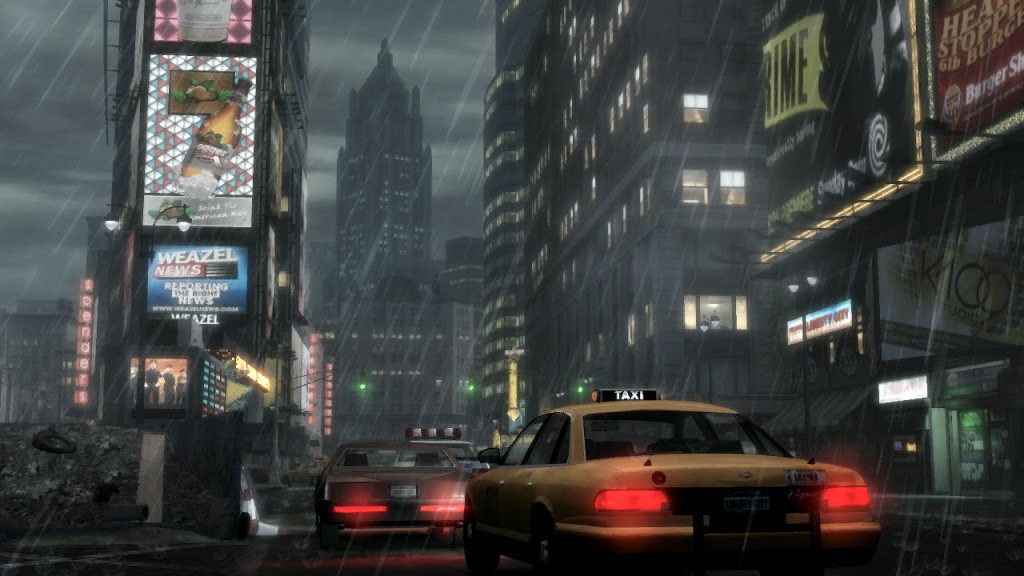
Above: Grand Theft Auto IV’s version of Times Square
Next Tuesday, the world stops for millions of Americans as they finally clutch copies of the hotly anticipated Grand Theft Auto IV. As in a few other incarnations of this bloody, aggressive adventure, the action takes place in Liberty City, an Earth-2 version of New York City. But forget the rampant crime and streetwalkers that will presumably be haunting every street corner; this one is supposedly the most lifelike New York yet. Manhattan has become Algonquin, Lady Liberty is renamed the Statue of Happiness. Four of the five boroughs are represented (sorry Staten Island). You can even visit Coney Island:
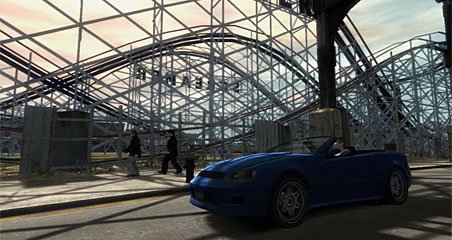
Here’s the complete list of comparisons between Liberty City and the real thing.
While I’m sure the designers of this game were too busy rolling up $100 bills and smoking them like cigars, hopefully they recognized their achievement in a long line of New York City themed video games.
It’s probably futile to do so, but here’s my partial history of New York City in video games. The difficult part is actually figuring out, in fact, if a game takes place in New York. For instance, Frogger could take place in New York, if the West Side Highway straddled a Hudson River full of logs and turtles. Pac-Man is certainly a metaphoric representation of the Financial District. If Donkey Kong is an homage to King Kong, wouldn’t that mean he’s throwing barrels from the Empire State Building?
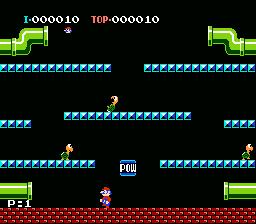
As far as I can tell, the first video game to be circumstantially set in New York City is the original Mario Brothers game from Nintendo. Not the Super edition, involving Mario and Luigi in an acid-trip world of fire flowers and dragons, but the regular arcade version.
The Mario Brothers are Brooklyn plumbers who clearly take their jobs seriously, scouring the sewers of the city for pesky critters transformed by an unexplained ooze. When the game debuted in 1983, the plump Mario was already a well known barrel hurdler who could wield a mean hammer in Donkey Kong. In that game, Mario was a carpenter (thus the hammer); apparently he decided to change careers after that death-defying adventure.
Their cartoonish and stereotypical Italian flavor was meant to evoke ‘working class Brooklyn men of immigrant descent’, certainly an odd choice for hero during the golden age of video games.
The game was only tepidly received and was soon overshadowed by the greater success of Super Mario Brothers, supplanting the Brooklynites into the ‘Mushroom Kingdom’.
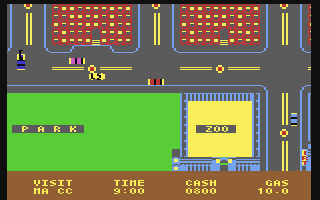
The next year, in 1984, anxious Atari and Commodore 64 owners got their hands on a more literal tribute to the city — The Big Apple. In the simple game, a player maneuvers through a traffic free midtown Manhattan, careening through sizable lanes to achieve such goals as going to the store or to the bank. Simple mazes greeted players within poorly animated bodegas. This game looks a bit like a malfunctioning digital watch and was appropriately forgotten. Take a look here to witness the wonder.
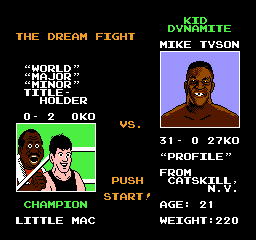
By the late 80s, New York City had yet to really break out as the star of a video game. 1984’s Punch Out!! presumably used Madison Square Garden as the location of its fights, and many combatants were from New York, like Brooklyn’s Kid Quick and 17 year old Little Mac from the Bronx (frequently pummeled by ear-nibbling Mike Tyson in his branded version of Punch Out!! in 1987).
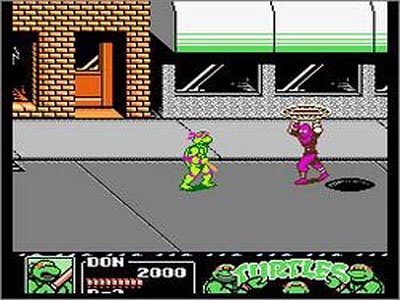
New York is a literal and metaphorical sewer throughout the 1980s. The 1989 Teenage Mutant Ninja Turtles features dramatic swordplay with the quartet through New York’s apparently endless chasms of empty sewers and warehouses. By 1992, in the game Teenage Mutant Ninja Turtles III: The Manhattan Project, the island of Manhattan is actually hoisted into the sky, and the Turtles must interrupt their vacation in Key West to save it.
Perhaps the only notable exception — the only game to really use New York’s actual geographical identity in service of a plot — might be 1986’s Amnesia . Like XIII (which I’ll mention later) the story involves the lead character awakening in New York with no memory; in Amnesia, the character fumbles through memory haze in midtown Manhattan. The game even came with a nifty map of Manhattan to guide your character through. Fun, right? The only drawback to Amnesia? Its an all text game. (More amusing screenshots here.)
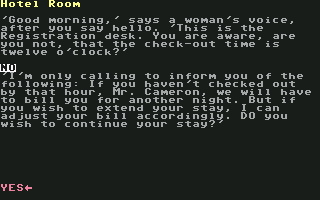
It was technologically impossible to set early video games in real places like New York City. Partially this had to do with the graphic complexity of presenting a big city with distinguishing features.
Backgrounds were little more than two-dimensional assortments of blips which moveable characters danced over. It wouldn’t be until the technological advances of the mid-90s that backgrounds could flesh out and breathe with the flow of animation — and a recognizable New York could emerge.
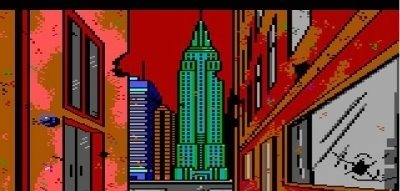
The first to make a real attempt at a identifiable and visual New York landscape was probably 1989’s Manhunter: New York, a clunky and mostly unexciting action game set in the post-apocalyptic future of 2002. However it did manage to depict city landmarks in ways that were at least recognizable, if primitive (see below):
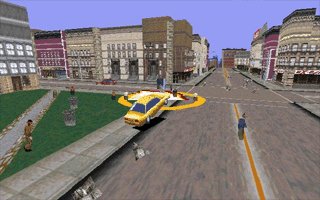
Games based on movies set in New York turn the city into a more realized, if still generic canvas for character adventure. For instance, the 1996 Die Hard Trilogy devotes its third half to a clumsy taxi simulation (below) with a computerized Bruce Willis.
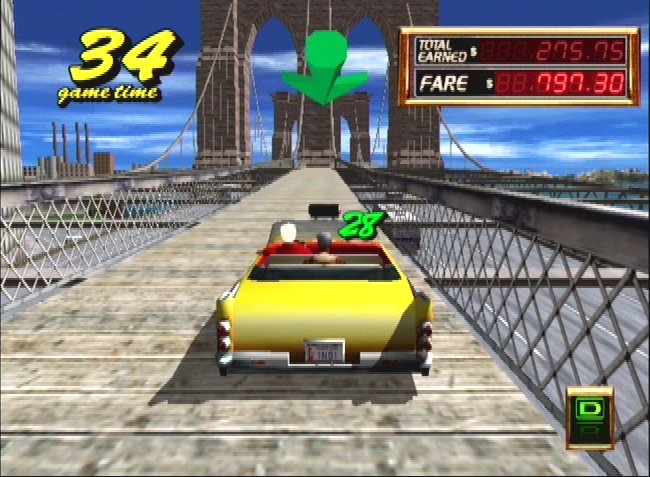
Despite the traffic congestion that most of us are familiar with, New York became a popular setting for driving games. The immensely popular 1989 Turbo Outrun begins in New York City and present a cross-country race across America. However, by 1998, the driving game Driver: You Are The Wheelman, a loosely modeled New York is entirely featured, including some character interaction in Grand Central Terminal. In 2001, a sequel to Crazy Taxi transported a player into the work-a-day life of a clearly frazzled cab driver with the ability to pick up multiple fares:
The shift to New York as a major video-game destination came in 1997, with the original Grand Theft Auto. New York in the GTA series plays the fictional Liberty City, but during the first incarnation, the city had little resemblence to reality and shared the stage with fictional representations of Miami (Vice City) and an amalgam of California cities under the name San Andreas. The geographical make-up of Liberty City would be fleshed out in subsequent GTA sequels.
More importantly, it would be the idea of gritty urban reality, throwbacks to New York City circa the 70s and 80s, with streets choked with guns and gangs, that would be the most influential nature of the series and inspire other game developers to create gaming adventures that used a host of different New Yorks, each more grim and unusual than the next.
Duke Nukem: Zero Hour from 1999 throws the titular ultra-masculine lead character into a New York taken over by time-tripping aliens. The dark techno role-playing adventure Deus Ex, first rolled out in 2000, begins with a Manhattan fifty years in the future, starting at Battery Park before embroiling the player in a shootout in Hell’s Kitchen, then escaping to Laguardia Airport.
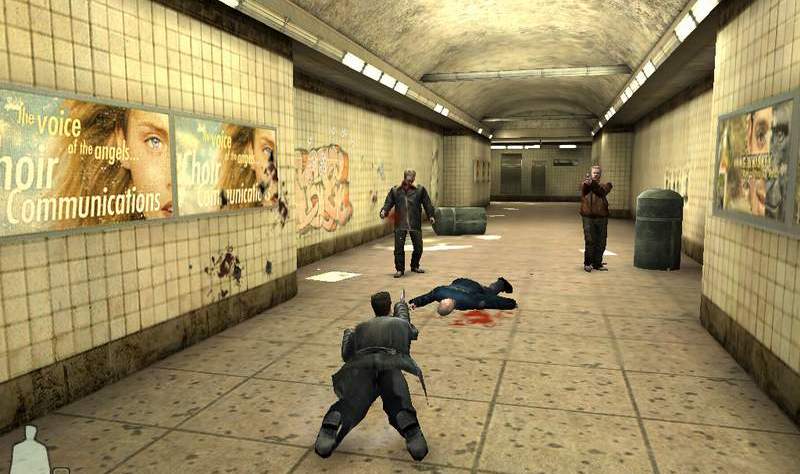
The successful 2001 series Max Payne (pictured above), often compared to the Matrix, often featured New York’s backalleys and underground elements, with one level “New York Minute” a breathless haul to beat the clock. My personal favorite, the beautiful XIII (Thirteen) from 2003, begins with the main character waking up on Brighton Beach with his memory erased.
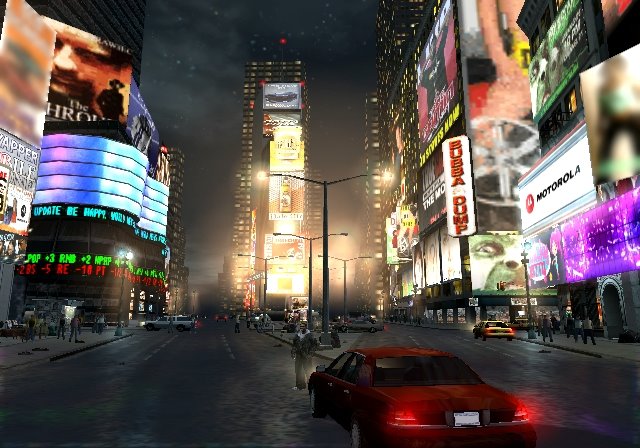
The tipping point came with True Crime: New York City, released in 2005 by Activision, the most serious attempt yet to create a rich cityscape in service of a gangster style plotline. As critically acclaimed for its visuals as it was denounced for its violence, True Crime gave players a run of fairly accurate Manhattan streets and subways. So accurate, you can even see the Naked Cowboy in daytime scenes of Times Square. Nighttime is below:
Video game film adaptations have followed suit with impressive displays of New York City in game versions of Spiderman, The Warriors and The Godfather.
My expectations are very high with Grand Theft Auto IV. I fully expect to be able to drive by a video-game version of my own apartment building and, given the game’s theme, either rob myself or beat up random people walking by.
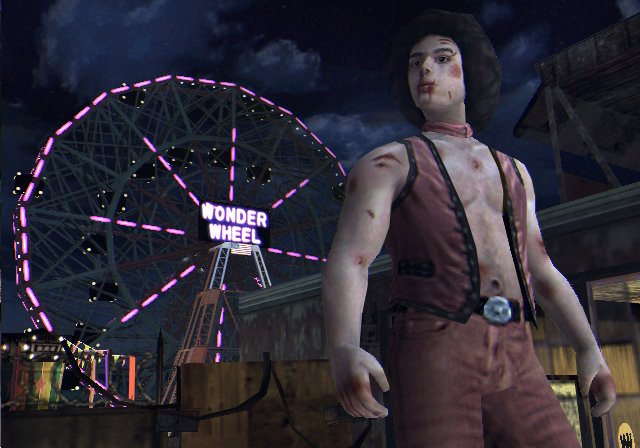
Below: Video game ‘Warriors’ come out and play on Coney Island
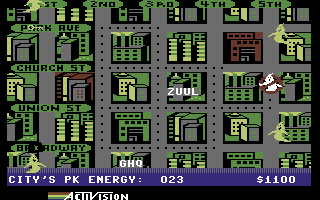
By the way, some commenters have added some notable New York games I couldn’t fit in, including the 80s Activision Ghostbusters game (as opposed to the new one), which I completely blanked on! It even had a cute but entirely inaccurate grid of downtown Manhattan!….