Categories
Those Were The Days

Before the flapper, the naughty ‘vamp’ scandalized New York


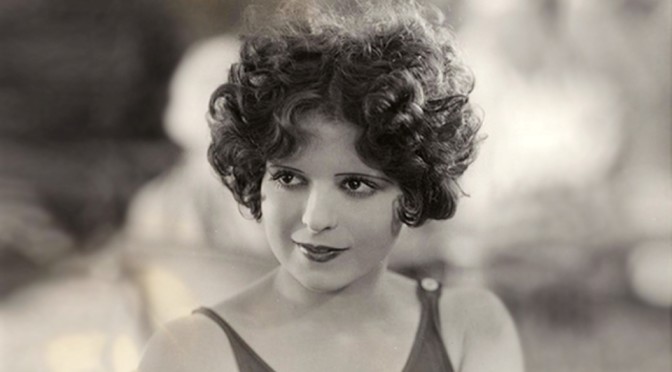
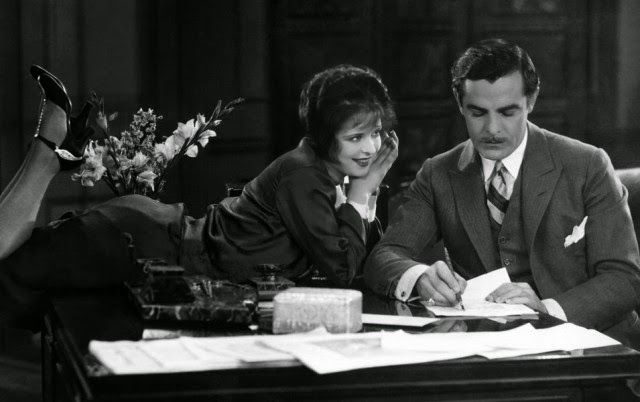
Above: Clara Bow, in It (1927), one of the roles that made her an major film star.

Two iconic actresses of the early silent film industry share a birthday today — Theda Bara (born July 29, 1885) and Clara Bow (born in Brooklyn, July 29, 1905).  Bow became the screen’s leading flapper archetype of the 1920s, but Bara’s exotic, controversial antics set the stage one decade earlier.  In honor of their birthdays, I’m re-running this article from last year about ‘the vamp’, a sort of proto-flapper popularized by Bara and the ladies of the Ziegfeld Follies, later to influence the changes in perceptions of women in the 1920s.
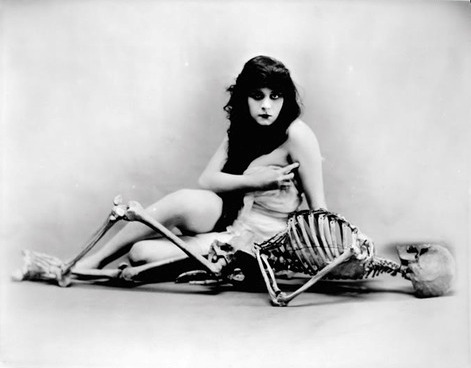
Maneater: Theda Bara in an unconventional portrait. Her publicist claimed it was her lover and that ‘not even the grave could separate them’.

“A vampire is a good woman with a bad reputation, or rather a good woman who has had possibilities and wasted them” — Florenz Ziegfeld

Progressive, liberated women were clearly so frightening one hundred years ago that equating them to undead, bloodthirsty creatures borne of Satan didn’t seem so unusual.

In the late 1910s, women were on the verge of winning the right for equal representation in the voting booth. Women were asserting power in unions, and, in the wake of disasters like the Triangle Factory Fire, those unions were influencing government policy. They were taking control of their destinies, their fortunes, even their sexuality (Margaret Sanger‘s first birth control clinic opened in 1916).

This surging independence came just as the entertainment industry heralded the female form as one of its primary attractions. Ziegfeld’s sassy, flesh-filled Follies — and its many imitators — defined the Broadway stage, mixing  music, sex and glamour with a morality-shattering frankness.

But it was the birth of motion pictures that gave the allure of female bodies an unearthly, flickering glow, as nickelodeon shorts became feature-length films, and the first era of the movie siren was born.

Combine the power of liberation with the erotic potential of cinema, and in the late 1910s, you got the vampire (or as we would come to know, the ‘vamp’).
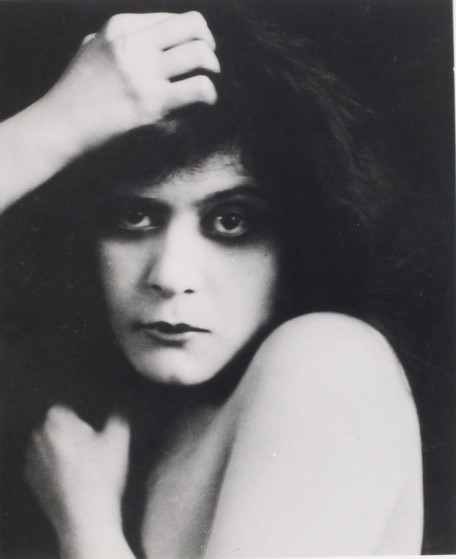
The queen of the vamps was one of America’s most mysterious movie stars — Theda Bara (at left). The magnetic actress, with her steely gaze and jetblack hair, was the prototype for a movie bad girl. She shook convention so dramatically that a critic called her a “flaming comet of the cinema firmament.”

From 1915-1919, she made over three dozen films, most in movie studios located in Fort Lee, New Jersey. It were here that she acquired her famous nickname, based upon her role as a home wrecker in a film inspired by Rudyard Kipling’s ‘The Vampire’. During this period, Bara lived in Manhattan’s Gramercy Park with her family — at 132 E. 19th Street.

She put a face to a new sort of young lady. These were the spiritual children of the prior generation of newly empowered women who fought against the constraints of Victorian society. A few years later, as another vein of female power (the temperance movement) helped bring about Prohibition, these young women would be called flappers, carefree and fueled on the powers of jazz and illegal alcohol.

But to the established class, these ladies weren’t trend-setters. They were devils in black gowns. ‘Know a ‘Vampire’ by the Card She Plays‘, warned a New York Evening World article from March 1919, accompanied by a Theda Bara-like illustration of a snake-like monster.

The article recounts the efforts of a Newark judge attempting the rid the streets of “flirty girlies,” as he called them. “A vampire is a woman who flirts on the street with men, bleaches her hair, camouflages her face, disguises herself with clothes and gives wrong names, but is unable to change her eyes or dimples.” The article laughs off his puny efforts. “Can vamps, of whatever sort, BE suppressed?”
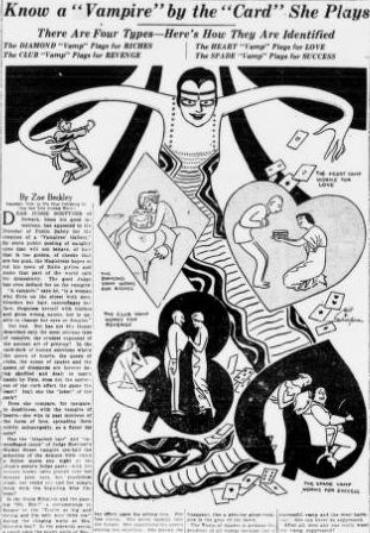
Vampires were of course more readily seen in Times Square, dancers, actresses or cabaret stars. But even your stenographer could be one!, warned one article.

Unlike Bara’s iconic identity as a raven-locked seductress, most ‘real’ vampires were blondes. “[T]he vampire of real life hath the golden hair of an angel, which is never disarranged, same when she letteth it down, to DISPLAY it, on the beach,” warned columnist Helen Rowland, with a little tongue in cheek. (Ms. Rowland was famous for her writings as a ‘bachelor girl’.)

“No one ever saw a vampire in a high neck dress,” said an Evening World advice columnist in 1918. “All vampires must reveal their collar-bones and the contiguous territory.”

The woman vampire was an urban creature, up all night, sleeping all the day. The city was partial cause for her condition. As the New York Times suggested in 1920, “The idea of New York as a vampire to the rest of the country is one which a number of persons have entertained and expressed. To some of them the vampire is Wall Street, to others it is the region of white lights [Broadway].”

Many actress got stuck with the term ‘vamp’ or ‘baby vampire’ — or else, embraced the coy terminology. Juliette Day was a known ‘baby vampire’ for her role in the scandalous 1916 play ‘Upstairs and Down’. It’s no surprise that in the film version from 1919, the role is reprised by the notorious Olive Thomas, a Ziegfeld girl who met a bitter end the following year.

Some actress fought against the alleged stigma. Actress Clara Joel, playing a vampire-type role in a 1918 film, made it known in the Tribune that “she is not a vampire and that she was born in Jersey City.”

The irony of stage actresses trying to shed a vampire image is that Theda Bara, the original vampire, in her first stage attempt in 1920, flopped. The play was supernatural-themed ‘The Blue Flame‘ which opened at the Shubert Theater to cavalcades of unintentional laughter.(A ‘terrible thing’, according to the Times critic.) Bara, who had to deliver such lines as “Did you remember to bring the cocaine?” was roundly trashed.

Shortly thereafter, the vampire moved to Los Angeles. Her film career lasted a few more years, but sound pictures and a strict Hollywood production code pretty much eradicated the existence of vamps on the screen. In New York, meanwhile, her sultry spawn morphed into flappers, populating the speakeasies and cabaret nightclubs of the city.

Below: A 1919 romp called ‘The Vamp’ performed by the Waldorf-Astoria Orchestra
Categories
Health and Living

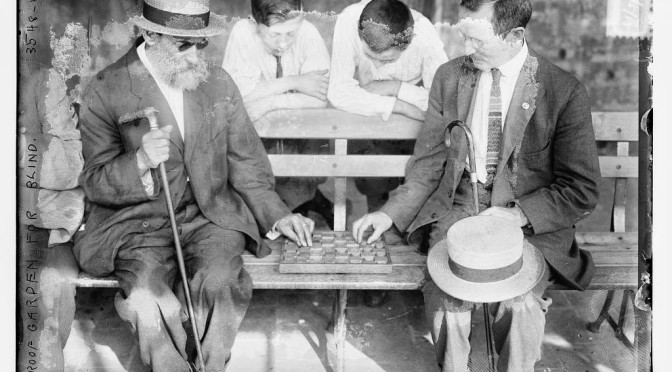
Above Delancey and Allen Streets: a roof garden for the blind and its unfortunate connection to the 1929 stock market crash

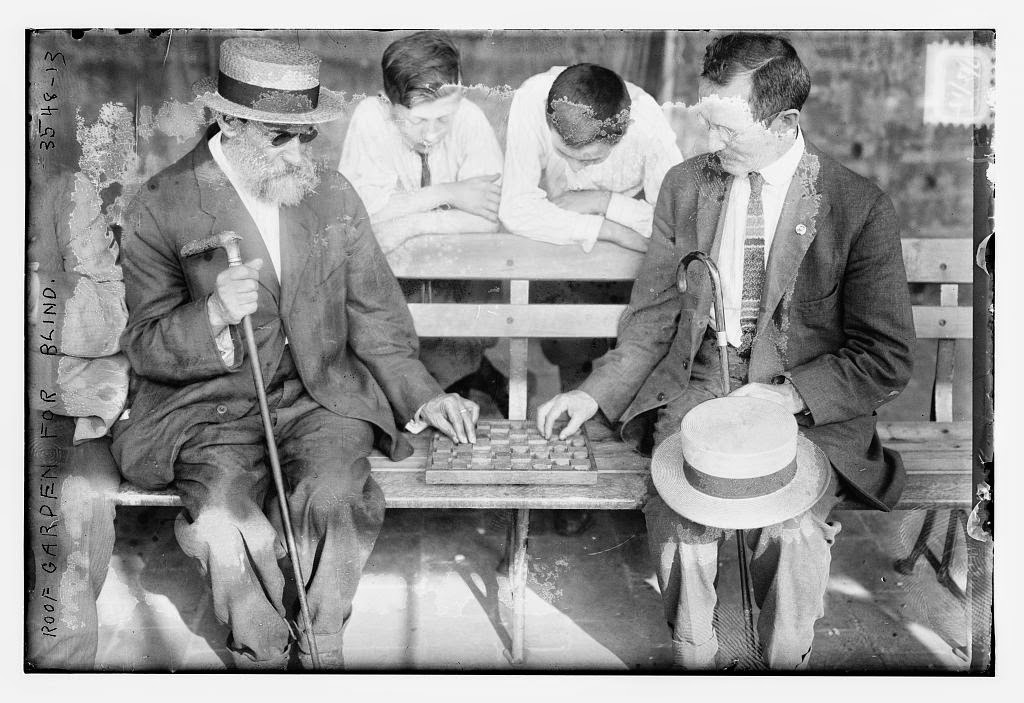
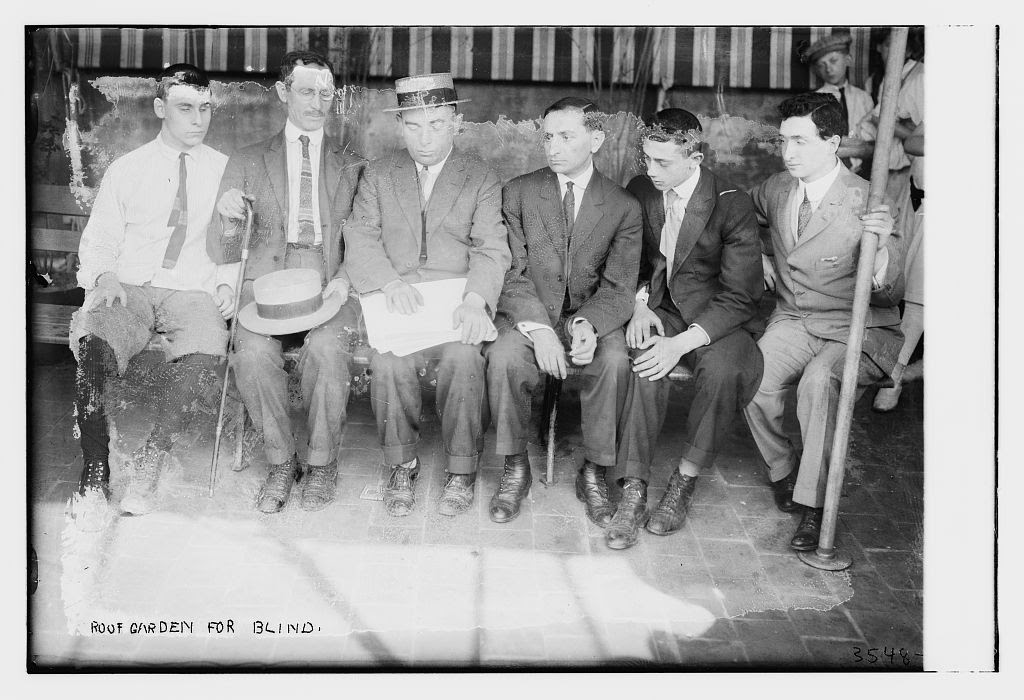
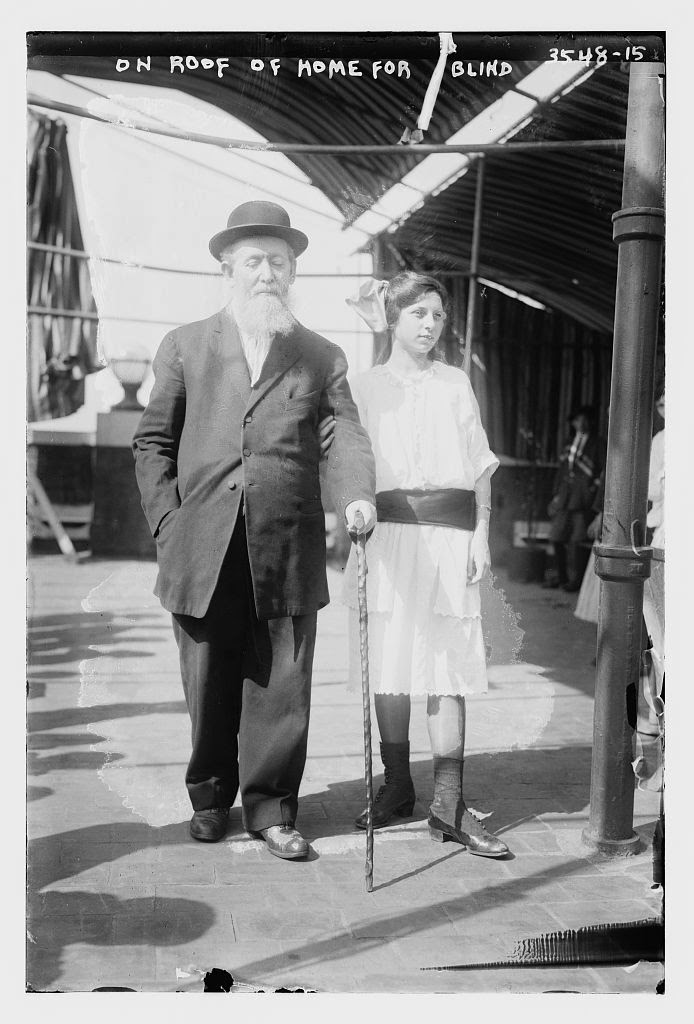
Above (and in the photographs below): Young and old alike enjoy the roof garden atop the Bank of the United States building, on the corner of Delancey and Allen

Next to the Tenement Museum in the Lower East Side on Delancey Street stands an elegant grey building incorporating regal Doric columns on its face. Echoing its facade is the restaurant and lounge on its ground floor — the Grey Lady.   It was constructed over one hundred years ago for the Bank of United States, a commercial bank that did not survive the Great Depression.

The bank, a venture by Jewish financier Joseph S. Marcus, had an attention grabbing name, sounding like a branch of the federal government.*  But it was the unusual feature on the top of the building that summoned the most attention at first — a rooftop garden for the blind.

While services for blind people in New York greatly improved with the social changes of the late 19th century, most facilities were in small rooms in overcrowded neighborhoods.  With the 20th century came the concept of “open air” schools and libraries for the prevention of diseases.

From the 1919 book called the Education of the Blind:  “Whatever may be said of sports and games for the blind, the “open air” principle must be strongly emphasized;  if the ever present germs of cold and of the dread tuberculosis are to be conquered, there cannot be too much cheerfully undertaken exercise in the open, where the health-giving sunshine and fresh air can exercise their curative powers the best.”

Marcus followed the examples of many Jewish philanthropists is reaching out to the communities of tenements around his bank.  His lofty Bank of the United States building opened at the corner of Delancey and Allen Streets in 1914, and, believing that the freshest air in the city could be obtained atop buildings, he topped it with a rooftop garden, devoted only to the needs of the blind.

It initially opened with “flower beds and settees under the awning [several] stories above the street, where it is always cool.”  The following year, the New York Times reported “[t]he roof is floored with tile and surrounded with a high wall so that the blind may move about in safety.”

“This is said to be the only place on the Lower East Side where the blind can be sure of safety from pickpockets.” [source]

Blind residents of the Lower East Side were brought to the roof garden with the help of “light bringers,” a group of 150 child volunteers from the local public schools.

The roof garden was operated by the Hebrew Association for the Blind, who had offices in the bank building.  The garden featured entertainment by local school choirs and lectures by “well known men.”

It’s the entertainment and leisure activities of Marcus’ roof garden that distinguished it from other rooftop gymnasiums which also offered outreach to blind New Yorkers.

An open-air gym at the Lighthouse for the Blind at 111 East 59th Street provided a rooftop running and roller-skating track while such services as cooking classes, swimming pools and a bowling alley were offered in the rooms below.

“Health for the blind through recreation in the open air,” was the motto of this institution. [source]  Lighthouse International is still at that location today.

I’m not sure when the Delancey Street roof garden closed — more beneficial services for the blind emerged by the 1920s — but thankfully it wasn’t there on December 10, 1930, when a Bronx branch of the Bank of United States saw the first of many bank runs in the aftermath of the Stock Market Crash of 1929.

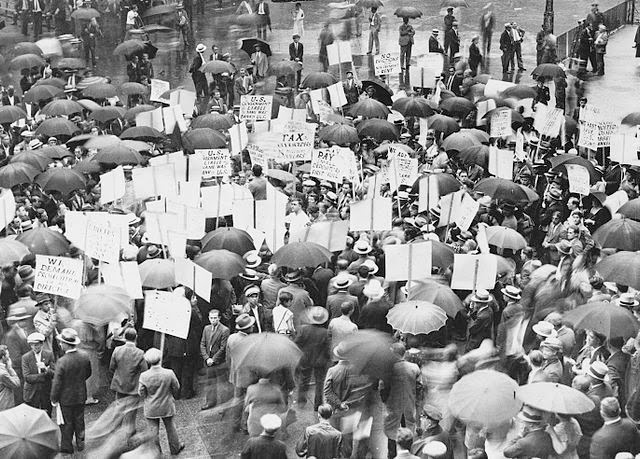
The following day, at the Delancey Street bank, “a line of 300 persons extended around the corner into Allen Street,” looking to withdrawal their money.  Judging from the photograph below (showing the mob at Delancey and Allen Streets on that very day), it appears that more than 300 people showed up!  That was the last day of business at the Bank of the United States. [Read its 1930 post-mortem here.]

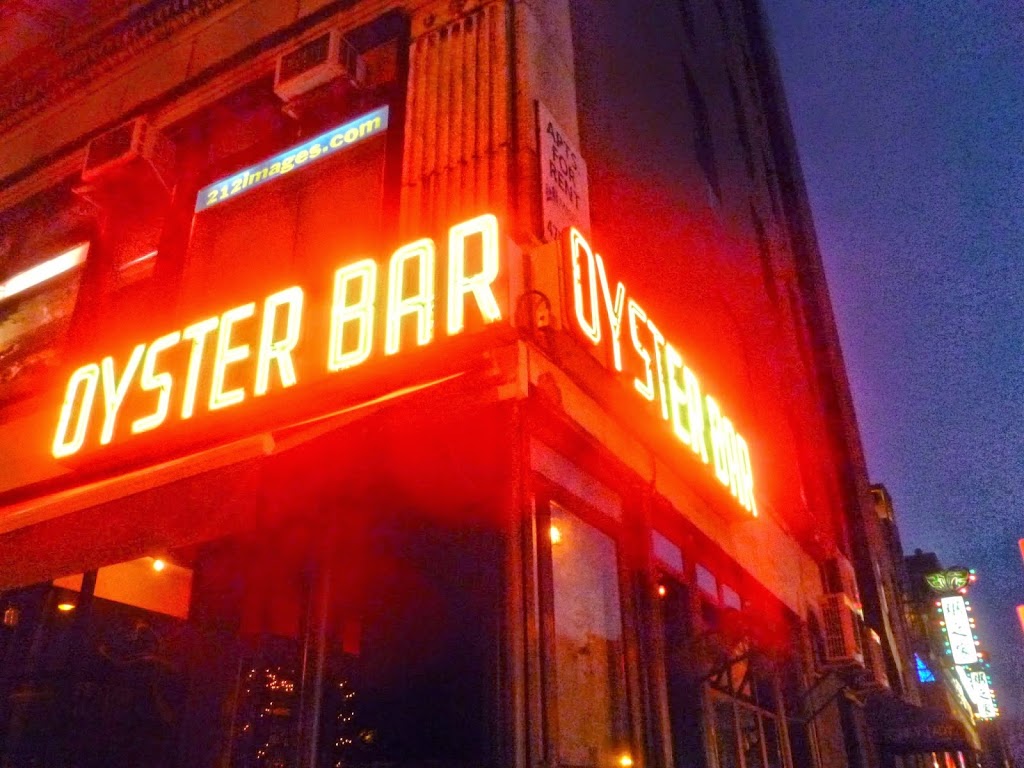
The building recently made the news — and made the day of nostalgists — when the proprietors of the Grey Lady installed the Famous Oyster Bar neon sign above their establishment, another sort of light bringer to this building’s unique history.

Picture courtesy Jeremiah’s Vanishing New York

* By the way, that lofty bank name was controversial back when it was chartered in June 1913. According to the New York Times, “The Bank of United States was chartered yesterday. This does not mean that the new national banking and currency system has gone into effect, and that the great United States is back of this institution, although interests which, it developed yesterday, have been making a hard fight against the use of that name say the ignorant immigrants of the east side are likely to think it does.”

Categories
Planes Trains and Automobiles

History in the making 2/18: Pennsylvania Station edition

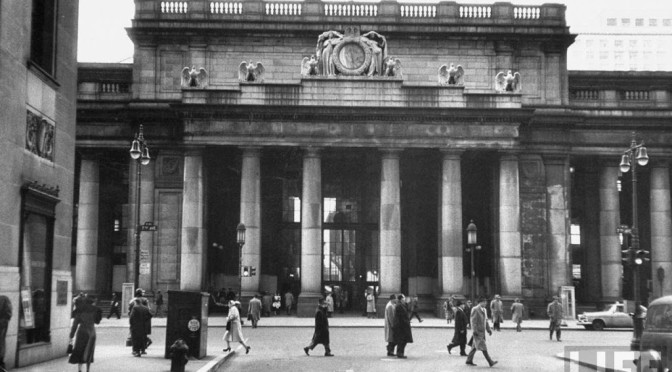
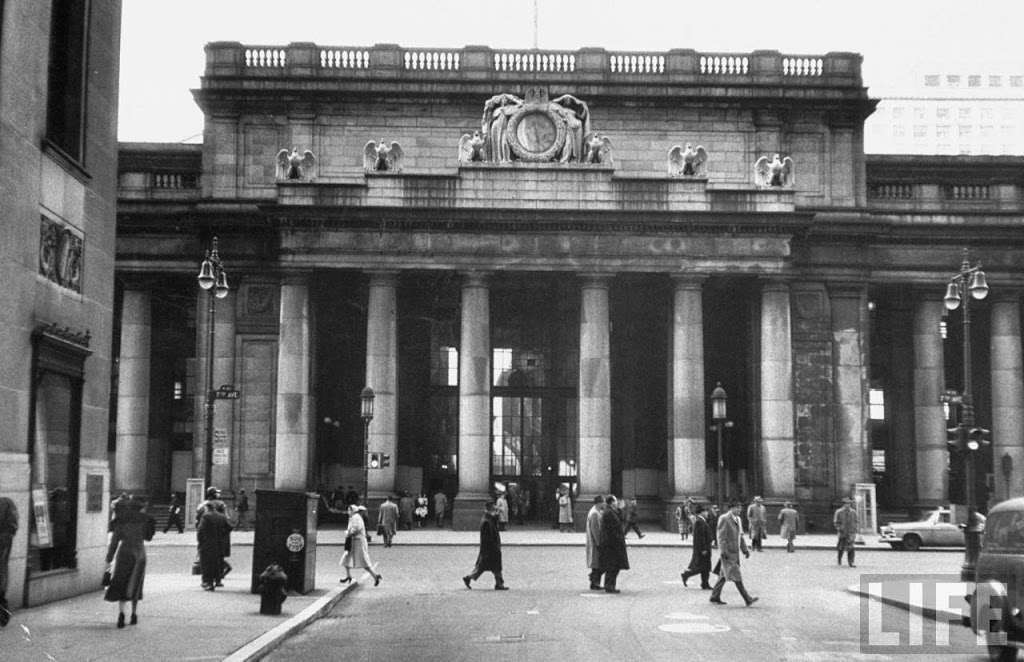
Aging beauty: The entrance of Penn Station, photographed by James Burke in 1957 for Life Magazine.

— Tonight on PBS’s American Experience: The Rise and Fall of Penn Station, the story of McKim, Mead and White’s Midtown masterpiece and how its tragic demolition in the 1960s forced New Yorkers to consider the importance of historic preservation.  [American Experience]

Barry Popik brings up an interesting anniversary — John J Fitz Gerald’s newspaper column “Around the Big Apple” began 90 years ago this week.  Fitz Gerald helped popularize New York’s nickname ‘the Big Apple’.  Read more at Popik’s excellent and exhaustive site of urban etymology: [Barry Popik]

— The secret at 58 Joralemon Street:  The Brooklyn Heights tunnel disaster that forever changed how the city handled destructive construction work.  [Brownstoner]

Ghost signage: The remnants of former businesses are all around us, their old signs living long past the establishments themselves.  Photographer Gary Fonville has found some beautiful examples all through the five boroughs, some of which you’ve probably walked by a thousands times without noticing! [Forgotten New York]

East Village monsters: What are those things guarding this home on St. Marks Place? [Ephemeral New York]

The Velvet Caps, the Scalpeens and the Jackson Hollow Gang: A fascinating rundown of the oddly named ruffians that ruled the streets of Brooklyn, most in the years before Consolidation. [artofneed]

Categories
Pop Culture Uncategorized

Pete Seeger 1919-2014

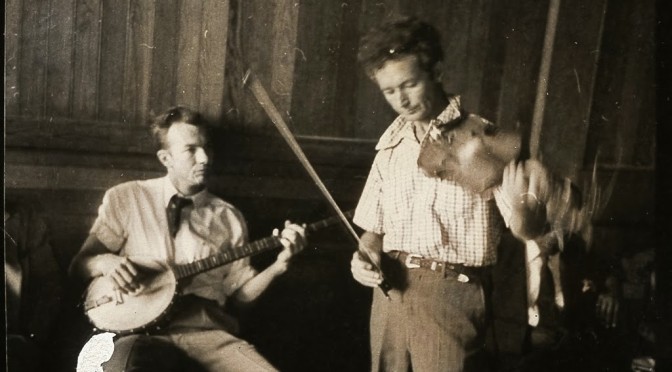
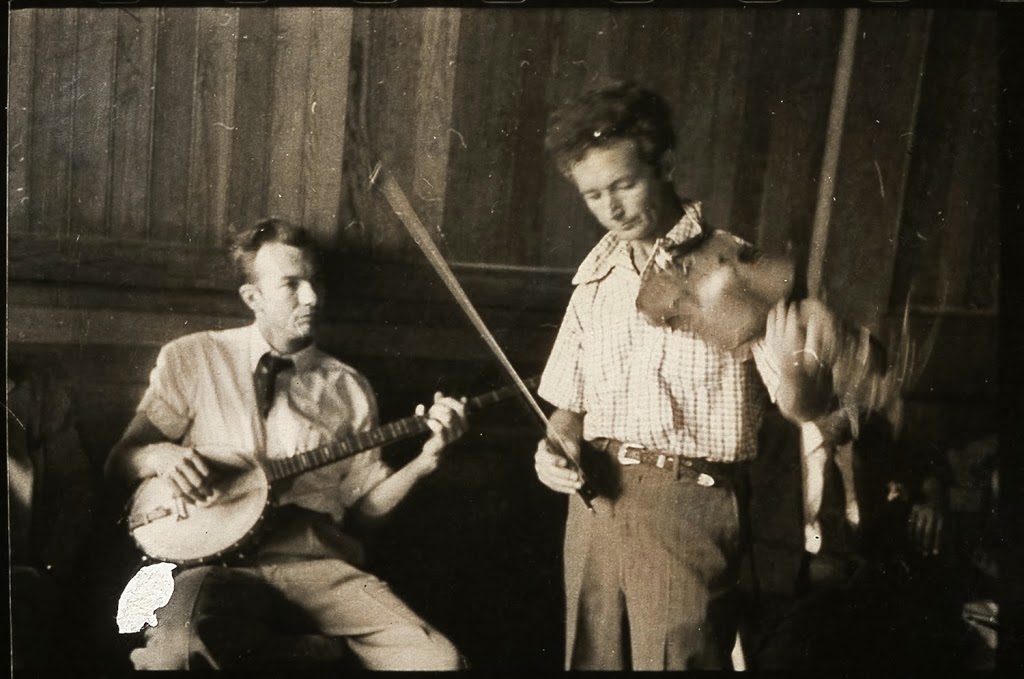
 Pete Seeger with Woody Guthrie, performing at the Music Inn in Lenox, Massachusetts, 1950 (Photo courtesy NPR)

 “I have sung in hobo jungles, and I have sung for the Rockefellers, and I am proud that I have never refused to sing for anybody.” — Pete Seeger

Pete Seeger with the Weavers — Washington Square Blues


Pete Seeger had a television variety show in the 1960s called Rainbow Quest, filmed from studios in Newark, New Jersey.  Interestingly, the shows were broadcast on WNJU, better known as a Spanish-language station and today the flagship for Telemundo!

Luckily, many of these programs are available to watch on YouTube. Here’s a clip of Seeger with BJ Reagon (from Sweet Honey In the Rock) and Jean Ritchie (aka ‘the mother of folk):

In 1974, he recorded the first album for Sesame Street to feature new material not featured on the show. Here, he duets with Oscar the Grouch about, of course, ‘Garbage’:

Categories
Christmas Neighborhoods Uncategorized

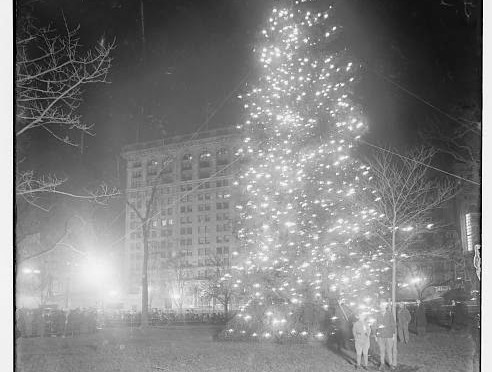
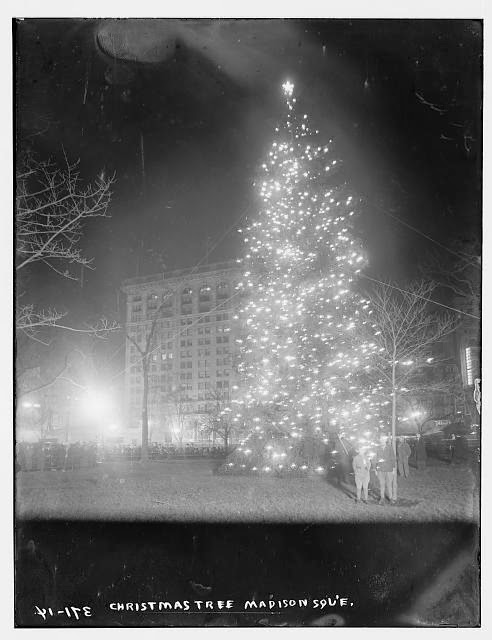
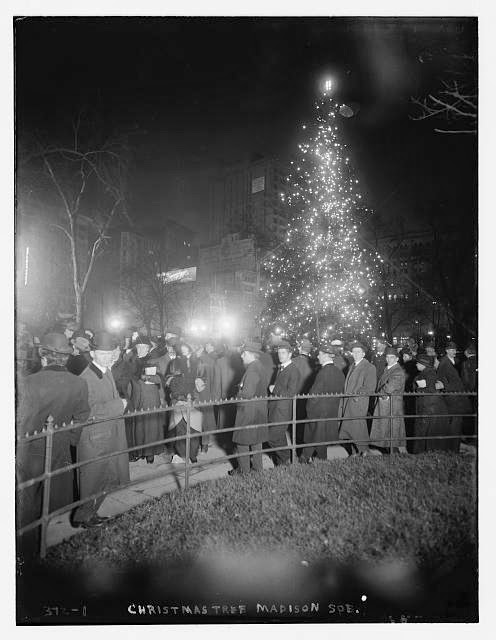
The lights of Madison Square: A Christmas tree at night

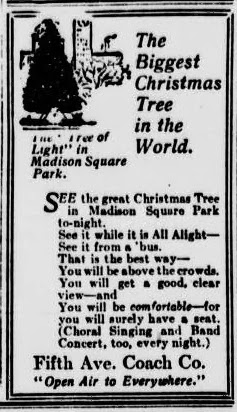
I’m not sure if the Madison Square annual Christmas tree was really the biggest in the entire world — as the 1913 Evening World at right suggests — but it was most certainly the largest in New York City. Its closest competitor in size would have been the City Hall Christmas tree.

This unique tradition in Madison Square began just the year before, in 1912, and is often considered to be the first community Christmas tree in America.

From my 2010 article: “This ‘Tree of Light’, mounted in cement, was such a novelty that almost 25,000 people showed up that night to witness it and enjoy an evening-long slate of choral entertainment.”  [Read more about its history here.]

I’ve seen a few photographs of the Madison Square Christmas ceremony from this period, but rarely any at night.  I’m not sure whether the pictures at top and at bottom are from 1913, but they’re definitely from the early 1910s.

We’re so used to novelty lighting features now that it’s difficult to imagine the extraordinary effect of a single tree draped in electric illumination.

From the ad by the Fifth Avenue Coach Company:
“See the great Christmas Tree in Madison Square Park to-night.
See it while it is All Alight —
See it from a ‘bus
That is the best way —
You will be above the crowds.
You will get a good, clear view — and
You will be comfortable — for you will sure have a seat.”
(Choral Singing and Band Concert, too every night”

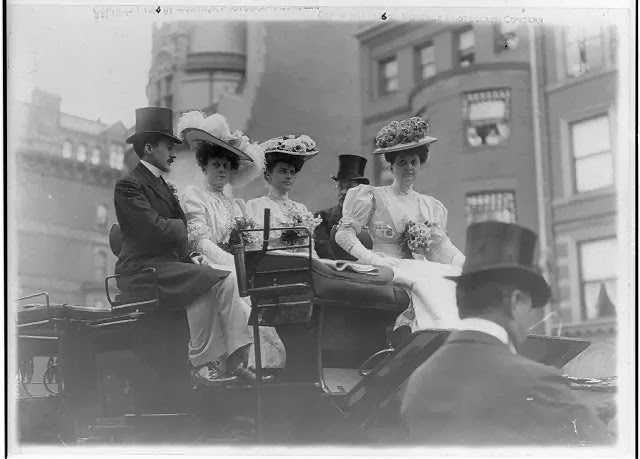
Here’s one view of a grand Fifth Avenue Coach omnibus of the type advertised (pictured here in 1906) that you might have been riding that particular evening.  I can’t imagine this was the most enjoyable ride on a chilly December evening, especially passed the famously windy Flatiron Building:

Pics courtesy the Library of Congress


Categories
Pop Culture

Inside ‘Inside Llewyn Davis’, a gauzy, surreal homage to 1960s New York bohemian life


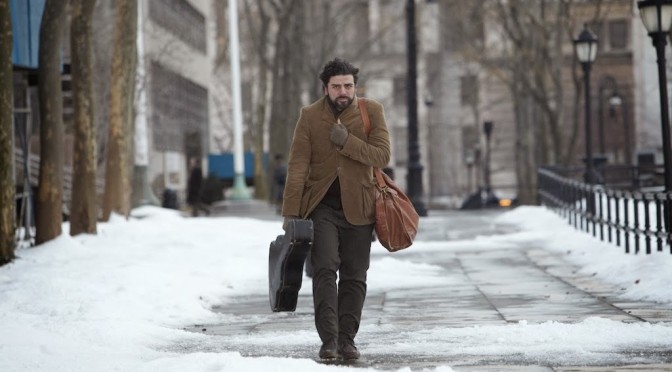
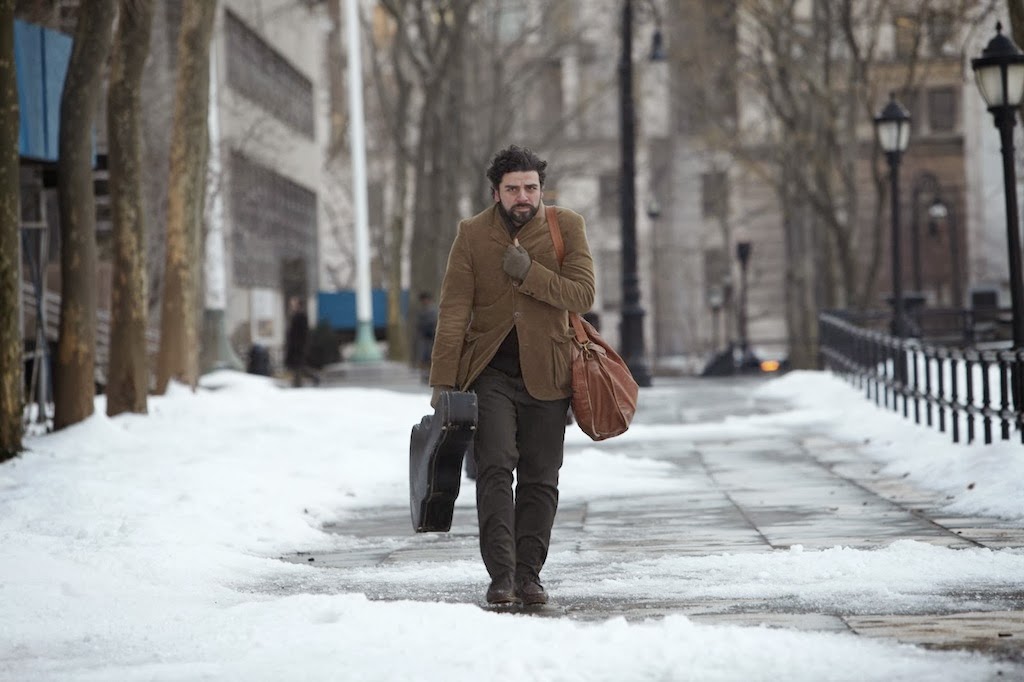
Out in the cold: Llewyn Davis gets no respect. Pic courtesy CBS Films

NOTE: This article contains minor spoilers for the film Inside Llewyn Davis, so proceed with caution if you have not yet seen the movie!

The latest movie by Joel and Ethan Coen, Inside Llewyn Davis, meanders through a coolly tinted rendition of New York in 1961, depicted as a chilly and even mystical place and time.  Davis (the brilliant Oscar Isaac), our scruffy hero, is introduced in a beautiful musical number down at a basement basket house in Greenwich Village. Certainly this singer is about to be discovered? Or perhaps he’s already a star? Quite the opposite, in fact.

Inside Llewyn Davis is a trademark Coen brothers movie, rarely straight-forward in narrative, with a bounty of great songs allowed to linger and finish.  As in O Brother Where Art Thou, there’s a mythical road trip with kooky characters, but the movie eventually returns to New York.  You’ll be happy to know that the second most important character in the film is probably a cat.

The movie doesn’t need to be so historically detailed — it feels mostly like a dream — but thankfully the production design takes its cues from places that actually existed.  Here’s a few significant historical New York details that I noted from a first pass at the movie this weekend.  I certainly might have missed something while scribbling notes in the movie theater, so please don’t hesitate to leave a comment if you have a correction!

Breakfast at Tiffany’s — The film, set in 1961, makes a clever nod to a movie that was actually released that year, Breakfast At Tiffany’s.  In both movies, an unusually named orange cat retreats down a fire escape, leading to a frantic search through the streets of New York.  In Breakfast, the apartment is in the Upper East Side; in Llewyn Davis, the Upper West.

The current film, however, seems to reflect the more melancholy ending of Capote’s original novella, not the bright-and-happy ending of the Breakfast film.  I imagine that the Coen brothers’ screenplay might have been inspired by this line:  “It took weeks of after-work roaming through those Spanish Harlem streets, and there were many false alarms — flashes of tiger-striped fur that, upon inspection, were not him.  But one day, one cold sun-shiny Sunday winter afternoon, it was.”


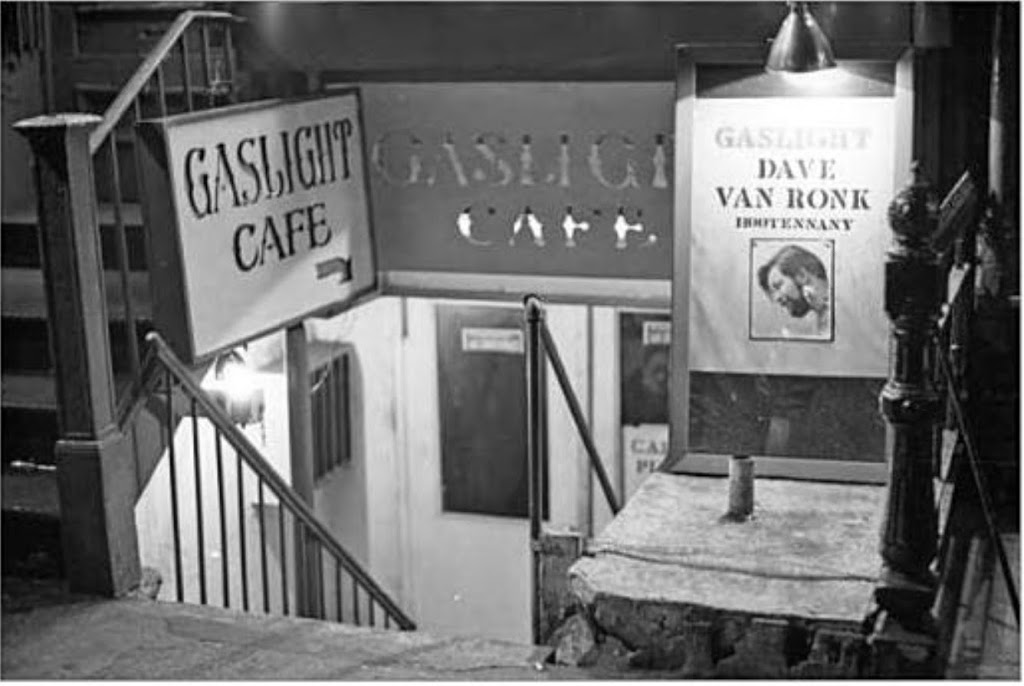
The Gaslight Cafe — One of New York’s greatest (and smallest) venues for folk music in the 1960s, the Gaslight was located at 116 MacDougal Street.  Today its the low-key bar 116. (Hey, would you prefer it be a Chiplotle?)  Along with Cafe Wha? and the Village Gate, the Gaslight provided stages for Greenwich Village’s burgeoning folk music scene.

A pivotal scene near the end did not actually take place at the Gaslight, but instead over at another seminal music venue, Gerde’s Folk City.

Dave Van Ronk — The character of Llewyn Davis is loosely based (depends on your definition of loosely, I guess) on this regular of the Village folk scene, one who never broke through in the same way as his peers.  Like Davis, Van Ronk grew up in Queens, but in Richmond Hill, not Woodside, as the film depicts for Davis.

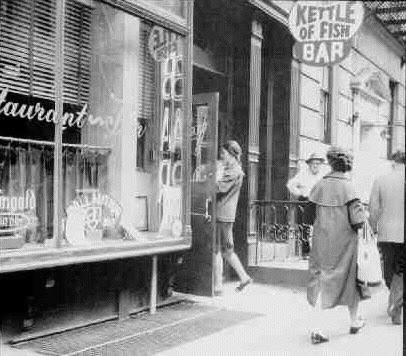
Kettle of Fish — Also seen along the streets next to the Gaslight is the tavern Kettle of Fish, back when it was on MacDougal Street.  Today, Kettle of Fish is located on Christopher Street, on the site of the old Lion’s Head bar, a writer’s hangout and favorite of Norman Mailer‘s back in the day.

At right: The original Kettle of Fish in the 1950s. Photo courtesy Ephemeral New York

Both the Lion’s Head and Dave Van Ronk are featured players in a bit of Christopher Street history — namely, the Stonewall Riots.  Van Ronk was celebrating his birthday at the Lion’s Head in the early morning of June 28, 1969, when the police came to shut down the mob-operated gay bar, located nearby.  Van Ronk got involved in the riot himself, allegedly throwing coins at the police.  The singer was then beaten by police and dragged into the Stonewall bar.

Caffe Reggio — This dark and weathered old cafe across the street from the Gaslight is a Village treasure, opening in 1927 during the days when its neighbors were speakeasies.  It’s one of the few places depicted in Llewyn Davis that’s not only still open today, but pretty much in the same condition, at least judging from the last time I had a cappuccino here.  According to Mitch Broder, “Reggio is the mythic Village hangout that’s not a myth:  It would like like it did eighty years ago if it weren’t for the customers.”

And Calvin Trillin, in a New Yorker article in 1963, described Reggio as a place “whose ornate espresso machine and quiet interior seemed to belong to some other neighborhood.”

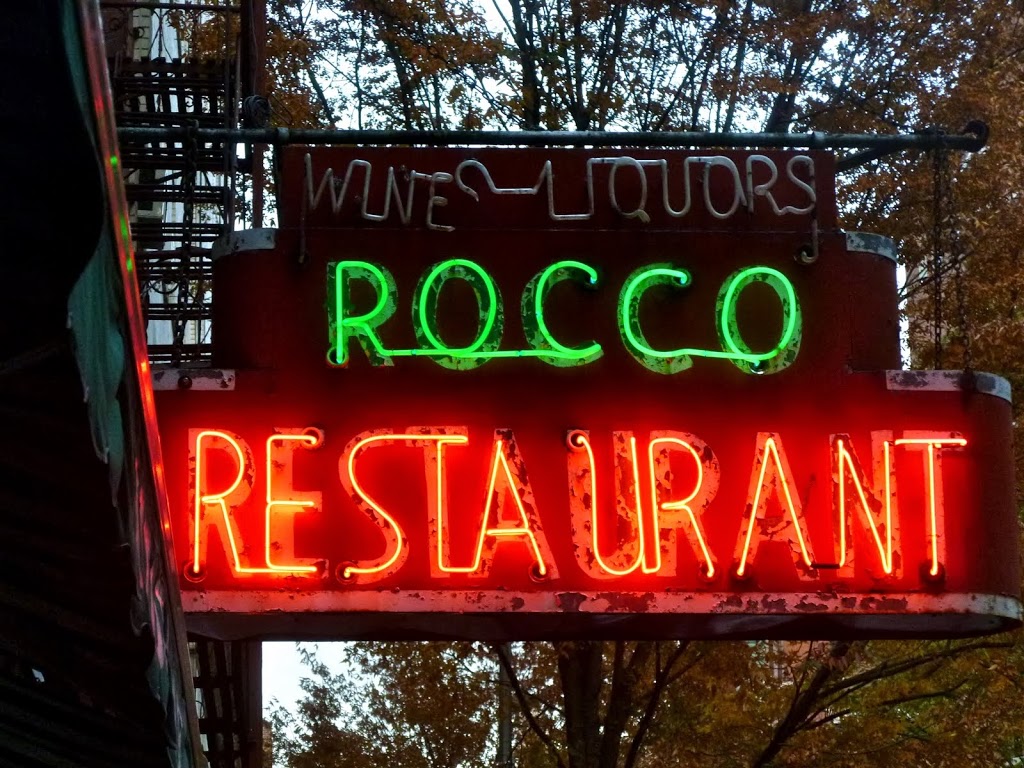
Rocco Ristorante — This grizzled old eatery, dating from 1922, was located at 181 Thompson Street, its fantastic old neon sign still a treasured mark of the Village.  It closed in 2011, but recently reopened as a restaurant again as Carbone. (Picture of sign courtesy Jeremiah’s New York)

Washington Square Park — It wouldn’t be a folk movie without a scene here, the heart of the 1960s music scene.  However, in 1961, it might have been a rather tense time in the park, and not welcoming to folk musicians at all.   When the park association closed the park to “roving troubadours,” the musicians fought back.  On April 9, 1961, thousands of artists and their supporters flooded the park, an outpouring that became derisively known as the Beatnik Riot.  (You can hear more about the riot and the history of Washington Square Park in my walking tour on the subject.)

Columbia Records — The label which would later sign Bob Dylan is featured briefly in the film.  In 1961, their big star would have been Andy Williams, a far cry from the sounds of coffee-shop culture.  Columbia’s well-known offices in the CBS Building, designed by Eero Saarinen and nicknamed Black Rock, would not have been completed yet, so this scene would have been in Columbia’s old offices at 485 Madison Avenue.

George Washington Bridge — This is the location of a off-screen suicide and a subsequent off-color joke about the rarity of such suicides at this location.  As we know from modern news events, however, the GWB is actually a frequent site for suicide attempts.  Two years ago, a staggering 43 people reportedly tried killing themselves from this spot.  And I can’t help but think of another great movie musical (Saturday Night Fever) which also features a tragedy off another large New York bridge.

New York Subway — For a film planted in the Village, there’s a lot of travelling around on the subway — to the Upper West Side, to downtown Varick Street, even Queens.  According to the 1959 subway map, Davis rides the IRT’s Flushing line to Woodside/61st and the Broadway local line to Varick.

Fred Harvey — The most unusual scene in the movie takes place at the Fred Harvey roadside restaurant inside the Illinois Tollway oasis in northern Illinois.  It’s here that I want to plug one of my favorite podcasts, the American history show Backstory, as just last week they featured a story on Fred Harvey and his ubiquitous chain of restaurants.  You should check out their show ‘Three Squares’, on the history of mealtime in America, where they discuss Harvey’s innovations as perhaps America’s first chain-restaurant mogul.

Categories
Friday Night Fever

Remnants of the Bull’s Head Tavern: Could this be the greatest New York archaeological find of the year?

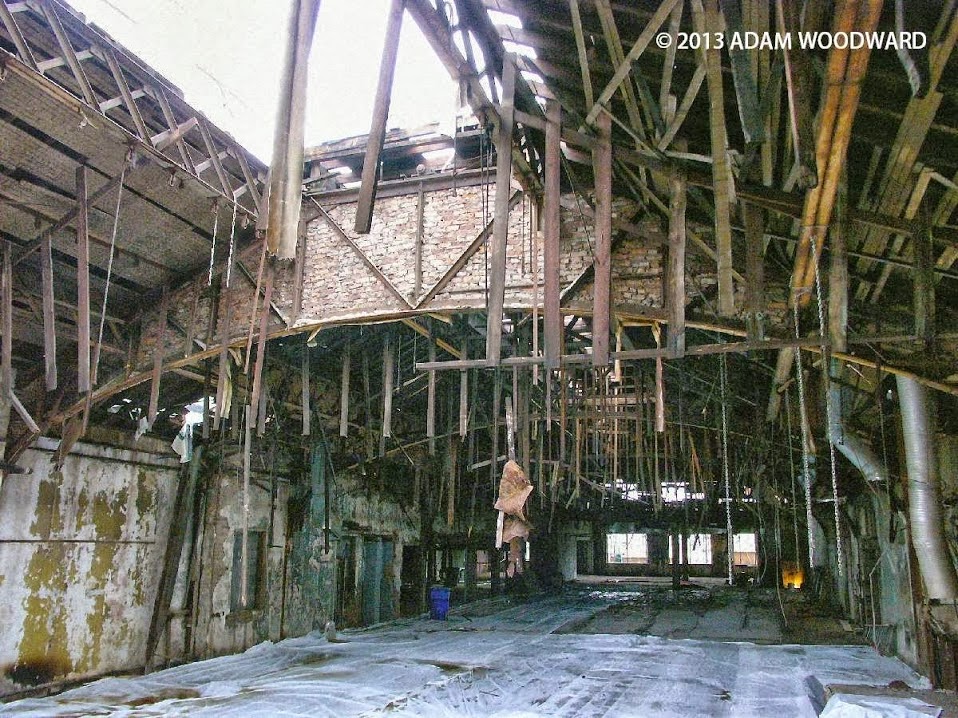
The former Atlantic Gardens, revealed during a demolition. Underneath it lies evidence of an even greater historical discovery. Courtesy Adam Woodward/Lower East Side History Project

Big news on the urban archaeological front — remnants of the Colonial-era Bulls Head Tavern may have been discovered during an excavation for a new hotel.  The Bull’s Head was itself built over in the late 19th century for the grand Atlantic Gardens beer hall (mentioned in our Beer History podcast). then enjoyed a rather non-descript past century at 50-52 Bowery in various guises, most recently a drug store and restaurant.
Check out the story here (Unearthed: A Possible Stop Along the Revolution) and follow The Lo Down for all the latest developments in the coming days.  And take a few minutes to marvel at preservationist Adam Woodward’s photographs of the site here.  It might not look like much, but verification of its identity would prove to be a pretty big deal for lovers of American history.

Below, I’m re-posting my article from 2009 on the history of the Bull’s Head Tavern.
__________________


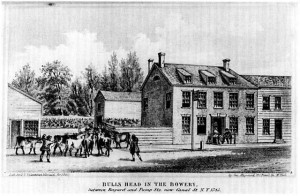
The Bull’s Head Tavern was the gathering-place for farmers, drovers, and merchants in the 18th century, located well outside city boundaries just east of Collect Pond. (At the Bowery, right at the entrance to the Manhattan Bridge.)

It soon became the center of Manhattan’s entire meat selling and rendering industry, with the area surrounding the nearby Collect overrun with tanneries and slaughterhouses.  As the Bull’s Head was also located right on the Boston Post Road (later the Bowery), situated at a crossroads of livestock yards and stables, it became an ideal place for both commerce and carousing.

The Bull’s Head was in operation as early as 1755, enjoying business as “the last halting-place for the stages before entering the city.”

Within the next few decades, industry enveloped the area, transforming the Bull’s Head into a cattle market, with pens adjoining the main building where farmers from the surrounding area herded their best specimens for sale.  Inside the tavern became a literal stock market, with transactions, news and gossip being shared over brew and a hot meal in “smoky, low-ceilinged rooms.

Those who lingered well into the night sometimes played a strange game called crack loo — often gambling away any profits they might have made earlier in the day. Out in the pen, dog fights and “bear baiting” sometimes occured as entertainment.

As Washington Irving describes, at the Bull’s Head he would “hear tales of travelers, watch the coaches and envy the more pretentious country gentlemen in Castor hat, cherry-derry jackets and doeskin breeches.”

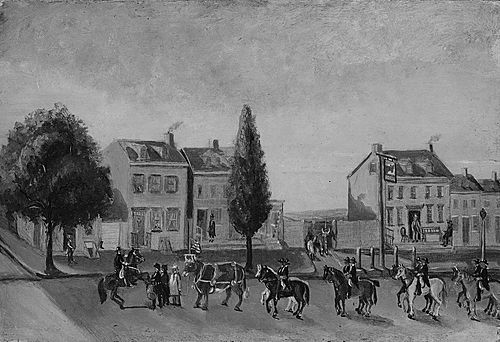
On November 25, 1783, Evacuation Day, the Bull’s Head entered history.  As the British fled New York that day, George Washington and his entourage met at the Bull’s Head, preparing themselves for their triumphant entry into town. Governor George Clinton and over 800 uniformed troops and town people gathered right outside, preparing for the procession.

Henry Astor, the older brother of John Jacob, stepped in as owner of the Bull’s Head in 1785.  Already an accomplished butcher, Henry served his “celebrated cuts of meats” and often outpriced his own clientele when a particularly choice herd of cattle came travelling by.

Of course, New York was outgrowing its old boundaries by then.  By 1813, Collect Pond had been drained and high society eyed the Bowery, sweeping away the filthy stockyards and factories to construct homes, shops and theaters.  Moving with the changing times, some civic minded businessmen bought out Astor and moved the Bull’s Head somewhere safely outside the city — this time at 3rd Avenue and 24th Street!

In 1830, this new location fell into the hands of young rancher and entrepreneur Daniel Drew, who turned the tavern into a sort of bank, marketplace and social club for local cattlemen, upgrading the establishment and building his own reputation as a savvy financier.  The neighborhood was even sometimes referred to as Bull’s Head Village.

As this time, according to an old history, “various types of men mingled in the bar-room of the Bull’s Head, from the rough country man to the speculative citizen, butcher and horse-fancier. Plain apple-jack and brandy and water… were the principal liquors passed over the bar. Guests were so numerous that at the first peal of the dinner-bell. it was necessary to rush for the table or fail miserably.” And of course, after hearty meal and vigorous drink, came the gambling, “throwing dice for small stakes.”

Drew eventually went on to become a steamboat mogul.  The site of the old Bull’s Head eventually hosted the notorious Bowery Theatre (built upon its old cattleyards), then the sumptuous Atlantic Gardens by the mid-19th century.  Drew’s uptown location on 24th caved in to a growing residential neighborhood and soon moved again — this time to 42nd Street.  That location was famous torched during the Draft Riots.

However, near the 24th Street location, there is a new Bull’s Head Tavern that probably smells a lot better than the original.

And not to forget, there was also a Bull’s Head Tavern in Staten Island, at Victory Boulevard and Richmond Avenue. Built in 1741, this Bull’s Head was a popular destination for British-loving Tories before the days of the Revolutionary War.  Before it was destroyed in a fire, “people from all over the country made special trips to the old house, just to see the famous Tory headquarters,” according to one old history.

The neighborhood that sprouts around that intersection at Victory and Richmond is named Bulls Head in the old tavern’s honor.

Categories
Bowery Boys

New listeners to the Bowery Boys podcast? Here’s some highlights of the last 149 episodes — and a hint for no. 150

Thanks to the profile on the Bowery Boys podcast which ran on NPR:Morning Edition a couple weeks ago, we’ve seen a lot of new listeners to the show.  Welcome aboard!  We’re grateful to have you join this amazing community of history lovers interested in the story of New York City.

If you’ve just discovered the podcast, you might be a little daunted by our back catalog. I’m daunted by it at times.  (There’s a few older shows that I’ve completely forgotten that we recorded!)  To help you sort through the 147 episodes that are currently available, here’s a rundown of some back episodes that may interest you:

1) The Early Years For our first few dozen episodes of so, we recorded weekly.  As a result, the shows are shorter and less deeply researched.  However if you want to take a dive into the older shows, subscribe via the Bowery Boys Archives (also found on iTunes).  Many of these have been relaunched as ‘illustrated podcasts,’ meaning photographs and other things pop up on your listening device as we speak about things.  Try (Episode #46Barnum’s American Museum, the two episodes on the Revolutionary War (Episodes #35 and #36) and of course the Brooklyn Bridge (Episode #29).

2) Ghost Stories Our annual Halloween shows are always fun to produce, a mix of urban legend, historical context and good ole fashioned storytelling.  Spooky Stories of New York (Episode #65), featuring supernatural tales of the Algonquin Hotel, a SoHo eatery with a secret in its basement, and an axe-wielding witch of Staten Island. And, of course, sound effects.

3) Next month is the 100th anniversary of the opening of the Woolworth Building so give our episode on its history a try. (Episode #76)

4) The Great Fire of 1835 gave us an opportunity to tell a straight-through narrative about a deadly blaze that destroyed almost a third of Manhattan during a frozen December evening.  This is one of my top five favorites. (Episode #78)

5) Robert Moses was 100th episode, and of course about the man we reference again and again in future shows. You need to know the story of Moses before you can understand the story of modern New York. Hopefully we did his tale justice. (Episode #100)

6) For Bowery Boys On The Go, we recorded five stories on the history of New York transportation, from land to sea.  Best listened to if you’re actually riding aboard ferry or subway — although sadly there are no cable cars. (Episode #106 Staten Island Ferry, Episode #107 Elevated Railroad, Episode #108 Cable Cars, Trolleys and Monorails, Episode #109 New York Subway Part One, and Episode #110 New York Subway Part Two)

7)  Want to know what we’re preparing for Episode #150? Well, here’s your first clue. WATER. Listen to Episode #143 Water for New York: The Croton Aqueduct, one of many shows we’ve recorded on New York infrastructure.

8) And finally — a new Bowery Boys audio history walking tour will be released next month!  We’ve released two thus far — the walking tour on Washington Square Park (on sale on iTunes and Amazon, or click the box in the top right column) and a free tour on the High Line (Episode #136).  I’ll reveal the subject of this walking tour on next week’s show.

And if you haven’t done so already, please join our Facebook page. Next week I’ll be posting something there — a treasure from our past! — that will only be available to those on Facebook.


Top picture courtesy New York Public Library

Categories
Uncategorized

Williamsburg in flames: Explosion on the East River 1912, and a test for the five-borough fire department

The Williamsburg waterfront was a wall of industry over one hundred years ago and of a most combustible kind.

Manhattan had waterfront industry as well, but it was leveraged with rising skyscrapers.  For instance, from the Williamsburg Bridge — not a decade old in 1912 — one could see the nearly-completed Woolworth Building emerging from the downtown skyline. When one turned to the Brooklyn side, however, you were greeted only with towers of belching smokestacks from warehouses and factories, dark, sooty and noxious.

Immediately north of the bridge was the Domino sugar plant, a remnant of William Havemeyer’s century-old sugar concern.  Nearby were the oil tanks and plants of Standard Oil, coal yards, concrete warehouses, gas reservoirs and even a marine freight terminal, with storage warehouses with grain and hay. Many workers of these factories actually lived close by in tenements along Kent Avenue.

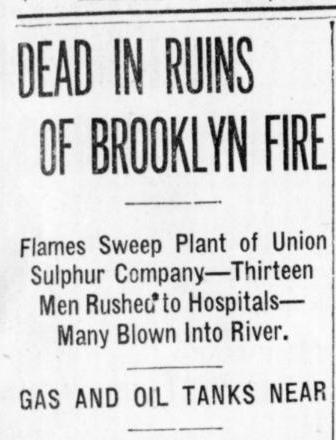
And right in the middle of all that was the United Sulphur Company*, at Kent Avenue and North 10th Street. On the afternoon of November 25, 1912, an explosion here at the sulphur plant threatened to destroy the entire waterfront.

At right: Headline from the New York Tribune, November 26, 1912

Imagine both the sights and the smells of an exploding sulphur factory. Over 5,000 tons of crude sulphur were ignited, created a blast so powerful that some employees were literally blown into the river. Others were trapped in “suffocating fumes” and collapsed.

Newspaper reports made note of various acts of “unselfish heroism” as trained employees “plunge[d] into the yellow glare, shot with blue sulphur flame” to rescue unconscious co-workers.

Two more explosions spread the fire over three blocks, showering fiery embers into the hay bales over at the  Brooklyn Eastern District Terminal building and endangering the nearby oil and gas tanks.

Fire alarms rang throughout the entire city, as firefighters from other boroughs soon arrived to help combat the blaze. This was the second time in history that a ‘borough call‘ — essentially, all hands on deck — had ever been made since the consolidation of New York in 1898.

The first would have been fresh on the minds of firefighters rushing to the scene — the devastating blaze at the Equitable Building (in Manhattan, at 120 Broadway) which had killed six people that January.  It appears the borough call was not yet in place or was simply not called in 1911, when the fire at the Triangle Factory Fire killed 146 workers.

“This was the hardest fire of its sort I ever experienced,” said New York fire chief John Kenlon of the blaze. Taking seven hours to fully extinguish, the inferno was made worse by the billowing sulfurous fumes which knocked out more than a few firemen and at least four fire horses.

One benefit of the burning sulphur: it smelled so rancid that residents of tenements in the surrounding neighborhood fled early from the smell. A good thing, as the flames eventually destroyed a tenement on Berry Street. A local saloon also caught fire from wisps of burning hay.

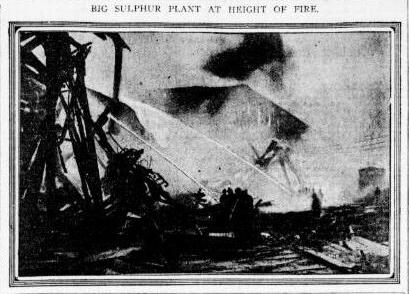
Below: An almost abstract photo of the fire from the Tribune.

Hundreds of spectators watched the blaze from the vantage of the Williamsburg Bridge, the sulphur created a thick curtain of smoke; the New York Times claimed that “the flames showed like dancing green sprites through the fog of gas and smoke.”

Unbelievably, despite dire headlines — ‘DEAD IN RUINS OF BROOKLYN FIRE‘ — it appears there were no deaths due to the blaze, but dozens of injuries. It was a true test of the consolidated New York Fire Department, and one they ably passed.

*’Sulfur’ is the more preferred spelling today, but as the original company used the British spelling ‘sulphur’, I have continued that spelling throughout the article for consistency. 

Top illustration courtesy New York Public Library

Categories
Uncategorized

Ten strange supernatural events that have supposedly occurred in New York, according to the Weekly World News

When I was a teenager, one of many life missions was to one day write for the Weekly World News, the black-and-white supermarket tabloid which specialized in uncovering mutant, fantastical, and mostly unbelievable events being ignored by the mainstream media.

It began in 1979 with far less embellished intentions, focusing on celebrity gossip and sensational true crime stories.  But it quickly found its footing as a proto-Onion style poke at the National Enquirer, spending the 1980s with ever-heightening, baldly absurd headlines which often slathered a kernel of truth in layers of fiction.

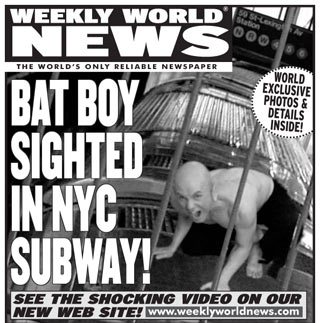
And then in 1992 came an extraordinary discovery in a West Virginia cave, a primordial mutant child the News called ‘Bat Boy‘, an instant success that eventually spawned a popular off-Broadway musical.  From then on, the Weekly World News has been an ever-escalating fanzine to the absurd, an outlandish rag of zany stories and doctored photography, often making unsubtle dings at current cultural events.

New York has been a repeated backdrop for many Weekly World News exposes, its landmarks battered and abused by a host of supernatural entities.  For his part, Bat Boy has been to New York on several occasions, once riding upon the top of a subway car to Coney Island “to get some of his beloved hot dogs.” In 2010, Bat Boy endorsed the enigmatic Jimmy McMillan (of The Rent Is Too Damn High party) for mayor.

The entire Weekly World News back-catalog is now available online on Google Books, and I recently spent a few too many hours perusing old titles looking for the best stories about New York City.  Little did I know of the number of spectacularly weird — and true! — events that have occurred here without my knowledge.  Click on the headers below to go the particular issue:

GIANT TURTLES 
In 1997, the paper uncovered a nest of giant turtles in the New York sewer system capable of snapping off a man’s hand in a single bite.  One specimen was captured at a Bronx treatment plant and sent to the Bronx Zoo where it was declared patently ‘prehistoric’.

But where did these monsters come from?  “The Hudson River gets too much water and gates are opened to allow the water to flow into the East River.”

GHOST PRIDE PARADE
A gathering of phantoms terrorized socialites along Fifth Avenue in 2006 as they marched down the street in a parade, walking through traffic and alarming law enforcement.  A police barricade at 57th Street proved useless as the spectral community simply passed right through it.

“It was surreal. I saw a Civil War soldier, an ancient Roman, a cavewoman and other strange apparitions. There were even a few celebrities, like Laurel and Hardy and Mark Twain.”

SAUCERS OVER BROOKLYN
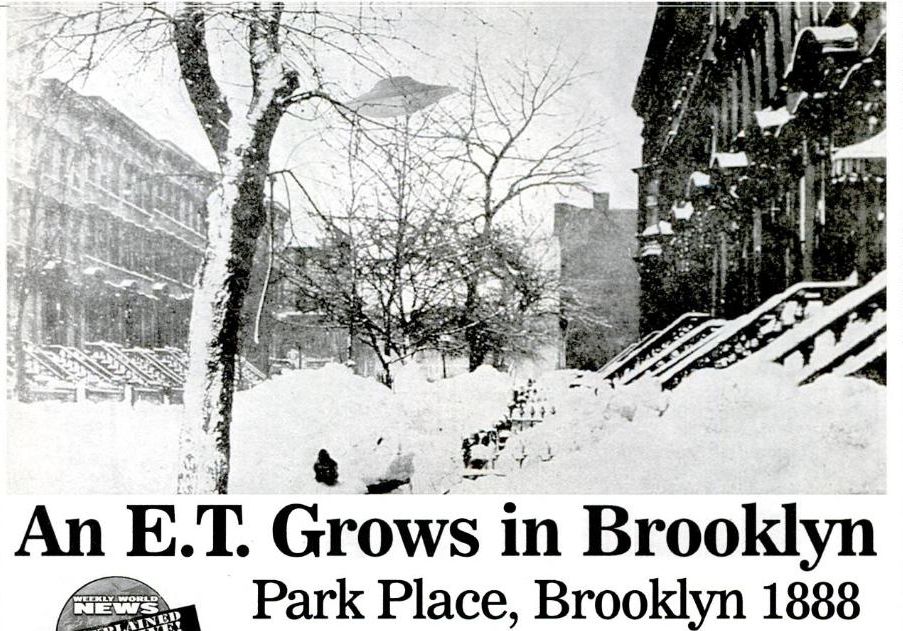
The Blizzard of 1888 immobilized the city, responsible for the deaths of hundreds and shutting down almost every element of New York infrastructure. It was such a devastating storm that there could only be one cause — beings from outer space.

As proven in the photograph above, obtained by the Weekly World News in 2007 from a source at the Brooklyn Eagle, flying saucers menacingly hung in the air over South Brooklyn during the storm. “We were being tested,” claimed a representative from the government’s Unexplained Phenomena Bureau.  Apparently, we passed.

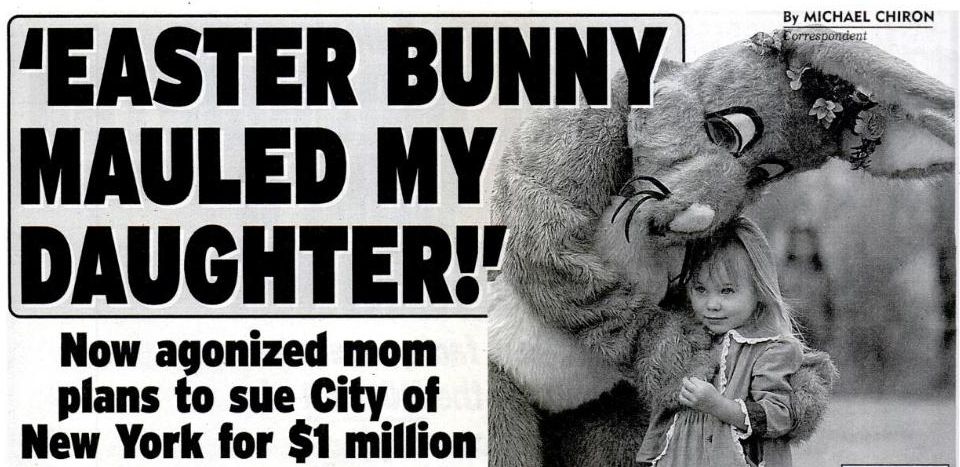
THE EASTER BUNNY
(pictured at top)
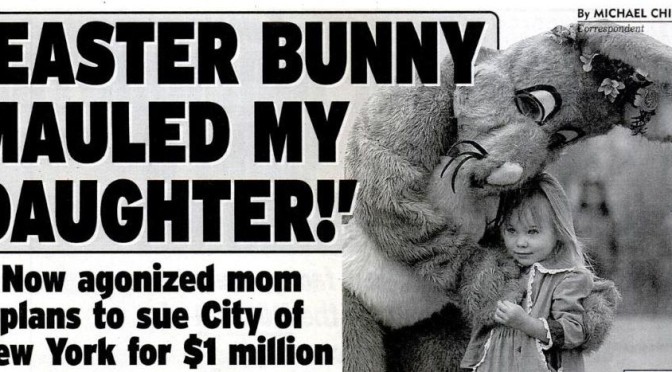
An unprovoked Easter attack in Central Park by an alleged “man-sized, floppy-eared creature” brought on a lawsuit by the victim’s mother. Perhaps the suit was settled out of court, for a paranormal expert is quoted claiming that “I seriously doubt that [the Bunny] would attack a helpless, unarmed child.”

THE RAPTURE
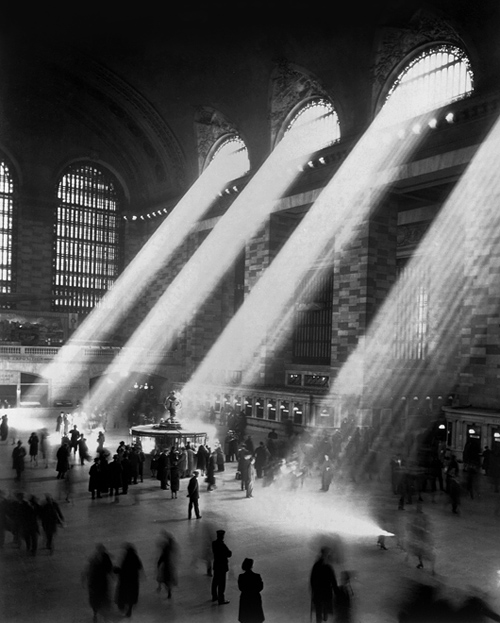
The Biblical rapture — where Christian faithful instantly vanish from the earth, to be taken to heaven — has already occurred, according to one 1999 article. The event took thousands of Christians during World War II. It offers as proof the extraordinary photograph of Grand Central Terminal to the right.

“According to a police officer who was cited as an eyewitness in one news account, rays of bright blue light came through the windows of the train station and singled out certain individuals.”

Strangely, the photographer of this iconic picture, John Collier, remained silent on this fact. Another conspiracy?

DUCKMEBA
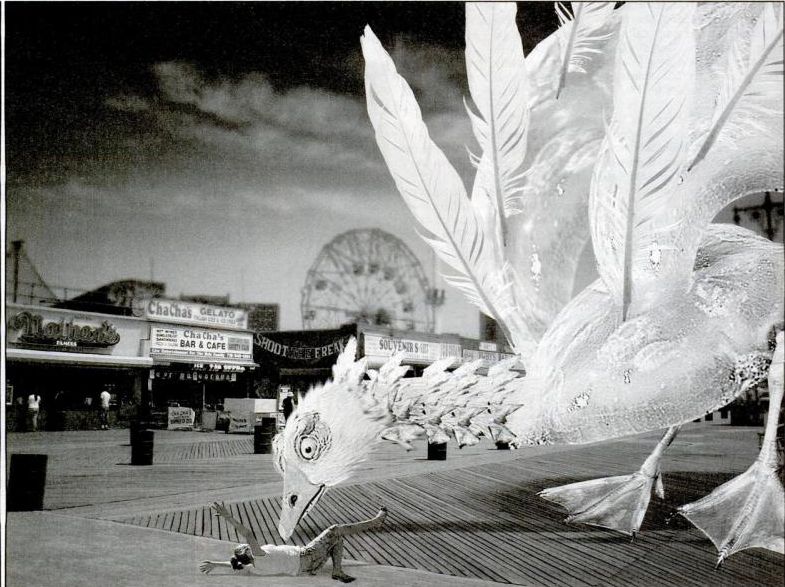
It is particularly irresponsible of the city to cover up the deadly event which occurred on Coney Island in July 2007, when an ‘undulating amoeba’ with the head of a duck and webbed feet rose from the ocean and attacked people along the boardwalk.

The beast apparently destroyed the Cyclone — it was swiftly repaired — and viciously went after the Parachute Jump before its ‘viscous body’ evaporated before the eyes of stunned police officers. Certainly you remember Mayor Bloomberg’s lame story about this event being ‘an aberrant form of ball lightning’? Well, the News blows that lie right out of the water.

Below: A composite of the fowl creature.

TIME-SPACE PORTALS
Anybody who lives and works in New York knows that there are moments where hours seem to pass in the span of mere minutes. Luckily, the Weekly World News over the years has found evidence of the city’s tenuous spot at the precipice of time and space.

An airplane which had disappeared over the Swiss Alps in 1972 suddenly reappeared over Manhattan in 1996, souls which had traveled through the dimensions, unaware of their otherworldly form.

Another portal appeared in the Tribeca neighborhood in 2007, when construction workers on Chambers Street fell victim to a tear in the space-time continuum, going from “real-time motion to moving at slow speed,” due to the dust of a white dwarf star that had somehow managed to get in their cement mix. The workers trapped in the space-time anamoly asked for overtime, “but they ain’t gettin’ it,” claimed their foreman.

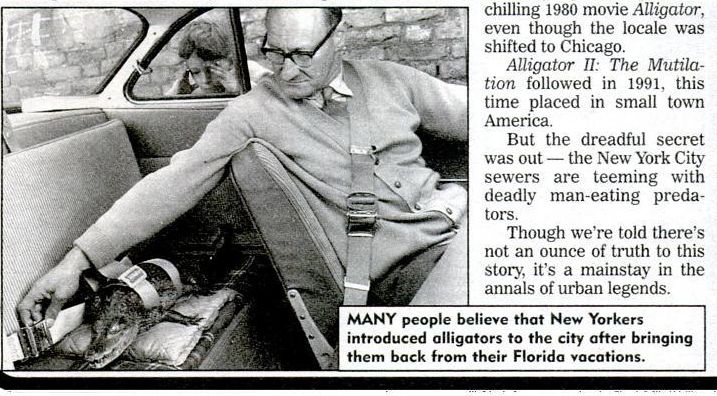
SEWER GATORS
A popular urban legend is given forceful historical credibility by the tabloid, exploring the long history of alligator sightings in the New York sewers.  In the 1930s, sewer workers were authorized to “shoot, poison or drown every one they could track down.” There were so many sightings in the 1950s, claims the paper, that sanitation workers purportedly demanded “protection from attacks.”

FRENZIED WOLFMEN
In 2002, a man viciously attacked his girlfriend in her apartment by biting her in the face. Or, as the News reported it, “gorged himself on chunks of her flesh!”

Clearly a telltale sign of lycanthropy, the News helpfully adds “The case recalls the mythical creature explored in folklore and in such Hollywood films as I Was A Teenage Werewolf.”

FISH MOBSTERS
The aquatic population of the East River is not immune from organized crime, as one Lower East Side resident discovered in 2007 when he awoke one morning to discover seven dead trout in his bed.

Officials tracked the crime to a deadly internecine war among the ‘trout, carp and bass’ of the river. “We think they have fishermen on the payroll,” said one detective.

But it’s not been all horror and doom for New York City in the pages of the Weekly World News. According to a 2002, article, the legendary Fountain of Youth was discovered underneath the streets of the city. One catch — it’s in a subway toilet.

Images and headlines above courtesy the Weekly World News, except for the Grand Central shot, courtesy New York Public Library

Categories
Amusements and Thrills

The first board game: Before Monopoly, a whirlwind tour around America became the perfect Christmas gift

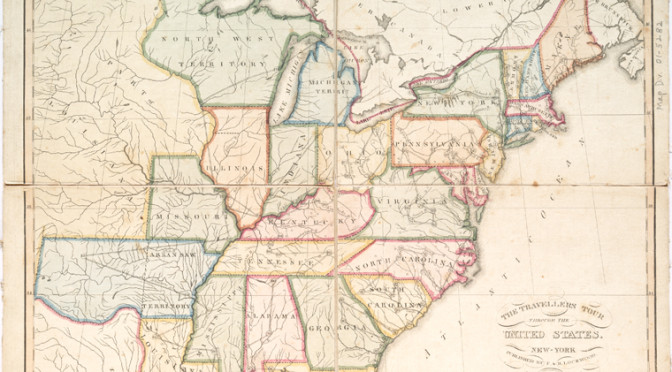
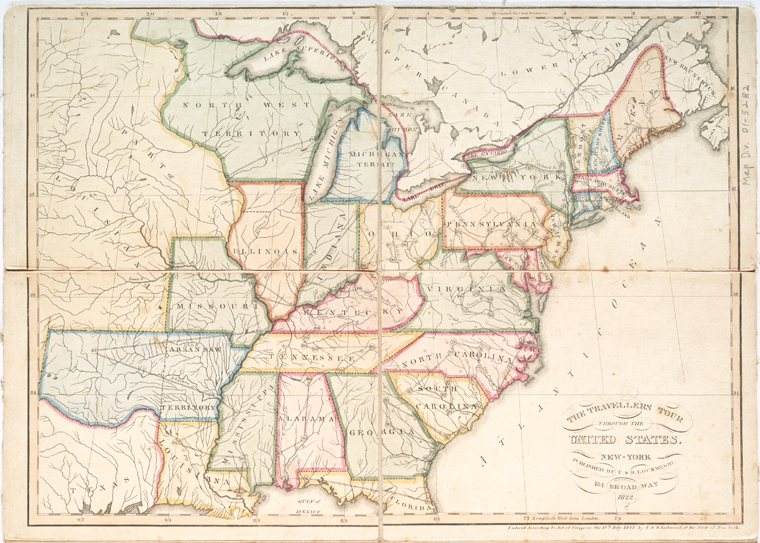
The 24 States: playing field for America’s first board game

HOW NEW YORK SAVED CHRISTMAS My yearly roundup of little events in New York history that actually helped establish the standard Christmas traditions many Americans celebrate today. Not just New York-centric events like the Rockefeller Christmas Tree or the Rockettes, but actual components of the festivities that are practiced in people’s homes. You can read past articles in this series here.

Board games are a staple of the holiday gift-giving season and one of the presents most easily guessed correctly by children when sitting wrapped under the tree. My young niece has already texted me strongly implying she would like to see the new UNO ROBOTO under the tree this year.What if I decided to be the weirdest uncle in the world and give her the first board game ever sold in America — The Travellers Tour through the United States, first manufactured and sold in New York?

Contests played on wooden boards (like backgammon and chess) have been around for millenia, but they were mostly seen as an adult dalliance, often kingly, sometimes undignified, and almost never for children.

The concept of non-physical boxed games for adolescents developed, not surprisingly, for educational uses. Board games are actually the step-children of maps, with many 18th century European models focusing on geographic instruction. Considering the penchant of European countries to invade each other then, this may have been both useful for teachers and vexing for students.

Historians trace the first real children’s board game to that party in a box called The Mansion of Happiness, indoctrinating Puritan values as children maneuvered pieces along a winding, multi-colored path. Although the game was invented in England in 1800, it took several decades to be reproduced in the United States. By this time, New York kids already had their own board game.

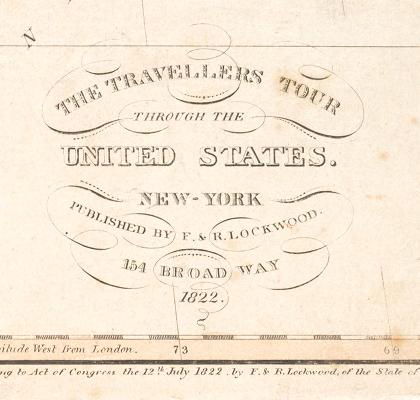
It debuted in 1822, courtesy the brother book publishers Frederick and Roe Lockwood. Their father, the spectacularly named Lambert Lockwood, owned a book store in Bridgeport, Connecticut. According to game historian Joseph Angiolillo, it’s believed Lambert also sold ‘linen games’ which could be unfurled on the floor, folded and put away. (Think of Twister, but less shocking.) The Lockwood’s fine home would not be far from that of the downtown Bridgeport residence of P.T. Barnum.

With father’s help, the young brothers moved to New York in the late 1810s to start their own publishing business, setting up a small shop at 154 Broadway at Liberty Street (today, catty-corner Zuccotti Park). They appear to have specialized in ‘foreign works‘ — probably books in other languages — but had a few startlingly devout titles in their collection, from  “Views on Theology: President Edward’s Doctrine of Original Sin, the Doctrine of Physical Depravity” to “The Excellence and Influence of the Female Character.” They even dabbled in game instruction with the 1821 guide “Instructive and Amusing Pastimes.”

In 1822, they developed an educational tool for the purpose of learning American geography — a topic not terribly complicated back then — and called it The Travellers Tour through the United States. Essentially, it was a map of the states and territories, including the freshly unveiled states of Missouri and Maine and the blue lumpen-shaped Arkansas territory. The map was printed on some type of flexible wooden board that could be folded.

The object of Travellers was to give the names of cities and places, with players following a line around the board. Seems easy, right? In a more advanced version of the game, however, one also had to guess the population total. I cannot think of a more apt symbol of the pride for American expansion than this particular feature. The first player to get to New Orleans won.

There were no dice with The Travellers Tour through the United States, being associated with gambling and vice. Instead, players maneuvered around the terrain via a spinner, a far easier method of cross-country travelling than the one chosen by Lewis & Clark several years previous.

The game was clearly successful enough in their store that two expanded versions were created, The Traveller’s Tour through Europe and The Traveller’s Tour through the World.

The Lockwoods aimed their board games to holiday shoppers. In in the 1820s, however, many New Yorkers didn’t celebrate on Christmas; in a Puritan throwback, many believed celebrating on Jesus’s birthday itself was too unholy. New Years celebrations, however, were just as relevant, with families visiting the homes of friends and neighbors, often bearing gifts.

The brothers Lockwood were ready: “VALUABLE NEW-YEAR PRESENTS,” according to one old newspaper.”The works of Byron, Scott, Cowper, Moore….in elegant bindings.” And among the books they sold backgammon and chess boards. With such games for adults, the Travellers series must have seemed a desirable purchase, lest they leave the children jealous.

The Lockwoods continued making books through the 1820s at this location, although it doesn’t appear they were in business together after 1830. One source mentions Frederick Lockwood as a watchmaker later in life. His brother Roe, however, stayed in the book business, partnering with his son. It appears he even later published the extraordinary illustrations of John James Audubon.

I’m not sure what happened with the building at 154 Broadway, but if it was still standing in 1845, it was surely destroyed in the Great Explosion of 1845.

One final note — in 1822, just as the Lockwoods were debuting their new board game, a wealthy gentleman uptown in his estate (the austere Chelsea manor) became inspired by the holiday season and wrote a festive poem. The following year, that man, Clement Clarke Moore, published it under the title “A Visit From St. Nicholas,” aka ‘Twas the Night Before Christmas.”

Top pic courtesy NYPL

Categories
Brooklyn History

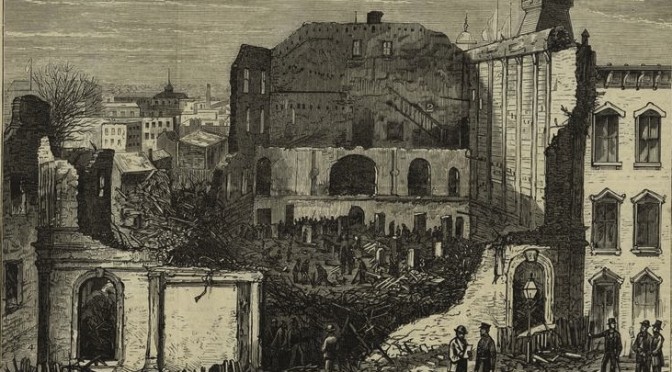
A Wretched Anniversary: The Brooklyn Theater Fire of 1876

It is difficult to discuss calmly the frightful disaster which happened in Brooklyn on Tuesday night. No such awful sacrifice of human life has ever been known in this country shipwreck and the casualties of war alone being excepted. — New York Times editorial, Dec. 7, 1876 

  One hundred and thirty-five years this evening, nearly a thousand playgoers entered the Brooklyn Theater, at Washington and Johnson streets near City Hall, to enjoy the well-reviewed (and lengthy) production of N. Hart Jackson’s ‘The Two Orphans’. During the show’s final act, stage hands discovered that a set piece backstage had caught fire. The actors onstage attempted gamely to stay in character, for fear of causing a panic, until fiery bits of wood and flaming parts of the set began raining down upon them.

As the audience leapt to the aisles in terror, the actors tried to calm people to prevent a stampede, to no avail. An usher forced open a rarely used exit door to free audience members, but the rush of December air only fed the flames, turning the once elegant auditorium, built only five years previous, into an inescapable trap of heat and asphyxiation.

Those in the upper tiers of the theater — the ‘family circle’, or cheap seats, filled with men, women and children — were trapped by smoke within darkened foyers and unnavigable stairwells. Some fell from balconies to their deaths. Dozens were crushed heading for doorways, and to some of those who survived, it seemed that all respectability had given way to base animal behavior. Most perished by suffocation or underfoot, while others were lost into the oblivion of belching smoke when weakened floors gave way.

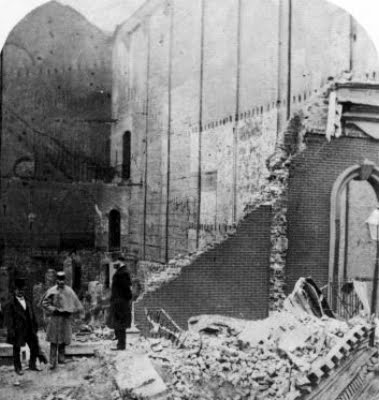
Twenty five minutes after flames were first spotted backstage, one entire wall of the Brooklyn Theater caved backwards into the inferno, the once elegant ceiling fresco nothing but a crumbling scorch now. Flaming projectiles caught in the wind settled upon surrounding structures, and firefighters scrambled to soak the inferno, now in fear of scattering randomly through one of Brooklyn’s oldest neighborhood. Most in danger was the hotel on the corner, where some audience members had found momentary safety.  

Since 1869, Brooklyn had a paid fire department, and many fought the fire from the streets. But the rudimentary firefighting implements of the day were unable to combat the inferno. The Brooklyn Theater burned for several hours more, dying out by early morning. Throughout the night, most could only watch — what to do, plunge into darkness? — and many did watch. Thousands flocked, some to help, others fascinated, horrified.
Inspectors found an unspeakably grisly sight the next morning, heaps of burned bodies in formless masses — people choked or crushed, their remains almost unrecognizable amid blackened debris. In an eerie parallel to two later disasters (the General Slocum explosion of 1904 and the Triangle Factory Fire of 1911), a make-shift morgue was prepared on nearby Adams Street to accommodate the dozens of unidentifiable corpses.

Nobody is sure exactly how many died that evening — some number between 275 to 300 people. It is certainly among the worst disasters in Brooklyn history and one of the most catastrophic fires in American history.

The place where the theater once stood is now occupied by Cadman Plaza, in the grove of trees just east of the Henry Ward Beecher statue. Many of the bodies (over a hundred) are buried together under a memorial at Green-Wood Cemetery.


Top picture courtesy NYPL


Below: the area of Cadman Plaza where the Brooklyn Theater once stood.


Categories
Neighborhoods

The Thermos Building, keeping it hot (and cool) in Chelsea

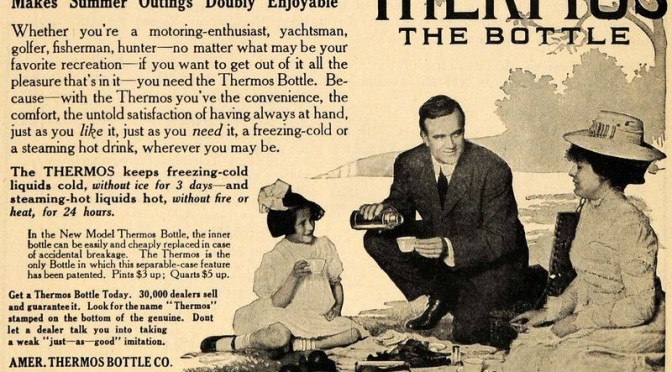
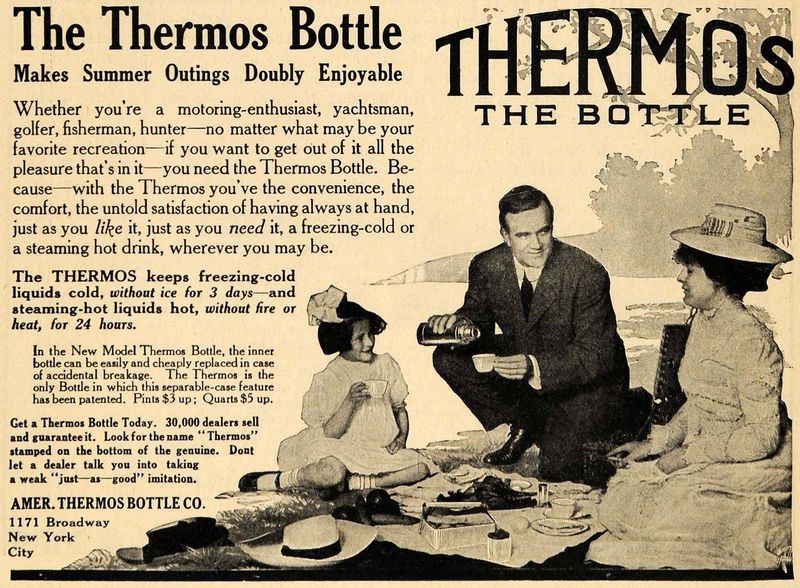
A charming family enjoys its insulated beverages — just as they like it, just as they need it — in an ad from 1909.

 The invention of the vacuum flask in 1892 (by Scottish chemist Sir James Dewar) does not rank high among mankind’s most remarkable inventions, but its longevity relies on being a steady companion. The first gas-operated motor vehicle debuted in Massachusetts the following year. In an era before disposable containers, the vacuum flask came along at exactly the right time. Now, people could travel long distances of their own accord and drink a hot beverage along the way. In the 1890s, the road trip was born.

Believe it or not, Dewar was not a member of the family that produced the famed Scottish whiskey, although I suspect much of that intoxicant has been stored in Dewar’s vacuum invention. Like many inventors, Dewar was not terribly business-savvy, and he failed to properly patent and profit from his own creation, unsuccessfully taking rivals to court.

One of those competitors, the German glass blowers Burger and Aschenbrenner, ran away with the industry. They loosely named their revised vacuum flask after the Greek word for ‘heat’ and began producing the Thermos for local use in 1904. Two years later, William B. Walker, an American visiting the Munich-based Thermos plant, became enamored of the magic container and obtained a license from the Thermos company to bring the product to America the following year.

Walker opened the American Thermos Bottle Company in 1907, producing the containers out of a small factory in Brooklyn, in the shadow of the Manhattan Bridge. (Today’s DUMBO neighborhood, 31 Washington Street, to be precise. The building is all condos today, so that means one or more people are living in an old Thermos factory as you read this.)

His timing could not have been more divine. Auto dealerships began popping up around Times Square, driving a market for accessories. New York’s continuing construction boom — paired with less advantageous lunch-break privileges — suggested new uses for the Thermos.

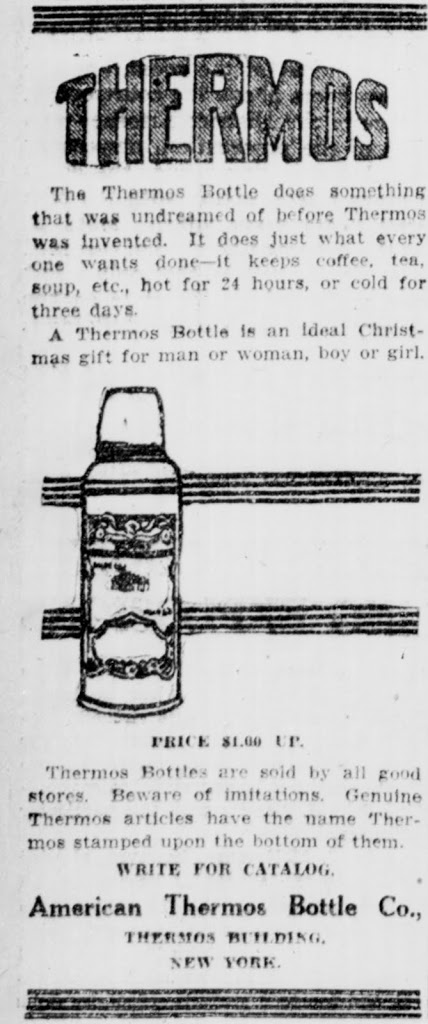
But most likely it was Walker’s clever marketing strategies that made the Thermos a desirable product. As seen in the advertisement at top, the Thermos brought the family together. It was traditional. At the same time, it was a marvel of invention, at an affordable price. An ad (at right) that ran 100 years ago today, in the New York Tribune, heralds its appropriateness as a Christmas present. “It does just what everyone wants done — it keeps coffee, tea, soup, etc., hot for 24 hours.”

Walker soon expanded the Thermos company. While his marketing and distribution team moved to a swank office near Madison Square (1171 Broadway), his production facilities moved to Chelsea in 1910, to 232 West 18th Street, with additional entrances on West 17th Street. “The building will hereafter be known as the Thermos Building,proclaimed the New York Times.

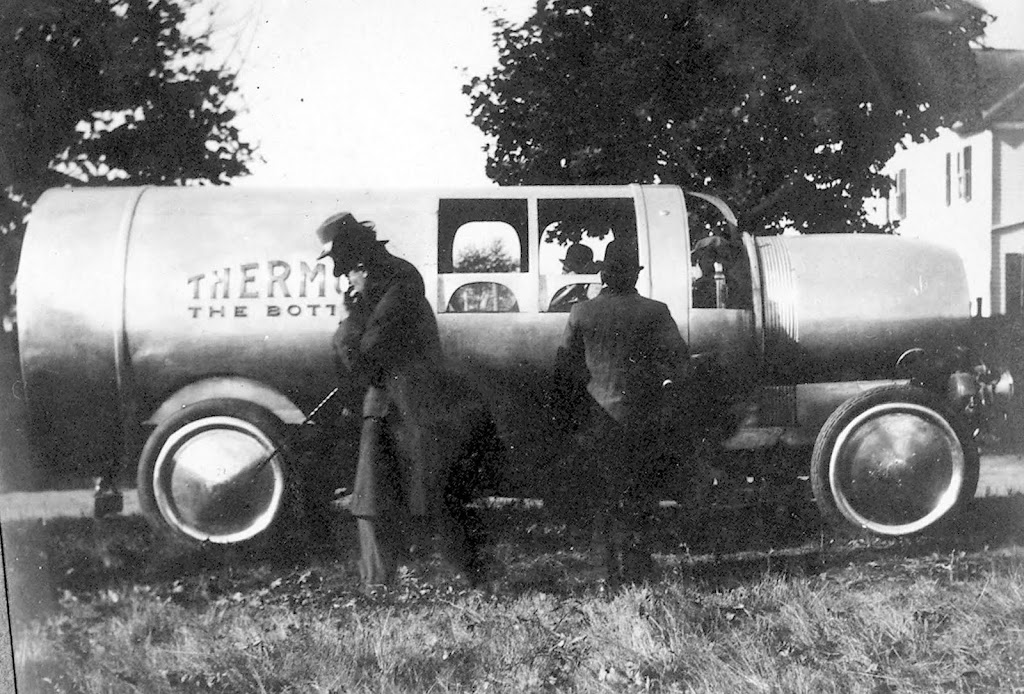
The product began popping up in truly odd places, all engineered for the maximum of publicity. Most of the 200,000 New Yorkers who lined Broadway for an “automobile carnival parade” in 1909 observed one prize-winning vehicle — a car in the shape of a Thermos bottle. (The Thermos car below is from the 1909 Vanderbilt Cup races, in Long Island. I imagine it must be the same vehicle. Pic courtesy Vanderbilt Cup Races.)

The Thermos made a stout companion during the era of exploration. E. H. Shackleton had one during his 1909 voyage to the South Pole, as did Robert Peary on a his similar expedition north. The Wright Brothers allegedly had one on their early planes. Back on Earth, so did the President of the United States that year, William Howard Taft.

Christmas shoppers along Ladies Mile, not far from the Thermos Building, would have found a wide selection of sizes. According to Charles Panati, “A quart-size Thermos sold for $7.50; the pint size for $5.00.” Those are appliance prices; according to the Inflation Calculator, a $5 Thermos in 1910 is equal to a $115 product today. (I don’t know what that ad above is talking about with its $1.00 Thermos.)

Demand soon required larger facilities, and the Thermos company moved out of the Thermos Building. But not before a disaster that struck on May 1, 1913, a fire that quickly swept through the structure, rather unsettling in light of the Triangle Factory Fire that occurred just two years before. Luckily, most of the Thermos employees were out to lunch, and a hero, “Samuel Gumps, a negro elevator man” rescued employees from the top floors. Although “several girl employees” were forced to escape to the rooftop.

The Thermos company moved its headquarters to Norwich, Connecticut.  Today the building is a basic residential address, its Thermos Building name long forgotten. (As the building cuts through the block, it’s known today as 245 West 17th Street.)  On the 18th Street side, it’s just next door to Barney’s Co-Op. Perhaps they sell Thermos there?

By the way, I love that in the early days of this product, it was sometimes marketed as ‘Thermos, the Bottle.”

Categories
Uncategorized

An evening of cocktails, with tales of quirky characters

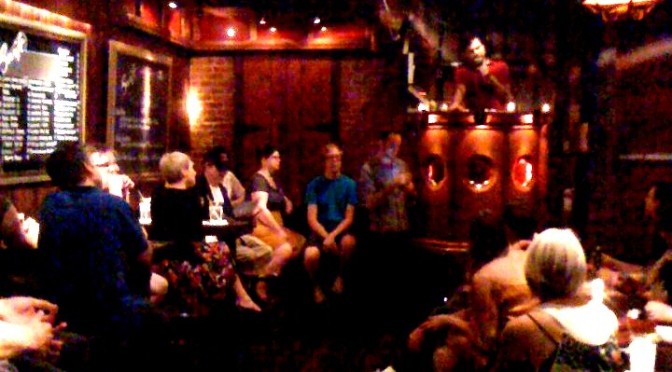
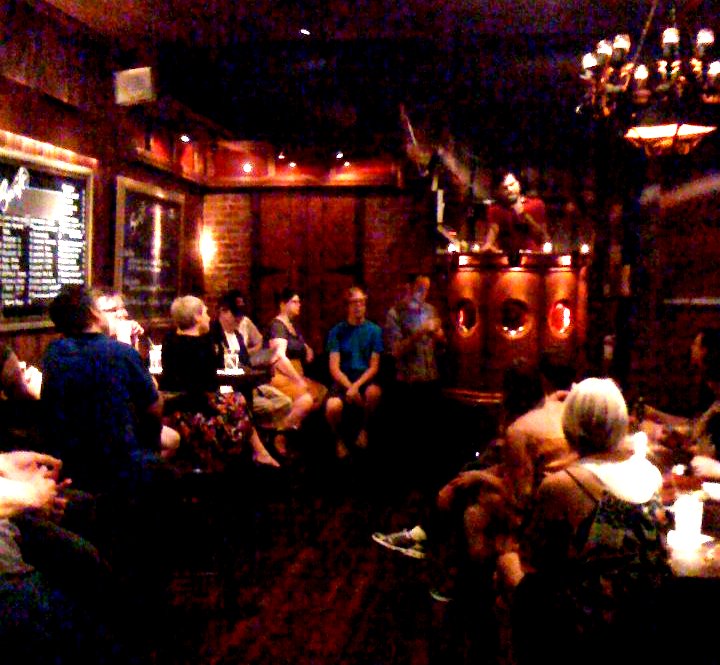
Thanks to everybody who came out on Saturday for our reading at Swift Hibernian Lounge, as part of the 4th Annual Lit Crawl. Swift makes for a incredibly atmospheric place to spin tales of New York history. Or possibly preach the gospel. Or hold an occult ritual. (Above: That’s me behind the massive podium.) And it was really fantastic meeting afterwards with some of the listeners! We love coming out from behind the microphones, and I promise more live events in the near future.

And a special thank-you to Ed Hamilton, who followed up my tale on notorious mayor Fernando Wood with two terrific pieces about Dee Dee Ramone and Harry Smith (an icon of American music scholarship and, apparently, a budding Satanist with fabulous hair). Check out Ed’s blog Living With Legends: Hotel Chelsea and his book on the famous place.

And thanks to the crew at Swift for the Gothic-inspired setup!

Categories
Uncategorized

The Bowery Boys 2010: A Year of Podcasts In Review

Here’s the whole menu of our 2010 podcasts. As always, you can download them all for free from iTunes and or your favorite podcast aggregator. The original blog page for each is listed below, along with a link to download directly from our satellite site. See you in 2011!

TRINITY CHURCH
Blog page / Trinity Church: Anchor of Wall Street, New York’s Landlord
Download here

MANHATTAN BRIDGE
Blog page / Manhattan Bridge: New York City’s dysfunctional classic
Download here

MADISON SQUARE GARDEN
Blog page / Madison Square Garden, World’s Most Famous Arena(s)
Download here

ROBERT MOSES
Blog page / Robert Moses: Did he save New York — or destroy it?
Download here

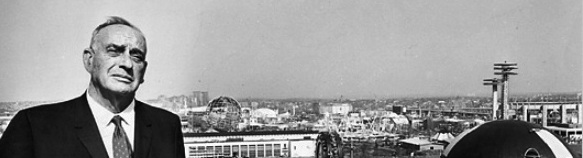
BRONX ZOO
Blog page / The Bronx Zoo: the tale of NYC’s biggest animal house
Download here

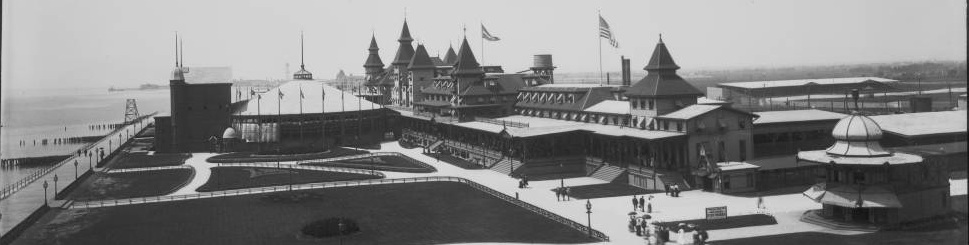
BRIGHTON BEACH AND MANHATTAN BEACH
Blog page / Brighton Beach and Manhattan Beach, at your leisure
Download here


CASE FILES OF THE NYPD
Blog page / Case Files of the New York Police Department 1800-1915
Download here

CBGB & OMFUG
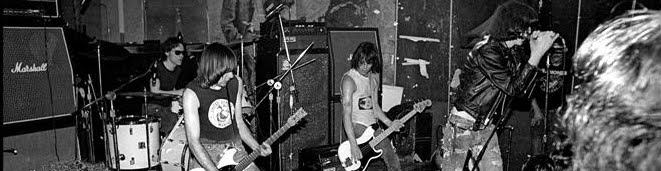
Blog page / CBGB & OMFUG: Punk music history on the Bowery
Download here

THE NEWSBOYS STRIKE OF 1899
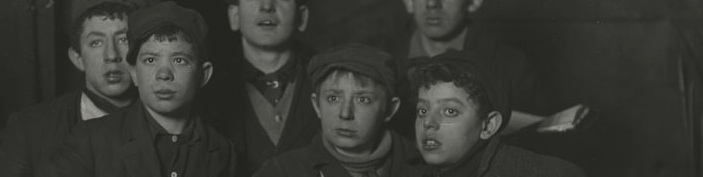
Blog page / Newsies vs. The World! The Newsboys Strike of 1899
Download here

STATEN ISLAND FERRY
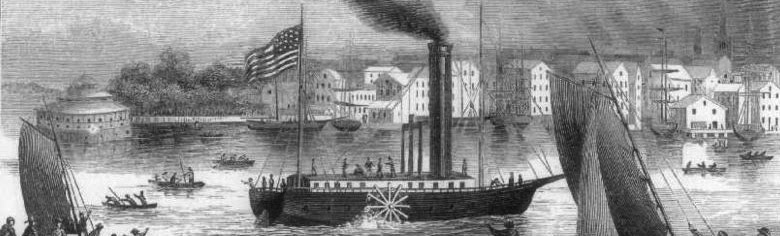
Blog page / The Staten Island Ferry: its story, from sail to steam
Download here

NEW YORK’S ELEVATED RAILROADS
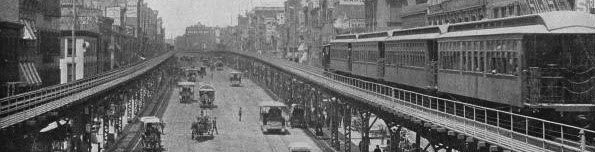
Blog page / New York City’s Elevated Railroads: Journey to a spectacular world of steam trains along the avenues
Download here

CABLE CARS, TROLLEYS AND MONORAILS
Blog page / Cable cars, trolleys and monorails: Moving around on New York’s forgotten transit options
Download here

NEW YORK CITY SUBWAY, PART 1
Blog page / The New York City Subway and the creation of the IRT
Download here

NEW YORK CITY SUBWAY, PART 2
Blog page / Modern history of the New York Subway: Expansion from the 1-2-3, A-B-C, Second Avenue and beyond
Download here

SUBWAY GRAFFITI 1970-1989
Blog page / The wild times of the subway graffiti era 1970-1989
Download here

ARCHIBALD GRACIE AND HIS MANSION
Blog page / Gracie Mansion: How a bucolic summer home survived a couple wars, a society feud and a few live-in mayors
Download here

NIBLO’S GARDEN
Blog page / Niblo’s Garden: New York’s entertainment complex and home to the first (bizarre) Broadway musical
Download here

SUPERNATURAL STORIES OF NEW YORK
Blog page / Supernatural Stories of New York: spooky seances, violent Jazz Ages ghosts and an island of despair
Download here

AFRICAN BURIAL GROUND
Blog page / African Burial Ground: History from underneath the city, and the secret tale of New Yorkers once forgotten
Download here

AMERICAN MUSEUM OF NATURAL HISTORY
Blog page / American Museum of Natural History: Digging up the past
Download here

MARK TWAIN’S NEW YORK
Blog page / Mark Twain In New York, or His Adventures on Fifth Avenue
Download here

TIMES SQUARE

Blog page/ Times Square: History in stages, chronicled in lights
Download here

Top picture courtesy NYPL; courtesy lines for all other pics can be found on original blog pages