New York governor resigns* in disgrace (in 1913)!


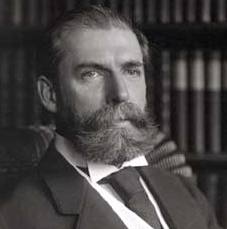
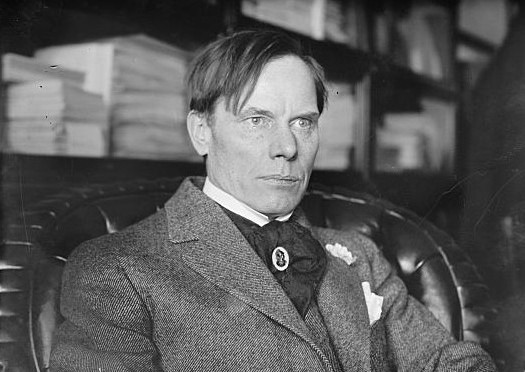
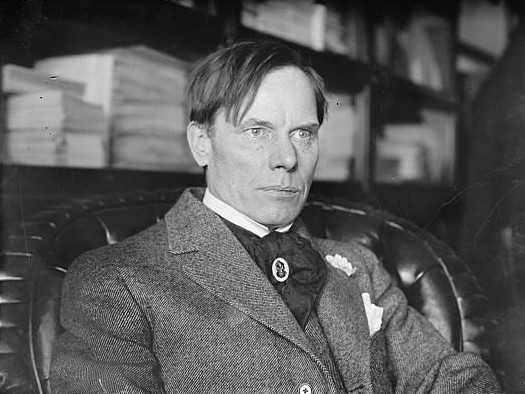
STRESSED: William Sulzer in 1911, a New York City representative on his way up…and out

*okay, technically he was removed in disgrace

As bloggers, newshawks and politicos wait to see what, if anything, comes of the latest New York Times supposed bombshell about current governor David Paterson — he’s already protesting “I DID NOT HAVE SEX WITH THAT WOMAN” in the Post — I thought I’d turn to state politics for a day and see how many of our state’s governors have been shamed into resigning. Certainly, in the wild-west days of state politics, there must have a been a few, right?

In fact, there’s only been two — the infamous Eliot Spitzer and of course, that dastardly William Sulzer.

Who?

Sulzer is a perfect example among many as to why you never trust Tammany Hall, especially if you’re one of them. Sulzer was a handchosen successor for the governor’s seat in 1913, a man of middling talents selected to do the Democratic machine’s bidding in state affairs. But like a bad gangster movie, you step outta line, you pay the price.

Sulzer was a practicing young lawyer during the 1880s who like many men worked his way into politics using the sticky graces of Tammany patronage. Sulzer more than paid his dues; in 1895, he served as representative of the various electoral districts in the U.S. House of Representatives, and served there up until the events described below.

They called him ‘Plain Bill’ Sulzer for entirely fictitious reasons; in fact, he was a “vain and self-important,” according to author Oliver Allen, miming the role of an elder statesman in dress and deed. He made grandiloquent statements about the public good but was mocked down in the Bowery saloons as a bit of a peacock. “When it comes to preserving our liberties, ” said one reporter, “Willliam is a whole canning factory.”

But he was subservient to Tammany, a loyal Freemason and, most important, well liked in an over-crowded district of potential voters. When governor John Dix, a Tammany Democrat who swiftly proved overwhelmed by the job, was nudged aside in 1912 by Tammany’s boss Charles Murphy, he was replaced by Sulzer on the ticket. Despite a challenge from a surging Progressive Party — led by former president Theodore Roosevelt — Sulzer was handily elected.

Perhaps it was the way in which his predecessor Dix was swept aside. Perhaps it was stupidity. Perhaps it was failed ingenuity. Whatever the case, Sulzer took office and immediately began ignoring Murphy’s requests for appointments. Even worse, he began calling for inquiries into questionable state construction contracts — always a hornet’s nest of illicit behavior by Democratic lawmakers. Looking to deeply here would expose dozens of legislators to accusations of graft and bribery.

Sulzer is not the first Tammany representative to turn his back on the corrupt organization. In fact, the same thing had been going on in New York with mayor William Jay Gaynor, a former golden boy of Murphy’s who proved difficult to control. Gaynor, however, was a deft, able politician who managed to step on Tammany’s toes without crushing them; Sulzer was simply too bold in his rebellion.

By the fall of 1913, Tammany would have neither Gaynor nor Sulzer to deal with. Gaynor would die that September during an overseas voyage of a latent bullet wound, received years earlier in a failed assassination attempt. Sulzer was felled in a more successful assassination, by Murphy, via accusations of improper allotment of campaign finances for personal use.

Sulzer did, in fact, dip into campaign money during the election; in 1910s politics, who didn’t? The investigation was created for the sole purpose of discrediting Sulzer, and its victim proofed feeble to the task of defending himself.
Perhaps sensing futility Sulzer didn’t even show up to trial to defend himself. He was hastily found guilty of “falsifying campaign documents,” impeached and removed from office in October 1913. Sulzer would die in November 1941 as the only governor of New York ever removed from office. And all for giving sass to the party politic.

100 Years Ago: Somebody actually shot the mayor

New York City started 2010 with an important bit of ceremony: the swearing-in of Michael Bloomberg. One hundred years ago, New Yorkers did the same thing, but with a new face — former state Supreme Court judge William Jay Gaynor, replacing George B. McClellan.

I did a whole Know Your Mayors posting about Mr. Gaynor awhile back, so I won’t elaborate too much about his biography here. However, just eight months after taking the job, on August 9, Gaynor was almost killed by an assassin’s bullet. As I originally wrote:

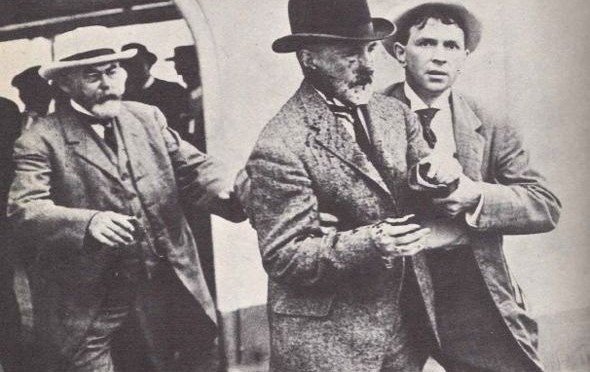
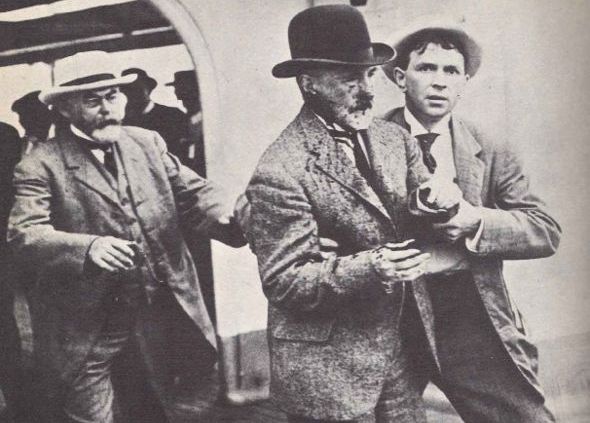
“While vacationing on the ocean liner SS Kaiser Wilhelm der Grosse, a disgruntled city employee James J. Gallagher, fired from his job on the docks, took out his frustration on Gaynor, shooting him through the back of the neck. Gallagher claimed, “He took away my bread and meat. I had to do it.” Really, James?

Unbelievably, a photographer for the New York world William Warnecke happened to catch the incident, which quickly became one of the most startling photographs in the short history of photo-journalism. [The photo above!]

Gaynor recovered somewhat, although the bullet would remain lodged in his throat, and for his entire term of mayor, he would remain weakened and haggard. He would even use the injury as a reason to get out of discussing delicate subjects, saying, “Sorry, can’t talk today. This fish hook in my throat is bothering me.”

Somebody should have advised Gaynor, however, to avoid ocean liners altogether. On Sept. 4 1913 he boarded the Baltic for yet another oceanic vacation and six days later was found dead on a deck chair, his body finally giving in to lingering internal injuries. Curiously, Gaynor’s would-be assassin Gallagher had died just a few months prior — at an insane asylum in Trenton, New Jersey.”

Read the rest of the piece here

Other political stories of 1910:

This was the final year in the term of New York governor Charles Evans Hughes (pictured), but it was hardly the last anybody would hear of the distinguished New Yorker. After an unsuccessful bid for president of the United States in 1916, President Warren G. Harding made him Secretary of State in 1921. Then he became the Chief Justice of the Supreme Court in 1930, where he resided over the greatest court in the land for an entire decade, helping bring Franklin D. Roosevelt’s New Deal policies to life.

What a surprise: corruption in the New York state senate! Senate Majority Leader Jotham P. Allds resigns on March 29, 1910, after it’s revealed that he took bribes from bridge construction companies to kill some undesirable legislation. In April, other senators, including notorious Lower East Side power broker “Big Tim” Sullivan, are implicated in several other bribery schemes, involving streetcar and fire insurance companies.

Capping it off is testimony in September 1910 that several lawmakers, with Williamsburg senator Patrick Henry McCarren smack in the middle, were given “a legislative corruption fund of $500,000” in early 1909 — during a dinner at Delmonico’s Restaurant, no less — to squash some critical anti-race track gambling legislation.

Nobody was censured — and McCarren had died in late 1909 — but the largely Republican scandal was probably key in getting a Democrat, John A. Dix, into the governor’s seat the next year.

[You can find all the juicy details in Gustavus Myers’ wonderful History of Tammany Hall.]

—-
AND SPEAKING OF RATS…

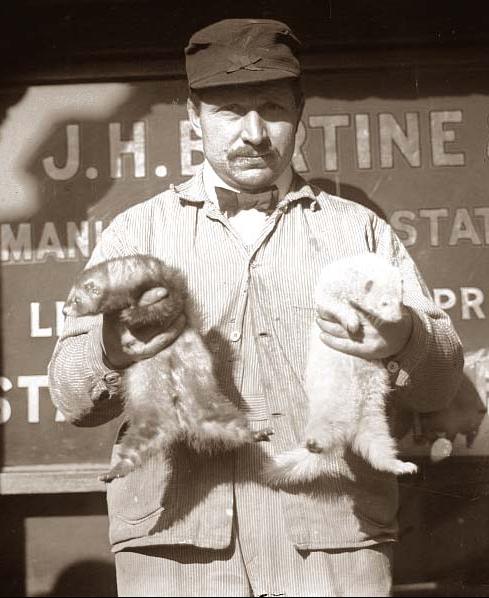
ABOVE: A New York City ratcatcher, photo taken during the 1910s, but those don’t look like rats to me. In fact, I think the ferrets are used to sniff out vermin. (Picture courtesy the great Old Photos blog)

And finally, for no reason other than humor, I present to you a letter that Mayor Gaynor wrote in March 20, 1910, to one Charles M. Frey, noted and ‘learned’ city ratcatcher. Imagine Mayor Bloomberg penning such a missive to one of his constituents:

“Dear Mr. Frey, Your letter of March 15 is at hand, describing how your calling of ratcatcher is being constantly interrupted by your being summoned to serve as a juror.

Sooner than have the city overrun with rats and everything eaten up by them I would have you relieved of jury duty. Do you not think we had better have a bill introduced in the Legislature to exempt ratcatchers from jury service?

The difficulty is, however, that so many exemptions have already been passed by the Legislature that there seems to be only ratcatchers and a few other people left to serve on juries. That might possibly impede the progress of your bill if sent to Albany.

I will have to carefully consider the matter, and some day when you are down this way, come in and we will talk it over, and also about rats. I see that you are a classical scholar, judging by the motto at the head of your letter. My experience is that learned men are to be found everywhere. As we read in Don Quixote: “The mountains breed learned men and philosophers are found in the huts of shepherds.”

[More of Gaynor’s fascinating correspondence here.]