Categories
Bowery Boys Movie Club Film History

The French Connection: Bowery Boys Movie Club

The new episode of the Bowery Boys Movie Club explores the new film The French Connection, the gritty action classic employing an astonishing array of on-location shots — from Midtown Manhattan to the streets of Brooklyn. It’s an exclusive podcast for those who support us on Patreon.

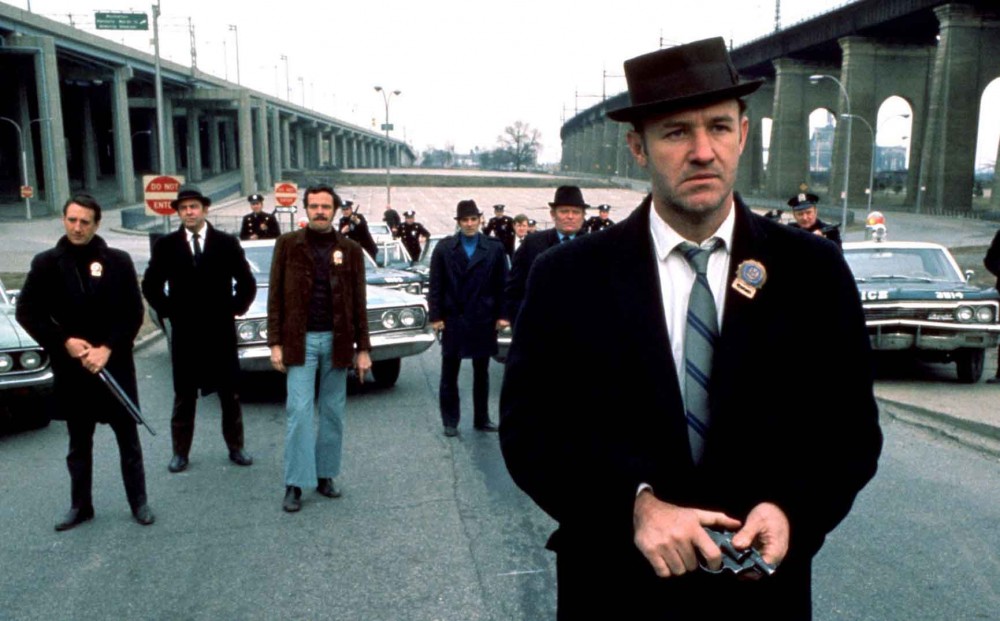
The French Connection, directed by William Friedkin and starring Gene Hackman, was released fifty years ago this year to critical and commercial success.

The movie would change the way film and TV action dramas were presented, a mix of real-life urban decay and brutal violence. But the film has much to say about New York City itself as it swerves into many pre-gentrified neighborhoods. 
SPOILER ALERT: The Bowery Boys Movie Club is a movie recap show, mixed with New York City history. We dive into the film, scene by scene… discussing its major plot turns and attempting to put it all into the historical context of New York City in late 60s/early 1970s.

We also discuss the plot, in quite a bit of detail. Haven’t seen the film yet? You might consider watching it first — it’s currently available for rent and also available for streaming on Showtime. 


How do I listen the Bowery Boys Movie Club?  Once you’re signed in on Patreon, you’ll see a private RSS link that can be put directly into your favorite podcast player. Even easier, it can also be played directly from the Patreon app.
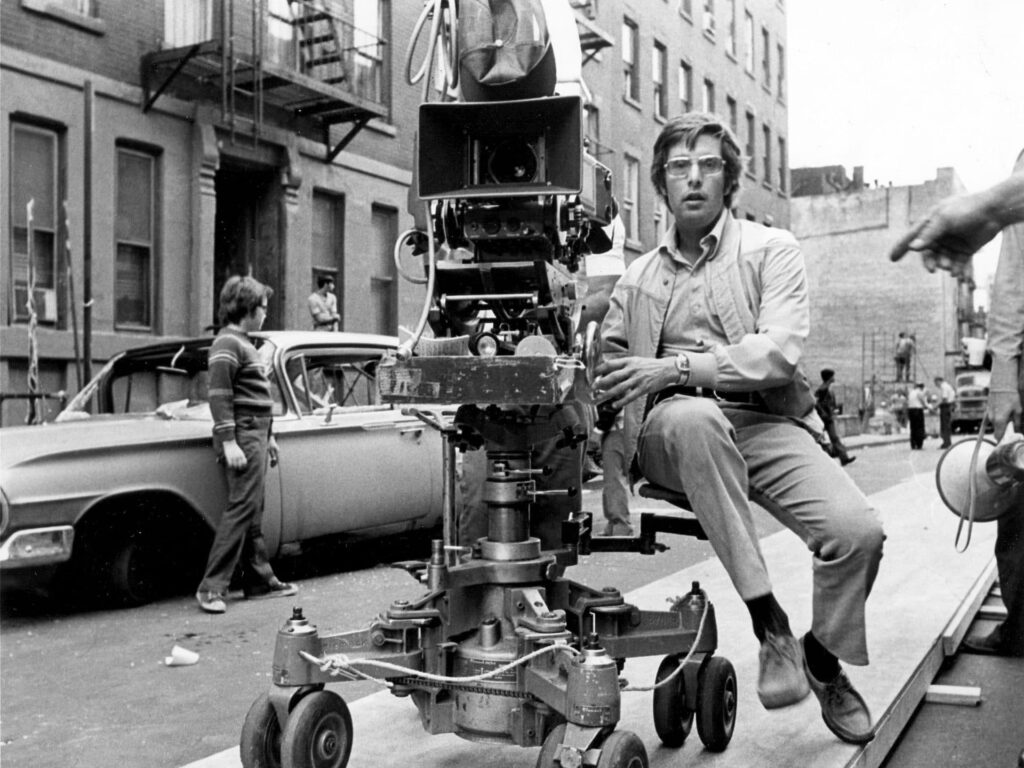

Director William Friedkin on the ‘set’ of The French Connection.

The French Connection was shot in New York — all over the place, uptown, downtown, on bridges, in bars. And much of it, on the fly and illegally. (There are, of course, famous scenes in Marseilles and Washington DC as well.)

Take the film’s most iconic moment, and possibly the greatest car chase scene in the history of film and cars. It’s filmed under the elevated D-line train, near Coney Island, along the course of 26 blocks, over the course of five weeks. However, N train stands in for what was then the B train, because, being New York in the 70s, they could find no clean-looking B trains.

Most of the ‘extras’ were actual residents going to and fro in their daily business. In fact, a car accident that happens at the corner of Stillwell Ave. and 86th Street actually happened; the unlucky vehicle was owned by a guy on his way to work.

The producers later paid for the cost of repairs. Today this would have spawned a multi-million dollar lawsuit!

That was the least of the mayhem. Friedkin and his producers filmed many scenes without the city’s permission at all, including much of the car chase, a staged traffic jam on the exit ramp of the Brooklyn Bridge, and an entire sequence on what is now the S-train between Grand Central and Times Square!

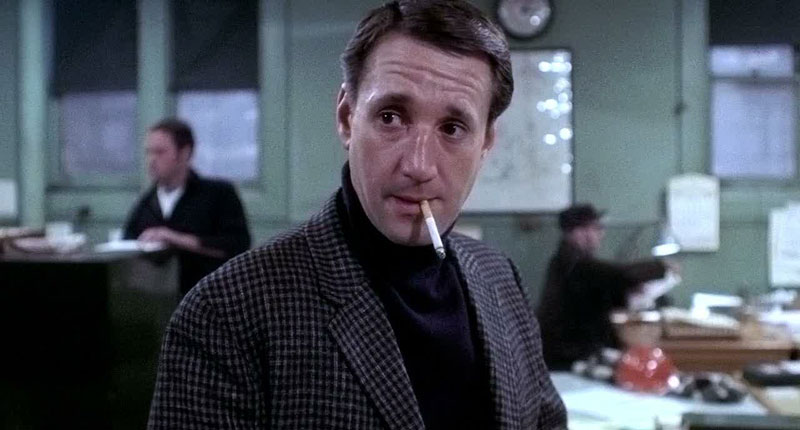
One treasured New York landmark featured in the film is sadly no longer with us. Popeye Doyle (Gene Hackman) and Cloudy Russo (Roy Schieder) stake out at Ratner’s Deli in the Lower East Side right off the Williamsburg Bridge.

Ratner’s was one the city’s legendary old Kosher deli’s, along with Katz’s just a few blocks away. Later in its life, its hidden ‘speak-easy’ Lansky Lounge became a hot spot during the 1990s.

Two Manhattan hotels are also featured prominently, the sumptuous Roosevelt Hotel in Midtown and the former Westbury Hotel, now residences.

Like The Taking of Pelham One Two Three, the movie brilliantly captures a New York on the precipice of near collapse but still retaining its rough-hewn charm. The fact that this classic could be filmed here — almost scot-free — gives a little insight into how massive and uncontrolled the city had gotten.
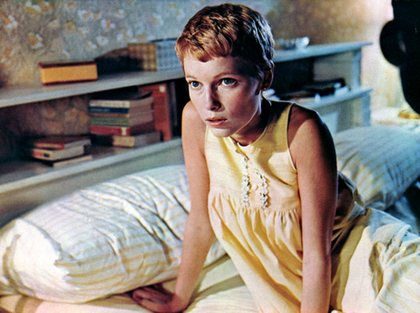
NYC NOIR: “He has his father’s eyes!”


The Film Forum is in the midst of their five week NYC Noir screening series, featuring some of the best thrillers, mysteries and action films set on the streets of the city. In this blog every Thursday of the series, we’ll feature a bit about one of the films, and encourage you to go check out some of these classic flicks. Past entries of this series can be found here. Showtimes and other movies in the series can be found at the Film Forum’s website.

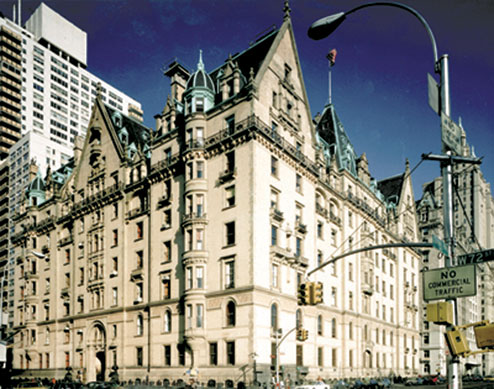
And killing two birds with one stone — as its also the topic of this week’s podcast — this week we feature a disturbing supernatural thriller Rosemary’s Baby and its primary setting, the Dakota Apartments, located at Central Park West and 72nd Street.

First of all, to correct a slip of the tongue from the podcast. No film has ever been shot in the interior of the Dakota. The exterior has been used in several films, most recently in Vanilla Sky, which may have given Tom Cruise and Katie Holmes the idea to buy a place there. The Dakota was first used in the 1949 Joseph Mankiewicz (All About Eve) directed film noir House of Strangers with Edward G Robinson. It’s safe to say that the Dakota is a perfect place for film noir.

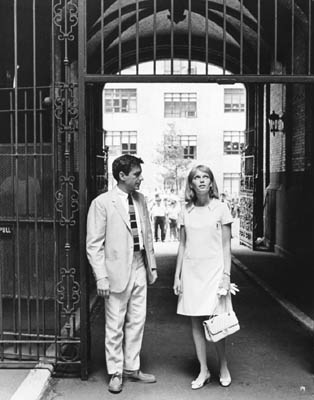
Here are stars Mia Farrow and John Cassavetes just inside the beautiful gated entry of the Dakota. When it was built in the 1880s, horse-drawn carriages rode through the gate to let out their passengers, then parked in the stables nearby. The center of the courtyard features a fountain, which greeted residents before they climbed up one of four seperate staircases to their homes.

By the way, it was while filming at the Dakota that Mia’s husband Frank Sinatra served her divorce papers. Tacky.

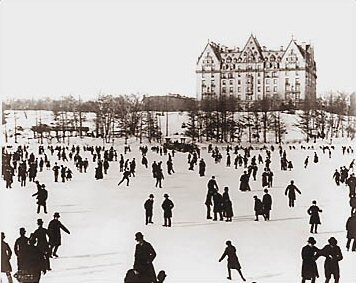
The Dakota is believed to have gotten its name from the preferences of developer Edward Clark’s towards the names of new American states (which represented ‘new money’). Others stories suggest that at the time of its construction, the new building was so far north that it would have been like visiting ‘the Dakota territories’. From this picture, that seems plausible:

The Dakota was host to Manhattan’s artistic elite, the home of famous actors, writers and composers. According to the book “Upper West Side Story, a History and Guide” “The early tenants included the piano manufacturer Theodor Steinway and his friend the music publisher Gustave Schirmer, who liked to fill his salon with such brilliant guests as Mark Twain, William Dean Howells, Herman Melville and Peter Ilyich Tchaikowsky, who came to town in 1891 to donduct the opening night concert at Carnegie Hall.” Latter day tenants included Paul Simon, Connie Chung and Maury Povich, and of course the Dakota’s most famous tenants, John Lennon and Yoko Ono.

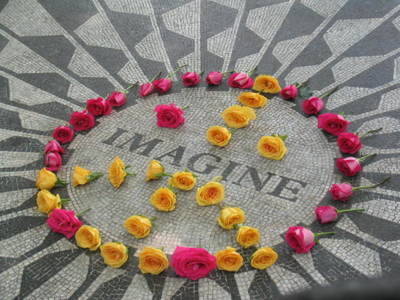
After Lennon’s murder in front of the Dakota — not far really from the grisly fake murder in ‘Rosemary’s Baby’ — the portion of Central Park nearest to the building was christened Strawberry Fields, and mural made of tiles from Pompeii was constructed in honor of the musician. The place has taken on a general purpose of celebrations and mournful gatherings: you’ll find people congregated there for the birthdays of living Beatles, the anniversary of Lennon’s death and even 9/11 memorials.

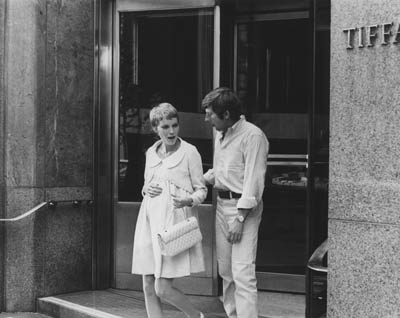
“Rosemary’s Baby” was filmed in other locations throughout the city, including stretches of Park Avenue above 42nd Street, the Time Life Building, and Tiffany’s. Here’s Polanski with Farrow rehearsing a scene:

NYC NOIR: “ONE MILLION DOLLARS!”

The Film Forum is in the midst of their five week NYC Noir screening series, featuring some of the best thrillers, mysteries and action films set on the streets of the city. In this blog every Thursday of the series, we’ll feature a bit about one of the films, and encourage you to go check out some of these classic flicks. Past entries of this series can be found here. Showtimes and other movies in the series can be found at the Film Forum’s website.

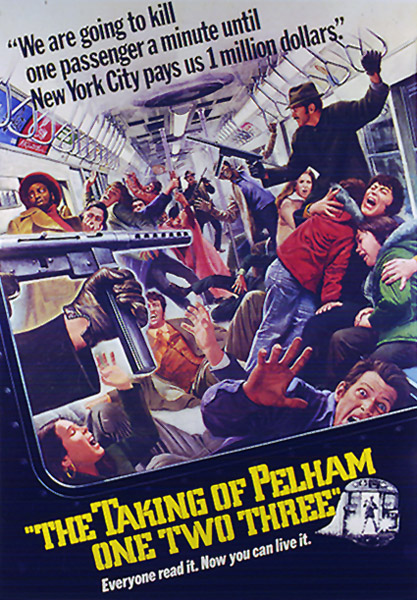
This weekend we feature a tense and perfectly 70-ish action flick The Taking of Pelham One Two Three.

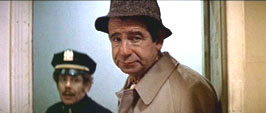
The film is best known now for its very dated but (if you’re budding historians like us) absolutely prototypical settings in a gritty, sweaty New York City. A group of hijackers demanding a ransom of one million dollars (Ha!) hold the 123 train and its unfortunate occupants hostage. On the case is Jerry Stiller and Walter Matthau, both playing the first of many grumpy old men in their futures, as police officers trying to negotiate with the crafty terrorists.

“Pelham” a fantastic example of the zippy, thriling action films that came in the wake of the French Connection (also in the Film Forum series). With a classic soundtrack by David Shire (Talia’s husbund), the best scenes are in the subway cars, with hijackers Martin Balsam and Robert Shaw wrestling with a most diverse group of Manhattanites and their attitude. Those scenes were partially shot in the tunnels below the old Court Street line in Brooklyn — which has now been transformed into the New York Transit Museum.

But as a personal story, my favorite location shots are those involving the police racing to get the hijackers their ransom money. When I first moved to New York, I lived on the corner of Park Ave and 23st Street (back when it was possible to be poor and live there!) and I happened to rent this film. What a surprise to see Park Ave, the stretch between 34th and 23rd, as location shots, with familiar buildings mixing in with now-forgotten shop awnings and people with crazy feathered hair and afros!

Of course, it’s actually the 6 line (that still goes to Pelham Bay Park) that gets hijacked. The 1-2-3 line, meanwhile, runs along the west of the island for much of Manhattan. Its the 1:23 6-train that is hijacked. Yeah, weird, New York subway trains have timetables!

The film runs all this weekend at the Film Forum.

NYC NOIR: ‘Sweet’ and sour


Almost as if they had asked us to help them program their schedule, the Film Forum begins their five week NYC Noir screening series, featuring some of the best thrillers, mysteries and action films set on the streets of the city. In this blog every Thursday of the series, we’ll feature a bit about one of the films, and encourage you to go check out some of these classic flicks.

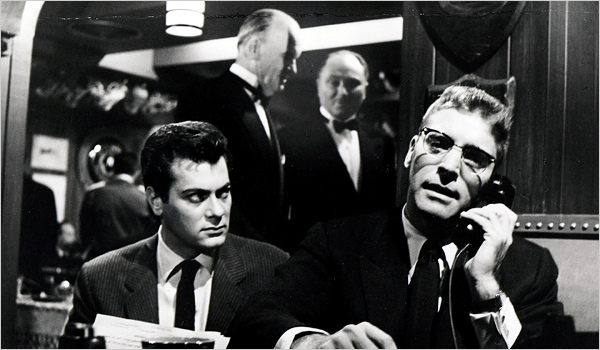
They kick off the festival with one of the most likeably cynical films ever made, Sweet Smell of Success, starring Burt Lancaster as the city’s most powerful gossip columnist JJ Hunsecker, back in the day when gossip mongers wielded their Page Sixes almost menacingly. Unfortunate for Martin Milner, playing jazz musician Steve Dallas that he should happen to get engaged to Hunsecker’s naive sister. Hunsecker soon makes it his business to see the coupling destroyed. His secret weapon? A curt and cool Tony Curtis, as Sidney Falco, the most dispicable and pathetic press agent in town.

Easily one of the best films to portray the glitzy 1950s New York nightclub scene, the characters weave themselves through half the bars in midtown, most notably the 21 Club formerly on 52nd Street. The night scenes have both a stink and a sheen to them, thanks to rigorous location shooting. Director Alexander Mackendrick’s complained of the bustling street noise — not to mention Curtis groupies, waiting for a glimpse — but it lends the movie pulp authenticity. Midtown never looked so stark and busted.

Hunsecker’s apartment, which plays a pivotal role in the final scenes involving his nervewracked sister, is actually in the Brill Building, 1619 Broadway near 49th St. According to Roger Ebert, a shot inside its lobby is mirrored by another film playing later in the NYC Noir series, Taxi Driver.

The film plays this Friday and Saturday. The showtimes and dates for this and the rest of the films in the series can be found here. My favorite part about the Film Forum’s repertory series is that you pay for double feature during the weekend, so find one you like and go hunker down….