Categories
Bronx History

Morrisania: The South Bronx and the old days of American aristocracy

Was there an estate in New York ever as beautiful as Morrisania, nearly 2,000 acres that hugged the Harlem River until it opened out into the turbulent East River as it coursed past small islands and flowed into the Long Island Sound?

A property that varied from western hills looking over the river to the rolling spread of Manhattan below, to eastern marshes and flatlands suitable for farming.

Today’s Bronx neighborhood of Morrisania is only a small portion of the original property owned by the Morris family since the 1670s, during the dawning years of British dominance in the New York region.

Vestiges of the old estate still existed well into the 20th century, including their old well (pictured below in 1910)
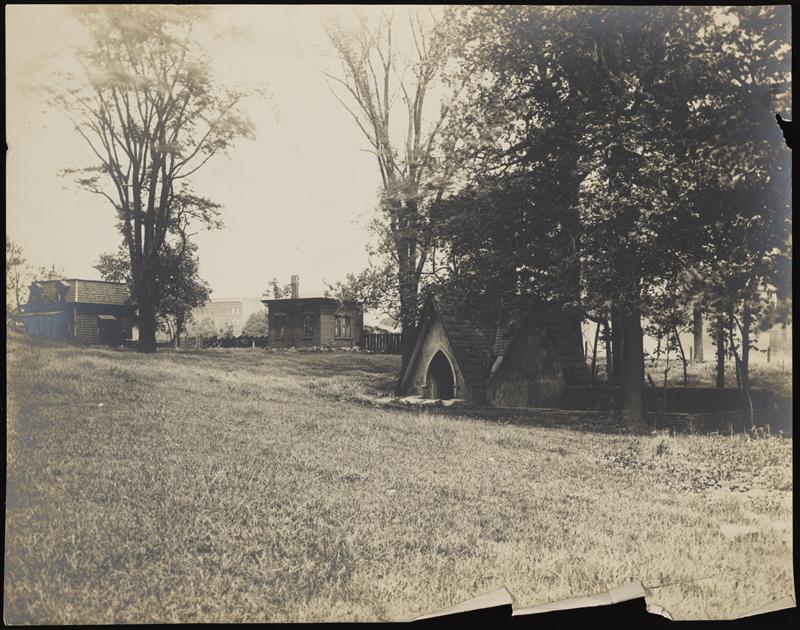
mny228863

The original parcel, purchased by Welsh captain Richard Morris, was only 500 acres, a part of original land settled by Bronx namesake Jonas Bronck.

When Richard died, brother Lewis Morris (for reasons that will soon be evident, let’s call him Lewis I) moved from the West Indies to claim the property. He would be one in a succession of Lewis Morrises to live here and place an imprint on what would some day contain much of the South Bronx.

The Morris family was feisty, business savvy, well connected, extremely aristocratic and entirely unoriginal with names. Another Lewis Morris (Richard’s son, or Lewis II) became the governor, at separate times, of both New York and New Jersey. Yet another Lewis (Lewis III) became a powerful New York justice. His son Lewis Morris (Lewis IV) was a signer of the Declaration of Independence.

Below: Morris farm houses, still standing in 1920
mny220944

If you haven’t gleaned it already, the clan carried themselves like some kind of royal family. They were, artificially at least, as were many families in the New World who quickly made fortunes here and staked claims in manners similar to what their forebears were accustomed to in Europe. Over the decades, the Lewises would blend by marriage into other elite, bold-faced families to form a tangled ball of interlinked faux American royalty.

Morrisania for most of the 18th century resembled a miniature British kingdom, with a spread of small farms, dairies and cattle pens operated by those leasing from the Morris family, a proper workaday serfdom common for the era. However, during the early decades, the land was even worked with slave labor, although the practice was phased out in later generations.

Below: The Lewis G Morris house which stood at Montgomery Avenue and 176th Street at late as 1905 (the date of this image)
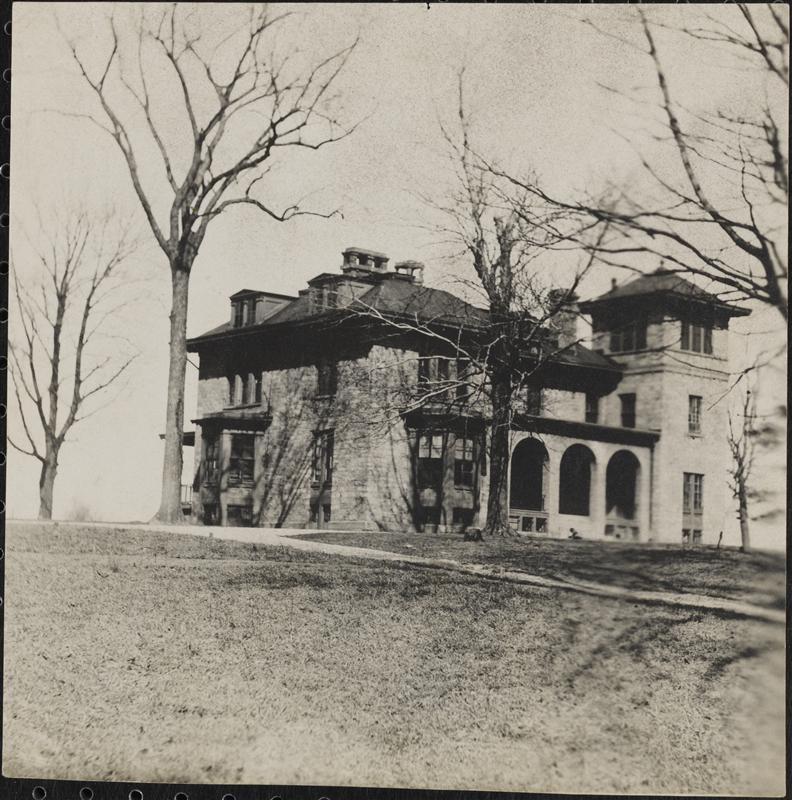
Museum of City of New York

When Lewis 3 passed in 1762, this massive property was split in two. West of the small babbling Mill Brook (honored today with a playground and a housing development) belonged to Lewis IV and his brothers, but the more bucolic eastern side fell to Lewis III’s second wife Sarah and eventually her only son. That’s right, Gouverneur Morris (pictured below).

Gouverneur fled his home during the Revolutionary War, but his mother Sarah stayed behind. During this time, the rich farmland was vandalized and the family’s voluminous library, one of the largest collections in North America at the time, was ransacked.

Gouverneur was quite busy in the late 18th century doing things like penning the Constitution and being minister to France in the midst of their bloody revolution. But wherever he traveled, he always felt a closeness to Morrisania.

After the war, while Gouverneur was in France, Lewis Morris (the fourth one, Gouverneur’s half brother) offered up the family estate of Morrisania be used as the site for the new American capital. One can just imagine the history of New York had Congress taken him up on that offer!

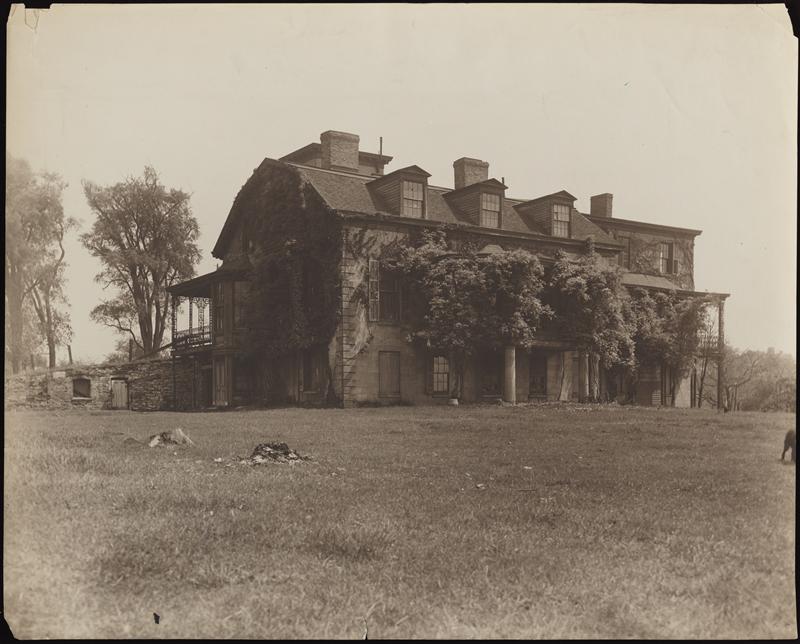
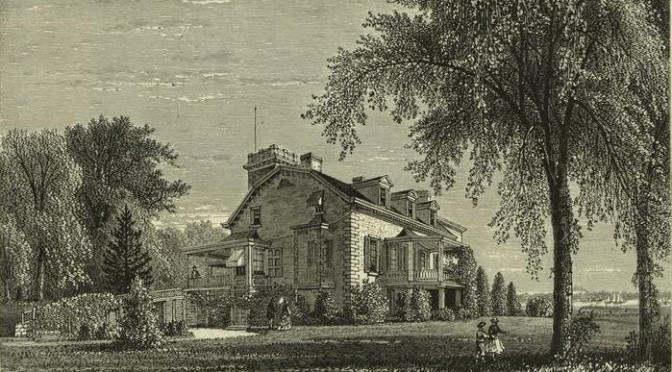
The former mansion of Gouverneur Morris which sat near the waterfront in the Bronx until the 1900s.

Museum of the City of New York

In 1798, when Gouverneur returned from France and claimed the property for himself, he built a new home here (the one pictured above) and filled it with all his gathered French finery. Perhaps no household was more beautiful — or as pretentious — as Morris’ new manor.

Gouverneur, of course, facilitated the growth of New York with his roles in the development of both the Commissioners Plan of 1811 and the Erie Canal. His old farms, however, were technically part of Westchester Country. In the 1840s, his son Gouverneur Morris Jr. emulated New York’s former estate owners and began to develop his property for commercial and residential use.

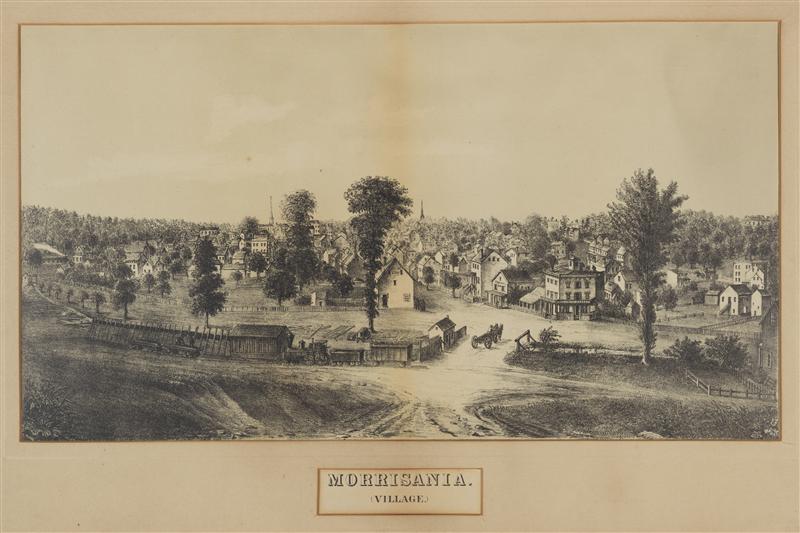
Below: The village of Morrisania, an original ‘commuter’s town’ for those who worked in the city of New York down south.

MCNY
MCNY

Chief among these decisions was becoming vice president of the New York and Harlem Railroad (eventually to be owned by Cornelius Vanderbilt) and allowing the railroad to cut through the old property. Townships formed around the railroad station, include one small village named for the old manor, Morrisania. That village is the root of today’s neighborhood of the same name.

Gouverneur Junior was cut from the visionary mold that would define many in the 19th century. One pet project was the development of a port village along the old family property on the eastern shoreline, today’s Port Morris area.

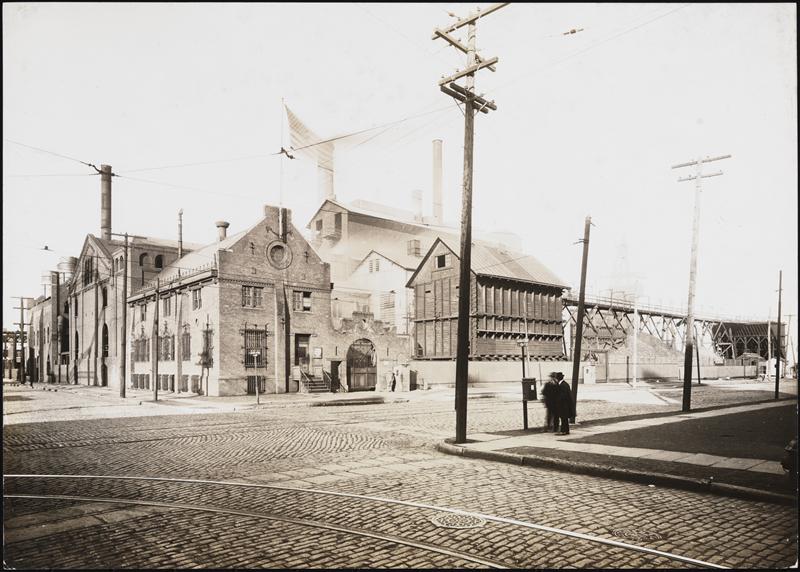
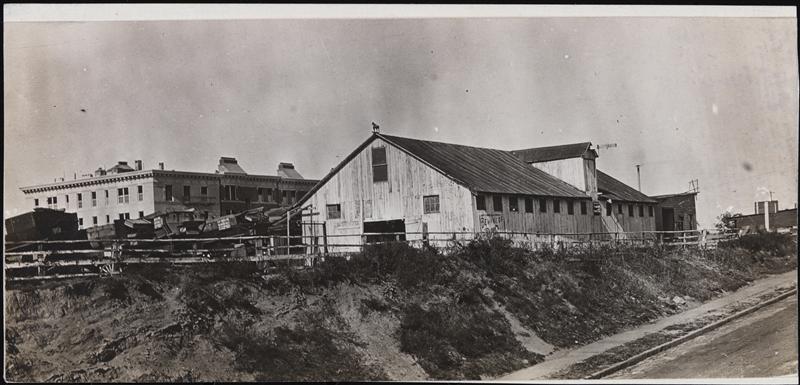
Port Morris, pictured below in 1920, would become a chief location for manufacturing in the borough.

mny221093

Given that Gouverneur Senior was partially responsible for Manhattan’s grid, it’s no surprise that a different grid patterns were adhered to the old Morris properties over the years. In emulating Manhattan’s pattern, all traces of the area’s early farm existence was eradicated.

The following years would hold many strange detours in the history of the South Bronx: opulent boulevards, the New York Yankees, 1970s urban decay. But the Morrises live on, if in name only.

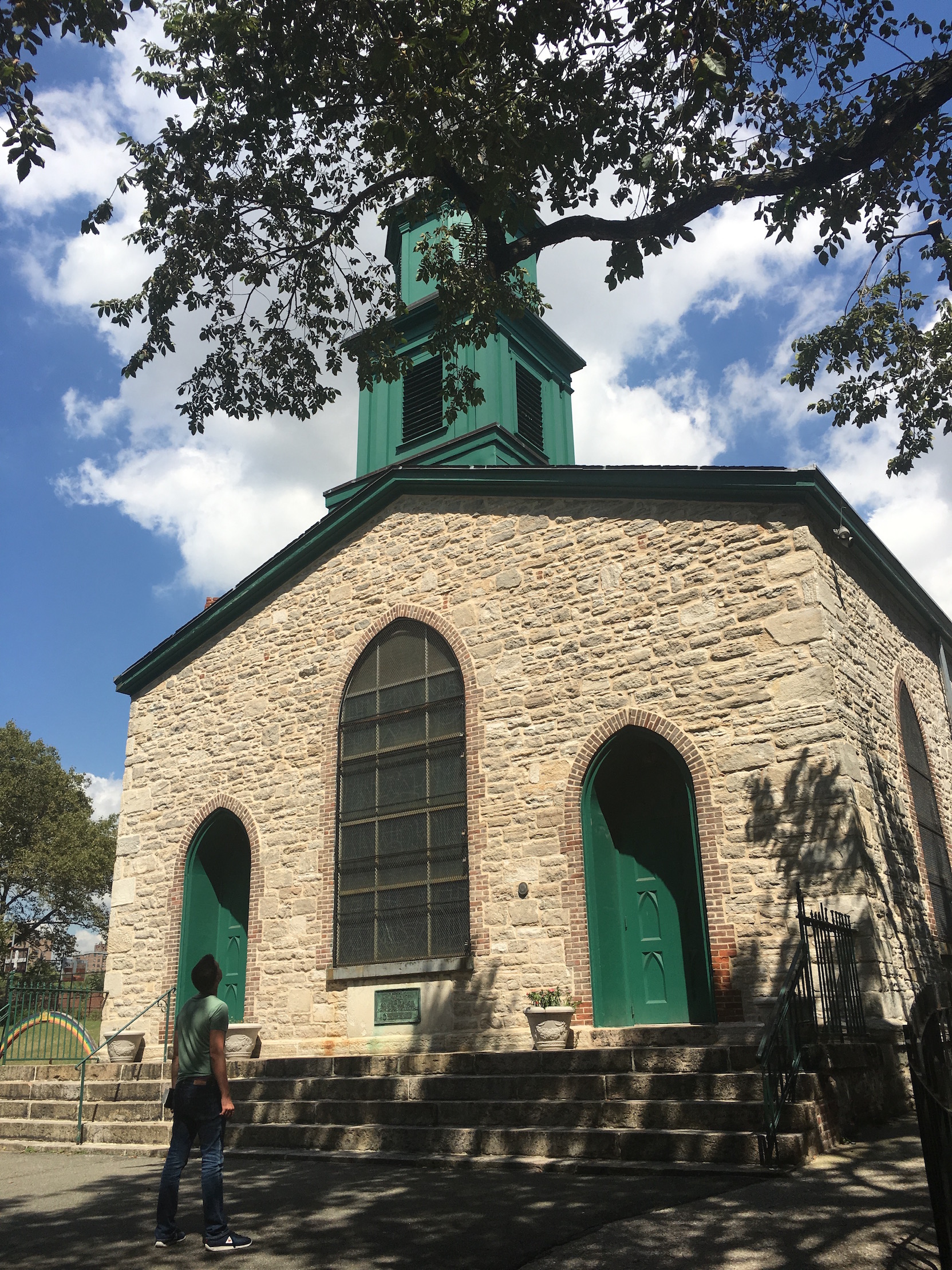
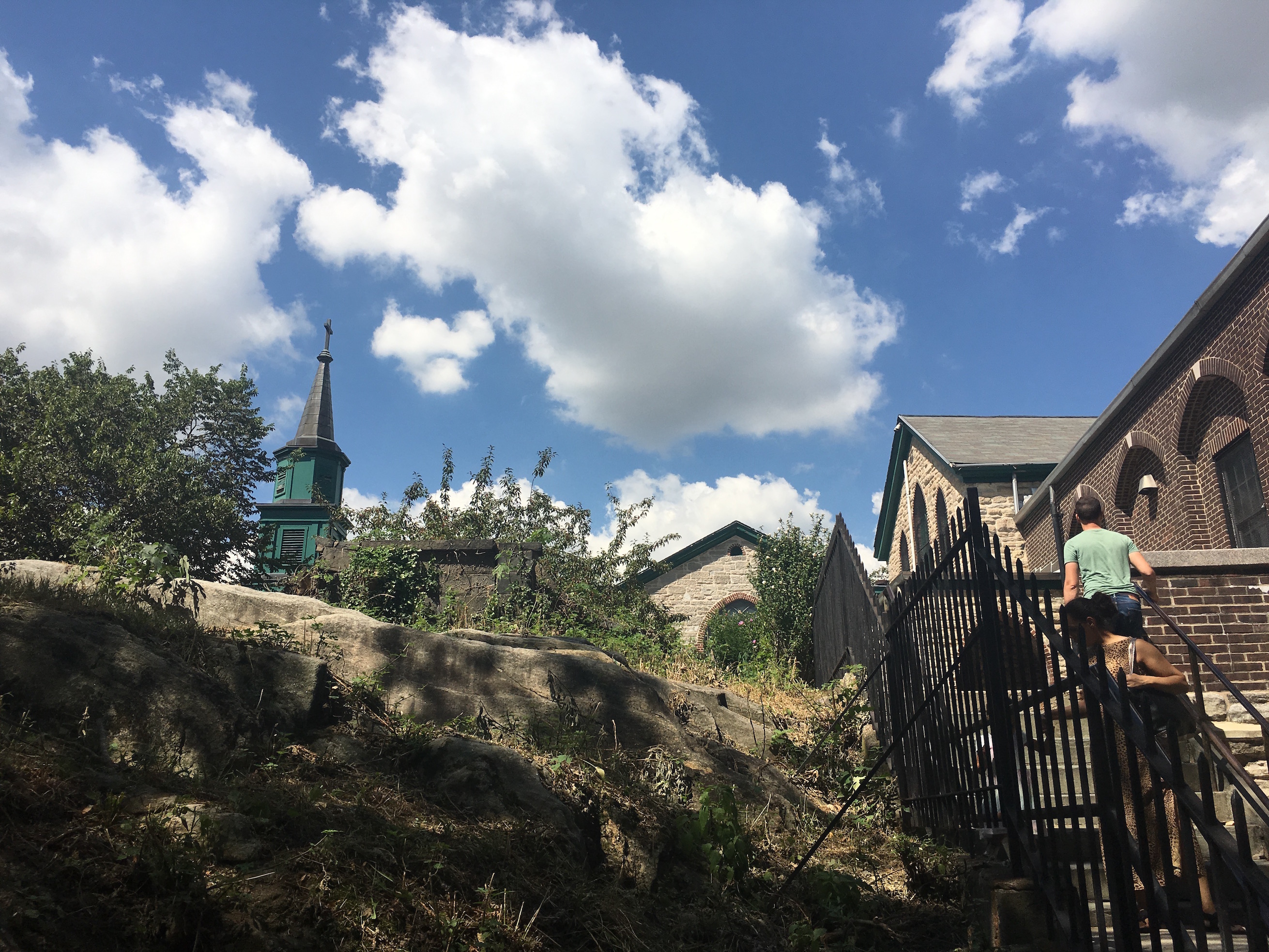
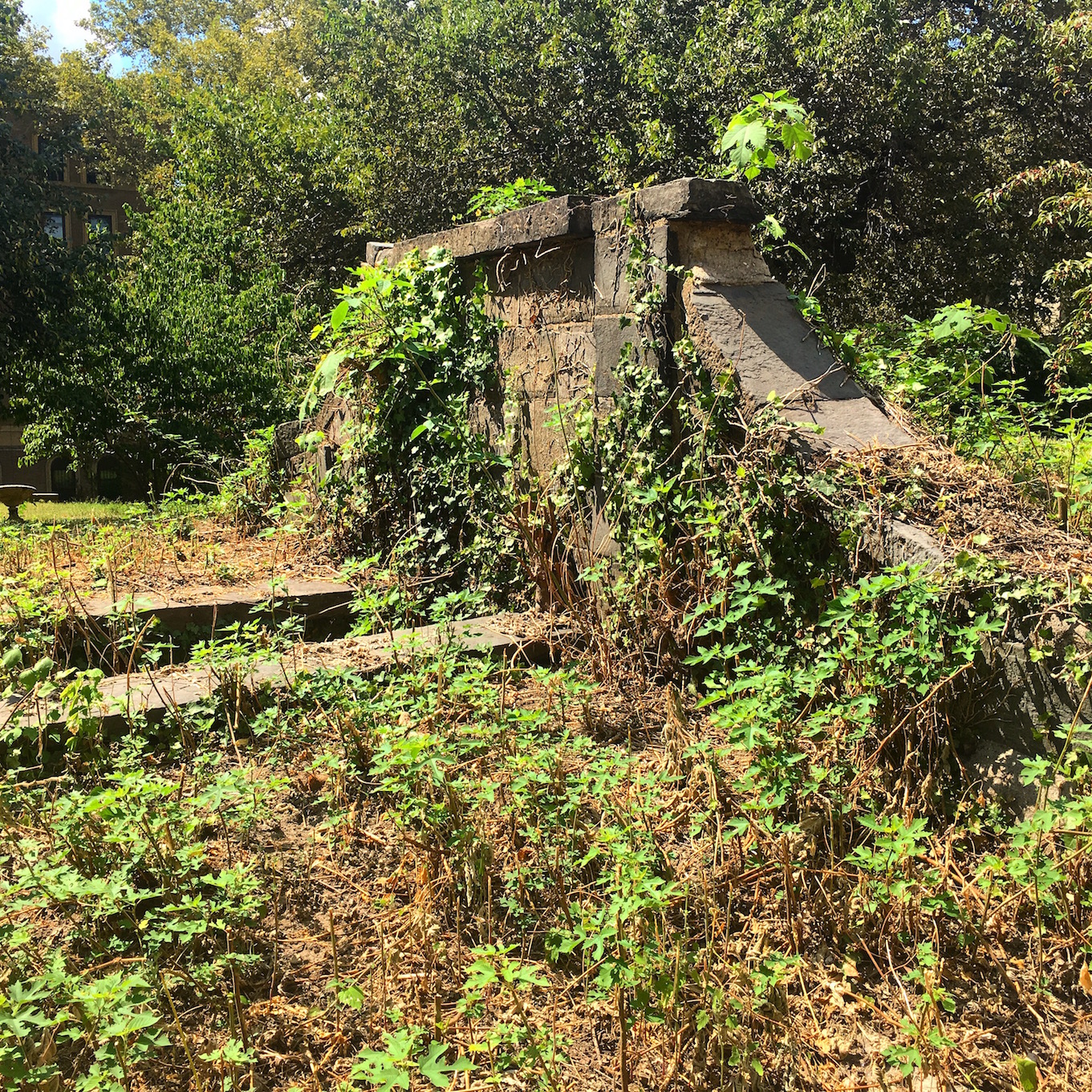
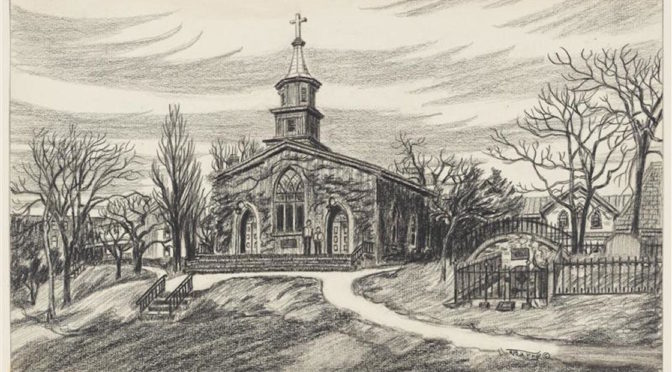
However one lasting physical vestige to the Morris family still remains — St. Ann’s Church (pictured below) in the neighborhood of Morrisania, built in 1840 and the location of burials for members of the Morris family, including Gouverneur Morris and Lewis Morris (the fourth).

img_0079
img_0078
img_0082

Portions of this article were taken from an earlier one that I wrote for this blog back in 2010.

Categories
Newspapers and Newsies

Hot off the press: the bicentennial of the Bronx Gutenberg

Hoe Avenue in the Bronx has nothing to do with farming, although it once indeed ran through a grand 19th century farm estate.

The avenue’s namesake, Richard March Hoe, born 200 years ago today, brought about a revolution in the world of printing. Without his innovations, the phrase ‘hot off the press’ might never have come about.

His father Robert Hoe, born in England in 1784, the year after America won its independence, moved to the new country and began a printing press business in lower Manhattan (10 Cedar Street) with his two brothers-in-law. Hoe tinkered with improving the hand-operated press machine for the ever-demanding industry of New York publishing. But it would be his young son Richard (born Sept. 12, 1812), taking over the reigns of the company in the 1830s, who would change the world of printing forever.

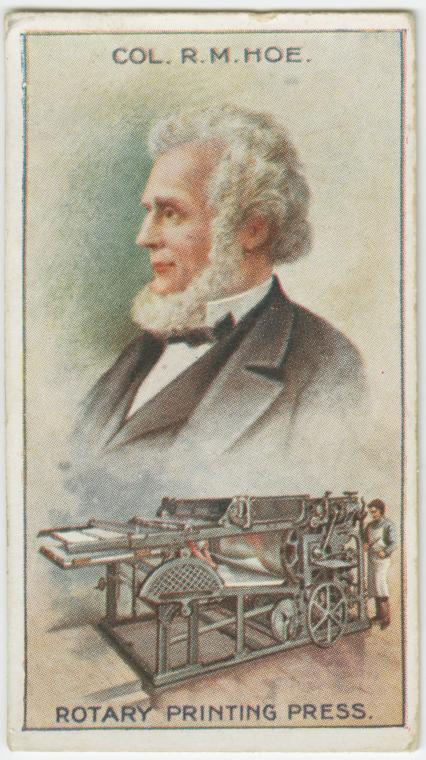
At right: ‘Colonel’ Hoe with his spectacular invention

The answer, of course, was steam power. It had forever changed the worlds of industry and transportation during this period. In 1843, R. Hoe & Company introduced a rotary printing press (nicknamed the ‘lightning press’), using a revolving cylinder drum that rapidly turned out thousands of printed pages using steam power.

His influence on the publishing world by the 1840s cannot be overstated. New York’s penny press, led by newspapers like the Sun, the Tribune and the Herald, utilized the technology to expand their circulation. Soon newspapers across the country were being made using the Hoe printing press, inspiring the growth of daily publications, turning the newspaper into an everyday item and creating a greater demand for the quick delivery of information.

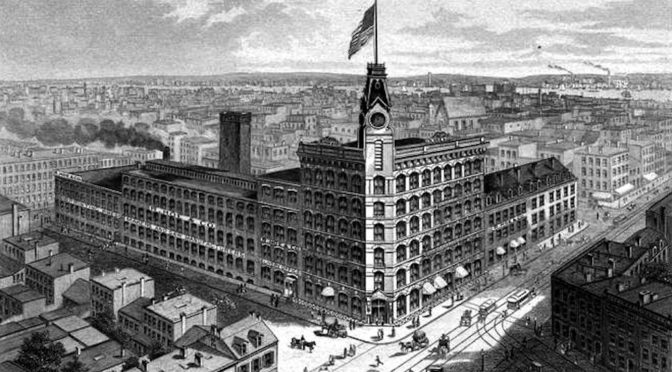
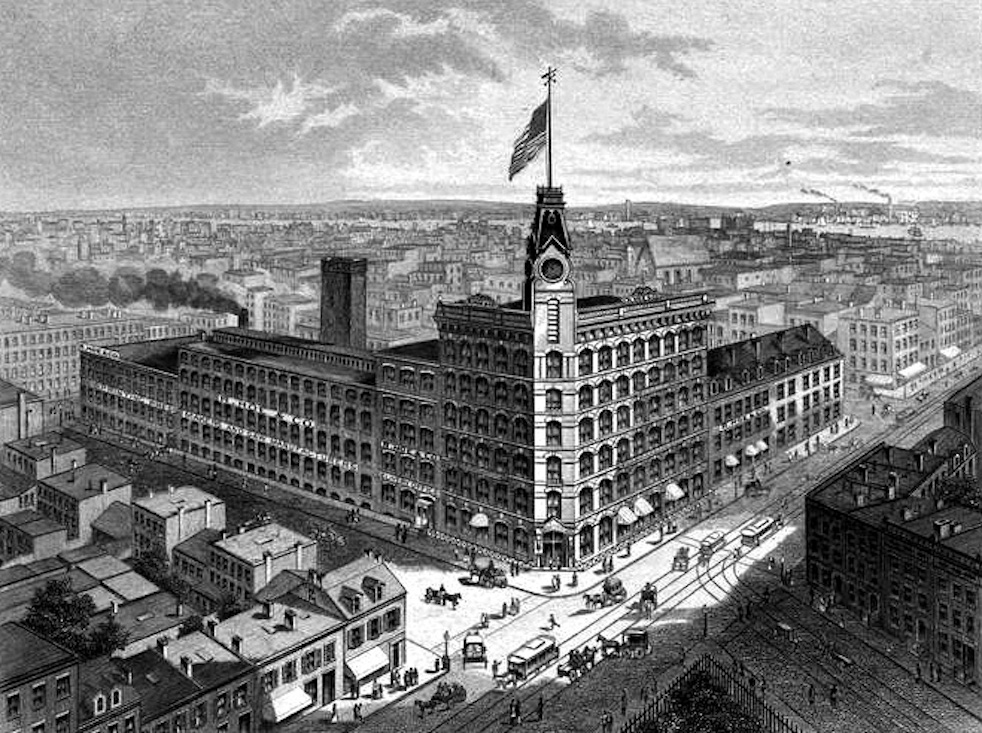
Above: R. Hoe & Company at 504-520 Grand Street.  

Like many great business moguls of the age — certainly men like Thomas Edison were paying attention — Hoe both innovated himself and bought inventions from others, generating a mini-publishing revolution from his headquarters at 504 Grand Street in Manhattan (pictured above).  In 1871, his factory eventually produced America’s first web press, generating two-sided printed pages from a single roll of paper. [source]

If that wasn’t enough, a decade later, Hoe acquired the technology to fold the newspapers as they came off the press.

Interestingly, the company also distinguished themselves in the manufacture of saw blades, a side business not completely unrelated, as they were used to cut metal type.

While Hoe conducted business from the Lower East Side and from offices in London, the printing-press mogul resided in a lavish 53-acre estate named Brightside near the Bronx River, on land once owned by the family of Gouverneur Morris, with plenty of room for an orchard and land for his prize-winning Jersey cattle. His brother Robert bought the neighboring land and opened his own estate called Sunnyslope.

Most signs of these estates is long gone, of course, with the exception of Hoe Avenue.  For modern pop culture junkies, the street is perhaps best known for the Hoe Avenue peace meeting, an assemblage of New York street gangs calling for a truce that inspired the plot of the 1981 film ‘The Warriors (in particular, the ‘Can you dig it?’ scene).

Nearby you’ll find another street named for printers: Aldus Street, a modification of the name Aldo Manuzio, a 15th century Italian printer  At the corner of Aldus and Hoe is a small playground called Printer’s Park, with playground equipment made to look like a rotary printing press.  And nearby is a small garden called — no beer jokes please — the Hoe Garden.

Richard Hoe died in Florence, Italy, on June 7, 1886.

Pictures courtesy New York Public Library.

South Bronx and the days of new American aristocracy

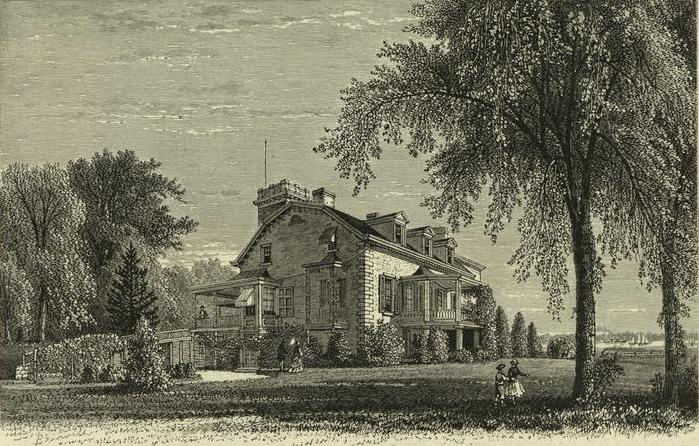
What you think about when you think about the South Bronx: the Morrisania estate built by Gouverneur Morris. (NYPL)

NAME THAT NEIGHBORHOOD Some New York neighborhoods are simply named for their location on a map (East Village, Midtown). Others are given prefabricated designations (SoHo, DUMBO). But a few retain names that link them intimately with their pasts. Other entries in this series can be found here.

NEIGHBORHOOD: Morrisania, the Bronx

Was there an estate in New York ever as beautiful as Morrisania, nearly 2,000 acres that hugged the Harlem River until it opened out into the turbulent East River as it coursed past small islands and flowed into the Long Island Sound? A property that varied from western hills looking over the river to the rolling spread of Manhattan below, to eastern marshes and flatlands suitable for farming.

Today’s Bronx neighborhood of Morrisania is only a small portion of the original property owned by the Morris family since the 1670s, during the dawning years of British dominance in the New York region. The original parcel, purchased by Welsh captain Richard Morris, was only 500 acres, a part of original land settled by Bronx namesake Jonas Bronck.

When Richard died, brother Lewis Morris (for reasons that will soon be evident, let’s call him Lewis 1) moved from the West Indies to claim the property. He would be one in a succession of Lewis Morrises to live here and place an imprint on what would some day contain much of the South Bronx.

The Morris family was feisty, business savvy, well connected, extremely aristocratic and entirely unoriginal with names. Another Lewis Morris (Richard’s son, or Lewis 2) became the governor, at separate times, of both New York and New Jersey. Yet another Lewis (Lewis 3) became a powerful New York justice. His son Lewis Morris (Lewis 4) was a signer of the Declaration of Independence.

If you haven’t gleaned it already, the clan carried themselves like some kind of royal family. They were, artificially at least, as were many families in the New World who quickly made fortunes here and staked claims in manners similar to what their forebears were accustomed to in Europe. Over the decades, the Lewises would blend by marriage into other elite, bold-faced families to form a tangled ball of interlinked faux American royalty.

Morrisania for most of the 18th century resembled a miniature British kingdom, with a spread of small farms, dairies and cattle pens operated by those leasing from the Morris family, a proper workaday serfdom common for the era. However, during the early decades, the land was even worked with slave labor, although the practice was phased out in later generations.

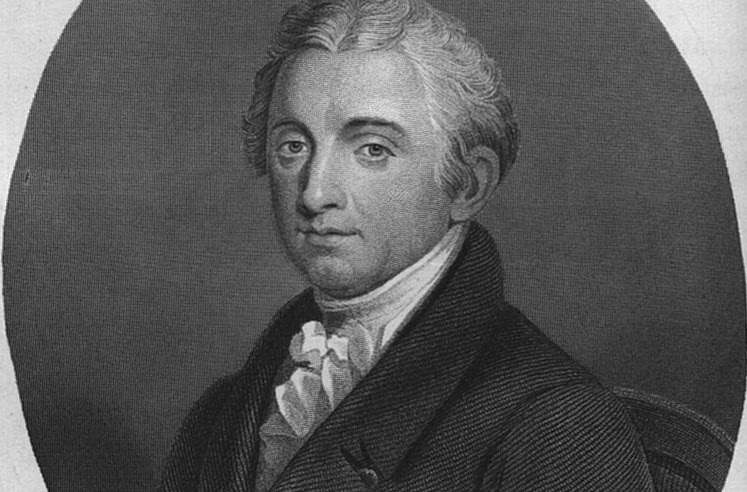
When Lewis 3 passed in 1762, this massive property was split in two. West of the small babbling Mill Brook (honored today with a playground and a housing development) belonged to Lewis 4 and his brothers, but the more bucolic eastern side fell to Lewis 3’s second wife Sarah and eventually her only son. That’s right, Gouverneur Morris (pictured below).
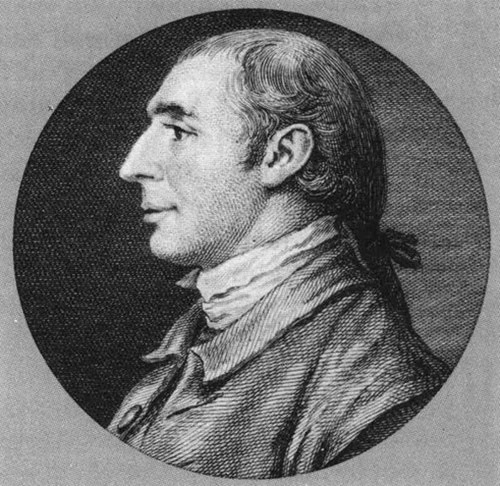
Gouverneur fled his home during the Revolutionary War, but his mother Sarah stayed behind. During this time, the rich farmland was vandalized and the family’s voluminous library, one of the largest collections in North America at the time, was ransacked.

Gouverneur was quite busy in the late 18th century doing things like penning the Constitution and being minister to France in the midst of their bloody revolution. But wherever he traveled, he always felt a closeness to Morrisania.

After the war, while Gouverneur in France, Lewis 4 offered up the family estate of Morrisania be used as the site for the new American capital. One can just imagine the history of New York had Congress taken him up on that offer!

In 1798, when Gouverneur returned from France and claimed the property for himself, he built a new home here and filled it with all his gathered French finery. Perhaps no household was more beautiful — or as pretentious — as Morris’ new manor.

Gouverneur, of course, facilitated the growth of New York with his roles in the development of both the Commissioners Plan of 1811 and the Erie Canal. His old farms, however, were technically part of Westchester Country. In the 1840s, his son Gouverneur Morris Jr. emulated New York’s former estate owners and began to develop his property for commercial and residential use.

Chief among these decisions was becoming vice president of the New York and Harlem Railroad (eventually to be owned by Cornelius Vanderbilt) and allowing the railroad to cut through the old property. Townships formed around the railroad station, include one small village named the old manor, Morrisania. That village is the root of today’s neighborhood of the same name.

Gouverneur Junior was cut from the visionary mold that would define many in the 19th Century. One pet project was the development of a port village along the old family property on the eastern shoreline, today’s Port Morris area.

Given that Gouverneur Senior was partially responsible for Manhattan’s grid, it’s no surprise that a different grid patterns were adhered to the old Morris properties over the years. In emulating Manhattan’s pattern, all traces of the area’s early farm existence was eradicated. The following years was hold many strange detours in the history of the South Bronx: opulent boulevards, the Yankees, 1970s crime sprees. But the Morrises live on, if in name only.

Categories
Health and Living Podcasts

Building Blocks: The Commissioners Plan of 1811, inventing a New York grid of streets and avenues

The simplicity of the New York grid system, seen overhead in a 1939 classic photo by Margaret Bourke-White.

PODCAST The Commissioners Plan of 1811 How did Manhattan get its orderly rows of numbered streets and avenues? In the early 19th century, New York was growing rapidly, but the new development was confined on an island, giving city planners a rare opportunity to mold a modern city that was orderly, sophisticated and even (they thought at the time) healthy. With the Commissioners Plan of 1811, uniform blocks were created without regards to hills and streams or even to the owners of the property!

Join us as we recount this monumental event in New York’s history — how land above Houston Street was radically transformed and also how the city revolted in many places. What about those avenues A, B, C and D? Why doesn’t the West Village snap to the grid? And why on earth did the early planners not arrange for any major parks?!

ALSO: A podcast within a podcast as we focus on the biography of one of those commissioners. Give it up for Gouverneur Morris, the casanova with Constitutional connections, a Bronx estate and a wooden pegleg.


CORRECTION: Due to my complete misreading of my own handwritten notes and in the flurry of wrapping up the show, I said that Manhattanhenge occurs on March 28 and July 12 or July 13. I meant MAY 28, not March 28. Chalk this one up to my senility. I apologize for the error.

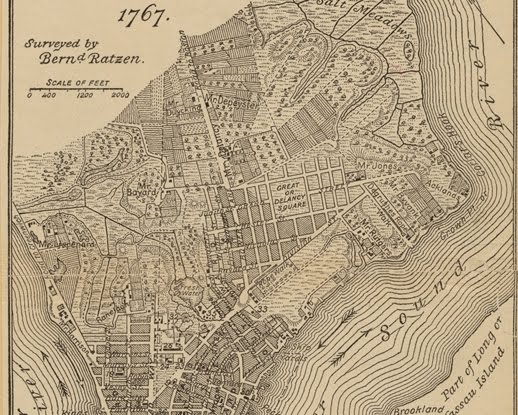
An early view of the area that would one day become the Lower East Side, SoHo and Chinatown: a network of farms and jagged roads, with some organization on individual properties. This map features details of James DeLancey’s farm. That property would be carved up after the war. (You can check out the whole 1767 map here.)

Gouverneur Morris, the Founding Father who led the commission to plan New York’s future streets and avenue.

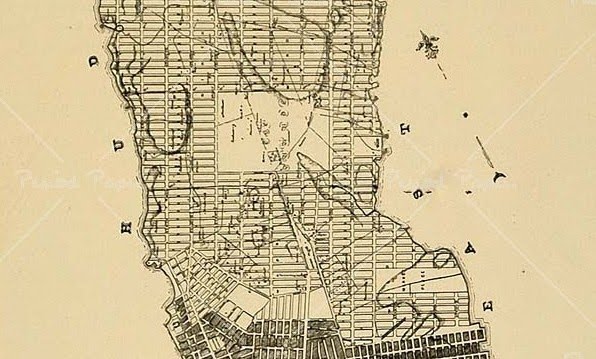
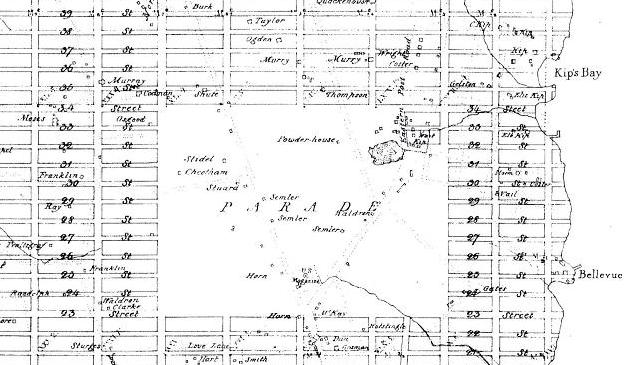
A detail from the original 1811 grid plan map of John Randel. The grid starts at irregular intervals due to keeping Greenwich Village intact, but begins right about Houston Street to the east. As it heads north, two big interupptions were planned — a market place in east around 10th-11th Street and a ‘parade ground’ about 23rd Street.

A close-up on the parade ground.

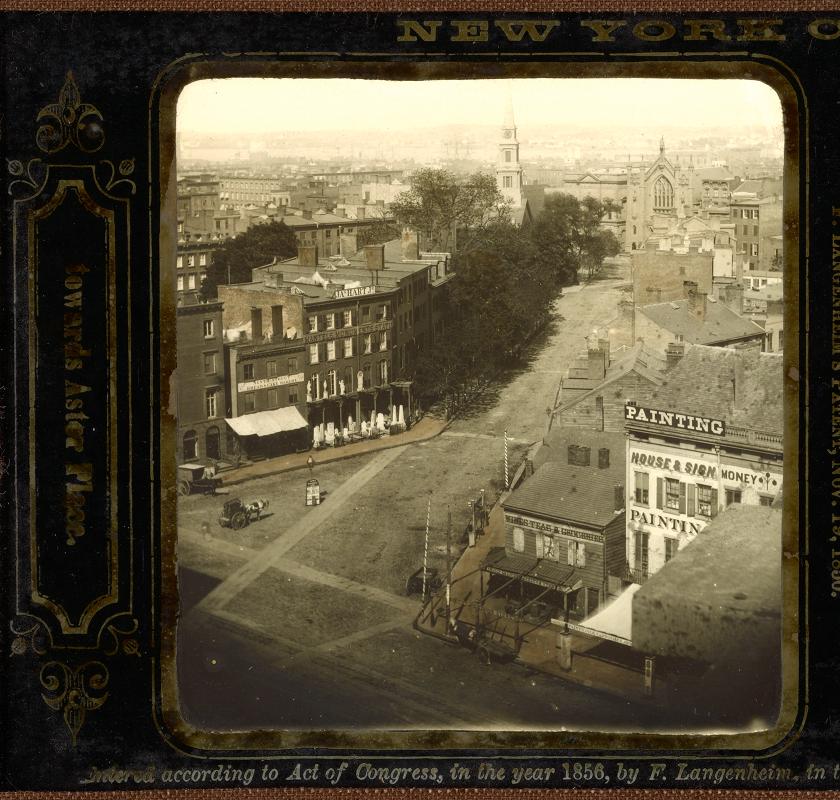
Not everything conforms to the original plan. Take Stuyvestant Street in the East Village. A main thoroughfare into the original estate of the Stuyvesant family, the small road was allowed to break the block between 9th and 10th streets. The street is hardly recognizable in this extraordinary photo from 1856, but the top of St. Mark’s Church gives away the location. (Courtesy East Village Transitions)

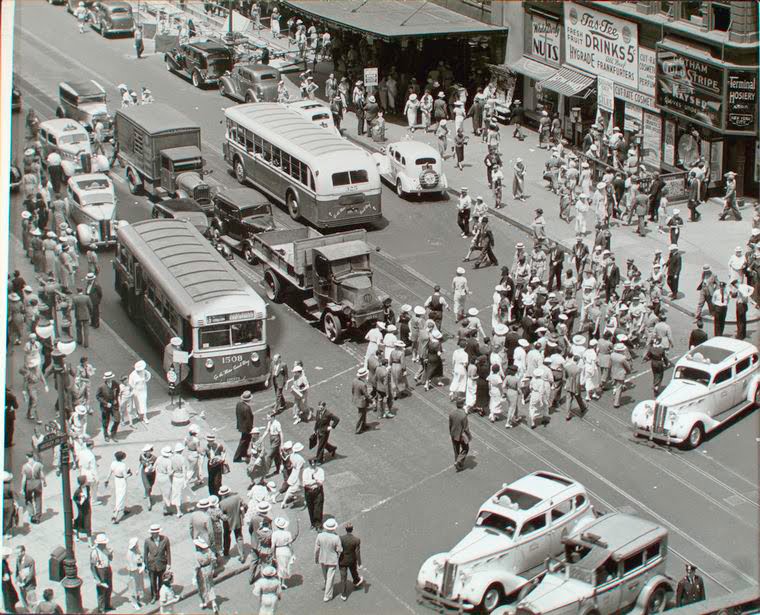
Crossroads: Herald Square, on a hot summers day in 1936. The intersection was partially created by the grid plan (the intersection of 34th Street and Sixth Avenue) and by one feature that later city planners ignored: Broadway which, according to the plan, was never supposed to extend past 23rd Street. (NYPL)

Here’s a look at the entire Randel map in color.

Check out the New York Times wonderful interactive map, overlaying the original plan on top of modern changes to the city.