Categories
The Alienist

The harsh lives of New York City street kids, captured — in a flash — by Jacob Riis

HISTORY BEHIND THE SCENE What’s the real story behind that historical scene from your favorite TV show or feature film? A semi-regular feature on the Bowery Boys blog, we will be reviving this series as we follow along with TNT’s limited series The Alienist. Look for other articles here about other historically themed television shows (Mad MenThe KnickThe DeuceBoardwalk Empire and Copper). And follow along with the Bowery Boys on Twitter at @boweryboys for more historical context of your favorite shows. 

Look near the very end of the fourth episode of The Alienist, and you’ll see a surprising homage to an iconic, heartbreaking photograph.

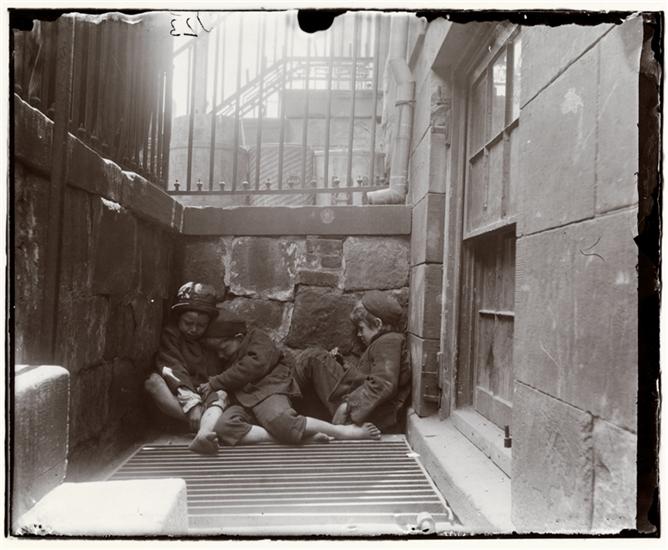
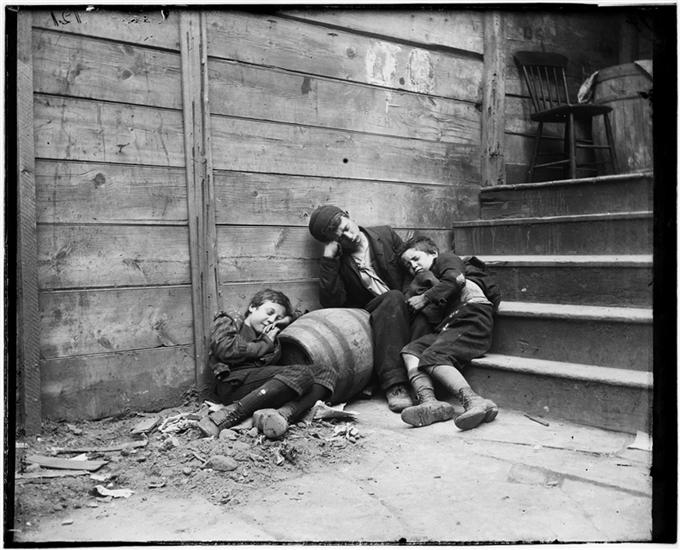
Called ‘Street Arabs in the Area of Mulberry Street‘, the image, taken in 1889, depicts three homeless boys sleeping over a heated vent on the bottom floor of a tenement (in the area of today’s Little Italy).
MCNY

Their names are unknown. In the late 19th century, hundreds of children lived on the streets of New York, turned out of their homes or separated from their loved ones. Many actually did have loving families but living conditions in the tenements were so squalid that some chose to sleep on the street.

We have this image — and many, many similar ones — thanks to journalist and social reformer Jacob Riis.

On February 12, 1888, Jacob Riis published his first investigation for the New York Sun, revealing the wretched conditions of New York’s worst slum neighborhoods by employing an experimental technology — flash photography. The startling pictures, by Riis and a team of other photographers, were at first rendered in line drawings, but the effect was nevertheless profound.
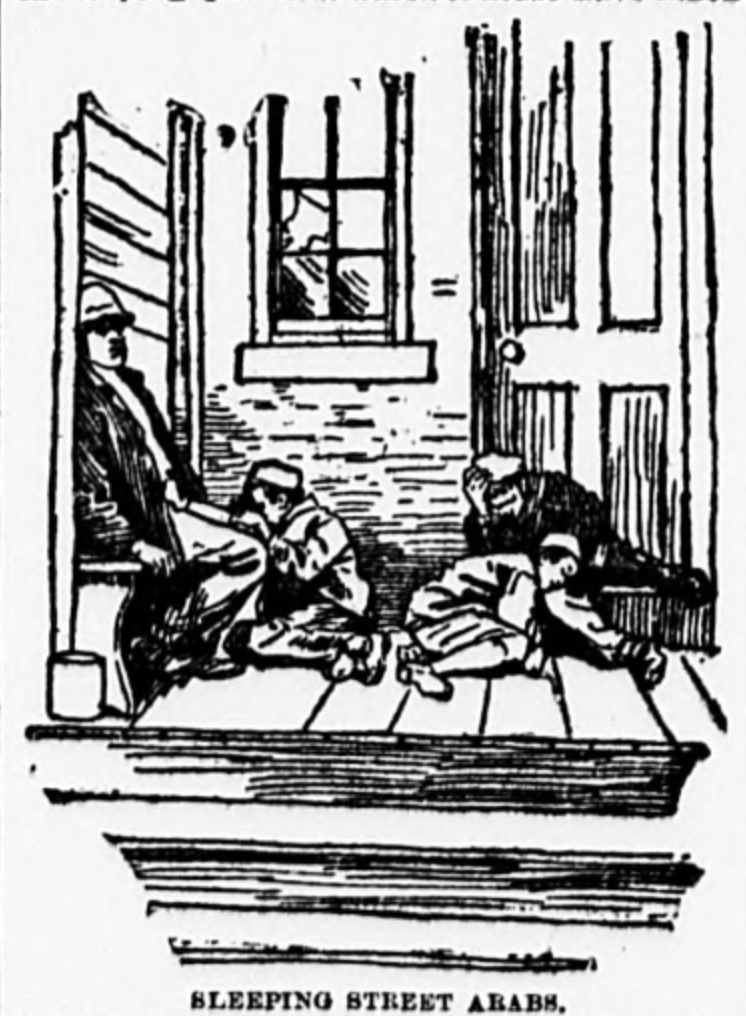
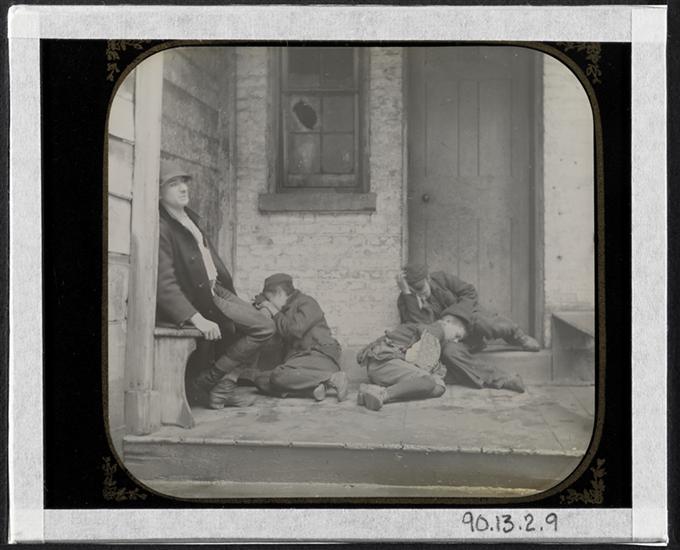
The entire article is available online but here’s the passage pertinent to the photograph above:

Another outcropping of the benevolent purpose of Mr. Riis … is his showing of a touching picture of street Arabs in sleeping quarters which it must have taken a hunt to discover. These youngers have evidently spent their lodging money for gallery seats at the show and have found shelter on the back stoop of an old tenement house.” 

Below: An illustration from the Feb. 12, 1888, newspaper, and the Riis photograph (of Bandit’s Roost) that it represents.
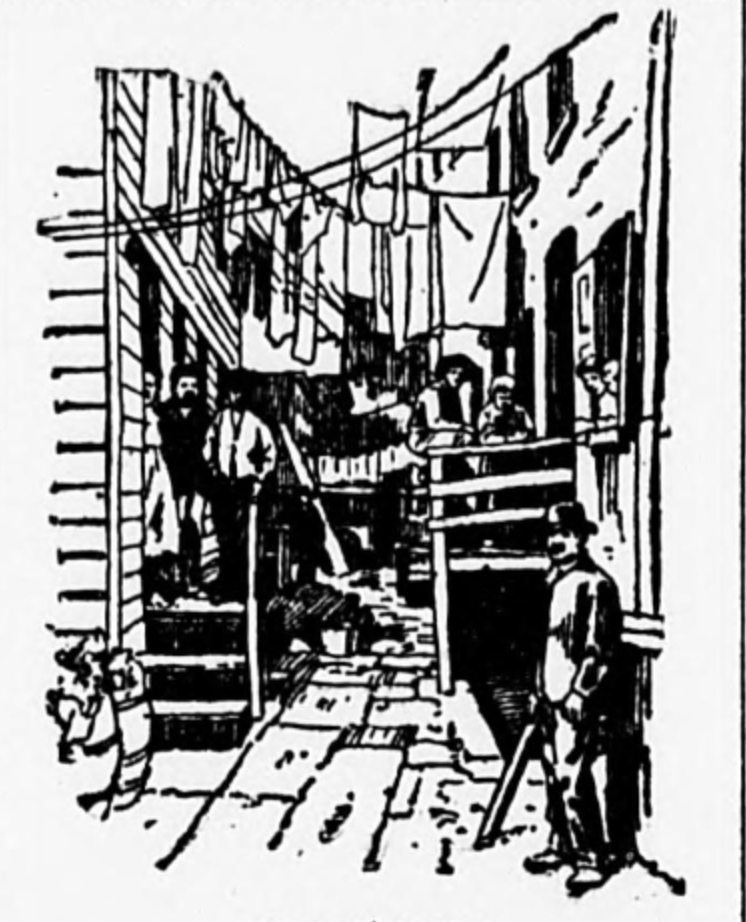
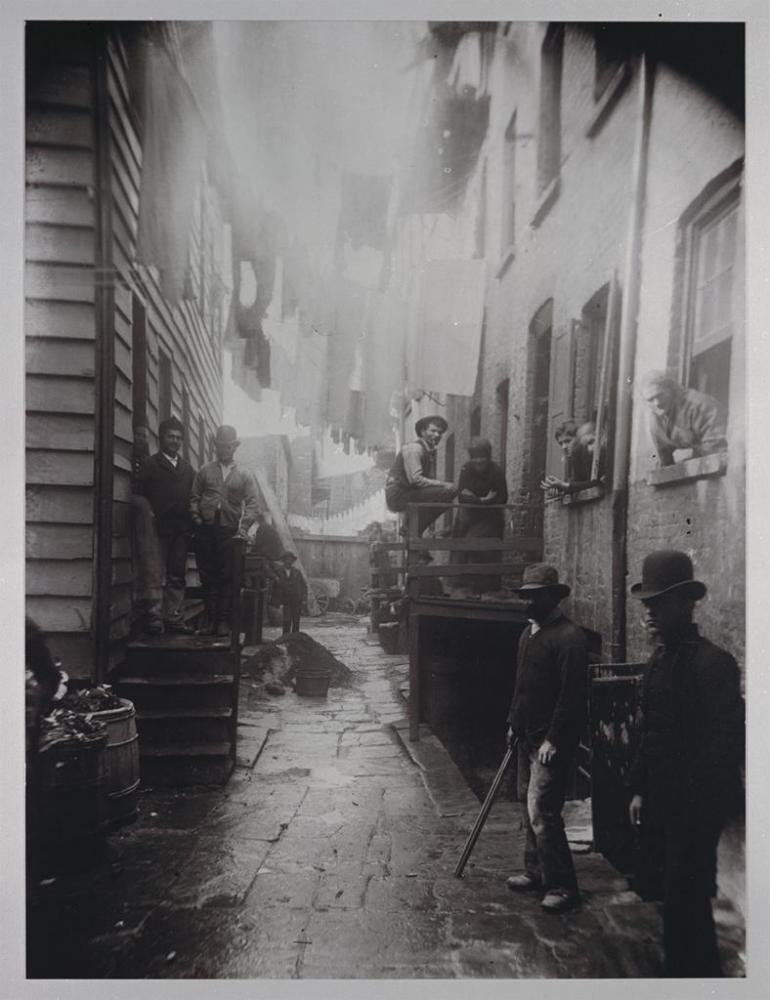
The pictures are more than social activism; they’re history themselves, the first flash photography ever to be used in this fashion. Riis was showing New Yorkers a vivid glimpse of poverty — orphans in the gutter, street gangs in the alleyway — using a technique that few were regularly exposed to apart from portraiture.

Riis never considered himself a professional photographer. Later in his career, he even farmed out the photographic work to others as he focused on writing and social activism. And yet modern photojournalism wouldn’t really be what it was today without his first forays into slums, opium dens and beer halls with his bulky and costly equipment. His early work influenced an entire field of social photographers seeking to prove the adage “a picture is worth a thousand words” (a phrase which debuted near the end of Riis’ lifetime).
MCNY

His work would eventually be published as a book in 1890 — How The Other Half Lives: Studies Among the Tenements of New York — and Riis would spend the decade virtually proselytizing on behalf of the city’s needy.

In that book, he expounds upon the plight of the ‘street Arab’, aka street urchin.

“They are to be found all over the city, these Street Arabs, where the neighborhood offers a chance of picking up a living in the daytime and of “turning in” at night with a promise of security from surprise. In warm weather a truck in the street, a convenient out-house, or a dug-out in a hay-barge at the wharf make good bunks. Two were found making their nest once in the end of a big iron pipe up by the Harlem Bridge, and an old boiler at the East River served as an elegant flat for another couple.”

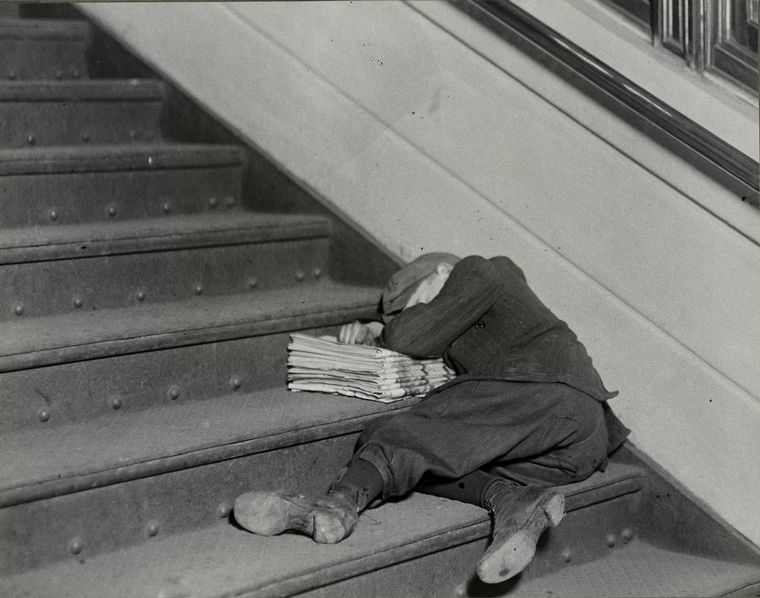
Below: Two boys asleep at 2 a.m. in the press room of the New York Sun newspaper.
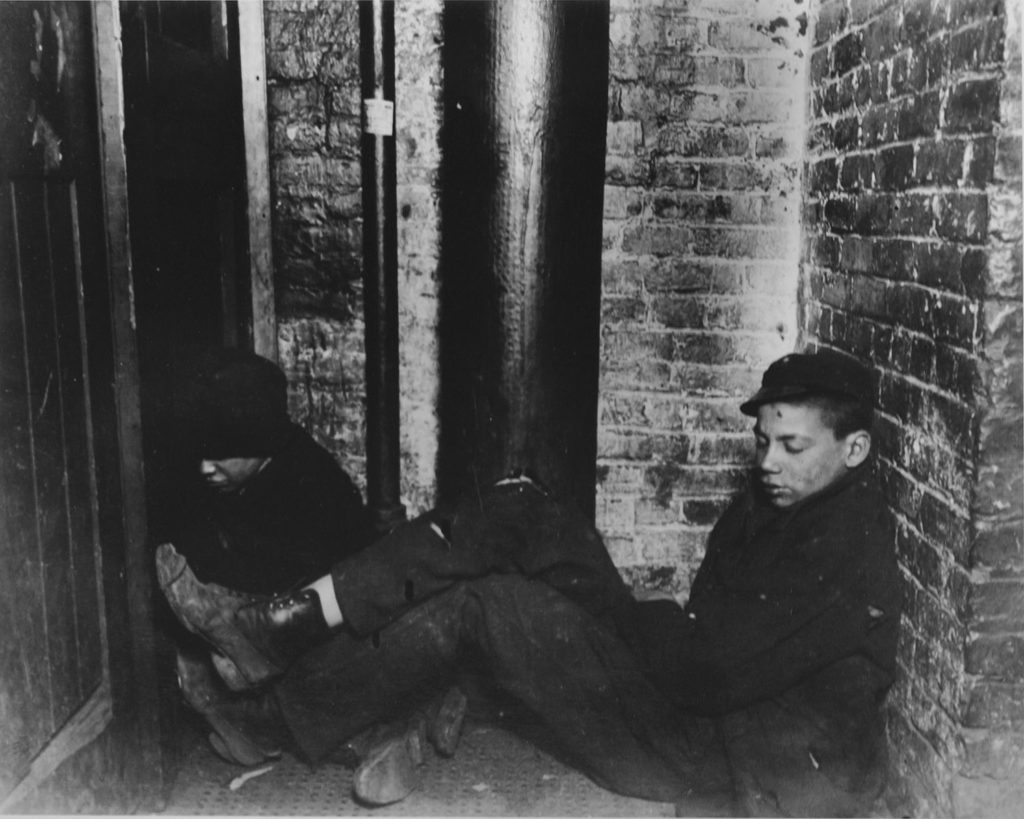
Most street kids are newspaper boys or bootblacks, fighting for scraps and a few pennies. In another section, Riis writes:

“We wuz six,” said an urchin of twelve or thirteen I came across in the Newsboys’ Lodging House, “and we ain’t got no father. Some on us had to go.” And so he went, to make a living by blacking boots. The going is easy enough. There is very little to hold the boy who has never known anything but a home in a tenement. Very soon the wild life in the streets holds him fast, and thenceforward by his own effort there is no escape. Left alone to himself, he soon enough finds a place in the police books, and there would be no other answer to the second question: “what becomes of the boy?” than that given by the criminal courts every day in the week.”
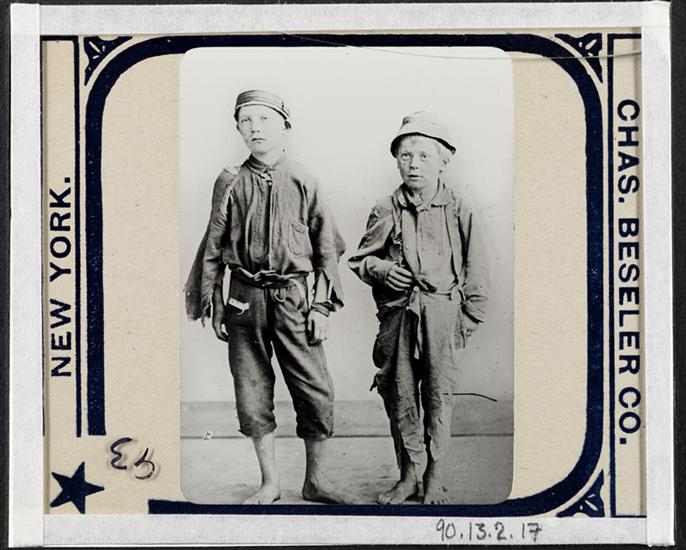
“Didn’t live nowhere.” MCNY

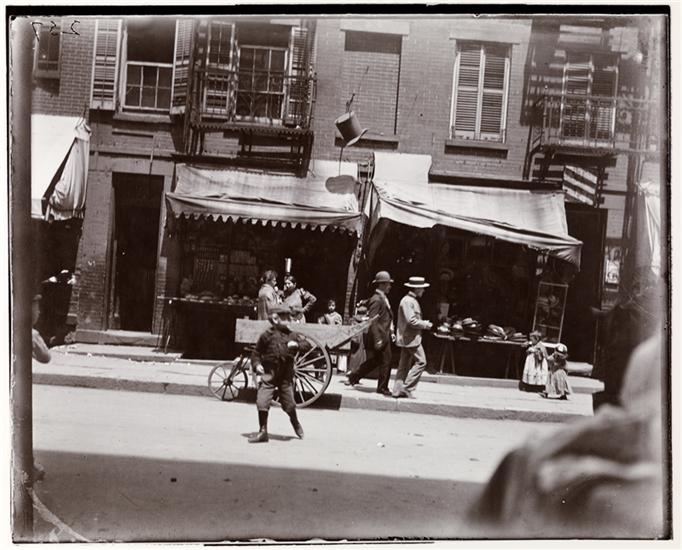
Below are more pictures of children on the streets of New York City in the late 1880s and early 1890s, taken by Riis and his associates, courtesy the Museum of the City of New York.
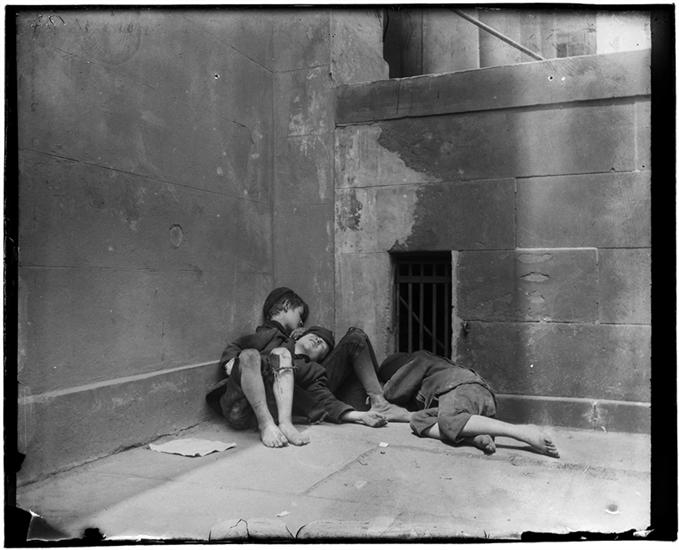
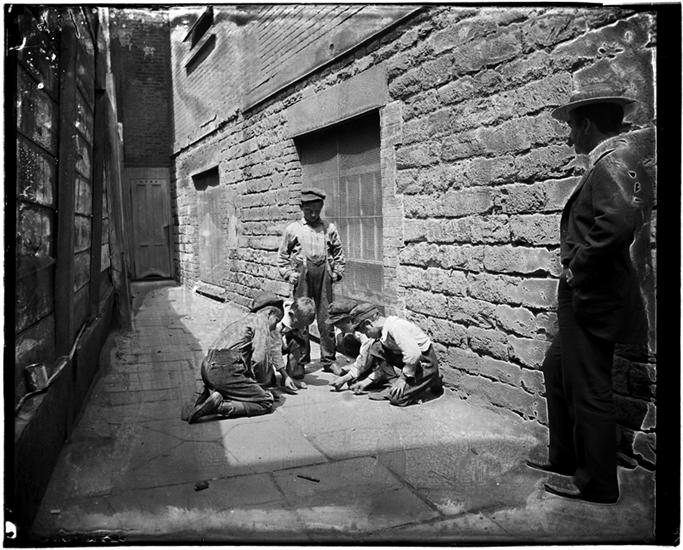
MCNY

“Shooting Craps: The Game of the Street,” Bootblacks and Newsboys, 1894″ MCNY
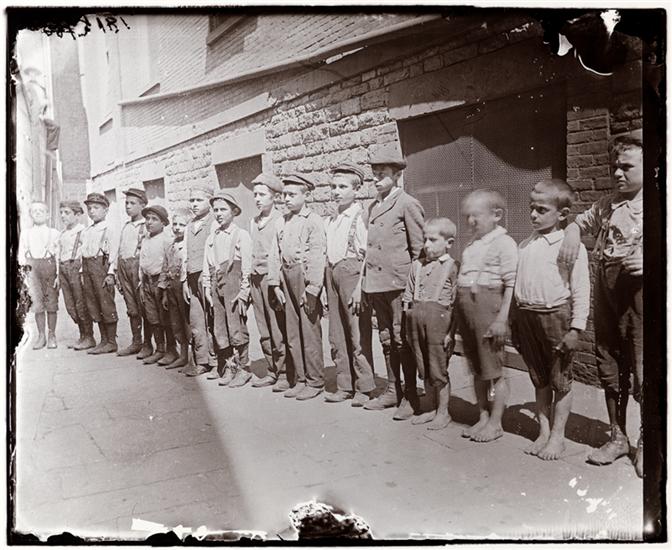
A line-up of boys in a Mulberry Street alley. 1890, MCNY
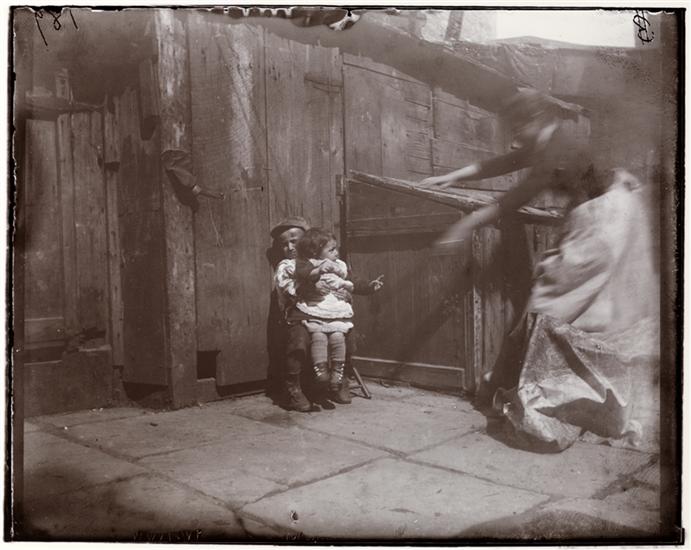
A young boy holding a baby, a woman reaches for them. 1890, MCNY
1890, MCNY
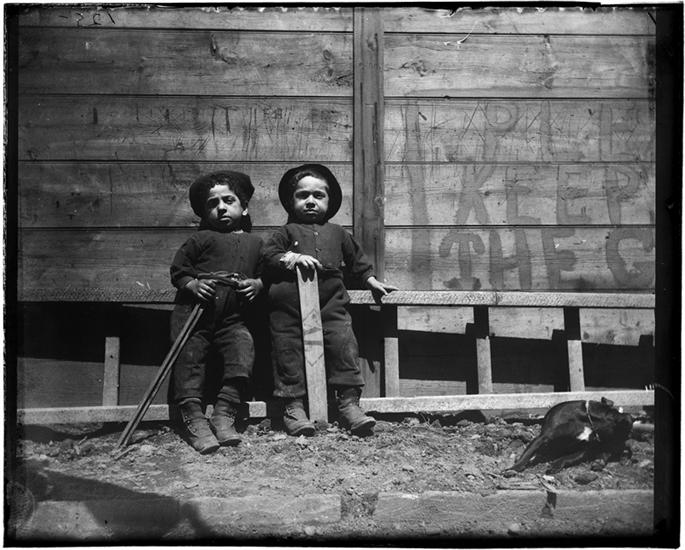
The Mott Street Boys, “Keep off the Grass”. 1890. MCNY

This article excerpts a portion of our review of the Museum of the City of New York’s 2015 exhibition on Riis.
Categories
Podcasts

Newsies vs the World! The Newsboys Strike of 1899

Are you tough enough to mess with them?

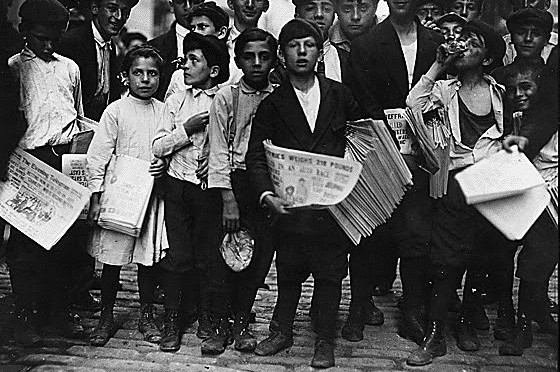
PODCAST Extra! Extra! Joseph Pulitzer and William Randolph Hearst vs. the newsboys! Pandemonium in the streets! One hot summer in July 1899, thousands of corner newsboys went on strike against the New York Journal and the New York World. Throngs filled the streets of downtown Manhattan for two weeks and prevented the two largest papers in the country from getting distributed.

In this episode, we look at the development of the sensationalist New York press — the birth of yellow journalism — from its very earliest days, and how sensationalism’s two famous purveyors were held at ransom by the poorest, scrappiest residents of the city. The conflict put a light to the child labor crisis and became a dramatic example of the need for reform.

Crazy Arborn, Kid Blink, Racetrack Higgins and Barney Peanuts invite you to the listen in to this tale of their finest moment, straight from the street corners of Gilded Age New York.


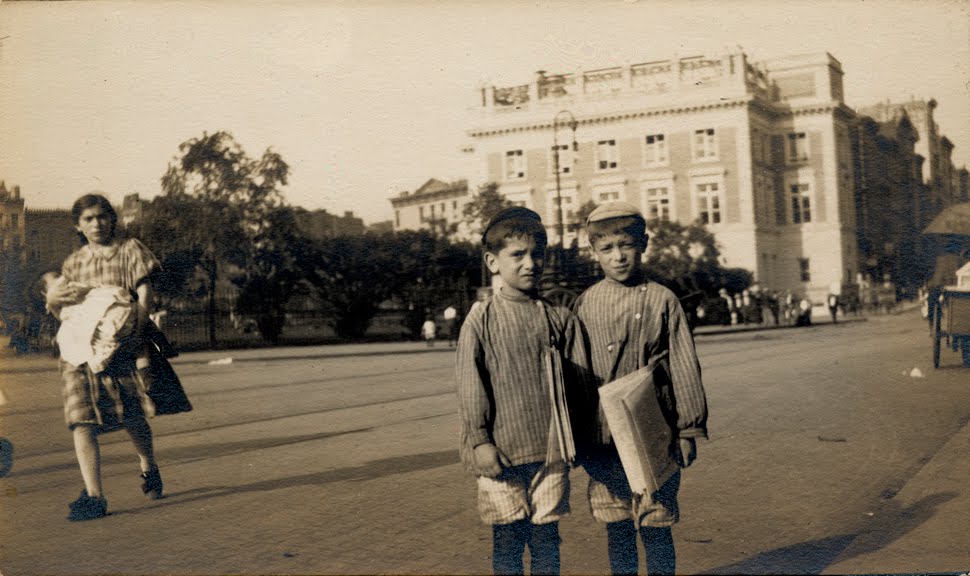
Newsboys in front of Seward Park. Caption: “Eisenberg Brothers, living at 27 Lewis Street. Benjamin, 8 years old, and John 10, selling Jewish papers [assumably the Forward] on East Broadway near Rutgers Street.” By Lewis Hine (Courtesy NYHS)

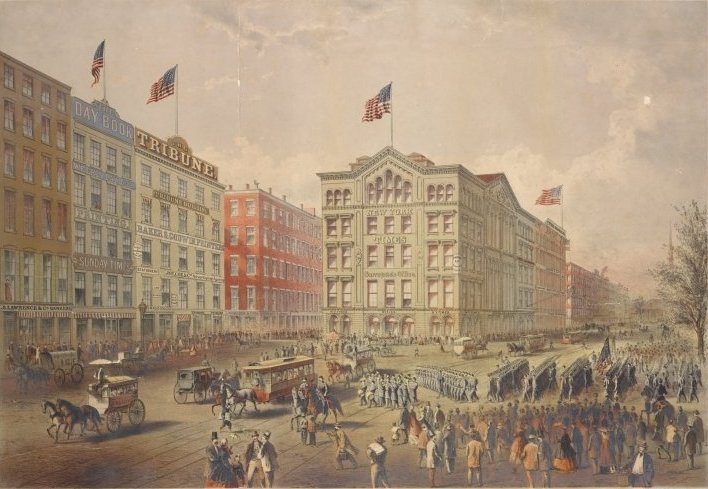
Printing House Square, in a print from 1866, and the world of newspaper publishing in the mid-19th century. This was the heart of journalism in New York, where the streets reeked of ink, reporters and editors darted back and forth from their offices, and newsboys gathered to pick up their morning bundles of hot-off-the-press editions. (NYPL)

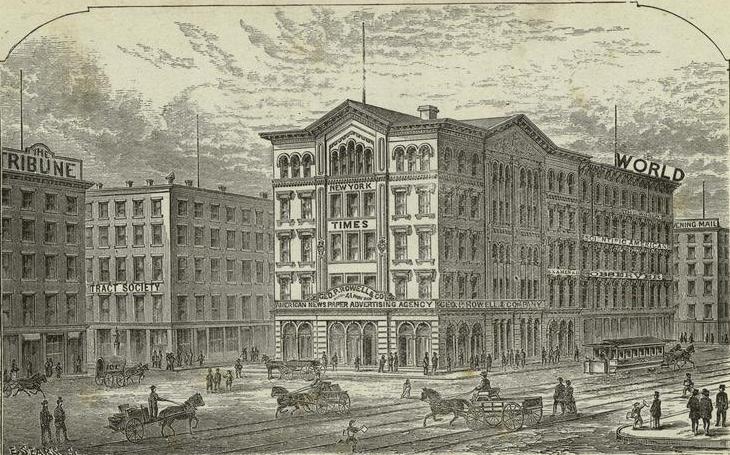
From another angle (print is labeled from 1870s) we see the offices of the Trubune, the Times and the World. The New York World at this time was under publisher Marble Manton was disreputable and unsuccessful.

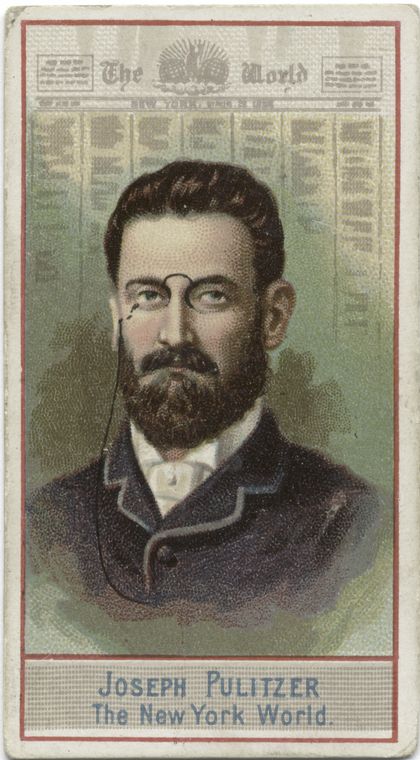
The fate of the New York World was transformed when it was purchased by innovator Joseph Pulitzer, who modernized the publication — introducing such staples of cover photographs and banner headlines — and increased its popularity through sometimes sensational articles. (NYPL)

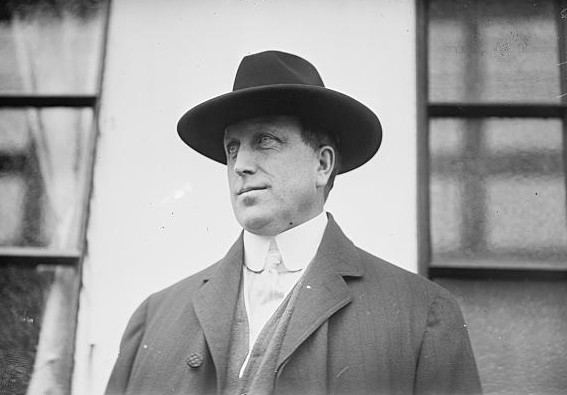
Not to be outdone, William Randolph Hearst stepped into the publishing fray in 1896 with the New York Morning Journal, matching the World head to head in pulling out the stops to increase circulation and ad revenue.

This is Duane Street in the early 1900s. I’m including this picture because the Newsboys Lodging House, where many of the strikers resided for a nickel a night, was located at 9 Duane Street, in the shadow of the World’s distinctive tower.

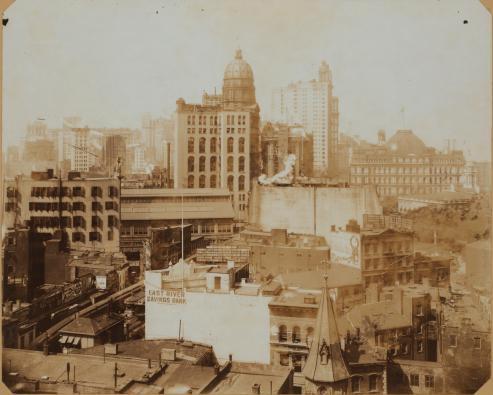
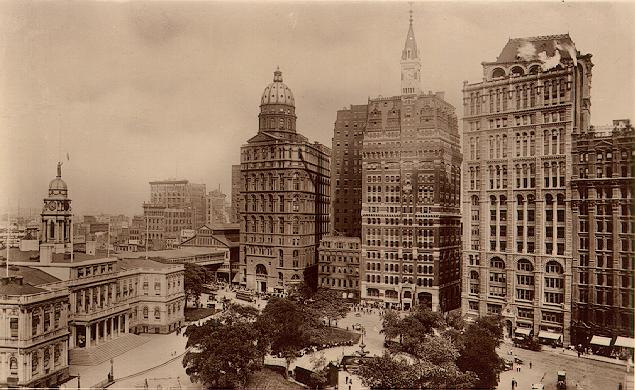
Pulitzer’s World Building from Park Row, designed by George Post, was at one time the tallest building in the world. It sits near the Tribune building, at center.
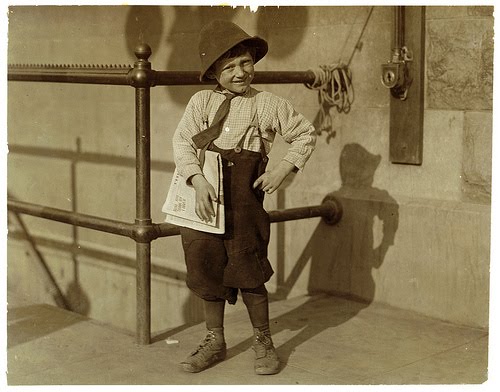
Newsboys were not the ‘plucky’, can-do ambitious entrepreneurs that pop culture has made them out to be, although sometimes (like this guy) they come close.

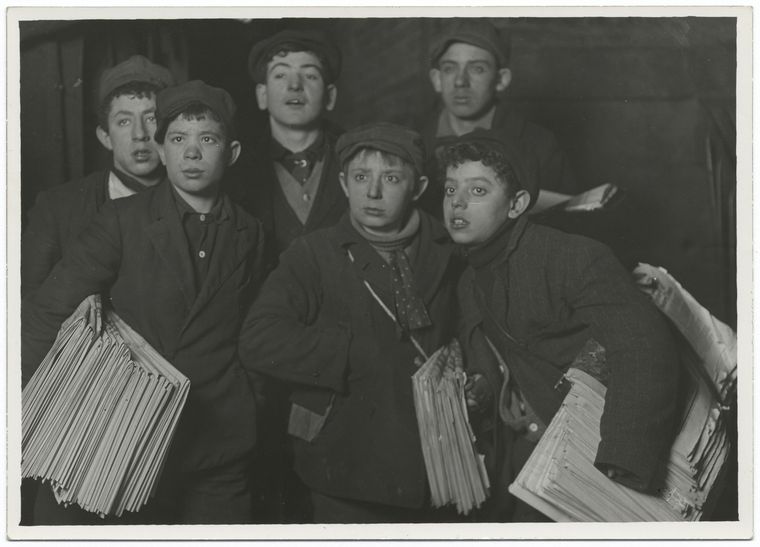
A Lewis Hine photograph with the caption “Group of newsboys starting out at Brooklyn Bridge early Sunday morning.” The newsies got up every morning to pick up their bundle of newspapers. New York newspapers raised the price of these bundles during the Spanish-American War, when circulation increased. When the war was over, many newspapers lowered the price. All but the World and the Journal. [NYPL]

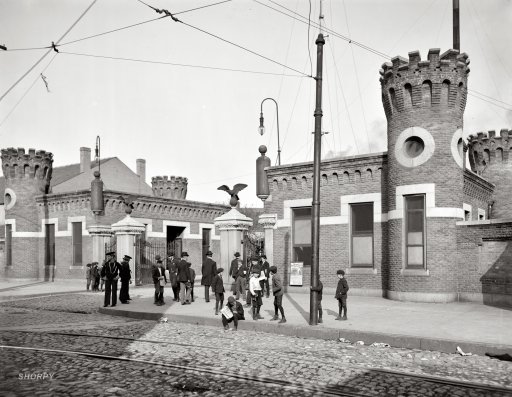
A cluster of newsboys, amongst sailors and businessmen, out at the Brooklyn Navy Yard, 1903. Brooklyn newsies had taken on the newspapers via a strike as far back as 1886 and joined their Manhattan counterparts in fighting back at Pulitzer and Hearst.(Courtesy Shorpy, who has a beautiful larger version)

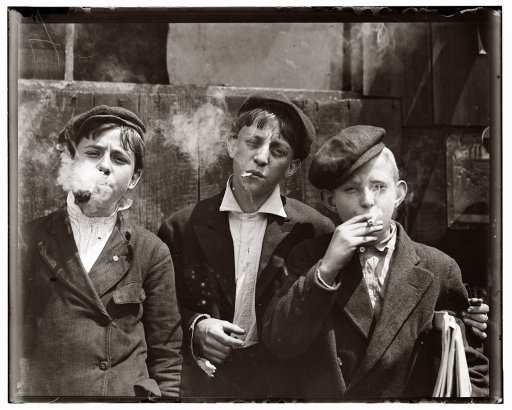
The life of the newsie aged children prematurely. Getting up early, staying up late, most of them homeless and scrounging for nickels and dimes to survive, the 19th century newsboy got by on emulating adulthood. The boys below were photographed by Lewis Hine in St. Louis. (from Shorpy, who have a larger view)

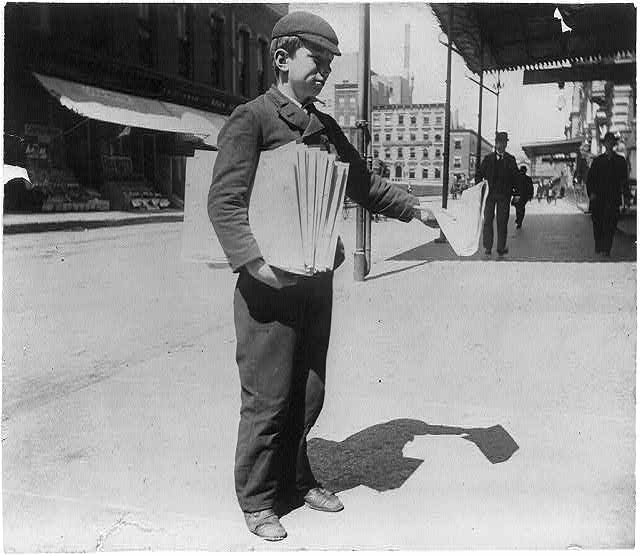
Hine and Staten Islander Alice Austen are the two most well-known photographers of everyday life in New York and captured life on the streets in all its unglamorized tarnish. Below, Austen captures a newsie hard at work in 1906.

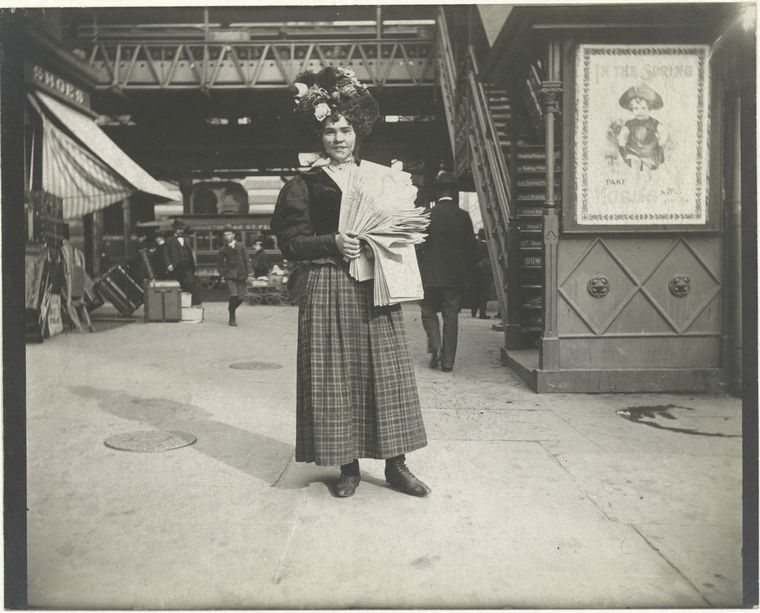
Although most newsies were boys, there were many newsgirls as well, such as this young lady in a fetching hat. Photo by Alice Austen. [NYPL]

Even with aid organazations like the Children’s Aid Society and lodging homes for wayward waifs, many newsboys lived their entire lives on the streets. The picture below is from 1912, by Hine. (NYPL)

Why do photographs of young kids from this era seem to resonate so strongly? You can look at these pictures and see your own children, nieces and nephews and neighbors. As children — particularly poor ones– have few of the fashionable trappings of adults of this era, we’re able to recognize common expressions. I highly recommend checking out the collections of Lewis Wickes Hine and Alice Austen at both the New York Public Library Digital Collection and the Library of Congress.

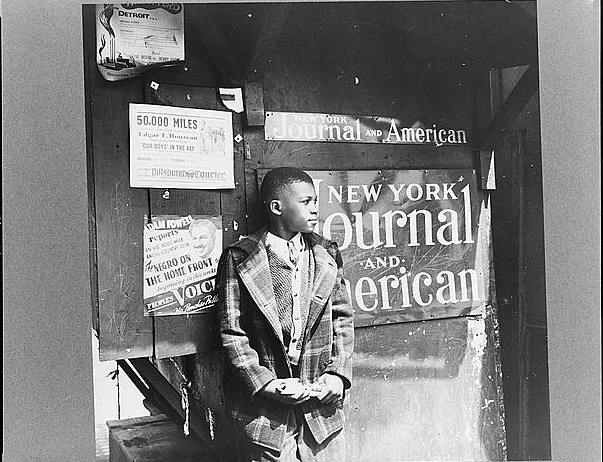
Finally, here’s a one more photograph from 1943 of a modern newsie, decades after the strike, by another great photographer Gordon Parks (yes, the director of Shaft). I like that he’s standing in front of a sign for the Journal-American, the newspaper that Hearst’s Journal morphed into.
[LOC]

And I couldn’t close without a little nod to that oft-maligned, cult classic Newsies , featuring fictional portrayals of Racetrack Higgins, David Simmons and of course Kid Blink (in a reduced role from his actual participation in the strike) (Thanks to Pengo for the link suggestion)

Finally I deeply apologize: I’m sadly aware that my impersonation of a newsboy’s dialect had a bit of an Ozark twang in it! I was never meant for the stage, I guess….