Categories
Health and Living The Alienist

Scenes from New York’s public baths: How tenement dwellers got clean and cool

HISTORY BEHIND THE SCENE What’s the real story behind that historical scene from your favorite TV show or feature film? A semi-regular feature on the Bowery Boys blog, we will be reviving this series as we follow along with TNT’s limited series The Alienist. Look for other articles here about other historically themed television shows (Mad MenThe KnickThe DeuceBoardwalk Empire and Copper). And follow along with the Bowery Boys on Twitter at @boweryboys for more historical context of your favorite shows. 

Public bathhouses were an integral component of tenement districts in late 19th and early 20th century New York City. Running water was uncommon in the poorest areas of the city, and when it was available, rusty, filthy pipes ensured that its consumption would be an unpleasant and often unhealthy experience.

And of course there was often very little available for bathing. As a result, life was so very fragrant back then.

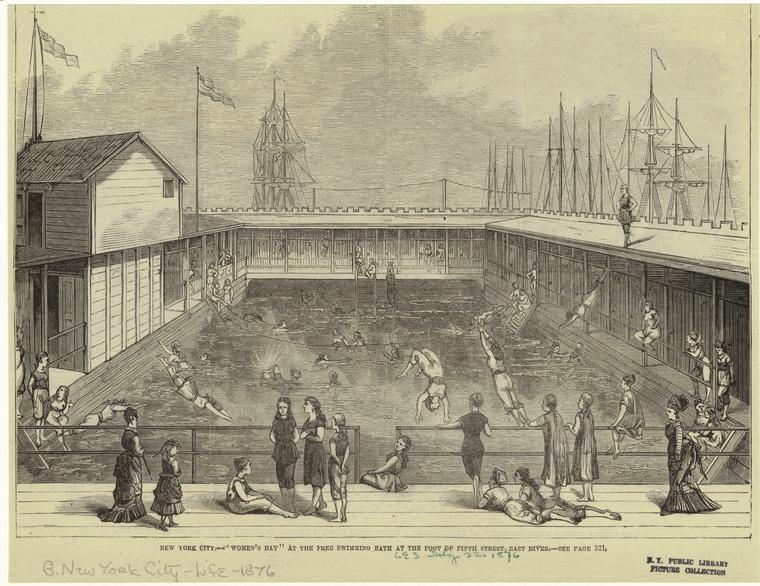
Temporary outdoor baths sprang up around the city during the summer such as this one off Fifth Street on the East River in 1870.
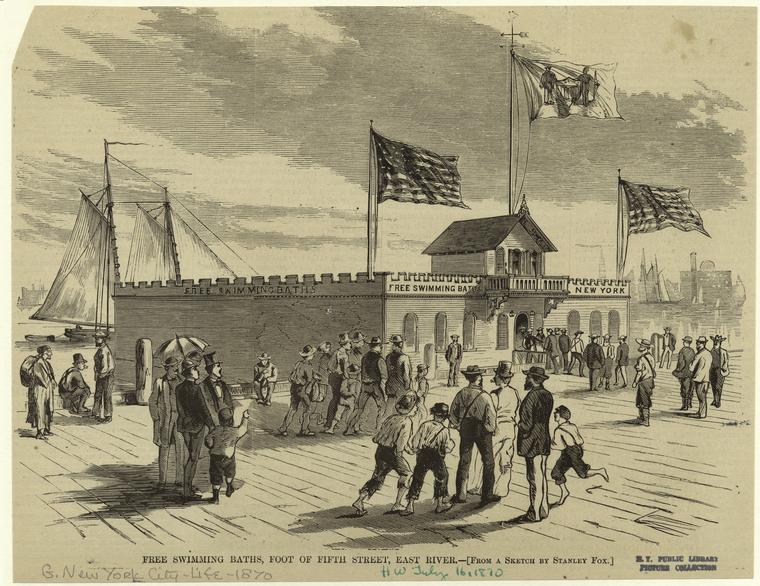
NYPL
NYPL

From Harper’s Weekly, August 20, 1870“We give on this page an illustration of the swimming bath at the foot of Charles Street. It contains 68 rooms, the water is four and a half deep and 200 bathers can be accommodated at one time. The success of these experiments should lead to the establishment of other baths in sufficient numbers to accommodate all who desire to avail themselves of these healthful privileges.”
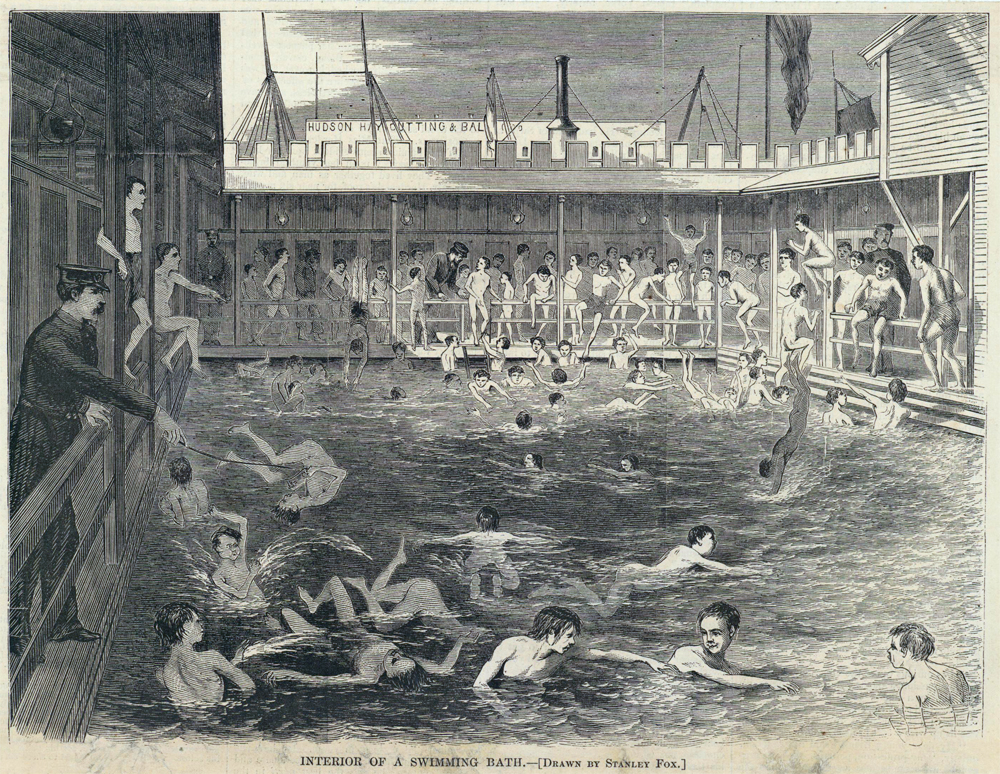
New -York Historical Society

But the city’s objectives in opening public bath houses (starting in the 1880s) weren’t merely related to cleanliness. Most believed access to clean water promoted health and kept epidemics from spreading. This wasn’t strictly for the benefit of the poor, but for the wealthier classes who interacted with them in daily life.

From Gotham by Edwin G. Burrows & Mike Wallace: “[I]n the late 1880s, [German professor Simon] Baruch began a campaign stressing that baths, in addition to benefiting the poor and helping create “civic civilization” out of “urban barbarism,” were in the interest of “the better situated classes”: no longer unwashed, the employees, servants, laborers, and tradespeople next to whom they sat on crowded cars would not carry so many deadly germs. ”

Public baths also provided relief in hot summer months — air conditioning and affordable electric fans were decades away — and encouraged physical activity. The public bath, in effect, gave rise to the urban swimming pool movement, drawing children from dangerous piers and swimming holes and into carefully monitored (if incredibly crowded) water environments.

In 1888, New York installed several outdoor baths within the city, imposing 20 minute time limits on swimmers to keep the water clean. (No matter; adventurous children hopped from pool to pool to skirt the rules).

Public Bath #10 on the Hudson River
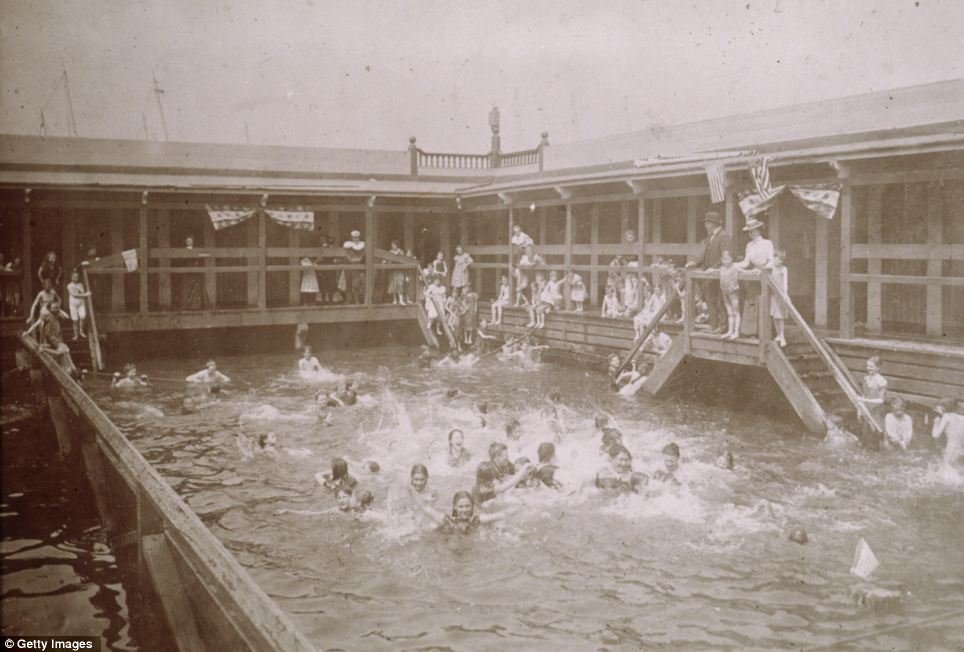
Three years later, a grand People’s Bath (at Grand Street and Centre Street) provided people with soap and towels for the modest admission of five cents.

In 1895, public bathing became a priority for Mayor William Strong who authorized a Sub-Committee on Baths and Lavatories which reported that “New York City was lagging far behind European and other American cities in the building of baths and urged that the city begin immediately to remedy the situation.” State government soon concurred, passing a mandatory bath law that year, “making the establishment of public baths mandatory for all first- and second-class cities in the state.” [source]
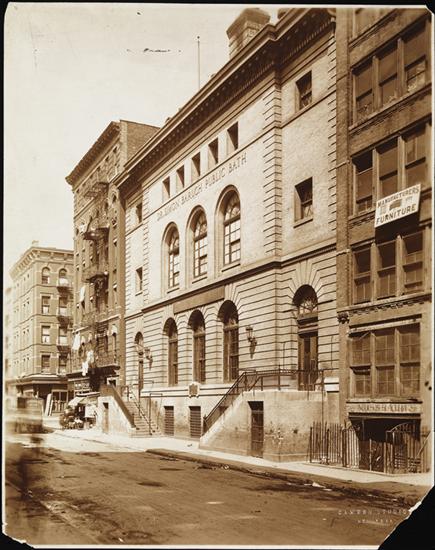
Museum of the City of New York

New public baths began opening by the new century, many in the Lower East Side; the first, Rivington Street Bath (pictured above), even had 91 showers and 10 bathtubs.

An advertisement for baths in 1935:
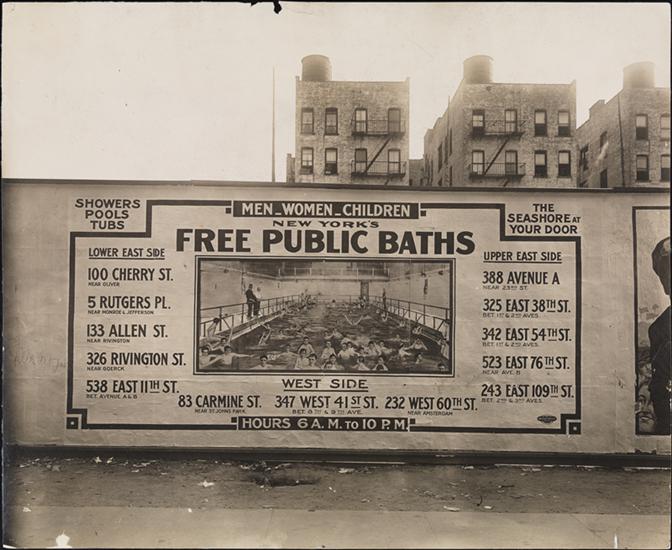
They’re mostly forgotten about today but a few remaining historical structures bear evidence of these important structures.

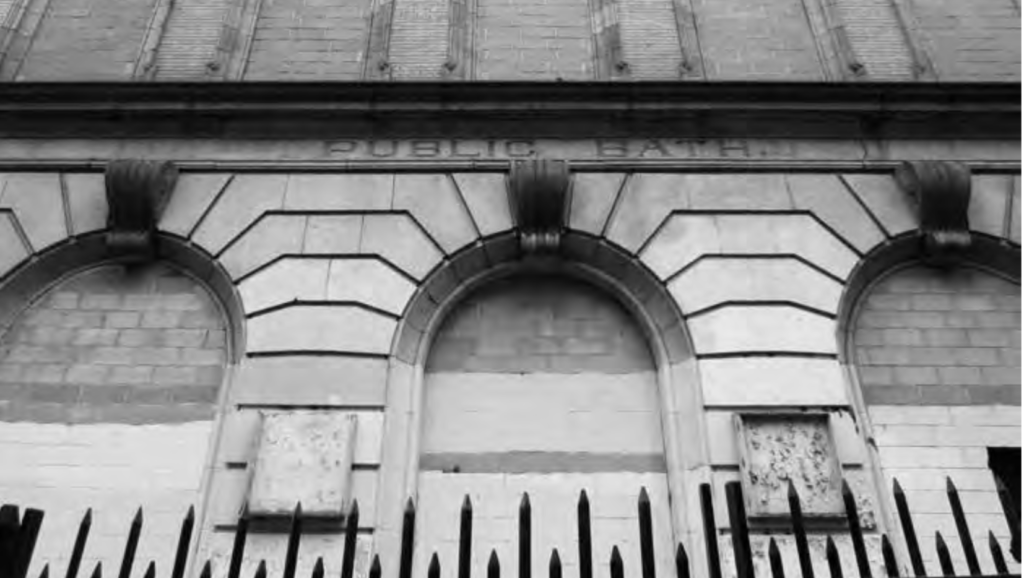
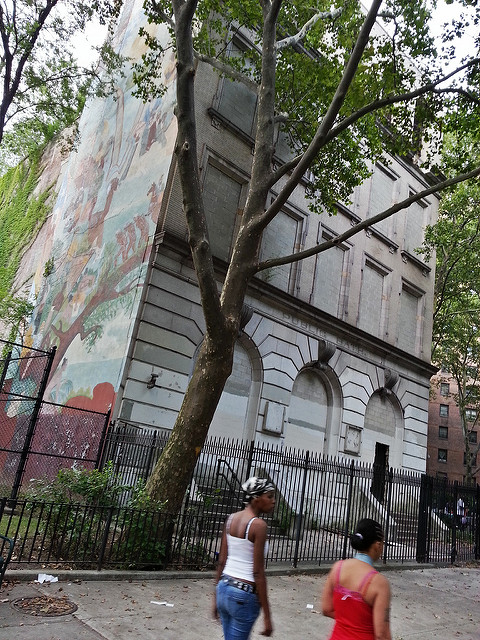
One such relic sits at Madison Street in the Lower East Side, within the La Guardia Houses development. (It’s listed in the above advertisement at 5 Rutgers Place.)
Matt Green/Flickr

Nicknamed the Whitehouse, the bathhouse opened on December 23, 1909, and was one of thirteen public bath facilities in New York at that time. By the 1940s indoor plumbing had rendered the public bath obsolete, and so it was converted into a public swimming pool and gymnasium. Today it sits unused, like many others throughout the city, a ruin from another time.

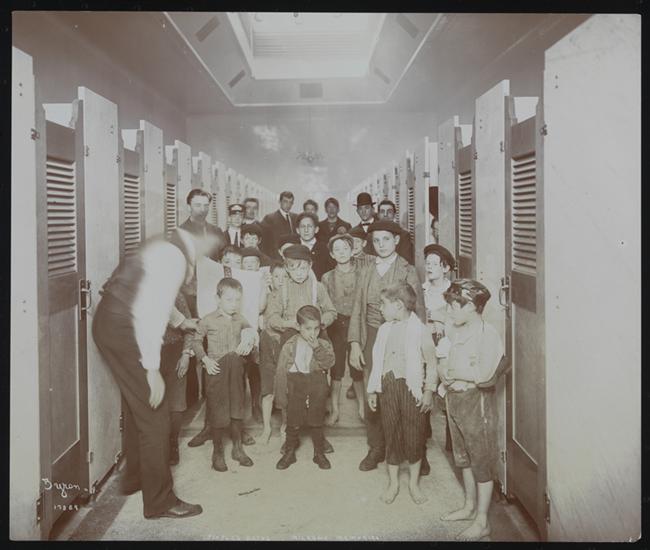
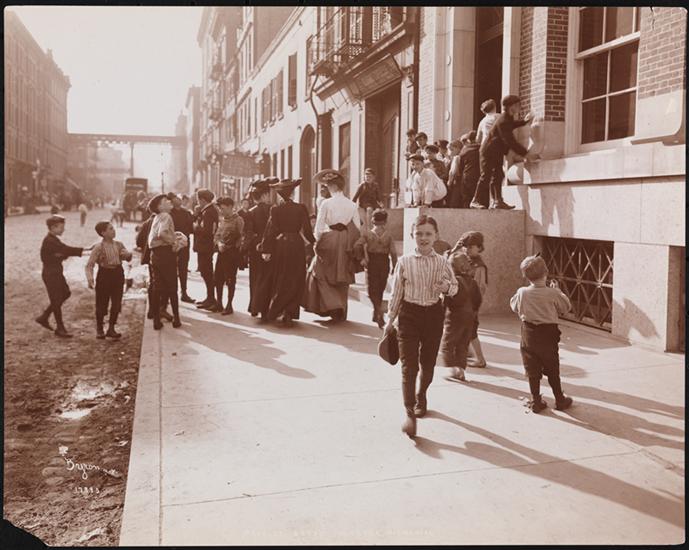
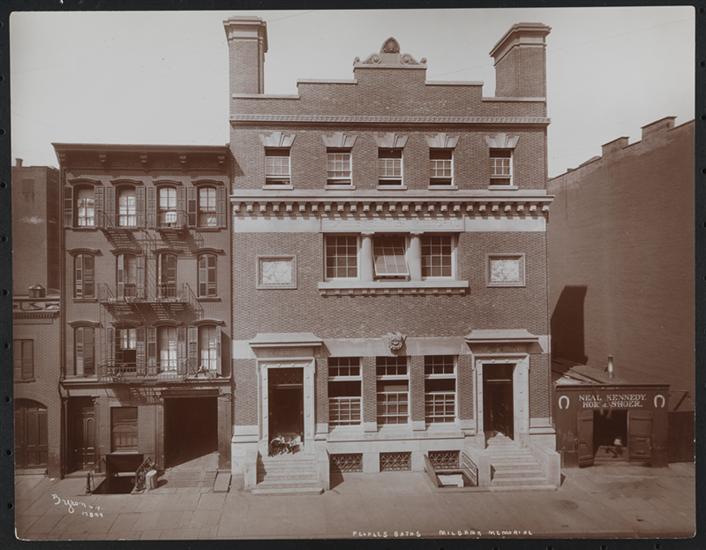
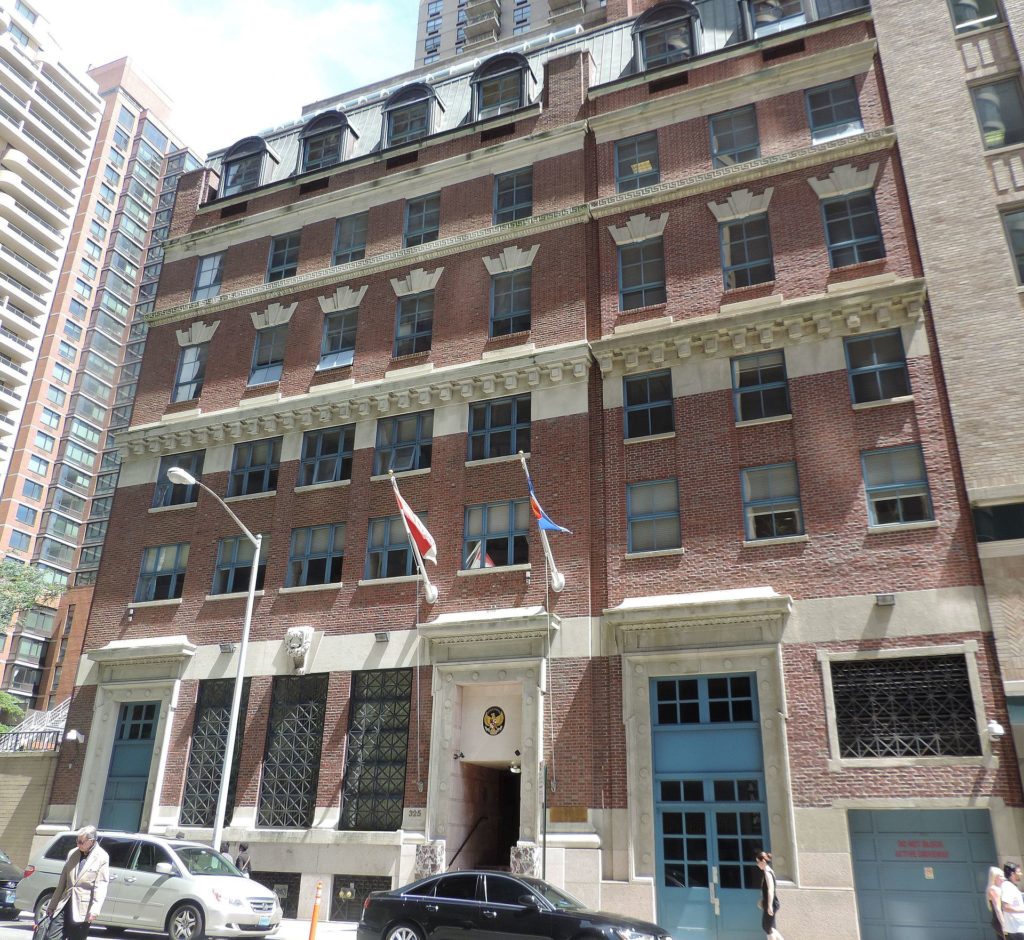
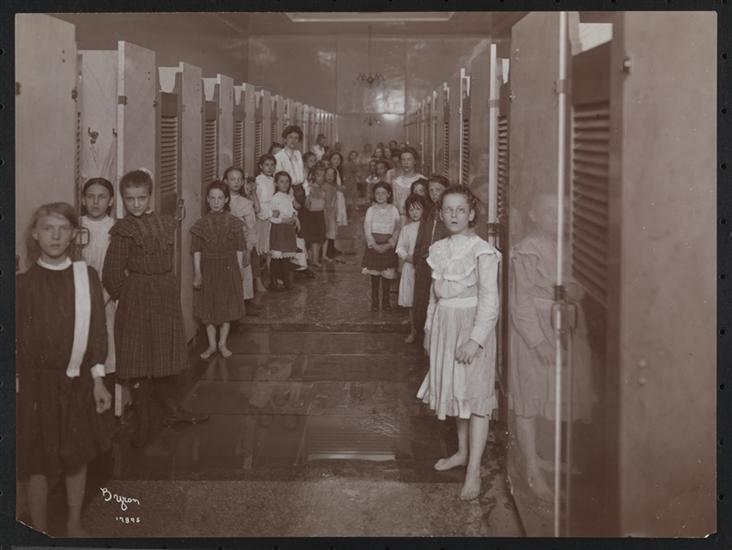
Others have been rescued and serve new purposes such as the Milbank Memorial Bath at 325-327 East 38th Street (pictured below)Today the structure is the Indonesian Mission to the United Nations, but when it opened, it was one of the biggest bathhouses in the city, serving up to 3,000 people.
MCNY
Jim Henderson/Wikimedia

The grateful visitors of Milbank’s bath house:
MCNY
MCNY
MCNY

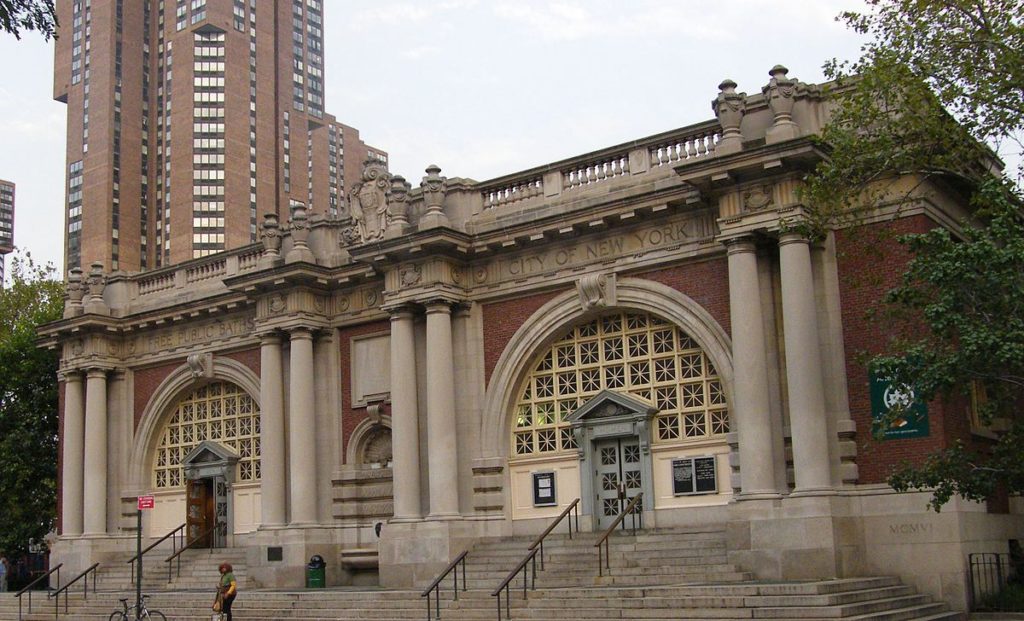
Perhaps the best known — and most beautiful — example of a public bath house standing in New York City today is the Asser Levy Public Bath in Kips Bay. (It’s also listed in the billboard image as 388 Avenue A.) Its unusual beauty is perhaps what saved it from demolition, and today it’s part of Asser Levy Recreation Center, serving in its original function — as a swimming pool for neighborhood children.
Wikimedia
Categories
The Alienist True Crime

The Alleged New York Murders of Jack the Ripper

HISTORY BEHIND THE SCENE What’s the real story behind that historical scene from your favorite TV show or feature film? A semi-regular feature on the Bowery Boys blog, we will be reviving this series as we follow along with TNT’s limited series The Alienist. Look for other articles here about other historically themed television shows (Mad MenThe KnickThe DeuceBoardwalk Empire and Copper). And follow along with the Bowery Boys on Twitter at @boweryboys for more historical context of your favorite shows. 

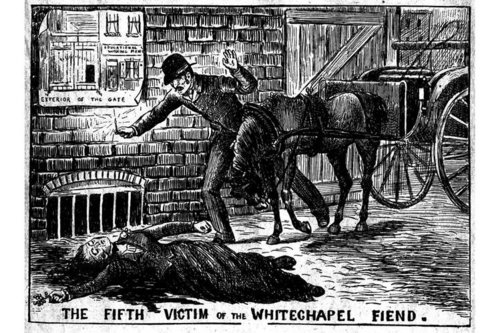
In 1888, a serial killer terrorized the Whitechapel district of London, leaving a set of disturbingly gory crime scenes which horrified the public and galvanized the press. It was soon believed at least five of the victims (and possibly many more) were killed by the same hand — a shadowy figure referred to as Jack the Ripper. The victims, all women, were Whitechapel prostitutes.

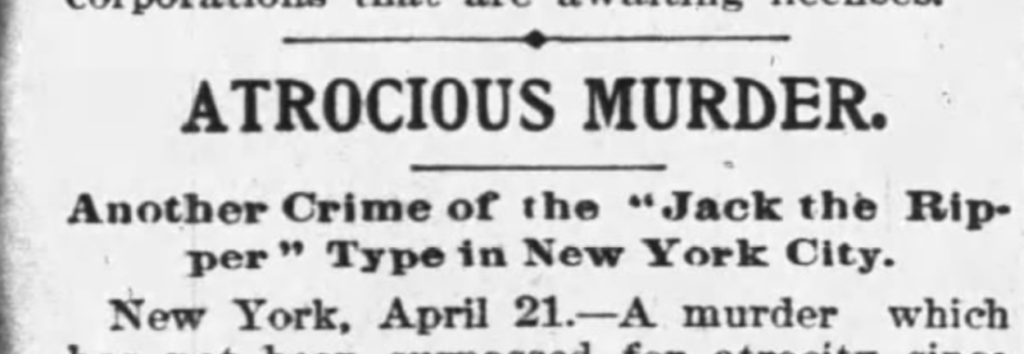
In 1891, the killer struck again in as gruesome a fashion as before. The victim was again a prostitute, a middle-aged woman “of dissolute and intemperate habits” named Carrie Brown who was found murdered in a lodging house on April 24, 1891. The only significant difference to the brutal crimes of 1888 was its location.

Carrie Brown was murdered in New York City.

Jack the Ripper’s alleged ‘New York City spree’ is the sinister pretext for the murder investigation depicted on The Alienist. Investigators in 1896, just five years after the death of Carrie Brown, would have had knowledge of Jack’s possible appearance on the streets of New York.

Of course, nothing has ever been proven that Brown’s death was associated in any way with the 1888 murders in Whitechapel. But that didn’t stop the press from speculating. After all, such twisted, grotesque crime sold newspapers.

The circumstances of Brown’s ghastly murder were indeed extraordinary.

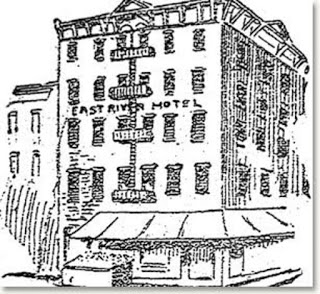
Let’s quote from that defining text of New York City crime folklore — Gangs of New York by Herbert Asbury. “The first Jack-the-Ripper murder in New York is said to have occurred [at the old East River Hotel at Catherine and Water streets] when an old hag known as Shakespeare was cut to pieces.”

Brown was known as Shakespeare for her habit of quoting the bard whenever possible. According to Asbury, “Shakespeare always claimed that she had come from an aristocratic family and that in her youth she had been a celebrated actress in England. She supported her contention by reciting, in return for a bottle of swan gin, every female role in HamletMacbeth and The Merchant of Venice.”

Her lifeless body was discovered the next morning, stabbed and repeatedly slashed with a cross cut into her thigh.

Below: Brown’s body wore mutilations similar to those found in the Whitechapel killings

Buffalo Morning Express, April 25, 1891

From the Evening World the day following her murder: “No crime which has been committed in this city for years has stirred the Police Department to such tremendous activity as the horrible butchery of Carrie Brown, alias ‘Old Shakespeare’ by ‘Jack the Ripper or his double, at the East River Hotel.”

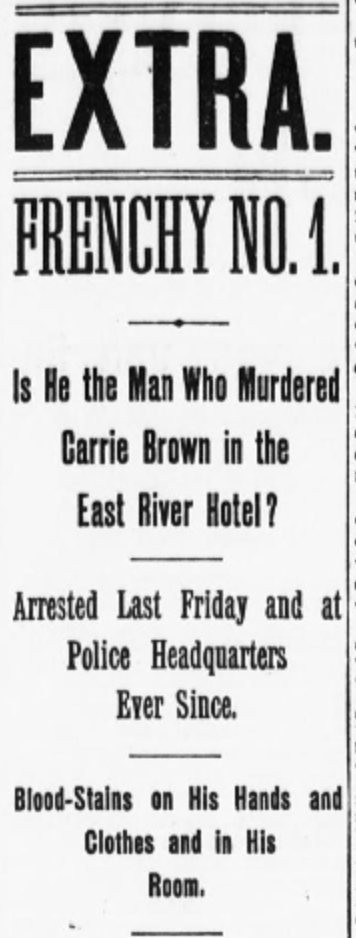
Police chief inspector Thomas F. Byrnes had previously chided Scotland Yard for their inability to catch a killer. Perhaps that’s why there was an immediate arrest in the case — an Algerian man named Ameer Ben Ali (nicknamed Frenchy). He was convicted of the crime and unjustly sent to prison, despite little evidence of his involvement in the murder. (He remained there for eleven years before he was eventually exonerated.)

Evening World, April 30, 1891

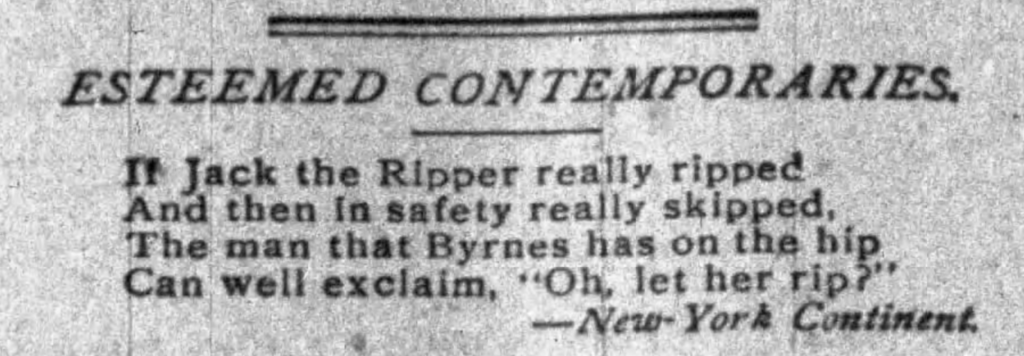
There were doubts about Ameer Ben Ali’s involvement with the murder from the very beginning — as evidenced by this poem in the Buffalo Morning Express, published a couple of weeks after the murder.

It didn’t matter that, in 1891, Jack seemed to have resumed his murder spree at the very same time in London. It’s unclear whether the London slayings attributed to this singular killer were related to the 1888 murders but newspapers made the assumption anyway. In total, eleven ‘Whitechapel murders’ from 1888 to 1891 are attributed to Jack.

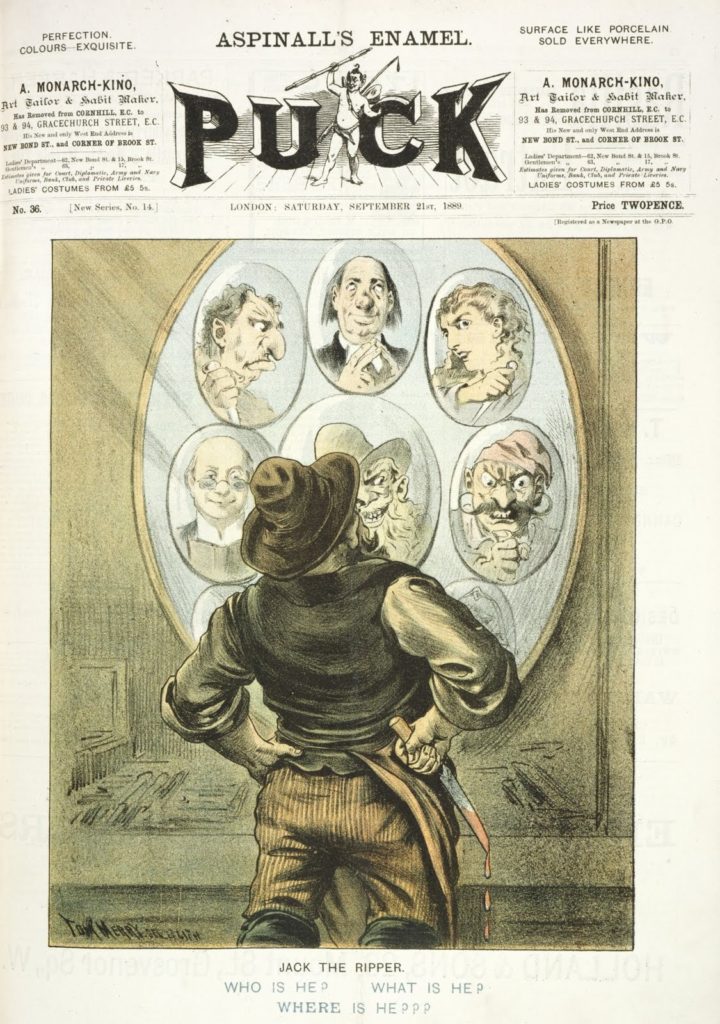
Below: Puck Magazine, published at the Puck Building on Houston Street, speculated on the Ripper’s identity in 1889.

Brown’s murder was not the only one eager newspaper publishers linked to the legend of Jack the Ripper. It happened with such frequency that Twentieth Century Magazine (published in May 1891) attempted to explain the phenomenon. “A little more than a month ago a homicide was committed in New York, the incidents of which were so like those attending the London homicides that the unknown perpetrator of the deed was also called Jack the Ripper. So that the name of Jack the Ripper stands for a person who kills a woman or women and afterword mutilates the body or bodies.”

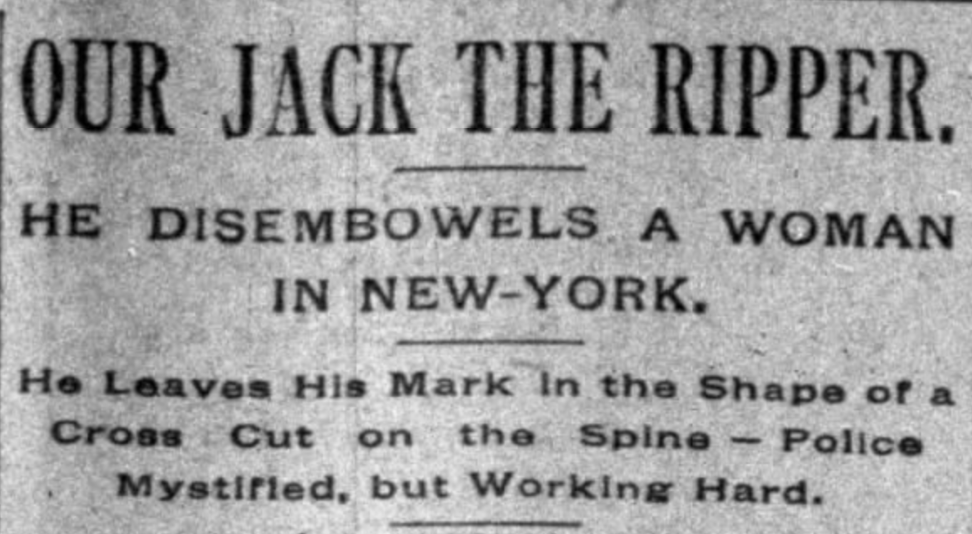
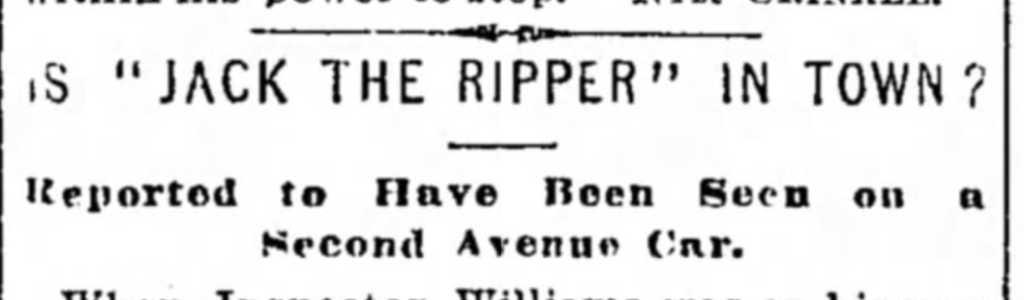
Jack the Ripper was reportedly seen throughout New York, due to the many eyewitness descriptions of both the London killer which ran in American newspapers and descriptions of the suspected New York killer.

Below: Such headlines ran in the newspapers even before the Carrie Brown murder (New York World, March 8, 1891)

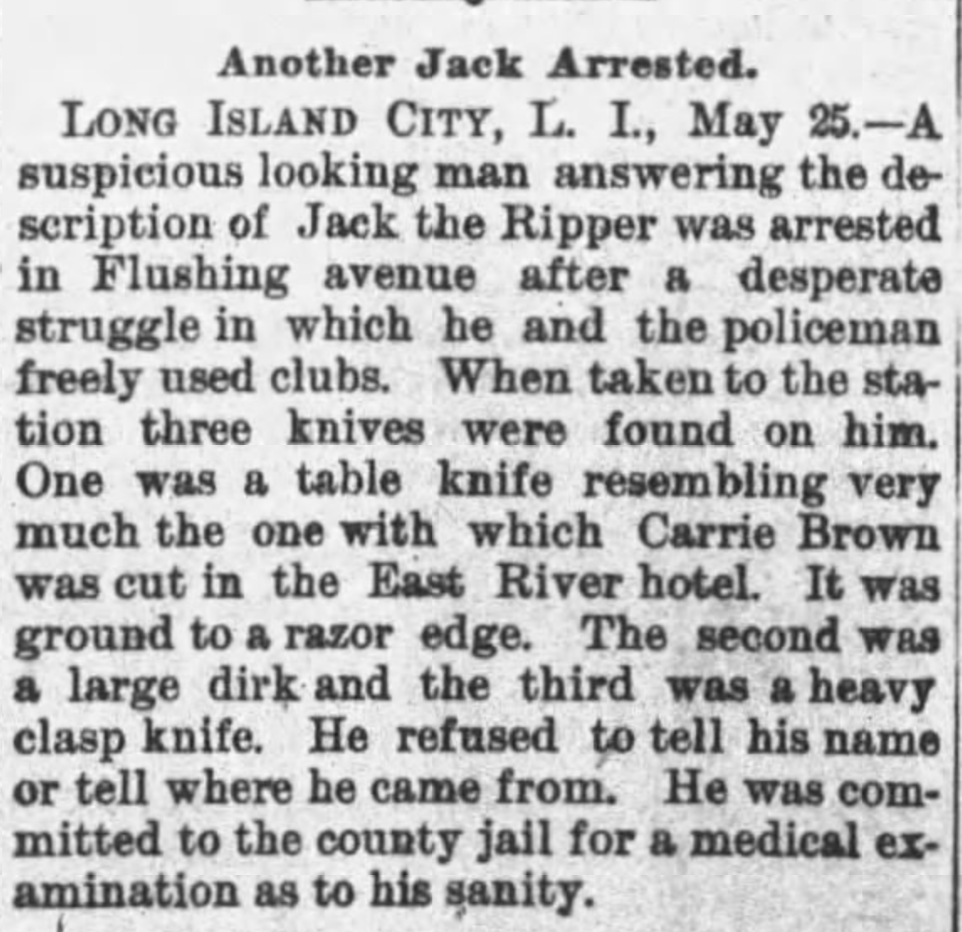
Below: From the Buffalo Evening News (May 25, 1891)

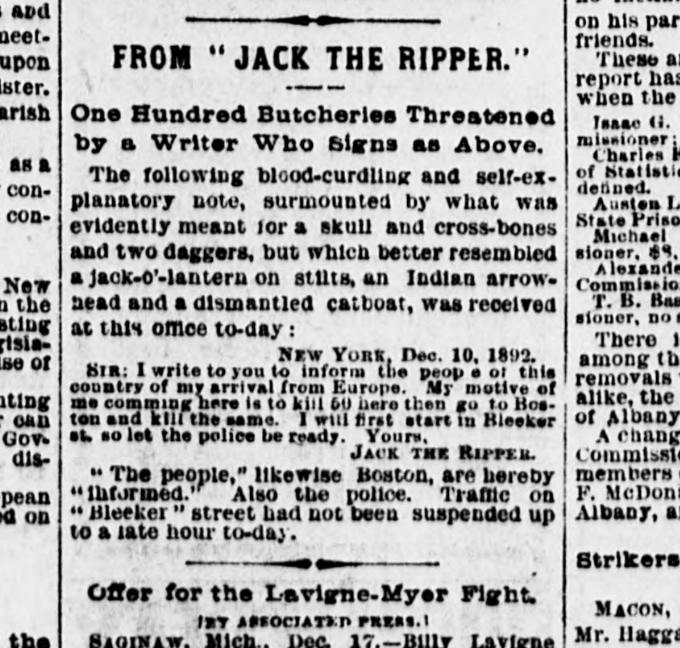
Publishers’ verve in linking any and all grisly murders to London’s killer might have inspired the following letter, sent to the New York Evening World offices on December 17, 1892:

(For those following The Alienist, Bleecker Street is also the destination of choice for that story’s killer.)

In the late fall of 1893, the body of a mutilated woman was found in the East River, and it too, for a time, was linked to Jack the Ripper. “On the hasty examination made last night some marks, taken to be somewhat similar, were discovered, but a thorough examination made this morning shows that they were simply bruises.”

By 1894 people stopped looking for Jack the Ripper in New York although several arrested murderers were described very explicitly as Ripper-style killers. One example from February 3, 1894: “Only a little over two years ago Henry G. Dowd rivaled the fiendish Jack the Ripper by slashing seven intoxicated, but inoffensive men in the Fourth Ward.”

Categories
The Alienist

The harsh lives of New York City street kids, captured — in a flash — by Jacob Riis

HISTORY BEHIND THE SCENE What’s the real story behind that historical scene from your favorite TV show or feature film? A semi-regular feature on the Bowery Boys blog, we will be reviving this series as we follow along with TNT’s limited series The Alienist. Look for other articles here about other historically themed television shows (Mad MenThe KnickThe DeuceBoardwalk Empire and Copper). And follow along with the Bowery Boys on Twitter at @boweryboys for more historical context of your favorite shows. 

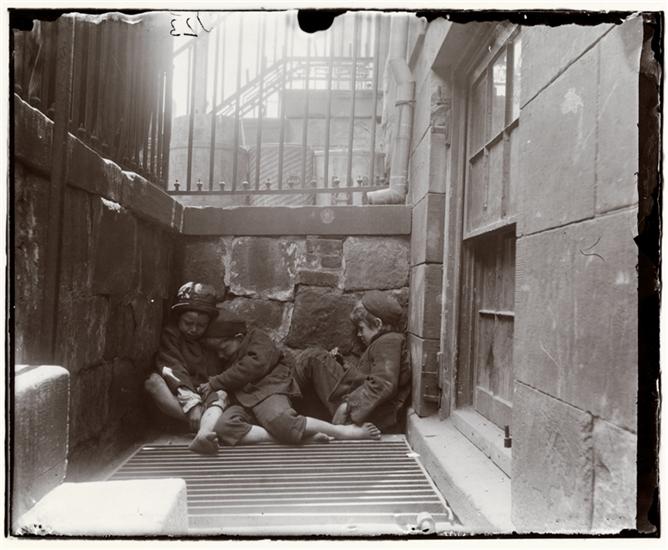
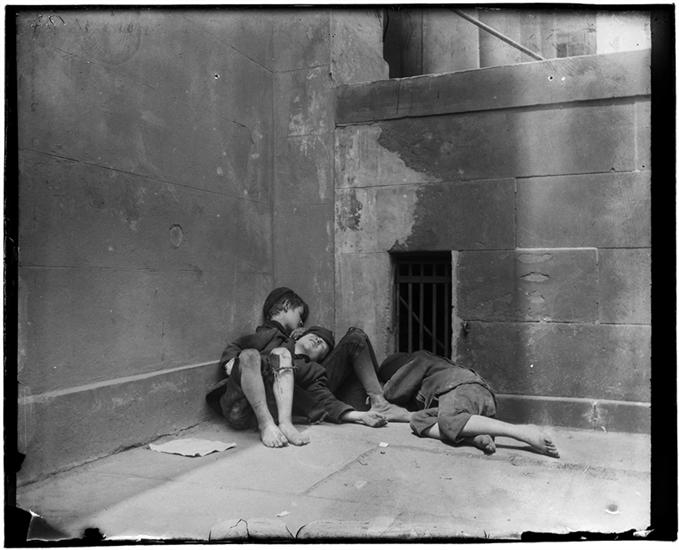
Look near the very end of the fourth episode of The Alienist, and you’ll see a surprising homage to an iconic, heartbreaking photograph.

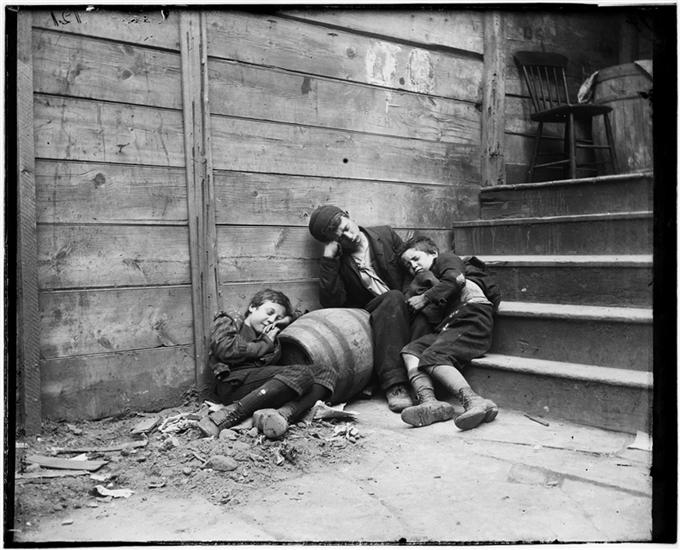
Called ‘Street Arabs in the Area of Mulberry Street‘, the image, taken in 1889, depicts three homeless boys sleeping over a heated vent on the bottom floor of a tenement (in the area of today’s Little Italy).

MCNY

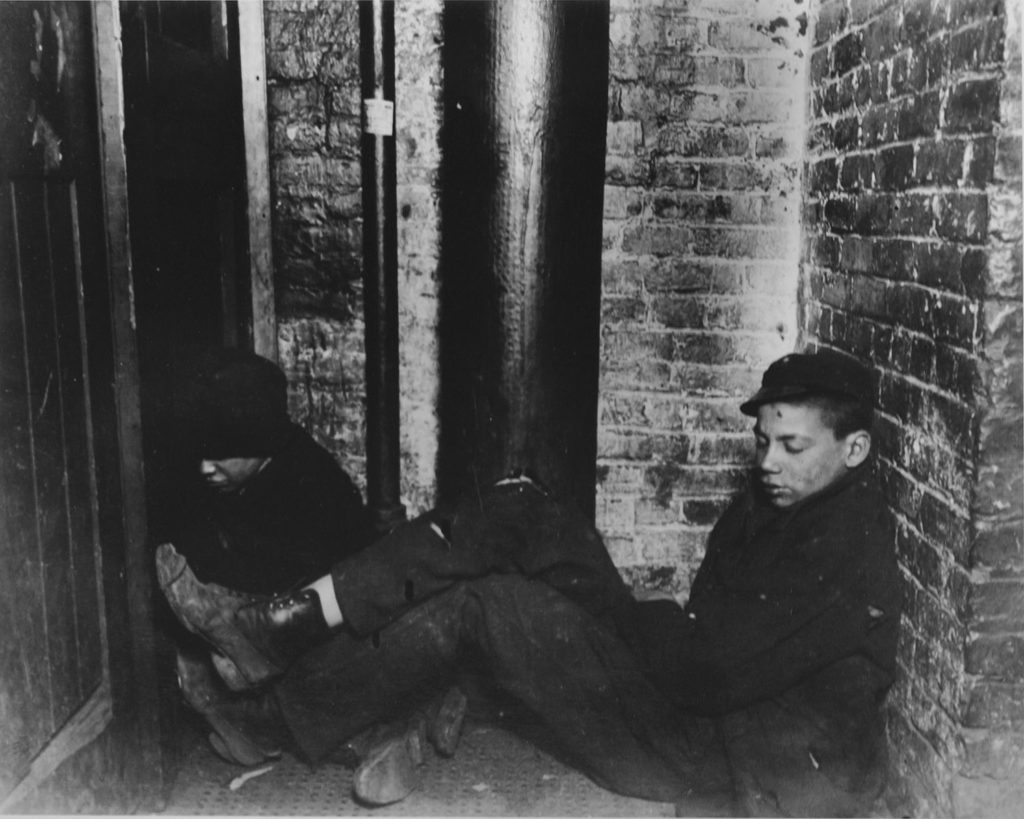
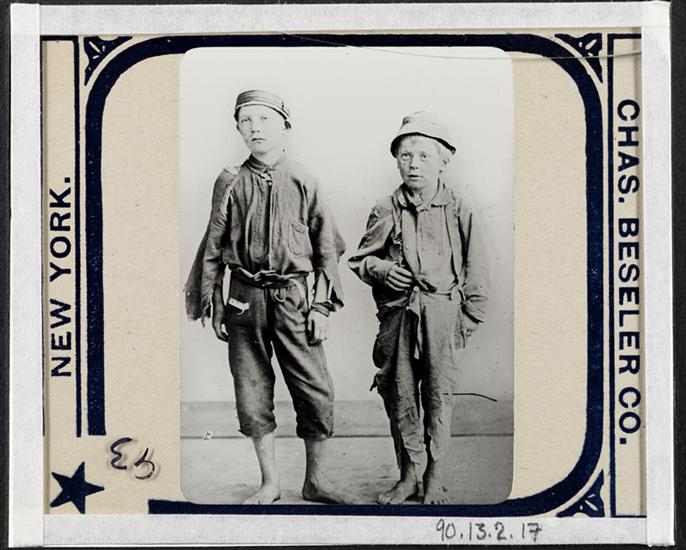
Their names are unknown. In the late 19th century, hundreds of children lived on the streets of New York, turned out of their homes or separated from their loved ones. Many actually did have loving families but living conditions in the tenements were so squalid that some chose to sleep on the street.

We have this image — and many, many similar ones — thanks to journalist and social reformer Jacob Riis.

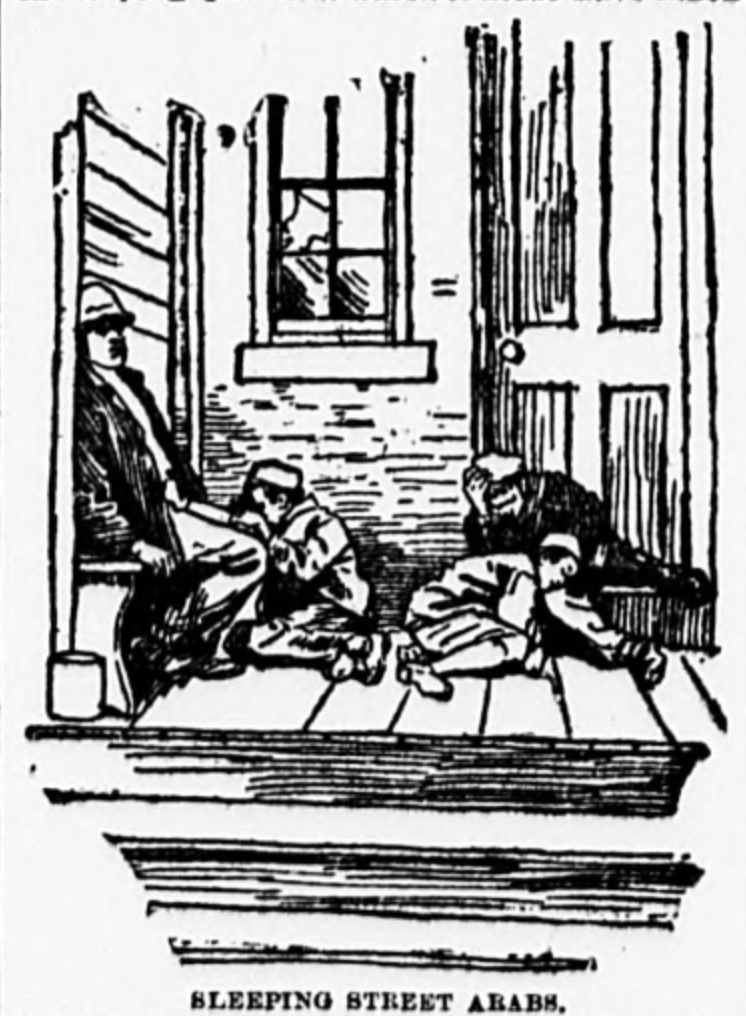
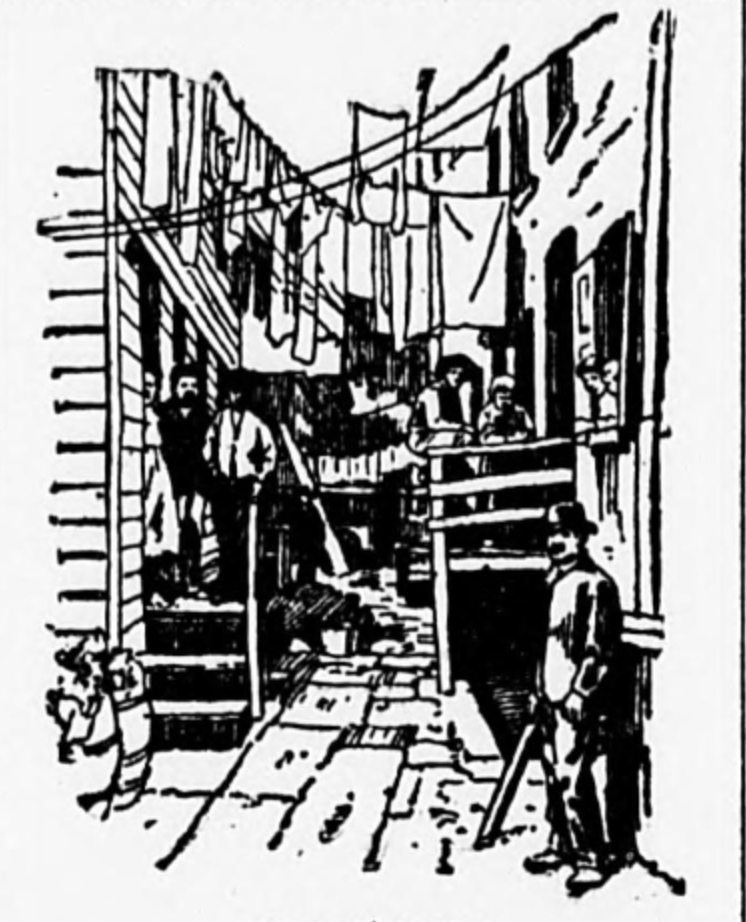
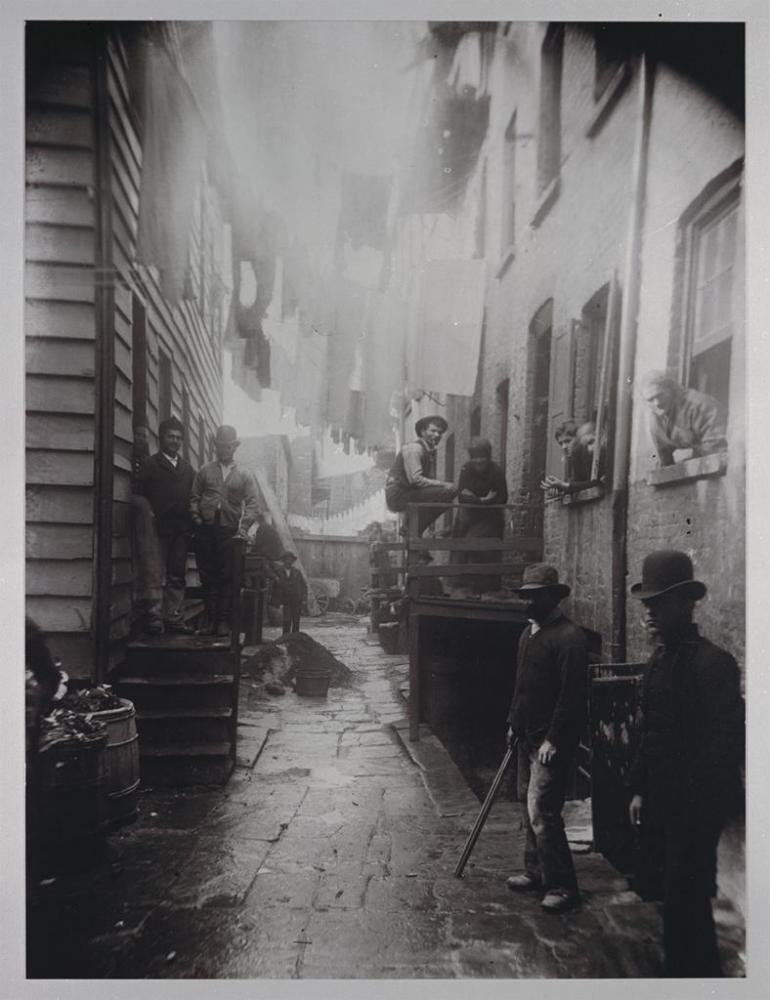
On February 12, 1888, Jacob Riis published his first investigation for the New York Sun, revealing the wretched conditions of New York’s worst slum neighborhoods by employing an experimental technology — flash photography. The startling pictures, by Riis and a team of other photographers, were at first rendered in line drawings, but the effect was nevertheless profound.

The entire article is available online but here’s the passage pertinent to the photograph above:

Another outcropping of the benevolent purpose of Mr. Riis … is his showing of a touching picture of street Arabs in sleeping quarters which it must have taken a hunt to discover. These youngers have evidently spent their lodging money for gallery seats at the show and have found shelter on the back stoop of an old tenement house.” 

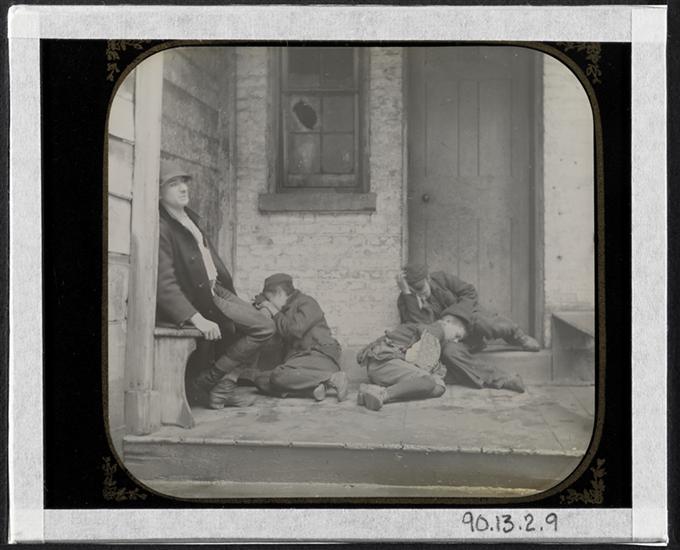
Below: An illustration from the Feb. 12, 1888, newspaper, and the Riis photograph (of Bandit’s Roost) that it represents.

The pictures are more than social activism; they’re history themselves, the first flash photography ever to be used in this fashion. Riis was showing New Yorkers a vivid glimpse of poverty — orphans in the gutter, street gangs in the alleyway — using a technique that few were regularly exposed to apart from portraiture.

Riis never considered himself a professional photographer. Later in his career, he even farmed out the photographic work to others as he focused on writing and social activism. And yet modern photojournalism wouldn’t really be what it was today without his first forays into slums, opium dens and beer halls with his bulky and costly equipment. His early work influenced an entire field of social photographers seeking to prove the adage “a picture is worth a thousand words” (a phrase which debuted near the end of Riis’ lifetime).

MCNY

His work would eventually be published as a book in 1890 — How The Other Half Lives: Studies Among the Tenements of New York — and Riis would spend the decade virtually proselytizing on behalf of the city’s needy.

In that book, he expounds upon the plight of the ‘street Arab’, aka street urchin.

“They are to be found all over the city, these Street Arabs, where the neighborhood offers a chance of picking up a living in the daytime and of “turning in” at night with a promise of security from surprise. In warm weather a truck in the street, a convenient out-house, or a dug-out in a hay-barge at the wharf make good bunks. Two were found making their nest once in the end of a big iron pipe up by the Harlem Bridge, and an old boiler at the East River served as an elegant flat for another couple.”

Below: Two boys asleep at 2 a.m. in the press room of the New York Sun newspaper.

Most street kids are newspaper boys or bootblacks, fighting for scraps and a few pennies. In another section, Riis writes:

“We wuz six,” said an urchin of twelve or thirteen I came across in the Newsboys’ Lodging House, “and we ain’t got no father. Some on us had to go.” And so he went, to make a living by blacking boots. The going is easy enough. There is very little to hold the boy who has never known anything but a home in a tenement. Very soon the wild life in the streets holds him fast, and thenceforward by his own effort there is no escape. Left alone to himself, he soon enough finds a place in the police books, and there would be no other answer to the second question: “what becomes of the boy?” than that given by the criminal courts every day in the week.”

“Didn’t live nowhere.” MCNY

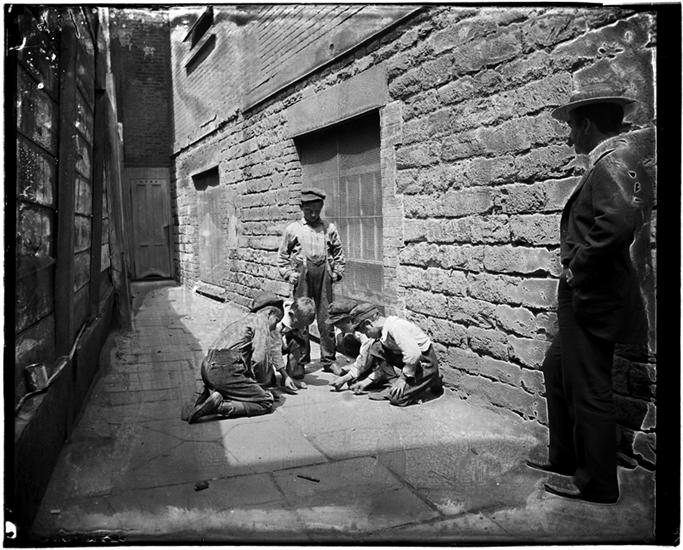
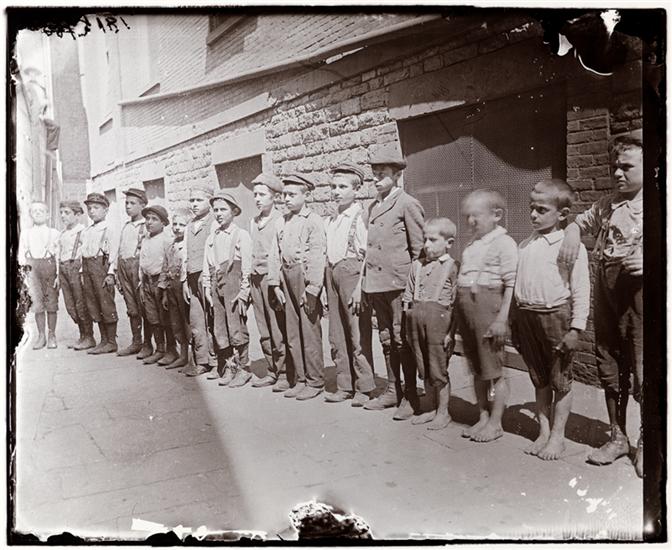
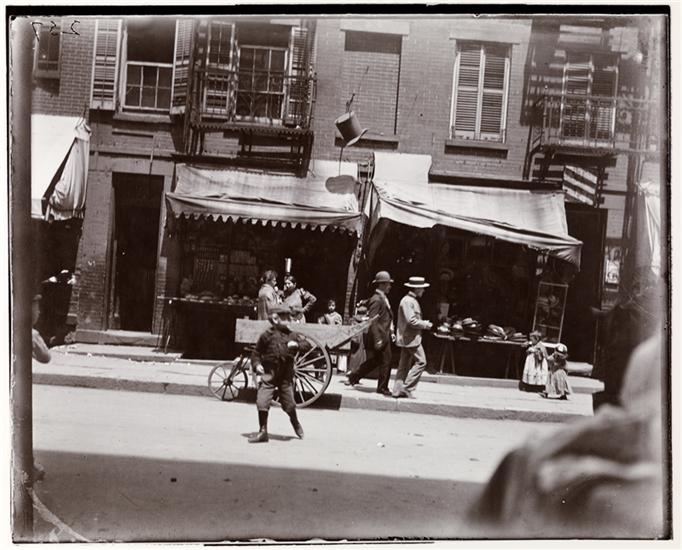
Below are more pictures of children on the streets of New York City in the late 1880s and early 1890s, taken by Riis and his associates, courtesy the Museum of the City of New York.

MCNY

“Shooting Craps: The Game of the Street,” Bootblacks and Newsboys, 1894″ MCNY
A line-up of boys in a Mulberry Street alley. 1890, MCNY
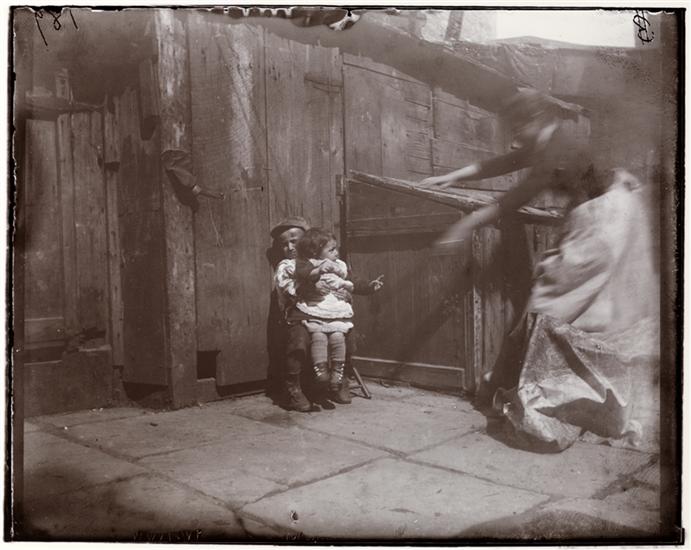
A young boy holding a baby, a woman reaches for them. 1890, MCNY
1890, MCNY
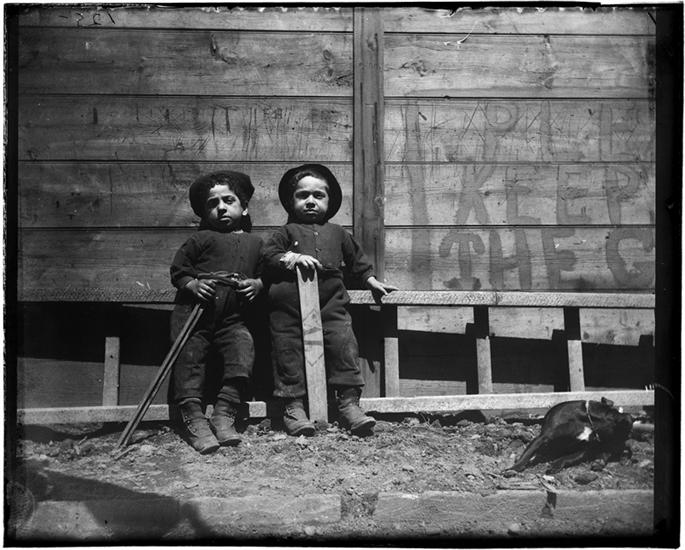
The Mott Street Boys, “Keep off the Grass”. 1890. MCNY

This article excerpts a portion of our review of the Museum of the City of New York’s 2015 exhibition on Riis.