Bloomberg’s Time Square plan: a blast from the past?

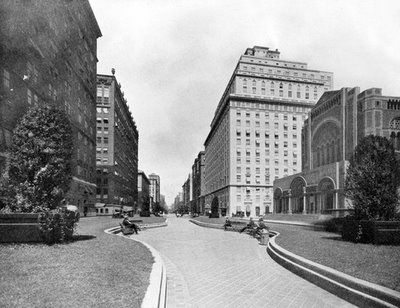
ABOVE: Park Avenue — before the cars came

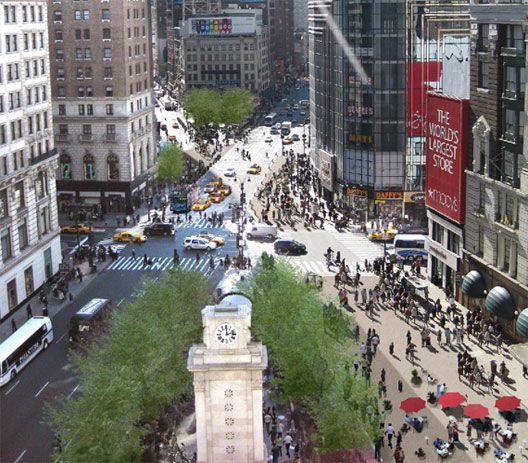
I’ve posted the extraordinary picture above of pre-1920s Park Avenue a couple times in the past, but I wanted to do so again in light of Michael Bloomberg’s recent proposal to turn Times Square and Herald Square into partial traffic-free plazas. His plan calls for “traffic lanes along Broadway from 42nd to 47th streets and from 32nd to 35th streets” to be “transformed into pedestrian lanes”, with the residual traffic flowing down a Seventh Avenue refitted for four lanes.

The notion of creating public space out of vehicular traffic areas in Manhattan flies in the face of what used to be called ‘progress’ — at least in the Fiorello Laguardia/Robert Moses definition of the word.
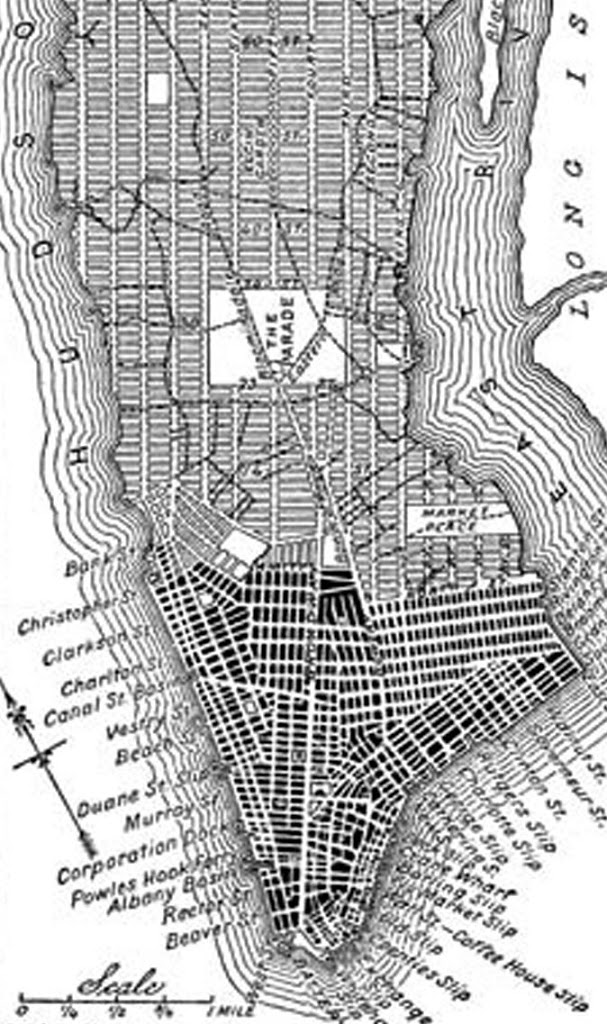
In a way, you can say this type of reversal for the benefit of pedestrians actually began in the 19th century, before the roads were paved. When the original commissioners plan of 1811 was initiated, the intention was to direct the city’s growth and organize a rational method of parcelling out the city to developers. In doing so, it sliced up Manhattan as though it were an ice tray, rows of uniform blocks in a cross-section of streets and avenues. However, there were few parks in that original plan (at right).

In practice, however, some virtual streets were transformed into public spaces once it seemed obvious that uninterrupted rows of development would cause for an unlivable city. Notably, Central Park was envisioned in the 1850s as a way to break up the grid. (The Parks Department actually has a nice short history on this 19th century struggle.)

Another major shift towards a pedestrian driven city occurred with the disappearance of the elevated trains and creation of the subway system, opening up darkened city streets and creating new public spaces. Additionally, as in the picture above, once Grand Central began hiding its train tracks underground, the newly created real estate above it became, you know, a park avenue.

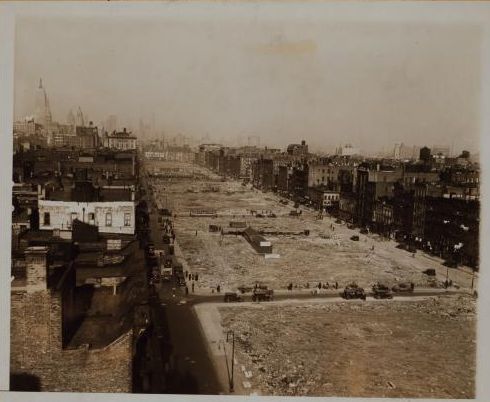
Social activism at the turn of the century, led by Jacob Riis and others, made a play at eliminating decrepit slums in exchange for pedestrian areas. For instance, Most of Five Points was wiped from the map to become Columbus Park and various governmental buildings. Swaths of land in the Lower East Side were cleared of tenements to become open space, like the Sara Delano Roosevelt Park.

Below: In this picture from 1932, tenements between Chrystie and Forsyth have been eliminated to make way for the future Sara Delano Roosevelt Park.
Robert Moses liked his parks, but he also loved his expressways, and he created both at the expense of the neighborhoods they were supposedly to have served. But Manhattan was becoming a latticework of traffic congestion well before that; everywhere you looked, streets were widened to accomodate vehicles — first carriages and trolleys, later cars and buses.

Bloomberg’s ambitions stem from a more environmental motivation, with newly installed bike lanes, pedestrian spaces in the Meatpacking District and Madison Square, and last year’s temporary no-traffic days on Park Avenue. His midtown plans, to be installed this summer, may become permanent. Below: A rendering of his virtual Herald Square:
Bowery Boys get older! Plus: 200 years of fire hydrants

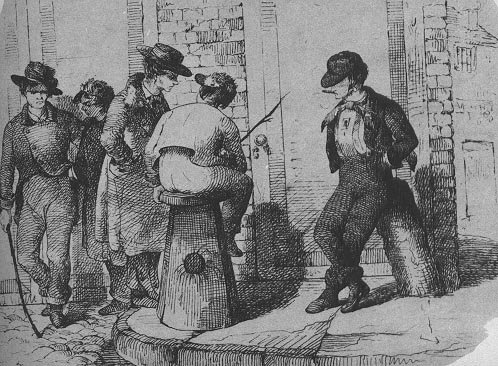
Early engraving of some Bowery b’hoys lolling about a fire hydrant, up to no good

Tomorrow is the one year anniversary of our very first podcast. We just want to say thank you to everybody who has subscribed on iTunes and other podcast services. Our first year has been a huge success and we have a lot of exciting plans coming up for year two!

I know we have some rather massive topics that we’ve yet to cover (Empire State Building, the subway system, Central Park) but we’ll get to most of them in the coming months, as well as experimenting with some more obscure topics.

I’ll try and keep updating this blog 4-5 times a week depending on my schedule.

Again, it’s been a blast so far and we’ve got lots of great ideas to keep improving the show. Thanks for letting us go ballistic geeky about this city that we love.

And now, more old New York City fire hydrant pictures. Why you ask? This year is the 200th anniversary of the very first hydrant in the city. Go here for a fairly comprehensive history of these invaluable street features:

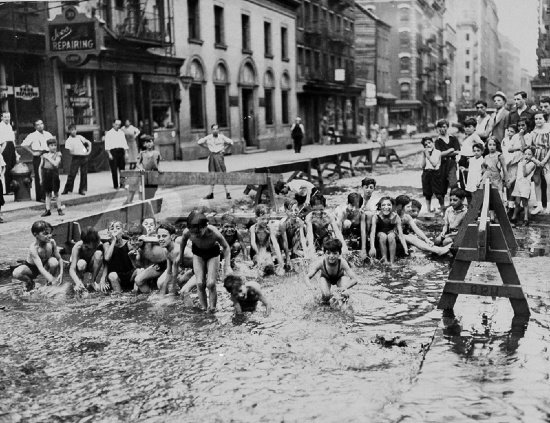
Below: more fire hydrant shenanigans, this time from some wacky Lower East Side kids, picture dated July 9, 1936

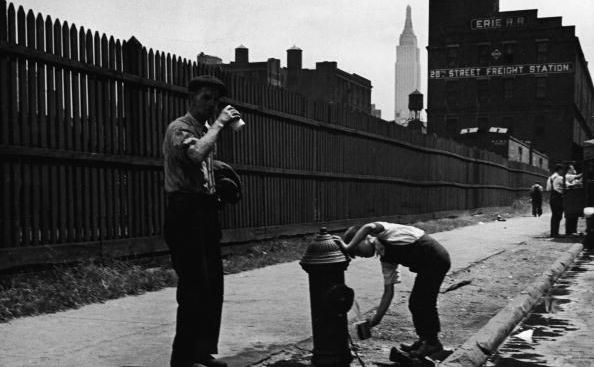
Also from the 30s, a more sedate usage of a hydrant, a father and his son take a sip with the five-year-old Empire State Building in the background

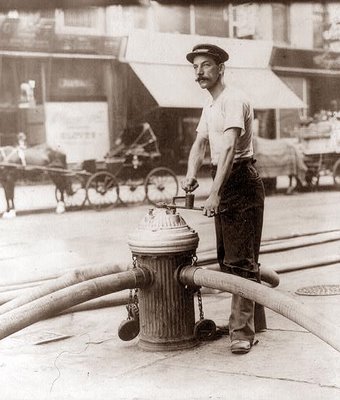
A fireman from 1908 (Photo courtesy Old Picture of the Day)

Categories
Podcasts

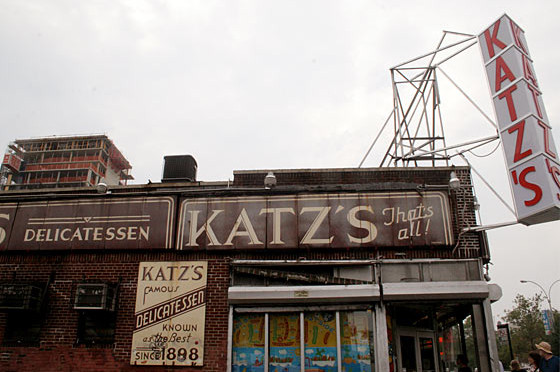
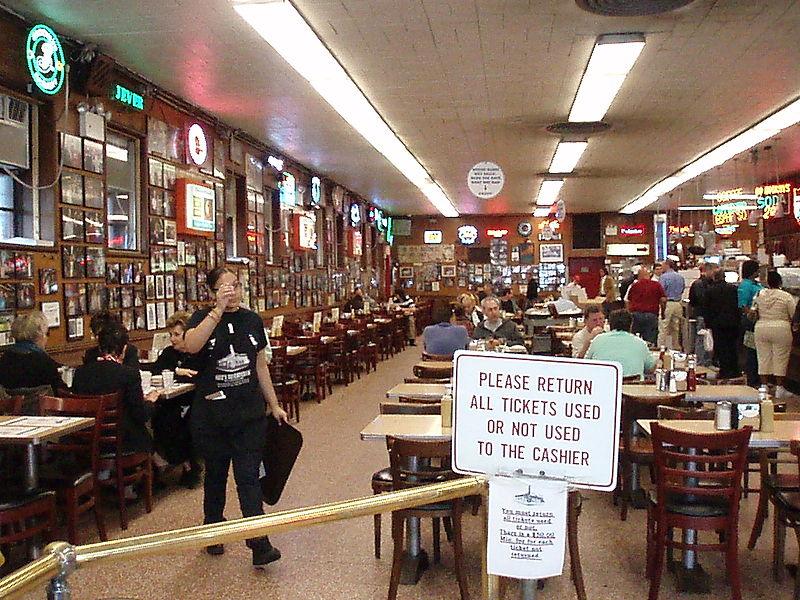
PODCAST: Katz’s Delicatessen

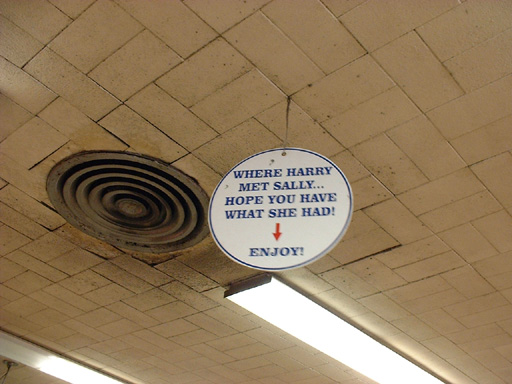
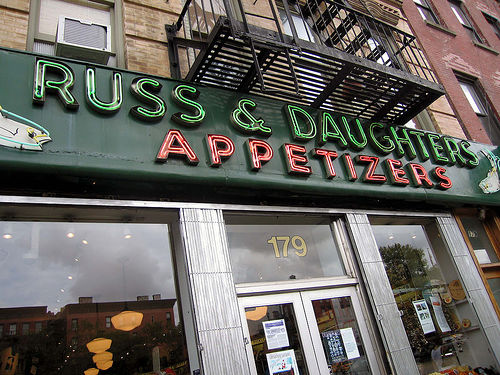
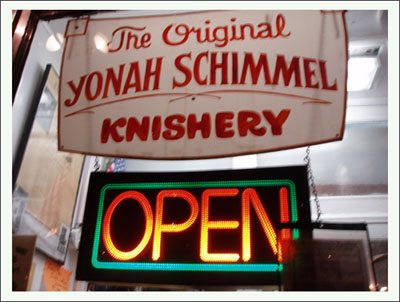
We stop for a nosh at three Jewish culinary stalwarts of the Lower East Side — Katz’s Delicatessen (a movie-friendly dining experience), Russ and Daughters (a tale of herrings and girl power) and the Yonah Schimmel Knishery (and its surprising connection to Coney Island).

Listen to it here or download it from iTunes and other podcast services:

Listen to it for free on iTunes or other podcasting services. Or you can download or listen to it HERE

Inside Katz:

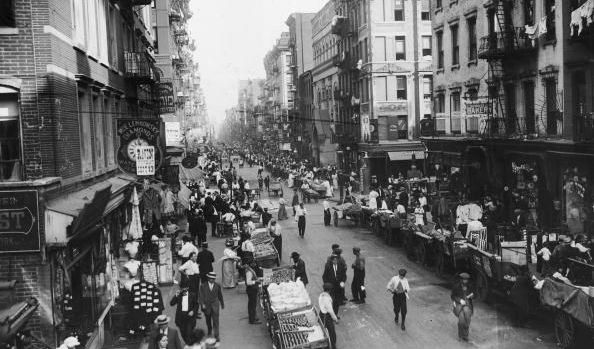
The Lower East Side pushcart and vendor street culture, from the start of the century…

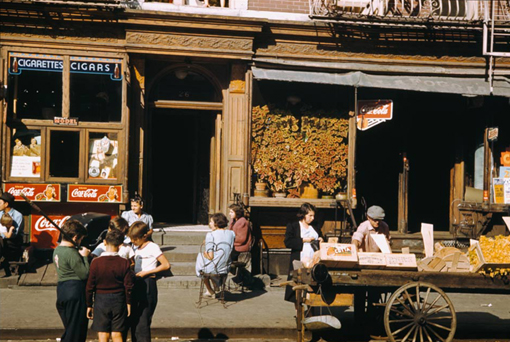
… as late as 1941, on Broome Street. (pic courtesy Charles W Cushman Photography Collection).

The Pickle Civil War!

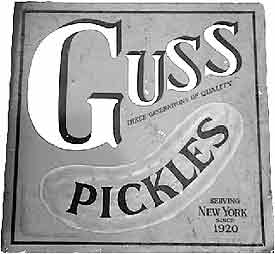
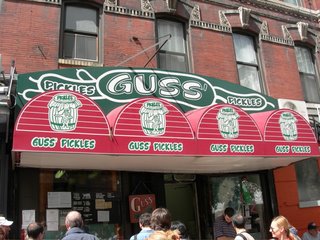
It’s odd to hear people speak passionately about pickles, as if they’re a lifestyle. But that’s how people talk about Guss Pickles, the self-proclaimed ‘largest pickle emporium in the world’ and an institution of the Lower East Side since 1910.

But as you shall see, those calling themselves the ‘largest’ and that store currently sitting in the Lower East Side are actually warring factions, wielding their pickles like scabbards engaged in a years-long battle for pickle dominance.

Pickles were a popular snack in New York as far back as Dutch New Amsterdam. They’re New York’s first portable food — long before the knish and the hot dog — and fairly easy to produce.

With the huge immigrant boom in lower Manhattan, young men in hopes of making a few bucks would operate a pushcart through the streets selling their wares. In the crowded blocks of Jewish Lower East Side, dozens of pushcarts occupied the streets, competing for customers with sidewalk stands and, for those lucky enough to have the money, actual stores!

(Check out this short silent film demonstrating the daily grind of a pushcart operator.)

Dozens of vendors at the turn of the 20th century sold pickles in the Lower East Side. Izzy Guss, an immigrant from Russia who arrived here in 1910, had a pushcart and sold produce. But he specialized in pickles. Although the competition was fierce — the area around Essex and Ludlow even called the Pickle District — Guss eventually bought his own store on crowded Hester Street in 1920, and there, in wooden barrels lining his store front, mastered his recipe for what has become the New York City pickle.

Guss’ Pickles are a New York legacy, but a war has brewed for over a decade about who currently holds the mantel of that legacy. Guss eventually bought some pickles from the Lebowitz family-owned United Pickles company. When Guss died in 1975, the business was sold to the Baker family who, in 2004, then sold it to new owner Patricia Fairhurst, who currently runs the the current Lower East Side location on Orchard Street.

However, Andrew Leibowitz of United Pickles lays claim to purchasing the actual Guss trademark from the Bakers when he sold the shop to Fairhurst. According to the Villager, the Bakers claim that Fairhurst ‘bought a lease, not a trademark’ and that they are the rightful owners of the Guss branding.

Confused? There are apparently two strains of Guss pickles in the universe. Leibowitz alledgedly has hold of the name, but Fairhurst lays claim to the original recipe.

In 2007, the controversy spread to Whole Foods, which began selling Leibowitz’ Guss pickles, which Fairhurst claims are not true Guss pickles.

Just to add to the pickle madness, a third claim to the Lower East Side pickle throne has emerged on Essex Street. The Pickle Guys, with their gallons of freshly made pickles, is operated by former employees of Guss pickles. They too may have a legitimate claim in Manhattan’s pickle heirarchy. Chowhound provides a taste test between Guss’ and Pickle Guys’ creations.)

I have a feeling that like the American Revolution, this will not be resolved until blood — or spilted pickle juice — is flowing through the street.