Categories
Podcasts Preservation

Jane Jacobs: Saving Greenwich Village

PODCAST The story of Jane Jacobs, the urban activist and writer who changed the way we live in cities and her fights to preserve Greenwich Village in the 1950s and ’60s.

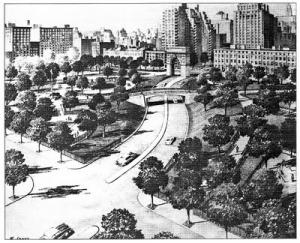
Washington Square Park torn in two. The West Village erased and re-written. Soho, Little Italy and the Lower East Side ripped asunder by an elevated highway. This is what would have happened in New York City in the 1950s and 60s if not for enraged residents and community activists, lead and inspired by a woman from Scranton, Pennsylvania.

Jane Jacobs is one of the most important urban thinkers of the 20th century. As a young woman, she fell in love with Greenwich Village (and met her husband there) which contained a unique alchemy of life and culture that one could only find in an urban area. As an adroit and intuitive architectural writer, she formed ideas about urban development that flew in the face of mainstream city planning. As a community activist, she fought for her own neighborhood and set an example for other embattled districts in New York City.

Her legacy is fascinating, often radical and not always positive for cities in 2016. But she is an extraordinary New Yorker, and for our 200th episode, we had to celebrate this remarkable woman on the 100th anniversary of her birth.

FEATURING: Mrs. Jacobs herself in clips interspersed through the show.

PLUS: ROOOOBERT MOOOOSES!


The Bowery Boys: New York City History podcast is brought to you …. by you!

We are now producing a new Bowery Boys podcast every two weeks. We’re also looking to improve the show in other ways and expand in other ways as well — through publishing, social media, live events and other forms of media. But we can only do this with your help!

We are now a member of Patreon, a patronage platform where you can support your favorite content creators for as little as a $1 a month.

Please visit our page on Patreon and watch a short video of us recording the show and talking about our expansion plans. If you’d like to help out, there are five different pledge levels (and with clever names too — Mannahatta, New Amsterdam, Five Points, Gilded Age, Jazz Age and Empire State). Check them out and consider being a sponsor.

We greatly appreciate our listeners and readers and thank you for joining us on this journey so far. And the best is yet to come!


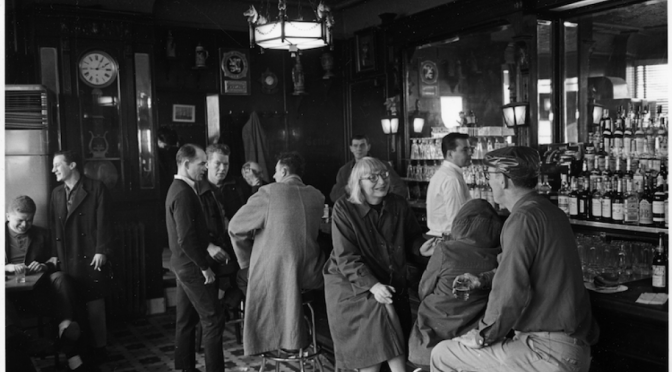
Jacobs at the White Horse Tavern, sometime in the 1960s. Jane lived on the block!
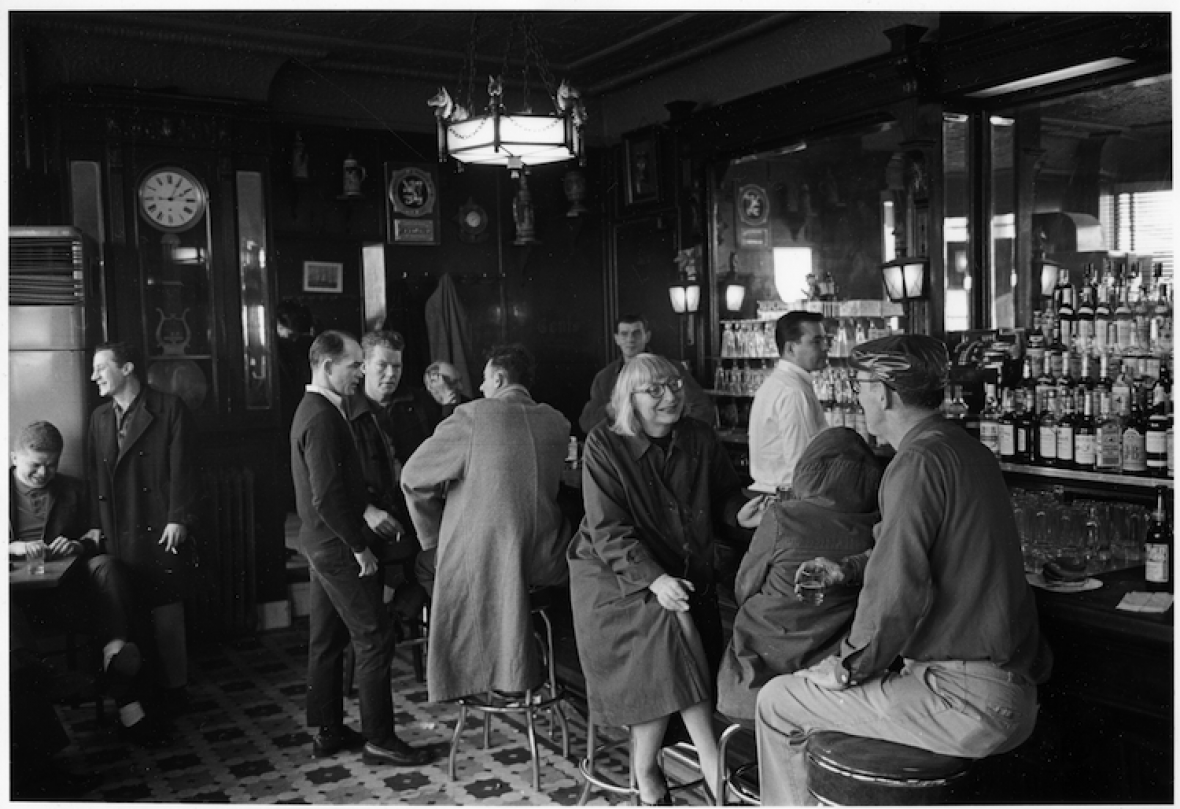
Cervin Robinson/New York Times (http://cervinrobinson.com/)
Photography by Cervin Robinson/New York Times. Visit his website for more extraordinary images of New York City (http://cervinrobinson.com/)

Jacobs in Washington Square Park (though I believe this is 1963 and not during the 1958 protest).
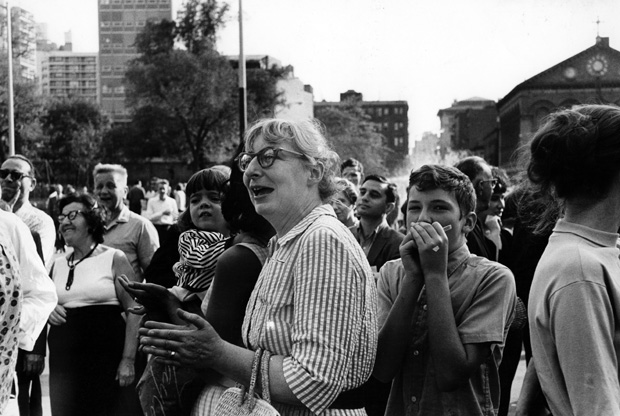
Fred W. McDarrah/Getty Images

Washington Square Park in 1935. The 1958 activists were so successful in their goal of saving the park that they were able to banish automobile traffic from it entirely.
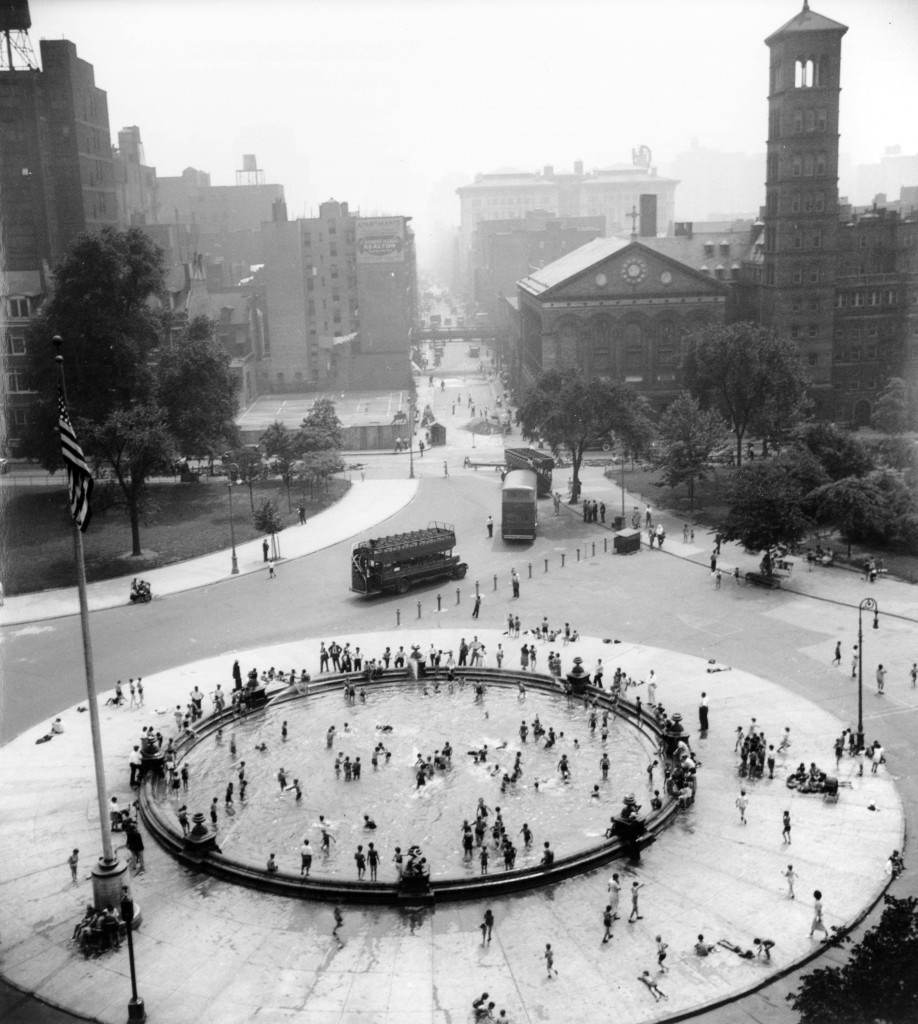
New York Parks Department

What Moses had planned for the park:

NYPL
NYPL

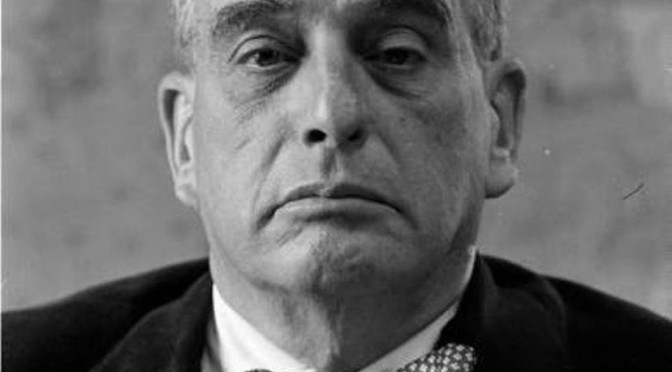
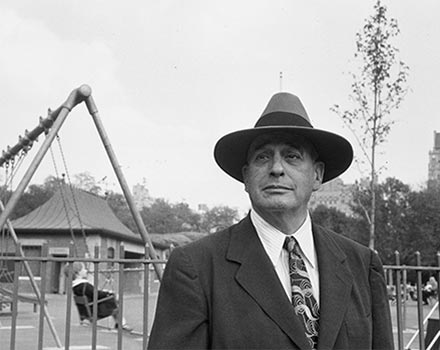
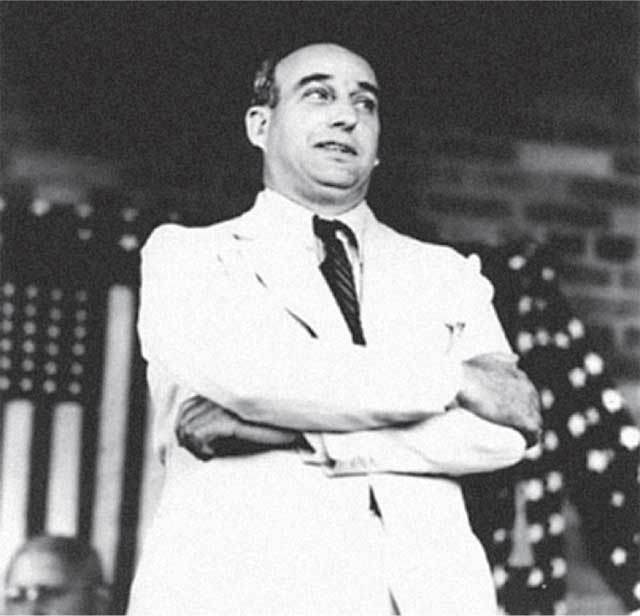
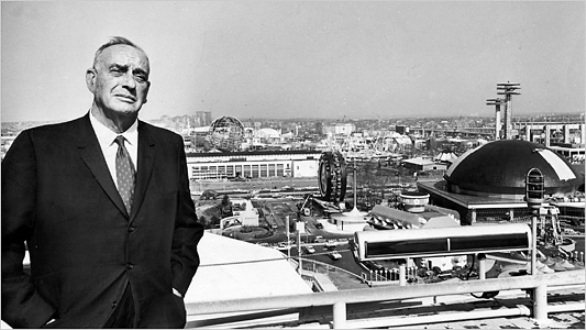
Robert Moses, pictured here in Brooklyn in 1956. Although he frequently situated as the arch-nemesis to Jane Jacobs, in fact they were rarely in the same room together. Their battles were fought in the press and in City Hall.
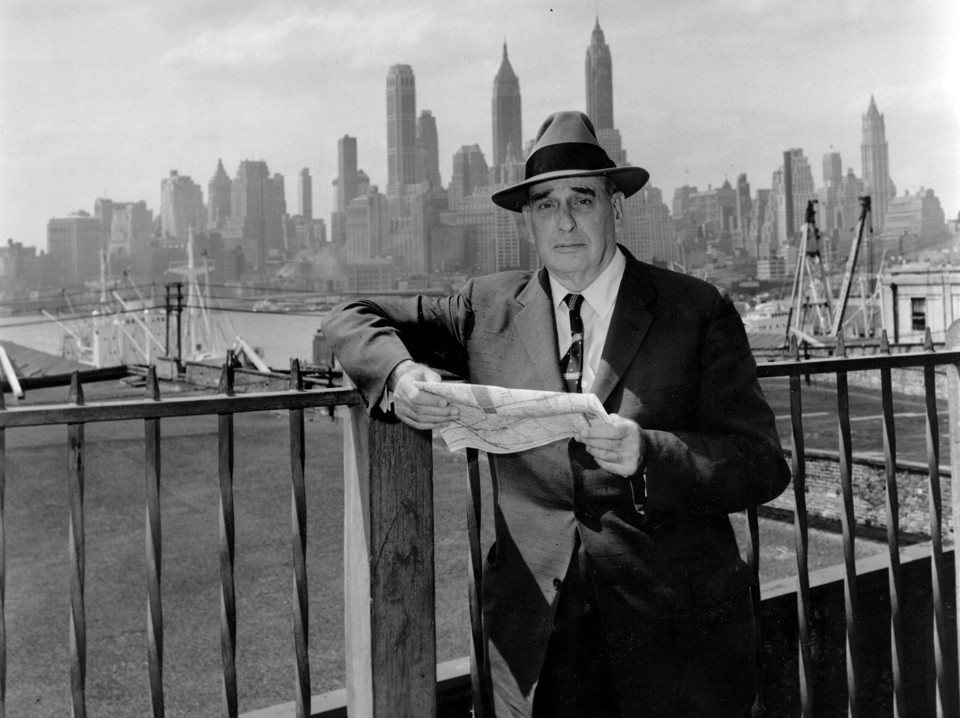
AP
AP

Jacobs presenting damning evidence about the proposed West Village demolition, taken at their main headquarters the Lion’s Head, in 1961 at the corner of Hudson and Charles Streets.
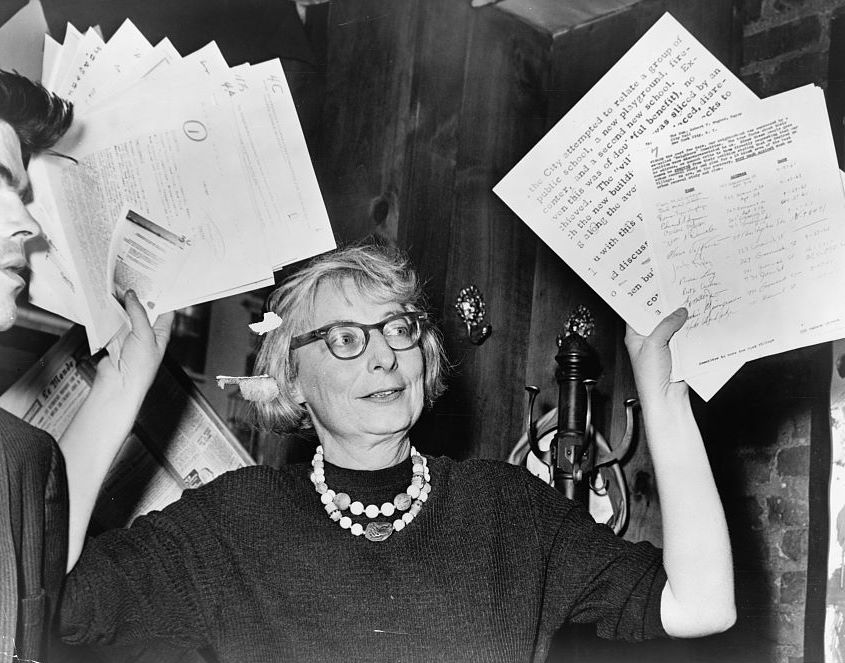
Jane_Jacobs

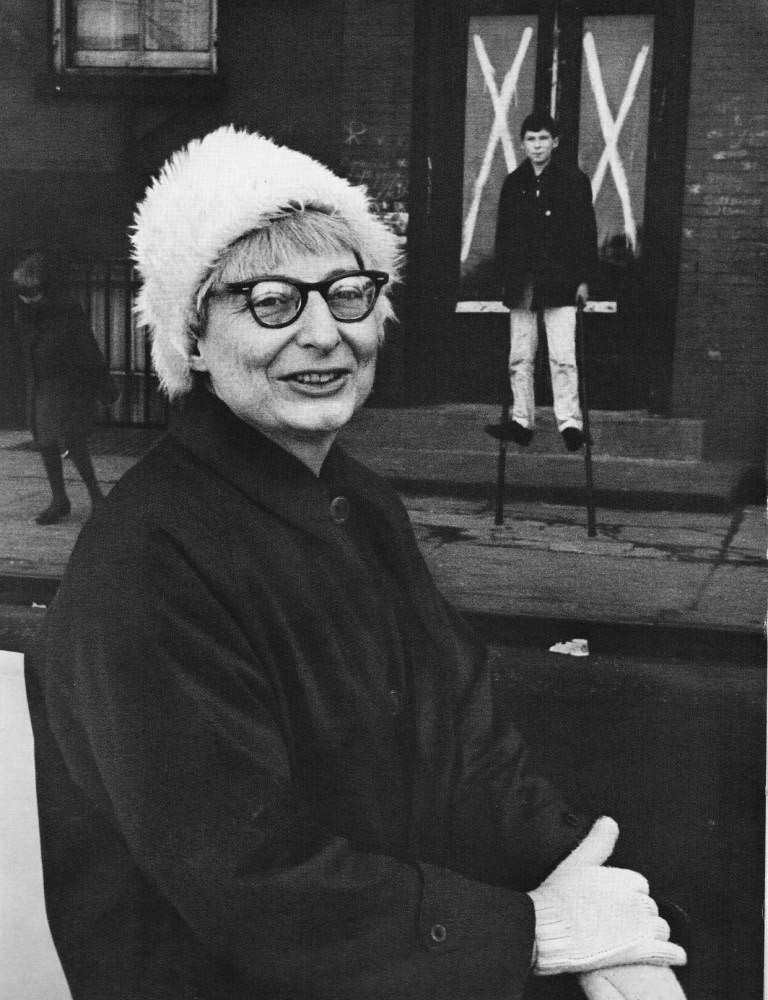
Jane Jacobs and her son Ned in 1961, during the West Village protests. The Xs were placed on buildings to be condemned. Activists wore sunglasses with Xs on the lenses in protest.
1
Photo courtesy Aesthetic Realism

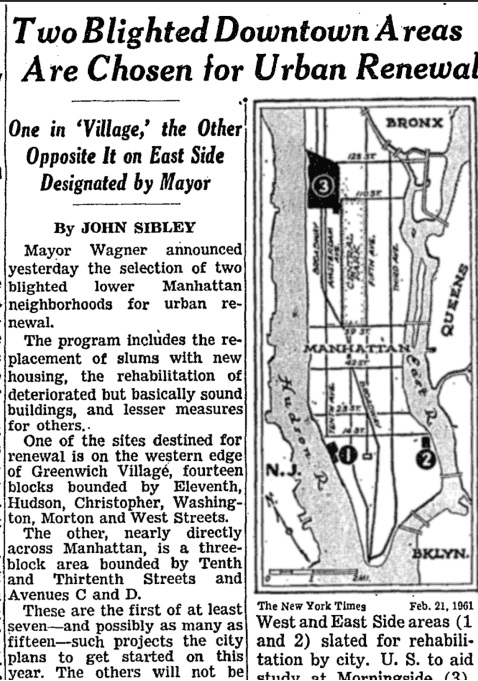
The February 21, 1961, article from the New York Times which riled up the West Village. The East Side project would eventually become Haven Plaza Apartments, but residents would fight off the designation in the West Village.
Untitled

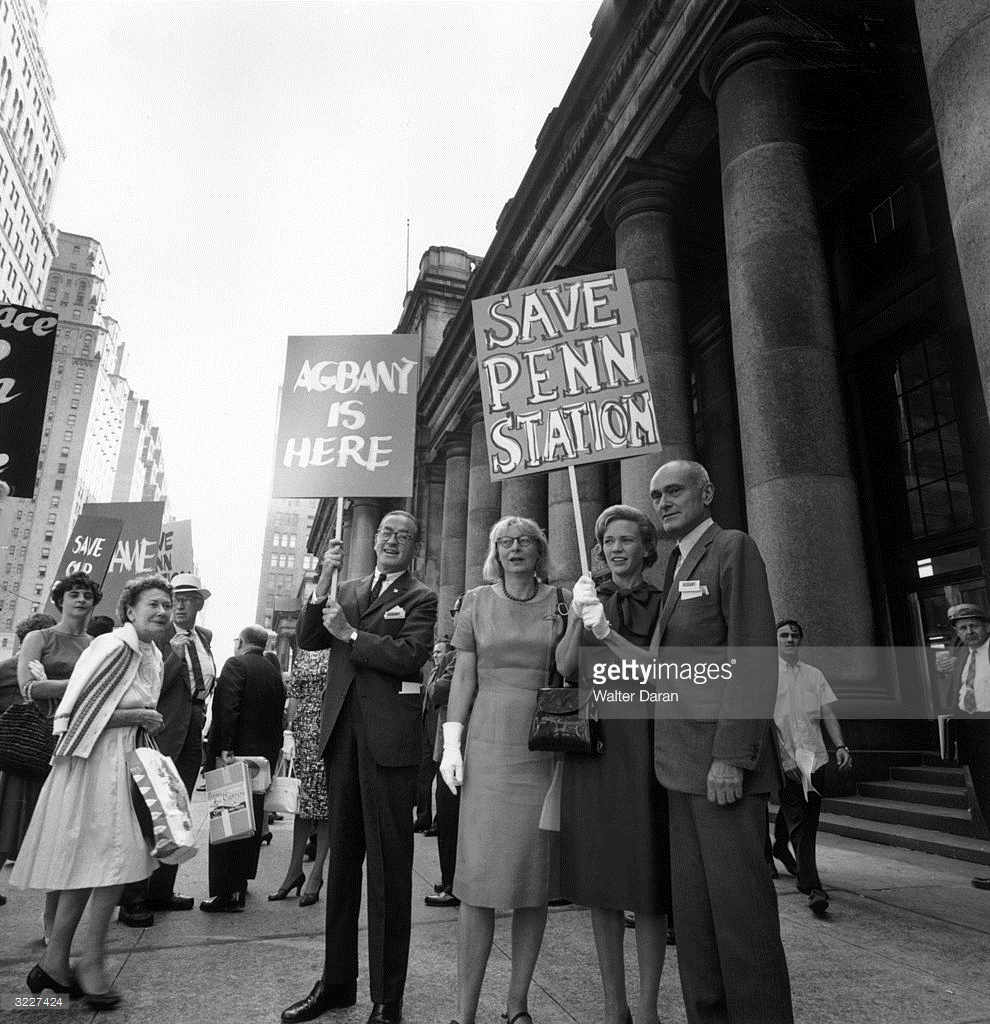
January 01, 1963 — Jacobs protests the destruction of Pennsylvania Station with architect Philip Johnson.
14

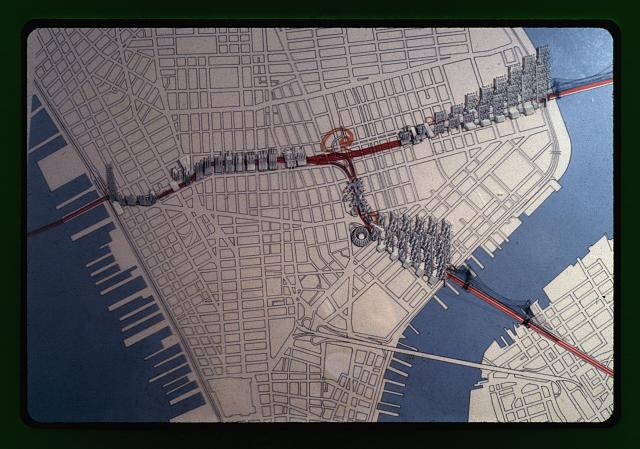
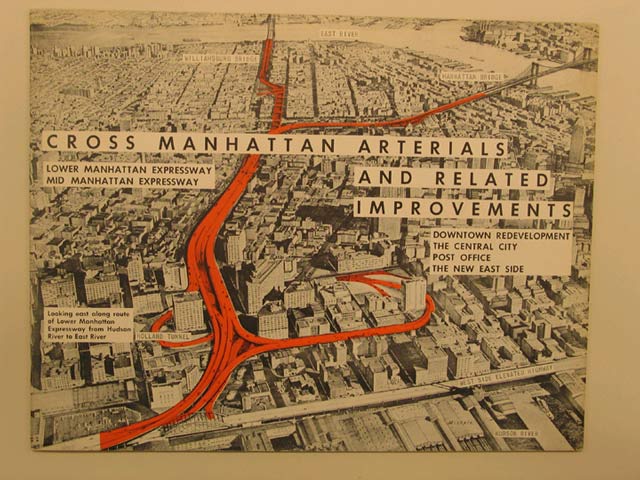
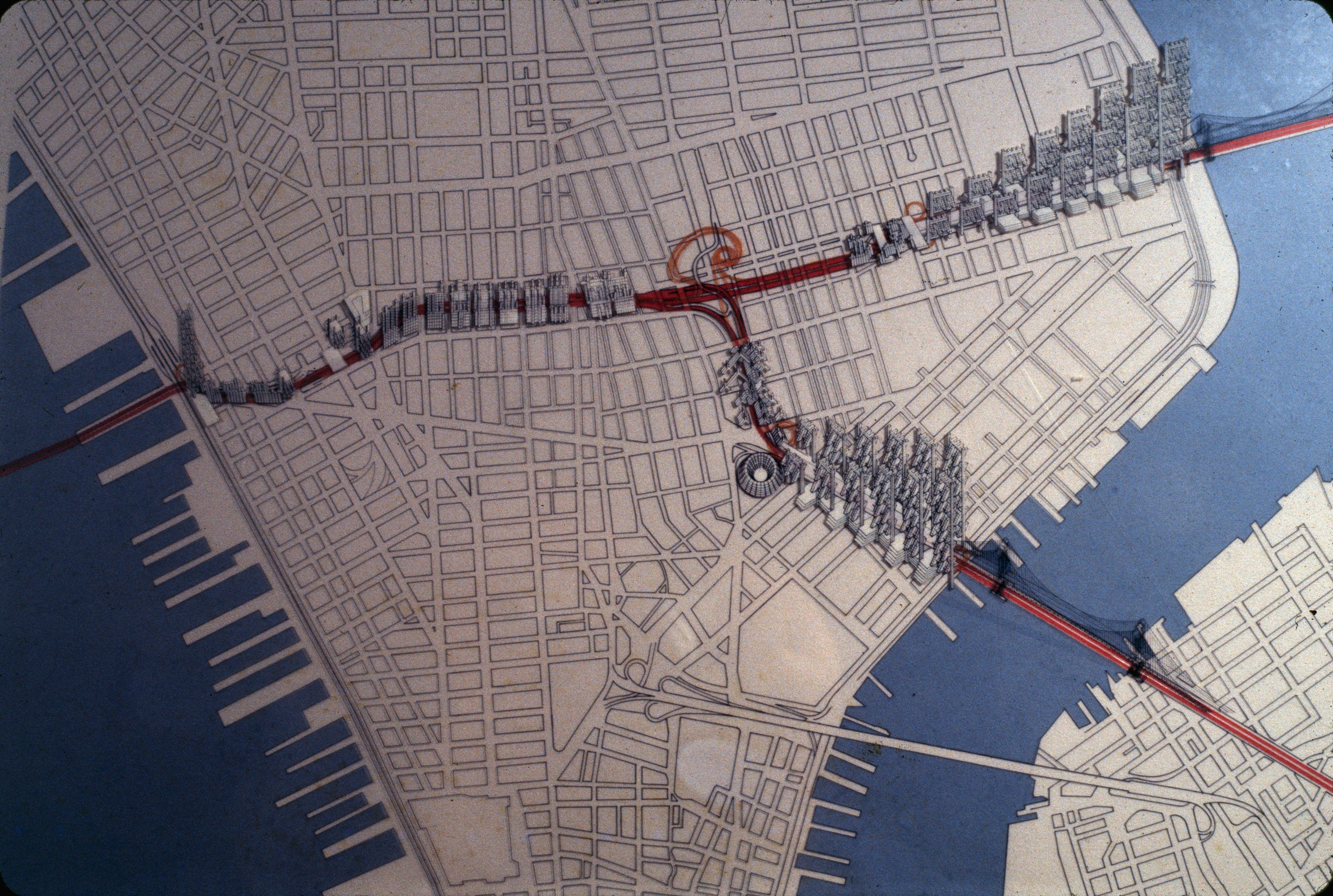
A map of the Lower Manhattan Expressway. Although this plan never came to fruition, the stack of buildings near the bridges seems to be coming to pass — on the Brooklyn side!
Library of Congress
Library of Congress

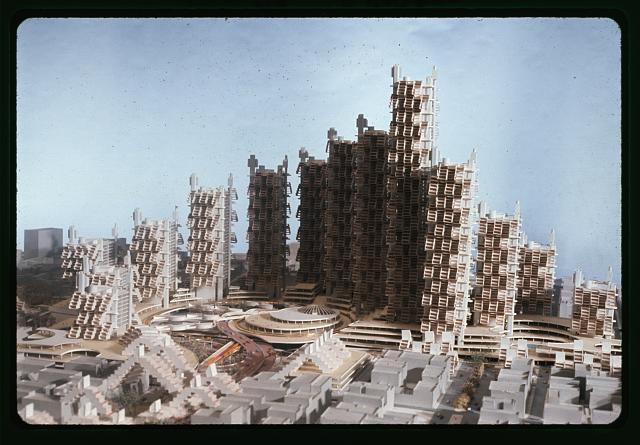
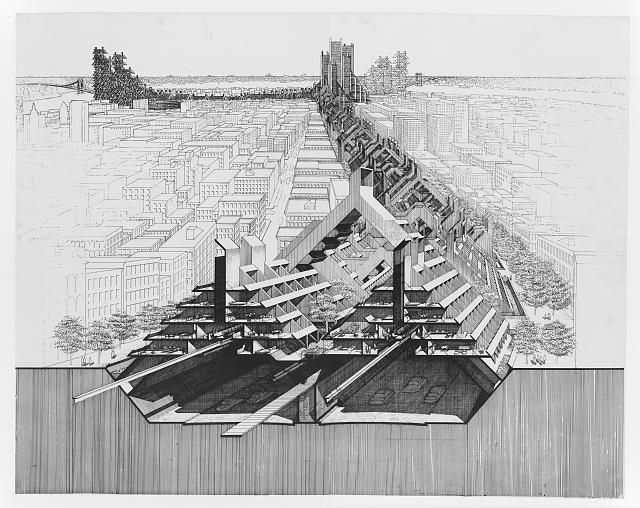
Another sketch by Paul Rudolph of the Lower Manhattan Expressway, showing the new construction from the Holland Tunnel as it enters through Manhattan.
paul

Jane Jacobs in Toronto, Dec. 21, 1968. She would continue her activism there, helping other community activists in foiling plans to build the Spadina Expressway.
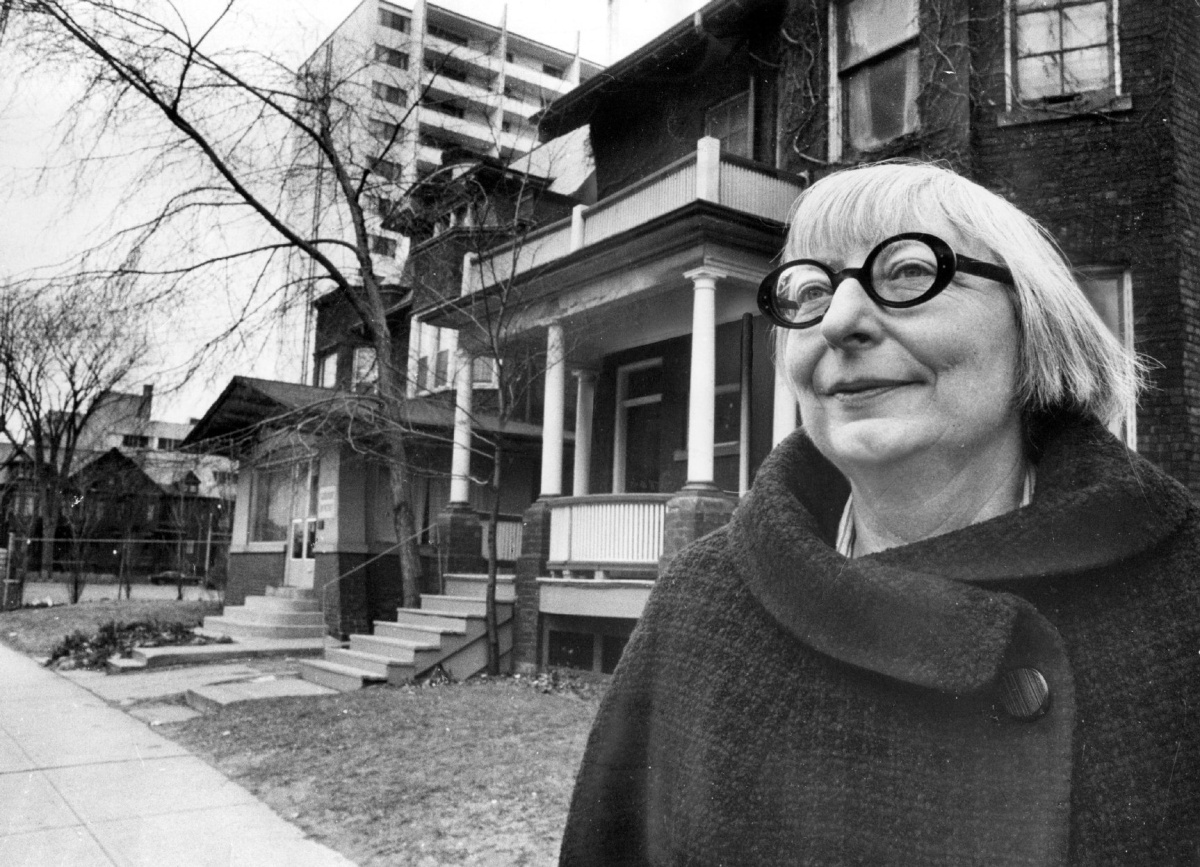
SCANNED FROM THE TORONTO STAR LIBRARY *U42 GRAPHIC Jane Jacobs outside her home on Spadina Road just north of Bloor Street. Photo taken by Frank Lennon/Toronto Star Dec. 21, 1968. Also published 19730425 with caption: Jane Jacobs. Urban affairs expert. Also published 19740520 with caption: Toronto's in good shape, says author Jane Jacobs, but "We've got to be thinking about how we make sure it stays that way." Just being Canadian gives it some advantage, she says, but she fears amalgamation will bring some of the problems of cities like New York.
TORONTO STAR LIBRARY

The abstract beauty of Robert Moses’ most horrifying idea

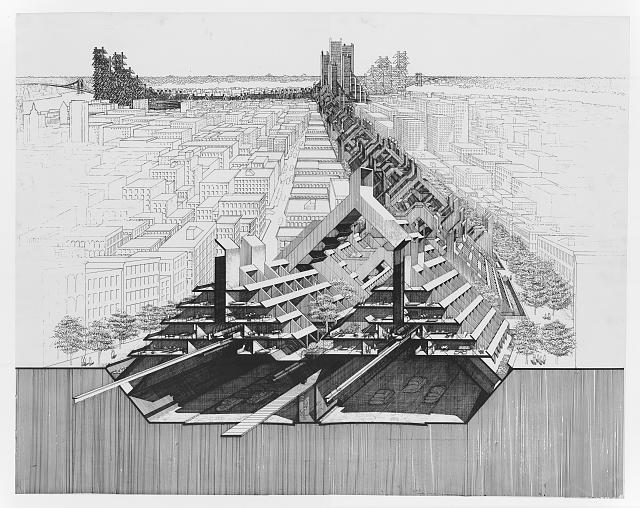
This is beautiful because it’s not real: a cross-section of Paul Rudolph’s cross-Manhattan proposal, looking east towards the two approaches consuming the Williamsburg and Manhattan bridges.

This is your last week to catch the fascinating and strange drawings of Paul Rudolph at the Arthur A. Houghton Jr. Gallery in Cooper Union. Rudolph drafted proposals for Robert Moses’ devastating Lower Manhattan Expressway which would have cleaved the island with an elevated highway, linking the East River bridges to the Holland Tunnel.

Community opposition and New York’s woeful financial crisis killed the Lower Manhattan Expressway project. Rudolph, a Bauhaus-influenced architect, was the rare master of the Brutalist style, as clearly evidenced in these drawings and mock-ups. Magnificent as stand-alone works of science fiction, Rudolph’s ideas unveil nothing less than a complete reconstruction of downtown Manhattan, with crystaline multi-level towers of concrete that evoke ancient architecture and a heavy, dreary aesthetic firmly planted in the late 1960s.

Here are a couple more images from the exhibit, courtesy the Library of Congress. The show runs through this Saturday and also feature an actual model reconstruction of what LOMEX would have looked like. More information about the exhibit can be found here.

The Arthur A. Houghton Jr. Gallery
The Cooper Union (7 East 7th Street, 2nd floor)
Wednesday-Friday 12:00-7:00pm, Saturday 12:00-5:00pm

An overhead map laying out the course through downtown, eating up the Bowery, Chrystie, Delancey and Broome streets.

Rudolph’s proposal didn’t just include highways, but a massive network of transportation hubs, skyscrapers and apartment towers. LOMEX wouldn’t just assist traffic flow; it would have defined downtown.

Categories
Podcasts Preservation

Robert Moses: Did he save New York — or destroy it?

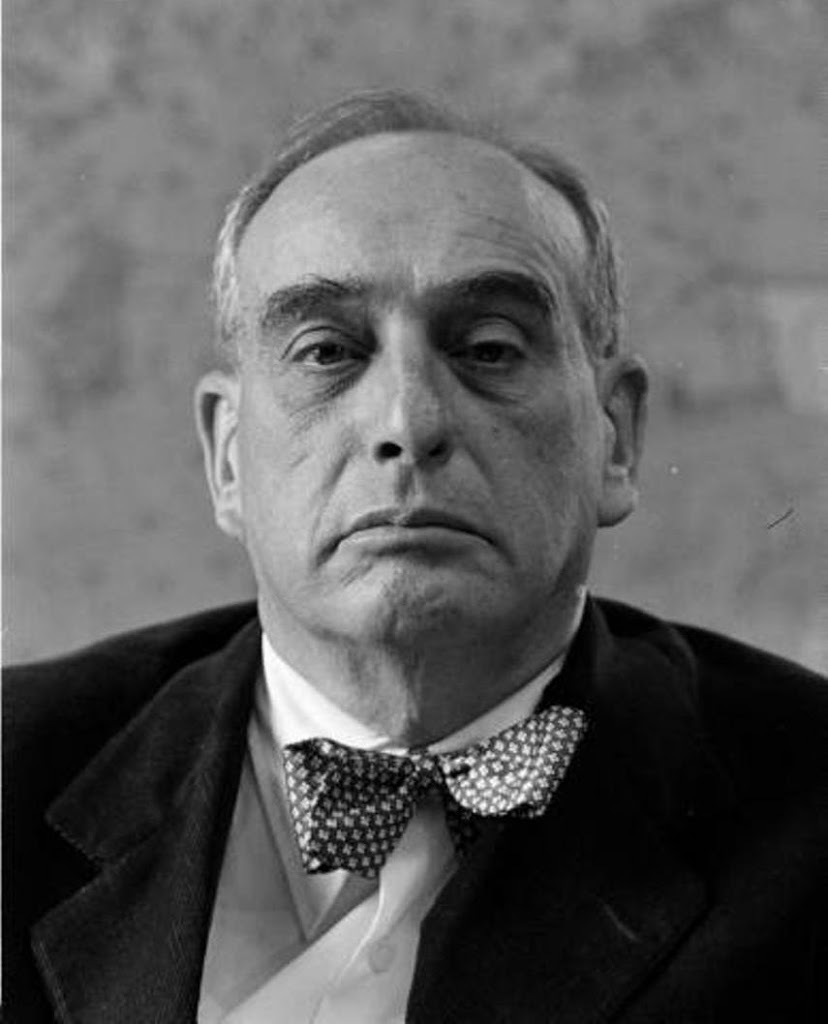
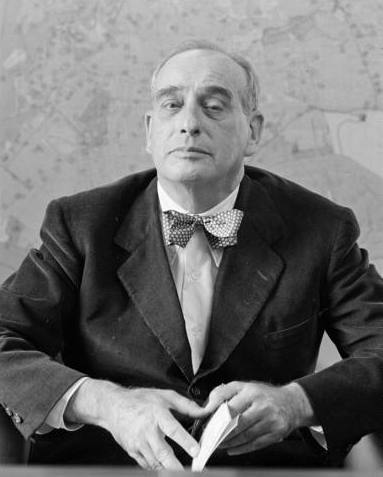
Photo above: Robert Moses, October 1952 by Alfred Eisensteadt (Courtesy Google Life)

PODCAST: EPISODE 100 We obviously had to spend our anniversary show with the Power Broker himself, everybody’s favorite Parks Commissioner — Robert Moses.

A healthy debate about Moses will divide your friends, and we provide the resources to make your case for both sides. Robert Moses was one of the most powerful men in New York from the late 1920s until the late 1960s, using multiple appointed positions in state and local government to make his vast dream of a modern New York comes to fruition.

That dream included glorious parkways and gravity-defying bridges. It also included parking lots and the wholesale destruction of thousands of homes. World’s fairs and innovative housing complexes. Elevated highways plowed through residential neighborhoods — straight through Harlem, midtown Manhattan, and SoHo.

We get into the trenches of some of Moses’s most renown and controversial projects — the splendor of Jones Beach; the revolutionary parks and pools; the tragedy of the Cross Bronx Expressway, and his signature project, the Triborough Bridge.

What side will you come down on — did Robert Moses give New York City the resources it needs to excel in the 20th century, or did he hasten its demise with short-sighted, malignant vision?

You can tune into it below, download it for FREE from iTunes or other podcasting services, get it straight from our satellite site.

CORRECTION TO THIS WEEK’S PODCAST: Once again, a misinterpretation of my own handwritten notes creates a somewhat hilarious mistake this time around. Although Jones Beach was indeed truly popular in its first year, it did not see an attendance of 150 million people in its first year. (That would have been more people than lived in the entire United States.) The correct number is 1.5 million.
___________________________________________________

KING OF PARKS: As the first five-borough Parks Commissioner, Moses was responsible for the creation and renovation of hundreds of city parks. If you see a park in New York, Robert Moses either commissioned it or radically altered it. Shunning the ‘waste’ of natural beauty, Moses replaced groves and meadows with tennis courts, playgrounds, drinking fountains and other things made with concrete and asphalt.

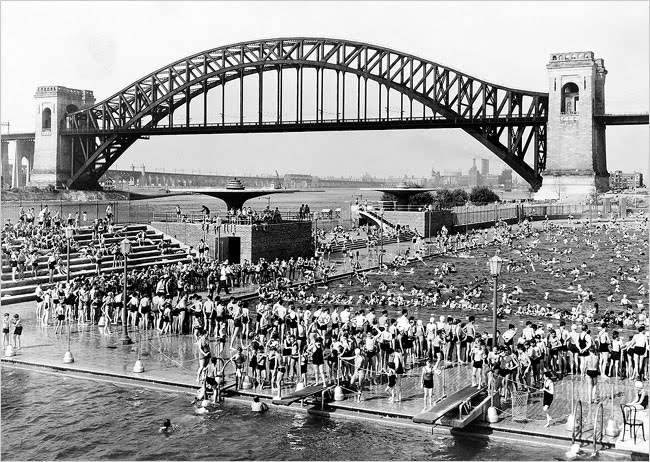
ALL WET: Being a swimmer himself, Moses placed an emphasis on public pools throughout the city, including this one in Astoria, Queens. For pools in East Harlem where he wanted to encourage white attendence, Moses reportedly authorized that the temperature of the water made colder — because black people disliked cold water. (Um, Bob, nobody likes cold water.)

CAN’T LIVE WITH ‘EM….: Mayors and governors alike latched onto Moses’s remarkable progress; newspaper editors and community leaders fell over each other to praise him. Voices of dissension were few and ignored. By the 1940s, he was immensely powerful, leading at one point a dozen local and state commissions and authorities. Picture from August 18, 1937. (Courtesy of the Long Island State Park Region Photo Archive)

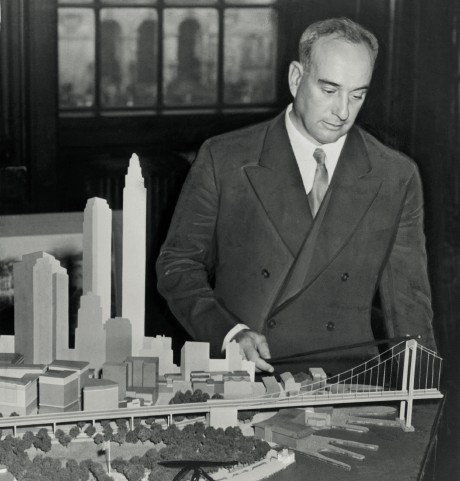
BRIDGE TO NOWHERE: Moses with a model of his Brooklyn Battery Bridge, which would have cut straight over New York Harbor, linking Battery Park with Red Hook, Brooklyn. To build this monstrosity would require turning Governor’s Island into a gigantic anchorage and eradicating the New York Aquarium, housed in historic Castle Clinton.

The project was defeated by some backroom machinations from President Roosevelt, but Moses got his revenge — on the New York Aquarium. He ripped it out of Castle Clinton and threw it out on Coney Island.

HIGHWAY CITY: Had Moses’s ideas come to full fruition, an elevated highway would have cut through lower Manhattan at Broome Street, a mid-Manhattan version would have landed onto 30th Street, and the culture of Harlem’s 125th Street would have been eliminated by a Cross Harlem Expressway. The two uptown extensions died quickly, but Moses was so close to making LoMaX (the Lower Manhattan Expressway) that one segment, at Chrystie Street, was actually built and abandoned.

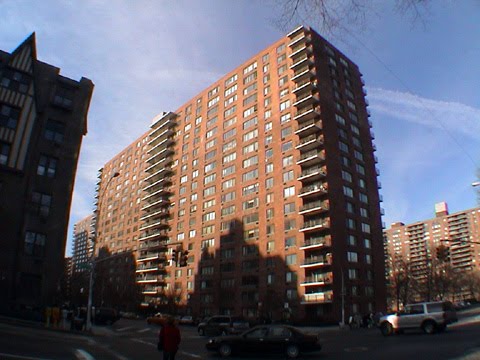
SCANDAL: The drab structures at Park West Village belie the scandal of Manhattantown, a proposed development exposed as an elaborate development scam spawned from the federal government Slum Clearance Program — a program overseen by Moses in New York.

NO FAIR: A visibly bitter Moses stands aloft his World’s Fair of 1964-65, a chaotic, financial flop that gave the press, once so adoring of their former Parks Commissioner, ample fodder for mockery.

Robert Moses has divided urban planners, politicians and regular New Yorkers for decades. The 1970s saw the devastating bio The Power Broker by Robert Caro, elaborating in great, grim detail the evils of Moses’s decisions. His legacy was re-evaluated in a critical 2007 exhibition at the Queens Museum.

Photo by Alfred Eisensteadt (Courtesy Google Life)