Categories
New York Islands

Whatever happened to Franklin and Eleanor Roosevelt Island?

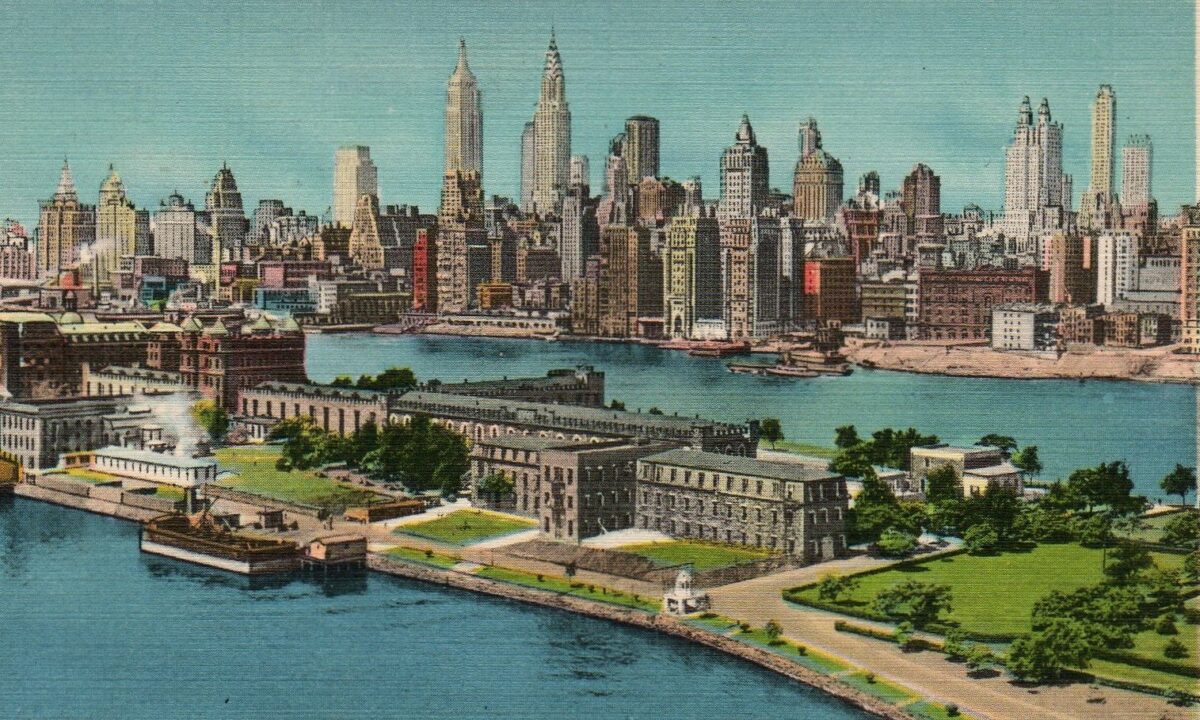
Welfare Island (once the more enticingly named Blackwell’s Island) was New York’s depository of human services, once a dour place of horrifying asylums and miserable workhouses.

In the 1960s Mayor John Lindsay was preparing to revitalize the East River island with new housing and increased support for the hospitals there. Architects Philip Johnson and John Burgee were brought in to rethink the urban space as a largely automobile-free community.

For this grand experiment, all they needed was a name. Luckily there seemed be a couple prominent figures being egregiously ignored in the city — Franklin Delano Roosevelt and his wife Eleanor:

From a New York Times editorial, January 30, 1972:

It is astonishing, and becomes more disgraceful with every passing year, that within the city there is still no memorial to this great New Yorker (except for FDR Drive, a dubious honor).  

The opportunity is, however, immediately at hand. Welfare Island, now slowly undergoing a total reconstruction and rebirth, would take on a new symbolic significance if its name were changed to Franklin D. Roosevelt Island — or, better yet, to Franklin and Eleanor Roosevelt Island in honor of that extraordinary woman who was even more closely identified with New York City than was the president himself.”

By the following year Mayor Lindsay submitted a proposal to re-name Welfare Island for the president and the first lady.

From Jan. 21, 1973:
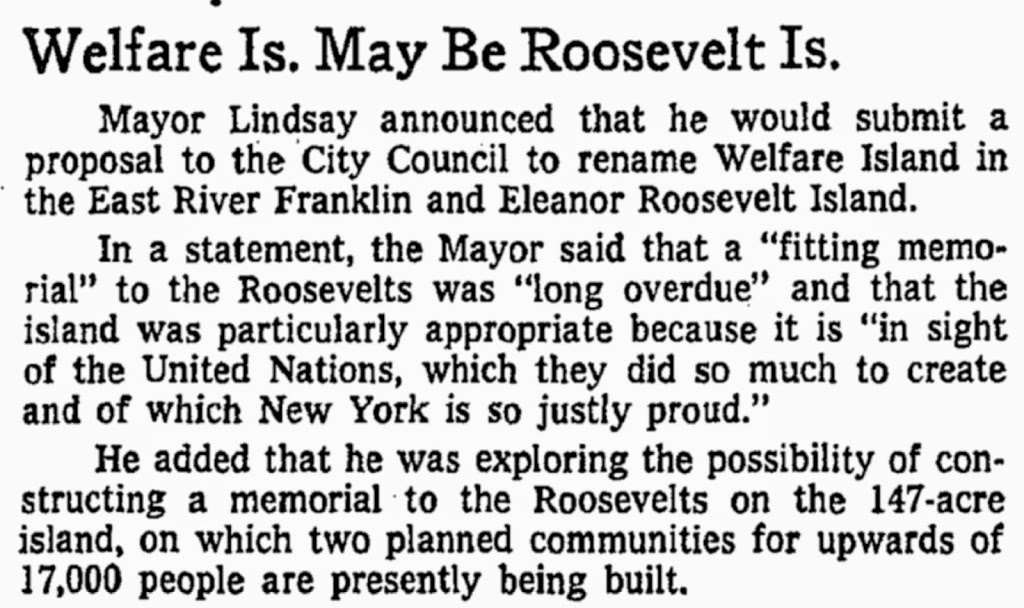
It was officially approved later that summer but with a revised name — Franklin Roosevelt Island.

To the Council, “a witness testified that the name of Welfare Island should be dropped because plans were under way to start marketing this September the thousands of apartments already built and still under construction as part of a $300-million ‘new town’ designed to replace outdated medical facilities.” [source]

Below: The island in April 1961, photo courtesy the New York Fire Department
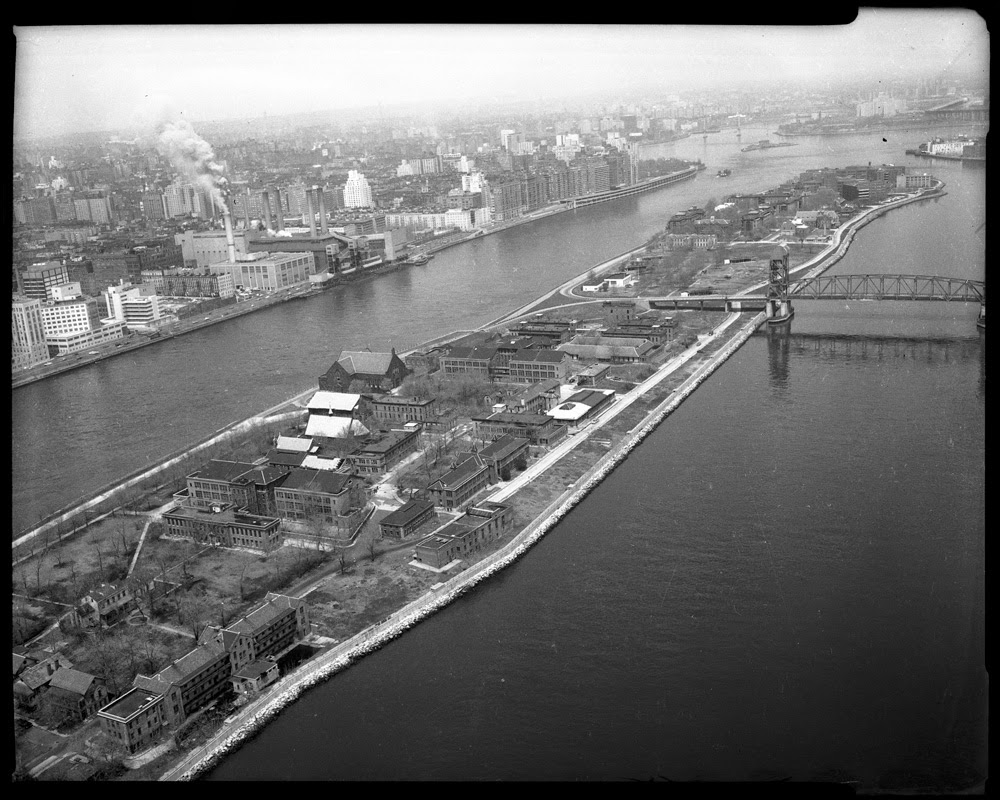
A Louis Kahn memorial to Franklin Roosevelt was to be built at the south end; it would take over four decades, but the Franklin D. Roosevelt Four Freedoms Park would finally open in 2012.

Wither Eleanor?

She finally did get her own memorial in New York City — an understated statue tucked away in Riverside Park.

It was unveiled on October 5, 1996 by Hillary Rodham Clinton.

Oddly enough, Hillary regaled the crowd with a story of imaginary conversations she liked to have with Eleanor. “When I last spoke to Mrs. Roosevelt, she wanted me to tell all of you how pleased she is by this great, great new statue.”

Top picture courtesy Museum of the City of New York
Categories
Mad Men

In Central Park, heated reactions to the assassination of Martin Luther King, while business booms at movie theaters

WARNING The article contains a couple light spoilers about last night’s ‘Mad Men’ on AMC.  If you’re a fan of the show, come back once you’re watched the episode.  But these posts are about a specific element of New York history from the 1960s and can be read even by those who don’t watch the show at all.  You can find other articles in this series here

The 1960s were obviously momentous for American culture and for New York specifically. But that decade was especially strange for Central Park.

Olmsted and Vaux’s urban oasis was a well-trodden destination for protest in the 1960s, a haven for “be-ins” and demonstration (with a little free love thrown in, I imagine).  In December 1967, agitated anti-war protesters even burned a Christmas tree.  Two years later, the first gay pride parade would also culminate here. (Here’s some video of the second pride celebration in Central Park the following year.)

Almost 24 hours after DrMartin Luther King Jr was assassinated in Memphis on April 4, 1968, angered New Yorkers — mostly students — gathered for a rally in Central Park at the Naumberg Bandshell to honor the man’s extraordinary life and to cope with the sudden, inconceivable loss.

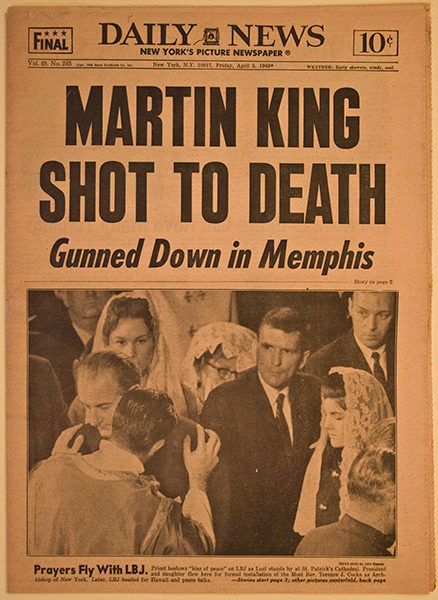
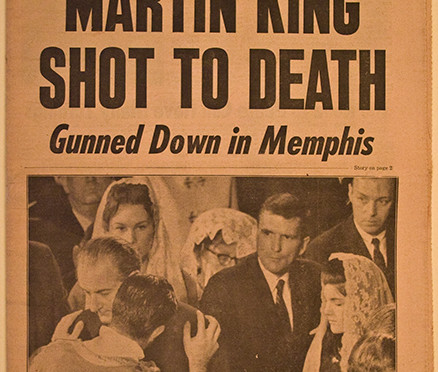
At right: The unusual headline from the New York Daily News. This particular front page popped up on last night’s show. Did you catch it?

The city was in a veritable lock down throughout the day, with many businesses and schools closing early on April 5.  In case you couldn’t make it into the city that evening — and given reports of rioting, many chose to stay home — the ceremonies were actually broadcast by WBAI.  (You can download a recording of the broadcast here, courtesy Pacifica Radio Archives.)

Those invited to speak at the gathering were friends and admirers from a variety of fields.  Looking at the list of speakers, perhaps the most unusual one that jumps out is Dr. Benjamin Spock, the famed pediatrician and best-selling novelist. Spock was an ardent, high-profile protester of the Vietnam War and a friend of Dr. King’s, frequently seen at his side in 1967 at war protest events.

Others who spoke at the rally included actor Ossie Davis and activists Florynce Kennedy and James Forman.  Perhaps the most damning words were spoken by Jarvis Tyner, chairman of the DeBois Clubs of America, who declared that Mayor John Lindsay was poised to send armored tanks to Harlem.

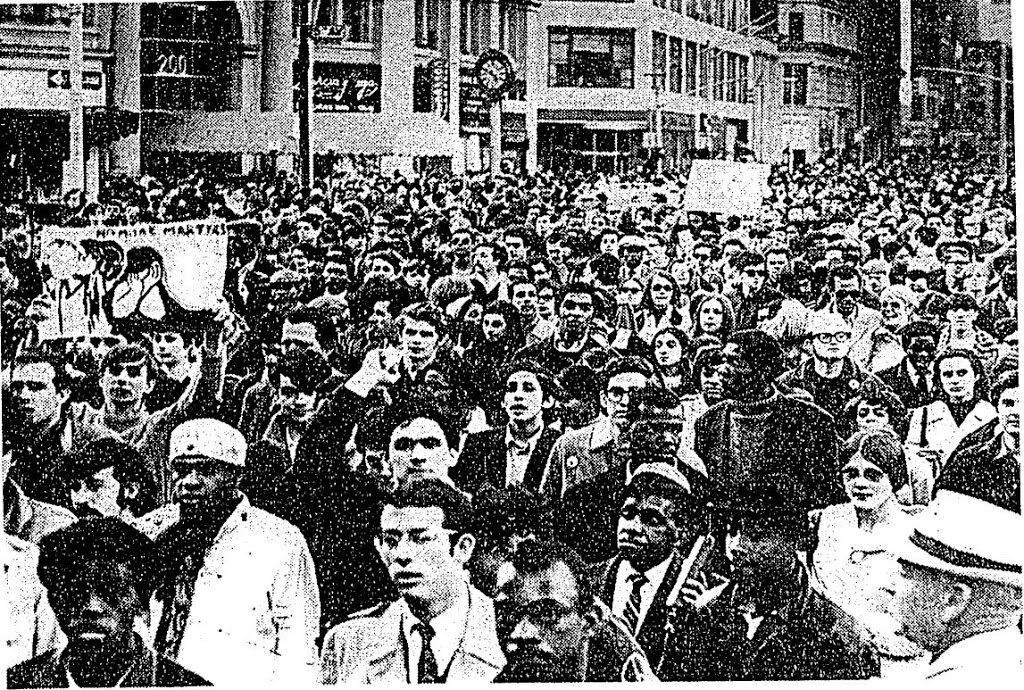
Below: Crowds cross 23rd Street on their way to City Hall. Picture courtesy NYT

Things got rather out of hand once the rally turned into a march down Broadway to City Hall.  According to the New York Times, throngs of students filtered down the streets, occasionally breaking windows along the way.  Trying to stem the violence among their number, others were heard shouting. “Let’s keep order for Martin Luther King.”

The following day, mourners marched from Harlem to an all-faith rally held by local religious leaders in the park.. (It seems likelier that this was the event attended by Megan and her step-children!)

On last night’s episode of ‘Mad Men’, we see Don’s own reaction to the tragedy — going to see ‘Planet of the Apes’ with his son!  According to the same article, this was not an unusual reaction after the tragedy.  While other forms of entertainment saw a notable decrease in attendance, movie theaters saw no such effect, even with fears of a possible riot awaiting moviegoers when they left the theater.  “Times Square movie theaters reported either normal or better than usual crowds and both the Baronet and Coronet Theaters on Third Avenue at 59th Street said they had long lines of people waiting to buy tickets for the early evening shows.”

The April 5th rally for Martin Luther King wasn’t even the most unusual thing to happen in Central Park that day.  That distinction would go President Lyndon B. Johnson, who planned a surprise trip to the United Nations that day and touched down his helicopter in the park!

Categories
Podcasts

Gracie Mansion: How a bucolic summer home survived a couple wars, a society feud and a few live-in mayors

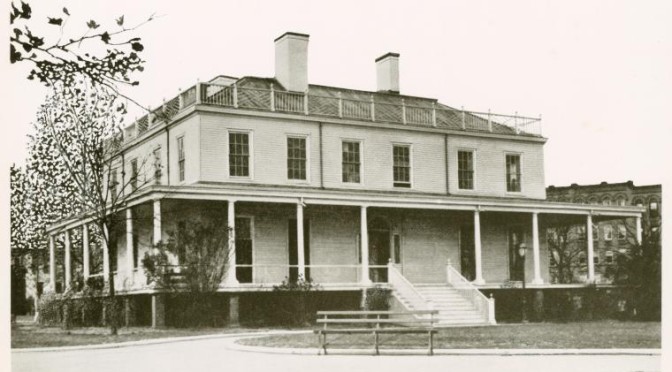
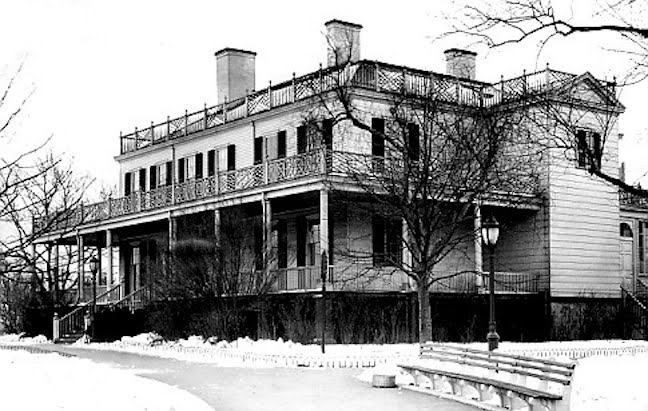
Photo by the Wurts Brothers, date unknown. Courtesy NYPL

Archibald Gracie admired the extraordinary vistas at Horn’s Hook — overlooking the East River and the churning waters of Hell’s Gate — and decided to build a house here. Little did he know what an extraordinary journey this comfy little Federal home would take over the next two hundred years.

After seeing a lamentable period as a refreshment stand and a place for sewing classes, Gracie Mansion became the first home for the Museum of the City of New York. Then, one day, Robert Moses came along and fell in love with it. Find out how the waterfront mansion became New York City’s defacto White House for over 70 years. And why our current mayor chose NOT to live here.

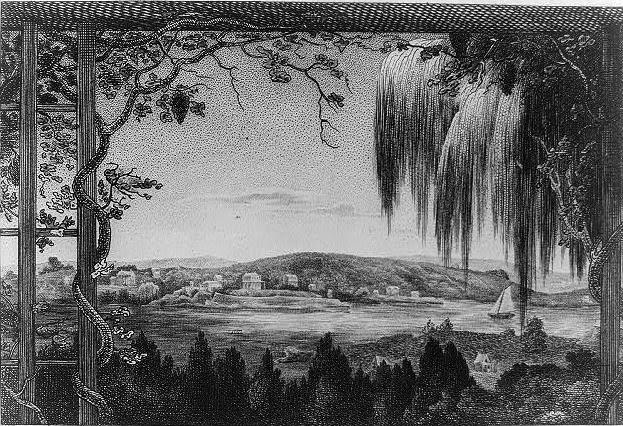
An illustration from May 1808, looking across the waters at Gracie’s mansion, newly built, and other country homes along the shorefront. In between them sits Hell’s Gate, the treacherous confluence of waters that often sank vessels and made travel quite difficult. (Courtesy LOC)


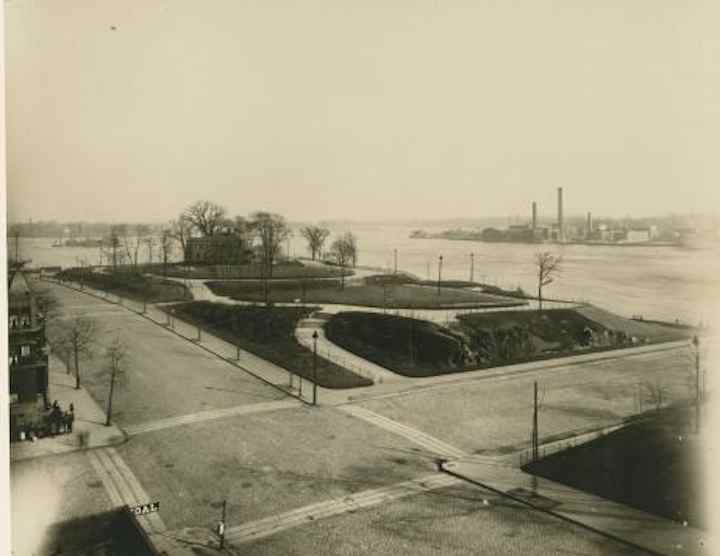
The land around the Gracie property was whittled away during the 19th century, and what remained was turned into Carl Schurz Park. The mansion, however, sat in disrepair and hardly of much use outside of storage and a basement refreshment stand. (Courtesy NYPL)

How it looked in 1942, before the mayors moved in…

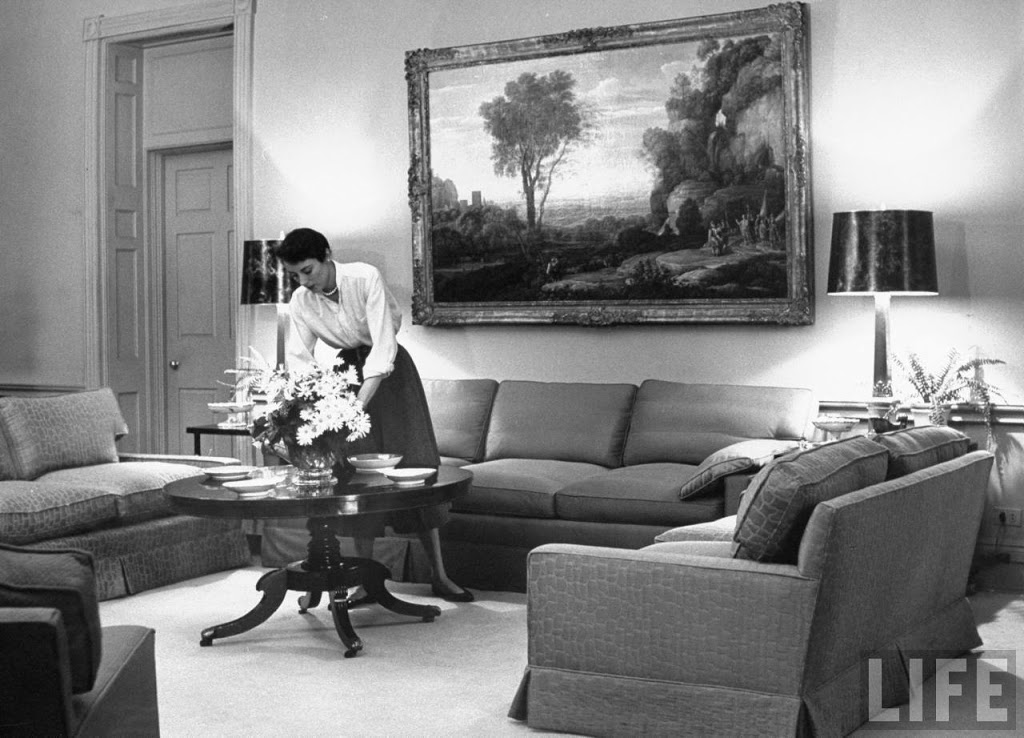
William O’Dwyer‘s new wife Sloan Simpson readies the Gracie Mansion living room for an event, or at least poses for a photo op. O’Dwyer was the second of nine mayors to live at Gracie.
Photo by Alfred Eisenstaedt, May 1950 (courtesy Life images)

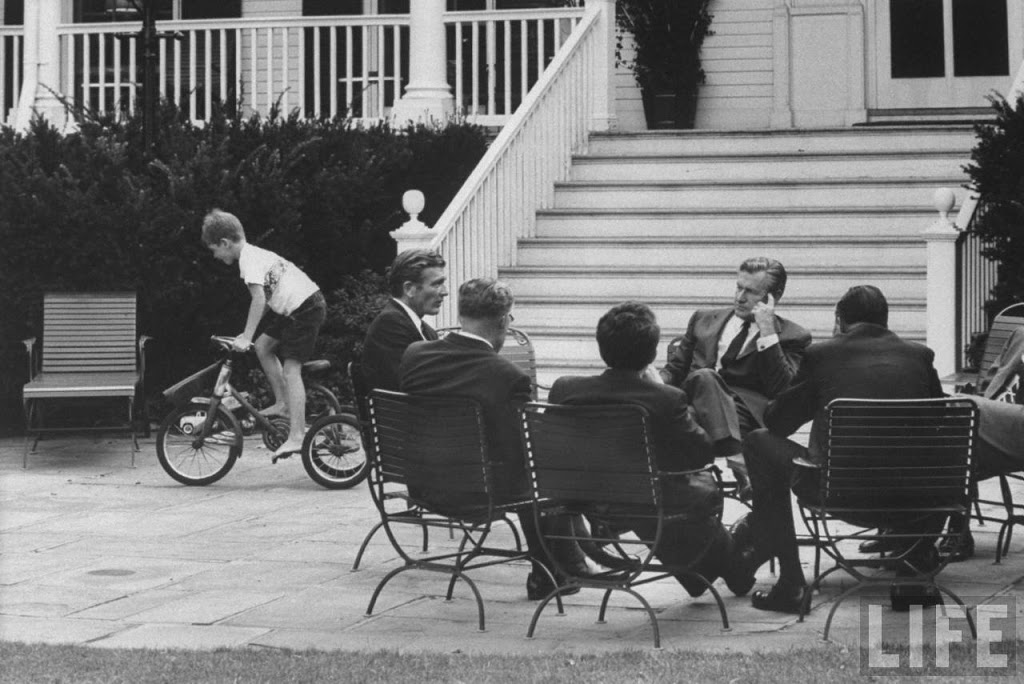
Certainly looks homey from here! A Federalist home is not complete without John Lindsay, G E chairman Gerald Phillippe, and Gov. Nelson Rockefeller sitting on the lawn. John’s son ride by without notice. Photo by John Dominis, May 1968 (courtesy Life images)

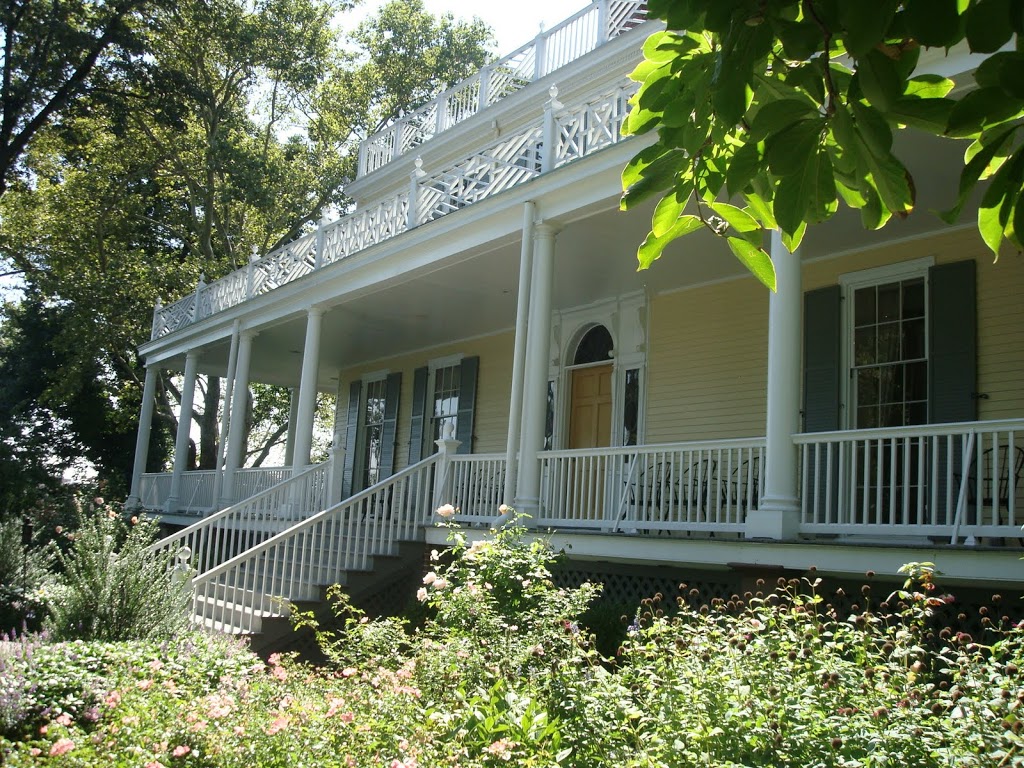
The front of Gracie Mansion today, although most guests use the side entrance. Gracie’s still faces into lovely vista overlooking the East River, but it mostly obscured today by trees.

Visit NYC.GOV’s website about Gracie Mansion to inquire about tours for individuals or small groups. If you have more than 25 people, you can actually have tea at Gracie Mansion. May King Van Rensselaer would have been proud. Our current mayor, by the way, lives here.