Is that any way to treat an Olympian?

Has an internationally famous monument ever had to endure such grave indignities as the Discus Thrower of Randall’s Island? Scandal!

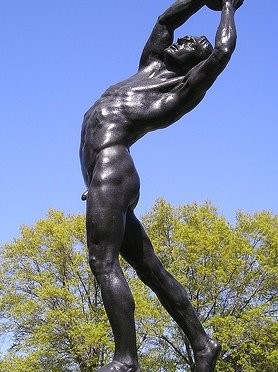
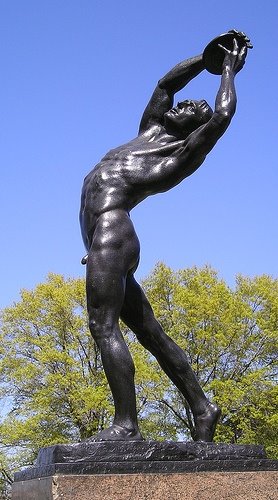
Nothing proclaims the revitalization of Randall’s Island more than this distinctive, classically inspired statue by Greek sculptor Kostas Dimitriadis. The Discus Thrower is the most graphic symbol of the changing island and a hallmark of its sports past. However, almost since its creation, Dimitria’s work has been constantly on the move and was even, at some point, ravaged and dismembered.

Dimitria created this award-winning discobolus for the 1924 Olympic Games in Paris. Two years later, businessman Ery Kehaya donated it to the Metropolitan Museum of Art as “an expression of gratitude from Greeks living in New York to the city that has given them opportunity.” The bronze was displayed behind the Museum, not in it, for ten years.

Finally, when the new stadium was opened on Randall’s Island in 1936, the Discus Thrower was installed in front of it, a natural fixture for a place soon to burst with Olympic superstars.

But respect for this Olympic icon faded in the 1960s. Badly rusted, the poor guy was riddled with graffitti, his discus was stolen, and part of his arm was broken off. Eventually, in 1970, the entire statue was placed into storage.
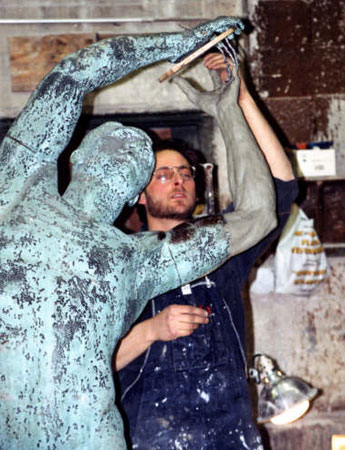
Almost thirty years passed before the island was in good enough shape, thanks to the Randalls Island Sports Foundation, to welcome the Discus Thrower back. But not before some delicate restoration to replace the missing limb. The statue was rededicated on July 21, 1999, in a ceremony that featured an actual discus thrower, and a pretty legendary one at that — Queens native Al Oerter, who won Olympic gold in the event in four consecutive games, a feat yet to be surpassed in any sport.

Later Mayor Bloomberg, who had worked with Oerter during the failed 2012 Olympic bid, turned the now-gleaming statue into a tribute when the athlete died in 2007. “From now on, when New Yorkers pass the iconic discus thrower statue on Randall’s Island, they should remember the life and contributions of Al.”

The Discus Thrower has a brother replica in Athens, Greece. He hasn’t moved from the entrance of Athens’ Panathinaiko Stadium since 1927.
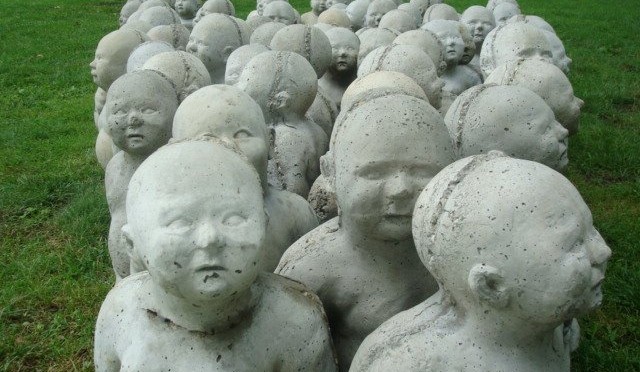
Scary sculpture babies: JOIN US on Governors Island

Governors Island has been open for a few weeks now and greeting people as they wander this historic military base are dozens of sculptures and installations, certainly the most comprehensive display of public art in the city outside a museum.

The Sculptors Guild takes to the grounds of Nolan Park on its 70th anniversary with a wide variety of unusual pieces. In ‘Building 408’, observe a group of artists as they make a collection of watercolors on site.

But the most spectacular concentration of artistic weirdness is in ‘Building 14’, where the Governors Island art collective Figment displays several installations alongside the building’s traditional room settings.

Nolan Park was for decades the quiet residence of military officers, living in rustic two-floor Victorian homes, a five minute ferry ride from downtown Manhattan. Nolan Park is already a rather surreal place to stroll around; you’re allowed to enter many of the empty homes and imagine who the people were who once lived here. Of course, the experience is intensified with the inclusion of modern art:

And of course, Governors Island joins the rest of the city next Friday as one of the four artificial waterfalls by Olafur Eliasson are finally switched on.

Rockefeller Center’s greatest art scandals!

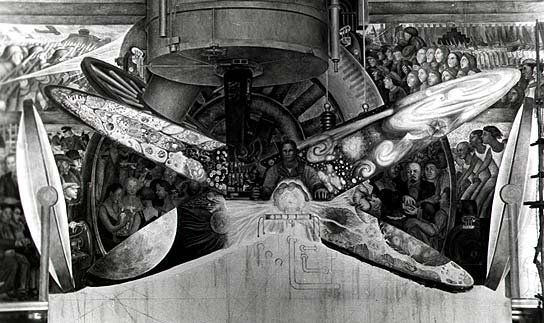
Above: Diego Rivera’s contentious creation

Despite JD Rockefeller Jr’s aversion to the ‘impropriety’ of modern art, Rockefeller Center has always been bursting with it, from the large outdoor installations sprouting up in the plaza to the gorgeous art deco blazing from its walls.

As with modern art for public display however, the Rock has sometimes riled the community with challenging and occasionally offensive art pieces.

The most famous of course is Diego Rivera’s Man at the Crossroads (pictured above), his epic mural created in 1933 with the supposed theme of ‘new frontiers’. Rivera was a favorite of Rockefeller’s wife Abby, having feted the artist in a show at the Museum of Modern Art in 1931. Rivera, however, was no tool of the rich. Amongst the many May Day figures depicted in Rivera’s expressive narrative mural is one Vladimir Lenin, communist leader and Marxist icon.

He was asked to repaint the Lenin figure but Rivera staunchly refused. The press had a field day, finding the depiction insulting and pressuring the Rockefellers to completely cover the mural, then a few months later, destroying it entirely. One photograph of the mural remains — and of course, a near exact copy that Rivera later painted in Mexico.

Yet another depiction of another controversial leader was allowed to stay.

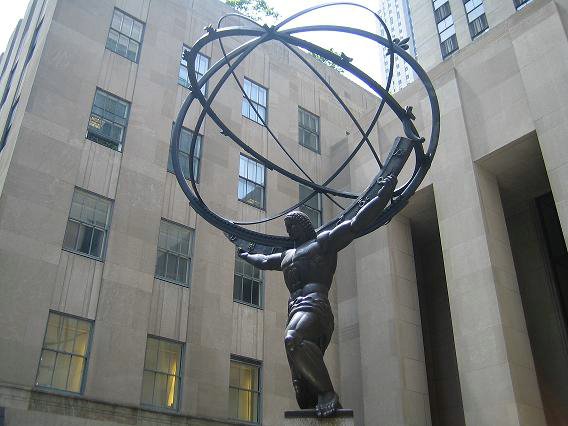
Just a few years later in 1936, art deco master Lee Lawrie created his mighty two-ton Atlas, probably one of the most recognizable pieces of artwork in the city of New York.

He currently stands directly in front of St. Patrick’s Cathedral, so you can imagine the surprise of many when it was rumored the face of Atlas was modelled after Italian dictator and all around bad guy Benito Mussolini. Although protestors picketed the statue, good Atlas was allowed to stay.

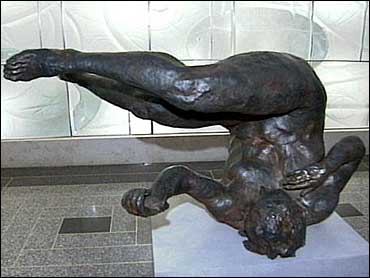
Flash forward a few decades to 2002 and a more modest piece that sat briefly in the Rockefeller Center concourse, not far from the skating rink — Erik Fischl’s Tumbling Woman. A bronze figure in the style of Rodin, this image of a falling woman installed as a Sept. 11 memorial on its first anniverary greatly disturbed passers-by.

After the New York Post threw the controversy on its front page, the figure was removed. Interestingly, the artist never intended the sculpture to be displayed publicly at all.

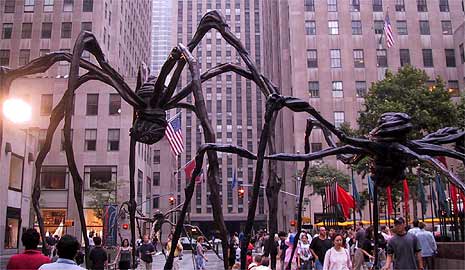
Then there were Louise Bourgeois’ gigantic spiders, which stood commanding the plaza for the entire summer in 2001.

As illustrated with all the previous art pieces discussed, timing (or rather, bad timing) is everything. These pieces might have been too disturbing for people had they been standing just a few months later, in the wake of Sept. 11. As they were only around for the summer, however, the only real controversy were several mild cases of nausea and probably a few panicked children.

Park Avenue’s stylish slaughterhouse

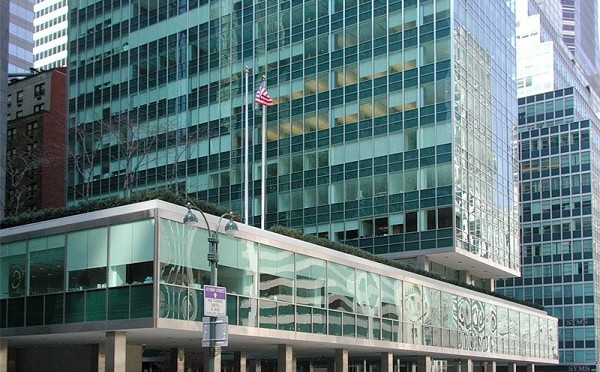
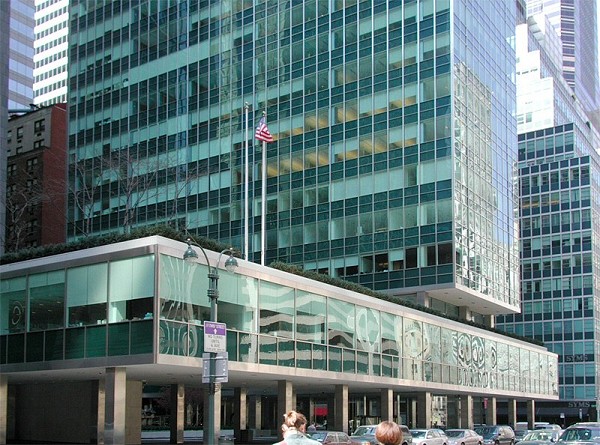
The Lever House at 390 Park Avenue, along with the United Nations building, ushered in New York’s obsession with the International Style of architecture in the 40s and 50s — clean and blocky thin glass icons in the sky. It’s no surprise to find the building was built in 1952 for a soap manufacturer, the Lever Brothers. The soap has since gone from the interiors of this sleek and cool structure, but they’ve been replaced with something more bizarre — human and animal gore.

Or rather, the aesthetic purveyor of such gore, the inimitable Damien Hirst. The Satan spawn of the British art scene, whose sometimes seemingly simple work bursts with shock value (and later, high price tags), has been a favorite of patron and German real estate mogul Aby Rosen, who just happens to own the Lever House.

Rosen is an art collector and enthusiast, hiring Whitney Museum curator Richard Marshall in 2004 to spice up the once frigid plaza and the redesigned William T. Georgis Lever lobby with some truly eye catching pieces.


The Lever has already seen such vivid works by artists like Jorge Pardo, Peter Wegner, A.V. Day (a dramatic, fabric-rent ‘Bride Fight’), and Jeff Koons (literally many blow-up Incredible Hulk dolls). Corridors within the Lever house works by Jean-Michel Basquiat and Andy Warhol.

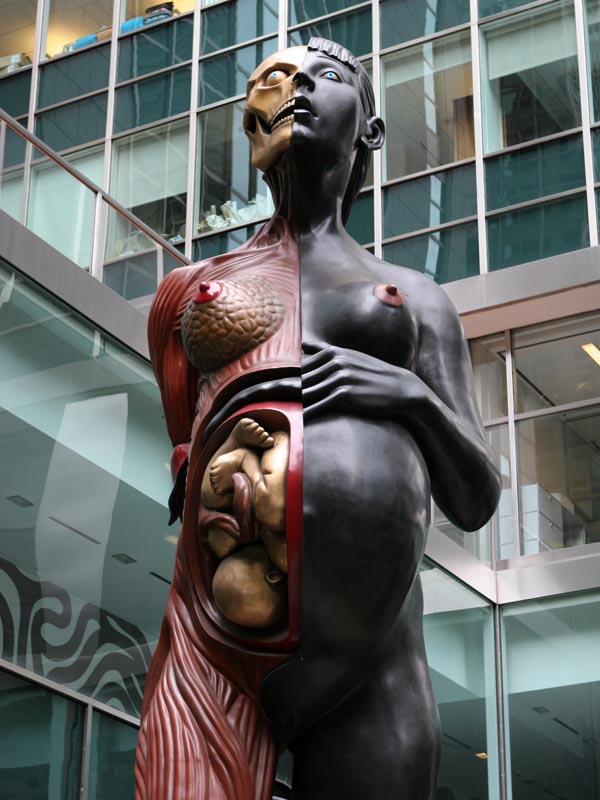
But Hirst is the Lever’s golden boy, giving the outdoor plaza a striking 34 foot tall naked pregnant ‘Virgin Mother’ (at left), in the Hirst fashion with most of her skin falling off. According to Interior Design, The lady “looks directly into the Lever Brothers corporate cafeteria.” As of last year, she has a twin across the pond in London at Royal Academy of Arts.

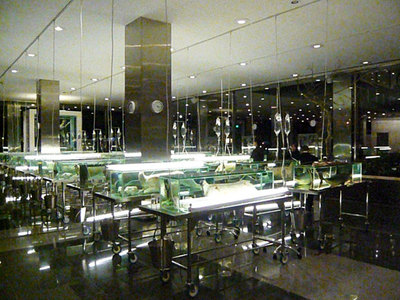
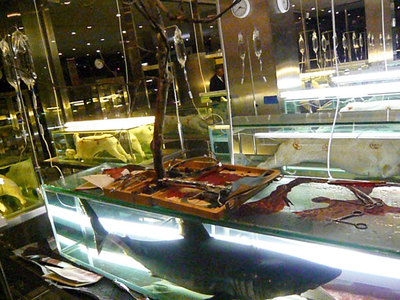
Until mid-February, you can catch more Hirst wrecking havoc in the Lever lobby as well. Laboring under the title “School: The Archaeology of Lost Desires, Comprehending Infinity, and the Search for Knowledge,” the entire lobby if filled with animal carcasses behind glass, often paired with furniture.

A couple images from the exhibit are below. Why not stop by on your lunch break today?

Photos from Slamxhype by Paul Mittleman

Remember the Alamo

It’s very revealing to me how bizarre, completely unnatural shapes just sprout up out of the ground in New York City, and we walk by them as if they were natural fixtures, as common as a mailbox or a newsstand.

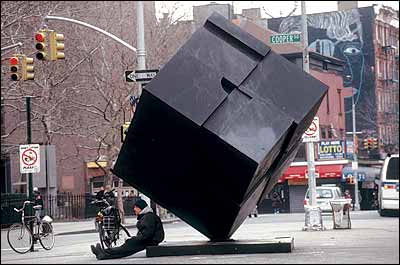
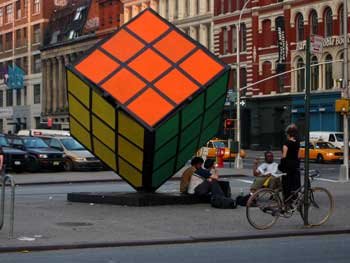
The spinnable cube in Astor Place is the best example of this. Could you imagine this East Village plaza space without it? Even as it’s now shaded by a new condo, sharing the square with a gaudy blue Chase Manhattan vestibule, it still sits immutable like a hunched homeless person that won’t leave.

The broken-looking but still operating sculpture is technically named Alamo, created by Tony Rosenthal and positioned in the middle of Astor Place in 1967. Rosenthal specializes in geometric oddities, usually broken up by their surface textures or interfaces with other shapes.

The Alamo — or Cooper Cube, or simply, The Cube — isnt a solid cube, but an uneven bonding of eight smaller ones, balanced on one of its tips. And it rotates clockwise, if you expend a little bit of elbow grease.

Why the Alamo? Like all of Rosenthal’s work, it might be difficult to ascribe the connection of title with object. Apparently Rosenthal’s wife coined the title, as the balanced cube displayed an “impenetrable strength” similar to the last holdouts at the infamous Texas fort. Hmmm.

The Cube (which everybody calls it) is particularly popular with students at neighboring Cooper Union, who are actually responsible for the Cube being there at all. It was originally placed there on a temporary basis by the NY Park Service, but Cooper Union students petitioned for the sculpture to be installed permanently.

The interlocking cubes making up the entire sculpture were inspiration for a notable prank in 2005, when the Cube was surrepticiously transformed into a Rubiks Cube. Read here to see how they did it.

The Cube was removed for repairs and replaced with a ghostly version, called the Jello Cube, before returning in November 2005, shiny and new. The temporary, transparent pipe version was named the Jello Cube because Peter Cooper, who Cooper Union is named after, is the inventor of Jello.

The Cube has seen a lot of skateboarders, vagrants, tourists, and punks, and thousands of drunk people have been seen attempting a hearty spin at 2 in the morning. It now holds court to two Starbucks (three if you count the one upstairs at the Barnes and Noble), a K-Mart, a new drugstore, and the aforementioned bank and condo. When all those places move on or close, I fully expect the Cube to still be there.

Who knows how far into the future it may survive?