Categories
True Crime

‘Days of Rage’ and Nights of Terror

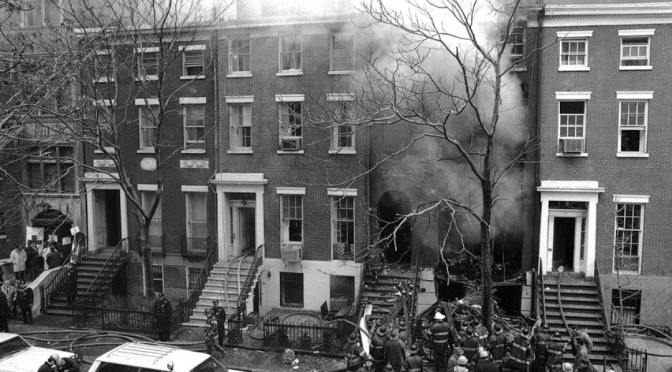
Right before noon on March 6, 1970, an explosion tore open a lovely Greenwich Village townhouse at 18 West 11th Street and awoke New York City to a violent new threat.

The remains of three bodies were discovered in the smoking debris but they weren’t residents of this quiet neighborhood. They were members of The Weather Underground, a radical underground unit absorbing the counter-culture spirit of the 1960s and unleashing it — oftentimes randomly and irrationally —  onto a new decade.

Below: Oddly enough, the townhouse explosion occurred next door to the home of Dustin Hoffman and his wife.
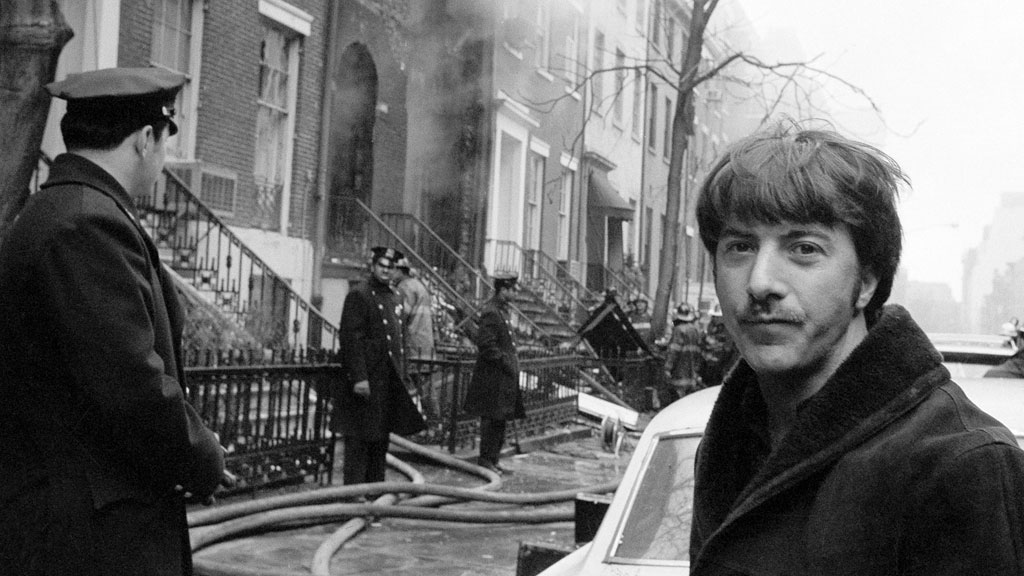
Courtesy AP file photo

Less than two years later, two New York police officers were brutally assassinated in the East Village, among the most brutal and shocking crimes against the NYPD in its history.  This wasn’t a random crime but a hit placed upon the officers by members of the Black Liberation Army, wielding some of the philosophies of the Black Panthers to dangerous ends.

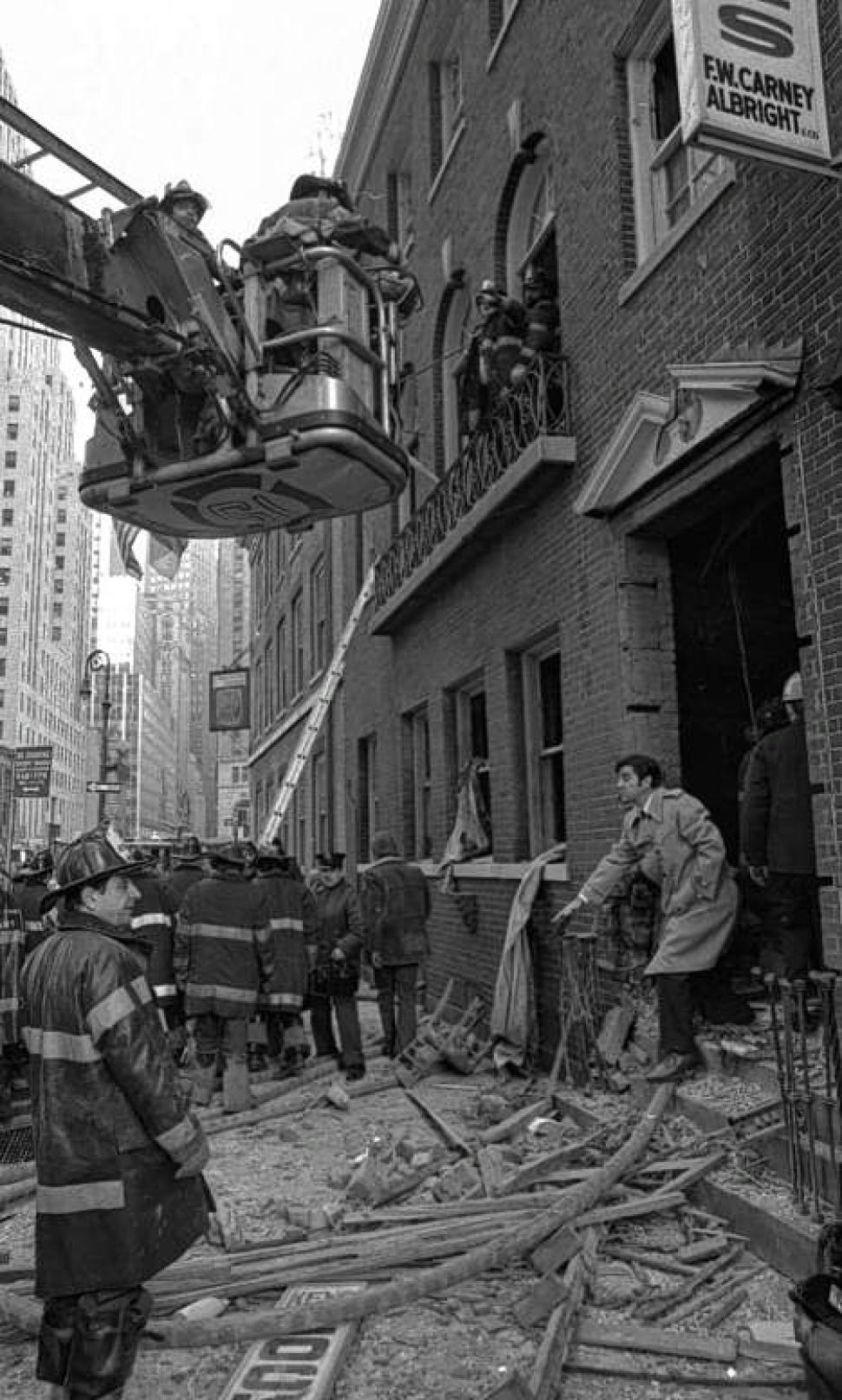
Almost three years later, a bomb exploded inside the historic Fraunces Tavern during in the middle of a busy weekday lunch. Four men were killed in the sudden attack, made by the Armed Forces of Puerto Rican National Liberation (or FALN).

Below: Aftermath of the explosion at Fraunces Tavern (courtesy New York Daily News)
faln

In between these terrible disasters were several other bombings of other significant buildings, here in New York and in other cities through the United States.  All of them indicative of a violent (and ultimately failed) form of protest, as turbulently described by Bryan Burrough in his new book Days of Rage: America’s Radical Underground, The FBI, and the Forgotten Age of Revolutionary Violence.

This is probably one of the most frightening non-fiction books I’ve read in recent memory, a broad and exquisitely told tale that loosely links together a variety of American revolutionary action groups from the 1970s.

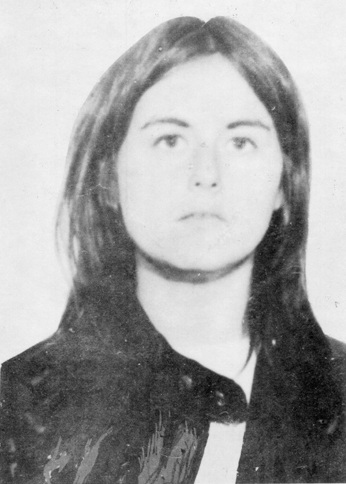
Some of the principal players of these groups are recognizable (Bill Ayers and Bernadine Dohrn,  Patty Hearst), but the breadths of their actions has been seldom studied. Through interviews with members who’ve never spoken, Burroughs patches together connections among these disparate groups — even if those connections are more philosophical than physical.

Below: The mugshot of Bernadine Dohrn, 1970
Bernardine_Dohrn_published_1970


Most shared the belief that violence, disruption and chaos would lead America to a new revolutionary age. As Burrough points out, most were inspired by civil rights movement and the plight of black Americans, taking their anger and frustration into far more radical directions than the mainstream leaders who advocated non-violence and change through the law.

While the vulgar and gut-wrenching violence was often doused with machismo, many of these groups were led or operated by women.

The title comes from a series of demonstrations that occurred in Chicago in the fall of 1969, seen as a sort of kick off to this festering revolutionary movement.  Much of the book details the ‘underground’ hideouts and escape routes of these organization, whether holed up in Manhattan’s Chinatown or San Francisco (as the Weathermen were, often dressed in silly disguises) or running from capture through rural Georgia.

Burrough does not flinch from the horror, graphically describing the aftermath of many of the more loathsome crimes.  The 1972 deaths of two NYPD officers in the East Village is especially grim. (You can read news of the original account here.)
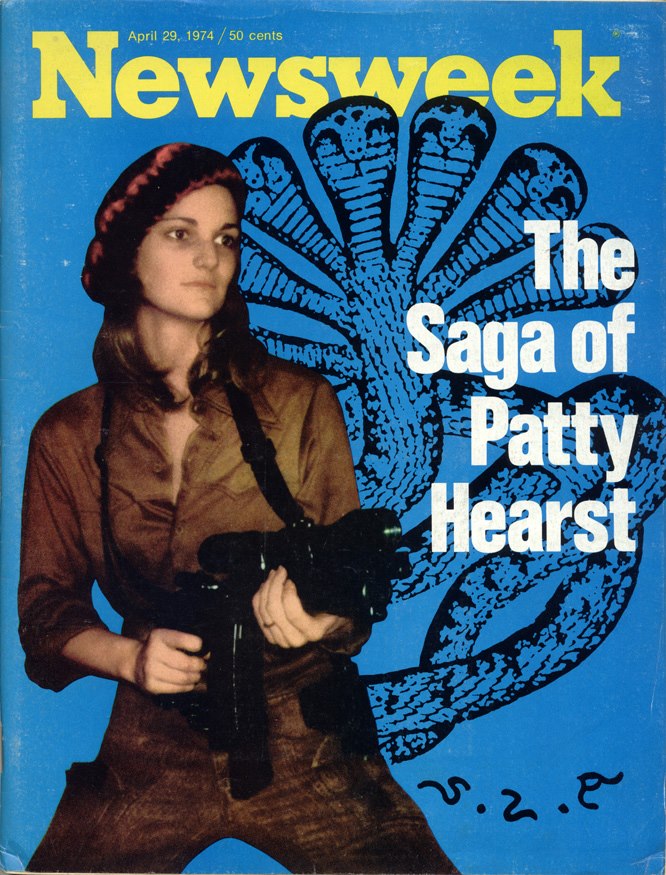
patty

In particular, I found the tale of the Symbionese Liberation Army especially gripping, notable less for their violent actions (although there certainly was some) than for the somewhat random notion to kidnap the granddaughter of William Randolph Hearst.  Many of these stories will replay in your memory as a reel of black-and-white news footage or a set of iconic photographs (such as the one above of Hearst).  Days of Rage offers a vivid and refreshing new context.

Burrough — a Vanity Fair writer perhaps best known for Barbarians At The Gate — is a thorough story-teller, conjuring fully blown narratives from the sometimes untrustworthy recollections of the surviving participants.  He’s often too thorough, sometimes including superfluous details because they’ve “never before been told.”

Chaos was an organizing principal for these groups which is partially way they were ultimately unsuccessful. As shocking as some of these horrifying attacks seem today, it’s a wonder many of them were successful orchestrated at all, given the tentative organizational structure and often incompetent leadership of these groups.


Top photograph courtesy Marty Lederhandler/AP Images.
Categories
Holidays

On this Veteran’s Day, a salute to the Harlem Hellfighters!

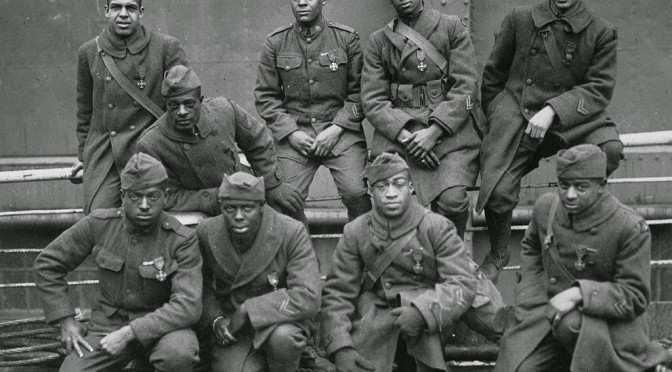
The men of the 369th who were awarded France’s Criox de Guerre for distinguished acts of heroism:  Pvt. Ed Williams, Herbert Taylor, Pvt. Leon Fraitor, Pvt. Ralph Hawkins. Back Row: Sgt. H. D. Prinas, Sgt. Dan Strorms, Pvt. Joe Williams, Pvt. Alfred Hanley, and Cpl. T. W. Taylor

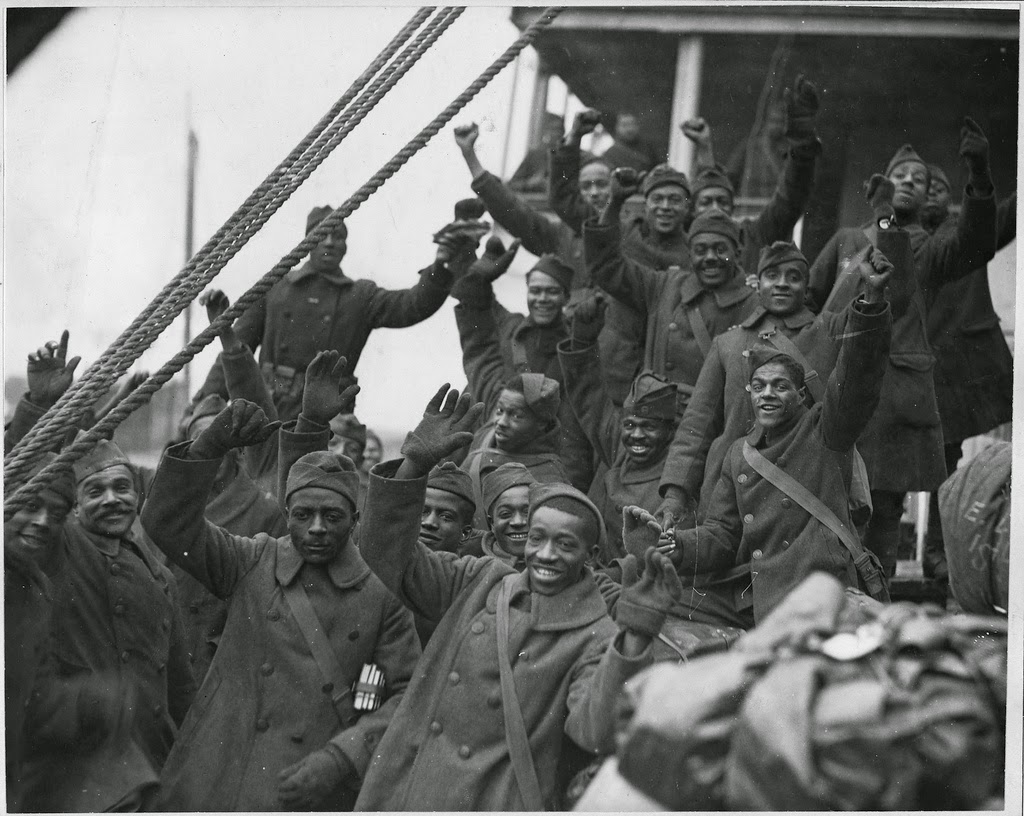
New York’s 369th Infantry Regiment was America’s first African-American regiment engaged in World War I.  While many white American soldiers would have been happy to serve next to trained regiments of any color, intense racial prejudice in the United States forced many who signed up to fight for their country to instead be assigned to the French army.

Nicknamed the Harlem Hellfighters, the regiment served alongside the French during the summer and fall of 1918.  Perhaps the most famous soldier of the 369th was Private Henry Lincoln Johnson (at right) whose deadly efficiency on the battlefield earned him the grim nickname Black Death.  He became the first of dozens from the 369th to receive the prestigious Criox de Guerre, the equivalent of the American Medal of Honor.

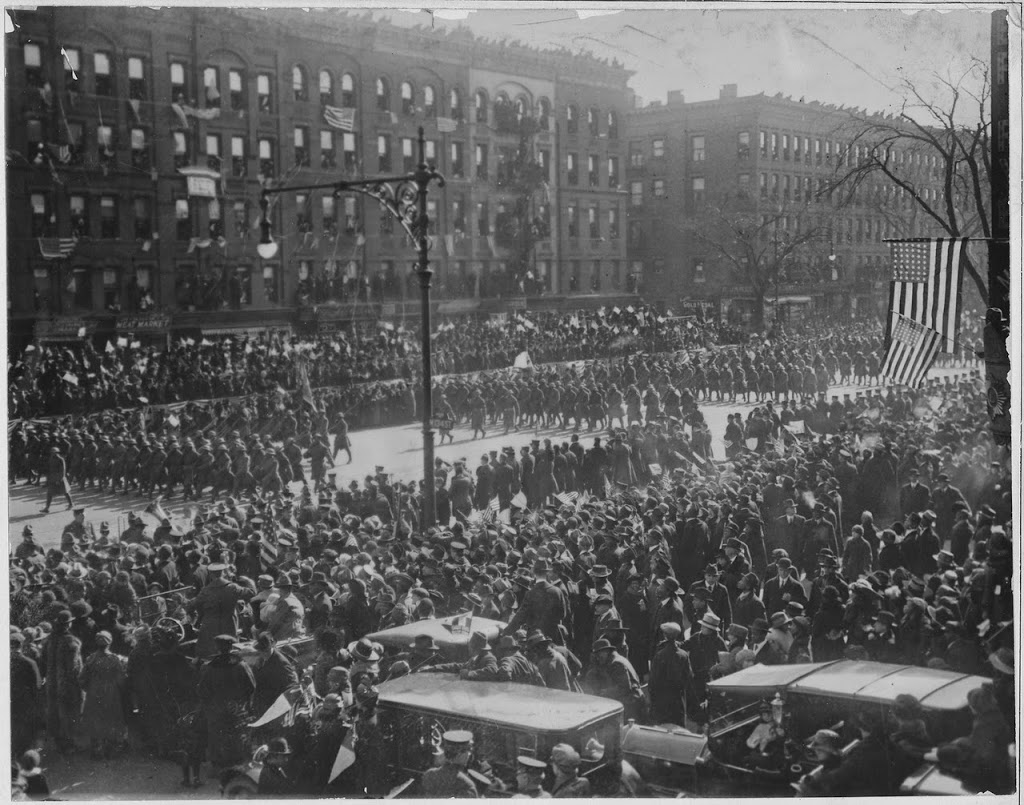
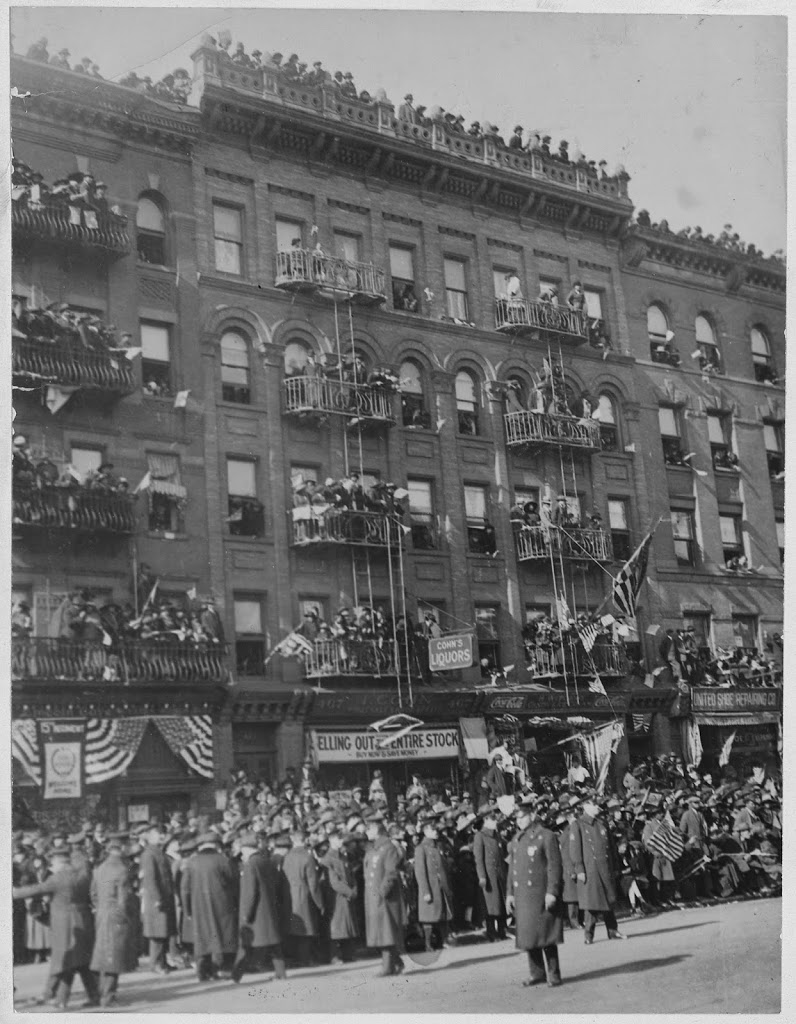
They returned to New York in February 1919 and marched through the streets of Manhattan on February 17 — from Greenwich Village to Harlem, in triumph.

From the New York Times the following day:

New York’s negro soldiers, bringing with them from France one of the bravest records achieved by any organization in the war, marched amidst waving flags and cheering crowds yesterday from Twenty-third Street and Fifth Avenue to 145th Street and Lenox Avenue.”

“At Thirty-Fourth Street the men marched under a shower of cigarettes and candy, and such tokens were pitched at them at other points in the line, but the files did not waver for an instant.

The men of the 369th photographed as they arrive back in New York City, 1919

From original caption (courtesy US National Archies):  “[The] 369th New York City Infantry (old 15th) [African American] troops and some of the 370th Infantry, Illinois [African American] troops, one of the most decorated regiments in the United States Army return to New York City. They saw [the] longest service of any American regiment as part of a foreign army, and had less training than any before going into action. They were never in an American division or brigade always being with the French.”

The 369th marching up Fifth Avenue.

The men are shown here in this assortment of newsreel footage from the war:

Pictures from the U.S. National Archives

Categories
Neighborhoods

Five items from the Village Voice, 50 years ago this week

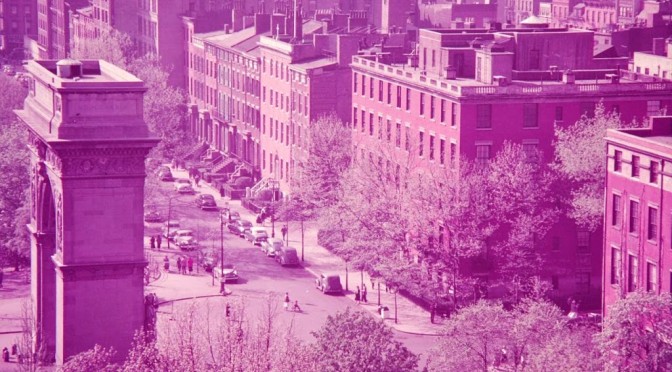
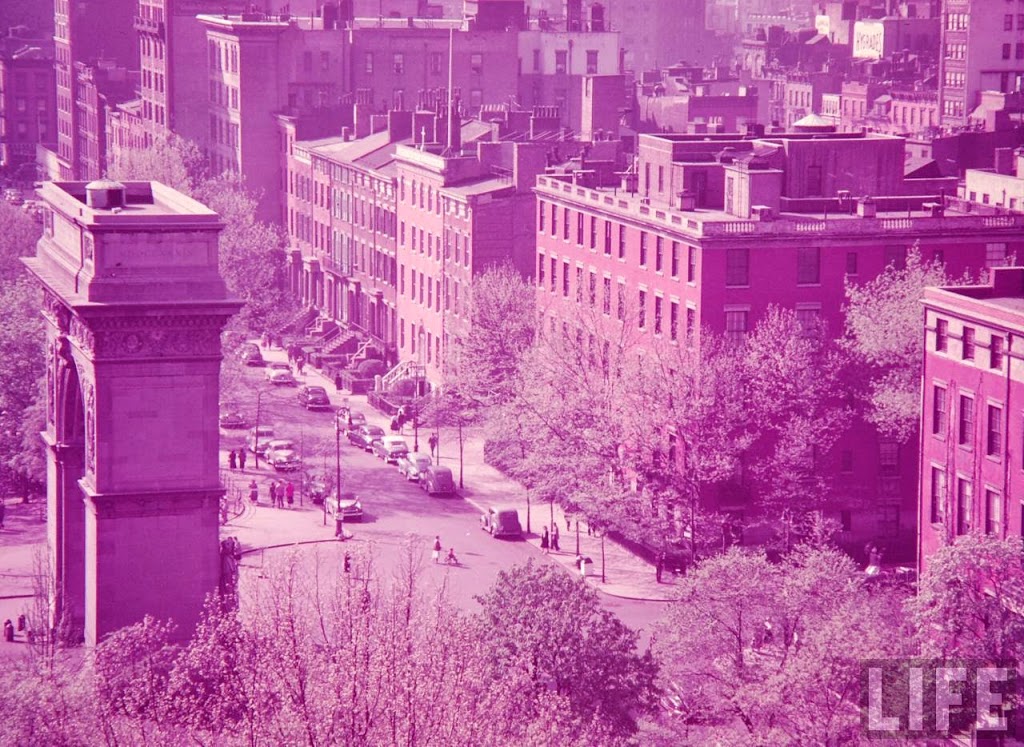
Washington Square North, looking west, 1950, photo by Walter Sanders, Life Magazine

The entire back catalog of the Village Voice, New York’s original alternative weekly, is available online through Google News.  The early issues are especially full of character, a scrappy counter-culture organ which provides an interesting window into downtown Manhattan.  Here are some highlights from an issue which came out fifty years ago this week:

1) Washington Square Park, both the physical epicenter of Greenwich Village and the gathering place for the Village’s various cultural factions, faced a possible makeover by the city in 1964.  “This plan has two objectives.  The first is to clean up the park, which is now physically run-down and neglected.  The second, in response to complaints by adjacent property-owners, is to discourage beatniks and other ‘undesirable elements’ from congregating there.” [source]

The park had been a magnet for the beatnik scene since the early 1950s.   The folk singers who would gather on Sunday afternoons had won a major victory in 1961 after a so-called “beatnik riot” convinced the city to allow musical crowds to congregate there

The park was eventually altered that year, but one major change would have been applauded by all — the traffic lane that cut under the Washington Square Arch and through the park was officially closed.

2) Sara D. Roosevelt Park in the Lower East Side, meanwhile, remained a disheveled dump, and the Voice clearly saw it as a symbol of the city’s neglect of the poor. “While the Parks Department is champing at the bit to pour $750,000 into Washington Square …. Sara Delano Roosevelt playground resembles a post-war Berlin.  The latter, at Forsyth and Chrystie Streets, has been the scene of unrelieved wreckage for almost six years.  It was torn up to make way for a subway and no one one thought to put it back together again.

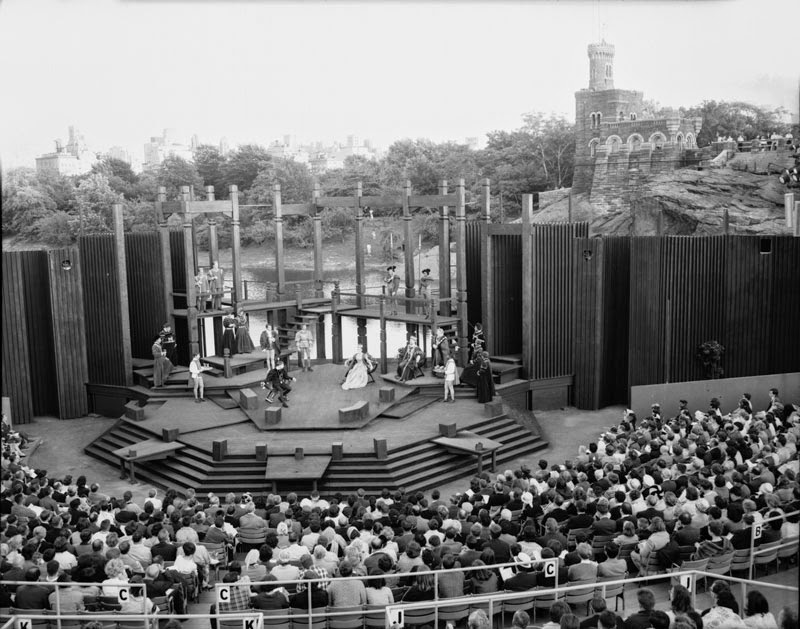
The Delacourte Theater, June 1964, a performance of Hamlet (courtesy NYC Parks)

3) The New York Shakespeare Festival has a new home at the Delacourte Theater in Central Park, but writer John Wilcock, author of the Village Square column, pines for the festival’s shaggier, less respectable days.  Respectability has rendered it commonplace, according to Wilcock. Now you have to line up to grab a seat!  “This is an improvement?”

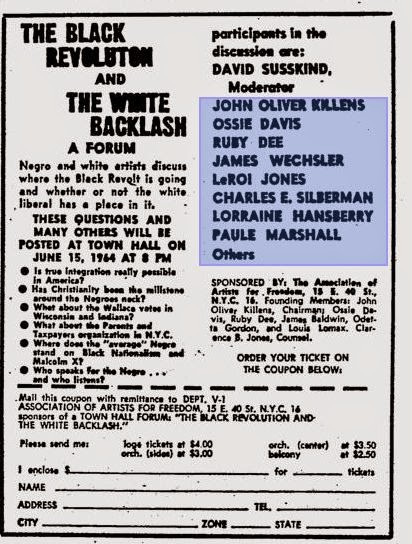
4) The Black Revolution and The White Backlash, a lecture at Town Hall, featured an interesting group of guests, including LeRio Jones (aka Amiri Baraka):

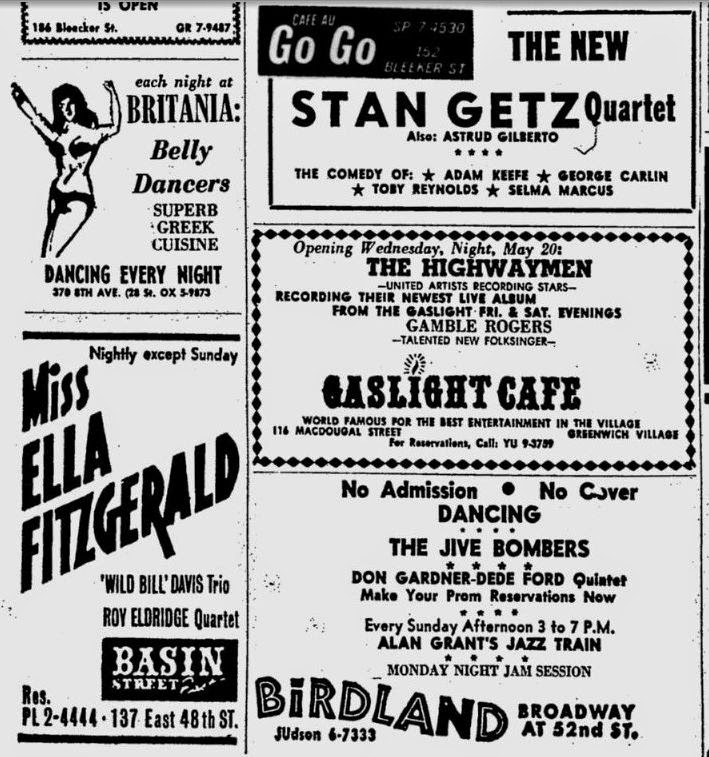
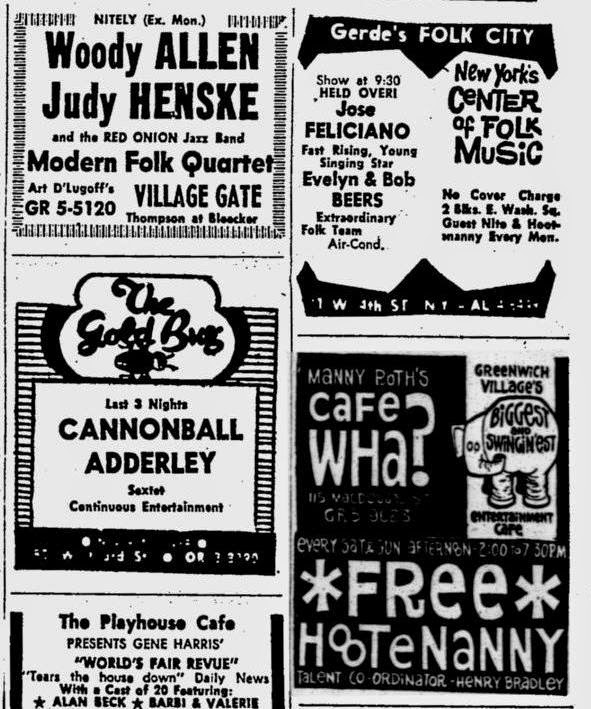
5) The jazz and folk clubs: A glorious sampling of musical icons that week — Ella Fitzgerald, Stan Getz, George Carlin, the Highwaymen, Woody Allen, Jose Feliciano, Cannonball Adderley

Don’t douse the glim! Four infamous dancehalls and dives which made the notorious reputation of Bleecker Street


“There are no lower outcasts in New York than the women who nightly creep out of the darkness and swarm the pavement of Bleecker Street…” L. Hereward, Eclectic Magazine, 1893

Sure, the Bowery was a rough and rowdy avenue, but one looking for more alternative adventures in the late 19th century might have found themselves somewhere along Bleecker Street. The college bars and cafes which inhabit the street now seem practically chaste compared to some of the dives once housed there.

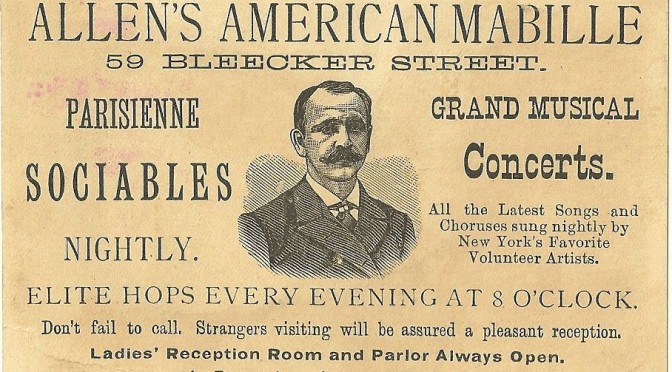
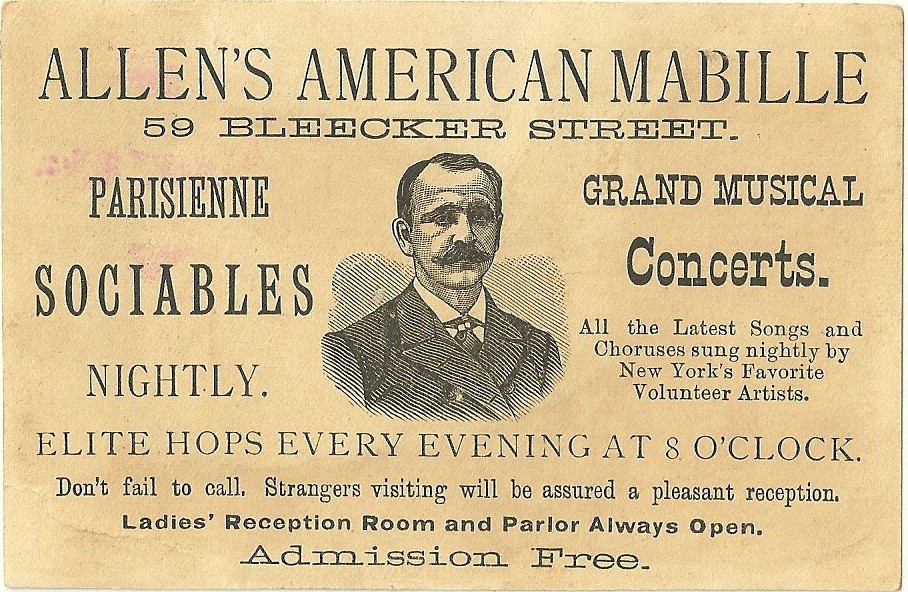
At 59 Bleecker Street, for instance, one could find The Allen’s American Mabille, a ‘Parisienne’ style dance hall and den of prostitution that survived several dozen police raids — police headquarters was literally a block away — and made Allen one of the infamous proprietors in Manhattan, responsible for “the ruin of more young girls then all the dive keepers in New York.” [source]

It joined a collection of prostitution houses along Bleecker and east of Washington Square Park, so many that the neighborhood was sometimes known as Frenchtown, and not because of the fine cooking.

But American Mabille and the other ‘Paris’ houses, from all appearances, specialized in heterosexual couplings. A few places on Bleecker catered to male encounters and often of the most flamboyant kind, if accounts are to be believed. (Keep in mind the hysteria of the late 19th century press!)

The most famous of these was The Slide at 157 Bleecker Street, a basement dive filled with men in drag, horrifying proper New Yorkers with clientele “effeminate, degraded, and addicted to vices which are inhuman and unnatural” according to contemporary scandal sheet descriptions.

The Slide is somewhat well-known today as it shares the same address as rock venue Kenny’s Castaways.

Down the street from The Slide was the Black Rabbit at 183 Bleecker Street, another dive with a mixed clientele, known for scandalous sex shows, from the likes of the ‘Jarbean fairy’ and a female ‘sodomite for pay’. Like many of the others, it survived with sizable bribes to the police. The bar even scandalized thieves. In 1901, a reporter from McClure’s Magazine entered the Black Rabbit with a pickpocket who replied, “[T]his is dead tough. I wouldn’t allow this, ‘f I was the chief….I like an open town where everything goes all right enough, but I’d douse the glim here.” (douse the glim = turn out the lights)

Today, the historically themed 1849 Restaurant occupies the Black Rabbit’s address.

Nearby The Slide was Frank Stephenson’s Black And Tan at 153 Bleecker, “a place of bad repute“, specializing in mixed race heterosexual encounters, something most likely frowned upon even in many low-class Bowery dives. The phrase black-and-tan was used to describe other halls where people of different races drank and caroused together.

 Top image courtesy here.

How some rough Saint Patrick’s Day hangovers almost destroyed New York

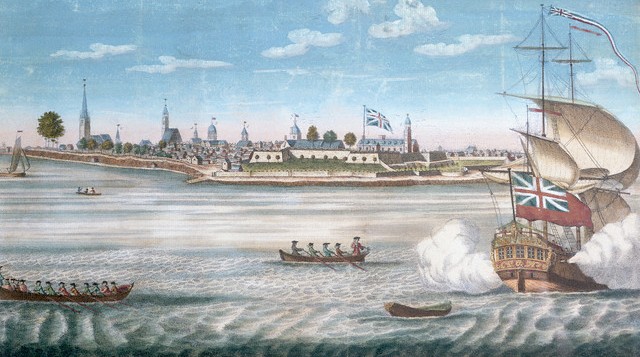
The harbor in 1730, with a view of New York’s Fort George by the engraver John Carwitham

It was 270 years ago this week that a truly foul period in New York history began, starting with a host of fires sprouting up throughout lower Manhattan and ending with several black residents of the city hanged and accused of treason, a reign of terror known as the Conspiracy of 1741 (or the Negro Plot of 1741), a hellish inquisition fueled by hysteria, racism and rumor.

Believing that local slave and freed blacks — along with white ‘traitor’ conspirators — had conspired to wreck havoc in the city, the authorities gathered up suspects and accused them of crimes based on scant evidence. In the end, over 30 people were executed for their part in this supposed ‘conspiracy’. Modern historians are unsure such a plot existed at all, and if it had, most of the executed would still have been innocent of wrong-doing.

This violence, which kept the city in a grip of heightened suspicion for most of the spring of 1741, have often been called New York’s version of the Salem witch trials.

For a rich description of these events and some measured speculation to its cause, I direct you to Jill Lepore’s excellent book from a few years ago New York Burning, one of the few books that turned on my enthusiasm for New York City history.

The reason I’m bringing this up today is that St. Patrick’s Day — or rather, the Catholic Feast of St. Patrick from which the holiday derives — actually figures into the story. Just like the modern holiday, it appears that both Catholics and non-Catholics took part in the March 17th celebration, and in particular, the imbibing. According to ‘Gotham’ by Edwin G. Burrows and Mike Wallace, soldiers at their posts at Fort George on March 18th were “recuperating in their barracks from their hearty celebration” the night before. Essentially, an epidemic of hangovers.

As a result, the fort was scantily patrolled that morning. As guards slept the morning away, unknown arsonists stole into the fort and set fire to several buildings inside, including the old governor’s house, once the home of Peter Stuyvesant (who, trust me, never would have allowed this to happen). The blaze quickly spread to the chapel , the soldiers barracks, and even to buildings outside the fort perimeter. It might have blossomed into a raging inferno that would have consumed the city had it not rained and doused the blaze from spreading further. (Thank you St. Pats!)

Had the men at Fort George been more alert, perhaps they would have identified the mysterious culprit. Not only would it have prevented the fire, it might have clamped down the later hysteria and prevented further arson from occurring throughout the next few weeks. The alleged ‘conspiracy’, either real or imagined, might not have materialized at all.