New York City’s curious, modern-day Olympus

Most small community colleges feature a statue or two honoring somebody specifically related to the campus. Even massive schools could invite their monuments over for a small dinner and have room for you and your friend from out of town.

Bronx Community College would need a fairly large banquet hall. This school in University Heights, the Bronx, is a kooky mix of classical Stanford White-designed buildings (from the days when New York University camped here) to some rather awkward concrete classrooms typical of schools that flourished in the 1970s.

One of the stranger acquisitions BCC received when it took over the NYU campus in 1973 was a prestigious hall of fame featuring the biggest names in American history. Let me clarify. They don’t own a hall of fame. They have THE Hall of Fame.
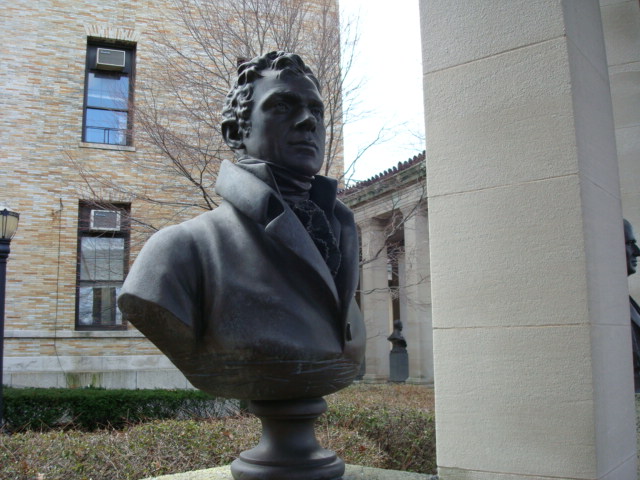
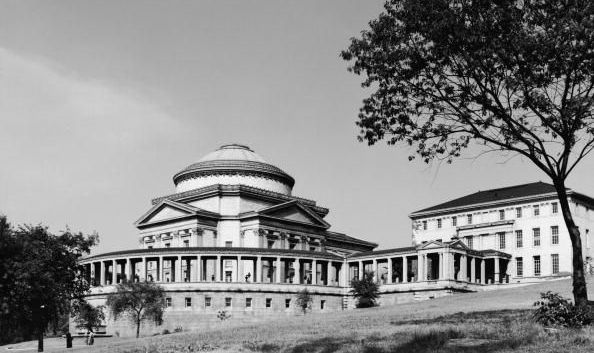
Tucked on a scenic cliff overlooking the Harlem River (and with the Cloisters well in sight), the Hall of Fame for Great Americans was an ambitious project constructed in 1900 with the idea of immortalizing the Americans with significant contributions to science, the arts, politics and the military. Spearheaded by then-chancellor Henry Mitchell MacCracken, the project is the first real memorial ‘hall of fame’ concept to be executed in the United States.

The spacious colonnade tucked behind the White-designed Hall of Philosophy, you are thrown back into a mix of turn-of-the century scholarly aesthetic and the belief of equating the American movement with ancient Roman and Greek forefathers.
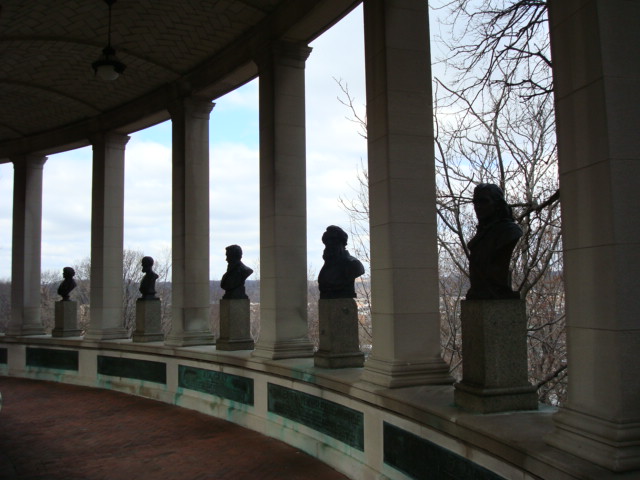
With room for 102 sizable busts (although there are only 98), the colonnade winds around the contours of the hill, spotlighting American icons. John Marshall sits astride Henry Clay. Harriet Beecher Stowe is a few busts down from brother Henry. George Washington AND George Washington Carver are close enough, they could play catch (if they had arms).
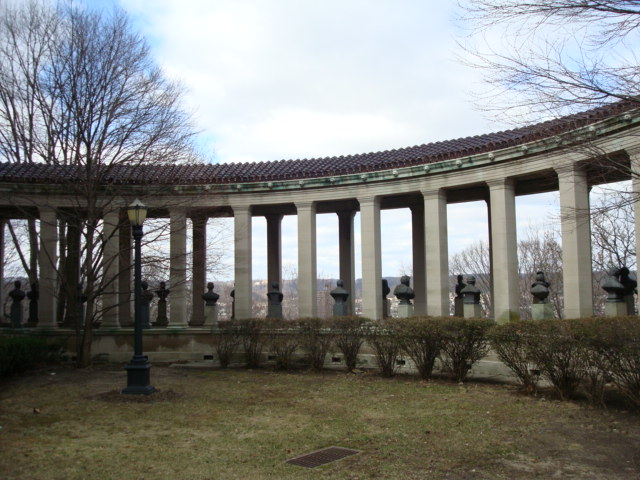
The Hall of Fame is a true curiosity in the ‘roadside attraction’ sense. Once a fabled hall with prestige enough that newspapers would lobby for nominees, there haven’t been any new inclusions since the 1960s. (Three more ‘American icons’ — Clara Barton, Andrew Carnegie and Luther Burbank — were elected in 1976, but nobody ever made busts for them!) Once NYU sold the campus, the colonnade was neglected, the hall of fame virtually forgotten.

It has been recently renovated, and the BCC keeps this well-preserved secret maintained. I went this weekend, stayed for about an hour, and didn’t see a soul. It’s worth a visit for the view, although you might want to wait until spring to appreciate the foliage.

Fun Hall of Fame trivia:

— One bust sits apart from the others, partially because he’s the only non-American — the Marquis de Lafayette

— The bust of Stephen Foster in inscribed with the music and lyrics to ‘Swanee River’

— Actor Edwin Booth sits serenely looking out at the river, while the man his younger brother assassinated, Abraham Lincoln, has a less interesting view

— Hey! We’ve actually done whole podcasts on four members of the Hall of Fame — Beecher, Washington Irving, Peter Cooper and Alexander Hamilton

— The bust of female astronomer Maria Mitchell creeps me out to my very soul

How to get there: #4 train to Burnside Avenue. Walk west to University Avenue and one block north to the college.
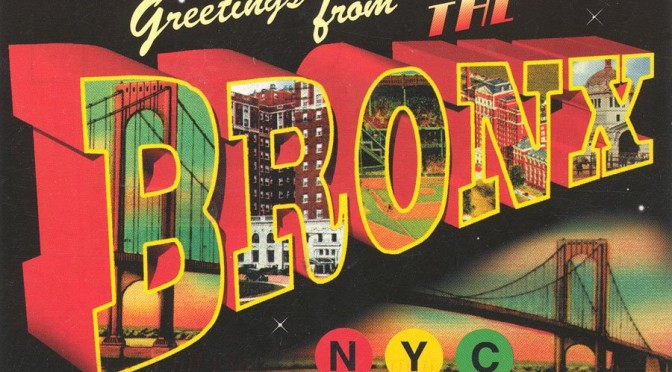
Name That Neighborhood: Who is Jonas Bronck?


Some New York neighborhoods are simply named for their location on a map (East Village, Midtown). Others are given prefabricated designations (SoHo, Dumbo). But a few retain names that link them intimately with their pasts. Other entries in this series can be found here.

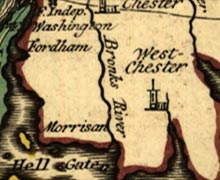
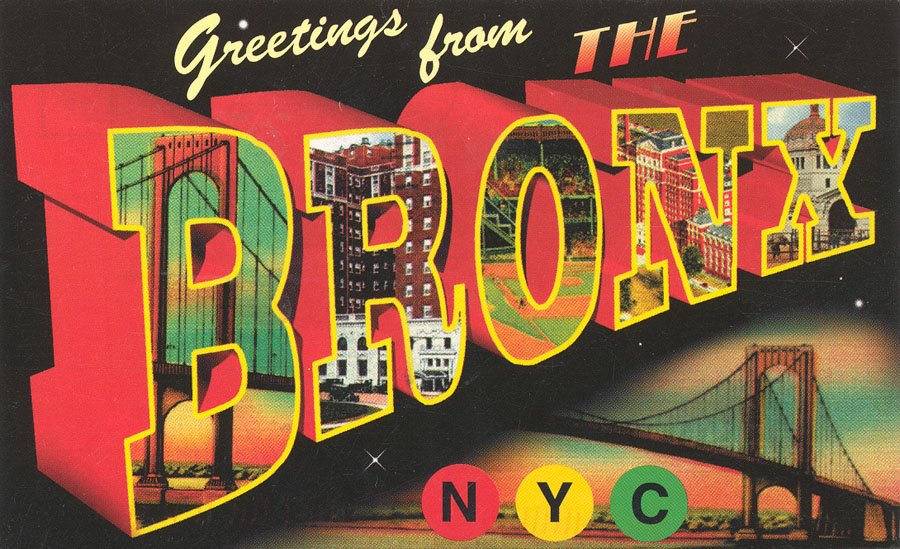
The Bronx is one of two boroughs with names derived from actual people. The residents of Queens can brag that their borough honors Charles II’s wife Catherine of Braganza. The Bronx, however, gets its name from less regal sources, from Swedish-born landowner Jonas Bronck. However the Bronx is not directly named after Bronck. Confused?

Despite Bronck’s tenacity in forging onto the unknown Lenape Indian territory of Rananchqua in the Dutch colony New Netherlands, his actual role in New York history is quite brief. An ardent intellectual who gave his ship the lofty name Brand van Trogen (The Fire of Troy), Bronck, his wife Teuntje and a boatload of eager voyagers traveled to the new world in 1639 and settled on a stretch of land, 500 acres, across the river from the village of Haarlem.

With permission from the West India company, Bronck had brought builders, his own cattle, boxes of books, and a desire to create a small community of his own. Spread out through the modern neighborhood of Motts Haven, Bronck’s farm (Broncksland) and those of the other settlers sat along a north-south river, called by the Lenape the river Aquahung.

Bronck grew tobacco and traded with the local Indians, keeping the peace through exchanges of goods. Jonas however had arrived at a rather unfortunate time to be a pale blond foreigner.

Relations between the Dutch and the native Indian population were tenuous at best, and not greatly assisted by hot-headed director-general William Kieft of the port city of New Amsterdam. In 1643, driven by growing animosities and the murder of a single settler, Kieft ordered troops to rout the Lenape populations at Corsairs Hook and the area now known as Jersey City, murdering dozens of Indians and ensuring years of bloody battles between settlers and natives.

Bronck was the unfortunate recipient of native Indian backlash. That same year, 1643, Bronck and most of his settlers were murdered in an Indian raid.

Kieft would be swept out of the new world by Peter Stuyvesant. Bronckland would pass into other hands, and after just a few years, the parcel of land would no longer be named for him. Jonas was almost erased from history.

Except for that rather sizable river that ran through his property, the Aquahung. Even as memories of Dutch settlers gave way to their British successors — his farm went to two officers in Oliver Cromwell’s army! — the river was still referred to as Bronck’s River. Eventually it was shortened to the Bronx River, and thus it’s the river that the borough is named after.

Had everybody just kept with the original name as given by the Lenape, we would be referring to our northernmost borough as Aquahung.

By the way, Bronck’s wife and son escaped the Indian raid, and later, Teuntje with her new husband moved to the area now known as Coxsackie, New York. Son Pieter Bronck became a landowner in his own right and built a house that still stands today. It is the oldest home in all of upstate New York.

UNUSUAL NYC MUSEUMS #2: History and waffles

In one of my entries below regarding the Mudd Club, a reader asked why I referred to Cortlandt Alley as ‘mysterious’. The tiny little alley — one of New York’s last — is between Canal and Franklin and, while partially my own projection upon it as a rough reminder of old New York, the dark and creepy path retains much of its bruised, dented appearance.

Perhaps in deference to the Mudd Club days, however, the alley has also become a haven for artistic talent, inspiring the likes of filmmaker Laura Kraning, installationist Matthew Gellar and photographer Spencer Tunick, who took one of his community of nudes there.

What does this have to do with an UNUSUAL MUSEUM?

Cortlandt Alley was named after Olaff Stevenson Van Cortlandt, who came to ole New Amsterdam 1637 and whose progeny would go on to become powerful forces in the new city.

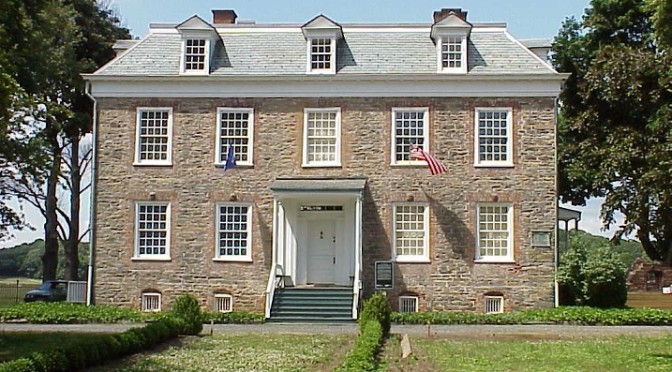
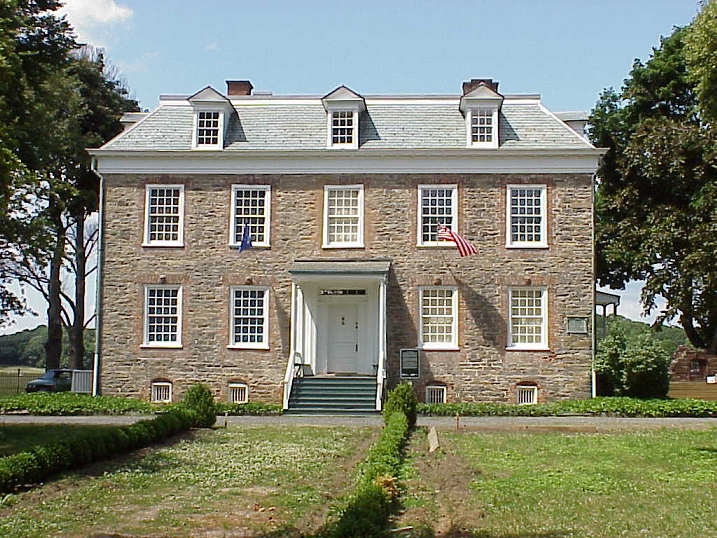
The Van Cortlandt’s base was in what is today the Bronx, and since 1897, their sprawling estate has been a museum and preservation to the lifestyle of early New York culture. It is officially the oldest standing structure in the Bronx, perched in massive Van Cortlandt Park.

The stately home was built by Olaff’s grandson Frederick, and the museum preserves rooms from the period from it was built in 1748, through the era (1823) that the house was maintained by his sons. If you’re doing your math, that would put the decor solidly in the American Colonial period. That’s right: George Washington slept here . During the Continental Army’s eventual retreat from New York, George set up officer’s quarters here. It must have sucked to leave the cozy charm of this house to cross into New Jersey and eventually the frozen shores of the Delaware River.

On top of its almost doll-house preservation of furniture and archectecture, there’s also a quaint herb garden outback. And, for some reason, my favorite part — Colonial waffle irons! You can even get the old-time recipe from the website, which also has visitors info and other historical details.

While you’re out there, why not check out the Van Cortlandt golf course nearby? Its the oldest golf course in the United States, built in 1895, but is still 150 years younger than the house that sits nearby. If that’s not enough for you, its also a movie star in its own right, starring in several film, including pivotal scenes in Wall Street.

As for Van Cortlandt House, don’t confuse it with the Van Cortlandt Manor, farther into New York state. Olaff’s son Stephanus , the first native-born mayor of New York City, moved farther up the Hudson River valley to what is now Croton and his house, which can also be visited, is almost more exquisite for its bucolic surroundings.