Categories
Those Were The Days

Ten cool facts about ice cream and New York City history PLUS: where was New York’s first frozen yogurt shop?

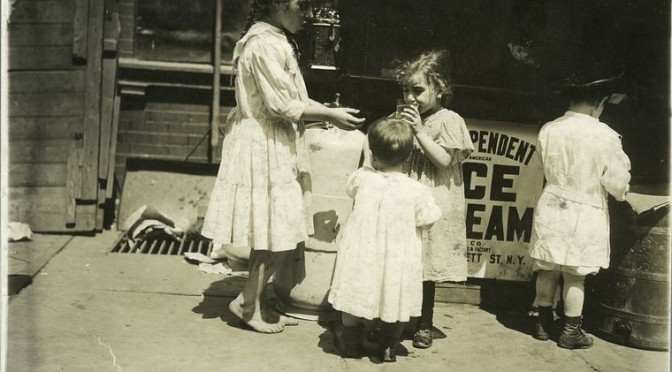
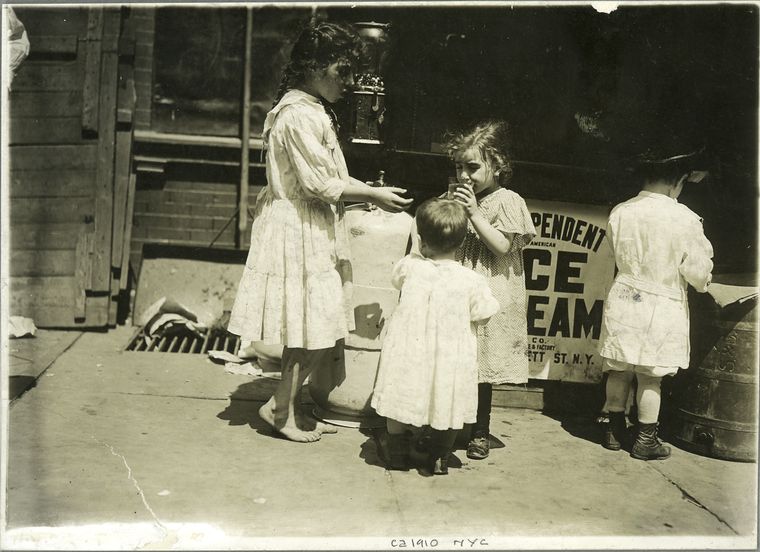
Lewis Wickes’ photograph of a few children enjoying a bit of ice cream on a hot day, 1910. (NYPL)

1. America’s first ice cream shop was located on Dock Street** (roughly today’s Pearl Street) in 1774.  The British confectioner Philip Lenzi advertised ice cream of “any sort”, along with a host of treats, including sugar plums, jams and sweetmeats.

2.  Hanover Square (near Stone and Pearl streets) was the center of commerce in colonial New York, and apparently of confections as well.  In 1777, in the midst of British-occupied New York during the Revolutionary War, Lenzi moved his shop up into Hanover Square next to another ice cream shop owned by Joseph Corree at 120 Hanover Square. [source]

3. George Washington and his wife Martha were huge fans of ice cream.  During the first year of Washington’s presidency, back in 1789, when the seat of government resided in New York, Martha would make several batches of it from the Washington’s home at One Cherry Street She sometimes complained of the lack of fresh cream, sometimes serving “unusually stale and rancid” desserts at her weekly tea parties.  One well-repeated legend states that the Washington’s spent over $700 on ice cream desserts in the summer of 1789.
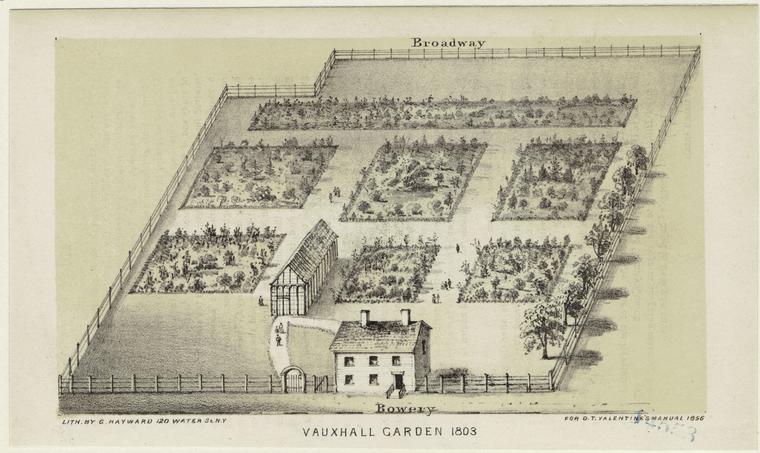
Above: A 1803 map of Vauxhall Garden, at Broome Street between the Bowery and Broadway, a lovely place to enjoy a bowl of ice cream in early New York

4. Manhattan’s pleasure gardens — early precursors to the modern park — became instrumental in spreading the joy of ice cream.  The aforementioned Joseph Corree opened the Mount Vernon Garden at Broadway and Leonard Street in 1800, a few months after ice cream-lovin’ Washington died at his estate in Mount Vernon.

On top of the many festive entertainments at the garden — fireworks, theatricals, topiary, tableaux vivant — Corree also offered ice cream for sale.  Other popular pleasure gardens of the day, such Vauxhall Garden and Niblo’s Garden, would follow suit.

5. Delmonico’s, before it became the finest name in restaurant dining in New York in the 19th century, got its start as a small confectionery shop on 23 William Street in 1827 which featured ice cream on its menu. (Learn more about Delmonico’s from my podcast on its history.)
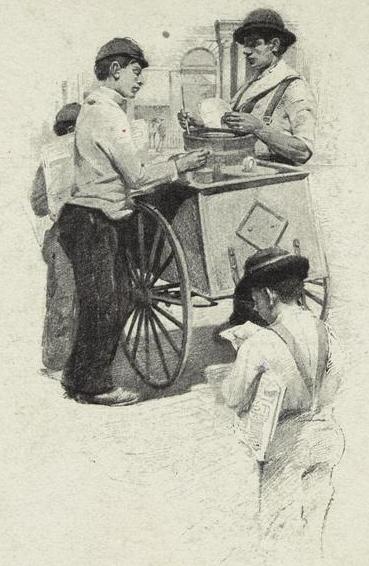
6. Ice cream vendors were on the streets of New York as early as the 1820s, the best way for less affluent people to enjoy the dessert.  Within a couple decades, of course, the ‘pleasure gardens’ would lose their patina of class and become playgrounds for poorer New Yorkers.  In 1852, one garden near the Bowery was described as “a sort of ice-creamery, and general rendezvous for the Bowery fashionables.” [source]

At right: A Century Magazine illustration from 1901 of a New York ice cream vendor or ‘hokey pokey man’ (NYPL)

7. Ice cream saloons, by mid-19th century, were aplenty along the main thoroughfares of New York, experimenting with different kinds of production.  One saloon, Parkinson’s on Broadway, claims to have invented pistachio ice cream.  Another, the Patent Steam Ice Cream Saloon, named for its steam-operated freezing unit, catered to the women of the middle class, “the wives and daughters of the substantial tradesmen, mechanics and artisans of the day,” according to New York by Gas-Light.

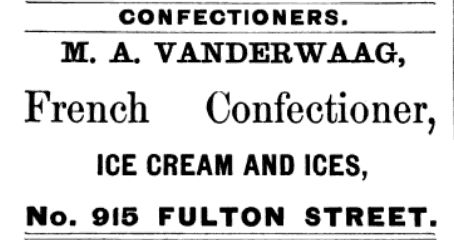
A Brooklyn confectioner ad from 1876:
8. The hokey pokey men, the nickname for one-cent ice cream street vendors, were briefly hindered by the Ice Cream Strike of 1913, a walkout by all 2,500 members of the Ice Cream Workers Union in New York, effectively shutting down the production of ice cream, especially in the Lower East Side.  The strike lasted several weeks.

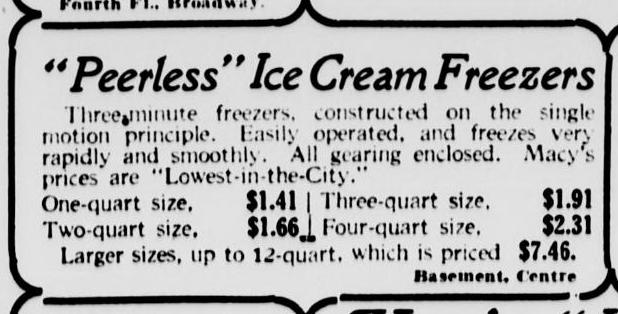
Below: A Macy’s ad in 1913 for a home ice-cream maker:
9. Ice Cream Profiteering or Newspaper Self-Promotion?  After the war, many merchants continued to sell massively overpriced ice cream.  The Evening World reported in 1921 that “profits from ice cream range from 500 to 1,000 percent” at a survey of local ice cream vendors.  “In few articles of food has there been found any greater evidence of extortion from the consumer.” [source]

A few days later, the newspaper extolled upon its own crack reporting, claiming that ice cream prices were going down because of their investigations.  “Hundreds of manufacturers and retails have already cut prices,” the World boasted.

10. Haagen-Dazs Ice Cream was not created anywhere near Scandinavia, but rather in the Bronx, the product of two Polish-Jewish confectioners Reuben and Rose Mattus.  The official reason for the name was “to convey an aura of the old-world traditions and craftsmanship to which he remained dedicated.” Reuben later admitted, “We wanted people to take a second look and say, ‘Is this imported?'”

The first Haagen-Dazs ice cream shop, which opened in 1976, is located at 120 Montague Street in Brooklyn Heights. The store is still going strong.

EXTRA: Frozen yogurt was the original cronut The trendy dessert was first sold over the counter in New York at Bloomingdale’s Department Store in the early 1970s.  As far as I can tell, the first actual yogurt store in the city — the first of many — was the Dannon Yogurt Store at 207 East 86th Street, opening in February 1975.

That was the year that New Yorkers first went WILD for frozen yogurt, well at least according to the New York Times (but you know how they are with trend stories!)

Yogurt: “It’s the biggest thing since hamburgers and chicken,” according to one fast-food executive in 1976.

**There were two Dock Streets back in old New York, so it’s possible (although more unlikely) the original shop could have been on the other one, which is near today’s Water Street and Coenties Slip.

For more sweet New York City history, check out my prior articles on:
New York and the history of soda fountains
New York, World War I and the history of the doughnut
Categories
Amusements and Thrills

The legend of Freedomland USA: Theme park memories from the kids who played there

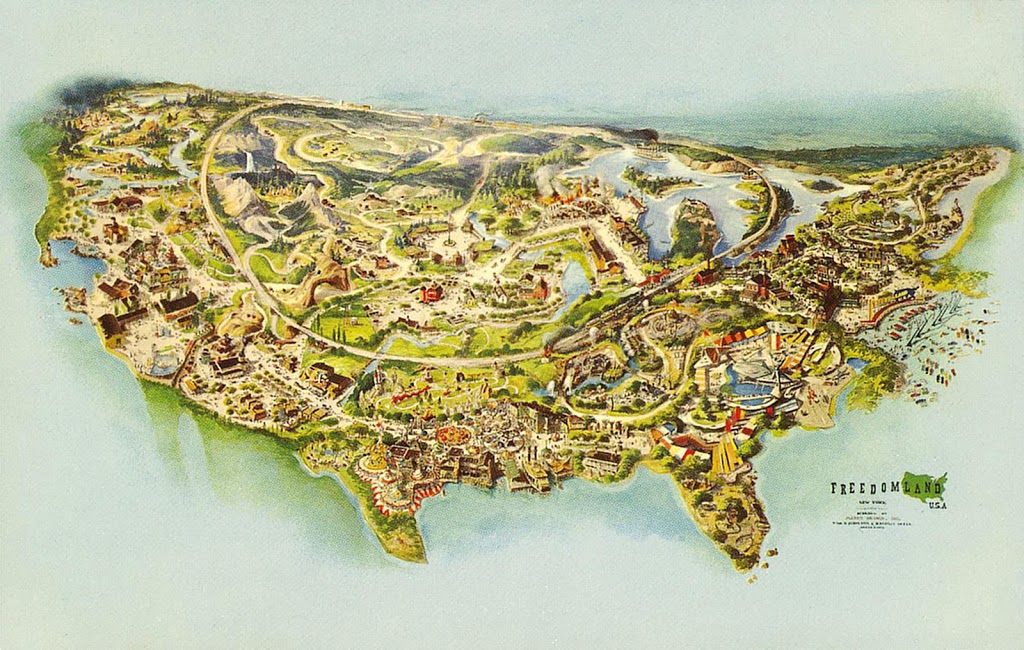
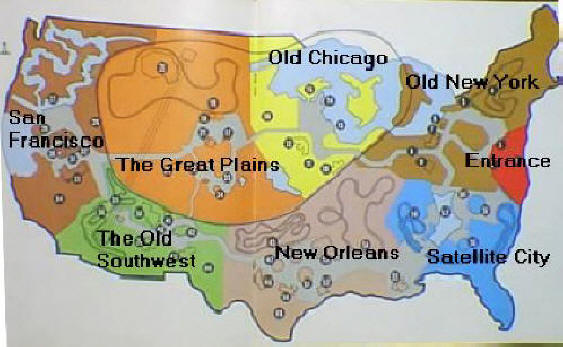
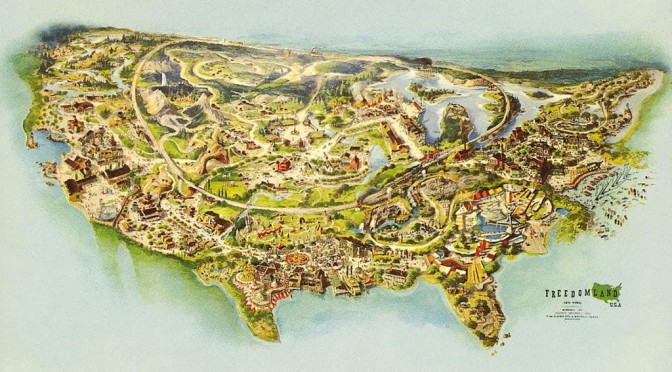
America, as depicted by Freedomland USA pre-opening map — courtesy Viewliner Ltd.

WOW. The response to our profile on NPR Morning Edition has been truly overwhelming. It’s been a very wild and exciting couple days. Thanks to everybody who has written us via email, Facebook and Twitter and welcome to our new listeners!

One amusing result of the airing of the piece is a resurgence of interest in Freedomland USA, the 1960s amusement park in the Bronx. I did a short podcast on the long-forgotten America-themed park back in 2009, and an original advertisement for one of the park’s more unusual attractions — reenactment of the Chicago fire! — was used in the NPR story.

The comments section on the blog page relating to our podcast is filled with recollections of people who visited Freedomland USA as a kid.  Here are a few selected comments about particular aspects of the park, giving a little more insight into this strange and mystifying place, written by those who were actually there:
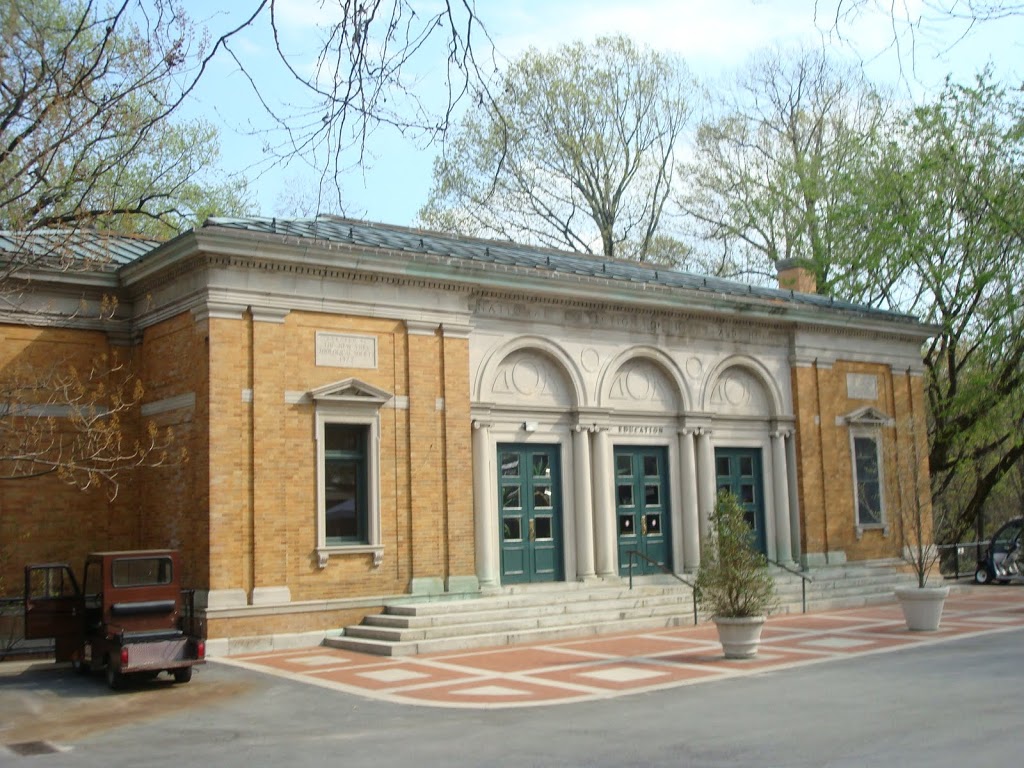
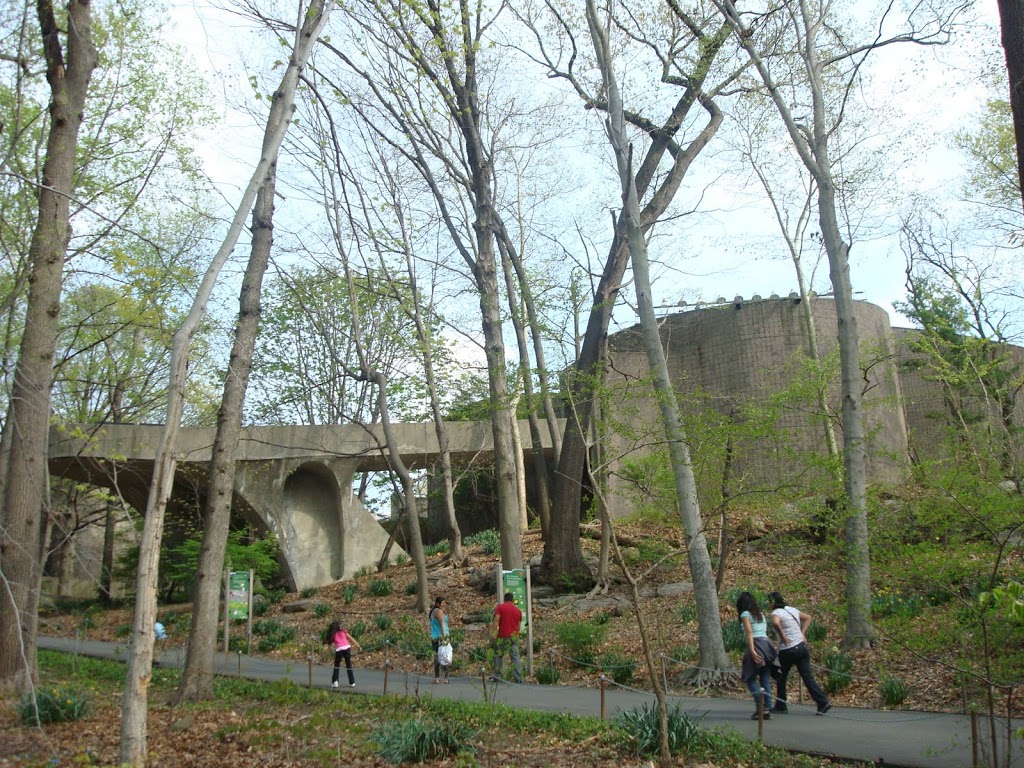
Elsie the Cow
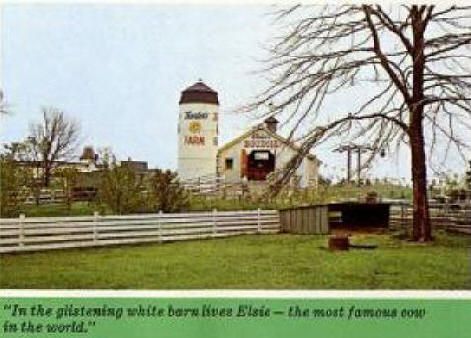
featured in the Borden’s Barn Boudoir, a barn that promoted Borden products. Yes, not only was Elsie a part of Freedomland, she had a very seductive image back in the 1960s

“I hadn’t even thought of Freedomland since the 60’s. It stopped me in my tracks when I heard the name. I remember my family and our friends who lived across the street all piling in the station wagon for our drive from Levittown to the park. Nothing else came to mind, but when you mentioned Elsie the cow- BINGO! I was mesmerized by that cow…I remember just standing there and being thrilled. Who knows what will captivate a little girl’s imagination.” — Jablow

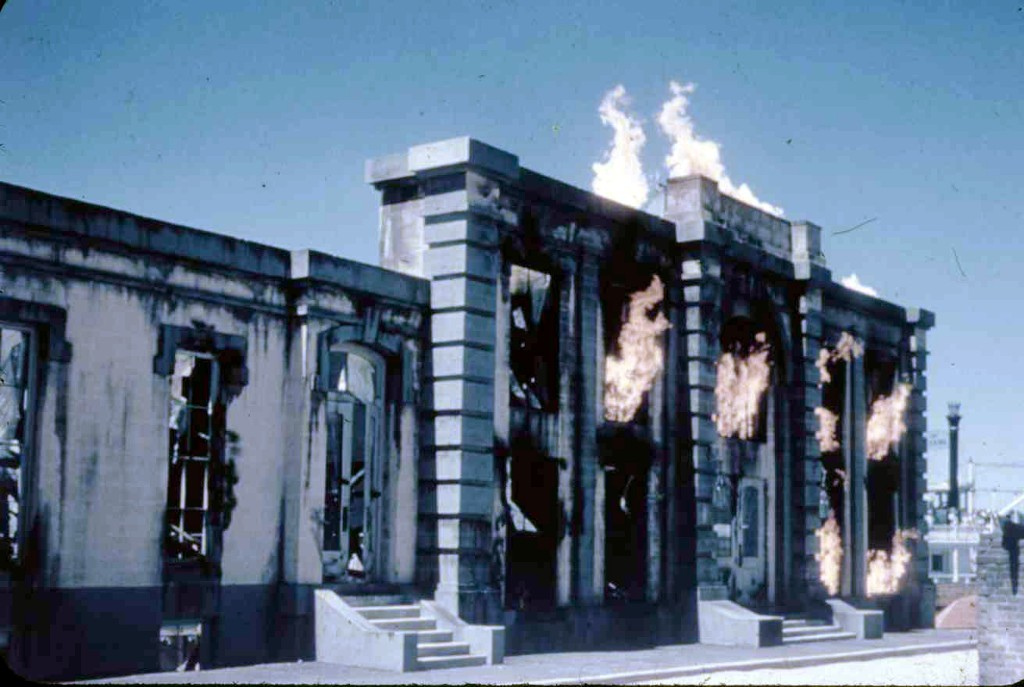
The Chicago Fire
 “Yeah! The Chicago Fire. I was selected to help pump one night & so we started pumping and all of a sudden, the pump started moving by itself – it was motorized! As a 12 year-old, I was crushed by the fakery. The good part was the photographer for LIFE Magazine snapped the scene so I became a smudge on a piece of newsprint.” — Big Al

“I still have my certificate recognizing my efforts to help put out the Chicago fire! Don’t remember Murray the K being there, but the WMCA good guys used to broadcast from a “space ship” in Futureland. Saw Little Peggy March there once, singing “I Will Follow Him.” Fond memories of seeing Elsie the Cow, too.”

Courtesy Flickr/slideshopper

Defying Gravity:
“As a kid growing up in Somerville, N.J. I got to go to Freedomland 3-4 times. My most vivid memory is of an attraction where stuff rolled uphill. You could set a soda can on a table and even though it looked like it was angled down hill, the can rolled up the hill. It still amazes me. Freedomland was the closest we kids from N.J would come to Disneyland for a really long time. California was on the other side of the country and Disney World was not even started yet. I have many great memories of a visit with my cub scout troop.” 

“Went to Freedomland several times over two summers loved the fried chicken with honey in “New Orleans”, “Casa Loco” with weird distortions of gravity, and I’ll never forget seeing my father’s face of amazement as we stood a couple of feet away from Benny Goodman and His Orchestra. The place was so cool.”


Special Events:
“Hey, does anyone remember seeing Chuck McCann do his Halloween kids show from the park? Absolutely! I remember bits and pieces of it like it was yesterday and I have been looking for references online about it for a number of years. As I recall it had two actual children and a number of puppets including a witch. It was one of my favorite Halloween specials. I have been trying to find a New York TV guide from October 1963 as I understand it’s listed there.”

“I was in a Yo-Yo championship contest hosted and judged by Chuck McCann. At Freedomland, I think it was 1962.”

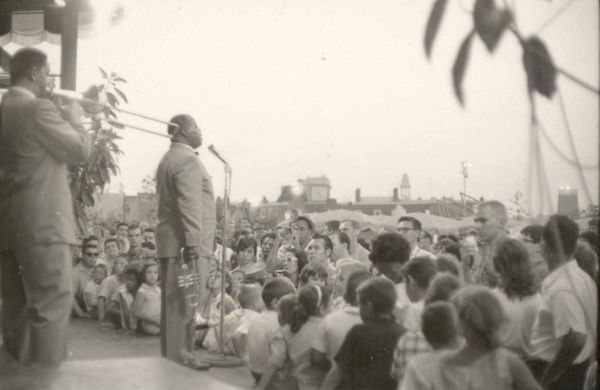
Above: Louis Armstrong at Freedomland, picture courtesy the Louis Armstrong House Museum

“I was 10 years old with Ed Sullivan on the original broadcast about Freedomland. It took all day to tape the show segment. He was very patient and very kind.” “Only thing I remember is seeing The Four Seasons perform on a chilly, damp, windy day. First concert I ever attended.”

“One of the most memorable events of my childhood was seeing Louis Armstrong at Freedomland.”

Photo courtesy Gorillas Don’t Blog

Stagecoach drama:
“I was stunned to hear about Freedomland on NPR today. I was there with my sister when they had the stagecoach accident that eventually caused the financial ruin of Freedomland

Apparently, the horse handlers warned the owners that the train that ran through the park would spook the horses. That is exactly what happened the day we visited. Coming down the last hill, the horse spooked and bolted. The stagecoach flipped over and severely injured most riders. 

My sister and I were on top and were thrown clear of the coach. I had a small cut on my elbow and my sister had a damaged tooth. Others broke legs and spines when they were trapped under the coach. My uncle and cousins helped lift the stagecoach off the injured. Many lawsuits later, Freedomland closed. I never heard anyone mention that place until today.” 

Categories
Podcasts

The Croton Aqueduct: How New York got its drinking water

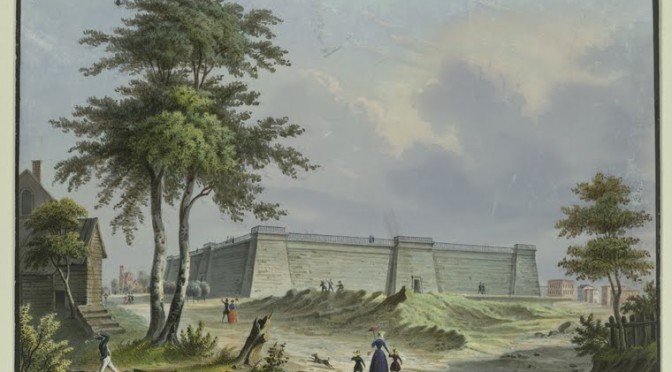
Above: The Croton Reservoir in 1850, in what would soon become Central Park. (NYPL)

PODCAST One of the great challenges faced by a growing, 19th-century New York City was the need for a viable, clean water supply.

We take water for granted today. But before the 1830s, citizens relied on cisterns to collect rainwater, a series of city wells drilled down to bubbling, underground springs, and, of course, the infamously polluted Collect Pond. But these sources were spreading disease and clearly inadequate for a city whose international profile was raising thanks to the Erie Canal.

The solution lay miles north of the city in the Croton River. New York engineers embarked on one of the most ambitious projects in the city’s history — to tame the Croton, funnelling millions of gallons of waters through an aqueduct down to Manhattan, where it would be collected and stored in grand, Egyptian-style reservoirs to serve the city’s needs.

This is the story of both the old and new Croton Aqueducts, and of the many landmarks that are still with us — from New York’s oldest surviving bridge to a former Bronx racetrack that was turned into a gigantic reservoir.

FEATURING: An entire town moved on logs, a famous writer’s strange musings on Irish laborers, the birth of a banking titan, and guest appearances by Isaac Newton, DeWitt Clinton, and Gouverneur Morris (or, at least, men who share those names).


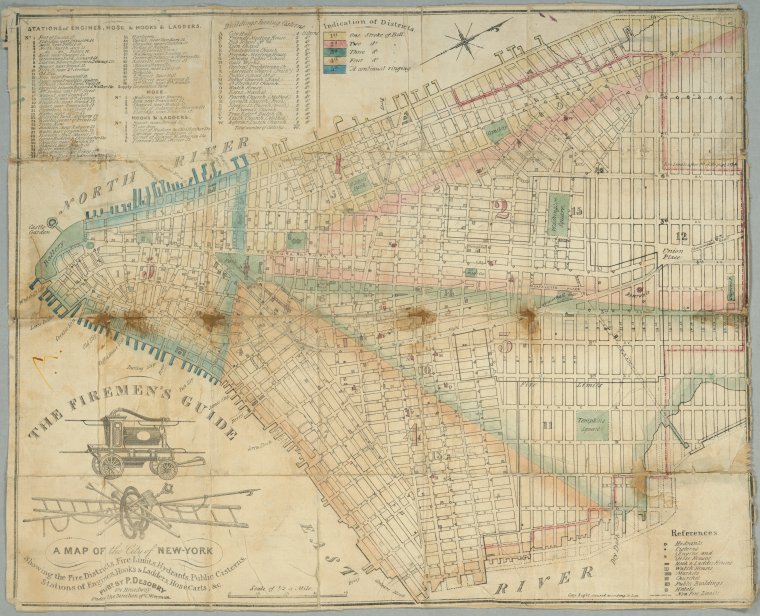
A fireman’s map of New York in 1834, detailing the location of the city water supply, in cisterns and hydrants fueled by the 13th Street Reservoir. (NYPL)

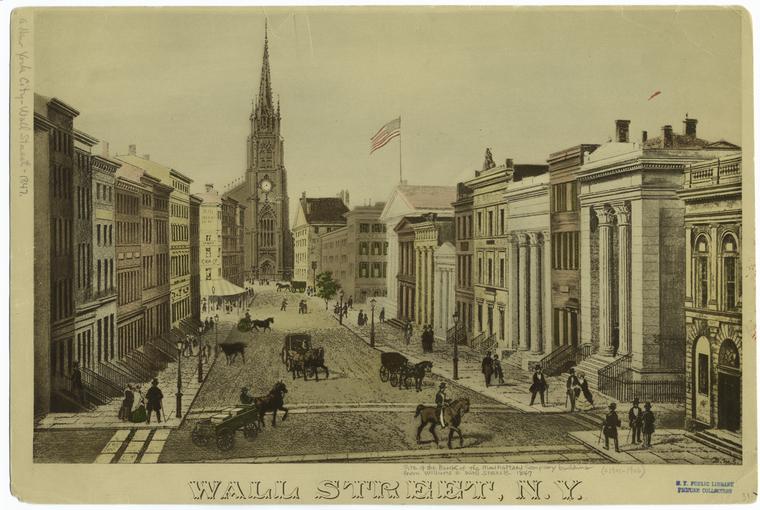
Wall Street in 1847. The Manhattan Company is at 40 Wall Street. Founded by Aaron Burr ostensibly as a public works to distribute water, the Company soon shed its water responsibilities to become a full-fledged financial institution.

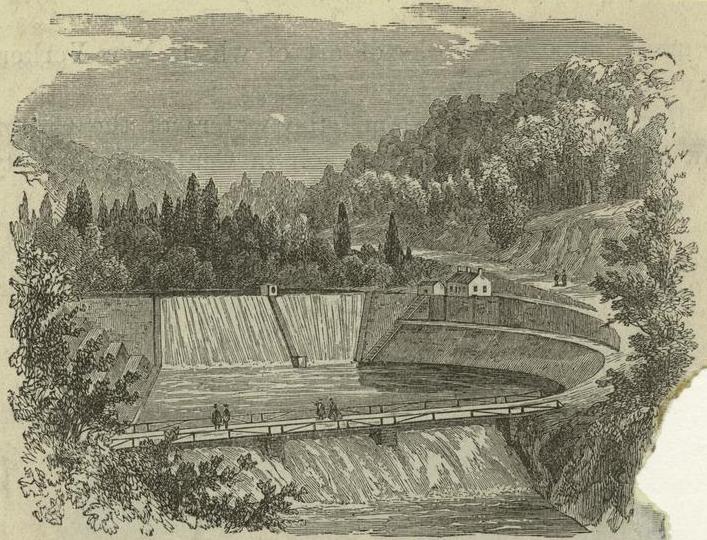
The Croton Dam and the start of the aqueduct system. After a partial collapse in 1841, the dam was quickly rebuilt for the opening of the entire system the following year. Today, the location of this dam is submerged under the current Croton. (NYPL)

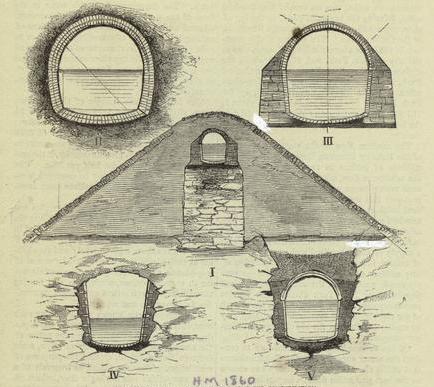
Examples of the various tunnels created to accommodate the various topographical challenges encountered during construction. Miles of these water tunnels were constructed by a team mostly comprised of Irish laborers. (NYPL)

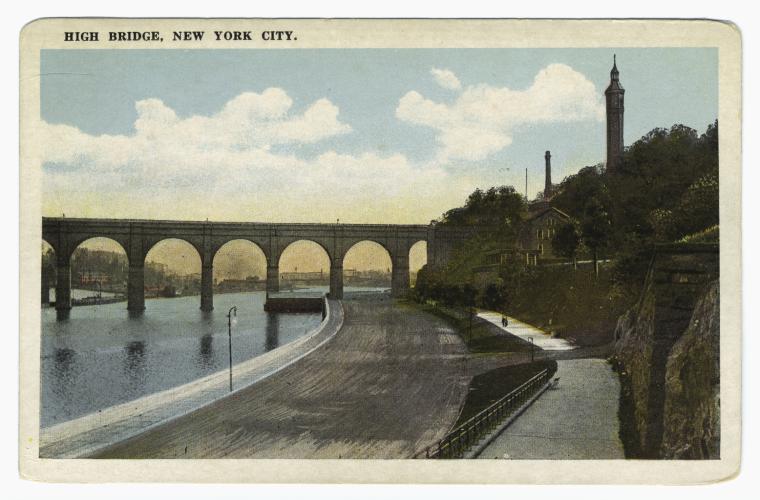
The glorious High Bridge, the oldest surviving bridge in New York — although much of it has been replaced and quite altered. (NYPL)

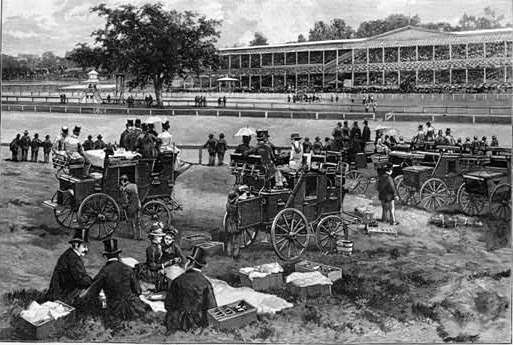
High society flocked to Jerome Park Racetrack on the weekends in the 19th century. But the park was turned into a reservoir at the beginning of the 1900s. (NYPL)

Also: please see my post from yesterday The Art of the Reservoir for pictures of some of the receiving and distributing reservoirs used in the Croton system and others through the New York region.

Categories
Newspapers and Newsies

Hot off the press: the bicentennial of the Bronx Gutenberg

Hoe Avenue in the Bronx has nothing to do with farming, although it once indeed ran through a grand 19th century farm estate.

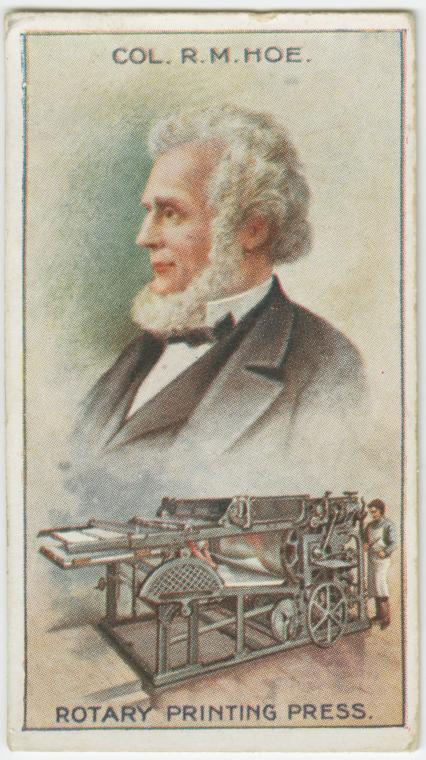
The avenue’s namesake, Richard March Hoe, born 200 years ago today, brought about a revolution in the world of printing. Without his innovations, the phrase ‘hot off the press’ might never have come about.

His father Robert Hoe, born in England in 1784, the year after America won its independence, moved to the new country and began a printing press business in lower Manhattan (10 Cedar Street) with his two brothers-in-law. Hoe tinkered with improving the hand-operated press machine for the ever-demanding industry of New York publishing. But it would be his young son Richard (born Sept. 12, 1812), taking over the reigns of the company in the 1830s, who would change the world of printing forever.

At right: ‘Colonel’ Hoe with his spectacular invention

The answer, of course, was steam power. It had forever changed the worlds of industry and transportation during this period. In 1843, R. Hoe & Company introduced a rotary printing press (nicknamed the ‘lightning press’), using a revolving cylinder drum that rapidly turned out thousands of printed pages using steam power.

His influence on the publishing world by the 1840s cannot be overstated. New York’s penny press, led by newspapers like the Sun, the Tribune and the Herald, utilized the technology to expand their circulation. Soon newspapers across the country were being made using the Hoe printing press, inspiring the growth of daily publications, turning the newspaper into an everyday item and creating a greater demand for the quick delivery of information.

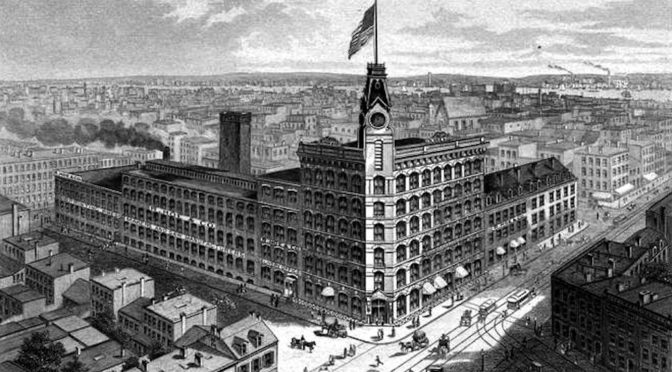
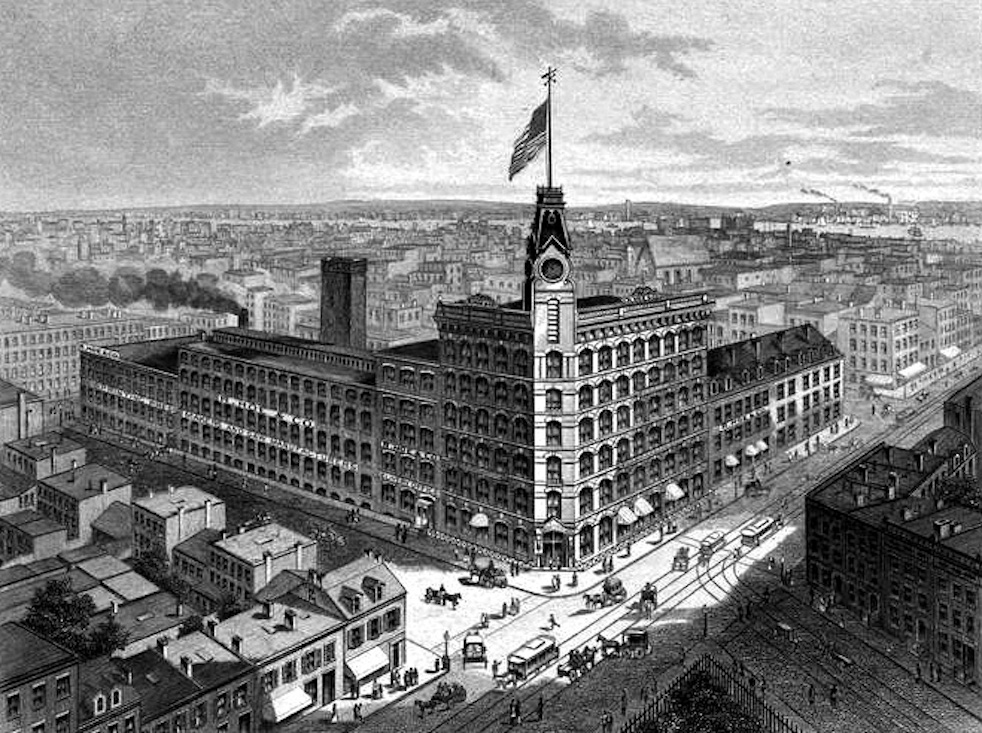
Above: R. Hoe & Company at 504-520 Grand Street.  

Like many great business moguls of the age — certainly men like Thomas Edison were paying attention — Hoe both innovated himself and bought inventions from others, generating a mini-publishing revolution from his headquarters at 504 Grand Street in Manhattan (pictured above).  In 1871, his factory eventually produced America’s first web press, generating two-sided printed pages from a single roll of paper. [source]

If that wasn’t enough, a decade later, Hoe acquired the technology to fold the newspapers as they came off the press.

Interestingly, the company also distinguished themselves in the manufacture of saw blades, a side business not completely unrelated, as they were used to cut metal type.

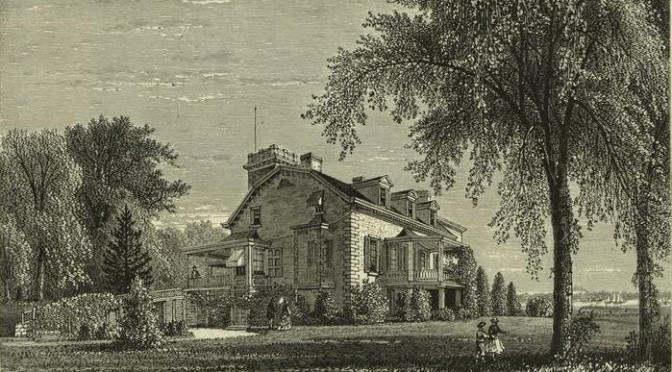
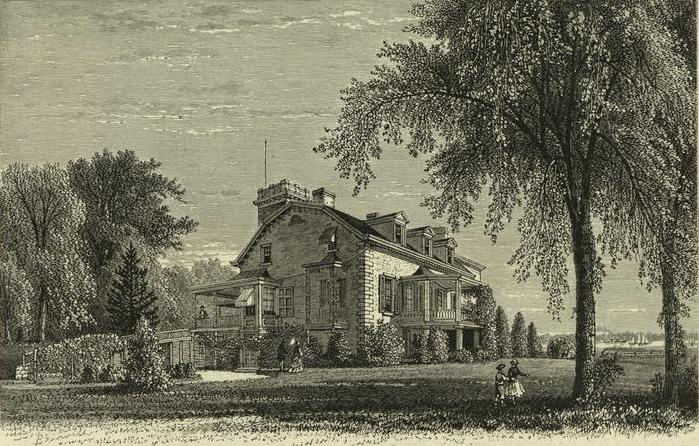
While Hoe conducted business from the Lower East Side and from offices in London, the printing-press mogul resided in a lavish 53-acre estate named Brightside near the Bronx River, on land once owned by the family of Gouverneur Morris, with plenty of room for an orchard and land for his prize-winning Jersey cattle. His brother Robert bought the neighboring land and opened his own estate called Sunnyslope.

Most signs of these estates is long gone, of course, with the exception of Hoe Avenue.  For modern pop culture junkies, the street is perhaps best known for the Hoe Avenue peace meeting, an assemblage of New York street gangs calling for a truce that inspired the plot of the 1981 film ‘The Warriors (in particular, the ‘Can you dig it?’ scene).

Nearby you’ll find another street named for printers: Aldus Street, a modification of the name Aldo Manuzio, a 15th century Italian printer  At the corner of Aldus and Hoe is a small playground called Printer’s Park, with playground equipment made to look like a rotary printing press.  And nearby is a small garden called — no beer jokes please — the Hoe Garden.

Richard Hoe died in Florence, Italy, on June 7, 1886.

Pictures courtesy New York Public Library.

South Bronx and the days of new American aristocracy

What you think about when you think about the South Bronx: the Morrisania estate built by Gouverneur Morris. (NYPL)

NAME THAT NEIGHBORHOOD Some New York neighborhoods are simply named for their location on a map (East Village, Midtown). Others are given prefabricated designations (SoHo, DUMBO). But a few retain names that link them intimately with their pasts. Other entries in this series can be found here.

NEIGHBORHOOD: Morrisania, the Bronx

Was there an estate in New York ever as beautiful as Morrisania, nearly 2,000 acres that hugged the Harlem River until it opened out into the turbulent East River as it coursed past small islands and flowed into the Long Island Sound? A property that varied from western hills looking over the river to the rolling spread of Manhattan below, to eastern marshes and flatlands suitable for farming.

Today’s Bronx neighborhood of Morrisania is only a small portion of the original property owned by the Morris family since the 1670s, during the dawning years of British dominance in the New York region. The original parcel, purchased by Welsh captain Richard Morris, was only 500 acres, a part of original land settled by Bronx namesake Jonas Bronck.

When Richard died, brother Lewis Morris (for reasons that will soon be evident, let’s call him Lewis 1) moved from the West Indies to claim the property. He would be one in a succession of Lewis Morrises to live here and place an imprint on what would some day contain much of the South Bronx.

The Morris family was feisty, business savvy, well connected, extremely aristocratic and entirely unoriginal with names. Another Lewis Morris (Richard’s son, or Lewis 2) became the governor, at separate times, of both New York and New Jersey. Yet another Lewis (Lewis 3) became a powerful New York justice. His son Lewis Morris (Lewis 4) was a signer of the Declaration of Independence.

If you haven’t gleaned it already, the clan carried themselves like some kind of royal family. They were, artificially at least, as were many families in the New World who quickly made fortunes here and staked claims in manners similar to what their forebears were accustomed to in Europe. Over the decades, the Lewises would blend by marriage into other elite, bold-faced families to form a tangled ball of interlinked faux American royalty.

Morrisania for most of the 18th century resembled a miniature British kingdom, with a spread of small farms, dairies and cattle pens operated by those leasing from the Morris family, a proper workaday serfdom common for the era. However, during the early decades, the land was even worked with slave labor, although the practice was phased out in later generations.

When Lewis 3 passed in 1762, this massive property was split in two. West of the small babbling Mill Brook (honored today with a playground and a housing development) belonged to Lewis 4 and his brothers, but the more bucolic eastern side fell to Lewis 3’s second wife Sarah and eventually her only son. That’s right, Gouverneur Morris (pictured below).

Gouverneur fled his home during the Revolutionary War, but his mother Sarah stayed behind. During this time, the rich farmland was vandalized and the family’s voluminous library, one of the largest collections in North America at the time, was ransacked.

Gouverneur was quite busy in the late 18th century doing things like penning the Constitution and being minister to France in the midst of their bloody revolution. But wherever he traveled, he always felt a closeness to Morrisania.

After the war, while Gouverneur in France, Lewis 4 offered up the family estate of Morrisania be used as the site for the new American capital. One can just imagine the history of New York had Congress taken him up on that offer!

In 1798, when Gouverneur returned from France and claimed the property for himself, he built a new home here and filled it with all his gathered French finery. Perhaps no household was more beautiful — or as pretentious — as Morris’ new manor.

Gouverneur, of course, facilitated the growth of New York with his roles in the development of both the Commissioners Plan of 1811 and the Erie Canal. His old farms, however, were technically part of Westchester Country. In the 1840s, his son Gouverneur Morris Jr. emulated New York’s former estate owners and began to develop his property for commercial and residential use.

Chief among these decisions was becoming vice president of the New York and Harlem Railroad (eventually to be owned by Cornelius Vanderbilt) and allowing the railroad to cut through the old property. Townships formed around the railroad station, include one small village named the old manor, Morrisania. That village is the root of today’s neighborhood of the same name.

Gouverneur Junior was cut from the visionary mold that would define many in the 19th Century. One pet project was the development of a port village along the old family property on the eastern shoreline, today’s Port Morris area.

Given that Gouverneur Senior was partially responsible for Manhattan’s grid, it’s no surprise that a different grid patterns were adhered to the old Morris properties over the years. In emulating Manhattan’s pattern, all traces of the area’s early farm existence was eradicated. The following years was hold many strange detours in the history of the South Bronx: opulent boulevards, the Yankees, 1970s crime sprees. But the Morrises live on, if in name only.

The City Island Monorail, easily the worst ride in NYC

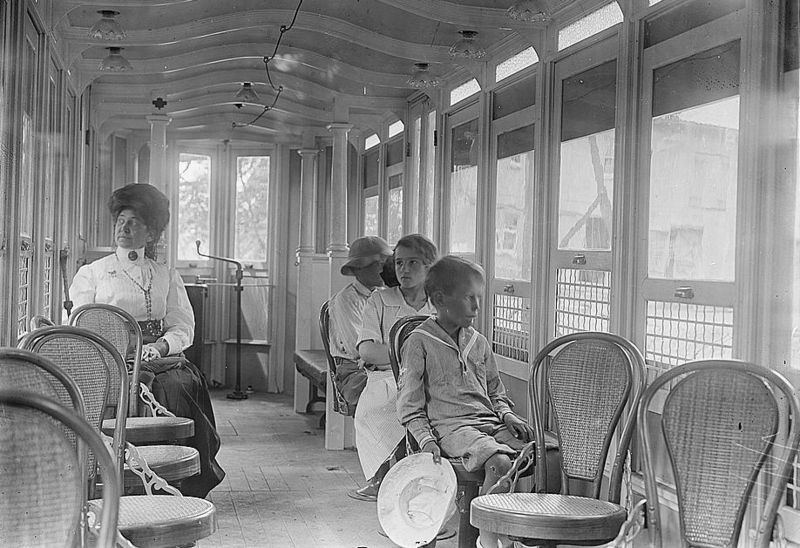
Taking their lives in their hands: riders of the City Island Monorail

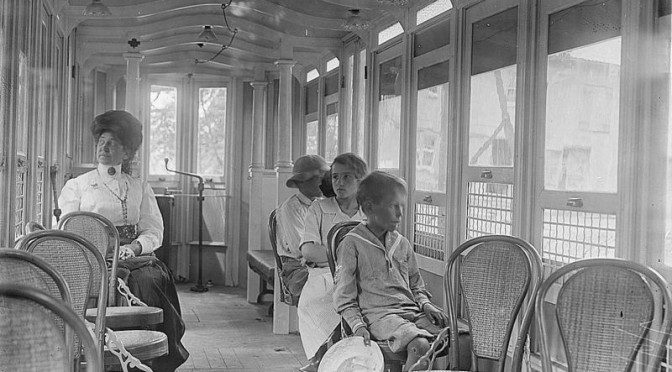
On Friday’s podcast, I briefly talked about the Pelham Park & City Island Railroad (or, in the parlance of the day, Monoroad), an actual monorail system, three miles in length, linking the small fishing community of City Island with the Bronx mainland. This slender and awkward looking conveyance (with its “yellow, cigar shaped car“, you can see it a couple posts below), departing on its very first trip on July 17, 1910 crammed with over 100 passengers, promptly fell over, injuring dozens.

“Passengers were thrown one on top of the other on the floor, so that they lay literally in layers,” according to the Times. Not helping matters, the conductor locked the doors after the accident for fear passengers would touch the electrified rail, and the injured had to be passed through a couple small, open windows.

The monorail was being piloted by its creator Howard Hansel Tunis who had trumpeted his technology of a single ground rail with two elevated (and electrified) side railings. Some in the press had seen the monorail idea as being superior to the newly build subway train. However it had taken his Monoroad financiers almost two years to raise the money, and the construction of usable track had happened hastily — and with remarkable incompetence.

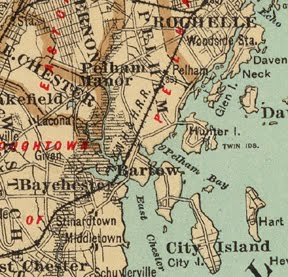
The ‘monoroad’ was to be a technological improvement of the horsecar line that serviced the route before 1910, picking up passengers at the long-vanished Bartow Station, located in Pelham Bay Park. One hundred years ago, New Yorkers took day trips up to enjoy the small, sandy beaches of City Island; most of that beach area is unavailable for bathers today, and anyway, Robert Moses sculpted a far grander Orchard Beach out of landfill in the 1930s, a more suitable option.

Despite the inaugural disaster, the City Island monorail system gave it another go a few months later, on October 12, 1910. On this, its second trip, the monorail hit an automobile, smashed it “to splinters” and injuring the driver and a passenger. They eventually seemed to work out the kinks, and the monorail began regular operation, although its irregular schedule and its inadequate connections to other lines never impressed local residents.

Its poor reputation may have held City Island back as a more popular place for recreation. An article on City Island from 1913 , while singing the monorail’s praises, inaccurately reported that people had been killed in the inaugural accident.

Its fate was sealed in 1914 when the powerful Third Avenue Railway bought it up, opened a traditional trolley line alongside it and unceremoniously closed the monorail by 1919.

Map above from Historic Pelham. Top photo from Wiki Commons.

Categories
Podcasts

The Bronx Zoo: the tale of NYC’s biggest animal house

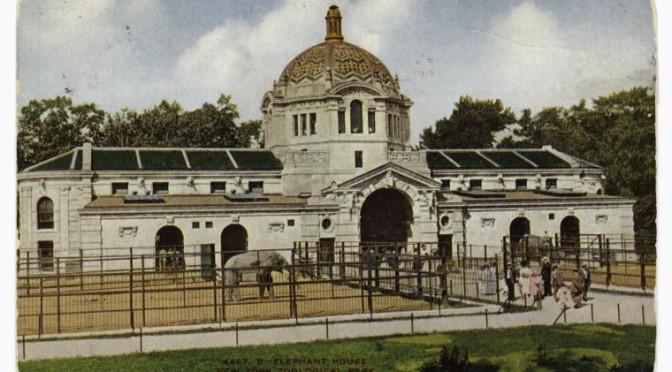
Postcard of the elephant house, now the central Zoo Center — and home today to a baby rhino below. (Courtesy NYPL)

PODCAST New York City’s most exotic residents inhabit hundreds of leafy acres in the Bronx at the once-named New York Zoological Park.

Sculpted out of the former DeLancey family estate and tucked next to the Bronx River, the Bronx Zoo houses hundreds of different species from across the globe, many endangered and quite foreign to most American zoos.

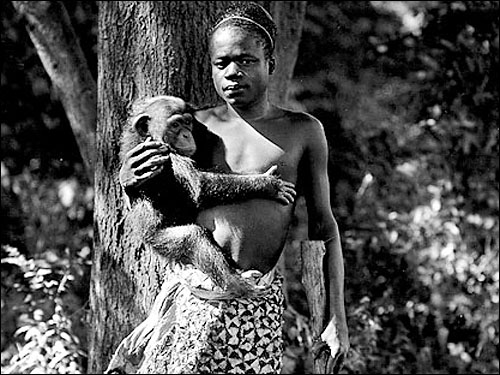
The well meaning attempts of its founders, however, have sometimes been mired in controversy. The highlight of the show — and the institution’s lowest moment — is the sad tale of Ota Benga, the pygmy once put on display at the zoo in 1906!

ALSO: We take you on a tour of the zoo grounds, unfurling over 110 years of historical trivia, from the ancient Rocking Stone to the tale of Gunda, the Indian elephant who may also have been a poet.

CLICK INTO PICTURES BELOW FOR GREATER DETAIL

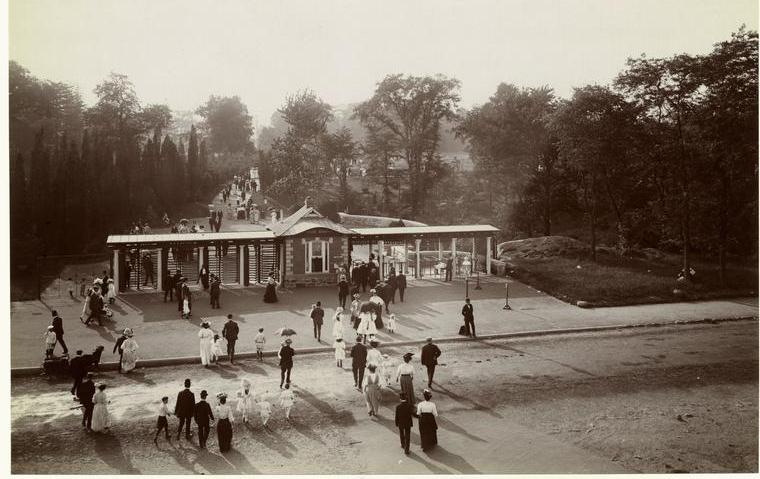
Well-dressed families arrive at the south zoo entrance in 1911. (NYPL)

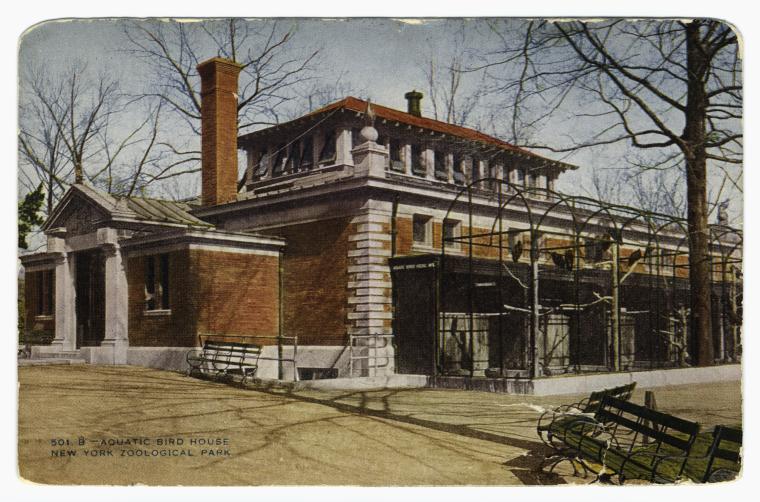
The aquatic bird house, one of the first buildings completed when the zoo opened in 1899. Another building from this date, the House of Reptiles, still stands and you can see it further below. (NYPL)

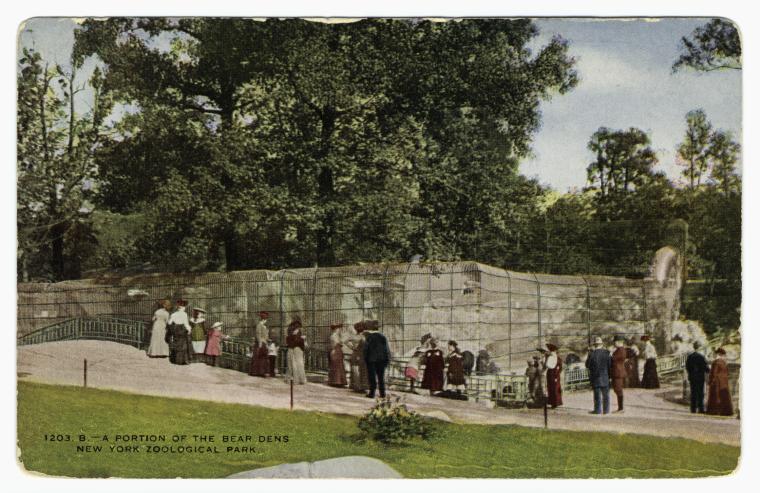
Bears behind fences. Zoo planners used Bronx Park’s natural topography to build enclosures into the very rocks themselves.

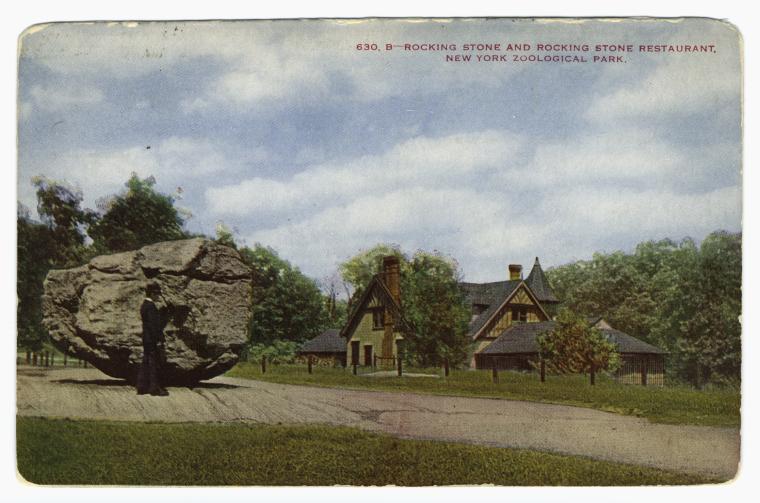
The mysterious Rocking Stone, next to the Rocking Stone Restaurant. Today there’s a World of Darkness exhibit there (presently closed to visitors).

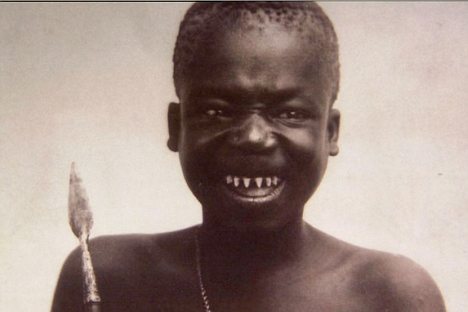
Ota Benga at the Bronx Zoo. The Congolese pygmy once lived at the Museum of Natural History (where he was forced to wear a duck costume!) before being scandalously exhibited for a short time in the Bronx Zoo monkey house in 1906.

Part of his allure to shocked New Yorkers were his filed teeth and his size (4’11’).

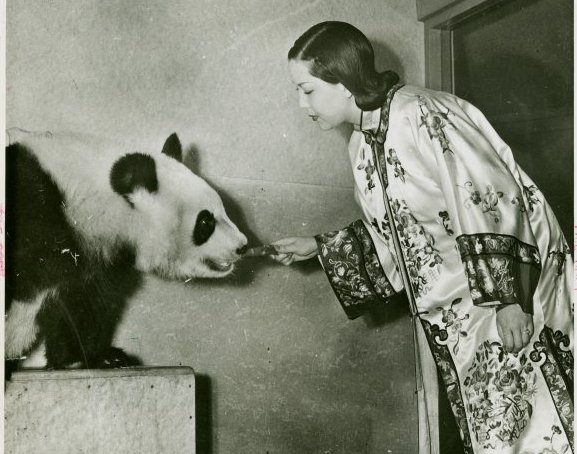
Pandora, the zoo’s first panda bear, from 1938. Pandas never lived for very long at the Bronx Zoo, and they stopped regularly keeping them. Pandas Ling Ling and Yun Yun were briefly housed here in the 1980s.

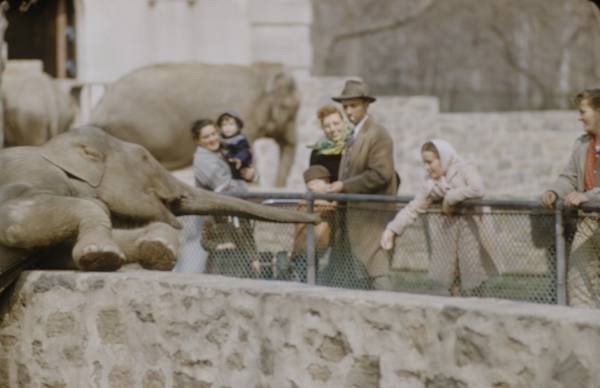
The elephant exhibit, circa the 1960s. The Bronx Zoo’s population of elephants has dwindled to just three animals. Very soon there may be none. (Photo courtesy Life Images, Nina Leen photgrapher)

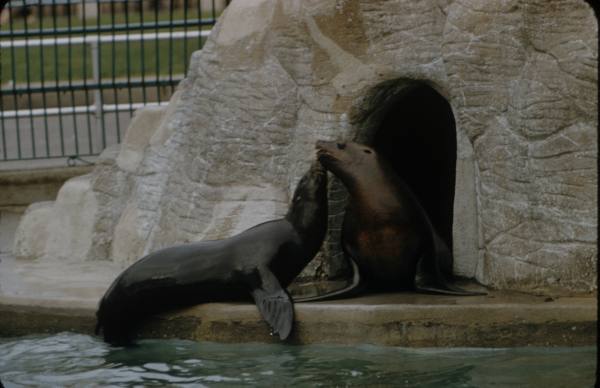
From the same time period as the picture above, but pretty timeless. The sea lions have been the centerpiece of the zoo since it opened in 1899. (Nina Leen)

Some pics from my trip last week are below. The zoo is one of the greatest places to see the spectacle of the Bronx River. (Click into them to see the detail.)

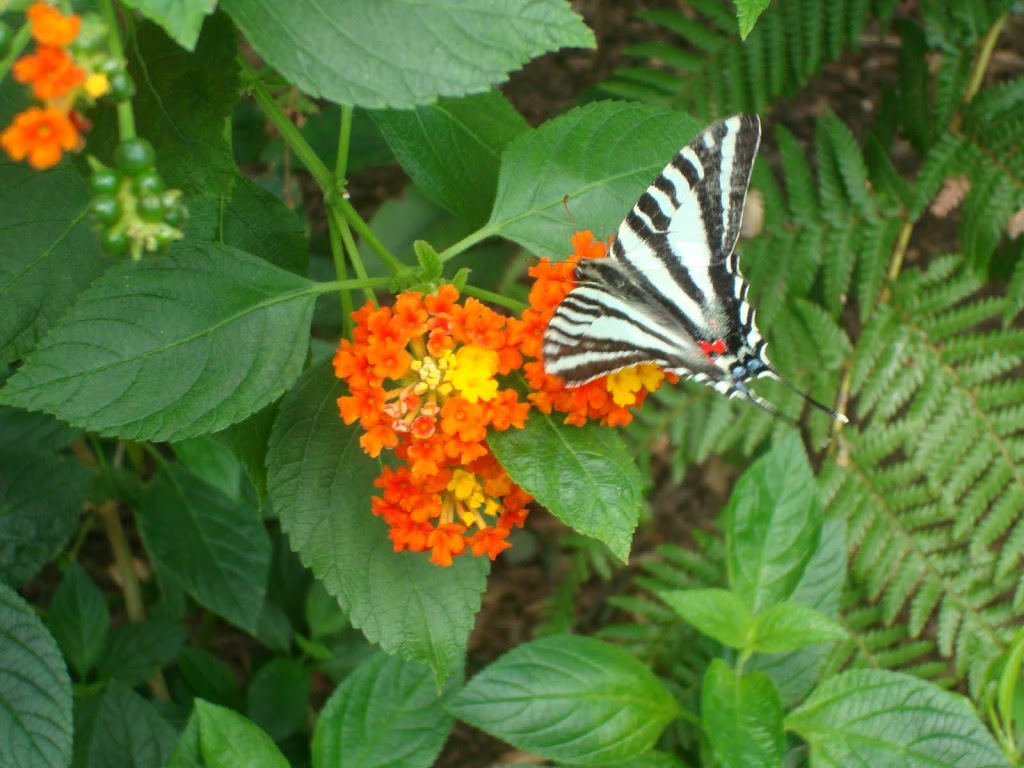
The Butterfly Garden is one of the newer exhibitions, an intimate greenhouse featuring dozens of varieties of butterflies flying all around you (and sometimes, even on you).

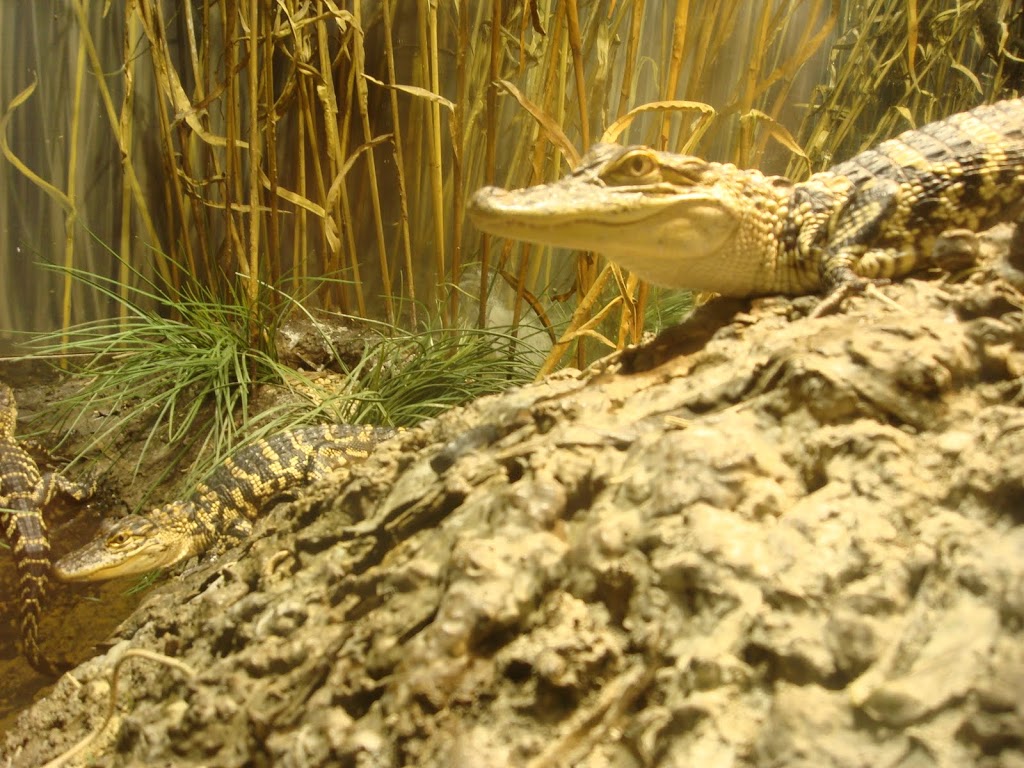
American allligators, the small, unthreatening kind. For something more severe, visit the nile crocodile in the Madagascar exhibit.

A display of some of the zoo’s marvelous, cheeky fontage.

The House of Reptiles, one of the zoo’s oldest structures, from 1899.

The brutalist wonder that is the House of Birds.

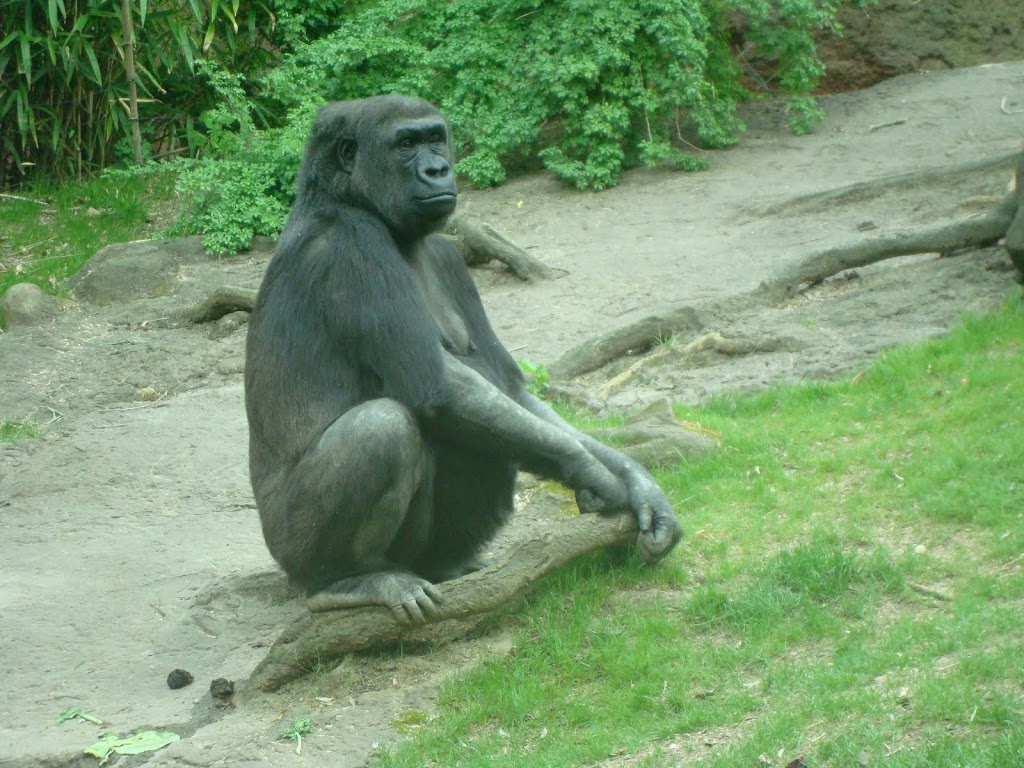
A young female gorilla, one of several who look on at gawking zoo visitors in curiousity and confusuion.

From the Madagascar exhibit:

You can find a baby Asian one-horned rhinoceros named Krishnan at the Zoo Center.

And finally, the Bronx Zoo movie star Andy the orangutan in his feature debut Andy’s Animal Alphabet:

What’s in a name? In Kingsbridge’s case, a New York first

NAME THAT NEIGHBORHOOD Some New York neighborhoods are simply named for their location on a map (East Village, Midtown). Others are given prefabricated designations (SoHo, DUMBO). But a few retain names that link them intimately with their pasts. Other entries in this series can be found here.

NEIGHBORHOOD: Kingsbridge, the Bronx

DUMBO, for Down Under Manhattan Bridge Overpass — a stretch to create an geographic acronym if there ever was one — is not the only neighborhood influenced by a bridge which passes by, through, or over it. It might be the most obvious thing I’ve ever typed, but the neighborhood of Kingsbridge in the Bronx is named for an actual bridge, and the King’s Bridge at that.

The Spuyten Duyvil creek, that short, narrow span of water that separated the far north edge of Manhattan from the west side of the Bronx, has vexed travelers for hundreds of years, due to choppy waters and devilish legends. One translation of its name has traditionally been ‘Devil’s Spout’. Folklore sent Anthony Van Corlaer to his death here. (Listen to last year’s Haunted Tales podcast for more information.)

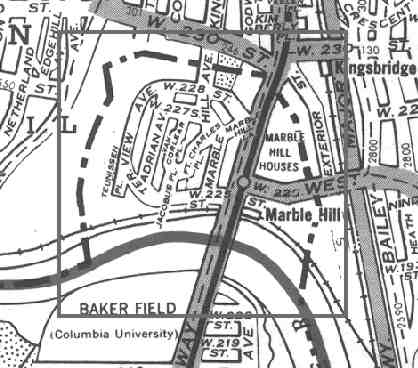
In the past 150 years, the course of this waterway has been re-routed, shut off and landfilled to accommodate needs of Harlem River shipping traffic. In fact the neighborhood of Marble Hill, once a part of Manhattan island, has been affixed to the Bronx by drilling a canal though its southern part (in 1895), then filling in the Spuyten Duyvil to its north (in 1914). This disembodied nub of Manhattan is still administratively considered part of the island.

(Forgotten New York has a wonderful write-up explaining it all. Picture below is from there; the dotted line is where the Spuyven Duyvil once flowed. The solid line is the Harlem River.)

But it’s not Marble Hill we’re looking at here, but rather the neighborhood to its east, Kingsbridge. Way before the Spuyten Duyvil was filled in, the creek posed a challenge for early Dutch farmers wishing to transport their wares into the city markets. However it was narrower than trying to attempt a crossing of the far-broader Harlem, and many farmers used their own boats to get across.

The earlier inhabitants of the land, the Lenape, simply used canoes when they wished to pass across it; it was at this spot that a well-trodden Indian trail led into the wilderness beyond. By the time of the Dutch, this path had been turned into a workable road, the Upper Trail Road and later the Boston Post Road, which led into New York to the south.

In 1669, in those tentative years of England’s early occupation of the former New Netherland colony, one enterprising Dutch farmer Johannes Verveelen set up a pay ferry service, at the area of the former creek today situated at 231st Street and Broadway — both to serve those who didn’t have their own vessels and to monetize those who had previously preferred their own. This would be fine for awhile, until greater number of travelers to and from New York on the post road commanded that a more permanent solution be found.

Enter wealthy adventurer and servant to the crown Frederick Philipse. He was actually born in Amsterdam, a slave trader who married into money, came to the New York colony and acquired an estate (or rather, “hunting ground”) encompassing land between the Spuyten Duyvil creek and the Croton River further upstate. He built a lavish home here with breathtaking views of the Hudson.

This land once had been owned by Lenape and farmed by Dutch farmers; now it was part of a wealthy lord’s estate, part of a vast property that would later become the western Bronx and Yonkers. Of course, in the southern part of his estate, there was that pesky road that abutted his property, heavily trafficed with people crossing at the creek. No matter. He built a bridge — the King’s Bridge as it was “established by royal grant” — and charged a fee, payable to the crown.

Philipse’s toll bridge can be seen as a physical representation of the later unrest between England and the colonies. Philipse and his descendants were faithful to the English; his great-grandson would still own the property during the Revolutionary War and would flee when the British were kicked out in 1783.

In the meantime, a mild form of protest was being displayed by neighboring farmers Benjamin Palmer and Jacob Dyckman, who build the aptly named wooden-plank Free Bridge in 1758, at around 226th and Broadway. This rebellion was celebrated with a wild feast, an ox roast, “thousands from the city and country …. rejoiced greatly.” Of course, Dyckman wasn’t totally altruistic, I suppose; sitting next to the bridge was the family owned Hyatt Tavern. Dyckman’s bridge was burned down by British soldiers, but they left the tavern still standing.

As for the King’s Bridge, it too was destroyed — by Washington’s forces, as they fled in 1776 — but was rebuilt after the war. The community of that developed around King’s Bridge, losing the space and the apostrophe, was officially part of Yonkers until the city of New York annexed it in 1874, years before the creation of the Bronx borough.

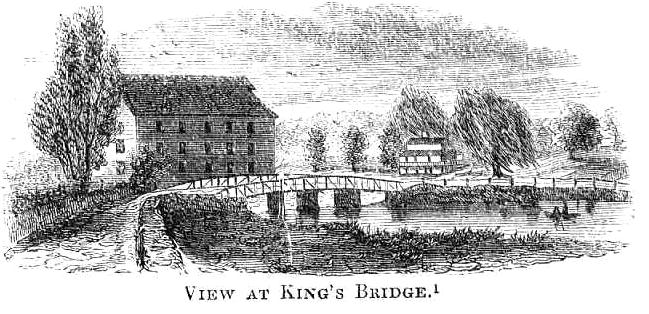
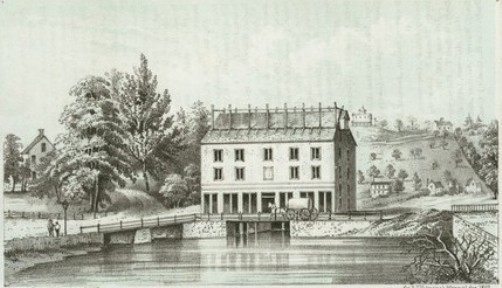
Below: The bridge as it looked in 1856

100 Years Ago: Frankenstein monster stalks the Bronx

In 1910, DW Griffith made the first film ever made in Hollywood, CA, called In Old California. Before then, film production companies were scattered throughout the United States, with two of the most successful based here in New York City.

The American Vitagraph Company, originally located at the Morse Building on 140 Nassau Street, made film shorts on the roof before moving to the Brooklyn neighborhood of Midwood in 1906. Vitagraph is best known for producing a five-part serial on The Life of Moses strung together to make what some call the first ever feature length motion picture.

More influential, however, was Edison Studios, the film company owned by inventor Thomas Edison. With principal studios in the New Jersey town West Orange — and original laboratories in Menlo Park (now Edison, NJ) — Edison eventually set his sights on a Manhattan studio.

He initially moved into the heart of the city in 1901, in a studio at 41 East 21st. Such a move made sense at the time; movies were only a few minutes long, essentially just filmed sequences of activities, and had no sound. A small studio smack in the center of New York would not have been disturbed by the bustle of the city.

With the growth into narrative films — longer movies with elaborate sets and casts — Edison needed to expand into a larger space and in 1908 moved production to a warehouse in the Bronx, at Decatur Avenue and Oliver Place, close to the New York Botanical Garden.

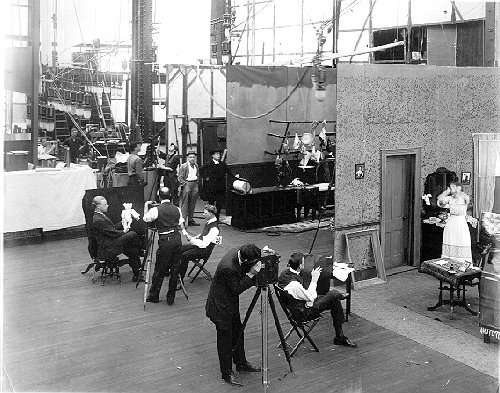
Below: Inside Edison’s Bronx studio

“The Edison Studio is said to be one of the finest and largest of its kind in the world,” reported [the theatrical trade paper] The Dramatic Mirror. “The building itself is 60 by 100 feet, built of concrete, iron and glass. The scenic end of the studio, corresponding to the stage in a theatre, except that it is not raised is 60 by 60 feet and 40 feet high. Here the scenes for film productions that cannot be made with natural outdoor backgrounds are painted and set.” [source]

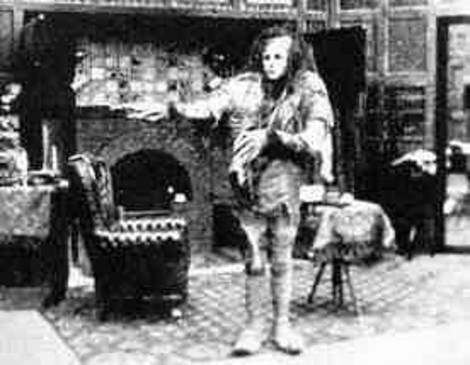
It was at this new Bronx studio in 1910 that Edison’s company produced one of its greatest works, the very first film adaptation of Mary Shelley’s Frankenstein. Shot in a week — rather lengthy for a film shoot in those days — the loose adaptation featured Charles Ogle as the famed monster. Believe it or not, the film began production on January 17, 1910, and was released by March of that year! Since there just weren’t that many movies houses in 1910, a film released constituted about 40 copies which were distributed around the country, then returned several months later.

The film was reportedly lost forever before a single negative was found and restored in the 1970s. I present to you the Bronx-made psycho-horror masterpiece in all its glory (watch it below or click here):

You can find more information about the film at Frankensteinia.

Mayor Franklin Edson: Bronx man and distillery king

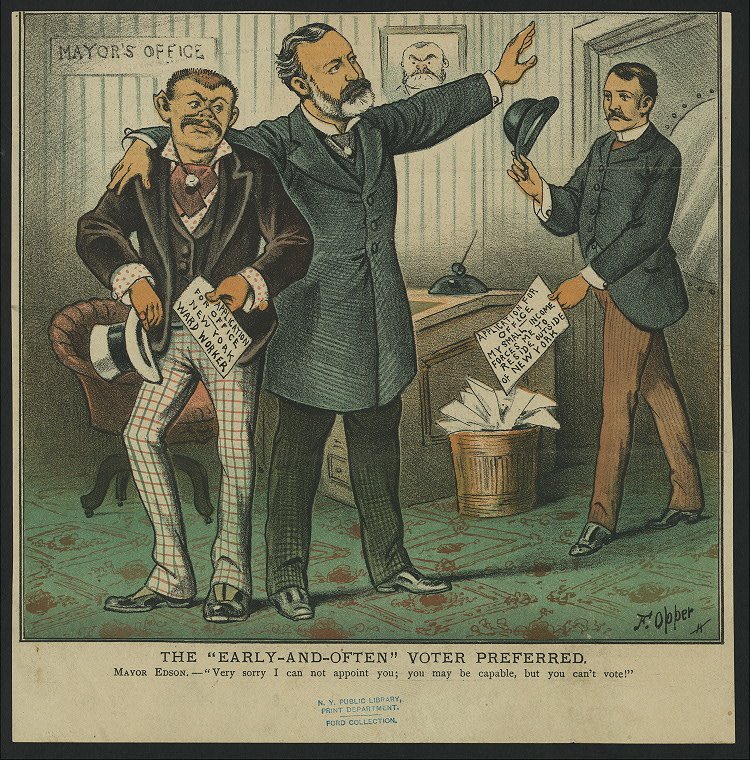
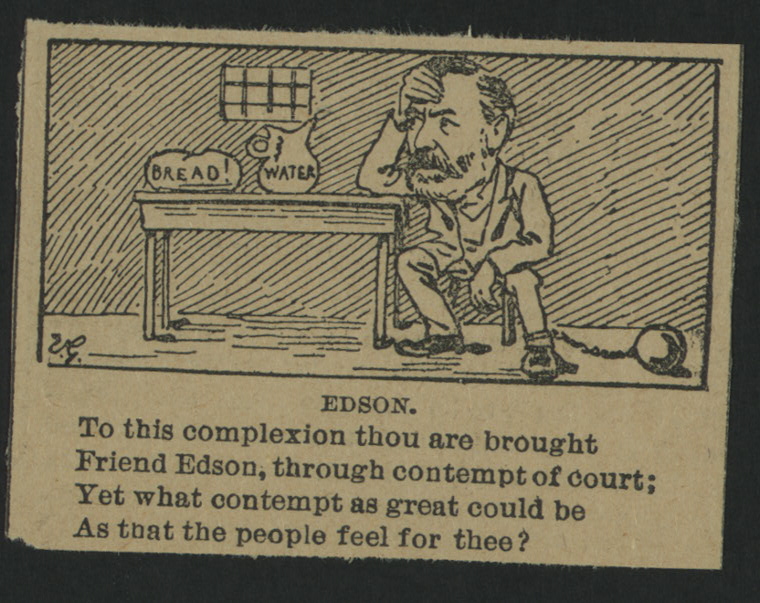
Above: a cartoon mocking Edson’s hiring practices (courtesy New York Public Library Digital Gallery)

KNOW YOUR MAYORS Our modest little series about some of the greatest, notorious, most important, even most useless, mayors of New York City. Other entrants in our mayoral survey can be found here.

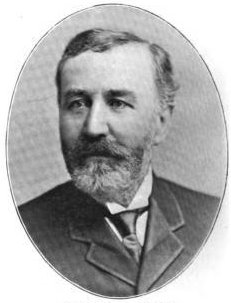
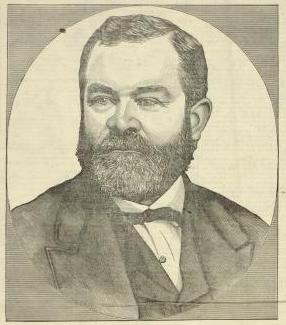
Mayor Franklin Edson

In office: 1883-1884

Although the political career of one-term mayor Franklin Edson was indeed brief, he helped commission both the city’s largest acquisition of park land and one of its biggest improvements in drinking water. And he was present for the opening of one of New York’s greatest landmarks. So how did the city thank him for his service? By nearly throwing him into Ludlow Street Jail — where Boss Tweed had been left to rot just a few years before.

Edson, a transplanted New Yorker, was a farmboy from Chester, Vermont, born in 1832, who distinguished himself in the art of whiskey distillery — distinghished with “precocious tact and sagacity,” in fact.

He worked his way over to Albany, New York, as a successful distiller and grain merchant with his brother. Franklin took full advantage of drink demands during the Civil War; his company soon became so profitable that he moved the entire venture to New York in 1866.

Edson, a burgeoning booze mogul of sorts, immediately became a prominent merchant voice in Manhattan, becoming the president of New York’s Produce Exchange three times, serving his first term in 1866 before he had to time to even unpack his moving boxes.

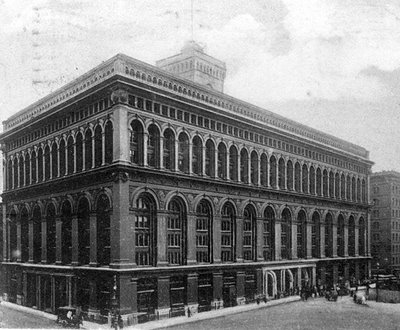
While this naturally afforded Franklin an incredible vantage for commercial power, it would soon place him in the crosshairs of political power as well. In later years he would be most proud of his Exchange days, priding himself in being one of the encouraging voices to tear down the inadequate castle-like Produce Exchange (designed by Leopold Eidlitz) and erecting the larger, more impressive George Post-designed Produce Exchange building near Bowling Green (which itself would be sadly torn down in 1957).

Below: the new Produce Exchange

What sets Edson apart from other future mayors of the time — and what might have potentially hindered his political ambitions — was that he loved the countryside, in this case Old Fordham Village, today a neighborhood in the Bronx.

He would live here for many years and would remain a member of the (now landmarked) Episcopal Saint James Church in Fordham for most of his days. Whether by design or coincidence, this love for what would become New York’s northern borough would soon prove fruitful for the city as a whole.

Franklin was also a practicing anti-Tammany Hall Democrat. And who wouldn’t be anti-Tammany during the 1870s? Edson became politically active in the years following the Boss Tweed scandals, when Tammany was still reeling for the highly publicized affair involving Tweed and then-mayor A. Oakley Hall.


Despite a slow rebounding, Tammany would never fully rinse off the stench of corruption. Naturally, Edson’s prominence among the business class married nicely with mayoral ambitions by the mid 1880s and would eventually include a denunciation of Tammany practices and condemnation of Tammany boss John Kelly (at right). But not at first.

For the election in November 1882, the various Democratic factions, including the still-potent Irving Hall, soon decided on the relatively green Edson, because he was a uncontroversial, neutral choice. To Tammany’s Kelly, Edson must have seemed a fairly agreeable pick indeed compared the previous mayor William Russell Grace, a reform Democrat rebelliously outside the realm of Tammany’s power.

Edson easily swept past his opponent, railroad man Allan Campbell — a sweet victory for John Kelly, as it was Campbell that had replaced Kelly as the city comptroller several years previous under the administration of mayor Edward Cooper. (Check out Edward’s entry for some juicy details of the Kelly/Cooper rivalry.)

How did a political nobody — a “seven day wonder in the political world” — sweep so handily into office? It helps to ride coattails; during that same election, the popular Democrat Grover Cleveland was elected the governor of New York.

At first, Edson gave in readily to political favoritism, paying back some of his Democratic cohorts — including many of the Tammany variety — with lucrative city jobs, a decision which disgruntled many of his former supporters. In fact, he even appointed Richard Croker as fire commissioner; Croker would become the head of Tammany Hall in the 1890s. (Harper’s Weekly has a coy little cartoon chiding the Croker decision.)

Like many before him, however, Edson soon grew tired of Tammany’s corrupting influence and began adopting reform policies which were currently being installed on the state level. And also like many before him, his against-the-wind attempts at reform would essentially spell the end of his political career. Edson would serve but a single term and would almost entirely vanish from politics afterwards.

But not before throwing his weight behind a major expansion of the Croton Aqueduct, which within in a few years would triple the supply of water into the city. (In fact, most of the expansion he pushed for is still in use today.)

Edson is also partially responsible for the huge increase in New York park land, commissioning a citizens group in 1884 to lobby the state to purchase lands in the area of today’s Bronx; accordiing to an old Bronx history, “the ‘new’ parks, as they were called, comprised 3,757 acres, now included in Van Corlandt, Bronx, Pelham Bay, Crotona, St. Mary’s and Claremont parks.”

And most notably, he was the first New York mayor to walk the Brooklyn Bridge, astride president Chester A. Arthur and governor Cleveland on the bridge’s opening day, May 24, 1883. He would be met in the middle by the mayor of Brooklyn — future New York mayor — Seth Low.

He might have crept quietly into obscurity had Edson not been accused of contempt of court shortly after he left office, threatening a man in his early 50s with jail time with a stint at the notorious Ludlow Street Jail. Apparently, despite a court injunction, Edson had quietly made promotions to two posts — the Commissioner of Public Works and the Corporation Council — on his last day in office. However, after a stressful two months in court, Edson was declared not guilty of the crime.

This did not stop people from imagining the ex-Mayor trapped behind bars, as the newspaper illustration below evidences:

Edson died in 1904, at his home on the Upper East Side. 42 West 71st Street, to be exact, a block from the Dakota Apartments, which were completed during his tenure as mayor.

Categories
Podcasts

PODCAST: Freedomland U.S.A.

What is Freedomland U.S.A.? An unusual theme park in the Bronx, only in existence for less than five years, Freedomland has become the object of fascination for New York nostalgia lovers everywhere.

Created by an outcast of Walt Disney’s inner circle, Freedomland practically defines 60s kitsch, with dozens of rides and amusements related to saccharine views of American history. Along the way, we’ll take a visit to the Blast-Off Bunker, Casa Loca, and, yes, Borden’s Barn Boudoir!

Listen to it for FREE on iTunes or other podcasting services. Or click this link to listen to the show or download it directly from our satellite site.

NOTE: There’s nothing wrong with your speakers! I include a short clip in this podcast of an original Freedomland radio advertisement from 1960. The sound quality of the clip is extremely bad, however I thought it was important to include as it sets the tone for what Freedomland was all about (or, rather, wanted to be about).

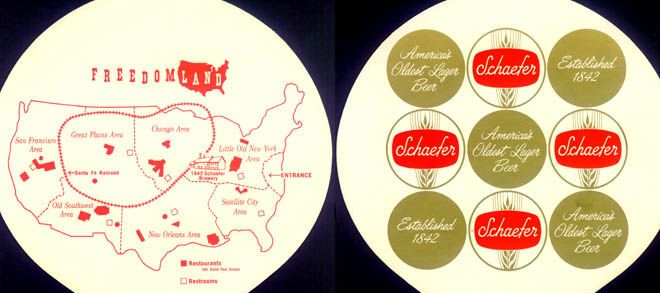
The map through Freedomland mimicked the outline of the United States. (Well, sorta.) Visitors entered through Washington D.C. and meandered through candy-coated interpretations of various national regions, ending up in the future (located in the American South).

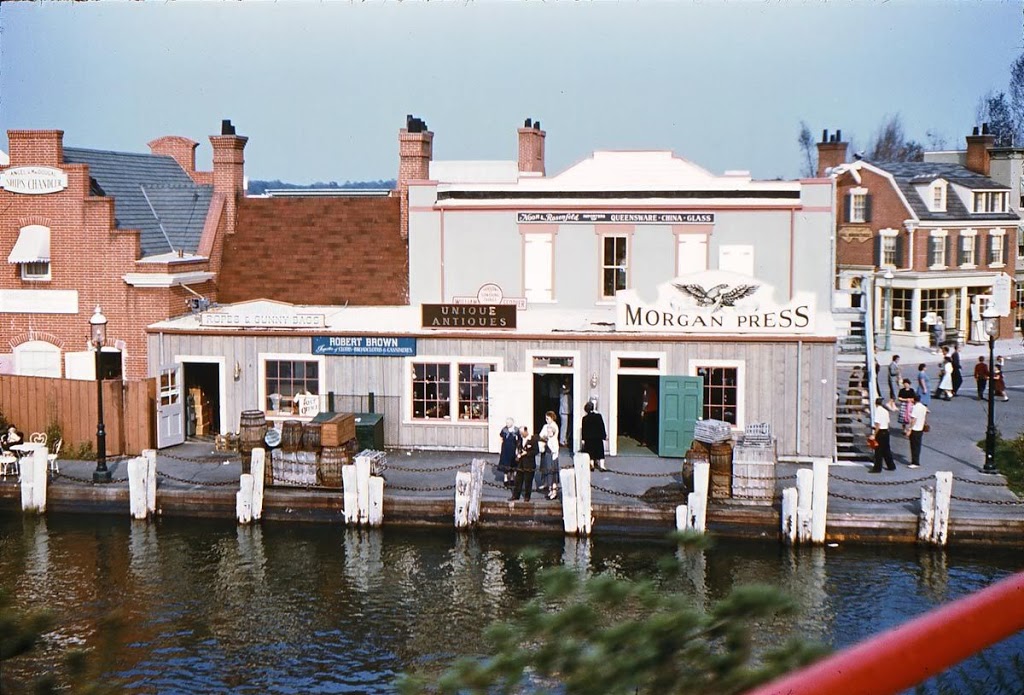
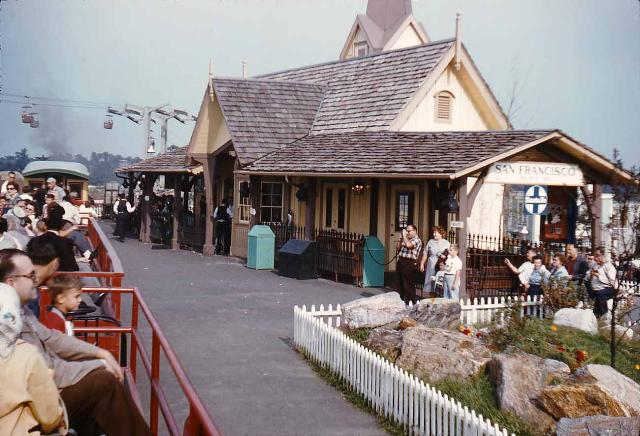
San Francisco in the Bronx, a Disney-like village served by the Santa Fe Railroad (pic courtesy Stuff From The Park)

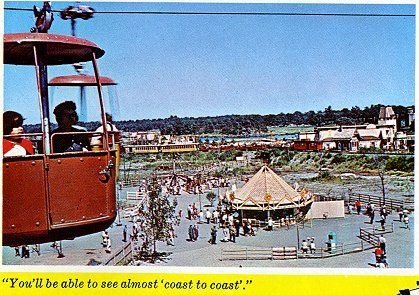
Another view of the Santa Fe (courtesty Gorillas Dont Blog)

Looking out over the ‘United States’

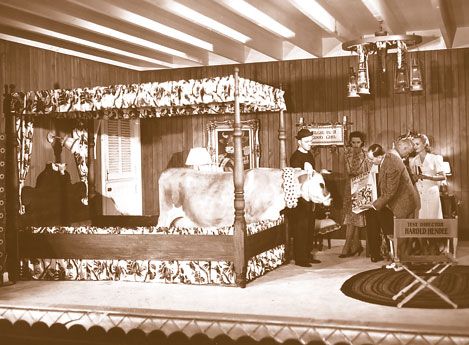
A rather blurry image — perhaps that’s best — of Borden’s Barn Boudoir, featuring the private rooms of one Elsie the Cow (Pic courtesty Benros, who has a great page on Freedomland.)

The picture below is NOT from Freedomland, but it gives you an idea of what Elsie’s bedroom might have looked like. Apparently, Bordens loved nothing more than putting their bovine mascot in this type of setting; she also had a bedroom at the World’s Fair of 1964-65 in Flushing Meadows, most likely transported from the failing Freedomland attraction.

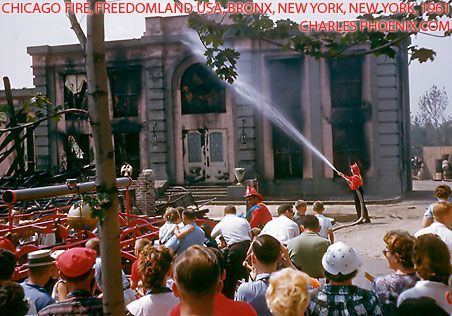
Why people are so entertained by this, I’ll never understand. But if fire was your game, Freedomland let you enjoy the re-burning of Chicago every day. And sometimes, the firemen actors would grab volunteers to help put out the blaze! (Pic courtesy God Bless Americana)

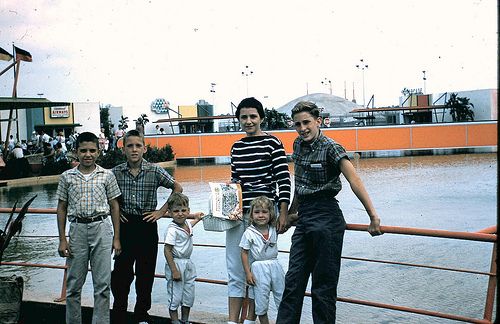
Freedomland was perpetually in debt and often a great inconvenience with long lines and unfinished rides. This family, visiting in July 1960, doesn’t seem to mind. (Flickr)

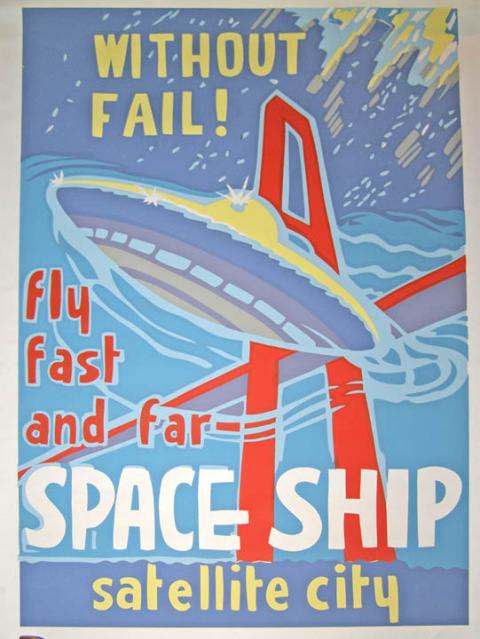
A promotional poster for Freedomland’s futuristic Satellite City, which wasn’t opened for a few days after the park’s opening, by which time crowds had died off considerably. (Pic courtesy Perky Pickle, who has other great poster images from the park’s heyday.)

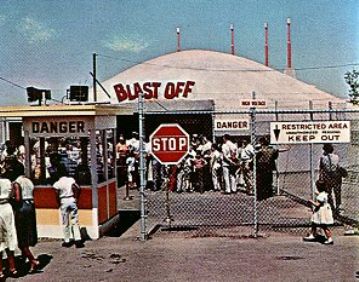
This frightening little attraction was the Blast-Off Bunker, because there’s nothing more fun than hanging out in a dark bunker on a nice summer’s day. In fact, inside you could enjoy the ‘tense excitement’ of a Cape Canaveral control room.

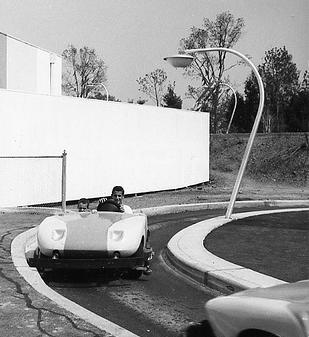
You could experience the joys of riding a ‘modern automobile’ in Freedomland’s knockoff future land. A sad way of marketing a go-cart, but at least this picture is pretty great. (Courtesy Flickr)

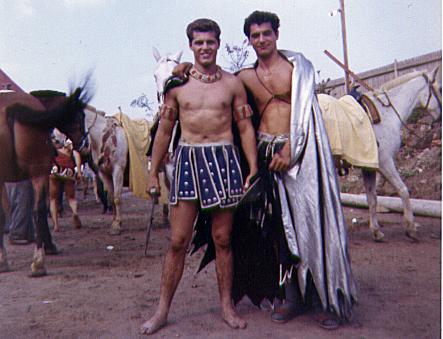
Freedomland was more than happy to abandon its themes if it meant more paying customers. Here are two stunt men from a ‘Colossus’ spectacular in 1961. (Benros)

Some detailing from a Freedomland souvenir fan, featuring a map of the park on one side, and beer advertisement on the other. This was, after all, a ‘family entertainment center.’ (Click it for a closer look.)

Freedomland was replaced by another oddity — the massive Co-op City, housing over 50,000 residents, and often referred to as a ‘city within a city’. Theoretically, one never need leave Co-op City.

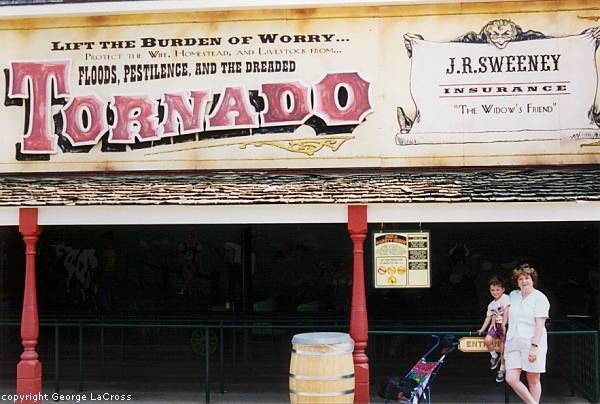
After the closing of Freedomland, some rides were rescued by other amusement parks, including the Tornado Adventure, seen here at Lake George, NY. It was eventually closed for good in 2003. If you really want to experience the delights of a tornado, you’ll have to go to the midwest! (Courtesy Laff In The Dark)

I tried to include a lot of link above to other great websites with more information on Freedomland. The most comprehensive tribute can be found on Rob Friedman’s old site on the park, with dozens of pictures, sounds and personal stories.

Any of you remember visiting this place? Leave a comment!

‘Starlight’ express: fun and death in a lost Bronx park

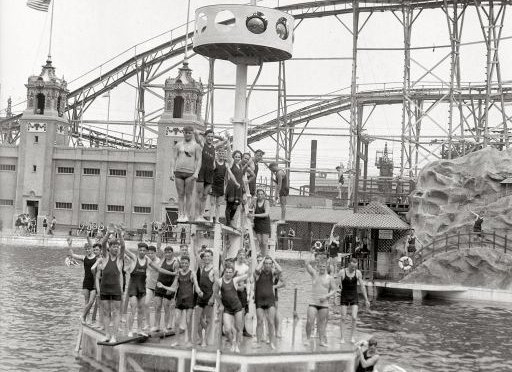
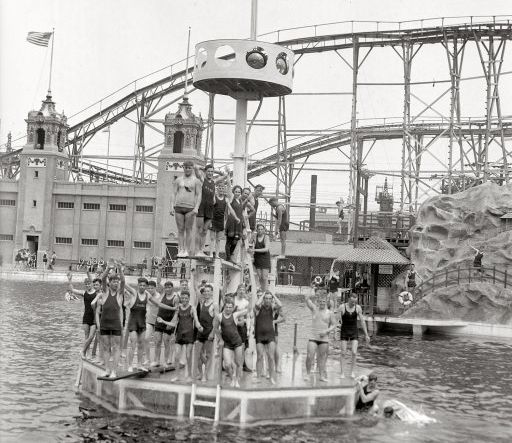
It’s raining men at Starlight Park in the Bronx, circa 1921 (photo cleaned up and courtesy of Shorpy)

For residents of the west Bronx, getting to Coney Island might have been quite a chore in 1918. So they decided to bring Coney Island to them.

I believe Starlight Park can be called the Bronx’s first amusement park. But it wasn’t the last. (More on that tomorrow.) Located on the Bronx River near the borough’s famous zoo, in the neighborhood of West Farms, it became a summer respite for residents looking for a cool swim or merely to ogle hot bodies in their revealing bathing suits (bare legs and arms!).

Similar to Flushing Meadows, Queens — which became a public park after its creation for the 1939 World’s Fair — Starlight Park also started off as a campus for a international exhibition, albeit far smaller. No one much talks about the Bronx International Exposition of Science, Arts and Industries, which opened here at 177th Street in the Bronx on June 30, 1918. The grounds, called Exposition Park, were not quite finished for the opening of the fair, which was held to “attract foreign trade to this country after the war.”

After the fair closed in November 1918, the park became the public playground Starlight Park. Just from reading about Starlight’s many amusements, it sounds like a hyper, dizzying place. Most prominent was an enormous swimming pool with faux rock features, a nearby roller coaster, your typical Coney Island-esque games and rides, boat rides, and outdoor performances by opera singers and greased up wrestlers (presumably, not all at once).

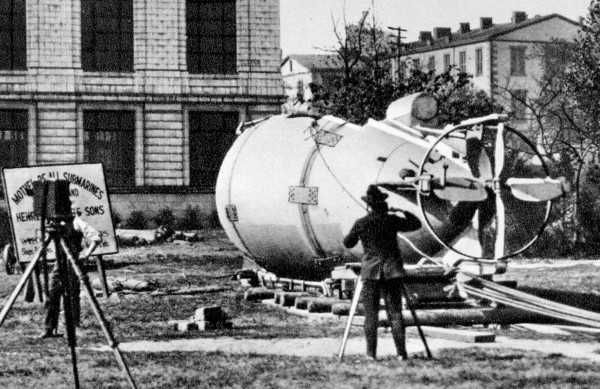
One of the park’s more popular attractions was something left over from the Expo: a small submarine called the Holland, the very first commissioned by the United States Navy. (The Holland is pictured below in its home in Philadelphia, just a couple years before being transported to the Bronx.)

Later, the park’s centerpiece was a giant stadium, built in 1928, called the Coliseum which held up to 15,000 people. They were often there to cheer on New York’s premier soccer team, the New York Giants, who made Starlight their home from 1923 to 1930.

In these heady days before safety precautions, the Starlight was also the scene of a tragic roller coaster fatality. “Somebody in a skylarking mood stood up in a seat on a roller-coaster train … and fell out as the train struck a curve on the fifty-foot level,” reports the New York Times in May 1922. “The other passengers were thrown completely out of the two-train car.”

(My favorite line of the story: “Inquiry by the police at an address noted on a card in [the victim’s] pocket failed, however, to disclose any one who knew such a person.”)

By the 1930s, most of the rides had closed, but the pool was still a popular draw. The park became a magnet for the area’s working class families, who enjoyed sunbathing, picnicking and, if they stayed after dark, moonlight dancing to live big band music. One of the very first Bronx radio station WKBQ also made Starlight its broadcasting home in 1931.

Sadly, Starlight met with a rather ignoble fate. The park was slowly demolished over the year and by 1940 it was permanently closed, transformed into a city “truck facility.” A fire in the late 1940s destroyed any remaining vestages of the park, and its memory was completely wiped away by expanses of the Cross Bronx Expressway.

You can still go to a Starlight Park in the Bronx however. Or rather, you will be able to. The current Starlight Park, nearby the original location, is closed for renovations. Look here for more information on what’s going on there and when it’s opening. But for now, leave your bathing suits at home.

And click here to see the belle of Starlight Park.

Categories
Uncategorized

Name that Neighborhood: what exactly is a Throgs Neck?


Some New York neighborhoods are simply named for their location on a map (East Village, Midtown). Others are given prefabricated designations (SoHo, DUMBO). But a few retain names that link them intimately with their pasts. Other entries in this series can be found here.

What is a Throgs Neck? And why isn’t it a Throggs Neck?

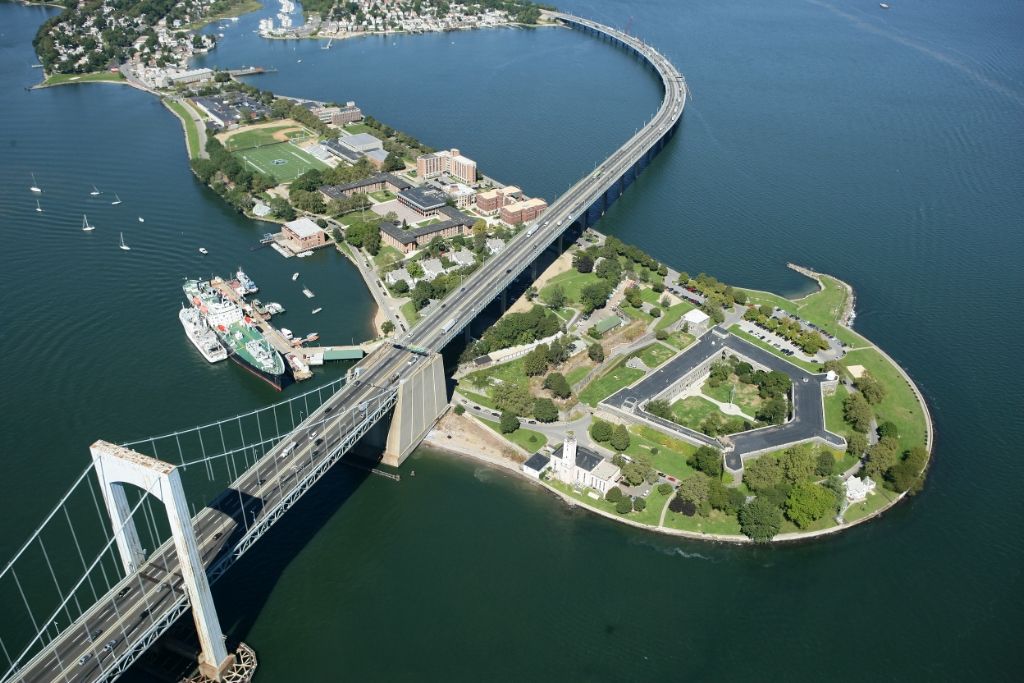
Of course that’s the name of a pleasant peninsular neighborhood in the Bronx. Many people with cars are probably as familiar with the Throgs Neck Bridge, a 1,800-foot Robert Moses/Othmar Ammann production which connects the Bronx to Queens. But where did that unusual name come from? Is a throg some kind of creature native to New England?

The “Neck” part is easy. The slender Throg’s Neck peninsula dangles where the East Rivers finally empties into the Long Island Sound. The neighborhood expands up the peninsula and out through the mainland.

For the throg, you’ll have to go back to the Dutch occupation of the region to find the answer. There was of course a contentious relationship between the Dutch and the British regarding territorial boundaries in the New World, a dispute that resulted in the eventual takeover of all Dutch lands in 1664. However, over 20 years earlier, the leader of the New Amsterdam colony, William Keift, seemed to take a more charitable view towards individual English families, especially those fleeing British rule due to religious intolerance.

The most famous of these satellite English settlements on alleged Dutch soil was that of Anne Hutchinson, a charismatic and determined leader who fled Massachusetts and Rhode Island out of religious persecution by the Puritans. Perhaps simmering with delight at Englishmen fleeing their own kind, Keift allowed Hutchinson and her flock to settle in the areas that are now called Pelham and Eastchester today. The Hutchinson River, which runs through these areas, reminds us of the impact of this ballsy lady.

Just a year earlier (1642) however, Keift allowed another persecuted religious leader to settle just downstream. The Rev. John Throggmorton (or Throgmorton or Throckmorton, take your pick, depending on which ancient document you prefer) and 35 others families were allowed to settle on this peninsula, valuable real estate if your living required contact with water, but dangerous because of the potential of being bottled in by an enemy.

The land had previously been known as Vredeland by the Dutch (or ‘land of peace’) owing to the lush natural beauty of the region. They dropped the old peaceful name and changed it to Throggmorton’s Neck.

Keift, who frequently provoked Indian anger, may have thought that additional European settlements could be used as a buffer against Lenape attacks to New Amsterdam, just 24 miles south. Eventually the Indians did attack; in one horrifying massacre on September 20, 1643, tribes exterminated the Hutchinson settlement, then traveled down to do the same to the Throggmortons. (Few in the future Bronx neighborhood escape the slaughter, including the borough’s namesake Jonas Bronck.)

Many families on Throggmorton’s Neck were brutally massacred, although a passing boat managed to rescue a few distraught family members. Strangely enough, Throggmorton himself was away that day. He never returned the area which would forever keep his name.

Within 150 years, the name would be shortened to Throgg’s Neck. Or, better yet, according to George Washington himself, “Frog’s Neck.”

You may have noticed that John’s last name has two g’s in it, while most common spellings have only one. Legend has it that this is another thing you can blame on Robert Moses. Not exactly known for reaching out to communities for their thoughts and opinions, Moses decided to drop a ‘g’ in 1955 when the bridge started construction, believing it would fit on more traffic signs without an additional and needless letter. Who cares if it was in use that way for over 300 years!

Purists prefer Throggs Neck. It is Throggs Neck. Either way, it’s an unforgettable name, with an unforgettable story.

Fall foliage freakout at two Bronx botanical gardens

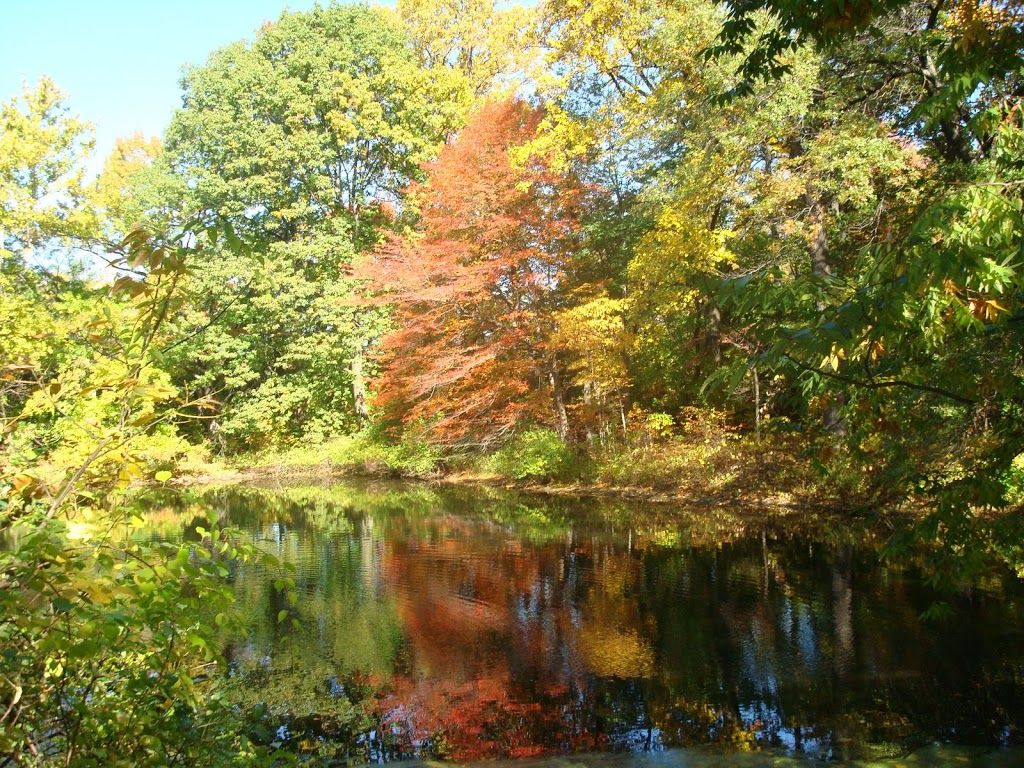
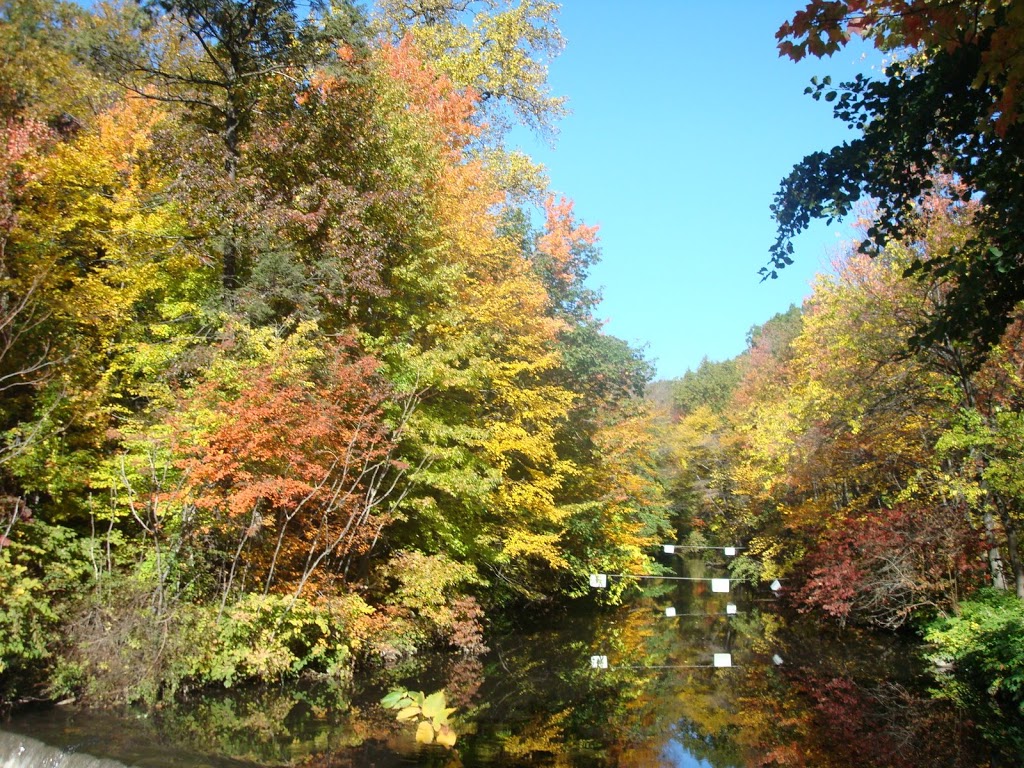
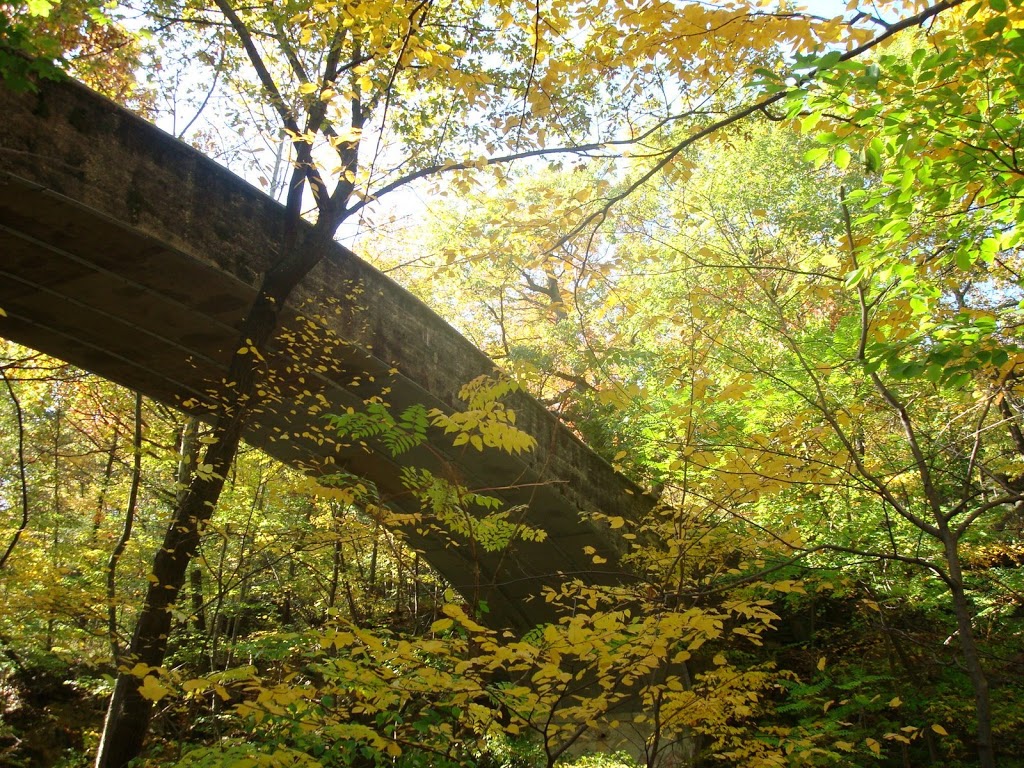
I’m skipping out on history today to give you a plain testimonial: if you’re craving a flashy autumn show courtesy of Mother Nature, the time is ripe to visit two lovely Bronx institutions in the throes of fall foliage madness. If you can’t actually get out of the city but need some seasonal therapy, both of these options are available via the subway.

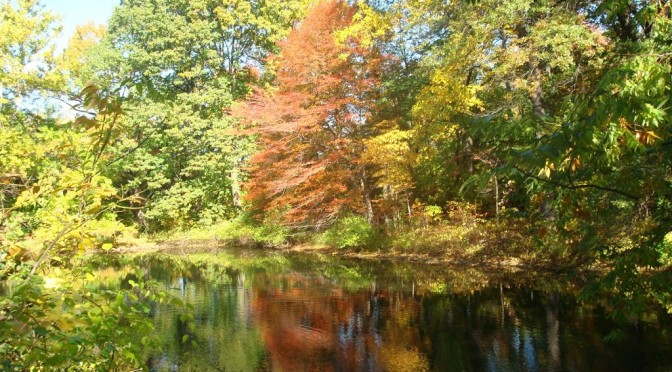
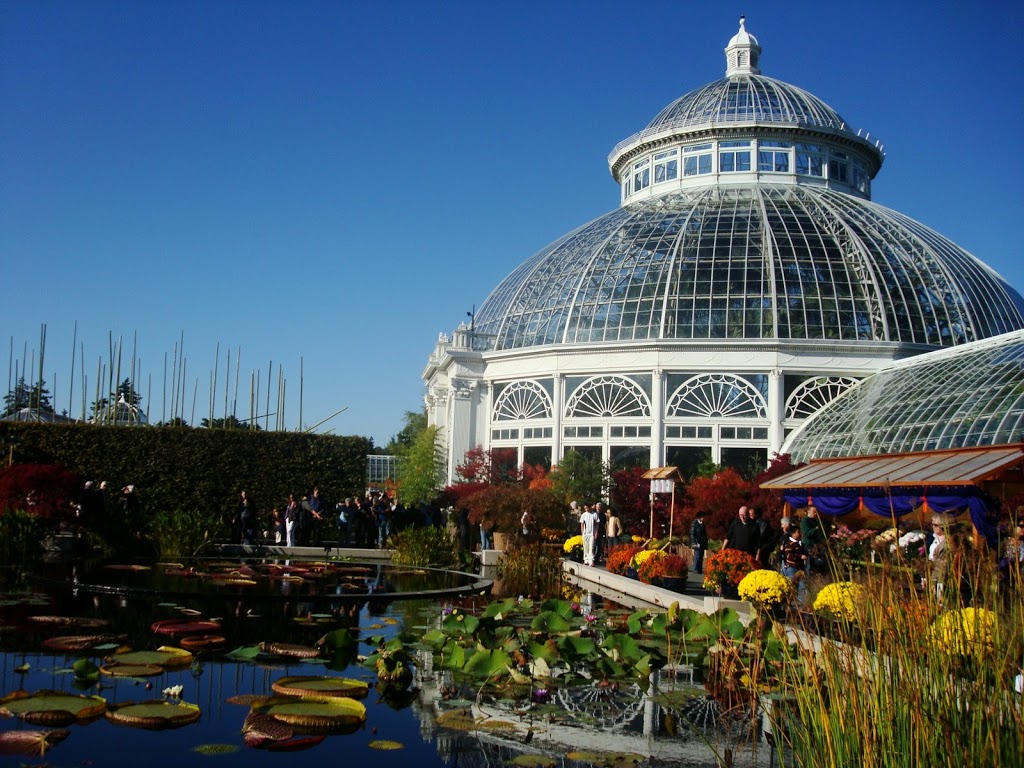
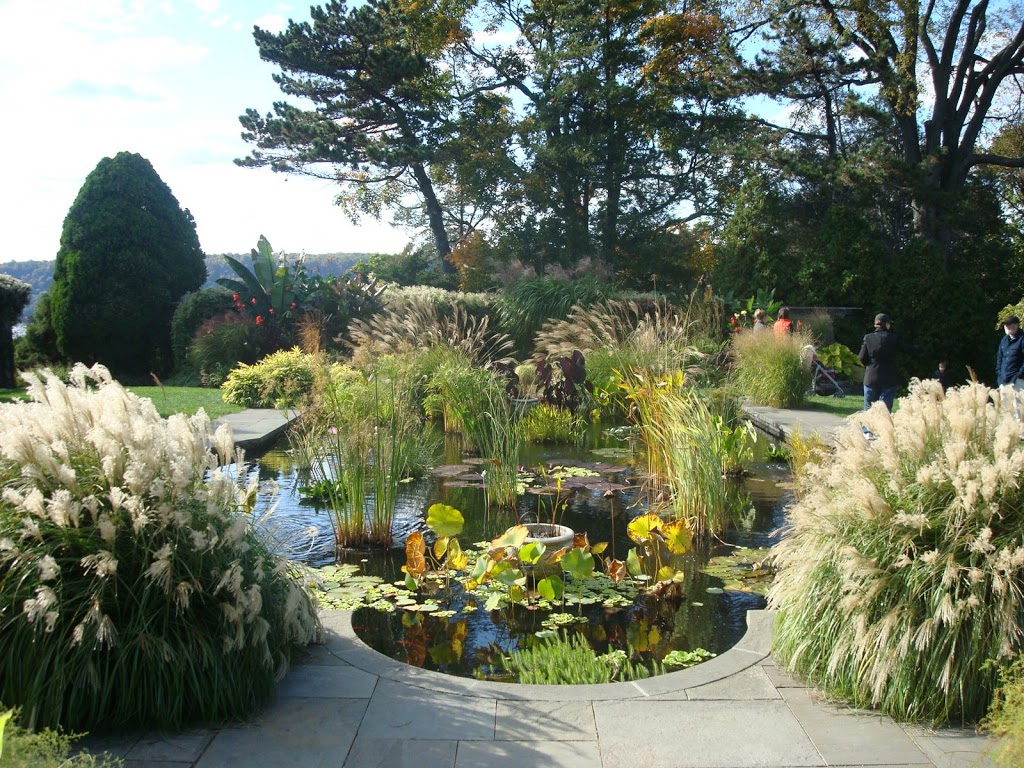
The New York Botanical Garden is currently in the throes of an amazing fall transformation. Although they currently have enormous Henry Moore sculptures scattered throughout the park, more striking art hangs on the trees in the Native Forest section, particularly those hugging the shoreline of the Bronx River:

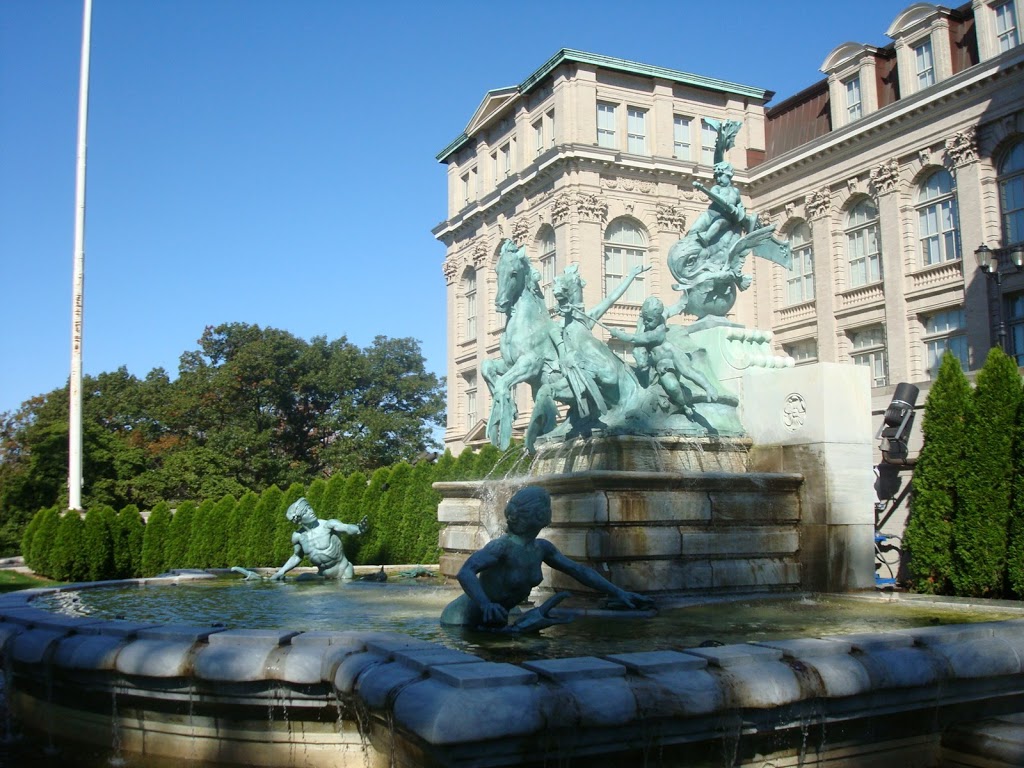
Botanical gardens are odd things in the fall. While some blooms are clearly out of seasons (the rose garden is a little sad this time of year), other sections are clearly just getting started. And if you can’t find enough to see and do outdoors, there’s always the lawn of Mertz Library, a veritable Beaux-Arts indulgance in the form of its Italian style fountain:

Meanwhile, at the theatrical Haupt Conservatory, the garden is presenting a fantastic Japanese kiku (chrysanthemum) show, which displays the more acrobatic and colorful traits of this popular flower:

The garden even has a map that tracks the projected leaf-changing time of various trees in the park. You can get to the New York Botanical Garden easily by the B and D subway lines, or on Metro-North (the preferred method).

Wave Hill is a little trickier. Taking the 1 train to its final stop (Van Cortlandt Park at 242nd Street), cross the street and hang out in front of Burger King, where a Wave Hill shuttle comes back even hour at ten minutes past the hours. Personally, having to meet in front of a fast food restaurant for a bus gives the whole occasion a decidedly high-school-field-trip feel.

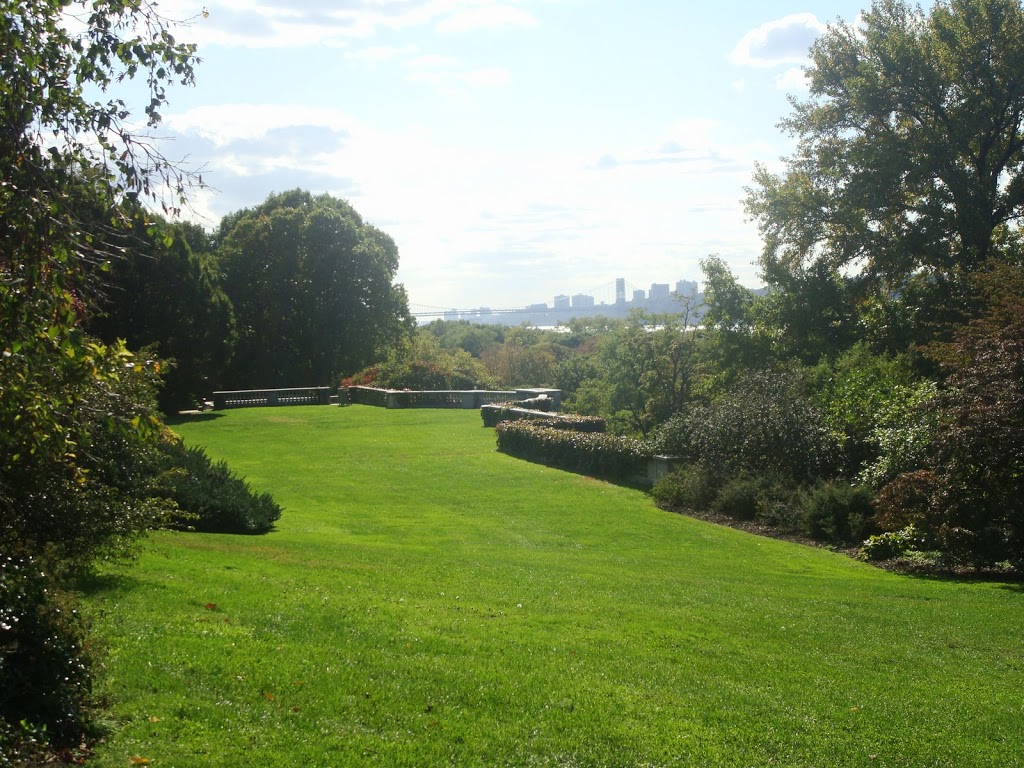
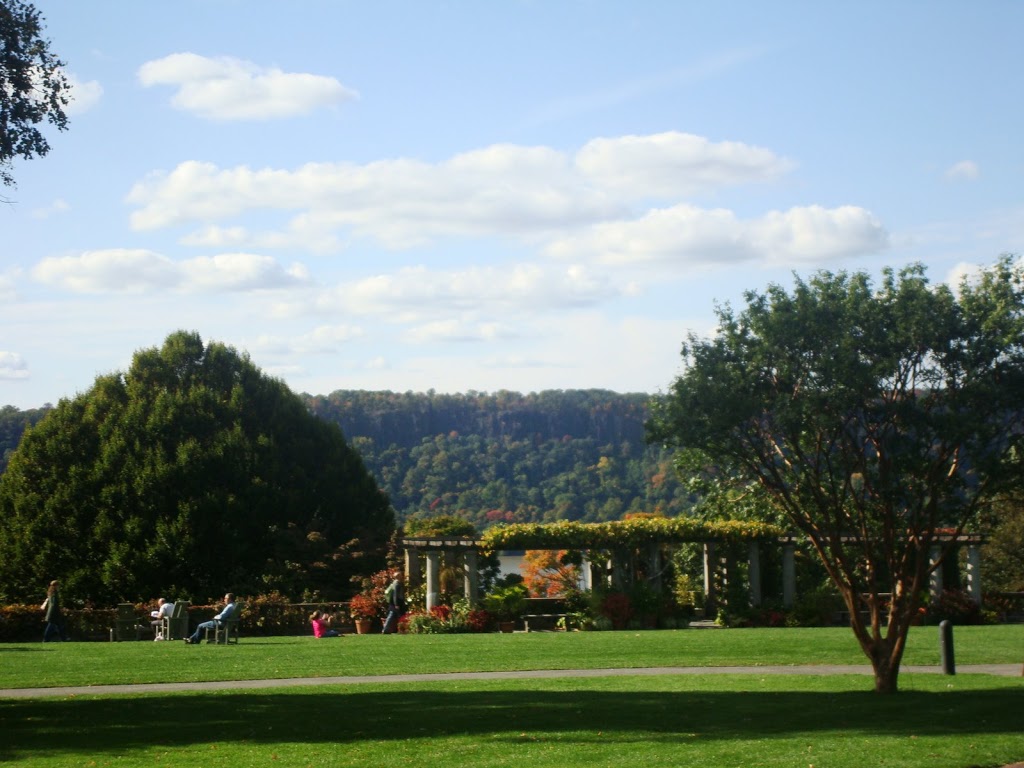
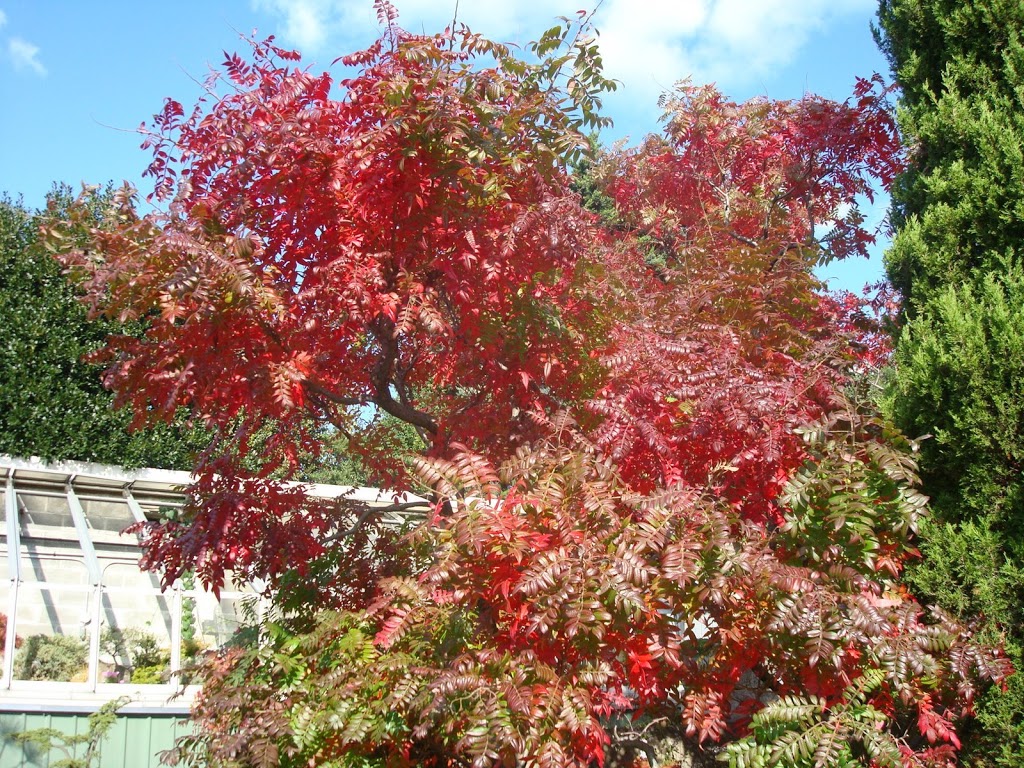
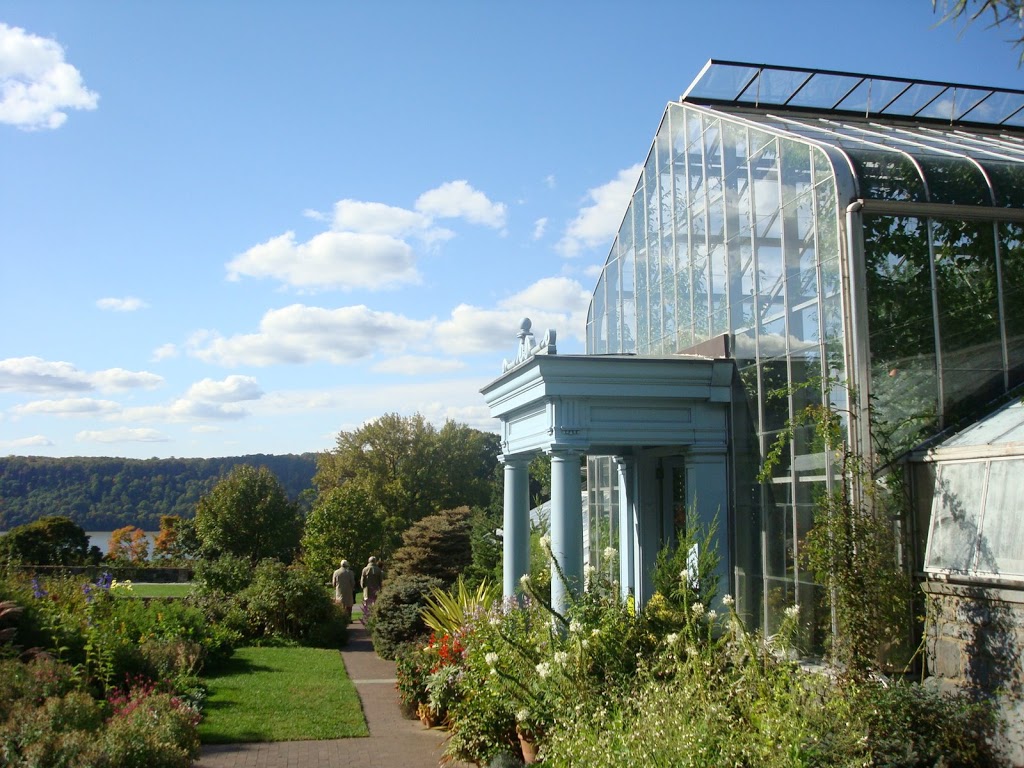
It’s one-tenth the size of the New York’s official botanical garden, far more remote and tinier gardens. However, Wave Hill has one crucial element that the Botanical Garden doesn’t have: crazy views of the Hudson River

The 19th century manor at Wave Hill served as an oasis for everybody from Mark Twain to Theodore Roosevelt. Today the home is a cultural center with photo galleries, art exhibits and children’s programs throughout the year.

Check out the official websites of both the New York Botanical Garden and Wave Hill for more details on hours and special programs. Back to normal history stuff tomorrow….

(Click on all pictures above for larger views)

Know Your Mayors: Hugh Grant, our youngest mayor

Our modest little series about some of the greatest, notorious, most important, even most useless, mayors of New York City. Other entrants in our mayoral survey can be found here.

The year Carnegie opened his illustrious Music Hall to the delight of New York’s cultured class, the city’s fate was in the hands of the youngest man ever elected to the office of mayor — Hugh J. Grant.

Although there would later be a man elected to job unofficially called ‘The Boy Mayor of New York’, Grant would be 31 years old when he finally stepped into the job. A stalwart of the Tammany Hall machine, the young Irish-Catholic worked his way through the ranks, from alderman in 1882 to sheriff in 1885 and graduated from there to mayor in 1889, where he stayed in office for two two-yera terms until 1892.

Grant was defeated in earlier attempts for mayor by businessman and reform Democrat William Grace. When Grant ran again in late ’88, he successfully defeated Abram Hewitt, thanks to the machinations of new Tammany ‘Boss’ Richard Crocker, who had personally grown weary of Hewitt’s independence. Grant would be a far less wily pawn.

At this point, I should quote at length the unreliable and heavily biased but enjoyable description of Grant, according to a 1922 chronicle: “Unfortunately in 1888 Hewitt was defeated by the old Tammany favorite, “Hughie” Grant, and corruptions returned to their former power and spoils. Worst of all, Grant’s election was accepted without alarm, and even with satisfaction, by the educated classes.

“The new Mayor, an ignorant and unprincipled son of a saloon-keeper, was given ‘social recognition,’ asked to dinner in the best circles, and opened a ball with Mrs. Astor. When he said, “If I don’t prove a good Mayor, it will be because I don’t know how,” this remark was repeated as if it were a gem of aphoristic wisdom.”

Grant was a Tammany loyalist, and enemies sniped that his administration hemmed in spirit to the corruption of the Tweed Ring, which had been taken apart twenty years earlier. It is true that the ‘tacit alliance of Tammany, business and underworld went unchallenged‘ under Grant’s hardly watchful eye; however, great city improvements developed rapidly under his administration.

Despite a state legislature probe into rampant city corruption, Grant was easily reelected in 1890.

Grant most notably attempted — and failed — to snag the 1892 World’s Fair for New York which he would have planted on the northern edge of Central Park. Instead, the fair was awarded to Chicago, to become the legendary 1893 World’s Columbian Exposition, or the fair of the White City.

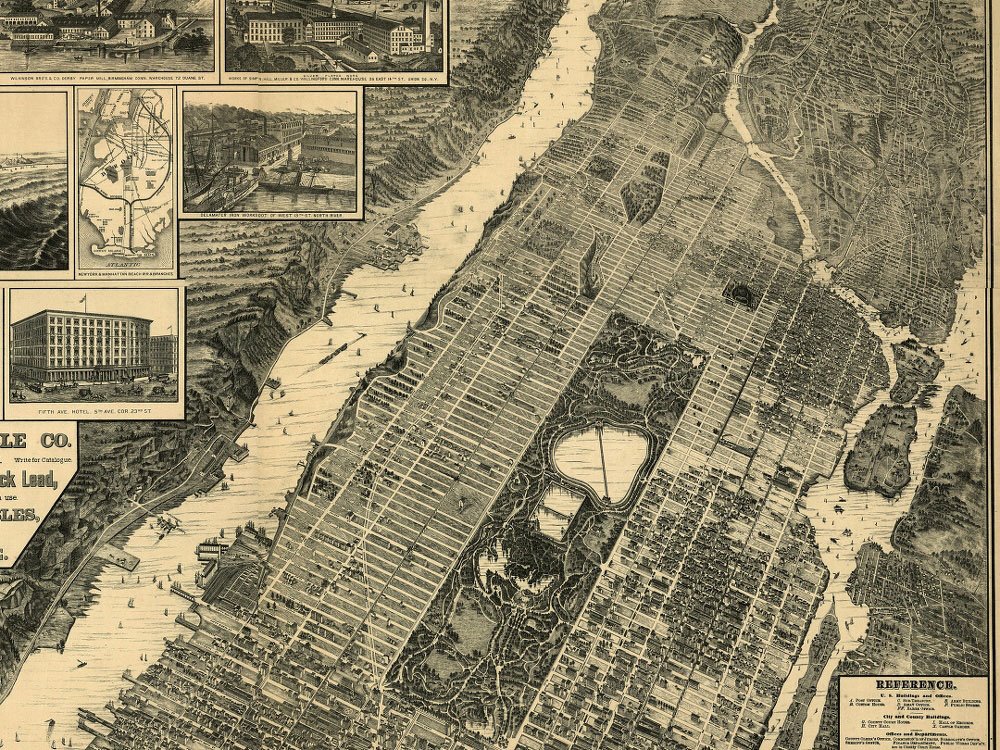
Below: an illustration of northern Manhattan, 1879 (Pic courtesy Times Up)

The city’s decisions regarding lands that would become the Bronx would also stir up a controversy. Despite technically being outside New York’s jurisdiction, development of the Bronx flourished in the 1870s. New York was powerful enough to exert its influence here, acquiring some areas as early as 1873. By 1895, most of the Bronx would belong to New York.

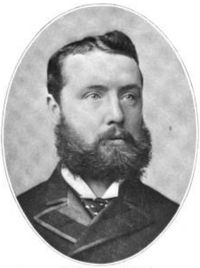
Andrew Haswell Green (pictured right), the influential parks commissioner and proto-Robert Moses who had once bunted Fredrick Law Olmstead from his own Central Park project, exerted great powers in developing outlying regions of Manhattan and had even proposed New York consolidation with the future boroughs long before 1898. Green would grow to become one of the most influential men in 19th century New York. In fact, Green had assisted close friend Samuel Tilden in taking down the Tweed Ring.

Grant was skeptical of these expansion plans, seeing developments of these outlying regions as pointless costly money pits. Like many under the thumb of Tammany Hall, he also disdained the state’s involvement in city affairs. Regardless, areas which became Van Cortlandt Park and Pelham Bay Park were bought during his tenure and today a small park in the Bronx is named in his honor. As New York Parks Department cheekily notes “Grant may be the only person who fought against parks who nonetheless has a park named after him.”

He didn’t resist another innovation that would soon change the fate of New York. Grant would be the first mayor to appoint a “rapid transit commission” in 1890 to develop a subway system.

Grant would pass off the mayor’s seat to another Tammany man, Thomas Gilroy, in 1892.

USELESS TRIVIA OF THE DAY: Hugh Grant isn’t the only New York mayor who shares his name with well-known 20th Century pop culture figures. Joining him in this lofty honor is Robert Wagner, James (Jimmy) Walker and David (Dave) Matthews.