New York transit system stymied by women’s skirt styles

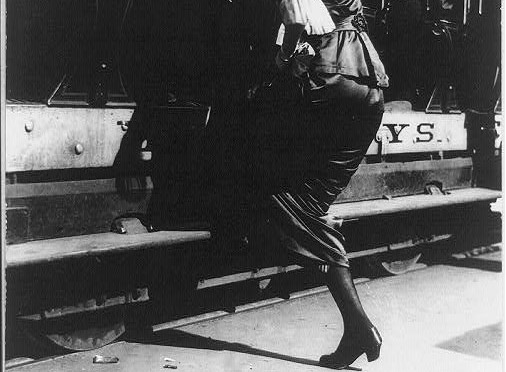
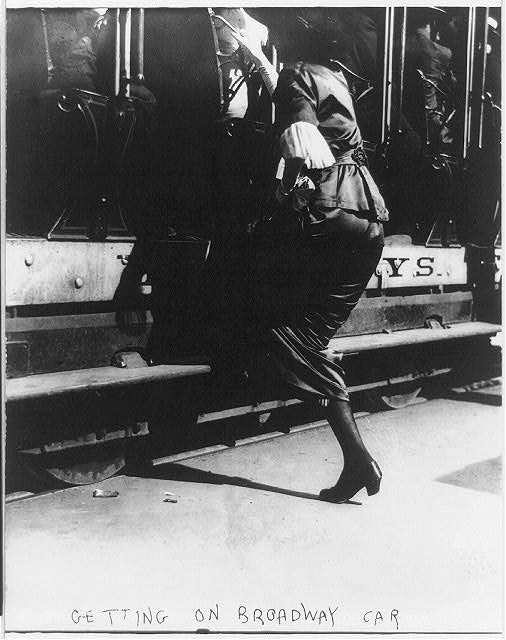
A lady in a relatively normal skirt boards a Broadway streetcar in July 1913. Now imagine trying this in a hobble skirt! (Courtesy Library of Congress)
A serious cry (mostly from men) rang out through the city one hundred years ago about the ever-expanding transit system and the scandalous style of women’s skirts. Were frocks getting caught in doorways? Were dress lengths causing women fall down stairs?

Perhaps, but that wasn’t the issue. The latest fashion trend, the hobble skirt, was slowing the progress of women onto and off of streetcars, causing frustrating delays.

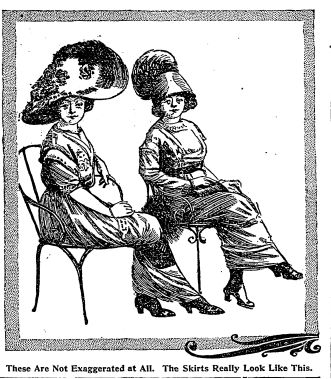
The Parisian-style hobble skirt, with its bunched hem near the bottom to create a mermaid-like appearance, made its appearance on New York streets in the early 1910s. The new gowns required ladies to walk more elegantly and, thus, more slowly, a throwback to the Victorian gait. “[T]he mannish stride of the women of today was taken for granted as a permanent thing. Nobody expected it to change, for nobody saw the hobble skirt on the horizon.” [New York Times, January 1912]

Above: Some sass from the Times fashion pages, June 12, 1910

After a millenia of unfettered skirts, this new silhouette must have seemed positively strange to elder fashionistas.

“‘The hobble’ is the latest freak in women’s fashions,” warned the Times upon their arrival in 1910.  “The hobble skirt suits none. But many, too many, women will wear what the fashion authorities decree.”

Aesthetics aside, the hobble skirt created a practical problem. While measured, graceful walking might be fine on Ladies Mile or strolling along Fifth Avenue, it was an encumbrance upon the ever-moving streetcar system.

An executive of the Interborough Transit System (New York’s first subway operator) grumbled to the Evening World in 1912 about the extra burden the hobble skirt created upon city transportation and called for the fashion trend to be abolished.
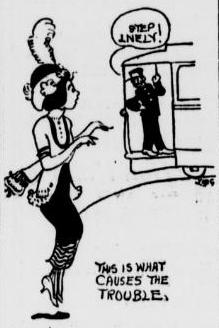
“Often hundreds of people will be forced to stand aside patiently waiting for some women to raise her skirts sufficiently to allow her to step into the car,” said George Keegan, general superintendent.

A special ‘step-less’ car had even been designed with the fashionable lady in mind. The first of these “hobble-skirt, hygenic, fool proof” cars debuted on the streets of New York in the spring of 1912.

Meanwhile, underground, fashionable ladies were finding difficulty clearing the gap between the platform and subway cars. “Nearly all of the accidents in the subway are due to the fact that women wear hobble skirts,” said Keegan, a claim which could not possibly have been true.

The Pennsylvania Railroad, fearful of complaints and potential lawsuits, acted upon the crisis the following year by requiring train conductors to note skirt styles and “height of heel” and report all data to their central office. “If women passengers on the Pennsylvania Railroad insist on wearing such mantraps, or rather womantraps, as hobble skirts and high heels they cannot hold this company responsible for accidents which may happen to them,” claimed the railroad.

But all these railroad executives really needed to do was simply wait — trends subside, to replaced with other, more objectionable wear.

By the time Mr. Keegan was complaining about the hobble skirt, the Evening World fashion section was already clutching its pearls in disbelief about another fashion abomination. “The high note of feminine folly has been struck.  The harem skirt is to succeed the hobbled horror which has made women hideous and ridiculous during the past year.”

But, leaving taste aside, at least you could ride the subway in a harem skirt!

Illustration above is from the August 9, 1912 edition of the Evening World which accompanied the Keegan article
Thank you, Tooth Brush Lady! Newsies get their teeth fixed

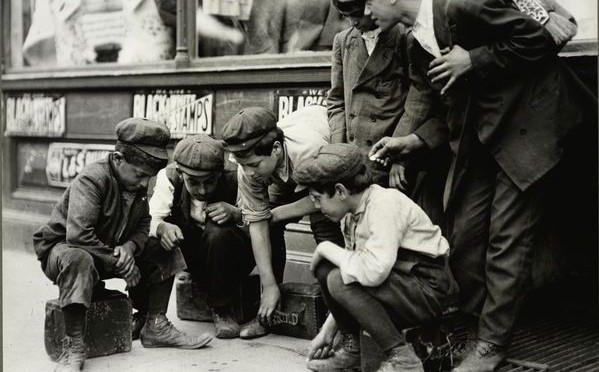
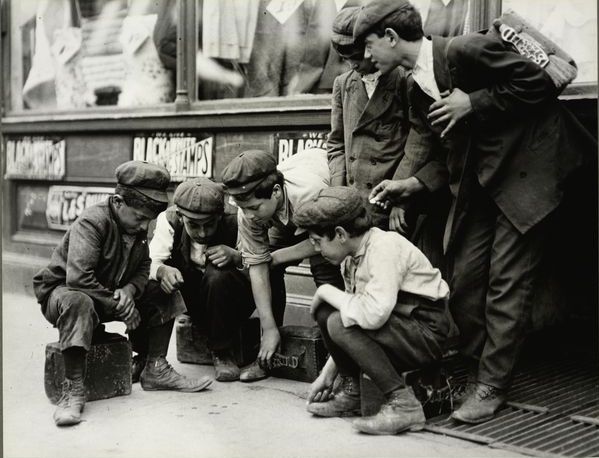
Above: Newsboys and bootblacks playing craps, photographed by Lewis Hines in 1912.  Some of these were most likely recipients of free dental care, provided at the Second Avenue newsie’s lodging house in that year by the Society of Good Cheer.

Newsboys with poor teeth one hundred years ago — I’m guessing this would be most of them — had something to smile about in 1912 in the form of Miss Theora Carter and the Society of Good Cheer.

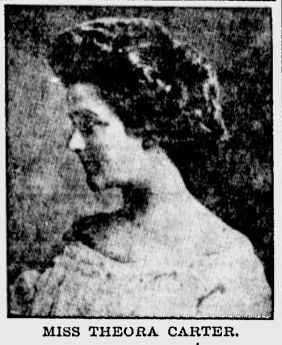
Miss Carter, a native of Seattle, was an inventive social activist and lecturer, focusing on generating an overall sense of good will among the poorest in New York, uplift and cleanliness as a way of promoting health.  An “advocate of good cheer” and a woman of “ample income“, Carter moved to New York and formed the Society of Good Cheer as a method of spreading healthful calm and tranquility. Joining her at the Society’s headquarters at 258 West 74th Street on the Upper West Side were two dozen like-minded young women, many of whom lived at that address. (Carter may also have lived here, although one news clipping claimed she lived in Park Slope.)

At right: A photo of Miss Carter from a Toledo newspaper [source]

The ladies of the Society of Good Cheer canvassed New York’s many hospitals, “seek[ing] out those patients with few or no friends and cheer[ing] them up by reading or talking to them.” During the holidays, the Society provided homes and hospital rooms in New York and Boston with Christmas trees; in many ways, Miss Carter’s holiday work might have inspired another society lady, Emilie Herreshoff, when she provided Madison Square with the very first public Christmas tree in 1912


In 1911, Carter expanded their crusade to noise prevention. After all, the streets were now rapidly filling with automobiles, adding to the noise of streetcars and elevated trains. She focused her wrath at noisemakers outside of children’s hospitals, handing out “cards of human appeal” to “truck drivers, the drivers of automobiles and other noise-making vehicles.” [source]


The following year, inspired by her noise-squelching hospital visits, Miss Carter turned her attentions to the orthodontic needs of poor children, in particular, the many thousands of newsies. ‘The upbuilding of character and the overcoming of physical imperfections through remedying irregularities of children’s teeth’ was Miss Carter’s stated goal. Another article further described her intentions as “good teeth, clean teeth and straight teeth.”


The Childrens Aid Society was already providing free dental inspections to hundreds of children by this time,  so Miss Carter decided to focus one some of the most neglected, most independently minded children, the inhabitants of the Newsboys Home at 170 Second Avenue (at 11th Street). A New York Times editorial from July10, 1912, proclaimed that ‘the teeth, jaws and mouths of some 2,000 newsboys’ would benefit from the new clinic.

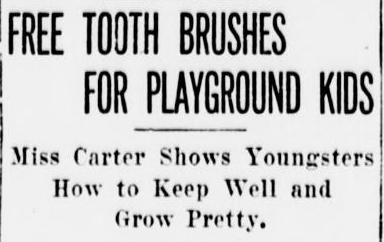
Above: A headline from the New York Sun, September 28, 1912

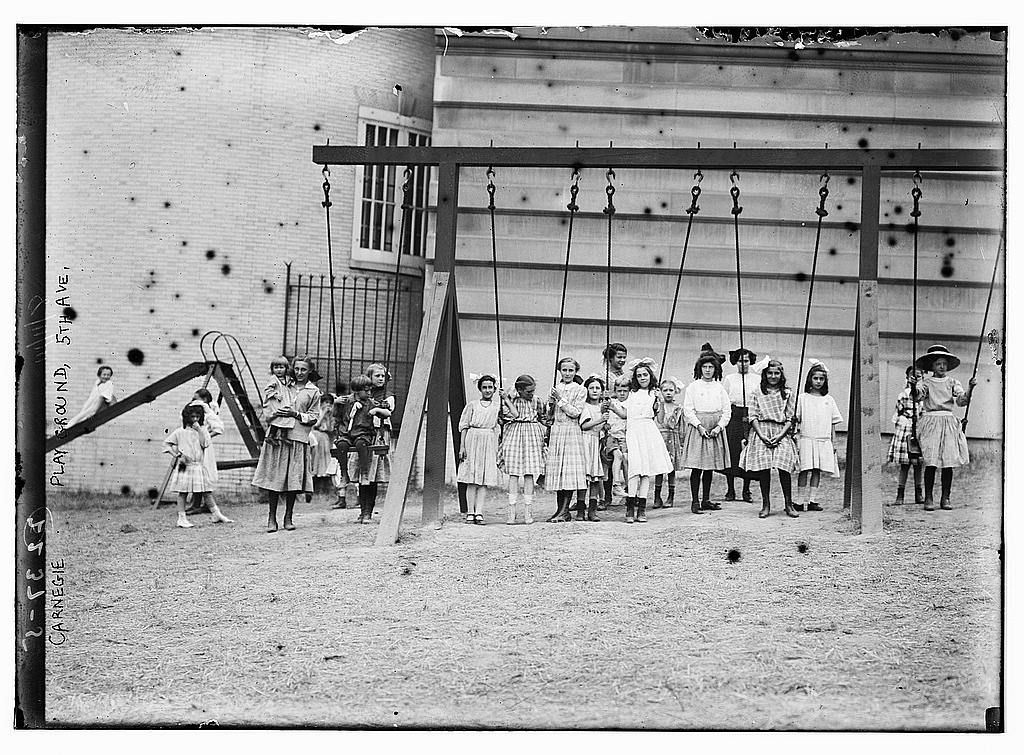
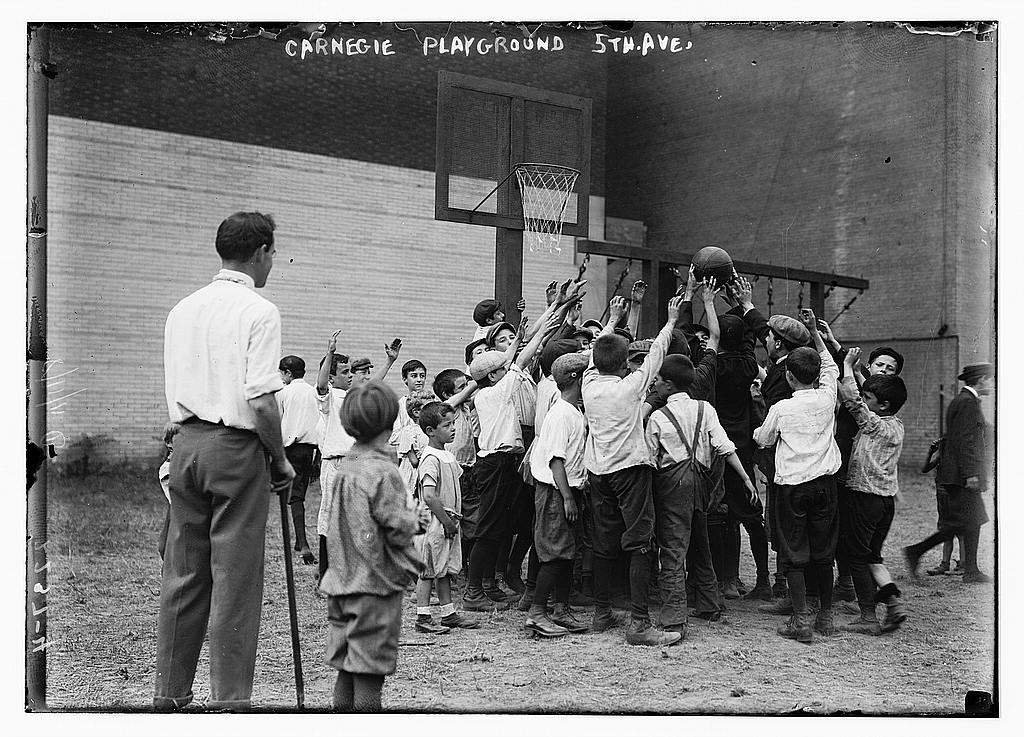
Carter, now fully invested in children’s dental practices, lectured to children on the Carnegie Playground at 91st Street and Fifth Avenue (near the palatial mansion of Andrew Carnegie), providing them with free toothbrushes while underscoring the social advantages of a healthy mouth. “[Y]ou see if you want to be good looking you must clean your teeth.” [source]

Miss Carter, known as the Tooth Brush Lady or ‘the Apostle of the Toothbrush‘, spent the next decade treating New York’s youngest unfortunates to her trademark ‘good cheer’. In 1916, the Society brought Christmas presents to the infirm young patients at the Hospital For Ruptured And Crippled Children — yes, that was its actual name — at 321 East 42nd Street (where the Ford Foundation stands today).

The New York Sun gives an interesting description of the ravishing Miss Carter: “She is slim and svelte, with dusky hair, big hazel eyes and a perfectly straight nose.”

Apparently the Society was so successful that Miss Carter formed a junior off-shoot in Brooklyn called the Little Cheerfuls, which allowed young children from wealthier households to help in the spreading of ‘good cheer’ in local hospitals.

By the way, I have officially fallen in love with Miss Theora Carter.

Below: Children at the Carnegie Playground at 91st and Fifth Avenue. It’s likely that these photographs were taken during Miss Carter’s visit to the playground, as news reports all state that photographers were present during her visit.

Photos courtesy the Library of Congress

Beware the New York vampires: A seductive film star inspires an army of ‘golden haired’ Broadway sex goddesses

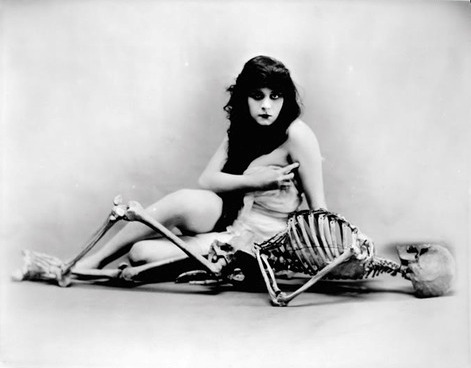
 Maneater: Theda Bara in an unconventional portrait. Her publicist claimed it was her lover and that ‘not even the grave could separate them’.


“A vampire is a good woman with a bad reputation, or rather a good woman who has had possibilities and wasted them” — Florenz Ziegfeld

Progressive, liberated women were clearly so frightening one hundred years ago that equating them to undead, bloodthirsty creatures borne of Satan didn’t seem so unusual.

In the late 1910s, women were on the verge of winning the right for equal representation in the voting booth. Women were asserting power in unions, and, in the wake of disasters like the Triangle Factory Fire, those unions were influencing government policy. They were taking control of their destinies, their fortunes, even their sexuality (Margaret Sanger‘s first birth control clinic opened in 1916).

This surging independence came just as the entertainment industry heralded the female form as one of its primary attractions. Ziegfeld’s sassy, flesh-filled Follies — and its many imitators — defined the Broadway stage, mixing  music, sex and glamour with a morality-shattering frankness.

But it was the birth of motion pictures that gave the allure of female bodies an unearthly, flickering glow, as nickelodeon shorts became feature-length films, and the first era of the movie siren was born.

Combine the power of liberation with the erotic potential of cinema, and in the late 1910s, you got the vampire (or as we would come to know, the ‘vamp’).

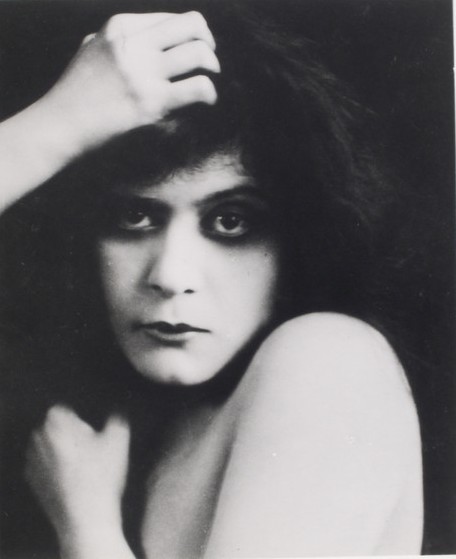
The queen of the vamps was one of America’s most mysterious movie stars — Theda Bara (at left). The magnetic actress, with her steely gaze and jetblack hair, was the prototype for a movie bad girl. She shook convention so dramatically that a critic called her a “flaming comet of the cinema firmament.”

From 1915-1919, she made over three dozen films, most in movie studios located in Fort Lee, New Jersey. It were here that she acquired her famous nickname, based upon her role as a home wrecker in a film inspired by Rudyard Kipling’s ‘The Vampire’. During this period, Bara lived in Manhattan’s Gramercy Park with her family — at 132 E. 19th Street.

She put a face to a new sort of young lady. These were the spiritual children of the prior generation of newly empowered women who fought against the constraints of Victorian society. A few years later, as another vein of female power (the temperance movement) helped bring about Prohibition, these young women would be called flappers, carefree and fueled on the powers of jazz and illegal alcohol.

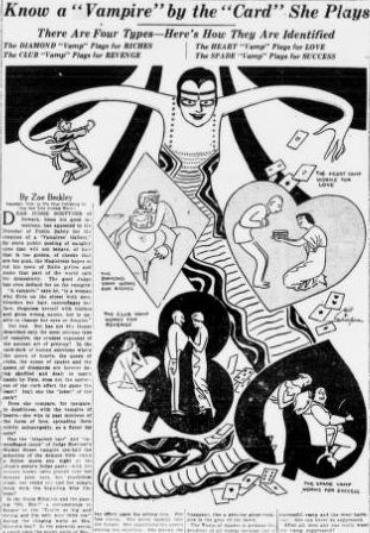
But to the established class, these ladies weren’t trend-setters. They were devils in black gowns. ‘Know a ‘Vampire’ by the Card She Plays‘, warned a New York Evening World article from March 1919, accompanied by a Theda Bara-like illustration of a snake-like monster.

The article recounts the efforts of a Newark judge attempting the rid the streets of “flirty girlies,” as he called them. “A vampire is a woman who flirts on the street with men, bleaches her hair, camouflages her face, disguises herself with clothes and gives wrong names, but is unable to change her eyes or dimples.” The article laughs off his puny efforts. “Can vamps, of whatever sort, BE suppressed?”

Vampires were of course more readily seen in Times Square, dancers, actresses or cabaret stars. But even your stenographer could be one!, warned one article.

Unlike Bara’s iconic identity as a raven-locked seductress, most ‘real’ vampires were blondes. “[T]he vampire of real life hath the golden hair of an angel, which is never disarranged, same when she letteth it down, to DISPLAY it, on the beach,” warned columnist Helen Rowland, with a little tongue in cheek. (Ms. Rowland was famous for her writings as a ‘bachelor girl’.)

“No one ever saw a vampire in a high neck dress,” said an Evening World advice columnist in 1918. “All vampires must reveal their collar-bones and the contiguous territory.”

The woman vampire was an urban creature, up all night, sleeping all the day. The city was partial cause for her condition. As the New York Times suggested in 1920, “The idea of New York as a vampire to the rest of the country is one which a number of persons have entertained and expressed. To some of them the vampire is Wall Street, to others it is the region of white lights [Broadway].”

Many actress got stuck with the term ‘vamp’ or ‘baby vampire’ — or else, embraced the coy terminology. Juliette Day was a known ‘baby vampire’ for her role in the scandalous 1916 play ‘Upstairs and Down’. It’s no surprise that in the film version from 1919, the role is reprised by the notorious Olive Thomas, a Ziegfeld girl who met a bitter end the following year.

Some actress fought against the alleged stigma. Actress Clara Joel, playing a vampire-type role in a 1918 film, made it known in the Tribune that “she is not a vampire and that she was born in Jersey City.”

The irony of stage actresses trying to shed a vampire image is that Theda Bara, the original vampire, in her first stage attempt in 1920, flopped. The play was supernatural-themed ‘The Blue Flame‘ which opened at the Shubert Theater to cavalcades of unintentional laughter.(A ‘terrible thing’, according to the Times critic.) Bara, who had to deliver such lines as “Did you remember to bring the cocaine?” was roundly trashed.

Shortly thereafter, the vampire moved to Los Angeles. Her film career lasted a few more years, but sound pictures and a strict Hollywood production code pretty much eradicated the existence of vamps on the screen. In New York, meanwhile, her sultry spawn morphed into flappers, populating the speakeasies and cabaret nightclubs of the city.

Below: A 1919 romp called ‘The Vamp’ performed by the Waldorf-Astoria Orchestra

Categories
Those Were The Days

Love on the airwaves: New York’s first female radio operator

She’s not exactly a Howard Stern or a Robin Quivers, but Anna A. Nevins does deserve to be considered as something of a radio pioneer in New York.

One hundred years ago, ‘wireless telegraphy’ was mostly used to communicate with vessels crossing the Atlantic Ocean. And these weren’t signals with human voices, but rather in the dots and dashes of Morse code. Experiments with sending vocals over the airwaves were already being conducted in New York by Lee De Forest as early as 1907, but radio wouldn’t seriously be considered as a means of voice transmittal for almost another decade.

It was a tool mostly used by the U.S. Navy and commercially by the telegraph companies. It was from the ashes of a De Forest company that the United Wireless Telegraph Company was formed in 1906. It heralded dozens of receiving stations throughout the country and, in particular, three in New York. Their corporate office at 42 Broadway was one, extremely convenient to the offices of the major passenger ship lines of the Cunard (25 Broadway) and the White Star (9 Broadway). They had another out at the luxury hotel spot Manhattan Beach, Brooklyn, where some wealthy New Yorkers spent the summers.

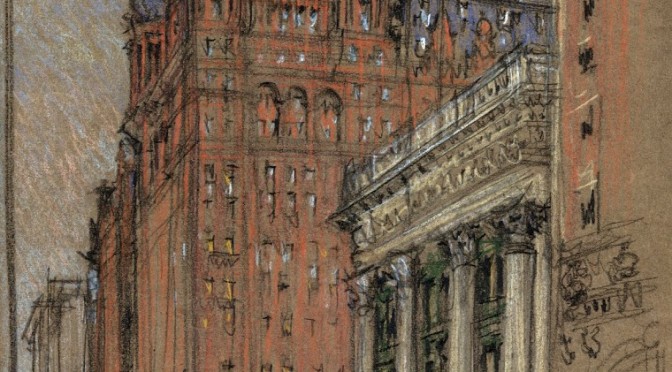
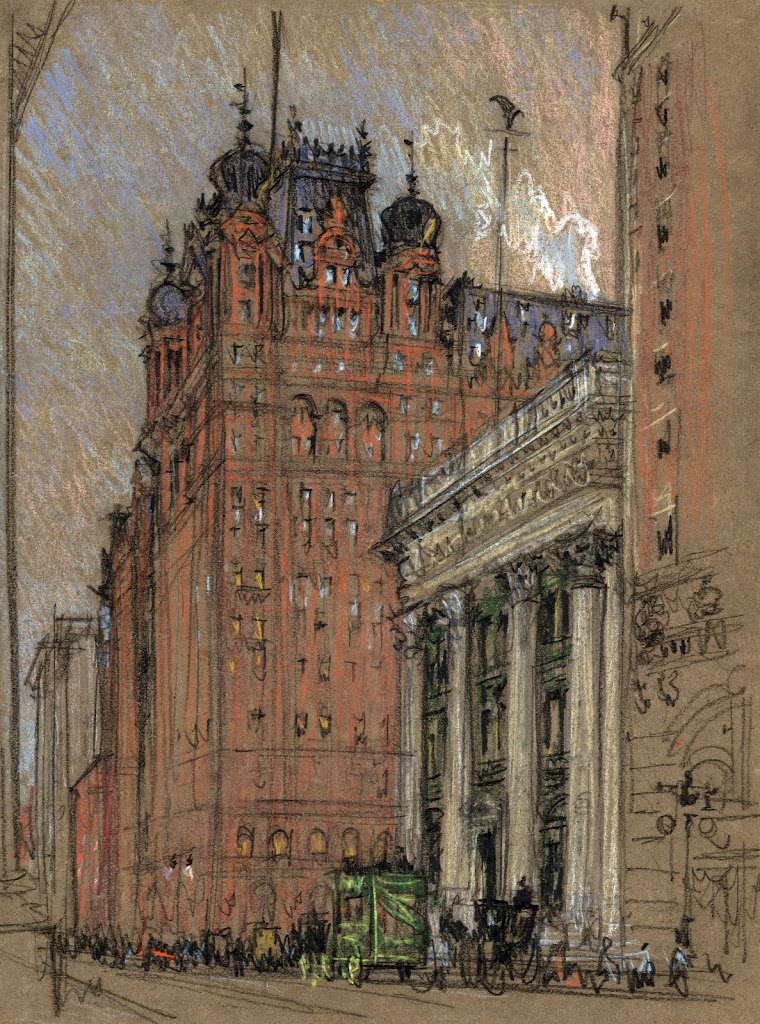
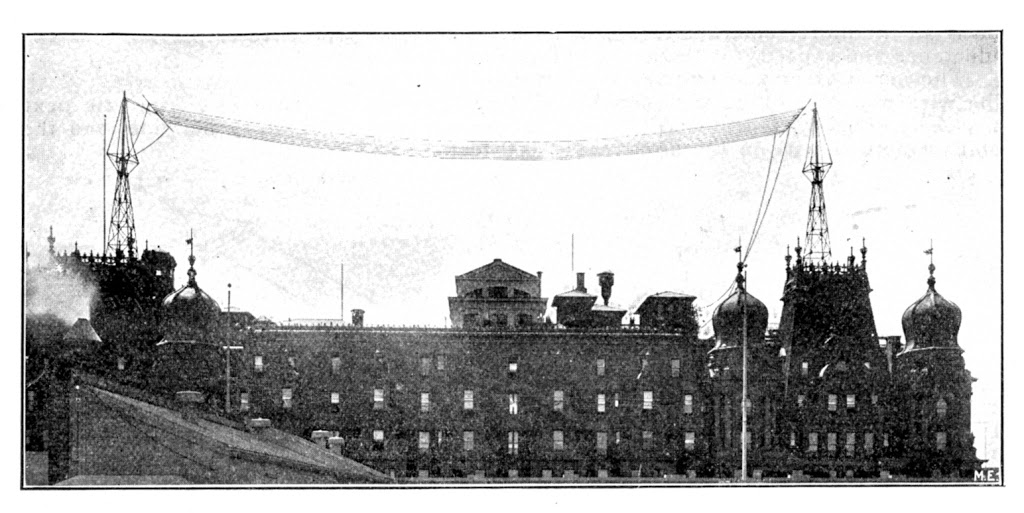
But by far the most notable of these wireless stations in Manhattan was atop the original Waldorf-Astoria, one of the most famous hotels in the world, at 34th Street and Fifth Avenue. (Above: Drawing of the Waldorf-Astoria in 1904 by Joseph Pennell.) From here, operators could send messages to ships hundreds of miles away and even to other cities like Chicago. “The operating room is a model in every respect,” claimed Modern Electrics Magazine in September 1909. “This station without a doubt is the most popular one in New York…. [T]he lofty aerial stretches its wires clear over one side of the famous roof garden.”

Below: the United Wireless telegraph station atop the Waldorf-Astoria Hotel, 1909

But they had another badge of pride — America’s first female wireless operator. Young Anna A. Nevins, 22 years old, worked eight hours a day at the Waldorf-Astoria station, considered by her colleagues “an expert in wireless instruments” By virtue of her sex, this was a news item in papers across the country in 1909.


It was not entirely shocking to see a women at a telegraph desk, but the newness of wireless technology and challenges of early radio would have made Anna’s skills rather unique. It’s believed she trained under De Forest as early as 1906.


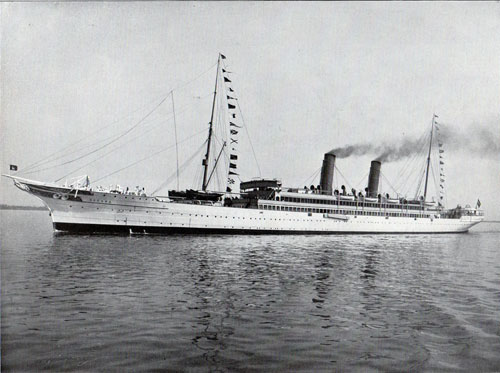
The juicy spin, of course, was romance. According to reports, Nevins had a beau “Jack” on the steamship Oceana (below)), a Hamburg-American line traveling to destinations in the West Indies. The young wireless operator would send ‘messages to her sweetheart’ over the wireless, alleged as far as 1,000 miles away, engaging in an ‘aerial conversation’ believed to be the longest exchange of its kind for the day. (Then again, this sounds like newspaper hyperbole!)


Did reporters seem fascinated to ask about what it was like to be the sole woman working within a new technology? Not when you can ask her about love! In a syndicated article from 1909, she’s quoted as admitting, “Yes I know the young man. When he’s in town, I see him. But almost every day I hear from him.”


The Waldorf station was the jewel in United Wireless’ crown. Unfortunately, United’s reputation as a corrupt company tied to Wall Street shenanigans and perpetually hounded with legal issues caused its demise in 1912, when it was sold to American Marconi. As for Anna, I can’t locate any trace of her after these initial reports. Perhaps she met and married ‘Jack’, whoever he was. Hopefully, years later, she was asked more interesting questions of her career.