Dr. Johannes La Montagne: Manhattan’s first physician


Nothing underscores the harshness of early New Amsterdam more than the notion that the Dutch settlement, which first formed at the tip of Manhattan in 1625, didn’t actually have a trained physician for almost twelve years.

Most likely, in these earliest years, medical emergencies were handled by ship surgeons and non-professionals skilled in a set of rudimentary practices. More practiced professionals eventually came, such as the man who can lay claim to being Manhattan’s first practicing physician Johannes La Montagne (also known as Jean Mousnieer de la Montagne), a Huguenot who arrived in 1637 and initially settled outside the colony in the village of Haarlem.

Johannes soon became “the only doctor in Manhattan in whom the settlers had any confidence,” practicing surprisingly sophisticated innovations in Dutch medicine.

Shockingly, before La Montagne, if one needed actual surgery, one went to the barber. According to one old history, “it might be remarked that at that time barbers were commonly looked upon as surgeons. Any skilled barber was likely to be applied to for surgical procedures.”

These ‘barber-surgeons’, adroit in “performing minor operations“, mostly worked on ships and were hardly skilled in the modern advances of 17th century medicine. Eventually La Montagne was able to regulate these barber-surgeons himself, issuing permits to those practicing in the colony and even those who sailed out of New Amsterdam ports.

Like the millions of doctors who would follow in his footsteps, Johannes would soon benefit handsomely from his expertise, gaining a vote in the first official voting council of the new colony under director-general William Kieft.

Johannes was also the first of many Manhattan physicians who was also versed in the art of networking; within a year he became Kieft’s right hand man and an extension of of the director-general’s wishes, however misguided. He even briefly took over a small farm (around the area of upper Central Park today) maintaining the production of tobacco.

Unfortunately, this devotion to Kieft and the desires of the Dutch West India Company over the needs of the colonists proved to help undermine the new colony, eventually leading to Kieft’s ouster and replacement by Peter Stuyvesant. To his credit, La Montague then won over the steadfast Stuyvesant, who kept him on as a member of his council.

He and his family stayed in the colony after its possession by the British, and it is believed to have spent the remainder of his life in Albany.  Today, descendants of the good doctor have set up their very own genealogical society. 

This article originally ran on May 9, 2009. Original is here
Categories
Uncategorized

Notes from the Podcast (#122) The Manhattan Grid Plan

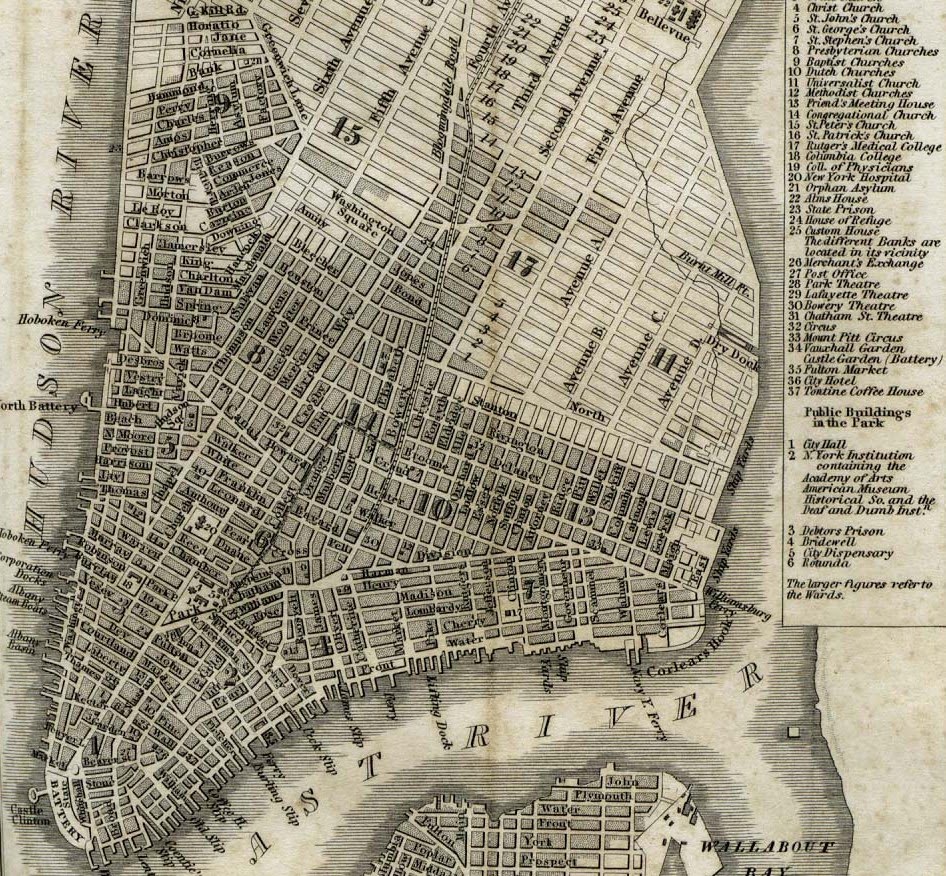
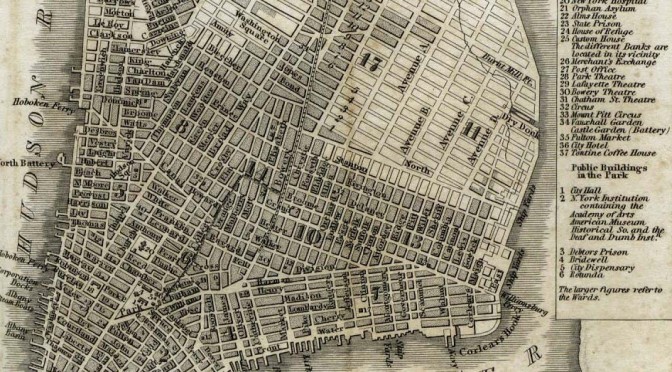
From H.S. Tanner’s ‘The American Traveller; or Guide Through the United States’, 1836 (book published book 1840)

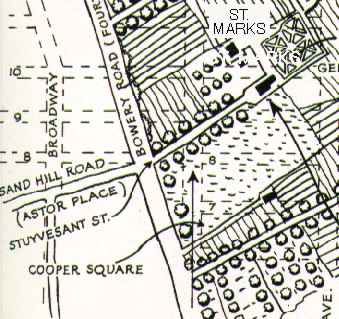
Stuyvesant Street is mentioned as one of the few streets in New York that was allowed to break the grid, and its diagonal path between Second and Third avenues is a reminder of the original farm grid of Peter Stuyvesant. But as a few listeners have pointed out, it holds another unique distinction.

The original estate owners of Manhattan often carved up their own lands into the shape of small grids. For instance, the grid of the DeLancey farm is still impressed upon the Lower East Side below Delancey Street. The Stuyvesants also had a system of streets on their property that ran true east to west. (Manhattan is obviously not on a true north-south axis, and its grid streets do not truly run east to west, but progress at a slight diagonal. Charles Petzold has a very detailed article on the island’s true orientation.)

Thus, Stuyvesant Street is the only street in Manhattan that actually runs east to west. Walk its length with a compass and be amazed!

—–

Not too far from Stuyvesant Street is the beginning of grid plan, First Street and First Avenue, Kramer’s “nexus of the universe”. This is the spot were near-uniformity along New York’s streets and avenues begins.

The southern border of the grid plan was, ironically, called North Street at the time, for it was truly north of the city. As I mentioned back in the Niblo’s Garden podcast, today’s Houston Street is actually the adjoining of two roads, the other being a path that cut through the property of Nicholas Bayard, land that is today’s SoHo. Bayard renamed his street after his daughter’s new husband, the esteemed Georgian patriot William Houstoun. Later, it made sense to link Houstoun’s street to North Street, and thus the whole thing was called Houston Street (with a ‘u’ vanishing in the process).
—–

The occasion of the Commissioners Plan is presents a good opportunity to peer into the extraordinary collection of old New York maps in the David Rumsey Collection. The original 1811 Randel maps are there, as well as others that chart the course of development during the 19th Century. This Tanner map from 1836 shows the grid progressing nicely.
—–

So, if I didn’t quite get it across on the show, let me say it now: Gouverneur Morris is awesome. I devoured two different biographies on the controversial Founding Father, and I highly recommended them both. Although Richard Brookhiser’s “Gentleman Revolutionary” is a breezier read, the quieter “Gouverneur Morris: An Independent Life” by William Howard Adams still makes room for some salacious details.
—–

And to repeat one major CORRECTION: Due to my complete misreading of my own handwritten notes and in the flurry of wrapping up the show, I said that Manhattanhenge occurs on March 28 and July 12 or July 13. I meant MAY 28, not March 28.

Categories
Podcasts

Haunted Tales of New York: Urban Phantoms

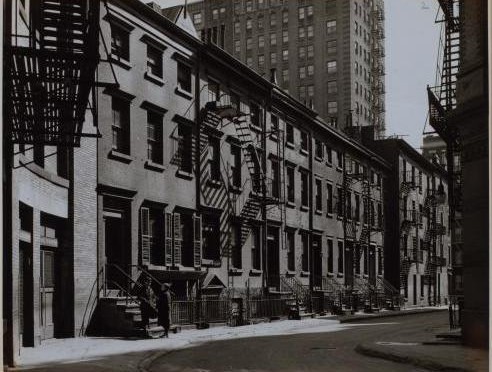
Historic Gay Street, 1940: a tiny little lane literally crammed with ghosts

It’s time for our third annual ‘ghost stories’ episode, our mix of historical facts and spooky legends from the annals of New York’s past.

For this round of scary tales, we visit a famous 19th century townhouse haunted by a lonely spinster, a West Village speakeasy with some guests who still haven’t gone home, and the site of a former restaurant that might be possessed with the spirit of a famous folk singer.

ALSO: we go back all the way to New Amsterdam for an old legend involving Peter Stuyvesant, a turbulent river, and the Devil himself!

PODCAST Download this show it for FREE on iTunes or other podcasting services. Click this link to download it directly from our satellite site. Or click below to listen here:

The Bowery Boys: Haunted Tales of New York

___________________________________
As always, click on pictures for a bigger view

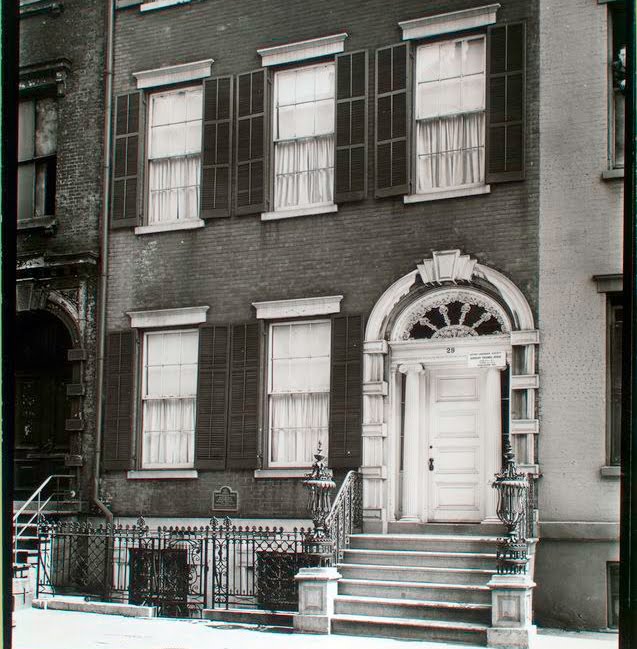
POSSESSIONS: The former home of Seabury Tredwell at 29 E. 4th Street, now billed as the Merchant’s House, is one of New York’s most famous haunted houses, alledgedly still home to his daughter Gertrude. The house is a rare ‘trapped in amber’ experience, with family possessions that have never left the house since the family moved there in 1835.

Photo from 1936 by Berniece Abbott, but really, the house looks exactly the same:

Click here for more information on the Merchant’s House Museum’s October Halloween plans, which include funereal decoration, a coffin procession to nearby New New York City Marble Cemetery, and candlelight tours: Merchant’s House
___________________________________

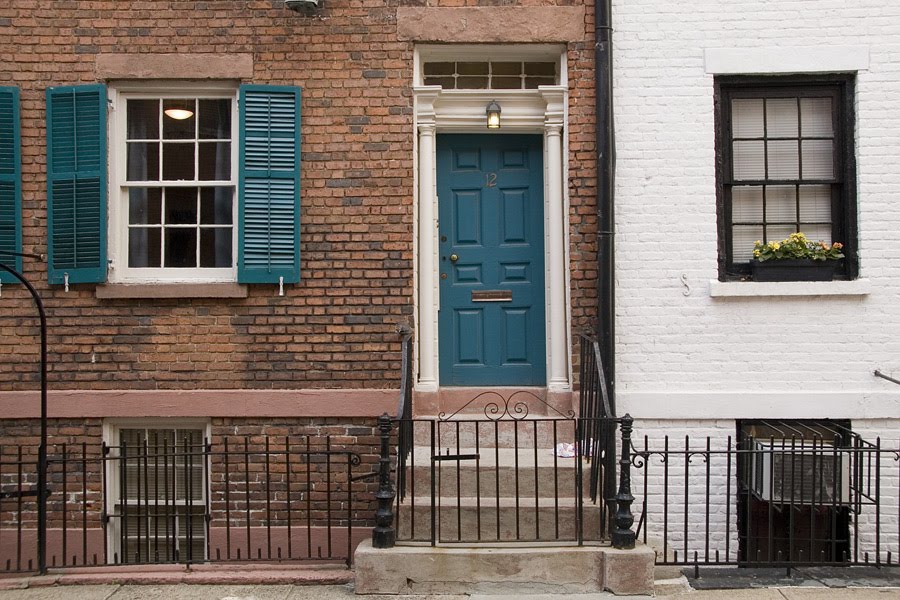
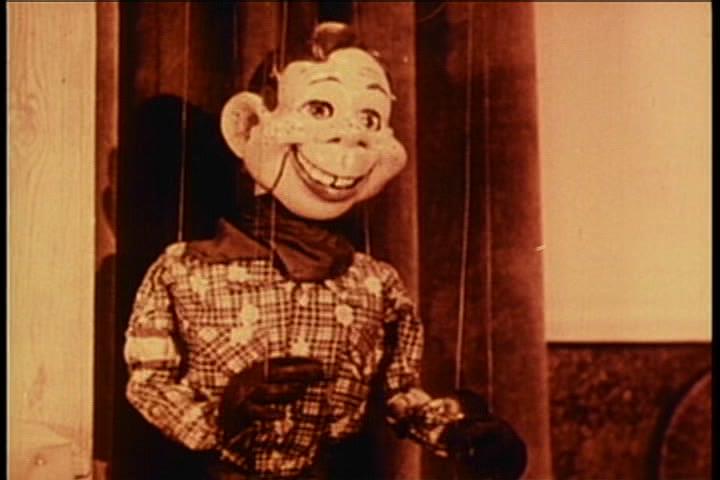
THE PARTY NEVER ENDS: 12 Gay Street, once a horse stable, housed Mayor Jimmy Walker’s mistress Betty Compton and the creator of Howdy Doody. However, it was a former speakeasy in the basement that’s given the building a rather ghostly entourage of spooks and apparitions, including the cloak-wearing Gay Street Phantom. Do deceased flappers and dead drunks still haunt this quiet little street?

HORROR: This famous puppet was born in the location of a former speakeasy. Might it too have been possessed with its former revelers?

___________________________________

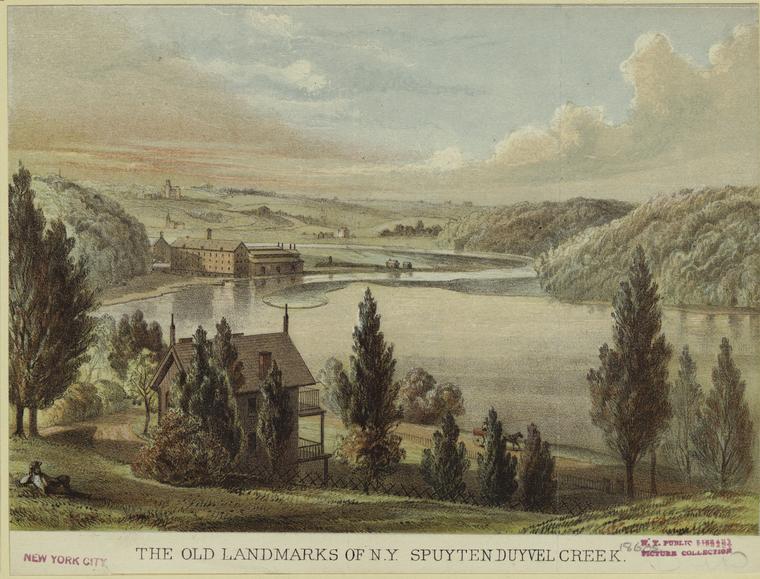
WHAT LIES BENEATH: The rushing waters of Spuyten Duyvil Creek, linking the Harlem River to the Hudson River, have spawned many legends since the Dutch arrived. Does its unusual name hide a secret of something that lives underneath the turbulent waters? (Illustration courtesy NYPL)

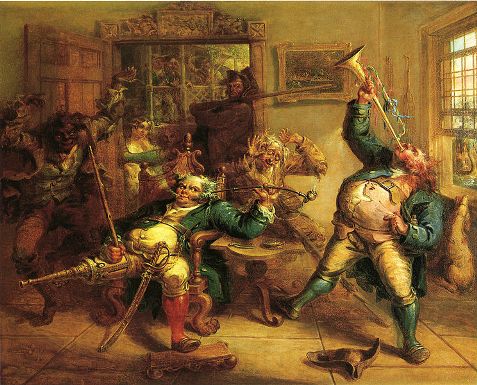
DOOMED: Anthony Van Corlaer, trumpeter and sentry assigned by Peter Stuvesant to warn rural Dutch settlers of impending attack, met a watery end at the hand of the Devil himself, according to legend. Below: from the painting Antony Van Corlear Brought Into the Presence of Peter Stuyvesant
___________________________________

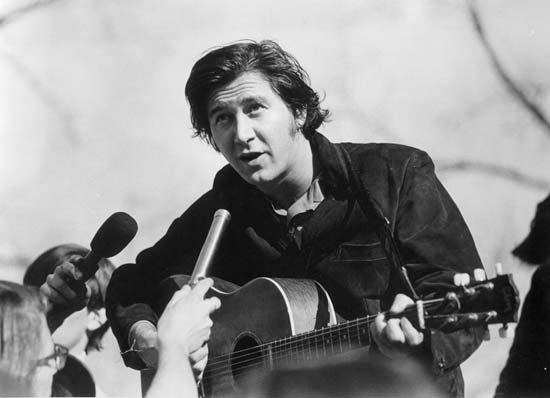
IN LIMBO: The tortured folk singer Phil Ochs killed himself in Far Rockaway, but is his spirit still haunting a former restaurant in SoHo?

Execution Corner: 13th Street and 2nd Avenue

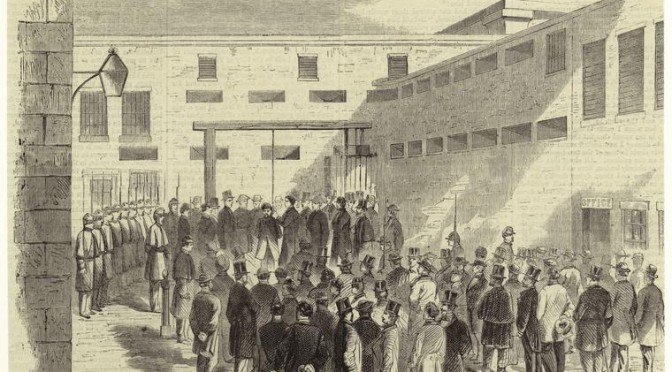
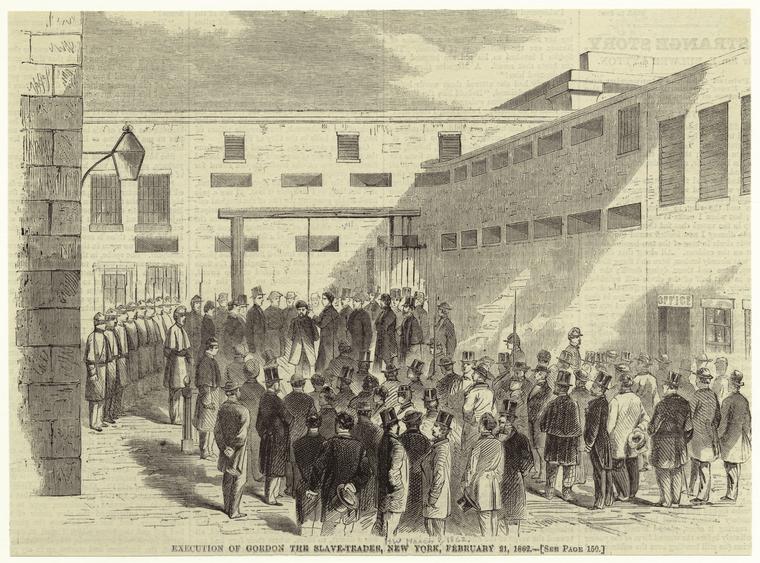
Public hangings were a rare but grisly part of 19th Century New York life. The one illustrated above is from 1862. Another would famously haunt the area near an East Village intersection.

I pass through the intersection of 13th Street and 2nd Avenue fairly frequently on my way home from work. The plain intersection is probably best known as the home of the New York Eye and Ear Infirmary and for being a block away from a movie theater with some rather small movie screens. If you’re a foodie, you probably know it for Momofuku’s Milk Bar.

The most recent modern drama this corner has seen might be the electrified manhole cover that almost killed somebody awhile back. But 185 years ago, when this area was nothing more than a large meadow once the property of the Stuyvesant family, it was the site of one of the most well-attended public execution in American history.

It may be hard to understand why (as some reports suggest) almost 30,000 people came to observe the hanging of John Johnson from this field in 1824.  Another source claims 50,000 people came to see the gruesome execution, which at the time would have been almost one-third of the entire city population of New York.

Perhaps the facts of his crimes were simply too shocking to ignore.  Johnson, a family man who kept his wife and children at an upstate farm, ran a boardinghouse for wayward sailors during New York’s heyday as a port city in the 1820s.  It was located in the bustling heart of the city and dozens of men passed through his door.  It was not exactly a four-star resort, however, and certainly the occasional home for misdeeds. But for the visiting seamen, these types of seedy places were hard to avoid, and the threat of murder would have been bone chilling indeed.

One day in 1823, in a nearby alley, the body of sailor James Murray was discovered, his head split open with a hatchet. Murray was staying at Johnson’s lodge; upon inspection, bloody sheets were found in Johnson’s cellar, and the innkeeper was arrested.

Johnson’s behavior was especially erratic.  He admitted to the crime, then retracted his statement, saying he was merely protecting his family.  He claimed another guest had attacked Murray and that Johnson was merely guilty of “neglecting his duty as a host.” His confession and subsequent about-face piqued public curiosity, with his wife’s letters and even his own minister’s spin on the tale quickly printed up into pamphlets.

Any printed entreaties to his innocence fell on deaf ears.  Decrying his innocence to the end, Johnson was sentenced to hang on April 2, 1824. (I have also seen sources that say April 4.) He was escorted to the gallows by his minister and even infantrymen who had to part the growing crowds, “a solid mass of living flesh — men, women and children of all colours and descriptions,” by one account.

Public executions were actually quite rare by this time or else relegated to one of New York’s lonely islands (such as Blackwell’s Island or the tiny oyster island that would later become Ellis Island).  Not because they were horrifying displays, but because they attracted large crowds of drunks, rowdies and pickpockets. So in the most macabre sense possible, the event of Johnson’s death signified something unique.

Whether Johnson had truly been fairly treated is unclear but the story had reached a fever pitch, its details splashed across newspaper and gossiped about at city taverns.  By the time he stood overlooking the crowd with a rope around his neck, Johnson had become a figure of evil.  After hanging, his body was donated to a medical school.

Civility would soon come to this death field, as avenues and streets along the grid plan were carved out and the area quickly developed. Violence would return to the neighborhood during the Civil War draft riots of 1863. A block away, a witness to the murder, Peter Stuyvesant’s pear tree at 3rd Avenue and 13th street, would stand until 1867 when it was mowed down by a wagon.

A plaque stands in honor of Peter’s pear tree.  No evidence remains of the public execution which occurred just a few yards — and one block — away.

Paging Dr. La Montagne, Manhattan’s first physician


Nothing underscores the harshness of early New Amsterdam more than the notion that the Dutch settlement, which first settled at the tip of Manhattan in 1625, didn’t actually have a real trained physician for almost twelve years.

Most likely, in these earliest years, medical emergencies were handled by ship surgeons and non-professionals skilled in a set of rudimentary practices. More practiced professionals eventually came, such as the man who can lay claim to be Manhattan’s first practicing physician Johannes La Montagne, a Huguenot who arrived in 1637, settling outside the colony in Haarlem.

Johannes soon became “the only doctor in Manhattan in whom the settlers had any confidence,” practicing surprisingly sophisticated (for the day) innovations in Dutch medicine. Like the millions of doctors who would follow in his footsteps, Johannes would soon benefit handsomely from his expertise, gaining a vote in the first official voting council of the new colony under director-general William Kieft. Johannes was also the first of many Manhattan physicians who was also versed in the art networking; within a year he became Kieft’s right hand man and an extension of of the director-general’s wishes, however misguided.

Unfortunately, this devotion to Kieft and the desires of the Dutch West India Company over the needs of the colonists proved to help undermine the new colony, eventually leading to Kieft’s ouster and replacement by Peter Stuyvesant. To his credit, La Montague then won over the steadfast Stuyvesant, who kept him on as a member of his council.

Shockingly, before La Montagne, if one needed actual surgery, one went to the barber. According to one old history, “it might be remarked that a that time barbers were commonly looked upon as surgeons. Any skilled barber was likely to be applied to for surgical procedures.”

These ‘barber-surgeons’, adroit in “performing minor operations“, mostly worked on ships and were hardly skilled in the modern advances of 17th century medicine. Eventually La Montagne was able to regulate these barber-surgeons himself, issuing permits to those practicing in the colony and even those who sailed out of New Amsterdam ports.

Name That Neighborhood: Wall Street Blues

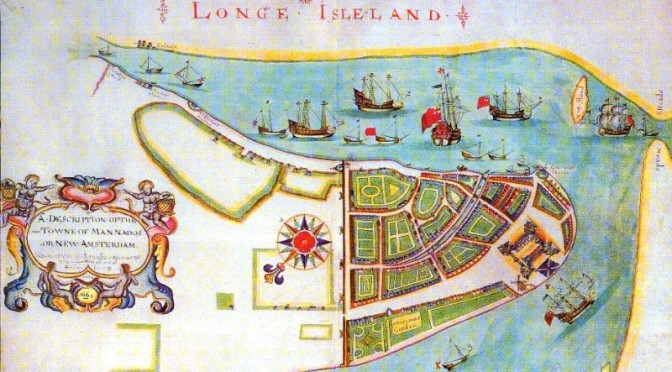
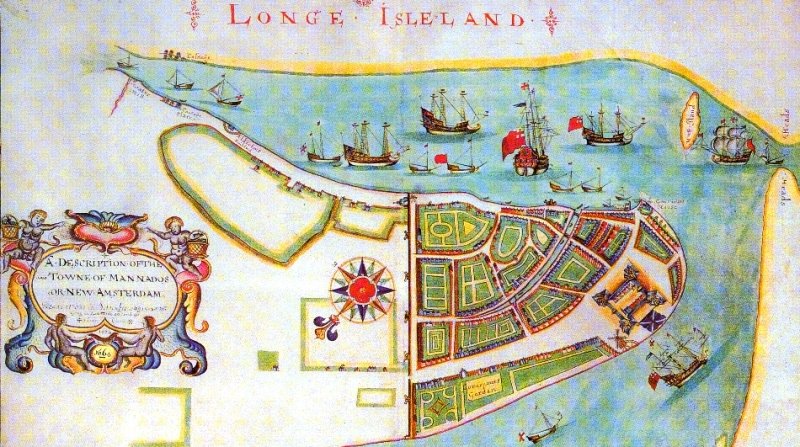
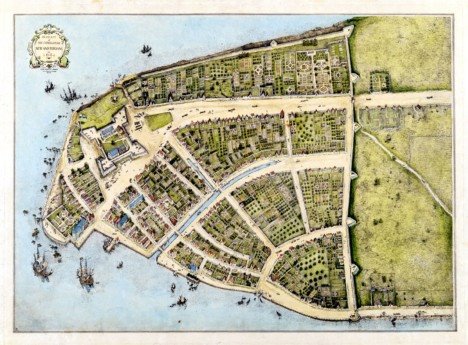
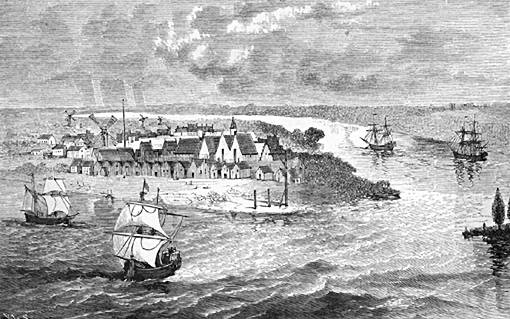
A simplistic but colorful view of “Man Mados” or “New Amsterdam” in 1664 (click in to inspect the detail)

One of the first facts you learn as a student of New York City history is that Wall Street, that canyon of tall buildings and center of the American financial world, is named for an actual wall that once stretched along this very spot during the days of the Dutch. The real story is rather fuzzied by the presence of a small community of French-speaking Belgians known as the Walloons.

The original ‘De Waal Straat’ was the center of a small Walloon community in New Amsterdam. There was most definitely a walled fortification nearby on New Amsterdam’s northern boundary, and it certainly did stretch along about the same area as Wall Street does today.

But the present name seems to be a formation of mixed meanings that only a tangle of languages and hundreds of years of history can create. The Dutch themselves referred to an actual street alongside the wall as the ‘Cingel’ — according to an old history, meaning “exterior, or encircling, street.”

The real reasons for New Amsterdam building its famous wall are also up for grabs. It’s commonly held that the wooden palisade was erected in defense of Indian attacks, and certainly the residents of New Amsterdam did their part to rile the anger of the native landowners. But the Dutch had been living at the tip of Manhattan for over 25 years by the time the wall was built in 1653. In truth, it was commissioned to keep out a different sort of enemy.

You’ll be pleased to know that one-legged director-general Peter Stuyvesant was the man who ordered the construction of the “high stockade and small breastwork” that cleaved the Dutch community from the natural wilds beyond.

This was an incredibly important year for New Amsterdam in two respects. In February 1653, New Amsterdam was chartered as a official Dutch city. Although Stuyvesant was quite against the outpost receiving such official recognition, he eventually took advantage of it, appointing the first town council himself rather than putting it up to such trivial inconveniences as elections.

But in 1653 the tides of the motherland spilled onto their shores, as the war between England and the Netherlands threatened the remote and undefended new city. The Dutch intended to launch ships from New Amsterdam harbor in battle against the English.

As a result, the English colonies up north were sure to retaliate, either by sea or, feared Stuyvesant, over land, possibly teaming with hostile Indian forces, down through undefended Manhattan island. Essentially, the wall that helped give us Wall Street was built because Stuyvesant feared attacks not just from Indian tribes, but from the European colonies of Connecticut, Massachusetts and New Haven!

Above: looking at this more well known map of New Amsterdam, once can see the two gates very clearly

Stuyvesant called upon the 43 richest residents of New Amsterdam to provide funding to fix up the ailing Fort Amsterdam and to construct a stockade across the island to prevent attacks from the north, while it took New Amsterdam’s most oppressed inhabitants — slave labor from the Dutch West India Company — to actually build the wall.

The barrier was constructed out of earth, rock, and 15 feet timber planks sold to the Dutch, ironically enough, by the “notorious” Englishman Thomas Baxter. In a turnabout that one would expect from hiring your enemy, Baxter later led a group of “Rhode Island marauders” and pirated Dutch fishing ships.

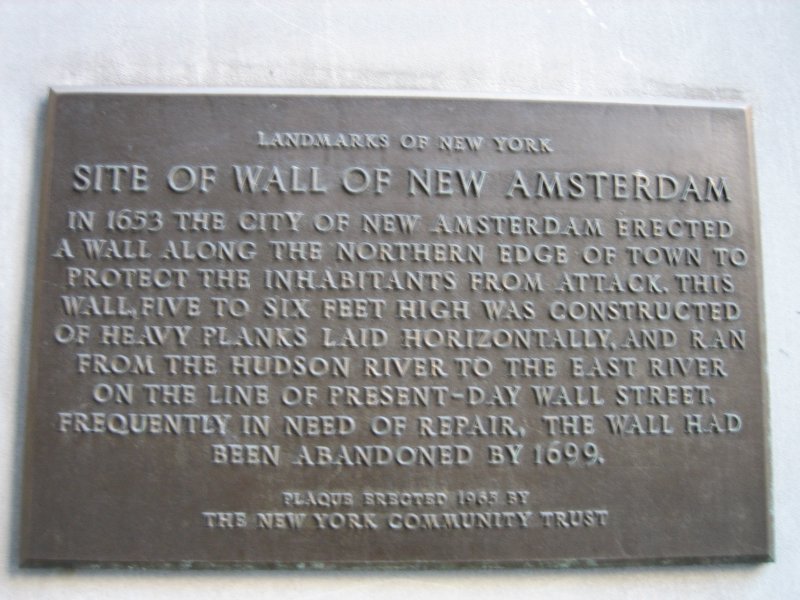
Early in the 1660s, the Dutch upgraded its wall to include brass cannons and two sturdy gates — one at today’s intersection of Wall and Broadway (for land), the other at Wall and Pearl Street (according to an early account, a water gate and access to a ‘river road’).

The British took over New Amsterdam in 1664 and renamed it New York, but the wall still remained, becoming more a relic than a serious defense.

By the turn of the century, the fear of land attacks had almost completely subsided and the city was beginning to feel crowded. So in 1699 the wall was torn down with some of the material salvaged to help construct a new City Hall at the corner of Nassau Street and the newly cristened Wall Street. When the British were forced out in 1783 by the Americans, the City Hall building was renamed Federal Hall — the first official center of American government.

A plaque honoring the old wall sits today at the corner of Wall and Broadway, where the gate to the city once opened:

Name That Neighborhood: Who is Jonas Bronck?


Some New York neighborhoods are simply named for their location on a map (East Village, Midtown). Others are given prefabricated designations (SoHo, Dumbo). But a few retain names that link them intimately with their pasts. Other entries in this series can be found here.

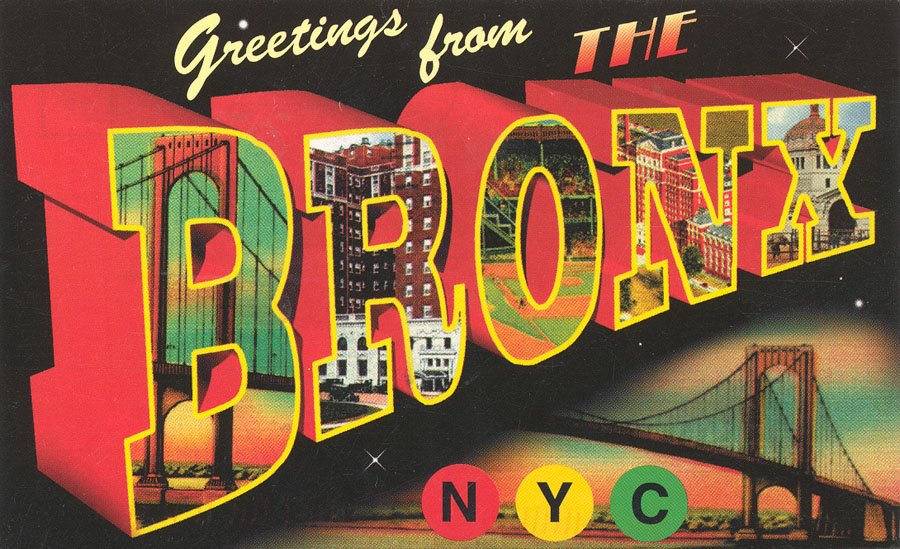
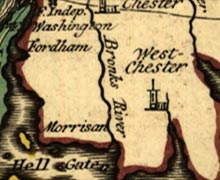
The Bronx is one of two boroughs with names derived from actual people. The residents of Queens can brag that their borough honors Charles II’s wife Catherine of Braganza. The Bronx, however, gets its name from less regal sources, from Swedish-born landowner Jonas Bronck. However the Bronx is not directly named after Bronck. Confused?

Despite Bronck’s tenacity in forging onto the unknown Lenape Indian territory of Rananchqua in the Dutch colony New Netherlands, his actual role in New York history is quite brief. An ardent intellectual who gave his ship the lofty name Brand van Trogen (The Fire of Troy), Bronck, his wife Teuntje and a boatload of eager voyagers traveled to the new world in 1639 and settled on a stretch of land, 500 acres, across the river from the village of Haarlem.

With permission from the West India company, Bronck had brought builders, his own cattle, boxes of books, and a desire to create a small community of his own. Spread out through the modern neighborhood of Motts Haven, Bronck’s farm (Broncksland) and those of the other settlers sat along a north-south river, called by the Lenape the river Aquahung.

Bronck grew tobacco and traded with the local Indians, keeping the peace through exchanges of goods. Jonas however had arrived at a rather unfortunate time to be a pale blond foreigner.

Relations between the Dutch and the native Indian population were tenuous at best, and not greatly assisted by hot-headed director-general William Kieft of the port city of New Amsterdam. In 1643, driven by growing animosities and the murder of a single settler, Kieft ordered troops to rout the Lenape populations at Corsairs Hook and the area now known as Jersey City, murdering dozens of Indians and ensuring years of bloody battles between settlers and natives.

Bronck was the unfortunate recipient of native Indian backlash. That same year, 1643, Bronck and most of his settlers were murdered in an Indian raid.

Kieft would be swept out of the new world by Peter Stuyvesant. Bronckland would pass into other hands, and after just a few years, the parcel of land would no longer be named for him. Jonas was almost erased from history.

Except for that rather sizable river that ran through his property, the Aquahung. Even as memories of Dutch settlers gave way to their British successors — his farm went to two officers in Oliver Cromwell’s army! — the river was still referred to as Bronck’s River. Eventually it was shortened to the Bronx River, and thus it’s the river that the borough is named after.

Had everybody just kept with the original name as given by the Lenape, we would be referring to our northernmost borough as Aquahung.

By the way, Bronck’s wife and son escaped the Indian raid, and later, Teuntje with her new husband moved to the area now known as Coxsackie, New York. Son Pieter Bronck became a landowner in his own right and built a house that still stands today. It is the oldest home in all of upstate New York.

Things To Come: 1908!

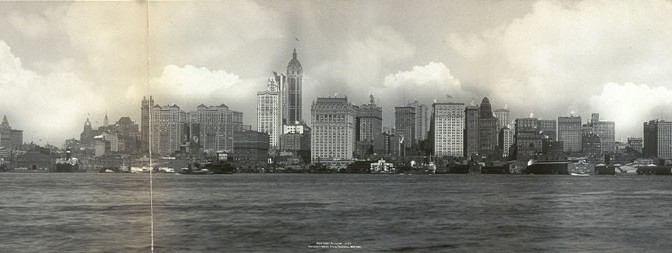
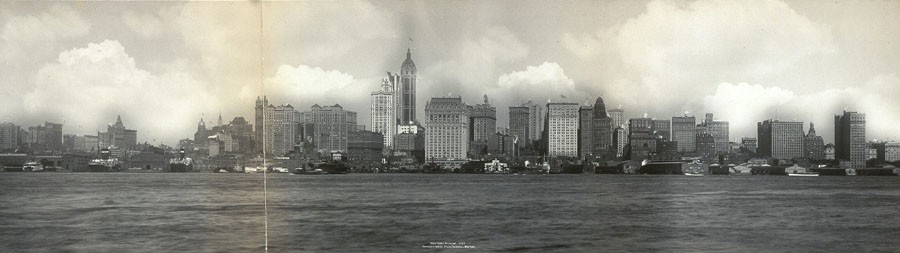
The New York City skyline, picture taken in 1908 (click to see detail)

Welcome to the future of New York City — the amazing year of 1908! A look into the crystal ball find that the following things will happen this year:

You Haven’t Yet Come A Long Way, Baby
The New York board of aldermen passes the Sullivan Ordinance on January 21st, banning women from smoking in public. “Hotel or restaurant proprietors” who allow women to light up on their premises will be fined. Various citizens spoke to the aldermen in defense of the act, including one ‘Little Tim’, who claimed that women smoking seemed to occur the most in the ‘lower east side’. Playing devil’s advocate, one councilman decried why they didn’t prohibit everyone from smoking in hotels and restaurants, “particularly boys under 21 years old”?

In covering this scandalous turn of events, the New York Times likens the law to Peter Stuyvesant’s ruling that all women wear ‘broad flaunces’ and only carry themselves in ‘shuffle and turn’ moves while dancing.

The mayor overturned the ruling, probably because it was very stupid to begin with.

These ‘Auto-Mobiles’, They Really Work!

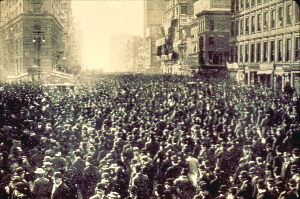
The New York Times sponsors a most ambitious competition using the newfangled ‘automobile’ devices. Referred to as The Great Auto Race, teams from Italy, Germany, France and the United States will steer their national auto motives on a truly cross-country voyage. Starting in New York City on February 21 (see picture above in the new ‘Times Square’), competitors followed an often hazardous path through Chicago, San Francisco, up to Valdez Alaska, over the Bering Strait to Japan, Vladivostock, Moscow, Berlin and then the the finish line in Paris.

We predict the Americans, led by driver George Schuster Sr. will win after a trek of 169 days. We also predict that Schuster will hold the title of longest roadtrip well into the future, as who would be silly enough to try this again?

New York Invaded by ‘Bridge & Tunnel’ Crowds!
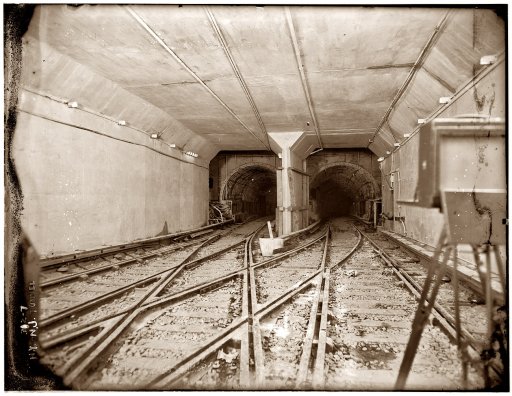
The first tunnel under the Hudson River, connecting Hoboken, NJ, and lower Manhattan around Christopher Street, officially opens on January 4. Other ‘PATH’ trains are tested out throughout the year, with even President Theodore Roosevelt getting into the act. On February 25, the president through a switch (via telegraph) in his office at the White House in Washington, throwing on the power (eventually) for the New York line running from 19th Street to New Jersey. At midnight the train would open for paid customers. New Jersey, welcome to New York!

Tomorrow — we look into a future New York City in 1908 that will include electric diamonds, the North Pole and something ominous by the name of BAM!

Categories
Podcasts

PODCAST: Peter Stuyvesant

Back when New York was New Amsterdam, it was the domain of the bullheaded, pear-growing, peglegged Peter Stuyvesant, who cleaned up the city and gave us our most important street. Find out why he still matters and why he’s the king of the East Village.

Listen to it for free on iTunes or other podcasting services. Or you can download or listen to it HERE

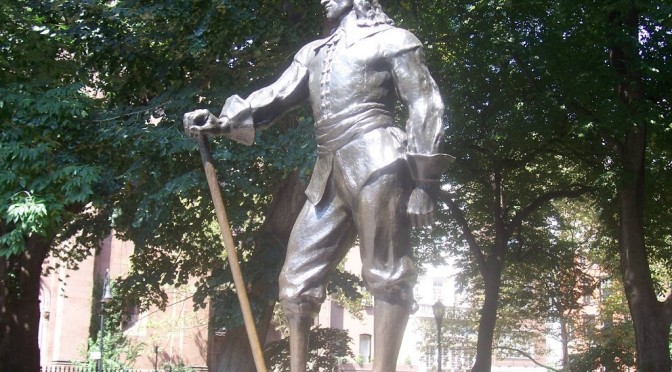
The picture above is of the statue of Peter Stuyvesant, created in 1941 by Gertrude Vanderbilt Whitney (as in the Vanderbilts and the Whitney Museum). Note how its posture and stance cleverly convey Stuyvestant’s stubborn character. (Click the pic to get a closer look at that peg leg.)

The park itself is a beautiful block of greenery lined with old churches and brownstones — and interrupted by 2nd Ave, part of the original design — in the approximate location of the original Stuyvesant family mansion.

Another of the neighborhood’s famous residents is also honored here with a statue nearby and a street named after him — composer Antonin Dvorak, who lived at 327 East 17th Street.

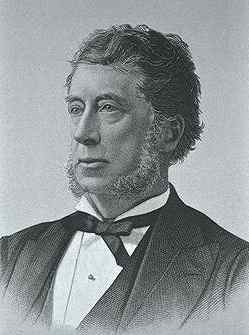
The legacy of Stuyvesant leadership would pass on through the generations. Peter’s great-great-granddaughter Elizabeth took the family in another historically significant direction when she married Revolutionary War hero Nicolas Fish. Their son Hamilton Fish (seen right, named after family friend Alexander Hamilton) would become an influential mayor of New York and later secretary of state under Ulysses S. Grant. Hamilton Fish II, Hamilton Fish III, and Hamilton Fish IV (who died in 1996) would all be New York congressmen. The current Hamilton Fish, we’re up to V I believe, once owned The Nation magazine.

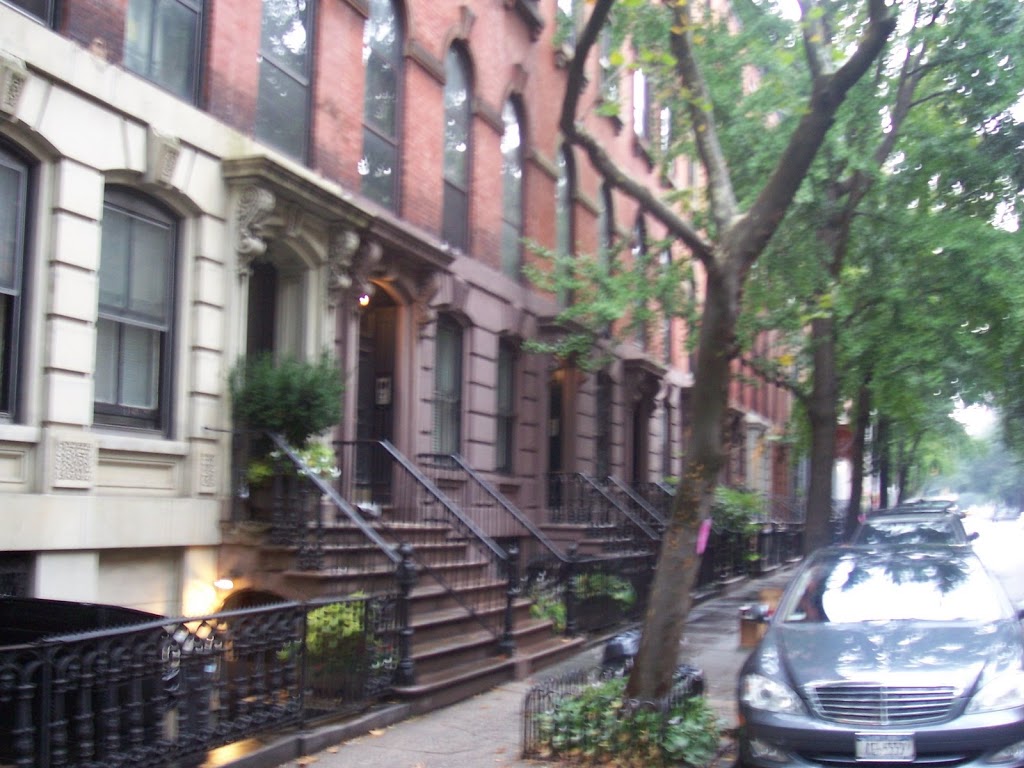
Hamilton I was born in the lovely Stuyvesant-Fish house at 21 Stuyvesant Street. Today its one of the loveliest streets in the East Village.

Its odd diagonal through the grid pattern of the Village is a vestige of its original path through Stuyvesant’s old farm.

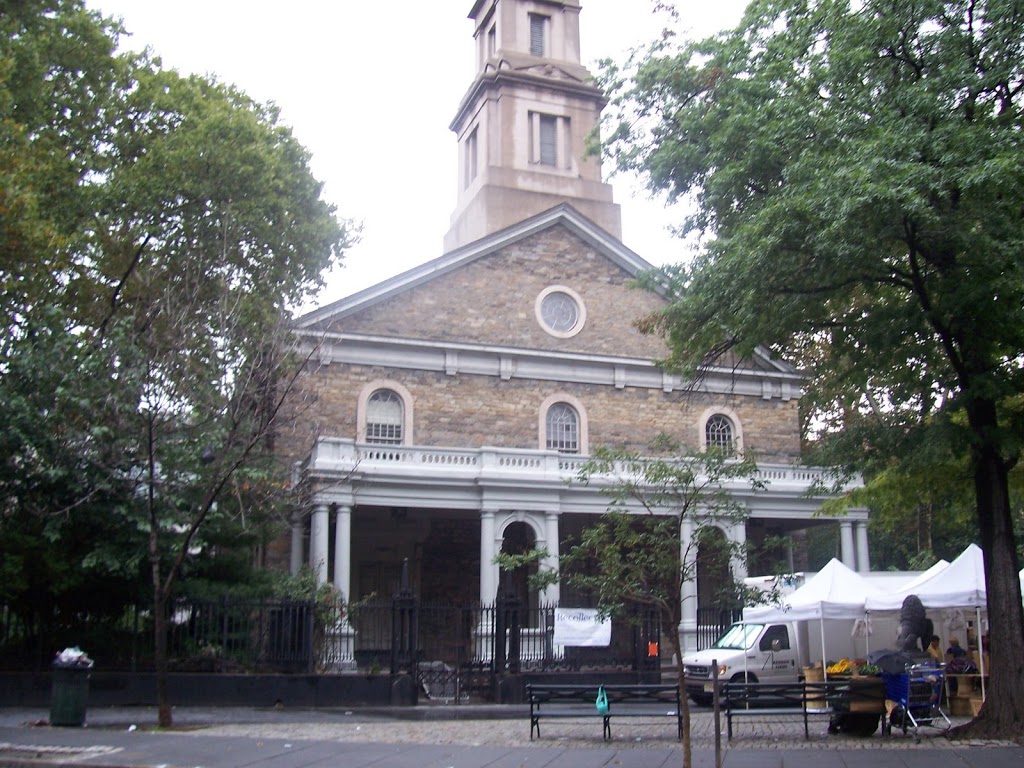
At the end of path, at Second Avenue, is St. Marks-on-the-Bowery, which is aswirl during the weekend with community activities and sometimes a farmer’s market outfront. St Marks contains the crypt of Peter Stuyvesant (marked Petrus Stuyvesant on the stone, to indicate the formalized version of his first name).

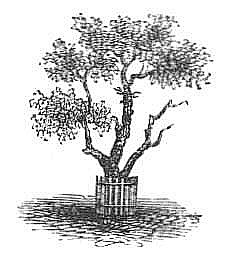
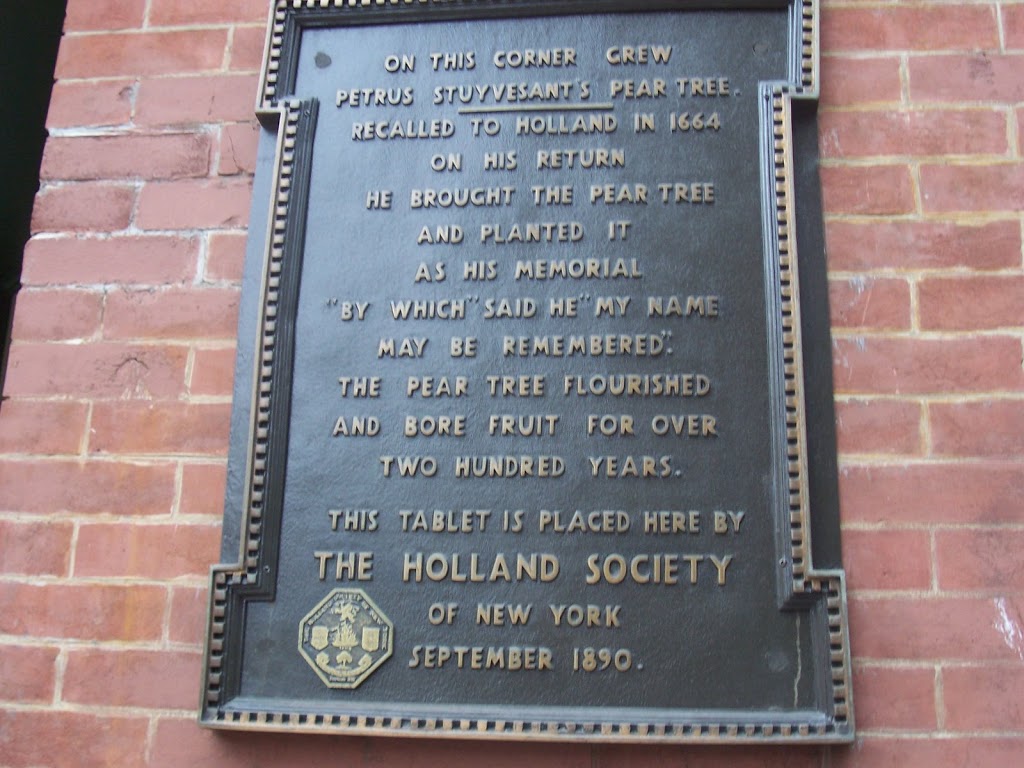
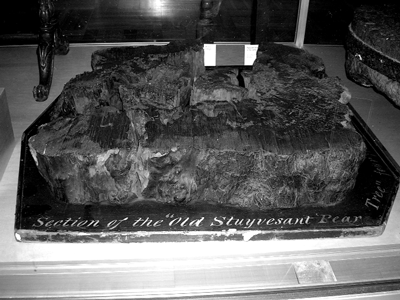
You’ll need to walk a short way to Third Avenue and 13th Street to the plaque honoring the site of Peter’s old pear tree, planted in 1647 from a Dutch seedling, which outlived him by almost two hundred years and drew curiosity seekers from miles around in the mid-19th Century. At the time it was considered the most famous tree in America until it was uprooted by an errant wagon in 1867. (It should be noted that the tree survived the New York Draft Riots, when the neighborhood nearby was in flames.)

Here’s the plaque that hangs in front of Keihl’s. Believe it or not, Keihl’s opened in 1851, the tree standing not far from its doorstep, and John Keihl may have even witnessed the arboreal tragedy. (Click into the picture for a closer look.)

Believe it or not, a slab of the old pear tree can be viewed in the regular collection of the New York Historical Society.

The Stuyvesant family name also pops up in Bedford-Stuyvesant (comprising the Stuyvesant Heights neighborhood), once a cultural mecca for African-Americans, then a former notorious neighborhood — at one time called ‘the world’s biggest ghetto’ — BedStuy has transformed into a ‘hot’ real estate haven, thanks to its many beautiful brownstones. Stuyvesant High School in Battery Park is one of the most revered in the nation (it’s the alumni of several Nobel laureates).