Categories
Mysterious Stories

I Sit On Your Grave: New York’s Hidden Burial Plots

Here’s a chilling thought for the Halloween season: if you’re visiting one of New York’s many amazing parks and squares, most likely you’re standing on land that was formerly used as a cemetery or potter’s field. And in some cases they even left the bodies behind!

If you’re fluent in your New York history, you probably know a couple of these. Most of these burial plots date from before 1851, when the city passed an ordinance forbidding further burials (without explicit permission) below 86th Street. Historical cemeteries (like those at Trinity Church and Old St. Patrick’s) and land with private vaults (such as the East Village marble cemeteries) were allowed to remain, and unique exceptions have been made, such as the singular grave of William Jenkins Worth at Madison Square.

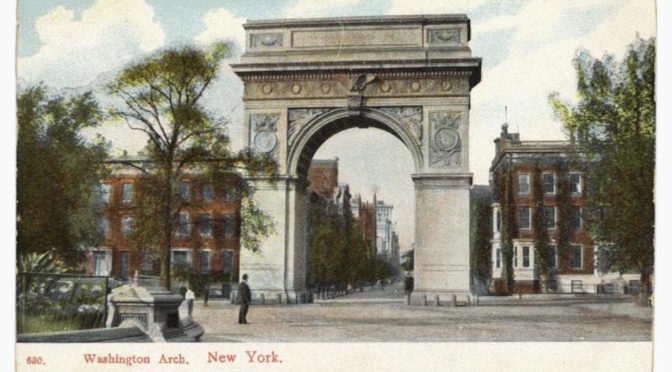
Washington Square Park, Manhattan
1797-1825
“Where now are asphalt walks, flowers, fountains, the Washington arch, and aristocratic homes, the poor were once buried by the thousands in nameless graves.” (Kings Handbook of New York, 1893) When fashionable New Yorkers moved from the confines of lower Manhattan to the area of Greenwich Village, the burial ground was closed for business and a lovely park placed on top of it.

While this might seem truly morbid, in fact the city considered this a preventative and sanitary option. According to city records, a recommendation was made that “the present burial ground might serve extremely well for plantations of grove and forest trees, and thereby, instead of remaining receptacles of putrefying matter and hot beds of miasmata.”

Today, that ‘hot bed of miasmata’ serves as one of New York’s most bustling and vibrant outdoor spaces. But the city simply built over the burial ground. It was claimed during the 19th century that a blue mist could be seen hanging over the park at night, the creepy vapor of the remains underground.

Are the bodies still here? Oh yes.
How many? Definitely over 20,000 (and they’re constantly turning up in excavation work). There were once as many as 125,000 people buried here

Leverish Street and 71st Street, Queens
1765-1818?
A private cemetery once used by the Leverish family, a prosperous Long Island clan descended from English minister, the Rev. William Leverich. According to a family genealogy site: “The contemporary location of the burial ground is a rectangular plot located immediately behind the rear yards of several private residences that face on Leverich Street, and on the other side immediately behind a parking lot behind several apartment buildings that face on 35th Avenue at the intersection of 71st Street.”

Are the bodies still there? According to author Carolee Inskeep, “there is no evidence to suggest that the bodies were removed.”
How many? Unknown

Liberty Place (at Maiden Lane), Manhattan
1700-1823
This burial ground served New York’s first Quaker congregation, formerly called the Little Green Street Burial Ground of the Society of Friends (Liberty Place was once known as Little Green Street). Its location is currently in the shadow of the New York Federal Reserve.

Are the bodies still there? Probably not, but the city gave them only six short months to move all the remains to a new location, so you never know what they might have left behind.
union
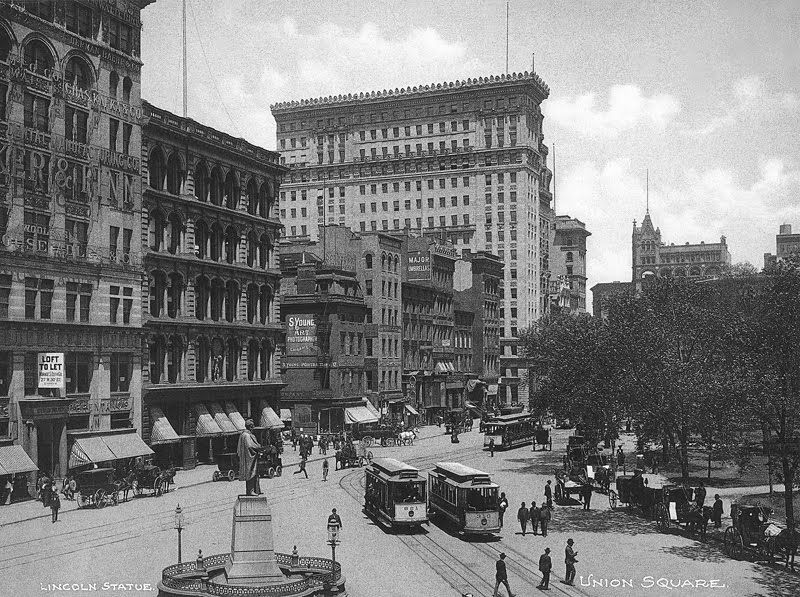
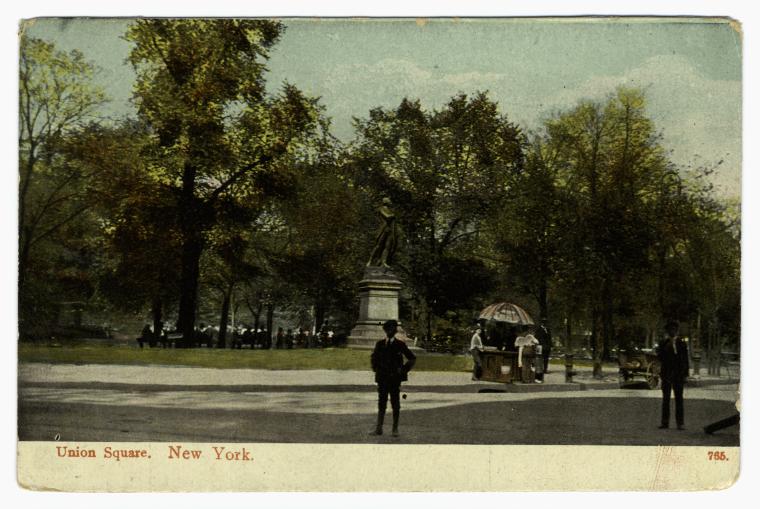
Union Square, Manhattan (above)
?-1807
Potter’s fields — where the poor or unclaimed were buried — moved frequently around the city as land values improved with the city’s growth. This particular area at 14th Street was once comfortably outside of town, but its proximity near Bloomingdale Road (the future Broadway) soon required its functions as a burial plot be transferred to other usable fields, like Washingon Square. The land here was transformed into the ellipse-shaped Union Place, a strolling park surrounded by an iron fence. By the 1830s, Samuel Ruggles would modify it further into New York’s toniest park Union Square, luring the wealthy who quickly built homes of ‘costly magnificence’ around it.

Are the bodies still there? Certainly not, given the park’s frequent renovations and the subway station right underneath.

Madison Square Cemetery, Manhattan
1794-1797
The short duration of this burial ground stems from the fact that it was used only to inter those who died at nearby Bellevue Hospital and the local almshouse during a devastating yellow fever epidemic. Later, with fears of a new war with England looming, the land was given to the U.S. Army as an arsenal, and the land that was later Washington Square became the official place to bury the dead.

Are the bodies still there? There’s some evidence to suggest that some of the remains were never moved.

How many? Unknown, although the epidemic took hundreds in the 1790s, and according to my estimation, there could be up to 1,000 buried here.

New York City Farm Colony Cemetery (Castleton Corners), Staten Island
1830-1910
This land served New York’s Farm Colony, an occupational asylum for the elderly and orphaned, and later a convalescent home for those with tuberculosis. The cemetery was once well kept, but today most of the tombstones are gone, and the land is virtually unmarked. Part of the farm colony has become part of the Greenbelt. The ruins of the Farm Colony are, frankly, unbelievable.

Are the bodies still there? Yes, the plots simply stopped being maintained
How many? Hundreds

Old Newtown Cemetery (92th Street and 56th Avenue), Queens
Off and on between 1652-1880
A family cemetery that became a horse pasture in the 19th century, cut through with cross streets, then designated a New York city park in 1932. Today, it’s the Newtown Playground.

Are the bodies still there? Many (notably from reputable families) were moved piecemeal to family plots or to Hart Island, but it’s not clear that the city ever methodically moved all the bodies. But something else is definitely there. A Queens Annual Report from 1927, as referenced by the parks department, claims “[a]ll the old headstones, which stuck up like eyesores, were laid flat and covered with soil.” So enjoy that swing set, kids!
bryant
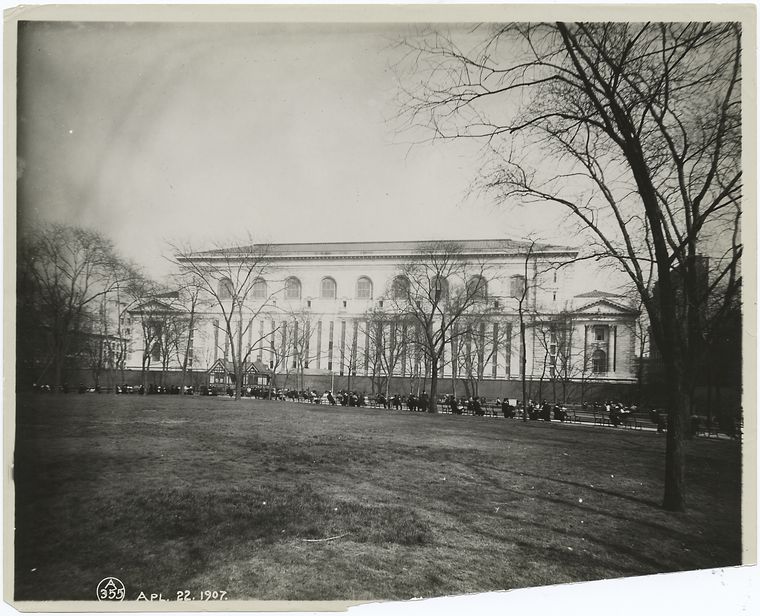
Bryant Park, Manhattan (above, from 1907)
1823-40 but possibly used as late as 1847
Yet another burial plot for paupers, still further north of city center. Soon however the adjoining land became an ideal spot to put the Croton Reservoir, supplying the city with drinking water. And it wouldn’t do to have a bunch of gravaes next to it, right? Following a short time as the location of the Crystal Palace, the land was turned into a park, named after William Cullen Bryant.

Are the bodies still there? The only thing you’re going to find under Bryant Park are miles and miles of library books, in tunnels owned by the New York Public Library.

Park Avenue and 49th Street, Manhattan
1822-1859
In the early 18th century, the area soon to become known as the richest street in America was home to railroad tracks, cattle yards, various grim asylums and, yes, Manhattan’s last potter’s field. When Columbia University moved uptown, it sat near the shoddy field, so decrepitly maintained that “the ends of coffins still protruded from the ground,” according to Edward Sandford Martin “a malodorous neighbor much in evidence and disrepute.”

In the late 1850s, the city forced the potter’s field off the island entirely and the bodies were slated for removal to Ward’s Island. Given municipal corruption and delays, however, the project took years, with train passengers often greeted with the sight of coffin stacks and grisly open pits.

Today, that former burial plot is occupied by the Waldorf=Astoria Hotel, built on the property in 1929, long since transformed by the Central Railroad and burial of tracks into Grand Central Station.

Are the bodies still there? Given the deep excavations underneath Park Avenue to accommodate trains and skyscrapers, I don’t imagine anything remains.

NOTE: Some of the dates above are estimates as record keeping for these kinds of things were hit and miss. Many dates are from Carolee Inskeep’s exhaustive survey of old New York burial grounds The Graveyard Shift.

Pics courtesy New York Public Library [Union Square] [Washington Square] [Bryant Park]
Union Square and the demise of ‘Dead Man’s Curve’

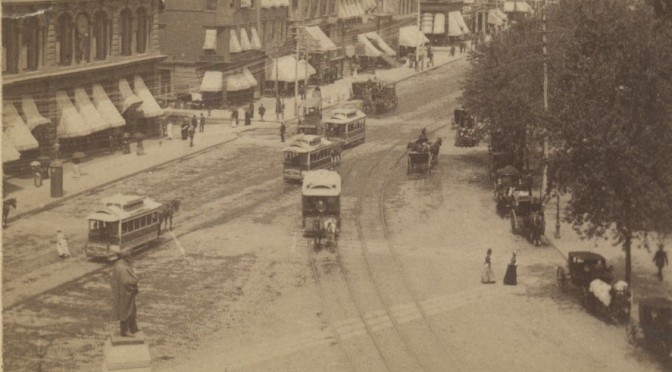
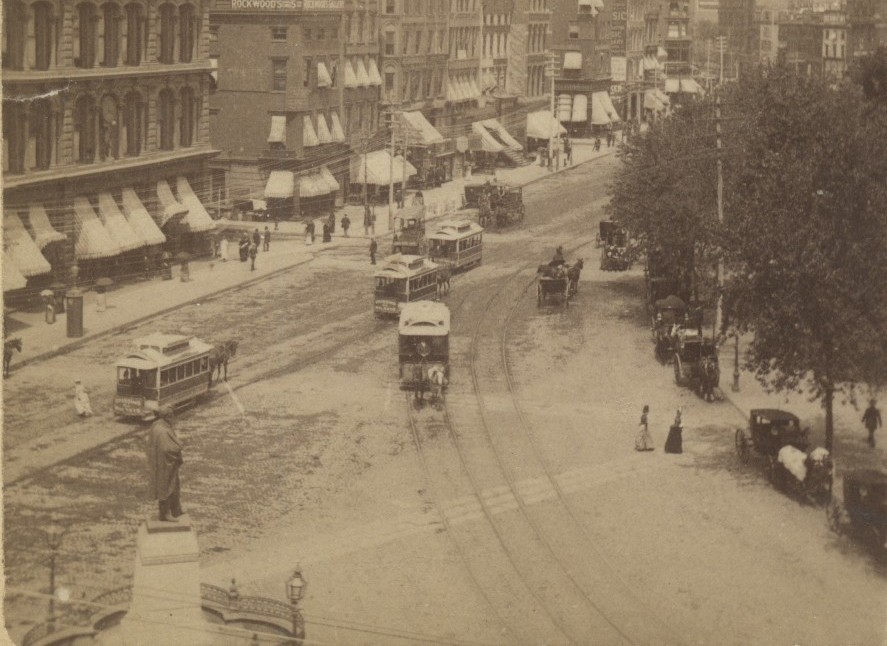
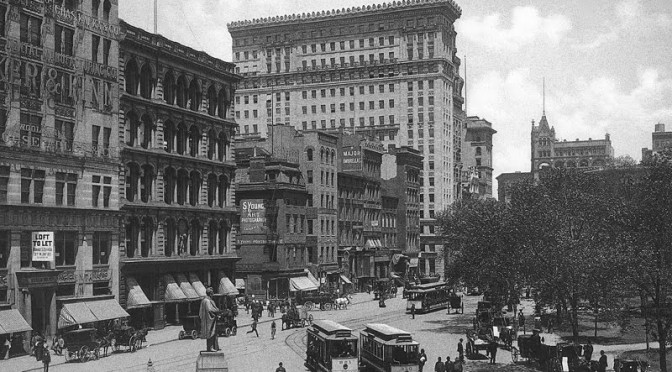
The photo above shows the southwest corner of Union Square in the year 1906. For many years prior, this corner was the scene of several brutal accidents between cable cars and pedestrians. When the Metropolitan Traction Company (now doing business as the powerful New York City Railway Company) ripped out the cable lines and replaced them with streetcar tracks in the early 1900s, New Yorkers hoped that troubles at the so-called ‘Dead Man’s Curve’ would likewise diminish.

Broadway and 14th Street, during the late 19th century, has always been seen as “New York’s Most Dangerous Crossing” (according to a Harpers Weekly article). But even in the new century, this morbid corner could never quite shake its reputation. “McGowan and Keenan Narrowly Escape Death At ‘Dead Man’s Curve” shouted an Evening World headline from February 15, 1906, reporting a serious accident here involving two major city officials, one (Patrick McGowan) the head of the Board of Alderman.

Getting rid of the cable cars reduced — but did not eliminate — the problems posed by the heavily trafficked, sharp corner along New York’s most famous avenue. Grim accidents kept occurring here, such as this one in September 1908: ‘Legs Are Crushed…at Dead Man’s Curve’. One source posits an interesting theory: with the district to the west still considered Ladies Mile, New York’s prime shopping district, male drivers (as they would have mostly been at this time) became distracted at this difficult corner by lively female shoppers.

Fortunately, it seems reputation can be the wonderful deterrent. While other cities would develop their own deadly traffic curves — and apply the nickname ‘dead man’s curve’ to those unfortunate places — New York would see fewer accidents at Broadway and 14th Street in the following decades.

One author in 1917 remarked that the corner’s “perils are now outdone on every street and road since the advent of the automobile.” In 1930, all of Union Square would be redesigned as subway lines were constructed underneath, and traffic was helpfully reduced. Most shopping had moved to Herald Square and Fifth Avenue, so there were fewer alleged distractions anyway.

A witness to all the grim accidents at this corner was, oddly enough, Abraham Lincoln. His sculptural likeness had stood here since 1870, a work by Henry Kirke Brown, surrounded by an austere bronze fence. With the redesign in the 1930s, Lincoln was moved away from the bloody corner and moved into the northern end of the park, where he still stands today.

Photo from the New York Times

Categories
Podcasts

Cable cars, trolleys and monorails: Moving around on New York’s forgotten transit options

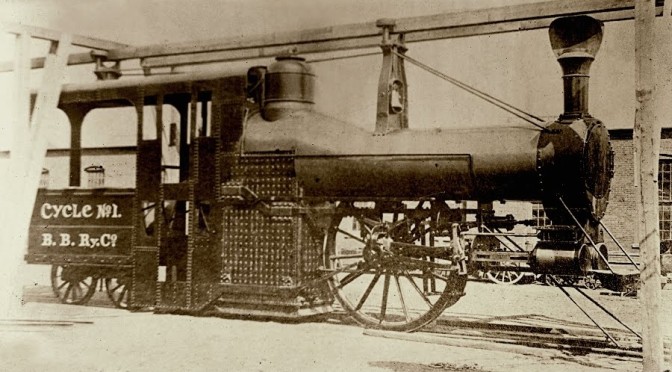
ABOVE: The Boynton Bicycle Railway, combining the best of the locomotive and the spinning wheel. This narrow little hot wheel took riders on a short ride through Coney Island.

For the third part of our Bowery Boys On The Go summer series, looking back at the history of New York City public transportation, it’s a short ride on the long gone, forgotten methods of getting around the city. The streets were mostly dominated by horse-based transport, but this was smelly and slow — not to mention awful on the animals. So the city experimented with new ways of moving the masses: by cable car (exported form San Francisco), the trolley and the monorail.

Along the way, you’ll find out the connection between the cable car and New York’s most famous art-house movie theater, discover the origins behind the name of a classic New York sports team, and hear the contributions of a man known as ‘the black Edison’.

ALSO: Find out about what may be the world’s worst monorail technology!

Click onto photographs for a larger view


Horse Drawn: New York City before the 1870s simply could not have survived without horse power, and the streets were filled with thousands of the animals pulling streetcars, omnibuses, carts and basically everything else that moved. As a result, life for a horse was pretty much appalling. Life span was relatively short. Although the city designated places along the waterfront to dispose of carcasses, it wasn’t unheard of to leave bodies in the street. This classic (but disturbing) photo from 1900, captioned ‘Close of a Career’, illustrates the absurdity. (Courtesy Shorpy)

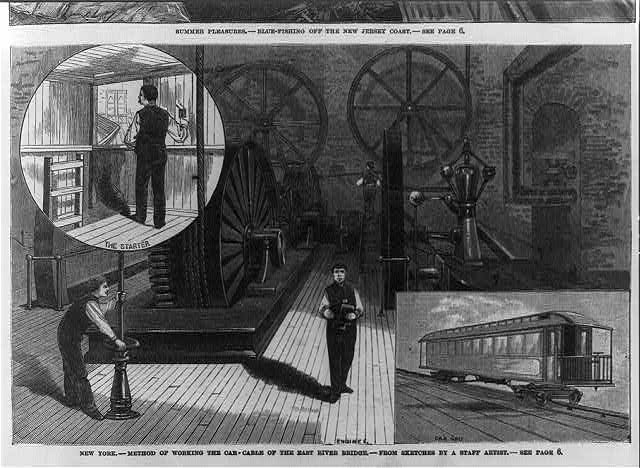
The first cable car system in New York was actually a steam-engine hybrid that ran over the Brooklyn Bridge in 1883. Engineers didn’t believe a regular steam locomotive could travel up an incline to get onto the bridge, so this dual steam/cable method was created. The powerhouses, pictured here, were situated under the approaches. (Read more about it here.)

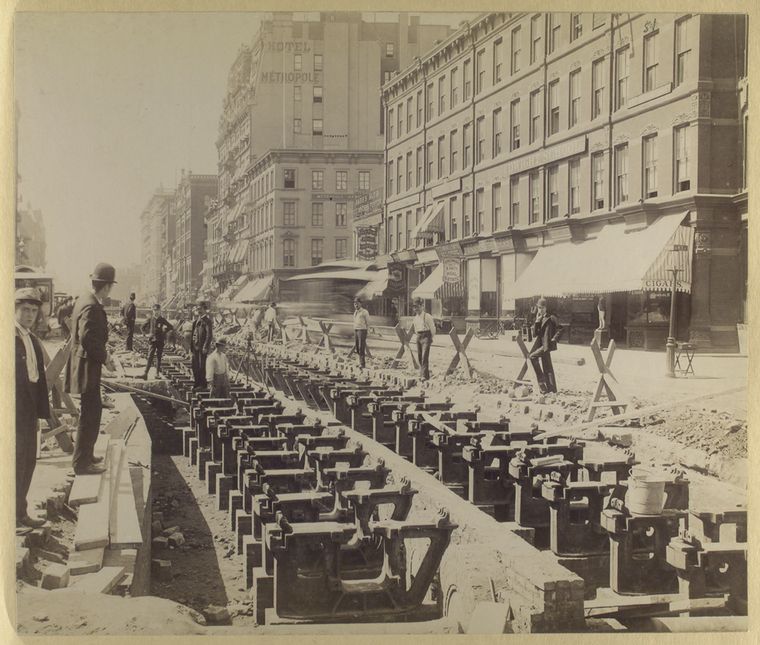
Cable Vision: How many times have the streets around Union Square been dug up? Here’s one of the very first times, in 1891, as workmen install a cable line for New York’s very first cable car system. Notable about this particular stretch is the fact that this would become part of the notorious Dead Man’s Curve, where cars would speed around the northwest corner of the park. (Courtesy NYPL)

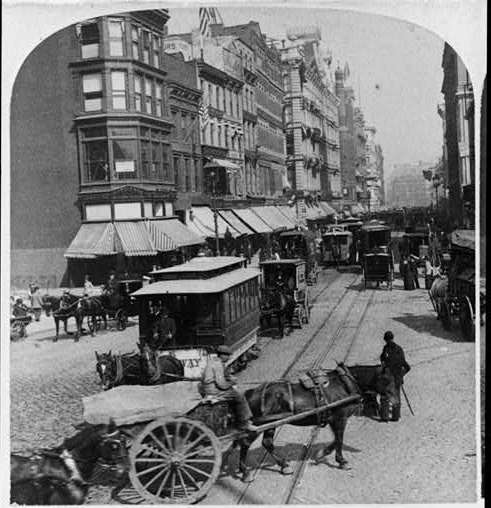
The frequent and frustrating traffic predicament on New York streets, a congested cluster of machines and horses, sometimes at a standstill. This picture, from 1892, depicts Broadway between Union Square and Madison Square.

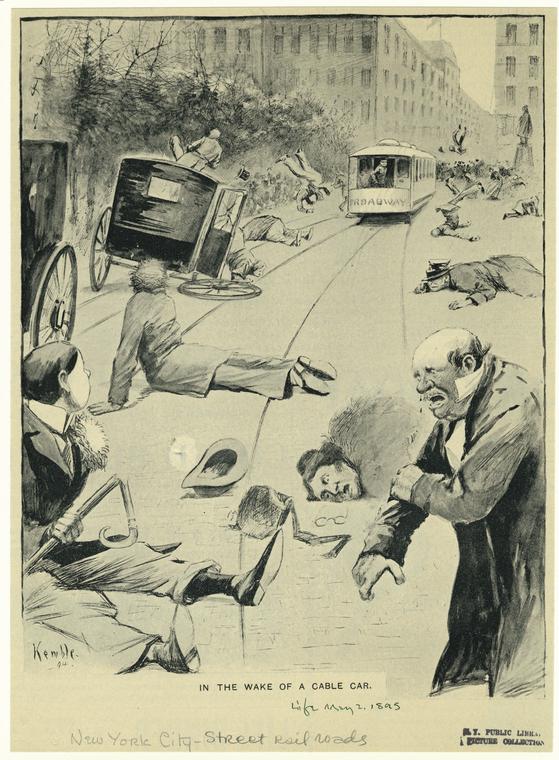
From an 1894 Life Magazine illustration, echoing the public sentiment over New York’s wily, dangerous cable car system. (Courtesy NYPL)

A video look at the Brooklyn trolley system, which by the 1930s had become the standard method of transit for most residents of the borough.

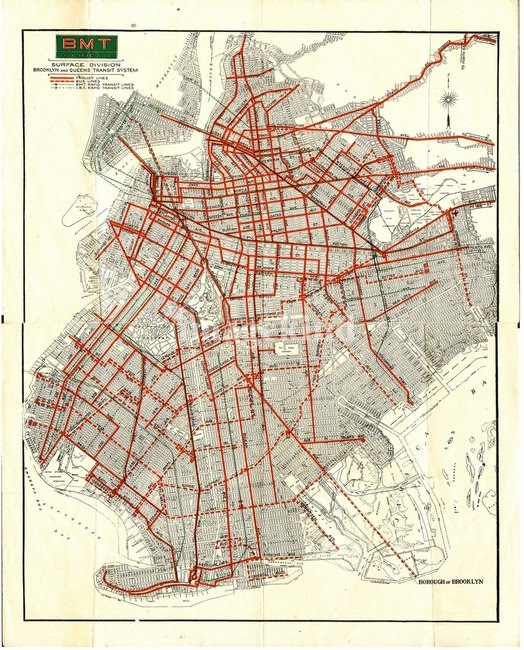
A map detailing the vastness of the Brooklyn trolley system by the 1930s, by this point a component of the Brooklyn-Manhattan Transit Corporation.

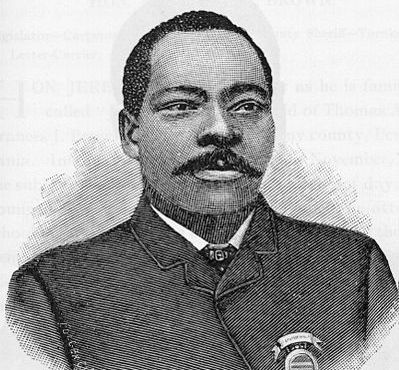
Inventor Granville Woods debuted his ‘multiple distributing station system’ — a sort of ‘wireless’ trolley system using electromagnetic induction — for the American Engineering Company in February 1892. Unfortunately, Woods had to sue the company for any sort of credit. In fact, this article in the Brooklyn Daily Eagle of the trial doesn’t even mention his name.

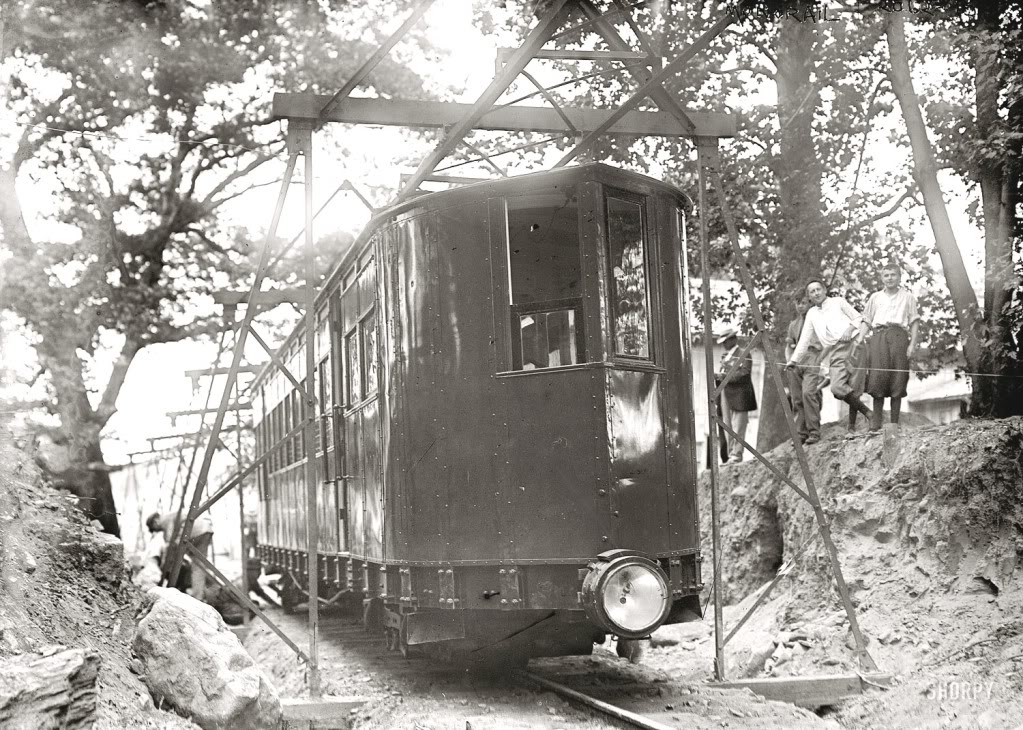
Monofail: The first riders of the monorail system provided by the Pelham Park and City Island Railroad were greeted with a nightmare voyage culminating in the entire car falling over on its side. “Flimsy Structure Supporting It Gives Way and Many Are Badly Hurt,” cries the New York Times. Despite this not insignificant hiccup, the monorail operated for a few years before being replaced with a trolley system.

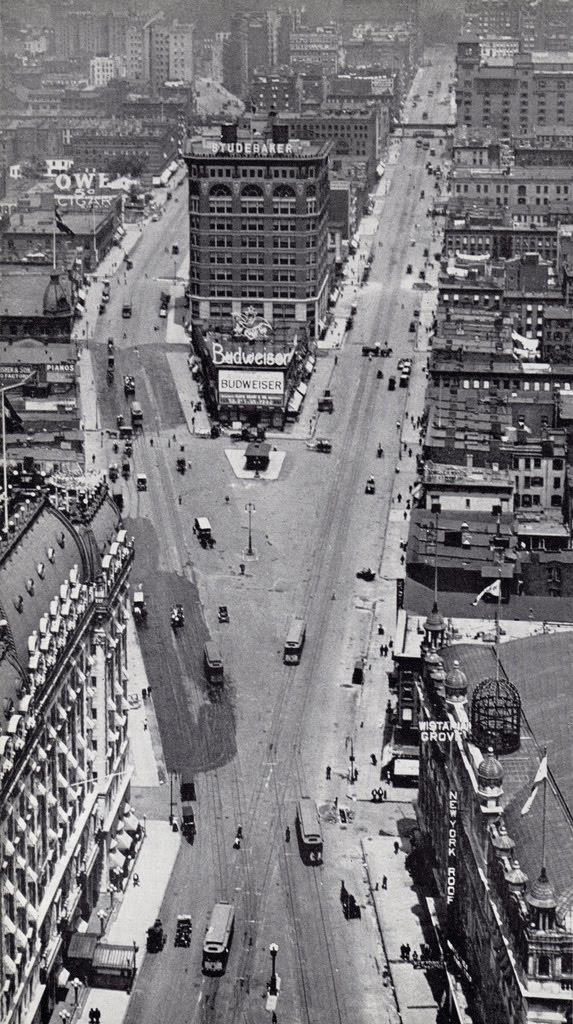
On Track: Looking down on Times Square from 1905, taken from the top of the Times Building. I’m putting this hear for a bird’s eye view on what the streets of New York looked like, grooved with trolley rails. You can still see several horse carts too, although most horses had been taken off of city streets by this time. (Please click on the photo for a close-up view)

Categories
Holidays

Jacob Riis’ Not-so-Rockin’ ‘Sane’ New Years Celebration

Social reformer Jacob Riis is one of the most important men to New York City history, exposing the ghastly living conditions of city tenements and using his connections to enact change that affected thousands of New York’s poorest residents. In spreading the word, he wrote a social history masterpiece ‘How The Other Half Lives’ and innovated multi-media techniques to inform and titillate crowds. But not all of his ideas were inspired.

At the end of his life, Riis railed against corrupting influences like alcohol and their effects on poor communities. So imagine his disgust when the New York Times began sponsoring wild New Years Eve parties outside its new headquarters on 42nd Street. Inaugurated by a lavish firework display during the first seconds of 1905, the Times Square celebration eventually incorporated its famous balldrop in 1907. (Hear all about it in our Midnight In Times Square episode.)


As today, the outdoor celebration encourages revelry, drunkenness and chaos, things Riis did not believe benefited the city. To this extent, and with the help of former president (and good friend) Theodore Roosevelt, Riis proposed a ‘safe and sane New Years Eve’.


According to Riis, the good men of the city “have observed the licentious and riotous conduct of New Years crowds, with their tin horns, ticklers and bags of confetti. Anyone who has seen the crowds of rowdies on Broadway breaking hats and insulting women knows that a saner manner of celebration is desirable.”


The new celebration will feature organized singing at various city plazas throughout the city, including City Hall, Union and Madison squares, with Salvation Army singers, organized bands and bandstands, leading ‘civilized’ public outcries of celebration via “the singing of patriotic songs and New Years ballads,” per Riis.


It would be an uphill battle that evening of December 31, as the somber chorale of hymns and polite exaltation of the downtown rallies would be entirely drowned out by the throngs of cheers and music drifting from downtown. “SANE FESTIVAL SUBMERGED,” shouts a New York Times headline from the next day. “The choral hosts greeted the new year with song last night, but the songs were not heard for the very good reason that in each instance there were just enough horns, rattles and other noise-making apparatuses in the hands of the din-making contingent to render even the ‘Star Spangled Banner’ and ‘America’ unrecognizable.”


Such mass city-organized, end-of-year civility would never seriously be attempted again. And Riis would only live to see one more New Years Eve, dying on May 26, 1914.


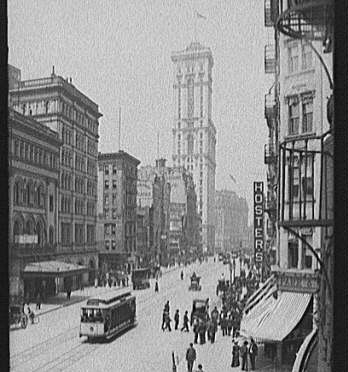
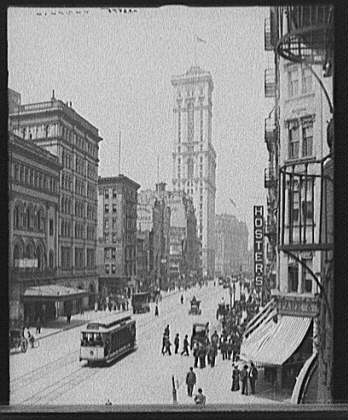
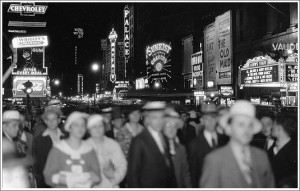
Top picture above: Time Square during the day, taken between 1903 and 1910. Courtesy LOC. Second picture, from the 1930s, courtesy Times Square NYC

Labor Day vs May Day: or why New Yorkers love a parade

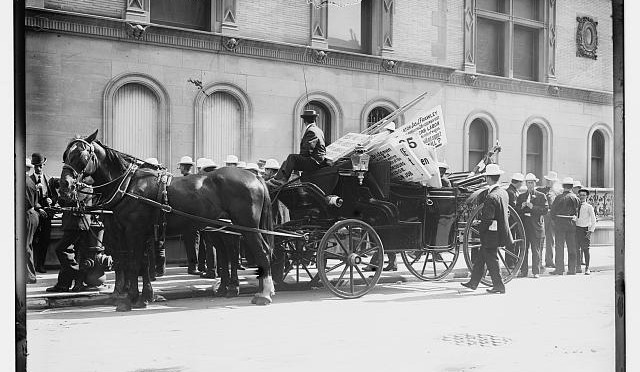
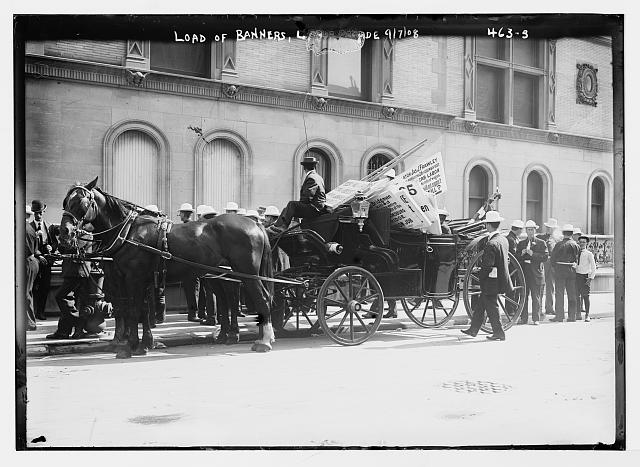
A banner celebration: loading up with signs for the 1908 Labor Day Parade in New York

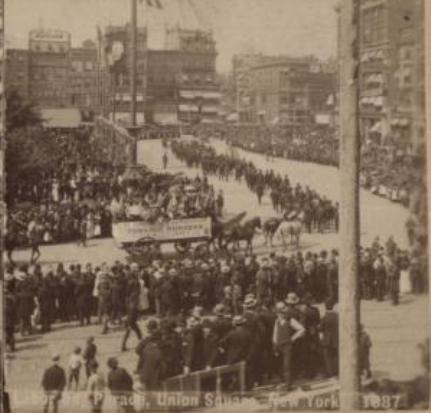
Labor Day is one of the few national holidays that New York City can lay claim to as their own. The roots of the U.S. holiday began here, with Union Square as its centerpiece, in 1882.

But in fact, New Yorkers borrowed the idea of Labor Day from Canada. Young Peter McGuire, educated at Cooper Union where he met labor activists like Samuel Gompers, was already making a name for himself as an advocate for workers rights as early at 1873, leading sit-ins at City Hall and heading a rally at Tompkins Square Park that was promptly broken up by police.

Workers in Canada were already marching annually by the 1870s. McGuire was invited to speak at one of these events in 1882 and decided to organize a similar event in New York. It’s doubtful that his was the only voice in organizing such a massive spectacle; Matthew Maguire, from Patterson, NJ, and secretary of the New York Central Labor Union, is also said to have proposed the date. Given their deep involvement with the CLU, it’s safe to consider both men (with such similar names!) as originator of the soon-to-be federal holiday.

That September 5 (a Tuesday, incidentally) anywhere from 10,000 to 25,000 participants marched from City Hall to Union Square and eventually on to 42nd Street. Matthew Maguire led the parade in a carraige he share with none other than Henry Ward Beecher. After the parade, the celebration continued with a massive picnic at Wendel’s Elm Park (at 92nd Street and 9th Avenue).

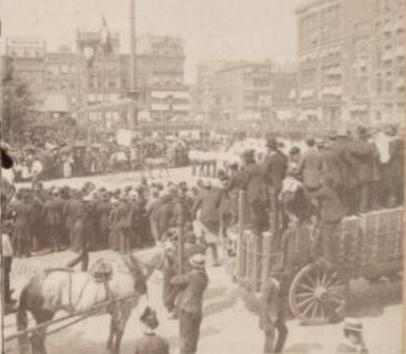
Below: Two of the earliest photos ever taken of a Labor Day celebration, this one from Union Square stands of a 1887 celebration, five years after the first. (Photo courtesy NYPL)

The celebration spread to other cities over the coming years, and by 1894, it was declared a national holiday.

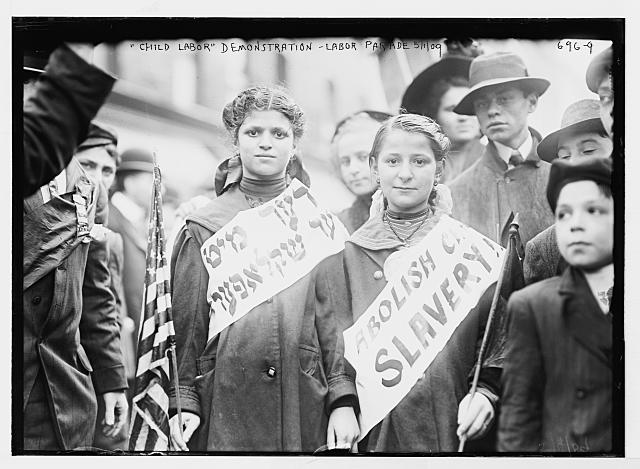
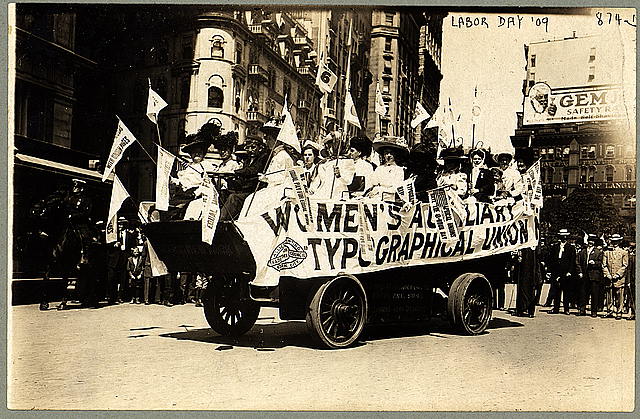
However Labor Day isn’t the only day that workers and labor organizations have rallied and protested in New York. In fact, I would hardly even say it’s the primary day of protest. That would of course by May Day which is still recognized internationally as a day of protest. Unlike Labor Day, May Day actually originated in the United States. In the late 19th and early 20th century, New York workers frequently organized May Day parades, demanding more reasonable working hours, better wages and safer working conditions. The first of these parades debuted across the country in 1886.

Today in New York, the area around Union Square often sees general protests on the first of May, but Labor Day has virtually lost its meaning. In fact, it’s better recognized today as the day of the festive West Indian-American Day Parade.

Below: The first is taken from a May Day celebration in 1909, over a hundred years ago. The second picture is taken from the Labor Day parade that very same year

For more information, check out our podcast on the history of Union Square.

Categories
Uncategorized

Snow shocked: The Blizzard of 1888

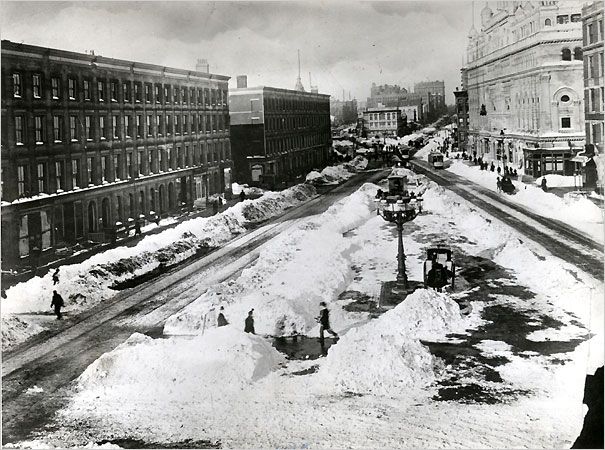
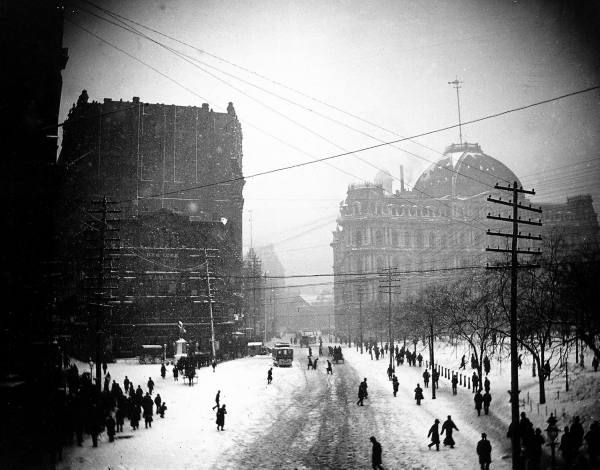
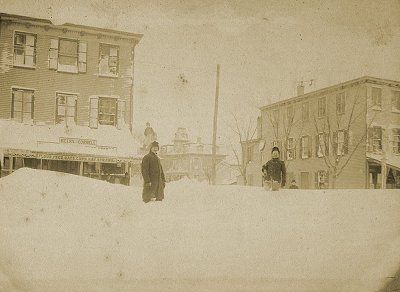
Longacre Square — the future Times Square — after the Blizzard

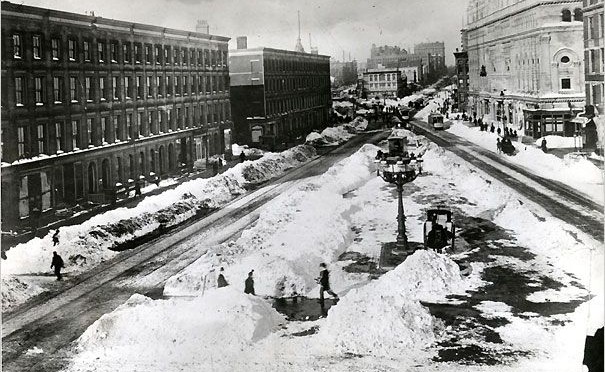
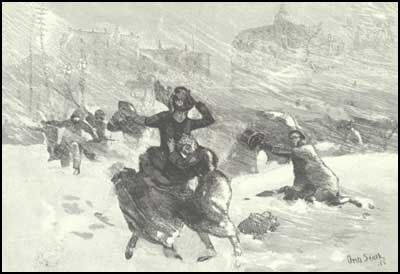
A March blizzard like the one today is discouraging as we’re so close to ridding ourselves of winter forever. But putting it all in perspective, it’ll never top the absolute worst March snowstorm of all time, a snowy catastrophe that completely shut down the city — the Blizzard of 1888.

In an age before radio and television, in a city with elevated trains and few effective snow-clearing techniques, New York was held hostage as the blizzard pelted New England, starting as freezing rain on March 11, then building to a 36-hour deluge of wind and snow from March 12-13, winding up the next day. The East River became a solid floor of ice, destroying dozens of boats and ferries. Telegraph poles and rudimentary electrical wires crumbled under ice and wind. Food deliveries stopped, supplies of fresh water froze up; many in downtown tenements froze to death in their rooms.

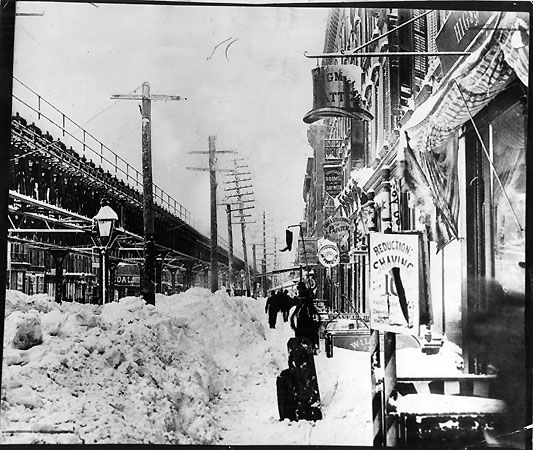
The storm also underscored the city’s need for an underground transit system. One unfortunate reporter for the New York Sun was on a packed morning Sixth Avenue elevated and observed: “The train moved down a little below Seventeenth street and stopped. It stayed there more than two hours. Then it moved ten feet and stopped another hour; ten feet more and another hour; finally to a little below Sixteenth street, and there it stuck until 5 minutes before 3 o’clock.”

Here’s a few more images from that horrific event. See, today isn’t so bad:

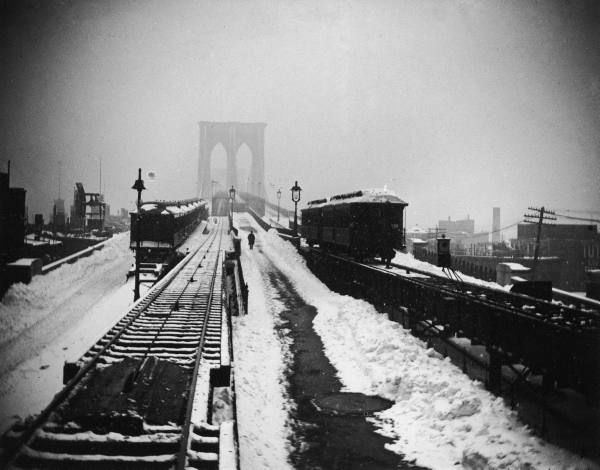
Aftermath along the elevated trains. Within ten years, New York would begin work on underground tunnels to accomodate a more convenient mode of transportation

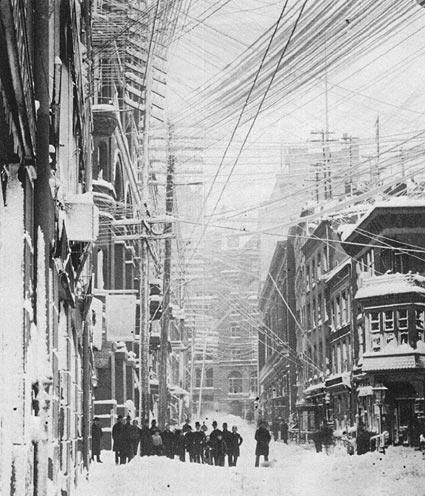
Not having the luxury of ‘sick days’ or lenient work environment, most New Yorkers braved the awful weather to go into work that day. What greeted them were a death-defying latticework of icy wires and downed telegraph poles.

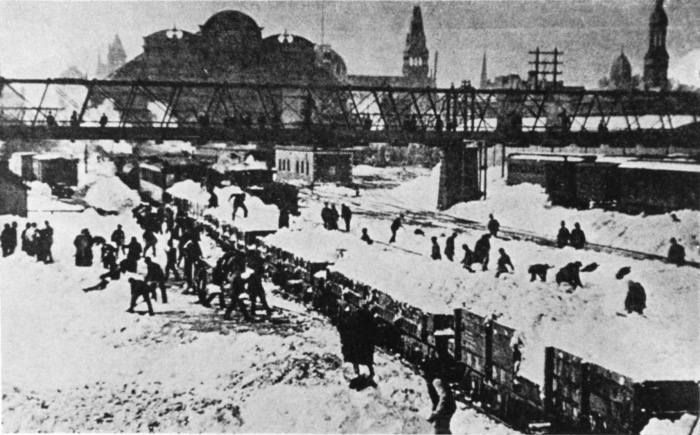
The scene behind the Grand Central Depot at 43rd street — essentially paralyzed

A Harpers Weekly illustration summing up the scene at Union Square. Not a day to hit the Ladies Mile shops!

The view of Park Row in front of the Brooklyn Bridge entrance in Manhattan, with the old post office to the right. Again, just invision sliding down one of these sidewalks, dodging uncontrollable trollies and the risk of falling poles and wires

The Brooklyn Bridge, barely a few years old, aches under the burden of tons of snow and violent winds
(Life archive images)

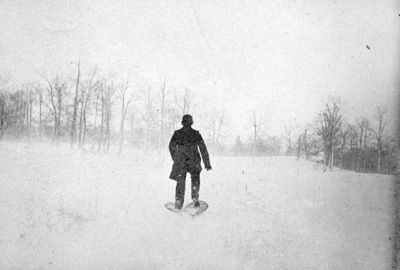
The truly adventurous, however, were well prepared, such as this man in Prospect Park, armed with snow shoes. (Pic courtesy the Brooklyn Historical Society)

And the scene was certainly no better in the town of Jamaica (Union Avenue is pictured here), which would be incorporated as a part of the borough of Queens just ten years later (pic courtesy wintercenter)

Categories
Podcasts

PODCAST: Union Square

This former English-garden style park became the heart of protest and the labor movement. Join the Bowery Boys as we dig into the history of Union Square, from Book Row to Klein’s.

Listen to it for free on iTunes or other podcasting services. Or you can download or listen to it HERE

An old view of Union Place, looking south. The oval shape of the park is readily apparent from this drawing. The park is still oval, but sidewalk extensions and the inclusion of the south ‘traffic islands’ configure the park into a more rectangular shape.

Two views of the 1861 Civil War rally (or Sumter rally), one from the ground…

…and from overhead.

This is Deadman’s Curve, the scene of several accidents due to cable-car operators zipping through

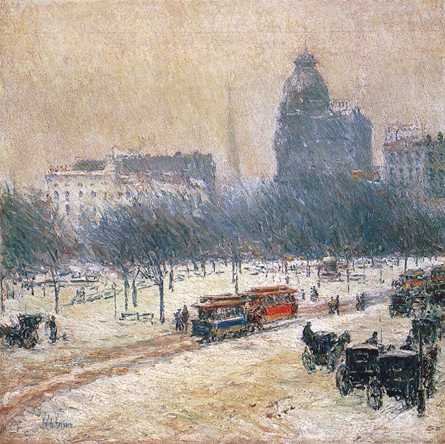
Union Square in 1892, by the American impressionist painter Frederick Childe Hassam

A depiction of the first Labor Day march by the Knights of Labor

Labor leader Emma Goldman was arrested here at Union Square. In this picture, she lectures to an enrapt audience (of men!)

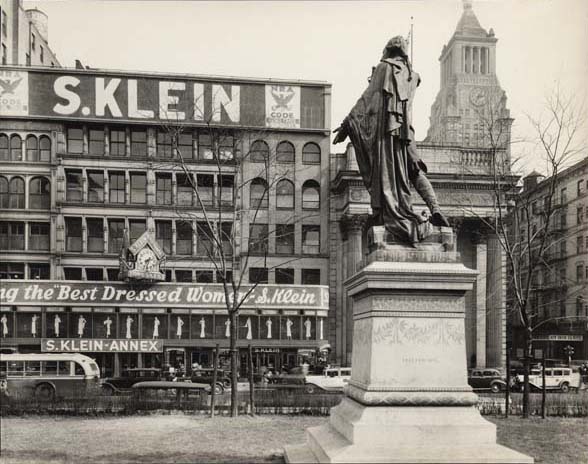
Klein’s on the Square — affordable women’s clothes dominate the park for decades, until they closed in 1975. It was strangely juxtaposed across the street with the Marquis de Lafayette statue, designed by Statue of Liberty creator Frederic Bartholdi.

New York also celebrated the first Earth Day here in Union Square in 1970

Union Square is still a popular and often chaotic place for gathering in protest. Last Saturday (March 22nd), over the course of about an hour, saw a large anti-war gathering, with speakers and singers.

People used the rally to air all sorts of grievances. And wear gory costumes.

Not thirty feet away, this flower seller was offering his springtime wares.

The Greenmarket stretched from the north side and down along the east side of the Square.

At 3 pm, almost as though in opposition to the war protest, people battled in a gigantic pillow fight

Now compare those pictures to this one of a Union Square crowd in 1910:

And finally, an extraordinary panoramic view of Broadway from Union Square … via 1890! Click to get a closer view

The REAL story behind those confusing numbers

Some architectural monstrosities just beg to be ripped upon. Topping this list is One Union Square South, a bland 33-story structure and pioneer in the mall-ification of Union Square. Although its storefronts feature a Circuit City and a dying Virgin Mega-store, One Union Square South is defined by a piece of public art that has only gotten more atrocious and weird over time.

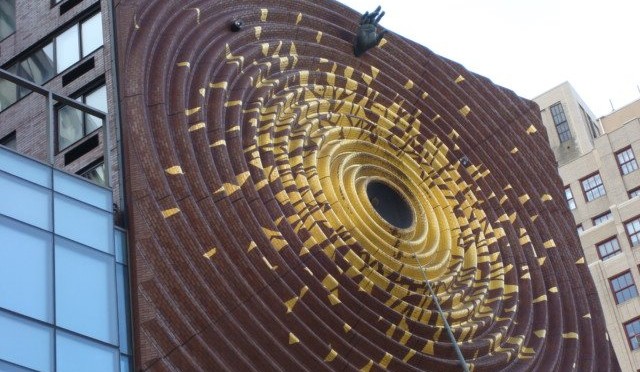
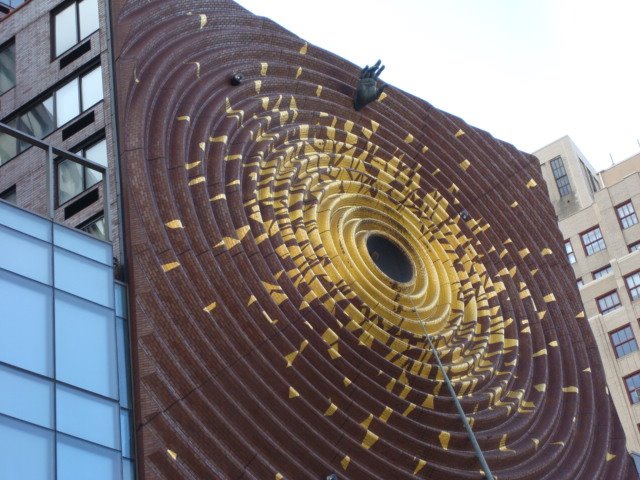
The Metronome was a project three years and $3 million in the making when it was finally installed in February 1999. It has confused and horrified New Yorkers ever since. The 100-foot Kristin Jones and Andrew Ginzel display features a brick wall striated with the undulations of water waves, interrupted with such objects as a boulder, a long tube frozen in the swing of a ‘metronome’, and a sphere which registers the moon cycles. Smoke occasionally burps through the hole in the middle, and a gigantic hand — modeled after the hand of George Washington across the street on his equestrian statue — beckons the viewer to stop and gawk at it.

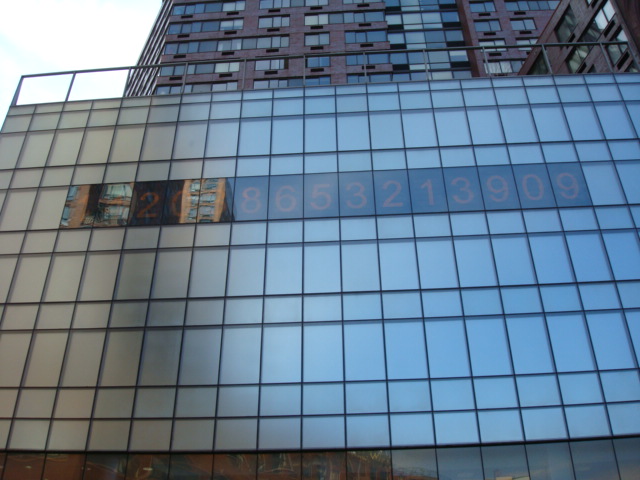
Nearby is a row of 80s-era calculator digits, rolling at different speeds. The six numbers on the left indicate the proper time (i.e. 9:34 am and 21 seconds = 093421).

The six numbers on the right display the amount of time before midnight, except to be quirky, they put it backwards. So, using the prior example, there are 14 hours, 25 minutes and 39 seconds to midnight. In Metronome world, you write that as 392514.

The three digits in the middle are too blurry, presumably in the rush of micro-seconds. (Except, of course, when you take a picture of it.)

Since this piece begs the viewer to speculate the passage of time, perhaps its time to speculate what sat here at One Union Square South before this dated piece was even here. (To be fair, the piece seemed dated the moment it was installed in 1999.)

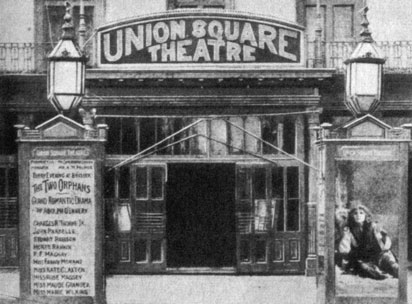
One Union Square South replaced the less glamorous address 58 East 14th Street. Passersby in the early 90s saw it as a frumpy building with modest retail space dominated by a gigantic McDonalds sign. What many may not have known was that this building contained the oldest theatrical space in Manhattan.

Rumors of this secret stage had persisted since the 1970s, but it wasn’t until some clever detective work by a New York Times reporter verified in fact interior walls were built during its transition into retail space, severing the stage from a vast auditorium, sitting empty for decades.

It had once been the Union Square Theater. In its final days of operations, from 1896 until the late 30s, it had been a cinema for silent features and ‘racy’ pre-code pictures. As with many stages, it converted to showing films after a brief stint from 1893 to 1896 as a vaudevillian showcase. The stage saw the debut of a young entertainer named George M. Cohen, who was originally supposed to perform with his family The Four Cohens. But owner B. F. Keith needed to fill up his bill, so young Georgie took the stage himself and the boy was greeted with apparent indifference. (You can see a variant of this event in the film ‘Yankee Doodle Dandy’.)

Before the racy films, before Cohen and the vaudeville, the Union Square Theater was a legitimate stage, showing mostly unsuccessful fare such as the un-intriguingly named ‘A Woman’s Strategem’. That show was apparently significant enough to merit articles about the details of the leading lady’s costumes — “a very quaintly-designed morning gown of crepe,” “a very handsome broche with bodices of the Directoire period and point de gaze’ lace sleeves.”

The early days of the Union Square Theater sound a lot more engaging. When it opened in 1871, it was advertised as a ‘modern temple of amusement’, showcasing everything from burlesque to ballet. Its brief foray into legitimate theater — the kind that could feature costumes of ‘quaintly-designed’ crepe — came only after a small fire gutted the balcony in 1888.

Peeling time back further, we find that the Union Square Theater was carved out of the remnants of vast dining room of an old hotel the Morgan House, which was itself the five-story modification of the original building on this spot — the Union Place Hotel, built in 1850.

A descriptive 1861 travel guide refers to the Union Place Hotel as an ‘elegant establishment’, and truly this was Union Square’s high-class heyday, of upper-crust homes surrounding an earlier version of the square inspired by lush English gardens.

A cheeky 1852 guide to the city called Glimpses of New York — written by “a South Carolinian (who had nothing else to do)” — describes it as ‘kept in equal style to the New York [Hotel, one of the superior hotels of the time] and the charges are a grade higher.’

Among many famous guests of the hotel were Mary Todd Lincoln in the years after the death of her husband.

Union Square eventually became the heart of New York’s theater district, and apparently the Union Square Hotel was a bit of a hangout for the out-of-work. Dwight’s Journal of Music proclaims “…at the Union Square Hotel, there is always a host of unemployed managers and actors.”

Luxury hotels and out-of-work actors — some things about New York haven’t changed a bit.