NOTE: This post features a slight spoiler of an event which occurs in the film’s first five minutes.
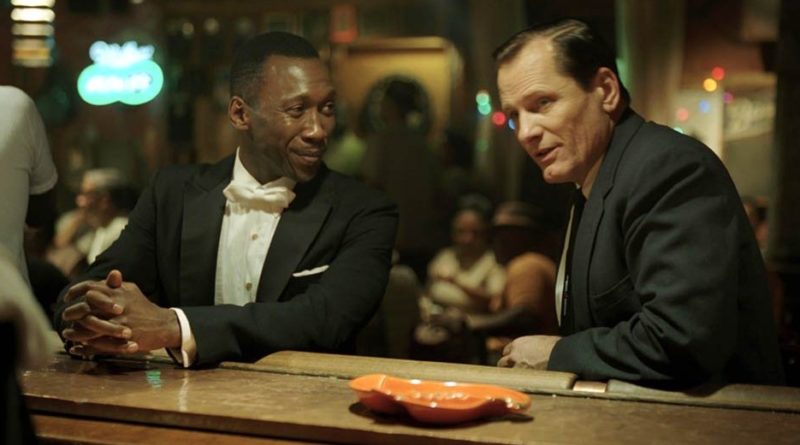
The period film Green Book — nominated for five Academy Awards, including Best Picture — goes cross-country with pianist Don Shirley (played by Mahershala Ali) and his chauffeur/bodyguard Tony Lip (played by Viggo Mortensen), depicting the varying gradients of class and race relations in America in the year 1962.
But the film is bookended by a look at vintage New York City from the perspective of three locations. Shirley really did live in one of the sumptuous artist units above Carnegie Hall — In fact, he lived there for over 50 years! — and the venue is depicted in all its regal, timeless glory. Meanwhile, Tony Lip — real name Tony Vallelonga — lived in an Italian neighborhood in the South Bronx, its street life and storefronts displayed in all their nostalgic beauty.
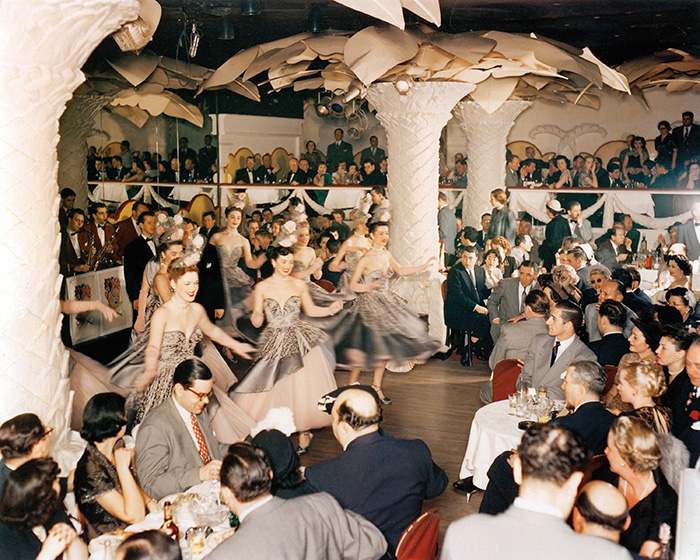
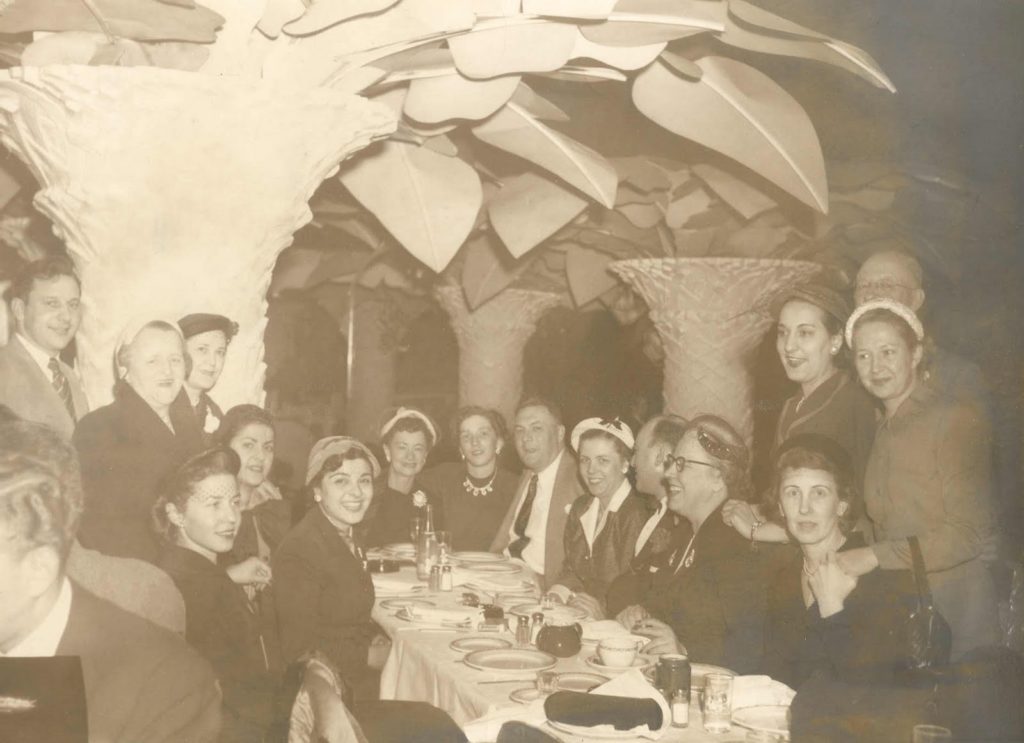
But when the film begins, we’re ushered into a space quite different from a concert hall or a Bronx apartment. In fact, we’re in one of the classiest, most renown nightclubs in New York City history — the Copacabana.
If you had to guess where the Copacabana was, most likely you would not have placed it at 10 East 60th Street near the entrance to Central Park and the aging mansions of Fifth Avenue. When it opened in 1940, Midtown Manhattan was exploding with nightlife, from the big-band supper clubs to the tiny jazz clubs of 52nd Street. (Billie Holiday was ruling the dives of Swing Street when during the Copa’s early years.)
The supper club scene was built for the wild and the wealthy, with fining dining and cocktails paired with floor shows by major stars and late-night dancing, a scene which greeted you whether you were at the Rainbow Room or El Morocco, The Cotton Club or the Stork Club.
But the scene was mostly operated by the mob, whose foothold into New York nightlife began during Prohibition and reached its crescendo in the 1960s. Organized crime syndicates controlled virtually all aspects of going out, from West Village gay bars to even the most respectable spots in Midtown.
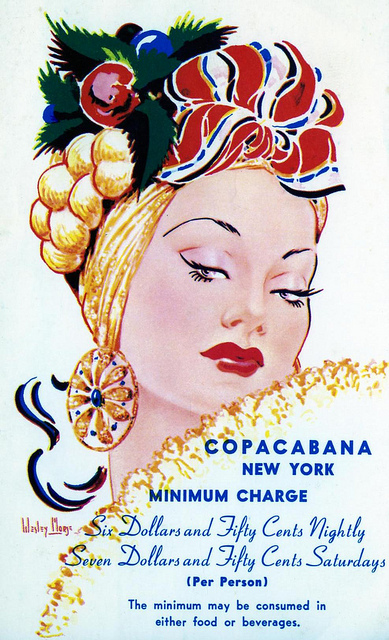
The Copacabana was owned by Broadway producer Monty Proser and was renown for its dazzling floorshow entertainment. Indeed its emblem was the face of Carmen Miranda herself, a Portuguese-Brazilian singer and dancer famous for her exotic, fruity headwear. Dean Martin and Jerry Lewis, who also made their name at the Copa, sometimes performed with Miranda before she died in 1955.
Tony Lip was a bouncer at the Copa, and at the opening of Green Book, we see a fight break out on the floor. Despite the club’s elegant airs, fights often broke out at the Copacabana, a venue which specifically courted wealthy (and famous) patrons known for partying a little too hard. Throw a bunch of drunken sports celebrities and mob bosses into the mix, and you were sure to see an ‘unplanned floor show’ at least once or twice a week. Lip was a busy man.
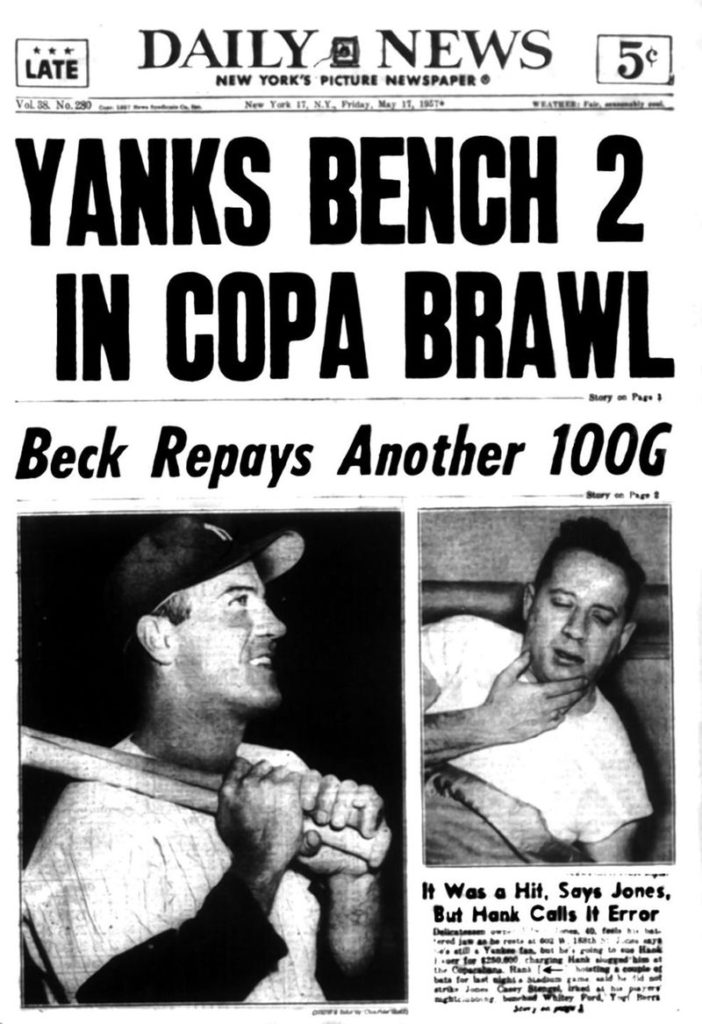
The most famous brawl of all happened on the night of May 16, 1957, during a performance by Sammy Davis Jr.
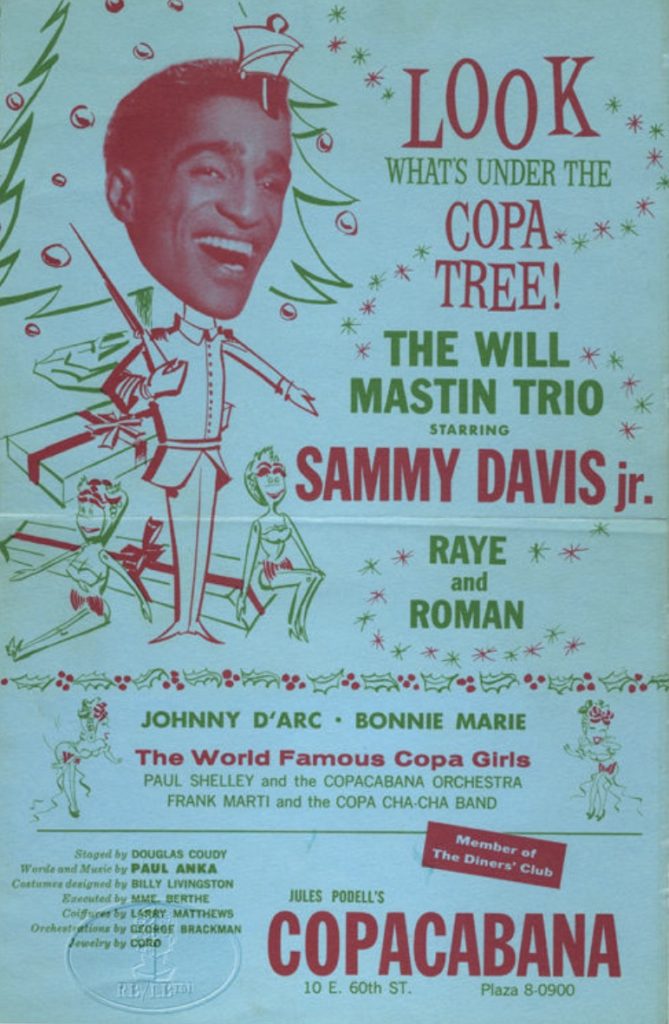
Below: A flyer for Davis’ 1960 show, apparently holiday themed.
Like many Manhattan supper clubs (including some in Harlem), the dining area was for white patrons only — at least until 1957 when this racist policy was finally dropped. But many black musicians and dancers entertained at the Copa well before then, including Davis, who first performed for the all-white audience here (as part of the Will Mastin Trio) in 1954.
During the spring of 1957, Davis returned to the Copa, now with an integrated dining room, and it was during one performance in May that a group of men began heckling Davis, reportedly spewing racial epithets. Unfortunately for these men, also in attendance that evening were a table of six drunken New York Yankees, including Mickey Mantle,Yogi Berra and Whitey Ford, out celebrating the birthday of Billy Martin.
The players retaliated, attacking the table of hecklers. Right-fielder Hank Bauer reported broke the nose of one man. “BEAK BUSTED BY BAUER CLAIMS FAN.”
Sammy Davis Jr would later become the Copa’s most popular draw, breaking attendance records in 1964.
The Copacabana — in its supper club incarnation — would close in the early 1970s, later reopening as a discotheque.
And then, in 1978, this happened.
For the rest of the story and for more information on the Copacabana, reach back into our back catalog and listen to a whole episode on the night club’s history! (Episode #24)
Welcome to the Bowery Boys Movie Club, a new podcast exclusively for our Patreon supporters where Tom and Greg discuss classic New York City films from an historical perspective. As we are currently prepare the newest episode for our patrons, we thought we’d give our all our listeners a taste of the very first episode (which was released back in September).
In the Bowery Boys Movie Club, we’ll be revisiting some true cinematic classics and sprinkling our recaps with trivia, local details and personal insight — and lots of spoilers of course.
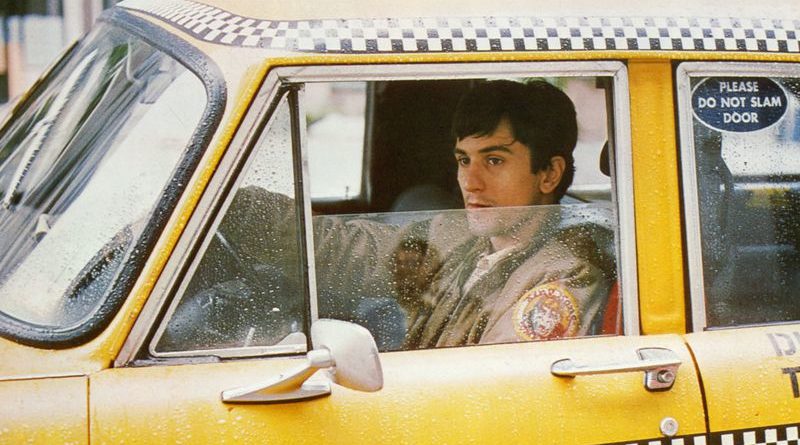
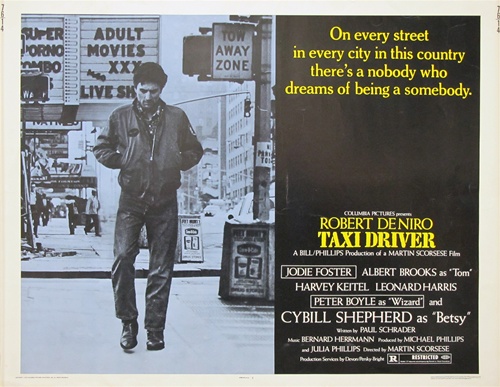
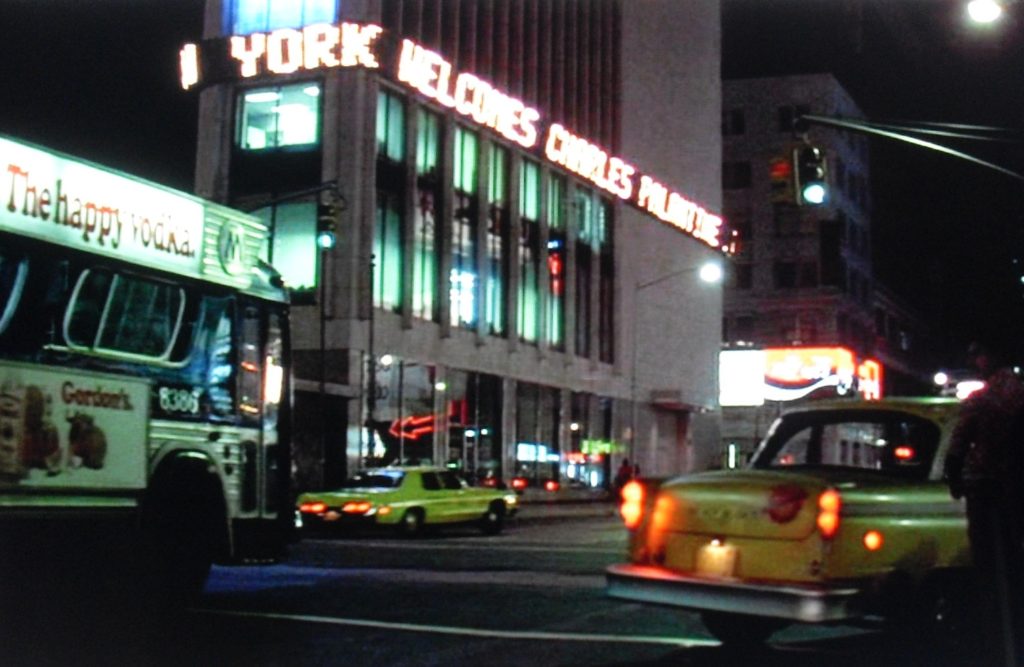
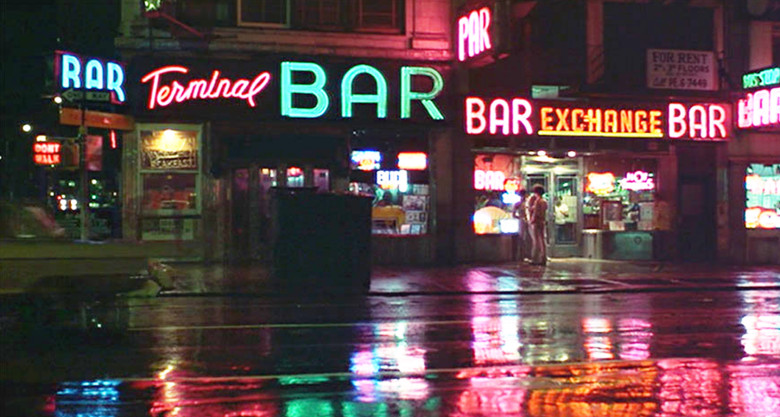
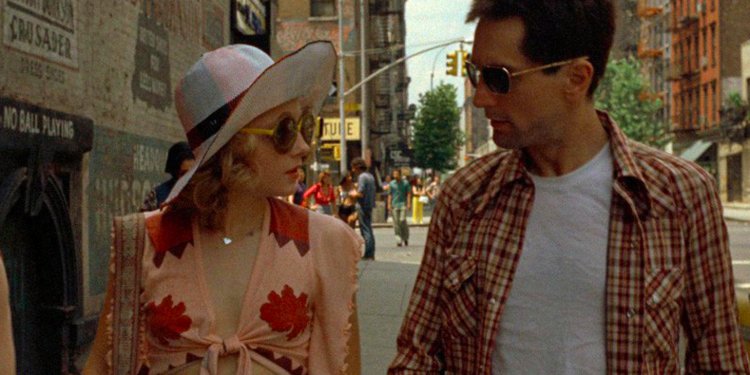
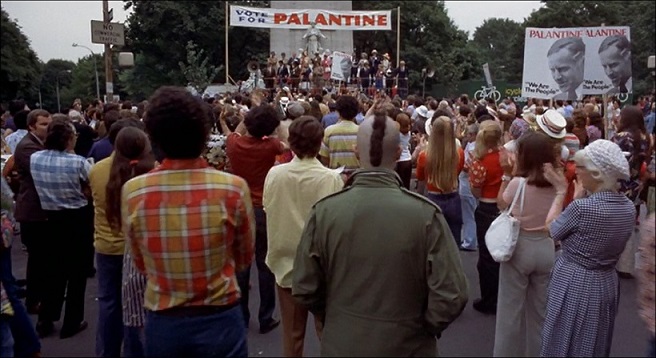
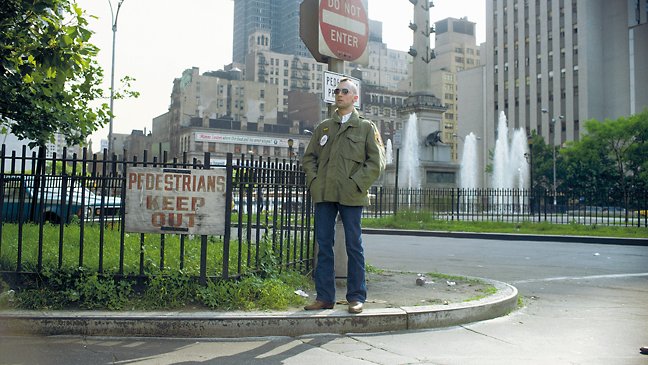
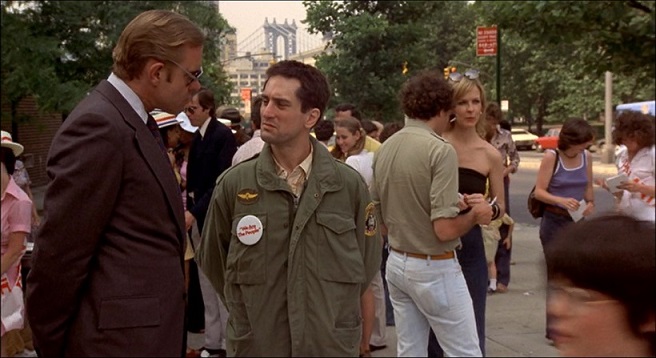
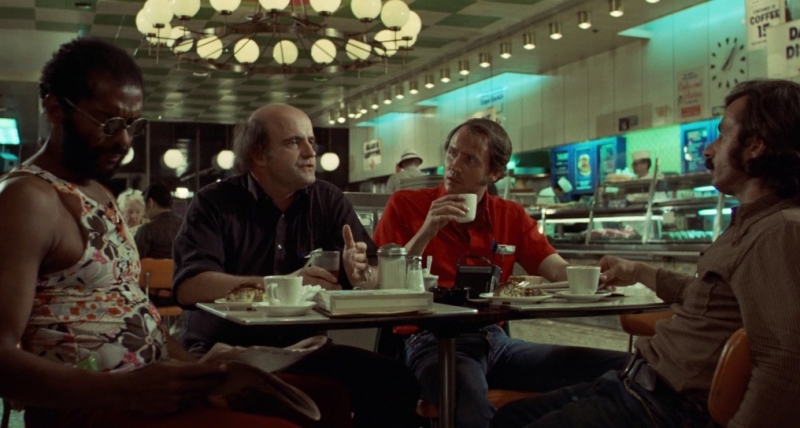
In this inaugural episode, the Bowery Boys take a trip to Times Square in the 1970s (not to mention Columbus Circle, the East Village and even Cadman Plaza in Downtown Brooklyn) in Martin Scorsese’s masterpiece Taxi Driver.
How does the director use New York’s unique geography to tell his story and categorize his three main characters? What does this film have to say about New York City in the 1970s? And how much has the city changed since Robert De Niro, Cybill Shepherd, and Jodie Foster starred in this grim, noir-ish thriller?
FEATURING: Diners, cafeterias, porn theaters and old elevated highways!
The Bowery Boys: New York City History podcast is brought to you …. by you!
We are now producing a new Bowery Boys podcast every other week. We’re also looking to improve the show in other ways and expand in other ways as well — through publishing, social media, live events and other forms of media. But we can only do this with your help!
We are now a member of Patreon, a patronage platform where you can support your favorite content creators for as little as a $1 a month.
Please visit our page on Patreon and watch a short video of us recording the show and talking about our expansion plans. If you’d like to help out, there are five different pledge levels (and with clever names too — Mannahatta, New Amsterdam, Five Points, Gilded Age, Jazz Age and Empire State). Check them out and consider being a sponsor.
And join us for the next episode of the Bowery Boys Movie Club, an exclusive podcast provided to our supporters on Patreon. Our new show on the 1958 classic Auntie Mame arrives in your exclusive feed next Wednesday.
We greatly appreciate our listeners and readers and thank you for joining us on this journey so far.
PODCAST What was life like in New York City from the summer of 1776 to the fall of 1783 — the years of British occupation during the Revolutionary War?
New York plays a very intriguing role in the story of American independence. The city and the surrounding area were successfully taken by the British by the end of 1776 — George Washington and the Continental Army forced to escape for the good of the cause — and the port city became the central base for British operations during the conflict.
While British officers dined and enjoy a newly revitalized theater scene, Washington’s spies on the streets of New York collected valuable intelligence. As thousands of soldiers and sympathizing Loyalists arrived in the city, hunger and overcrowding put the residents of the city in peril. When the sugar houses and churches became too filled with captured rebels, the British employed prison ships along the Brooklyn waterfront to hold their enemies.
This is a very, very special episode, a newly edited combination of two older shows from our back catalog. PLUS several minutes of brand new material, featuring stories that we overlooked the first time.
The Bowery Boys: New York City History podcast is brought to you …. by you!
We are now producing a new Bowery Boys podcast every other week. We’re also looking to improve the show in other ways and expand in other ways as well — through publishing, social media, live events and other forms of media. But we can only do this with your help!
We are now a member of Patreon, a patronage platform where you can support your favorite content creators for as little as a $1 a month.
Please visit our page on Patreon and watch a short video of us recording the show and talking about our expansion plans. If you’d like to help out, there are five different pledge levels (and with clever names too — Mannahatta, New Amsterdam, Five Points, Gilded Age, Jazz Age and Empire State). Check them out and consider being a sponsor.
We greatly appreciate our listeners and readers and thank you for joining us on this journey so far.
Since 2008, we’ve taken a deep dive into New York’s Revolutionary years with several shows focusing on many different aspects of these trying times. For more information, check out these shows from our back catalog:
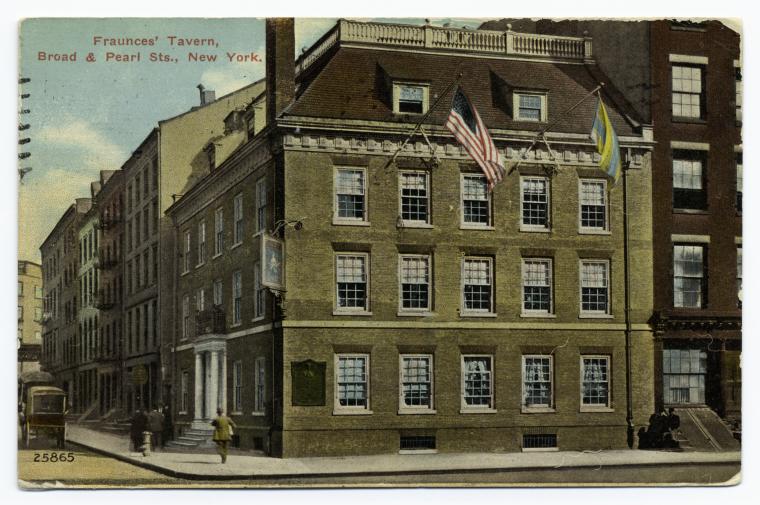
FRAUNCES TAVERN Fraunces Tavern is one of America’s most important historical sites of the Revolutionary War and a reminder of the great importance of taverns on the New York way of life during the Colonial era.
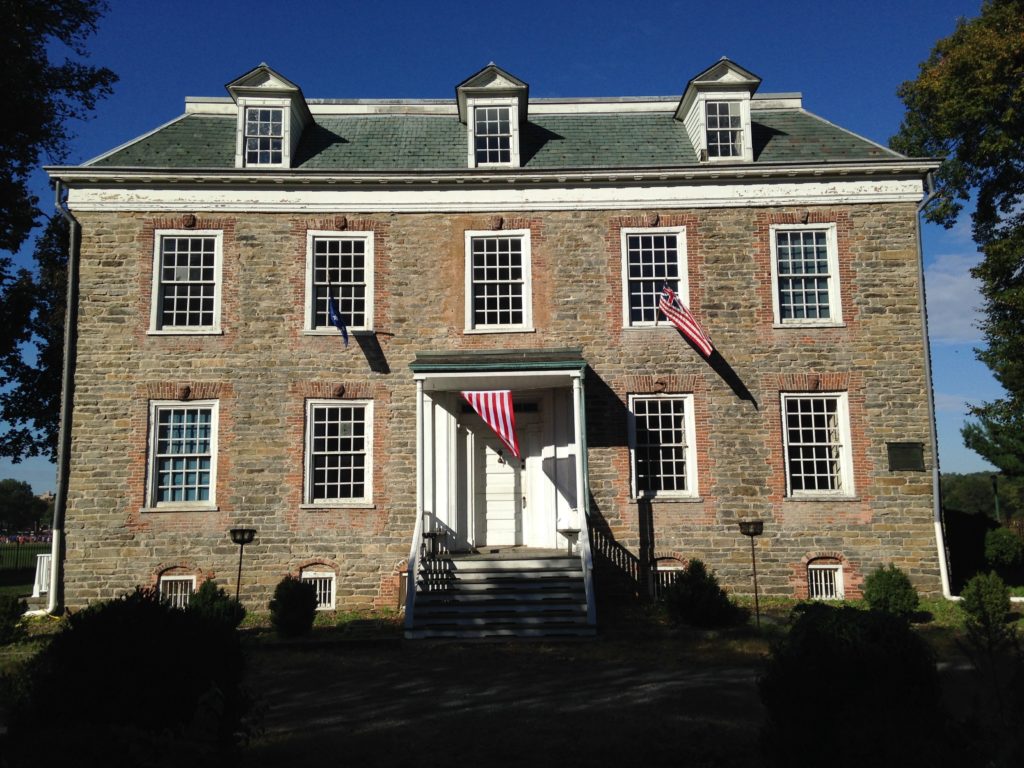
Van Cortlandt House Museum
BRONX TRILOGY (PART ONE): THE BRONX IS BORN Before it was the borough of the Bronx, the southern portion of Westchester County was populated with wealthy, prominent British families who faced a tough choice during the Revolutionary War? Remain loyal to the Crown or support the rebels?
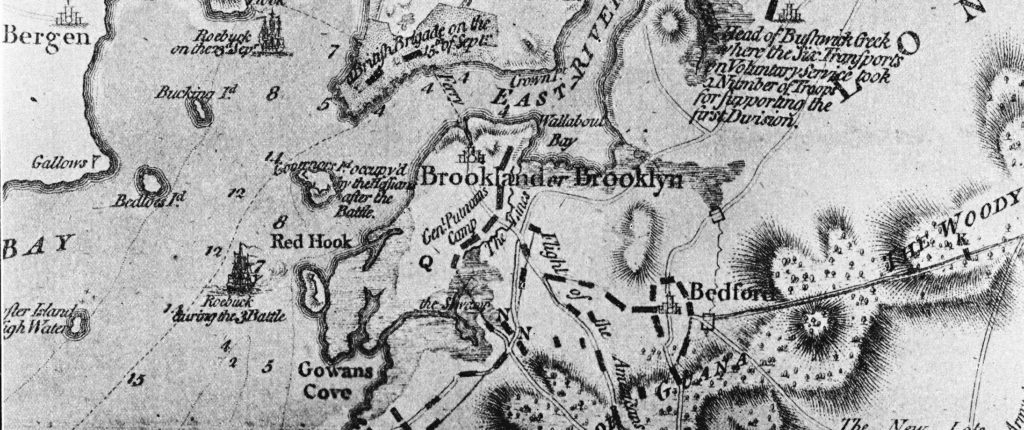
GOWANUS! Brooklyn’s Troubled Waters Back when the Gowanus was a marshy creek, an early battle in the quest for American independence was fought here. The Old Stone House today pays homage to this pivotal skirmish.
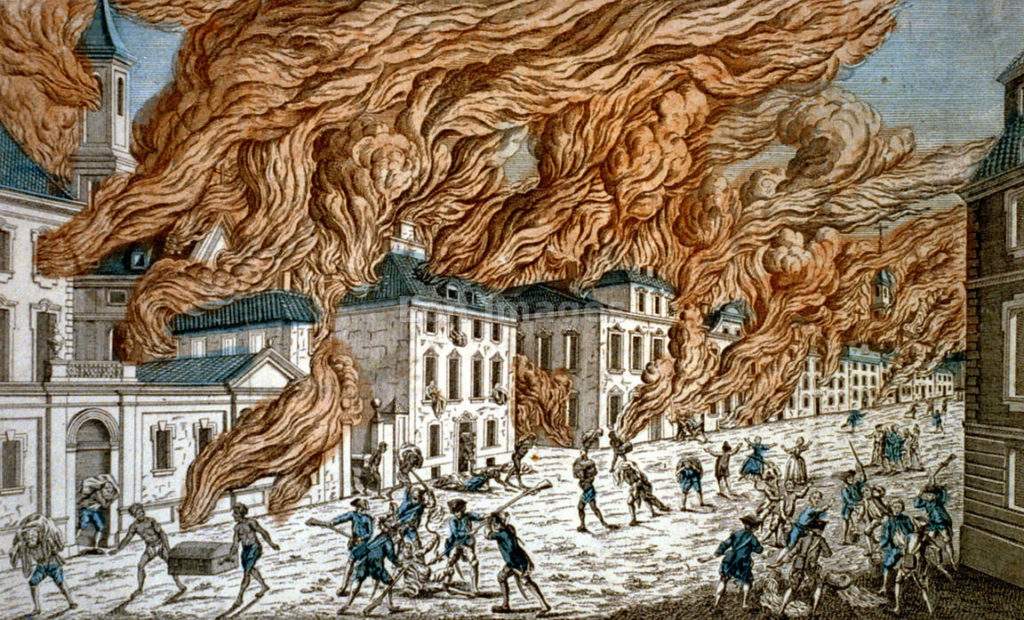
THE GREAT FIRE OF 1776 The circumstances surrounding the Great Fire of 1776, the events of the Revolutionary War leading up to the disaster, and the tragic tale of the American patriot Nathan Hale.
GEORGE WASHINGTON’S NEW YORK INAUGURATION After Washington resigned as head of the Continental Army in 1783, many did not ever expect to see him back in New York. But providence — and a new nation — called.
HISTORY BEHIND THE SCENE What’s the real story behind that historical scene from your favorite TV show or feature film? A semi-regular feature on the Bowery Boys blog, we will be reviving this series as we follow along with TNT’s limited series The Alienist. Look for other articles here about other historically themed television shows (Mad Men, The Knick, The Deuce, Boardwalk Empire and Copper). And follow along with the Bowery Boys on Twitter at @boweryboys for more historical context of your favorite shows.
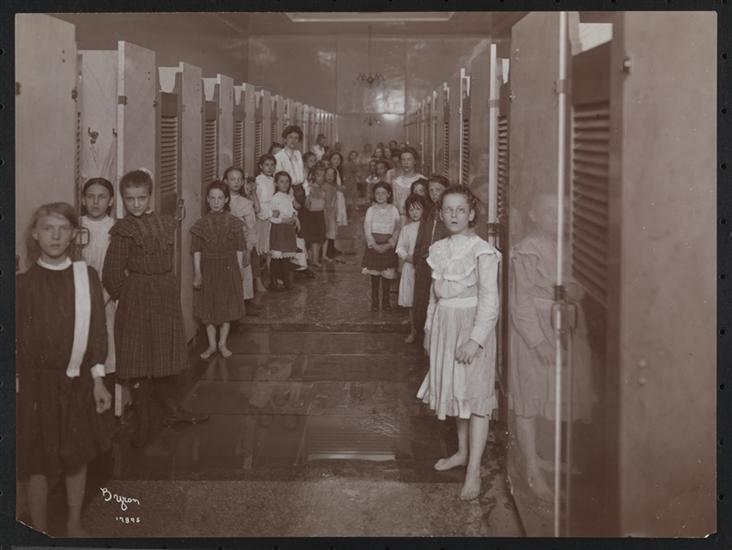
Public bathhouses were an integral component of tenement districts in late 19th and early 20th century New York City. Running water was uncommon in the poorest areas of the city, and when it was available, rusty, filthy pipes ensured that its consumption would be an unpleasant and often unhealthy experience.
And of course there was often very little available for bathing. As a result, life was so very fragrant back then.
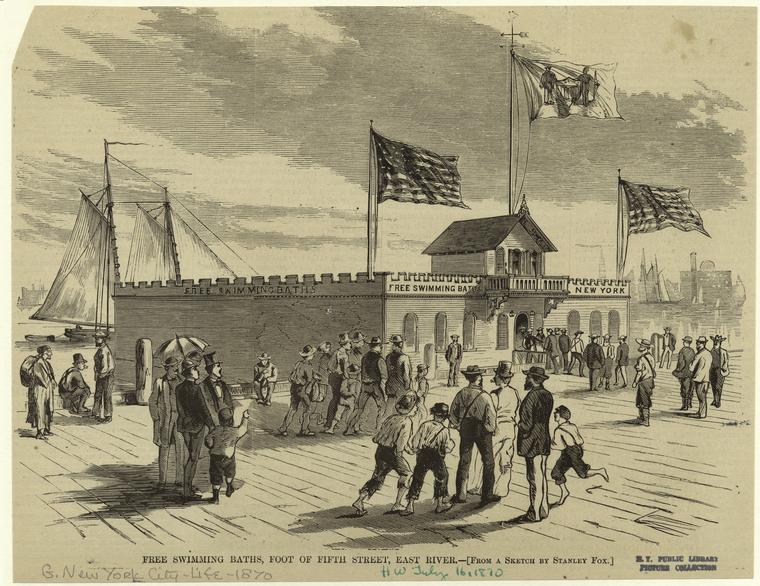
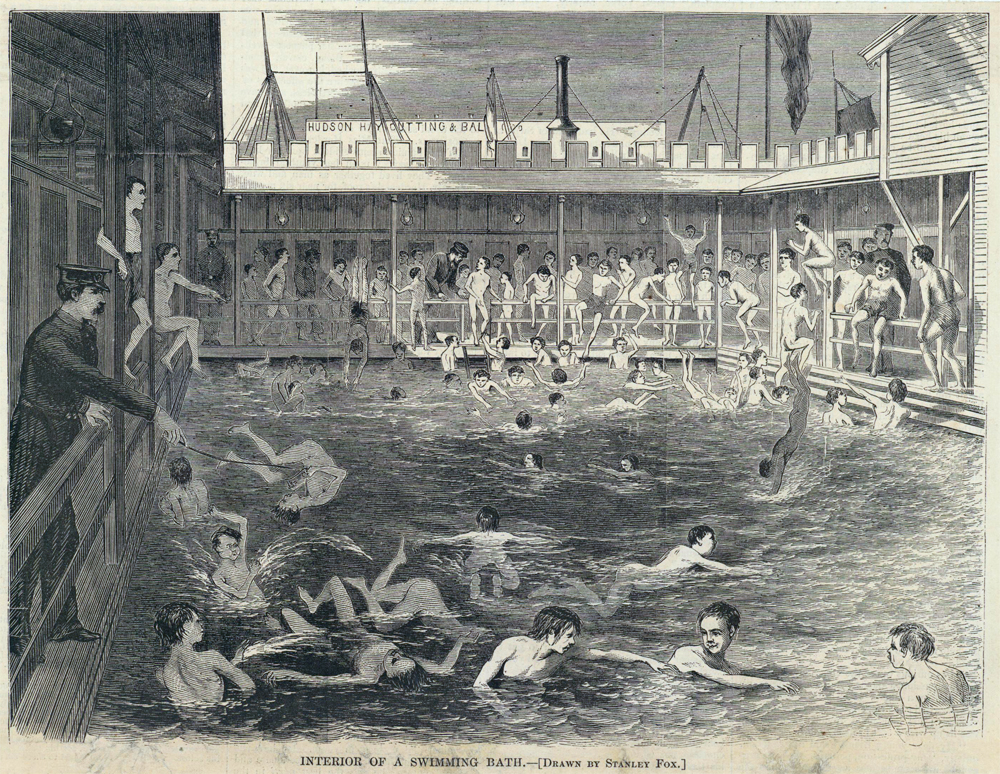
Temporary outdoor baths sprang up around the city during the summer such as this one off Fifth Street on the East River in 1870.
NYPLNYPL
From Harper’s Weekly, August 20, 1870. “We give on this page an illustration of the swimming bath at the foot of Charles Street. It contains 68 rooms, the water is four and a half deep and 200 bathers can be accommodated at one time. The success of these experiments should lead to the establishment of other baths in sufficient numbers to accommodate all who desire to avail themselves of these healthful privileges.”
New -York Historical Society
But the city’s objectives in opening public bath houses (starting in the 1880s) weren’t merely related to cleanliness. Most believed access to clean water promoted health and kept epidemics from spreading. This wasn’t strictly for the benefit of the poor, but for the wealthier classes who interacted with them in daily life.
From Gotham by Edwin G. Burrows & Mike Wallace: “[I]n the late 1880s, [German professor Simon] Baruch began a campaign stressing that baths, in addition to benefiting the poor and helping create “civic civilization” out of “urban barbarism,” were in the interest of “the better situated classes”: no longer unwashed, the employees, servants, laborers, and tradespeople next to whom they sat on crowded cars would not carry so many deadly germs. ”
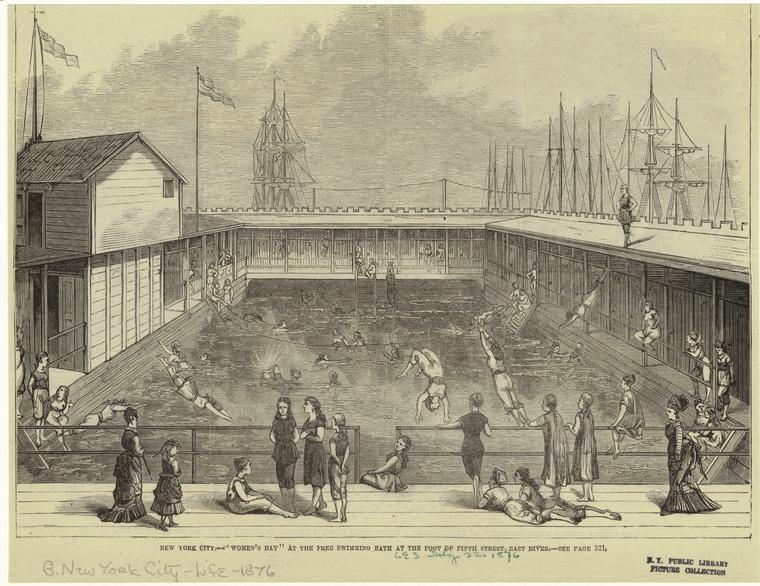
Public baths also provided relief in hot summer months — air conditioning and affordable electric fans were decades away — and encouraged physical activity. The public bath, in effect, gave rise to the urban swimming pool movement, drawing children from dangerous piers and swimming holes and into carefully monitored (if incredibly crowded) water environments.
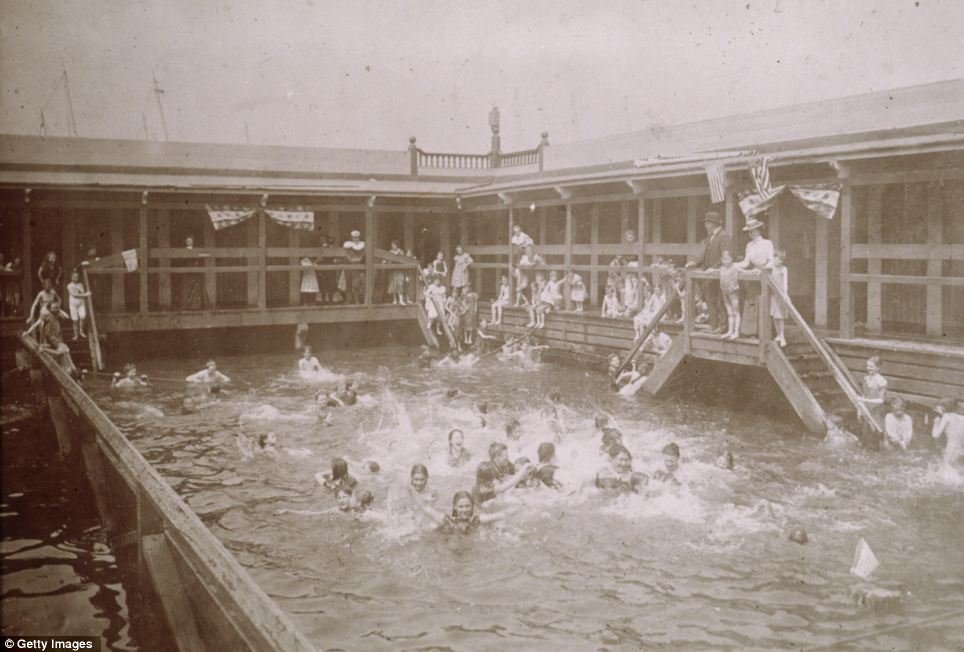
In 1888, New York installed several outdoor baths within the city, imposing 20 minute time limits on swimmers to keep the water clean. (No matter; adventurous children hopped from pool to pool to skirt the rules).
Public Bath #10 on the Hudson River
Three years later, a grand People’s Bath (at Grand Street and Centre Street) provided people with soap and towels for the modest admission of five cents.
In 1895, public bathing became a priority for Mayor William Strong who authorized a Sub-Committee on Baths and Lavatories which reported that “New York City was lagging far behind European and other American cities in the building of baths and urged that the city begin immediately to remedy the situation.” State government soon concurred, passing a mandatory bath law that year, “making the establishment of public baths mandatory for all first- and second-class cities in the state.” [source]
Museum of the City of New York
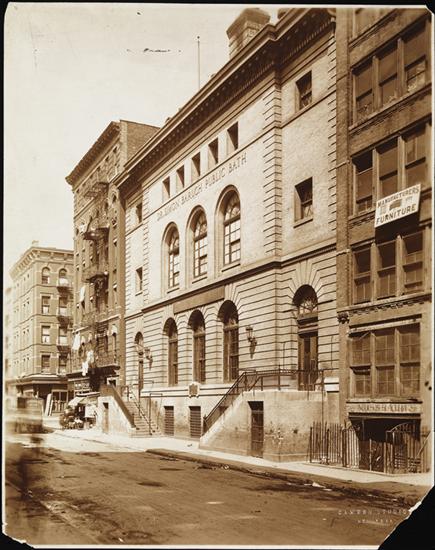
New public baths began opening by the new century, many in the Lower East Side; the first, Rivington Street Bath (pictured above), even had 91 showers and 10 bathtubs.
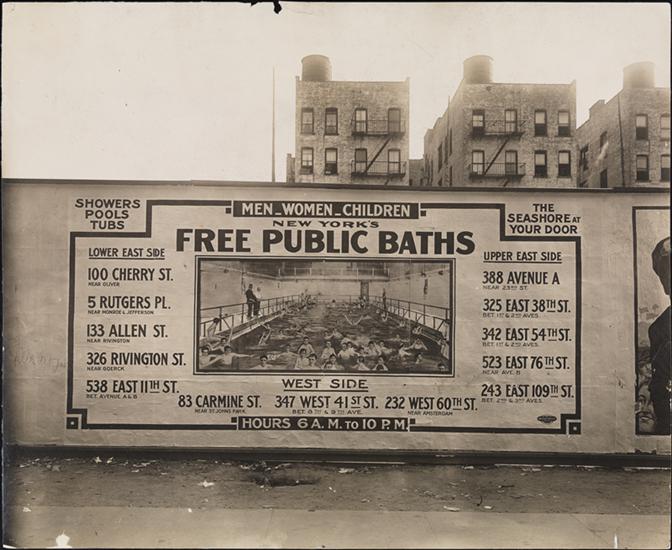
An advertisement for baths in 1935:
They’re mostly forgotten about today but a few remaining historical structures bear evidence of these important structures.
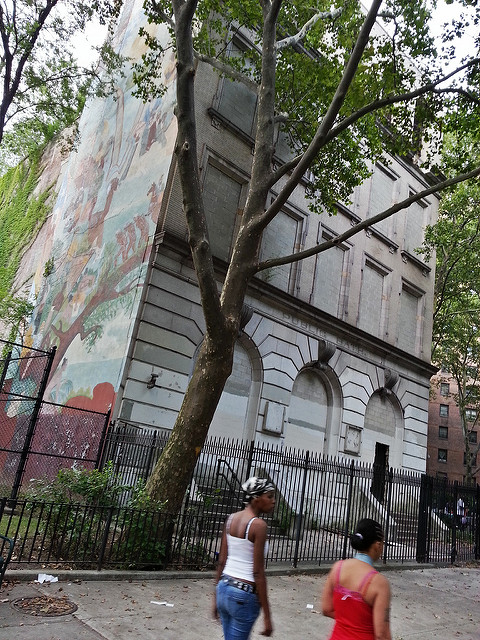
One such relic sits at Madison Street in the Lower East Side, within the La Guardia Houses development. (It’s listed in the above advertisement at 5 Rutgers Place.)
Matt Green/Flickr
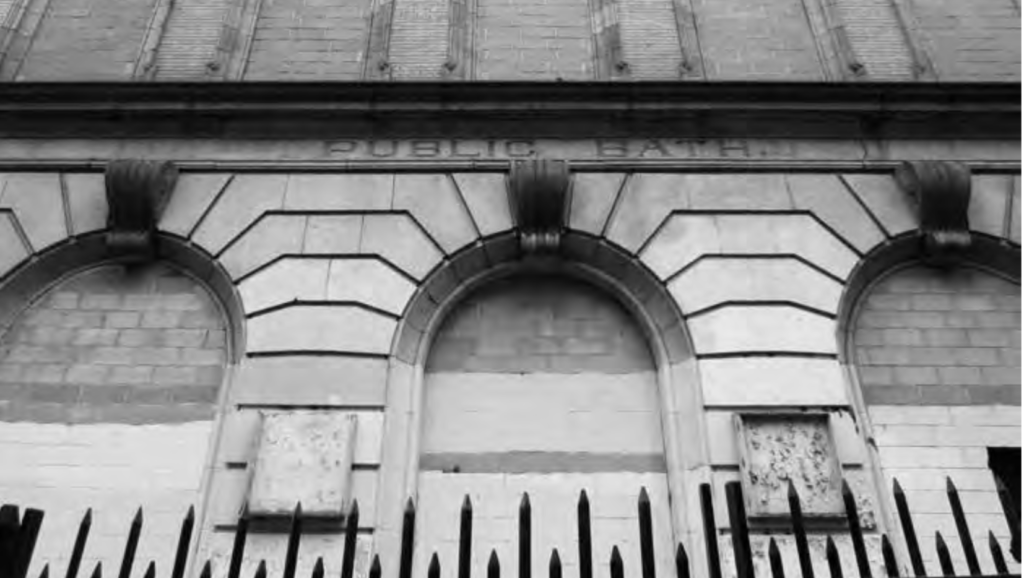
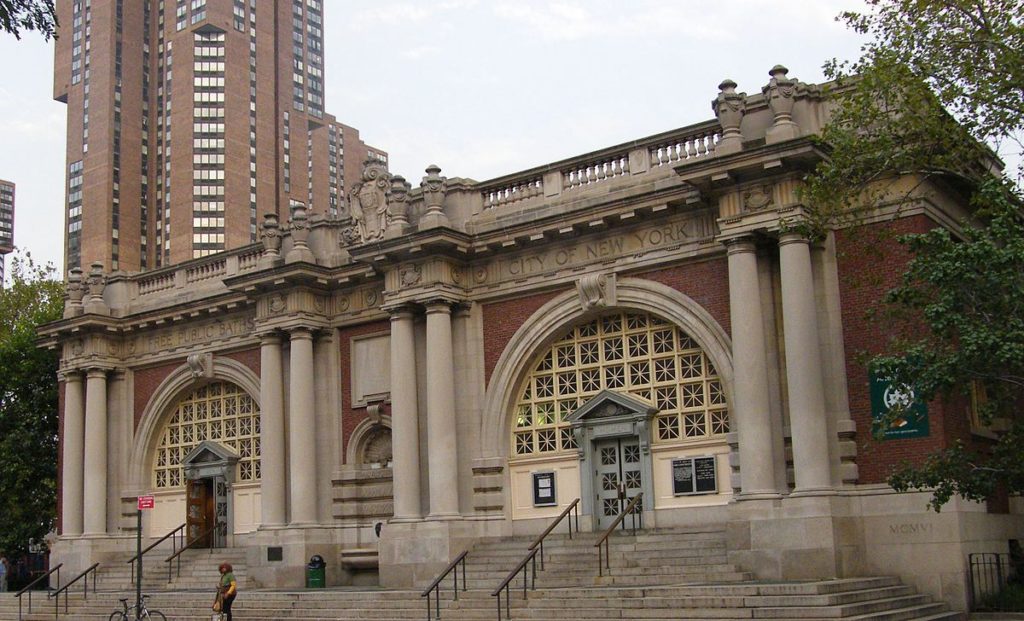
Nicknamed the Whitehouse, the bathhouse opened on December 23, 1909, and was one of thirteen public bath facilities in New York at that time. By the 1940s indoor plumbing had rendered the public bath obsolete, and so it was converted into a public swimming pool and gymnasium. Today it sits unused, like many others throughout the city, a ruin from another time.
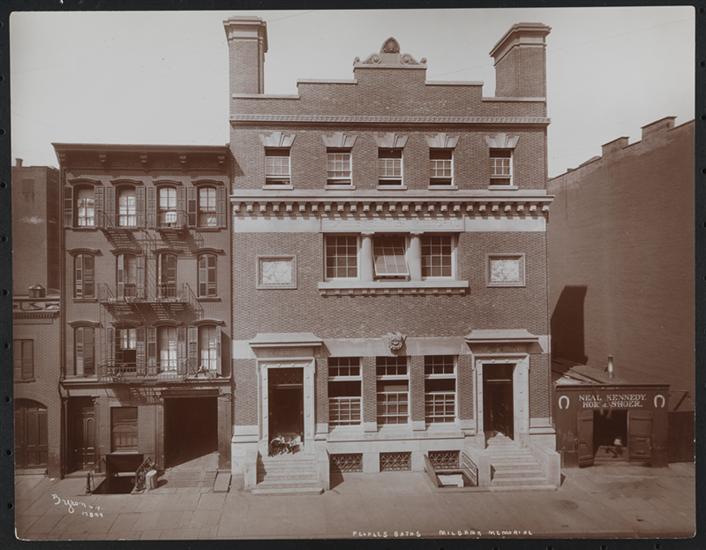
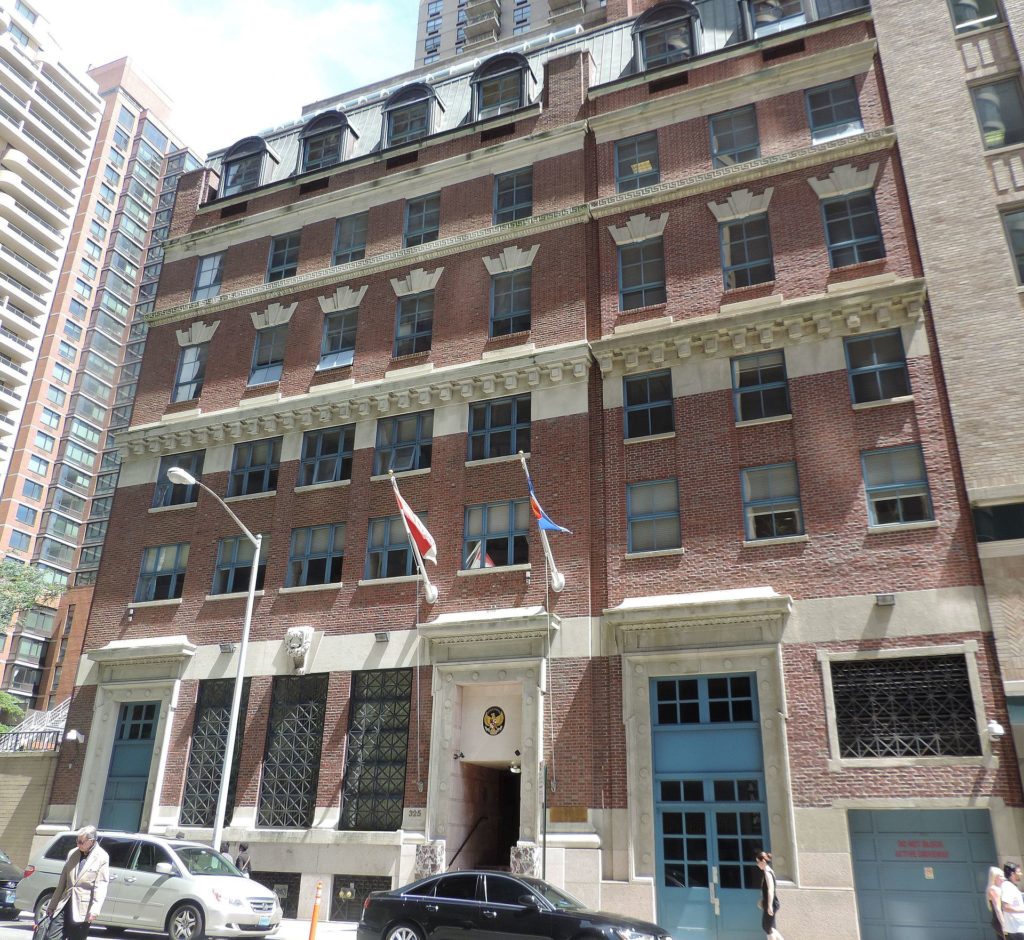
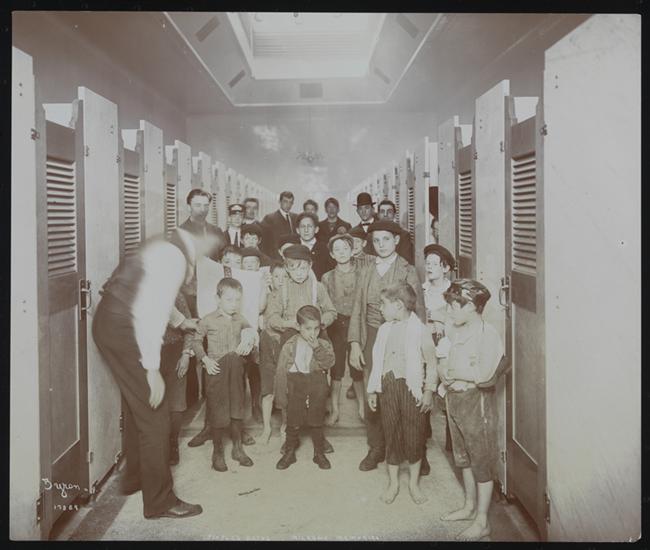
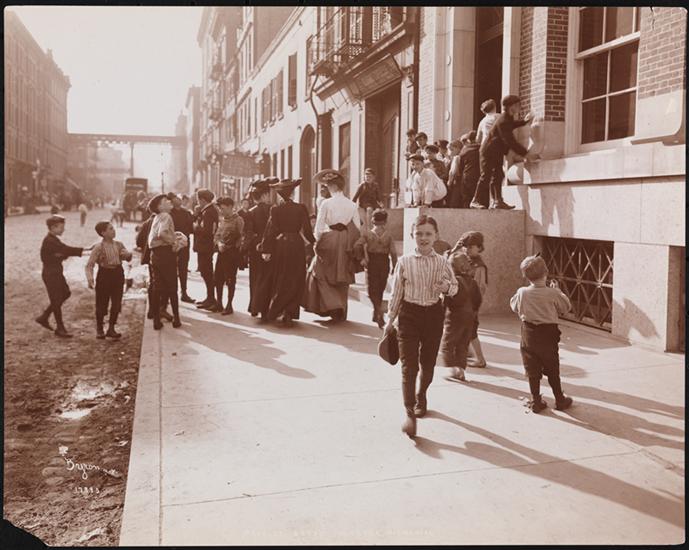
Others have been rescued and serve new purposes such as the Milbank Memorial Bath at 325-327 East 38th Street (pictured below). Today the structure is the Indonesian Mission to the United Nations, but when it opened, it was one of the biggest bathhouses in the city, serving up to 3,000 people.
MCNYJim Henderson/Wikimedia
The grateful visitors of Milbank’s bath house:
MCNYMCNYMCNY
Perhaps the best known — and most beautiful — example of a public bath house standing in New York City today is the Asser Levy Public Bath in Kips Bay. (It’s also listed in the billboard image as 388 Avenue A.) Its unusual beauty is perhaps what saved it from demolition, and today it’s part of Asser Levy Recreation Center, serving in its original function — as a swimming pool for neighborhood children.
HISTORY BEHIND THE SCENE What’s the real story behind that historical scene from your favorite TV show or feature film? A semi-regular feature on the Bowery Boys blog, we will be reviving this series as we follow along with TNT’s limited series The Alienist. Look for other articles here about other historically themed television shows (Mad Men, The Knick, The Deuce, Boardwalk Empire and Copper). And follow along with the Bowery Boys on Twitter at @boweryboys for more historical context of your favorite shows.
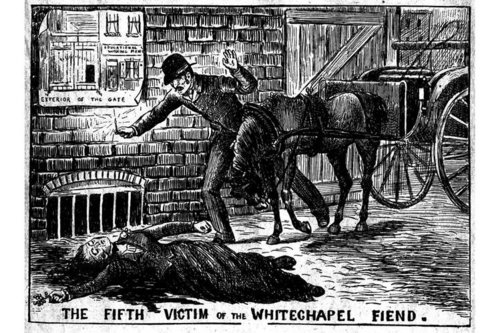
In 1888, a serial killer terrorized the Whitechapel district of London, leaving a set of disturbingly gory crime scenes which horrified the public and galvanized the press. It was soon believed at least five of the victims (and possibly many more) were killed by the same hand — a shadowy figure referred to as Jack the Ripper. The victims, all women, were Whitechapel prostitutes.
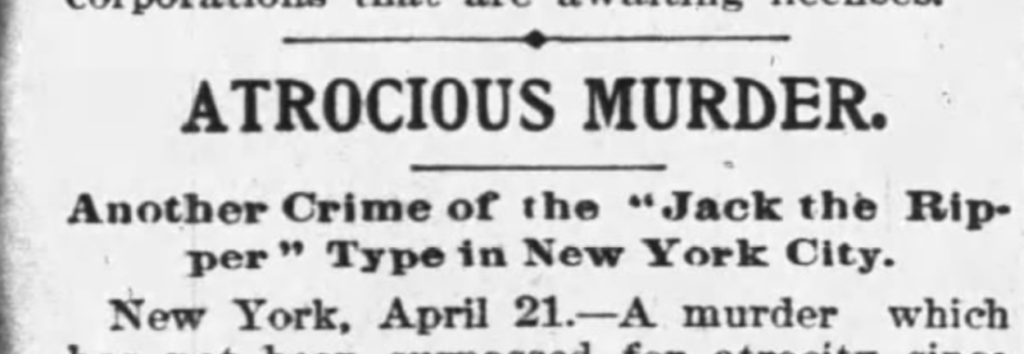
In 1891, the killer struck again in as gruesome a fashion as before. The victim was again a prostitute, a middle-aged woman “of dissolute and intemperate habits” named Carrie Brown who was found murdered in a lodging house on April 24, 1891. The only significant difference to the brutal crimes of 1888 was its location.
Carrie Brown was murdered in New York City.
Jack the Ripper’s alleged ‘New York City spree’ is the sinister pretext for the murder investigation depicted on The Alienist. Investigators in 1896, just five years after the death of Carrie Brown, would have had knowledge of Jack’s possible appearance on the streets of New York.
Of course, nothing has ever been proven that Brown’s death was associated in any way with the 1888 murders in Whitechapel. But that didn’t stop the press from speculating. After all, such twisted, grotesque crime sold newspapers.
The circumstances of Brown’s ghastly murder were indeed extraordinary.
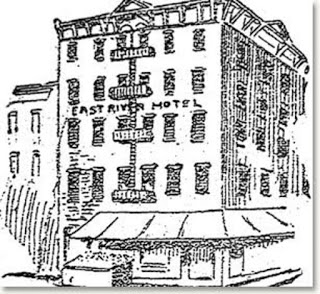
Let’s quote from that defining text of New York City crime folklore — Gangs of New York by Herbert Asbury. “The first Jack-the-Ripper murder in New York is said to have occurred [at the old East River Hotel at Catherine and Water streets] when an old hag known as Shakespeare was cut to pieces.”
Brown was known as Shakespeare for her habit of quoting the bard whenever possible. According to Asbury, “Shakespeare always claimed that she had come from an aristocratic family and that in her youth she had been a celebrated actress in England. She supported her contention by reciting, in return for a bottle of swan gin, every female role in Hamlet, Macbeth and The Merchant of Venice.”
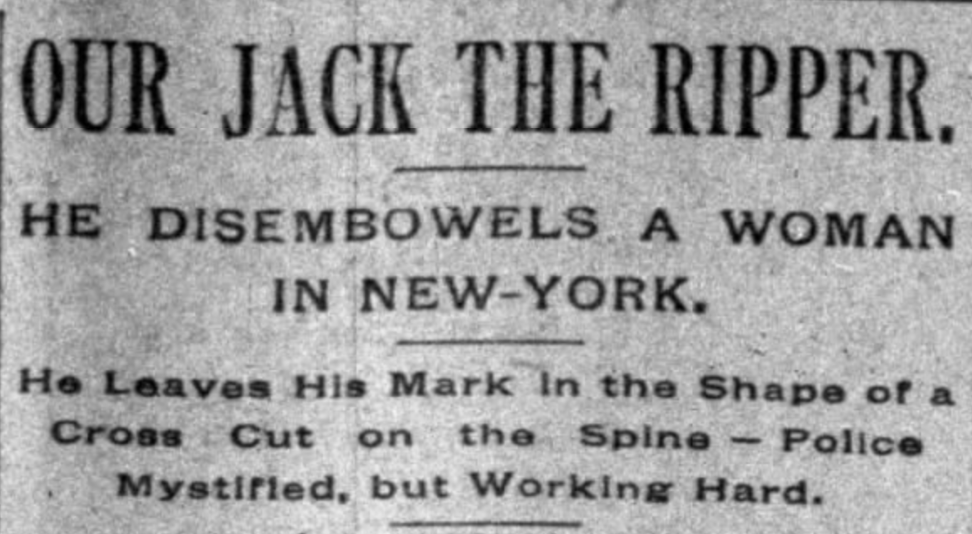
Her lifeless body was discovered the next morning, stabbed and repeatedly slashed with a cross cut into her thigh.
Below: Brown’s body wore mutilations similar to those found in the Whitechapel killings
Buffalo Morning Express, April 25, 1891
From the Evening World the day following her murder: “No crime which has been committed in this city for years has stirred the Police Department to such tremendous activity as the horrible butchery of Carrie Brown, alias ‘Old Shakespeare’ by ‘Jack the Ripper or his double, at the East River Hotel.”
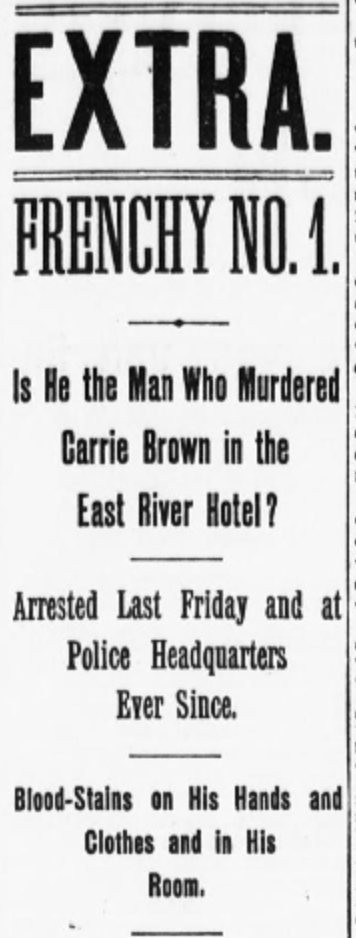
Police chief inspector Thomas F. Byrnes had previously chided Scotland Yard for their inability to catch a killer. Perhaps that’s why there was an immediate arrest in the case — an Algerian man named Ameer Ben Ali (nicknamed Frenchy). He was convicted of the crime and unjustly sent to prison, despite little evidence of his involvement in the murder. (He remained there for eleven years before he was eventually exonerated.)
Evening World, April 30, 1891
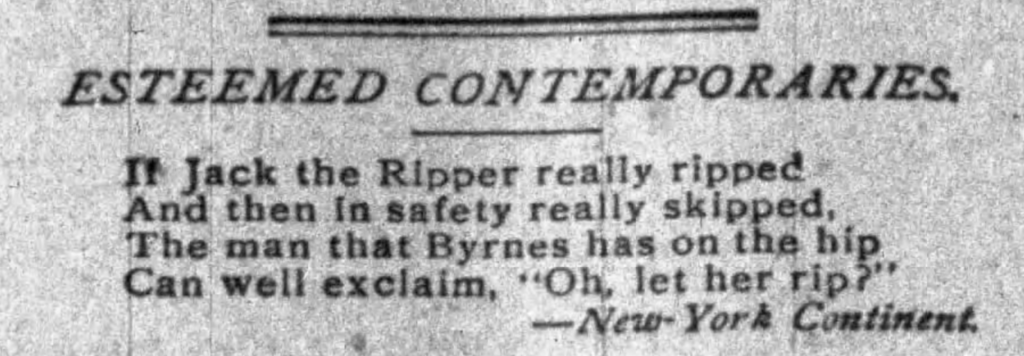
There were doubts about Ameer Ben Ali’s involvement with the murder from the very beginning — as evidenced by this poem in the Buffalo Morning Express, published a couple of weeks after the murder.
It didn’t matter that, in 1891, Jack seemed to have resumed his murder spree at the very same time in London. It’s unclear whether the London slayings attributed to this singular killer were related to the 1888 murders but newspapers made the assumption anyway. In total, eleven ‘Whitechapel murders’ from 1888 to 1891 are attributed to Jack.
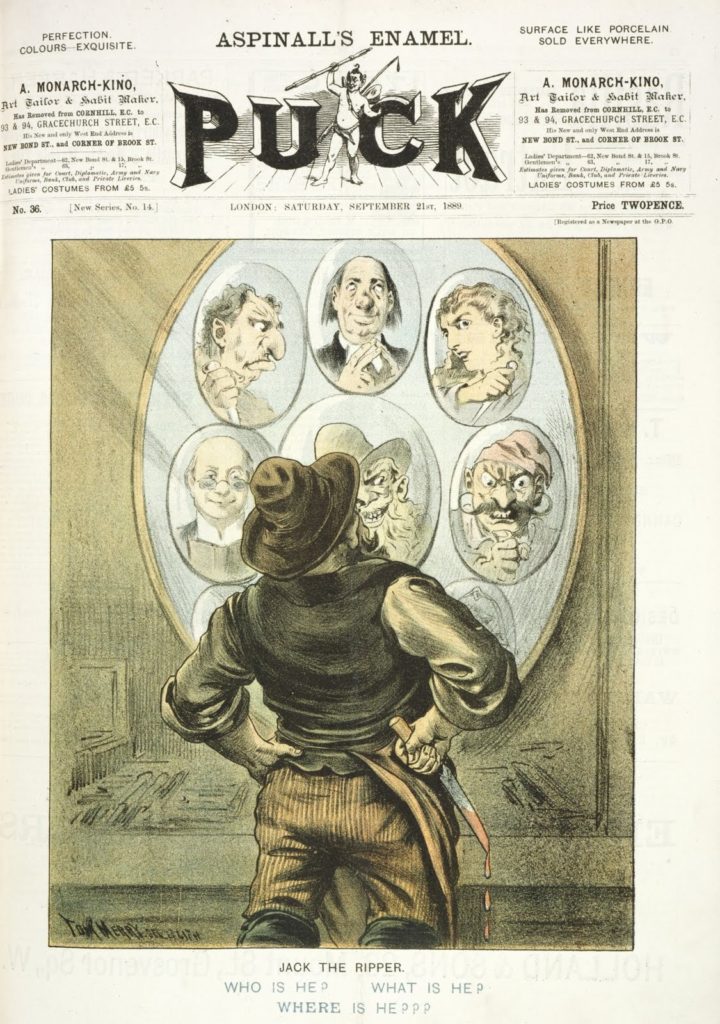
Below: Puck Magazine, published at the Puck Building on Houston Street, speculated on the Ripper’s identity in 1889.
Brown’s murder was not the only one eager newspaper publishers linked to the legend of Jack the Ripper. It happened with such frequency that Twentieth Century Magazine (published in May 1891) attempted to explain the phenomenon. “A little more than a month ago a homicide was committed in New York, the incidents of which were so like those attending the London homicides that the unknown perpetrator of the deed was also called Jack the Ripper. So that the name of Jack the Ripper stands for a person who kills a woman or women and afterword mutilates the body or bodies.”
Jack the Ripper was reportedly seen throughout New York, due to the many eyewitness descriptions of both the London killer which ran in American newspapers and descriptions of the suspected New York killer.
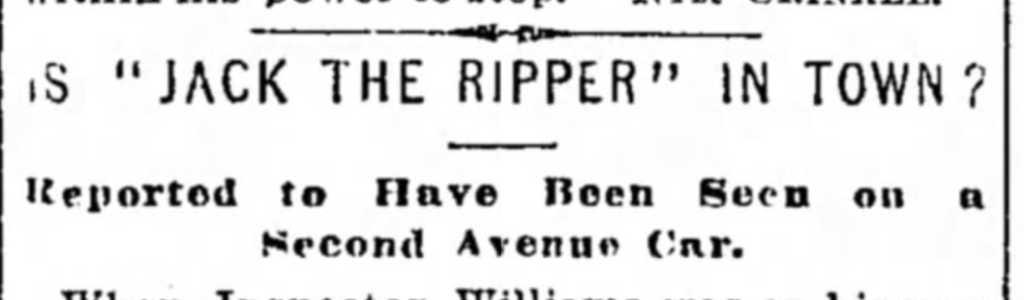
Below: Such headlines ran in the newspapers even before the Carrie Brown murder (New York World, March 8, 1891)
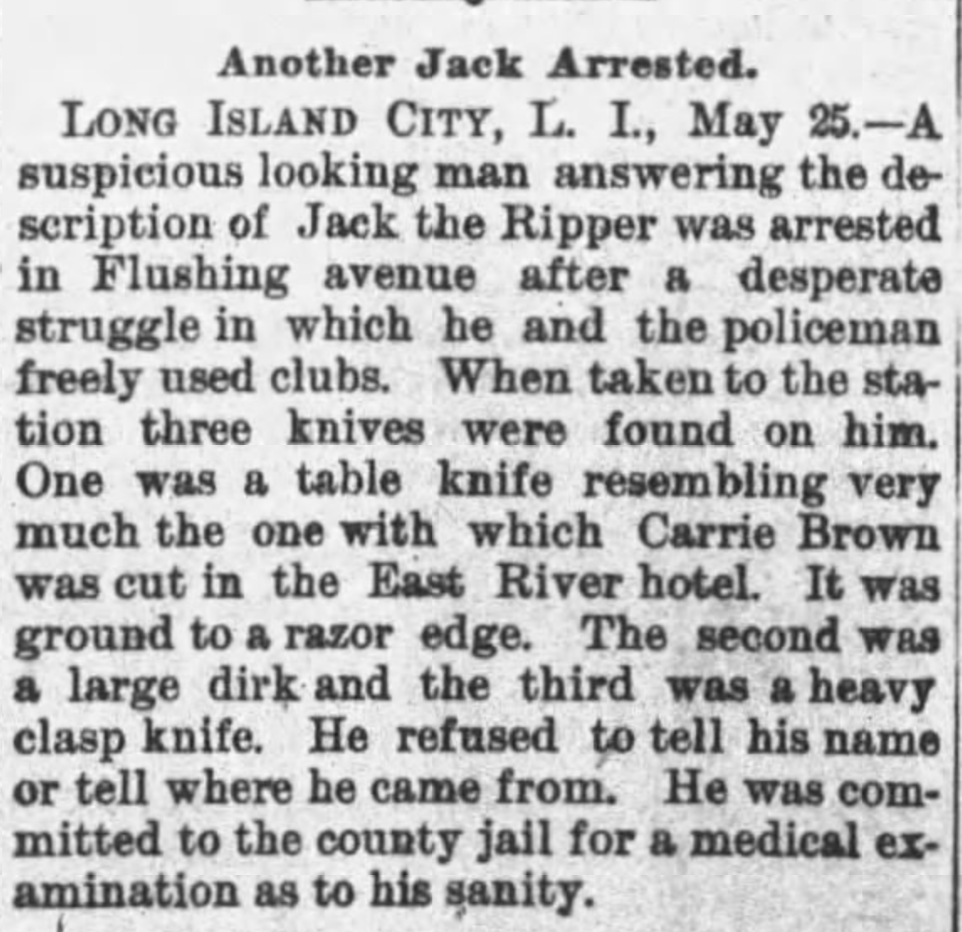
Below: From the Buffalo Evening News (May 25, 1891)
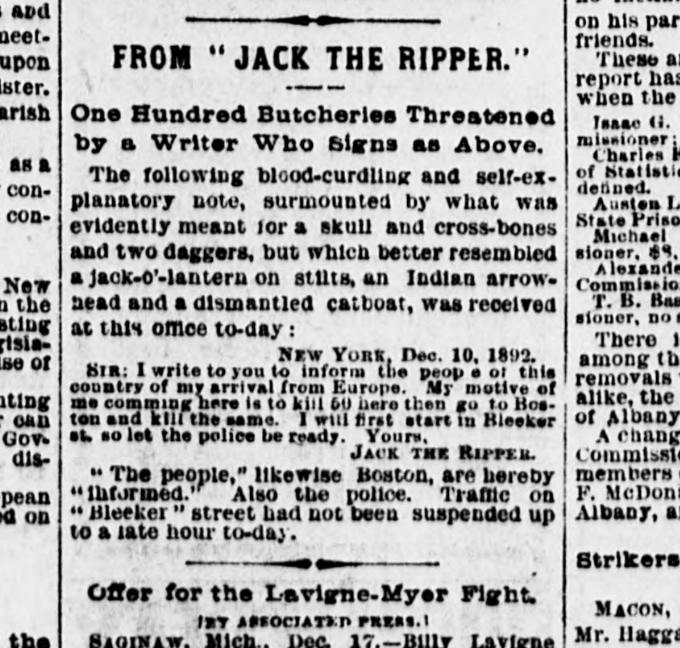
Publishers’ verve in linking any and all grisly murders to London’s killer might have inspired the following letter, sent to the New York Evening World offices on December 17, 1892:
(For those following The Alienist, Bleecker Street is also the destination of choice for that story’s killer.)
In the late fall of 1893, the body of a mutilated woman was found in the East River, and it too, for a time, was linked to Jack the Ripper. “On the hasty examination made last night some marks, taken to be somewhat similar, were discovered, but a thorough examination made this morning shows that they were simply bruises.”
By 1894 people stopped looking for Jack the Ripper in New York although several arrested murderers were described very explicitly as Ripper-style killers. One example from February 3, 1894: “Only a little over two years ago Henry G. Dowd rivaled the fiendish Jack the Ripper by slashing seven intoxicated, but inoffensive men in the Fourth Ward.”
Grand Central Terminal has seen millions of people rush across
its Main Concourse over the past one hundred years, and more than a few
movies have captured that commuter ebb and flow. But while Grand
Central is occasionally a backdrop for romance — especially during World
War II, when returning soldiers would arrive to meet their loved ones —
filmmakers have preferred to capture a darker aspect to the landmark.
The Beaux-Arts train station has become an ideal location for
thrillers, mysteries, fantasies and horror films, a backdrop for chases
and a metaphor for chaos and disorientation. In the movies, its
concourse feels even more cavernous and mythic, its train tunnels havens
for the unknown.
During its first half-century, Grand Central was known mostly for its trains — in particular, the Twentieth Century Limited,
the luxurious passenger locomotive that attracted the most famous
people in the world. In fact, the most common place to see a celebrity
in the 1930s and 40s would probably have been Grand Central. People
would sit at the station watching politicians and stars boarding the
most famous train in the world.
So it’s no surprise that Grand Central’s most notable early film
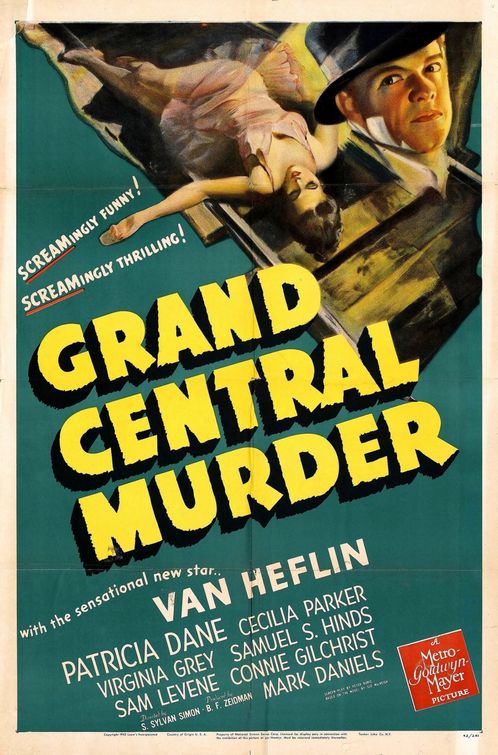
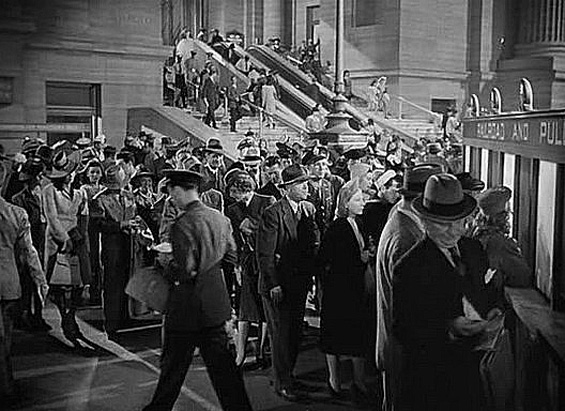
appearances relate to the Twentieth Century, including, of course, Twentieth Century, the ribald 1934 comedy that made Carole Lombard a star. Other glamorous features of this era — including Grand Central Murder (1942) and The Thin Man Goes Home(1945) — use Hollywood reconstructions of Grand Central as a backdrop.
Below: A phony version of Grand Central Terminal used in the film The Thin Man Goes Home. (Courtesy On The Set of New York)
As the train station deteriorated after the 1950s — as train travel
itself fell into disregard — Grand Central became a darker, dangerous
place in the movies. The travelers, the commuters, are now a backdrop
for chase scenes and violent shootouts, homeless people and even psychos
stalking the yellowing, banner-filled concourse of the 1970s and 80s.
Its rehabilitation in the 1990s brought monumentality back to Grand
Central and brought it back to the movies as a place of respect and
beauty. I would never recommend you watch the remake of Arthur starring Russell Brandexcept for this particular scene which demonstrates the Terminal’s remarkable transformation.
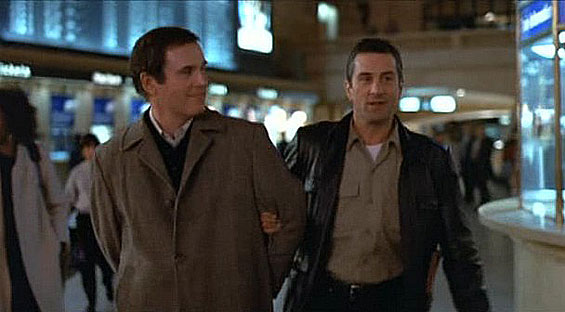
Grand Central makes a brief appearance in the 1988 comedy Midnight Run with Charles Grodin and Robert DeNiro. (Courtesy On The Set of New York)
Here are my personal choices for Grand Central’s top ten moments in
cinema. I’m sure I’m forgetting a few choice ones, so please add them
in the comments section if they come to mind:
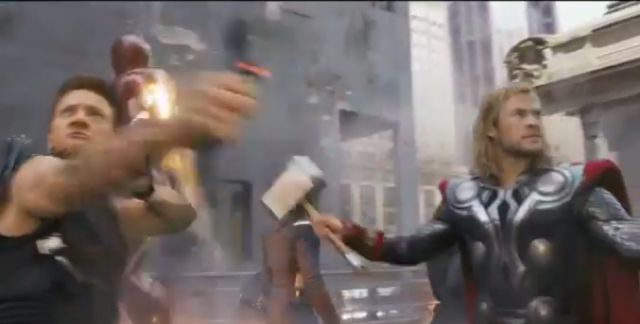
10 The Avengers (2012)
The Terminal as a fortress, a hall of justice. The MetLife Building behind it is completely dismantled and replaced with Iron Man‘s
new headquarters, but nobody would ever think of doing that to Grand
Central. In fact, our heroes fight inter-dimensional aliens right in
front of it, their phalanx mounted on the overpass below. As Earth’s
finest stand in akimbo waiting for the attack, the statue of Cornelius Vanderbilt stands equally defiant in the background. (For another sci-fi use of Grand Central’s exterior, see Will Smith in I Am Legend.)
9 Necrology (1971)
The building has inspired the avant-garde as well. Years after Andy Warhol turned his camera to the Empire State Building, experimental filmmaker Standish Lawder
found supernatural inspiration inside Grand Central for this odd little
film ostensibly about the afterlife. Stay for the credits.
8 Spellbound (1945)
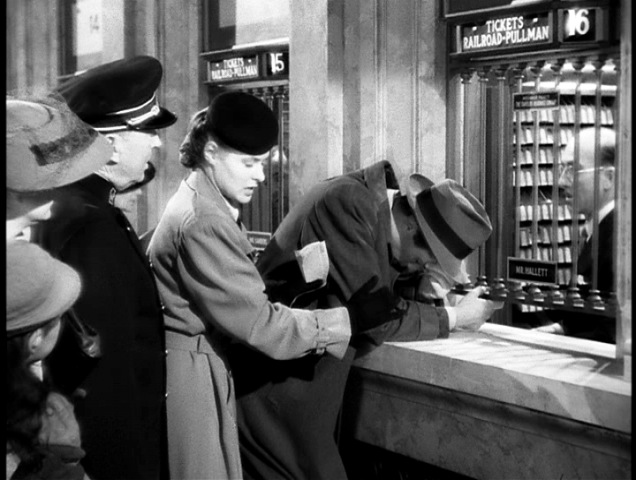
This isn’t even Alfred Hitchcock‘s best film usage of Grand Central (see below), but it’s notable in that both Grand Central and Pennsylvania Station are used in this psychological thriller starring Ingrid Bergman and Gregory Peck.
I can’t recall any other film that would have included both iconic New
York landmarks. With this film, Hitchcock also playfully mocks Grand
Central’s wartime reputation as a place for departing lovers, even while
giving into those romantic impulses.
7 The House on Carroll Street (1988)
This somewhat unsuccessful thriller (with a spectacular cast) is notable
for its creativity involving a climactic chase scene up in Grand
Central’s inaccessible upper tiers. You can see a little bit of it in
this trailer:
6 Superman (1978)
Lex Luther’s secret lair, eccentrically decorated, is hidden in a
forgotten tunnel underneath Grand Central. His lackey Otis (Ned Beatty)
is tracked to the concourse by police officers, but Luther has set a
deadly trap for one of them. Another reason not to roam the tracks by
yourself!
Later, the supervillain waxes about the benefits to his Grand Central lair as the trains rumble overhead.
5 A Stranger Is Watching (1982)
Had Lex not been defeated, he would have been sharing the tunnels with
the maniacal killer of this schlocky thriller, based on a novel by Mary
Higgins Clark. While this movie is pretty bad, Grand Central is used to
superb effect, a veritable haunted house of dark tunnels and abandoned
elevators. There’s even mention of Franklin Delano Roosevelt’s secret elevator!
4 Carlito’s Way (1993)
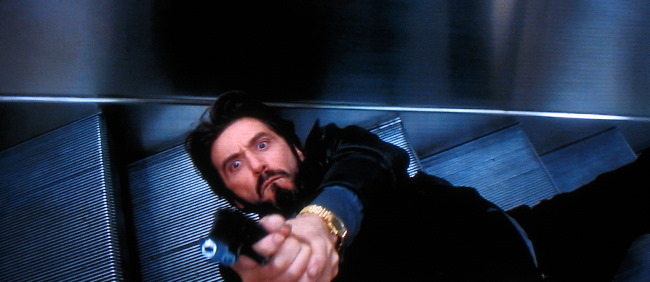
The famous escalator shootout scene (it’s Battleship Potemkin-meets-violent
cop show) is probably the goriest scene ever filmed directly in Grand
Central, topped by Carlito (Al Pacino) running to meet Penelope Ann
Miller. Let’s just say, he misses his train. Watch the scene here.
3 Seconds (1966)
This bizarre John Frankenheimer drama starring Rock Hudson uses
Grand Central Terminal (and a unique camera angle) to set the film’s
off-kilter and twisted perspective. It becomes the crossroads where
opportunities of a second chance are literally handed to you if you dare
to take them.
2 The Fisher King (1991)
Having hosted various mentally disturbed escapades in prior films, we
now get to look in on an actual Grand Central fantasy in this Robin Williams film, as the deranged hallucinations of his character turn the bustling room into a glorious dance floor.
1 North By Northwest (1959)
Has Grand Central Terminal ever looked as beautiful as it does in this
pivotal scene from Hitchcock’s great 1959 masterpiece? It gives Cary Grant
opportunities to be suave, pensive and fabulous all at once. It also
embodies the tension and danger that would influence other filmmakers in
later years to come to Grand Central for inspiration.
HISTORY BEHIND THE SCENE What’s the real story behind that historical scene from your favorite TV show or feature film? A semi-regular feature on the Bowery Boys blog, we will be reviving this series as we follow along with TNT’s limited series The Alienist. Look for other articles here about other historically themed television shows (Mad Men, The Knick, The Deuce, Boardwalk Empire and Copper). And follow along with the Bowery Boys on Twitter at @boweryboys for more historical context of your favorite shows.
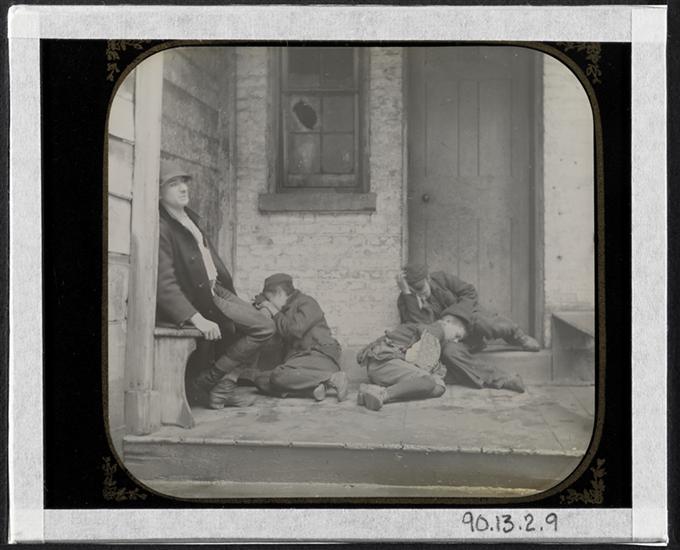
Look near the very end of the fourth episode of The Alienist, and you’ll see a surprising homage to an iconic, heartbreaking photograph.
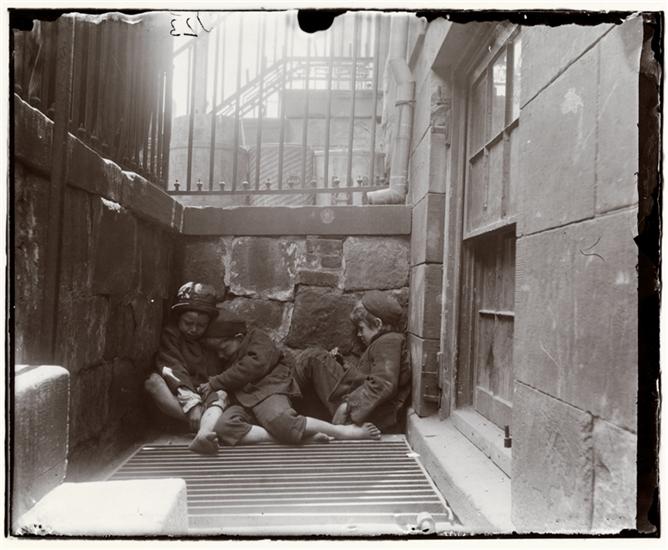
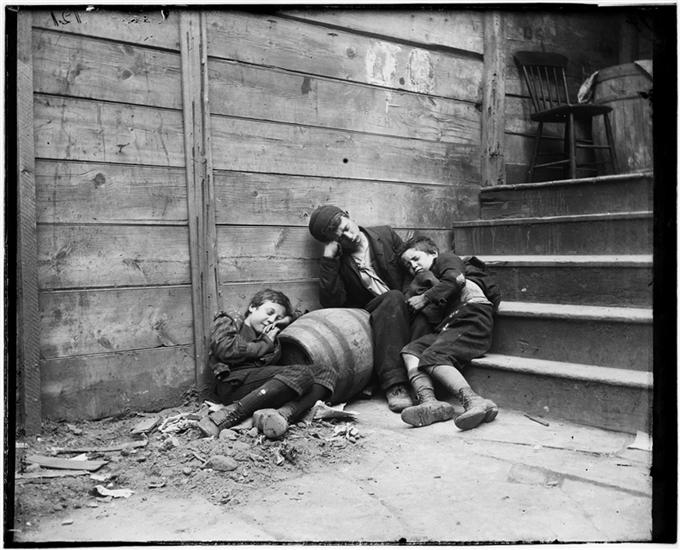
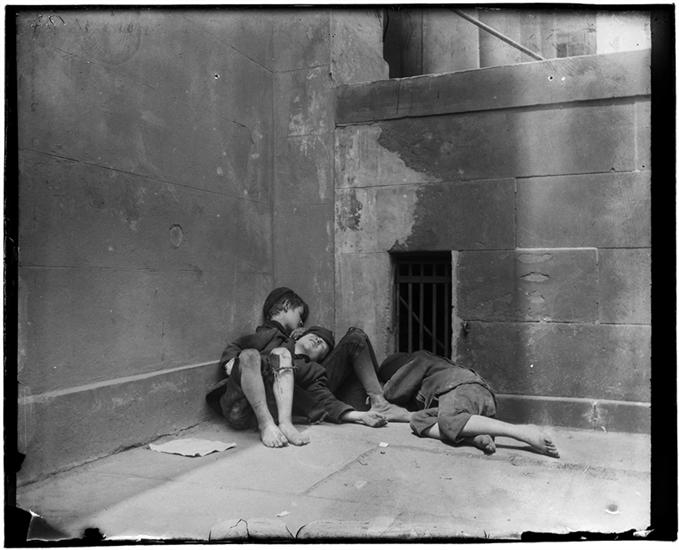
Called ‘Street Arabs in the Area of Mulberry Street‘, the image, taken in 1889, depicts three homeless boys sleeping over a heated vent on the bottom floor of a tenement (in the area of today’s Little Italy).
MCNY
Their names are unknown. In the late 19th century, hundreds of children lived on the streets of New York, turned out of their homes or separated from their loved ones. Many actually did have loving families but living conditions in the tenements were so squalid that some chose to sleep on the street.
We have this image — and many, many similar ones — thanks to journalist and social reformer Jacob Riis.
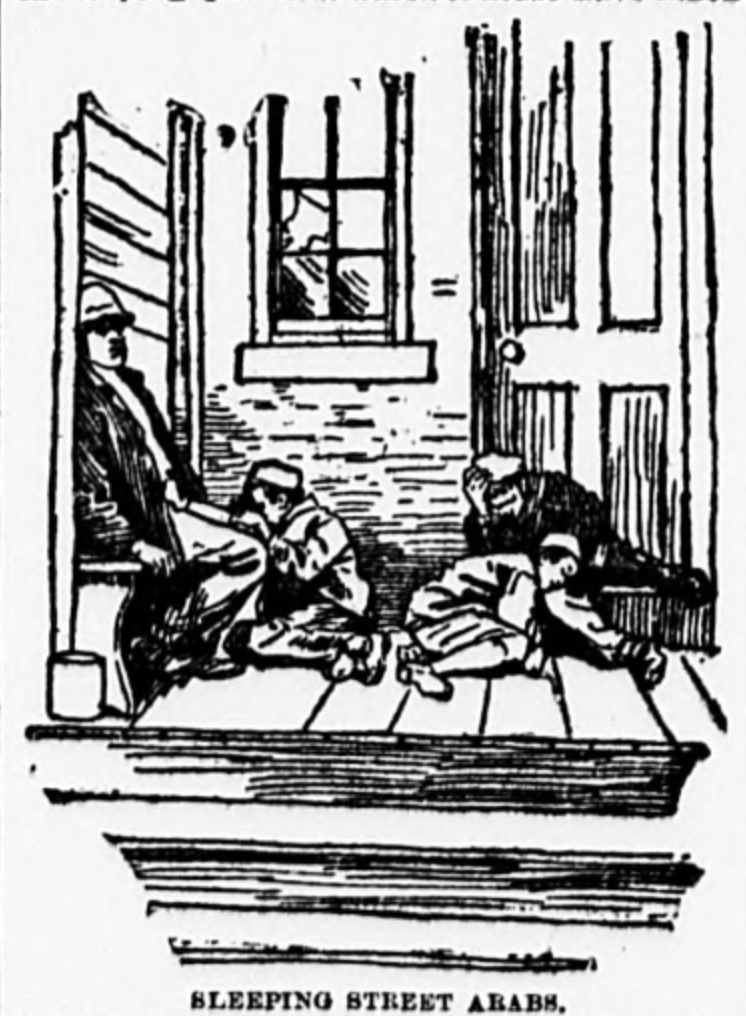
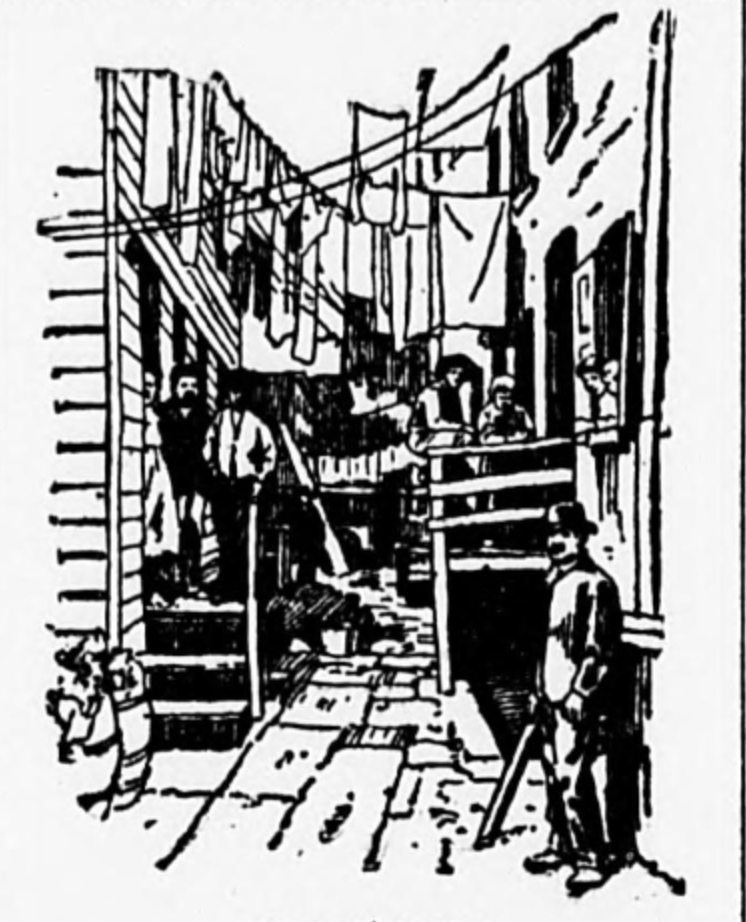
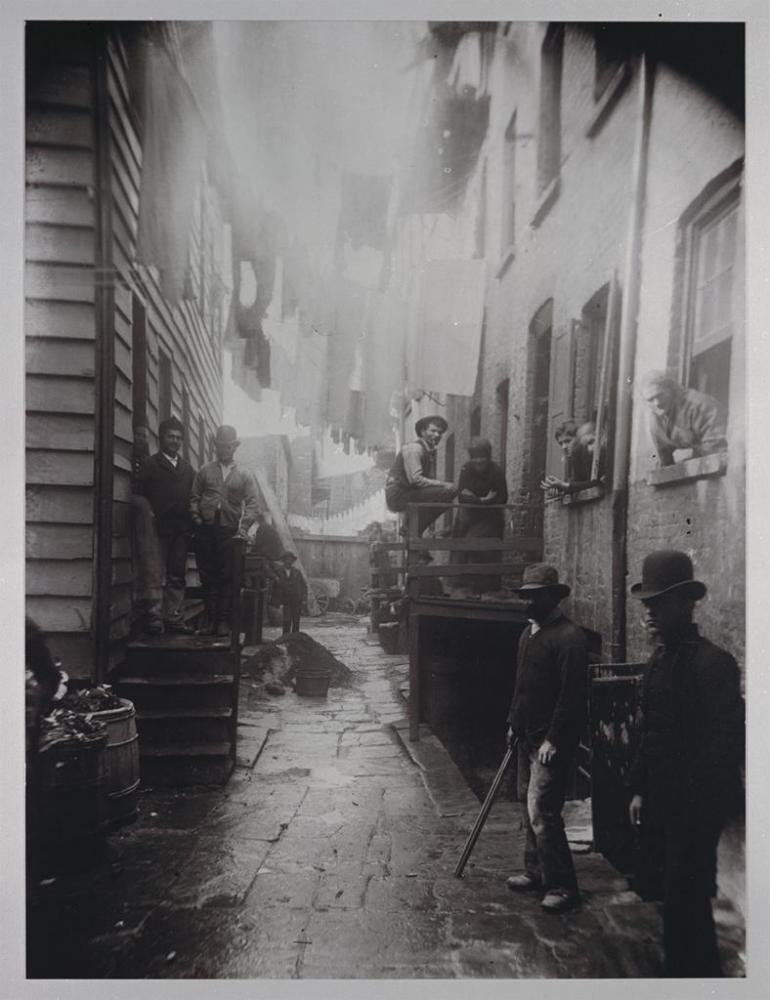
On February 12, 1888, Jacob Riis published his first investigation for the New York Sun, revealing the wretched conditions of New York’s worst slum neighborhoods by employing an experimental technology — flash photography. The startling pictures, by Riis and a team of other photographers, were at first rendered in line drawings, but the effect was nevertheless profound.
“Another outcropping of the benevolent purpose of Mr. Riis … is his showing of a touching picture of street Arabs in sleeping quarters which it must have taken a hunt to discover. These youngers have evidently spent their lodging money for gallery seats at the show and have found shelter on the back stoop of an old tenement house.”
Below: An illustration from the Feb. 12, 1888, newspaper, and the Riis photograph (of Bandit’s Roost) that it represents.
The pictures are more than social activism; they’re history themselves, the first flash photography ever to be used in this fashion. Riis was showing New Yorkers a vivid glimpse of poverty — orphans in the gutter, street gangs in the alleyway — using a technique that few were regularly exposed to apart from portraiture.
Riis never considered himself a professional photographer. Later in his career, he even farmed out the photographic work to others as he focused on writing and social activism. And yet modern photojournalism wouldn’t really be what it was today without his first forays into slums, opium dens and beer halls with his bulky and costly equipment. His early work influenced an entire field of social photographers seeking to prove the adage “a picture is worth a thousand words” (a phrase which debuted near the end of Riis’ lifetime).
MCNY
His work would eventually be published as a book in 1890 — How The Other Half Lives: Studies Among the Tenements of New York — and Riis would spend the decade virtually proselytizing on behalf of the city’s needy.
In that book, he expounds upon the plight of the ‘street Arab’, aka street urchin.
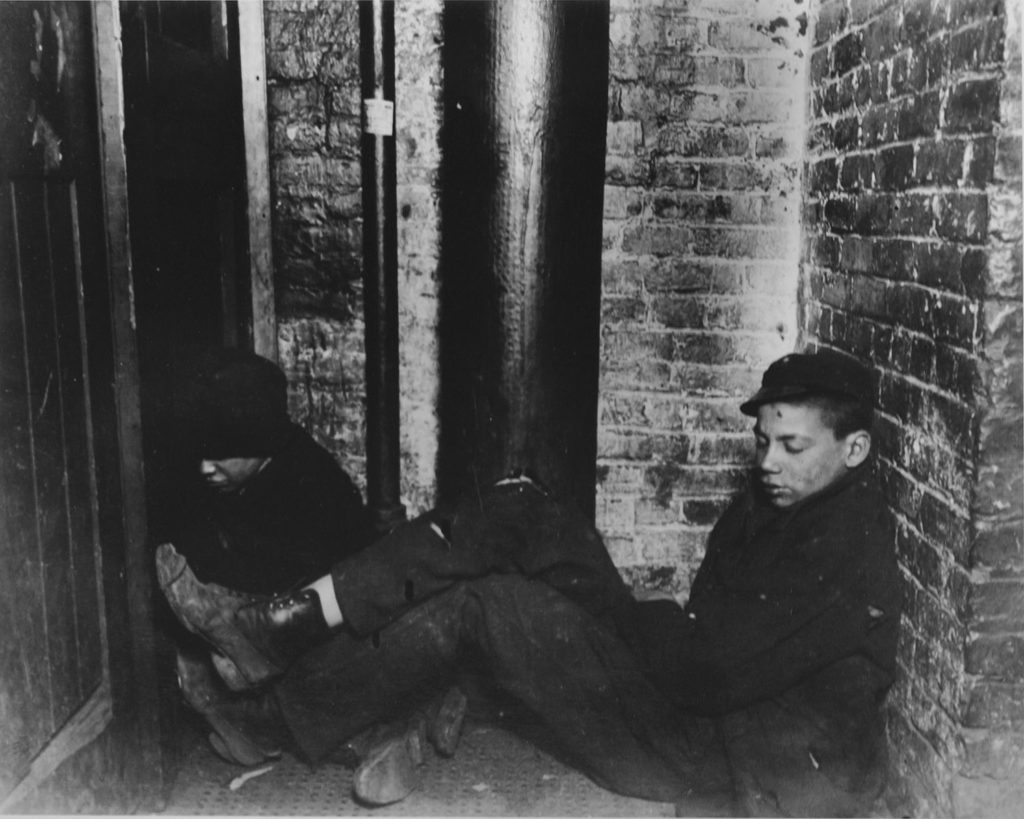
“They are to be found all over the city, these Street Arabs, where the neighborhood offers a chance of picking up a living in the daytime and of “turning in” at night with a promise of security from surprise. In warm weather a truck in the street, a convenient out-house, or a dug-out in a hay-barge at the wharf make good bunks. Two were found making their nest once in the end of a big iron pipe up by the Harlem Bridge, and an old boiler at the East River served as an elegant flat for another couple.”
Below: Two boys asleep at 2 a.m. in the press room of the New York Sun newspaper.
Most street kids are newspaper boys or bootblacks, fighting for scraps and a few pennies. In another section, Riis writes:
“We wuz six,” said an urchin of twelve or thirteen I came across in the Newsboys’ Lodging House, “and we ain’t got no father. Some on us had to go.” And so he went, to make a living by blacking boots. The going is easy enough. There is very little to hold the boy who has never known anything but a home in a tenement. Very soon the wild life in the streets holds him fast, and thenceforward by his own effort there is no escape. Left alone to himself, he soon enough finds a place in the police books, and there would be no other answer to the second question: “what becomes of the boy?” than that given by the criminal courts every day in the week.”
“Didn’t live nowhere.” MCNY
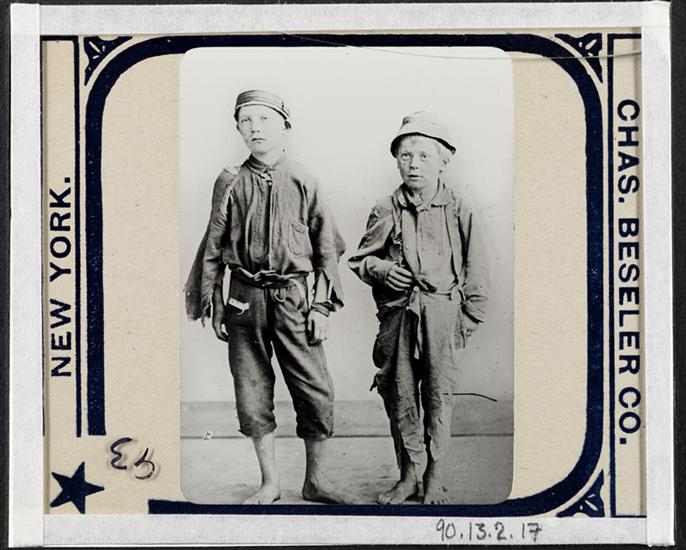
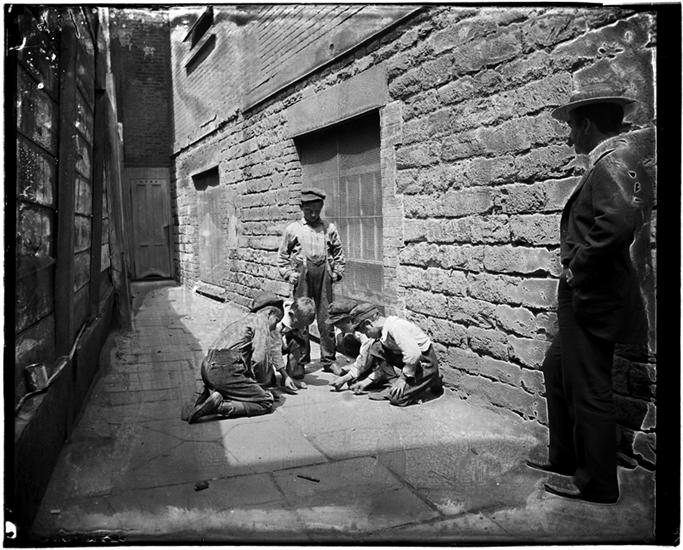
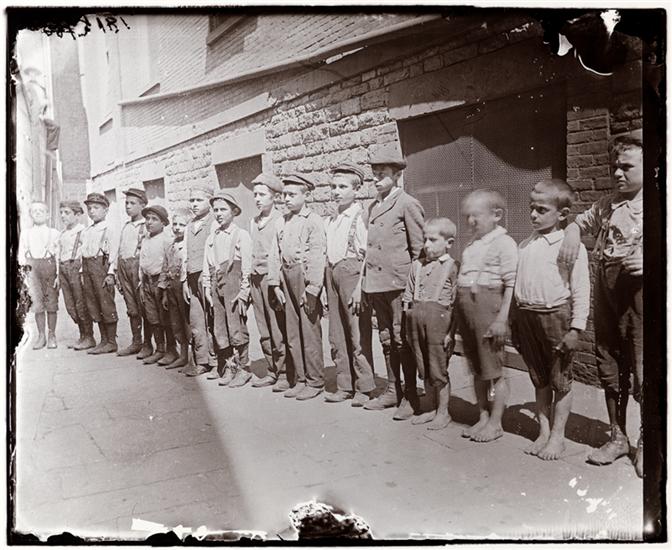
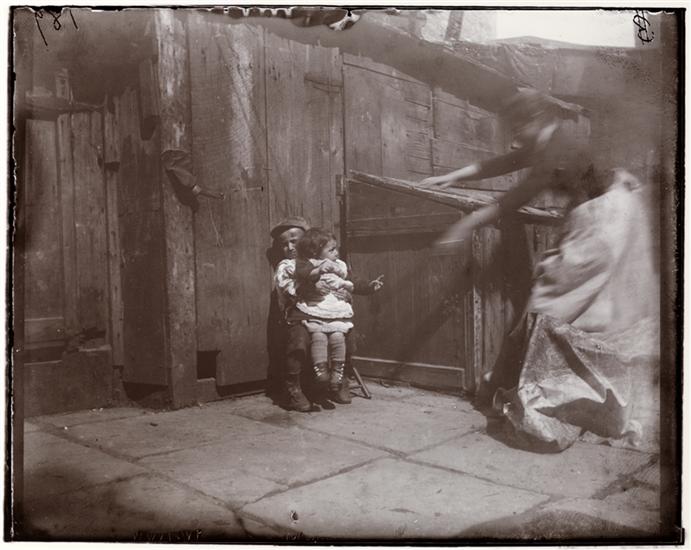
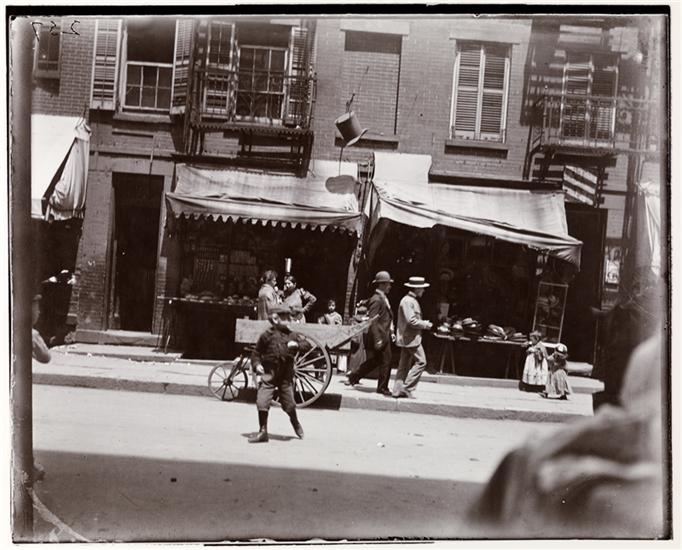
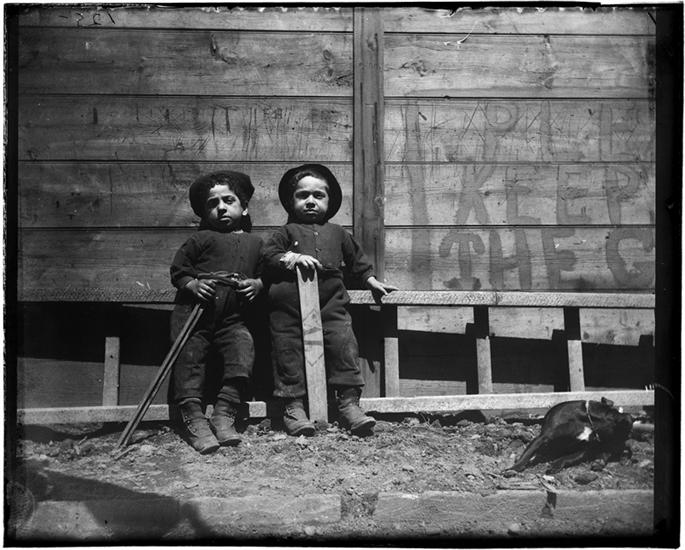
Below are more pictures of children on the streets of New York City in the late 1880s and early 1890s, taken by Riis and his associates, courtesy the Museum of the City of New York.
MCNY “Shooting Craps: The Game of the Street,” Bootblacks and Newsboys, 1894″ MCNYA line-up of boys in a Mulberry Street alley. 1890, MCNYA young boy holding a baby, a woman reaches for them. 1890, MCNY1890, MCNYThe Mott Street Boys, “Keep off the Grass”. 1890. MCNY
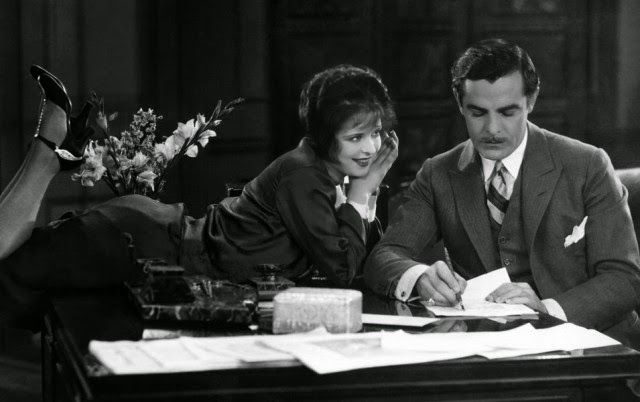
Above: Clara Bow, in It (1927), one of the roles that made her an major film star. Two iconic actresses of the early silent film industry share a birthday today — Theda Bara (born July 29, 1885) and Clara Bow (born in Brooklyn, July 29, 1905). Bow became the screen’s leading flapper archetype of the 1920s, but Bara’s exotic, controversial antics set the stage one decade earlier. In honor of their birthdays, I’m re-running this article from last year about ‘the vamp’, a sort of proto-flapper popularized by Bara and the ladies of the Ziegfeld Follies, later to influence the changes in perceptions of women in the 1920s.
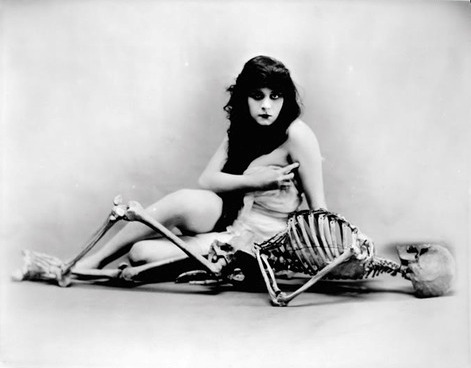
Maneater: Theda Bara in an unconventional portrait. Her publicist claimed it was her lover and that ‘not even the grave could separate them’. “A vampire is a good woman with a bad reputation, or rather a good woman who has had possibilities and wasted them” — Florenz Ziegfeld
Progressive, liberated women were clearly so frightening one hundred years agothat equating them to undead, bloodthirsty creatures borne of Satan didn’t seem so unusual.
In the late 1910s, women were on the verge of winning the right for equal representation in the voting booth. Women were asserting power in unions, and, in the wake of disasters like the Triangle Factory Fire, those unions were influencing government policy. They were taking control of their destinies, their fortunes, even their sexuality (Margaret Sanger‘s first birth control clinic opened in 1916).
This surging independence came just as the entertainment industry heralded the female form as one of its primary attractions. Ziegfeld’s sassy, flesh-filled Follies — and its many imitators — defined the Broadway stage, mixing music, sex and glamour with a morality-shattering frankness.
But it was the birth of motion pictures that gave the allure of female bodies an unearthly, flickering glow, as nickelodeon shorts became feature-length films, and the first era of the movie siren was born.
Combine the power of liberation with the erotic potential of cinema, and in the late 1910s, you got the vampire (or as we would come to know, the ‘vamp’).
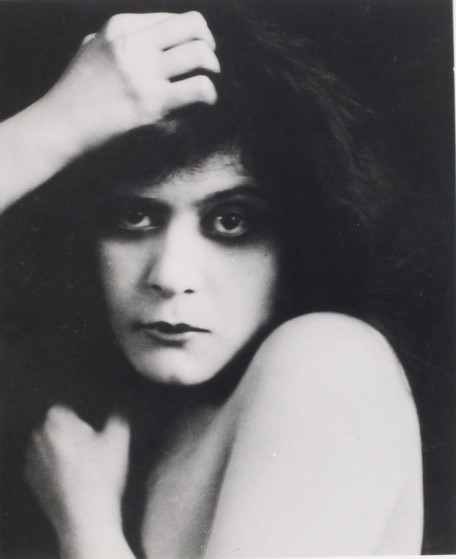
The queen of the vamps was one of America’s most mysterious movie stars — Theda Bara (at left). The magnetic actress, with her steely gaze and jetblack hair, was the prototype for a movie bad girl. She shook convention so dramatically that a critic called her a “flaming comet of the cinema firmament.”
From 1915-1919, she made over three dozen films, most in movie studios located in Fort Lee, New Jersey. It were here that she acquired her famous nickname, based upon her role as a home wrecker in a film inspired by Rudyard Kipling’s ‘The Vampire’. During this period, Bara lived in Manhattan’s Gramercy Park with her family — at 132 E. 19th Street.
She put a face to a new sort of young lady. These were the spiritual children of the prior generation of newly empowered women who fought against the constraints of Victorian society. A few years later, as another vein of female power (the temperance movement) helped bring about Prohibition, these young women would be called flappers, carefree and fueled on the powers of jazz and illegal alcohol.
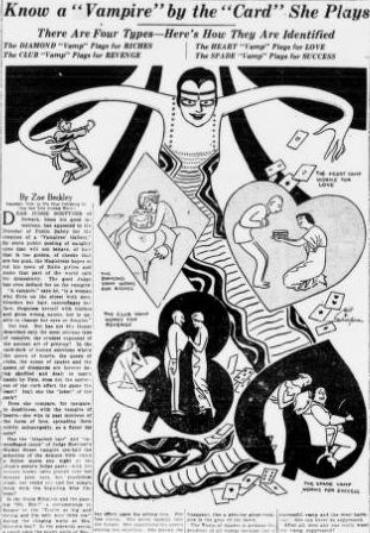
But to the established class, these ladies weren’t trend-setters. They were devils in black gowns. ‘Know a ‘Vampire’ by the Card She Plays‘, warned a New York Evening World article from March 1919, accompanied by a Theda Bara-like illustration of a snake-like monster.
The article recounts the efforts of a Newark judge attempting the rid the streets of “flirty girlies,” as he called them. “A vampire is a woman who flirts on the street with men, bleaches her hair, camouflages her face, disguises herself with clothes and gives wrong names, but is unable to change her eyes or dimples.” The article laughs off his puny efforts. “Can vamps, of whatever sort, BE suppressed?”
Vampires were of course more readily seen in Times Square, dancers, actresses or cabaret stars. But even your stenographer could be one!, warned one article.
Unlike Bara’s iconic identity as a raven-locked seductress, most ‘real’ vampires were blondes. “[T]he vampire of real life hath the golden hair of an angel, which is never disarranged, same when she letteth it down, to DISPLAY it, on the beach,” warned columnist Helen Rowland, with a little tongue in cheek. (Ms. Rowland was famous for her writings as a ‘bachelor girl’.)
“No one ever saw a vampire in a high neck dress,” said an Evening World advice columnist in 1918. “All vampires must reveal their collar-bones and the contiguous territory.”
The woman vampire was an urban creature, up all night, sleeping all the day. The city was partial cause for her condition. As the New York Times suggested in 1920, “The idea of New York as a vampire to the rest of the country is one which a number of persons have entertained and expressed. To some of them the vampire is Wall Street, to others it is the region of white lights [Broadway].”
Many actress got stuck with the term ‘vamp’ or ‘baby vampire’ — or else, embraced the coy terminology. Juliette Day was a known ‘baby vampire’ for her role in the scandalous 1916 play ‘Upstairs and Down’. It’s no surprise that in the film version from 1919, the role is reprised by the notorious Olive Thomas, a Ziegfeld girl who met a bitter end the following year.
Some actress fought against the alleged stigma. Actress Clara Joel, playing a vampire-type role in a 1918 film, made it known in the Tribune that “she is not a vampire and that she was born in Jersey City.”
The irony of stage actresses trying to shed a vampire image is that Theda Bara, the original vampire, in her first stage attempt in 1920, flopped. The play was supernatural-themed ‘The Blue Flame‘ which opened at the Shubert Theater to cavalcades of unintentional laughter.(A ‘terrible thing’, according to the Times critic.) Bara, who had to deliver such lines as “Did you remember to bring the cocaine?” was roundly trashed.
Shortly thereafter, the vampire moved to Los Angeles. Her film career lasted a few more years, but sound pictures and a strict Hollywood production code pretty much eradicated the existence of vamps on the screen. In New York, meanwhile, her sultry spawn morphed into flappers, populating the speakeasies and cabaret nightclubs of the city.
Below: A 1919 romp called ‘The Vamp’ performed by the Waldorf-Astoria Orchestra
BOWERY BOYS BOOK OF THE MONTH Each month I’ll pick a book — either brand new or old, fiction or non-fiction — that offers an intriguing take on New York City history, something that uses history in a way that’s uniquely unconventional or exposes a previously unseen corner of our city’s complicated past. Then over the next month, I’ll run an article or two about some of the historical themes that are brought up in the selection.
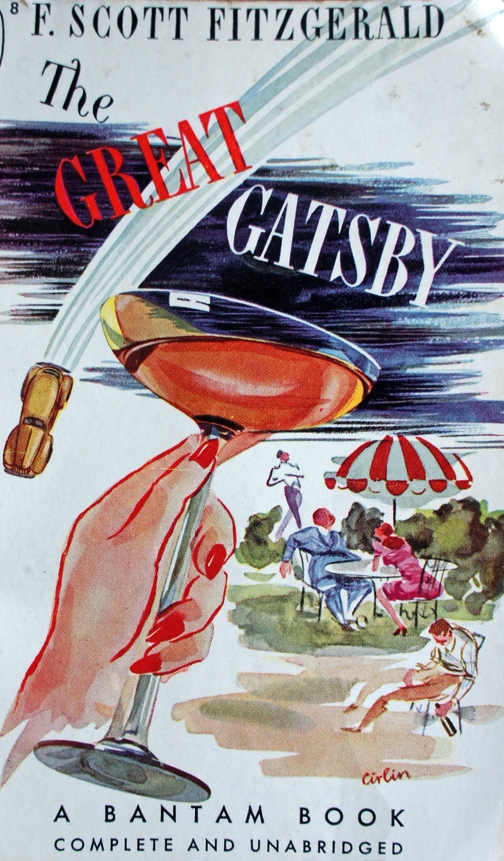
The Great Gatsby by F. Scott Fitzgerald
I re-read The Great Gatsby a few weeks ago on purpose, not because I had a school assignment. Unlike my first experience with Gatsby at age 14, I actually read it, without the signposts of Cliff’s Notes to tell me what I was supposed to be getting from it.
Of course the impetus for re-discovering F. Scott Fitzgerald‘s masterpiece is the flashy new Baz Luhrmann film coming out this weekend, which uses the text as an excuse to throw an expensive 3-D party, starring Leonardo DiCaprio, Beyonce, large champagne bottles, fifty shades of pink, the ghost of Mae West and a whole host of other drunk guests.
Few works of American literature have been as comprehensively analyzed as The Great Gatsby, by which I mean, of course, over-analyzed. One reason I’m excited about the film, with all its superficial decadence on display, is that it seems to discard several decades of nine-dimensional analyses that have settled upon the book like a thick shroud of dust. Maybe that’s wearing white to a funeral, so to speak, but true masterpieces can weather an occasional glare.
The Great Gatsby deserves to be savored for many reasons that I had forgotten or never noticed through the filter of creating a B+ term paper in my teenage years. It’s one of the most economic stories of the 20th century, an exercise of graceful control, an epic with powerful restraint. In comparison, try reading Fitzgerald’s The Beautiful and the Damned— an embittered New York book twice as long with half as much to say– to appreciate the brevity of Gatsby.
Fitzgerald uses the locales of 1922 New York City so precisely — jetting around Long Island and over the bridge to Manhattan — that it seems almost possible to map the characters’ every move.
There are three principal types of locations in The Great Gatsby. About half the novel’s actions take place on either East Egg or West Egg, fictional northern Long Island villages still graced with the mansions of Gilded Age millionaires. Characters escape to Manhattan, big and glittering, either to entertain their mistresses or to dine with gentlemen of suspicious occupation. And then, of course, there’s the wasteland in between, where secrets are laid bare and burnt to ash. Welcome to Queens!
Fitzgerald paints a very lush, cockeyed view of New York City in the early 1920s. Here are some of the more interesting city locations you’ll visit as you read along, and some of the words he used to describe them:
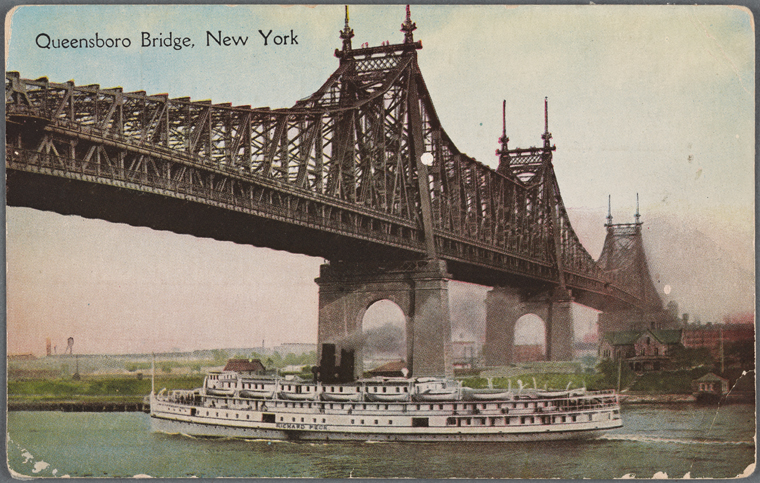
Queensboro Bridge “The city seen from the Queensboro Bridge is always the city seen for the first time, in its first wild promise of all the mystery and the beauty of the world.” ‘Anything can happen now that we’ve slid over this bridge,’ I thought; ‘anything at all….’ Even Gatsby could happen, without any particular wonder.” The 1920s were more than just a decade of speakeasies and spendthrifts. It was the decade of immense growth for Manhattan’s outer boroughs, none more so than Queens, thanks mostly to the opening of the Queensboro Bridge in 1909 and a connection to New York’s new subway system.
The IRT Astoria line “[W]e sped along toward Astoria at fifty miles an hour, until, among the spidery girders of the elevated, we came in sight of the easy-going blue coupe.”
Astoria’s elevated subway train opened in 1917, at the time servicing only cars from the IRT. (The trains of the BMT are a little too wide to use the stations.) So as Gatsby, Nick Carraway and the gang race underneath it to get onto the Queensboro, they’re really experiencing something quite new, a symbol of New York’s expansion into Queens.
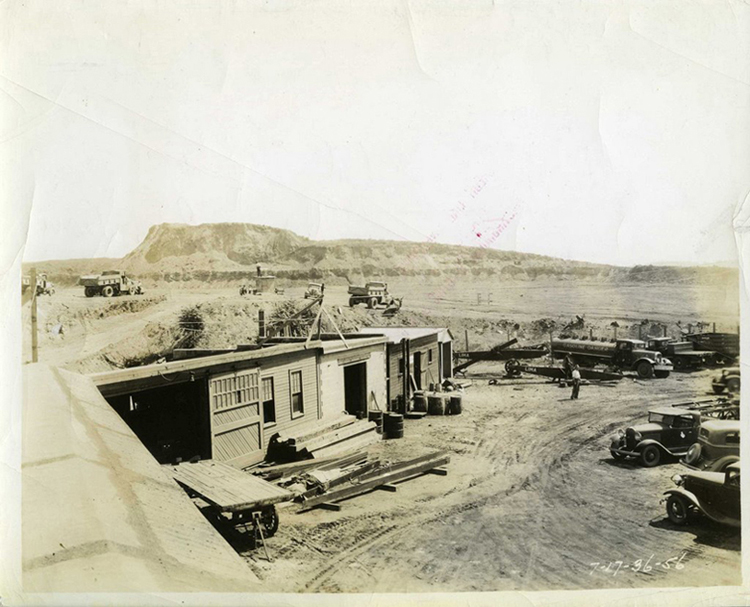
Corona Ash Dumps “We passed Port Roosevelt, where there was a glimpse of red-belted ocean-going ships, and sped along a cobbled slum lined with the dark, undeserved saloons of the faded-gilt nineteen-hundreds. Then the valley of ashes opened out on both sides of us.”
Once the place where New York and Brooklyn dumped their ash from coal-burning furnaces, the old ash dumps of Corona turned a bit of Queens into a gloomy and unpleasant landscape. It would take Robert Moses and dreams of a World’s Fair to transform the ashen landscape into Flushing Meadows-Corona Park in the 1930s. (Picture courtesy the Queens Museum)
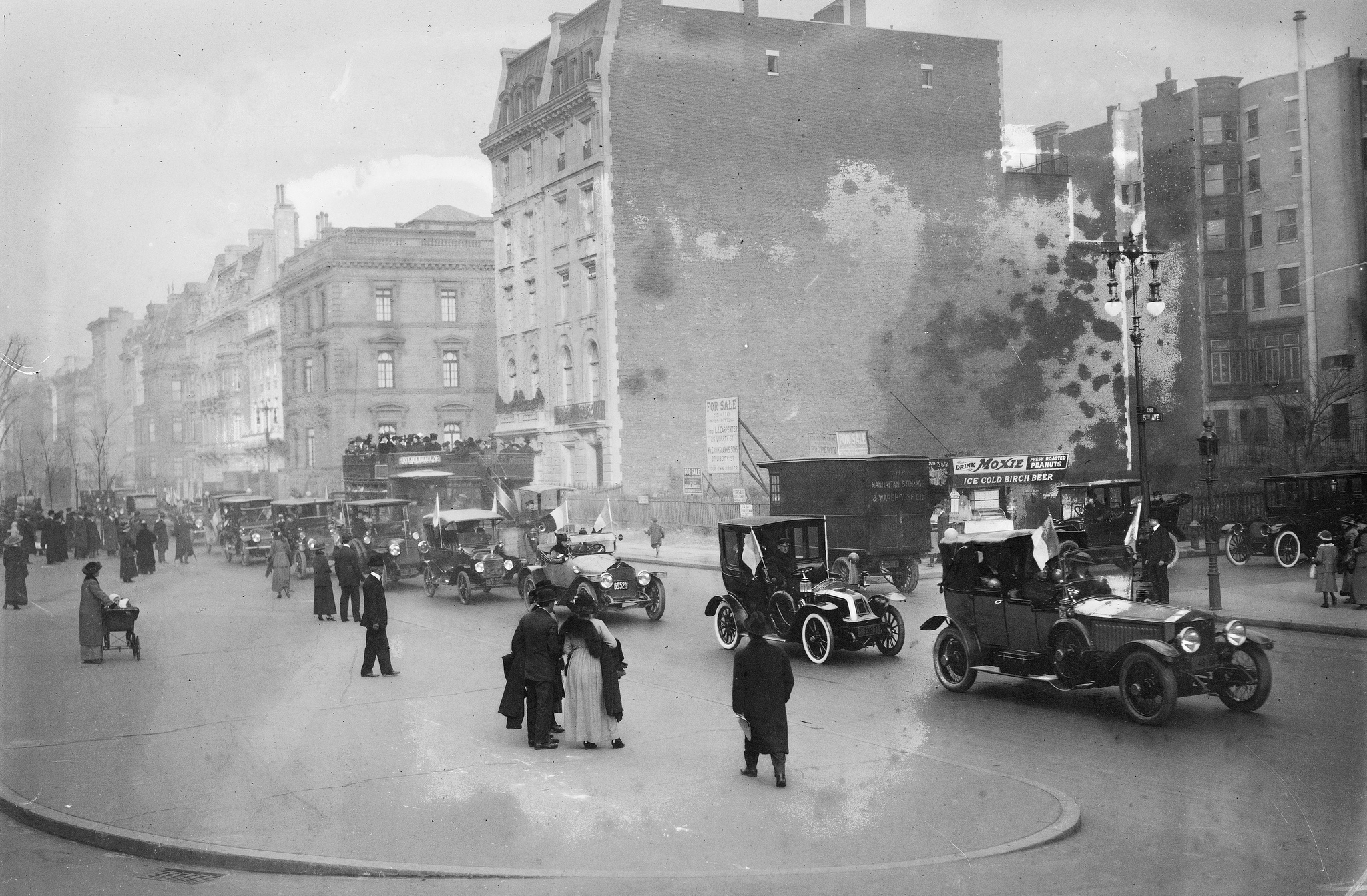
Automobile parade on Fifth Avenue, approx. 1915 (Courtesy LOC)
Upper Fifth Avenue “We drove over to Fifth Avenue, so warm and soft, almost pastoral, on the summer Sunday afternoon that I wouldn’t have been surprised to see a great flock of white sheep turn the corner.” This was not as bizarre as it sounds, for nearby Central Park actually had sheep grazing in it until 1934. Granted, they would have been on the other side of the park, in today’s aptly named Sheep Meadow.
Above 158th Street and Riverside Drive, 1921 (NYPL)
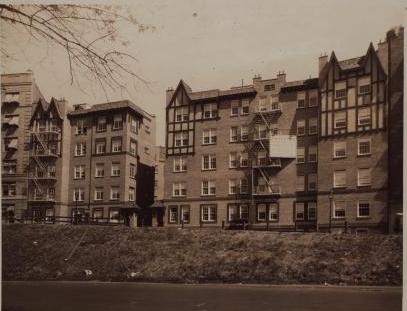
Washington Heights “We went on, cutting back again over the Park towards the West Hundreds. At 158th Street the cab stopped at one slice in a long white cake of apartment-houses. Throwing a regal homecoming glance around the neighborhood, Mrs. Wilson gathered up her dog and her other purchases, and went haughtily in.”
Once the respite of wealthy manors in the 19th century, the upper reaches of Manhattan gave way to middle-class housing at the start of the new century. Myrtle’s perch here in Washington Heights would have been appropriately out of the way in the 1920s.
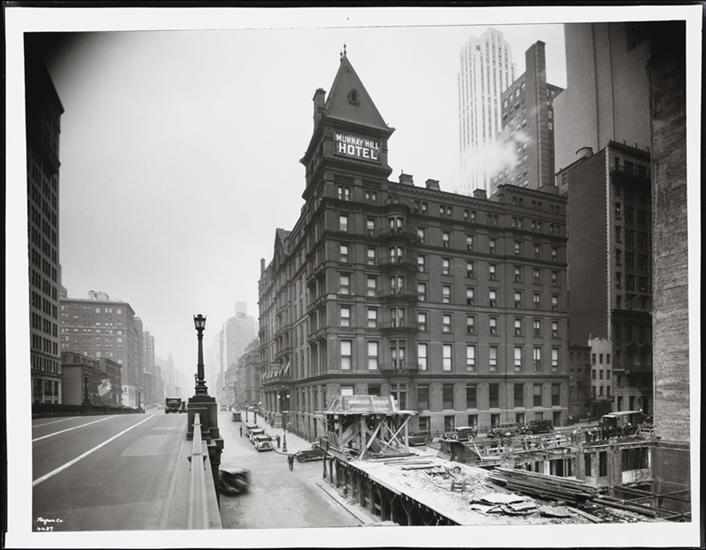
The Murray Hill Hotel on Park Avenue, 1931, courtesy Museum of the City of New York
The Murray Hill Hotel
“After that, if the night was mellow, I strolled down Madison Avenue past the old Murray Hill Hotel and over 33d Street to the Pennsylvania Station….I liked to walk up Fifth Avenue and pick out romantic women from the crowd and imagine that in a few minutes I was going to enter into their lives, and no one would ever know or disapprove.”
Opening in 1884 to serve the needs of those arriving from Grand Central Depot, the Murray Hill Hotel kept its halls fully occupied until its demolition in 1946. The Daytonian In Manhattan blog has a wonderful tale of the hotel’s colorful history.
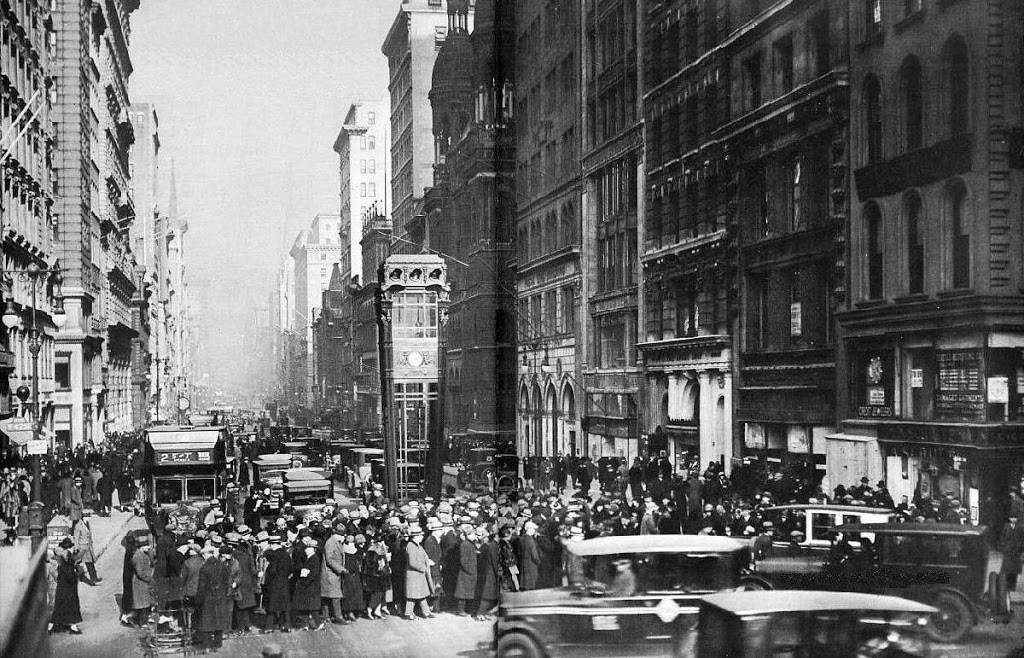
Above: 42nd Street in 1926 (Courtesy Kings Academy)Forty-Second Street
“Roaring noon. In a well-fanned Forty-second Street cellar, I met Gatsby for lunch. Blinking away the brightness of the street outside, my eyes picked him out obscurely in the anteroom, talking to another man.”
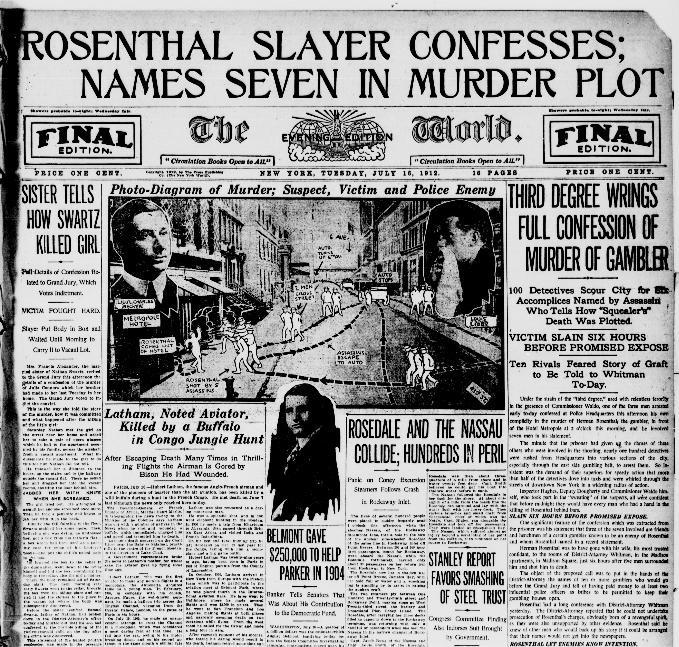
From the July 16, 1912 edition of the New York Evening World Hotel Metropole “The old Metropole,” brooded Mr. Wolfsheim gloomily. “Filled with faces dead and gone. Filled with friends gone now forever. I can’t forget so long as I live the night they shot Rosy Rosenthal there.”
The Hotel Metropole was a swanky Times Square hotspot located at 147 W. 43rd Street. Mr. Wolfsheim (himself a stand-in for gangster Arnold Rothstein) spends a moment recounting the assassination of Herman Rosenthal, gunned down by the mob. Charles Becker, who was accused of orchestrating the murder, became the first police officer to ever be given the death penalty.
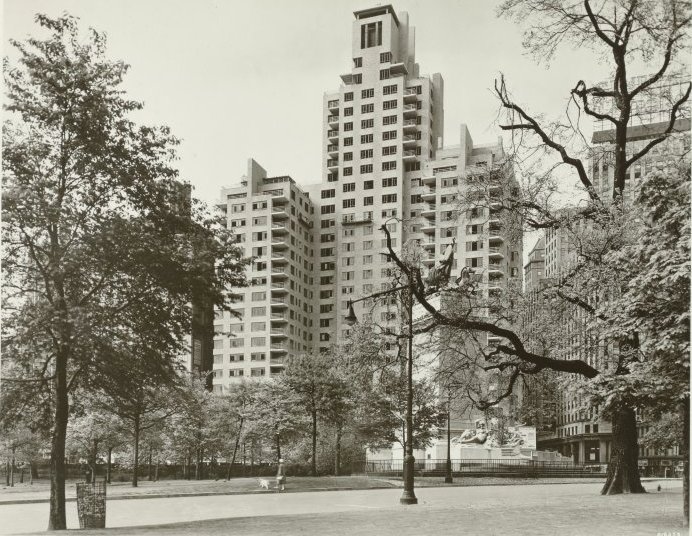
Above: The southwest corner of Central Park, photo by the Wurts Brothers (NYPL)
Central Park “When Jordan Baker had finished telling all this we had left the Plaza for half an hour and were driving in a victoria through Central Park. The sun had gone down behind the tall apartments of the movie stars in the West Fifties, and the clear voices of little girls, already gathered like crickets on the grass, rose through the hot twilight. We passed a barrier of dark trees, and then the facade of Fifth-ninth Street, a block of delicate pale light, beamed down into the park.”
“And we all took the less explicable step of engaging the parlor of a suite in the Plaza Hotel. The room was large and stifling, and, though it was already four o’clock, opening the windows admitted only a gust of hot shrubbery from the Park.”
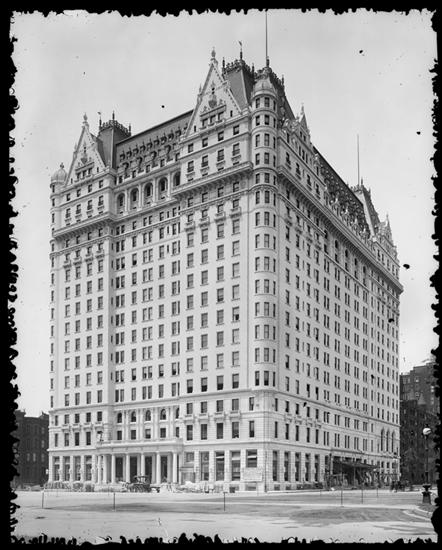
The Plaza Hotel The beginning of a string of violent acts in the book begins here at The Plaza, at perhaps the epitome of class in the early 1920s. It was only open about 15 years when the events of the book take place here.
ABOVE: These are the ladies who lunch in Prospect Park 1935
We talk about a lot of white men on the Bowery Boys podcast. When
discussing the mainstream history of the city, it’s pretty unavoidable.
Men had the money, the power, the influence. Not to mention most of the
corruption, the crime, the scandal.
So as Women’s History Month draws to a close (okay, I’m one day
late), I thought I’d make a very opinionated list of the 25 women who
made the biggest impact to the city of New York, at least as seen by
this humble blogger and podcaster.
There have obviously been many, many New York-based women whose
contributions changed the country and the world. There are your
feminists (Elizabeth Cady Stanton), your activists (Ella Baker), your
entrepreneurs (Estee Lauder), your tastemakers (Diana Vreeland) and your
entertainers (Madonna).
But these 25 helped shape
the actual city itself. The neighborhoods, populations and culture, to
be sure. But most importantly, they each effected perceptions of the
city, both to its residents and outward to the world. (Thus, for
instance, you’ll note my heavy emphasis on preservationists.)
This is not an ultimate list. I obviously do not know the impact of
every woman who ever lived in New York City. Many women communicated
power through wealth and property; I don’t have the social register from
every season and cannot gauge the influence of every bold-faced name.
These are just 25 that have crossed my path since we started the Bowery
Boys that I just wanted to celebrate today.
I’ve obviously missed out on a few, so if you have a
particular favorite that’s missing, please put them in the comment
section. At the bottom I have a list of ladies that made my personal
honorable mention. So here we go!
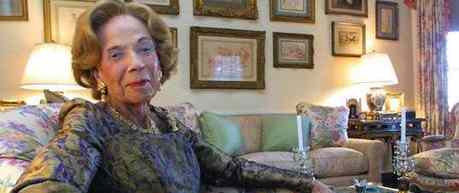
Brooke Astor (1902-2007)
Philanthropist
She was the last of the socialites, as they say. The queen of old
American money, for 105 years Astor ruled as the last official vestige
of one of Manhattan’s wealthiest families, setting a standard for
philanthropy and sadly leaving an uncertain legacy amid scandals
involving her heirs.
Power is the ability to do good things for others. — Brooke Astor
Alice Austen (1866-1952)
Photographer
Few saw the Gilded Age city quite as Austen did, a Staten Island
native who captured the beauties of New York, the horrors of Ellis
Island’s quarantine station, and the wonders of the world, but probably
took her best shots from her own backyard at Clear Comfort, in Rosebank,
SI.
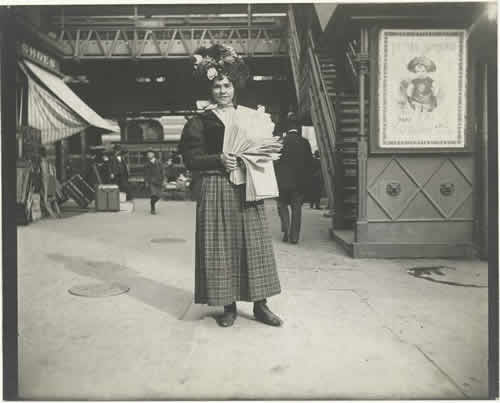
Below: a girl newsie in 1896, as captured by Austen
Nellie Bly (1864-1922)
Journalist
Her bravery, curiosity and outright nerve made her a writer of
international fame, one of the first investigative journalists in the
age of sensational journalism. But the story that put her on the map was
her undercover expose at Blackwell’s Island, ripping open the abuses of
New York’s island of untouchables, changing how the city thought about
both the infirm and the incarcerated.
Could I pass a week in the insane ward at Blackwell’s Island? I said I could and I would. And I did. — Nellie Bly
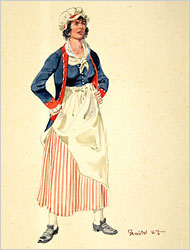
Margaret Corbin (1751-1800)
Revolutionary
Things were so precarious in the fall of 1776, the dawn of the
Revolution, that anyone who lived in New York might have turned the tide
of war. Many women did their part to battle the British, from Mary Lindlay Murray the to the mysterious Agent 355,
a shrouded spy among the British. But Corbin is notable not just for
particular bravery but for sacrifice; she continued to lob cannon fire
at the British from Fort Washington in today’s Washington Heights well
after her husband was killed. Corbin herself was later imprisoned by the
British. Today the street along Fort Tryon is named for her.
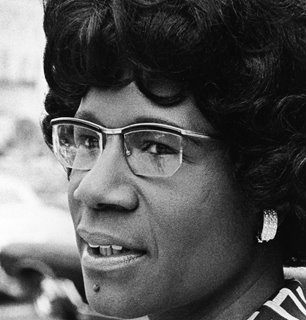
Shirley Chisholm (1924-2005)
Trailblazer
The pride of Bedford-Stuyvesant maneuvering through the precarious world
of New York politics, Chisholm won a seat in the state legislature in
1964 but always dreamed to represent Brooklyn on a national level, in
the U.S House of Representatives. She finally got her wish to represent
her neighborhood when redistricting lines were finally redrawn — finally
allowing a black candidate to run (and win) in a largely black
community — and won her seat in Congress in 1968. Shirley never
disguised her ties to her beloved Brooklyn neighborhood, even as a
candidate for president of the United States.
That I am a national figure because I
was the first person in 192 years to be at once a congressman, black
and a woman proves, I think, that our society is not yet either just or
free. — Shirley Chisholm
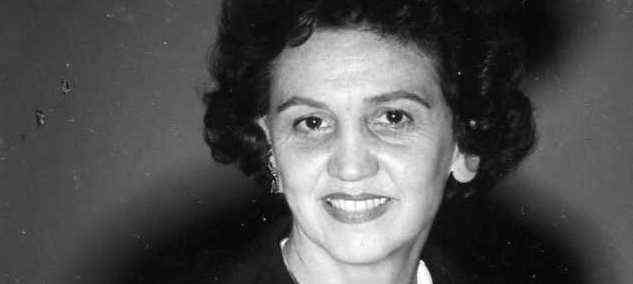
Margot Gayle (1908-2008)
Community leader
Gayle, who died last year at age 100, loved her Victorian
architecture and in particular cast-iron, the antiquated style of
downtown New York warehouses. Seeing destruction imminent, she decided
to save what she considered one of the city’s most neglected treasures.
Forming her first community group in the 1950s to save castle-like
Jefferson Market Courthouse, Gayle galvanized a grassroots architecture
movement.
There might be no SoHo without Gayle; as a campaigner, her work in
saving and preserving this heretofore disregarded part of downtown led
to one of Manhattan’s great neighborhood success stories. The SoHo Cast
Iron Historic District exists due to her efforts. And, more importantly,
her work became a template for how future neighborhoods could be
revitalized. (Read her Times obituary here).
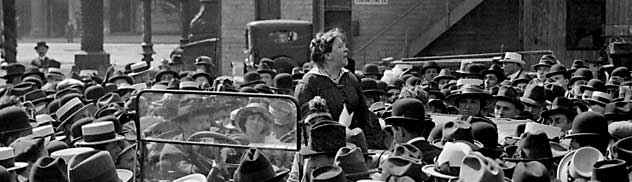
Emma Goldman (1869-1940)
Agitator
Probably the most influential anarchist in American history, Goldman
promoted the rights of workers and upended the role of women in New York
politics. The Russian-born activist made her name on the streets of
Manhattan, stirring Bohemia and workers alike, butting heads with most
of New York’s leading industrialists in the process.
Her views are controversial, often horrifying by today’s standards.
(She once ordered the assassination of Henry Clay Frick, for instance.)
But her powers as an orator and rabble-rouser are unquestioned; her
stirring words in Union Square (pictured above) during the panic of 1893
gave voice to the outrage of the city.
If voting changed anything, they’d make it illegal. — Emma Goldman
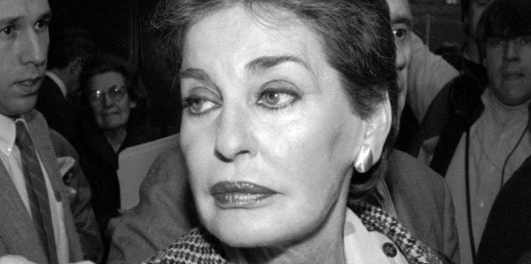
Leona Helmsley (1920-2007)
Magnate
Leona and her husband Harry reigned over a vast Manhattan empire of
highrises and hotels, permanently changing Park and Madison avenues,
helping transform New York into a city of condominiums. Her status as
the Queen of Mean also formed the modern caricature of overbearing and
out of touch wealthy elite. Later convicted of tax evasion, Leona died
in 2007 a laughing-stock. (That Suzanne Pleshette film
didn’t help either.) But her reach extends through many of the city’s
great iconic buildings, including the Empire State Building, which she
and her husband once managed.
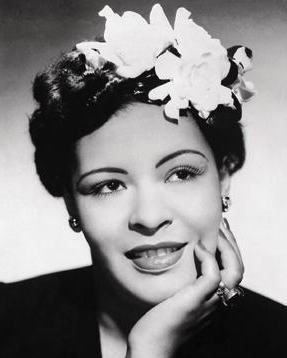
Billie Holiday (1915-1959)
Chanteuse
Of all the thousands of entertainers that have left their imprint on the
city, Holiday’s is the one that makes the deepest impact. Her entire
story — her birth, her rise to fame, her indiscretions and her tragic
death — takes place in New York. Her greatest performances electrified
and reshaped race assumptions in 1930s and 40s nightlife; legendary
nights at places like Cafe Society ensured entertainment would no longer
be strictly a black and white affair. Her performance style is emulated
nightly in cabarets and clubs throughout the city.
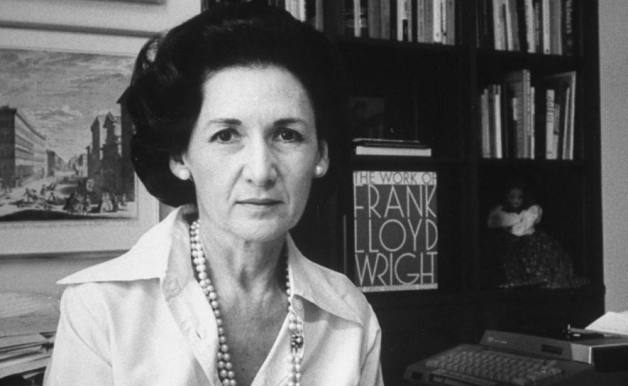
Ada Louise Huxtable (1921-2013)
Critic
She is the best known woman in twentieth century architecture, and she
isn’t even an architect. It’s hard to analyze the history of any
building without first checking in with Ada to see what she has to say
on the matter. Her writing is elegant, persnickety, direct and
affectionate to architectural aesthetic as a whole, and New York City in
specific. As a writer for the New York Times and Wall Street Journal,
Huxtable directed New York’s architecture scene from behind her desk,
excoriating designers for excess or dullness, praising beauty when it
improved the city’s legendary skyline.
I like old buildings that are
intriguing and quite wonderful but don’t make the history books. What
you discover is there’s a little group of people that have been admiring
them quietly by themselves all along. — Ada Louise Huxtable
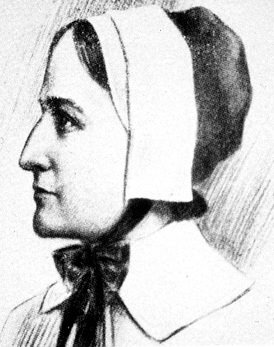
Anne Hutchinson (1591-1643)
Dissident
Escaping persecution in both Puritan Massachusetts and Rhode Island,
religious revolutionary Hutchinson and her followers settled in today’s
area of the North Bronx in the 1640s, one of two significant female
leaders in the early New York area. Although she was later murdered —
Lenapes wiped out the settlement in 1643, a victim of New Amsterdam’s
persistent conflicts with native tribes — she still leaves her mark
today. The Hutchinson River and Parkway both carry her name.
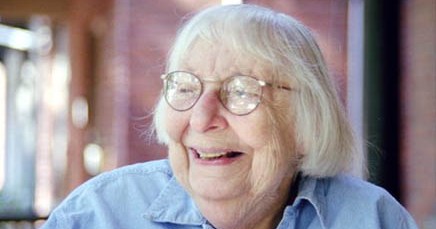
Jane Jacobs (1916-2006)
Community defender
Her theories on urban life have benefited many North American cities,
but it was her struggles to save neighborhoods from Robert Moses and
the rise of car culture in the 1950s and 60s that make her most
influential today. The entirely of downtown Manhattan has her to thank
for fighting back — and ultimately defeating — Moses’ destructive Lower
Manhattan Expressway proposal. The theories described in her classic
“Death and Life of Great American Cities” were shaped from observing
life from her window at 555 Hudson Street in the West Village.
Cities have the capability of providing something for
everybody, only because, and only when, they are created by everybody. —
Jane Jacobs
Lady Deborah Moody (1586 – 1659)
Founder
The British-born Moody, like Hutchinson, took to the unknown when
persecuted for her religious beliefs. With the permission of William
Kieft, the “dangerous” Moody set up the colony of Gravesend in 1645,
becoming the first female founder of an American colony. Gravesend was
one of the original towns of Brooklyn and is still the name of a south
Brooklyn neighborhood today.
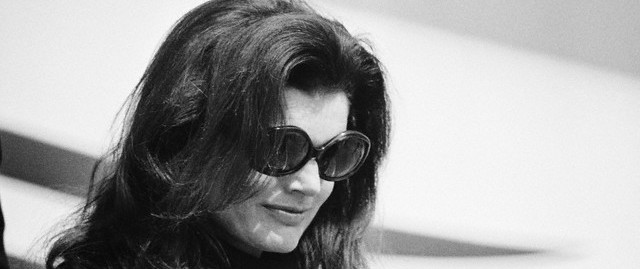
Jackie Kennedy Onassis (1929-1994)
Icon
Settling in New York after the deaths of two husbands, Onassis was
the biggest bold-faced name in the city, famously suffering the
intrusive effects of paparazzi. However she used her headline grabbing
name wisely as a member of the Municipal Art Society, helping defend
Grand Central Station, Columbus Circle and Staten Island’s Snug Harbor
from modification or outright destruction. The Central Parks reservoir
is named in her honor, and MAS gives out a yearly Jackie Kennedy Onassis
Medal to noteworthy New Yorkers. (Margot Gayle received it in 1997.)
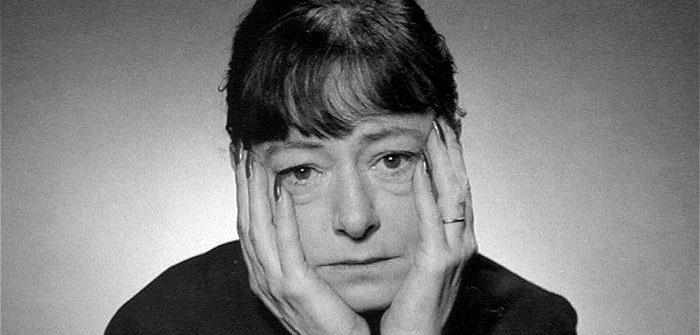
Dorothy Parker (1893-1967)
Wit
As doyenne of the Algonquin Round Table, Parker had the sharpest
friends in town in the 1920s. Her droll charm helped create the
archetype of New York caustic intellectualism, something Woody Allen,
Fran Lebowitz and an entire culture of New Yorker readers can well
recognize.
I’d rather have a bottle in front of me, than a frontal lobotomy. — Dorothy Parker
Abby Aldrich Rockefeller (1874-1948)
Collector
She could very well have stayed in the sidelines with the other
spouses of multi-millionares. But Abby’s tastes and passions for modern
art led her to an astonishing collection she kept on an upper floor of
her townhouse, away from her husband J.D. Rockefeller Jr., who didn’t
much care for those odd little pictures. Years later, that townhouse
would give way to Abby’s pet project, the Museum of Modern Art, one of
the most influential galleries for 20th Century art. Her memory is kept
alive at the museum with the Abby Aldrich Rockefeller Sculpture Garden.
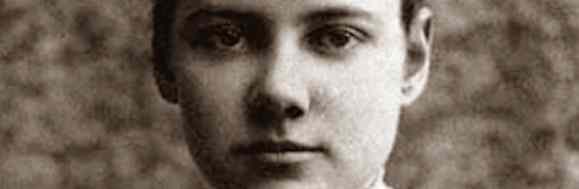
Emily Warren Roebling (1843-1903)
Bridge Builder
Construction on the Brooklyn Bridge had barely begun when her husband
and master engineer Washington Roebling came down with crippling
symptoms of the Bends. Emily at first operated only as his eyes and
ears, but soon grew into the role of leading the completion of New
York’s first great bridge. Ceremonially, she was the first person to
cross it.
Eleanor Roosevelt (1884-1962)
World Leader
One of the most powerful American women to have ever lived was a New
Yorker through and through. Her aristocratic name may have opened doors
for her early on, but her compassion and ingenuity would soon set her
apart, first as a social worker in Manhattan slums, then as the spouse
of a governor and president. She returned to New York after FDR’s death
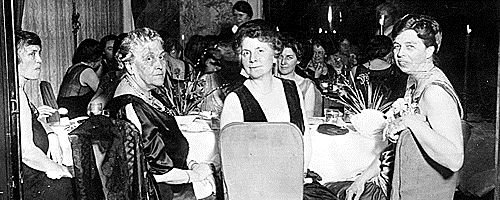
to become a U.S. delegate to the United Nations. (Above: Eleanor with
New York City society women.)
Beautiful young people are accidents of nature, but beautiful old people are works of art. — Eleanor Roosevelt
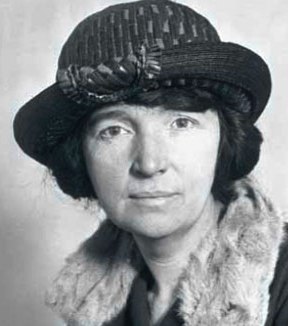
Margaret Sanger (1879-1966)
Rebel
Her influence in the fields of reproduction and birth control would
eventually go global, but all nurse Sanger really wanted to do at first
was help out women in the Lower East Side. From her work in the slums,
Sanger believed radical action was neccessary to control the rising tide
of pregnancies, leading to larger families and greater poverty. In 1917
she opened New York’s first birth control clinic in Brooklyn and was
promptly thrown in jail. Ten years later, her innovations as an educator
in birth control — she’s the mother of Planned Parenthood! — would
catch on worldwide.
During these years in New York more and more my calls began
to come from the Lower East Side, as though I were being magnetically
drawn there by some force outside my control. — Margaret Sanger
Verna Small (1916-2008)
Preservationist
Small is the queen of Greenwich Village, a fiesty, often poetic
community leader who provoked residents into lobbying for historic
preservation. She organized or led one group after another, all in an
effort to preserve the remainder of the Village before developers could
sweep it away. She succeeded. Today it seem impossible that the Village
was ever in that much danger at all. Her many years with the Landmarks
Committee in the 1980s assured the rest of the city would benefit from
her tender loving care.
The attitude of the Village was ‘We’ve got to catch up with Brooklyn Heights!’ —Verna Small
Dorothy Schiff (1903-1989)
Publisher
Native New Yorker Schiff owned the New York Post from 1939 to the 1970s
and eventually shaped its editorial policy as publisher, the first New
York woman to do so. Her stinging, left-leaning views and saavy tastes
for great writers turned the once tame newspaper into the city’s most
successful tabloid. Her sudden decision to sell it to Rupert Murdoch in
1976 led to the decidedly different, far more sensational Post we’re
familiar with today.
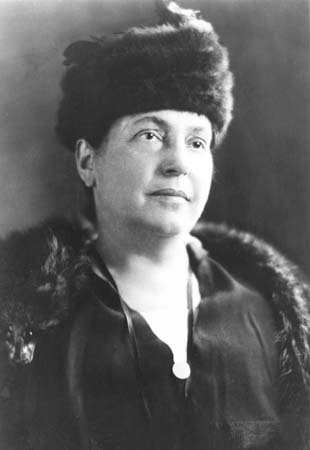
Lillian Wald (1867–1940)
Social Worker
The patron saint of the Lower East Side, devoted nurse Wald helped
found both the Henry Street Settlement and the National Association for
the Advancement of Colored People. Her desire to help New York’s poorest
consumed her life. Her altruism helped save thousands of lives and set
the standard modern social work and nursing. If that isn’t enough, her
innovations from everything to playgrounds and school lunch programs
redefined New York education and reverberated throughout America. Um,
what have you done today to help your fellow man?
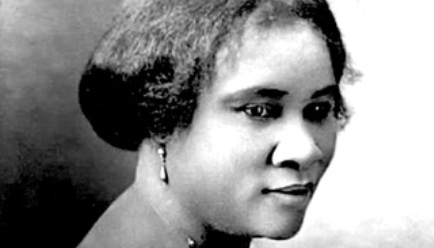
Madam C.J. Walker (1867-1919)
Tycoon
Walker, a self-made entrepreneur and hair product queen, was the
richest and most powerful woman in Harlem, during the neighborhood’s
pivotal years of growth in the dawn of the Harlem Renaissance. (Some
sources say she was America’s first female millionaire.) She shattered
color and gender barriers, employing hundreds of other black women and
eventually leaving most of her wealth to notable African-American
organizations. Walker’s daughter A’Lelia was a patron of many great
writers of the Renaissance era.
And her name? She was once married to a man named Charles Joseph Walker; he left in 1910, but the C.J. — and the Madam — stayed.
Edith Wharton (1862-1937)
Observer
Wharton was a woman of ultimate privledge in Gilded Age New York but
had an uncanny ability to describe it. Our notions of what upper-crust
New York was at this time are shaped in part by her novels and short
stories. Her creations Lily Bart and the Countess Ellen Olenska are
still the best evidence we have of the absurdities and restraints
upper-class New York.
A New York divorce is in itself a diploma of virtue. — Edith Wharton
Gertrude Vanderbilt Whitney (1875-1942)
Patron
Gertrude, the daughter of Cornelius Vanderbilt, turned her powerful
name, untold wealth and fascinations with art into an endeavor that
would benefit the general public, eventually founding the Whitney Museum
in 1931. But unlike Abby Rockefeller, Whitney actually was an artist
herself, a sculptrress and a habitue of turn-of-the-century Greenwich
Village bohemia. Gertrude’s daughter Flora Payne Whitney would go on to
head her mother’s museum for decades.
And 25 more that I didn’t get to write about this time around: