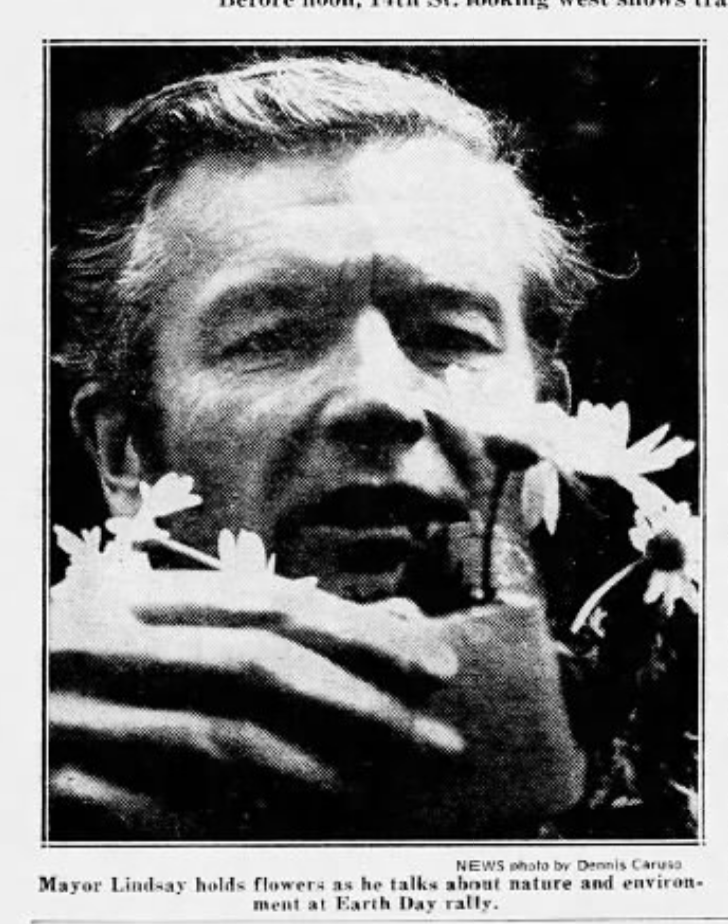
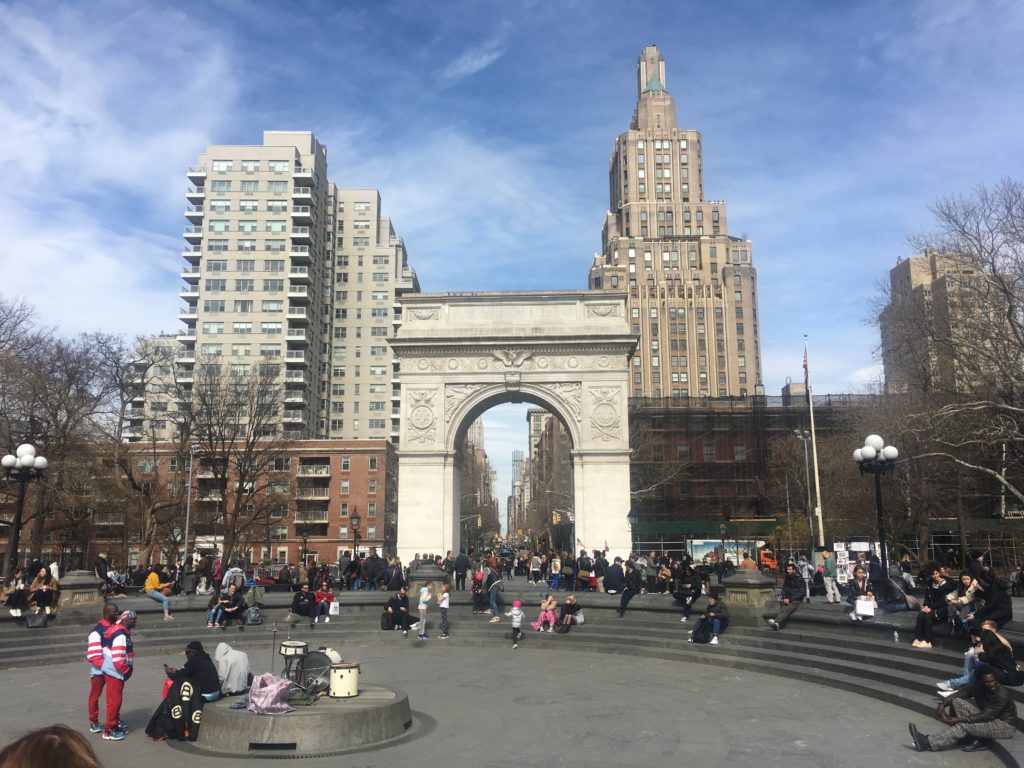
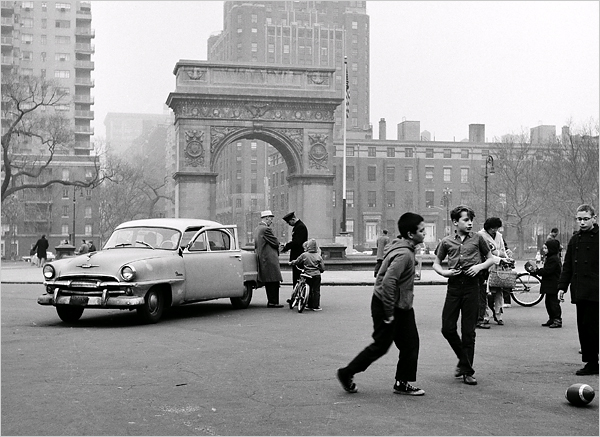
Mayor John Lindsay pulled out all the stops for the first official Earth Day on April 22, 1970, with such a show that one could be mistaken in the belief that the holiday was created here. (It was officially sanctioned in San Francisco the year before.)
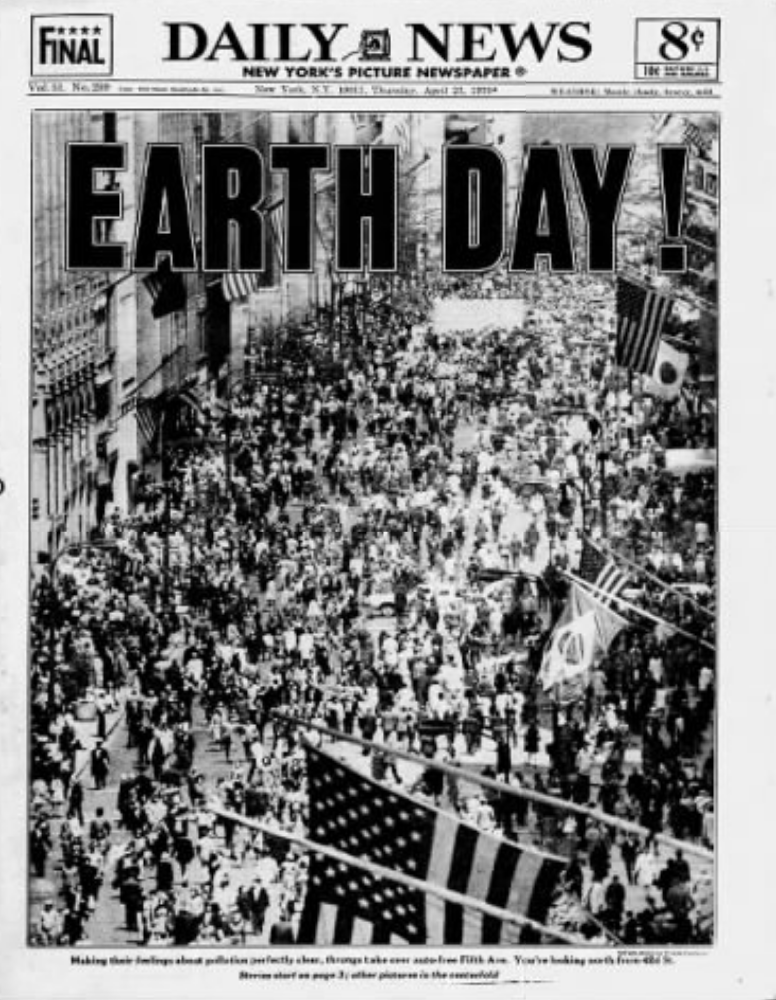
In honor of the inaugural environmental holiday, Lindsay authorized Fifth Avenue closed for two hours, the streets filled with thousands of celebrants and protesters.
The event culminated in Union Square, where the mayor — along with actors like Paul Newman and Ali McGraw — spoke to encouraging crowds about a cleaner city. Fourteenth Street between Third and Seventh Avenues was also shut down for an ‘ecological carnival’, which might not sound as fun as a real carnival. Except this was 1970, after all.
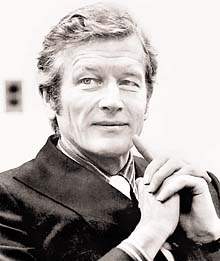
Was Lindsay (left) before his time in his passion for pollution? Maybe. More likely, his constituents were.
By 1970 the mayor was attempting to appeal to the true sensibility of the urban bohemian, allowing ‘be-ins’ in Central Park and promoting a virtue of ‘Fun City’, “a phrase that embodied the hope of New Yorkers for a more livable city,” according to biographer Vincent Cannato. In fact, Earth Day was modeled after the Vietnam-era ‘teach-in’, essentially an educational outreach mixed with a smidgen of good times.
Lindsay: “[T]he city is contributing a billion dollars over the next ten years to mass transit construction. And then more, more and more we are discouraging automobile use in the central business areas.” (Look here for the rest of the interview with Lindsay in Union Square talking to NBC about the first Earth Day.)
“If you’re not part of the solution, you’re part of the pollution,” added governor Nelson Rockefeller in a speech to the crowds.
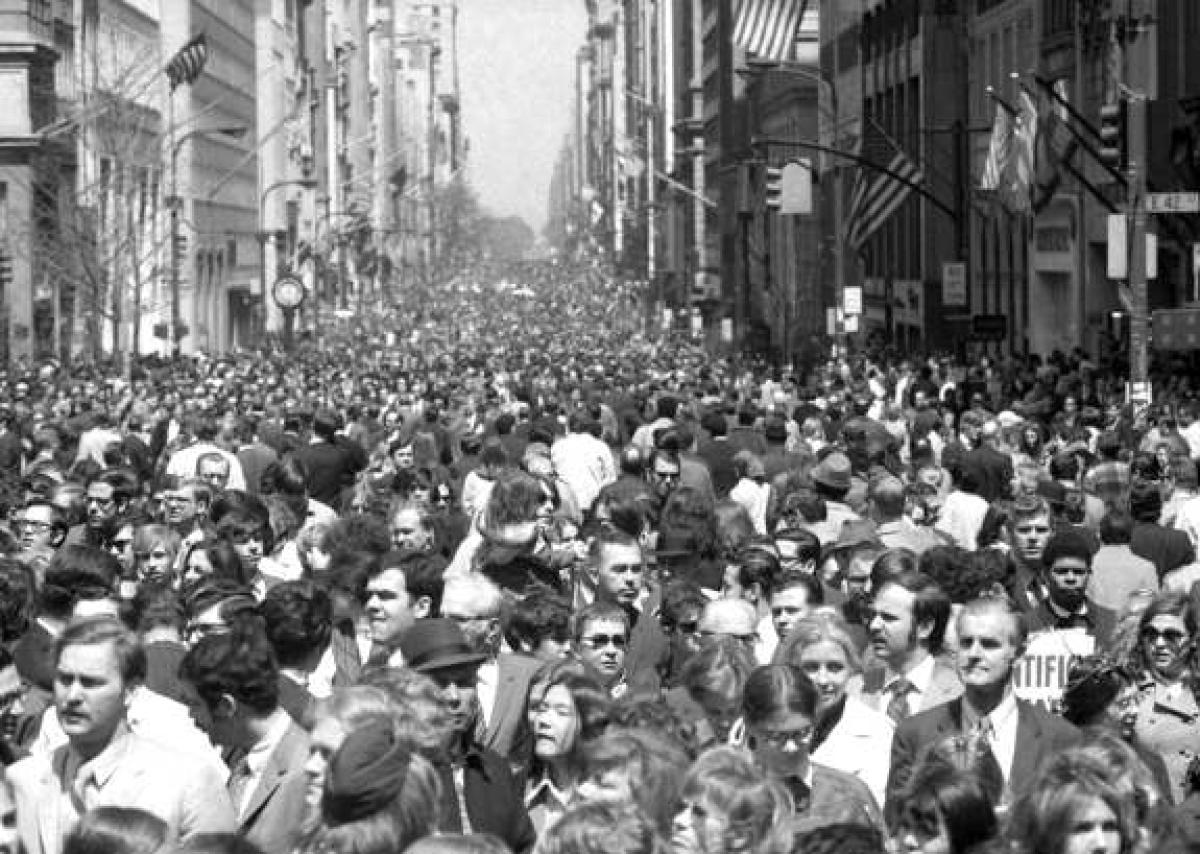
Above: Throngs enjoy a cleaner world by cramming themselves on Fifth Avenue during the city’s very first Earth Day celebration
The massive rally, with a 100,000 in attendance, reportedly left little pollution in its wake (although that seems a tad revisionist to me). Crowds occasionally attacked gas-guzzling, pollutant-making cars as they went by, and one group of demonstrators curiously dragged around a net filled with rotting fish, shouting “This could be you!”
Lindsay would later close Fifth Avenue to traffic for several weekends that summer.
From the New York Daily News
Flash forward to 2019 — the city often hosts Summer Streets car-free weekend, allowing pedestrians and bikers to enjoy city streets without automobiles.
In fact, this Saturday is Car Free Earth Week, “opening thirty blocks of Broadway from Times Square to Union Square for people to explore on foot during event hours, 9:00 AM to 3:00 PM.” And in uptown Manhattan, Car Free Earth Day opens up 9 blocks on St. Nicholas Avenue from 181st Street to 190th Street. [More details here]
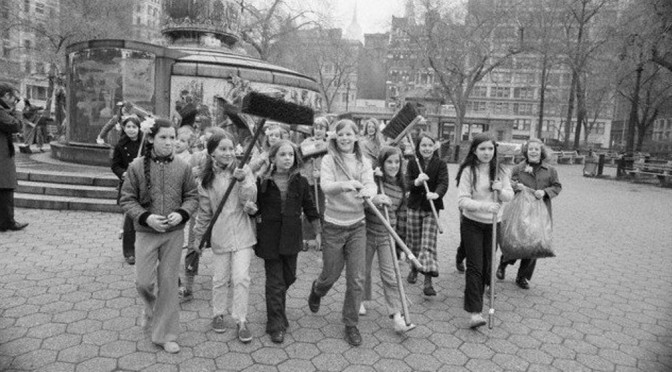
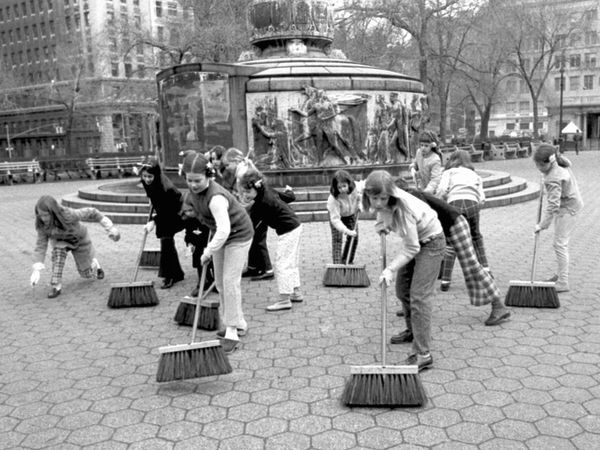
Below: This gang of adorable, broom-wielding Union Square scalawags prepare to attack the city’s grime
Congratulations to Victoria Johnson for being named a Pulitzer Prize finalist for her book American Eden, one of our favorite from 2018. Here’s our review from a few months ago:
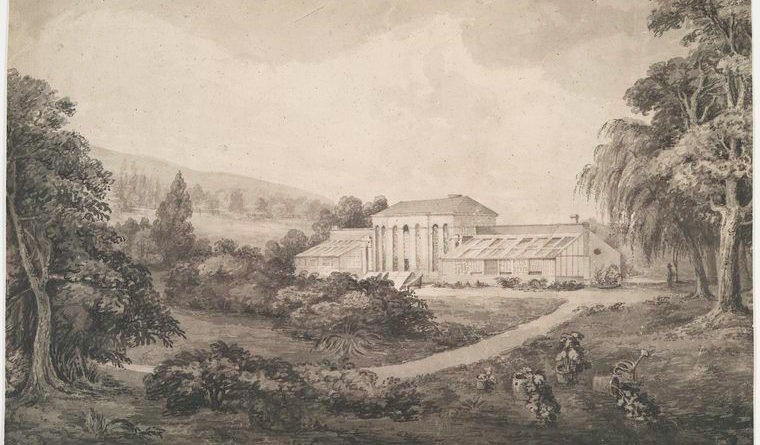
A secluded haven to an age of wonder once sat in mid-Manhattan at the start of the 19th century.
“Few New Yorkers had ever seen anything like it,” writes Victoria Johnson. “Its white facade had seven graceful arches, each stoppered with glass windows. Inside the building, rows of graduated shelves — known as stages — would accommodate dozens of potted plants. Wide walkways would run the length of the greenhouse, allowing access to the plants.”
The greenhouse was only part of a spectacular botanical garden, the first of its kind in America. Beautiful though it certainly may have been, the Elgin Botanic Garden was meant to save lives. Its numerous plant samples held the secrets to 19th century medicine at a moment when epidemics and illnesses ravaged a country without cures.
You may not be familiar with this long-forgotten place. (Rockefeller Center sits on the spot where this treasure once bloomed.) And you may know little about its creator, a prominent New Yorker who has spent far too much time in obscurity — Dr. David Hosack.
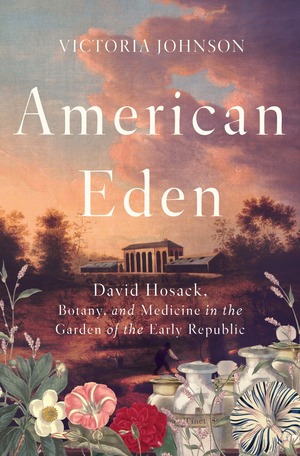
American Eden David Hosack, Botany, and Medicine in the Garden of the Early Republic Victoria Johnson Liveright
If you know Hosack at all, it’s because of his association with Alexander Hamilton and Aaron Burr. He was the doctor of both men and attended to Hamilton after his fateful duel with Burr in the summer of 1804. In fact, Hosack’s garden was constructed at about the same time as Hamilton’s upper Manhattan home Hamilton Grange.
In Johnson’s excellent new biography on Hosack — deservedly singled out on the 2018 National Book Award longlist for non-fiction — this hidden associate of the Founding Fathers comes alive, his contributions to early New York history and American science celebrated at last.
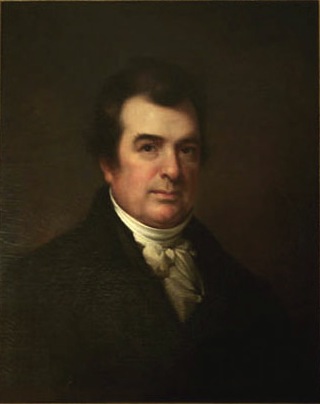
Hosack as painted by Rembrandt Peale
Hosack gained prominence in medicine at a moment when medieval and often barbaric practices were being scrutinized and discarded by more enlightened practitioners. For young Hosack, the secret to health lay not in antiquated procedures such as bloodletting but in the unlocked potential of the natural world. These hidden cures were not necessarily exotic but could be found in the rolling countryside of Manhattan itself.
Few biographies have such an impressive set of supporting players — Hamilton, Burr, Thomas Jefferson, Benjamin Rush, Carl Linneaus, even Lewis and Clark. My favorite moments were those involving a rivalry with Philadelphia renaissance man Charles Willson Peale. While American Eden is truly a celebration of flora and fauna, you’ll be thrilled to discover this conflict between great thinkers happens to involve a prehistoric Mastodon skeleton.
The New York City entertainment world was never the same after Bob Fosse and Gwen Verdon met at a rehearsal space in Midtown Manhattan in 1955.
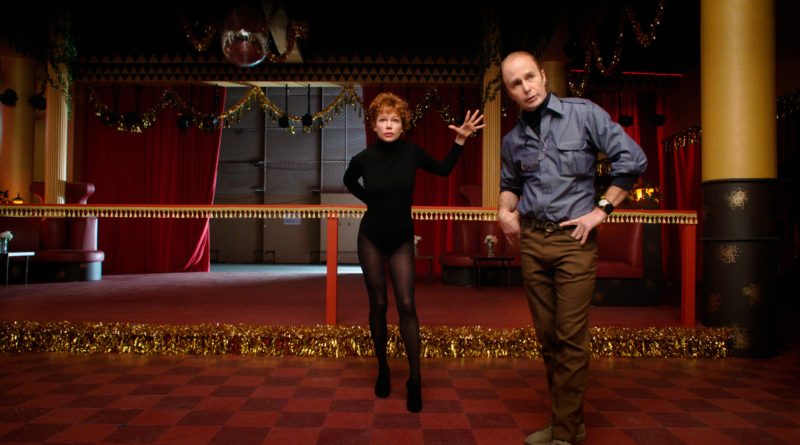
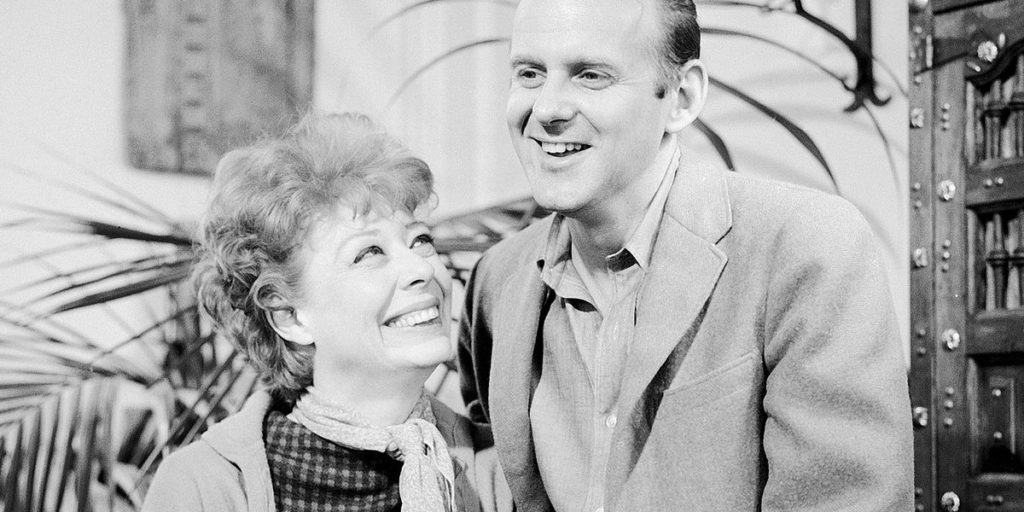
Tonight FX Network debuts its tribute to the lives of these collaborators and lovers in the series Fosse/Verdon, based upon the brilliant biography Fosse by Sam Wasson. This look at the complicated lives of two seminal performers of American theater and film will play out upon stages and in rehearsal spaces that were concentrated on just a few blocks of New York City’s Theater District. [For a full tour of Broadway, listen to our podcast episode: The Origin of Broadway.]
Wanna walk (or dance) in the footsteps of these two legendary performers? Visit these addresses in Midtown to pay homage:
January 9, 1951 — New York Daily News
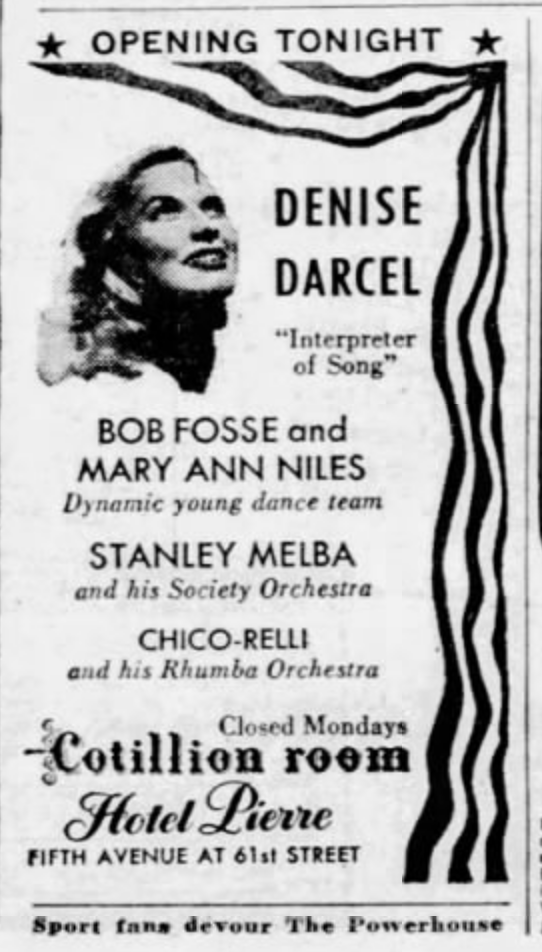
Pierre Hotel — In 1948, the Pierre’s Cotillion Room, “one of the most romantically appointed nightclubs in the city,” presented Fosse and his first wife Mary Ann Niles in a nightly ballroom act. While the critics were less than enthusiastic, their friends Dean Martin and Jerry Lewis, the hottest comic duo in town, invited the dancers to join them on TV’s Colgate Comedy Hour. Fosse later credits Lewis with giving him his first choreographer job.
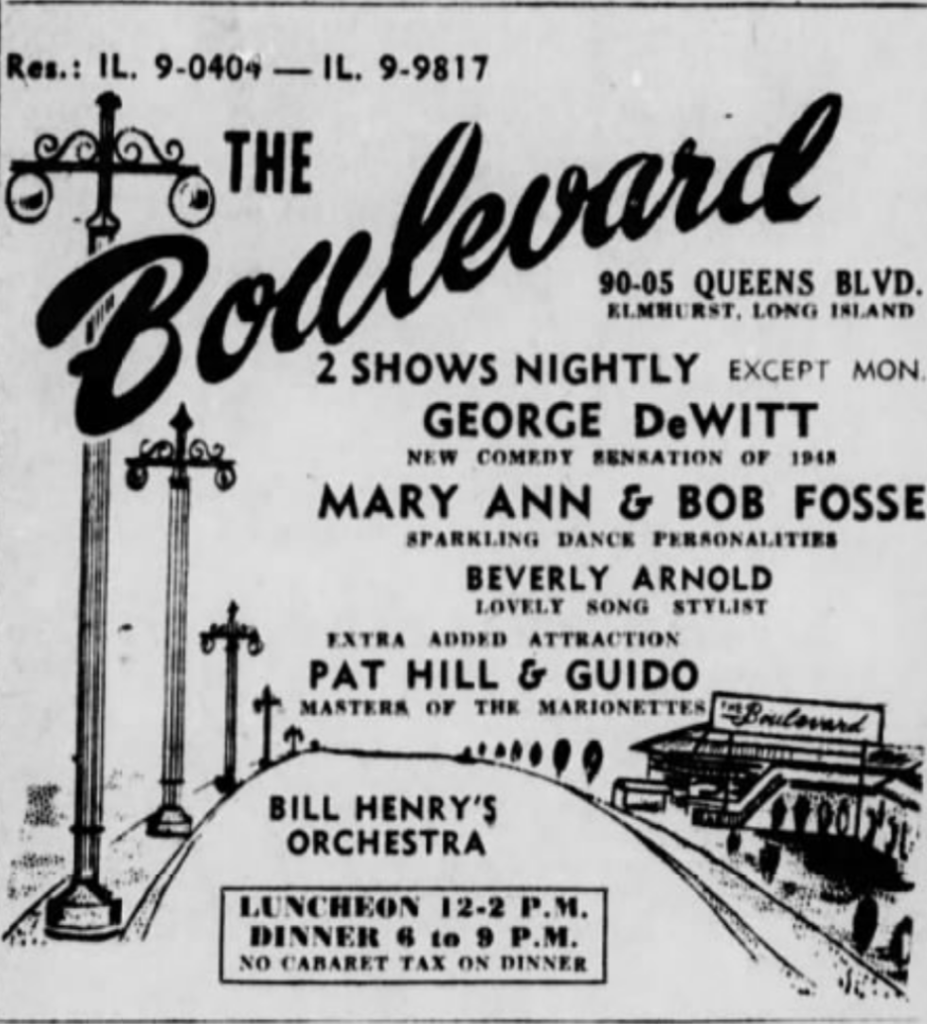
I also found a 1948 advertisement for a performance by these “sparkling dance personalities” at a venue in Queens:
Getty Images
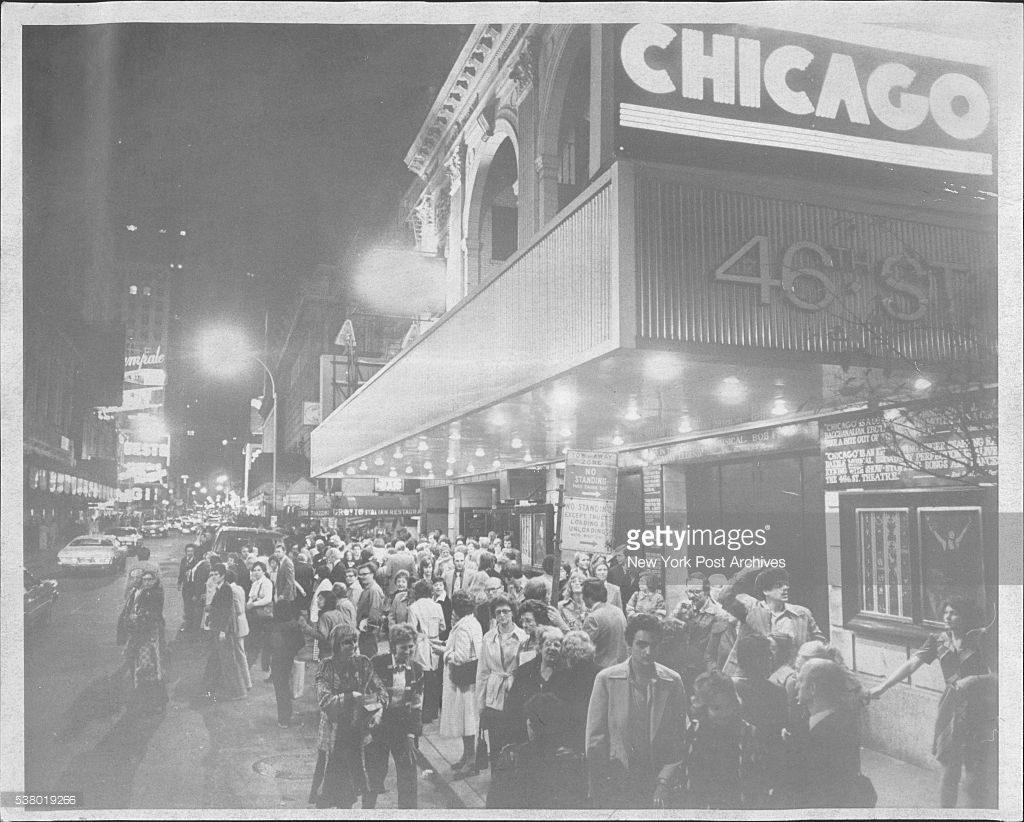
46th Street Theatre (aka Richard Rodgers Theatre) — The site of the 1955 production Damn Yankees, a Tony-winning musical romp featuring the New York Yankees as a sports nemesis. As choreographer, this was Fosse’s second musical on Broadway (after The Pajama Game) and the first with collaborator and future wife Gwen Verdon who won a Tony Award for her show-stopping performance as Lola.
Their follow-up together Redhead debuted here in 1959 and Fosse also worked here on the 1961 original production of How To Succeed In Business Without Really Trying. After the duo divorced in 1971, they continued to work with one another, most notably in the musical Chicago, which debuted in this theater on June 3, 1975.
(Hamilton continues to play at the Richard Rodgers Theatre today. Lin-Manuel Miranda is one of the producers of the FX series.)
Fosse and Verdon from the 1958 film Damn Yankees:
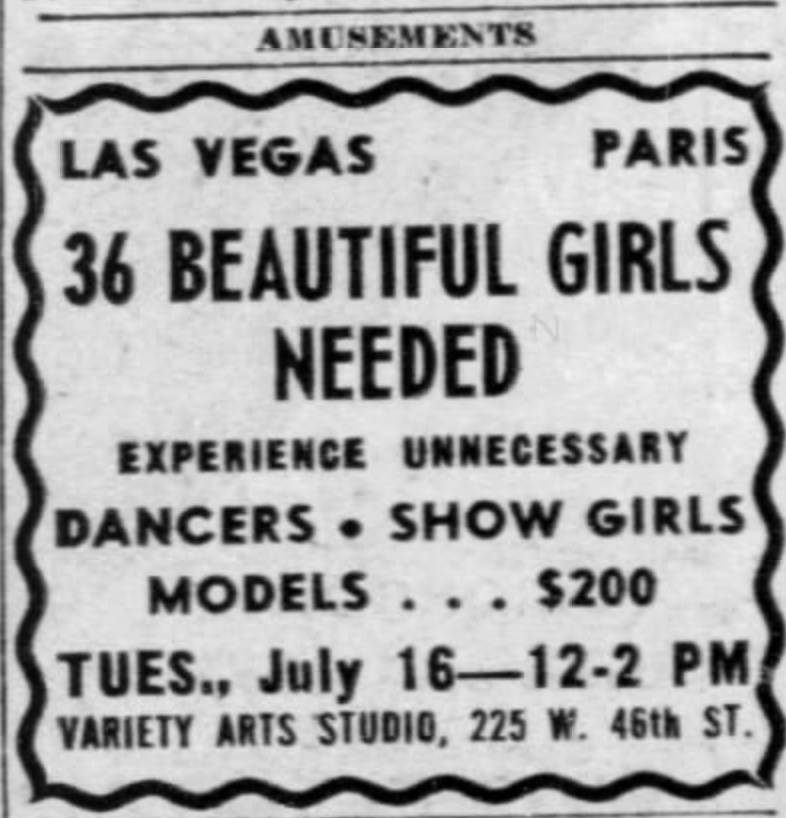
Variety Arts Studios (225 West 46th Street) — The Variety Arts not only contained rehearsal spaces used for many productions by Fosse and Verdon, but for a great many stars from the Golden Age of Broadway.
Here’s a 1957 New York Daily News advertisement for an audition held at the Variety Arts, illustrating a different kind of production that would have used the rehearsal space:
Getty Images
91 Central Park West — The lavish penthouse apartment of Fosse and Verdon for many years. From Wasson’s book: “From their terrace, vast enough to hold a vegetable garden, a Ping-Pong table, and dog run for Gwen’s pets, they could watch the park below, and on fair-weather days they could entertain a small group of friends, most of them carryovers from their Long Island summers and weekends.”
New York Public Library/Billy Rose Theater Division
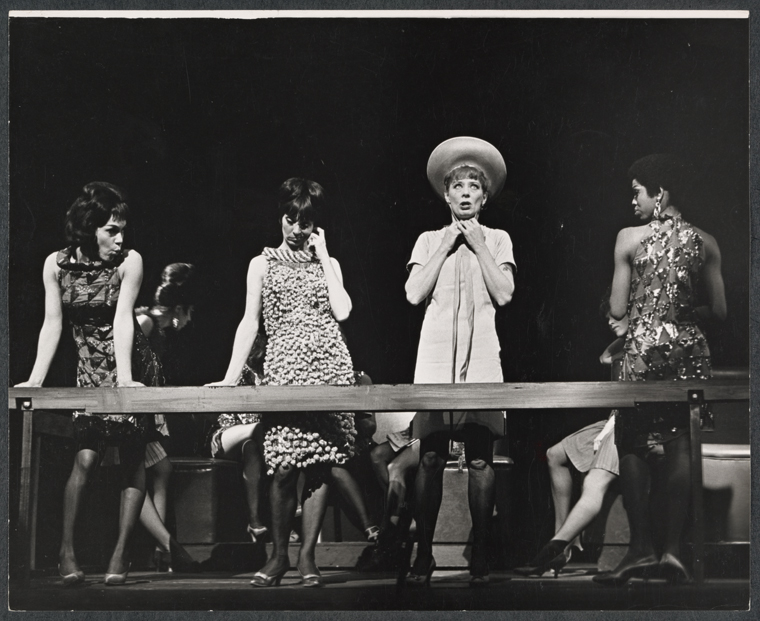
Palace Theatre (1564 Broadway) — Sweet Charity opened at this historic theater in 1966, just a block from the stage where Fosse and Verdon first worked together. The Palace, which first opened in 1913, had been a movie palace for many decades; Citizen Kane had even premiered here. Sweet Charity would bring this aging doyenne of the vaudeville circuit back to life as a still-thriving Broadway house.
58 West Fifty-Eighth Street — Fosse’s post-Verdon, early 70s pad, “a welcoming blend of bachelor and cozy.” The semi-autobiographical All That Jazz would feature a lead character who lived at 61 West 58th Street. (The apartment complex is called Tower 58 today.)
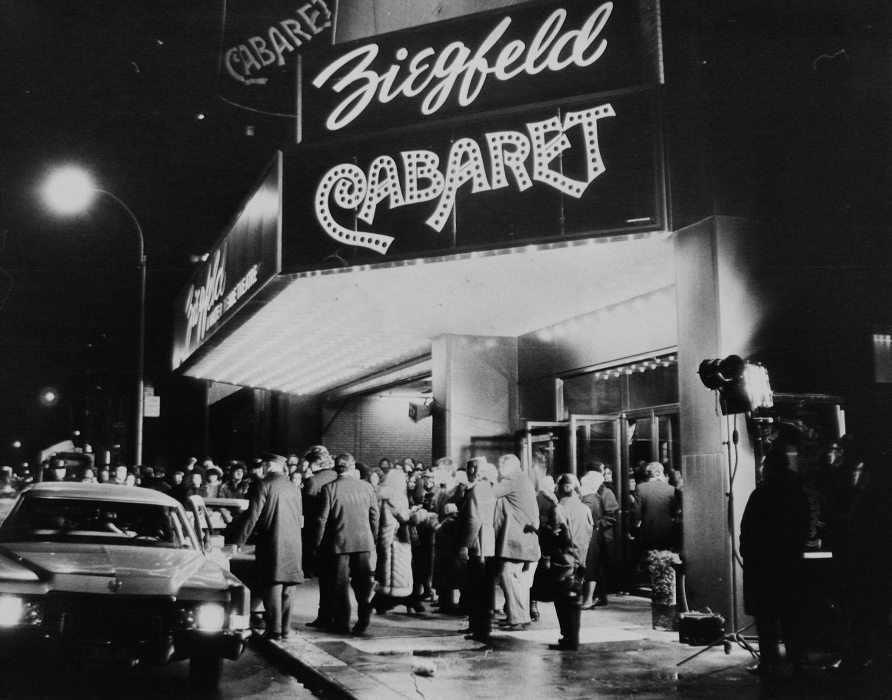
UNITED STATES – FEBRUARY 14: Crowds outside Ziegfeld Theatre for opening of “Cabaret”. (Photo by Richard Corkery/NY Daily News Archive via Getty Images)
Ziegfeld Theatre — Fosse was not involved with the original Broadway production of Cabaret, the 1966 Kander and Ebb musical based on a play I Am A Camera which was based on a Christopher Isherwood short novel Goodbye to Berlin. But he directed the 1972 film version, which premiered at the Ziegfeld.
According to Wasson, Fosse was obsessed with the theater’s environment for the premiere. He “adjusted the house lights and levels, honing the ambience for optimum viewing. He could not be too careful, even now. An exhibition atmosphere anything less than immaculate” could derail the film’s critical chances. “Fosse knew the Ziegfeld was his last line of defense against the likes of [New Yorker film critic] Pauline Kael and the critics from the New York Times.”
In the end, the critics loved it, and the film won an Academy Award for Best Director and one for his leading lady Liza Minelli.
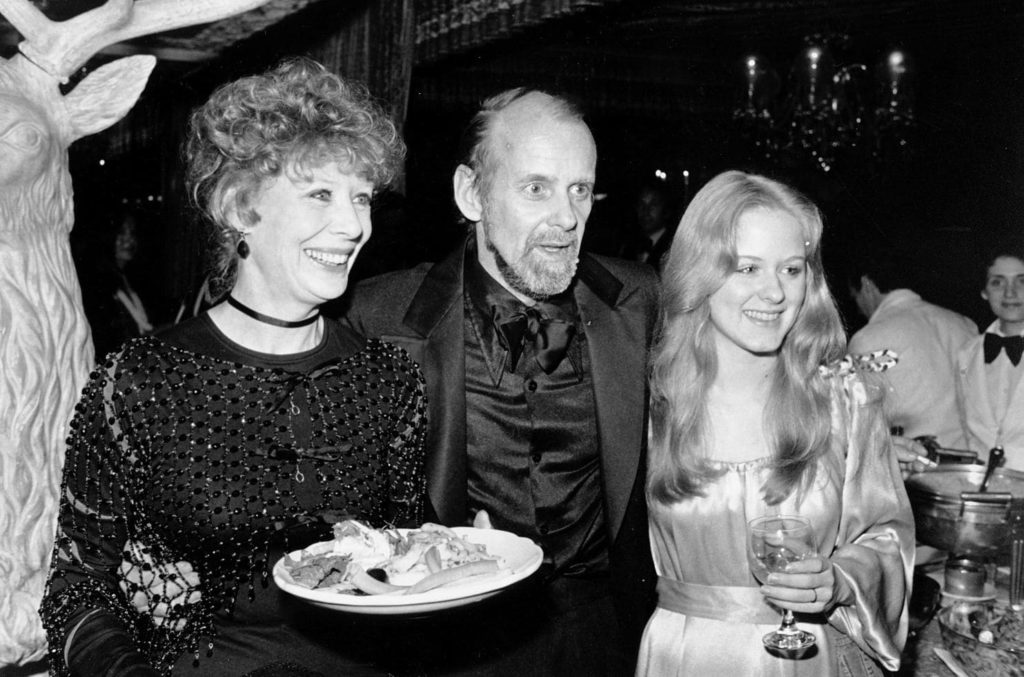
Verdon, Fosse and their daughter Nicole Fosse at Tavern on the Green, 1978. Photo courtesy the Associated Press
Tavern on the Green — “The site of sundry Fosse movie premieres and opening-night bashes,” the romantic Central Park restaurant was also the location of an unconventional dinner party on October 30, 1987, that Fosse was hosting for his closest friends.
The unconventional part — Fosse had died over a month earlier. From the New York Times: “‘Go out and have dinner on me,’ the choreographer and director ordered in his will.”
NOTE: Okay this is really a tour of Midtown and the Upper West Side.
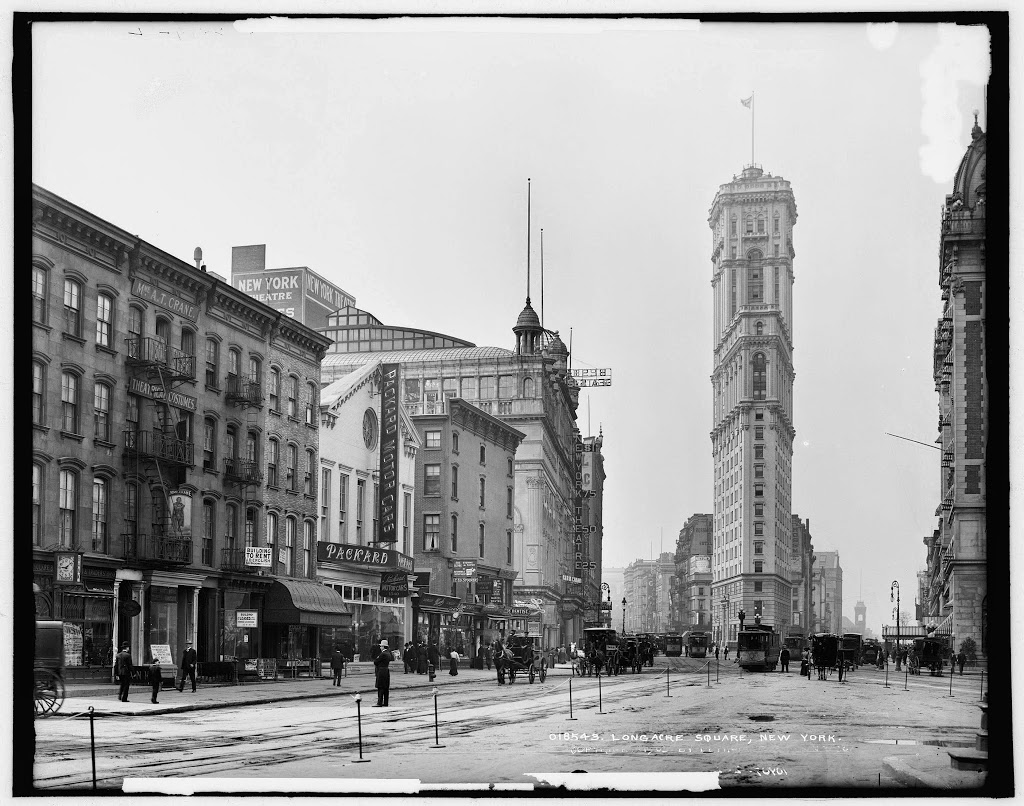
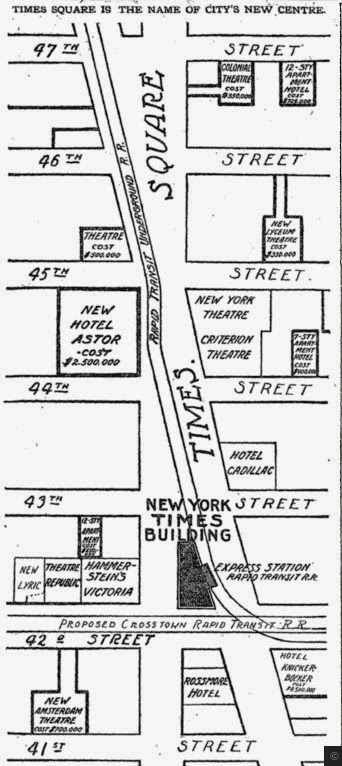
On April 8, 1904, the former horse-and-carriage district known as Longacre Square was renamed for a tenant who had just moved to the neighborhood.The New York Times was building a new office tower on the slim odd-shaped block at 42nd Street between Broadway and 7th Avenue.
Meanwhile, below ground, the city had built a pivotal new subterranean station for the Interborough Rapid Transit Company (IRT) which would open on October 27, 1904.Combined with the growing presence of theaters in the neighborhood, the area needed a fresh new name.
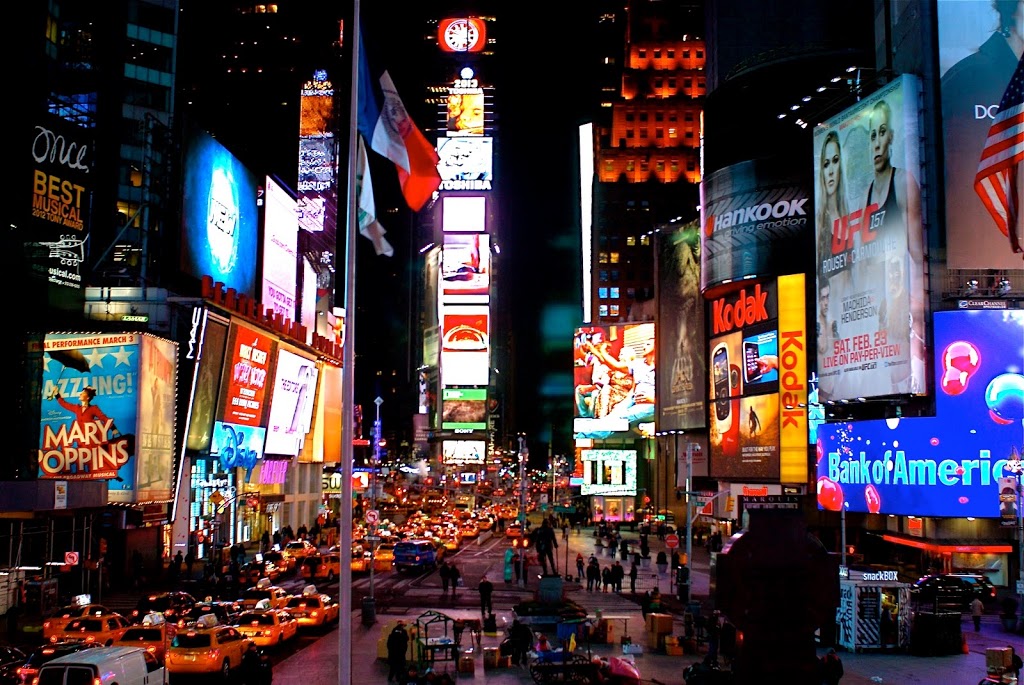
Looking south towards the Times Building, 1904 and 2013: Featured pic courtesy Library of Congress; Bottom pic courtesy nyclovesnyc
“Mayor [George B.] McClellan yesterday signed the resolution adopted by the Board of Aldermen on Tuesday last changing the name of Long Acre Square to that of Times Square. This follows out the recommendation of the Rapid Transit Commission and of the Interborough Rapid Transit Company, which is to operate the subway, and it is intended by the Rapid Transit Commission at its next meeting to call the subway station at Broadway and Forty-Second Street Times station.
The resolution with Mayor McClellan has signed becomes operative at once, and authorizes the President of the Borough of Manhattan to take such steps in the matter as may be proper and necessary. This includes the alteration of street signs. Times Square takes in the triangle on which the new building of The New York Times is situated, and the name applies to the entire section between Forty-Second and Forty-Seventh Streets, Broadway and Seventh Avenue.”
Below: The illustration of Times Square which ran in the April 9th issue:
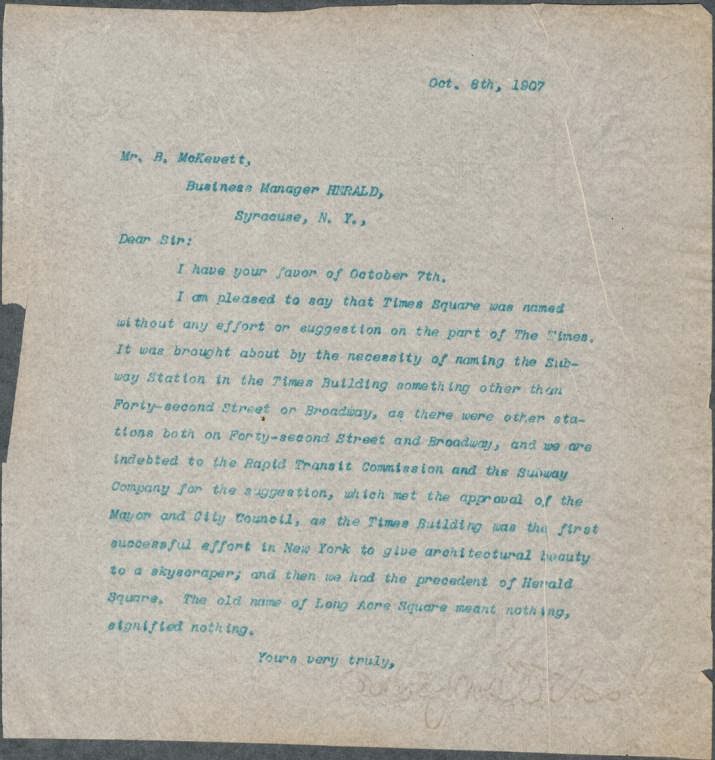
Below: A letter written by publisher Adolph Ochs to the New York Herald (Courtesy New York Public Library)
“I am pleased to say that Times Square was named without any effort or suggestion on the part of the Times. It was brought about by the necessity of naming the Subway Station in the Times building something other than Forty-second Street or Broadway, as there were other stations both on Forty-second Street and Broadway…….”
“The old name of Long Acre Square meant nothing, signified nothing.”
(Well, it didn’t mean nothing. The area was named for a street in London that was also known for the coach and carriage trade.)
This is the story of Greenwich Village as a character — an eccentric character maybe, but one that changed American life — and how the folky, activist spirit it fostered in arts, culture and the protest movement came back in the end to help itself.
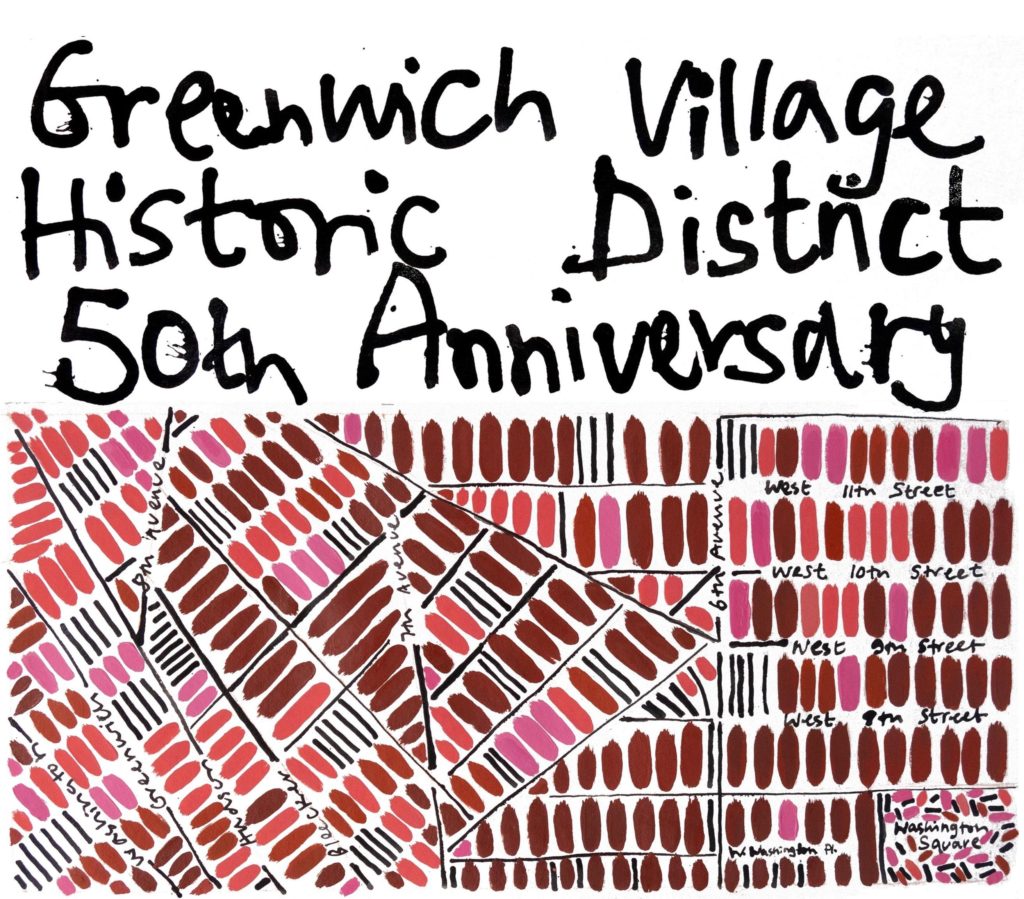
This April we’re marking the 50th anniversary of the Greenwich Village Historic District designation from 1969 — preserving one of the most important and historic neighborhoods in New York — and to mark the occasion we are celebrating the revolutionary scene (and the revolutionary moment) that gave birth to it — the Greenwich Village of the 1960s.
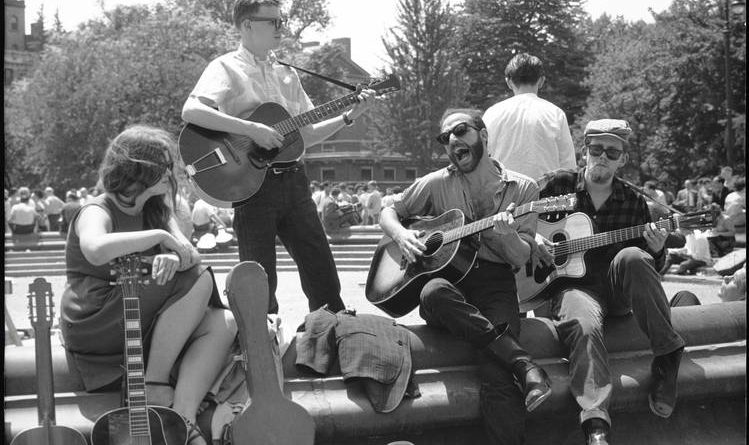
The Village is the stuff of legends: a hotbed of musicians, artists, performers, intellectuals, activists. In the 1950s, people often defined Greenwich Village as a literal village with a small-town atmosphere.
Nobody was saying that about the Village in the 1960s. In just a few short years, the neighborhood’s community of artists and creators had helped to define American culture. The Village was world famous.
This episode will present a little walk through Greenwich Village in the early ’60s, giving you the flavor of the Village during the era — and an ample sampling of its sights and sounds.
There’s gonna be mandolins! And chess players. And avant garde theater. And art markets. And lots of coffeeshops. *snap* *snap*
The Bowery Boys: New York City History podcast is brought to you …. by you!
We are now producing a new Bowery Boys podcast every other week. We’re also looking to improve the show in other ways and expand in other ways as well — through publishing, social media, live events and other forms of media. But we can only do this with your help!
We are now a member of Patreon, a patronage platform where you can support your favorite content creators.
Please visit our page on Patreon and watch a short video of us recording the show and talking about our expansion plans. If you’d like to help out, there are six different pledge levels (New Amsterdam, Five Points, Gilded Age, Jazz Age, Empire State and Greater New York). Check them out and consider being a sponsor.
And join us for the next episode of the Bowery Boys Movie Club, an exclusive podcast provided to our supporters on Patreon.
We greatly appreciate our listeners and readers and thank you for joining us on this journey so far.
Greenwich Village Historic District 50th Anniversary Celebration and Open House Weekend! Washington Square Park Celebration Saturday, April 13 from 12:00-3:00pm in Garibaldi Plaza Historic District Open House Weekend Saturday, April 13 – Sunday, April 14 Full calendar at gvshp.org/GVHD50weekend
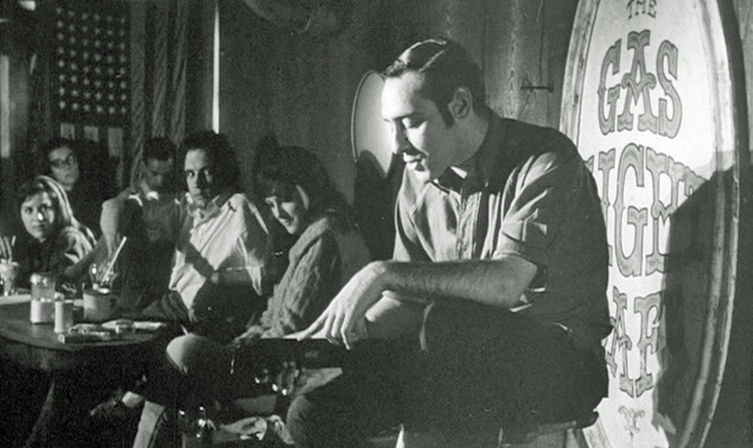
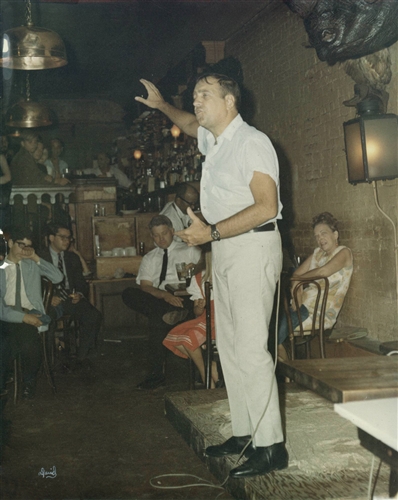
Inside the Gas Light Cafe, in a still from the film Greenwich Village Story directed by Jack O’ConnellJean Shepherd, performing at the Limelight Gallery.
Peter Paul and Mary
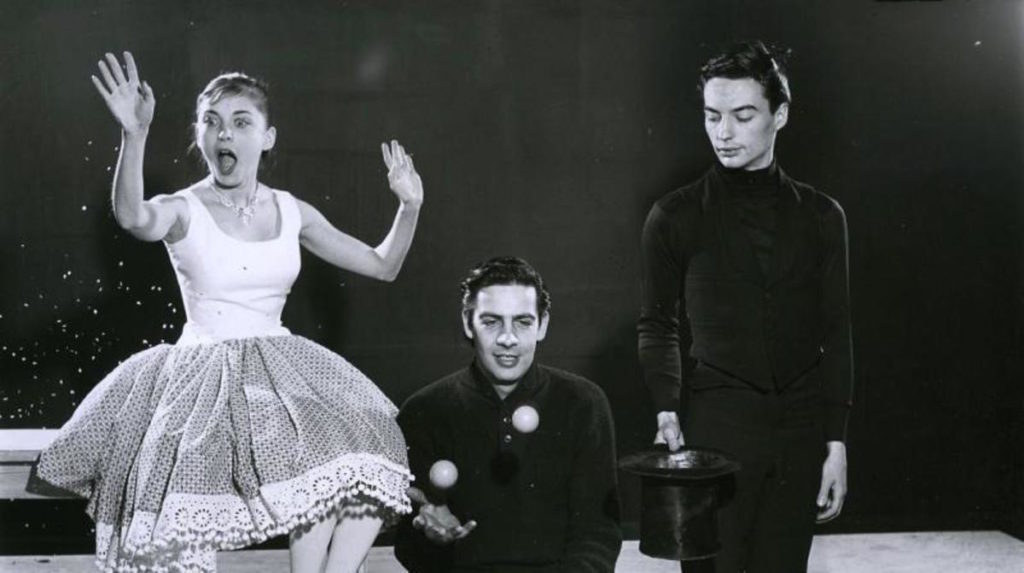
The Fantasticks original cast featured Rita Gardner, Jerry Orbach and Kenneth Nelson
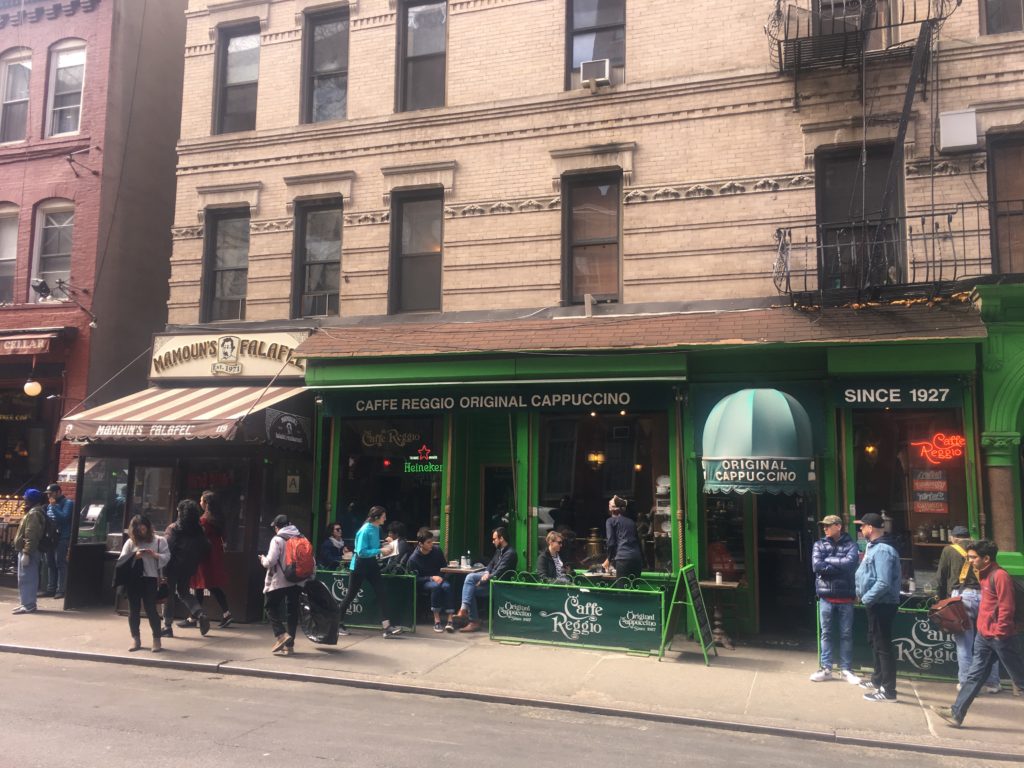
Some images of Greenwich Village today which recall its days from the 1960s — and even earlier (photos by Greg Young):
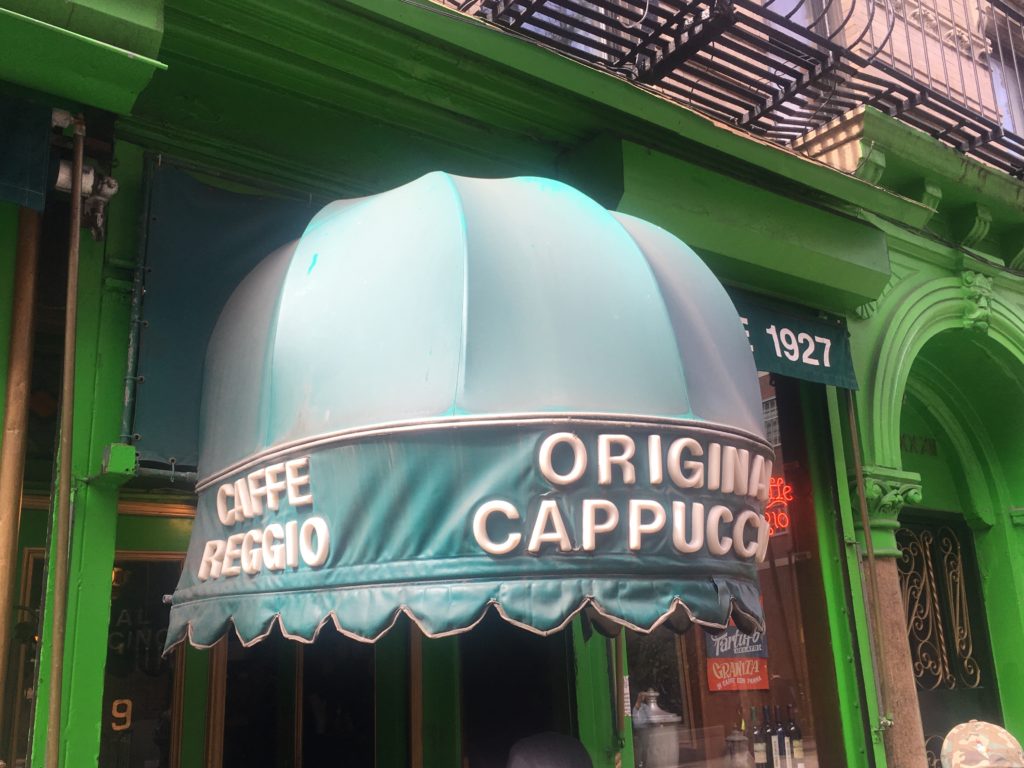
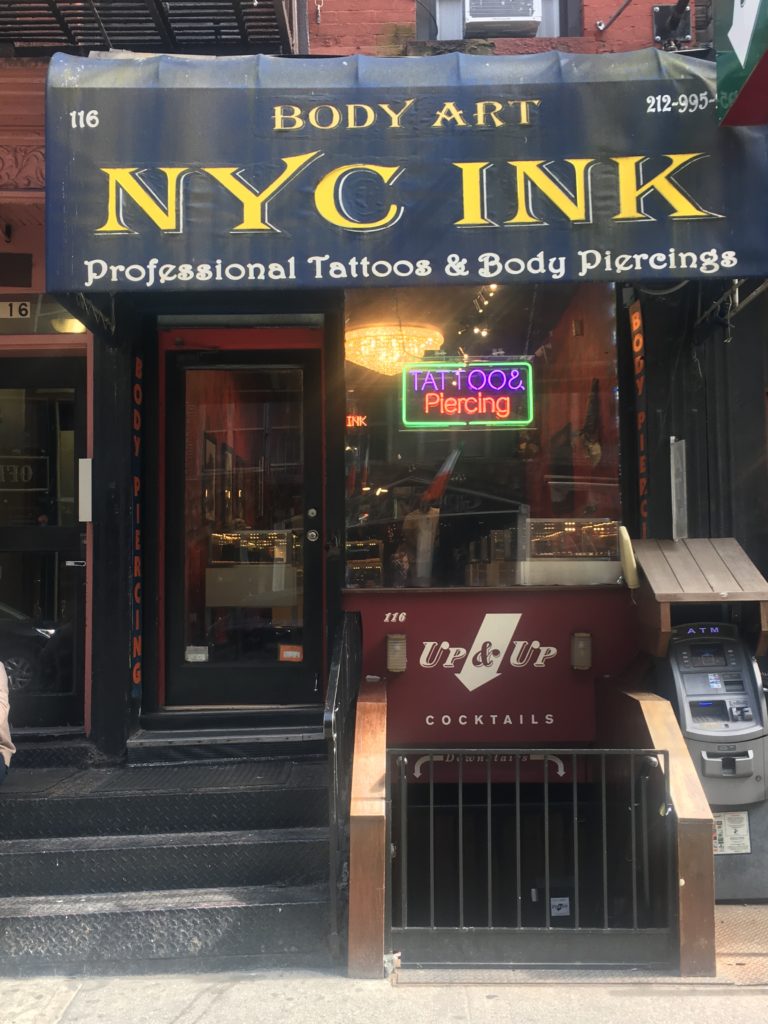
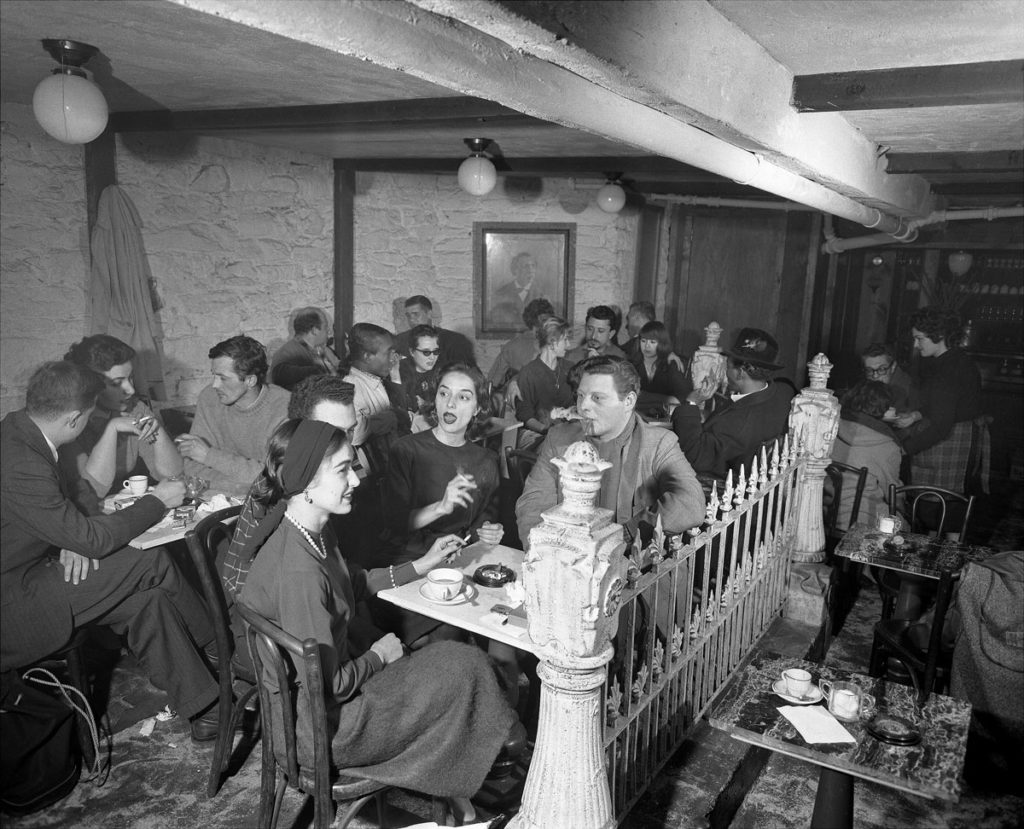
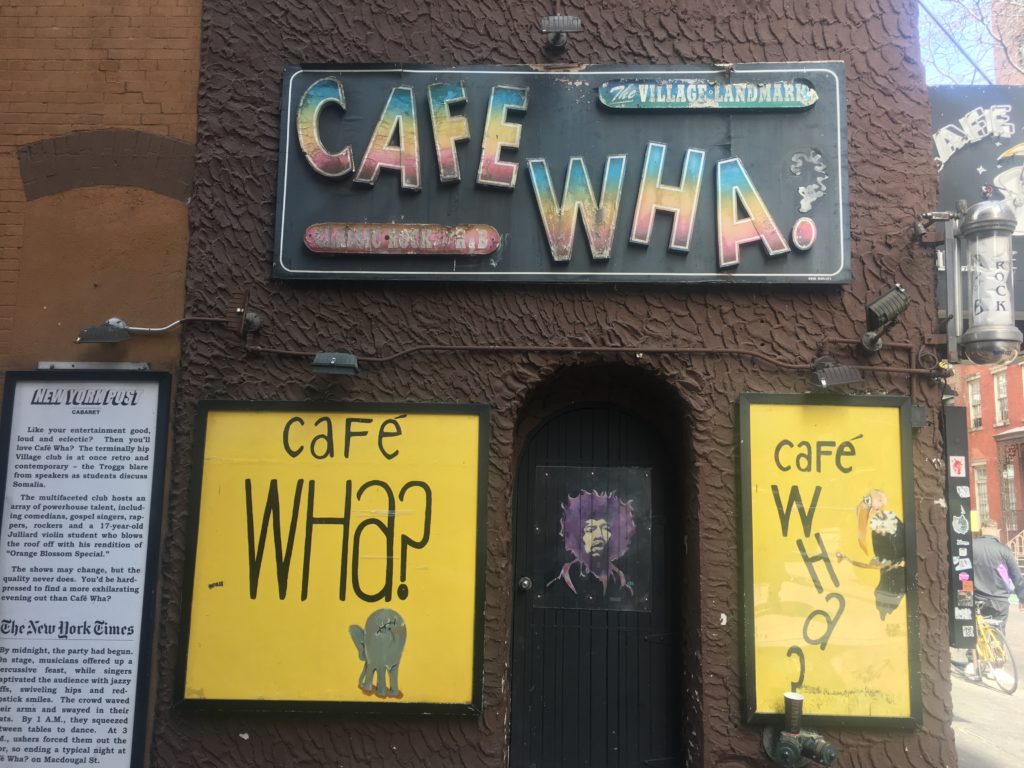
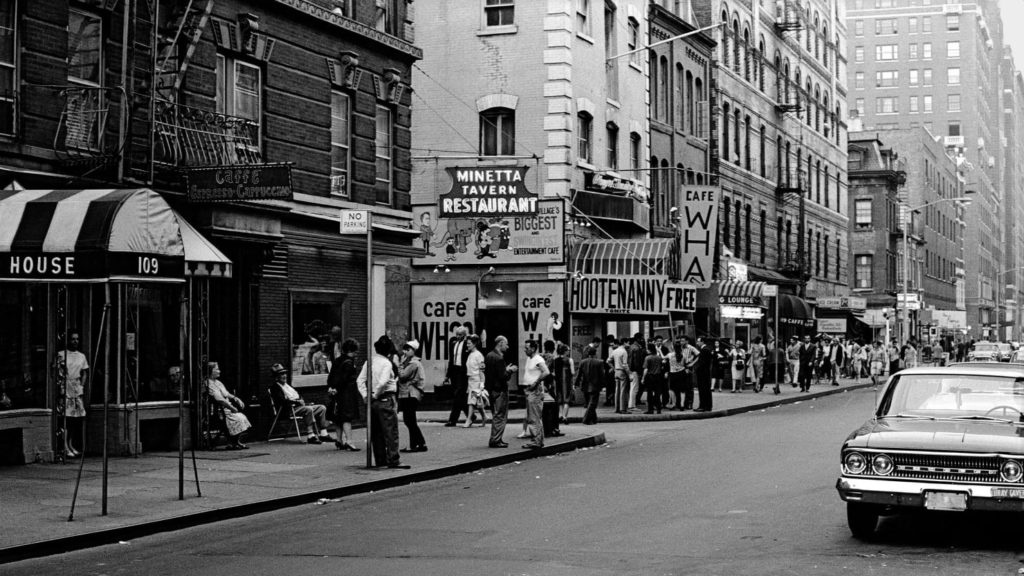
Robert Otter/New York TimesCaffe Reggio has been an anchor of MacDougal Street since 1927, an Italian owned business that transitioned into a center for the beatnik scene.The location of the Gaslight CafeUNITED STATES – FEBRUARY 19: Patrons at the gaslight, 116 McDougal St. Greenwich Village (Photo by Charles Payne/NY Daily News Archive via Getty Images)Cafe Wha? todayCafe Wha?, Minetta Tavern and the rest of MacDougal Street (aka ‘the fun zone’)
FURTHER READING Some material we recommend you check out for more information on Greenwich Village:
360 Sound: The Columbia Records Story by Sean Wilentz Around Washington Square: An Illustrated History of Greenwich Village by Luther S. Harris Greenwich Village Stories: A Collection of Memories by Judith Stonehill, Andrew Berman, et al The Village: 400 Years of Beats and Bohemians, Radicals and Rogues, a History of Greenwich Village by John Strausbuah The Village Voiceonline archives and of course…. The original Greenwich Village Historic Designation Report (1969)
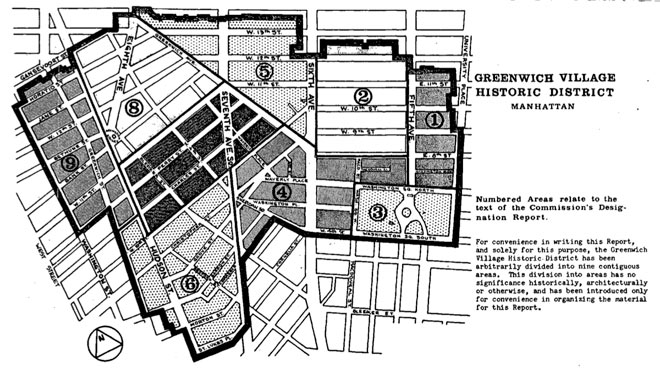
The original map of the Greenwich Village Historic District
Join the Bowery Boys Movie Club! Support us on Patreon at any level and get these Patreon-exclusive, full-length and ad-free podcast. Each month we talk about one classic (or cult-classic) film that says something interesting about New York City.
In the new Bowery Boys Movie Club, Tom and Greg visit the year 1978 and a cult classic thriller starring Faye Dunaway, Tommy Lee Jones and Raul Julia.
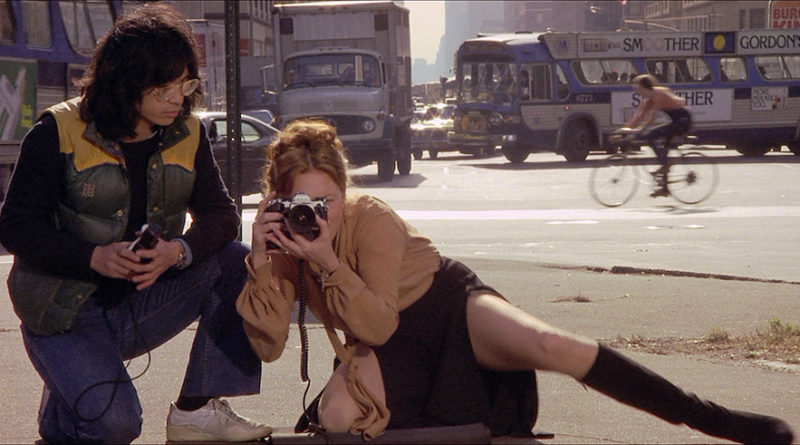
Eyes of Laura Mars presents the chic downtown art world of 1970s SoHo within a supernatural thriller involving a famed fashion photographer (played by Dunaway) and her psychic connection to a menacing killer. The thriller also takes us on a ride to Columbus Circle, the Christopher Street Pier and Hell’s Kitchen.
Listen in as Greg and Tom set up the film’s backstory — Barbra Streisand was almost the star — then give a suspenseful synopsis through the film’s fun but implausible story line. And there’s disco music too!
Should you watch the movie before you listen to this episode? This podcast can be enjoyed both by those who have seen the film and those who’ve never even heard of it.
We think our take on Eyes on Laura Mars might inspire you to look for the film’s many fascinating (but easy to overlook) historical details, so if you don’t mind being spoiled on the plot, give it a listen first, then watch the movie! Otherwise come back to the show after you’ve watched it.
The film is available on Amazon Prime, among other services.
To get the episode, simply head to Patreon and sign up to support the Bowery Boys podcast at any level.
The monumental events of America’s founding would be immortalized by the fair in some rather unusual ways 150 years later. Both April 30th events were occasions of great patriotic ceremony (and both even slightly kitschy) in their own ways.
Courtesy New York Public Library
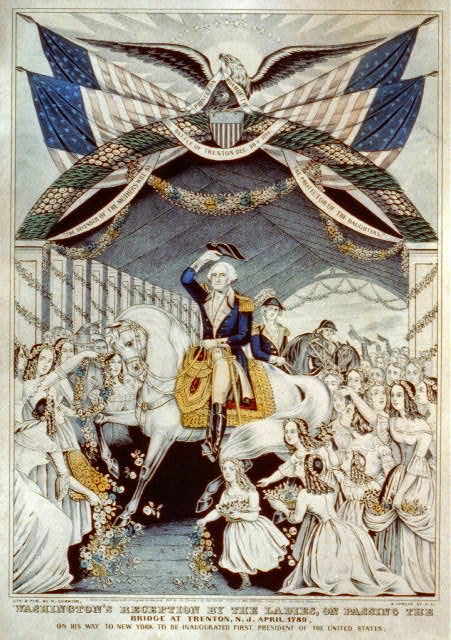
April 1789 It took George seven entire days to get to New York from his home in Mount Vernon, as his procession was met every step of the way with throngs of patriotic crowds and flamboyant celebratory displays.
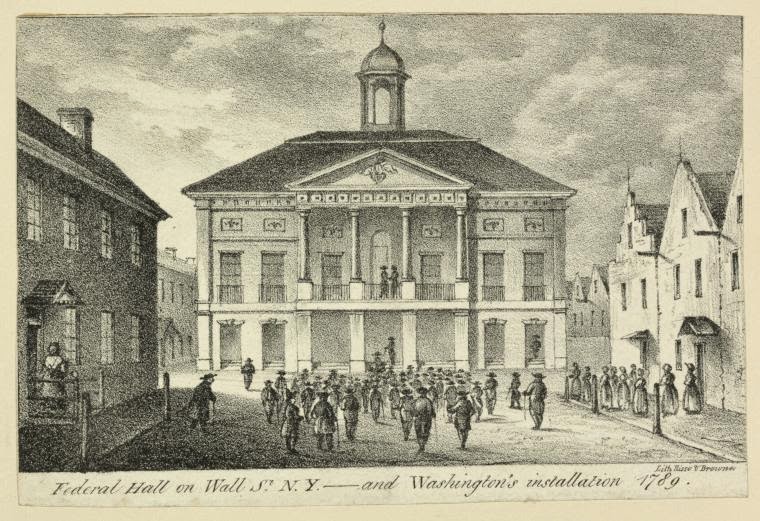
Washington’s vice president John Adams had already arrived in New York, on April 21st. The building which greeted him, the former City Hall building on Wall Street, had been the center of city’s government since 1699, when the British used materials from the city’s demolished north defense wall to construct it.
Courtesy New York Public Library
The heavily remodeled building which now stood in its place, later to be calledFederal Hall, was designed by successful city contractor and former Continental Army engineer Pierre Charles L’Enfant. According to author David McCullough, “it was the first building in America designed to exalt the national spirit, in what would come to be known as the Federal style.” (Sadly, this building was ripped down in 1812; the ‘Federal Hall’ which stands in the same spot today was built as a customs house in 1842.)
L’Enfant would later work on the creation of Washington DC out of Maryland swampland. He would ultimately be fired from that project — by George Washington.
George finally arrived in New York two days after Adams, April 23, via a barge from Elizabeth, New Jersey, and was met at the Wall Street pier by the current mayor of New YorkJames Duaneand the state’s governor George Clinton.
From there, he was taken to his new home on Cherry Street (long demolished, around near the Brooklyn Bridge anchorage today) and spent the day greeting dozens of well-wishers. That night, Governor Clinton hosted an elaborate dinner in his honor; the pomp and extravagance by this time were probably getting tiresome to the stately Virginian farmer.
Meanwhile Adams spent the week at Federal Hall in Senate chambers, hashing out such things we take for granted — such as how to even address the new president — until at last they were ready for the ceremony to begin, on April 30.
According to Ron Chernow: “Washington rose early, sprinkled powder in his hair, and prepared for his great day.” Like some detail from a fairy tale, Washington left his Cherry Street home at noon in a yellow carriage driven by white horses, legions of soldiers marching proudly behind him.
The streets of Manhattan were clogged with people, over ten thousand cramming Broad and Wall streets, as far as the eye could see both ways. Sitting on the balcony of his own home on Wall Street was Washington’s closest confidante Alexander Hamilton, certainly reveling in the moment.
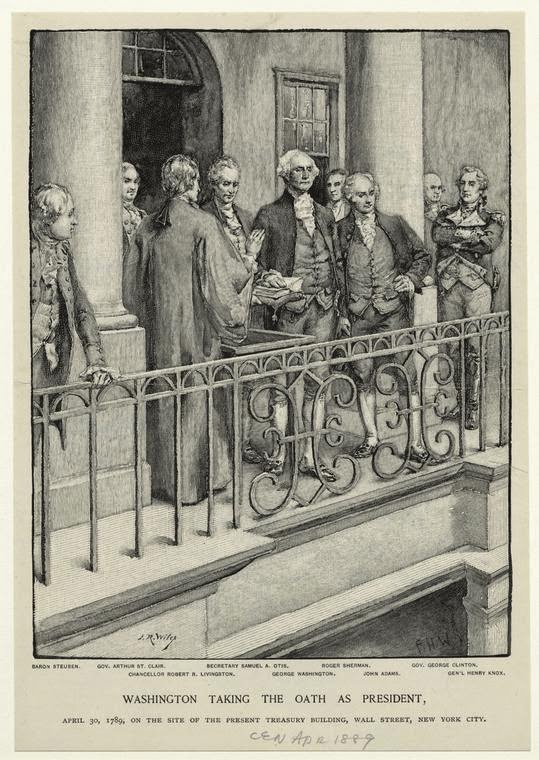
After greeting the Congress, Adams led Washington to the second floor balcony along with Robert Livingston, the Chancellor of New York (the highest judicial office in the state), who held out a bible owned by the St. John’s Lodge Freemasons and delivered the oath of office, probably not loud enough for anybody in the street to actually hear.
Washington, even less audibly than Livingston, swore to “faithfully execute the office of President of the United States, and will to the best of my ability, preserve, protect and defend the Constitution of the United States.” He then possibly threw in a ‘so help me God’ for good measure (although there are many doubts that this occurred).
Courtesy New York Public Library
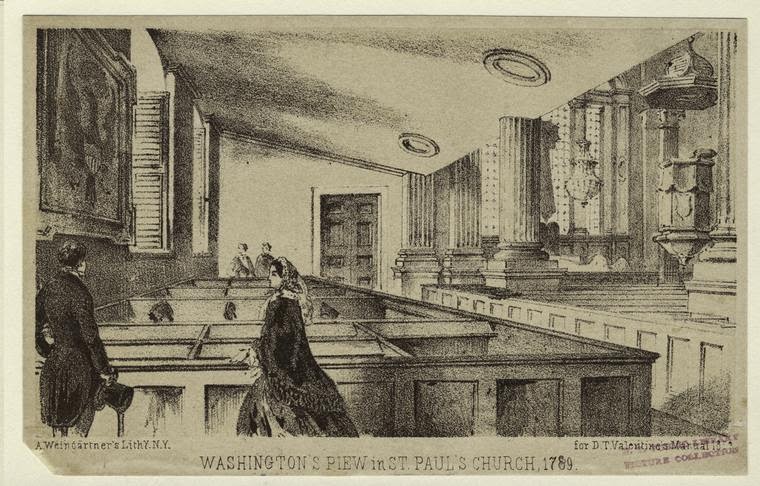
New Yorkers went crazy then, firing cannons, screaming and waving flags, playing music and dancing in the streets. After returning inside to address the new Congress — by this time with tears in his eyes — Washington and his entourage went up Broadway to receive on invocation at St. Paul’s Church, the scrappy survivor of the great fire the destroyed much of the city in 1776. Washington would be a regular here for his entire stay in New York; the pew where he planted himself for two years is still on display there (illustrated above).
Martha Washington would not arrive in town for another month, but that didn’t stop the parties. The official inauguration ball took place a week later, on May 7th, at the Assembly Rooms at 115 Broadway.
Although a bit stiff and silent, George was still popular with the ladies and danced “two cotillions and a minuet,” often seen with Alexander Hamilton’s young bride Eliza. When Martha arrived on May 17, landing at Peck Slip, she was greeted with similarly grand fanfare, and yet another ball was held in her honor.
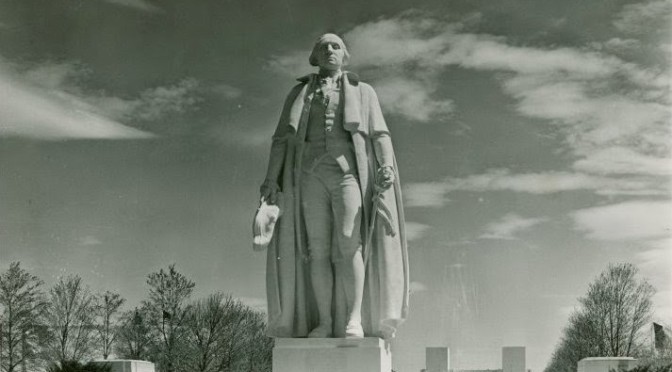
James Earle Fraser’s colossal Washington statue out in Queens. (NYPL)
April 1939 One hundred and fifty years later, the 1939 New York World’s Fair opened in Flushing Meadows-Corona Park, the second largest American fair up to that time (only St. Louis’ 1904 event was larger).
This celebration of human advancement — as demonstrated through miles of utopian kitsch and strikingly bizarre architecture — was a reason for Robert Moses to turn the unsightly Corona Ash Dumps into a Queens super-park. The fair was advertisement as entertainment, with hundreds of modern gadgets displayed as novelties and staples of the future.
Courtesy the Museum of the City of New York
But the celebration was planned with the past in mind as well. It opened on April 30, 1939, coinciding with another great day in New York City history — Washington’s inauguration. That’s how important the city thought the opening of the fair was. (Life Magazine was a little more cynical; in 1939, they refer to Washington as “the excuse” for the fair. The purpose, of course, was profits.)
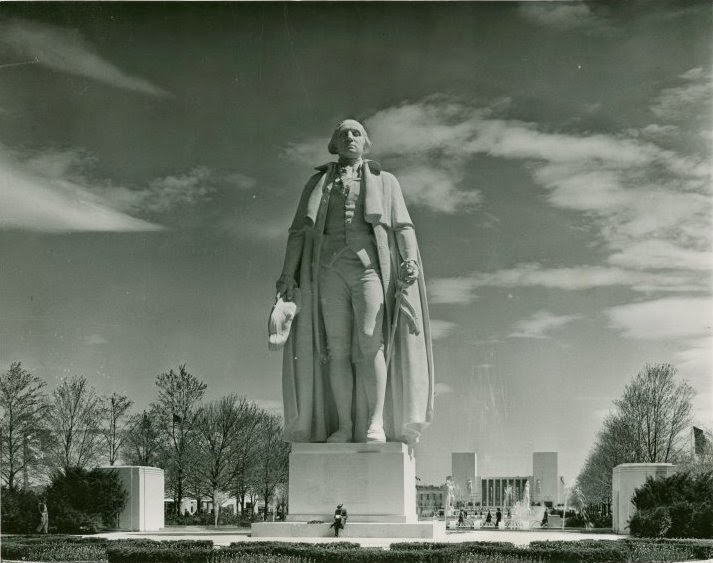
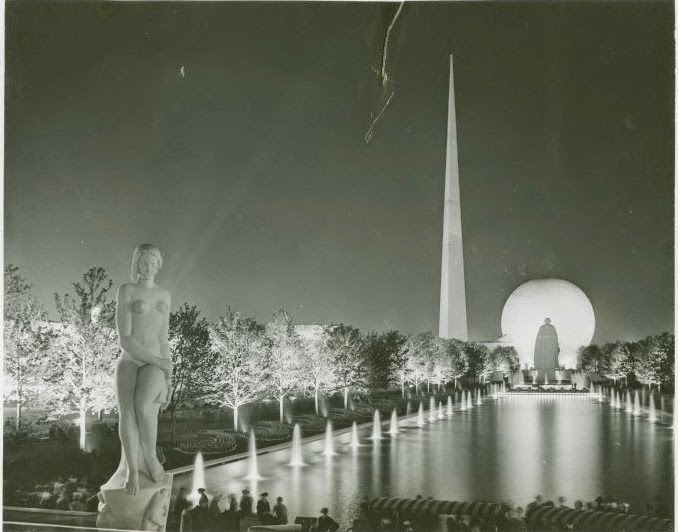
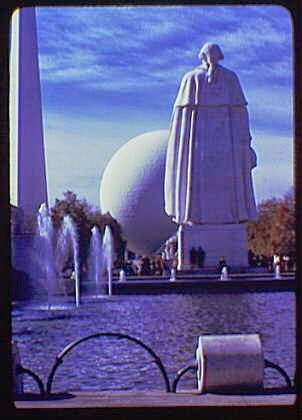
A 61-foot-tall statue of Washington by James Earle Fraser stood mightily over the fair’s Constitution Mall, peering perhaps quizzically at Paul Manship’s massive sundial sculpture. A cluster of buildings called the Court of States recalled the Colonial architecture of Washington’s day. Even Federal Hall was recreated.
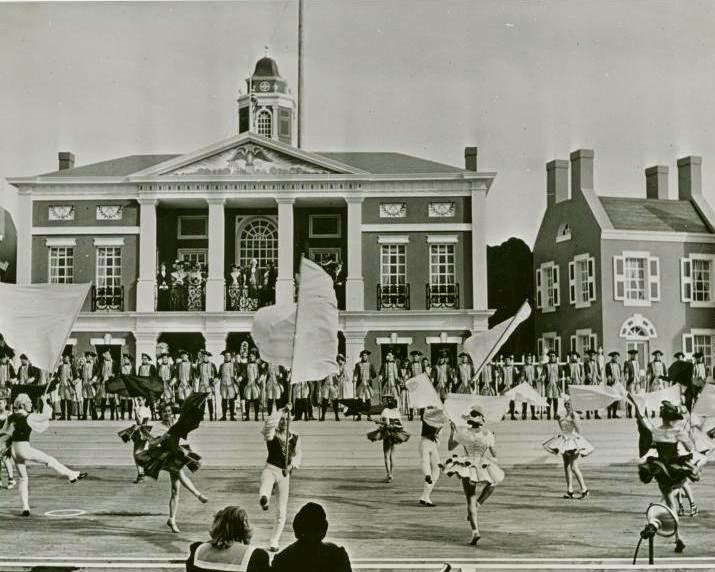
Below: The World’s Fair presented a recreation of Washington’s inauguration, except with lots of flag dancing. (NYPL)
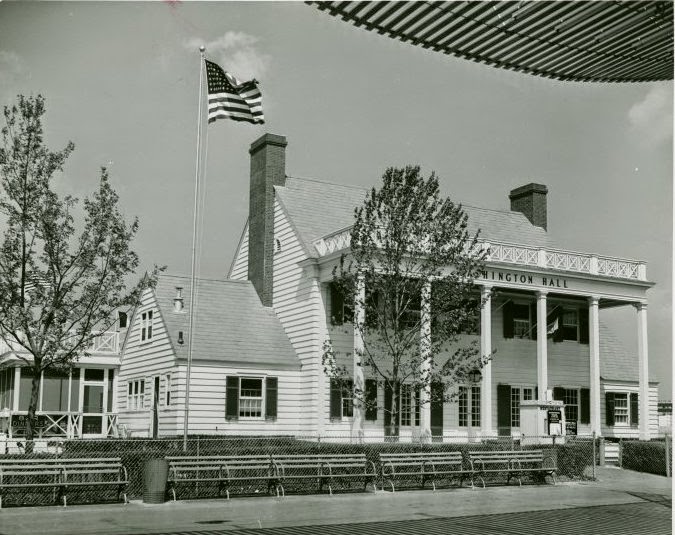
A replica of Mount Vernon (sort of) called Washington Hall was the pet project of a New Yorker with presidential ties.
Museum of the City of New York
According to the New Yorker, “Mr. Messmore Kendall, is responsible for the Hall. Mr. Kendall, president of Sons of the American Revolution and owner of the Capitol Theatre, [developed] plans for erecting, entirely at his own expense, a $28,000 building to house a collection of Washington relics. Before the Fair closes, he expects the whole thing will have cost him more than $50,000. He has given more than money to the project; he has given the family cook, so that whenever he wants a home-cooked meal, he has to go all the hell out to Flushing.”
The Hall received a host of reenactors who had made their way up from Mount Vernon in emulation of Washington’s own footsteps. On May 6th, a child named Robert E, Lee Williamson opened Washington Hall in a grand ceremony, bringing “three consecutive weeks of neo-Federal quaintness to a close.” [source]
The president also sits (sometimes awkwardly) upon a variety of World’s Fair merchandise. Light shows and fireworks unheard of in Washington’s time were dedicated in his honor throughout the fair. He even starred in a popular musical pageant at the fair called American Jubilee, with books and lyrics by Oscar Hammerstein.
It was another great president who kicked off the fair 75 years ago. With 200,000 people in attendance, Franklin Delano Roosevelt gave an opening speech extolling the virtues of American ingenuity as he became the first president to be broadcast to television audiences. Few had televisions in their homes at the time. But NBC founder David Sarnoff helpfully scattered a few dozen of them throughout the city in a clever publicity stunt.
Roosevelt starts off his speech referencing Washington. “[T]here have been preserved for us many generations later, accounts of his taking of the oath of office on April thirtieth on the balcony of the old Federal Hall. ….. And so we, in New York, have a very personal connection with that thirtieth of April, one hundred and fifty years ago.” [Read the whole speech here.]
Defined by the odd Trylon and Perisphere buildings, the fair seems like something truly dreamlike. The land where the fair once stood now contains the ruins of a New York’s other World’s Fair, the event from 1964-65.
TODAY
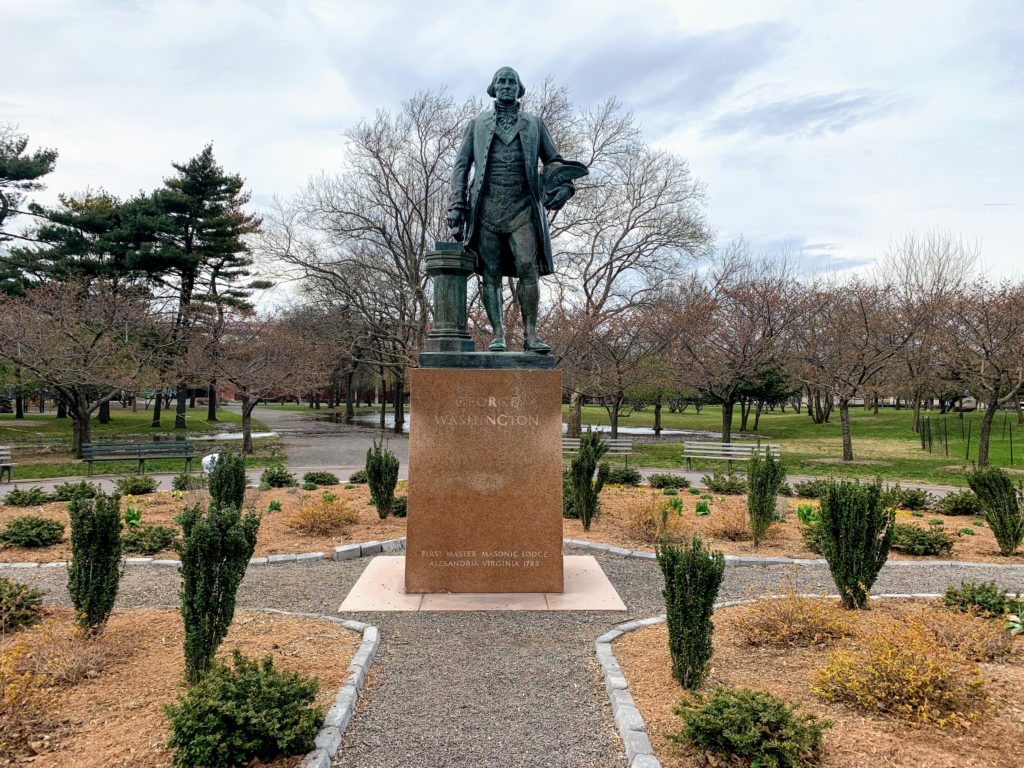
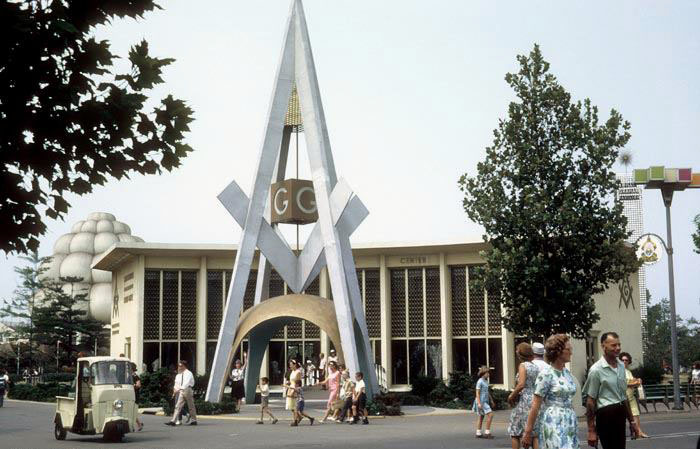
You can still find a tribute to George Washington in Flushing Meadow Corona Park today. George Washington as Master Mason by Donald De Lue was installed here in 1967, a replica of a much larger Washington statute, made of plaster, that stood at the New York World’s Fair of 1964-65 within the Masonic Pavilion. (That’s right; the Freemasons had a World’s Fair pavilion).
That 11-foot plaster statue of Washington stood next to the actual Masonic Bible on which Washington took his oath of office. Today the bible is on display — at Federal Hall.
For this article, I’ve re-purposed a couple pieces of writing I did on these events a few years ago. The original pieces can be found here and here.
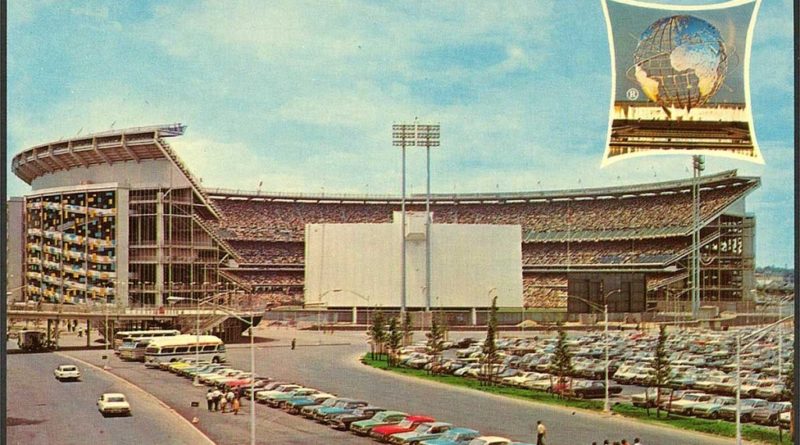
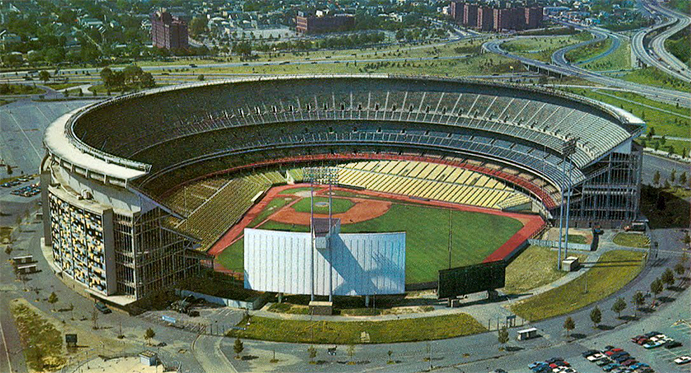
With mourning fans looking on, the final section of seats were torn out on the morning of February 18, 2009. Awaiting fans a short distance away was the sparkling new Citi Field which would open for business with a thrilling game between the San Diego Padres and the field’s home team the New York Mets.
Shea was not a perfect stadium. Neither was Ebbets Field, the former home of the Brooklyn Dodgers that has nonetheless entered into the realm of sports mythology. But nostalgia holds a special power in sports history, and the further we get from the classic moments which took place at Shea, the more remarkable it becomes in memory.
Quite frankly, Queens has not been quite the same.
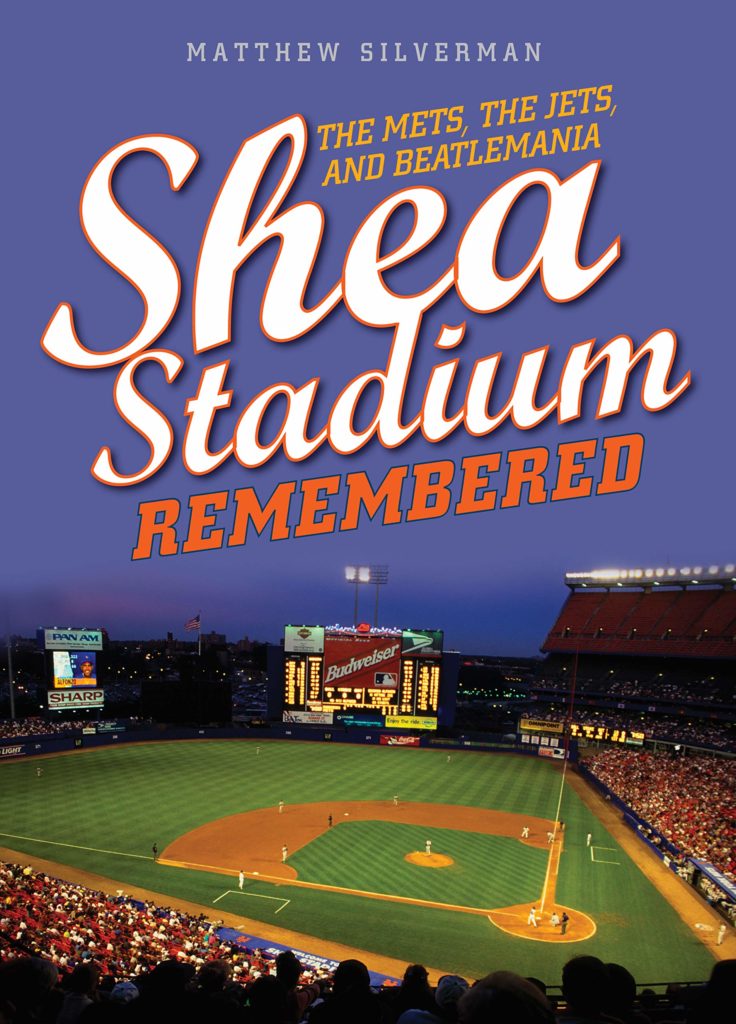
Shea Stadium Remembered: the Mets, the Jets and Beatlemania by Matthew Silverman Lyons Press
Journalist Matthew Silverman is such an ardentMets aficionado — if you’ve read a book about the beloved Queens baseball team, he probably wrote it — that his official website is MetSilverman.com. And so of course Shea Stadium Remembered: the Mets, the Jets and Beatlemania, his tribute to the Met’s most famous home, has a breezy pitch-perfect charm to it.
Arranged in tiny chapters, little blips of history, Shea Stadium Remembered revels unashamedly in sweet nostalgia, recalling a place that matched the charisma of its underdog baseball team and a home for an accomplished football team back when it was actually situated within the city.
The birth of the Mets and their home for over 40 years begins in a moment of great turmoil in New York City sports history. In the 1950s, both the New York Giants and the Brooklyn Dodgers left New York City, the latter after a vicious public battle between Dodgers owner Walter O’Malley and New York power broker Robert Moses.
Moses wanted a team situated in Queens, in Flushing Meadows-Corona Park, an eventual companion to Moses’ pet project — the World’s Fair of 1964. With Ebbets growing inadequate for modern baseball crowds, O’Malley wanted a new stadium at Atlantic and Flatbush Avenues, keeping them in Brooklyn. (That’s near the spot of today’s Barclays Center.)
But nobody overpowered Robert Moses in the 1950s. The Dodgers split for Los Angeles.
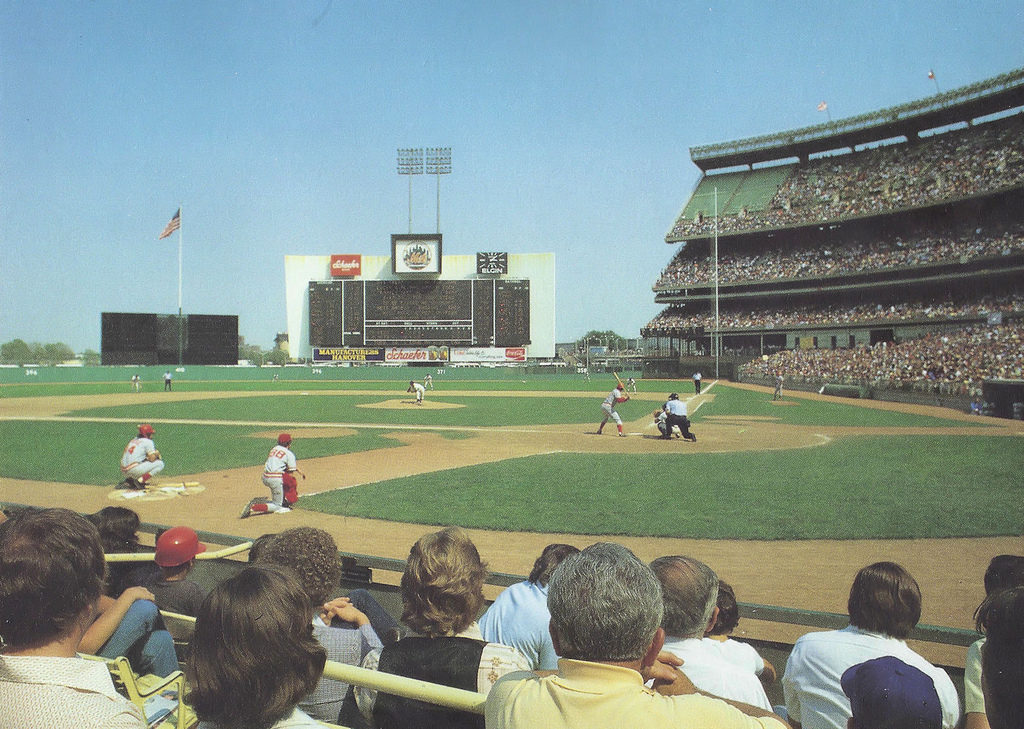
Shea Stadium, late 1970s — Sports Photo File/Mitchell Reibel
Fortunately, lawyer William Shea convinced the National League to expand their roster, leading to the creation of the New York Metropolitans, the name a nod to a 19th century baseball club and eventually shortened. After a short stint in the decrepit Polo Grounds, they moved to their new home — named in honor of a man who never played for them but was nonetheless instrumental to the history of New York City sports.
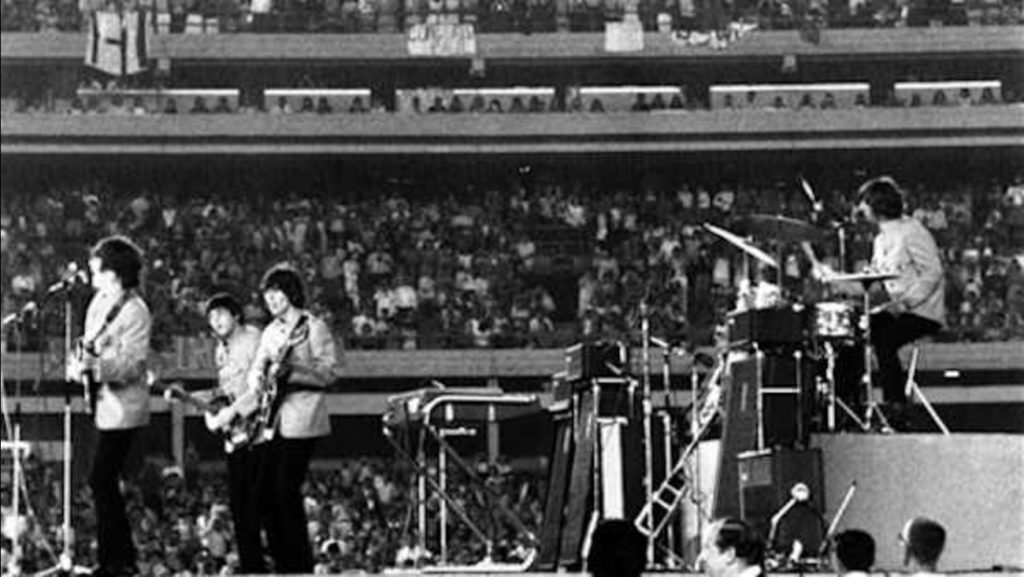
In Shea Stadium Remembered, Silverman gives us a compilation of the stadium’s greatest moments, weaving the Met’s history in with the other notable events at the stadium — from the Beatles to Pope John Paul II.
Not to say that the Jets aren’t prominently featured here as well — they played at Shea for almost twenty years — but the Mets were truly at home here, through thick and thin (often very thin). The Mets gave Shea some of its personality and Shea gave the Mets its hometown pride.
The Beatles at Shea Stadium, August 1965 (AP)
For more information, check out these catalog episodes of the Bowery Boys podcast:
Hugh Ryan’s When Brooklyn Was Queer embarks on a modern quest to find the roots of the LGBTQ community in the pages of history.
A reader might hope to pick up Ryan’s book and find a reflection of their own world in the back alleys and parlors of Old New York — or rather, Old Brooklyn, the former city turned borough with its own genteel and sometimes stubborn personality. After all, many components of modern queer life were available and even thriving a century ago — homoeroticism, gender-swapping apparel, drag queens, cruising.
For a more in-depth look at the general history of downtown Brooklyn, listen to our podcast episode. And for a rundown of drag in New York, listen to this podcast episode: Absolutely Flawless.
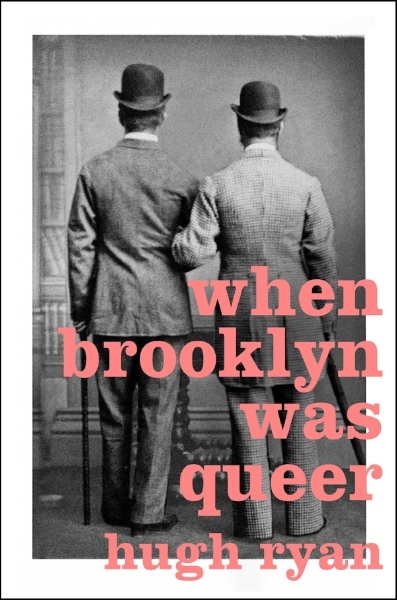
When Brooklyn Was Queer: A History Hugh Ryan St. Martin’s Press
But the wondrous discovery of Hugh Ryan’s exceptionally well-researched book is that there really is no through line. The emotional or sexual desires might be similar, but the visibility of those we might label gay, lesbian and transgender today was either in performative contexts (vaudeville or sideshow entertainers) or ephemeral in nature (encounters in late-night saloons). The most celebrated individuals — the writers, artists and dancers — were often cloistered away in townhouse parlors.
Most of the connective tissue that might exist between these groups is undocumented. Like the ghostly voids of Pompeii, we see only the shadows of the lives they left behind.
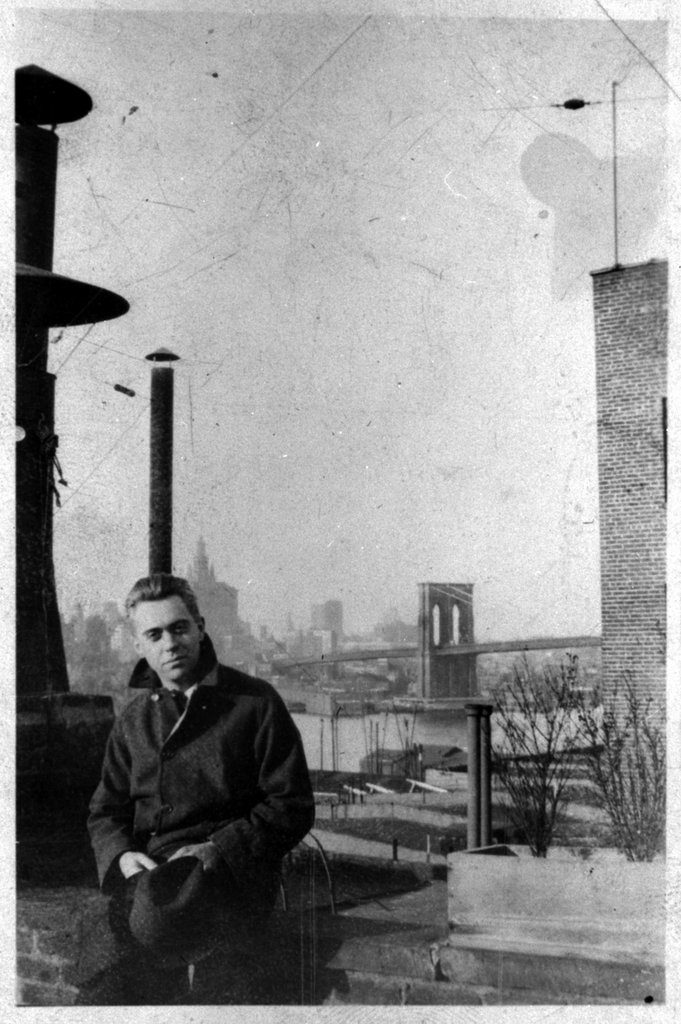
Hart Crane in 1928, at 110 Columbia Heights — Courtesy Rare Book and Manuscript Library, Columbia University
Fortunately, Ryan provides those links in a rich and nuanced narrative, uniting the biographies of a group of extraordinary and often forgotten people.
But why Brooklyn? After all, Manhattan had the Greenwich Village coffeehouses, the Broadway shows, the Harlem drag balls, the most notorious speakeasies — all magnets for different aspects of historical LGBTQ life.
Ryan allows the transformation of Brooklyn from city to borough to parallel the shifts in modern thinking about gay and lesbian encounters.
Naturally, the story begins with Walt Whitman — born 200 years ago this year — whose story provides us with some of the earliest recollections of gay life in Brooklyn. For many gay writers, the legacy of Whitman was a literal beacon, drawing them to consider Brooklyn as a place to live and create. [For a deeper look into his life, listen to our podcast episode on Walt Whitman.]
Those readers hoping for anecdotes about a fabulous gay underworld in one of Brooklyn’s current centers of LGBTQ life — Williamsburg, Bushwick, Park Slope — will be disappointed. The bulk of Ryan’s stories are centered in the oldest areas of Brooklyn — Coney Island, Brooklyn Heights and the Brooklyn Navy Yard.
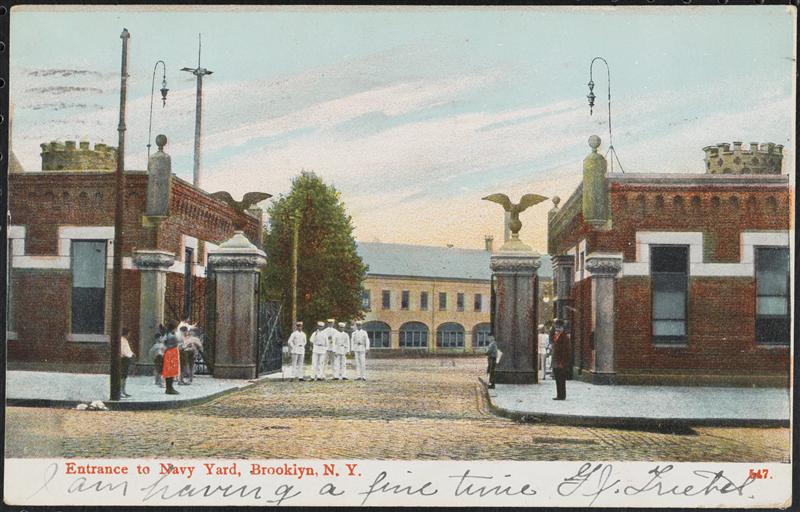
Brooklyn Navy Yard 1907 — Museum of the City of New York/ Ignatz Stern Communications
The Navy Yard! A magnet for tawdry saloons and horny sailors, the scene that centered around Sands Street resembles nothing we would recognize today because gay identity had yet to be fully established. “Properly gendered behavior … insulated men from being considered queer,” writes Ryan, “even if they were known to have sexual relations with men (or boys).”
Even by World War II, the streets surrounding the Navy Yard were well known for brothels catering to homosexual desires, most notably the wonderfully nicknamed Swastika Swishery.
One scintillating cabaret Tony’s Square Bar “was just ‘a couple of hundred yards’ from the Sands Street entrance to the Navy Yard and had a sign on the door that read NO MINORS UNDER 20 ALLOWED (in response to which one journalist wryly noted, ‘Minors age rapidly on Sands Street’).”
Meanwhile, increased employment opportunities for women during the war brought lesbians like Rusty Brown to the Navy Yard, a real-life Rosie the Riveterwho later became a professional drag king.
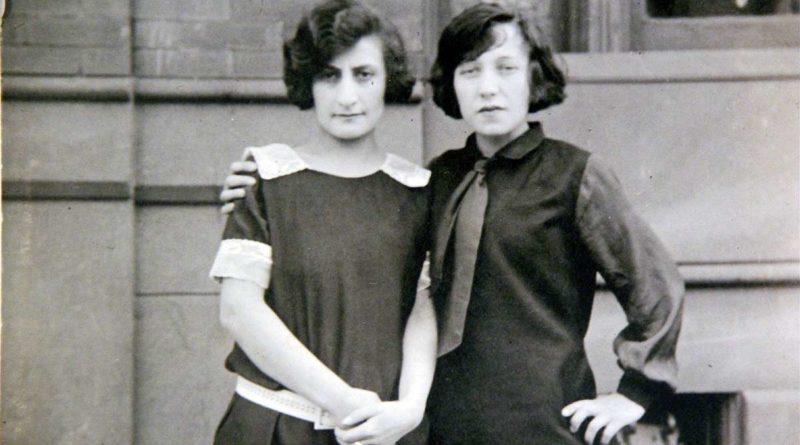
Before the 1940s, Coney Island offered the best opportunities for same-sex encounters and, in particular, the amusement district provides Ryan with the most appealing anecdotes of working-class Brooklynites and New Yorkers — from Loop-the-Loop, a trans sex worker named for a popular Coney Island ride, to Mabel Hampton (pictured above), an African-American dancer who had her first lesbian experiences here.
Another world emerges in the austere townhouses of Brooklyn Heights, the destination for artists and writers escaping Greenwich Village in the 1920s. The recollections of Hart Crane, Carson McCullers and W. H. Auden are some of the fullest descriptions we have of gay Brooklyn, albeit from the eyes of individuals who would become literary legends.
Ryan writes:
“In 1929, budding author Parker Tyler (who would write a scandalous gay novel entitled The Young and Evil just a few years later) encountered a campy gay waiter in a restaurant of Brooklyn Heights.
Tyler was so tickled by their interaction, and what he learned about the neighborhood, that he immediately wrote to friends to say, “Brooklyn is wide open and N.Y. should be notified of its existence.”
Throughout the month, we will shed a little light on a few of these choices. And we’d love to hear yours! Leave a choice in the comments section and we will compile them in a couple weeks in a dedicated article. At the end of the month, we’ll send all the choices — both yours and ours — to the nomination committee.
Artists and entertainers make natural candidates for statues and public commemorations as many become immortal with the passage of time, their influence imprinted on future generations. There are several such honors for artists in New York — all men (but one).
Among the city’s statuary entertainers are Edwin Booth, Jackie Gleason, Duke Ellington, George M Cohan, Ludwig Van Beethoven, William Shakespeare and countless other writers and composers (many in Central Park). But in Bryant Park, one can find a single bust dedicated to a female writer — Gertrude Stein.
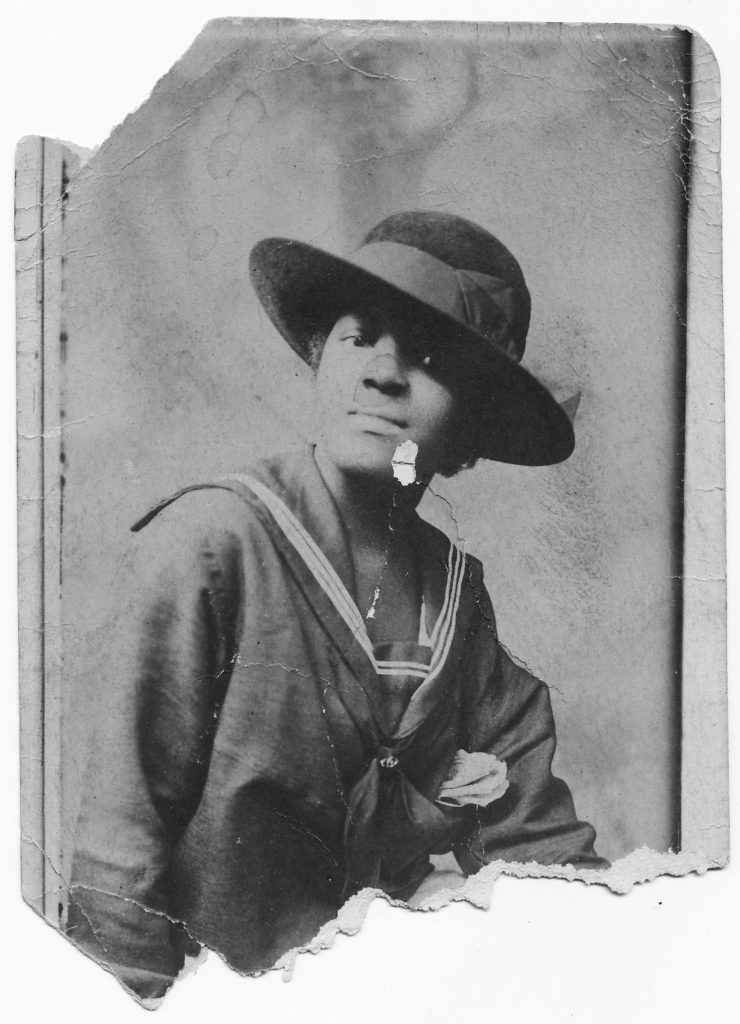
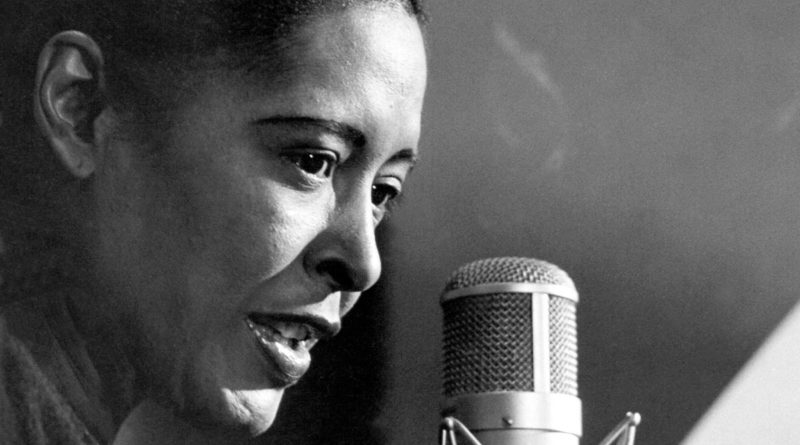
New York City needs another! And we nominate one of the greatest vocalists in American popular music – Billie Holiday.
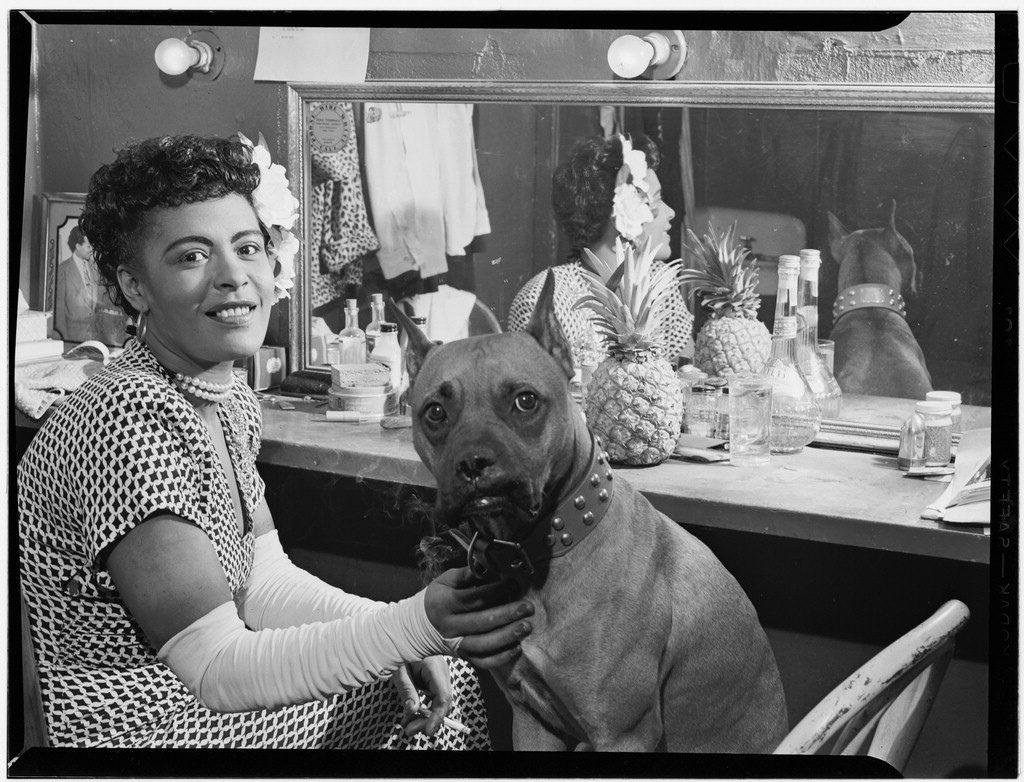
New York City, June 1946, with her dog Mister, courtesy Library of Congress
Her impact upon American music is profound, changing the way vocalists interpret songs, bringing out extraordinary subtlety and richness beyond the lyrics and instrumentation. And she did it within a set of important Manhattan music venues, from Midtown to Harlem. Hers is the story of New York’s own jazz legacy.
Her story is full of drama and paradox, moments of sadness, others of pure ecstasy, in the midst of New York’s history in the making. At its core, her biography is a reflection of the black experience in the 1930s and 40s and how separations of race effected the music scene, how those impressions still reverberate today.
She was born Eleanora Fagan in Philadelphia on April 7, 1915, and first arrived in New York as a teenager. Her first home was in Harlem, a neighborhood in the midst of a renaissance of black art, music and literature.
She worked her way through many of Harlem’s great music venues of this period (Small’s Paradise, Covans), singing at 2-3 in the morning, working for tips, hoofing from table to table.
She experimented with her voice, understanding what captivated an audience, learning to interact with gangsters, randy young men, even white movie stars. She shook off her ragged appearance, recognized that a little glamour, a fancy dress, would also help sell her songs. It was at this time she took her stage name Billie, from a white silent film actress named Billie Dove, and Holiday from her father.
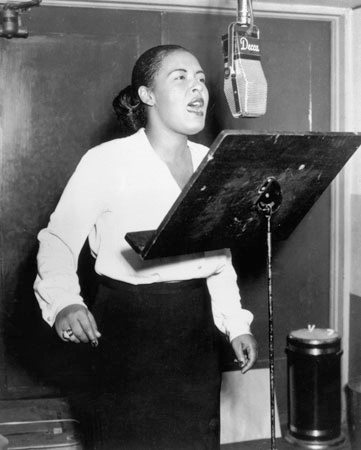
What she learned to do was style music, using her vocals in much the same way as a jazz instrumentalist. She stepped back from the precise hit-every-note style of predecessors for discovered ways of dramatizing music with what some called a slurred or sauntering tone, perhaps one beat behind where a traditional songstress would have come in. By the mid 1930s, she had already invented a singular musical style, captured in recordings for Columbia Records.
In 1937 she began touring with famous big-band orchestras – first with Count Basie, then Artie Shaw. On the road, she came up immediately against the racial and gender prejudices of the day.
Sadly she didn’t even need to leave New York to experience this. In the late 1930s, most hotels in New York City had strict segregation policies. One October evening in 1938, the manager asked Shaw to tell his young singer to use the freight elevator as they did not want guest to think that a black woman was staying there.
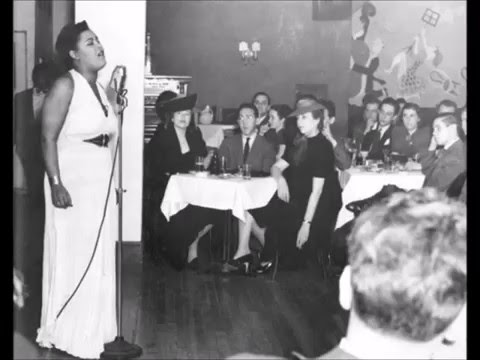
Holiday performing at Cafe Society
But a life changing experience was just around the corner — a Greenwich Village club named Café Society, a venue specifically designed to mix black and white audiences. The novelty of it all brought a lot of attention to Café Society, as did its coterie of progressive celebrities. And this brought attention to Holiday, just at the moment that many of her recordings were now being listened to across the country.
For in April 1939 a Jewish songwriter named Abel Meerepol asked Holiday to perform a new song – one about racism in the South. “If you think it’s okay man, I’ll do it,” said Billie.
“Strange Fruit” was a stark and graphic song about the lynching of black men. She would sing ‘Strange Fruit’ for the remainder of her career, a rare political message in a career mostly comprised of swing and torch songs.
In the 1940s Holiday became one of America’s most famous recording artists, but the real magic happened inside a cluster of smoky music clubs around the area of 52nd Street, between Fifth and Seventh Avenues. Billie Holiday wasSwing Street. She played most of these places during the mid and late 1940s — the Onyx Club, Kelly’s Stable, the Famous Door and Club Downbeat.
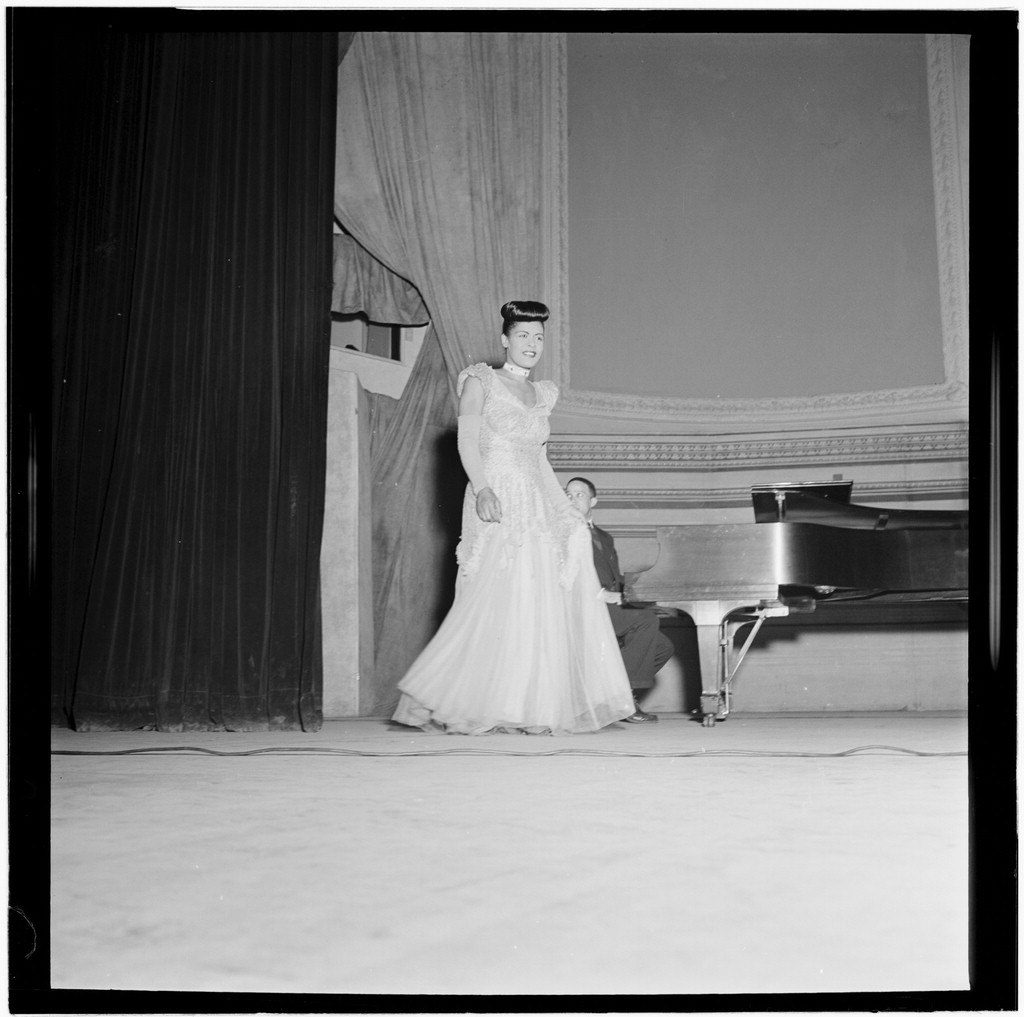
She lived the life of a night owl, eyes stinging from smoke filled bars, drinking continuously. But fans would have clearly noticed a startling change in her off-stage demeanor by the time she got to Onyx. At some point in the 1940s she had begun turning heroin, eventually shooting it up before shows. Her addiction worsened throughout her life, even as she graduated to larger, more ‘respectable’ venues like Town Hall and even Carnegie Hall (pictured below in 1946).
Library of Congress
Perhaps due to a renewed interest by the curious public (her substance-abuse troubles had made the papers), the Carnegie Hall concerts were sold out for weeks, and additional seats were placed on the aisle, with even 600 people sitting on the stage behind her.
That first night, she sang 21 song and 6 different encores. People claim it was the greatest concert she ever gave.
In 1958 Frank Sinatra said of her: “With few exceptions every major pop singer in the US during her generation has been touched in some way by her genius. It is Billie Holiday who was, and still remains the greatest single musical influence on me. Lady Day is unquestionably the most important influence on American popular singing of the last twenty years.”
Holiday died on July 16, 1959, leaving the world countless recordings of undeniably beauty (not to mention her biography Lady Sings the Blues).
A public memorial to Billie Holiday would serve not only as a tribute to her impact on modern music, but would also function as a tribute to New York City’s forgotten musical districts — Harlem’s 133rd Street, Midtown’s 52nd Street, the Village’s integrated music clubs.
For more information on Holiday’s bittersweet career, check out our podcast Billie Holiday’s New York. Portions of the article above are taken from this podcast. You can hear the entire thing here:
“Hickok was a celebrity. He was famous. He was feared. He was already a legend. It is estimated that over fifteen hundred dime novels were written just about Buffalo Bill Cody, beginning in 1869, when he was only twenty-three, into the 1930s, and during the early years. Wild Bill was in that category of iconic western hero. He had risen to the heights of both reputation and fabrication … and now the slow, inexorable descent began.” — Tom Clavin
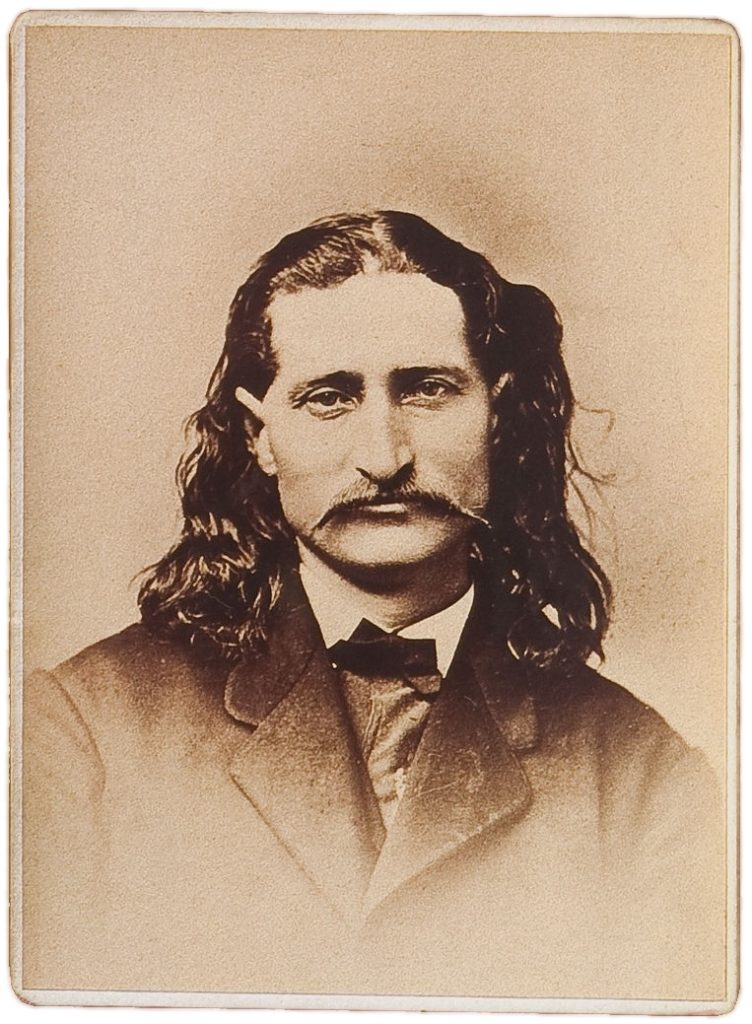
How do you write a book about a historical figure who seems more fiction than real? The Western folk hero Wild Bill Hickok lived a life that was thrilling, dangerous and brash, amplified by the fascinations of the American press into a virtual Western superhero.
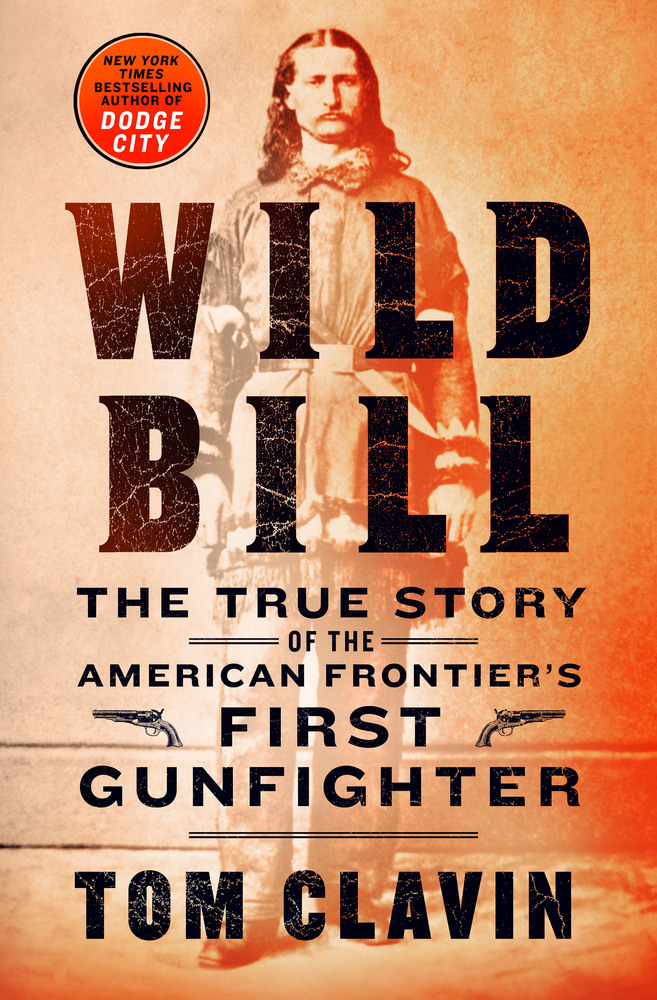
Wild Bill: The True Story of the American Frontier’s First Gunfighter by Tom Clavin St. Martins Press/2019
Tom Clavin’s Wild Bill: The True Story of the American Frontier’s First Gunfighter, a biography as frisky and unpretentious as its subject, attempts the noble task of walking back 150 years of mythology surrounding the Illinois man named James Butler Hickok, a drifter who wandered from job to job through Missouri, Arkansas and Kansas. During the Civil War, he worked as a wagon master and later a scout for the Union Army.
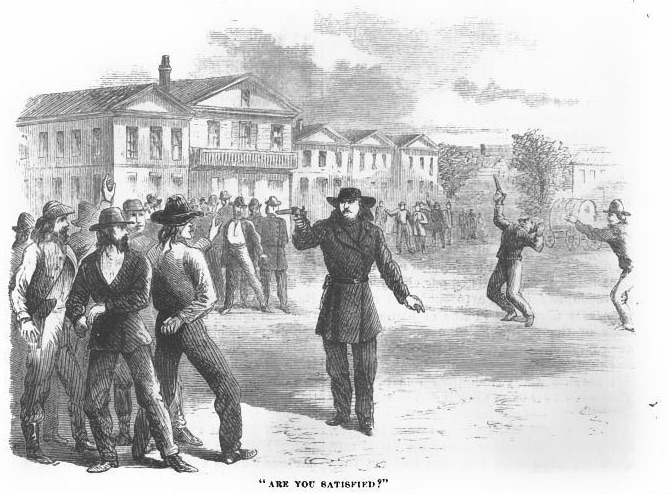
In 1865, he shot and killed the gambler Davis Tutt in the town square of Springfield, Missouri. This quick-draw duel — essentially over a pocket watch — took place in the early evening, not high noon. But whispers of this outrageously bloody event inspired a journalist named George Ward Nichols, working for New York’s Harper’s New Monthly Magazine, to profile Hickok.
Hickok shoots Tutt in Springfield town square, as depicted in Harper’s New Monthly Magazine in 1867.
It was in Nichols’ piece that Wild Bill Hickok — the fastest gun in the West — and indeed the genre of Wild West pulp fiction was born.
“[N]o single published piece catapulted a man on the American frontier more than Nichol’s article did for Hickok,” writes Clavin. With “the fertile imagination of a writer who could cash in on a sensational story and an outlet that offered that story to thousands of eager and mostly gullible readers, America had its first postwar frontier star.”
The attention only made Hickok more of a target with foolhardy men seeking him out in efforts to best the now-famous gunslinger. (It never ended very well for them.)
Wikimedia Commons
Clavin depicts an unruly but realistic western (or, more accurately, midwestern) landscape of chance encounters, brief romances and wide, arduous journeys. Yet even a hardened adventurer like Hickok would occasionally take a moment to bask in his fame.
In 1873 he joined his longtime friend ‘Buffalo Bill’ Cody in the cast of a ham-fisted play Scouts of the Plains at New York’s Niblo’s Garden, becoming a major box office draw.
Today we might call him, um, difficult. “Hickok felt like he was risking his integrity and dying a bit with every performance because he became further convinced that acting was a foolish occupation. One night … he took one of his real pistols and shot out the spotlight that had been fixed on him. The audience applauded the dramatic reality of the production as well as Hickok’s famous marksmanship.”
On August 1, 1876, Hickok was murdered during a poker game in Deadwood, a frontier town in the Dakota Territory, cutting short any future stage performances but securing his position in the pantheon of Wild West mythology.
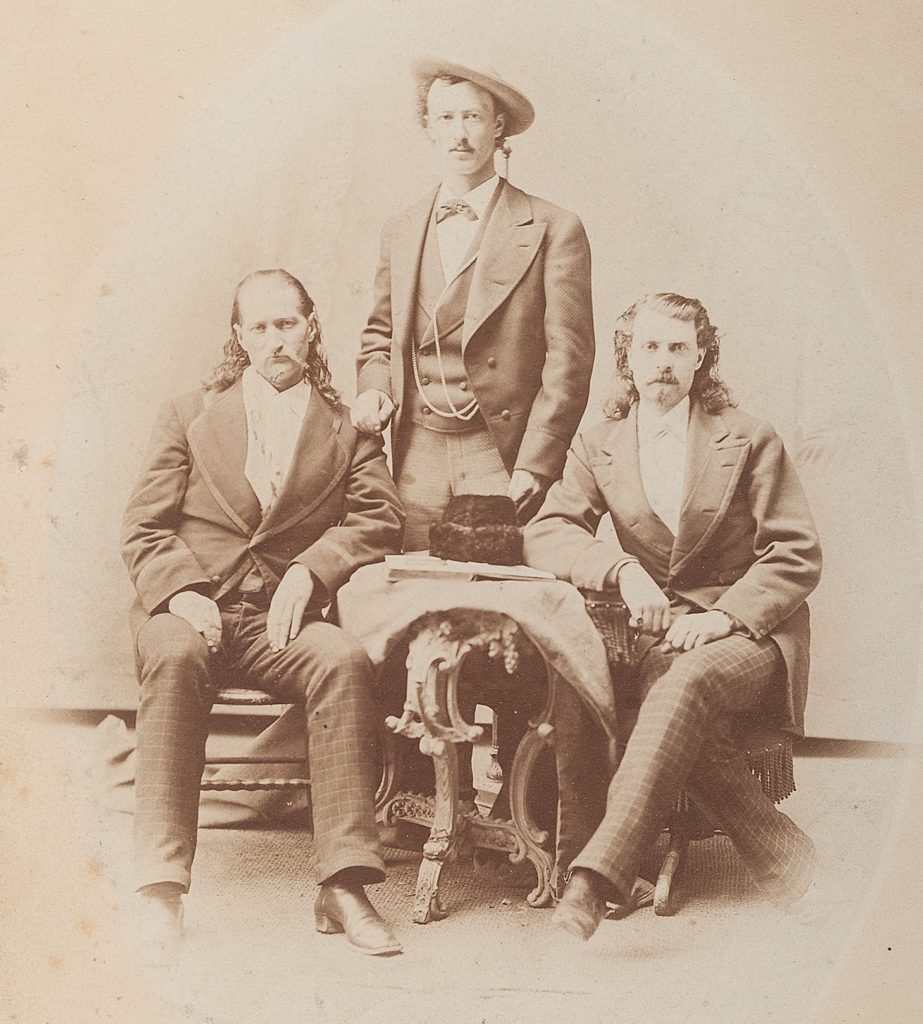
Wild Bill Hickok, “Texas Jack” Omohundro, and Wild Bill’s longtime front “Buffalo Bill” Cody, in a cabinet photograph for Scouts of the Plains, 1873
Head over to Chinatown this Sunday afternoon (February 17, starting at 1pm) for the Lunar New Year Parade and Festival, topping off two weeks of celebrations in honor of the Year of the Pig. (Find the parade route here. And get there early for a great spot.)
[We also did a podcast episode on the history of New Year’s Eve across the neighborhoods in NYC.]
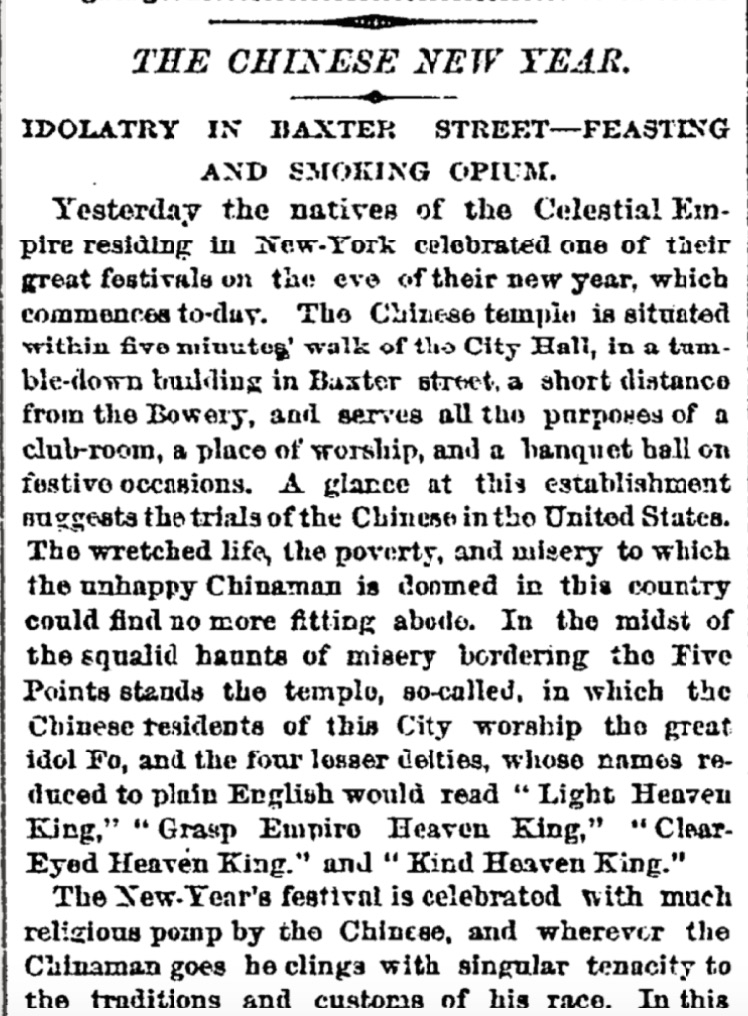
Although this is the 20th anniversary of the Better Chinatown Society‘s involvement with the parade, New Yorkers have been celebrating the Chinese New Year here in Chinatown for over 150 years.
By the early 1860s, a small enclave of Chinese people (mostly men) had settled in the area of Mott Street, slightly east of the notorious Five Points slum. As that neighborhood’s dynamics would change by the 1890s – from Irish to mostly Italian immigrants — the Chinese community would develop a strong foothold as their neighbors here on Mott Street, Bayard Street, Pell Street and, of course, ‘bloody’ Doyers Street.
And it would be here, in the nucleus of modern New York Chinatown, that the first Chinese New Year celebrations would be held.
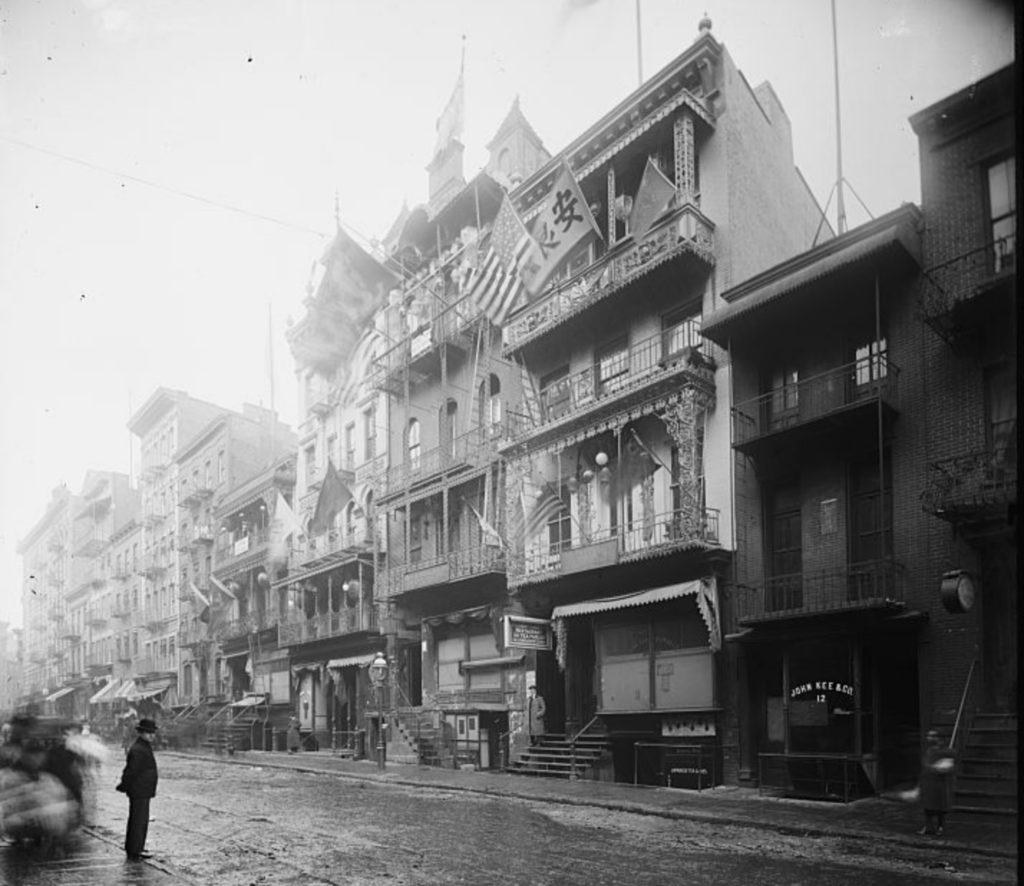
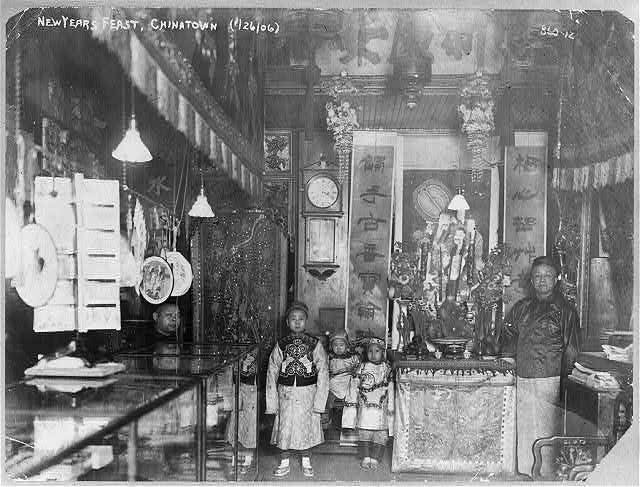
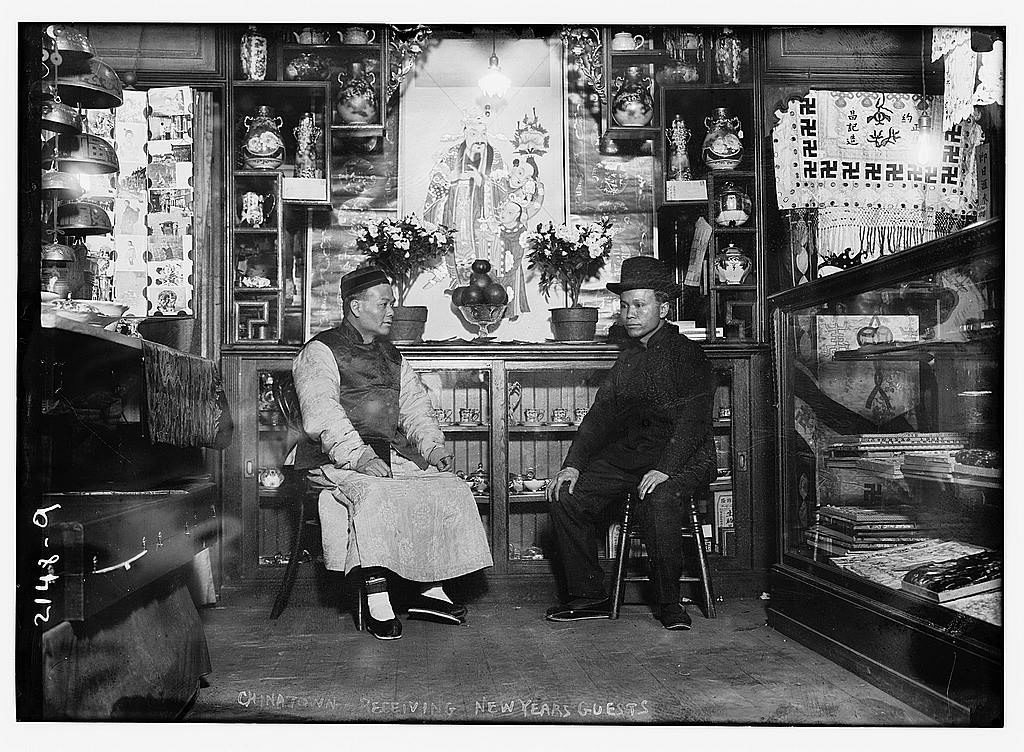
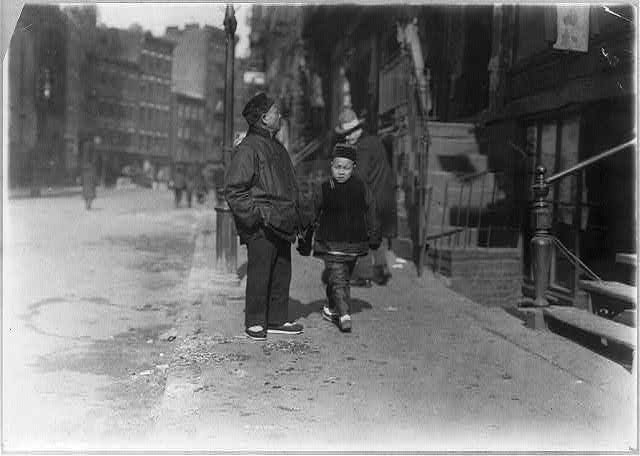
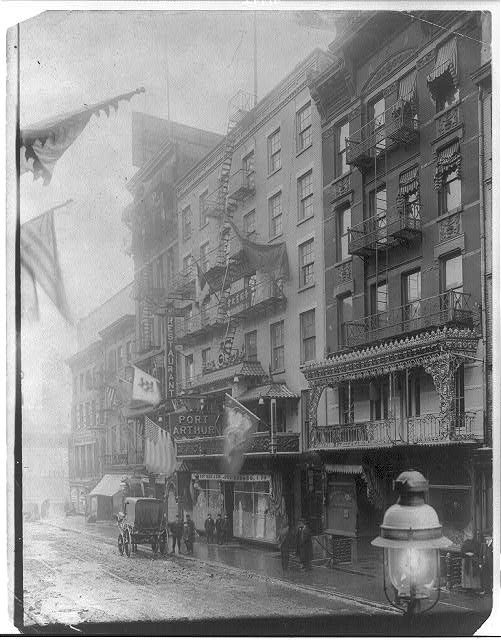
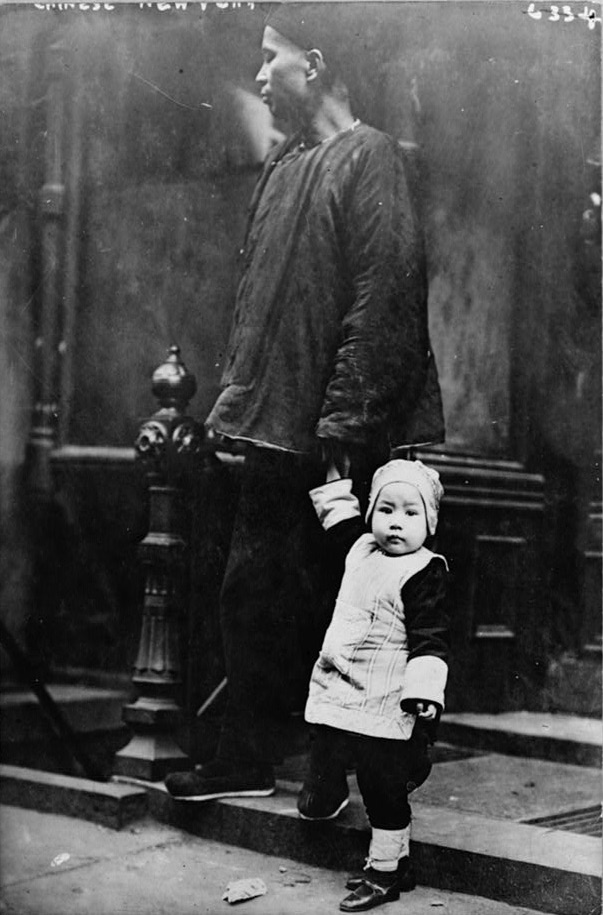
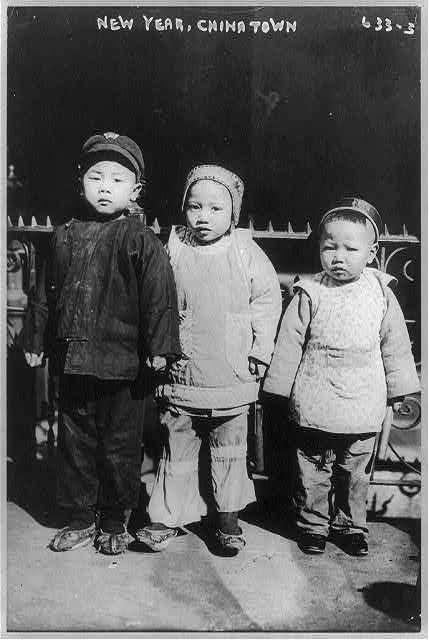
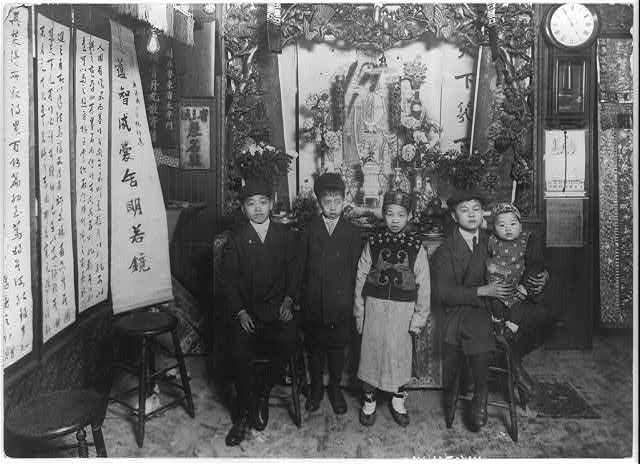
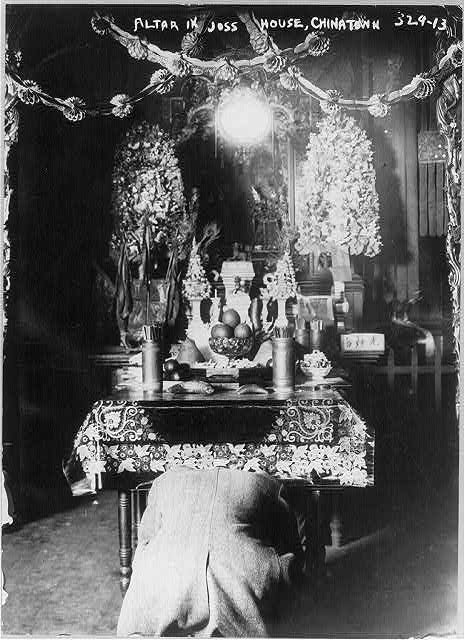
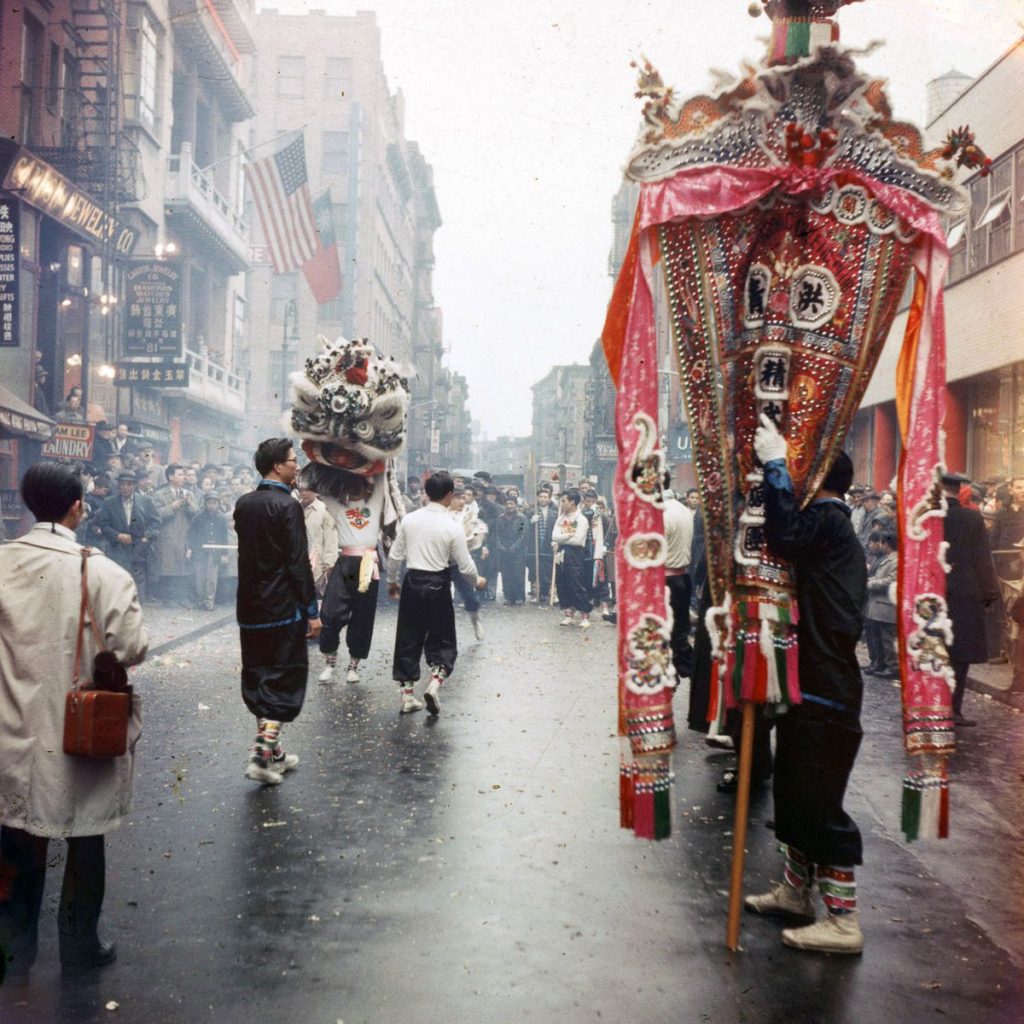
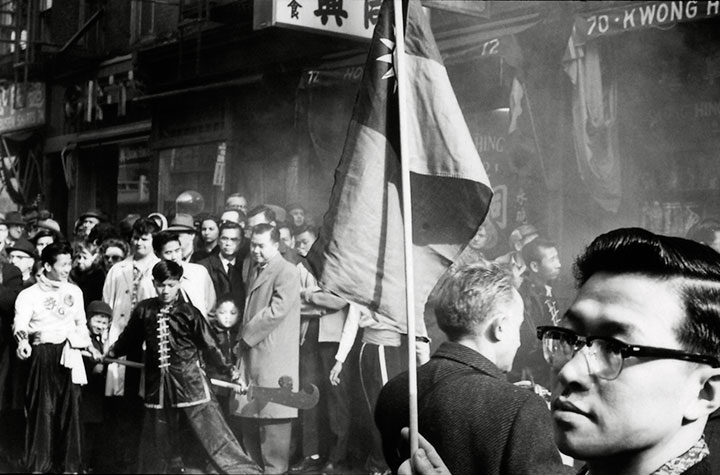
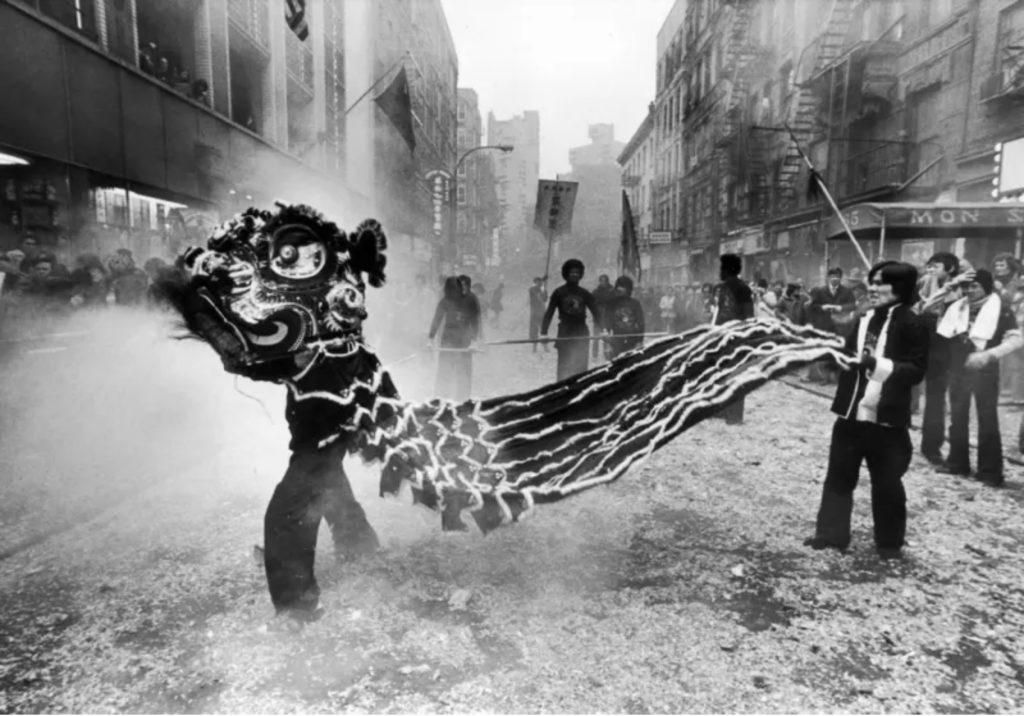
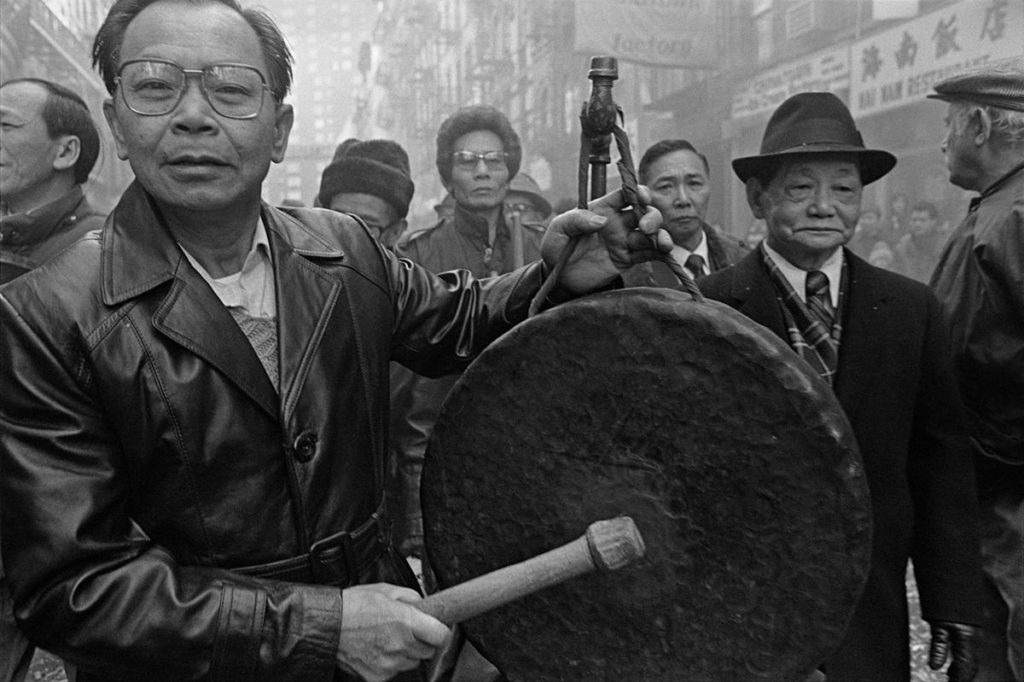
What follows are images of Chinese New Year celebrations in Manhattan’s Chinatown over the years, subtly modernizing while retaining many of the same traditions. Today you can find certain places on Mott Street that still look a bit like these earliest images.
Library of CongressChinatown, New York City – New Years feast, Jan. 26, 1906/Library of Congress[1900] Library of CongressThree people on sidewalk in foreground, Chinatown, Chinese New Year (taken between 1909-1913)Port Arthur restaurant on Mott Street, decorated for the New Year, Jan. 21, 1909Chinese child with an adult on step outside of building, Chinatown, New York City, 1909. Library of CongressThree children posed, New Year’s Day, 1909//Library of Congress[Jan. 30 1911] Library of CongressChinatown, New York City – altar in Joss House, 1911
A rare video of the Chinatown celebration from 1928. Can you identify the street?
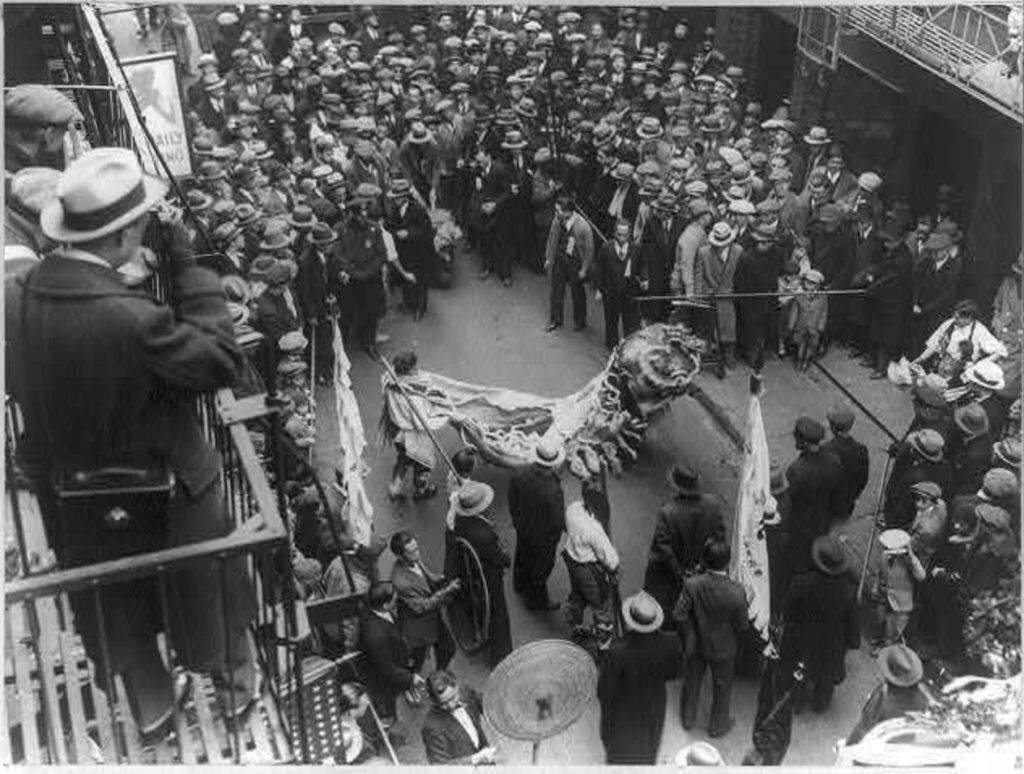
Jumping ahead to 1931 and the traditional dragon costume, entertaining a sea of fedoras on Pell Street.
New Year’s dragon in Pell St. of New York City’s Chinatown. 1931.
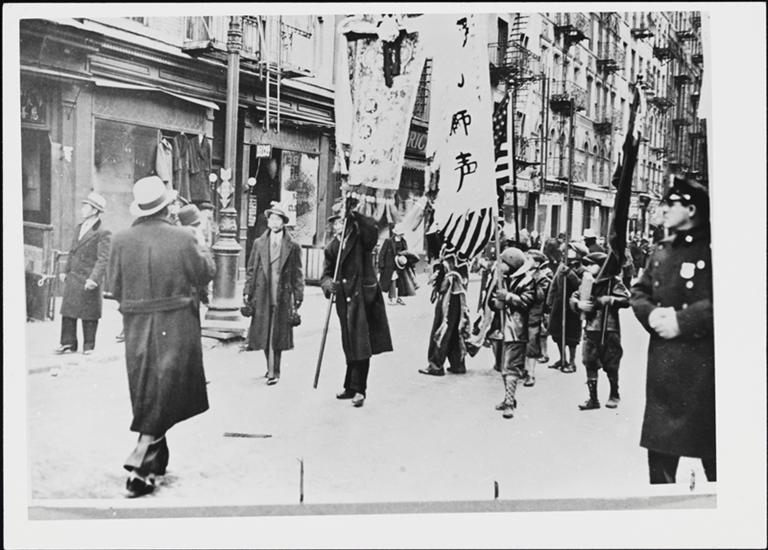
The parade in 1936.
Museum of the City of New York
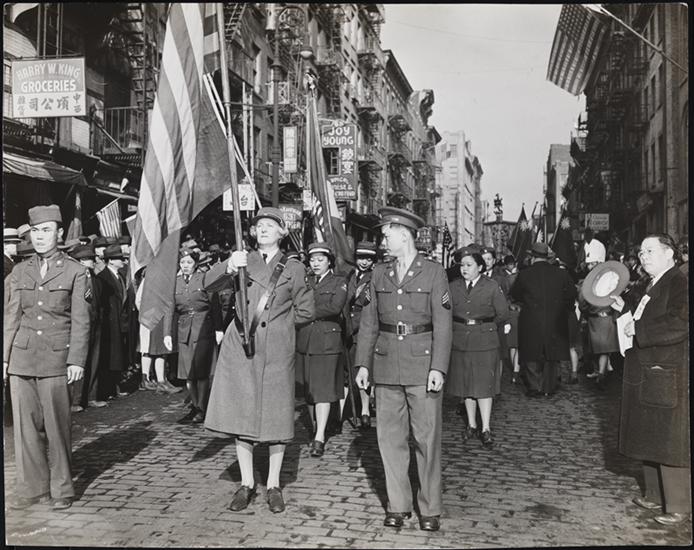
The Chinese New Year Parade of 1943 was decidedly more patriotic, reflecting the wartime alliance between China and America. According to the Daily News that year: “American flags were presented with those of the Chinese Republic and American soldiers of Chinese descent marched with Chinatown members of the United States war organizations.”
Museum of the City of New York
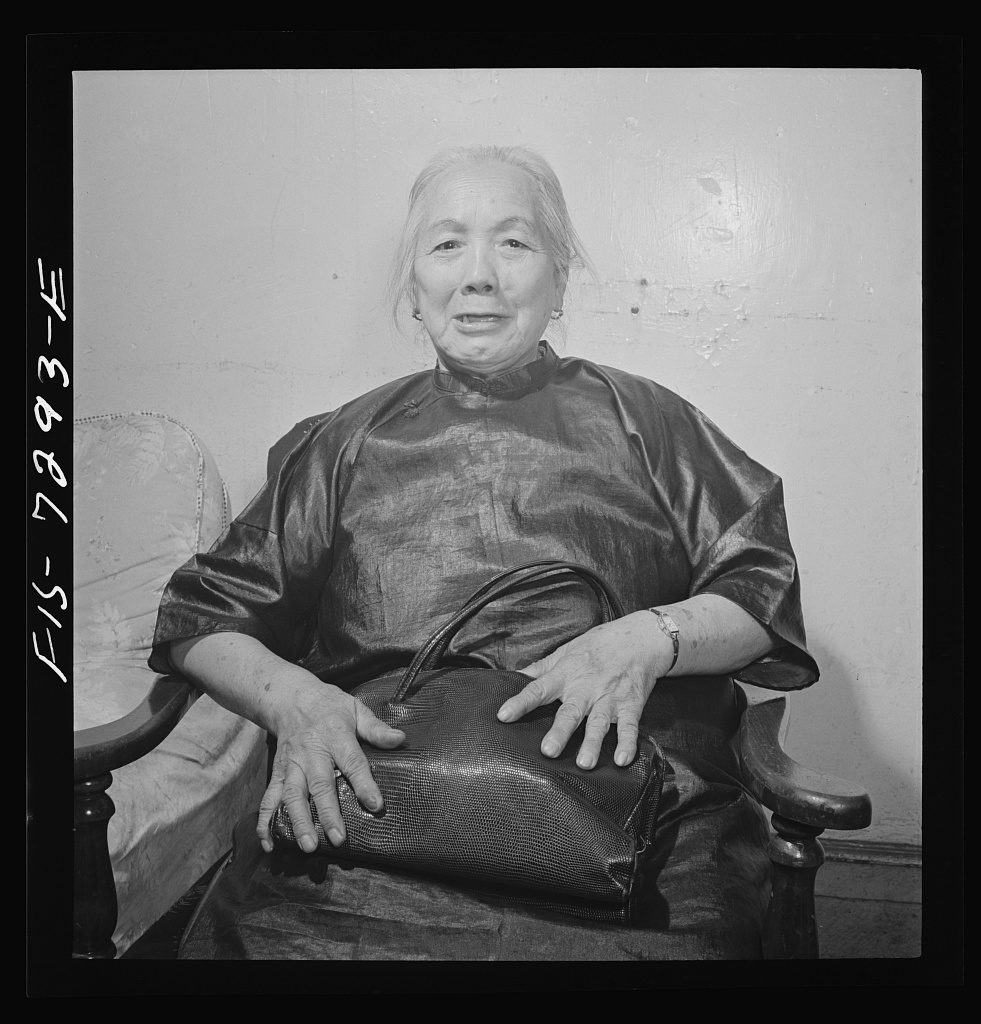
A resident of Chinatown, 1942, photographed by Marjory Collins
Library of Congress/Photographed by Marjory Collins
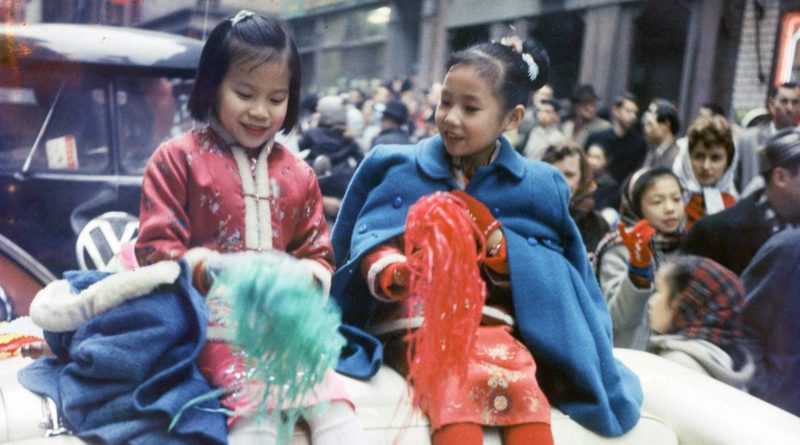
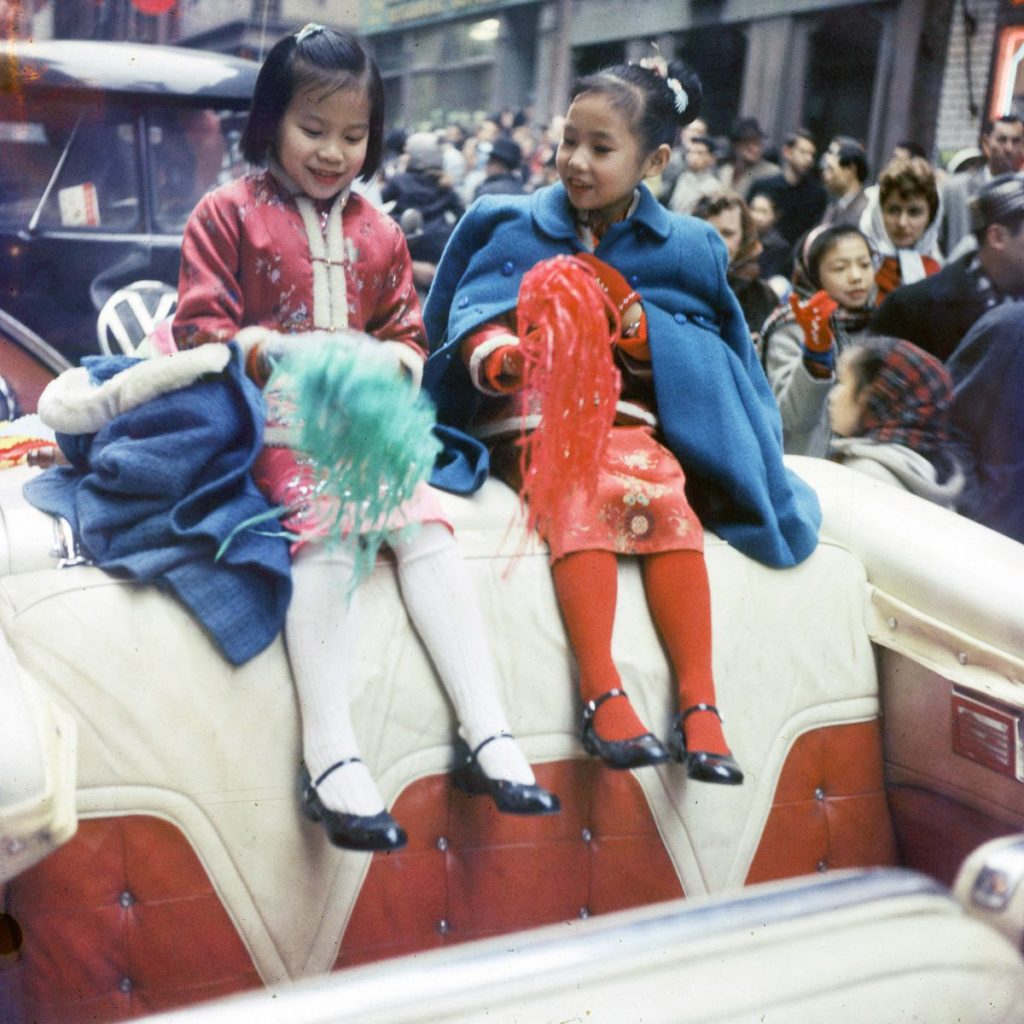
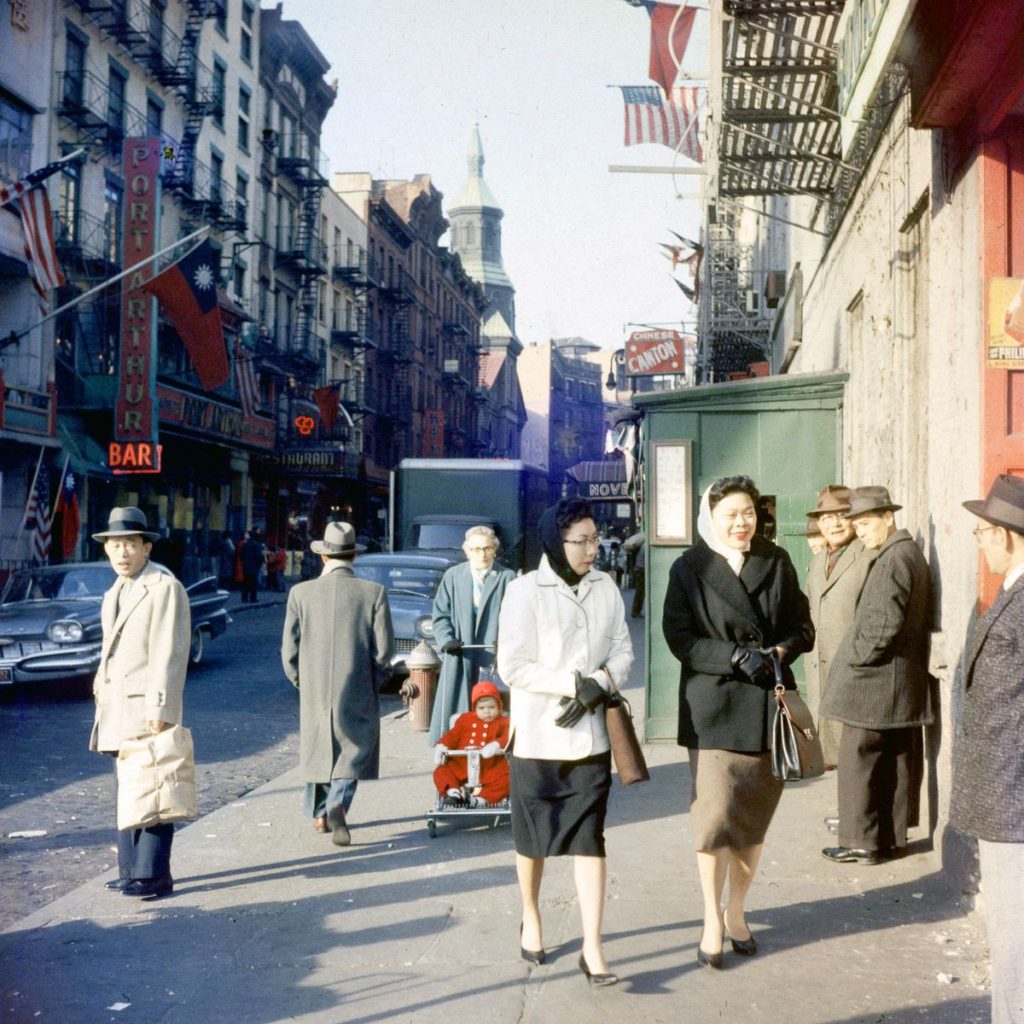
The parades begin draw drawing of thousands of onlookers by the 1950s, enamored of the lions and dragons, the live music, festive costumes, and allure of what had now become some New Yorkers most favorite food. Here’s a selection of images from the 1960 parade. (And you can check out more from this series at Mashable).
Another image of the festival in the 1960s, in a photograph by Jan Yoors.
Jan Yoors photographer
According to Karlin Chan, a lion dancer in the parade during the 1970s, “The city would just close down the streets around here for the New Year, and since every [dancing] group was on their own, it was basically a free for all.” [Read more of his interview with The Villager here.]
Leo Vals / Getty Images
By the 1980s, vibrant Chinatowns has developed in Queens and Brooklyn. And in Manhattan, immigrants from Fuzhou, speaking Mandarin, would develop just west of ‘old’ Chinatown in a neighborhood sometimes called Little Fuzhou today. For those non-fluent in Chinese, it would appear Chinatown as a whole has expanded its original confines on Mott Street, although in reality today’s Chinatown area reflects a multitude of different cultures, languages and customs.
Here’s a New Year’s procession on Bayard Street, 1984:
[You can find more fabulous images of 1980s Chinatown, taken by Bud Glick, here.]
Bud Glick photographer/The Atlantic
You can also get a sampling of Glick’s work here:
A news report from the 2002 parade, held just months after Sept 11, 2001:
And some festive video from the 2010 celebration:
For more information on the history of the Chinese New Year in New York City, listen to our recent show on the history of New Year’s celebrations — A New Year In Old New York
Sometimes an artist’s biography can work on two levels, providing both the sweep of history within the subject matter of the artist’s own output and a grand view of American art history in the artist’s working life.
In Mary Schmidt Campbell’s absorbing biography of the painter, illustrator and collagist Romare Bearden, we get to look at the New York City art world of the 20th century with insights into the life of an African-American painter who managed to remain relevant in a career of almost 60 years.
Campbell, currently the president of Spelman College, knew Bearden leading up to her role as executive director of the Studio Museum in Harlem in the 1970s and 80s. (The appendix features copies of handwritten letters from Bearden written on stationary from his Canal Street studio. That alone gave me chills.)
Bearden’s body of work is unique in that it reflects, in its longevity, both the changing tides of 20th century art and his own conflicts with depicting the American black experience on his canvas.
He came of age in Harlem in the 1920s, among the creative swirl of the Harlem Renaissance, even as his formal training came from the famed Art Students League in Midtown Manhattan. His mother Bessye Bearden was a noted journalist whose connections to such Harlem figures as Duke Ellington and A’Lelia Walker introduced Romare to a new world of possibilities for black creators. “She not only found her way into Harlem’s inner circle,” writes Campbell, “but she also helped define and expand its perimeter.”
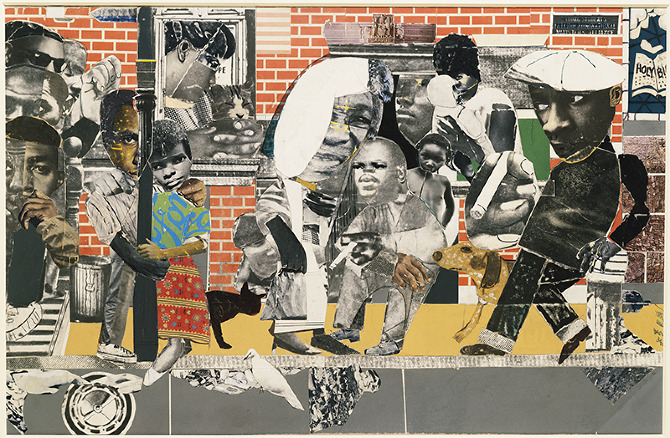
Young Students – Romare Bearden, 1964 – Romare Bearden Foundation
Romare developed into both an renowned artist and an insightful critic of the art world, setting up a studio right above the most famous place in Harlem — the Apollo Theater. It was here that he later pivoted his style away from concrete representational forms, finding his own path into the world of abstract modernism.
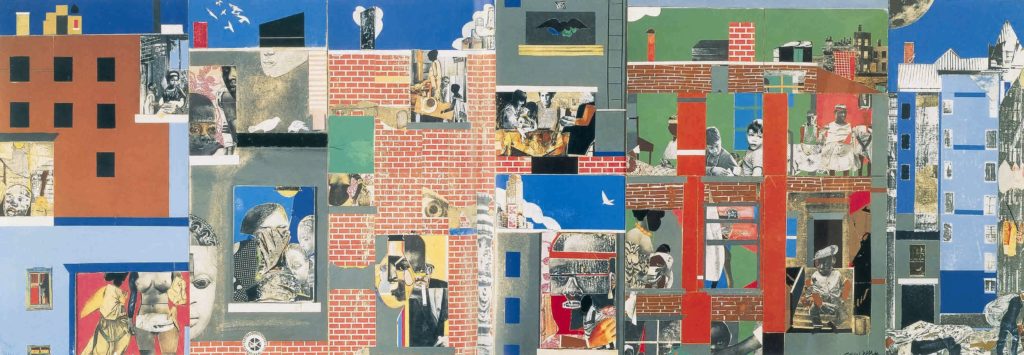
The Block by Romare Bearden, 1971 — Romare Bearden Foundation
By the late 1940s he oddly found himself an outsider — wanting to break out from shows that only featured black artists but eventually excluded from mainstream galleries for not being sufficiently abstract.
It took a revitalizing intellectual journey to Paris, a change of scenery within New York City (to the newly developed artists’ enclave in SoHo) and a shift to collage work to reinvent Bearden’s role in the art world. His groundbreaking 1964 show Projections also established him as an artist in conversation with the American civil rights movement.
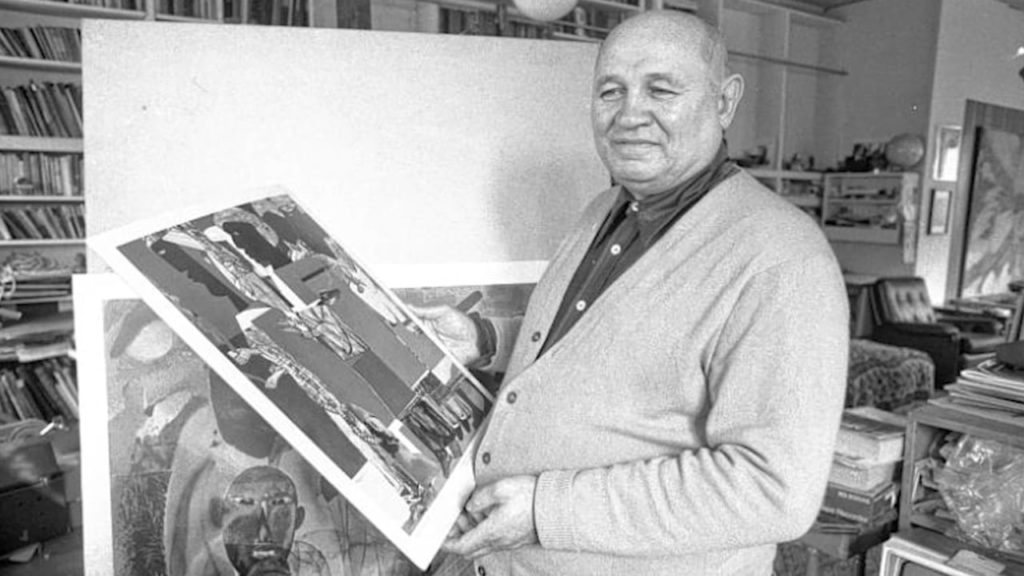
Bearden in his Long Island City studio
By 1987, when Ronald Reagan awarded Bearden the National Medal of the Arts, the artist had secured his legacy. Yet today his body of work — including some of his most profound collages — often remains unseen.
As Campbell explains, “Despite Bearden’s care in the assemblage of materials, his collages with their multitude of different materials are a preservationist’s nightmare. Major museums exhibit his works infrequently because they are so perishable.”
“Bearden’s legacy is as complicated as his art; he would become many things to many people — all at once.”
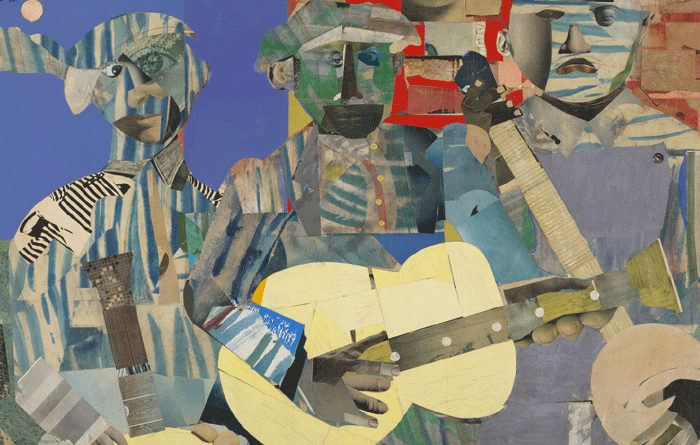
At top: Three Folk Musiciansby Romare Bearden / Virginia Museum of Fine Arts
Events such as these used to be unthinkable, anomalies of history that once played like speculative fiction. But this really did happen.
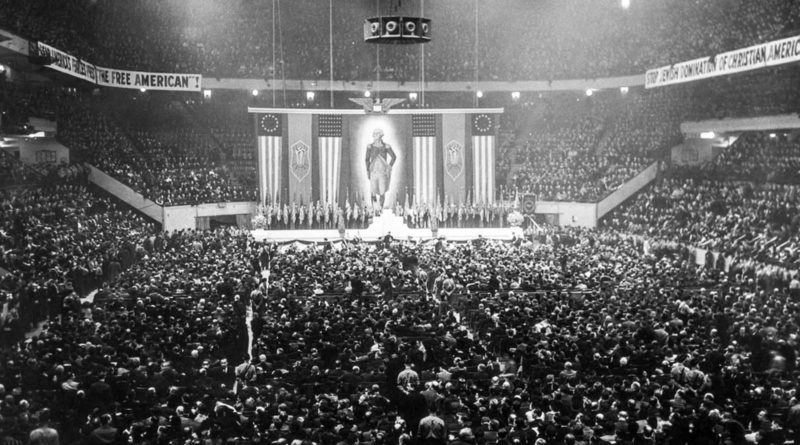
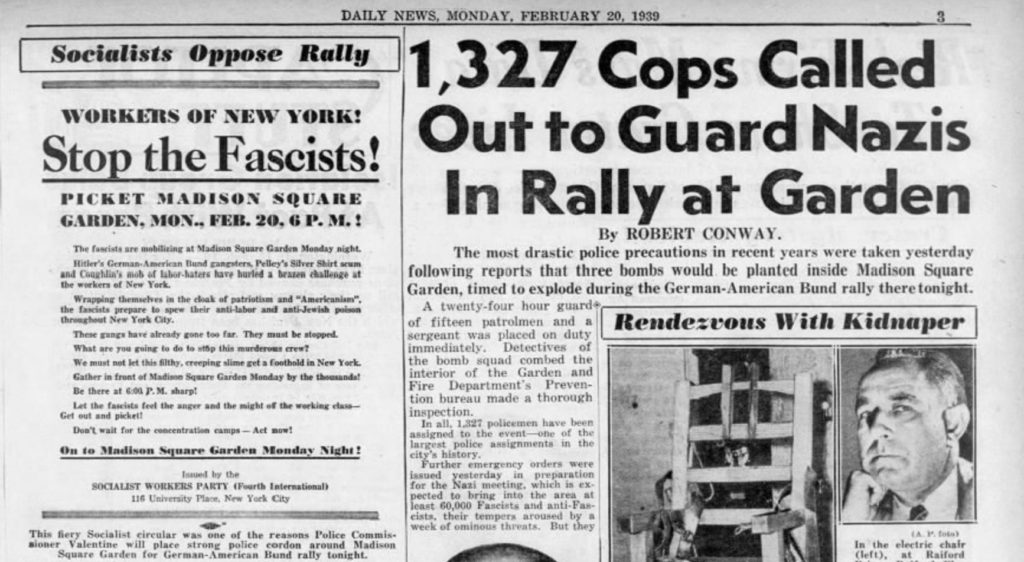
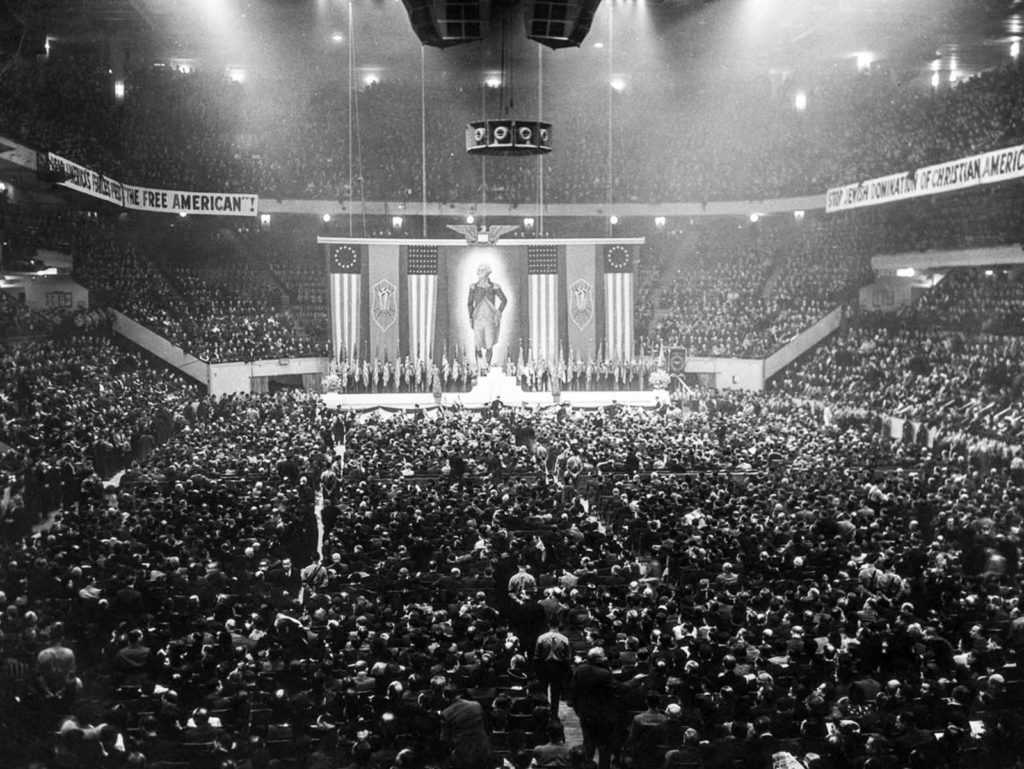
Eighty years ago this month — on February 20, 1939 — over 20,000 members of the German American Bund, a pro-Nazi organization, gathered at Madison Square Garden (at its Hell’s Kitchen location on Eighth Avenue) to unite the philosophies of American exceptionalism and Nazi worldview, gathering under the pretense of celebrating the birthday of George Washington.
Just a week earlier, on February 12, 1939, the Garden was filled with thousands of prized canines as part of the Westminster Dog Show. Eight days later, the famous arena was occupied with a more menacing sight.
From the New York Daily News:
I find the matter-of-fact reporting from the Brooklyn Daily Eagle the following day to be almost chilling:
“Marked by scores of street fights in which anti-Nazis, Nazis and police clashed frequently, the German-American Bund’s “American-ism” rally in celebration of George Washington’s birthday last night gave the vicinity of Madison Square Garden the liveliest six hours it has known in recent years.
The meeting itself, attended by more than 18,000, was without incident, except for the beating by Storm Troopers and subsequent arrest of Isadore Greenbaum, Brooklyn unemployed plumber, who attempted to attack Fritz Kuhn, Bund leader, as he spoke from the platform.”
The Oscar-nominated short documentaryA Night At the Garden looks at this event from an ominous bird’s eye view, capturing the united enthusiasm of the crowd and even Greenbaum’s attempt to storm the stage. The director Marshall Curry (who made the excellent film Street Fight — about Newark politics — over a decade ago) lets the footage speak for itself, allowing the audience to make their own contemporary parallels.
You can watch the entire film here. It’s up for an Academy Award for Best Documentary Short Subject against four other astounding films. (End Game and Period. End of Sentence are both on Netflix. And you can find Black Sheep and Life Boat on YouTube.)
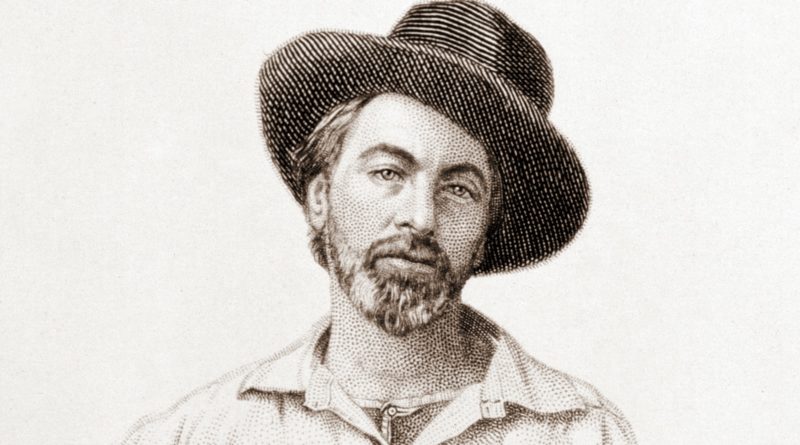
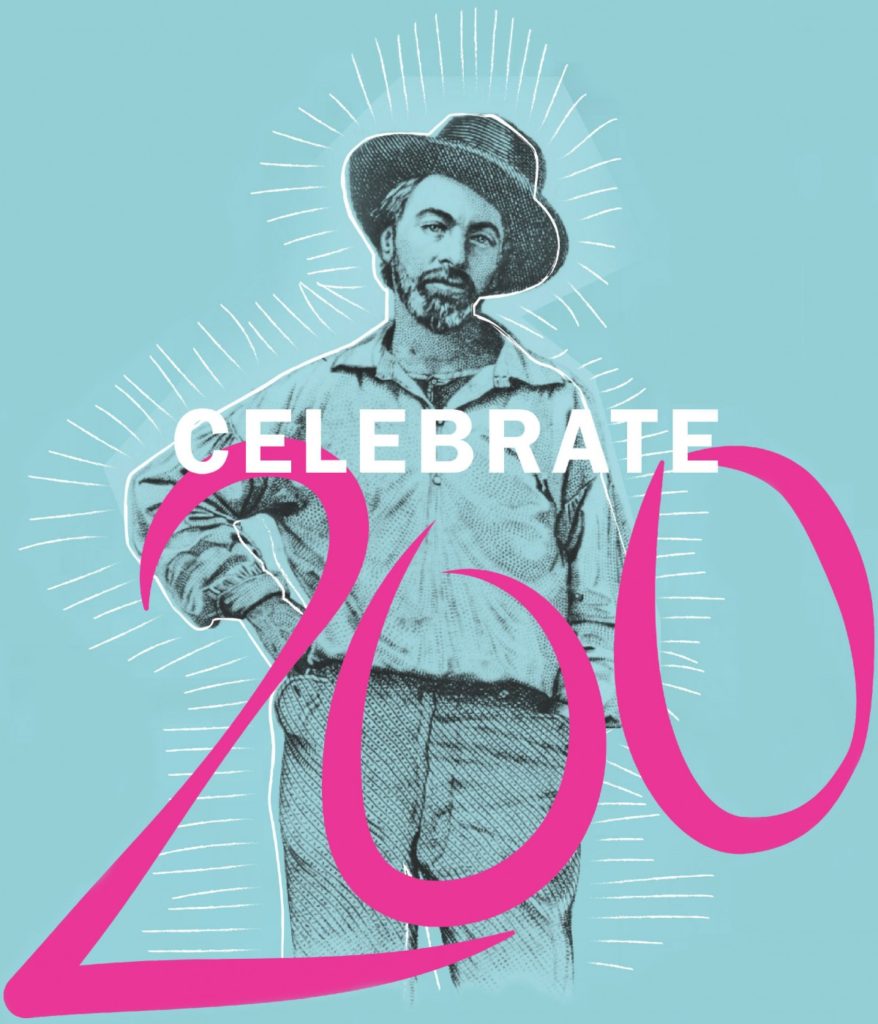
A very special episode of the Bowery Boys podcast, recorded live at the Bell House in Gowanus, Brooklyn, celebrating the legacy of Walt Whitman, a writer with deep ties to New York and its 19th century sister-city Brooklyn.
On May 31, 1819, the world will mark the 200th anniversary of the birth of Whitman, a journalist who revolutionized American literature with his long-crafted work Leaves of Grass. The 19th century cities of New York and Brooklyn helped shape the man Whitman would become, from its bustling printing presses to bohemian haunts like Pfaff’s Beer Cellar.
To help them tell this story, Greg and Tom are joined by guests from the worlds of academia, literature and preservation:
Karen Karbiener, NYU professor and head of the Walt Whitman Initiative, an international collective bringing together all people interested in the life and work of Walt Whitman
Jason Koo, award-winning poet, and founder and executive director of Brooklyn Poets, celebrating and cultivating the literary heritage of Brooklyn, the birthplace of American poetry
and Brad Vogel, executive director at the New York Preservation Archive Project and board member of the Walt Whitman Initiative, leading the drive to protect New York City-based Whitman landmarks.
The Bowery Boys: New York City History podcast is brought to you …. by you!
We are now producing a new Bowery Boys podcast every other week. We’re also looking to improve the show in other ways and expand in other ways as well — through publishing, social media, live events and other forms of media. But we can only do this with your help!
We are now a member of Patreon, a patronage platform where you can support your favorite content creators for as little as a $1 a month.
Please visit our page on Patreon and watch a short video of us recording the show and talking about our expansion plans. If you’d like to help out, there are five different pledge levels (and with clever names too — Mannahatta, New Amsterdam, Five Points, Gilded Age, Jazz Age and Empire State). Check them out and consider being a sponsor.
And join us for the next episode of the Bowery Boys Movie Club, an exclusive podcast provided to our supporters on Patreon.
We greatly appreciate our listeners and readers and thank you for joining us on this journey so far.
For a list of Walt Whitman celebrations in New York City and around the country, visit the Walt Whitman Initiative for details. And the week of Whitman’s bicentennial (May 27-June 1) is International Whitman Week!
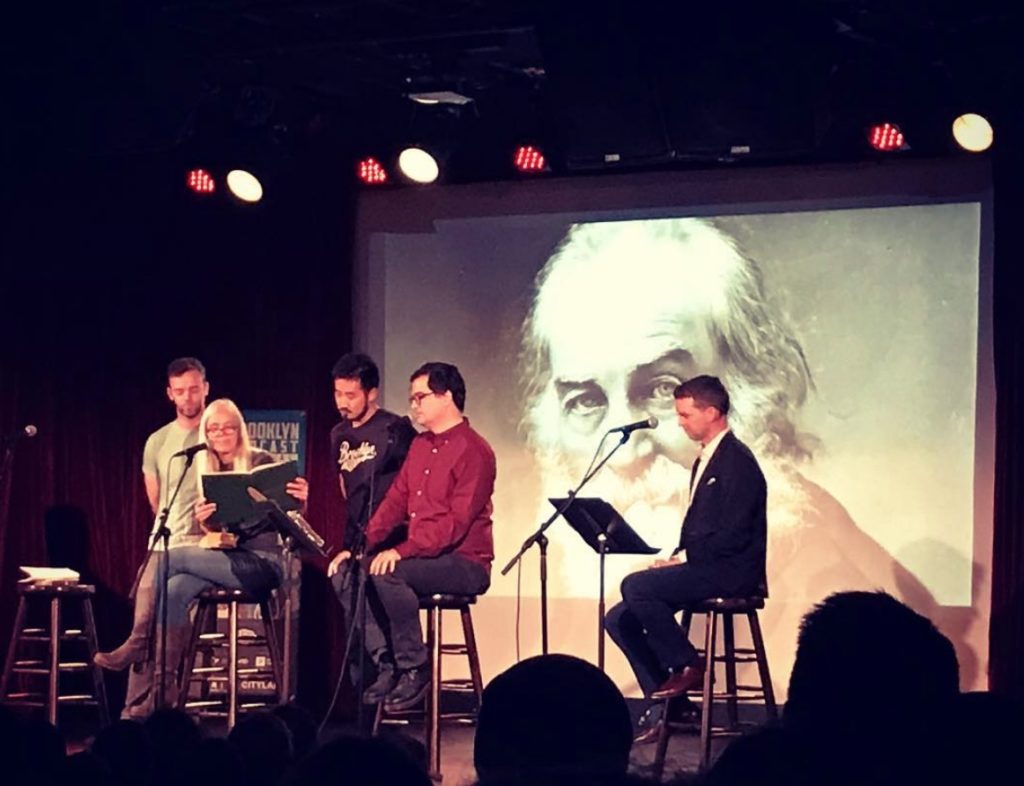
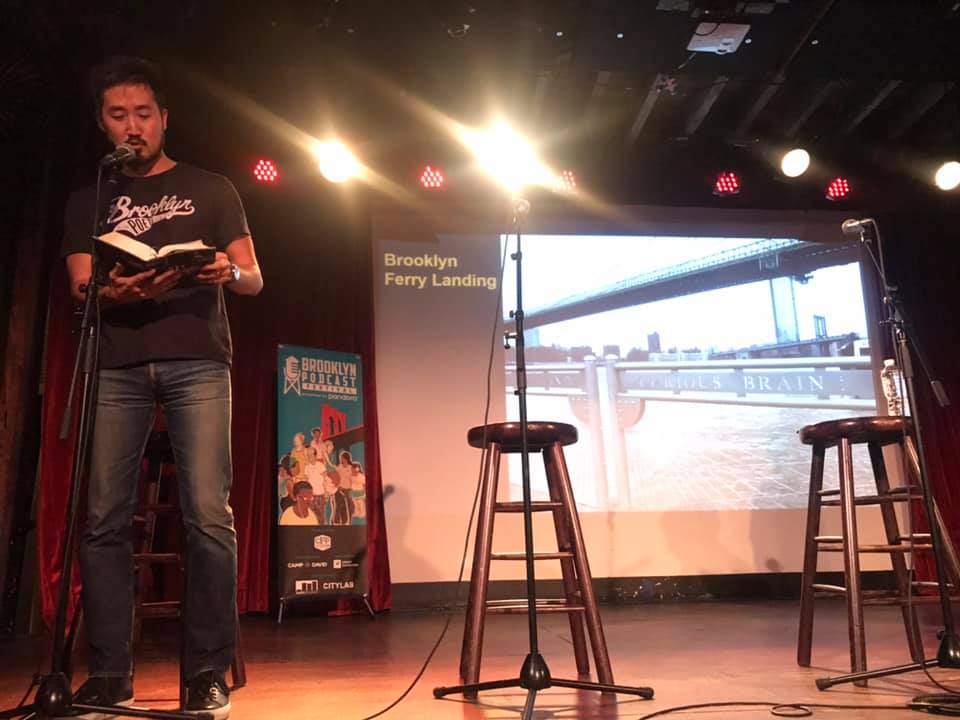
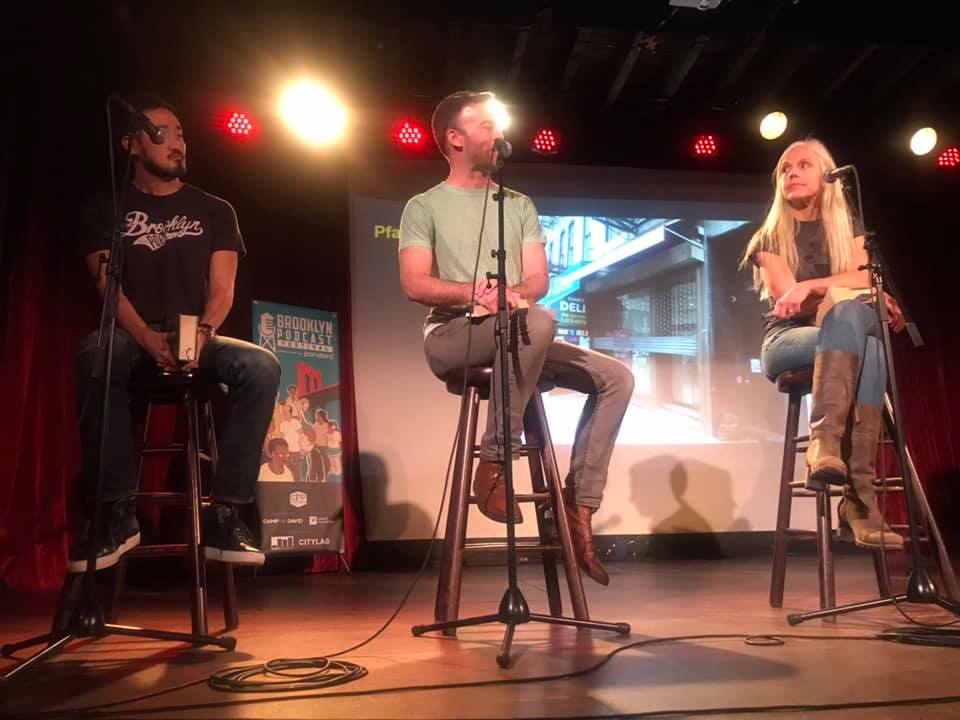
Some images from our live show:
jenna_scherer/Instagram
Jason Koo reading “Crossing Brooklyn Ferry”
Courtesy Marie Carter
Jason Koo, Brad Vogel and Karen Karbiener
Courtesy Marie Carter
This is a recording of what many consider the actual voice of Walt Whitman, recorded on wax cylinder, reading a section of his poem “America”. (There is some controversy over its veracity.)
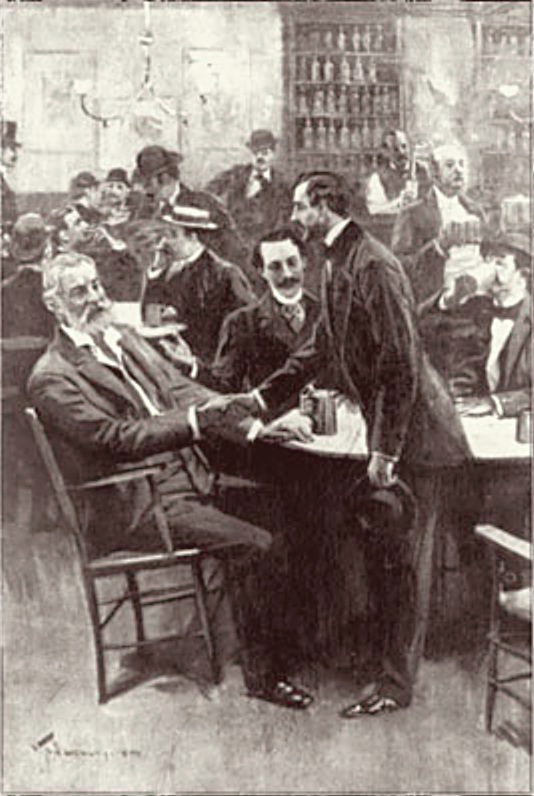
An illustration of the interior of Pfaff’s Beer Cellar, depicted here in 1857 (the seated gentleman is Whitman).
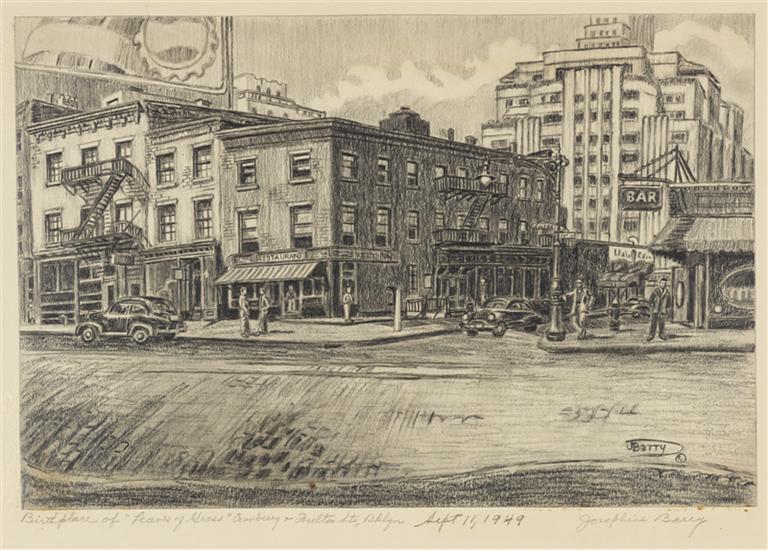
The location of Rome Brothers printing house (at Cranberry and Fulton streets), depicted here in 1949 in an illustration by Josephine Barry.
Museum of the City of New York
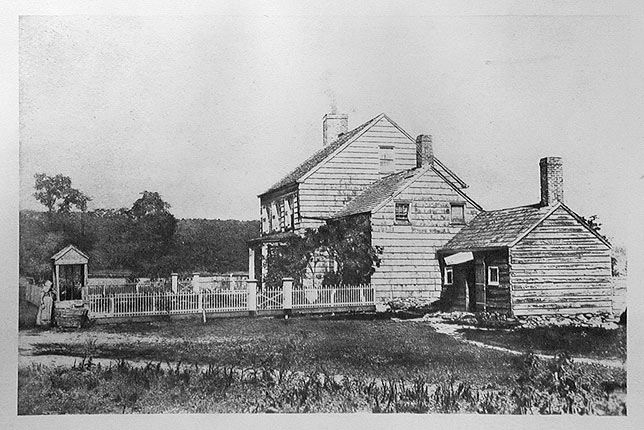
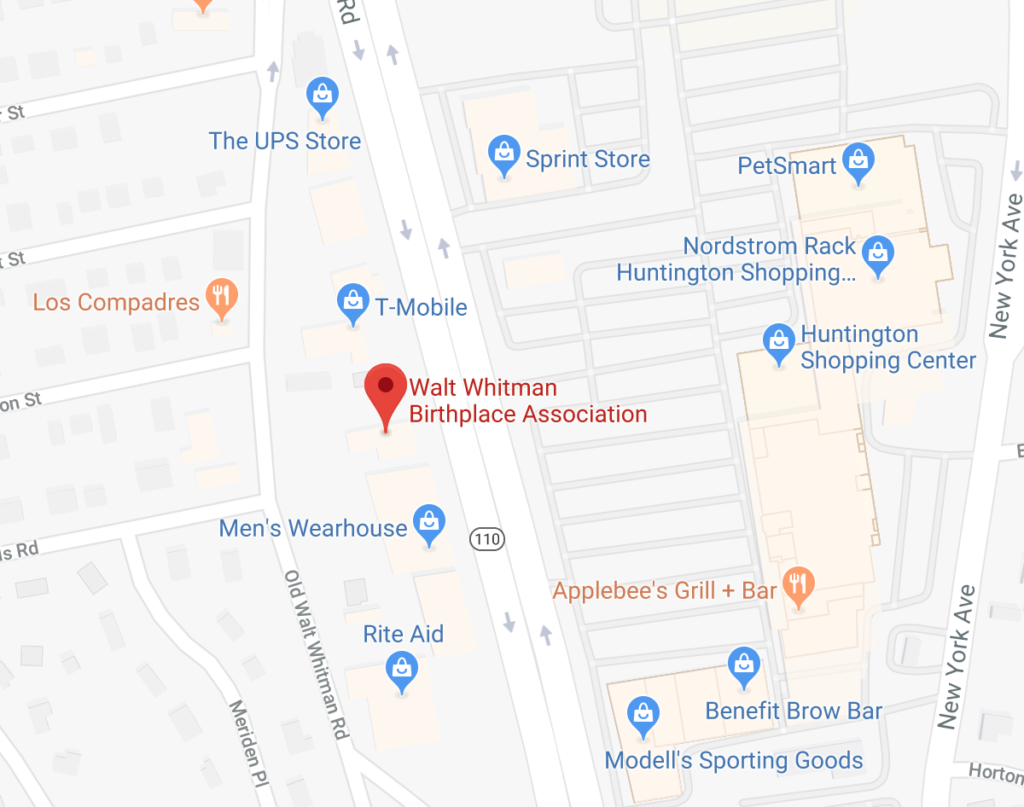
Whitman’s birthplace in Huntington, Long Island, still stands and is well worth a visit. It’s lovely! Unfortunately the landscape around the house has changed dramatically.
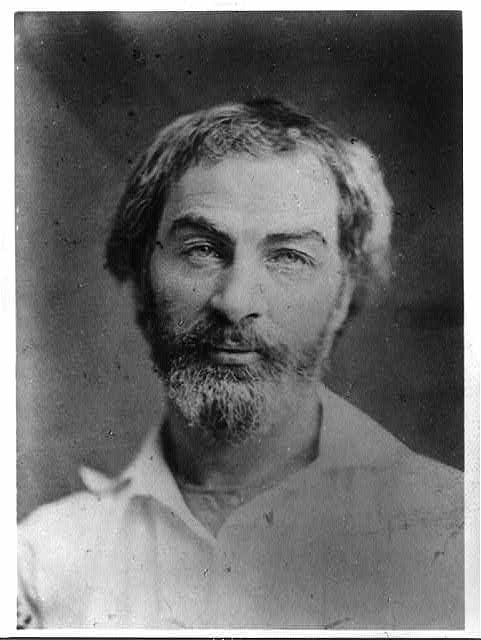
Whitman in 1854
Library of Congress
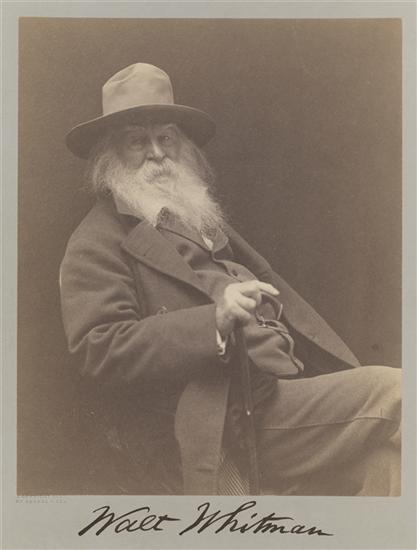
Whitman in 1890, photographed by George C. Cox
Museum of the City of New York
FURTHER LISTENING
Before Whitman, Poe found inspirations for his poetry in New York and in another future borough — the Bronx:
Whitman was a young man living in New York when a terrible blaze destroyed much of the city (not to mention job prospects):
Downtown Brooklyn, the area where Whitman once lived and published, has gone through several transformations since he lived here: