“The Raven” was first published in the New York Evening Mirror on January 29, 1845, and would come to define the morbid brilliance of its author Edgar Allan Poe.
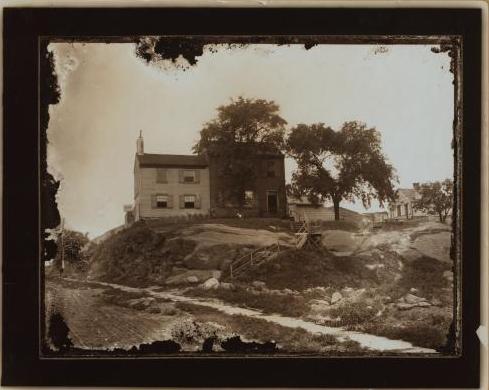
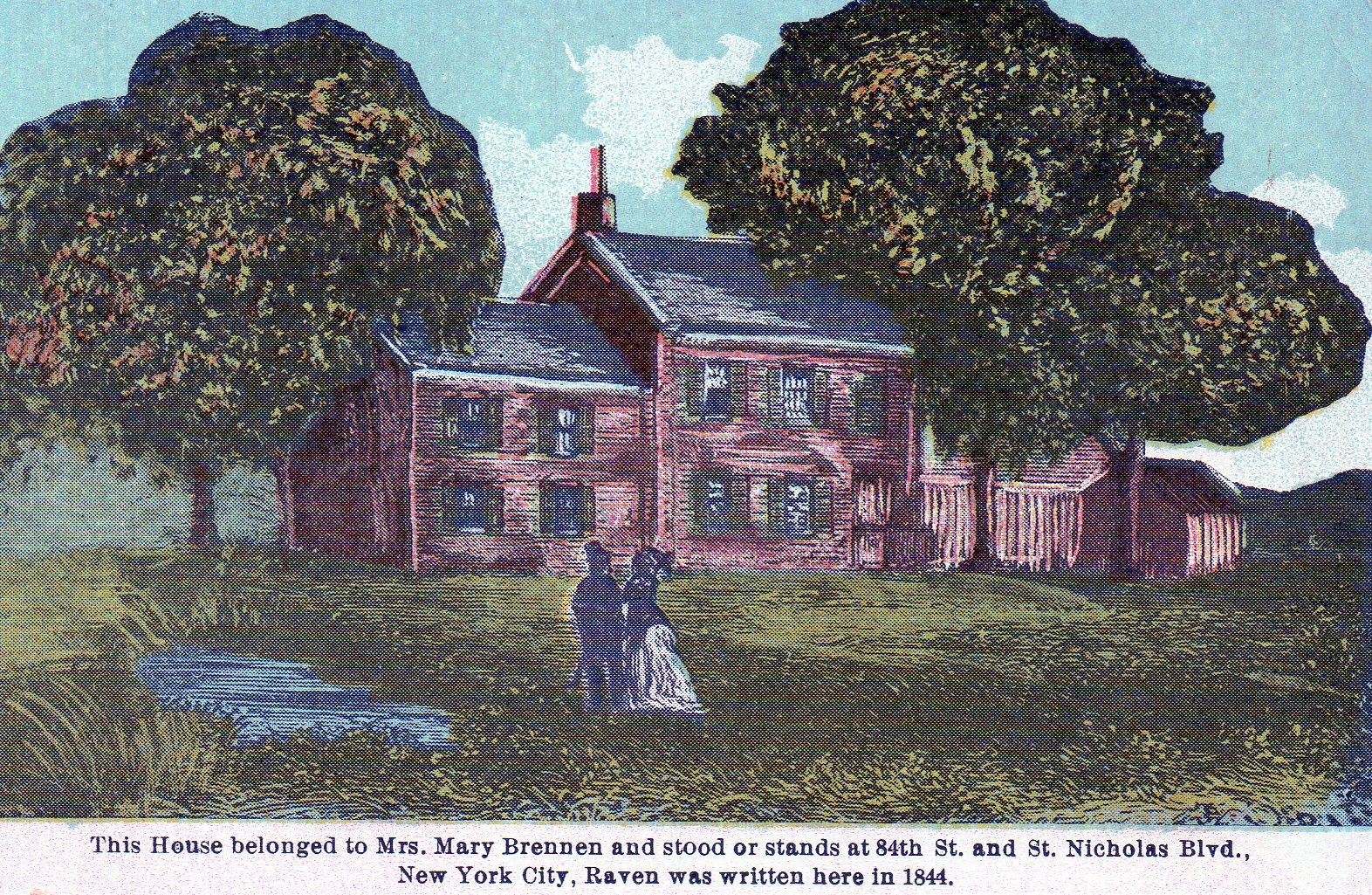
Poe and his sickly young wife Virginia arrived in New York in 1844, lodging at a dairy farm at today’s West 84th Street, between Broadway and St. Nicolas Blvd. (While blocks would have been marked by the Commissioners Plan in the 1810s, there would have been little development here.) It’s widely believed that Poe “composed, or at very least, perfected” the poem in New York.
Believed to be the Brennan farm. Photo courtesy New York Public Library
Here’s another angle of the house in a fanciful illustration highlighting the very bucolic nature of the area then.
The blog Manhattan Past has an excellent post on the supposed whereabouts of the Brennan farm. Although he lived here for a short time, the street today is ceremonially referred to as Edgar Allan Poe Street. The street was officially given that distinction in 1980 and for many years presented misspelled street signs — “Edgar Allen Poe Street.”
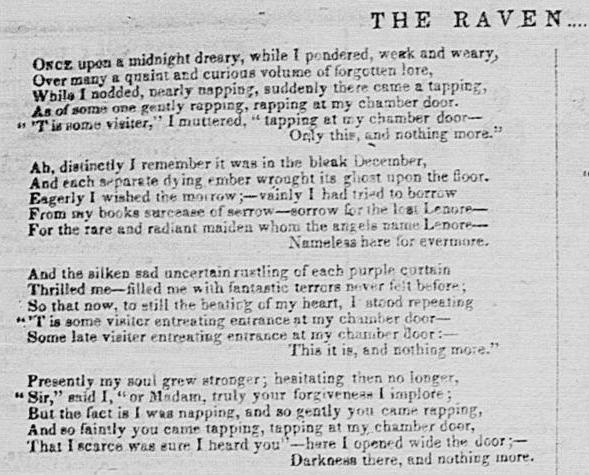
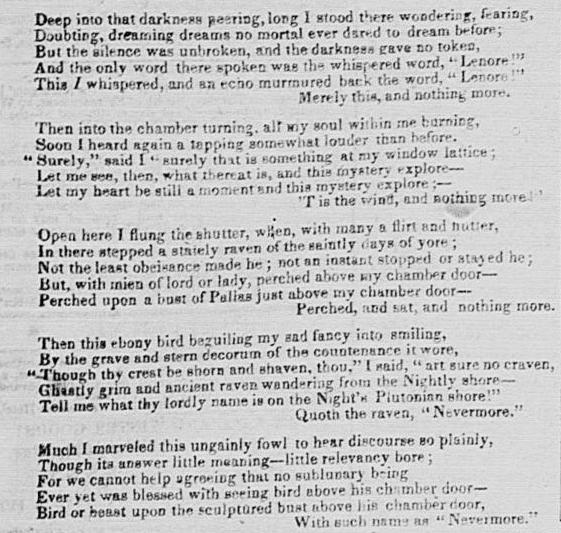
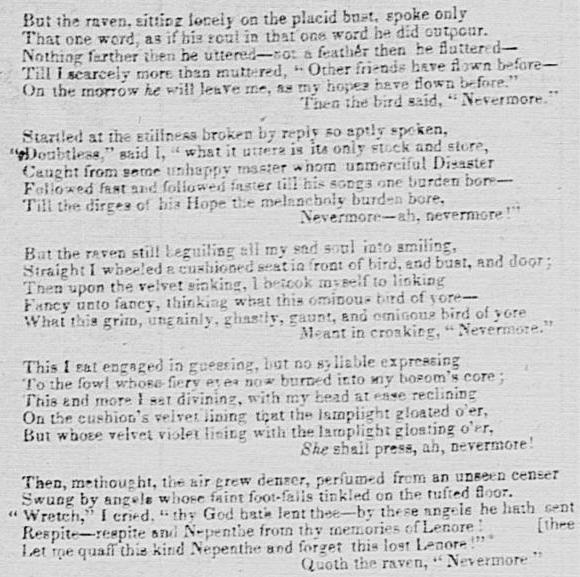
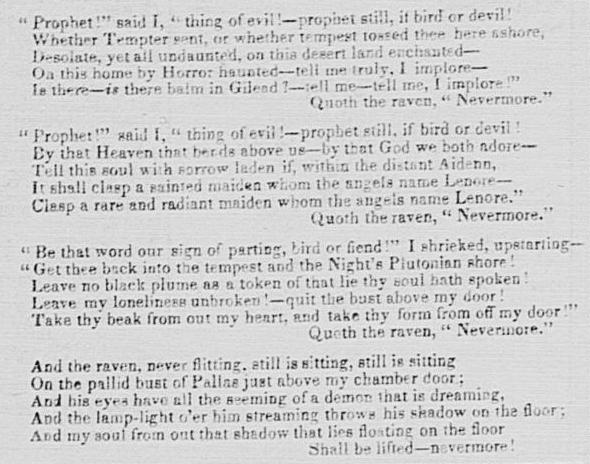
A few days later after the poem’s debut in the Evening Mirror, on February 4, the New York Daily Tribunealso published “The Raven”. Here’s how it first appeared in the Tribune:
It was then published in the Broadway Journal, a couple of weeks before Poe became editor of that publication. The venture however was a financial failure. In 1846, he and Virginia moved to a farm-house in the area of Fordham (in the Bronx) which is still preserved today.
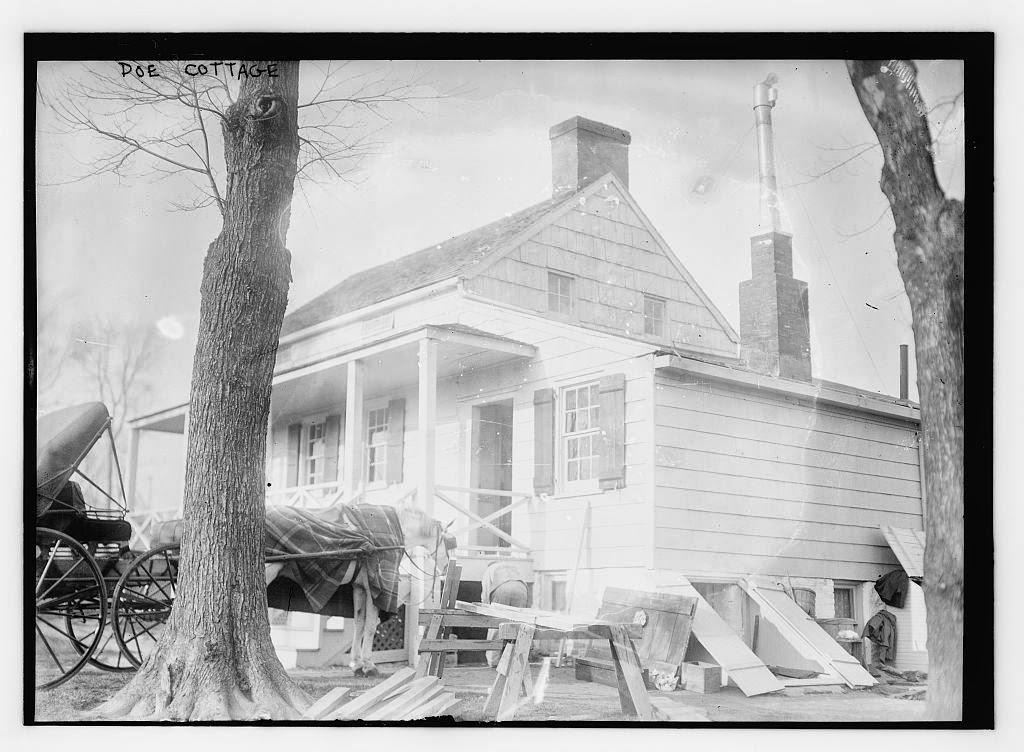
Poe hoped living far from the bustle of New York would help his wife; but she died here in on January 30, 1847 — almost two years to the day after the publication of “The Raven.”
Poe’s home in the Bronx, as it appeared in the 1910s. Courtesy Library of Congress
EPISODE 308 In the final decades of his life, steel tycoon Andrew Carnegie — one of the richest Americans to ever live — began giving his money away.
The Scots American had worked his way up from a railroad telegraph office to amass an unimaginable fortune, acquired in a variety of industries — railroads, bridge building, iron and steel.
Andrew Carnegie, 1913. (Library of Congress)
In the age of the monopoly, Gilded Age moguls often made their money in ways we might consider unethical and illegal today. But Carnegie’s view of his wealth was quite different than that of his rarefied clubhouse peers.
Carnegie devoted his latter years to philanthropy, primarily devoting his energies to the creation of libraries across the country.
Researchers at the Carnegie 135th Street library in 1938. (Courtesy The New York Public Library, Schomburg Center for Research in Black Culture)
By the late 19th century, the New York City area already had dozens of libraries and reading rooms throughout the future five boroughs. But they were certainly not welcoming to every person. And those circulating libraries that were available were limited and woefully overburdened.
Carnegie’s unprecedented financial gift to the city would jump start the city’s nascent library systems (the New York Public Library, the Brooklyn Public Library and the Queens Borough Public Library) and broaden their reach into communities with the development of dozens of new branch libraries.
The Red Hook Carnegie library, 1915. Unfortunately this branch library was damaged in a 1946 fire and demolished. (Courtesy Brooklyn Public Library)
In this episode, we are joined by Adwoa Adusei and Krissa Corbett Cavouras, hosts of the Brooklyn Public Library podcast Borrowed, who give the Bowery Boys a tour of one of Carnegie’s most popular New York City libraries.
In the winter of 1908, thousands stood in line to visit the new Brownsville branch library. How do treasured structures like Brownsville continue to serve the needs of the neighborhood in the 21st century? Are Carnegie libraries, most of which still stand, prepared for the future?
LISTEN NOW — CARNEGIE AND NEW YORK’S PUBLIC LIBRARIES
After listening to our show, head on over to the Borrowed podcast to hear the other half of the story. Greg and Tom make an appearance on their show, speaking further with Krissa and Adwoa about Carnegie’s legacy in New York City, in the United States and around the world.
The Ottendorfer branch of the New York Public Library, pictured here in 1917. It actually predates the Carnegie library, the most lavish example of a building from the New York Free Circulating Library days.
New York Public LIbrary
FURTHER LISTENING
After listening to our show on the Holland Tunnel, check out these episodes with similar themes:
Carnegie Hall would probably be Carnegie’s best known gift to New York City, aimed not to the working class but to the city’s elite. By the early 20th century, however, it would be a stage for all New Yorkers … and for a variety of presentations
The Rise of the Fifth Avenue Mansions: Even as Carnegie was giving away his money, he comforted himself within a glorious Fifth Avenue mansion on 51st Street, literally across the street from Vanderbilts and Astors.
From the Borrowed podcast: The story of the Brownsville Stone Avenue branch of the Brooklyn Public Library, one of the first dedicated children’s libraries in the United States.
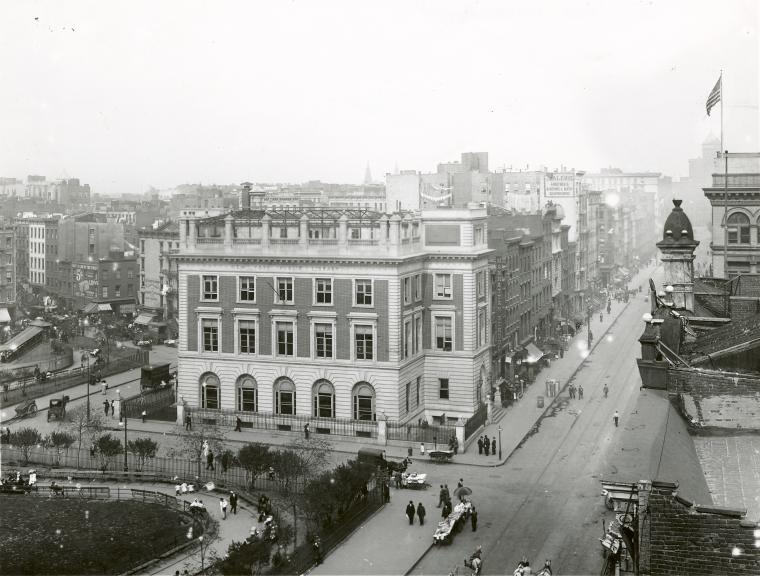
Below is a picture, facing east, of Seward Park Library in the Lower East Side at 192 E. Broadway (picture taken in 1911). This spectacular branch library, funded by Andrew Carnegie, opened in November 1909, two years before the 42nd Street main branch opened. All of the housing behind the library to the east has since been demolished.
Courtesy New York Public Library
The nearby park in the foreground is still there. Inn fact, it’s recently been renovated! But the small extension of Jefferson Street which separate the park from the library has been turned into a paved, closed off pedestrian plaza. The streets seen in the left of the photograph are completely gone.
The library was built by the firm Babb, Cook and Welch, whose accomplishments from the Gilded Age are seldomly still found today.
But, in fact, one of the firm’s lead architects William Cook was part of a committee which included Charles McKim (of McKim, Mead and White) and John Carerre (of Carerre and Hastings, who ultimately designed the famous 42nd Street branch) to standardize branch library designs in the city.
Those two better known firms got most of the commissions; however the Seward Park library remains one of Babb, Cook and Welch’s best known remaining public works.
During the library’s first years, readers were actually allowed onto a “roof garden.” According to a New York Times article from 1910, “There will be awnings over the top to shield from sun and the occasional shower; tables around which the readers can congregate, and a network of electric bulbs strung over the top so that there will be plenty of light for the industrious who wish to study.”
The rooftop library, 1910. Courtesy New York Public Library
Adults were even allowed onto the roof late into the evening, including “mothers who wish to do their sewing out of doors.”
Although this grand structure was placed here in 1909, it was certainly not the neighborhood’s first library. Once the domain of the private sector, libraries were provided by philanthropic organizations such as the Aguilar Free Library Society, which began offering a reading room for New Yorkers at this very address starting in 1891.
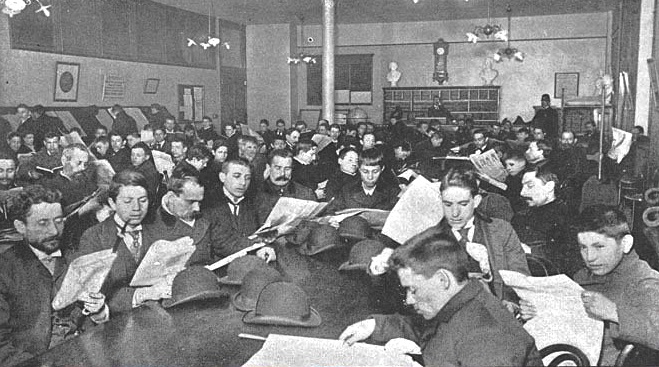
Below: Inside the Aguilar Free Library in 1895.
De Leeuw & Oppenheimer, – Souvenir book of the fair in aid of the Educational Alliance and Hebrew Technical Institute. New York : De Leeuw & Oppenheimer, 1895
Aguilar’s East Broadway library, “where the readers are nearly all Hebrew,” featured over 140,000 thousands books, the most popular being ‘Uncle Tom’s Cabin’ and ‘Around The World In 80 Days”. This library was sold in 1902 and remade as the building which stands there today.
The Seward Park Library has gone through two major renovations, the most recent in 2004, bringing back most of the building’s original lustre. As evidenced by this photo, little around it remains from its original condition.
Here are a couple more interesting views of the neighborhoods, featuring meany streets and structures that are no longer with us today:
Looking north, 1928. The library is mid-frame, far right. The main thoroughfare seen here is Essex Street. The Williamsburg Bridge can be seen faintly in the distance.
Kalart Co/Museum of the City of New York
Looking east along Canal Street to Strauss Square, Seward Park and the library. The Forward Building is the tall structure to the right.
EPISODE 307 The Holland Tunnel, connecting Manhattan with Jersey City beneath the Hudson River, is more important to daily life in New York City than people may at first think.
Before the creation of the Holland Tunnel, commuters and travelers had painfully few options if they wanted to get to and from Manhattan. And for the city’s many waterfront industries, there was mostly only one option — barges and ferries which carried cargo across the crowded Hudson River, maneuvering through an overcrowded port system which profited from the grotesque congestion.
And then along came the automobile, rapidly transforming the American way of life. How could an average motorist — or a regular cargo truck — get back and forth to New York City in its current chaotic state?
NJ.com
The new tunnel envisioned by chief engineer Clifford Milburn Holland would create a new pathway for motor vehicles, the first for such conveyances under the Hudson River.
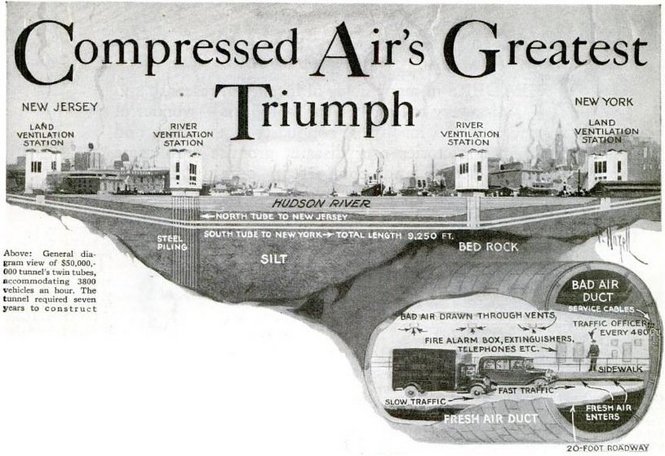
Yet one pressing problem stood in the way of its completion. Railways and mass transit could travel through long, underground tunnels because their tracks were electrified. But automobiles produced poisonous exhaust — carbon monoxide — making a contained tunnel almost 100 feet underwater a deadly proposition.
The ingenious solution would ensure not only the success of the New York/New Jersey tunnel, but would change the fate of automobile transportation in the United States and around the world.
PLUS: The tragic story behind the naming of the Holland Tunnel
LISTEN NOW — THE HOLLAND TUNNEL
THE TAKEOUT — A bonus after-show podcast for those who support us on Patreon. We share a few interesting details that didn’t make it on the show — including the Holland Tunnel police force and their odd tunnel ‘cop car’ and the story of the first bridge over the Hudson River (in the year 1804!) PLUS — Why is the Holland Tunnel so underappreciated in comparison to the region’s great bridges? Subscribe at the Five Points level and above to receive this bonus show.
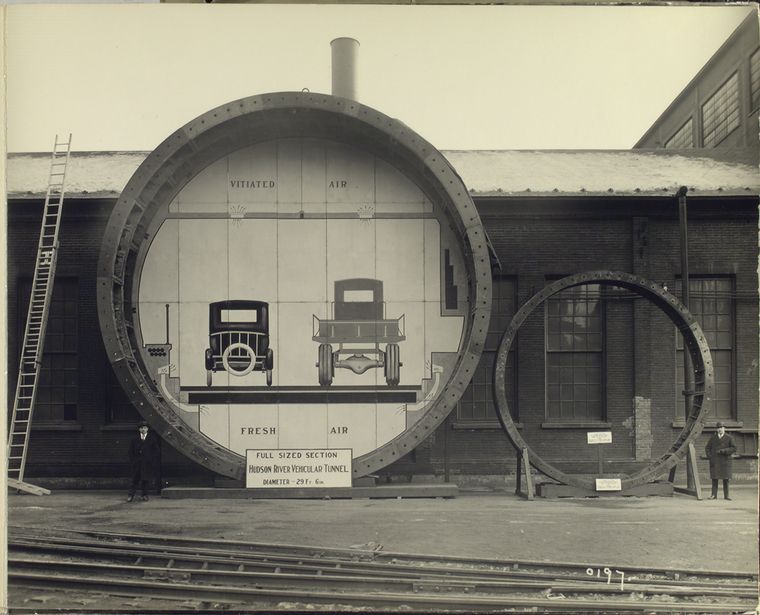
A full sized section of the Hudson River vehicular tunnel (aka the Holland Tunnel) 29′ 6 inches diameter, taken 1923, courtesy New York Public Library
Also taken 1923, courtesy New York Public Library
Miners in the tunneling shield, shoveling out the south tunnel, 4/5/23. NYPL
Canal Street shaft and air locks, South tunnel, 4/24/23, NYPL
Holing through North Tunnel between New York and New Jersey. November 1924. NYPL
The famously large New York river shaft caisson, leaving St. George, Staten Island. January 1923.
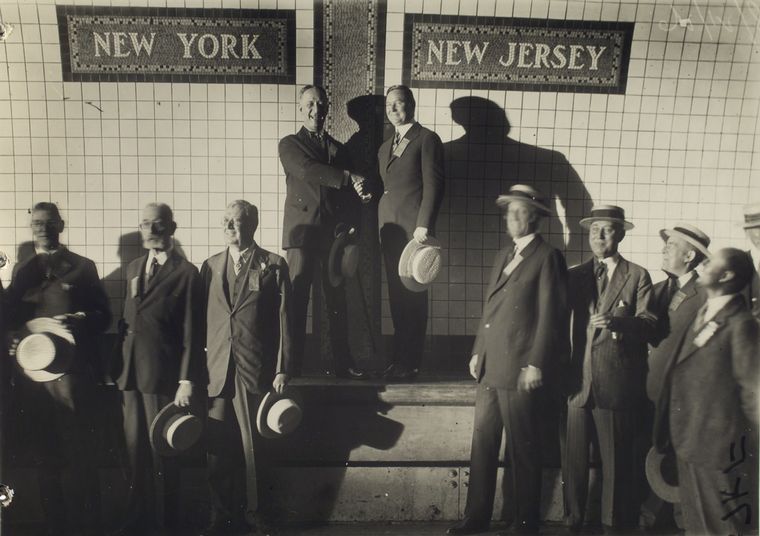
The governors, officially meeting halfway!
NYPL
Photo from 1935, courtesy Museum of the City of New York.
A Holland Tunnel catwalk car, used by Port Authority during the 1950s. Courtesy Hoboken Historical Museum
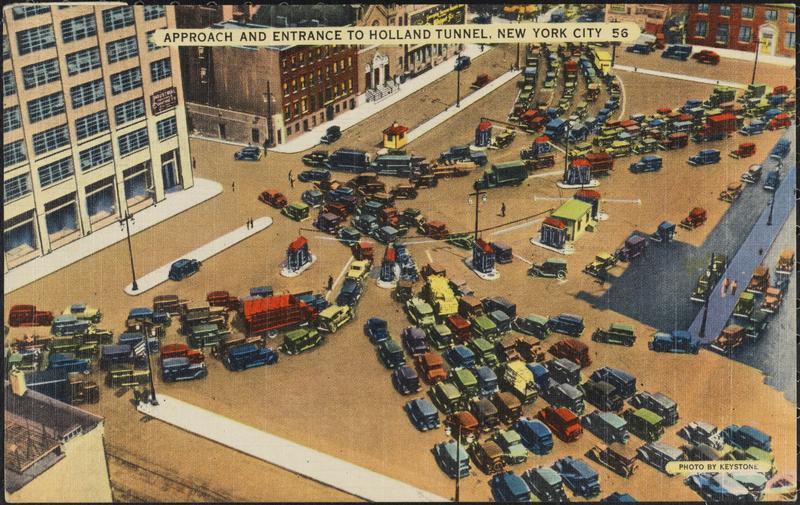
Madness! A 1954 postcard showing the maelstrom of traffic at the tunnel entrance in Manhattan. Courtesy Museum of the City of New York
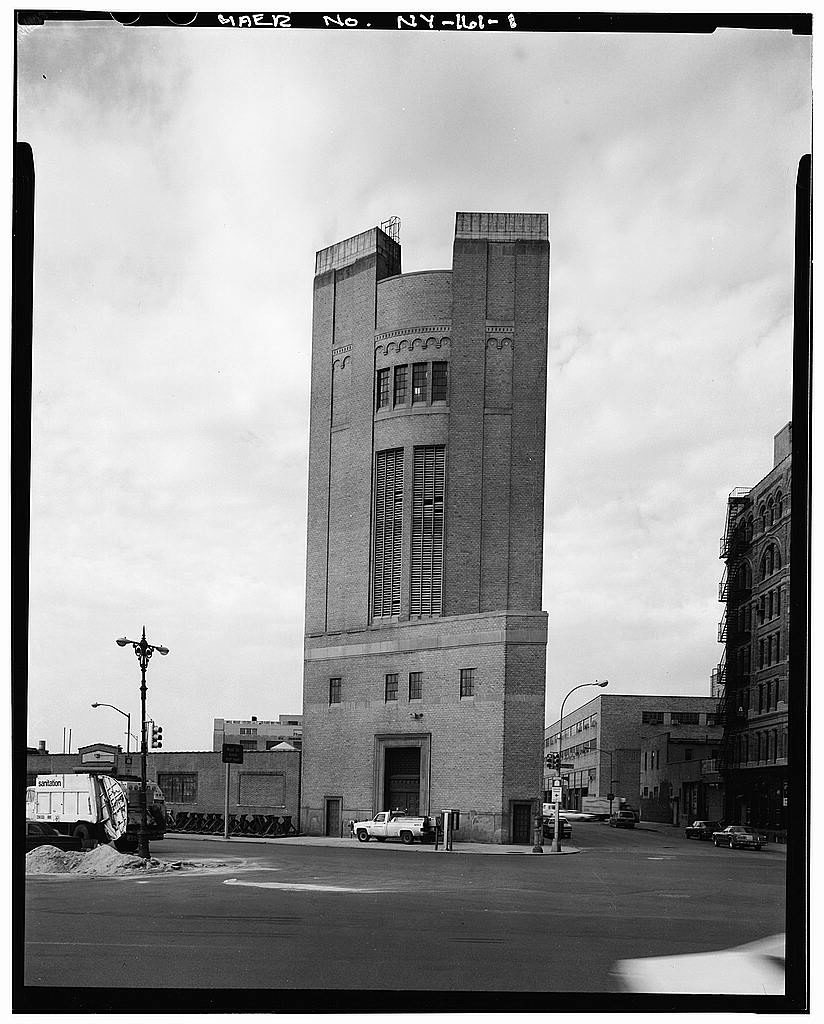
The New York Land Ventilation Tower, photo courtesy Library of Congress
Ventilation towers on either side of the Hudson River. The tunnel runs under the Hudson between these towers. Photo courtesy Library of Congress
FURTHER LISTENING
After listening to our show on the Holland Tunnel, check out these episodes with similar themes:
The George Washington Bridge would open just a few years after the Holland Tunnel. It too faced some interesting engineering hurtles…..
The Tribeca neighborhood would be greatly affected by the tunnel’s construction — in grand ways (clearing away those congested ports) and bad (the true end of the old St. John’s Park neighborhood).
Wow it’s been a busy time on the podcast this year. Twenty-seven new episodes of the Bowery Boys: New York City History podcasts in 2019 — along with seven episodes of the Bowery Boys Movie Club, four of The Takeout and other bonus audio for those who support us on Patreon. That’s a lot of talking!
For 2020, we’re thrilled to announce MORE live shows than we’ve ever done before and new episodes visiting landmarks and neighborhoods that we’ve never visited on the show.
What follows is a list of our ten most popular shows in 2019. Did your favorite Bowery Boys episode make the list? We’ve embedded a player for each episode so you can listen to them all
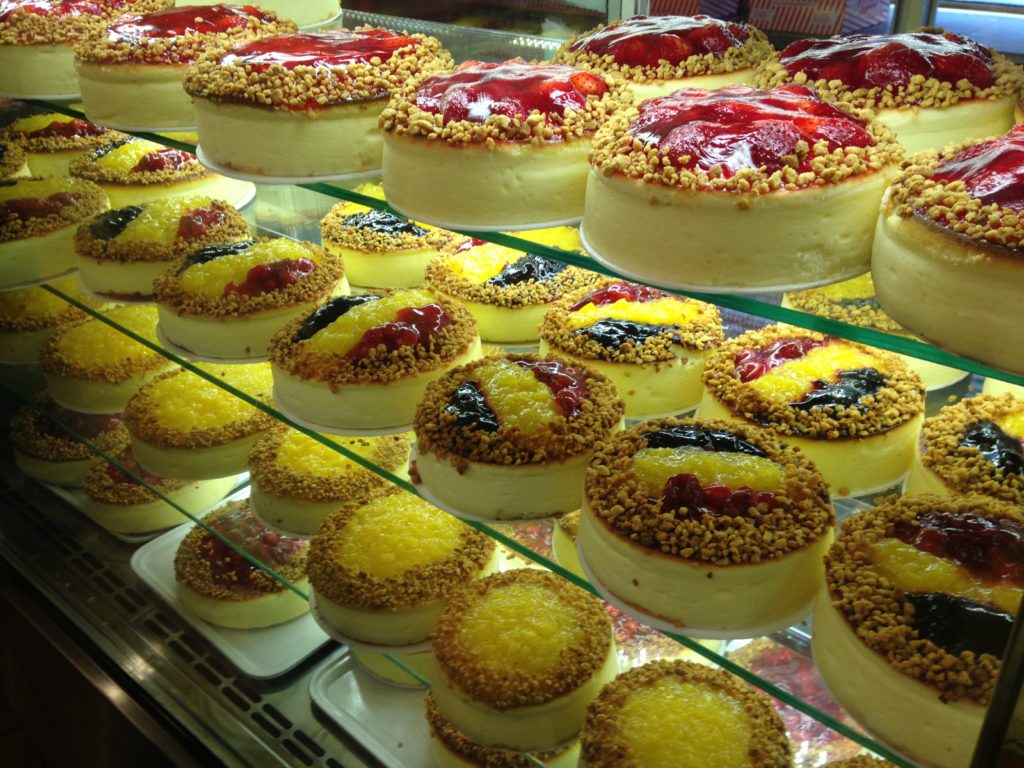
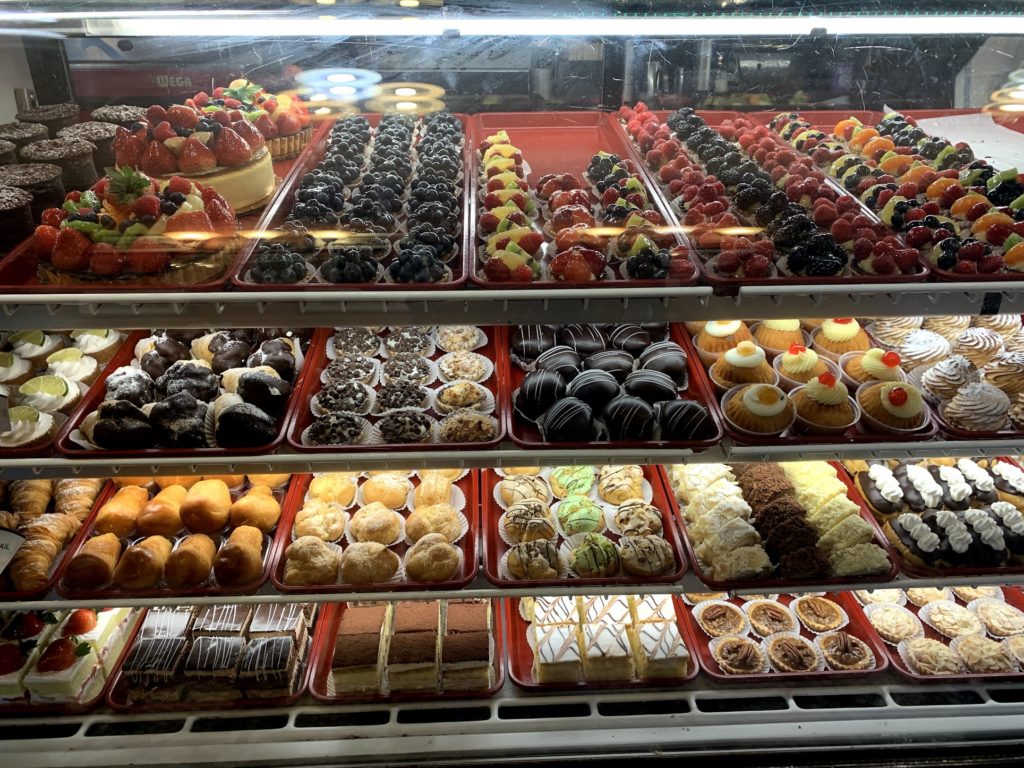
In this special episode, the Bowery Boys podcast focuses on the delicious treats that add to the New York experience. These aren’t just the famous foods that have been made in New York, but the unique desserts that make the city what it is today.
The origins of some of these treats go way, way back — the Dutch New Amsterdam. Others have become staples of the New York diet thanks to immigrant groups who first developed and perfected them in neighborhoods like the Lower East Side.
So while this show may seem like a trifle, the underlying story celebrates the contributions of local communities in creating timeless food classics, served in historic bake shops, candy stores and cafes.
Cheesecake and cannoli are two of our five historic treats. What are the other three? Tune in and find out! (And definitely save some room after dinner for dessert.)
LISTEN NOW — JUST DESSERTS
THE TAKEOUT — A bonus after-show podcast for those who support us on Patreon. Greg dives into further tales of sweet history. Near the Brooklyn Bridge sits a remnant of an old Revolutionary War sugar house with a disturbing history (and possibly ghosts). The Gilded Age shopping district of Ladies Mile was also the home of a short lived chocolate factory. And the tragic story behind the Tootsie Roll.
PLUS: More on the history of soft drinks. Who was Doctor Pepper?
FURTHER LISTENING: Check out our other food history episodes!
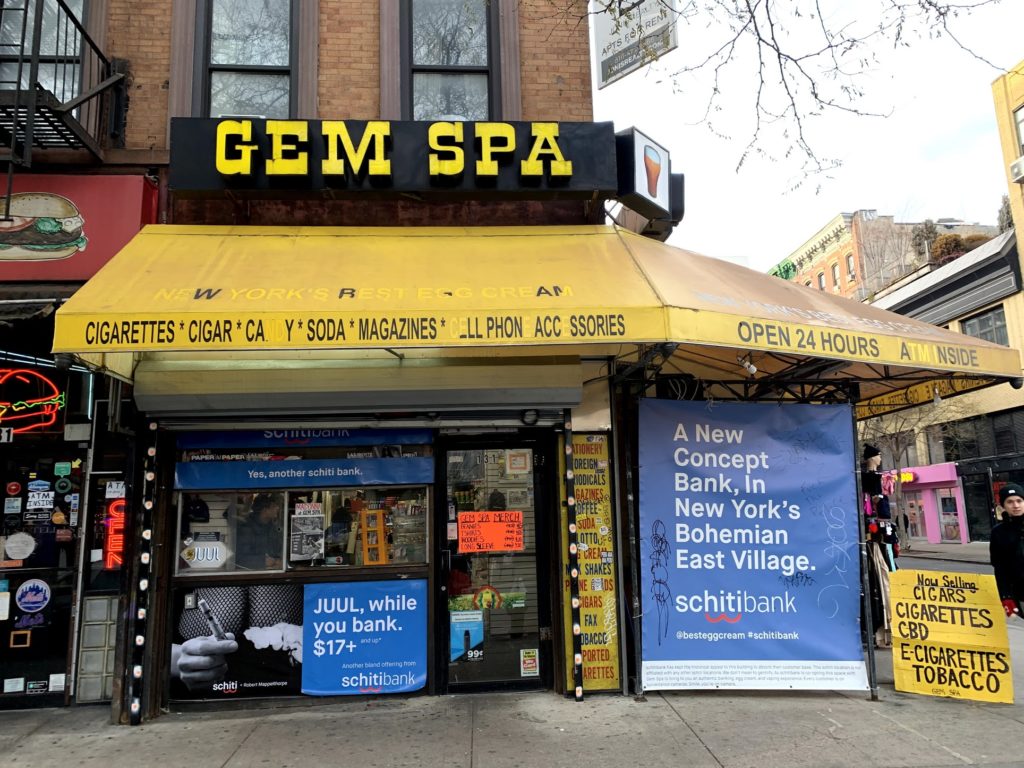
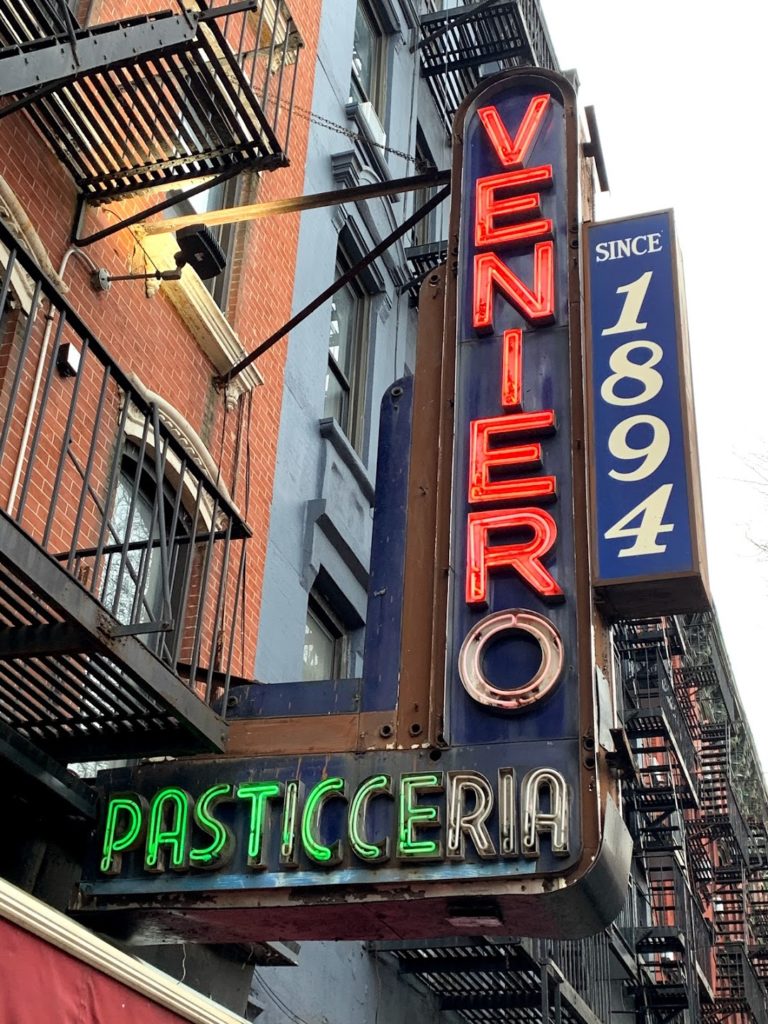
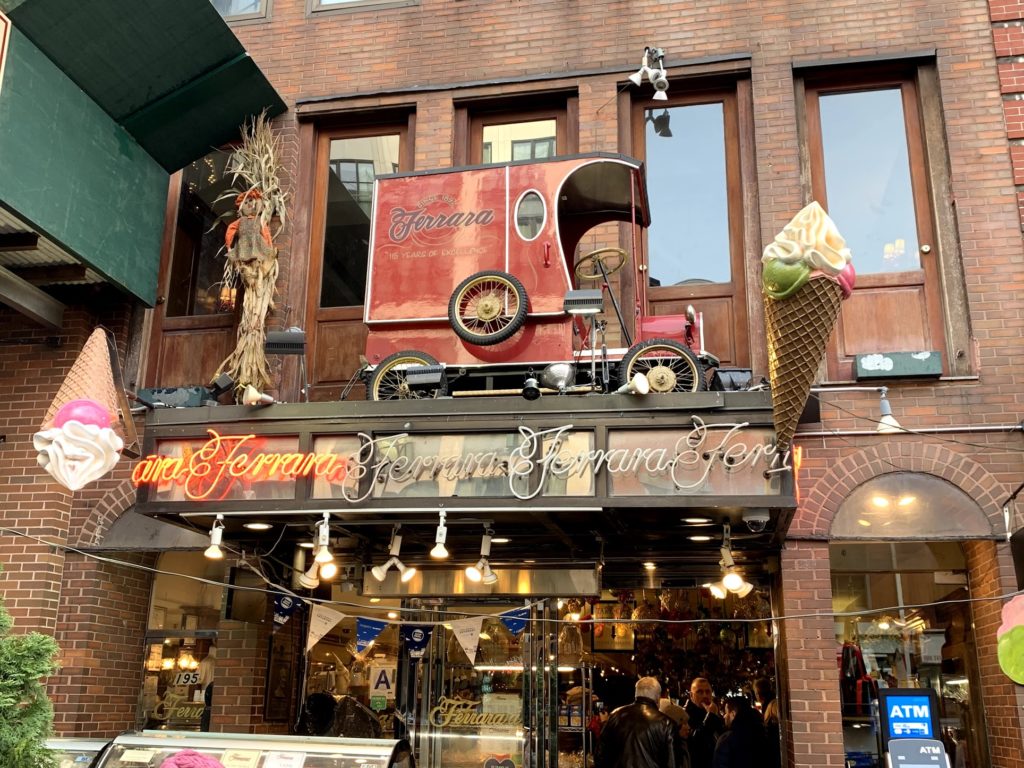
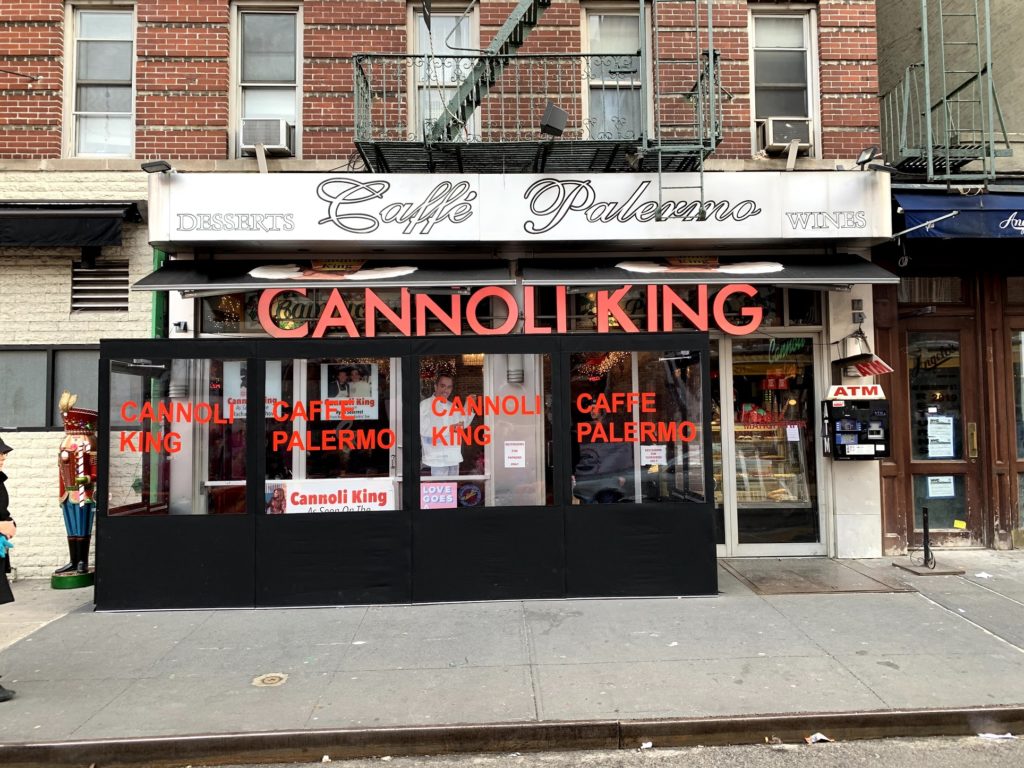
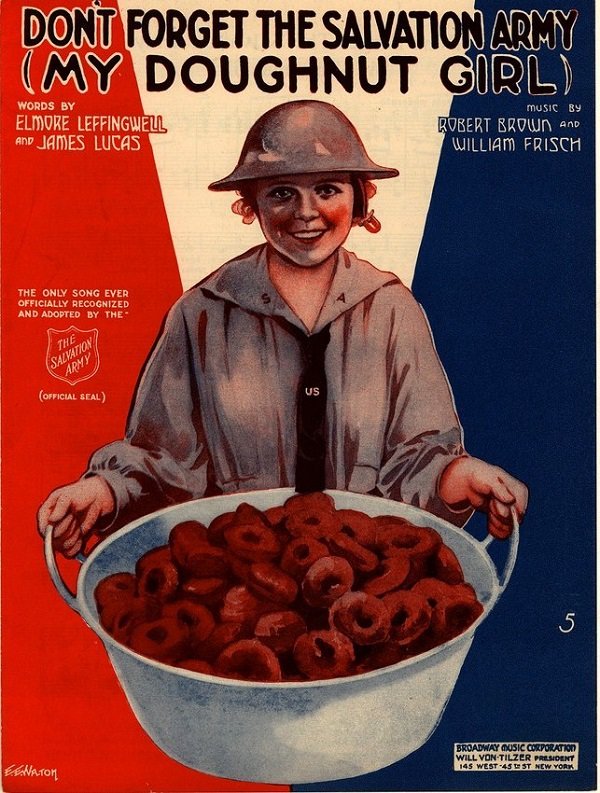
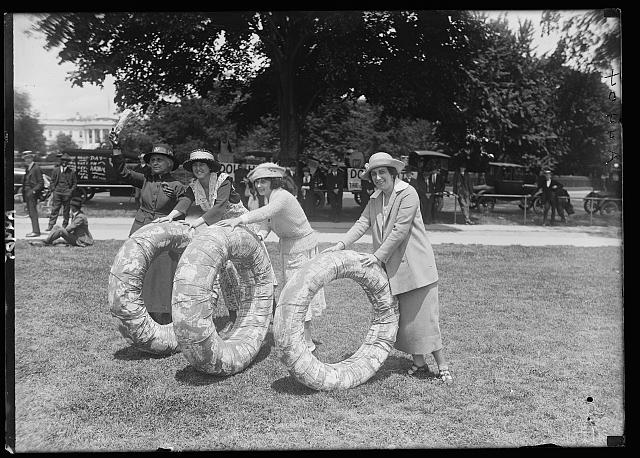
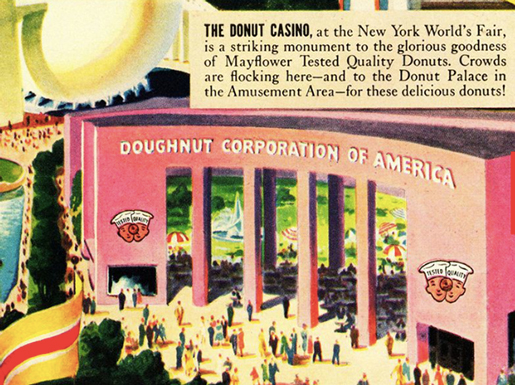
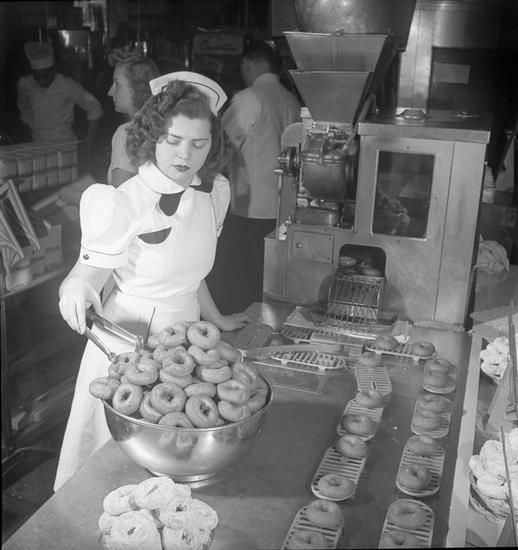
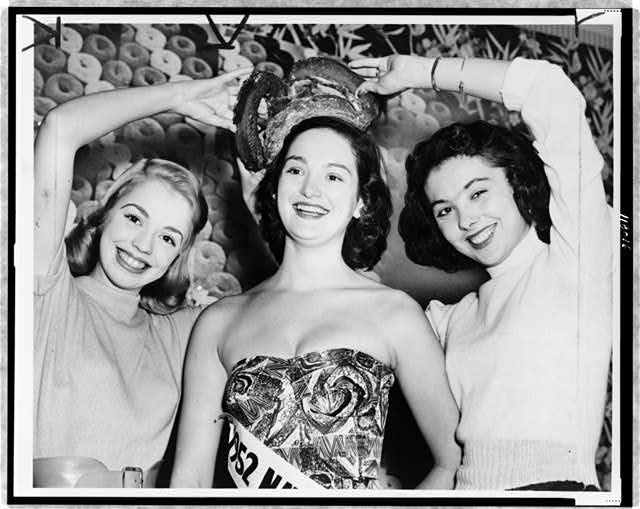
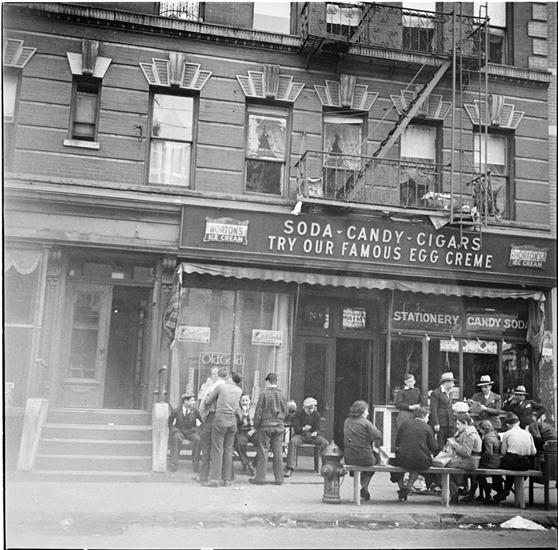
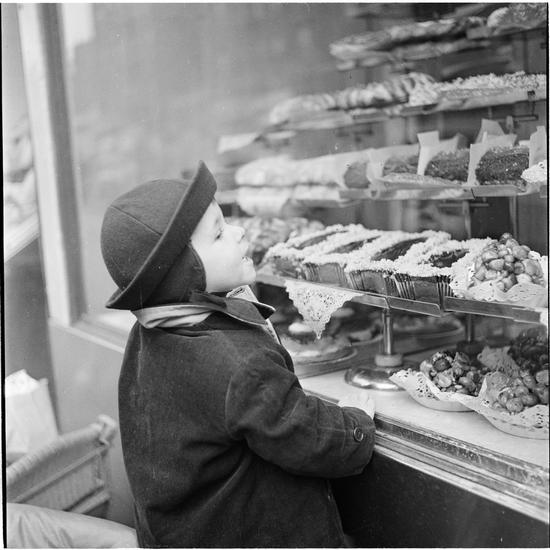
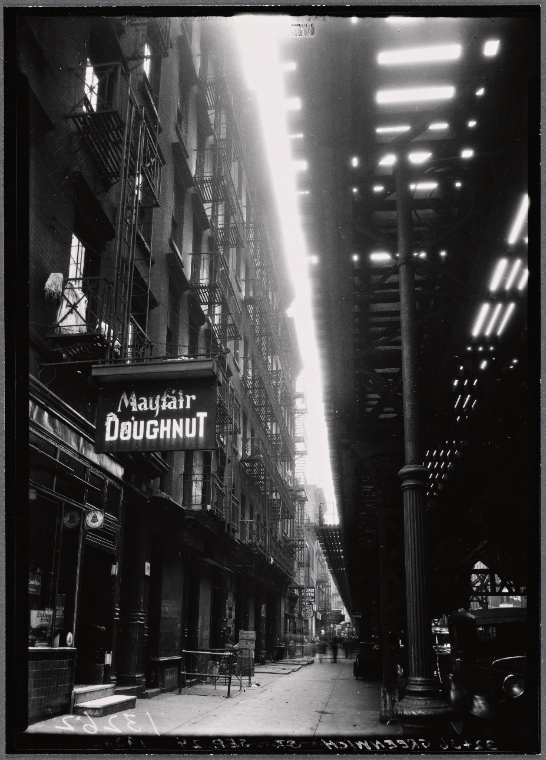
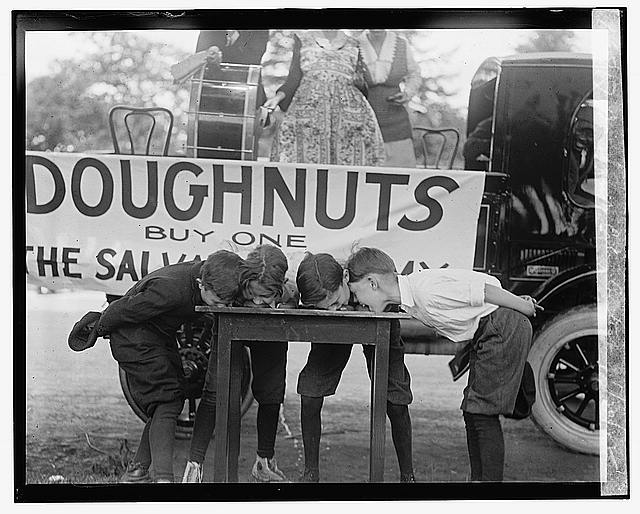
Inside the wonderful world of Junior’s in BrooklynA view inside Caputo’s Bake Shop in Carroll Gardens, BrooklynA no-fuss egg cream can still be had at Gem Spa, which has been serving them for generations.Sweets to your heart’s delight at Veniero’s, celebrating 125 years.Ferrara’s in Little Italy is always hopping with hungry patrons….…as is Caffe Palermo’s around the corner, aka the Cannoli King!Sheet music celebrating the World War I ‘doughnut girl’A 1922 Salvation Army ‘doughnut race’. Harris & Ewing, photographer, Library of CongressThe Donut Casino, delivering thousands of free doughnuts to World’s Fair goers.A well-dressed employee working a doughnut machine at a shop in Times Square. 1945, Bob Leavitt, Look Magazine. Courtesy Museum of the City of New YorkNancy Templeton, the 1952 National Doughnut Queen flanked by her runners-up. orld Telegram & Sun photo by Fred Palumbo, Library of CongressA New York City candy store, advertising egg creams, 1935. Arnold Eagle, photographer. Courtesy Museum of the City of New York.A photo taken by Stanley Kubrick in 1947 of a child admiring pastries. Courtesy Museum of the City of New York
Is Bloomberg really running? If so, this would make David Dinkins the only previous living mayor of New York City never to have run for the highest office in the land.
And it begs the question — is it even possible for the leader of the biggest city in America to step up to the role of Commander In Chief?
Precedent tells us no. Not one New York City mayor in history who ever actively tried or hinted at being interested in the job ever got it. Indeed it’s difficult — especially in recent years — to even identify any genuine enthusiasm for such presidential runs.
The Road to the Presidency
This is rather unusual as the mayor of New York City has certain responsibilities akin to running an actual country. Our city has a diverse population the size of Austria with immense financial and cultural power. One might expect the job to be a natural stepping stone to the White House.
Mayors of American cities and towns have become president in the past although that biographical detail is usually not a defining aspect of that candidate’s résumé. For instance, Calvin Coolidge tenure as mayor of Northhampton, Massachusetts, was but one of several offices the lawyer achieved on his way to the presidency.
Grover Cleveland was also a mayor (of Buffalo), but it’s his experience as Governor of New York which recommended him for the Office of the President.
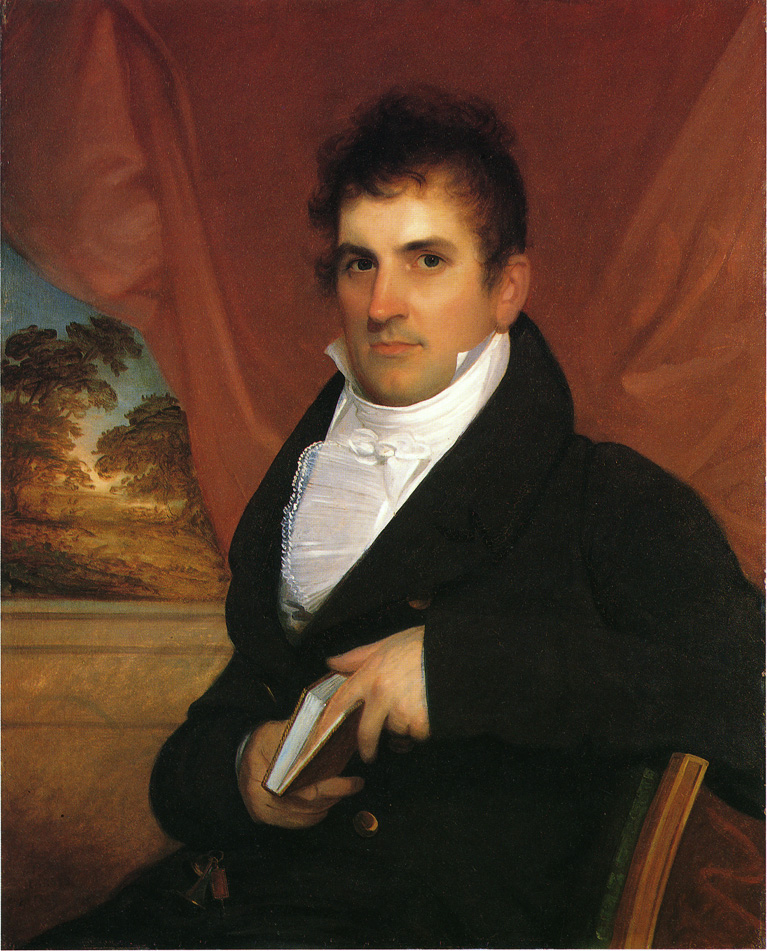
Mayor Philip Hone, in a painting by John Wesley Jarvis, never ran for President but ‘the party mayor’ was close friends with several of them.
Indeed the real road to power is through the office of New York state governor. Four former governors have become president (Cleveland, as well as Martin Van Buren, Theodore and Franklin Delano Roosevelt), four more were vice president (George Clinton, Daniel Tompkins, Levi P. Morton and Nelson Rockefeller) and two have even become chief justice of the Supreme Court (John Jay and Charles Evans Hughes).
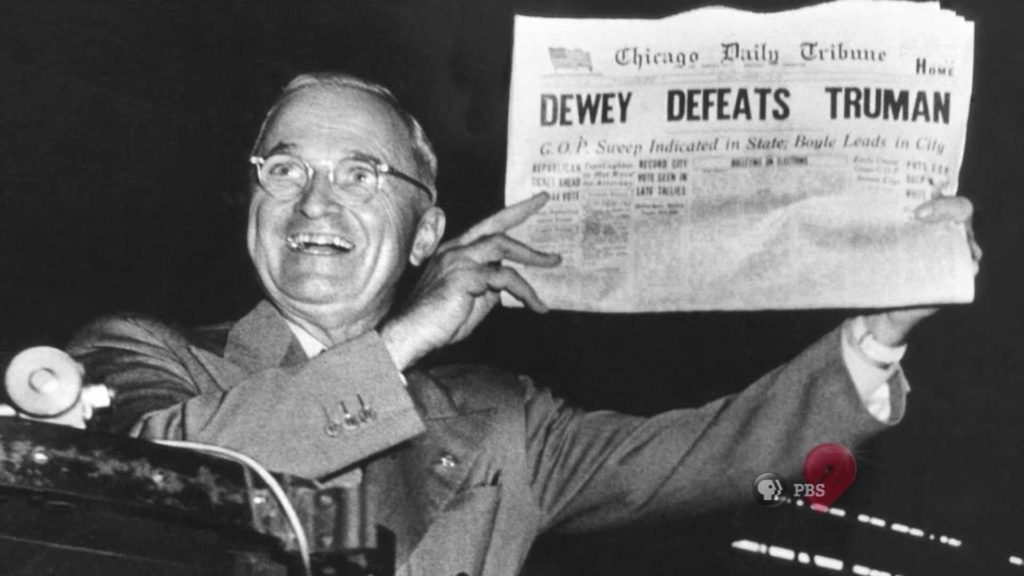
Even those governors who failed to become president did so in a dramatic and historic fashion, such as former governors Al Smith, Samuel Tilden and Thomas Dewey (of the particularly famous photo below).
New York governors often have very interesting failed presidential runs!
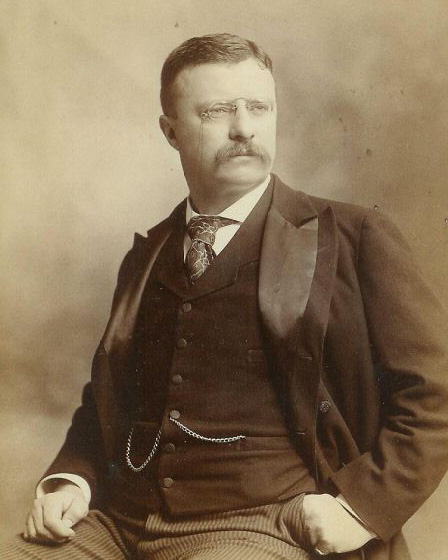
Then you have Theodore Roosevelt who was the New York City police commissioner and eventual New York governor who became the Vice President and then the President of the United States — all in the span of less than seven years.
Courtesy US Navy
But Mayor of New York City? No.
New York City Mayors and the White House
The list of what-ifs and also-rans is long indeed:
Michael Bloomberg — The mayor from 2002-2013 has flirted many times with a presidential run but has never made the leap — until now. Since his first flirtation with a presidential bid, the political world has shifted greatly. The three-term Republican mayor changed his party affiliation to Democrat last year although he seems forever poised to run as a fiscally-minded centrist.
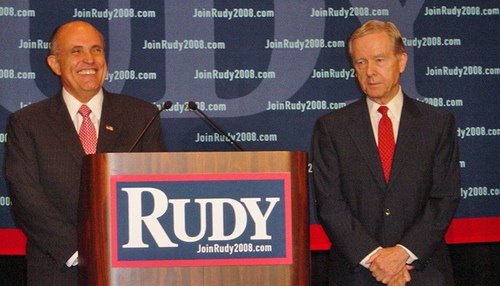
Rudy Giuliani — The mayor from 1994-2001 did run for President in 2008 but stumbled almost immediately after a major Florida miscalculation and never recovered, withdrawing on January 30, 2008.
John Lindsay didn’t fare much better than Rudy in his quest for the 1972 Democratic nomination. Starting out of the gate strong, like Rudy he stalled in Florida and eventually dropped out. Given the catastrophic changes to the city in the 1960s ad 70s, it’s not surprising that having ‘mayor of New York City’ on their political resume proved a stumbling block.
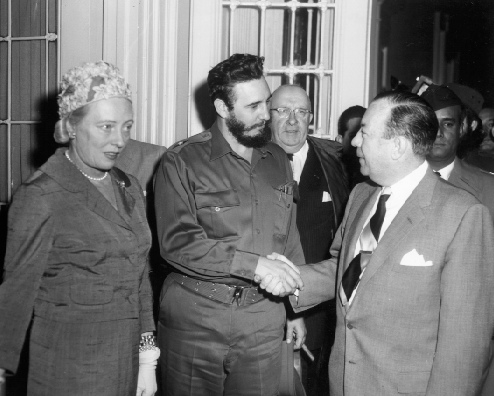
Robert F. Wagner (1954 to 1965) never ran for president but was short-listed to be Adlai Stevenson‘s vice president in 1956. Wagner was eventually beaten in balloting by Al Gore Sr. and John F Kennedy Jr. But, in the end, they were ALL beat for the spot by the clearly more popular, always reliableEstes Kefauver.
Below: Robert Wagner meets Fidel Castro during his visit to New York in 1959.
Courtesy La Guardia and Wagner Archives
New York City mayors before World War One were generally considered second tier, even props for political machines. Only a few were politically influential and that was often because of prior connections. You can read all our coverage of past New York City mayors here.
William Jay Gaynor (mayor 1910-1913) was widely considered a potential presidential hopeful, even with an assassin’s bullet lodged in his neck. Had he actually lived through his term as mayor, who knows?
George Brinton McClellan Jr (mayor 1904-1909) was never a presidential candidate but his father and Civil War icon George B. McClellan Sr most certainly was. The Union Army general ran in 1864 against Lincoln during his second term, promising to end the war in the South.
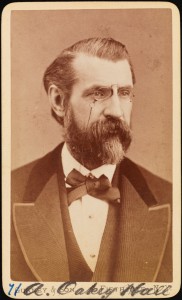
A Oakley Hall (mayor 1869 from 1872) (pictured at left) was as closely tied to the Boss Tweed Ring as a politico could be, but even he harbored presidential hopes. Considering he had to temporarily resign from mayor due to the Tweed scandal, I can’t imagine how much luck he would have had.
DeWitt Clinton (mayor for ten non-consecutive annual terms starting in 1803 ending 1815) collected political positions like postage stamps, but the one he could never lick was the presidency, defeated by incumbent James Madison in 1812. By June, Madison had declared war on England and later fled the White House when the Brits torched it.
How a Mayor gets to the White House
The closest a mayor ever got to a top federal job wasEdward Livingston, who became Secretary of State to Andrew Jackson. Which is interesting, as Livingston was literally ran out of Manhattan after his stint as mayor several years previous due to debts and scandals.
For the most part, most politicians who become the mayor of New York City rarely achieve higher elected office. John T. Hoffman is the last individual to be both New York City mayor and then a higher elected position (New York governor in 1869)
John T. Hoffman, a Boss Tweed favorite
This story has been revised from an article which ran on June 25, 2008. Because there’s always a chance, fellow mayors!
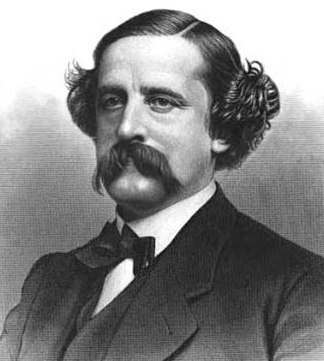
A toast to the great 20th-century architect Eero Saarinen! The Modernist icon was born on this date in 1910 in Finland. He immigrated to the United States with his parents when he was thirteen years old. His father Eliel Saarinen was himself a brilliant architect; his son would learn from the best.
Eero Saarinen was a versatile furniture designer and prolific architect, perhaps best known in the states as designer of the St. Louis Gateway Arch, an ambitious and even surreal monument that has come to define the city of St. Louis — and the American Midwest in general. When the Arch opened in 1965, it automatically entered the pantheon of great works of American art.
Saarinen was known as an architectural chameleon of sorts, shifting styles to fit the project. Although he died relatively young, at age 51 of a brain tumor, he gave New York City three very memorable, completely different buildings.
Sadly he did not live to see any of them completed (nor the Gateway Arch for that matter). Work was completed by his firm Eero Saarinen and Associates.
Carlo Fumarola/Flickr
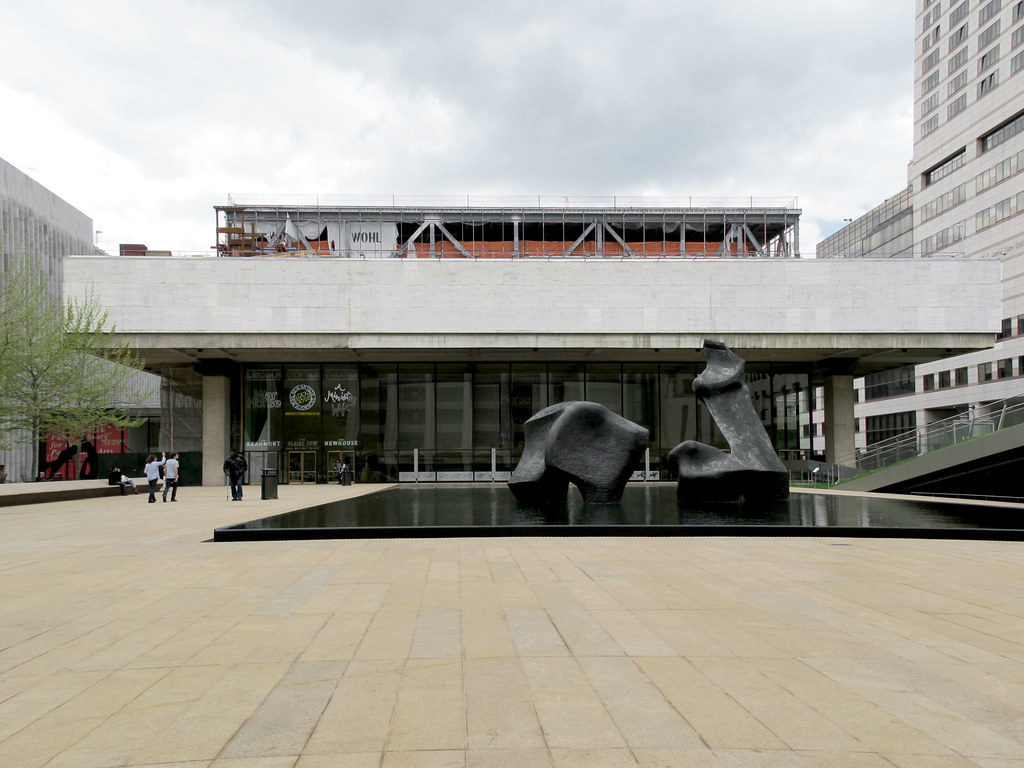
Vivian Beaumont Theater (150 West 65th Street, at Lincoln Center)
Completed four years after Saarinen’s death, the Vivian Beaumont was designed as part of the Lincoln Center complex, thus its concrete and glass containment works in sync with the other buildings in the plaza.
Friendly but formal, this massive theater remains as the only Broadway house outside the traditional Broadway district and has a notable thrust stage that gives performances a virtual in-the-round feel. Last year, New York Magazine ranked the Vivian Beaumont as the second best Broadway theater in New York (after the Richard Rodgers Theatre).
There’s are also two other theaters in the building — the Mitzi E. Newhouse Theater (for off-Broadway productions) and the Claire Tow Theater for off-off productions.
We talked about Saarinen’s involvement with this project in our podcast on Lincoln Center:
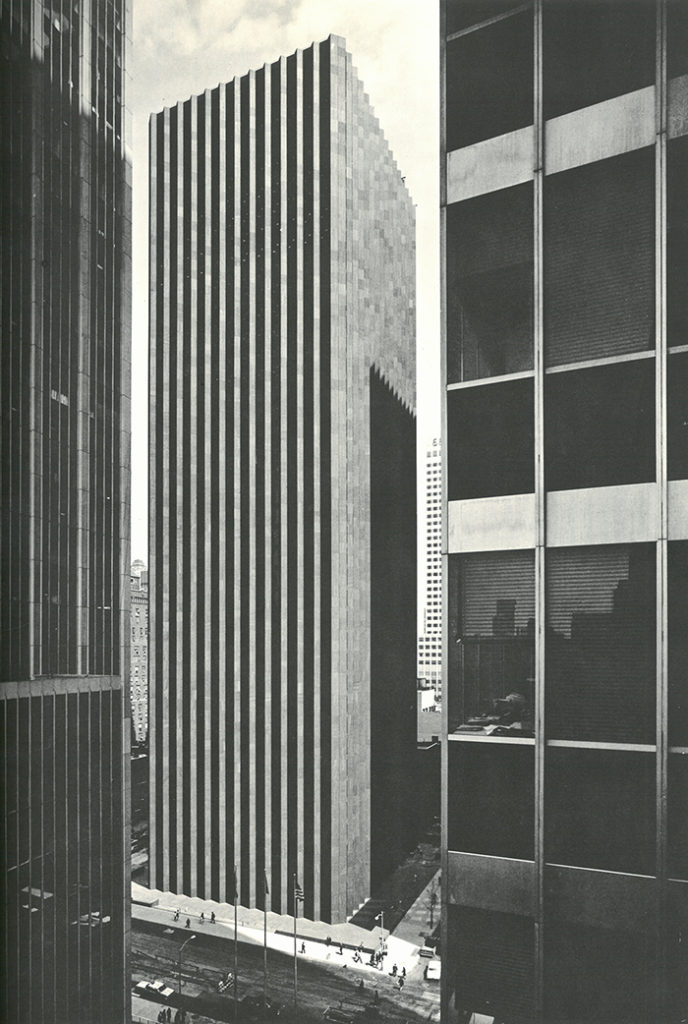
CBS Building (51 West 52nd Street)
Saarinen’s critics accused him lacking a defining aesthetic, something you might believe comparing the Lincoln Center playhouse to this lurching, severe structure on Sixth Avenue, affectionately nicknamed Black Rock.
Both the Vivian Beaumont and the CBS Building opened the same year, 1965. The CBS Building employs a moat of public space, and the building springs out of the crevice like an ominous plant.
On an avenue of steel, the rather scary CBS Building was the first to use reinforced concrete, although it’s draped in black granite.
It remains the headquarters of the CBS Corporation to this day. Black Rock was designated a New York City landmark in 1997.
From its landmark designation report: “When seen directly, the tower’s bays appear open, with relatively narrow granite piers alternating with relatively narrow window bays of single sheets of plate glass, but when viewed from afar and necessarily at an angle, the V-shape of the piers effectively eclipses the view of the glass, creating the effect of a gray granite slab.”
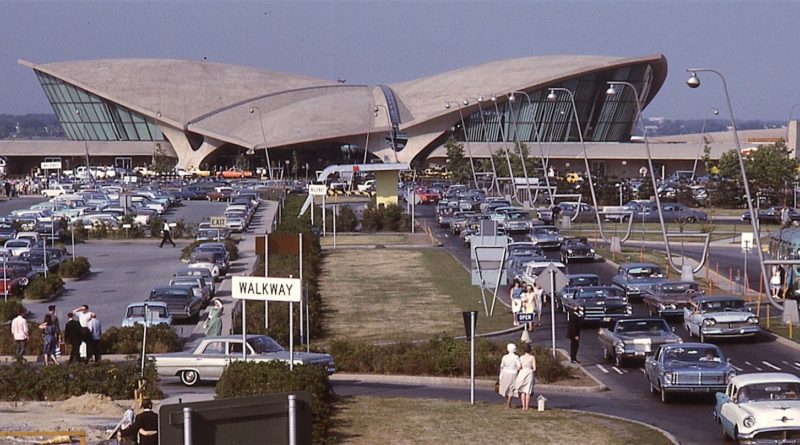
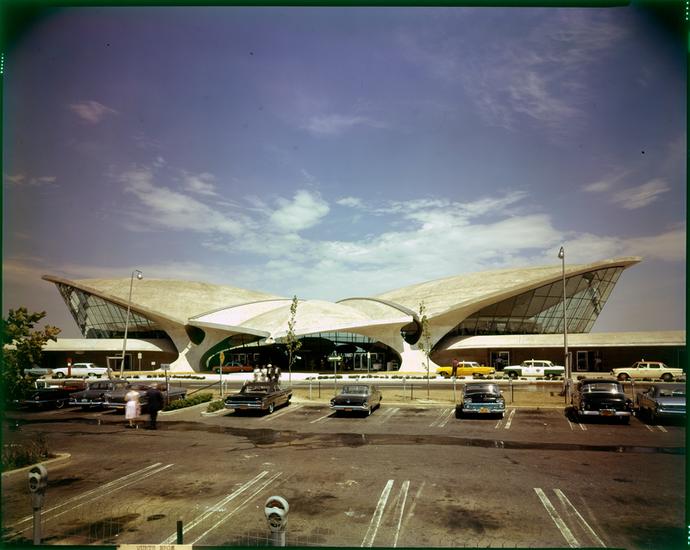
The TWA Terminal in 1962, photographed by the Wurts Brothers. Museum of the City of New York
TWA Flight Center (JFK Airport, Queens)
If you’re gonna write home about a Saarinen building in New York, make it the kooky, sometimes foolish, always imaginative terminal he designed for TWA that was completed in 1962.
It’s a tragedy that he never saw any of his New York buildings — not to mention the Arch itself — in final form. The terminal is so exotic and loopy that it energized arriving passengers.
It has the unity of some organic space being, retro-futuristic down to its benches. Or as Saarinen describes: “All the curves, all the spaces and elements right down to the shape of the signs, display boards, railings and check-in desks were to be of a matching nature.”
It outlived TWA, which was bought out in 1991. Thankfully landmarked in 1994 — saving it from any potential urges to demolish its now-dated, spacy halls — it has recently reopened as the swanky retro TWA Hotel at JFK.
To hear more about the details of the TWA Flight Center — and Idlewild/JFK in general — listen to our show on the history of the airport.
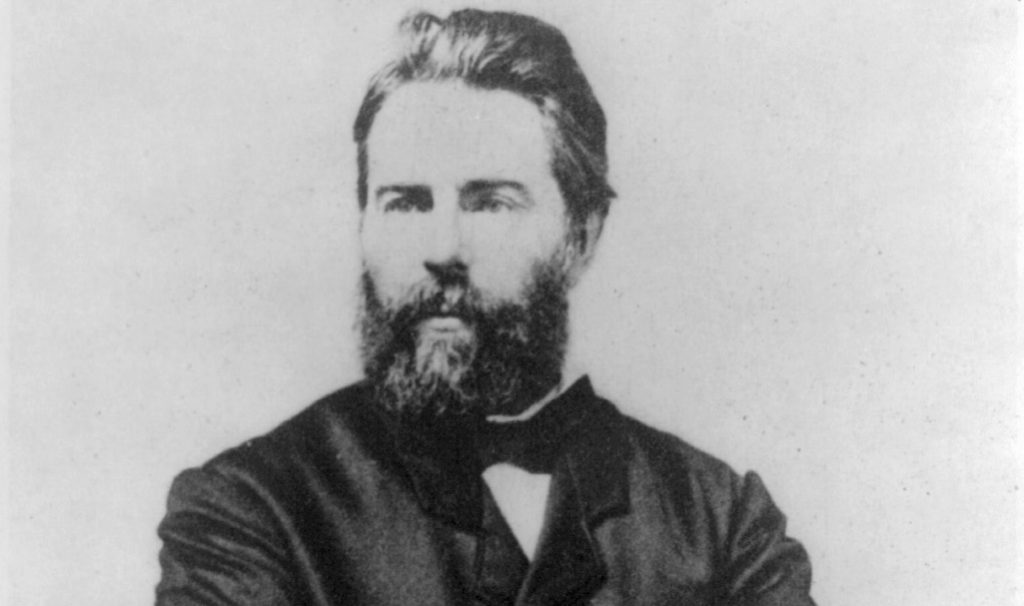
Herman Melville, one of America’s greatest writers of the 19th century, was born 200 years ago today. Here are five New York-centric facts about Melville that you may not have known:
1) Melville was born at 11:30 pm on August 1, 1819, at 6 Pearl Street. Today, across the street from that approximate location of the address sits a Starbucks, the coffee franchise named after a character in Melville’s Moby Dick.
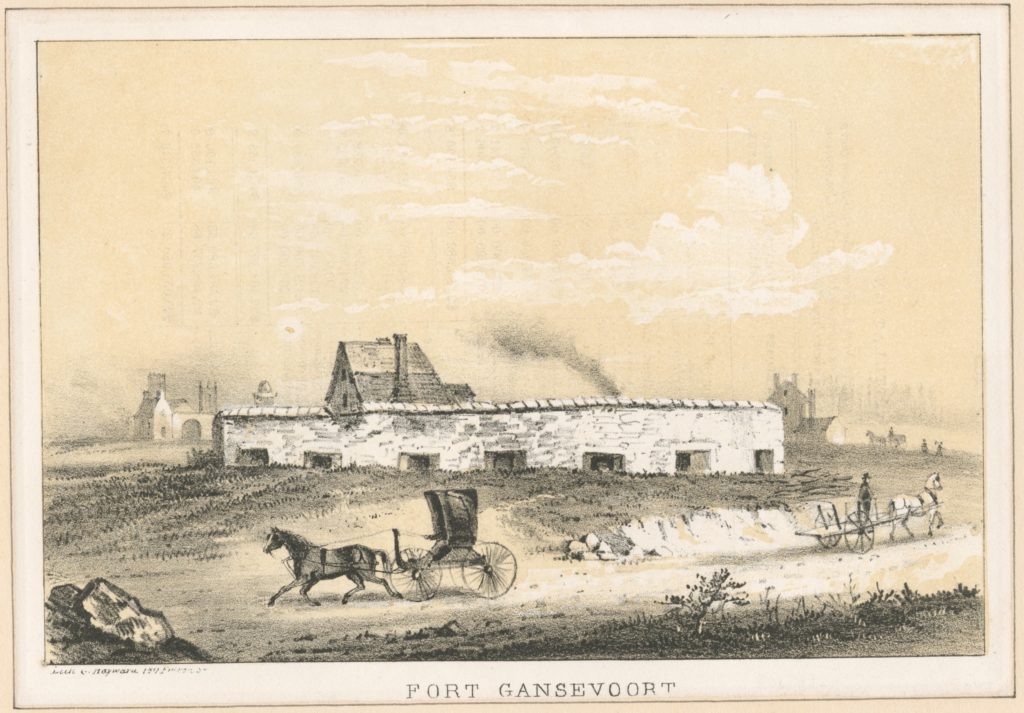
2) His grandfather Peter Gansevoort, a colonel in the Continental Army, had a fort named after him on the west side of Manhattan, in the area of today’s Meatpacking District. Gansevoort Street is a lasting tribute to both the colonel and his fort.
Melville worked on whalers and merchant ships as a young man, acquiring the rich experiences he would immortalize in his writing. For a time, he also worked in a customs office at West Streetand Gansevoort Street, almost exactly where the old fort once stood. Today a fortress to art stands in its place — the Whitney Museum of American Art.
3) His family’s wealth wildly fluctuated, and Herman’s father was at one point thrown in debtor’s prison. But at the height of the Melville’s prosperity, they managed to live in a luxurious townhouse at675 Broadway, between Bond and Great Jones Street. (Click the address to see what’s there today.) In the 1820s, that would have put them in the lap of wealthy New York
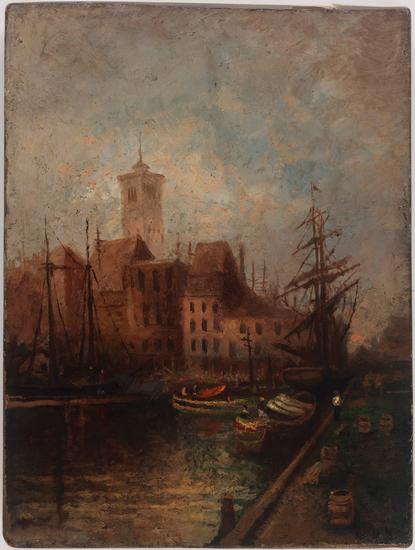
A painting of Coenties Slip circa mid 19th century, artist unknown. Courtesy Museum of the City of New York
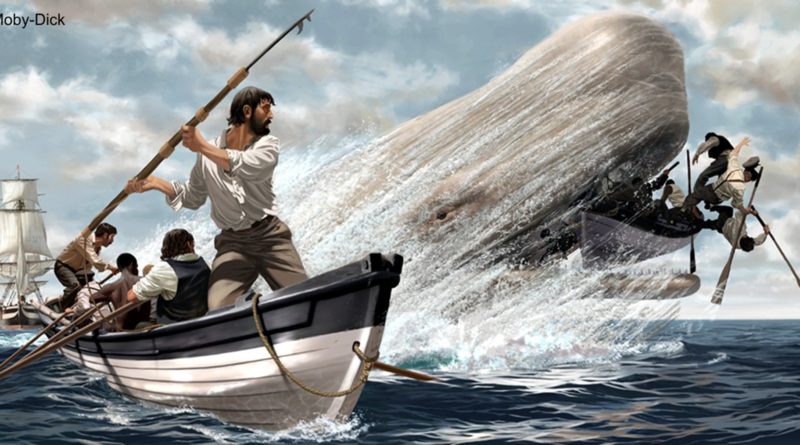
4) Melville was very familiar with all of downtown New York’s seaport culture but made special note to mention those places along the East River — Whitehall, Corlear’s Hook and Coenties Slip — in his book Moby Dick. These locations along the east side would have been his landscape as a youth, the places where his mind began crafting tales of adventure. From Moby Dick:
“Circumambulate the city of a dreamy Sabbath afternoon. Go from Corlears Hook to Coenties Slip, and from thence, by Whitehall, northward. What do you see?- Posted like silent sentinels all around the town, stand thousands upon thousands of mortal men fixed in ocean reveries. Some leaning against the spiles; some seated upon the pier-heads; some looking over the bulwarks of ships from China; some high aloft in the rigging, as if striving to get a still better seaward peep.”
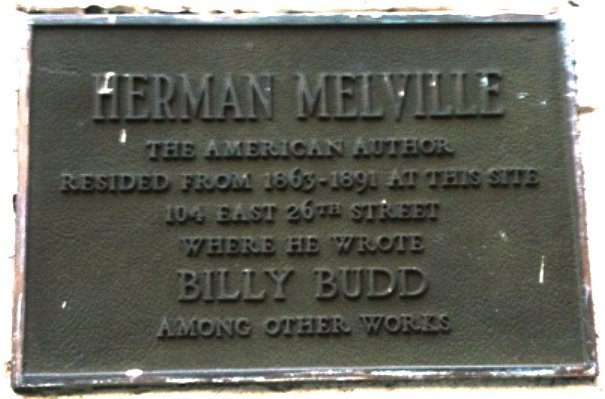
5) For much of his later career, Melville lived at 104 East 26th Street. Most of his greatest works had already been written, but it was from this house that he started a novella called Billy Budd. Uncompleted at the time of his death in 1891, it was later published and is today considered one of his greatest works. There’s a plaque nearby where this building once stood, making note of this important literary spot.
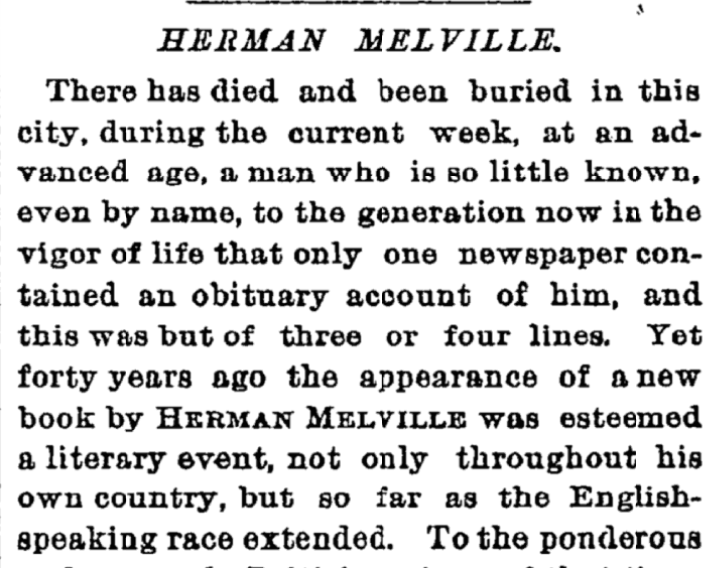
6) Melville died on September 28, 1891 and was buried at Woodlawn Cemetery. He had fallen into some obscurity at the end of his life; his initial obituary in the New York Times is a single paragraph. Somebody on staff, a lover of literature I would imagine, corrected this oversight a few days later with a longer tribute:
Eugenics, as with any creation from a mad scientist, was developed to advance the human race, built from the studies of Charles Darwin and Gregor Mendel. Shouldn’t we pass only mankind’s most laudable attributes to the next generation? Who wouldn‘t want to weed out disease and deformity?
Instead, it became one of the most insidious tools of the 20th century, a faulty science employed to punish individuals outside the norm and a sinister implement used by Nazi Germany in some of their greatest crimes.
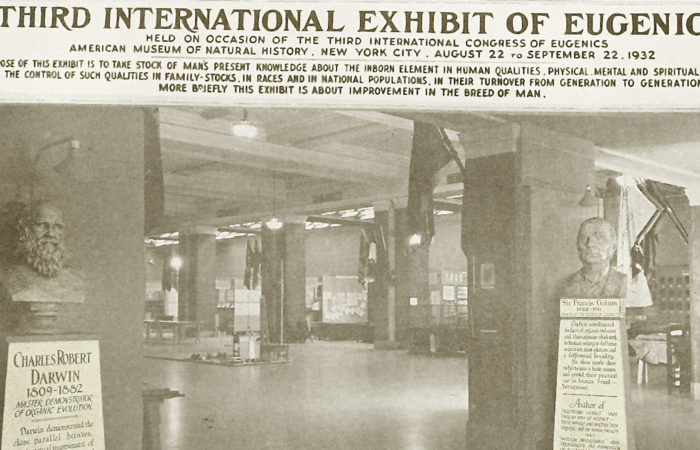
And it was developed largely thanks to the contributions of several of New York’s leading citizens and institutions.
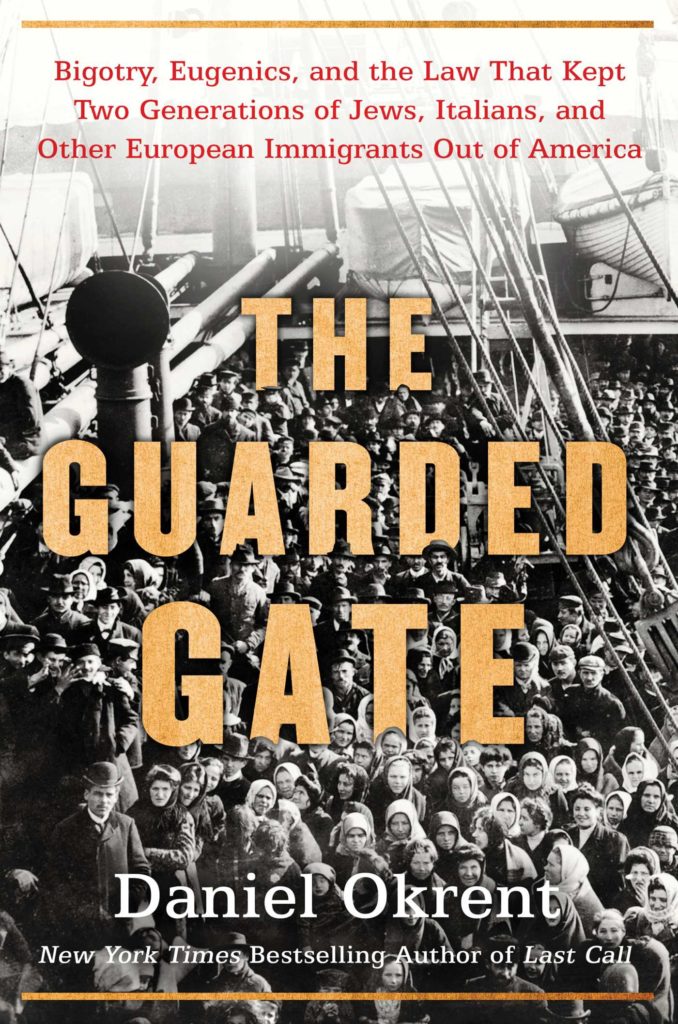
THE GUARDED GATE Bigotry, Eugenics, and the Law That Kept Two Generations of Jews, Italians and Other European Immigrants Out of America by Daniel Okrent Scribner
Daniel Okrent, author of Last Call(on American Prohibition) and Great Fortune (about Rockefeller Center), has produced his most vivid, most intense history yet, a look at the moment where the eugenics ‘craze’ meets the anti-immigration movement.
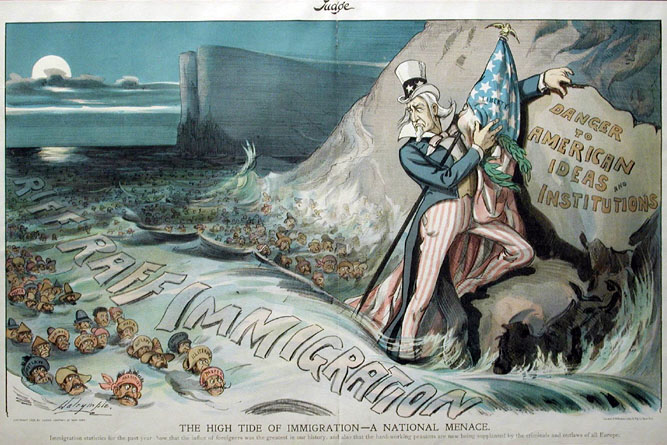
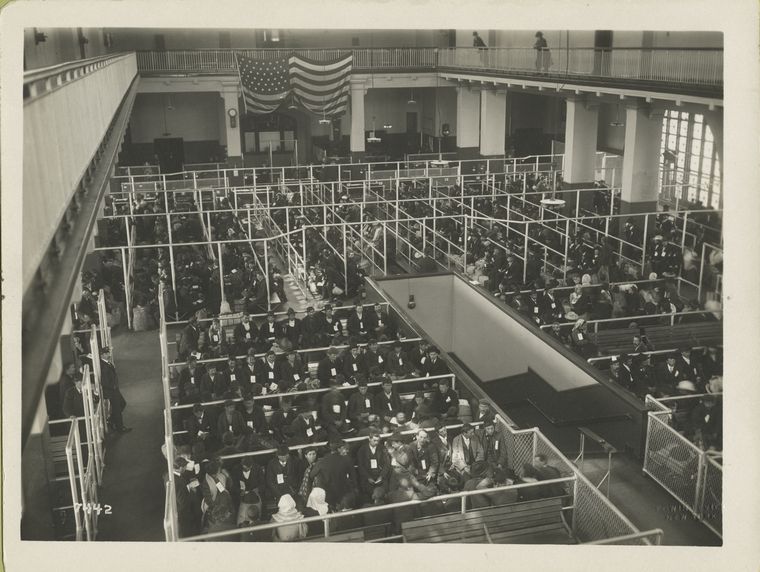
But such a large number of those immigrants initially settled within New York City that it’s not surprising that the most embittered protests came from the city. (Okrent’s book isn’t about New Yorkers per se but they happen to make up most of the cast.)
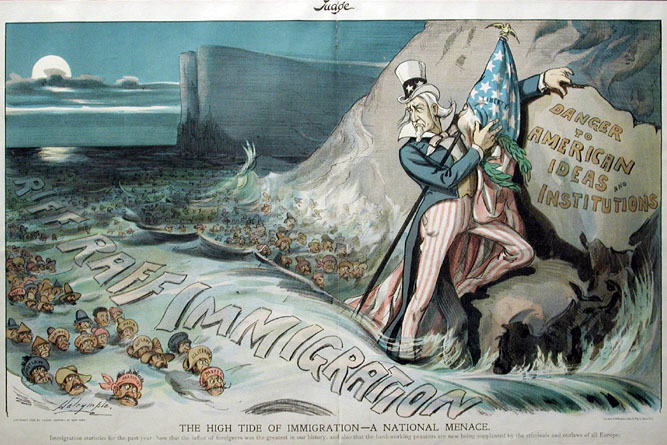
And that eugenics, a tool of ‘selective breeding’ already cruelly aimed at society’s most ‘feeble-minded’, would be brandished by those who wished to label whole ethnic populations as inferior.
An anti-immigration cartoon from 1903
Much has been made of Margaret Sanger‘s emphatic support of eugenics; so eager was she to promote birth control as an essential right of women that she latched her wagon to a most insidious cause. But many prominent New Yorkers believed eugenics was an enlightened path.
Both widowed heiress Mary Harriman (of Harriman State Park) and the Carnegie Institution funded the eugenics work of Charles Benedict Davenport (whose brother was the director of a Brooklyn settlement house) out in Cold Springs Harbor Laboratory.
The American Museum of Natural History, which Okrent calls ‘the home stadium for the eugenics movement’, was home to eugenics’ most ardent cheerleader (Henry Fairfield Osborn) and its most prominent critic (Frank Boas).
Okrent also reveals that Charles Scribner’s Sons, the actual publisher of Okrent’s book, was the de facto in-house publisher for the eugenics cause. In 1916, they published The Passing of the Great Race by Fifth Avenue blue blood Madison Grant, who popularized the phrase ‘the Nordic race’.
By the early 1920s, the anti-immigrant forces would declare victory. Thousands were abruptly turned away from American shores, families forever separated by newly enshrined quotas.
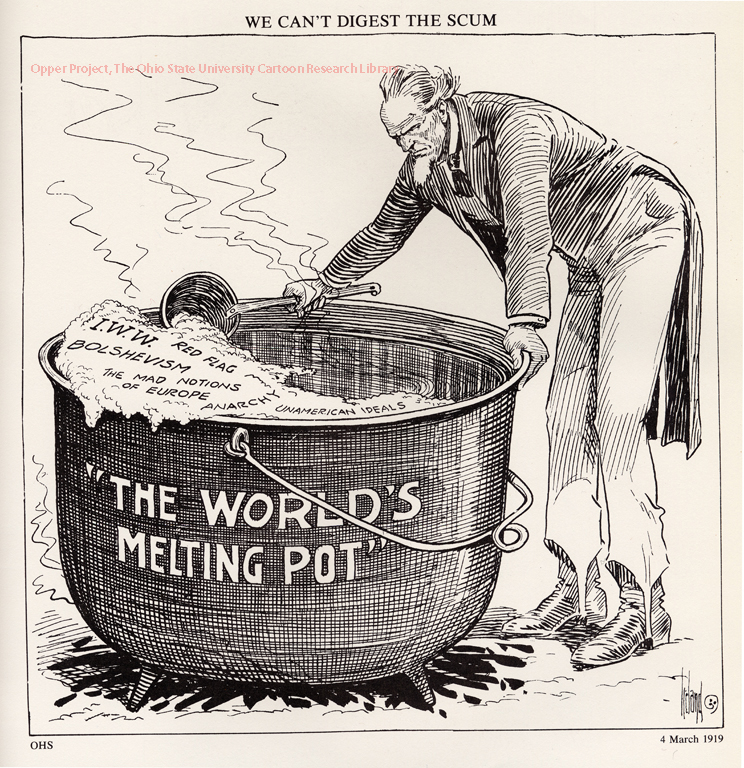
Columbus Dispatch, art by Billy Ireland, 1919
In 1900, eugenics was thought to be a precise way to curb human deficiencies from the ‘germplasm’, in itself a dangerous and wicked pursuit. In the hands of racists and bigots, it would serve as an inspiration for genocide.
Okrent, one of America’s greatest non-fiction authors, uses his sardonic voice wisely here, enlivening long passages of horrible human thought with bursts of caustic (and, on occasion, bitterly amusing) commentary. He delivers one of the most important history books of 2019.
Today is National Doughnut Day which is not a real holiday although that shouldn’t stop you from celebrating in whatever powdered, glazed, creme-filled way you see fit.
However you will be surprised to learn that this day traces its roots to the Salvation Army and World War I.
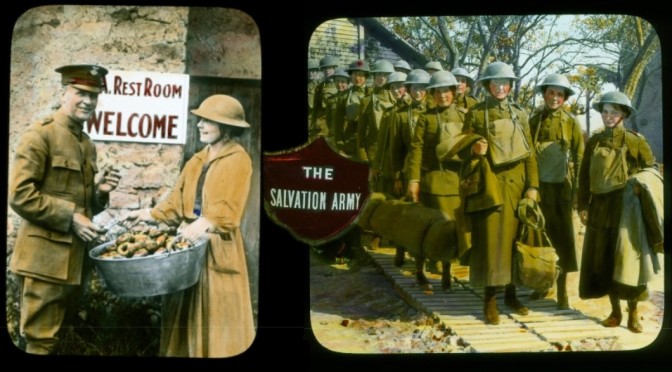
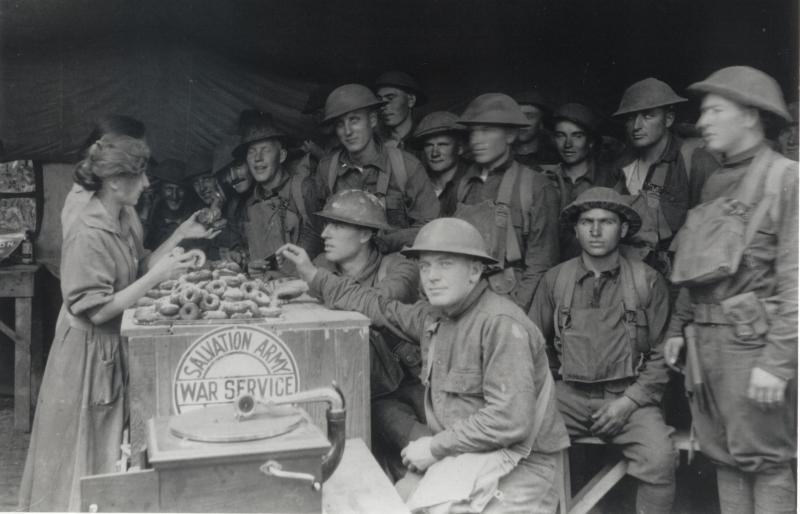
To provide for the American troops fighting in France in 1917-18, Salvation Army workers set up small tents or ‘huts’, providing the comforts of home, with nourishing meals, a quiet place to write letters or to get clothing mended.
Time to make the doughnuts: A Salvation Army hut during World War I (Courtesy the Salvation Army)
There were actually several dozen of these Salvation Army huts already set up in the United States near military bases so the tradition was simply transferred over to Europe when the war began, with workers often setting up huts in abandoned or even bombed-out buildings.
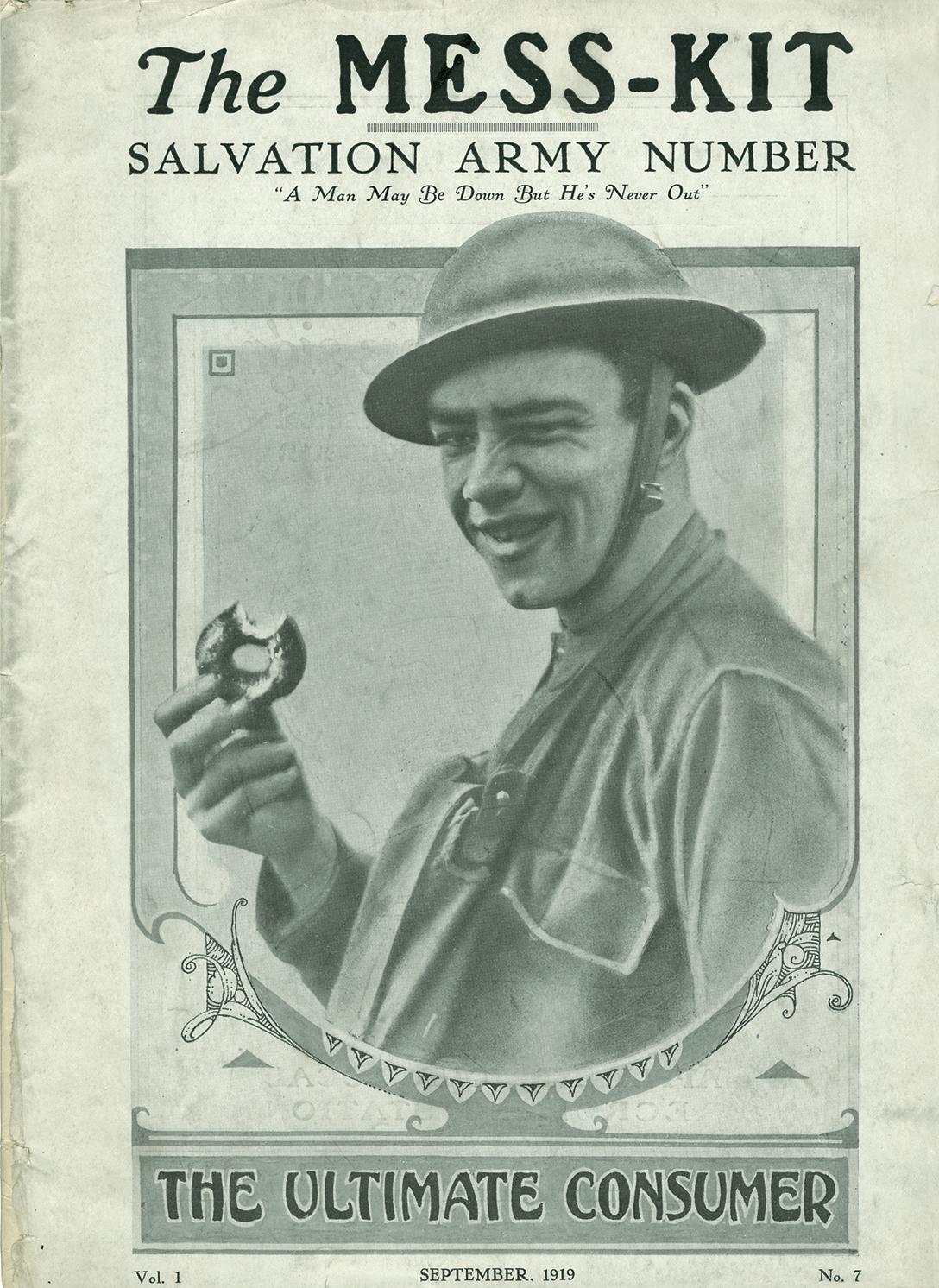
Below: A doughboy eating a doughnut on a 1919 magazine cover. (LOC)
What brings greater pleasure than a baked good? But the Salvation Army couldn’t transport large baking ovens, so they improvised with the doughnut, deep-frying dough on small portable stoves.
Irving and the Oly Koek
The round pastry was not invented by the Salvation Army. Indeed, Washington Irvinghimself is credited with the first mention of the doughnut in print back in 1809.
Regaling on old Dutch custom, he writes “[I]t was always sure to boast of an enormous dish of balls of sweetened dough, fried in hog’s fat, and called dough-nuts, or oly koeks: a delicious kind of cake, at present known scarce to this city, except in genuine Dutch families.”
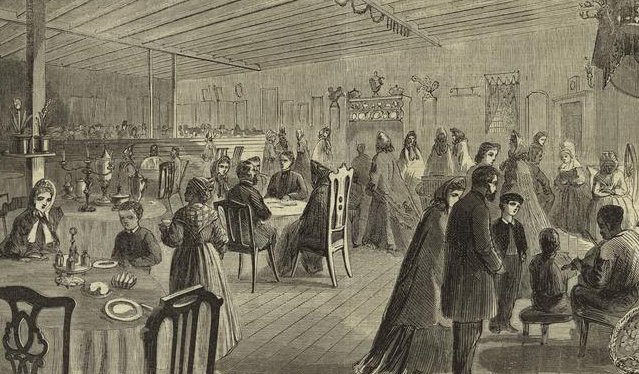
Above: A scene from the Knickerbocker Kitchen in 1864 (NYPL)
Due to their ease of preparation, doughnuts became associated with wartime cuisine. But even the original Dutch ‘oly koeks’ made a wartime return as well, brought back as a fund-raiser during the Civil War, sold during the 1864 Metropolitan Fair in the Knickerbocker Kitchen, a sort-of theme restaurant where Dutch delights were sold.
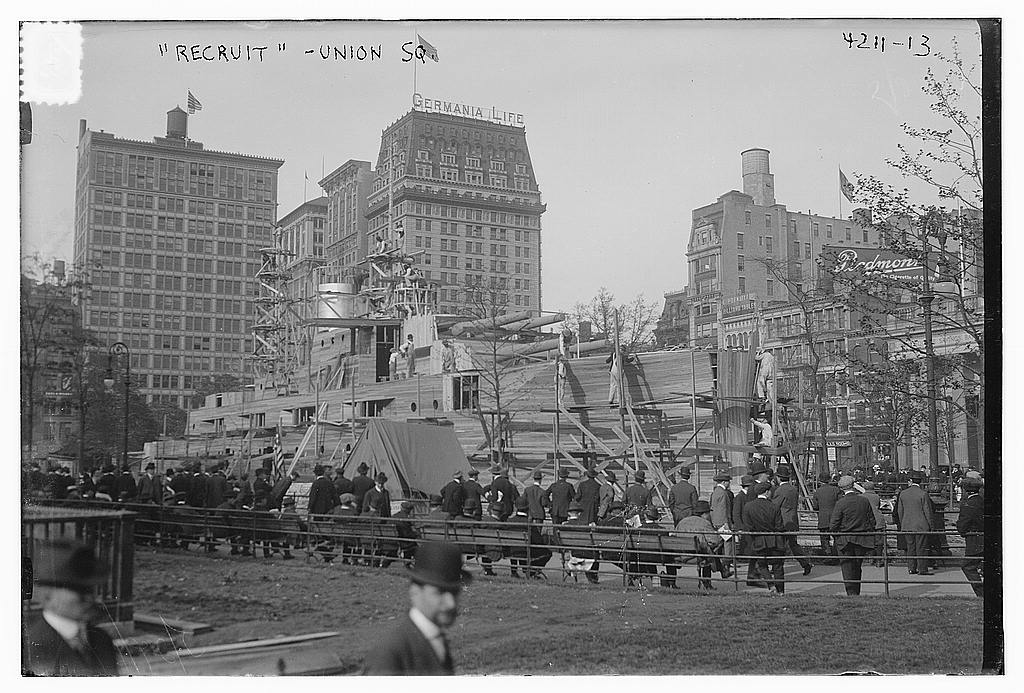
The Battleship in Union Square
Interestingly, the Knickerbocker pavilion was located just off of Union Square. Many decades later, the doughnut would return to Union Square for yet another war-related pageant.
Once the war was over, the Salvation Army thought it would be a kind gesture to those New Yorkers were fought in the war to recreate their welcoming war huts. And it made natural sense to set one up here in Union Square, next to the wooden battleship and conveniently located near their headquarters on West 14th Street (still there today).
The Salvation Army’s Union Square hut opened for business January 12, 1919, with a grand ceremony around the USS Recruit and military officers from the Brooklyn Navy Yard.
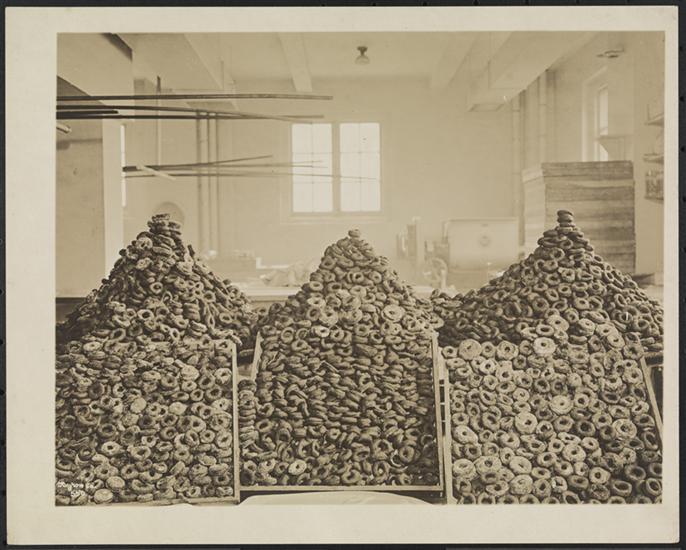
Inside Salvation Army workers were busily preparing the doughnuts, using the same tools as on the battlefield. It was led by Adjutant Violet McAllister, one of the original “doughnut sweethearts” of the war, with “flour on her nose and a great white apron over her khaki uniform.
That day over 1,000 doughnuts were prepared, many for soldiers returning from the war. In emulation of the war front huts, the Union Square edition was “open every day for reading, writing and gossip, with doughnut and coffee for 10 cents for all men in uniform.” [source]
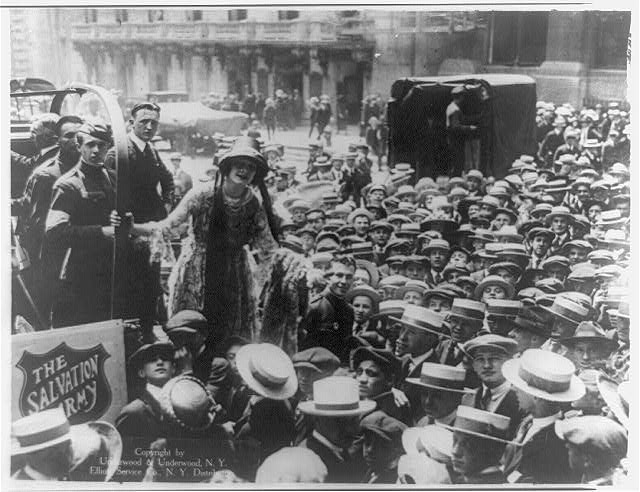
Above: Silent film star and New Yorker Martha Mansfield sells doughnuts for $1 apiece on the streets of New York during a fundraiser for the Salvation Army. (LOC)
Below: The doughnuts were prepared at the Hotel Commodore, Lexington and 42nd Street.
Courtesy Museum of the City of New York
By 1920, the battleship — and I assume the doughnut hut as well — were dismantled. In 1938, two decades after World War I, the Salvation Army started National Doughnut Day as a fundraiser and in honor of its phalanx of busy doughnut makers.
New Yorkers of course no longer needed to associate this food with wartime activities as the pastry soon sprang up at every lunch corner and automat in town.
Join the Bowery Boys Movie Club! Support us on Patreon at any level and get these Patreon-exclusive, full-length and ad-free podcast. Each month we talk about one classic (or cult-classic) film that says something interesting about New York City.
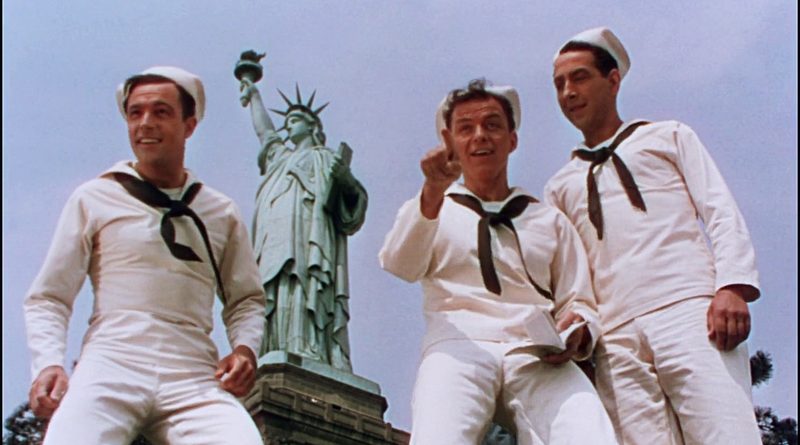
In the new Bowery Boys Movie Club, Tom and Greg disembark at the Brooklyn Navy Yard and spend a breathless 24 hours in New York City — with Gene Kelly,Ann Miller, Vera-Ellen and Frank Sinatra.
On The Town, with lyrics by Betty Comden and Adolph Green and (some) music by Leonard Bernstein,puts a fairytale spin on post-War 1940s New York City as it follows three sailors on a big-city adventure — knocking down dinosaurs, finding love, singing their hearts out. This screen musical classic mixes both studio and on-location film shoots, offering extraordinary views of Times Square, Rockefeller Center and Coney Island.
OnThe Town is not simply a movie about New York City, but about being a tourist in New York City. And musical lovers! You will especially appreciate Tom’s deep dive into the lyrics of songs like “Come Back To My House,” chock-full of references from New York City’s past.
Listen in as Greg and Tom set up the film’s backstory — highlighting the many changes made in the transition from stage to screen — then give a joyful spoiler-filled synopsis through the film’s breezy story. (Not every aspect of this film ages well!)
Should you watch the movie before you listen to this episode? This podcast can be enjoyed both by those who have seen the film and those who’ve never even heard of it.
We think our take on On The Town might inspire you to look for the film’s many fascinating (but easy to overlook) historical details, so if you don’t mind being spoiled on the plot, give it a listen first, then watch the movie! Otherwise come back to the show after you’ve watched it.
The film is available on iTunes, Amazon, among other streaming services.
To get the episode, simply head to Patreon and sign up to support the Bowery Boys podcast at any level.
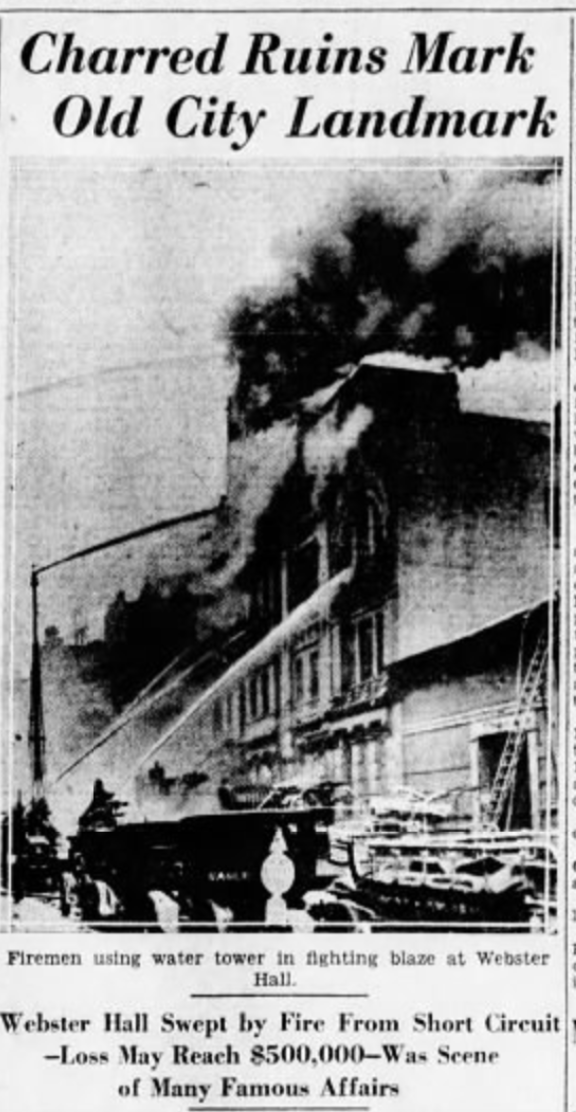
The East Village nightclub Webster Hall reopens this evening with a concert by Jay-Z after an extensive interior renovation by new owner Barclays/Bowery Presents.
The hall has had many facelifts over the past 133 years, evolving to mirror the tastes of Greenwich Village residents. This latest upgrade is a belated reflection of the neighborhood’s various sleek changes. That said, the renovations as describedseem positively mild in comparison to the blistering reinvention of neighboring Astor Place.
From the exterior, it appears absolutely nothing has changed. In 2008 Webster Hall was designated a New York City landmark for its impressive terra-cotta architecture and its status as a beacon of ethnic and social counter-culture during the late 19th and early 20th centuries.
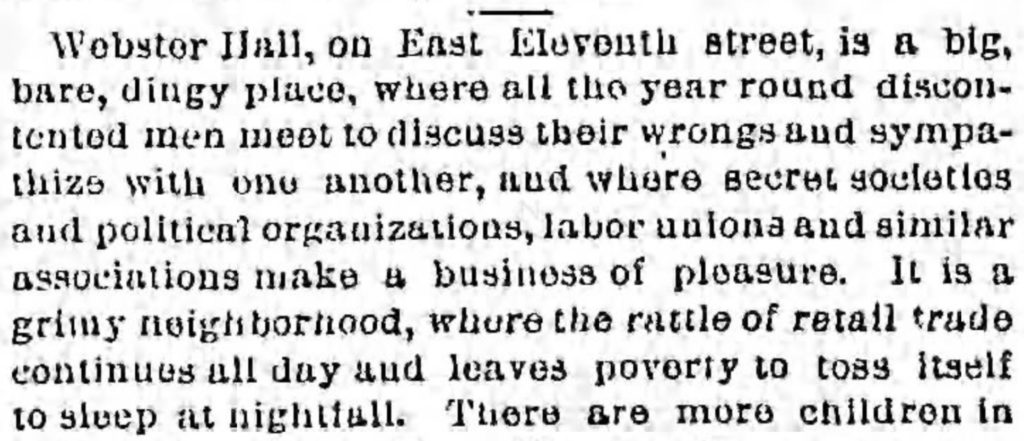
If I were the owner of this club, I would affix the following description (from an 1888 Brooklyn Daily Eagle article) in massive letters near the entrance:
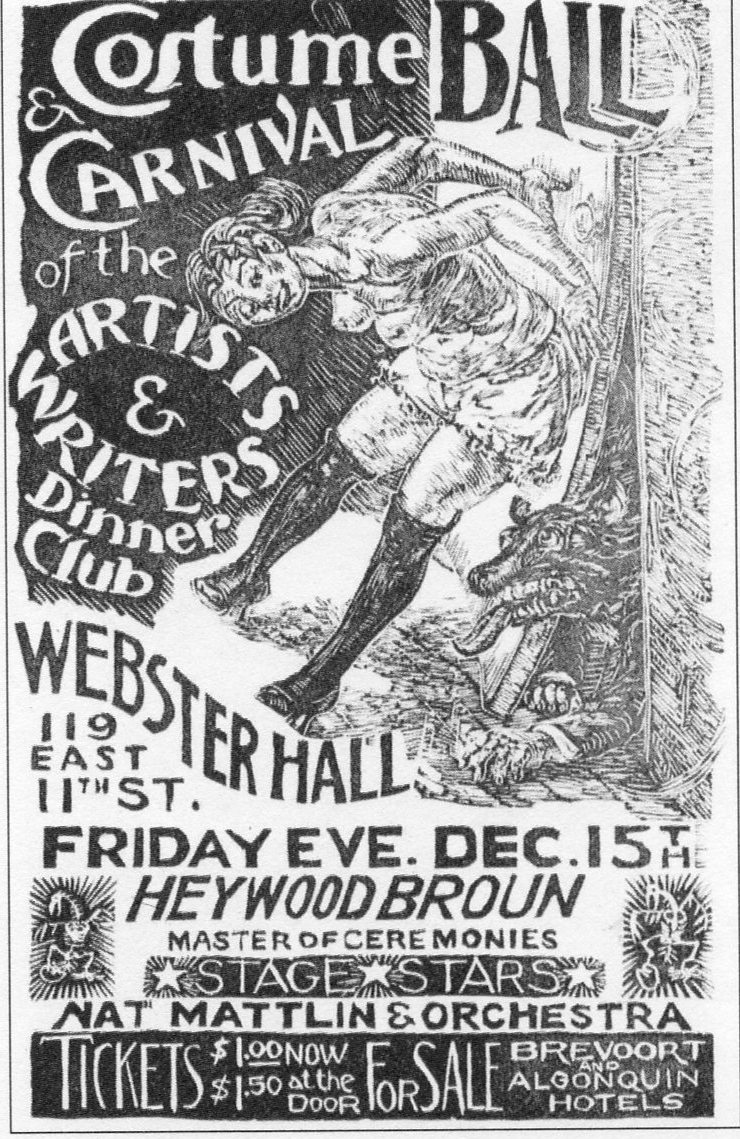
As we wrote in our book Adventures In Old New York: “Opened in 1886, the hall hosted the annual Greenwich Village Ball from the 1910s to the 1930s, a bacchanalia where artists, bohemians, drag queens, and general reprobates of the best kind came to drink, dance, and seriously make merry until early morning. It worked hard to earn its nickname “the devil’s playhouse.”
Author Allan Church wrote, “So many dances-till-dawn and fancy dress balls were held there that one Villager said of himself and his wife: ‘We’ve sold our bed. Why sleep when there’s a dance every night at Webster Hall?’ ”
—————
In celebration of its new landmark status, we recorded a short episode on the history of Webster Hall back in January 2009.
Here’s a few clippings from old newspapers, giving you a few additional insights into Webster Hall’s spectacular history:
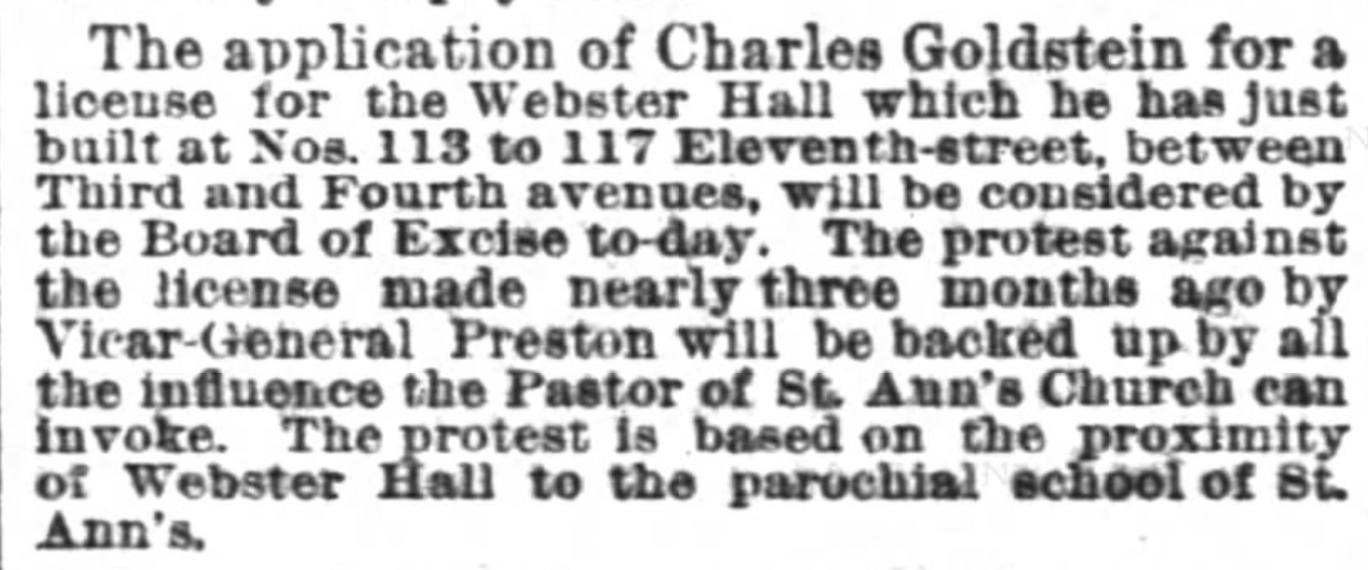
Webster Hall was rebellious before it even opened. St. Ann’s, the church which most vigorously decried its existence, has all been erased except for its entrance:
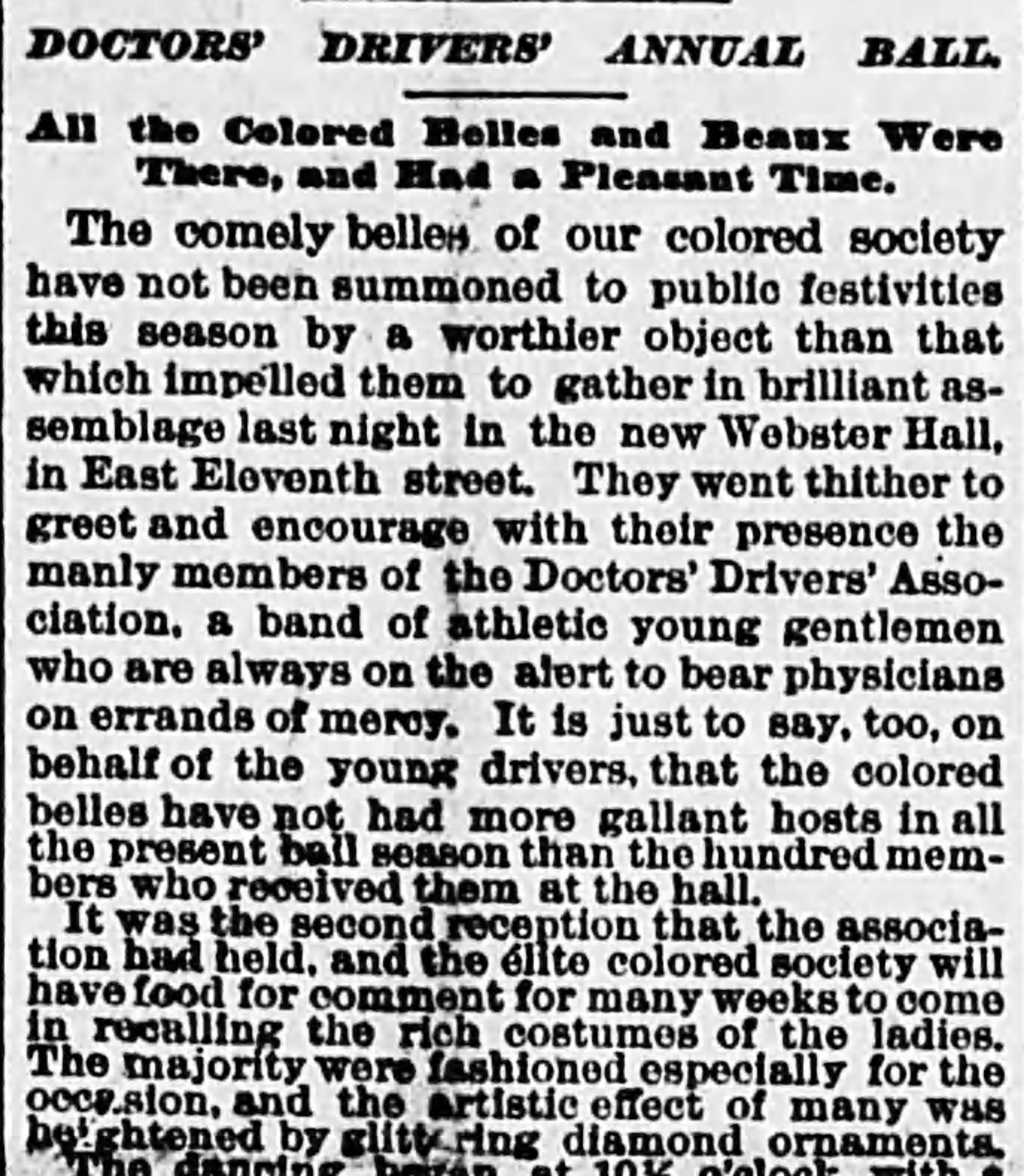
In 1887 Webster Hall played host to a private dance for wealthy black New Yorkers, members of the Doctors’ Drivers’ Association, “a band of athletic young gentlemen who are always on the alert to bear physicians on errands of mercy.”
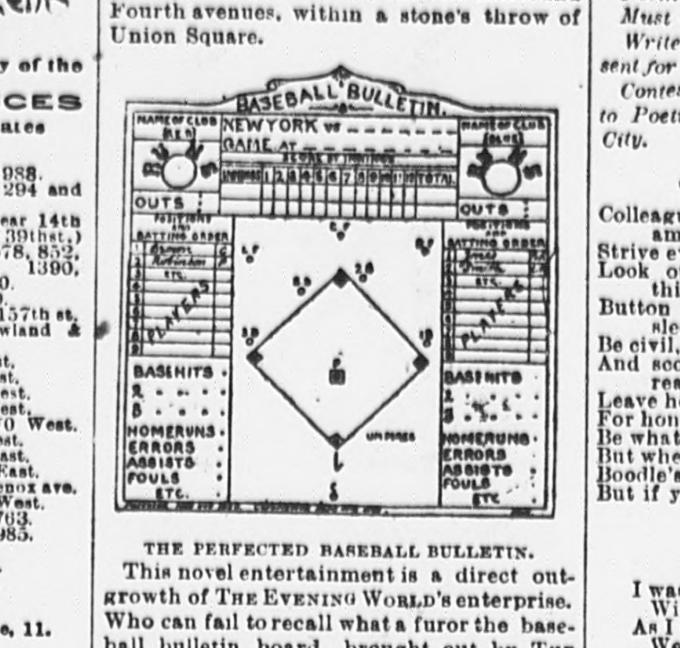
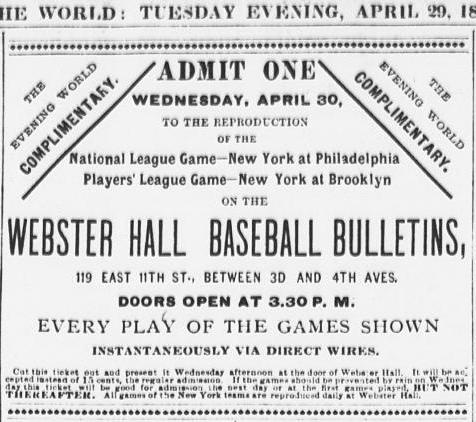
A depiction of the baseball scoreboard that was installed by the New York Evening World to ‘instantaneously’ update baseball scores from Boston in 1890. [The complete article is here.]
New York Evening World
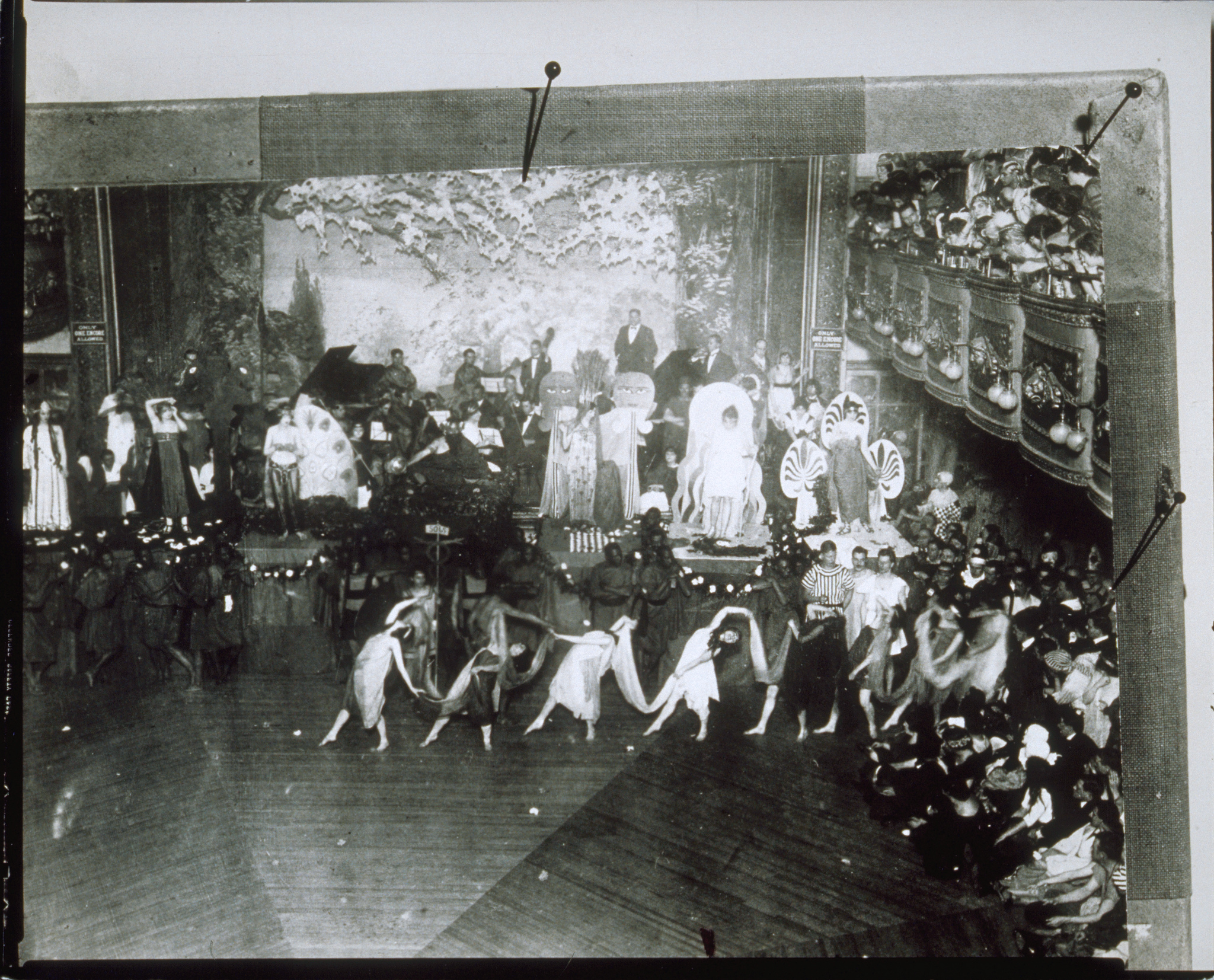
The party rages at a Webster Hall artist costume ball, in a photo by the great Jessie Tarbox Beals (date unknown, most likely late 1910s).
Courtesy Schlesinger Library
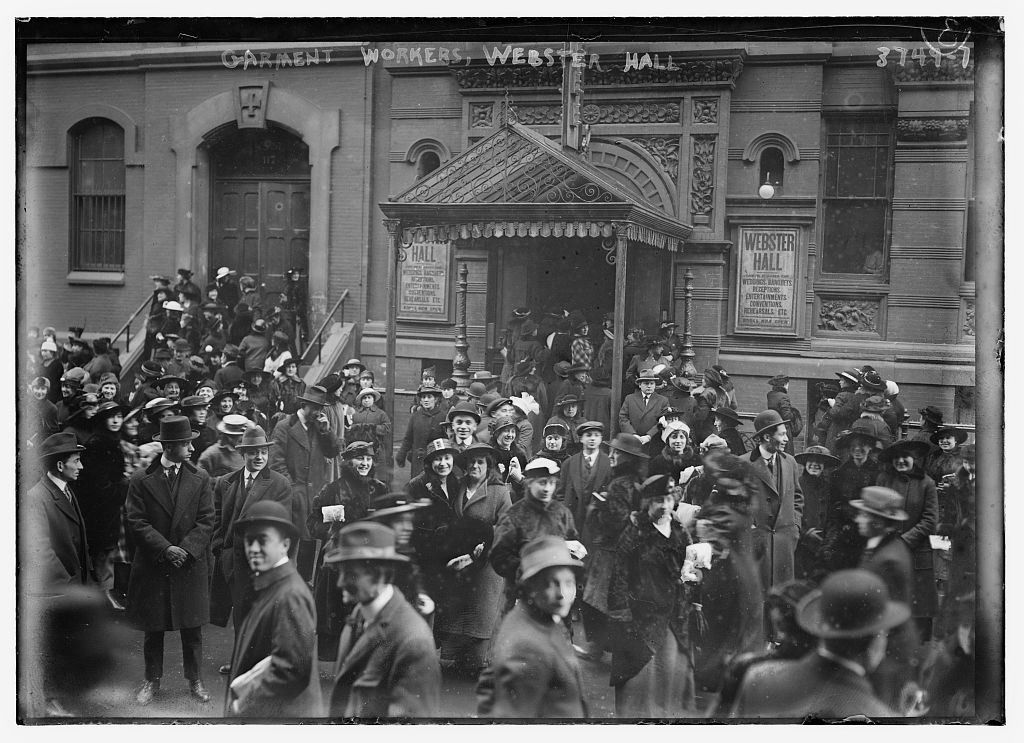
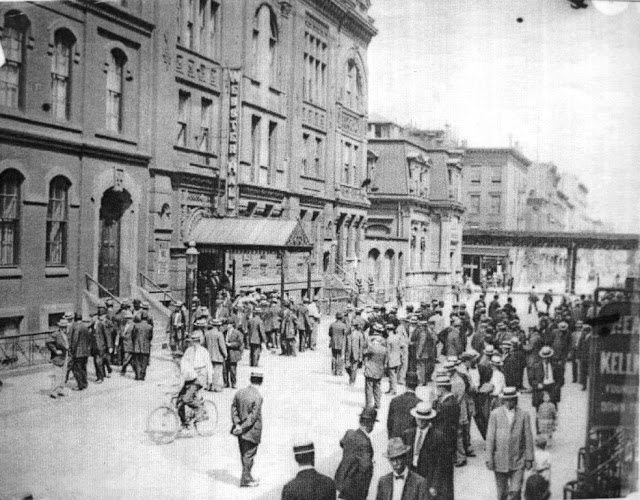
Garment workers meet out in front of Webster Hall, between 1910-1915. The venue was a pivotal meeting spot for union groups, political activists and anarchist leaders like Emma Goldman.
Courtesy Library of Congress
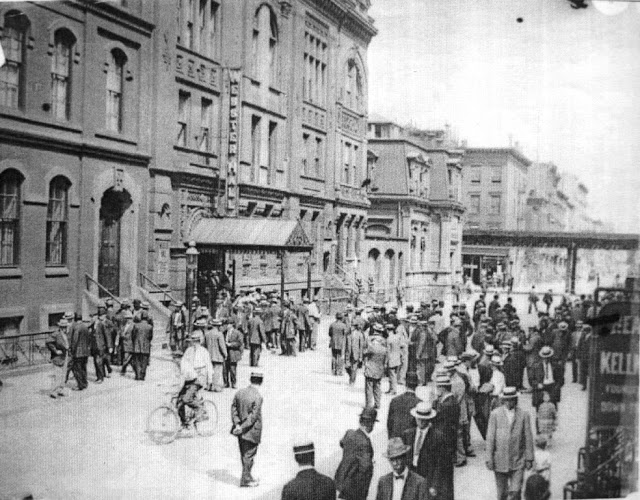
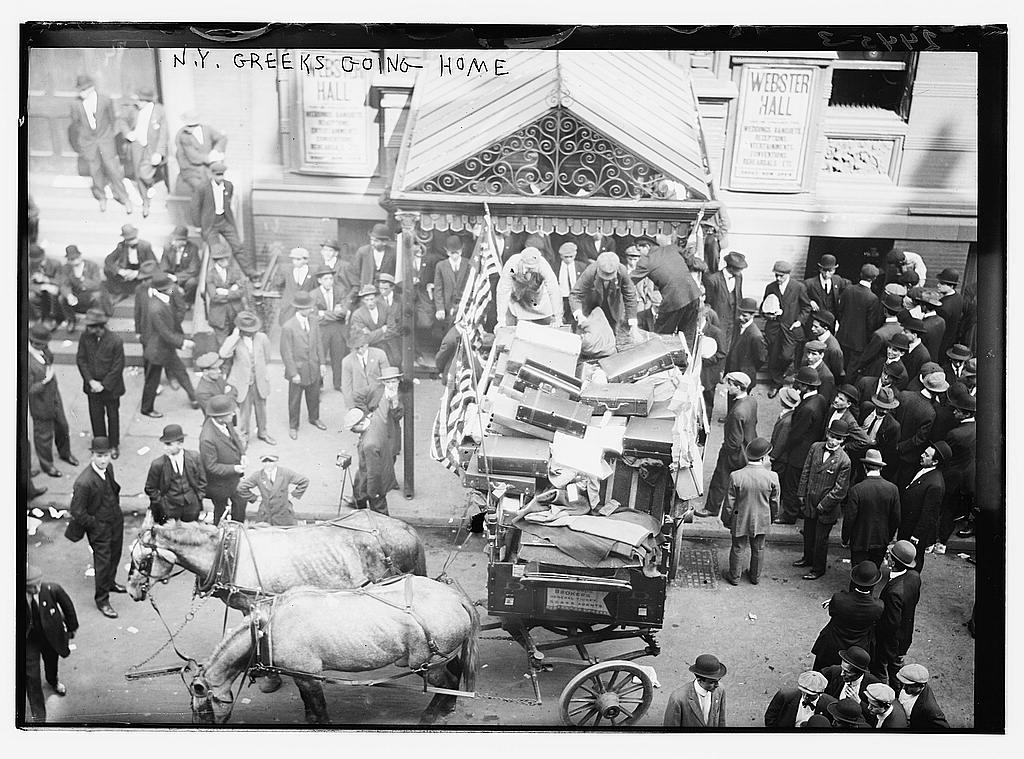
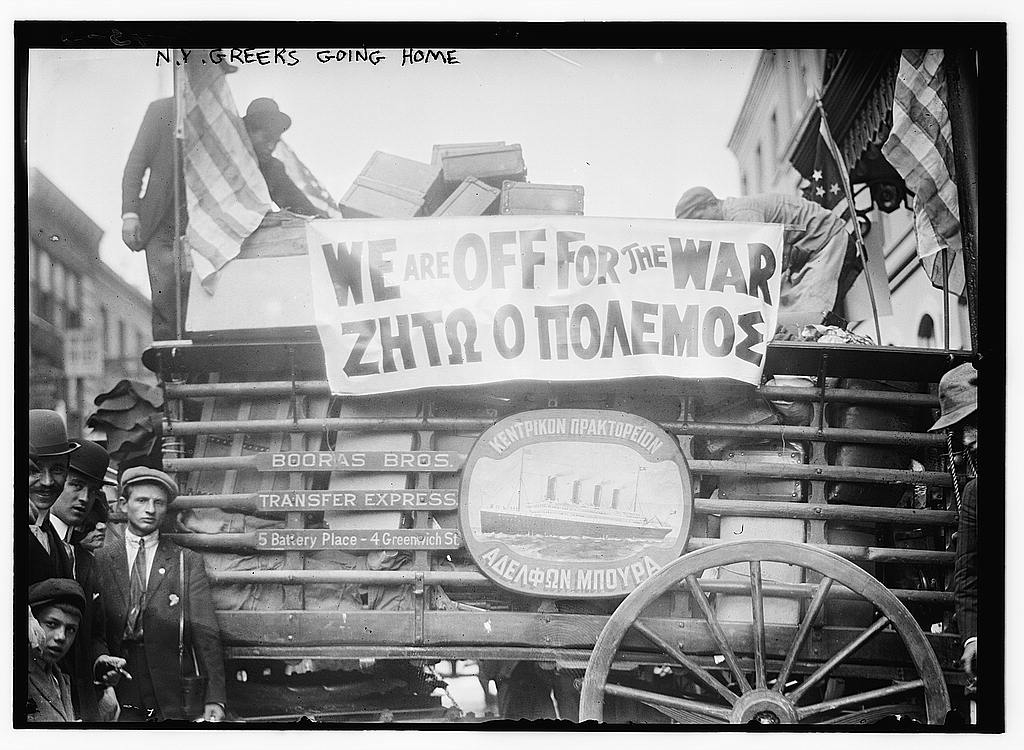
Greek immigrants gather in front of Webster Hall as they prepare to return to their country to engage in the first Balkan war (October 1912).
Courtesy Library of CongressCourtesy Library of Congress
From a 1930 article:
A 1933 poster advertising the annual Greenwich Village costume ball, designed by John Sloan
Courtesy Library of Congress
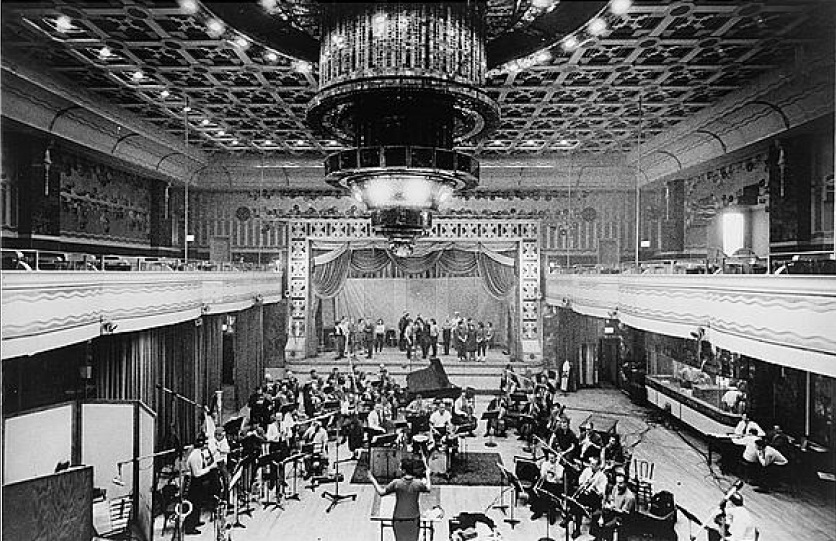
The cast of ‘How To Succeed In Business Without Really Trying’ recording the cast album at Webster Hall, 1961.
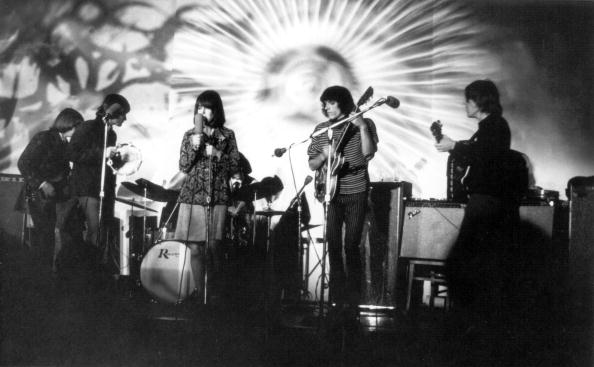
Jefferson Airplane’s first New York concert, January 8, 1967, at Webster Hall
(Photo by Michael Ochs Archives/Getty Images)
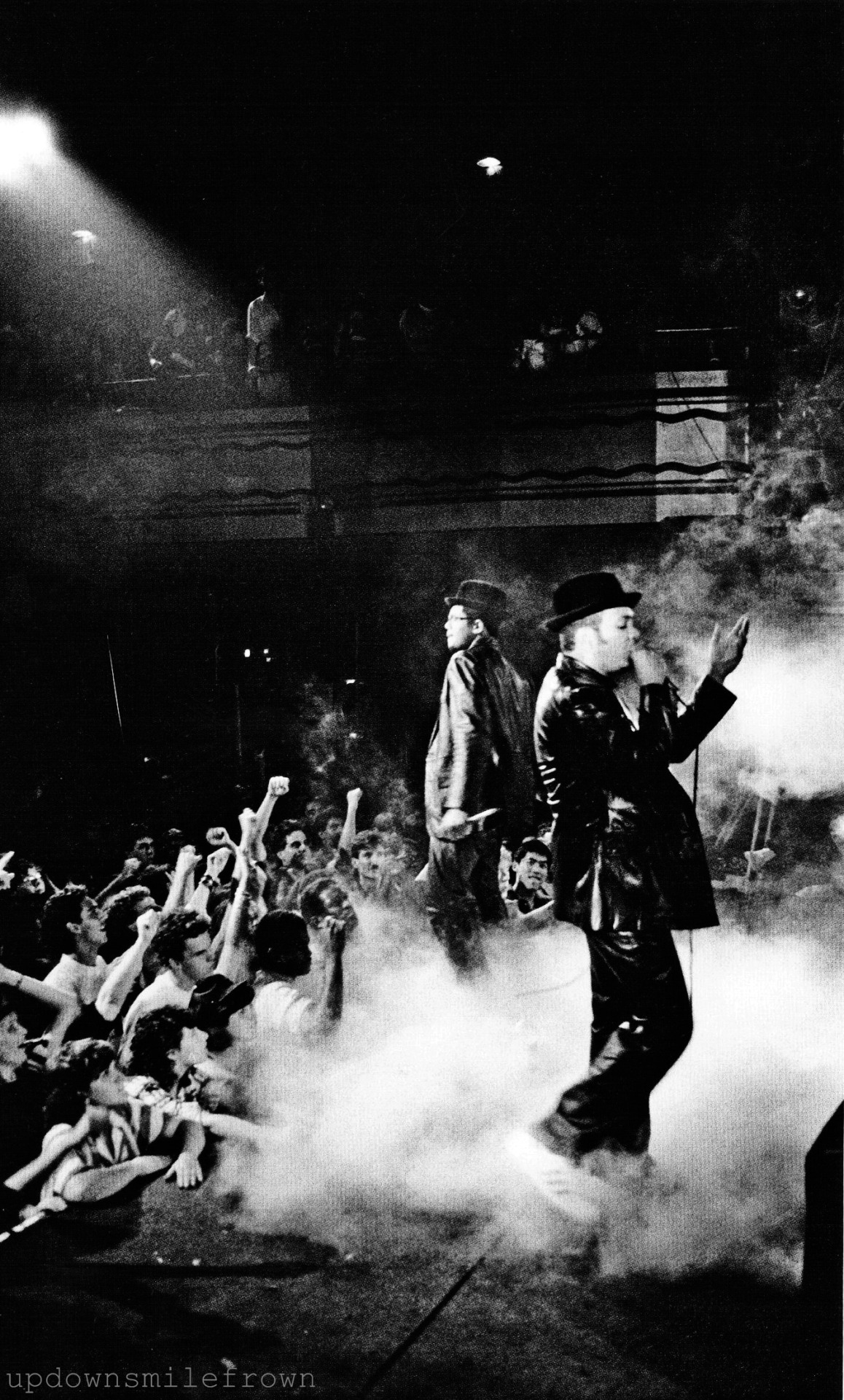
In the 1980s and early 90s, Webster Hall was known as The Ritz. Much of the scrappy charm of Webster Hall that people love derives from its years as this important rock venue. Here’s Run DMC performing at The Ritz, May 15, 1984
Photograph by Josh Cheuse/updownsmilefrown
In 1980, the young Irish rock band U2 had their American debut at The Ritz. Their second performance there, in March of 1981, was reviewed by the New York Times, and the original review — by Stephen Holden, no less — is worth a look if you’re a U2 fan. “Bono Hewson, U2’s lead singer, has a moderately strong voice that was partially drowned out at the Ritz. This was a shame, since the band’s material is of considerable interest.”
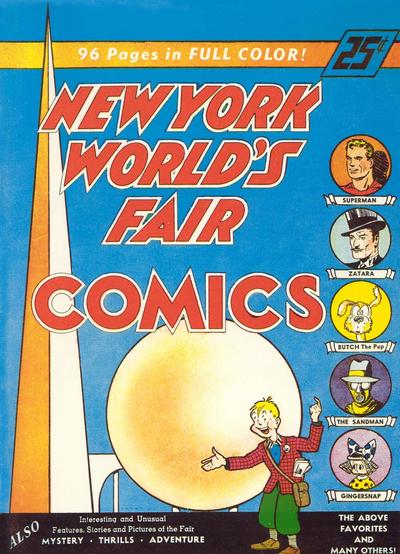
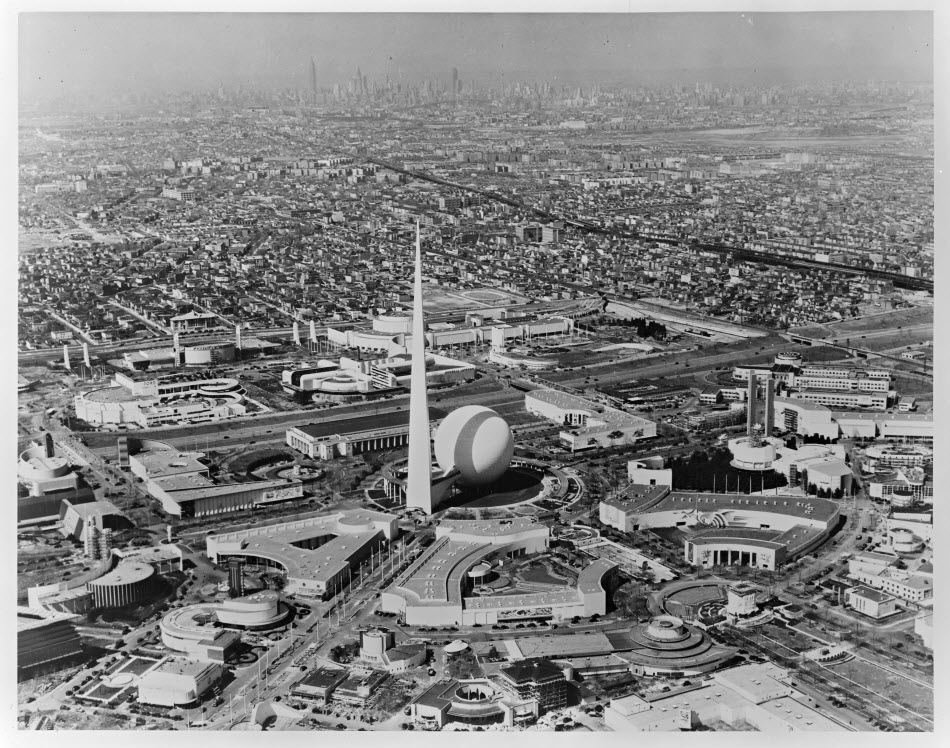
The New York World’s Fair of 1939-40, held in Flushing Meadows Corona Park, was an extravagant wonderland of ideas, filled with technological wonder and futuristic imagination. It was fun for all ages — if you could afford it. Children were a key audience, of course, and the fair was advertised to them in a variety of ways, including through a rather new form of publication called a comic book.
Action Comics #1, featuring the first exploits of Superman, was published in June 1938. Less than a year later, the Man from Krypton appeared in an official World’s Fair tie-in comic book.
Flash forward many decades in the future. Comic books have gone from cheap kiddie magazines to the basis of modern Hollywood blockbusters. And it’s there that the New York World’s Fairs have again come alive — thanks to Marvel Comics.
Below: Jack Kirby at the 1939 New York World’s Fair
Courtesy Kirby Museum
But there’s obviously something special about Flushing Meadows Corona Park— and the two New York World’s Fairs which were held there in 1939-40 and 1964-5 — for the site has been carefully built into the movies of the Marvel Cinematic Universe, a collection of massive superhero blockbusters culminating this weekend with Avengers: Endgame**.
Courtesy New York Public Library
World’s Fair of 1939
As we mentioned in our latest podcast, the New York World’s Fair of 1939-40 celebrated corporate innovation and technological progress, a glittering future through automobiles and robotics.
Had the fair been deemed a financial success when it closed in 1940, you could imagine how it might have become a permanent theme park to American middle-class ideals. After all, it was the ambitions of city parks commissioner Robert Moses to transform Flushing Meadows Corona Park — a former ash dump — into a place that could be enjoyed by New Yorkers year-round.
Well, good news, Mr. Moses! In the alternate history presented by Marvel, the World’s Fair of 1939-40 was apparently NOT a financial disappointment, because its doors remained open for future expositions, possibly even yearly ones.
Imagine how Queens would have developed with perpetual events at Flushing Meadows. There would have been more highways and a greater expansion of the park grounds. The tolls gathered by Moses’ Triborough Authority would have been double the bounty they were in real life. He might have arguably had even more power within the city.
World’s Fair of 1943
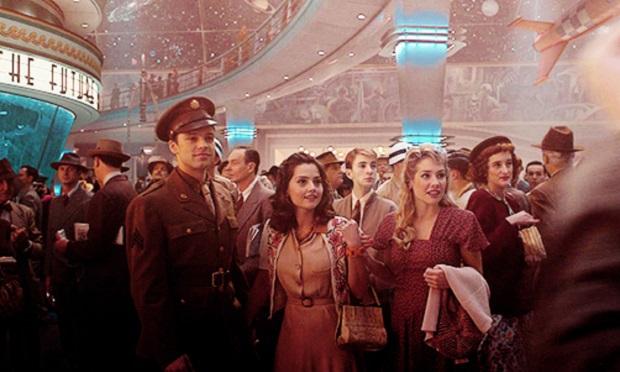
The first fictional fair in Flushing Meadows debuted in the film Captain America: The First Avenger, an exposition called Modern Marvels of Tomorrow.
Longtime friends Bucky Barnes and Steve Rogers bring dates to the fair and attempt to have a good time before Bucky ships out to war. Rogers, a puny CGI-ed man with great enthusiasm, pines to join his best friend on the front lines.
It seems unusual that New York would host a seemingly frivolous fair during wartime. Even in 1939, the crisis in Europe was influencing the direction of the actual fair; by the 1940 edition, the Poland Pavilion had closed and the Soviet Pavilion and its massive Big Joe sculpture were entirely removed.
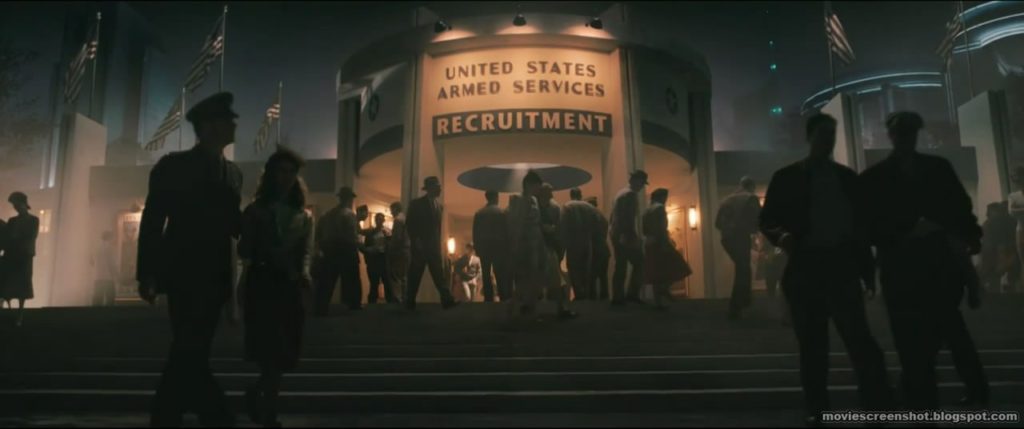
The fictional Modern Marvels of Tomorrow seems to mix patriotic pride with technological advancement. It’s here that Rogers, deemed too physically inadequate to serve, attempts to re-enlist for the military.
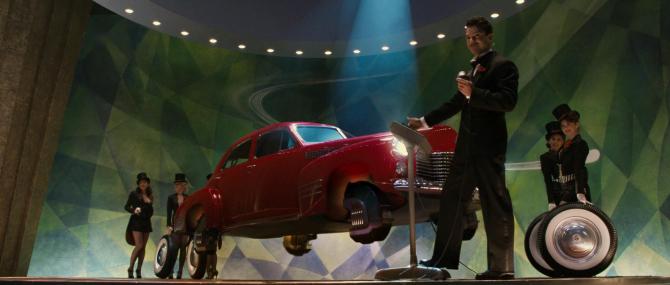
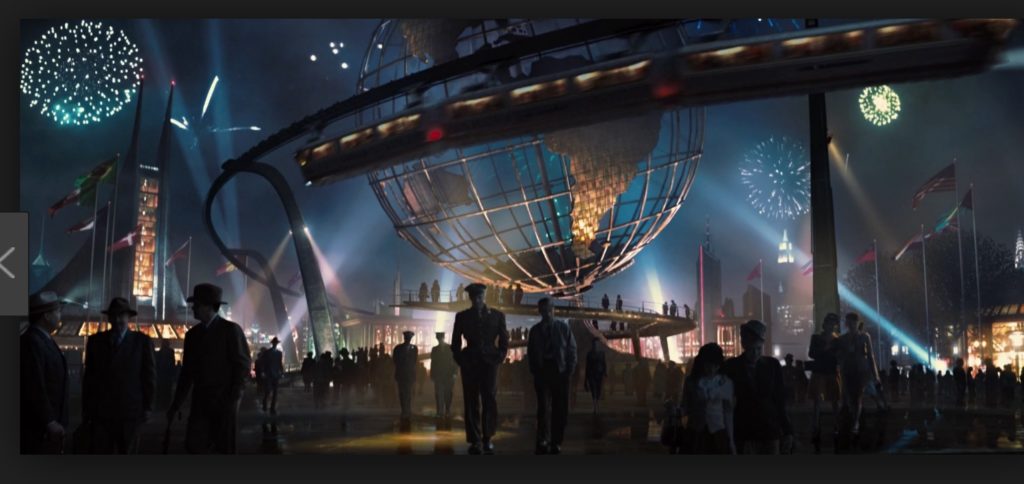
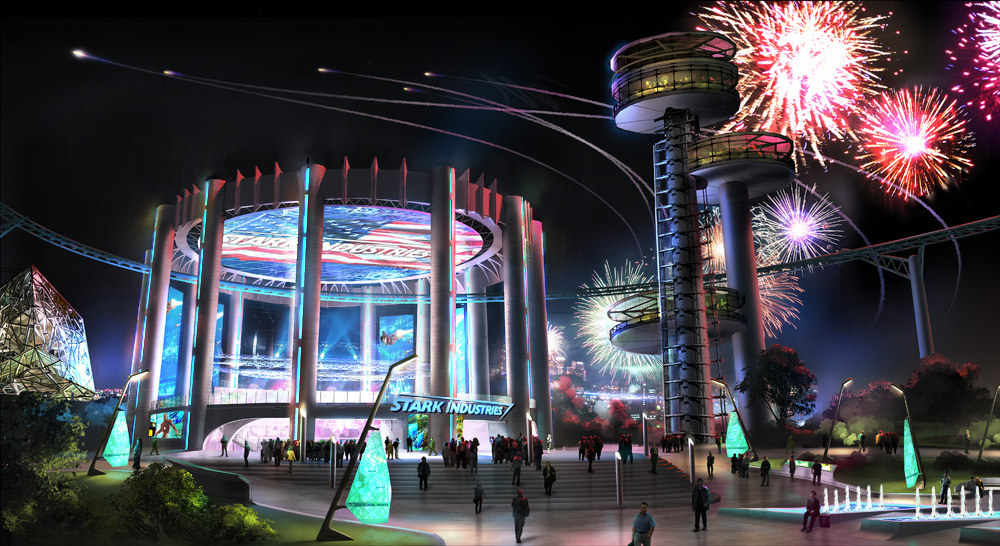
It’s not all bandstands and flag-waving. The future Captain America and Winter Soldier (and their dates) drop by the pavilion of a young start-up company Stark Industries where its handsome young CEO Howard Stark attempts to demonstrate a flying car.
You can watch the entire sequence featuring the 1943 World’s Fair here. Note that the Unisphere, created for the 1964 World’s Fair, is already a feature of the Marvel Cinematic Universe by this time. In fact, a model of the Unisphere plays a crucial role in the film Iron Man 2.
The Trylon and Perisphere are nowhere to be seen but the Helicline — the spiral ramp which encircled the Perisphere — now wraps around the Unisphere.
World’s Fair of 1954
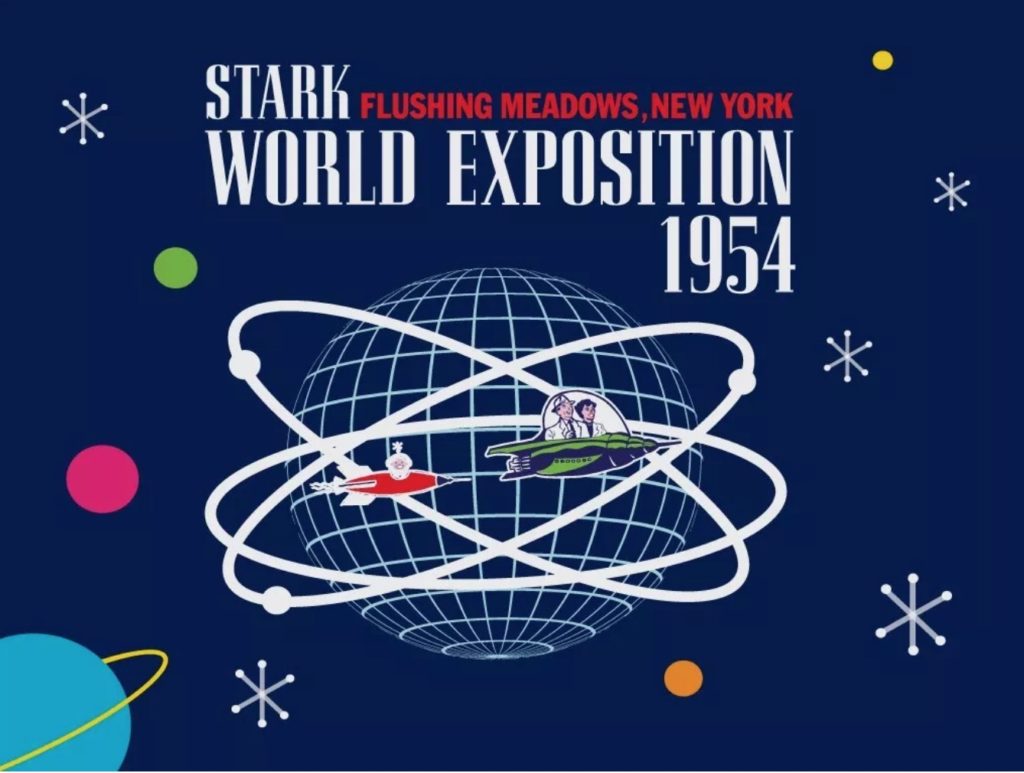
In the Marvel Cinematic Universe, we must assume that Howard Stark became good friends with Robert Moses and mayor Vincent Impellitteri, for in 1954, it appears they simply give management of the fair over to Stark Industries.
In a memo later sent by Howard’s son Tony Stark: “In ’54 my Father returned to Flushing Meadows, Queens, to show off the new tech he used to defeat global tyranny. This was the first ever Stark Expo.”
Banner for the non-existent 1954 fair.
Certainly Moses would have been thrilled to have private sponsorship of public fair pavilions. In this alternate New York past, perhaps Moses even worked with Stark in producing the highways and airports that would service this grand Queens attraction. By the 1950s, Queens would have been recognized as the most important tech center in the United States.
World’s Fair of 1964
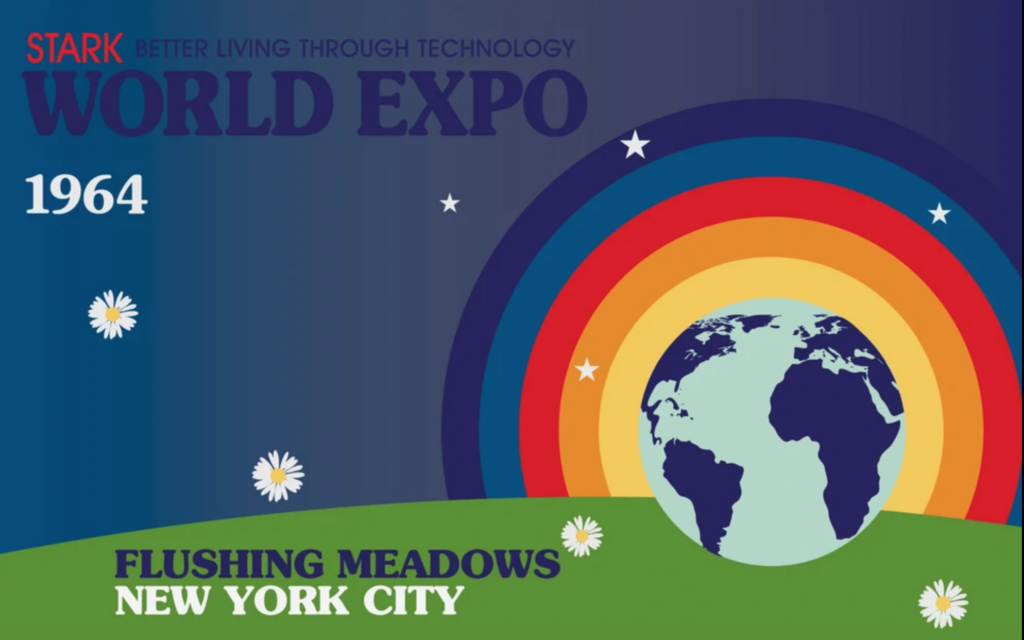
The New York World’s Fair of 1964-65 occurred both in the real world and in Marvel Cinematic Universe history. The themes, however, were quite different.
The theme of real fair, officially unsanctioned by the Bureau of International Expositions, was “Peace Through Understanding.” Howard Stark’s fair put a cheeky spin on that title — “Better Living Through Technology.”
In the Marvel world, we can only assume that the Mets did debut in Shea Stadium in 1964, except that it was most likely called Stark Stadium. We do know that the Mets exist in the same universe as the Avengers as canonically the cinematic Amazing Spider-Man is a big fan.
As with the actual 1964 fair, it appears that that the New York State Pavilion structure may have been built for the Stark Expo, although it is unclear if the Marvel version of the Philip Johnson-designed pavilion would have included a life-sized Texaco highway map.
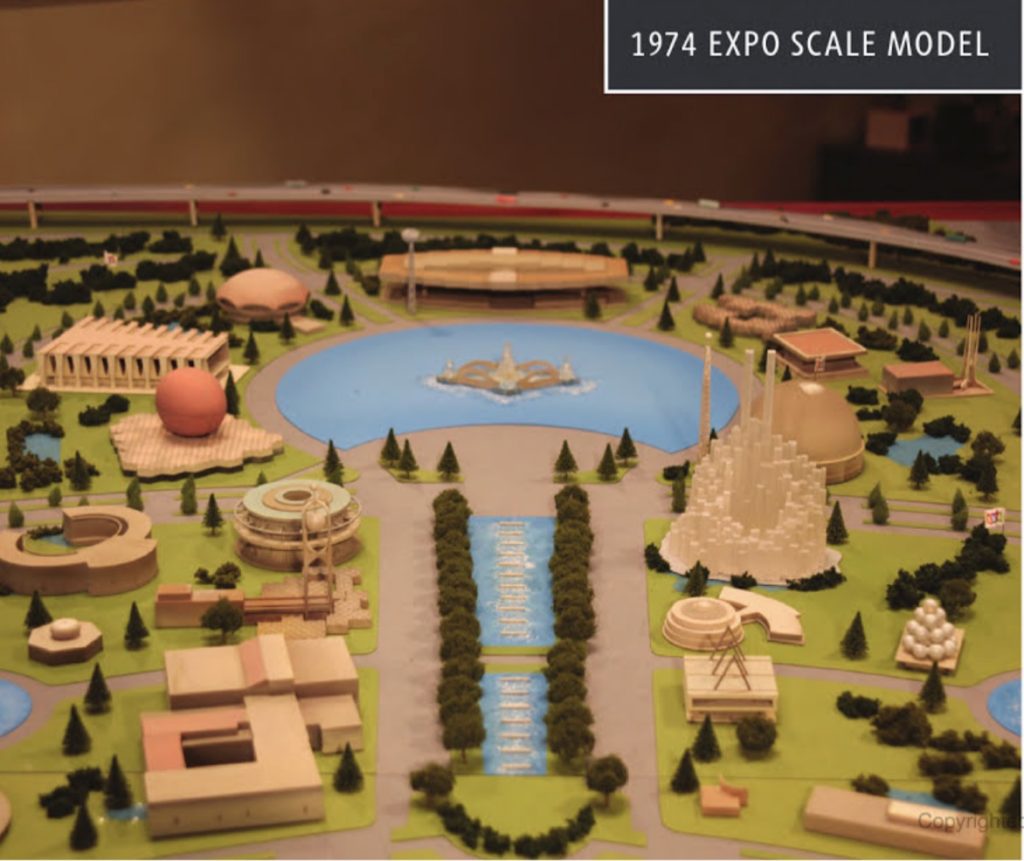
Stark Expo 1974
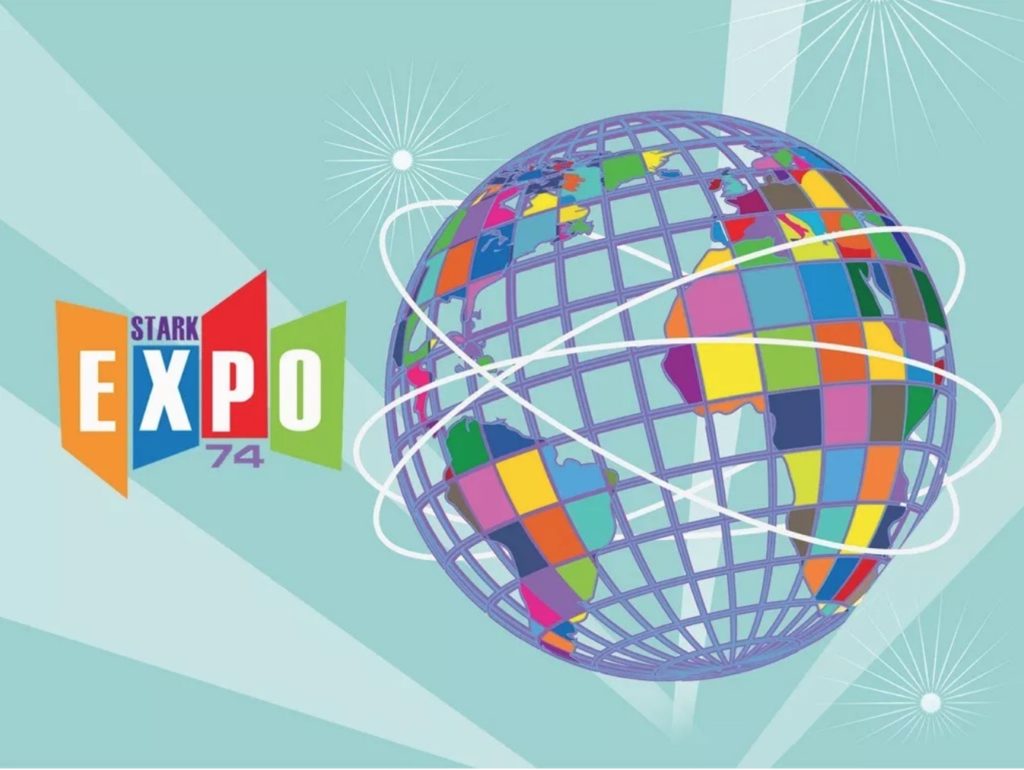
The ‘Stark Expos’ ran for many years until 1974. I can only imagine that New York City’s dire financial fortunes still played out in this fictional comic-book world, closing the annual display of progress for good.
From Tony Stark’s memo: “In the decades that followed, my Father invited the world’s greatest minds to contribute to the Expo and put to task corporations to create better living for all. When the 1974 Expo closed, we lost that glimpse into humankind’s amazing future.”
Below: It appears that the Lagoon of Nations has been a feature of the fair from the very beginning — in both the real and fictionalized worlds.
After its closure, the borough would have been decimated, no longer the heart of American technology. Perhaps we can assume Moses was involved until the bitter end, for 1974 happens to be the year his own reputation takes a beating with the publication of Robert Caro’s The Power Broker.
The promotional video for the 1974 Stark Expo offers no new insights outside of an introduction by Howard Stark (who looks an awful lot like another New York city power player, Madison Avenue advertising king Roger Sterling, mixed with a bit of Walt Disney).
The great downturn of New York City’s fortunes in this alternate timeline must have contributed to a massive crime wave and serious urban blight. It is fortunate then that the city might have benefited from a completely coincidental spike in costumed crime fighters.
(By the way, the film Iron Man 2 does provide confirmation that the 1974 fair did include a “Belgian waffle stand,” as mentioned by Jarvis, the computer intelligence that would later become incorporated into robot superhero Vision. Belgian waffles were the fair snack of choice for visitors of the 1964 New York World’s Fair.)
A look at the World’s Fair of 2010 according to the film Iron Man 2.
Stark Expo 2010
As highlighted in the film Iron Man 2, Howard’s son Tony Stark — aka Iron Man — would bring the Stark Expo back to Flushing Meadows in 2010, making the New York State Pavilion the centerpiece of the excitement.
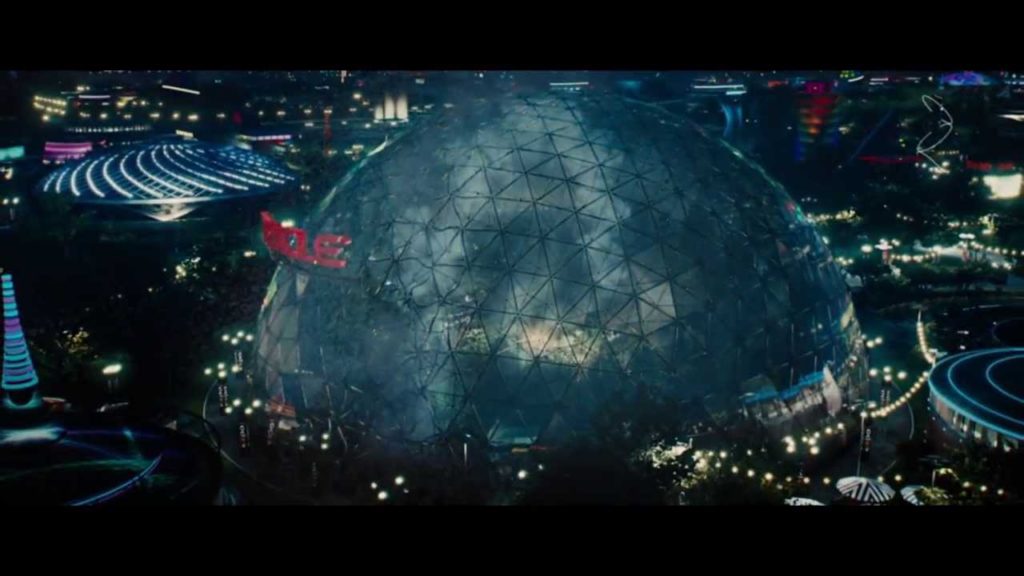
Unfortunately the festivities are interrupted by dozens of flying armored super robots. I’m sure Iron Man 2 features several deleted scenes of an enraged Mayor Michael Bloomberg demanding retribution from Stark Industries, dozens of lawsuits against the private firm and reverberations of corruption through Stark’s association with the federal government. (Hopefully, the Mets weren’t having a home game that night!)
Bill Cotter/New York Times
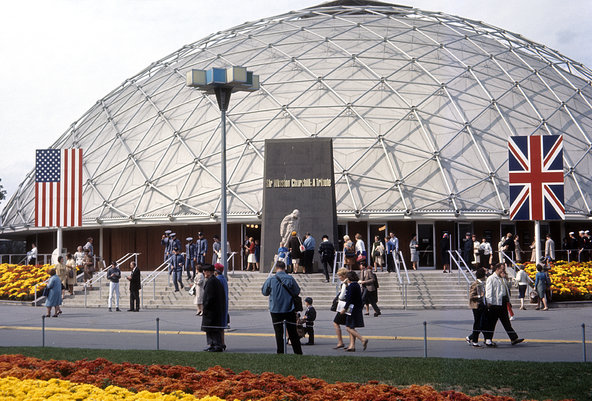
Among the architecture seriously damaged during the battle was a pavilion sponsored by Oracle within a geodesic dome that looks very similar to the Queens Zoo aviary which was originally created for the 1964 World’s Fair.
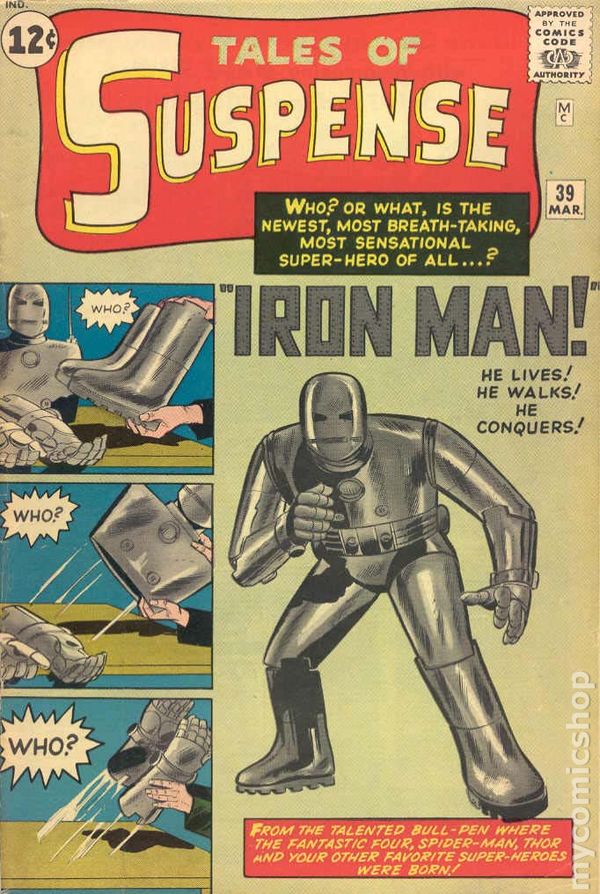
The character of Iron Man debuted on March 1963 in the comic book Tales of Suspense #39. Had this suit of powered armor been an actual creation, it would most likely have been displayed at the real 1964 World’s Fair — with its focus on ‘A Millennium of Progress’ — alongside other wonders of the day like the computer, atomic power and new space technology.
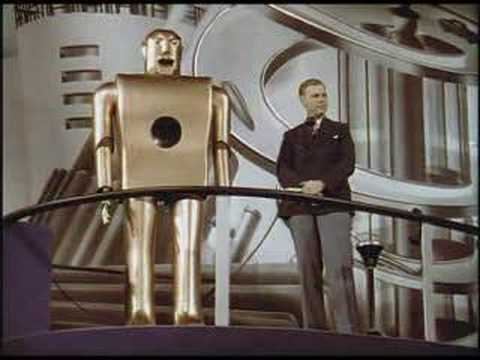
There is no evidence that Iron Man creators Lee, Kirby, Don Heck and Larry Lieber were directly inspired by the 1939 World’s Fair super-being Elektro, but visually the pair could been mechanical cousins.
And just nearby….
Peter Parker lives with his Aunt May in the neighborhood of Forest Hills, Queens, a short walk from Flushing Meadows Corona Park.
In the comic books, Parker would attend a demonstration of the “safe handling of nuclear laboratory waste materials” at the New York Hall of Science within the park, and it was there that he was bitten by a radioactive spider, becoming Spider-Man. It too was designed for the 1964 New York World’s Fair.
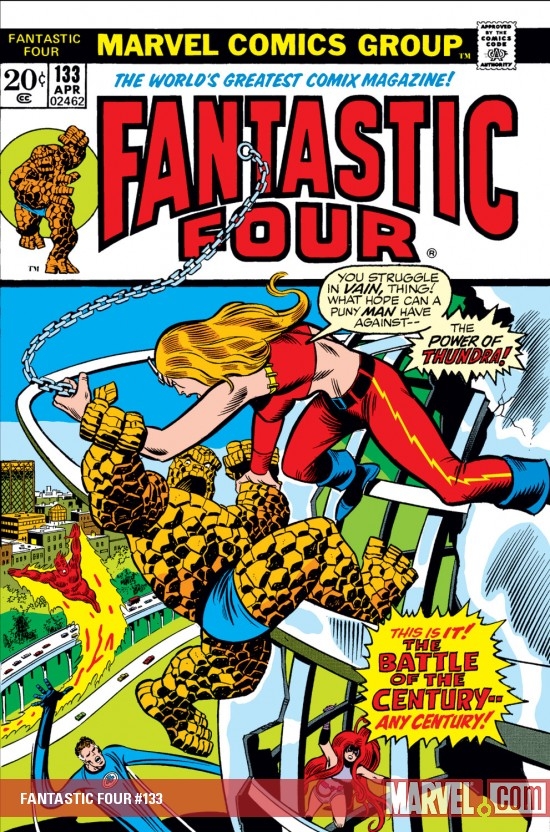
The Fantastic Four found themselves at the Unisphere in 1973
Check out these past podcast episodes for more information on World’s Fairs, Flushing Meadows Corona Park and comic books!
**In the new Avengers: Endgame there is a quick panning show of Flushing Meadows centers on Citi Field, proving you can’t make a Marvel movie without a little Queens in it.
All movie art and promotional photos above courtesy Marvel Entertainment — from the films Captain America: The First Avenger and Iron Man 2. All comic book art (except where otherwise noted) is courtesy Marvel Comics
The 1896 landmark Supreme Court decision Plessy v. Ferguson embedded and legitimized the practice of “separate but equal” into American life in the 20th century.
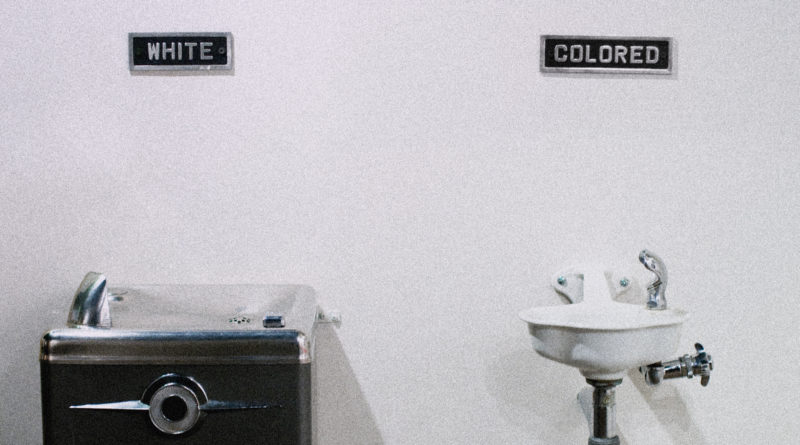
The decision built racism into the fiber of everyday activities — schooling, housing, medical care, public transportation — and elevated personal prejudices into the realm of legality. It raised white and black children in separate environments, entrenching prejudice so deeply that we, in 2019, are still reeling from its consequences.
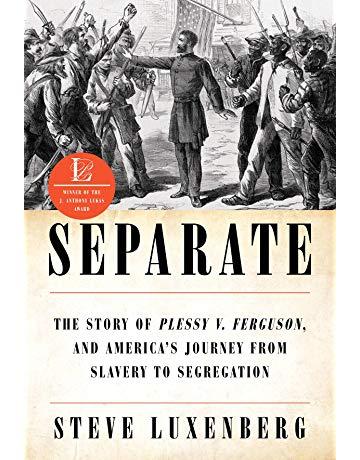
Steve Luxenberg’s captivating history Separate: The Story of Plessy v. Ferguson, and America’s Journey From Slavery to Segregation is a slow-build up to the case itself. (Homer Plessy, the Creole plaintiff who attempted to sit in a railroad car for white passengers, comes into the story 60 pages before the end.) Luxenberg is more concerned with the legal and social entanglements that led up to the case, a myriad of state-specific practices upon a wide spectrum of public prejudice.
Separate follows the lives of three men crucial to the outcome of the decision — the firebrand white Northern journalist Albion Tourgée and Supreme Court justices Henry Billings Brown and John Marshall Harlan. From different states and backgrounds, the stories of these three men hurtle towards that fated moment in 1896 when their collective experiences lead to a damaging climax.
Albion Tourgée who litigated for Homer Plessy in front of the Supreme Court. (Library of Congress)
The fourth protagonist — and certainly the most interesting — are the people of color in New Orleans in the late 19th century.
‘Separate but equal’ policies were commonplace on the state level throughout the South and especially contentious when it came to public transportation — streetcar and railroad passenger cars. Drivers and ticket takers had to determine on the spot the race of a passenger, guide them to the ‘proper’ section and enforce the separation should there be conflict.
But in Louisiana, there were thousands of residents of color who had never been enslaved people, lesgens de couleur libres with a mix of European and African ancestry. (An excerpt of a 1853 New Orleans divvied its population into eight different ‘grades’.) Passengers could be labeled black one day, white the next, depending on the railroad or streetcar employee making the determination.
Plessy was indeed a mixed race gentlemen from New Orleans, and his ‘test case’, destined for the high court, would be shepherded through the system by Tourgée, a nationally known columnist, and Louis Martinet, a Creole attorney with interesting challenges to his own career.
In the stories of Brown and Harlan, another fascinating subplot emerges, that of wavering and unexpected shifting views on slavery and racial relationships, inspired by unique state issues following the Civil War.
And even enlightened views can be reached narrowly. Harlan, the ‘lone dissenter’ in the case of Plessy vs. Ferguson, was once a proud member of the anti-immigrant Know Nothing Party and was a full-throated supporter of the Chinese Exclusion Act.
For many legal minds in the late 19th century, equality in a legal sense did not mean social equality. An American, white or black, may share the same rights as upheld by the U.S. Constitution, but in everyday matters, there was no urgent need to include all people in the same public spaces.
Of course this would prove dysfunctional and absurd, a fallacy based on an unenforceable belief that every actor at every level of public life would truly provide ‘equal’ options to Americans of any color. Separate lays out the course for how this thinking became the law of the land.