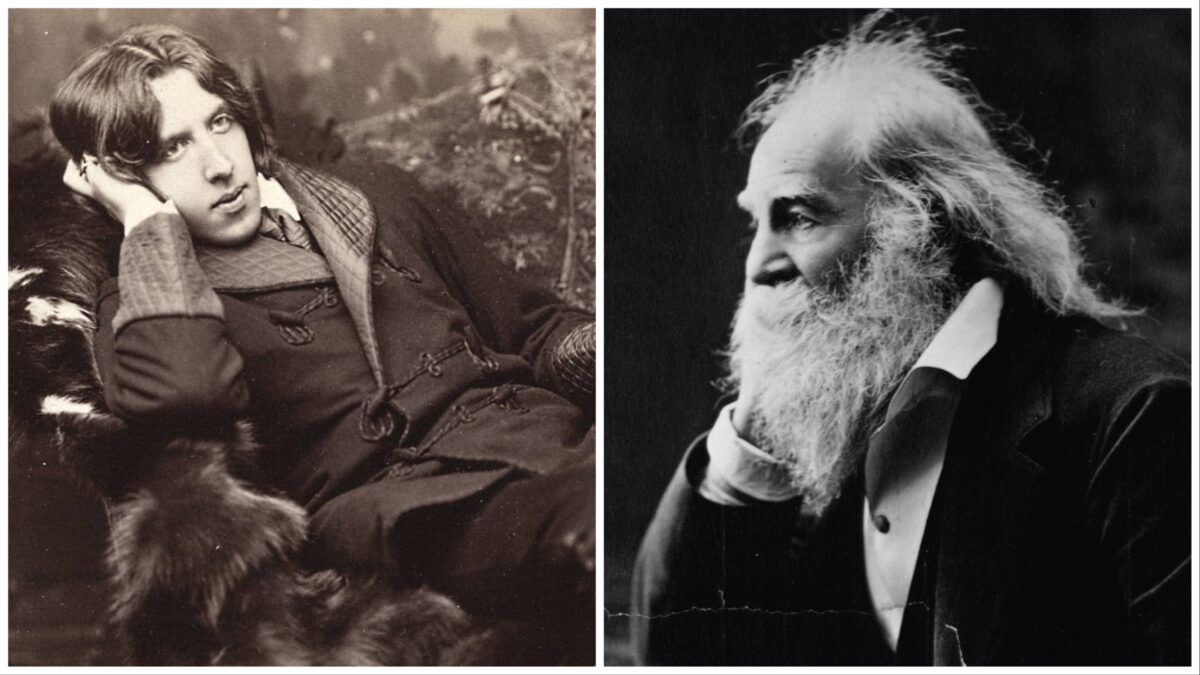
In 1882, Oscar Wilde took break from his lecture tour of North America to meet his childhood idol, the aging poet Walt Whitman, who lived in Camden, New Jersey.
Their afternoon together is the stuff of literary legend. Wilde later recounted, “The kiss of Walt Whitman is still on my lips.”
On these special two episodes of The Gilded Gentleman, host Carl Raymond and guests take a look at the lives of Whitman and Wilde, two revolutionary writers, the times in which they lived, their surprising meeting, and how New York inspired them to move onto great fame and celebrity.
In part one, writer and historian Hugh Ryan(When Brooklyn Was Queer, The Women’s House of Detention) talks about how revolutionary Whitman’s Leaves of Grass was and how Whitman would have defined his same-sex attractions, which had not yet evolved into the concepts of sexuality and gender identification that we know today.
What was the New York and Brooklyn that Whitman knew? Hugh offers insight into just what that famous meeting between the older Whitman and the younger Wilde years later might have been like.
In part two, noted Wilde scholar and expert John Cooper joins Carl to envisions New York that Wilde would have seen upon his arrival.
John guides listeners on a journey to discover just who Wilde was at this point in his life and career, how he and the city of New York interacted with each other and just how Oscar would likely have defined and described his own much debated sexual identity.
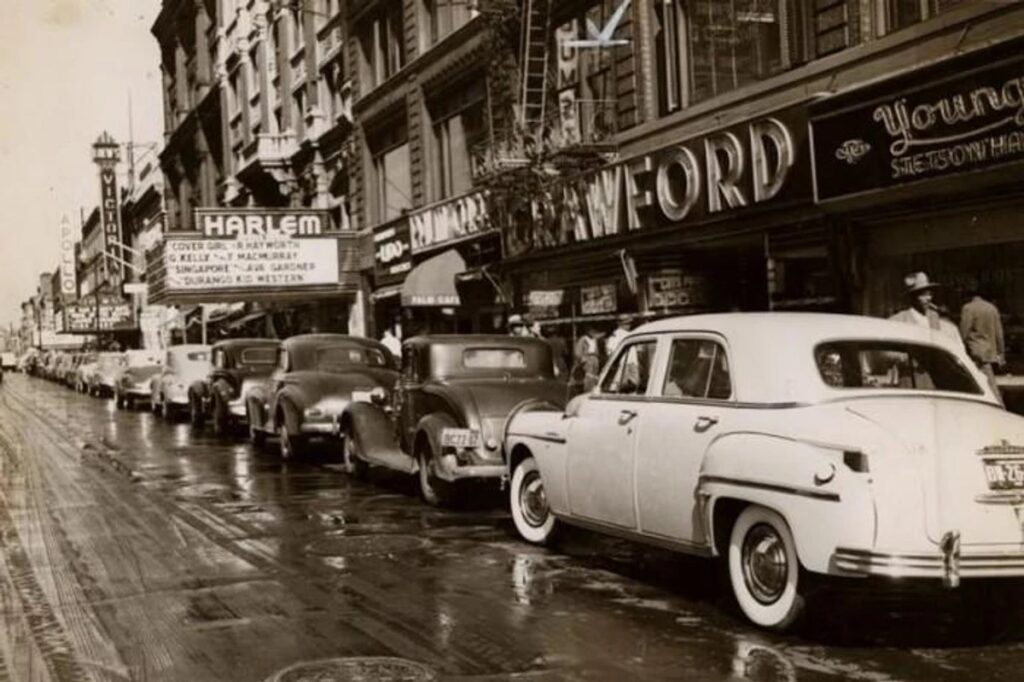
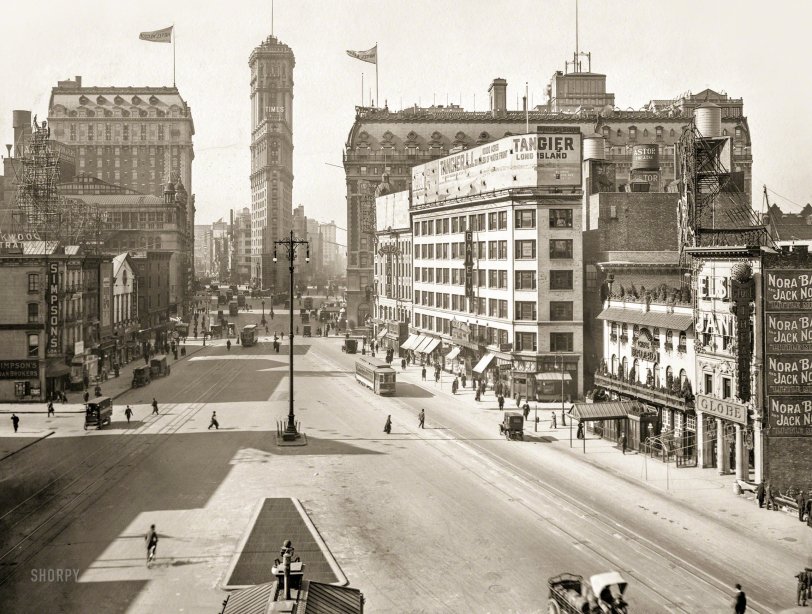
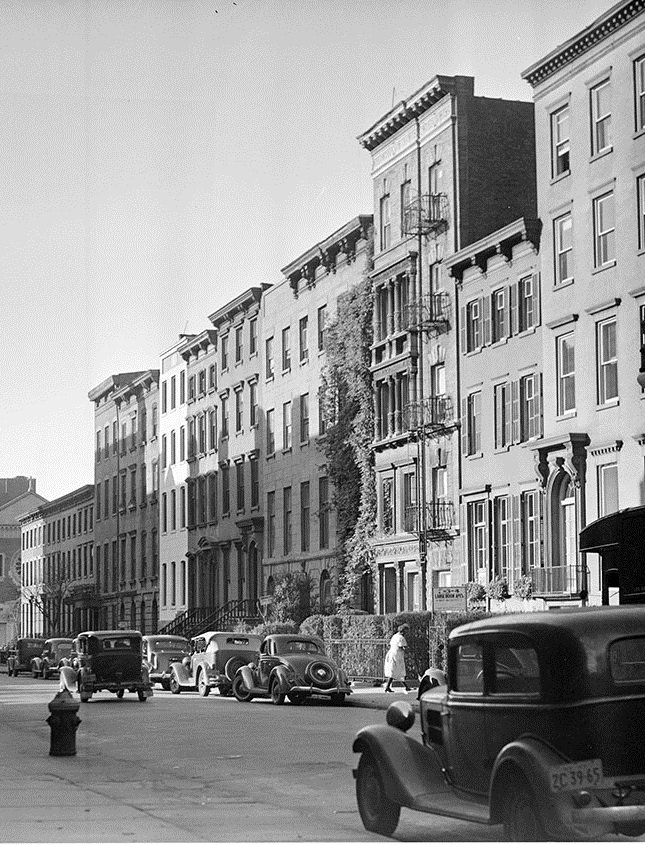
Take a look at a vintage photograph of New York from the 1930s and you’ll see automats, newsies, elevated trains and men in fedoras. What you won’t see — dozens and dozens of automobiles on the curb.
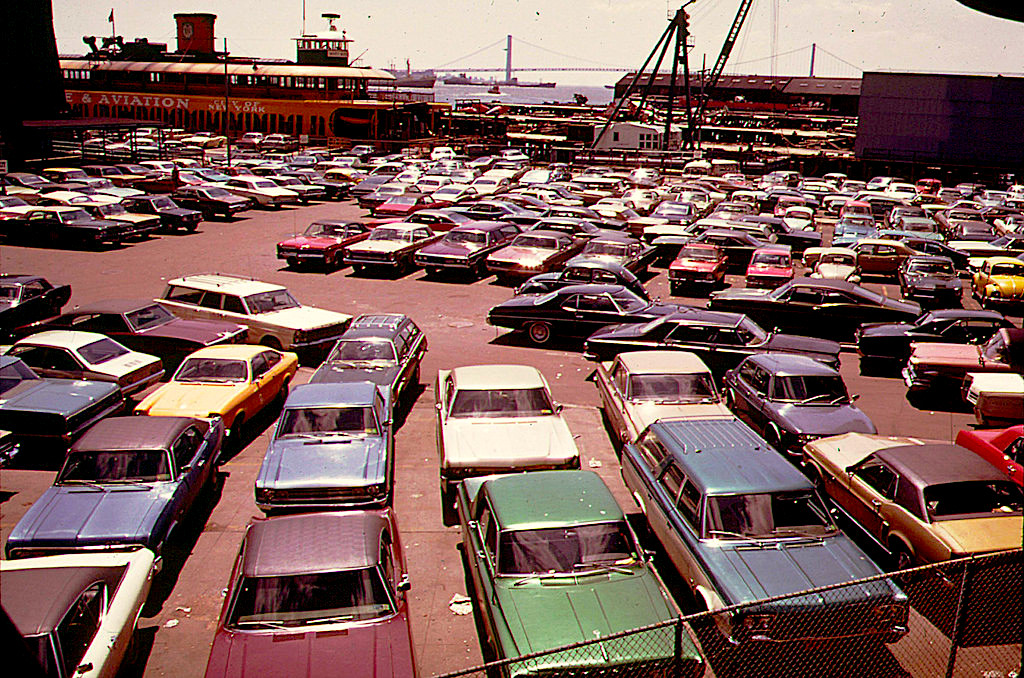
In a city with skyrocketing real estate values, why are most city streets still devoted to free car storage? It’s a situation we’re all so used to that we don’t think twice about it. Whatever happened to the curb?
Long-term and overnight parking used to be illegal in the early 20th century. The transition from horse-drawn carriages to gas-powered automobiles transformed neighborhoods like Times Square and reconfigured everyday life on the street.
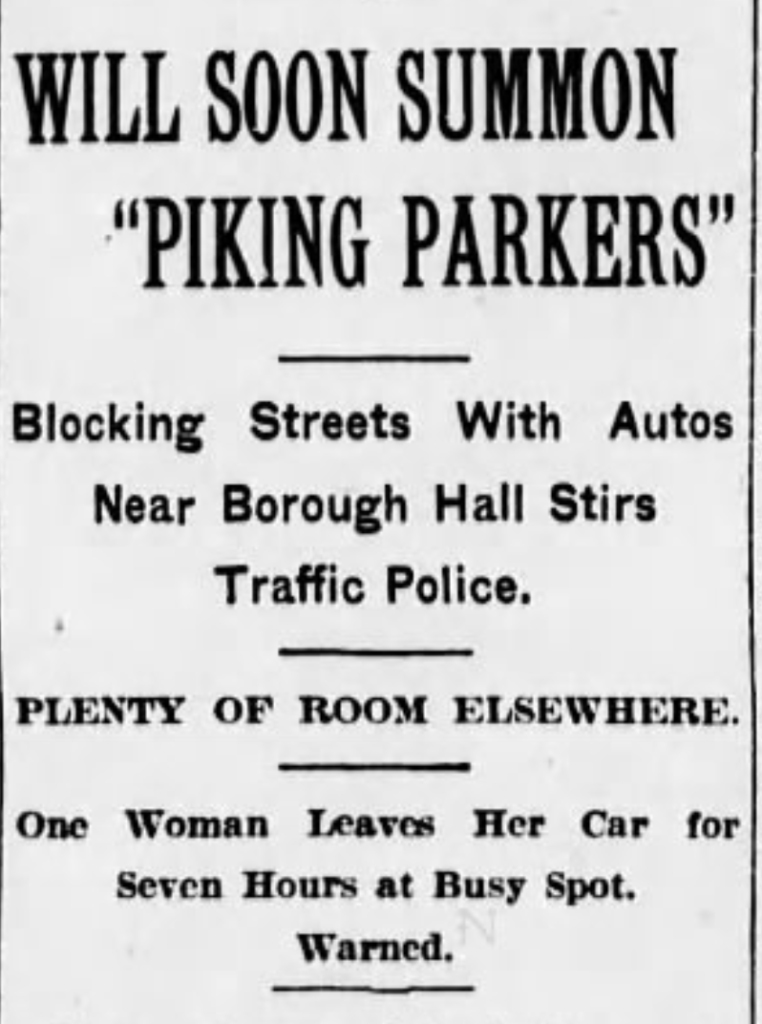
But before the 1920s, parking those glamorous new Model Ts on the street was tolerated only in short-term situations.
Harlem, 125th Street, 1949 — the year before alternate side parking is enacted
By the 1940s, however, New Yorkers were simply too reliant on the automobile, and the city’s parking lots and garages were simply not adequate. (For many New Yorkers, like Seinfeld’s George Costanza, they’re still not acceptable).
Street parking was de facto legalized with the advent of alternate-side parking rules, and soon parking meters and ‘meter maids’ were attempting to keep a handle on the chaotic situation.
Eventually the car took over. Will it always be this way?
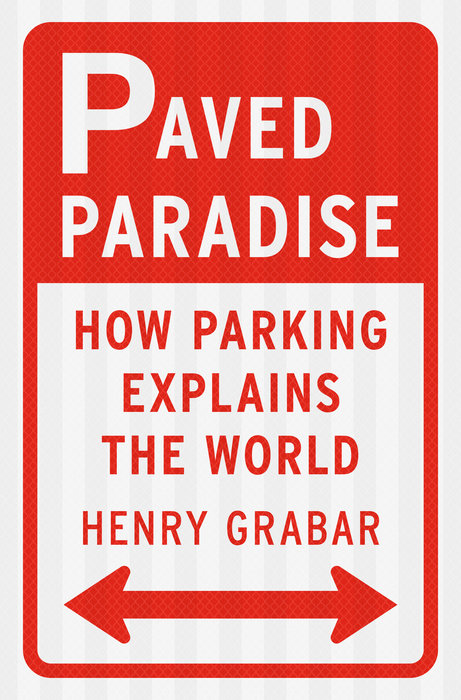
In this special episode, Tom and Greg are joined by Slate Magazine writer Henry Grabar, author of Paved Paradise: How Parking Explains The World, who exposes some shocking parking violations and even offers a few couple solutions for the future.
LISTEN NOW: THE NEW YORK PARKING WARS
Our thanks to Henry Grabar for joining us on the show today. You can find all his work from Slate Magazine here. You might also like to hear him on a couple of our favorite podcasts — Decoder Ring and 99 Percent Invisible.
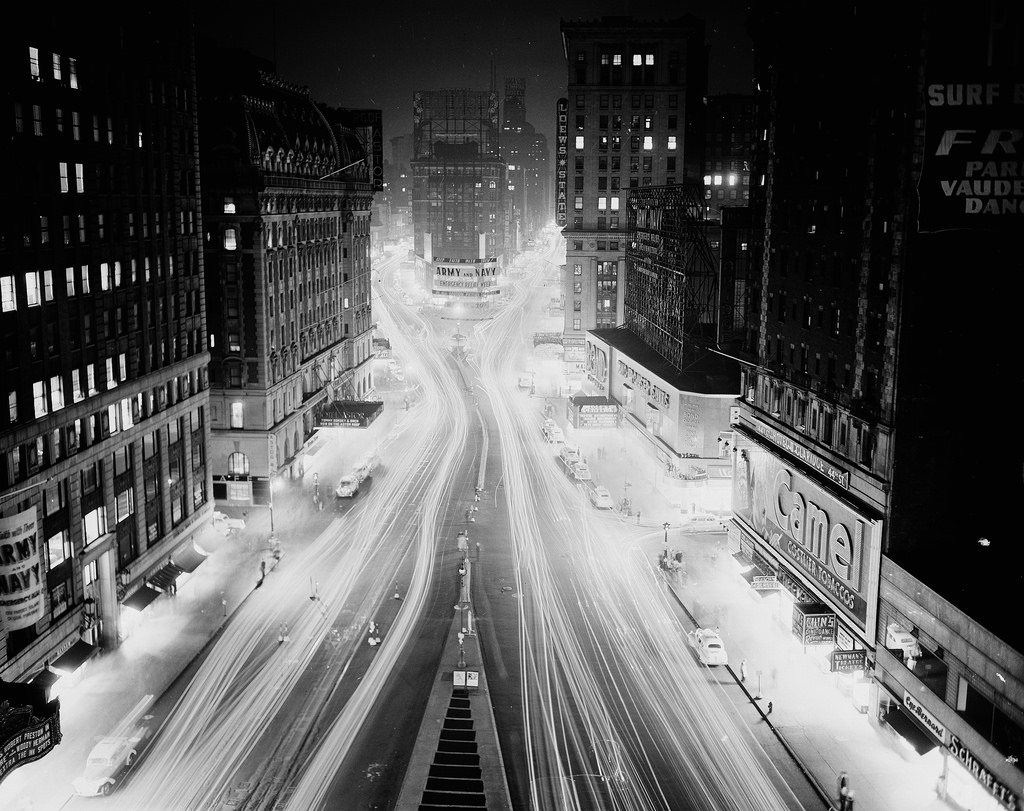
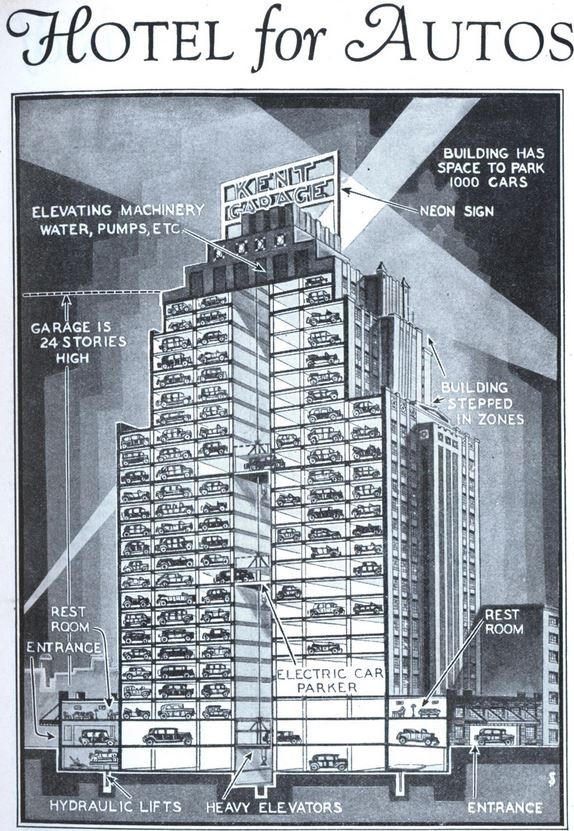
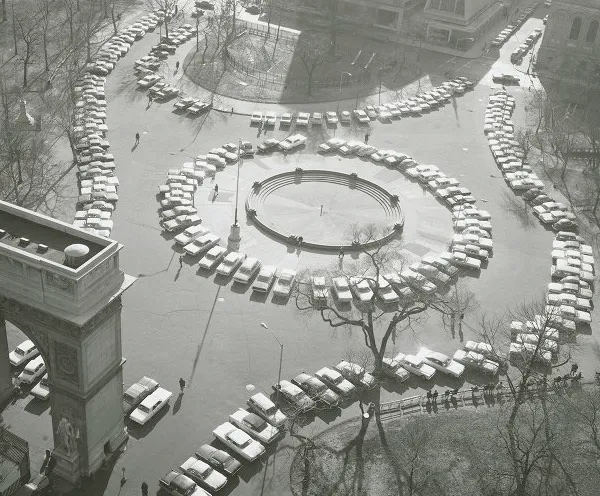
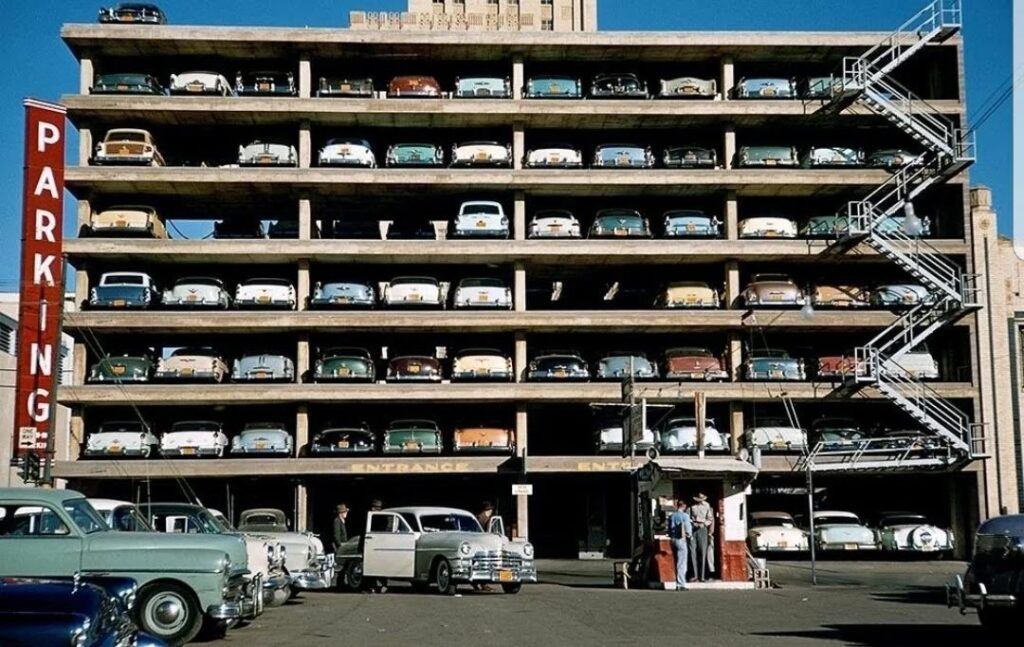
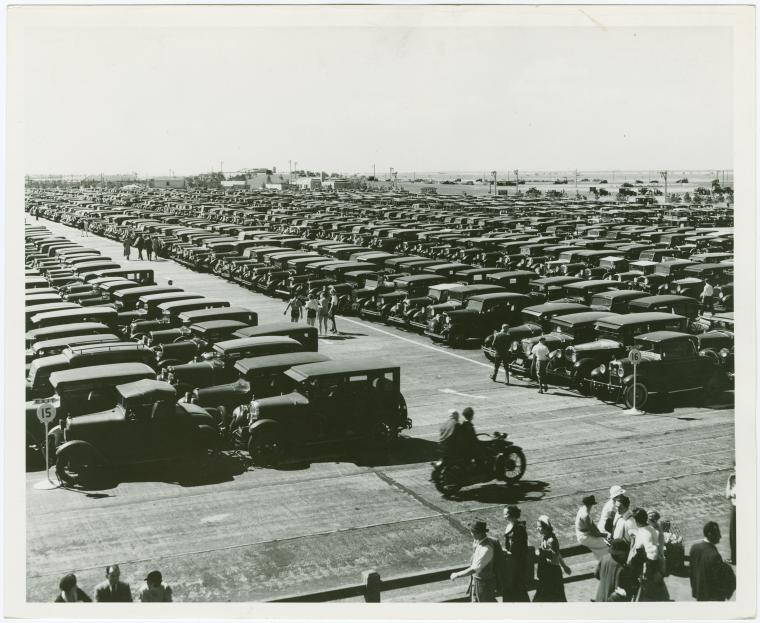
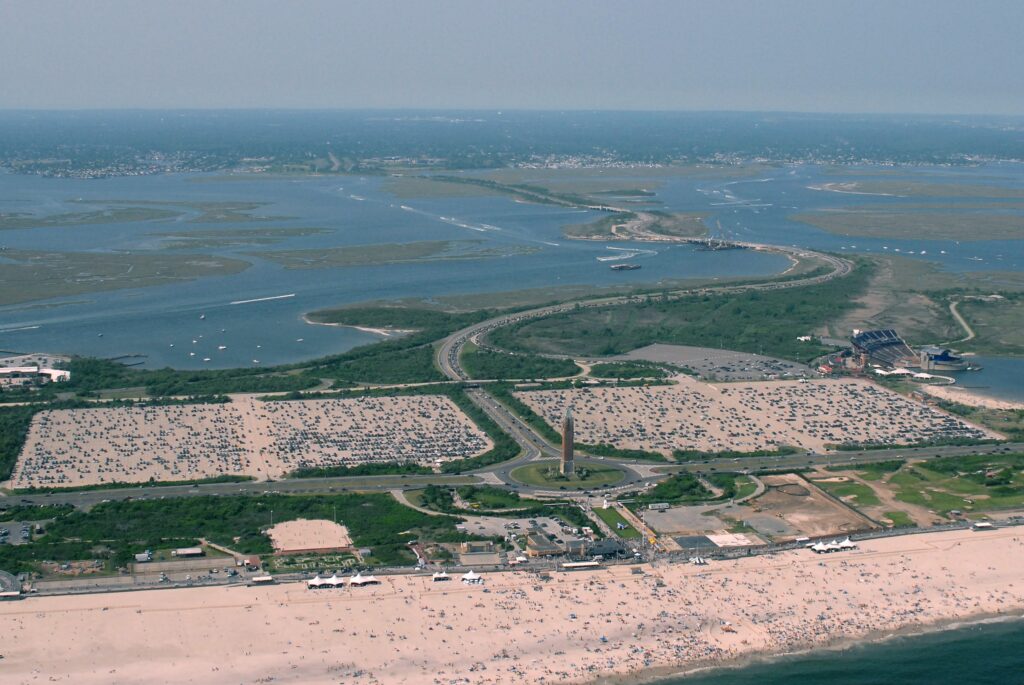
Times Square: The original ‘automobile district’, 1911 (cleaned up shot courtesy Shorpy)Brooklyn Daily Eagle, 1918Times Square in the 1930s. Although this is certainly taken late night, there are very few cars at the curb.Washington Square North,: 1937. Courtesy WPA-FWP Collection, NYC Municipal Archives.A 1930s motor hotel, courtesy Modern MechanixCars, Washington Square Park, Aerial View, 1960sNew York City parking garage, photograph by Marvin E Newman, taken in 1955.The stacked parking solution, photo taken 2010, Jérôme from Wikimedia CommonsJones Beach parking lot then (as in 1934, courtesy New York Public LIbrary)Jones Beach parking lot now
Seinfeld clips which pertain to this week’s show
FURTHER LISTENING:
After you’re done with this show on the history of parking, check out these shows from our back catalog with similar themes.
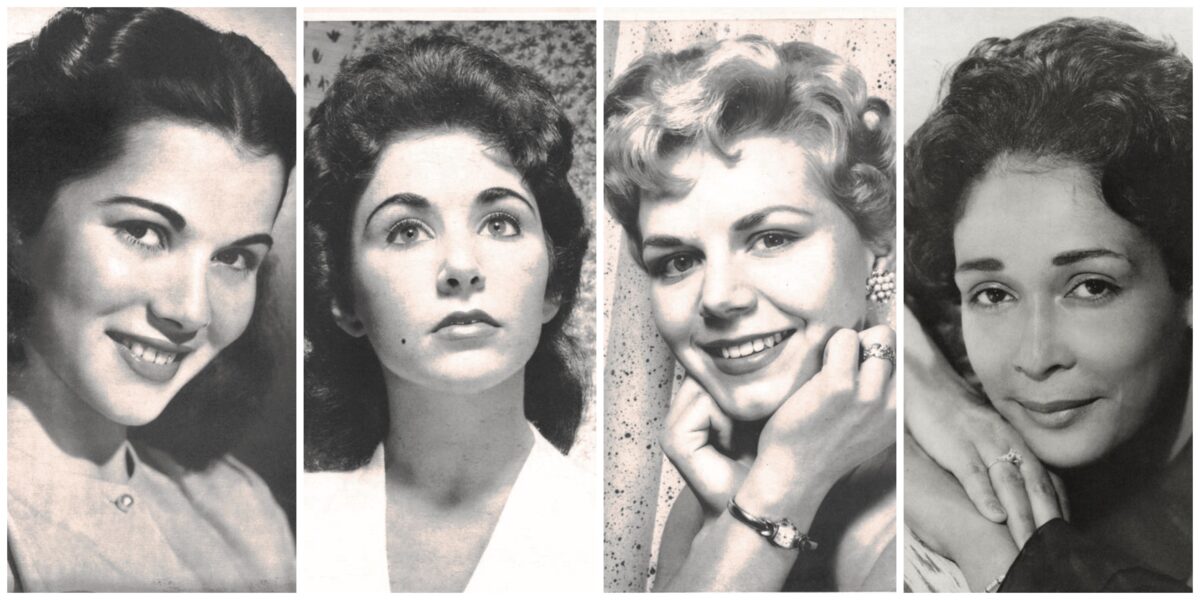
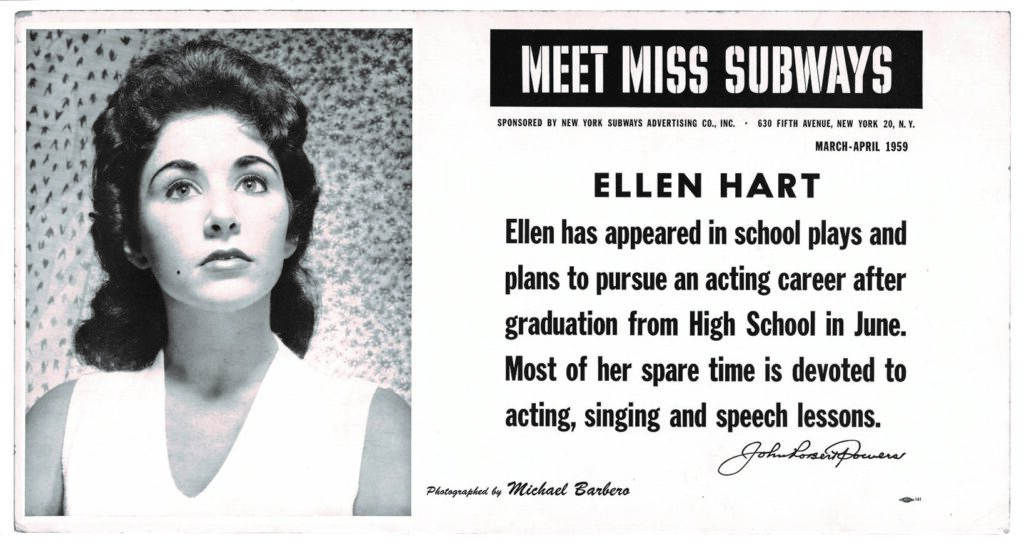
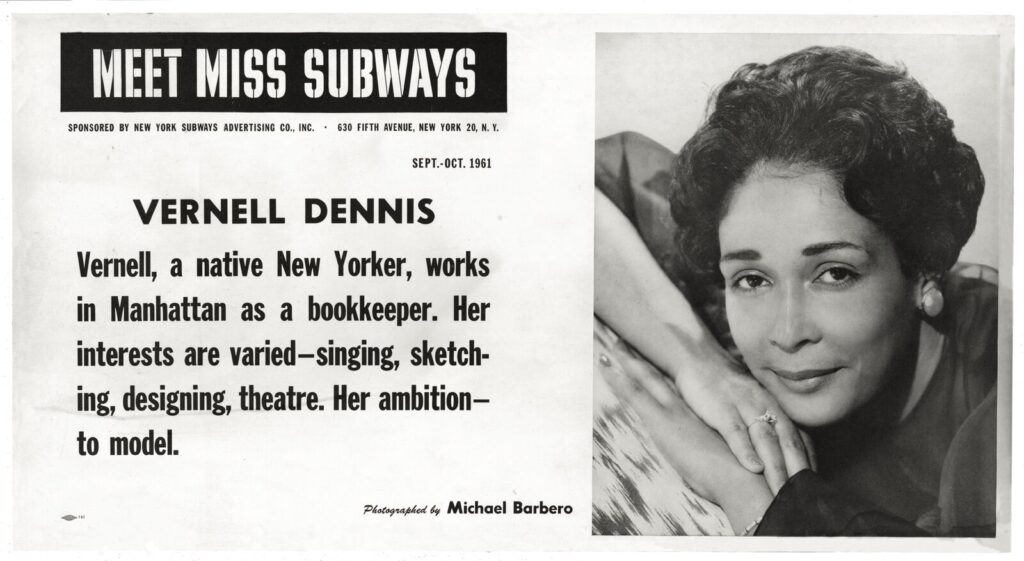
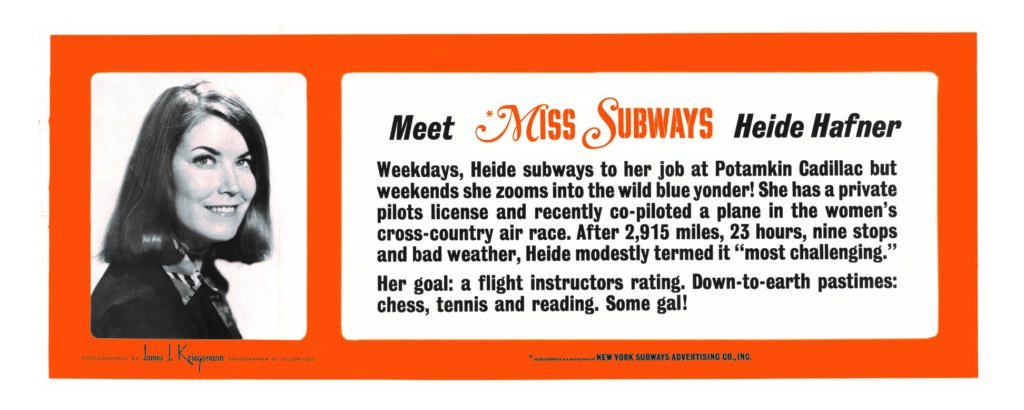
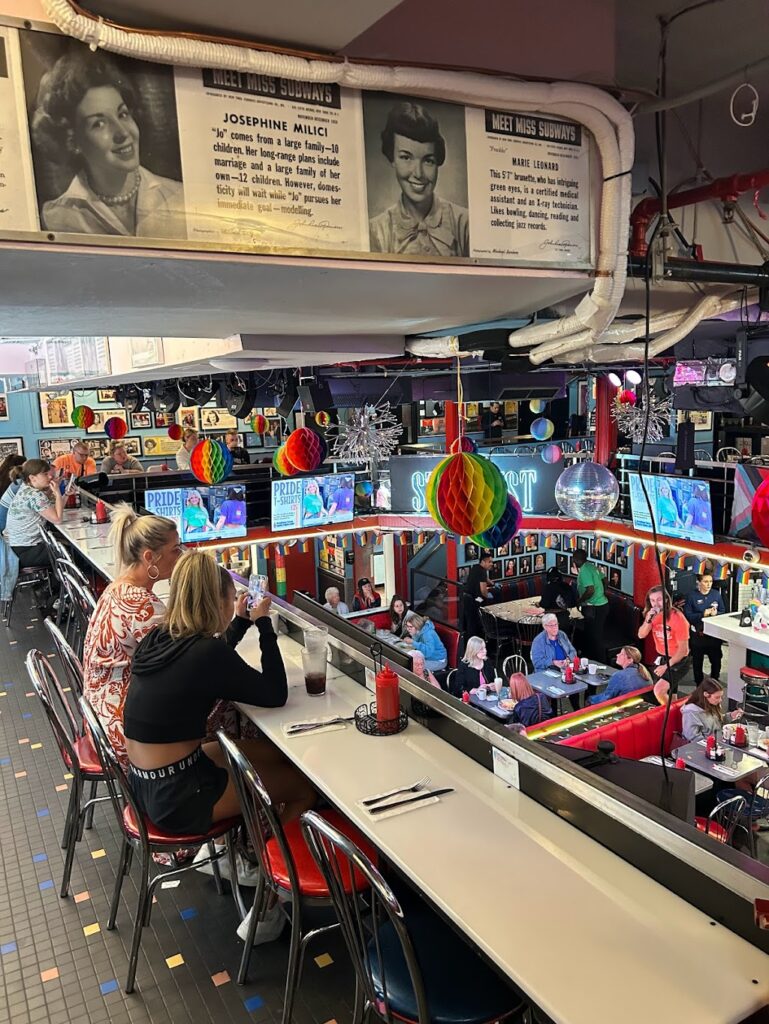
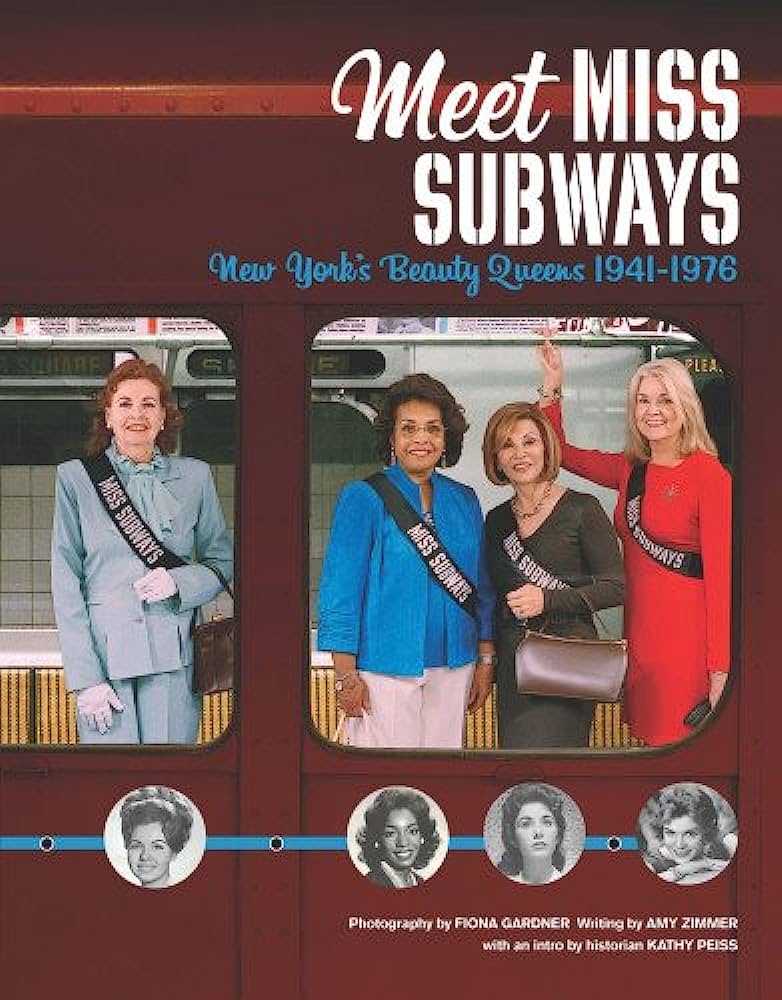
Miss Subways winners Enid Berkowitz (July 1946), Ellen Hart (March-April 1959), Shirley Martin (May-June 1960), Vernell Dennis (Sept-Oct 1961)
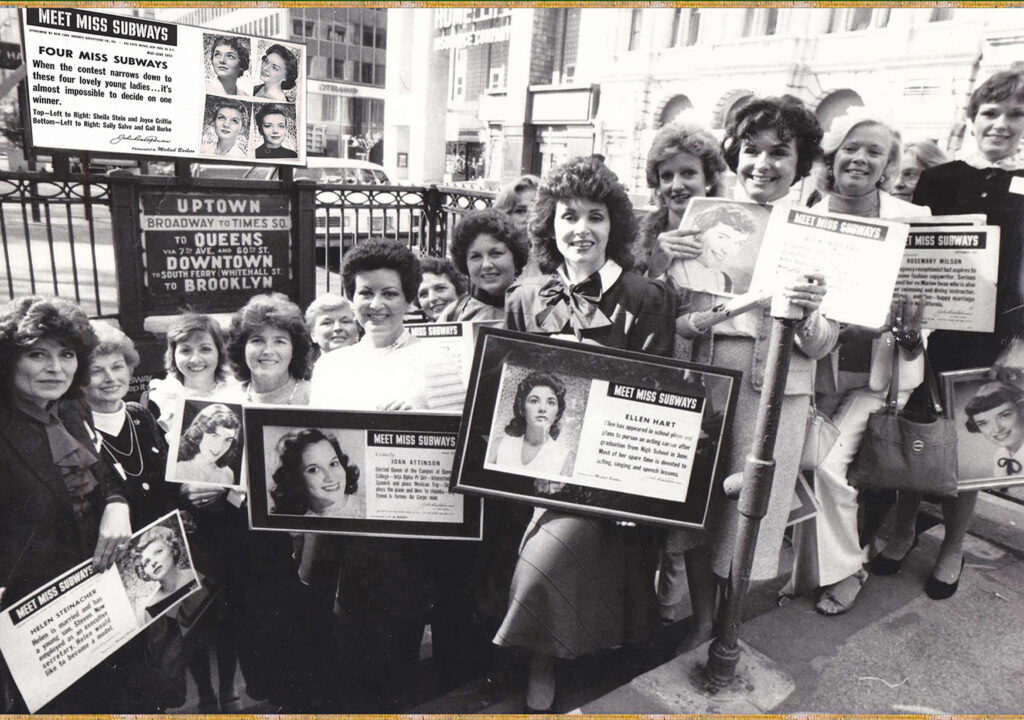
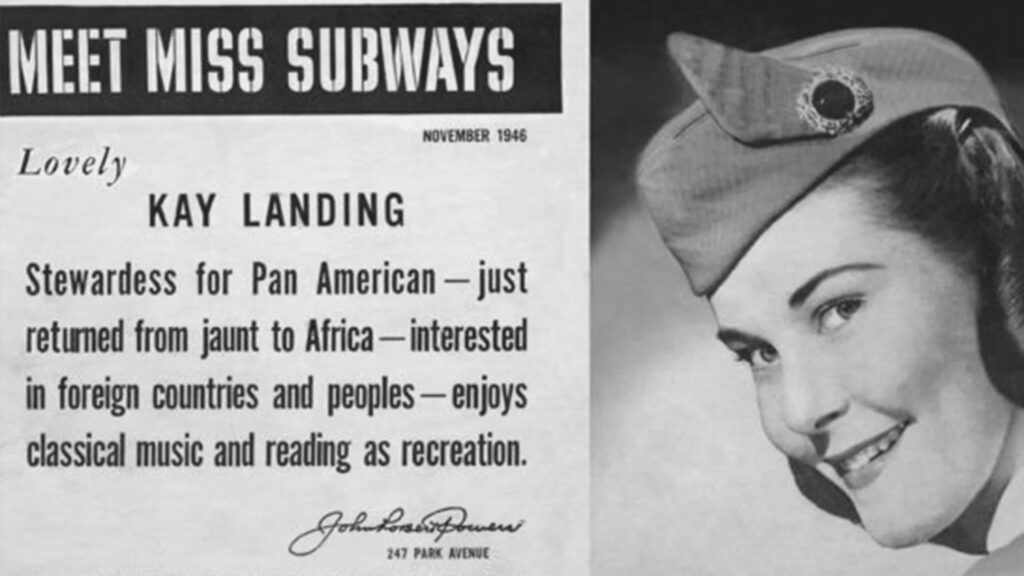
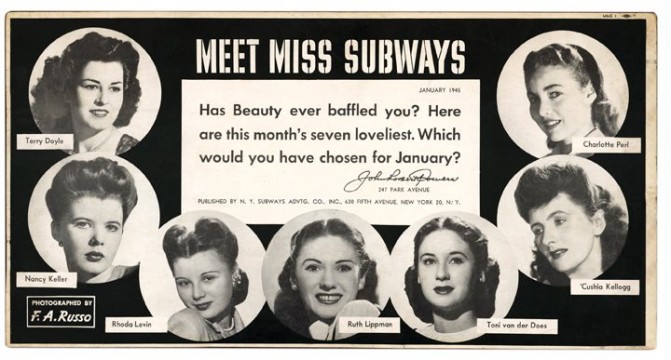
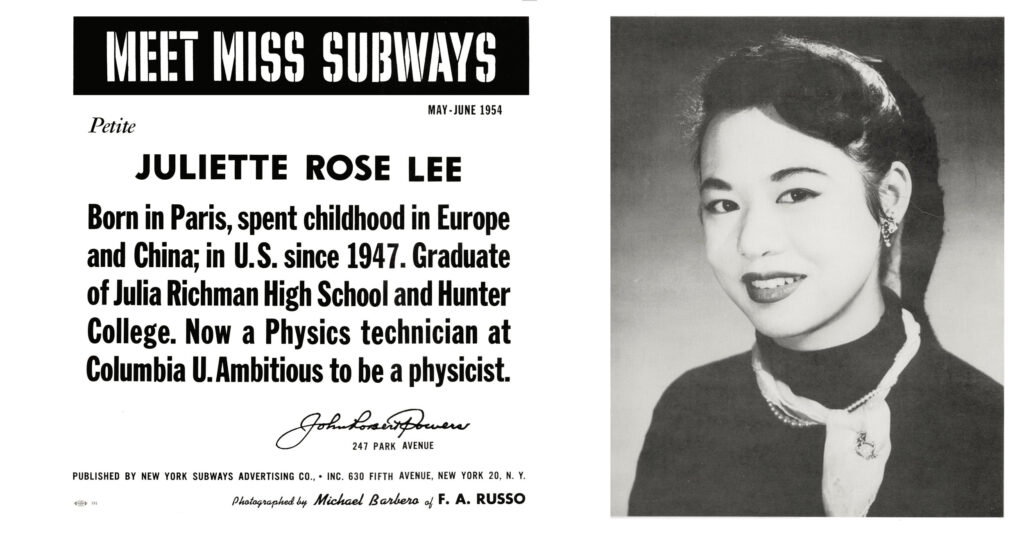
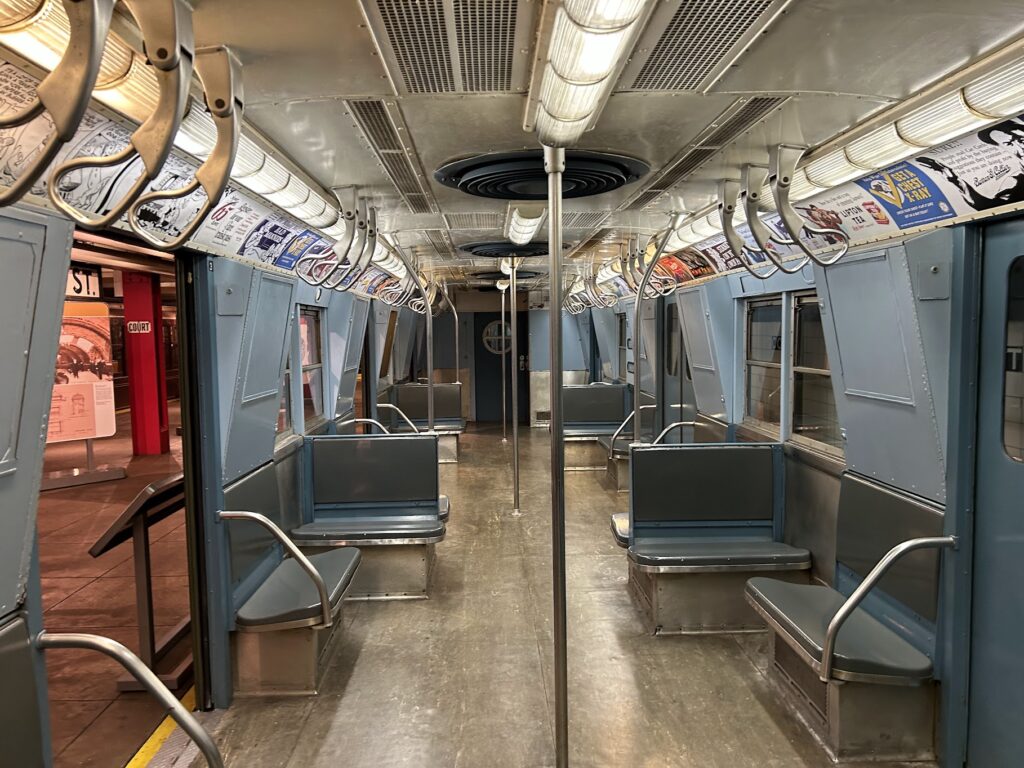
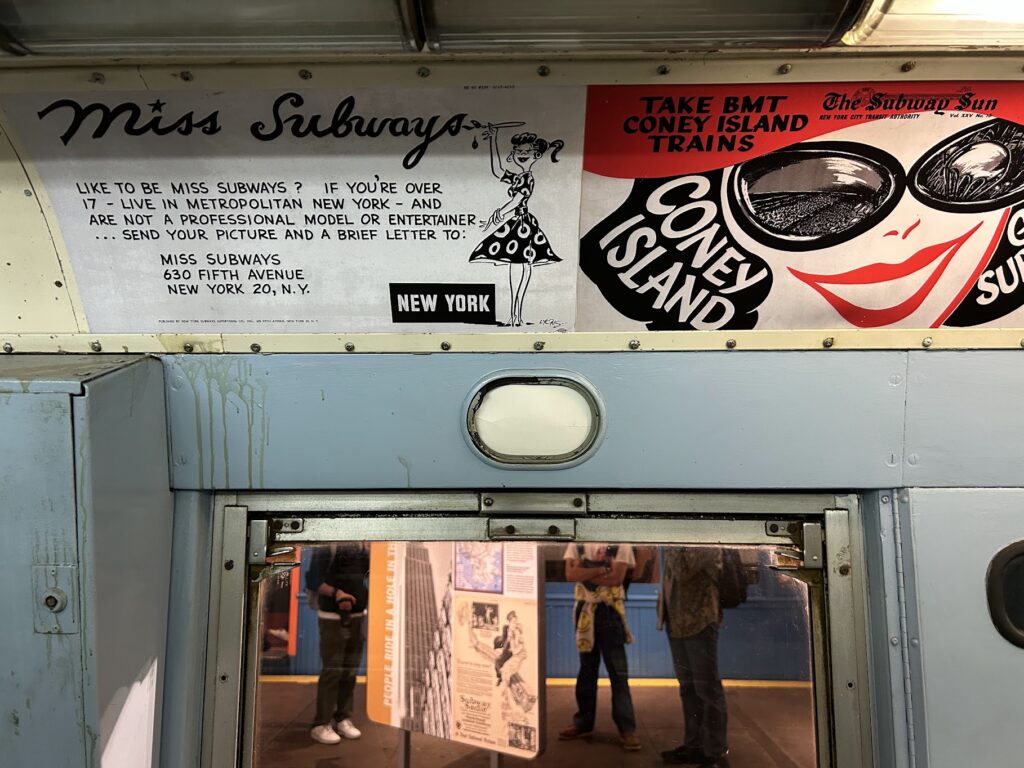
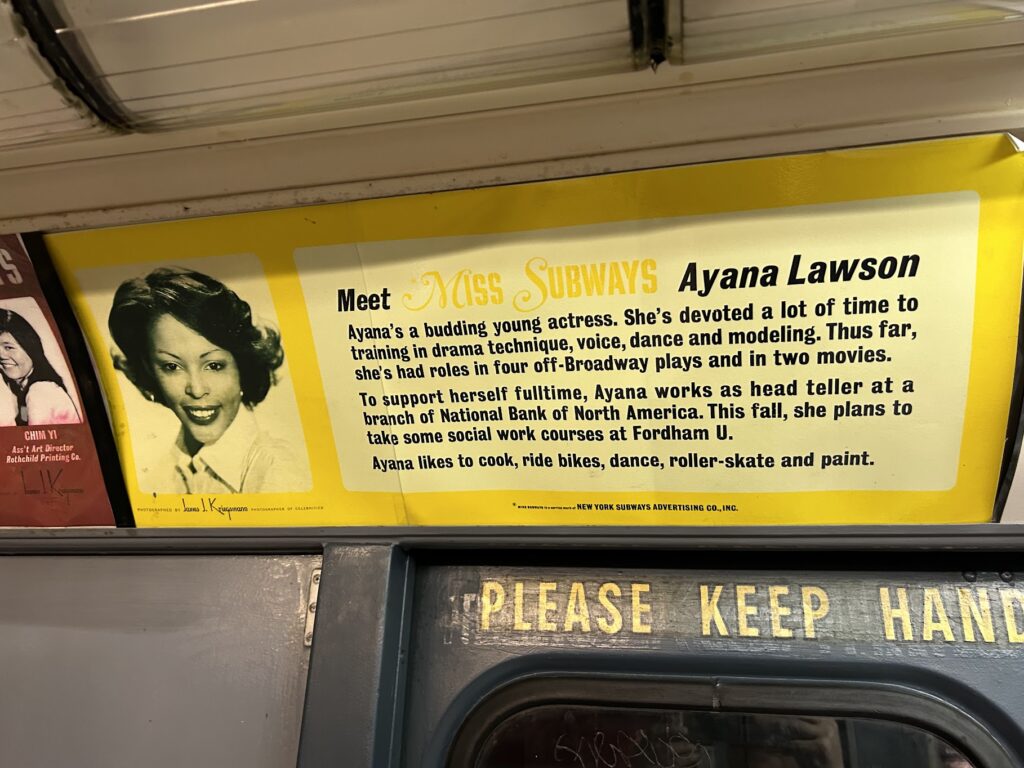
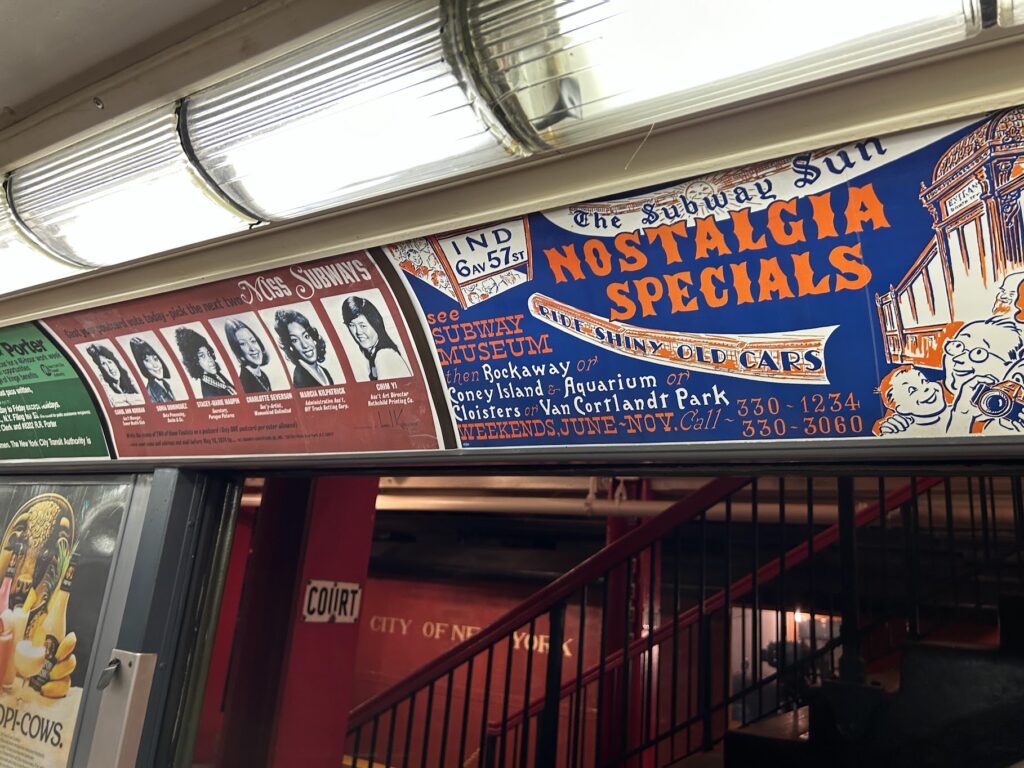
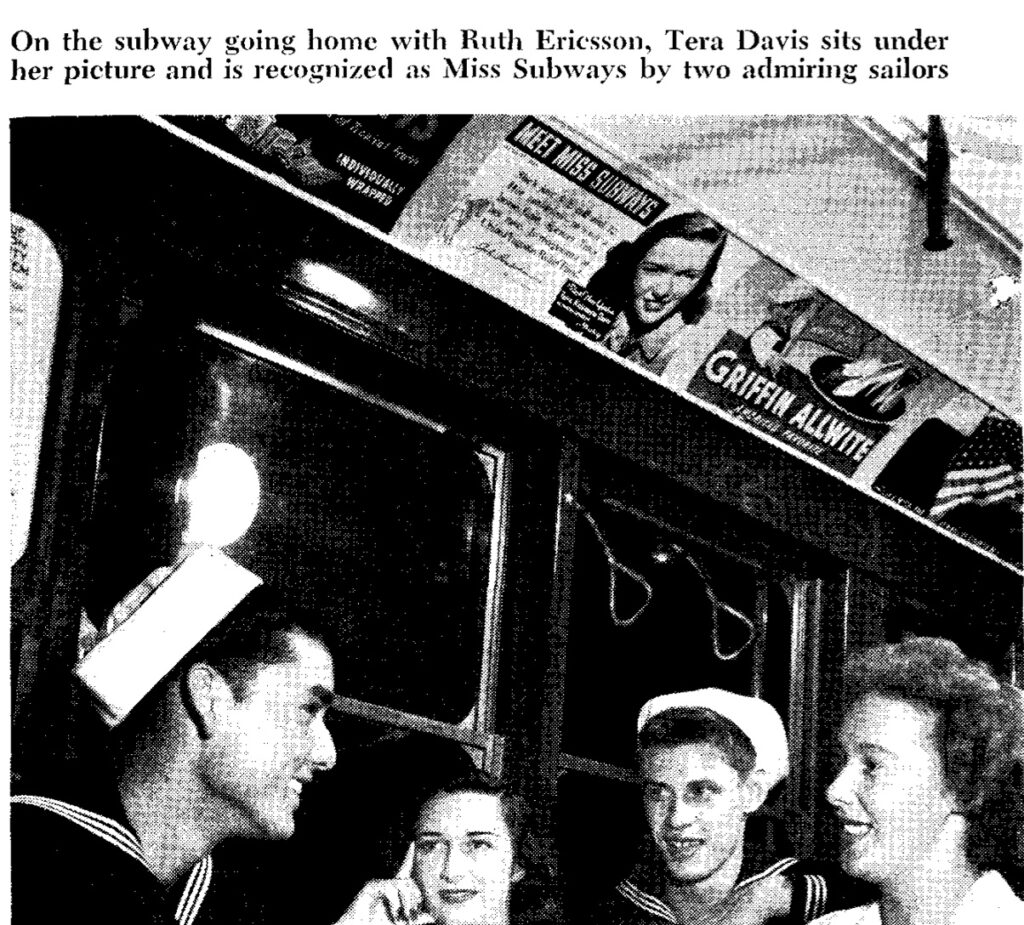
From 1941 and 1976, dozens of young women and high school girls were bestowed the honor of Miss Subways with her smiling photograph hanging within the cars of the New York subway system.
This was not a beauty pageant, but rather an advertising campaign which promoted the subway and drew the eyes of commuters to the train car’s many advertisements for cod liver oil, cigarettes and frozen foods.
The women who were chosen for Miss Subways became overnight local celebrities, aspirational figures for thousands of subway riders.
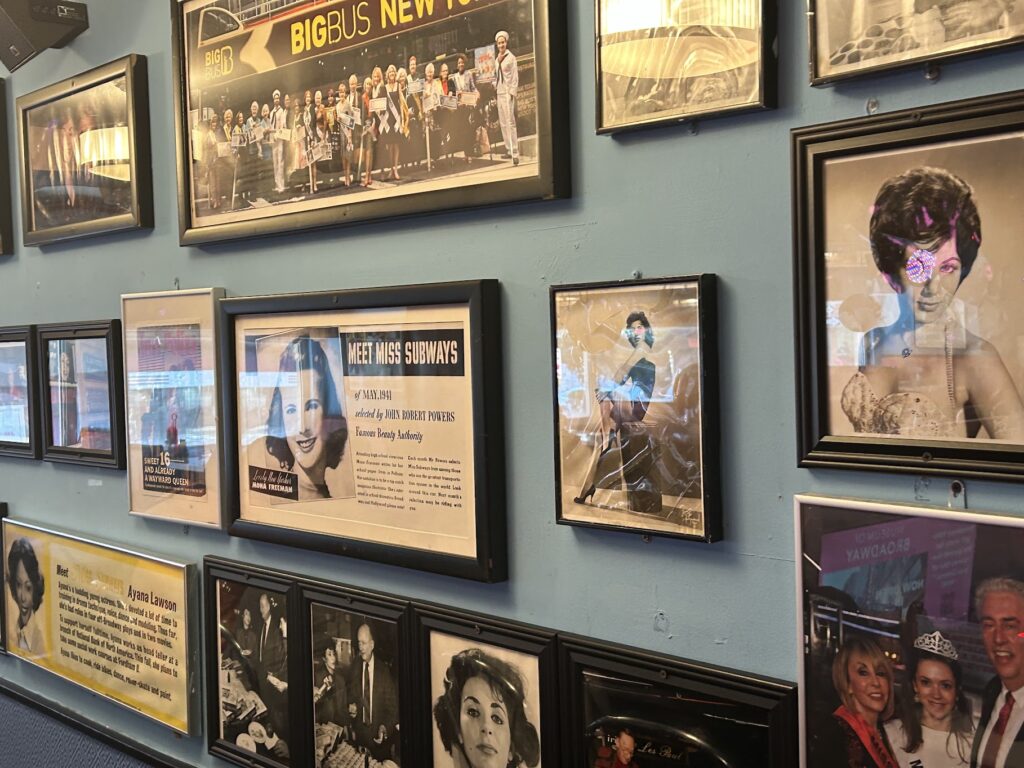
The program was overseen by modeling agent guru John Robert Powers whose work for mail order catalogs and newspapers would help define the ‘girl-next-door’ image of the mid 20th century.
However this blonde Midwestern template soon looked out of place promoting the subway system of one of the most diverse cities in the world. By the 1960s, winners of this fleeting title began to reflect the many types of women who commuted and used the subway.
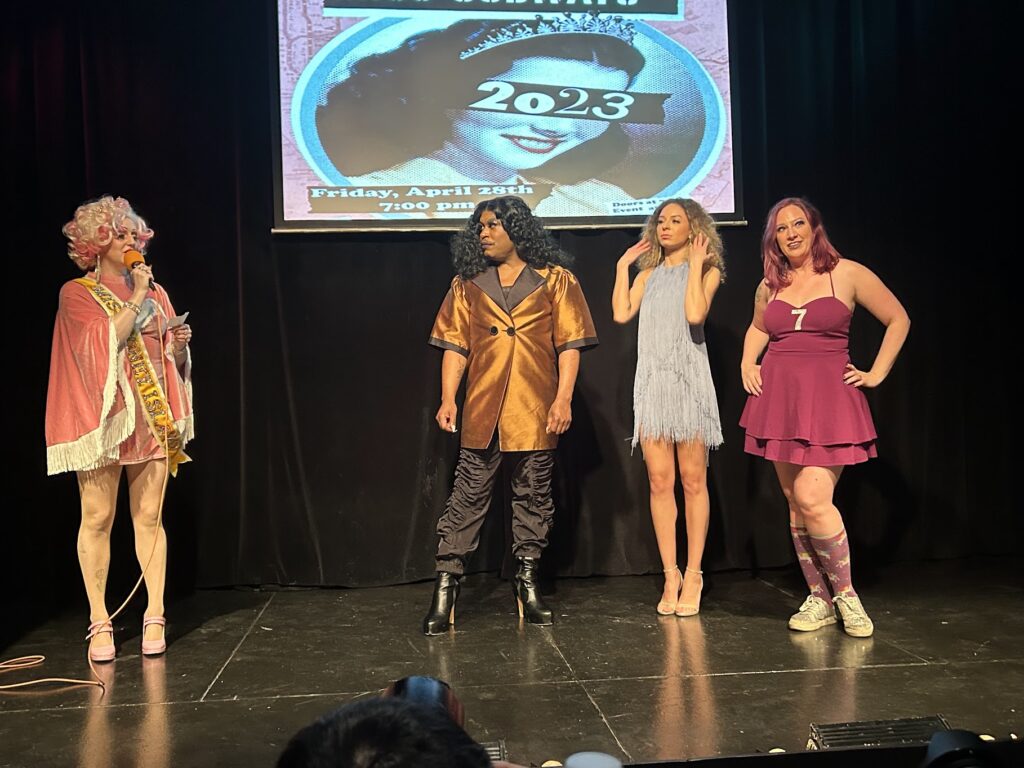
Listen in as Greg tells the story of the Miss Subways pageant then participates as a judge for a brand new Miss Subways competition, held in Coney Island in April. But what does this title mean in 2023?
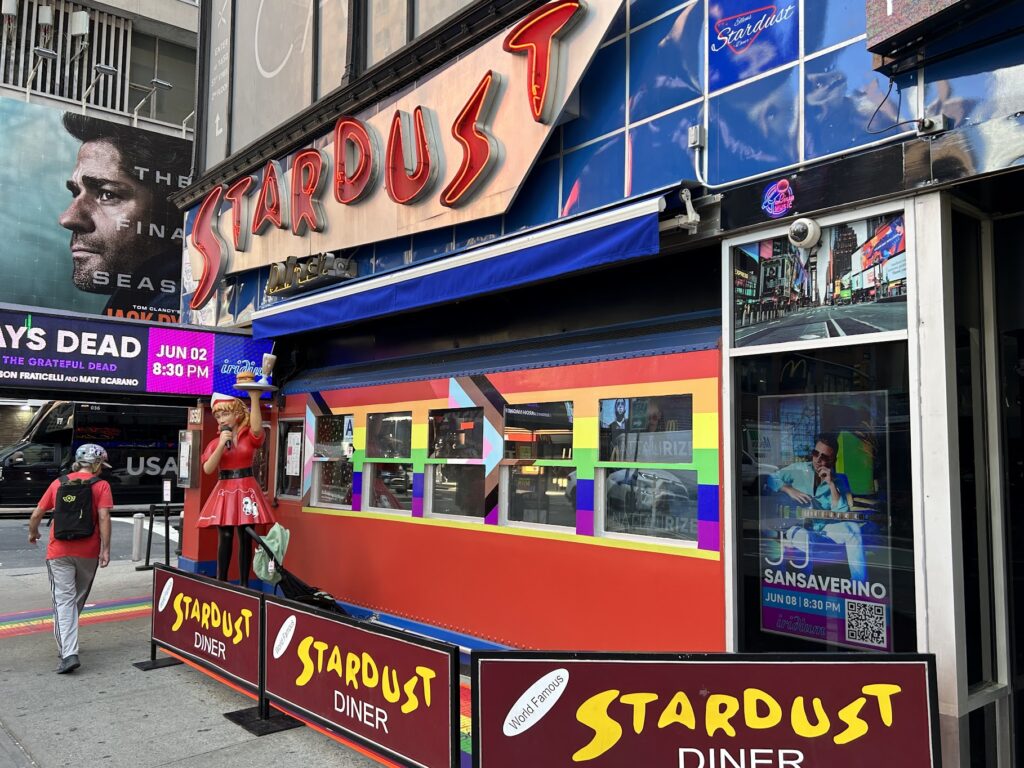
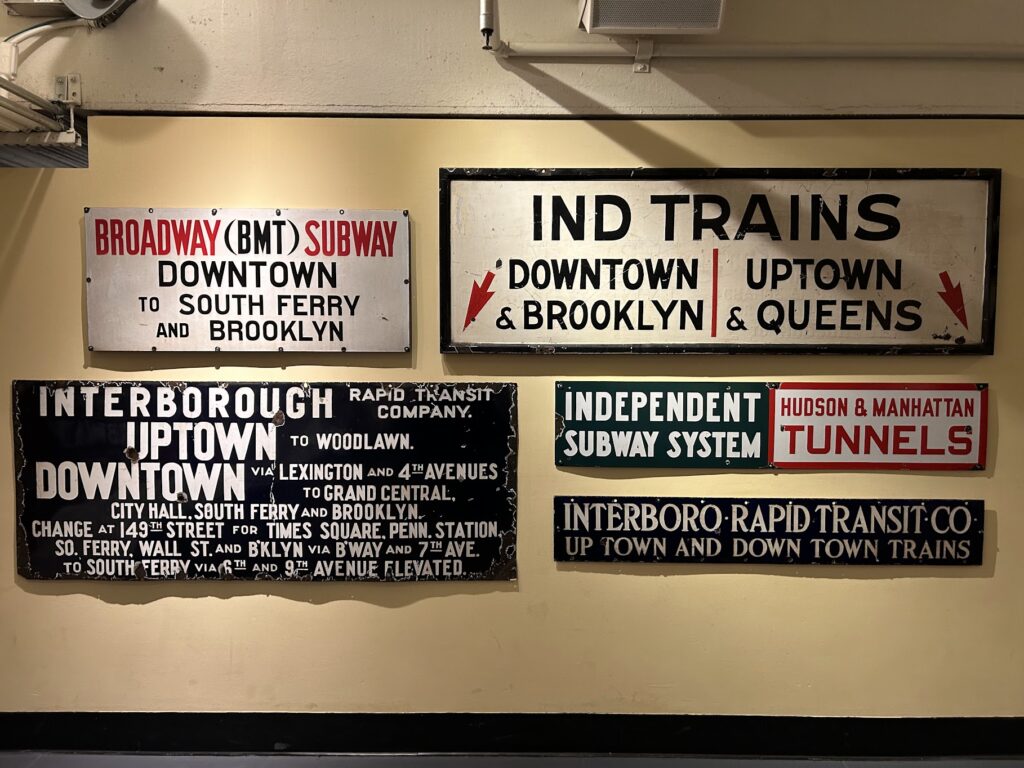
FEATURING A visit to the New York Transit Museum, the City Reliquary, Coney Island USA’s Seashore Theater and Ellen’s Stardust Diner
LISTEN NOW: MISS SUBWAYS: QUEENS OF THE NEW YORK COMMUTE
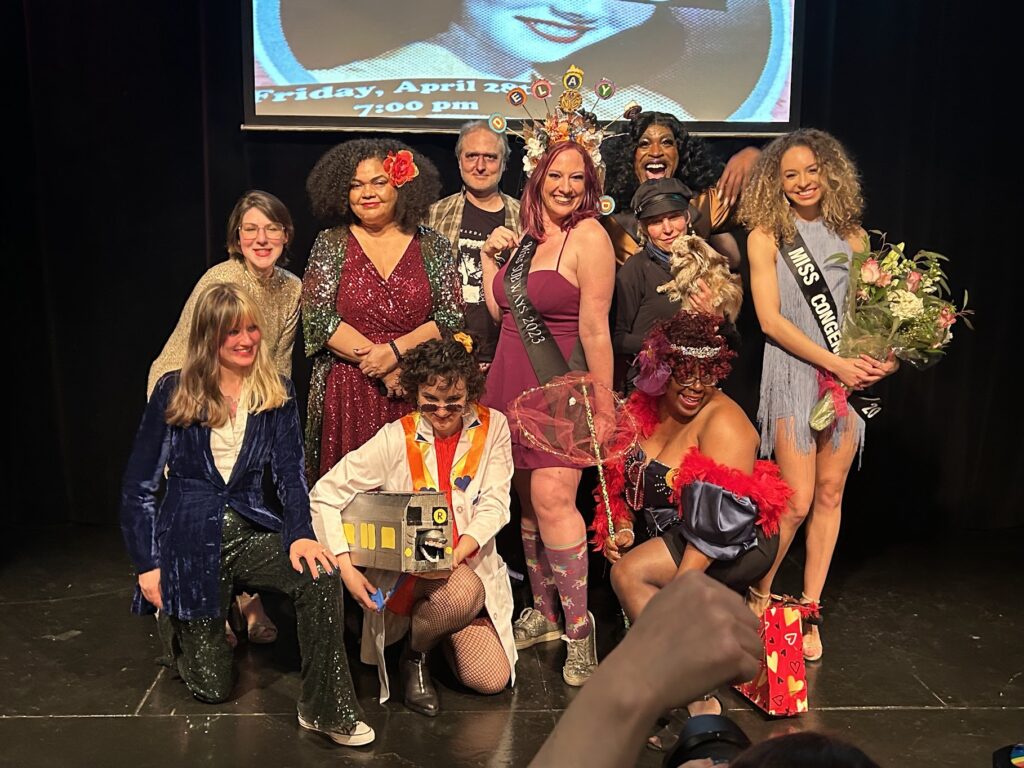
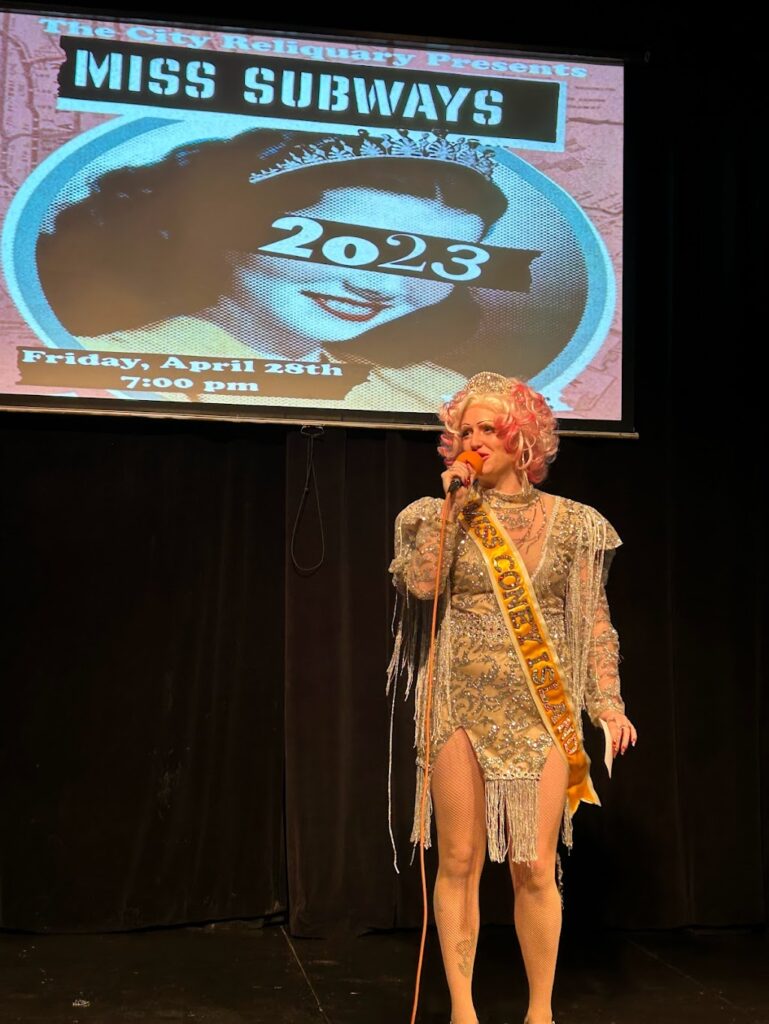
Harmony Hardcore and the contestants of the 2023 Miss Subways pageantThe glorious Maggie McMuffinThe final three contestants — Lena Horné, Chantelle and Harmony Hardcore
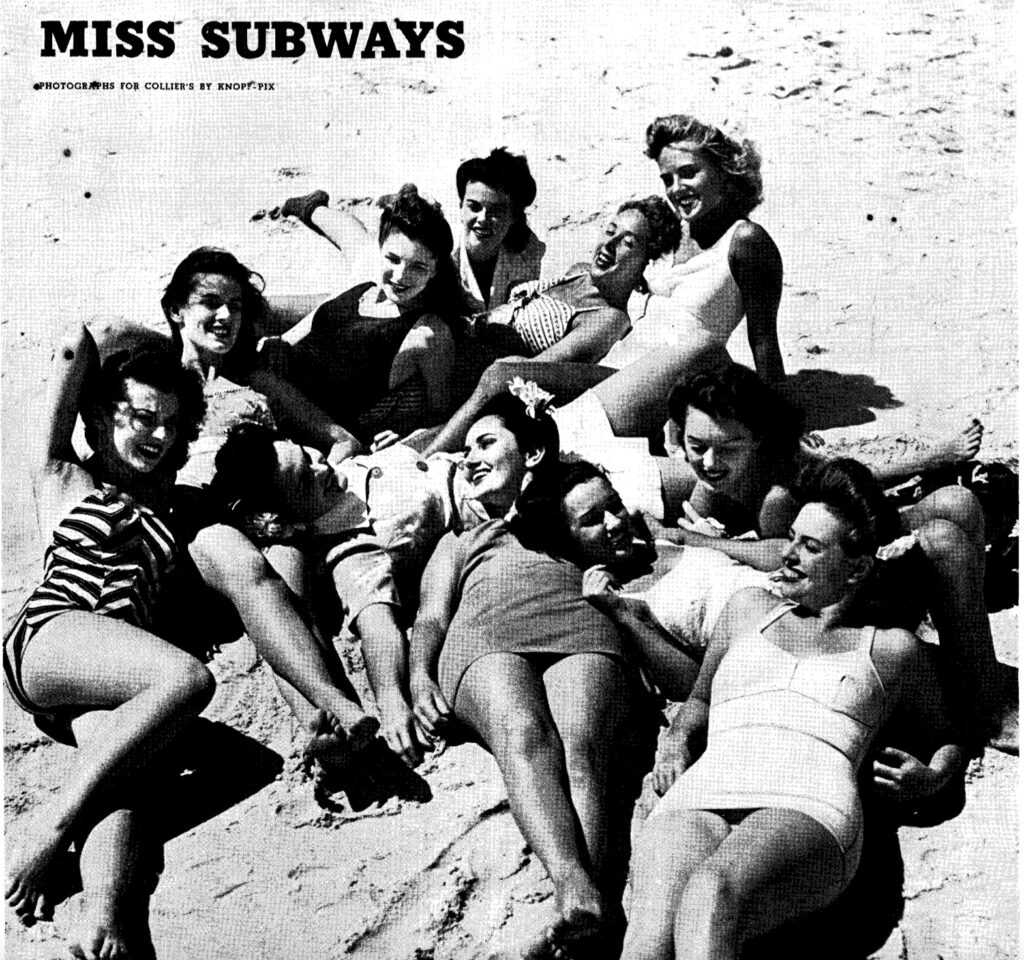
From an article in Collier’s Weekly, September 25, 1943, “Miss Subways: A new kind of beauty brightens the life of New York’s underground commuters,” in a photograph highly influenced by the pin-up photos of Betty Grable and other wartime beauties:
FURTHER LISTENING
After listening to this podcast, head back into our back catalog and listen to these shows with similar themes
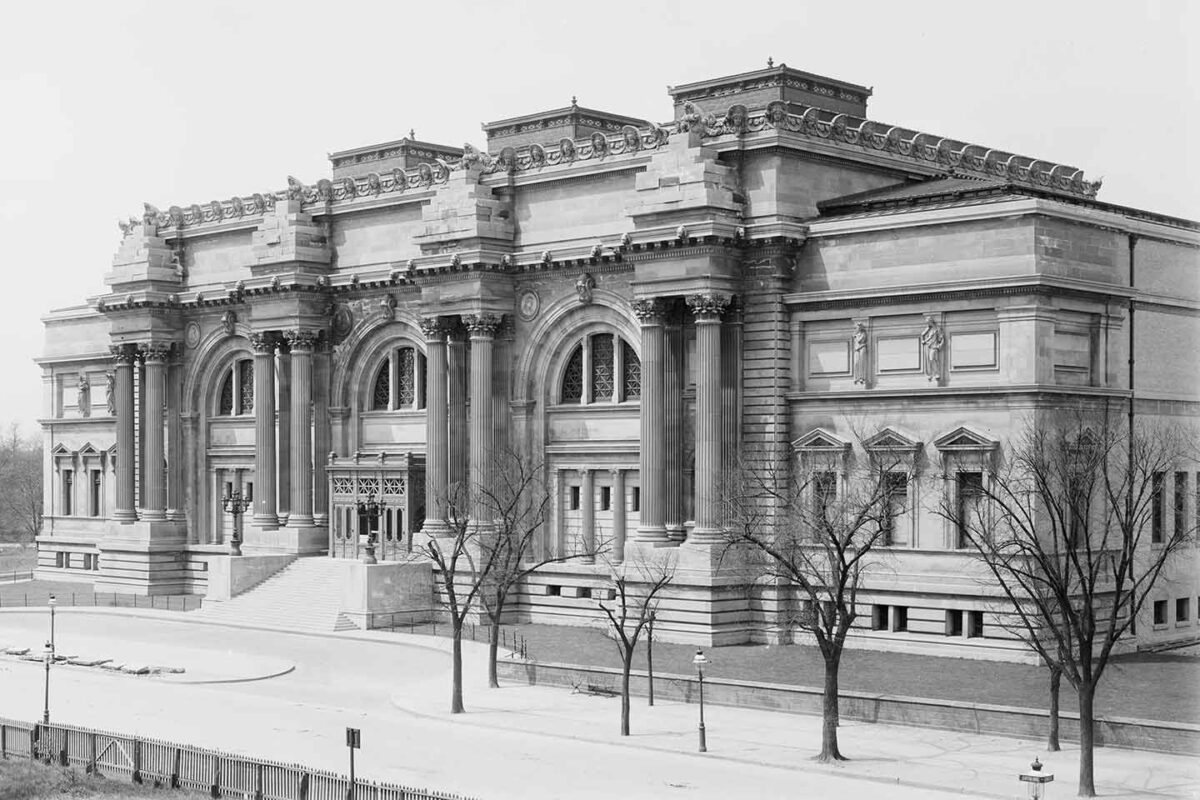
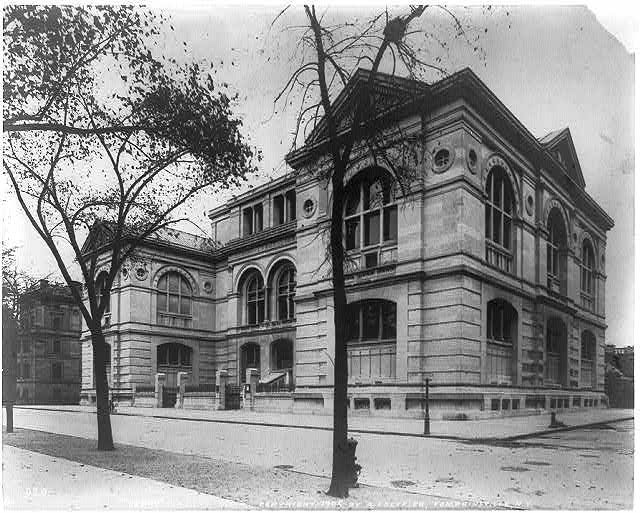
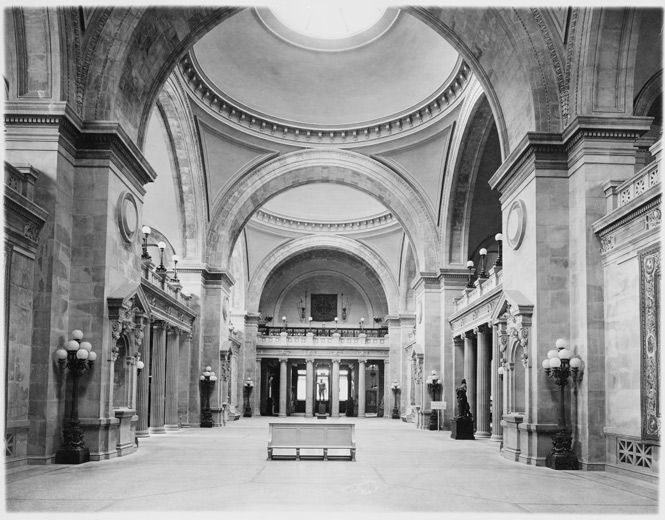
The Metropolitan Museum, 1902, entrance hall by Richard Morris Hunt. (Photo courtesy the Met Museum)
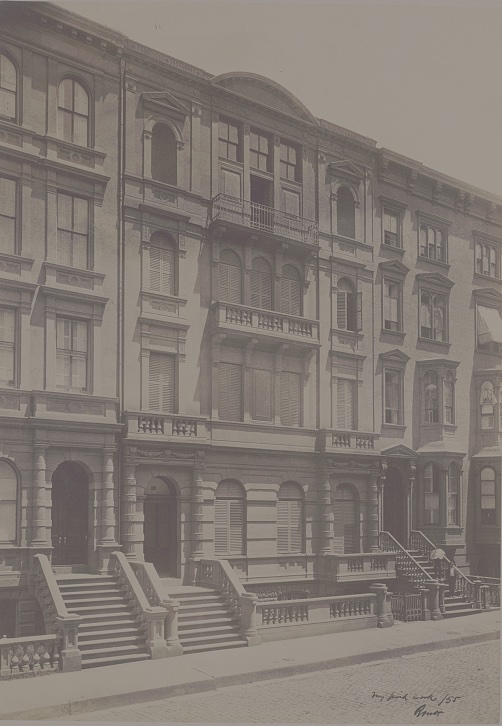
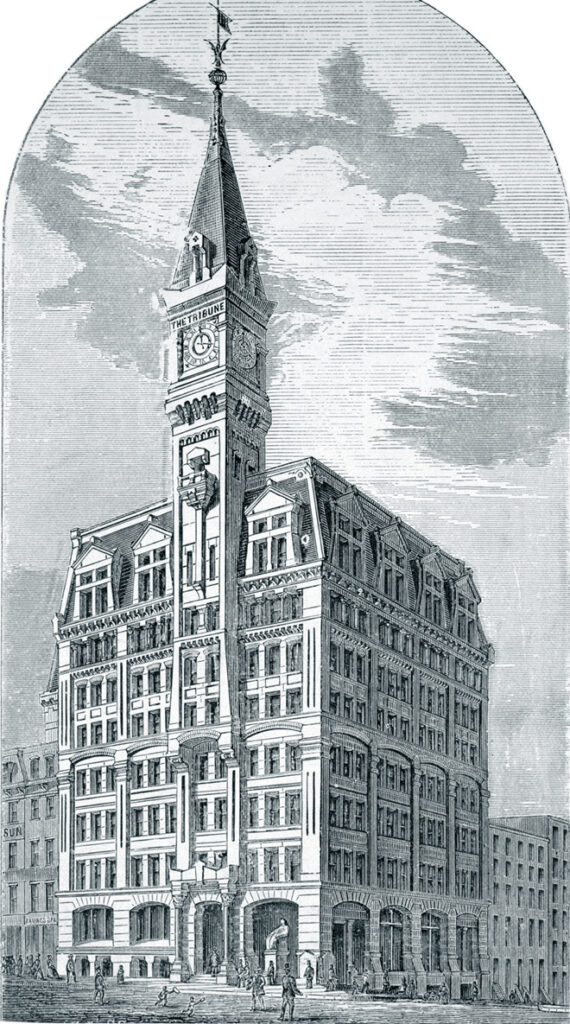
Richard Morris Hunt was one of the most important architects in American history. His talent and vision brought respect to his profession in the mid 19th century and helped to craft the seductive style of the Gilded Age.
So why are there so few examples of his extraordinary work still standing in New York City today?
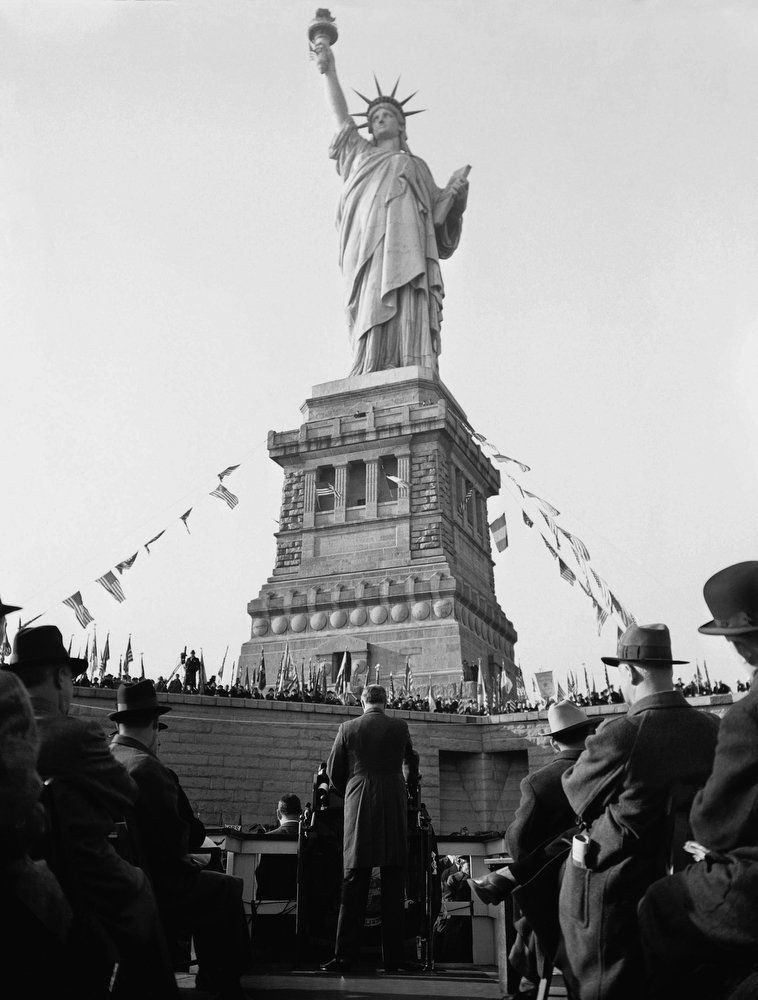
You’re certainly familiar with the pedestal of the Statue of Liberty and the grand entrance of the Metropolitan Museum of Art, two commissions that came late in Hunt’s life.
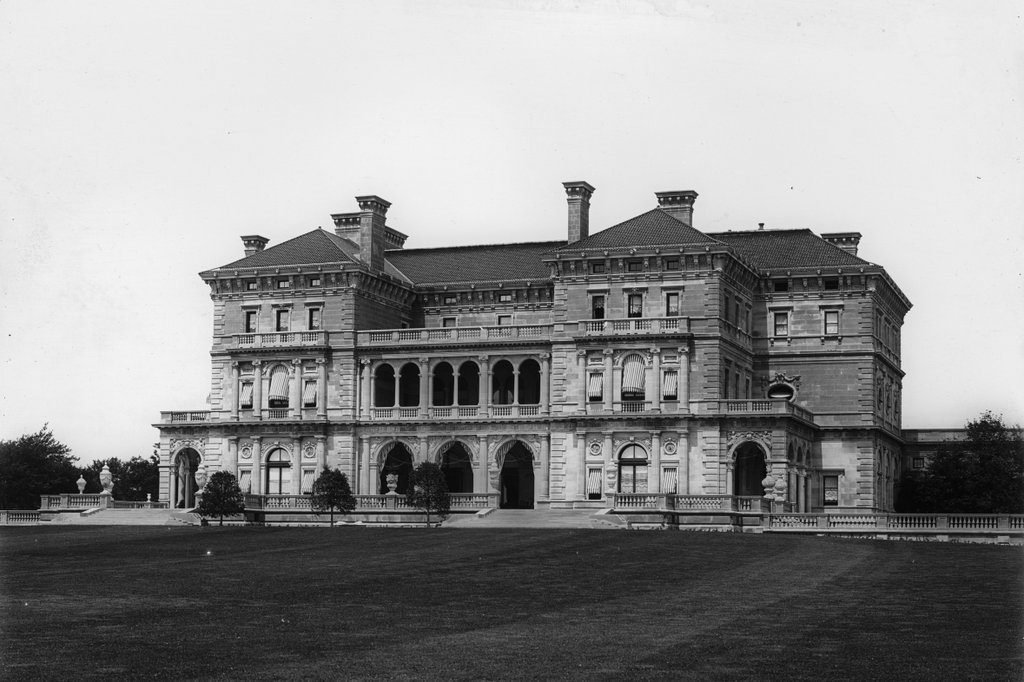
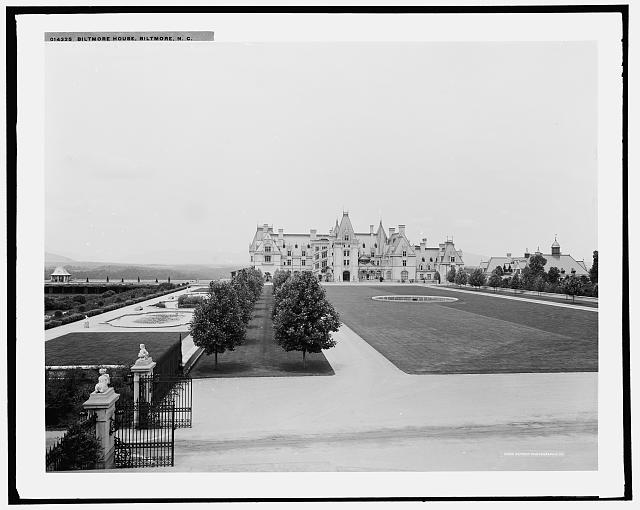
And perhaps you’ve taken a tour of two luxurious mansions designed by Hunt — The Breakers in Newport, Rhode Island, and Biltmore in Asheville, North Carolina.
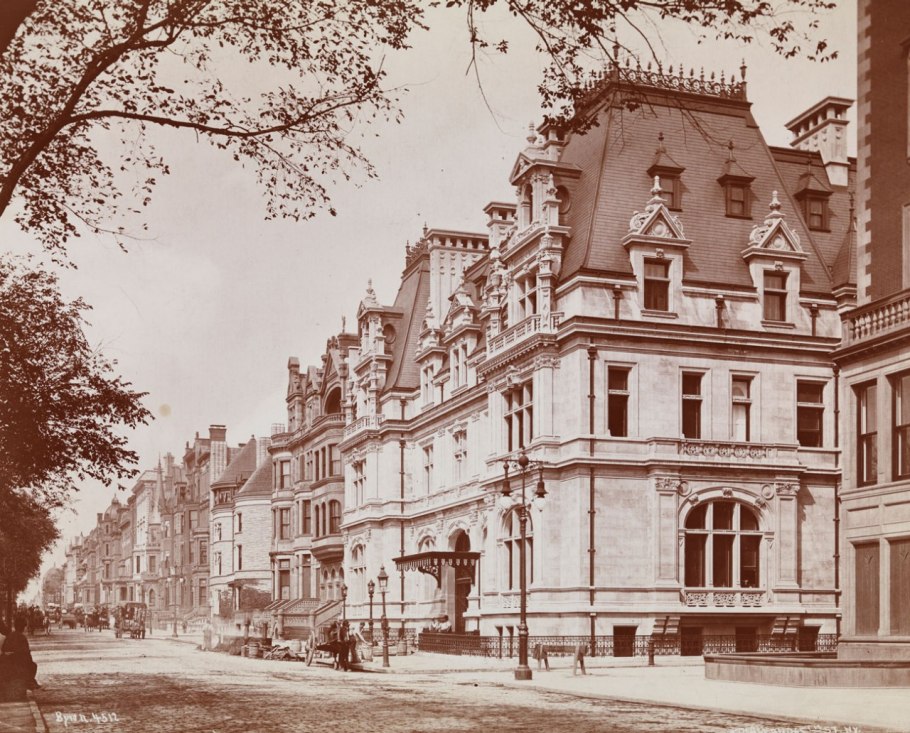
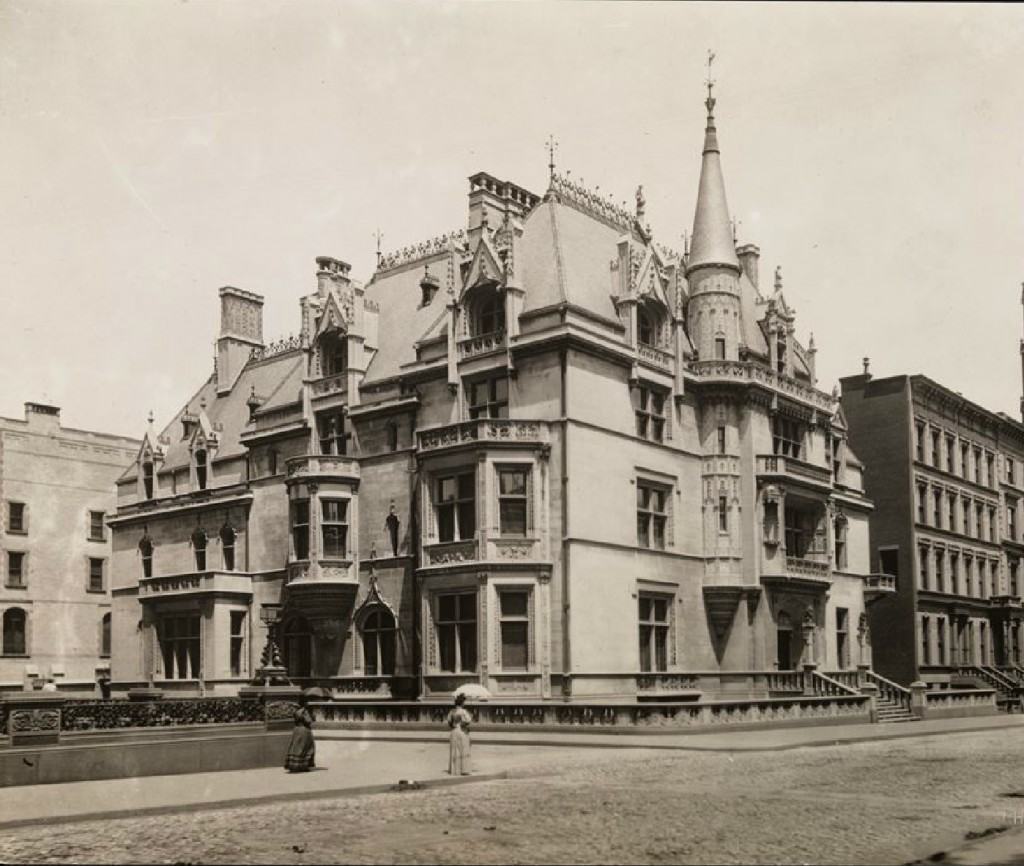
The mansion of Mrs. Caroline Astor
But Hunt was more than just pretty palaces.
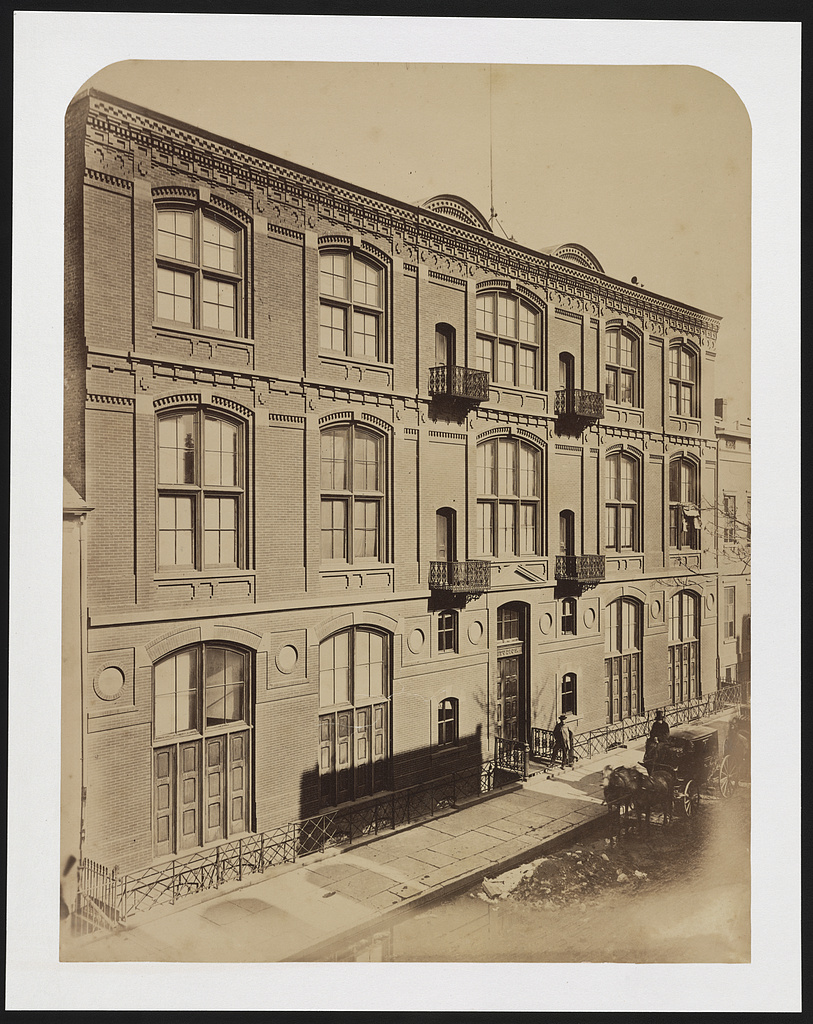
He championed the profession of the architect in a period when Americans were more likely to associate the job with construction or carpentry. Hunt brought artistry to the fore and trained the first official class of American architects from his atelier at the Tenth Street Studio in Greenwich Village.
He promoted certain European styles of design — collectively known as the Beaux-Arts architecture — to growing wealthy class of Americans who wished to emulate the grand and regal lifestyles of French aristocracy.
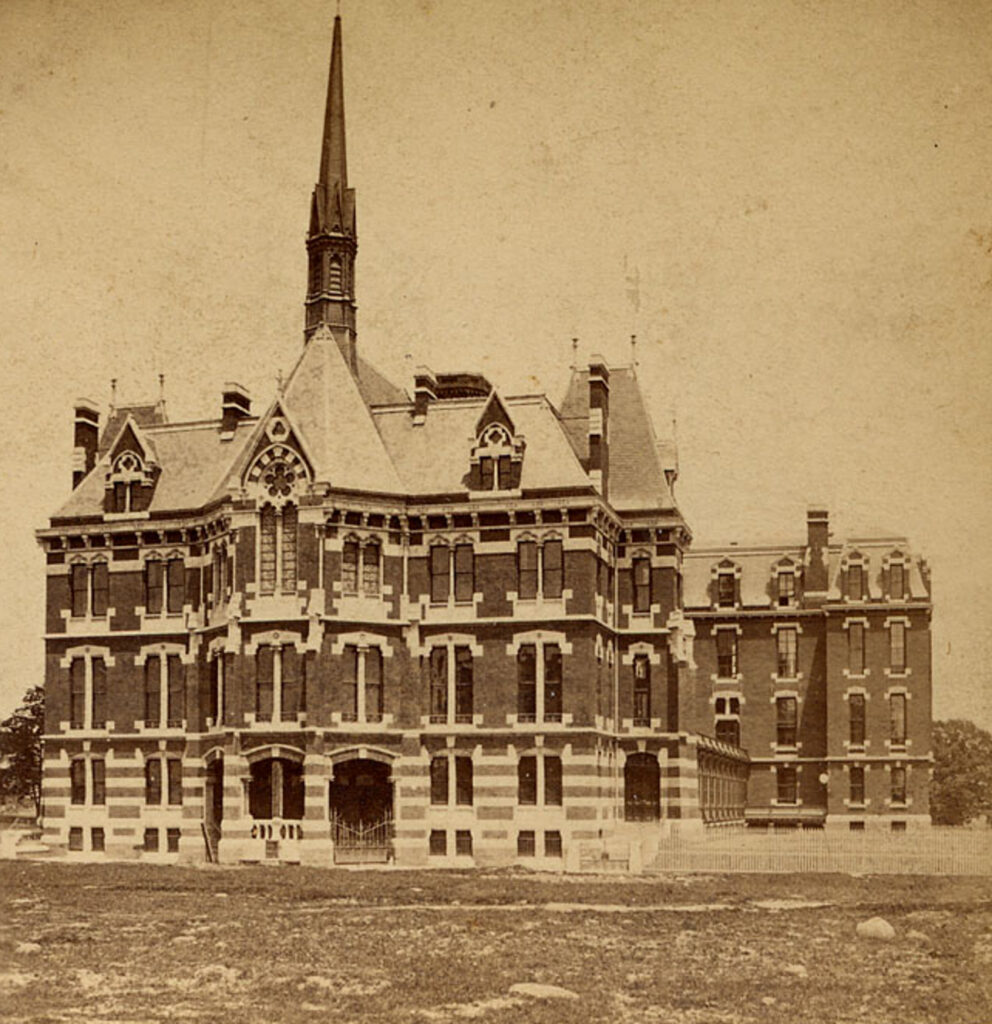
His legacy includes prominent organizations promoting both the field of architecture and the need for effective urban design. Along the way he built hospitals, libraries, newspaper offices, artist studios, churches and even the first American apartment building.
Join us for this look at a true arbiter of American architecture.
LISTEN NOW: ARCHITECT OF THE GILDED AGE
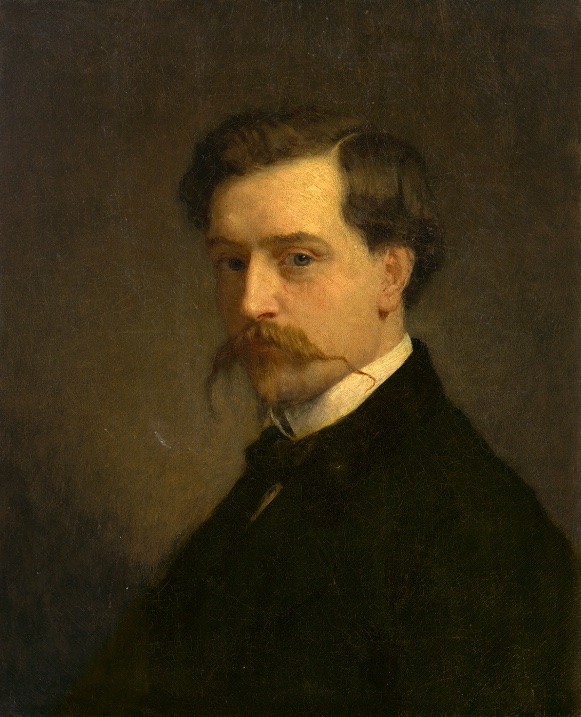
Young Richard Morris Hunt, in a painting by Thomas Couture
BUILDINGS AND OTHER CREATIONS MENTIONED ON THIS WEEK’S SHOW
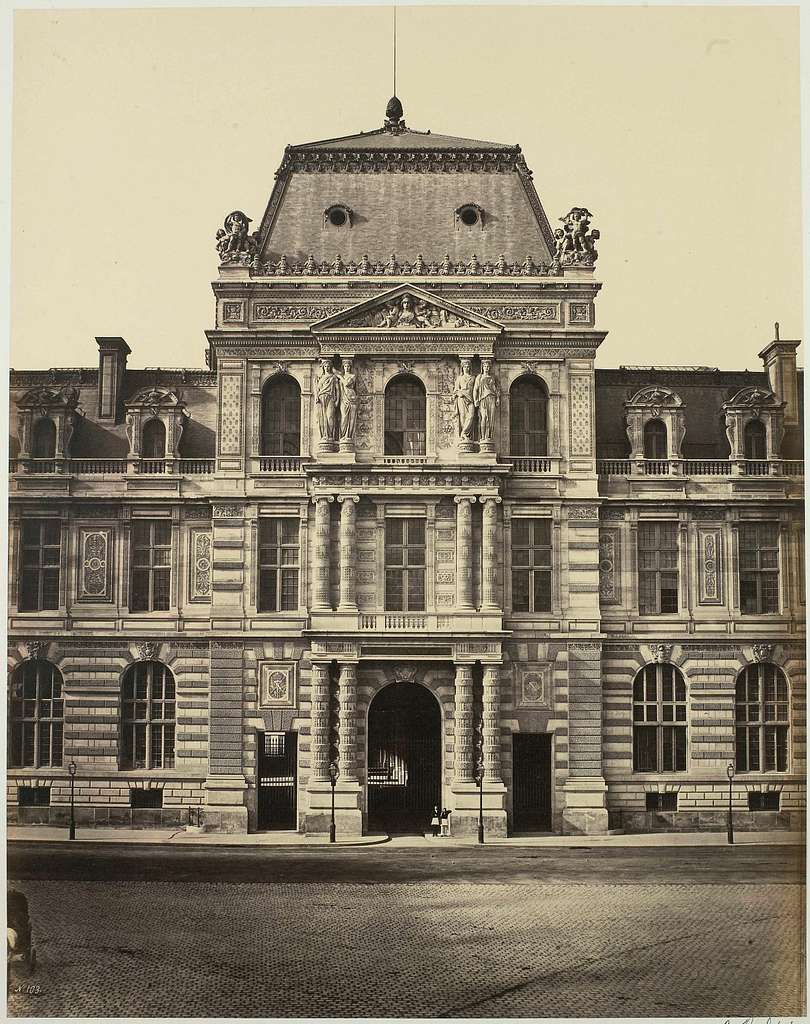
Pavilion de la Bibliothèque Imperiale, the Louvre, Paris
Courtesy Rijksmuseum
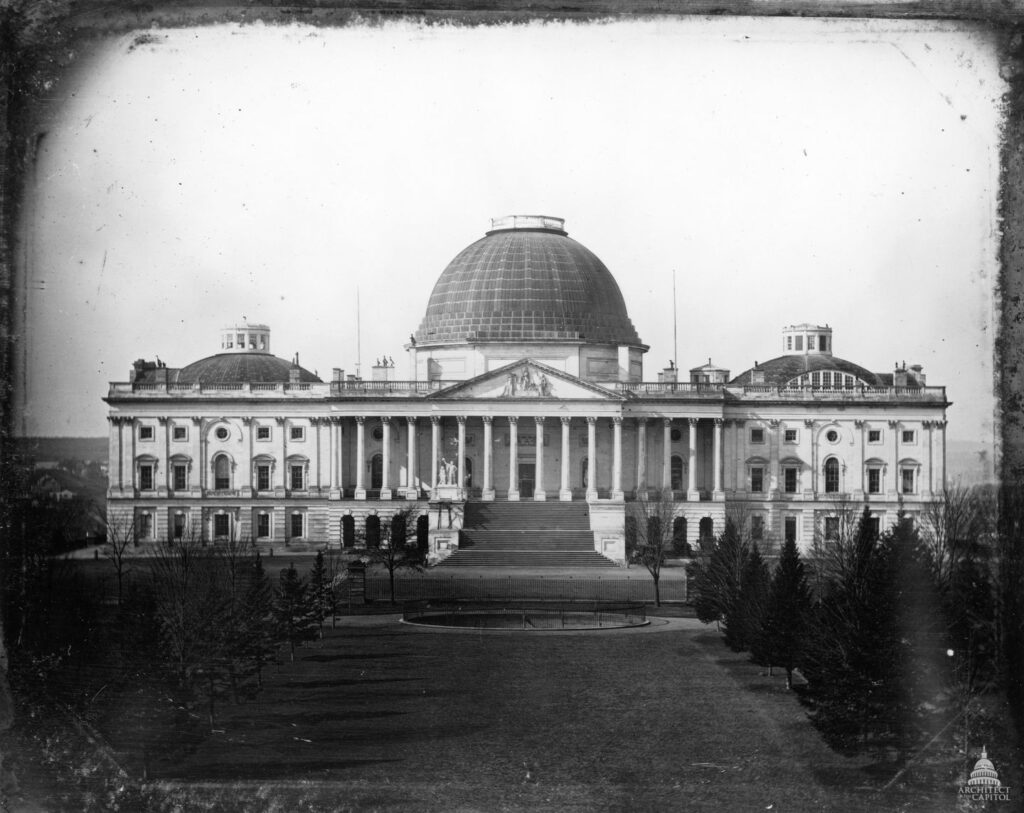
The U.S. Capitol Building in 1855, before the wooden dome was removed.
Pictured here in 1936 with FDR giving a speech at the 50th anniversary celebration. Preston Stroup / AP
The Breakers, Newport RI
1904, photo courtesy the Library of Congress
The Biltmore, Asheville NC
Library of Congress
Metropolitan Museum Entrance Hall
Courtesy the Metropolitan Museum
FURTHER READING
Richard Morris Hunt / Paul R. Baker The Architectural Heritage of Newport Rhode Island / Antoinette F. Downing and Vincent J. Scully Jr. Richard Morris Hunt: A Sketch of His Life and Adventures / Lloyd J. Farrar The Last Castle: The Epic Story of Love, Loss and American Royalty in the Nation’s Largest Home / Denise Kiernan The Architecture of Richard Morris Hunt / Edited by Susan R. Stein The Art Story: Richard Morris Hunt
FURTHER LISTENING
After listening to this week’s episode on Richard Morris Hunt, dive back into past episodes which intersect with his story.
The Bowery Boys: New York City History podcast is brought to you …. by you!
We are now producing a new Bowery Boys podcast every other week. We’re also looking to improve and expand the show in other ways — publishing, social media, live events and other forms of media. But we can only do this with your help!
We are now a creator on Patreon, a patronage platform where you can support your favorite content creators.
Please visit our page on Patreon and watch a short video of us recording the show and talking about our expansion plans. If you’d like to help out, there are several different pledge levels. Check them out and consider being a sponsor.
We greatly appreciate our listeners and readers and thank you for joining us on this journey so far
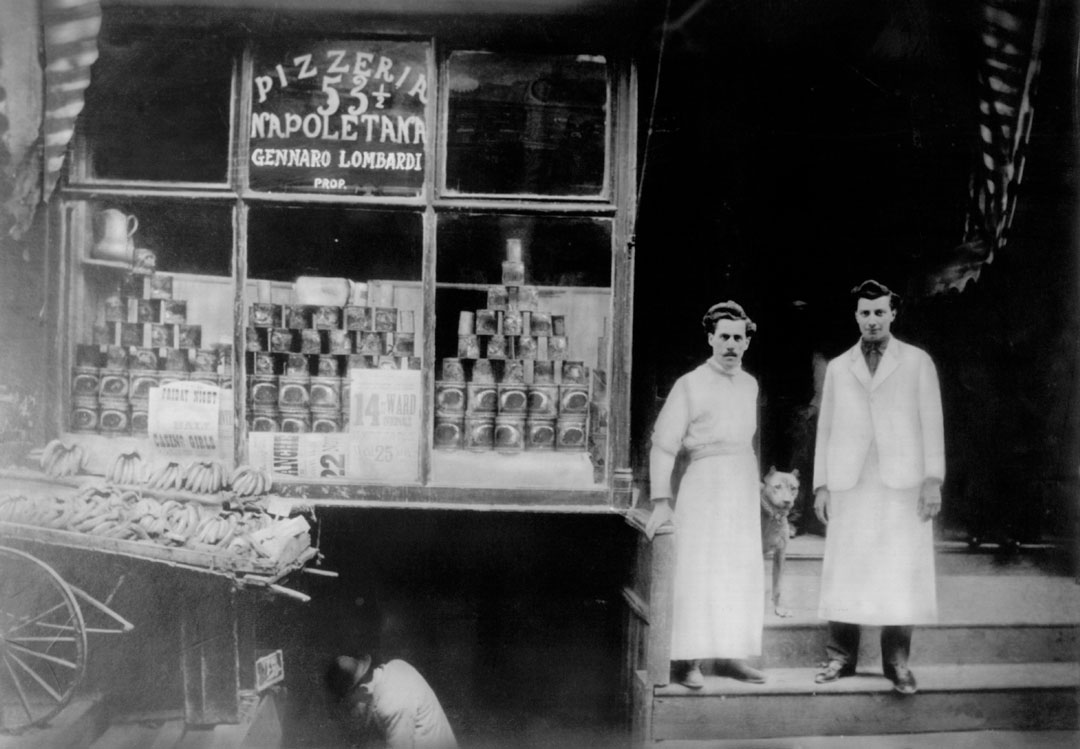
Gennaro Lombardi and Antonio Totonno Pero at 53 Spring Street. While this photo is traditionally labeled as 1905, recent evidence had been uncovered that places the year as 1908.
The history of pizza in the United States begins in Manhattan in the late 19th century, on the streets of Little Italy (and Nolita), within immigrant-run bakeries that transformed a traditional southern Italian food into something remarkable.
But new research discovered in recent years has changed New York food history, revealing an origin tale slightly older than what the old guide books may have you believe.
Understanding the history of American pizza is important because it’s a food that brings people together, young and old — from pizza parties to corner slice places, from classic traditional pies to the latest upscale innovations.
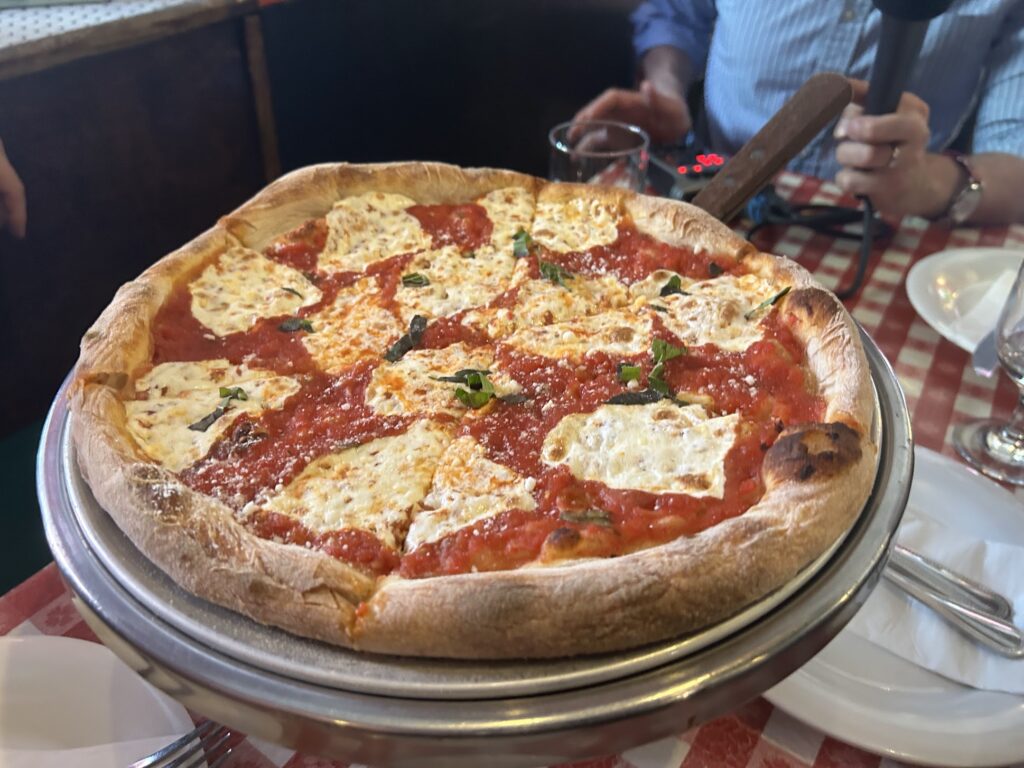
Behold, our pizza at Lombardi’s!
Pizza lovers of all kinds — even you, Chicago deep-dish lovers — will find much to enjoy in this show, tracing the early origins of American pizza and specifically how New York City-style pizza was born. (What even is New York style pizza? Even that answer is trickier than you think.)
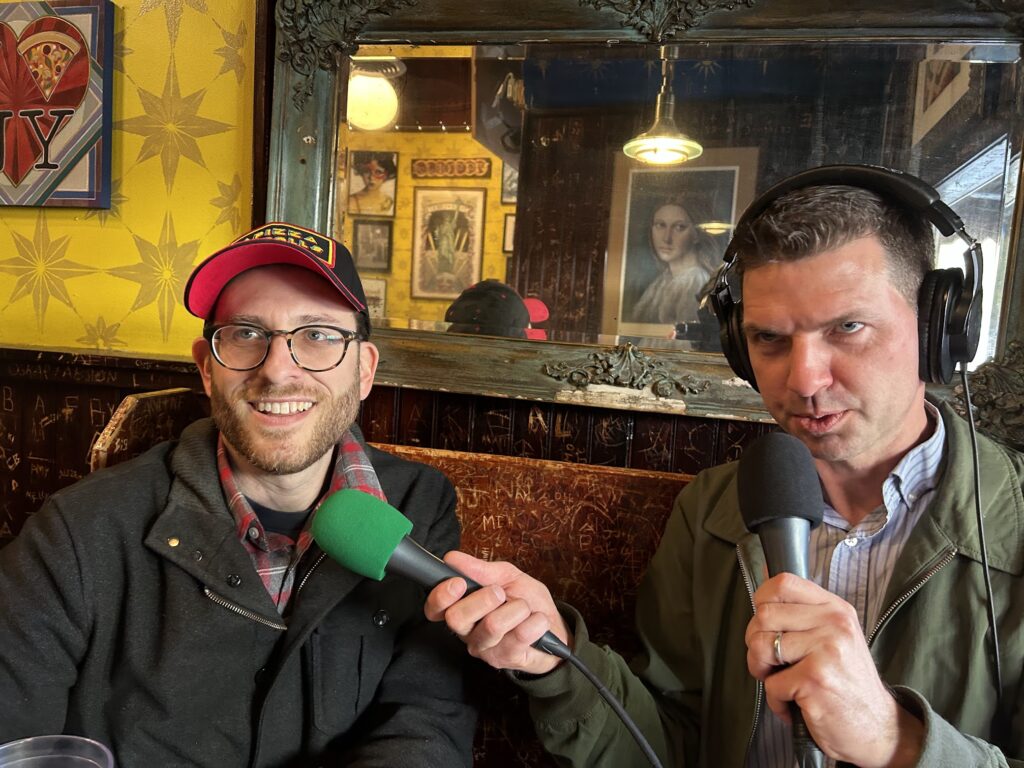
On this wandering episode — through Nolita, Greenwich Village and even the Bowery — Tom and Greg are joined by the prince of pizza himself Scott Wiener of the long-running Scott’s Pizza Tours.
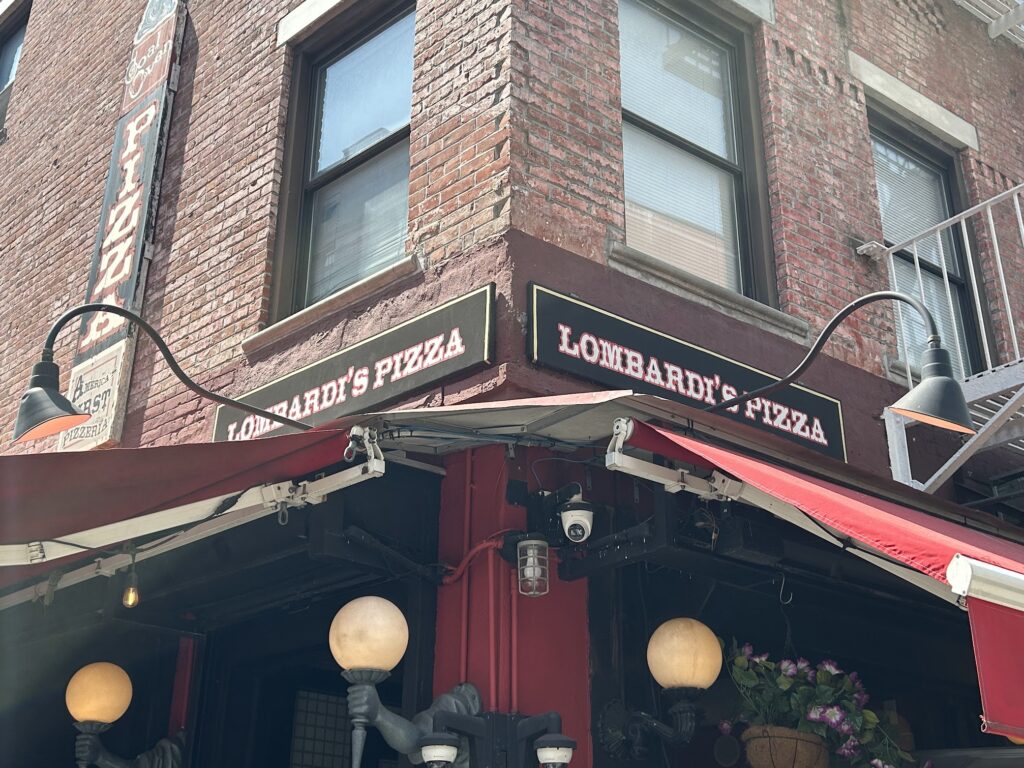
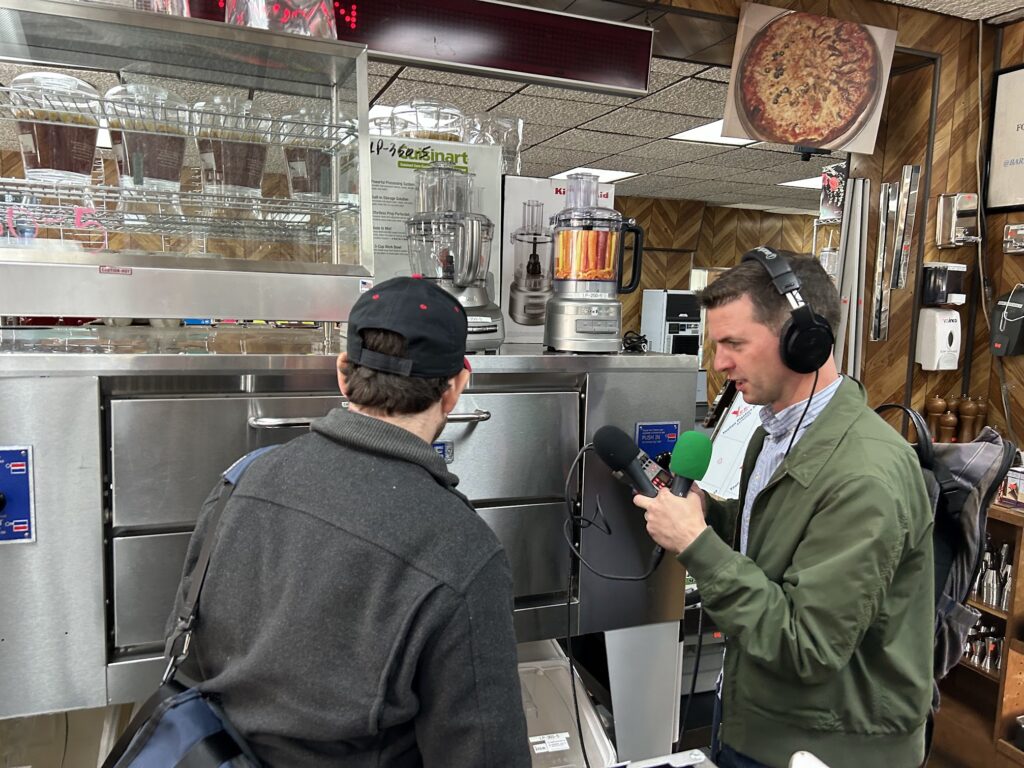
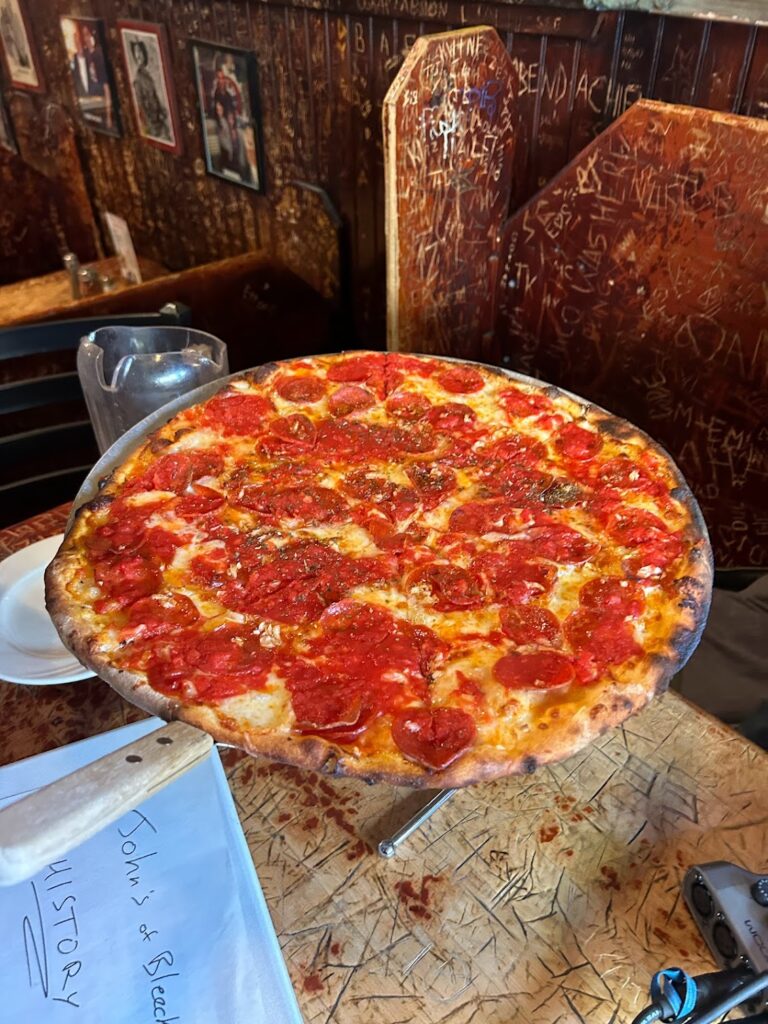
Perhaps nobody in New York City knows more about pizza than Scott, and he takes the Bowery Boys on a culinary adventure which includes two of New York’s most famous pizza restaurants — Lombardi’s Pizza and John’s of Bleecker Street.
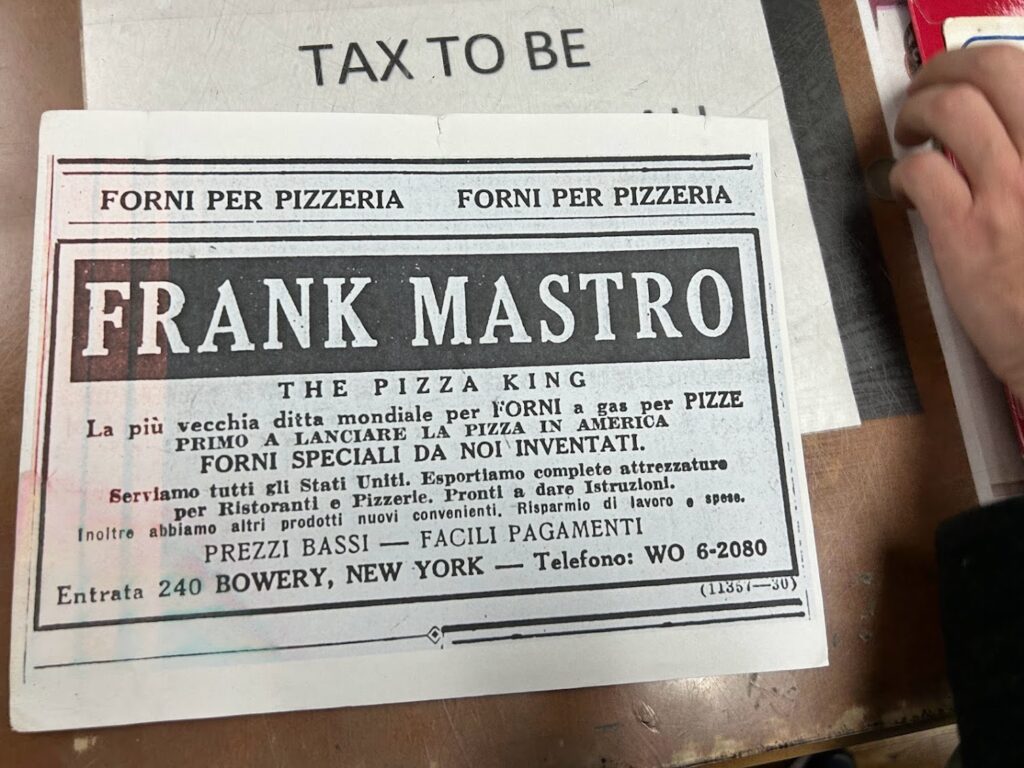
And a stop at the most important restaurant-supply store in American pizza history, a place were dreams (and pizza ovens) were once made.
LISTEN NOW: THE GREAT NEW YORK CITY PIZZA TOUR
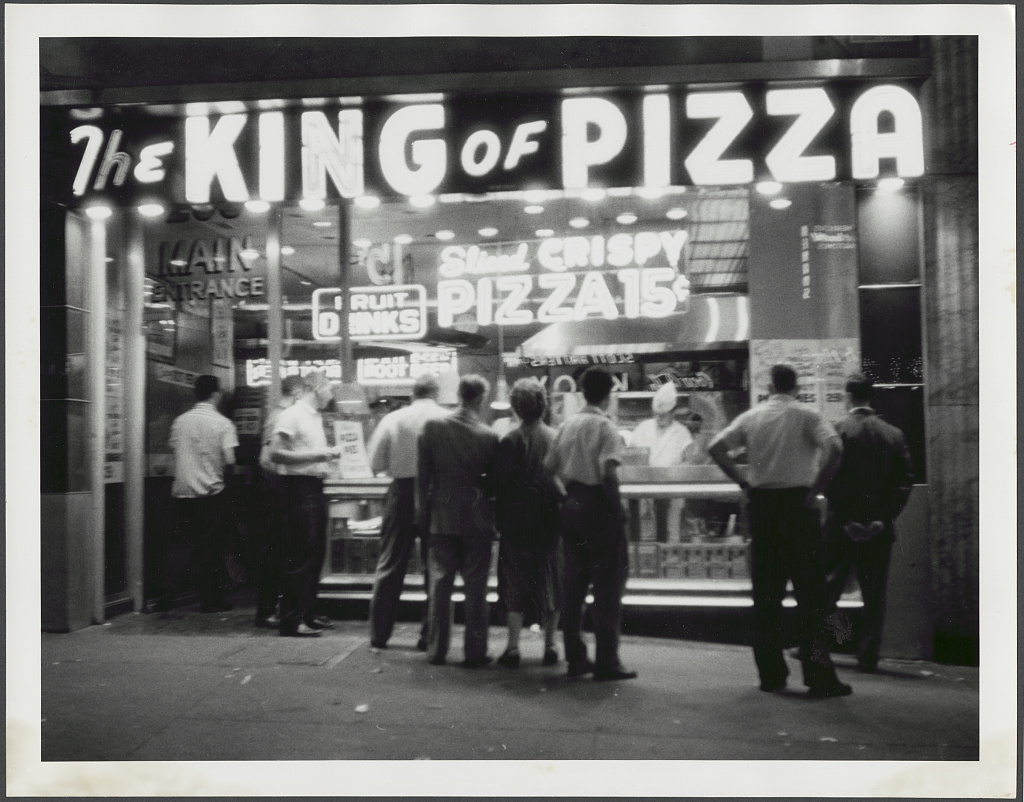
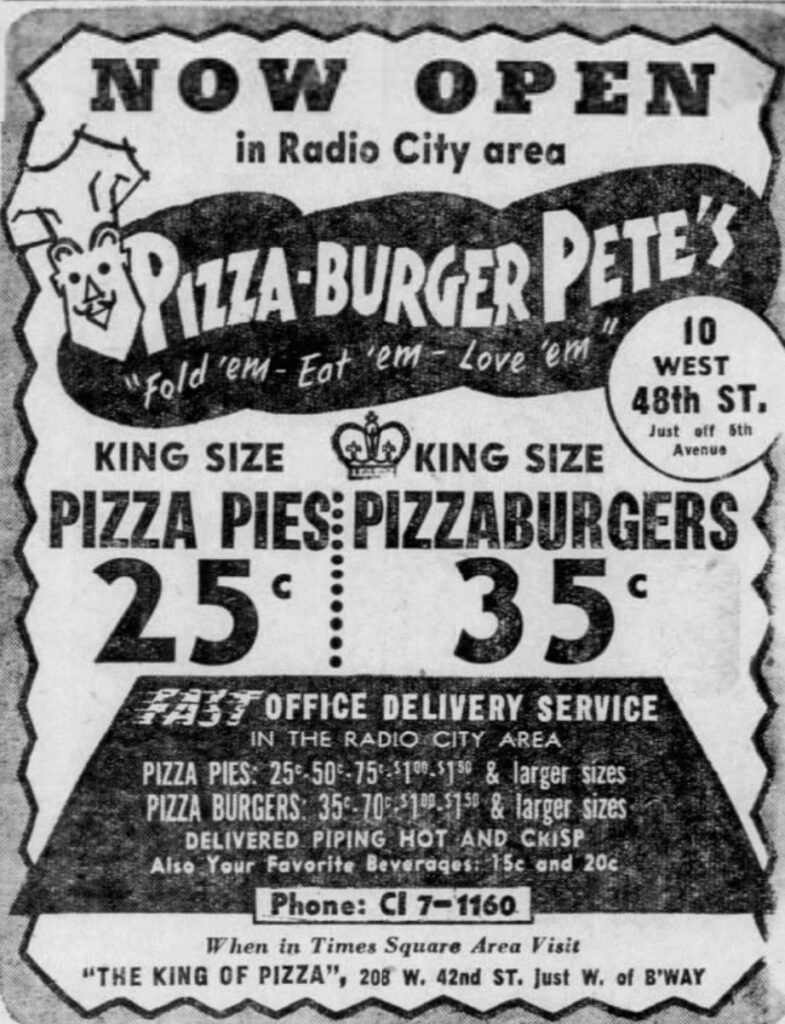
A Times Square pizza joint from the 1950s
Library of Congress
Find information on Scott’s Pizza Tours “for true pizza nerds” here.
Our deep thanks to Chicago pizza historian Peter Regas whose research was used in this show.
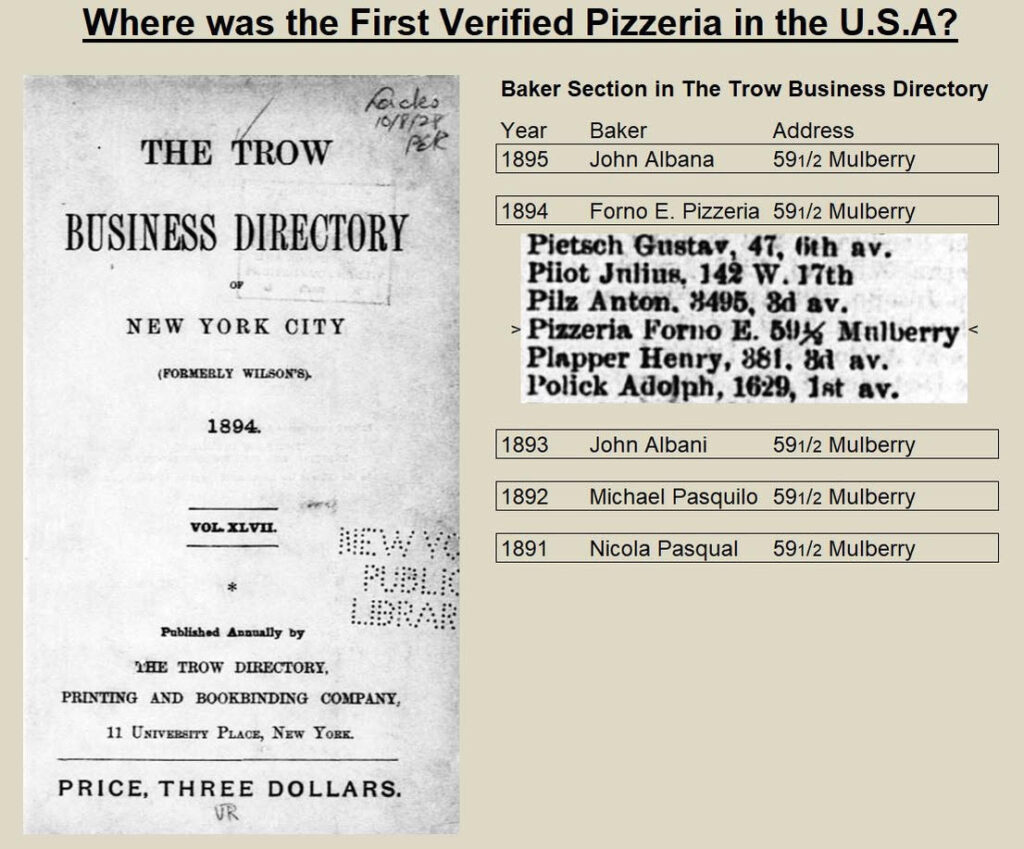
From Scott: “The earliest evidence of a pizzeria in the U.S. is currently this listing (attached, a slide from the presentation Peter and I gave at 92 St Y) from an 1894 NYC business directory.
Whoever canvassed the neighborhood didn’t realize the phrase “Forno E Pizzeria” was Italian for “Oven and Pizzeria,” they interpreted it as the proprietor’s name and recorded the business at 59 1/2 Mulberry St as belonging to a person with the last name Pizzeria, first name / middle initial Forno E.
So a data entry gave us this great gift of evidence of a pizzeria! Likely that pizzeria existed in 1893 since the proprietor was the same person that year (a guy named John Alban) but we don’t have 100% proof like we do in 1894. The building at 59 1/2 Mulberry was torn down in 1897 to make way for Columbus Park.”
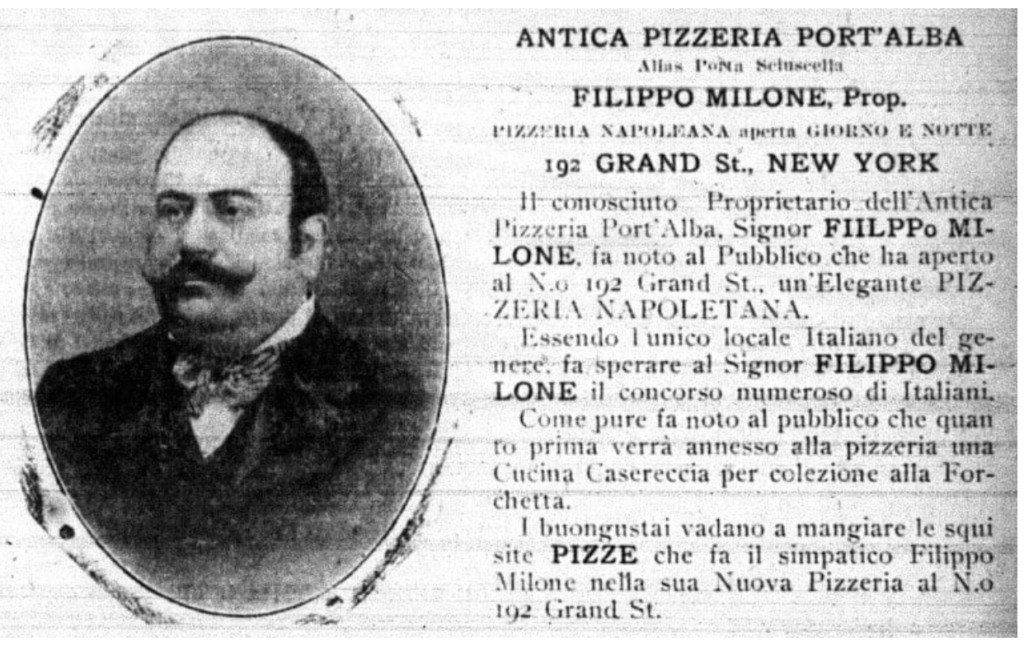
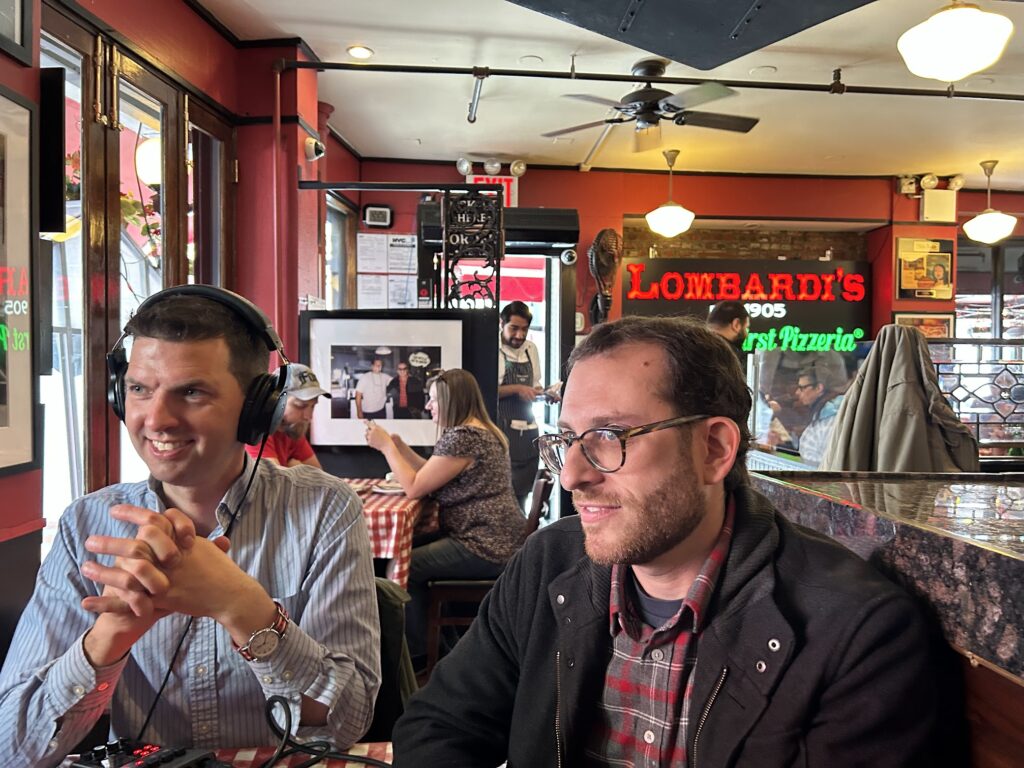
A 1903 advertisement in Il Telegraph, an Italian language newspaper published in America. Tom and Scott at Lombardi’s. Photo by Greg YoungBari Pizzeria and Restaurant Equipment is home inside the former Frank Mastro “the Pizza King” at 240 Bowery. At the pizza ovens at Bari’s.In a rustic booth at John’s of Bleecker StreetPizza at John’s
New Yorkers eat a LOT of Chinese food and have enjoyed Chinese cuisine – either in a restaurant or as takeout – for well over 130 years. Chinese food entered the regular diet of the city LONG before the bagel, the hot dog and even pizza.
What wonderful surprises await the Bowery Boys in Little Caribbean? The Brooklyn enclave in Flatbush is one of the central destinations for Caribbean-American life and culture in New York City.
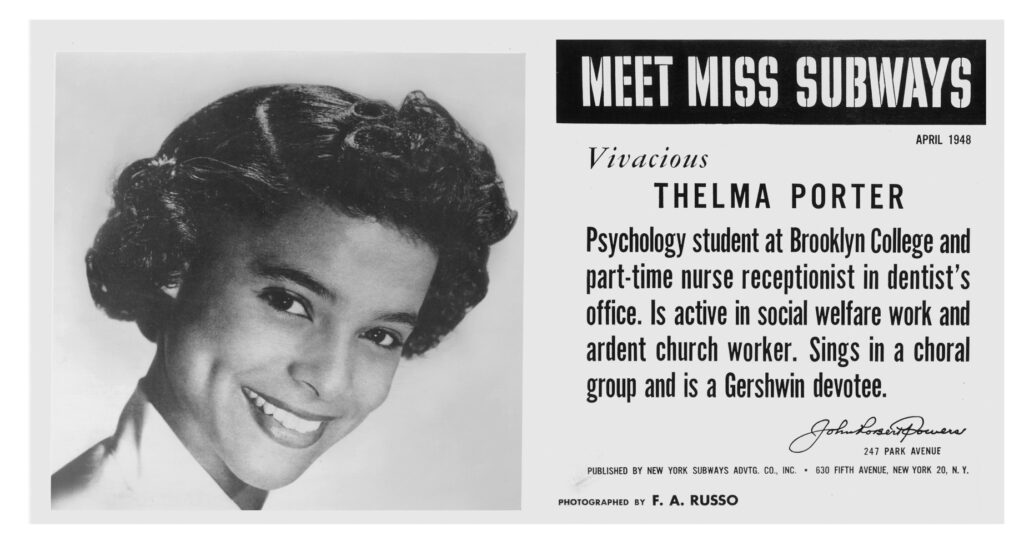
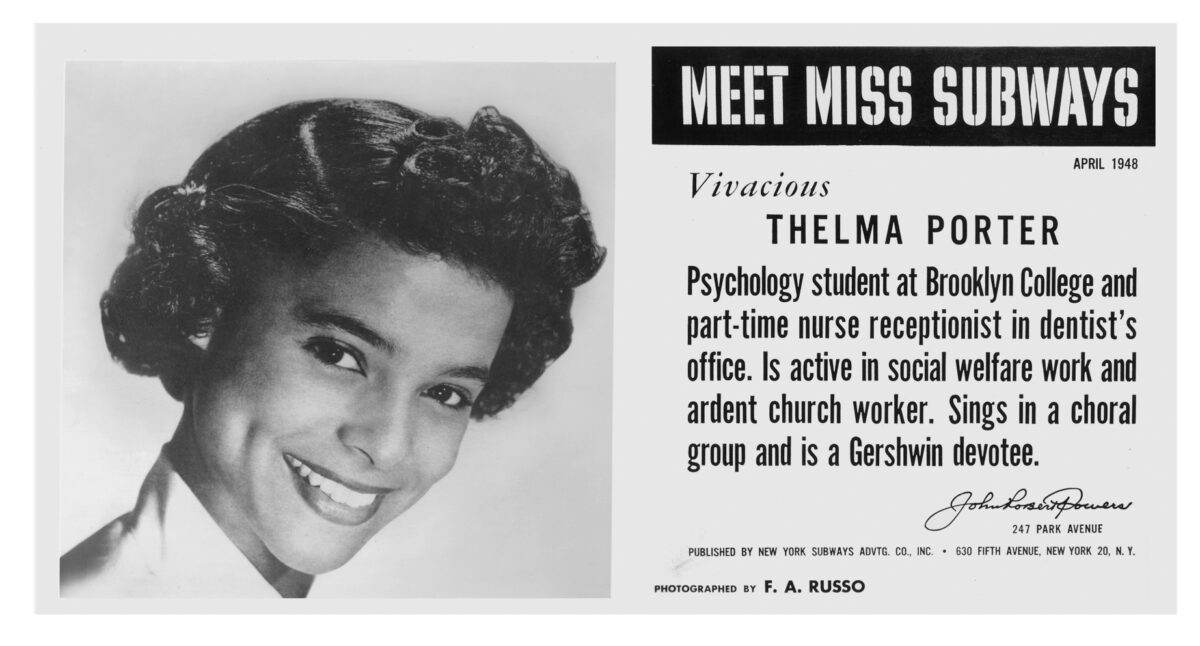
In 1948, Thelma Porter became the first African-American Miss Subways. These cards were a regular sight on the subway in the mid 20th century.
New York City subway riders in the mid 20th century knew who Miss Subways was. The beauty pageant, spotlighting “every day” New York women, featured placards which hung on all the trains (like the one above for 1948 winner Thelma Porter).
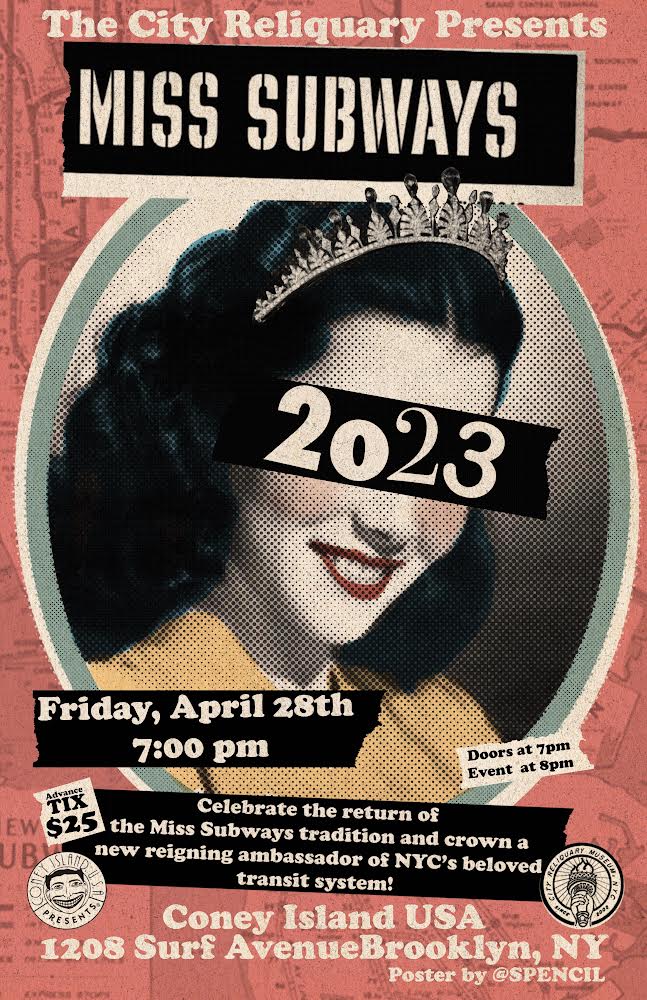
Well, Miss Subways is back, hosted by the City Reliquary Museum in a fabulous, flamboyant event in Coney Island. And this year, one of the judges will be none other — than Greg Young of the Bowery Boys Podcast!
Here are the details:
Miss Subways 2023 Friday, April 28, 2023, Doors open at 7pm Coney Island USA’s Sideshows by the Seashore Theater (1208 Surf Ave., Brooklyn) Tickets $25: GET THEM HERE
All proceeds benefit The City Reliquary and Coney Island USA.
This year’s event emcee will be the current reigning Miss Coney Island and local burlesque performer Maggie McMuffin of New York’s Last Chance Dancers.
Here are the judges who will determine this year’s Miss Subways:
Here are the details, provided by The City Reliquary
Updated for the 21st century and first presented in 2017, the new Miss Subways by the City Reliquary expands on the progressive history of Miss Subways as the first racially integrated beauty competition and is open to contestants of all gender identities, body types, and ages 18+ to compete for the prized title of Miss Subways.
Are YOU Miss Subways 2023? Contestants are invited to present an original performance that captures their relationship with the NYC subway, in all its complexity. “Performance” may be interpreted broadly. We welcome song, dance, poetry, or any other talent—Rubik’s cube solving, hula hooping, speed knitting, playing the sousaphone…surprise us!
Past performances have included an ode to the G train, an experimental soundscape inspired by the Q, songs about subway proselytizers, and an appearance by the Wicked Witch of the Upper East Side and an immigrant from Oz.
And one of the guest voices through the series is Greg Young of the Bowery Boys podcast!
Here’s the trailer for the series:
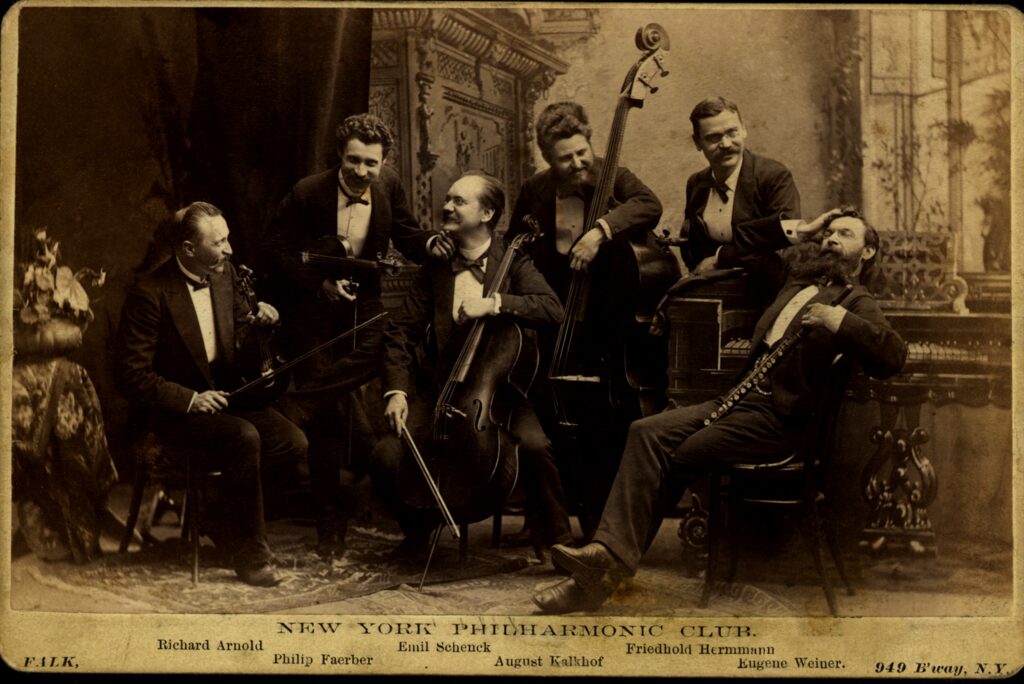
The New York Philharmonic Club, a chamber ensemble of Philharmonic musicians, clowning for their public-relations photograph in 1887: (left to right) Richard Arnold, Philip Faerber, Emil Schenck, August Kalkhof, Friedhold Hermmann, Eugene Weiner.
During New York City’s Gilded Age, the NY Philharmonic pushed the boundaries of American”classical music with the ground-breaking premier of Dvořák’s “New World Symphony.”
Over 100 years later, the NY Phil made it to Pyongyang, North Korea, revisiting those same questions of what it means to perform American music — and once again, making history.
Listen to the episodes here and on your favorite podcast players.
For more than 180 years, the New York Philharmonic has been making history here in the city we call home. The NY Phil Story: Made in New York is a podcast about the people, the music, and the city behind America’s oldest orchestra.
Host Jamie Bernstein (the daughter of Leonard Bernstein) takes you backstage and into the archives to hear the untold stories of the Philharmonic–right from the very beginning. Each episode, the show will go behind the scenes of an iconic performance, speak to current Philharmonic musicians about how they carry on the orchestra’s legacy, and hear the music that inspired it all.
Listeners will hear recordings from the NY Phil’s rich audio archives, including their broadcast in the aftermath of John F. Kennedy’s assassination, recordings of urban planner and city official Robert Moses discussing San Juan Hill’s destruction, Leonard Bernstein’s live radio debut, and other treasures from the archives.
The series features interviews with historians, scholars, and New York Philharmonic musicians, including:
Deborah Borda, President and CEO of the New York Philharmonic
Erica Buurman, director of the Ira F. Brilliant Center for Beethoven Studies at San JoséState University
Etienne Charles, performer, composer, and storyteller
Abraham Lincoln historian Harold Holzer
Alex Kaminsky, band director at Marjory Stoneman Douglas High School at the time of theParkland shooting
Virginia Sánchez Korrol, historian and professor emerita in the Department of PuertoRican and Latino Studies at Brooklyn College, CUNY
Doug Shadle, Dvořák scholar and chair of musicology and ethnomusicology at VanderbiltUniversity’s Blair School of Music
Beethoven scholar, author, and composer Jan Swafford
Shanta Thake, chief artistic officer for Lincoln Center
Jaap van Zweden, music director of the New York Philharmonic and the Hong KongPhilharmonic
TheBowery Boys podcast host Greg Young
Here’s the first episode but you can subscribe to The NY Phil Story at the same places you get the Bowery Boys Podcast:
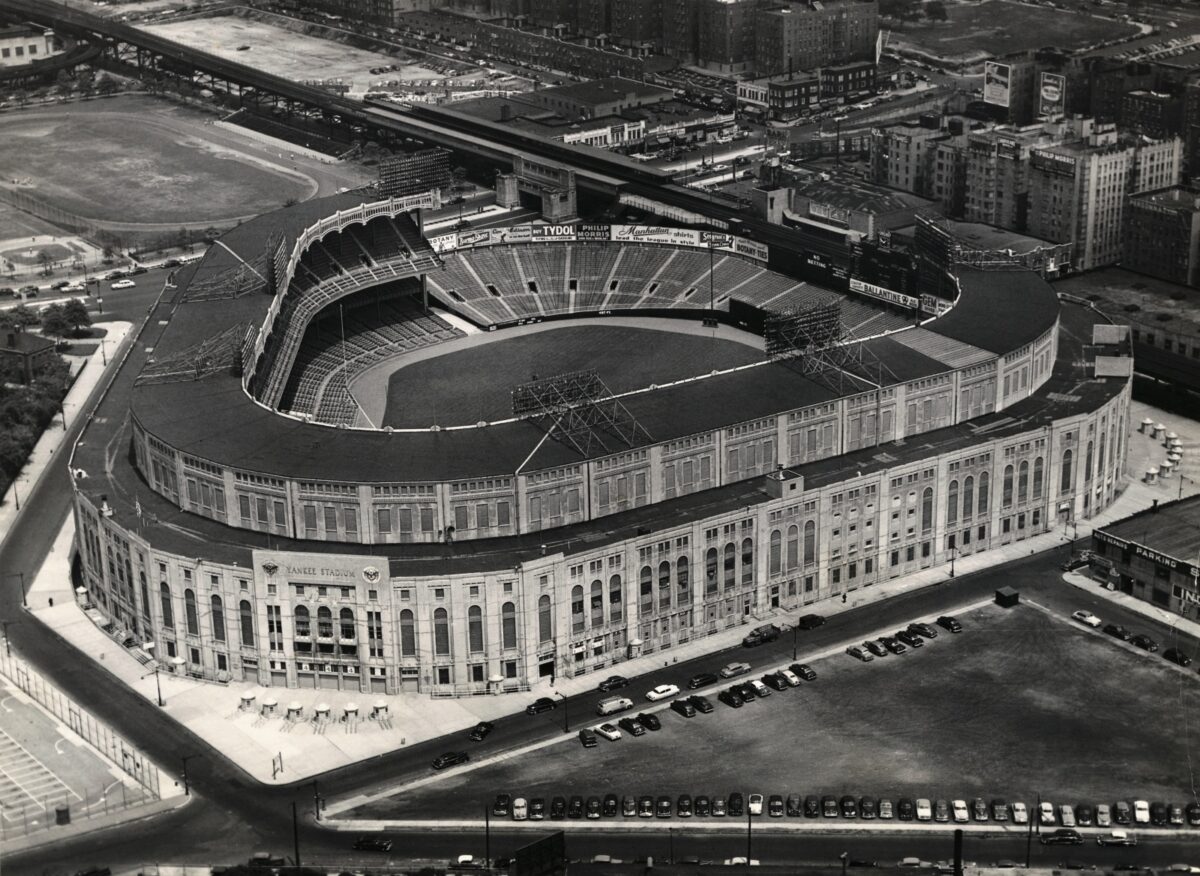
The New York Yankees played their first game at the original Yankee Stadium 100 years ago today, beating the Boston Red Sox 4 to 1, a game that would only heighten a long enduring sports rivalry.
But of course the Bronx Bombers didn’t actually get their start in the Bronx.
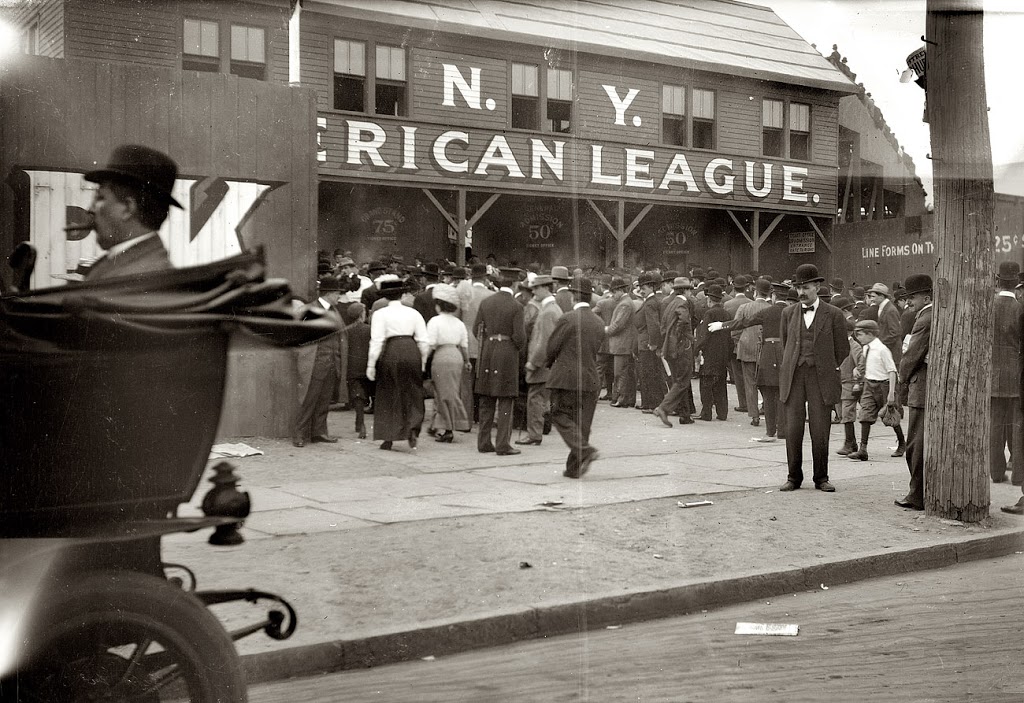
First Base: Hilltop Park
The team was formed in 1903 by William S. Devery and Frank J. Farrell and originally named the Highlanders in honor of their first home Hilltop Park.
Patrons arrive at the Hilltop Park stadium to watch the Highlanders.
A large but spare field located in Washington Heights on Broadway between 165th and 168th streets, Hilltop Park could accommodate 15,000 to 16,000 spectators comfortably, though more exciting match-ups would draw clusters of almost 10,000 standing room only crowds.
In fact, in the rather lax early days of formalized sports, fans were allowed to stand around, almost virtually on the playing field! (In 1914, Hilltop Park was demolished and became Columbia-Presbyterian Medical Center.)
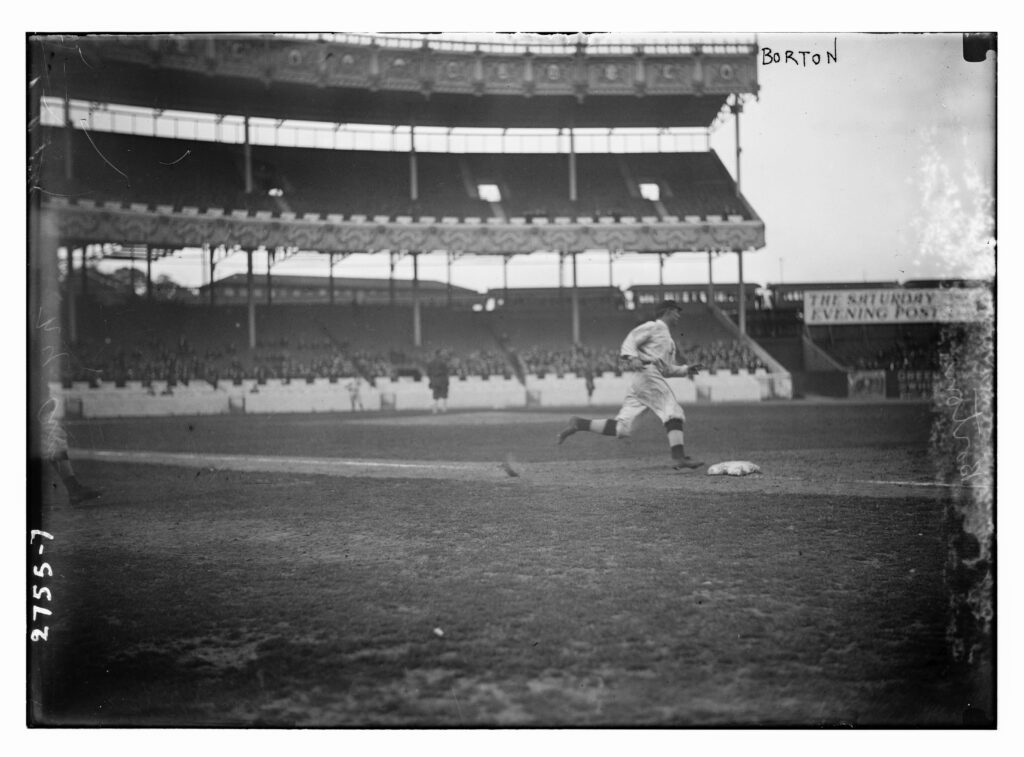
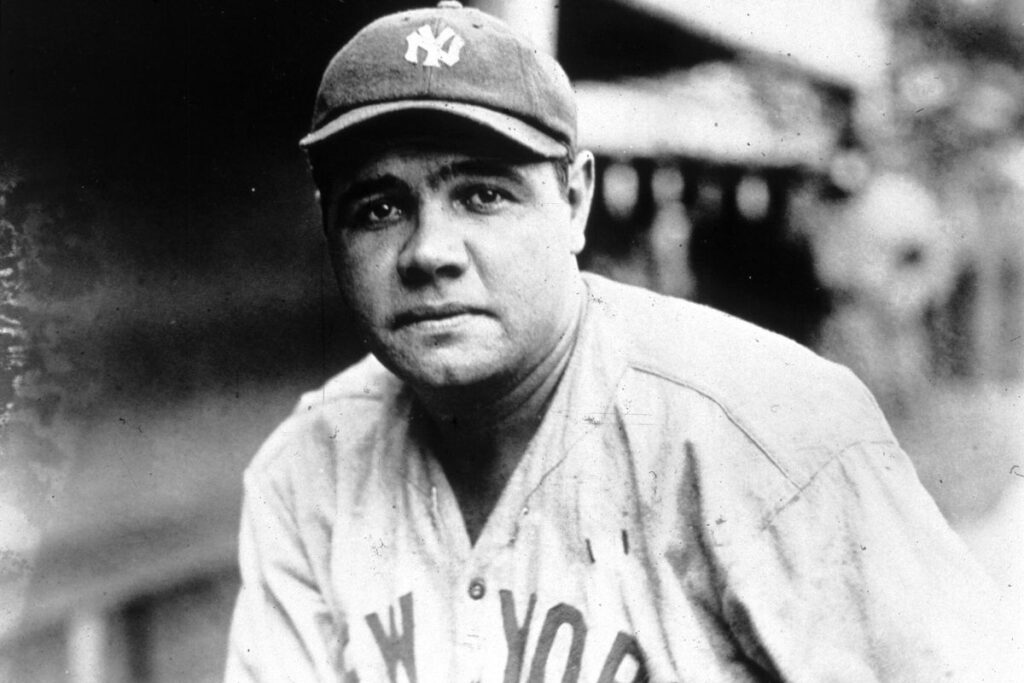
The Yankees’ Babe Boston at then Polo Grounds, 1913 (Library of Congress)
Second base: Polo Grounds
In 1913, the Highlanders moved into New York’s most famous baseball park of the era — the Polo Grounds, which was actually home to their rivals the New York Giants.
But the Highlanders stayed at the Polo Grounds for ten years. And since they were below Coogan’s Bluff in Washington Heights and very obviously not on a hilltop, they changed their name — to the Yankees.
A patriotic name was apt. They were, after all, in Washington Heights and now located very close to the Morris-Jumel Mansion, a former headquarters for Washington during the war.
But the team, by any name, really stunk up the place, becoming one of the least successful team in the American League.
Eventually in 1915, the team was sold to an unlikely pair — the beer brewer Jacob Ruppert (who hoped to use the team to sell bear) and war engineer Tillinghast L’Hommedieu Huston.
In 1919 the wealthy Yankees owners bought the contract of Boston Red Sox star Babe Ruth, allegedly because Sox owner Harry Frazee was looking to finance his Broadway musical offering No No Nanette. (That’s the popular legend, although many believe the trade was to finance another, equally ridiculous production called My Lady Friends.)
A face of the sports world’s most enduring superstition.
It would be a shocking transfer of power in the sports world, conjuring the so-called ‘Curse of the Bambino’. Boston, once the league’s most successful squad, didn’t win another World Series until 2004, while the Yankees, well, they changed sports history.
But not at the Polo Grounds. Ruppert knew that the Yankees — and Ruth — now needed their own home.
By 1923 Ruppert owned the team outright, Huston selling him his shares at $1.5 million. By then plans were in motion to build the Yankees a new home — thanks to the Astor family.
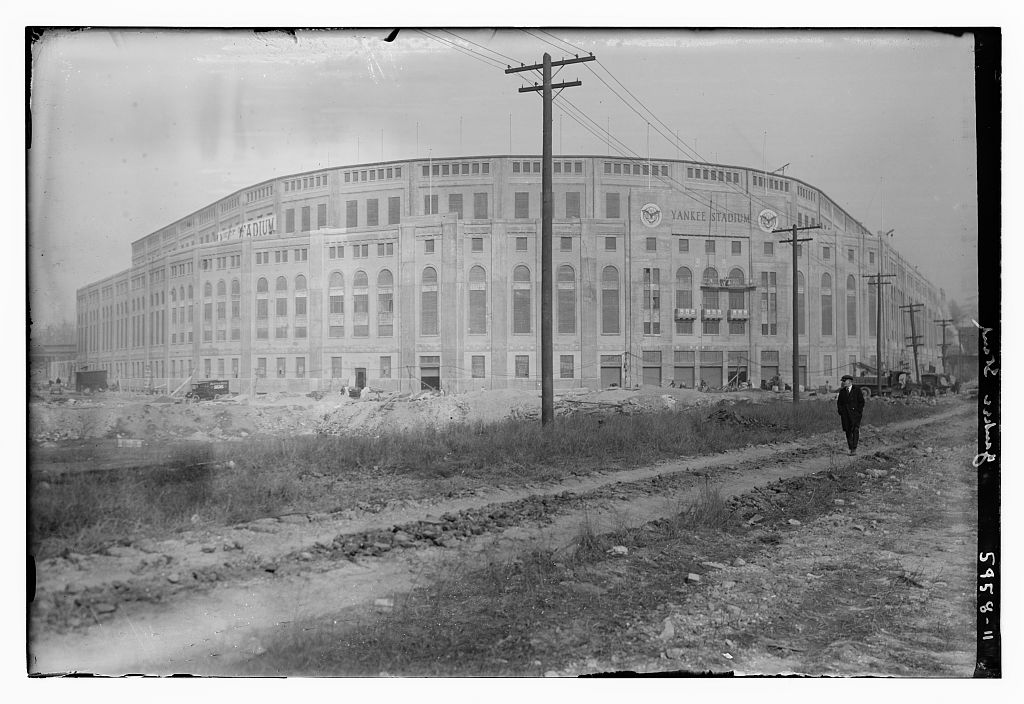
In the early spring of 1922 Ruppert bought a ten-acre lumberyard in the West Bronx, across the Harlem River from the Polo Grounds.
“One of the reasons the site was chosen by Ruppert was to irritate his former landlord,” writes Harvey Frommer. “Another reason was that the IRT Jerome Avenue subway line [today the 4 and 5 train] snaked its way virtually atop the Stadium’s right-field wall and provided ease of transportation for fans.”
Yankee Stadium, April 3, 1923. Bain News Service photograph collection/Library of Congress
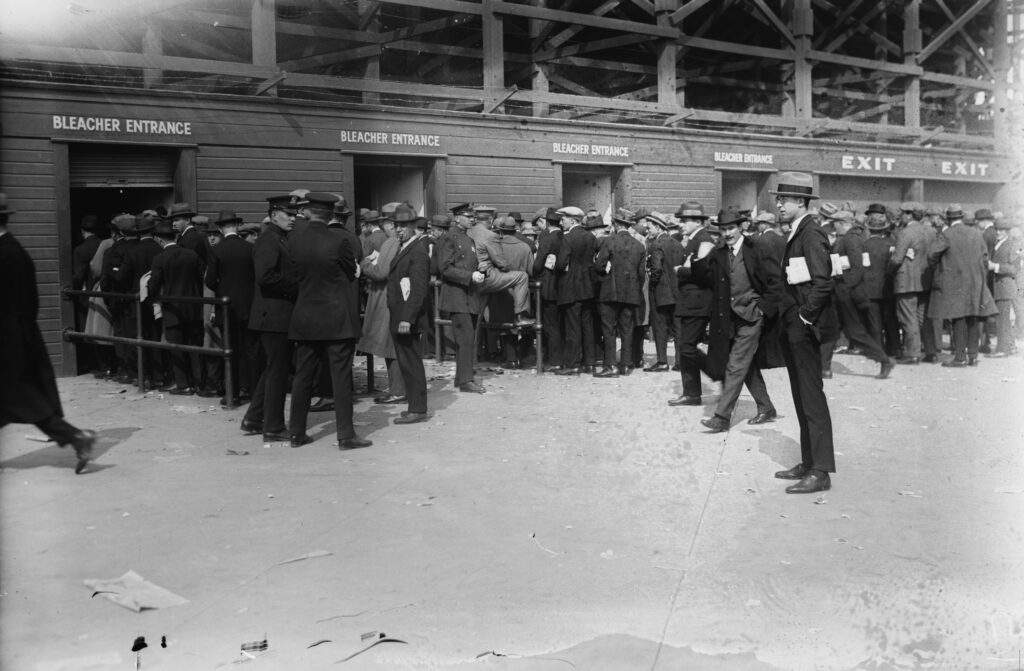
Fans lined up for World Series Game 1 bleacher seats at Yankee Stadium – October 10, 1923. (Library of Congress)
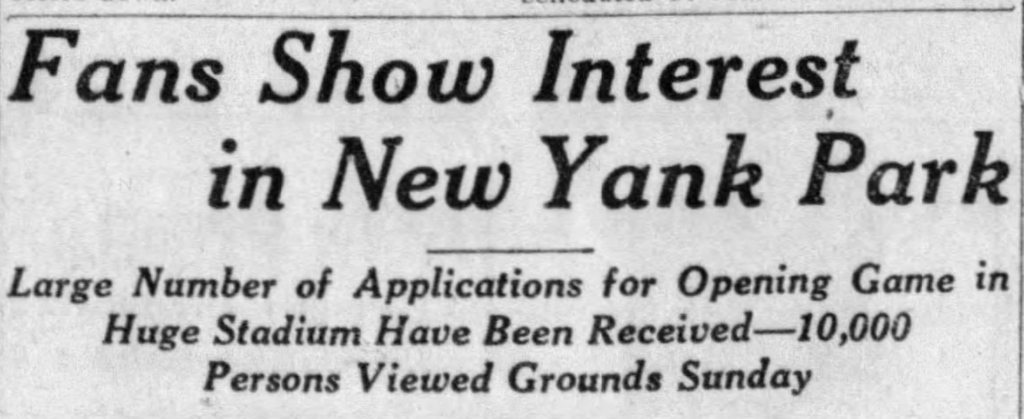
Its opening was heralded with a tidal wave of sports hyperbole from every American newspaper. The Times declared “[I]n the busy borough of the Bronx, close to the shore of Manhattan Island, the real monument to baseball will be unveiled this afternoon — the new Yankee Stadium, erected at a cost of $2,500,00, seating some 70,000* people and comprising in its broad reaches of concrete and steel the last word in baseball arenas.”
*Its capacity was actually around 58,000
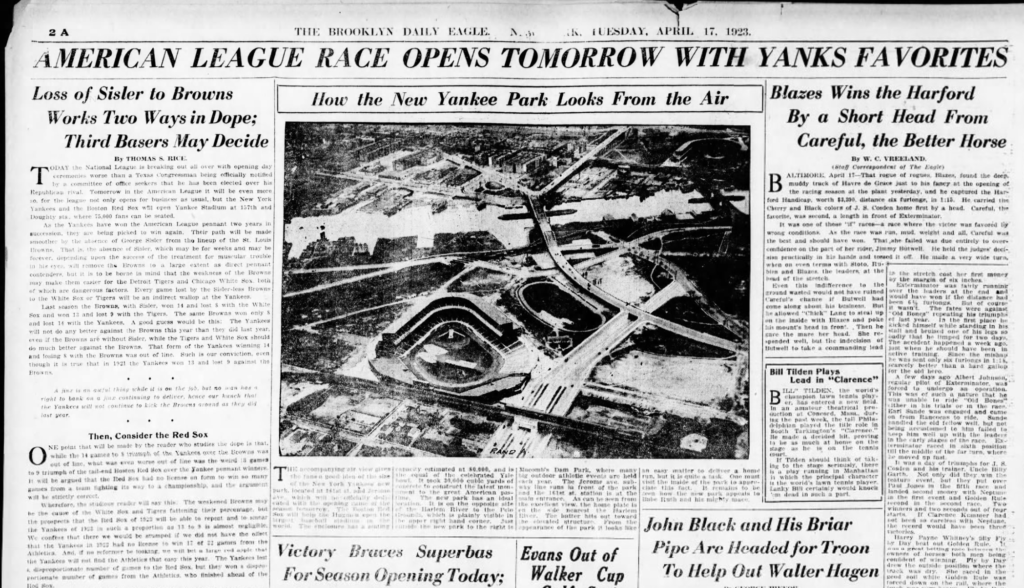
The Yankees first game here was on Wednesday, April 18, 1923, and appropriately, it was against the Boston Red Sox. New York governor Al Smith threw out the ceremonial first pitch.
Brooklyn Daily Eagle, April 17, 1923 (newspapers.com)
Ruth naturally rose the occasion. “It was an opening game without a flaw. The Yankees easily defeated the Boston Red Sox, 4 to 1. In the third inning, with two team mates on the base lines, Babe Ruth smashed a savage home run into the right field bleachers, and that was the real baptism of the new Yankee Stadium.” [New York Times, April 19]
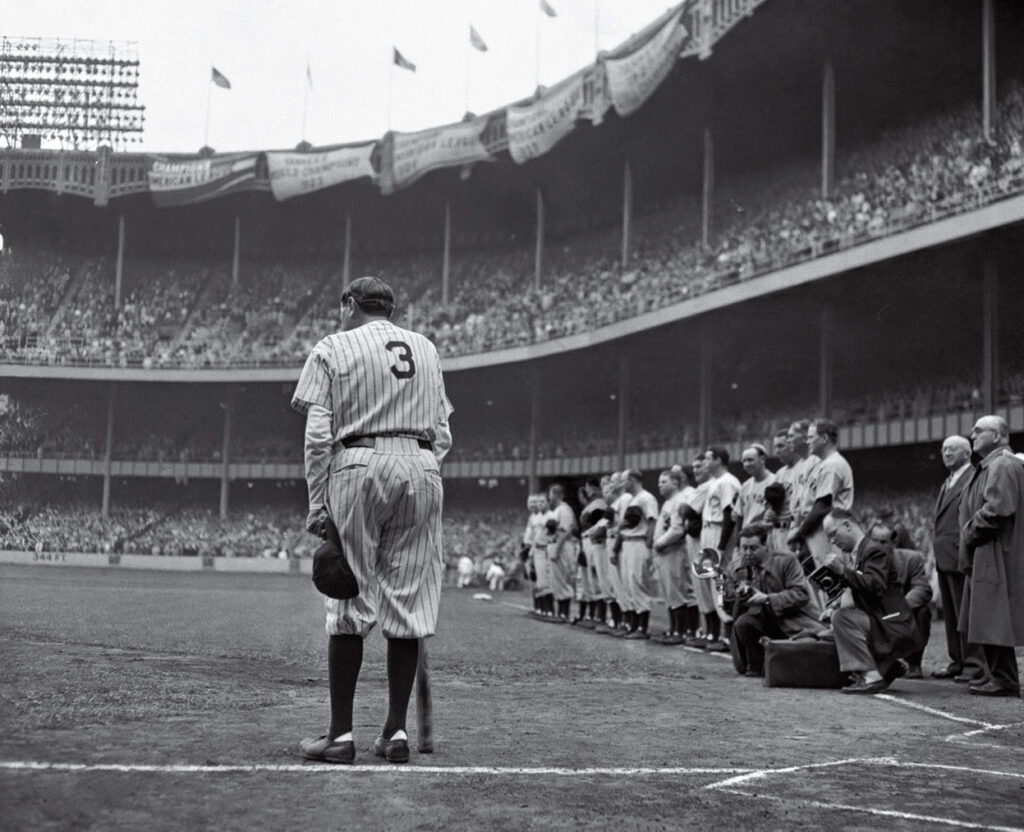
One of the greatest sports photographs ever taken. “Babe Bows Out” by Nathaniel Fein. Taken June 13, 1948. (Time Magazine)
Home: Yankee Stadium II
Many teams — from many sports — would play at Yankee Stadium. So would popes, evangelists and rock stars (Simon and Garfunkel, The Beach Boys, Billy Joel, Pink Floyd). But this was the home of the Yankees and they would make sports history here, winning 26 of its 27 World Series titles here.
By the 1990s, it was very obvious that the stadium was in a state of disrepair. And what had once been great and mighty now paled in comparison to the modern sports arena and the demands of the modern baseball fan.
Construction began on a new Yankee Stadium — across the street from the old one — in the summer of 2006. The final game at the old stadium was on September 21, 2008, with the Yankees beating another old team and rival (the Baltimore Orioles) 7 to 3.
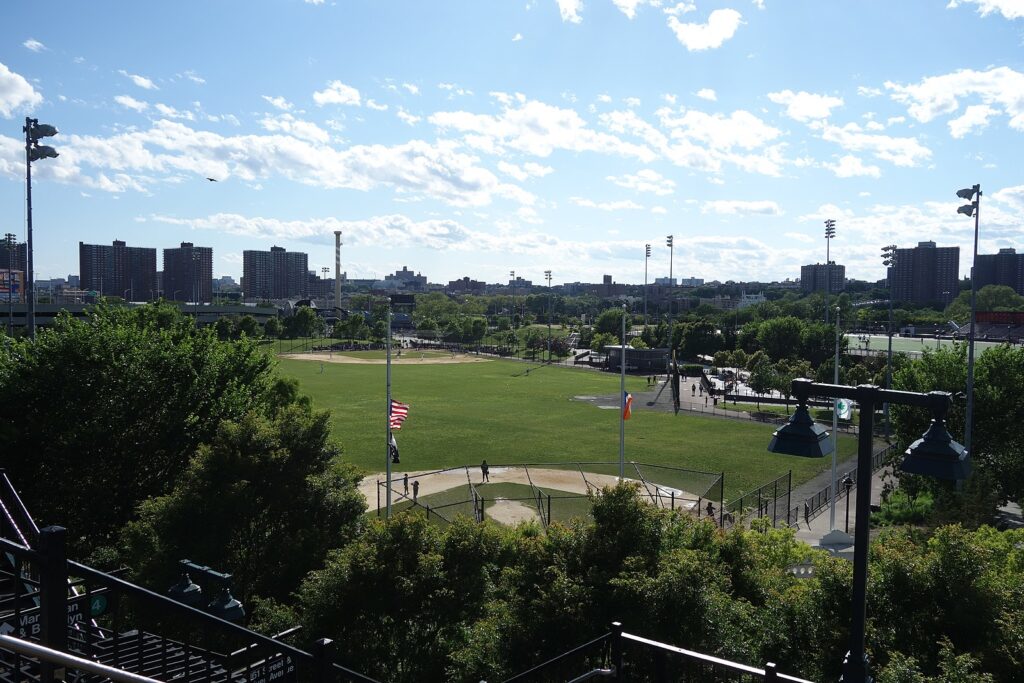
It took over a year to demolish the old stadium with the final vestige dismantled on May 13, 2010. The site of the former Yankee Stadium is now a park called Heritage Field which contains several memorials to the great teams who once played here.
And on April 16, 2009, the Yankees played their first game at their new stadium. The team was destroyed by the Cleveland Indians, 10-2. (They could have used the Bambino.)
Regardless they shook it off and, in early November, ended up winning the World Series for the 27th time — the first and (so far) only time the title has made its way at the new stadium.
Heritage Field, photo by Tdorante10, Wikimedia Commons
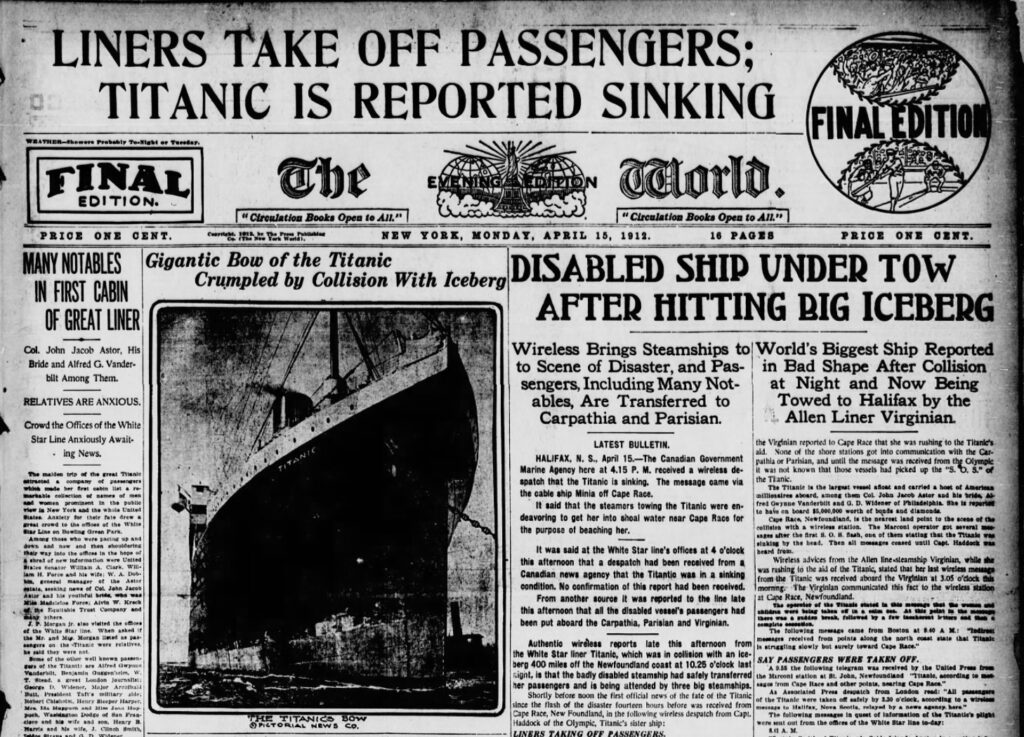
In the early morning hours of April 15, 1912. the White Star ocean liner RMS Titanic struck an iceberg en route to New York City and sank in the Atlantic Ocean.
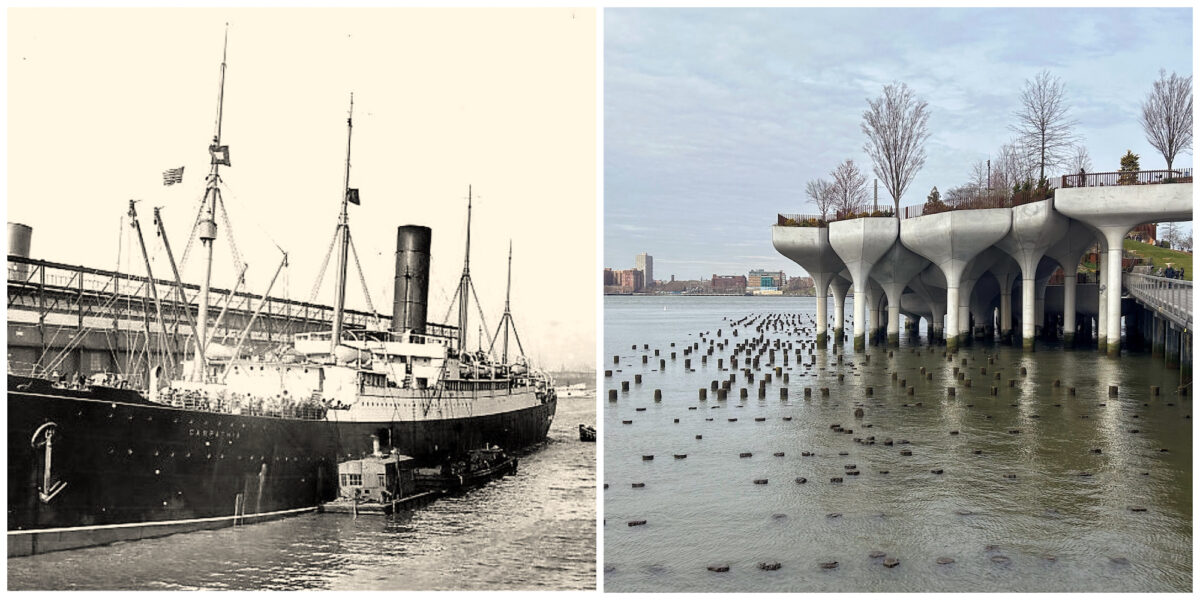
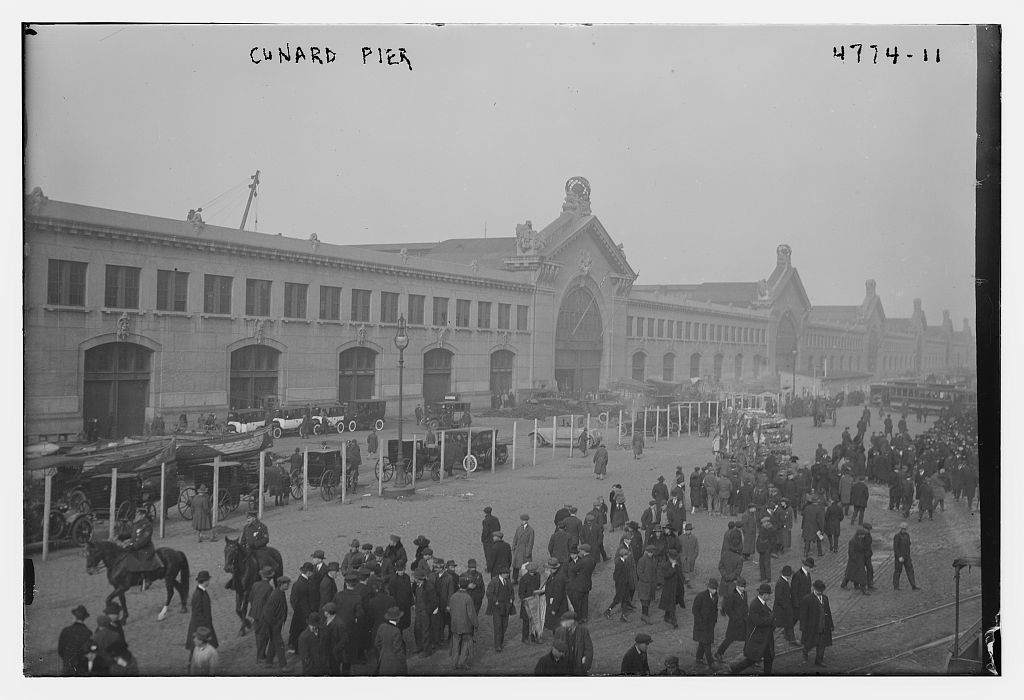
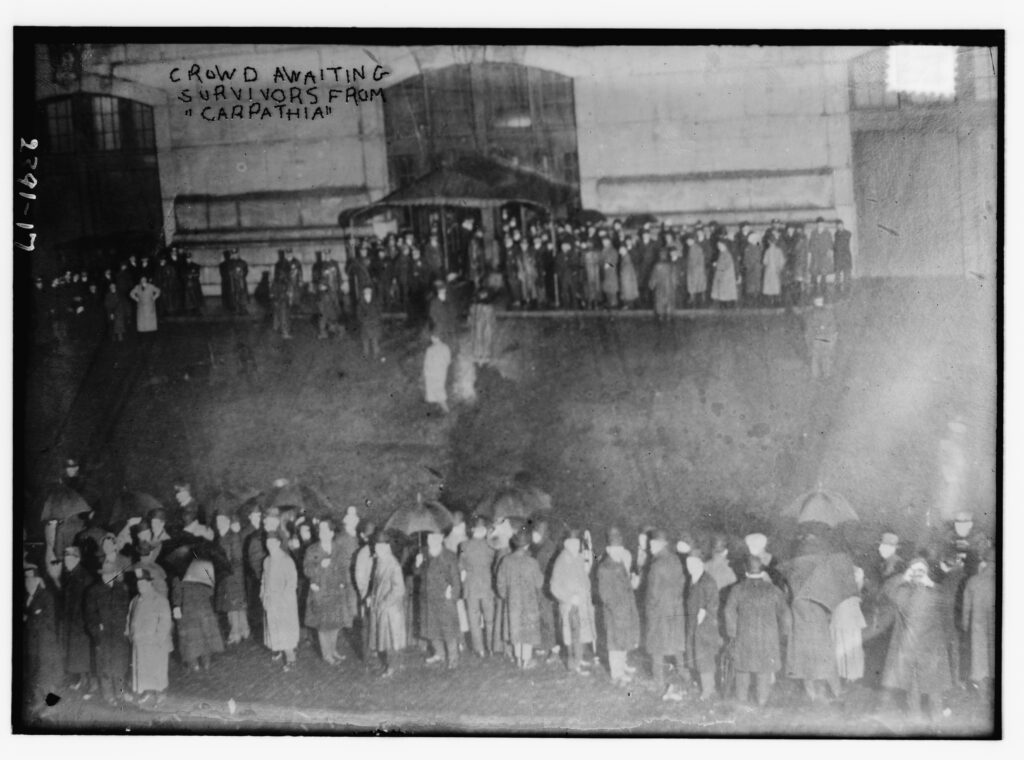
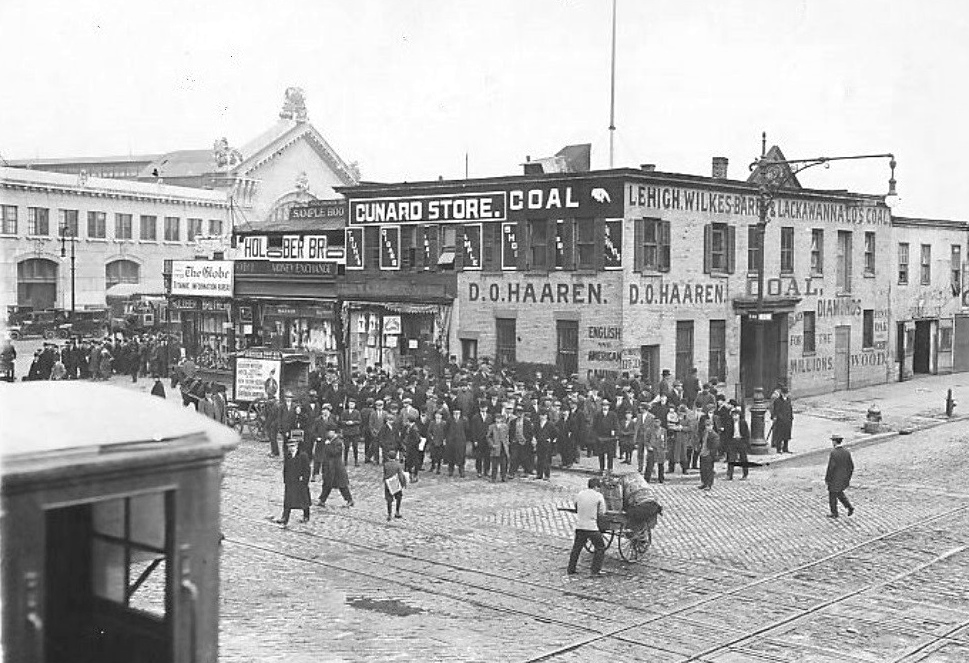
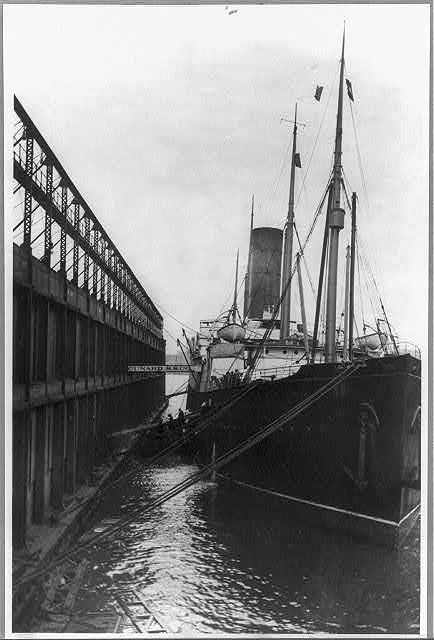
Survivors were rescued by the Cunard liner Carpathia and brought to their berth at Pier 54 at the Chelsea Piers.
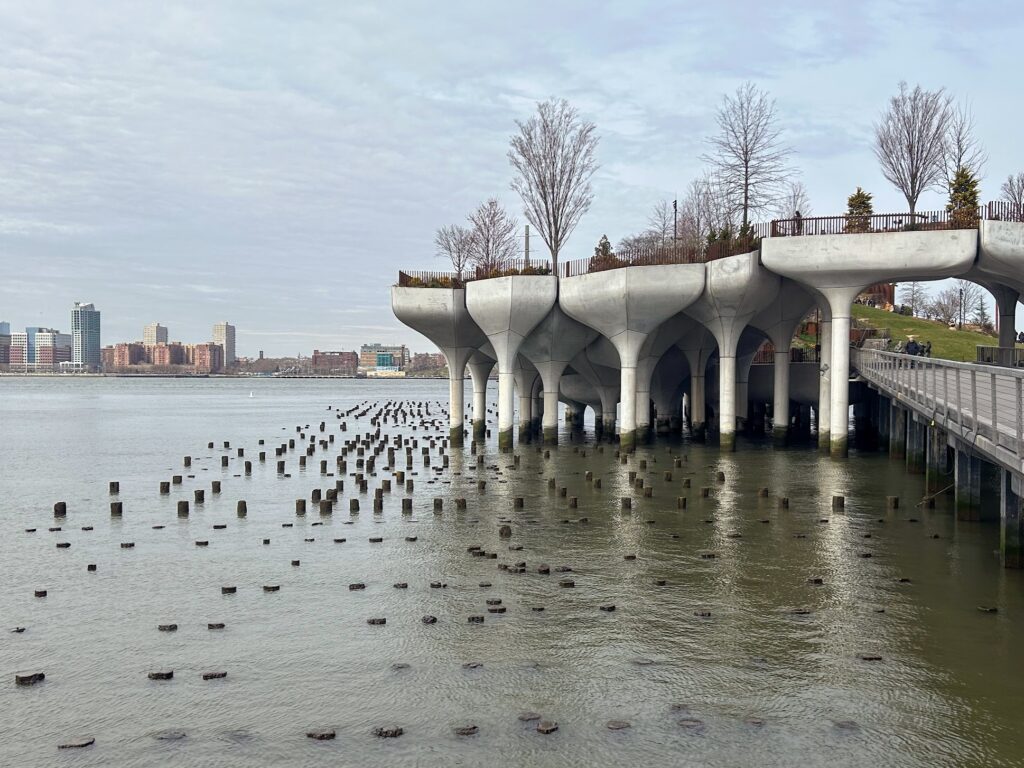
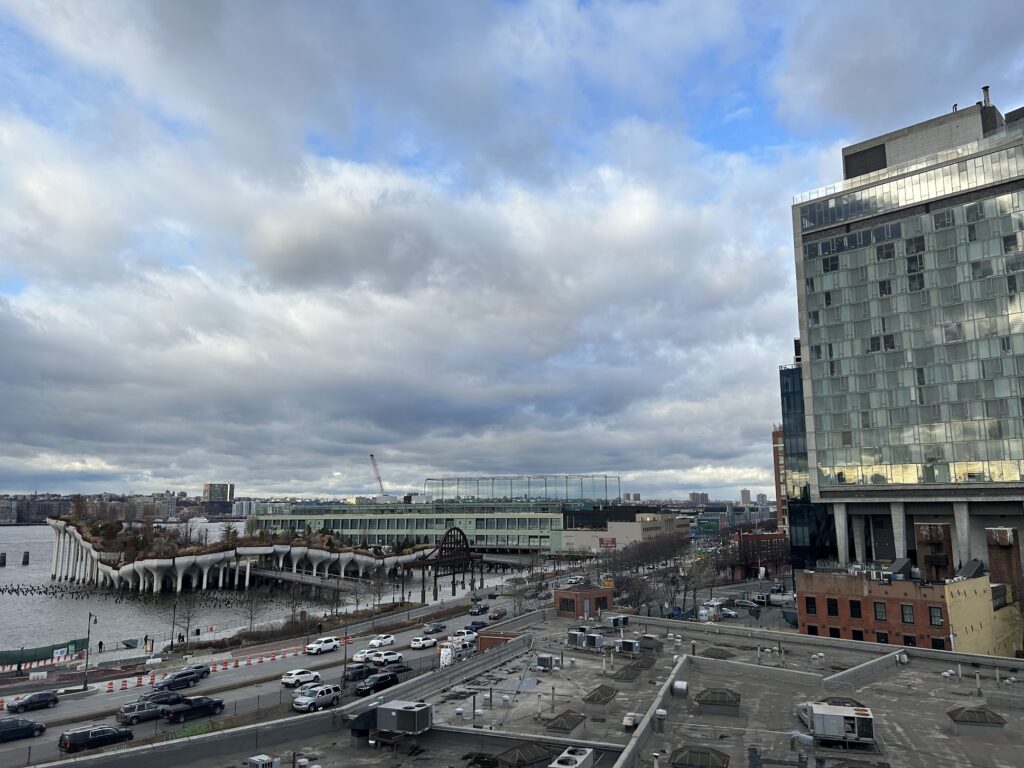
On that very spot today, a fanciful waterfront development juts out into the Hudson River, a place called Little Islandwhich opened in 2021. This recreational oasis will draw thousands of people, New Yorkers and tourists alike, this spring and summer.
But on the southern side of Little Island, peering out of the water, are dozens of wooden posts – these are the remains of the former Pier 54.
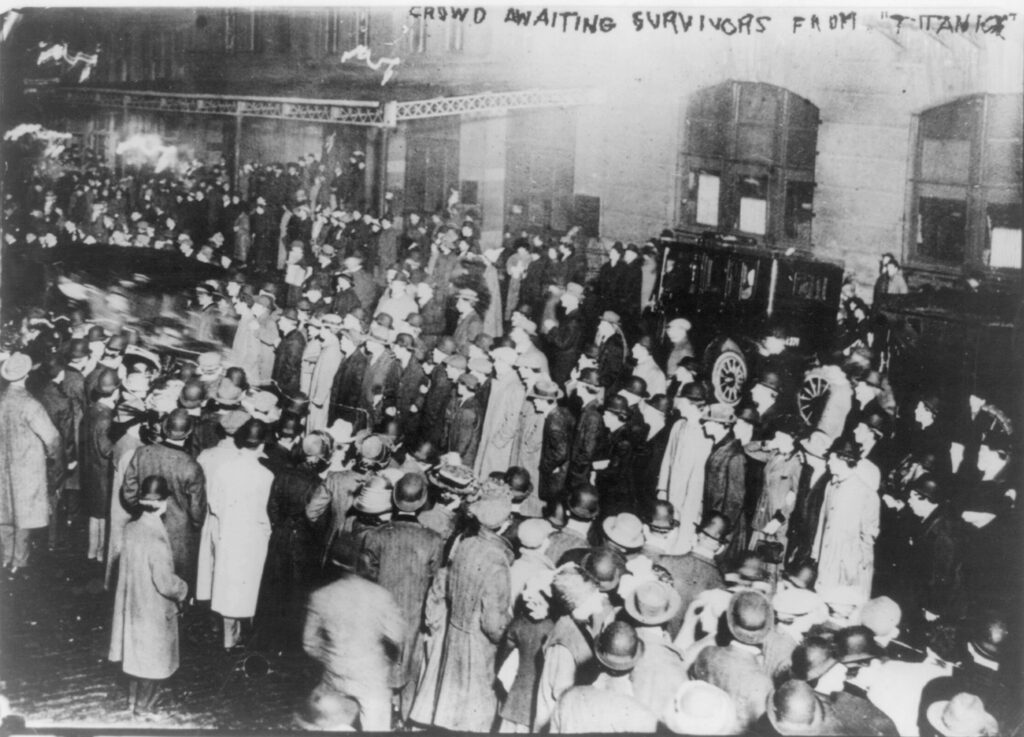
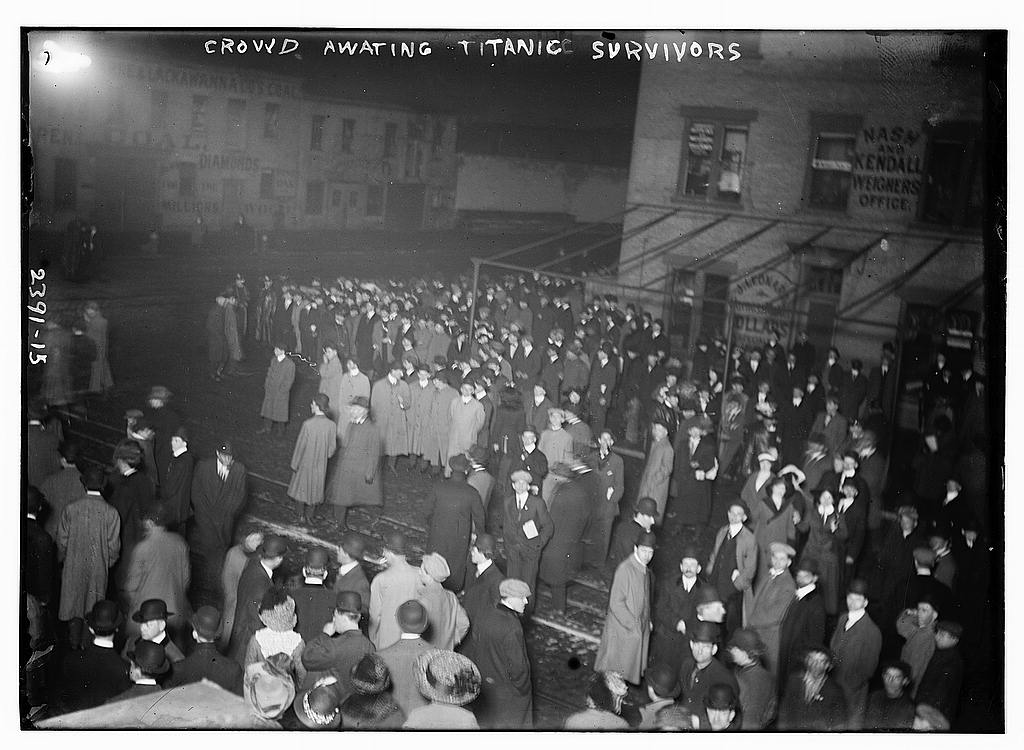
And it was on this pier, on April 18, 1912, that survivors of the Titanic disembarked and touched land.
The remains of Pier 54 jut out from the water on the southern side of Little Island. Photo by Greg Young
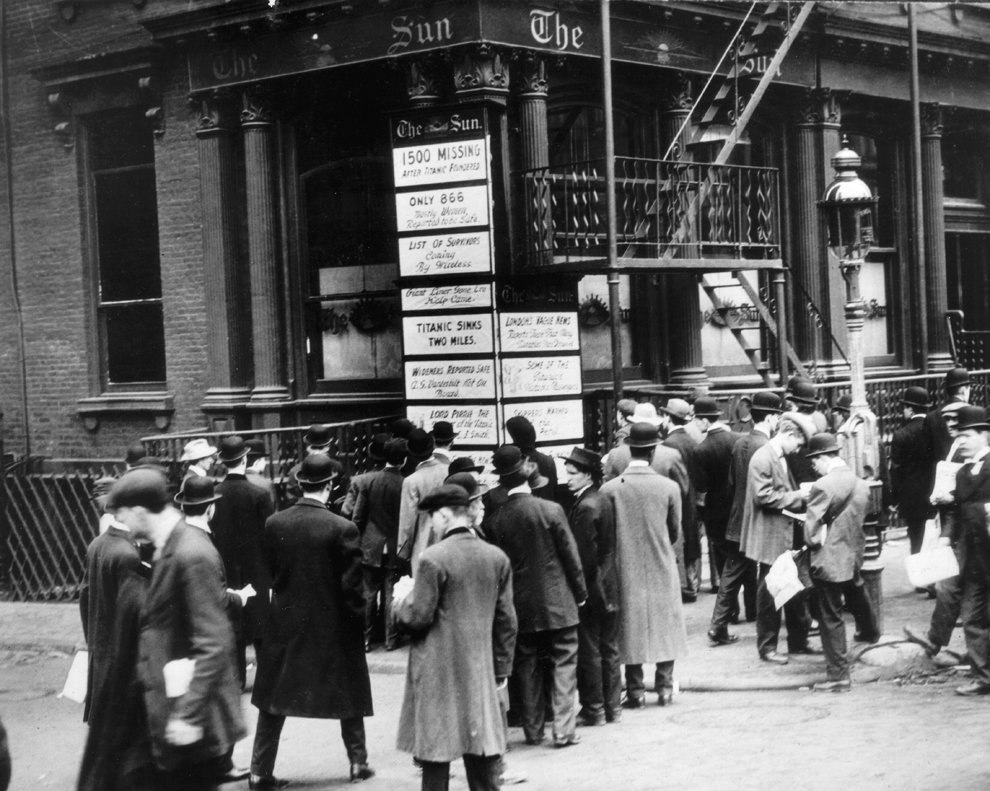
There are many, many books and documentaries on the subject of the Titanic’s sinking. (And of course a very popular movie.) But in this episode, Greg and Tom look at the story from the perspective of New York City – from the famous New Yorkers who were passengers to the experiences of New Yorkers anxiously awaiting news in those horrifying days following the ship’s sinking.
This is the story of the places that figured into the aftermath and the story of how New York memorialized those lost to the tragedy.
And in the end they return to Little Island and to the ghost of Pier 54, the place where this disaster became reality for most people.
Where survivors were greeted with joy and where many hundreds of people faced the reality that their loved ones were never coming home.
LISTEN NOW: THE TITANIC AND THE FATE OF PIER 54
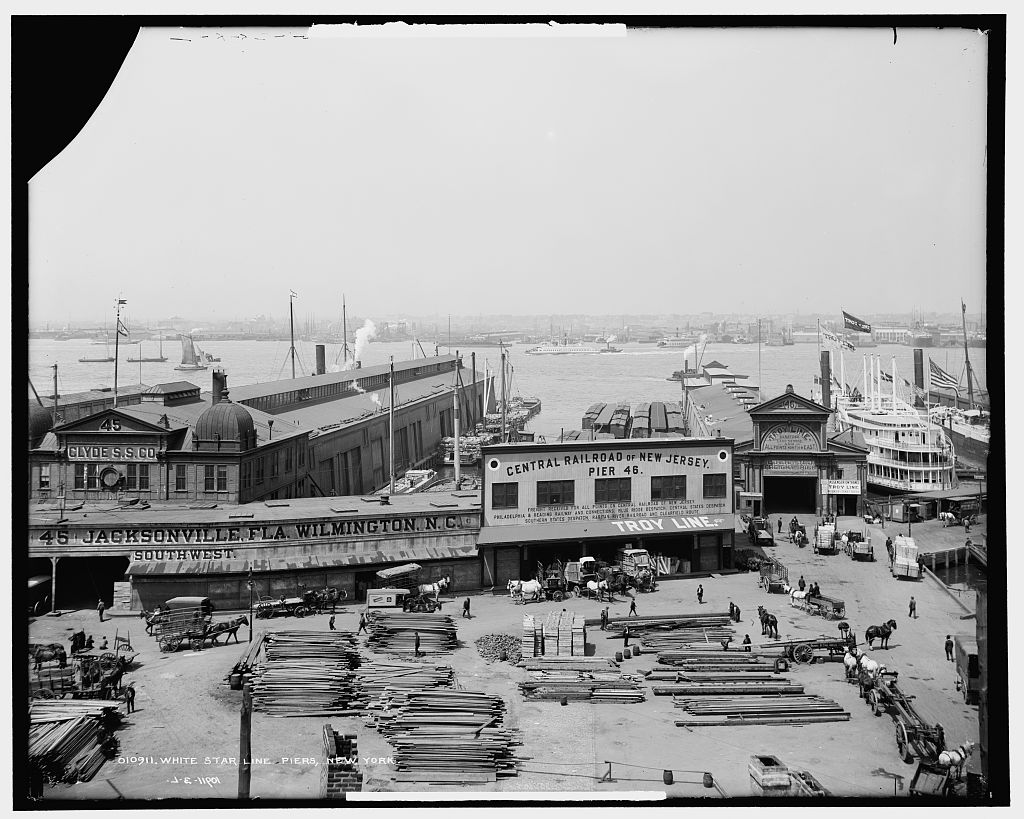
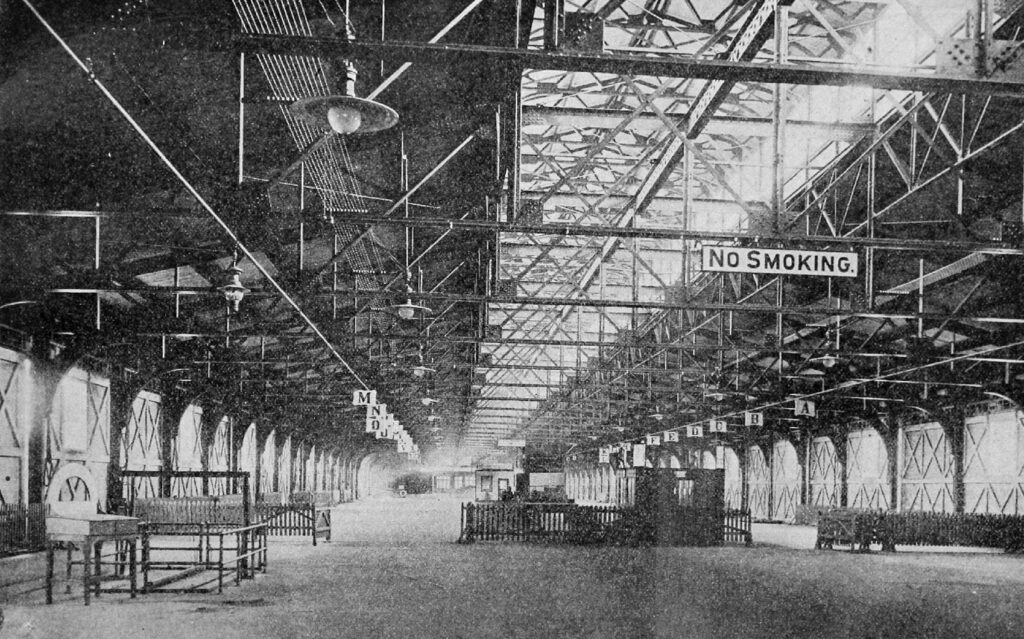
Little Island and the Meat Packing District. Photo by Greg YoungPier 54, 1912Many people found out about the Titanic disaster from newspaper bulletin boards where breaking news was posted.The streets were lined with people that night at Pier 54.The morning of April 19, 1912 — Crowds gather at the Cunard Pier 54 (at 14th Street) where the Carpathia landed with survivors of the Titanic disaster the previous evening. News accounts say there were up to 40,000 people gathered at the pier waiting for Carpathia on April 18. (Picture courtesy AP)The berth of the White Star lineInside Pier 54, the Cunard line, in 1912
The Carpathia at Pier 54
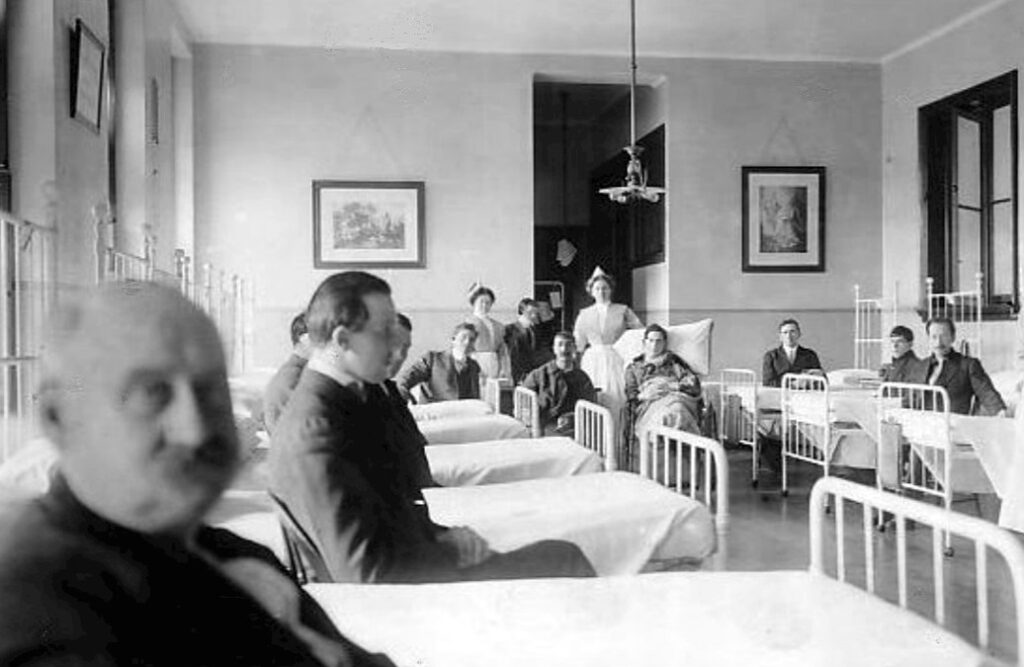
Titanic survivors are treated at St. Vincent’s Hospital (Picture courtesy AP)
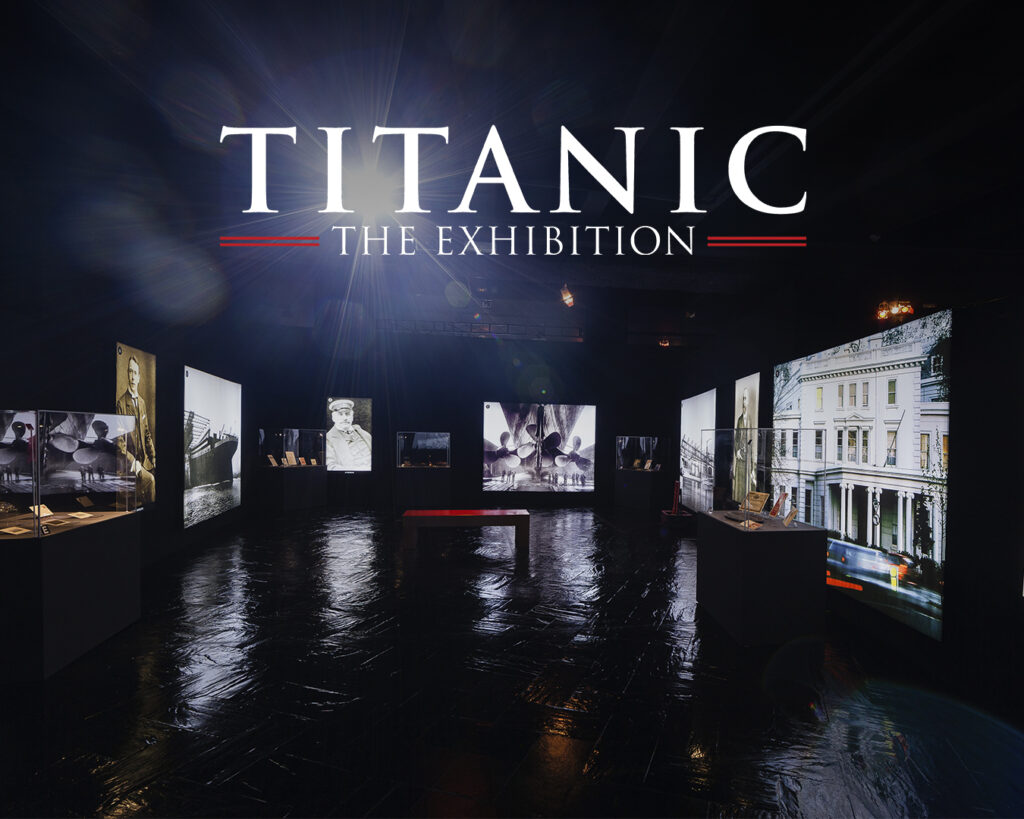
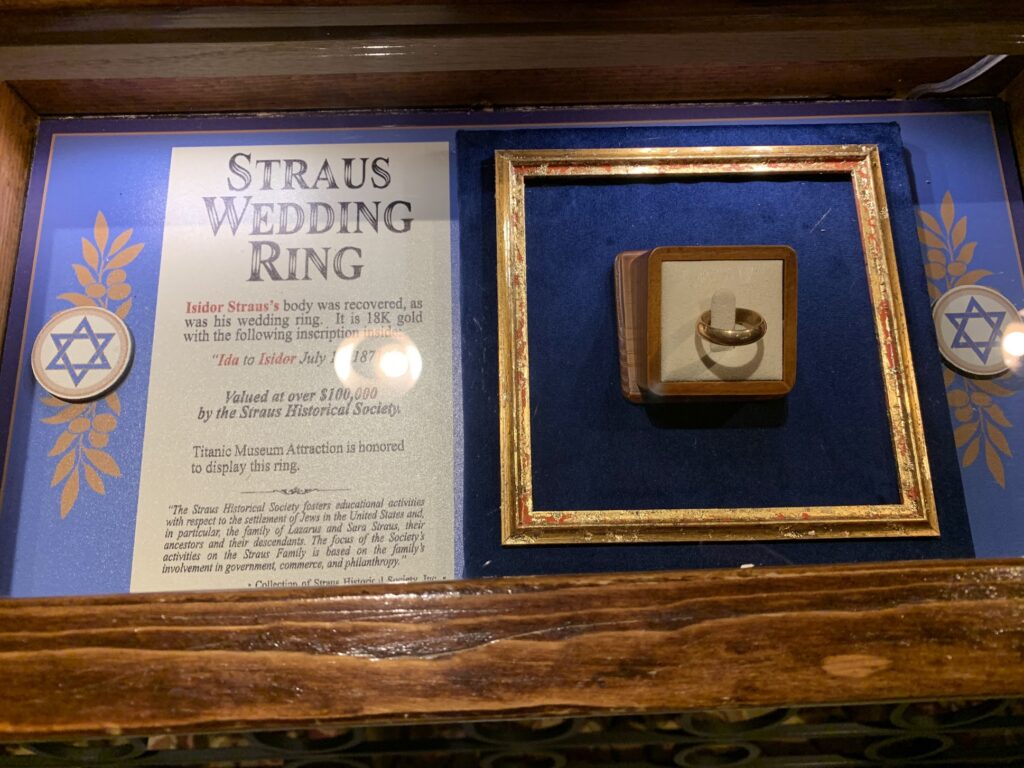
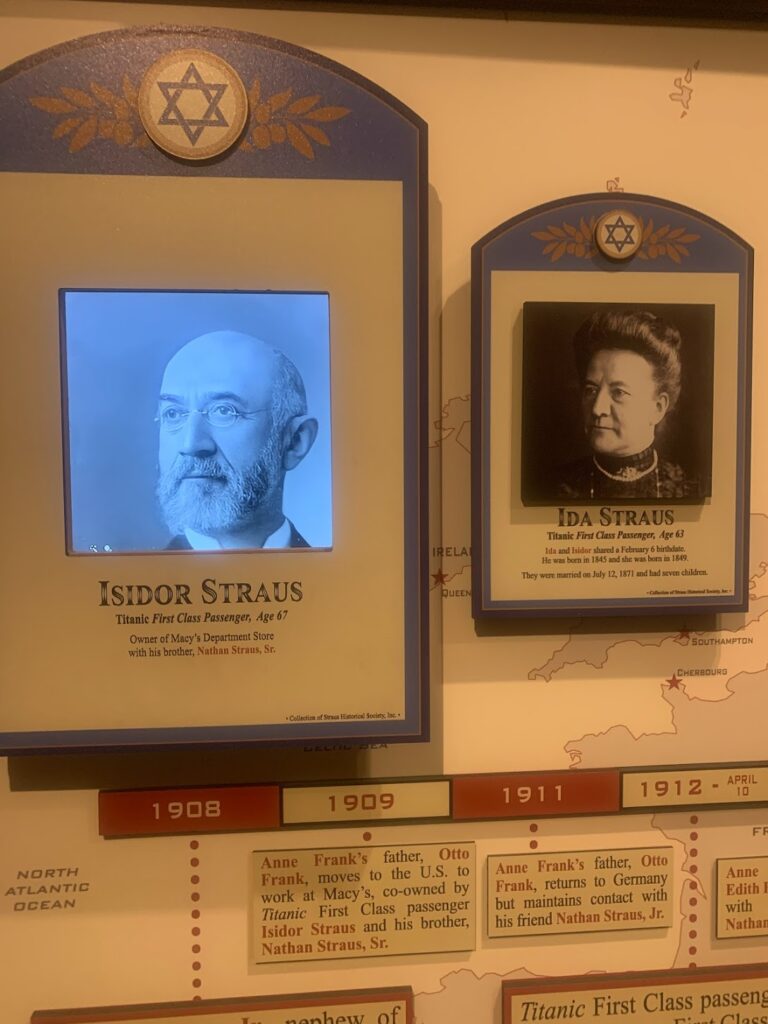
As Tom mentioned on the show, you can visit Titanic: The Exhibition in the same building where Macy’s opened and where Titanic passenger Isador Straus (with his brother Nathan) got their start with the department store. For more information, visit their website.
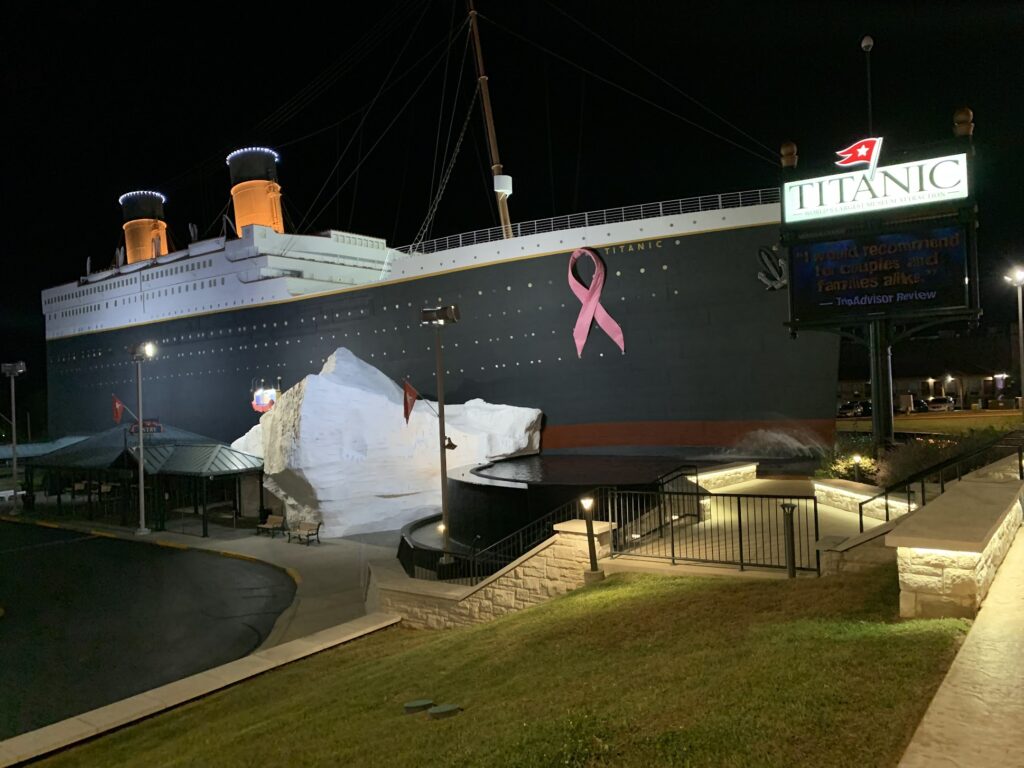
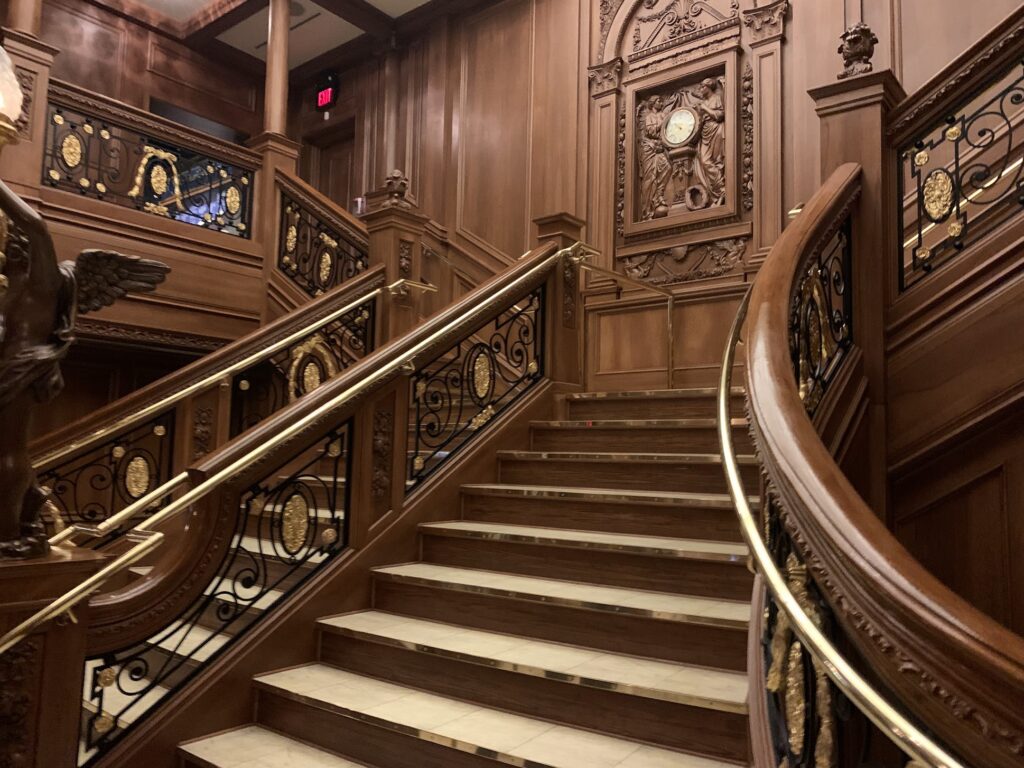
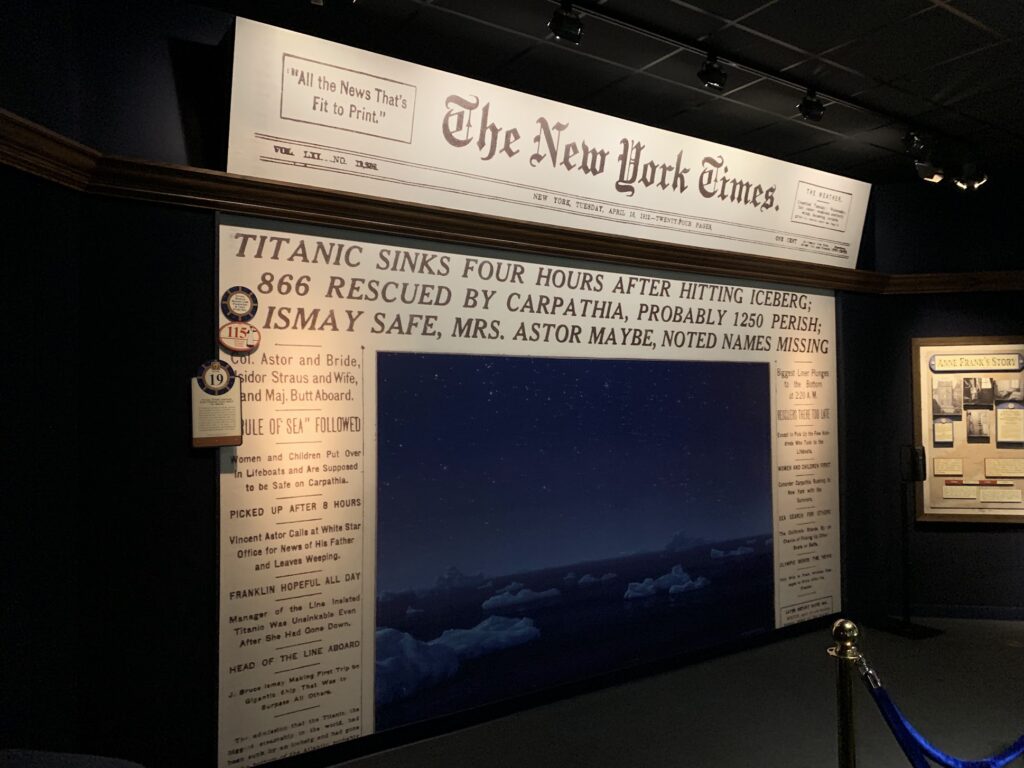
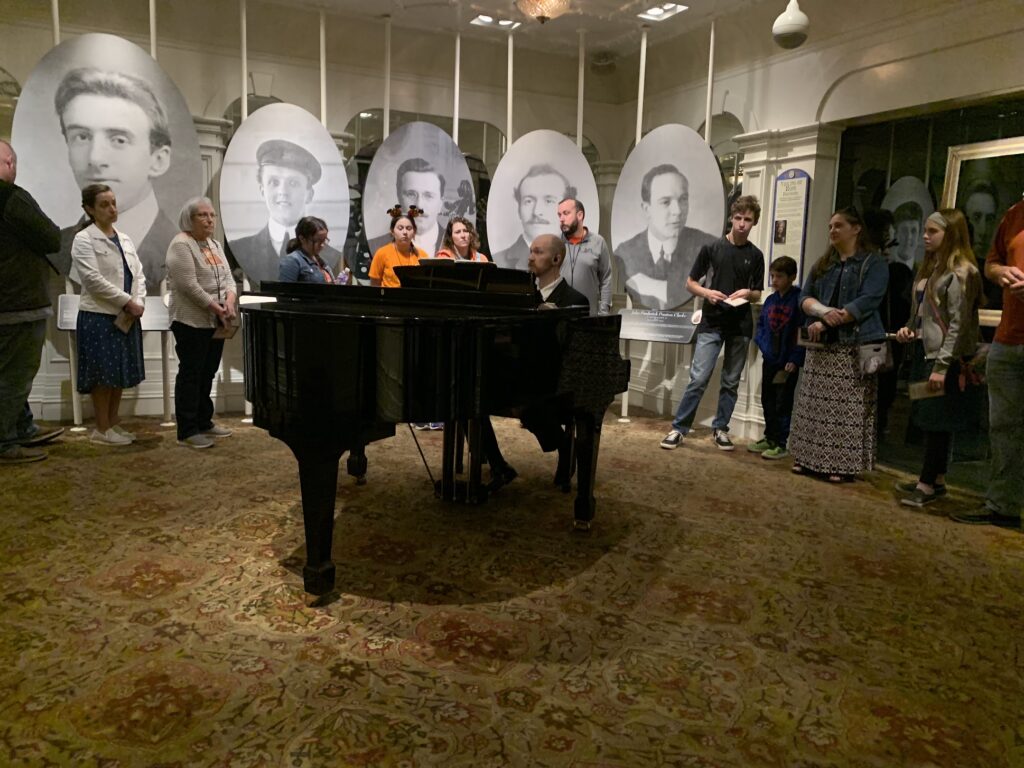
And for a more long distance experience, here are Greg’s pictures from the Titanic Museum in Branson, Missouri:
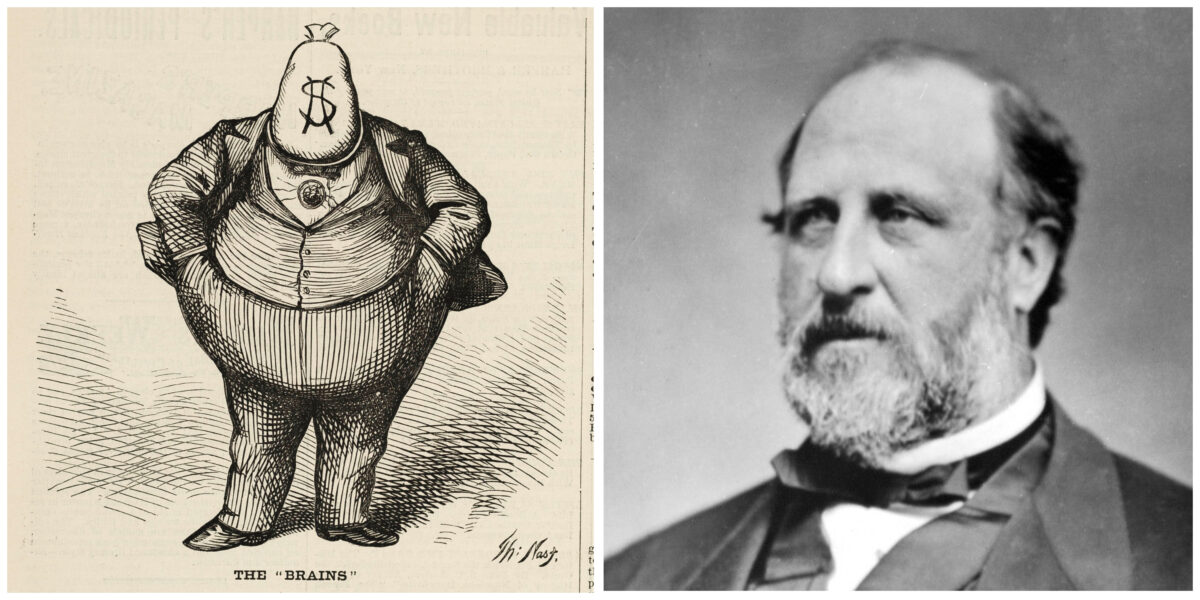
One of our great sources of inspiration here on the Bowery Boys Podcast was born 200 years ago today — William Tweed, otherwise known as Boss Tweed.
This doesn’t mean he was a great guy. In fact, as the boss of America’s most infamous political machine Tammany Hall, you could say he formalized all the very worst aspects about local politics.
Mark his birthday today by taking a dive into one of these top podcasts we’ve recorded over the years with Tweed as a central character, recounting his adventures and misdeeds
The tale of America’s most infamous political machine and the rise and fall of its flamboyant William ‘Boss’ Tweed.
You cannot understand New York without understanding its most corrupt politician — William ‘Boss’ Tweed, a larger than life personality with lofty ambitions to steal millions of dollars from the city.
With the help of his Tweed Ring’ the former chair-maker had complete control over the city — what was being built, how much it would cost and who was being paid.
How the Tweed Courthouse became a symbol for everything rotten about 19th century American politics.
The Tweed Courthouse is more than a mere landmark. Once called the New York County Courthouse, the Courthouse is better known for many traits that the concepts of law and order normally detest — greed, bribery, kickbacks and graft.
In this special episode, we look at the history of New York City as seen through one corner of the Lower East Side. Created by the intersections of several streets, this is a place that has gone by many names — in the past and even today.
And in one inconceivable historical moment, a statue was almost raised here to William ‘Boss’ Tweed!
And other Bowery Boys articles on this website about Boss Tweed that you might enjoy:
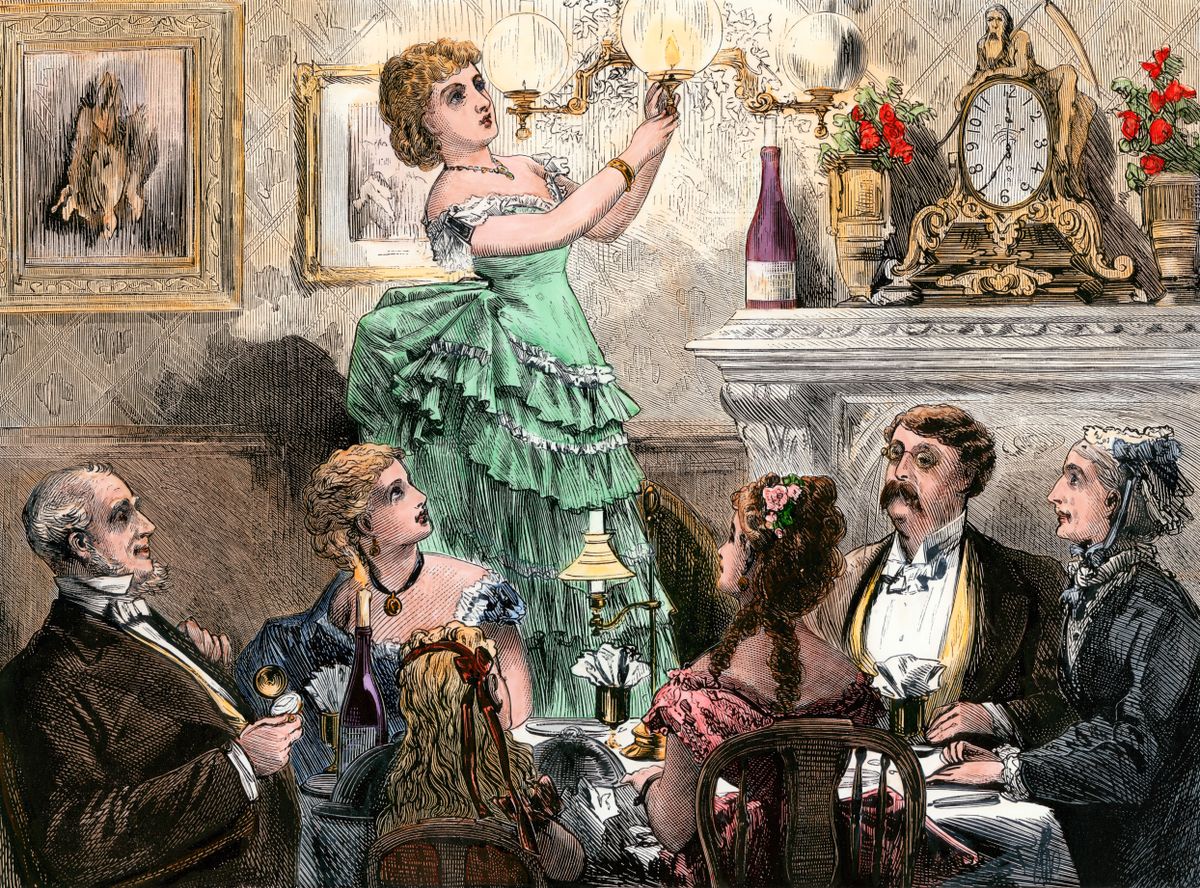
Enter the magical world of New York by gaslight, the city illuminated by the soft, revolutionary glow of lamps powered by gas, an innovative utility which transformed urban life in the 19th century.
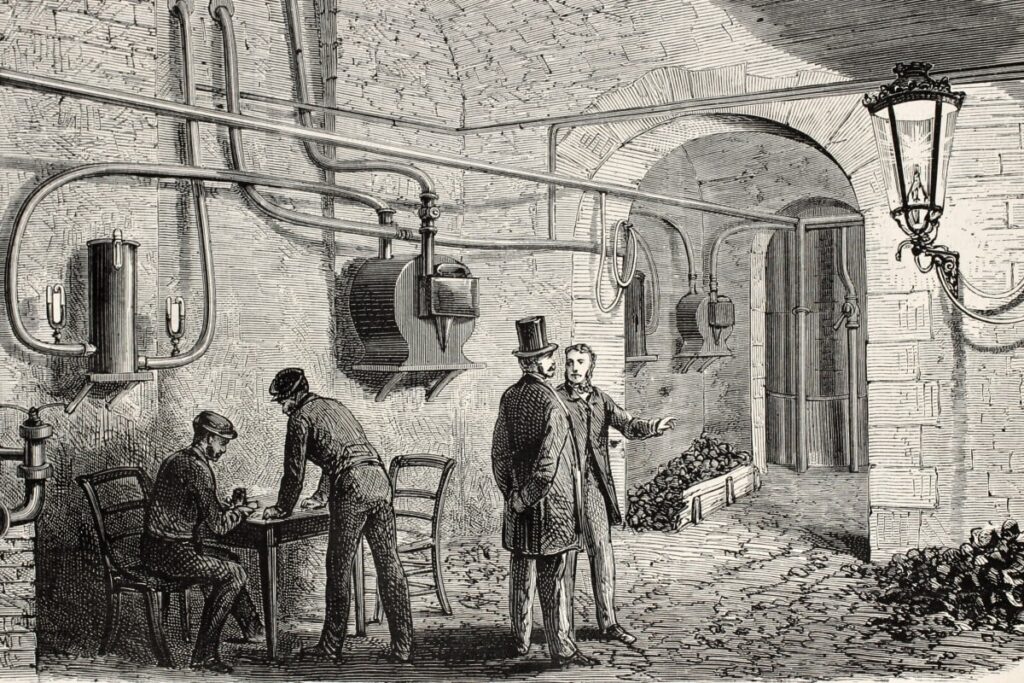
Before the introduction of gaslight in the 1820s, New York was a much darker and quieter place after sunset, its streets lit only by dull, foul-smelling whale-oil lamps. Gaslight, reliant upon the burning of coal, was first used in London and later made its American debut in Newport and Baltimore.
The New York Gas Company received its company charter in 1823 and began to install gas pipes under the street that decade. With gas-powered lighting, New York really became the city that never sleeps.
It meant you could work late without your eyes straining – or wander the streets with less apprehension. It meant greater ease reading a book or throwing a lavish ball. (It also meant working later hours.) Gaslight brought the 19th century city to life in ways that are easy to overlook.
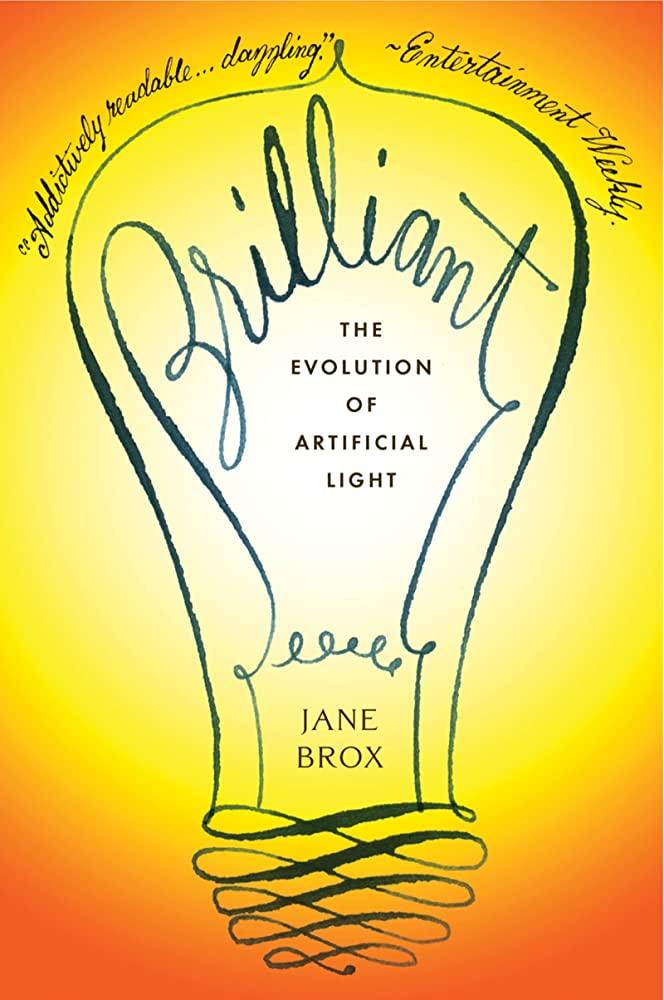
In this episode we’re joined by author Jane Brox, author of Brilliant: The Evolution of Artificial Light who discussed the curious charms of this rare and enigmatic light source.
LISTEN HERE: NEW YORK BY GASLIGHT
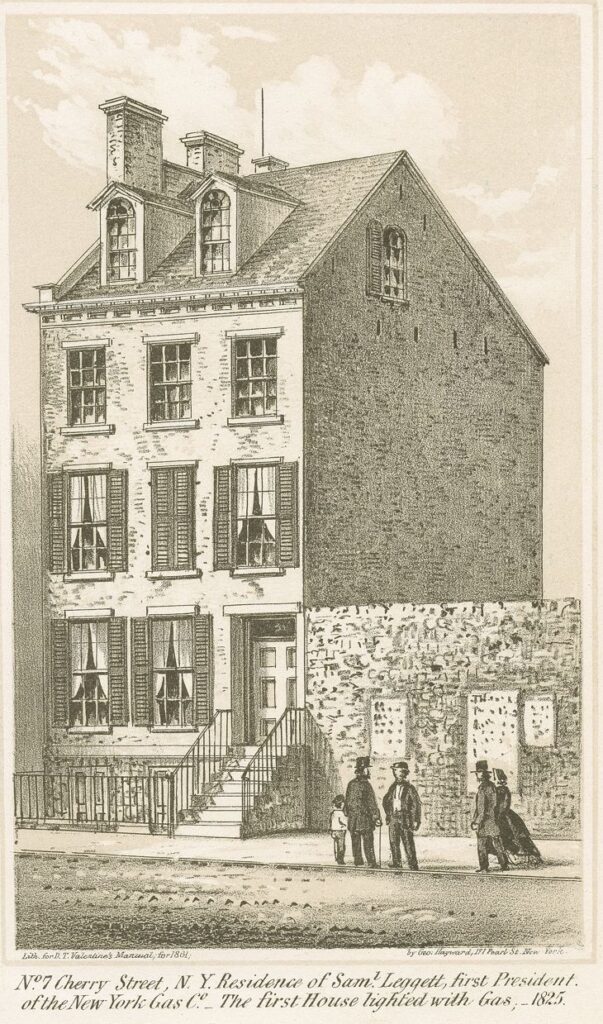
The first house in New York City to be illuminated by gaslight — 7 Cherry Street, the home of New York Gas Company president Samuel Leggett.
Courtesy New York Public LibraryGaslight was often installed concurrently (or even before) water pipes in certain areas of the city.
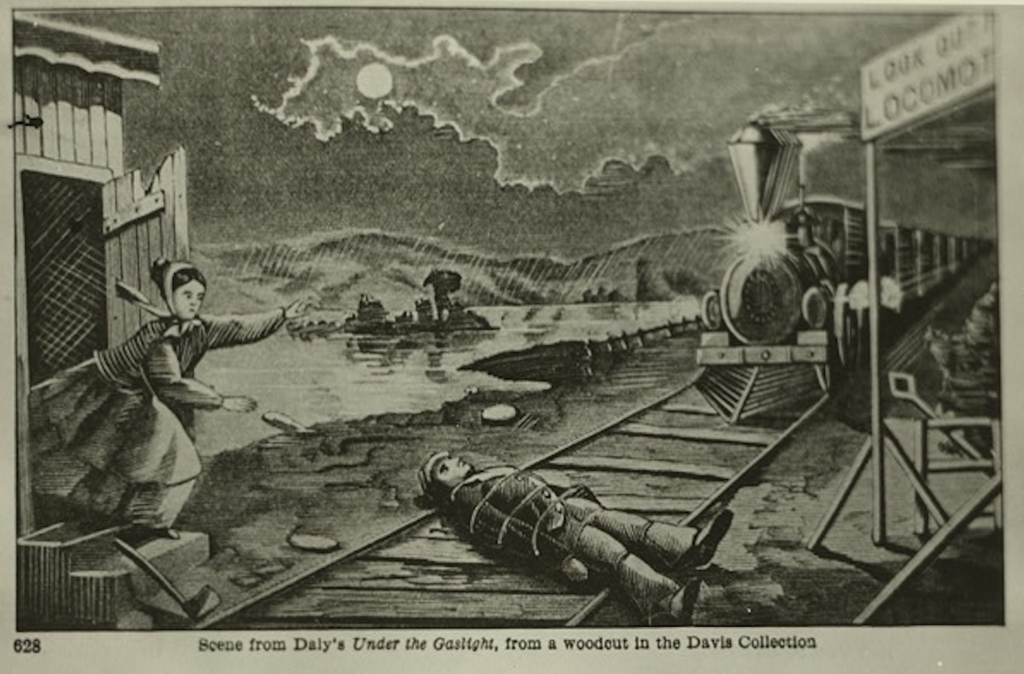
The innovative 1867 play Under The Gaslight employed spectacular gaslight effects to create a captivating scene.
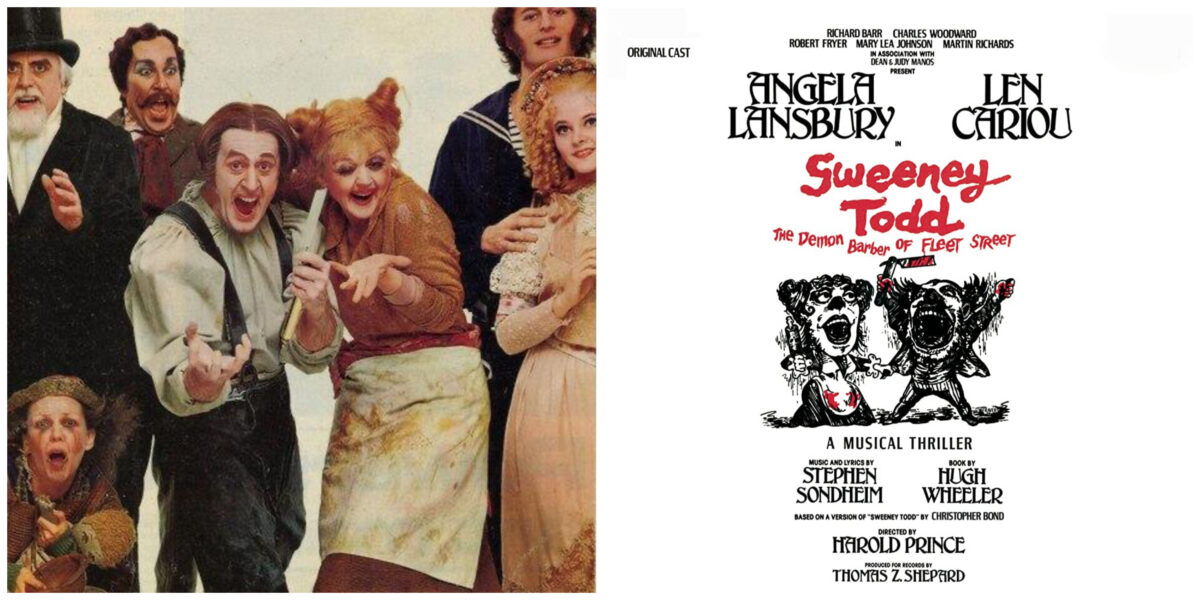
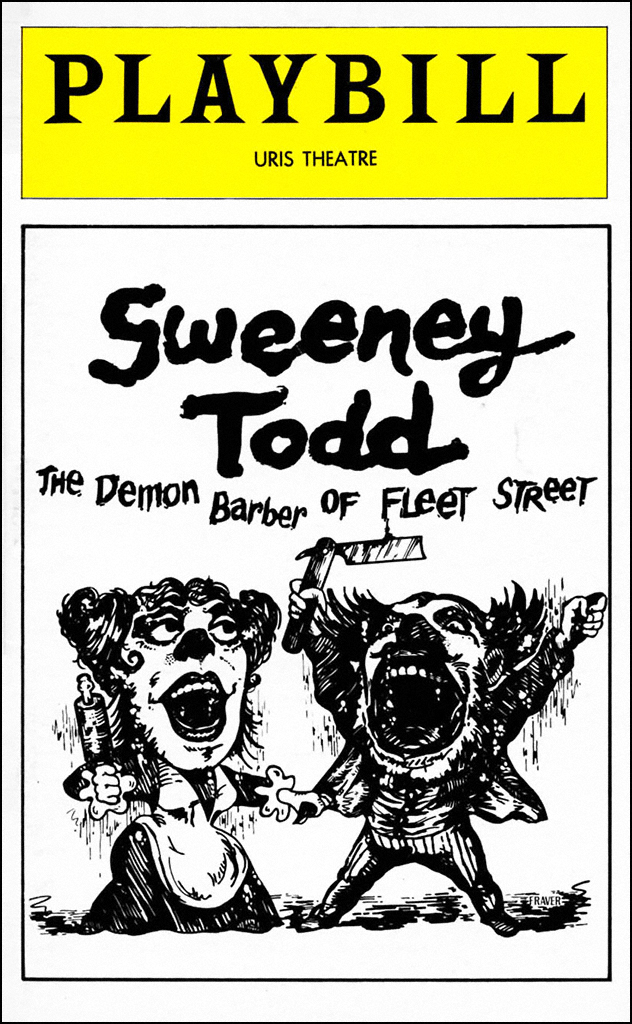
The Stephen Sondheim musical Sweeney Todd: The Demon Barber of Fleet Street made its Broadway debut on March 1, 1979 at the Uris Theatre (today the Gershwin Theatre).
It would become one of the most popular and beloved musicals of modern times, winning eight Tony Awards including Best Musical, Leading Actor (for Len Cariou) and Leading Actress (Angela Lansbury).
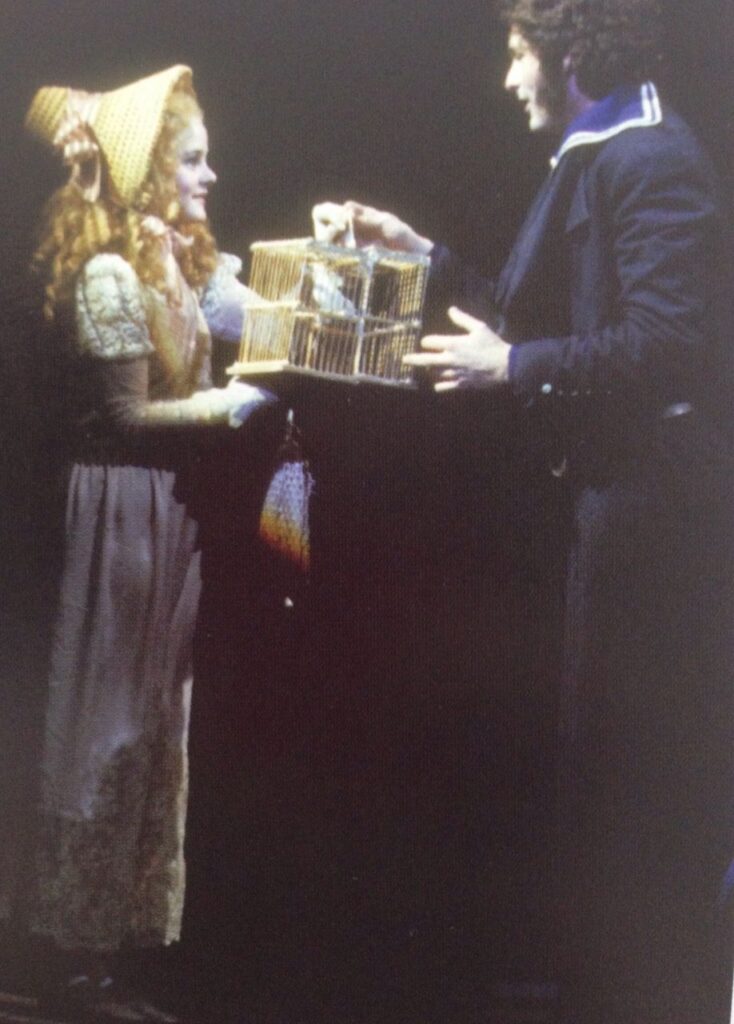
Also in the Broadway cast was Sarah Rice who originated the role of Johanna.
On this week’s episode of The Gilded Gentleman, Sarah joins host Carl Raymond for a fascinating conversation about that original production.
Sarah shares what it was like to get the role, how she went about creating the character and what it was like to work with such extraordinary colleagues.
Sarah Rice opposite Victor Garber in the original production of Sweeney Todd.
And that’s not all! As the famed “Demon Barber of Fleet Street” gets ready to flash his razor and do his deeds once again in a new Broadway production (starring Josh Groban and Annaleigh Ashford), Carl goes back in time to the early years of London’s Victoria era to look at just how Sweeney Todd and his tale came to be.
Born in the world of the sensational and gruesome stories of the “penny dreadfuls“, Sweeney Todd and his story were quite different from what theatre audiences know today.
Listen today on your favorite podcast player or play it here:
The original television commercial:
An original video of Sarah Rice singing “Green Finch and Linnet Bird” on the Broadway stage!
And after you listen to Carl’s show, dive into the original Broadway cast recording:
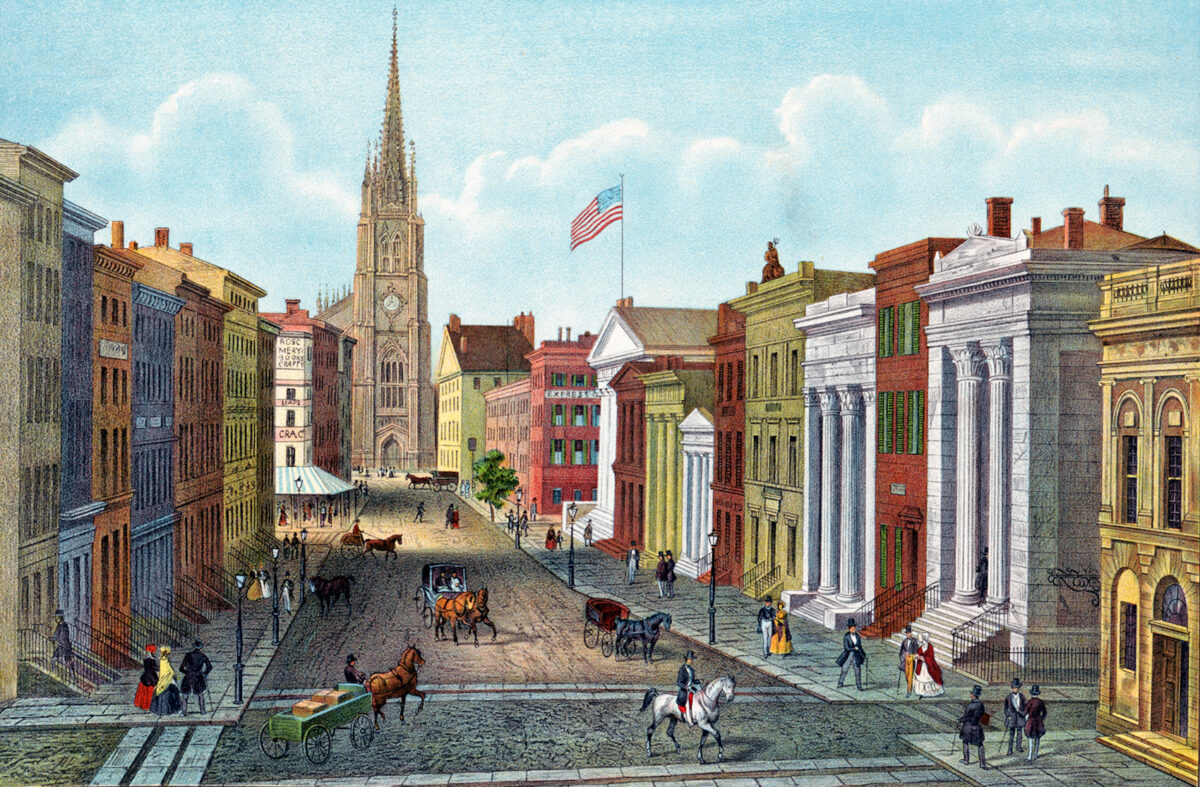
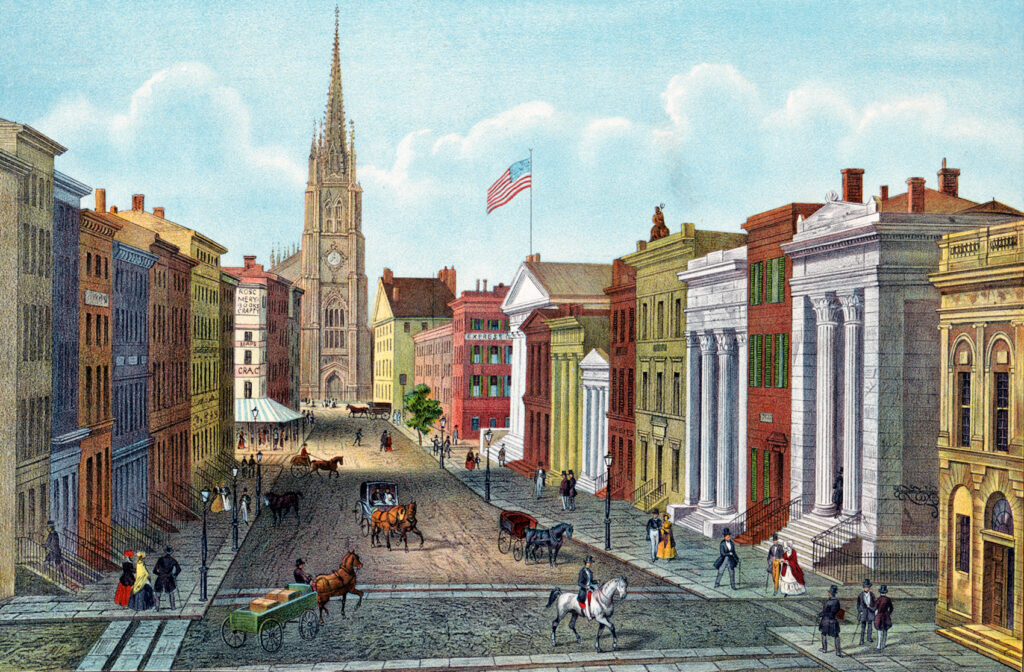
Wall Street in 1847, German artist Augustus Köllner, from lithograph by Laurent Deroy
Wall Street, today a canyon of tall buildings in New York’s historic Financial District, is not only one of the most famous streets in the United States, it’s also a stand-in for the entire American financial system.
Wall Street in 1847, German artist Augustus Köllner, from lithograph by Laurent Deroy
One of the first facts you learn as a student of New York City history is that Wall Street is named for an actual wall that once stretched along this very spot during the days of the Dutch when New York was known as New Amsterdam.
The particulars of the story, however, are far more intriguing. Because the Dutch called the street alongside the wall something very different.
During the colonial era, the wall was torn down and turned into the center of New York life, complete with Trinity Church, City Hall and a shoreline market with a disturbing connection to one New York’s financial livelihoods — slavery.
So how did this street become so associated with American finance? The story involves Alexander Hamilton, a busy coffee house and a very important tree.
LISTEN NOW: HOW WALL STREET GOT ITS NAME
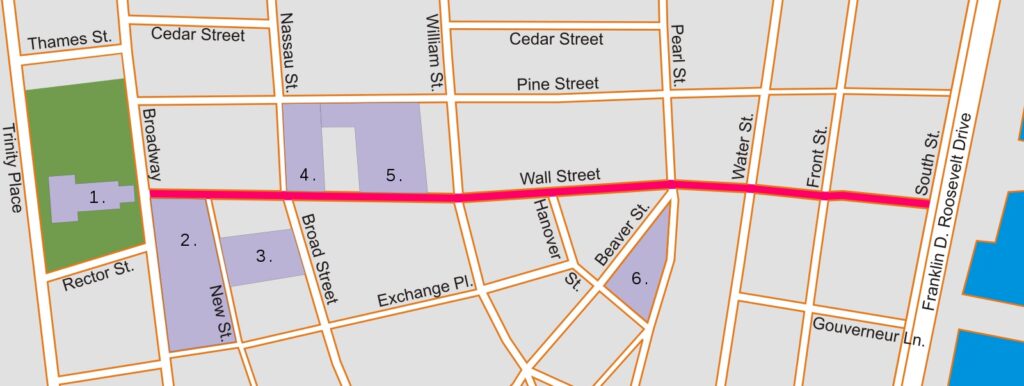
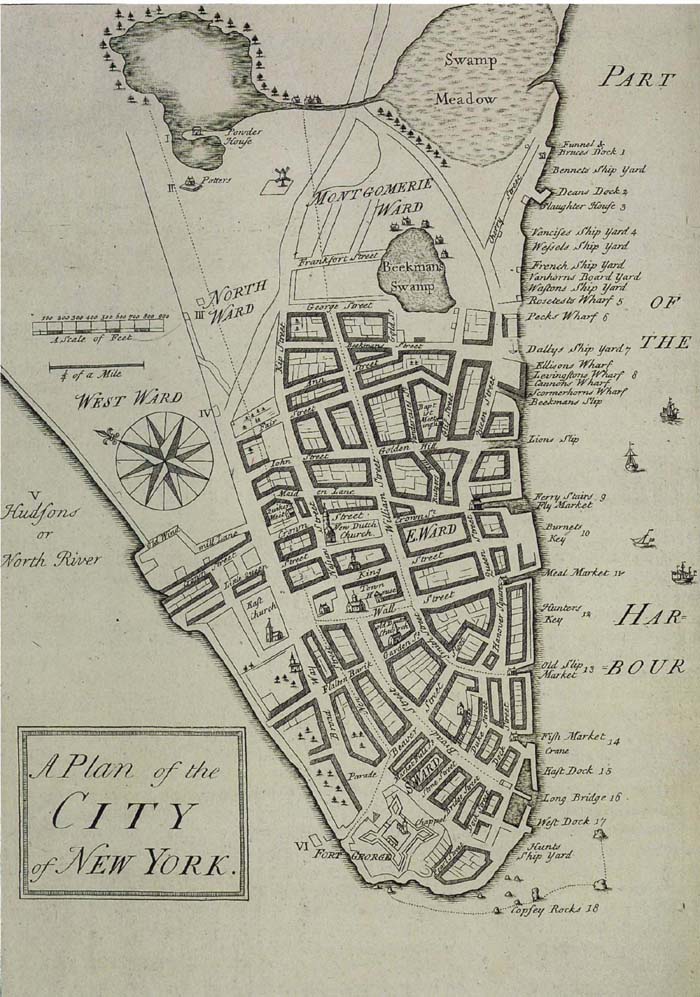
Map courtesy Wikimedia Commons: Featured on the map 1) Trinity Church 2) Bank of New York Building 3) NY Stock Exchange 4) Federal Hall 5) Trump Building 6) Cocoa ExchangeThe slave market was where the “Meal Market” is marked on the map.From Our Firemen: A History of the New York Fire Departments. Augustine E. Costello, 1887The Wall Street market which featured a slave market in 1711
FURTHER LISTENING:
After listening to the show about Wall Street, check back into these prior episodes for further adventures relating to this story.
This podcast is inspired by the article below, which ran in 2017 (and was itself based on an earlier article on this website).
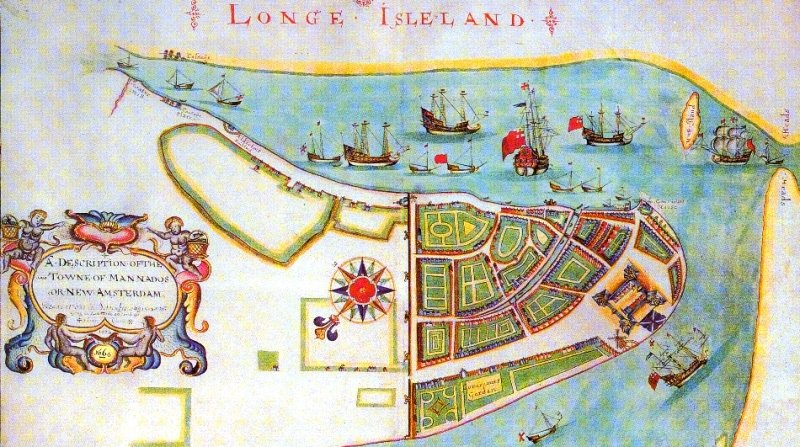
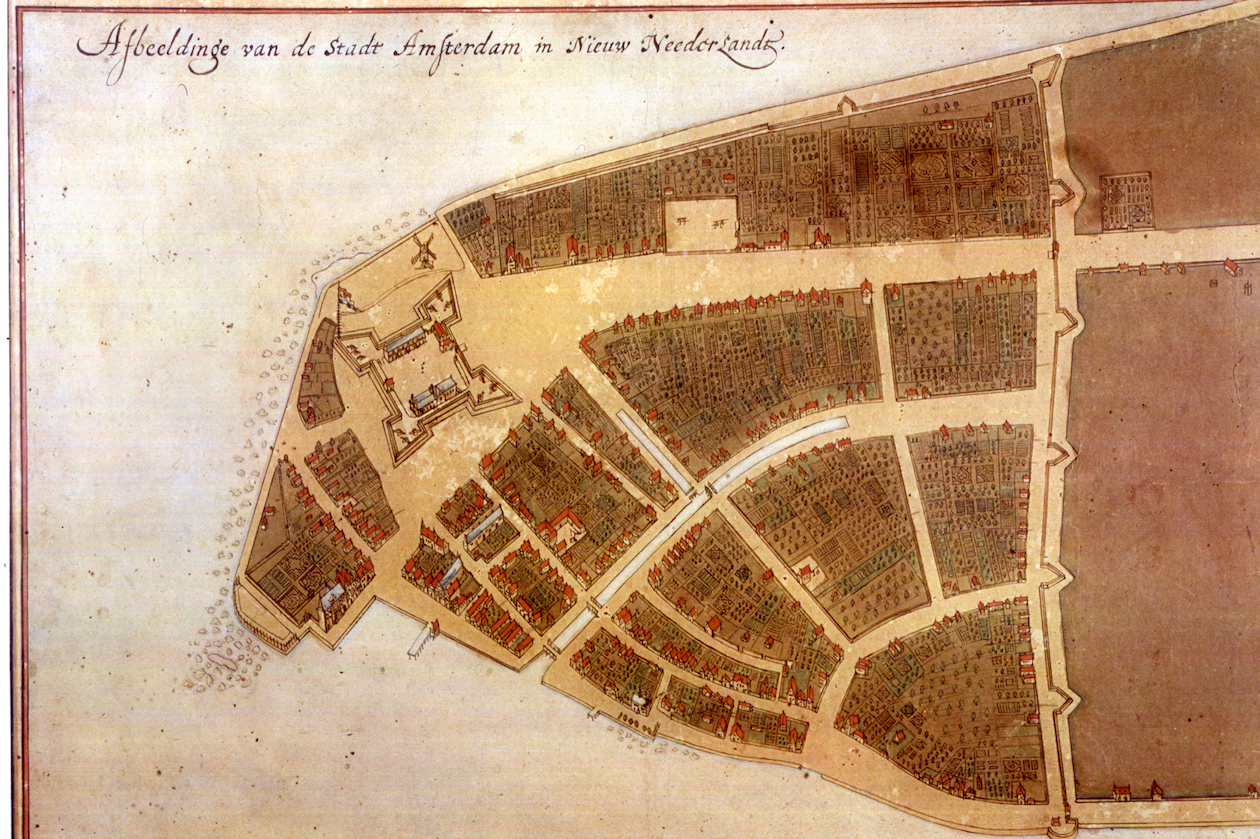
A simplistic but colorful view of “Man Mados” or “New Amsterdam” in 1664 (click in to inspect the detail)
There was most definitely a walled fortification nearby on New
Amsterdam’s northern boundary, and it certainly did stretch along about
the same area as Wall Street does today.
But the present name seems to be a formation of mixed meanings that
only a tangle of languages and hundreds of years of history can create.
The Dutch themselves referred to an actual street alongside the
waterfront that ran up to and alongside the wall as the ‘Cingel’ —
according to old history, meaning “exterior, or encircling, street.”
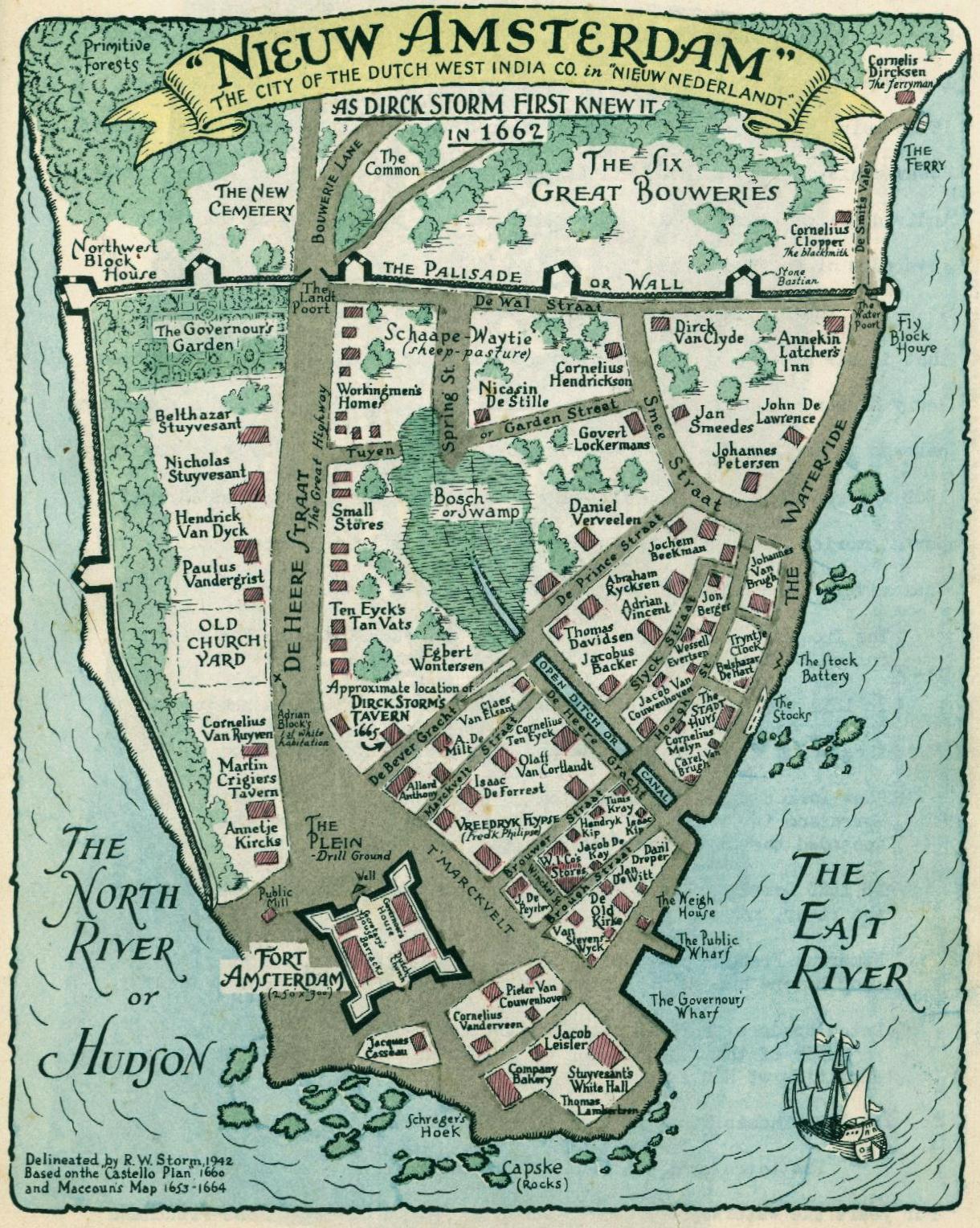
This festive illustration from 1949, created for Old Dirck Storm’s Book, takes some liberties with the names and streets of New Amsterdam. For instance it applies De Wal Straat as the name of the street next to the wall. See this week’s show for how this confusion came to be.
But ‘De Waal Straat’, as it was also known, was also the center of a
small Walloon community in New Amsterdam, and some believe the name
comes from them. The Walloons were French-speaking Belgians who were
among the first European settlers, arriving in the New World as part of a
contingent hired by the Dutch West India Company.
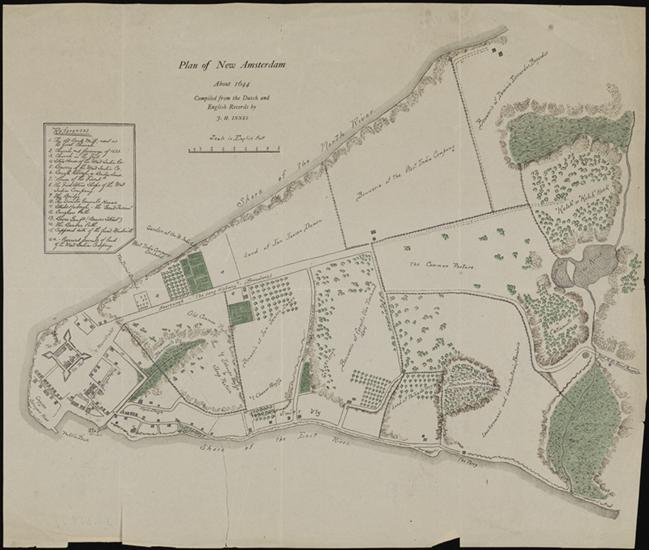
A map of New Amsterdam, indicating the layout from about 1644, well before a wall was constructed.
MCNY
The real reasons for New Amsterdam building its famous wall are also
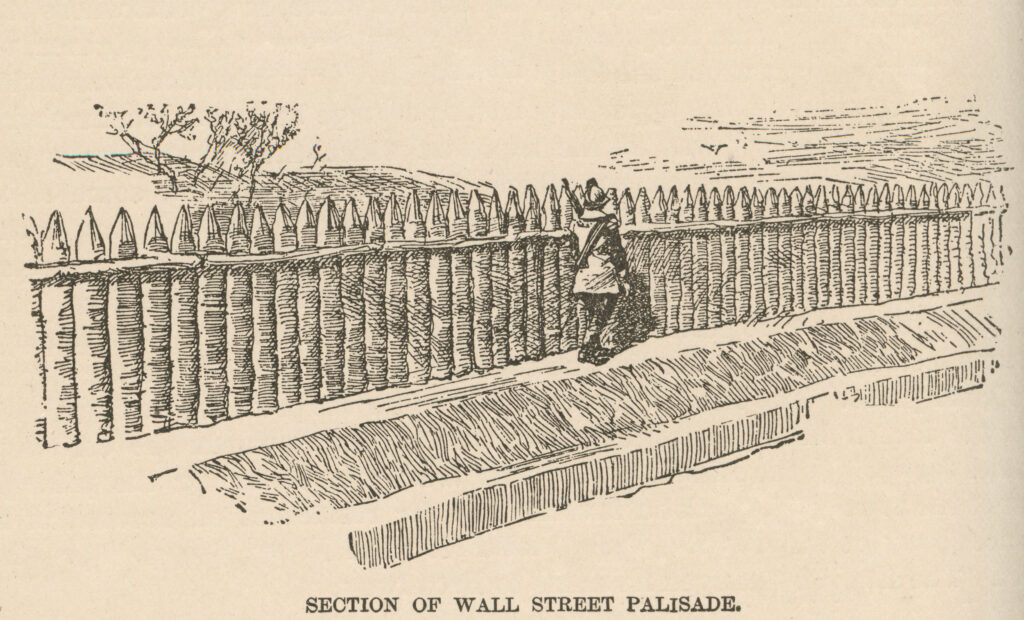
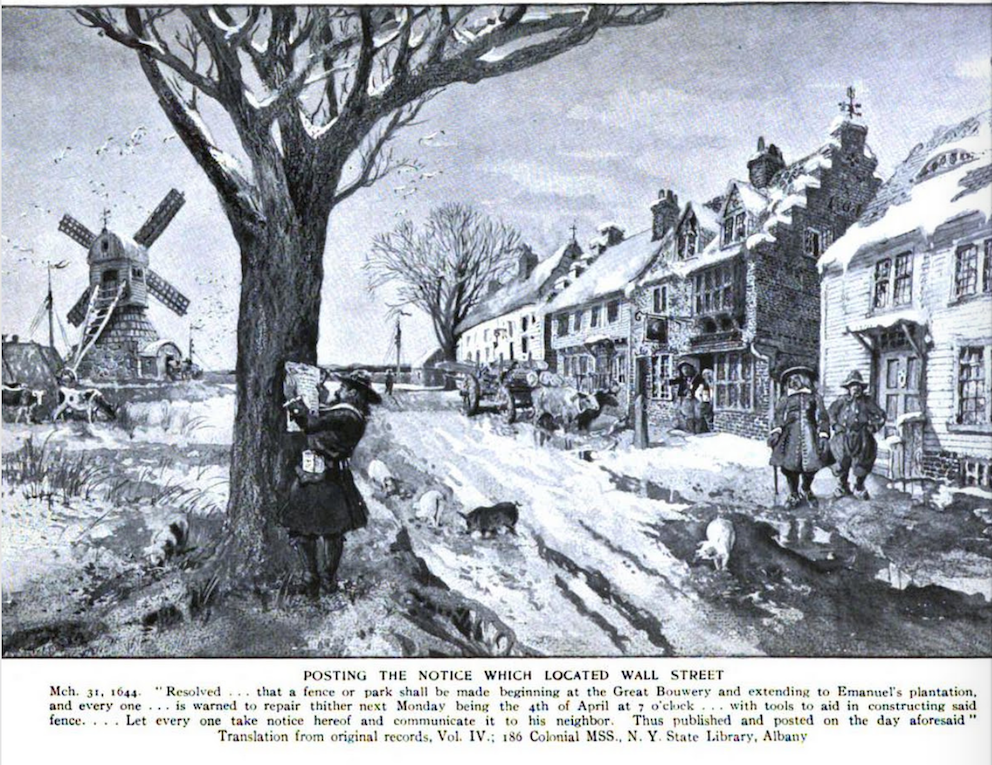
up for grabs. It’s commonly held that an original wooden palisade was
erected in 1644 in defense of Indian attacks, and certainly, the
residents of New Amsterdam did their part to rile the anger of the
native landowners.
Below: A fanciful illustration from Harper’s Magazine, 1908,
imagining New Amsterdam and the construction of the original ‘wall’.
But the Dutch had been living at the tip of Manhattan for over 25
years by the time the sturdier wall was built in 1653. In truth, it was
commissioned to keep out a different sort of enemy.
You’ll be pleased to know that director-general Peter Stuyvesant was the man who ordered the construction of the wall — in his words, “to surround the greater part of the city with a high stockade and small breastwork” — to replace the inadequate wooden barrier that had previously marked the city’s northern border.
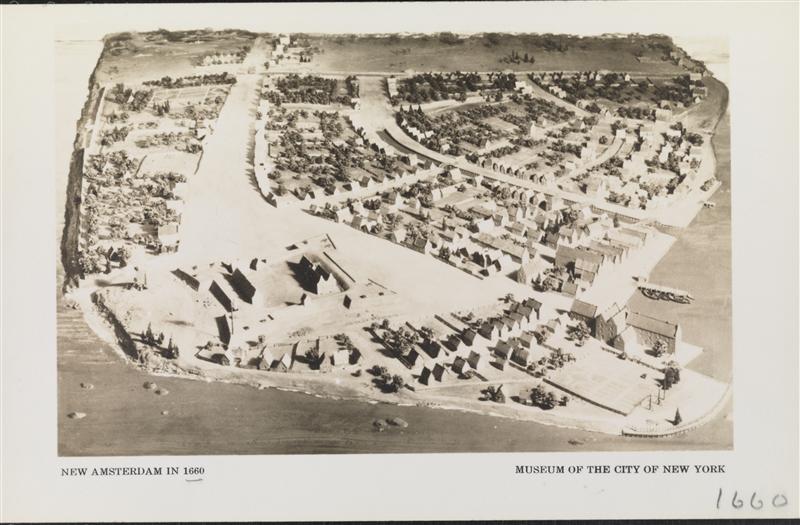
A model of New Amsterdam made in 1933, clearly showing how sudden the city borders stopped thanks to the wall.
MCNY
This was an incredibly important year for New Amsterdam in two respects. In February 1653, New Amsterdam was chartered as an official Dutch city.
Although Stuyvesant was quite against the outpost receiving such official recognition, he eventually took advantage of it, appointing the first town council himself rather than putting it up to such trivial inconveniences as elections.
But in 1653, the tides of the motherland spilled onto their shores as the war between England and the Netherlands threatened the remote and undefended new city.
The Dutch intended to launch ships from New Amsterdam harbor in a battle against the English.
As a result, the English colonies up north were sure to retaliate,
either by sea or, feared Stuyvesant, over land, possibly teaming with
hostile Indian forces, down through undefended Manhattan island.
Essentially, the wall that helped give us Wall Street was built
because Stuyvesant feared attacks not just from Indian tribes, but from
the European colonies of Connecticut, Massachusetts and New Haven!
Looking at this more well-known map of New Amsterdam – the Costello Plan of 1660 — one can see the two gates very clearly.
Stuyvesant called upon the 43 richest residents of New Amsterdam to
provide funding to fix up the ailing Fort Amsterdam and to construct a
stockade across the island to prevent attacks from the north, while it
took New Amsterdam’s most oppressed inhabitants — slave labor from the
Dutch West India Company — to actually build the wall.
The barrier was constructed out of earth, rock, and 15 feet timber planks sold to the Dutch, ironically enough, by the “notorious“ Englishman Thomas Baxter. In a turnabout that one would expect from hiring your enemy, Baxter later led a group of “Rhode Island marauders“ and pirated Dutch fishing ships.
Early in the 1660s, the Dutch upgraded its wall to include brass
cannons and two sturdy gates — one at today’s intersection of Wall and
Broadway (for land), the other at Wall and Pearl Street (according to an early account, a water gate and access to a ‘river road’).
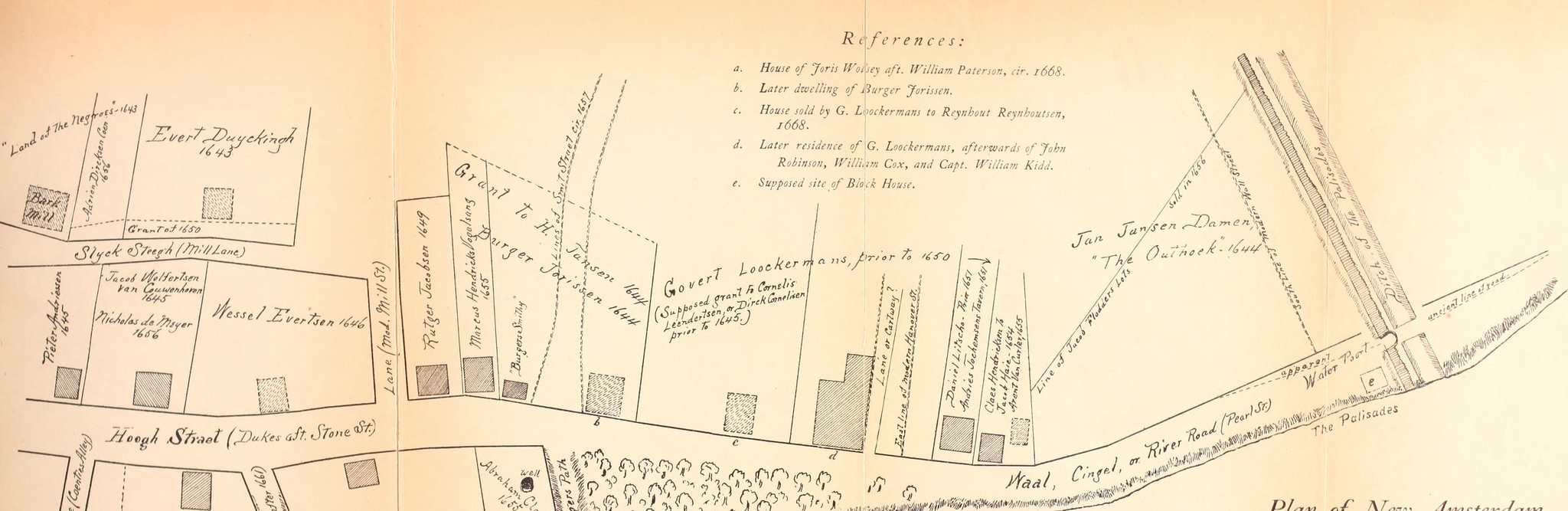
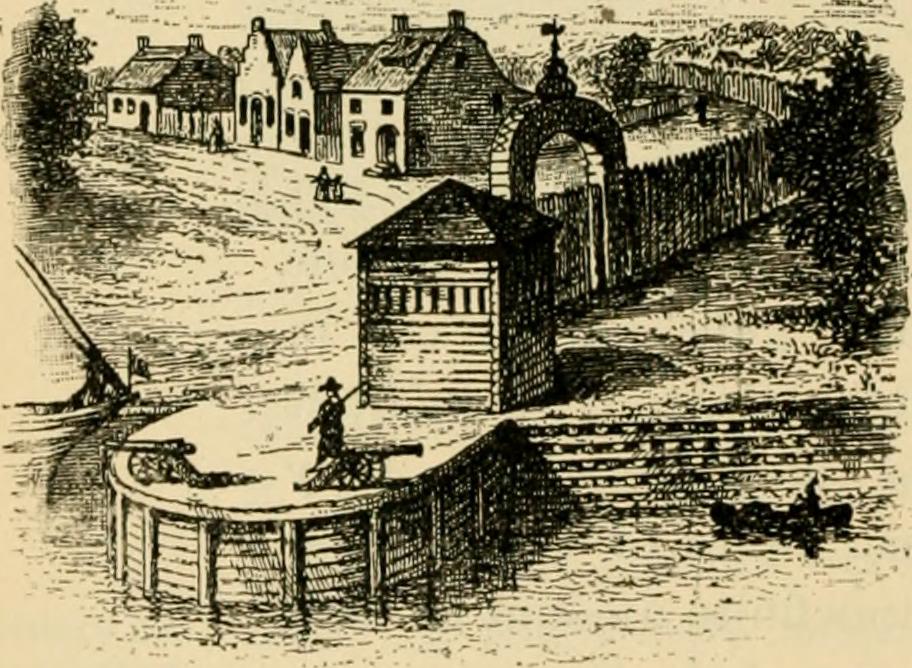
Below: A detail from a map of New Amsterdam’s eastern side,
clearly showing the water gate, and an illustration from 1908 of that
eastern gate:
Internet Archives Book Images
The British took over New Amsterdam in 1664 and renamed it New York,
but the wall still remained, becoming more a relic than a serious
defense.
By the turn of the century, the fear of land attacks had almost completely subsided and the city was beginning to feel crowded. So in 1699, the wall was torn down with some of the material salvaged to help construct a new City Hall at the corner of Nassau Street and the newly christened Wall Street.
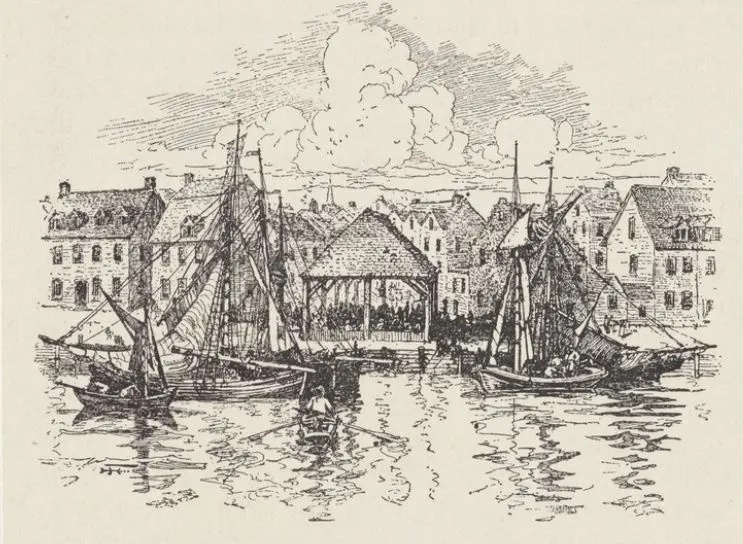
In 1711 a slave market was built on Wall Street along the eastern shore, remaining there until 1762.
When the British were forced out in 1783 by the Americans, the City Hall building was finally renamed Federal Hall — the first official center of American government.
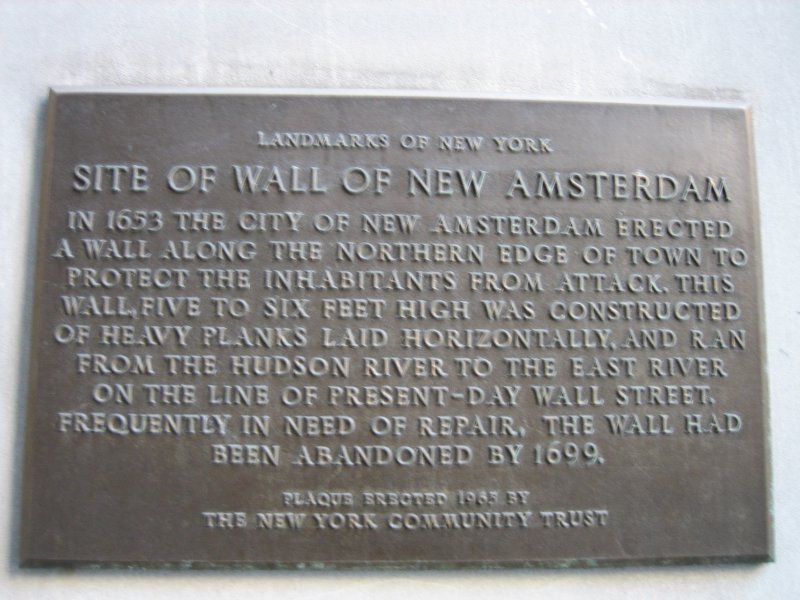
A plaque honoring the old wall sits today at the corner of Wall and Broadway, where the gate to the city once opened:
New York City and Los Angeles may be separated by a few thousand miles — and rivalries between the two cities abound — but they are intimately linked due to the entertainment industry.
In fact the American film industry was developed in New York and New Jersey and was a growing medium by the time the first film moguls set their sights on the tiny little town of Hollywood in the early 1910s.
If you find yourself in a Hollywood kinda mood — whether due to the Academy Awards or the many recent films about Hollywood history (Babylon, The Fabelmans) — we’ve got your covered! Here are just five shows from our catalog about the movies and movie stars living in New York City.
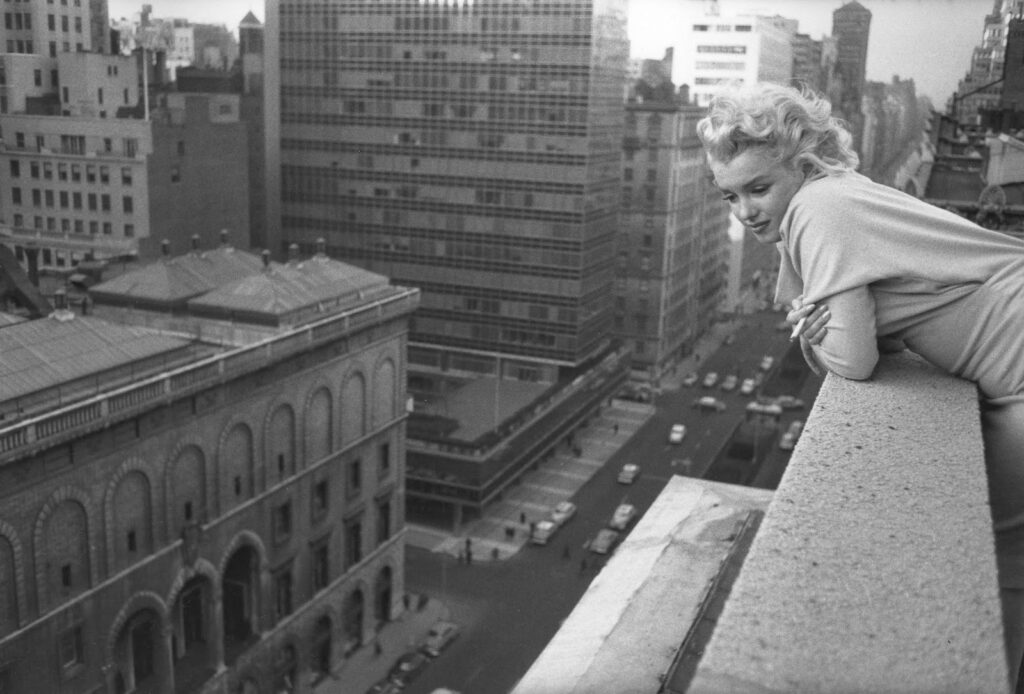
Marilyn Monroe overlooking Park Avenue from the roof of the Ambassador Hotel at Park and 51st. (The hotel was demolished in 1966). From here you can also see the Racquet and Tennis Club (1918) and the Lever House (1952). Photograph by Ed Feingersh, taken 1955.
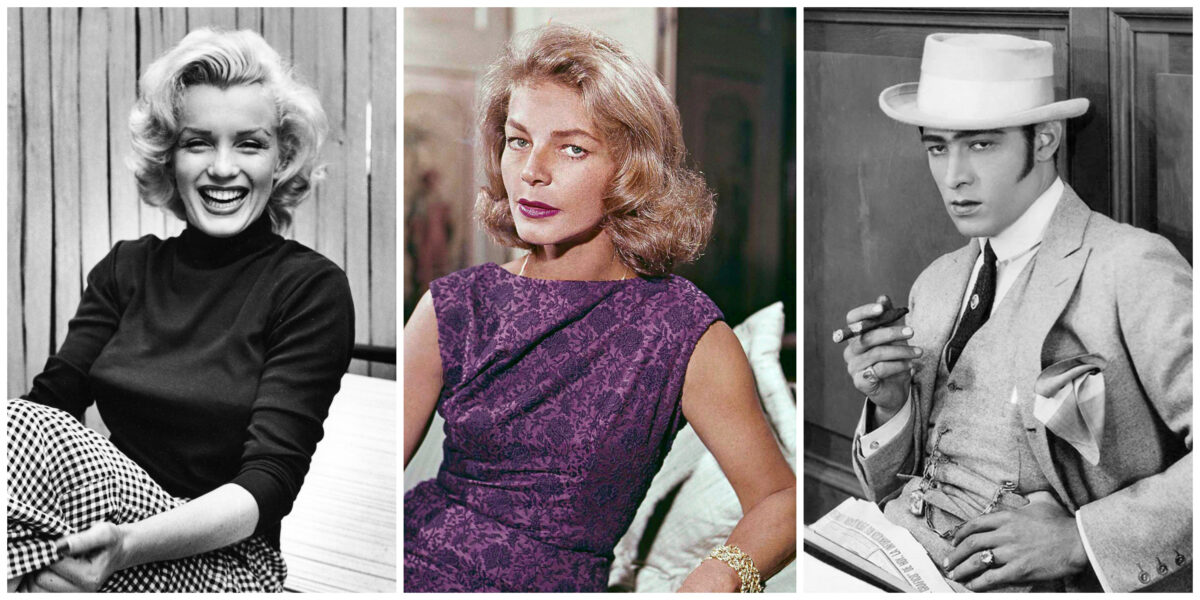
By the mid 1950s, Marilyn Monroe had become the biggest movie star in the world. But suddenly, in 1955, she came to the East Coast to reinvent herself and her career. It would be a turning point in her life and it all played out on the streets of New York City.
FEATURING: An interview with Alicia Malone from TCM.
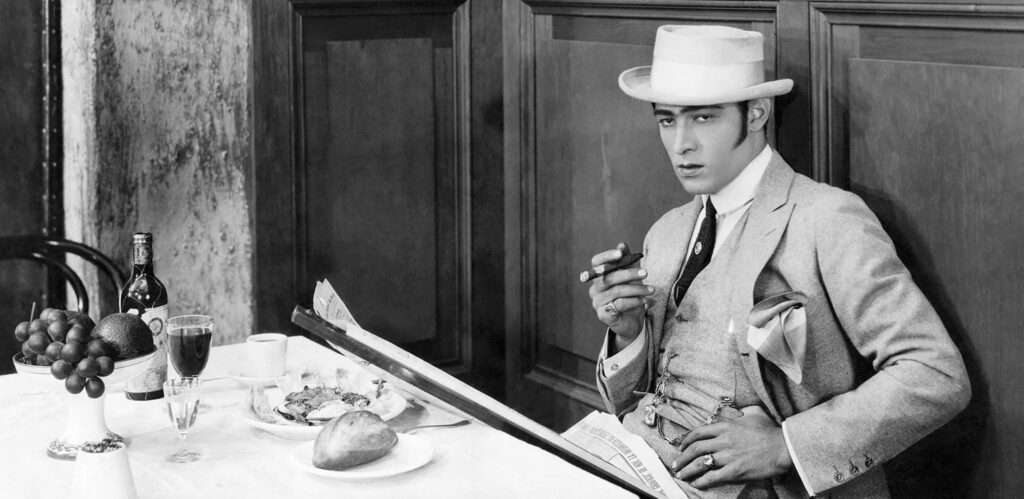
On August 23, 1926, Rudolph Valentino died in New York City. The Italian American actor had come to America via Ellis Island in 1913 and gotten his first break in the city as a dancer.
By 1926, he had become the biggest star of the silent film era. His death sparked widespread grieving and even a riot near Columbus Circle.
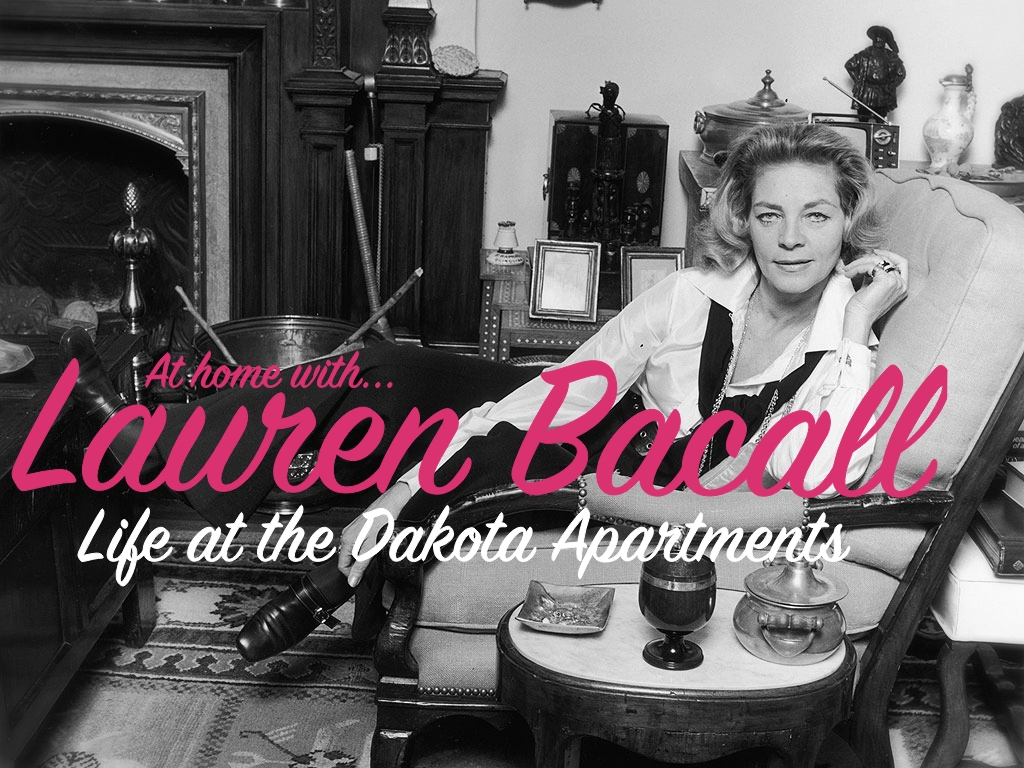
Bacall, born Betty Joan Perske, the daughter of Jewish Eastern European immigrants, worked her way from theater usher to cover model at a young age, then became a movie star before she was 20 years old. Her film pairings with husband Humphrey Bogart define the classic Hollywood era.
After his death, she moved to the Dakota Apartments which she called home for 53 years.
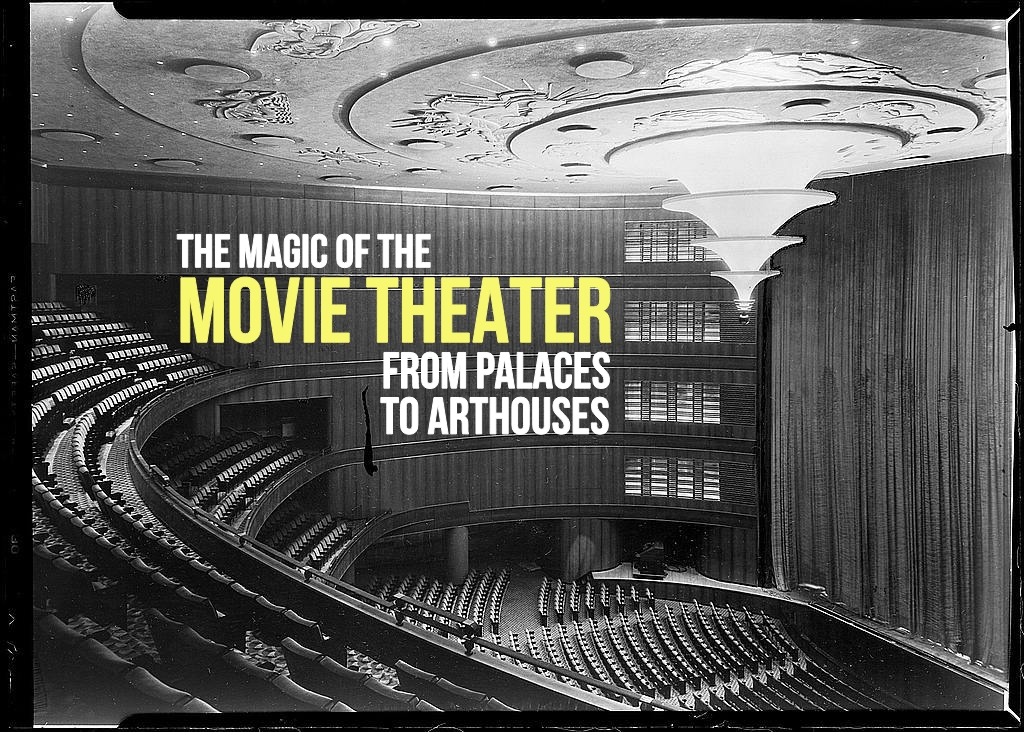
The Magic of the Movie Theater: A History of Palaces and Art Houses.
In celebration of 125 years of movie exhibition in New York City — from vaudeville houses to movie palaces, from arthouses to multiplexes. And also a lament for all the theaters which have since closed — and continue to close.
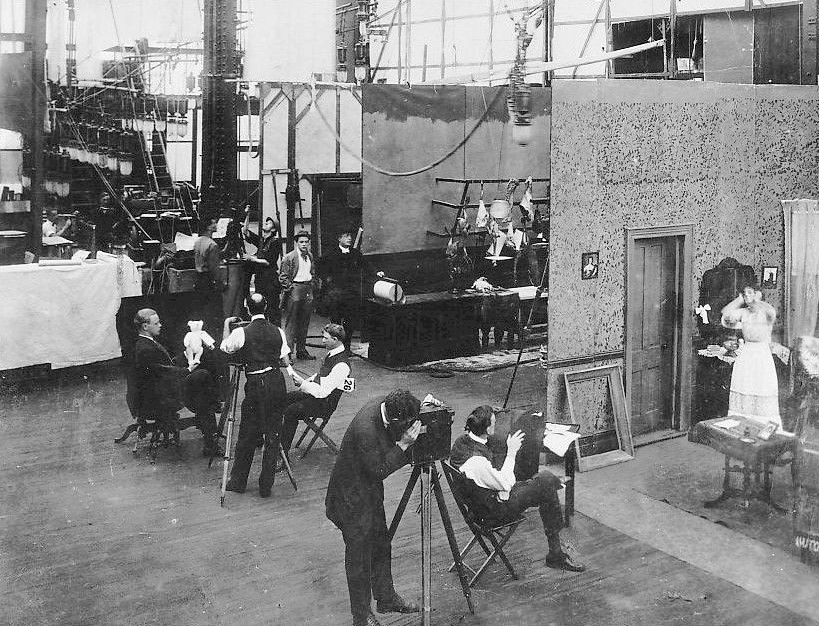
New York City inspires cinema, but it has also consistently manufactured it. Long before anybody had heard of Hollywood, New York and the surrounding region was a capital for movies, the home to the earliest American film studios and the inventors who revolutionized the medium.
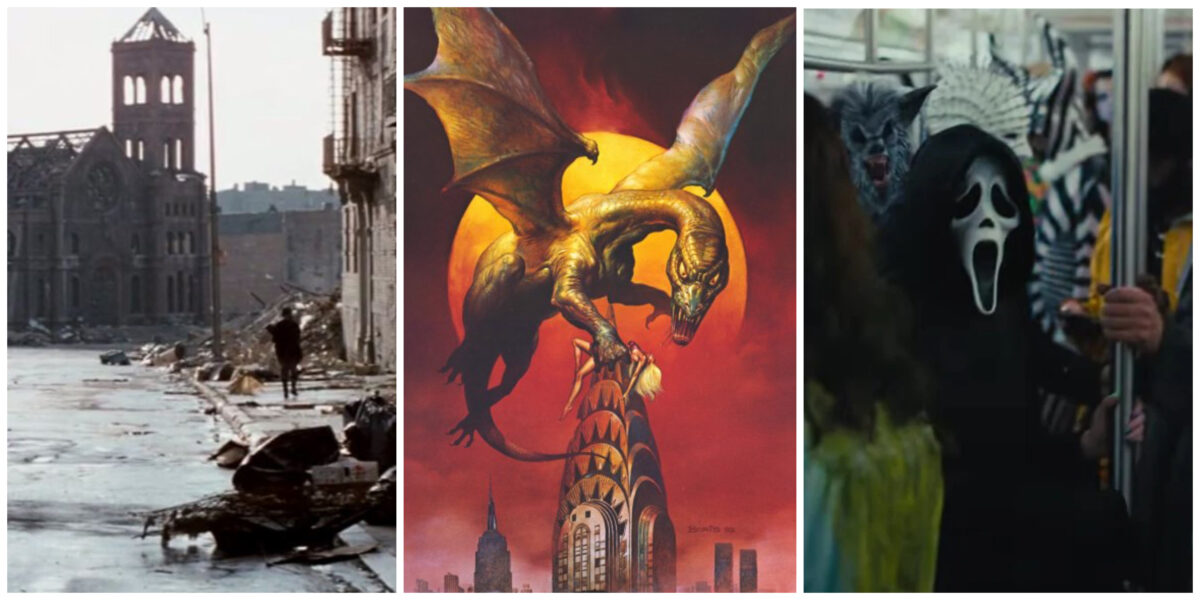
Horror movies normally go for nameless suburbs, dark woods or remote Victorian-style haunted houses for their scary settings, so it’s a wonderful treat when New York City and its recognizable landmarks get to host a few cinematic monsters.
Ever since King Kong traipsed up the Empire State Building, filmmakers have used the city’s architecture as a way to heighten thrills and even comment on the real-life horrors of urban living. This week the Scream franchise brings its mix of murder mystery and slasher to New York City in Scream VI starring Melissa Barrera and Jenna Ortega.
Want to make your own New York City horror film festival? Here are ten of my personal favorite movies set in the big city, from campy treats to genuine frights. Do you have any urban horror favorites? Leave them in the comments.
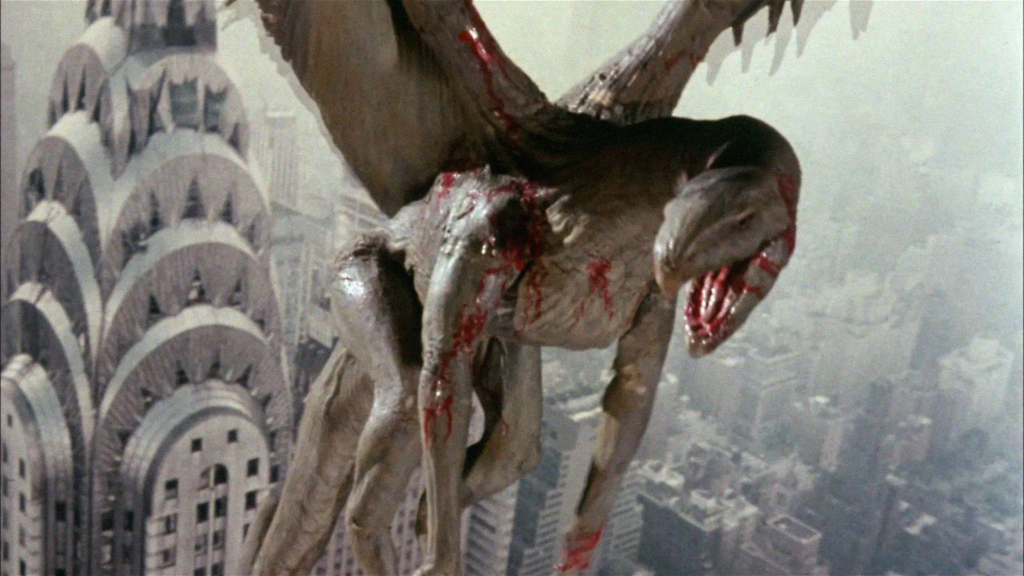
10 Q: The Winged Serpent (1982)
Before Q was a conspiracy theory, it was an ancient beast terrorizing the New York skyline. Chrysler Building architect William Van Alen would be horrified to learn that the graceful tapering top hat of his most famous building becomes home of a loathsome flying dragon and a gigantic nest of eggs.
This movie is one of my all-time favorite camp horror classics, Jaws if the shark were actually just a long, mean pigeon. (Way back in 2007 I wrote about my love of this movie on this website.)
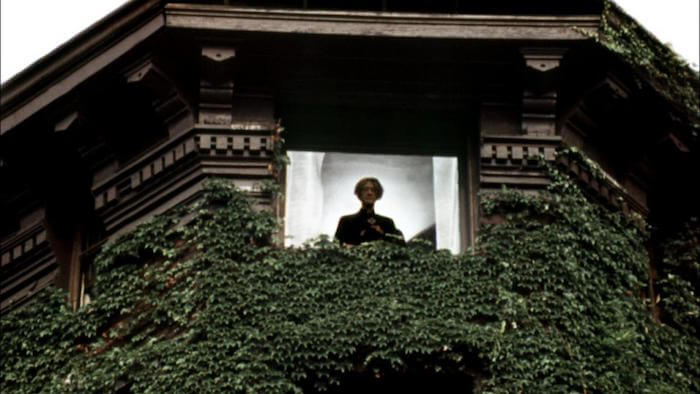
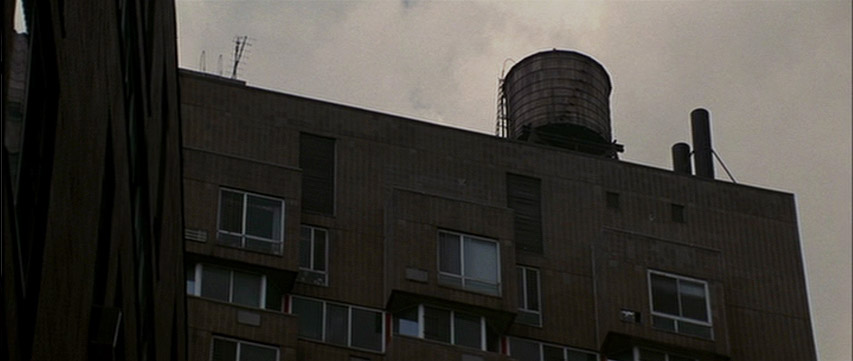
9 The Sentinel (1977)
Horror on the Brooklyn Promenade! A fashion model moves into a historic Brooklyn brownstone only to be tormented by the most peculiar set of neighbors to ever vex the borough. Sure it’s built upon the gateway to Hell, but given the state of real estate today, it might be worth the risk. (We talked a bit about this film in our Ghost Stories of Brooklyn podcast.)
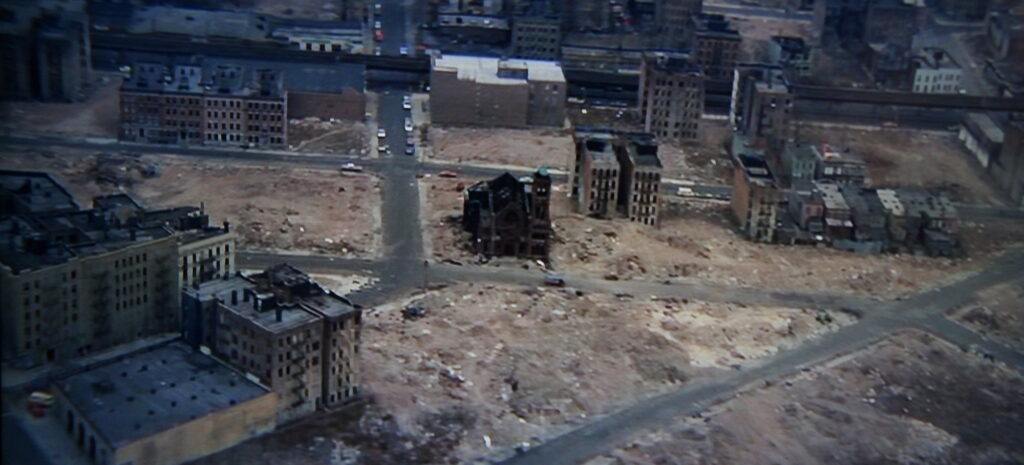
8 Wolfen (1981)
A murder mystery in early 80s New York City that uses both recognizable landmarks like the Brooklyn Bridge and the rubble of the Lower East Side to great chilling effect.
Something very wolf-like is killing people in gruesome ways, from Battery Park to the Central Park Zoo. There are literally wolves on Wall Street! There are also some definite cringe-worthy moments (using Native American mythology in the most trivial way) but seeing New York as an apocalyptic landscape is eye-opening. Bonus points for the bloody nod to New Amsterdam.
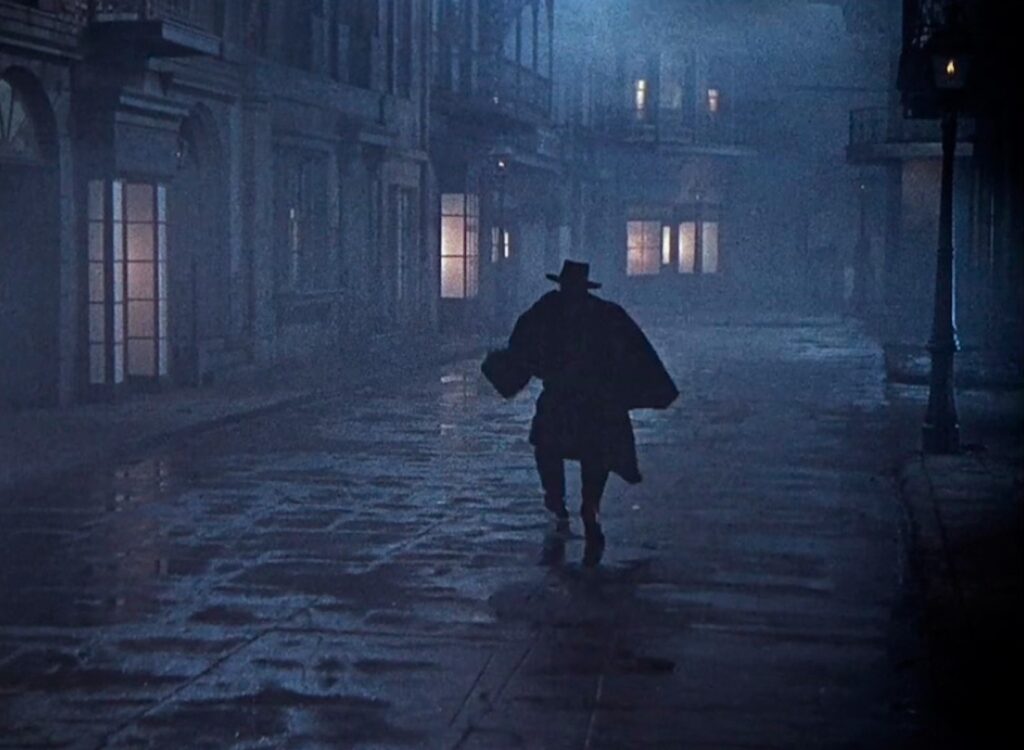
7 House of Wax (1953)
A rich and campy celebration of the city’s once ubiquitous wax museum scene — in particular a glorious nod to the Eden Musée — in a morbid mystery along the dark streets of turn-of-the-century New York. Vincent Price is at his very best as a sculptor with a dark method of creating new exhibitions.
6 Eyes of Laura Mars (1978)
The world of high-fashion New York, set to soundtrack of disco and Barbra Streisand, is the backdrop for this serial killer thriller starring Faye Dunaway as an extremely macabre photographer who begins seeing horrifying visions. Absurd and sometimes silly, the film nonetheless features an exquisite look at 1970s SoHo. We loved it so much that we recorded a Bowery Boys Movie Club about it.
5 Dark Water (2005)
And now we turn to Roosevelt Island and a remake of a Japanese film, made during the height of the Western fascination with Japanese horror. (Think Ring; in fact Dark Water is a variation on a short story by Koji Suzuki, author of Ring.) Here Jennifer Connelly fights back against a leaky ceiling — haunted, of course — and a ghostly child. I kept wanting the movie to reach back further into the island’s dark history but it’s a fun, little jump-scare fest regardless.
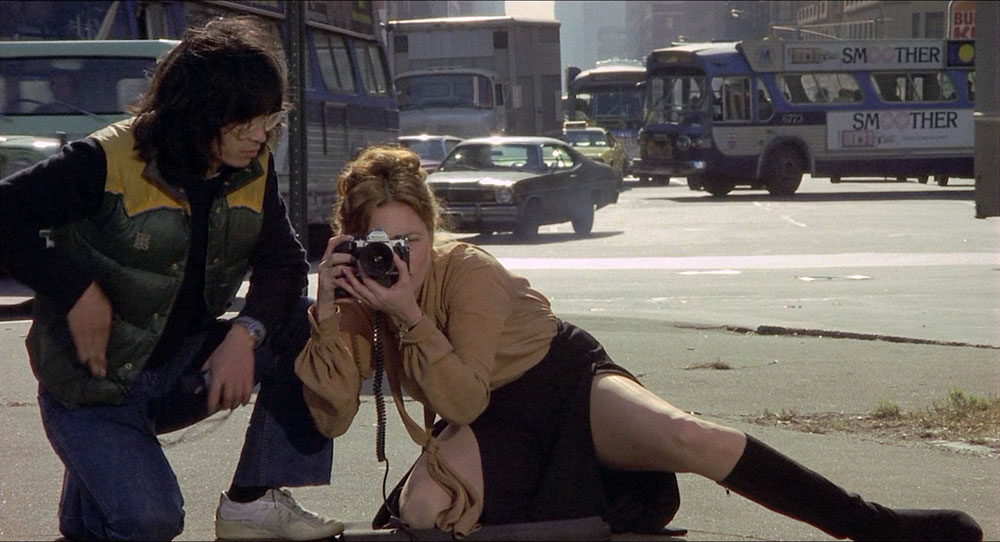
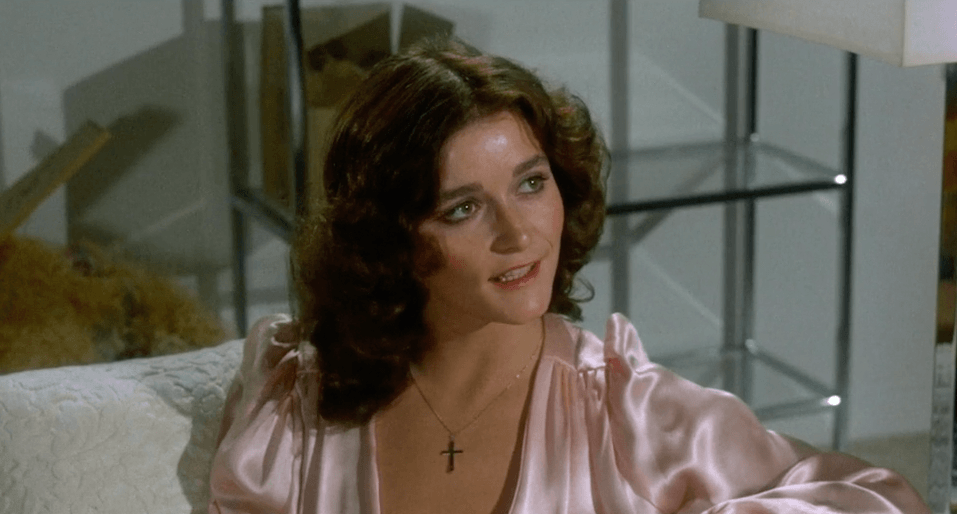
4 Sisters (1972)
Brian De Palma in Staten Island! Plus a very troubled Margot Kidder playing a fashion model and, well, something more. This strange little indie artifact is the first of many tributes to Alfred Hitchcock in De Palma’s career, a murder mystery and a psychosexual terror that may permanently change the way you see the neighborhood of St. George.
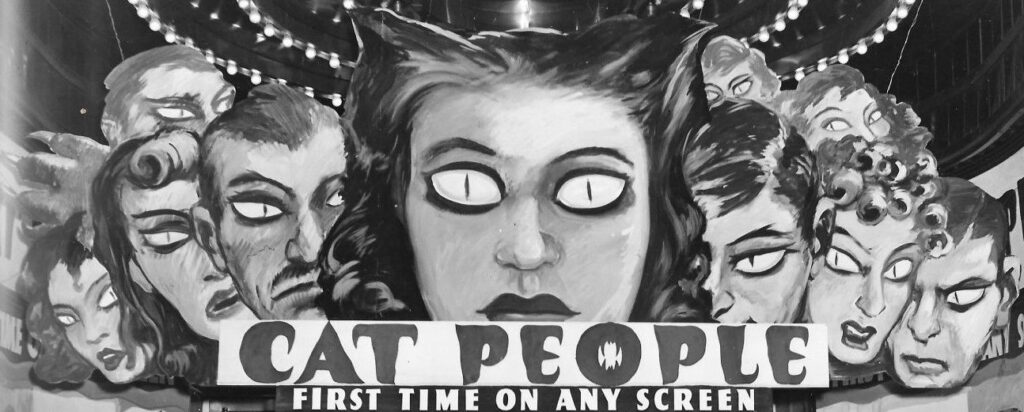
From the Rialto Theater premiere in New York, December 1942
3 Cat People
This sinister creeper actually has very little violence or gore, and it’s not even filmed in New York! But director Jacques Tourneur manages to turn Fifth Avenue interiors into shadowy horror landscapes and the brilliant Simone Simon perfectly embodies a glamorous international socialite who might also be the original catwoman. Central Park Zoo is the scene of much of the melodrama but the most terrifying scene is an effective trick of light-and-shadow at an apartment building swimming pool.
2 The Hunger
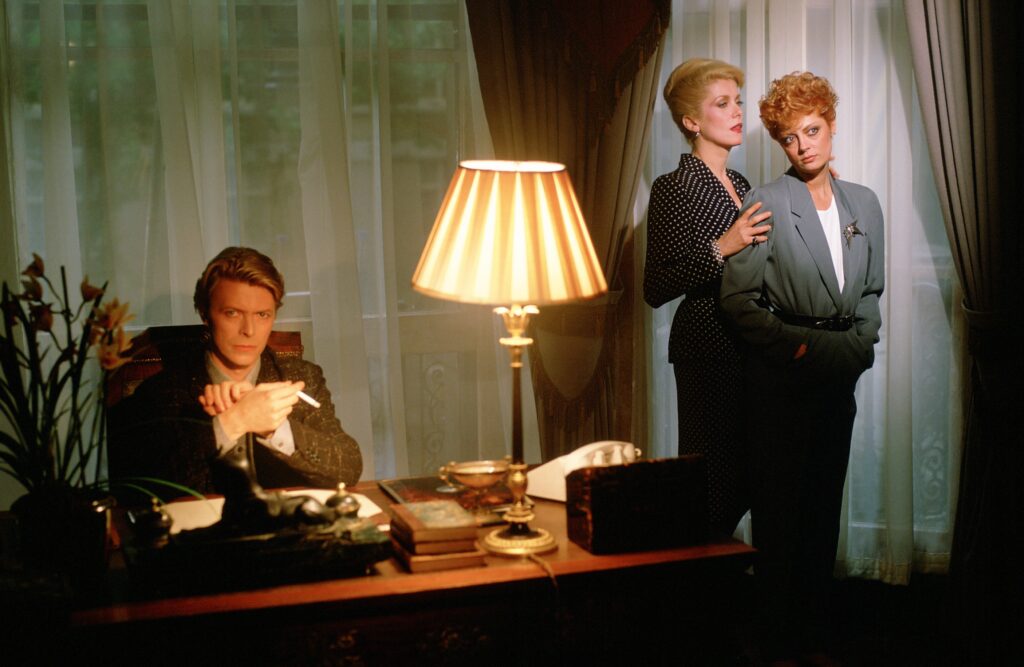
So dramatic, pretentious and beautiful. Two New Wave vampires (Catherine Deneuve and David Bowie) hit the town looking for new victims and eternal youth. When Bowie discovers the downsides of making an evil, immortal pact with the undead, Deneuve turns to Susan Sarandon as her new unholy companion.
Filled with so much eyeliner and a great many shoulder pads, this sexy horror melodrama spawned a million baby goths and still stands as an LGBT midnight classic. It also makes a perfect double feature with Martin Scorsese’s After Hours, both movies a celebration of New York City after dark.
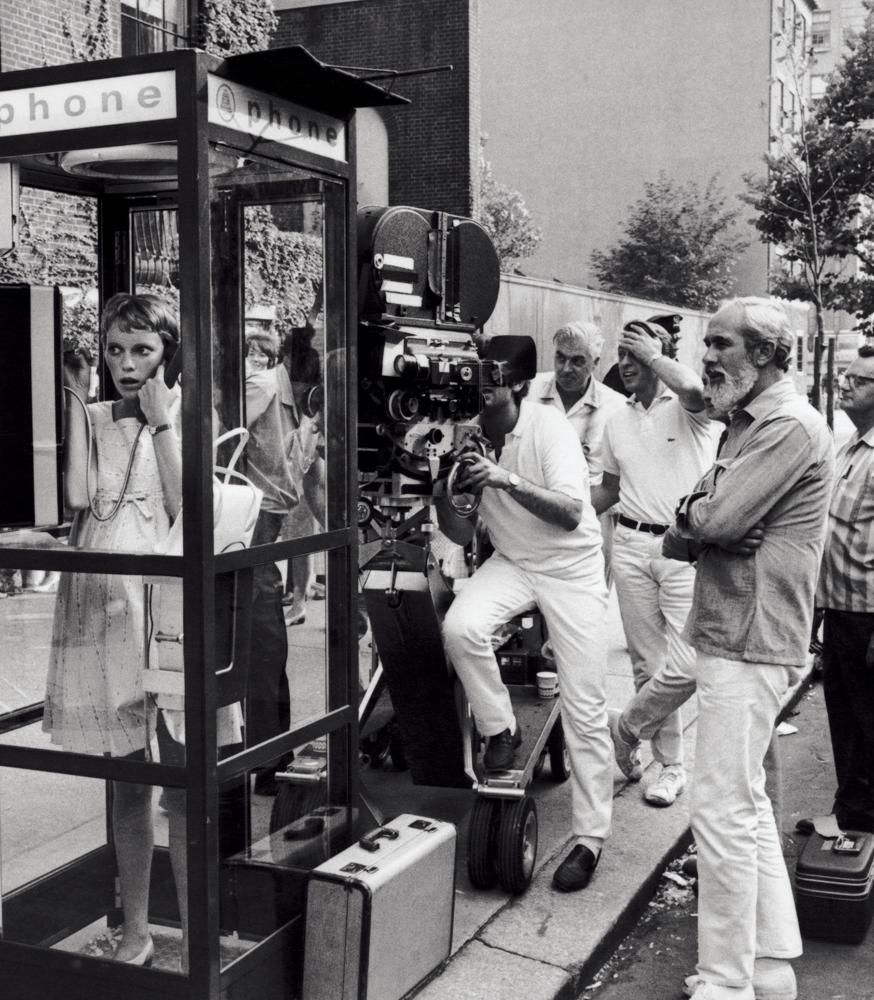
BOB WILLOUGHBY/MPTV IMAGES/REEL ART PRESS
1 Rosemary’s Baby
This is the ultimate marriage of story and location and essentially a horror movie about nosy neighbors and a co-op board. You’re certainly familiar with the story — a young woman (Mia Farrow) becomes impregnated under mysterious circumstances in her tony new home at the Dakota Apartments. But even if you don’t care for horror (or for director Roman Polanski), watch it just for the New York City locations, an embodiment of both the chic and unusual.
Also I want you to watch this movie knowing that Dakota resident Lauren Bacall, friends with producer William Castle, was often watching them film the movie here.