Categories
Bronx History Podcasts

A History of the Bronx Part Two: Building The Borough

PODCAST The story of how the Bronx became a part of New York City and the origin of some of the borough’s most famous landmarks.

In the second part of the Bowery Boys’ Bronx Trilogy — recounting the entire history of New York City’s northernmost borough — we focus on the years between 1875 and 1945, a time of great evolution and growth for the former pastoral areas of Westchester County.

New York considered the newly annexed region to be of great service to the over-crowded city in Manhattan, a blank canvas for visionary urban planners. Soon great parks and mass transit transformed these northern areas of New York into a sibling (or, perhaps more accurately, a step-child) of the densely packed city to the south.

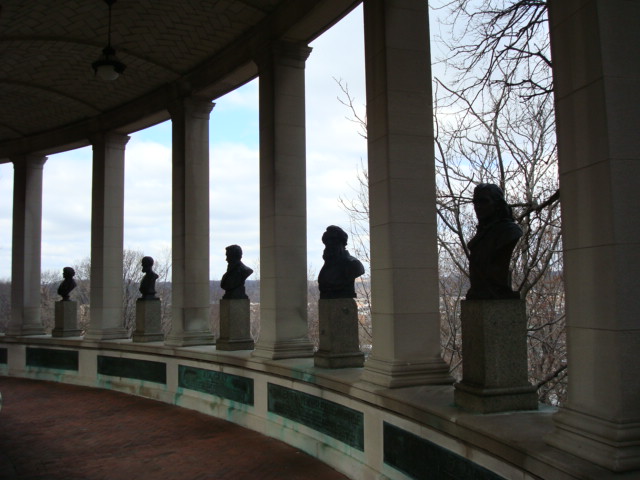
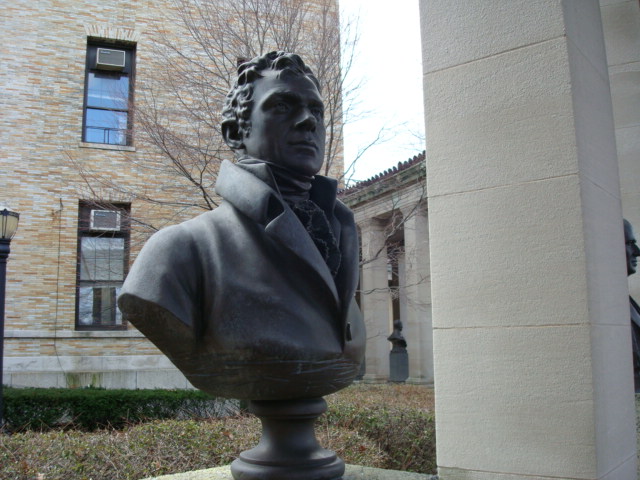
The Grand Concourse embodied the promise of a new life for thousands of new residents — mostly first and second-generation immigrants, many of them Jewish newcomers. The Hall of Fame of Great Americans was a peculiar tourist attraction that honored America’s greatest. But the first time that many outside New York became aware of the Bronx may have been the arrival in 1923 of New York’s most victorious baseball team, arriving via a spectacular new stadium where sports history would frequently be made.

By the 1930s Parks Commissioner Robert Moses began looking at the borough as a major factor in his grand urban development plans. In some cases, this involved the creation of vital public recreations (like Orchard Beach). Other decisions would mark the beginning of new troubles for the Bronx.


The Bowery Boys: New York City History podcast is brought to you …. by you!

We are now producing a new Bowery Boys podcast every two weeks. We’re also looking to improve the show in other ways and expand in other ways as well — through publishing, social media, live events and other forms of media. But we can only do this with your help!

We are now a member of Patreon, a patronage platform where you can support your favorite content creators for as little as a $1 a month.

Please visit our page on Patreon and watch a short video of us recording the show and talking about our expansion plans. If you’d like to help out, there are five different pledge levels (and with clever names too — Mannahatta, New Amsterdam, Five Points, Gilded Age, Jazz Age and Empire State). Check them out and consider being a sponsor.

We greatly appreciate our listeners and readers and thank you for joining us on this journey so far. And the best is yet to come!


The burial vault of the Van Cortlandts was actually contained within the newly formed park. And it’s still there.
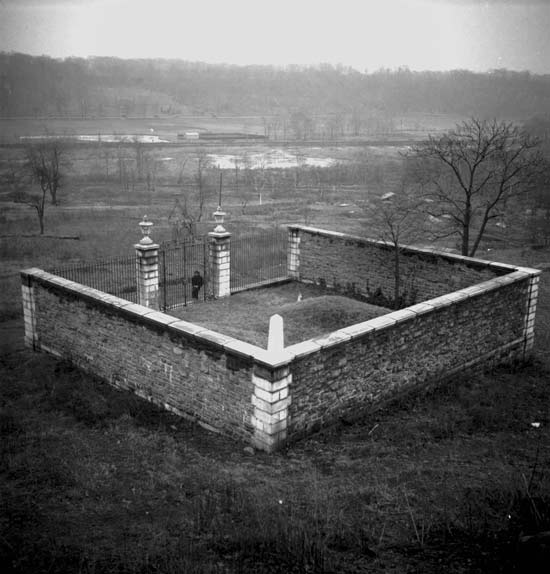
Courtesy New York Park Service

NYU’s former University Heights campus (now the home of Bronx Community College) contains one unusual tourist attraction — the Hall of Fame of Great Americans
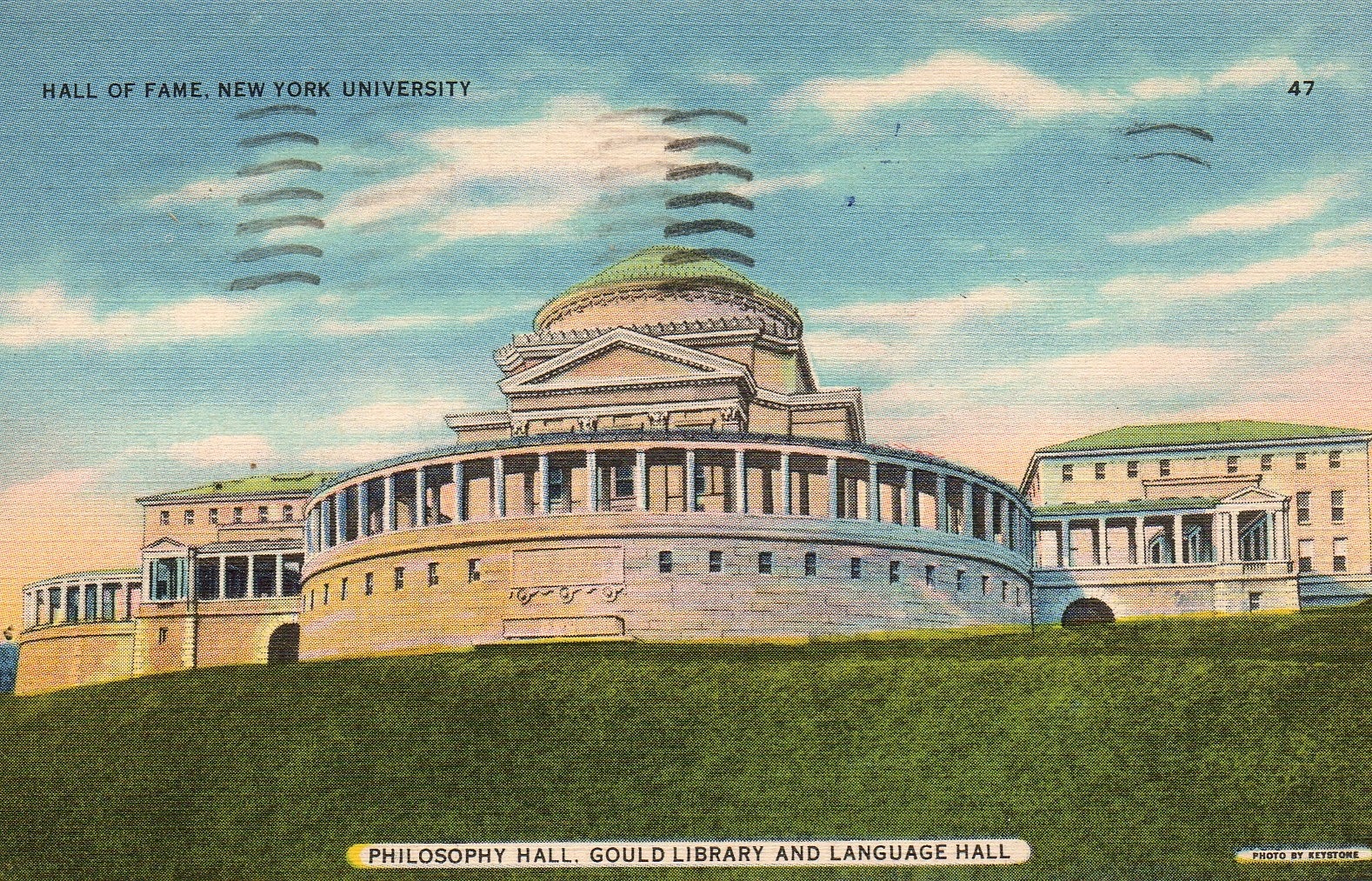
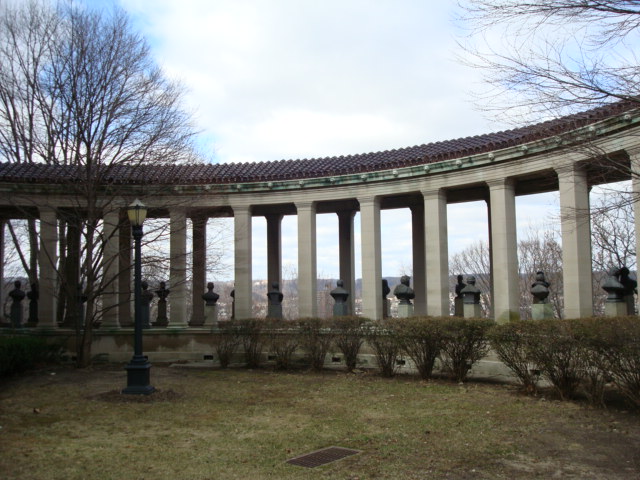
nyuinthebronxpostcard

1 2 3

Louis Risse’s vision of the Grand Concourse in 1892 obviously did not imagine automobiles using the boulevard.
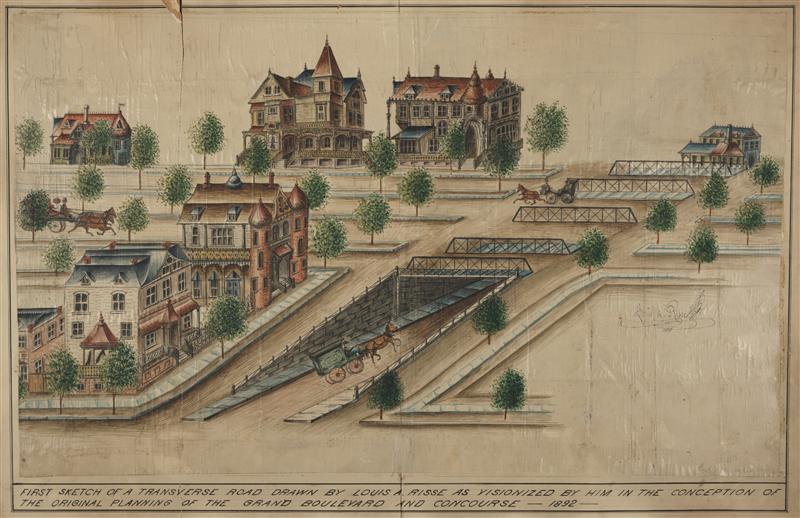
MCNY
MCNY

Kingsbridge Road near the Grand Concourse, 1890. It was originally a dirt road of course.
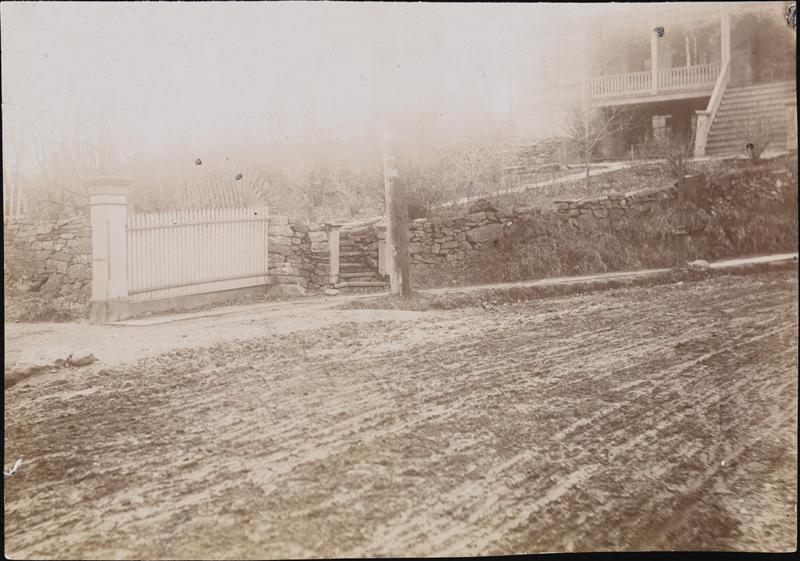
MCNY
MCNY

The New York Botanical Garden inaugurated Bronx Park and created another reason for New Yorkers to head up to the vastly evolving area up north.
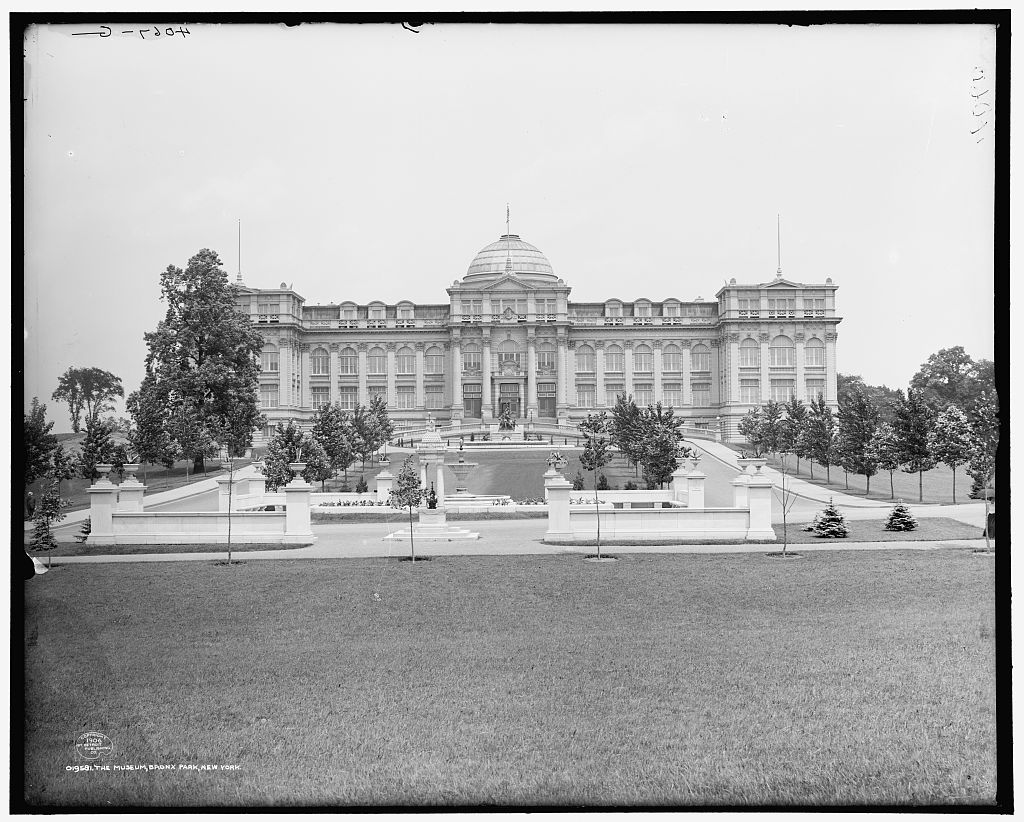
4a13506v

A romantic depiction of the Lorillard snuff mill on the Bronx River. The building is still on the river, contained within the Botanical Garden.
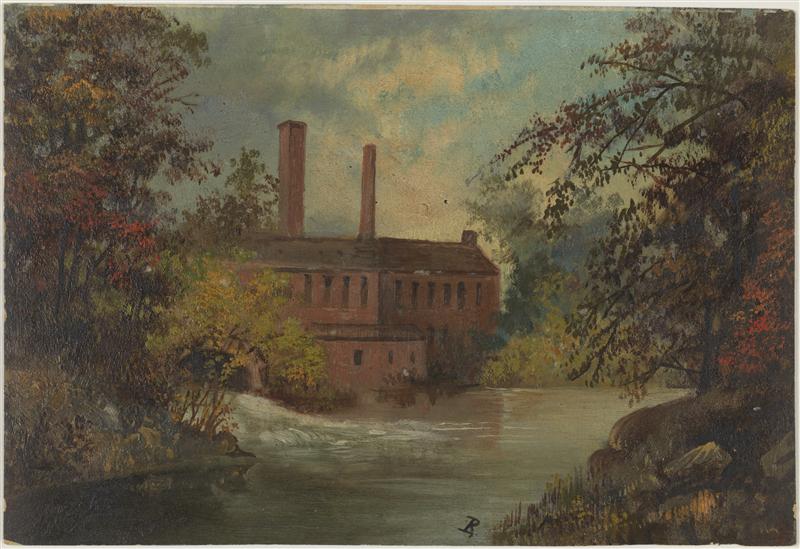
By Frederick Rondel, Jr., courtesy MCNY

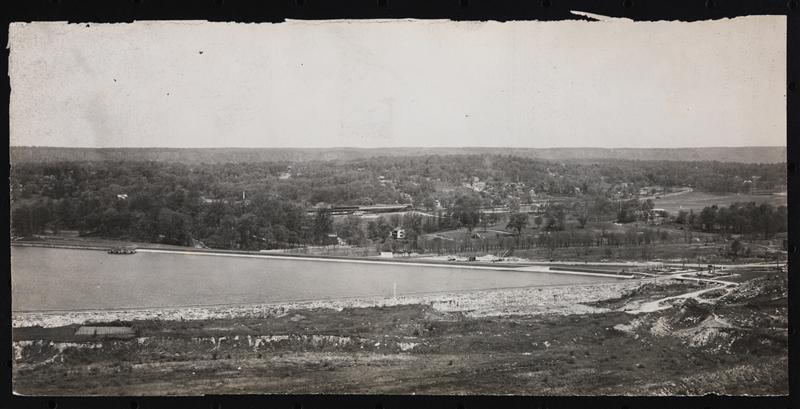
Jerome Park Reservoir, opposite a set of homes, pictured here in 1920 and (below) 1936.
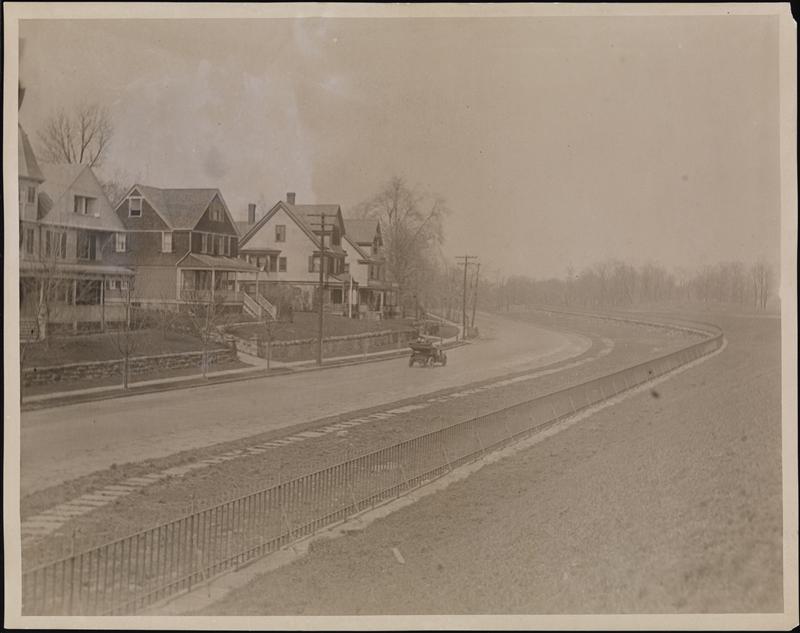
MCNY
MCNY
mny221499
MCNY

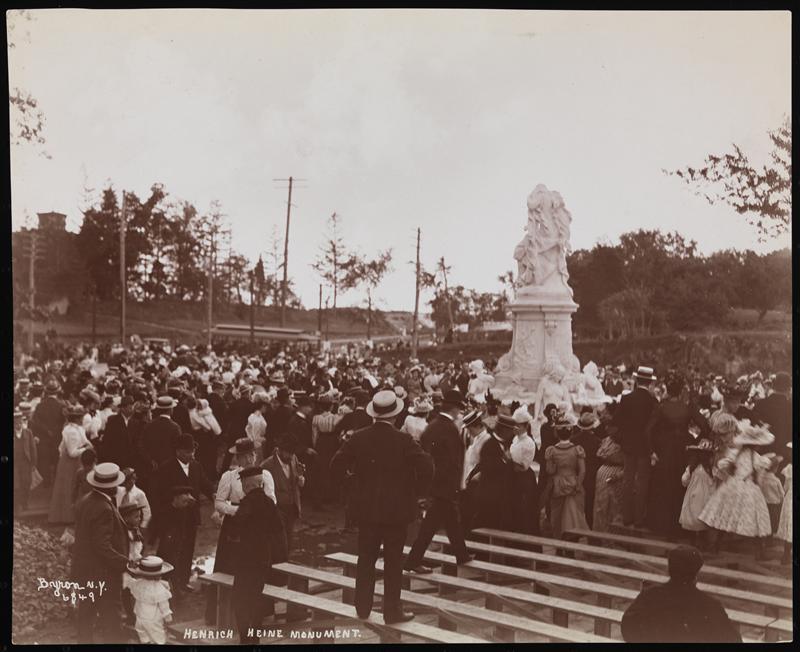
The unveiling of the Heinrich Heine monument in today’s Joyce Kilmer Park on the Grand Concourse.
MCNY
MCNY

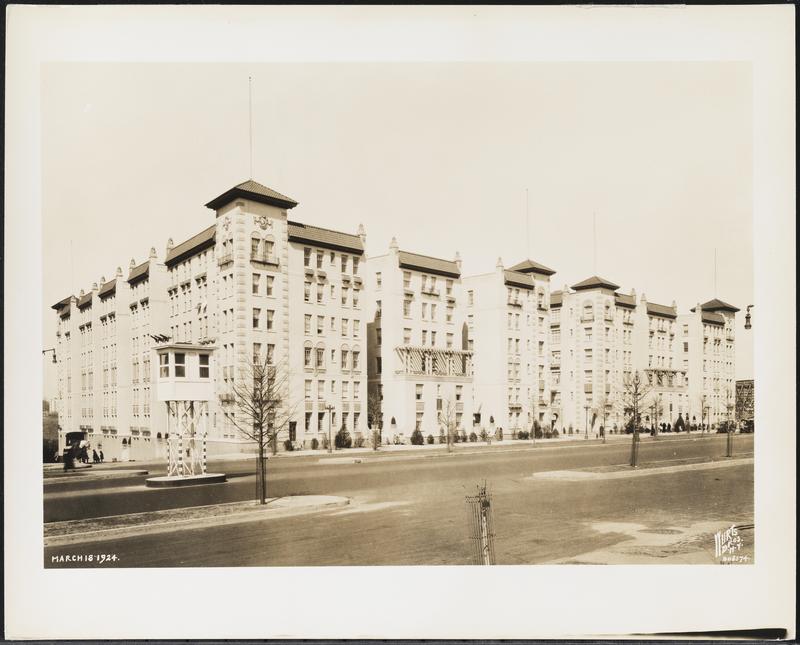
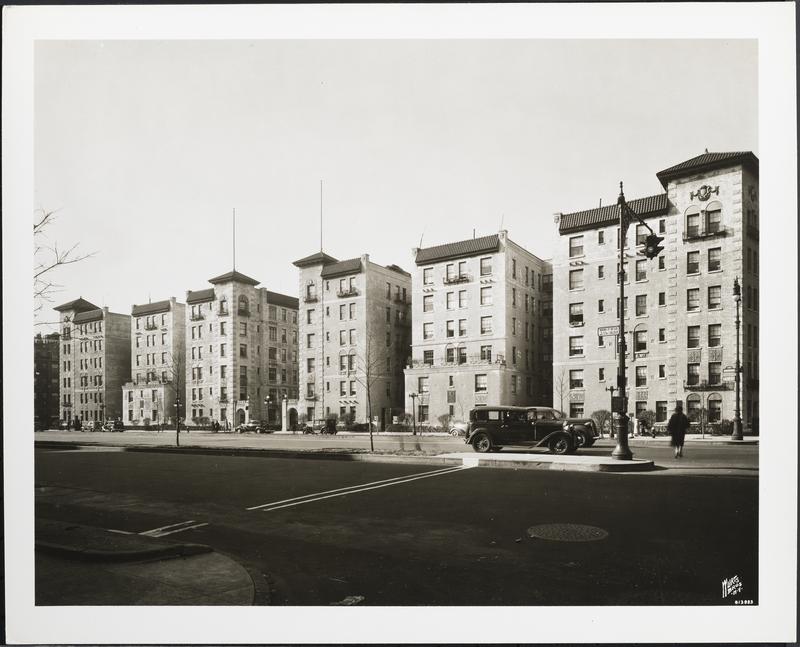
Lavish apartments like the Roosevelt  (pictured here in 1924 and in 1937) were able to attract New Yorkers escaping the overcrowded Lower East Side.
MCNY
MCNY
MCNY
MCNY

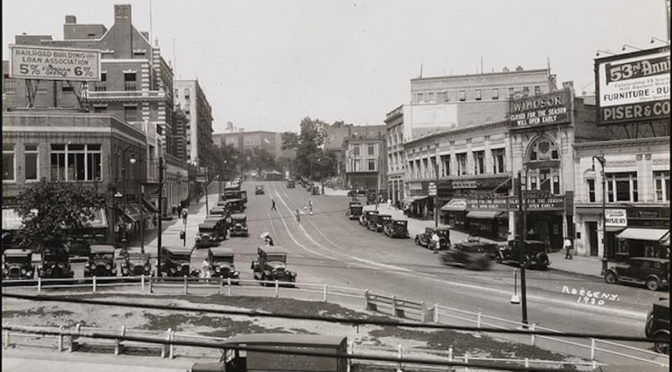
Fordham Road in 1930 with the Grand Concourse East Kingsbridge Road steaming by.
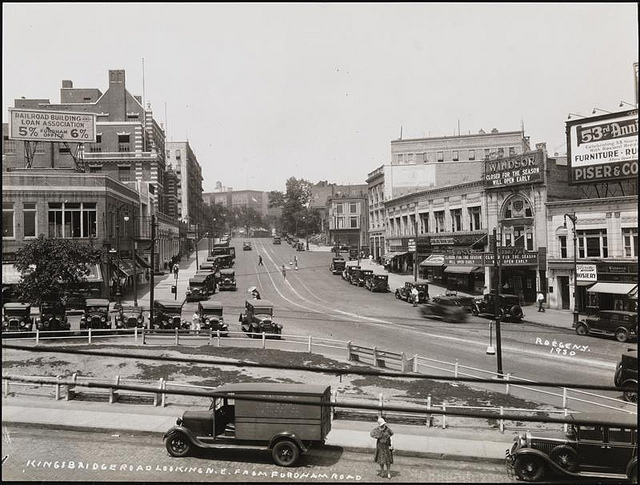
Photo by William Roege (1930)

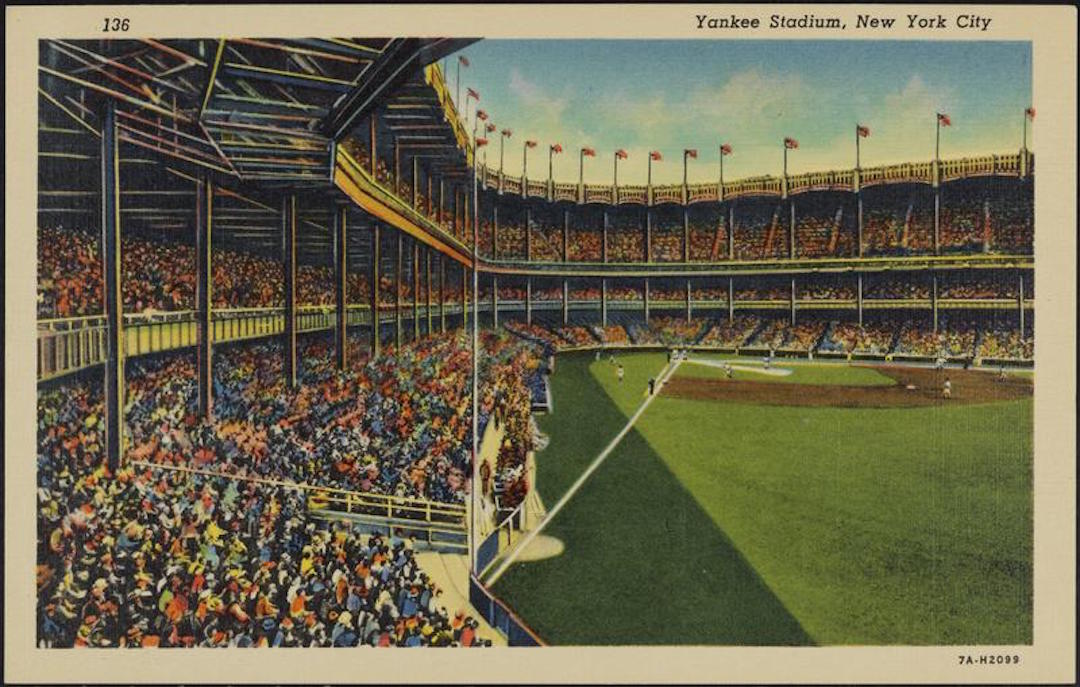
A Yankee Stadium postcard circa 1945

mny285122
Courtesy MCNY

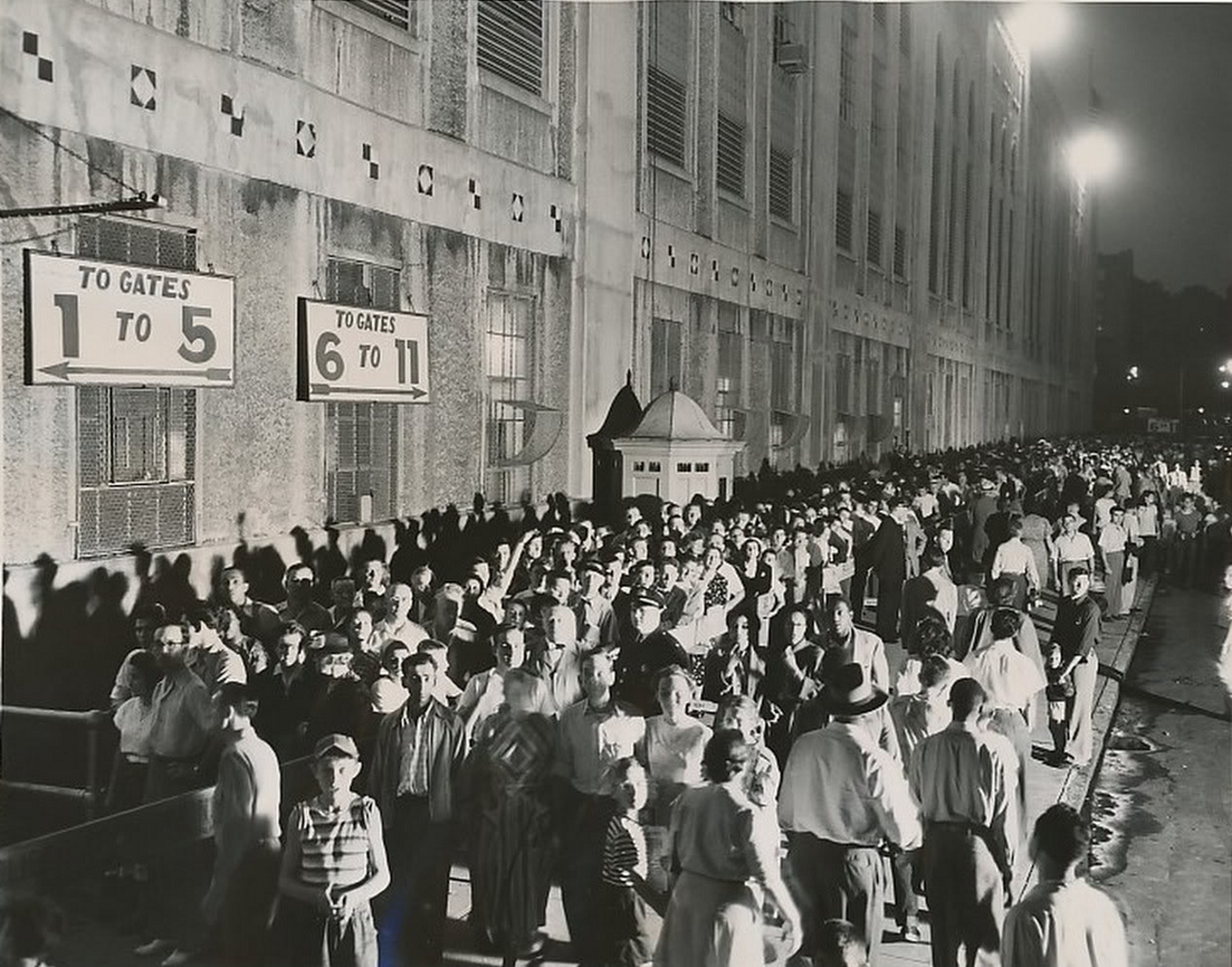
Ruth was so integrally a part of the Bronx and Yankee Stadium that when he died in 1948, his casket was taken to the stadium where tens of thousands of people came to pay their respects.
babe-ruth-funeral-fans-line-up-8-17-1948

A few selections from our Instagram account of things we discussed on this week’s show:


A photo posted by Gregory Young (@boweryboysnyc) on


A photo posted by Gregory Young (@boweryboysnyc) on

From the Grand Concourse:


A photo posted by Gregory Young (@boweryboysnyc) on


A photo posted by Gregory Young (@boweryboysnyc) on


A photo posted by Gregory Young (@boweryboysnyc) on

Here’s Tom and our special guest this week — the great Lloyd Ultan
Categories
Bowery Boys Bookshelf

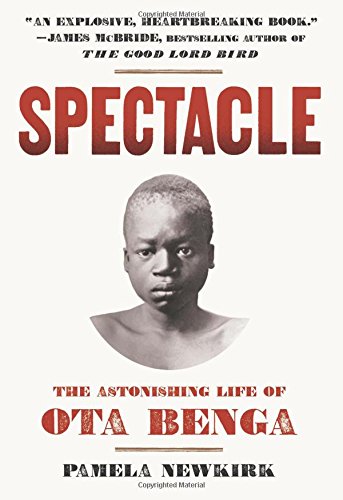
‘Spectacle’: The Story of Ota Benga

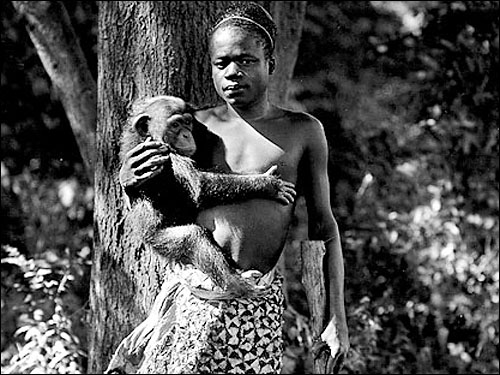
In 1906, visitors to the Bronx Zoo observed a rather bizarre sight in the Monkey House — the exhibition of a man in African dress, often accompanied by a parrot or an orangutan.


An African pygmy, so read the sign, “Age, 23, Height, 4 feet 11 inches, Weight 103 pounds, Brought from the Kasai River, Congo Free State, South Central Africa.” Displayed in one of America’s foremost institutions devoted to the display and care of exotic animals. Elephants, tigers, polar bears, snow leopards, bison. And one young man named Ota Benga.

2

He is the subject of Pamela Newkirk’s engaging new book Spectacle: The Astonishing Life of Ota Benga, both a sincere ode to his tragic life and a contemporary accusation of the terrible forces that exploited him over a century ago.

But the story is really about the ghost of Ota Benga.

He spoke little English and there are no accounts from his perspective. Almost everything we know is from the perspective of a jaundiced press and the glare of condescending authority. He was the subject of great fabrications over the years; the truth is almost impossible to extricate from hyperbole.

While his story is front and center in Spectacle, but he barely raises his voice. He never had one.

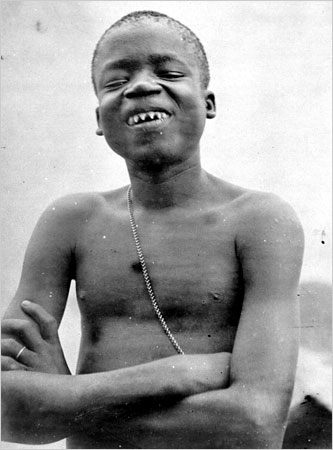
1906 photograph of Ota Benga, described as being taken at Bronx Zoo. (Wikimedia) Title: Ota Bengi     Creator(s): Bain News Service, publisher     Date Created/Published: [no date recorded on caption card]     Medium: 1 negative : glass ; 5 x 7 in. or smaller.     Reproduction Number: LC-DIG-ggbain-22741 (digital file from original negative)     Rights Advisory: No known restrictions on publication.     Call Number: LC-B2- 3971-2 [P&P]     Repository: Library of Congress Prints and Photographs Division Washington, D.C. 20540 USA http://hdl.loc.gov/loc.pnp/pp.print     Notes:         Title from unverified data provided by the Bain News Service on the negatives or caption cards.         Forms part of: George Grantham Bain Collection (Library of Congress).         General information about the Bain Collection is available at http://hdl.loc.gov/loc.pnp/pp.ggbain     Format:         Glass negatives.     Collections:         Bain Collection     Bookmark This Record:        http://www.loc.gov/pictures/item/ggb2005022751/
1906 photograph of Ota Benga, described as being taken at Bronx Zoo. (Wikimedia)
Creator(s): Bain News Service, publisher 
Ota Benga is probably not even his real name. And even then, it’s twisted and distorted mercilessly, sometimes by the man himself. (When he died in 1916, he was known as Ota Bingo.)  In 1904 he was rescued from captivity in the Congo by the explorer and would-be scientist Samuel Phillips Verner.

This is probably true although Verner is an unreliable source, often changing his own biography to burnish his reputation in the science community.  Verner was the product of his age, seeing Africans as inferior beings but seeing their continent as a source of revenue. Verner sought to profit handsomely from his ‘explorations’ both by currying favor with the Belgian King Leopold II (the ruthless leader who exploited the people of the Congo) and by snatching human specimens for display in America.

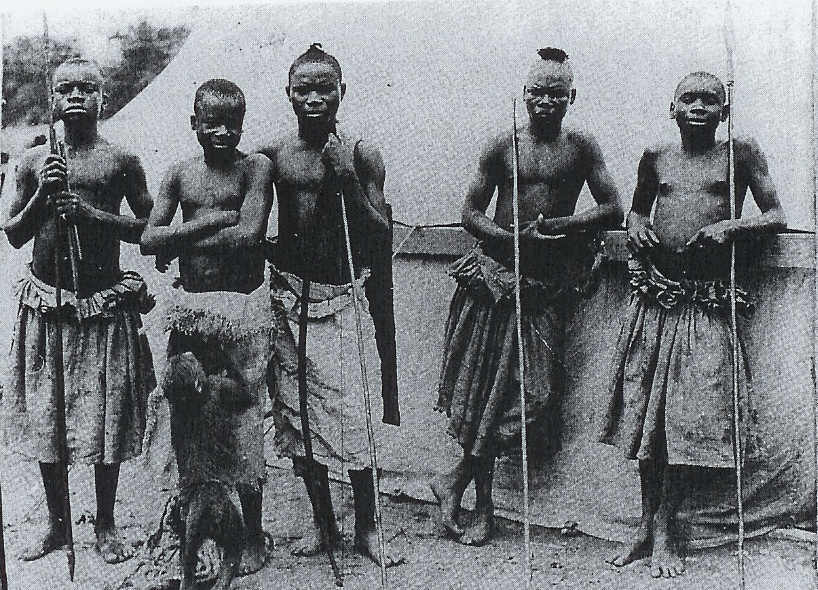
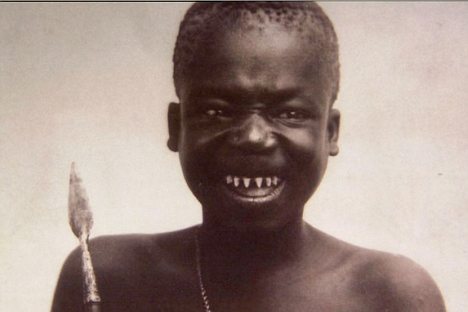
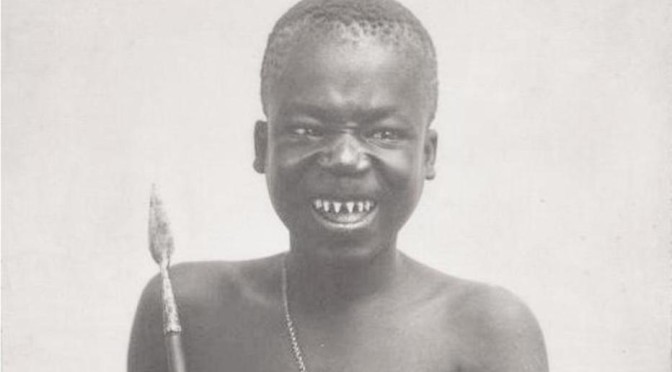
Ota Benga first arrived with a group of other men and boys for an exhibition at the 1904 St. Louis World’s Fair.  People delighted at his mischievous nature and unusual appearance. His teeth were filed into points, a decorative trait that exhibitors (including Verner) proclaimed were the product of a cannibalistic nature.

Below: Ota Benga at the St. Louis World’s Fair with other men taken from Africa 

1

He went back with Verner to Africa only to arrive back in America by 1906 where he was placed in the care of the American Museum of Natural History. Ota Benga actually lived inside the museum, subject to more than a few indignities. “I have bought a duck suit for the Pigmy,” wrote Hermon Carey Bumpus, the director of the museum, to Verner. “He is around the museum, apparently perfectly happy and more or less a favorite of the men.”

Ota Benga’s removal to the Bronx Zoo and subsequent display in the Monkey House has certainly been a blight to that institution’s history. The decision reveals the outmoded and racist philosophies that pervaded scientific thinking of the day.

At best, Ota Benga was simply an object in an exotic diorama with audiences prodding him to do tricks. His humanity was barely considered. At worst, the exhibition lays bare the racism of the day in the most baldy sinister way possible, corroding even the most esteemed institutions of the day.

It’s a small relief to hear of the many criticisms the zoo received in the press back in 1906. Sanity soon prevailed and Ota Benga left the zoo to live in an orphanage in Weeksville, Brooklyn.

2Newkirk gives the life of Ota Benga a proper eulogy. She crafts an intriguing tale around the many uncertainties of his biography, sometimes even stopping to analyze his state of mind.  I greatly credit the author for parsing through volumes of inaccurate news reports in search of even the smallest grains of truth.

His story ends with an unsatisfying hollowness, outside New York and far from the Congo. Few in his life ever treated him as an equal. In fact, due to his size, he was frequently treated like a boy, although he mostly like ended his life in his early 30s.  He never found a place to fit in.

There’s only a single moment in the book where Newkirk lets us in on his marvelous potential, on a life that could have been under more fair and enlightened circumstances.

He becomes, for a moment, “a father figure and hero” to a group of small African-American boys in Lynchburg, Virginia.  “In Benga they found an open and patient teacher, a beloved companion, and a remarkably agile athlete who sprinted and leaped over logs like a boy. And with his young companions Benga could uninhibitedly relive memories of a lost and longed-for life and retreat to woods that recalled home.”

Spectacle: The Astonishing Life of Ota Benga

Amistad, HarperCollinsPublishers

by Pamela Newkirk


Other recently reviewed books on the Bowery Boys Bookshelf:

Categories
Bowery Boys Bookshelf

Happy birthday Herman Melville! Some New York City trivia Plus: News on our upcoming podcasts

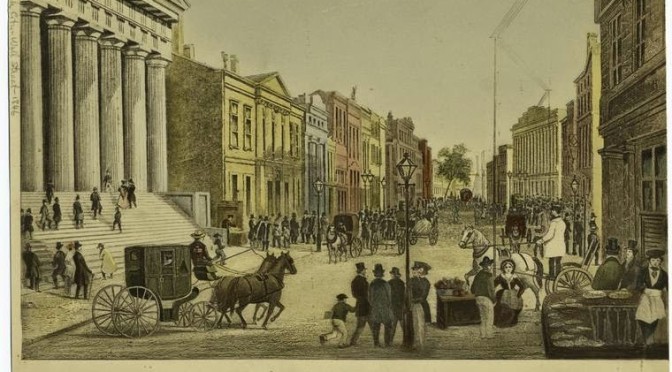
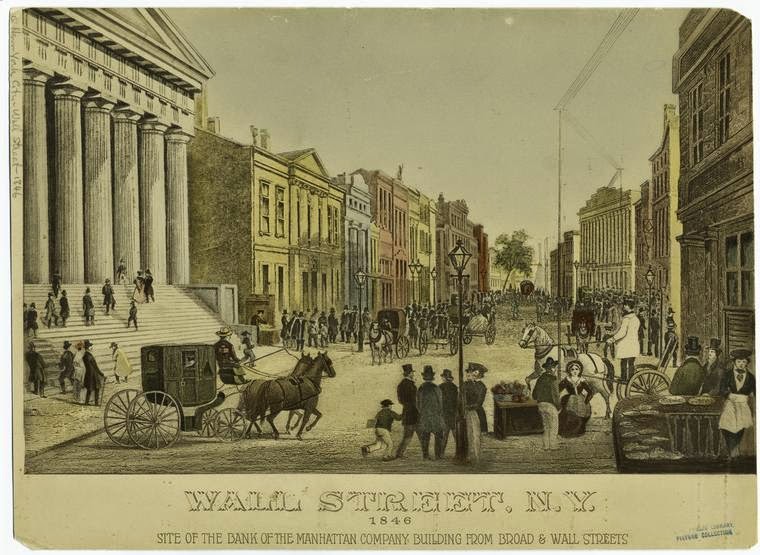
“Of a Sunday, Wall-Street is deserted as Petra; and every night of every day it is an emptiness.” — Herman Melville, Bartelby the Scrivener.  The lithograph above is what Wall Street would have looked like in Melville’s day. (NYPL)

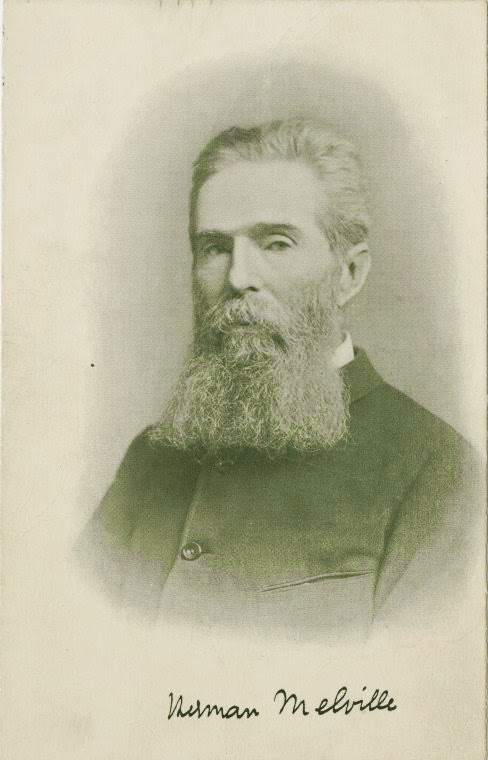
Herman Melville, one of America’s greatest writers of the 19th century, was born 195 years ago today.  Here are five New York-centric facts about Melville that you may not have known:

1)  Melville was born at 11:30 pm on August 1, 1819, at 6 Pearl Street. Today, across the street from that approximate location of the address sits a Starbucks, the coffee franchise named after a character in Melville’s Moby Dick.

2)  His grandfather Peter Gansevoort, a colonel in the Continental Army, had a fort named after him on the west side of Manhattan, in the area of today’s Meatpacking District.  Gansevoort Street is a lasting tribute to both the colonel and his fort.

Melville worked on whalers and merchant ships as a young man, acquiring the rich experiences he would immortalize in his writing. For a time, he also worked in a customs office at West Street and Gansevoort Street, almost exactly where the old fort once stood.

3)  His family’s wealth widely fluctuated, and Herman’s father was at one point thrown in debtor’s prison.  But at the height of the Melville’s prosperity, they managed to live in a luxurious townhouse at 675 Broadway, between Bond and Jones Street. (Click the address to see what’s there today.)   In the 1820s, that would have put them in the lap of wealthy New York.

4)  Melville was very familiar with all of downtown New York’s seaport culture but made special note to mention those places along the East River — WhitehallCorlear’s Hook and Coenties Slip — in his book Moby Dick.  These locations along the east side would have been his landscape as a youth, the places where his mind began crafting tales of adventure. From Moby Dick:

“Circumambulate the city of a dreamy Sabbath afternoon. Go from Corlears Hook to Coenties Slip, and from thence, by Whitehall, northward. What do you see?- Posted like silent sentinels all around the town, stand thousands upon thousands of mortal men fixed in ocean reveries. Some leaning against the spiles; some seated upon the pier-heads; some looking over the bulwarks of ships from China; some high aloft in the rigging, as if striving to get a still better seaward peep.” 

5)  For much of his later career, Melville lived at 104 East 26th Street.  Most of his greatest works had already been written, but it was from this house that he started a novella called Billy Budd. Uncompleted at the time of his death in 1891, it was later published and is today considered one of his greatest works.  There’s a plaque nearby where this building once stood, making note of this important literary spot.
___________________

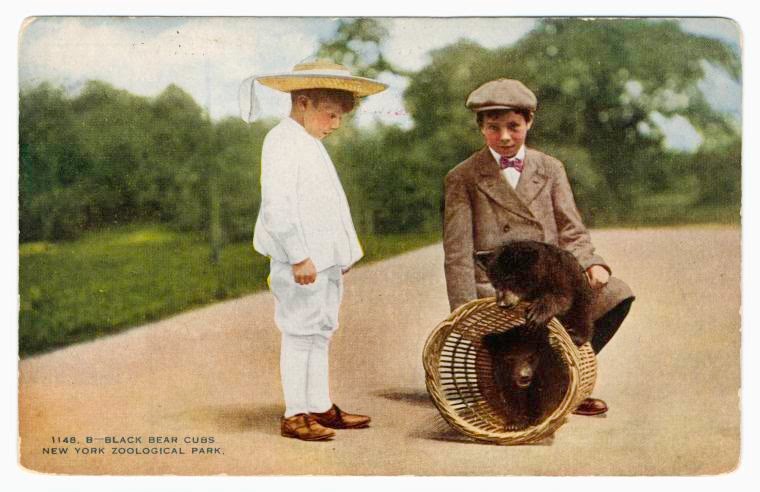
Above: Boys in fancy dress marvel over baby bears at the Bronx Zoo (NYPL)

Bonjour and hey! I’ve just returned from Europe where I saw Tom Meyers get married to his partner amid the bucolic beauty of southern France.  This may shock you but there was not a single pun made the entire ceremony.

This was also the longest vacation I’ve taken since starting the Bowery Boys so I thank you for your patience in the general silence around these parts.  I’ll have a Parisian flavored posting on Monday or Tuesday.

The podcast release schedule has been very erratic this summer so we’ve tried to give you a little extra doses wherever possible.  Sohis month you’ll be getting TWO new shows.  Here’s the layout:

August 8 — A new solo podcast
August 22 — Tom returns with a new duo show

At that point we’ll return to our monthly schedule with the next show on September 19.

Categories
Those Were The Days

Fun money: The Buffalo nickel, 100 years old this month, makes Wall Street messenger boys rich (for a couple hours)


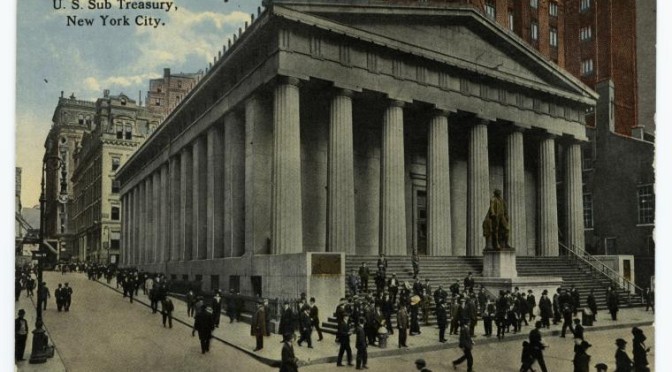
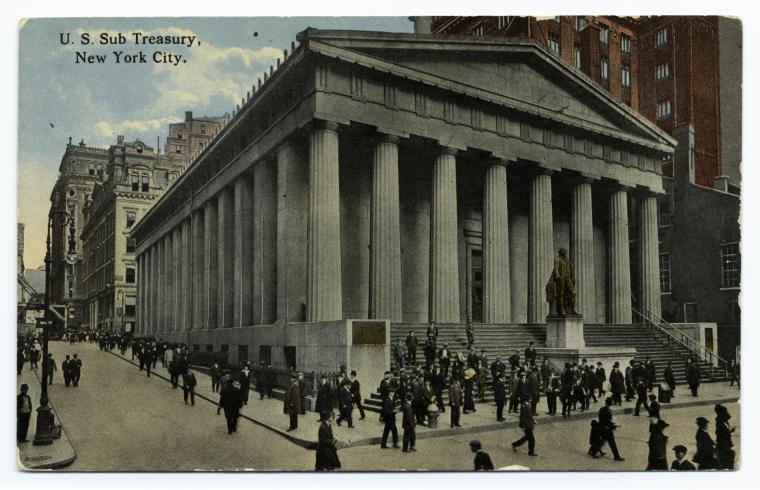
The U.S. Sub Treasury Building — today’s Federal Hall — as it appeared in a colorized postcard in the 1900s (courtesy NYPL)


“Hey! Getcha buffalo nickels here. Only 15 cents!”

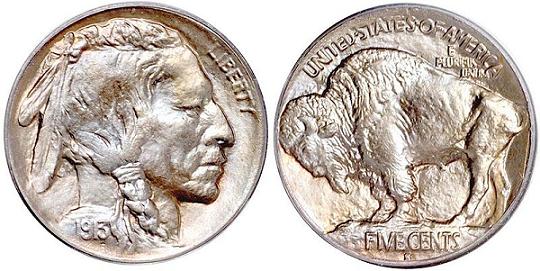
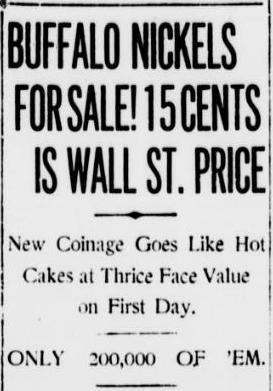
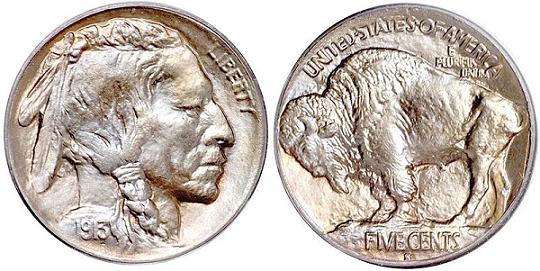
On March 1, 1913, the usual bustle of Wall Street was enlivened with the voices of young men — mostly messenger boys, bank runners and peddlers, according the Evening World — with handfuls of shiny new nickels, the first run of what would become known as the Indian Head nickel or the Buffalo nickel.  And in these heady morning hours, many managed to sell the five-cent piece for triple its value.

“The down-at-the-heels men, who sell picture postcards and neckties from pushcarts on Ann Street, scented a bargain and hurried to the Pine Street El Dorado to sink their little capital in nickels.”   The “Pine Street El Dorado” in that quote refers the New York Sub Treasury building, later referred to as Federal Hall.  (It’s second entrance is on Pine Street.)  The Sub Treasury received $10,000 worth of new nickels in ten wooden kegs.

Unfortunately for these budding young nickel entrepreneurs, the novelty wore off by noon and the Buffalo nickel sunk back down to its original face-value cost.

The new nickels were designed by the sculptor James Earle Fraser, a former assistant of the estimable Augustus Saint-Gaudens and best known in New York perhaps for his equestrian statue of Theodore Roosevelt outside the American Museum of Natural History.

Fraser, a professor at the Art Students League, designed the new coin from a studio at 3 MacDougal Alley, off of Washington Square Park.  An admirer of Western and Native American imagery, Fraser used a series of models for the noble Indian profile on the front of the coin.  For the buffalo on the reverse side, Fraser reportedly went to Central Park Zoo and used their old buffalo Black Diamond for a model.

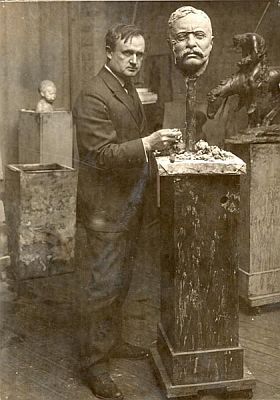
At right: James Earle Fraser in 1912 with a clay model of a Theodore Roosevelt bust (courtesy National Cowboy Museum)

Or at least, Black Diamond has always been considered the model for the buffalo nickel.  In fact, Fraser may also have used specimens from the Bronx Zoo including a fiesty beast named, appropriately, Bronx.  Given the renown of the Bronx Zoo collection — the institution essentially saved the buffalo from extinction — it might have made more sense to use their animals as models.

Despite outcries from manufacturers of coin operated devices — who claimed the new five-cent piece would not fit in their machines — the buffalo nickel was minted in February 1913, replacing the Liberty Head nickel that year.  (A small handful of Liberty Heads were made in 1913, becoming some of the most prized coinage among the numismatic set.)  Americans got a preview of the new coin when a small number were distributed by President William Howard Taft at the groundbreaking for the National American Indian Memorial in Staten Island, a monument that was ultimately never built.

A week later, on the first day of March, rolls of the new buffalo nickels were distributed to New Yorkers on Wall Street, and millions more sent across the country for distribution.

Perhaps Fraser’s design was a tad too whimsical for some.  The term ‘buffalo nickel’ soon became slang for something nearly worthless.  Just a month later, the New York Sun reported, “[T]he $1,500 mathematical job didn’t mean anymore to him yesterday afternoon than a buffalo nickel.”

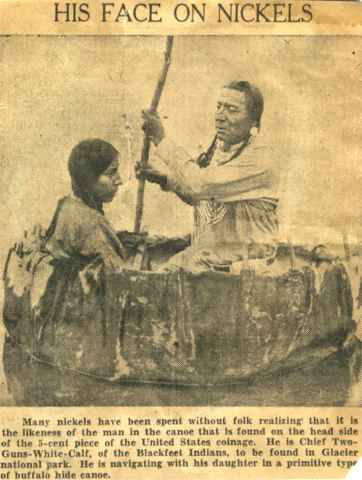
In 1921, one of Fraser’s human models, the chieftain Two Guns White Calf, pitched his teepee atop the luxury Hotel Commodore next door to Grand Central Terminal in a publicity stunt.

The buffalo nickel was replaced in 1938 by the more familiar Thomas Jefferson model.

Below: A news clipping featuring an image of Two Guns White Calf with his daughter. (Courtesy Flickr/sharknose)

Coin image courtesy Coin Collecting For Beginners

Other scary animals that have escaped the Bronx Zoo

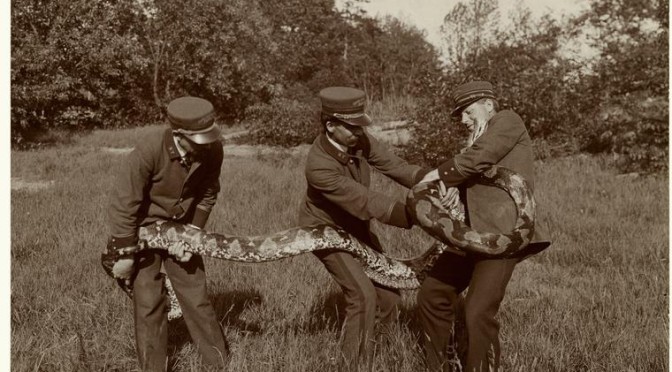
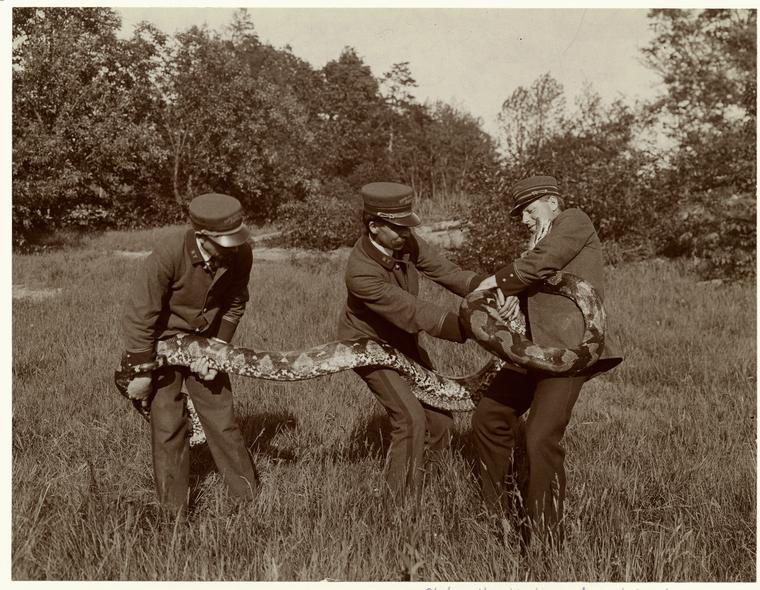
These 1906 Bronx zoo employees won’t let this snake out of sight. (NYPL)

Escapes from the Bronx Zoo are relatively rare today, so news of a 20-inch Egyptian cobra slithering away last Friday — its current whereabouts unknown — struck fear and excitement in the hearts of Bronx residents. The slithery beast has even inspired its own Twitter feed @BronxZoosCobra. (Its latest Tweet: “Taking the Sex And The City Tour!!! I’m totally a SSSamantha.”)

But the institution once known as the Bronx Zoological Park is a 111-year old zoo after all, and during the park’s early years, animals were escaping all the time, almost yearly in fact. And the creatures making the prison breaks back then were far larger than a mere snake. Here’s just a sampling, culled from some early New York Times articles:

July 1902 — A rather plucky Mexican panther broke loose from his new home behind the puma house and crashed a noontime picnic full of women and children. Soon the grounds were buzzing with panicked families and people fleeing for indoor safety. This made life easier for the animal, who feasted upon abandoned picnic lunches. The headlines claimed, “He Eats Sandwiches and Ham for Lunch, but Balks at Pie.” The panther eventually jumped into the Bronx River and swam away.

The original article [found here] makes mention of a bear that had escaped the previous summer. It is unclear whether this was the same “tiny black bear” granted to the zoo by Theodore Roosevelt in 1901 — actually a bear named Teddy Roosevelt, years before the animals that might have inspired the ‘teddy bear’.

July 1904 and 1905Both snow leopards in captivity at the Bronx Zoo escaped in successive years. The first was “shot dead after an all night hunt,” and the next year its mate tried to make a break for it, disappearing “like a ghost” until it was found the next morning. [source]

July 1908 — The iguana would have been quite an exotic beast to children one hundred years ago, so imagine the shock when two Cuban iguanas escaped from their confines during a crowded summer day in the reptile house. Women and children ran to the doors. “One man sprang over a low iron fence into the alligator cage in his excitement and scrambled out again as soon as he realized where he was.” They were thrown into burlap sacks and returned to their confines. [source]

August 1908 — Later that year, an 36-foot long East Indian python (perhaps the one pictured above) briefly fled while being transferred to a pit and had to be recaptured by police officers.

November 1916 — Most unusual is the tale of Loco, the ring-tailed cat, who escaped his cage but hung around the zoo for over two months, killing various birds and rats. Loco was a donation from a Texas animal owner, who gave the cat that particular name because he “must have eaten of the loco weed” before being captured. After feasting with abandon on the zoo’s bird collection, Loco was recaptured and returned to his cage, “mus[ing] upon the good time he has had.” [source]

For more information on the history of the Bronx Zoo, you can download our podcast on the subject right here (recorded in April 2010).

Categories
Podcasts

The Bronx Zoo: the tale of NYC’s biggest animal house

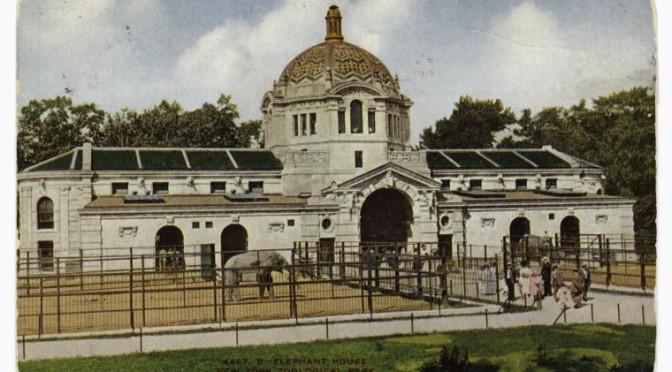
Postcard of the elephant house, now the central Zoo Center — and home today to a baby rhino below. (Courtesy NYPL)

PODCAST New York City’s most exotic residents inhabit hundreds of leafy acres in the Bronx at the once-named New York Zoological Park.

Sculpted out of the former DeLancey family estate and tucked next to the Bronx River, the Bronx Zoo houses hundreds of different species from across the globe, many endangered and quite foreign to most American zoos.

The well meaning attempts of its founders, however, have sometimes been mired in controversy. The highlight of the show — and the institution’s lowest moment — is the sad tale of Ota Benga, the pygmy once put on display at the zoo in 1906!

ALSO: We take you on a tour of the zoo grounds, unfurling over 110 years of historical trivia, from the ancient Rocking Stone to the tale of Gunda, the Indian elephant who may also have been a poet.

CLICK INTO PICTURES BELOW FOR GREATER DETAIL

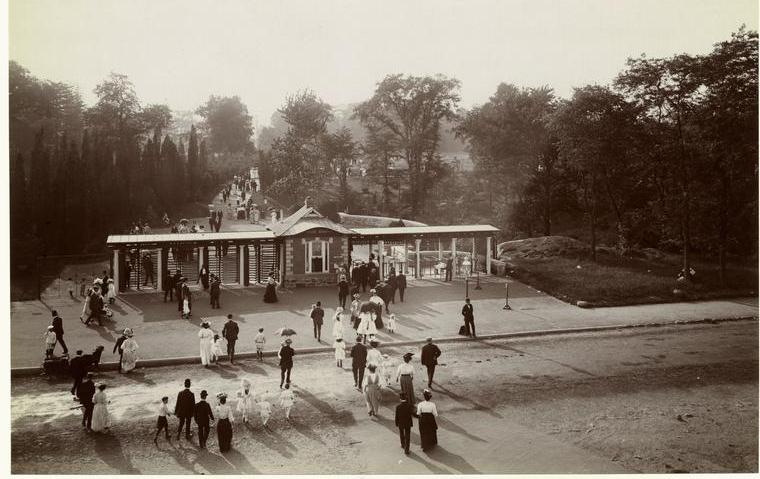
Well-dressed families arrive at the south zoo entrance in 1911. (NYPL)

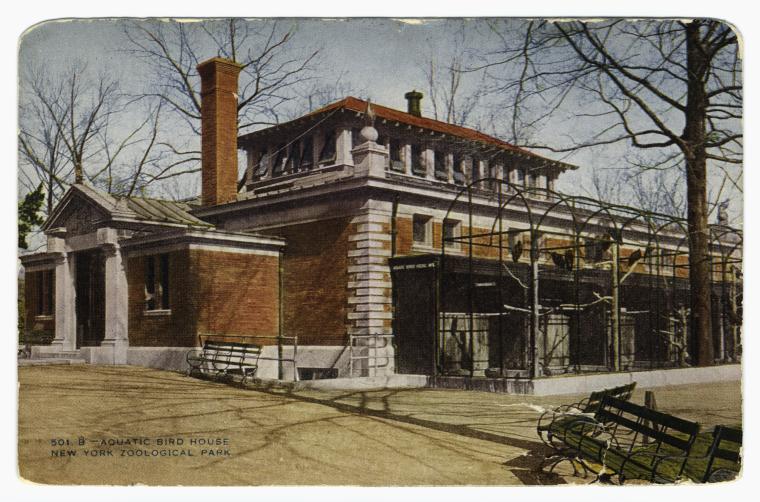
The aquatic bird house, one of the first buildings completed when the zoo opened in 1899. Another building from this date, the House of Reptiles, still stands and you can see it further below. (NYPL)

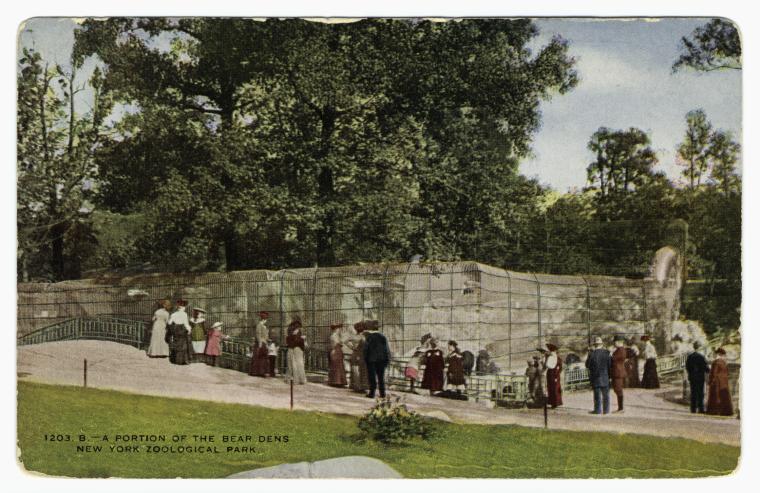
Bears behind fences. Zoo planners used Bronx Park’s natural topography to build enclosures into the very rocks themselves.

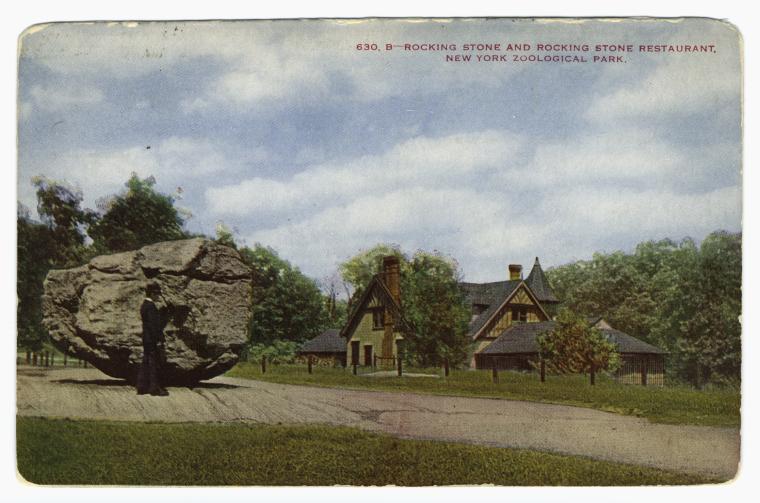
The mysterious Rocking Stone, next to the Rocking Stone Restaurant. Today there’s a World of Darkness exhibit there (presently closed to visitors).

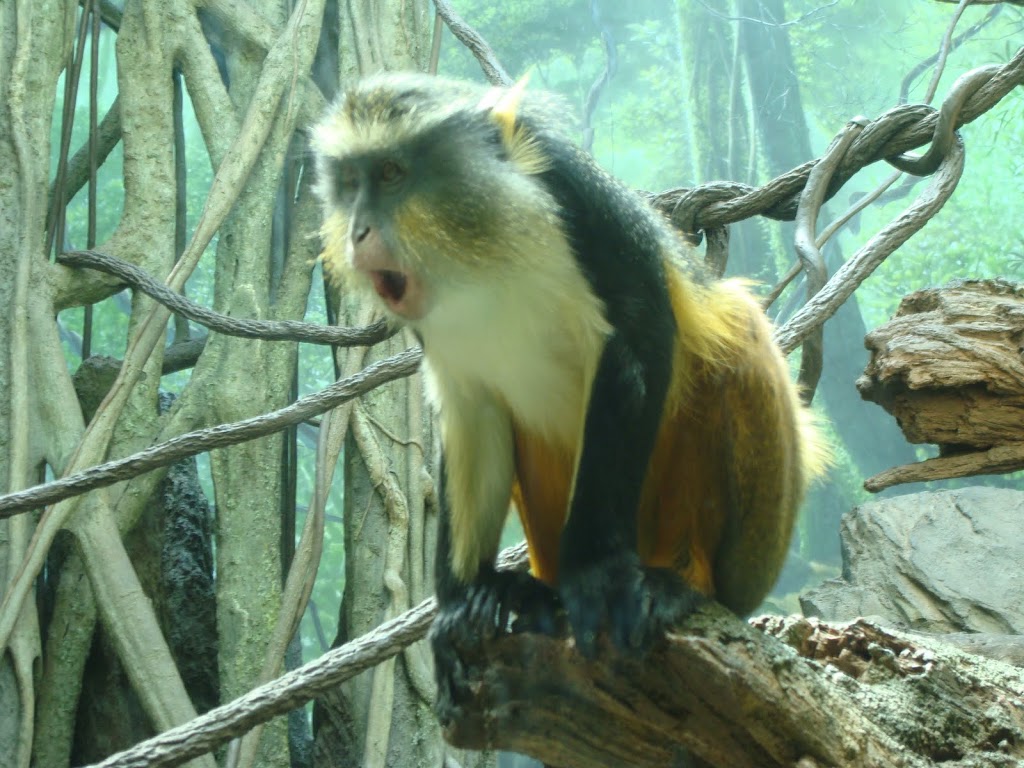
Ota Benga at the Bronx Zoo. The Congolese pygmy once lived at the Museum of Natural History (where he was forced to wear a duck costume!) before being scandalously exhibited for a short time in the Bronx Zoo monkey house in 1906.

Part of his allure to shocked New Yorkers were his filed teeth and his size (4’11’).

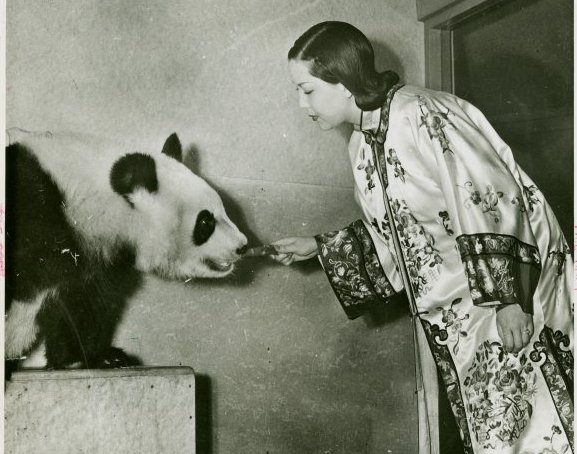
Pandora, the zoo’s first panda bear, from 1938. Pandas never lived for very long at the Bronx Zoo, and they stopped regularly keeping them. Pandas Ling Ling and Yun Yun were briefly housed here in the 1980s.

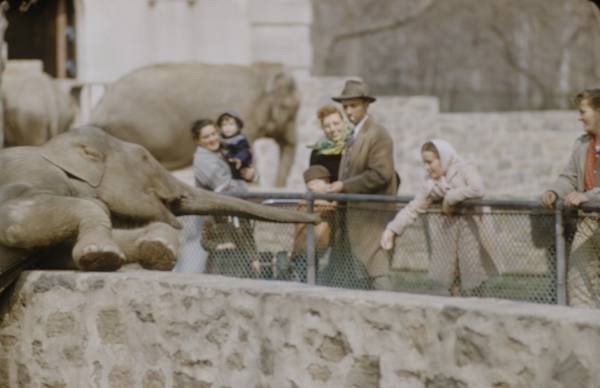
The elephant exhibit, circa the 1960s. The Bronx Zoo’s population of elephants has dwindled to just three animals. Very soon there may be none. (Photo courtesy Life Images, Nina Leen photgrapher)

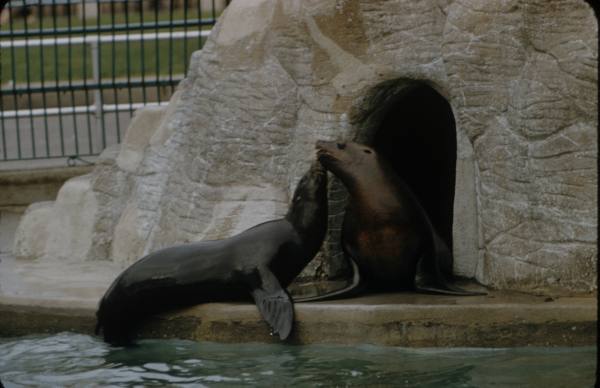
From the same time period as the picture above, but pretty timeless. The sea lions have been the centerpiece of the zoo since it opened in 1899. (Nina Leen)

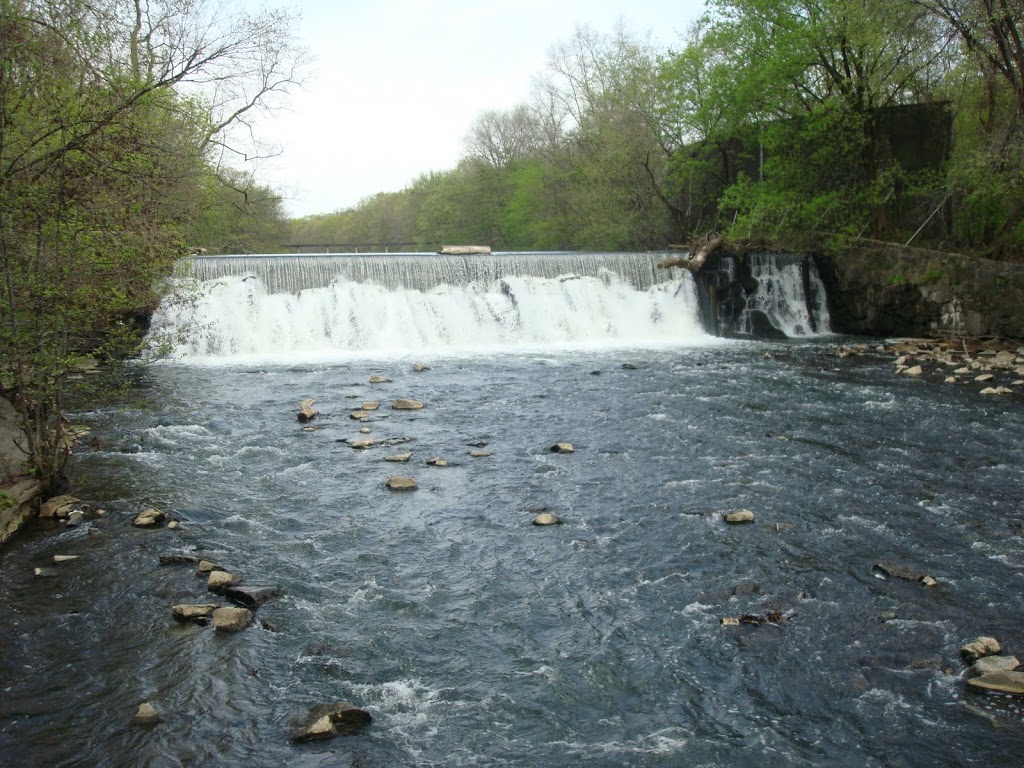
Some pics from my trip last week are below. The zoo is one of the greatest places to see the spectacle of the Bronx River. (Click into them to see the detail.)

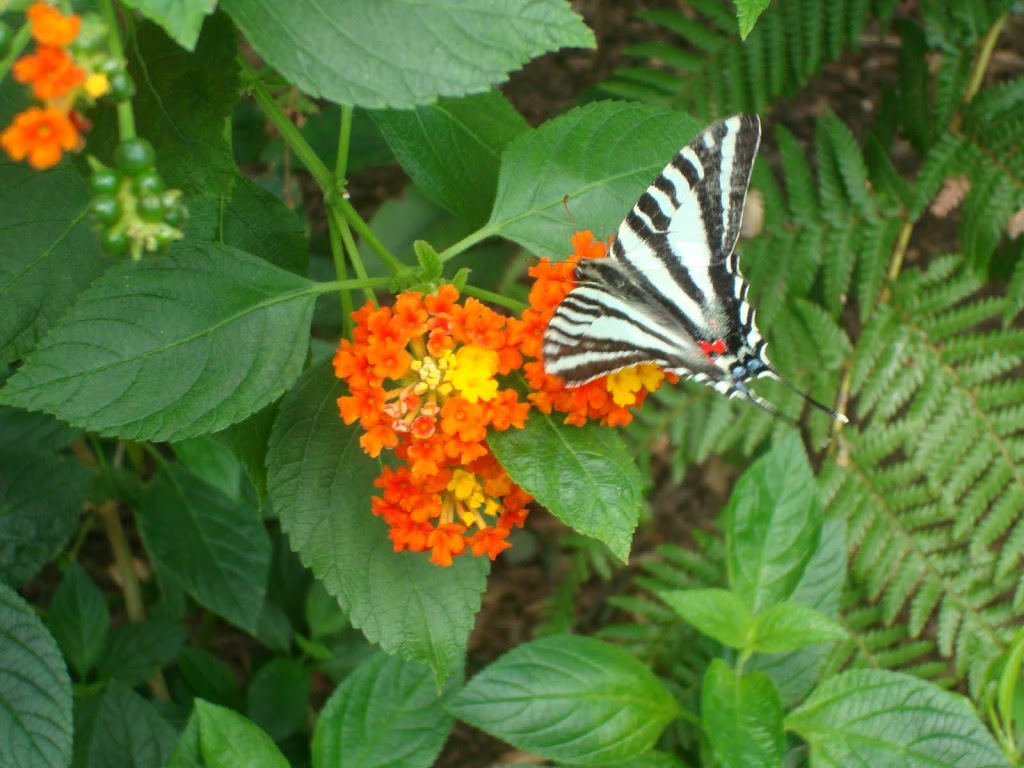
The Butterfly Garden is one of the newer exhibitions, an intimate greenhouse featuring dozens of varieties of butterflies flying all around you (and sometimes, even on you).

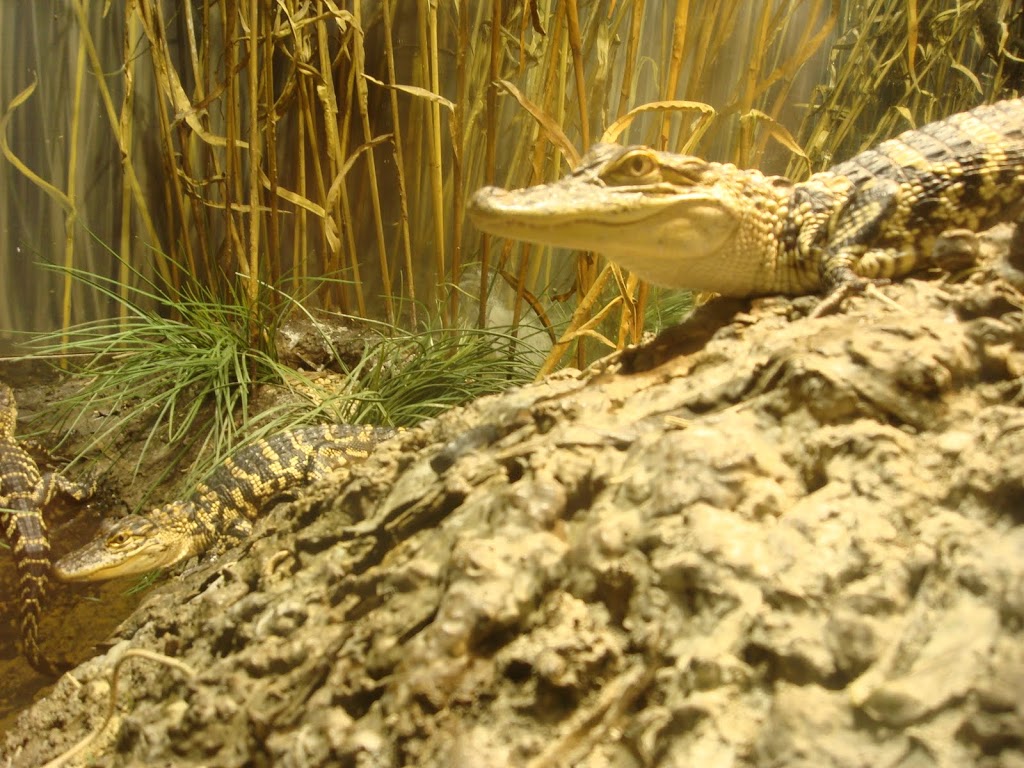
American allligators, the small, unthreatening kind. For something more severe, visit the nile crocodile in the Madagascar exhibit.

A display of some of the zoo’s marvelous, cheeky fontage.

The House of Reptiles, one of the zoo’s oldest structures, from 1899.

The brutalist wonder that is the House of Birds.

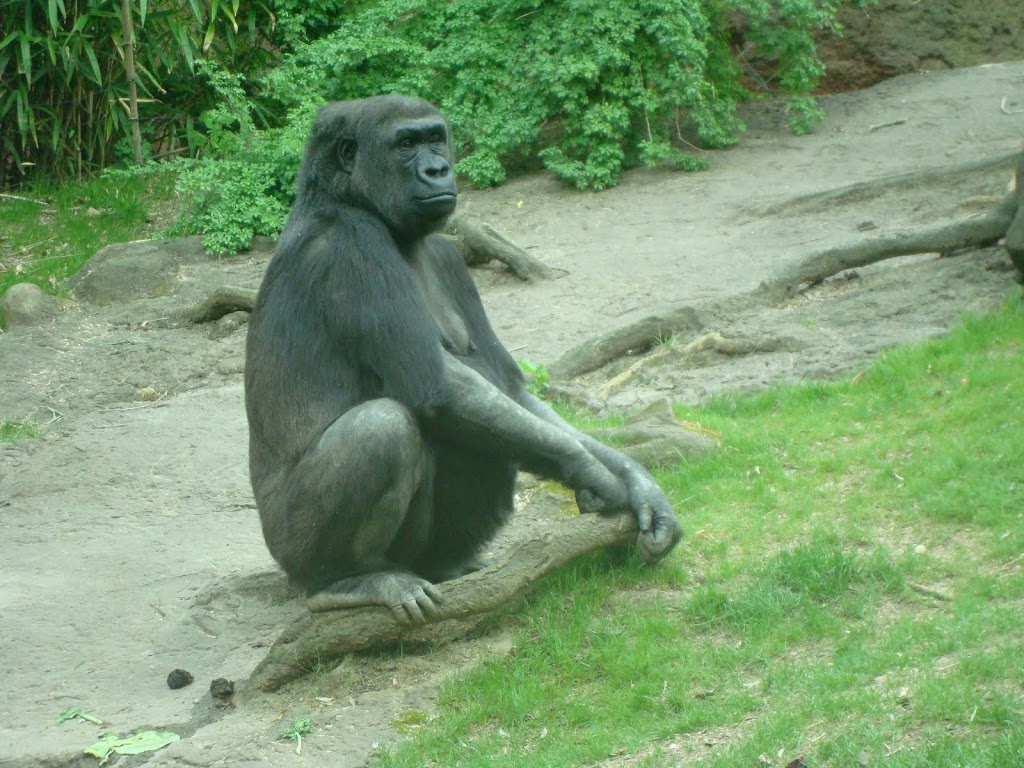
A young female gorilla, one of several who look on at gawking zoo visitors in curiousity and confusuion.

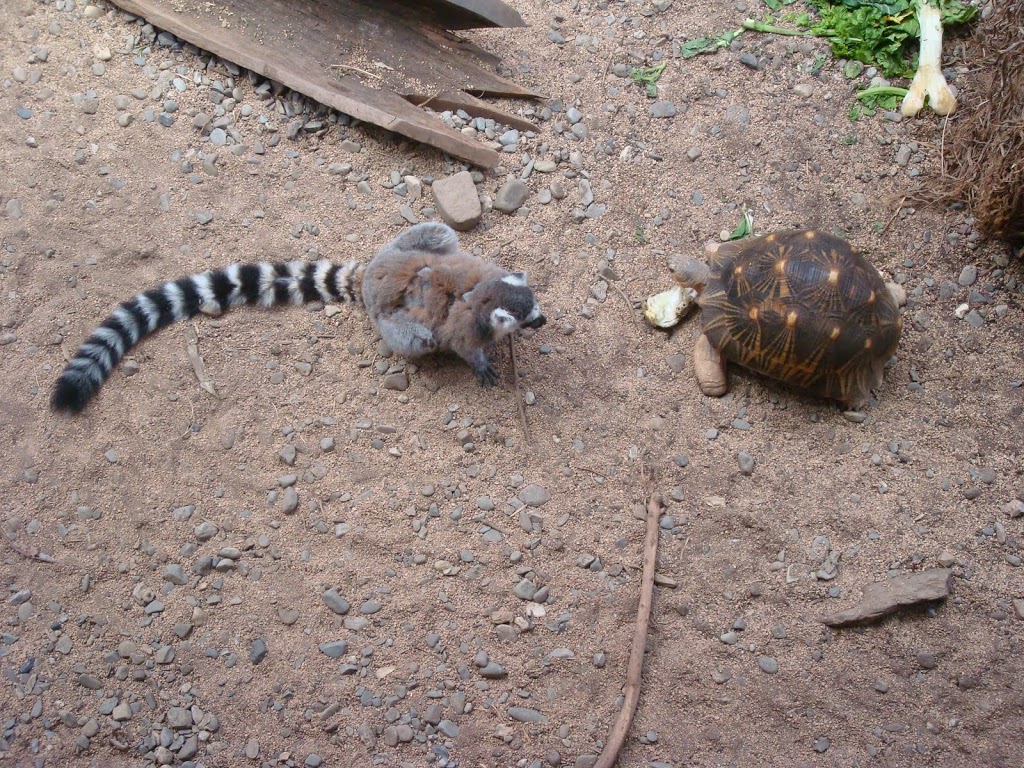
From the Madagascar exhibit:

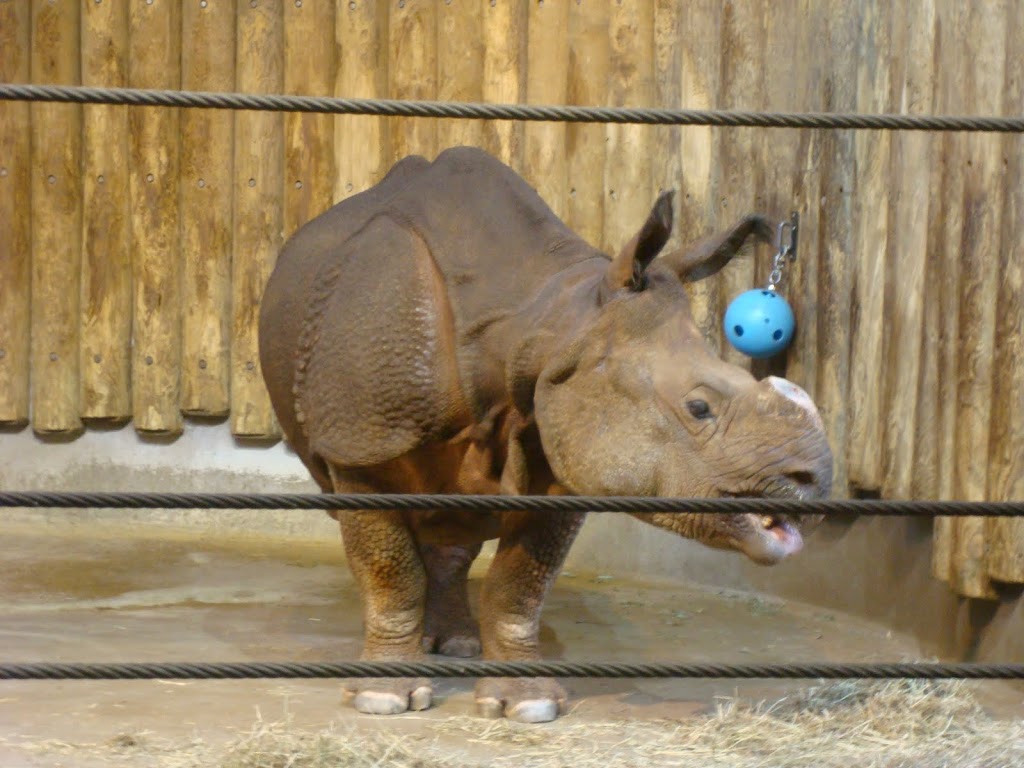
You can find a baby Asian one-horned rhinoceros named Krishnan at the Zoo Center.

And finally, the Bronx Zoo movie star Andy the orangutan in his feature debut Andy’s Animal Alphabet:

A ride around New York’s remaining merry-go-rounds

Carousels aren’t really for kids anymore. Sure, you won’t see many adults truly captivated by the process of mounting a wooden animal and twirling in a circle. But well-preserved models of the famous amusements are nostalgia goldmines; tinkling calliope music and a few flashing light bulbs can sometimes capture a by-gone era more than a multi-million dollar restoration can.

New York City used to have dozens of the swirling entertainments. Today, you can only find them in a few places:

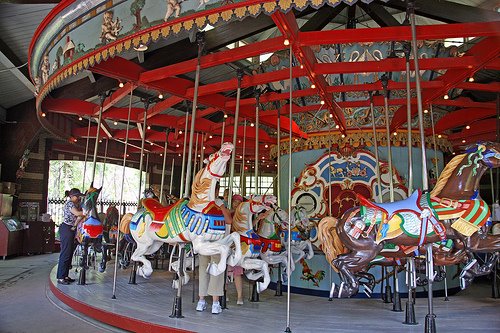
Central Park Carousel (above)
This is perhaps the world’s most famous carousel, but it’s not the original amusement which debuted in 1871. That carousel was controlled by a blind mule that walked around in circle in a dark, underground pit, as upper-class children paid the rather steep ten cent admission for a chance to ride it. It was replaced by an electric carousel in 1924 and was eventually destroyed in fire.

The carousel that whirrs about here today is actually much older, built in 1908 and entertained children during Coney Island’s heyday. Still one of the world’s largest carousels, it moved to this location in 1950.

La Carrousel
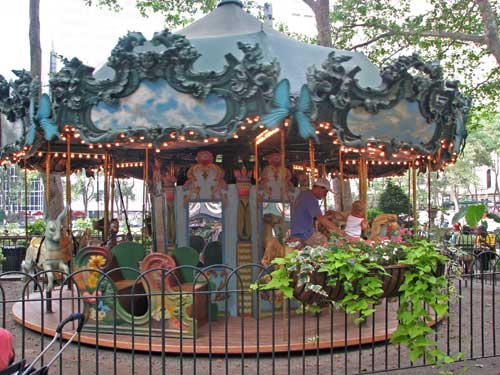
Given to the park’s symmetrical French landscape design, they call the one in Bryant Park Le Carrousel (ooo la la). Despite seeming very rustic, this miniature wedding-cake was only installed in 2001. I can only imagine what a carousel would have seemed like had it been here during Bryant Park’s days as a hangout for drug addicts.

Battery Park SeaGlass
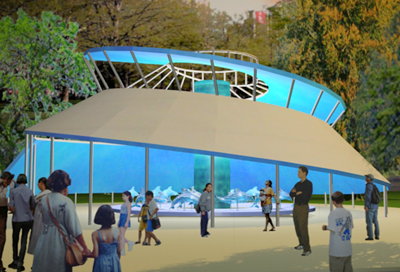
This glittery, futuristic looking thing recalls Battery Park’s past as the home of the New York Aquarium, with horses replaced by creatures of the sea. Oh wait. This carousel’s not built yet.

Flushing Meadows-Corona Park ‘Carousel In The Park’
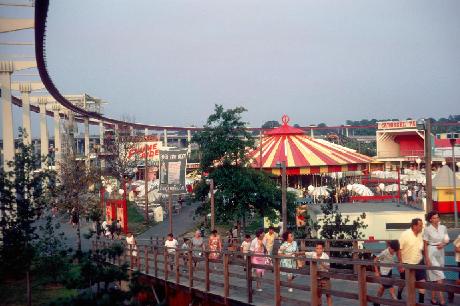
Queens’ only merry-go-round came here from Coney Island, by way of the New York World’s Fair in 1964. Previously, it spent the early part of the century as the official carousel of Stubbman’s Beer Garden until the 1950s, where it moved up to the boardwalk next to the parachute jump and became the Steeplechase Carousel. It was transported to the World’s Fair Lake Amusement area (pictured above) and was left there, donated to the city, long after the Fair left town.

B & B Carousell
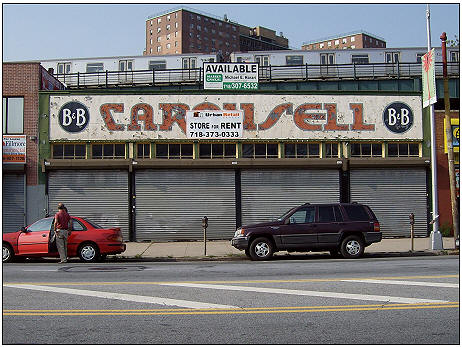
Coney Island was the home of dozens of spectacular carousels and could safely be considered the world’s largest assemblage of them. Today there’s only one left — the wonderfully misspelled B & B Carousell, which arrived in 1923. But don’t go looking for it. After being purchased by the city, the Carousell is currently being refurbished in Ohio for the fancy new Steeplechase Plaza, the city’s costly revamp of the Coney Island amusement sector. However its former home still sits, sad and vacant:

Prospect Park Carousel
Sitting close to the zoo and Leffert’s Homestead, this was also acquired from a Coney Island site in 1952, although the park has had merry-go-arounds since its inception. It stopped running altogether in the 1980s due to mechanical failures but was renovated in 1990. The park has a ‘horse adoption and grooming’ program to keep the carousel in working order.

The Carousel for All Children
This awkwardly named merry-go-round is located at Willowbrook Park in Staten Island’s Greenbelt. Nothing too retro about this ride; a modern model built in Ohio, it was installed here at Willowbrook in 1999. However, some of the horses are reproductions of those of Staten Island’s very first carousel — a version that entertained on Midland Beach Boardwalk from the mid 1910s that was dismantled in 1957.

The Bronx Zoo Bug Carousel
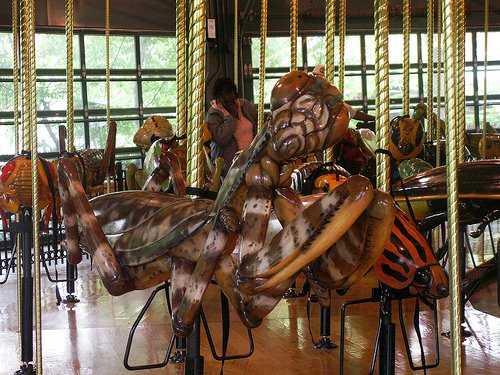
The New York area’s newest carousel, debuting in 2005, the Bronx Zoo model is certainly the only one of its kind to be comprised entirely of insects.

Jane’s Carousel
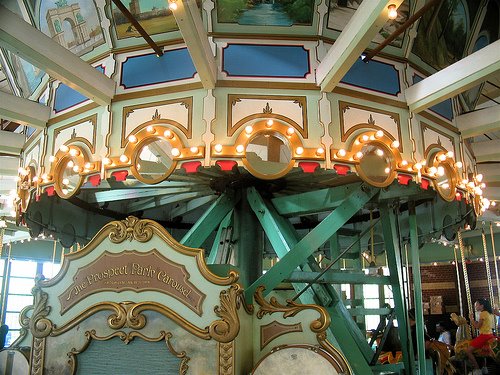
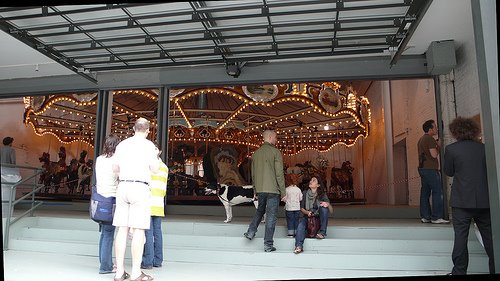
The strangest carousel in New York is one that unfortunately does not take riders. Jane Walentas, wife of Brooklyn real estate developer David Walentas, keeps a fully restored 1922 carousel (seen below) tucked away in a building on Water Street. Walentas, who purchased the crumbling amusement in 1984 and personally restored it, has been hoping the city would adopt her hobby horse for the expanding Brooklyn Bridge Park. Until then, pop by 56 Water Street to grab a view, if not a ride.

Know of any I might have missed?