Categories
Neighborhoods

Finding Pietro

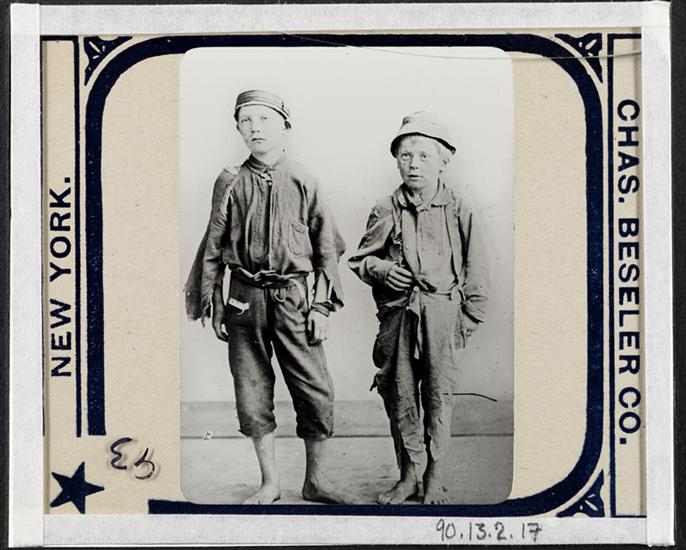
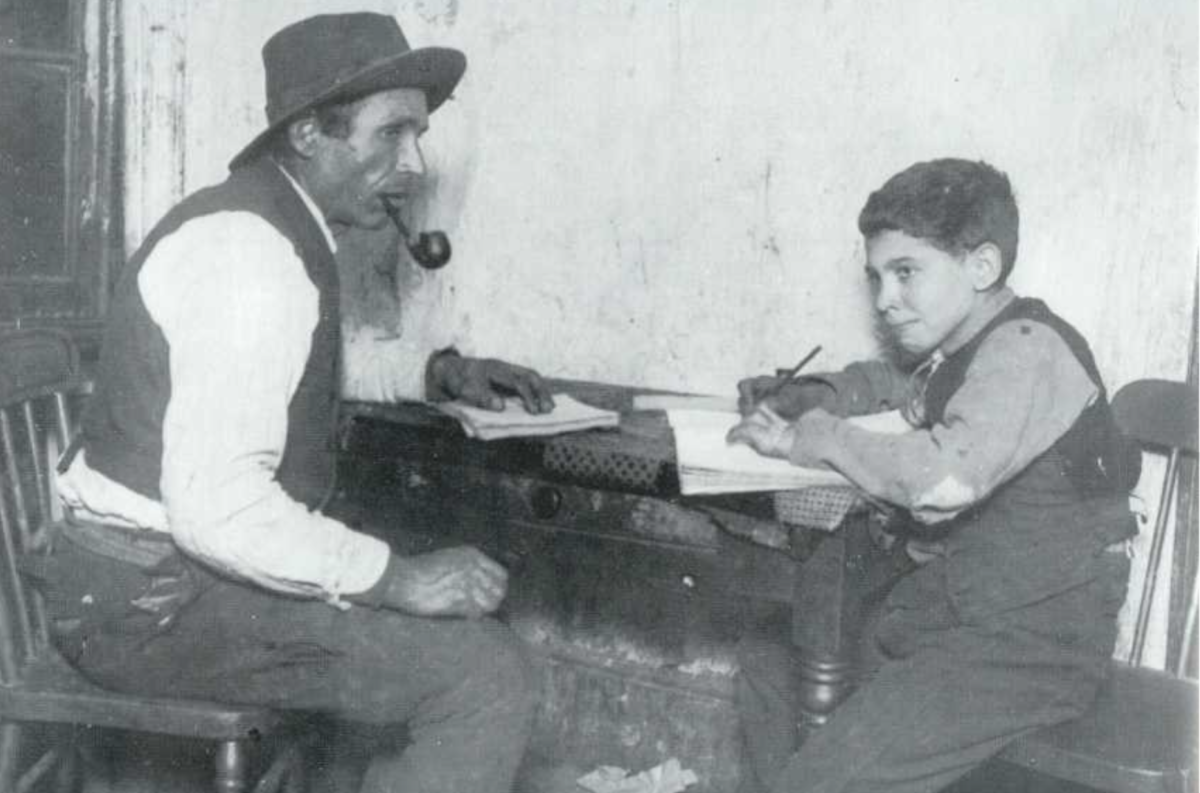
One of you may be related to Pietro, the boy in the picture. He was one of thousands of Italian immigrants who arrived in New York in the 1870s-80s. He seems to have been intelligent and even exceptional, weathering a set of truly dreary circumstances that would have defeated most men.

Pietro was not yet 13 years old when he was almost killed in a streetcar accident. He was permanently scarred and unable to support his family. If not for witnessing a shooting outside of his home, we might never know his name.

But in 1892,  Pietro became a profoundly moving subject in a new book by one of the greatest social reformers of the Gilded Age.

Jacob Riis was a pioneer social activist who used journalism and photography to change the living conditions of thousands of poor New Yorkers. He took his bulky camera to the most decrepit nooks of lower Manhattan, documenting a world entirely unseen by most people.

In 1890 he published How The Other Half Lives, exposing the squalid living conditions of downtown Manhattan’s mostly immigrant population.

Riis did help to change the face of New York. In Five Points, the worst tenements were demolished and replaced with government buildings and one very manicured park. But his depictions of ethnic groups, in retrospect, could be very simplistic, even condescending. In his goals to highlight an overwhelmingly malignant condition, he often glossed over some telling details of some of his subjects.
1

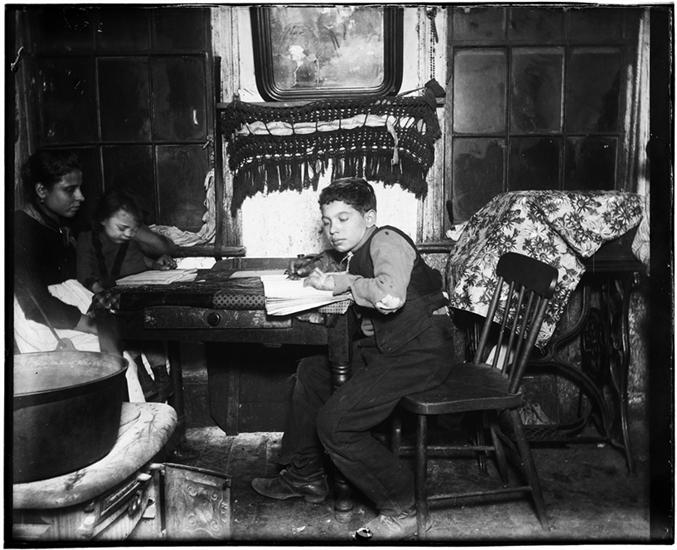
Pietro (I haven’t been able to find his last name) is one of Riis’ favorite subjects. He makes his debut in The Children of the Poor, Riis’ 1892 follow-up to How The Other Half Lives, as a model of the striving young student. Pietro is an ambassador of sorts, an avatar of social improvement, bringing “[e]very lesson of cleanliness, of order, of English” taught to him in school back to his tenement life.

He was born sometime in the early 1878 or 1879, just as the sudden increase of southern Italians began to permanently change the nature of the old tenement neighborhoods.

We know he was born in Italy — not “borned here” as Riis depicts him saying — and brought to a home somewhere at Mulberry and Jersey Street (in the shadow of the Puck Building.)

He lived in a single room with his parents and four younger siblings. As a small boy, he attended classes at the school run by Old St. Patrick’s until “his education was considered to have sufficiently advanced to warrant his graduating into the ranks of the family wage- earners.”

Being the eldest son, he would have gone to work immediately. In this case, as a bootblack, the most common occupation for poor Italian immigrants in the 1880s.
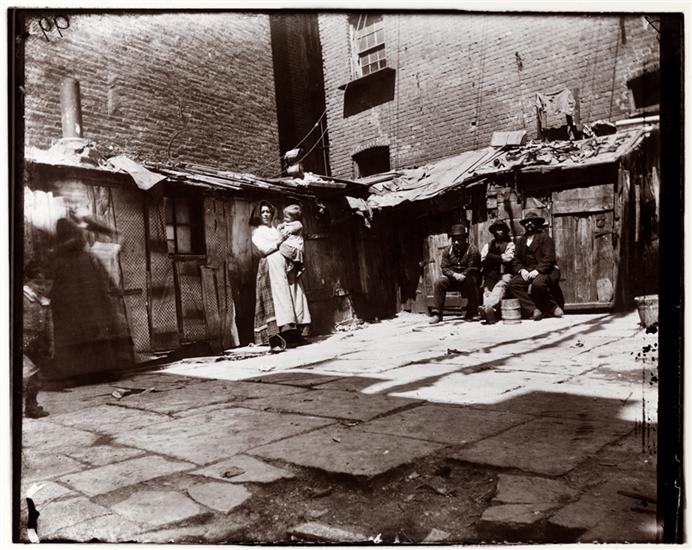
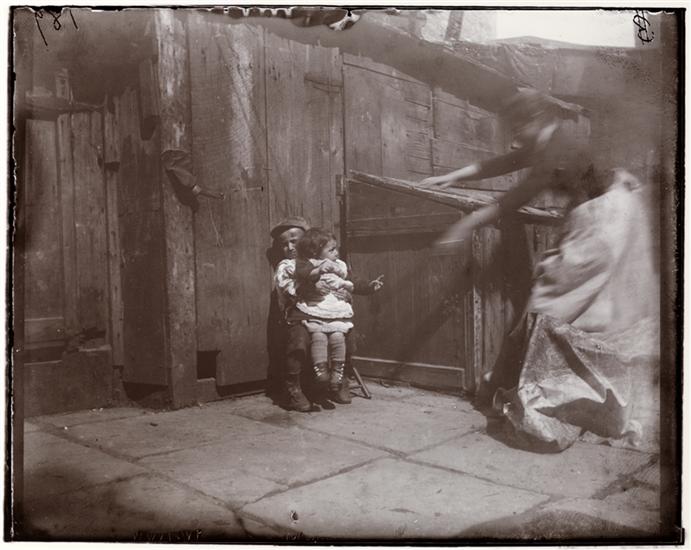
1897 Yard in Jersey Street (now gone). A woman holding a child, and men sitting in a rear yard of a Jersey Street tenement. Pietro lived on Jersey Street and one of these buildings may have been his home.

Probably around age 11 or 12, Pietro began shining shoes in a saloon somewhere in the neighborhood. One day, while crossing Broadway, he was struck by a streetcar and mangled so badly that it was assumed he would not survive. “They thought he was killed but he was only crippled for life.”

He met Riis one day at the police station at 300 Mulberry Street. He was there as a witness to a shooting which had occurred in front of his home. As Riis describes:

“With his rags, his dirty bare feet, and his shock of tousled hair, he seemed to fit in so entirely there of all places, and took so naturally to the ways of the police-station, that he might have escaped my notice altogether but for his maimed hand and his oddly grave but eager face, which no smile ever crossed despite his thirteen years.”
2

Riis gained the boy’s confidence and was invited into his home to document his life. Pietro was devoting his energies to education, improving both his Italian and English skills. It appears the accident left one or both of his hands impaired.

As Riis observes:

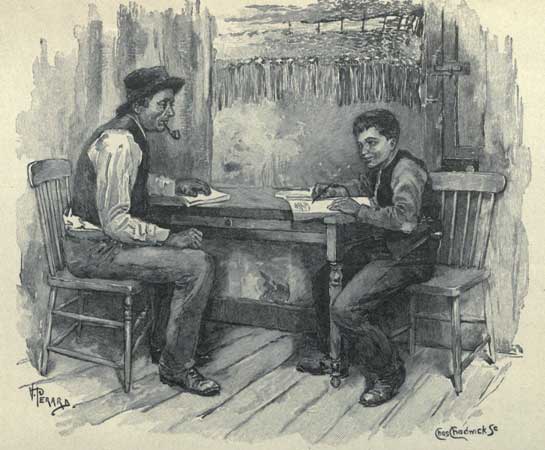
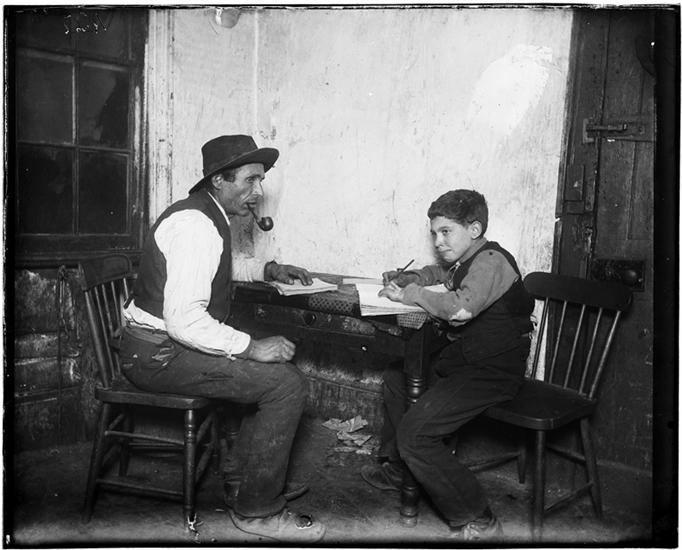
‘By ‘m by,’ said poor crippled Pietro to me, with a sober look, as he labored away on his writing lesson, holding down the paper with his maimed hand, ‘I learn t’ make an Englis’ letter; maybe my fadder he learn too.’

I had my doubts about the father. He sat watching Pietro with the pride in the achievement that was clearly proportionate to the struggle it cost, and mirrored in his own face every grimace and contortion the progress of education caused by the boy.

‘Si! si!’ he nodded eagerly. ‘Pietro he good a boy; make Englis’, Englis’!’ and he made a flourish with his clay-pipe, as if he too were making the English letter that was the subject of their common veneration.

Riis clearly views Pietro as a charity case burdened with the extraordinary responsibility of assimilating his family into American life.

At the maimed 13 year old eldest child of immigrants, his days of innocence were long gone. His situation had utterly defeated him. At least, that’s the image Riis very poignantly meant to convey in his final anecdote, turning to Pietro as he watched over his baby brother:

‘Pietro’,” I said with a sudden yearning to know, ‘did you ever laugh?’

The boy glanced from the baby to me with a wistful look.

‘I did wonst’, he said quietly and went on his way. And I would gladly have forgotten that I ever asked the question; even as Pietro had forgotten his laugh.’

We never see Pietro again. He’s used as a pitiful example of life in the Italian slums and then fades into the background, lost among the thousands of individuals who lived in the Mulberry Street slums.

Riis, however, does use the generic name ‘Pietro’ — now a stand-in for all disadvantaged Italian immigrants — in his 1902 book The Battle With the Slum.

One of Riis' photographs, illustrated for the book Children of the Poor.
One of Riis’ photographs, illustrated for the book Children of the Poor.

Did Pietro ever make it out of the tenements? Did he get married, have children, begin a career? Did his physical condition ever improve? It’s rather likely that either he or one of his siblings had children, and one of those children might be your grandmother or grandfather.

You can read Jacob Riis’ Children of the Poor here.
Categories
Health and Living

Open-air schools and sitting-out bags: Keeping children safe during tuberculosis scares

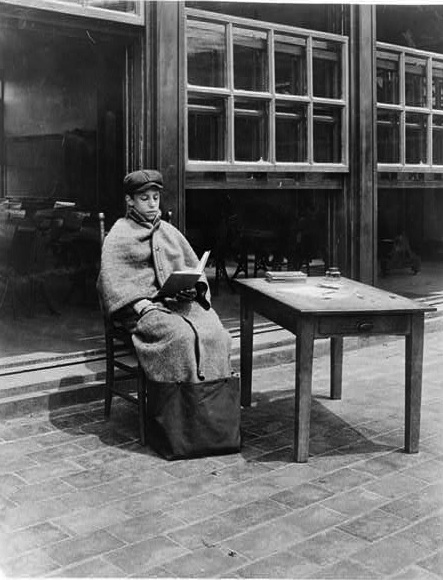
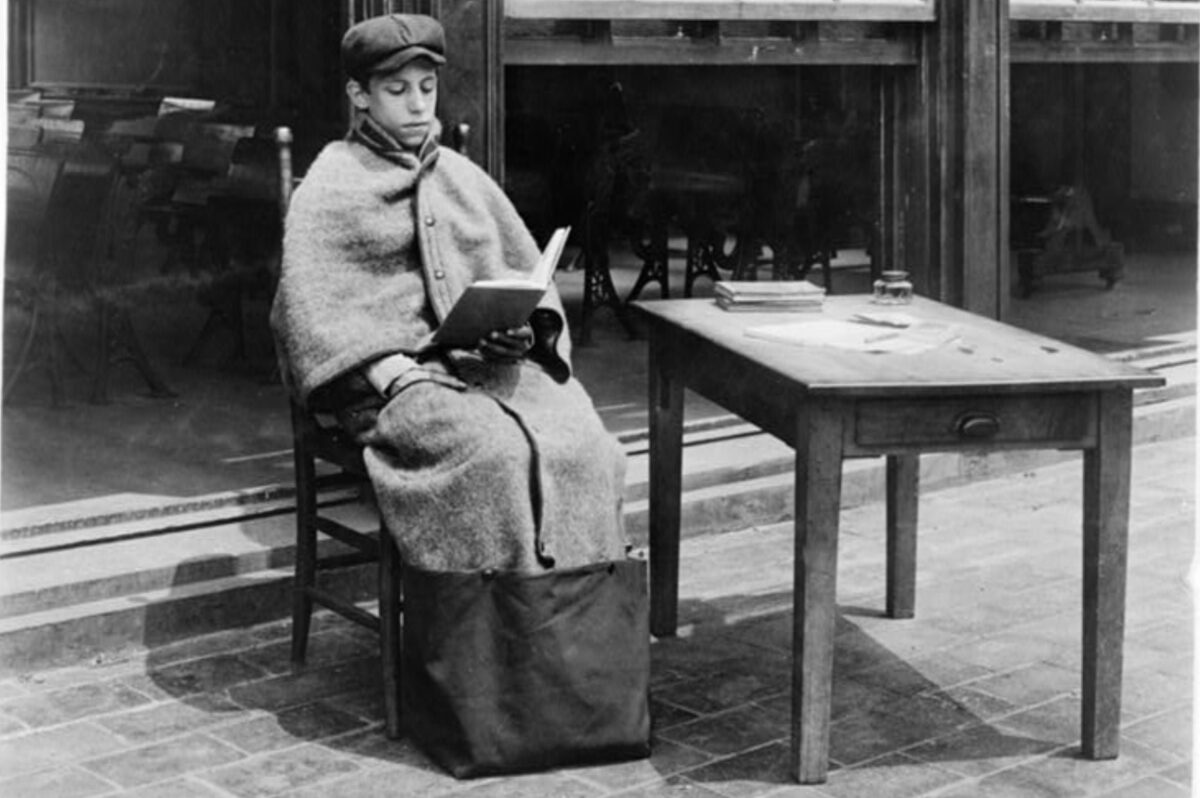
This is a sitting-out bag. No child ever wore one because he wanted to impress his friends.

But this awkward example of outdoor wear was created to save lives and keep students educated during one very concerning health crisis.

Teaching children during perilous moments of disease spread had been a challenge since the invention of public schooling. The educators of the past did not have the option of remote learning. And sometimes the epidemics faced during these moments seemed to specifically target children.

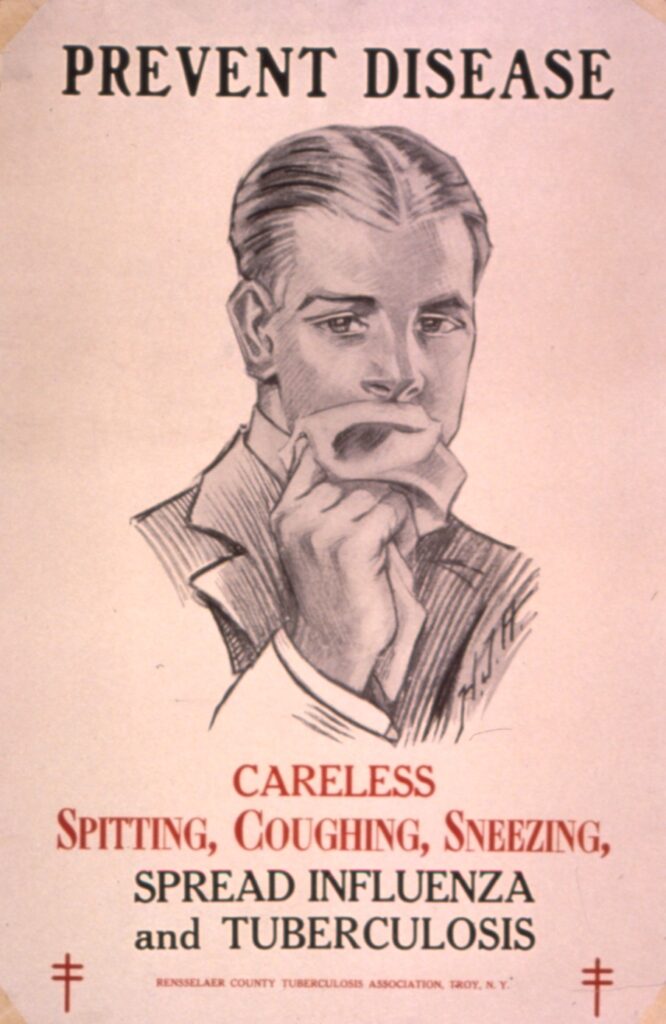
Such was the case of tuberculosis (TB), a constant specter over life in big cities for centuries. Like COVID-19, tuberculosis is spread through aerosol droplets. And like COVID-19, TB is spread through close and continued exposure to an afflicted person.

Tuberculosis was one of the leading causes of death worldwide in the 19th century and would not fully be controlled until the widespread acceptance of vaccines after World War II.

But in densely populated neighborhoods like the Lower East Side, combatting the disease was an uphill battle. Not only were people packed into small spaces, but those spaces were hardly well ventilated.

Where possible, educators chose to heed the advice of experts and hold classes outdoors.

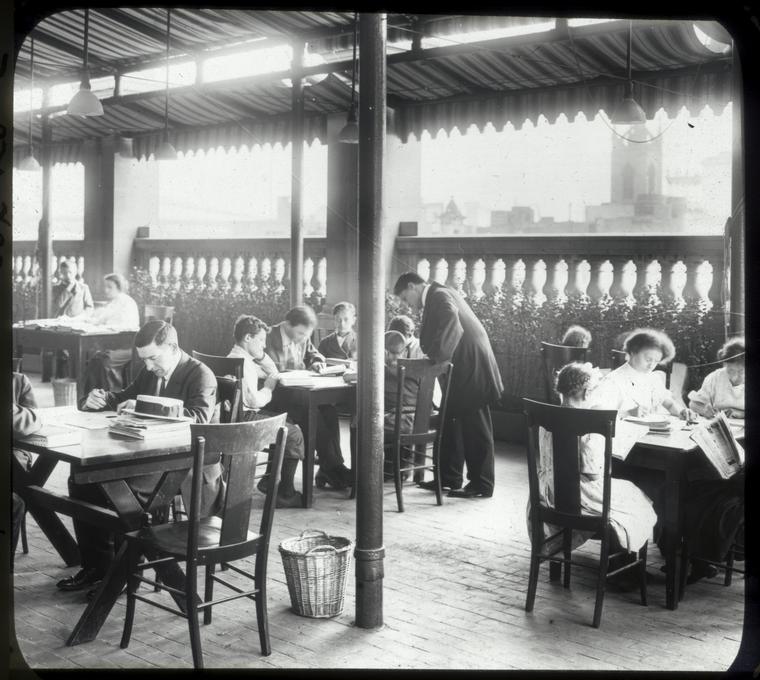
The Seward Park Library opened up its rooftop as a reading room for students, both as a way to beat the heat but also to encourage the flow of air and the prevention of disease. (Courtesy NYPL, date unknown, photographer Lewis Hine)

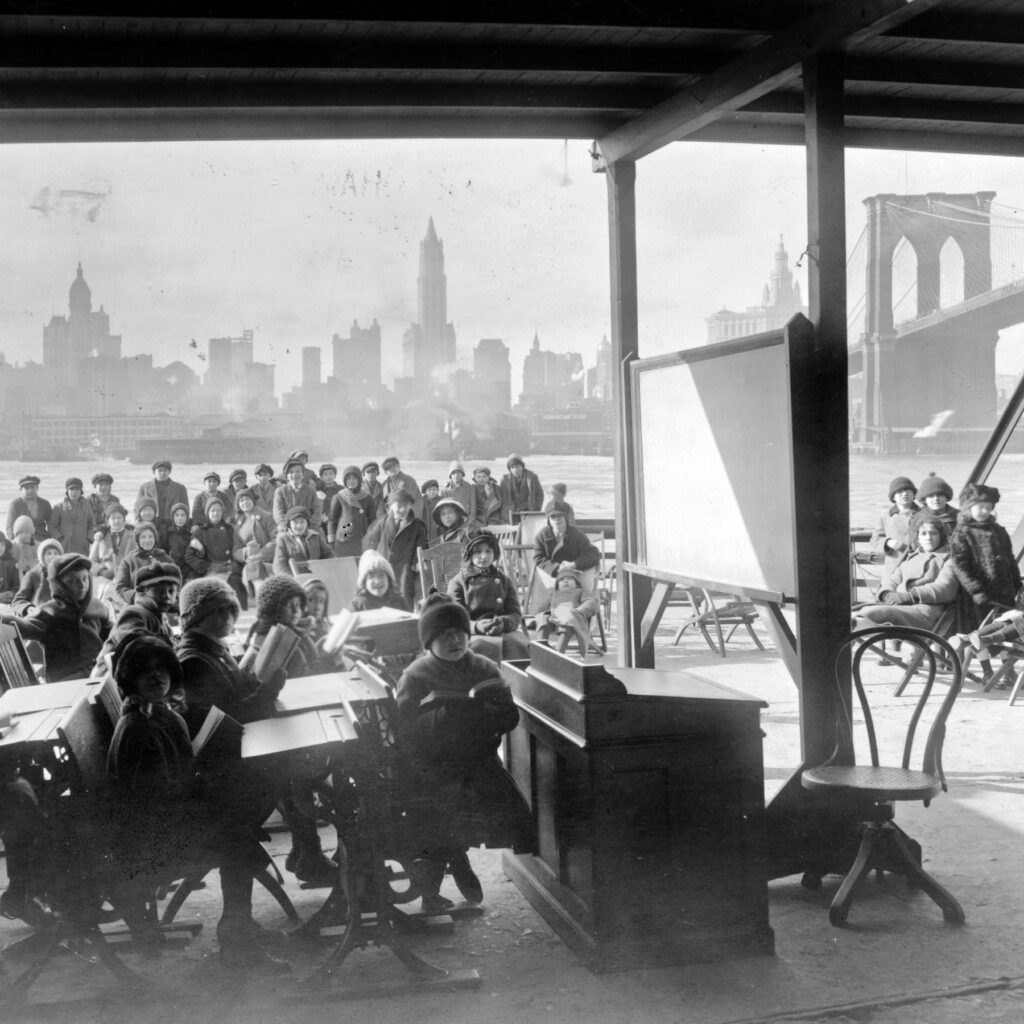
The so-called ‘open air schools’ instructed students in environments with ample ventilation, often on building rooftops or lawns.  

According to a 1916 analysis of the movement, an open-air schoolroom was “fully exposed to the air on one or more sides, providing merely shelter from wind and rain. There is no artificial heating, the temperature of the room always being that of the open air.”

Bureau of Charities, via Library of Congress

The first open-air school in New York opened in 1908 on an “abandoned ferryboat.”  Easily the most notable of New York’s open-air schools — and a model of this unusual form of education — was the Horace Mann School, operated by the Teachers College at Columbia University.

Horace Mann’s students had to meet a certain unfortunate criteria.  “The children who make up the classes were chosen because they were nervous, or irritable, or anaemic, or undernourished.” [source]

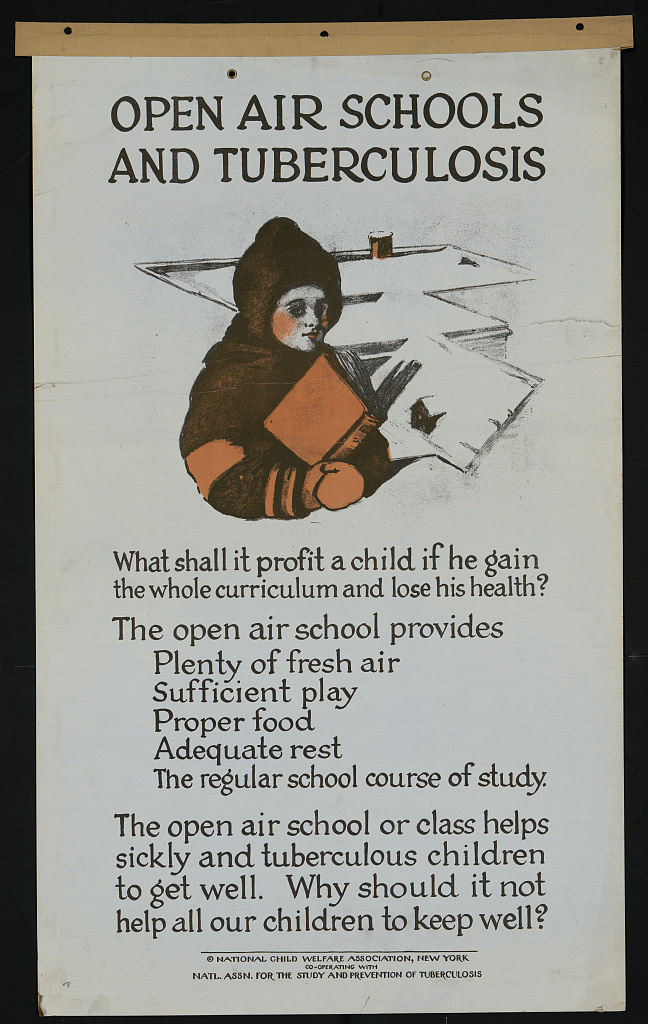
Library of Congress/National Child Welfare Association : Co-operating with Natl. Assn. for the Study and Prevention of Tuberculosis, [between 1920? and 1923?]

But while the open-air school was created for the prevention of one illness, it most likely encouraged another — pneumonia.

And that’s where the sitting-out bag comes in.

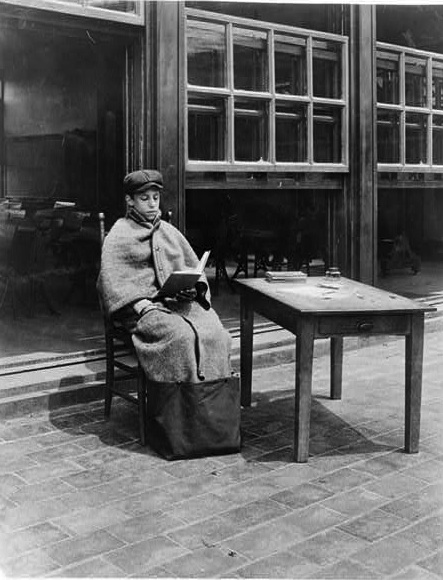
Not cool: “Boy wearing coat with attached bag covering feet, seated at table, outside of classroom, reading, New York City.” Courtesy Library of Congress

The sitting out bag was like a potato sack, a thick sheath of material that allowed the student to study even in freezing temperatures.

The device was basically the sleeping bag for daytime, used to warm the body and keep students alert during open-air classrooms.

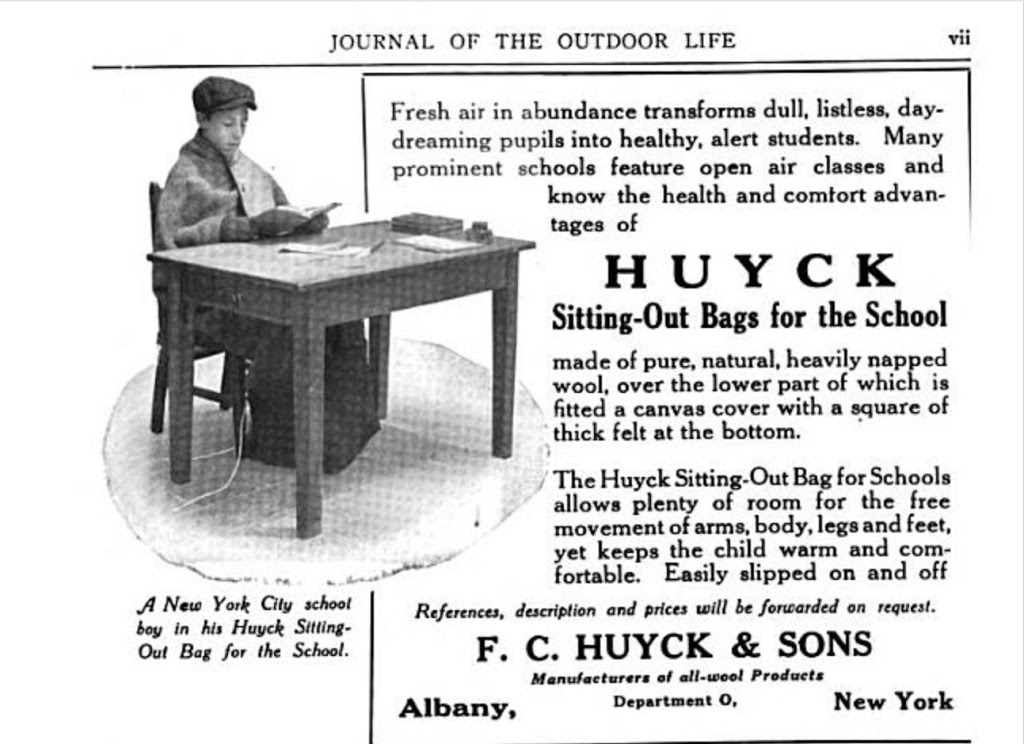
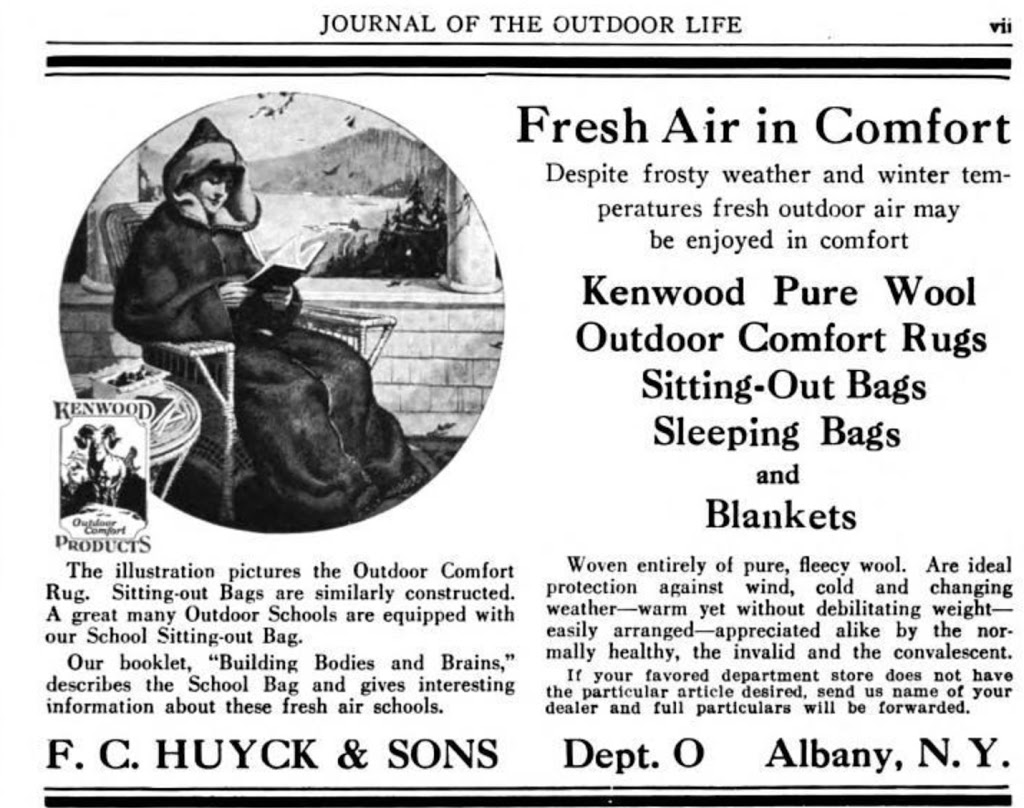
Below: An advertisement promoting “fresh air in abundance” featuring the same boy as above

It was by no means a pleasant ensemble.  One guide to open-air schools described the sitting-out bags as “made of a brown, pliable, hairy, felt-like cloth bound with tape and fitted with snap fasteners.”

Because the sitting-out bags were often used by several students — and reused, over many years — parents were encouraged to make their own sitting-out bags at home for their children.  

As with masks today, parents were encouraged to make their own. An article in a 1910 Survey Magazine offered tips to adults on how to make homemade sitting-out bags. (If you’d like to make your own sitting-out bag, find the instructions here, but you’ll need lots of braid and cotton batting.)

Many sitting-out bags came with hoods, leading to the alarming sight of an entire classroom of hooded children in stiff uncomfortable cocoons.

Below is pictured a hooded version, advertised in the Journal of the Outdoor Life in 1922. A sporting magazine?  Sadly, no. The publisher of this guide to open-air living was the National Tuberculosis Association.

But the sitting-out bag played a small part in keeping children safe during this moment of crisis. Better understanding of the disease and the invention of an effective vaccine would lower the infection rate by mid-century:

“Rates of death from tuberculosis in the United States decreased from 194 per 100,000 persons in 1900 to 40 per 100,000 persons in 1945, in part because the epidemic of tuberculosis in the western world was running its course and in part because of public health initiatives and improved socioeconomic conditions.” [source]

Categories
The Alienist

The harsh lives of New York City street kids, captured — in a flash — by Jacob Riis

HISTORY BEHIND THE SCENE What’s the real story behind that historical scene from your favorite TV show or feature film? A semi-regular feature on the Bowery Boys blog, we will be reviving this series as we follow along with TNT’s limited series The Alienist. Look for other articles here about other historically themed television shows (Mad MenThe KnickThe DeuceBoardwalk Empire and Copper). And follow along with the Bowery Boys on Twitter at @boweryboys for more historical context of your favorite shows. 

Look near the very end of the fourth episode of The Alienist, and you’ll see a surprising homage to an iconic, heartbreaking photograph.

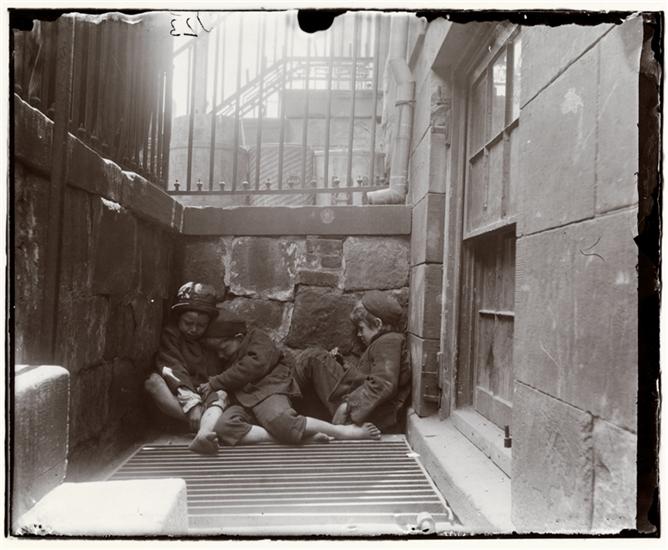
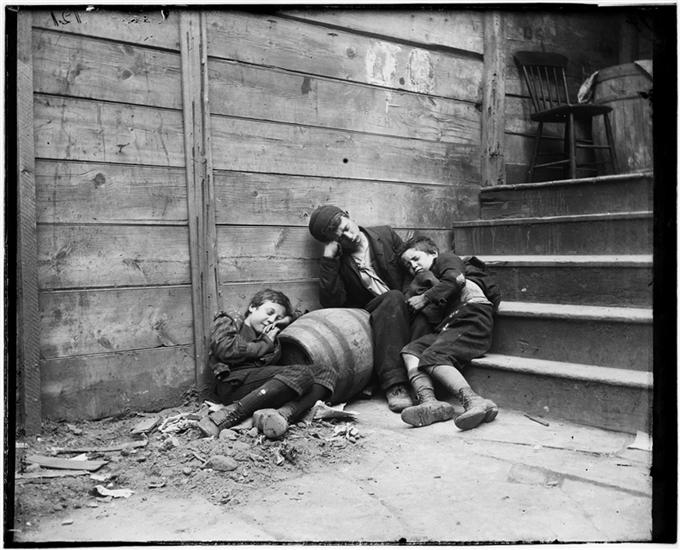
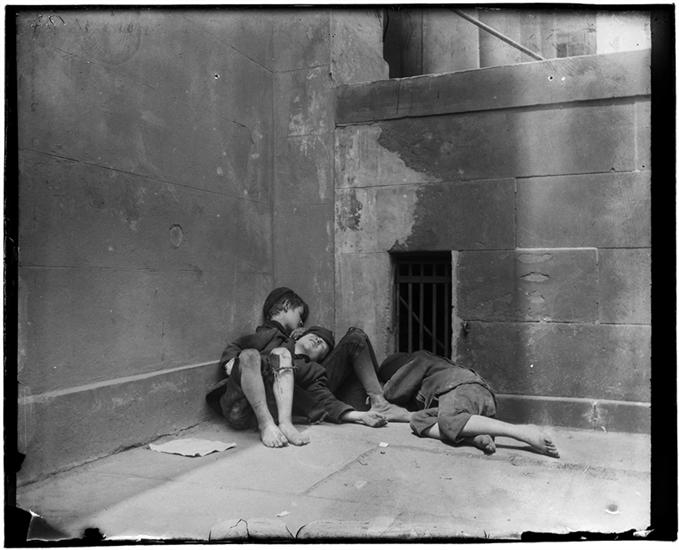
Called ‘Street Arabs in the Area of Mulberry Street‘, the image, taken in 1889, depicts three homeless boys sleeping over a heated vent on the bottom floor of a tenement (in the area of today’s Little Italy).

MCNY

Their names are unknown. In the late 19th century, hundreds of children lived on the streets of New York, turned out of their homes or separated from their loved ones. Many actually did have loving families but living conditions in the tenements were so squalid that some chose to sleep on the street.

We have this image — and many, many similar ones — thanks to journalist and social reformer Jacob Riis.

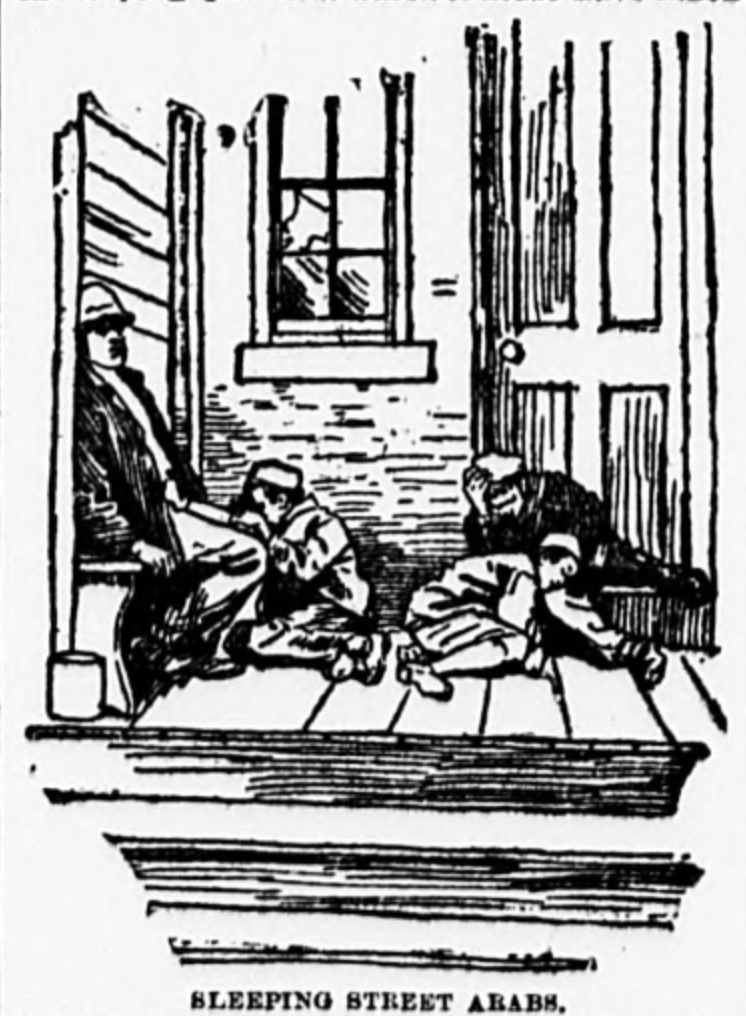
On February 12, 1888, Jacob Riis published his first investigation for the New York Sun, revealing the wretched conditions of New York’s worst slum neighborhoods by employing an experimental technology — flash photography. The startling pictures, by Riis and a team of other photographers, were at first rendered in line drawings, but the effect was nevertheless profound.

The entire article is available online but here’s the passage pertinent to the photograph above:

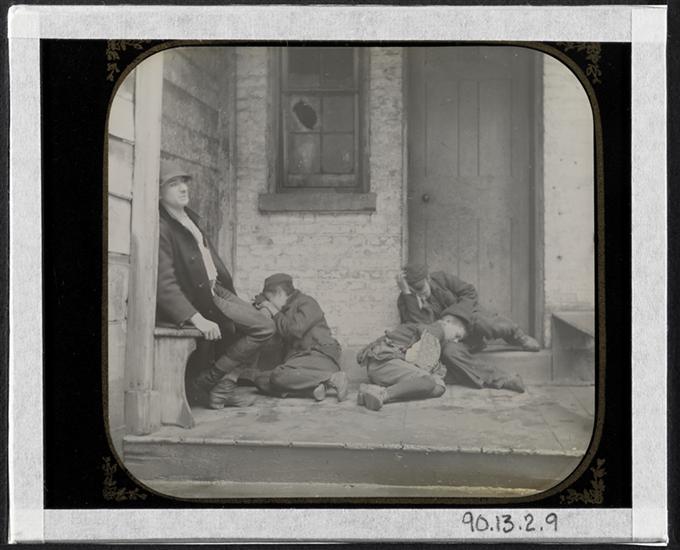
Another outcropping of the benevolent purpose of Mr. Riis … is his showing of a touching picture of street Arabs in sleeping quarters which it must have taken a hunt to discover. These youngers have evidently spent their lodging money for gallery seats at the show and have found shelter on the back stoop of an old tenement house.” 

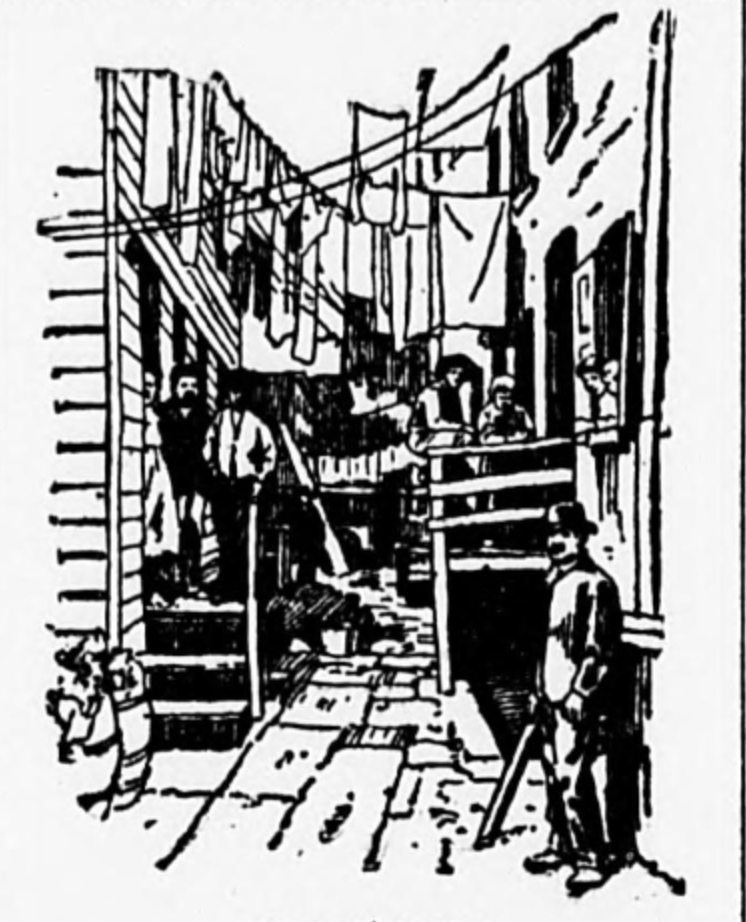
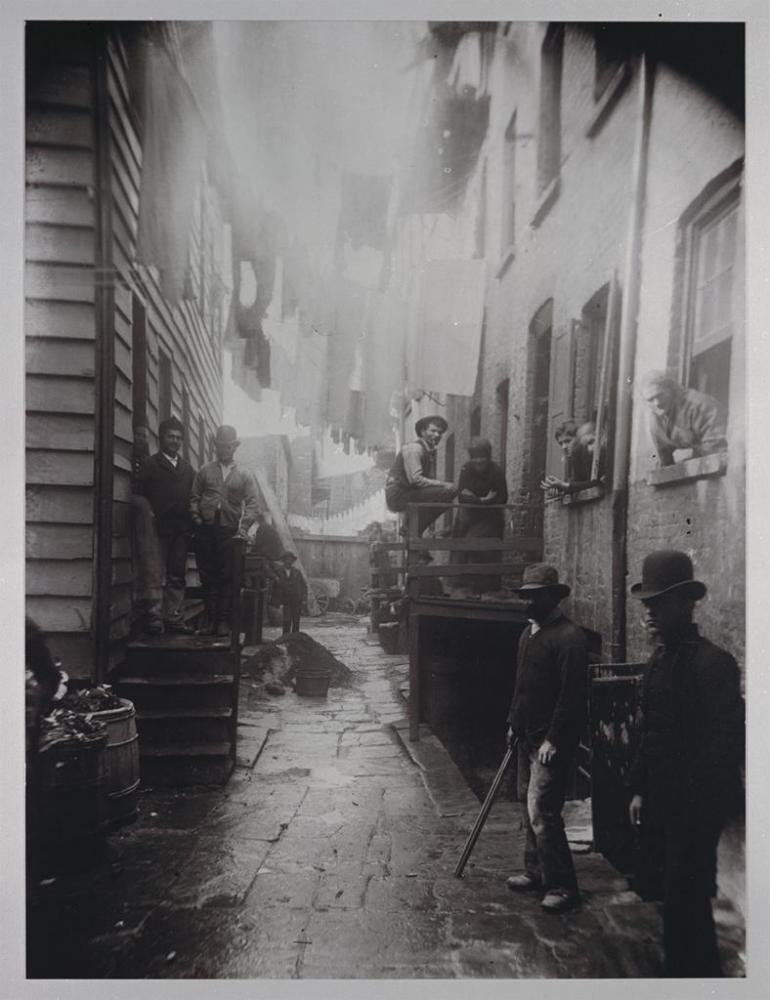
Below: An illustration from the Feb. 12, 1888, newspaper, and the Riis photograph (of Bandit’s Roost) that it represents.

The pictures are more than social activism; they’re history themselves, the first flash photography ever to be used in this fashion. Riis was showing New Yorkers a vivid glimpse of poverty — orphans in the gutter, street gangs in the alleyway — using a technique that few were regularly exposed to apart from portraiture.

Riis never considered himself a professional photographer. Later in his career, he even farmed out the photographic work to others as he focused on writing and social activism. And yet modern photojournalism wouldn’t really be what it was today without his first forays into slums, opium dens and beer halls with his bulky and costly equipment. His early work influenced an entire field of social photographers seeking to prove the adage “a picture is worth a thousand words” (a phrase which debuted near the end of Riis’ lifetime).

MCNY

His work would eventually be published as a book in 1890 — How The Other Half Lives: Studies Among the Tenements of New York — and Riis would spend the decade virtually proselytizing on behalf of the city’s needy.

In that book, he expounds upon the plight of the ‘street Arab’, aka street urchin.

“They are to be found all over the city, these Street Arabs, where the neighborhood offers a chance of picking up a living in the daytime and of “turning in” at night with a promise of security from surprise. In warm weather a truck in the street, a convenient out-house, or a dug-out in a hay-barge at the wharf make good bunks. Two were found making their nest once in the end of a big iron pipe up by the Harlem Bridge, and an old boiler at the East River served as an elegant flat for another couple.”

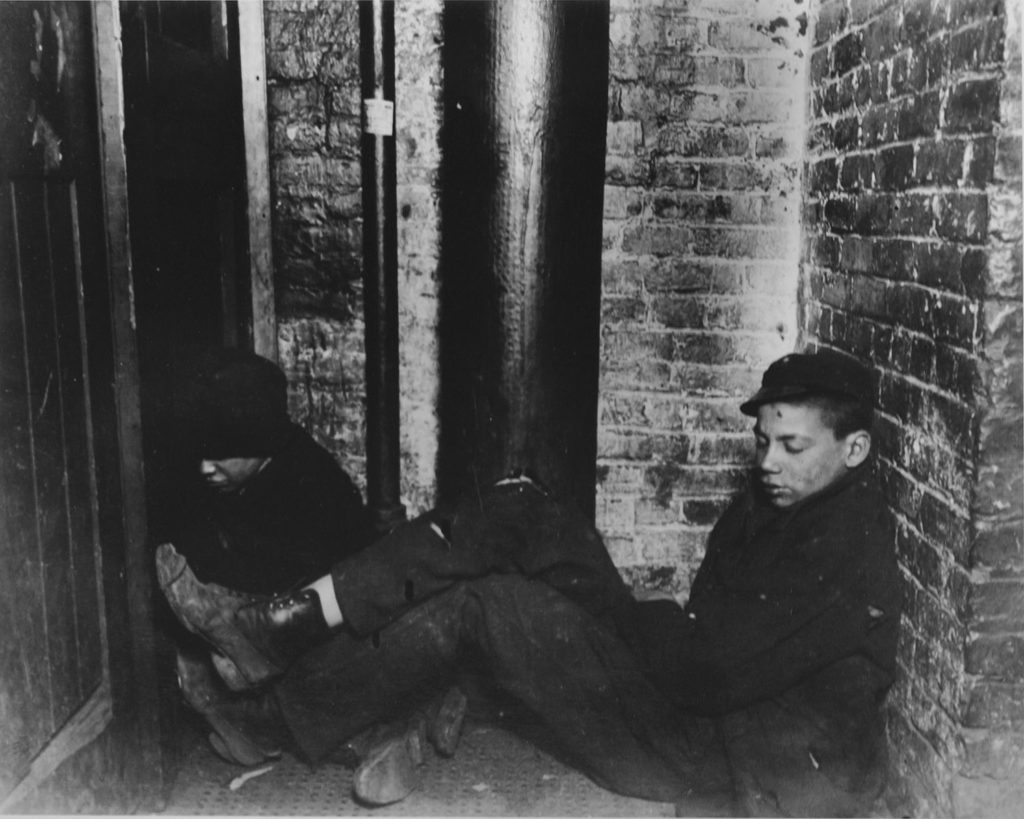
Below: Two boys asleep at 2 a.m. in the press room of the New York Sun newspaper.

Most street kids are newspaper boys or bootblacks, fighting for scraps and a few pennies. In another section, Riis writes:

“We wuz six,” said an urchin of twelve or thirteen I came across in the Newsboys’ Lodging House, “and we ain’t got no father. Some on us had to go.” And so he went, to make a living by blacking boots. The going is easy enough. There is very little to hold the boy who has never known anything but a home in a tenement. Very soon the wild life in the streets holds him fast, and thenceforward by his own effort there is no escape. Left alone to himself, he soon enough finds a place in the police books, and there would be no other answer to the second question: “what becomes of the boy?” than that given by the criminal courts every day in the week.”

“Didn’t live nowhere.” MCNY

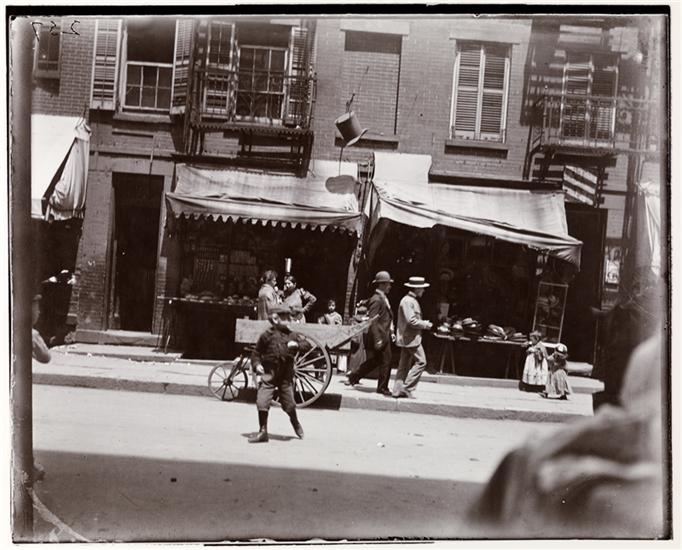
Below are more pictures of children on the streets of New York City in the late 1880s and early 1890s, taken by Riis and his associates, courtesy the Museum of the City of New York.

MCNY

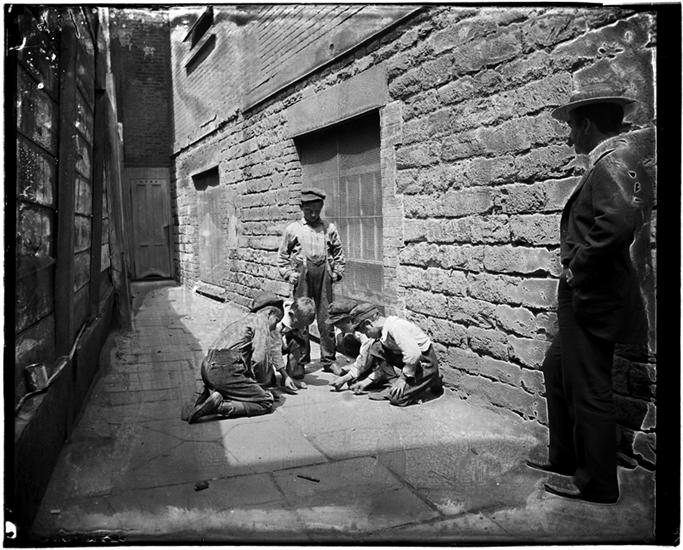
“Shooting Craps: The Game of the Street,” Bootblacks and Newsboys, 1894″ MCNY
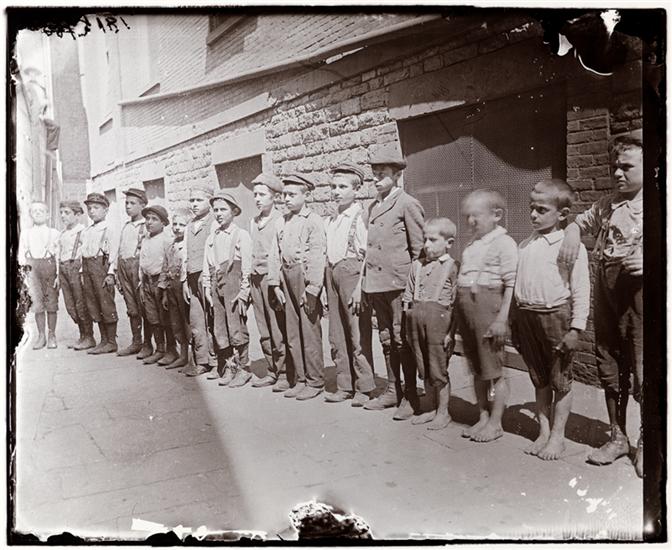
A line-up of boys in a Mulberry Street alley. 1890, MCNY
A young boy holding a baby, a woman reaches for them. 1890, MCNY
1890, MCNY
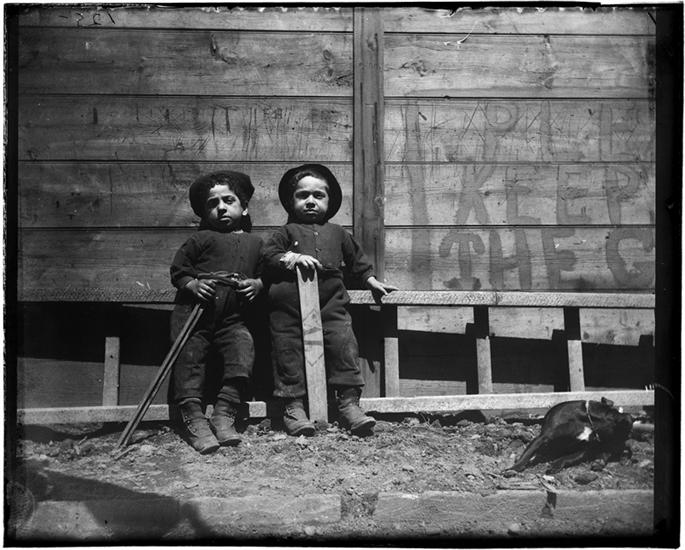
The Mott Street Boys, “Keep off the Grass”. 1890. MCNY

This article excerpts a portion of our review of the Museum of the City of New York’s 2015 exhibition on Riis.

Categories
Museums

Photographs of wonder from the American Museum of Natural History

One hundred years ago, the American Museum of Natural History received a massive visitor, one so mighty that the doors of the museum’s delivery room “had to be removed and [the] partition openings enlarged” in order to accommodate it.

Was it a dinosaur? A meteorite? Perhaps the remains of a great whale?

No, the new visitor was a bush chrysanthemum,  with over 1,500 blooms, 17 feet in diameter, wider, the New York Times notes, than the largest meteorite on the property.

The massive plant, grown north of the city at Ardsley-on-Hudson, was the star of an impressive plant and flower show at the museum with thousands of chrysanthemums and a so-called ‘rose gorgeous’ which “changes color as it opens.

While looking for a picture of this notable flower, I stumbled into something equally as magical — the American Museum of Natural History digital library of images.  While I never found the flower, I did find some stunning and lovely images of visitors and students enjoying the museum in its early days.

What is it about old museum pictures that I find so interesting? Most of the exhibits would today be considered politically incorrect, and modern advances have improved our knowledge about many of the objects being pictures. But the faces filled with wonder and imagination could be taken from museum images today.

So enjoy these pictures and visit the archives to view more:

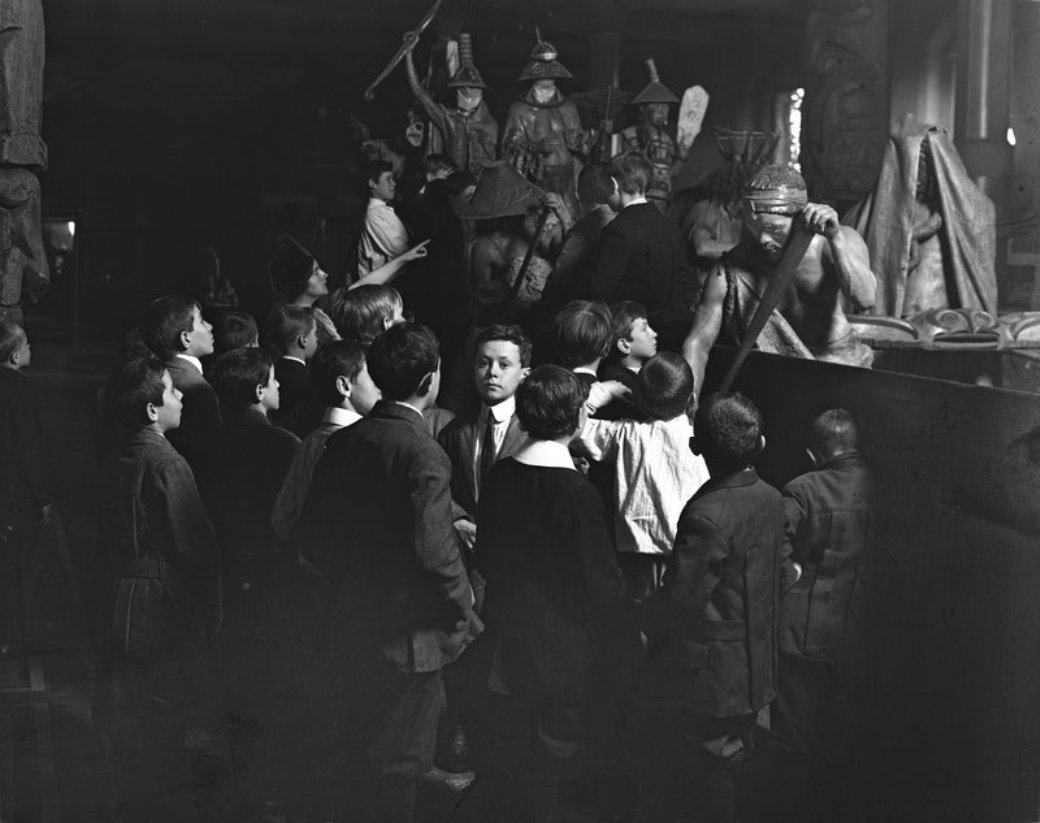
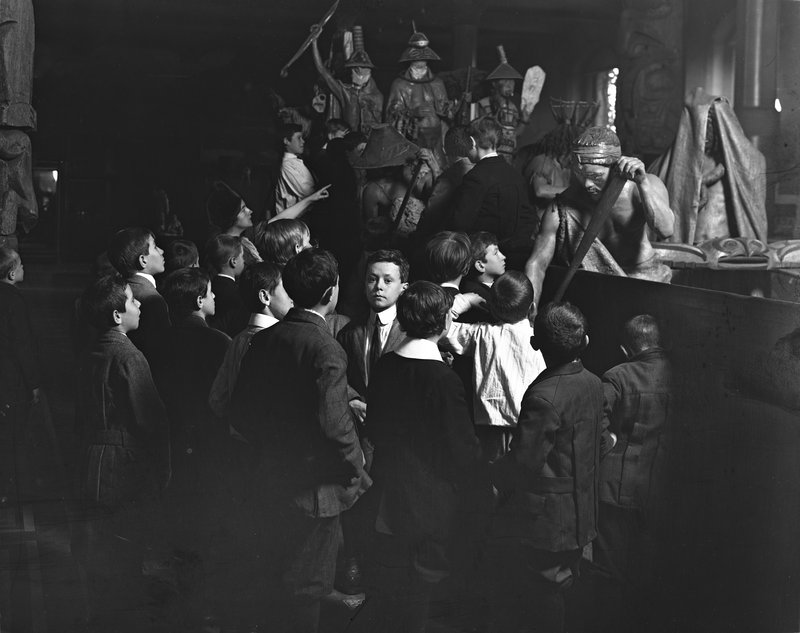
School children viewing Indian canoe exhibit, 1911:

 Julius Kirschner, courtesy AMNH
Julius Kirschner, courtesy AMNH


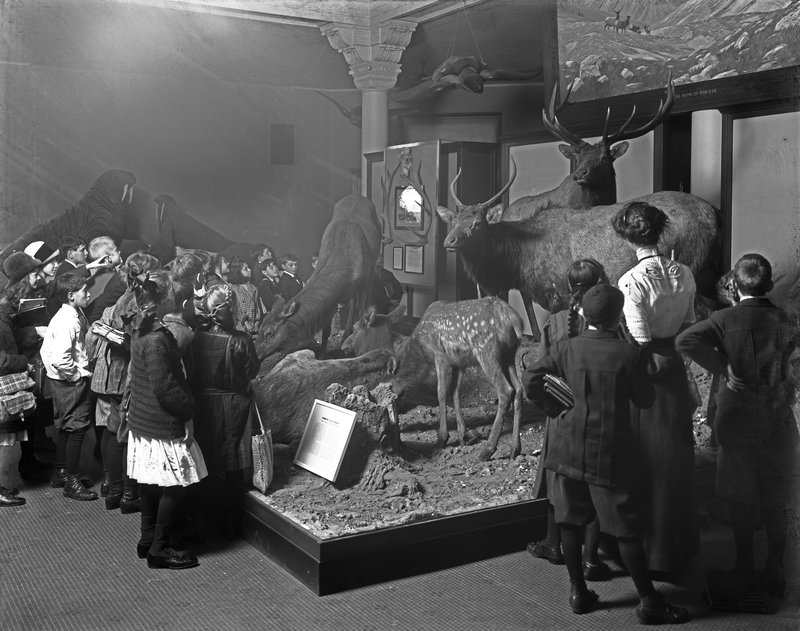
Students and teacher at a mammal display, October 1911

2007 METRO Project | ImageDigitizationSpecifications v1.0 | Epson Perfection V750 Pro
Julius Kirschner, courtesy AMNH


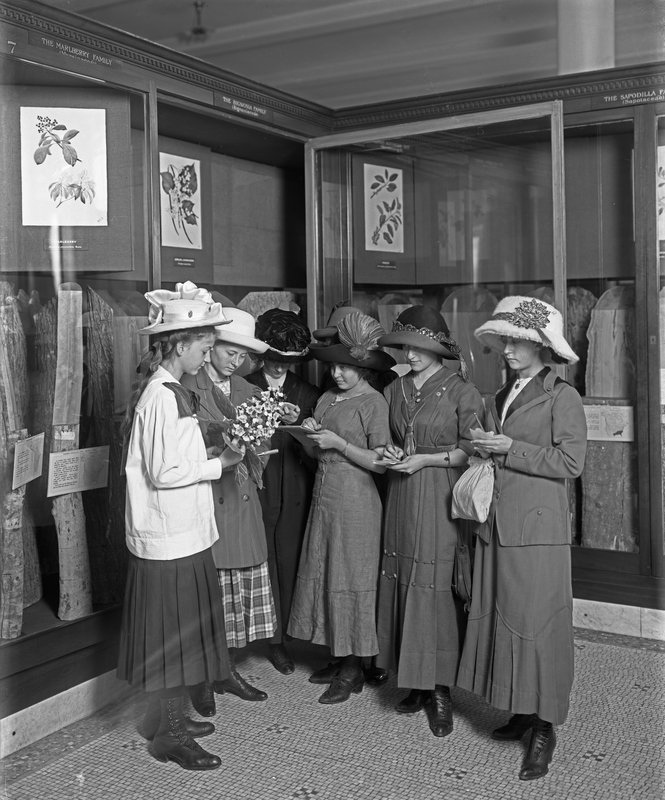
Young ladies in Forestry Hall, October 1911

Julius Kirschner, courtesy AMNH


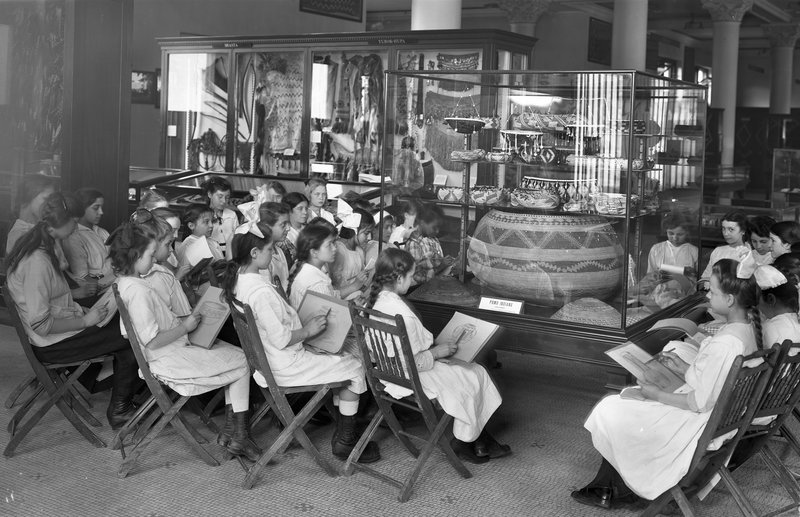
Schoolgirls from Public School 94 drawing items on display in Southwest Indian Hall, May 1916

Julius Kershner, courtesy AMNH


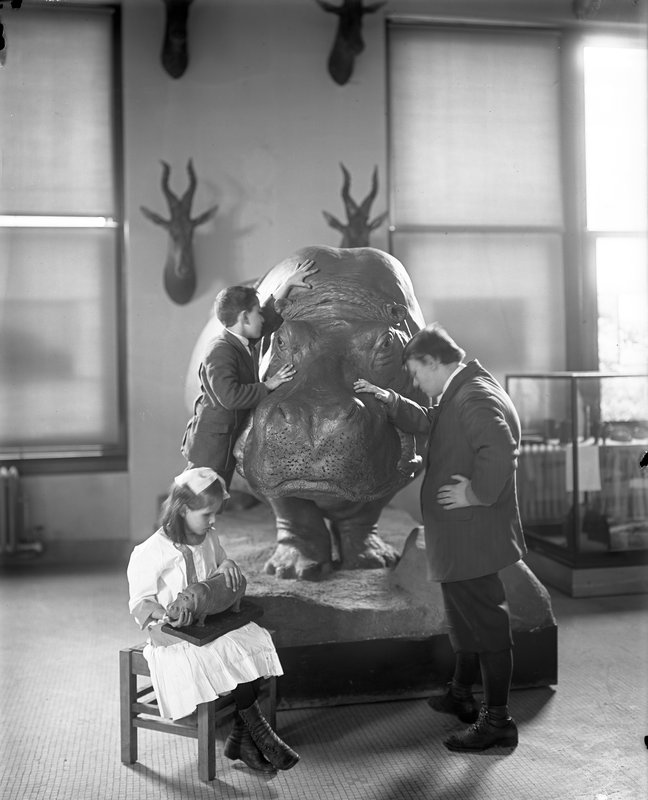
Blind children studying the hippopotamus, May 1914

Julius Kershner, courtesy AMNH


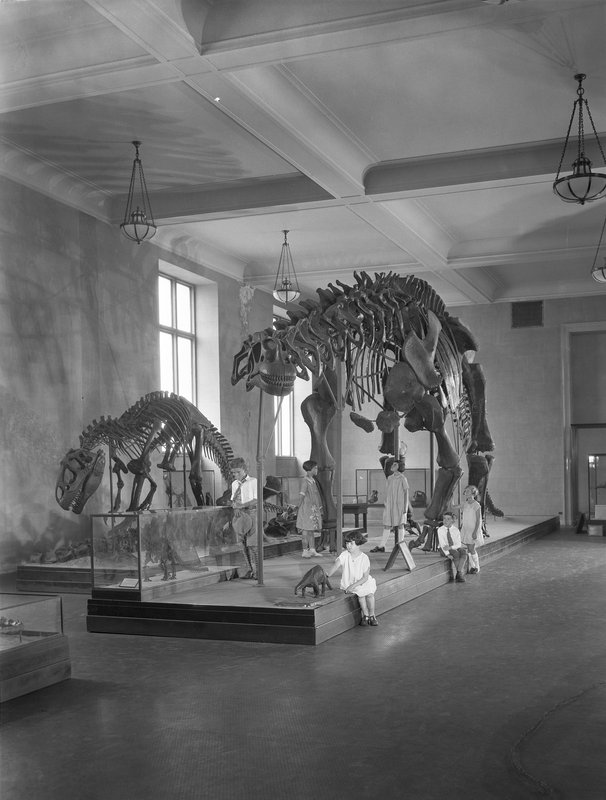
Kids in Dinosaur Hall, July 1927

Courtesty Irving Dutcher, courtesy AMNH


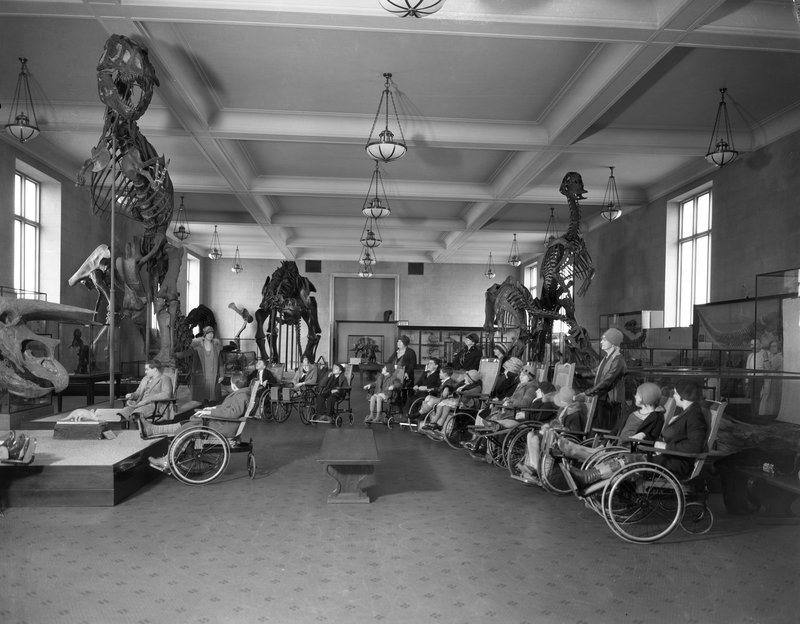
More students in Dinosaur Hall, this time in December 1929

Julius Kirschner, courtesy AMNH


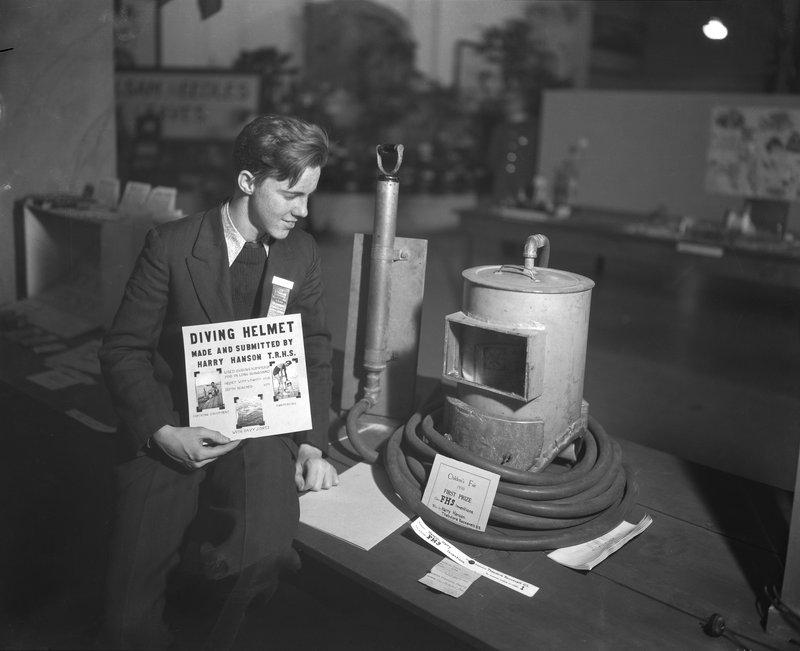
Diving helmet made and submitted by Harry Hanson of Theodore Roosevelt High School, Children’s Fair, December 1930

Julius Kirshner, courtesy AMNH


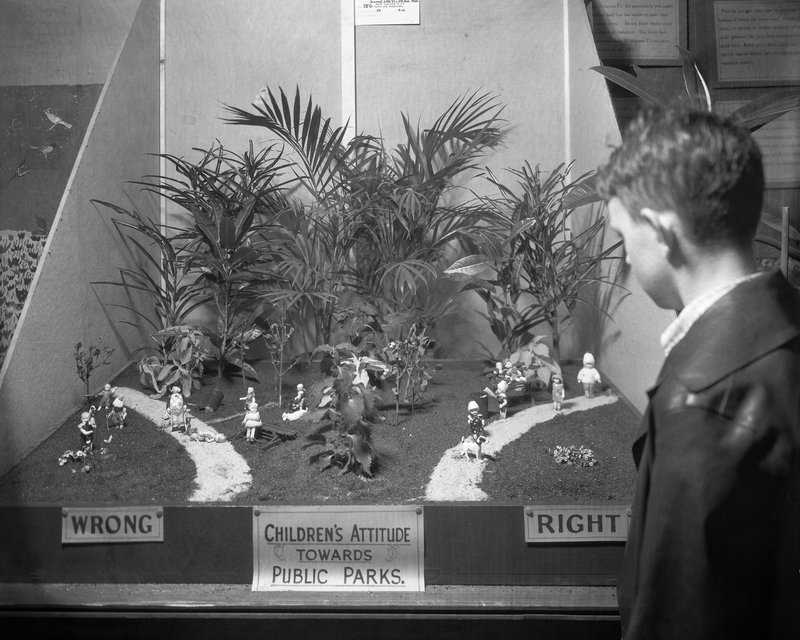
How to do parks the right way! A boy views a display showing Children’s Attitude Toward Public Parks at the Children’s Fair, December 1931

Julius Kirshner, courtesy AMNH


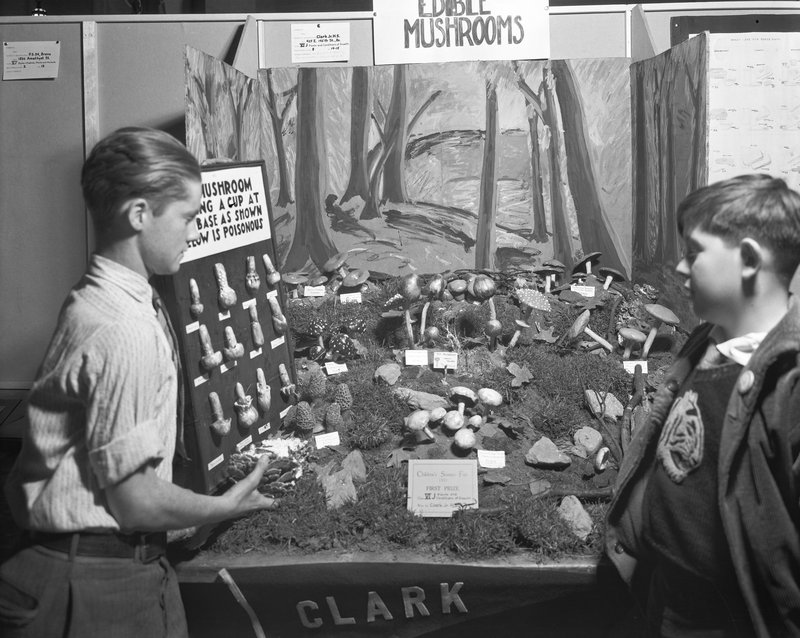
Good advice for campers! Boys viewing display showing Edible Mushrooms at the Children’s Fair, December 1931

Julius Kirshner, courtesy AMNH


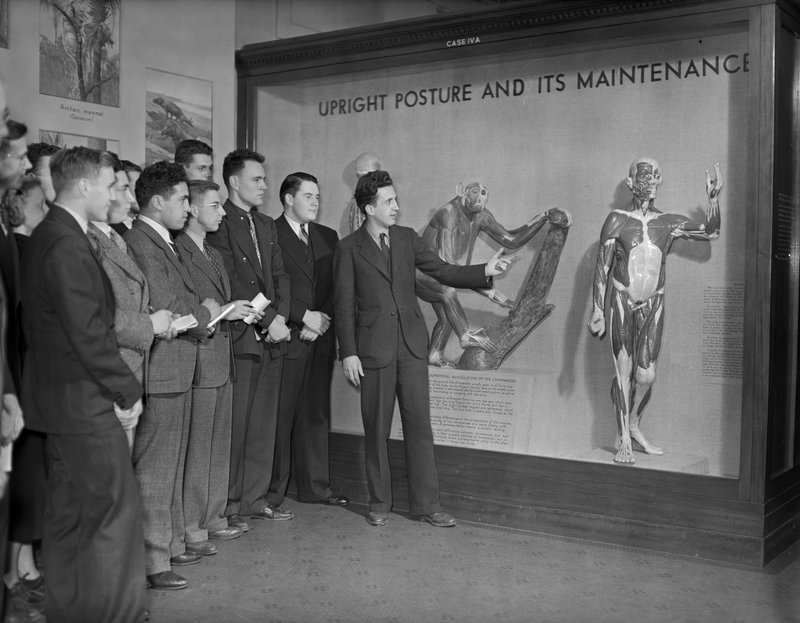
Students on guided tour of the Natural History of Man, December 1937

Photo by Charles Coles, courtesy AMNH


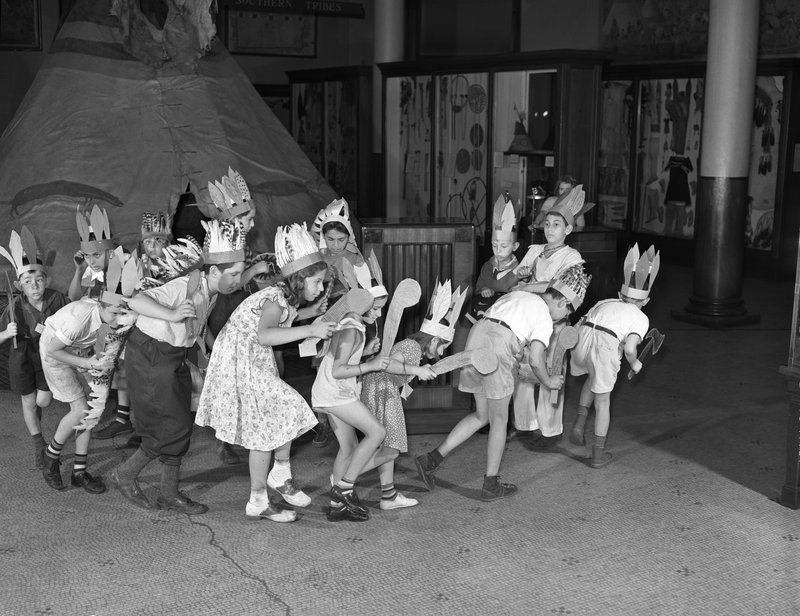
Children doing Native American dances in the Plains Indians Hall, July 1939

Photography by Thane L. Bierwert, Courtesy AMNH


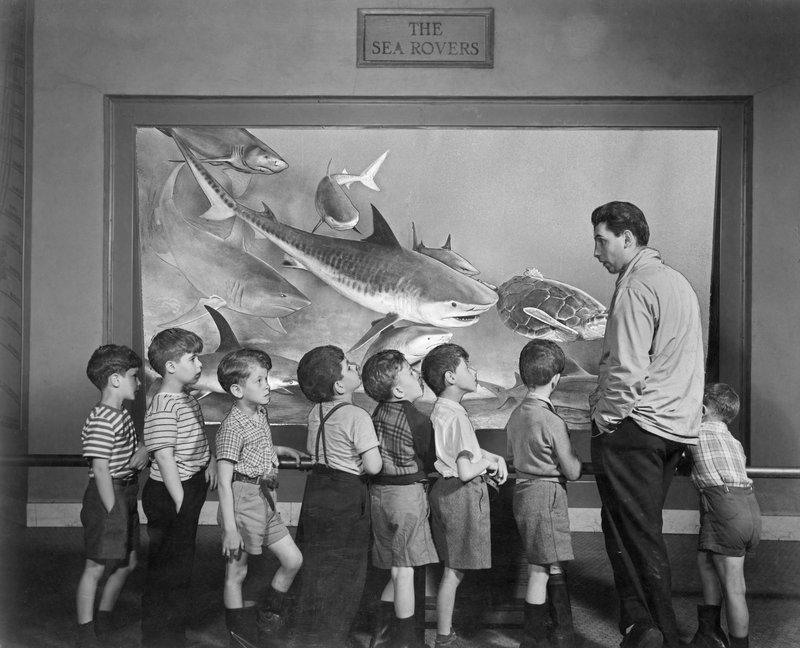
Kids have loved sharks for decades. Here’s a picture from the Sea Rovers display, Hall of Fishes, 1948

Thane Bierwert, courtesy AMNH


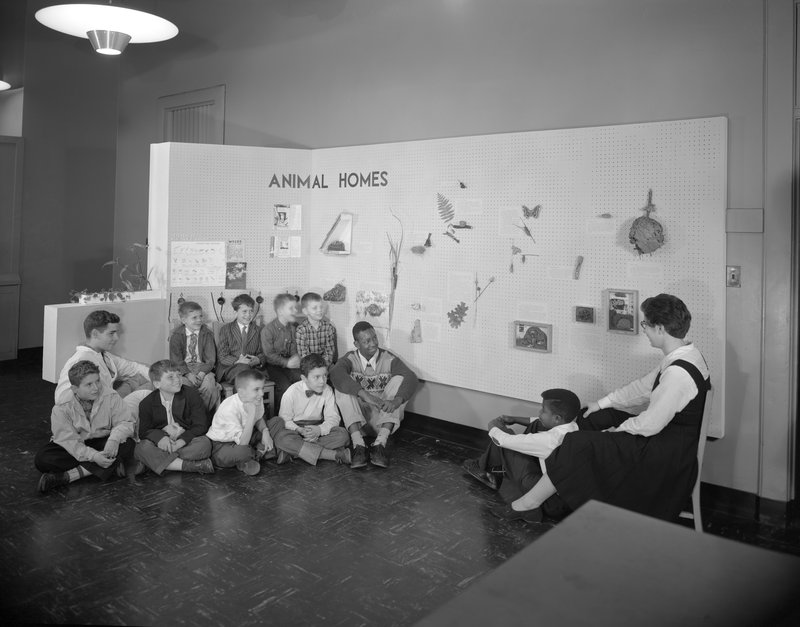
October 1957 — A group of children receiving instruction at the Natural Science Center

Morton Yourow, courtesy AMNH


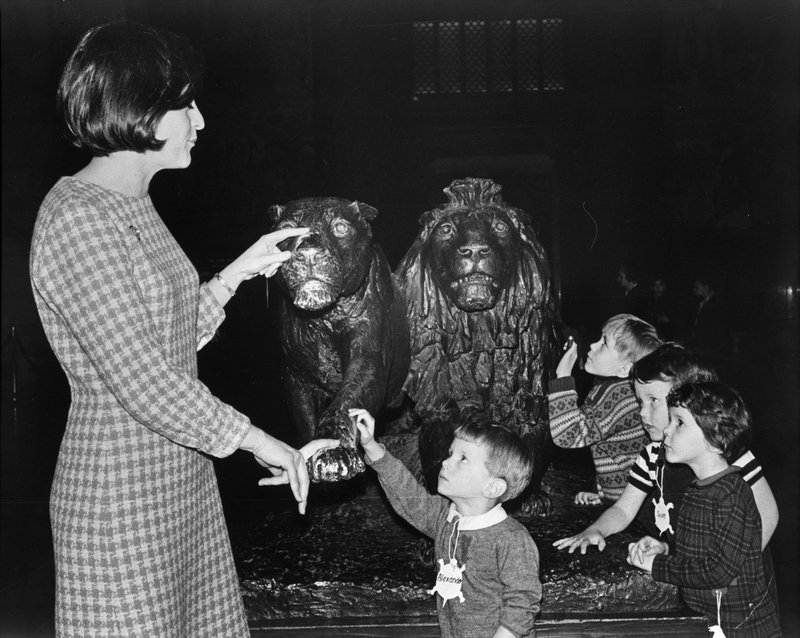
Children viewing bronze lions in Akeley African Hall, 1965

Photo New York Times, courtesy AMNH


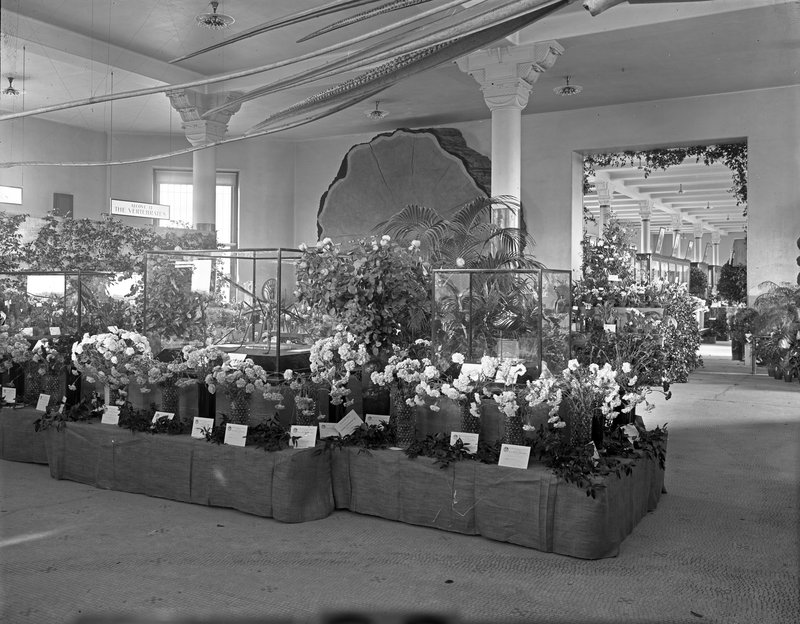
I never did find that historic chrysanthemum but the exhibition would have looked like this one from the Fall Exhibition of the Horticultural Society of New York, November 17-20, 1908.

32145.tif
Photo by Thomas Lunt, courtesy American Museum of Natural History

Categories
American History

Life in New York City 1935-1945: Heavenly images from Yale University

Yale University has sprung a beautiful present onto the Internet — a searchable database of over 170,000 public-domain photographs created by the United States Farm Security Administration and Office of War Information, documenting the aftermath of America of the Great Depression and World War II. The photos, dating from between the years 1935 to 1945, include of the greatest American photographers from the period (such as Gordon Parks, Walker Evans and Dorothea Lange).

These images aren’t really new; they’ve been available at the Library of Congress for many years. I’ve even ran a couple of these on the blog before.  But Yale has done an outstanding job of sorting and cataloging. Their site even comes with a map if you want to look at images from a particular area of the country.

Take a look at this particular images from New York City during this period, then head over to the database and lose yourself inside these captivating, sometimes harrowing pictures. Thank you Yale!


3

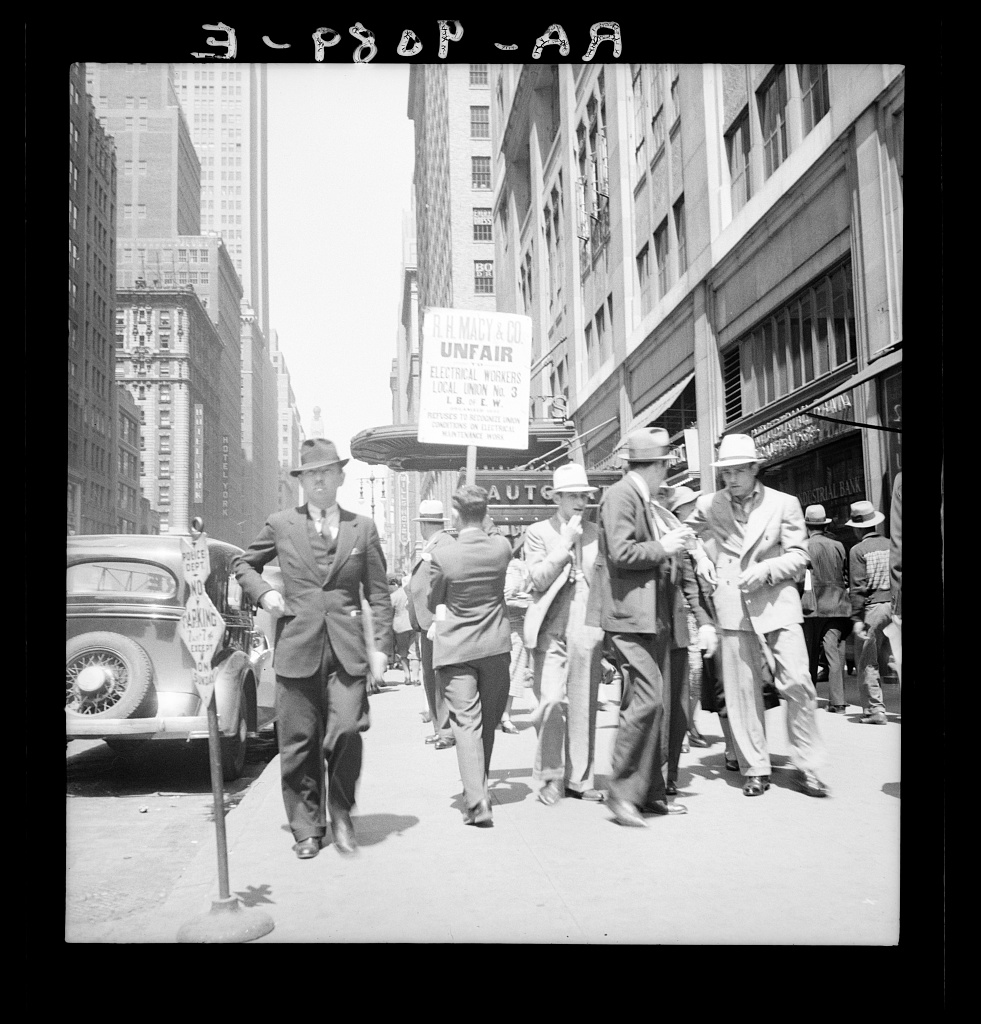
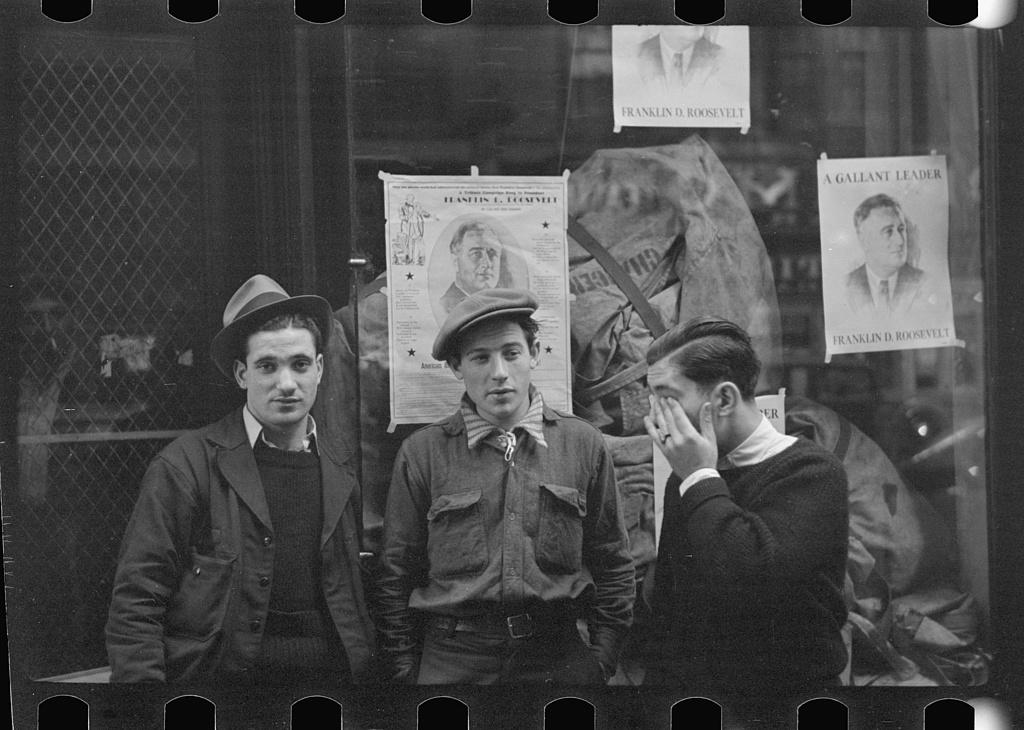
June 1936 “New York street scene: striking in front of Macy’s” Photographer Dorothea Lange


4

November 1936 “Street scene at 38th Street and 7th Avenue” Photographer Russell Lee


5

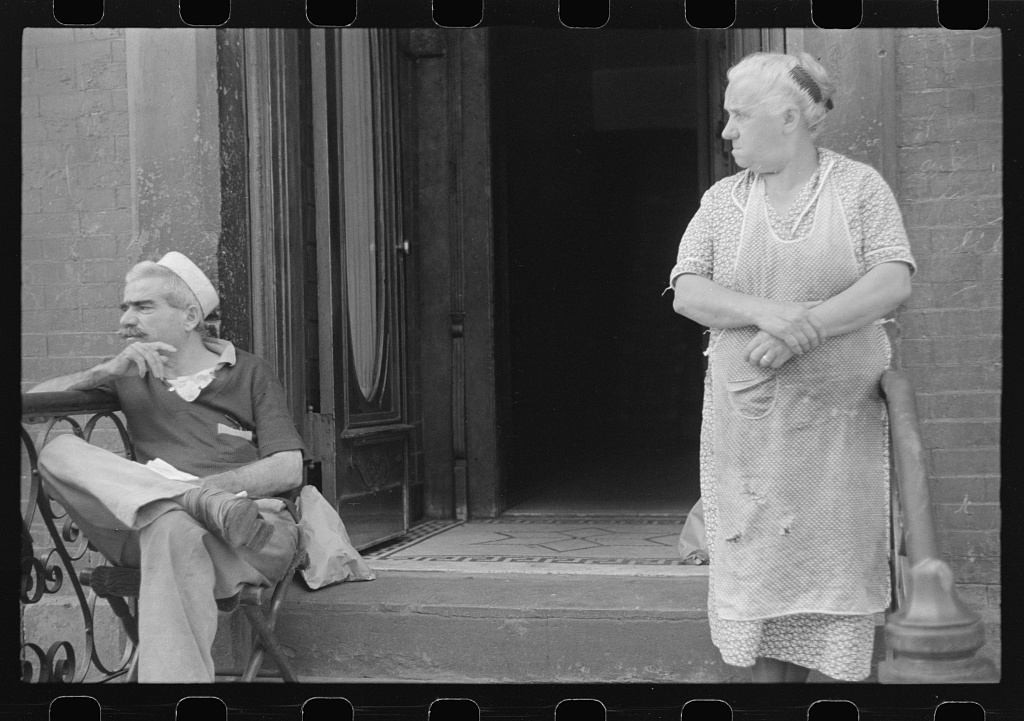
1938 “New York, New York. 61st Street between 1st and 3rd Avenues. Tenants” Photographs by Walker Evans


6

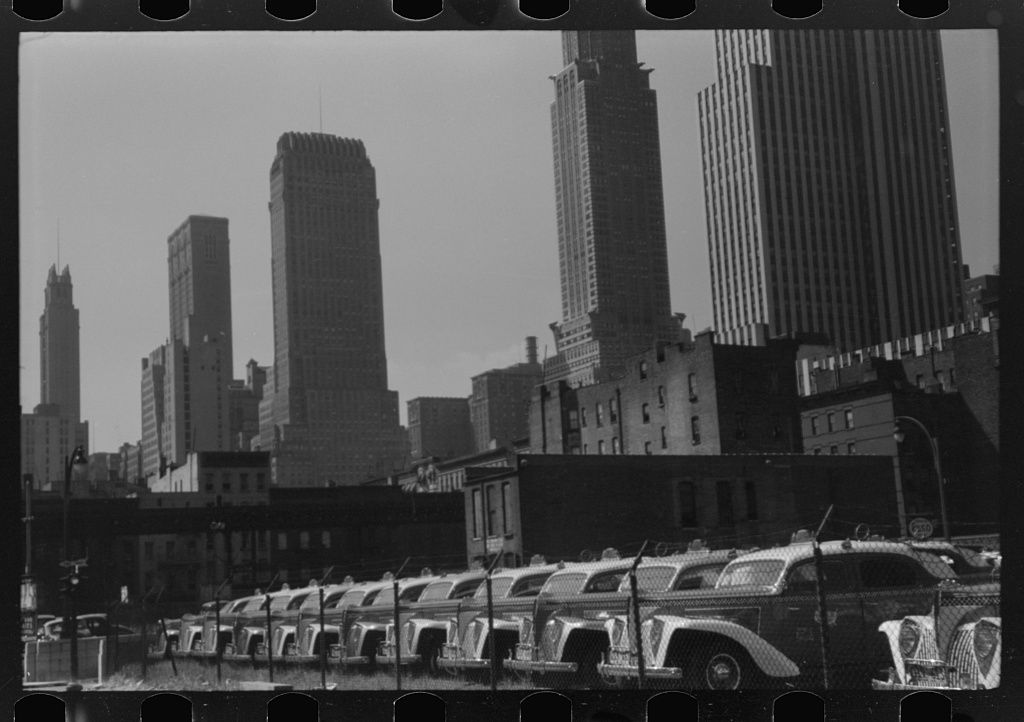
1938 Photographer Jack Allison (no caption on photo)


7

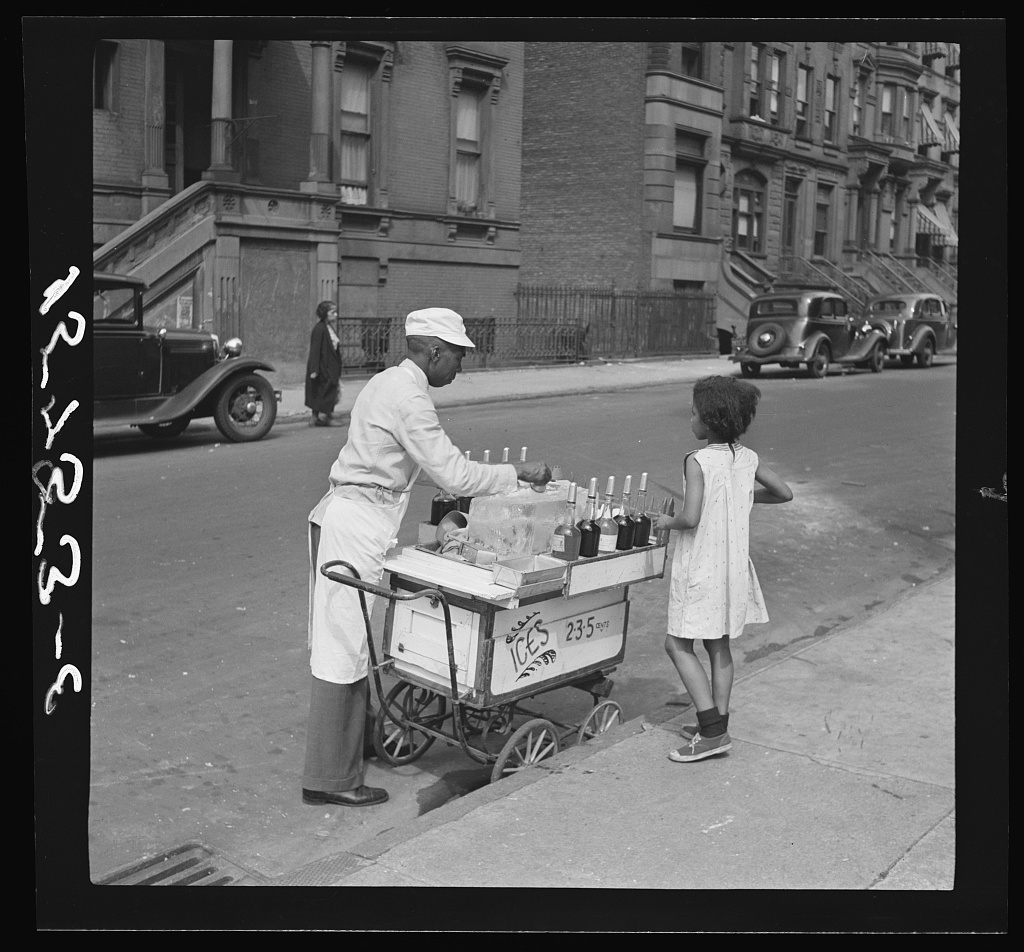
June 1941 New York City, East Side, Sunday morning, photographer Marion Post Walcott


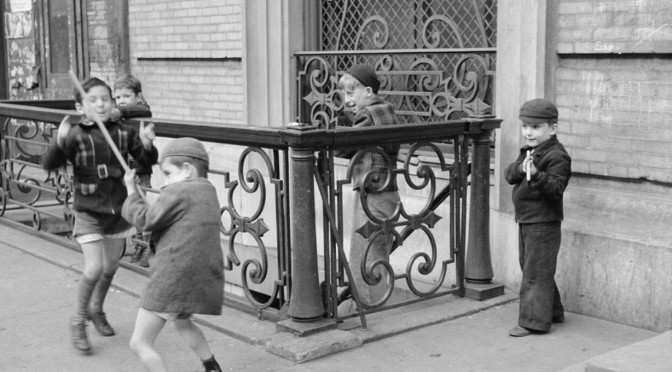
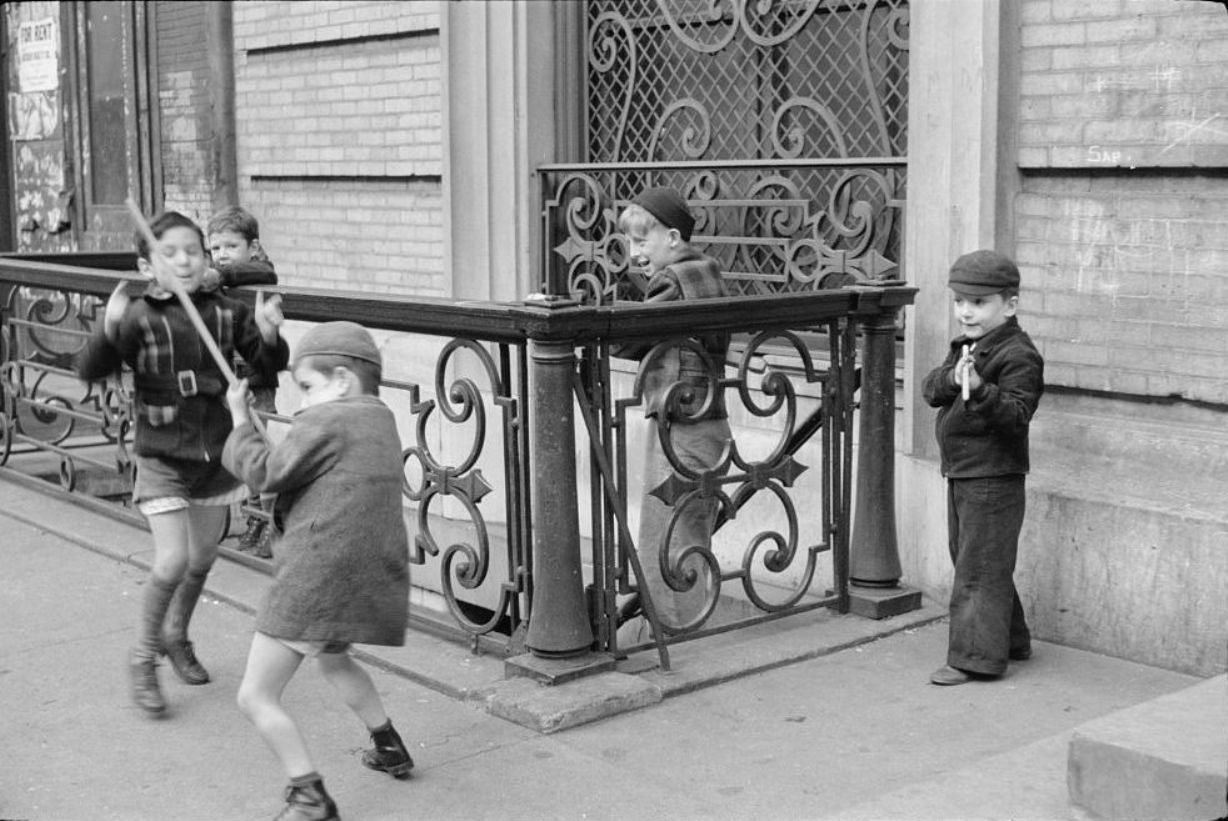
picDecember 1941 :Children playing, New York City: Photographer Arthur Rothstein


1

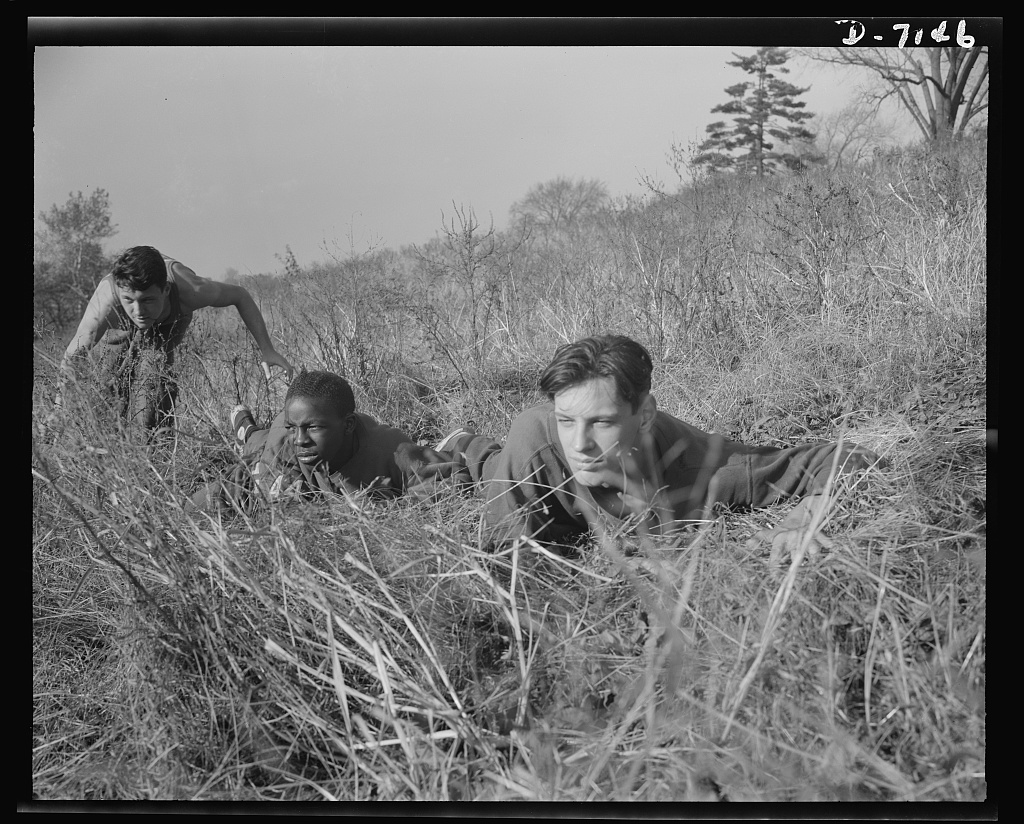
October 1942 “High school Victory Corps. Learning the rudiments of advancing on an enemy will prove valuable to these boys if they are called to join their older brothers in the armed forces. This is part of the “commando” training given in physical education courses at Flushing High School, Queens, New York” Photographer William Perlitch


2

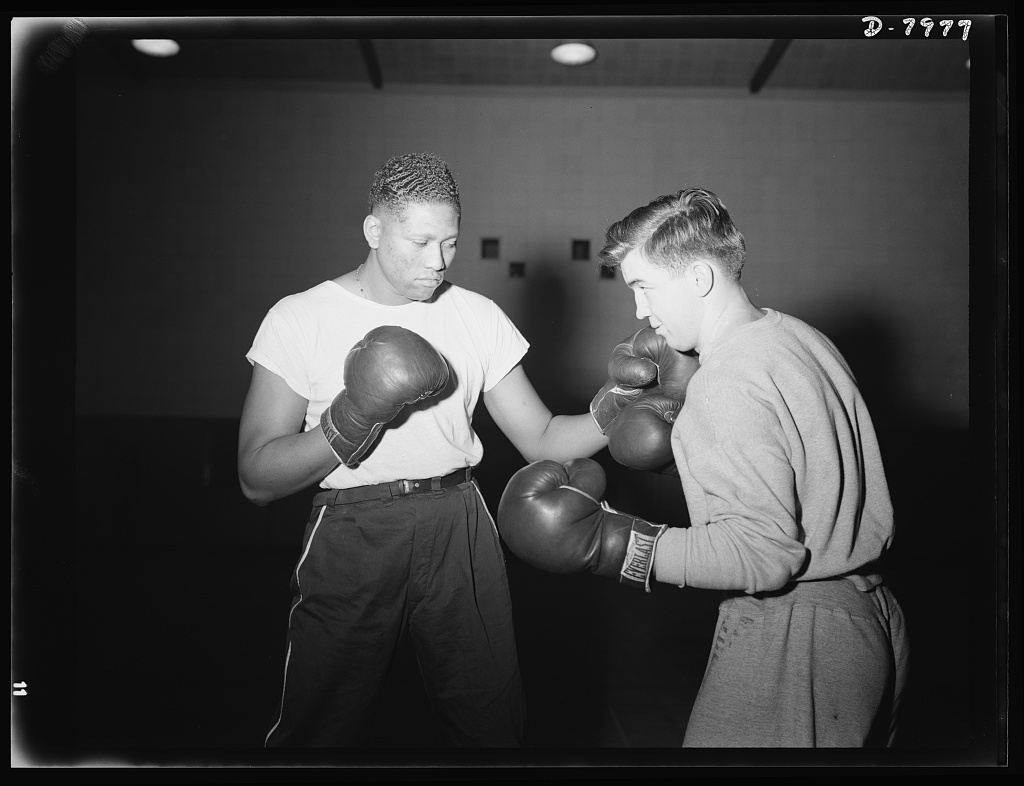
January 1943 “Manhattan Beach Coast Guard training station. The gymnasium is one of the busiest places at Manhattan Beach Coast Guard training station. The physical education program is handled by many noted exponents of boxing, wrestling, track and judo. Paul (Tiny) Wyatt, one-time leading contender for heavyweight boxing honors, is shown sparring with Hart Kraeten, former Golden Gloves champ.” Photographer Roger Smith


mott

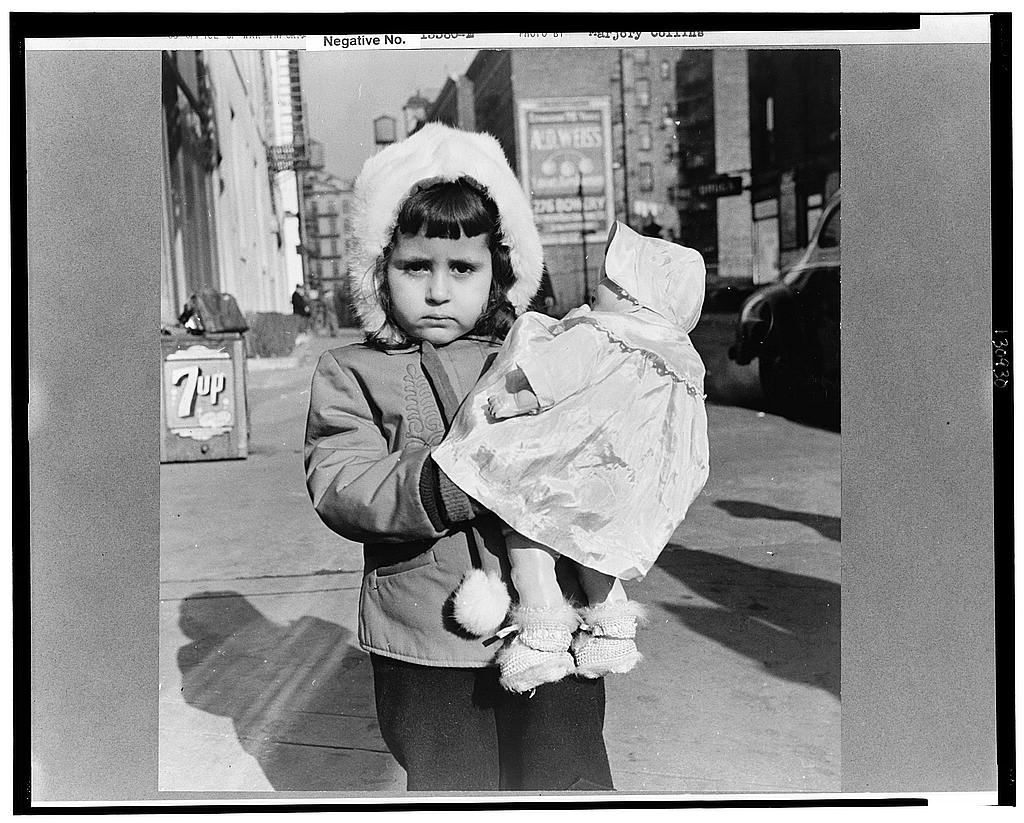
January 1943 “New York, New York. Child on Mott Street on Sunday” Photograph by Marjory Collins


8


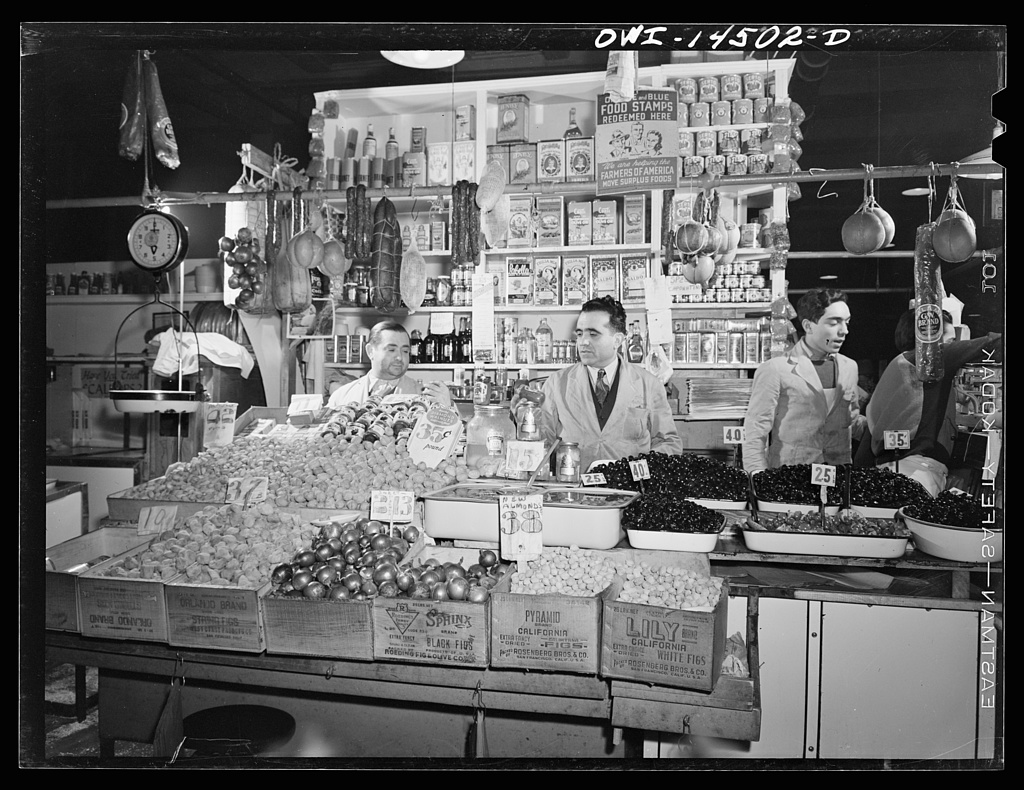
January 1943  “Italian grocer in the First Avenue market at Tenth Street” Photograph by Marjory Collins

10


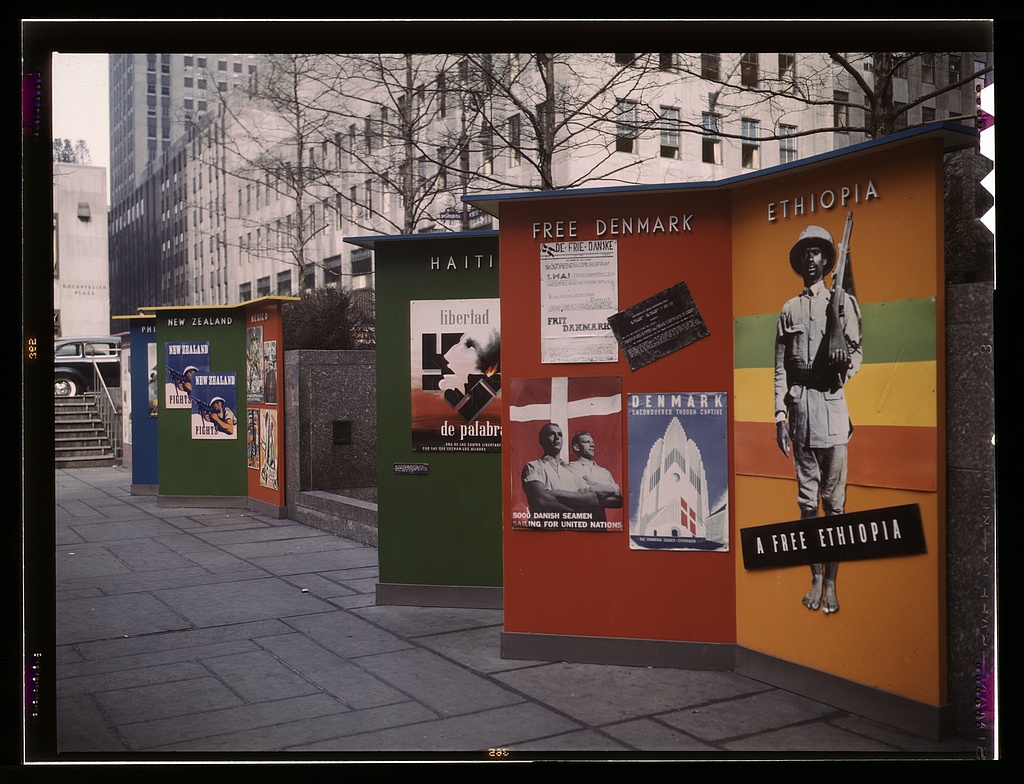
March 1943 “Rockefeller Plaza, exhibit [for] United Nations by OWI, New York, N.Y. Between photographic displays is [the] Atlantic charter in frame with transmitters at each end and where voices of Roosevelt, Churchill and Chiang Kai-Shek are heard each half hour; surrounded by statues of the four freedoms.” Photograph by Marjory Collins

times


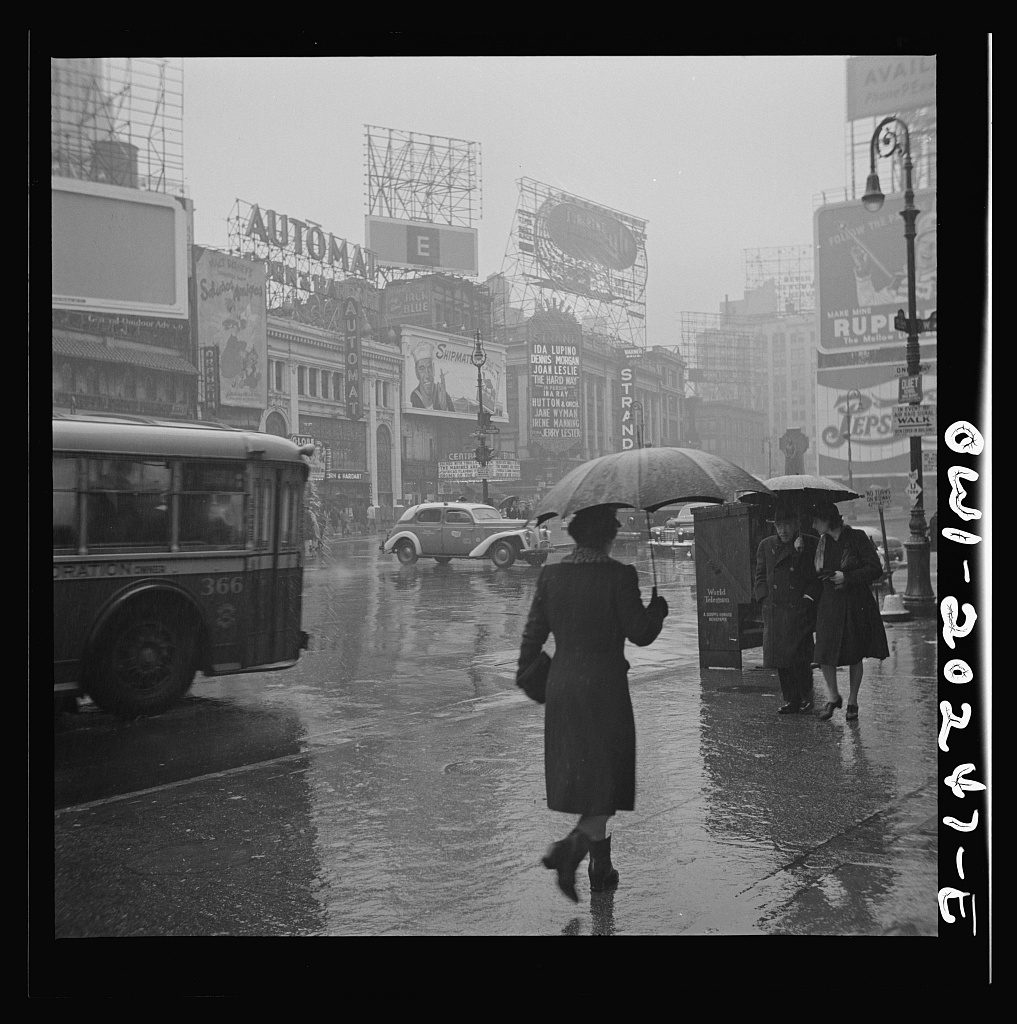
March 1943 “New York, New York. Times Square on a rainy day” Photographer John Vachon

last


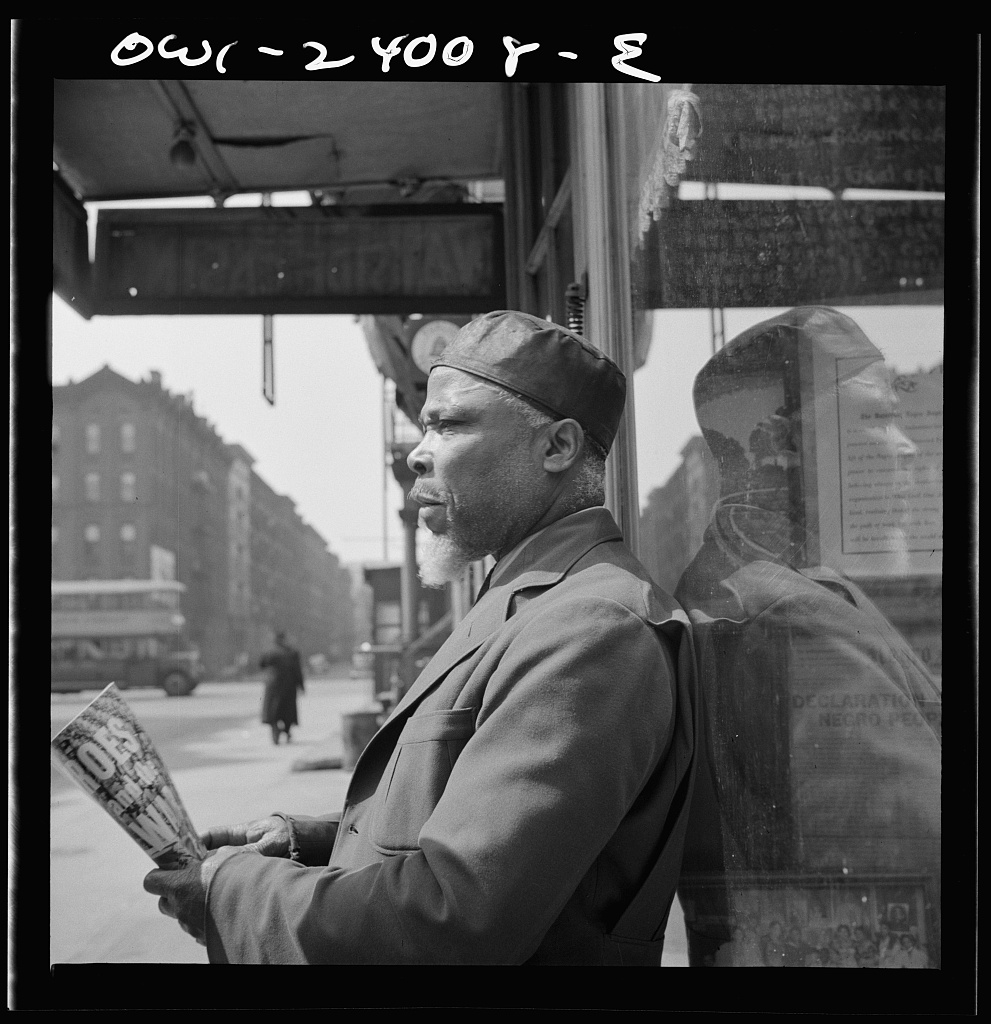
April 1943 “A follower of the late Marcus Garvey who started the “Back to Africa” movement” Photographer Gordon Parks

eye


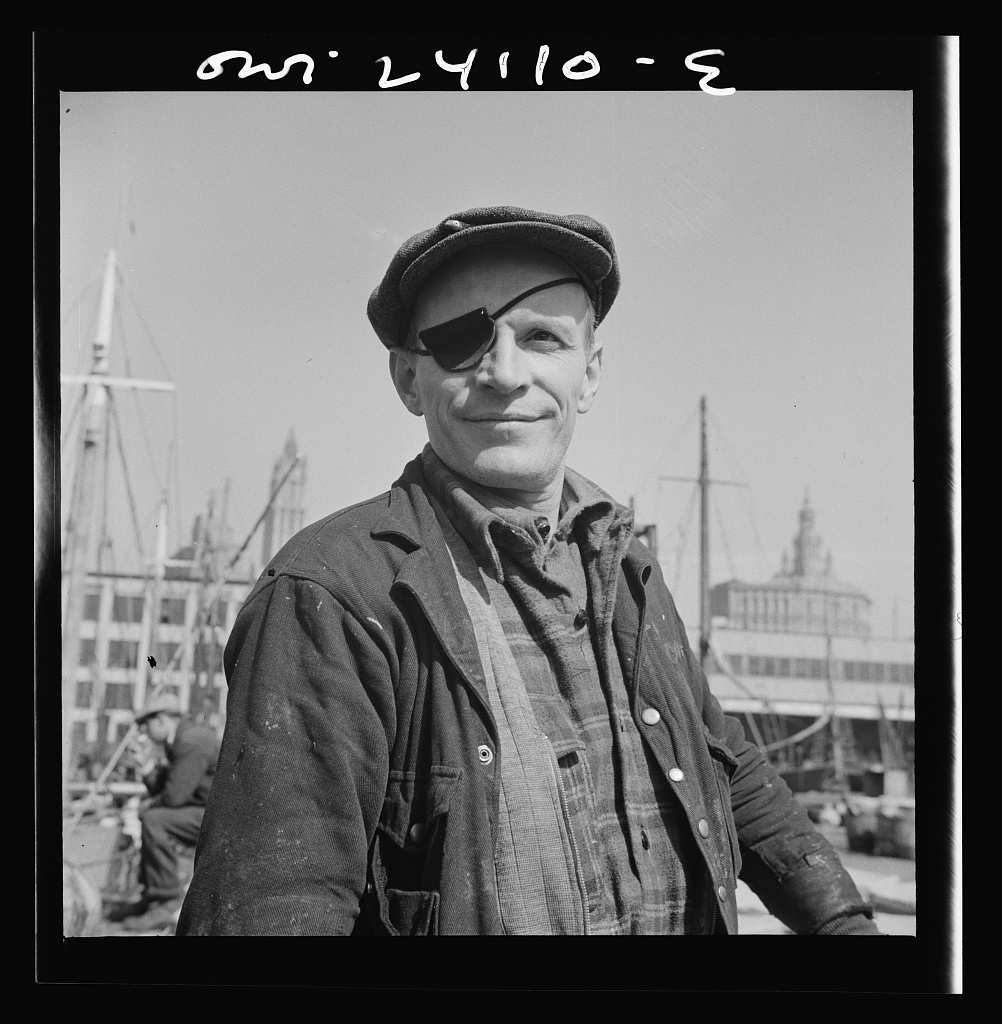
June 1943 “New York, New York. Dock stevedore at the Fulton fish market” Photographer Gordon Parks

victory


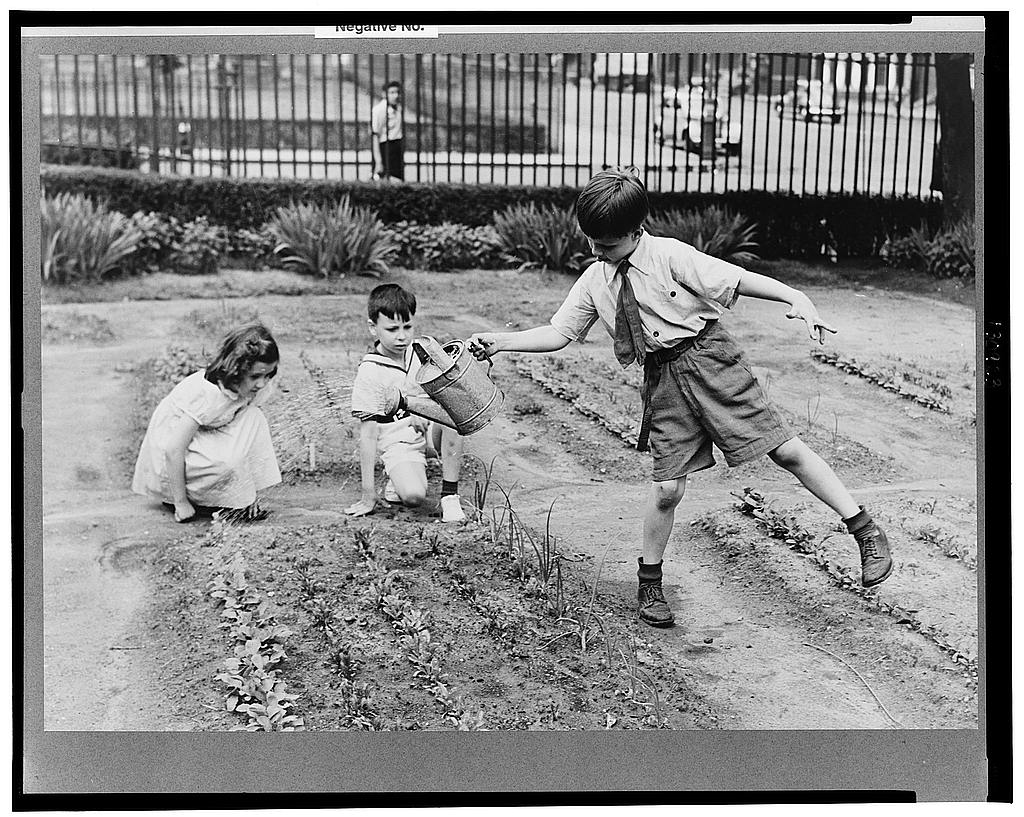
June 1944 “Children’s school victory gardens on First Avenue between Thirty-fifth and Thirty-sixth Streets” Photographer Edward Meyer


d-day

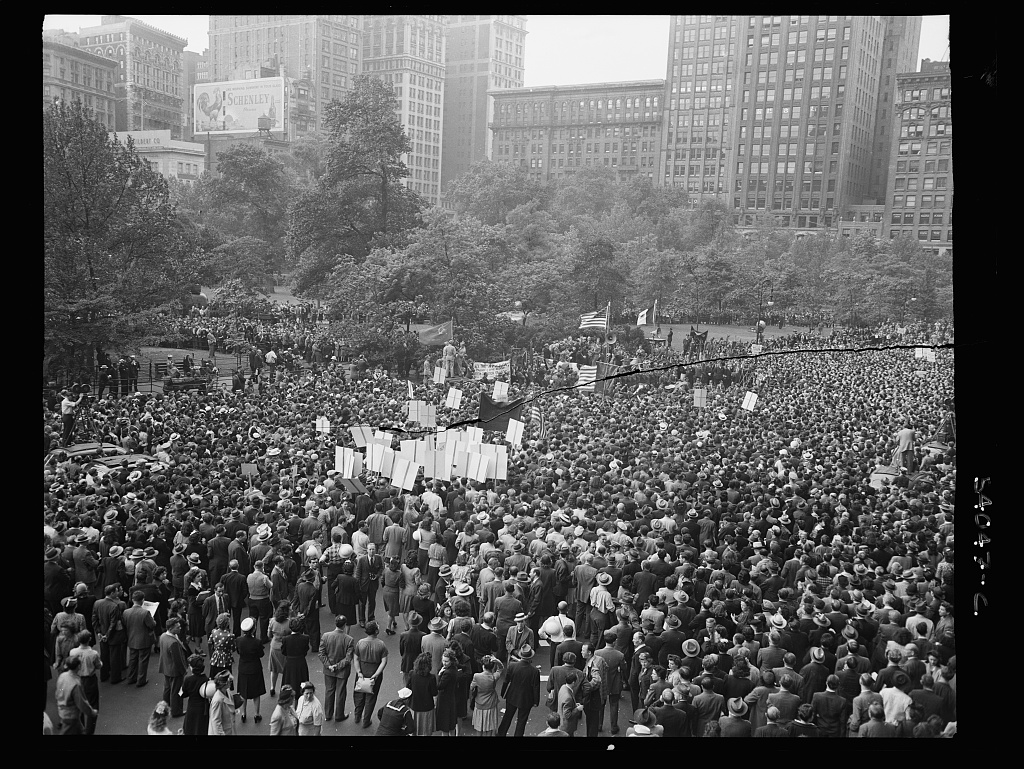
June 1944 “A crowd on D-Day in Madison Square” Photographer unknown

Categories
Those Were The Days

Dollhouses, skully and puddles: Lower East Side children, actually having fun

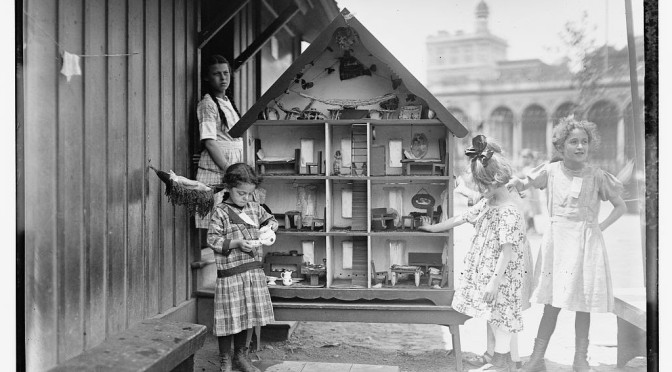
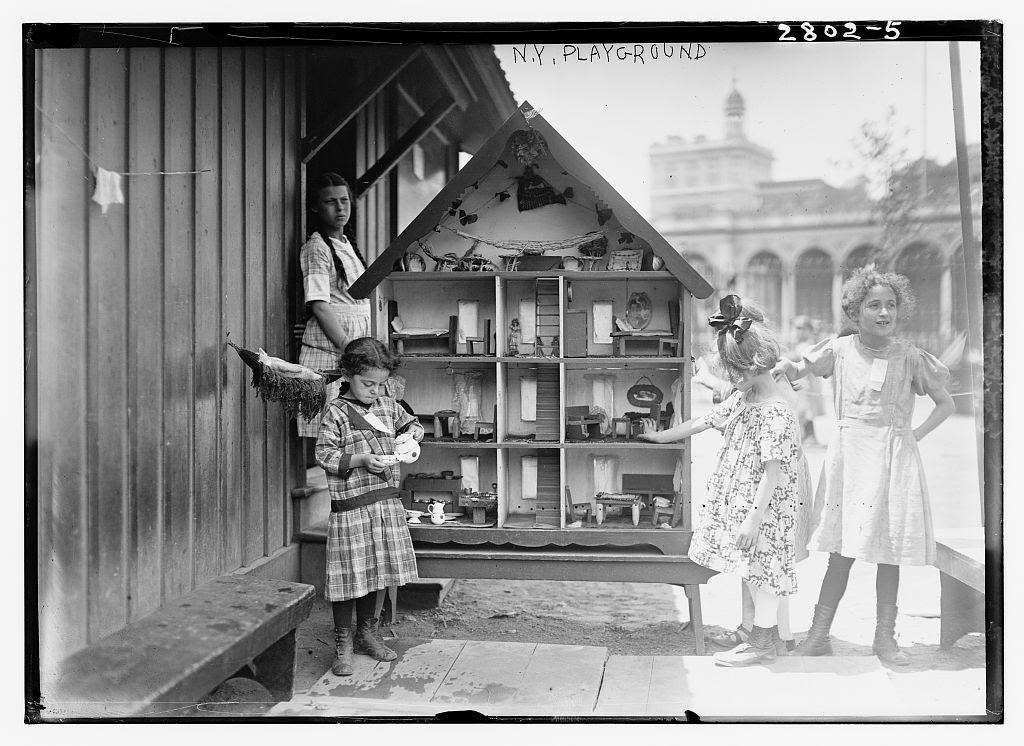
Girls with a pretty amazing dollhouse at Seward Park playground.  Photo labeled August 1913

I’ll be traveling for the next few days so I’ll be posting here a bit less than normal. Next week I’ll re-post some interesting stories from the back catalog. Enjoy your weekend!

I recently discovered this first image in a collection of Lower East Side photographs, and realized how unusual it was to see pictures of children before the 1920s actually smiling and happy in photographs.  This is partly due to a certain awkwardness around cameras and the relative slow process in taking a picture back then.

Also, children were usually photographed doing things that did not make them happy.  The two best known social photographers of the era — Lewis Hine and Jacob Riis — were specifically trying to capture poor working and living conditions. Images of life’s little pleasures did not fit the narrative. Although in some of Hine’s photographs of tenement life, some happiness peeks through.

But I did find these images of kids at play, most all of them in the summer time. Take a little of their enthusiasm with you this summer! Click into the pictures for a larger view.

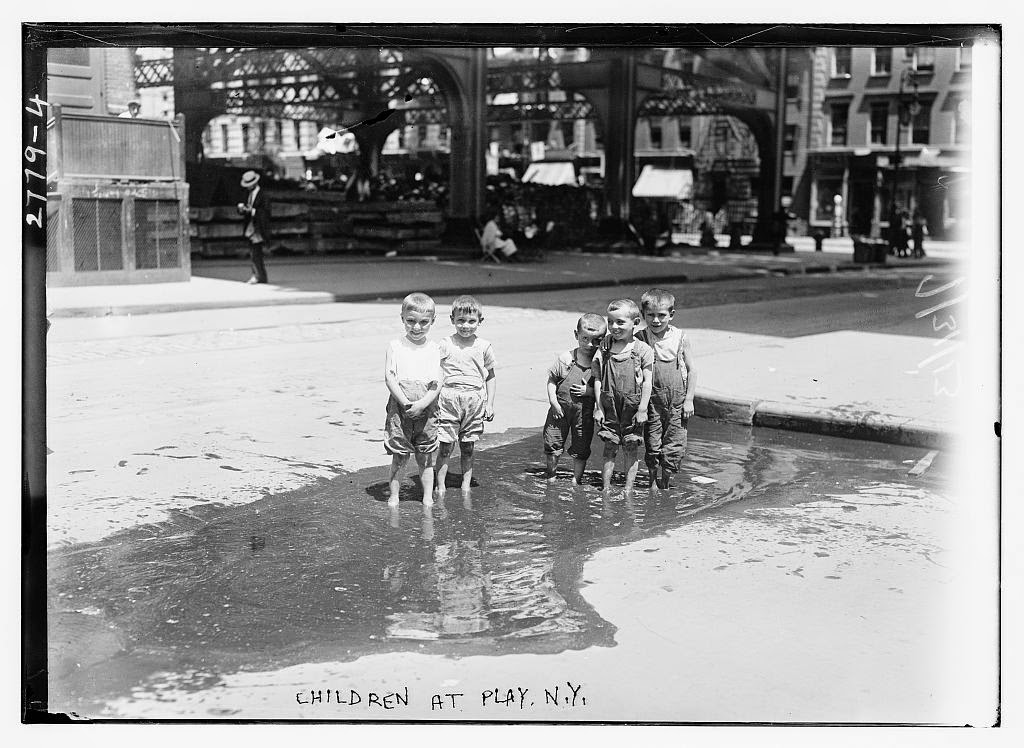
Children find some joy near the elevated, July 31, 1913.  The kid in me wants to jump in and join them.  The adult in me is thinking, “That water must be filthy.”

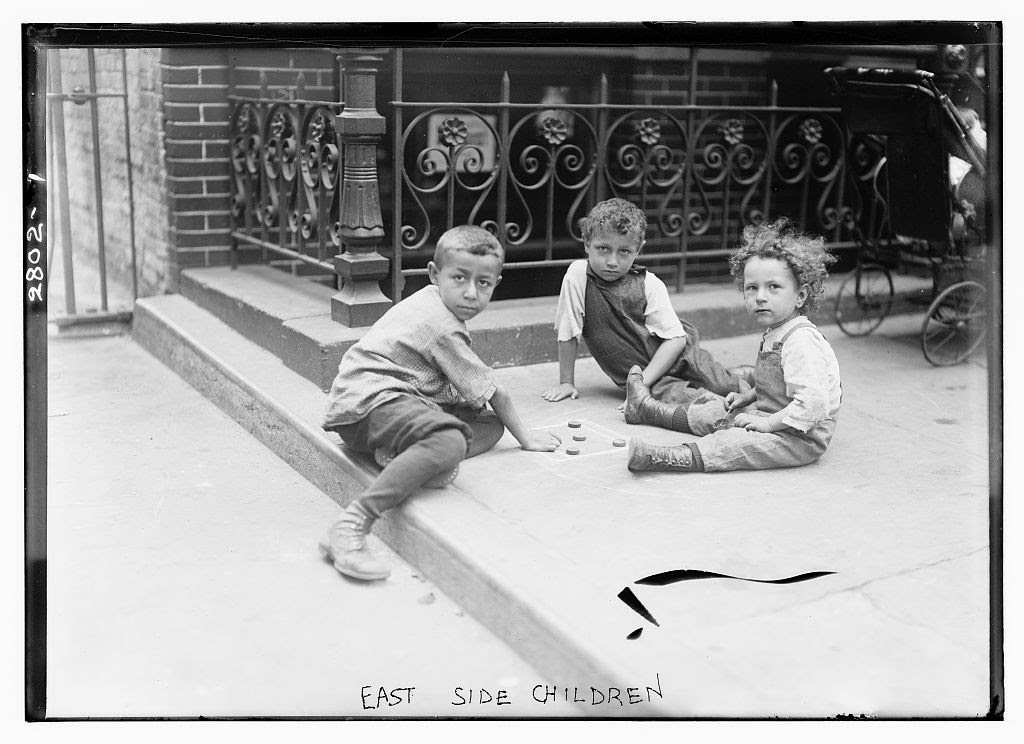
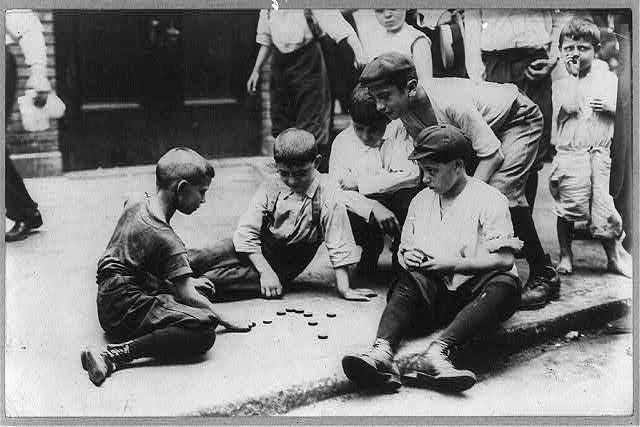
I believe the boys in the two pictures above are playing checkers*.  Top photo is labeled August 1913, the second around the same time period.

Craig on our Facebook page clarifies the images above: “I suspect that the boys in that picture aren’t playing checkers, but a distinctly NYC game called “Skully” or “Skullsy,” as some call it. At least that’s the first thing that I thought of.” Good catch!

I’m putting this in a blog post about children playing, but I do not think the boy being leaped over is having too much fun.

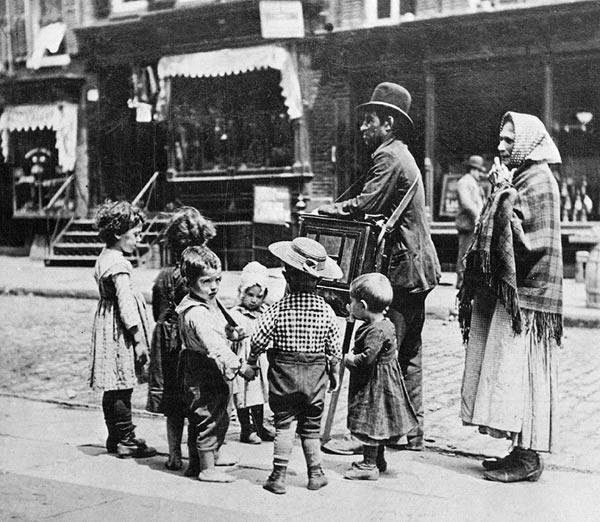
Children being drawn to the streets by the intoxicating sounds of the organ grinder (and monkey, although I don’t see one here).


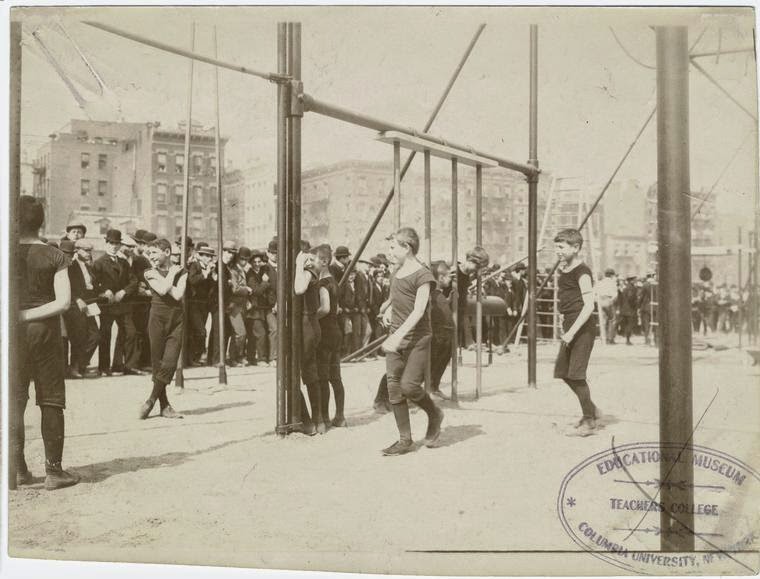
At the Seward Park playgrounds.  The dark clothing doesn’t appear to make the scene very jovial, but everybody is all smiles.


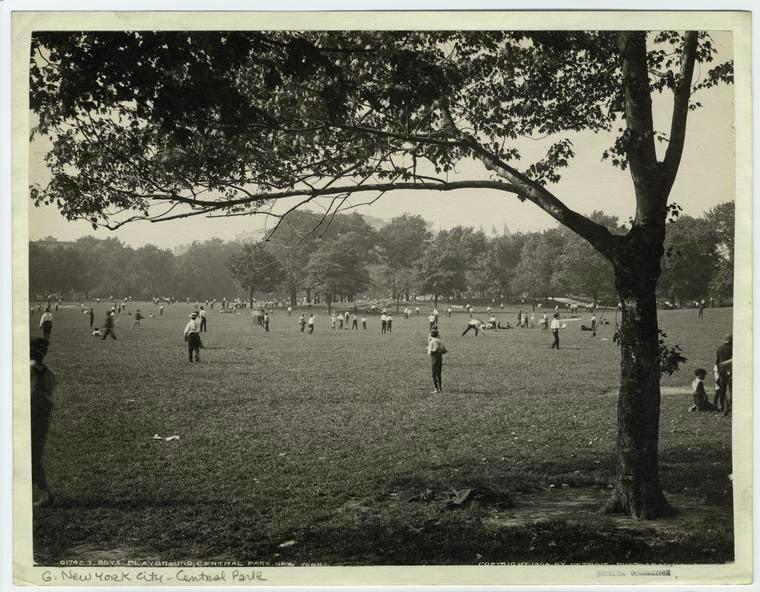
And a bonus picture above of boys playing in Central Park, 1904.  This is a quite extraordinary picture because for half a second, I thought they were sheep.

Photos above are courtesy the Library of Congress, the Tenement Museum, and the New York Public Library

Categories
Parks and Recreation

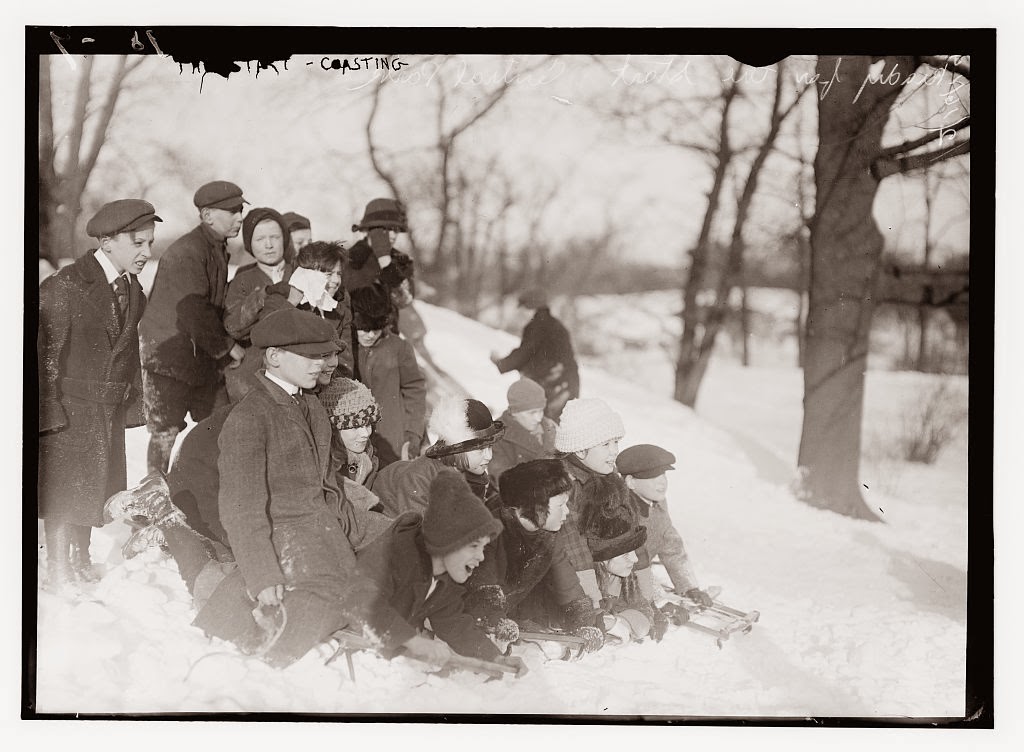
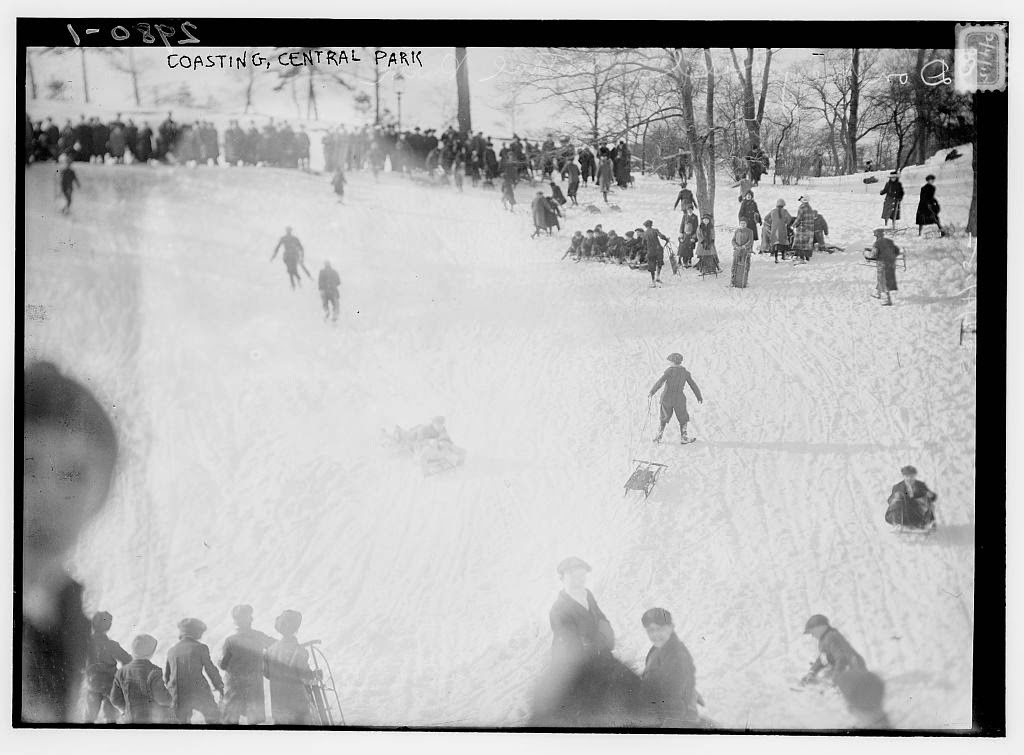
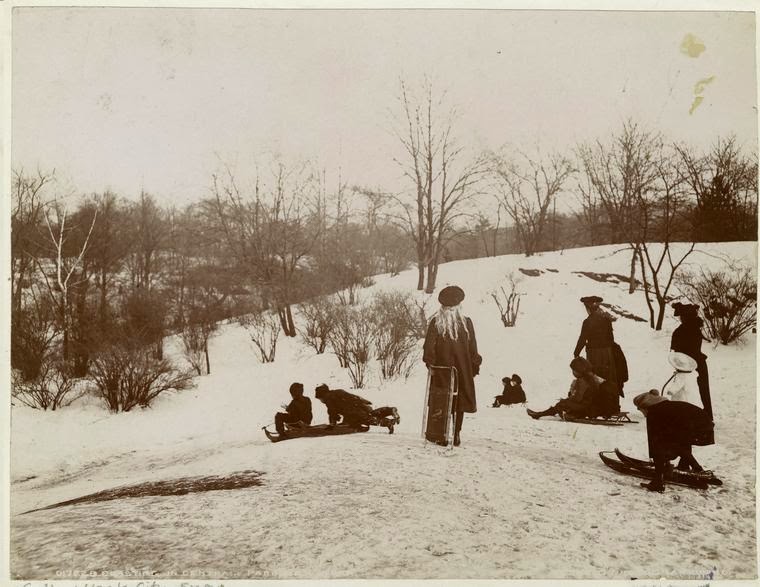
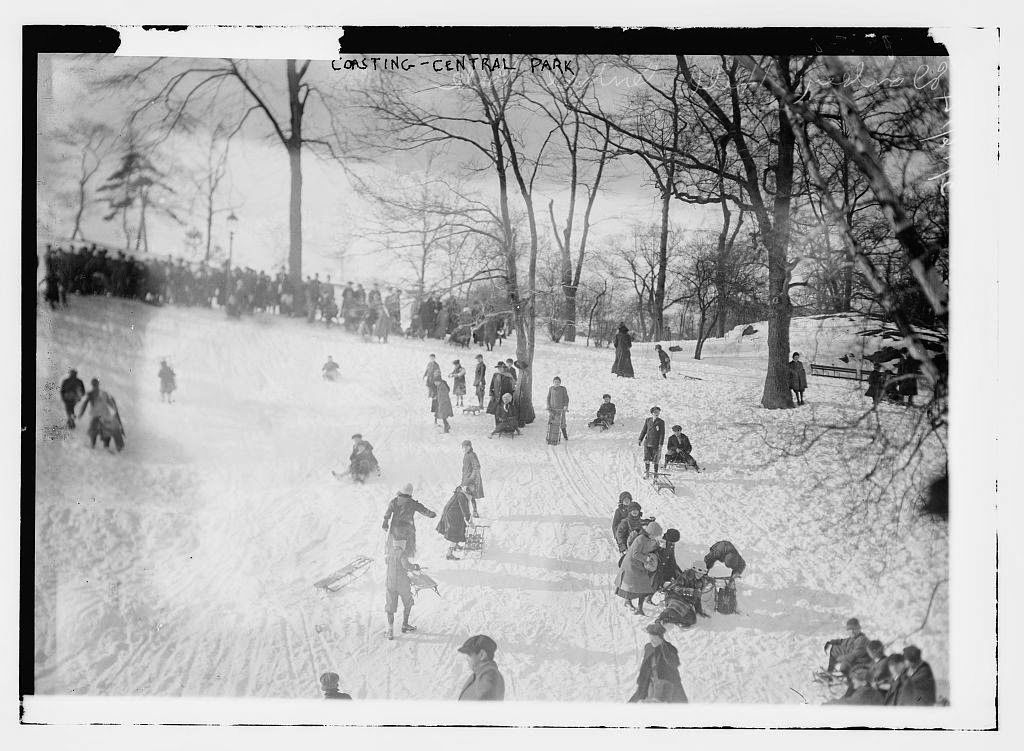
Never Too Cold: Crazy kids conquer Central Park on sleds

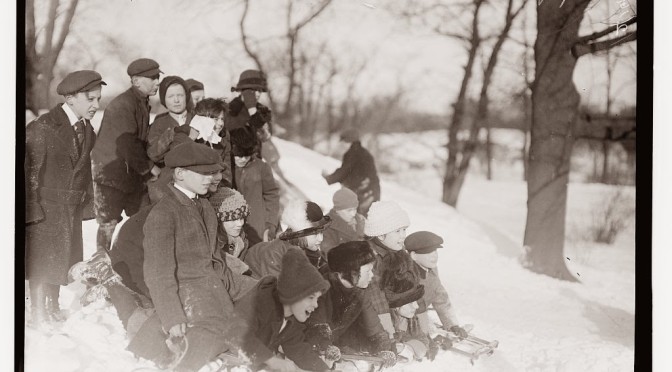
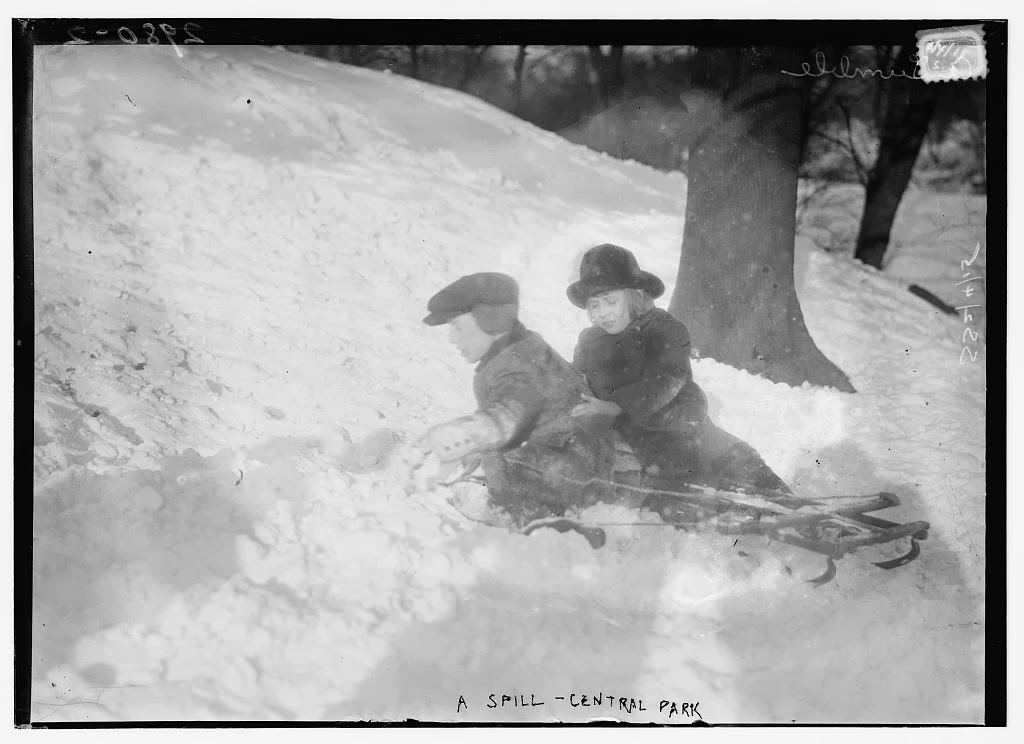
During one particular winter in the early 1910s, Central Park was invaded by an army of young sledders, tearing over the snow-covered terrain without thought to temperatures or bodily injury.

Believe it or not, the city encouraged children to use the city parks for sledding, especially given that the alternatives were slicked-up city streets.  In fact, New York did everything possible to make parks an ideal sledding destination.

“Snow from the sidewalks around Hamilton Fish, DeWitt Clinton and East River parks has been thrown over the fences to form an embankment from which the youngsters can coast.” reported the New York Tribune in 1910.  In Central Park, “never before were so many coasters in evidence.”

Indeed, automobiles posed a grim and dangerous threat to children sledders. The newspapers between 1909-1919 are filled with sad stories of children killed in sledding accidents, with autos frequently involved.  Vehicles from the early days (not to mention, their novice drivers) were simply ill-equipped for icy conditions.

While some in the community lamented the mess made in public parks, most preferred keeping children safe.  These pictures kind of make you want to make a go of it, don’t you think?

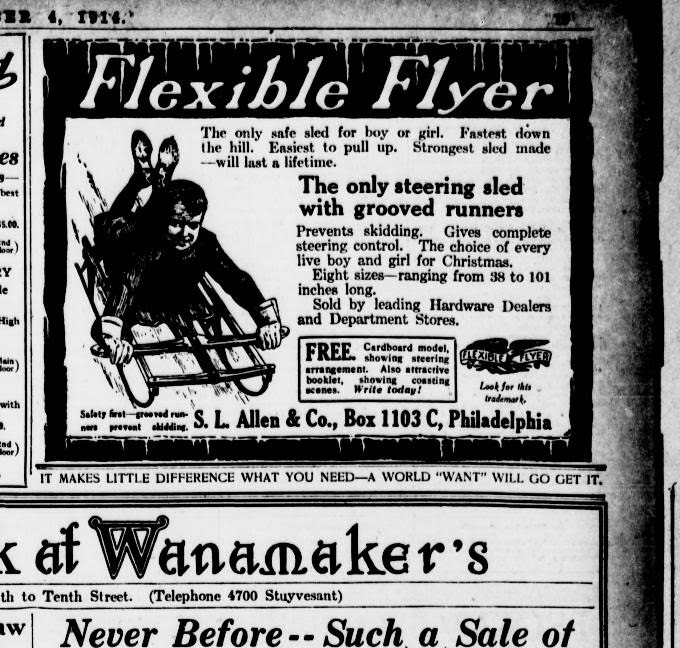
Of course, wealthy people could always go on a sleigh ride in the park, but the mass production of individual flyers (like the one advertised below) and homemade facsimiles soon brought middle and working class into the park for fun.  I would like to think this sled model (advertised in a Dec. 4, 1914 edition of the Evening World) was used by some of those intrepid spirits pictured above:
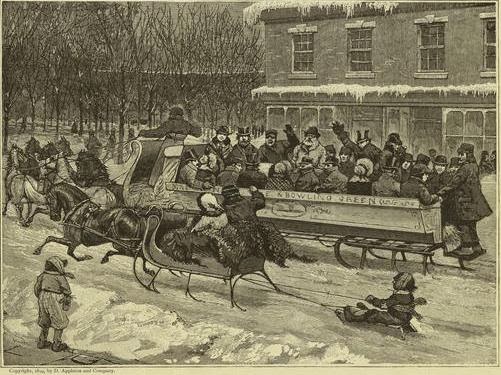
And you think that all looks a little dangerous, here’s some adventurers from 1860, using Broadway as their personal ice sheet, with a child tied to the back!
Images courtesy Library of Congress and New York Public Library

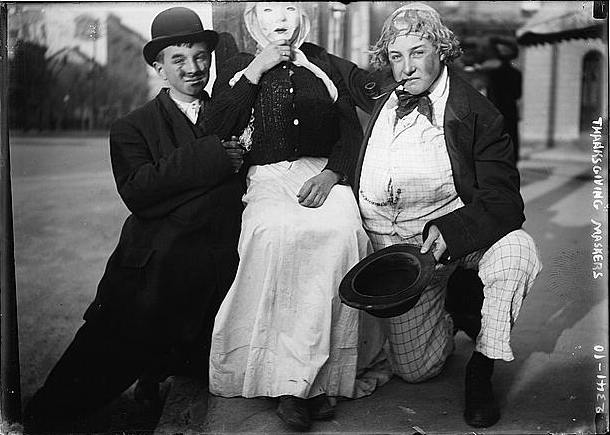
Dressed for success: The tradition of Thanksgiving masking, children in drag, begging for money!


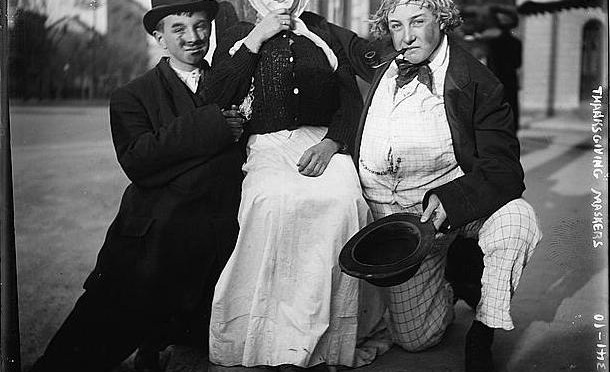
Turkey anyone? Thanksgiving maskers, in New York, taken sometime between 1910-15. Whatever you do, don’t look the ‘lady’ directly in the eye!

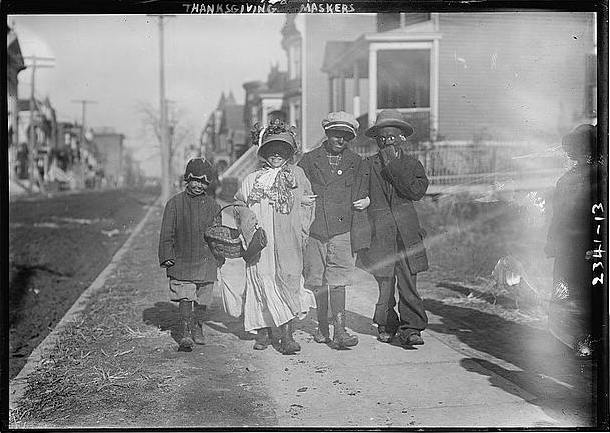
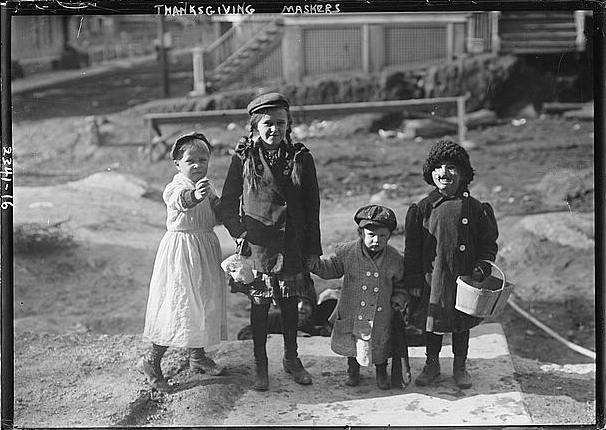
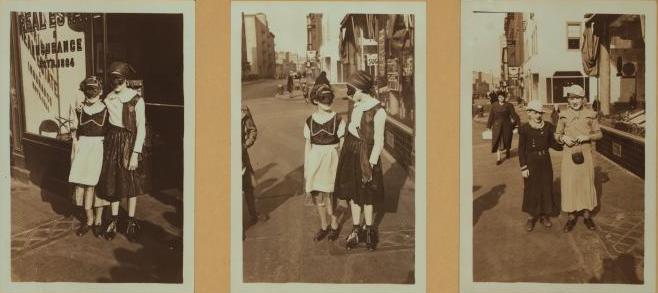
My new column for the Huffington Post is live, and the topic is a strange, forgotten holiday custom called Thanksgiving masking, popular among New York kids from the 1890s-1930s. Children dressed as exaggerated versions of poor people! Boys in their sisters’ clothes! I wrote about this last year at this time, but this article is newly expanded, and I’ve done a bit more research on the origins of this very odd tradition.

You can check out my story here.
There are several archive photos attached to the article as well. However, here are a few more, courtesy the Library of Congress.
All these were taken in New York between the years 1910-15 according to file captions. However the background looks quite unfamiliar. Any guesses?

I especially love these little rascals. Cute, cute, really cute, SCARY.

And finally, here’s a selection of small portraits of Thanksgiving maskers in the West Village in 1933. Courtesy New York Public Library