100 Years Ago: Worst theatrical review ever written?

Readers of the New York Times on January 19, 1910, were greeted with the following theatrical review:

FAT PEOPLE MUST AVOID THIS FARCE;
Unless They Want To Put On Extra Pounds To Prove An Old Adage

If you’re confused, the lead of the review elaborates:

“If to laugh is to grow fat, obesity patients had better take to the other side of the road when they see the sign ‘William Collier in ‘A Lucky Star’ looming up in front of the Hudson Theatre on Forty-Fourth Street.”

This is actually from a glowing review of a new farce by Anne Crawford Flexner. Do you know anybody who says ‘to laugh is to grow fat’ anymore? Thank goodness that one died out.

Flexner, by the way, was a fascinating woman, an ardent feminist and suffragist whose daughter Eleanor became a revolutionary in the field of women’s studies.

Thanks to absurdly positives reviews like the one in the Times, Flexner’s ‘A Lucky Star’ continued on Broadway for three more months. Read the full review here.

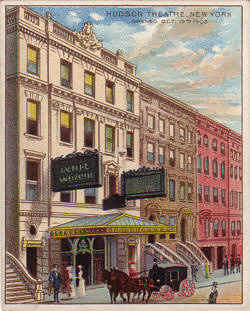
Incidentally, the Hudson Theatre (141 W. 44th St., at left), now landmarked, is still around as convention space for the Millennium Broadway Hotel. Notably, the first production of Arsenic and Old Lace debuted here on January 10, 1941. Given all the news about ‘late night TV’ wars, you may be interested to know that it all started here: the first Tonight Show, with original host Steve Allen, was first broadcast here, at the Hudson Theatre, in 1954.

Wonderland: Walt Disney’s seven Big Apple moments

Yesterday’s news about a new Times Square flagship store for Disney had me wondering what influence if any New York had on the career of Walt Disney, arguably one of the most successful men in history to make his name on the West Coast. Come to find out, the world might never have had Mickey Mouse and the rest without one New Yorker in particular.

Here’s seven of the most significant New York moments for Walt Disney and the Disney empire:

1) Disney Discovered
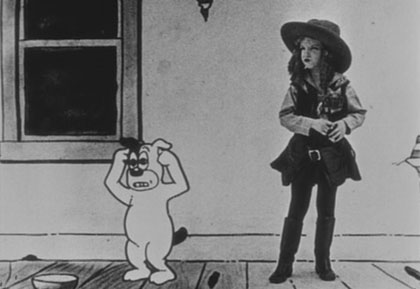
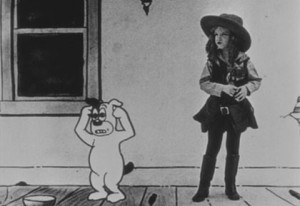
Small-time Kansas City animator Walt Disney spent much of 1923 writing New York film distributor Margaret Winkler, hoping she’d take a look at a new film he was creating, Alice’s Wonderland — a coy, self-reflexive mix of animation and live-action. He was lucky; Winkler was looking to put pressure on her biggest star Pat Sullivan (creator of Felix The Cat), and Disney’s strange little picture did the trick. She signed him and brother Roy, but retained editing control on the early ‘Alice Comedies’, inserting a Felix the Cat-like character named Julius, the first of hundreds of human-like animals in Disney films.

Winkler, by the way, was the first female film distributor in the United States and briefly one of the most powerful women in silent film — at a time when the film industry was centered on the east coast.

Below:one of the Alice Comedies
2) Steamboat Willie
Disney would return to New York with his revolutionary ‘Steamboat Willie’, the first sound appearance of Mickey Mouse. On November 18, 1928, it quietly made its world premiere at the Colony Theatre (Broadway and 53rd Street, still around today as the Broadway Theatre). Sitting in the audience for everyone of its two-week performances was Walt himself.

Steamboat Willie was the opener on a bill of entertainment that also featured the film Gang War, starring Mary Pickford’s brother Jack, an alcoholic mess who once dated Olive Thomas who allegedly haunts the New Amsterdam Theatre. ‘Gang War’ would be his final movie role.

3) Snow White and The Seven Dwarfs
Almost ten years later, Disney’s first feature-length animated spectacle would have a far more grandiose reception — a five-week run at Radio City Music Hall starting in January 1938. The New York Times exclaimed, “They’re gay and friendly and pleasant, all of them, and so is the picture. Thank you very much, Mr. Disney, and come again soon.” As legend goes, the upholstery of several Radio City Music Hall chairs had to be replaced, as children wet their pants as the first sight of the Wicked Witch.

Strangely, the film was later paired with an ice-themed short, Ski Flight, because during winter there’s nothing people like to do more than sit and watch ski movies.

4) Fantasia
Disney’s trippy concept film closed the loop; as one of Disney’s first self-distributed films, it premiered November 13, 1940 at the same theatre that had once shown Steamboat Willie, only this time it was called the Broadway Theatre. (Today it’s a mainstream musical stage featuring Shrek the Musical).)

There was more drama behind the screen than in front. One scene (“Ave Maria”) had to be redeveloped, flown to New York and was literally spliced in with four hours to go before showtime.

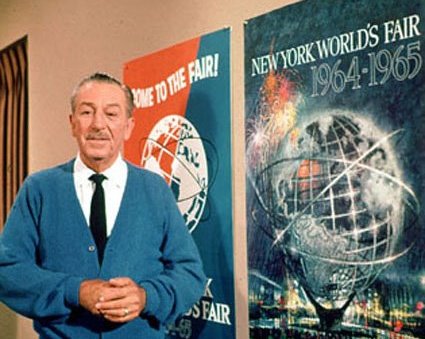
5) The Worlds Fair 1964-65
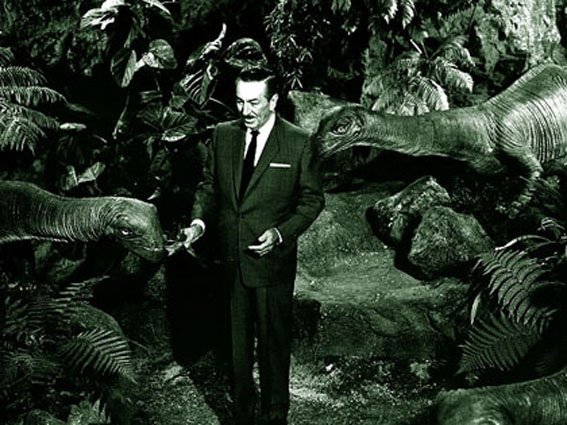
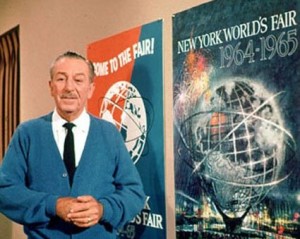
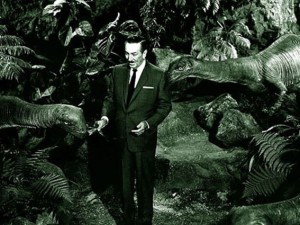
The Worlds Fair of 1939 had clearly had its influences on Disney’s future theme parks. So it was only natural to bring him in as a consultant for Robert Moses’ crowning concrete spectacle of 1964. Disney Studios brought animatronic dinosaurs to life in the “Magic Skyway” for the Ford Motor Company pavilion (see picture below), a talking Abraham Lincoln, and of course ‘It’s A Small World’. Many more pictures of Walt behind the scenes at Disney and More.
6) Disney rewrites Broadway
Less than thirty years after Walt’s death, the company enters — and promptly conquers — a new frontier: Broadway. Beauty And The Beast became its first permanent Broadway production when it opened in April 18, 1994. The swirling gala of dancing utensils and candelabras won the Tony for Best Musical, fueling a run that would make it the sixth longest running show in Broadway history and opening the flood gates of Disney-themed shows.

By the time ‘Beauty and the Beast’ closed in 2007, Disney had changed the rules of the Broadway musical and the actual physical makeup of 42nd Street itself, leading to the sanitation (i.e. ‘Disney-fication’) of the once-seedy boulevard

7) And hits Fifth Avenue, too
The invasion wasn’t just on popular entertainment, but on the heart of New York retail. The first Disney store opened on Fifth Avenue on May 22, 1996. Ushered in by mayor Rudy Giuliani and Disney CEO Michael D. Eisner, thousands of shoppers flocked to the retailer, at the time setting the record for single-day sales at a Disney store. That’s an awful lot of mouse-eared Statue of Libertys.

The company just announced that this ‘World of Disney’ location, at 55th Street, would be permanently closing next year, to make way for Disney’s Time Square plans.

I should end by adding that when Disney moved in during the 1990s, it had kicked out a New York City institution — the famous French restaurant La Côte Basque, a “high-society temple” and favorite of Jacqueline Kennedy Onassis. The eatery moved around the corner but only lasted a few more years.

Picture Perfect: Irving Underhill captures New York style

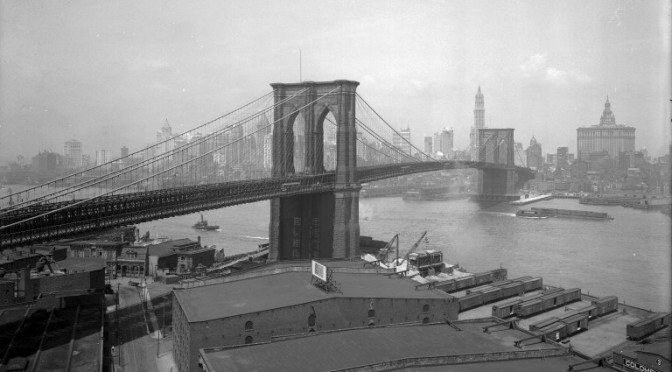
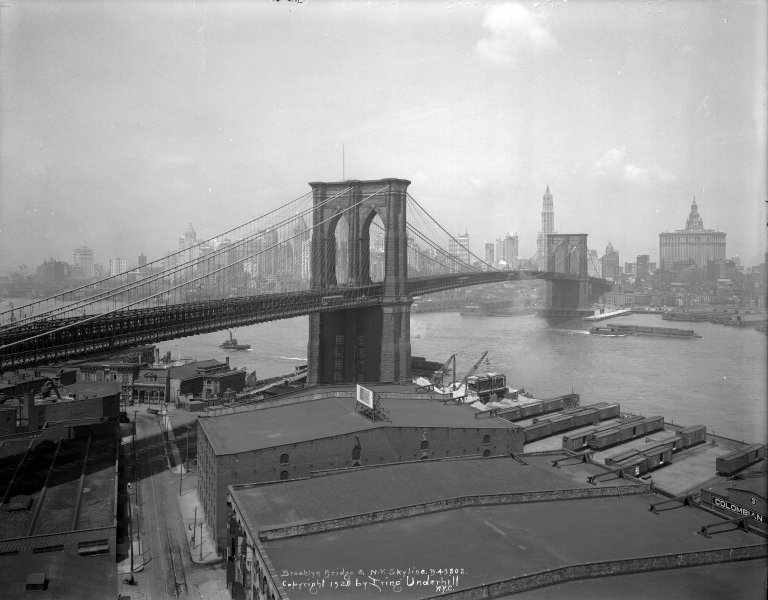
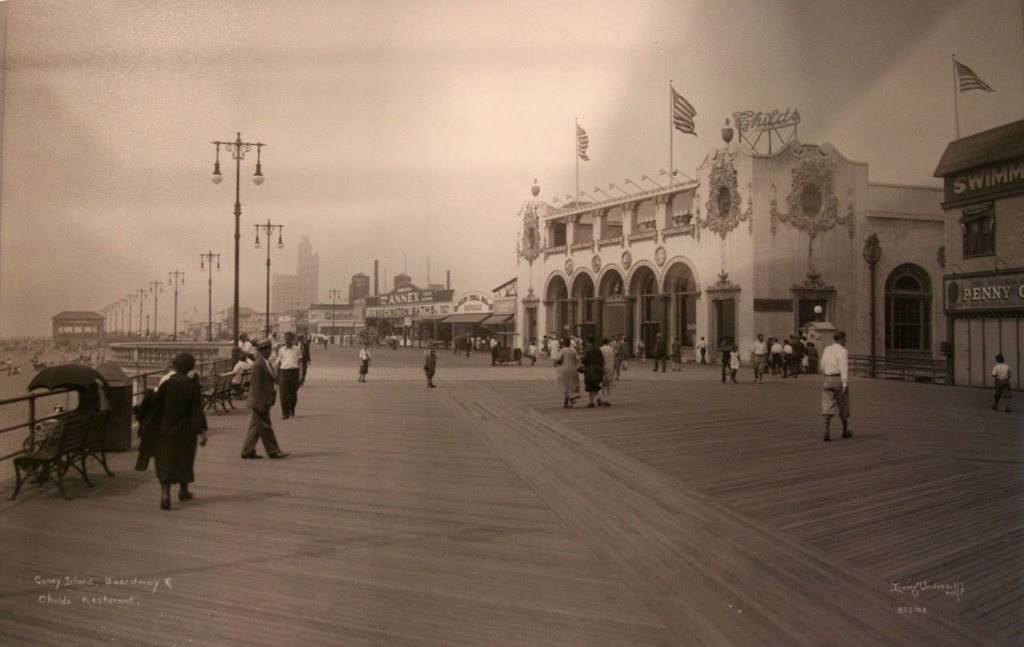
Top: the Brooklyn Bridge in 1925. Bottom: Underhill on the boardwalk: the photographer captures a seemingly meloncholy day in Coney Island, with Childs Restaurant at right

Nobody in New York’s early history captures the romance of early city life more than the first photographers — the men and women who wiled away with expensive, limited and time-consuming photographic processes, bulky and decidedly unportable cameras, and a medium that was still struggling to find purpose.

New York’s first master photographer Matthew Brady, famous for his Civil War battle images and unappreciated in his time, chose the city for the location of his studio but turned his camera over mostly to intimate subjects. Jacob Riis used his lense to expose social disparity in lower Manhattan. And the social fabric of the city was documented by Alice Austen, who balanced intimate images of neighborhood life with candids of big city bustle.

But the real glamour shots of the city most often came from big studio photographers, working not to present any kind of social illumination but for a profit. One of these was Irving Underhill (1872-1960), a successful photographer who also took pictures to be rendered as colored postcards or “souvenir cards”.

More of his postcards can be found here. They’re certainly pretty, with their saturated color turns regular New York scenes into unusual and cartoonish pastel paintings. The real beauty of New York comes alive in Underhill’s regular, clean photographic documentation of basic city structures.

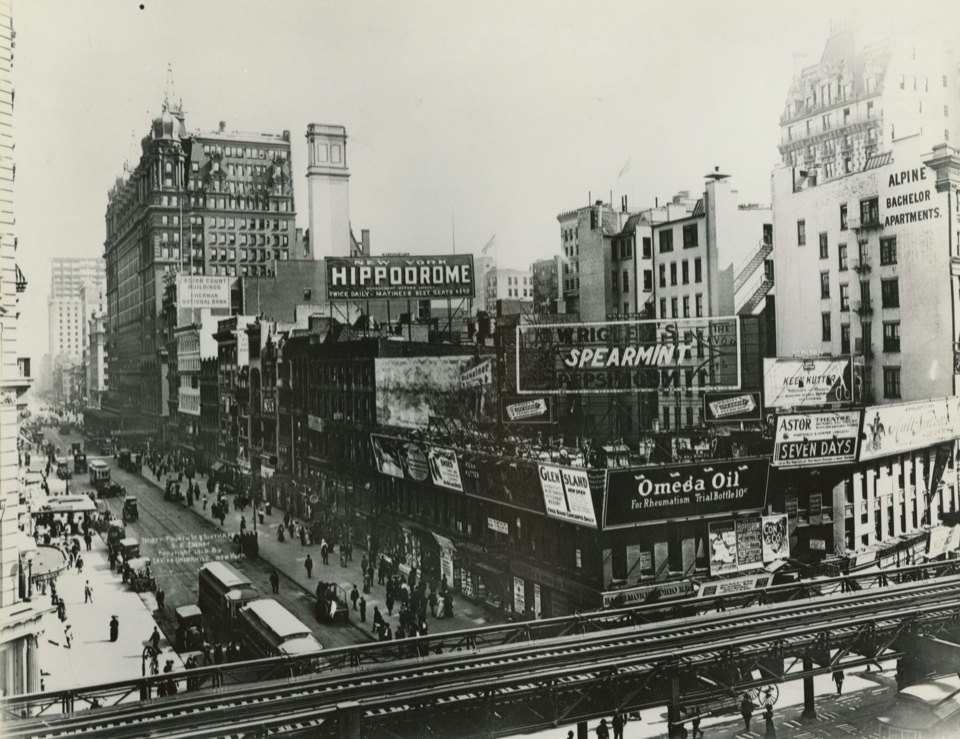
1910: 34th Street and 6th Avenue, shot from the roof of Macy’s, looking east

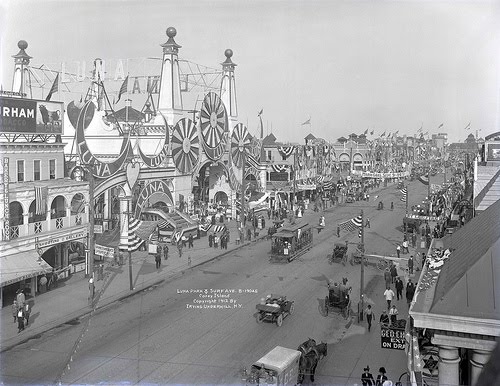
1912: Luna Park along Surf Avenue in Coney Island

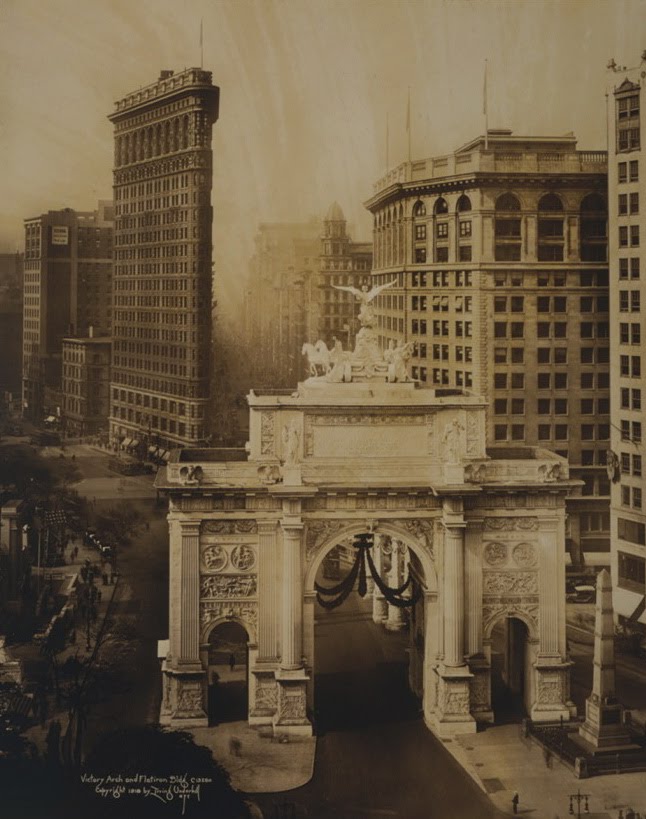
1919: Madison Square Park and the Flatiron Building, with the newly erected ‘Victory Arch’ celebrating the end of World War I

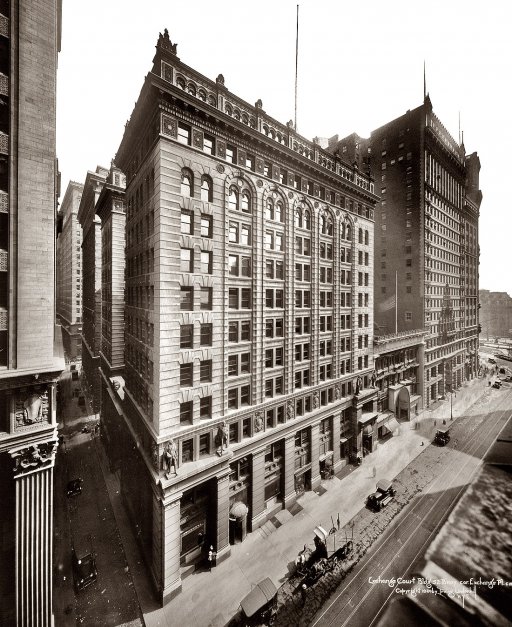
1920: Exchange Court building at 52 Broadway, one of dozens of Underhill subjects either radically revamped or demolished completely

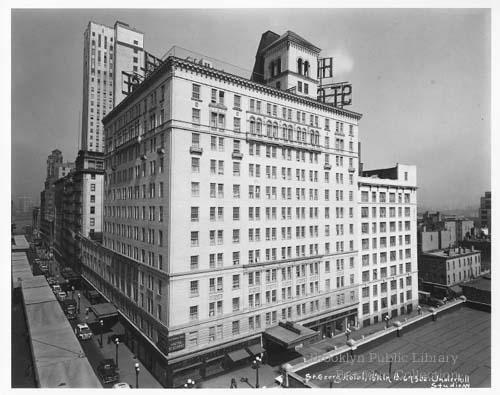
The Hotel St. George in Brooklyn Heights, date of photograph unknown

Underhill opened his studio in 1896, specializing in “artistic portraits, city views and panoramas, group photographs, marine, legal and machinery photography.”

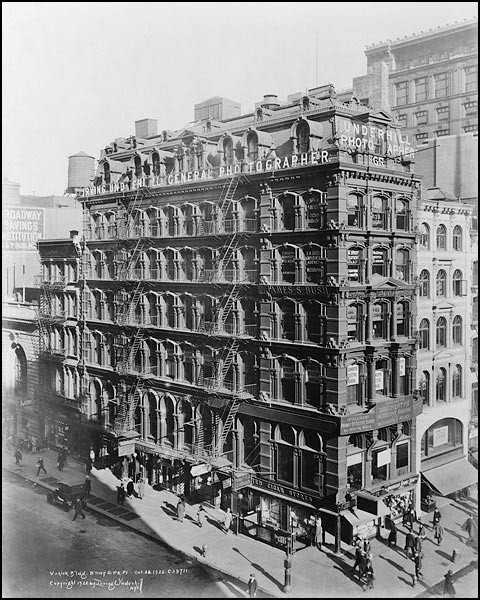
He was so successful that his agency received exclusive commissions to photograph and promote new buildings like the Woolworth Building, which he would capture in timed intervals to track the construction process. Many years later, his name could be seen from blocks away, plastered along the top of his studios at Broadway and Park Place. You can see the words ‘Irving Underhill, General Photographer’ along the top of the image here, taken in 1922.

Underhill’s early portfolio was printed in the 1904 book One Hundred And Sixty Glimpses of Greater New York, an incredible array of black and white images detailing city architecture in the midst of the gilded era. Each page is cleanly labeled and visual detectives will enjoy matching the images to what stands in these places today. You can look at most of the book on Google Books.

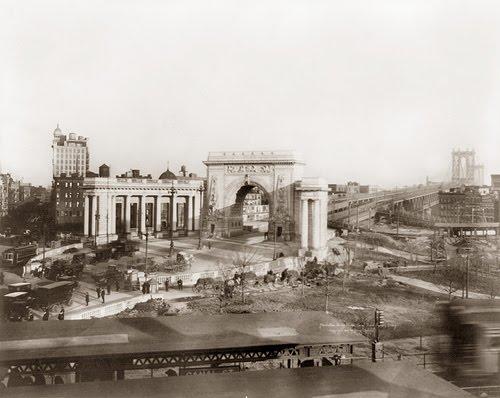
Below: the Manhattan Bridge plaza, 1917

Sarah Bernhardt’s favorite New York landmark

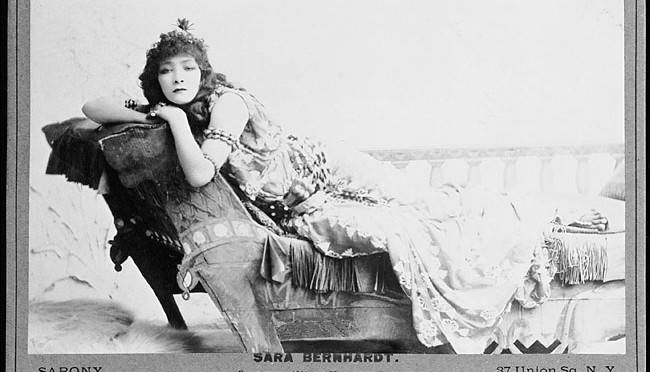
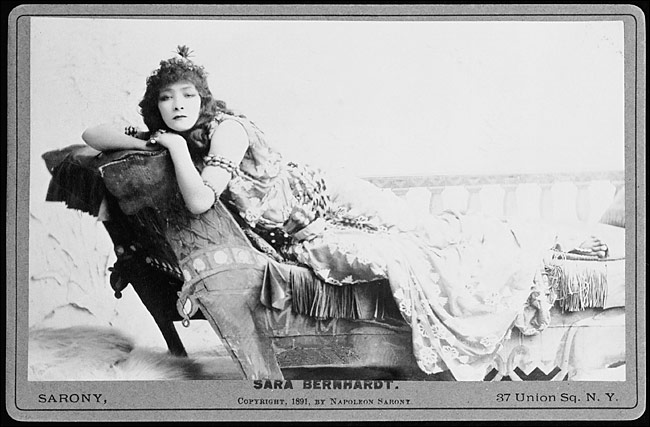
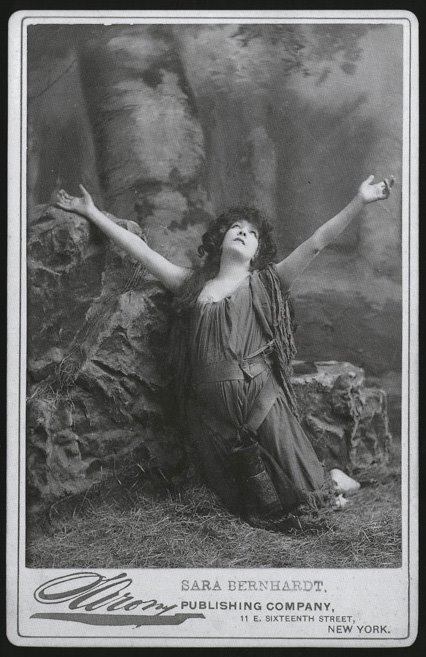
Sarah Bernhardt may be the most famous and most mysterious actress who ever lived and certainly “the greatest celebrity of her era.” Working mostly in the days before recorded medium (there are exceptions), Bernhardt crafted a legend matched by outrageous behavior and provocative stage performance. Naturally, she brought both with her when she came to New York City for her first American tour in 1880 to present the first of many signature roles, Adrienne Lecouveur.

The French actress, lauded as one of Europe’s greatest commodities, didn’t exactly crave a visit to America. Leaving for New York on October 1880, Sarah “was in utter despair, weeping bitter tears, tears that stained my cheek,” according to her autobiography. New York had no such hesitation. When her boat arrived two weeks later into a strangely frozen New York harbor, it was greeted with smaller steamers, filled with fans and decorated with French flags. They feted her onboard in a lengthy, drawn out ceremony of admiration.

Her response? Feeling slightly woozy, “I decided therefore to faint.” She fell gently into waiting arms, people rushed to her attention until “it was time to come to my senses again.”

She stayed that evening at the luxury Albermarle Hotel at Broadway and 24th Street where she blocked her door with furniture to keep other well-wishers and journalists out.

Bernhardt’s auto-biography is so steeped in extremity that you assume she must be exaggerating. Alexandre Dumas did call her a “notorious liar”, but the fact that it took Alexandre Dumas to make that proclamation underscores the exotic circles and experiences in which she traveled.

She greatly distrusted the press who she believed willfully printed lies about her (even when the lies were fed to them by Bernhardt’s own management.) At a press conference at the Albermarle later that day, she dismissed even the simplest questions, especially bristling when she was asked about her religion. “Oh Heavens! Will it be like this in all the cities I visit?”

Two days later, she arrived to rehearse at Booth’s Theater, the tony stage built by theatre legend Edwin Booth (John Wilke’s brother) and located near her hotel, at 23rd and 6th Avenue. Her reaction at seeing fans gathered outside to greet her: “These strange-looking individuals did not belong to the world of actors….with their white neckties and their questionable looking hands.”

Inside the theater, she was finally reunited with her 42 trunks of gowns and costumes — briefly and offensively seized by customs, a “chiffon court martial” — and ordered her underlings to open and inspect each container. So horrified was she at the lowly people opening her possessions that she could only grit her teeth and stand in a state of utter mortification. In fact, the experience exhausted her so much that she failed to even rehearse at all that day.

She would later go on to interact with every strata of New York culture, some more friendly than others, appealing more to liberal minded (and daring) social elites than the stalwarts of Mrs Astors storied Four Hundred. Which seemed fine with Sarah; she didn’t want to meet them either.

But for all her condescension that week, for all the superiority and righteousness, there was one thing that stopped her in her tracks. Believe it or not, something actually gave the legendary imperious actress pause.

It was Bernhardt vs. the Brooklyn Bridge, and the bridge won. In 1880, it wasn’t even fully completed, yet in her recollection, it was as if it were bustling with traffic. “Oh, that bridge! … One is proud to be a human being when one realizes that a brain has created and suspended in the air….that fearful thing.” The magnificence of the bridge, its extraordinary scale, filled her with “a strange, undefinable sensation of universal chaos.”

Yet she was able to sleep peacefully that evening, “reconciled with this great nation.” And all it took was for something to make the mighty actress feel small.

She would come many, many times to New York and onward to other major cities. By 1910, her tolerance of America was enough that she endeavored to perform future productions in English. (Up until then, all of her performances were rendered in French.)
I highly recommend peeking into her pompous, overblown autobiography My Double Life (well out of print, although Google Books has a copy to review). Simply flip to any random page and get a whiff of her powerful perfumed prose. They seriously do not make them like Sarah Bernhardt anymore.

Below: the spectacular Booth’s Theatre, where Sarah Bernhardt made her U.S. debut on November 8, 1880. It was located on the southeast corner of 23rd and 6th. Today the building there contains a Best Buy and an Olive Garden.

P.S. It appears that Sara and Sarah were interchangable back in the day. You’d think this discrepancy would have driven the poor thing to the fainting couch.

Categories
Uncategorized

PODCAST: Ziegfeld!

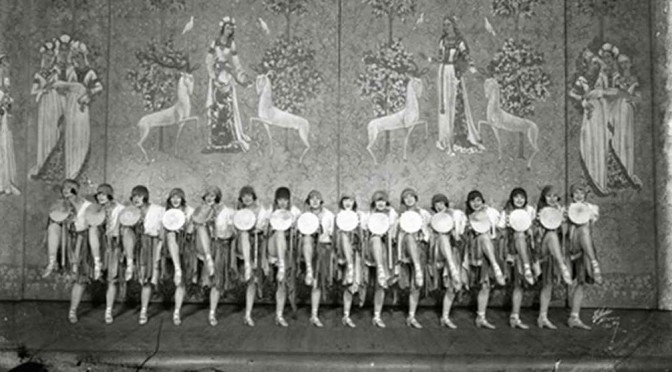
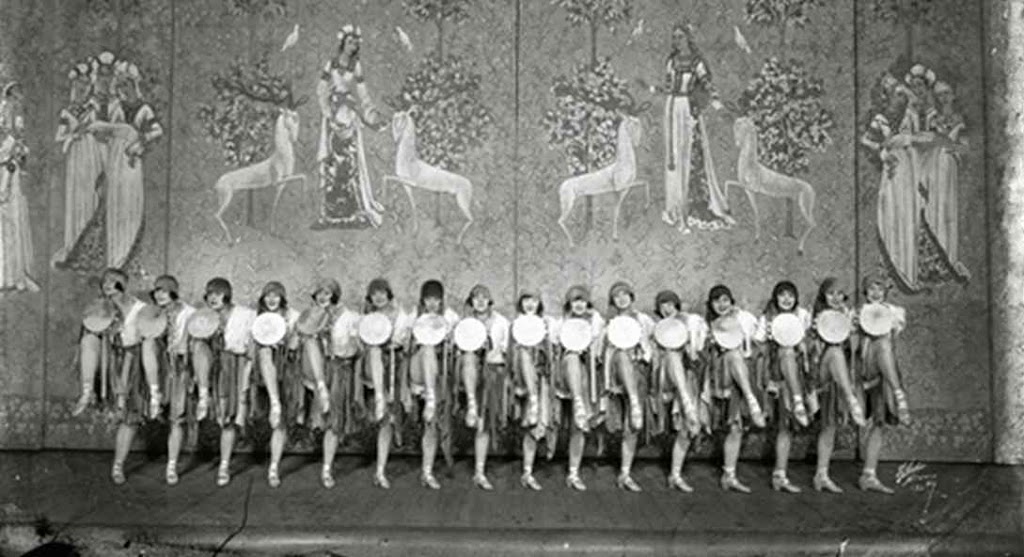
Cue the dancing girls, lower the props, raise the curtain — we’re taking on Broadway’s most famous producer, Florenz Ziegfeld! We give you a brief overview of the first days of Broadway, then sweep into Ziegfeld’s life — from his early successes (both professional and personal) to his famous Follies. And find out how the current Ziegfeld Theatre, a movie house, relates to the original Ziegfeld Theatre, home of Broadway’s first ‘real’ musical, Show Boat.
CORRECTION: I mention that the Lion King is playing at the new New Amsterdam Theater. It DID play the New Amsterdam, but another Disney musical, Mary Poppins, resides there today.

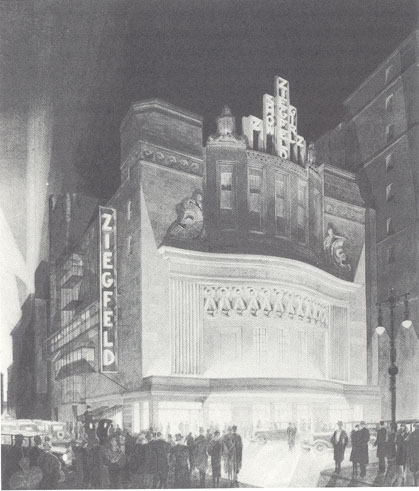
The original Ziegfeld Theatre, built by Thomas Lamb and Joseph Urban, one of the glitziest stages and the home of ‘Show Boat’ (built 1927, demolished 1966)

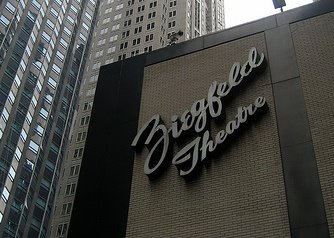
Three years after the original was torn down, a movie theater bearing the Ziegfeld name was constructed by Emery Roth and Sons. Don’t let its bland exterior fool you; this is one of the greatest movie screens in town.
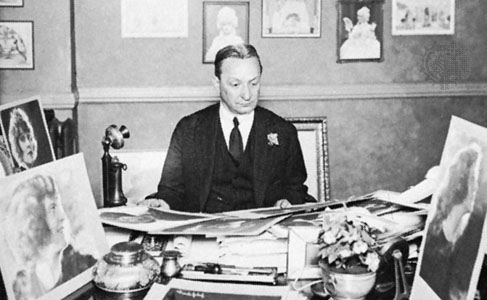
Florenz Ziegfeld, for once not surrounded by actual girls

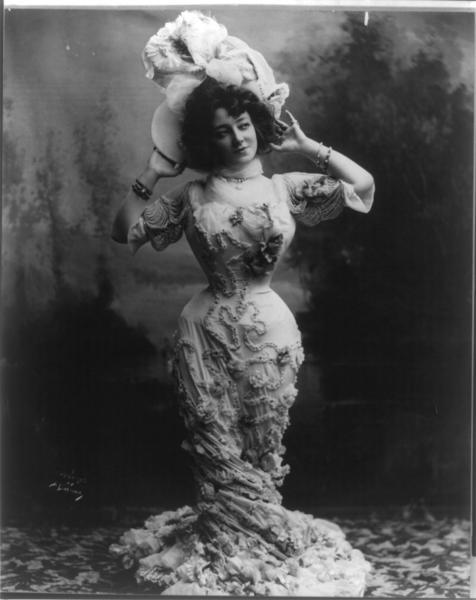
Anna Held, Ziegfeld’s ‘common law’ wife, became a star in America thanks to Flo’s often comically ridiculous press stunts

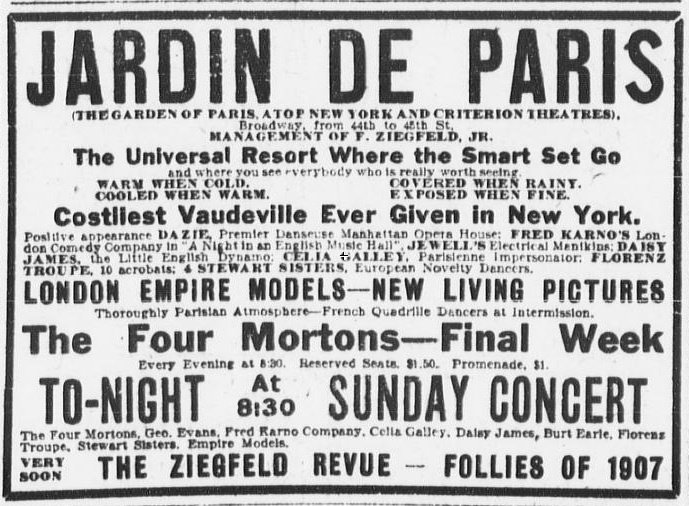
A New York Sun ad for the Jardin de Paris, the rooftop performance space at the New York Theater, touting the Follies of 1907

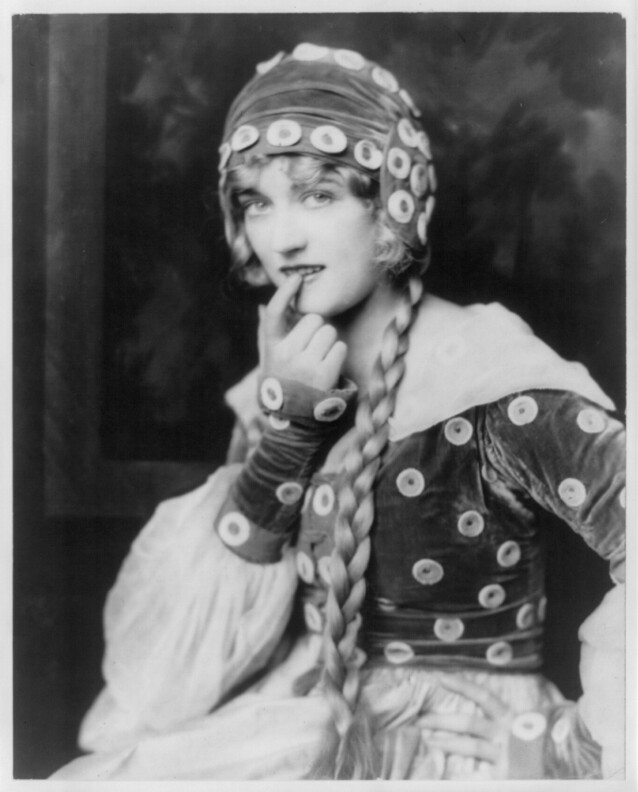
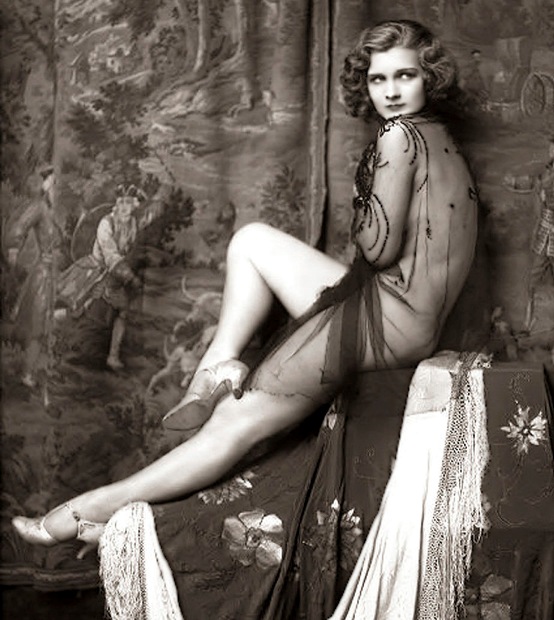
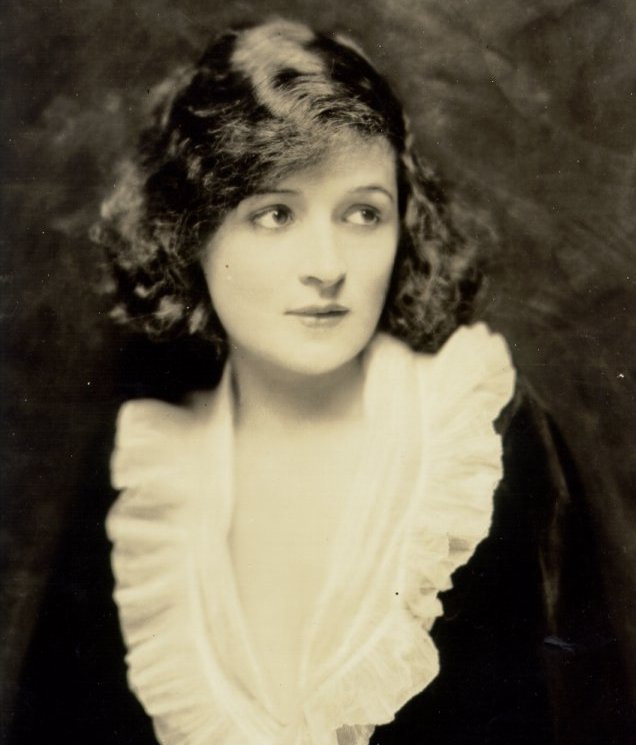
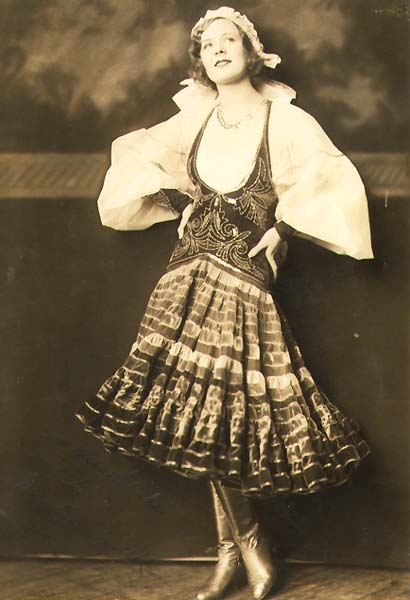
Some of the real mystique of the Ziegfeld girls comes from the provocative photography of Alfred Cheney Johnston, whose candid images were often the closest one got to these beautiful women. Below are a few examples of his work:

Marion Davies

Drucilla Strain

Billie Burke

Marilyn Miller

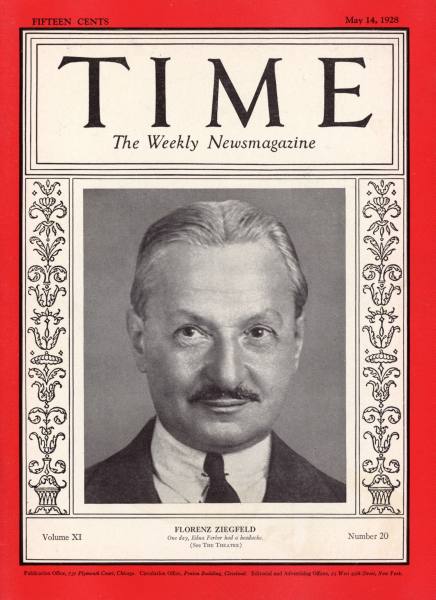
Just how big did all this make Ziegfeld? Cover-of-Time-Magazine big, that’s how big. (Courtesy Time)

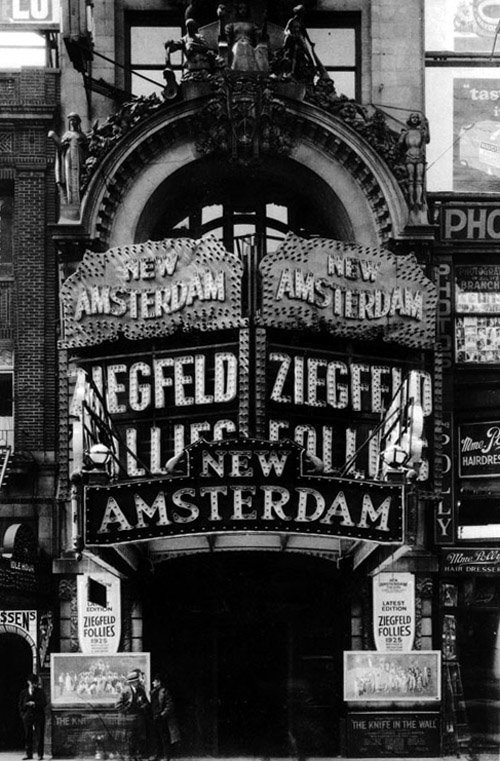
Klaw and Erlinger’s crown jewel the New Amsterdam was the home for the Ziegfeld Follies for most of its years. The stage wouldn’t see another hit that size for another 75-80 years, when Disney would renovate and move in the Lion King (now at the Minskoff Theatre).

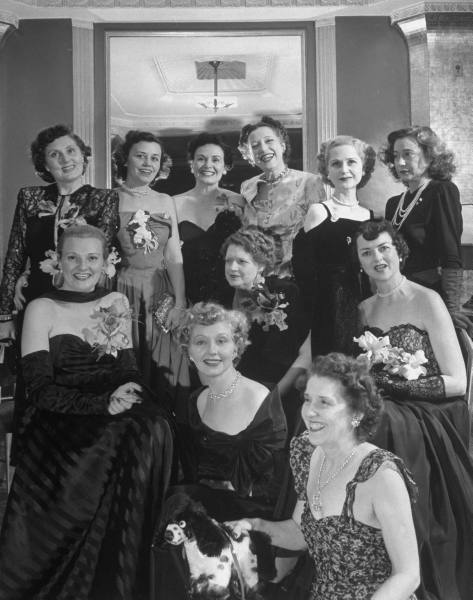
In 1948, some Ziegfeld girls who had married well (and most of them did) put together a reunion to raise money for their sister chorines who weren’t quite living it up so well.

For more information, I highly recommend you check out Musicals101’s great coverage of the Ziegfeld phenomenon. If that’s not enough, there’s a new biography on Flo Ziegfeld by Ethan Mordden that’s an absolute blast to read.

Ultimate Flair: T.G.I.Friday’s four Broadway goddesses


Imagine a Steve Madden shoe store in Times Square erecting a grand new palace to footwear, and atop its banner they decided to welcome its patrons and the throngs of Broadway theater goers passing by with sculptural likenesses of Angela Lansbury, Audra McDonald, Idina Menzel, and Julia Roberts.

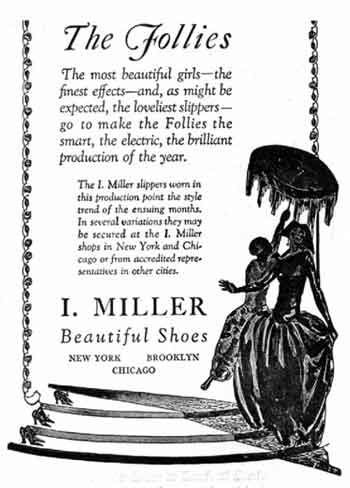
That absurd theater dream actually happened — eighty-three years ago. Polish-born Israel Miller was a successful importer of women’s shoes from the 1920s well into the late 1960s, an early fashionista who learned his trade fitting ladies of Broadway during its formative years. It was an adroit way of self-promotion; the glamorous Ziegfeld girls wore his shoes home, and what lady doesn’t want to look like a glamorous Ziegfeld girl?

By 1911, Israel opened his first shoe store at 1552 Broadway, the heart of the new theater world. Business boomed — echoing the fortunes of Broadway itself — and by 1926 absorbed the storefront next door, 1554 Broadway, to create a midtown footwear oasis for trendy women.

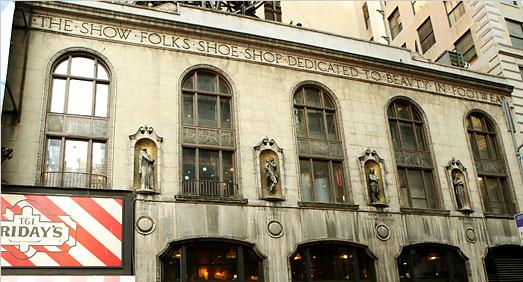
Today, Israel’s former shrine to shoes is a TGI Friday’s. But the gaudy striped signs of this chain restaurant fail to mask a remarkable glimmer of the building’s glory days.

You can still see Miller’s slogan etched into the marble — The Show Folks Shoe Shop Dedicated to Beauty in Footwear. Sitting into the walls below are four statues of Broadway muses, four major stars of the stage when they were carved in 1929 — drama icon Ethyl Barrymore, musical muse Marilyn Miller, operetta diva Rosa Ponselle and film’s biggest female star Mary Pickford (yes, that’s really her, in drag as Little Lord Fauntleroy).

But the building is as much a monument to 20th Century art as it is to the early days of Broadway. The first remarkable fact comes with the man who sculpted these stone beauties: Alexander Sterling Calder, father of the iconic mobile designer.

The second involves Miller, who in the 1950s commissioned a young graphic artist to invent whimsical, fresh shoe designs, radically dusting off his store’s by-then dusty reputation. That illustrator, Andy Warhol, would later uses his assembly-line acumen and eye for product design to revolutionize the art world.

For more information about this remarkable landmarked building, check out this string of posted articles.

‘Rent’ hikes, taking the old East Village with it


A stubborn group of good-looking, well-meaning squatters were finally evicted last night as the hit Broadway musical ‘Rent’ closed after 5,124 performances.

The show had become the most peculiar historical time capture on Broadway, freezing forever a musical variation of late 80s/early 90s, pre-Guiliani East Village underground, recalling a time when Avenue B had far fewer condos and trendy bars. Seen now as a history of pre-development, ‘Rent’ documents a psychic battle most feel the East Village lost — artistic independence in a shrinking bohemian subculture.

‘Rent’ was written as a tangle of contemporary love stories — based loosely on ‘La Boheme’ — by Jonathan Larson, the young playwright who died of an aortic aneurysm the day before the show’s opening night (January 26, 1996) at the New York Theatre Workshop.

‘Rent’ moved to Broadway that spring and won the Best Musical Tony, eventually becoming the seventh longest running show in Broadway history. It fell into a ragtag category of edgy downtown shows made good — inheritor of ‘Hair’-like passions among fans and setting the stage ten years later of ‘Spring Awakening’, another sexy, youthful show based on an older source.

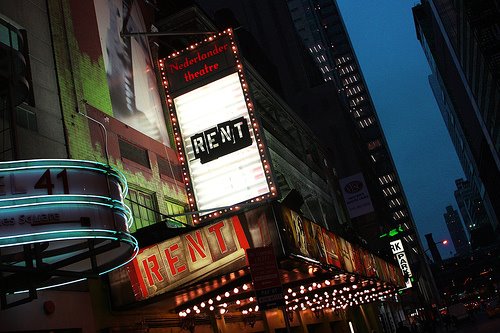
It ignited the career of many of its original cast members, chief among them married stars Taye Diggs and Idina Menzel (securing her Best Actress Tony for ‘Wicked’). From the show’s perch at the Nederlander Theater on 41rd Street, the show literally saw nearby 42nd Street transform from a shiftless boulevard of empty marquees to the most hyper-neon tourist friendly destination on the planet. Slowly, what felt fresh and contemporary turned nostalgic, as the cast’s trendy fashions became more and more costume-y as the years went by.

The Tower of Toys made famous in ‘Rent’s striking scaffolding set has since been demolished. The Life Cafe — scene of Rent’s rousing ‘La Vie Boheme’ — is still around, although when the film version of ‘Rent’ came around, the roomier bar at 7th Street and Ave B was its stand-in.

I fully admit to being a ‘Rent’-head; I saw the show two days after its opening downtown, when the cast was still stunned by Larson’s passing and energized by audience and critical enthusiasm. Once the show moved to Broadway, it offered front-row seats for $20, as long as you were willing to literally camp out all night for them. (I did it. Twice. Okay, three times.)

The show now faces its final test — as a musical standard spreading to local theatre troupes all over the world. A national tour has been on the boards for years. Can a bit of the old East Village survive perpetually in suburbia?

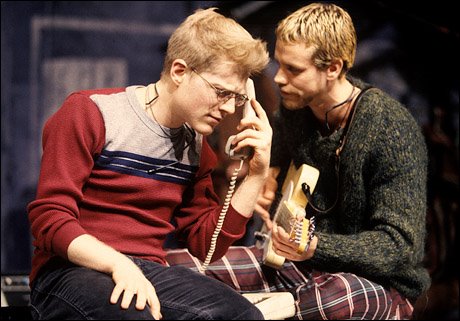
Below: Anthony Rapp and Adam Pascal

Sarah Jessica Parker: her New York City history


Above: the sun comes out for Sarah Jessica Parker

New York City usually spends the summer movie season being destroyed by aliens or scarred by car chases. So despite what you may think of the upcoming Sex And The City movie, consider this — not only does the Big Apple make it out alive, it actually transforms back into that place of fantasy and romance that made you fall in love with it in the first place.

All the Sex And The City actresses have New York connections, especially native New Yorker Cynthia Nixon. But lead star Sarah Jessica Parker developed her acting chops here and maneuvered through many notable Broadway and off-Broadway performances to somehow become the quintessential young New York actress.

Although Sarah was born in Nelsonville, Ohio, in 1965, her father was a Brooklyn native so the city was always in her blood. Even almost removing Sex And The City entirely from the equation, you can still trace her early history through the streets of the city at these sites:

Roosevelt Island
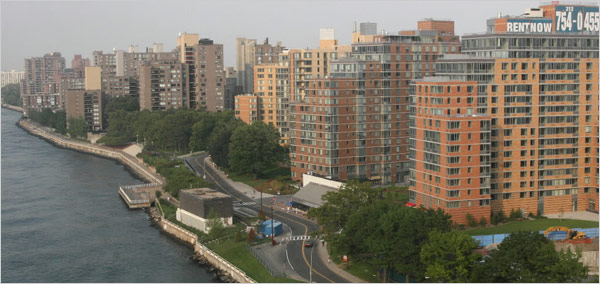
In 1977 Sarah’s family packs up a VW van and moves to the burgeoning social experiment known as Roosevelt Island. From here, she is able to go to performance schools in the city and audition for shows at an early age. The island had only been named after Roosevelt for four years and many were still calling it Welfare Island. Sarah most likely took the Roosevelt tram, which had just been built the year before.

Professional Children’s School (132 West 60th Street)
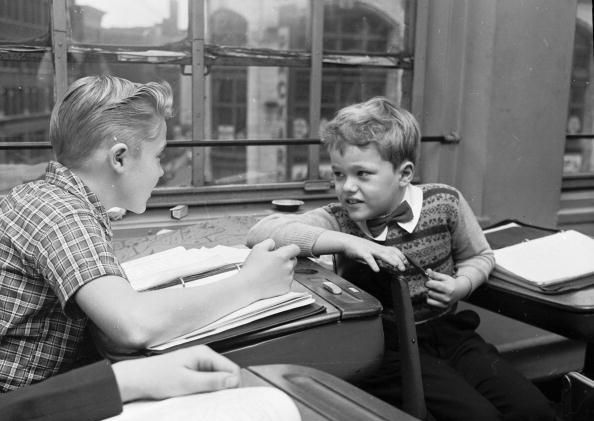
Sarah attended this performing arts school in her early years. The Professional School has fostered hundreds of precocious young performing arts students since 1914, including another famous Sarah (Michelle Gellar). The photo above is of PCS students in 1955. Sidenote: the Professional Children School spawned most of the Culkins (Macaulay, Rory, et al)

Neil Simon Theatre (W. 52nd Street)
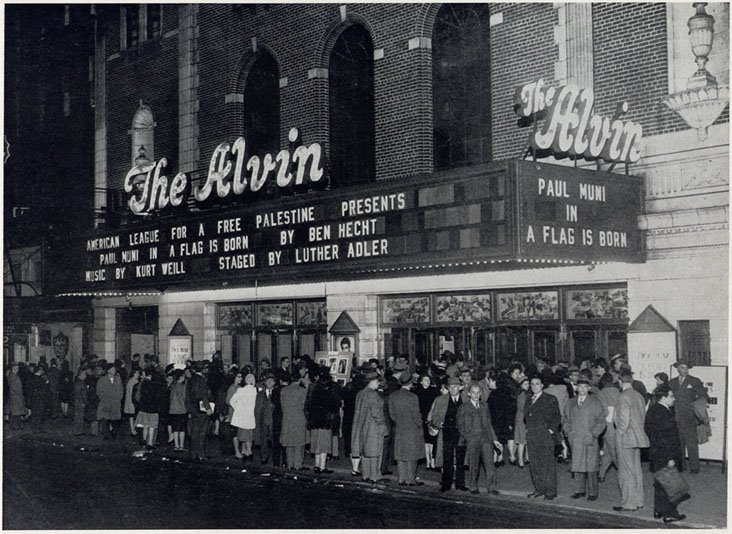
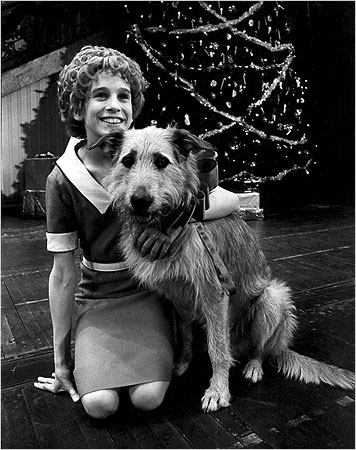
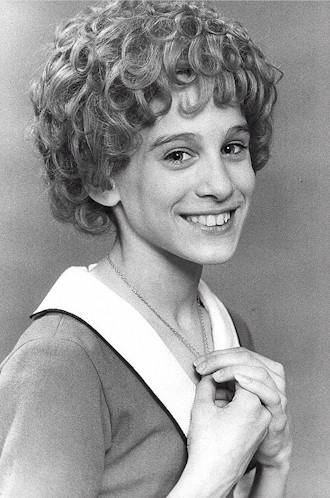
Formerly the Alvin Theatre (pictured above in 1947), this was where Annie made its Broadway debut, and from 1978-80 featured a young Sarah Jessica, in latter years as the title character (below), in what looks to be a horrendous fright wig. Four years later the Alvin would be renamed for playwright Simon, and its first production — Brighton Beach Memoirs — would star Sarah’s future husband Matthew Broderick.

Sarah performs a song from Annie in a 1982 television special here.


Manhattan Theater Club (at City Center, 131 West 55th Street)
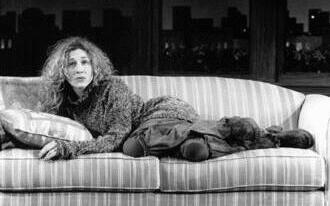
City Center, a former Shriners hall, welcomed the renown theater company to its location in the 1980s. Sarah spent many great years during the 90s on the stage of the MTC, most notably playing a dog in the 1995 comedy Sylvia. Her co-star Nixon frequented the stage many times as well.


Richard Rodgers Theatre (226 W 46th Street)
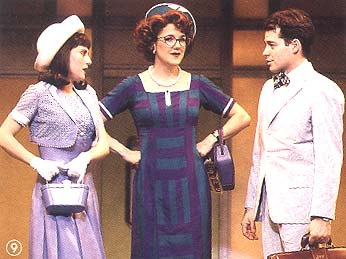
Sarah met her future husband Matthew Broderick (above) through her association with the Naked Angels theatre company, but the two would take to the big stage together in the revival of How To Succeed In Business Without Really Trying, a show which would garner Broderick a Tony Award. Sarah Jessica marries Broderick in 1997 in civil ceremony in a former Lower East Side synagogue.

66 Perry Street
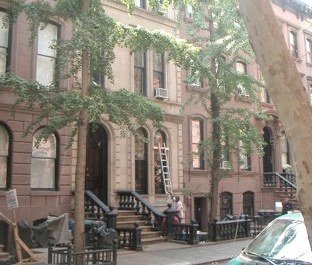
Sex And The City, which debuted in 1998 and scoured the city during its seven year run for trendy and romantic locations, placed Sarah’s character Carrie Bradshaw at the address 245 East 73rd Street, although the actual building where exteriors were shot was located at 66 Perry Street in the West Village, nearby her present home. (You may want to avoid this location for the next few weeks.)

Lenox Hill Hospital (100 East 77th Street)
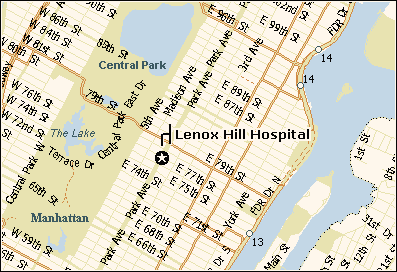
Sarah gave birth to her first child here, in one of Manhattan’s oldest hospitals, in 2002. The facility opened in 1857 as the German Dispensary but moved to its present location in 1862. In 1918 it was renamed after the Upper East Side neighborhood where it resides. Perhaps Sarah delivered her son James Wilkie Broderick in a room near where Winston Churchill was treated after he was hit by a car in 1931.

Plaza Hotel (5th Ave and 59th Street)
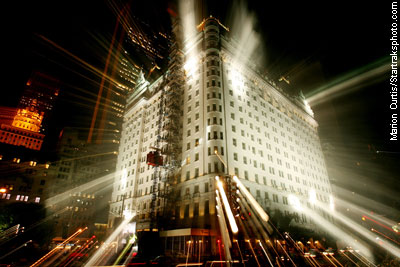
Turned 40 years old at a lavish birthday party at the Plaza Hotel, which was at the time 97 years old. The whole cast celebrated with her, as did that other New York City comedy icon — Jerry Seinfeld.

Below: Sarah as Annie

By the way, in 1971, when Sarah was only six years old, a young designer by the name of Manolo Blahnik came to New York City with his portfolio, looking for work. He met with the legendary Diana Vreeland at Vogue Magazine, who suggested he focus strictly on making shoes.

Your shoes in these drawings are so amusing,” she said as she thumbed through his sketches.

Less than 30 years later, Manolo’s shoes would become famous worn on the feet of the former child star.

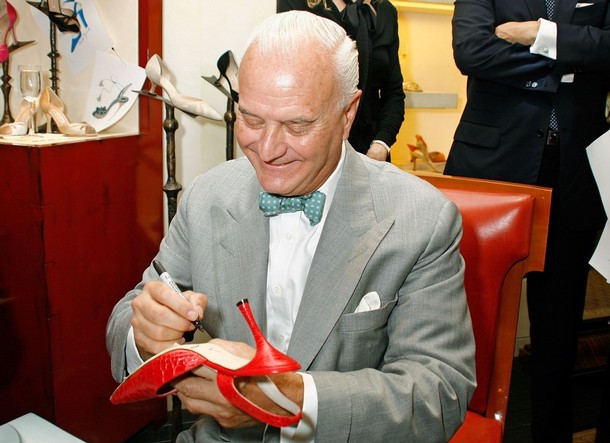
Below: Manolo, signing a shoe in New York Fashion Week in 2006


Photo by Amy Sussman/Getty Images

When Jupiter aligned with Mars: Hair on Broadway


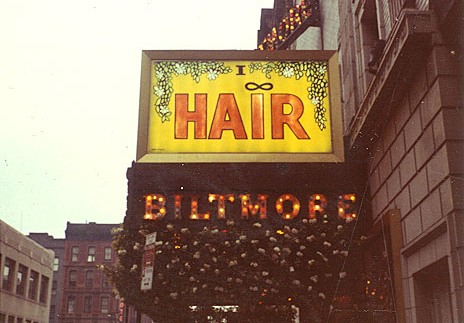
Forty years ago today, April 29, 1968, the musical Hair debuted on Broadway and basically changed New York’s theater industry — where shows come from, how they’re staged, what you can even doon stage.

Here’s ten reasons why Broadway’s first rock musical is so important, and why today you should probably fish out your Fifth Dimension CD or original cast album in tribute to this one of a kind groovy show:

1) Hair made the Public Theater. The show made its debut on October 17, 1967 at the Public, which was itself making its debut. In fact, the theater in which is was being performed — in the former Astor Library — wasn’t even finished yet! The Public Theater would have course to go on to become off-Broadway’s leading theatrical producer.

2) After six weeks, Hair would foreshadow Studio 54’s own transformation into a Broadway house by moving the remainder of its off-Broadway run into the Cheetah discotheque.

3) Hair is the very first musical to be transferred from off-Broadway. At the time an extremely risky proposition, it’s today considered a logical move for the most critically popular of shows. Rent, Avenue Q and Spring Awakening — like Hair, all off-center shows with sexuality and rebellion at their core — also made the jump to the big stage and all won Tonys for Best Musical.

4) Hair brings Tom O’Horgan to Broadway. A regular at the off-off-Broadway La Mama — the East Village’s most venerated experimental theater — O’Horgan brought an uncompromising edge to his staging that was entirely shocking to mainstream theatrical audiences. O’Horgan would stay on Broadway throughout the 70s with pivotal work in Jesus Christ Superstar, Futz!, and Lenny.

5) Hair doubles the number of songs ‘allowed’ in a musical. The sheer number of songs in Broadway restaging made it unique, over thirty. The big musical from the previous year, Cabaret, barely featured half that number

6) O’Horgan also brings the nudity. The uptown redux features one of the most influential scenes in all of Broadway history — at the end of the first act, when the entire cast, in low lights, appear completely unclothed, the first stage nudity to hit the Great White Way.

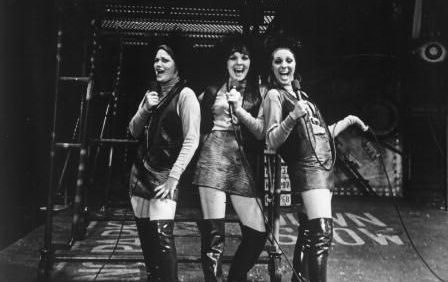
7) A New York icon debuts. Diane Keaton (above, in the middle) becomes an understudy in the show but refuses to do the nude scenes. After several months with the cast, Keaton goes on to her next show — Play It Again, Sam — where she makes the acquaintance of a young director, Woody Allen.

8) Up for two awards (Best Director and Best Musical) at the 1969 Tony Awards, it lost both to the musical 1776. Interestingly, Diane Keaton is up for her Tony that year for Play It Again Sam and also lost.

9) Hair closes July 1, 1972 after 1,750 performances. It is the 38th longest running musical in Broadway history, between La Cage Au Folles (at 37) and The Wiz (at 39).

10) An unbelievable one-night revival of Hair, in 2004, for an Actors Fund benefit, mounted at the New Amsterdam and featured the following cast: JM J. Bullock, Harvey Fierstein, Ana Gasteyer, Annie Golden, Jai Rodriguez, RuPaul, Michael McKean, Laura Benanti, Adam Pascal and future Oscar winner Jennifer Hudson

Here’s about a comprehensive list of some of Hair ‘s original review. Both the New York Post and the New York Times gives the original off-Broadway production a condescendingly mixed review.

The Village Voice? Hated it. “As for Hair, I loathed and despised it. Described as ‘an American tribal love-rock musical’ it turned out to be all phony.” Wow, some things never change!

We’ll see how the critics like it this summer when the Public Theatre restages Hair for its Shakespeare In The Park program at Delacorte Theatre, from July 22 to August 17. Diane Keaton won’t be in it, but will there be nudity?

Categories
Podcasts

PODCAST: Studio 54

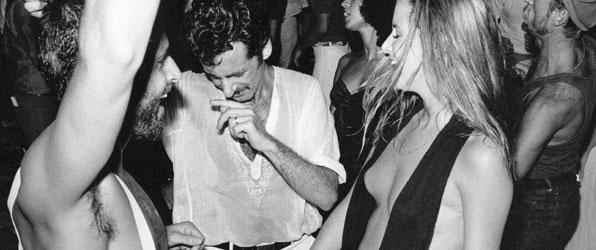
Join us as we step behind the velvet ropes to explore the history of Studio 54, legendary dance club.

Listen to it for free on iTunes or other podcasting services. Or you can download or listen to it HERE

April 26 marks the 31st anniversary of the opening of Studio 54

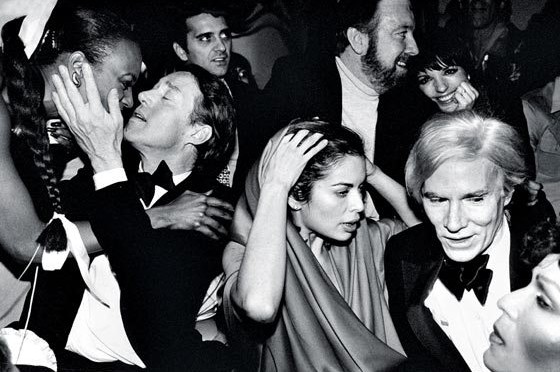
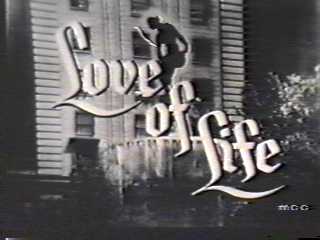
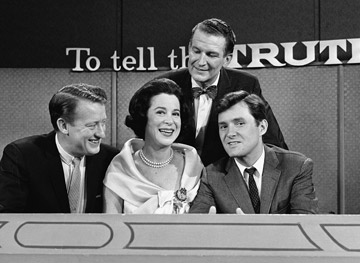
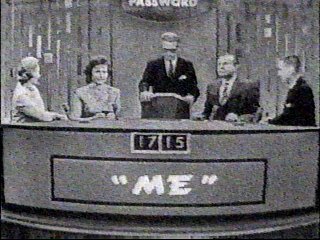
Before it was Studio 54, Studio 52 was one of CBS’s premier recording studios for a wide variety of programs. It was the home of such shows as Password, To Tell the Truth and the soap Love Of Life.

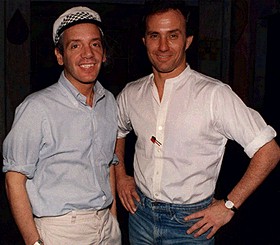
Steve Rubell and Ian Schrager

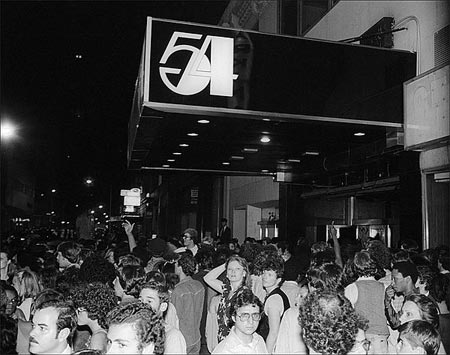
A typical scene outside the club

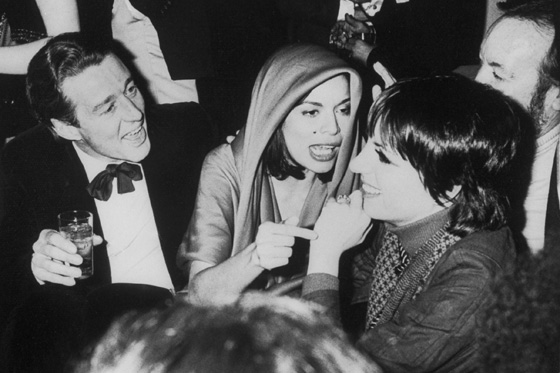
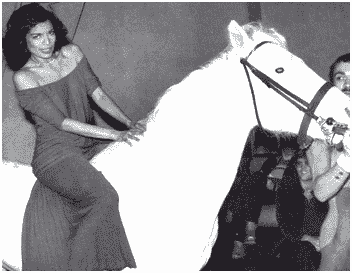
Halston, Bianca Jagger and Liza Minelli at 54

Bianca … on horseback!

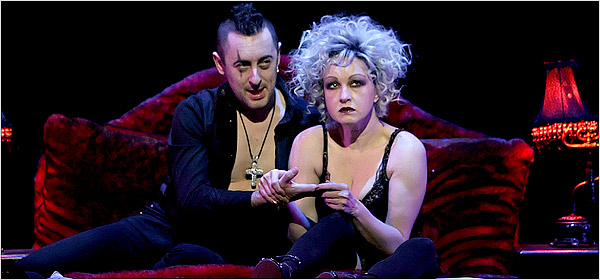
A different Studio 54 as the Roundabout Theatre moves in. Here’s Alan Cumming and Cyndi Lauper from the edgy production of Threepenny Opera
(Photo Sara Krulwich/The New York Times)

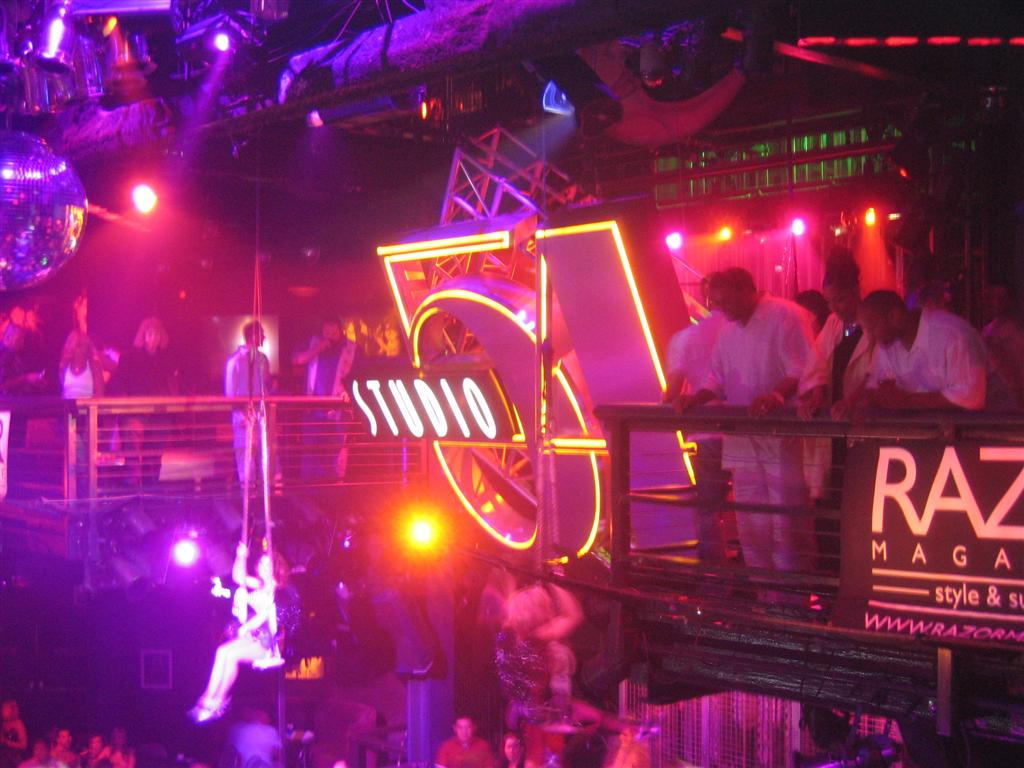
An entirely different Studio 54, this time in Las Vegas

Disco Disco has a warm look back at the club. New York Magazine did a where-are-they-now? And check out some of Ian Schrager’s elegent properties — the Hudson and the Gramercy Park Hotel

Categories
It's Showtime

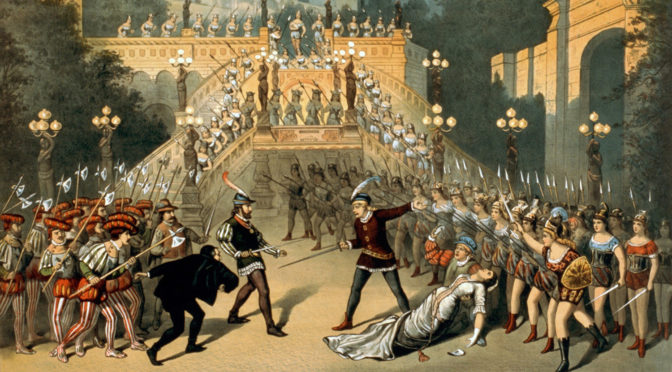
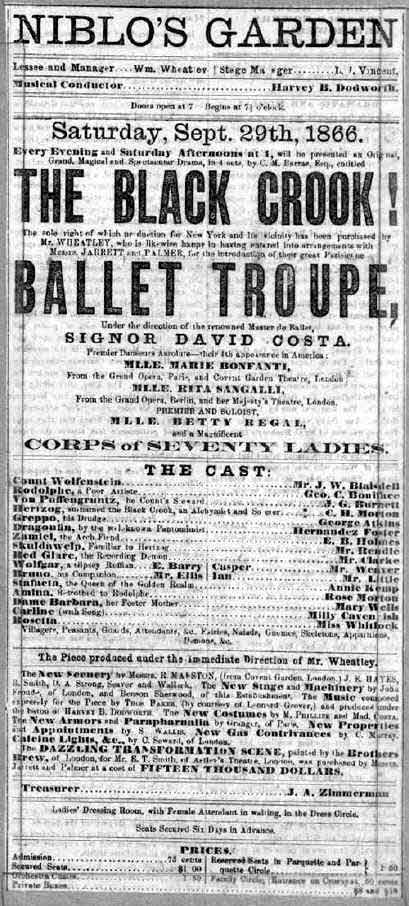
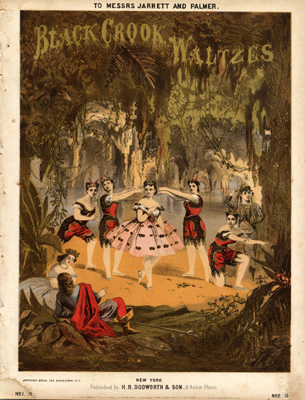
Broadway’s first musical: The Black Crook

The Broadway theater season begins again with another new batch of musicals hitting the boards — from an unusual adaptation of War And Peace to a stage version of a Robert DeNiro drama.  Some believe that this musical tradition begins all the way back in September 12, 1866, back when musicals based on movies and popular Founding Fathers weren’t much of a consideration.

At a time when the largest theaters in Manhattan were all below 14th Street, the 3,200-seat Niblo’s Garden on Prince and Broadway was one of the largest and most popular. In fact, it wasn’t merely a theater but an entertainment park of mid-19th century fancies. William Niblo, an upper class PT Barnum of sorts, opened his version of a showy Las Vegas hotel in 1828, with elaborate gardens, gaslight illumination shows, vivid dioramas, traveling circuses, fireworks displays, and plenty of open saloons to keep his patrons happy. A theater was included in this complex, for many years one of the most popular amusements in the city.

In 1866, a variation on the usual theatrical spectacle debuted at Niblo’s that soon proved to be his most popular offering. Plays had featured popular songs in the past, and variants of operas (or rather, sung plays or ‘ballad-operas’) were popular. But in September, The Black Crook debuted, with odd traits at the time that have now come to typify the modern musical.

It’s considered the first American musical by many scholars for three reasons: 1) it included newly written songs with previously adapted music; 2) it included a flashy chorus of leggy dancers; 3) its success spawned a slew of ‘extravaganzas’ that evolve right into today’s modern musical productions. By most accounts, it was also, from our perspective, really, really awful.

Evokative of German melodrama, Crook was really just a terrible play by Charles M. Barras that Niblo manager William Wheatley had refitted with a troupe of recently unemployed French dancers from another show that had the fortune (in William’s eyes) of being booked in a theater that had just burned down.

The plot was all fainting spells and sulfur smoke. Young Rodolphe is enslaved by a sorceror Hertzog, who must grant the Devil the soul of one innocent every New Years Eve. Rodolphe saves a white dove from peril which just happens to be a good witch in disguise — Stalacta, Fairy Queen of the Golden Realm — who rescues him and sends all the bad guys straight to Hell. Damn it, why hasnt this thing been revived? I smell Tonys! [2016 Ed: Guess what? It is being revived!]

Well, for one, if you can believe it, the musical ran five and a half hours long each night. Despite this, it was a huge success, running 263 performances and, in a proud American tradition, spawning a sequel, The White Fawn.

The key to its success wasn’t the drama, but all those sexy girls in flesh colored garments and a bevy of dazzling light and shadow effects that were lavish and magical. From a review from the New York Tribune: “One by one curtains of mist ascend and drift away. Silver couches, on which fairies loll in negligent grace, ascend and descend amid a silver rain.” Although I’m sure they’re nothing compared to the scandalous vamps of Chicago, they must have been spectacular at the time.

And, in keeping with perspective of our current strike, according to Mark Caldwell’s New York Night, the show employed 80 carpenters and “twenty gasmen” just to run the elaborate mechanics.