Categories
Parks and Recreation

Ten Images of Bowling Green and Ten Facts about its Marvelous History

Bowling Green, at the very tip of Manhattan island, is a small oval park so calm in comparison to its surroundings that it’s hard to believe this is one of the oldest sections of the city of New York.  

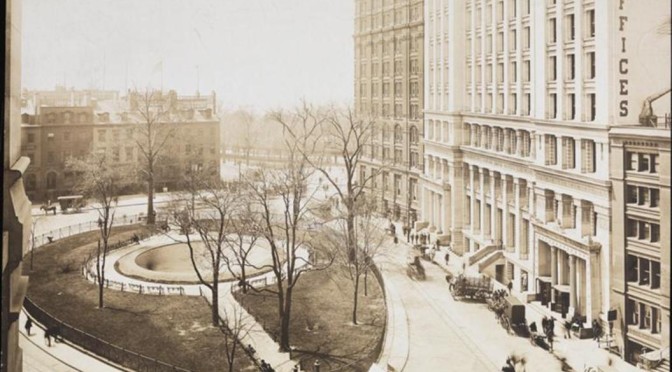
Here are ten facts about Bowling Green, accompanied by ten images and photographs from various periods in this tiny park’s extraordinary history:

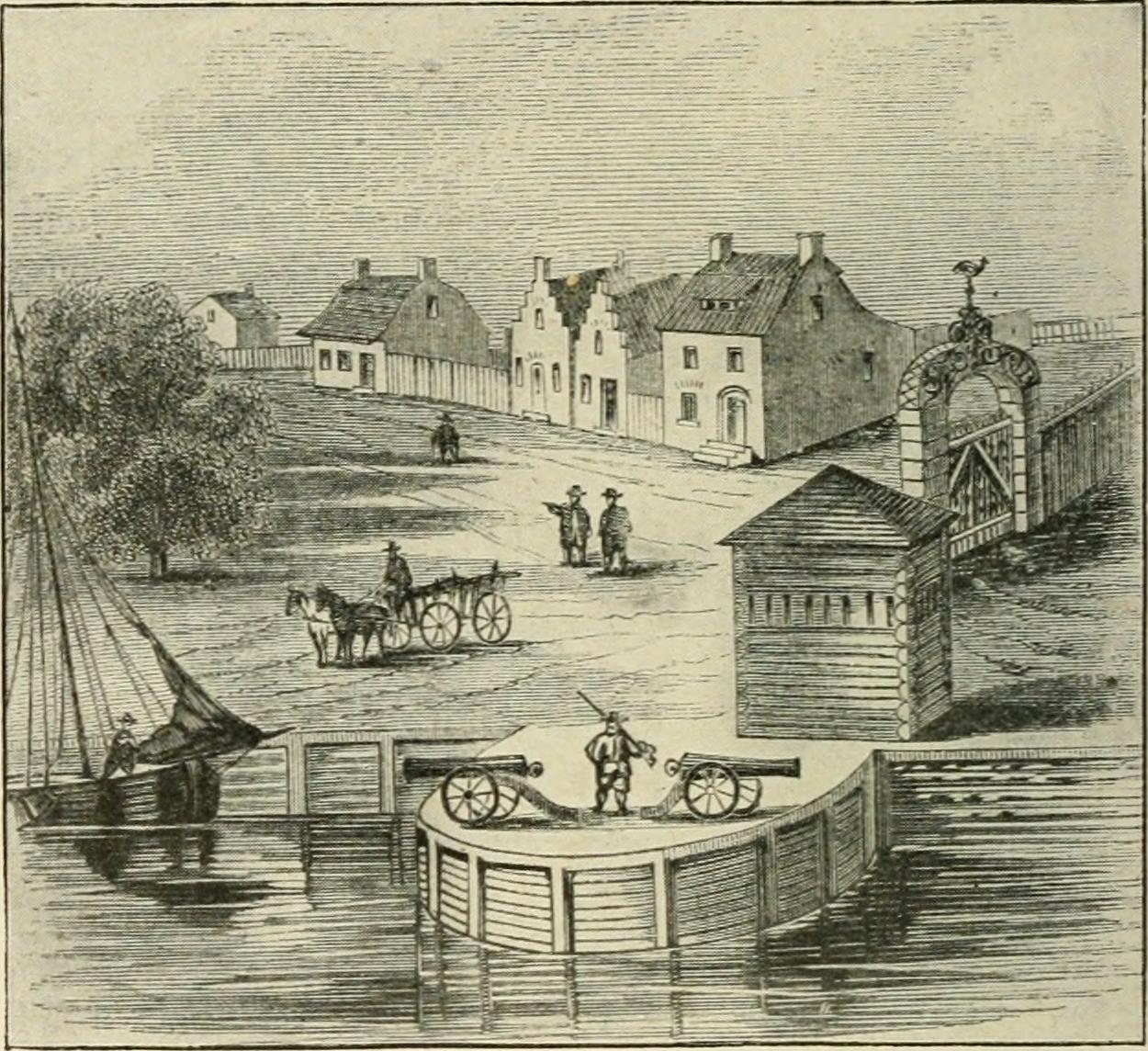
"The Plaine" -- where the trees are to the left -- is where Bowling Green would eventually be constructed. This depicts the early Dutch years. (Courtesy the Internet Book Archive)
“The Plaine” — where the trees are to the left — is where Bowling Green would eventually be constructed. This depicts the early Dutch years. (Courtesy the Internet Book Archive)

1) The land comprising Bowling Green was situated next to Fort Amsterdam. During the days of New Amsterdam, this was the site of the first public well, dug in 1658 and would remain the only well within the city until 1677, long after the Dutch were replaced by the British.

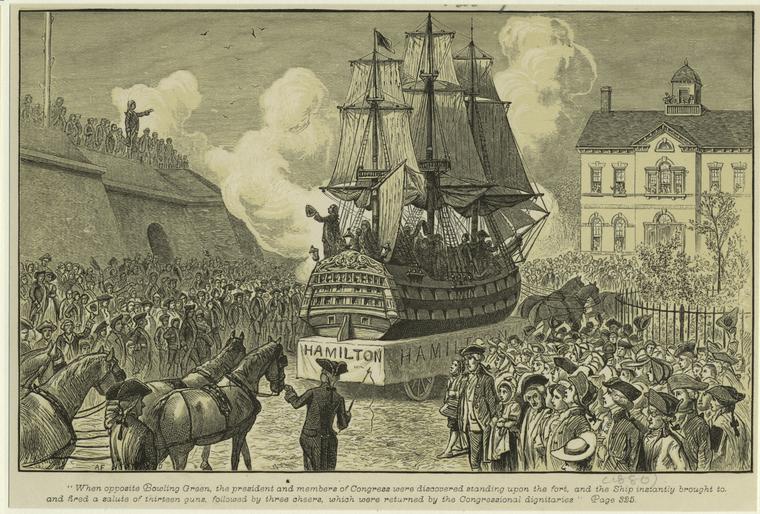
Ship On A Parade Float Drawn By Horses Past Bowling Green, New York, 18th Century. (Courtesy New York Public Library)

2) Since it was next to the fort, it’s not surprising to discover that the area was a parade ground during the early 18th century.  In 1733, it was leased to three local landlords — Peter Jay, John Chambers, and Peter Bayard — to develop an English-style park. It quickly became the destination of lavish homes of the wealthy.

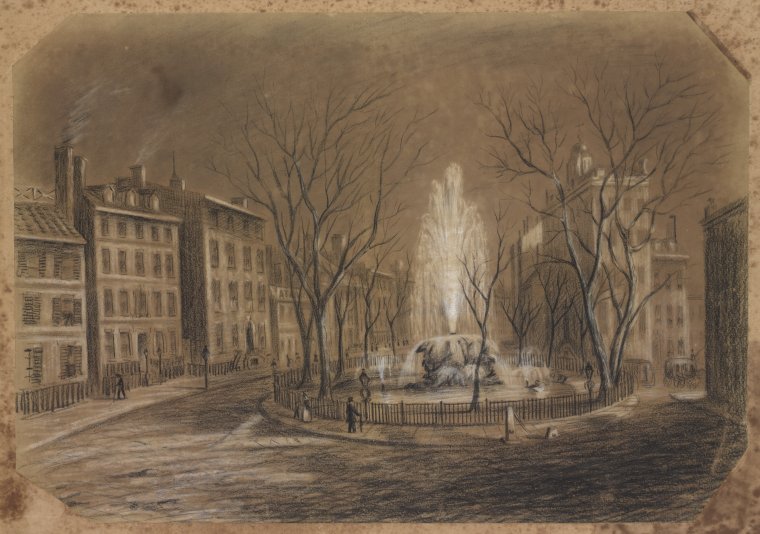
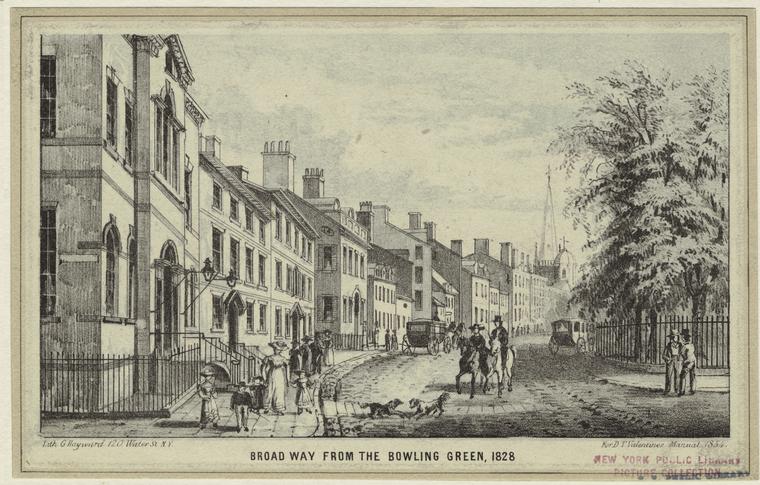
Charcoal drawing of Bowling Green, New York, 1845. (New York Public Library)

3) Yes there was actually bowling here. Or rather, the traditional form of lawn bowling, enjoyed by the residents that lived around the park. This required perpetual maintenance of the lawn. Before the invention of the lawnmower, this was usually accomplished by sheep. I’m not sure whether sheep were employed into service here at Bowling Green. But there were pigs in the street so you never know.

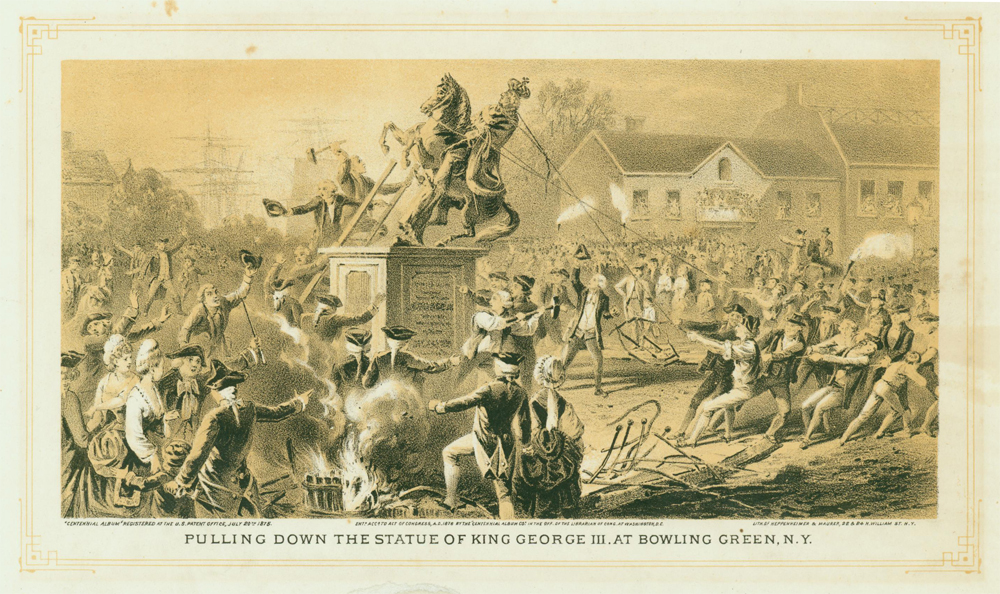
Pulling down the King George statue 1776

4) In 1770, loyalists to the crown erected an equestrian statue of King George III in the center of the park. Six years later, it was ingraciously torn down by New Yorkers after hearing George Washington read the newly crafted Declaration of Independence.  Parts of that statue still exist in the city.

nypl.digitalcollections.510d47e1-0ec5-a3d9-e040-e00a18064a99.001.w

5) George Washington lived here. No really. He had two residences here during the time when New York was briefly the nation’s capital.  The first, over on Cherry Street, provided him and his wife Martha with breathtaking views of the East River, but they soon found it quite unsuitable.  So in 1790 they moved to a home at 39-41 Broadway, at the northern tip of Bowling Green, residing here until the capital was finally moved to Philadelphia.

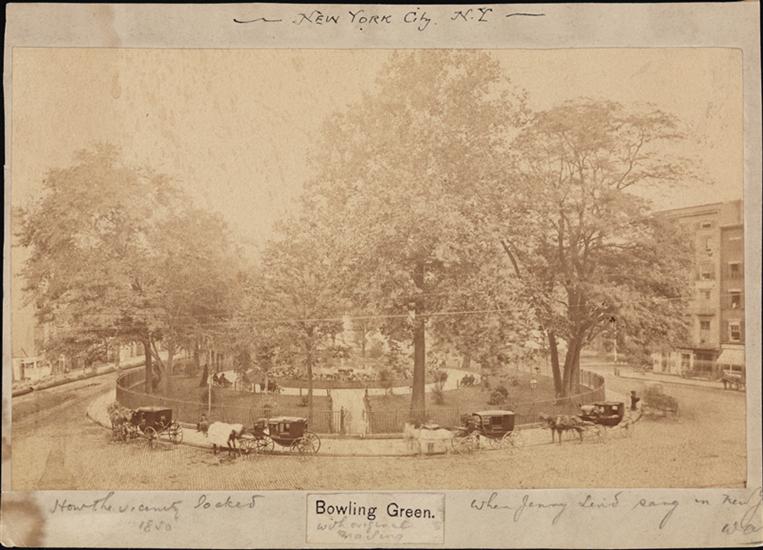
Bowling Green, how the vacinity looked in 1850 whnen Jenny Lind sang in New York.  (Courtesy Museum of the City of New  York)
Bowling Green, how the vacinity looked in 1850 whnen Jenny Lind sang in New York. (Courtesy Museum of the City of New York)

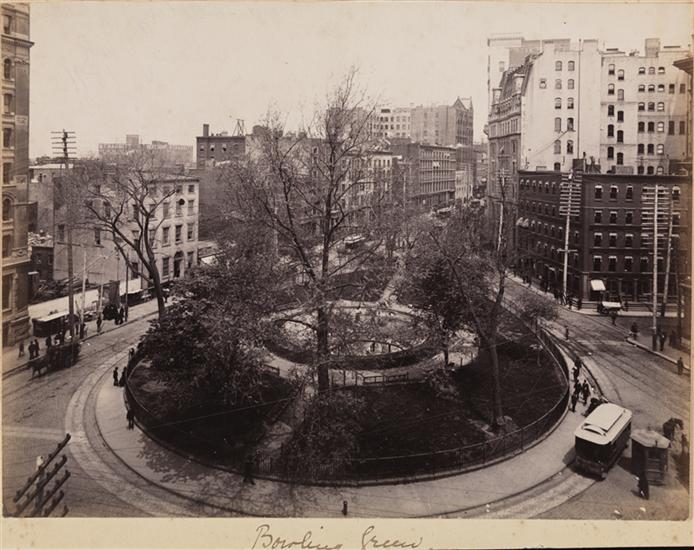
6) Bowling Green was still the destination for the New York’s oldest, snootiest families at the start of the 19th century.  In fact, it was given a rather inappropriate nickname — Nobs Row. As the town moved northward, the wealthy left their houses around Bowling Green.

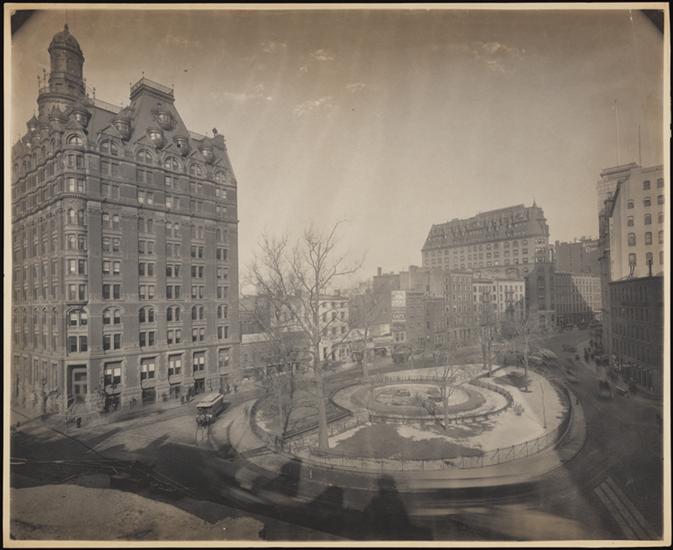
Bowling Green 1900 (Courtesy Museum of the City of New York)

7) In the 1820s, the first velodrome was situated near Bowling Green featuring a precursor to the bicycle called the draisine.  New Yorkers loved this curious device. “Near Bowling Green these vehicles were first exhibited.  Around City Hall Park and the Bowery, at all times of the days, riders might be seen.

Bowling Green 1915 (Courtesy Museum of the City of New York)

8) Bowling Green soon became known as a transportation terminus for coaches and omnibuses which strode up and down Broadway. In the 1820s, when the entertainment venue Castle Garden opened, the streets around Bowling Green became clogged with busy street life. By the 1850s, Castle Garden became the principal immigration station, filling the once elite neighborhood with a bustling cross-section of classes. In the 1890s, New York’s short-lived cable-car line terminated here.

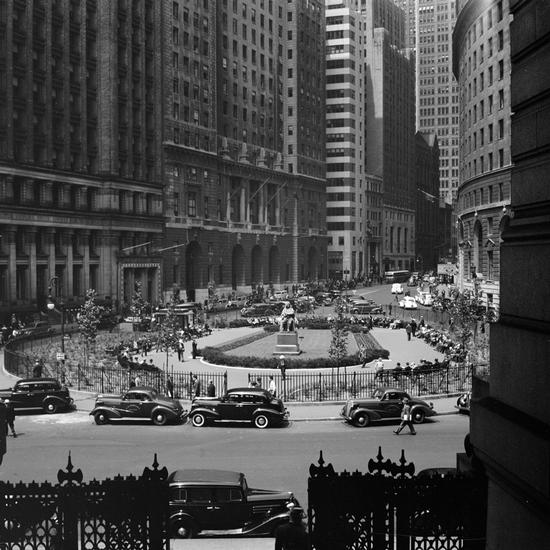
Bowling Green, 1939, Wurts Brothers photography (courtesy Museum of the City of New York)

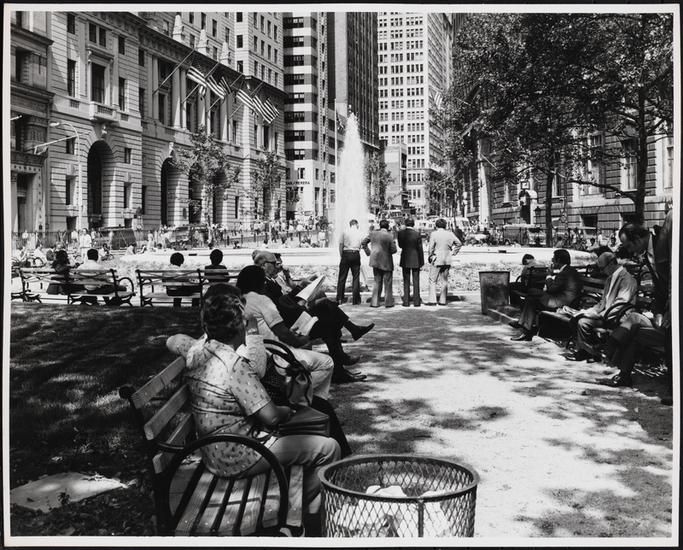
9) The park was much abused and generally unimpressive during the 1950s and ’60s but was rebuilt during the 1970s to approximately resemble  how it once looked.  The fence which surrounds the park is the original which was first placed around the park in 1773. This makes it one of the oldest free-standing artifacts in all of Manhattan.

Bowling Green 1975, photo by Edmund V Gillon (Courtesy Museum of the City of New York)

10) During the late 1980s the park met its weirdest neighbor yet — the Charging Bull sculpture by Arturo Di Modica.  Arguably better known and more beloved by tourists, the bull was originally planted illegally in front of the New York Stock Exchange. By the time the city removed the statue, New Yorkers had come to love it. They eventually placed it next to Bowling Green in 1989.

Categories
It's Showtime

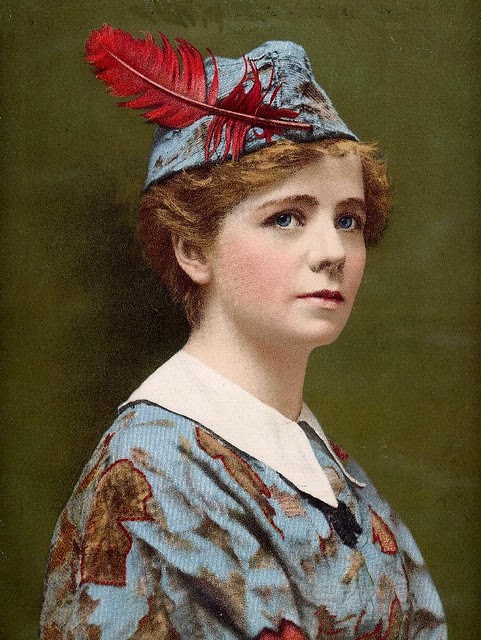
Maude Adams: Fashion icon and America’s first Peter Pan

Tonight NBC’s unveils its live theatrical experiment Peter Pan with Girls star Alison Williams in the cross-dressing role of the boy who never grows up.

We can all have our debates about who’s been the greatest stage Peter Pan in history.  Most will say Mary Martin, a sizable minority will claim Sandy Duncan, and a few smaller voices may even cry the name Cathy Rigby. However the first and most popular woman to ever play the role was most likely the actress who originated the role on the American stage — Maude Adams.  

Her rendition was so popular that it inspired one enduring fashion trend.

Peter Pan made its New York debut on November 6, 1905 at the Empire Theatre at Broadway and 41st Street.  The theater was owned by one of New York’s most powerful producers Charles Frohman. Adams was one of his greatest finds, casting her in several productions when she was just a teenager.

Adams had played a boy on stage and had even starred in a prior play by Peter Pan’s author J. M Barrie (Quality Street).  Barrie himself came to New York to witness rehearsals with Adams and the show 70-odd cast members.

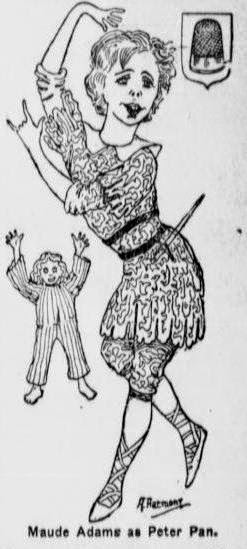
At right: The bizarre visage of Maude Adams as illustrated in the New York World, November 1905

The audiences loved Adams, but not the critics. From the New York Tribune the following day:  “As an actress Miss Adams is incarnate mediocrity — for she possesses neither imagination, passion, power, depth of feeling or formidable intellect and her faculty of expressive impersonation is extremely limited” — OUCH — “but as a personality, she is piquant, interesting and agreeable … she has shown to advantage and she causes the effect of commingled merriment, sentiment and momentary thought.”

Others criticized her physical size, calling her “plump and prancing.” “She was a trifle overweight for a fairy, but she carried herself lightly and gracefully and didn’t scare the children in the least.”

Audiences loved her, however, Adams proceeded to play the role of Peter Pan, off and on, for over a decade. In fact, Maude Adams was the actress most associated with the part for fifty years.  Mary Martin then took the role to Broadway in 1954, won the Tony Award for Best Actress the following year and then became the model for which all subsequent actors have looked to.

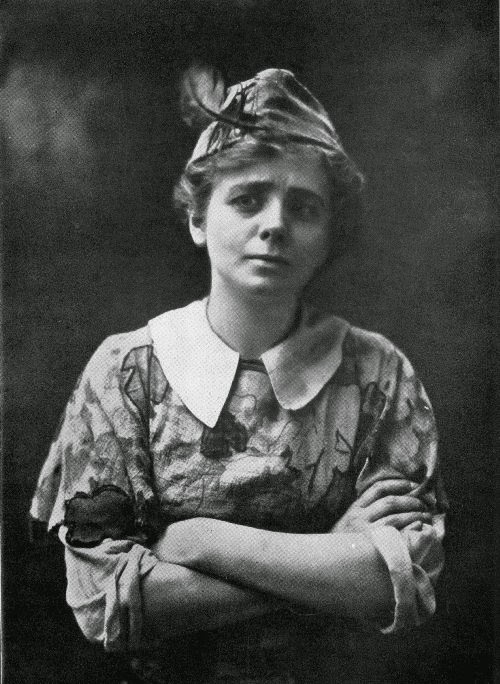
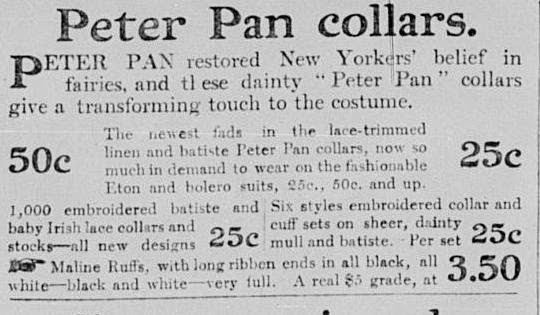
More important, Adams inspired a popular fashion trend — the Peter Pan collar.  Her costume, by John White Alexander, took great liberties with Barrie’s descriptions of Peter’s garments.  Women soon clamored for dresses with a similar floppy collar.  The play was still running at the Empire when the collars soon appeared at department stores.  This ad is from April 1906:

Her belted waist also took the fashion world by storm.  The “Peter Pain waist,” a traditional shirtwaist bound with a thick black belt, was called “decidedly chic,” “particularly becoming and stunning in effect.”

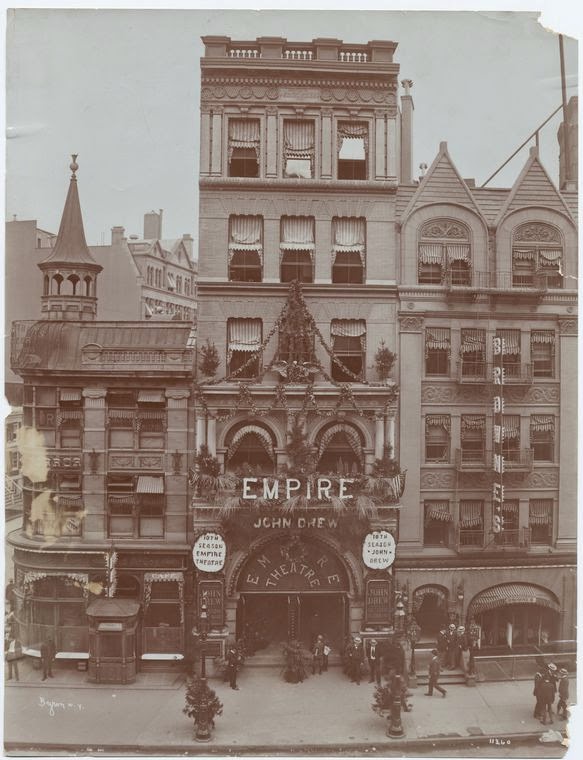
The front of the Empire Theatre, where Peter Pan made its New York debut:

Pic courtesy New York Public Library

Categories
Holidays

Wacky, windy and weird: 1964 Macy’s Thanksgiving Day Parade

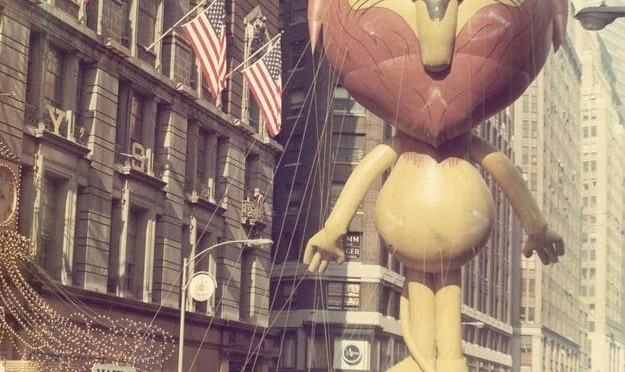
Linus the Lion-Hearted at the 1964 Macy’s Parade

The Macy’s Thanksgiving Day Parade of 1963 had been a downer of a parade.

President John F. Kennedy had just been assassinated a few days before but, deciding that cancelling the event would be “a disappointment to millions of children,” the parade went on as planned.

Leading the parade that year was a 38-foot rubber Unisphere to promote the upcoming World’s Fair. Further back in the line was young television star Michael Landon.

Flash forward to the following year — the World’s Fair out at Flushing-Meadows had celebrated a rocky first year. Landon’s Bonanza was about to become the most popular show on television, a distinction it would hold throughout the mid-1960s. New York City was, generally speaking, in a cautiously more festive mood.

Not that the specter of the previous year’s tragedy was far from people’s minds. “Americans plan to savor the traditional cheer of Thanksgiving today in an atmosphere that contrasts with the numbing experience of last year,” said the New York Times. [source]

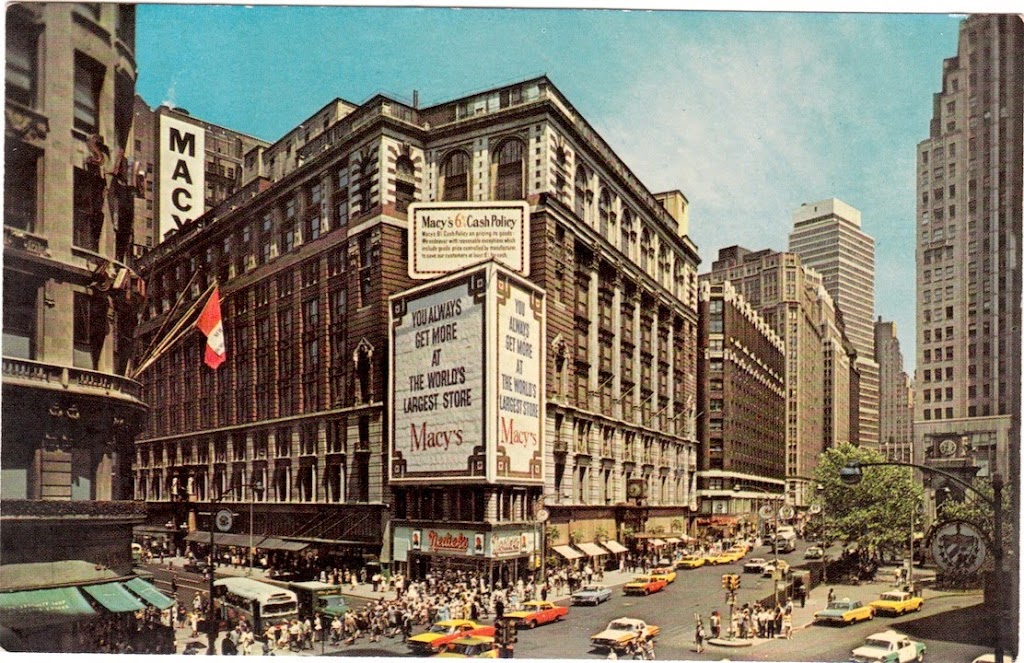
Below: Macy’s in 1964 (courtesy The Paper Collector)

For their part, Macy’s was trying to whip New Yorkers back up into a holiday shopping frenzy. Among the hottest items advertised by the department store during Thanksgiving week were Hitachi record players, Consolette hair dryers and mink coats for $99.99.


The 1964 Thanksgiving Day parade (November 27) held a certain campier flair than normal, loaded with family-friendly cheerfulness slightly more heightened than normal, with a few assorted mishaps and lots of goofiness mixed in. Why? For the same reason the 1964 is among the most memorable in parade history — television:

First in Color: NBC has been broadcasting the parade since 1952. By 1964 coverage had expanded to 90 minutes — in 2014, it’s three hours — and now, for the first time ever, it would be broadcast in color. Several NBC shows had gone to a color broadcast previously, but Americans didn’t yet have affordable color sets at home. But by 1964 sets were finally being mass produced and sold as luxury items in department stores.

There were a little over one million color televisions in American homes with the potential to tune in to a color broadcast in 1964. Ten years later, that number would rise to almost 45 million.

The Official Debut of Lip-Syncing: But some lamented the attention to the television audience. At one point, the parade was held up for eight minutes while waiting for a television signal. “Near Herald Square television took over the parade …. and some of the spontaneity went out of it.”  [source]

Performances were pantomimed while songs were pumped in for the television audience. The Times notes that cameras zoomed in on “performers who were only feigning a performance.” Today, of course, this is a regular feature of the parade and almost none of the performances (outside of the marching bands) feature live singing.

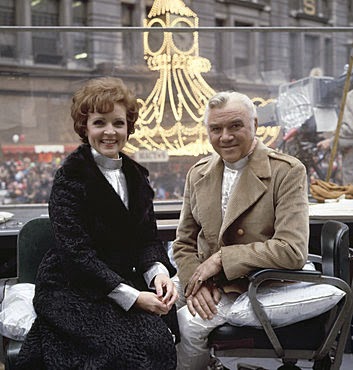
At right: The hosts at the 1968 parade

Lorne and Betty:  The hosts of NBC’s 1964 broadcast were Lorne Greene — Landon’s Bonanza co-star — and the effervescent Betty White, celebrated star of a 1950s show called Life With Elizabeth. Greene was perhaps one of NBC’s hottest actors at the time, while White was busy as a television spokeswoman. She was also a regular host of the Tournament of Roses parade. Almost every role you’ve ever loved Betty White in lay far in the future for her at this time.

First Men In the Moon: Being a special televised event meant more promotion of film and television properties.  Among the most unusual was the space-themed float promoting the new film First Men In The Moon, a British sci-fi romp featuring special effects by Ray Harryhausen.

The float did its best to simulate Harryhausen’s unique creations — ‘Moon Cows’, gigantic bugs who poked their heads out of craters upon a floating moonscape. Lorne Greene is reported to have said, “Wow look at those big grasshoppers!” [source]

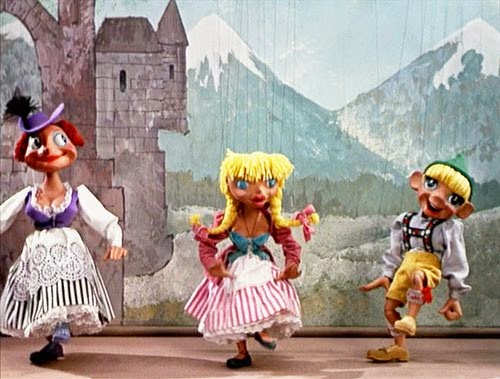
The Sound of Puppets: A few stars of the upcoming film The Sound of Music would appear in the parade. No, not Julie Andrews, bur rather the colorful marionettes of Bil Baird, featured in the ‘goatherd’ scene of the film. I’m not sure how they were presented, and I assume most of the spectators were unable to see them perform.

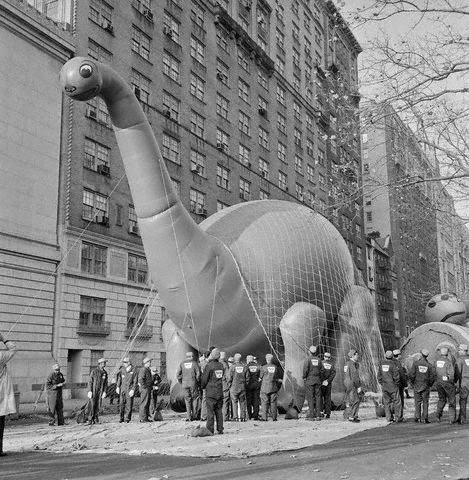
The Fate of Dino the Dinosaur: A great danger threatened the 1964 parade — horrible winds. Fortunately no spectators were injured by the gusts, some up to 21 miles an hour.

The balloons did not emerge unscathed. Dino the Dinosaur (not to be confused with Dino, the dog from the Flintstones) would grow to become a favorite site in the 1960s and 70s. (He’s pictured at right, from the 1963 parade.)

But at the 1964 parade, a sudden gust blew the dinosaur into a lamppost at Columbus Circle, tearing a hole in its side.  Its handlers along the avenue continued to pull the beast down the street, but by the time they got to Macy’s, the dinosaur was partially deflated and dragging the ground.

Popeye The Limp Sailor: Dino wasn’t the only balloon with performance mishaps. The impressively sized Popeye balloon failed to properly inflate the night before; or as the papers note, “there was not enough spinach in the pumps, and Popeye wouldn’t expand at all.”

He was unceremoniously replaced in the parade by a dragon balloon that Macy’s just had lying around.

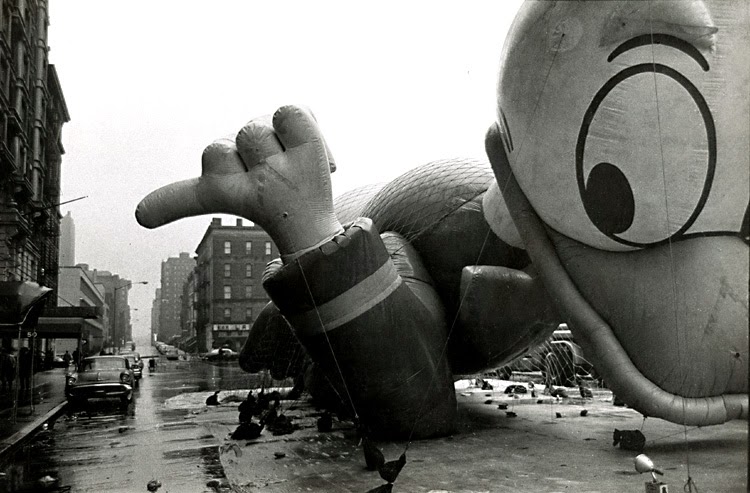
Donald Duck (pictured below from 1964) had fewer troubles that year.

Linus the Lion-Hearted: Pictured at top, this balloon with excellent posture debuted at the 1964 parade. It was based upon a Crispy Critters breakfast cereal spokesman who had his own television show which debuted just a couple months earlier.  However, when the FCC determined in 1969 that advertising mascots could not also have children’s show, Linus was abruptly cancelled. He would still make frequent appearances in the parade until 1991.

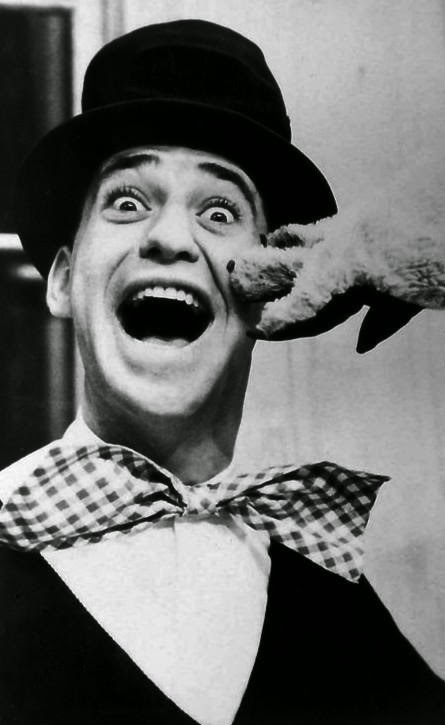
The Soupiest Star: New to NBC, New York City and to the parade itself was children’s comedian Soupy Sales (pictured at left), whose daily show Lunch with Soupy was a local hit that year. He was probably one of the biggest hits in the parade, riding atop a rocking horse, as his trademark beaming grin was as noticeable as the floats themselves.

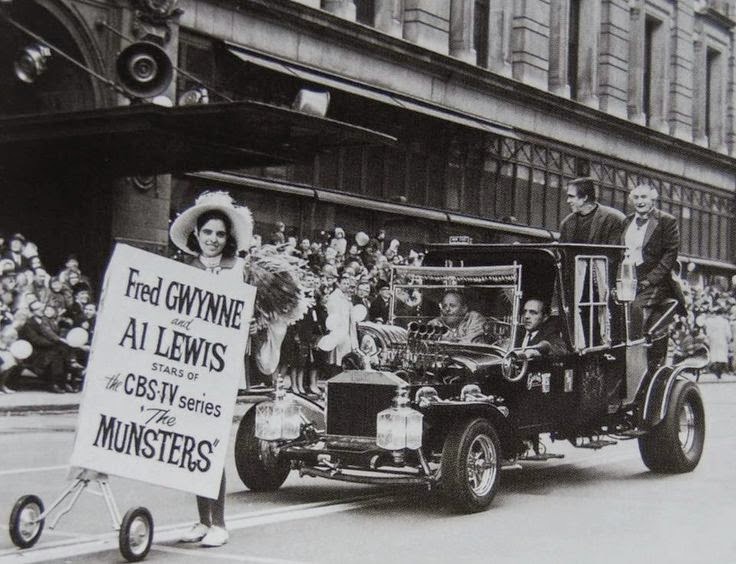
The Drunk Munster: And then there was Fred Gwynne and Al Lewis, the stars of NBC’s monster comedy The Munsters.

From a prior article — because this incident has fascinated me for years — “[The] stars of The Munsters, appeared in the 1964 parade in their ghoulish costumes, riding along in their ‘Munster Koach’ car. Neither star was very amused. Gwynne was high on ‘nerve medicine‘ and began cursing at the crowd.”

According to their makeup man (pictured below, in the front seat): “I was in the Koach handling the loudspeaker and radio system that was playing the Munsters song.  Fred had brought along a bottle with him, wrapped in a paper bag, and he got fractured [drunk]. And Al was mad at him. Fred was cussin’ at people. I just kept the music up so nobody could hear him.” [source]

Passing the hosts Greene and White in the media box, Herman Munster fired off a rude expletive in their direction as well

Here are some video highlights from the parade, with the Munsters stars prominently featured:


“Peacock NBC presentation in RCA color” Licensed under Fair use of copyrighted material in the context of NBC via Wikipedia  

Categories
Pop Culture

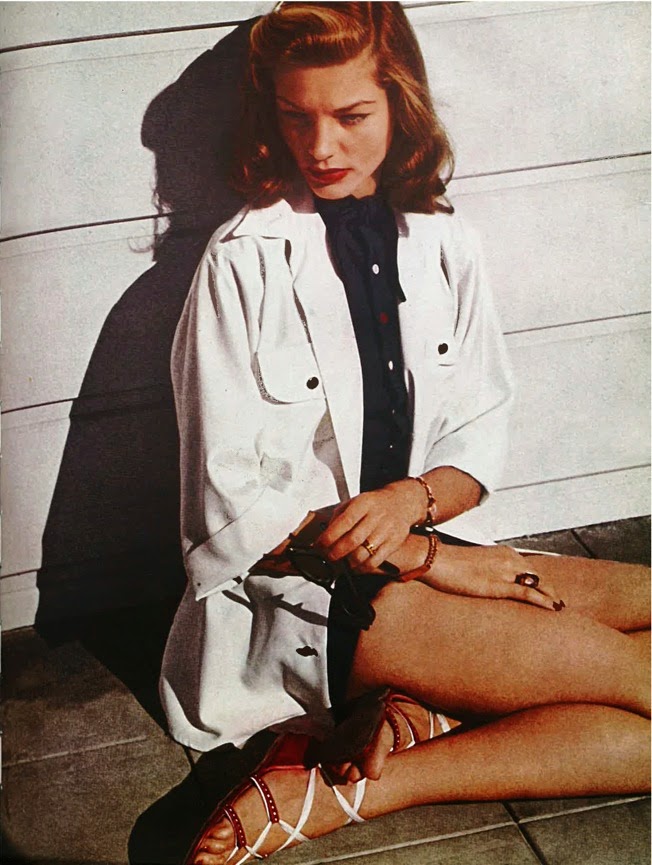
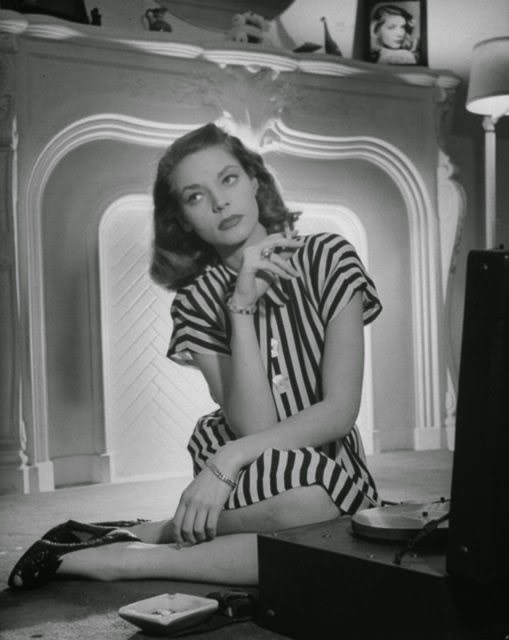
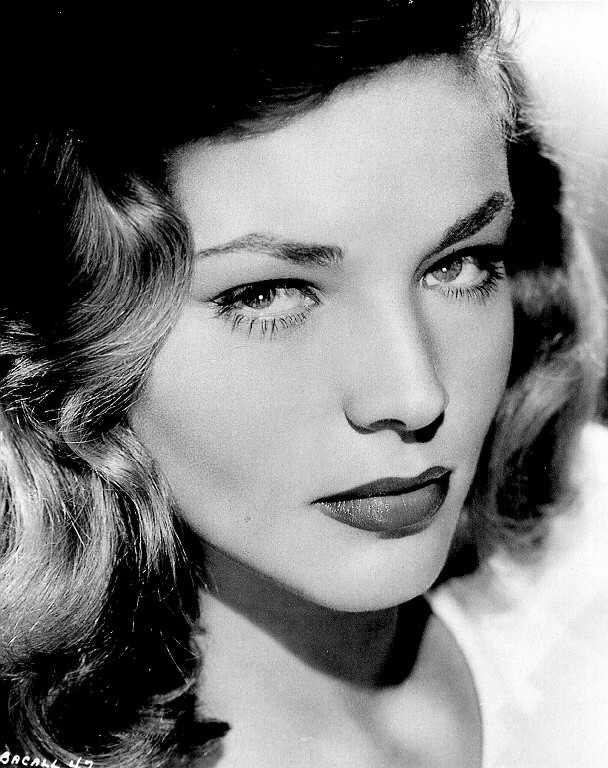
Lauren Bacall’s Guide on How To Become A Successful Model in New York City, 1941

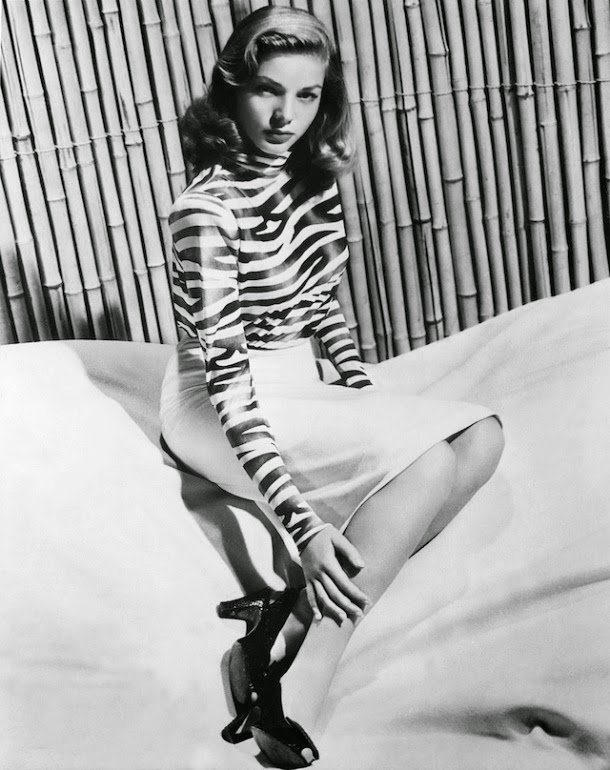
Lauren Bacall, the cinema and stage legend who died yesterday at age 89, was once the less enigmatic Betty Joan Perske, a New York girl with a lot of moxie.  As a sixteen year old, she ventured downtown from her home on the Upper West Side (84th Street, under the elevated train) to look for work as a model and actress.

In her great autobiography By Myself, she recounts her experiences as a teen model.  Go back in time and take her valuable advice on how to make it in the cutthroat world of the Garment District in 1941!

Know the finer places: “I asked a couple other girls how to find work modeling clothes on Seventh Avenue.  They said I should … go down to certain Seventh Avenue buildings — nothing really below 500 Seventh Avenue. The best houses were in 550 or 530 and you could squeeze in 495, but that was it — anything below that was tacky.”

Lie a little: At 498 Seventh Avenue, “[a] woman came out, looked at me, asked me about my experience — I told her I had been a photographic model for several years (a white lie), that I was an actress, that I knew how to move and would certainly be a very good model.”

Play act: “I kept telling myself, ‘It’s a part — play it….’  Finally the woman asked me if I would try on one of the model dresses….I walked through the curtains.  Mr. Crystal asked me to turn — I did, without falling down or getting dizzy…”

Dress the part:  “I spent the next week going through my scant wardrobe to make certain I had enough to wear to work.  Then a trip to Loehmann’s in Brooklyn.  Loehmann’s was a large store that stocked clothes from all the Seventh Avenue houses — lower-priced clothes of unknown designers as well as the most expensive…. There were no dressing rooms in the store.  Women ran around in their slips, girdles and bras — all shapes and sizes — grabbing things from saleswomen as they brought them down. A madhouse.”

Watch and learn:  At Crystal’s, her first modeling house, “you undressed and either sat in a slip or put on a cotton smock.  There was a long make-up table with a chair for each of us….I watched [the older models] as they applied their make-up — a base, then full eye make-up.  It didn’t look heavy, but it was there. I did the best I could do with the face confronting me in the mirror.”

Composure: “When I showed a dress and a buyer would ask to see it close to, I’d be motioned forward.  The buyer, male or female, would then feel the fabric, discuss it — I’d stand there until I was dismissed.  An occasional male buyer would feel the goods a bit more than necessary and I never knew what to do.  I was petrified, though no one ever was really fresh, just suggestive — just enough to make me aware that I’d better keep on my toes, protect myself.”

Build from rejection:  She was laid off at Crystal’s for being too thin (can you imagine?) but promptly got a job modeling evening gowns.  “I was much happier at Friedlander’s than at Crystal’s.  He laughed at all my little jokes, the other models were good girls (there were only two of them), the feeling was much cozier.”

Plan your escape route: “The other girls seemed fairly uncomplicated to me — they would keep on modeling until Mr. Right came along and then they’d get married and be all set.”  But Betty wanted to be an actress.  On her lunch breaks, she would go up to Walgreen’s at 44th and Broadway. Then this happened.

After six months she quit — “I was not getting any closer to the stage in the Garment District” — and eventually moved with her mother to 77 Bank Street in the West Village.  This allowed her a full time foray into theater work, first as an usher, then as a extra and bit part player.

But she still modeled for extra money, including a stint as a Montgomery Ward catalog model.   Although would soon move on to full-time acting, her experience as a model was invaluable once she was put in front of a movie camera.  Her cover work for Harper’s Bazaar even got her noticed by director Howard Hawks.

Her debut in To Have And Have Not with future husband Humphrey Bogart electrified audiences.  Now as Lauren Bacall, she seemed to instantly generate magnetism. “Slumberous of eye and softly reedy along the lines of Veronica Lake,” wrote Bosley Crowther for the New York Times, in her first film review,” she acts in the quiet way of catnip and sings a song from deep down in her throat.”

Or, Bacall might have said, she did the best she could do with the face confronting her in the mirror.

Categories
Pop Culture

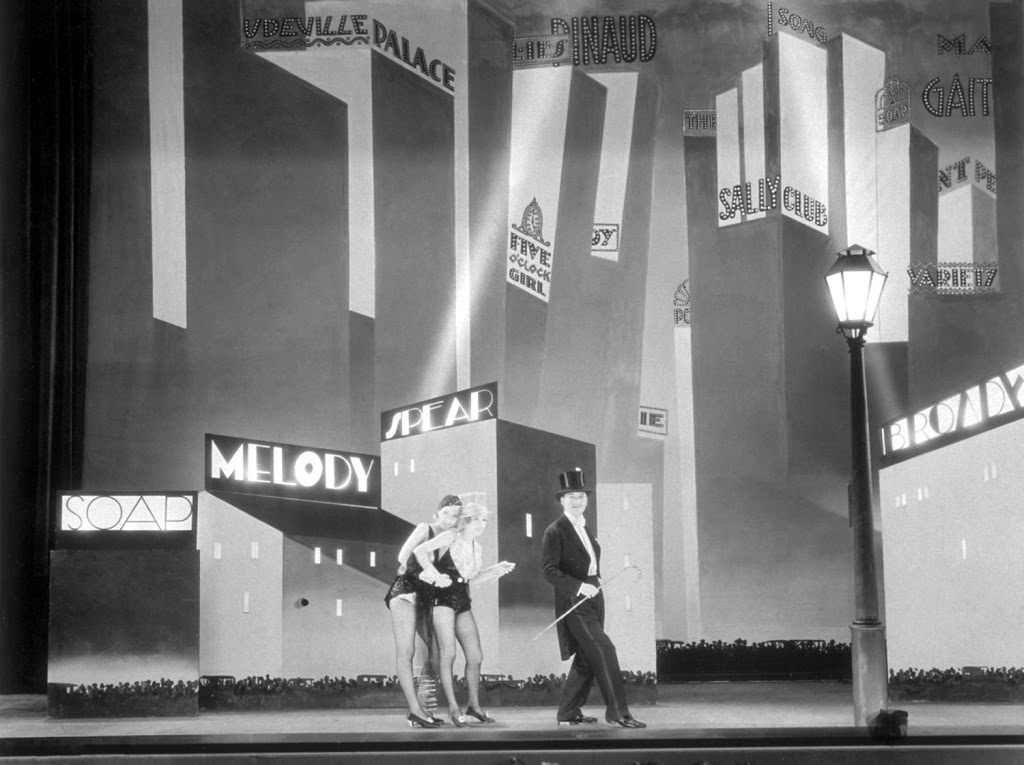
The Broadway Melody: New York’s first Oscar victory and an ironic success for the Astor Theatre in Times Square

The second film to ever win the Academy Award for Best Picture was hardly a movie at all.

‘The Broadway Melody’, a frothy Hollywood revue about the mounting of an frothy Broadway revue, was a total celebration of every strength and weakness of the early Broadway stage, and a hopeful sign that the New York entertainment world would still wield some influence over its West Coast counterpart.

“Before an enthusiastic throng there was launched last night at the Astor Theatre a talking picture teeming with the vernacular of the bright lights and back-stage argot,” began the New York Times’ original review by Mordaunt Hall, when the movie opened on February 8, 1929.

One of the first-ever movie musicals, ‘Broadway’ was, of course, not filmed on Broadway, but in Hollywood, on an MGM soundstage.  Even when movies were regularly filmed in New York in the early years, they were rarely filmed on an actual Broadway stage.

But the movie’s opening shot is within an office on Tin Pan Alley, that sector of songwriters at 28th Street and Broadway who changed American pop music.  The melody of the film’s title is delivered to Zanfield (a thinly disguised Florenz Ziegfeld) who uses it as a vehicle to make stars out of a couple freshfaced sisters.

The puffy love triangle at the heart of ‘The Broadway Melody’ is merely an excuse to launch various musical numbers in the vaudeville-variety style.  The movie was produced at astonishing speeds; filming began in October 1928 and was ready for its two-city premiere (Grauman’s Chinese Theater in Los Angeles, the Astor Theatre in New York) by early February.

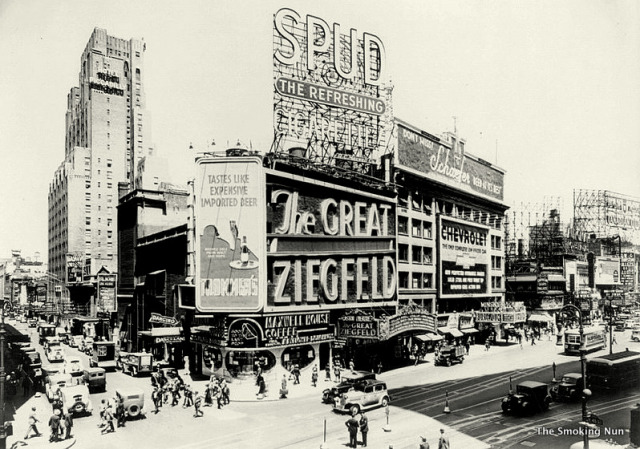
The Astor Theatre, in Times Square at Broadway and 45th Street, played host to ‘The Broadway Melody’ for an entire year.  Some might have thought that deeply ironic, as the Astor had once been a legitimate stage that permanently switched to motion pictures in 1925.  And with great success it was now exhibiting a motion picture about the legitimate stage.

Below: The Astor Theatre in 1936, exhibiting another Broadway-themed film that would go on to win the Oscar for Best Picture —  The Great Ziegfeld (Courtesy LOC)

It’s been claimed that the film was made by MGM’s Irving Thalberg on a suggestion from the owner of the Capitol Theatre, up the street from the Astor.  If so, its debut here must have been a real slap in the face!

In this tenuous day of movie sound, many were unsure people a film with music would work.  “Although the audible devices worked exceedingly well in most instances,” Hall continued in his review, “it is questionable whether it would not have been wiser to leave some of the voices to the imagination, or, at least to have refrained from having a pretty girl volleying slang at her colleagues.”

Audience members, especially those in the Astor’s $2 reserved seats, were rapturous for it.  “‘Broadway Melody’ has everything a silent picture should have outside of its dialog,” praised Variety in 1929.  A basic story with some sense to it, action, excellent direction, laughs, a tear, a couple of great performances and plenty of sex….It’s perfectly set at the Astor.  And will it get dough around the country. Plenty.”

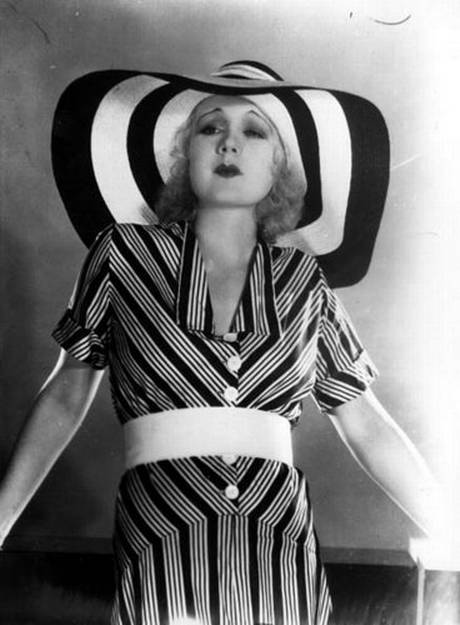
At right: Anita Page, one of the stars of ‘The Broadway Melody’, from Flushing, Queens!

The very first Academy Awards the previous year had rewarded serious fare — and all silent.  The first Best Picture winner, ‘Wings‘, had also been a big box office hit in New York, making its debut in August 1927 at the Criterion Theater, just one block away from the Astor!

But Oscar voters went carefree for their second Best Picture winner. Additionally, ‘The Broadway Melody’ became the first sound picture to be awarded the Best Picture Oscar. And the first of a great many to find inspiration in that great big city on the opposite coast.

It would also introduce a lasting connection between the movies and stage musicals, a connection that still lasts today with the Oscar-nominated ‘Les Miserables’, which had its Broadway debut on March 12, 1987 at the Broadway Theatre (Broadway and 53rd Street).

Theodore Roosevelt and the Case of the Master Mind! Is it the Black Hand or something even stranger?

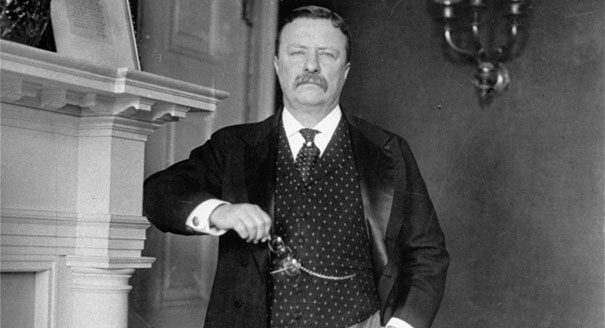
Theodore Roosevelt in 1908, in a rare shot with his pince-nez lowered.

Checking the mailbox was a frightening experience for some New Yorkers almost a century ago.

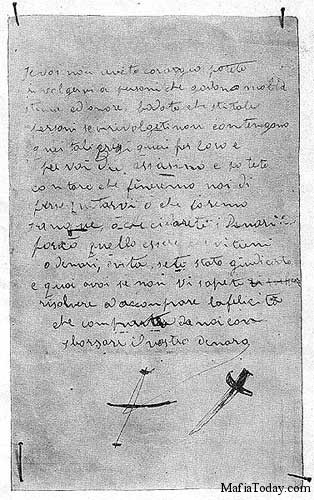
Some found extortion notes — threatening letters, demanding large sums of money or else — courtesy Italian gangsters collectively referred to in the press as The Black Hand.  Most of the targeted addresses belonged to newly arrived wealthy Italian immigrants, often celebrities or successful business owners.  Famed tenor Enrico Caruso was even a victim of the Black Hand’s extortion in 1920.  “I laugh, ho ho, to show me myself that I fear not,” the singer claimed, although he ended up paying one extortion threat before calling the police after he received a follow-up.

At right: A typical extortion letter attributed to the Black Hand (Courtesy Mafia Today)

The Black Hand was already a frightening and well-publicized threat by 1913, although the number of incidents were probably less than the press would have its readers believe.

It was under this apprehension, on Valentine’s Day 1913, that a Mrs. Douglas Robinson arrived at her husband’s real estate office on the Upper East Side to open his mail.

Inside one envelope was a single ‘blood-red’ card, which very simply stated:

“This is the red card to remind you that I have not forgotten. When you receive a black card, you will know that the end is at hand. The Master Mind”

What Mrs. Robinson did not know is that this threatening note had been sent to thousands of New Yorkers that very day. And that it had been preceded just a few days before with another ominous card:

“This is to remind you of an incident in your past, and of my enmity. When you receive a red card it will mean I am drawing near. The Master Mind.”

According to the New York Tribune, 40,000 New Yorkers had received such cards in the mail that month. Had Mrs. Robinson known this fact, she might have found safety in numbers and cautiously went about her day.  Instead, in a panic, she reached for the telephone and called New York’s police commissioner.

Except not the current commissioner, the ineffectual reformist Rhinelander Waldo.  Instead, she called up New York’s most famous police commissioner (from 1895-97), a man who still lived in New York and, oh yes, had been the President of the United States for a few years — Theodore Roosevelt.

The Colonel was still licking his wounds from an unsuccessful bid the previous year at reacquiring the presidency, as the head of the newly formed Bull Moose Party.  You may wonder how the wife of a real estate broker would have the ready ear of an ex-President, but it is here that I reveal that Mrs. Douglas Robinson (which is how she’s presented in press accounts of this incident) is in fact Corinne Roosevelt Robinson, Theodore’s younger sister. (Pictured at left in 1920, picture courtesy LOC)

“Leave it to me,” he assured his sister and promptly called up detectives Hyams and Hughes to investigate the matter.

Going only upon Roosevelt’s description, the two detectives began scouring the streets for clues.  They were certainly quite proud to be working on a case personally passed to them by Roosevelt — probably the most famous New Yorker in America.  Their only liability was that they were working only off of Roosevelt’s information — and his sister had overlooked one rather big piece of information.

While wandering through midtown Manhattan, the detectives struck up a conversation with Edward Gireaux, a booking agent of John Cort, one of America’s leading theatrical impresarios.  A Seattle entrepreneur enriched by the Klondike gold rich, Cort, unlike his competitors Klaw & Erlanger and the Shuberts, specialized in promoting a national circuit of legitimate theater.  No musicals for the Cort Circuit! (The Cort Theatre, on West 48th Street, is still hammering out dramas to this day.)

The detectives were only too eager to tell Mr. Gireaux of their mysterious case, delivered to them by Roosevelt directly.  It was only when they informed the agent of the details of the crime that Gireaux must have smiled to himself.

He produced a stack of the very same ‘blood-red’ cards from his pocket. Perhaps he was passing them out to passers-by. The detectives now saw the entire printed content of the card:

“This is the red card to remind you that I have not forgotten. When you receive a black card, you will know that the end is at hand. 

I will see you at the Harris Theatre.  — The Master Mind”

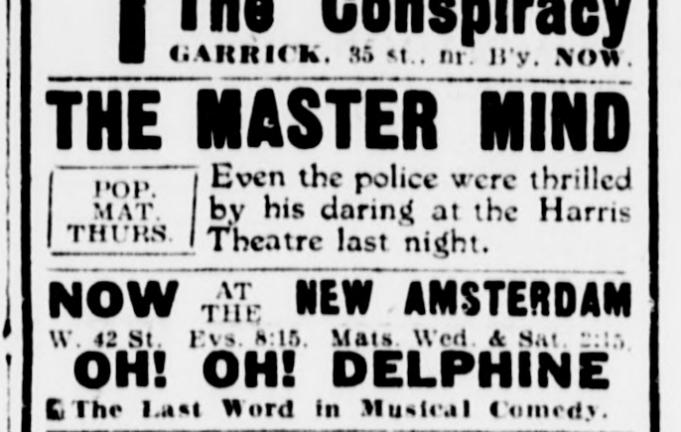
‘The Master Mind’, starring Edmund Breese, was a ragged melodrama about “a dominant personality in a band of criminals,” premiering that week at the Harris Theatre at 254 W. 42nd Street.  The cards had been nothing more than a slightly inappropriate bit of viral marketing.

Below: Newspaper advertisement for the Master Mind. ‘Even the police were thrilled!’ 

And it worked!  The Master Mind played for several months despite some tepid reviews (“headachy to follow“) and was later turned into a film starring Lionel Barrymore.  You can read a contemporary novelization of the play here, featuring such delectable bon mots as “You have made your own beds! Now you shall lie in them. Understand that, please! I have said it — I, the Master Mind!”

The star of the play Breese would himself go on to the silent pictures and co-starred in the Oscar-winning All Quiet On The Western Front in 1930.

As for Theodore Roosevelt, he would publish his autobiography in 1913 and by year’s end would embark on a lengthy journey to South America.  Corinne Roosevelt Robinson would later dabble in politics herself, backing Warren G. Harding in 1920 and even recording this radio message in support.

Categories
Podcasts

A whirlwind tour of Herald Square: More than just Macy’s, the intersection of publishing, theater and debauchery

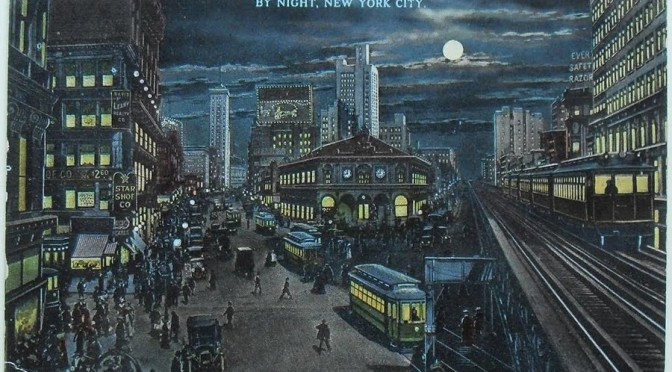
Herald Square at night, 1910, with the flurry of shoppers, the churn of printing presses, the clanking and soot exhaust of the elevated train, the rush of the streetcar. The theaters, the drinking, the dancing. (Courtesy the blog Ajax All Purpose Blog)

PODCAST Welcome to the secret history of Herald Square, New York City’s second favorite intersection — after Times Square, of course, just a few blocks north. But we think you may find this intersection at 34th Street, Sixth Avenue and Broadway perhaps even more interesting.

This is a tale of the Tenderloin, an entertainment and vice district which dominated the west side of midtown Manhattan in the late 19th century, and how it abutted the great cultural institutions that soon became attracted to Herald Square, from cheap aquariums to New York’s greatest opera house.

By the 1890s, newspapers arrived to the area, including the one that gives Herald Square its name. A remnant of the New York Herald Building still sits in Herald Square and is the cause of some serious conspiracy. (Especially if you’re afraid of owls!) But the Herald wasn’t the only publication that got its start here; in fact, one of America’s most famous magazines began in a curious office-slash-bachelor apartment facility just close by.

The department stores came at the start of the 20th century, and we bring you the tales of Macy’s, Saks and Gimbels, not to mention their later incarnations, the Herald Center and the Manhattan Mall.

ALSO: Where on 32nd Street were crazy parties featuring a who’s who of New York’s greatest freak show performers? Where did a silent fim stunt man meet his end? And where in New York can you get the best in Korean pop music?


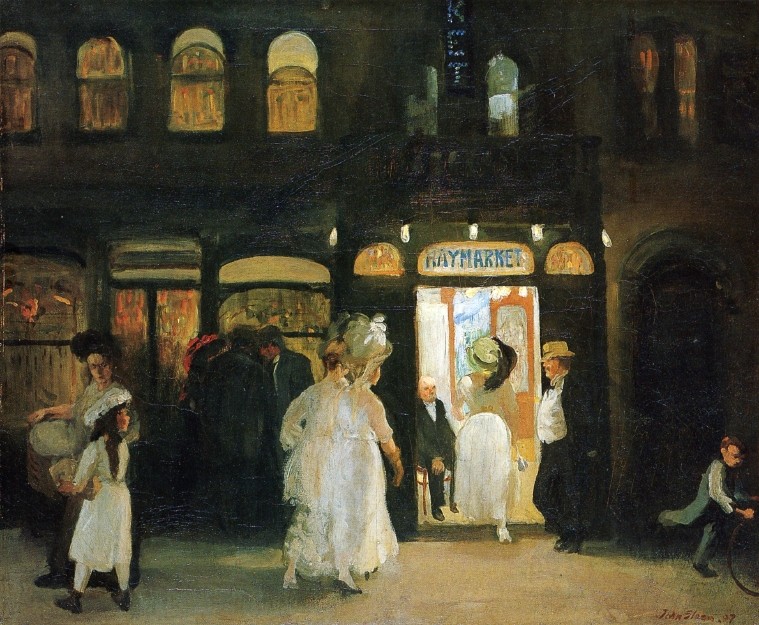
The bawdy Haymarket dance hall, at 30th Street and Sixth Avenue, in a magnificent painting by John Sloan (1907) that conjures up the glamour and winks at its secret pleasures. Several of Sloan’s works depict places located in the Tenderloin, a wide area of entertainment and vice west of Broadway. The original painting hangs in the Brooklyn Museum.

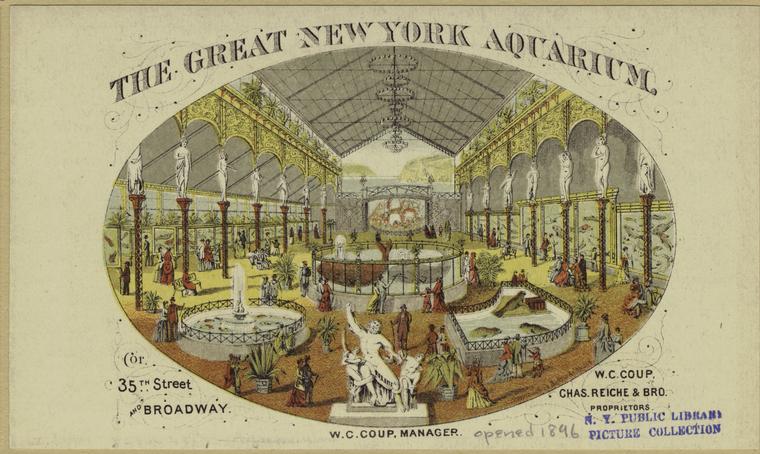
The Great New York Aquarium of W.C. Coup, bringing sea creatures to the corner of Broadway and 35th Street. (NYPL)

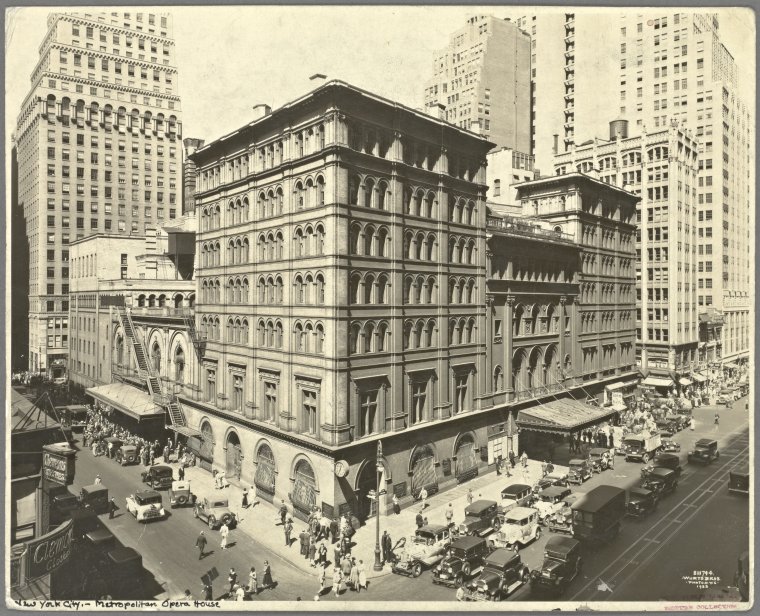
The character of Broadway between the intersections of 34th Street and 42nd Street (before they were known as Herald Square and Times Square, respectively) was changed forever with the construction of the Metropolitan Opera House, a vanity project for New York’s new wealthy class. It was all for show; there were plenty of loges for the rich, but so little backstage room that set pieces were stored on the street. (NYPL)

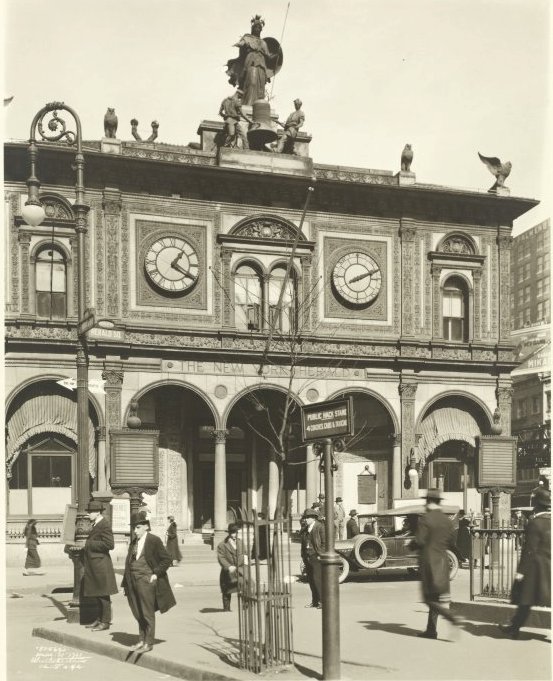
The front of the New York Herald building, with its ornate clock face and Minerva statue. Please note the owls on the corners. (NYPL)

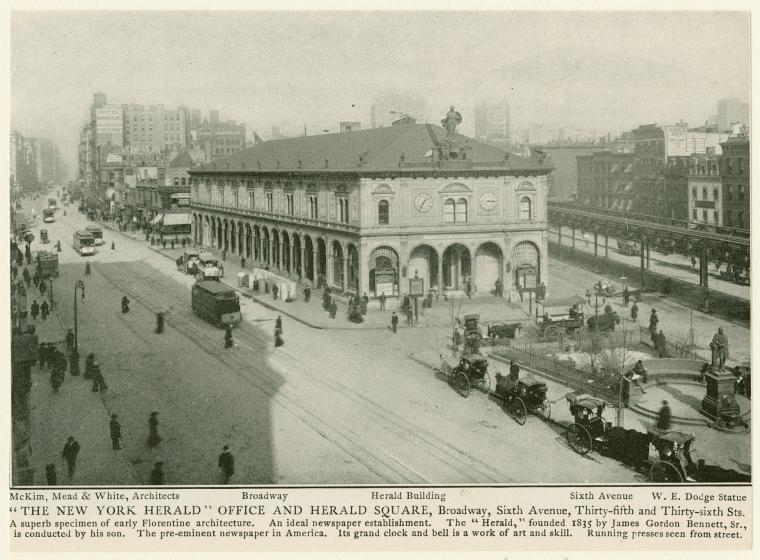
The two most dominant structures in Herald Square in the 1890s — the Sixth Avenue Elevated and Stanford White’s Herald building. “Running presses seen from street.” (NYPL)

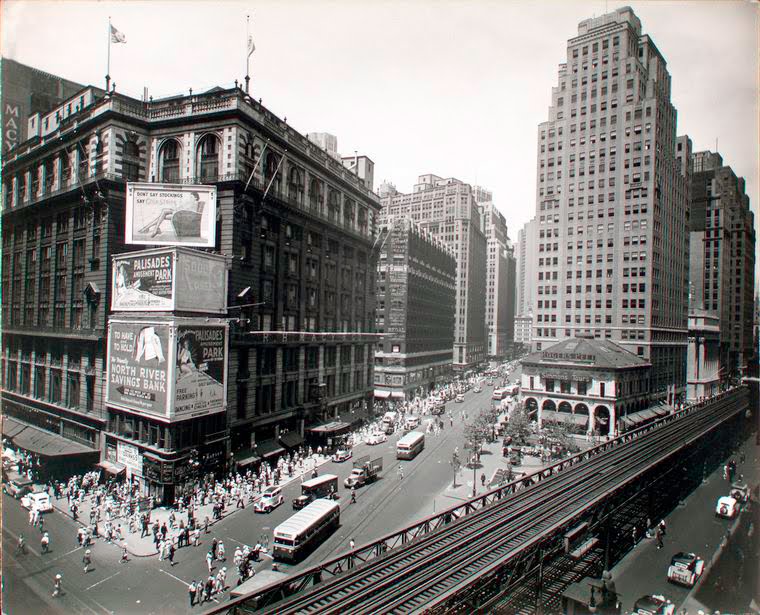
The Elevated and the Herald Building from another angle in 1936, with the new addition of Macy’s — and the little building which prevented Macy’s from taking up the entire block! Today, that’s still a Sunglass Hut. You can also see that the back of the Herald offices has already been demolished and replaced with an office building. The front would survive a bit longer and then too would be destroyed. (NYPL)

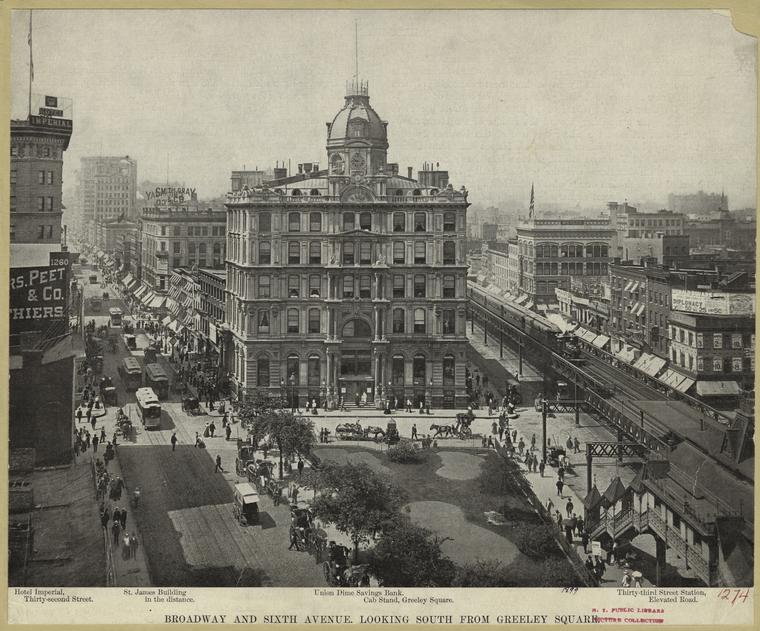
A view of Greeley Square, with the elevated to the right. This building is the Union Dime Saving Bank. The counting offices of the New York World were on the ground floor, however I’m not certain if they are there in the year this picture was taken (1899).

Now here’s a mystery for you — this is Greeley Square, named for the statue of Horace Greeley which was definitely installed in 1894. Hmm, but where is it?

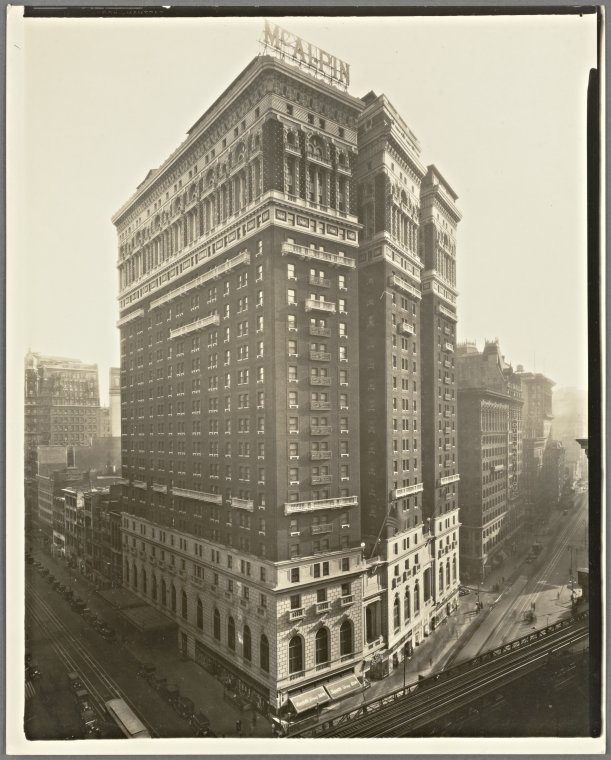
The Hotel McAlpin, at the southeast corner of 34th Street, the largest hotel in the world when it was built in 1912! Happy 100th anniversary to this accommodation, pivotal in New York City history.

Herald Square in an early (1896!) clip from Edison.

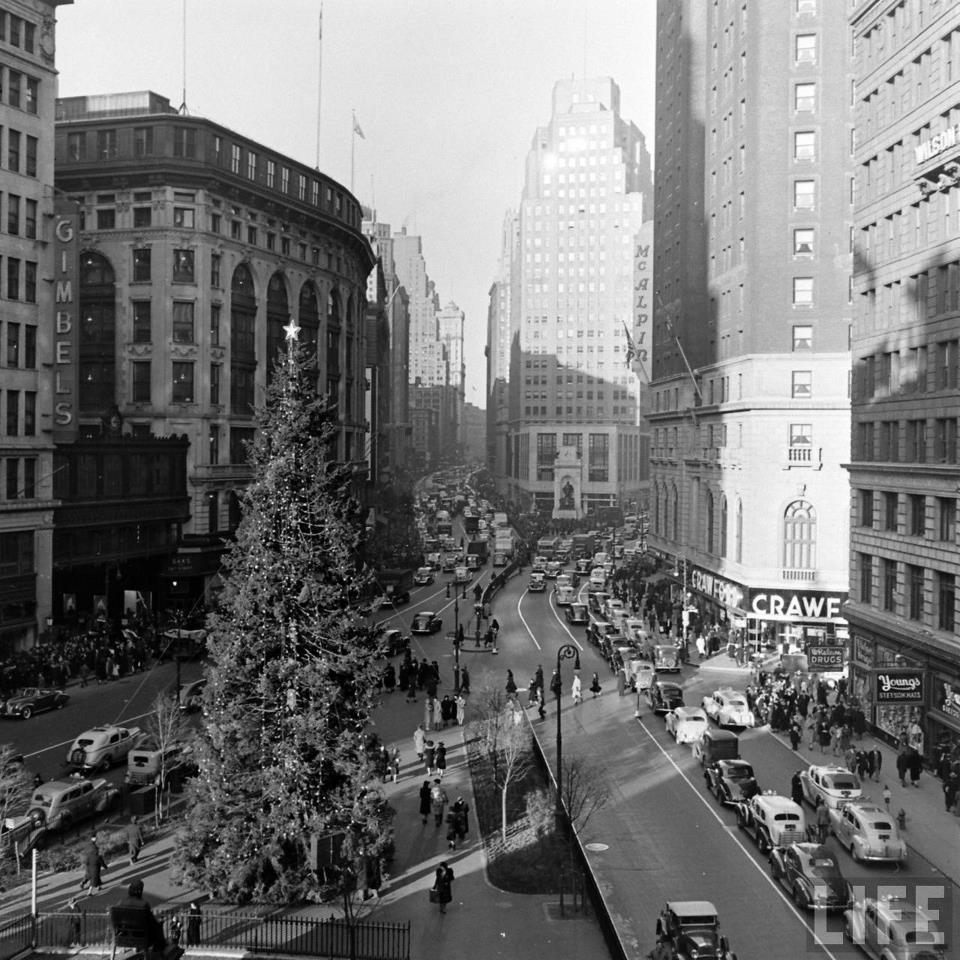
And an image for the holidays, from the 1940s! Courtesy Life Magazine

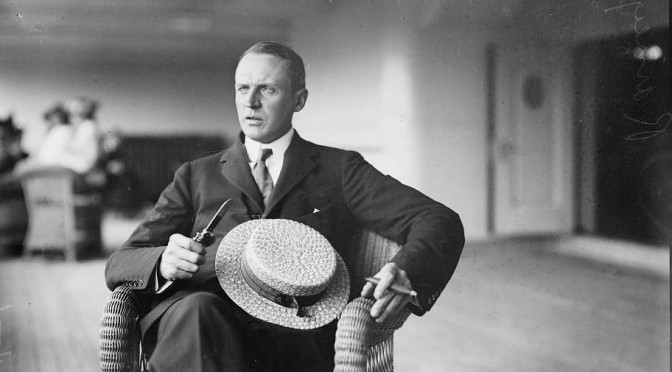
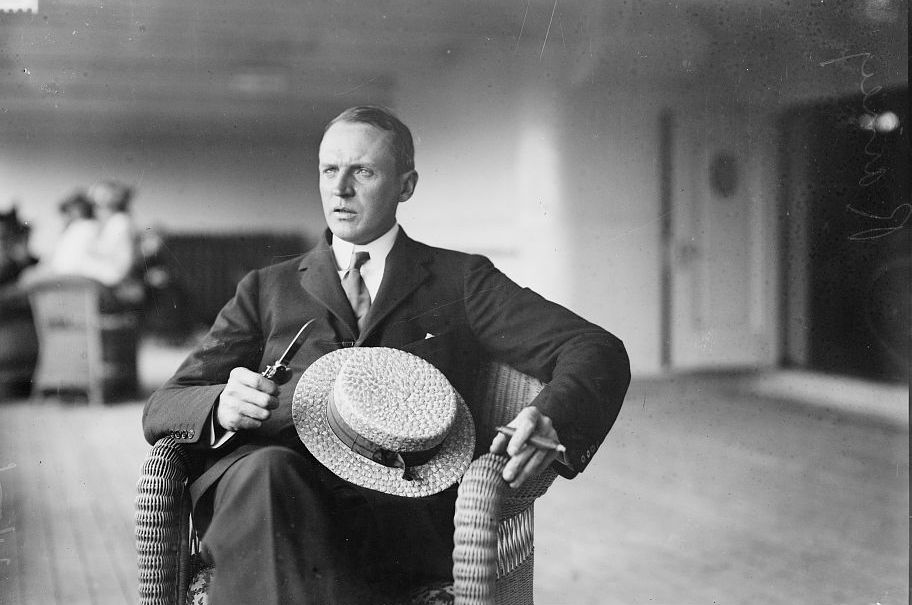
Rainey’s African Hunt: A bloody 1912 movie blockbuster

Hunter and gadabout Paul Rainey: An accidental matinee idol

Catching a movie this weekend? Many New Yorkers had the same plan one hundred years ago, but the experience was vastly different.  Motion pictures in 1912 were shorter, without sound and in black-and-white, of course, but they were sometimes presented as part of a set of vaudeville performances, with live musical accompaniment and in repertory with several short films.

In the days before movie palaces, movies were shown in legitimate theaters which often gave them a must-see feel. This was the case with a strange non-fiction film that played in New York for well over a year — Rainey’s African Hunt.

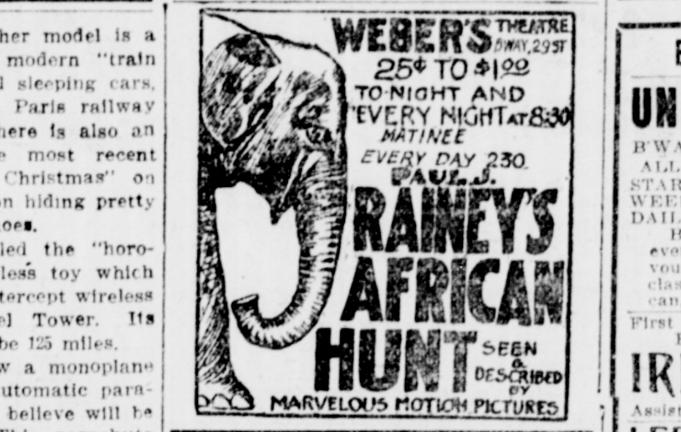
In September 1912, the film played Joe Weber‘s Music Hall at Broadway and 29th Street:

The film made its debut in April 1912 up the street at the Lyceum (45th/Broadway) and played there through the summer, heralded as a serious entertainment, for ‘wealthy people at top prices‘ to distinguish it from the fiction films favored by everybody else.

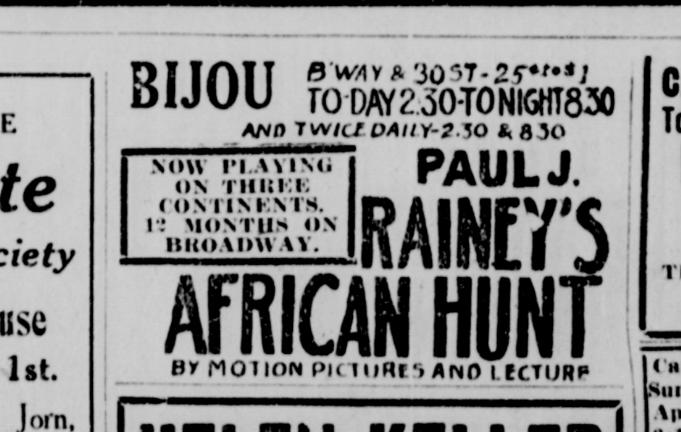
But is seems that ‘African Hunt’ resonated with all sorts of audiences. The film moved to Weber’s in August, then to the Bijou (30th/Broadway) in October, where it stayed put until April 1913!

So what made this film so popular? Americans were still safari crazy in the early 1910s thanks to Theodore Roosevelt‘s famous African trip in 1909, in which he brought back the carcasses of dozens of exotic animals and donated them to natural history museums around the country, including New York’s own American Museum of Natural History.

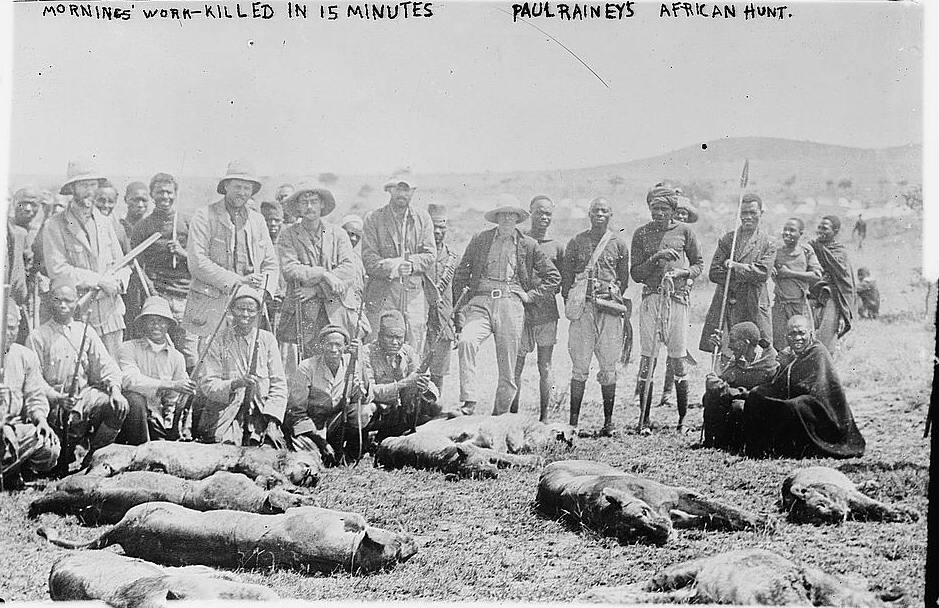
The wealthy playboy Paul Rainey was also a renown game hunter and filmed his exploits in Africa following Roosevelt’s trip there. The film depicts his interaction with African tribes and the trials of hunting exotic animals. Although Rainey claims to have been more interested in photographing and trapping live creatures, he ended up killing several dozen animals, including “twenty-seven lions in thirty-one days.” One notable scene features Rainey’s specially trained fox hounds stalking and killing a leopard.

 Claimed one advertisement: “One touch of nature makes the whole world kin. That is the secret to the extraordinary success of this picture.”

The film came with a sterling pedigree and glowing reviews, include praise from the American Museum’s Henry Fairfield Osborn, who proclaimed it the ‘greatest contribution to natural science of the decade.’ [source]

Distributed by Carl Laemmle’s Universal studios, ‘Rainey’s African Hunt’ grossed over a half-million dollars, an extraordinary sum for an early motion picture. It would stand as one of the most successful non-fiction films of the decade.

Like every box office success, a sequel debuted in 1914 at the Casino Theatre (29th/Broadway). Portions of its first week gross were donated to a newsies home and summer camp in Staten Island. Despite emphatic reviews — “better and clearer” than its predecessor, according to the New York Times —  it appears to be mostly recycled material and was not a hit.

Below: A grim photo from Rainey’s safari. The hunter killed so many animals that is exploits eventually led to stricter regulations on foreign hunters.

According to the site Silent Era, a print exists of the film, although I don’t know if its presently available for view.
For more information on New York’s unique relationship with African safari hunters, check out our podcast on the American Museum of Natural History. For a peek at the early days of cinema in New York, listen to our show on NYC and the Birth of the Movies.
For more information on Paul Rainey, check out this interesting blog page on his Tennessee lodge and his tragic death.

New York transit system stymied by women’s skirt styles

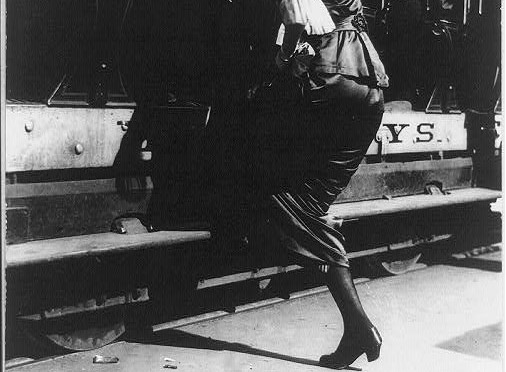
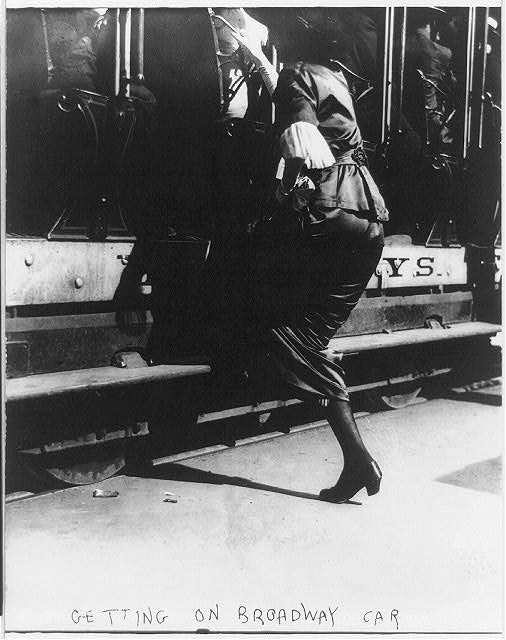
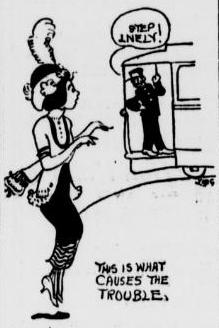
A lady in a relatively normal skirt boards a Broadway streetcar in July 1913. Now imagine trying this in a hobble skirt! (Courtesy Library of Congress)

A serious cry (mostly from men) rang out through the city one hundred years ago about the ever-expanding transit system and the scandalous style of women’s skirts. Were frocks getting caught in doorways? Were dress lengths causing women fall down stairs?

Perhaps, but that wasn’t the issue. The latest fashion trend, the hobble skirt, was slowing the progress of women onto and off of streetcars, causing frustrating delays.

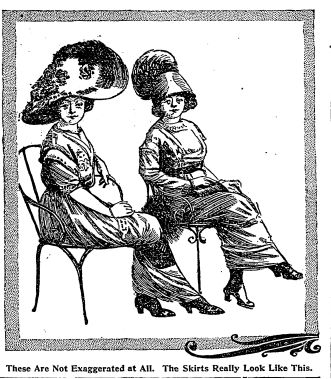
The Parisian-style hobble skirt, with its bunched hem near the bottom to create a mermaid-like appearance, made its appearance on New York streets in the early 1910s. The new gowns required ladies to walk more elegantly and, thus, more slowly, a throwback to the Victorian gait. “[T]he mannish stride of the women of today was taken for granted as a permanent thing. Nobody expected it to change, for nobody saw the hobble skirt on the horizon.” [New York Times, January 1912]

Above: Some sass from the Times fashion pages, June 12, 1910

After a millenia of unfettered skirts, this new silhouette must have seemed positively strange to elder fashionistas.

“‘The hobble’ is the latest freak in women’s fashions,” warned the Times upon their arrival in 1910.  “The hobble skirt suits none. But many, too many, women will wear what the fashion authorities decree.”

Aesthetics aside, the hobble skirt created a practical problem. While measured, graceful walking might be fine on Ladies Mile or strolling along Fifth Avenue, it was an encumbrance upon the ever-moving streetcar system.

An executive of the Interborough Transit System (New York’s first subway operator) grumbled to the Evening World in 1912 about the extra burden the hobble skirt created upon city transportation and called for the fashion trend to be abolished.

“Often hundreds of people will be forced to stand aside patiently waiting for some women to raise her skirts sufficiently to allow her to step into the car,” said George Keegan, general superintendent.

A special ‘step-less’ car had even been designed with the fashionable lady in mind. The first of these “hobble-skirt, hygenic, fool proof” cars debuted on the streets of New York in the spring of 1912.

Meanwhile, underground, fashionable ladies were finding difficulty clearing the gap between the platform and subway cars. “Nearly all of the accidents in the subway are due to the fact that women wear hobble skirts,” said Keegan, a claim which could not possibly have been true.

The Pennsylvania Railroad, fearful of complaints and potential lawsuits, acted upon the crisis the following year by requiring train conductors to note skirt styles and “height of heel” and report all data to their central office. “If women passengers on the Pennsylvania Railroad insist on wearing such mantraps, or rather womantraps, as hobble skirts and high heels they cannot hold this company responsible for accidents which may happen to them,” claimed the railroad.

But all these railroad executives really needed to do was simply wait — trends subside, to replaced with other, more objectionable wear.

By the time Mr. Keegan was complaining about the hobble skirt, the Evening World fashion section was already clutching its pearls in disbelief about another fashion abomination. “The high note of feminine folly has been struck.  The harem skirt is to succeed the hobbled horror which has made women hideous and ridiculous during the past year.”

But, leaving taste aside, at least you could ride the subway in a harem skirt!

Illustration above is from the August 9, 1912 edition of the Evening World which accompanied the Keegan article

Categories
Brooklyn History

Ten fabulous facts about 70 Willow Street, Brooklyn Heights, aka ‘the Truman Capote house’

The strange, yellow Brooklyn Heights mansion best known as the home where Truman Capote wrote ‘Breakfast At Tiffany’s’ has finally been sold for $12 million, after many months of humbling markdowns from its original hefty pricetag.
Located in the heart of old Brooklyn, the new owners will be winning more than a literary prize. The house has a rather unusual past full of influential inhabitants and has been used in some curious ways:
1) 70 Willow Street, in the popular Greek revival style of the day, was built in 1839 by Adrian Van Sinderen, the descendant of original Dutch settlers in New Amsterdam and a fiery Revolutionary War-era reverend from Flatbush, Ulpianus Van Sinderen. Van Sinderen’s lavish urban villa — it has almost a dozen fireplaces — is one of the oldest houses in the neighborhood, but not the oldest. There are a few neighboring houses that are older, including 24 Middagh Street, just a couple blocks away and built in 1824.
2) The house passed to his son Adrian Jr., a prominent New York lawyer, who fell spectacularly from grace when he mishandled the family trust. He died nearly penniless and alone in New Lots, far outside the sphere of wealth, in 1864. (There’s an avenue near that east Brooklyn neighborhood named for the Van Sinderen family.) His descendants appear to have done better. Another Adrian Van Sinderen has an annual book-collecting competition named for him at Yale University.
3) The ‘estate of Van Sinderen’, as it was often called then, was built for a single family, but by the late 1860s, the roomy floors were being split up for several tenants. From an October 1869 classified ad in the Brooklyn Eagle:”One large, handsomely furnished second floor room for gentleman and wife or gentlemen willing to room together.”***

4) The primary resident during the late 19th century was the banker William Putnam, better known as a significant trustee for the Brooklyn Museum in its early years. He betrothed to the museum paintings by Rembrandt and Monet, as well as some ‘Royal Copenhagen  porcelain’ that rivaled that of European rulers, according to the Times.

5) The house was a pivotal location for the women’s suffrage movement. Scratch that, the anti-women’s suffrage movement. The newly married lady of the house, Caroline Putnam, and her sister Lillian joined other local ladies of means in organizing protests against granting women the right to vote or, in the words of their 1894 petition, to protest “the obligations of the ballot upon the women of the state.” Mrs. Putnam also hosted French conservation classes and literary salons from her parlor here. [source]
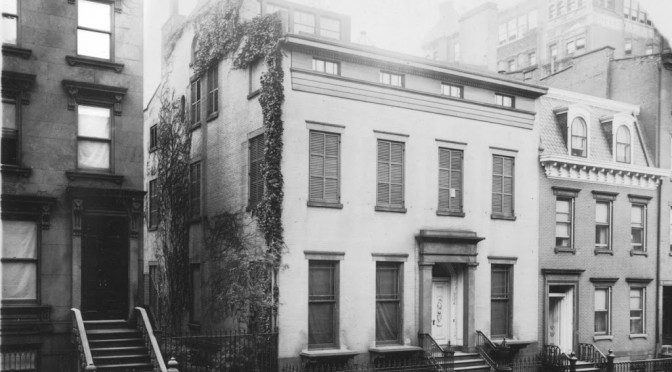
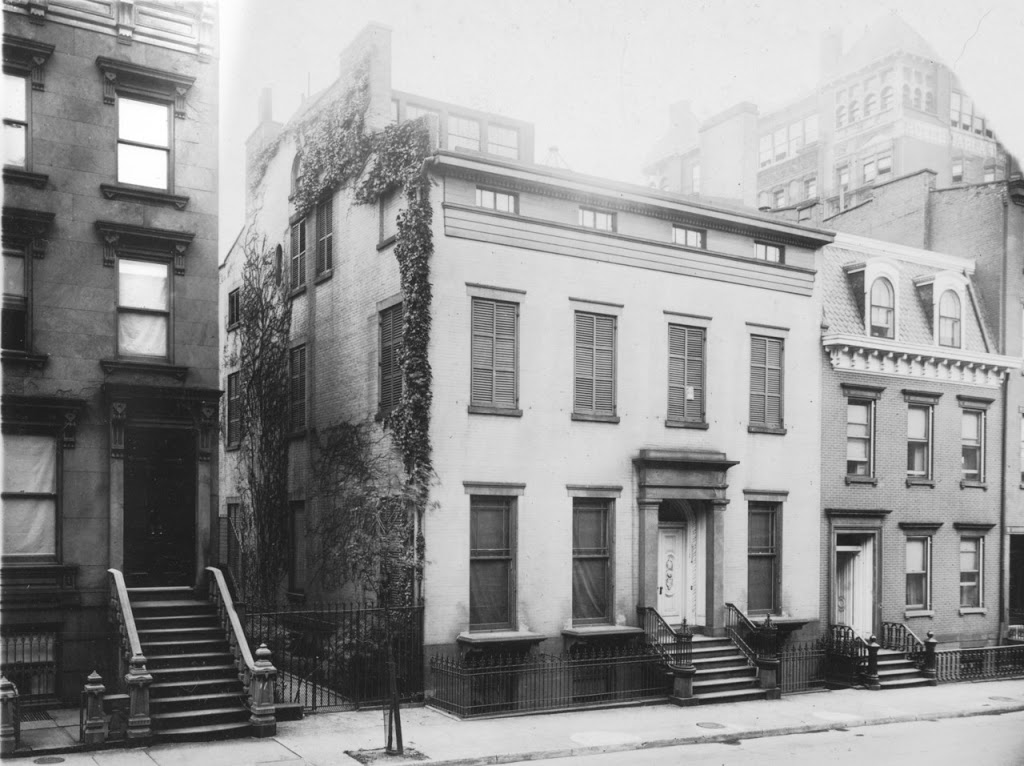
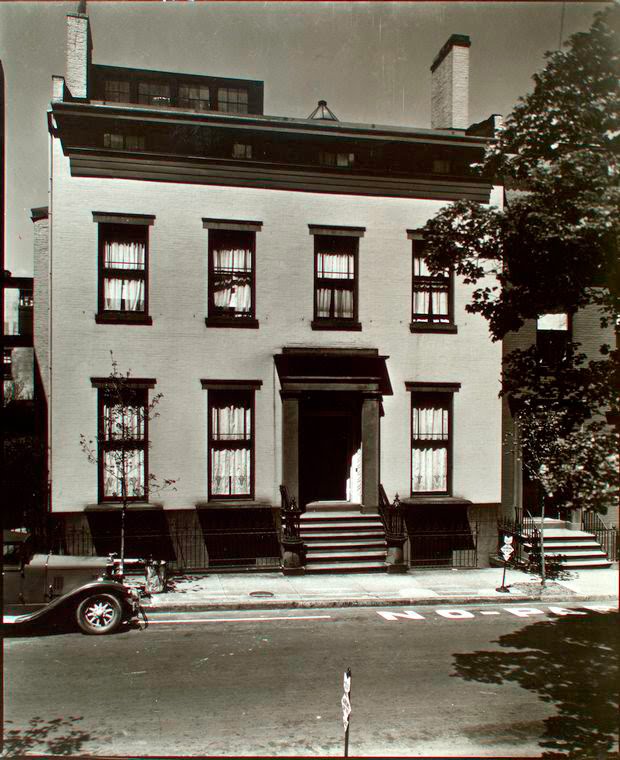
The picture at top shows the house as it looked in 1922. At right, the home in 1936. (Pictures courtesy New York Public Library.)
6) After Mrs. Putnam died in 1940, the house sat entirely vacant until 1944, when it was donated to the Red Cross. They used the house as a classroom, teaching arts and crafts, Braille to the blind and cooking classes to the wives of returning soldiers from World War II.

7) In 1953, the old house landed in the hands of renown Broadway stage designer Oliver Smith, responsible for the original scenery from great American musicals like Oklahoma!, Guys and Dolls and West Side Story. In his lifetime, he was nominated for 25 Tony Awards. With some of his earnings from the musical On The Town, Smith bought 70 Willow Street and lived here until he died in 1994.

8) From 1955 to 1965, he lent the basement apartment to his friend Truman Capote. The blond Southern writer was simply wild about Brooklyn Heights and basically charmed himself into a permanent room on Willow Street. From his essay ‘A House on the Heights,‘ Capote describes, “We [Smith and Capote] sat on the porch consulting Martinis — I urged him to have one more, another. It got to be quite late, he began to see my point; yes, twenty-eight rooms were rather a lot; and yes it seemed only fair that I should have some of them.”

9) Decked out in green wallpaper and odd knickknacks, “an atmosphere of perpetual Christmas,” the house would prove a place of great inspiration for Capote. He wrote part of ‘Breakfast At Tiffany’s‘ here. Perhaps more notably, it was here that he picked up a New York Times are read about the brutal slaying of a Kansas family. Capote set about working on what became ‘In Cold Blood‘ the next day.

10) I can’t leave the tale of 70 Willow Street without mentioning one of its most famous lunch guests — Jackie Kennedy. Capote conveniently left out the fact that the house was Smith’s, not his. “She laughed about it, because suddenly in the middle of lunch she got the idea that it wasn’t his,” Smith recalled later. “I suppose I acted as if it were mine.”

And here’s some literary bonus points — it’s just down the street from the old home of Arthur Miller (155 Willow Street)

***A reader emailed me to say that the addresses for Willow Street were differently numbered before 1865 and that this ad probably refers to a neighbor of 70 Willow Street. In that case, I’ll replace that fact with one I should have mentioned in the lede of this article — as reported by Brownstoner, the $12 million final price tag for 70 Willow Street makes it the most expensive house purchase in Brooklyn history. Does this mean that nobody has yet bought my dream apartment in DUMBO?

Notes on the podcast (#125) Sardi’s Restaurant

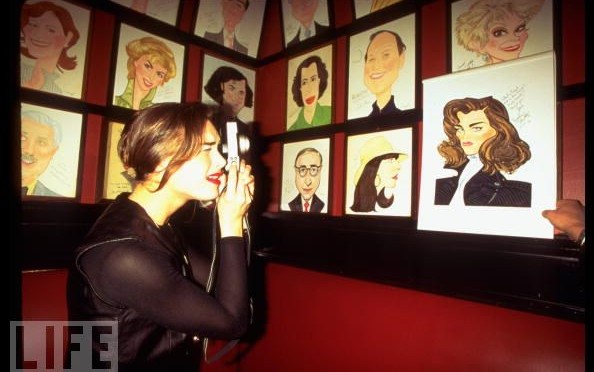
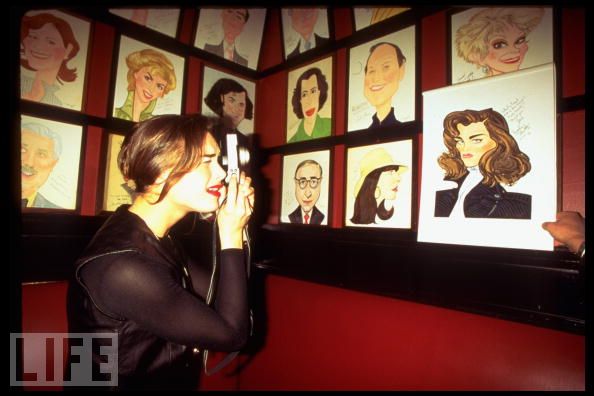
Above: Brooke Shields admires her caricature, 1995 (courtesy Google LIFE images)

Thanks for listening to our breezy, kind of giddy tale of Sardi’s Restaurant. We might sound a little strange at a couple points, as we were recording it in 95 degree weather, and our studio isn’t adequately air conditioned! A little delirium might be evident. We decided to do a showbiz-type episode as our next episode will be going to a very, very dark place in New York City history.

Obviously, when I said this was our ‘quasquicentennial’ episode, I didn’t actually mean it was our 125th year of podcasting. Although that’s a remarkable thought — our first episode would have been playable on a gramophone!

As we mentioned on the show, it’s difficult doing a history podcast on a private business without it sounding a bit like an advertisement, but hopefully we were able to execute past that. (We came across this odd feeling with other podcasts like Saks Fifth Avenue and The Plaza Hotel.)

We left a few details on the cutting-room floor, including Sardi’s lengthy involvement with the Dog Fanciers Club, which throws a congratulatory breakfast every year for the Best In Show winner of the Westminster Dog Show. Tom also did a rather nice job with reading an excerpt from Renee Caroll’s biography, but some sound problems forced us to cut it.

Tom mentioned the glory of Broadway in 1927. Show Boat is definitely the breakout show of that year, but theatergoers could also choose from one of these show that year — A Connecticut Yankee, Funny Face, Burlesque, Coquette, Hit The Deck, Rio Rita, Dracula and the hit play The Ivory Door, written by A.A. Milne of Winnie-the-Pooh fame. (Find a complete list here.)

Reading Recommendations: The best is Off The Wall by Vincent Sardi Jr. and Thomas Edward West, featuring full color representations of Sardi’s best known caricatures. Worth seeking out a copy at your used book stores. More difficult to find is Vincent Sardi Sr.’s own biography Sardi’s: A Story of a Restaurant, published in 1953 and well out of print. Carroll’s biography In Your Hat is also out-of-print, but you can find excerpts scattered online. You should seek out a physical copy if possible, as it features original artwork by original Sardi’s caricaturist Alex Gard.

Was Lauren Bacall the world’s most glamorous newsie?

The answer to the question in the headline is absolutely, without a doubt, yes.

This story begins with a Minnesotan named Leo Shull, who moved to New York in the 1930s to become a playwright. He never wrote anything of note for the stage, but he wrote plenty about the stage, various guides to playwriting, “how to break into showbiz” style books, and eventually, directories of entertainment contacts.

In 1941, Shull rented out some mimeograph machines in a basement below a Walgreens at 44th and Broadway to produce a newspaper called the Actors Cue, a daily guide to auditions, agents and producers. (Actor’s Cue was similar to today’s Back Stage. That currently operating publication was spun off by two former employees of Shull in 1960.)

But this was no ordinary Walgreens. According to author John U. Bacon, this was the very first Walgreens in New York, in the basement of the grand Paramount Building.

It opened in 1927, the same year that Sardi’s Restaurant opened its current location just around the corner. Both were associated with the theater business, with show folk. In fact, this Walgreens was often called the ‘poor man’s Sardi’s’. There was even a wall of caricatures, just like Sardi’s, lampooning the most famous faces of Broadway.

In his biography, Eli Wallach called that particular Walgreens a “hangout for actors,” a place for out-of-work actors to spend their last dime on a sandwich at the lunch counter, wiling away time before an audition.

So then, obviously, it made sense for Shull to create his daily directory here. And he not only sold the paper to actors; he often hired them to spread out around the theater district and sell the newspaper on the street.

So who should walk in but an attractive young actress named Betty Joan Perske. She was born in the Bronx and currently lived on a ground-floor apartment in the West Village, making ends meet by modeling and ushering in Broadway theaters. But she hoped to soon be on the stage, not in the aisles.

At some point, she met Shull and began selling his newspaper on her lunch breaks. In her own words:

I spent most of my lunch hours rushing to Walgreen’s to grab Actor’s Cue and look for a job in the theatre. …….  Leo had a table in the basement of Walgreen’s where copies of Actor’s Cue were piled up and sold for ten cents apiece. I prevailed on him to let me sell some. He finally said okay — to get me off his back, I think.

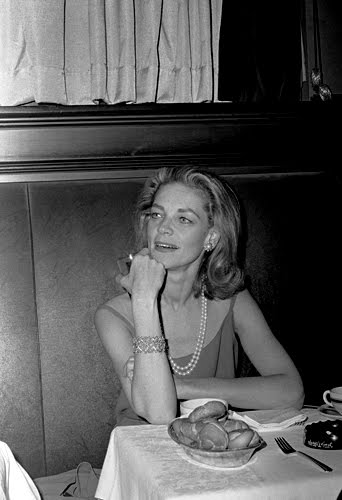
She took her papers to the sidewalk outside Sardi’s, where powerful producers and agents frequently dined. From there, she hocked the paper, not to make money, but to initiate conversations. “I kept my eyes peeled for a recognizable producer, actor, anyone who might help me get a job.” At right: Bacall, actually in Sardi’s Restaurant, courtesy Life Magazine

Her gumption eventually paid off. In 1942, with a slight name change (to Betty Bacall), she made her Broadway debut in the short-lived “novelty melodramaJohnny 2 X 4 at the Longacre Theatre.  However, her fame would be made on the movie screen, cast in 1943 (after yet another name change, to Lauren) opposite her future husband Humphrey Bogart in the Howard Hawks’ classic To Have And Have Not. She never needed an Actor’s Cue ever again.

I wonder if Winchell, a regular at Sardi’s, remembered that when he wrote an entire column that year called “The Bacall of the Wild,” raving about the young starlet.

Actor’s Cue is still being sold today — presumably not in front of Sardi’s — under its more descriptive new name of Show Business.

Santa Claus: a Broadway concert saloon from the 1850s

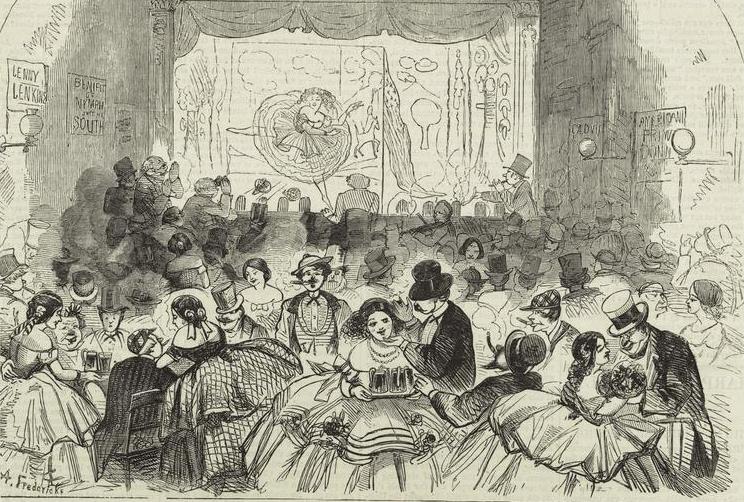
A Broadway saloon in 1859 during a ‘Sunday sacred concert’, as in, not very sacred at all. The Santa Claus probably looked like this on a good night. [Courtesy NYPL]

I’m doing some research on a couple upcoming entries for the How New York Saved Christmas feature which I started last year and came across something rather odd and Christmas-related that didn’t save anything at all.

Broadway was becoming New York’s de facto entertainment district after the 1830s, ushered in by luxury shops, pleasure gardens, and grand theatrical palaces like the Olympic (at Grand Street) and the Chambers Street Theatre. The Bowery, pretender to that title, would stoop (or elevate, depending on your tastes) to tawdrier amusements, starting with horse shows and comedic theater and degenerating into that infamous row of saloons and dance halls.

But the line was never precisely drawn and, anyway, weren’t the bawdier establishments more fun anyway? And so it was that saloons with musical acts seeped over to the more fashionable street, which explains how Santa Claus came to Broadway.

Not the bearded heavy-set gentlemen from north of Canada, but a place named in his honor. Santa Claus was a dance hall originally located at 596 Broadway, placing it adjacent to the newly built Metropolitan Hotel (on the Niblo’s Garden property).

Little is known about the ‘concert saloon’, as it was billed by its owner R. W. Williams. Opening in 1858, it may have attracted mixed clientele just below the line of New York respectability, but its bill of entertainment pretended otherwise. The unadorned long hall had a sawdust floor, a smattering of billiard tables and a high stage for performances from an odd mix of “opera, ballet, concerts, minstrels and gymnasts,” according to advertisements.

It’s not clear why such a place would be named Santa Claus who, as far as we know, is not a drinker. Enjoying the delights of an ‘uncommonly stocked bar’, patrons could enjoy German acrobats, ‘singing and dancing gypsies’, dog tricks, Irish comedians or, for a more somber occasion, the sounds of Dodworth’s Military Band and Cornet Corps. And all for a door charge of twelve cents.

The only review of the place I could find (a fussy, otherwise condescending review from a Dec 1858 issue of the New York Times) paints a dour scene, a ‘cheerless-looking hall’ with ‘a very dingy and forlorn aspect’. Interestingly, the place appears to cater to both white and black patrons, which the Times reviewer did not particular care for.

Santa Claus lost its lease and in 1859 moved a bit south to 72 Prince Street. At its new home, you could hear the talents of ‘pleasing concert singer’ Julia Barton, Spanish dancer Josephine West or minstral comedian Jerry Merrifield.

One source I found calls the Santa Claus “the first recognizable New York variety theater,” although few were recognizing anything here, and it appears that the new Santa Claus never made it to another Christmas.

Categories
Podcasts

Niblo’s Garden: New York’s entertainment complex and home to the first (bizarre) Broadway musical

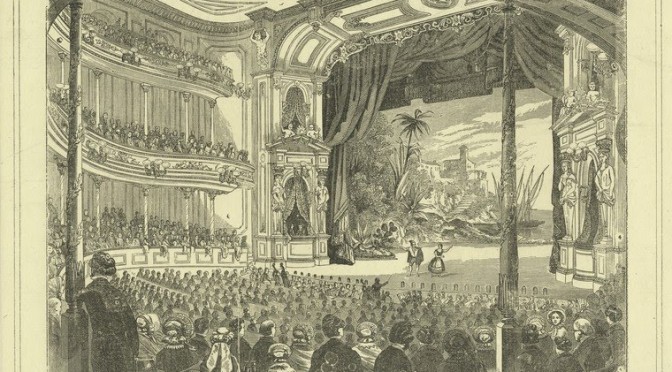
Show-stopping: The interior of Niblo’s Garden Theatre. Illustration by Thomas Addis Emmet, courtesy NYPL

PODCAST It’s the 1820s and welcome to the era of the pleasure garden, an outdoor entertainment complex delighting wealthy New Yorkers in the years before public parks. Wandering gravel paths wind past candle-lit sculptures, songbirds in gilded cages, and string quartets in gazebos, while high above, nightly fireworks spray the sky.

Niblo’s Garden, at the corner of Broadway and Prince Street, was the greatest of them all, with an exhibit room for panoramas and refreshment hall consider by some to be one of New York’s very first restuarants. But it was Niblo’s grand theater, seating 3,000 people, that would make Niblo’s reputation as the venue for both high- and low-brow events. And in 1866, a production debuted there that would change everything — the gaudy, much-too-long spectacle The Black Crook, considered by most as the very first Broadway musical.

Music in the episode is Enigma Variation VI. Ysobel by Elgar. It’s actually from after the time period of Niblo’s, but it’s so very strolling-the-garden, isn’t it? And I had a cold this week, so please forgive my scratchy voice!

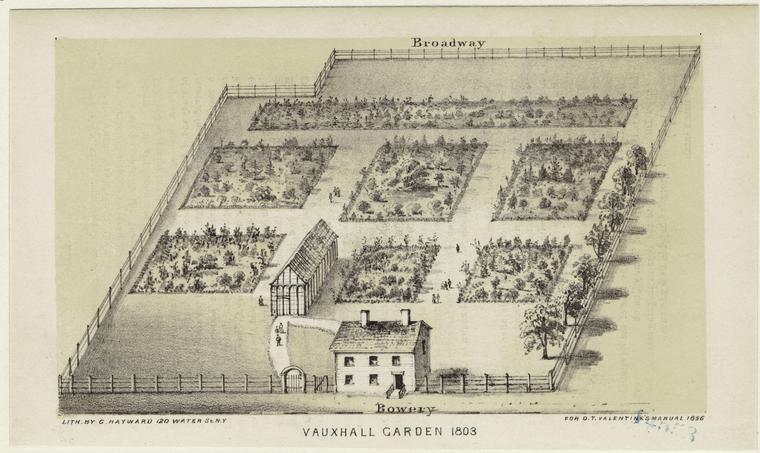
Before Niblo’s, the premier pleasure garden was Vauxhall Garden, derived from a British garden of the same name. The one picture below is from the incarnation before it moved in 1807 to the area just below Astor Place, in what would become Lafayette Street. (NYPL)

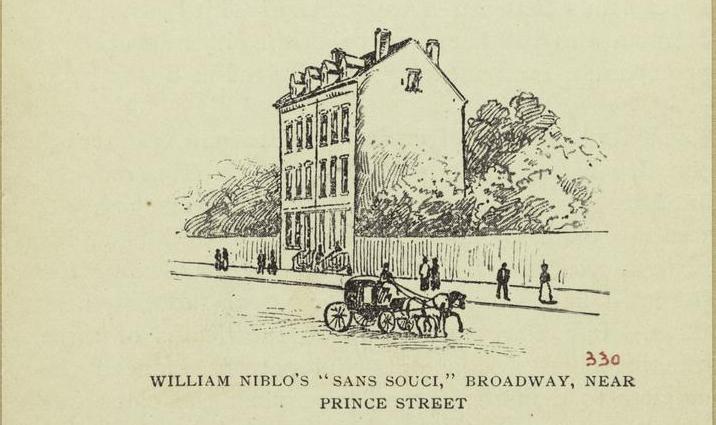
The first theater on the Niblo property was a small stage he called ‘Sans Souci’. Demand soon dictated that a larger venue be built. [NYPL]

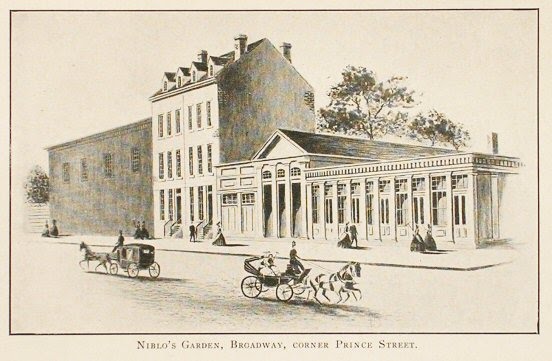
From another illustration detailing the block just a few years later. The theater looks the same, but other buildings (possibly the saloon or a greenhouse?) have been built up around it. (from Merrycoz)

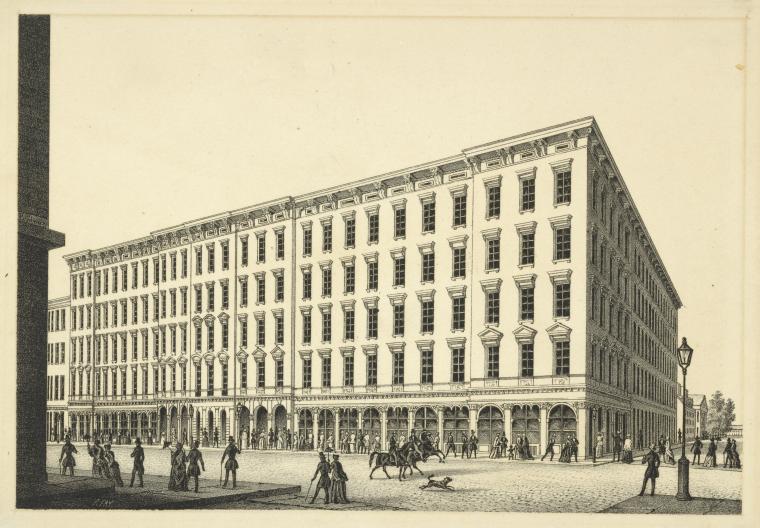
The garden was soon overtaken by a great hotel, the Metropolitan, which opened in 1852. This image is looking east, down Prince Street, with Broadway stretching to the left. NOTE: The original caption on this illustration says 1850, but the hotel would not be open for a couple years later. (NYPL)

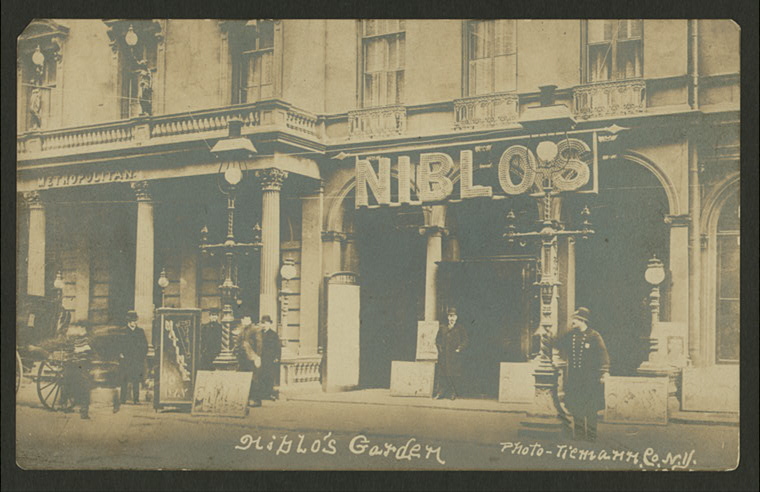
This is one of the only photographs of Niblo’s Theater, certainly from its last years, judging from the fashion of the day. The theater and the hotel were demolished in 1895. [Pic from here]

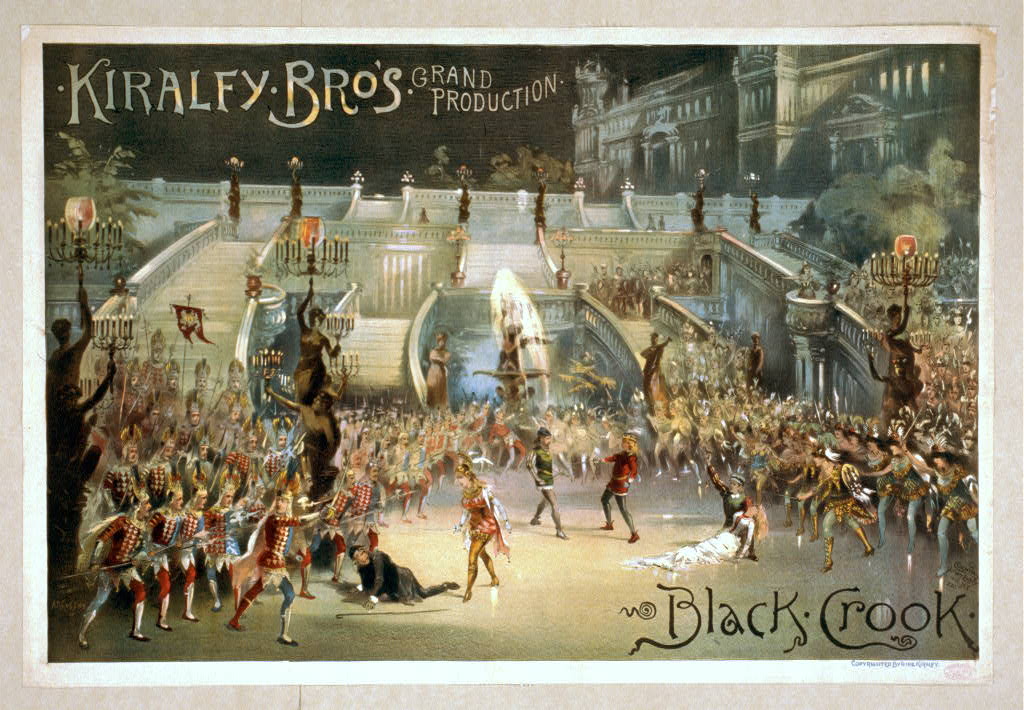
This poster is from a Boston production of ‘The Black Crook’, but it illustrates nicely the scope and theatricality of the production. The show was cobbled together using a poorly written German fantasia, a troupe of out-of-work Parisian dancers, and some original music. The show ran five and a half hours nightly and was a runaway hit. [Image from Kirafly Bros]

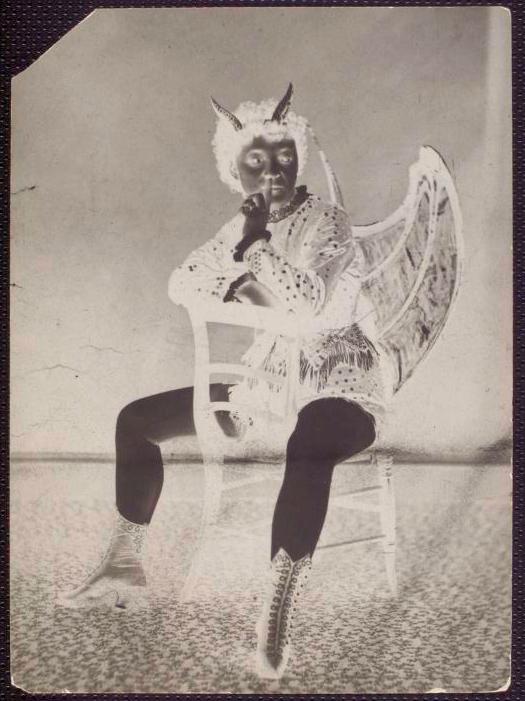
A costumed damsel (in photographic negative) from an early production of The Black Crook. [source]

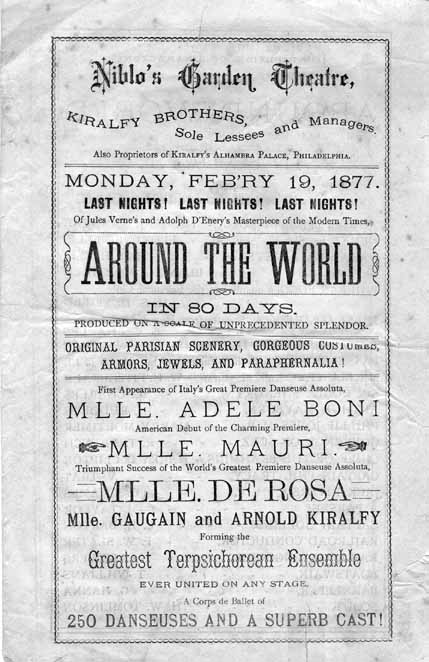
An early program from Niblo’s, from 1877, featuring stage rendition of Jules Verne’s Around The World In 80 Days. I can only imagine the sets for this one! Also featuring the ‘Greatest Terpsichordean Ensemble’ and ‘250 Danseuses and a Superb Cast’.[Courtesy Jules Verne]

Categories
Uncategorized

Xenon and the strange journey of a Broadway theater: Noel Coward, Fellini, porn, disco, ‘Cabaret’, Dame Edna

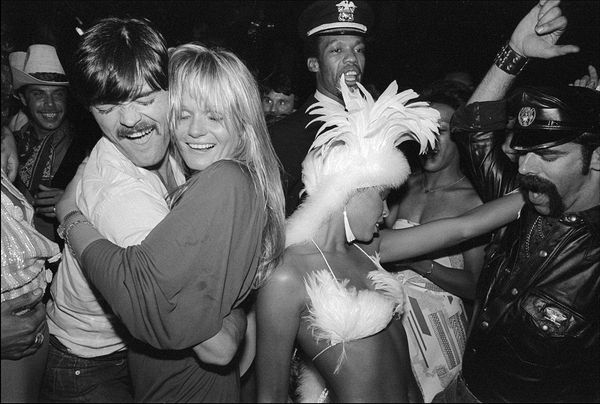
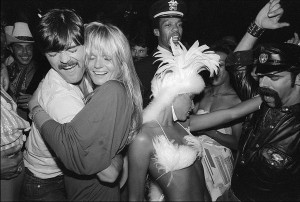
You know it’s a good night at Xenon when you’re drunk on the dance floor, and all of a sudden, the actress Valerie Perrine and the Village People appear (source)

FRIDAY NIGHT FEVER To get you in the mood for the weekend, on occasional Fridays we’ll be featuring an old New York nightlife haunt, from the dance halls of 19th Century Bowery, to the massive warehouse clubs of the mid-1990s. Past entries can be found here.

 LOCATION: XenonTimes Square, 43th Street and Broadway, Manhattan
In operation 1978-84
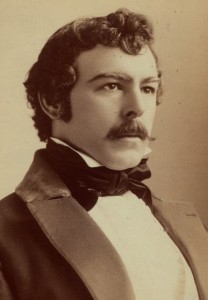
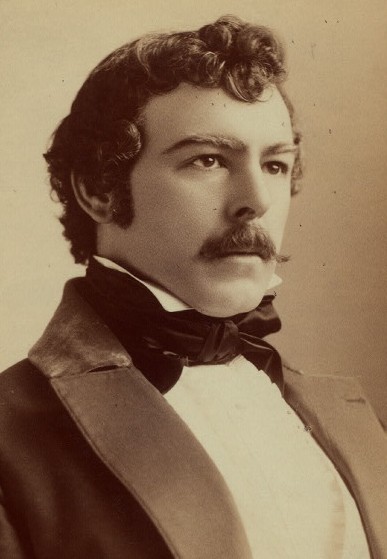
THIS, AT LEFT, IS HENRY MILLER. Clearly this is not the Henry Miller you more popularly know.

This Henry Miller would have never produced Tropic of Cancer. But his major contribution to the American stage would bring New Yorkers an iconic work of French cinema, a world famous theatrical revival, and one of the most successful Studio 54 knockoffs ever.

Miller was a minor theatrical star in the age of Sarah Bernhardt, who began dabbling as a director and stage manager at the same time that theater on 42nd Street began to flourish in New York. He became an early, respectable presence; from an early biography: “It was a foregone conclusion that a Henry Miller production must be in the best tradition of the theater.”

His timing was exquisite as well. The Broadway district in the 1910s was in full swing, with excitement at all hours. His patron (and progressive, feminist icon) Elizabeth Milbank Anderson assisted him in opening a stage in 1918 at 124 W. 43rd Street, a prime location near the theaters of Oscar Hammerstein, Klaw & Erlanger and Florenz Ziegfeld. The old New York Times building was half a block away, the nexus for New Years Eve celebrations for over a decade. Across the street rose the Hotel Metropole with its bustling late night antics; a few years earlier, in 1912, you could have stood in Miller’s lot and watched the bloody mob hit of gambler Herman Rosenthal — possibly ordered by New York cop Charlie Becker. (You can hear more about that in our Case Files of the NYPD podcast.)

There were no hits at Henry Miller’s theater, however, not the lucrative kind at least. In fact, the first show, The Fountain of Youth, was an unmitigated flop, opening in April 1918 and closing in May. (“This fountain of youth plays a very slender stream, and even that is of intermittent vigor,” claimed one review.) Famous names played here — George Gershwin, Billie Burke, Helen Hayes — but it wouldn’t be until Noel Coward debuted his scandalous, sex and cocaine-fueled comedy The Vortex in September 1925 that Miller’s theater would see its first in a string of major successes. Miller himself, however, would not enjoy these successes; he died a few months after Coward’s debut, in early 1926.

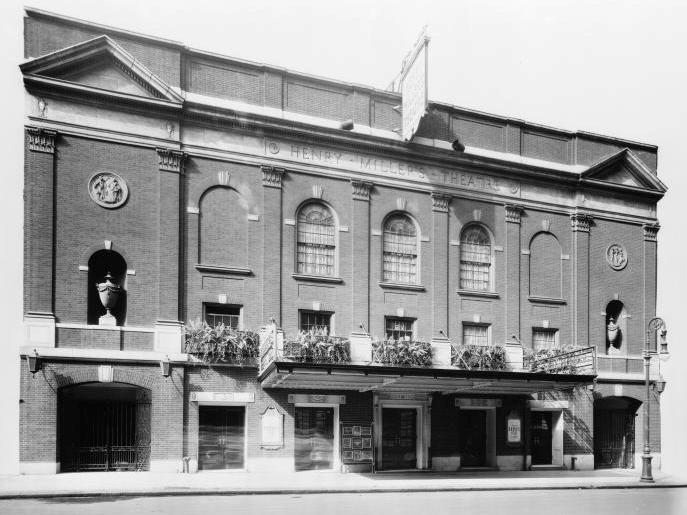
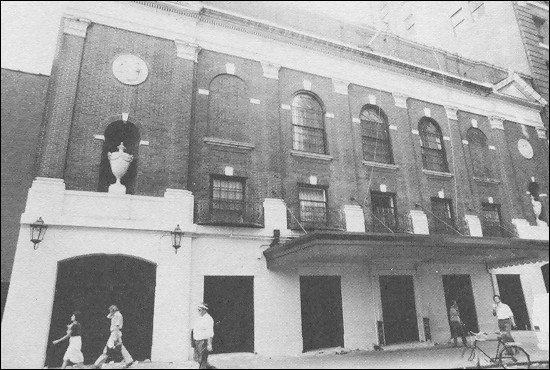
Below: Henry Miller’s theater, during its glory days. Photo courtesy NYPL
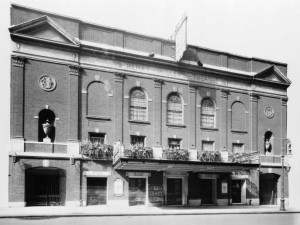
But Henry’s son Gilbert Miller had a knack for theatrical production even greater than his father. For three decades, he ushered countless box office hits through the Henry Miller’s Theatre, including the Tony winning T.S. Eliot play The Cocktail Party starring Alec Guinness. Most notably, Our Town would make its Broadway debut here in February 1938, and in 1957, a young British actress named Angela Lansbury would make her American stage debut here in Hotel Paradiso. Gilbert would win an honorary Tony in the mid-1960s for his contributions to the New York stage.

By then, however, the theater began flirting with a transition that many midtown stages had already made — into a legitimate movie house. Its first foray was also its most memorable, Federico Fellini‘s La Dolce Vita, premiering here in April 1961. The strangeness and theatricality of Fellini’s masterpiece fit the Henry Miller playhouse perfectly, even if the stage itself was technically ill-fitted for movies. The grumpy critic Bosley Crowther was even impressed: “Fellini’s “La Dolce Vita” (“The Sweet Life”), which has been a tremendous hit abroad since its initial presentation in Rome early last year, finally got to its American premire at Henry Miller’s Theatre last night and proved to deserve all the hurrahs and the impressive honors it has received.”

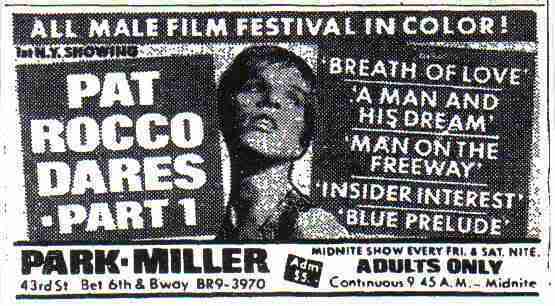
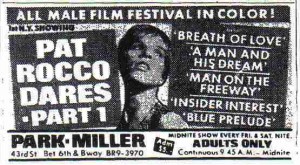
This might have been a harbinger for a fabulous future as an art house, however the theater was instead sold, renamed the Park-Miller, and entered the 1970s as one of Times Square’s most popular porno theaters, specializing in all-male features for gay audiences.

Although Henry Miller was certainly turning in his grave, the theater actually become quite successful, more so than most of Miller’s own productions during his lifetime.

According to author Hilary Radner, “the Park-Miller Theater on 43rd Street grossed in excess of thirty thousand dollars per week in the early 1970s….For a five dollar admission fee, audience members watched a mixed program that included shorts, slides, and a dubbed minifeature, such as Truckers — Men of the Road.” A long way from The Fountain of Youth, indeed!

Below: an advertising glimpse into the theater’s more prurient days
Everything changed in the spring of 1977 with the transformation of an old opera house into the superstar disco spectacular Studio 54, epitomizing the notion of nightlife as a headline-grabbing celebrity wonderland. One night at 54, music manager Howard Stein met Swiss restaurateur Peppo Vanini (the ex of actress Victoria Tennant), and the two cooked up a scheme to match the club’s glamour in another midtown location.

Stein purchased the old porn theater and remade it into the discotheque Xenon, although Xerox might have been a better name, for it adhered closely to the Studio 54 formula of flashy nights, big celebrities and kitschy showmanship (cannons with colored feathers, a neon X above the dance floor).

Being just slightly lesser a club than 54, you actually did stand a chance of getting in if you happened not to be a bold-faced somebody. But Stein would occasionally stand at the door himself “weeding out the detested middle class from the very rich and the colorful poor,” according to a New York Magazine profile.

Below: the club, during the day, in the 1970s:
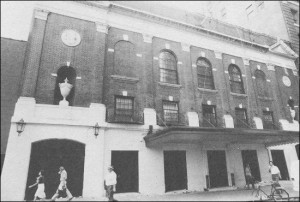
Still, Xenon had its day, and on a typical hot summer night in 1979 or 1980 you might stumble into private parties hosted by Michael Jackson, Woody Allen, Lauren Bacall, Ben Vereen, or Pele. Inside you might hear deejay Jellybean Benitez.

Although people often stripped down to bikinis on the dance floor, you had fewer naked Grace Jones moments; Xenon “combined the craziness of Studio 54 with the comfort of Regine’s” according to one source, Regine’s being the more elegant nightclub entree owned by French chanteuse Régine Zylberberg.
With the end of disco came the end of Xenon, in 1984, and a brief attempt at turning the space into a rock ‘n’ roll venue called SHOUT! It lay mostly dormant, hosting temporary parties, until the early 1990s, when in a flash of inspiration, the Roundabout Theatre renovated the worn, abused little stage, combining all eras of its history to transform it into the Kit Kat Club, a cabaret venue fit to re-stage, naturally, Cabaret. That version, starring Alan Cumming and the late, wonderful Natasha Richardson, would go on to win the Tony for Best Musical Revival in 1998. Incidentally, that same year, a devastating construction crane accident next door closed the block for weeks, and Cabaret would be forced to move uptown to the former Studio 54.

Suddenly, all its prior incarnations seemed to enjoin to create its most successful reinvention yet. After Cabaret left, the hot off-Broadway show Urinetown moved in; that bawdy musical took three Tonys in 2003.

And then, they demolished it.

Saving the landmarked front exterior — with Henry’s name emblazoned along the top — the rest of the building was scrapped in a massive construction project that eventually put the Conde Nast Building to its west side and the Bank of America building to its north, to which a new theater was attached, using that old exterior and renamed the Stephen Sondheim Theatre. In the fine tradition of Henry Miller himself, the stage has features two shows — a revival of Bye Bye Birdie, and the Dame Edna musical All About Me — both flops.

For some great recollections of the glory days of Xenon, check out the website Disco Music. Featuring one commenter who says: “There’ll never be a club like it again. Pinball machines would drop out of the neon heavens and land next to dancers gyrating to ‘Funky Town’ by Lipps. Not to mention the fake snow (clearly an homage to the abundant cocaine passing through nostrils by one and all) that dropped on you, sticking to your favorite nylon shirt.”