Categories
Brooklyn History On The Waterfront Podcasts

Notes from the podcast (#133): Red Hook, Brooklyn

A haunting snapshot of the Atlantic Docks, circa 1870-80s (possibly as early as 1872) photo by George Bradford Brainerd (courtesy the Brooklyn Museum

Quite a few notes on the podcast this week! There were a lot of little details I found interesting that didn’t make the cut:

Before the Water Taxi: One of the more enlightening tales left on the cutting-room floor was that of the Hamilton Avenue Ferry, the 1846 Atlantic Docks ferry line that linked Red Hook with downtown Manhattan in much the same way the IKEA Water Taxi does today. As the ferry made “the shortest and most direct route from New York” to the newly constructed Green-Wood Cemetery, it also became the method by which many bodies were transported there.

Fiery renovation: A stalwart of the old community is Visitation of the Blessed Virgin Mary Roman Catholic Church (built in 1896) right off of Coffey Park, the third incarnation after the congregation grew out of the first building (originally built in 1855) and fire destroyed the second. That fire, incidentally, was allegedly caused by combustible materials workers were using to renovate the structure.

Goodbye Vienna: A vestige of World War I hysteria exists within the name of Red Hook’s Lorraine Street. According to Brooklyn By Name, the street was once named Vienna Street but was deemed ‘offensive’ during the war and was changed to reflect the area of Alsace-Lorraine, which entered French possession after the war.

What’s My Name?: I mentioned a couple facts about the neighborhood of Carroll Gardens (once considered a part of Red Hook), although we hope to elaborate further one day on a show on South Brooklyn. The name Carroll Gardens, like that of its neighbors Cobble Hill and Boerum Hill, was a real-estate invention which the community quickly embraced. (Contrast this with modern failures of real-estate re-branding, like ChumboBelDel and LoDel.) You might be interested in reading Carroll Garden’s original 1973 historic designation.

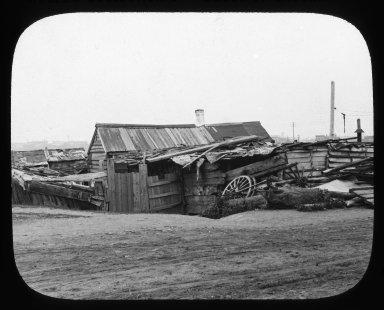
Below: I’m not quite sure of the story behind this sunken squatters home, taken on Van Brunt Street from the year 1900 (courtesy the Brooklyn Museum

Brooklyn Museum: Brooklyn scenes; buildings


Further reading: For more information on the corruption of the  New York and Brooklyn waterfronts , I highly endorse Nathan Ward‘s ‘Dark Harbor’. It’s brilliantly lucid and immediate. In particular, he focuses some attention on the disappearance of Columbia Street longshoreman Pietro Panto and vividly describes a mob hit that took place in a building in Manhattan’s West Village, in a building next door to the treasured piano bar Marie’s Crisis. There are several books that feature chapters on Red Hook history, but a dedicated book on the subject is sorely needed. In the meantime, I recommend the short essay by Jerry Nachman that appears in “Brooklyn: A State of Mind,” about, of all things, an air conditioning crisis!

Maggie Blanck has an extraordinary web resource that begins as a genealogy of her family and elaborates into a history of Red Hook’s industrial giants. And for those of you who are fascinated by late-century street-gang history, the website Stone Greasers has an exhaustive list of gang names, many more unusual than anything you’d find in the movie The Warriors.

Red Hook as inspiration: Several sources, both on Brooklyn history and film history, discuss Red Hook’s impact on the work of both Arthur Miller and Budd Schulberg, the screenwriter of ‘On The Waterfront’.

 In 2009, a unique restaging of ‘On The Waterfront’ took place aboard the Waterfront Barge Museum in Red Hook, a production that then floated to Manhattan and Hoboken waterfronts for further performances, “all places whose dock wars echoed in Terry [Malloy’s] story,” according to Ward.

Elia Kazan’s Oscar-winning film is embedded with influences from the entire New York waterfront struggle. For instance, Karl Malden‘s Father Barry is transparently inspired by Father Corridan, an activist waterfront priest from Manhattan’s west side. (Author J.T. Fisher focuses on Corridan’s contribution in his new book ‘On The Irish Waterfront’.) Of course no inspiration was greater than Malcolm Johnson‘s now classic series of articles for the New York Sun in the late 1940s, a series which won the Pulitzer Prize in 1949 — coincidentally the same year that Miller won for ‘Death of A Salesman’!

I suppose there is some controversy in some circles regarding whether Schulberg and Kazan ‘stole’ the idea of ‘Waterfront’ from Miller’s ‘The Hook’, but I’m not touching that. However you can read about it yourself in Stephen Schwartz’s argumentative 2005 article.

Thanks to commenter Rob Hill who calls to attention another fascinating literary Red Hook reference. In 1957, Harlon Ellison, one of America’s great science fiction and crime novelists, literally went undercover with a Red Hook street gang called The Barons to find inspiration for his book ‘Web of the City’ and, later, in the non-fictional account Memos From Purgatory. Ellison’s entire life would probably make a good subject for a podcast one day. Thanks Rob!

Further listening: This show shares many similar themes with our past shows on Williamsburg, Brooklyn and Corlears Hook and the Pirates of the East River. Hmm, and let’s just say, we’re probably coming back to the waterfront sooner than later this year….

Community vs Neighborhood: One listener Carolina from PortSide NY had some strong objections to my characterization of Red Hook, particularly my focus on the neighborhood’s crime and gang activity. I’m excerpting part of her letter, as it highlights a challenge that Tom and I often tackle with our podcast:

“Red Hook housed great poverty, but for decades was more mixed economically than your focus on gangland stories describes. Personally, I find what is most distinctive about Red Hook over the years is the capacity of this small place to hold AT THE SAME TIME a striking economic range in its residents and a striking range of land use from major industry to residences.

That is an undoubtedly true statement, especially when you compare it to the fate of other dockside neighborhoods, like Corlears Hook and Water Street in Manhattan. I find there are two ways to accurately tell a story of a place like Red Hook — from an organic, street-level or ‘ground up’ perspective (what I call ‘a community history’) and from a macro-view, as a component of the larger forces of the city which contain it (or ‘a neighborhood history’).

As the creators of a New York City history podcast, we opt to recount neighborhood histories, as New Yorkers and those who love this city are familiar with the mechanisms of change that have influenced it. In this decision, we understand that the normalcy of a place can get sometimes overlooked. (After all, not every person in Five Points was a gang member or a prostitute either.)

However, the sad truth is, Red Hook was for many years nationally known as a blighted neighborhood, and it was important to inspect both how it got that way and how that condition demanded some very unique revitalization plans.  I hope I have shown how essential Red Hook was to New York, and continues to be.  We encourage you to wander around the waterfront on a sunny afternoon sometime and, in particular, check out places like the Waterfront Barge Museum.

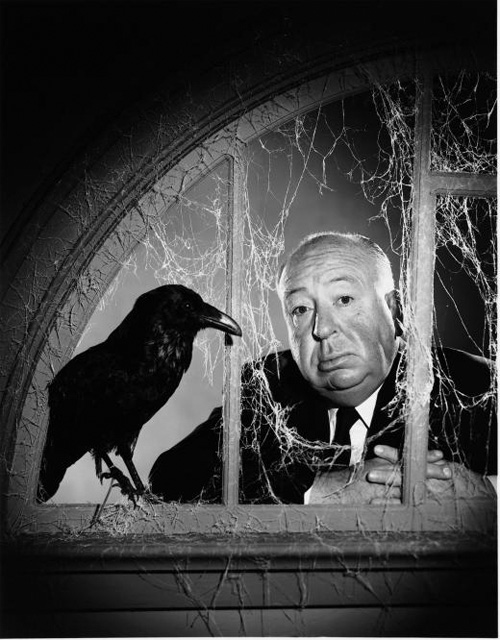
Was New York not haunted enough for Alfred Hitchcock?

A still from ‘The Wrong Man’, a crime drama shot in New York in 1956. (Courtesy Empire Magainze.)

Alfred Hitchcock‘s innovative anthology series ‘Alfred Hitchcock Presents’ debuted on CBS in the fall on 1955. As a filmed dramatic series (vs. the live camera TV hits like ‘I Love Lucy’ and ‘The Honeymooners’), the weekly mystery program brought serious cache to the medium and set the bar high for genre anthology television, to be raised four years later by ‘The Twilight Zone’.

Many episodes were filmed in New York, using Broadway’s rich pool of stars. The city would itself be a star of several Hitchcock films, including one released the next year in 1956. The Henry Fonda crime drama ‘The Wrong Man’, based on real events, concerned a jazz musician from the Stork Club falsely accused of a robbery. Most notable were its scenes shot on location at Queens City Prison in Kew Gardens.

Before beginning production on ‘The Wrong Man’, Hitchcock wanted to wow Warner’s studio executives and reporters with a fabulous New York soiree in March, done up Hitchcock-style. That meant conjuring up many of the mystery and horror themes the director was most famous for. So, on that note, Hitch requested his publicist look for an actual New York haunted house.

Now I can tell you from doing our annual Halloween podcasts that there are no shortage of ‘haunted’ New York locations. But it seems the publicists had a bit of a problem locating a suitable venue — one that could host both ambassadors from the afterworld and a haughty contingent from the film world.

According to reports, Hitchcock loved some ‘abandoned wine cellars’ beneath the Manhattan end of the Brooklyn Bridge. (The article doesn’t clarify where these are. Perhaps they were part of George Washington’s old home?) But costs to install plumbing were prohibitive. Hitchcock “wanted women among his guests in the haunted quarters and women would want washrooms,” according to reports.

He next turned to a very familiar haunted home — the Merchant’s House, allegedly possessed by its former owner Gertrude Tredwell. It was ideal, but the home owners were less than thrilled at hosting a saucy industry party and rebuffed the offer.

Frustrated, Hitchcock’s publicists even put an ad in the paper, looking for ghost-filled venues. After a few disappointing offers — including one in Jackson Heights, Queens, but the master of suspense feared his party guests would never venture that far — he settled on a rustic old townhouse at 7 East 80th Street, right off the park. Not haunted, but plenty ‘cobwebby’, according to the press.

The party went off, with Hitch, without a hitch. The ‘haunted-house’ party included tombstone-shaped ‘Carte de Mort’ menus with a variety of macabre selections, including Corpse Croquette, Vicious-Soisse, Suicide Suzettes, Gibbeted Giblets, Ghoulish Goulash and “Fresh-cut Lady Fingers (in season)”. (Revel in the rest of the menu here.)

Hitchcock received a true fright at the end of the year when ‘The Wrong Man’ was finally released and promptly flopped at the box office. It would be his final film for Warner Bros., whose executives at least got a kooky party out of the deal.

The Academy Awards in New York: NBC experiments, as Audrey Hepburn wins an Oscar after a long day of work

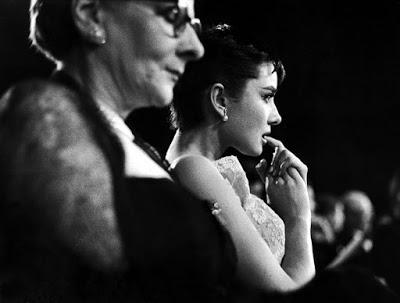
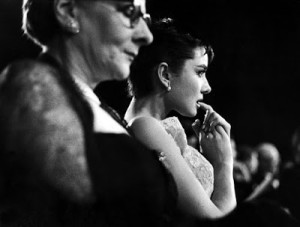
Audrey, off Columbus Circle: Hepburn sits in nervous anticipation at the New Century Theatre, moments before she wins for Best Actress.

Despite the Academy Awards being a celebration of all things Hollywood, New York has actually hosted the Oscar ceremony on more than one occasion. Or rather, they co-hosted the event — from 1953 to 1957 — in a rare and quickly abandoned bi-coastal ceremony that taxed the mechanics of television’s earliest production crews.

There were two reasons for this complicated arrangement. NBC, who was broadcasting the event, had most of their principal stages in New York. After all, the first NBC studios were at Rockefeller Center, where they still remain. Even The Tonight Show, perhaps NBC’s first and most famous Burbank production, filmed in Manhattan until the early 1970s.

More importantly, many film stars were in New York, unable to get out of theatrical commitments on Broadway. And frankly, in the years before international television viewership, the Oscars simply did not have the same urgency as they do today. Thus, the award show came to them.
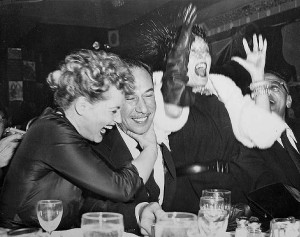

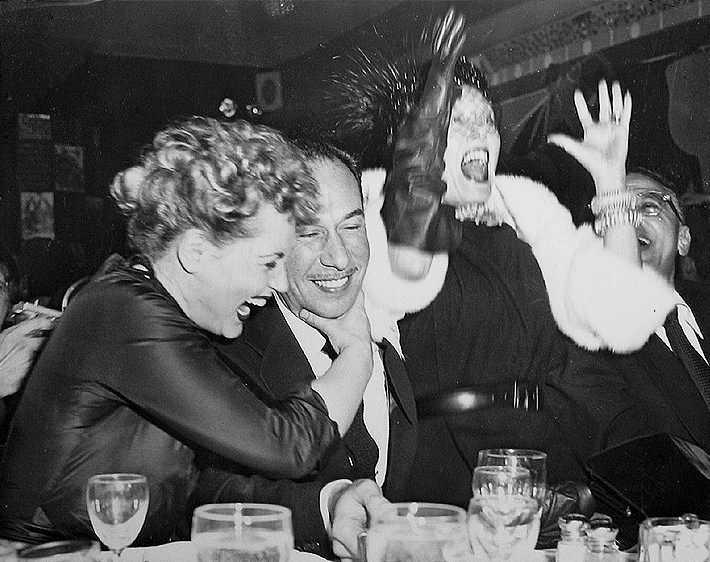
Judy Holliday gives Jose Ferrer a friendly squeeze — and Gloria Swanson bursts with joy — as Ferrer’s name is announced as the winner of Best Actor, at the La Zambra in midtown. (Getty Images)

23rd Annual Academy Awards
Best Picture winner: All About Eve
March 29, 1951

Before splitting the broadcast, the Oscars once tried a very strange live radio remote from a New York nightclub.

For the 23rd Annual Academy Awards, held on March 29, 1951, many nominees like Judy Holliday and Gloria Swanson remained in New York. Both Swanson and Jose Ferrer, starring in the Broadway comedy Twentieth Century, were nominated that year.

Instead of disappointing a sell-out theater audience, Ferrer invited all the nominees to an after-theater party at the La Zambra Cafe (127 W. 52nd Street), a nightclub owned by Spanish guitarist Vincente Gomez. A live radio link was set up among the tables, and nominees wined and dined waiting for their categories to be announced out in Los Angeles.

Believe it or not, Ferrer won Best Actor (for Cyrano), and Holliday won Best Actress (for Born Yesterday), giving their speeches into a radio microphone as champagne corks popped in the background. (Swanson, who thought she might win for Sunset Blvd., was less enthusiastic for Judy’s win.) It’s appropriate they were in New York, as Ferrer and Holliday both won for film adaptations of Broadway shows in which they had starred. And clearly underscoring the power that the New York stage still had on the film business, Best Picture went to the stage drama All About Eve.
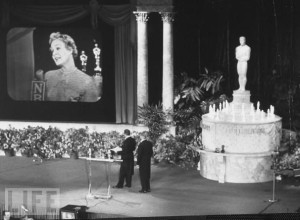

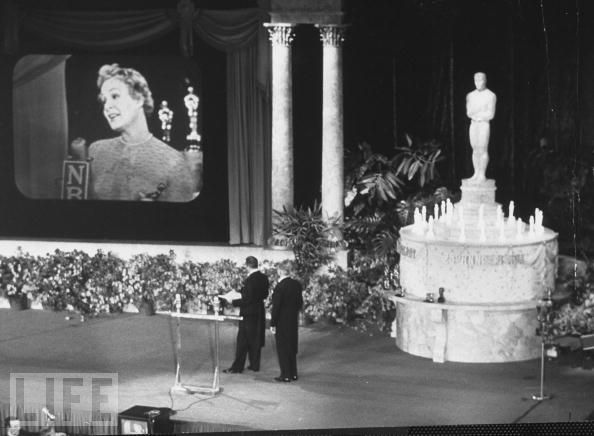
Above: Shirley Booth accepts her Oscar in New York, as the audience in Los Angeles watches on. (LIFE images)

25th Annual Academy Awards
Best Picture winner: The Greatest Show On Earth
March 19, 1953

While the Los Angeles crowd were entertained by host Bob Hope, the attendees to the first official bi-coastal New York ceremony were met by co-host Fredrick March, a two-time Academy Award winner. The event was broadcast from 5 Columbus Circle, at the International Theatre.

In 1953, the International was a worn out, tired New York stage, having gone through a host of different owners and renovations since it first opened — as the Majestic Theatre — in 1953. At different periods of time, it was owned by Florenz Ziegfeld and William Randolph Hearst, and its stage played hosts to virtually every form of entertainment, from burlesque to ballet.

So definitely an odd setting for an awards program given that this was also the first Oscar show to be broadcast on television. But the International was owned by NBC, who had agreed to fund the inaugural broadcast. And NBC’s fees to broadcast the program were especially valuable to Academy of Motion Picture Arts and Sciences, as the film studios refused to fund an elaborate bi-coastal show.

The broadcast began 7pm PST and 10 p.m. here, to accommodate the Broadway stars just stepping off the stage. Due to staggered entrances, many of the seats at the International were empty for much of the ceremony.

Among the nominees sitting in the Columbus Circle theater was Best Actress nominee Shirley Booth, who was starring in the Broadway play The Time Of The Cuckoo on 40th and Broadway at the now-demolished Empire Theatre. She won the Oscar for the film version of Come Back, Little Sheba; she had won a Tony Award for the stage version in 1950.

Given the limitations of early television technology, it’s amazing they were able to broadcast simultaneously between two coasts at all. Glitches did cause for a few amusing gaffes for television audiences. When the universally reviled film The Greatest Show On Earth somehow won Best Picture over the favorite High Noon, the camera switched to the New York audience, who sat there not clapping and in mild confusion.

There would not be another Oscar telecast at the International, or anything else for that matter. The very next year, NBC moved out, and the theater was finally torn down, replaced with one of Robert Moses’ pet projects, the Coliseum convention center.
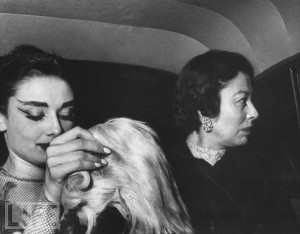

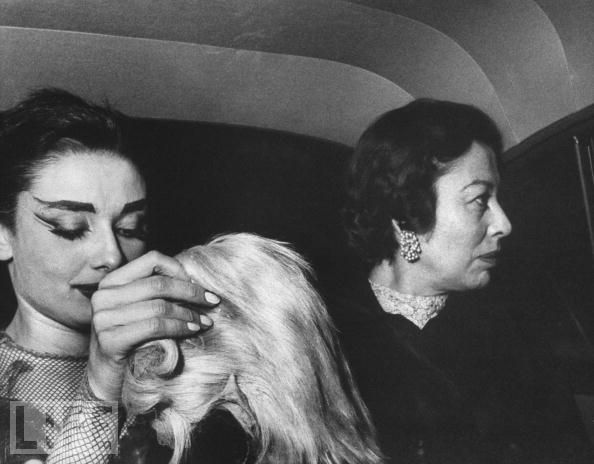
Above: Audrey snatches off her blonde Ondine wig as her limousine races her to the Oscar ceremony uptown.

26th Annual Academy Awards
Best Picture Winner: From Here To Eternity
March 25, 1954

For the remainder of the Oscars’ short stay in New York, they were broadcast from the New Century Theater*, at Seventh Ave. and 58th Street, right off Columbus Circle and best known before then as the theater that Orson Welles and his spirited cast stormed in 1937 to perform his musical The Cradle Will Rock.

Film fans were set up in bleachers outside, just as they’re popularly done out in Los Angeles. But one New York nominee didn’t get there in time to meet her fans. Audrey Hepburn was down at the 46th Street Theatre performing the play Ondine, costumed in a blonde wig. After the show, she raced to the Century in a limousine (with police escort, no less), ripped off her wig, rushed to bathroom to wipe off her stage makeup, then settled to her seat for less than ten minutes before standing again to accept the trophy for Best Actress for Roman Holiday.

Here’s video of Audrey’s win. You can see the ‘switch off’ between the Los Angeles and New York feeds.

The show, hosted in New York again by Fredric March, had another New York icon receiving an Oscar that year — Frank Sinatra, Best Supporting Actor for his role in the Best Picture that year. However, he was in Los Angeles to accept it.

(You can find tons of pictures of Audrey in her post-Oscar glow at the NBC Photo Bank.)

27th and 28th Academy Awards
Best Picture Winners: On The Waterfront, Marty
March 30, 1955; March 21, 1956

It became obvious to most viewers that the bi-coastal productions were becoming lopsided. After all, it was early evening in Los Angeles, and most of the young, fresh talent was there. In New York, it was post-theater time, and attracted the older stars — some exhausted from stage productions. Nothing exemplifies this more than the 28th ceremony, hosted in New York by proper Claudette Colbert and Joseph Mankiewicz and in Hollywood by the hot new comedian Jerry Lewis, whose ribald antics made the New York cutaways seem drab.

But the awards were all about the East Coast. The Best Pictures these two years were for films set in Hoboken, NJ and the Bronx, respective. Much of the cast of On The Waterfront were actually at the New York ceremony, including Best Supporting Actress winner Eva Marie Saint, her pregnancy concealed by a jacket as she mounted the stage to accept her award. (Here’s the video of her win, again highlighting the difference between the New York and the L.A. ceremonies.) Best Director Elia Kazan was also here to accept his trophy. Marlon Brando, however, was out in Los Angeles, apparently where the fun was.

The following year, Best Picture went to Marty, another show originating in New York. But not from a Broadway stage. As a symbolic move towards the importance of the small screen, the Ernest Borgnine vehicle was based on a teleplay from the Goodyear Television Playhouse.

29th Academy Awards
Best Picture Winner: Around The World In 80 Days
March 27, 1957

It was clear by this time that the two coast production was more trouble than it was worth. While Hollywood had Jerry Lewis again, the sparsely interested New York audience had the lovely but comparatively unexciting Oscar winner Celeste Holm as hostess.

This would be the last year New York hosted the Oscars. And this would be the last hurrah for the New Century Theatre as well. It would be torn down in 1962 and replaced with the rather sleek, curvy 200 Central Park South co-op.

*NOTE: The official Academy Awards website actually has the Academy Awards ceremony in 1954 held at the Center Theatre, the former RKO Roxy Theatre that was originally built as a smaller companion to Radio City Music Hall. However most sources have the New Century (often just called the Century or the NBC Century) as the location. Additionally, the Center Theatre was torn down in 1954. The announcement of its demolition was in October 1953, before the ’54 Oscars ceremony. If I find further validation that the Center was the location, I’ll make the correction….

To make it even more confusing, New York also had a Century Theatre on the other side of Columbus Circle that was demolished in the 1930s. Hopefully I’ve gotten these theaters all straightened out!

ALSO: You might like to see the Life Magazine photographs of Audrey pictured above in the context of the original Life Magazine article.

The San Francisco Earthquake, as recreated in New York


San Francisco burns — in New York

The first American newsreel debuted just over one hundred years ago, representing the first real attempt to contextualize the moving images of actual events into a stream of information that could emulate a newspaper. The French film company Pathe and the New York-based Vitagraph both debuted edited silent newsreels in the city in 1911.

Before this time, actual events where contained in straightforward ‘news films’ or actualities that were presented at Nickelodeons and other exhibition spaces alongside narrative fiction shorts. As a result, there wasn’t a strict need to display accuracy in filming real life.

Biograph Studios was especially guilty of this. From its studios at 11 East 14th Street in New York’s Union Square and in locations nearby, the film company recreated a variety of news events. Audiences could be easily fooled in 1906; real events, from moving trains to boxing matches, already seemed fantastic to eyes untrained to cinema. And so, sometime in the spring of 1906, it didn’t seem like a bad idea to the Biograph production team to simply recreate the San Francisco earthquake, one of the worst natural tragedies in American history.

The devastating quake that rocked the California coast on April 18, 1906, killed over 3,000 people and nearly wiped the young city off the map. But with one exception (which I’ll mention), nobody was filming it, much less capturing it in a way that could encapsulate the horror and damage it caused.

Enter Biograph general manager George E. Van Guysling. He and his crew produced an elaborate model of San Francisco at their 14th Street studio, a mini-metropolis of cardboard and clay, replete “a yawning cavity which appeared to split the city in two.” As a camera took note, the New York film crew pulled San Francisco asunder, setting it ablaze.

It seems to be this must have looked spectacularly fake to our eyes today, a regular Ray Harryhousen-type production from a 1960s monster movie. But the eye of the film goer was not as explicitly trained to spot fabrication in 1906, nor were audiences jaded enough to expect it.

What seems especially brazen about this fabrication is that it was being created in New York’s Union Square, even as San Francisco’s public square of the same name sat in ruins.

Biograph quickly put the film into circulation, and the footage was a hit with shocked and amazed audiences. Allegedly, both the mayor of San Francisco and one of California’s senators thought the footage to be real. (Of course, that would have required a fortuitous placement of camera at just the right time and place.) Had it been taken for the fake that it was, the studio’s cavalier recreation of a disaster that killed over 3,000 people would probably not have been as warmly received.

A San Francisco filmmaker named Henry Miles did in fact record some of the earthquake in action. (The earthquake actually destroyed his own film studio in the process.) Being real footage, it was apparently not as perfectly framed as Biograph’s fake movie. As a result, when Miles released it for distribution, it was not a success, according to author Raymond Fielding and his book on the history of the newsreel.

Faking the events would not be the norm. Edison’s film studio, of course, was adept at successful ‘news films’, and clearly unstaged events — from European coronations to parades down Broadway — would be hits with audiences. In fact, Edison even filmed the aftermath of the San Francisco earthquake, and the footage provides some of the most powerful images of the tragedy:

Not surprisingly, one of the first disasters to be filmed in New York was the blaze that destroyed the Powers Film Studio in the Bronx in June 1911. After all, the cameras were already there! The New York Times proclaimed: “MOVING PICTURE FIRE CAUGHT BY CAMERA; Man Behind the Film Snaps the Players as They Escape from Canned Drama Plant.”

But even with the introduction of journalistic standards and the somewhat legitimate format of the newsreel, filmmakers still frequently fudged real news events. (After all, don’t they sometimes do that today?)

Even the renown March of Time newsreels, produced by Henry Luce at their midtown offices at 460 West 54th Street, was known to fabricate events in the 1940s. During World War II, according to author Richard Koszarski, producers regularly had the New York area stand in for Nazi Germany. “When suitable footage of Nazi beer halls was unavailable, a brauhaus in Hoboken served just as well; ‘concentration camp graveyards’ were constructed on Staten Island; the newsreel’s own offices doubled as Nazi Party headquarters.”

Notes from the podcast (#120): NYC early film history


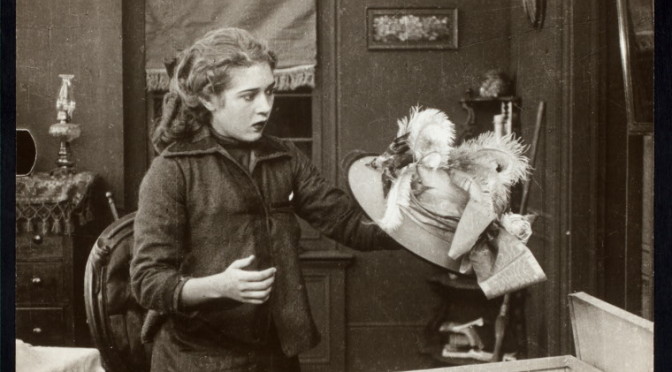
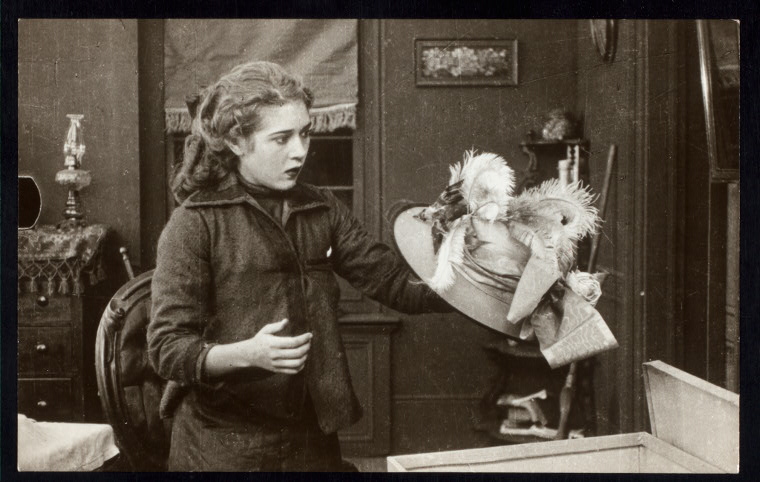
Fashion weak: Mary Pickford finds millinery mischief in the 1912 feature ‘The New York Hat’, a Biograph film by D.W. Griffith.

This was an especially unusual show to arrange and represents a closely cultivated tour through New York City’s early film history.

But early movie studios spread beyond New York’s borders. Most notably, Fort Lee, NJ, became as active as New York in the 1910s, especially as the sophistication of filming processes allowed more productions to be shot outdoors and long running times meant story lines with multiple sets. D.W. Griffith’s first film, Rescued From An Eagles Nest, for Edison, was shot on the Fort Lee Palisades. But this wasn’t his directorial debut; he was the star of that film.


Soon all the major studios would have locations in Fort Lee and other places along the New Jersey coast. You can find more information on Fort Lee’s contributions to cinema at the Fort Lee Film Commission.

We had to cut off our coverage of New York’s film history at the early 1920s, or else it would have been an endless show, and one of us would have collapsed in exhaustion! But obviously we plan to pick up the topic again from this point in a later show.

One note of clarification: I mention that Fox ‘got his start’ in Staten Island. I meant to state that Fox would get his start in film production in Staten Island; indeed, in 1914, the ambitious film distributor began his very own studio and began making movies from his three small studios in Fort Lee, Jersey City, NJ, and a place called Scott’s Farm, in the neighborhood of Grasmere, Staten Island. Within a year, that studio would be named Fox Film Corporation and move out to Los Angeles. Less than twenty years later, weakened by debt, Fox merged with Twentieth Century Pictures to form Twentieth Century-Fox (yes, with a hyphen, which was later dropped).

Places To Visit:
Your first stop should be the Museum of the Moving Image in Astoria, Queens, to check out their displays of early film productions. Next door is the Kaufman Astoria Studios, New York’s oldest and still active movie studio. According to their website, there are no tours. But the famous studio commissary in the basement has been turned into a swanky restaurant and lounge.

Edison’s laboratory in West Orange, NJ, is definitely worth the trip, and not just to see the replica of the Black Maria. The National Park Services operates the Thomas Edison National Historical Park with tours of the laboratory complex and the Edison home Glenmont, where the inventor himself is buried.

Tom mentioned that Edison’s first demonstration of his kinetoscope — and its first film ‘Blacksmithing Scene’ — was exhibited as the Brooklyn Institute of Arts and Sciences on May 9, 1893. That organization was the forerunner to the Brooklyn Museum.

We planted a few specific addresses in the podcast for you to search out during one of your wandering adventures through the city. See if you can find the plaque at Macy’s honoring the theater that once stood there, Koster and Bial’s Music Hall, and occasion of the debut of Edison’s Vitascope. One of the first modern movie houses, the Regent Theatre in Harlem, is still around, but it’s no longer a theater. It’s owned by the First Corinthian Baptist Church.

Other Sources:
For a clearer picture of early film history, you should supplement this podcast with the first three parts of the TCM documentary Moguls and Movie Stars, their mini-series on the history of the movies. The best place find some of these very early films is the Library of Congress, which includes a wonderful page on early on-location pictures, The Life of a City: Early Films of New York 1898-1906.

Richard Koszarski’s extensive survey of the region’s contribution to the movies, ‘Hollywood On The Hudson‘, essentially starts where we leave off. David Robinson’s ‘From Peep Show To Palace’, with an introduction by Martin Scorsese, puts New York’s role into international context. You can also check out Paul Clee’s ‘Before Hollywood: From Shadow Play To Silver Screen‘.

Brooklyn invents the movie magazine, a century ago

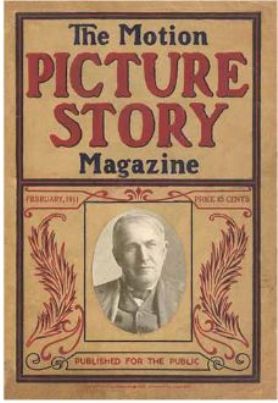
The Motion Picture Story Magazine, the first American magazine devoted exclusively to motion pictures, released its first issue one hundred years ago this month.

The deluge of movie periodicals that would debut afterwards would help define Hollywood movie stars, foster their fan bases, promote studio films and sculpt the mythology of film history. And it all began from a tiny magazine produced in Brooklyn, at 175 Duffield Street, to be exact.

The magazine wasn’t entirely born without ulterior motive. It was produced by two partners, one of which, John Stuart Blackton, was the head of the young Vitograph Studios. Blackton, a former news reporter turned early film mogul, produced and even starred in pictures filmed from the Vitagraph rooftop soundstage at 140 Nassau Street in Manhattan.

By 1906, Blackton had a Brooklyn location in mind and moved there — Avenue A and East 15th Street in Midwood, to be exact.

Blackton didn’t produce the magazine as a mere mouthpiece for his studio, but to help promote the entire industry. In fact, the cover of the first issue, from February 1911, featured not a movie star, but the man most influential to the entire business at the time — Thomas Edison. The New Jersey inventor who had launched the film industry with his Kinetescope had given Blackton a tour of his Black Maria studio in West Orange, NJ, which inspired him and his business partner Albert E. Smith to later form the rival film studio.

Edison’s appearance was a nod to his influence. Not to mention that Vitagraph was also a partner in Edison’s Motion Picture Patents Company, a trust that kept the young movie industry under the monopolistic control of a few companies.

As the title hints, the Motion Picture Story Magazine reiterated the storylines of several movies of the day. Considering this was early in the silent era — with few title cards and no film over 20 minutes long — the magazine used writers to flesh out the stories. In essence, the descriptions would have enhanced the story, and few would have considered the articles as ‘spoiling’ the action.


More importantly, the magazine also featured photographs from the films themselves. And in a greater innovation, some of the stars themselves would be featured in closeup, full-page portfolios. This swiftly became the most popular part of the magazine as actors became name movie stars that audiences began seeking out.

It didn’t just provide pretty pictures. The magazine soon began playing along with the film studios, reinforcing the images studio head wished to convey of their early film stars. Motion Picture Story Magazine was more a precursor to a polish-and-shill, People Magazine-style publication than it was to a gossip rag or a serious film journal.

At left: The December 1912 issue, featuring a still from the long forgotten film The Kerry Gow

The magazines would be sold at nickelodeons and movie theaters around the country. To get a sense of what a typical issue would look like the Internet Archive has a copy of the December 1912 that you can read online and even download. (You can find it here.) The issue is stuffed with portraits of current stars, several story descriptions, and lots of early industry ads, most from movie businesses based in New York.

By 1914, the magazine changed its named to simply Motion Picture Magazine and moved its offices to 26 Court Street, across the street from old Brooklyn City Hall. A whole crop of movie magazines had debuted as a result of Motion Picture‘s success, including the Chicago-based Photoplay Magazine. And Variety, a weekly tabloid launched in Manhattan in 1905 that reported on the vaudeville industry, had greatly expanded its film coverage over the years. (It had made film history years before, publishing in 1907 the first movie review.)

The principal driver of the magazine’s content seems to have been Blackton’s original partner, Eugene Valentine Brewster, a rather colorful character himself. Brewster was a lawyer, politician and occasional film director who left his wife (after a messy divorce) for film star Corliss Palmer. Eugene has flaunted his affair with the actress in front of his wife, even inviting Palmer to live in the couple’s Long Island home “on account of the work in which they were engaged in.” Mrs Brewster received payback, not only from her now ex-husband, but in the form of a successful damage lawsuit against Palmer herself.

At left: Eugene Brewster with Corliss Palmer

‘Shadows’: Improv, jazz and a squint at midtown Manhattan

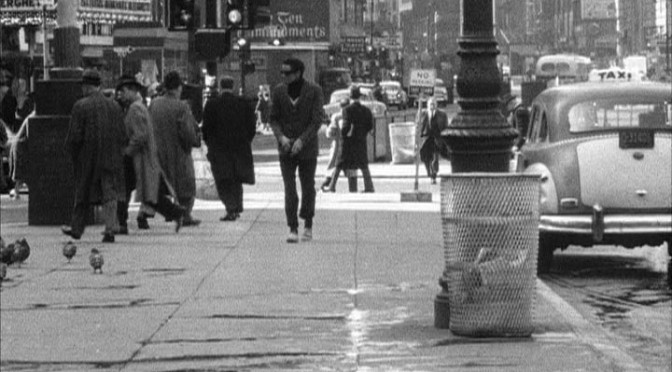
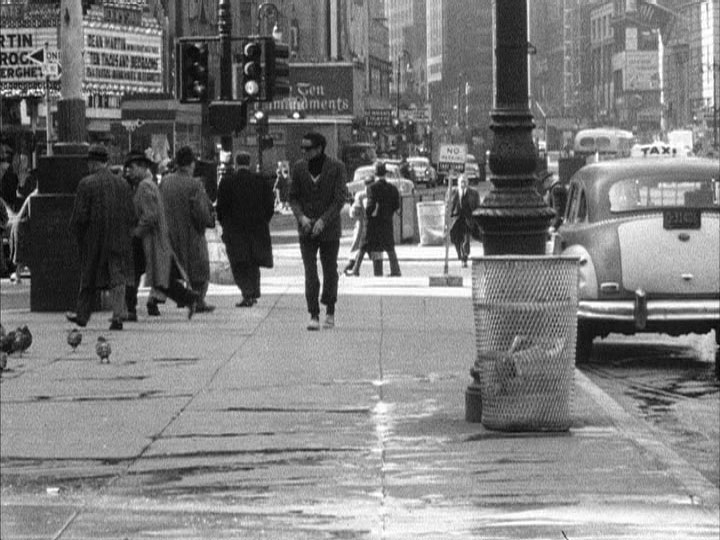
A beat in Times Square: Ben Carruthers drifts through the city in ‘Shadows’

BOWERY BOYS RECOMMEND is an occasional feature where we find an unusual movie or TV show that — whether by accident or design — uniquely captures an era of New York City better than any reference or history book. Other entrants in this particular film festival can be found HERE.

When we did our Times Square podcast a few weeks ago, I went looking for photographs that captured its mid-century transition, when the balance between glamour and sleaze began tipping from one extreme to the other. When was the moment that 42nd Street went from meaning one thing, to the other? Had I seen John Cassavetes’ ‘Shadows’ then, I wouldn’t have needed to look much further.

‘Shadows’ is a revolutionary moment in film, displaying a loose, on-the-fly vocabulary and a casual, bebop storytelling style completely foreign to movies of the day. Cassavetes, a young acting teacher and soon-to-be film star in his own right, assembled production funds and the film’s cast from among his friends and acquaintances. Its largest supporter was radio deejay and writer Jean Shephard, years before writing short stories that would form the basis of the film ‘A Christmas Story’.
The film was finished in 1959 after Cassavetes had initially completed one version in 1957 and sent the actors on their merry way. He recalled the cast and inserted new scenes which are easily identified. The plot is largely improvised and feels it. The somewhat central plot — a romance between a young black woman and a white jazz musician she meets at a party — was provocative for its time, but feels little wooden today. The acting is all over the place. (Cassavetes’ wife Gena Rowlands, later to become his greatest star, appears only fleetingly as an extra.)
But I’m recommending this film for its style and electricity, its cool depiction of downtown beatniks afloat in midtown Manhattan. The images and sounds seem to fly together, with an airy jazz score accompanying a broad number of New York locations rising from a grainy black-and-white haze.

Its most famous scene depicts the lovely Lelia Goldini strolling down 42nd Street after dropping off her brother at Port Authority. He wants her to take a cab home; she wants to enjoy a walk. 42nd Street isn’t the seedy corridor it would become, but it isn’t safe either. Outside a movie theater, aflame with the glowing lights of surrounding marquees she’s harassed by a stranger. But this is a street in transition; Lelia is rescued by strangers, and the harasser is himself harassed. (See if you can recognize one of the strangers.)

The movie is strongest when it’s drifting along with rebels, three hapless hipsters led by the magnetic Ben Carruthers. They invade a countless number of dive bars and diners, looking for street smart ladies. That’s how they look at the entire world which makes their visit to the sculpture garden at the Museum of Modern Art strangely compelling. I’m sure you’ve never looked at art the way these three do.
In a cramped and dank nightclub, smoke and whiskey filled, a jazz vocalist, played by Hugh Hurd, is forced to become an emcee to a bunch of talentless dancing girls, the humiliation on his face a sure representation of the changing tastes of New York nightlife. In the variety shows of yore, his somber talents would have fit in; by the late 1950s, moody jazz was merely a distraction.
‘Shadows’ has a wonderful mood of melancholy that would go on to exemplify the great New York independent movies of the 1960s and 70s. The long procession of cabs zooming down the avenue, past the Colony Records and the Thom McAn’s, past the titillating neon ‘FASCINATION’ of a 42nd Street theater, would go on to influence the dreams of New York lovers for years after.

Here’s the trailer:

Was ‘Birth of a Nation’ really filmed in Staten Island?


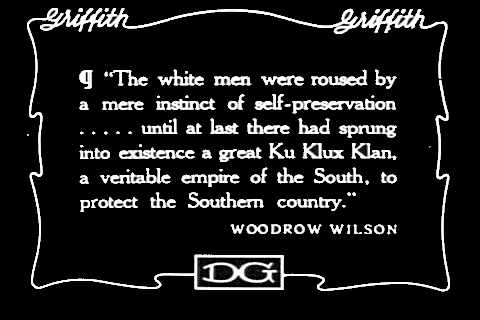
A rather startling title card from ‘Birth of a Nation’ [courtesy the Liberty Lamp]

The question posed in the headline is a fascinating urban legend I’ve been obsessed with proving (or disproving) for about a year. It pops up occasionally during discussions about New York film history. And I think I’ve come up with an answer.

D.W. Griffith’s 1915 landmark ‘The Birth of a Nation’ heralded the birth of the Hollywood blockbuster, becoming its first true sensation and inventing production techniques that would become standard issue for the industry. It’s also, of course, an incredibly slanted account of the Civil War and its aftermath, glorifying the Ku Klux Klan and presenting a demeaning and racist portrait of Southern blacks.

For all those reasons, the movie is a true archetype, singlehandedly displaying the power and influence, both good and bad, that motion pictures would one day possess. So I was quite surprised a couple years ago to find that the production of this staple of college film courses might have a New York City connection.

Many non-primary sources claim that some scenes depicting Civil War battle were filmed in Staten Island, in an area located around today’s Park Hill neighborhood. The New York City Department of Parks and Recreation pinpoints it further — “shooting [the] Civil War battles sequences” around the area of Eibs Pond in nearby Clifton.

One can perhaps imagine the calm, slight hills around the pond standing in for Southern battlefields. But I’m afraid to say this was probably not the case.

Local filming references mostly pop up in books and websites on New York or Staten Island history. The earliest reference I could find was in an AIA Guide from 1968. New York Magazine also trumpeted this tale in 1970, even visiting the alleged filming location.

But you won’t find these claims in film history books. Books specifically related to the ‘Birth of a Nation’ are clear that this was an all-California production: “Filmed at the Reliance-Majestic Studio, Sunset Boulevard, Los Angeles, California, and the various outdoor locations in the area, principally in the the San Fernando and Big Bear valleys and the open country in the Rio Honda.” [source]

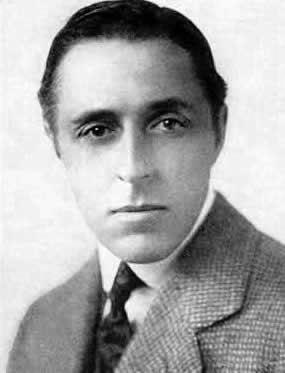
Staten Island does have an important place in early American cinema. Some of the first fiction shorts were made here, in the South Beach area, in the 1890s, and some consider the area the birth place of the movie western. And Griffith (at left) did indeed make dozens of films in the New York region for the American Mutoscope and Biograph Company, whose principal studios were in Manhattan.

But Griffith began filming ‘Birth of a Nation’ from July to September of 1914. He had left both Biograph and New York the year previous and drummed up the finances independently to make ‘Nation’ himself, as its length and subject matter was still an uncertain risk for a young Hollywood to take. Griffith would return to the New York area in 1919, setting up a short-lived studio in Mamaroneck, New York, a short drive from the Bronx.

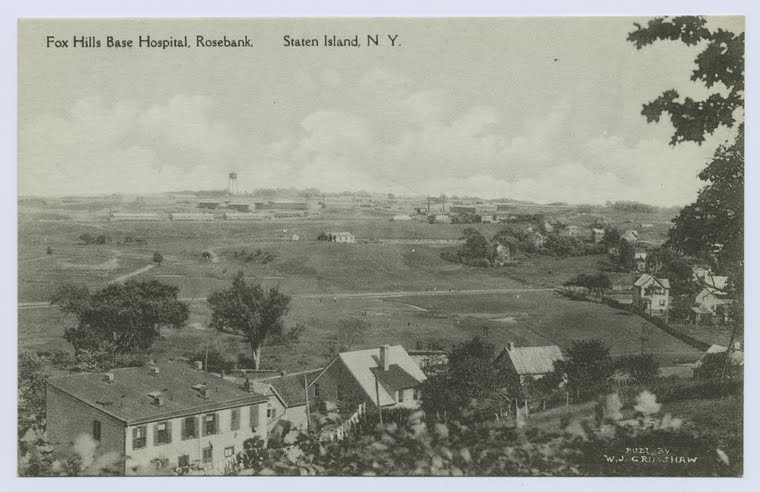
Below: Fox Hills, Staten Island, perhaps in the 1910s or 20s [NYPL]

Part of the location confusion may lie in the former name of the Park Hill and Clifton neighborhoods. Around the late 19th century, this area of Staten Island was called Fox Hills, known for its tony golf course and, during World War I, a noted hospital for wounded soldiers. The name is still occasionally used there by residents today.

Fox Hills is also the name of a small neighborhood in Culver City, California, and was also once known for its golf courses. Culver City would become an important home to film studios in the late 1910s, after ‘Nation’ was finished. But it would not be a stretch to think it was this area that was most likely used for certain shots of the Griffith picture, and not an area of New York thousands of miles away.

This is not to say that New York doesn’t have a role in the tumultuous history of ‘The Birth of A Nation’. The movie, “a feature film tracing the history of African slavery” according to a notice in the New York Times, made its debut in March 1915 at the Liberty Theatre* on 42nd Street, to both praise and outrage. The film was picketed by the NAACP on a daily basis, and one New York protester got themselves arrested by throwing eggs at the screen. [source]

But the film was a financial success in New York, running for most of the year — tickets were sold a month in advance, and at an outrageous price of $2.00! — and it soon swept across the country to similar accolades.

*The Liberty is still standing, in part; its facade has been absorbed that of Madame Toussaud’s Wax Museum complex.

**Seems that a commenter on the Staten Island Advance has had a similar idea!

Categories
It's Showtime

D.W. Griffith turns Central Park into a silent screen star

In honor of the grand re-opening of the Museum of the Moving Image this Saturday, we’re going all New York film and media here on the blog, posting some new stuff and re-printing some older ones pertinent to the city’s filmmaking history.

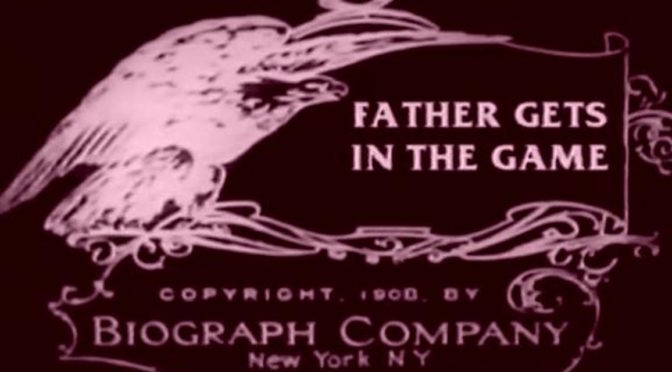
Above, you can watch ‘Father Gets In The Game’, a cheeky short from 1908 that is most likely the very first fictional movie ever filmed in Central Park. ‘Father’, a lark involving a lecherous old timer who hits the park to pick up ladies, is directed by D.W. Griffith, who would expand into feature length projects several years later, notoriously so with ‘The Birth of a Nation’ in 1916.

The crudely rendered ‘old man’ in the picture is played by Mack Sennett, himself a director of early comedies and founder of Keystone Studios. Charles Avery, who plays the butler here, will later become of the Keystone Kops.

(The movie only 8 minutes long. It’s followed in the YouTube clip above by another feature from the same year called ‘Romance Of A Jewess’, also directed by Griffith and starring Sennett.)
______________________

By the way, the first new Bowery Boys: New York City History podcast of 2011 will be available on January 21.

A new ‘Metropolis’ — for our metropolis — at the Ziegfeld


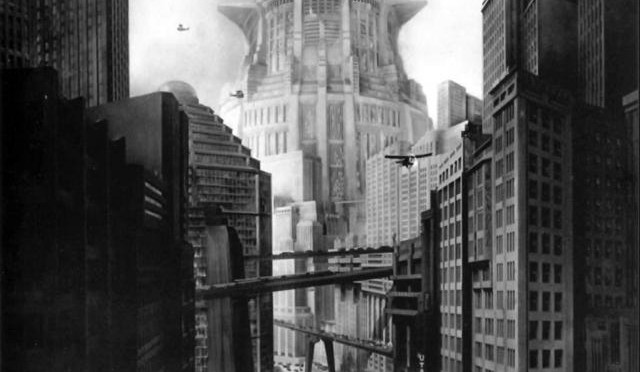
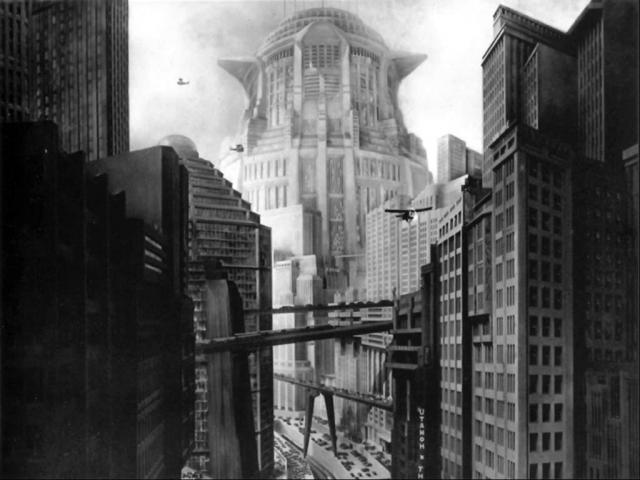
Fritz Lang claims the Manhattan skyline influenced the look of his film ‘Metropolis’ . In fact, the film’s fantasy city resembles futuristic sketches rendered by American magazine illustrators of the late 19th century.

The giant screen at the Ziegfeld Theatre goes silent this Friday as a two-week run of Fritz Lang’s fantasy masterpiece ‘Metropolis’ opens, featuring the famously restored print — with 30 minutes of newly integrated footage — that presents the most complete version of the movie ever screened in the city. This version originally debuted at the Film Forum back in May, but the Ziegfeld’s massive screen — the largest in the city — and classic cinema setting should make this an unforgettable event.

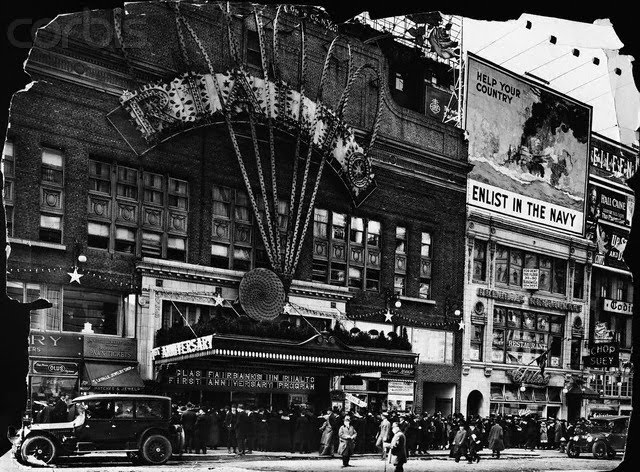
The Ziegfeld seats a little over 1,100 people. The film made its New York debut on March 3, 1927 on a much bigger screen, the Rialto, on the northwest corner of 42nd Street and Broadway, which could accommodate over 1,900 filmgoers at one time. (And that was considered a medium-sized theater for its day.) In the days when single films toured to various cities in succession, ‘Metropolis’ was a bonafide box office favorite for New Yorkers, raking in just over $150,000 during a six week run, back when the price of movie tickets ranged from 30 to 90 cents. Below: the Rialto Theatre in 1917

What was shown to audiences in 1927 would have made cineastes wither with shame, a “butchered, disjointed ” version released by Paramount Pictures, with whole reels of the film discarded, “16 reels to 7, resulting in a plot with ‘more holes than a pound of rigatoni.'” (Cesar J. Rotondi).” [source] In place of those reels were a couple shorts, including a scenic documentary called ‘Steamer Day’.

The version of ‘Metropolis’ being shown at the Ziegfeld is the truest to the filmmaker’s original vision. And a perfect home for it, too, as Lang had always claimed that the film was inspired by a journey to New York. On October 12 1924, while being kept in the harbor aboard the vessel SS Deutschland awaiting entry, Lang caught sight of the city skyline for the first time, “completely new and fairy-tale like for a European. I knew then that I had to make a film about all of these sensations.”

As production on ‘Metropolis’ began just five months later, however, there were undoubtedly other inspirations before Manhattan, and many film historians believe Lang told of his New York inspiration as a way to promote the movie.

New York critics were all over the map in their appreciation. “There is altogether too much of Metropolis…too much scenery, too many people, too much plot and too many platitudinous ideas,” proclaimed the critic from Life Magazine. Mordaunt Hall of the New York Times was kinder: “Nothing like “Metropolis” has been seen on the screen. It, therefore, stands alone, in some respects, as a remarkable achievement.” Before adding, “It is a technical marvel with feet of clay, a picture as soulless as the manufactured woman of its story.” (They were watching the heavily edited version, so we’ll give them a pass.)

The film had left New York by May 1927 — the era of sound movies would come that summer with ‘The Jazz Singer’ — but it left one spiritual mark on the city: three years later, architect William Van Alen pays the film a subconscious nod when the spire of the Chrysler Building is raised May 20, 1930.

Tony Curtis: “The cat’s in a bag and the bag’s in a river”

Curtis, as the smarmy Sidney Falco, in ‘Sweet Smell of Success’

“Another way I coped was by being rough, rowdy, and athletic. Not on a basketball court or a football field; on the streets of New York. I would climb the trestles of the el train like I was Tarzan. I would jump from the roof of one apartment building to another, sometimes downhill. One time I misjudged and bounced off the side of another building. I cracked a few ribs.

But my favorite stunt was really dangerous. I call it trolley hitching. I’d start on the sidewalk under the el. When the trolley was going about twenty miles an hour I’d run next to it, jump up, grab the window bar, and hang on. My timing was split second. I couldn’t afford a mistake.”

— Bronx baby Tony Curtis, who died last night at age 85, on his own scrappy, street-bred machismo, from his book The Making of Some Like It Hot and the Classic American Movie. (Excerpt from here)

The quote in the header is from one is his best works and one of the greatest New York films ever: ‘Sweet Smell of Success’. Here’s one of Curtis’ jazz-soaked scenes from the movie:

Categories
Mad Men

‘Mad Men’ notes: A movie theater classic in its final days

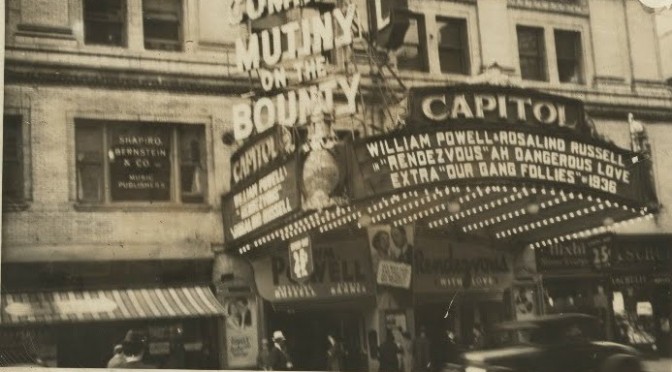
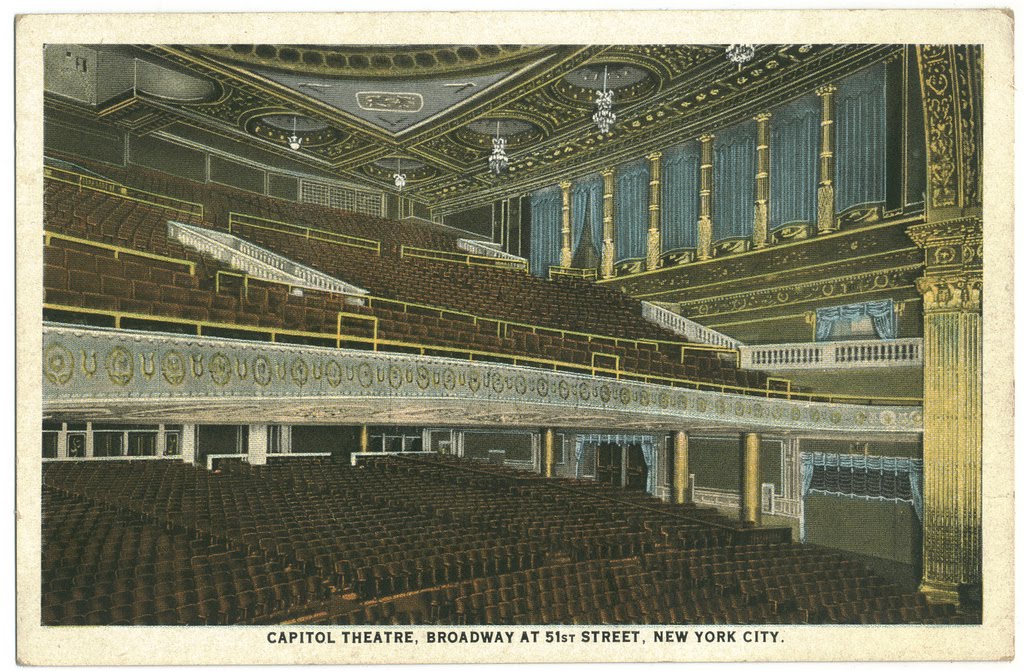
The Capitol in 1935, its feature attraction the spy thriller Rendezvous

Every Monday I’ll try and check in with the Mad Men episode from the night before and focus in on one or two historical references made on the show. Spoilers aplenty, so read no further if you don’t want to know….

While doing some background work on last week’s podcast, I came across an indulgent presentation in the New York Tribune of some elaborate new mural pieces by nearly forgotten painter William Cotton, installed in 1920 on the walls of the Capitol Theater, at Broadway and 51st Street. “The great mural paintings by William Cotton in the Capitol Theater stand to-day unrivaled. There are in America no decorations to compare with them.” (Take a look at these ‘unrivaled’ murals here.)

I crossed paths with the Capitol Theater again in this week’s episode of ‘Mad Men’. Most of the staff of Sterling Cooper Draper Pryce were attending an exclusive screening at the Capitol of the now-infamous Cassius Clay-Sonny Liston prize fight, waged in Lewiston, Maine, in May 25, 1965, a re-match between boxing powerhouses that help solidify the reputation of the future Muhammad Ali.

Like many locations previously featured on the show, the Capitol was past its prime by 1965 and would not make it out of the 1960s.

A movie house designed by architectural wizard Thomas W. Lamb, the Capitol opened in October 1919 and helped establish the template for lavish film palaces, with 4,000 seats, a 25 x 60 feet screen, and a stage large enough to host variety shows, classical music concerts and even radio broadcasts.

Not surprisingly, it was originally managed by Samuel “Roxy” Rothafel, of Radio City Music Hall fame.

By 1965, the stage productions had stopped, but the theater was still hosting spectacular film premieres such as the one on December 22 for ‘Doctor Zhivago’. As the unflappable Bosley Crowther dryly notes in his film review from that premiere: “In the three hours and seventeen minutes (not counting intermission time) it takes to move Robert Bolt’s dramatization of Boris Pasternak’s Doctor Zhivago across the screen, a few rather major things happen.”

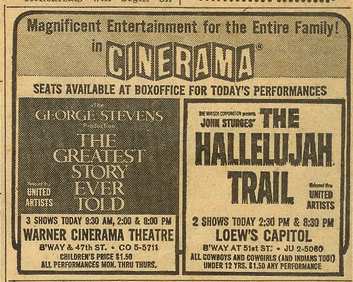
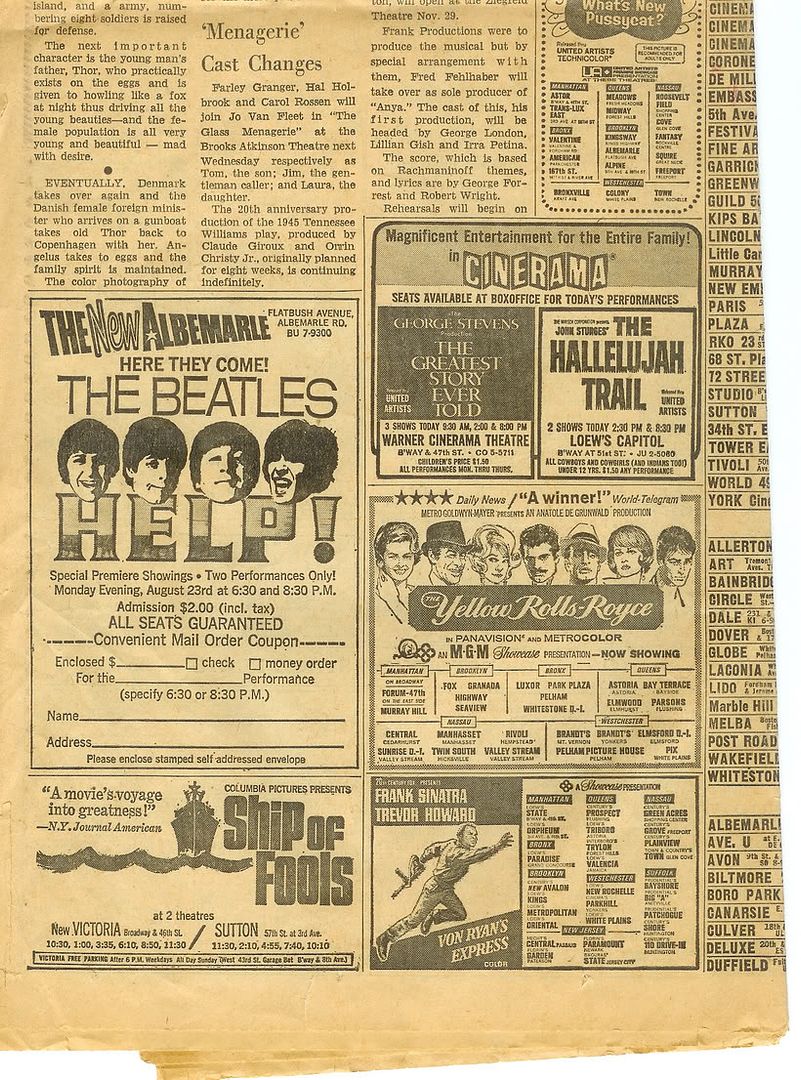
That June, for the now forgotten Burt Lancaster western ‘Hallelujah Trail’, the film studio United Artists threw a promotional barbecue in front of the theater that shut down Broadway.

The theater closed in 1968, but at least it went out memorably: its last two movies were Planet Of The Apes and (starting that April) 2001: A Space Odyssey, both in glorious Cinerama.

So, what’s sitting there now? Mars 2112 (and the Paramount Plaza office tower). It’s too bad they didn’t have Mars 2112 back in the 1960s; I’d love to see Roger Sterling get sloshed on their alien themed cocktails.

Coincidentally, by the way, our ‘Mad Men’ friends were attending a broadcast of a boxing match in a theater that sat only one block from the greatest live venue for boxing in the world — Madison Square Garden, when, in its third incarnation, it sat at 50th Street and 8th Avenue.

Below: the lush interiors at the Capitol Theatre

Top picture courtesy NYPL Digital Gallery. Movie advertisement courtesy Cinema Treasures You can check out a lovely picture of Times Square in the 1960s featuring the Capitol here

A History of Subway Cinema: From musical daydreams to gritty roller-skating gangs and underground alien bugs

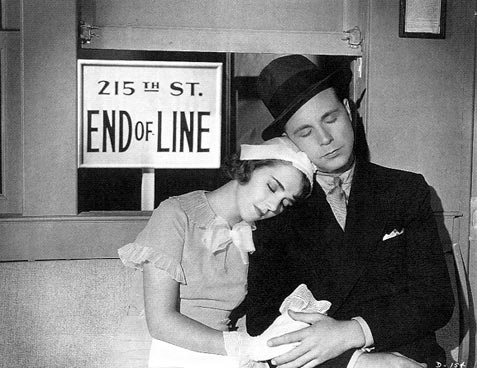
Above: ‘Dames’ on a Train: Keeler and Powell dream of the innocent days

The subway doesn’t immediately come to mind as a photogenic movie star, but in fact, the various tunnels and stations of the New York City Subway have appeared as the backdrop for hundreds of movies. Its route diversity — from deep under midtown to elevations above the outer boroughs — and its longevity have allowed filmmakers to turn the subway into a rolling sound stage. I recently binged on a variety of subway films from several eras and noticed a definite pattern in their development:

The First Subway Movie: I posted this just a couple weeks ago, but the subway makes its first appearance at the inception of the very first IRT line, with a six-minute short (they were all short back then) “New York Subway” filmed by the Edison company, which was simply a camera following behind the first subway from Union Square to Grand Central. The film’s cinematographer, Billy Bitzer, went on to innovate standard filming techniques, like the soft focus and the fade out, and made his reputation working with D.W. Griffith on The Birth Of A Nation and Intolerance.

The Musical Subway: Fiction films wouldn’t be shot on-locaton in the subway until the 1940s, but that didn’t stop Hollywood from transforming it (via a backlot) into a romantic set piece. The most unusual of these is certainly the 1934 hokey gangbuster Dames, featuring an exotic dance number by Busby Berkeley as psychedelic as any 60s counter-culture movie. Dick Powell and Ruby Keeler put on a wacky show — they’re always puttin’ on a show back then — featuring a crowded ride on an uptown train. Powell falls asleep and his dreams burst into hundreds of chorus girls. BONUS: Earlier in the film, the pair woo each other on the Staten Island ferry with the song “I Only Have Eyes For You” (making its debut).

ALSO: Although it’s an elevated train — not a subway — I’d be remiss if I didn’t mention that King Kong (1933) didn’t much enjoy them rumbling down Sixth Avenue either.

The Romantic Subway: ‘On The Town’ (1949) is a candy-colored, on-location race through New York nostalgia, with our three dancing sailors skimming through the city’s greatest landmarks. A subway ride provides the impetus for the central romance, as Gene Kelly falls for a poster of Miss Turnstiles (a play on the mid-century’s quaint beauty pageant contest Miss Subways). Daydreaming similar to ‘Dames’ produces an equally dance-filled response (watch it here).


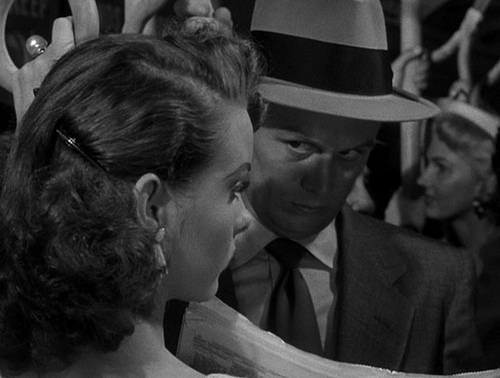
The Dark Subway: I’m not sure why more film noirs weren’t set on the subway — that would be remedied in the 1970s — especially when they’re as juicy as the 1953 Pickup on South Street. The opening scene is one of its most famous, as an eerie Richard Widmark hovers over ditzy Jean Peters in a crowded subway car, gingerly relieving her purse of what proves to be a very troublesome item. From there, the action shifts to the piers of South Street — nearly unrecognizable, not a mall in sight — before submerging back into the subway tunnels for a spectacular finish. Here’s a clip of the opening scene:

ALSO: With intrigue rumbling below, even the breeze from a passing subway train could elicit a sexual response as a defenseless young woman in a white dress stands above a grating in the 1955 comedy The Seven Year Itch.

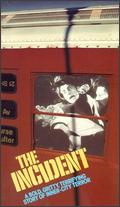
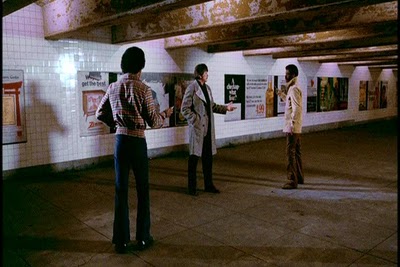
The Hostage Train: That glowing sheen of the Berkeley musicals — even the somewhat clean shadows of ’50s crime dramas — would slowly fade by the 1960s, along with the conditions of the subway itself. Presaging a rich future as a moving hellcar of violence and death, the 1967 film The Incident presents a group of unwitting passengers terrorized by two young, stereotypical ’60s sadists. Surreptitiously filmed and very low budget, ‘The Incident’ would introduce the subway car-as-trap motif that would fuel the 1974 thriller The Taking Of Pelham 1-2-3 and open its possibilities for urban horror.

Vengeance Underground: The movies hardly sugar-coated New York City’s hard times in the 1970s and rendered the subway into a place where anybody, at any time, could be shot, stabbed and assaulted. In Death Wish (1974), the subway is one of several locales of seething, bald-faced criminal activity, but it’s so dangerous that Charles Bronson goes down there twice to pick off bad guys. In the universe of this unsubtle action flick, you could be mugged and raped five, six, seven times a day, so best to be proactive and pick them off before they get you. Ten years later, Bernhard Goetz would reinvent this hyper, fictional fantasy by actually doing it.

ALSO: The greatest movie ever made using the subway, The French Connection (1971), actually has its most notorious moment that runs underneath an elevated line in Brooklyn, a breathless chase scene filmed famously without the city’s permission.

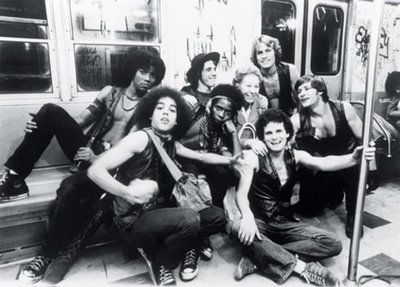
The Fantasy Detour: The reputation of the New York subway system was so poor in the 1970s that depictions went from the ultra-realistic to the absurd without missing a stop. In The Warriors (1979), the train becomes a virtual yellow-brick-row for a costumed Coney Island gang escaping a host of absurd villains. The Union Square subway station holds one of their deadliest challenges: suspendered, roller-skating pretty boy toughs with feathered hair. It’s only a tiny step into pure fantasy and an actual yellow brick road in The Wiz (1978) with a creepy collection of gangly puppets, a pair of Scarecrow-eating trash cans, and living subway posts most certainly not designed by Heins & Lafarge.

Local Lines: While the mainstream movie depictions would get even more outrageous, the growth of independent filmmaking and thoughtful, locally filmed productions in the 1980s depicted the subway in more realistic tones — as a confusing place to lose a child in Gloria (1980), as an underground wild west for graffiti artists and hip hop dancers in Wild Style (1983) and Beat Street (1984, in the clip below), and as a restless throwback to film noir in King of New York (1990).

The Sequel Subway: With the advent of the Hollywood blockbuster came a restoration of the subway’s reputation — sorta. The subway in the cinematic 1980s and 1990s was still dangerous, but in wild, sensational and very unrealistic ways. The tunnels underneath Manhattan harbored rivers of ectoplasmic ooze (Ghostbusters 2, 1989), a train booby-trapped with explosives (Die Hard With A Vengeance, 1995), a supernatural danger zone of runaway trains and alien warriors (Superman 2 AND Superman 4), and even the Teenage Mutant Ninja Turtles (who hole up in that abandoned City Hall subway station).

Midnight Horrors: As the subways became safer to ride, the usual tropes of knife-wielding thugs and rapists no longer made sense as objects of menace. Soon the subways were filled with supernatural beings, starting with the relatively sedate Jason from Friday The 13th Part 8: Jason Takes Manhattan and slowly elevating into humanoid insects (Mimic, 1997), monsters from the sea laying large lizard eggs (the Godzilla remake, 1998), and humanoid insect monsters from the sea (Cloverfield, 2008)

ALSO: For a more intriguing take on subway horror, I recommend Jacob’s Ladder (1990) which uses the Brooklyn Bergen Street Station to surreal effect.

The Worst Subway Depiction Ever: Of course, films are allowed to manipulate train lines, distort direction, even put trains next to landmarks that are, in reality, miles away. It’s fantasy. But somewhere out there in the vast universe of fiction there is a vague, undefined point where a film steps over the line, and the movie which does this most shamelessly is the otherwise great Spider-Man 2, which inserts a vast, fantasy elevated R line through the heart of Manhattan, rebuilding what the city so painstakingly tore down in the 1940s and 50s.

21st Century Redux: In the last forty years, Hollywood has had a nasty habit of replicating itself, and that goes for subway movies, with rehashed old themes like vigilantism (in 2007’s The Brave One) and even remakes the older films, like the sorry remake to The Taking of Pelham 1-2-3. Incidentally, that remake’s two stars have two important subway films on their resumes — John Travolta in one of the greatest New York films of all time, Saturday Night Fever, and Denzel Washington, in an uncredited, unceremonious moment in Death Wish.

The MTA is more than happy to increase its exposure in future films. All you need, according to their website, is “a minimum $2 million general liability insurance policy; a $2 million railroad protective insurance policy; and proof of Workmen’s Compensation.”

I know I’ve missed a few goods/bad ones (Money Train, The Yards) but those’ll be for a future post…

Bowery Boys Bookshelf: Film history and a morning Danish

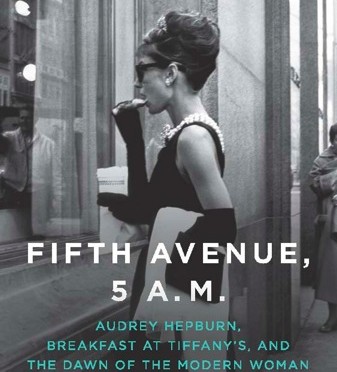
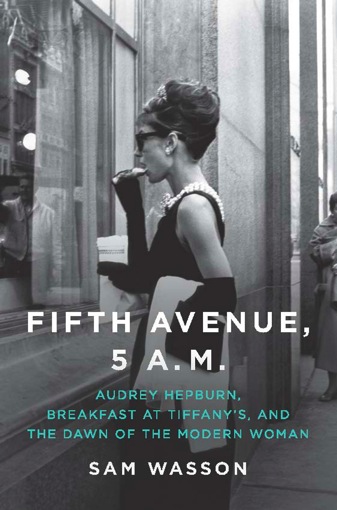
I feel as though I am partly responsible for the death of actress Patricia Neal, who passed away this past Sunday. Last Wednesday I was finishing up Sam Wasson’s indulgent little “Fifth Avenue 5 A.M.: Audrey Hepburn, Breakfast At Tiffany’s, and the Dawn of the Modern Woman” and admired the author’s anecdotes about Neal, who apparently had an awful time with co-star George Peppard.

Then I actually said aloud — in fact, posted on my Facebook page — “Wow, that Patricia Neal, what a lady. I can’t believe she’s still alive!” Next time, I’m keeping it to myself.

However I’m still recommending this book anyway, “Fifth Avenue 5 A.M.,” a morsel of a film bio that is the very definition of a good late-summer beach read, because you can finish it in 2-3 hour (preferably with a summer-y beverage) and it’s as light as a breeze.

‘Breakfast At Tiffany’s’ is one of the greatest films ever shot in New York City and features a heroine, Holly Golightly, that would have the same cultural effect to mid-’60s tastes that Carrie Bradshaw would have to those decades later. However, very little of Wasson’s book truly takes place here in the Big Apply, instead flitting about Europe and Hollywood, tracing the evolution both of the Truman Capote story and Audrey Hepburn’s career.

Capote, of course, was quite unhappy with the adaptation, yet the story as Wasson tells it seems to imply the film, in its finished form, was inevitable. The story of the film’s inception and production are told through snippets concerning the film’s main creators — Audrey’s of course, but also Henry Mancini (composer of ‘Moon River’), costumer Edith Head, and the film’s director Blake Edwards. Capote’s inspirations are also highlighted including the tragic Babe Paley.

Wasson’s retelling of the fateful morning of filming at the corner of Fifth Avenue and 57th Street in front of Tiffany’s, on October 2, 1960, has the feeling of mythology being retold. And yes, I guess that’s a bit much at times — he tends to overwrite a bit — but the wit and subject matter keep it light and frothy.

It’s not completely useless as a New York history tool, thanks to a map up front of key locations (mostly in the Upper East Side and Midtown East) to both the film and its principals that serves as a makeshift self-guided walking tour.

One of the cutest details recalls the ‘cat call’ for aspiring feline actors auditioning for the role of Cat, a sentence all too absurd to retype. You also get to relive some of the most famous legends of film, like the near electrocution within Tiffany’s and the real story about that particular, famous black dress (there were two, one for moving, one for standing).

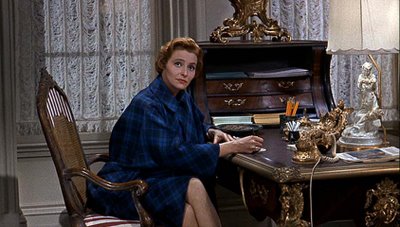
As for Patricia, her appearances are brief but notable. On Peppard: “I always thought he was a piss poor actor.”

Below: Neal in Breakfast At Tiffany’s


A couple years ago, I did a podcast on the history of Tiffany’s & Co., with a definite emphasis on the film. (You can get it here)

Categories
Uncategorized

Xenon and the strange journey of a Broadway theater: Noel Coward, Fellini, porn, disco, ‘Cabaret’, Dame Edna

You know it’s a good night at Xenon when you’re drunk on the dance floor, and all of a sudden, the actress Valerie Perrine and the Village People appear (source)

FRIDAY NIGHT FEVER To get you in the mood for the weekend, on occasional Fridays we’ll be featuring an old New York nightlife haunt, from the dance halls of 19th Century Bowery, to the massive warehouse clubs of the mid-1990s. Past entries can be found here.

 LOCATION: XenonTimes Square, 43th Street and Broadway, Manhattan
In operation 1978-84

THIS, AT LEFT, IS HENRY MILLER. Clearly this is not the Henry Miller you more popularly know.

This Henry Miller would have never produced Tropic of Cancer. But his major contribution to the American stage would bring New Yorkers an iconic work of French cinema, a world famous theatrical revival, and one of the most successful Studio 54 knockoffs ever.

Miller was a minor theatrical star in the age of Sarah Bernhardt, who began dabbling as a director and stage manager at the same time that theater on 42nd Street began to flourish in New York. He became an early, respectable presence; from an early biography: “It was a foregone conclusion that a Henry Miller production must be in the best tradition of the theater.”

His timing was exquisite as well. The Broadway district in the 1910s was in full swing, with excitement at all hours. His patron (and progressive, feminist icon) Elizabeth Milbank Anderson assisted him in opening a stage in 1918 at 124 W. 43rd Street, a prime location near the theaters of Oscar Hammerstein, Klaw & Erlanger and Florenz Ziegfeld. The old New York Times building was half a block away, the nexus for New Years Eve celebrations for over a decade. Across the street rose the Hotel Metropole with its bustling late night antics; a few years earlier, in 1912, you could have stood in Miller’s lot and watched the bloody mob hit of gambler Herman Rosenthal — possibly ordered by New York cop Charlie Becker. (You can hear more about that in our Case Files of the NYPD podcast.)

There were no hits at Henry Miller’s theater, however, not the lucrative kind at least. In fact, the first show, The Fountain of Youth, was an unmitigated flop, opening in April 1918 and closing in May. (“This fountain of youth plays a very slender stream, and even that is of intermittent vigor,” claimed one review.) Famous names played here — George Gershwin, Billie Burke, Helen Hayes — but it wouldn’t be until Noel Coward debuted his scandalous, sex and cocaine-fueled comedy The Vortex in September 1925 that Miller’s theater would see its first in a string of major successes. Miller himself, however, would not enjoy these successes; he died a few months after Coward’s debut, in early 1926.

Below: Henry Miller’s theater, during its glory days. Photo courtesy NYPL

But Henry’s son Gilbert Miller had a knack for theatrical production even greater than his father. For three decades, he ushered countless box office hits through the Henry Miller’s Theatre, including the Tony winning T.S. Eliot play The Cocktail Party starring Alec Guinness. Most notably, Our Town would make its Broadway debut here in February 1938, and in 1957, a young British actress named Angela Lansbury would make her American stage debut here in Hotel Paradiso. Gilbert would win an honorary Tony in the mid-1960s for his contributions to the New York stage.

By then, however, the theater began flirting with a transition that many midtown stages had already made — into a legitimate movie house. Its first foray was also its most memorable, Federico Fellini‘s La Dolce Vita, premiering here in April 1961. The strangeness and theatricality of Fellini’s masterpiece fit the Henry Miller playhouse perfectly, even if the stage itself was technically ill-fitted for movies. The grumpy critic Bosley Crowther was even impressed: “Fellini’s “La Dolce Vita” (“The Sweet Life”), which has been a tremendous hit abroad since its initial presentation in Rome early last year, finally got to its American premire at Henry Miller’s Theatre last night and proved to deserve all the hurrahs and the impressive honors it has received.”

This might have been a harbinger for a fabulous future as an art house, however the theater was instead sold, renamed the Park-Miller, and entered the 1970s as one of Times Square’s most popular porno theaters, specializing in all-male features for gay audiences.

Although Henry Miller was certainly turning in his grave, the theater actually become quite successful, more so than most of Miller’s own productions during his lifetime.

According to author Hilary Radner, “the Park-Miller Theater on 43rd Street grossed in excess of thirty thousand dollars per week in the early 1970s….For a five dollar admission fee, audience members watched a mixed program that included shorts, slides, and a dubbed minifeature, such as Truckers — Men of the Road.” A long way from The Fountain of Youth, indeed!

Below: an advertising glimpse into the theater’s more prurient days

Everything changed in the spring of 1977 with the transformation of an old opera house into the superstar disco spectacular Studio 54, epitomizing the notion of nightlife as a headline-grabbing celebrity wonderland. One night at 54, music manager Howard Stein met Swiss restaurateur Peppo Vanini (the ex of actress Victoria Tennant), and the two cooked up a scheme to match the club’s glamour in another midtown location.

Stein purchased the old porn theater and remade it into the discotheque Xenon, although Xerox might have been a better name, for it adhered closely to the Studio 54 formula of flashy nights, big celebrities and kitschy showmanship (cannons with colored feathers, a neon X above the dance floor).

Being just slightly lesser a club than 54, you actually did stand a chance of getting in if you happened not to be a bold-faced somebody. But Stein would occasionally stand at the door himself “weeding out the detested middle class from the very rich and the colorful poor,” according to a New York Magazine profile.

Below: the club, during the day, in the 1970s:

Still, Xenon had its day, and on a typical hot summer night in 1979 or 1980 you might stumble into private parties hosted by Michael Jackson, Woody Allen, Lauren Bacall, Ben Vereen, or Pele. Inside you might hear deejay Jellybean Benitez.

Although people often stripped down to bikinis on the dance floor, you had fewer naked Grace Jones moments; Xenon “combined the craziness of Studio 54 with the comfort of Regine’s” according to one source, Regine’s being the more elegant nightclub entree owned by French chanteuse Régine Zylberberg.

With the end of disco came the end of Xenon, in 1984, and a brief attempt at turning the space into a rock ‘n’ roll venue called SHOUT! It lay mostly dormant, hosting temporary parties, until the early 1990s, when in a flash of inspiration, the Roundabout Theatre renovated the worn, abused little stage, combining all eras of its history to transform it into the Kit Kat Club, a cabaret venue fit to re-stage, naturally, Cabaret. That version, starring Alan Cumming and the late, wonderful Natasha Richardson, would go on to win the Tony for Best Musical Revival in 1998. Incidentally, that same year, a devastating construction crane accident next door closed the block for weeks, and Cabaret would be forced to move uptown to the former Studio 54.

Suddenly, all its prior incarnations seemed to enjoin to create its most successful reinvention yet. After Cabaret left, the hot off-Broadway show Urinetown moved in; that bawdy musical took three Tonys in 2003.

And then, they demolished it.

Saving the landmarked front exterior — with Henry’s name emblazoned along the top — the rest of the building was scrapped in a massive construction project that eventually put the Conde Nast Building to its west side and the Bank of America building to its north, to which a new theater was attached, using that old exterior and renamed the Stephen Sondheim Theatre. In the fine tradition of Henry Miller himself, the stage has features two shows — a revival of Bye Bye Birdie, and the Dame Edna musical All About Me — both flops.

For some great recollections of the glory days of Xenon, check out the website Disco Music. Featuring one commenter who says: “There’ll never be a club like it again. Pinball machines would drop out of the neon heavens and land next to dancers gyrating to ‘Funky Town’ by Lipps. Not to mention the fake snow (clearly an homage to the abundant cocaine passing through nostrils by one and all) that dropped on you, sticking to your favorite nylon shirt.”