Jacob Riis changed the world with “How The Other Half Lives.” By using the new technology of flash photography, Riis was able to capture the squalid conditions of Manhattan tenements in a way no mere paragraph, drawing or sermon could.
The startling photographs contained in this book did not originate there, however. Riis debuted them — and would continue to exhibit them — in “magic lantern” lectures, essentially the first slide shows.
But calling them magic lanterns is far more exciting, don’t you think? Wouldn’t you have gone to class a lot more had you known your professor was lighting up the magic lantern?
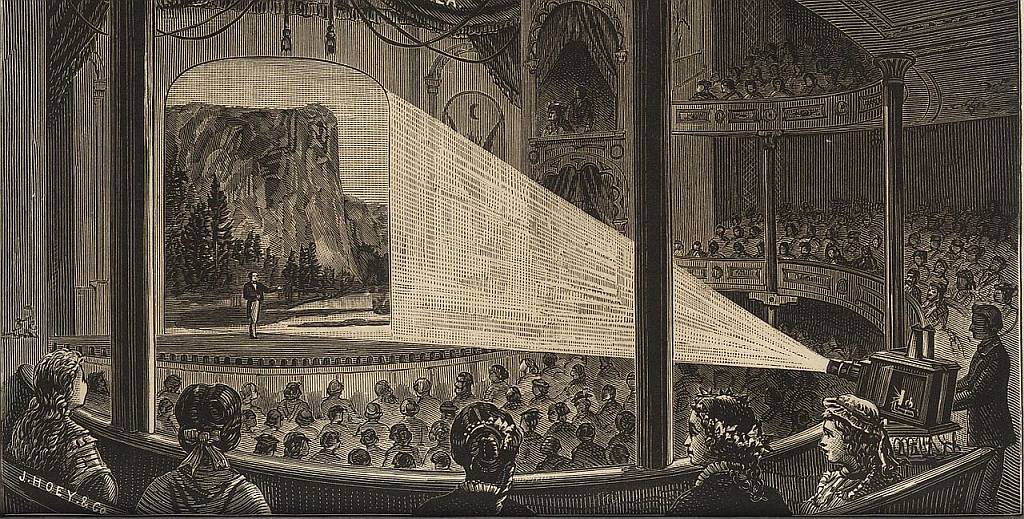
The magic lantern’s “real” name, the stereopticon, used a succession of glass slides (as few synthetic, transparent materials were not available at the time) transposed with a negative image that could be projected onto a hanging sheet.*
The magic lantern was created in the 1840s in Philadelphia and was originally intended for entertainment. In fact, one of Riis’s first schemes in New York used the magic lantern in a rather clever way.
He and a business partner would set up a stereopticon in a public park — a precursor to the Bryant Park film series — and project images of attractive people and international public landmarks, interspersing the pictures with advertisements from businesses nearby.
By 1888, however, Riis (pictured right) was using the technology to display the devastating images he had taken in the various slums around town. His first show was to the New York Society of Amateur Photographers, giving a vivid account according to some sources.
“Mr. Riis was so ingenious in describing the scenes and brought to his task .. a vein of humor,” according to a newspaper account quoted in Tyler Anbinder’s book Five Points.
Riis eventually took his ‘illustrated lectures’ on the road, electrifying audiences both taken with the modern marvel of the magic lantern and the images captured by the newly developed flash photography. “His viewers moaned, shuddered, fainted and even talked to the photographs he projected, reacting to the slides not as images but as a virtual reality that transported the new York slum world directly into the lecture hall.”
In essence, Riis was giving the equivalent of a show-stopping IMAX show to illuminate the plight of New York’s poorest and the unsafe conditions of their tenements. His shows could be considered the prototype of the film documentary.
The presentations would come with fiery speeches by Riis, often using the rhetoric of religious sermons in service of a more progressive, social cause. The shows were so successful that Riis grabbed a book deal and in 1890, his lectures and photographs were contained in his masterpiece “How The Other Half Lives.”
Interest in the magic lantern hasn’t waned today; in fact there’s a national organization that still revels in the wonder of the projected still image.
By the way, you can still find Jacob Riis all over the city. There are the Jacob Riis Houses on East 10th Street and Avenue D, built in 1949 on the site of a clump of tenements Riis railed on about, as well as the Jacob Riis Settlement House in western Queens and high school in the Lower East Side. And of course, there’s a huge Robert Moses park in Far Rockaway named for him.
*Read here for an interesting short history of the magic lantern and how images adhered to the glass
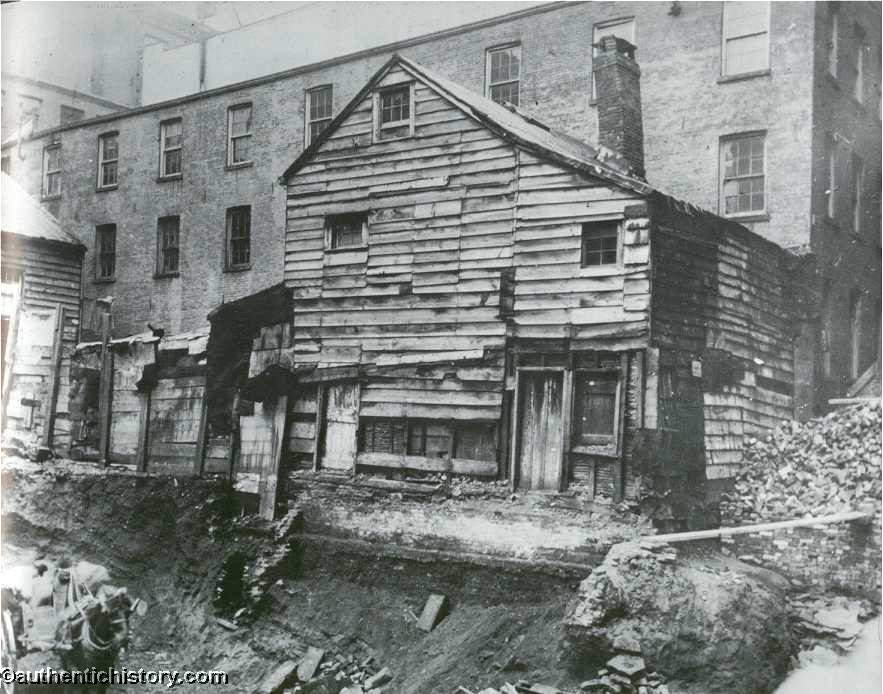
Below: a home on Bleeker Street (at Mercer and Greene streets), a Jacob Riis image that certainly must have popped up in one of his magic lantern shows
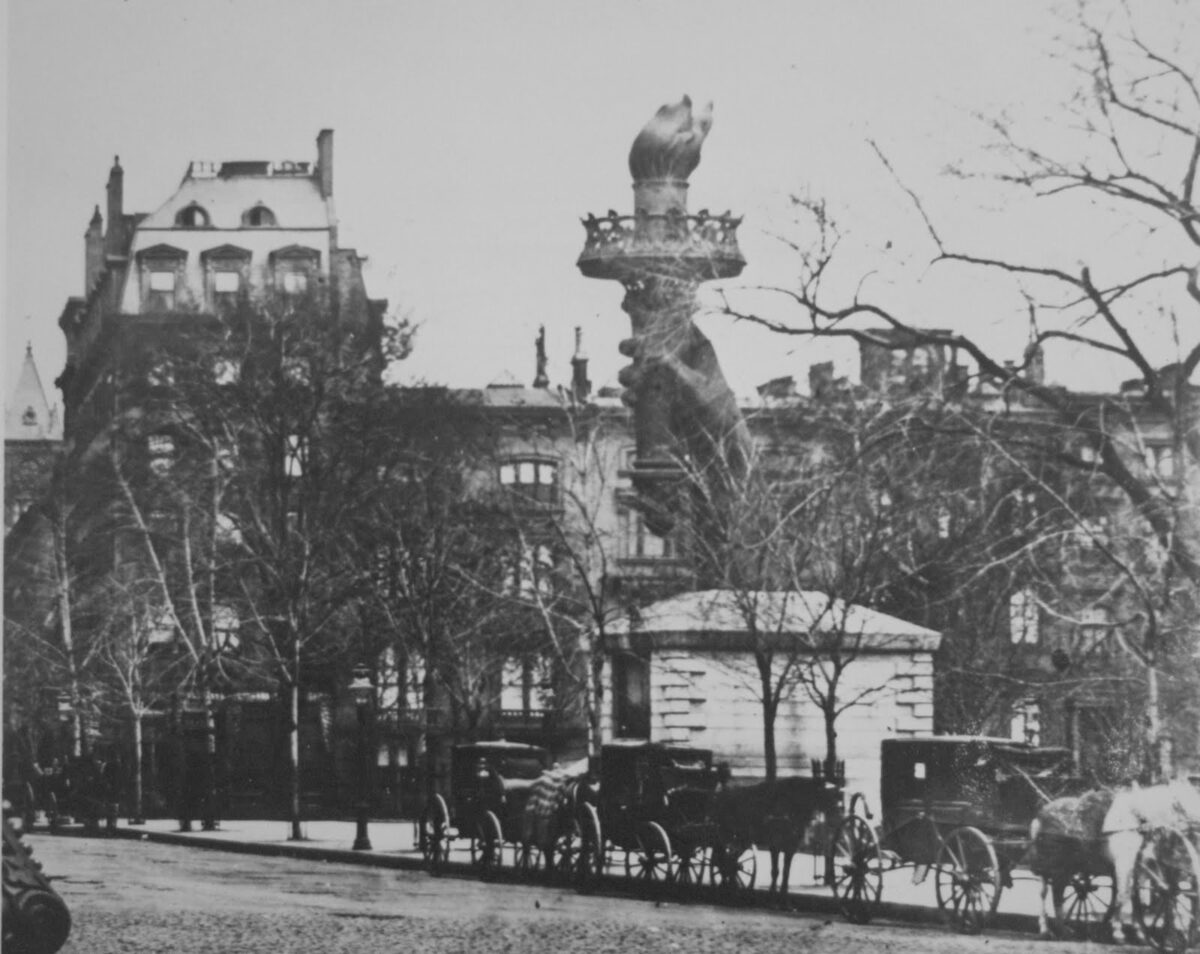
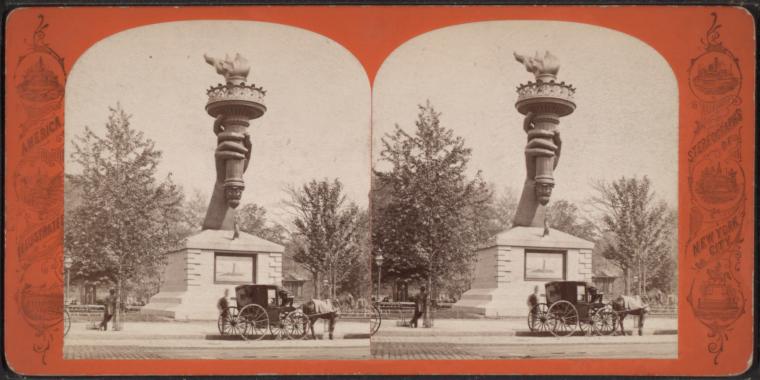
Above: The arm of the Statue of Liberty stood solitary in Madison Square for six years, from 1876 to 1882.
Eugene Emmanuel Viollet-le-Duc, one of the forgotten names in Statue of Liberty history was born in Paris. As the godfather of historical restoration, Viollet-le-Duc would rescue countless medieval structures from decay, helping to preserve the spirit of French architecture through such buildings as Notre-Dame and Mont Sant-Michel.
But it’s through his association with his student Frédéric Bartholdi that Viollet-le-Duc would make his mark in America, as the original designer of the Statue of Liberty‘s brick-laden skeleton.
Viollet-le-Duc would work with Bartholdi in creating both the head and the arm, parts that would then travel to the United States to raise funds for the completed structure.
In particular, the arm and torch would be displayed in the northwest corner of Madison Square Park, from 1876 to 1882. On July 4th, 1876, a gigantic painting byJean-Baptiste Lavastreof the completed statue was displayed on a building across the street from the arm.
Below: The arm would also make its way to the 1876 Philadelphia Centennial Exposition.
Sadly, Viollet-le-Duc would never again see these portions of the statue, as he died in 1879 before the entire structure was completely built. Bartholdi then turned to another architect to complete the work — Gustave Eiffel. It’s Eiffel’s redesigned interior that supports the statue today.
In 1889, three years after the Statue of Liberty finally made its home in New York harbor, Eiffel debuted his better known work — the Eiffel Tower — at the Paris World’s Fair.
But the somewhat radical theories of restoration espoused by Viollet-le-Duc would inspire American architects and inform the direction of modern historical preservation.
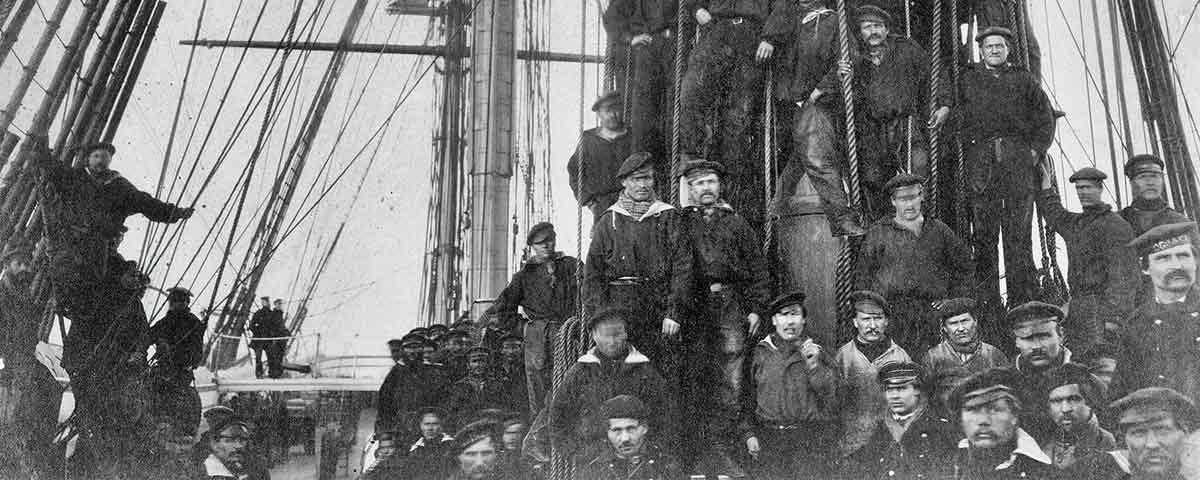
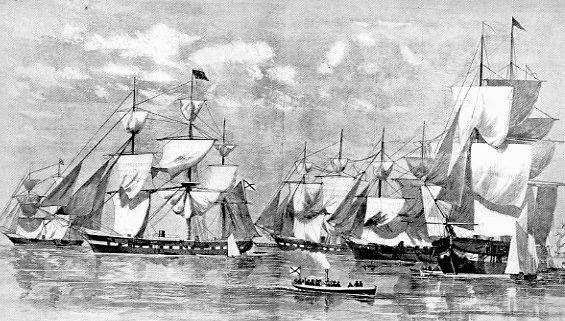
In 1863, New Yorkers flocked to the waterfront to see a startling sight — Russian war ships in New York Harbor. They were here as a display of force, but not to threaten the United States.
The fleet of Russian ships, sailing into New York Harbor in September 1863, as depicted by Harper’s Weekly.
Russia’s Atlantic Squadron, as the fleet was known, was patrolling the Atlantic Ocean as a show of strength against England’s Royal Navy.
They arrived in the harbor on September 24, 1863, initially anchoring in Flushing Bay, and stayed in the city for a couple months. (A description of the various Russian vessels can be found in this 1863 New York Times report.)
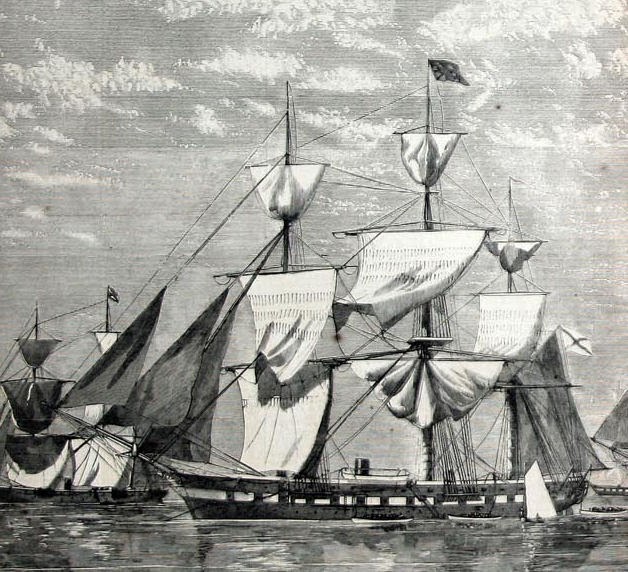
The fleet was led by the massive frigate Alexander Nevski (pictured below), an American-designed ship commissioned and built by the Russian government.
A reporter for Harper’s Weekly, joining a reception onboard the vessel, praised its beauty. “A lady with the most immaculate skirts and kid gloves can move any where, on deck or below, without danger of soiling either, so perfectly clean every thing about the ship is kept.”
America was in the midst of the Civil War, and New York itself was still recovering from the Draft Riots that July.
Many Americans believed the appearance by the Russians underscored a healthy support for the Union over the Confederacy, but most scholars today believe the Russians were acting with far more self-interest.
Still, most New Yorkers embittered by war welcomed the impressive show by friendly foreign powers, kicking off “a slight craze in the public mind.”
Harper’s Weekly remarked, ” [E]very citizen felt bound to do what in him lay to testify to the Russians our sense of gratitude for the friendly manner in which Russia has stood by us in our present struggle, while the Western Powers [England and France] have done not a little to work our ruin.”
New Yorkers marveled at the mighty mast of the Alexander Nevsky, “lying almost on a line westward from Trinity Church,” as it shot off its cannons and a band on-board attempted to play ‘Yankee Doodle Dandy.’
The ship officially docked on the west side at 23rd Street, and the procession, joined by city leaders, marched through the streets (pictured at left, courtesy NYPL), past Union Square and down Broadway.
“[T]he scene became splendidly animated. The moving pageant rolled in a glittering stream down the broad thoroughfare between banks of upturned human faces, the trappings of the equipages, the gold and silver epaulets of the Muscovite guests and the sabres, helmets, and bayonets of the escort reflecting back in unnumbered dazzling lines the glory of the evening sun.” In particular, New York women were captivated by the brawny Russian contingent in their handsome uniforms. “Throngs of ladies in the windows most vigorously waved their ‘kerchiefs, to the great delight of the Russian officers, who never left off bowing, smiling, and even uttering their thanks aloud, while they doffed their gold-laced chapeau.”
(Not every woman was infatuated. The following day, two Russian officers reported being robbed by three women “at a disreputable house.“)
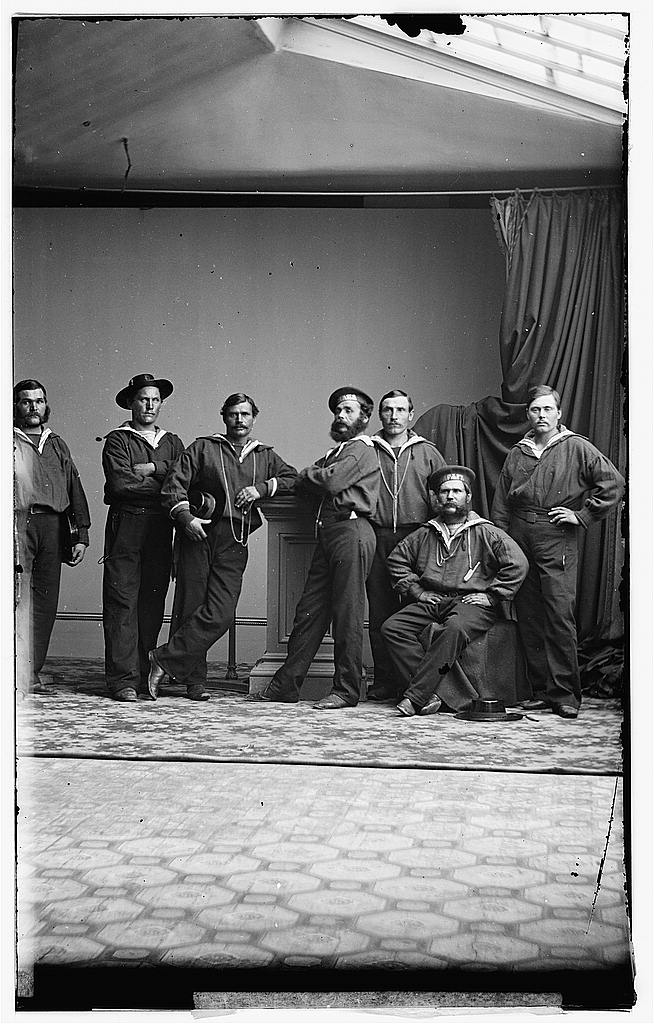
Below: A group of Russian soldiers, taken October 1863, courtesy Library of Congress
The finest hotels of New York were adorned with American and Russian flags. Tiffany’s, at its location on Broadway between Prince and Spring Streets, unfurled a gigantic Russian banner that stretched the length of the building.
Throughout the following weeks, the Russians were continually feted by the grateful Americans. At a dinner with Mary Todd Lincoln and other American dignitaries, Mrs. Lincoln toasted the Russians for their kindness.
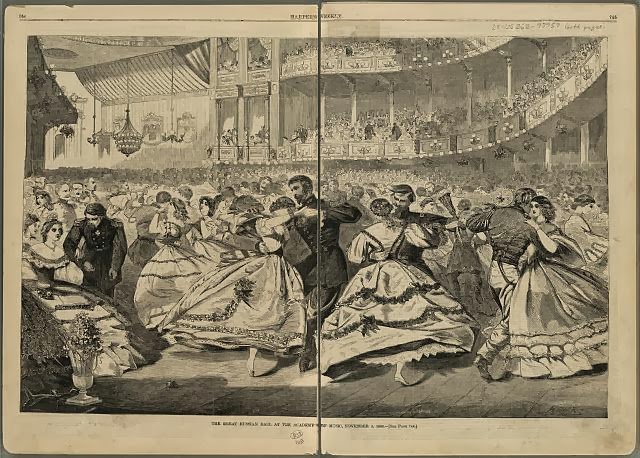
Russian dignitaries frequently met with Mayor George Opdyke and the Common Council and were wined and dined at virtually every hotel in town, including an opulent banquet at the Academy of Music in early November (depicted below in an illustration in Harper’s Weekly).
“They are dined, walked, driven, and are, with unconcealed gratification, availing themselves of the many opportunities of seeing us and all around and about us,” said the New York Times that October. “Yesterday, a number visited Central Park and enjoyed its fine drives and beautiful walks; others were whirled to High Bridge, and others were entertained with City sights of interest.”
The Russian ships would remain in American waters for almost seven months, darting up and down the coast, including a period of time in Washington D.C.
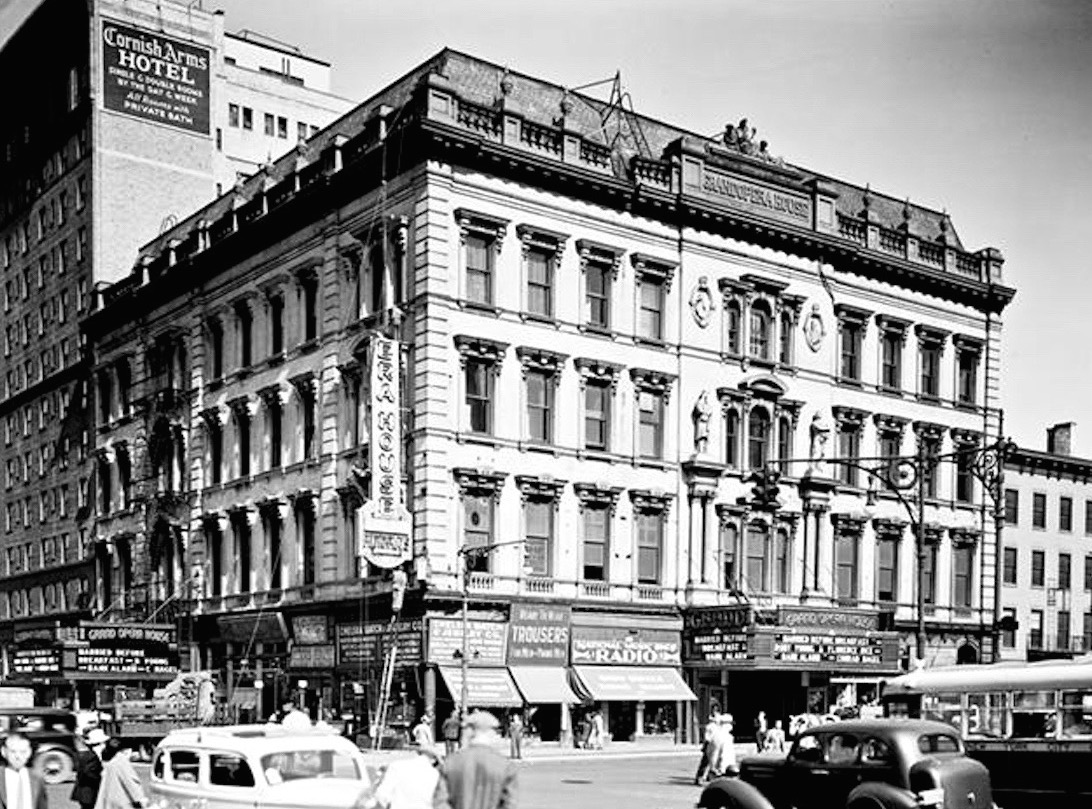
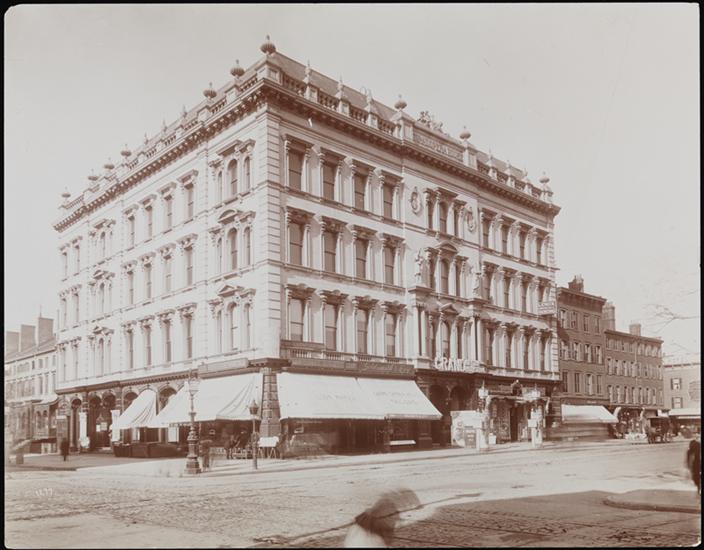
And it took place at a quite surprising venue — the Grand Opera House. Surprising in the sense that it seems unusual that an opera house stood at this spot at all.
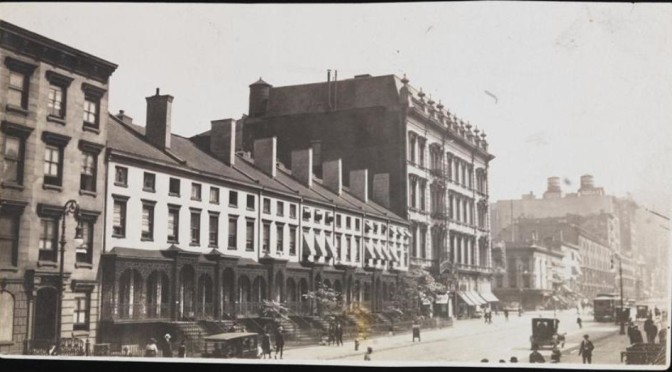
Above: the opera house in 1925 as seen looking east on 23rd Street. Below: in a picture from 1895
Courtesy the Museum of the City of New York
Pike’s Place
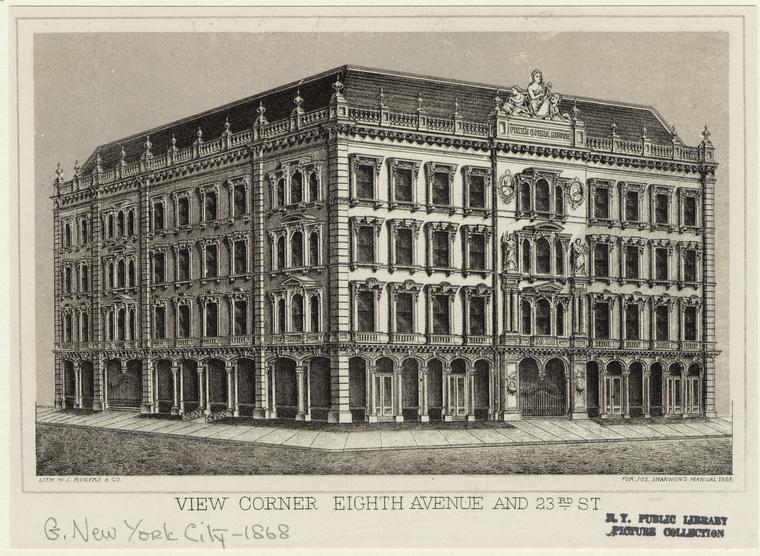
The opera house sprang up in 1868, the project of Samuel N. Pike, who purchased the land directly from Chelsea estate owner Clement Clarke Moore himself. In fact, the original Moore estate was located only a block away.
The Pike Opera House, as it was called in those days, was Pike’s play for legitimacy in New York. A German immigrant who arrived in the U.S. in 1837, Pike lived in New York for a few years and made his fortunes in wine imports. Aspiring to upper-crust tastes, Pike fell in love with opera music after viewing performances byPT Barnum chanteuse Jenny Lind.
“Samuel N. Pike was an extraordinary man in many ways. In appearance he was rather above the middle height, and slender. He wore a heavy, full mustache, after the manner of that period, and though dark complexioned, had very piercing steel-gray eyes. He had a short, abrupt way of speaking, and though good to his employees, was not familiar with any of them. He always dressed in the height of fashion, wore a silk hat and used perfume……
He was crippled in one of his fingers, but in spite of this was accounted a fine amateur flute player.”
Pike constructed a massive opera house in his adopted home of Cincinnati in 1859 and many years later built a companion here in Manhattan at 23rd Street. It officially opened on January 9, 1868.
He was banking on the growth of the New York theater along 23rd Street. Meanwhile the wealthy preferred the Academy of Music down on 14th Street. While some stages would come to 23rd Street, it would bethe arrival of retail and Ladies Mile that would come to define this street by the 1880s.
Courtesy New York Public LIbrary
A Stage for Scoundrels
The theater was spectacular — perhaps too spectacular for the location. “A striking feature seen on entering is the grand foyer, the largest in any theater in the city, open in part to the roof. A stairway of unusual width leads to the balcony….The stage, one of the largest in New York, is eighty feet wide and seventy feet deep, and the green-room is much the most extensive in the city.” [Kings Handbook]
The following year, Pike sold his lavish hall to two rather unlikely investors — Jim Fisk and Jay Gould, grade-A robber barons, pals of Boss Tweed and the orchestrators of the Black Friday Panic of 1869. Why would these two nefarious characters want an opera house?
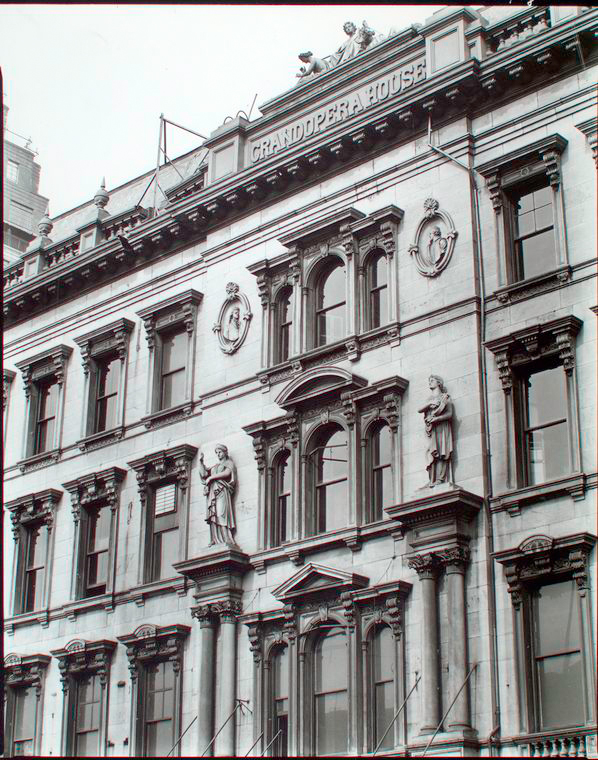
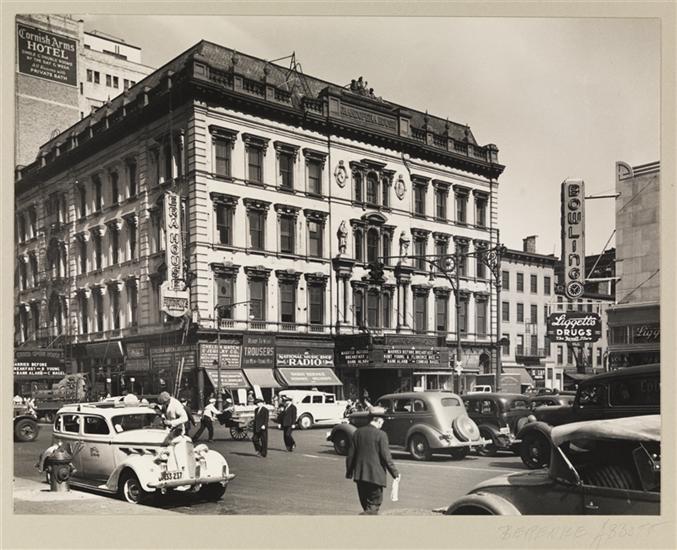
Below: A detail from the Grand Opera House taken in the 1930s
Photo by Berenice Abbott
The house’s upper floors doubled as the offices of their own Erie Railway venture. Fisk’s mistress Josie Mansfield was frequently installed into productions at the now-named Grand Opera House; it was even rumored her next-door apartment was connected to the opera house with an underground tunnel.
However it does seem that Fisk and Gould were legitimately aficionados of the theater, or at very least fans of the elite who would attend them, and the profits that would follow. The Grand Opera House would soon showcase a great number of theater endeavors outside of opera.
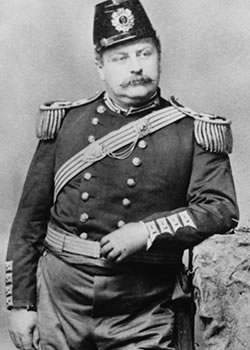
But unfortunately for Fisk (pictured below) the greatest show the Grand Opera House ever presented was his own wake.
The Murder of Jim Fisk
On January 7, 1872, Fisk was fatally shotat the Grand Central Hotelby Manfield’s new lover Edward Stiles Stokes. He died the following day. The robber baron was so associated with the Opera House that his body lay in state here, attended by thousands of mourners and perhaps tens of thousands of curiosity seekers.
“The showy coffin, liberally adorned with gold-plated ornaments, rested on two low stands, and in this, garbed in the gold-laced uniform of the colonel of the Ninth [regiment], lay Fisk, his mustache carefully waxed, white kid gloves on his hands, and his feet buried in white flowers, in various devices.” [source]
His business partner Gould would continue operating the Opera House for several years afterwards, eventually renting it out to vaudeville shows and ‘second-run’ Broadway productions, its fortunes disintegrating as theater moved uptown and the Chelsea neighborhood became more middle-class.
Changing the Scenery
Like many old stages before it, the Grand Opera House switched to films in the 1920s. RKO tried its best to rehabilitate the space, hiring Thomas Lamb to renovate the theater with modern flourishes, reopening the space as theRKO 23rd Street Theatre (seen below in 1927):
Courtesy Museum of the City of New York
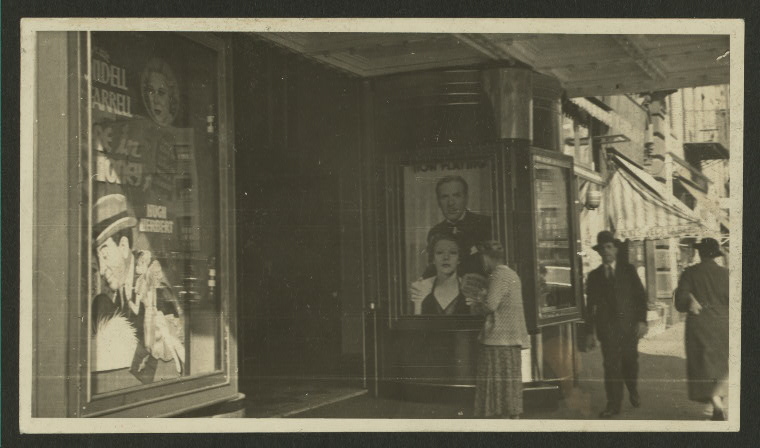
Outside the opera house-turned-movie theater:
Courtesy New York Public Library
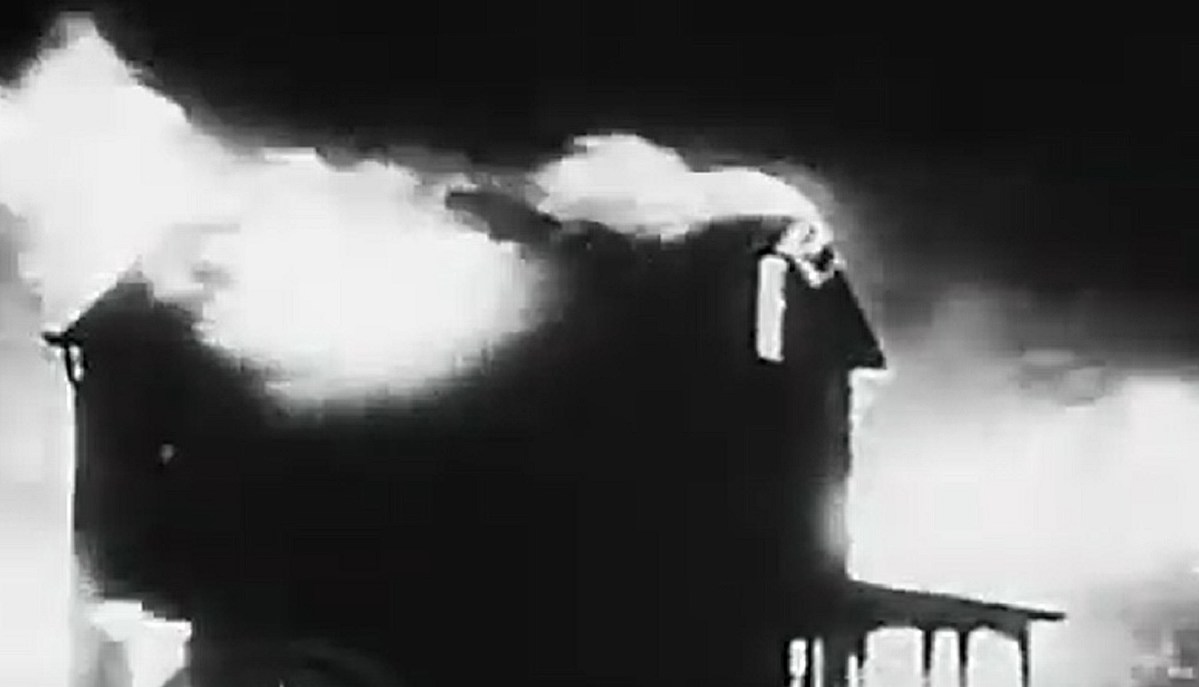
The site remained a movie house through the 40s and 50s, finally closing on June 15, 1960. In a further indignity, the Opera House was thoroughly gutted in a fire.
Today a three-story office and retail building sits on the spot of the opera house. Most New Yorkers are familiar with this corner due to the Dallas BBQ which graces the corner. Fisk might have been way into their Texas-sized margaritas.
Today is the 105th anniversary of the Kingsland factory explosion. To mark the occasion I’m reposting this article originally released on the 100th anniversary of this mysterious disaster.
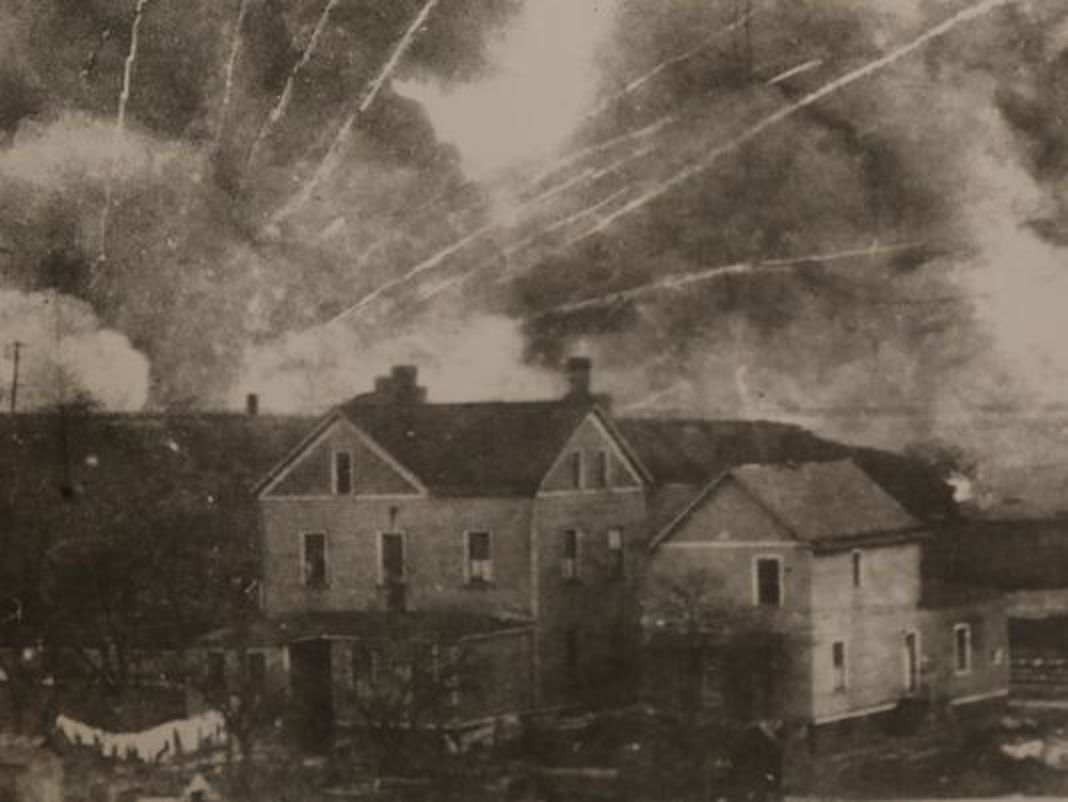
On the afternoon on January 11, 1917, workers in downtown Manhattan skyscrapers were jolted from their desks by a startling sight in New Jersey — an exploding munitions plant in Kingsland, a small community about nine miles south of New York City.
“For four hours Northern New Jersey, New York City, Westchester and the western end of Long Island listened to a bombardment that approximated the squad of a great battle — a bombardment in which probably half a million three-inch high explosive shells were discharged.” (New York Times)
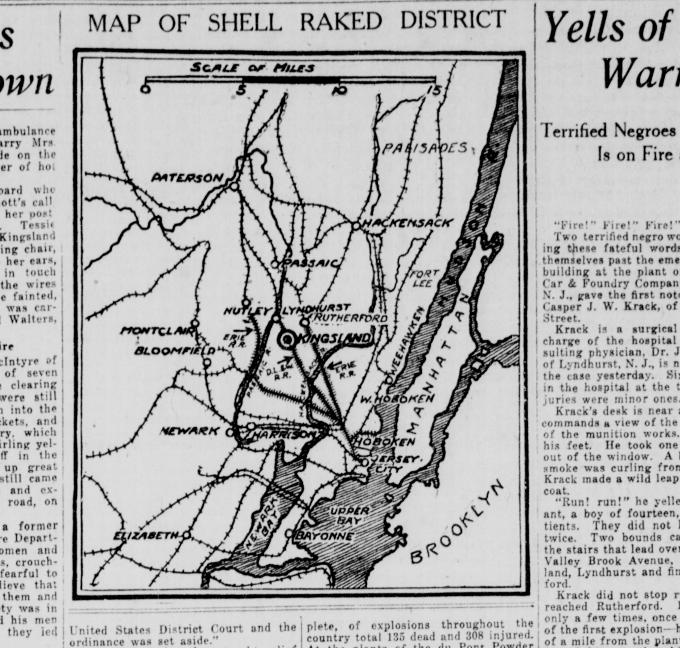
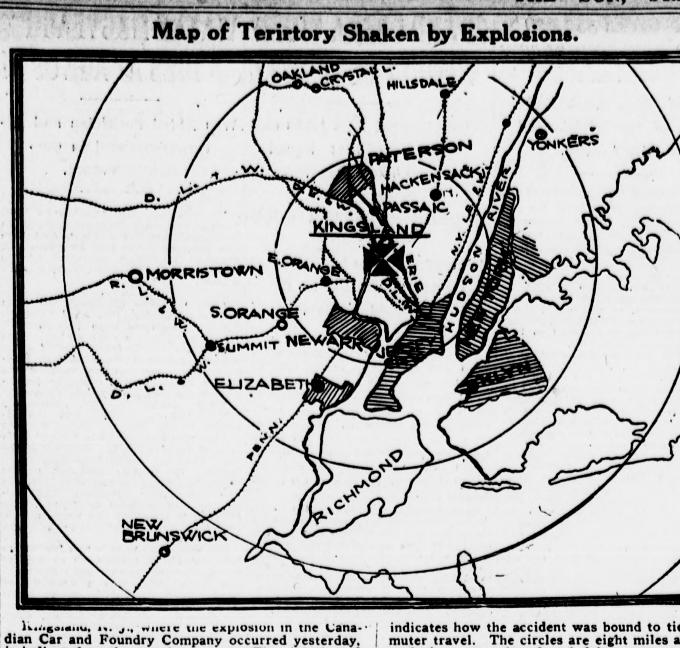
A map from the New York Tribune:
A Canadian company Canadian Car and Foundry had been producing weaponry for Russia and Great Britain in Kingsland. All of it went up in a dramatic and deathly burst. Two square miles of town completely flattened.
Given the dangerous work of manufacturing exploding devices, unfortunate accidents occurred all the time. But was this something more? Was this an act of sabotage?
A slightly less interesting map from the New York Sun:
The region had been on edge for a few years. Although the United States had still not yet entered the European conflict, fireworks and munitions plants had been producing weapons for Allied forces — France, the United Kingdom and Russia.
By 1917, America was clearly considered an enemy agent by the warring Germans.
Just a few months earlier, on July 30, 1916, the area shook with the horrific explosion at Black Tom Island in Jersey City, NJ, an act of sabotage that blew out thousands of windows and even damaged the Statue of Liberty. (We recount the entire story in our podcast from 2016 about the Black Tom Explosion.)
Courtesy Lyndhurst Historical Society
Seven people died in that explosion the previous year. But in Kingsland that day, with a deadly blast even greater than that which had occurred at Black Tom, nobody died.
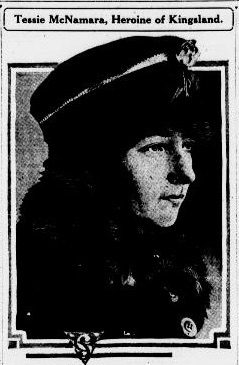
This is attributed to the heroism that day of a single woman — Lyndhurst resident Theresa Louise “Tessie” McNamara.
Tessie was a switchboard operator at the plant that fateful day. The explosions began in a building used for cleaning artillery shells. Once they began, the company’s buildings were a scene of confusion and chaos.
McNamara was immediately informed of the blaze, but kept to her station, broadcasting messages to every building in the complex, even as most others fled the site fearing for their lives.
From the New York Tribune: “McNamara, operator of the Kingsland Central, stayed in her revolving chair, with the receivers clamped to her ears, keeping the terrified town in touch with the outer world until the wires were blasted away. Then she fainted, with her job well done, and was carried away to safety by Fred Walters, of East Rutherford.”
From the New York Sun: “It was emphasized from a dozen sources that one girl’s bravery stood between many hundreds of men and shocking death.”
From an interview of Miss McNamara: “Shells were dropping all around and I thought every minute would be my last. About a dozen buildings were now on fire and I had completed 36 calls. No more were coming in and I started for the door without coat or hat. Just then three of the boys who had missed me appeared in the office doorway. One of them shouted, “Come on now, Tess!” but I couldn’t walk. My courage left me and I needed their assistance to get out” [source]
The explosion stranded tens of thousands of passengers along train lines in New Jersey. The explosion’s curious timing — at the end of the day, near closing time — meant that trains were filled with commuters on their way home from work. Nobody was injured, but nobody got home in time for dinner that evening.
This begs the question — was the Kingsland Explosion purposefully set? Nobody was ever arrested, although many reported the mysterious behavior of an employee named Fiodore Wozniak who lived in New York.
From a statement by Wozniak’s foreman: “I noticed that this man Wozniak has quite a large collection of rags and that the blaze started in these rags. I also noticed the he had spilled his pan of alcohol all over the table, just preceding that time. I also noticed that someone threw a pail of liquid on the rags or the table almost immediately in the confusion ….. Whatever the liquid was, it caused the fire to spread very rapidly and the flames dropped down on the floor and in a few minutes, the entire place was in a blaze.
It was my firm conviction from what I saw, and I stated, that the place was set on fire purposely, and that has always been and is my firm belief.“
Wozniak later disappeared and never questioned.
In the 1970s, Germany did pay tens of millions of dollars in reparation for various acts of sabotage within the United States, but did specifically accept the blame for the Kingsland disaster.
Today you can visit a unique site associated with the explosion — a smokestack that somehow survived the disaster, near a plaque dedicated in Miss McNamara’s honor. [More details here]
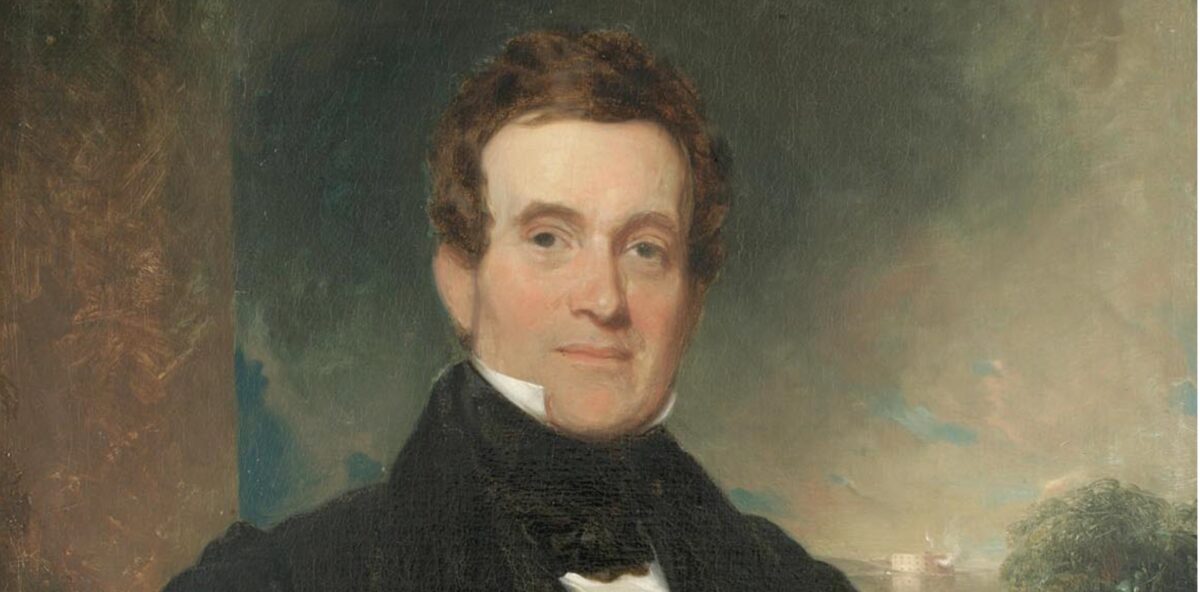
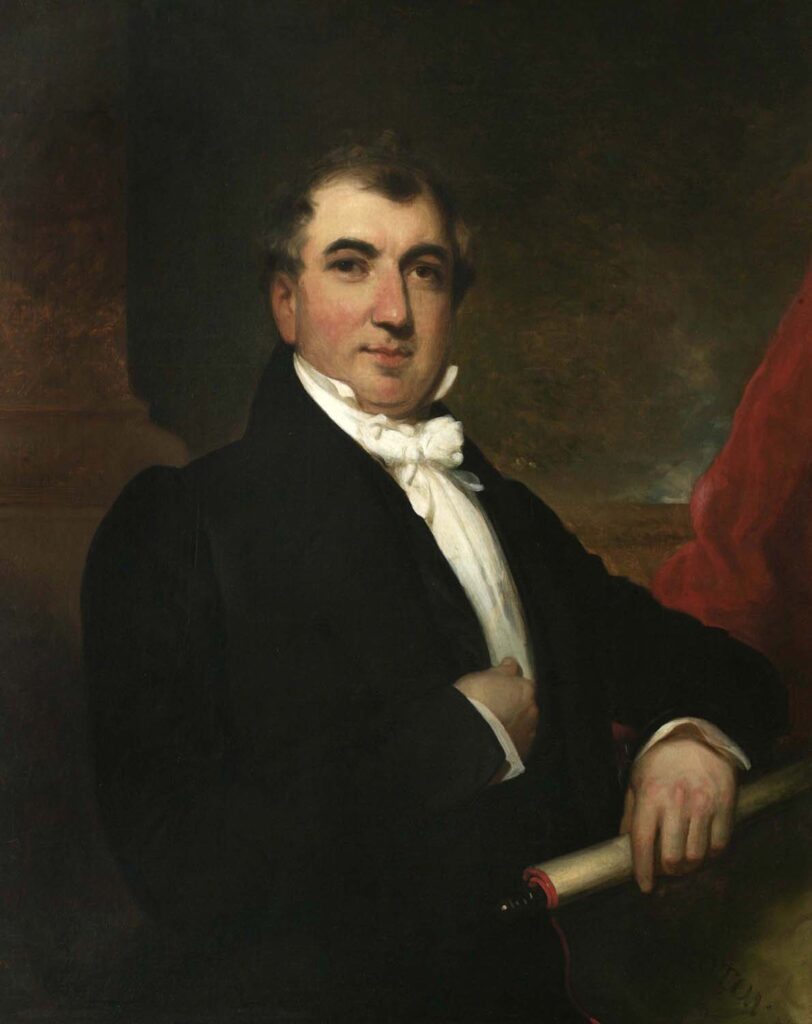
Aaron Clark, from his official City Hall portrait, painted by Henry Inman. Courtesy NYC City Hall
New York City has a new mayor — Eric Adams! So we think it is time that you Know Your Mayors, becoming familiar with other men who’ve held the job, from the ultra-powerful to the political puppets, the most effective to the most useless leaders in New York City history.
This longtime feature of this website is being rebooted with new articles and newly researched and refreshed earlier entries in this series. Check back every other week for a new installment. Read past articles here.
Mayor Aaron Clark 1837-1839 (two one-year terms)
Aaron Clark has many claims to fame in New York City history, none of them really things that recommend him as a defining leader of our city. His most defining characteristic was that he was often very lucky.
Clark is the first mayor ever elected representing the anti-Democrat, anti-Andrew Jackson Whig Party — a political party abolished less than 20 years after Clark’s victory.
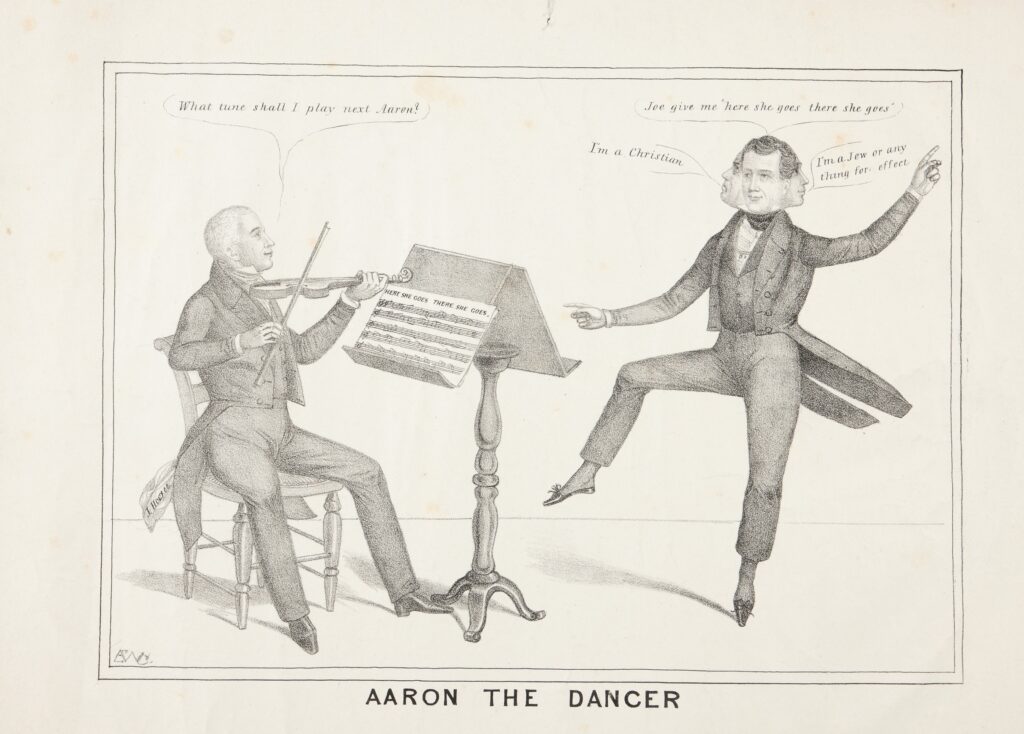
He was known as the ‘Dancing Mayor’, which was not an accomplishment but a mockery.
He called himself the New York’s most prestigious lottery operator, which he considered an accomplishment but was perceived by some as a disqualification.
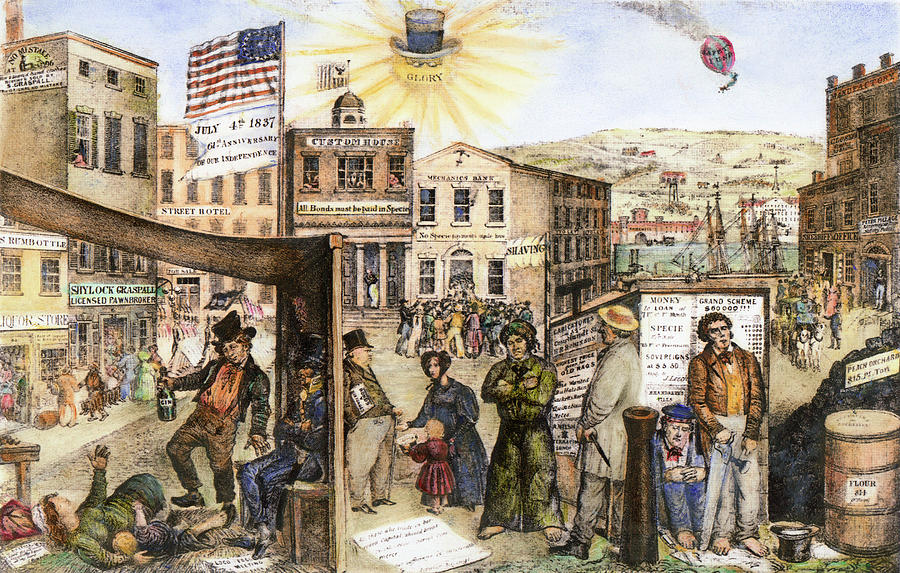
And finally he was elected amidst one of the worst financial crises in its history– the Panic of 1837.
Previously on ‘Know Your Mayors’
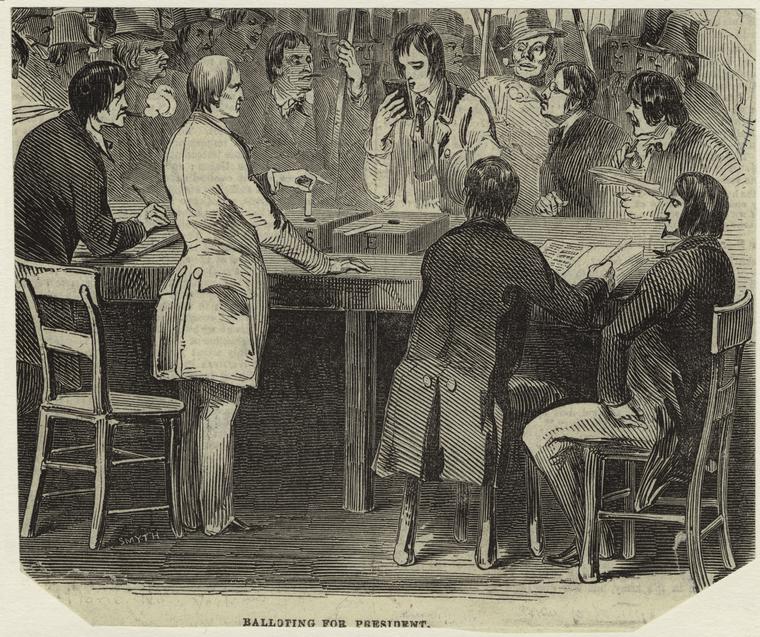
Clark, perhaps more honorably, was also the second man to ever be popularly elected as mayor of New York, i.e. chosen directly by the people of the city.
Previously, the position was selected by the Common Council (city council), district representatives who often chose men beholden to their whims.
When the state finally changed mayoral selection to one of popular election in 1834, the result caused violence at the polls and mass pandemonium. (See the last installment.) Cornelius Lawrence would come out ahead for three consecutive one-year terms.
Lawrence had been a candidate of Democratic machine Tammany Hall — with their influence, who else would be the first mayor? — but Democrats were facing strong opposition from an ascendent Whig party.
In fact, the Whig candidate in 1834, Gulian Verplanck, very nearly won; the animosity between the Democrats and Whigs was so contentious that right before the election, Tammany thugs stormed their opponents headquarters, destroyed everything inside and even killed a man.
During Lawrence’s tenure, the Whigs remained strong as the Democrats got weaker.
In a situation which certainly has some reflection in current national events, Tammany was split between conservative and liberal factions (an ‘Equal Rights’ faction, as they called themselves).
During a Tammany meeting in 1835, the Equal Righters stormed a Tammany committee meeting loaded with conservative members and threw them out.
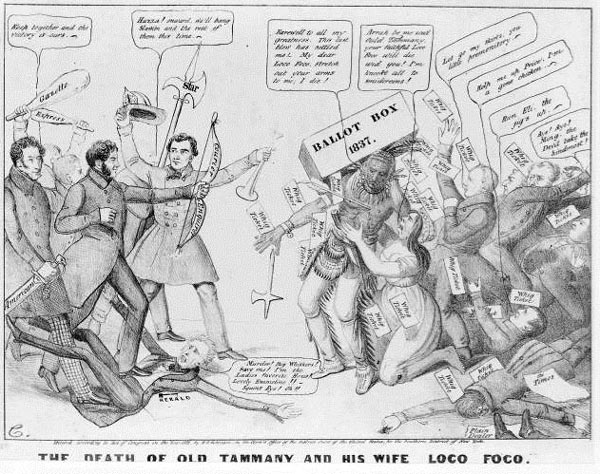
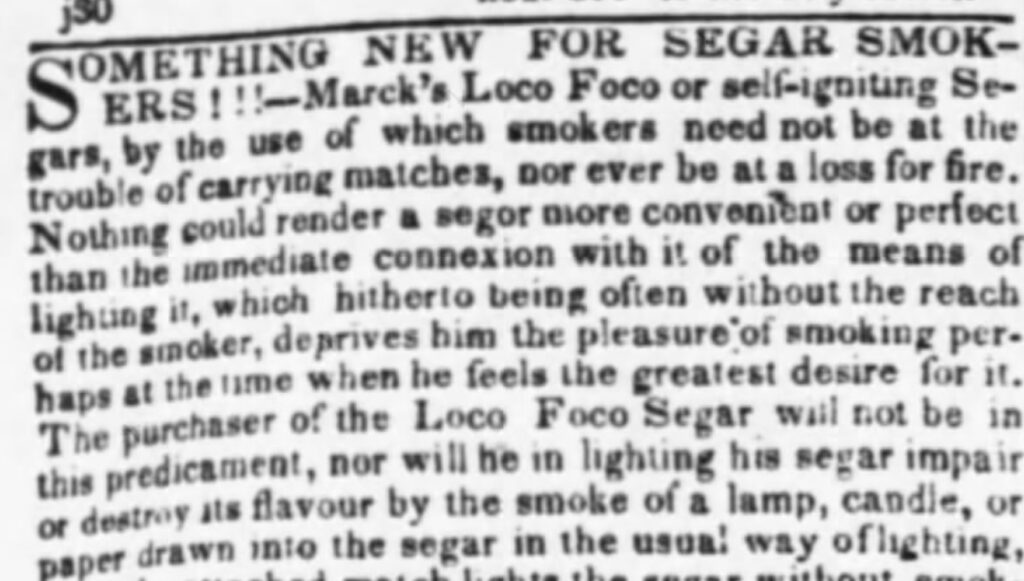
When the lights were turned out on the party-crashers, they lit Spanish matches or ‘loco-focos‘ and continued. The opposition, which would eventually run the conservatives right out of the party, would forever be known as the Locofocos. (For more on their particular beliefs, read here.)
How Luck Elected A Whig Mayor
So what does this have to do with Whig man Aaron Clark? At another period in history, Mr. Clark might never have gotten to experience life in City Hall.
But the dissention within the Democrats opened the door for the fleeting Whig party to reign briefly in New York. With that sort of luck, it’s no surprise to learn that Clark’s primary occupation up to then was as operator of a lottery business.
Privately-run lotteries were, believe it or not, quite common in early American history.
King’s College (today’s Columbia University) was founded with a lottery pool. A young P.T. Barnum operated one up in the 1820s. Benjamin Franklin and George Washington both held fund-raising lotteries in their day.
Even Alexander Hamilton opined that “everybody … will be willing to hazard a trifling sum for the chance of considerable gain.”
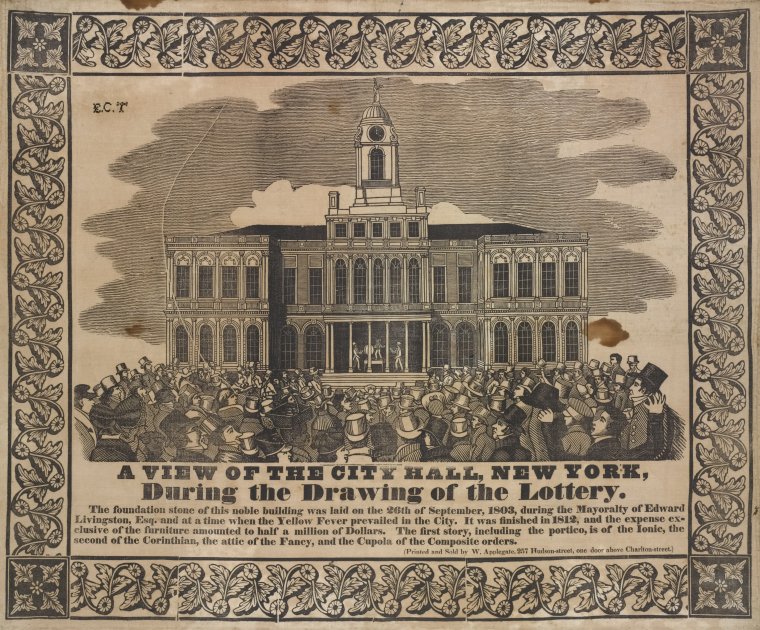
A view of the City Hall, New York, during the drawing of the lottery, New York Public Library
By the mid 19th century, private lotteries would be associated with more disreputable elements and would be abolished at the end of the century. Clark was thus a successful operator of an industry in the 1830s that would soon be looked upon as scandalous and unseemly.
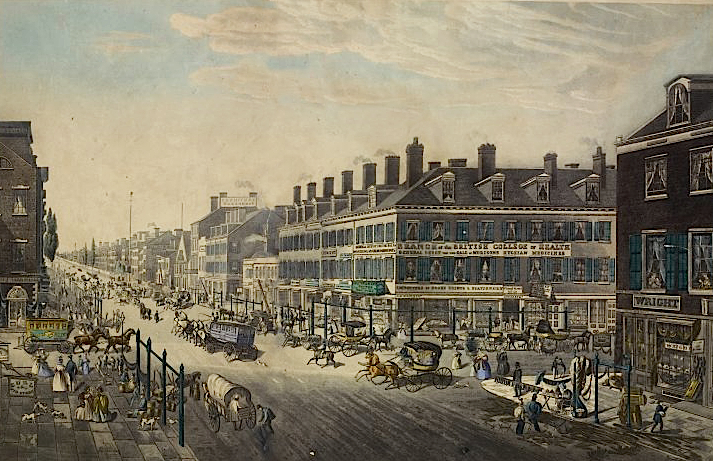
“As lotteries, under certain regulations as to the drawings, which were had upon the esplanade in front of the City Hall, in the presence of an alderman, were authorized by law, there were many offices in the city, notably one at the southwest corner of Broadway and Park Place* kept by Aaron Clark, a much reputed citizen.”
*The Woolworth Building now stands on the spot where Clark’s business once stood.
“He was a great lottery seller and made a fortune of it,” says one source. A recollection from an 1890s New York Times article shortlists Clark as one of the “best known rich men” at the time.
Huzza for Clark, Fortune’s Favorite!
Clark was born in 1787 in Massachusetts, a veteran of the War of 1812, and spent his early years as a clerk of Albany state assembly.
He moved to New York to pursue banking and eventually fell into his lottery endeavors, becoming wealthy and, by extension, highly suitable for early 19th century public office. Clark was soon elected to an alderman’s seat, typically a neat launching pad into the mayor’s chair.
The Whigs announced him as their candidate in 1837 against the intensely split Democrats. Conservative Tammany ran John Jordan Morgan, while the Loco-Focos put up the interestingly named Moses Jacques, considered “the patriarchal leader of the Loco-Focos.”
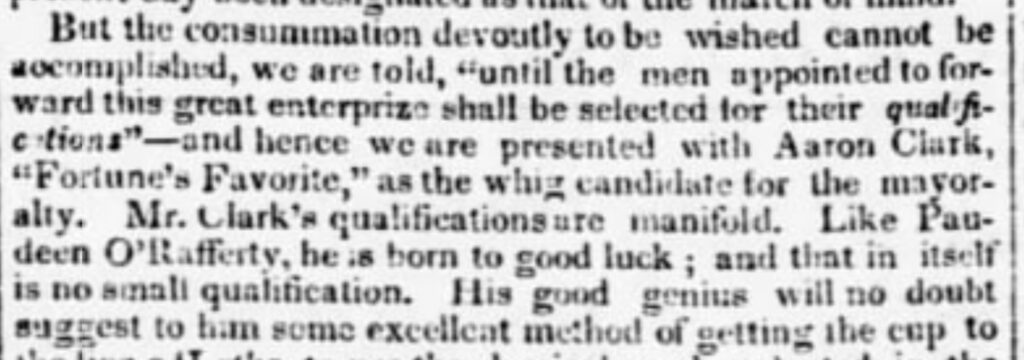
Clark’s opponents certainly tried to use his occupation against him. Wrote William Leggett : “If we elect Aaron Clark for Mayor who knows but he may get up some ‘splendid scheme’ and insure ‘a grand prize’ to everyman who assisted in making him manager of the municipal lottery. Huzza for Clark, Fortune’s Favorite!”
The Evening Post repeated this nickname — Fortune’s Favorite — March 1837.
However Morgan and Jacques cleaved the opposition in two, and for the first time in New York history, on April 11, 1837, a Whig became mayor.
He then would be re-elected in 1838 when Tammany’s conservatives threw their support to him out of spite towards their liberal LocoFoco brethren. (There was apparently a shocking amount of fraud going about that year, which also helped matters.)
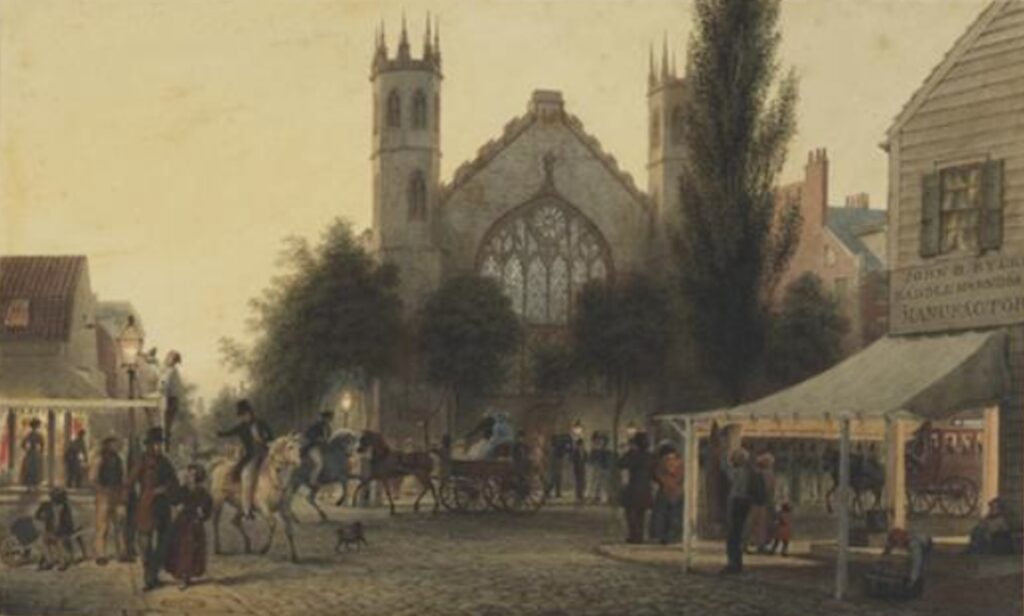
Night-fall. St. Thomas’ Church, Broadway, New York, a beautiful painting by George Harvey from 1837. (The Museum of the City of New York)
Fortune’s Favorite?
Clark was certainly the wrong mayor for the moment. He was an ardent Native American, meaning he generally despised the boatloads of Irish emptying into New York slums, driving “the native workmen to exile,” he said in a meeting to the Common Council.
His campaign was openly hostile to ‘clannish’, ‘untrustworthy’ Irishmen, and his tenure as mayor only stirred up xenophobic sentiments. He advocated for keeping new immigrants on ships, directing them away from city and charging them ‘commutation fees’ of $10.
Clark aimed his racial paranoia at the lower classes at large, fearing that the charity organizations already in place were turning the city “into a rendez-voux of beggars, paupers, vagrants and mischievous persons,” according to the book Gotham.
One general benefit of this alarming hysteria was an improvement to the system of nightwatchmen and security patrols throughout the city, a “military arm” to assuage rioting and general chaos. Clark was no light-weight; he would frequently lead these local militias through the city himself, breaking up rabble-rousing groups.
The Unfortunate Fop
Most unfortunately, however, Clark’s charms were limited. His attempts to woo over New York’s elite in a series of parties at his home on Broadway and Leonard Street fell flat.
This type of social governance was a winning recipe for mayors like the honorable Philip Hone. As mentioned in a prior installment of this column, Hone’s parlor “hosted a nightly gallery of political and foreign dignitaries mixing it up with New York’s social strata.”
Clark, however, was roundly ridiculed for attempting such grand ‘entertainments’. In fact, in an early form of political snark, Clark was ironically called ‘the Dancing Mayor’, not for his graces assumably or even the class of his “splendid patent leather pumps” but for his pretensions of trying too hard.
Also on his watch, the Croton Aqueductcontinued apace although its workers went on strike not once but twice in 1838 for better wages.
He also governed the city through the beginning of a grueling financial crisis, known today as the Panic of 1837.
Not even a month into Clark’s first term, on May 10, 1837, New York City banks ran out of gold and silver, having loaned out too much due to months of high inflation. President Jackson had hollowed out the central bank and refused to recharter it, leading to bank collapses across the country.
“During the Panic of 1837, approximately ten percent of U.S. workers were unemployed at any one time. Mobs in New York City raided warehouses to secure food to eat. Prominent businessmen, like Arthur Tappan, lost everything.” [source]
The Panic froze real estate developments across the city. Construction projects in Union Square and Gramercy Park sat unfinished.
“A deadly calm pervades this lately flourishing city,” wrote former mayor Philip Hone in his diary. “No goods are selling, no business stirring, no boxes encumber the sidewalks of Pearl Street.”
A Different Kind of Prize
It became clear that Clark was out of his depth. Two years of a Whig in office — with the tide of immigrants hardly abating — was quite enough.
In the election of 1839, Tammany put up Isaac Varian, who had been defeated the year previous by his political machine’s fractious split. Despite the usual cries of fraud, in this round Varian was the victor. Clark’s luck, if that’s ever what it was, had run out.
During its first year, The Clark Prize had eight competitors. “It is expected that the exercises will be unusually interesting and attractive,” claimed one article.
When Clark died in 1861, he was buried right here in the city, at the old New York Marble Cemetery in the East Village. The gates to this historic burial ground are occasionally opened to the public so I recommend bringing a lottery ticket to his headstone.
PODCAST Steven Spielberg’s new version of West Side Story is here — and it’s fantastic — so we’re re-visiting our 2016 show on the history of Lincoln Center, with a new show introduction discussing the film and the passing of musical icon Stephen Sondheim.
Warm up the orchestra, lace up your dance slippers, and bring the diva to the stage! For our latest show we’re telling the origin story of Lincoln Center, the fine arts campus which assembles some of the city’s finest music and theatrical institutions to create the classiest 16.3 acres in New York City.
However this tale of Robert Moses urban renewal philosophies and the survival of storied institutions has a tragic twist. The campus sits on the site of a former neighborhood named San Juan Hill, home to thousands of African American and Puerto Rican families in the mid 20th century. No trace of this neighborhood exists today.
Or, should we say, ALMOST no trace. San Juan Hill exists, at least briefly, within a part of classic American cinema.
The Oscar-winning film West Side Story, based on the celebrated musical, was partially filmed here. The movie reflects many realities of the neighborhood and involves talents who would be, ahem, instrumental in Lincoln Center’s continued successes.
FEATURINGLeonard Bernstein, Leontyne Price, James Earl Jones, Imelda Marcos, David Geffen and, naturally, the Nutcracker!
The Bowery Boys: New York City History podcast is brought to you …. by you!
We are now producing a new Bowery Boys podcast every other week. We’re also looking to improve and expand the show in other ways — publishing, social media, live events and other forms of media. But we can only do this with your help!
We are now a creator on Patreon, a patronage platform where you can support your favorite content creators.
Please visit our page on Patreon and watch a short video of us recording the show and talking about our expansion plans. If you’d like to help out, there are several different pledge levels. Check them out and consider being a sponsor.
We greatly appreciate our listeners and readers and thank you for joining us on this journey so far.
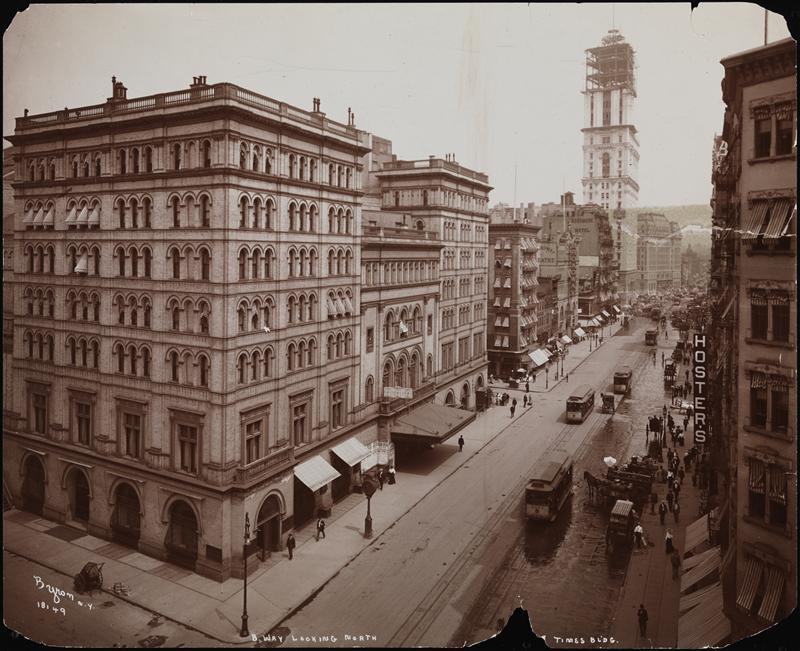
The Metropolitan Opera House, in 1904. In the far distance, you see One Times Square being constructed in Longacre Square.
Courtesy MCNY
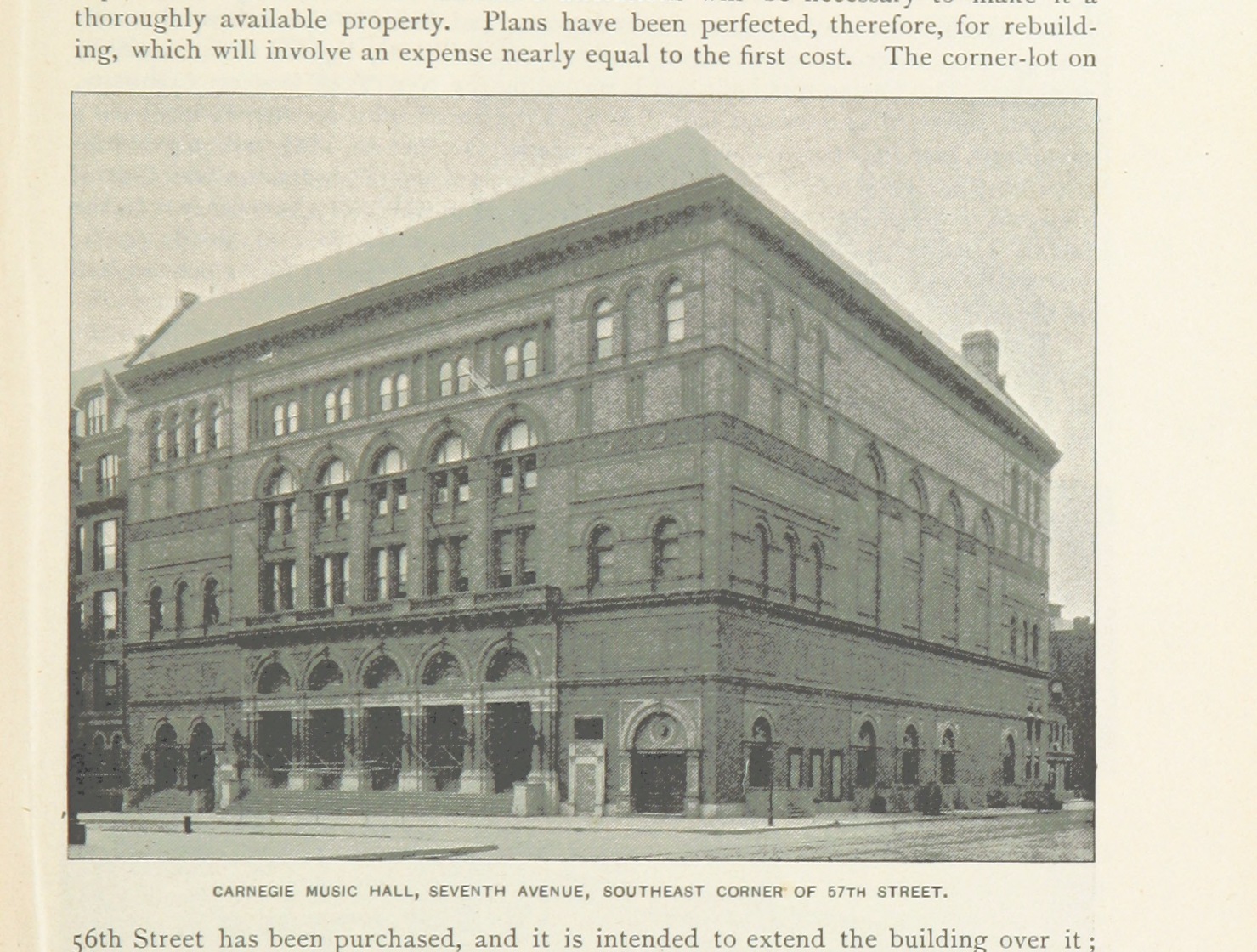
The New York City Ballet had its first home at City Center while the New York Philharmonic was housed for decades at Carnegie Hall.
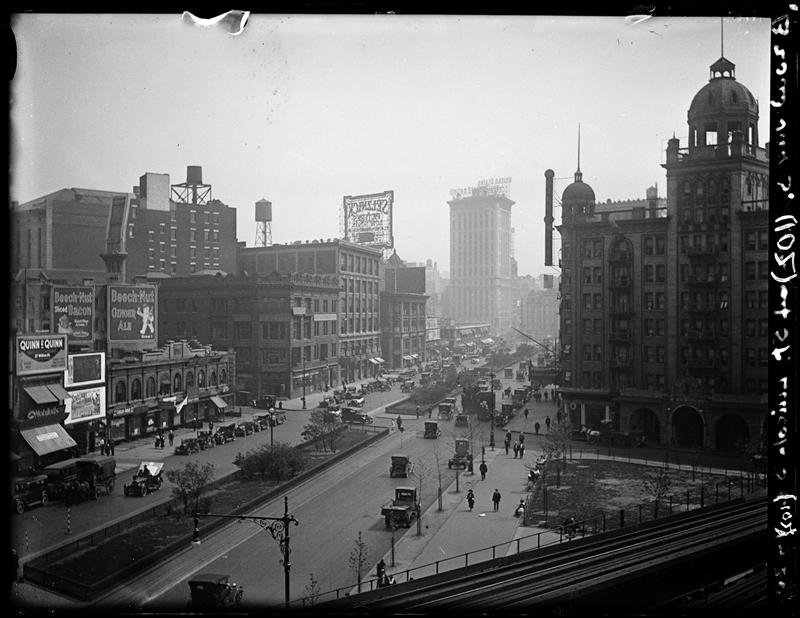
Below: Lincoln Square, 1920. This picture is actually taken from the spot where Lincoln Center stands today.
The triangular plaza pictured here would later be called Dante Park (a statue to the Italian writer would be placed here a year after this photo was taken). Take note of the 9th Avenue elevated streaking up Columbus Avenue at the bottom of this image.
Arthur Hosking/Museum of the City of New York
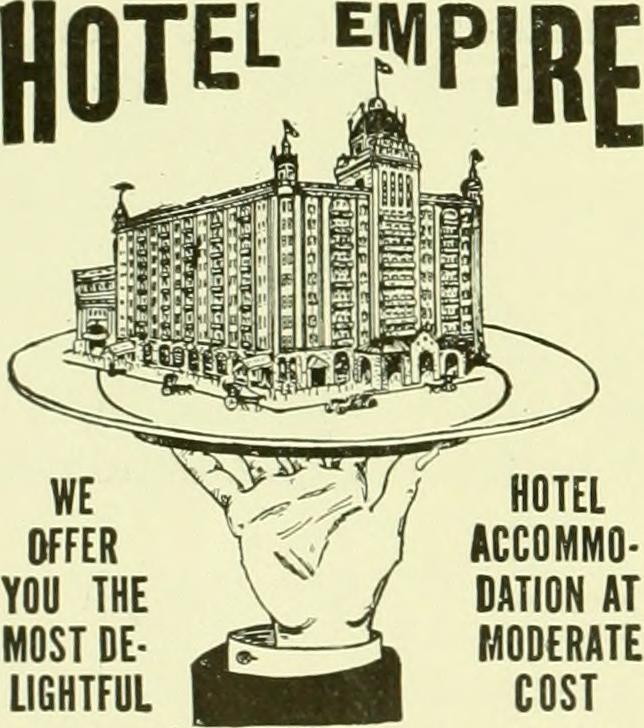
And that building to the right? That’s the Hotel Empire which is still standing there today (albeit in a greatly modified form). Here’s an ad for the Empire from 1909.
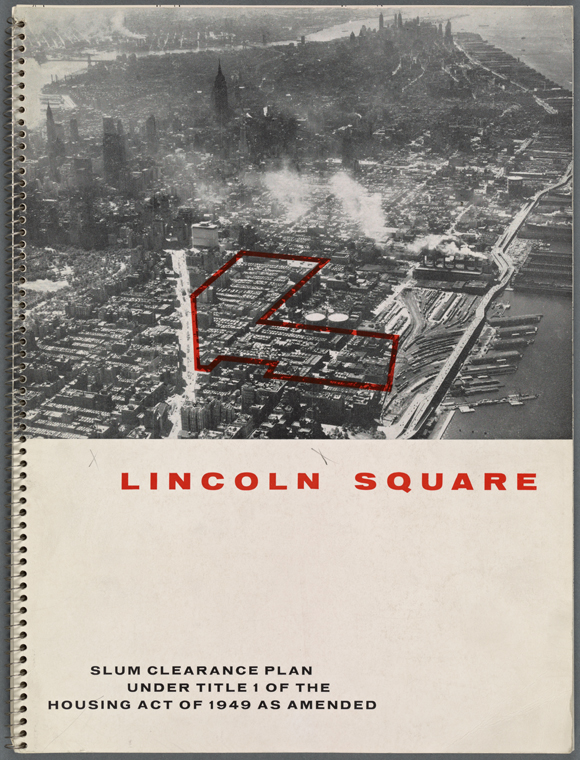
Robert Moses’ slum clearance plan for San Juan Hill, published in 1956.
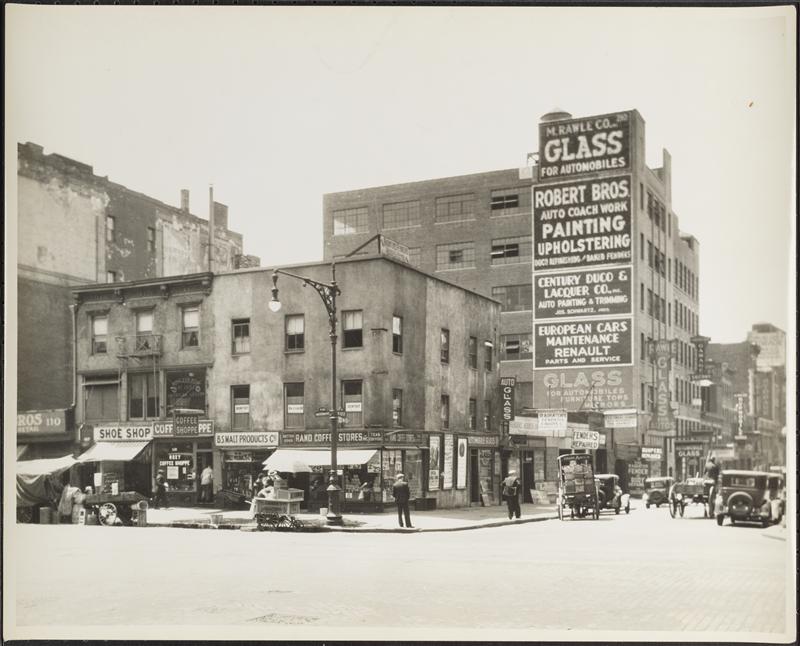
Scenes from old San Juan Hill — 1932, 65th Street and Amsterdam Avenue
Charles Von Urban/MCNY
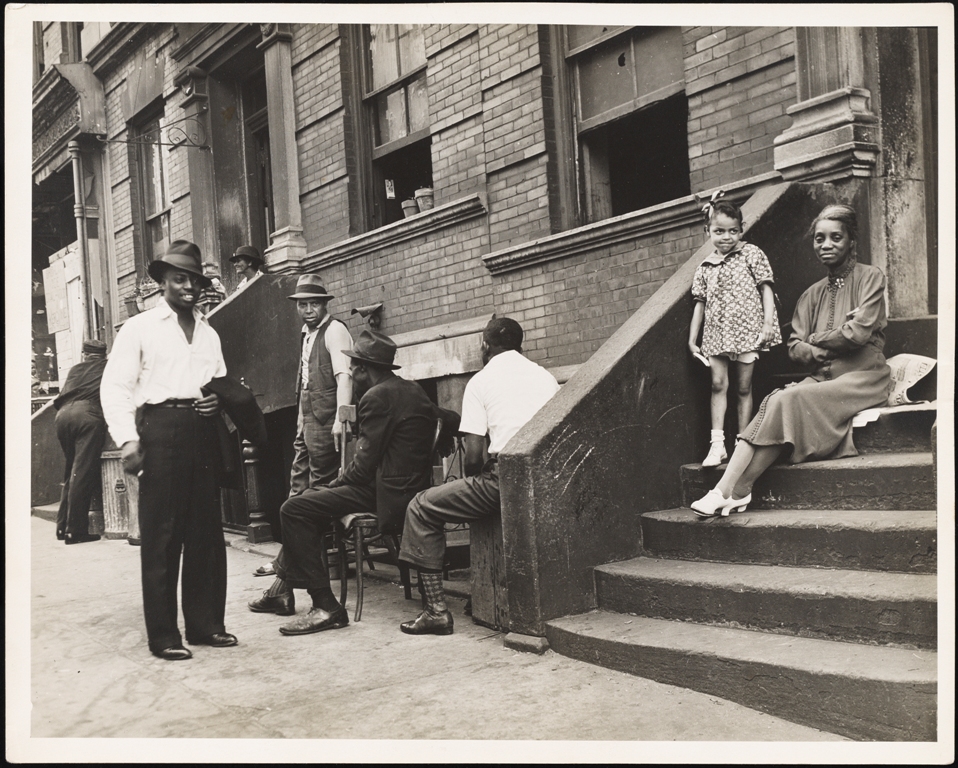
1939 — the stoop scene in San Juan Hill, street unknown
Courtesy MCNY Lee Sievan (1907-1990). San Juan Hill. 1939
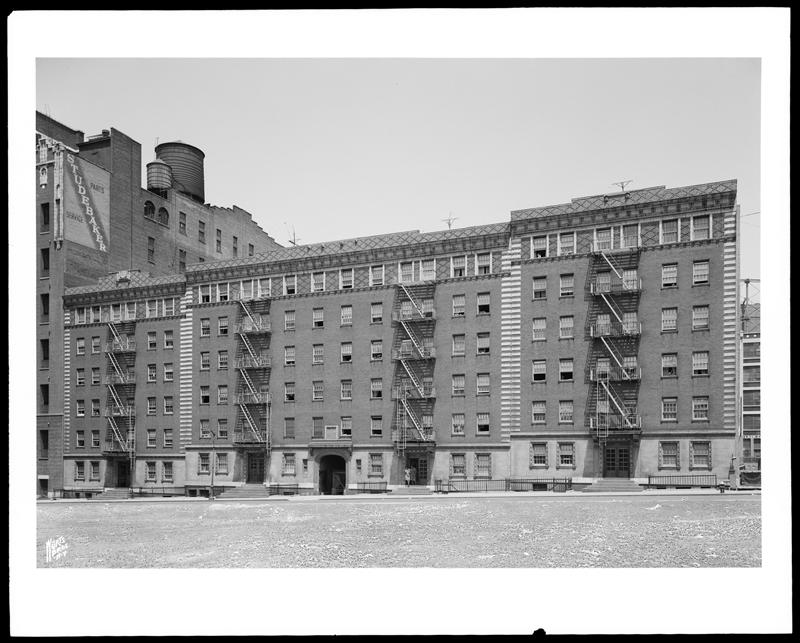
Below: An early effort to improve the housing quality in the neighborhood — the Phipps Houses, built in 1906.
An interesting New York Times article describes a few residents: “A typical tenant was the steamboat steward Joseph Craig, 36, classed as ‘mulatto’, who was born in Trinidad and arrived in the United States in 1891. Another was the horse breeder Daniel Moore, 43, born in Missouri and married for six years to Tilly Moore, 30, born in Cuba and in the United States since 1892; she worked as a domestic.”
MCNY
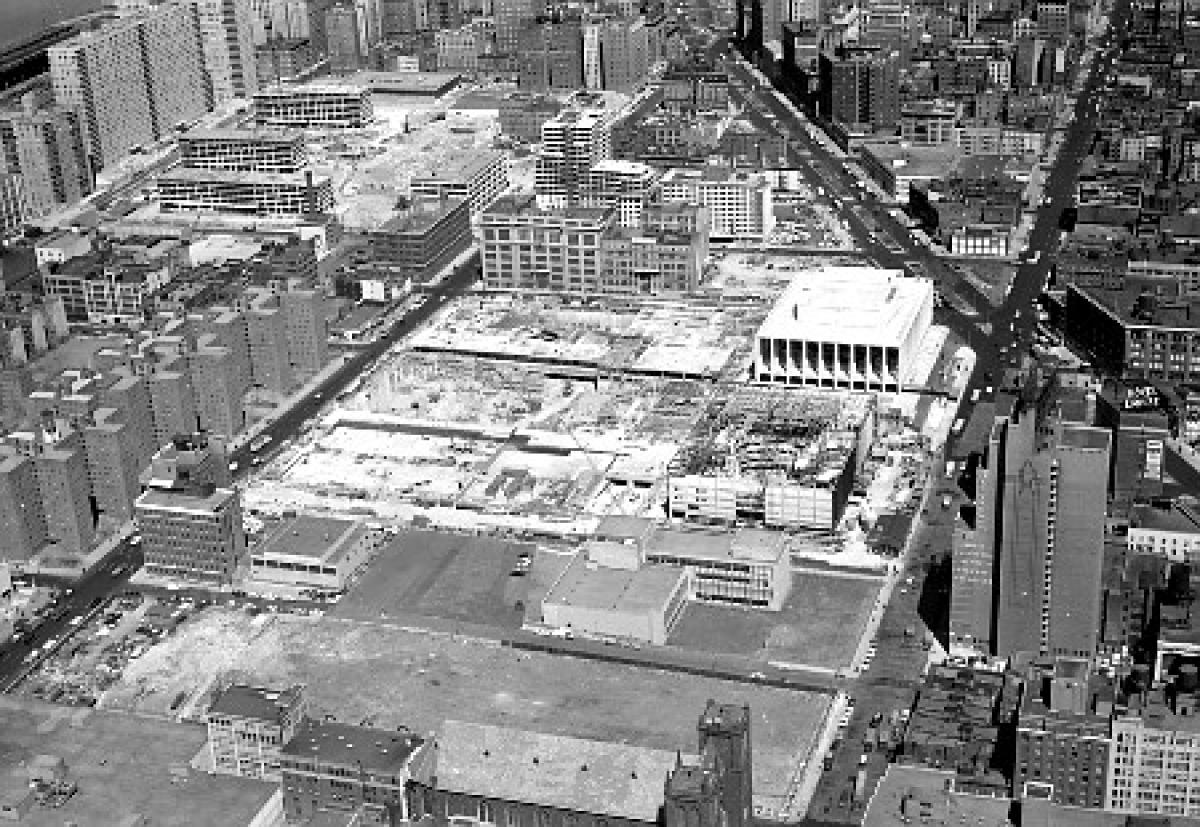
The scene in April of 1963. The Philharmonic Hall was already opened by this point. This really brings home the fact that there must have been so much noise pollution due to construction which must have perturbed the organizers of the Philharmonic greatly!
(MATTSON/DAILYNEWS)
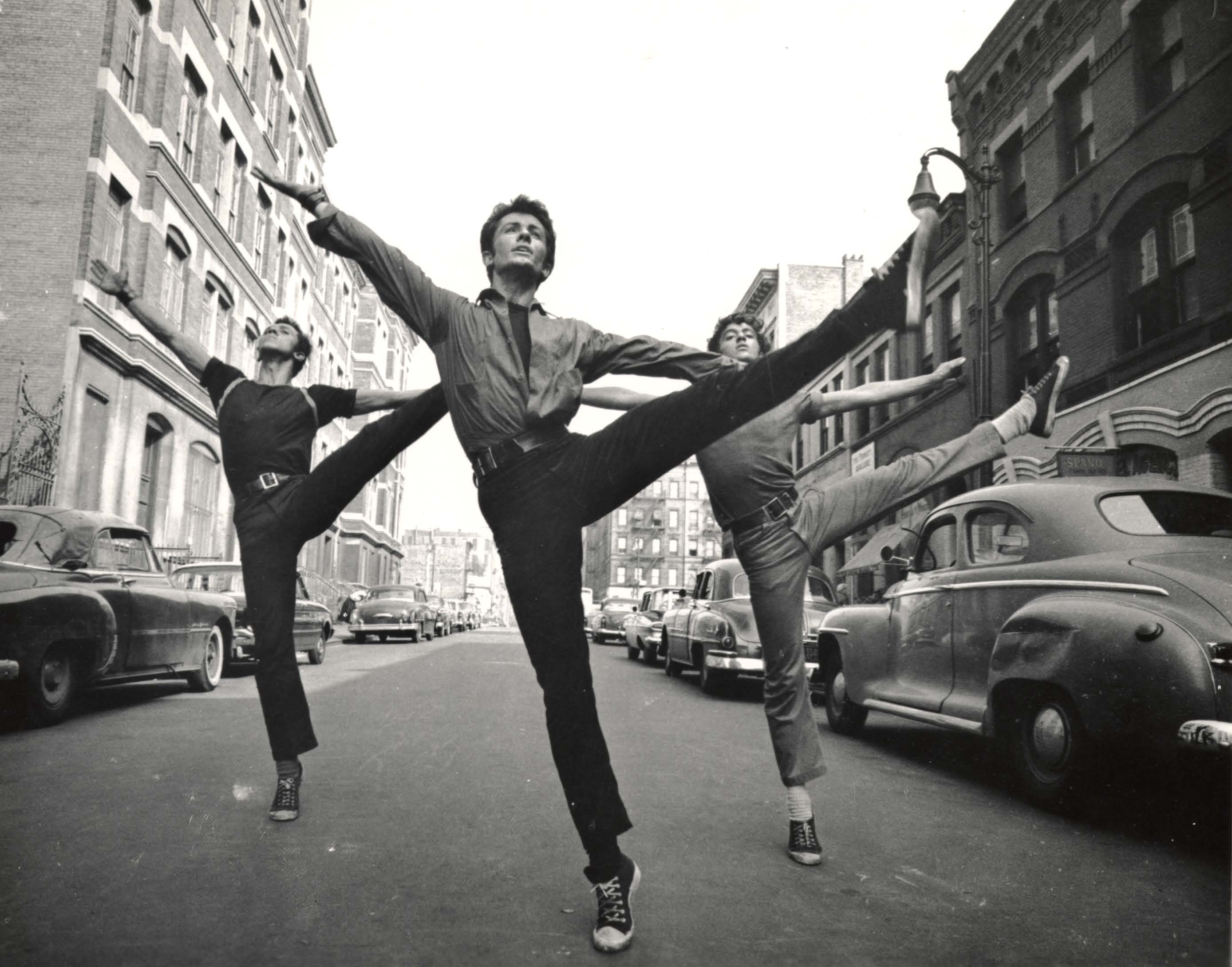
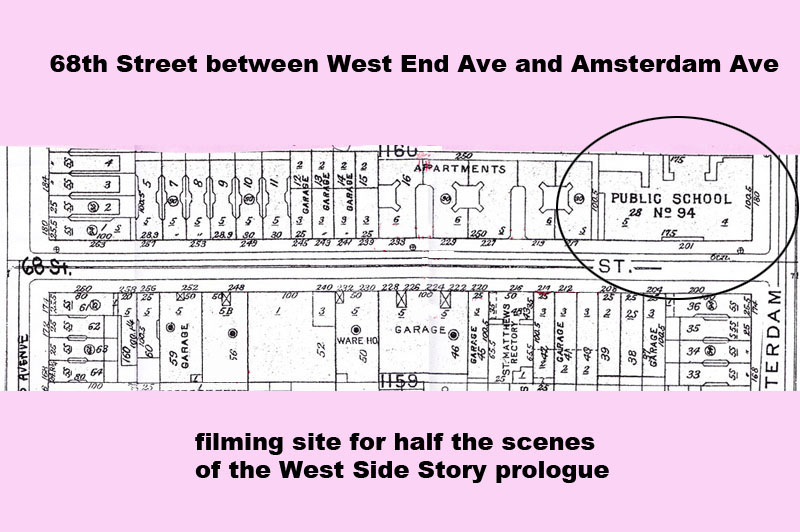
The opening sequence of the Oscar-winning film West Side Story was filmed on the streets of San Juan Hill, the structures around the actors clearly boarded up and ready for demolition.
(The website Tom mentioned on the show — Pop Spots NYC — shows a very detailed comparison of film scenes with maps and old photographs. Highly recommended!)
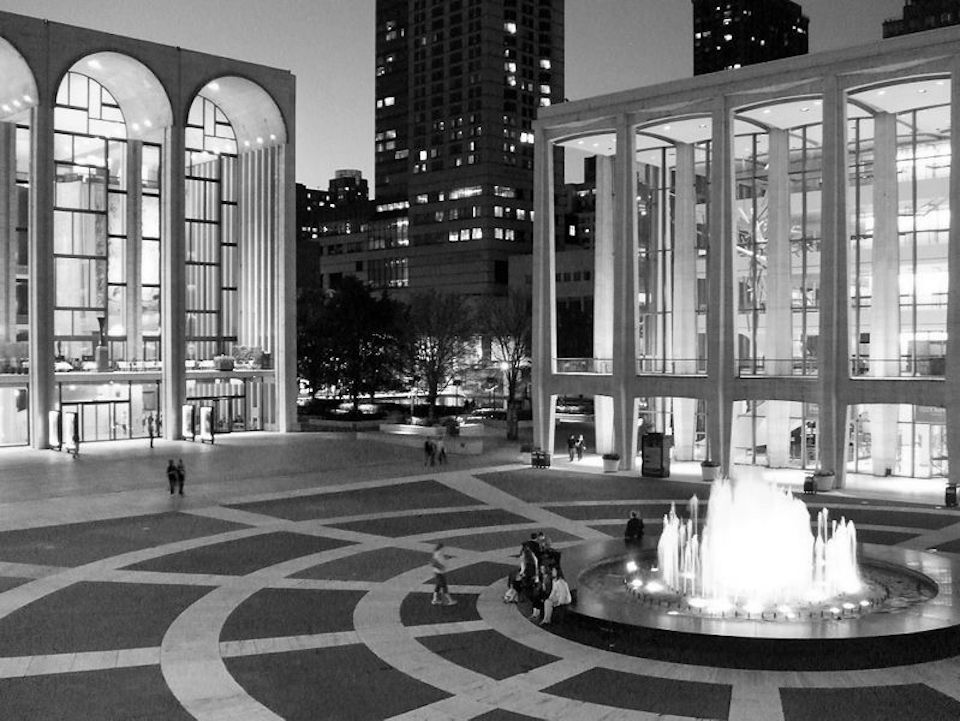
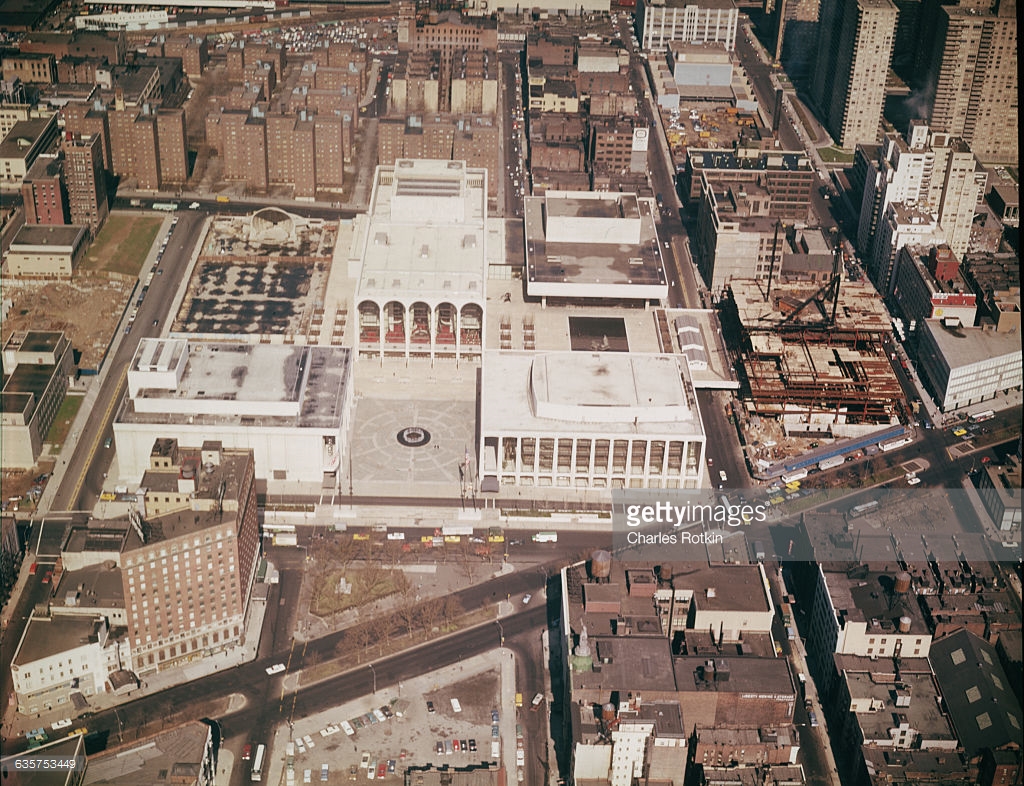
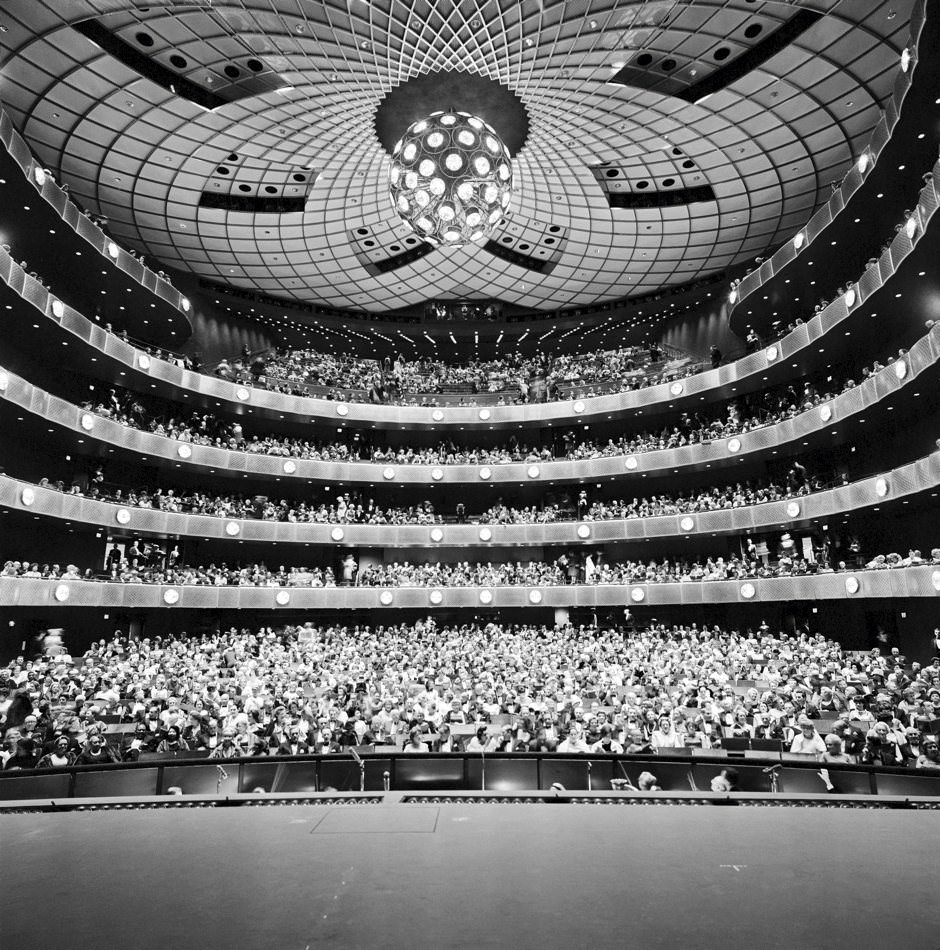
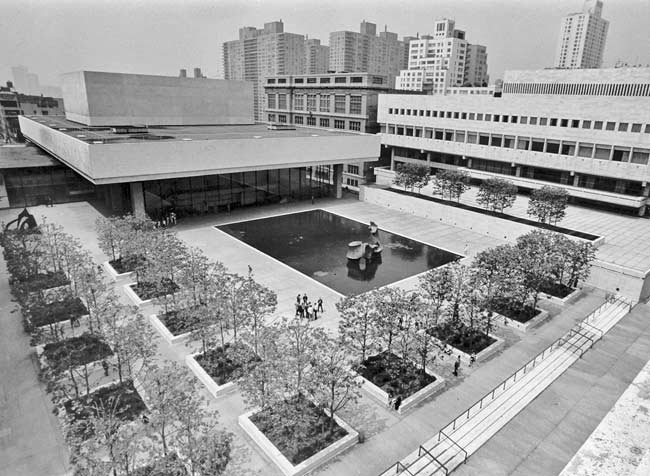
An overhead view of Lincoln Center in 1969 with most of the major venues completed by this point. At the bottom right you see the Empire Hotel, then (moving clockwise around the fountain): the New York State Theater, Damrosch Park, the Metropolitan Opera House, the library and the Vivian Beaumont Theater and Philharmonic Hall.
Getty Images
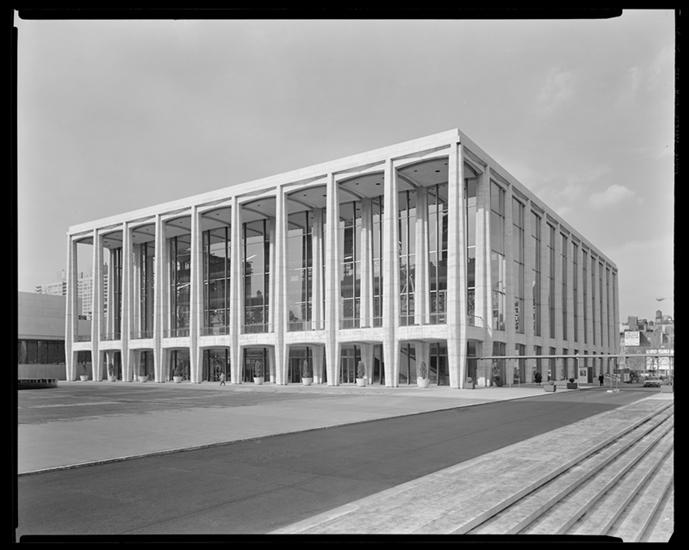
Philharmonic Hall, later Avery Fisher Hall, then David Geffen Hall — designed by Max Abramovitz.
MCNY
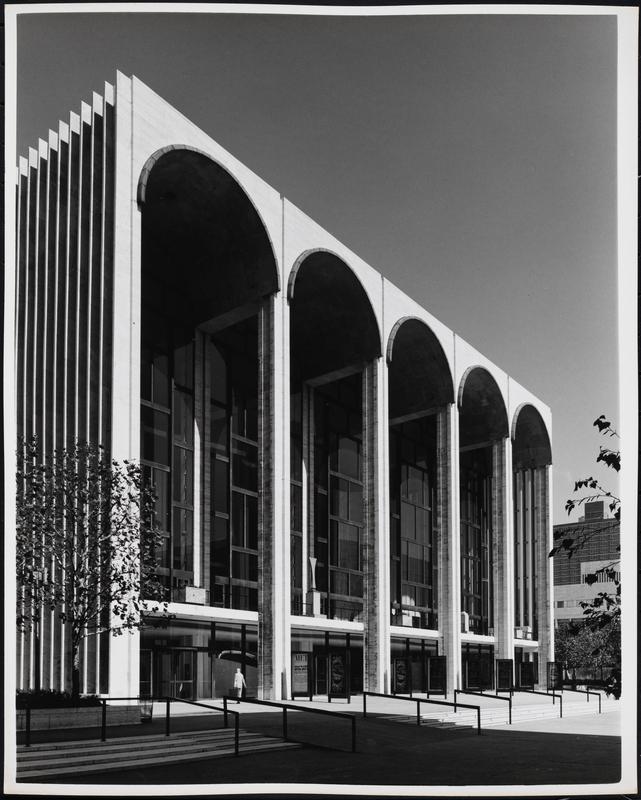
The Metropolitan Opera House, designed by Wallace Harrison.
MCNY/Edmund Vincent Gillon
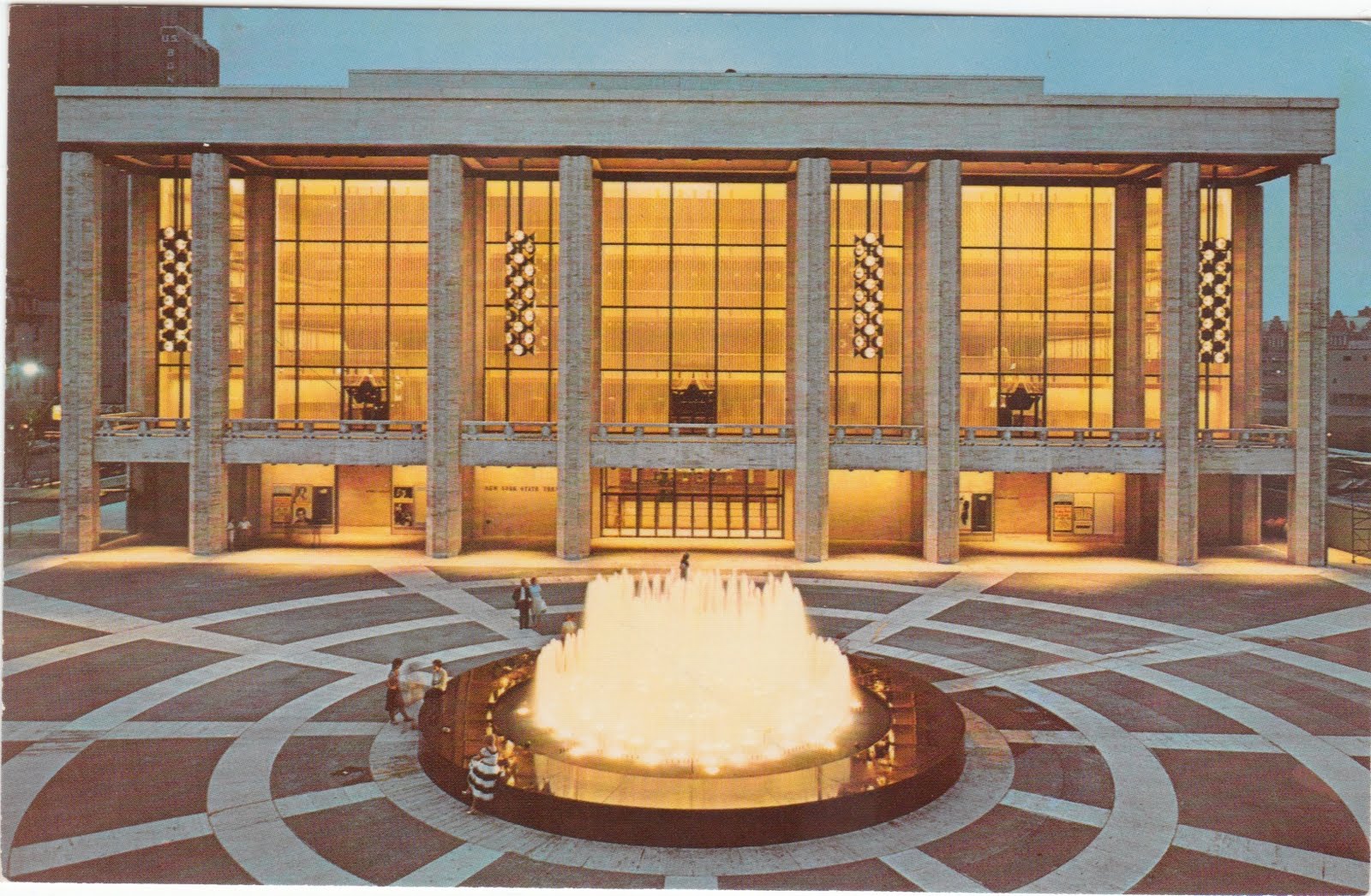
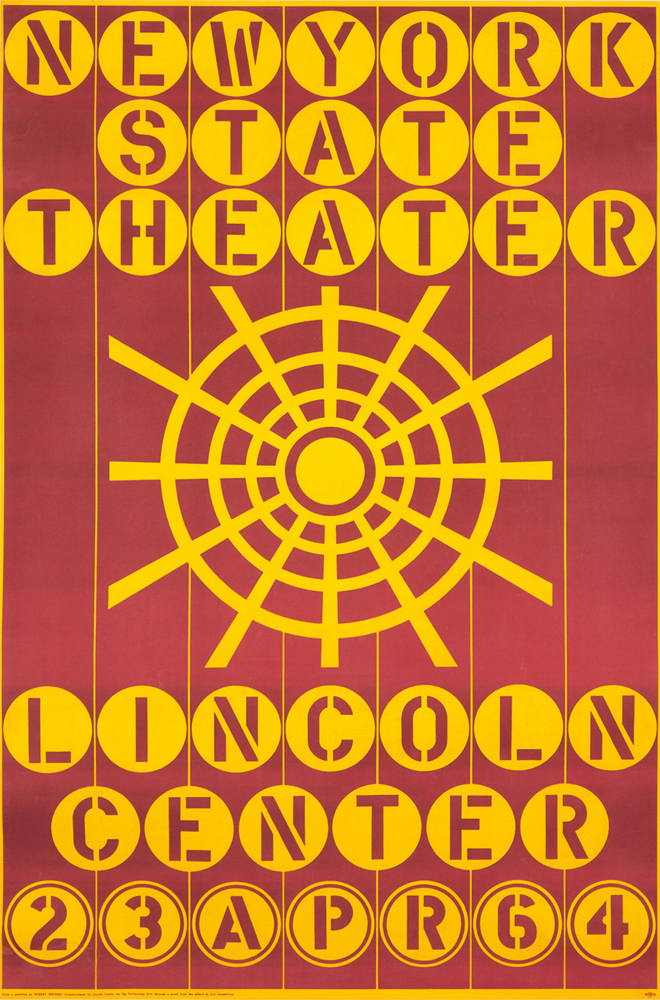
The New York State Theater, later the David H. Koch Theater.
Opening night at the New York State Theater, April 24, 1964
Bettman/Corbis
Eero Saarinen’s Vivian Beaumont Theater, the reflecting pool featuring a sculpture by Henry Moore, and the Julliard School, designed by Pietro Belluschi.
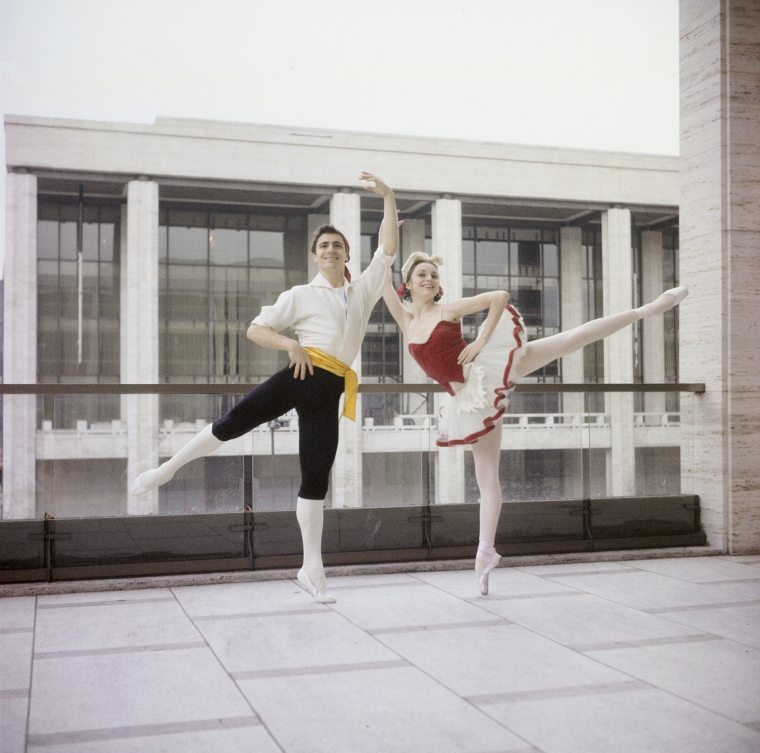
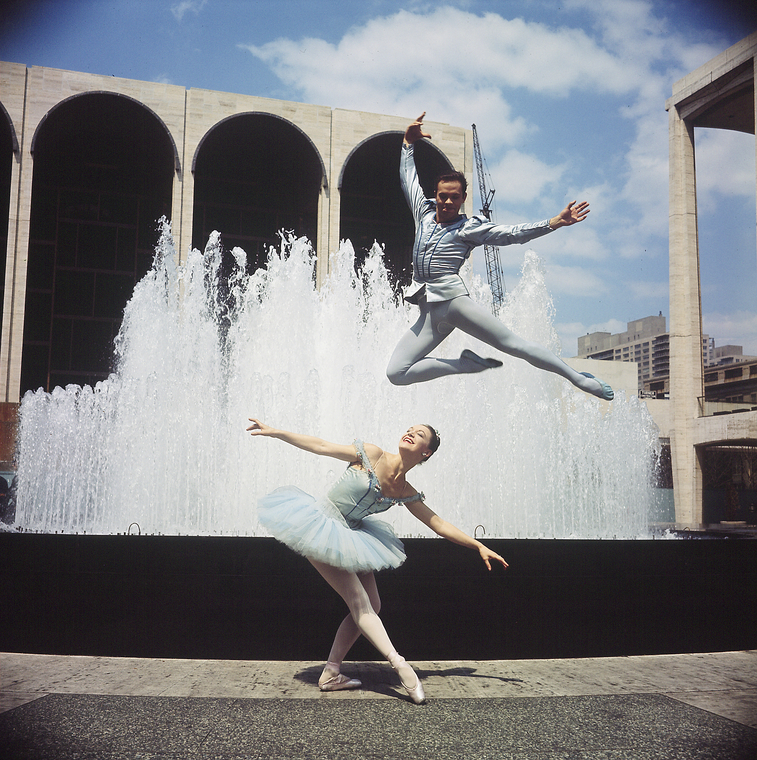
Patricia McBride and Edward Villella in front of the unfinished New York State Theater at Lincoln Center, in Tarantella costume, choreography by George Balanchine, 1964
Patricia Wilde and Andre Prokovsky in Raymonda posing in front of fountain in plaza at Lincoln Center, choreography by George Balanchine, 1965
Courtesy NYPL
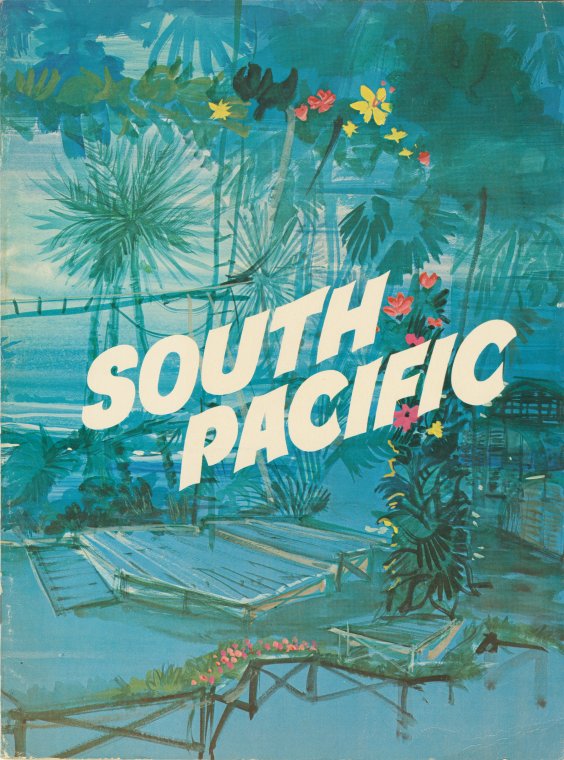
Program from the 1967 revival of South Pacific which played at the New York State Theatre……
NYPL
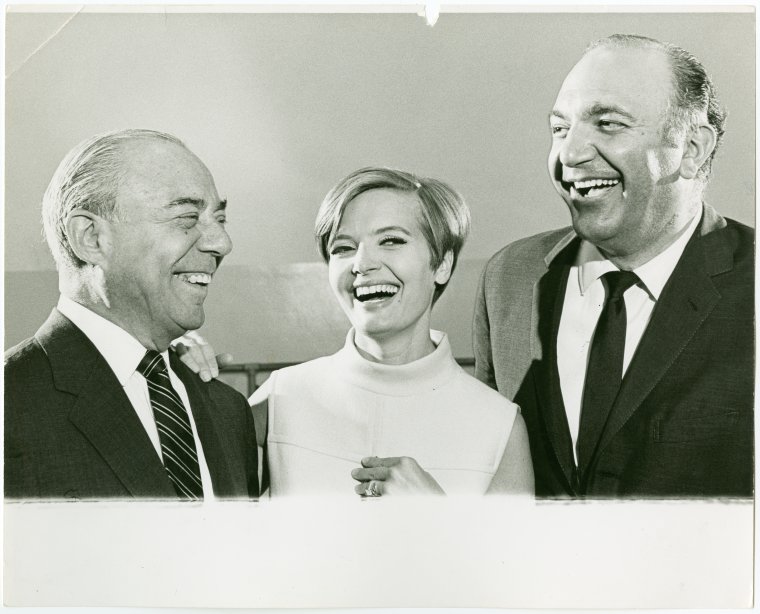
….starring Florence Henderson as Nellie Forbush! Here she is with Richard Rodgers and Georgio Tozzi (who played Emile de Becque).
NYPL
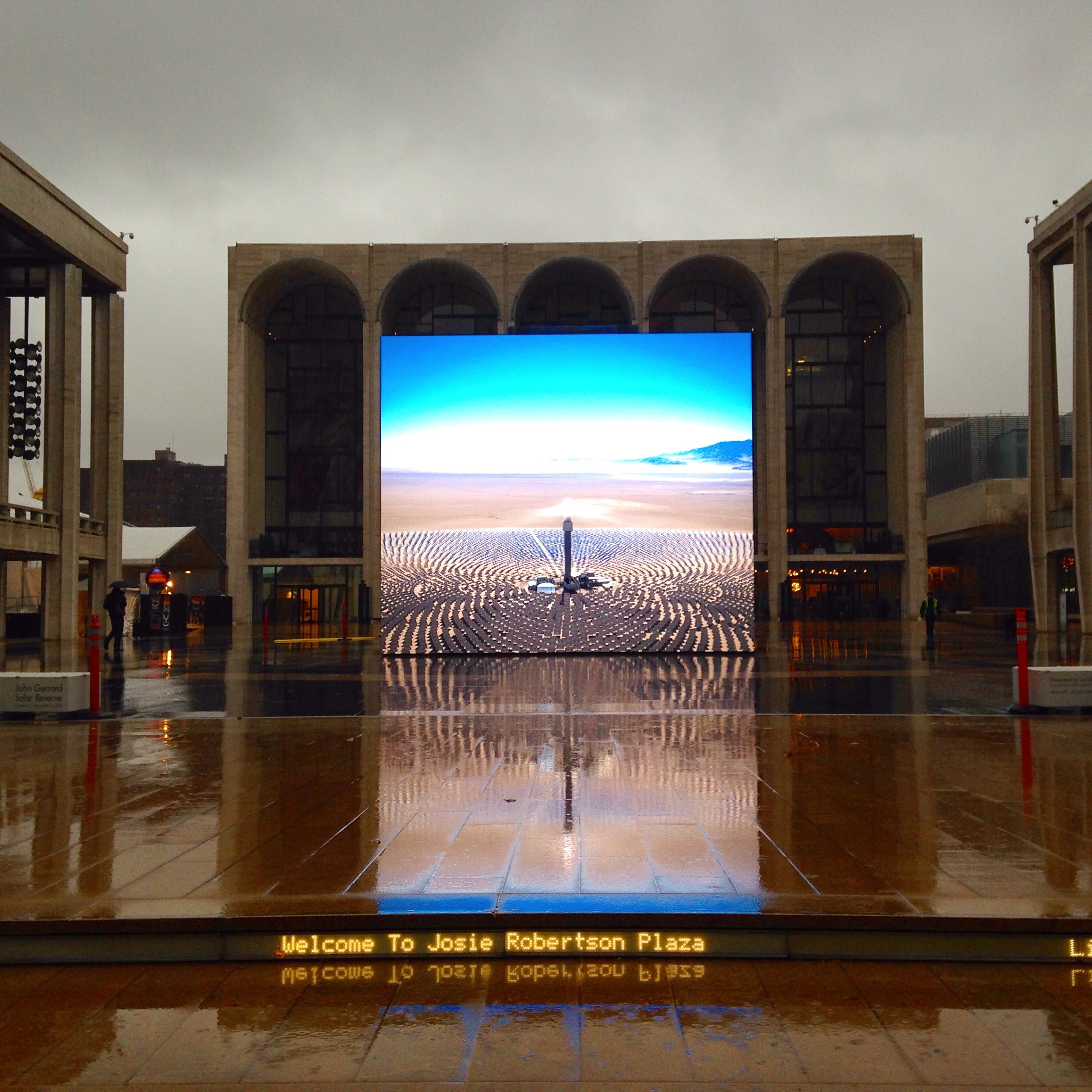
The plaza at Lincoln Center is always a place where surprises greet visitors. Here’s an image from a couple years ago of a video installation which sat in front of the fountain:
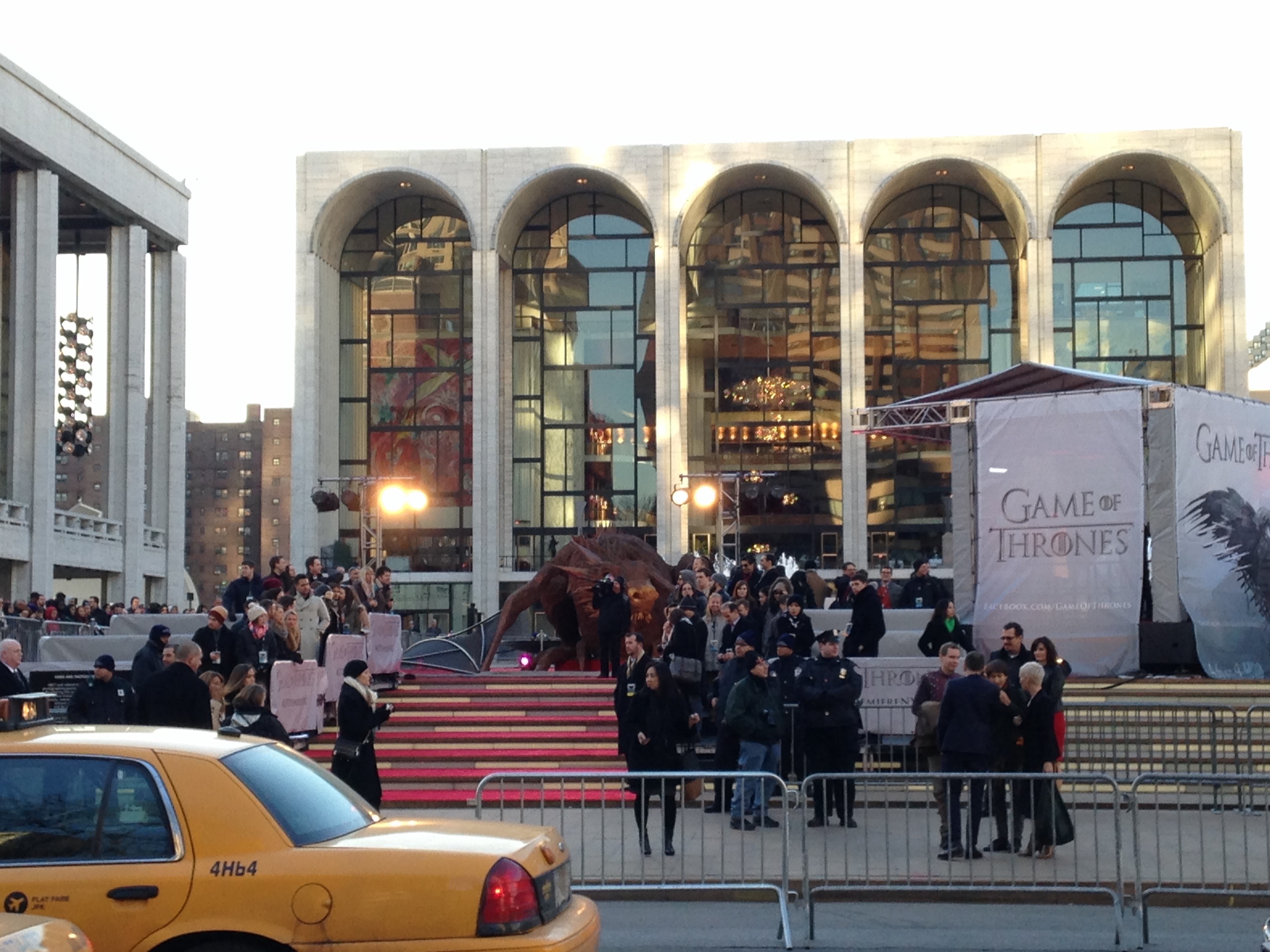
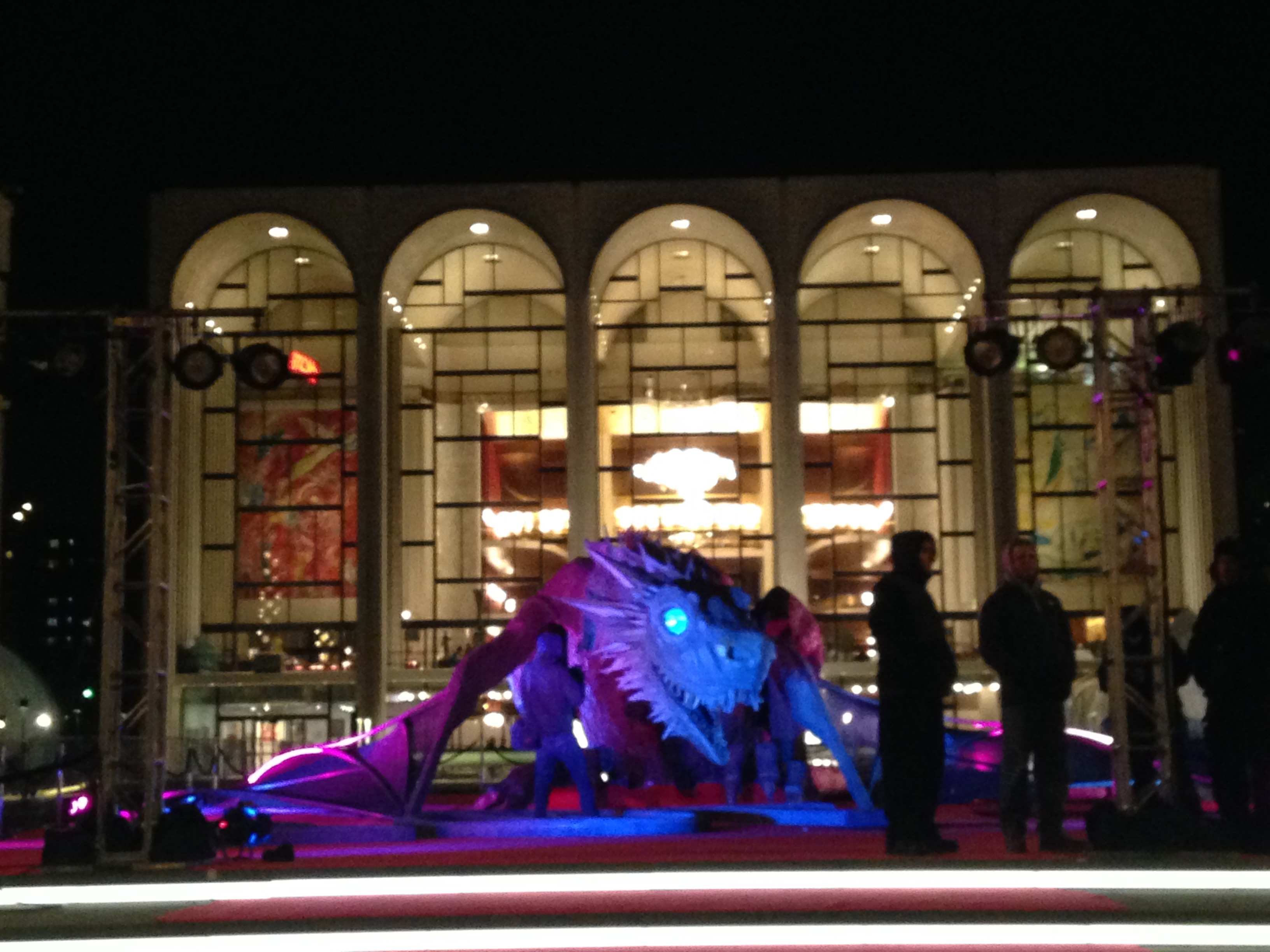
And 2019 when they hosted the premiere of Game of Thrones. With a life-size dragon!
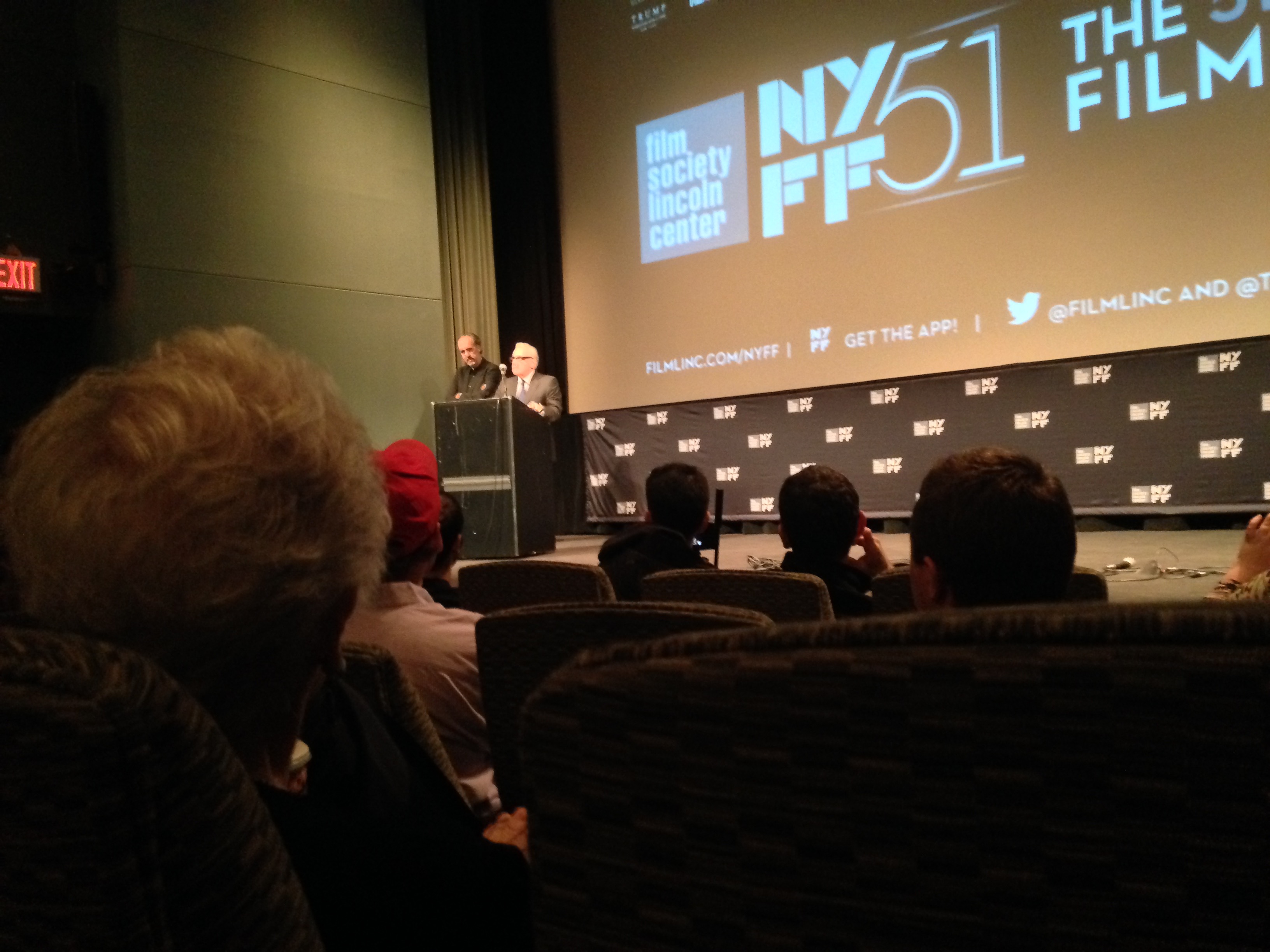
Martin Scorsese! He introduced a screening of his film The Age of Innocence at the New York Film Festival.
FURTHER LISTENING
Back catalog episodes mentioned on show or shows with similar themes that we think you’ll enjoy.
After reading this article on the origins of Christmas in America, find some information about a virtual Christmas in Old New York tour from Bowery Boys Walks.
There are many different ways to celebrate Christmas, a national holiday derived from the union of Christianity and capitalism. How one chooses to mark the occasion is a reflection of one’s own traditions and faith (or lack thereof).
Christmas can be intensely religious for some, not at all for others. It is ever evolving to fit the population’s needs.
However, if none of the present ideas work, then there is the Puritan way: don’t celebrate it at all.
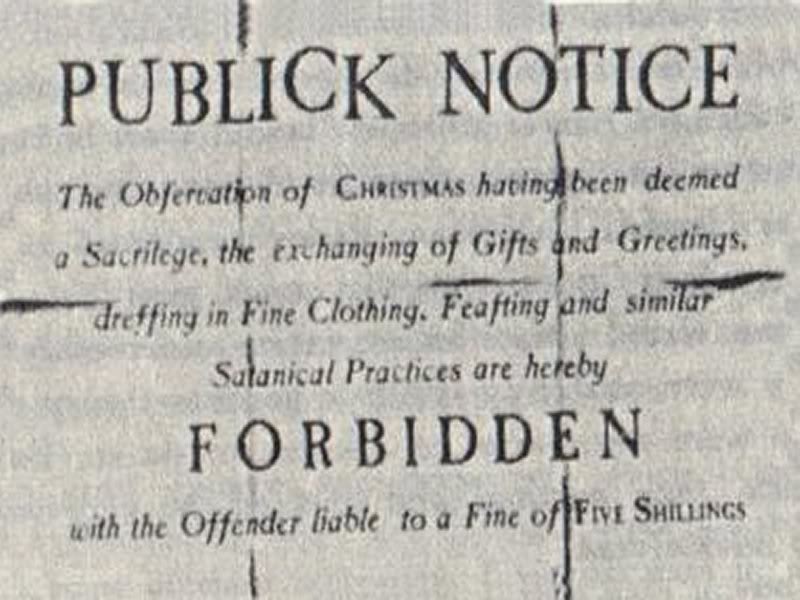
Below: A 1659 notice forbidding the celebration of Christmas in the Puritan-led colonies
There was such opposition to the holiday within the first communities of the New World that it was outright banned among the Puritans of the Massachusetts Bay Colony.
Puritan leaders, ironically enough, took this abolition directly from the Bible; there was no celebration authorized in the book, and since it was doubtful Jesus was actually born on December 25, they considered the day a sinner’s excuse for debauchery.
As Puritans were by nature a homogeneous community, differing traditions were frowned upon, although modest observance of Christ’s birth was occasionally allowed. Generally speaking, December blew through the early English colonies with nary a festivity.
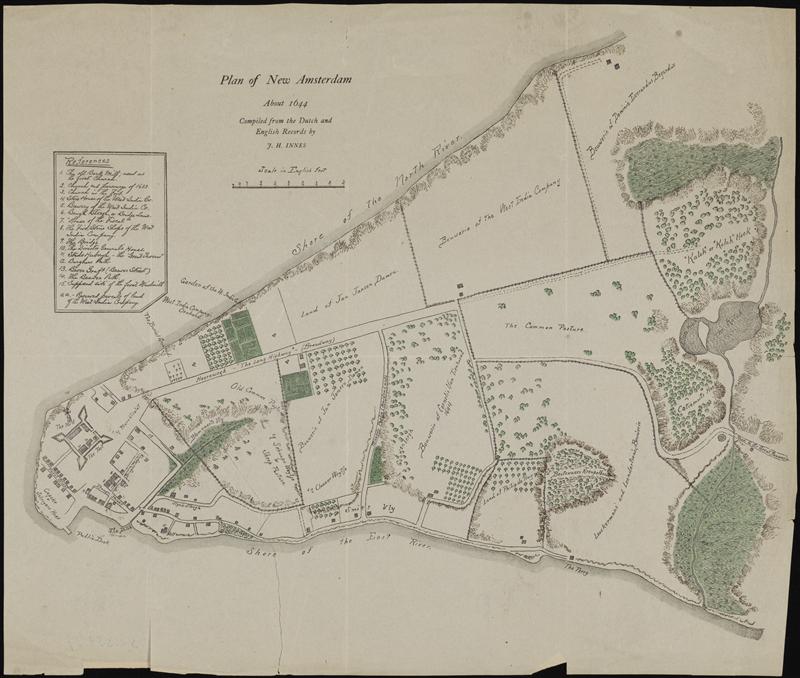
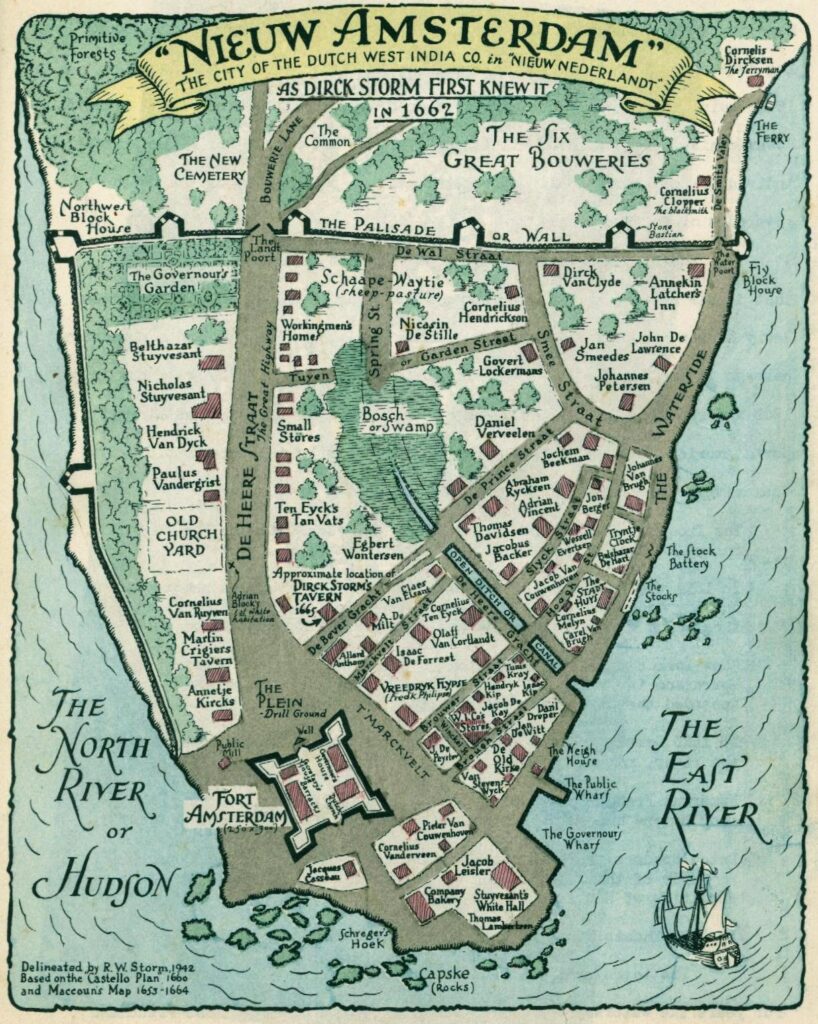
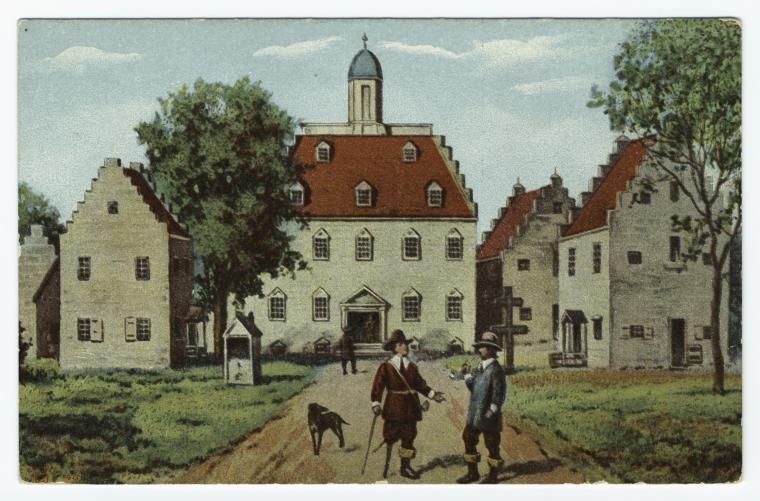
So where did the ingredients of modern Christmas first wash up onto the shores of North America? All signs point to New Amsterdam.
Courtesy Museum of the City of New York
The New Netherland colony of the 17th century was not ruled by such strict restriction of belief.
New Amsterdam, New York’s precursor, was a company town. While laws suppressing the celebration of Christmas were on the books until 1681 up in Massachusetts and other places, down in New Amsterdam, rudimentary holiday traditions were openly, even casually, celebrated.
The settlers of Dutch New Netherland could theoretically celebrate how they wished.
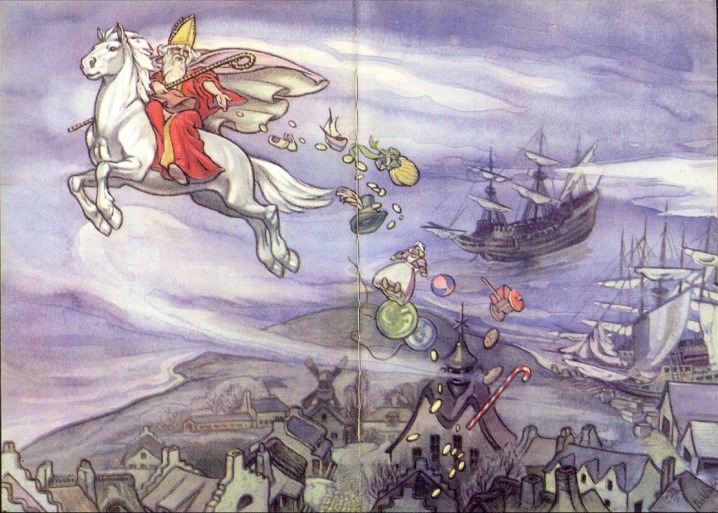
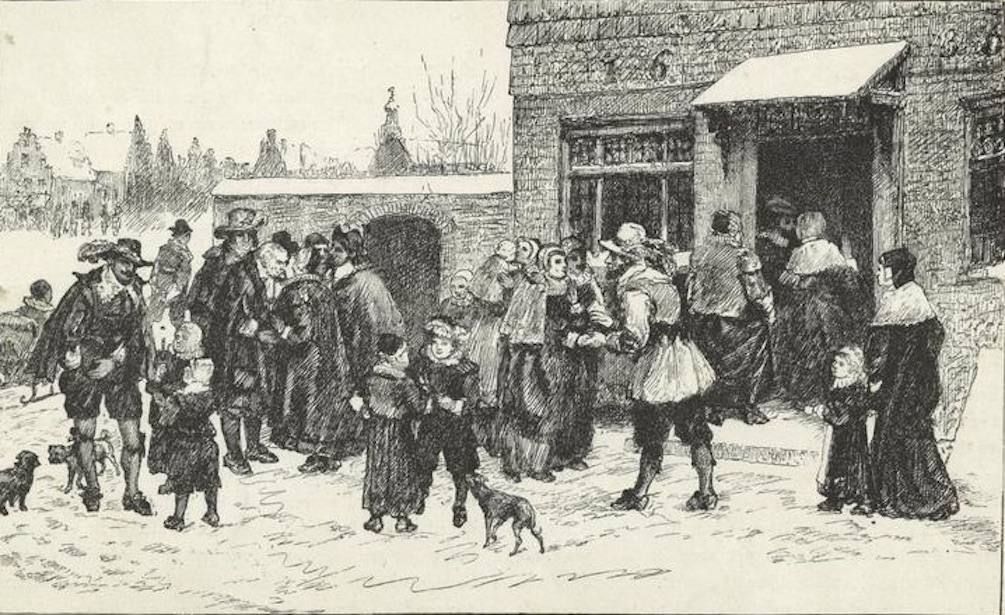
There were certainly observations of Christ’s birth — called Kerstydt — but, it was often overshadowed by a more popular December holiday: Sinterklaas, a Dutch gift-giving tradition where children sat their shoes outside their homes to be filled by a visiting St. Nicolas on December 6th.
(Often, perhaps due to inclement weather, it made sense to have the shoes remain inside, and perhaps better still, to hang stockings near the fireplace.)
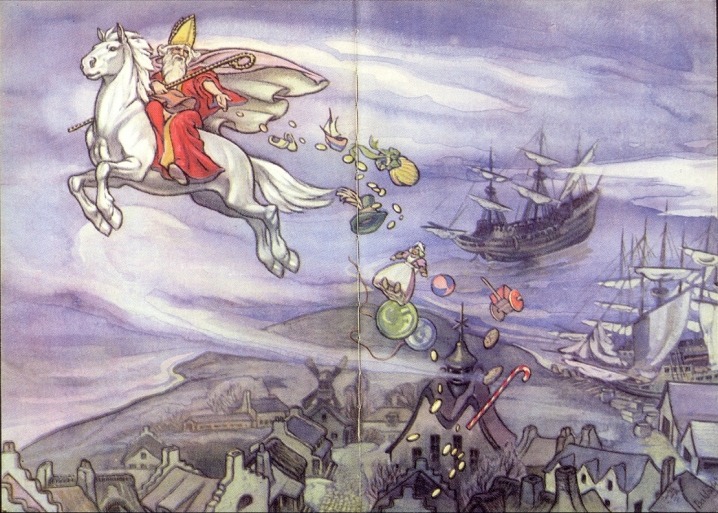
A whimsical illustration of St Nicolas over a Dutch city, very possibly New Amsterdam. Artist unknown.
New Netherland’s population in 1624 was only 270 people, with few if any children. Over the next 40 years, however, dozens of families populated the outpost, passing down family customs and linking their distant home with the mainland.
With Dutch residents eventually outnumbering the others, their traditions became the most prevalent.
Combine that prevalence (with its extra-exciting gift-getting component) with the envy of the other non-Dutch children, and suddenly Sinterklaas becomes a highly anticipated holiday among the entire population of New Amsterdam.
This, despite Peter Stuyvesant‘s disgust at any holiday which promoted moral laxity (also known in some circles as fun).
NYPL
Or as author Russell Shorto describes it: “[A]mong the English, the French, the German, the Swedish families of Manhattan, pressure was brought to bear on parents, and the Dutch tradition was adopted and, later, pushed forward a couple of weeks to align with the more generally observed festival of Christmas.”
According to one source, “On Nieuw Jaar (New Year) and Kerstydt (Christmas) the Governor’s house was ablaze with candles and the young men and maidens danced in the ‘entry’.”
Official business was closed for weeks after, and “the burghers and their families spent much of their time in firing guns, beating drums, dancing, card-playing, playing at bowls or nine-pins and in drinking beer.”
No wonder Peter Stuyvesant hated holidays!
Over time, Christmas and Sinterklaas — one an observance of Jesus’ birth, the other honoring one of his most popular saints — would melt into each other. Even when the Dutch were kicked out of Manhattan in 1664, Sinterklaas was still celebrated in the region, further infused with English Christmas customs.
However, even as the British were expelled from Manhattan, American holiday traditions were still localized, often tied to one’s specific ethnicity and hardly unified.
It would take New York city leaders in the 19th century and the work of New York’s greatest writers to define new holiday symbols for a national audience.
In some Dutch pockets of upstate New York, the tradition of Sinterklaas is still celebrated today.
Want to hear more about the history of Christmas in New York? Take a Bowery Boys Walking Tour andget into the holiday spirit with a merry virtual stroll through The Big Apple!
On the Christmas In Old New York tour, guide Jeff Dobbins unveils the history of how the Big Apple became the center of all things Christmas from Macy’s to Rockefeller Center.
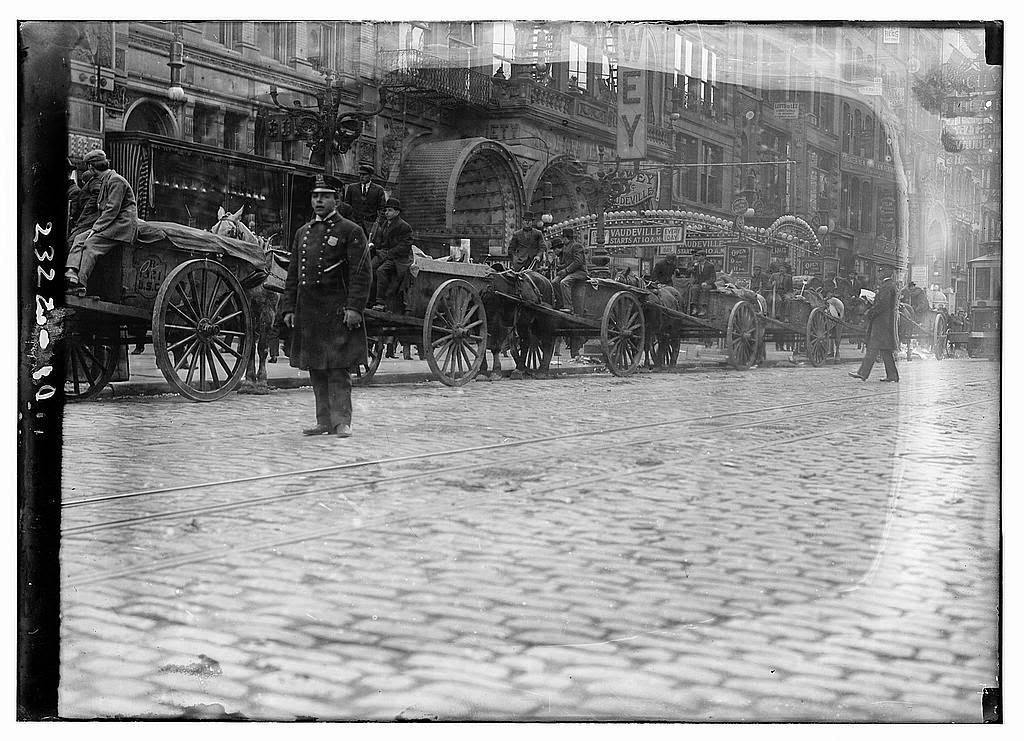
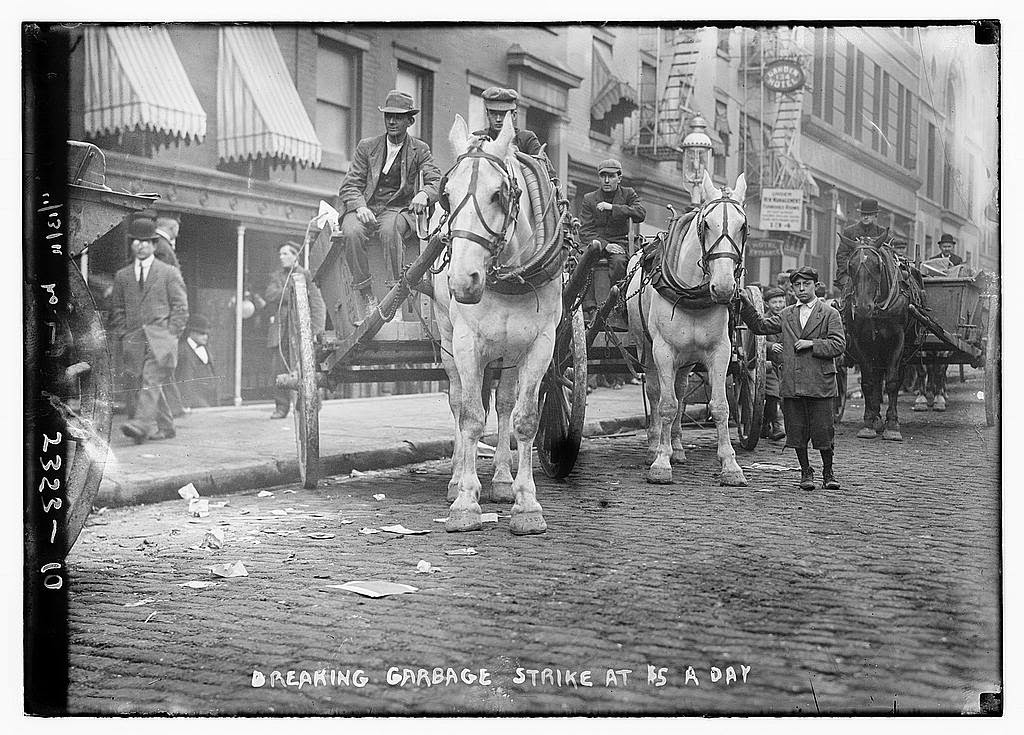
New York street cleaners and garbage workers (sometimes referred to as ‘ashcart men’) went on strike on November 8, 1911, over 2,000 men walking off their jobs in protest over staffing and work conditions.
More importantly, that April, the city relegated garbage pickup to nighttime shifts only, and cleaners often worked solo. This may have been acceptable in warmer weather, but winter was approaching.
At a union rally that evening, a union representative proclaimed, “A 200-pound can was a mighty big load for one man to lift into a garbage wagon ……. [Our] men are already falling ill with pneumonia and rheumatism and … they demanded the right to work in the sunlight and the warmer weather of the daytime.”
In total, almost over 2,000 workers left their jobs in retaliation, “because they didn’t like to work in the dark,” said the New York Sun, derisively. [source]
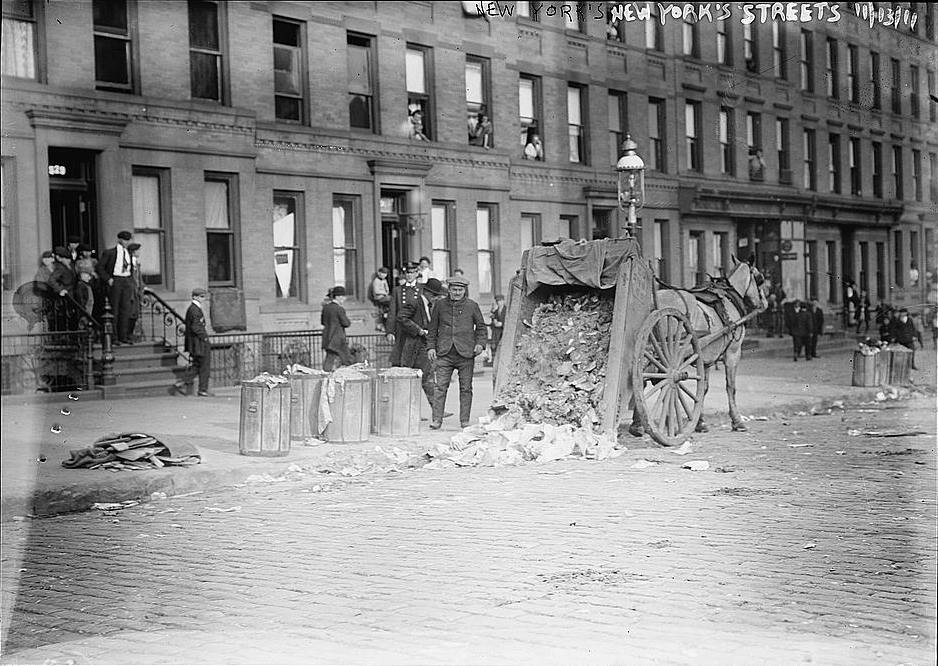
By Nov. 11, garbage was heaped along street corners, and coal ash swirled into the street, creating a blackened, smelly stew along the cobblestones.
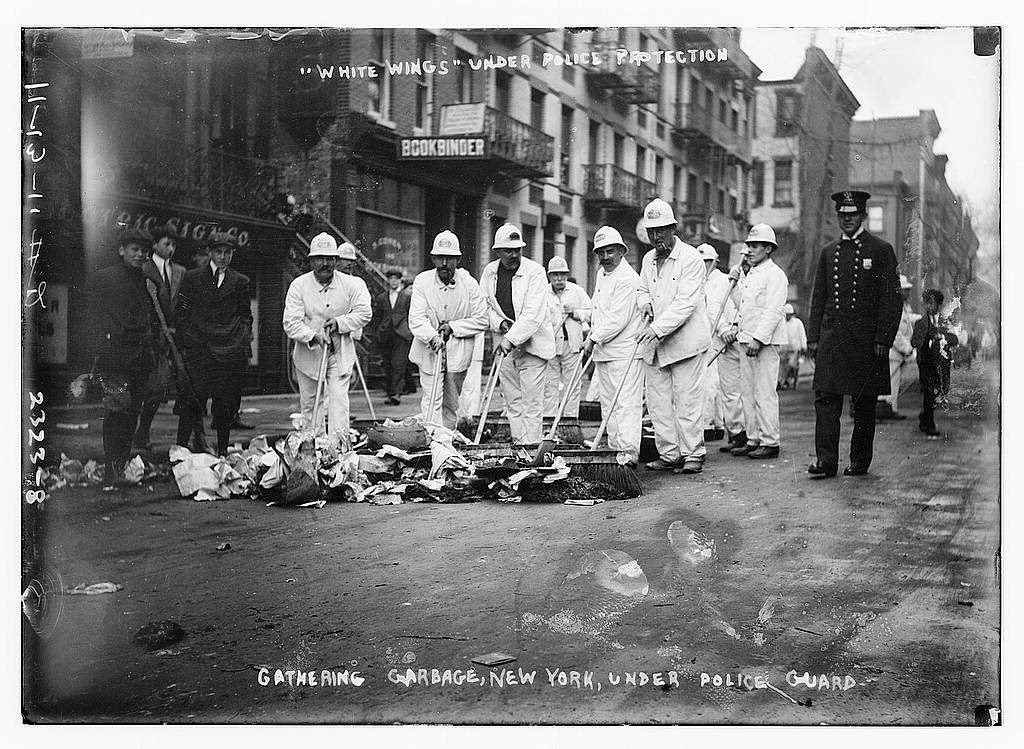
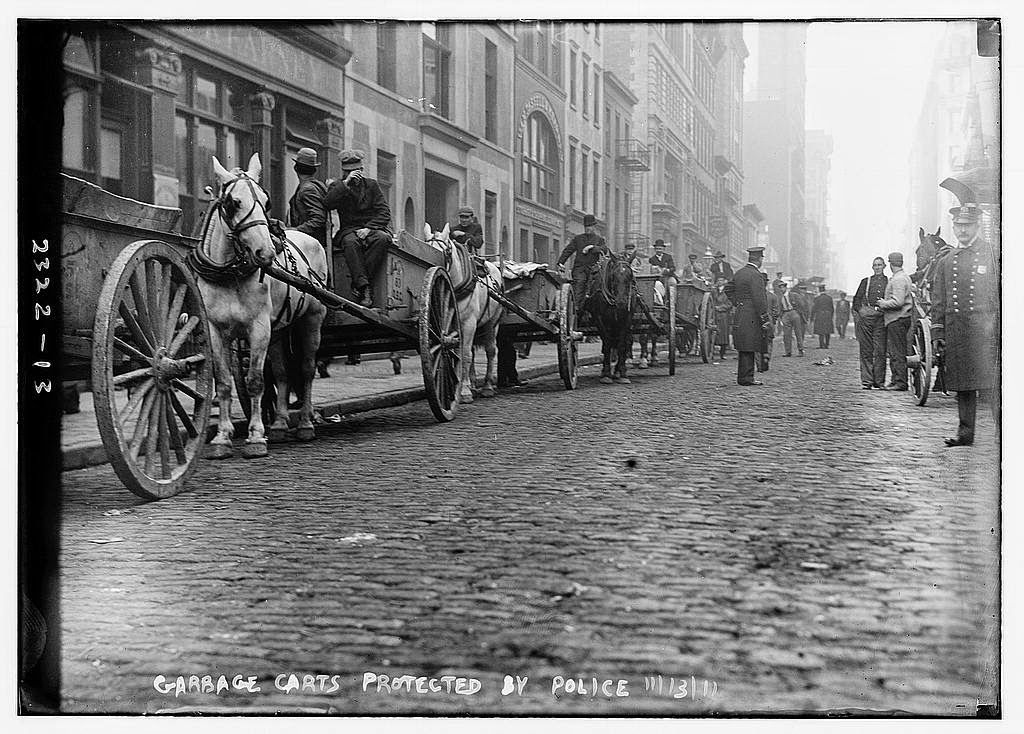
The city brought in temporary workers to carry off the more egregious piles of filth away, but harangues and violence by union protesters –“mobs assaulting and stoning drivers” — required they be protected by police.
New Yorkers had lived through such a strike before, as recently as 1907, but strikers found little public support this time around.
Newspapers, little sympathetic to the strikers, highlighted the growing threat of disease and the perceived selfishness of the workers.
“The right to strike of public employees, who enjoy the advantage of being listed in the civil service, is more than doubtful,” said the New York Times.
During bouts between strikebreakers and police, over two dozen people were injured and one man was even killed by a falling chimney.
Meanwhile, Mayor William Jay Gaynor was resolute in rejecting the cleaners demands. The efforts of the workers failed, and many went back to their jobs the next week, some heavily penalized for their participation in the strike.
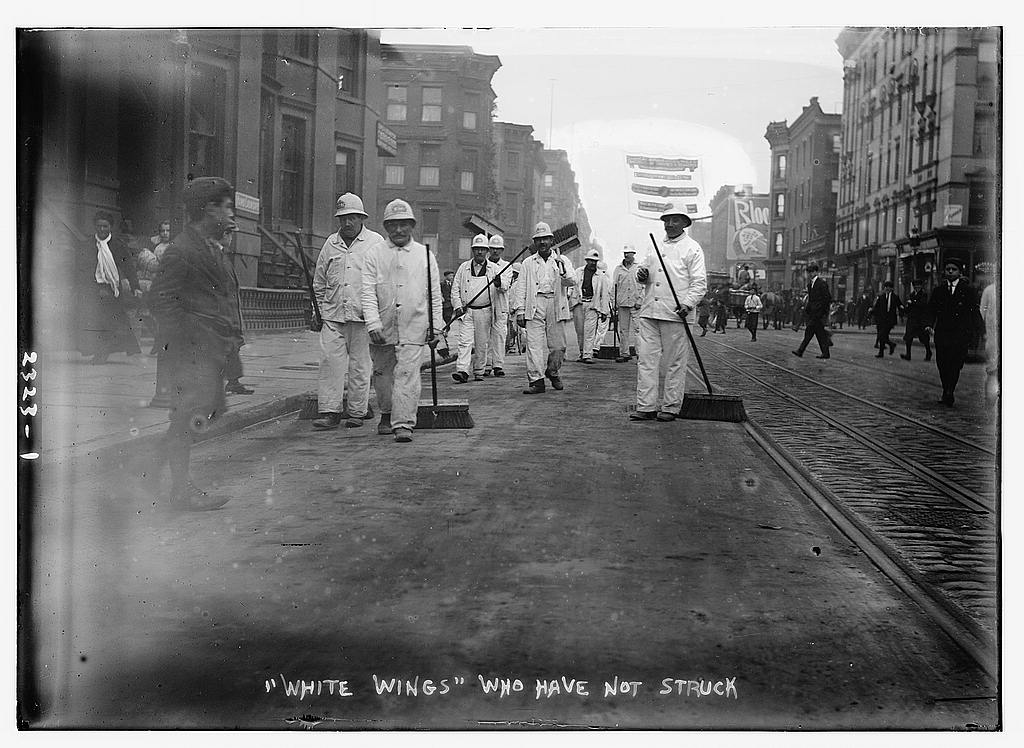
Here are a few images from those foul-smelling days. These photographs are far more pleasant to look at than they must have been to shoot:
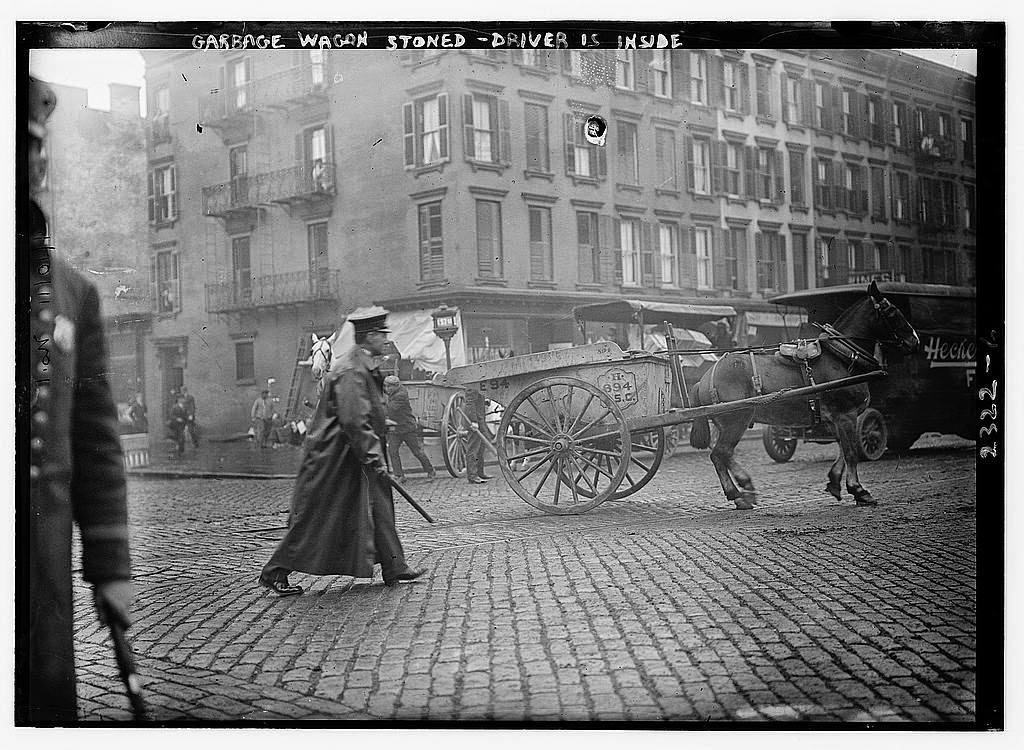
Horse-drawn garbage wagons collect trash during the four-day garbage strike.
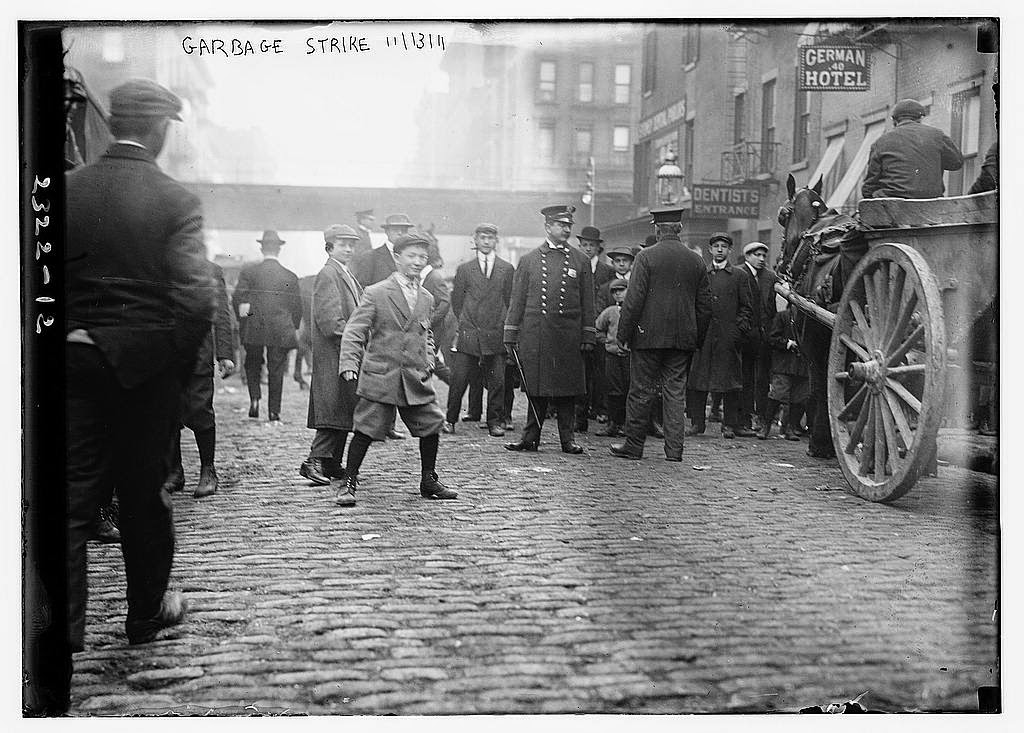
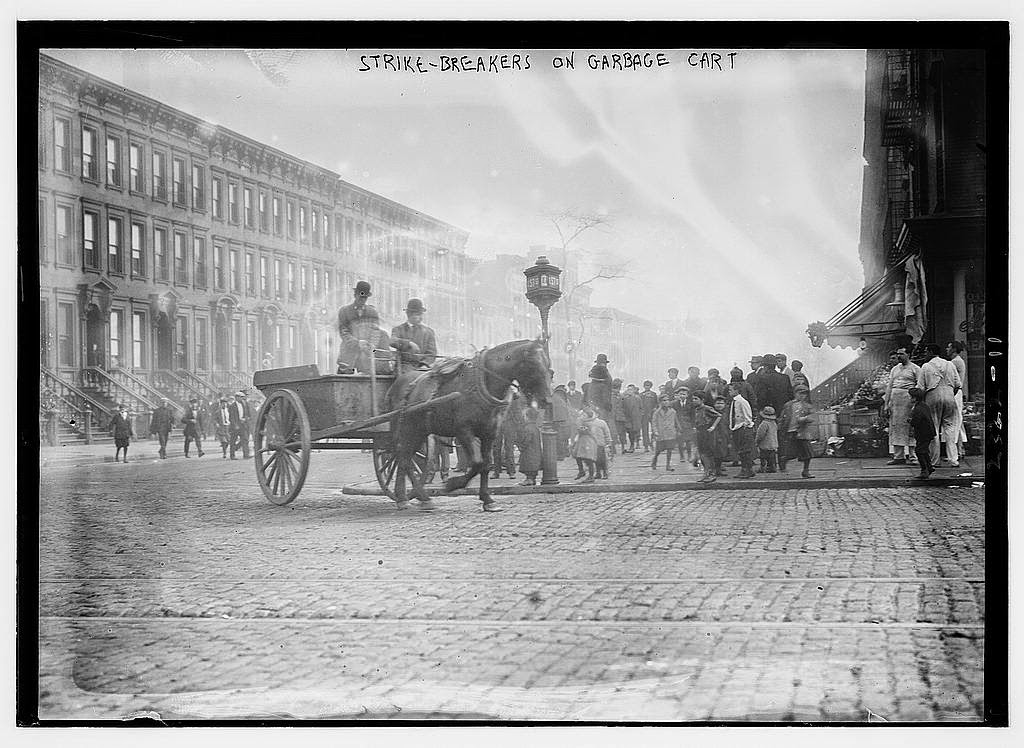
Police protection those who broke from the strikers to clean the city streets.
The city shipped in workers from out of town to sweep the streets during the strike
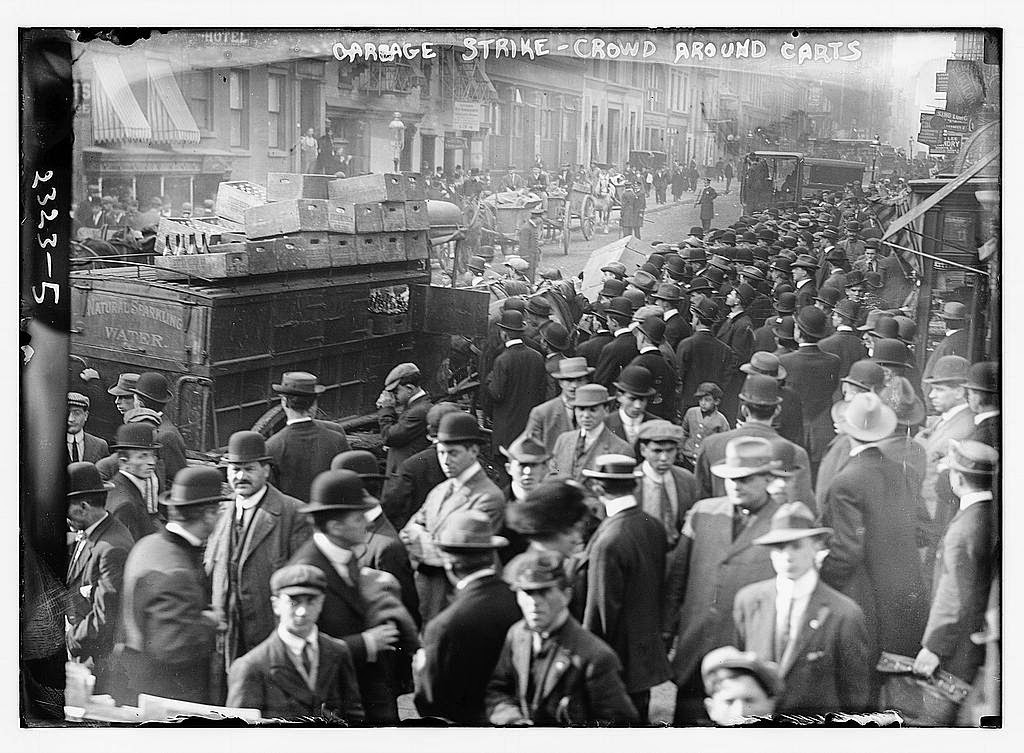
Crowds form in the streets watching the garbage carts go by. I don’t know whether these are strikers or just curiosity seekers
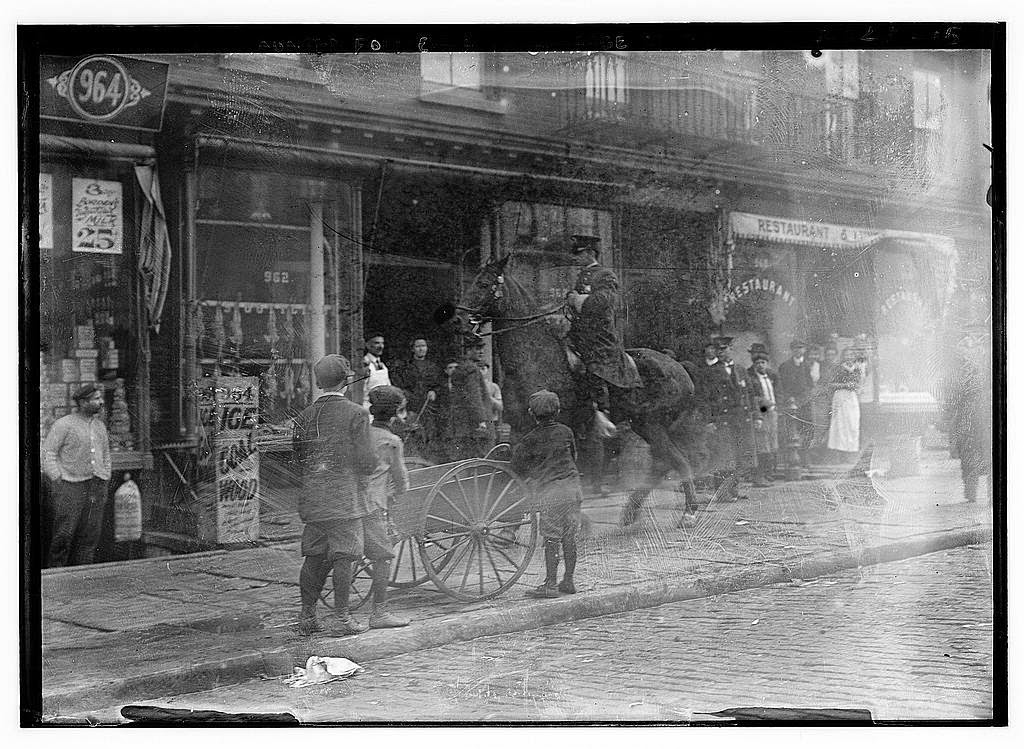
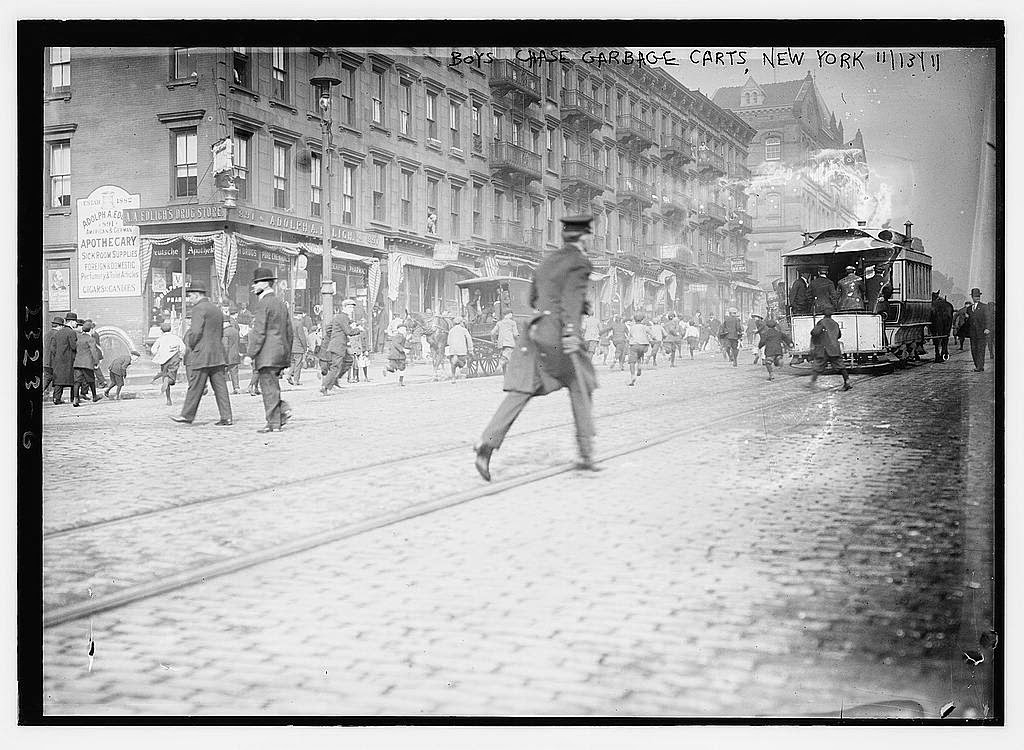
Boys captivated by the mounted police guarding the garbage carts. In the second photograph, a couple rowdy boys are actually chasing after a garbage cart.
This vehicle is pelted with stones at the corner of East 57th Street.
Another set of strike breakers rush by this street corner in their garbage cart.
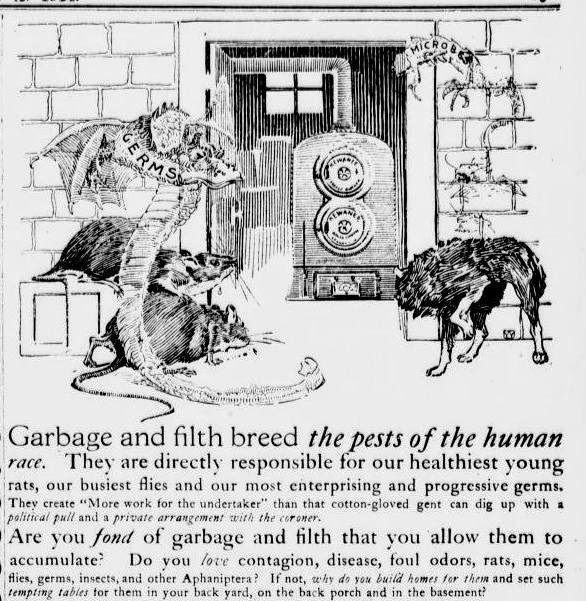
Meanwhile, a boiler company took advantage of the strike to run this grim advertisement for their garbage burners in the New York Sun.
This photo series courtesy the Library of Congress.
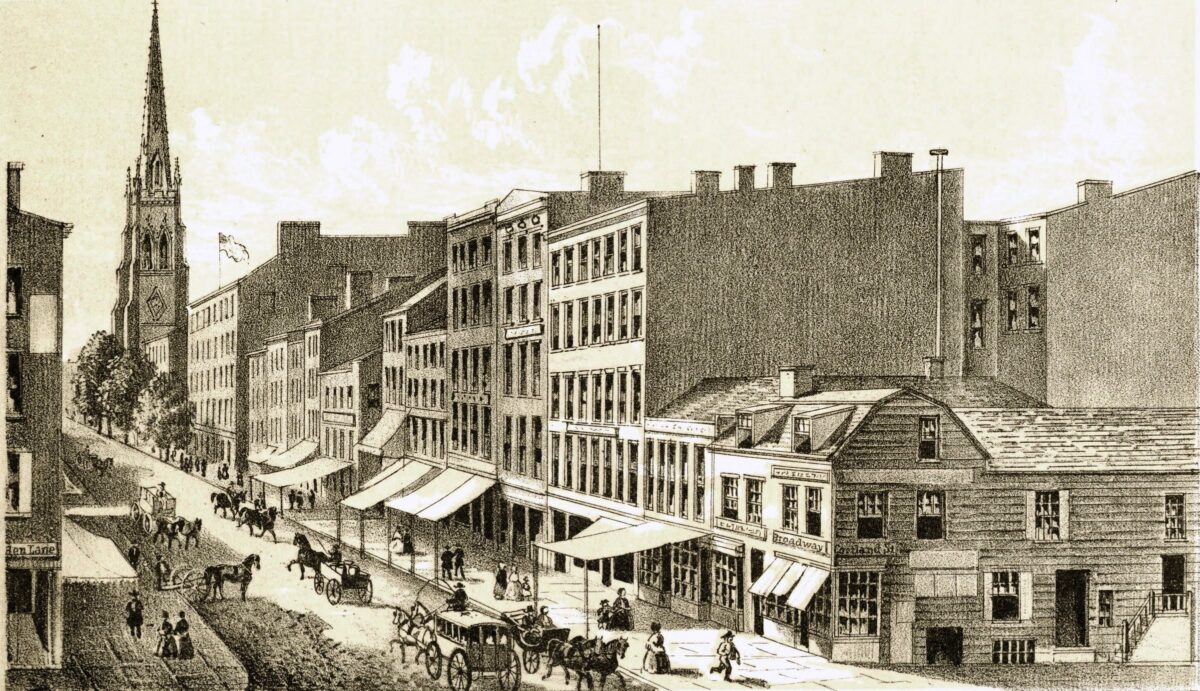
View of Broadway, 1834. Printmakers include P. Canot, G.R. Hall, H.B. Hall, George Hayward and W.S. Leney.
We’re getting a new mayor! So we think it is time that you Know Your Mayors. Become familiar with other men who’ve held the job, from the ultra-powerful to the political puppets, the most effective to the most useless leaders in New York City history.
This longtime feature of this website is being rebooted with new articles and newly researched and refreshed earlier entries in this series. Check back every other week for a new installment. Read past articles here.
Cornelius Van Wyck Lawrence Term: 1834-1837 (three terms)
When did New Yorkers first start electing mayors — directly? When did voters first go to the polls and select the new mayor themselves? The year was 1834 — and, oh boy, did it not go smoothly.
In the first few decades following the Revolutionary War, mayors were chosen by the governor and a state-side appointment committee. Then, from 1821 to 1834, the position was appointed by vote of the Common Council, an elected body equivalent today’s City Council.
The Council often chose prominent businessmen with high profiles — such as the sail-maker Stephen Allen or the well-connected attorney William Paulding.
Courtesy New York Public Library
But the city charter was amended in 1833 to allow the position of mayor — a lucrative post with rising visibility in a growing city — be directly chosen by New Yorkers.
Or rather, directly chosen by those who comprised the voting body — white male New Yorkers. (Black men could vote if they owned property; but as slavery in New York was only abolished in 1827, few men actually did, save for those in places like Seneca Village.)
But democracy in its purest form relies on a certain degree of faith. The direct election process — the collection and counting of ballots, the integrity of an honest count — has the potential to be quite chaotic.
And no election in New York City has been as chaotic — or as bloody — as that very first mayoral election in 1834.
Broadway and Canal Street, 1834. Courtesy Wikimedia Commons
In 1834, New Yorkers were thrilled with the real possibility of a city leader not beholden to the whims of its Council, a membership whose intentions were often deployed straight from the meetings of political machines and did not reflect the will of the people.
But local politics can become overshadowed by national concerns. As a result, direct election for the office may fail to correct this sort of favoritism. In fact, if the conditions are right, the will of the people can be bent to adhere to the most elitist of principles, using the sometimes benign instrument of populism.
Such was the case of the man who would become New York’s first democratically elected mayor in 1834 — Cornelius Van Wyck Lawrence.
Painting of Lawrence by Henry Inman, 1837
Lawrence, a wealthy New York merchant, was born in 1791 in Flushing, Queens County, a member of the old Dutch Van Wycks. (His ancestor Cornelius Van Wyck built the historic Van Wyck Homestead in Fishkill, New York.)
In 1833, he became a Democratic state congressman known for believing one thing, and voting another, especially if it benefited himself financially. He was known to cry at the podium as he voted with his party.
From a biography on Martin Van Buren: “[Lawrence], the crying congressman, the weeping stock-jobber could have resigned had he disliked the party drill — but it brought him plunder, and he blubbered and held on, and afterwards he lent his name as a candidate for the mayoralty to uphold the gamblers he voted with in public…”
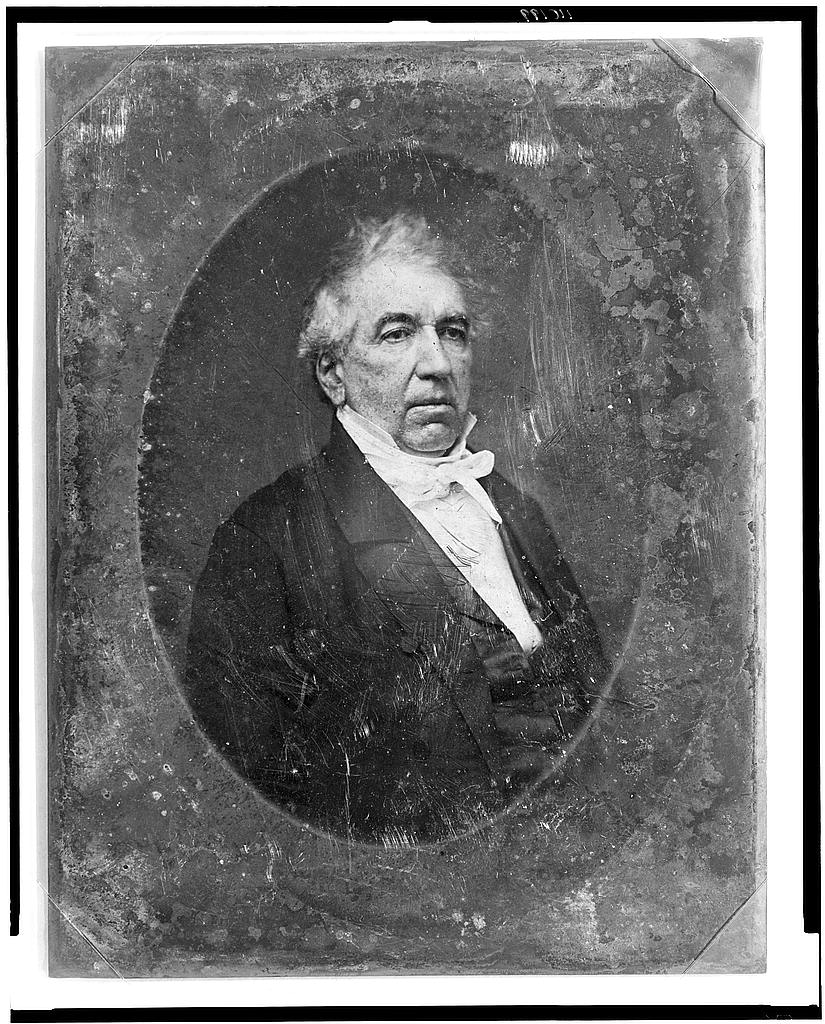
Lawrence was one of the first mayors to be photographed, sitting for Mathew Brady in 1852. Courtesy the Library of Congress
Yet the election was much larger than one man — it was about power at a time when New York was on the cutting edge of great expansion.
In fact the Whig Party was primarily formed in protest to Jackson’s policies. And they would make quite a first impression on their very first election ballot in New York.
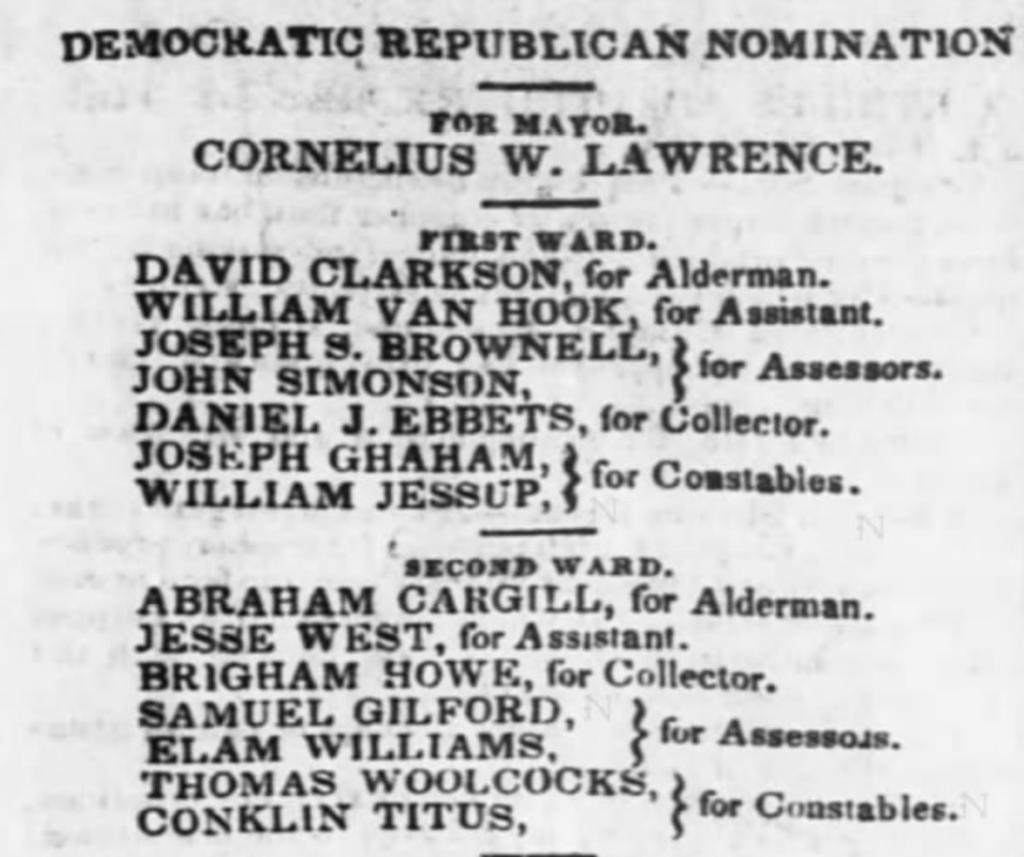
April 9, 1834, New York Evening Post
A proud New York tradition returned with that first election — rioting. The first electoral process lasted three days, as Democrats and Whigs attacked each other on the street in front of polling places.
On April 8, 1834, men fought with knives and clubs, destroying ballots and virtually shutting down the entire process. One man was killed, twenty others wounded.
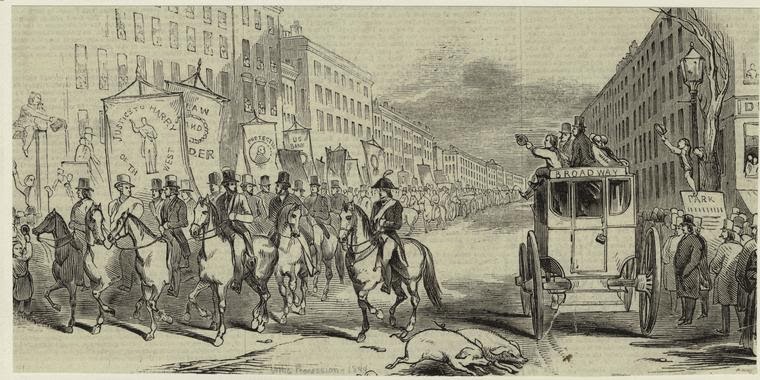
The Whigs were almost war-like in their determination to wrest power from Democrats, actually decorating a frigate with Whig banners, calling it the Constitution, and dragging it up Broadway in a violent and vitriolic parade.
A Whig procession from the. year 1844. Courtesy New York Public Library
Democrats were no better; the following day, acolytes headed down to Wall Street to destroy a pro-Whig newspaper office, its publisher armed and ready to shoot.
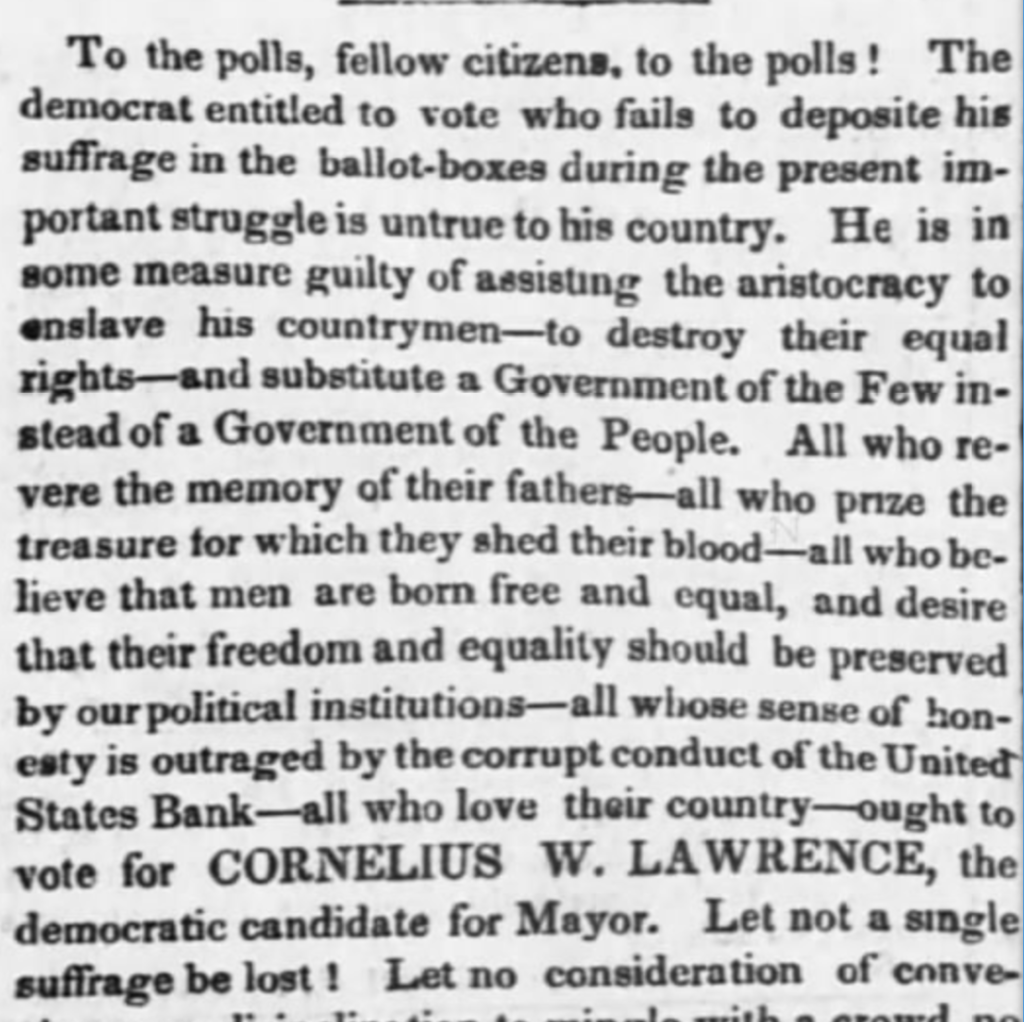
An entreaty to vote for Lawrence, published in the New York Evening Post, April 9, 1834
By April 10, the final day of voting, thousands filled the streets, ransacking gun shops and arsenals, preparing for all-out chaos.
“With Armageddon in the office, the mayor called out all troops — twelve hundred infantry and calvarymen — and order was restored,” according to Edwin G Burrows and Mike Wallace. But even that resolution was one-sided; most of the infantry was faithful to PresidentJackson— and by extension, Lawrence, the Democratic candidate.
With thousands gathered outside City Hall, the election results were announced — Lawrence had defeated the Whig candidate Guilian Verplanck by less than 200 votes!
New Yorkers had at last exercised their direct right to vote for mayor. And in the end — after days of riots and tumult, an election process singular in its chaos — New Yorkers voted in “the crying congressman.”
The Statue of Liberty celebrates her 135th birthday today. Technically, I suppose, it’s the anniversary of her dedication, a star-studded, pomp-laden ceremony that took place on Friday, October 28, 1886.
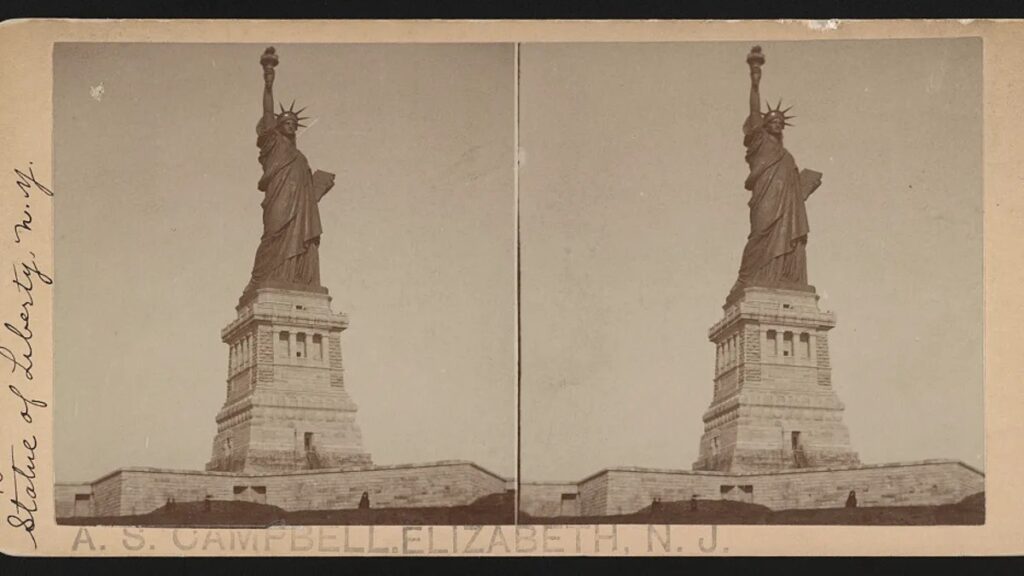
But for many months previous, she was a fierce presence in the harbor, as the copper monument was arduously stitched together from far flung pieces — including an arm which sat in Madison Square Park for many years — upon a contentious new pedestal by Richard Morris Hunt.
The dedication ceremony was not the sterling event of pure American patriotism that one might expect. The reality of her debut proved far more interesting:
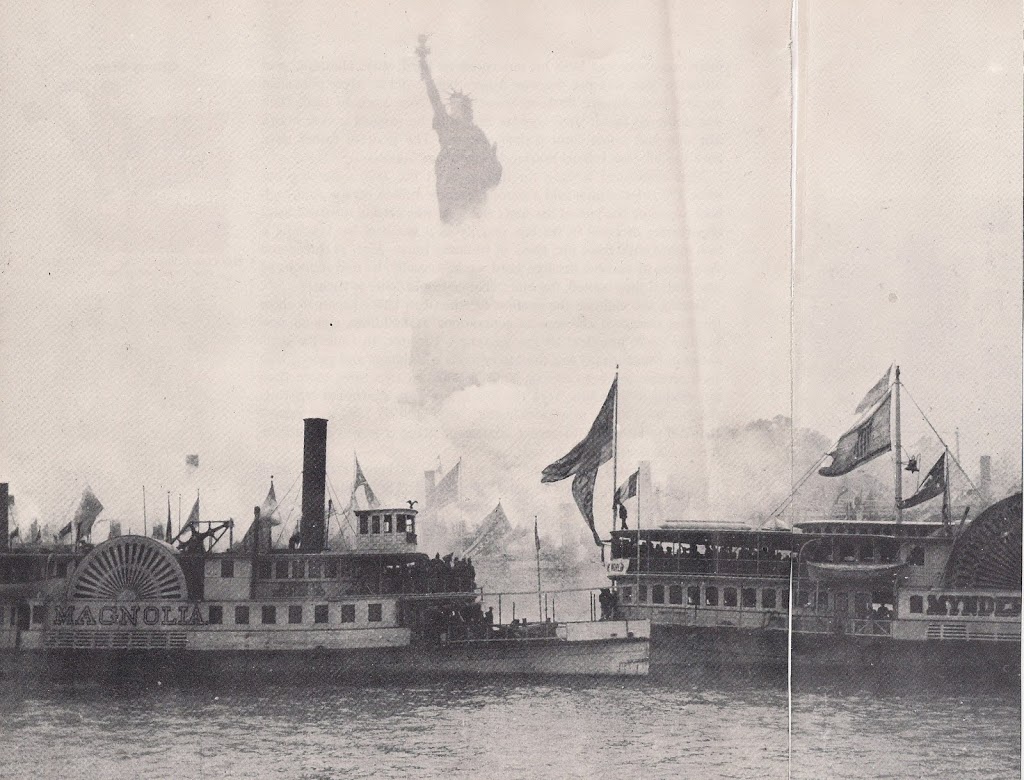
1) The weather was totally awful that day. Nasty weather, rainy and wet, nearly wrecked the day, with the statue surrounded in mist and then a ‘regular London fog‘.
2) It was as much a celebration of the French as it was of the statue. Despite the rain, a contingent of 20,000 men in French uniform marched down Fifth Avenue in the morning, and the French tricolor was waved alongside the flag of the United States from virtually every window and balcony.
3) The early action took place in Madison Square Park. The official ceremony began near the Worth Monumentnext to Madison Square Park, with President Grover Cleveland, the statue’s creator Frederic Bartholdi and other luminaries in a parade reviewing stand, enjoying marching bands in the pouring rain. Apparently, Cleveland stood in the downpour for over two hours without an umbrella. (This is most peculiar behavior, considering what is popularly believed to have happened to President William Henry Harrison a few decades previous.)
4) No respect for veterans! A minor controversy erupted involving the participation of the three remaining living veterans of the War of 1812. They had been slated to join the parade, but somebody neglected to send a carriage for them. “The Memorial Committee of the Grand Army forgot us three times. We will never appear on a public occasion again,” proclaimed 90-year-old General Abram Daly.
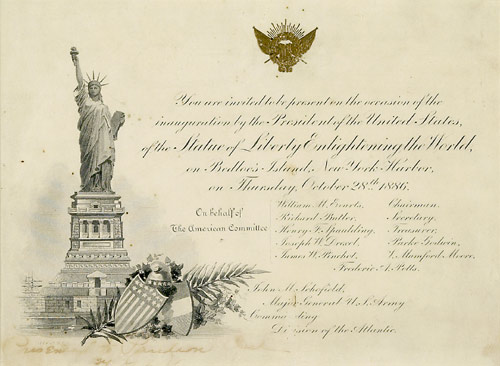
Below: The official invitation to the inauguration ceremony.
5) Lady Liberty was covered in a gigantic French flag. After the parade, all New Yorkers, en masse, rushed towards Battery Park, ostensibly to watch the dedication ceremony (but then, of course, it was too foggy to see anything).
The dignitaries, meanwhile, maneuvered a boat through crowded waters over to Bedloe’s Island. They were greeted by a looming, shadowy figure draped in a gigantic, wet French flag.
The effect, according to the newspapers, was one of mystery and eeriness. “[T]he nearest of the men-of-war could be seen floating like phantoms on what might either have been fog or water so far as the eye could see.” [source]
6) There’s only room for one Lady at this ceremony. Despite being a celebration of a large, glorious woman, there were less than a dozen actual women invited to the Bedloe’s Island ceremony, of the 2,500 or so that slowly made their way to their seats. (A boat of bold suffragists did navigate close to the island.)
In one way, it was for the best; it took hours for people to arrive at the island. The bandleader, the estimable Patrick Gilmore, played a bevy of marches and French folk songs until he and his musicians was soaking wet.
7)Â It was really too loud to be having a ceremony at all. Explosions and whistles, the “impish screech” of steamships and tugboats, filled the harbor in celebration, and nobody on Bedloe’s Island could really signal to anybody to get them to stop. The dedication prayer and several speeches were drowned out. Ferdinand de Lessups, developer of the Suez Canal and head of the French delegation, dryly remarked of the noisy steamships, “Steam, which has done so much good in the world, is just now doing us a good deal of injury.”
8) Unveiling fiasco! At the close of a very grand speech by New York senator William Evarts, a series of signals was to be sent to Bartholdi, holding a cord which would pull away the gigantic flag.
There was a miscommunication however — in the middle of Evarts speech — and the cover was pulled off of Lady Liberty too early. This elicited a deafening, celebratory cry of horns, cannons and shouts from all around the harbor.
Evarts, however, was still speaking. Nobody could hear him, and thus people at the ceremony actually began dispersing. Everts ended by turning to President Cleveland, who sat nearby, and uncomfortably finished his prepared remarks. Awkward!
9) No ‘Enlightening the World’ today. The weather was so bad that the Statue of Liberty’s torch could not be illuminated, so plans for an elaborate ‘pyrotechnic display’ were scrapped.
10) The disaster that almost was: There were so many boats in the water — with fog and mist still impeding visibility (as pictured above) — that it is actually quite incredible that President Cleveland and the French dignitaries made it off of Bedloe’s Island alive. In fact, the president had to transfer to a smaller boat which successfully got him to the Penn Railroad station on the New Jersey side.
11) Occupy Wall Street? The celebration didn’t stop there. Parades and marching bands marched well into the evening, with apparently little crowd control. At around Broadway and Wall Street and further south to Maiden Lane, streets were so clogged that there was literally no movement for over an hour.
Overhead, people shouted from rooftops and even shot off pistols. Meanwhile, further north on Canal Street, somebody actually had the wise idea of placing a cannon on a rooftop and firing it in celebration. (No word on any suspected damage.) The city’s grand fireworks display did eventually take place, on November 1st.
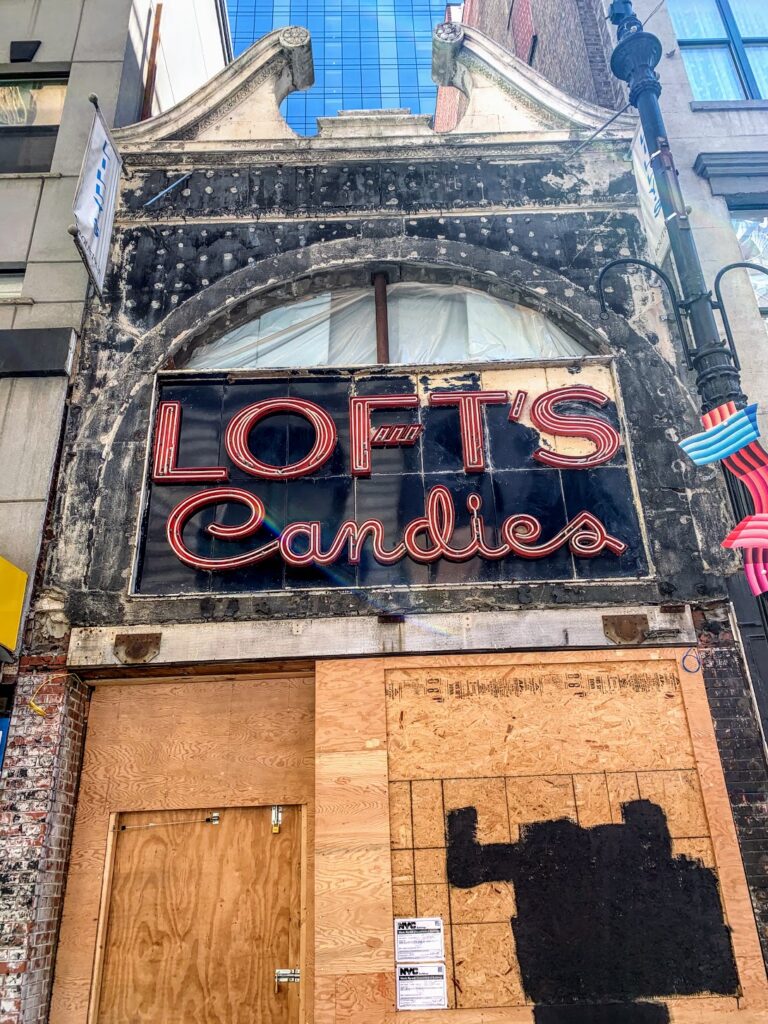
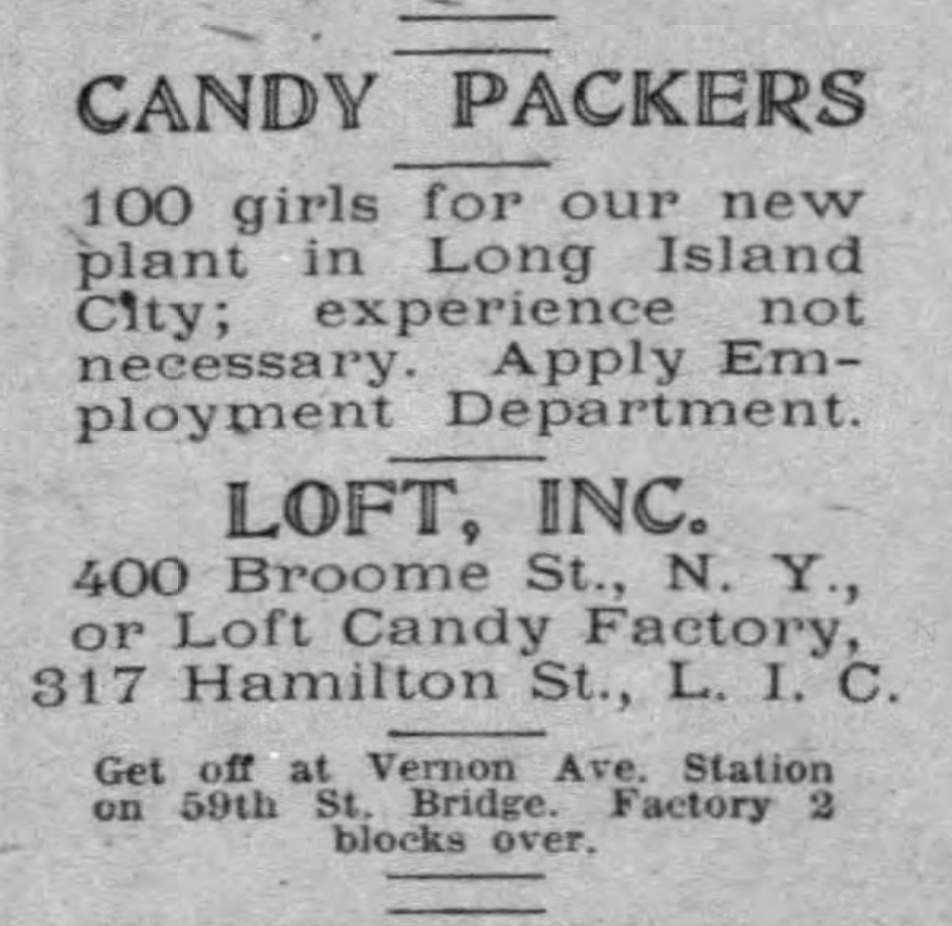
The Loft Candy Company exclusively operated several locations throughout the New York area in the 1910s-30s, many of them proper restaurants. For the Jazz Age candy lover, they were heaven on earth.
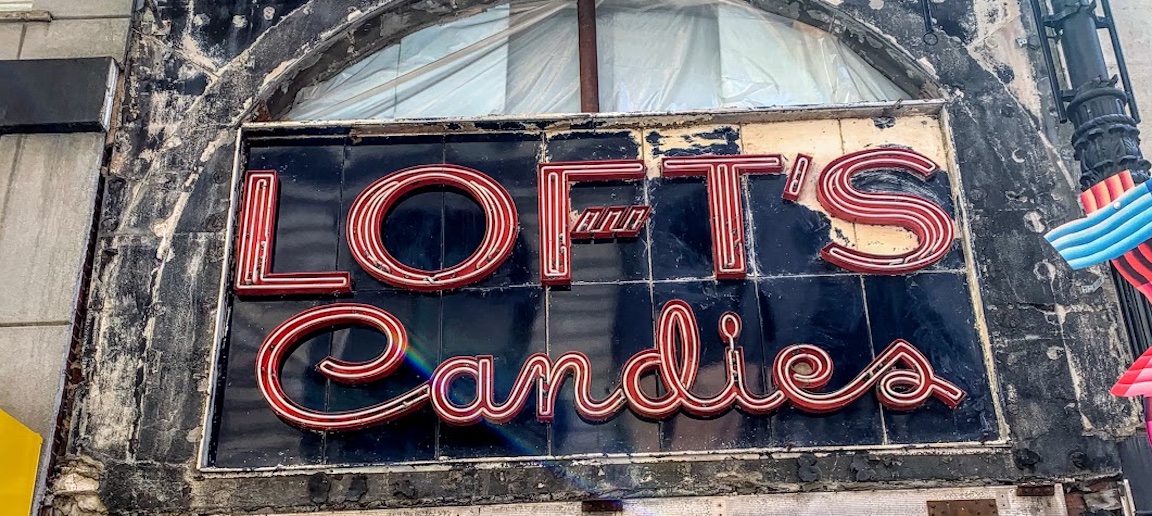
Occasionally you’ll find an old Loft’s neon sign today, peering from a crumbling facade.
This beauty is located at Fulton and Nassau streets in lower Manhattan. New York Neon has the scoop about this marvelous sign. Photo by Greg Young
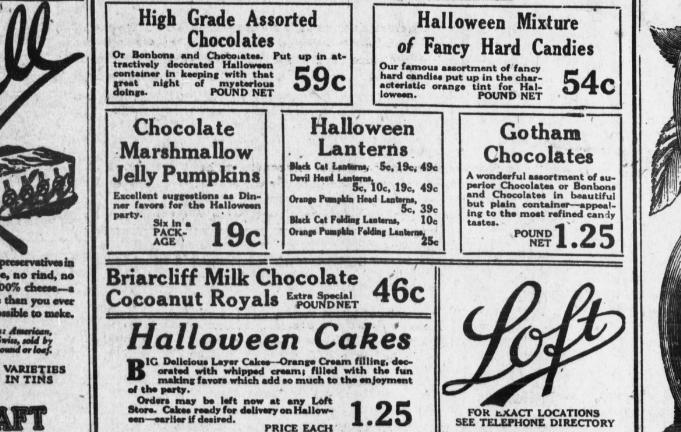
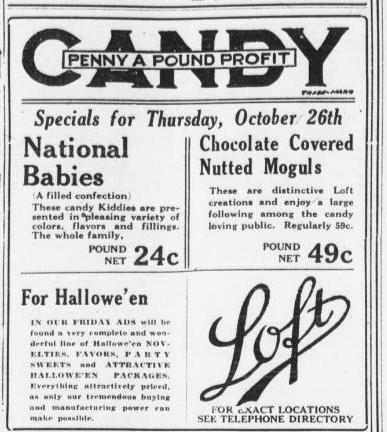
An ad from October 20, 1921 issue of the New York Daily News
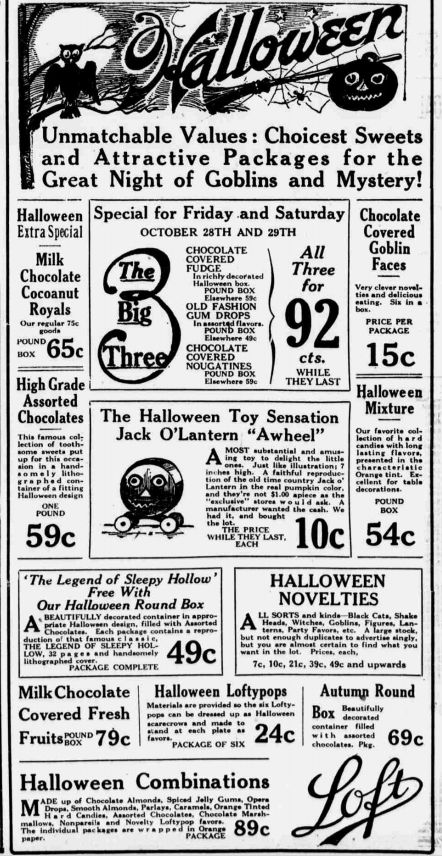
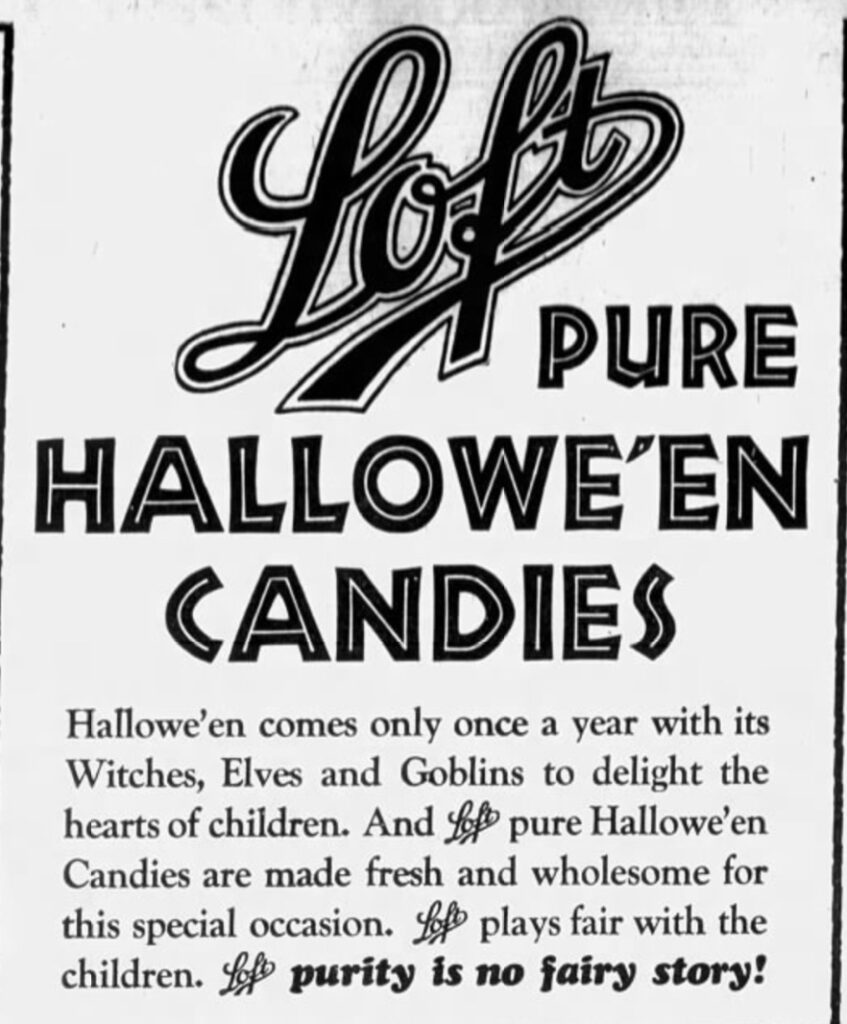
Their Halloween advertisements are an interesting window into the customs a century ago. The practice of trick-or-treating would not become acceptable until the 1950s. Children would have celebrated attending Halloween parties instead, where many of the treats listed below would have been served.
Loft survived the Great Depression by merging with the bankrupt soda fountain company Pepsi-Cola, a perfect marriage of sugary treats. It then became a national brand and cities across the country were graced with Loft candy stores into the late 1980s.
Please enjoy these ads filled with oddball Halloween treats! The ad below is from October 28, 1921:
And what the heck are ‘National Babies (a filled confection)? From October 25, 1922
In this page-sized ad from 1931, Loft offers ‘fortune telling cakes’, moonfaces on sticks and novelties in the shapes of ‘Felix cats’, wood crickets and ukuleles.
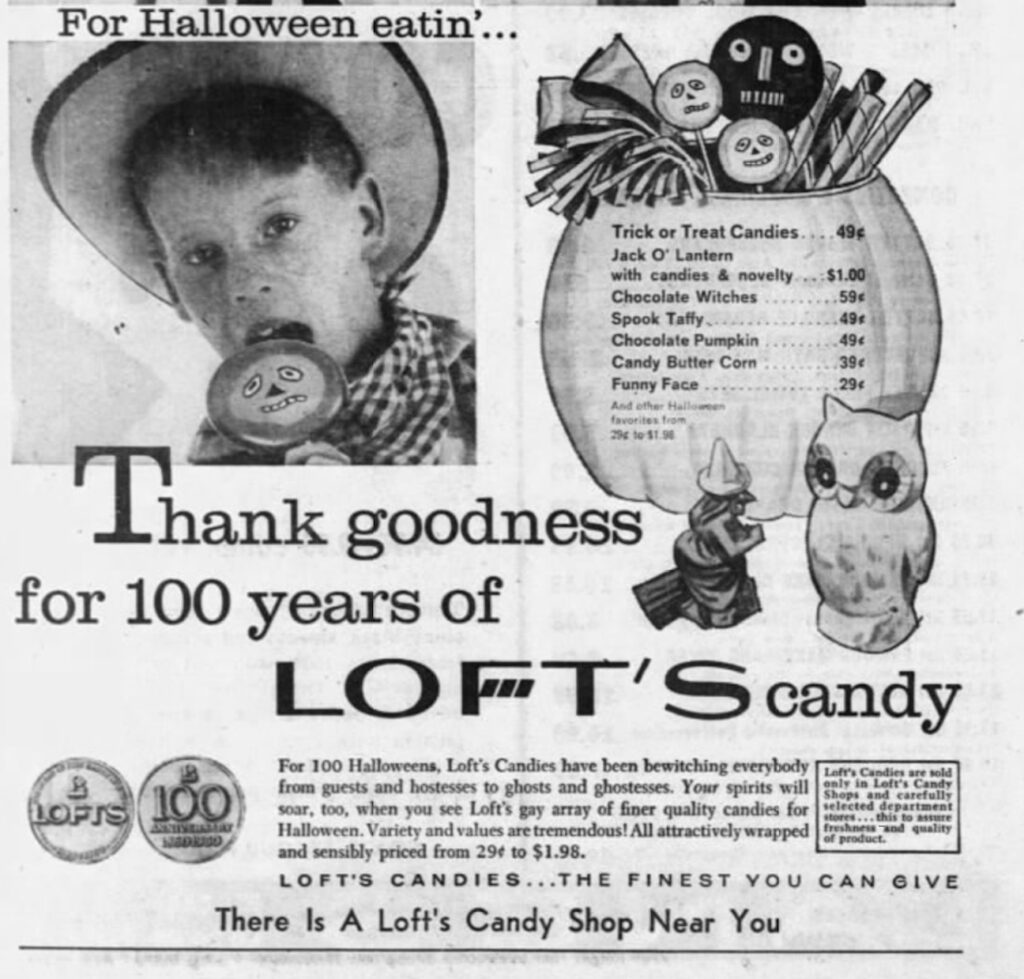
Loft was still making unusual treats for the season in 1960. By this time trick-or-treating had become a national pastime. Although some candy makers had begun making ‘small’ versions of their adult candy treats, it was Mars Inc. that changed the game by targeting trick-or-treaters with ‘fun size’ versions of their popular candies (Snickers, M&Ms) in 1961.
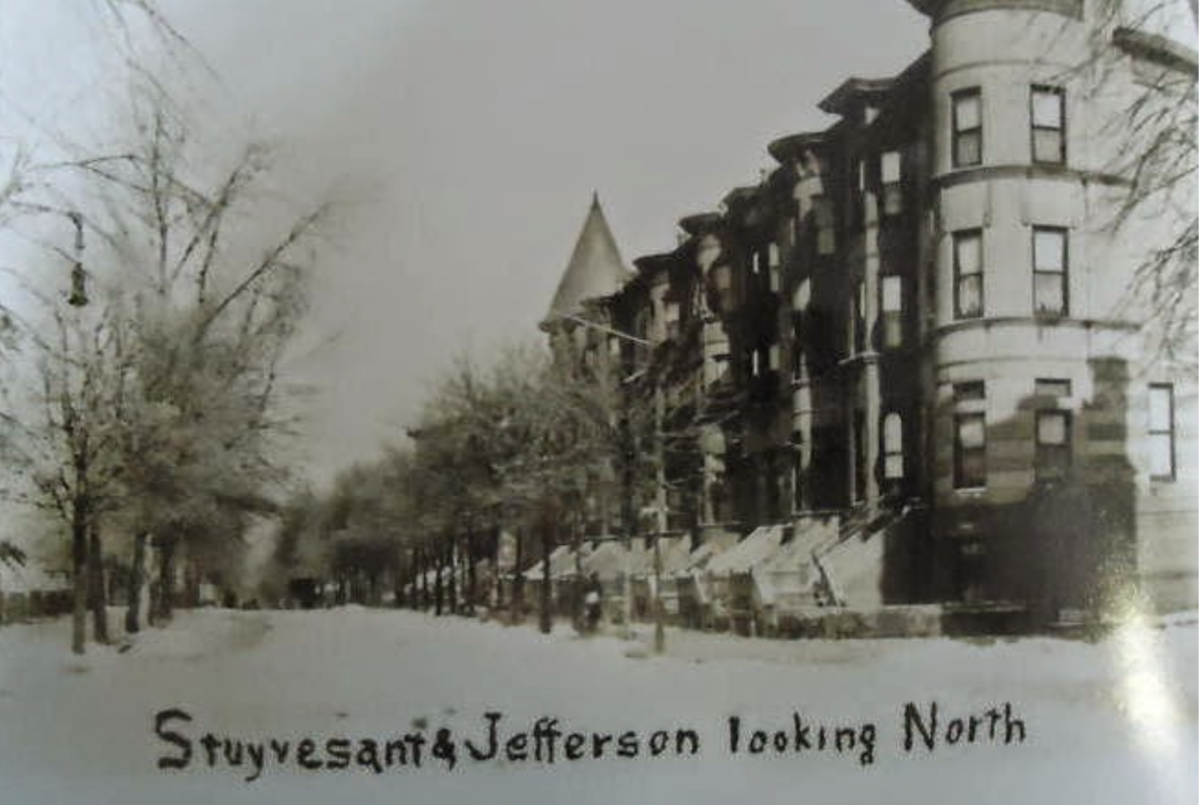
The Brooklyn neighborhood of Bedford-Stuyvesant is defined by its architectural character, rows of impressive brownstones and ornate apartment buildings which trace back to the late 19th century.
It was once two separate villages — Bedford and Stuyvesant Heights — combined to appeal to new residents in the ever-expanding city of Brooklyn. The Bed-Stuy of the 20th century was the heart of African-American residential life; gentrification may alter that definition in the 21st.
Another feature of the neighborhood that may have passed down through the decades are its ghosts.
Simply mix a neighborhood of families full of imaginative children with severe and dramatic old architecture, and voila! You’ve got ghost stories.
Anybody born and raised in Bed-Stuy probably has one story of a purported haunted house, either a structure uninhabited and boarded up or an old home with a single unseen resident, the yard out front overtaken with neglect.
But perhaps one of Bed-Stuy’s most interesting ghost stories comes not from legend but from an actual newspaper report — the haunting of 281 Stuyvesant Avenue in Stuyvesant Heights.
On October 23, 1901, the Brooklyn Daily Eagle reported on a disturbing and frankly stressful time had by the building’s first-floor newlyweds Mr. and Mrs. Joseph Griffin.
The school teacher and his wife moved into the flat in July and immediately experienced some truly unusual phenomenon. At precisely 2 pm every afternoon the new electric doorbell stationed in the vestibule would ring, prompting the lady of the house to open the door. But nobody would be there.
After a few days of this activity, Joseph naturally assumed it was troublesome kids. However one day, Griffin stood in the vestibule at precisely 2 pm. To his astonishment, the bell ring with no human agency present.
This was only the beginning. The ghost continued to torment the Griffins with “hollow groans, creepy sidesteps on the staircase and unexpected trips from room to room by articles of furniture.”
A haunting so close to Grace Presbyterian were particularly unsettling. “His temerity in operating in a flat, the windows of which look right out on the stained glass panes of a church, is especially startling.”
The Griffins, more irritated than frightened, could not take this disturbing presence in their home any further and immediately moved out. The skeptical reporter, of course, took note of the fact that nobody else in the building had experienced any particular supernatural phenomenon.
The upstairs neighbor complained of rats and mice and wind gusts with the strength to swing open doors.
The neighbor added, “The pipes groan and the plumbing rattles too, and my husband says its the spookiest house he was ever lived in, but ghosts! — nonsense.”
We’re just a few weeks away from a new mayor in New York City so we think it is time that you Know Your Mayors! Become familiar with other men who’ve held the job, from the ultra-powerful to the political puppets, the most effective to the most useless leaders in New York City history.
This longtime feature of this website is being rebooted with new articles and newly researched and refreshed earlier entries in this series. Check back every other week for a new installment. Read past articles here.
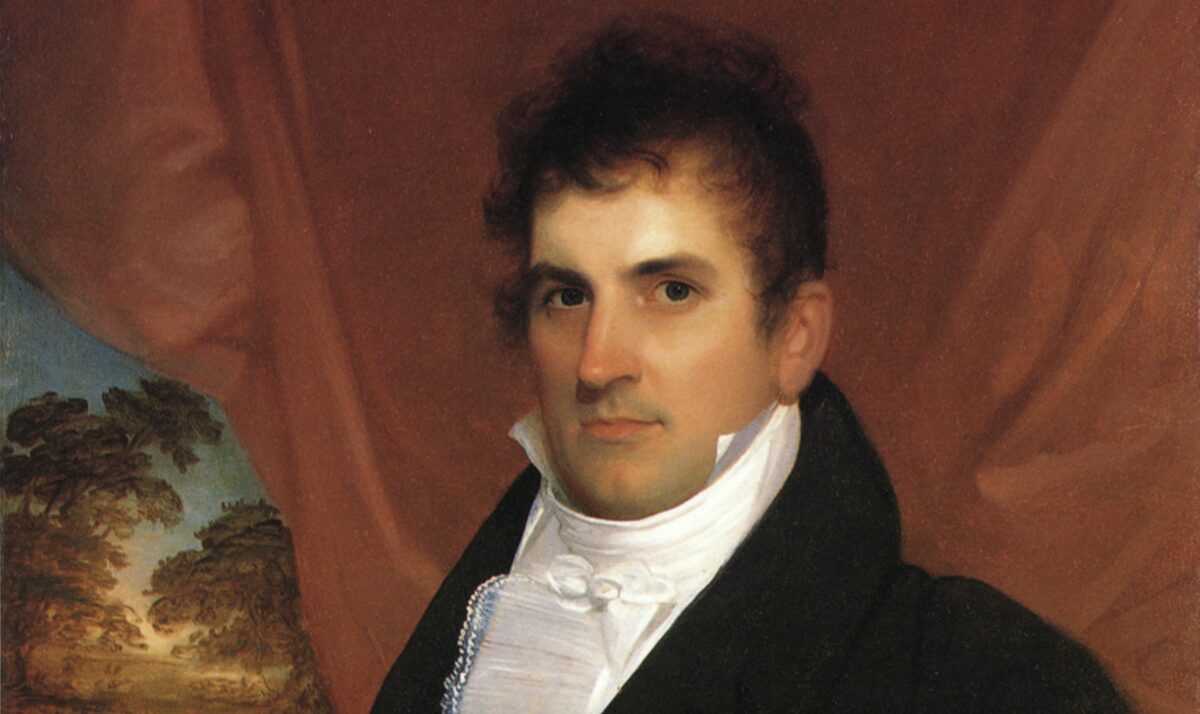
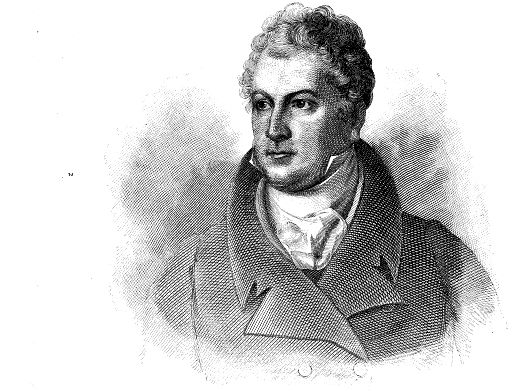
Philip Hone Term: 1826-1827
Many of our city’s early mayors are marginal figures obscured by a lack of personal information contained in publications of the day.
We only know a few by their actions and can only indirectly discern their personalities from their popularity and effectiveness.
Not so with Philip Hone, the Whig mayor of New York City for a single solitary term (1826-27).
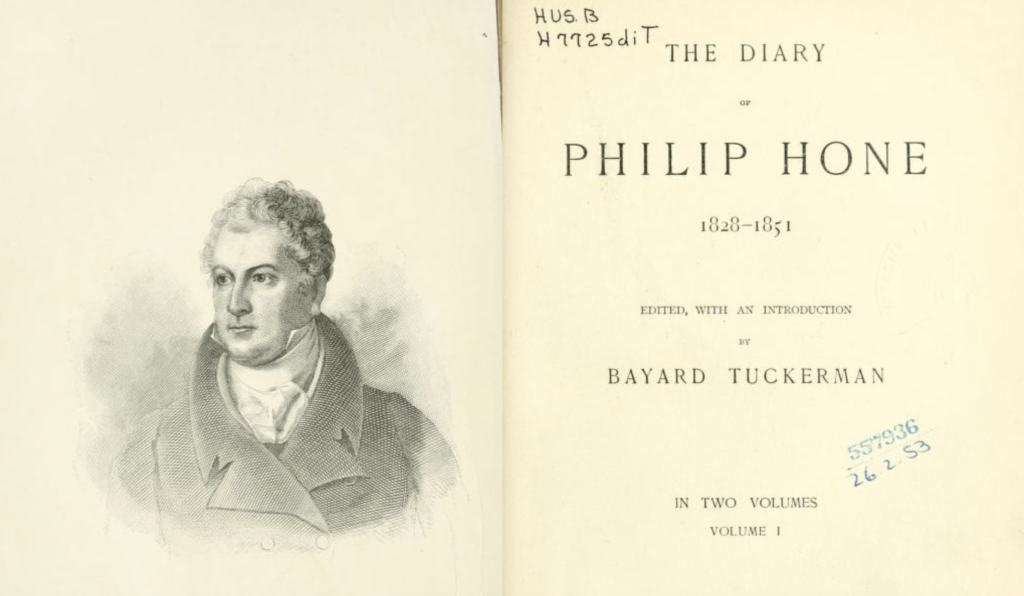
Thanks to his fascinating and well written diary, we not only know all about him, we have an uncommonly vivid window into the workings of the early city.
Twenty-Four Hour Party People
Hone was born in 1780 on Dutch Street (between John and Fulton streets) and made his name on the nearby ports as an teenage auctioneer selling goods right off the boat.
His auction business became known throughout the ports of the new America, and by age 40, the self-made Hone had amassed such wealth that he effectively retired to the life of a “gentleman”.
From his lavish home on 235 Broadway across from City Hall, Hone dined with politicians and celebrities, a good-natured and cultured bon vivant, an old school Knickerbocker who would consider himself good friends with the likes of Daniel Webster, Washington Irving, and John Jacob Astor (whose Astor House would sprout up next door).
His parlor hosted a nightly gallery of political and foreign dignitaries mixing it up with New York’s social strata.
From his diary: “As his children grew up the house became a resort for the young people ; and it was an ordinary question for the beaux and belles walking on Broadway : ” Shall we meet to-night at Mr. Hone’s, or at Dr. Hosack’s?” — these being the two houses in town most constantly open..”
Naturally, political ambitions also came knocking, and Hone was elected an alderman in 1824 before winning the mayoralty in 1826, a rare representative of the Whig party in a city ever so dominated by Democrats.
It seems that Hone’s strengths as mayor came as a direct extension of his role as New York’s social network king. He’s as known as much for his parties as for his policies.
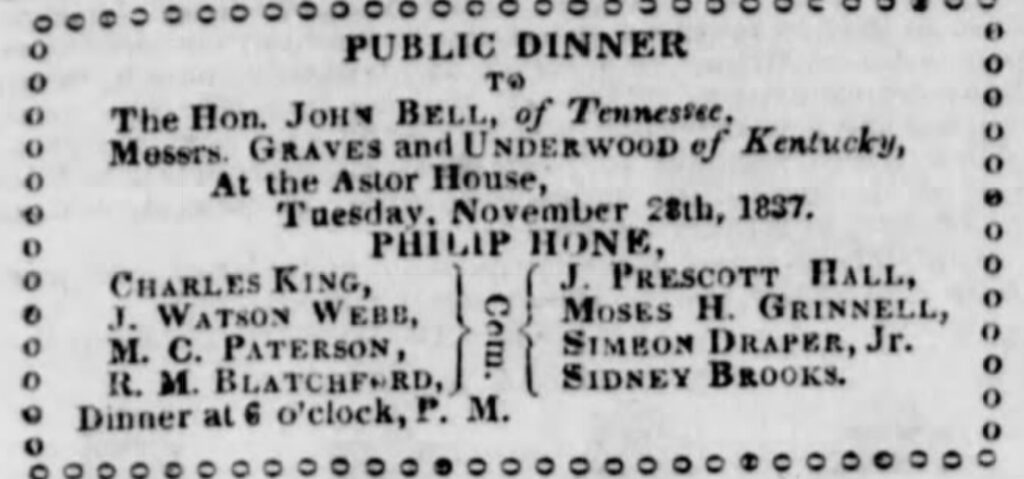
The New York Daily Herald published an invitation to one of his fancy parties at the Astor House, 1837
King of Clubs
The introduction to his diaries doesn’t even bother to disguise this: “Mr. Hone represented the city socially as well as politically. He entertained officially; and visiting strangers during his term enjoyed a hospitality which reflected credit upon the whole community.”
A true social butterfly, he amassed membership in a variety of clubs and associations, became a trustee in New York’s first insane asylum, and dabbled early in canal building as president of the Delaware and Hudson Canal company (later to become the basis of the D&H Railroad).
“He was never voluntarily absent from a meeting where the interests of others demanded his presence, and many were the good dinners which he lost in consequence.”
As a comfortable and well-connected gadabout, his somewhat elitist views and political outsiderness left him stranded in a city where ‘Whiggery’ often equated only to upper classes.
In particular his anti-Irish, anti-Democratic positions were fighting against the wind. Later, by the 1830s, the power struggles between Whigs and Democrats would virtually wipe Hone’s party from the city’s political map.
Mostly, he’s remembered as a cultural ambassador, even commissioning artwork for City Hall, approving of a developing theater district in the not-yet-seedy Bowery and encouraging the city’s growth as an American capitol of arts and sciences.
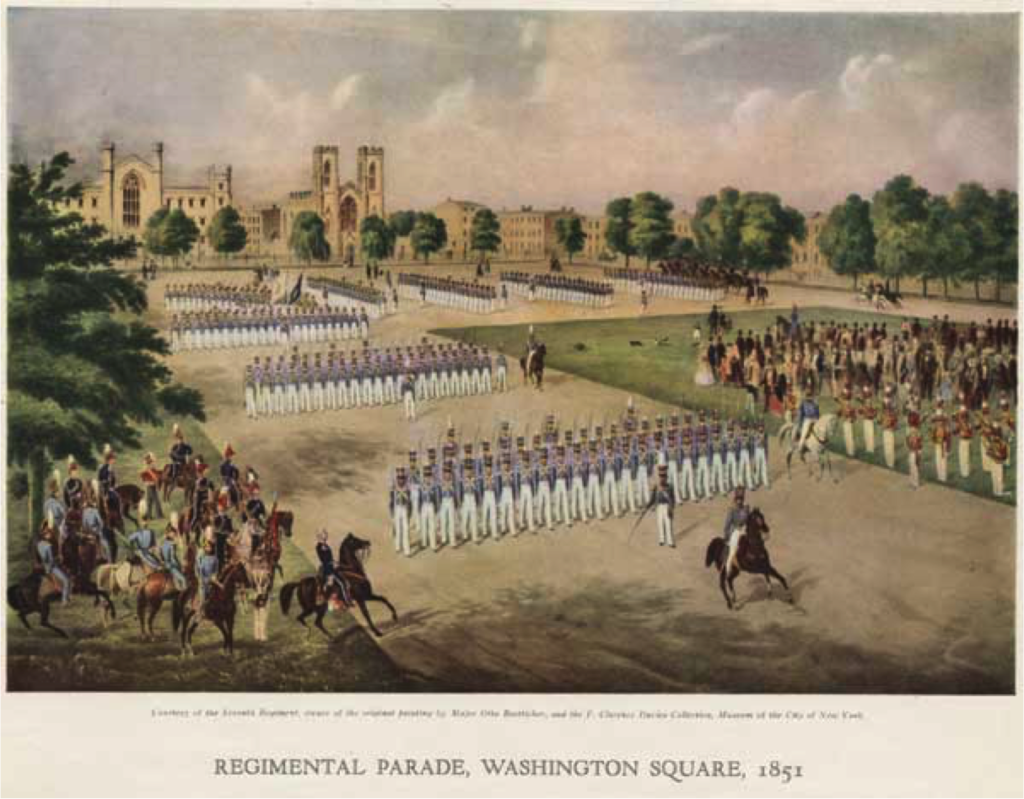
Seventh Regiment on Review, Washington Square, New York, 1851, Otto Boetticher. Courtesy of the Metropolitan Museum of Art.
The Washington Parade Ground
But he’s largely responsible for one of New York City’s most beautiful places — Washington Square Park.
Hone, as earlier mentioned, was on the board of everything. One of those organizations was Sailors Snug Harbor, a retirement home for “aged, decrepit, and worn out seamen” which owned property immediately north of New York’s public burial grounds in Greenwich Village.
By 1831 the retirement home had moved to the donated farmland of Robert Richard Randall on the north shore of Staten Island (where it resides to this day). To raise money for the organization, Hone suggested that the former burial ground — which was already overcrowded — be transformed into a military parade ground.
“Hone ensconced the militia in the former potter’ field,” wrote Luther S. Harris in his book Around Washington Square, “then decreed that the site be used to host the national jubilee for the fiftieth anniversary of the signing of the Declaration of Independence.”
In June of 1826 the grounds were renamed the Washington Parade Ground, in time for a massive jubilee celebrating that patriotic anniversary the following month. As a result this meant that Sailor Snug Harbor’s Greenwich Village property became much, much more valuable.
By the end of his term, the ‘parade ground’ would be expanded to its present size. The military would leave the grounds by the late 1840s and it would be renamed Washington Square Park.
From an 1889 edition of Hone’s diary
Diary of a Comfortable Man
As for Hone, his true claim to fame would come as an urban observer, not only as a civic leader.
Moving to the “south-east corner of Broadway and Great Jones street” above Houston Street, where he would remain until his death in 1851, Hone would document in a remarkable diary the everyday, upper-class life of New York, from political shifts to the latest opera.
Hone’s “graphic pen”, as described in a New York Times review in 1896, would become one of the great chronicles of early New York history, a “naive, faithful and vastly interesting record of social, commercial and political events here ” and in Europe.” [source]
From his diary introduction:
“Mr. Hone took pleasure in recording the events which took place under his eyes during the first half of the present century. He saw New York grow from a town of twenty thousand inhabi- tants into a city of five hundred thousand ; he saw the residence portion of the city extend up Broadway to Union square, up Fifth avenue as far as Twentieth street. And in this enormous growth and all the changes which it involved, he had borne an influential part.”
Most notable is his description of the terrible Great Fire of 1835, a tragedy which momentarily gutted the high society he had fostered for years:
“How shall I record the events of last night, or how to attempt to describe the most awful calamity which has ever visited these United States? [It was the] greatest loss by fire that has ever been known, with the exception perhaps of the conflagration of Moscow, and that was an incidental concomitant war….”
The diary is indispensable for New York historians. You can take peek at the 1889 edition here.
This article is an expanded and reedited version of an article which first ran on this site in 2008.
The new episode of theBoweryBoysMovieClub explores the new film The French Connection, the gritty action classic employing an astonishing array of on-location shots — from Midtown Manhattan to the streets of Brooklyn. It’s an exclusive podcast for those who support us on Patreon.
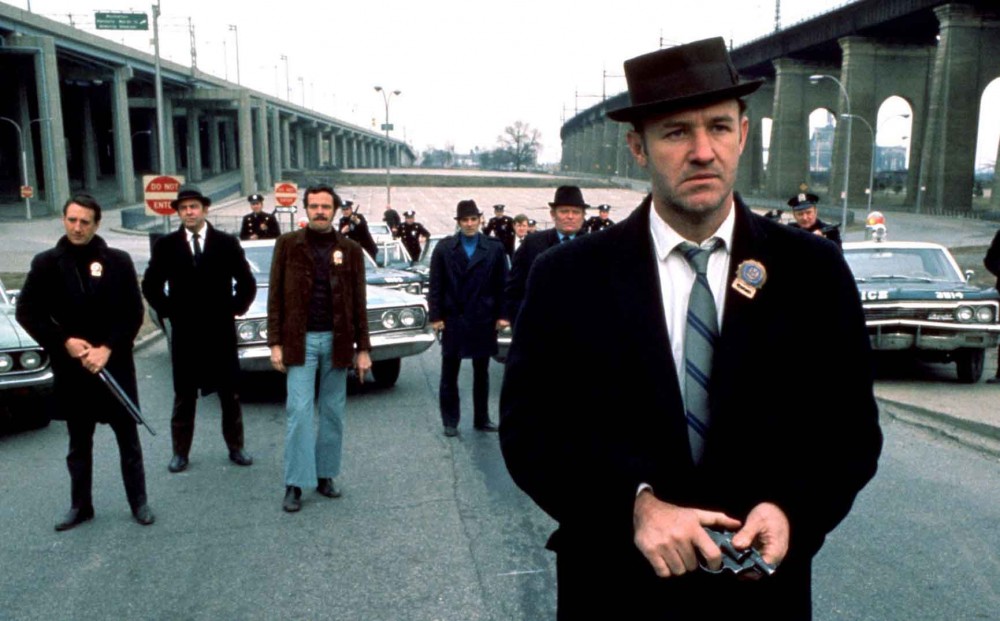
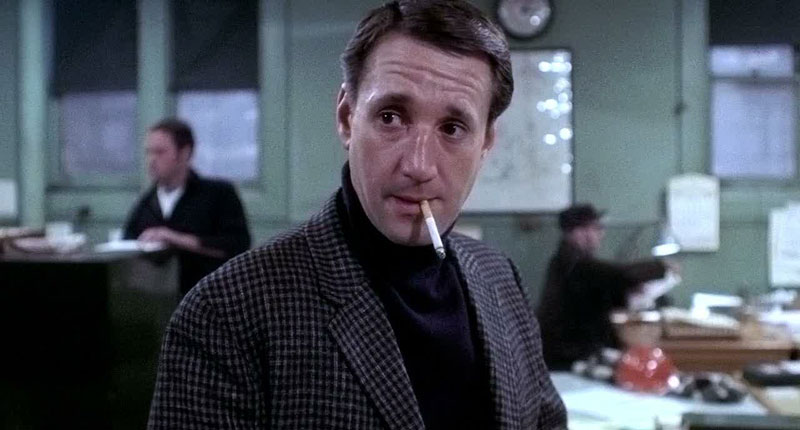
The French Connection, directed by William Friedkin and starring Gene Hackman, was released fifty years ago this year to critical and commercial success.
The movie would change the way film and TV action dramas were presented, a mix of real-life urban decay and brutal violence. But the film has much to say about New York City itself as it swerves into many pre-gentrified neighborhoods.
SPOILER ALERT:The Bowery Boys Movie Club is a movie recap show, mixed with New York City history. We dive into the film, scene by scene… discussing its major plot turns and attempting to put it all into the historical context of New York City in late 60s/early 1970s.
We also discuss the plot, in quite a bit of detail. Haven’t seen the film yet? You might consider watching it first — it’s currently available for rent and also available for streaming on Showtime.
HowdoIlistentheBoweryBoysMovieClub? Once you’re signed in on Patreon, you’ll see a private RSS link that can be put directly into your favorite podcast player. Even easier, it can also be played directly from the Patreon app.
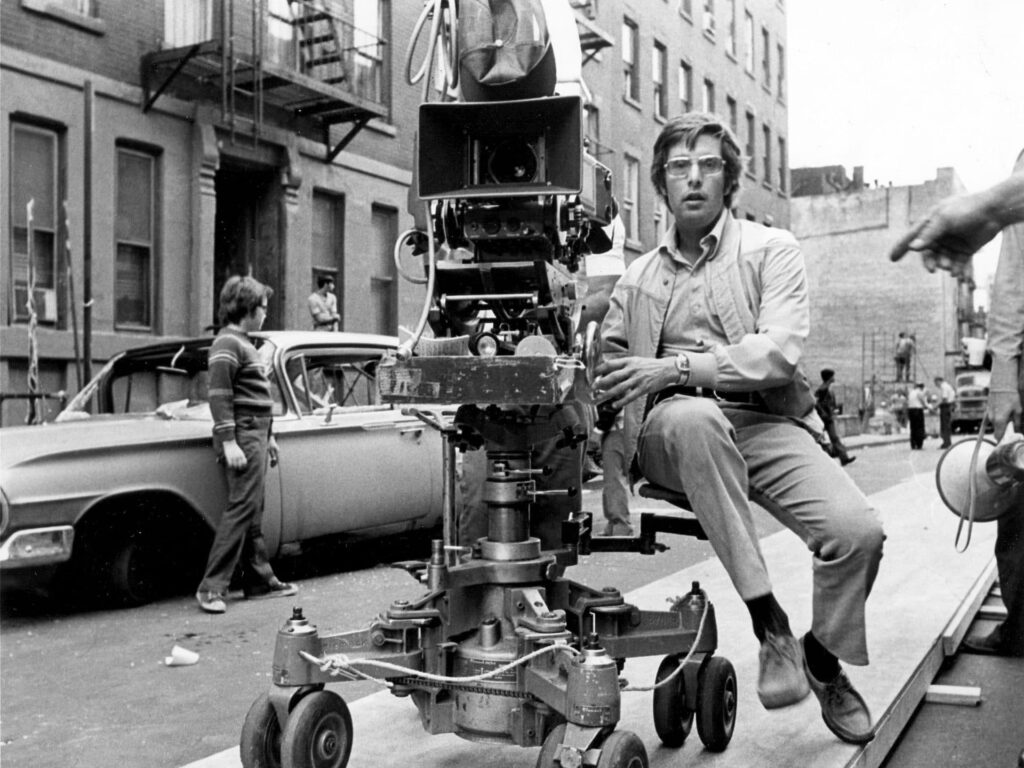
Director William Friedkin on the ‘set’ of The French Connection.
The French Connection was shot in New York — all over the place, uptown, downtown, on bridges, in bars. And much of it, on the fly and illegally. (There are, of course, famous scenes in Marseilles and Washington DC as well.)
Take the film’s most iconic moment, and possibly the greatest car chase scene in the history of film and cars. It’s filmed under the elevated D-line train, near Coney Island, along the course of 26 blocks, over the course of five weeks. However, N train stands in for what was then the B train, because, being New York in the 70s, they could find no clean-looking B trains.
Most of the ‘extras’ were actual residents going to and fro in their daily business. In fact, a car accident that happens at the corner of Stillwell Ave. and 86th Street actually happened; the unlucky vehicle was owned by a guy on his way to work.
The producers later paid for the cost of repairs. Today this would have spawned a multi-million dollar lawsuit!
That was the least of the mayhem. Friedkin and his producers filmed many scenes without the city’s permission at all, including much of the car chase, a staged traffic jam on the exit ramp of the Brooklyn Bridge, and an entire sequence on what is now the S-train between Grand Central and Times Square!
One treasured New York landmark featured in the film is sadly no longer with us. Popeye Doyle (Gene Hackman) and Cloudy Russo (Roy Schieder) stake out at Ratner’s Deli in the Lower East Side right off the Williamsburg Bridge.
Ratner’s was one the city’s legendary old Kosher deli’s, along with Katz’s just a few blocks away. Later in its life, its hidden ‘speak-easy’ Lansky Lounge became a hot spot during the 1990s.
Two Manhattan hotels are also featured prominently, the sumptuous Roosevelt Hotel in Midtown and the former Westbury Hotel, now residences.
Like The Taking of Pelham One Two Three, the movie brilliantly captures a New York on the precipice of near collapse but still retaining its rough-hewn charm. The fact that this classic could be filmed here — almost scot-free — gives a little insight into how massive and uncontrolled the city had gotten.