Categories
Those Were The Days

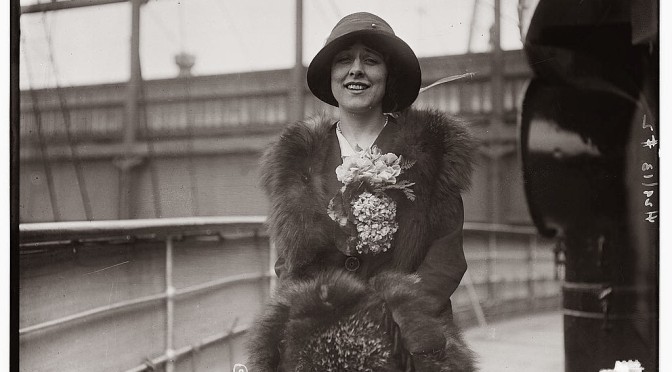
Venuses in Fur — New York society ladies in fancy animal skin

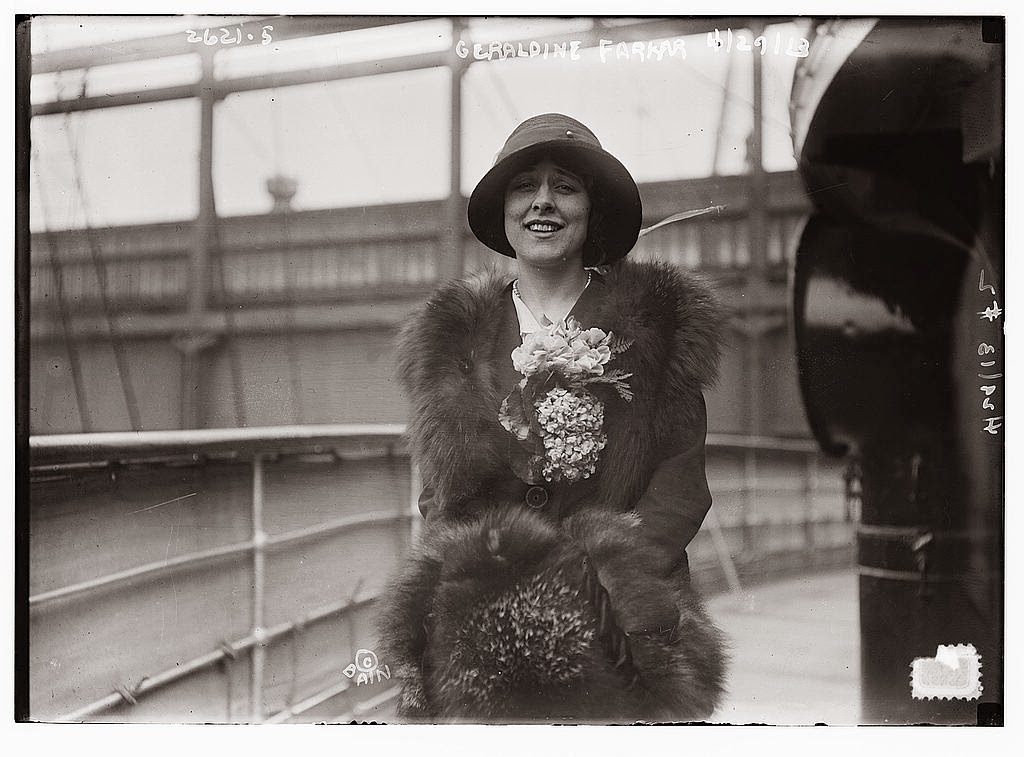
The Metropolitan Opera’s soprano sensation Geraldine Ferrar, photo taken April 1913. I guess fur was never out of season a century ago!

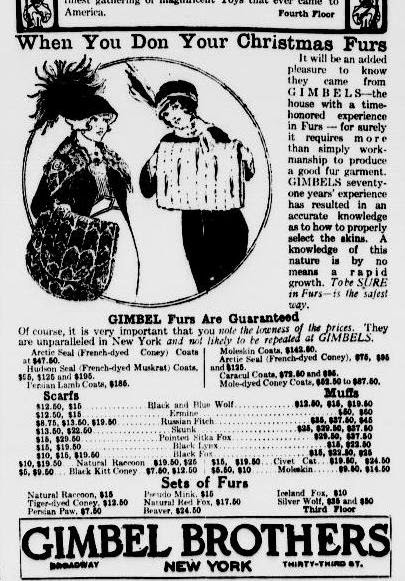
“When You Done Your Christmas Furs — It will be an added pleasure to know they came from Gimbels — the house with the time-honored experience in Furs — for surely it requires more than simply workmanship to produce a good fur garment.  GIMBELS seventy-one years’ experience  has resulted in the accurate knowledge as to how to properly select the skins.”

Some of the furs sold at Gimbels for the holiday season in 1913 — wolf, muskrat, skunk raccoon, lynx, lamb, stoats (otherwise known as ermine), several kinds of fox, beaver and ‘tiger-dyed coney’ or rabbit skins dyed to resemble exotic animals.  You could get coney skins in zebra and leopard prints.

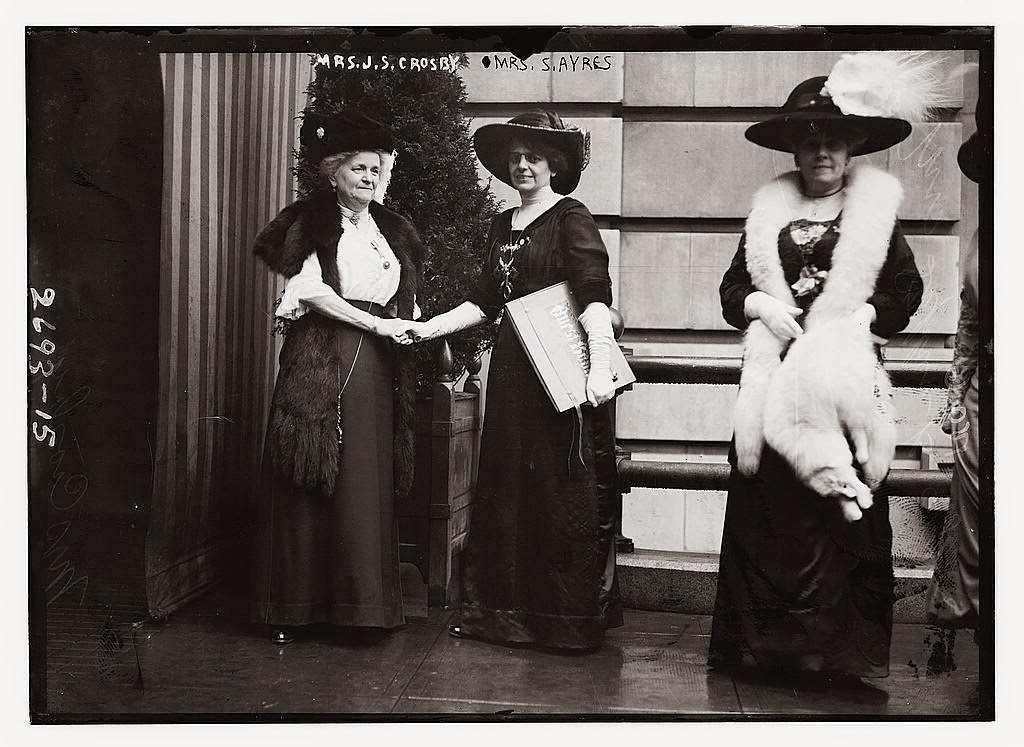
Nellie Fassett Crosby (Mrs. John Sherwin Crosby), president of the Women’s Democratic Club of New York City and founder of the Woman’s National Democratic League, and Mrs. Steven Beckwith Ayres, also active in the WNDL.

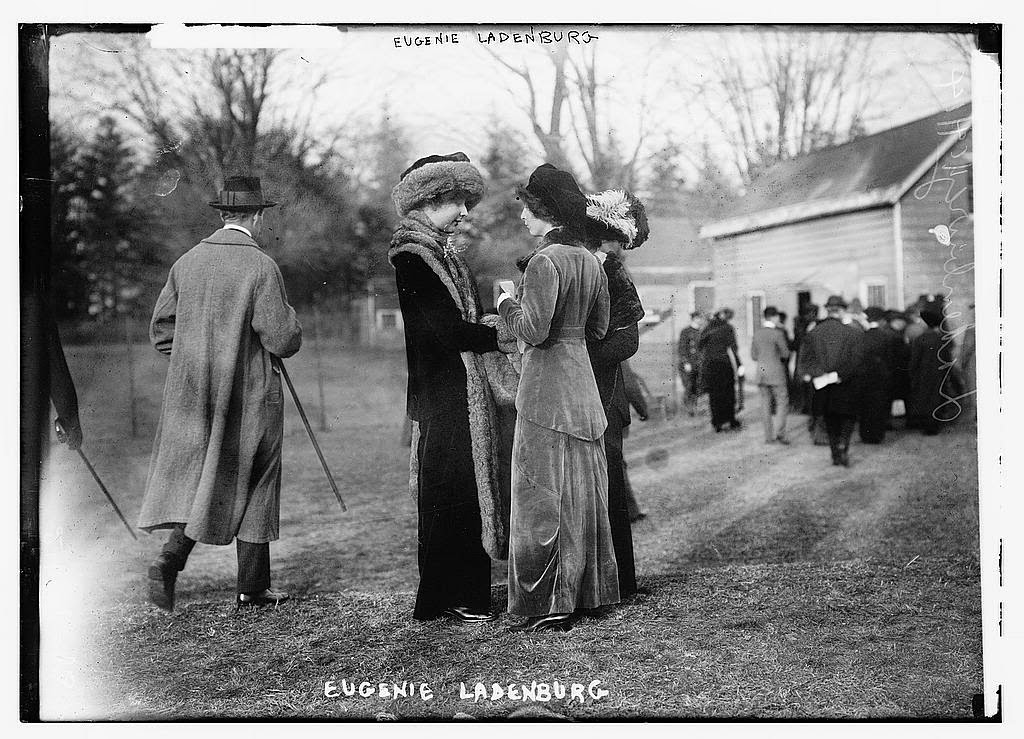
Eugenie Mary “May” Ladenburg Davie, noted Republican activist in New York and a director of the Pioneer Fund.  She was apparently a bit of a political spitfire, even while draped in the latest fashion.
 

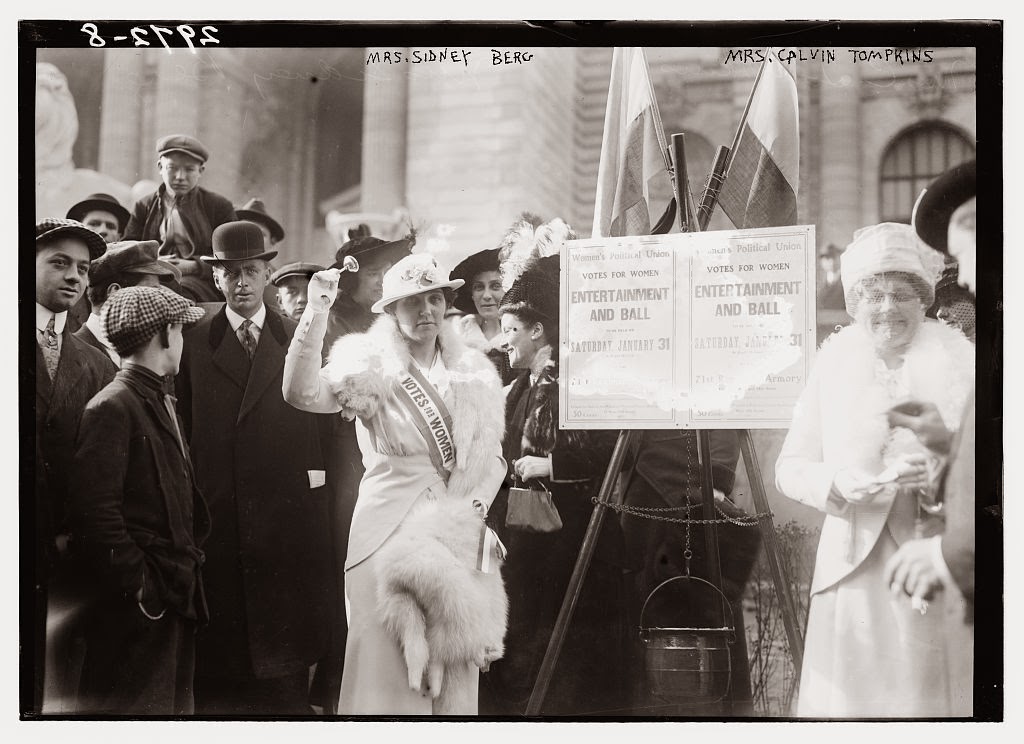
Suffragists at the Armory, January 1914

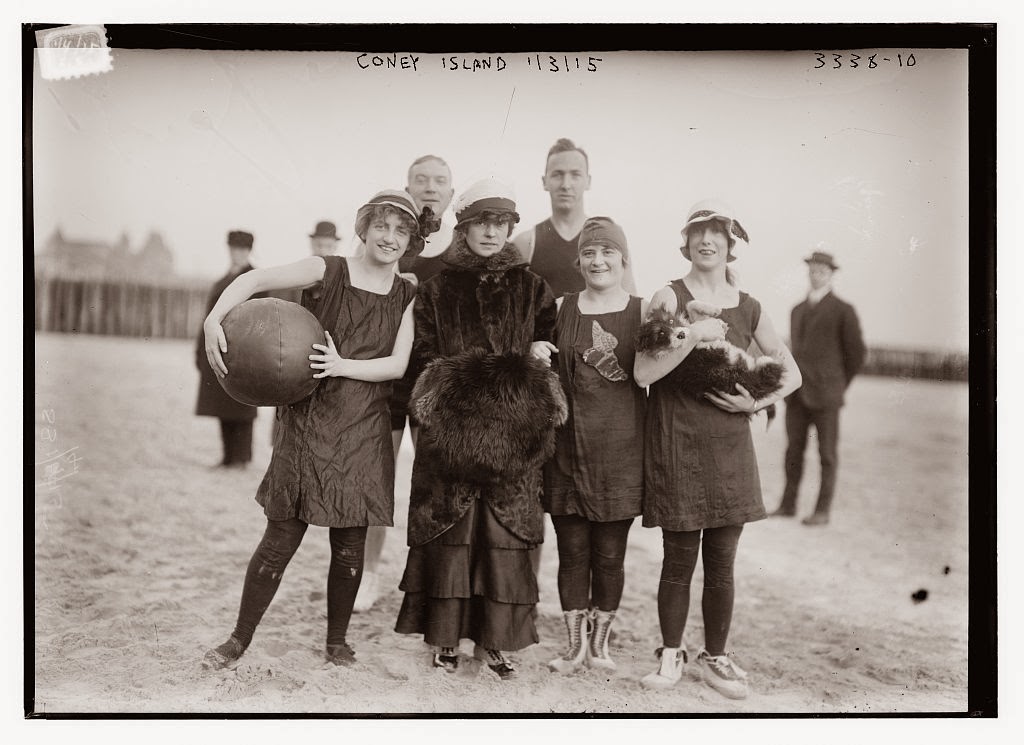
It’s even suitable beach wear! A group of friends at Coney Island, January 1915

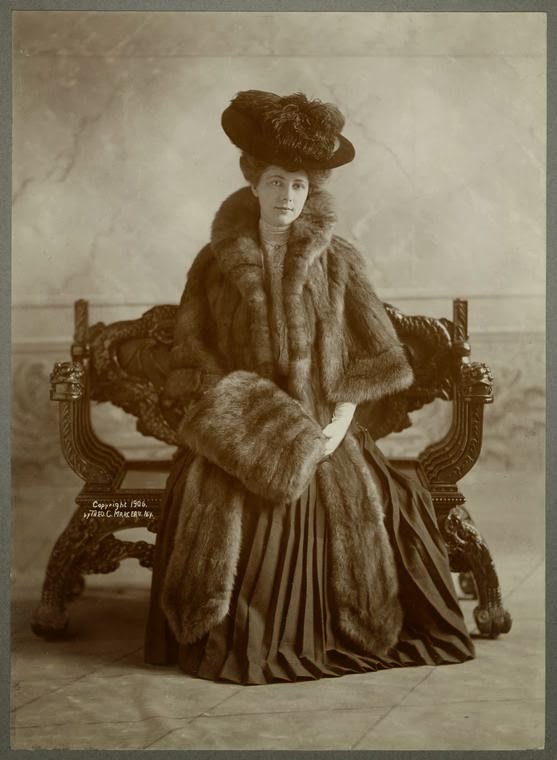
From the studio of New York portraitist Theodore C Marceau, 1906

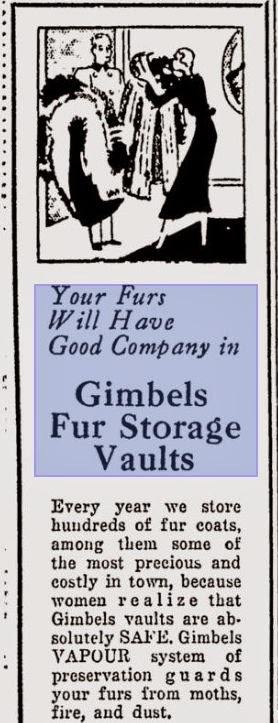
Gimbels not only sold furs; they stored them for you in the summertime. Can’t have a frock made entirely of animal skin just sitting in your closet!


Categories
Bowery Boys Bookshelf

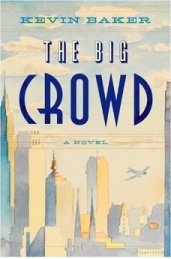
‘The Big Crowd’: Kevin Baker takes on an unsolved mystery, the murder of Kid Twist and the secrets of a fallen mayor

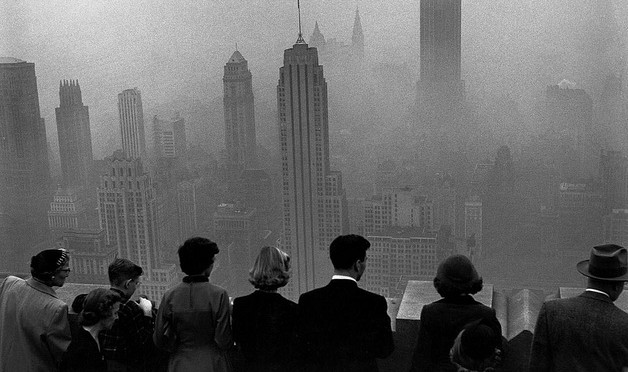
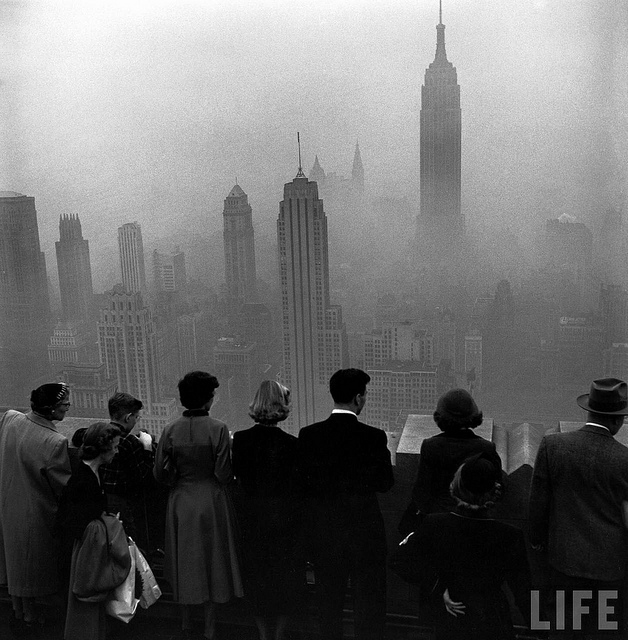
New York City, 1953, the setting for Kevin Baker’s The Big Crowd. Photo by Eliot Elisofen, courtesy Life/Google images

BOWERY BOYS BOOK OF THE MONTH Each month I’ll pick a book — either brand new or old, fiction or non-fiction — that offers an intriguing take on New York City history, something that uses history in a way that’s uniquely unconventional or exposes a previously unseen corner of our city’s complicated past.  You can find some our past selections here and links to purchase them from Amazon at the bottom of this post.

The Big Crowd: A Novel
by Kevin Baker
Houghton Mifflin Harcourt

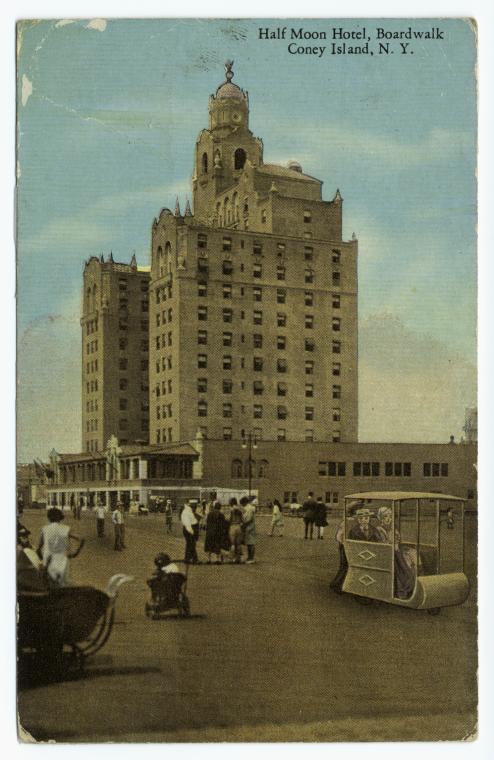
The Half Moon Hotel (pictured at left), named for Henry Hudson’s ship, was Coney Island’s most glamorous accommodation when it was built in 1927.

In the fall of 1941, the mob informer Abraham Reles, nicknamed Kid Twist, was being held here, heavily guarded by police officers.  Reles had information on dozens of murders, putting away some of Brooklyn’s most notorious gangsters.

Next on his list was Albert Anastasia, better known in the press as the leader of Murder Inc.  On November 12, Reles plummeted out the window to his death.  Was Reles trying to escape?  Or was he murdered?

This real life mystery is at the heart of Kevin Baker’s new historical novel The Big Crowd, a brassy noir of New York City in the post-LaGuardia era.

Baker is one of the more thrilling historical novelists working today, latching colorfully and with epic flourish into specific New York eras, obsessed with the seedier elements which make the city tick.  He is unafraid of embracing real-life characters and emboldened by difficult, abrasive eras.  In Paradise Alley, his imagination ran wild through the Civil War Draft Riots.  In my favorite Baker novel, Dreamland, gangsters and freaks collide amid famous Coney Island landmarks.  He somehow even fits in Carl Jung and Sigmund Freud along the way.

He’s written about the life of Kid Twist, too, in Dreamland.  But it’s his death that sits in the smoldering center of The Big Crowd, exposing the connection between waterfront gangland activity and the upper reaches of New York government, reaching, in fact, all the way to the very top.

While Baker has fictionalized the lives of real-life people in the past (a young Malcolm X being the most ambitious, in his novel Strivers Row), for his latest, he’s transformed Mayor William O’Dwyer into Mayor Charlie O’Kane.

While their biographies are nearly the same — an Irish mayor brought down by scandal — O’Kane is a lustier, more mysterious figure, escaping America and becoming an almost godlike figure in Mexico City.  His brother Tom works for the New York district attorney’s office, attempting to clear his brother’s name while solving the mystery of Reles’ death.

The Big Crowd often feels like an unmade gangster film, its beat cops and waterfront roughs rendered from a world of cinematic grays.  At the core is Baker’s relentless attention to historical detail, even when it seems impossible to believe, manifesting into occasional weirdness.

For instance, O’Kane’s lascivious wife, who incidentally sleeps with his brother, fancies herself a bull-fighter. (O’Dwyer’s real wife Sloan Simpson did become a bull-fighter in Mexico.)

Some of my favorite 20th century figures are successfully evoked, including Toots Shor and racketeer Joe Ryan.  Robert Moses is glimpsed without apology as a menace;  a powerful passage late in the book envisions the wreckage of a demolished Bronx neighborhood, “the cityscape melted into a pile of pure, mindless wreckage.”

Like other Baker adventures, The Big Crowd rewards history buffs with dozens of recognizable signposts, but not so many as to seem like an over-researched theme park.

The underlying story of Reles’ murder languidly ebbs and flows through the book, unspooling gradually, via interrogations and in few eloquent monologues.  (In real life, the mystery was never solved.)  But The Big Crowd is the type of book where the distractions are often the most entertaining.  Baker has once again created a magnificent alternate New York of exacting, glamorous detail.

PAST BOWERY BOYS FEATURED BOOKS:


Categories
Health and Living

Dueling ‘perfect babies’ in Brooklyn and Manhattan, pageantry in support of healthy infants in New York

The exaltation of fat, plucky babies via beauty contests stems from a rather grim origin — American infant mortality rates of the 19th century.  During the 1880s, as swelling immigrants and overcrowding in New York created harbors for disease and malnourishment, over one in five infants would die in America, with higher occurrence among poor or minority populations.

Although people have always adored looking at cute babies, the criteria for a ‘perfect baby’ in 1913 involved body form, fat and general disposition.  Baby pageants were a common place feature in Coney Island parades, with stunned and perplexed infants laid in small floats and pulled along the avenue to great acclaim.  (This second place winner from a 1923 parade doesn’t look too pleased.)

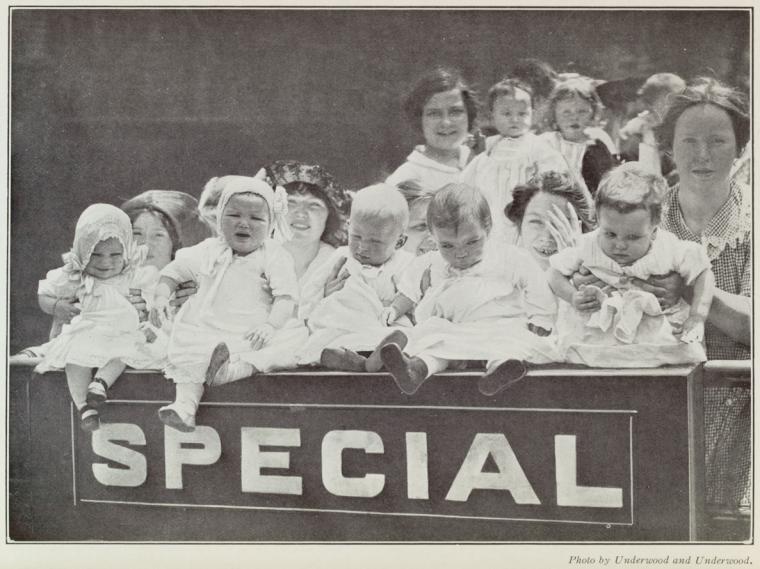
Below: Annoyed babies on display in a June 1914 Grand Automobile Baby Parade.  (This is obviously a photo montage, and, by the way, the original caption for it is super depressing. Read it here if you want.)

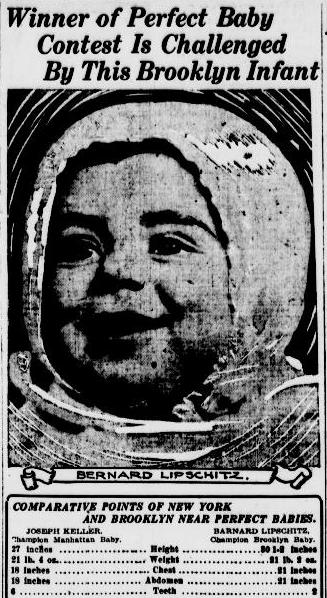
In 1913, with New York City relishing the results of two decades of City Beautiful architecture, so too did they honor the beauty of their offspring.  It even offered an opportunity to rekindle the famous Manhattan-Brooklyn rivalry that so made the Consolidation of 1898 so contentious, when, on April 17, 1913, the New York World declared that the winner of a Manhattan Perfect Baby contest had been challenged by a Brooklyn tot.

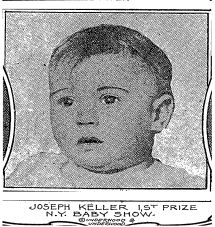
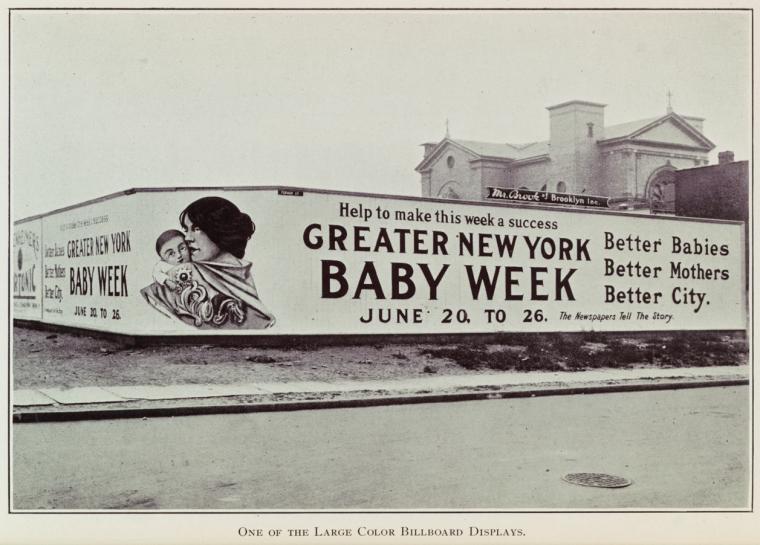
Young nine-month-old Joseph Keller (at right), residing with his German-Irish family at West 136th Street in Manhattan, won a contest held by a local public school, in a culmination of the city’s Better Babies Week, an effort by public health advocates to promote infant health, providing ‘milk stations’ and doctor consultations throughout the city.

The unabashed celebration of gorgeous children — with a mind towards public education — electrified the city.  The program was such a success that it was greatly expanded the following year.  “Baby week has done to New York’s attitude towards babies what a large, active firecracker placed under the chair of a dozing grandfather might be expected to do,” said one journal in 1914.

Keller was chosen from dozens of babies whose mothers showed up at a milk station during Better Babies festivities. Babies were evaluated based on precise guidelines, almost as one judges an animal at the Westminster Dog Show.

According to the New York Times, the scorecard used to judge Keller and the other babies in 1913 included the following criteria:  height, weight, circumference of chest, circumference of abdomen, symmetry, quality of skin and fat, quality of muscles, bones, length of head, shape and size of lips, shape and potency of nose, disposition, energy and attention.

Another article makes note, to the detriment of Mr. Keller, that “it was not the prettiest baby that got the prize” but rather one with the healthiest and most ideal physique.

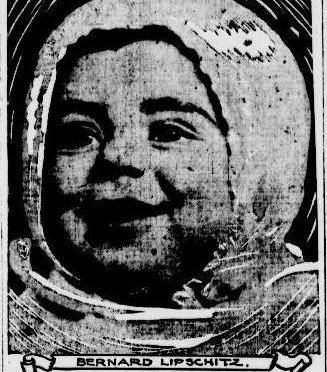
But the mother of Bernard Lipschitz, of 1526 Eastern Parkway in Brooklyn, begged to differ.  “In Brooklyn, there are babies that can equal if not excel the record set by the prize winner Joseph Keller,” she said to the Evening World in an article on April 17, 1913.

“He certainly looks like a prize winner!” the Evening World remarked of Lipschitz, regaling his superior qualifications.  In every aesthetic but one, baby Lipschitz was the superior candidate, with Keller’s only saving grace being his number of teeth — 6 to Bernard’s 2 . “Let Joseph hug that consolation to his soul.” [source]

And now, one hundred years later, what say you — Joseph vs. Bernard?

Below: From the 1914 baby drive, heavily supported by new mayor John Purroy Mitchel.

Pictures courtesy New York Public Library, except for images of Joseph and Bernard.

Categories
Podcasts

Bicycle Mania! The story of New York on two wheels, from velocipedes to ten-speeds — with women’s liberation in tow


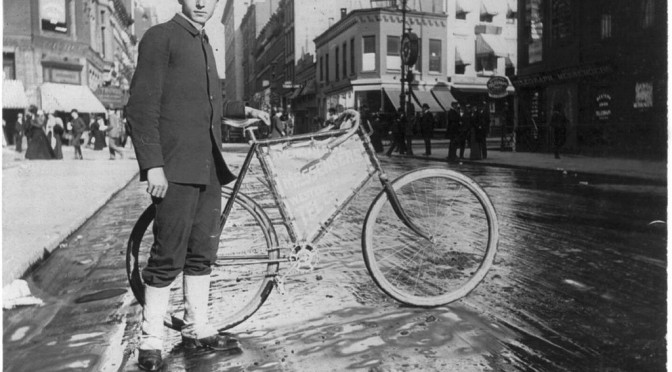
Alice Austen’s iconic photograph of a telegram bike messenger in 1896, a year where many New Yorkers were wild about bikes. Austen even rode one around with her camera. 

PODCAST The bicycle has always seemed like a slightly awkward form of transportation in big cities, but in fact, it’s reliable, convenient, clean and — believe it or not — popular in New York City for almost 200 years.

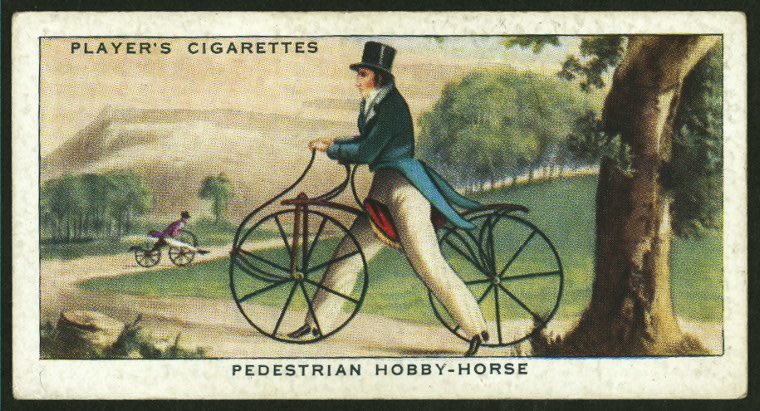
The original two-wheeled conveyance was the velocipede or dandy horse which debuted in New York in 1819. After the Civil War, an improved velocipede dazzled the likes of Henry Ward Beecher and became a frequent companion of carriages and streetcars on the streets of New York. Sporting men, meanwhile, took to the expensive high-wheeler.

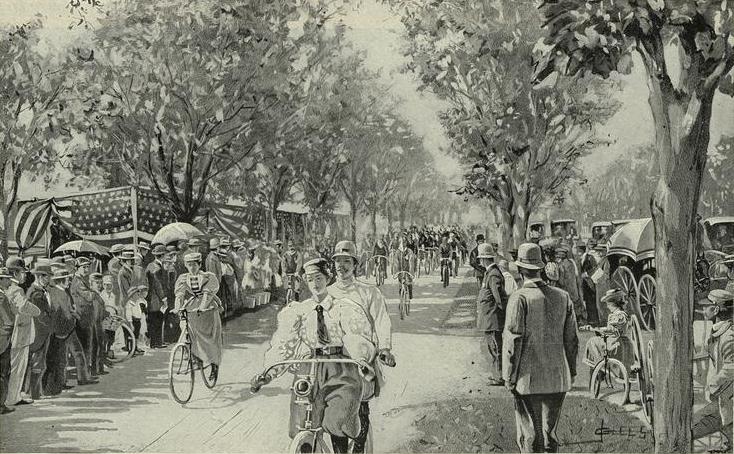
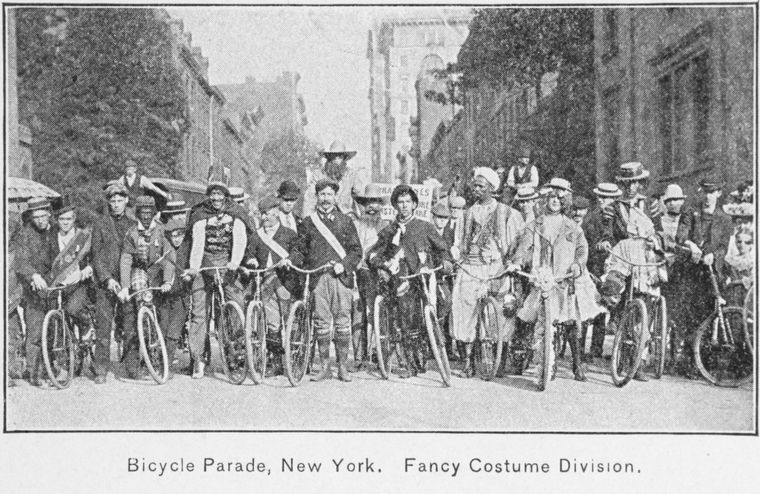
But it was during the 1890s when New Yorkers really pined for the bicycle. It liberated women, inspired music and questioned Victorian morality. Casual riders made Central Park and Riverside Drive their home, while professionals took to the velodrome of Madison Square Garden. And in Brooklyn, riders delighted in New York’s first bike path, built in 1894 to bring people out to Coney Island.

FEATURING:  Robert Moses, Charles Willson Peale, Ed Koch, and New York’s bike thief in bloomers!


The early velocipede went by several names — the hobby horse, the dandy horse, the draisine. This device made a big splash in 1819 before they were effectively banned from the city. [NYPL]


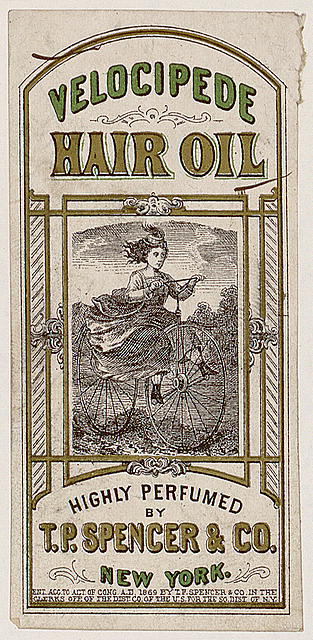
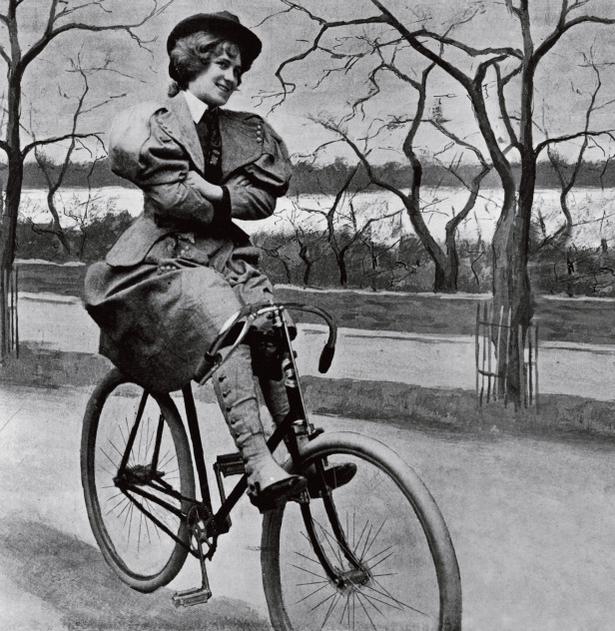
With the velocipede craze of the late 1860s, women attempted to conform to Victorian ideals of fashion with a host of bizarre products to maintain a ladylike presentation. By the 1890s, women riders chucked most of those conformities out the window, introducing more comfortable clothing and embracing the independence offered by the bicycle.

At top: An ad for a hair product, 1869. (LOC) Below: A radical change of costume in a photo illustration from 1890s (courtesy Brain Pickings, accompanying an amusing article of women’s bicycle do’s and don’ts from 1895)

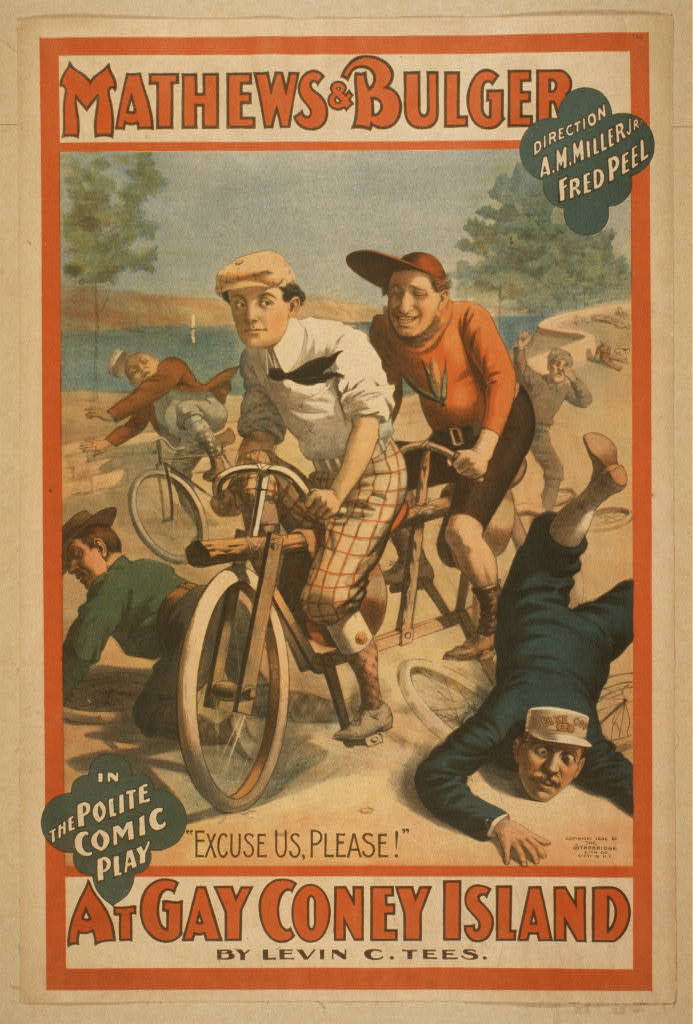
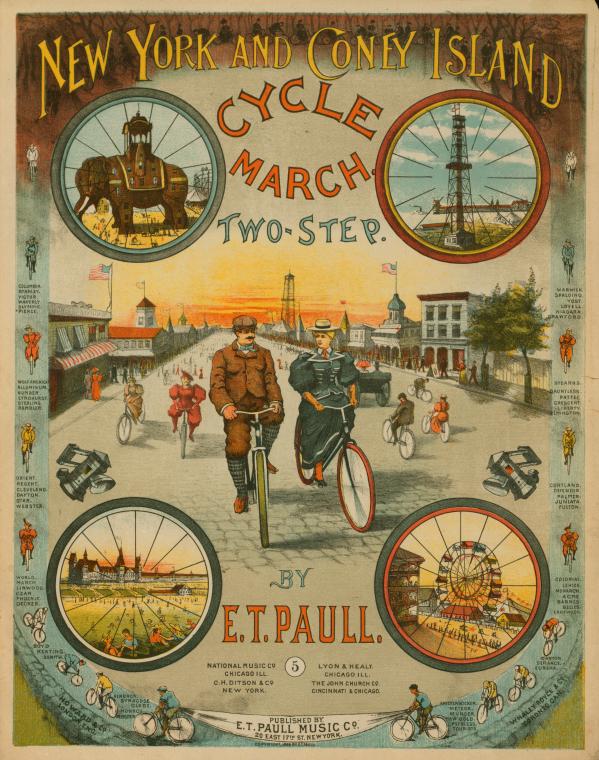
The bicycle didn’t just provide transportation and recreation in the 1890s. It influenced entertainment as well, through the songs of Tin Pan Alley. Below: A ‘comic play’ and a two-steph, both from 1896, and both inspired by the Coney Island Bike Path. (LOC)

The Coney Island Bike Path in 1896, running up Ocean Parkway to Prospect Park. I believe this illustrates the opening of the return path, as the original path opened in 1894

I have absolutely no context for this image, but I love it. Taken sometime between 1894-1901 [NYPL]

Brooklyn’s Hell Gate: Dangerous tides off Coney Island

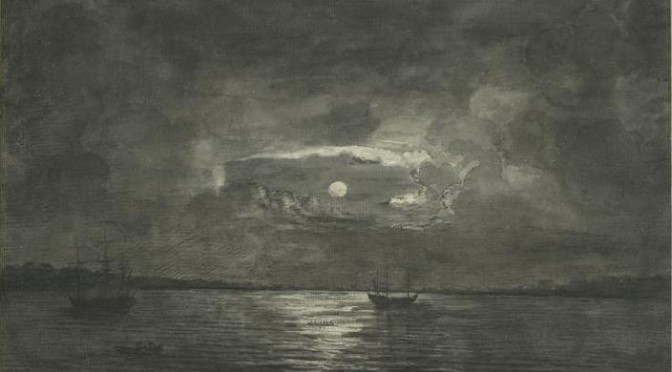
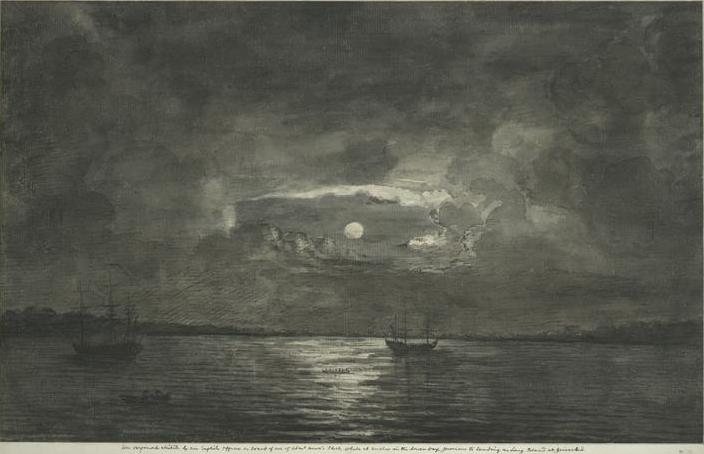
Above: The waters off Gravesend, Brooklyn, sketched by a British general in 1776. They too would have experienced the odd watery phenomenon known as ‘the Potato Patch’. [NYPL]

You may know the legend of the East River’s Hell Gate, a rush of violent waters borne from a tidal strait near Randall’s Island, so famous for wrecking ships that 19th century engineers took to dynamiting the surrounding rocks to alter the river’s flow. But the Hell Gate was not the only danger ships faced when traversing the waters around New York.

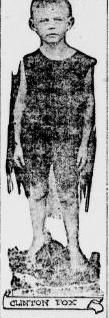
On the afternoon of October 24, 1912, two boys, Willie Taylor and Clinton Fox, playfully slipped out of their classrooms and tramped along the southern shore of Coney Island, near the edge of today’s Sea Gate neighborhood. Fox’s mongrel dog jumped into an abandoned rowboat floating off the shore near W. 25th Street.  The boys, already primed for mischief, climbed aboard, grabbed the oars and began paddling away.

They unwisely decided to steer toward the western tip of Coney Island, towards the lighthouse and Sea Gate’s most popular landmark of the day, the Atlantic Yacht Club.  They suddenly hit violent, churning seas created by a ‘strong ebb tide and a stiff wind’, and the boat smashed against a pier. Willie was thrown from the boat and eventually washed onto the shore unconscious.

But Clinton and his dog were swept back into the inescapable, twisting waves, never to be seen again.  Near midnight, the damaged rowboat eventually reemerged ashore with no trace of Clinton Fox but his shoes. [Above: a photo of Clinton Fox from the front-page Evening World story, next to the banner ‘BOY SKIPPER GAVE UP LIFE FOR CANINE CREW OF ROWBOAT‘]

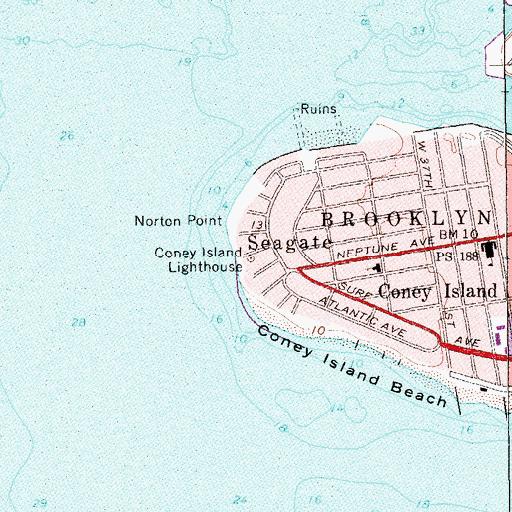
Fox was one of several deaths caused by the curious water occurrence off the Sea Gate shore known as The Potato Patch, a one-mile long watery stew of twisting currents near a row of jagged rocks and old piers, where Atlantic Ocean waters meet those of more tranquil Gravesend Bay.  A ‘peculiar rip‘ with a benign name, the choppy currents were a constant vexation one hundred years ago, “a miniature maelstrom where scores of small boats and boatsman have come to grief.”

A potato patch is an old nautical name for rough, choppy waters near a shoreline.  There is a similar occurrence in San Francisco also called the Potato Patch Shoal (watch video of it here) that frustrates ships and surfers to this day.

At left: location of the Brooklyn Potato Patch, off the coast of Sea Gate and the Coney Island beach.

The patch could overturn small boats and submerge their crewmen before anyone on shore could take notice. The Sun claimed in 1912 that it had an “unenviable record for boat mishaps and drownings.”

The area along the western portion of Coney Island had become more residential by this time. Once called Norton’s Point, a rowdy getaway popular with the likes of Boss Tweed, it had been redeveloped in the late 1890s as the respectable residential community of Sea Gate. The Atlantic Yacht Club operated as an upper-class alternative to the amusements of Coney Island further east, and, in fact, does so to this day.  All of this served only to increase small-craft traffic along the shore, particularly sporting and recreational crafts.

On March 1914, two men disappeared into the waters when their canoe was pulled into the tidal disturbance. The New York Times reported “it is feared that their boat was overturned in the rough water known as the potato patch.”

The effect of the patch were greatest in the late afternoon when the tide came in. A 1910 swim meet, delayed by only an hour, unceremoniously ended at the treacherous tidal scar. “[W]hen the swimmers came to it … they found in it their Waterloo, as not even a rowboat could pull through it with the current and wind that prevailed.”

Bearing witness to many of these disasters was an operating station for the Marconi Wireless Company, famous for its role in picking up messages from the RMS Carpathia after the sinking of the Titanic. And also Its most famous operator was David Sarnoff, later the founder of the Radio Corporation of America (RCA).

I found references to the Potato Patch well into the 1920s.  I’m sure the waters in this area are still turbulent to this day; however they are likely no match for modern vessels. It does not appear to have caused many injuries after this date. It’s also doubtful that children are jumping into random rowboats anymore.

The legend of bank robber ‘Red’ Leary, his wife Kate, and the greatest jail break in Lower East Side history

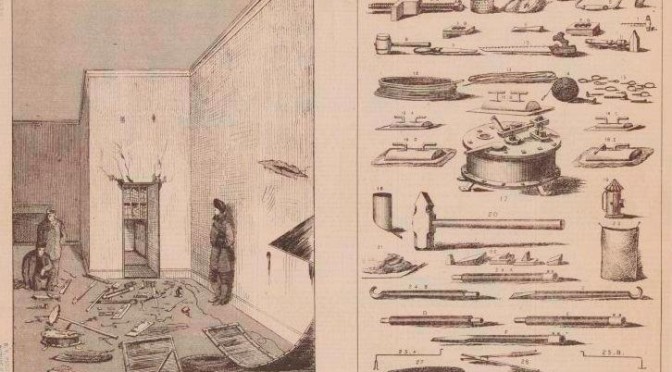
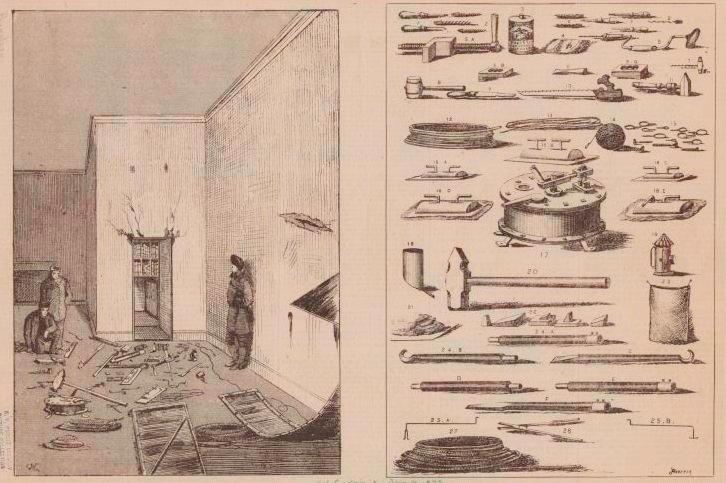
 ‘Red’ Leary was one of the famous bank robbers of the 1870s, assisting in heists all along the Northeast. Above is an illustration of a bank robbery in Montreal, Canada, displaying some of the tools found at the crime scene.

They don’t talk about ‘Red’ Leary anymore down in the streets of the Lower East Side. In the hipster bars and boutiques, in the graphic design firms and the Chinese foot-massage parlors, his name goes virtually unspoken.

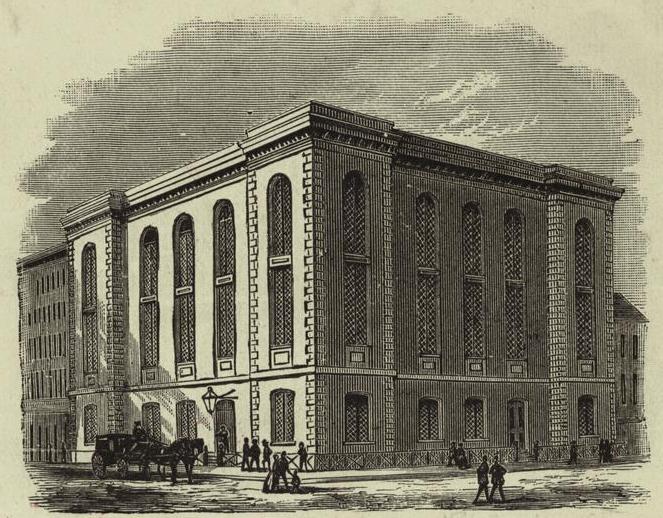
But over one hundred and thirty years ago, his unusual escape from the Ludlow Street Jail (pictured below) captivated New Yorkers, willing to overlook the rascal’s criminal misdeeds to marvel at the ambitiously planned jail break, orchestrated by his wife Kate Leary. ‘A Hero and a Burglar’ proclaimed the New York Times, appalled that teenagers were “absolutely besides themselves and exultant over the daring deed, each individual boy wishing, for the moment, that we was a Red Leary.”

John ‘Red’ Leary was one of the northeast’s most notorious bank robbers of the 1870s, frequently pairing with other known criminals of the day to pull of spectacular heists. In particular, as a part of the gang of George Leonidas Leslie (nicknamed “king of bank robbers”), Leary helped make off with thousands of dollars in stolen sums, involved in tricky operations that sometimes took years to plan.

According to Herbert Asbury, Leslie’s gang was responsible for 80% of the bank robberies between 1874-84. Not sure how that number was specifically settled on, but needless to say, as a critical member of Leslie’s operation, ‘Red’ Leary was a master at his chosen profession.

However, in December 1878, after a robbery at the Northampton Bank in Massachusetts (making off with a staggering $1.6 million), Leary was promptly captured back in New York at Second Avenue and 92nd Street, in connection with another bank robbery. It was decided to extricate Leary to Massachusetts to answer for the robbery there, so he was thrown into Ludlow Street Jail to await transferal.

The Ludlow Street Jail, between Broome and Grand streets, opened at 1862 as a debtors prison and a sometimes repository for New York’s more infamous criminals. In fact, just several months before Leary’s arrival, William ‘Boss’ Tweed had died in one of the cells here.

Leary would be sure not to meet the same fate, thanks in part to his wife, the fiery Coney Island pickpocket Kate Leary, and some of Red’s criminal cohorts. Included among them were Shang Draper, a crooked saloon owner famous for drugging customers and shanghaiing them onto ships.

Kate had already helped her husband escape capture once before, in August 1877, when the duo eluded several officers at a hotel near Fort Hamilton in Brooklyn.  A lightly guarded prison in the middle of one of the most populated neighborhoods in the world was certainly no match for a woman as determined as Kate, known as much for her intelligence as for her venality.

In May of 1879, Mrs. Leary, in disguise, rented a tenement flat next door to the jail at 76 Ludlow Street.  She and her accomplices then knocked out a wall, drilling through the thick prison defenses until they broke through into the prisoner’s bathroom, perfectly timed with Red’s arrival there.

As author B.A. Botkin‘s describes: “No alarm was raised, nor was the tunnel leading to the room with its neatly piled ton of excavated brick discovered until 10:30. By that time the fugitive was on his way to Coney Island in a light truck.”

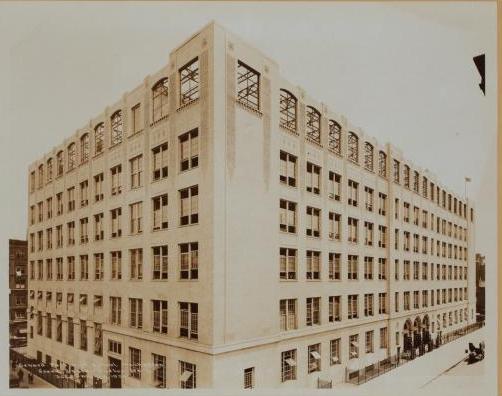
As a judge has explicitly stated that Leary would probably try to escape, the clean extraction of the high profile criminal elicited mocking scorn at the jailers and officers involved. Saving face, Ludlow officials declared Leary’s assisted release was “one of the most daring and skillfully-planned affairs of the kind to ever occur in the city,” “executed by shrewd and bold criminals.” [source]  The Ludlow jail would never really shake its, shall we say, porous reputation and was eventually demolished in the 1920s. Both the jail and the address 76 Ludlow Street would make way for Seward Park High School (pictured below, from 1930)

So dramatic was the 1879 Ludlow prison break that Leary and his crew were soon turned into folk heroes by the more rebellious residents of the Lower East Side. For this reason, the Leary escape is sometimes listed as a New York urban legend. But in fact, newspapers of the day spilled over with reports of the bold getaway.

Red Leary was eventually recaptured two years later and returned to Massachusetts to answer for his crimes there. He met a grim end in 1888 at the Knickerbocker Cottage (Sixth Avenue and 10th Street), smashed in the head with a brick by a card shark named William Train. His wife Kate literally drank herself to death in 1896 at a Coney Island hotel.

According to Botkin’s 1956  book ‘New York City Folklore’, the legend of Red Leary even briefly entered sports vernacular. “So celebrated did the exploit become, that …. [a] coach who wanted to instruct a player to break loose and steal a base simply yelled, “Red Leary!

Pictures courtesy New York Public Library

Eight forgotten roller coasters from all five boroughs!

If you’re ever attempting to make the case that New York isn’t as fun as it used to be, just use the following post as an illustration. The New York City area was once home to dozens of roller coasters, set up at major amusement destinations around the city, in every borough. Even Manhattan!

Coney Island’s Switchback Railway (1884) is often considered the first ‘real’ roller coaster. Not only was its size key to the stomach-churning thrill, but amusement parks soon relied on its proportions and sweeping shapes as a kind of branding backdrop, an immediate identifier as a destination of instant fun and relaxation. It was the first thing people saw as they approached the area; the cranking of the wheels and screams of its victims, heard from a mile away, set the rhythm for early 20th century beaches.

Not only are all these roller coasters gone, but the resort districts that hosted them have been radically transformed. Only Coney Island — the home to America’s very first roller coasters — remains.

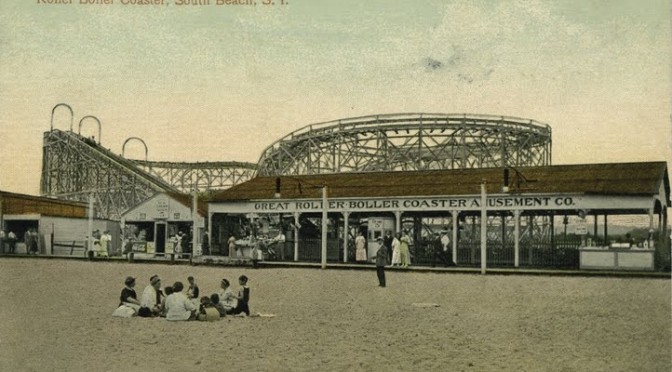
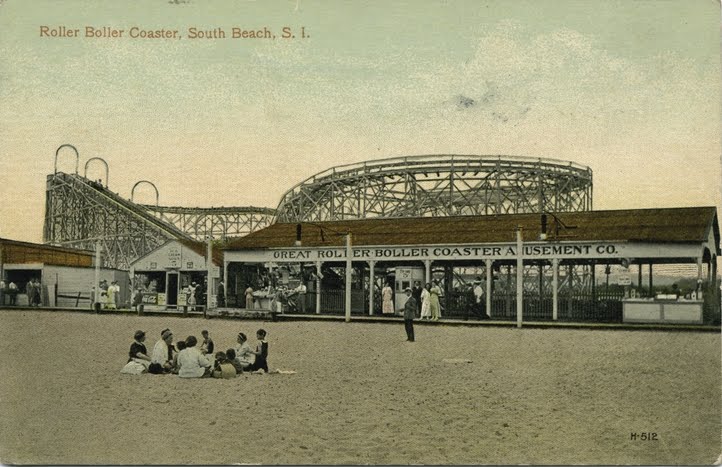
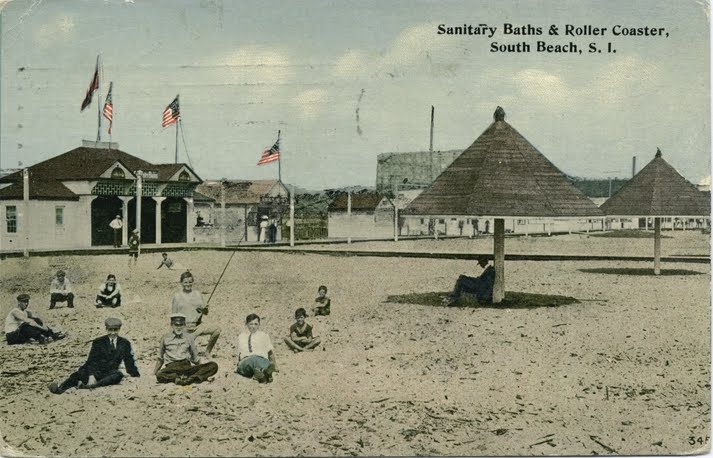
Roller Boller Coaster (seen above and in the background below)
Staten Island (South Beach)
In operation: Unknown, but probably lasted until late 1910s
South Beach popular thrived around the same time as Coney Island’s did. Likewise, its amusement parks (like Happyland) were similarly felled by fire.


Pic Courtesy NYPL

Starlight Park Rollercoaster 
The Bronx (West Farms)
In operation: 1918-early 1930s
Starlight’s rollercoaster was abandoned even the park limped along for most of the 1930s. In 1932, the coaster caught fire, the victim of rampant bonfires set along the Bronx River. (More information on my blog post about Starlight Park)

Wolz’s Thriller and the Atom Smasher
Queens (Rockaway Beach)
In operation: Thriller 1916-1937; Atom Smasher 1938-1985
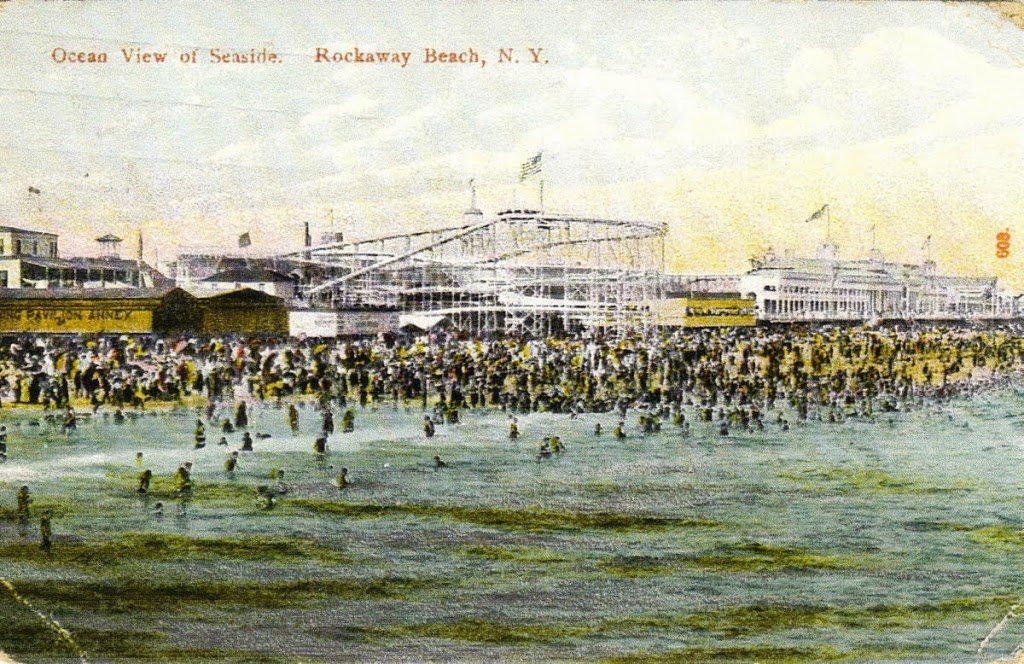
A ‘dollar’s worth of ride for just ten cents’, the Thriller (top picture) was a backbone of Rockaway’s early amusement industry, one of ten rollercoasters eventually built for the resort area. Perhaps Rockaway’s most famous rollercoaster was the Atom Smasher (at bottom), the anchor of Playland. Rockaway lost all its amusements in the 1980s.

Courtesy Rockaway Memories


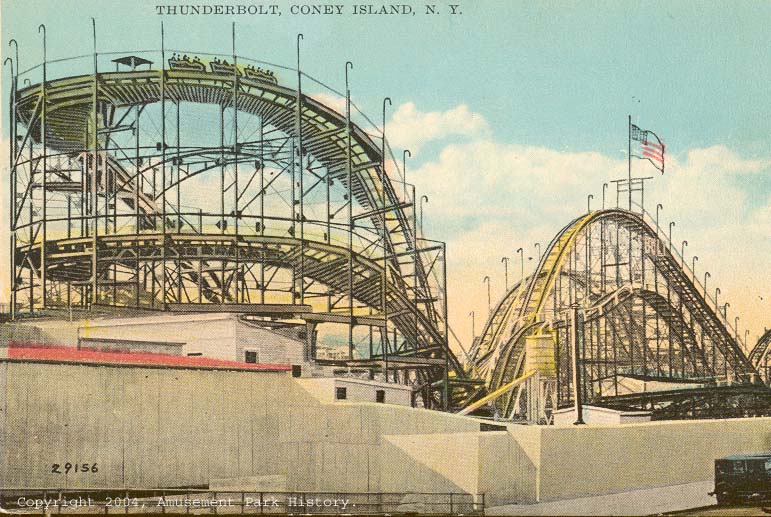
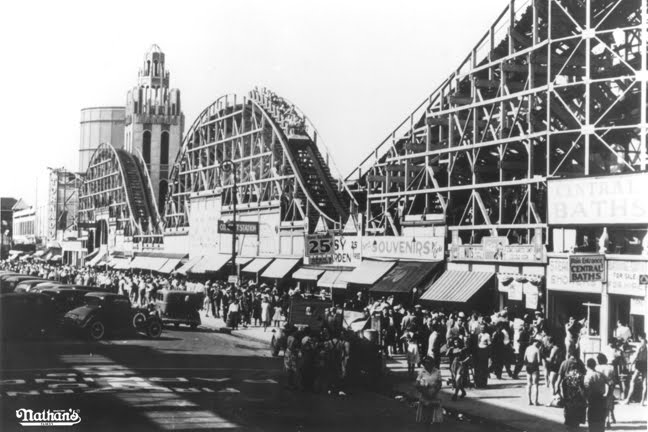
Thunderbolt and the Tornado
Brooklyn (Coney Island)
In operation: Thunderbolt 1925-1982; Tornado 1926-1977
Brooklyn has had more rollercoasters than any other borough. In fact, thanks to Coney Island, it’s had more coasters than most American states — 47 by the count of the Roller Coaster Database.

While the still-extant Cyclone is the granddaddy of them all, amusement lovers recall fondly the Thunderbolt , made famous in Woody Allen’s Annie Hall, which stood as a ruin for almost two decades. It outlasted its cousin the Tornado (at bottom), considered a marvel of engineering with its almost 3,000 feet of track undulating at a relatively low height.

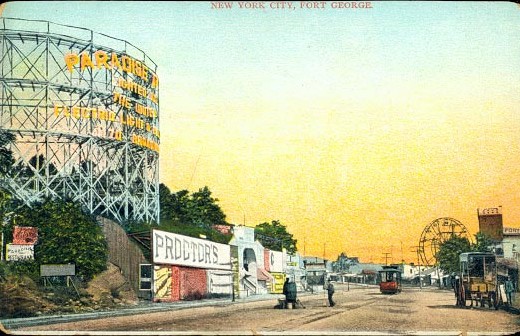
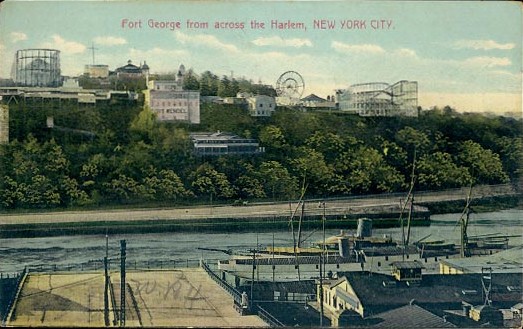
Paradise Park Roller Coasters
Manhattan (Inwood)
In operation: 1895-1914
Yes, there was a roller coaster in Manhattan! Although this appears to be the only place the island has ever had them, located in an amusement park camped out in today’s Highland Park. This amusement park actually had a couple roller coasters, according to one source. Yes, it eventually burned down as well, but its owners moved across the Hudson and opened the Palisades Amusement Park. (Courtesy myinwood.nethttp://myinwood.net/fort-george-amusement-park/)

Some dates above verified from the Rollercoaster Database

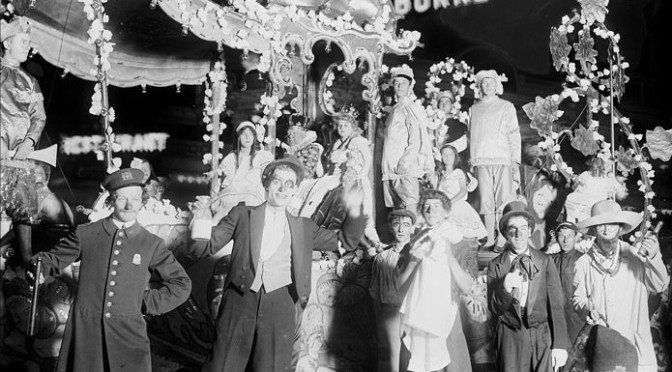
Before mermaids paraded, Coney Island went Mardi Gras!

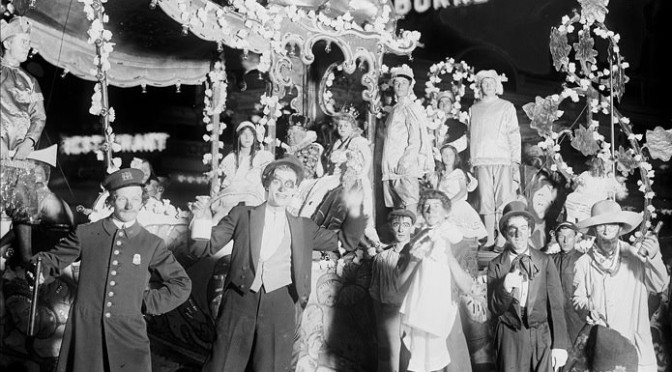
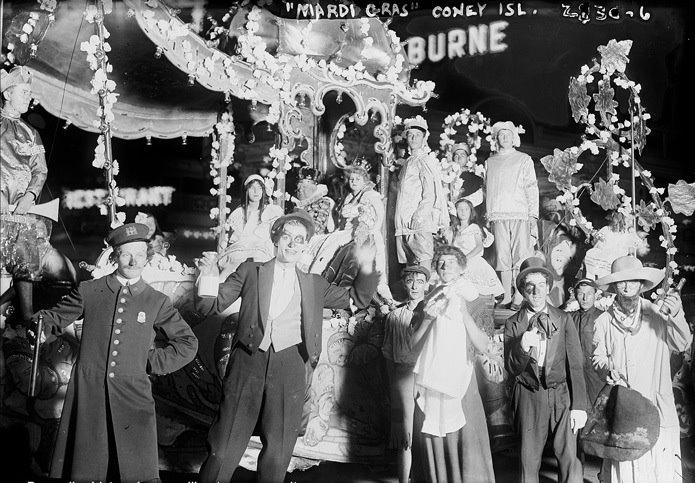
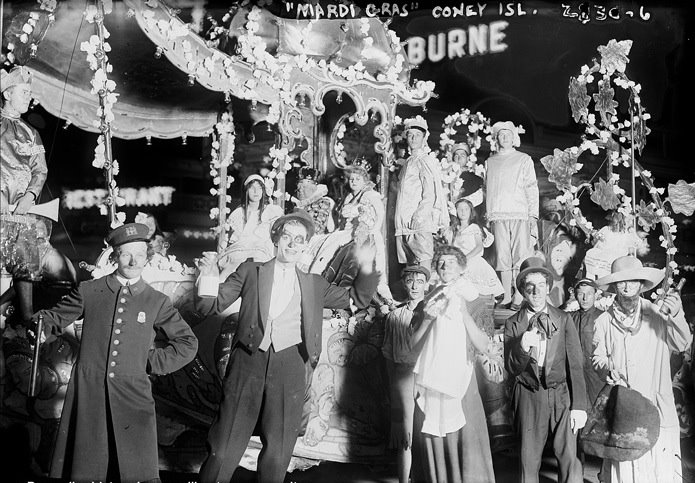
A century-old party: ghoulish revelers from the 1911 parade

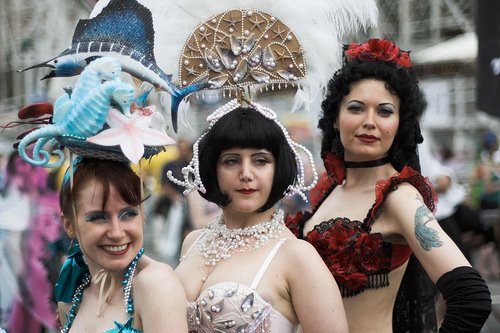
An even larger collection of freaks and aquatic oddities than Coney Island’s everyday normal assortment will come slithering down Surf Avenue this Saturday with the 29th annual Mermaid Parade.

The parade is the heart of Coney’s modern freak-show aesthetic, Christmastime for the tattooed and glittery. Most people think that, unlike most New York City parades, the Mermaid parade celebrates nothing specific, only a joy of costume, summertime and silliness. In fact, Coney Island ‘mayor’ Bill Zigun and Coney Island USA created the parade in 1983 as an homage to an even more legendary seaside tradition: the Coney Island Mardi Gras parade.

Let that stew in your mind a bit. Coney Island meets New Orleans.

The annual Mardi Gras celebration lasted from 1903, the heart of Coney’s heyday, until 1954 — the heart of the Robert Moses years. Curiously, it always took place in mid-September, which I suppose is a nicer time for a New York parade than February, the traditional date of Marti Gras. Instead, the parade was timed to coincide with the end of the summer season and the annual shuttering of the amusement parks.

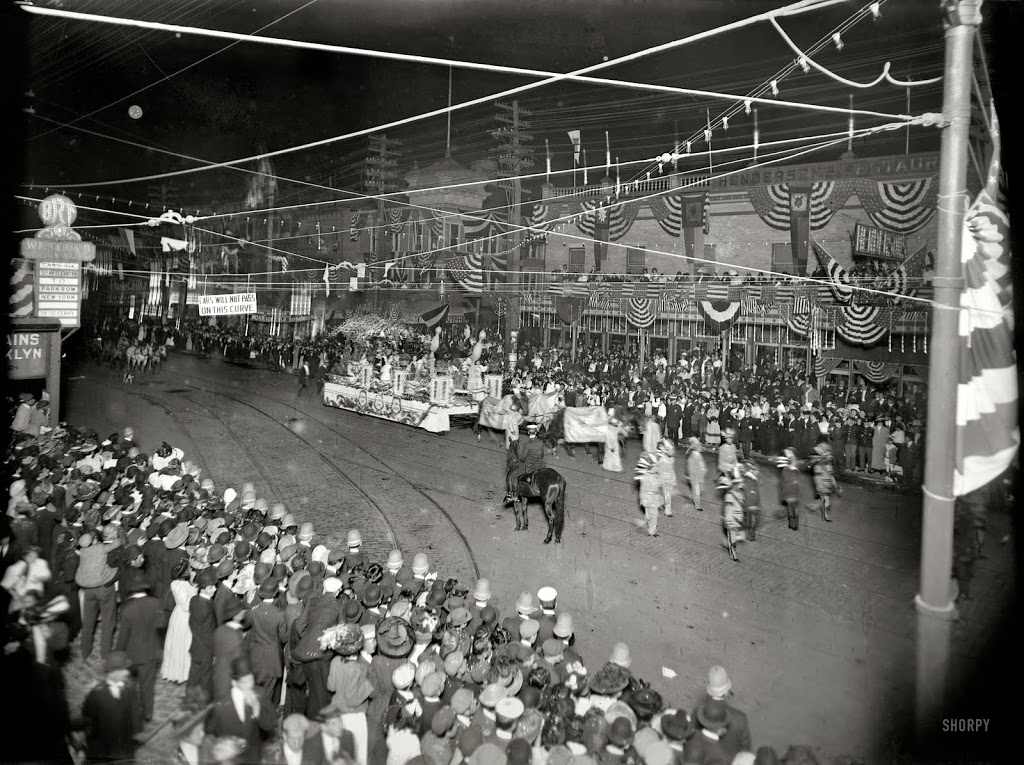
Below: The 1908 festival, with nighttime floats and frippery (Click to see an enlarged version of this picture at Shorpy.)

In 1906, the great parks of Coney Island like Dreamland were still standing, but other current draws, like  Nathan’s famous hot dog stand, wouldn’t be open for many years. Even still, the Mardi Gras parade that year managed to attract 500,000 people. “Police Commissioner [Thomas] Bingham visited the Island and had [his] full share of attention from confetti throwers and wielders of the ‘tickler’.”

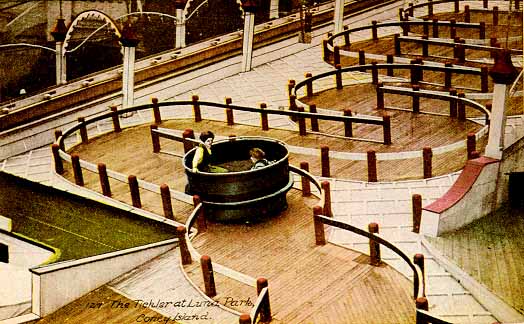
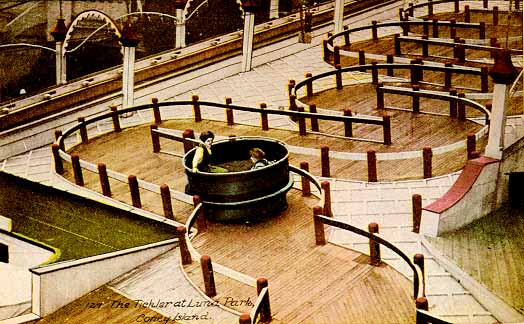
I don’t know what a tickler was back then, but the idea of what I think it is being thrust at a police commissioner is absurd. Probably a souvenir from a Luna Park ride called the Tickler (which doesn’t look that fun, see image from 1906):

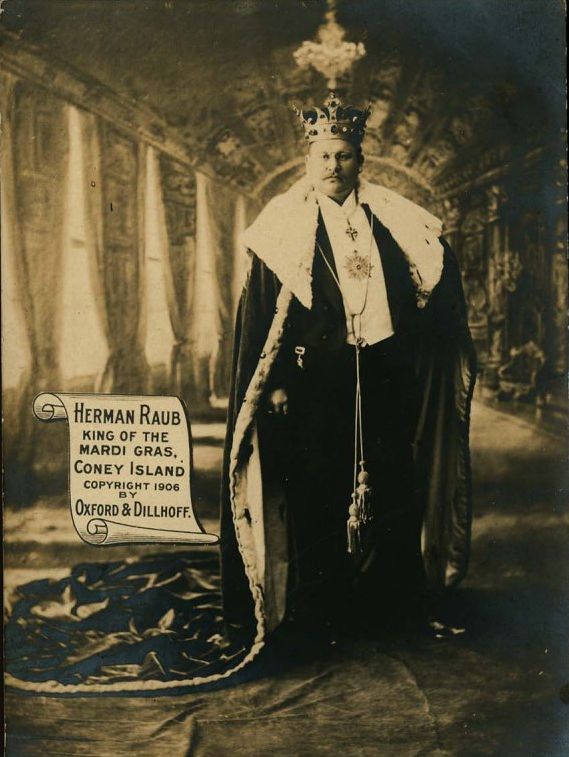
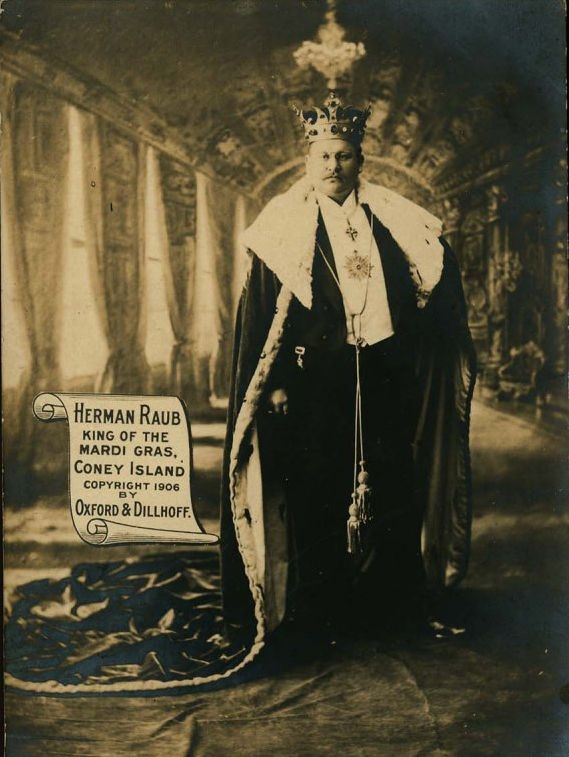
That same year brewery mogul Herman Raub (pictured below), founder of the Coney Island railway, was anointed king of the parade.

The Mardi Gras parade sounds like it was a horrifying, chaotic, fabulous mess. In 1911, the celebration also gathered about a half million people to view this tenuously religious celebration.

It seems part of the fun of the original Mardi Gras involved drunken displays of violence. “Gangs March Through Street Insulting Women and Wrecking Stores And Restaurants” shouts the Times. “Several Hundred Arrested.”

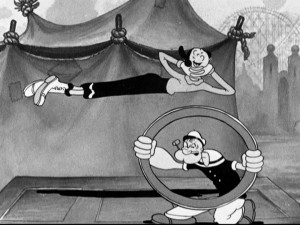
Despite rampant (probably exaggerated) violence, the parade became the star of a wacky Fatty Arbuckle-Buster Keaton film, the 1915 ‘Coney Island’. It hit celluloid later in 1935 in the Popeye the Sailor Man short ‘King of the Mardi Gras’.

By 1921, the parade had to deal with a new menace — Prohibition. “It was agreed that Prohibition had struck Coney Island a staggering blow.” Many revelers dressed in costumes that “referred satirically to blue law advocates.”

One popular event at the parade was the annual ‘prettiest baby’ competition. In 1921, the winner was “Rita Murphy, 6 years old, of 2,005 Sixty-Third Street, Brooklyn, dressed as a jockey.” The tot was awarded “a ninety-two-piece silver set which she can use to start housekeeping when she gets married.” What a future young Rita had in store for her!

The parade sadly petered out thanks in part to Robert Moses’s ridiculous plan to turn the area into “an area of predominantly residential character.” Brooklyn Pix has a good shot of the final Mardi Gras spectacle, and it looks alarmingly similar to today’s Mermaid Parade.

Check here for all the details on this year’s Mermaid Parade. I’ll see you down there!

This article is a modified reprint of one I wrote back in 2008.

Categories
Podcasts

Brighton Beach and Manhattan Beach, at your leisure

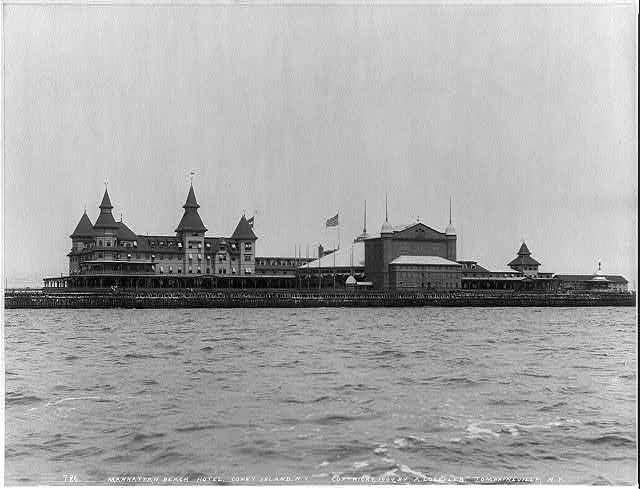
Above: Manhattan Beach Hotel

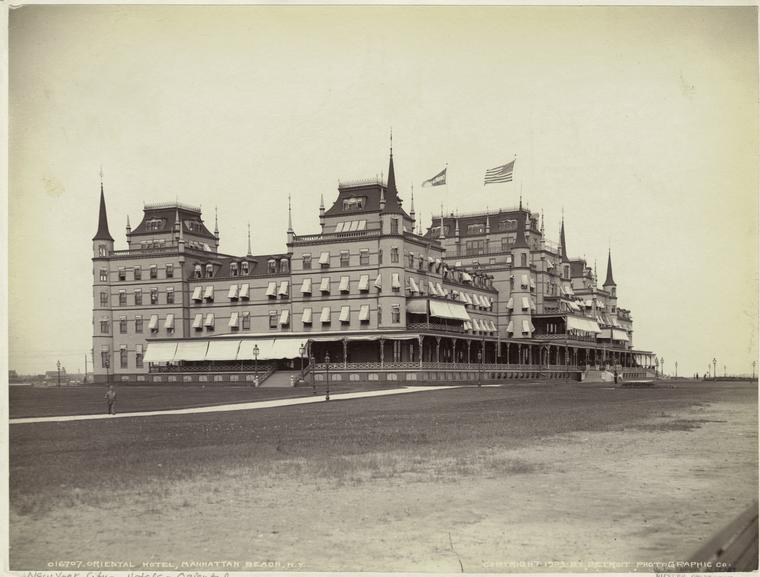
EPISODE 102 Today Brighton Beach is known for Brooklyn’s thriving Russian community, while its neighbor Manhattan Beach is calm and family oriented. But over a hundred years ago, these neighborhoods were the homes of giant, lavish hotels catering to the upper classes. While regular folk were playing at Coney Island’s Steeplechase Park, Dreamland and Luna Park, the wealthiest were enjoying ‘the tonic of sea bathing’ at three of the most toniest hotels on the East Coast — Brighton Beach Hotel, the Oriental Hotel and Manhattan Beach Hotel.

Find out the origins of these long-gone resorts and how they make their mark on the current neighborhoods of Brighton Beach and Manhattan Beach.

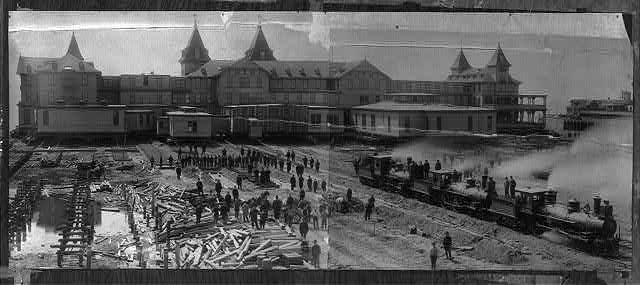
ALSO: Why should we care so much about one particular raging anti-Semite? And why did the Brighton Beach Hotel, several thousand tons of it, have to get dragged inland 500 feet?

Music in this episode is the “Manhattan Beach March” by John Philip Sousa!

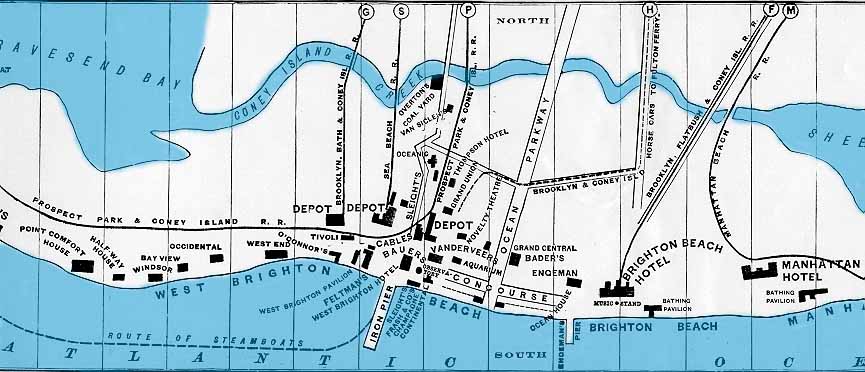
A map of Coney Island from 1879. Click into it to see the detail of the various train and horsecar lines traveling over bridges to the island. The Oriental Hotel was built in 1880 and is thus not listed. (Find the original here.)

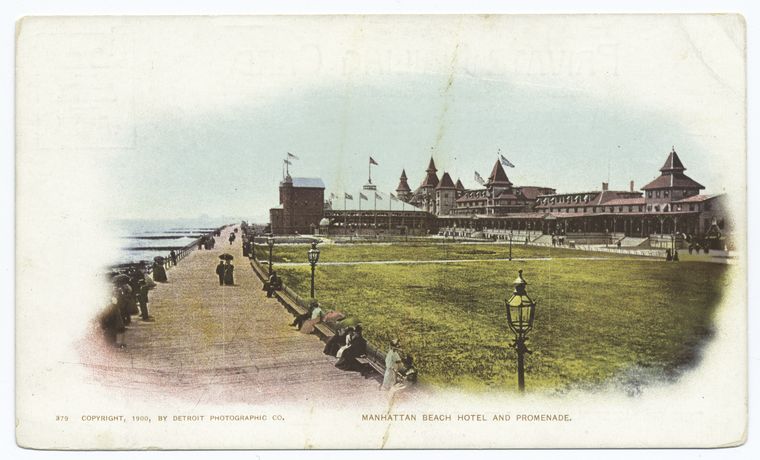
The Manhattan Beach Hotel by postcard

Facing the other way — the boardwalk of the Manhattan Beach hotel.

And from the water. The hotel was built in 1877 by railroad financier Austin Corbin. He would later scandalize progressive New Yorkers by prohibiting Jewish guests from staying at the resort.

The Oriental Hotel, built in 1880. Click here for another view by George Bradford Brainerd.

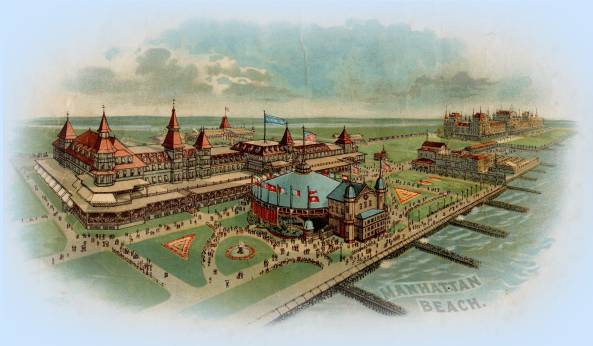
An illustration of the Manhattan Beach Hotel in the foreground, the Oriental in the distance. (Courtesy MMCSL)

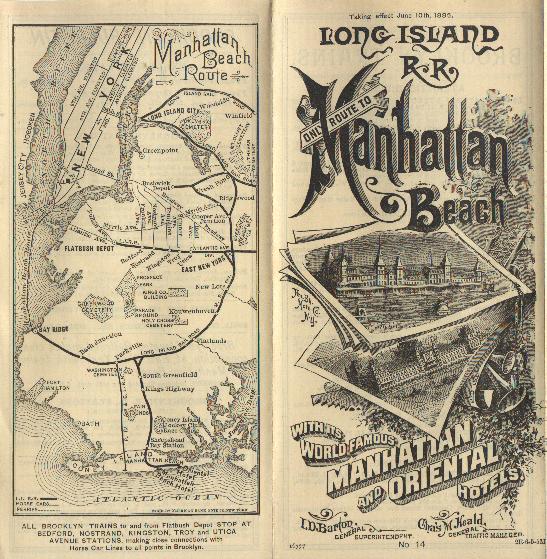
An illustrated train map for the New York and Manhattan Beach Railway, featuring the two Corbin hotels on the flap. (Courtesy LIRR history)

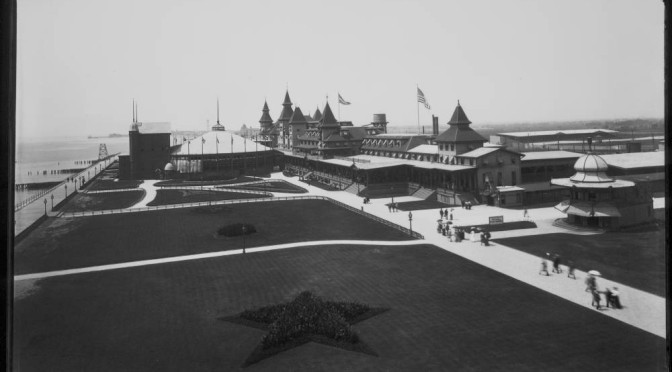
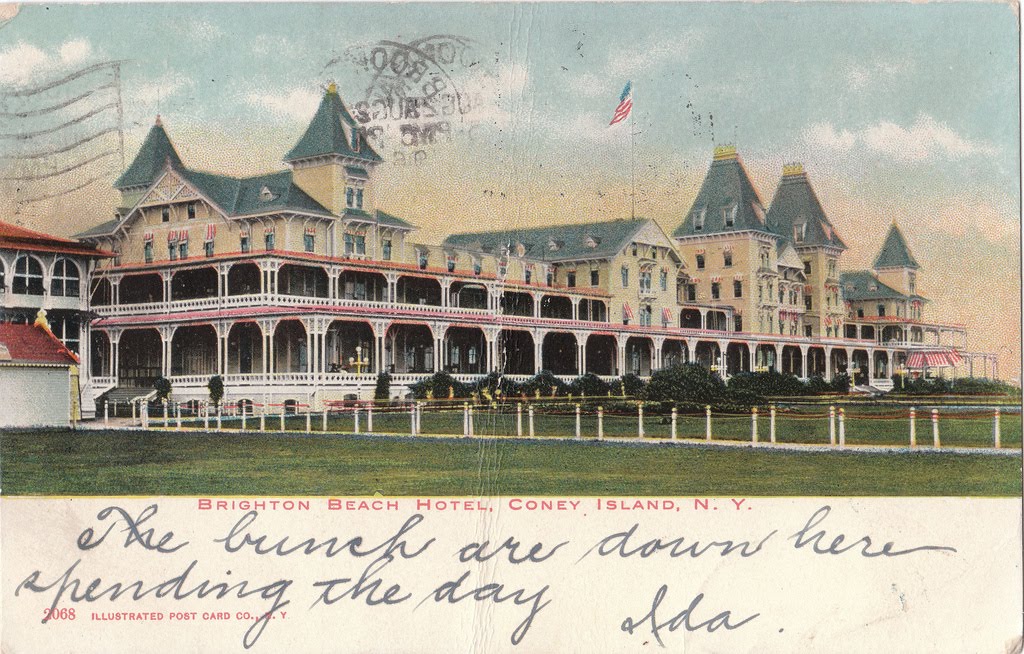
The Brighton Beach Hotel in 1906. Even as millions streamed into Coney Island to enjoy the frenetic rides and attractions, others could relax here, just a few hundred feet away.

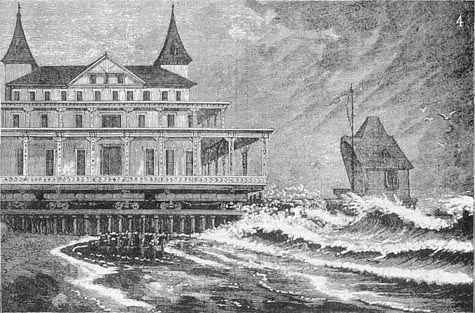
The Brighton Beach was moved — all 6,000 tons of it — in 1888 when the beach in front of it eroded. (Click into pic for better view.) Below it, an illustration of the hotel under siege by the sea. (Courtesy Weather blog)

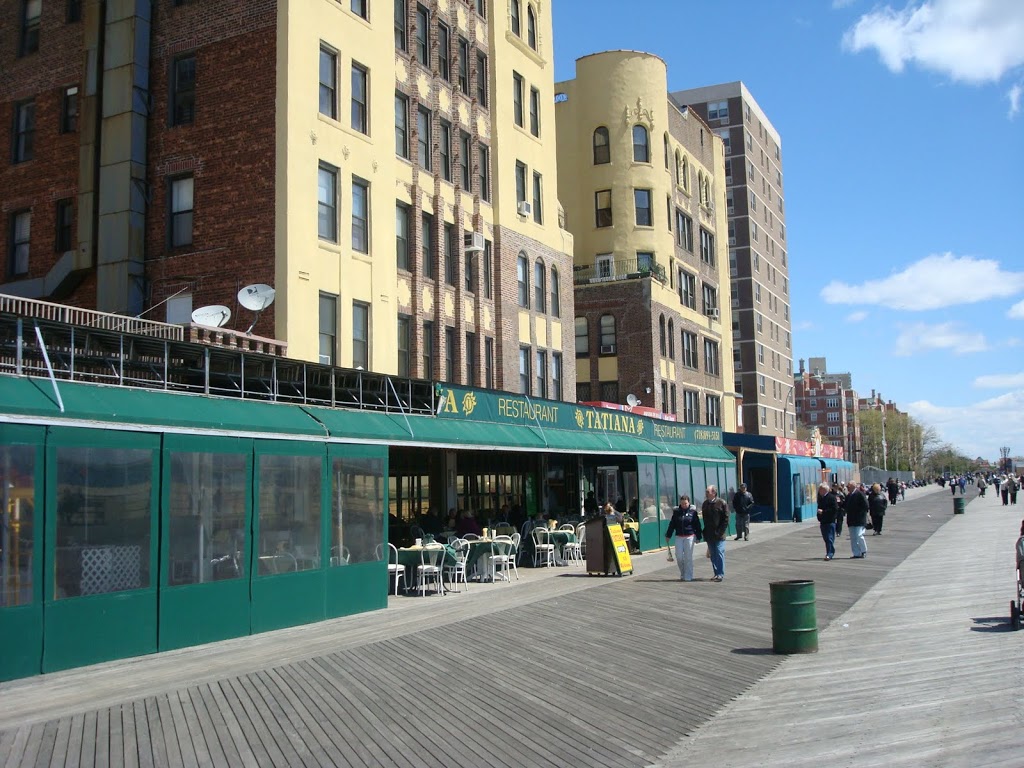
Along today’s Brighton Beach Avenue, you can find a host of shops and restaurants harkening to the tastes of old Russia.

The real fun lies along the boardwalk at night, a string of Russian restaurants and clubs where the action sometimes spills out to the beach. Up the street at Brighton Beach Avenue, you can find The National restaurant, the closest a New Yorkern can come to finding Atlantic City style dinner entertainment.

In places, you can almost see the line where William Engeman’s Brighton Beach property ends and Austin Corbin’s Manhattan Beach/Oriental Hotel property begins. Brighton Beach is distinguished by handsome pre-war apartment buildings; Manhattan Beach is more single-family homes, many recently built and some very ornate.

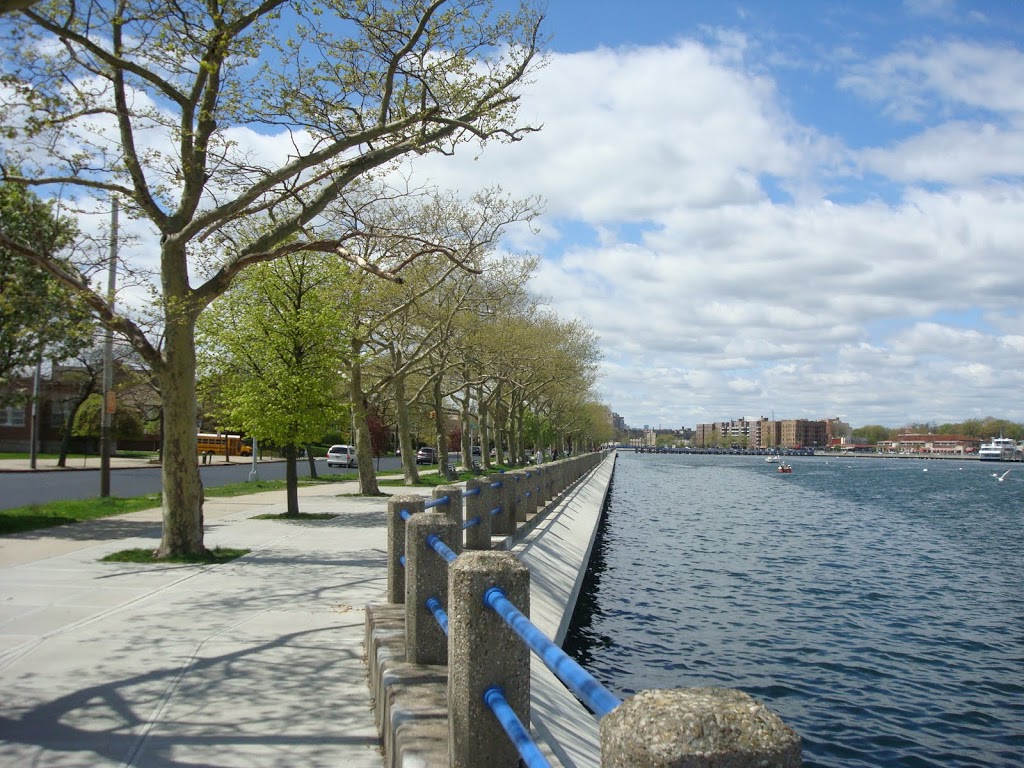
Sheepshead Bay, north of Manhattan Beach, is named for a fish which no longer swims here.

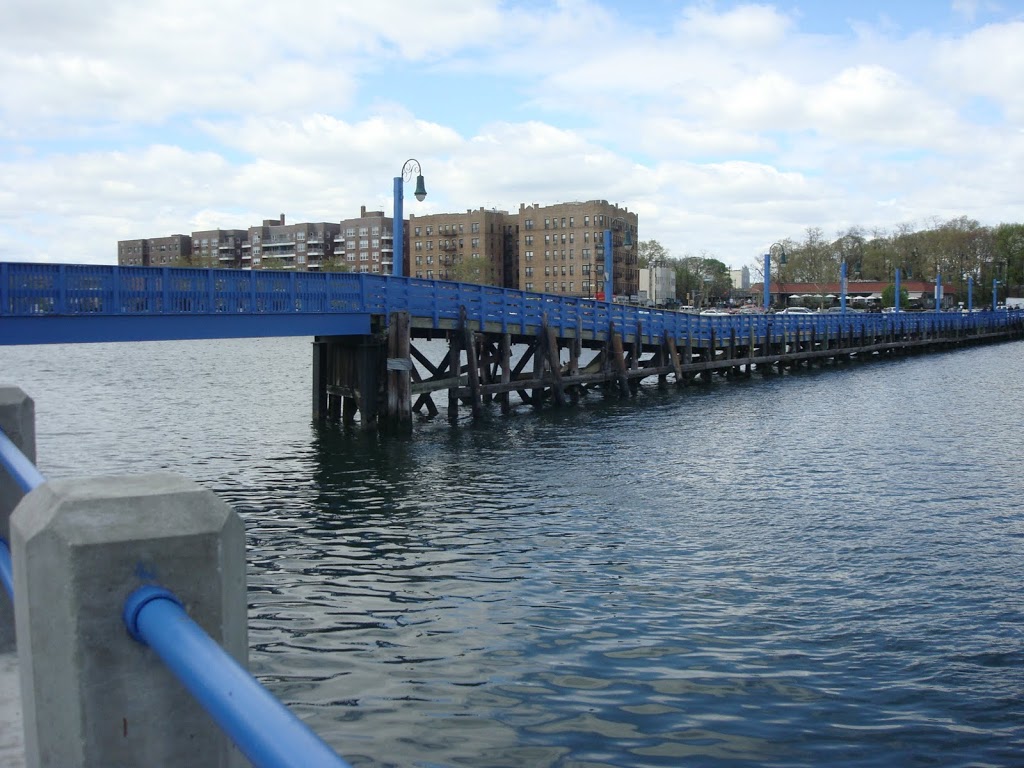
One of my favorite things in all of Brooklyn — the Ocean Avenue footbridge. Originally built in 1880, commissioned by Austin Corbin, the pedestrian bridge links the promenade in Manhattan Beach with the one in the neighborhood of Sheepshead Bay. According to Forgotten New York, Corbin kept closing the bridge, worried about ‘undesirables’ flocking to his precious upper-class hotel.

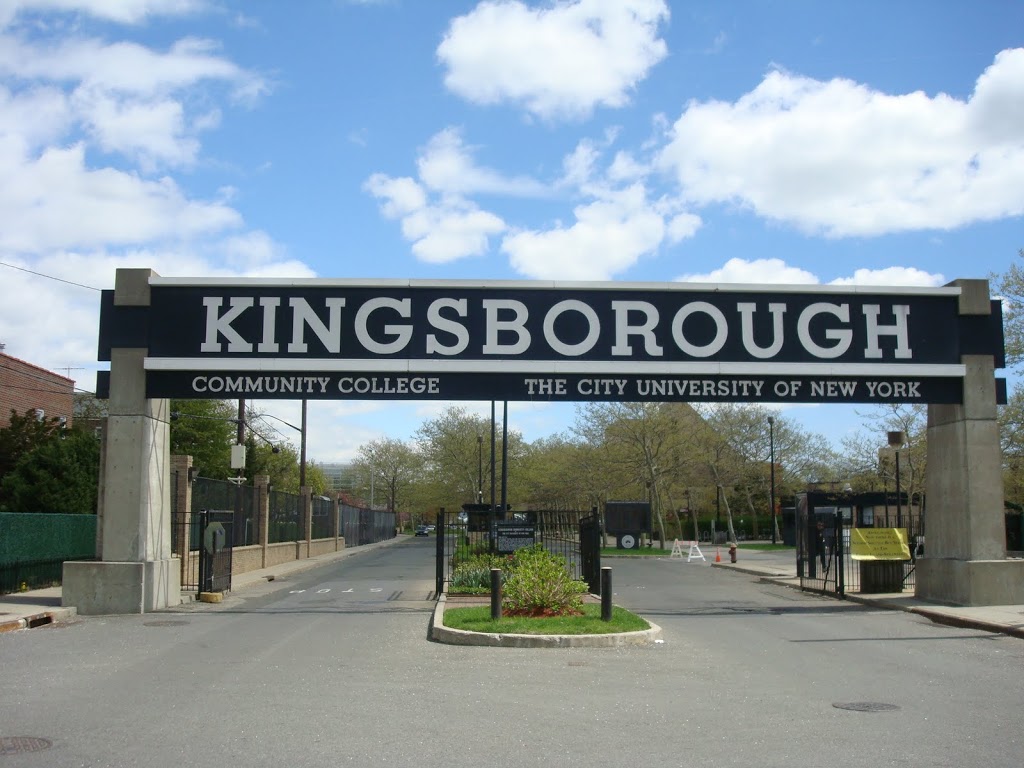
Kingsborough Community College at the far eastern end of the former island. If the college feels a bit like a military barracks, that’s because it was. After Corbin’s hotels were demolished, most of the land went to private home developments. But the far tip went to the Coast Guard and later served as a training base for the United States Maritime Service.


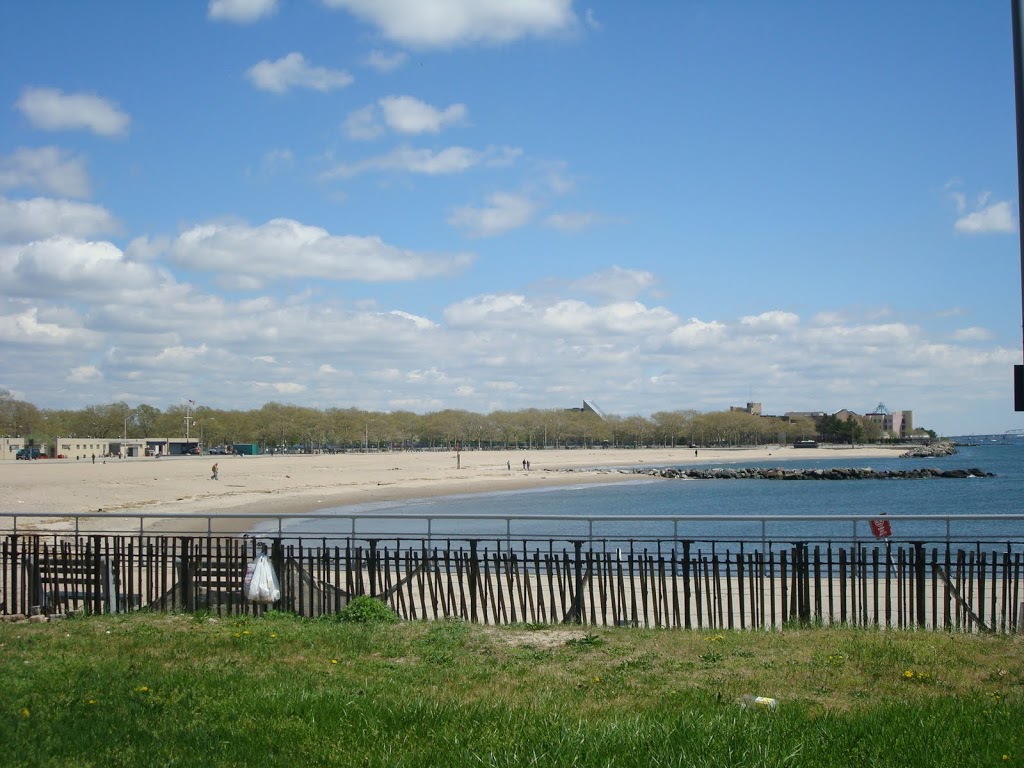
Manhattan Beach Park, a seemingly out of place sandy oasis in the quiet neighborhood of Manhattan Beach, is a remnant of the former resorts.

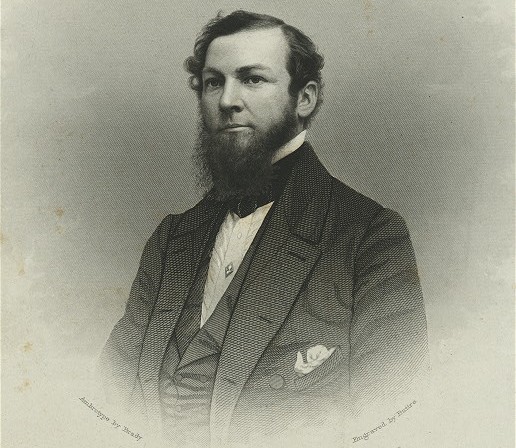
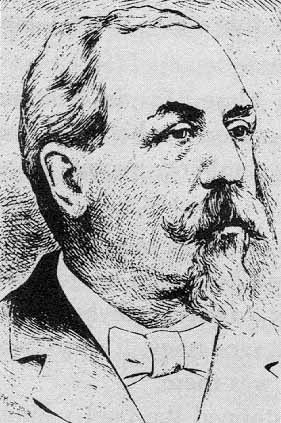
Mayor Charles Godfrey Gunther, Coney Island-bound

KNOW YOUR MAYORS Our modest little series about some of the greatest, notorious, most important, even most useless, mayors of New York City. Other entrants in our mayoral survey can be found here.

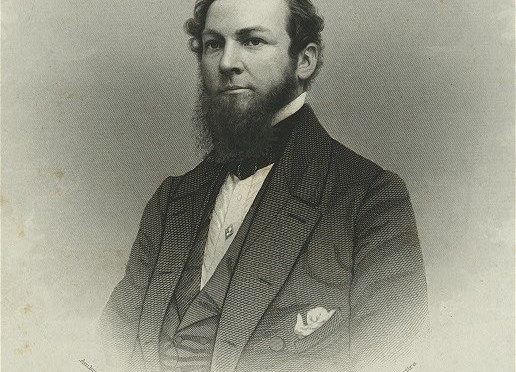
Mayor C. Godfrey Gunther
In office: 1864-1865

His past glories were built on a mountain of fur pelts, and his future would wash up on the half-developed shores of Coney Island. But in 1961, it was Civil War that nearly derailed the political career of Charles Godfrey Gunther.

The groundwork was laid in 1857 by former mayor Fernando Wood, who rebelled against Tammany Hall, the Democratic machine he formerly led, to form his new political organization called Mozart Hall. This assembledge of working class reformers and Wood devotees elevated him back to City Hall in 1960, returning to the seat of power occupied by German paint mogul Daniel Tiemann, who had unseated Wood back in 1857.

Back in business, Wood heralded a feisty pro-South, anti-abolitionist stance, pitting himself against Albany and threatening to secede Manhattan from the state.

By the election of 1861 however, a swell of national support for the Union cause turned against Wood. The Democrats were in a precarious spot, splintered between rival Democratic groups. It’s here in our story where we introduce Charles Godfrey Gunther, Tammany’s official candidate for mayor in 1861.

Gunther was born at Maiden Lane and Liberty Street, on Feb 7, 1822 — into a German family that had made its fortunes in the fur trade, rivals of the city’s true fur king John Jacob Astor. Charles spent his youth in his father’s tutelage, taking over the family business C.G. Gunther & Co.

Like so many others before him, Charles’ business saavy and wealth caught the attentions of Tammany Hall. The furrier worked his way up through the political lodge, eventually becoming sachem in 1856.

He was Tammany’s candidate for mayor in 1861, against Wood, and it would have made for a fine contest between them. In fact, Gunther would have won. (He scored all of 600 more votes than Wood.)

But of course, there was another contestant, the Republican George Opdyke. With Wood and Gunther appealing to the same constituencies, they split the traditional Democratic vote, and Opdyke ascended to office.

Perhaps Charles should have been grateful. The years 1862 and 1863 were not gracious times to be mayor of a major city. Opdyke’s execution of military conscription upon the city’s immigrants and his fumbled handling of the ensuing draft riots permanently damaged his political reputation.

By the fall of 1863, New Yorkers craving a change in leadership were given a strange buffet of choices. The Republicans, shedding Opdyke and at a serious political disadvantage, brought forth alderman and gun-maker Orison Blunt, inventor of the ‘pepper box gun’. Tammany meanwhile offered up Francis I. A. Boole, a rather corrupt city official notable for heading the street cleaning department.
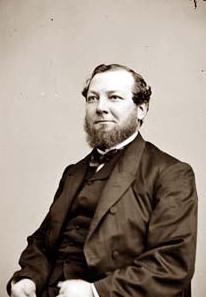
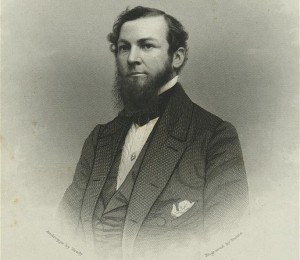
With these weak choices at such a pivotal period in history, rebels from both parties — and heavily peopled with disenfranchised former Wood supporters — split to form a temporary coalition of working class Irish and Germans.

With the strong support of the city’s surging German newspapers, Gunther was chosen as their candidate. That November he swept past Blunt and Boole to become New York’s 77th mayor. Boole took it especially hard; he “became insane and died shortly afterwards.”

Was the German furrier an effective mayor? I can’t quite figure out as original sources seem split. An “honest, pleasant gentleman, with frank and cordial manners,” he’s praised for his penny pinching tactics, at one time even cancelling a celebration of George Washington’s birthday as it was thought to be too extravagant. In 1964, on the verge of a national election, he clamped down on any serious city celebrations of Union victory as being too ‘political’ in nature.

In a parallel to Bloomberg’s recent efforts to relieve traffic congestion, Gunther also strived to clear the streets — with the removal of slaughterhouses and roaming herds of cattle.

However, he was also seen as a rather weak political figure, with little influence over other city offices. Perhaps this was because he was honest and the bureaucracies of city government dreadfully corrupted. Running for re-election in 1865, he was crushed in the polling, with three other candidates out voting him. The victor that year was true-blue Boss Tweed crony John Hoffman.
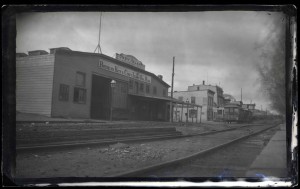

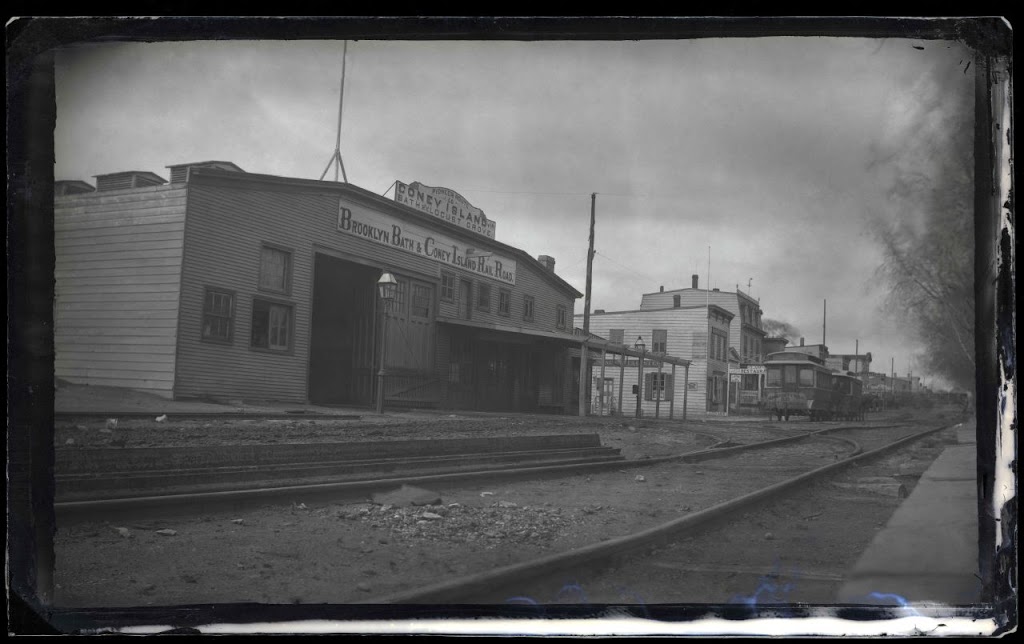
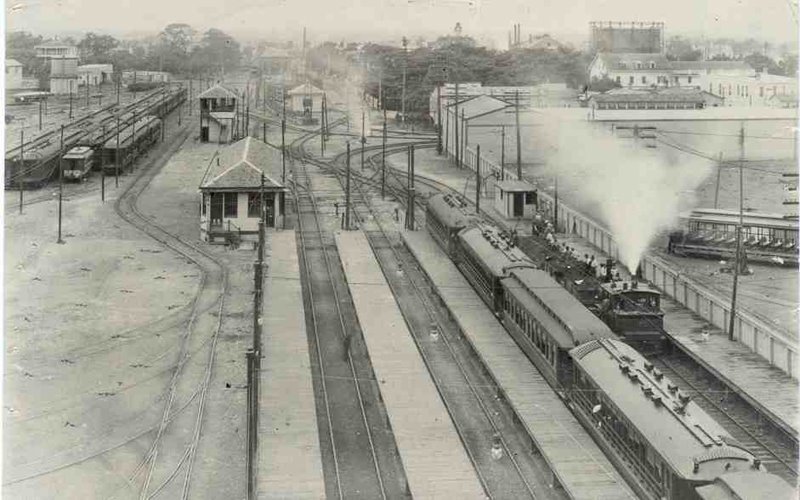
Above: the Coney Island terminal for the Brooklyn, Bath and Coney Island Railroad line

Gunther’s story doesn’t end here. He became a prominent leader in New York volunteer fire department and eventually even a partner in a very lucrative venture — the Brooklyn, Bath and Coney Island Railroad. It was this rail line that allowed thousands of New Yorkers to escape the city, eventually transforming Coney Island into a popular resort and amusement palace.

The train line, nicknamed Gunther’s Road, operated “six steam locomotives and 28 passenger cars” and “carried almost 400,000 passengers” in 1882 alone. Gunther would even own his own resort out on Coney Island, although it burned down a few years later.

And I end with a rather colorful anecdote from a 1906 article about Mr. Gunther and his railroad, from The Third Rail:

“There was one engineer who had served in the war of the rebellion, and who was particularly patriotic, who painted his engine red, white and blue.

Gunther saw it from a distance, on its first trip, tearing across the country, and he was frantic.

“For God’s sake, Drummond,” he said, when he overtook his engineer, “whatever possessed you to paint that engine red, white and blue?’

“You’re a true American, ain’t you?” said Drummond.

“Yes, but-but-“

“Well, so am I.”

“Yes, but that engine looks like a traveling barber shop.”

Gunther could not convince Drummond, however, and the latter quit his job rather than submit to any alterations.

The engine was afterwards painted according to Mr. Gunther’s ideas.

It was painted a flaring yellow.”

Mr. Gunther died on January 22, 1885 and is buried at Green-Wood Cemetery.

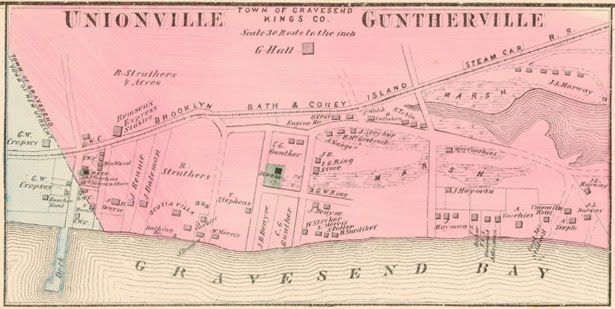
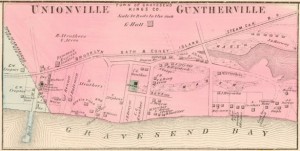
ADDED: One of our Facebook fans reminded me of an even more spectacular fact about Mr. Gunther — there was actually a short-lived Brooklyn neighborhood named after him. Guntherville was actually part of the pre-consolidation town of Gravesend and naturally featured many properties owned by C. Godfrey. The map below from 1873 illustrates its place along the Gravesend shore. Judging from comparing maps, it appears that part of Guntherville would later comprise the fleeting, beach side amusement venture Ulmer Park.

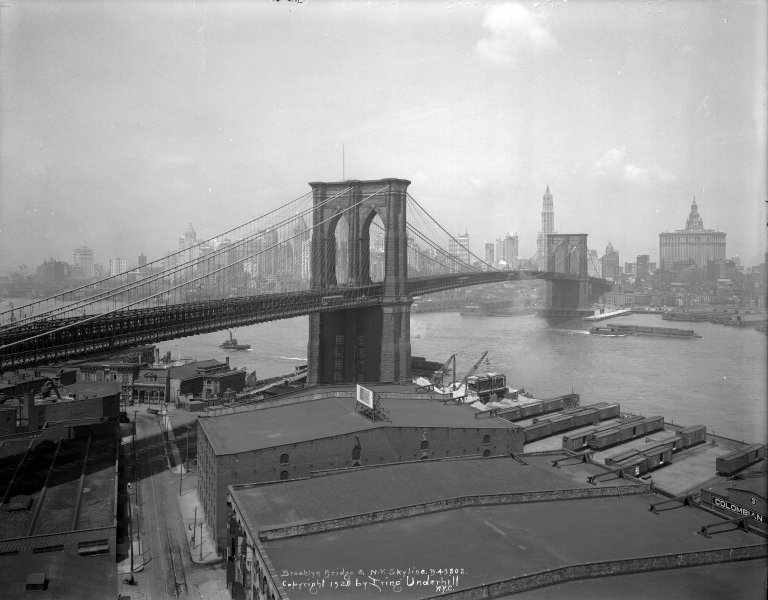
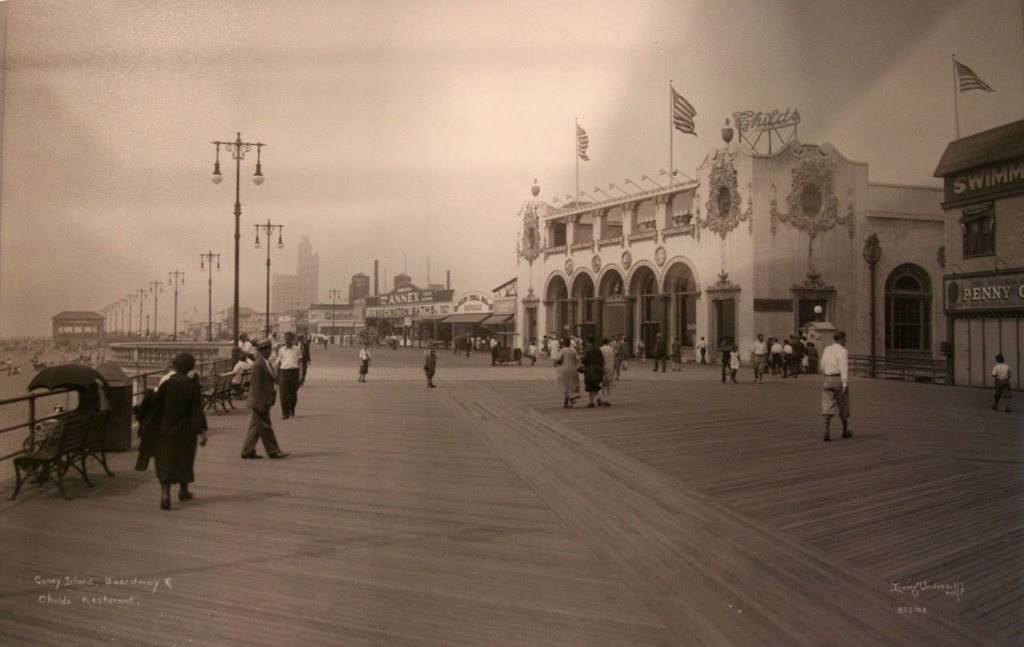
Picture Perfect: Irving Underhill captures New York style

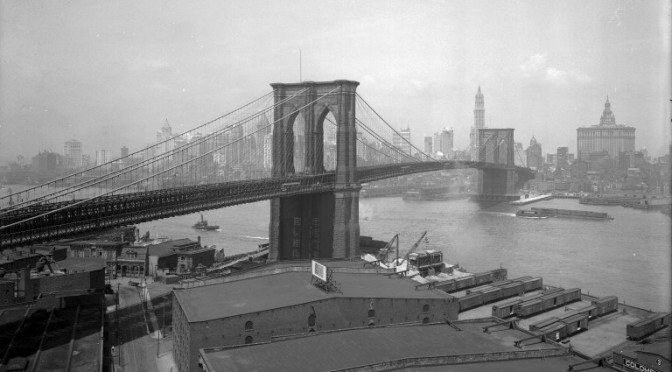
Top: the Brooklyn Bridge in 1925. Bottom: Underhill on the boardwalk: the photographer captures a seemingly meloncholy day in Coney Island, with Childs Restaurant at right

Nobody in New York’s early history captures the romance of early city life more than the first photographers — the men and women who wiled away with expensive, limited and time-consuming photographic processes, bulky and decidedly unportable cameras, and a medium that was still struggling to find purpose.

New York’s first master photographer Matthew Brady, famous for his Civil War battle images and unappreciated in his time, chose the city for the location of his studio but turned his camera over mostly to intimate subjects. Jacob Riis used his lense to expose social disparity in lower Manhattan. And the social fabric of the city was documented by Alice Austen, who balanced intimate images of neighborhood life with candids of big city bustle.

But the real glamour shots of the city most often came from big studio photographers, working not to present any kind of social illumination but for a profit. One of these was Irving Underhill (1872-1960), a successful photographer who also took pictures to be rendered as colored postcards or “souvenir cards”.

More of his postcards can be found here. They’re certainly pretty, with their saturated color turns regular New York scenes into unusual and cartoonish pastel paintings. The real beauty of New York comes alive in Underhill’s regular, clean photographic documentation of basic city structures.

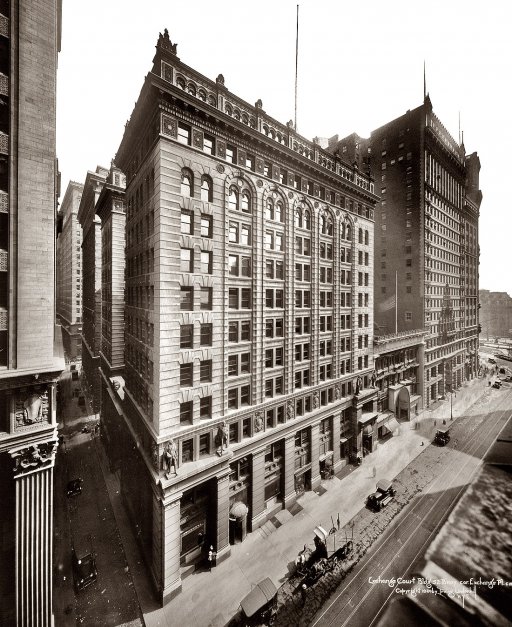
1910: 34th Street and 6th Avenue, shot from the roof of Macy’s, looking east

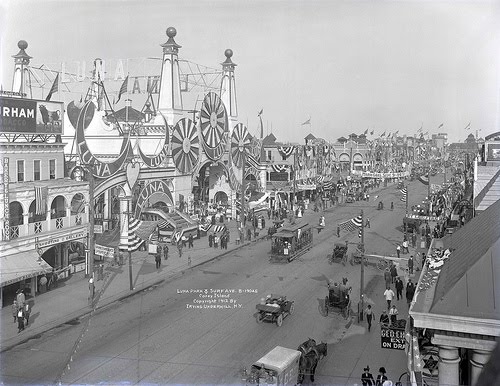
1912: Luna Park along Surf Avenue in Coney Island

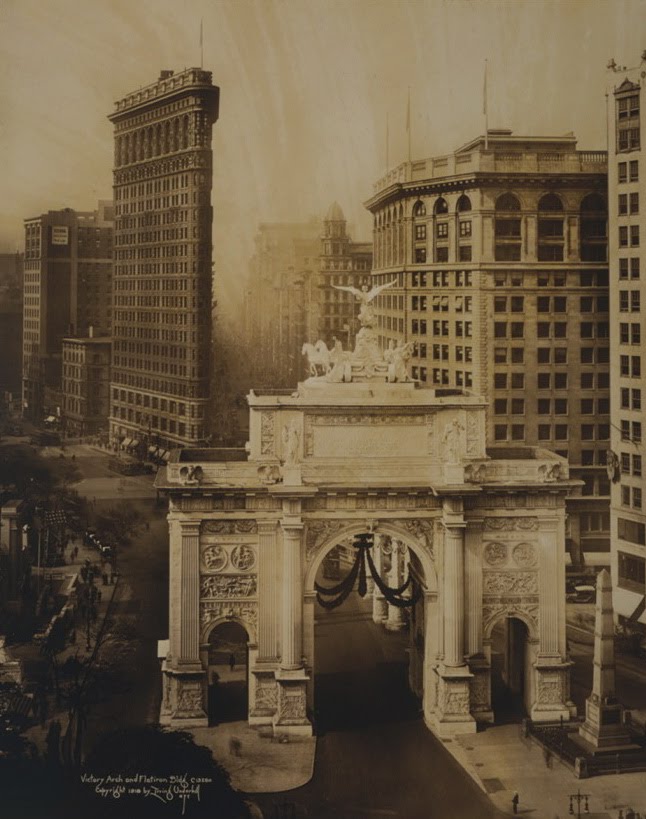
1919: Madison Square Park and the Flatiron Building, with the newly erected ‘Victory Arch’ celebrating the end of World War I

1920: Exchange Court building at 52 Broadway, one of dozens of Underhill subjects either radically revamped or demolished completely

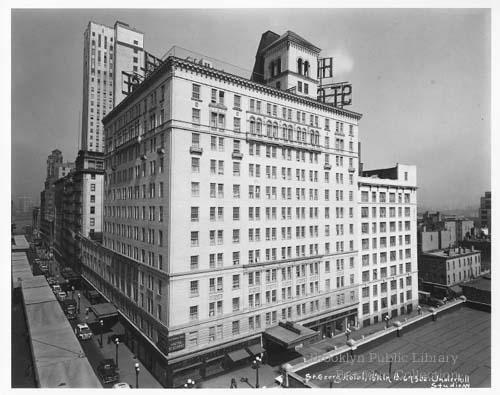
The Hotel St. George in Brooklyn Heights, date of photograph unknown

Underhill opened his studio in 1896, specializing in “artistic portraits, city views and panoramas, group photographs, marine, legal and machinery photography.”

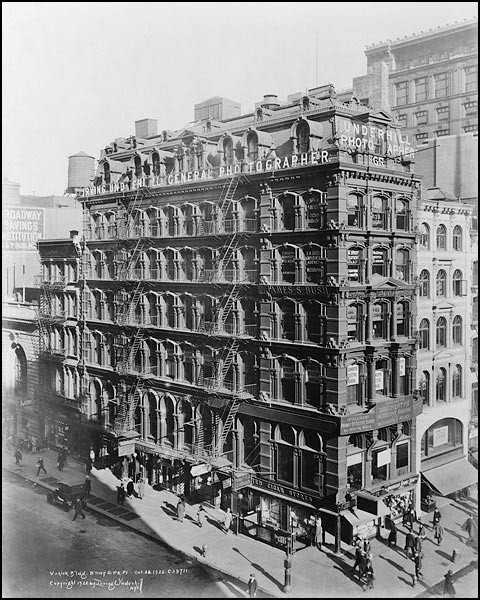
He was so successful that his agency received exclusive commissions to photograph and promote new buildings like the Woolworth Building, which he would capture in timed intervals to track the construction process. Many years later, his name could be seen from blocks away, plastered along the top of his studios at Broadway and Park Place. You can see the words ‘Irving Underhill, General Photographer’ along the top of the image here, taken in 1922.

Underhill’s early portfolio was printed in the 1904 book One Hundred And Sixty Glimpses of Greater New York, an incredible array of black and white images detailing city architecture in the midst of the gilded era. Each page is cleanly labeled and visual detectives will enjoy matching the images to what stands in these places today. You can look at most of the book on Google Books.

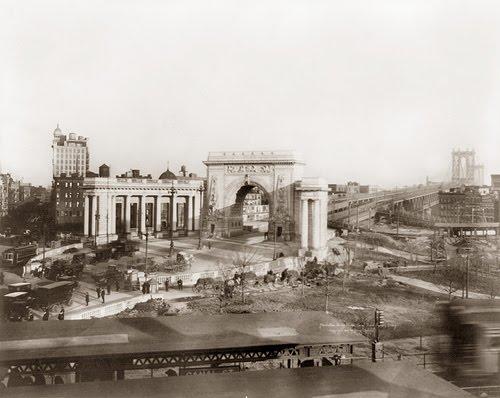
Below: the Manhattan Bridge plaza, 1917

‘Starlight’ express: fun and death in a lost Bronx park

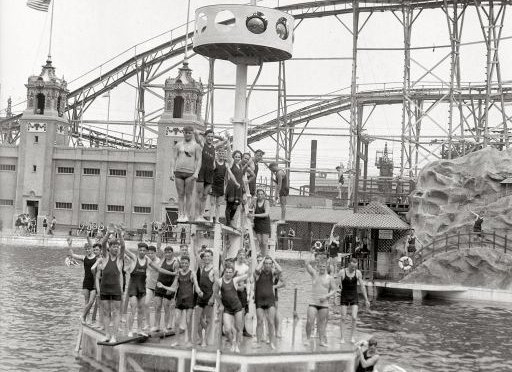
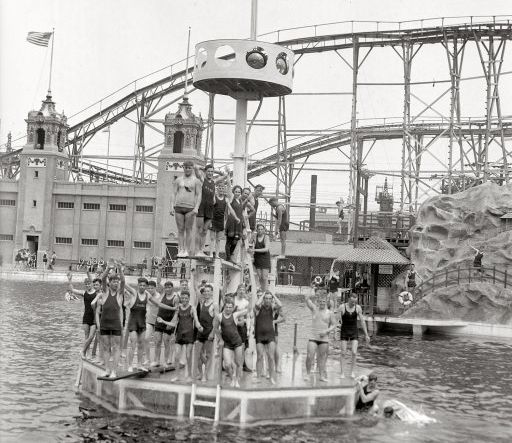
It’s raining men at Starlight Park in the Bronx, circa 1921 (photo cleaned up and courtesy of Shorpy)

For residents of the west Bronx, getting to Coney Island might have been quite a chore in 1918. So they decided to bring Coney Island to them.

I believe Starlight Park can be called the Bronx’s first amusement park. But it wasn’t the last. (More on that tomorrow.) Located on the Bronx River near the borough’s famous zoo, in the neighborhood of West Farms, it became a summer respite for residents looking for a cool swim or merely to ogle hot bodies in their revealing bathing suits (bare legs and arms!).

Similar to Flushing Meadows, Queens — which became a public park after its creation for the 1939 World’s Fair — Starlight Park also started off as a campus for a international exhibition, albeit far smaller. No one much talks about the Bronx International Exposition of Science, Arts and Industries, which opened here at 177th Street in the Bronx on June 30, 1918. The grounds, called Exposition Park, were not quite finished for the opening of the fair, which was held to “attract foreign trade to this country after the war.”

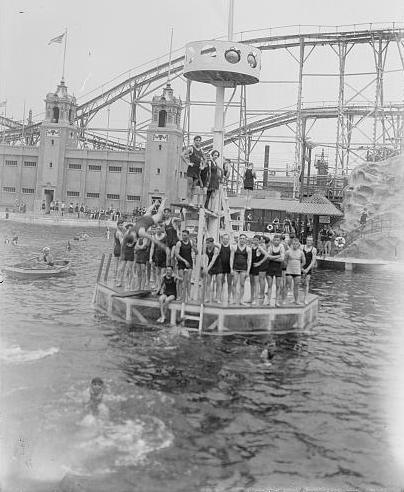
After the fair closed in November 1918, the park became the public playground Starlight Park. Just from reading about Starlight’s many amusements, it sounds like a hyper, dizzying place. Most prominent was an enormous swimming pool with faux rock features, a nearby roller coaster, your typical Coney Island-esque games and rides, boat rides, and outdoor performances by opera singers and greased up wrestlers (presumably, not all at once).
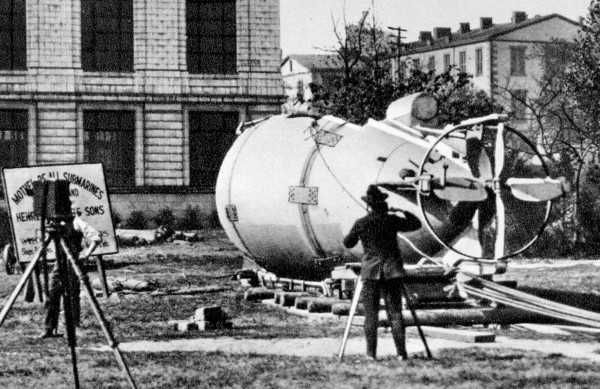
One of the park’s more popular attractions was something left over from the Expo: a small submarine called the Holland, the very first commissioned by the United States Navy. (The Holland is pictured below in its home in Philadelphia, just a couple years before being transported to the Bronx.)

Later, the park’s centerpiece was a giant stadium, built in 1928, called the Coliseum which held up to 15,000 people. They were often there to cheer on New York’s premier soccer team, the New York Giants, who made Starlight their home from 1923 to 1930.

In these heady days before safety precautions, the Starlight was also the scene of a tragic roller coaster fatality. “Somebody in a skylarking mood stood up in a seat on a roller-coaster train … and fell out as the train struck a curve on the fifty-foot level,” reports the New York Times in May 1922. “The other passengers were thrown completely out of the two-train car.”

(My favorite line of the story: “Inquiry by the police at an address noted on a card in [the victim’s] pocket failed, however, to disclose any one who knew such a person.”)

By the 1930s, most of the rides had closed, but the pool was still a popular draw. The park became a magnet for the area’s working class families, who enjoyed sunbathing, picnicking and, if they stayed after dark, moonlight dancing to live big band music. One of the very first Bronx radio station WKBQ also made Starlight its broadcasting home in 1931.

Sadly, Starlight met with a rather ignoble fate. The park was slowly demolished over the year and by 1940 it was permanently closed, transformed into a city “truck facility.” A fire in the late 1940s destroyed any remaining vestages of the park, and its memory was completely wiped away by expanses of the Cross Bronx Expressway.

You can still go to a Starlight Park in the Bronx however. Or rather, you will be able to. The current Starlight Park, nearby the original location, is closed for renovations. Look here for more information on what’s going on there and when it’s opening. But for now, leave your bathing suits at home.

And click here to see the belle of Starlight Park.
John McKane: the original ‘maverick’

I should preface this to say, out of fairness, I looked through the annals of New York City history for scandalously corrupt politicians named Barack Obama, Sarah Palin and Joseph Biden, but could find none.
John McKane was one of the most important figures in the history of Coney Island, in much the same way William ‘Boss’ Tweed shaped the fortunes of Manhattan. Both used greed and Tammany Hall connections to their advantage, manipulating the police force to do their bidding and cooking the books to pad the pockets of himself and his cronies.
Coney Island was governed by the town of Gravesend, in the 1870s not yet a part of the growing city of Brooklyn. Dutch farmers mostly made up the town’s population until mid-century when new Irish immigrants settled here. McKane was born here in 1841 and would spend most of his life turning it and nearby Coney Island into a magnet resort area. (Unlike the later man with the same name, McKane lied to get out of military service, in this case, the Union Army.)

At first McKane was an honest politician, literally working his way from a Sunday school superintendent to town constable in 1867. From this vantage he could gauge the reactions of stubborn local farmers, who looked with disdain at the growing crowds from the city travelling to the new resorts sprouting up around the beach. Far from thinking the encroaching city folk a stain on their bucolic lands, McKane saw opportunities for expansion and profits.

Two years later, he was Gravesend’s commissioner, and with the help of town surveyor William Stillwell (whose family name still graces an avenue here) allowed developers to swarm into town and into the common lands near Coney Island — but not without jacking land prices, sometimes three times their normal value.

Obviously, prosperity in the 1860s and 70s came with strings attached — namely, abeyance to the powerful Democratic machine Tammany Hall. John McKane paid homage to the Democrats, then mastered their system of bribes and kickbacks from businessmen and land developers. At first, the local farmers and leaseholders were pleased with the results until it became obvious that McKane’s own pockets were swelling from kickbacks, granting him absolute power over every building project.

Below: McKane obviously encouraged railroads to terminate at Coney Island and sold off all the land around the Culver terminal

The final straw came when McKane engineered an absurd land grab for wealthy developer Austin Corbin, filling a council meeting with cronies and selling Corbin the area of Breezy Point (originally valued in some accounts at $100,000) for $1,500. McKane certainly received far more of that directly from Corbin for maneuvering such a deal.

McKane created his own the police force with himself as police chief, frequently seen on the beach, gigantic club in hand. Rigging elections, essentially becoming a mini-Tweed, McKane helped destroy the agricultural community of Gravesend and turned Coney Island into a garish tourist trap. He proffered licenses to anybody who wanted them — saloons, brothels, dance halls. Coney Island’s sometimes seedy reputation today was borne out of McKane’s blind eye. He even admitted “houses of prostitution are a necessity in Coney Island.”

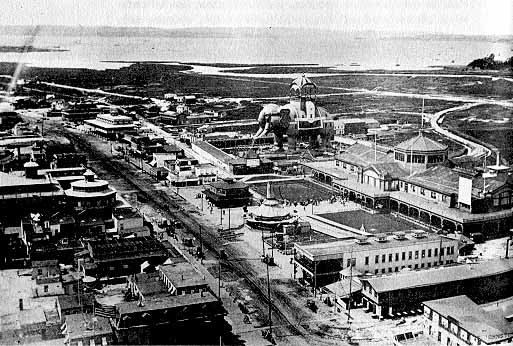
By the end of his reign in the 1890s, Coney Island resembled this:

McKane somehow managed to avoid conviction throughout the 1880s despite several attempts by the New York state legislature. He was finally convicted in 1893 after refusing to turn clearly phony voting tallies over to the Brooklyn Supreme Court. He was thrown into prison for six years but was released in time to see Brooklyn incorporated into New York City — and Coney Island become the world’s leading center of amusement, spectacle and vice.

He died in 1899, notably less wealthy but still a Coney Island landowner on the cusp of its golden age.

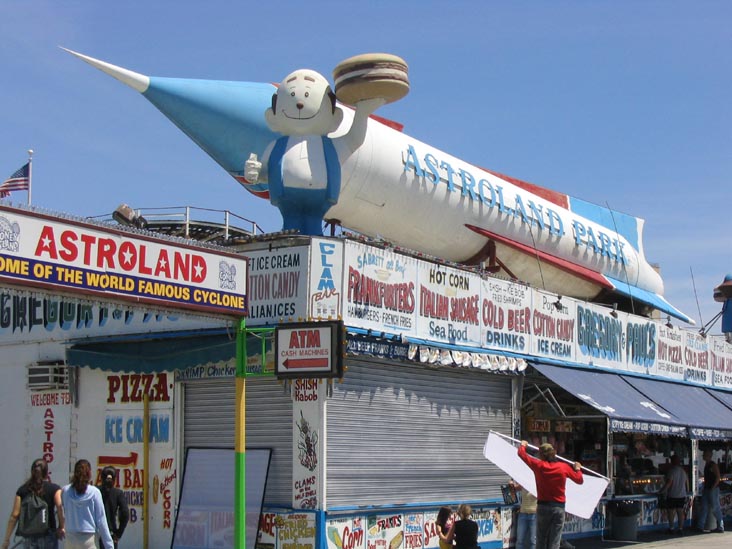
Goodbye Astroland (again)

Astroland is once again closing for the final time at the end of this weekend, making way for Thor Equities to begin their new development of the area.

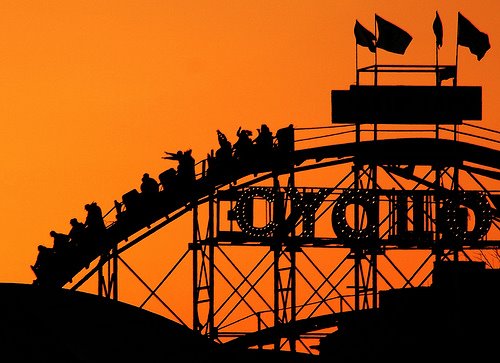
The park’s main attraction, the legendary Cyclone, isn’t going away however. A functioning roller-coaster since 1927 — and built on the spot of the world’s very first roller-coser — the Cyclone is actually owned by New York City parks department. Its been leased to Astroland since the park’s opening in 1975 and will return to the city’s hands with Astroland’s closure.

Less certain is the fate of cheesier rides such as haunted ride Dantes Inferno and the back-pain indusing Break Dancer.

This is a huge dent to the immediate future of Coney Island, but it isn’t the end. Deno’s Wonder Wheel park stays open through October and will be open as usual next year.

You can read official statement of Astroland’s closure at the great Coney Island blog Kinetic Carnival. And relive our podcasts on Coney Island — the golden age and the funspot in the 20th Century including a history of the Cyclone.

All hail the Coney Island Mardi Gras parade!

Before there were Mermaids, there was Mardi Gras. Above: ghoulish revelers from the 1911 parade

An even larger collection of freaks and aquatic oddities than Coney Island’s everyday normal assortment will come slithering down Surf Avenue this Saturday with the 26th annual Mermaid Parade.

The parade is the heart of Coney’s modern freak-show aesthetic, Christmastime for the tattooed and glittery. Most people think that, unlike most New York City parades, the Mermaid parade celebrates nothing specific, only a joy of costume, summertime and silliness. In fact, Coney Island ‘mayor’ Bill Zigun and Coney Island USA created the parade in 1983 as an homage to an even more legendary seaside tradition: the Coney Island Mardi Gras parade.

Let that stew in your mind a bit. Coney Island meets New Orleans.

The annual Mardi Gras celebration lasted from 1903, the heart of Coney’s heyday, until 1954 — the heart of the Robert Moses years. Curiously, it always took place in mid-September, which I suppose is a nicer time for a parade than a seaside New York February. The parade coincided with the end of the season and the annual shuttering of the amusement parks.

In 1906, the great parks of Coney Island like Dreamland were still standing. Nathan’s famous hot dog stand wouldn’t be open for another ten years. And the Mardi Gras parade that year managed to attract 500,000 people. “Police Commissioner [Thomas] Bingham visited the Island and had [his] full share of attention from confetti throwers and wielders of the ‘tickler’.”

I don’t know what a tickler was back then, but the idea of what I think it is being thrust at a police commissioner is absurd. Probably a souvenir from a Luna Park ride called the Tickler (which doesn’t look that fun, see image from 1906):

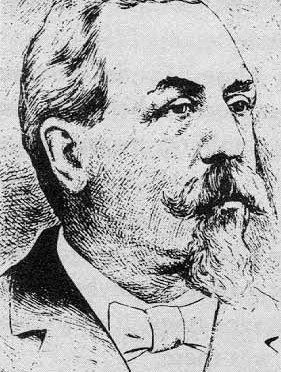
That same year brewery mogul Herman Raub (pictured below), founder of the Coney Island railway, was anointed king of the parade.

The Mardi Gras parade sounds like it was a horrifying, chaotic, fabulous mess. In 1911, the celebration also gathered about a half million people to view the tenuously religious celebration. “Gangs March Through Street Insulting Women and Wrecking Stores And Restaurants” shouts the Times. “Several Hundred Arrested.”

It seems part of the fun of the original Mardi Gras involved drunken displays of violence.

Despite rampant (probably exaggerated) violence, the parade became the star of a wacky Fatty Arbuckle-Buster Keaton film, the 1915 ‘Coney Island’. It hit celluloid later in 1935 in the Popeye the Sailor Man short ‘King of the Mardi Gras’.

By 1921, the parade had to deal with a new menace — Prohibition. “It was agreed that Prohibition had struck Coney Island a staggering blow.” Many revelers dressed in costumes that “referred satirically to blue law advocates.”

One popular event at the parade was the annual ‘prettiest baby’ competition. In 1921, the winner was “Rita Murphy, 6 years old, of 2,005 Sixty-Third Street, Brooklyn, dressed as a jockey.” The tot was awarded “a ninety-two-piece silver set which she can use to start housekeeping when she gets married.” What a future young Rita had in store for her!

The parade sadly petered out thanks to Robert Moses’s ridiculous plan to turn the area into “an area of predominantly residential character.” Brooklyn Pix has a good shot of the final spectacle, that looks alarmingly similar to today’s Mermaid Parade.

I can only imagine what horror Moses would experience by glimpsing the Mermaid Parade today. He may get the last laugh. With an overhaul of Coney Island beginning next year — or already beginning, depending on how you look at it — the parade’s role may be greatly affected. So go down to Coney Island this Saturday and make sure you appreciate it in all its goofy and charming glory. (Check here for all the details.)