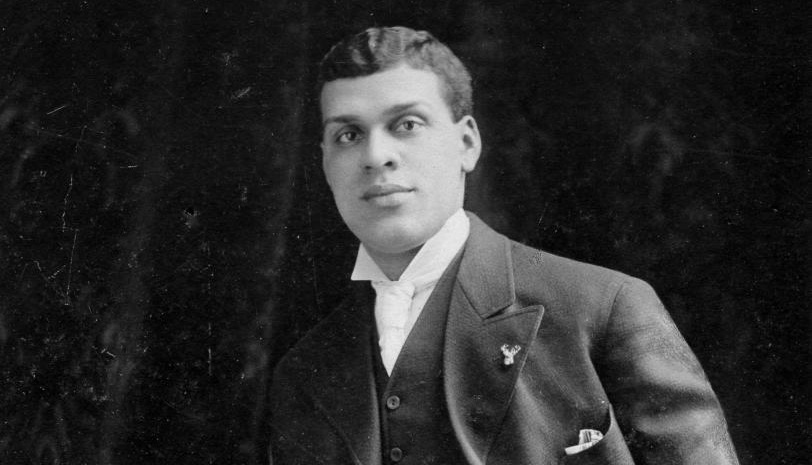
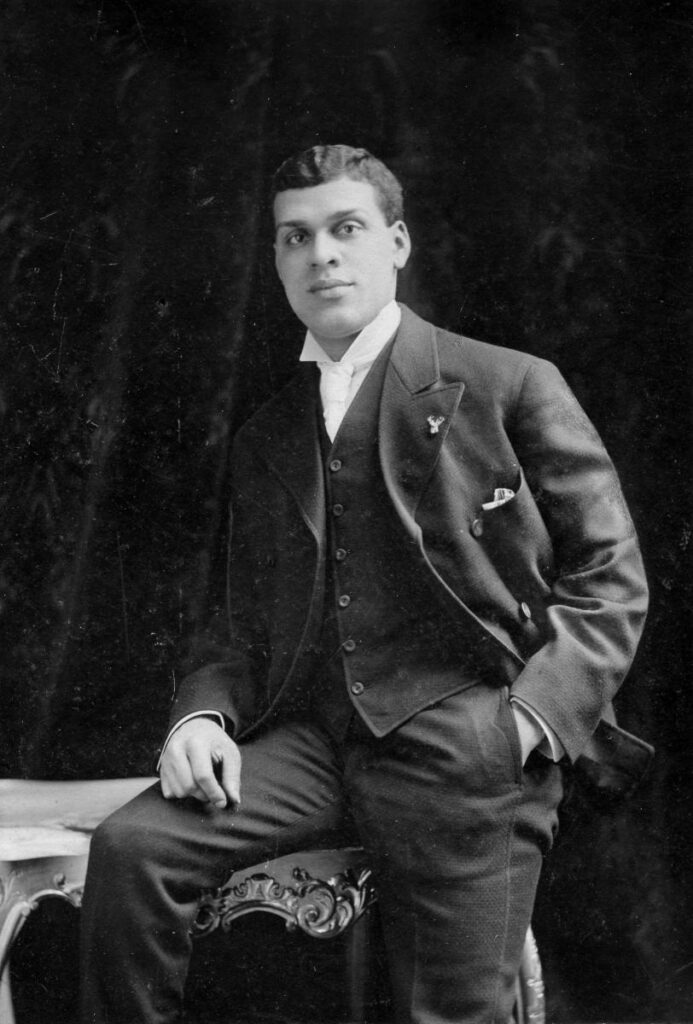
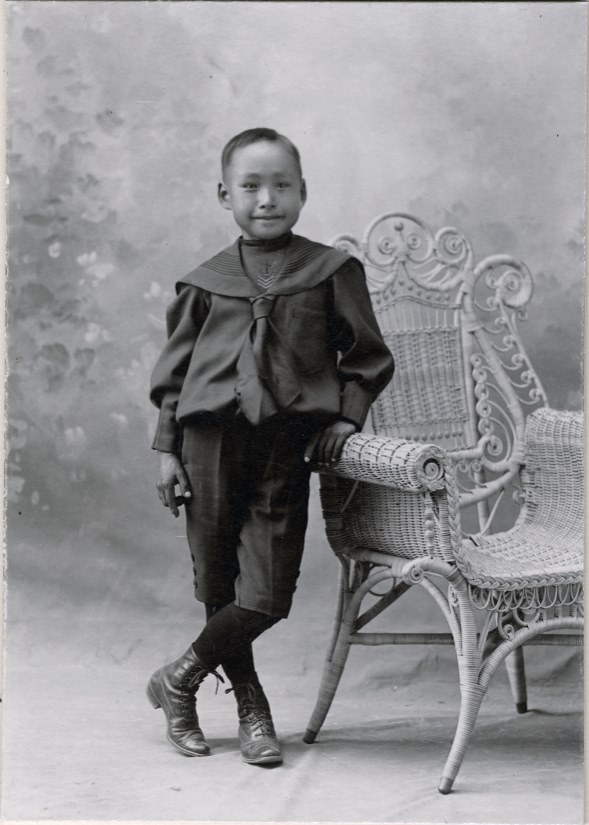
James H. Williams, here in 1905, would soon become the "Chief" of a force of hundreds of Red Caps at Grand Central, a post he'd keep for four decades.
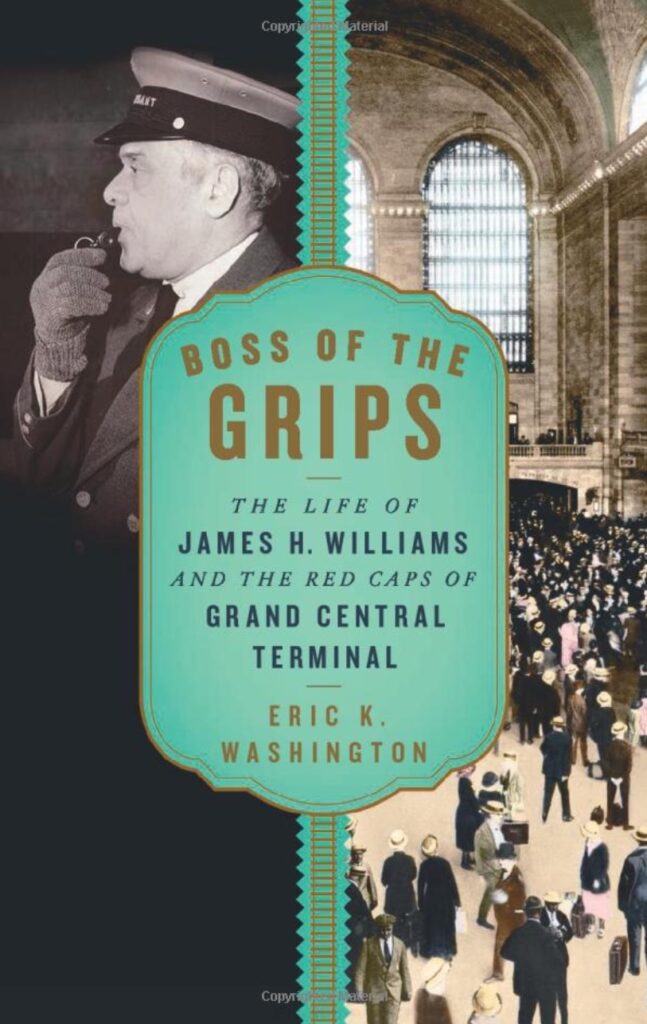
PODCAST EPISODE #339: An interview with author Eric K. Washington, author of “Boss of the Grips: The Life of James H. Williams and the Red Caps of Grand Central Terminal”.
The Red Caps of Grand Central Terminal were a workforce of hundreds of African-American men who were an essential part of the long-distance railroad experience. Passengers relied on Red caps for more than simply grabbing their bags — they were navigators, they helped with taxis, offered advice, and provided a warm greeting.
He also tells the story of Grand Central Terminal, and specifically, of the Red Caps who worked here, especially during the Terminal’s heyday in the first half of the 20th century. And along the way, the book chronicles how New York’s African-American enclaves and communities developed and moved around the city.
That huge story is told through the lens of this one, often underappreciated, and yet instrumental man — James Williams. He was the chief of the Red Caps, but also an under-reported figure in the Harlem Renaissance.
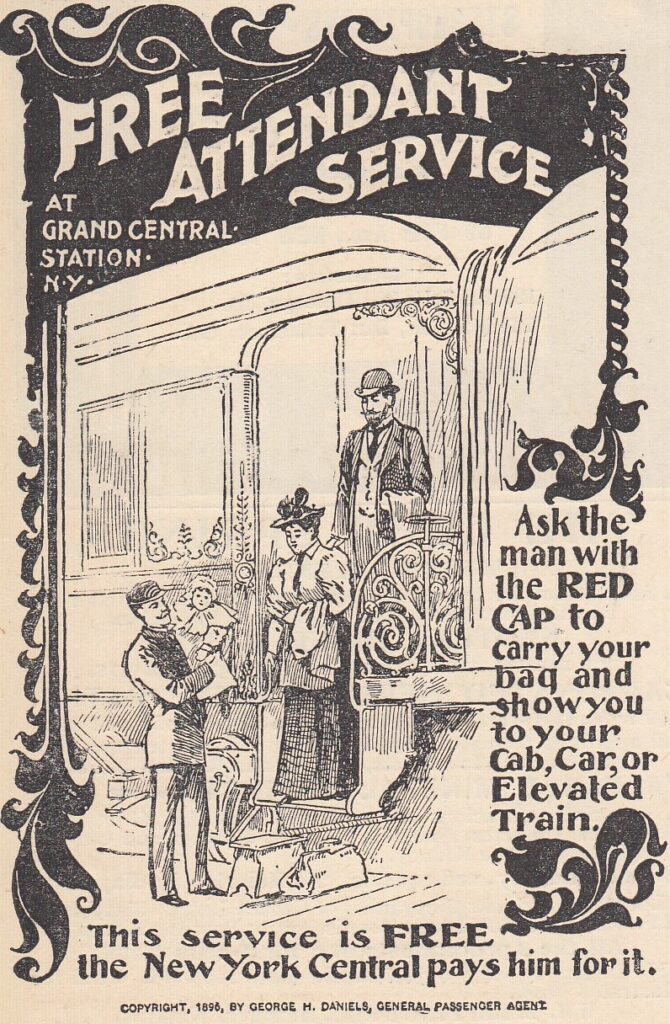
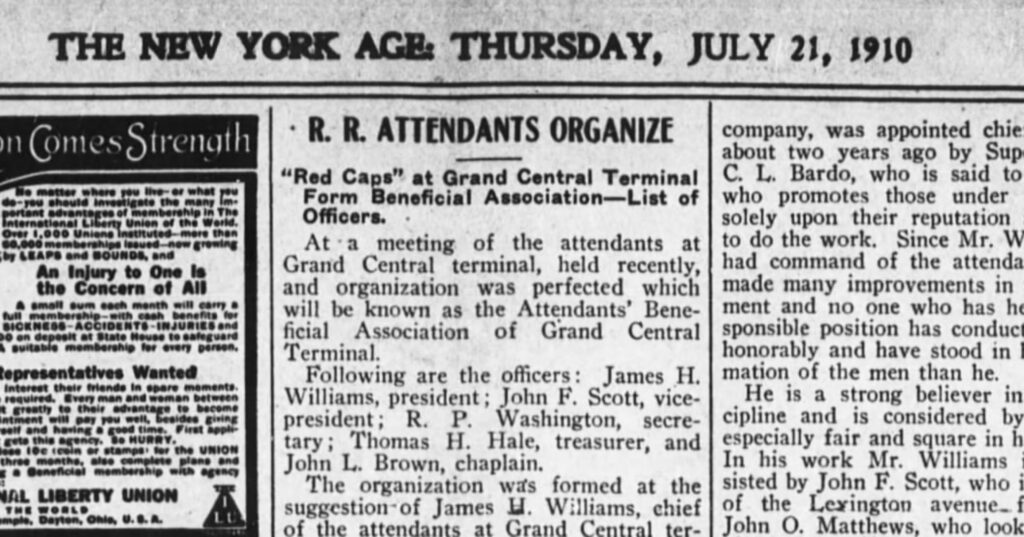
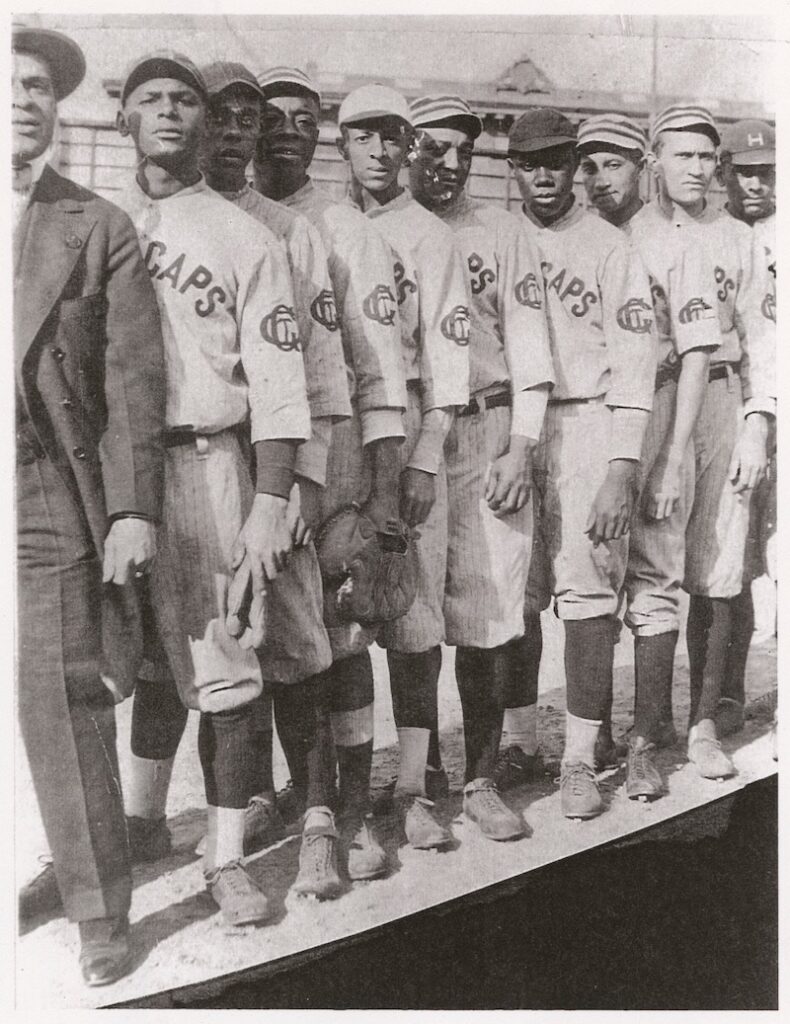
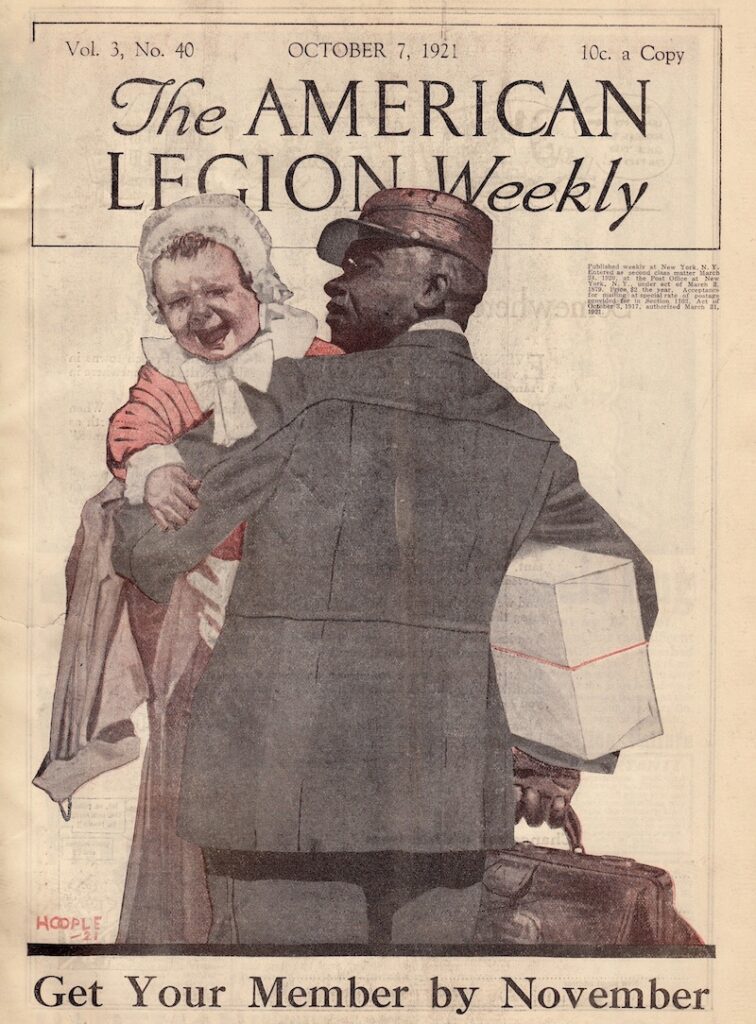
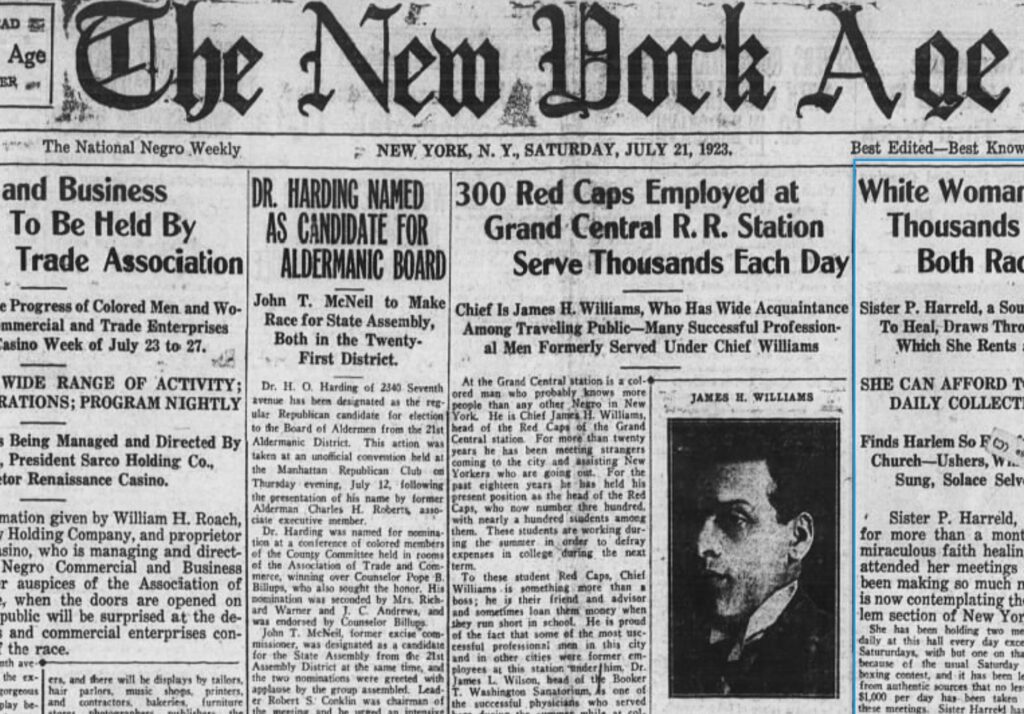
The New York Central launched its free Red Cap service in 1895, and promoted it widely in advertisements like this one, from 1896.When Williams sat for this portrait in 1905, he was working as a Red Cap, but had not yet been named Red Cap director, or “Chief”. Williams became the “Chief” of the Red Caps in 1909, and immediately got to work organizing a benevolent association for the Red Caps, covered here in the New York Age in 1910.Chief Williams posing with the Grand Central Terminal Red Caps baseball team in 1918. Red Caps carried hat boxes, valises… and sometimes even crying babies, too, as illustrated in this 1921 cover of The American Legion Weekly.James H. Williams was regularly covered in the local and national press. In 1923, the New York Age published a profile of Williams on its front page.
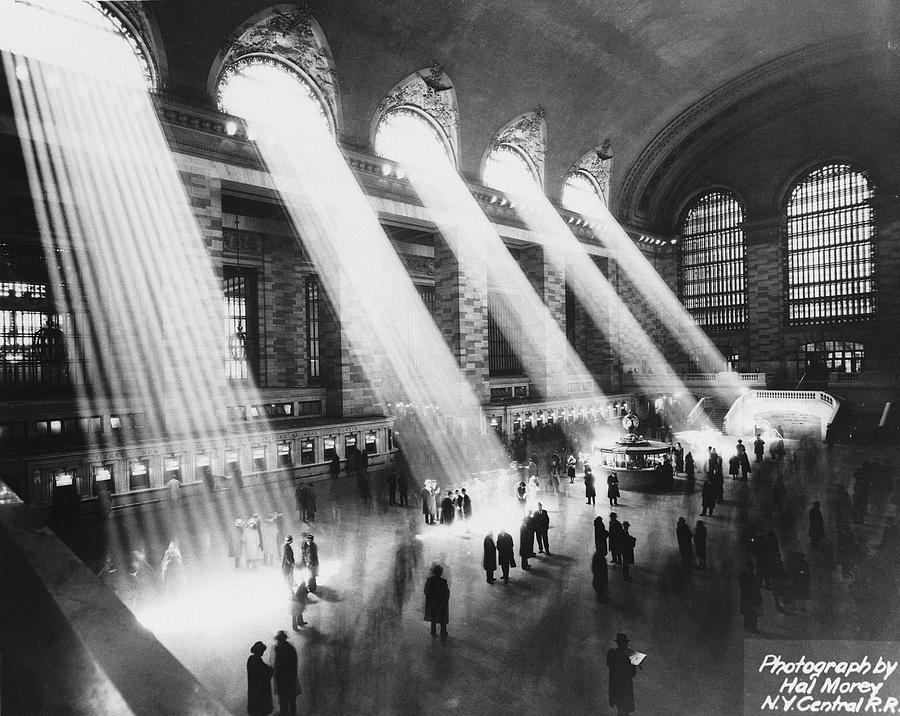
Hal Morey’s iconic shot of Grand Central from 1930 captures a blur of activity in the lower left corner. Could it be a Red Cap carrying a bag, drenched in sun?
The Grand Central Red Caps Orchestra perform “Nina”, under the direction of Russell Wooding, Frank Luther (vocals). RCA Victor, 1931
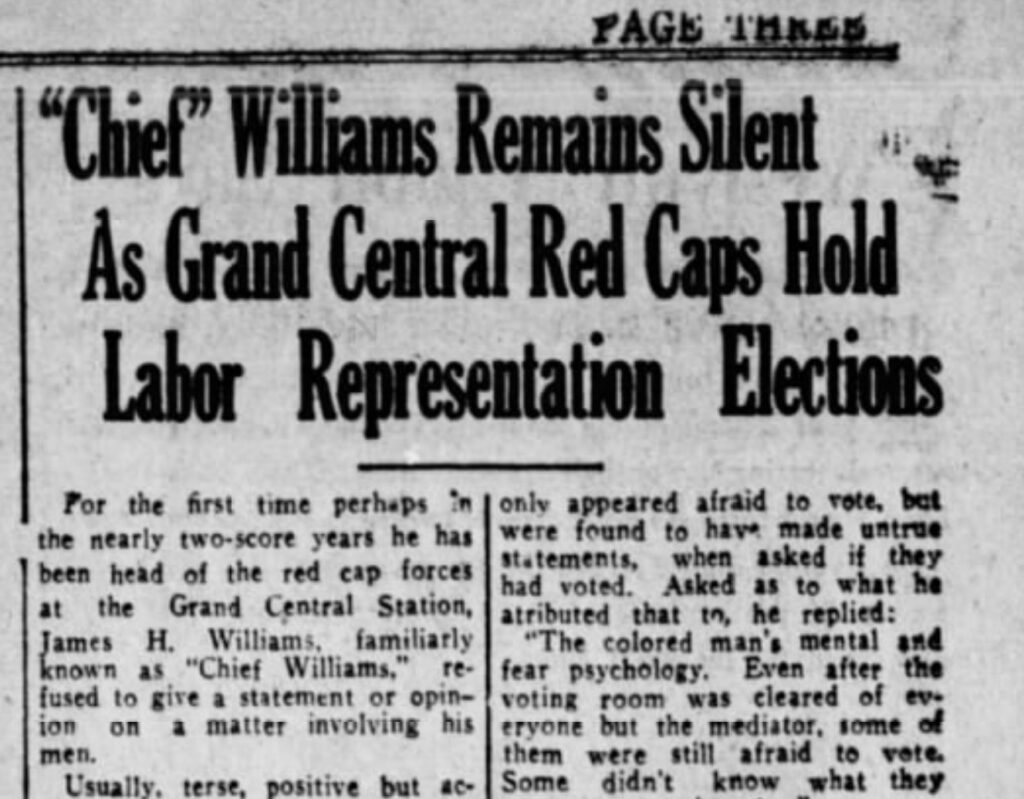
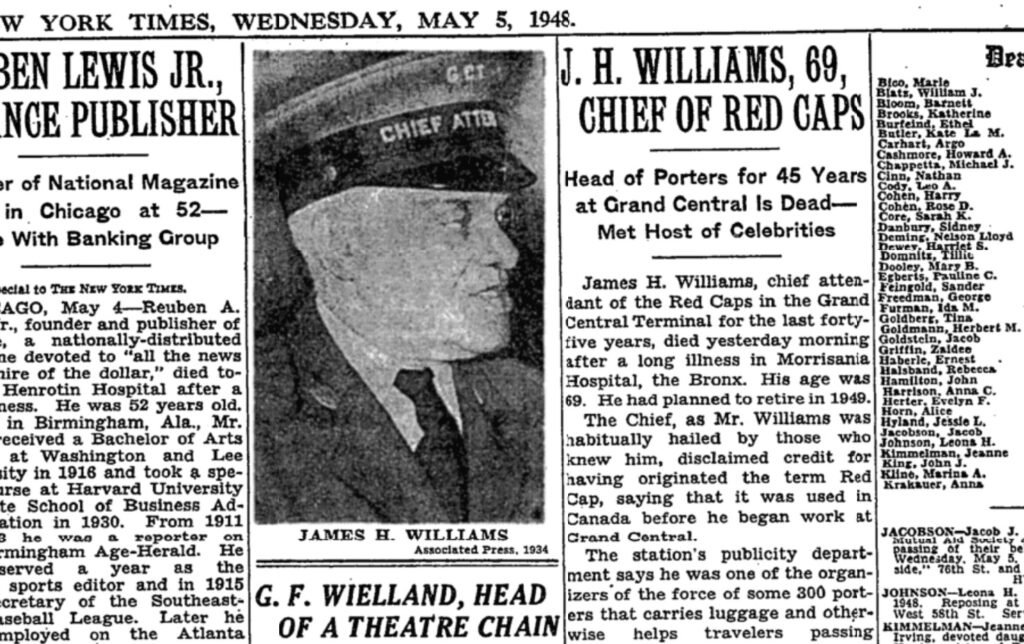
In 1939 as Red Caps around the country started organizing, Chief Williams remained strategically quiet. The formation of a Red Cap union was covered in this piece in the New York Age, September 16, 1939.Williams obit in the New York Times, May 5, 1948.
The Bowery Boys: New York City History podcast is brought to you …. by you!
We are now producing a new Bowery Boys podcast every week. We’re also looking to improve and expand the show in other ways — publishing, social media, live events and other forms of media. But we can only do this with your help!
We are now a creator on Patreon, a patronage platform where you can support your favorite content creators.
Please visit our page on Patreon and watch a short video of us recording the show and talking about our expansion plans.
If you’d like to help out, there are six different pledge levels. Check them out and consider being a sponsor.
We greatly appreciate our listeners and readers and thank you for joining us on this journey so far.
In the fall of 1783 Lewis Morris, signer of the Declaration of Independence, helpfully suggested in a letter to the Continental Congress that his own bucolic estate Morrisania (in today’s area of the South Bronx) would make a fine home for the new capital of the United States.
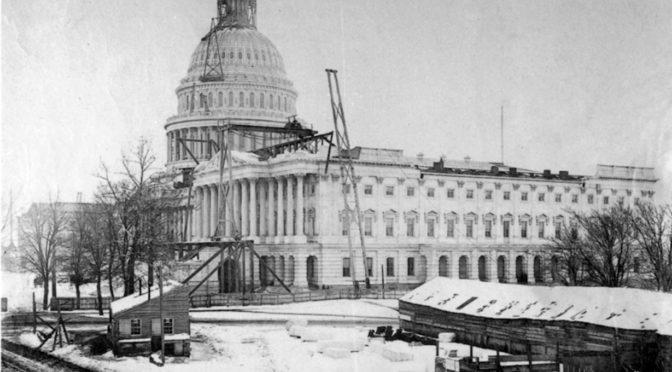
That didn’t happen, of course, but the Bronx plays a big role in another big national artifact – the dome of the U.S. Capitol Building.
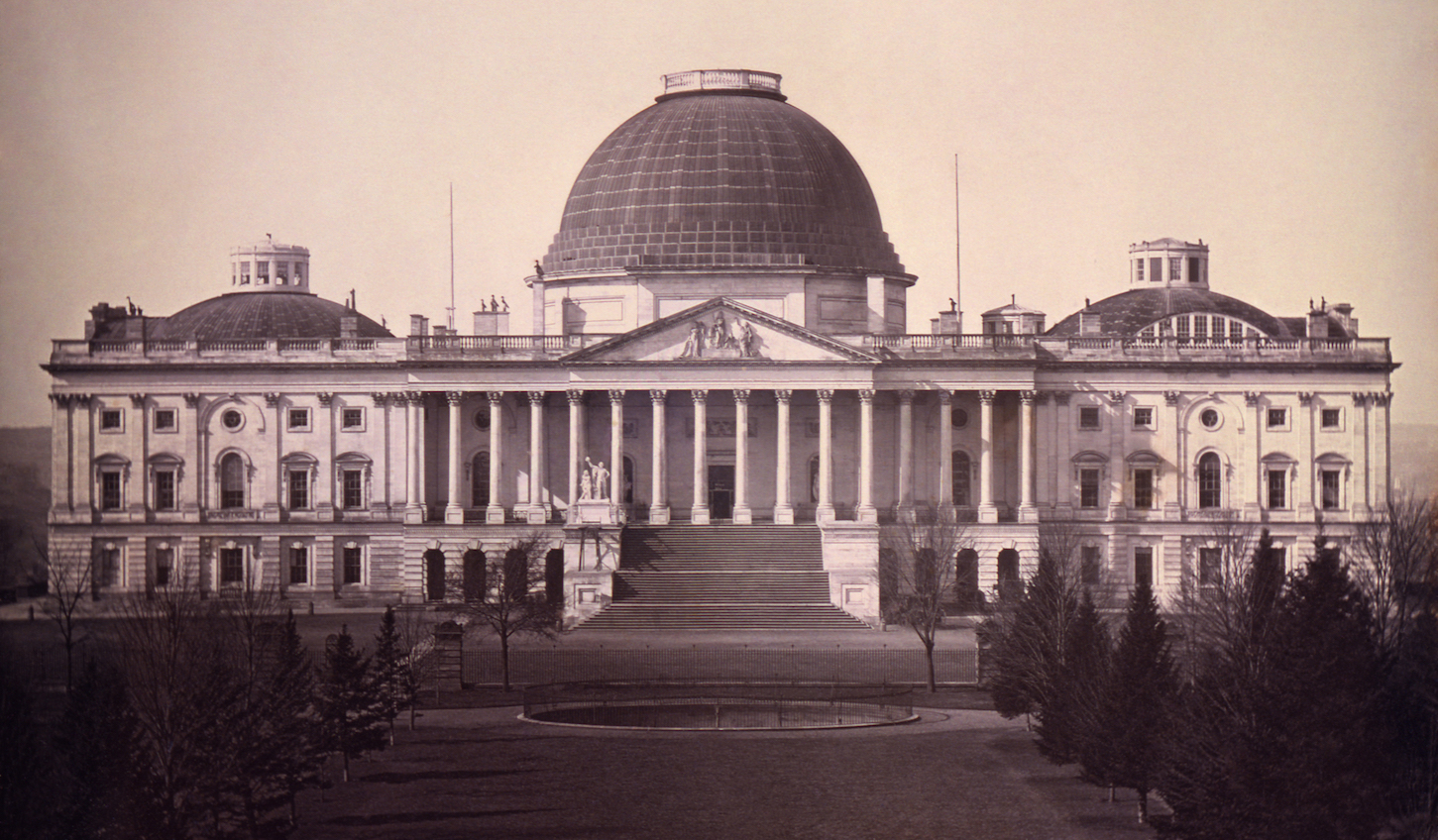
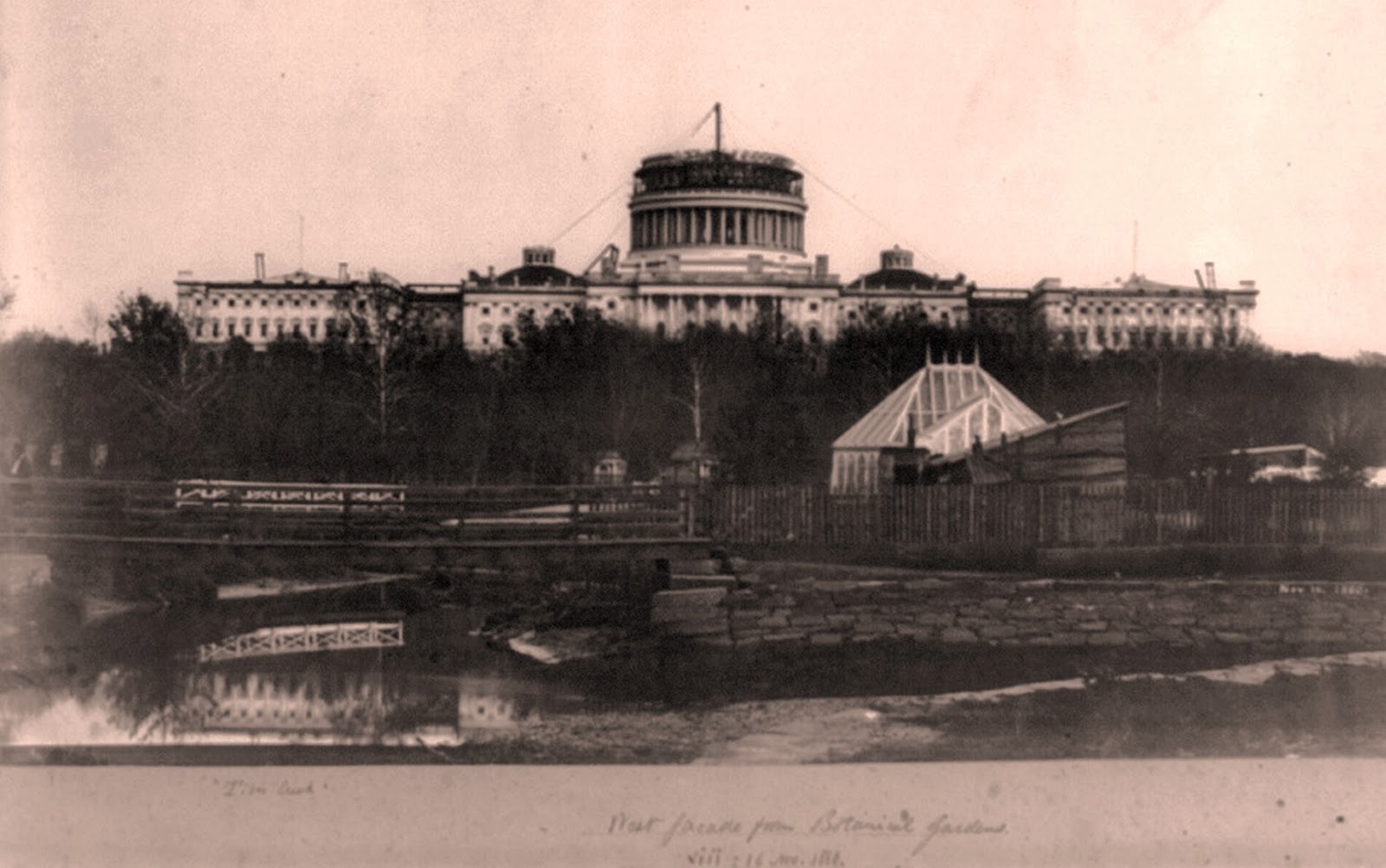
The Capitol Building in Washington D.C. was originally built in 1800. After suffering a fire during the War of 1812, it was a thoroughly redesigned, with a low wooden dome adorned with copper.
By the 1840s the copper had oxidized, giving the dome a similar hue as the one worn by the Statue of Liberty today.
From an early 1846 daguerreotype by John Plumbe:
But with the inclusion of new states into the Republic, the nation’s leaders were outgrowing this home. The addition of new wing extensions in the 1850s made the copper dome seem embarrassingly small.
In a city of mighty and grandiose architecture — for a young country still very much unsure of itself — this simply would not do.
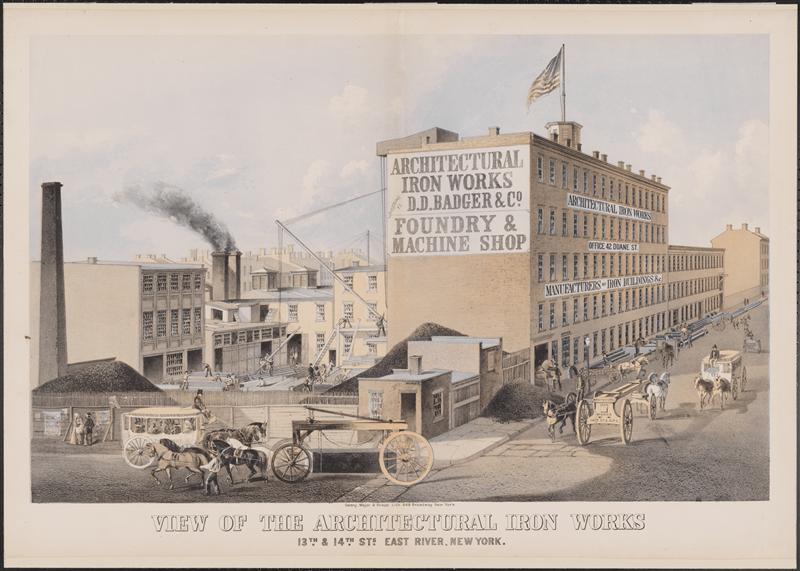
The story now turns to New York, home to some of the most profitable iron foundries of the 1850s. It seems extraordinary today, but the city actually had several large iron works scattered throughout the region. Below: A 1865 depiction of one such iron foundry at 14th Street and the East River
Museum of the City of New York
A couple key foundries were built near the southern shore of Westchester County, near Spuyten Duyvil Creek, including Johnson Iron Works and J.L. Mott Iron Works. (Mott’s president Jordan Mott would develop nearby land into the small town — and later neighborhood — of Mott Haven.)
They were kept in business by mass production for railroad lines and, a decade later, by manufacturing cannons and other weaponry during the Civil War.
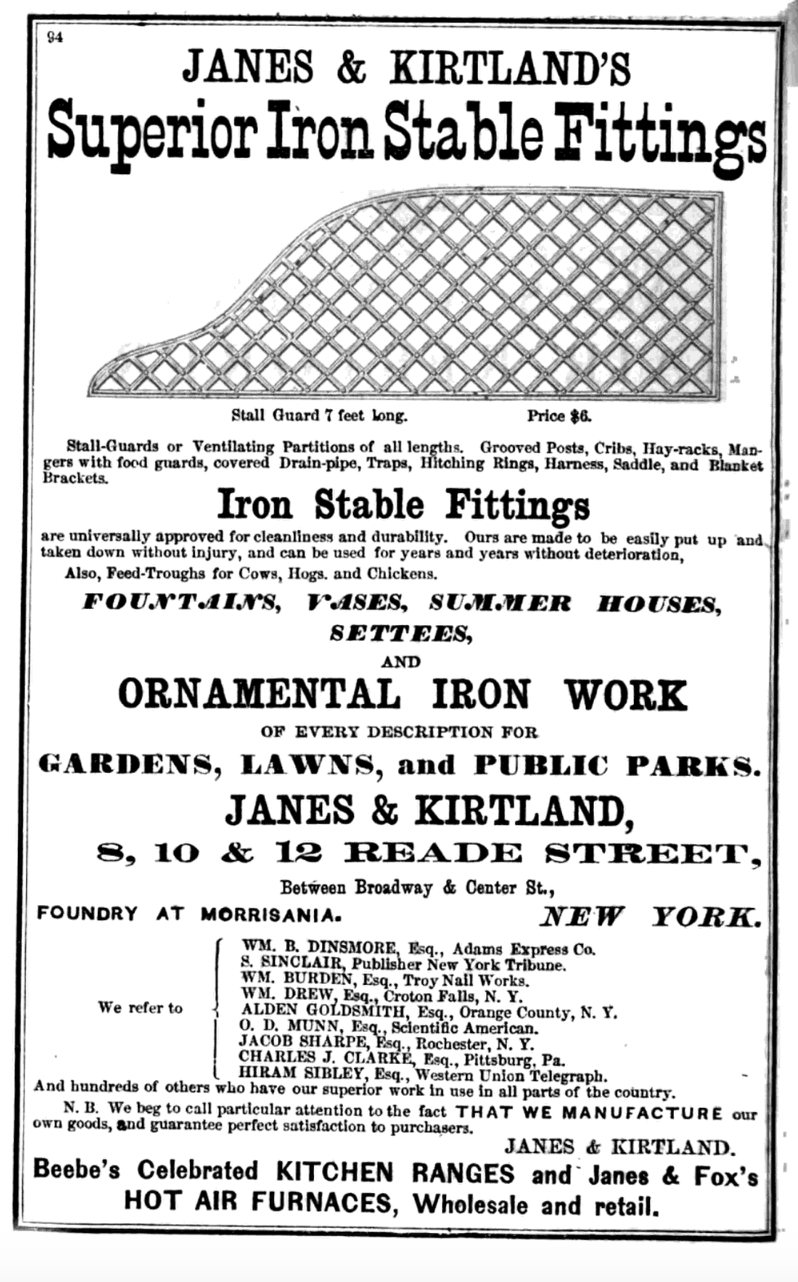
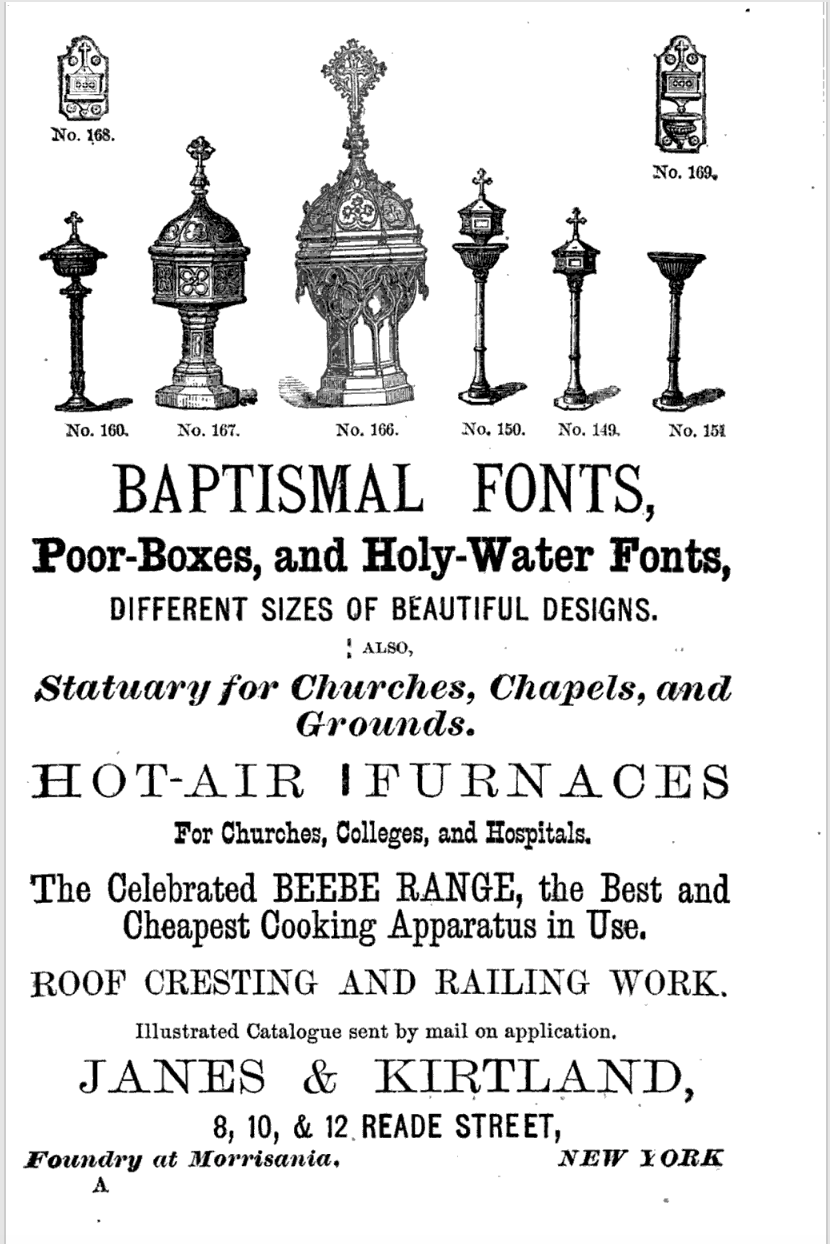
Another local iron works was Janes, Beebe & Company which was originally housed in a factory at Reade and Centre Streets in Manhattan.
By 1859 the boardroom will have changed a bit to become Janes, Fowler, Kirkland & Company. A little audacity on their part would win them a most treasured contract.
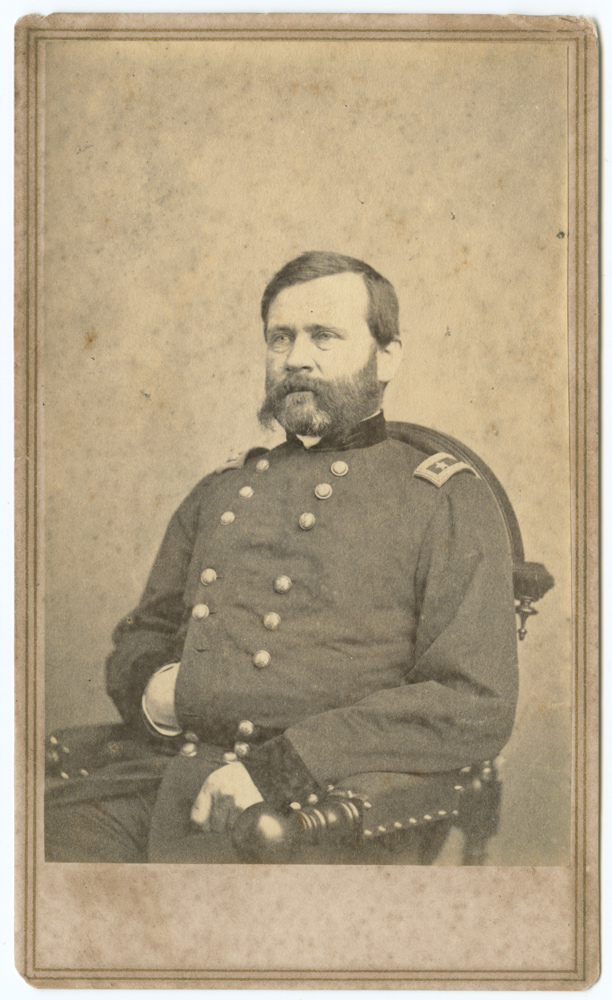
Colonel William Buel Franklin, a respected civil engineer and later to be a Union Army general (as pictured above), was tasked with developing the new dome and reached out to various iron foundries for bids.
Originally, Janes, Fowler, Kirkland & Co. had only been asked about providing surface covering for the dome. Seeing a possibility for greater profit, they boldly offered to do the entire thing — for an unbelievable price:
“Having thus made an offer in accordance with your letter of the 1st instant, we beg leave to lay before you another proposition. We have examined the plans for the dome, and we find the design of what remains to be done above the work now being put up, is so dependent, the one part on the other, that it forms a whole that cannot well be divided…. [W]e therefore propose to execute all that remains to be done to the dome, including the putting up of the entire work, exclusive only of staging and hoisting, as before expressed, for seven cents per pound (7c)” Â — source
That’s a little under $2 per pound in today’s money. What’s astonishing is that they were mostly known for small ornamental iron furniture and decor, not exactly recommending themselves for such a massive project.
But the company’s bold ‘all in’ proposition got them the job, although both they and Franklin were later accused by members of Congress of colluding on a higher price — that the dome could have actually been completed for mere six cents a pound.
(Although such price gouging was a regular feature of government contractors, this appears in retrospect to be your usual Congressional grousing.)
Janes, Fowler, Kirkland & Co. were awarded the contract in February of 1860, the same month that a young lawyer from Illinois named Abraham Lincoln spoke to a packed Cooper Union, a mile north of Janes’ original foundry.
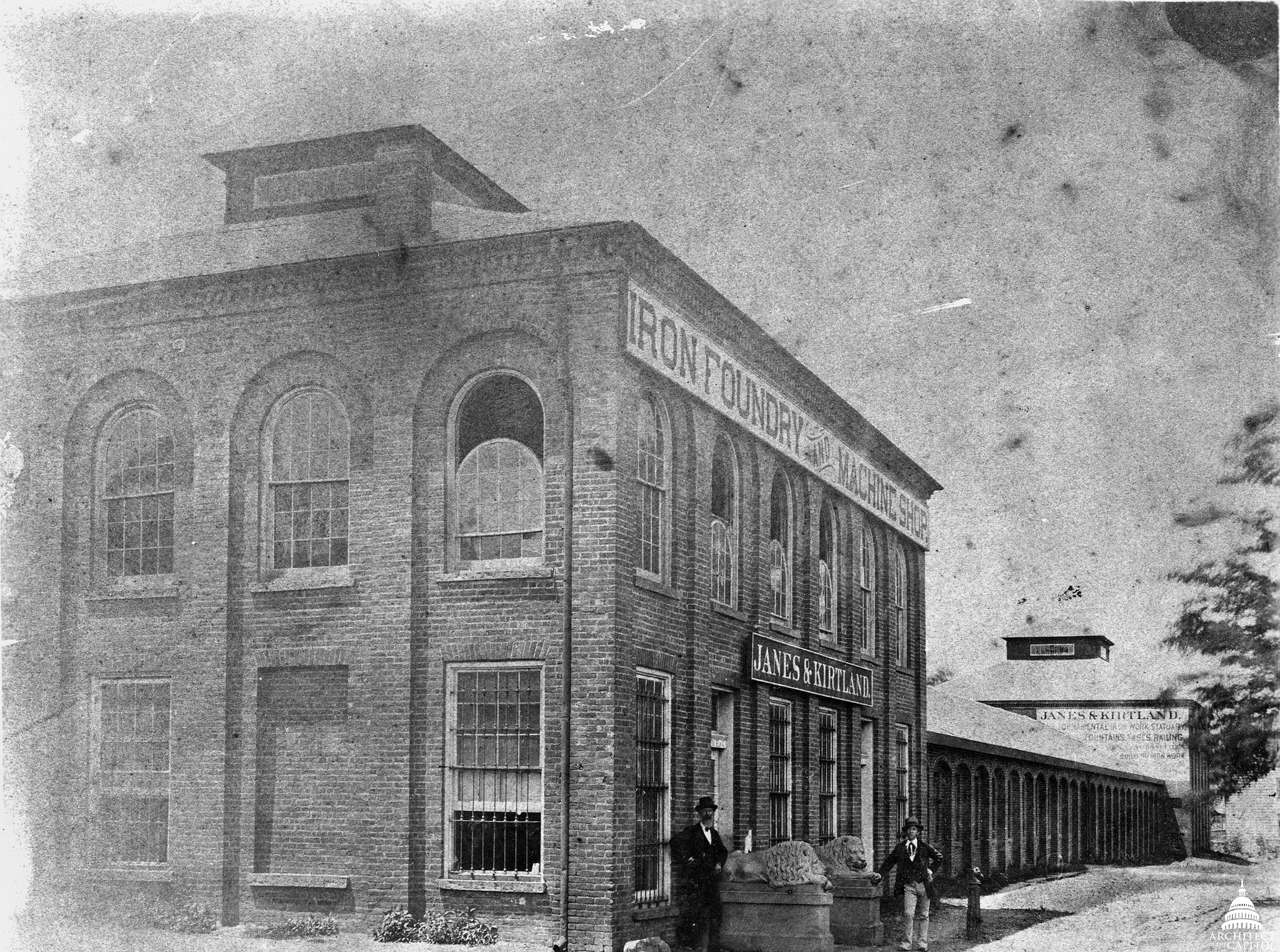
Fortunately by this time, however, the foundry had decided it needed a much larger space for ambitious projects such as the Capitol dome. In 1857, anticipating great things, they moved from Manhattan to a foundry in the town of Morrisania in Westchester County.
The iron works was “1,000 feet long by 50 feet wide, giving employment to a large number of hands, many of whom have been with the firm for years.”
The new Morrisania foundry of Janes, Kirtland and Company, in 1862
Courtesy the U.S. Capitol
From here, parts were forged, partially assembled and loaded onto ships in the East River where they then made their way down to the District of Columbia. The foundry became a critical job creator for the town.
“The wages paid to the workmen amount to many thousand dollars yearly, and with the taxes paid is of great importance to the town of Morrisania.” [source]
The Civil War halted construction on a great many projects across the country, but not at the Capitol Building. In the spring of 1861, the firm was told to stop working on the dome.
But contractors at Janes realized that so much work had been done — and so much ironwork already delivered — that they continued unabated, taking the government in good faith that they would pay their bills after the war.
“There was not a day during the Civil War when the sound of the hammer was not heard at the Capitol,” wrote George Cochrane Hazleton in 1914.
“Even when, in May 1861, all work was ordered to be suspended, the contractors practically continued at their own expense to put in place the 1,300,000 pounds of iron castings then upon the ground.”
They completed work on the dome — in all, using 8,909,200 pounds of cast iron — in October of 1865, six months after the end of the Civil War and the assassination of President Abraham Lincoln.
Adrian Janes, founder of the foundry, died on March 2, 1869, but he had seen his company produce marvelous things by this time. His Bronx foundry also produced the Bow Bridge in Central Park in 1862 and would later manufacture the railings used on the Brooklyn Bridge.
While the foundry is long gone of course, one vestige of Janes’ legacy remains — St. Mary’s Park.
The land was purchased from the Morris family by Janes in the 1850s for the purpose of developing a foundry and other properties, including his home. For a time the area was even known as Janes Hill, and an area to the park’s northern side still takes that name.
A small chapel was once on the property — St. Mary’s Church — for which the park gets its name. The Mary in question is actually Adrian Janes’ youngest daughter Mary. If that seems a bit hard to believe, keep in mind that St. Ann’s Episcopal Church just a couple blocks south — where Gouverneur Morris and Lewis Morris are presently interred — is actually named for Gouverneur’s wife Ann!
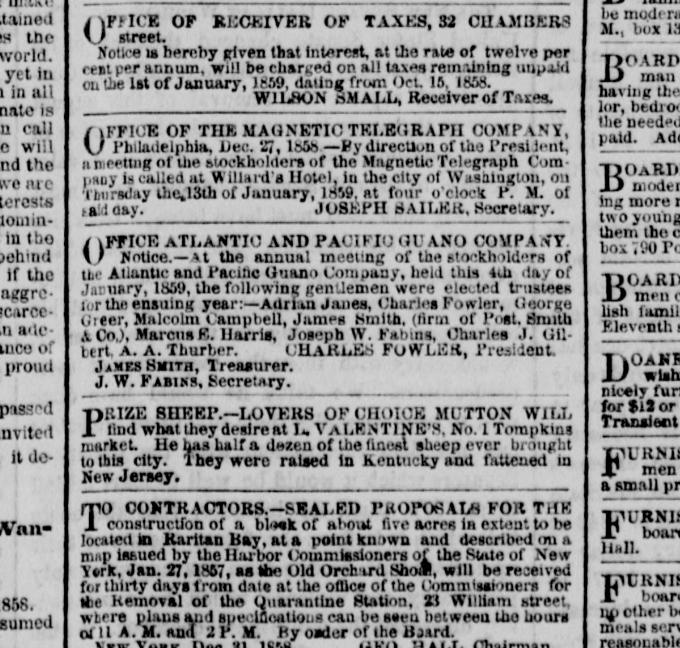
From the January 5, 1859 New York Herald — Mr. Janes was also a speculator in guano (bat and seabird droppings) as evidenced by the newspaper notice below:
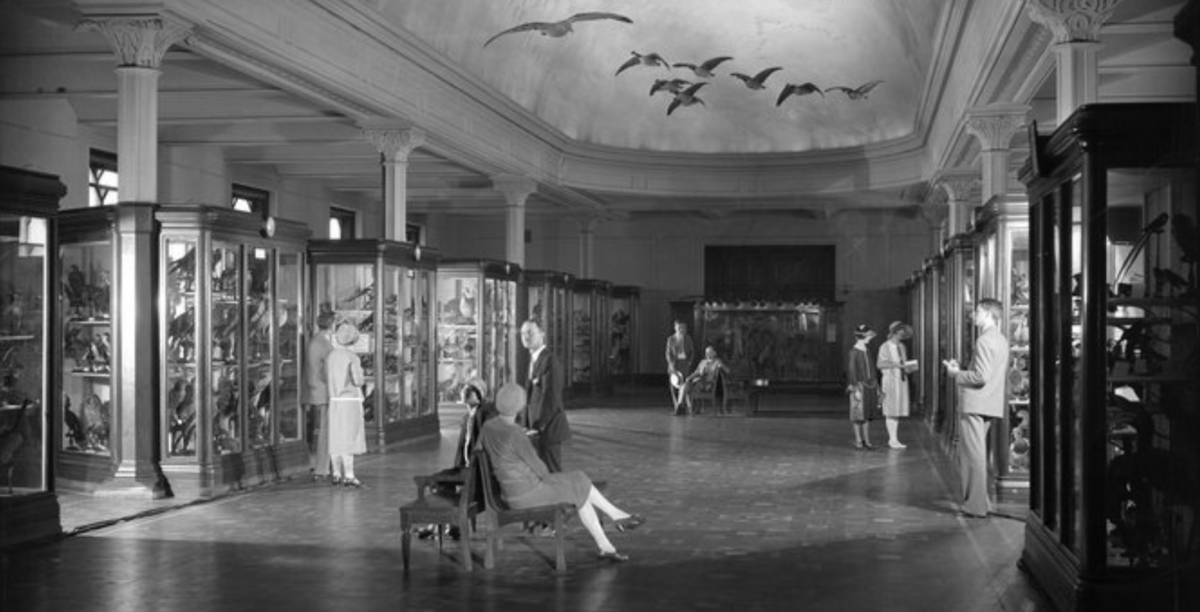
Birds of the World, 1927. Courtesy the American Museum of Natural History
PODCAST Ancient space rocks, dinosaur fossils, anthropological artifacts and biological specimens are housed in New York’s world famous natural history complex on the Upper West Side — the American Museum of Natural History!
Throughout the 19th century, New Yorkers tried to establish a legitimate natural history venue in the city, including an aborted plan for a Central Park dinosaur pavilion.
With the creation of the American Museum of Natural History, the city finally had a premier institution that celebrated science and sent expeditions to the four corners of the earth.
Tune in to hear the stories of some of the museum’s most treasured artifacts and the fascinating folks behind the collection — including one explorer who might have inspired a famous movie hero.
But there’s also a dark side to the museum’s history, one that includes the tragic tale of Minik the Inughuit child, subject by museum directors to a bizarre and cruel lie.
PLUS: How exactly do you display a 68,100 lb meteorite?
AND: An update involving that rather controversial equestrian statue of Theodore Roosevelt.
This is a re-broadcast of a show originally released on November 24, 2010 with bonus material recorded in 2020.
Listen today on your favorite podcast player or just press play here:
The website of the American Museum of Natural History has all the details you need for your visit — including information on safety. On top of suggested admission, there are additional costs for the special exhibits, including the planetarium.
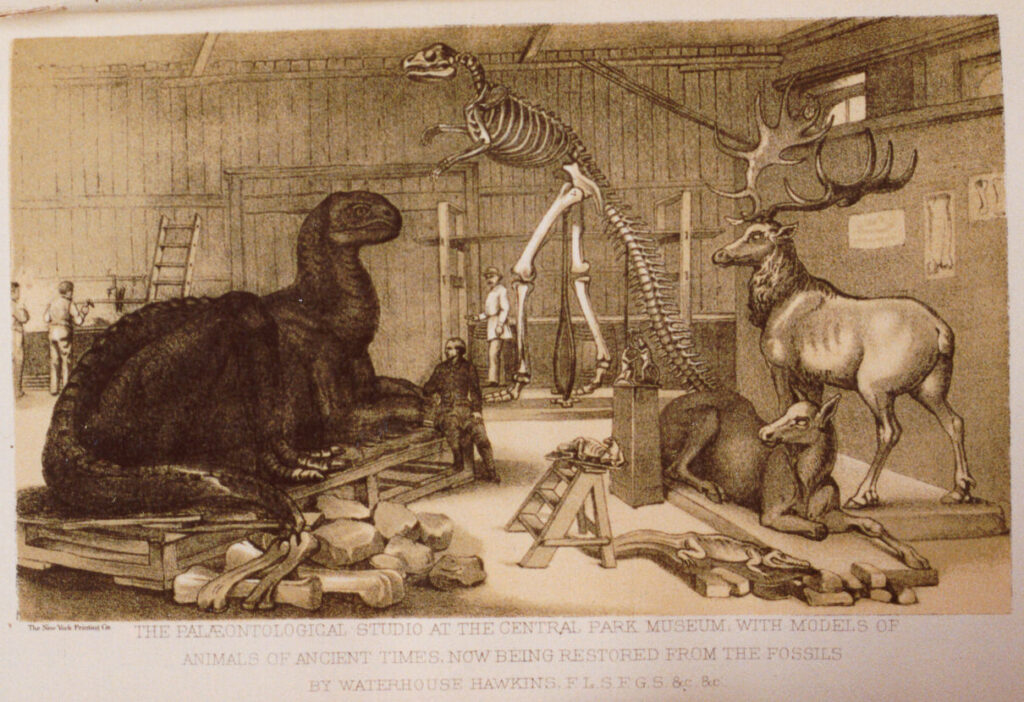
The Arsenal studio of Benjamin Waterhouse Hawkins, 1869.
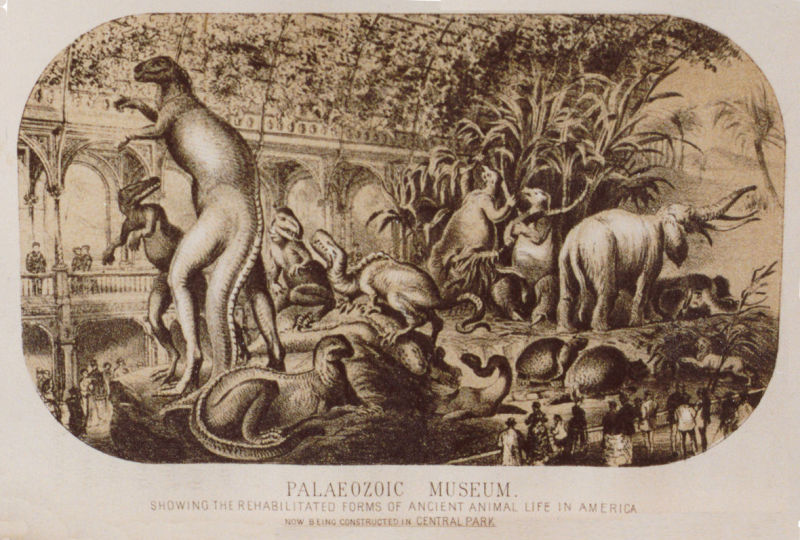
A sketch of what the Paleozoic Museum might have looked like, had construction not been stopped by the cronies of Boss Tweed.
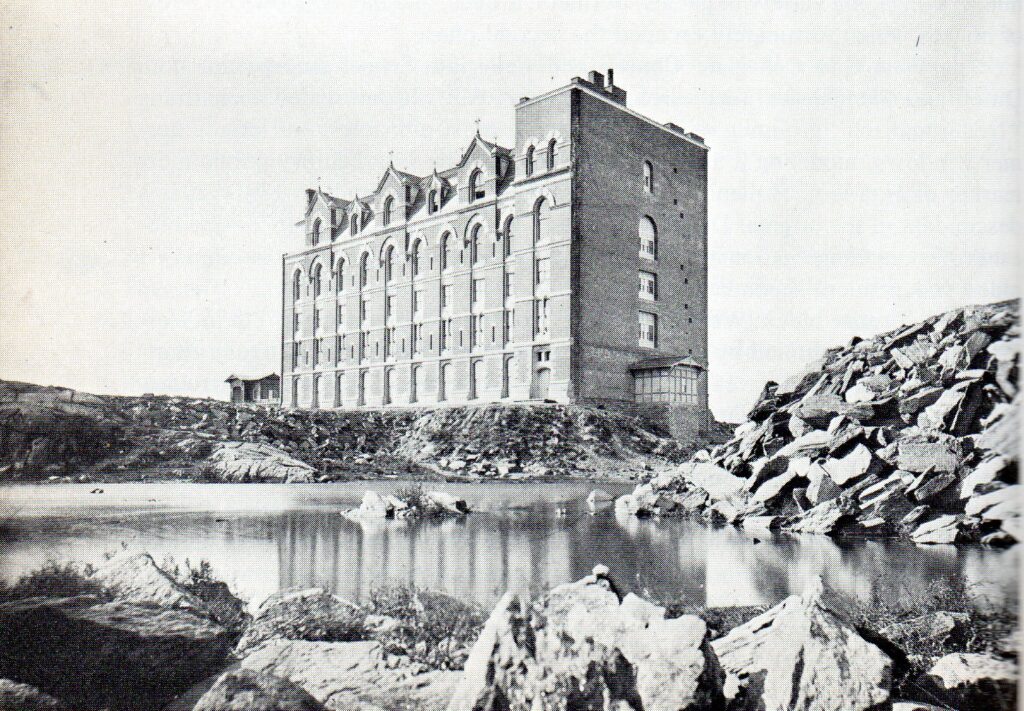
The lonely little first building of New York’s natural history museum, pictured in the early 1870s, placed on an unspectacular lot of land alongside Central Park called Manhattan Square.
New York Public Library
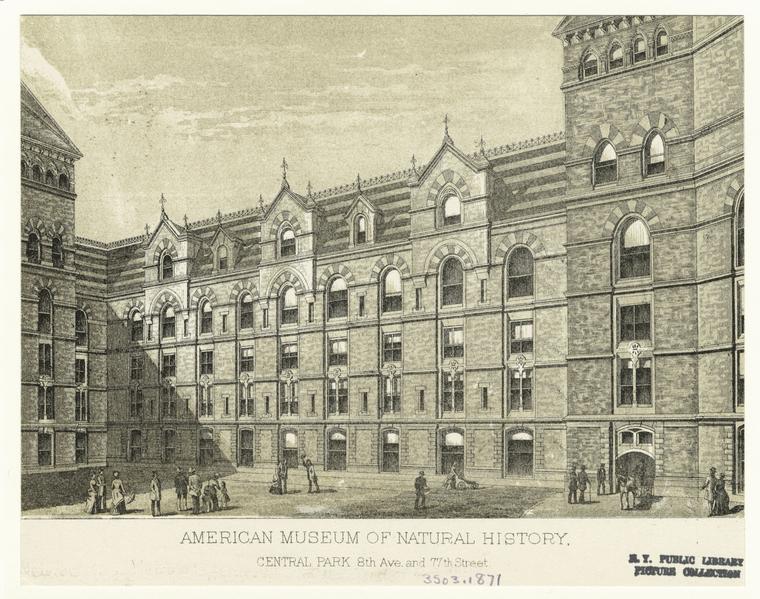
This illustration of the building from 1871 above displays the particular touches of Jacob Wray Mould, in the whimsical window design. What it doesn’t show is the vibrant, robust color of the building.
Although subsumed by later additions, some areas of the original walls are still peeking out within the larger structure today. [source NYPL}
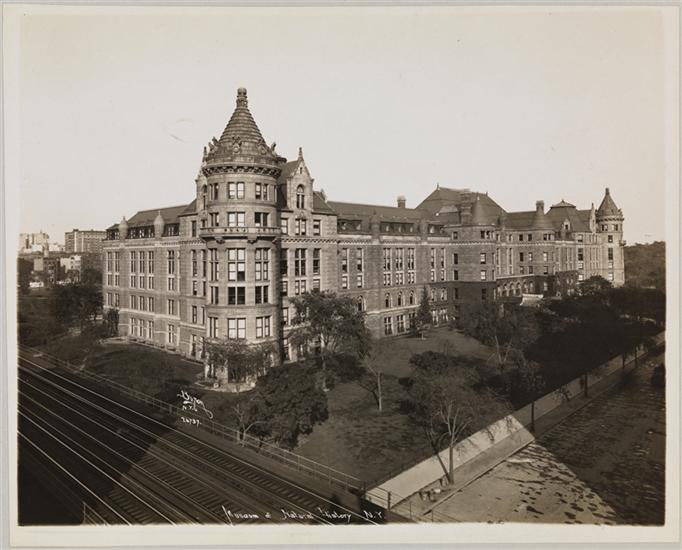
The grandeur of the museum in 1908. Note the elevated tracks running along Columbus Avenue. (Museum of the City of New York)Library of Congress
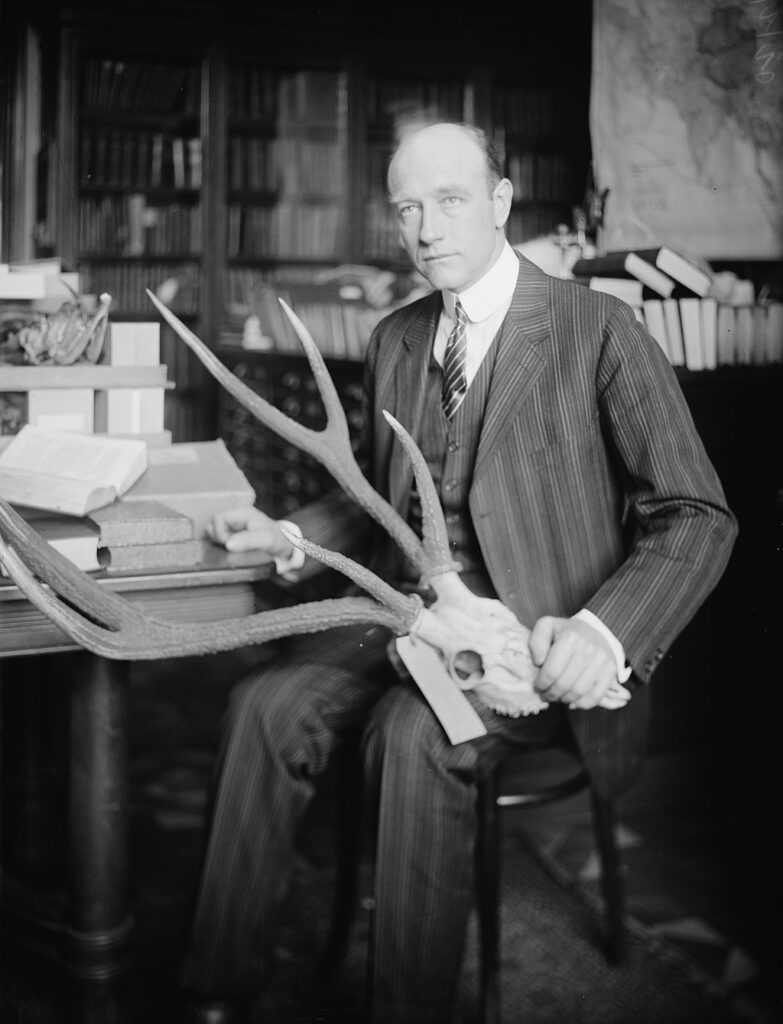
Roy Chapman Andrews, the dashing adventurer who became one of the museum’s most valuable explorers. It’s rumored that Andrews was the inspiration for the character of Indiana Jones.
Minik Wallace, the Inuit boy brought to New York with his father in 1897. Minik was subject to one of the most bizarre and tragic cover ups in the museum’s history.
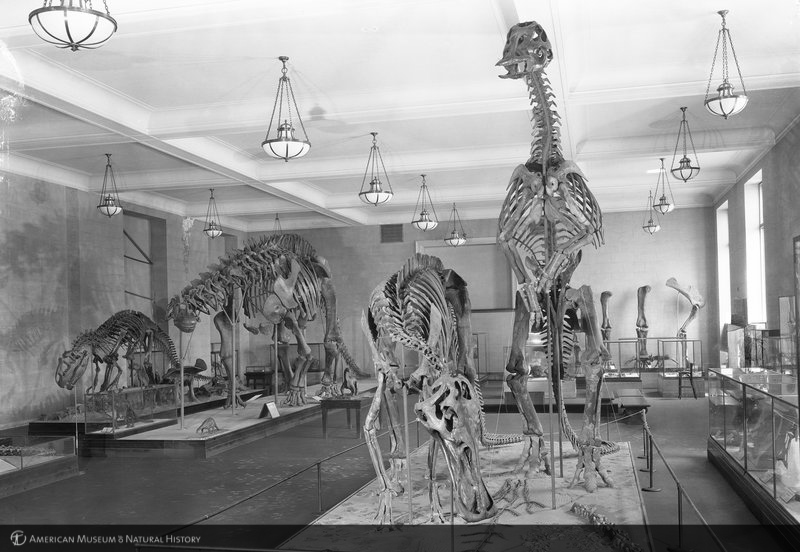
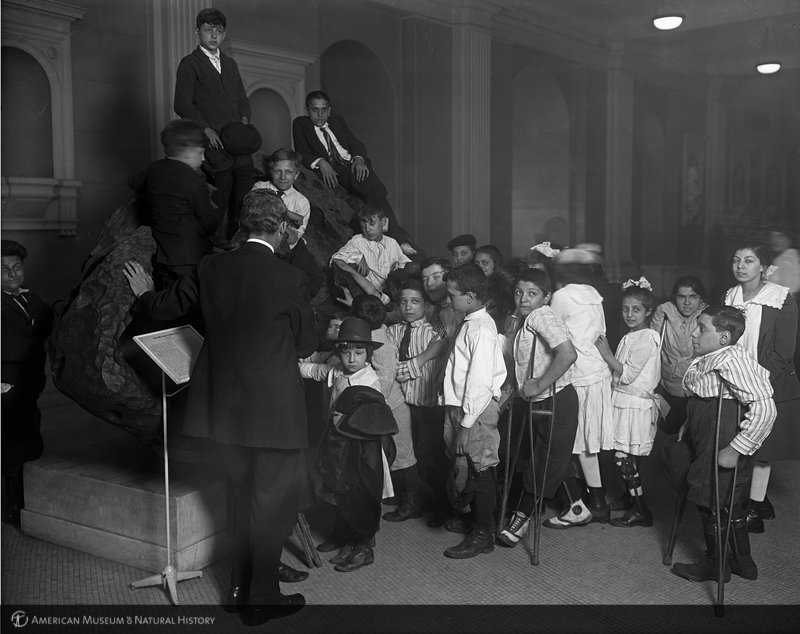
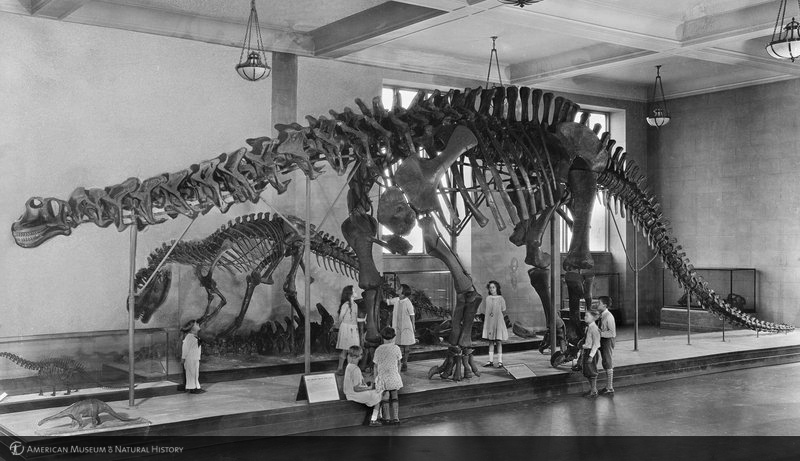
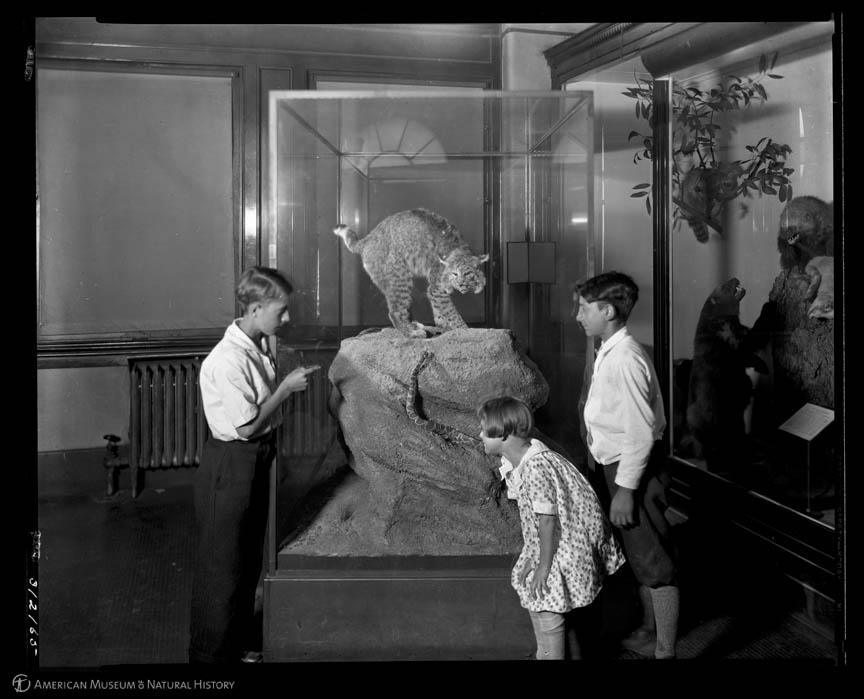
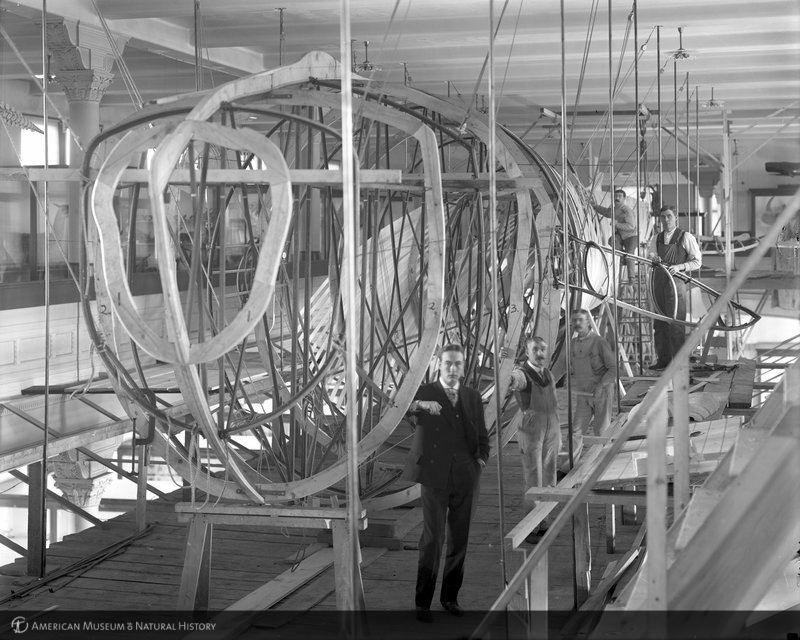
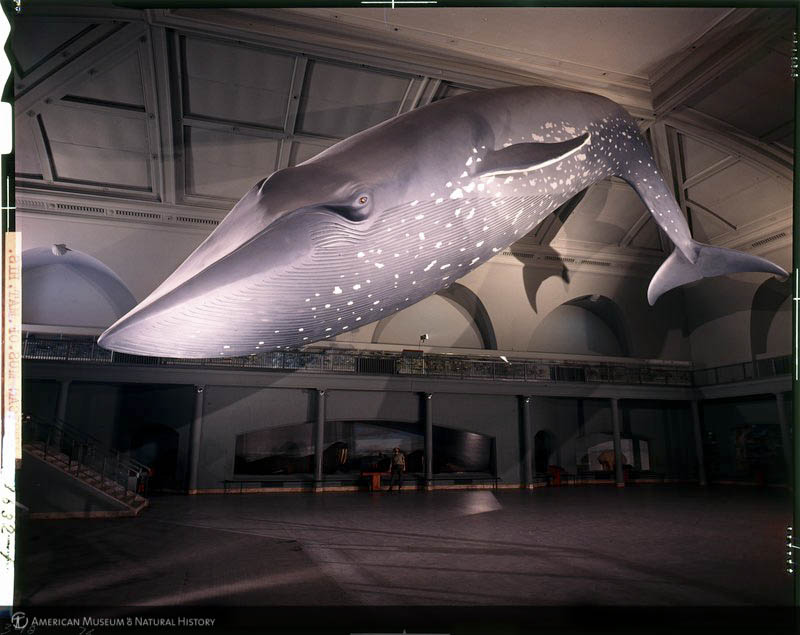
Children viewing the Williamette meteorite, 1920 (AMNH)Children viewing Brontosaurus (Apatosaurus) exhibit, 1927, courtesy the American Museum of Natural HistoryChildren viewing Wild Cat Group, 1927, courtesy AMNHRoy Chapman Andrews with frame for model of sulphur bottom [blue] whale, November, 1906. (Courtesy AMNH). But this is not the whale you know and love! According to the Museum: “The Museum’s iconic blue whale model, first constructed in the mid-1960s, was based on photographs of a female blue whale found dead in 1925 off the southern tip of South America.” It was resculpted in 2001 based on more modern research and made with foam and fiberglass.The Blue Whale as it appeared in 1969. (Courtesy AMNY)
A little song and dance while you’re marveling at the natural marvels:
The Bowery Boys: New York City History podcast is brought to you …. by you!
We are now producing a new Bowery Boys podcast every week. We’re also looking to improve and expand the show in other ways — publishing, social media, live events and other forms of media. But we can only do this with your help!
We are now a creator on Patreon, a patronage platform where you can support your favorite content creators.
Please visit our page on Patreon and watch a short video of us recording the show and talking about our expansion plans.
If you’d like to help out, there are six different pledge levels.Check them out and consider being a sponsor.
We greatly appreciate our listeners and readers and thank you for joining us on this journey so far.
UPDATE FOR 2020: It was announced today that Lord & Taylor, America’s first department store, has announced it will go out of business after 193 years. It began in 1826 as women’s clothing store in Lower Manhattan.
In tribute, we are bumping up this article from 1914, framed around its 1914 move to the Fifth Avenue shopping district.
Thank you Lord & Taylor — for the glamour, for the Christmas windows, for legacy that reaches back to the earliest year of New York retail history.
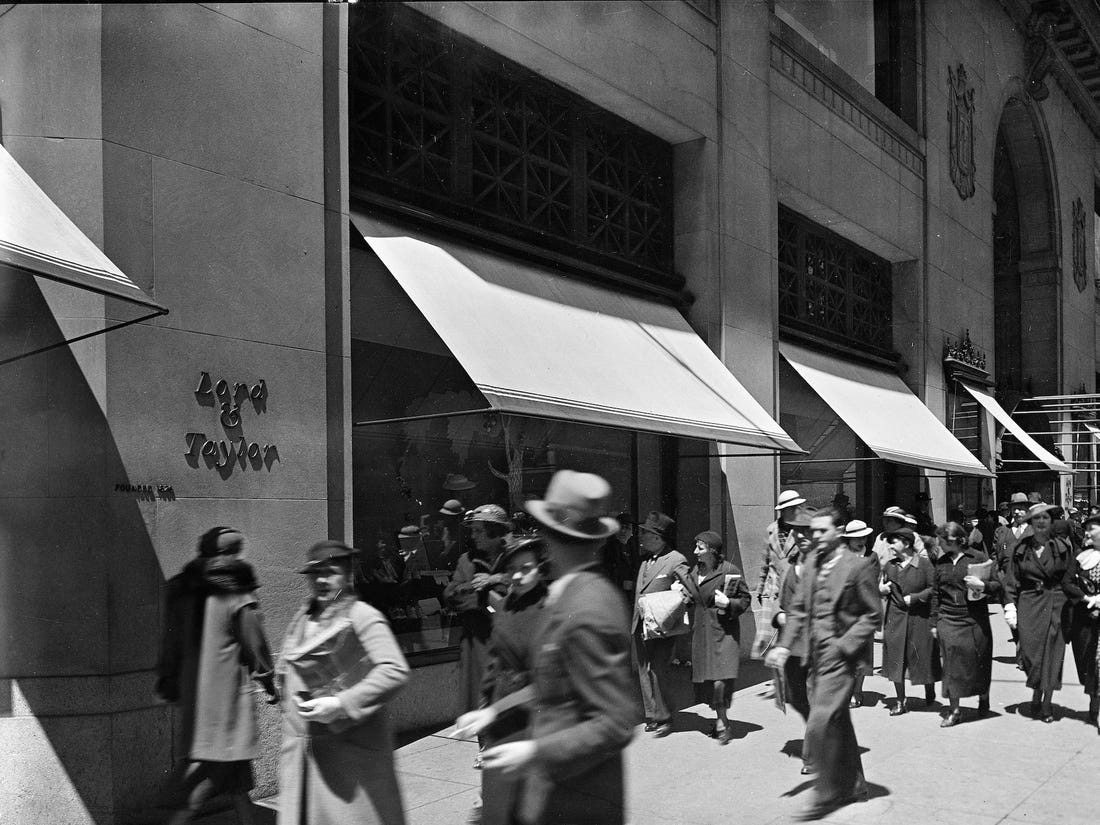
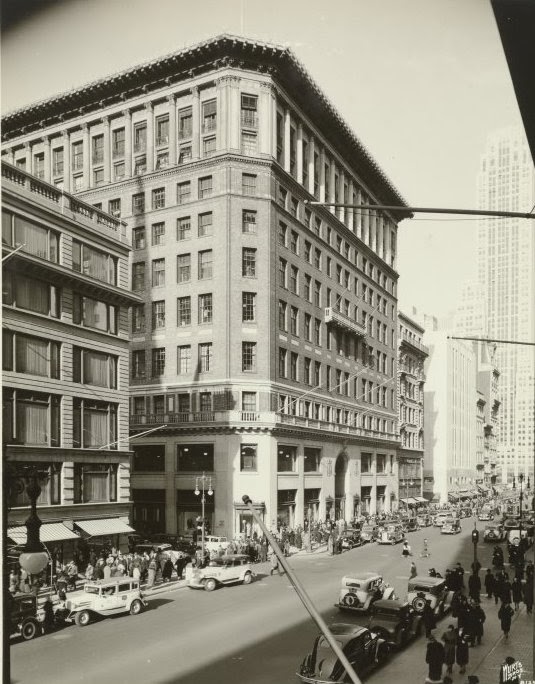
Lord & Taylor’s at Fifth Avenue and 38th Street, in the 1920s, photo by the Wurts Brothers (courtesy NYPL) Loehmann’s, the once-great Brooklyn-based department store, closes all their locations for good tomorrow, another causality of the changing economy and people’s changing tastes in shopping.
But let’s not dwell on the decline of the department store. Let’s revisit the heyday, shall we?
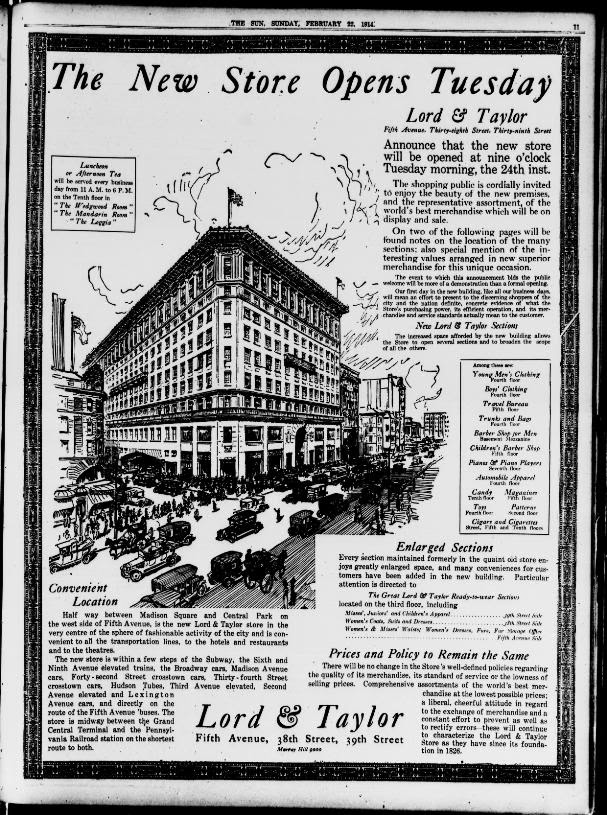
Lord and Taylor Department Store opened the doors to their tony Fifth Avenue address one hundred years ago yesterday, on February 24, 1914.
“Half way between Madison Square and Central Park on the west side of Fifth Avenue, is the new Lord & Taylor store in the very centre of the sphere of fashionable activity of the city and is convenient to all the transportation lines, to the hotels and restaurants and to the theatres.”
The store traces its lineage to a three-story women’s clothing store on 47 Catherine Street, which was opened in 1826 by Samuel Lord and George Washington Taylor. Nearby, men could find equally fine fashions at the clothier of H & D.H.. Brooks (today Brooks Brothers) at Catherine and Cherry Streets. Catherine Street is hardly a place where you would look for high-end brands today, located between the Manhattan and Brooklyn Bridges.
Lord & Taylor had subsequent locations in Manhattan at Broadway and Grand Street and, later, at Broadway and 20th Street on Ladies Mile.
Flash forward to 1914 — the new store was an automated wonder, according to the New York Sun, equipped with a system of conveyor belts. “[T]he human equation has been eliminated wherever possible and machinery performs its part quietly and out of sight.”
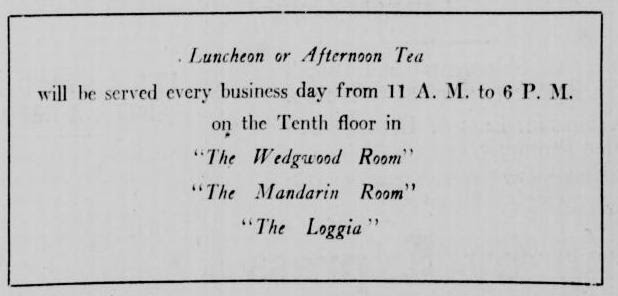
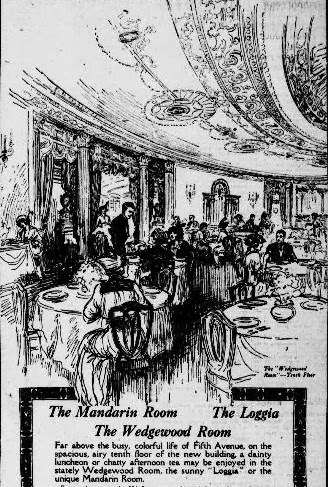
Shoppers could also escape to the tenth floor for “a dainty luncheon” or some afternoon tea:
The building is in the go-to architectural style for department stores — Italian Renaissance Revival — and, apparently, the go-to architectural firm for such places, Starrett and Van Vleck, also known for Bloomingdale’s and Saks Fifth Avenue.
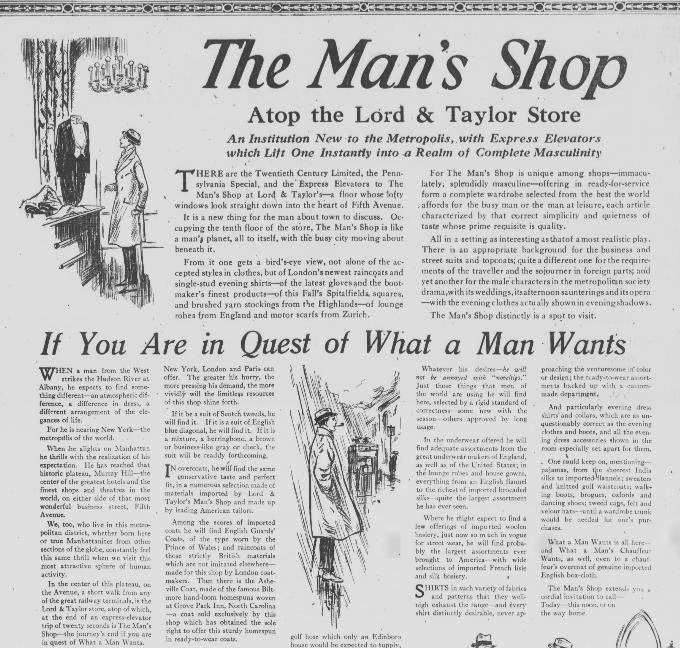
The new store made a unique appeal to the male shopper with its tailored men’s department, “a realm of complete masculinity”. There was a men’s-only entrance on the 38th Street side where gentlemen could access the Manicuring Parlor. “[M]ake your purchases, be shaved and manicured, change your clothing, if you like, and leave without passing through any of the departments where women’s goods are sold.” In addition, the entire fourth floor was “devoted to men’s apparel and accessories for motoring.”
The store also had featured an Equestrienne Section, including “a mechanical horse, duplicating the actual motion of walking, trotting, or cantering.”
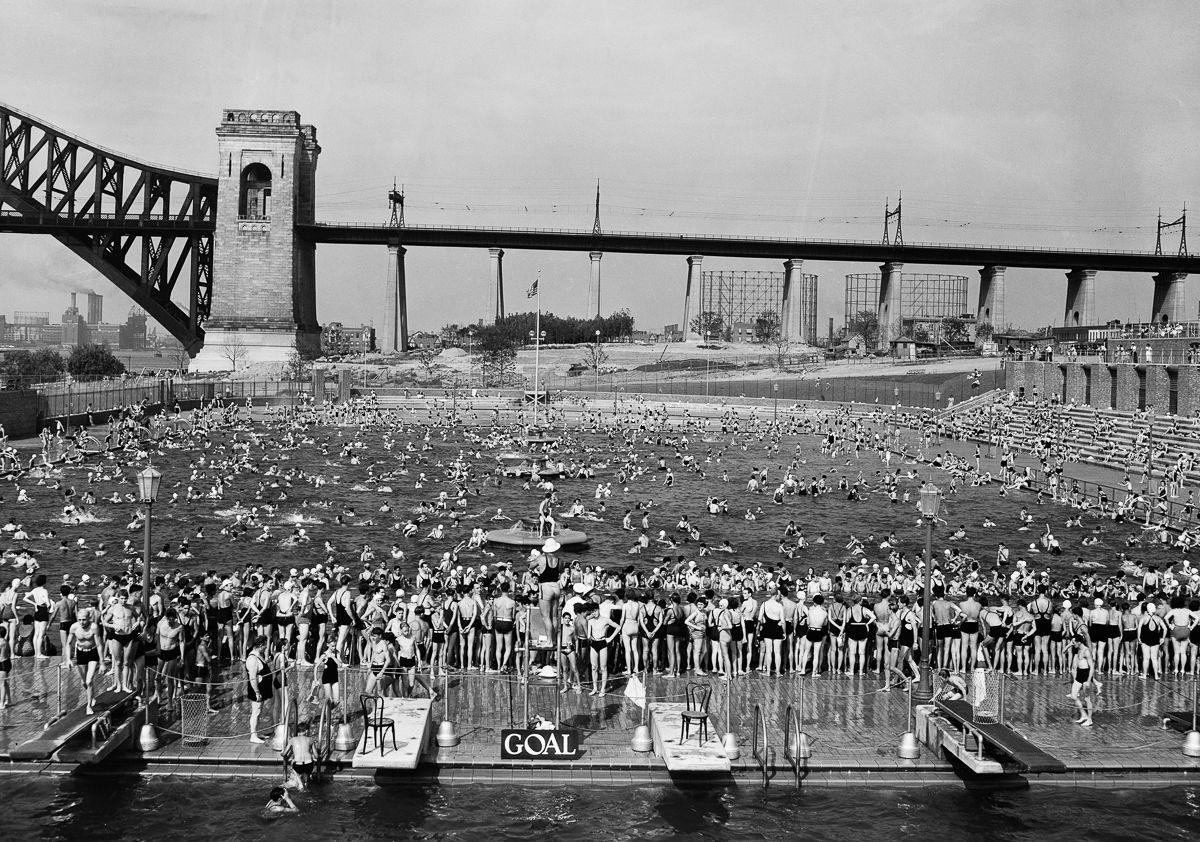
Astoria Pool is the largest venue for swimmers in New York, outside of the Hudson and East Rivers and, of course, the ocean.
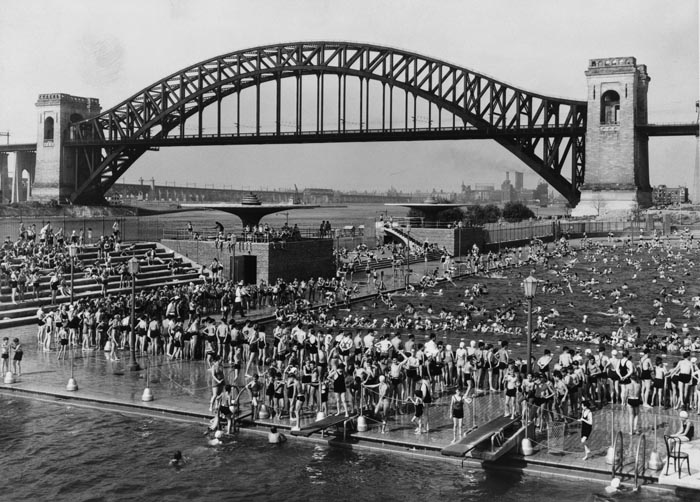
Its location in Astoria Park is certainly theatrical, parallel with the river and in sight of two spectacular bridges (the Robert F. Kennedy and the Hell Gate) that sail over to Randall’s Island.
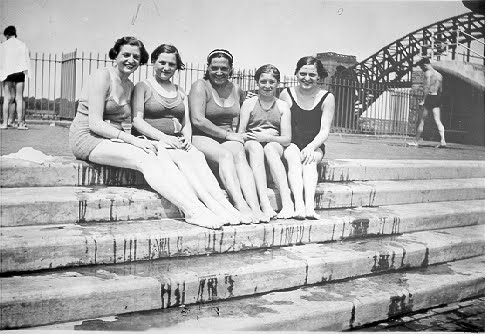
Mermaidens: Five sisters in bathing suits pose on steps of Astoria Pool, circa 1938. Courtesy the LaGuardia and Wagner Archives
For a public pool, its so big (330 feet long, with a supposed capacity of 3,000 people) that it might be more comfortable in a theme park.
Riding the Wave
The pool, the park, one of the bridges (the RFK, aka the Triborough) and the roads you probably used to get to thee places were all 1930s projects overseen by New York Parks Commissioner Robert Moses.
But the real fuel behind the creation of Astoria Pool was the Works Progress Administration, a federal agency that infused billions of dollars into local communities during the Great Depression.
The money came just as Moses (above, in a swimsuit, at Jones Beach) was ascending into his various governmental roles in city and state government. The result was some of his most earnest and arguably most effective projects.
Perhaps his legacy might not be as hotly debated today had he stopped with his greatest hits of the decade: the Triborough, the parkways and the many miles of parkland scattered throughout the city.
And of course the swimming pools, eleven in total, built during the 1930s.
Dipping A Toe Into Swimming Pools
They were of special note as a culmination of the modern public facility, using modern design and new technology to create places of recreation for regular New Yorkers.
The idea of municipal pools wasn’t new — Philadelphia had them as early as 1890s, and New York had plenty of public baths and even floating baths — but standards of decency had changed by the 1920s.
Women could cavort with men, as could different social classes. (And occasionally people of different races, although many of Moses’ own pools were guilty of segregation.)
Astoria Pool, with its subdued Art Deco design, was the grand model for all the new pools in the other boroughs. And it was certainly the most popular, from the moment it opened in July 1936.
It became a daily destination during the summer for neighborhood children.
“In 1936, I was eight years old,” recalled New York Yankee superstar Whitey Ford. “You could stand by the pool on a hot summer day –along with a couple thousand neighborhood kids in the main pool and maybe another hundred in the diving pool — look up, and see quite a sight. On the right was Hell’s Gate Bridge….and on your left, was the brand new Triboro Bridge heading towards the horizon.”
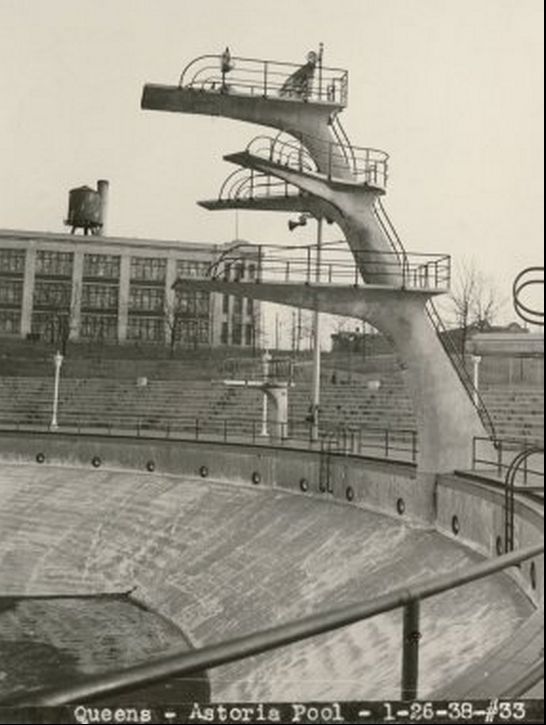
But Moses wasn’t just concerned with public accommodation. He had different intentions for this pool, reflected in the semi-circle of bleachers and that spectacular diving platform stretching like a plant over a deeper half-moon pool.
The Astoria Pool was meant to create swimming superstars.
The Diving Board and the Butterflies
Two days after its opening, on July 4, 1936, Astoria Pool hosted the U.S. Olympic trials in swimming and diving. From these events, victors went straight over to the Games, hosted that year in Berlin.
And they weren’t the only athletes tested that month in a New York WPA project.
Across the water, at Randall’s Island, Olympic track-and-field trials were hosted at Downing Stadium, producing the man who would become the most famous Olympian of the ’36 games — Jesse Owens, winner of four golds. [For more information, check out the podcast on Randall’s Island and the 1936 Olympic trials.]
Two massive Olympic torches stood astride the pool as competitors fought for a spot on the Olympic team.
Events at the Astoria Pool in July 1936 produced several winners, including gold medal swimmers Jack Medica and Adolph Keifer and a slate of athletes that went on win ten of twelve medals in men’s and women’s platform and springboard diving.
(Interestingly, the other two medalists were Germans. And both their medals were bronze, yet another result that must have angered Adolf Hitler.)
Olympics trials returned to Astoria Pool in 1952, and again in 1964, producing athletes that again nearly swept the diving events in the Tokyo games.
SwimmerDon Schollanderwent on to win 4 golds that year, the most of any athlete in 1964 and the most medals won by an American athlete since Jesse Owens.
But, as it would turn out, the biggest swimming celebrities fostered from the Astoria Pool were neighborhood boys.
Aqua-Zanies
Imagine being a kid in Astoria, Queens, in the early 1940s, living next to a swimming pool that had helped produce the world’s greatest swimmers!
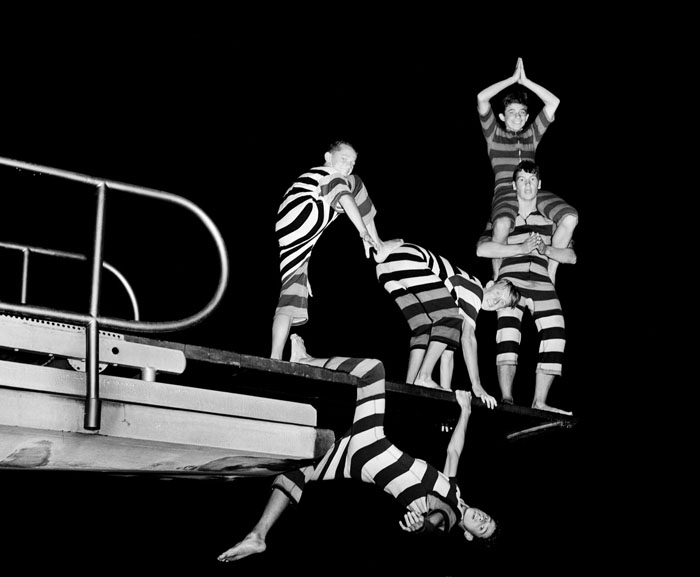
A group of local swimming enthusiasts looked at Astoria Pool’s extended diving platform and saw a opportunity to entertain, forming an athletic-comedy group called the Aqua-Zanies.
Garbed in matching stripped ensembles, the teenagers performed wacky acrobatic stunts from off the platform — darting, twirling and sometimes bellyflopping into the water below.
They soon became ‘America’ leading water comedians‘, performing throughout New York and even going on an international tour in the early 1950s. Several Aqua-Zanies went onto more legitimate swimming careers.
And certainly these effortless performance have inspired hundreds of others to leap from the Astoria diving platform with equal attempts at gravity-defying levity.
Although the swimming pool has remained a important part of the community even to this day, that diving platform, weathering decades of elemental abuse, was shut down in the 1970s and has become something of a beloved ruin.
In June 2006 it was officially designated a New York City landmark. And the pool is open for swimming again. Let your aqua-zany dreams soar!
Thanks to the Parks Department for use of the images above. (Diving platform photo courtesy NYC Dept of Records)
Women received the right to vote 100 years ago today with the ratification of the Nineteenth Amendment to the U.S. Constitution.
Tens of thousands of women from all walks of life spent hard-fought decades working for this moment. Many of the most prominent suffragettes were wealthy white women of the Fifth Avenue set.
It was their influential voices — added to those of long-time activists, women and girls from the labor movement and women of color from all backgrounds — that convinced the nation that its institutionally ingrained discrimination should end.
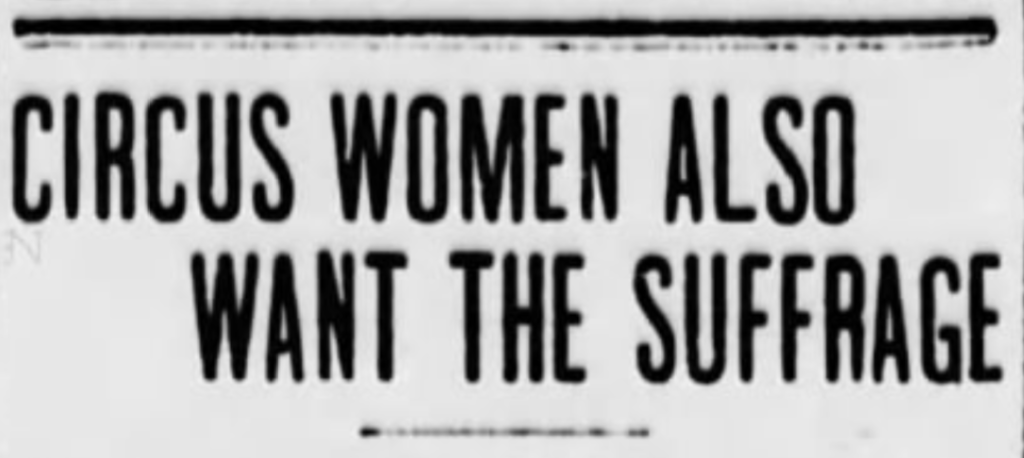
Even circus women got into the act.
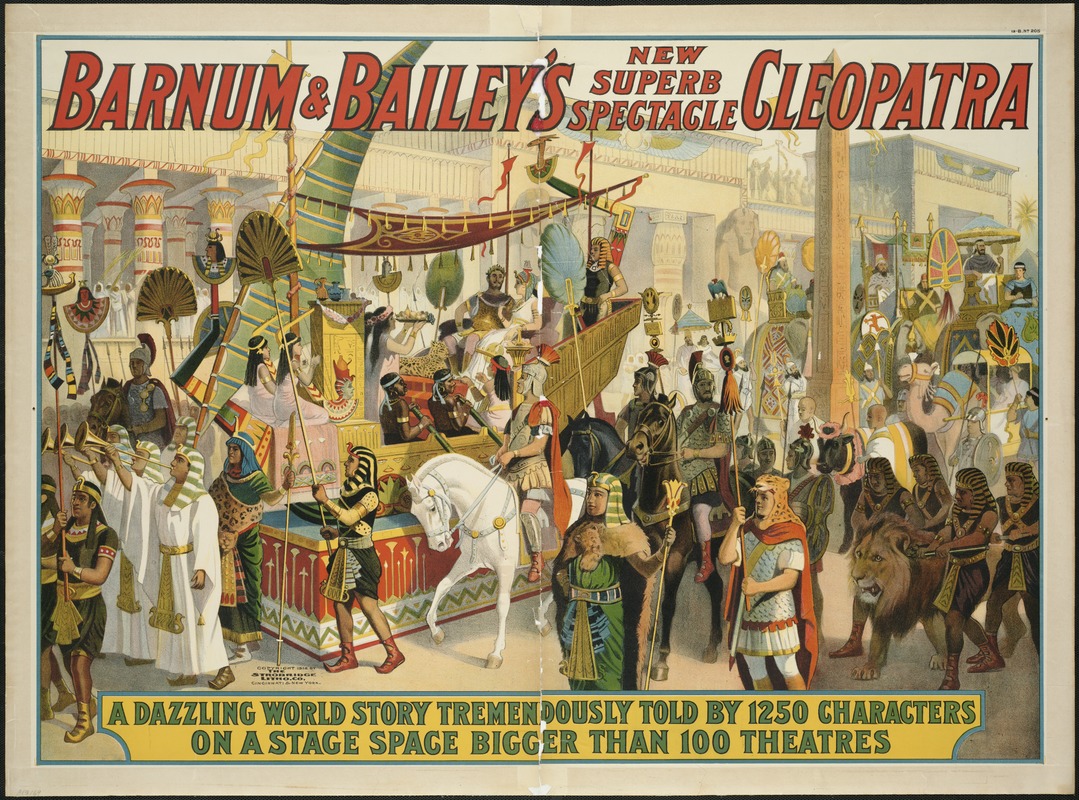
The famed Barnum & Bailey’s presented an elaborate Cleopatra-themed stage show during its 1912 season, featuring over 1,500 performers. The show had debuted just the week before at Madison Square Garden. Certainly some of its stars — perhaps Cleopatra herself? — participated in the March 1912 suffrage event.
On March 31, 1912, members of the Barnum & Bailey circus troupe, in town to perform at Madison Square Garden (back in its Madison Square location), decided to put on a very different show.
The female stars of Barnum’s traveling show decided to throw their support behind the suffragist cause. Unfortunately they were not greeted with the praise they deserved — by either the newspapers or the other suffragists.
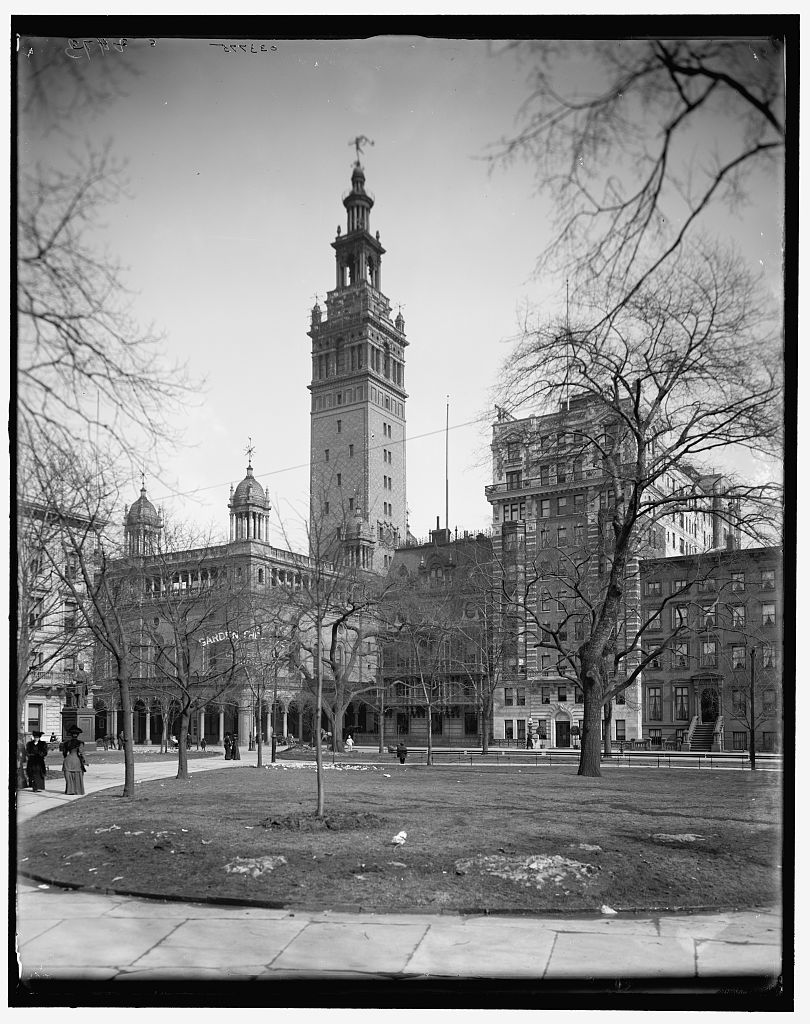
Madison Square Garden, 1910 (Courtesy Library of Congress)
Modern women activists of the day were happy to see any headlines relating their cause, as long as the environment was a respectable one. The circus was not one of those environs.
Then consider that most newspapers were operated by men and read by men. While some progressive sheets supported suffrage, several chose to cast the cause in a satirical light where possible. The ladies of Barnum & Bailey gave reporters a particularly ripe opportunity for a little spoofing.
On March 31, seventy-five women employed by America’s most famous circus organized an afternoon suffrage rally and invited the press to the world’s first ‘circus suffrage society‘.
How indeed could reporters resist a group of daredevil acrobats and horse wranglers, presenting their cause on the site of caged animals?
It was meant as a solemn pronouncement; reporters mocked it. “They Organize As Man-Eating Hyena Grins, Elephants Trumpet‘, went the Tribune headline, as the circus’s publicity agent “solemnly swore last night with a hand on his heart that the meeting was a real, honest-to-goodness suffrage meeting.” [source]
This was Barnum territory, after all. Although the great showman had died many years earlier, perhaps after decades of chicanery and misdirection, nobody could take a Barnum photo opportunity with a straight face.
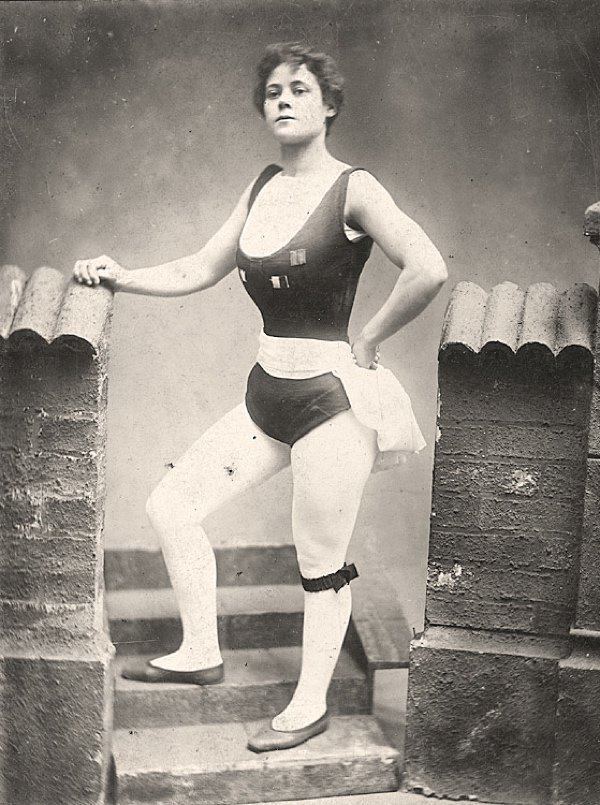
But it was a serious endeavor, led by petite circus rider Josie De Mott (pictured above)and acrobat Zella Florence.
Included in the audience were animal trainers, wire walkers, ‘hand balancers’, dancers, acrobats and even a few strong ladies, including the renown Katie Sandwina, ‘the female Hercules’ (pictured below).
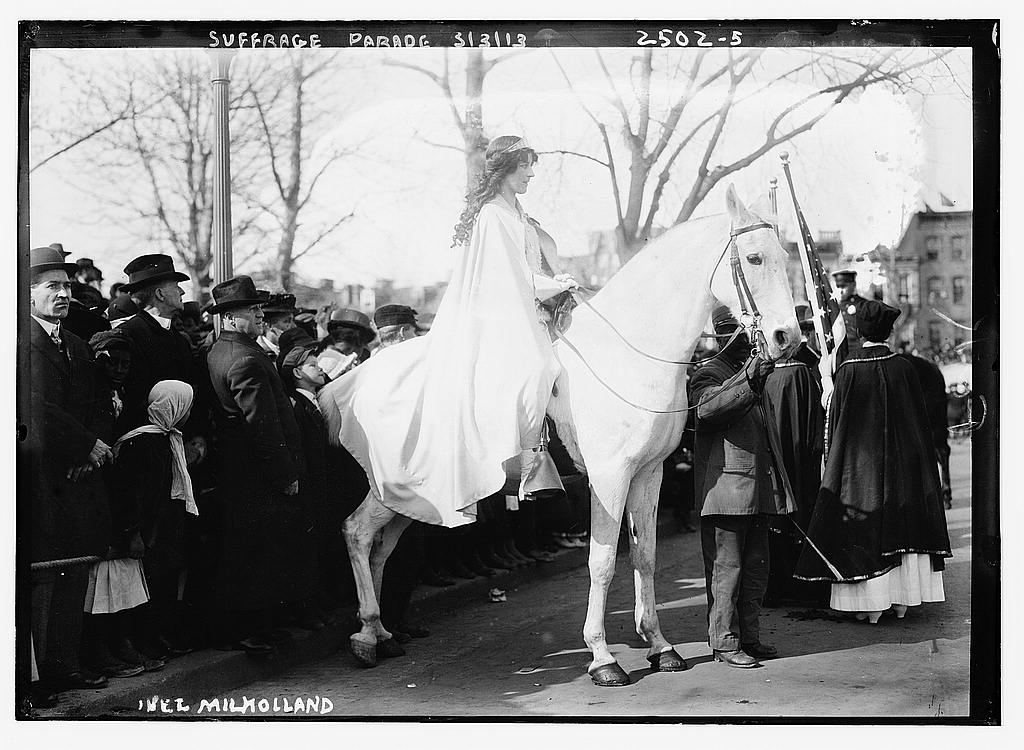
Not in attendance, however, were key members of the mainstream suffrage movement — notably Brooklyn socialite Inez Millholland and the movement’s de facto leader Harriet Stanton Blatch, the daughter of Elizabeth Cady Stanton.
Mrs. Blatch, the New York Times noted, was having tea with her fellow esteemed suffragists at their 46 East 29th Street headquarters. (It should be noted they were only a block away from Madison Square Garden!) However, perhaps recognizing the value of a traveling suffragist show, they did deign to send a representative named Beatrice Jones.
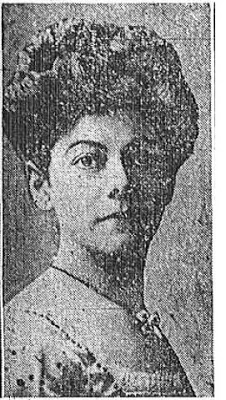
Inez Millholland at a Washington DC suffrage event in 1913. Given her dramatic display on horseback, one might have thought she’d be delighted to entertain the circus women. (Library of Congress)
Clearly flustered by the appearance of the press — the society ladies of the suffrage movement did not consider a circus ring an appropriate political venue — Jones repeatedly asked the ladies if they were serious, then dispensed advice on how to conduct themselves as standard-bearers of the roving suffragist cause.
At one point, the male half of Barnum’s husband-and-wife riding act stormed in and dragged his partner from the meeting. The crowd assailed the interloper with boos and hisses.
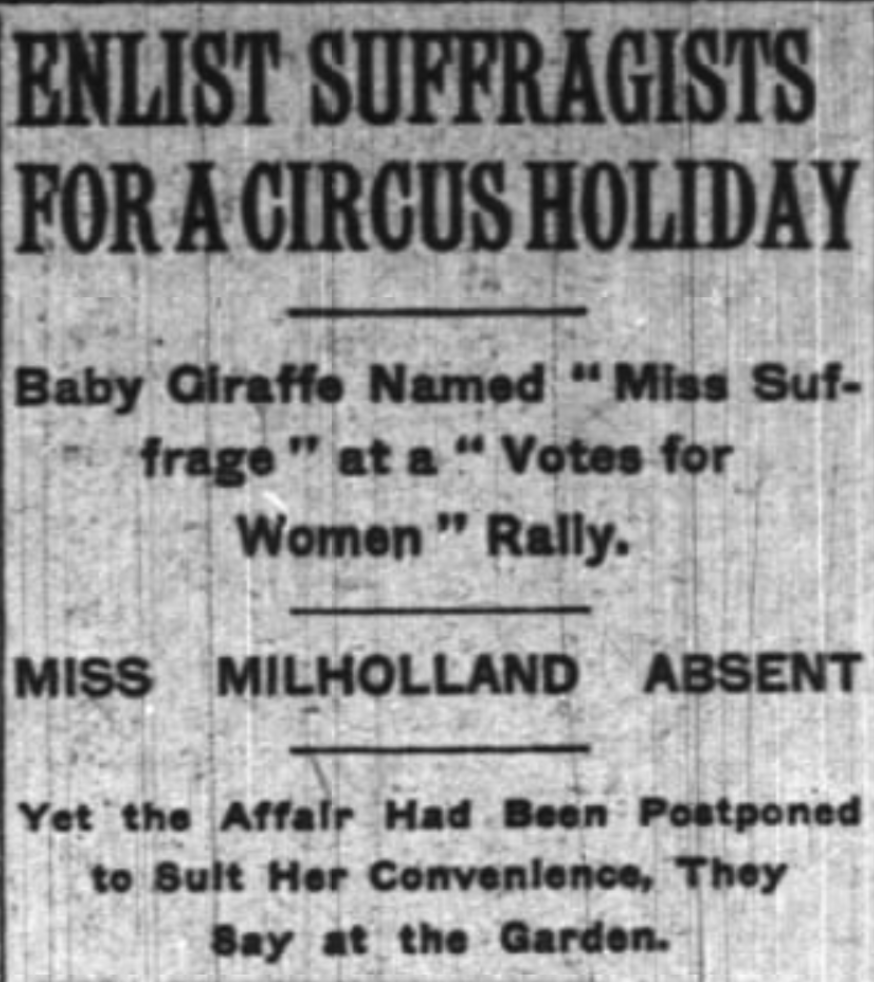
After the meeting, De Mott and the other circus suffragists created a dandy of a photo op, moving to a cage and presenting the name of ‘Miss Suffrage’ to a young baby giraffe. The Times coyly suggested the animal was male: “[B]y nightfall he couldn’t abide even the sight of a suffragette.”
The ‘proper’ suffragists acquiesced and eventually did meet with their more flamboyant sisters over tea the following week. The society activists marveled at the vigor of the Barnum ladies.
“It is because they have so much exercise,” one exclaimed, all the while “looking envious at the at the smooth skins and rosy cheeks,” the Times condescendingly added.
Eight years later, however, all these women would earn the right to vote.
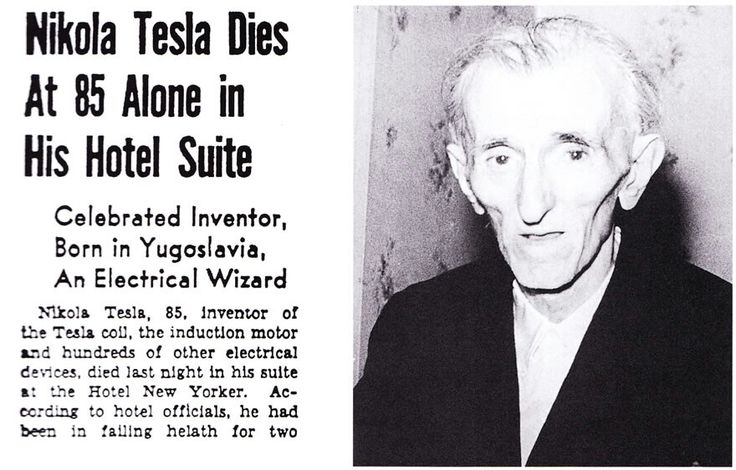
PODCAST The strange and wonderful life of Nikola Tesla in New York City.
The Serbian immigrant Nikola Tesla was among the Gilded Age’s brightest minds, a visionary thinker and inventor who gave the world innovations in electricity, radio and wireless communication.
So why has Tesla garnered the mantle of cult status among many?
Part of that has to do with his life in New York City, his shifting fortunes as he made his way (counting every step) along the city streets.
Tesla lived in Manhattan for more than 50 years, and although he hated it when he first arrived, he quickly understood its importance to the development of his inventions.
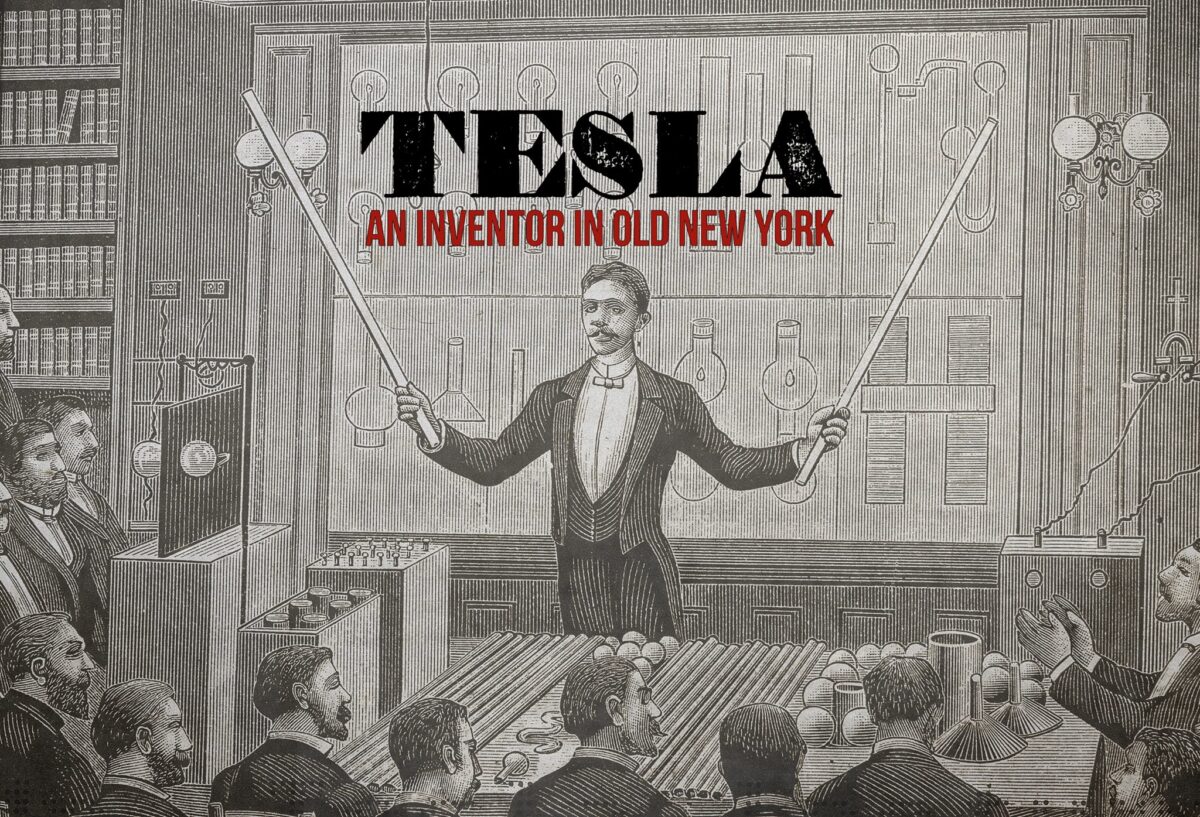
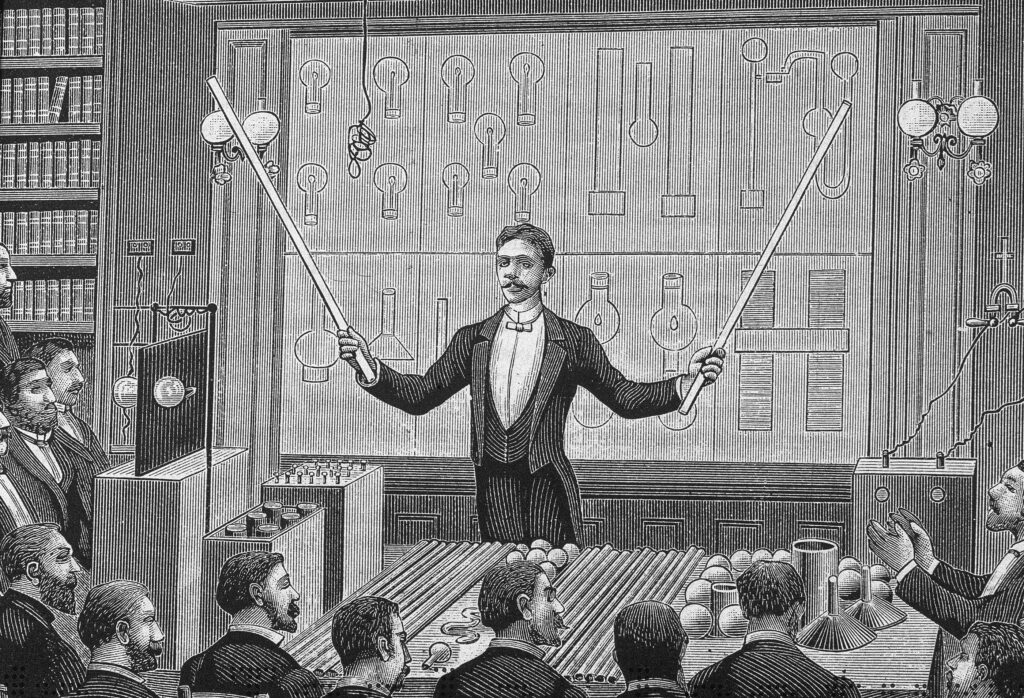
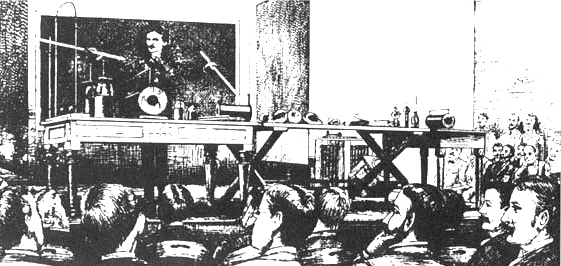
Engraving of Nikola Tesla (1856 – 1943) ‘lecturing before the French Physical Society and The International Society of Electricians,’ 1880s. (Kean Collection/Getty Images)
Travel with us to the many places Tesla worked and lived in Manhattan — from the Little Italy roost where the Tesla Coil may have been invented to his doomed Greenwich Village laboratory.
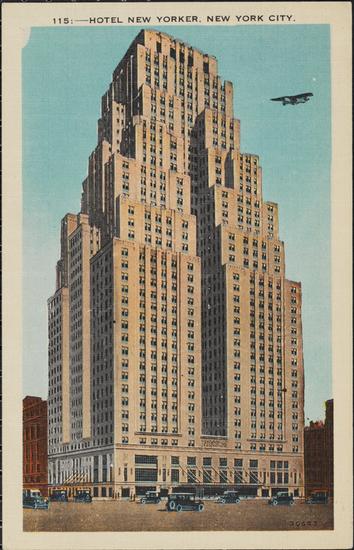
From his first job in the Lower East Side to his final home in one of Midtown Manhattan‘s most famous hotels.
Nikola Tesla, thank you for bringing your genius to New York City.
PLUS: The marvelous demonstration at Madison Square Garden in 1898 that proves that Tesla invented the drone!
The Bowery Boys: New York City History podcast is brought to you …. by you!
We are now producing a new Bowery Boys podcast every week. We’re also looking to improve and expand the show in other ways — publishing, social media, live events and other forms of media. But we can only do this with your help!
We are now a creator on Patreon, a patronage platform where you can support your favorite content creators.
Please visit our page on Patreon and watch a short video of us recording the show and talking about our expansion plans.
If you’d like to help out, there are six different pledge levels. Check them out and consider being a sponsor.
We greatly appreciate our listeners and readers and thank you for joining us on this journey so far.
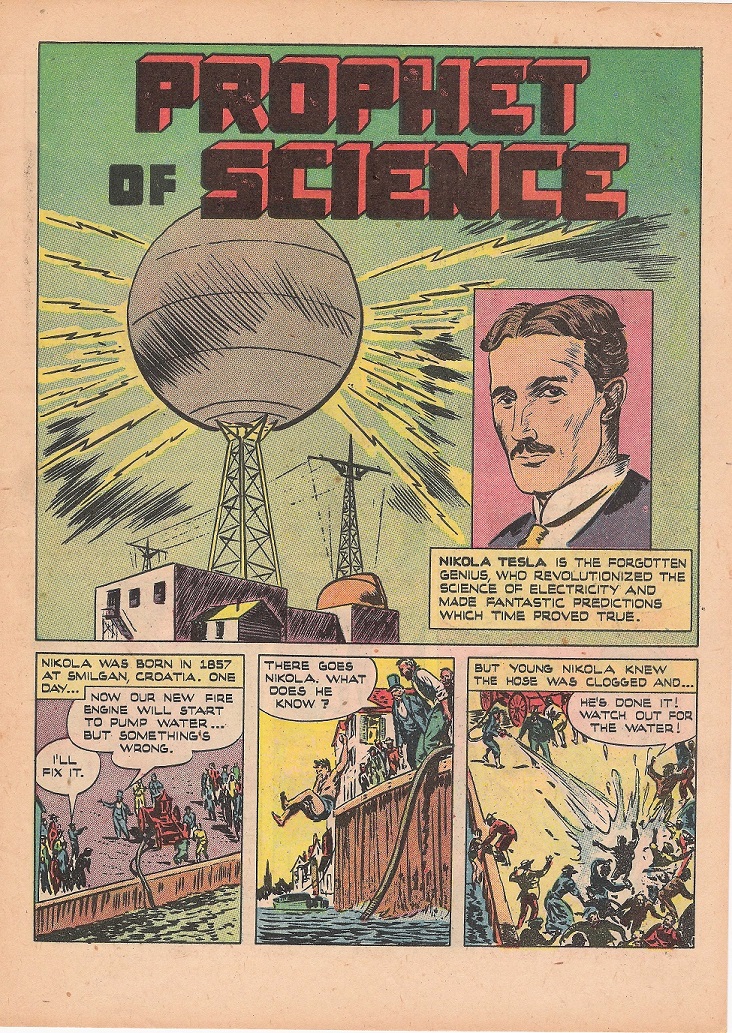
A page from the 1942 comic book Real Heroes, illustrating the life of Nikola Tesla:
Courtesy Quality Comics
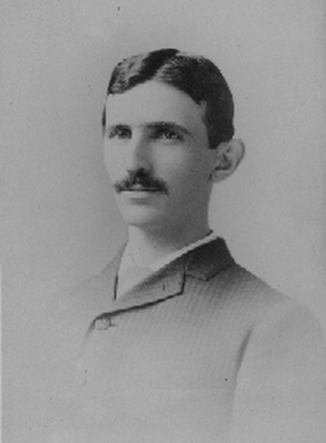
Young Tesla in 1885 while still in the employ of Thomas Edison.
Smithsonian Institution
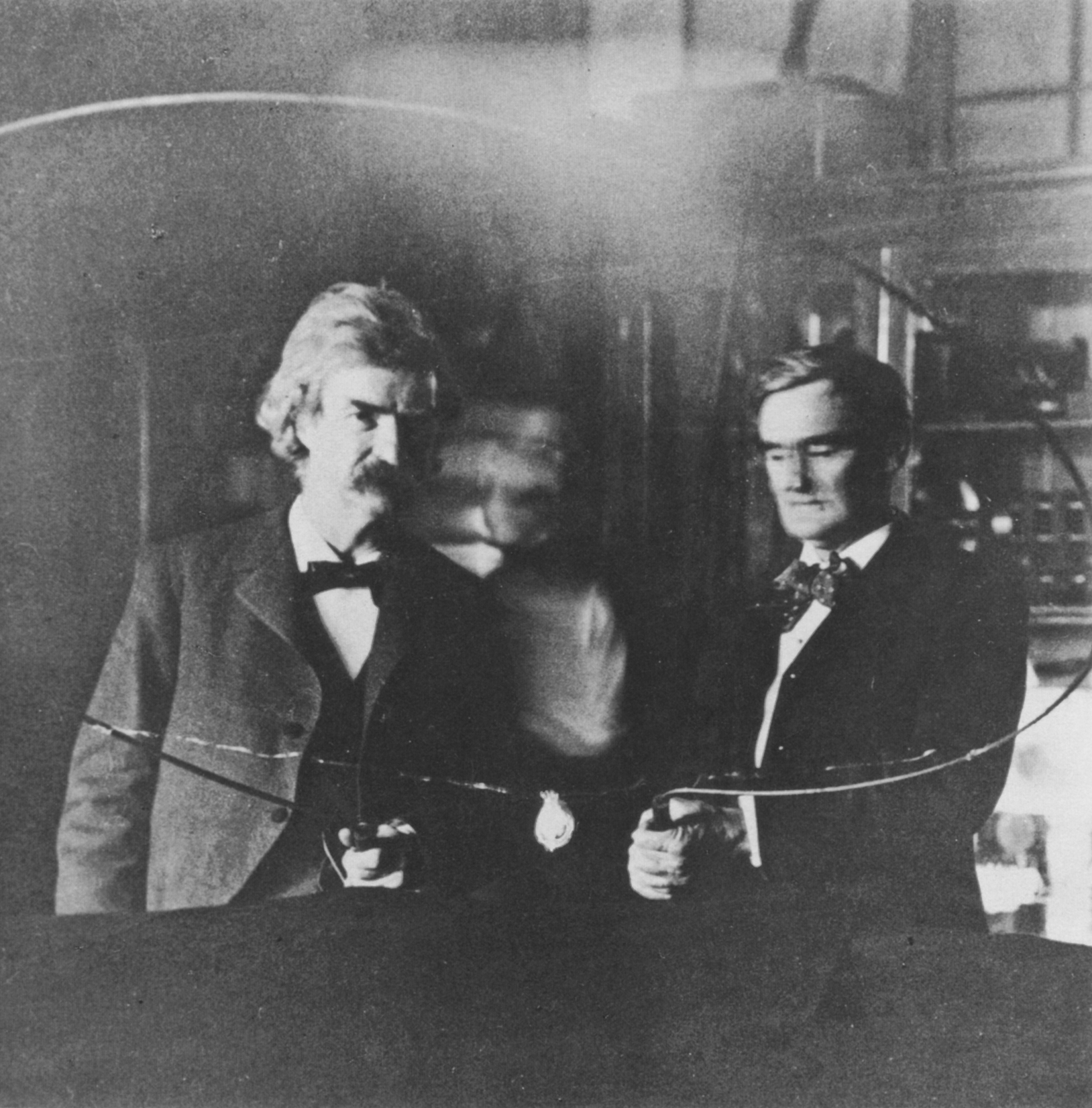
Mark Twain and Joseph Jefferson in Tesla’s South Fifth Avenue Laboratory. That’s Tesla, blurry, in the background.
Courtesy the Tesla Society
Tesla’s 1888 lecture at Columbia changed his life. His demonstration dazzled the room of distinguished scientists and professors and particularly grabbed the attention of journalists.
Courtesy Pictures of Infinity
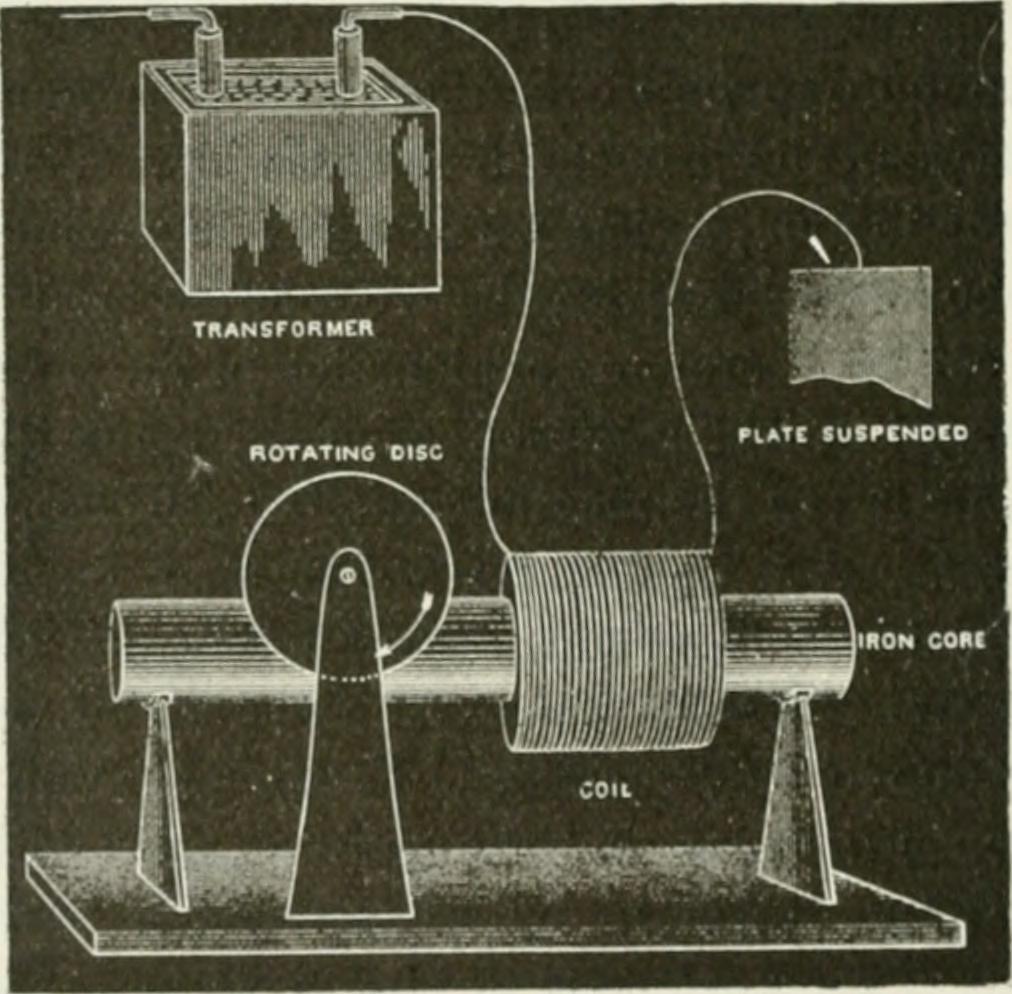
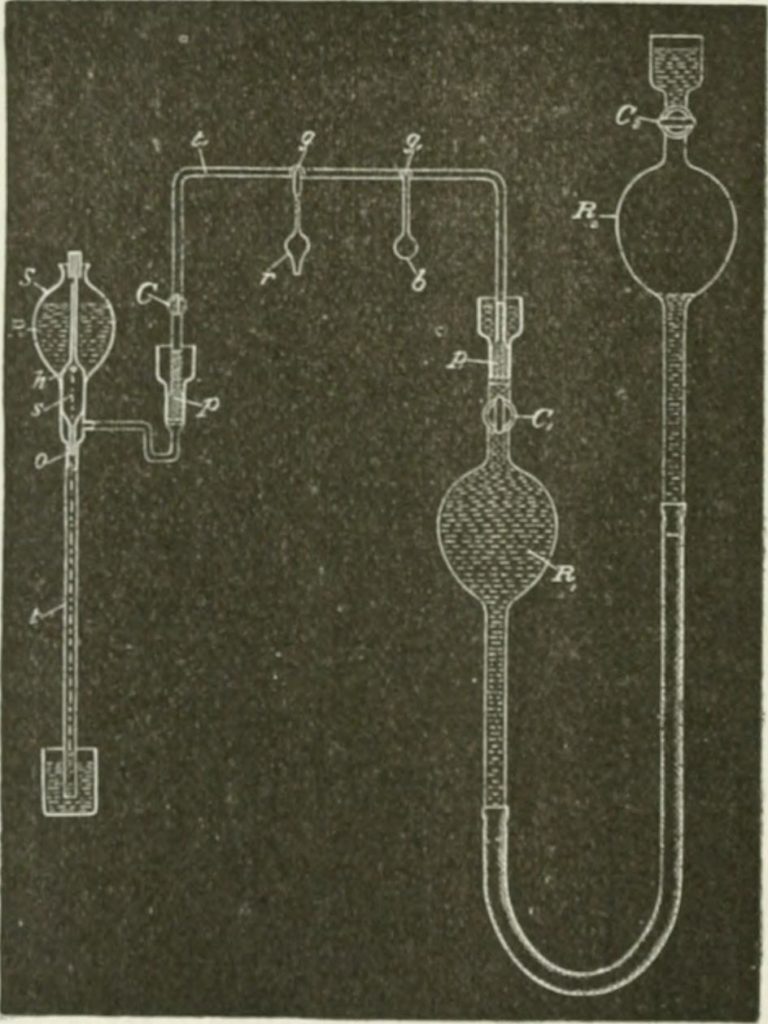
Diagrams of Tesla’s inventions from the 1880s and 90s have an almost otherworldly quality that wouldn’t look out of place in a gallery of modern art.
Internet Archive Book Images
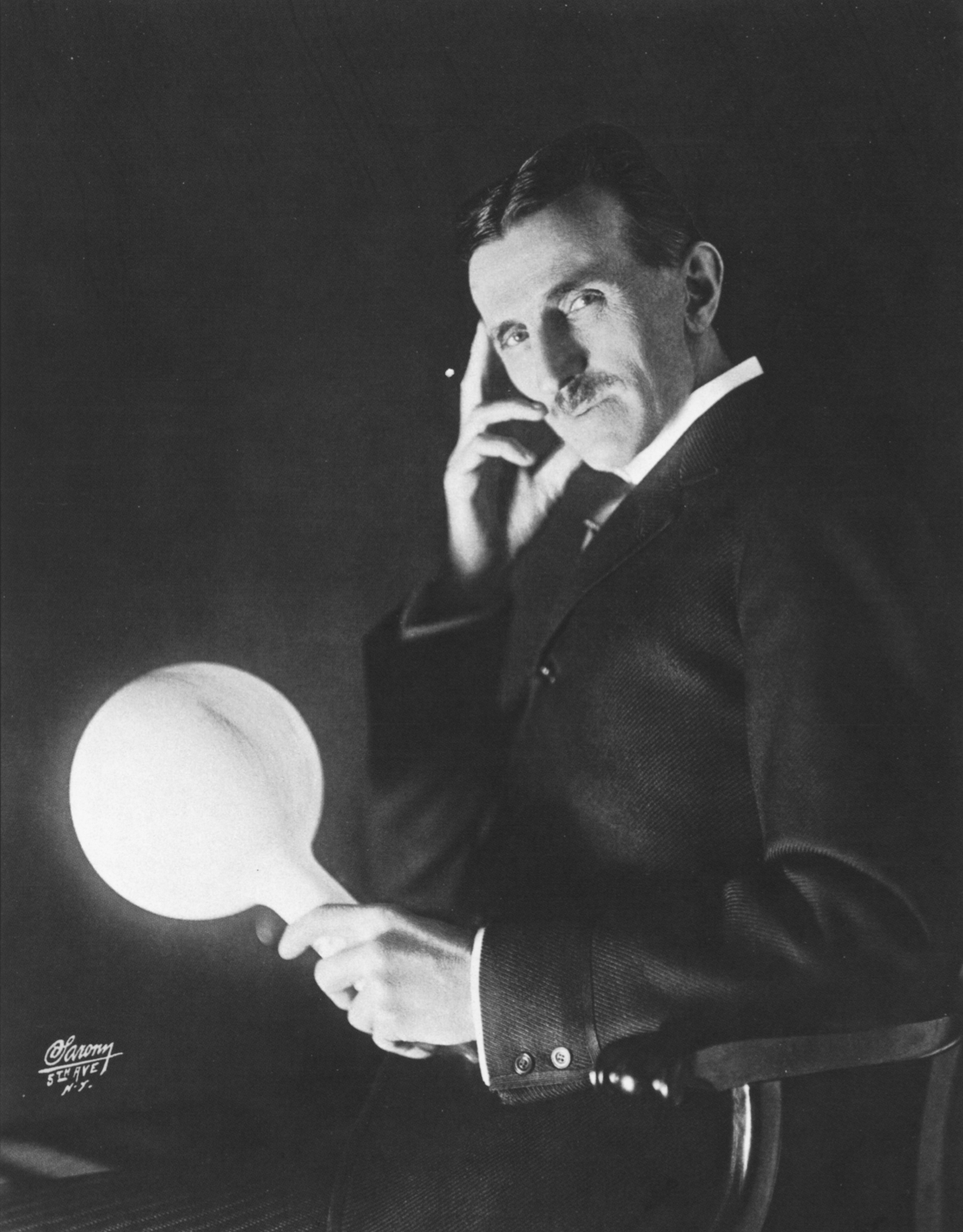
The Not-so-mad Scientist: Tesla posing with perhaps his most famous prop — a large bulb which could generate light from the human body.
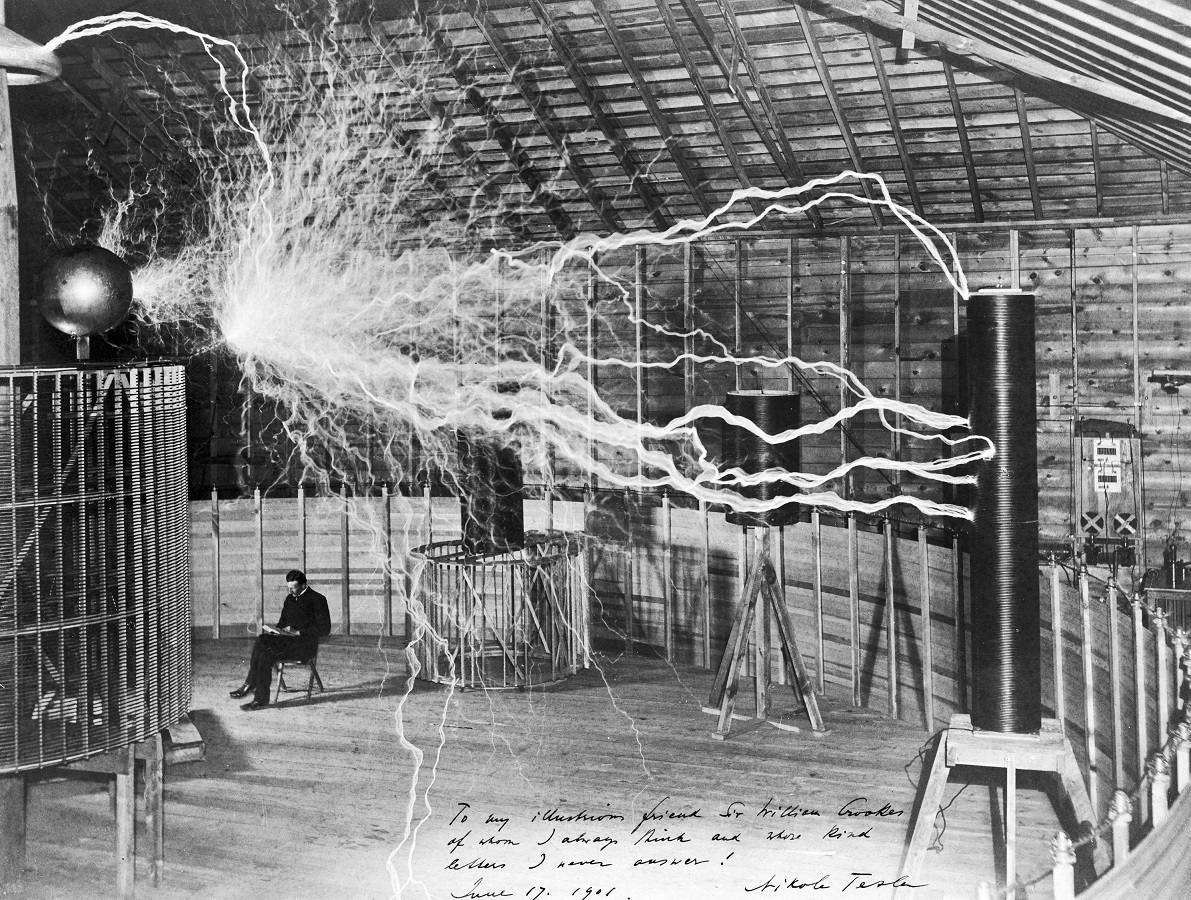
Tesla in Colorado Springs, 1899. From the caption: “A publicity photo of a participant sitting in the Colorado Springs experimental station with his “Magnifying Transmitter“. The arcs are about 22 feet (7Â m) long. (Tesla’s notes identify this as a double exposure.)”
M0014782 Nikola Tesla, with his equipment Credit: Wellcome Library, London. Wellcome Images images@wellcome.ac.uk http://wellcomeimages.org Nikola Tesla, with his equipment for producing high-frequency alternating currents. Inscribed: ‘To my illustrious friend Sir William Crookes of whom I always think and whose kind letters I never answer! Nikola Tesla June 17, 1901’ Photograph 1901 Published: –
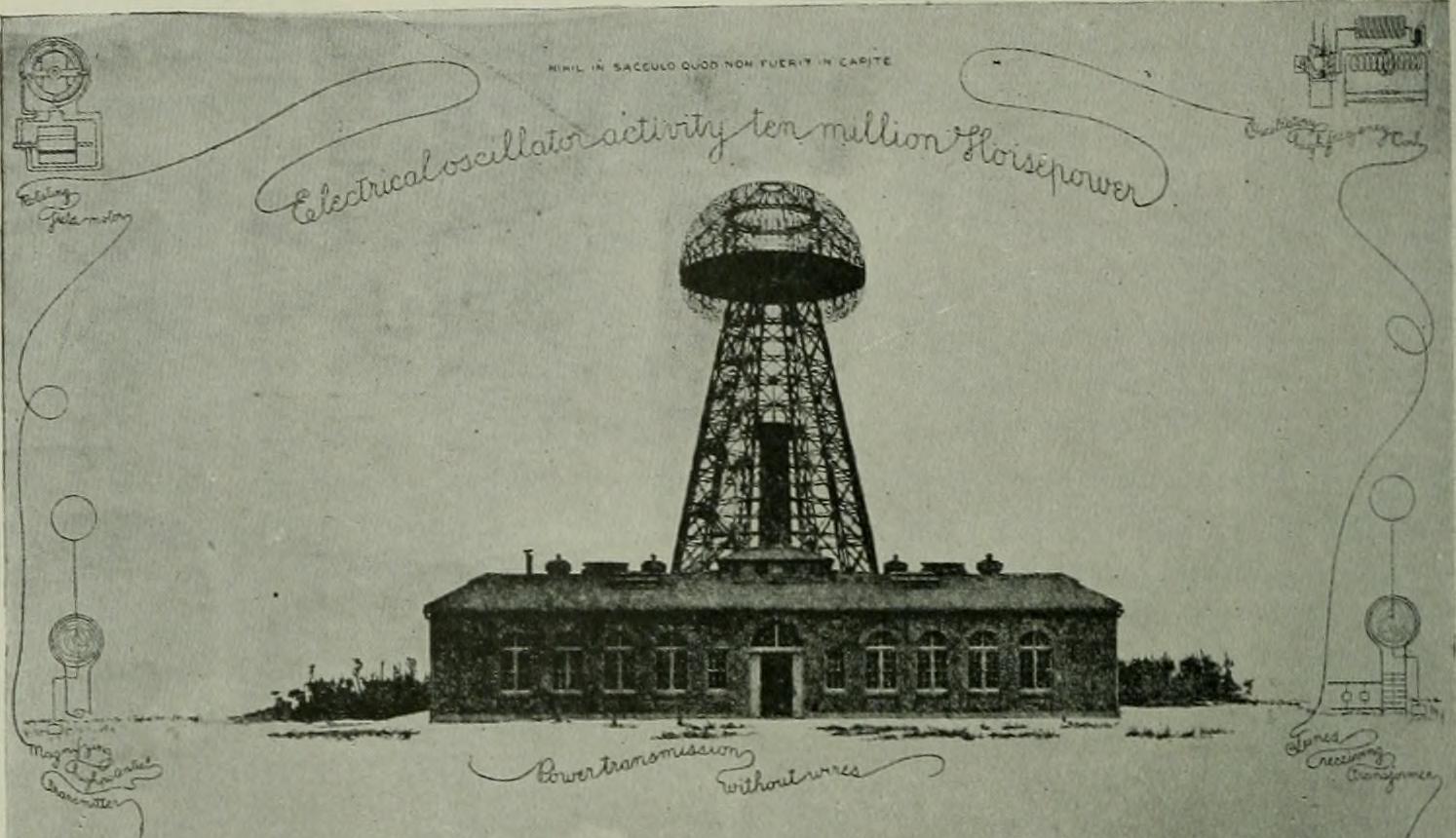
A view of Wardenclyffe Tower, Tesla’s grandest attempt of creating a wireless tranmission of electricity.
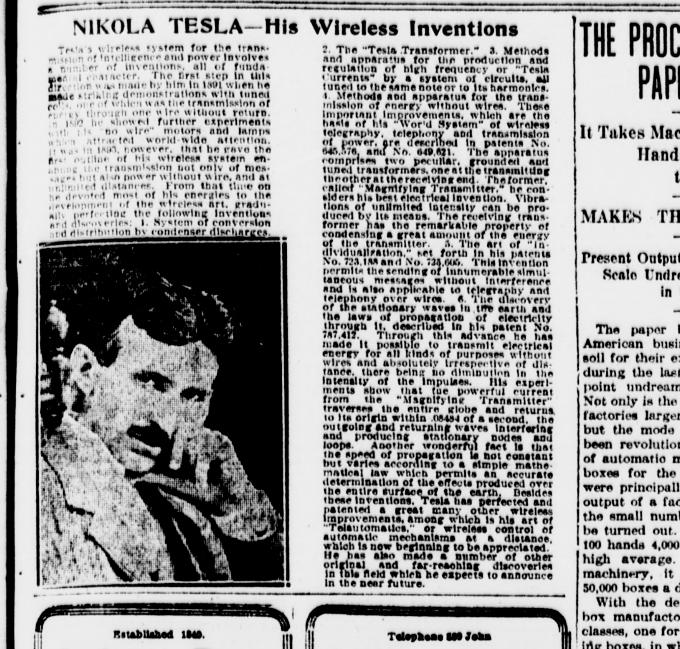
From the New York Sun, March 31, 1912: “Tesla’s wireless system for the transmission of intellegence and power involves a number of inventions, all of fundamental character.”
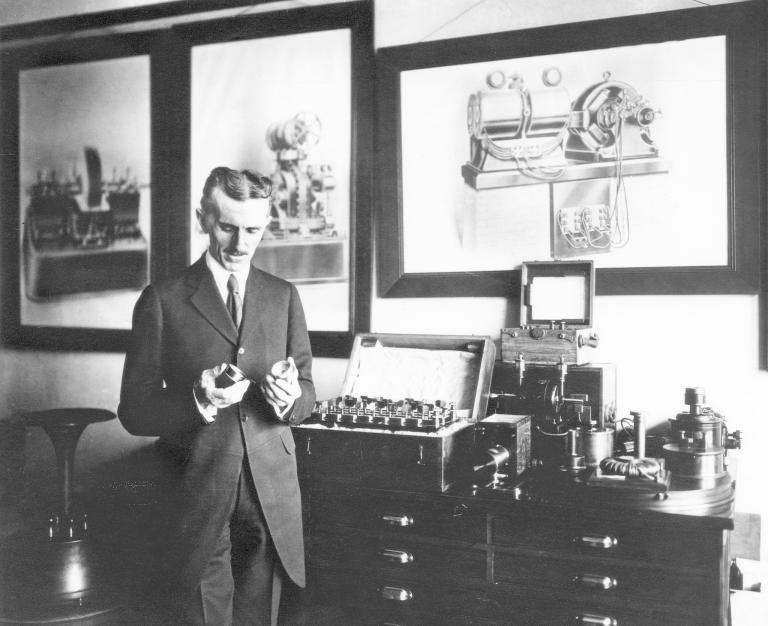
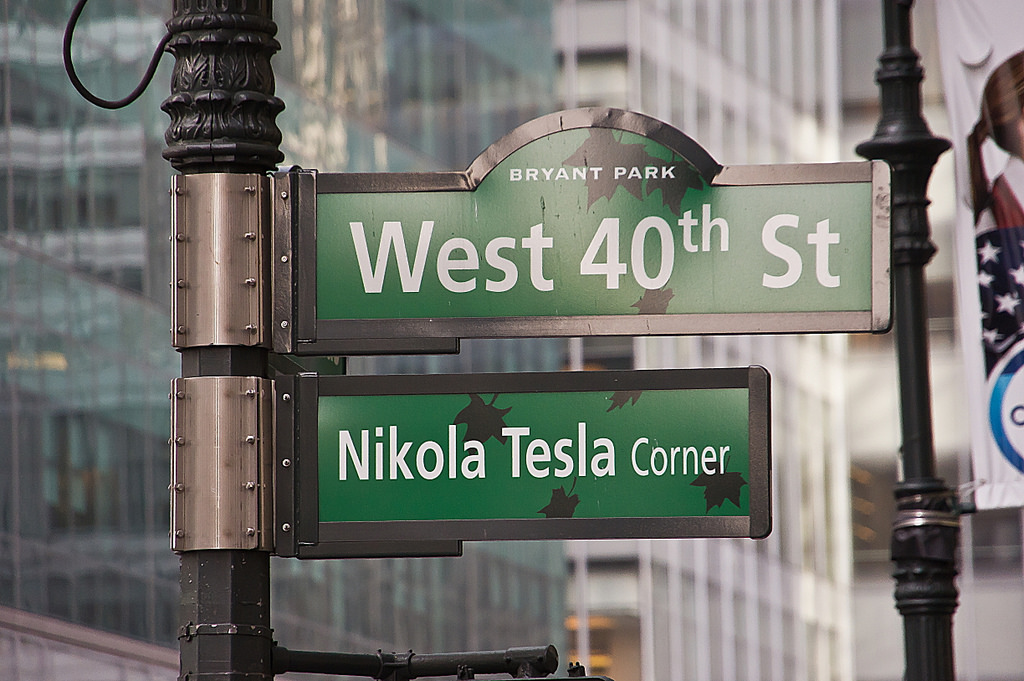
1916: Tesla poses in his West 40th Street laboratory, 1916.
Courtesy Everett Collection Inc., ALAMY
Courtesy Museum of the City of New York
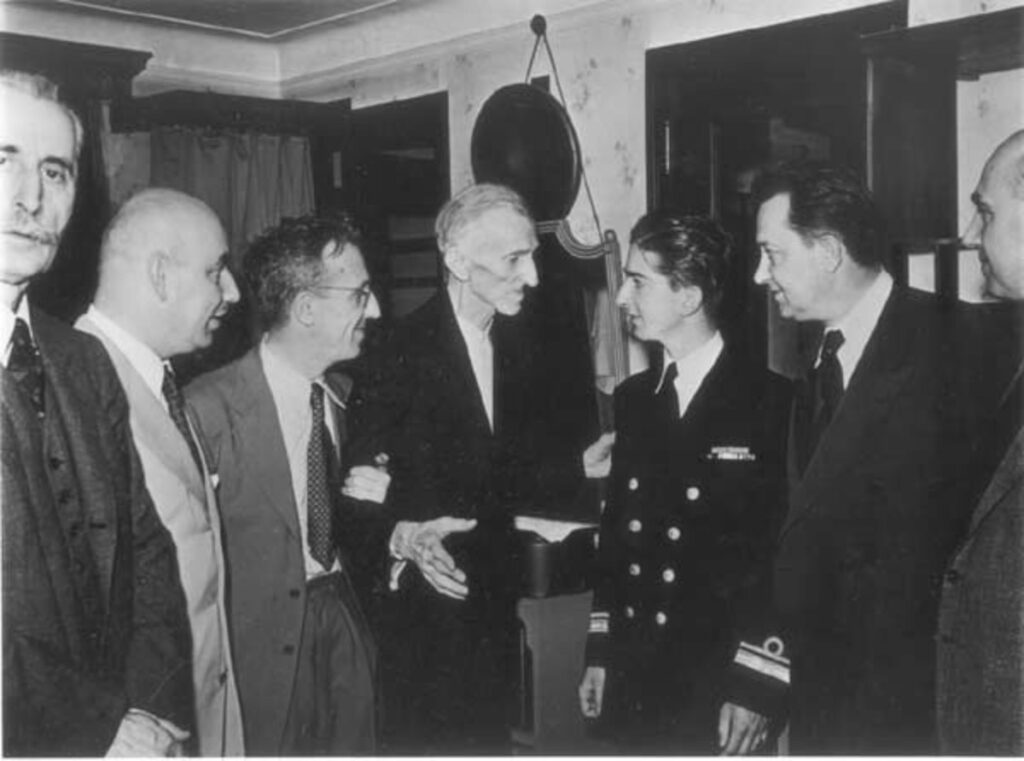
Nikola Tesla at the Hotel New Yorker with King Peter II of Yugoslavia. (Courtesy The New Yorker Hotel)
Bryant Park, near the spot of Tesla’s former laboratory and the place where he fed the pigeons.
A photo posted by Gregory Young (@boweryboysnyc) on
For more information
Visit the excellent blog by author Martin Hill Ortiz, deeply exploring the life of Tesla in New York City.
There are many societies devoted to the life and work of Nikola Tesla including the Tesla Memorial Society of New York. Â The Oatmeal is behind the effort to turn Wardenclyffe into the Tesla Science Center. Go read up on Tesla at The Oatmeal first, then check out their efforts at the Tesla Science Center.
Wann learn more about Tesla? There’s a few great books on his life including the latest by W. Bernard Carlson — Tesla: Inventor of the Electrical Age. — and Sean Patrick’s Nikola Tesla: Imagination and the Man Who Invented the 20th Century.
Then there are Tesla’s own writings — My Inventions: The Autobiography of Nikola Tesla and The Inventions, Researches and Writings of Nicola Tesla
Listen to our podcast on the history of the Silent Parade of 1917here:
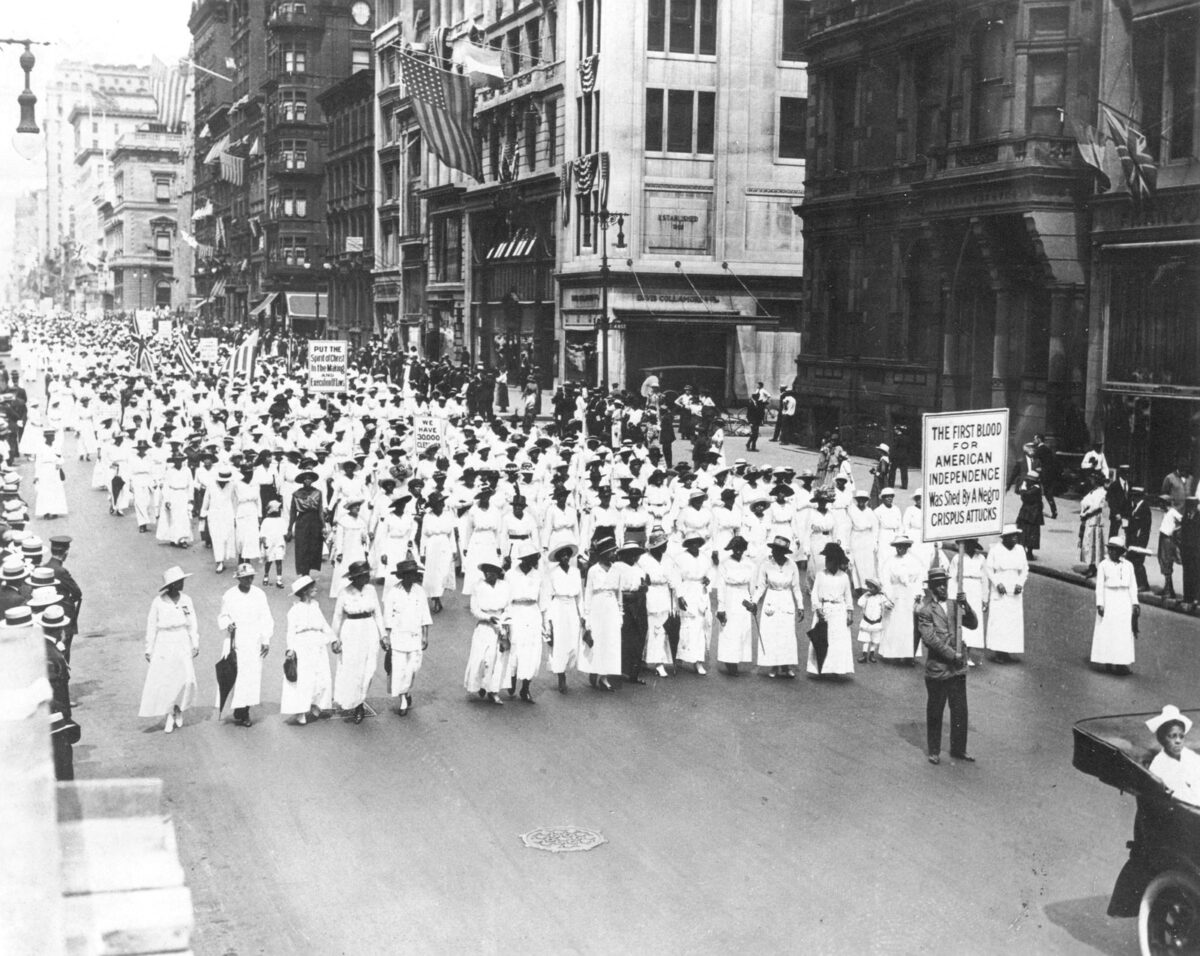
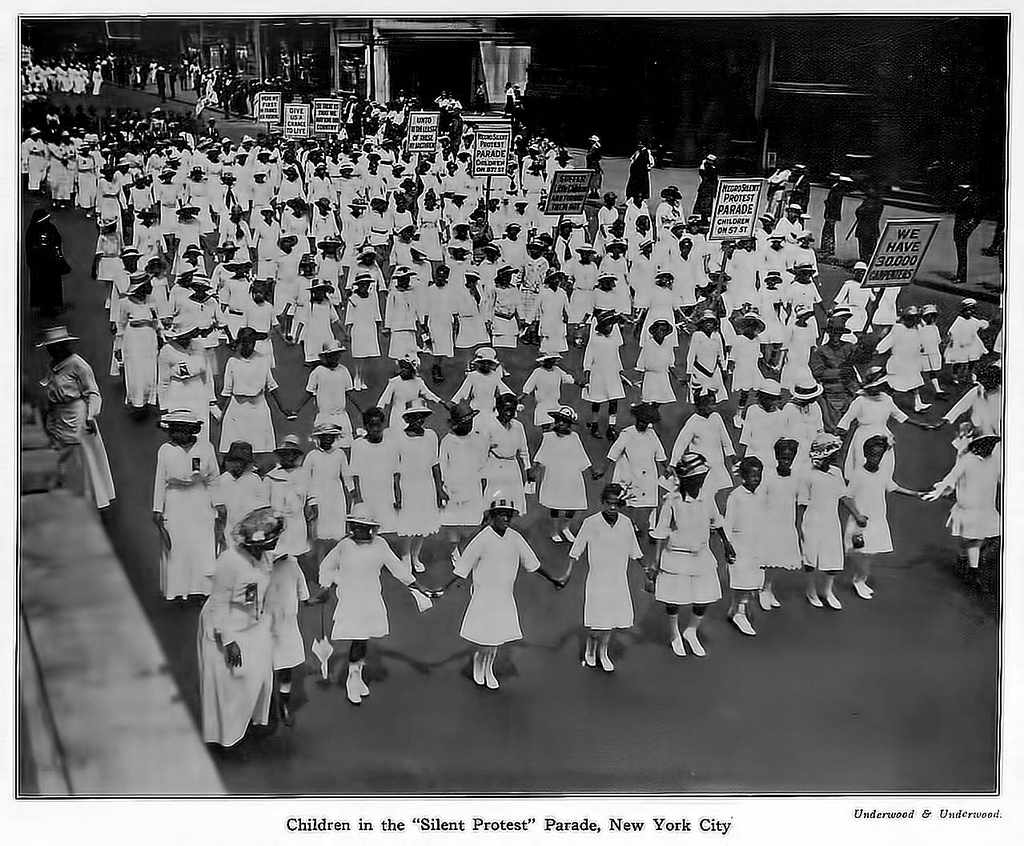
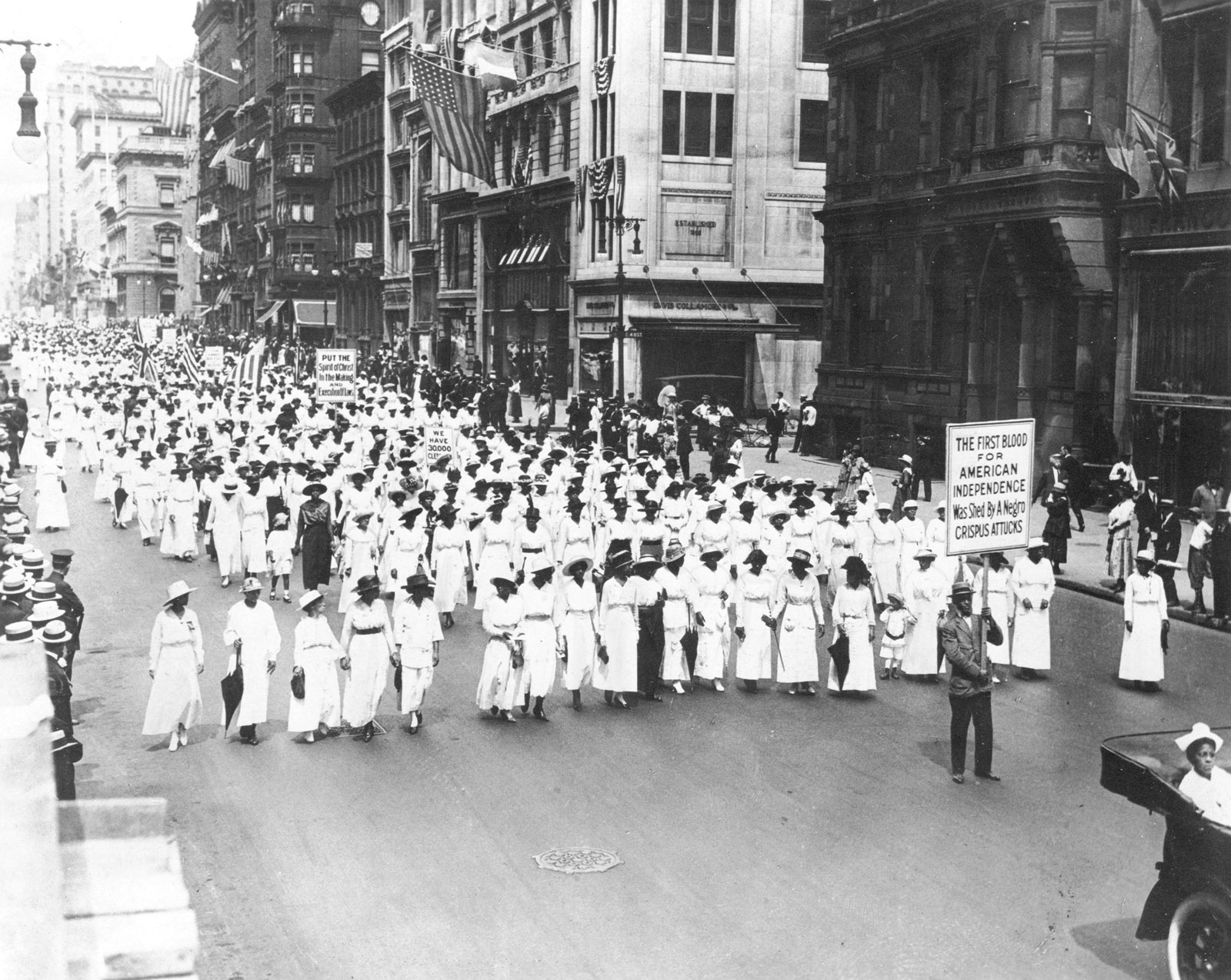
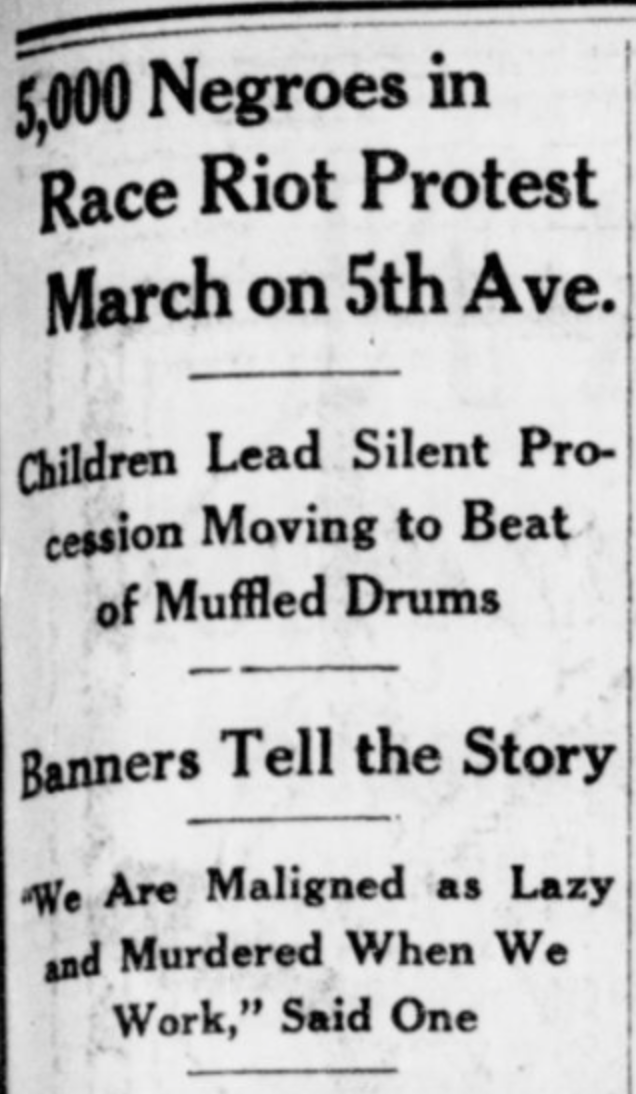
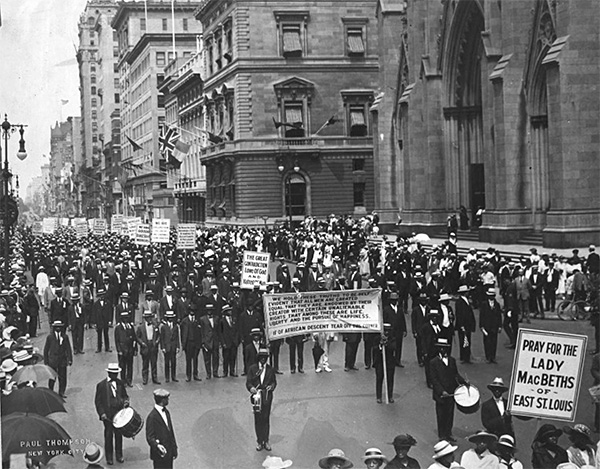
“To the beat of muffled drums 8,000 negro men, women and children marched down Fifth Avenue yesterday in a parade of ‘silent protest against acts of discrimination and oppression’ inflicted upon them in this country, and in other parts of the world. Without a shout or a cheer they made their cause known through the many banners which they carried, calling attention to Jim Crowism, segregation, disfranchisement, and riots of Waco, Memphis and East St. Louis.” — New York Times
The Silent Parade of July 28, 1917, was unlike anything ever seen in New York City. Today it is considered New York’s (and most likely America’s) first African-American civil rights march.
New York had seen its share of protest parades since the start of World War I, but none had featured so prominently the city’s African-American population, gathering in such impressive numbers along New York’s wealthiest street.
This extraordinary procession was organized by the National Association of the Advancement of Colored People (NAACP), a group of concerned black and white activists and intellectuals which had formed less than a decade earlier in New York.
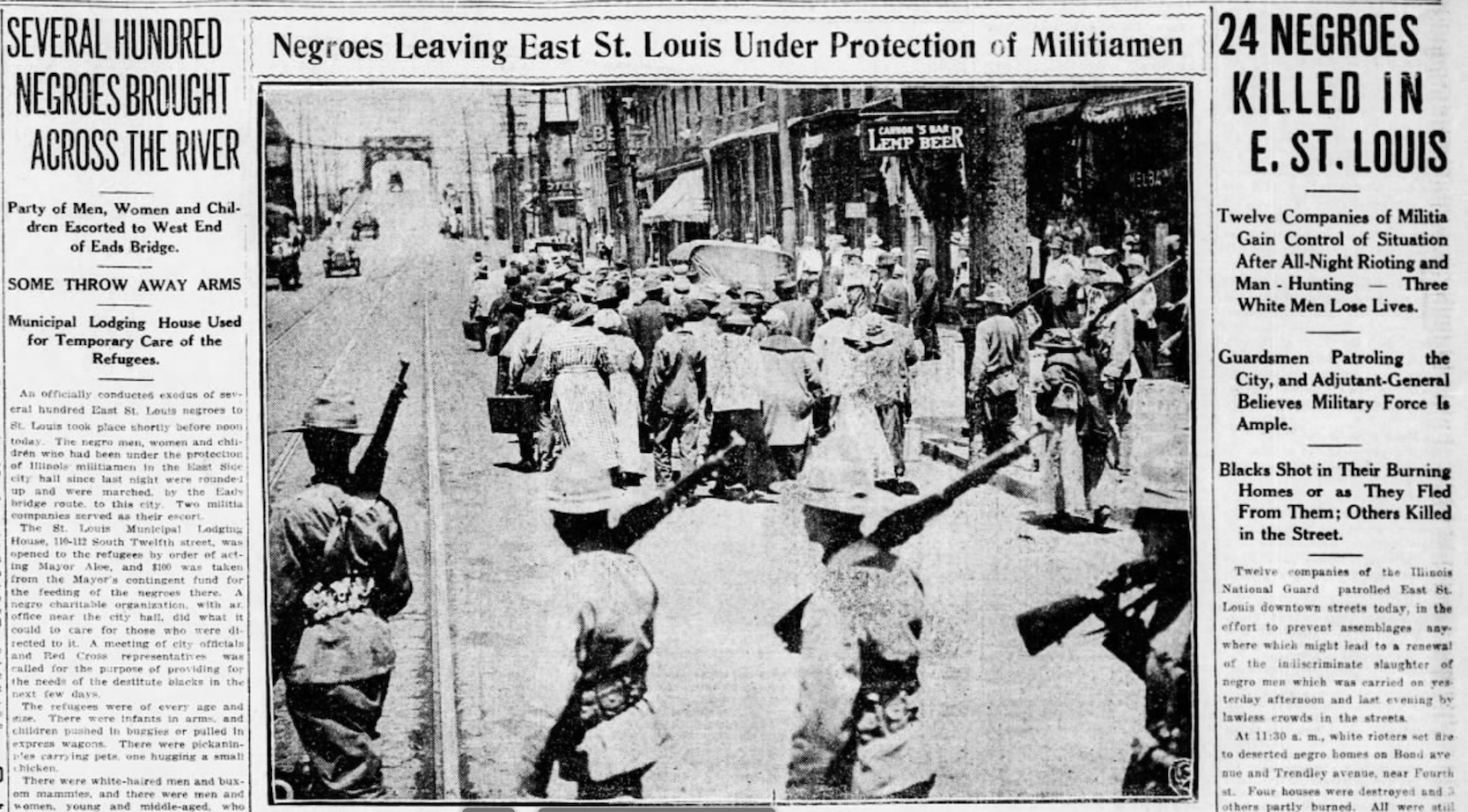
The march was organized in direct response to a horrible plague of violence against black Americans in the 1910s, culminating in the East St. Louis Riots*, a massacre involving white mobs storming black neighborhoods in sheer racial animus.
In Illinois, two sets of riots in May and July 1917 left almost 200 people dead. Rioters burned black neighborhoods, cutting off water hoses and watched as families fled the burning buildings — to be picked off by gunmen.
This massacre was but one of several violent incidents aimed at new black laborers, pointed attacks meant to strike fear in the hearts of black Americans.
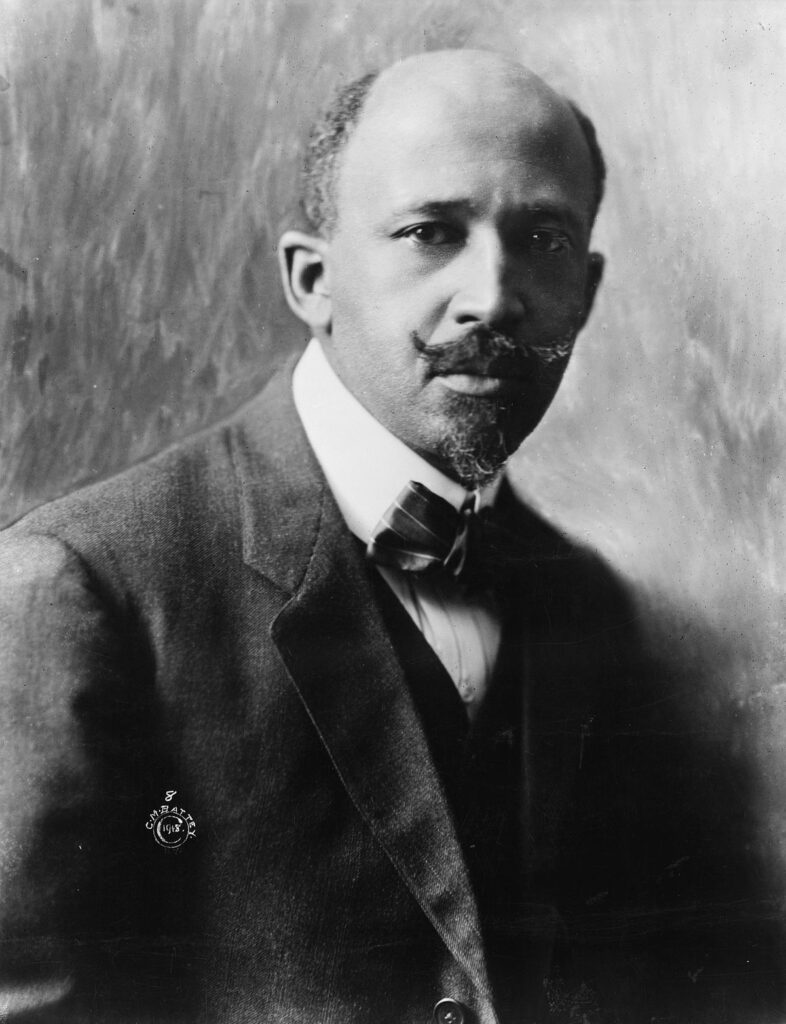
The circumstances of World War I exacerbated an already volatile crisis. As W.E.B. DuBoiswould explain it,
“The Negro, attracted by higher wages in the North and repelled by the menace of lynchinig and caste in the South moves in to fill the new labor demand [caused by the war]. The common laborer in the North is caught between the tyranny of exclusive trade unions and the underbidding of blacks. The rest is murder and riot and unrest…. White Northern laborers find killing Negroes a safe, lucrative employment which commends them to the American Federation of Labor.”
W.E.B Du Bois in 1918.
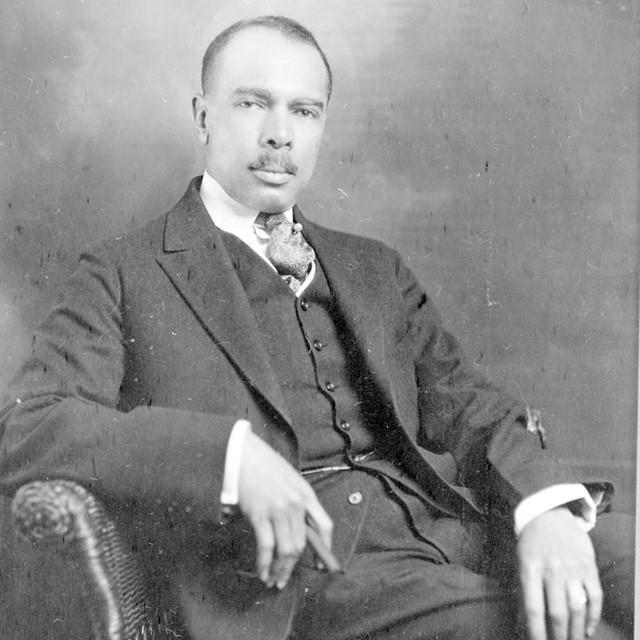
In New York, at a meeting of the NAACP in Harlem, president James Weldon Johnson (at the suggestion of New York Evening Post editor Oswald Villard) proposed an unusual but effective form of protest — an army of marchers along Fifth Avenue, drawing attention to the victims of the East St. Louis riot.
And in an unprecedented decision by the organizers, it would consist only of black marchers.
Underwood & Underwood
New York newspaper reports of the riot passively mentioned the tragic cost to the black residents of East St. Louis; a dramatic march down the city’s most prosperous street — comprised of those very people most likely to be victimized in such riots — would jar the delicate sensibilities of insulated New Yorkers.
This was a fairly radical idea for its time. Decades after the Civil War, most Americans, even in the most progressive states, still looked skeptically at organized black movements. Part of the NAACP’s early legitimacy for many was that it was formed by a mixture of black and white activists.
James Weldon Johnson, one of the architects of the Silent Parade
In 1915, the NAACP (in a crusade led by newspaper editor William Monroe Trotter) protested the release of the film Birth of a Nation, the trailblazing film that positively depicted the Ku Klux Klan while demonizing African-Americans. The protests failed to stop the film’s release but this organized resistance galvanized the NAACP and the black community for future battles.
While the East St. Louis tragedy was the focus of the mournful July 28th gathering, the march was intended as a larger protest against civil rights abuses in the United States. One of many flyers passed around during the march declared :
“We march because we are thoroughly opposed to Jim Crow cars, segregation, disenfranchisement and the host of evils that are forced upon us. We march in memory of our butchered dead, the massacre of honest toilers who were removing the reproach of laziness and thriftlessness hurled at the entire race. They died to prove our worthiness to live. We live in spite of death shadowing us and ours.”Â
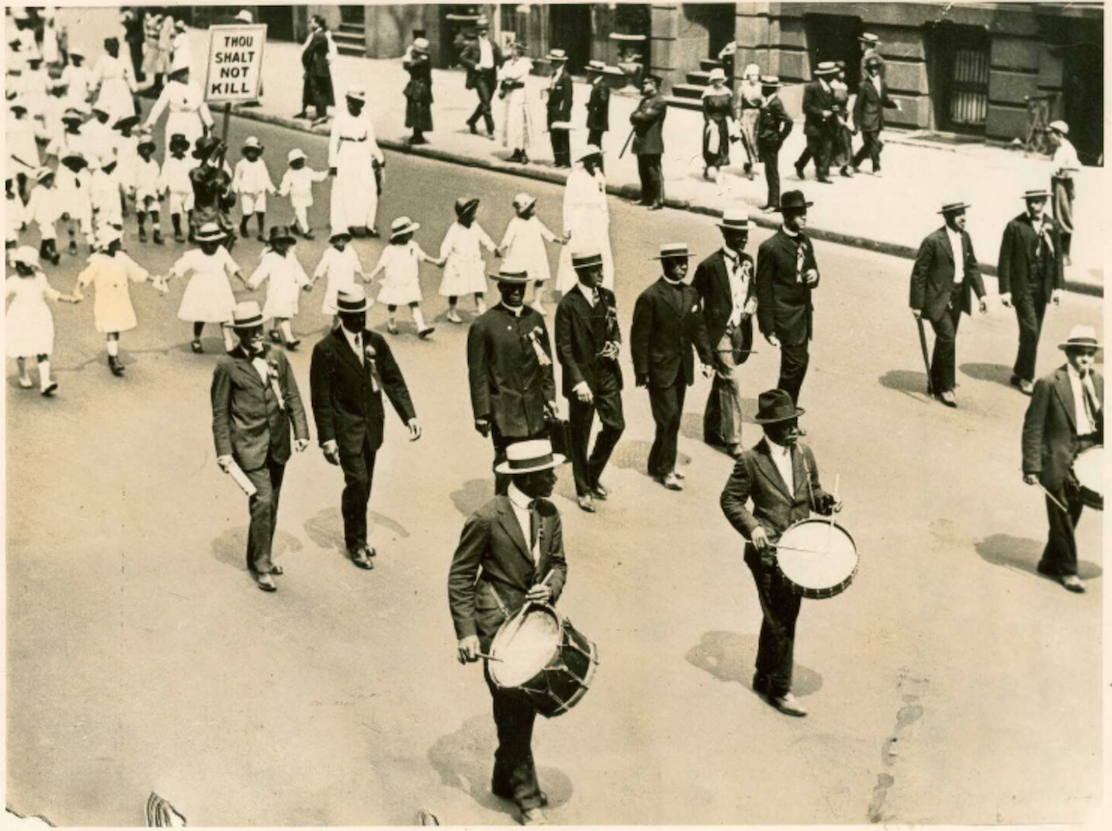
Below: The organizers marched in front of the women and children. At far right are W.E.B. Du Bois and James Weldon Johnson.
Underwood and Underwood
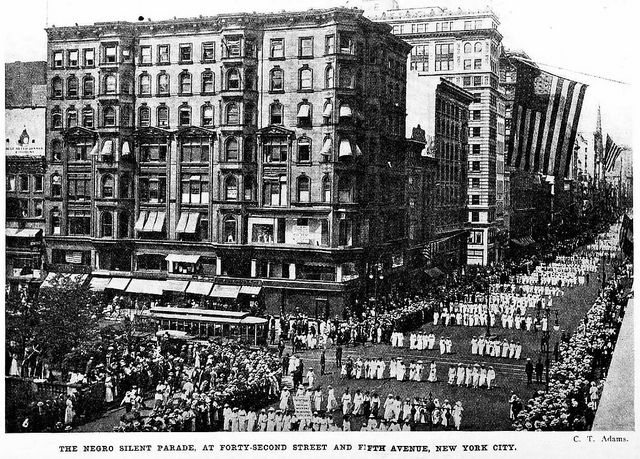
The thousands of people who marched that day came from virtually every African-American church in New York City and the surrounding area. A drum corps and a troupe of black Boy Scouts vibrantly led the parade, with women and children following behind, garbed in white dresses.
The men, some in United States army uniforms, marched last behind a row of flag bearers, holding representative flags from the United States, Great Britain, Liberia and Haiti.
New York Tribune
There were no chants or rallying cries. The throng remained silent during the length of the parade, a commonpractice for peace parades but one pregnant with meaning here. The black communities in East St. Louis and in the South had little opportunity to engage in such protests.
New Yorkers, in solidarity, would echo that reverberating silence. (It may also have been prudent for large groups of African-Americans marching along the city’s whitest street to keep themselves calcified.)
The marchers were orderly and stone-faced as they walked down Fifth Avenue — from 57th Street to 24th Street, culminating at Madison Square Park. They were not allowed to gather there; according to the New York Sun, “When the marchers reached Twenty-Fourth Street, they turned west and were dismissed.”
While there were no chants, political intentions were made known via a series of banners interspersed among the marchers:
‘Your Hands Are Full of Blood’
‘Pray for the Lady Macbeths of East St. Louis’**
‘We Are Maligned as Lazy and Murdered When We Work’
‘From Bunker Hill to Carrizal*** We Have Done Our Duty’
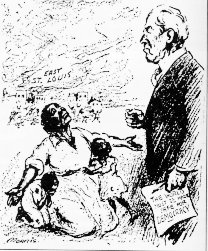
One ‘controversial’ sign was thrown out of the march. According to the Times, the sign “displayed a picture of a negro woman kneeling before President Wilson and appealing to him to bring democracy to America before carrying it to Europe.” The police intervened, and the sign was removed.
Below: A newspaper illustration that was most certainly used in the offending sign
No other incidents surrounding the march were reported that day. Thousands of onlookers had lined the parade route that day out of curiosity, amusement, pride, anger and joy. Some were shaken to the core.
“[T]he streets of New York have witnessed many strange sites, but I judge, never one stranger than this; among the watchers were those with tears in their eyes. — James Weldon Johnson, The Autobiography of James Weldon Johnson, 1937
FURTHER LISTENING
After you’ve listened to this podcast on the Silent Parade of 1917, check out these past episodes of our show that feature topics referenced in the new episode:
NOTE: The number of marchers so widely varies from source to source that I can safely say that it was between 5,000 and 15,000 marchers. Not exactly precise! Judging from all reports, I would guess the actual number is closer to 15,000.
*East St. Louis, on the Illinois side, is about 15 miles away from Ferguson, the St. Louis suburb on the Missouri side.
**According to authorNikki Brown, the ‘Lady Macbeth’ sign references “an alleged incident wherein at least two white women pulled black women off a streetcar, tore off one woman’s clothing and ‘then took off her shoes and beat her over the face and head with their shoe heels’.”
***The Battle ofCarrizal had been fought in Mexico a year before the march. Unlike the battles in Europe, African-American soldiers served with American units on the front lines of this engagement.
PODCAST The story of the Lenape, the native people of New York Harbor region, and their experiences with the first European arrivals — the explorers, the fur traders, the residents of New Amsterdam.
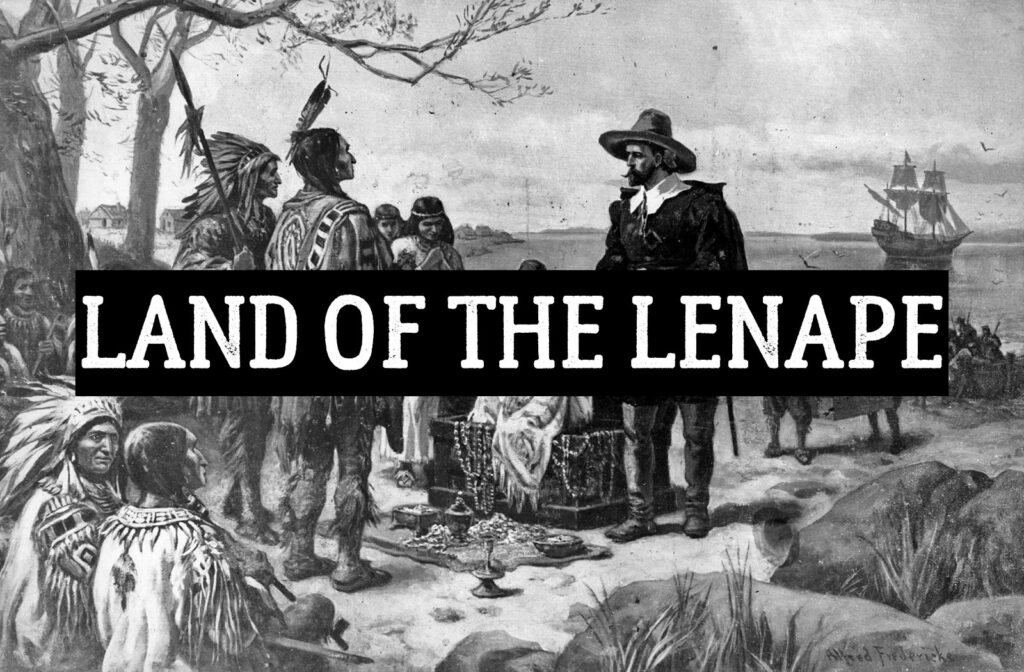
Before New York, before New Amsterdam — there was Lenapehoking, the land of the Lenape, the original inhabitants of the places we call Manhattan, Westchester, northern New Jersey and western Long Island.
This is the story of their first contact with European explorers and settlers and their gradual banishment from their ancestral land.
Fur trading changed the lifestyles of the Lenape well before any permanent European settlers stepped foot in this region. Early explorers had a series of mostly positive experiences with early native people.
With the Dutch settlement of New Amsterdam, the Lenape entered into various land deals, “selling: the land of Manhattan at a location in the area of today’s Inwood Hill Park.
But relations between New Amsterdam and the surrounding native population worsened with the arrival of Director-General William Kieft, leading to bloody attacks and vicious reprisals, killing hundreds of Lenape and colonists alike.
Peter Stuyvesant arrives to salvage the situation, but further attacks threatened any treaties of peace. But the time of English occupation, the Lenape were decimated and without their land.
And yet, descendants of the Lenape live on today in various parts of the United States and Canada. All that and more in this tragic but important tale of New York City history.
The Bowery Boys: New York City History podcast is brought to you …. by you!
We are now producing a new Bowery Boys podcast every two weeks. We’re also looking to improve the show in other ways and expand in other ways as well — through publishing, social media, live events and other forms of media. But we can only do this with your help!
We are now a member of Patreon, a patronage platform where you can support your favorite content creators for as little as a $1 a month.
Please visit our page on Patreon and watch a short video of us recording the show and talking about our expansion plans.
If you’d like to help out, there are five different pledge levels (and with clever names too — Mannahatta, New Amsterdam, Five Points, Gilded Age, Jazz Age and Empire State). Check them out and consider being a sponsor.
We greatly appreciate our listeners and readers and thank you for joining us on this journey so far. And the best is yet to come!
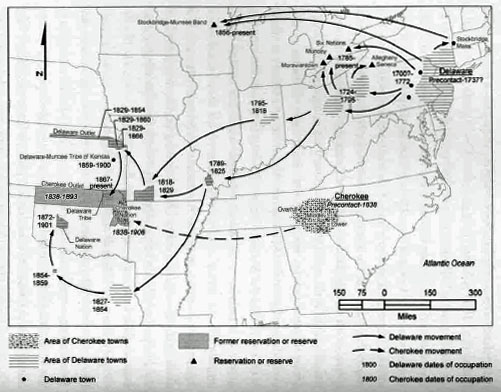
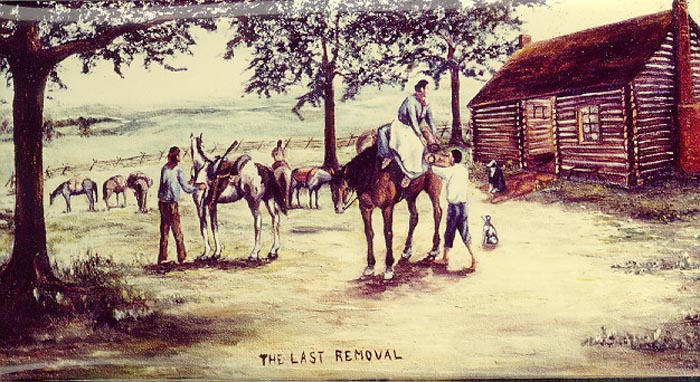
The long road of the Lenape. This 1978 map shows the path of their various relocations across the country in comparison with the relocation path of the Cherokee.
Ives Goddard, “Delaware,†in Handbook of North American Indians, vol. 15: Northeast, ed. Bruce Trigger and William Sturtevant (Washington DC: Smithsonian Institution1 1978)
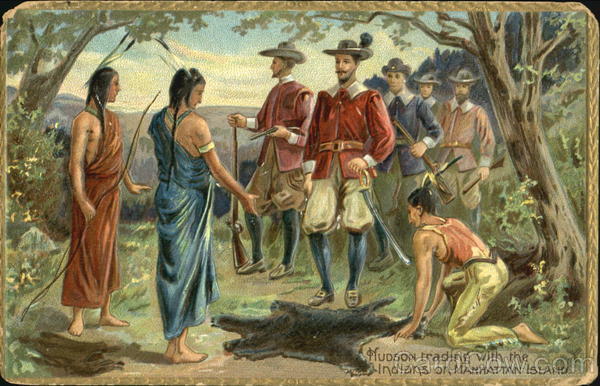
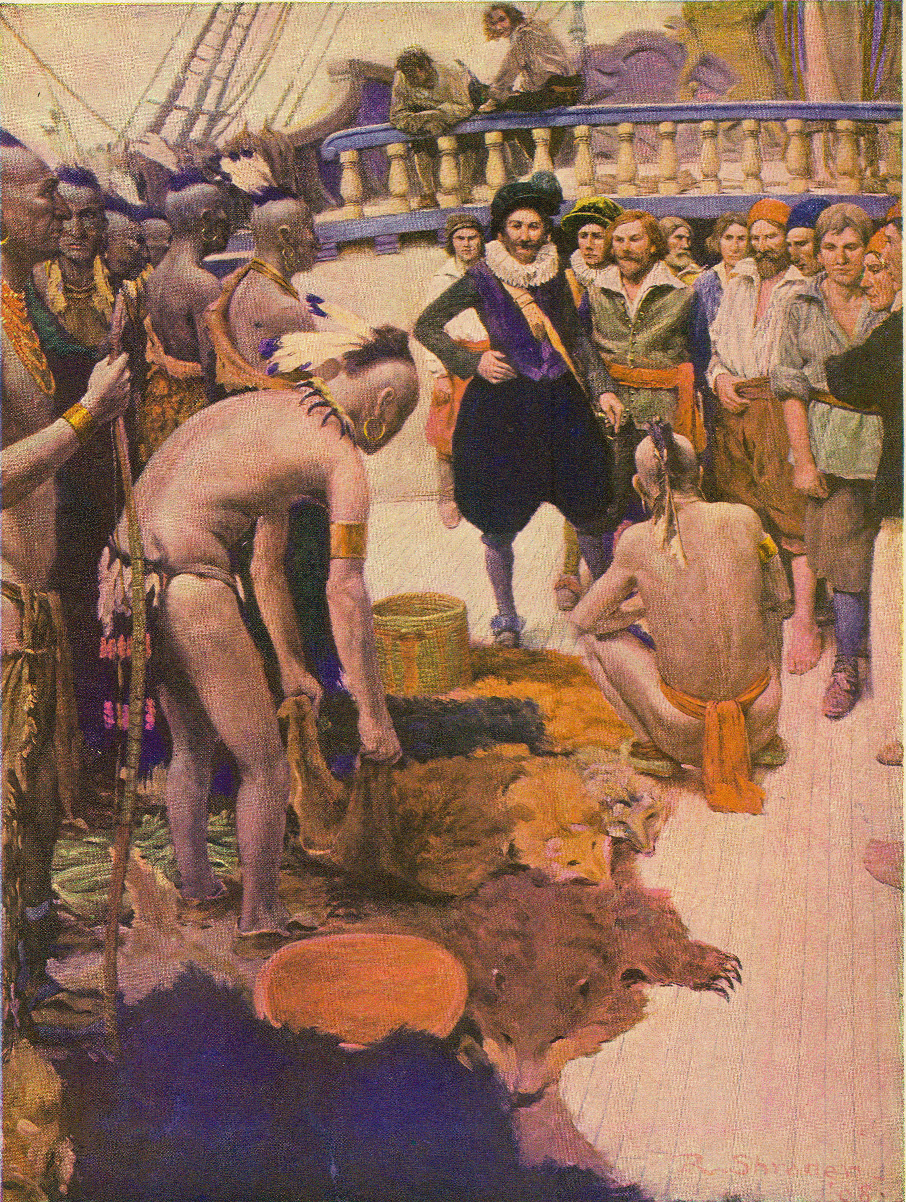
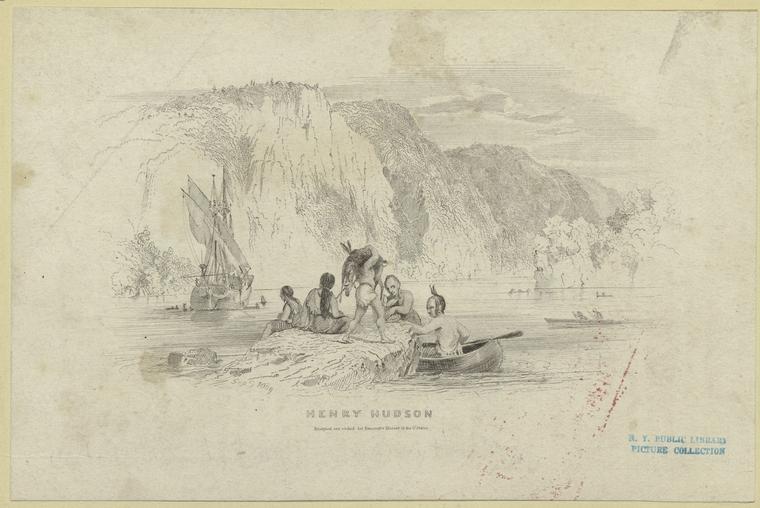
Henry Hudson’s interaction with the native people of the area would much later inspire a host of fanciful depictions.
“‘Designed and etched for Bancroft’s History of the United States’ Written on image: ‘Sept. 7 1609’
Courtesy NYPL
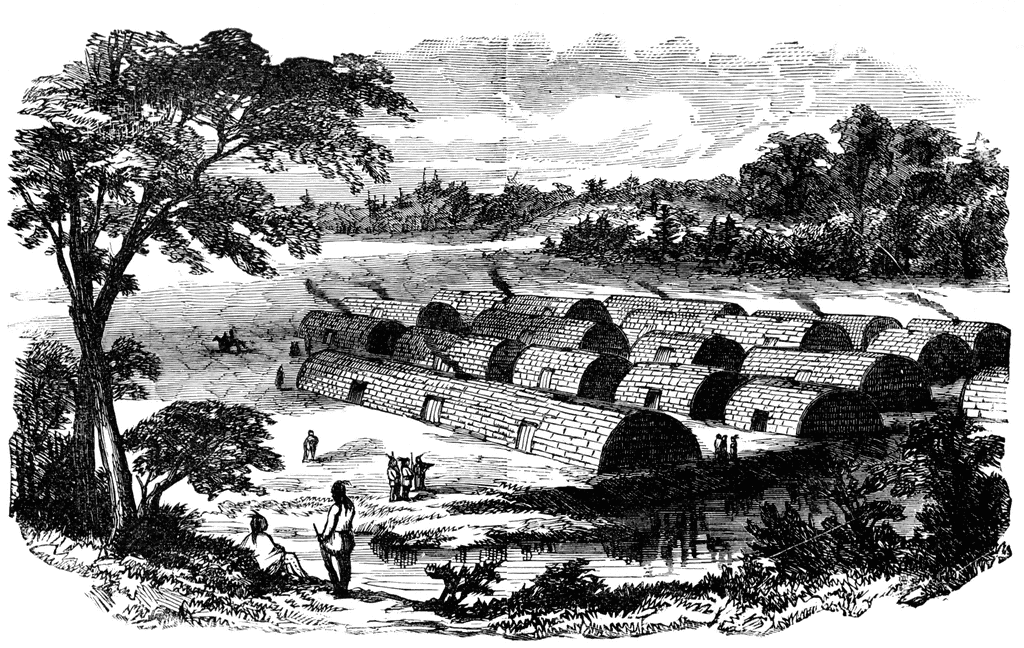
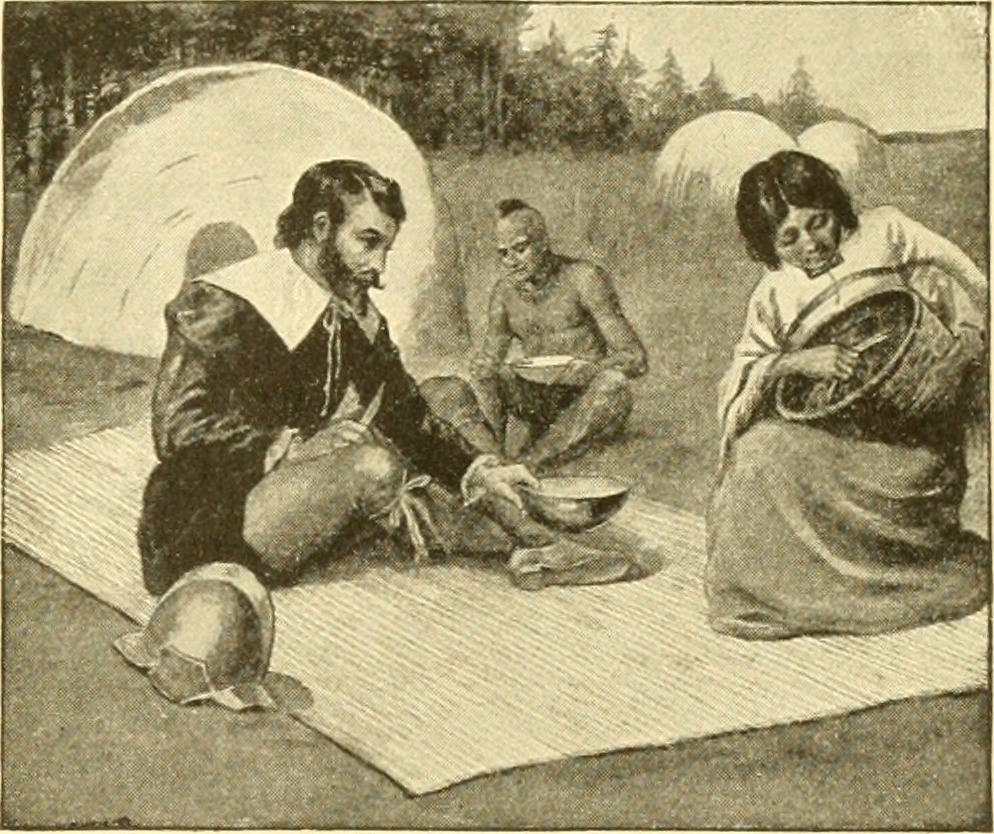
From a 1915 textbook ‘A First Book In American History’ — “Hudson’s ship anchored again opposite the Catskill Mountains, and here he found some very friendly Indians, who brought corn, pumpkins, and to-bacco to sell to the crew. Still farther up the river Hudson visited a tribe onshore, and wondered at their great heaps of corn and beans. The chief lived in around bark house. Captain Hudson wasmade to sit on a mat and eat from a red wooden bowl. The Indians wished him to stay all night; they broke their arrows and threw them into the fire, to show their friendliness.
Internet Archive Book Images
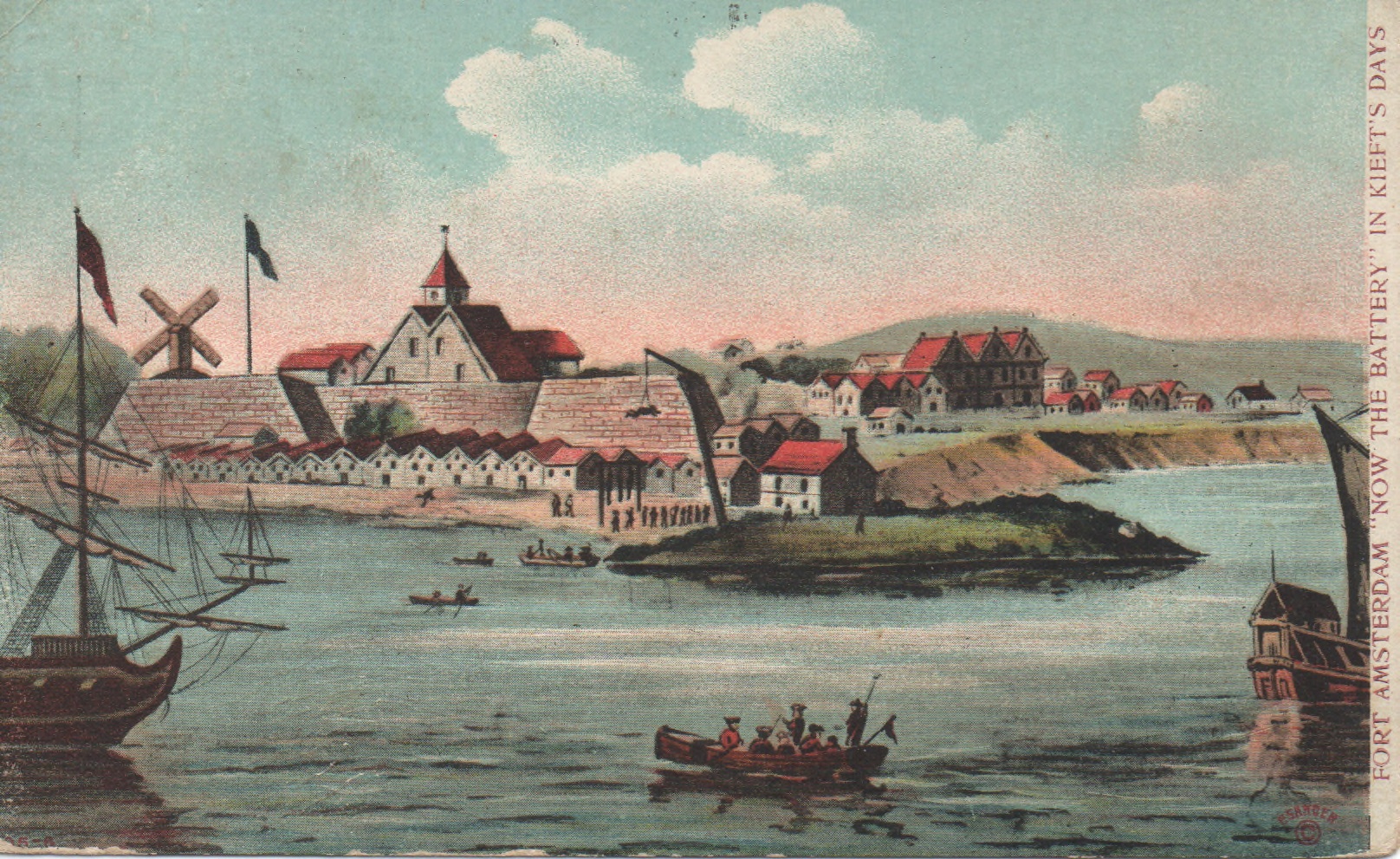
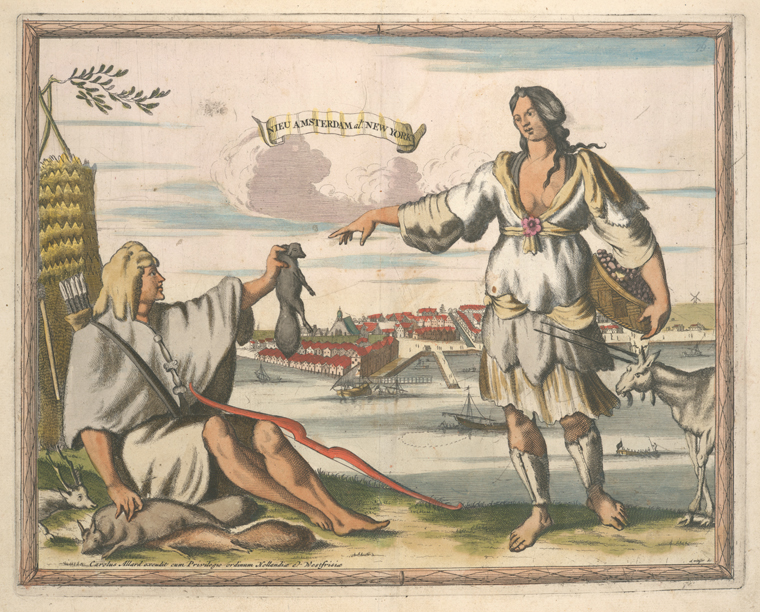
Behold New Amsterdam!
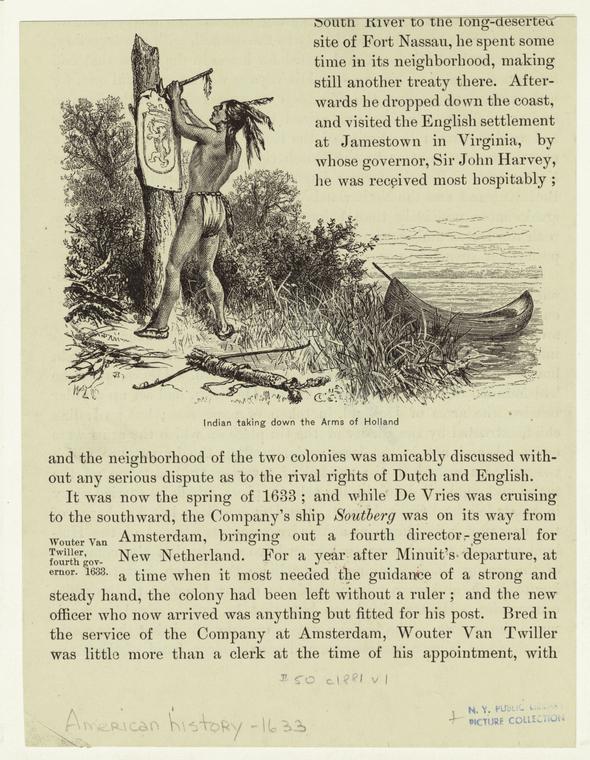
From another text book, this one from 1881:
New York Public Library
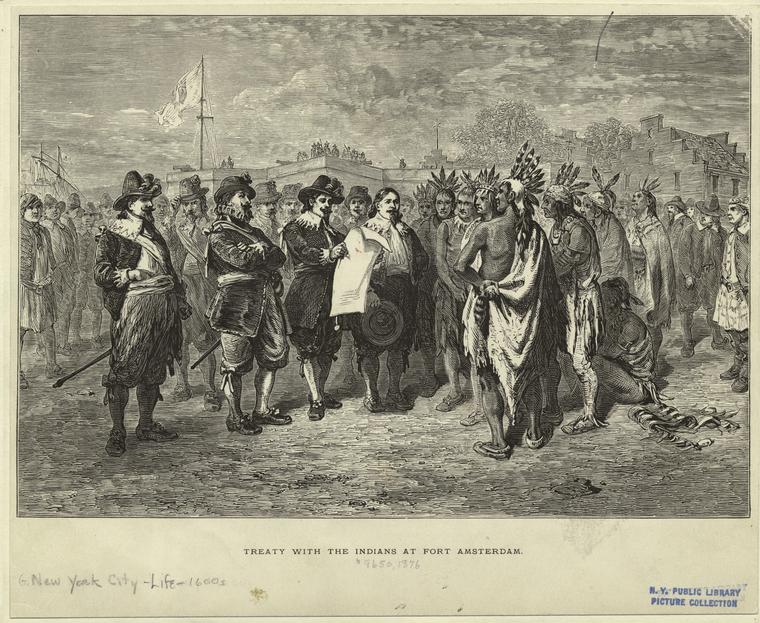
From an 1876 print: ‘Treaty with the Indians at Fort Amsterdam.” Not sure what year this picture depicts but everybody has two legs, so no Peter Stuyvesant!
NYPL
A well-known engraving by Aldert Meijer depicts New Amsterdam as being touched by the hand of providence.
NYPL
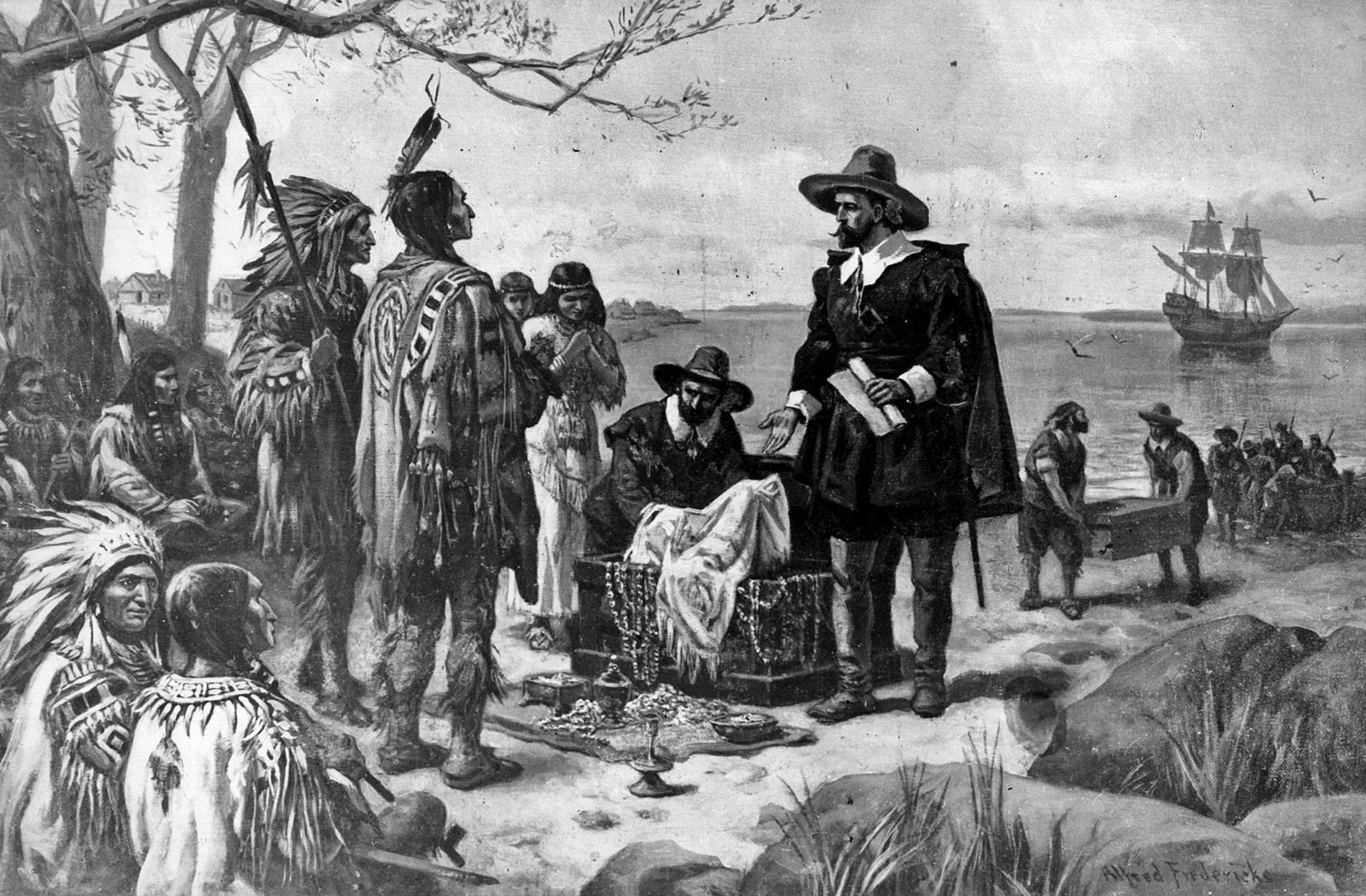
A drawing of the 1926 purchase of Manhattan between the native population and Peter Minuit. Image is from Popular Science Magazine, 1909.
NYPL
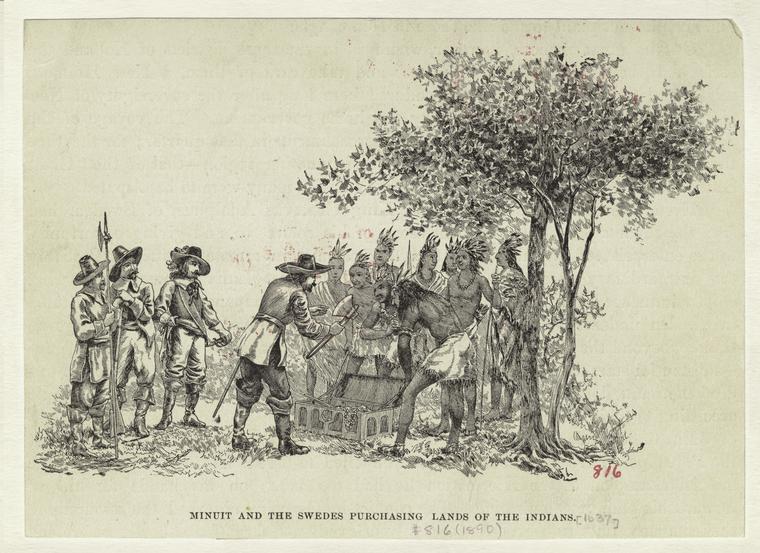
…clearly derived from
“Peter Minuit and the Swedes purchasing lands of the Indians.” Illustration dated 1890
NYPL
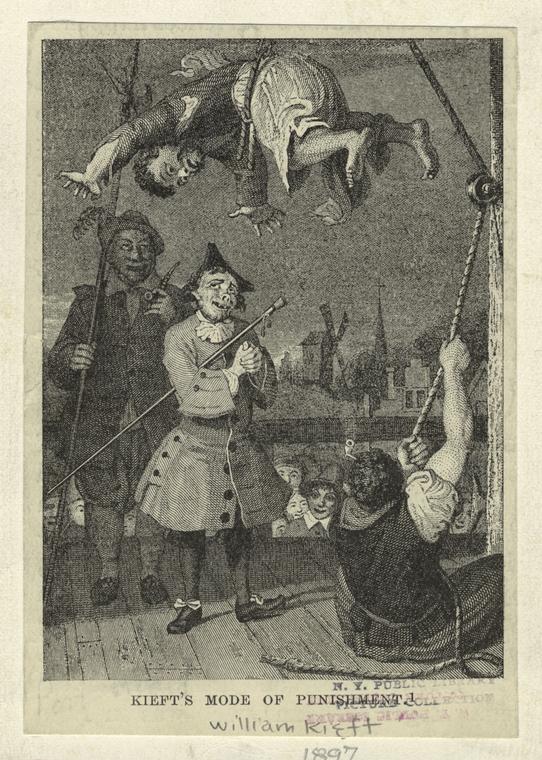
William Kieft’s reputation as a vicious tyrant is made apparent here in this 1897 illustration captioned ‘Kieft’s Mode of Punishment.’
NYPL
From the Delaware Indians website: “A painting by Lenape artist Jacob Parks (1890-1949), which depicts a Lenape family leaving their home on their reservation in Kansas in 1867. This area had been their home for over thirty-five years, and now the government told them they had to move to Indian Territory (now Oklahoma).”
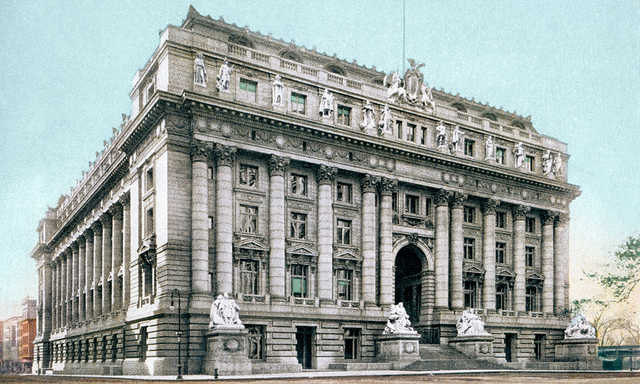
The Smithsonian National Museum of the American Indian is currently living in the Alexander Hamilton U.S. Custom House. It’s a FREE museum so you should stop in anytime you’re in the Battery Park area.
FURTHER READING
The First Manhattans: A History of the Indians of Greater New York by Robert S. Grumet
The Island At The Center Of The World by Russell Shorto
The Delaware Indians: A History by  C.A. Westanger
Native New Yorkers: The Legacy of the Algonquin People of New York by Evan T. Pritchard
It may be some time before we all get to truly enjoy the inside of a movie theater again. Hopefully soon!
But outdoor movies — in particular, drive-in movies — have had a bit of a renaissance, a socially distanced way to enjoy blockbusters on a big screen. Mommy Poppins has a great round-up of all the outdoor drive-in movie options in New York City and the surrounding area.
Watching movies outdoors is tradition much older than you think.
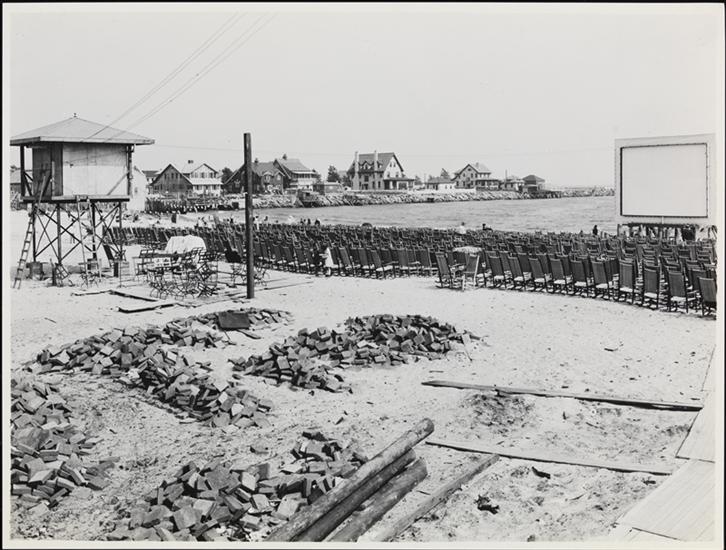
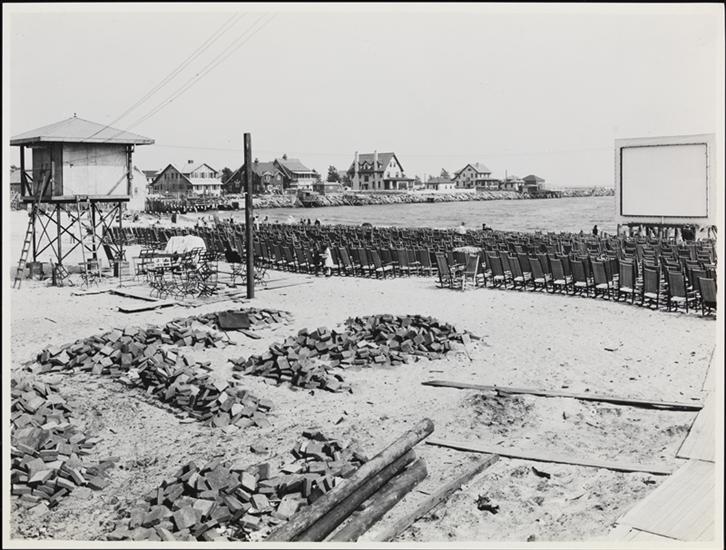
At an outdoor movie theater in Brighton Beach, 1920. (MCNY)
Yes, there were outdoor (or open air) theaters showing films almost as soon as the medium became popular.
This is not terribly surprising. There were already outdoor playhouses for theater and vaudeville, and, in an era of over-crowded tenements and no air conditioning, any reason to sit outside on a nice summer’s night seemed practically luxurious.
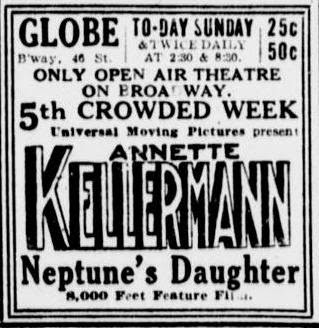
An advertisement for a rare Midtown open-air theater. The lights of Broadway and street noise would have been a serious impediment.
One drawback outdoor movie lovers deal with today is the loud city interfering with the sound of the movie. Not so then; the city might have been loud, but the movies had no sound.
It was a purely visual sensation, a thrilling entertainment light show under the moonlight.
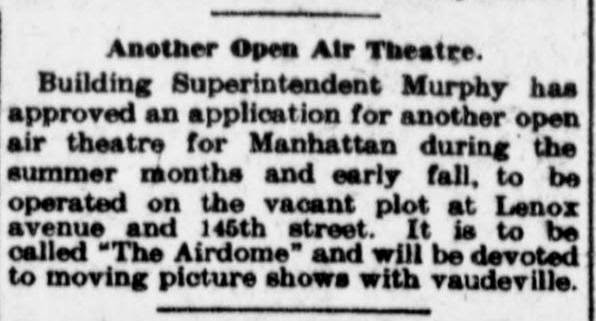
Early outdoor theaters in New York, sometimes called airdomes, were not usually in city parks, but in abandoned lots or open spaces in upper Manhattan.
Here’s a description of an airdome from a 1914 exhibition guide: “An airdome is simply an outside moving picture show that is run on practically the same lines as the old summer garden, and is therefore essentially a fair-weather show, although a few airdomes are equipped with pavilions.”
Airdomes were designed to be temporary although you did need a permit from the city to operate one. Other than that, anybody could do it! “Nothing elaborate …is necessary for a successful airdome,” said the guide. “The chairs and tables may be of the ordinary kitchen variety.”
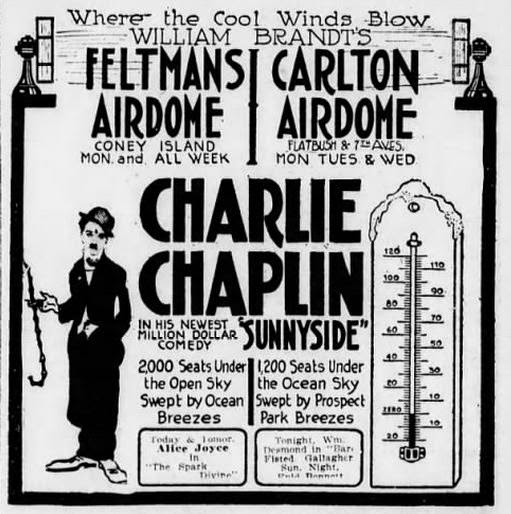
An advertisement for two Brooklyn airdomes — in Coney Island and Prospect Heights (Brooklyn Daily Eagle)
From surveying various newspapers from the 1910s, it appears most airdomes were located either in upper Manhattan and the Bronx (where there were more open lots) or in Coney Island (where the masses went for recreation).
Before 1915, movies were one-reelers, quite short, and often featured alongside live acts as part of a vaudeville routine. This airdome (listed in the July 1909 New York Sun) was typical of the day:
Outdoor movie theaters were so prevalent in the 1910s that, during planned war time electrical blackouts in 1918, they were specifically mentioned as a “bonafide food and entertainment establishment” alongside “roof gardens and outdoor restaurants.” [source]
But as with modern outdoor theaters, sometimes reality elbows its way into the picture.
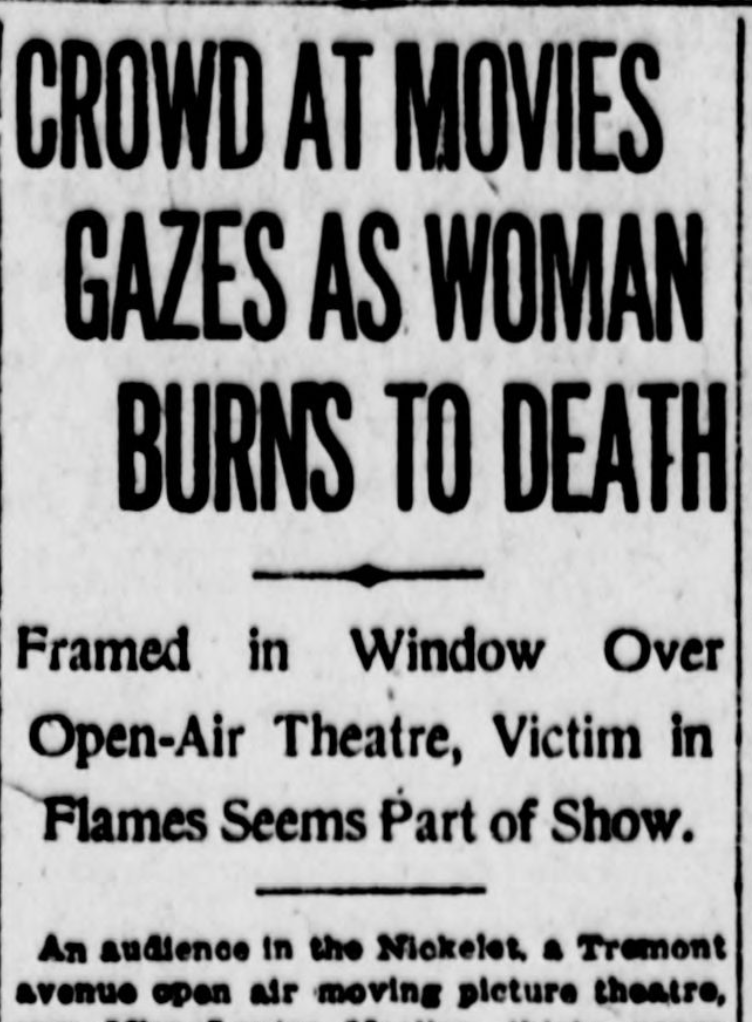
One of the Bronx’s most prominent open air moving picture theatres was the Nickelet (at Tremont and Prospect Avenues), presumably named for the admission price.
One evening in June 1913, audiences witnessed a terrifying sight — a woman burning to death in a building adjacent to the theater lot. Audience members scrambled to her rescue to no avail.
The transient nature of the airdome — and the ability for anybody with a license to have one — did cause friction at times.
During the spring of 1909, in the Long Island town of Freeport, a Brooklyn man enraged the town when he set up an airdome there even though he was not a town resident.
The airdome never went away of course. But the experience paled in comparison to the grand delights of the movie palaces, especially when air conditioning technology came along.
They eventually died out, along with the rooftop garden, in the 1920s, only to return later in the century when sound and projection technologies allowed for a more enjoyable evening at the movies.
And now, ladies and gentlemen, I hope you’re reading this outside! Create your own airdome experience and watch this film — Charlie Chaplin’s Sunnyside — enjoyed by Brooklynites over 90 years ago in an outdoor moving picture theater:
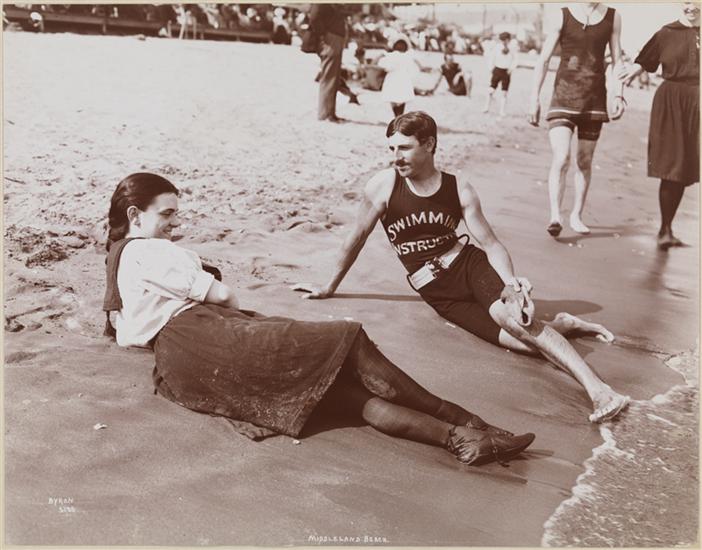
Basking in the surf at Midland Beach, 1898 (Courtesy Museum of the City of New York)
The notion of organized ‘ocean bathing’ — actually going into the water for health, relaxation and enjoyment — was really a 19th century invention, first popularized in the United States during the 1830s at the Marine Pavilion on the Rockaway Peninsula.
Bathing beauty: Diver Maggie Ward prepares for a jump into the waters of Coney Island, in the summer of 1888
For propriety’s sake, people would enter a bathing hut hitched to a horse and ride the container as it was backed into the water, exiting from the hut in their full-body swimming apparel only when safely immersed in the water. No risk of seeing wet fabric clinging seductively to the human form!
Fifty years later, bathers would dare walk to the beach sans horse-drawn hut. But their beach apparel still matched the modesty of their regular wear.
Here are a few examples of garments — for sunbathing, swimming or just relaxing — worn at some of New York’s most popular beaches of the late 19th-early 20th century.
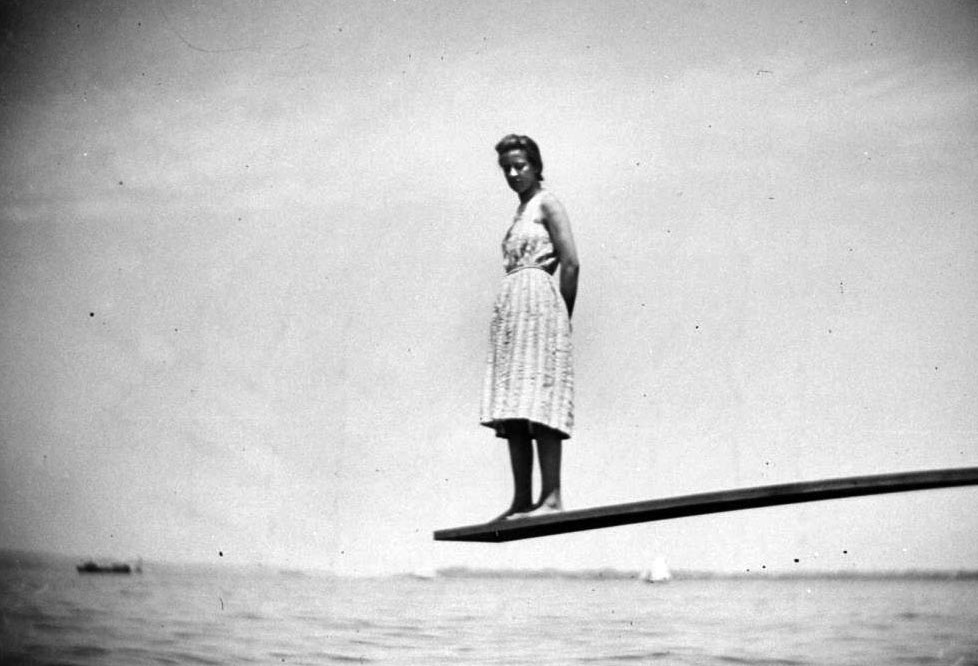
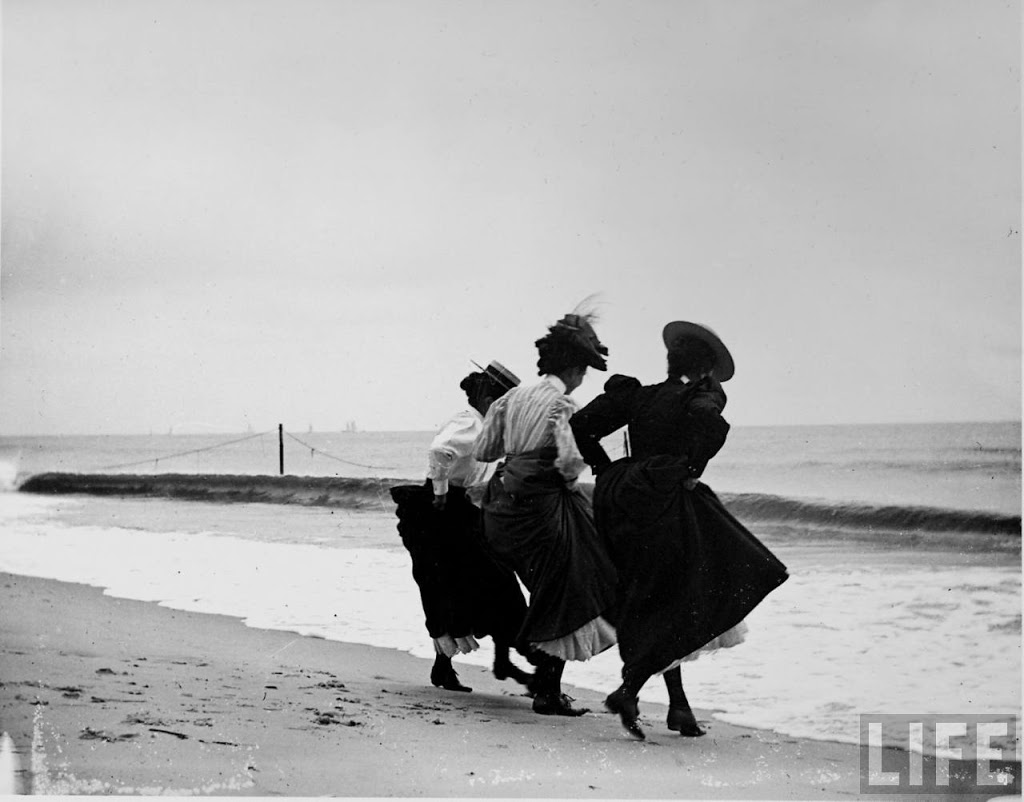
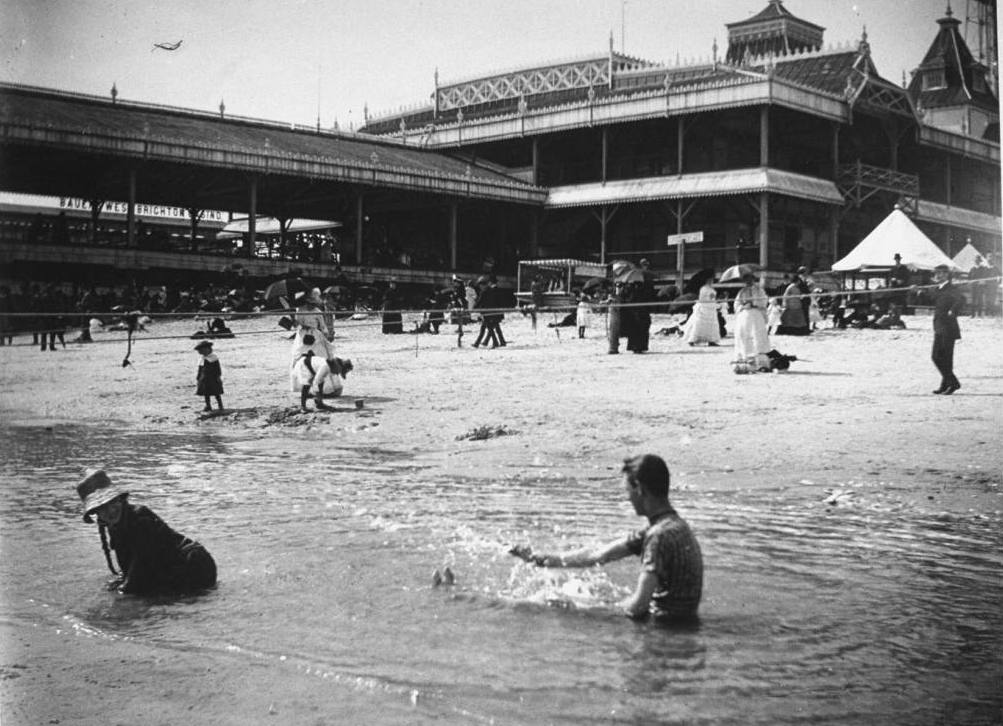
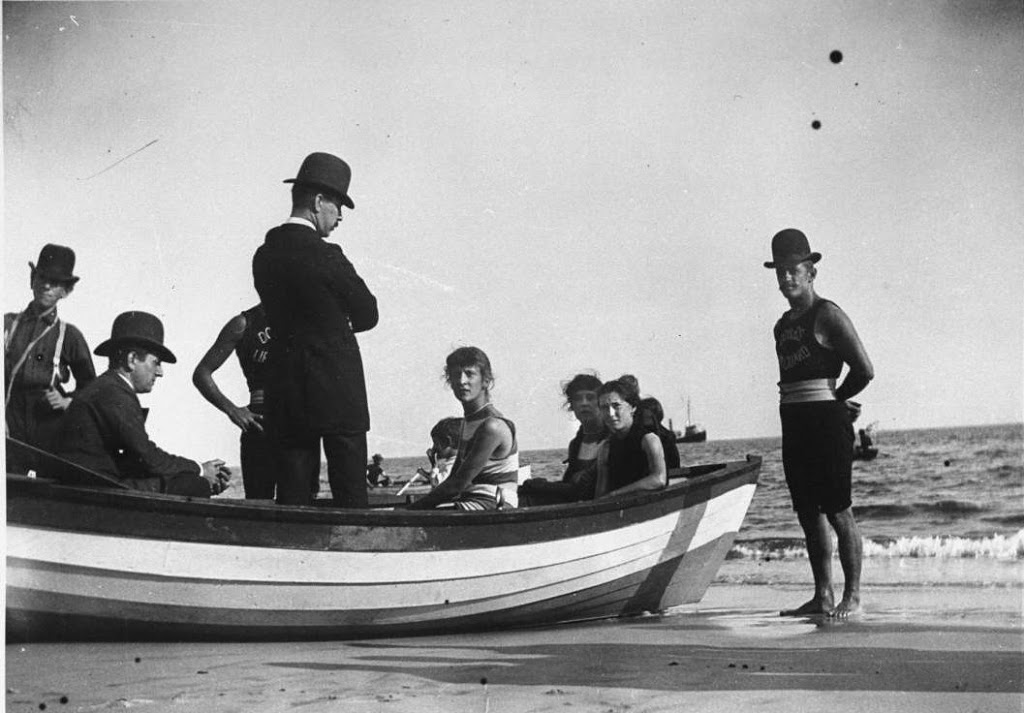
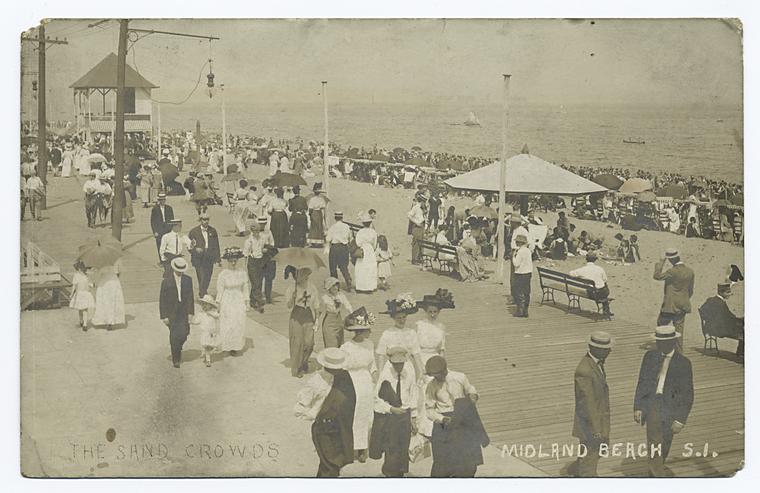
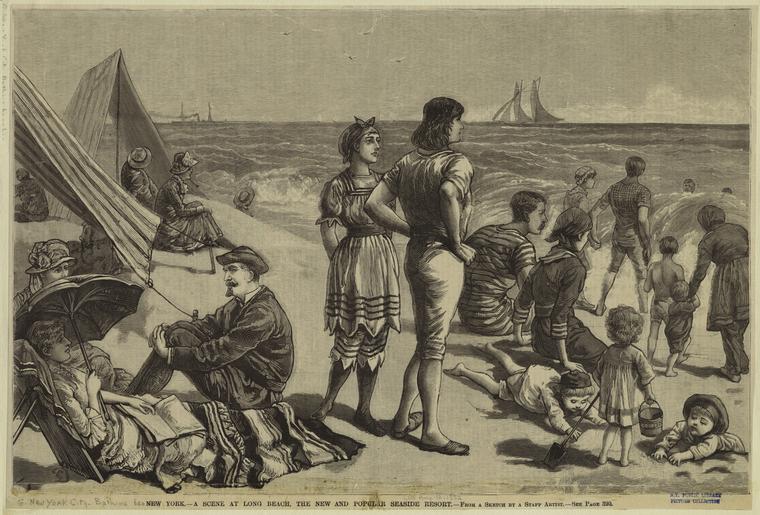
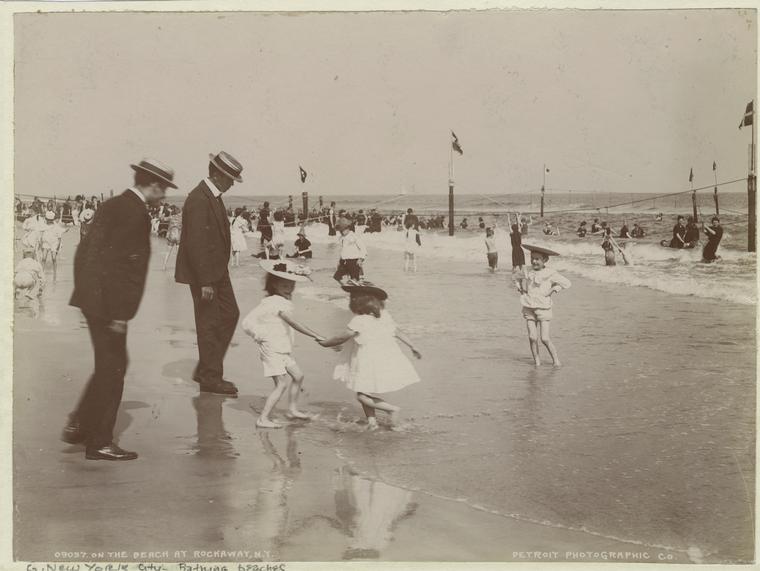
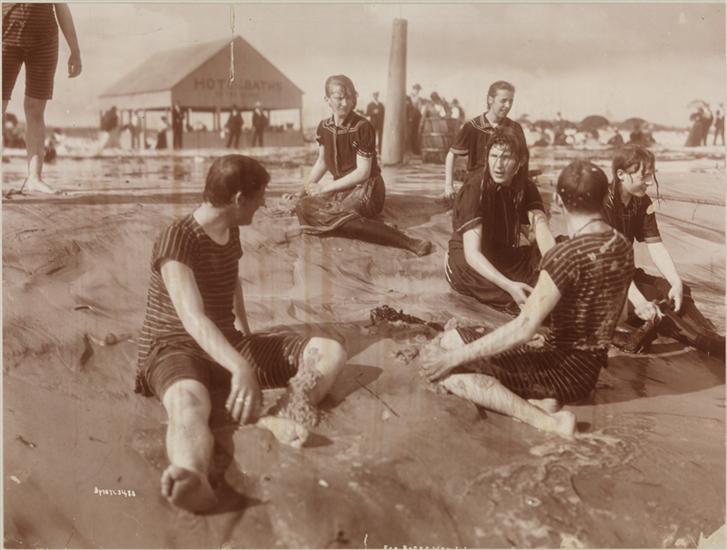
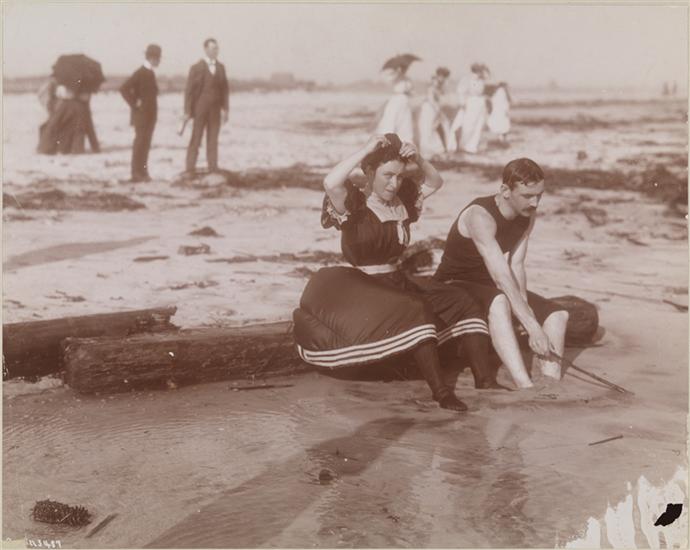
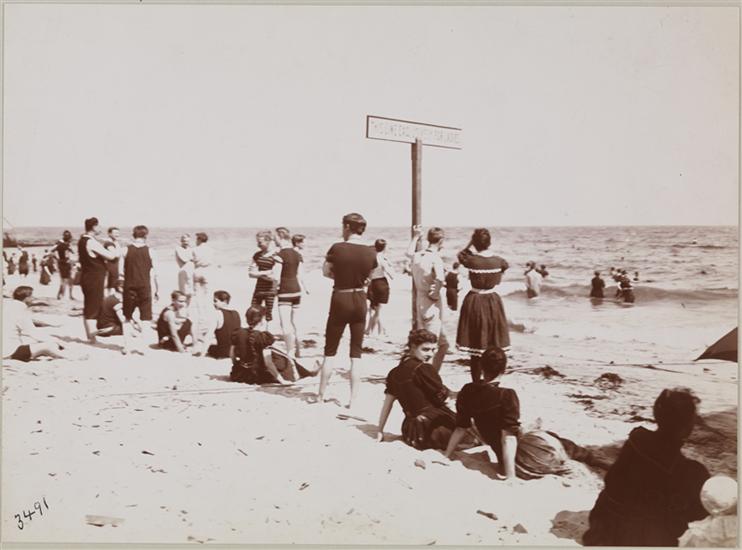
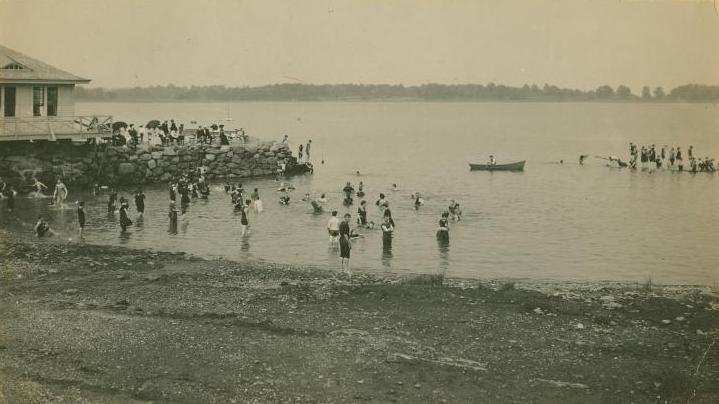
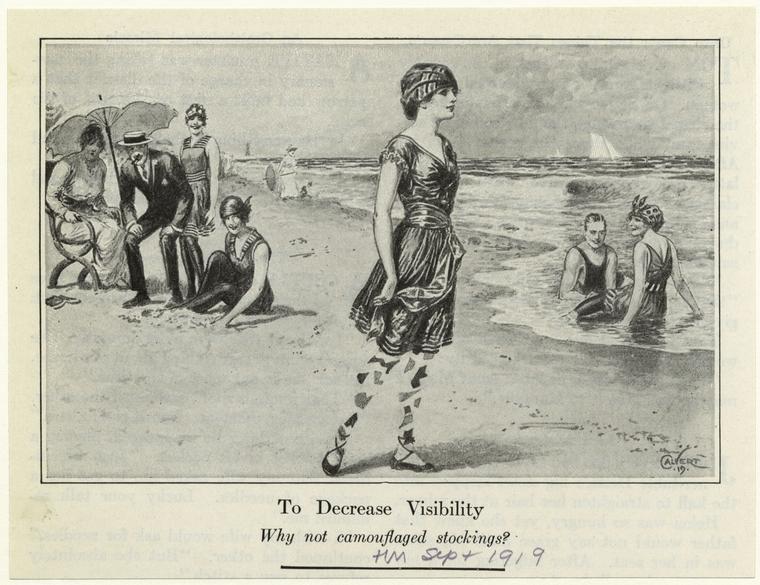
Why needs a bikini? Daring ladies risk the surf in regular wear on the Rockaway beachfront, 1897 (Courtesy Life Magazine)Serving up shenanigans in the waters of Brighton Beach, 1886Three female athletes, readying for a ocean swimming match out at Coney Island, await the competition with a few oddly fully clothed men, 1887 (Life Magazine)Classing it up a little with the ‘sand crowds’ along the Midland Beach boardwalk in Staten Island, no date, but probably between 1900-1910. (New York Public Library)The dapper sea threads adorning the trendy beachgoers at Long Beach, 1882. Okay, this is technically in Nassau County, not New York City proper, but how could I not give these styles a showcase? (New York Public Library)Check out little Minnie Pearl and her fine hatted friends at Rockaway, date unknown. (New York Public Library)Frolicking in the sand in Far Rockaway, 1897. In the distance is a Hot Baths pavilion. (Courtesy Museum of the City of New York)A dynamic duo hitting the beach of Far Rockaway, 1896. (Courtesy Museum of the City of New York)Another image of Far Rockaway, 1897. featuring a whole array of bathing-suit options. (Courtesy Museum of the City of New York)Bathers in black luxuriate in a swimming hole in Pelham Bay, 1903 (New York Public Library)And finally, I’m not quite sure this avant garde look ever made it onto the beach. But if you want to look like you’re floating over the beach without legs, why not try these camouflage beach leggings, advertised in Harper’s Magazine in September 1919? (New York Public Library)Basking in the surf at Midland Beach, 1898 (Courtesy Museum of the City of New York)
The devastating results of the monstrous Great Fire of 1835 helped change the course of Manhattan — hastening the residential migration up the island, rewriting the architectural nature of downtown and essentially erasing the past. There would never be another fire of such intensity and magnitude.
But New York didn’t suddenly become fire-proof.
In fact, ten years later came another massive blaze, in almost exactly the same place, that threatened to halt downtown’s rebirth before it even began.
Some distinct circumstances set it apart from the prior, more destructive blaze.
It occurred before the crack of dawn on Saturday, July 19, 1845, on the third floor of an “whale oil store” on New Street — only a couple blocks from where the Great Fire of 1835 had started.
Normal summertime temperatures, sunlight creeping onto the horizon, and an influx of people going about their early morning business likely might have ensured that the blaze would have been swiftly contained.
Unfortunately, a warehouse owned by the merchants Crocker & Warren, just a block away at 38 Broad Street, was filled with a new shipment of saltpetre, used for the manufacture of gunpowder.
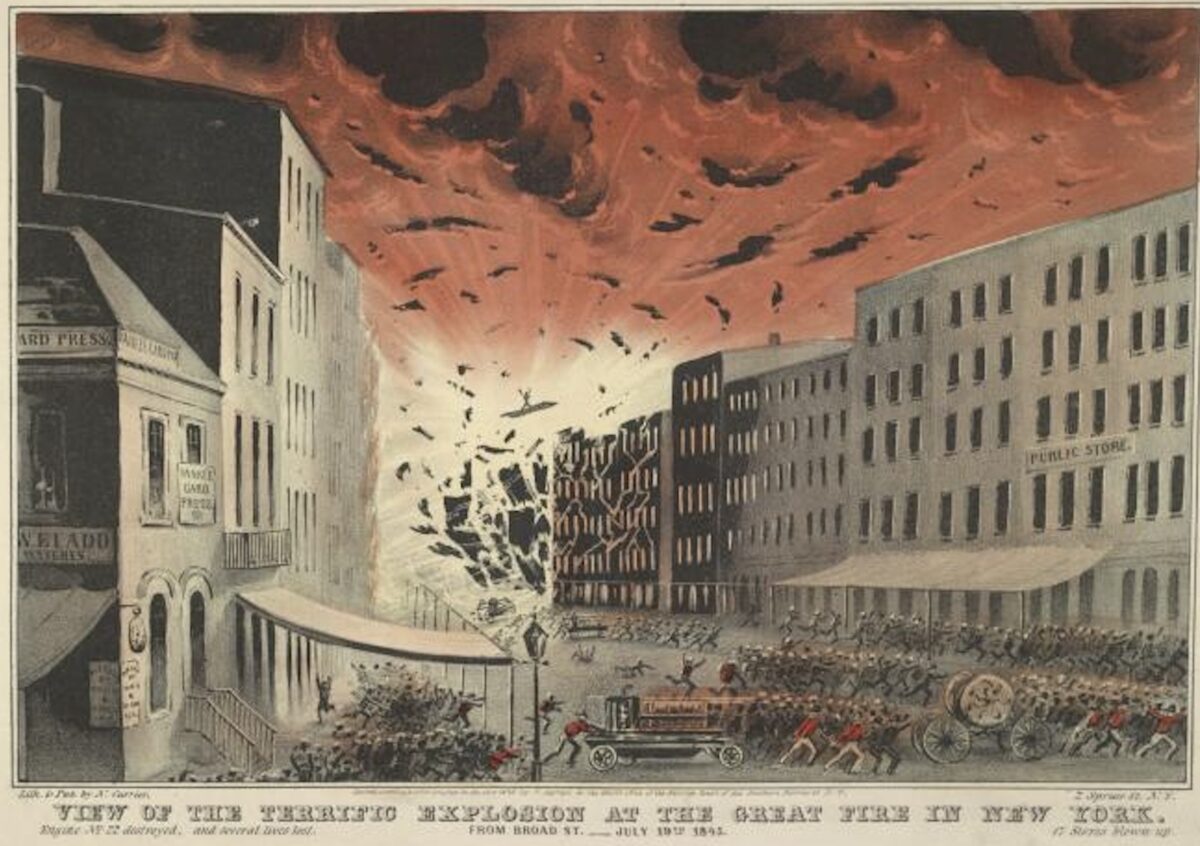
Fire wafted in through an opening in one of the store’s open iron shutters, and the result was a series of cannon-like bursts of smoke and fire, almost like a volcano, smashing into buildings across the street.
It culminated in a terrible, final explosion, completely engulfing the block. The explosion was heard as far away as Sandy Hook, New Jersey.
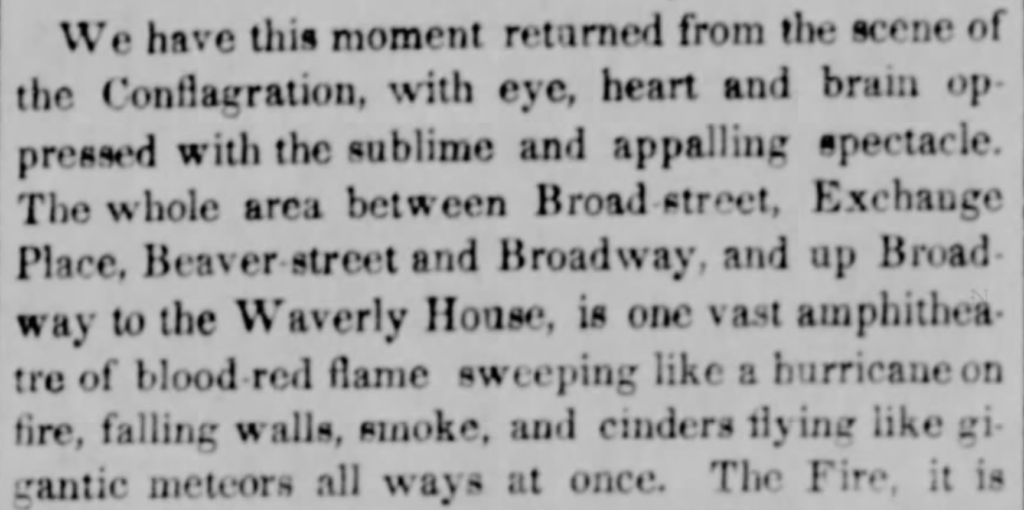
A breathless account in the New York Tribune prints this description — “an amphitheater of blood-red flame”:
“an immense body of flame… it instantly penetrated at least seven buildings, blew in the fronts of the opposite houses on Broad Street, wrenched shutters and doors from buildings at some distance from the immediate scene of the explosion, propelled bricks and other missiles through the air, threw down many individuals who had gone as far as Beaver Street, spread the fire far and wide, so that the whole neighborhood was at once in a blaze, and most unfortunately covered up the [fire company’s] hose…. After this the firemen could with difficulty obtain any control over the conflagration.”
This new blaze spread south, down as far as Bowling Green, in total destroying between 300 and 350 buildings, most of which had been partially damaged by the blaze ten years before.
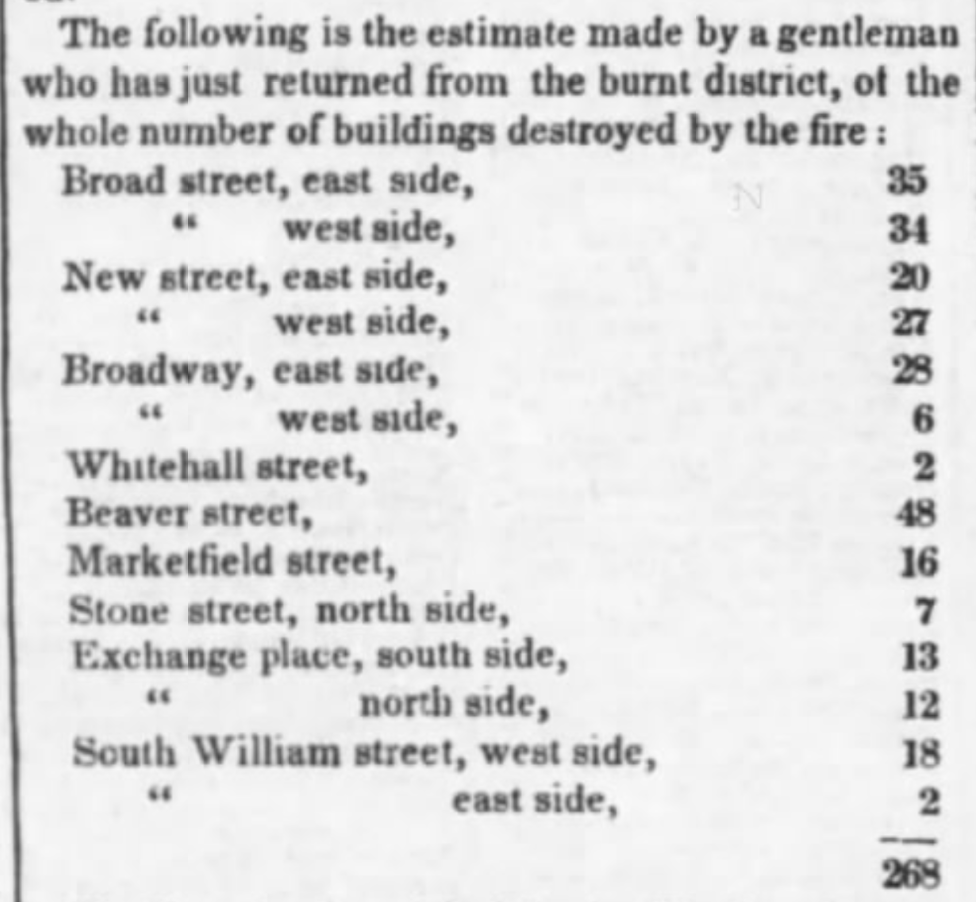
An on-the-spot report from the Evening Post, July 19, 1845, identifying 268 buildings destroyed. Other estimates would count many more. (courtesy newspapers.com)
The financial cost to the city was great, although significantly less than that of the blaze of 1835, somewhere between $6 and $10 million.
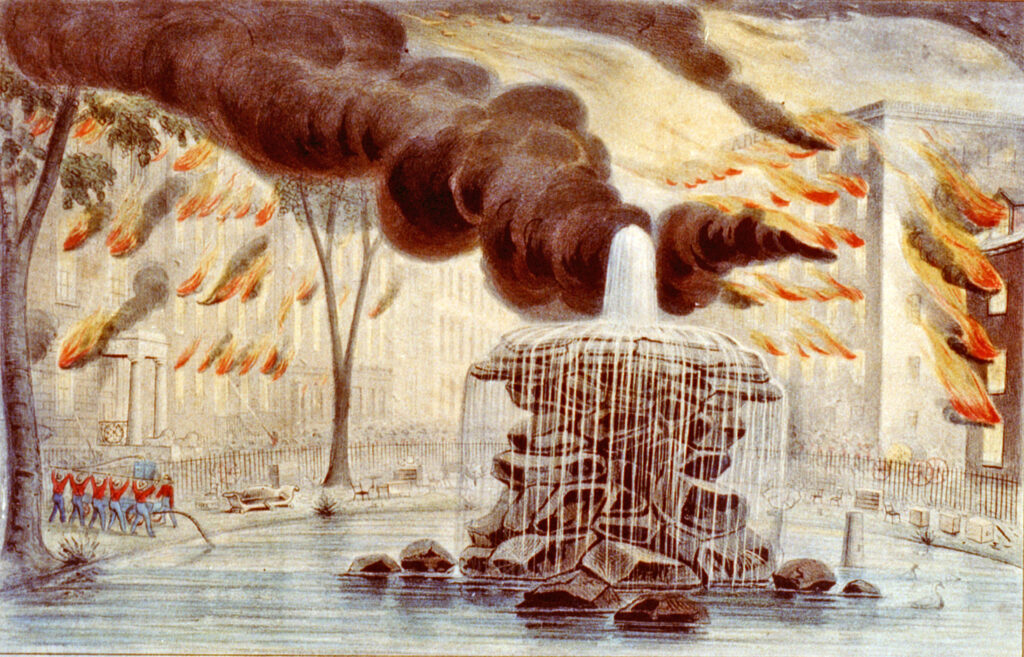
In this Currier & Ives lithograph, the serene fountain in Bowling Green as flames consume buildings all around it.
A guide book from 1877 assesses the damage at $7 million, but interestingly attributes the rebuilding of the affected blocks to a “constant influx of gold from the seeming exhaustless resources of the El Dorado and the Pacific.”
This fire might have grown to swallow up all of downtown had the Croton Reservoir not been completed a few years before, providing a steady stream of water to put out the flames.
However, perhaps due to the awful and sudden explosion, the fire of 1845 bests that of the 1835 inferno in one unfortunate statistic: the number of fatalities.
Where only two people had died in the larger fire, at least 30 people died that July morning, including a few volunteer firefighters like lawyer Augustus L Cowdrey, whose body was never found.
It’s through Cowdrey’s memory that you can actually find a reminder of the 1845 fire in downtown Manhattan.
In the graveyard at Trinity Church on Broadway and Wall Street sits a tall obelisk, a fireman’s memorial engraved with the names of many fallen fighters of the 19th century, including that of Cowdrey.
PODCAST The history of African-American settlements and neighborhoods which once existed in New York City
Today we sometimes define New York City’s African-American identity by the places where thriving black culture developed – Harlem, of course, and also Crown Heights and Bedford-Stuyvesant, neighborhoods that developed for groups of black residents in the 20th century.
But by no means were these the first in New York City. Other centers of black and African-American life existed long before then. In many cases, they were obliterated by the growth of the city, sometimes built over without a single marker, without recognition.
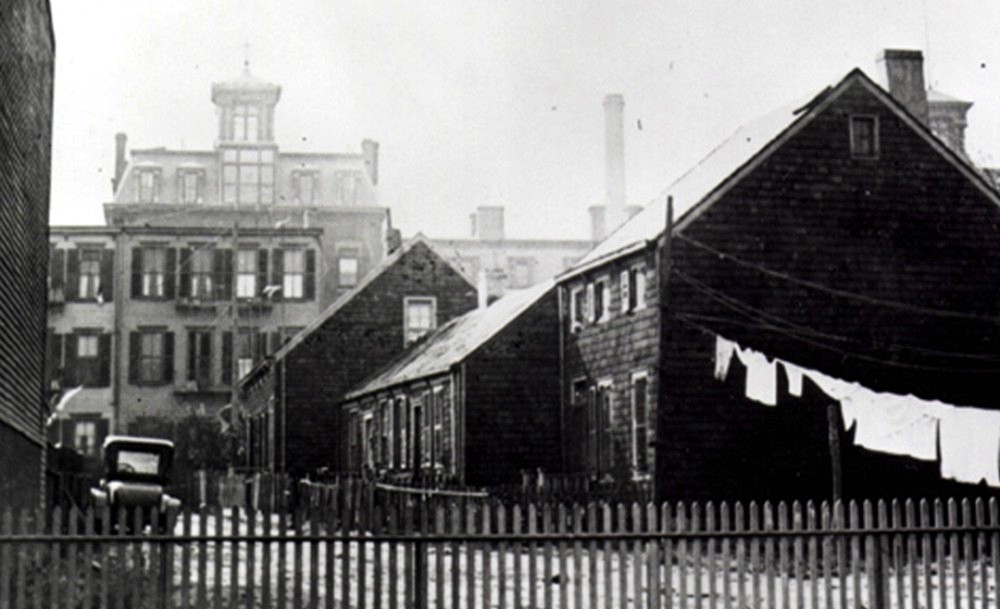
This is the story of a few of those places. From the ‘land of the blacks‘ — the home to New Amsterdam and British New York’s early black population — to Seneca Village, a haven for black lives that was wiped away by a park.
From Little Africa — the Greenwich Village sector for the black working class in the late 19th century — to Sandy Ground, a rural escape in Staten Island with deep roots in the neighborhood today.
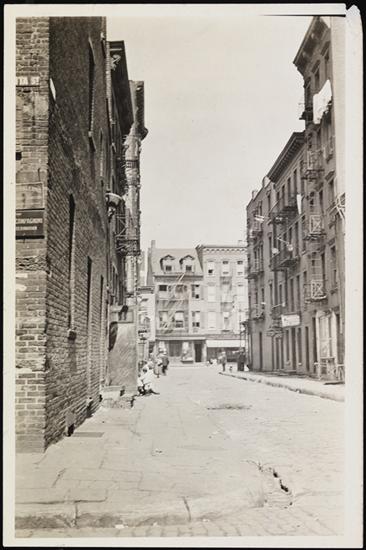
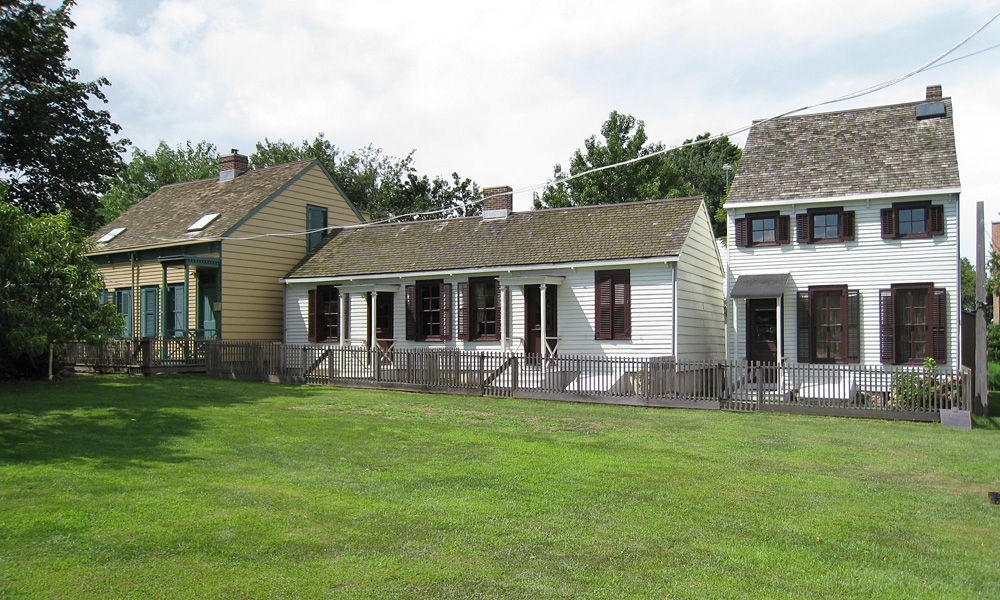
And then there’s Weeksville, Brooklyn, the visionary village built to bond a community and to develop a political foothold.
The episode is a rebroadcast of a show which first aired on June 9, 2017. Stay tuned to the end of this show for some newly written material and an update on the Black Gotham Experience and the Weeksville Heritage Center.
To get this week’s episode, just find our show onStitcher or your favorite podcast streaming service. Or listen to it here:
The Bowery Boys: New York City History podcast is brought to you …. by you!
We are now producing a new Bowery Boys podcast every week. We’re also looking to improve and expand the show in other ways — publishing, social media, live events and other forms of media. But we can only do this with your help!
We are now a creator on Patreon, a patronage platform where you can support your favorite content creators.
Please visit our page on Patreon and watch a short video of us recording the show and talking about our expansion plans.
If you’d like to help out, there are six different pledge levels. Check them out and consider being a sponsor.
We greatly appreciate our listeners and readers and thank you for joining us on this journey so far.
Our thanks to Weeksville Heritage Center and Black Gotham Experience. Visit their websites for further information about upcoming events and programs. In addition please check out the Sandy Ground Historical Society for information about this important site in Staten Island.
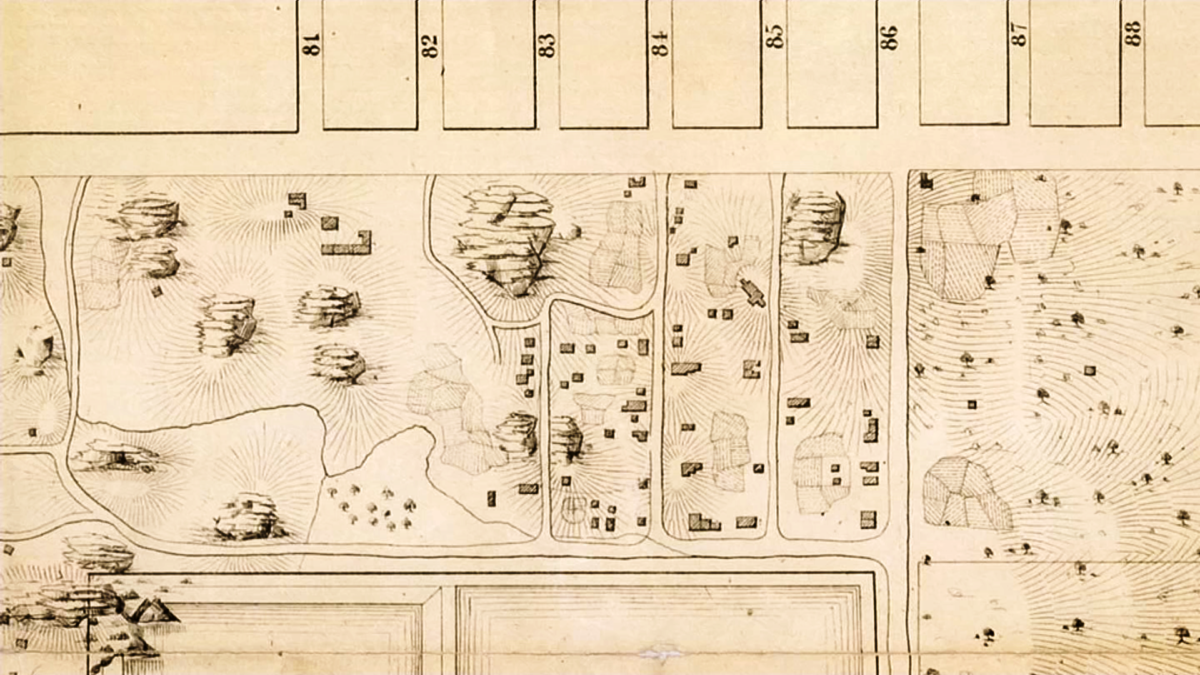
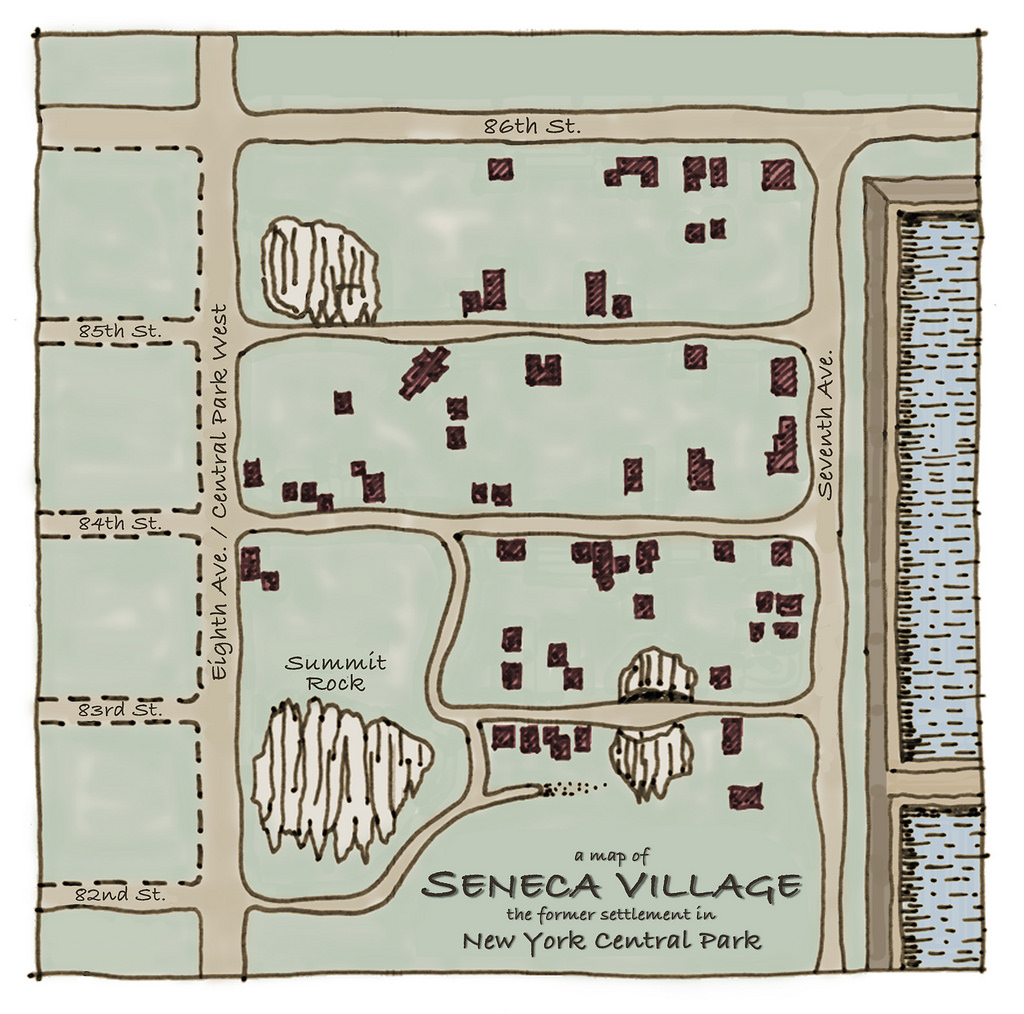
This map of Seneca Village was made by Andy Proehlillustrating what the settlement looked like in the years before its destruction.
Courtesy Andy Proehl/Flickr
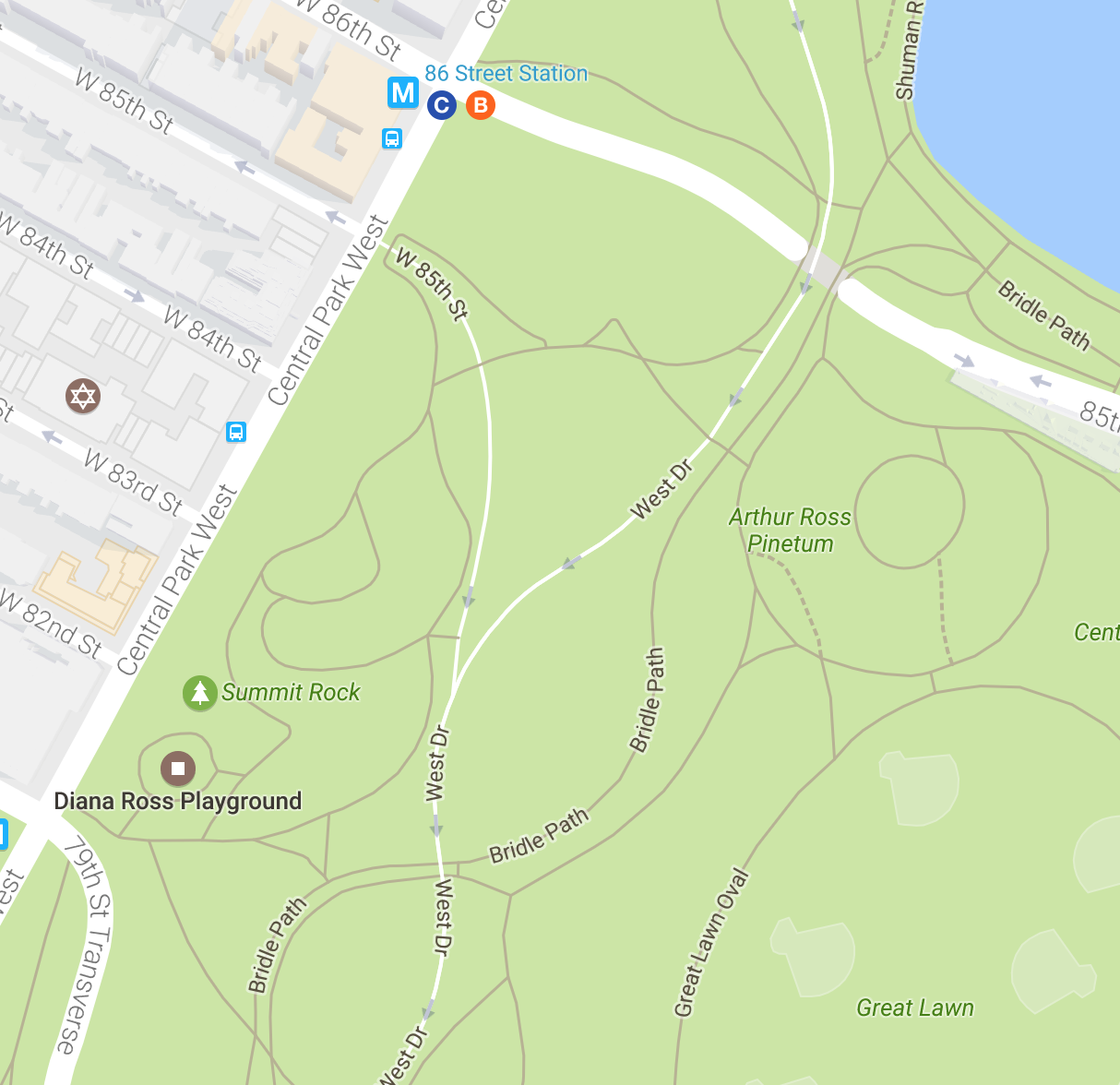
The approximate area via Google Maps. The Great Lawn now sits on the spot where the reservoir is.
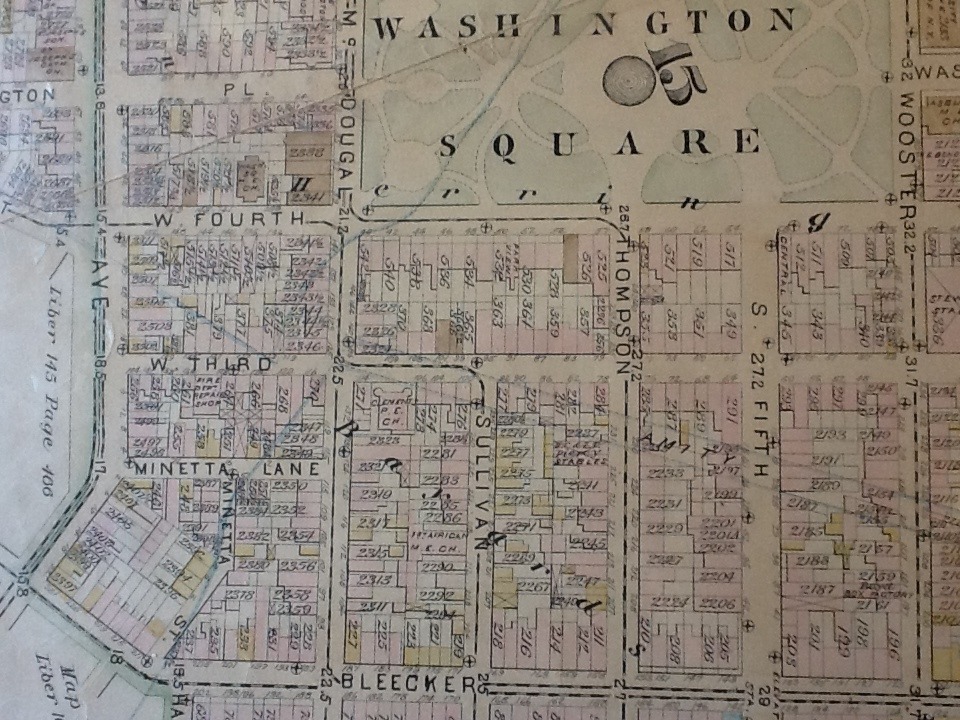
The approximate area of Little Africa. The map is from 1889.
NYPL via Greenwich Village Society of Historical Perseveration
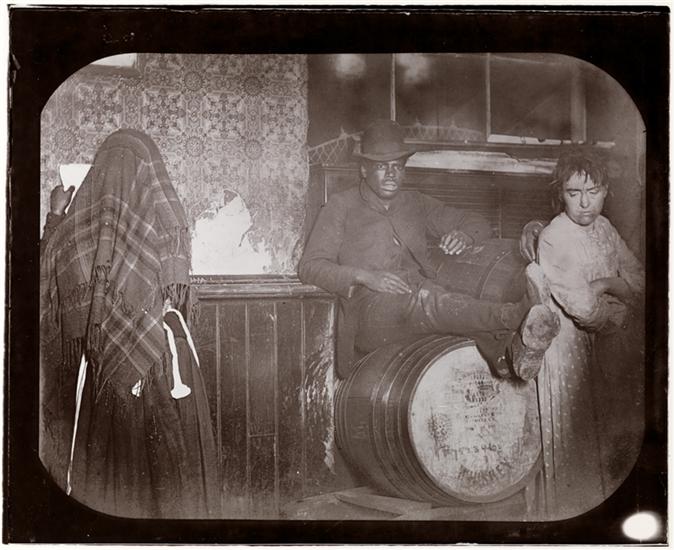
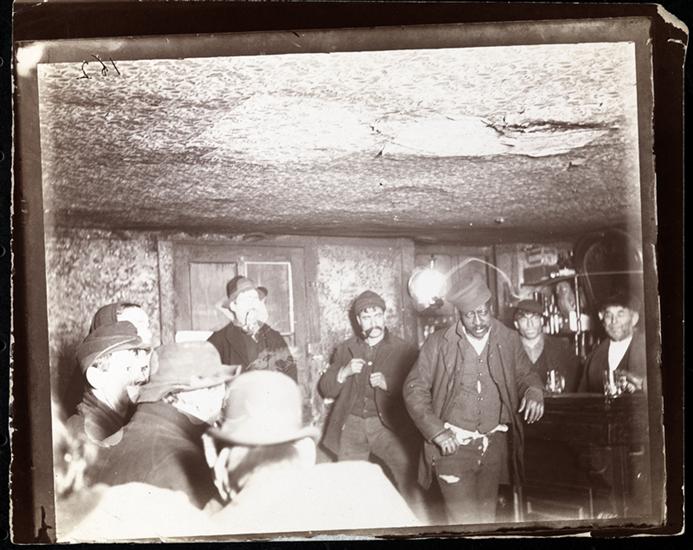
Richard Hoe Lawrence and Jacob Riis’s images of a “Black and Tan” dive bar on Broome Street near Wooster Street, 1890.
Courtesy Museum of the City of New York
Courtesy Museum of the City of New York
Minetta Lane, circa 1900.
MCNY
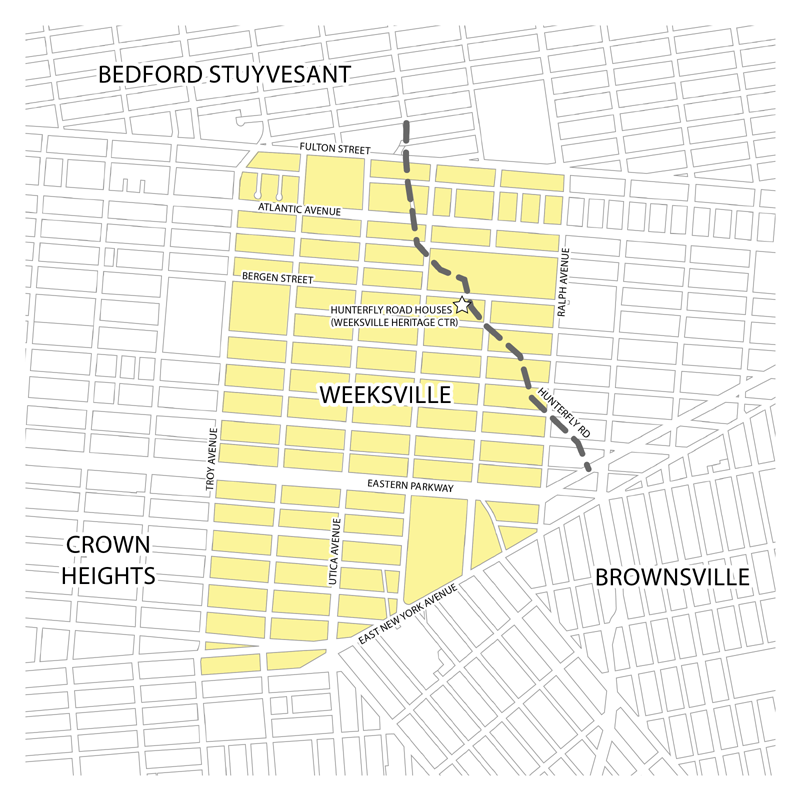
The approximate location of Weeksville, Brooklyn
Wikipedia
Brooklyn Public Library
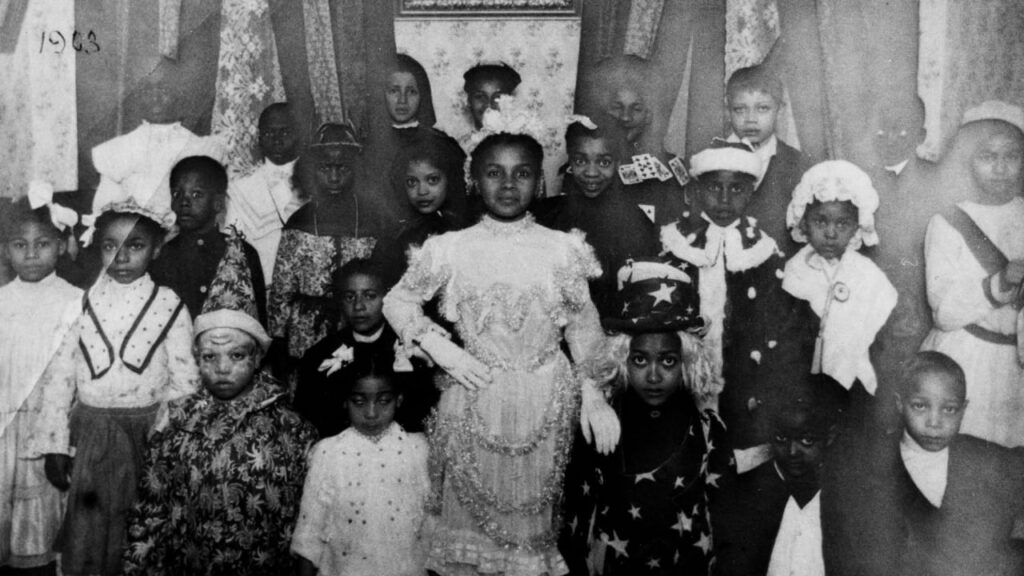
Halloween party by photographer and Weeksville resident Alexander Moore. [PHOTO: PERCY F. MOORE COLLECTION, COURTESY OF THE 5TH OF JULY RESOURCE CENTER FOR SELF-DETERMINATION & FREEDOM, WEEKSVILLE HERITAGE CENTER]
The three surviving houses today
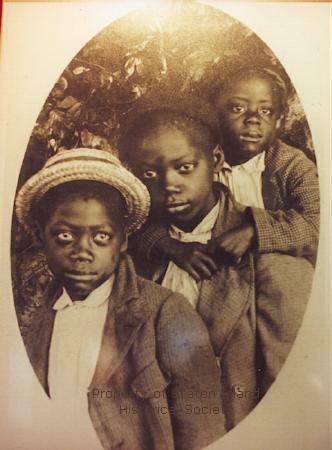
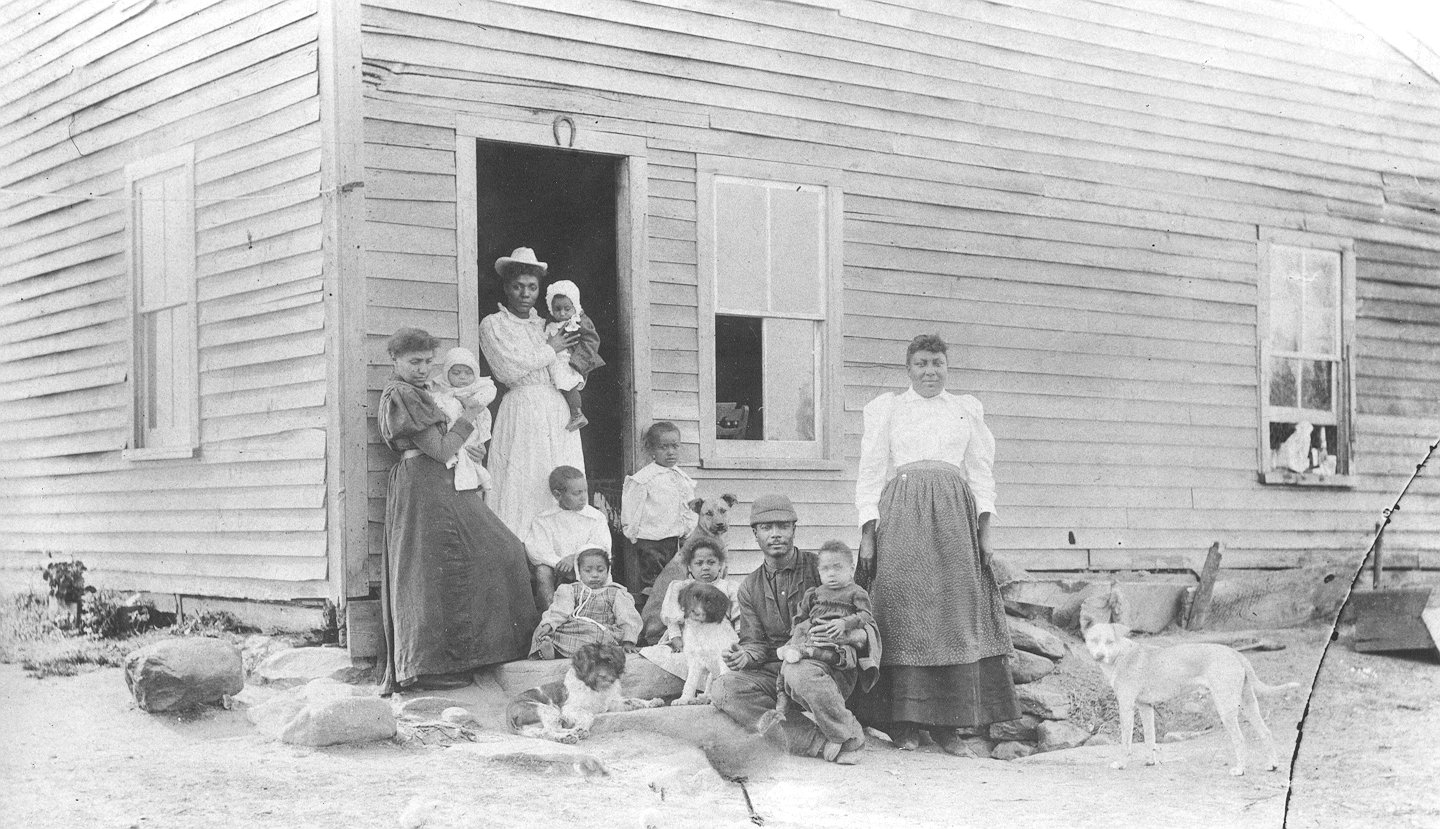
The picture at top features an African-American family posed in front of the John Brown Homestead in Torrington, Connecticut, circa 1890s-1900. I particularly love this picture because the house is reminiscent of the Weeksville houses and those that were in Sandy Ground.
Connecticut Historical Society
FURTHER LISTENING
After you’ve listened to this episode on Seneca Village and New York’s forgotten black communities, check out these past Bowery Boys episodes about aspects of New York City history featured on this show:
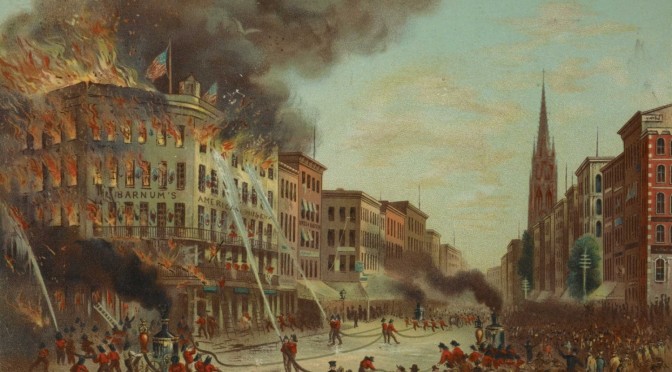
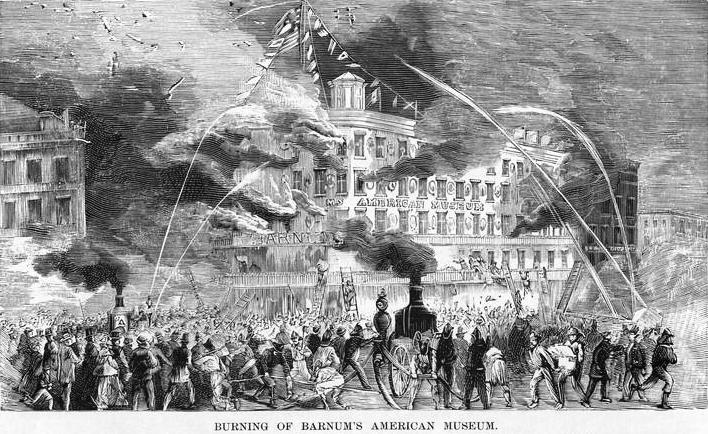
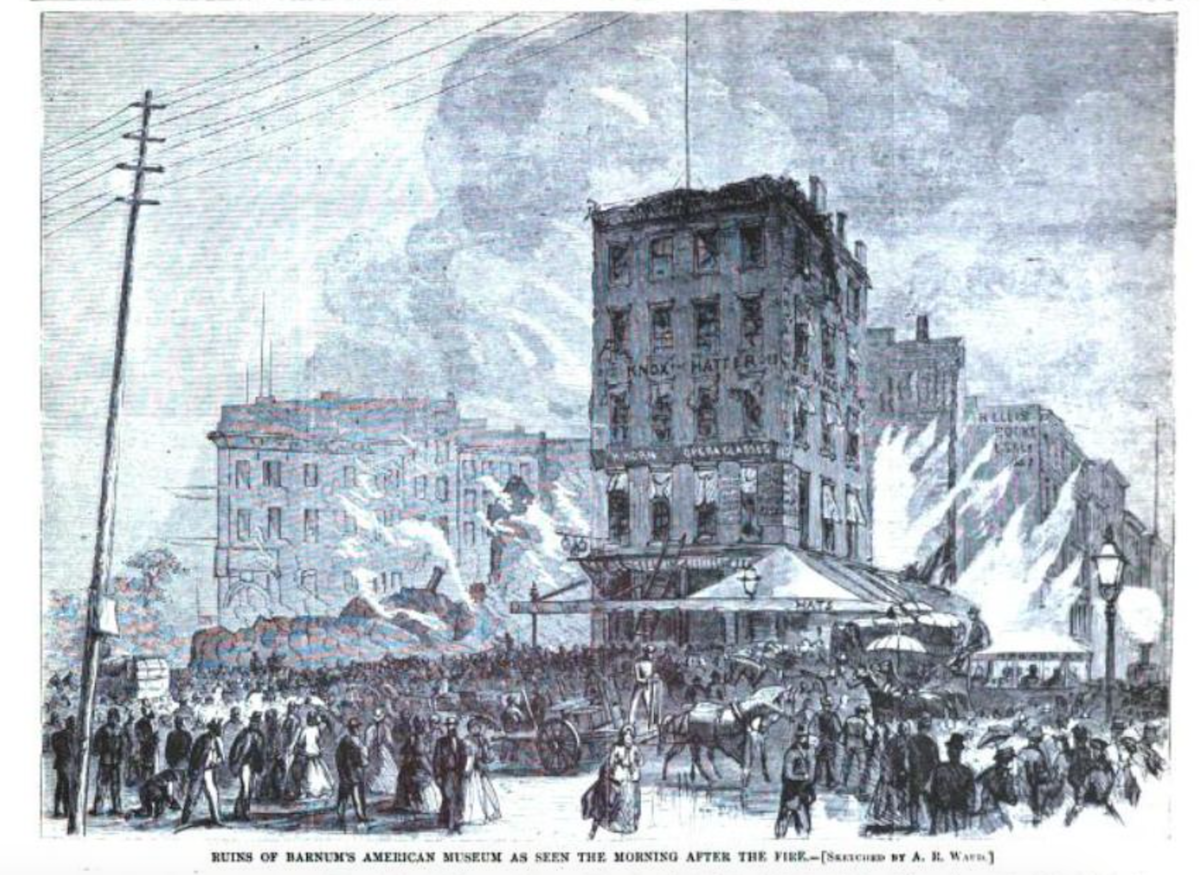
Christopher Pearse Cranch. Burning of Barnum's Museum, July 13th, 1865, 1865. Chromolithograph. Eno Collection Miriam and Ira D. Wallach Division of Art, Prints and Photographs, The New York Public Library
One hundred and fifty-five years ago (on July 13, 1865), New York City lost one of its most famous, most imaginative and most politically incorrect attractions.
When P.T. Barnum opened his museum in 1841, the kooky curiosities contained within the building at the corner of Broadway and Ann Street— at the foot of Park Row — were simply reconstituted properties from other museums.
But he soon expanded the collection to include living spectacles, both human and animal, become both the greatest show and the greatest side-show on earth.
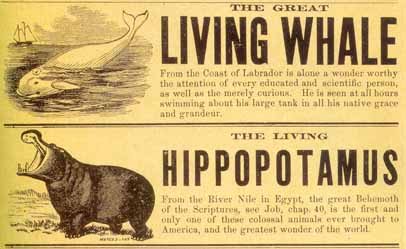
From his lilliputian stars Tom Thumband Commodore Nuttto the unfortunate white whales contained in water tanks in the basement, Barnum’s American Museum was New York’s destination for the fascinating and the weird.
Millions would visit its corridors during its two and a half decades of operation. It was so renown that it was even a target of attempted sabotageduring the Civil War.
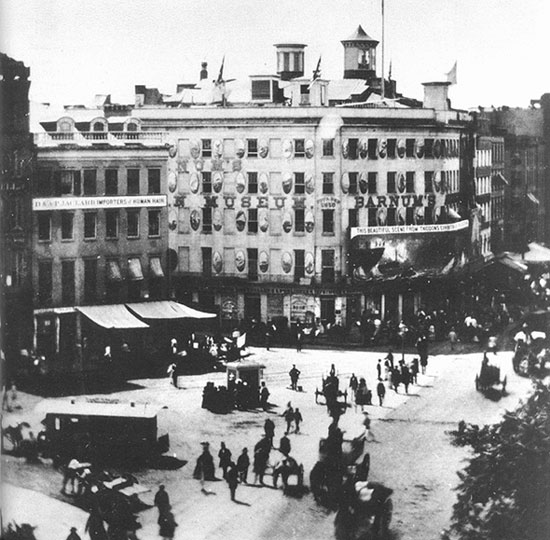
Below: A rare photo of Barnum’s American Museum, taken in 1858
Taken 1858
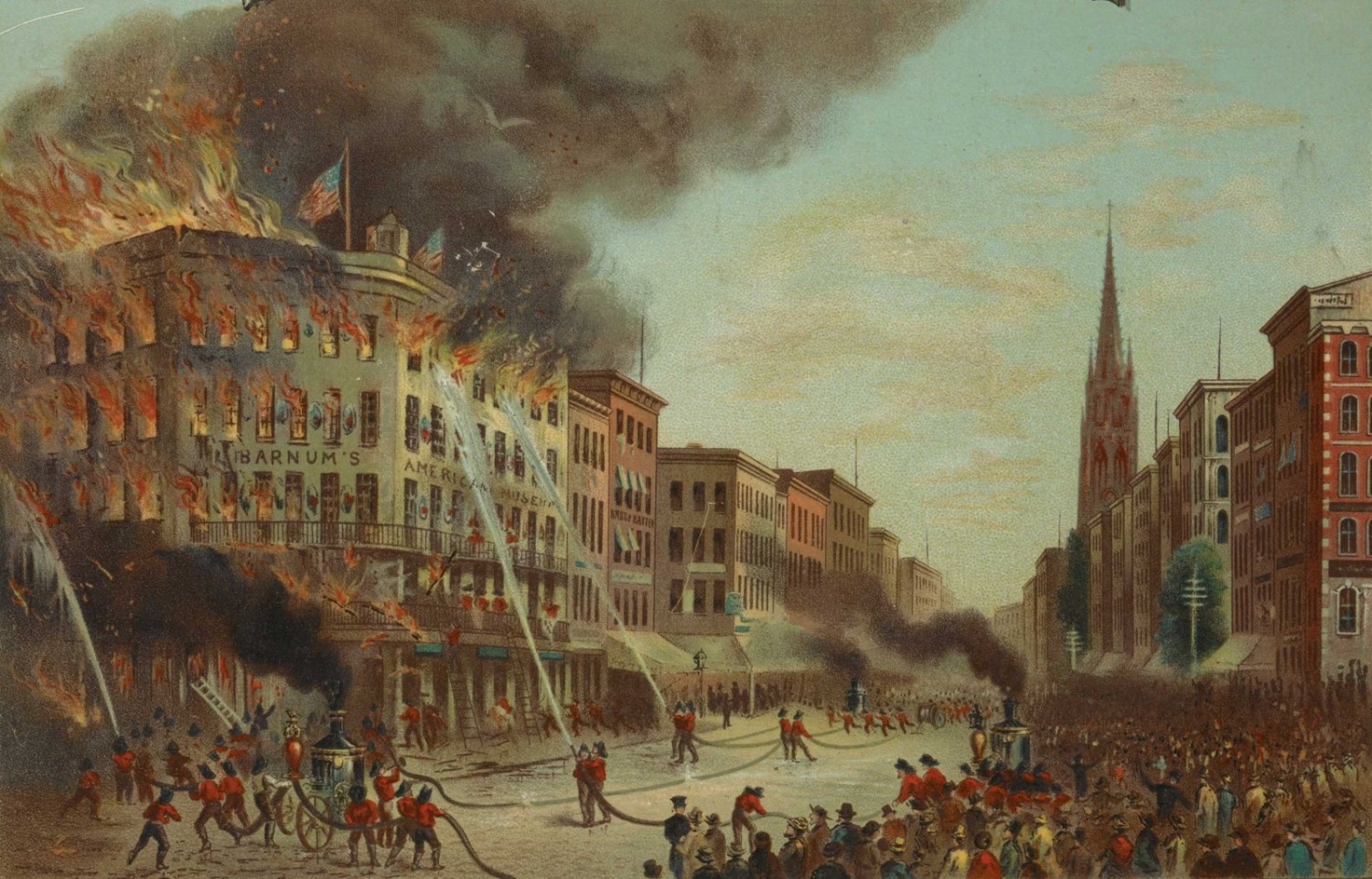
At around noon on July 13, 1865, the building quickly succumbed to “the fierce tooth of fire,” causing the greatest pandemonium that New York City had ever seen. I must give way to some of the press reports of the day, as they best capture the drama:
New York Times: “Probably no building in New-York was better known, inside and out, to our citizens than the ill-looking ungainly, rambling structure on the corner of Broadway and Ann-streets, known as the American Museum, where for more than twenty years Mr. Barnum has furnished the public with a wonderful variety of amusements.”
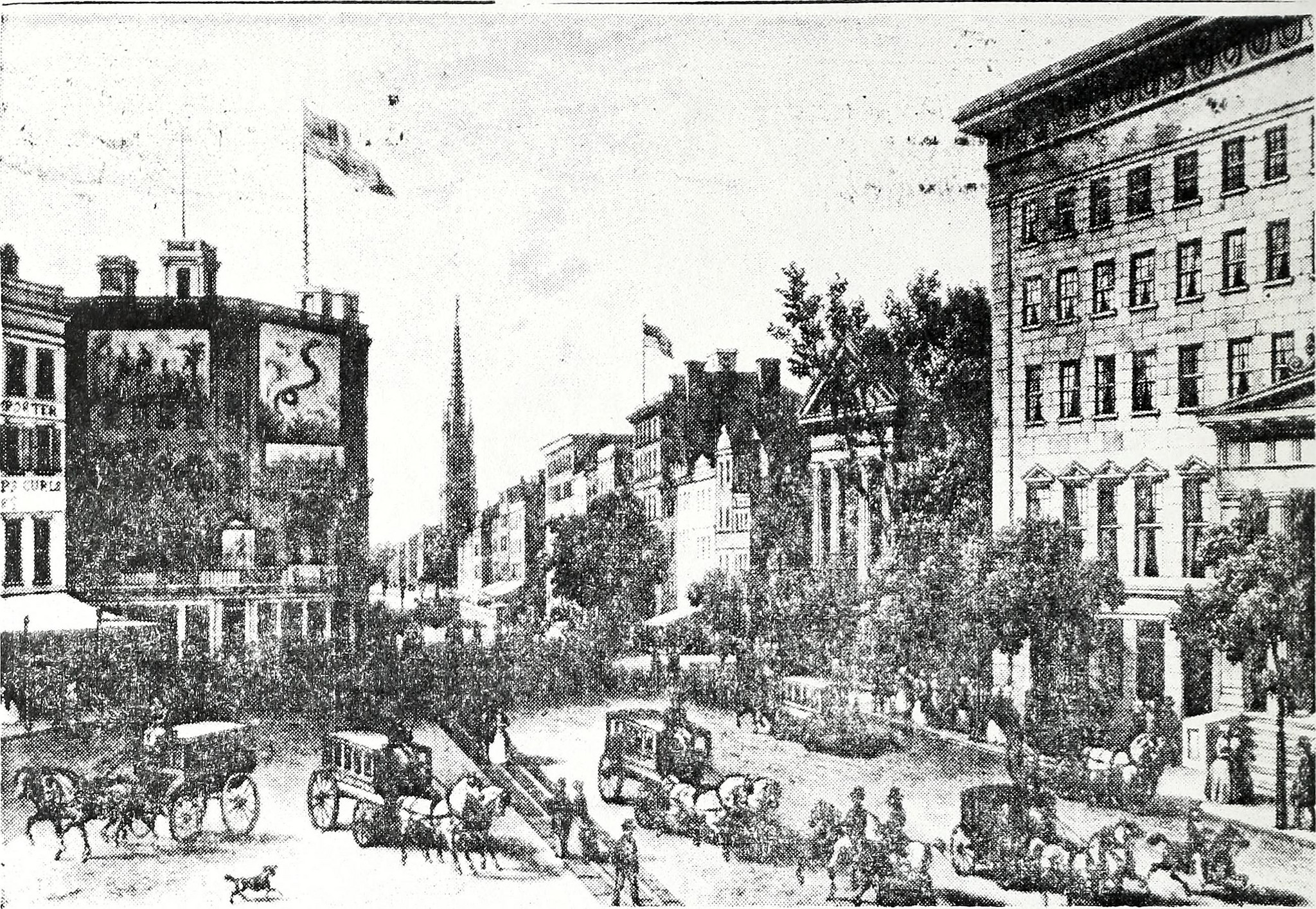
Below: The street scene at the cross-section of Broadway and Ann Street, in 1860. A sign advertising Barnum’s snake collection can be seen on the museum.
Courtesy Internet Book Archive
New York Sun: “About half past twelve o’clock yesterday the Engineer rushed up from below announcing that his room was on fire, and about the same time immense volumes of smoke permeated the Ann Street end of the building. [K]nowing that the immense whale tank was directly over the spot where the fire had begun to make headway, attempted to knock a hole in the huge reservoir.”
Christopher Pearse Cranch. Burning of Barnum’s Museum, July 13th, 1865, 1865. Chromolithograph. Eno Collection Miriam and Ira D. Wallach Division of Art, Prints and Photographs, The New York Public Library
The occupants of the tanks were doomed. “‘[T]wo whales, imported, at a cost of $7,000, from the coast of Labrador,’ whose sportive plunges and animated contests of affection afforded constant amusement to hundreds of spectators, [was] a pregnant contrast to the fearful death by roasting which they so soon thereafter met.”
The fire spread rapidly, quickly filling the upper floors with smoke. Â Firemen burst in from the Ann Street side and quickly attended to patrons who had collapsed or were too confused in the immense labyrinth of bizarre objects to escape.
A fireman named William McNamara is credited with single-handedly evacuating many patrons of the museum, not to mention some of the performers who regularly lived there.
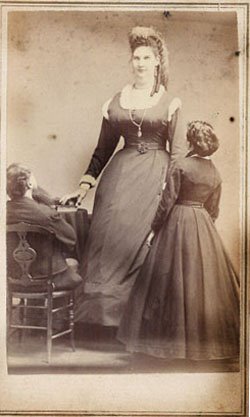
From the New York Sun: “Knowing that [some performers] occupied apartments on the third floor, he rushed thither and burst open the doors. Finding the rooms empty he ascended to the next floor and succeeded in bringing down the ladies assembled in the dressing rooms there — a Miss Swan, the Giantess, and Miss Zuruby Hannus, the Circassian girl.”
Below: Anna Swan, ‘the Giantess’ who lived at the museum, was successfully rescued
Many of the wax figures from the third floor were hurled out the windows. One peculiar item captured the imagination of the crowd — the wax depiction of Jefferson Davis, dressed in a woman’s petticoat. (It was rumored that the former president of the Confederacy has attempted to escape dressed as a lady.)
NYT: “One [rescuer] had Jefferson Davis’ effigy in his arms and fought vigorously to preserve the worthless thing, as though it were a gem of rare value. On reaching the balcony the man, perceiving that either the inanimate Jefferson or himself must go by the board, hurled the scarecrow to the iconoclasts in the street. As Jefferson made his perilous descent, his petticoats again played him false, and as the wind blow them about, the imposture of the figure was exposed.”
NYS: “When the Jefferson Davis petticoated figure was recognized by the crowd, it was seized, kicked, knocked and finally hanged to an awning frame [in front of St. Paul’s Church], amid the derisive and contumelious epithets of the persons engaged in this pastime.”
More seriously a great number of artifacts from the Revolutionary War were incinerated in the fire. “Valuable mementos of Washington, Putnam, Greene, Marion, Andre, Cornwallis, Howe, Burr, Clinton, Jefferson, Adams, and other eminent men which should have been carefully stored in a fire-proof vault, yesterday smoldered in the heat….” [NYT]
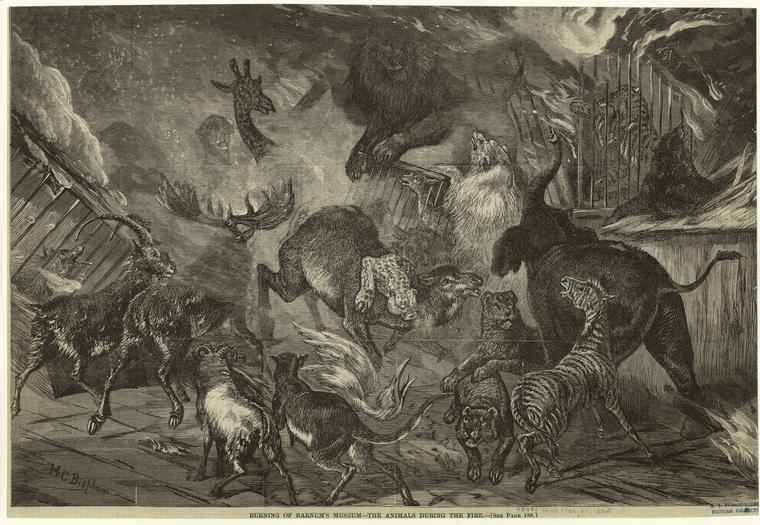
The museum’s impressive collection of taxidermy — monkeys, lions, elephants, zebras — were swallowed up by smoke and collapsed into the inferno.
But the museum also had a great many living animals — snakes, pigs, dogs, and even a kangaroo and an alligator. And, of course, a great many monkeys — “big monkeys, little monkeys, monkeys of every degree of tail, old, grave, gray monkeys, young, rascally, mischievous monkeys, middle-aged, scheming monkeys, and a great many miserable, angry monkeys.” Most perished in the flames although some escaped into the streets, some never to be found again.
Below: This is Harpers Weekly’s illustration of Barnum’s second fire — see below — but could have tragically captured the events on July 13, 1865.
Harpers Weekly
Remarkably, nobody humans died in the blaze. In fact, few wax depictions of humans perished as many took to rescuing wax figures thinking they were alive. The fire spread to several surrounding buildings, and soon the entire block was engulfed in flame.
NYT: “The roof of the Museum had now fallen, and the interior of the building was like the crater of a volcano. A stream of heated air issued from the top, and was borne eastward by the breeze directly over the block, carrying with it light articles, pieces of burning wood, shingles ….
At 1:30 came a crash resounding like the explosion of a powder magazine. The whole wall on the Ann-street side had fallen. A cloud of dust and smoke filled the air, making it dark as twilight, and rendering it impossible to descry objects at short distance.”
There was a bit a looting, including “two men dressed as soldiers [who] were seen coming out of the shoe-store in Ann Street, each with five or six pairs of shoes under their coats.” And there were false reports that the lion has escaped and was running through the streets.
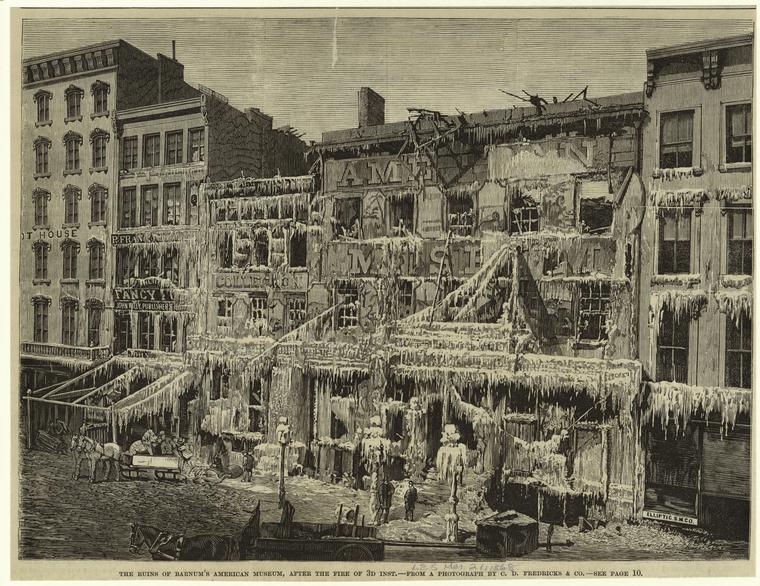
For years after, people mourned the loss of Barnum’s collection, truly among the greatest in New York City up until that time. Â Barnum attempted to relaunch the museum at 539-541 Broadway. but it, too, was destroyed in a fire (pictured below).
Then, in 1871, he leased a train depot and called it Barnum’s Monster Classical and Geological Hippodrome. (It would later morph into the first Madison Square Garden.)
Finally he just decided to take his collection of acts on the road forming a traveling circus in 1881 with ringmaster James Anthony Bailey.
While the world of entertainment would be changed by their collaboration — Barnum and Bailey’s Circus — most would consider the old American Museum as Barnum’s greatest achievement.
Below: Barnum’s second museum destroyed by fire, which gutted the building on a cold day
Harpers Weekly
For more information, we have a few Barnum-themed podcasts that you might enjoy:
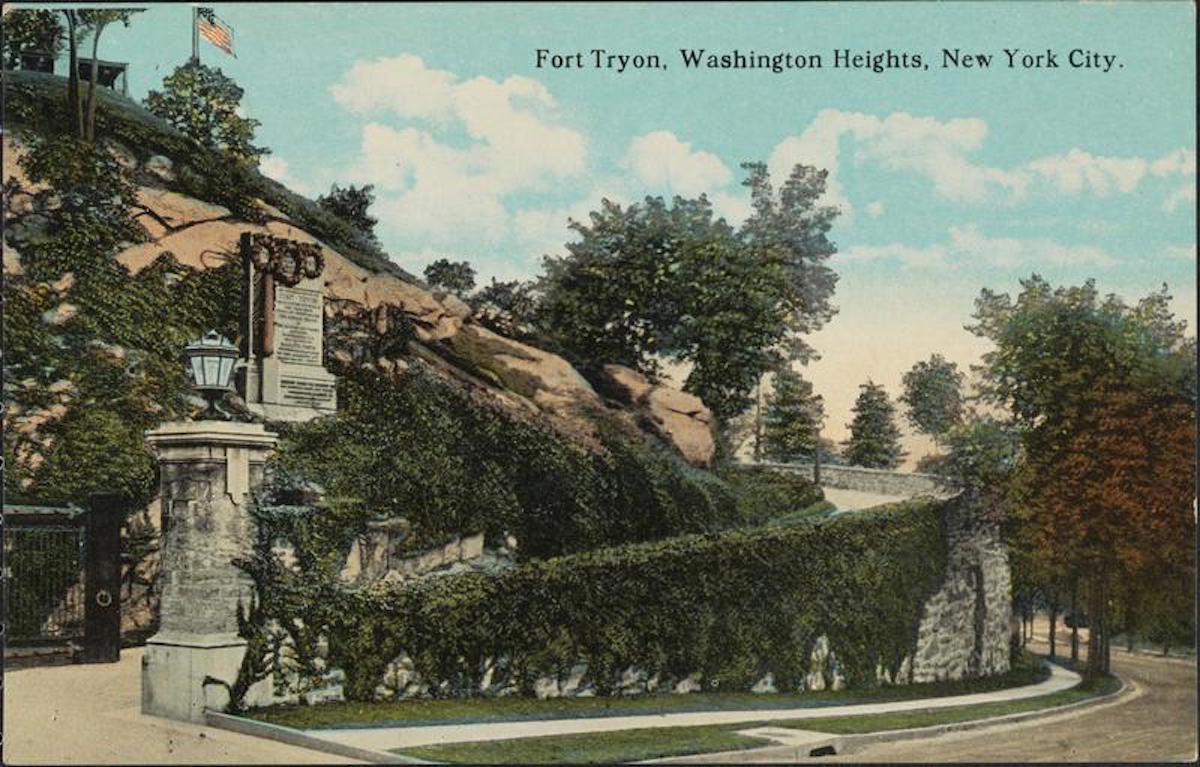
Ask any New Yorker at random where the site of Fort Washington once stood, and chances are your query will be met with a furrowed brow, followed by frantic tapping on a smartphone. (ANSWER: It was located on the site of today’s Bennett Park in Washington Heights.)
But ask about Fort Tryon, and chances are better that they could point it out on a map.
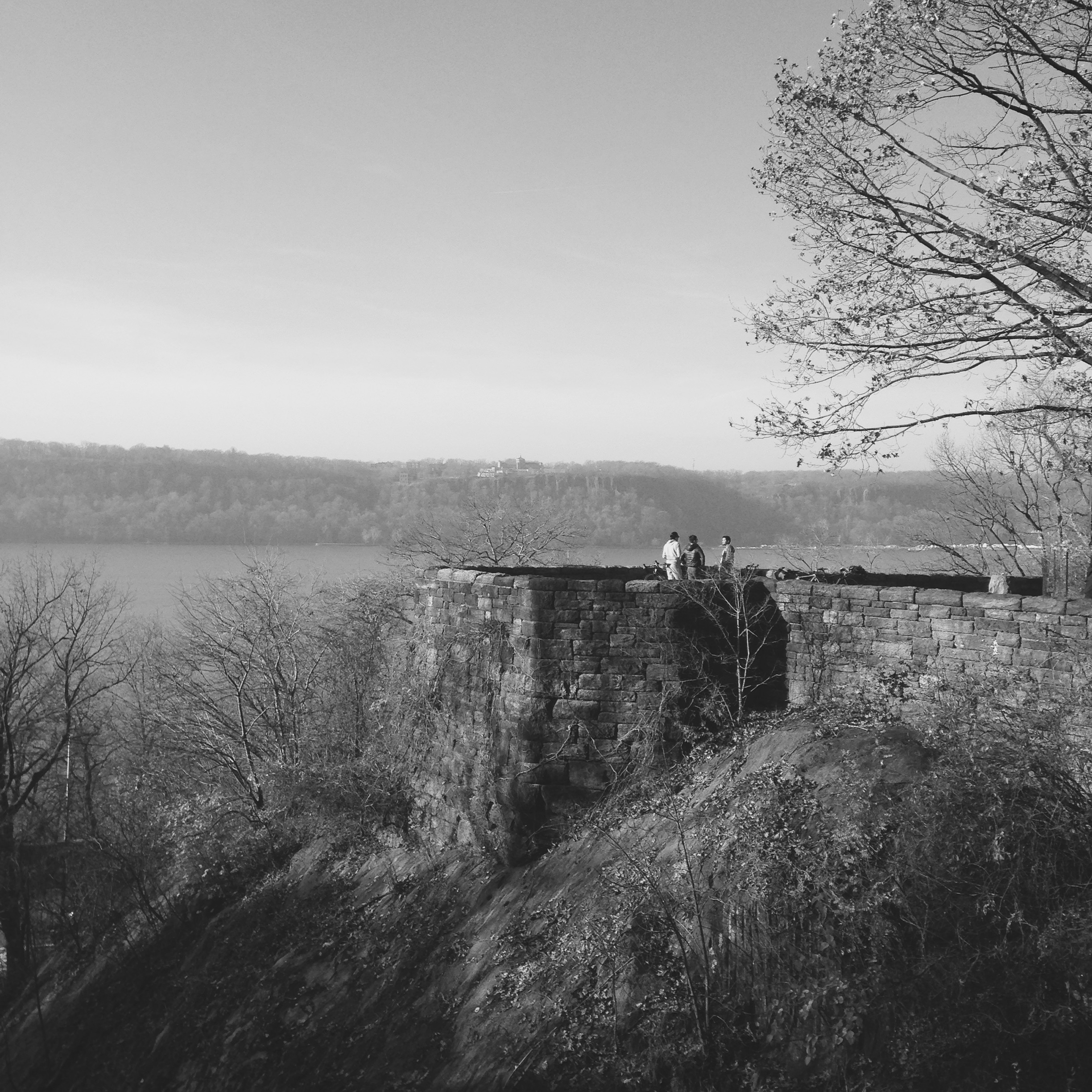
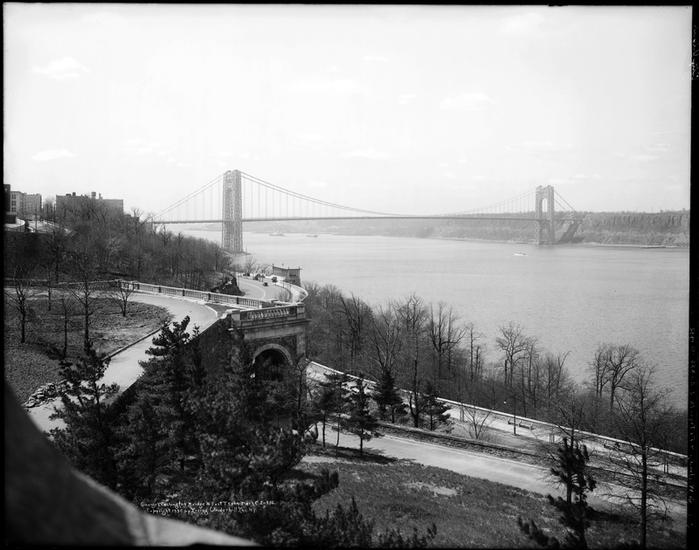
Fort Tryon Park not only hosts the renowned Cloisters museum, but it’s also one of the lushest and most romantic spots in Manhattan, with dramatic outlooks over the Hudson River and sweeping views of the Palisades.
Photo/Greg Young
This breathtaking view is no accident. Along with buying the Cloisters and the land that would become Fort Tryon Park, J. D. Rockefeller, Jr., also bought hundreds of acres along the New Jersey waterfront to preserve them and the view.
This is America the Beautiful at its finest.
Curious thing though.
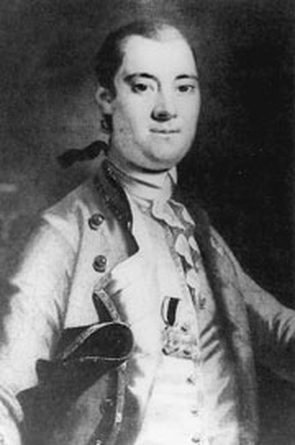
The park is named for a vicious British general who fought against George Washington and the Continental Army.
Museum of City of New York
Its name is taken from Sir William Tryon (1729-1788), the last governor of the Province of New York, who led British forces to burn and plunder civilian outposts throughout New England during the Revolutionary War.
He was a debonair monster, perhaps best known, as major general of the British army, for authorizing vicious raids against civilians in Connecticut in 1779.
“The work of pillage and destruction now commenced in earnest, and large quantities of public stores were removed to the street and burned. The Soliders drank so freely of liquor which they found in one of the buildings that many of them were in a condition of beastly intoxication. The next morning was the sabbath but Tryon gave orders to continue the work of firing the dwellings and business places of all persons except those who were know to be loyal to the king.
Having finished the work of destruction they left innocent women and children without food or shelter….”
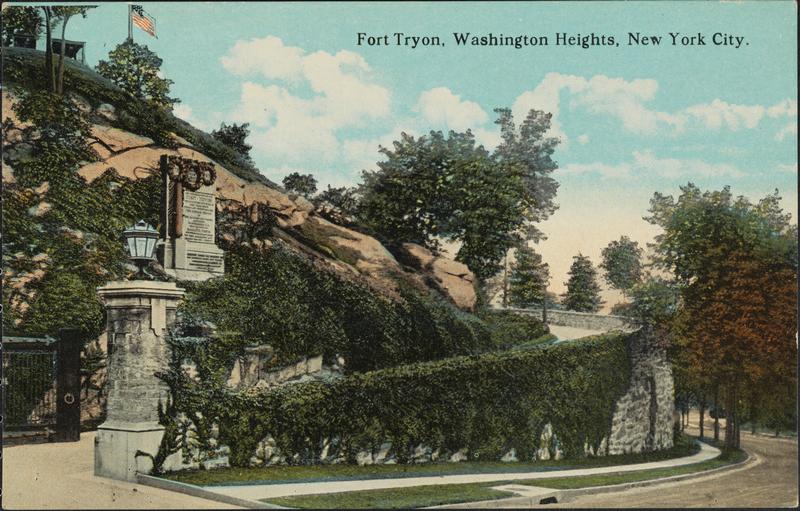
Below: More peaceful views courtesy the park, 1932
MCNY
And yet the name has, by tradition, stuck to Fort Tryon Park, a haunting reminder of the violence of 1776 which once marred this land. It is here that one can best imagine the absolute chaos of those early revolutionary days, nestled in scenes of picturesque natural beauty.
Wander the meandering paths and you’ll come across several other mementos of long-ago times, including a bronze plaque to the memory of Margaret Corbin (1751-1800), considered the first woman to see active battle in the Revolutionary War and the first to receive a military pension after the war.