Categories
Film History It's Showtime ON TELEVISION

When New York hosted the Oscars

Despite the Academy Awards being a celebration of all things Hollywood, New York has actually hosted the Oscar ceremony on more than one occasion. Or rather, they co-hosted the event — from 1953 to 1957 — in a rare and soon abandoned bicoastal ceremony that taxed the mechanics of television’s earliest production crews.

There were two reasons for this complicated arrangement. NBC, who was broadcasting the event, had most of their principal stages in New York. After all, the first NBC studios were at Rockefeller Center, where they still remain today. Even The Tonight Show, perhaps NBC’s first and most famous Burbank production, filmed in Manhattan until the early 1970s.

Just as important, many film stars were in New York, unable to get out of theatrical commitments on Broadway. And frankly, in the years before international television viewership, the Oscars simply did not have the same urgency as they do today. Thus, the award show came to them.

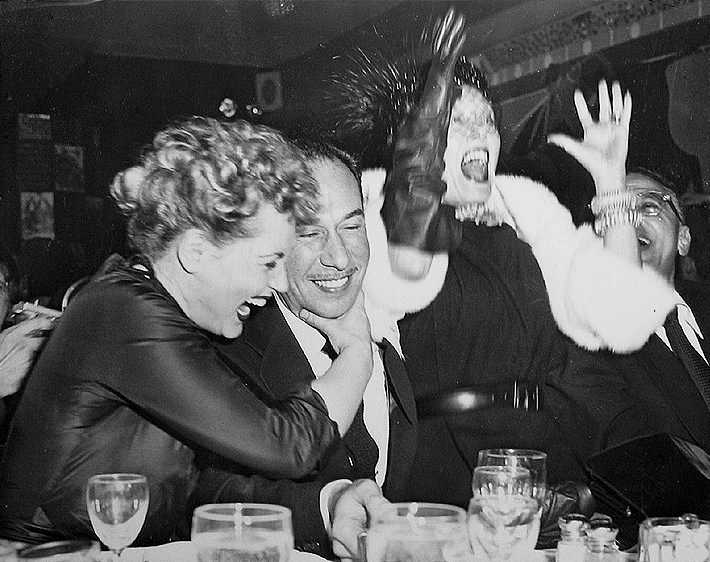
Judy Holliday gives Jose Ferrer a friendly squeeze — and Gloria Swanson bursts with joy — as Ferrer’s name is announced as the winner of Best Actor, at La Zambra in midtown. (Getty Images)

23rd Annual Academy Awards

Best Picture winner: All About Eve
March 29, 1951

Before splitting the broadcast, the Oscars once tried a very strange live radio remote from a New York nightclub.

For the 23rd Annual Academy Awards, held on March 29, 1951, many nominees like Judy Holliday and Gloria Swanson remained in New York. Both Swanson and Jose Ferrer, starring in the Broadway comedy Twentieth Century, were nominated that year.

Instead of disappointing a sell-out theater audience, Ferrer invited all the nominees to an after-theater party at the La Zambra (127 W. 52nd Street), a nightclub owned by Spanish guitarist Vincente Gomez. A live radio link was set up among the tables, and nominees wined and dined waiting for their categories to be announced out in Los Angeles.

The club was hopping that night. Ferrer won Best Actor (for Cyrano de Bergerac), and Holliday won Best Actress (for Born Yesterday), giving their speeches into a radio microphone as champagne corks popped in the background. (Swanson, who thought she might win for Sunset Blvd., was less enthusiastic for Judy’s win.)

It’s appropriate they were in New York, as Ferrer and Holliday both won for film adaptations of Broadway shows in which they had starred. And clearly underscoring the power that the New York stage still had on the film business, Best Picture went to the stage drama All About Eve.


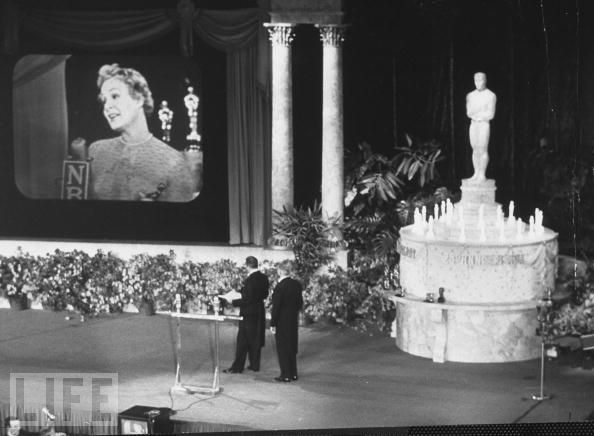
Shirley Booth accepts her Oscar in New York, as the audience in Los Angeles watches on. (LIFE images)


25th Annual Academy Awards

Best Picture winner: The Greatest Show On Earth
March 19, 1953

While the Los Angeles crowd were entertained by host Bob Hope, the attendees to the first official bicoastal New York ceremony were met by co-host Fredrick March, a two-time Academy Award winner. The event was broadcast from 5 Columbus Circle, at the International Theatre.

In 1953, the International was a worn out, tired New York stage, having gone through a host of different owners and renovations since it first opened — as the Majestic Theatre — in 1903. At different periods of time, it was owned by Florenz Ziegfeld and William Randolph Hearst, and its stage played hosts to virtually every form of entertainment, from burlesque to ballet.
Definitely an odd setting for an awards program, especially given that this was also the first Oscar show to be broadcast on television. But the International was owned by NBC, who had agreed to fund the inaugural broadcast. And NBC’s fees to broadcast the program were especially valuable to Academy of Motion Picture Arts and Sciences, as the film studios had refused to fund an elaborate bi-coastal show.

The broadcast began 7pm PST and 10 p.m. here, to accommodate the Broadway stars just stepping off the stage. Due to staggered entrances, many of the seats at the International were empty for much of the ceremony.

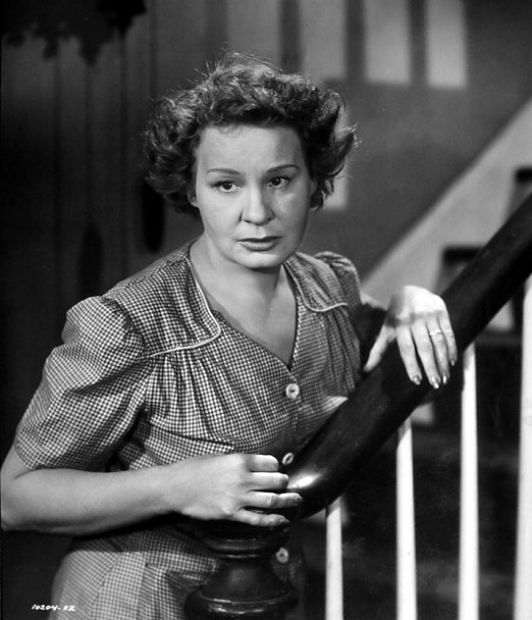
Among the nominees sitting in the Columbus Circle theater was Best Actress nominee Shirley Booth (above), who was starring in the Broadway play The Time Of The Cuckoo on 40th and Broadway at the now-demolished Empire Theatre. She won the Oscar for the film version of Come Back, Little Sheba; she had won a Tony Award for the stage version in 1950.

Given the limitations of early television technology, it’s amazing they were able to broadcast simultaneously between two coasts at all. Glitches did cause a few amusing gaffes for television audiences. When the universally reviled film The Greatest Show On Earth somehow won Best Picture over the favorite High Noon, the camera switched to the New York audience, who sat there not clapping and in mild confusion.

There would not be another Oscar telecast at the International, or anything else for that matter. The very next year, NBC moved out, and the theater was unceremoniously torn down, replaced with one of Robert Moses’ pet projects, the ill-fated Coliseum convention center.


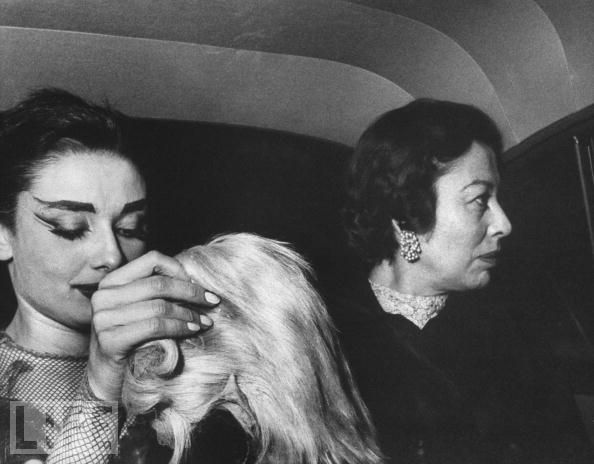
Audrey snatches off her blonde Ondine wig as her limousine races her to the Oscar ceremony uptown.
26th Annual Academy Awards
Best Picture Winner: From Here To Eternity
March 25, 1954

For the remainder of the Oscars’ short stay in New York, they were broadcast from the New Century Theater*, at Seventh Ave. and 58th Street, right off Columbus Circle and best known as the theater that Orson Welles and his spirited cast stormed in 1937 to perform his musical The Cradle Will Rock.

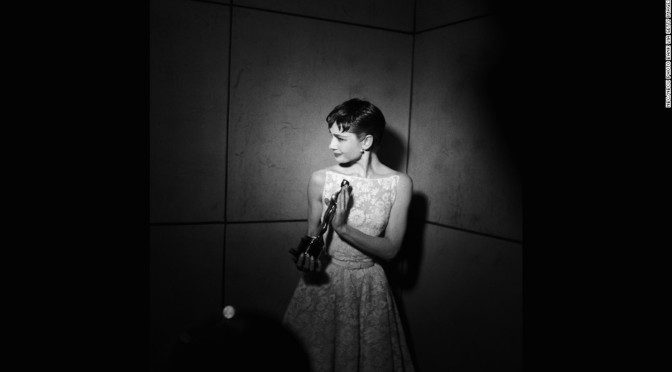
Film fans were set up in bleachers outside, just as they’re popularly done out in Los Angeles. But one New York nominee didn’t get there in time to meet her fans. Audrey Hepburn was down at the 46th Street Theatre performing the play Ondine, costumed in a blonde wig.

After the show, she raced to the Century in a limousine (with police escort, no less), ripped off her wig, rushed to the bathroom to wipe off her stage makeup, then settled into her seat for less than ten minutes before standing again to accept the trophy for Best Actress for Roman Holiday.

Here’s video of Audrey’s win. You can see the ‘switch off’ between the Los Angeles and New York feeds.

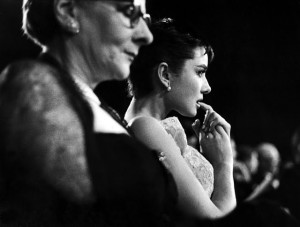
Audrey, off Columbus Circle: Hepburn sits in nervous anticipation at the New Century Theatre, moments before she wins for Best Actress.
The show, hosted in New York again by Fredric March, had another New York icon receiving an Oscar that year — Frank Sinatra, Best Supporting Actor for his role in the Best Picture that year. However, he was in Los Angeles to accept it.

(You can find tons of pictures of Audrey in her post-Oscar glow at the NBC Photo Bank.)

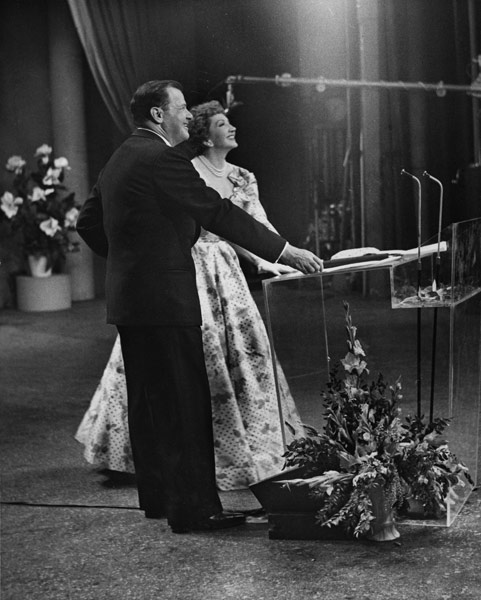
Claudette Colbert and Joseph Mankiewicz presided over a sedate New York audience, while out in Los Angeles, audiences were energized by young comedian Jerry Lewis. (Courtesy Oscars)


27th and 28th Academy Awards

Best Picture Winners: On The Waterfront, Marty
March 30, 1955; March 21, 1956

It became obvious to most viewers that the bicoastal productions were becoming lopsided. After all, it was early evening in Los Angeles, and most of the young, fresh talent was there. In New York, it was post-theater time, and attracted the older stars — some exhausted from stage productions. Nothing exemplifies this more than the 28th Oscar ceremony, hosted in New York by proper Claudette Colbert and Joseph Mankiewicz and in Hollywood by the hot new comedian Jerry Lewis, whose ribald antics made the New York cutaways seem drab.

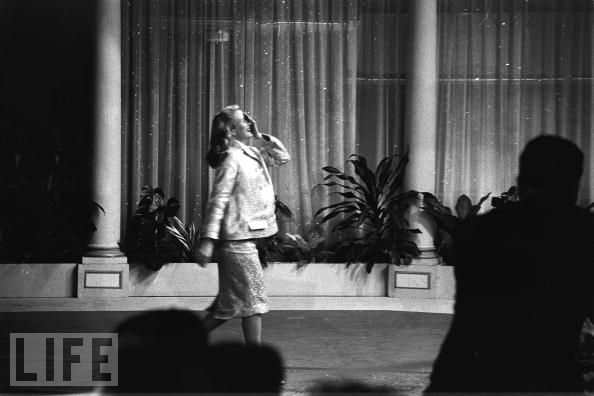
But the awards were all about the East Coast. The Best Pictures these two years were for films set in Hoboken, NJ and the Bronx, respectively. Much of the cast of On The Waterfront were actually at the New York ceremony, including Best Supporting Actress winner Eva Marie Saint (pictured below), her pregnancy concealed by a jacket as she mounted the stage to accept her award. (Here’s the video of her win, again highlighting the difference between the New York and the L.A. ceremonies.) Best Director Elia Kazan was also here to accept his trophy. Marlon Brando, however, was out in Los Angeles, apparently where the fun was.

The following year, this time with Colbert going solo as the East Coast mistress of ceremonies, Best Picture went to Marty, another show originating from New York. But not from a Broadway stage. As a symbolic move towards the importance of the small screen, the Ernest Borgnine vehicle was based on a teleplay from the Goodyear Television Playhouse.

Below: Eva Marie Saint, in shock, approaches the podium to accept her Best Supporting Actress Oscar for On the Waterfront, her tasteful ensemble barely concealing her pregnancy. (Courtesy Life images)

29th Academy Awards
Best Picture Winner: Around The World In 80 Days
March 27, 1957

It was clear by this time that the two coast production was more trouble than it was worth. While Hollywood went with Jerry Lewis again, while New York opted for the elegant but comparatively unexciting Celeste Holm.

The New York Times called it ‘a colossally listless affair.’ One of the few shining moments was an honorary Oscar to New York vaudevillian and Macy’s Thanksgiving balloon inspiration Eddie Cantor.

This would be the last year New York hosted the Oscars. And this would be the last hurrah for the New Century Theatre as well. It would be torn down in 1962 and replaced with the rather sleek, curvy 200 Central Park South co-op.

NOTE: To make this story slightly confusing, New York also had a Century Theatre on the other side of Columbus Circle that was demolished in the 1930s. Hopefully I’ve gotten these theaters all straightened out!

ALSO: You might like to see the Life Magazine photographs of Audrey pictured above in the context of the original Life Magazine article.

This article originally ran in 2011.
Categories
Neighborhoods Podcasts

The Astor Place Riot of 1849: Bloodshed and Shakespeare splits New York at a busy crossroads

“By the pricking of my thumbs / something wicked this way comes” — Macbeth

PODCAST In old New York, one hundred and seventy years ago, a theatrical rivalry between two leading actors of the day sparked a terrible night of violence — one of the most horrible moments in New York City history.

England’s great thespian William Macready mounted the stage of the Astor Place Opera House on May 10, 1849, to perform Shakespeare’s Macbeth, just as he had done hundreds of times before.  But this performance would become infamous in later years as the trigger for one of New York City’s most violent events — the Astor Place Riot.

The theater, being America’s prime form of public entertainment in the early 19th century, was often home to great disturbances and riots.  It was still seen as a British import and often suffered anti-British sentiments that often vexed early New Yorkers.

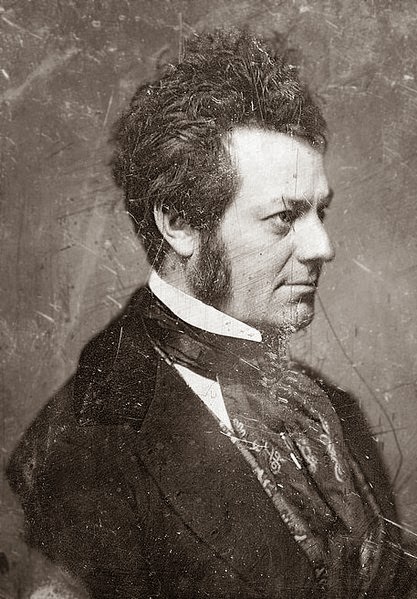
Macready, known as one of the world’s greatest Shakespearean stars, was soon rivaled by American actor Edwin Forrest, whose brawny, ragged style of performance endeared the audiences of the Bowery.  To many, these two actors embodied many of America’s deepest divides — rich vs. poor, British vs. American, Whig vs. Democrat.

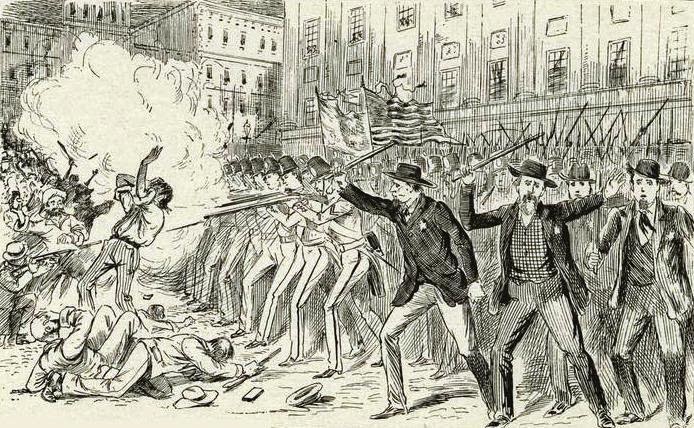
On May 10th, these emotions overflowed into an evening of stark, horrifying violence as armed militia shot indiscriminately into an angry mob gathering outside theater at Astor Place.  By the end of this story, over two dozen New Yorkers would be murdered, dozens more wounded, and the culture of the city irrevocably changed.

Listen Now: The Astor Place Riot Podcast


______________________________________________________

RIOT OR RIOTS?  You may have noticed in our podcast that we go from calling it the Astor Place Riot and the Astor Place Riots.  We both saw primary references to both the singular and the plural.  Though it was just one riot which occurred on May 10, the incidents on May 7 and May 11 constitute smaller riots or disturbances that lead up or were the result of the May 10 event.  The word ‘riot’ is not perfect either as it starts as a riot and ends as a massacre.

CORRECTION: In the podcast, I mention that John Jacob Astor lived in the line of stately buildings today known as Colonnade Row.  Although he built them, he never lived here.  However he moved his family into them, including his grandson John Jacob Astor III.  Cornelius Vanderbilt and Washington Irving also lived here.
__________________________________________________________

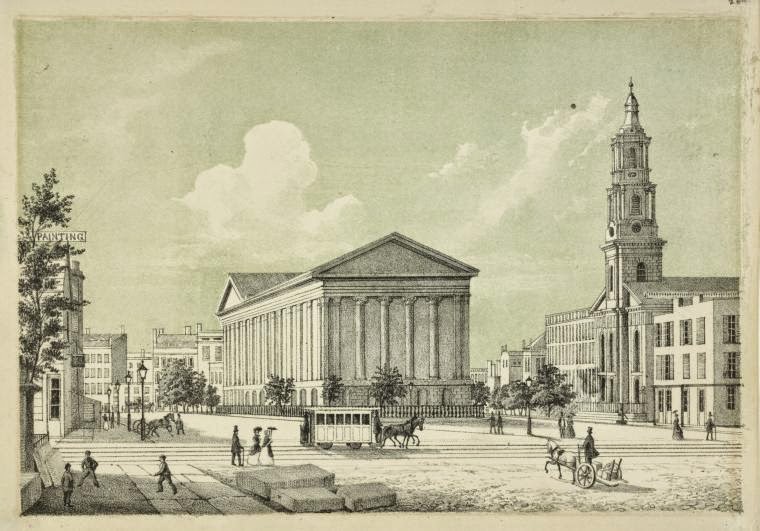
The Astor Place Opera House in 1850:

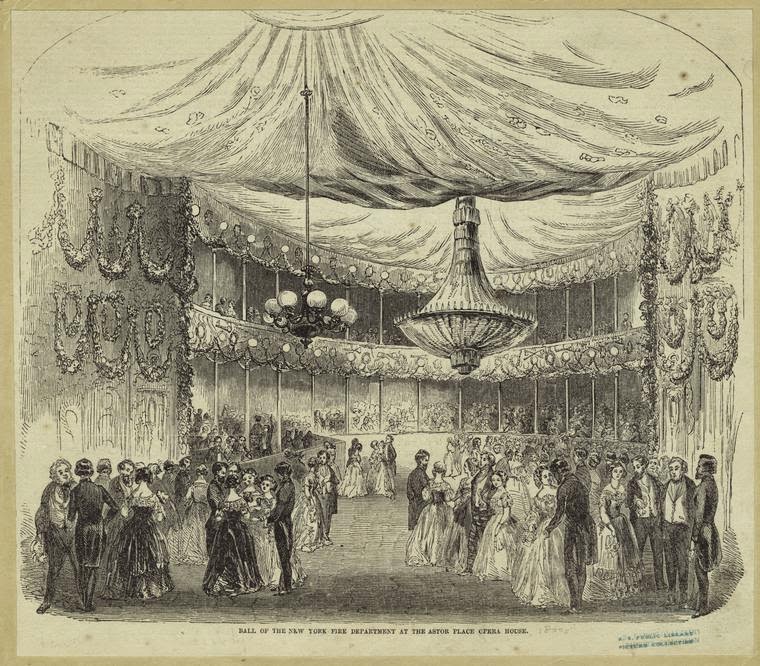
Inside the Astor Opera House, one of the most lavish spaces in all of New York in the 1840s.  Curiously, this illustration depicts a ball for the New York Fire Department.  Many members of the volunteer fire departments  actually set upon the opera house as part of the angry mob.

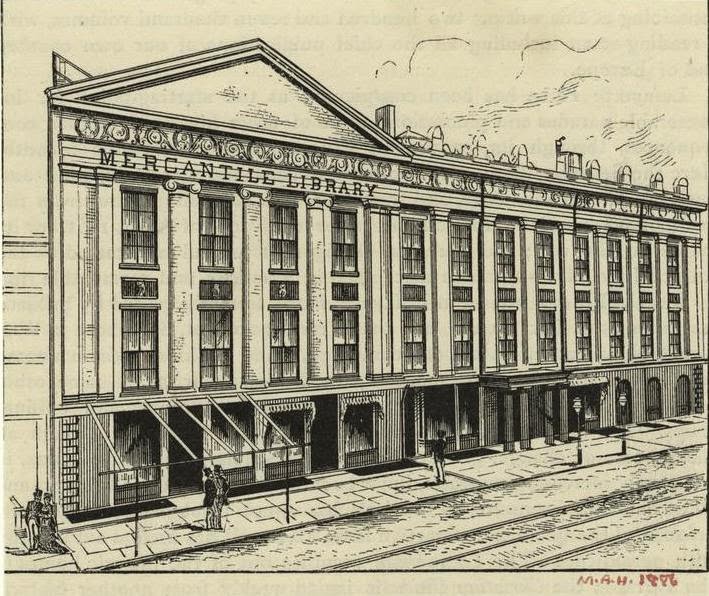
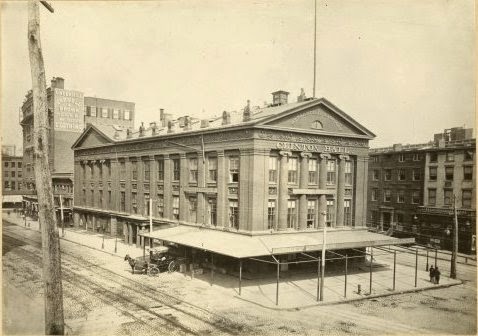
After the riots, the opera house quickly lost its cache. High society moved uptown to the Academy of Music (not so far away actually, on 14th Street, near Union Square).  The interior of the theater was eventually demolished and sold to the New York Mercantile Library and renamed Clinton Hall.

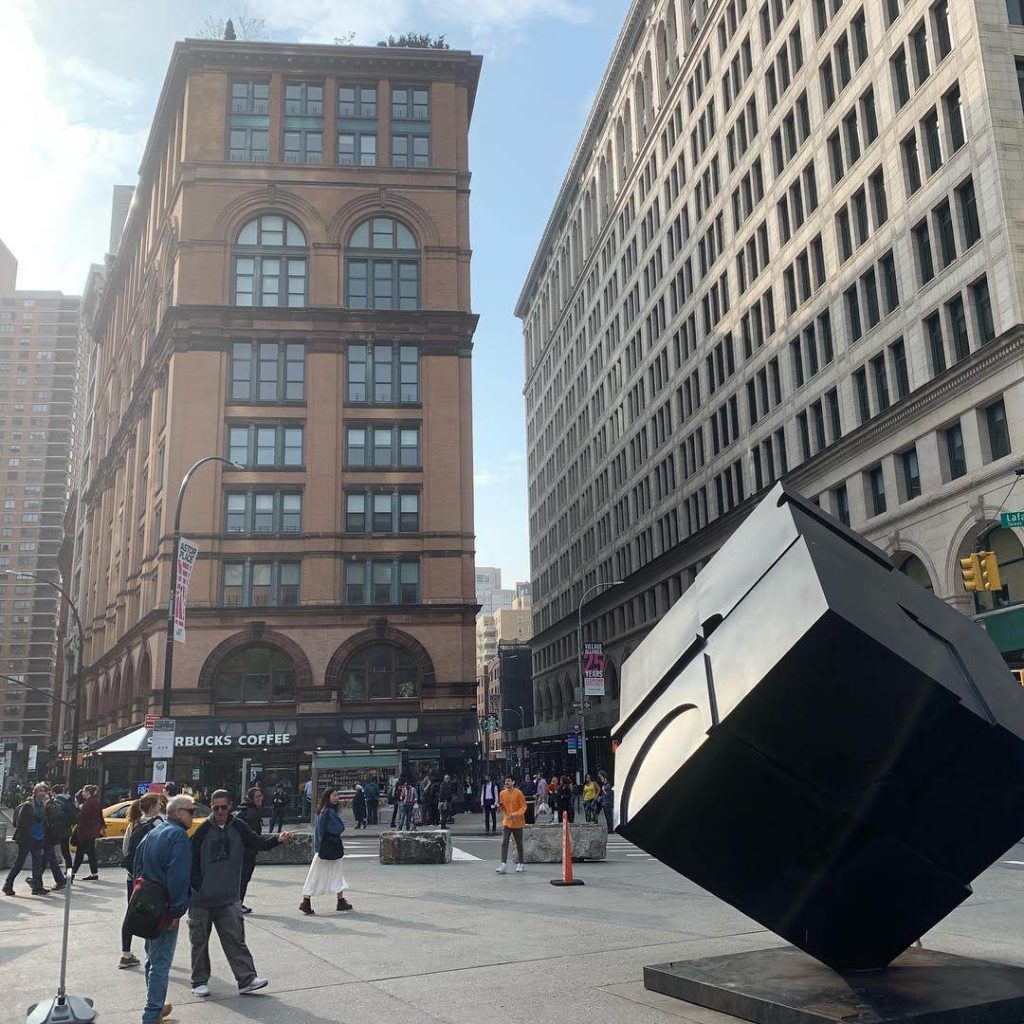
This was torn down in 1890 and replaced with the 11-story structure that stands there today.

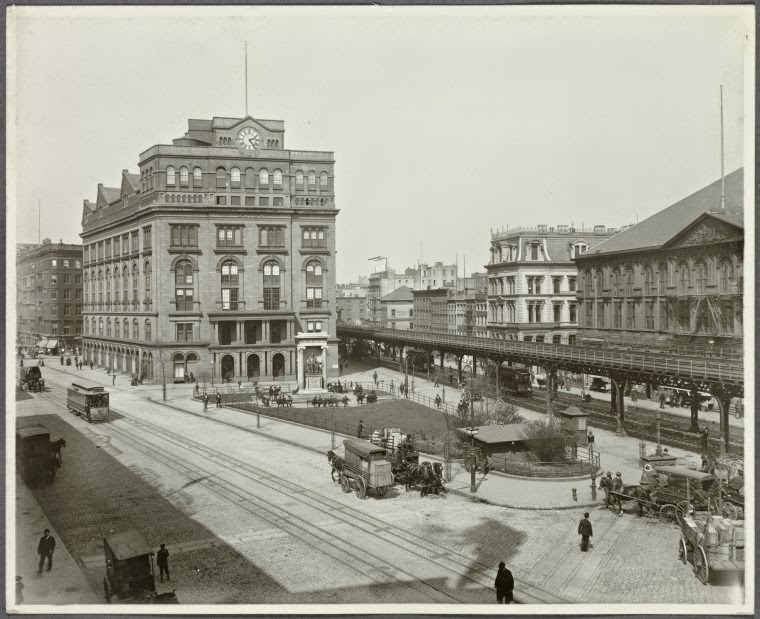
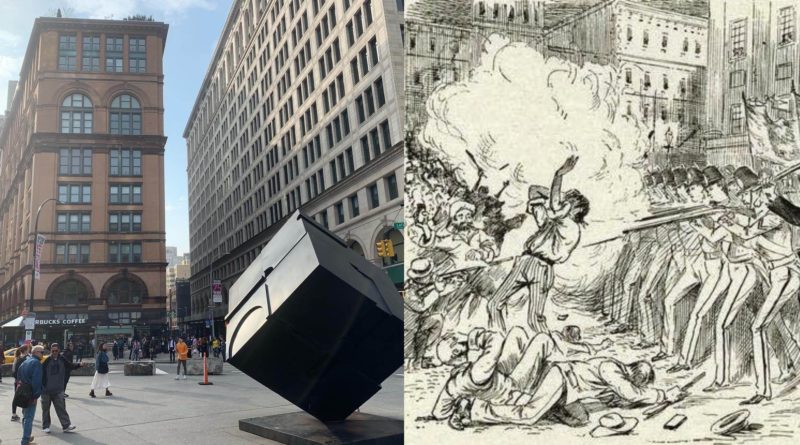
Many considered the demons of Astor Place purged when Cooper Union was finally constructed in 1859, a decade after the riots.  In this image, we’re looking up Third Avenue and the final remnant of the Bowery.  The Third Avenue Elevated has already been built here:

Astor Place in 2019:

William Macready:

From the New York Evening Post, May 1, 1849, advertising his May 7th show (which was interrupted by protesters).

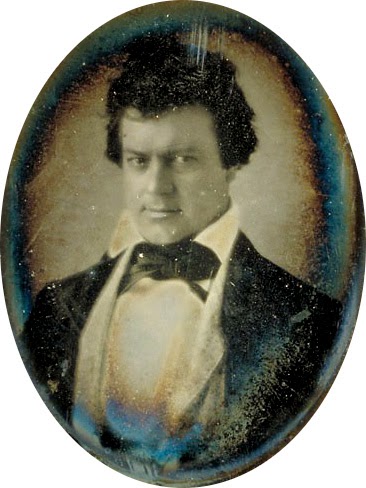
Edwin Forrest: In portrait and in daguerreotype

Images above courtesy the New York Public Library (except where otherwise noted).

FURTHER LISTENING:

We’ve been doing this for so long that we have MANY podcasts about historical landmarks in and around Astor Place. After you listen to this show, check out these older shows from our catalog:

Categories
Those Were The Days

Joyful mourning: The Lower East Side honors a forgotten star


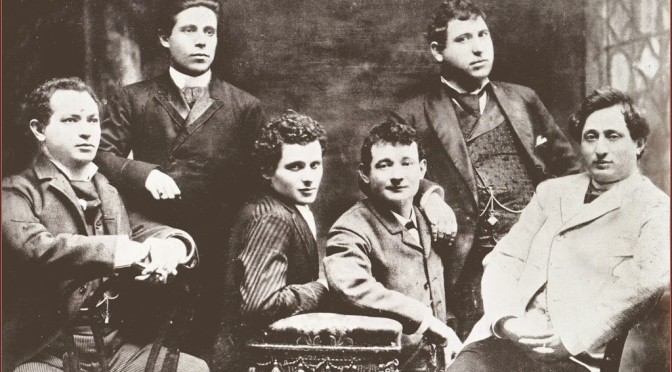
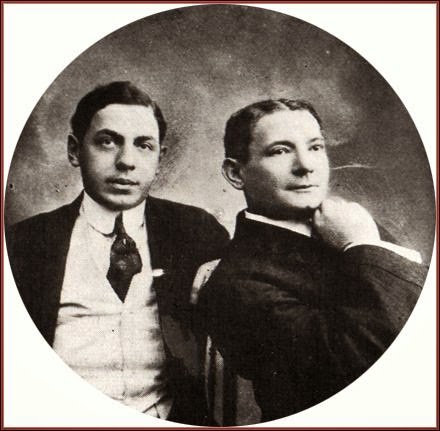
An extraordinary photograph of Yiddish theater stars!  Front row: Jacob Adler, Sigmund Feinman, Sigmund Mogulesko, Rudolph Marx;  Back row: Mr. Krastoshinsky and David Kessler


For a passionate sub-set of New Yorkers, Mogulesko was everything.

The Romanian-born theater star Sigmund (also written as Zigmund or Zelig) Mogulesko came to America in 1886 already a star of Europe’s Yiddish theater scene. Intrepid performers like Mogulesko helped create the Yiddish theater circuit during this decade — and, by extension, vaudeville as well, since so many of its performers would start here.

When he opened the Rumanian Opera House (later, the National Jewish Theatre) on Second Avenue and Houston Street, Mogulesko wasn’t just opening a stage. It became a vital instrument of the community and a key destination in New York’s thriving ‘little Broadway’, opera stages and vaudeville houses along Houston Street and Second Avenue uniquely catering to the immigrants of the Lower East Side.

Mogulesko became America’s most popular Yiddish theater star by the 1900s, a singer and comedian with an uncanny ability to pluck the heart strings. His debut in Coquettish Ladies required a myriad of costume changes, from old to young, male to female. A Jewish historian wrote, “A born genius he was, and his personality was as marvelous as his art.” [source]

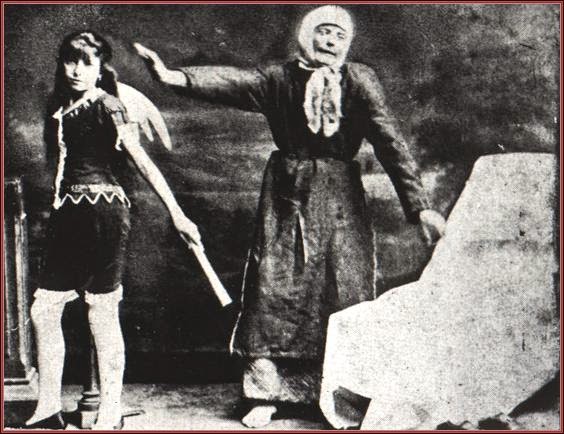
Below:  Mogulesko in Joseph Lateiner’s The Dybbuk (performed in Odessa in 1884) playing the character “Grandmother Eve”

At the same time, he was little known in other parts of New York. (He allegedly never learned to speak English.)  The more formal elements of the “legitimate” stage sometimes looked at the successes of the Lower East Side theater scene with bemusement and a little jealousy. “These alien citizens have a theater which they thoroughly comprehend and esteem,” said the New York Times in 1914. [source]

Mogulesko, at right, with his son Julius:

This accounts for the passion held by many for the performers of Yiddish stage, the embrace of an entertainment form that was undeniably theirs in language and custom.  And this also accounts for the great outpouring of grief when one of its most acclaimed stars — like Sigmund Mogulesko — passed away.

On February 4, 1914, the great actor died in his home at Stuyvesant Street, eliciting a response from the Lower East Side that, from the outside, must have appeared quite hysterical. (Below: From the New York Sun, February 7, 1914)

His memorial service at his theater on Houston and Second Avenue caused a spectacular riot of mourning.  Over 20,000 people arrived at the theater, fighting past 50 police officers swinging their clubs.  “The crowd tore the theatre doors from their hinges and shattered their glass panels.” [source]

A funeral procession lined the streets all along Second Avenue, from the Hebrew Actors Club (at 31 East 7th Street) to the theater.  The hearse transporting the actor’s body was engulfed “in the sea of those who hummed with queer breaks in their voices bits of the songs which had endeared the author to them.” [source]  Not since the explosion of the General Slocum steamship had the Lower East Side been filled with such intense grief.

Among those who spoke at his memorial service were Jacob Adler (father of method acting coach Stella Adler) and Boris Thomashefsky, a later inspiration for the Marx Brothers and Mel Brooks.  Sadness — and a certain kind of joy — permeated the service, his greatest roles and contributions to the local theater scene lauded.  It was now a vital industry of New York, one that would not have thrived as it did without him.

As Moguloesko’s coffin was taken from the church, drawn by eight black horses, and carried through the falling show, all of Delancey Street was lined with thousands of mourners, watching as the hearse, now obscured in a blizzard, headed onto the Williamsburg Bridge for its eventual destination — Washington Cemetery.

All photos (except the newspaper) from the Second Avenue Yiddish Theater Digital Archives.

Categories
Mad Men

‘Mad Men’ notes: A movie theater classic in its final days

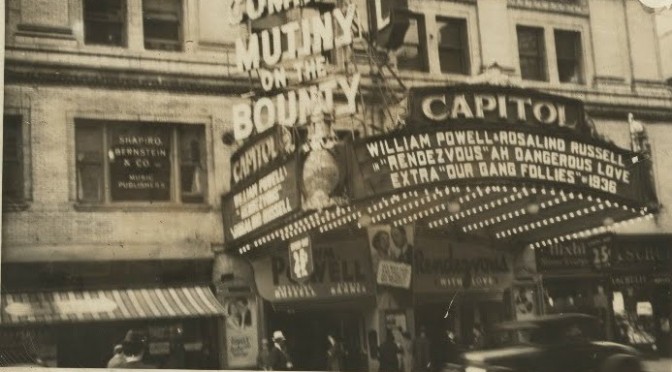
The Capitol in 1935, its feature attraction the spy thriller Rendezvous

Every Monday I’ll try and check in with the Mad Men episode from the night before and focus in on one or two historical references made on the show. Spoilers aplenty, so read no further if you don’t want to know….

While doing some background work on last week’s podcast, I came across an indulgent presentation in the New York Tribune of some elaborate new mural pieces by nearly forgotten painter William Cotton, installed in 1920 on the walls of the Capitol Theater, at Broadway and 51st Street. “The great mural paintings by William Cotton in the Capitol Theater stand to-day unrivaled. There are in America no decorations to compare with them.” (Take a look at these ‘unrivaled’ murals here.)

I crossed paths with the Capitol Theater again in this week’s episode of ‘Mad Men’. Most of the staff of Sterling Cooper Draper Pryce were attending an exclusive screening at the Capitol of the now-infamous Cassius Clay-Sonny Liston prize fight, waged in Lewiston, Maine, in May 25, 1965, a re-match between boxing powerhouses that help solidify the reputation of the future Muhammad Ali.

Like many locations previously featured on the show, the Capitol was past its prime by 1965 and would not make it out of the 1960s.

A movie house designed by architectural wizard Thomas W. Lamb, the Capitol opened in October 1919 and helped establish the template for lavish film palaces, with 4,000 seats, a 25 x 60 feet screen, and a stage large enough to host variety shows, classical music concerts and even radio broadcasts.

Not surprisingly, it was originally managed by Samuel “Roxy” Rothafel, of Radio City Music Hall fame.

By 1965, the stage productions had stopped, but the theater was still hosting spectacular film premieres such as the one on December 22 for ‘Doctor Zhivago’. As the unflappable Bosley Crowther dryly notes in his film review from that premiere: “In the three hours and seventeen minutes (not counting intermission time) it takes to move Robert Bolt’s dramatization of Boris Pasternak’s Doctor Zhivago across the screen, a few rather major things happen.”

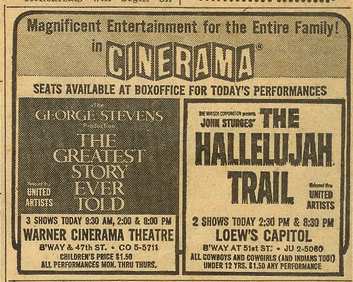
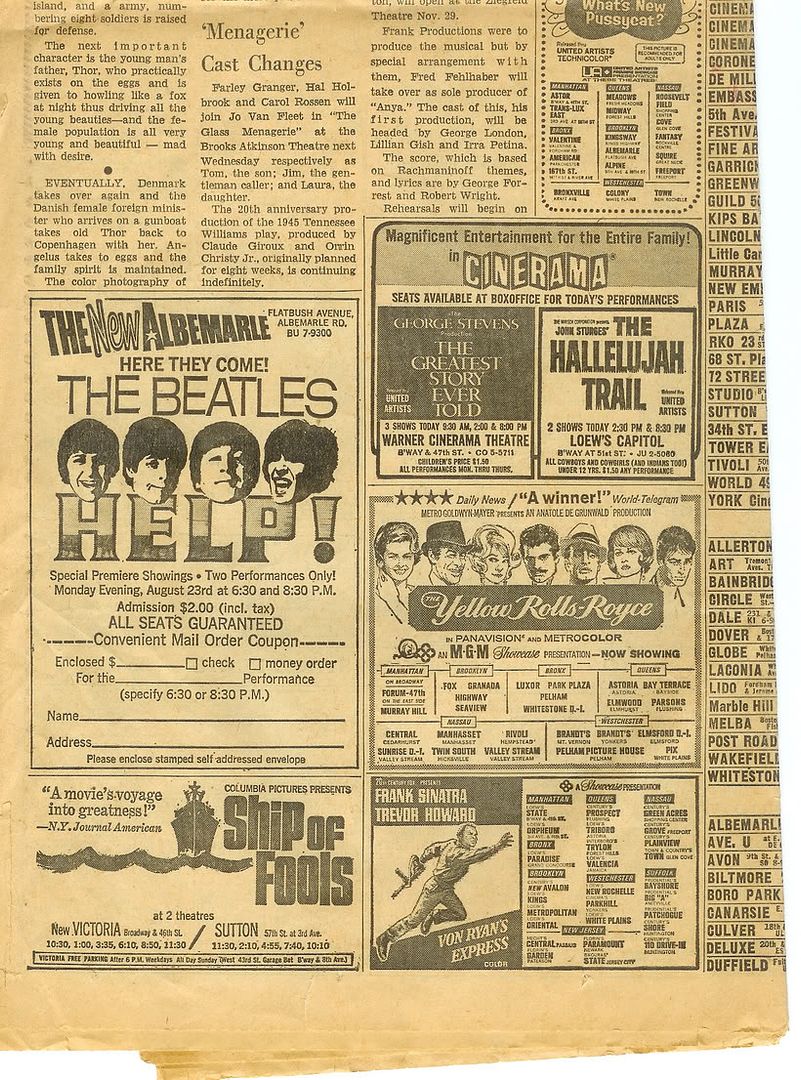
That June, for the now forgotten Burt Lancaster western ‘Hallelujah Trail’, the film studio United Artists threw a promotional barbecue in front of the theater that shut down Broadway.

The theater closed in 1968, but at least it went out memorably: its last two movies were Planet Of The Apes and (starting that April) 2001: A Space Odyssey, both in glorious Cinerama.

So, what’s sitting there now? Mars 2112 (and the Paramount Plaza office tower). It’s too bad they didn’t have Mars 2112 back in the 1960s; I’d love to see Roger Sterling get sloshed on their alien themed cocktails.

Coincidentally, by the way, our ‘Mad Men’ friends were attending a broadcast of a boxing match in a theater that sat only one block from the greatest live venue for boxing in the world — Madison Square Garden, when, in its third incarnation, it sat at 50th Street and 8th Avenue.

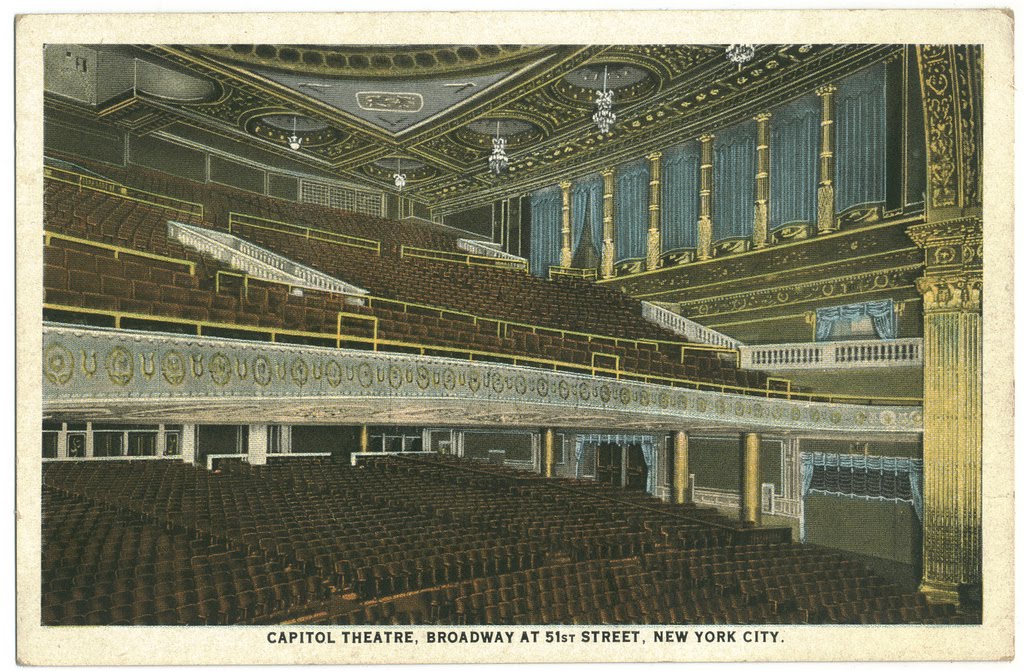
Below: the lush interiors at the Capitol Theatre

Top picture courtesy NYPL Digital Gallery. Movie advertisement courtesy Cinema Treasures You can check out a lovely picture of Times Square in the 1960s featuring the Capitol here

Categories
Uncategorized

Xenon and the strange journey of a Broadway theater: Noel Coward, Fellini, porn, disco, ‘Cabaret’, Dame Edna

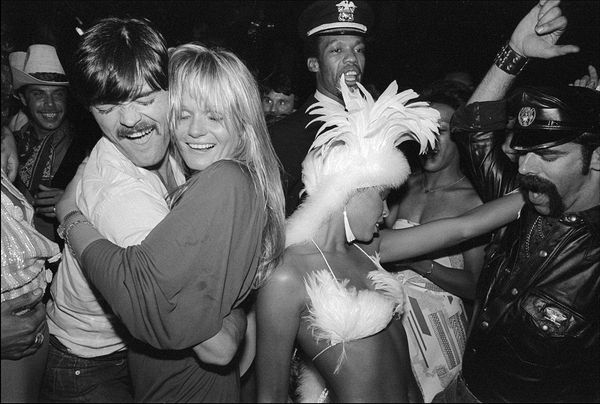
You know it’s a good night at Xenon when you’re drunk on the dance floor, and all of a sudden, the actress Valerie Perrine and the Village People appear (source)

FRIDAY NIGHT FEVER To get you in the mood for the weekend, on occasional Fridays we’ll be featuring an old New York nightlife haunt, from the dance halls of 19th Century Bowery, to the massive warehouse clubs of the mid-1990s. Past entries can be found here.

 LOCATION: XenonTimes Square, 43th Street and Broadway, Manhattan
In operation 1978-84

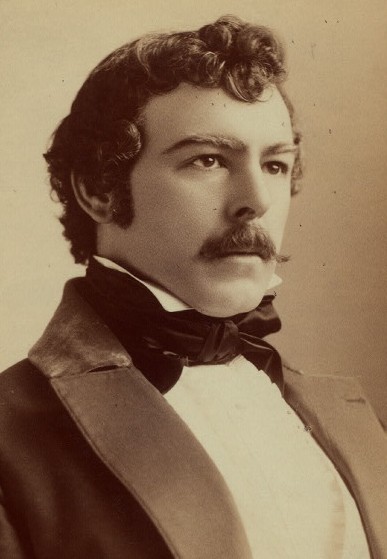
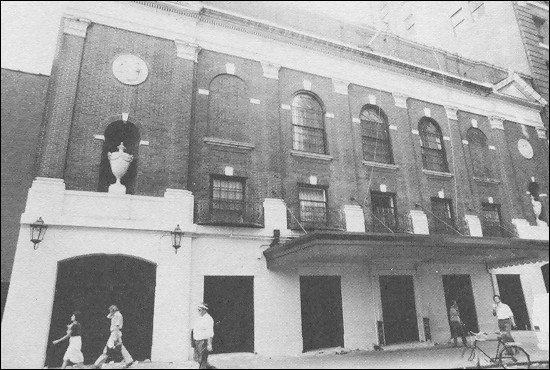
THIS, AT LEFT, IS HENRY MILLER. Clearly this is not the Henry Miller you more popularly know.

This Henry Miller would have never produced Tropic of Cancer. But his major contribution to the American stage would bring New Yorkers an iconic work of French cinema, a world famous theatrical revival, and one of the most successful Studio 54 knockoffs ever.

Miller was a minor theatrical star in the age of Sarah Bernhardt, who began dabbling as a director and stage manager at the same time that theater on 42nd Street began to flourish in New York. He became an early, respectable presence; from an early biography: “It was a foregone conclusion that a Henry Miller production must be in the best tradition of the theater.”

His timing was exquisite as well. The Broadway district in the 1910s was in full swing, with excitement at all hours. His patron (and progressive, feminist icon) Elizabeth Milbank Anderson assisted him in opening a stage in 1918 at 124 W. 43rd Street, a prime location near the theaters of Oscar Hammerstein, Klaw & Erlanger and Florenz Ziegfeld. The old New York Times building was half a block away, the nexus for New Years Eve celebrations for over a decade. Across the street rose the Hotel Metropole with its bustling late night antics; a few years earlier, in 1912, you could have stood in Miller’s lot and watched the bloody mob hit of gambler Herman Rosenthal — possibly ordered by New York cop Charlie Becker. (You can hear more about that in our Case Files of the NYPD podcast.)

There were no hits at Henry Miller’s theater, however, not the lucrative kind at least. In fact, the first show, The Fountain of Youth, was an unmitigated flop, opening in April 1918 and closing in May. (“This fountain of youth plays a very slender stream, and even that is of intermittent vigor,” claimed one review.) Famous names played here — George Gershwin, Billie Burke, Helen Hayes — but it wouldn’t be until Noel Coward debuted his scandalous, sex and cocaine-fueled comedy The Vortex in September 1925 that Miller’s theater would see its first in a string of major successes. Miller himself, however, would not enjoy these successes; he died a few months after Coward’s debut, in early 1926.

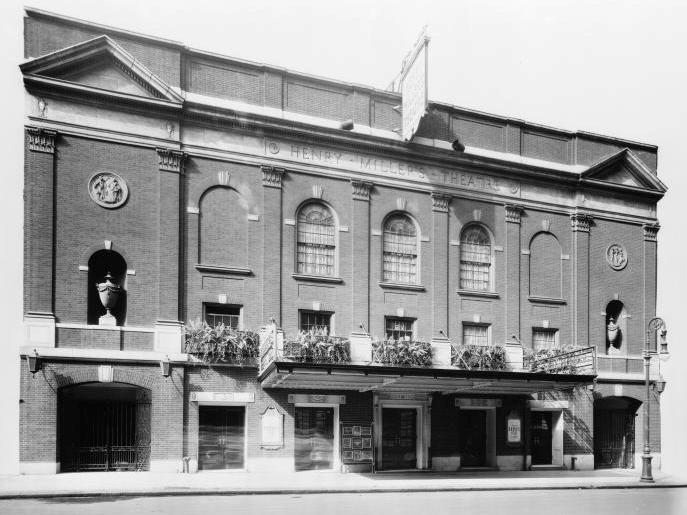
Below: Henry Miller’s theater, during its glory days. Photo courtesy NYPL

But Henry’s son Gilbert Miller had a knack for theatrical production even greater than his father. For three decades, he ushered countless box office hits through the Henry Miller’s Theatre, including the Tony winning T.S. Eliot play The Cocktail Party starring Alec Guinness. Most notably, Our Town would make its Broadway debut here in February 1938, and in 1957, a young British actress named Angela Lansbury would make her American stage debut here in Hotel Paradiso. Gilbert would win an honorary Tony in the mid-1960s for his contributions to the New York stage.

By then, however, the theater began flirting with a transition that many midtown stages had already made — into a legitimate movie house. Its first foray was also its most memorable, Federico Fellini‘s La Dolce Vita, premiering here in April 1961. The strangeness and theatricality of Fellini’s masterpiece fit the Henry Miller playhouse perfectly, even if the stage itself was technically ill-fitted for movies. The grumpy critic Bosley Crowther was even impressed: “Fellini’s “La Dolce Vita” (“The Sweet Life”), which has been a tremendous hit abroad since its initial presentation in Rome early last year, finally got to its American premire at Henry Miller’s Theatre last night and proved to deserve all the hurrahs and the impressive honors it has received.”
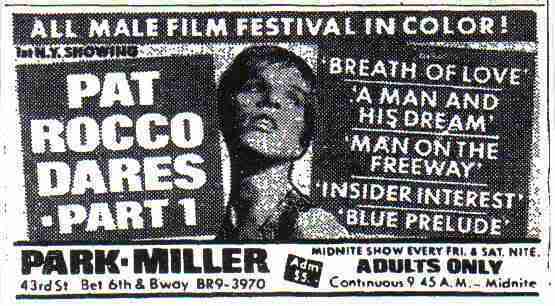
This might have been a harbinger for a fabulous future as an art house, however the theater was instead sold, renamed the Park-Miller, and entered the 1970s as one of Times Square’s most popular porno theaters, specializing in all-male features for gay audiences.

Although Henry Miller was certainly turning in his grave, the theater actually become quite successful, more so than most of Miller’s own productions during his lifetime.

According to author Hilary Radner, “the Park-Miller Theater on 43rd Street grossed in excess of thirty thousand dollars per week in the early 1970s….For a five dollar admission fee, audience members watched a mixed program that included shorts, slides, and a dubbed minifeature, such as Truckers — Men of the Road.” A long way from The Fountain of Youth, indeed!

Below: an advertising glimpse into the theater’s more prurient days

Everything changed in the spring of 1977 with the transformation of an old opera house into the superstar disco spectacular Studio 54, epitomizing the notion of nightlife as a headline-grabbing celebrity wonderland. One night at 54, music manager Howard Stein met Swiss restaurateur Peppo Vanini (the ex of actress Victoria Tennant), and the two cooked up a scheme to match the club’s glamour in another midtown location.

Stein purchased the old porn theater and remade it into the discotheque Xenon, although Xerox might have been a better name, for it adhered closely to the Studio 54 formula of flashy nights, big celebrities and kitschy showmanship (cannons with colored feathers, a neon X above the dance floor).

Being just slightly lesser a club than 54, you actually did stand a chance of getting in if you happened not to be a bold-faced somebody. But Stein would occasionally stand at the door himself “weeding out the detested middle class from the very rich and the colorful poor,” according to a New York Magazine profile.

Below: the club, during the day, in the 1970s:

Still, Xenon had its day, and on a typical hot summer night in 1979 or 1980 you might stumble into private parties hosted by Michael Jackson, Woody Allen, Lauren Bacall, Ben Vereen, or Pele. Inside you might hear deejay Jellybean Benitez.

Although people often stripped down to bikinis on the dance floor, you had fewer naked Grace Jones moments; Xenon “combined the craziness of Studio 54 with the comfort of Regine’s” according to one source, Regine’s being the more elegant nightclub entree owned by French chanteuse Régine Zylberberg.

With the end of disco came the end of Xenon, in 1984, and a brief attempt at turning the space into a rock ‘n’ roll venue called SHOUT! It lay mostly dormant, hosting temporary parties, until the early 1990s, when in a flash of inspiration, the Roundabout Theatre renovated the worn, abused little stage, combining all eras of its history to transform it into the Kit Kat Club, a cabaret venue fit to re-stage, naturally, Cabaret. That version, starring Alan Cumming and the late, wonderful Natasha Richardson, would go on to win the Tony for Best Musical Revival in 1998. Incidentally, that same year, a devastating construction crane accident next door closed the block for weeks, and Cabaret would be forced to move uptown to the former Studio 54.

Suddenly, all its prior incarnations seemed to enjoin to create its most successful reinvention yet. After Cabaret left, the hot off-Broadway show Urinetown moved in; that bawdy musical took three Tonys in 2003.

And then, they demolished it.

Saving the landmarked front exterior — with Henry’s name emblazoned along the top — the rest of the building was scrapped in a massive construction project that eventually put the Conde Nast Building to its west side and the Bank of America building to its north, to which a new theater was attached, using that old exterior and renamed the Stephen Sondheim Theatre. In the fine tradition of Henry Miller himself, the stage has features two shows — a revival of Bye Bye Birdie, and the Dame Edna musical All About Me — both flops.

For some great recollections of the glory days of Xenon, check out the website Disco Music. Featuring one commenter who says: “There’ll never be a club like it again. Pinball machines would drop out of the neon heavens and land next to dancers gyrating to ‘Funky Town’ by Lipps. Not to mention the fake snow (clearly an homage to the abundant cocaine passing through nostrils by one and all) that dropped on you, sticking to your favorite nylon shirt.”

100 Years Ago: Worst theatrical review ever written?

Readers of the New York Times on January 19, 1910, were greeted with the following theatrical review:

FAT PEOPLE MUST AVOID THIS FARCE;
Unless They Want To Put On Extra Pounds To Prove An Old Adage

If you’re confused, the lead of the review elaborates:

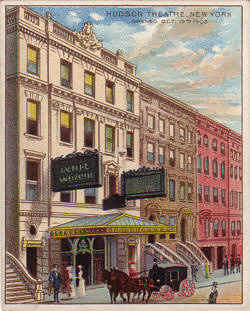
“If to laugh is to grow fat, obesity patients had better take to the other side of the road when they see the sign ‘William Collier in ‘A Lucky Star’ looming up in front of the Hudson Theatre on Forty-Fourth Street.”

This is actually from a glowing review of a new farce by Anne Crawford Flexner. Do you know anybody who says ‘to laugh is to grow fat’ anymore? Thank goodness that one died out.

Flexner, by the way, was a fascinating woman, an ardent feminist and suffragist whose daughter Eleanor became a revolutionary in the field of women’s studies.

Thanks to absurdly positives reviews like the one in the Times, Flexner’s ‘A Lucky Star’ continued on Broadway for three more months. Read the full review here.

Incidentally, the Hudson Theatre (141 W. 44th St., at left), now landmarked, is still around as convention space for the Millennium Broadway Hotel. Notably, the first production of Arsenic and Old Lace debuted here on January 10, 1941. Given all the news about ‘late night TV’ wars, you may be interested to know that it all started here: the first Tonight Show, with original host Steve Allen, was first broadcast here, at the Hudson Theatre, in 1954.

Wonderland: Walt Disney’s seven Big Apple moments

Yesterday’s news about a new Times Square flagship store for Disney had me wondering what influence if any New York had on the career of Walt Disney, arguably one of the most successful men in history to make his name on the West Coast. Come to find out, the world might never have had Mickey Mouse and the rest without one New Yorker in particular.

Here’s seven of the most significant New York moments for Walt Disney and the Disney empire:

1) Disney Discovered
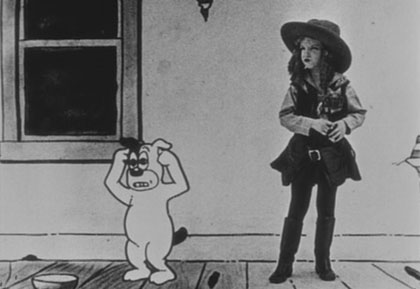
Small-time Kansas City animator Walt Disney spent much of 1923 writing New York film distributor Margaret Winkler, hoping she’d take a look at a new film he was creating, Alice’s Wonderland — a coy, self-reflexive mix of animation and live-action. He was lucky; Winkler was looking to put pressure on her biggest star Pat Sullivan (creator of Felix The Cat), and Disney’s strange little picture did the trick. She signed him and brother Roy, but retained editing control on the early ‘Alice Comedies’, inserting a Felix the Cat-like character named Julius, the first of hundreds of human-like animals in Disney films.

Winkler, by the way, was the first female film distributor in the United States and briefly one of the most powerful women in silent film — at a time when the film industry was centered on the east coast.

Below:one of the Alice Comedies

2) Steamboat Willie
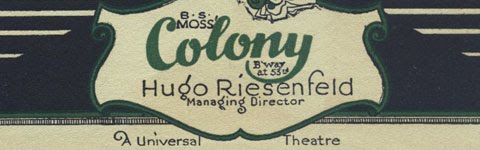
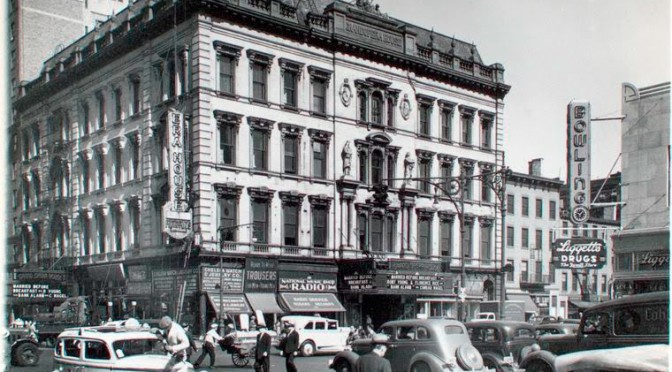
Disney would return to New York with his revolutionary ‘Steamboat Willie’, the first sound appearance of Mickey Mouse. On November 18, 1928, it quietly made its world premiere at the Colony Theatre (Broadway and 53rd Street, still around today as the Broadway Theatre). Sitting in the audience for everyone of its two-week performances was Walt himself.

Steamboat Willie was the opener on a bill of entertainment that also featured the film Gang War, starring Mary Pickford’s brother Jack, an alcoholic mess who once dated Olive Thomas who allegedly haunts the New Amsterdam Theatre. ‘Gang War’ would be his final movie role.

3) Snow White and The Seven Dwarfs
Almost ten years later, Disney’s first feature-length animated spectacle would have a far more grandiose reception — a five-week run at Radio City Music Hall starting in January 1938. The New York Times exclaimed, “They’re gay and friendly and pleasant, all of them, and so is the picture. Thank you very much, Mr. Disney, and come again soon.” As legend goes, the upholstery of several Radio City Music Hall chairs had to be replaced, as children wet their pants as the first sight of the Wicked Witch.

Strangely, the film was later paired with an ice-themed short, Ski Flight, because during winter there’s nothing people like to do more than sit and watch ski movies.

4) Fantasia
Disney’s trippy concept film closed the loop; as one of Disney’s first self-distributed films, it premiered November 13, 1940 at the same theatre that had once shown Steamboat Willie, only this time it was called the Broadway Theatre. (Today it’s a mainstream musical stage featuring Shrek the Musical).)

There was more drama behind the screen than in front. One scene (“Ave Maria”) had to be redeveloped, flown to New York and was literally spliced in with four hours to go before showtime.

5) The Worlds Fair 1964-65
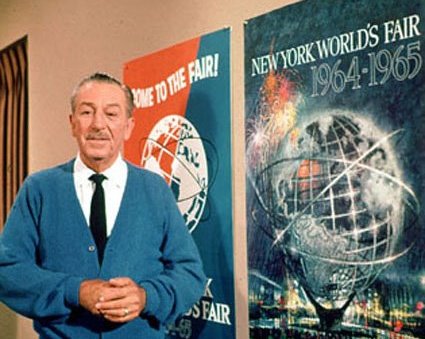
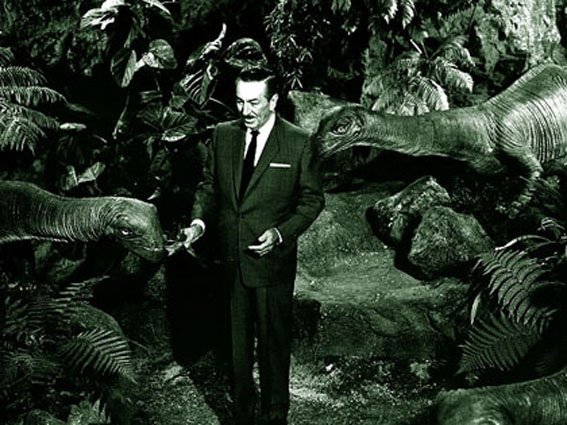
The Worlds Fair of 1939 had clearly had its influences on Disney’s future theme parks. So it was only natural to bring him in as a consultant for Robert Moses’ crowning concrete spectacle of 1964. Disney Studios brought animatronic dinosaurs to life in the “Magic Skyway” for the Ford Motor Company pavilion (see picture below), a talking Abraham Lincoln, and of course ‘It’s A Small World’. Many more pictures of Walt behind the scenes at Disney and More.

6) Disney rewrites Broadway
Less than thirty years after Walt’s death, the company enters — and promptly conquers — a new frontier: Broadway. Beauty And The Beast became its first permanent Broadway production when it opened in April 18, 1994. The swirling gala of dancing utensils and candelabras won the Tony for Best Musical, fueling a run that would make it the sixth longest running show in Broadway history and opening the flood gates of Disney-themed shows.

By the time ‘Beauty and the Beast’ closed in 2007, Disney had changed the rules of the Broadway musical and the actual physical makeup of 42nd Street itself, leading to the sanitation (i.e. ‘Disney-fication’) of the once-seedy boulevard

7) And hits Fifth Avenue, too
The invasion wasn’t just on popular entertainment, but on the heart of New York retail. The first Disney store opened on Fifth Avenue on May 22, 1996. Ushered in by mayor Rudy Giuliani and Disney CEO Michael D. Eisner, thousands of shoppers flocked to the retailer, at the time setting the record for single-day sales at a Disney store. That’s an awful lot of mouse-eared Statue of Libertys.

The company just announced that this ‘World of Disney’ location, at 55th Street, would be permanently closing next year, to make way for Disney’s Time Square plans.

I should end by adding that when Disney moved in during the 1990s, it had kicked out a New York City institution — the famous French restaurant La Côte Basque, a “high-society temple” and favorite of Jacqueline Kennedy Onassis. The eatery moved around the corner but only lasted a few more years.

Chelsea’s old Opera House: from robber barons to BBQ

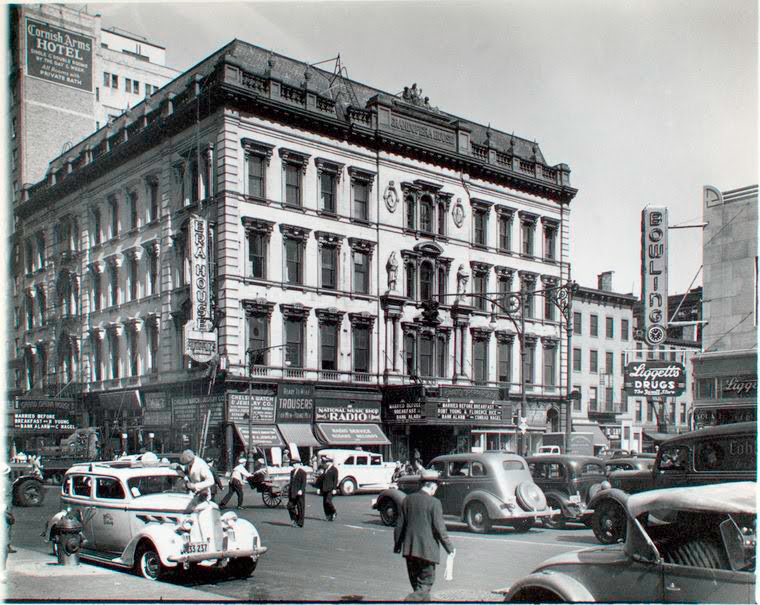
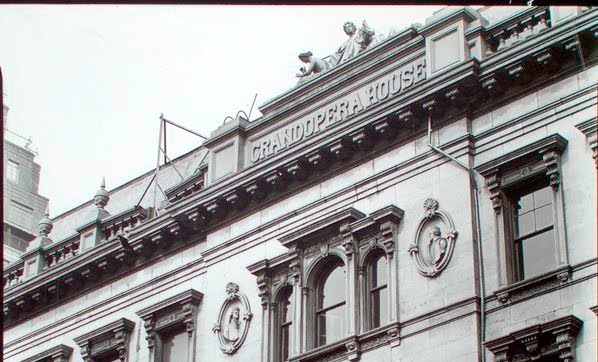
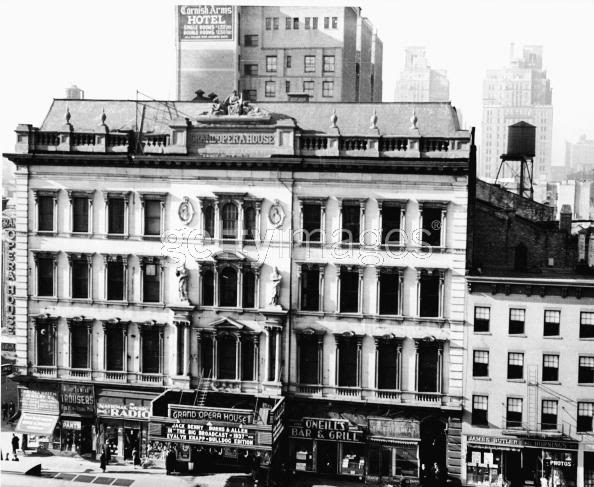
In last Friday’s podcast on the Hotel Chelsea, I mentioned a building that was located very near by called the Grand Opera House, at the northwest corner of 23rd Street and 8th Avenue. Here it is:

The opera house sprang up in 1868, the project of Samuel N. Pike, who purchased the land directly from Chelsea estate owner Clement Clarke Moore himself. In fact, the original Moore estate was only a block away.

The Pike Opera House, as it was called in those days, was Pike’s play for legitimacy in New York. A German immigrant who arrived in the U.S. in 1837, Pike lived in New York for a few years and made his fortunes in wine imports. Aspiring to upper-crust tastes, Pike fell in love with opera music after viewing performances by PT Barnum chanteuse Jenny Lind.

Pike constructed a massive opera house in his adopted home of Cincinnati in 1859 and many years later built a companion here in Manhattan at 23rd Street. Pike’s timing was off; theaters would crowd along 23rd Street in the coming years, but in 1860s, the wealthy preferred the Academy of Music down on 14th Street.

So the next year, Pike sold his lavish hall to two rather unlikely investors — Jim Fisk and Jay Gould, grade-A robber barons, pals of Boss Tweed and the orchestrators of the Black Friday Panic of 1869. Why would these two nefarious characters want an opera house?

The house’s upper floors doubled as the offices of their own Erie Railway venture. Fisk’s mistress Josie Mansfield was frequently installed into productions at the newly named Grand Opera House; it was even rumoured her next-door apartment was connected to the opera house with an underground tunnel.

However it does seem that Fisk and Gould were legitimately aficionados of the theater, or at very least fans of the elite who would attend them, and the profits that would follow. The Grand Opera House would soon showcase a great number of theater endeavors outside of opera.

Mansfield would prove Fisk’s downfall; her other lover Edward Stokes shot him in 1872. Mourners could stream through the lobby of the Opera House and observe Fisk’s body laying in state there. Gould would operate the Opera House for several years afterwards, eventually renting it out to vaudeville shows and ‘second-run’ Broadway productions, its fortunes disintegrating as theater moved uptown and the Chelsea neighborhood became more middle-class.

Like many old stages before it, the Grand Opera House switched to films in the 1920s. RKO tried its best to rehabilitate the space, hiring Thomas Lamb to renovate the theater with modern flourishes, reopening the space as the RKO 23rd Street Theatre. The picture below is actually from the year before the renovation, which stripped away some of the the Grand Opera’s frippery:

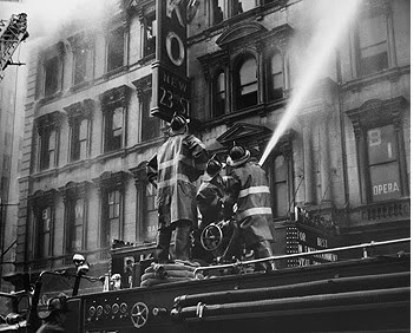
The site remained a movie house through the 40s and 50s, finally closing on June 15, 1960. In a further indignity, the Opera House was thoroughly gutted in a fire (seen in the picture below (courtesy Cinema Treasures):

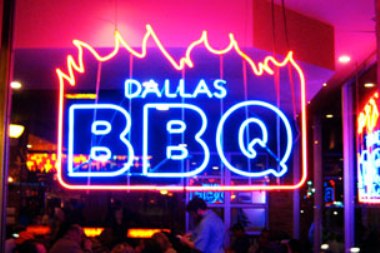
And thus it was time — to put in a strip mall! Today you can visit that very corner and enjoy a rather enduring Chicken Delight location or stop and have a Texas-sized margarita at the corner Dallas Barbecue.

Sarah Bernhardt’s favorite New York landmark

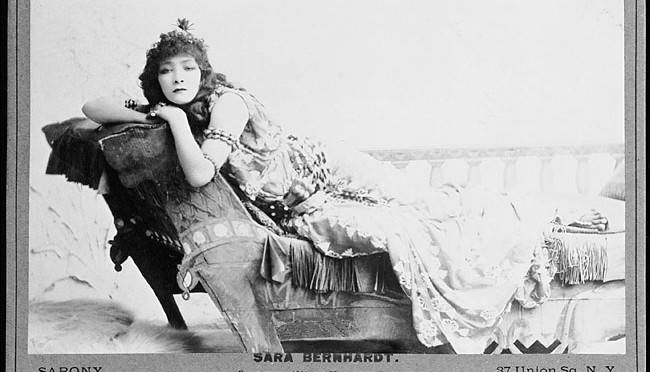
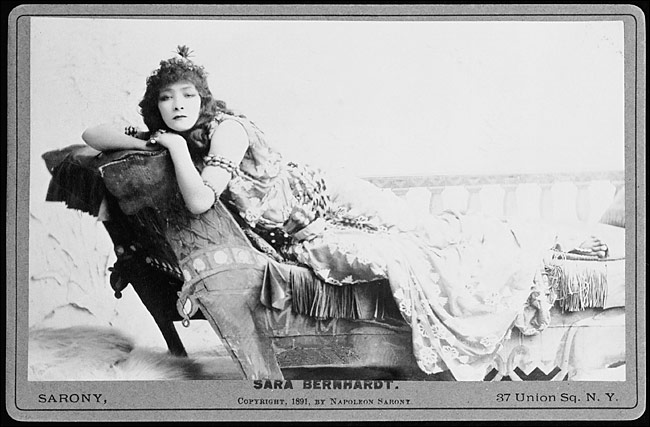
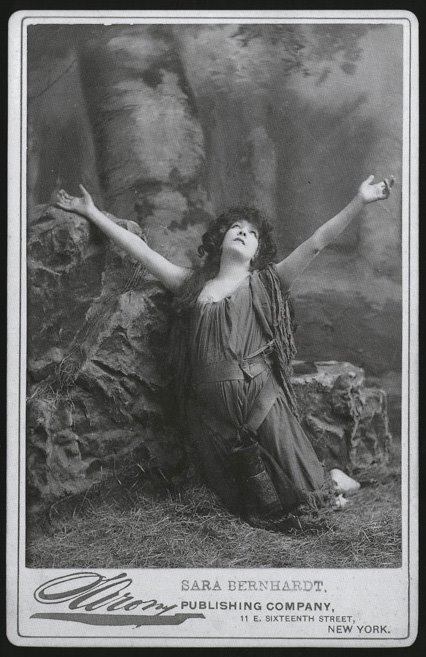
Sarah Bernhardt may be the most famous and most mysterious actress who ever lived and certainly “the greatest celebrity of her era.” Working mostly in the days before recorded medium (there are exceptions), Bernhardt crafted a legend matched by outrageous behavior and provocative stage performance. Naturally, she brought both with her when she came to New York City for her first American tour in 1880 to present the first of many signature roles, Adrienne Lecouveur.

The French actress, lauded as one of Europe’s greatest commodities, didn’t exactly crave a visit to America. Leaving for New York on October 1880, Sarah “was in utter despair, weeping bitter tears, tears that stained my cheek,” according to her autobiography. New York had no such hesitation. When her boat arrived two weeks later into a strangely frozen New York harbor, it was greeted with smaller steamers, filled with fans and decorated with French flags. They feted her onboard in a lengthy, drawn out ceremony of admiration.

Her response? Feeling slightly woozy, “I decided therefore to faint.” She fell gently into waiting arms, people rushed to her attention until “it was time to come to my senses again.”

She stayed that evening at the luxury Albermarle Hotel at Broadway and 24th Street where she blocked her door with furniture to keep other well-wishers and journalists out.

Bernhardt’s auto-biography is so steeped in extremity that you assume she must be exaggerating. Alexandre Dumas did call her a “notorious liar”, but the fact that it took Alexandre Dumas to make that proclamation underscores the exotic circles and experiences in which she traveled.

She greatly distrusted the press who she believed willfully printed lies about her (even when the lies were fed to them by Bernhardt’s own management.) At a press conference at the Albermarle later that day, she dismissed even the simplest questions, especially bristling when she was asked about her religion. “Oh Heavens! Will it be like this in all the cities I visit?”

Two days later, she arrived to rehearse at Booth’s Theater, the tony stage built by theatre legend Edwin Booth (John Wilke’s brother) and located near her hotel, at 23rd and 6th Avenue. Her reaction at seeing fans gathered outside to greet her: “These strange-looking individuals did not belong to the world of actors….with their white neckties and their questionable looking hands.”

Inside the theater, she was finally reunited with her 42 trunks of gowns and costumes — briefly and offensively seized by customs, a “chiffon court martial” — and ordered her underlings to open and inspect each container. So horrified was she at the lowly people opening her possessions that she could only grit her teeth and stand in a state of utter mortification. In fact, the experience exhausted her so much that she failed to even rehearse at all that day.

She would later go on to interact with every strata of New York culture, some more friendly than others, appealing more to liberal minded (and daring) social elites than the stalwarts of Mrs Astors storied Four Hundred. Which seemed fine with Sarah; she didn’t want to meet them either.

But for all her condescension that week, for all the superiority and righteousness, there was one thing that stopped her in her tracks. Believe it or not, something actually gave the legendary imperious actress pause.

It was Bernhardt vs. the Brooklyn Bridge, and the bridge won. In 1880, it wasn’t even fully completed, yet in her recollection, it was as if it were bustling with traffic. “Oh, that bridge! … One is proud to be a human being when one realizes that a brain has created and suspended in the air….that fearful thing.” The magnificence of the bridge, its extraordinary scale, filled her with “a strange, undefinable sensation of universal chaos.”

Yet she was able to sleep peacefully that evening, “reconciled with this great nation.” And all it took was for something to make the mighty actress feel small.

She would come many, many times to New York and onward to other major cities. By 1910, her tolerance of America was enough that she endeavored to perform future productions in English. (Up until then, all of her performances were rendered in French.)

I highly recommend peeking into her pompous, overblown autobiography My Double Life (well out of print, although Google Books has a copy to review). Simply flip to any random page and get a whiff of her powerful perfumed prose. They seriously do not make them like Sarah Bernhardt anymore.

Below: the spectacular Booth’s Theatre, where Sarah Bernhardt made her U.S. debut on November 8, 1880. It was located on the southeast corner of 23rd and 6th. Today the building there contains a Best Buy and an Olive Garden.

P.S. It appears that Sara and Sarah were interchangable back in the day. You’d think this discrepancy would have driven the poor thing to the fainting couch.

Categories
Uncategorized

Jimian? The strange affair of Lillian and Diamond Jim


Had there been a paparazzi in the 1880s, the woman they would have hounded the most would be New York stage singer and actress Lillian Russell. Like a Scarlett, she was always hanging on the arm of a famous, powerful man. Like an Angelina, she did dramatic things in her personal life that often upstaged her work. And like a Britney, she was occasionally caught doing things most unbecoming for a lady.

Celebrity fame in those days derived primary from legend and word of mouth; most of the people who idolized Russell had never seen her, in anything. As P.T. Barnum aptly demonstrated with Jenny Lind in the early 1850s, nobody actually needed to hear you sing to become a famous singer; you just had to be desired as one.

Russell (as Helen Louise Leonard) came to New York from Iowa in 1878 to become a opera star, managing to train under no less than Leopold Damrosch, whose son Walter was intimately involved in the creation of Carnegie Hall. The next year, she changed her name to Lillian Russell.

She made her name thanks to Tony Pastor, a vaudeville showman who presented a wide range of acts at his Union Square music hall. Her sweet singing voice and good looks made her perfect for the comic opera circuit, and she quickly became the toast of New York theatre. She eventually toured Europe, hopped from opera company to opera company, and became the first voice in travel over long-distance phone wire in 1890, thanks to admirer Alexander Graham Bell. (She sang the ‘Sabre Song’ to listeners on the other line in Boston and in D.C.)

But it was her penchant for glitz, and roster of suitors that made her a legend among celebrity seekers. She would breeze through four different tempestuous marriages with an actor, a politician, a composer and a newspapermen, but she would be most famous for the one man she didn’t marry — ‘Diamond’ Jim Brady.

Brady was a legend of the Gilded Age, a wealthy businessman who embodied indulgence. Enamored of wearing jewels (thus the nickname), Brady painted the town with his money, a frequent and well-known guest at all the hottest restaurants in town, especially Delmonico’s and later Luchow’s.

He was known for his sizable appetite, a usual evening meal at Charles Rector’s restaurant involving “two whole ducks, six or seven lobsters, a sirloin steak, two servings of terrapin and a variety of vegetables.” And, in the process, growing terribly, unbelievably fat.

He began a public flirtation with Russell that lasted throughout the 1880s and 1890s(throughout her various marriages!) by wooing her with jewels and fancy meals. They made quite a pair. Two celebrities in their thirties, their rubies and diamonds twinkling under gas light in the most exclusive dining room in the world. Oscar Tschirky, later to become the leading chef at the Waldorf-Astoria, got a job at Delmonico’s in his early years just to get a closer glimpse of Russell.

He would see quite a lot of Russell’s eating habits, keeping up with Brady as the pair shucked down oysters and drank champagne, her gluttonous abandon leaving little of her glamorous image intact. Like any actress today, her weight was closely observed, as during her years with her extravagant paramour, she blossomed to 160 pounds.

It seems clear that Brady was in love with Russell, and that Russell was in love with Brady’s attentions. Their public affair crept into the new century as Russell became the defining voice of American operetta. She went on to marry newspaper publisher and later U.S. ambassador Alexander Pollock Moore, and even toured Europe in her later years on behalf of president Warren G Harding. She died in 1922.

Diamond Jim (below) had died five years previous, having never married, with Russell still presumably in his heart, and god knows how many pounds of oysters in his gut.

The REAL story behind those confusing numbers

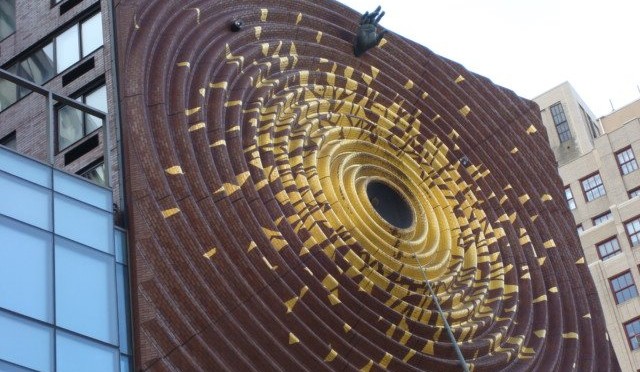
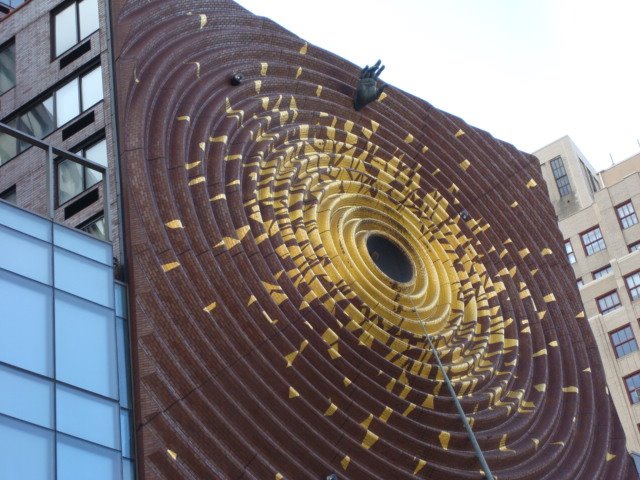
Some architectural monstrosities just beg to be ripped upon. Topping this list is One Union Square South, a bland 33-story structure and pioneer in the mall-ification of Union Square. Although its storefronts feature a Circuit City and a dying Virgin Mega-store, One Union Square South is defined by a piece of public art that has only gotten more atrocious and weird over time.

The Metronome was a project three years and $3 million in the making when it was finally installed in February 1999. It has confused and horrified New Yorkers ever since. The 100-foot Kristin Jones and Andrew Ginzel display features a brick wall striated with the undulations of water waves, interrupted with such objects as a boulder, a long tube frozen in the swing of a ‘metronome’, and a sphere which registers the moon cycles. Smoke occasionally burps through the hole in the middle, and a gigantic hand — modeled after the hand of George Washington across the street on his equestrian statue — beckons the viewer to stop and gawk at it.

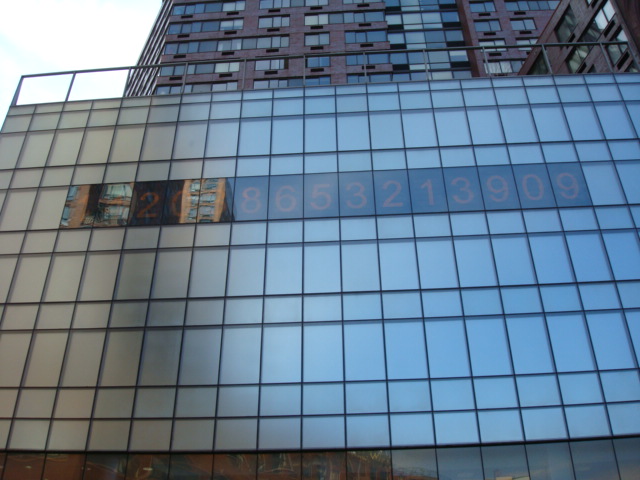
Nearby is a row of 80s-era calculator digits, rolling at different speeds. The six numbers on the left indicate the proper time (i.e. 9:34 am and 21 seconds = 093421).

The six numbers on the right display the amount of time before midnight, except to be quirky, they put it backwards. So, using the prior example, there are 14 hours, 25 minutes and 39 seconds to midnight. In Metronome world, you write that as 392514.

The three digits in the middle are too blurry, presumably in the rush of micro-seconds. (Except, of course, when you take a picture of it.)

Since this piece begs the viewer to speculate the passage of time, perhaps its time to speculate what sat here at One Union Square South before this dated piece was even here. (To be fair, the piece seemed dated the moment it was installed in 1999.)

One Union Square South replaced the less glamorous address 58 East 14th Street. Passersby in the early 90s saw it as a frumpy building with modest retail space dominated by a gigantic McDonalds sign. What many may not have known was that this building contained the oldest theatrical space in Manhattan.

Rumors of this secret stage had persisted since the 1970s, but it wasn’t until some clever detective work by a New York Times reporter verified in fact interior walls were built during its transition into retail space, severing the stage from a vast auditorium, sitting empty for decades.

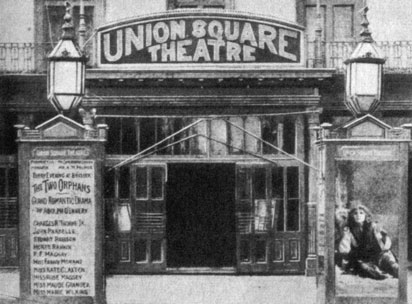
It had once been the Union Square Theater. In its final days of operations, from 1896 until the late 30s, it had been a cinema for silent features and ‘racy’ pre-code pictures. As with many stages, it converted to showing films after a brief stint from 1893 to 1896 as a vaudevillian showcase. The stage saw the debut of a young entertainer named George M. Cohen, who was originally supposed to perform with his family The Four Cohens. But owner B. F. Keith needed to fill up his bill, so young Georgie took the stage himself and the boy was greeted with apparent indifference. (You can see a variant of this event in the film ‘Yankee Doodle Dandy’.)

Before the racy films, before Cohen and the vaudeville, the Union Square Theater was a legitimate stage, showing mostly unsuccessful fare such as the un-intriguingly named ‘A Woman’s Strategem’. That show was apparently significant enough to merit articles about the details of the leading lady’s costumes — “a very quaintly-designed morning gown of crepe,” “a very handsome broche with bodices of the Directoire period and point de gaze’ lace sleeves.”

The early days of the Union Square Theater sound a lot more engaging. When it opened in 1871, it was advertised as a ‘modern temple of amusement’, showcasing everything from burlesque to ballet. Its brief foray into legitimate theater — the kind that could feature costumes of ‘quaintly-designed’ crepe — came only after a small fire gutted the balcony in 1888.

Peeling time back further, we find that the Union Square Theater was carved out of the remnants of vast dining room of an old hotel the Morgan House, which was itself the five-story modification of the original building on this spot — the Union Place Hotel, built in 1850.

A descriptive 1861 travel guide refers to the Union Place Hotel as an ‘elegant establishment’, and truly this was Union Square’s high-class heyday, of upper-crust homes surrounding an earlier version of the square inspired by lush English gardens.

A cheeky 1852 guide to the city called Glimpses of New York — written by “a South Carolinian (who had nothing else to do)” — describes it as ‘kept in equal style to the New York [Hotel, one of the superior hotels of the time] and the charges are a grade higher.’

Among many famous guests of the hotel were Mary Todd Lincoln in the years after the death of her husband.

Union Square eventually became the heart of New York’s theater district, and apparently the Union Square Hotel was a bit of a hangout for the out-of-work. Dwight’s Journal of Music proclaims “…at the Union Square Hotel, there is always a host of unemployed managers and actors.”

Luxury hotels and out-of-work actors — some things about New York haven’t changed a bit.

The Summer Blockbuster of 1928

On this day, 79 years ago in 1928…

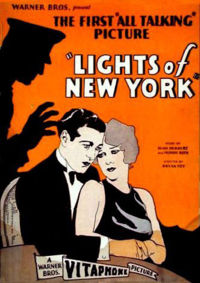
The first ever all-talking movie, “The Lights of New York” debuted in New York’s Strand Theatre at midnight, to an enrapt audience. (It would release nationally on July 28)

“Lights of New York” was a precursor to the great crime films of the 30s that would make Edward G Robinson and James Cagney into huge stars. The plot involves Broadway speakeasies, chorus girls and ‘toughies’, featuring a cast of vaudevillian entertainers.

The film was a box office smash (grossing $2 million dollars, or what Tom Cruise makes for a single day of work today) and presaged the death of the silent era.

Of course, they hadnt quite got the art of editing down, and the film still included ‘transition’ placards.

The Brooklyn Eagle has a few charming anecdotes about the filming:

“In one scene in a barbershop, a character began a speech at one end of the room, walked across the room, and started talking again only when he had come to a complete rest at the other end. He could not speak until he had parked himself under the mike.”

The Eagle also notes the film’s other contribution to the world of cinema: it’s the first of many, many, many gangster films to feature the line “Take him for a ride.” Martin Scorcese and The Sopranos thank you kindly.

Oh, and you might be asking — where’s the Strand Theatre? A premier auditorium for film and Big Band shows for over 70 years, The Strand was demolished in 1978. But you can go see where it used to be; the former address is 1579 Broadway. There’s a Hershey’s Chocolate Super Store there now.

Cinema Treasures, one of our favorite websites, has an elaborate write up on the fate of the Strand.