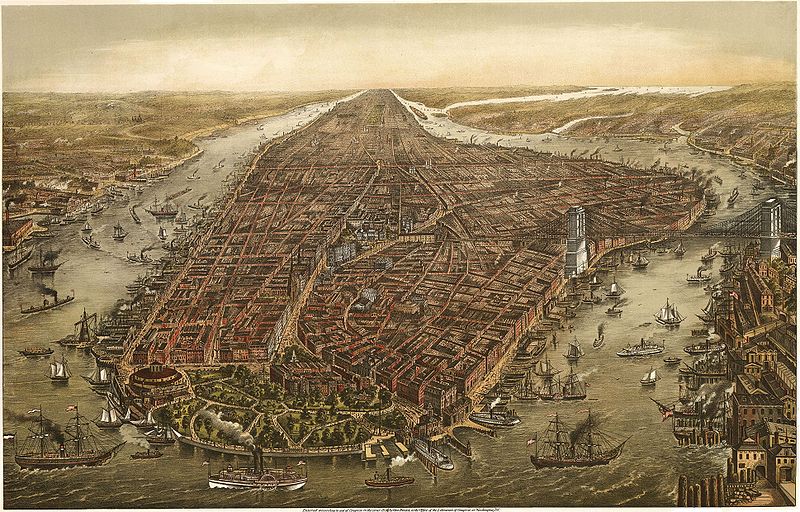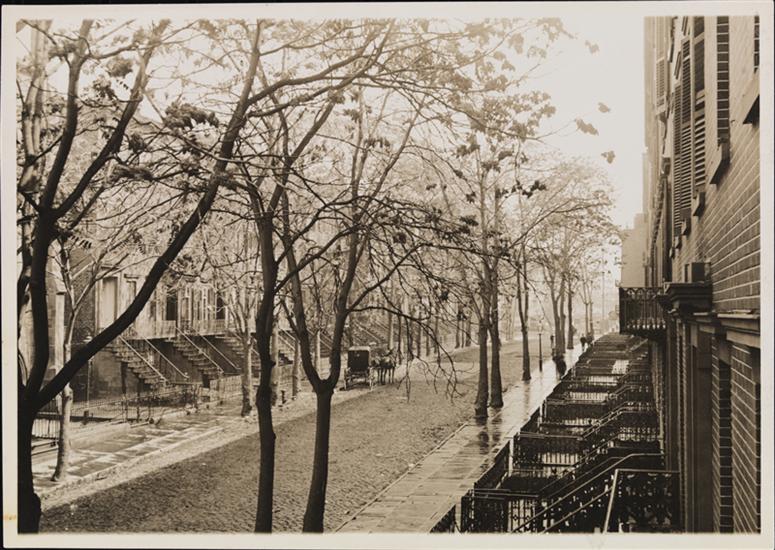
Illustration of Madison Square after a snowstorm, 1899. Courtesy New York Public Library
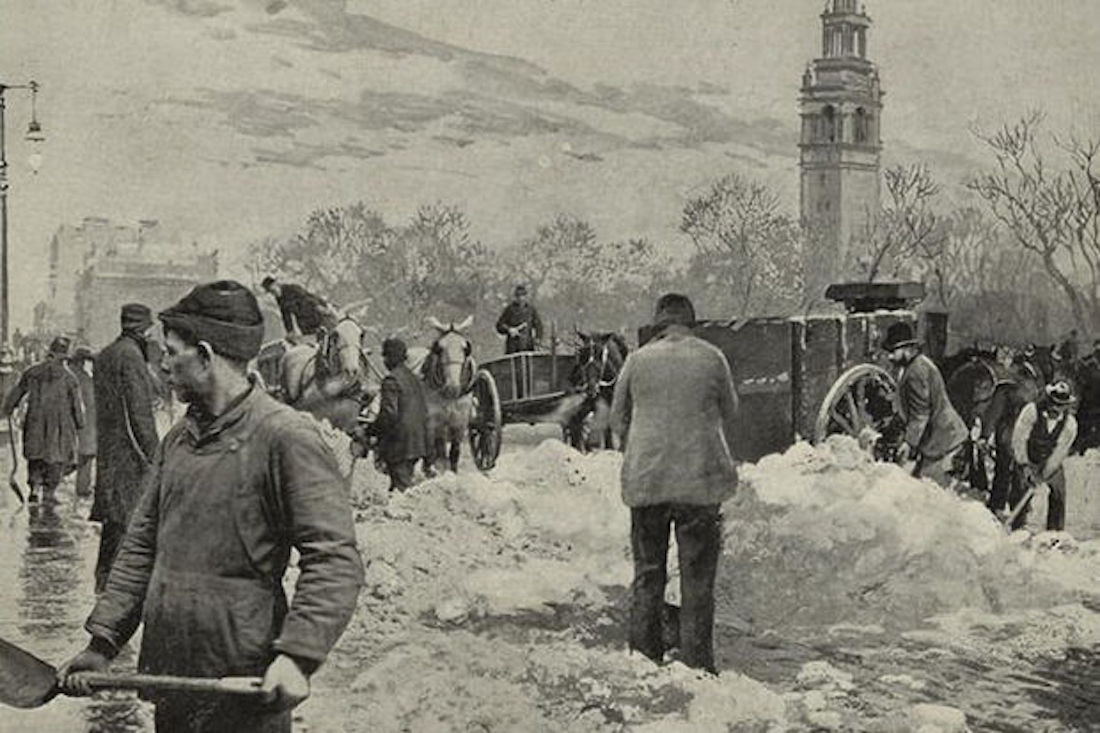
Missing a good old-fashioned New York City snowfall? Well, then, take in this unusual view from 1902:
What storm is this? The horrific blizzard that hit New York on February 17, 1902. It would be considered the worst snowstorm to hit the metropolitan area since the Great Blizzard of 1888. (Read all about it here.) I assume we’re actually in the aftermath of the blizzard here, as the snow shovels are out, and the kids are playing.
Who made this? Edison Manufacturing Company. Their Manhattan studio was nearby, at 41 East 21st Street.
Who’s the director? The head of Edison’s film division Edwin S. Porter, considered by most to be the first real movie director, inventing basic techniques used by subsequent filmmakers.
What are we seeing? Trolleys, cabs, carriages and other unusual vehicles, braving the icy conditions and dodging pedestrians at the intersection of Broadway, Fifth Avenue and 23rd Street. At one point, you almost see a team of horses slide off the road!
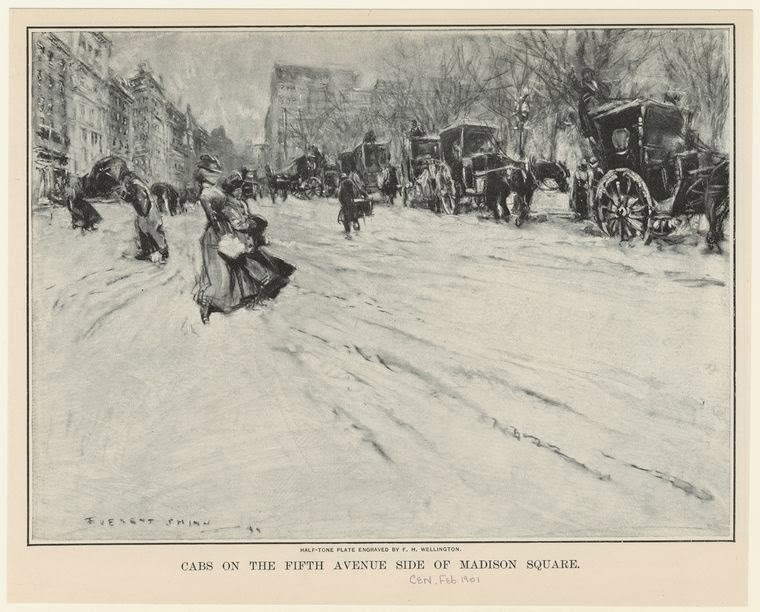
Below: An illustration from 1899, showing cabs parked along Madison Square (courtesy NYPL)
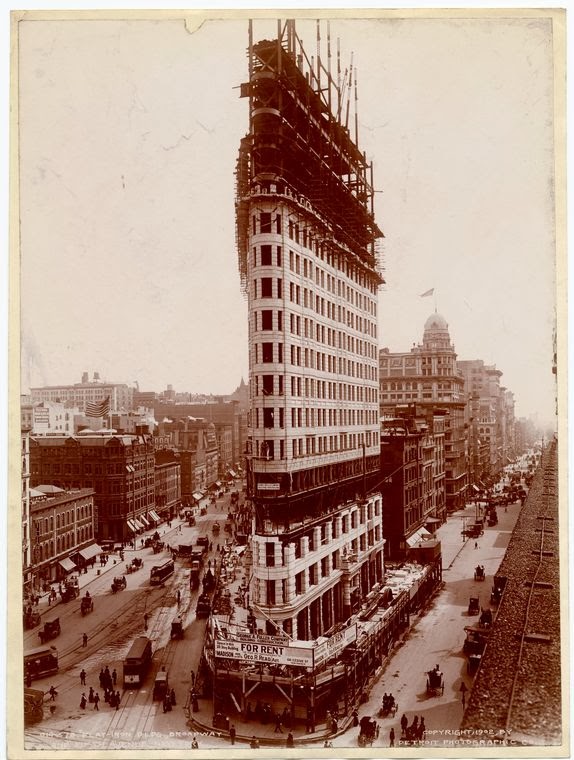
Why aren’t they showing the Flatiron Building? It’s not completed yet! The Daniel Burnham-designed office building would be opened by the summer, to great fanfare. But as an open construction site, it would have been dangerous to linger anywhere around it. I believe the slanted beams you see at the very end are part of the construction site.
This is the first film of a New York blizzard? This is probably the first film of any American blizzard. Primitive film technology had only recently allowed for outdoor filming. Porter and his crew would have been brave indeed dragging Edison’s equipment even two blocks through these conditions.
What’s that statue at the 1:15 mark? The seated, snow-covered figure of William Seward. The statue has sat at that corner since 1876. (More about that here.)
What’s that big building at the end? The Fifth Avenue Hotel, once considered the greatest accommodation in New York City and a headquarters for backroom politics in the 1870s and 1880s. Its glory days are long passed by the time of the blizzard. Six years later, it would be torn down and replaced with the building that stands at that corner today — the International Toy Center.
PODCASTYour ticket to Truman Capote’s celebrity-filled party at the Plaza.
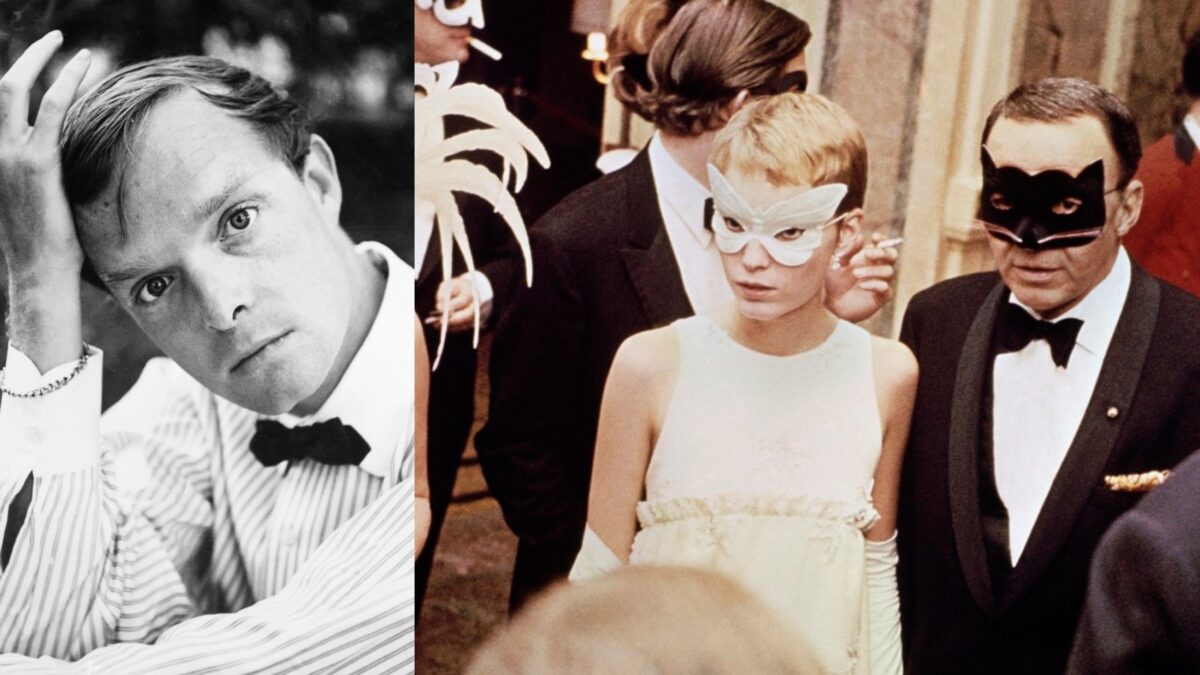
This month FX is debuting a new series created by Ryan Murphy — called Feud: Capote and the Swans — regarding writer Truman Capote‘s relationship with several famed New York society women.
And it’s such a New York story that listeners have asked if we’re going to record a tie-in show to that series. Well, here it is! Tom and Greg recorded this show back in November of 2016 but, likely, most of you haven’t heard this one.
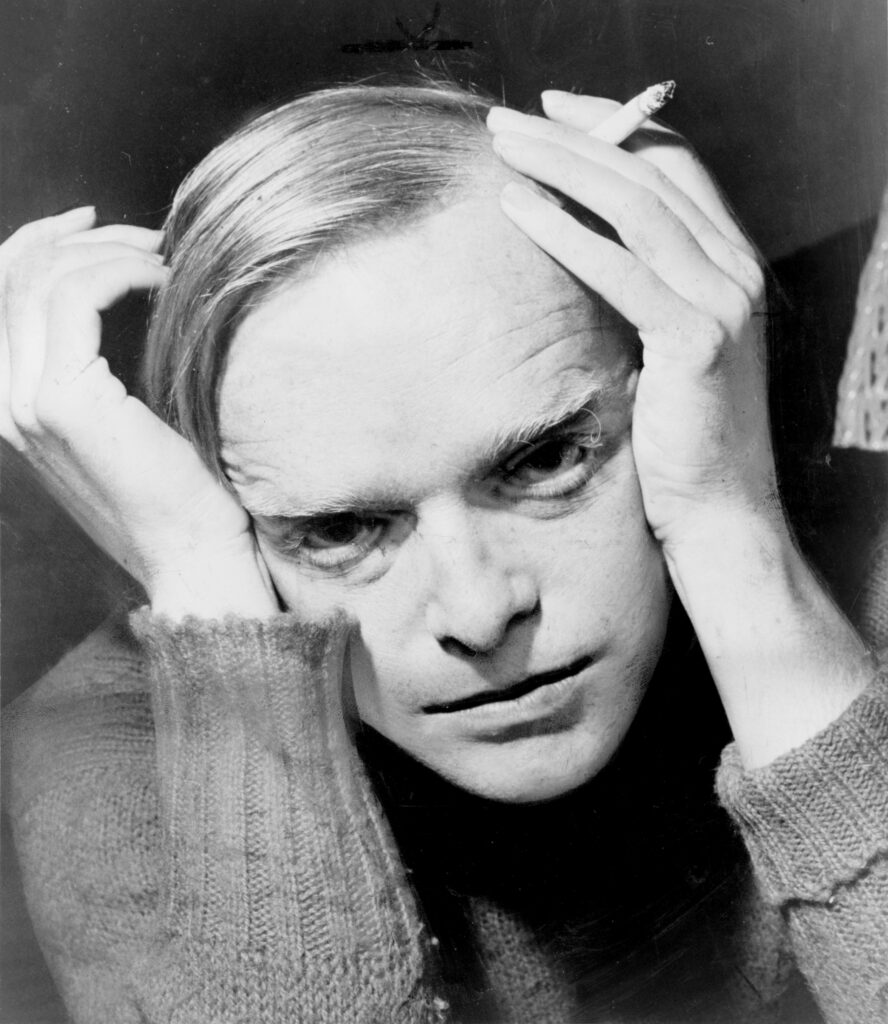
Capote in 1959 / Library of Congress Prints and Photographs Division. New York World-Telegram and the Sun Newspaper Photograph Collection.
Capote is a true New York character, a Southern boy who wielded his immense writing talents to secure a place within Manhattan high society. Elegant, witty, compact, gay — Capote was a fixture of swanky nightclubs and arm candy to wealthy, well-connected women.
One project would entirely change his life — the completion of the classic In Cold Blood, a ‘non-fiction novel’ about a horrible murder in Kansas. Retreating from his many years of research, Truman decided to throw a party.
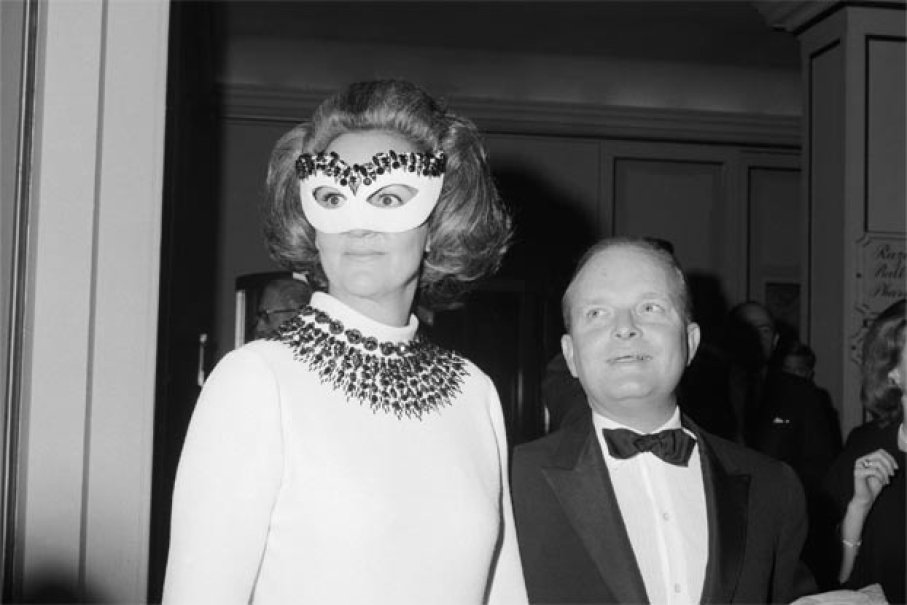
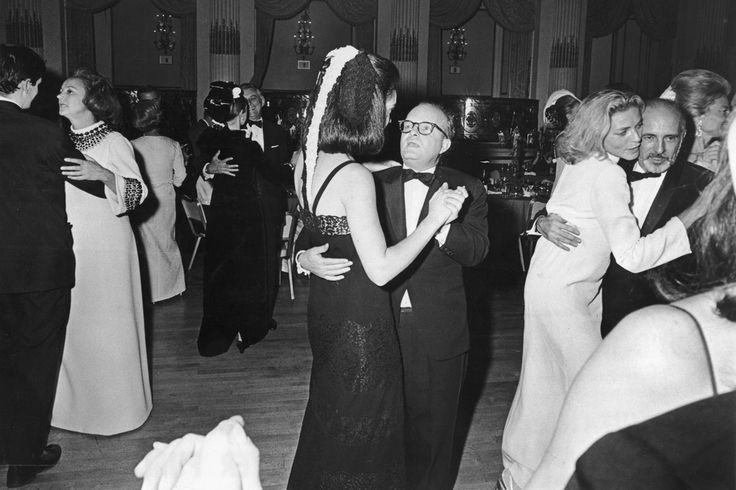
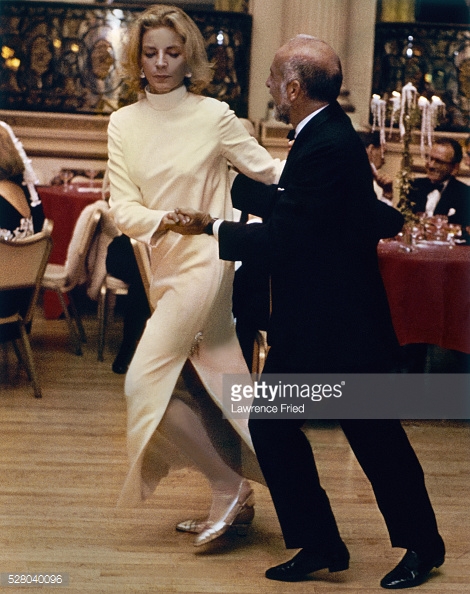
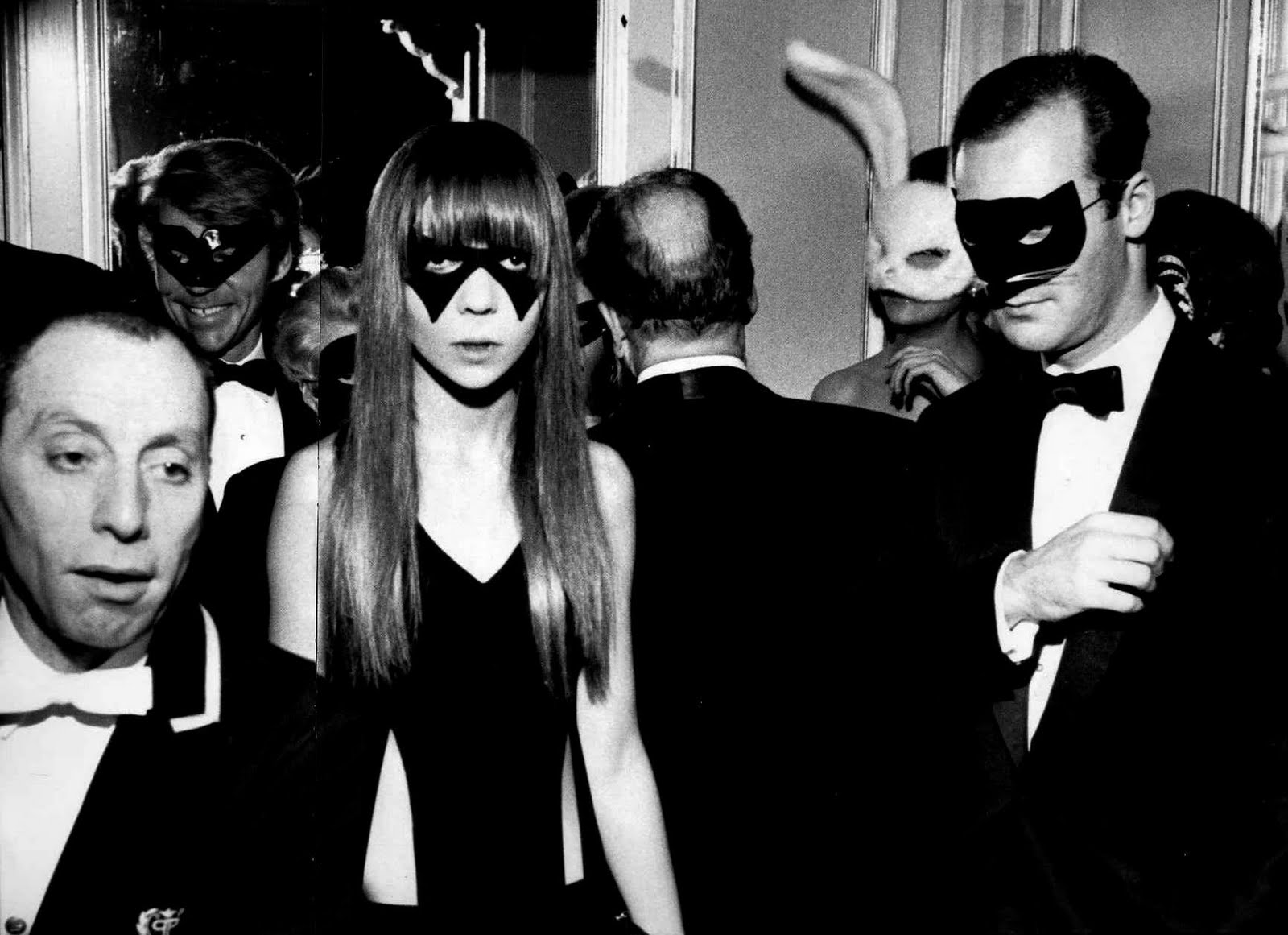
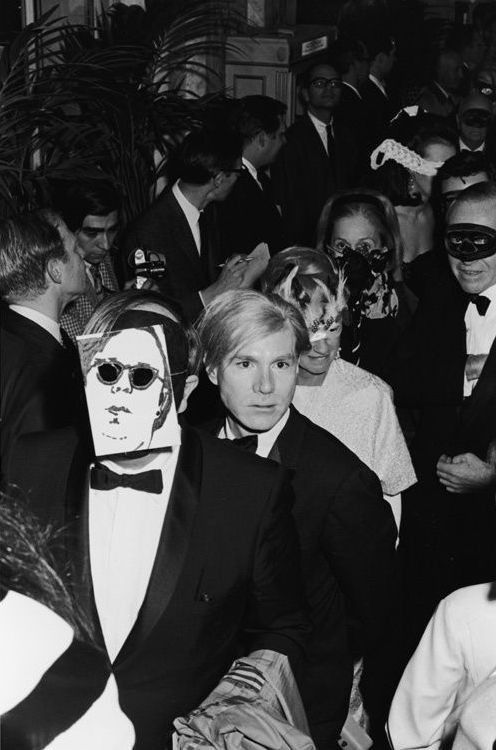
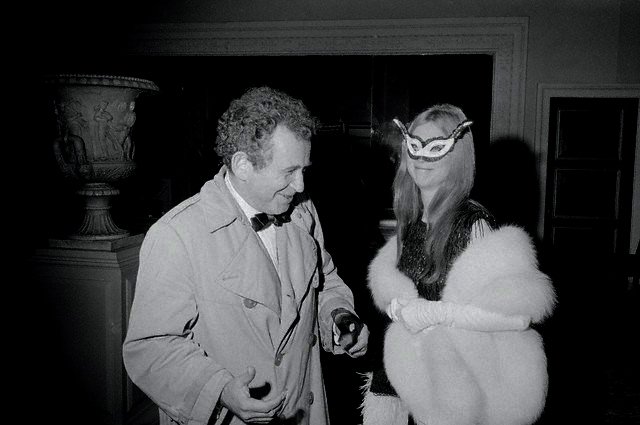
But this wasn’t ANY party. This soiree — a masquerade ball at the Plaza Hotel — would have the greatest assemblage of famous folks ever gathered for something so entirely frivolous. An invite to the ball was the true golden ticket, coveted by every celebrity and social climber in America.
Come with us as we give you a tour of the planning of the Black and White Ball and a few glamorous details from that strange, glorious evening.
FEATURING: Harper Lee, Lauren Bacall, Frank Sinatra, Robert Frost, Lillian Hellman, Halston, Katharine Graham and a cast of thousands (well, or just 540)
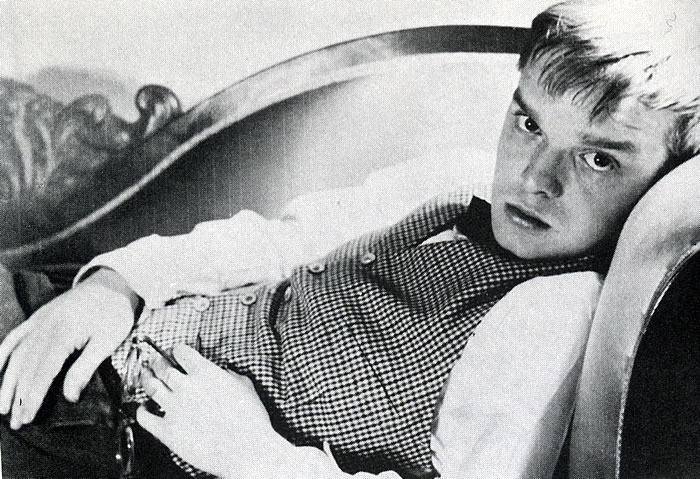
Truman Capote in 1945
From the unusual book jacket of Other Voices, Other Rooms, 1948
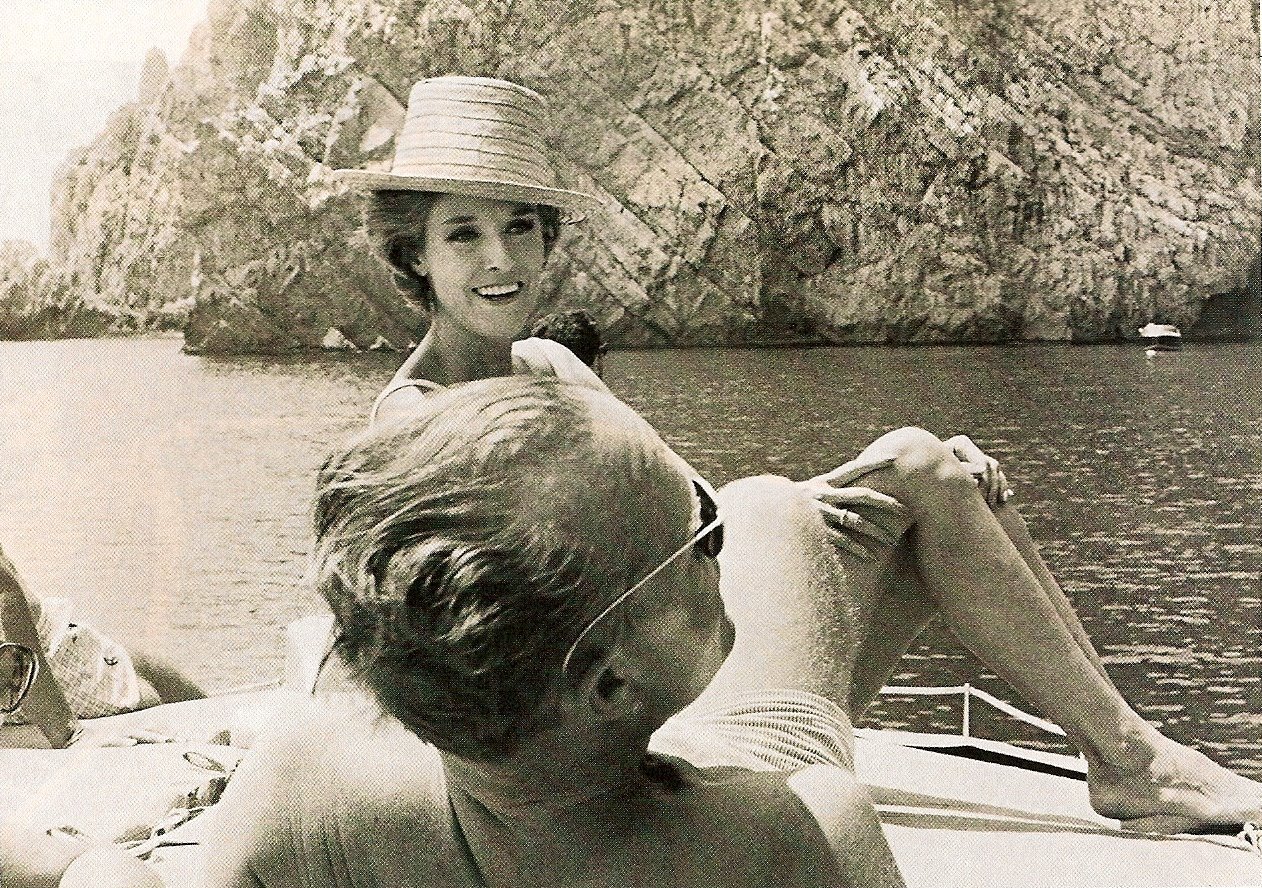
Babe Paley with Truman Capote in Capri, early 1960s
Courtesy the Red List
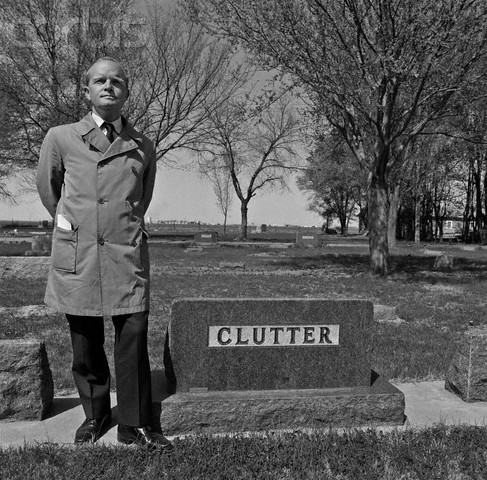
Capote in Kansas, at the grave of the Clutter family, their murder being the inspiration for his book In Cold Blood.
Two other New York cultural icon — who happened to be invited to Capote’s dance:
Some context on the New York ball/society scene, courtesy The Gilded Gentleman
FURTHER READING
Truman Capote / Breakfast at Tiffany’s Truman Capote / In Cold Blood Truman Capote / Other Voices, Other Rooms Truman Capote / “La Côte Basque 1965” and Answered Prayers Deborah Davis / Party of the Century: The Fabulous Story of Truman Capote and His Black and White Ball George Plimpton / “Was Truman Capote’s Black-and-White Ball the Greatest Party Ever?” Esquire 1991 Guy Trebay / “50 Years Ago, Truman Capote Hosted the Best Party Ever,” New York Times, 2016 Ralph Voss / Truman Capote and the Legacy of “In Cold Blood”
This newly edited edition of this episode of the Bowery Boys is now running on the The Gilded Gentleman podcast. Listen today:
PODCAST Four strange and spooky tales taken from New York City newspaper articles published during the Gilded Age
For this year’s 10th annual Bowery Boys Halloween special, we’re highlighting haunted tales from the period just after the Civil War when New York City became one of the richest cities in the world — rich in wealth and in ghosts!
We go to four boroughs in this one (sorry Brooklyn!):
— In the Bronx we highlight a bizarre house that once stood in the area of Hunts Point, a mansion of malevolent and disturbing mysteries
— Then we turn to Manhattan to a rambunctious poltergeist on fashionable East 27th Street
— Over in Queens, a lonely farmhouse in the area of today’s Calvary Cemetery is witness to not one, but two unsettling and confounding deaths
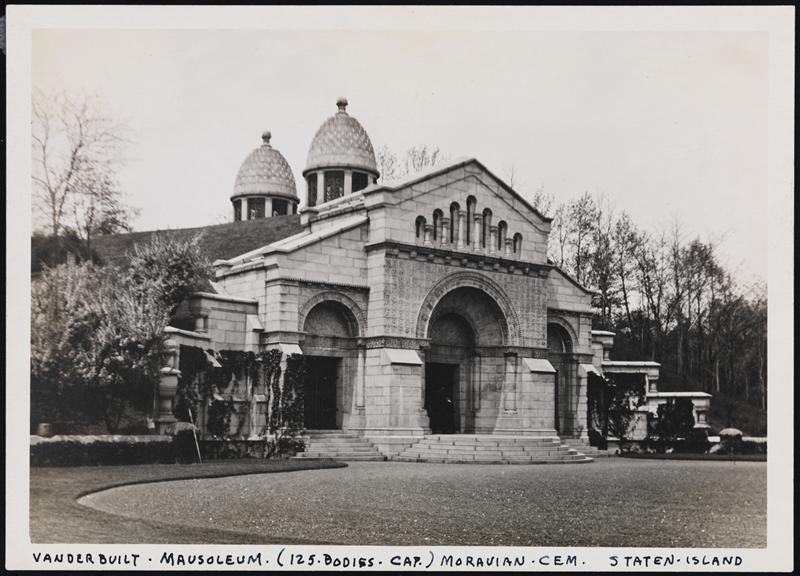
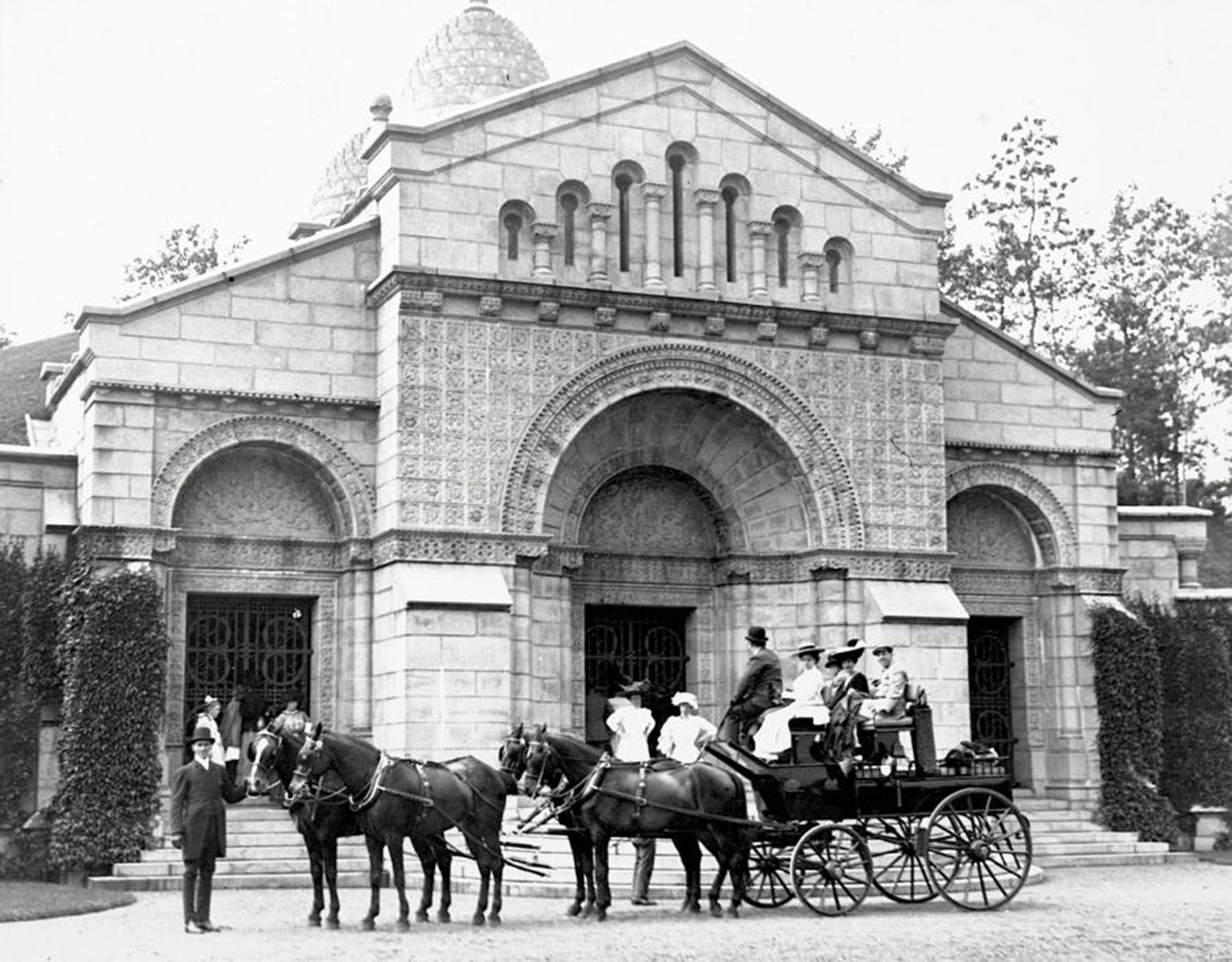
— Finally, in Staten Island, we take a visit to the glorious Vanderbilt Mausoleum, a historic landmark and a location with a few strange secrets of its own
The Bowery Boys: New York City History podcast is brought to you …. by you!
We are now producing a new Bowery Boys podcast every two weeks. We’re also looking to improve the show in other ways and expand in other ways as well — through publishing, social media, live events and other forms of media. But we can only do this with your help!
We are now a member of Patreon, a patronage platform where you can support your favorite content creators for as little as a $1 a month.
Please visitour page on Patreon and watch a short video of us recording the show and talking about our expansion plans. If you’d like to help out, there are five different pledge levels (and with clever names too — Mannahatta, New Amsterdam, Five Points, Gilded Age, Jazz Age and Empire State). Check them out and consider being a sponsor.
We greatly appreciate our listeners and readers and thank you for joining us on this journey so far. And the best is yet to come!
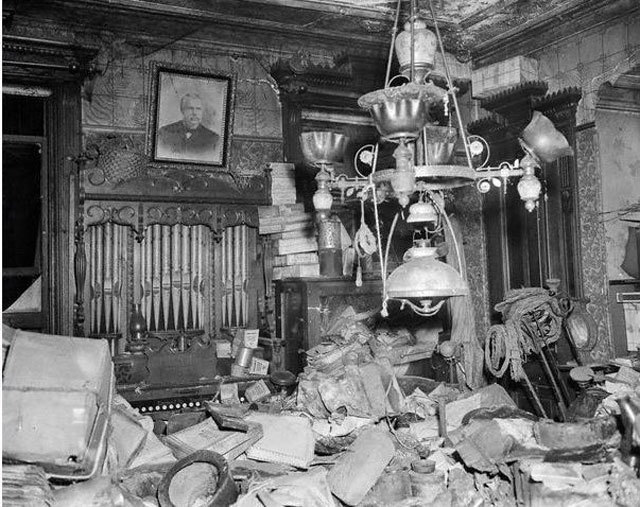
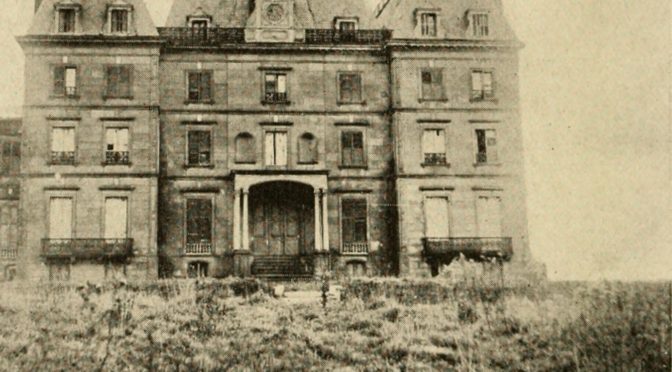
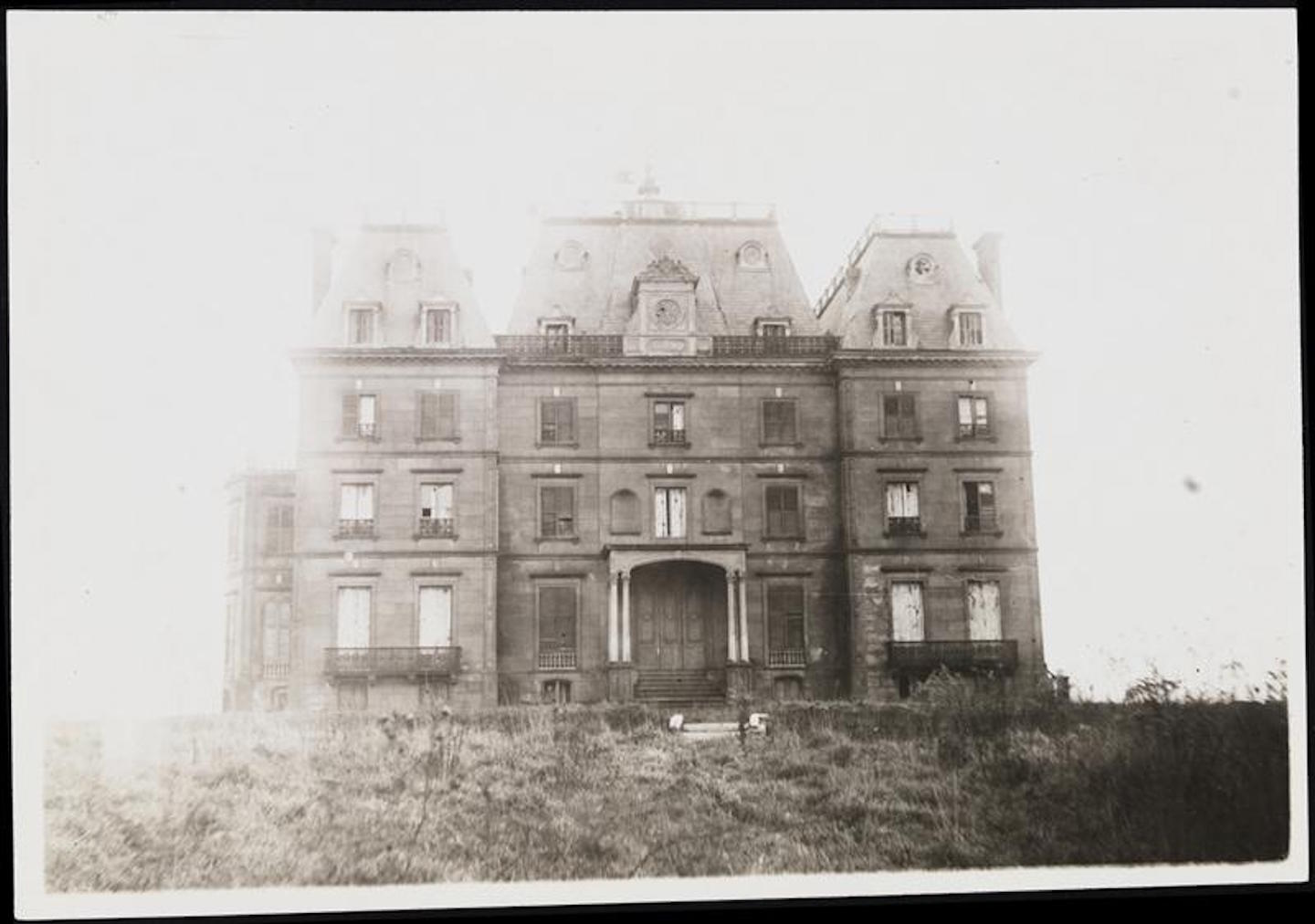
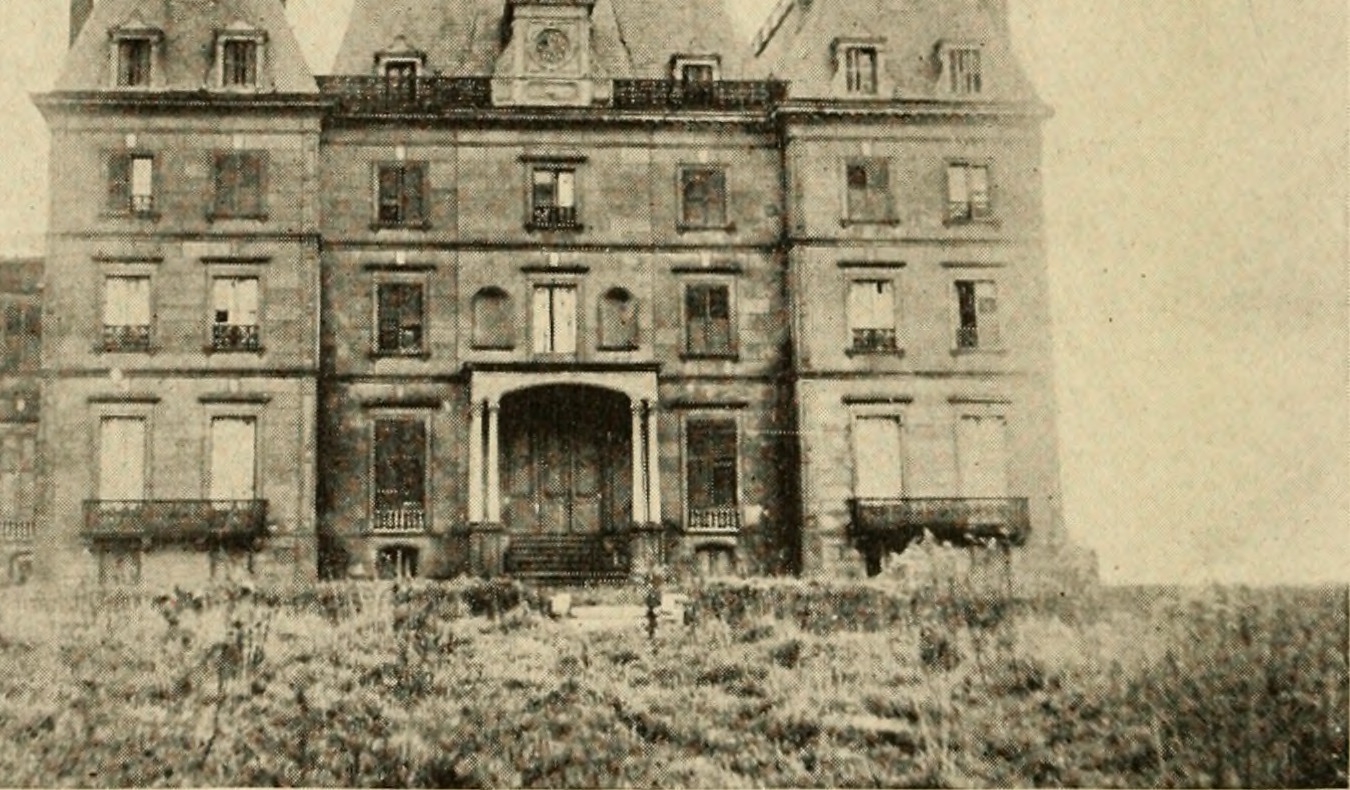
This is the Casanova Mansion aka “the house of many mysteries”
Courtesy Museum of the City of New York
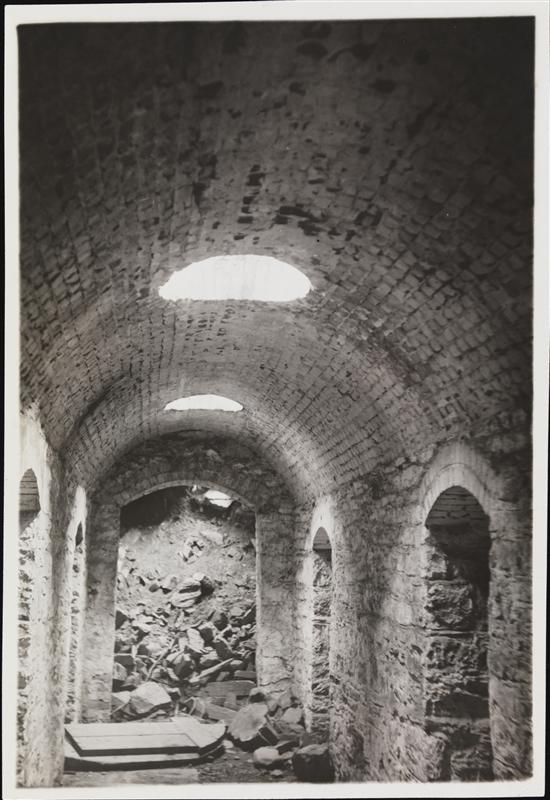
The subterranean tunnels under the Casanova mansion, as they appeared in 1910. Prison cells were discovered along the walls of the tunnels. What could they have been used for?
Courtesy MCNY
From the book “The borough of the Bronx, 1639-1913; its marvelous development and historical surroundings” (1913): “Casanova Mansion were stored with powder and rifles which eventually found their way into the hands of the patriots in Havana and other Cuban cities. An underground passage had been made, running from the house to the Sound, and under cover of darkness boats, which were undoubtedly filibusters, were occasionally seen to steal into the little cove that the mansion overlooked; and, after being freighted with ammunition and other implements of war, to creep out again as mysteriously as they had entered.”
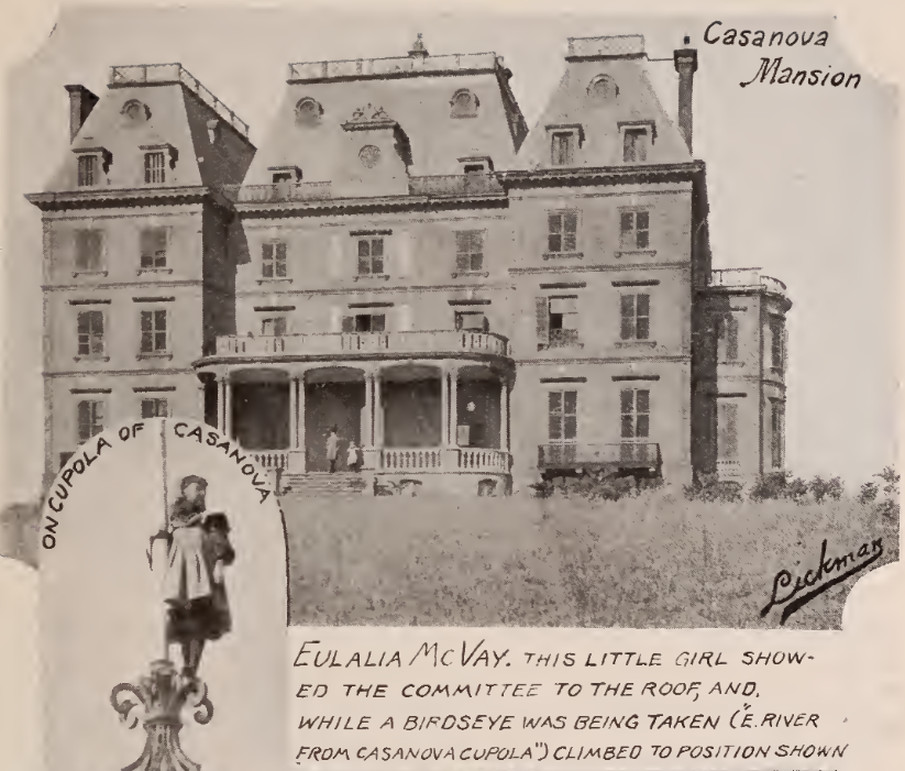
In 1902 a young girl made the news when she by climbing the the very top of the old mansion. Note that the porch is different than the picture above. This is probably the side of the house that faced the East River.
Courtesy Stuff Nobody Cares About
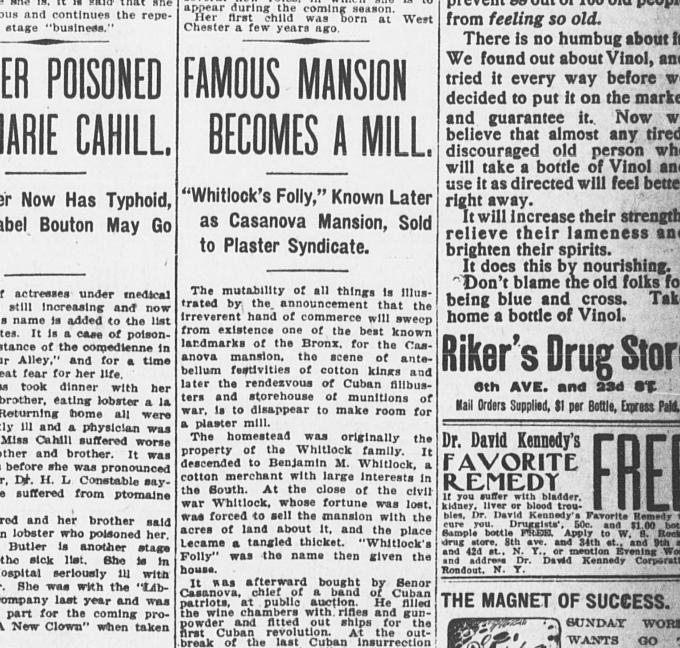
The Casanova Mansion makes one of its final appearances in the newspapers. This article is from 1902 although it appears that the mansion was not completely demolished until much later (the pictures above are from a later date)
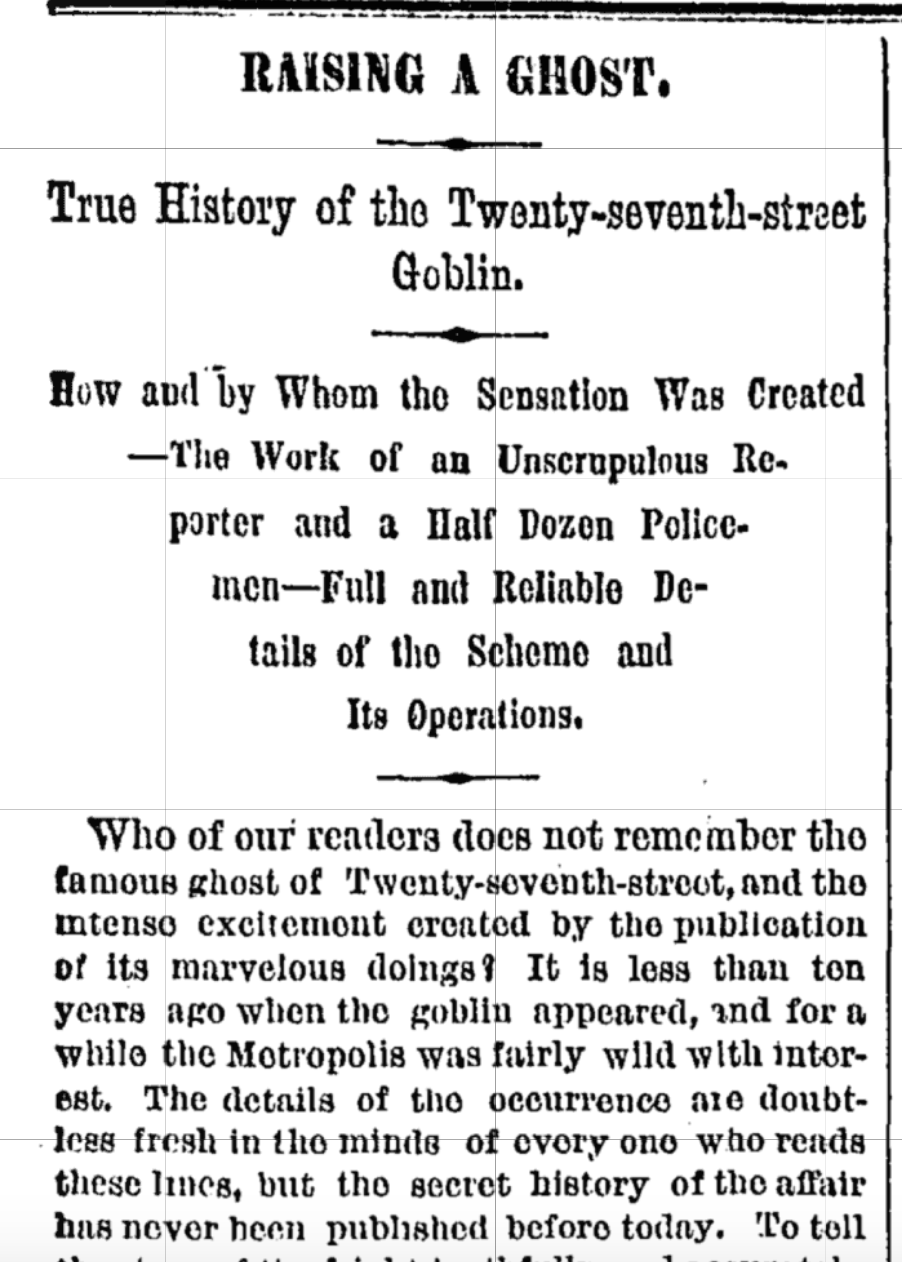
From the New York Times, September 18, 1870, a thorough recounting of the strange story of possible ghosts on East 27th Street, with a thorough description of the police’s creative use of lighting and photography.
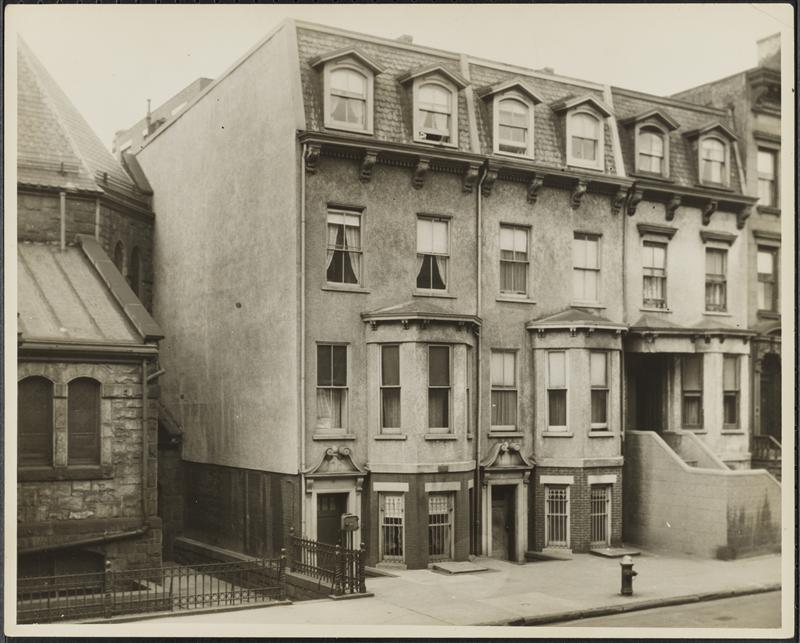
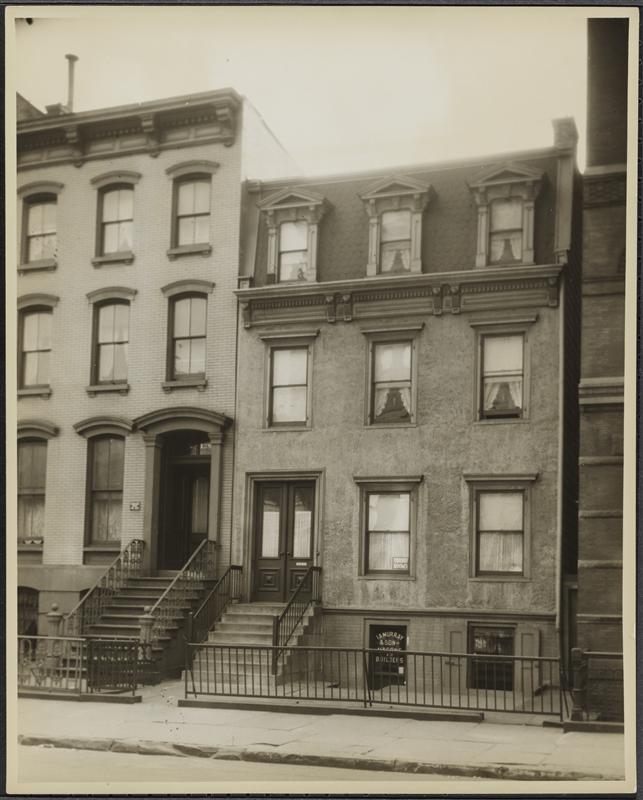
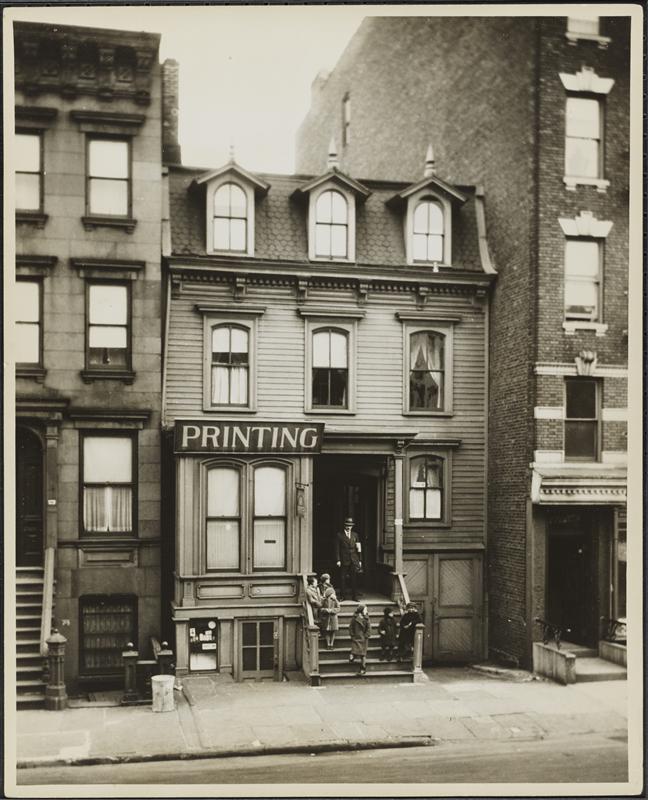
A selection of houses along East 27th Street, photographs by Charles Von Urban, courtesy the Museum of the City of New York
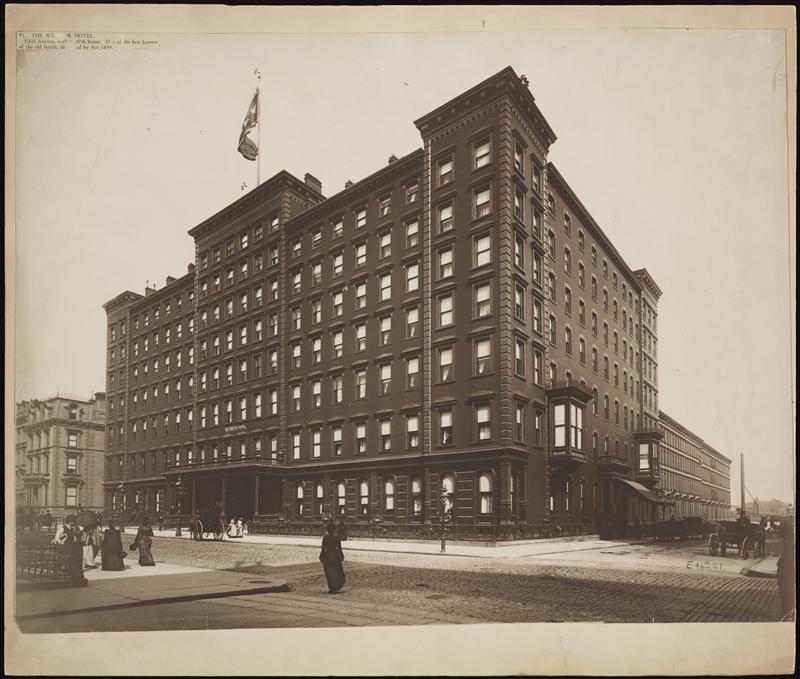
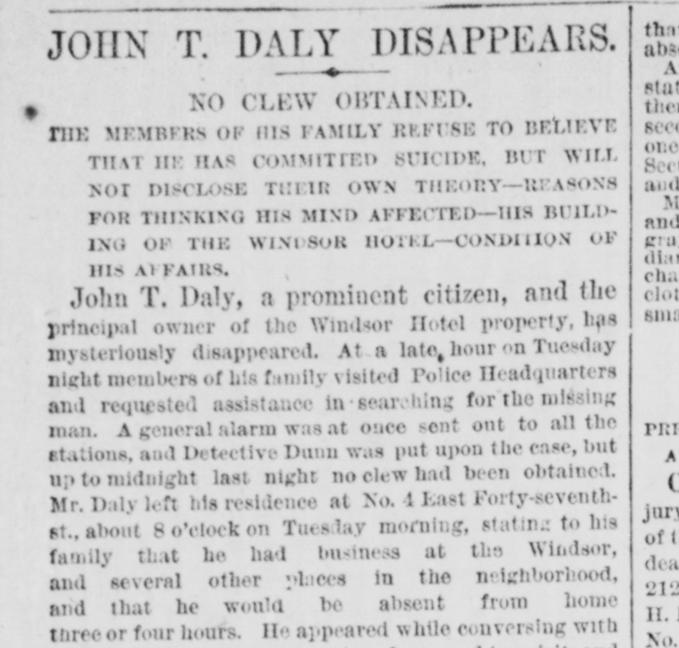
The spectacular Windsor Hotel on Fifth Avenue and 46th Street, pictured here in 1890, many years after the death of its proprietor John T. Daly. For more information on this forgotten hallmark of upper-class glamour, check out this article from Daytonian In Manhattan.
Museum of the City of New York
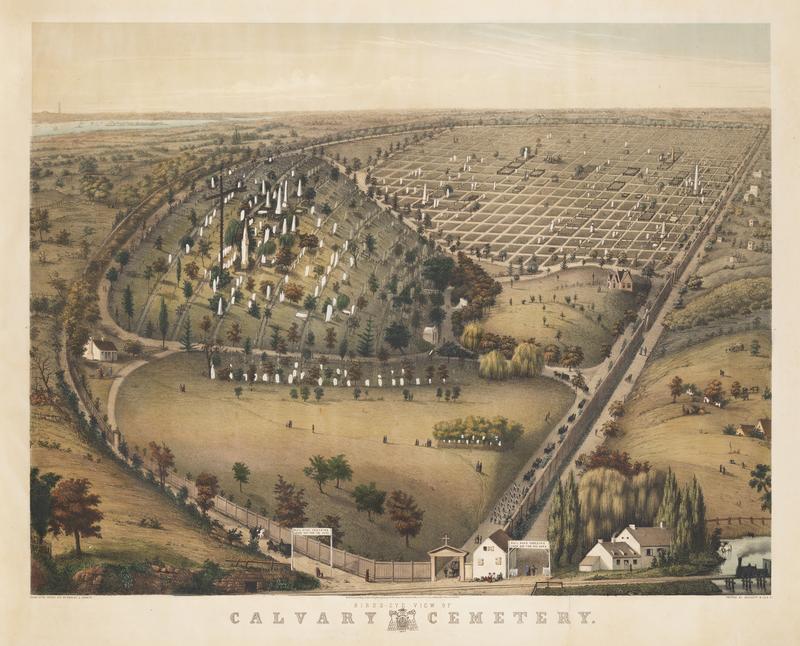
A ‘bird’s eye’ view of Calvary Cemetery in 1855, well before its expansion. Taking from clues from various newspaper, my guess is that the ‘cursed farmhouse’ lay somewhere to the far right of this image.
MCNY
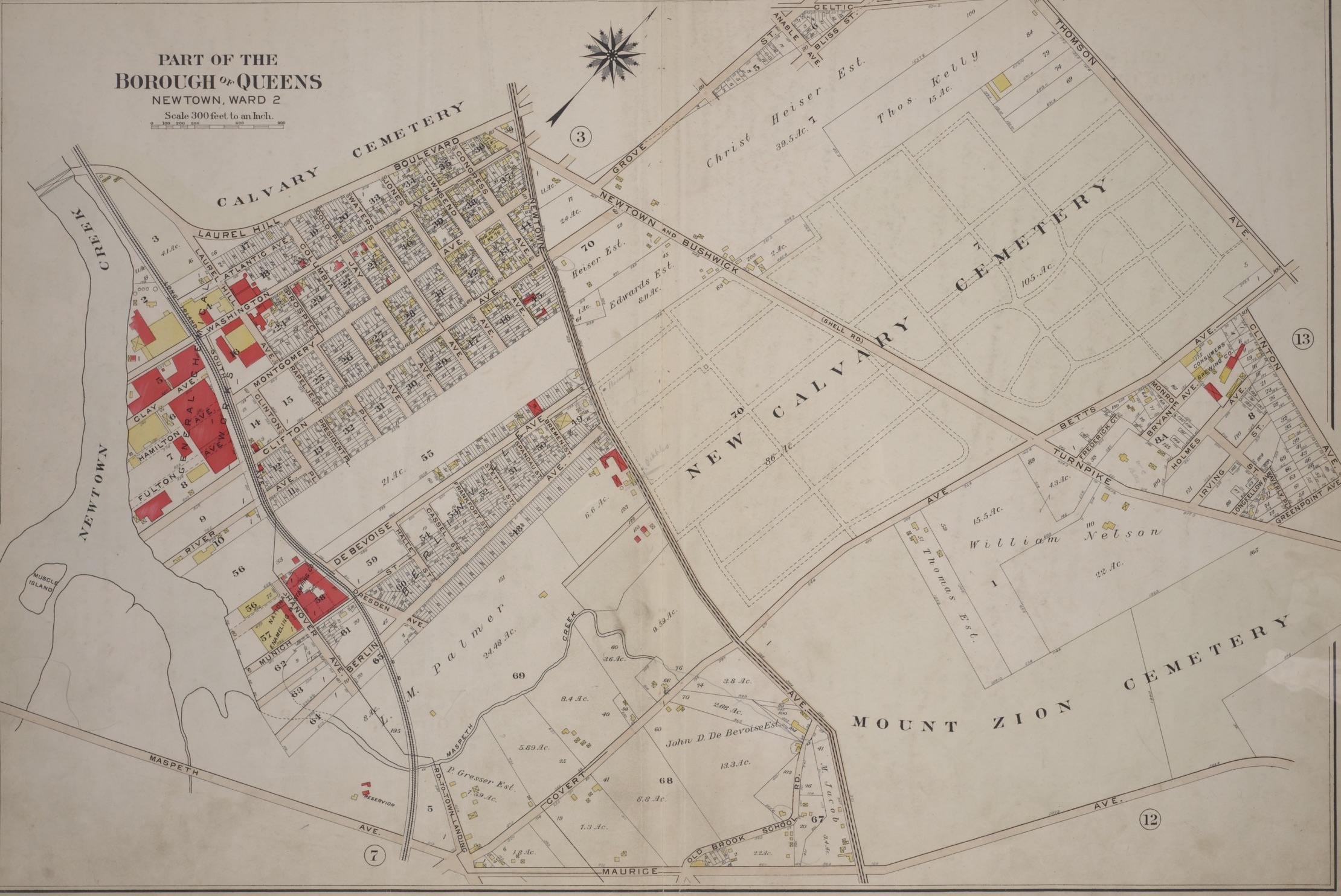
A map from 1909 detailing the expansion of Calvary Cemetery.
We hope you stuck around until the end of the show — to hear the official trailer for the new Bowery Boys podcast series called The First. Listen to it here:
The interior of the Electric Circus on St. Mark’s Place. Pic courtesy Christian Montone/flickr WARNING The article contains a couple light spoilers about last night’s ‘Mad Men’ on AMC. If you’re a fan of the show, come back once you’re watched the episode. But these posts are about a specific element of New York history from the 1960s and can be read even by those who don’t watch the show at all. You can find other articles in this series here.
Almost predictably, a couple characters from ‘Mad Men‘ finally interact with a psychedelic temple of Andy Warhol, in this case the nightclub Electric Circus at 19-25 St. Mark’s Place, today the site of a Chipotle and a Supercuts.
As I wrote back in an article from 2007: “It became the East Village fuse box for Warhol’s talents and those of his entourage, in particular the Velvet Underground and Nico. The dazzling synthesis of psychedelica and glamour, of the Velvet’s strange atmospheric music and Warhol’s performance displays of lights and costumes, immediately attracted the scenesters to this odd little street — according to the New York Times, “everyone from hippies to Tom Wolfe and George Plimpton” — way before St. Marks would make its reputation in the 1970s with the punk scene.”
An original ad from the Electic Circus, summer of 1967 (courtesy butdoesitfloat)
Since I wrote that article, many people have chimed in within the comments section to relive their memories of Electric Circus. Here are a few of my favorite comments from those who were actually there:
“What memories. I started working at the E.C. as a ticket taker. I say working, but in reality we didn’t get paid, we got let in for our work. Like Woodstock, if you remembered much of what happened at the E.C. you weren’t really there.” – Being the Best
Below: Headline from the Village Voice, July 6, 1967
“I worked at the Electric Circus, 67-68-ish. I was the fire-eater, and mime/clown, working with another mime named Michael Grando. Larry Pizoni was the director of the circus show. We had a trapeze artist named Sandy [Alexander], and security was a biker club called the Aliens (which worked, unlike Altamont).
Everytime I’m in New York, in the East Village, I stop on St Mark’s and bow my head. I wanted to have someone put up a plaque, but nobody in the stores knew who to call.” – Richard Bluejay “I was one of 5 or 6 people who worked at Limbo* for number of years across from the Electric Circus. I was there at the opening night, and then on for a long time I remember we use to give discounts to the Circus employees so we get in free. Can not tell you how many times I was in there but it was a lot!!!! It was great time back then. Fillmore East was around the corner and Max’s Kansas City was not far away. East Village was where it was at back then ” – Anonymous
A freakout-indusing video from Electric Circus, scored to the music of Frank Zappa:
“I remember two things about the electric circus from my one visit in 1969. One was the fact that the walls were not at a right angle to the floor, which combined with the strobe lights and swirling crowd, made for a delightfully disorienting experience. The other was a dark room off to the side where couples — or even strangers I suppose — could sit and smooch. In addition to all kinds of nooks and crannies for this purpose there was a rotating upholstered carousel in the middle of the room, divided into sections, one per couple.” — Anonymous
Below: A typical crowd on the stairs outside the Electric Circus (pic courtesy Old New York)
“I’m so excited, after all these decades to hear from people who got to experience the the most amazing Electric Circus, as I did. By far dancing myself into a dazed, psychedelic trance, while absorbing the magical energy of the Chambers Brothers sing ‘Time’, was right up there in my top ten of life altering experiences. I was a runaway, living with new friends in the Village.
I used to panhandle on St. Marks Place, and spend all my money on clothes at the Limbo, pizza, and tickets to hear my fav bands, except for the times I used to get in for free.” — Sonny
Below: Sonny’s jam from the floor of the Electric Circus:
“I can’t remember exactly how I arrived at St. Marks Place that first night. I had never been to St Marks Place and I certainly didn’t know about Electic Circus. I was just following a friend of mine who was interested enough in the new culture to find out where to go and what to do.
There must have been some kind of happening that night because the streets were full of people. People were hanging all over the stairs leading up to the Circus. And, you didn’t have to pay. We just walked in. I still remember it emotionally.
The big room was completely decorated with fabric amorphously draped on walls and spanning corners and cornices. Projectors behind the fabric ran continuous short loops of films. Of course it was dimly lit so as not to wash out the films. People were everywhere and moved mysteriously in the smoky dim light. I was born in Brooklyn and had already lived a few years in Manhattan, but I never saw anything like this before. The next time I saw EC the decor had changed. I never paid to get in because I was a member of the PABLO Light** show.” — Anonymous
* Limbo was a famed ‘hippie clothing’ boutique where today’s Trash & Vaudeville sits today.
** That would be Lights By Pablo, a leading ‘liquid light show’ exhibitor of the late 1960s, frequently here and at Fillmore East.
A condescending illustration of Tompkins Square Park from the New York journal Hearth and Home, 1873. (NYPL)
This episode on the history of Tompkins Square Park ties right into an all-new two-part episode coming in September, the first part coming at you next week.
Central Park has frequently been called ‘the people’s park,” but we think Tompkins Square Park may have a better claim to that title. From its inception, this East Village recreational spot — named for Vice President Daniel D Tompkins — has catered to those who might not have felt welcome in other New York parks.
Carved from the marshy area of Peter Stuyvesant‘s old farm, Tompkins Square immediately reflected the personality of German immigrants who moved here, calling it Der Weisse Garten. With large immigrants groups came rallies and demands for improved working conditions, leading to more than a number of altercations with the police in the 19th century.
Progressives introduced playgrounds here, and Robert Moses changed the very shape of Tompkins Square. But the most radical transformation here took place starting in the late 1950s, with the introduction of beatnik and ‘hippie’ culture and infusion of youth and music.
By the 1980s, the park became known not only for embodying the spirit of the East Village through punk music and drag shows (above: Lady Bunny), but also as a haven for the homeless. Clashes with police echoed the clashes that happened here one century before. The park still maintains a curfew left over from the strife of the late 1980s.
FEATURING: Lillian Wald, the Grateful Dead, Charlie Parker, Samuel S. Cox, Lady Bunny … and Chevy Chase?
LISTEN NOW: TOMPKINS SQUARE PARK
A version of this show was originally released in 2014 (episode #160)
Images from the park this week (August 2023)
It’s doubtful that the image below is accurately depicted by the caption which accompanied it in Frank Leslie’s Illustrated Newspaper in 1874: “The red flag in New York – riotous Communist workingmen driven from Tompkins Square by the mounted police, Tuesday, January 13th.” [Courtesy LOC]
Another illustration of the 1874 protests, notably featuring a German establishment in the background. (More information on the Tenement Museum blog.)
People enjoying (most likely) German music and entertainment in Tompkins Square Park, 1891. An image from Harper’s Weekly by Thure de Thulstrup. (NYPL)
Women and children enjoying themselves in Tompkins Square Park, Arbor Day, 1904, on the brand new playground for girls. (Photos courtesy Museum of the City of New York)
The Tompkins Square Milk House, which provided clean, healthy milk to families in the 1910s.
The statue of Samuel Cox, funded by New York postal workers. (1900, pic courtesy Museum of the City of New York
Children waiting in line to use the children’s reading room at the Tompkins Square branch library. (NYPL)
An advertisement from 1920, urging residents of the Lower East Side to take English courses at the Tompkins Square branch library. There are several of these posters in different languages here. (NYPL)
Lady Bunny and friends, performing at Wigstock 1988 (Picture courtesy aquaman6 on Flickr)
The Tompkins Square Police Riot from 1988 (courtesy Quilas)
Police retake Avenue A during a riot outside Tompkins Square Park that erupted after police allegedly beat a homeless man. The late 1980’s and early 1990’s was a period of rapid gentrification in the East Village, and many homeless residents, activists, and squatters, battled the process, frequently clashing with the police around Tompkins Square Park.
The Tompkins Square Park bandshell, which was torn down by the city in 1991. (Photo courtesy Flickr/Mike Evans)
A performance by the hardcore band Breakdown at the bandshell in 1988
A Ghostbusters-themed entrant in the Halloween Dog Parade in 2013 (Courtesy USA Today)
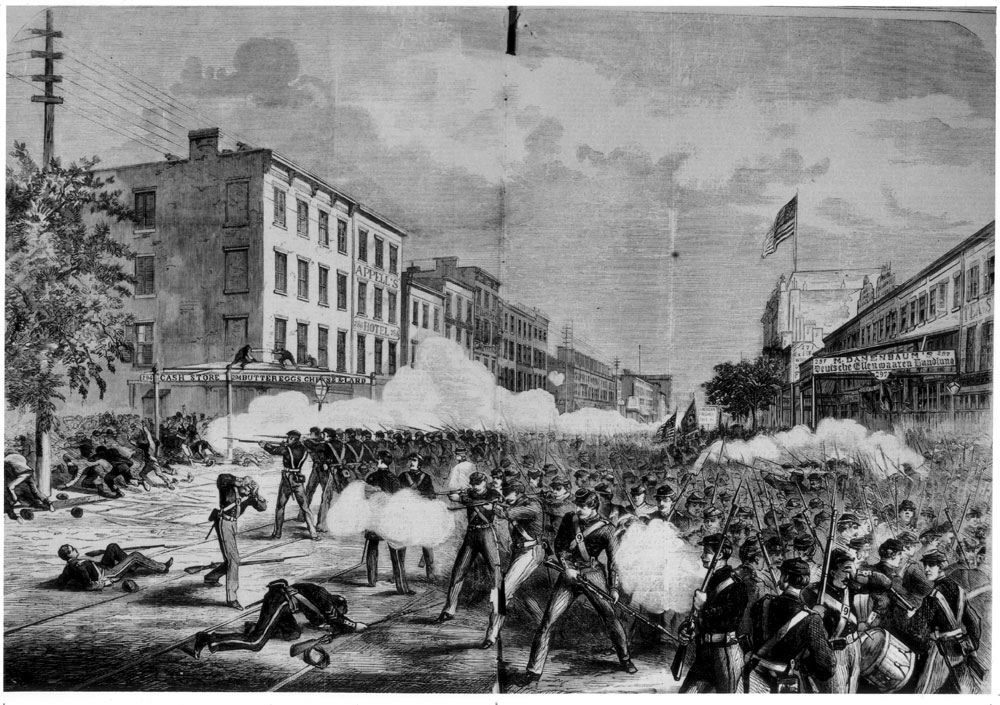
This month we are marking the 160th anniversary of one of the most dramatic moments in New York City history – the Civil War Draft Riots which stormed through the city from July 13 to July 16, 1863.
Thousands of people took to the streets of Manhattan in violent protest, fueled initially by anger over conscription to the Union Army which sent New Yorkers to the front lines of the Civil War. (Or, most specifically, those who couldn’t afford to pay the $300 commutation fee were sent to war.)
Looting at Brooks Brothers. Harpers Weekly, August 1, 1863
In many ways, our own city often seems to have forgotten these significant events.
There are very few memorials or plaques in existence at all to the Draft Riots, a very odd situation given the numerous markers to other tragic and unsettling moments in New York City history.
In particular, given the number of African-Americans who were murdered in the streets during these riots, and the numbers of Black families who fled New York in terror, we think this is a very significant oversight.
Harper’s Weekly, August 1, 1863
The riots place New York City not outside the significance of the Civil War battlefield, but squarely within it. The Union was not united, but an assortment of different viewpoints.
In this episode, a remastered, re-edited edition of our 2011 show, we take you through those hellish days of deplorable violence and appalling attacks on abolitionists, Republicans, wealthy citizens, and anybody standing in the way of blind anger. Mobs filled the streets, destroying businesses (from corner stores to Brooks Brothers) and threatening to throw the city into permanent chaos.
That Abraham Lincoln and the Union Army succeeded is even more remarkable when you realize the dissension from within, dissension which we discuss in this show (a remastered, reedited version of a show we originally recorded in 2011).
LISTEN NOW: THE DEADLY DRAFT RIOTS
The burning of the Colored Orphan Asylum on Fifth Avenue: In a day of vile crimes that Monday, July 13th, this certainly stands out as one of the worst.The mob burned the draft office at 3rd Avenue and 46th Street first thing on Monday morning. The destruction was but only a taste of the violence that was to come. By Friday, New York would be smoldering with dozens of structures in ashes — from factories and homes to armories and even bridges.
John A. Kennedy, the superintendent of police, who was savagely beaten and barely escaped with his life on the first day of rioting.
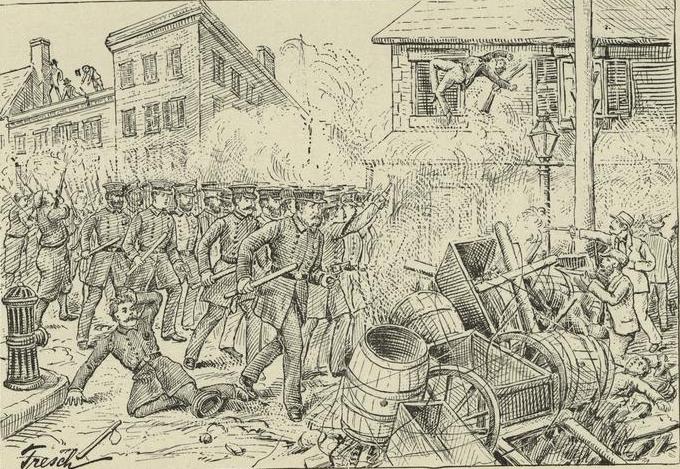
By Tuesday, rioters had cordoned off barricades along a couple key streets, including a mile-long makeshift fortification along Ninth Avenue, through today’s Chelsea and Hell’s Kitchen neighborhoods.
Illustrations courtesy New York Public Library digital image collection
The Illustrated London news
The other draft riots: Given the New York-centric nature of our program, I should note that draft riots occurred throughout the North that week, and even earlier. Yet none were of the intensity as those that occurred in Manhattan. In Boston, for instance, mobs stormed the famous Faneuil Marketplace and an armory on Cooper Street. But troops quelled the violence early, and only eight people died. [Read more about this even in the Boston Phoenix.]
And events were sparked in the future boroughs of Brooklyn, the Bronx, Queens and Staten Island as well. You can read more about them in this blog post.
Why are there no permanent memorials or remembrances of any significant kind in New York City to the Civil War Draft Riots? It was the most grave, the most tumultuous event in New York City history between the Revolutionary War and September 11, 2001. Doesn’t it merit some mention? Read Greg’s opinion piece which ran on the 150th anniversary — which more or less still applies today.
FURTHER READING
For more information on the Draft Riots, you can turn to several sources, based on your level of interest. My favorite is Barnet Schecter’s‘The Devil’s Own Work’which gives a gripping chronological retelling of events. He really manages to tame a chaotic tale in a way that neither confuses nor oversimplifies. I used Schecter’s ‘Mrs. Hilton’ anecdote from this book, and his book is chockful of other individual tales like that one.
If you prefer something a bit more analytical, there’s Iver Bernstein’s‘The New York City Draft Riots’ which tries to parse who exactly the rioters were. Of course ‘Gotham’ by Edwin G Burrows and Mike Wallace have a nice, compact recount with plenty of context. The City University of New York’s ‘Virtual New York’ web resource has a timeline with maps.
The Gangs of New York: Perhaps the most famous depiction of the riots occurs in Herbert Asbury’s classic ‘The Gangs of New York’. The film version, directed by Martin Scorsese, takes quite a few liberties with the facts of course. The placing of candles in windowsills and the fire at Barnum’s American Museum, for instance, did not happen during the riots. But those are based on true events that happened in New York a year later.
FURTHER LISTENING
There’s also the Broadway musical Paradise Square, set during the Draft Riots. Joaquina Kalukango won a Tony Award for Best Actress for her work in the musical:
When this show was originally released in 2011, it was part of a three part mini-series on New York City and the Civil War. You might like to check out the other two parts — especially part three Hoaxes and Conspiracies of 1864
In this episode, Greg pays a visit to Weeksville, the Brooklyn community which became a haven for Black New Yorkers fleeing the city during the riots.
If there is a ‘prequel’ to the Draft Riots, it’s certainly the Astor Place Riot of May 10, 1849.
The Pledge of Allegiance feels like an American tradition that traces itself back to the Founding Fathers, but, in fact, it was only written in 1892.
And the version you may be familiar with from elementary school — featuring the most recent phrase “under God” — is less than 70 years old.
This is the story of the invention of the Pledge, a set of words that have come to embody the core values of American citizenship. And yet it began as part of a for-profit magazine promotion, written by a Christian socialist minister.
Listen to the pledge wording evolve throughout the years and discover the shocking salute that once accompanied it.
Featuring: Tom Meyers as the voice of Francis Bellamy, the inventor of the pledge. This is a reedited, remastered version of an episode of Greg’s spin-off show The First, originally released in 2017
LISTEN NOW: THE MAKING OF THE PLEDGE OF ALLIEGANCE
Francis Bellamy, known as the author of the Pledge of Allegiance:
What the Bellamy salute used to look like
Other forms of the salute had students lift their hands palms up, not down.
San Francisco, California, 1942: Flag of allegiance pledge at Raphael Weill Public School (Geary and Buchanan Streets). The original caption to this photo read: “Children in families of Japanese ancestry were evacuated with their parents and will be housed for the duration in War Relocation Authority centers where facilities will be provided for them to continue their education.”
Department of the Interior. War Relocation Authority. Courtesy US National Archives
Young scouts on a hike. Photo by Roy Perry, 1940. Most people were saluting the flag in other methods than the ‘Bellamy salute’ which remained in the Flag Code until the 1940s.
Courtesy Museum of the City of New York
Second graders pledge allegiance in an elementary school in Rockport, Massachusetts, February 1973
Deborah Parks, photographer. Courtesy US National Archives
From the Youth’s Companion in September 1892, outlining the day’s ceremonies and the first use of the pledge.
A copy of the Youth’s Companion from 1899:
My beautiful picture
And yet WHY does an almost identical version of the pledge appear in the Ellis County News Republican on May 21, 1892? Did Francis Bellamy simply misremember when he wrote the pledge? Or did he really actually steal it from a 13-year-old boy — who happened to be named Frank Bellamy? Mystery!
The child Frank E. Bellamy graduated from high school and fought in the Spanish-American War. He died in 1915 from bone tuberculosis he contracted while fighting.
What is the real story between Francis Bellamy and Frank E. Bellamy?
Image by Leonard Fink; courtesy of The LGBT Community Center National History
Today every shop seems to wear a Rainbow Flag and every corporation and major retailer seems to offer a welcoming message to the LGBTQ community or a line of multi-colored ‘gay apparel’.
But keep in mind that just a bit over fifty years ago no such celebration would have ever occurred. In fact the city was certainly doing its best to obscure, frustrate and even expel its gay and lesbian population from living in the open.
Stormé DeLarverie. Craig Rodwell. Dick Leitsch. Marsha P Johnson. These are some of the people that made this present moment possible.
But those individuals have others to thank for creating a network of gay and lesbian spaces in New York City that have existed — mostly in the shadows — for over 150 years. Flawless Sabrina.James Baldwin. Alice Austen. Julian Eltinge. And yes — Walt Whitman.
So yes — celebrate Pride! And listen to one of these Bowery Boys: New York City History podcasts to give some important context to the celebration.
Celebrate the 200th anniversary of the birth of Whitman, a journalist who revolutionized American literature with his long-crafted work “Leaves of Grass.” The 19th-century cities of New York and Brooklyn helped shape the man Whitman would become — from its bustling newspaper offices to bohemian haunts like Pfaff’s Beer Cellar.
Fire Island is one of New York state’s most attractive summer getaways, a thin barrier island on the Atlantic Ocean lined with seaside villages and hamlets, linked by boardwalks, sandy beaches, natural dunes and water taxis. (And, for the most part, no automobiles.)
But Fire Island has a very special place in American LGBT history.
It is the site of one of the oldest gay and lesbian communities in the United States, situated within two neighboring hamlets — Cherry Grove and the Fire Island Pines.
In the beginning there were two styles of drag — vaudeville and ballroom. As female impersonators filled Broadway theaters — one theater is even named for a famed gender illusionist — thrill seekers were heading to the balls of Greenwich Village and Harlem.
By the 1930s, the gay scene began retreating into the shadows, governed by mob control and harshly policed. By design, drag became political. It also became a huge counter-cultural influence in the late 1960s — from the glamour of Andy Warhol’s superstars to the jubilant schtick of Charles Busch.
In 1966, a revolutionary gay-rights organization took a page from the civil rights movement to stage a demonstration in a small bar in the West Village. This little event, called the Sip-In at Julius‘, was a tiny but significant step towards the fair treatment of gay and lesbians in the United States.
In the early morning hours of June 28, 1969, undercover police officers attempting to raid the Stonewall Inn, a mob-controlled gay bar with darkened windows on Christopher Street, were met with something unexpected — resistance.
That ‘altercation’ was a messy affair indeed — chaotic, violent, dangerous for all. Homeless youth fought against riot police along the twisting, crooked streets of the West Village. And yet, by the end, thousands from all walks of life met on those very same streets in the days and weeks to come in a new sense of empowerment.
On May 30, 1883 — one week after it officially opened — 12 people were killed in a horrifying trample caused by the collapse of the Brooklyn Bridge.
Except of course, the Bridge didn’t actually collapse.
The prior week, the Brooklyn Bridge opened to terrific fanfare, with almost 14,000 people invited to cross this architectural behemoth which had sat in their harbor under construction for years.
The experience of crossing for the first time — to experience the sprawling city from a vantage in the harbor and at equal height of the tallest buildings of the time — must have been immense. And rather frightening.
One week later, on May 30th (Memorial Day that year), the path was still clogged with curiosity seekers.
Suddenly a woman fell on the stairs walking up on the Manhattan side, and her friend screamed.
Just this unnerving act alone created a rumor that the new bridge was about to collapse, that it couldn’t take the weight of all these people.
Panic ensued and people stampeded in every means possible to escape off the bridge. I feel the editorial from the Brooklyn Daily Eagle says it best:
“Two men tried to raise the prostrate woman and were instantly trampled and paid forfeit with their lives. In a few seconds human beings were piled four deep at the foot of the steps, and the crowd was hurried over them.”
“I was just above the stairs, at the side of the promenade. There was a crowd going in each direction and I was trying to keep them moving. A woman stumbled on the stairway below the landing and fell. Another woman at the head of the stairway saw her fall, and she screamed. The whole thing was caused by that woman screaming.”
“Then came the rush and the panic. I succeeded in getting up the woman who had fallen, but my hands were stepped on and my head kicked. I tried to drive back the crowd but could do nothing. It seemed as though the people didn’t see the stairs till they were pushed headlong down them by the rushing crowd behind.“
Under a grim heading ‘The Pile of Dead’ in the New York Sun sits some frightful descriptions by survivors:
“I felt the pulse of a number of those who were taken out. The first was a woman, who lay on her back just below the steps, with one arm twisted under her and the other hand clenching the reman of a child’s shawl. She had gray hair. Her forehead had been cut by the fall and her face was stained with blood. I believe she died before they got her off the bridge.”
New York Tribune
In the bloody tussle, 12 people died and over 36 were seriously injured. The victims ranged in age from 15 to 60, according to the Tribune.
The bridge, of course, wasn’t in any danger of collapsing. But few who walked upon it had ever stepped upon such a thing and it must have been a disorienting experience for the uninitiated.
And newspapers were periodically filled with the news of collapsing bridges. Only a few years before, on December 28, 1879, seventy-five people were killed when Scotland’s Tay Bridge collapsed during a storm.
Closer to home, a railway accident upon a bridge in Little Silver, New Jersey, killed three and injured dozens. (One of the survivors was former president Ulysses S. Grant.)
Following this unfortunate disaster upon the bridge, Brooklyn beefed up the police presence upon the bridge. “The order had evidently gone forth to keep everything moving for officers were stationed on the broad platforms circling the middle pier of each tower — favorite resorts hitherto for loungers and for others who want a shady spot in which to rest.” [source]
A variation of this article originally ran in 2007.
The photograph above (officially called “Brooklyn Bridge showing painters on suspenders”) is perhaps the best-known image taken by Eugene de Salignac, a city employee who took municipal photography of most major New York structures during the early 20th century.
His work had never appeared in a gallery until 2007, almost 65 years after his death.
His exquisite eye rendered otherwise ordinary shots with a captivating grandeur; this was certainly beyond the call of duty of his responsibilities for the Department of Bridges (later named the Department of Plant and Structures) for which he worked from 1906 to 1934.
In all, it’s estimated the city owns about 20,000 glass-plate negatives taken by de Salignac.
Another striking view of the Brooklyn Bridge, taken by de Salignac on May 6, 1918. / Municipal Archives of the City of New York
On September 22, 1914, de Salignac headed to the Brooklyn Bridge to observe workers painting the bridge’s steel-wire suspension. Perhaps a bit inspired by modern artistic photography of the day, the normally workaday photographer returned to the bridge a couple weeks later, on October 7.
To quote Aperture: “The image was obviously planned, as evidenced by the relaxed nature of these fearless men who appear without their equipment and are joined, uncustomarily, by their supervisor.”
It was, generally speaking, an unspectacular day for the 31-year-old bridge.
It’s believed that the original color of the Brooklyn Bridge was ‘Rawlins Red’ although by this time, the vibrant color might have been replaced with the less dramatic ‘Brooklyn Bridge Tan.’
Can you imagine what this image would have looked like in color?
I would like to think de Salignac took some inspiration from photographers like Paul Strand who were beginning to see New York City as a set of geometric abstracts.
The spirit of this photograph echoes into the work of Berenice Abbott and especially Charles C Ebbets. In 1932, while de Salignac was still employed by the city, Ebbets was hired by Rockefeller Center to document the construction of the RCA Building.
In one photo, workers were posed in a way that eventually became quite iconic:
Most likely, none of those other photographers saw de Salignac’s Brooklyn Bridge picture. It was essentially lost among the thousands of archives pictures until the 1980s.
For his first film for PBS, Ken Burns used the photograph in his Brooklyn Bridge documentary which went on to snag an Academy Award nomination. In 2007, de Salignac was belatedly honored with an exhibition at the Museum of the City of New York.
De Salignac returned to the bridge to several times to catch more workers in the act of maintaining the bridge. Such as this photograph the following year:
Want to get lost for an hour or so? Check on the New York Municipal Archives vast trove of Eugene de Salignac photographs directly.
**This famous picture Lunch atop a Skyscraper was attributed first to Lewis Hine, then to Charles C Ebbets. Thank you to Michael Lorenzini for pointing this out!
The Broadway Musical is one of New York City’s greatest inventions, over 150 years in the making! It’s one of the truly American art forms, fueling one of the city’s most vibrant entertainment businesses and defining its most popular tourist attraction — Times Square.
But why Broadway, exactly? Why not the Bowery or Fifth Avenue? And how did our fair city go from simple vaudeville and minstrel shows to Shuffle Along, Irene and Show Boat, surely the most influential musical of the Jazz Age?
This podcast is an epic, a wild musical adventure in itself, full of musical interludes, zipping through the evolution of musical entertainment in New York City, as it races up the ‘main seam’ of Manhattan — the avenue of Broadway.
We are proud to present a tour up New York City’s most famous street, past some of the greatest theaters and shows that have ever won acclaim here, from the wacky (and highly copied) imports of Gilbert & Sullivan to the dancing girls and singing sensations of the Ziegfeld revue tradition.
CO-STARRING: Well, some of the biggest names in songwriting, composing and singing. And even a dog who talks in German! At right: Billie Burke from a latter-year Follies. (NYPL)
This show, originally recorded in 2013, has been re-edited, remastered and even includes extra material which was cut from the original episode.
LISTEN NOW: THE BIRTH OF THE BROADWAY MUSICAL
A few images from Greg’s trip to the Museum of Broadway at 145 West 45th Street.
The Black CrookZiegfeld FolliesShowboatRentThe Phantom of the Opera
The original grid plan from 1811. As you can see, Broadway was not meant to extend further than the Parade Ground, the largest planned plaza from the Commissioner’s Plan. Years later, the Parade Ground was reduced (becoming Madison Square) and Broadway was allowed to break the grid, creating plazas conducive for transportation and public gathering. (NYPL)
New York Public Library
One of dozens of knock-off productions of HMS Pinafore, this one featuring children:
The facade of the Fifth Avenue Theater, once located at 1185 Broadway. Why was it called the Fifth Avenue Theater then? Possibly to just make the society ladies feel at home here! This was home to three Gilbert & Sullivan original productions, including the premiere of The Pirates of Penzance.
The Florodora girls, from the hugely successful 1900 musical comedy which debuted at the Casino Theater. (NYPL)
The Casino Theatre at West 39th Street and Broadway.
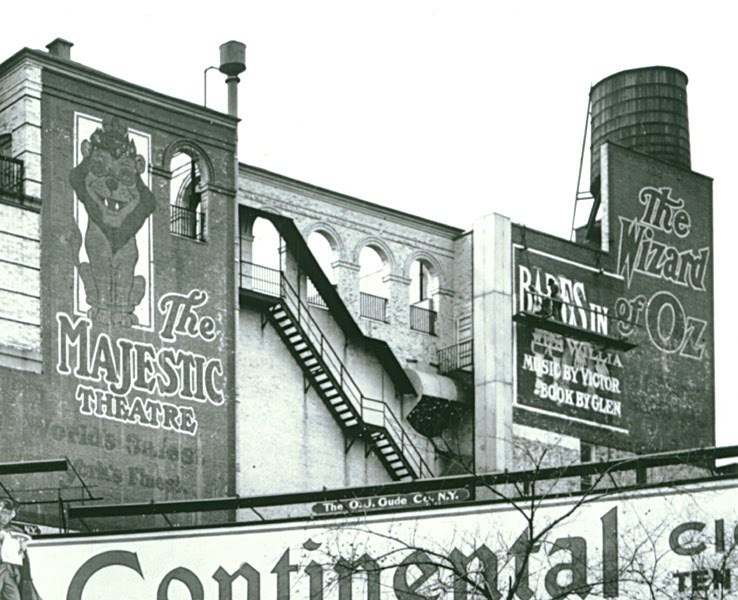
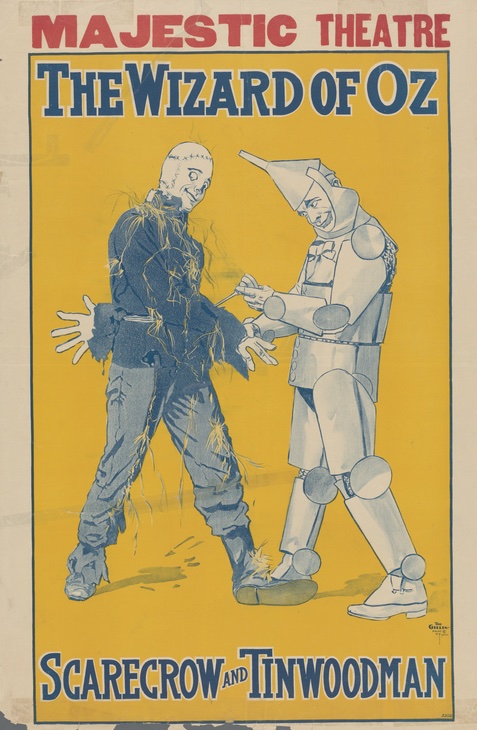
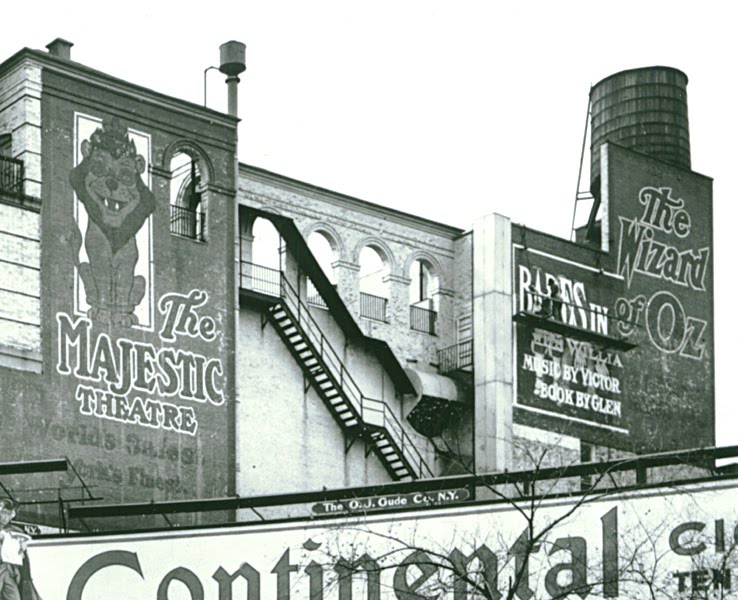
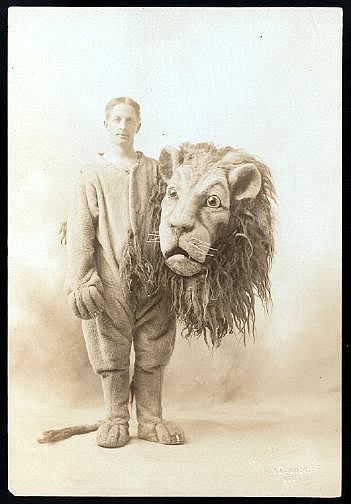
One of the more fantastic creatures from Victor Herbert’s Babes In Toyland, which made its debut in Columbus Circle’s Majectic Theater. You can read my article here on the musical which inspired Herbert’s show, the musical version of The Wizard of Oz. (NYPL)
New York Public Library
George M Cohan singing “Over There”
Video of a Ziegfeld Follies from 1929, a bit past their heyday, actually. They would only last until 1931:
Sheet music from 1921 of one of the most famous songs from Shuffle Along (NYPL):
Dancing girls during the Actors Strike of 1919, which galvanized the industry and gave regular New Yorkers a window into the tough conditions faced by many background performers. (NYPL)
So the number ‘After The Ball’ — a huge hit song that made its stage debut in A Trip To Chinatown — made a return appearance to Broadway in 1927’s Show Boat!
Musical cues from this week’s show: Give My Regards To Broadway and After the Ball performed by Billy Murray A version of Make Believe recorded by Bing Crosby, and Ol Man River, performed by Paul Robeson, from a 1932 cast recording, featuring Victor Young and His Orchestra Love Will Find A Way, from a 1921 recording by Eubie Blake Selection from HMS Pinafore, from a 1914 recording by the Victory Light Opera Chorus
And finally, a clip from the film version of ‘Show Boat’, featuring an iconic performance by Paul Robeson.
This is how they turn on the lights at the tallest building in the world in 1913:
At some time after 7 pm, on April 24th, according the New York Sun the following day, “President [Woodrow] Wilson pushed a button in Washington last night, a bell tinkled in the engineer’s quarters far below the street level in the Woolworth Building and thousands of lights [80,000, by contemporary accounts] flashed out … to signal that New York’s newest heaven kissing tower was opened formally for service.”
As normal New Yorkers stared up in wonder at this glowing candle near City Hall, an electric vision that lorded over the dark hulk of the unloved Post Office across the street, a collection of wealthy men were gathered up on the 27th floor for a lavish banquet in honor of the building’s architect, Cass Gilbert (at right).
The Tribune called it “the highest dinner ever held in New York.” (The building is 57 floors; dinner could have been much higher but for tenants who had already moved in.)
Holding court this evening was, of course, Frank W. Woolworth, the man whose retail empire inspired the building’s construction.
Also presiding over the gala was Francis Hopkinson Smith, a close friend of Gilbert’s who, several years earlier, just happened to built the foundation for the Statue of Liberty.
People toasted a true American entrepreneur. They toasted his visionary architect and his world-class achievement. Many toasted the fact that both men, after years of arduous work, were still talking to each other.
The Woolworth Building at night in 1913. This extraordinary photo is courtesy of Shorpy, my favorite website of all time. Click here to see the whole spectacular version and to search their their archive of cleaned-up vintage photos. (You can find the original picture at Library of Congress.)
It was a celebration of the filthy rich, possibly one of the most indulgent dinners of the Gilded Age.
In attendance were governors, dozens of congressmen and military men, judges, the police commissioner and at least seven of Woolworth’s early business partners. A letter from William Howard Taft, a month into his post-presidency, elicited enthusiastic applause.
But nothing like the reaction when Gilbert stood up to honor his benefactor, who paid for the entire building from his lucrative retail profits. “I asked his bankers about it and they told me that the Woolworth Building is a structure unique in New York, since it stands without mortgage and without a dollar of indebtedness.”
At this, the 37th floor erupted into “the big noise of the celebration.” Gilbert was then presented with a bronze foot-high cup — a literal trophy earned for building one for Frank Woolworth.
Following the dinner, Boy Scouts — patient ones, apparently — then raced downstairs ten floors to the Marconi wireless station, where an honored greeting was sent back to President Wilson.
Below: The Woolworth and lower Manhattan in 1919, lit from a building in Brooklyn. Specifically this was the Sperry Spotlight. You can read my article on ‘the world’s most powerful searchlight’Â here. (Picture courtesy Library of Congress)
The Woolworth Building was an achievement of American capitalism and a fabulous symbol of limitless New York real estate. Its technical achievements, impossible to imagine a decade prior, only reinforced the themes of the day — money could defy gravity.
On the day of the official opening, the following ad ran in the Evening World (While April 24th was the ceremonial first day, May 1st was the beginning of the building’s leases.):
Nobody would “forget about you” — provided you took out a lease at the Woolworth — but most importantly they certainly wouldn’t forget the name affixed to this building. The Woolworth continued the trend of business owners who created skyscrapers as a show of business dominance.
Newspapermen popularized the trend — for instance, The World Building, offices for Joseph Pulitzer‘s New York World, was also a world’s-tallest at one point — and insurance companies and retailers would perfect it.
In fact, three decades later, the crown for world’s tallest building would be taken by a structure in midtown Manhattan named for a car company — The Chrysler Building.
The Woolworth was considered a vertical super-city, in an era before anybody ever dreamt of Rockefeller Center.
“You can deposit and draw money at the bank on the first floor; in the basement there are barber shops and a swimming pool, one of the largest in New York …. There is an arcade lined with attractive shops whose fronts are entirely of plate glass. Then there is a luncheon club, library and gymnasium on the 28th floor and an observatory station on the roof.”
Woolworth’s own businesses took up only two floors. The rest were filled with such premiere tenants as Fordham University (its law school and dean’s offices were here), Irving National Bank and even Columbia Records.
Below: A study for Woolworth’s private office in the Woolworth Building. Frank Woolworth was obsessed with the life of Napoleon Bonaparte, and his office was fashioned on a room from Napoleon’s castle in Compaigne, France. (Pic courtesy LOC)
Today, we might consider the Woolworth Building to be a rather elusive monument. You can’t regularly tour it, and its style, before New York’s zoning laws, makes it a unique stranger within New York’s skyscraper population. You can’t interact with it like Grand Central, and it doesn’t have the personality of the art-deco Chrysler or the Flatiron.
But even if its nightly mystical posture on the skyline somehow fails to ensnare you, the Woolworth Building stands alone as an influence to almost every skyscraper that has come afterwards, from the Empire State Building to the Woolworth’s old neighbor the World Trade Center.
Of the many grand visions born in New York before the 1910s — the Erie Canal, Central Park, the Croton Aqueduct, the Brooklyn Bridge — the Woolworth Building is easily the most effortless in execution. And arguably the most duplicated.
Or as the Sun prophesied a week after the building opened: “The Woolworth Building is unique, it was explained. Its style of architecture is original in office buildings and there were no precedents or rules upon which to go. The proportions have now been ascertained and will be available for the guidance of architects in the future.”
Interested in learning about the history of the Woolworth Building? It’s our Episode 76. You can download it from here, find it on iTunes, or just play it below!
__________________
And finally, I found this in a July 1919 copy of the New York Evening World — the Woolworth Building as a possible air dock for dirigibles! (This never happened of course.)
This article originally ran on the Woolworth Building’s 100th anniversary.
The South Street Seaport is the home for a great many nautical treasures. It’s also the location of a memorial to nautical tragedy.
The Titanic Memorial, a 60-foot white lighthouse, sits in the little plaza at Fulton and Water Streets.
This was no mere decorative lighthouse as it seems today.
For much of its history, it was an operational light source, a beacon over the East River.
The memorial’s first home, atop the Seamen’s Church Institute (Courtesy NYPL)
The Titanic sank on April 15, 1912, killing more than 1,500 people from all social classes.
The loss shook society to its core. Among the victims were prominent New York businessmen and benefactors such as John Jacob Astor IV and Benjamin Guggenheim.
As New Yorkers mourned the loss of loved ones, they immediately funneled their grief into the building of memorials, the physical remembrance of a disaster that left virtually no trace behind.
Mayor William Jay Gaynor gathered community leaders to City Hall in May 1912 to solicit ambitious ideas of the new memorial.
The Evening World attributes one idea for a lighthouse to engineer Carroll Livingston Riker, who suggested “the lighthouse should be located at some perilous point on the coast, illuminated by a most powerful light and with a great fog horn that may be heard many miles as part of its equipment.”
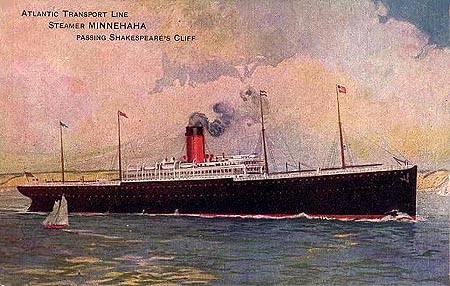
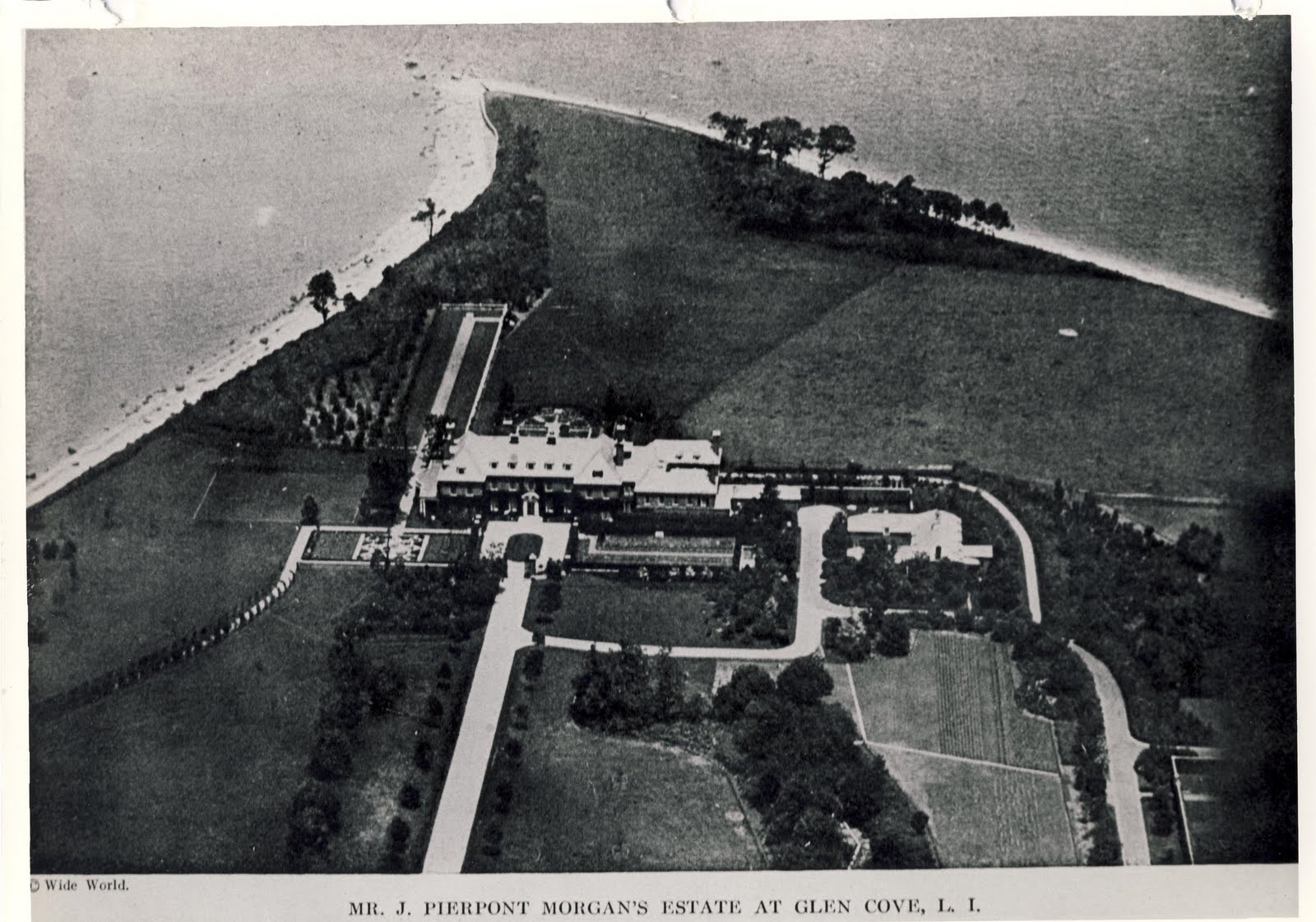
Meanwhile, a less dramatic lighthouse memorial (pictured above) was funded by J.P. Morgan and planned for the top of the new Seamen’s Church Institute at 25 South Street.
From a 1912 handbill, drumming up support for a proper memorial. (Courtesy Seaman’s Institute)
The lighthouse was equipped with a time ball which was lowered at noon to help distant sailors adjust their equipment. (This same sort of ball is affixed to the top of One Times Square in 1908, dropped every year at ring in the new year.)
The lighthouse memorial was dedicated on the first anniversary of the disaster with many family and friends of victims in attendance.
The New York Times claims the lighthouse and ball drop atop the Institute “were simply features of the existing plan, relabeled as a memorial.” [source]
However it became New York’s most prominent remembrance of the Titanic disaster after all when, over at City Hall, nobody could make up their mind on a truly grand memorial. (All you need to know about the city’s failed efforts is illustrated in this 1912 headline on one meeting — “One Man Made 18 Speeches.”)
Meanwhile, there were other Titanic memorials being planned in other parts of the city.
In Greenwich Village, in the Washington Square studios of Gertrude Vanderbilt Whitney, the artist began work on a sculpture for a national memorial in Washington D.C.
She displayed a model for the memorial in February 1916 that drew gasps from society women.
“[T]he present figure with its pedestal extends from floor to ceiling and catches interesting lights that add to the highly dramatic conceptions.” [source]
A study of the Titanic memorial which was displayed at Whitney’s Village studio. (Courtesy AAA/Whitney Museum)
Yet another Titanic memorial was planned in June 1912 to honor philanthropists Isador and Ida Straus near their home on the Upper West Side. A competition was held in 1913 for aspiring sculptors, with Augustus Lukeman’s pondering nymph the eventual winner.
Featured at the dedication ceremony were 800 children who had been helped by Straus’ Educational Alliance on the Lower East Side.
Below: Dedication of Straus Square and its curious monument. (Courtesy Library of Congress)
As for the Titanic Lighthouse Memorial?
It sat dutifully atop the Seamen’s Institute for decades, its green light a welcome beacon to those entering the harbor.
By the 1950s, shipping no longer came through the area of New York’s waterfront, and the Institute eventually sold its building.
The lighthouse was donated to the South Street Seaport Museum in 1968, then a budding institution formed just a couple years prior to protect the historic structures of the area.
For a time, the lighthouse actually sat on the waterfront before relocating back to its present home in 1976, in a park partially funded by Exxon Oil.
There was one other memorial to the Titanic disaster — the Wireless Operators Memorial at Battery Park. This bronze cenotaph and fountain was dedicated in 1915 to nine intrepid employees — “wireless heroes” — who died on the Titanic and in other ocean disasters.
Wrote J. Andrew White in 1915: “It is an eloquent reminder of a tradition that has grown out of the brand of courage which seeks no precedent, which, founded on the heroic action of a mere boy, has been written in the indelible annals of the men who go down to the sea in ships.”
After sitting in storage for many years, the memorial can once again be found in Battery Park.
Let me take you back to a simpler time, back to a time where it might have been okay to hate the actual World Trade Center.
The World Trade Center was originally seen as a representation of New York’s own dreams and failures. The buildings represented progress to some, disruption to others.
An entire business district — Radio Row— was eliminated in its construction. Another neighborhood — Battery Park City — sprang up in its shadow. The monumental design by Minoru Yamasaki radically altered (distorted?) the skyline. Some of New York’s oldest streets were now blocked from sunlight. On the other hand, an area of Manhattan that would have been susceptible to rising blight was now renewed.
It was the apotheosis of post-modern design, the apex of New York City construction.
Everything grand and intolerable about New York City in the late 1960s/early 1970s was embodied here in these two impossibly tall shafts of metal.
Many saw a waste of resources and state governments with skewered priorities. Business interests were hopeful the buildings would reinvigorate the Financial District. They would, eventually.
But back in 1973 many openly wondered how its owner, the Port Authority of New York and New Jersey, were even going to attract tenants.
Below: The view of downtown Manhattan from a New Jersey marina
Courtesy Museum of the City of New York, Edmund V Gillon
After years of construction that transformed lower Manhattan, the buildings were officially opened in a ribbon-cutting ceremony on April 4, 1973. Far from a rapturous embrace, the opening of the world’s tallest buildings was met with relief, resignation and turmoil.
Few were in a mood to celebrate two shiny new symbols of wealth in a city slowly nearing bankruptcy.
Here are a few more details from its opening day and its aftermath:
People were already over it: The opening was occasioned by severe rain. (It’s in good company; the opening of the Statue of Libertywas also met with a downpour.) Even without it, however, the celebration would have been heavily muted.
The ground was broken on the World Trade Center site almost seven years before, and New Yorkers had plenty of time to get used to the rising towers. The first tower had been completed by 1970, but by then, the city had become rather jaded to the expensive buildings. As it was, lower levels of the second building were still not even completed.
Disagreements: The top luminaries at the opening were New York governor Nelson Rockefeller and New Jersey governor William T. Cahill. The World Trade Center was a Port Authority project; PATH trains to New Jersey were rumbling underneath (or were supposed to be, see below).
While the two governors seemed in playful spirits, Cahill openly resented the backseat his state took in the finished product. According to author Eric Darton: “Cahill implies that New Jersey’s commuter rail needs have taken second place to the trade center, and Rockefeller, still grinning, points towards the Jersey shore. ‘You see all those magnificent container ports,’ he says, ‘that took all those jobs away from New York.’ “
In Absentia: Gone were the days when U.S. presidents showed up at the opening of New York landmarks, but President Richard Nixon did send a statement, hailing WTC as “a major factor for the expansion of the nation’s international trade.” That very same month, the Watergate cover-up erupted into the scandal that would eventually lead to his resignation the following year.
STRIKE! Not only was Nixon not there, but the man he designated to read the speech — Peter J. Brennan — was not even there. Three days earlier, the Brotherhood of Railway Carmen union began a strike against Port Authority. Because of the strike, the PATH train — that glorious feature of the new World Trade Center — was closed for a total of 63 days. Brennan was Nixon’s new Secretary of Labor, so it would hardly seem proper to break the picket line. Nixon’s speech was delivered instead by a Port Authority chairman.
Critics, Part One: Noted labor leader and powerful mediator Theodore W. Kheel was violently against the states’ interest in the World Trade Center. Calling it “socialism at its worst,” he demanded the governors take the podium on ribbon-cutting day and sell the building to private investors “at the earliest possible date.”
Others were perhaps understandably concerned that the buildings, given special tax status, were now a quarter-filled with state offices and certainly destined to empty and bankrupt office buildings with no such tax breaks in the surrounding area. Luckily, Kheel did live to see the building sold to private concerns in 1998.
Critics, Part Two: Somebody else was saving up some vitriol for opening day — noted architectural critic Ada Louise Huxtable. Having years to craft some well-worded jabs, she did so in a column in the New York Times the following day. “These are big buildings, but they are not great architecture…..The Port Authority has built the ultimate Disneyland fairytale blockbuster. It is General Motors Gothic.”
Critics, Part Three: Labor leaders were disgruntled. Critics dismissed it. But many New Yorkers outright loathed it. It’s a bit disturbing to read such outright disgust over structures that we have very different feelings about today. From the Village Voice a week after the opening:
“The ecology-minded and those who are concerned with the energy crisis are fond of predicting that the building will have to be torn down — or at the very least abandoned — on that not-to-distant day when the power it consumes puts an intolerable strain on our already-diminishing power reserves.”
Nowhere to Eat: The World Trade Center could facilitate thousands of employees, but, on opening day, it had one restaurant, called “Eat and Drink,” where “the waitresses wear hard hats and its busboys wear vests inscribed “Ecologist” on the back.”
In the second building, a makeshift sandwich shop opened on the unfinished 44th floor. Needless to say, outside food vendors in the area were not displeased.
Subversion The ribbon-cutting ceremony also marked the end of One World Trade Center’s dominance as the world’s tallest building. Chicago trumped it when Sears Tower topped out at 1,454-feet less than one month later.
In New York, the buildings quickly became a totem of excess, of something that could be symbolically overcome. You may be familiar with the daredevil Philippe Petit and his insane and unbelievably majestic (and illegal) tightrope walk between the towers. But you may not remember that it took place just sixteen months after the opening, on August 6, 1974.
Two years later, King Kong performed a similar sort of feat in the 1976 remake starring Jessica Lange.
But there was magic in the air. On the very same day as the ribbon-cutting, in a hospital across the water in Brooklyn, a woman went into labor and gave birth to a child who would later become the nightclub-loving illusionist David Blaine. The World Trade Center and David Blaine — born on the same day!
Photography on this page, from various periods, by Edmund V. Gillon, courtesy of the Museum of the City of New York. Check out their online gallery for some more beautiful black-and-white shots.
This article originally ran on September 11, 2014.
One of the great narratives of American history — immigration — through the experiences of the Irish.
We just reedited and reworked our 2017 show on Irish immigration in time for St. Patrick’s Day and a celebration of all things Irish! So much has changed in our world since 2017 and this history feels more relevant and impactful than ever before.
You don’t have a New York City without the Irish. In fact, you don’t have a United States of America as we know it today.
This diverse and misunderstood immigrant group began coming over from Ireland in significant numbers starting in the Colonial era, mostly as indentured servants. In the early 19th century, these Irish arrivals, both Protestants and Catholics, were already consolidating — via organizations like the Ancient Order of the Hibernians and in places like St. Patrick’s Cathedral.
Emigrants leaving Queenstown for New York / M.F. [Published] Photograph. Retrieved from the Library of Congress
But starting in the 1830s, with a terrible blight wiping out Ireland’s potato crops, a mass wave of Irish immigration would dwarf all that came before, hundreds of thousands of weary, sometimes desperate newcomers who entered New York to live in its most squalid neighborhoods.
The Irish were among the laborers who built the Croton Aqueduct, the New York grid plan and Central Park. Irish women comprised most of the hired domestic help by the mid 19th century.
The arrival of the Irish and their assimilation into American life is a story repeated in many cities. Here in New York City, it is essential in our understanding of the importance of modern immigrant communities to the life of the Big Apple.
PLUS: The origins of New York’s St. Patrick’s Day Parade!
LISTEN HERE: When The Irish Came To New York
The Bowery Boys: New York City History podcast is brought to you …. by you!
We are creators on Patreon, a patronage platform where you can support your favorite content creators.
Please visit our page on Patreon and watch a short video of us recording the show and talking about our expansion plans. If you’d like to help out, there are several different pledge levels. Check them out and consider being a sponsor.
Patrons receive the extra bonus podcast Side Streets featuring conversation about all sorts of New York City related subjects.
We greatly appreciate our listeners and readers and thank you for joining us on this journey so far.
St. Patrick’s Old Cathedral, the embodiment of early Irish pride in New York. Below: A photograph by Edmund Gillon from 1975.
2013_3_2_ 627
Irish Emigrants Leaving Home — The Priest’s Blessing (dated 1851)
A lithograph by Maurer and Currier (of Currier and Ives) illustrating a rather stereotypical scene of Irish life.
An anti-Catholic illustration from 1855.
Library of Congress
In 1860, fear of foreigners inspired a San Francisco cartoonist to draw this image, imagining laborers from Ireland and China (responsible for building the railroads) ‘swallowing’ up the country. A mixed Irish/Chinese caricature completes the job.
Library of Congress
St. Patrick’s Cathedral on Fifth Avenue, a new signpost for the acceptance of the Catholic religion in America, sits alongside acres of hot real estate in 1905. Its neighbors would slowly transition from luxury manors to upscale shops and department stores.
Image courtesy Shorpy
By 1872, you were seeing much more thoughtful depictions of Irish Americans such as this one  by Duval and Hunter. “Print shows a mother pinning clover on her son’s suit lapel, on the right is a young girl standing at an open window waving a banner “God save Ireland.” A domestic scene in a palor with a sewing machine on the left.”
LOC
The departure of the 69th Infantry Regiment, the ‘Fightin’ Irish’ brigade headed to the battlefields of the Civil War. Lithograph dated 1862.
The caption, dated 1866 — “Irish Emigrants Leaving Their Home For America — The Mail Coach From Cahirciveen, County Kerry, Ireland.”
From a Harpers Weekly article from 1874 — leaving Queenstown (today’s town of Cobh) for New York.
Library of Congress
The insanity of Castle Garden, the prime immigration station in New York in 1880, before the construction of Ellis Island. Below that, registering names at Castle Garden in 1871.
NYPL
The hazards of immigrants leaving Castle Garden, as vividly illustrated by Puck Magazine.
The flow of immigrants were better accommodated by Ellis Island, pictured here in 1907.
MCNY
Irish women line up at the Emigrant Savings Bank, withdrawing money to send back to relatives in Ireland. (1880)
Library of Congress
Irish vaudeville often poked fun at their own stereotypes — and promoted many others. This 1880 Harrigan and Hart sketch was called ‘Ireland vs Italy.’
MCNY
An 1886 cartoon by Bernard Gillam, illustrating the Tammany Hall tiger with Irish accoutrement.
Courtesy MCNY
‘Professor’ Mike Donovan, an Irish-American boxer who performed out west then became a boxing instructor in New York up until his death in the Bronx in 1918.
LOC
A typical example of an Irish-themed song from the Gilded Age, of the type which is obviously playing with some stereotypes of Irish people.
By 1895 the St. Patrick’s Day Parade is a genuine event, drawing New Yorkers of all kinds. These pictures are along 57th Street.
The parade in 1909, featuring a banner for the Kerrymen’s Patriotic and Benevolent Association.
The St. Patrick’s Day Parade, between 1910-15
LOC
A version of this podcast and page was originally released in March 2017.