PODCAST The story of the devastating snowstorm that changed New York City forever.
Every winter, as forecasters gaze upon a gruesome impending storm, they always mention one of the worst storms to ever wreak havoc upon New York City, the now-legendary mix of wind and snow called the Great Blizzard of 1888.
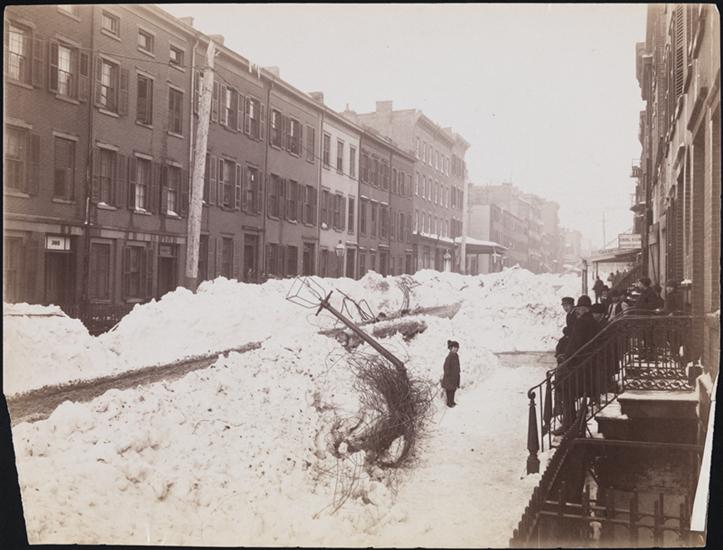
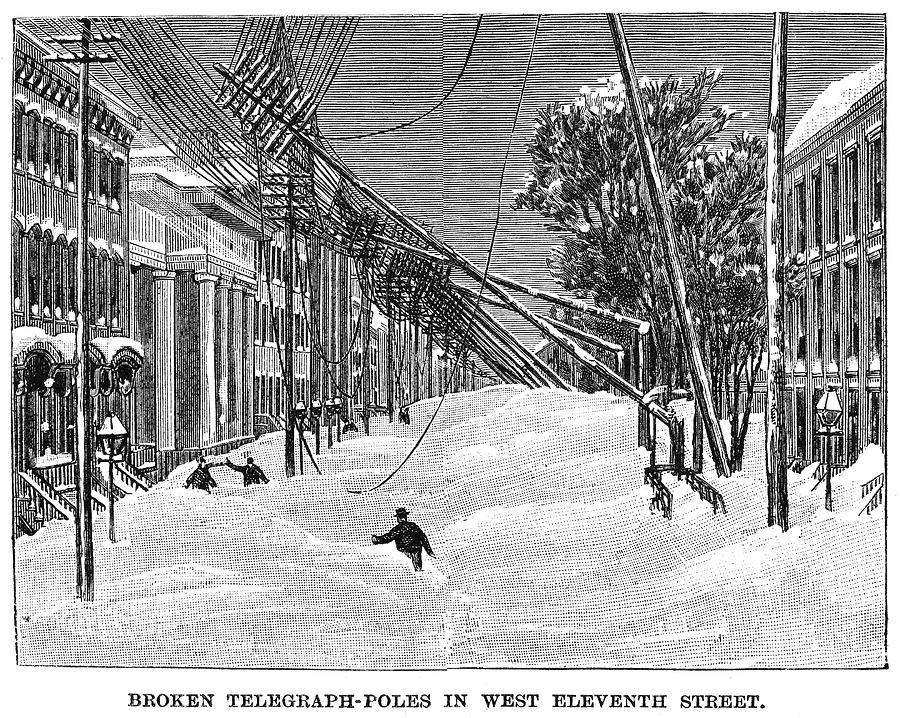
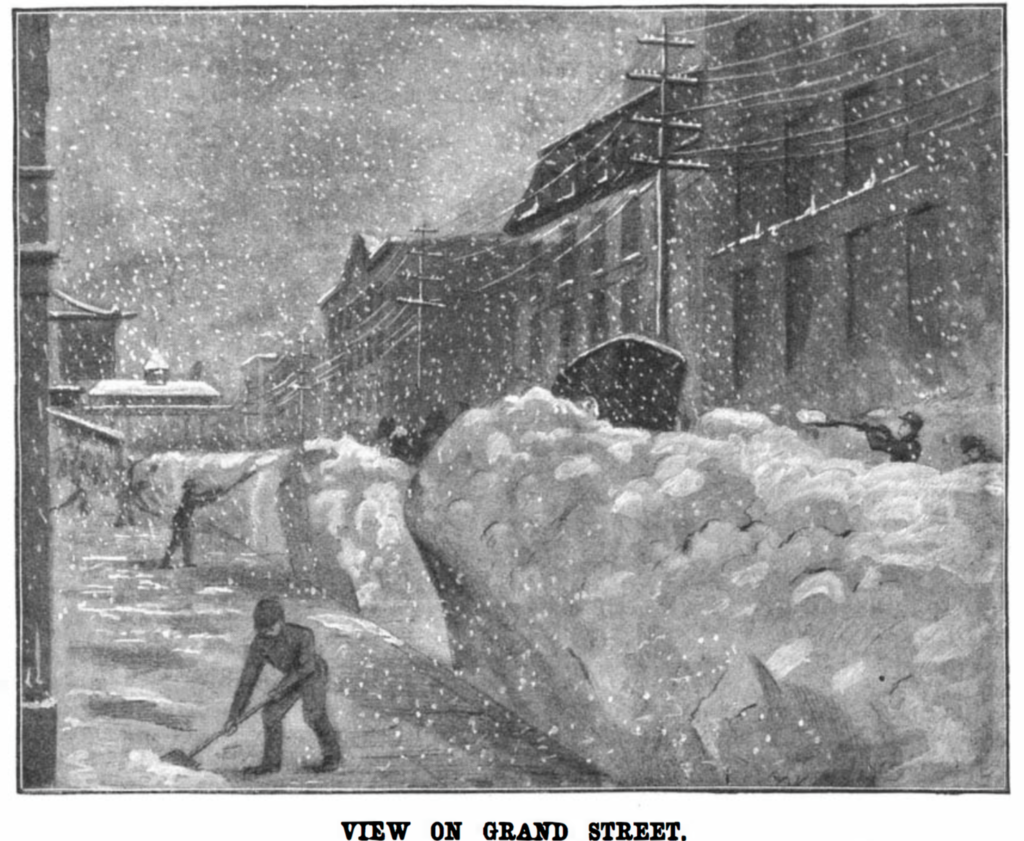
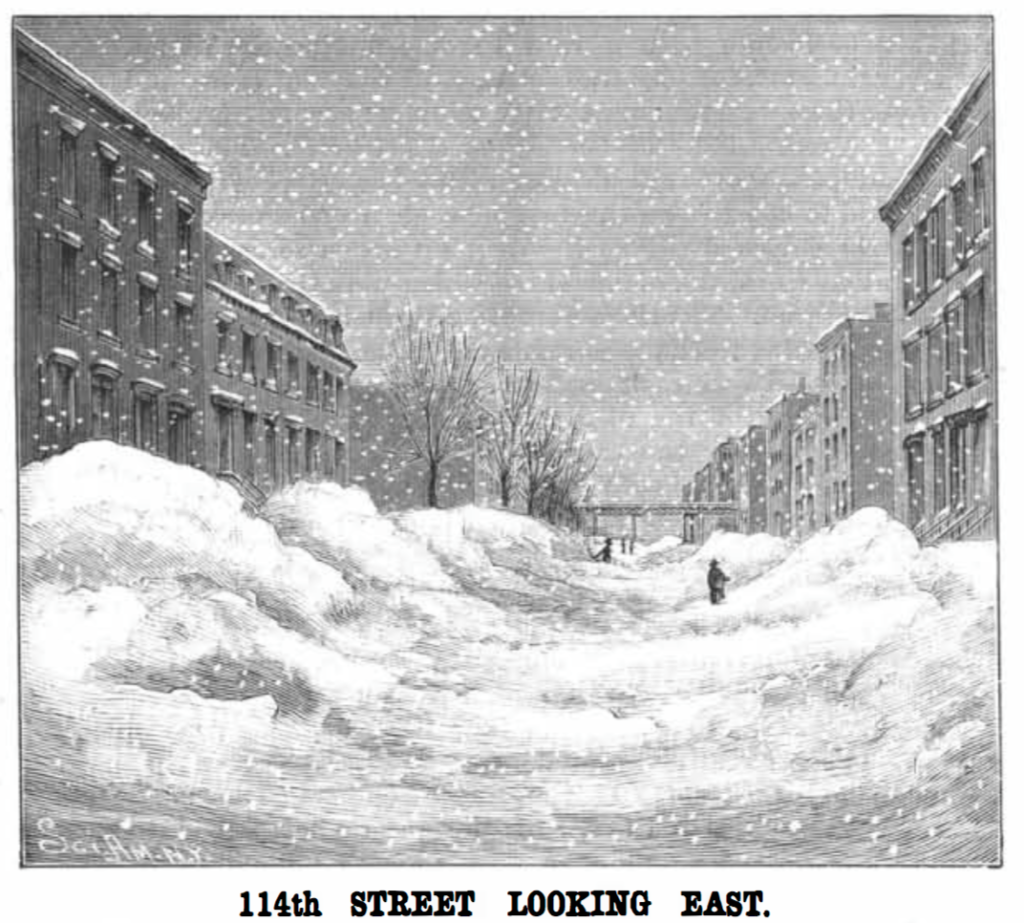
The battering snow-hurricane of 1888, with its freezing temperatures and crazy drifts three stories high, was made worse by the condition of New York’s transportation and communication systems, all completely unprepared for 36 hours of continual snow.
The storm struck on Monday, March 12, 1888, but many thousands attempted to make their way to work anyway, not knowing how severe the storm would be. It would be the worst commute in New York City history. Fallen telephone and telegraph poles became a hidden threat under the quickly accumulating drifts.
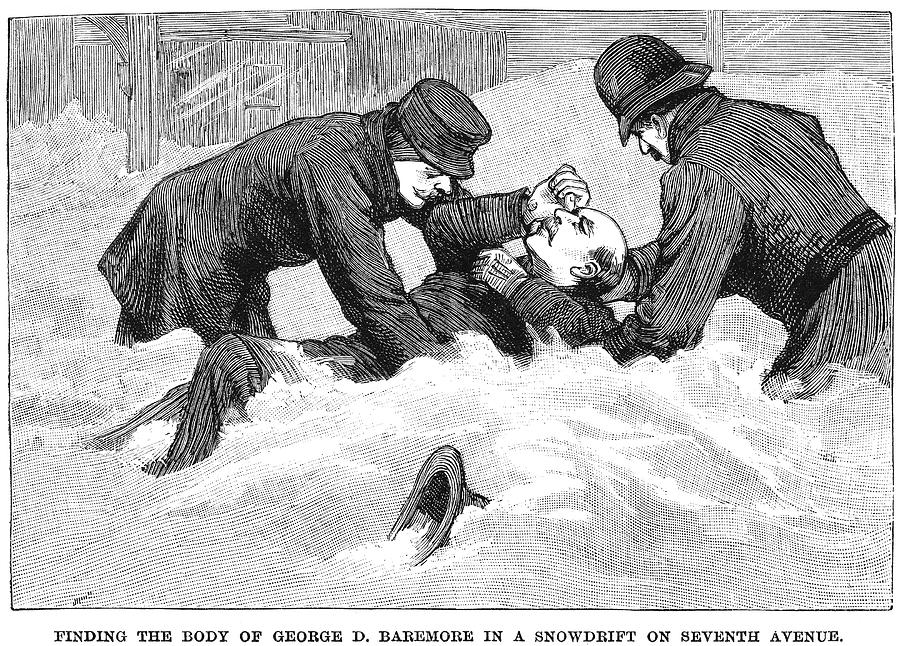
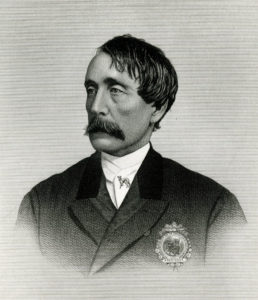
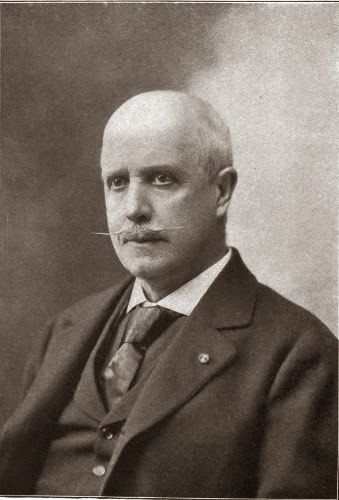
Elevated trains were frozen in place, their passengers unable to get out for hours. Many died simply trying to make their way back home on foot, including Roscoe Conkling (at right), a power broker of New York’s Republican Party.
But there were moments of amusement too. Saloons thrived, and actors trudged through to the snow in time for their performances, And for P.T. Barnum, the show must always go on!
This show was originally recorded back in 2013, just a few months after Hurricane Sandy. We think the comparisons to Sandy that were made in that show feel even more relevant today.
And for 2026, we’ve added a bunch of new exclusive features to our membership levels — on top of our regular behind the scenes podcast called Side Streets, which we are also recording on video, we’re also releasing classic episodes of the Bowery Boys each week, ad-free. Patrons can now hear this show (The Blizzard of 1888) ad-free.
On top of that, of course, we have exclusive merchandise made just for patron, you also get first dibs on tickets for upcoming live appearances – and so much more!
So please join the fun over at Patreon.com/boweryboys and thank you for helping support the Bowery Boys podcast.
We greatly appreciate our listeners and readers and thank you for joining us on this journey so far.
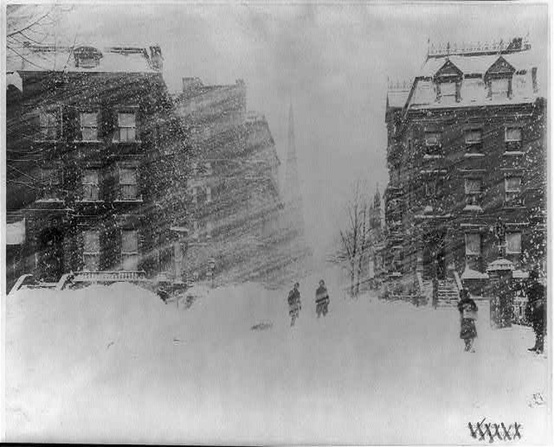
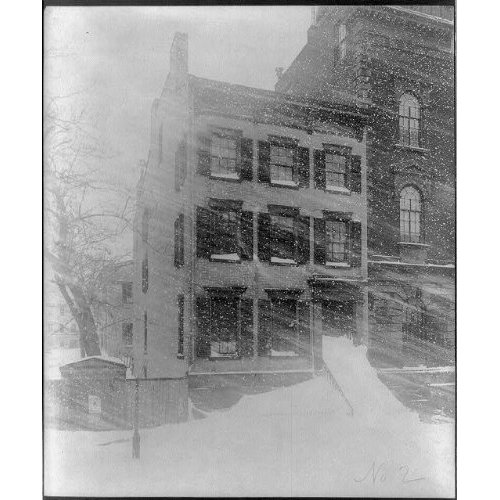
In the blizzard of 1888, the streets disappeared and the snow came down almost horizontally. Imagine being trapped at work, several miles from your home. This was the plight experienced by thousands of New Yorkers (and others throughout the northeast) that Monday. (Library of Congress)
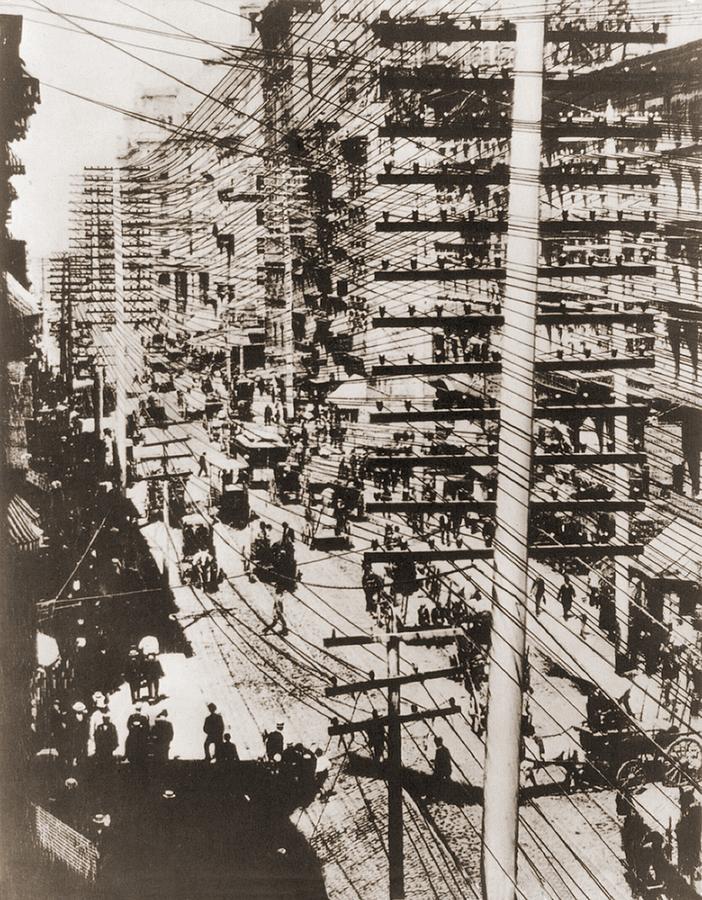
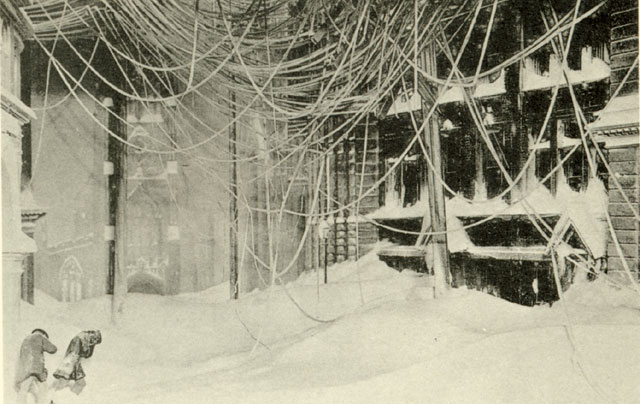
Why did the 1888 blizzard become such a hazard for New Yorkers? Let this picture be your first clue. The city was a cobweb of elevated telegraph, telephone and electric wires. This picture is from 1887. (LOC)
Langill & Bodfish/Museum of the City of New YorkMuseum of City of New York
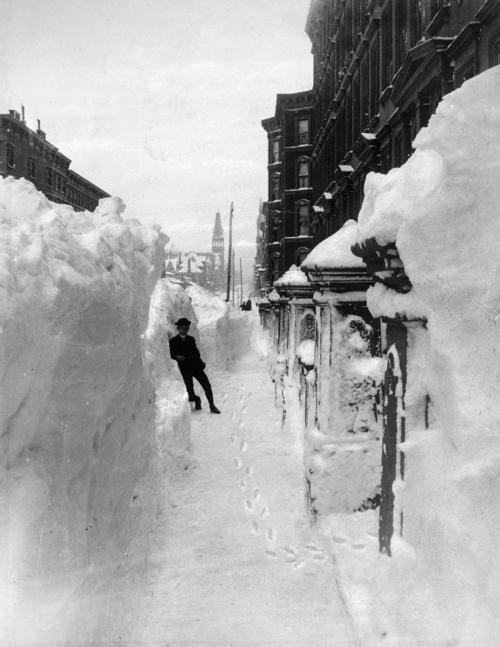
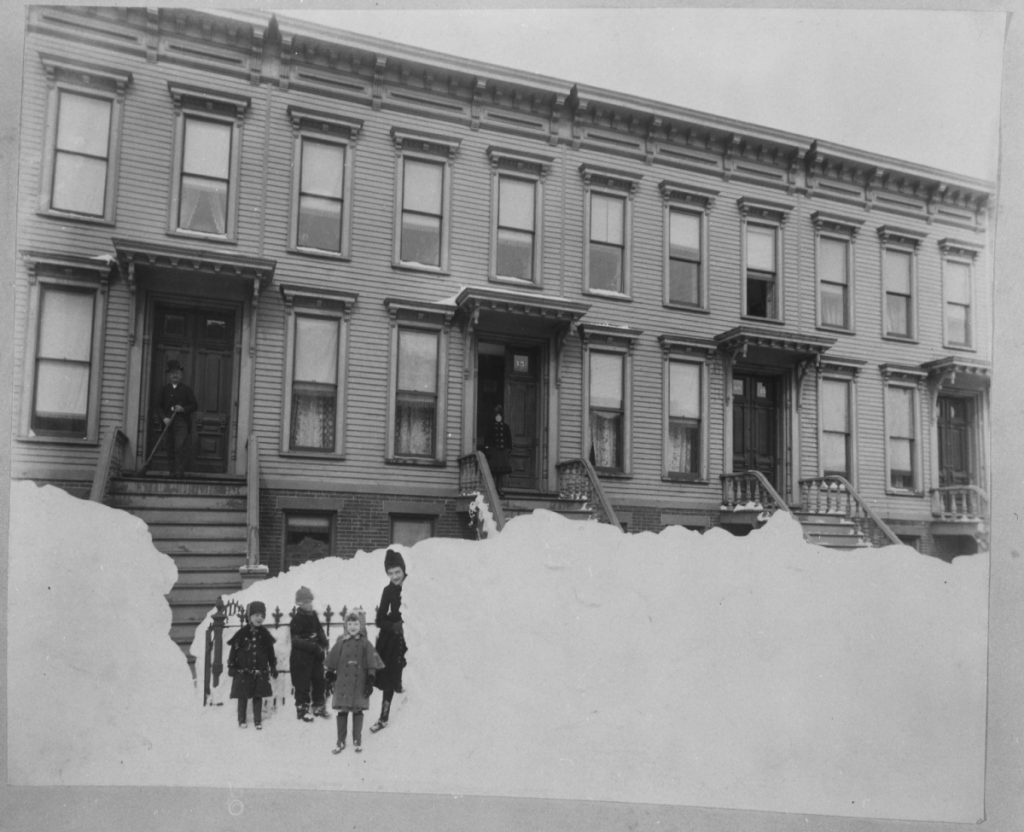
One example of a terrible (although minor) snow drift that might have kept this family in their home all day. Because of the unpredictable changes in wind, some houses might have been drift-free, while others close by completely locked in with snow. (LOC)
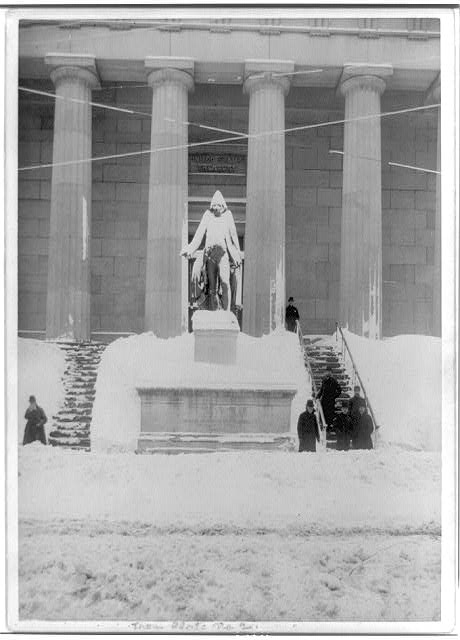
George Washington at the Sub-Treasury Building (today Federal Hall).
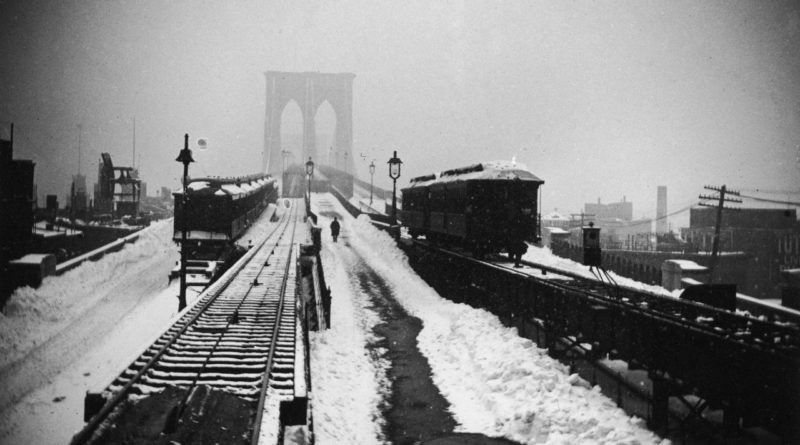
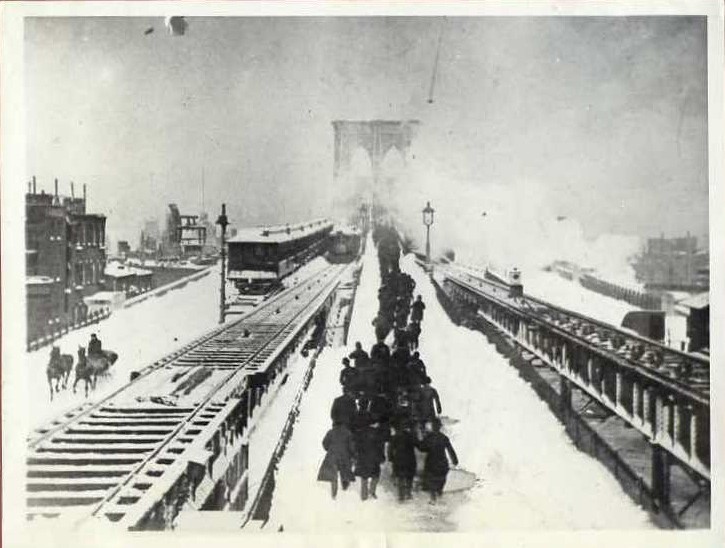
The Brooklyn Bridge, not even five years old, weathered the winds quite well, but became a hazard due to ice. In this picture, people are crossing over as there was no other way to get between Manhattan and Brooklyn. It’s not clear if any of the trains are operating in this picture.
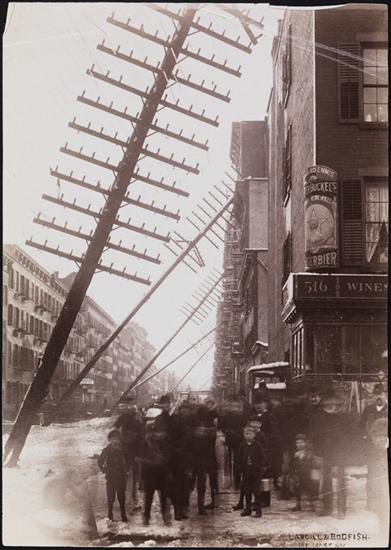
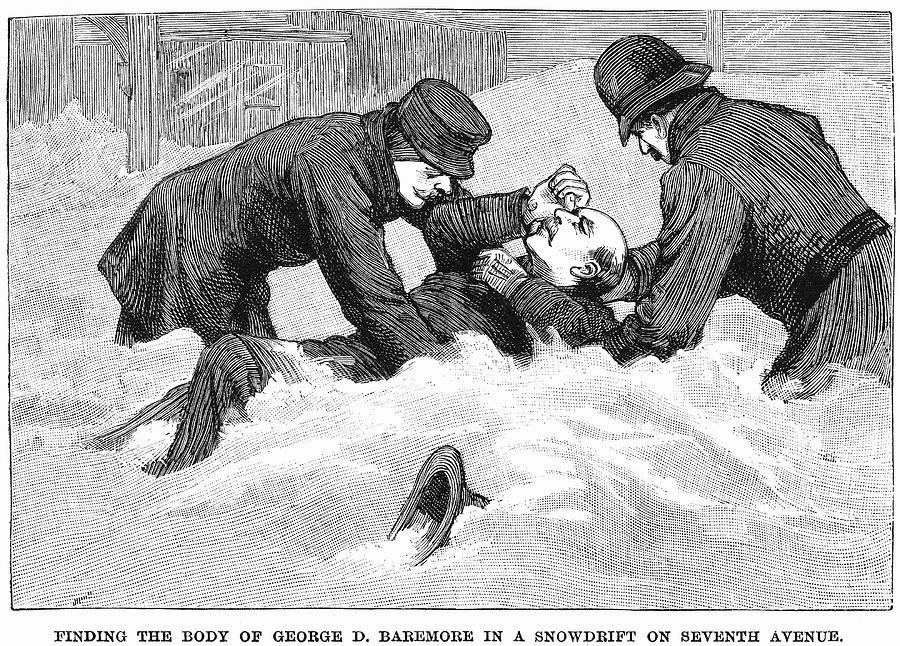
The biggest danger for those venturing outside were the hundreds of downed telegraph, telephone and electrical poles, no match for the intense gusts. The poles would quickly fall then get covered with snow, creating deadly hazards for people walking past. The snow would just as quickly cover over an unconscious individual; many New Yorkers froze to death when they fell and were instantly shrouded.
Henry Bergh, founder of the American Society for the Prevention of Cruelty to Animals. He did not survive the blizzard. (NYHS)
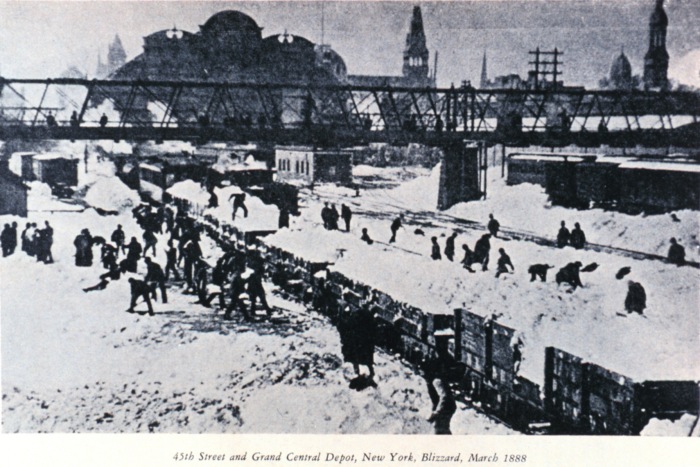
Transportation in and out of the city was at a complete standstill for half the week. Here workers frantically try to clear the way for trains going into Grand Central Depot.
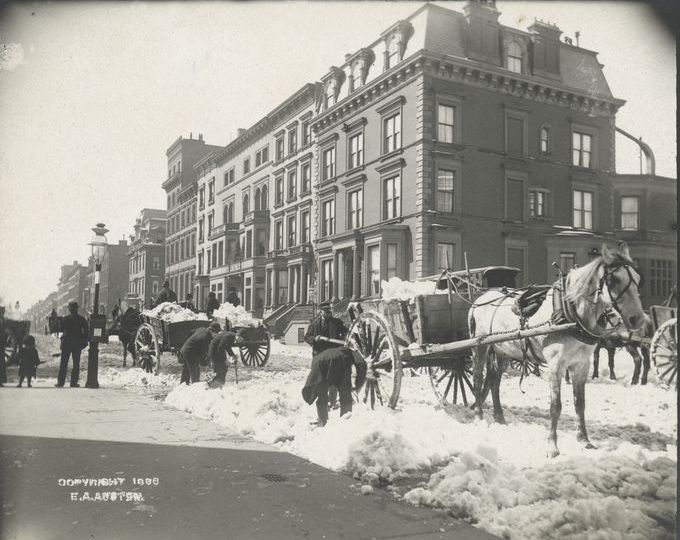
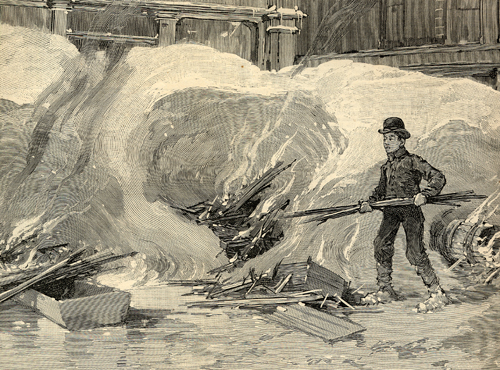
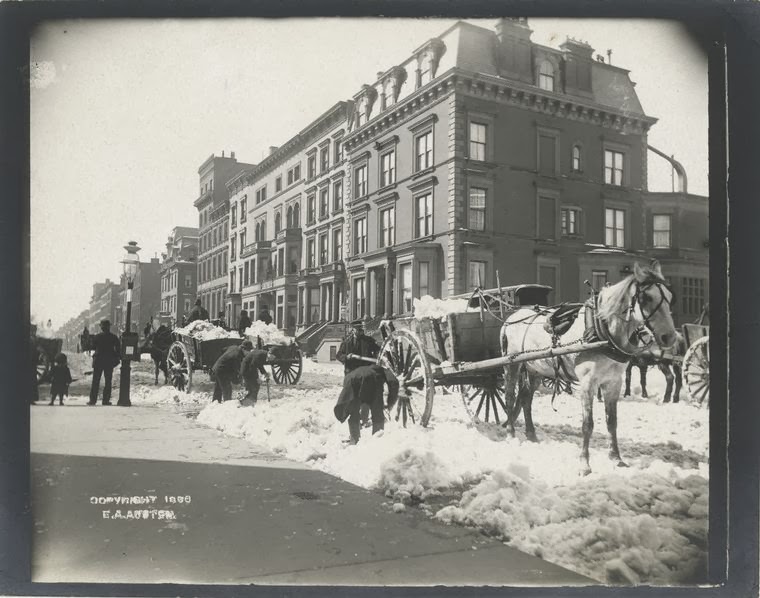
Clean-up was truly chaotic, a feeble effort by the city paired with private contractors with horses, shovels and carts. The piles of snow were taken to water’s edge and dumped, or, in a few less preferred cases, people just started bonfires and melted it away. (For a great picture of a snow dump in the river, see this photo at Shorpy of a blizzard from 1899.) Top pic courtesy LOC, at bottom Maggie Blanck.
The cover of Frank Leslie’s Illustrated Newspaper, usually one of the more sensational pieces of journalism people might have found at their newsstand.
Illustrations from Scientific American, March 24, 1888
For more information on New York City’s history with snow removal, listen to our 2019 show on the history of the city’s Department of Sanitation.
For some of New York City’s history, snowstorms have been completely paralyzing, and most residents had to clear their own streets, an impossibility in areas of a more rural character.
The notion that it was actually the city’s responsibility to remove snow is a product of the early-to-mid 19th century. The notion that all residents — not just the wealthiest — should benefit from this difficult civic task is newer still.
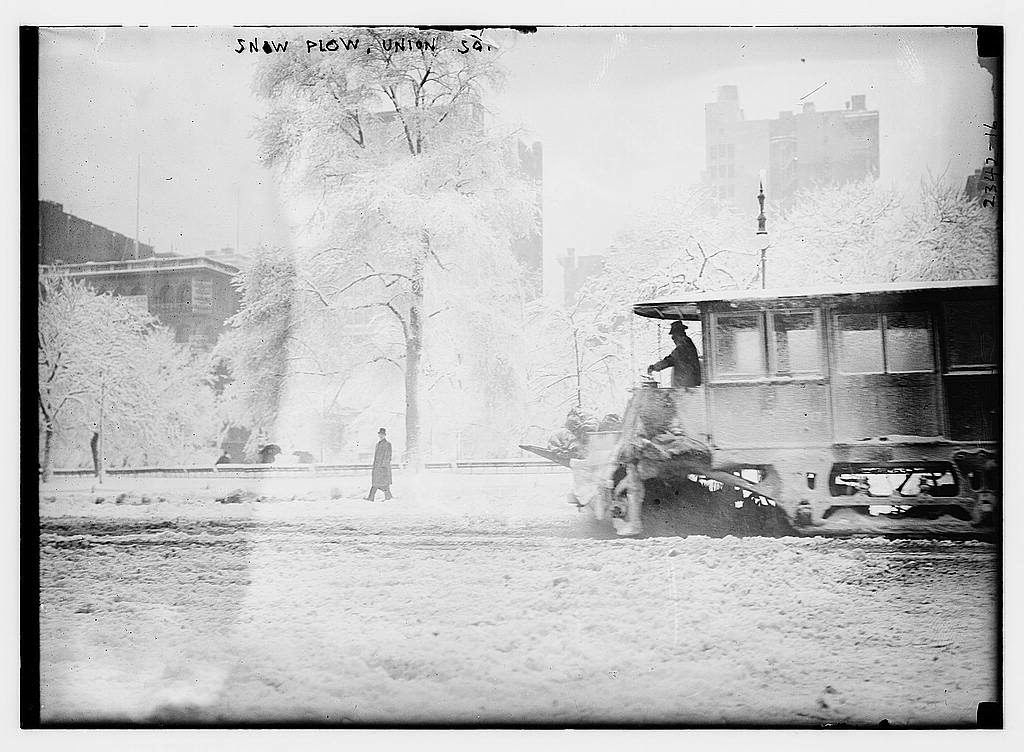
A snow plow at Union Square, circa 1901-1905 (LOC)
Snowed Under
There was no simple method for clearing thoroughfares.
The task was heavily labor intensive, with dozens of men shoveling down roads obscured with newly fallen snow. As a result, only the most important streets were cleared — mostly around City Hall, Wall Street and Fifth Avenue — leaving the rest of the city to fend for itself.
Later on, snow plows were attached to horses, piercing through the snow-covered streets, while wagons would follow along to collect the snow.
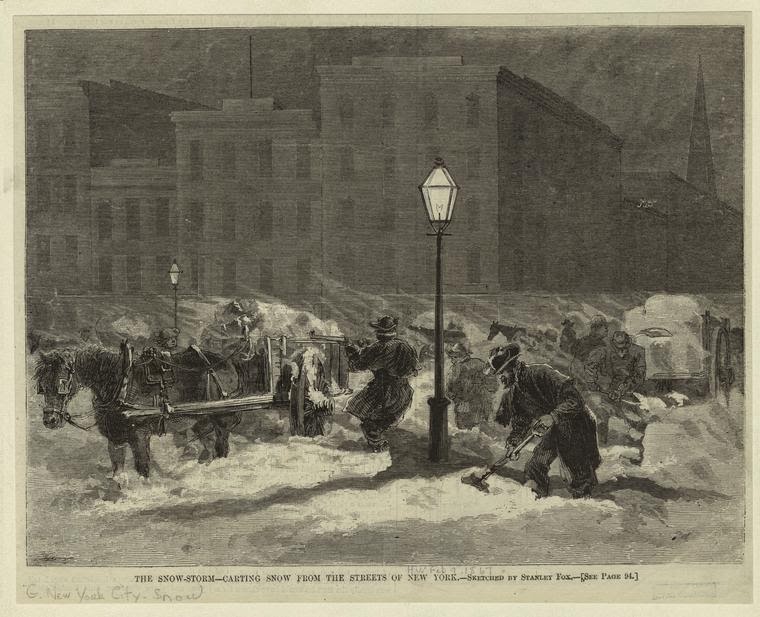
The arduous task of clearing the streets with only horses, shovels and carts, 1867 (NYPL)
The Mechanics of Removal
Civic snow removal was initially a responsibility of the police department up until 1881, when the Department of Street Cleaning became its own separate entity.
New York street-cleaners manned a broom during the spring and a shovel in the winter, working with horse-drawn carts in “piling and loading gangs” to clear gutters and intersections.
Most of the time, snow clearing was not even begun until it was believed the snowstorm was over. As a result, mountainous piles were even more difficult to tackle.
Obviously, this was slow going and highly prone to the corruption of the era. (Need snow removed from your street, business owner? ) And due to the erratic nature of snowfall, there were hardly enough men on hand at any given moment.
The Blizzard of 1888 changed everything in New York City. The storm was so devastating that certain streets were blocked for days.
More horrifying still, due to the hurricane-force winds, many people had been knocked unconscious and were subsequently buried in the snow. Not to mention the hundreds of dead animals also found underneath the massive snow drifts.
New York’s entire system of street cleaning — in sun or snow — radically changed when the Civil War veteran George E. Waring Jr. (pictured below) became commissioner of the Department of Street Cleaning in 1894.
The brilliant and reform-minded engineer had guided healthy sewage and draining maintenance throughout the country, from the design of Central Park to the streets of Memphis, Tennessee.
Snow Patrol
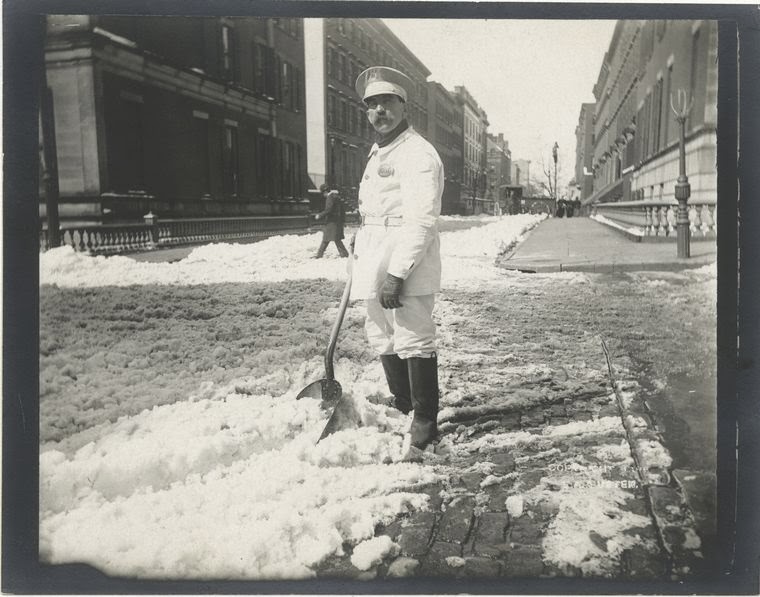
Waring transformed his men into a small military unit, garbed in all-white uniforms who occasionally marched in parades with Commissioner Waring out front, on horseback.
This military mindset was a boon for New York; Waring referred to his employees as “soldiers of the public.”
Street cleaning was no longer a luxury, but a necessity.
Clearing snow in the Waring era, 1896, photos by Alice Austen (she was riding around in her bike in this weather?) Courtesy NYPL
Waring was part of a large progressive movement in the 1890s, one that would finally, with zeal, tackle the numerous health and livelihood issues associated with the city’s overcrowded tenement districts.
A ‘Moral Obligatiion’
In the spring of 1897, the commissioner produced a lengthy treatise for Mayor William Strongon the thorny subject of clearing snow. Its opening paragraph lays out the scope of Waring’s staunch, progressive vision:
“The question of snow removal has always been one of the most vexatious problems confronting the various administrations. The removal of ‘new fallen snow from leading thoroughfares and such other streets and avenues as may be found practicable’ is a duty made obligatory upon the Commissioner by law, and with each year, the moral obligation to the vast traffic interests of congested Manhattan Island becomes more insistent.” [source]
Before Waring, never was it considered necessary to remove snow from the entire city, but only from “leading thoroughfares”.
However, thanks to the rise of sophisticated urban planning and progressive socialism, it soon became a “moral” responsibility on behalf of the health of the city and its citizens.
From the report: “[A] delay in the removal of the almost knee deep snow and befouled slush is at the cost of much sickness and, probably, lives each winter.”
By the late 1890s, Waring hired private contractors specifically for snow clearance, leaving his regular crew of street cleaners to focus on their regular responsibilities.
With the 20th century came motorized plows and more sophisticated street-cleaning rules to better facilitate the headache of a bad winter.
But after Waring, it would no longer be acceptable in the public’s eye to pick and choose which neighborhoods receive the city’s attention. (Both our former and current mayors have certainly learned this lesson!)
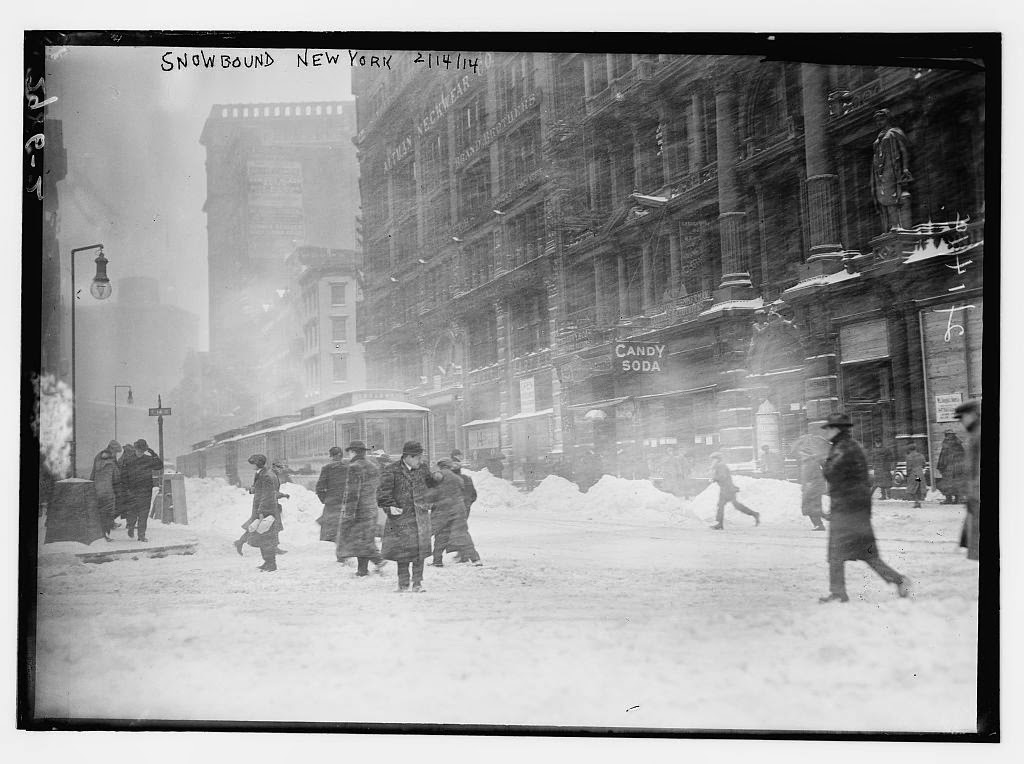
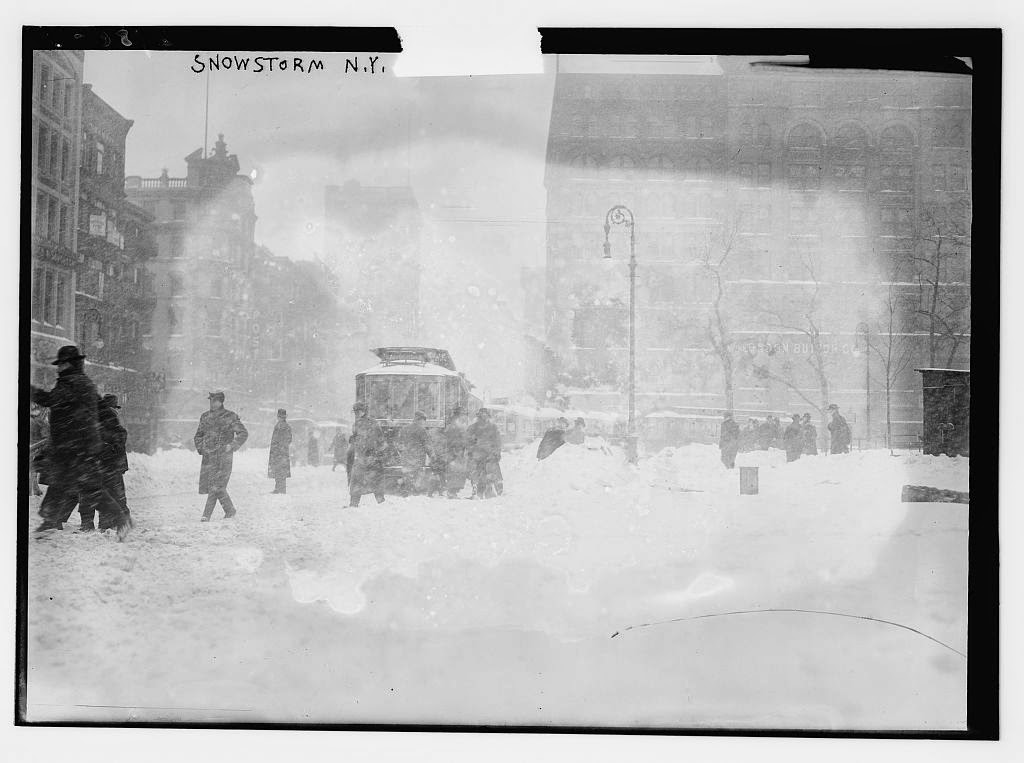
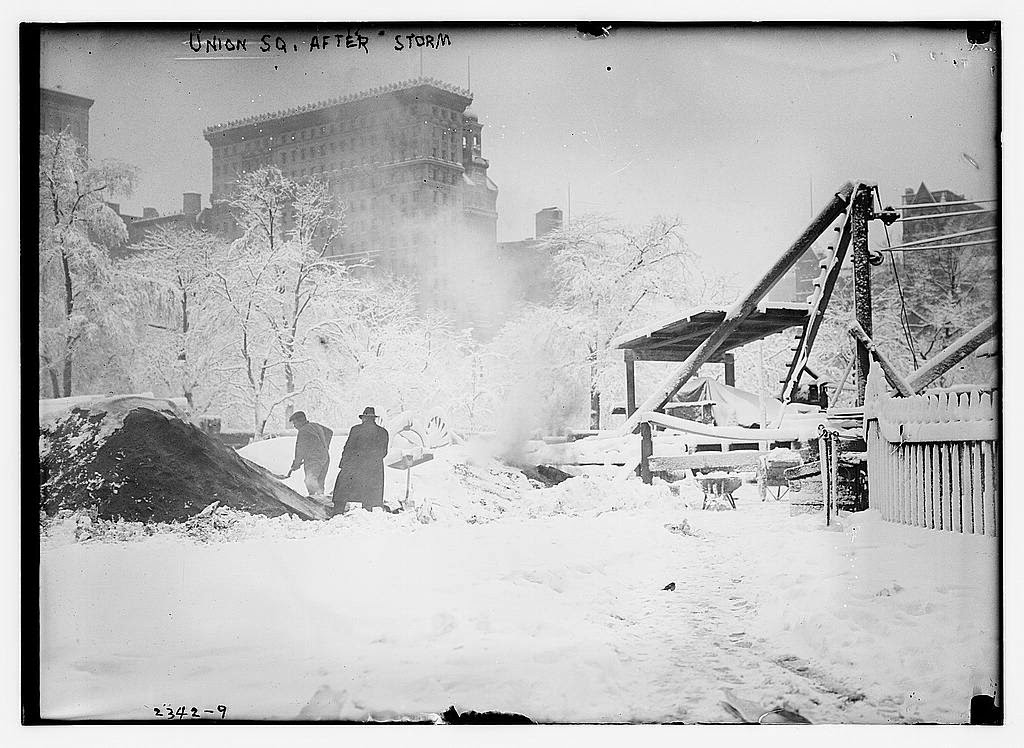
Below: Pictures Valentine’s Day Blizzard of 1914. The bottom picture is of Union Square, with snow covering the construction site of the new subway station. (Courtesy Library of Congress)
That was a headline in the New York Times back in November about the highly problematic section of the Brooklyn-Queens Expressway located beneath the Brooklyn Promenade, the romantic walkway that offers sumptuous views of lower Manhattan.
Everybody loves the Promenade. Nobody loves the BQE, especially in its present state. So how did we get here? You have to go all the way back to the origins of the neighborhood of Brooklyn Heights for the answers.
A stroll through Brooklyn Heights presents you with a unique collection of 19th-century homes — all preserved thanks to the efforts of community activists in the 20th century. Each street sign traces back to an original landholder from the late 18th and early 19th centuries.
Those are more than just street names. Each sign traces back to an original landholder who developed this special place in the early 19th century.
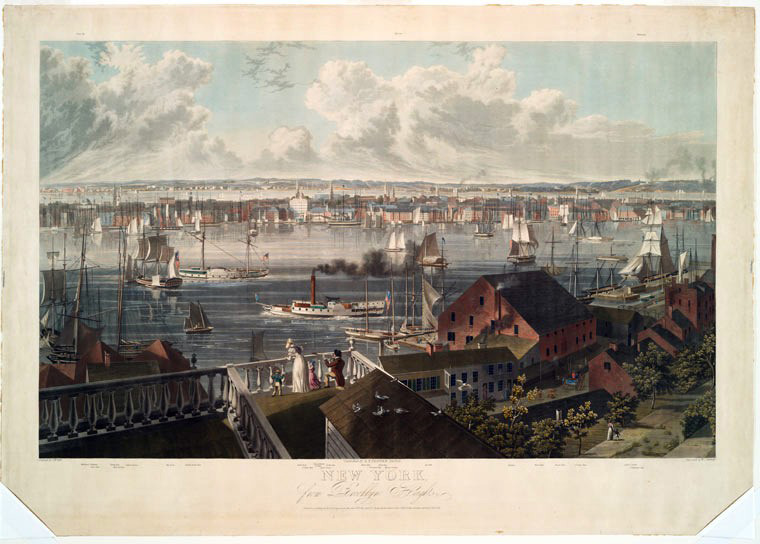
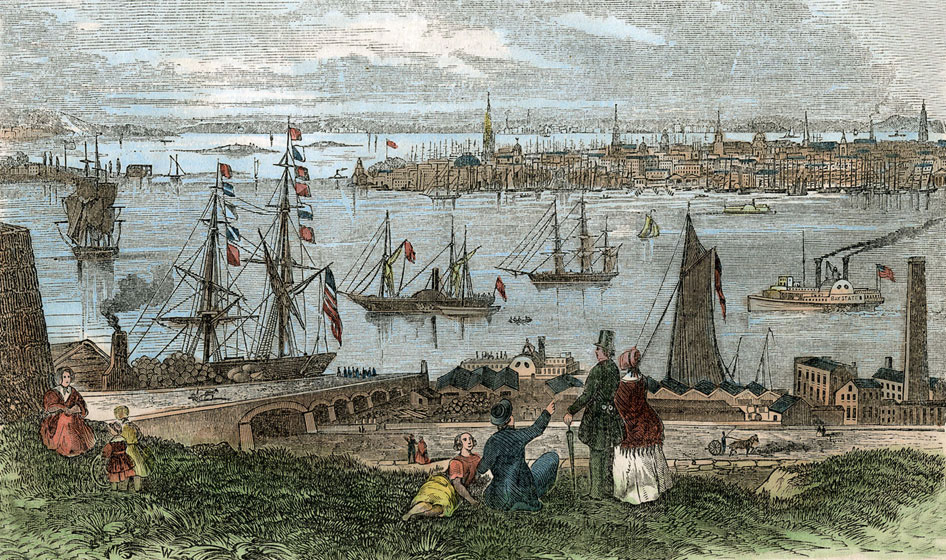
New York from Brooklyn Heights [The Hill-Bennett-Clover view.], 1837
By then, the land once known as Clover Hill had seen its share of both tranquility and drama, the former site of a Revolutionary War fort and a crucial evening in the saga of the American Revolution.
But by the 19th century, most Americans knew Brooklyn Heights for more than just architecture and George Washington. This was the home to respected cultural institutions and to scores of churches, so many that the borough received a very spiritual nickname.
The Heights would go on a roller-coaster ride with the opening of the Brooklyn Bridge and Brooklyn’s transformation into a borough of Greater New York. The new subway would bring the bohemians of Greenwich Village into Brooklyn Heights, transforming it into an artist enclave for most of the century.
When Robert Moses began planning his Brooklyn Queens Expressway in the 1940s, he planned a route that would sever Brooklyn Heights and obliterate many of its most spectacular homes.
It would take a devoted community and some very clever ideas to re-route that highway and cover it with something extraordinary — a Promenade, allowing all New Yorkers to enjoy views of New York Harbor.
LISTEN NOW — THE STORY OF BROOKLYN HEIGHTS AND THE PROMENADE
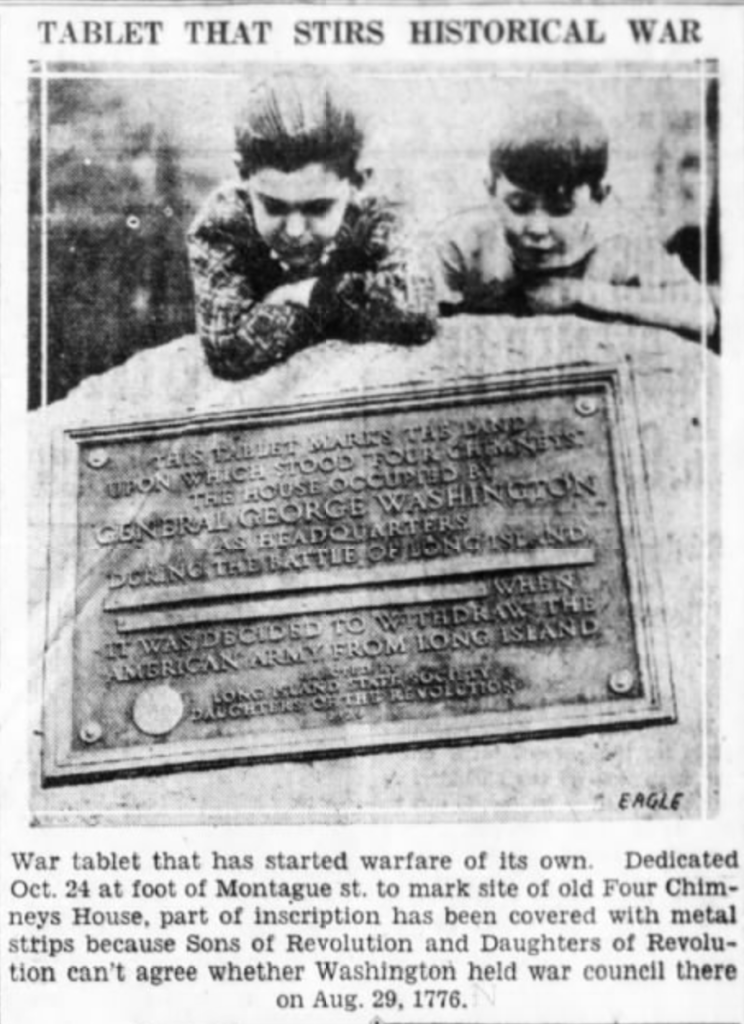
When, on October 24, 1929, the plaque to the The House of Four Chimneys was unveiled, visitors observed that two lines of the plaque were covered in tape. That’s because a minor war broke out between the Sons of the Revolution and the Daughters of the Revolution as to where the fateful meeting with George Washington and his general actually took place!
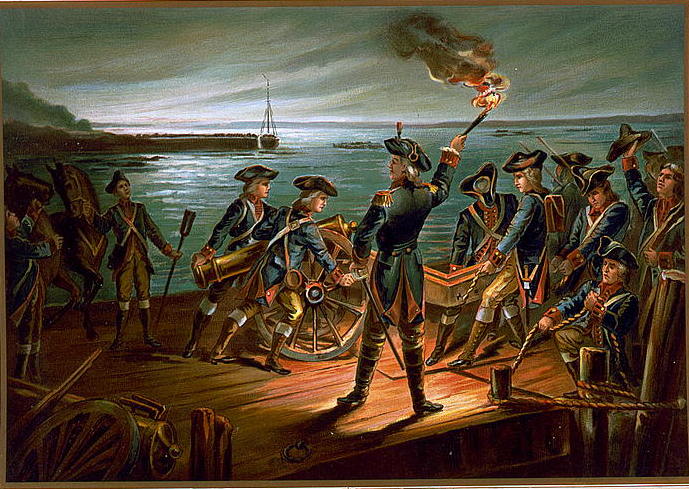
George Washington and the Contintental Army flee in the dead of night, from the shores below Brooklyn Heights.
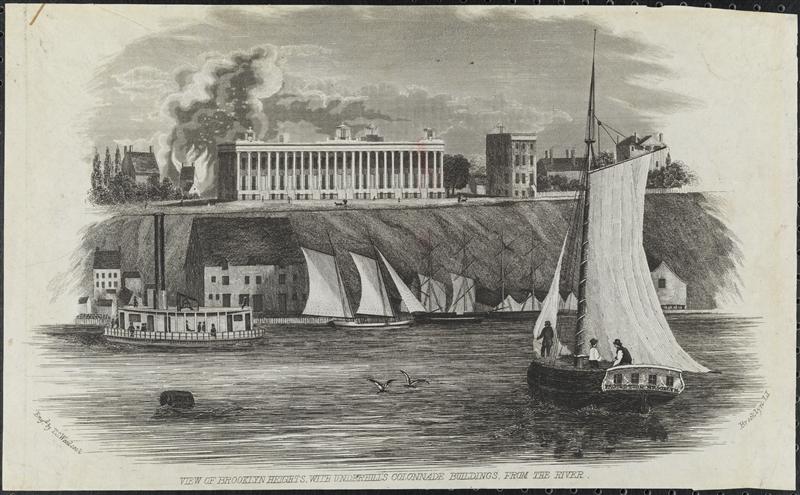
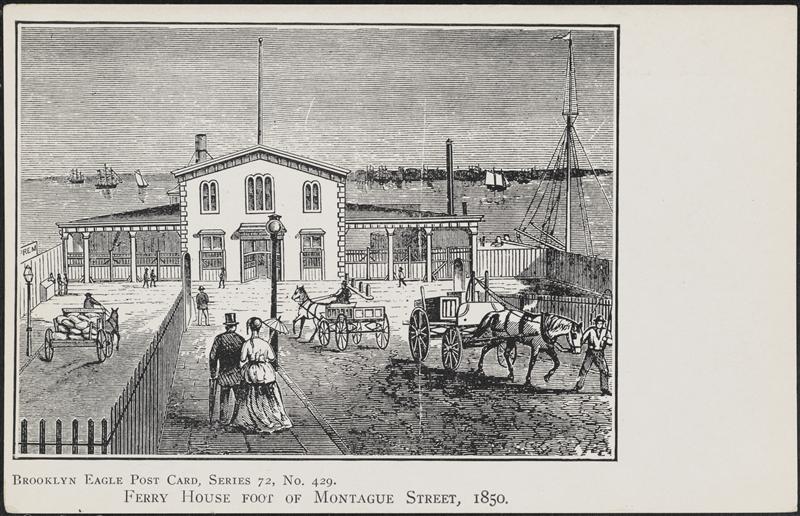
The Werner Company, Akron, OhioView of Brooklyn Heights with Underhill’s Colonnade Buildings from the River, Thomas Swann Woodcock engraver, 1838m Museum of the City of New YorkA view of the bridge — taking Montague Street down to the water’s edge (and the Wall Street Ferry landing). From the excellent website Walt Whitman’s Brooklyn.Ferry House Foot of Montague Street, 1850. From the Brooklyn Daily Eagle (courtesy Museum of the City of New York)
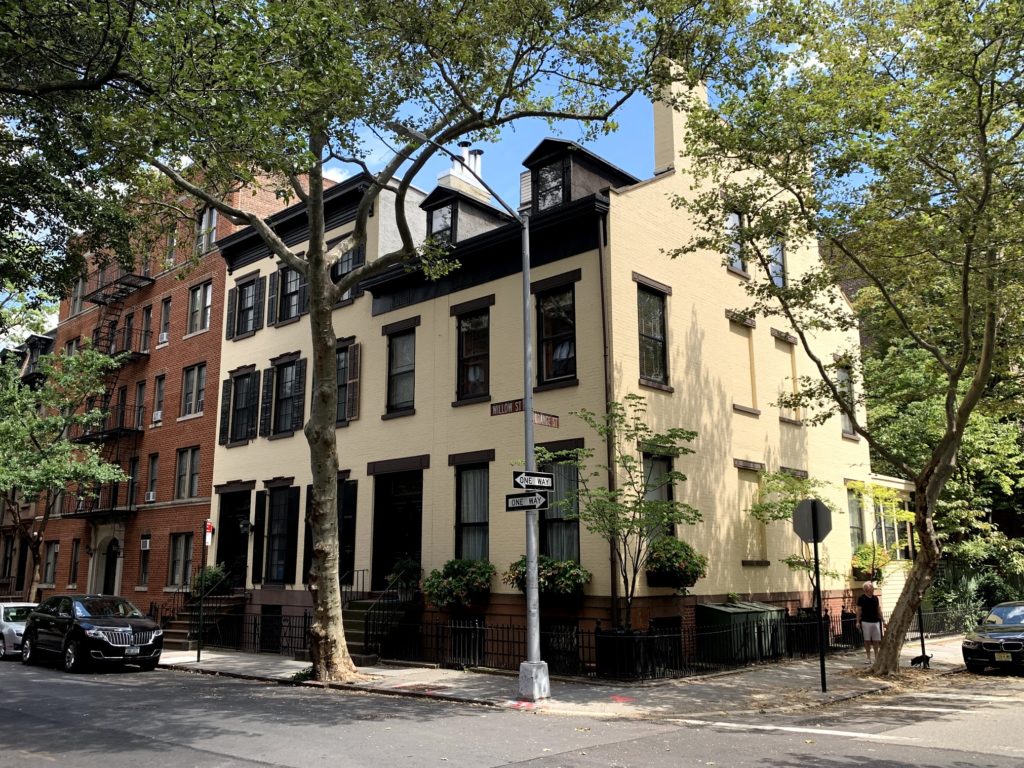
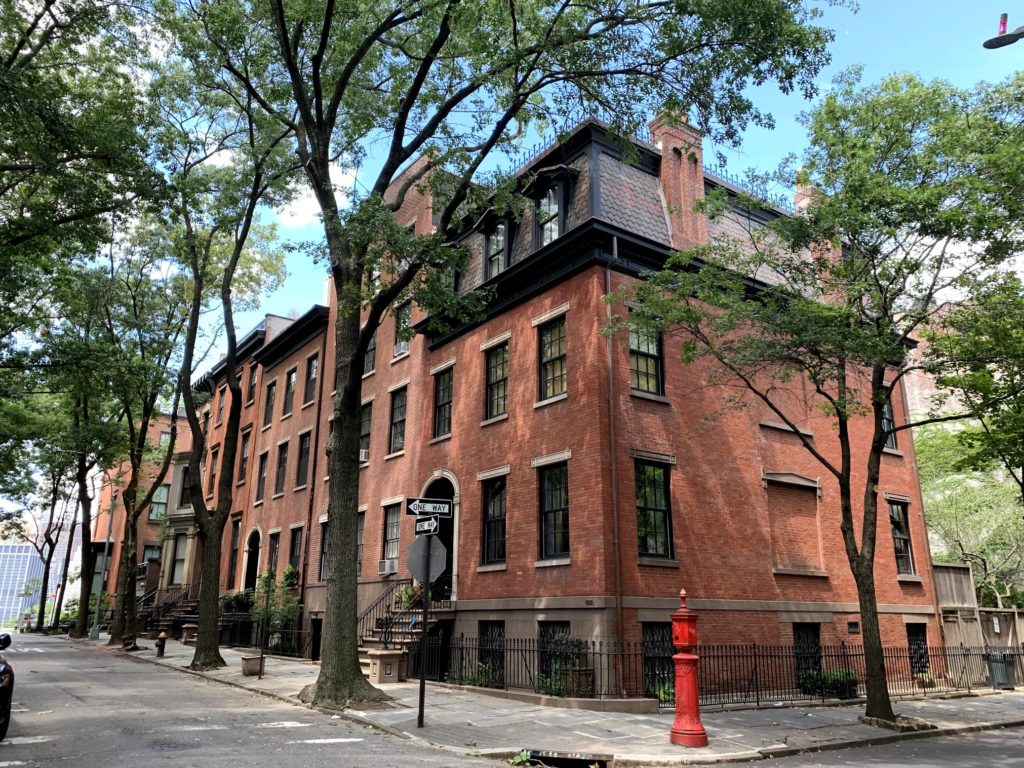
Just a small sampling of the architectural variance found in Brooklyn Heights:
FURTHER LISTENING:
Listen to these shows in our back catalog for more information on subjects mentioned in this show —
Whitman’s father was actually a builder and developer. A few of the houses he and his son Walt constructed are still standing in Brooklyn Heights.
Plymouth Church — and many residents of Brooklyn Heights — play a significant role in the abolitionist movement.
Henry Ward Beecher was, shall we say, a complicated man.
Brooklyn’s premier performing arts destination got its start on Montague Street — along with a few other notable institutions.
The Bowery Boys: New York City History podcast is brought to you …. by you!
We are now producing a new Bowery Boys podcast every other week. We’re also looking to improve and expand the show in other ways — publishing, social media, live events and other forms of media. But we can only do this with your help!
We are now a member of Patreon, a patronage platform where you can support your favorite content creators.
Please visit our page on Patreon and watch a short video of us recording the show and talking about our expansion plans. If you’d like to help out, there are six different pledge levels. Check them out and consider being a sponsor.
And join us for the next episode of the Bowery Boys Movie Club, an exclusive podcast provided to our supporters on Patreon.
We greatly appreciate our listeners and readers and thank you for joining us on this journey so far.
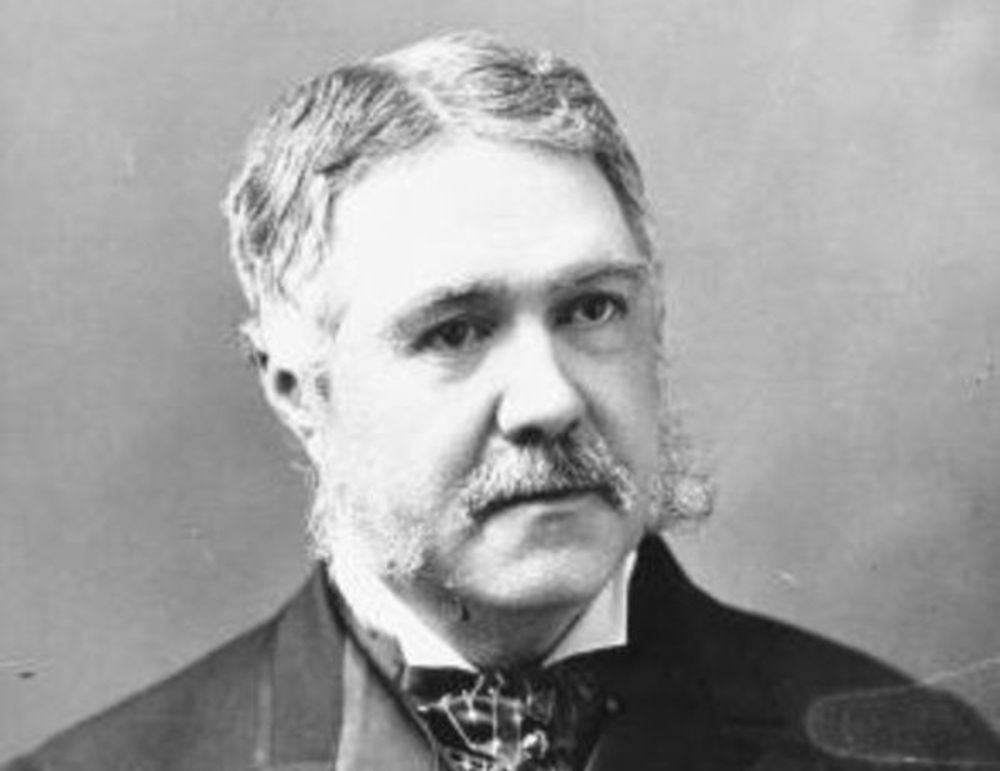
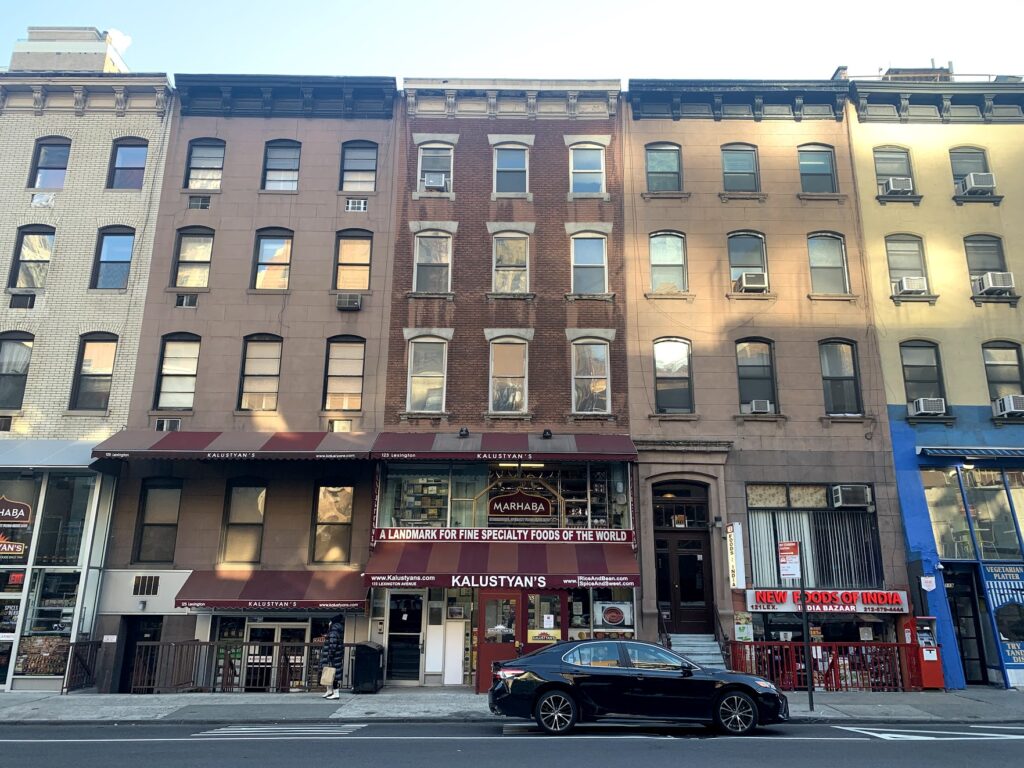
On Lexington Avenue sits a special food store named Kalustyan’s with a second floor stocked with international spices, syrups and bitters. In 1881, this was the home of Chester A. Arthur, and it was here in the early morning hours of September 20, that he became the 21st President of the United States.
He is only one of two men inaugurated for president in New York City — the other was George Washington. And Arthur was certainly no Washington!
Fans of the Netflix series Death By Lightning have already been introduced to Arthur’s rugged, street-toughened personality, an efficient operator of Republican politics in a city governed by Democrats and Tammany Hall. He was quite famous, in fact, for converting Tammany men to Republican voters by using similar bareknuckle tactics.
He eventually became the Collector of the Port of New York, one of the most lucrative jobs in American government. And then, through a strange series of events, he was catapulted onto the national ticket for president, the running mate of James Garfield.
But nobody really wanted the New Yorker for president, did they?
This is a story not only of a man out of his depth, but of the two very different individuals who helped hone his reputation — the New York power broker Roscoe Conkling, and the Upper East Side recluse Julia Sand, who may have helped guide Arthur through the toughest moments of his ‘accidental’ presidency.
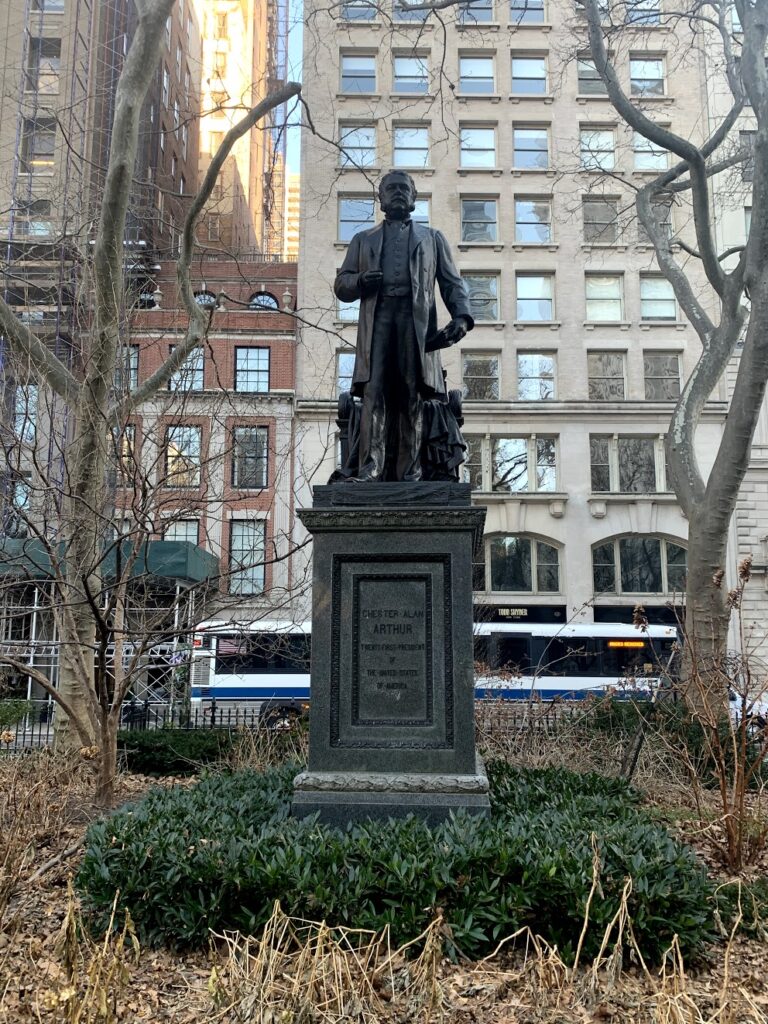
PLUS: How Madison Square Park has become one of the only true monuments to his legacy.
LISTEN TODAY: CHESTER A. ARTHUR — THE GENTLEMAN BOSS
This podcast was inspired by this website post I wrote back in 2017:
There are several enemies in Candice Millard‘s Destiny of the Republic, the terrific 2011 narrative history of the assassination of President James Garfield during the summer of 1881.
The most obvious foe is the delusional Charles Guiteau, who believed himself the nation’s savior when he shot President Garfield twice at a Washington DC train station on July 2, 1881.
Then there were the microbial infections transmitted during improperly sanitized operations performed by Garfield’s doctor at the White House, causing blood poisoning that worsened the president’s suffering and ultimately killed him.
For the purposes on this website, however, I was drawn into the tales of two New York politicians who became victims of rumor-mongering that summer.
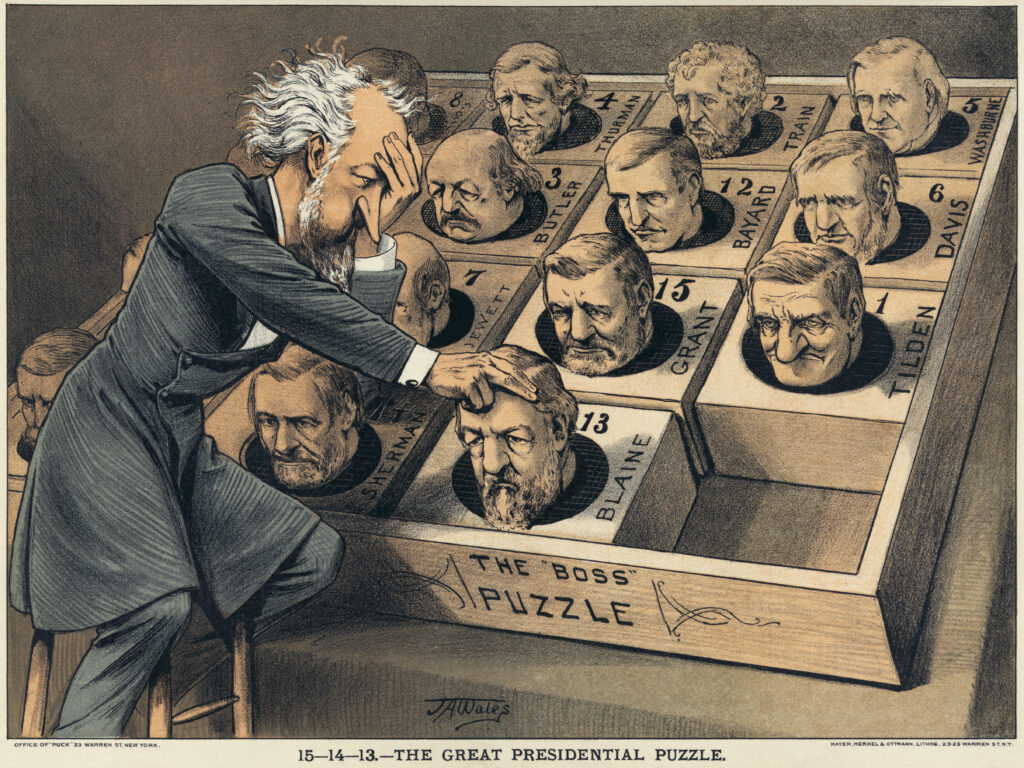
From Puck Magazine: The Great Presidential Puzzle”: “Illustration shows Senator Roscoe Conkling, leader of the Stalwarts group of the Republican playing a puzzle game. All blocks in the puzzle are the heads of the potential Republican presidential candidates.”
Boss of the Gilded Age
Powerful New York senator Roscoe Conkling was seen as a political rival of Garfield’s, a thorn in the president’s side, especially considering Conkling’s own political protege — his pawn, really — was Garfield’s vice president, Chester A. Arthur.
Traumatic crises in this country are frequently accompanied by a churning undercurrent of suspicion and conspiracy, and Conkling and Arthur became victims of just such a shadowy accusation that summer.
Many believed Conkling to be culpable of the assassination attempt himself — perhaps not of pulling the trigger, but of fostering and encouraging the discord that inspired it.
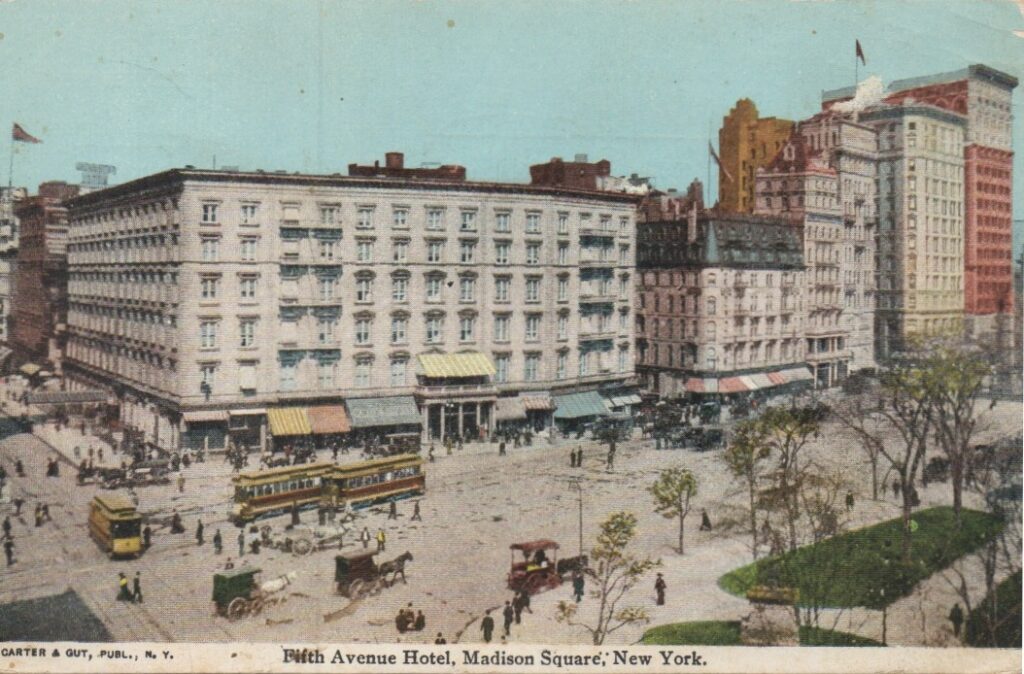
The Fifth Avenue Hotel. Read more about Conkling and the Fifth Avenue Hotel here.
It’s not a stretch to consider Conkling an embodiment of the spoils system which determined hundreds of government jobs through political affiliation. Guiteau thought himself unfairly left out of that patronage system when he attacked Garfield that hot July day.
Conkling endured the disintegration of his political career from his rooms at the Fifth Avenue Hotel, the luxury accommodation at 23rd Street off Madison Square that became senator’s second home and a regular scene of political intrigue for the Republican Party.
Arthur in charge?
Meanwhile, many were mortified at the very thought of Arthur, hardly a universally admired figure, ascending to the presidency.
While the president lay incapacitated in Washington, there was even debate as to when presidential responsibilities should cede to the vice president. Nobody seemed enthusiastic at the prospect of a President Chester A. Arthur.
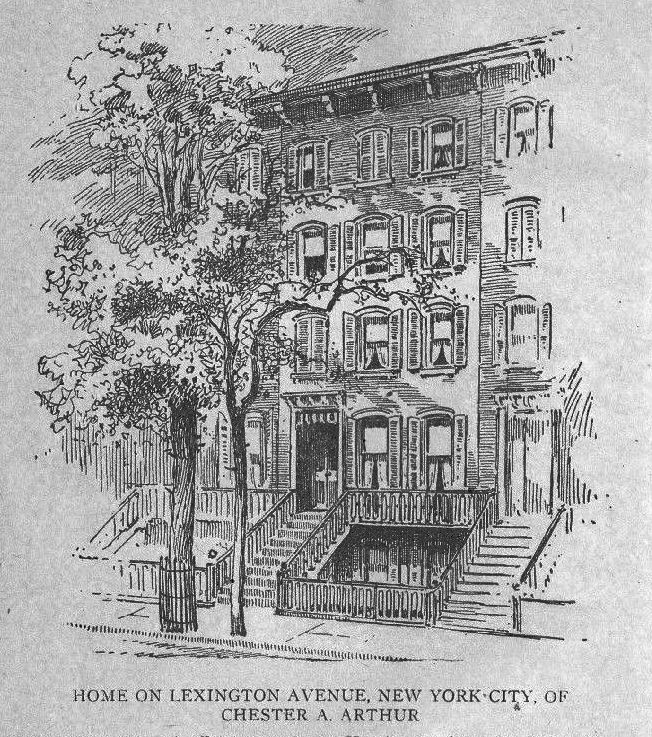
Thus, Arthur essentially spent his summer hiding out in his townhouse at 123 Lexington Avenue(below), fearful of seeming overly ambitious even as the fate of President Garfield seemed uncertain.
123 Lexington Avenue, taken from an Arthur biography (via Daytonian in Manhattan)
The Presidential Brownstone
On the day the president finally succumbed to his injuries, Arthur sobbed uncontrollably from his shuttered home as servants shooed away the press.
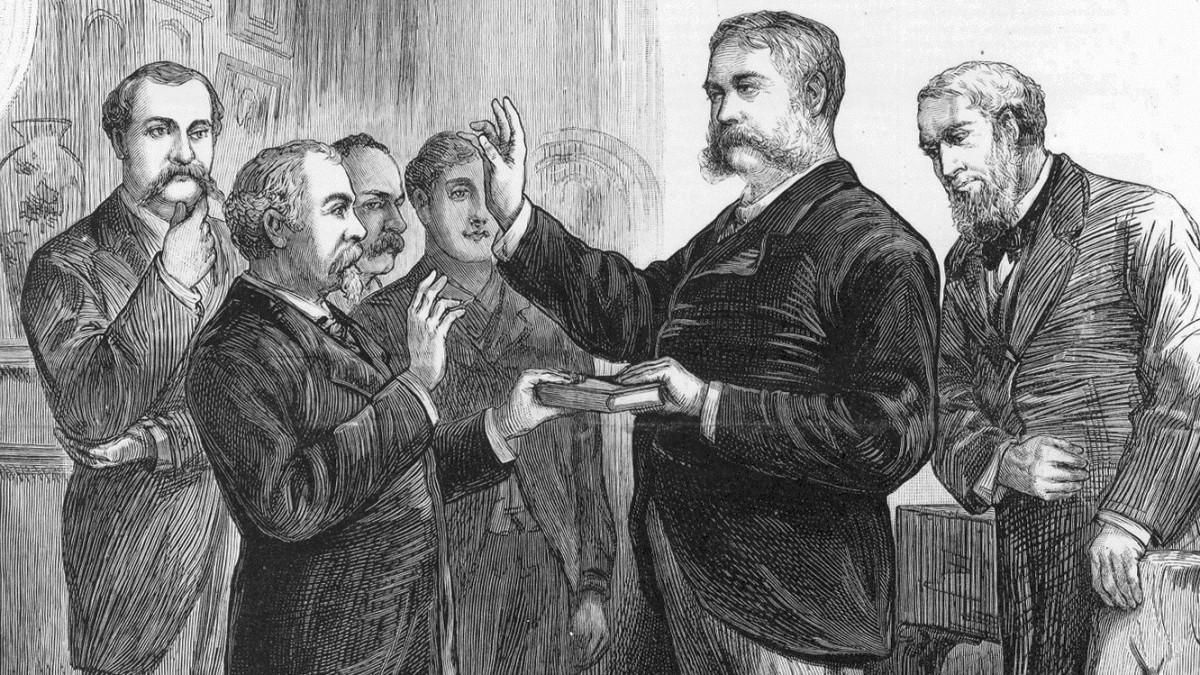
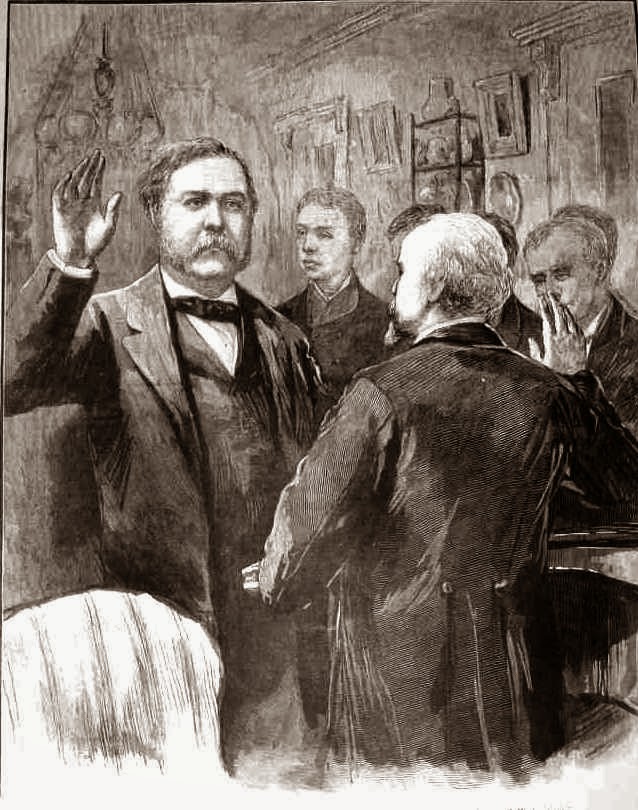
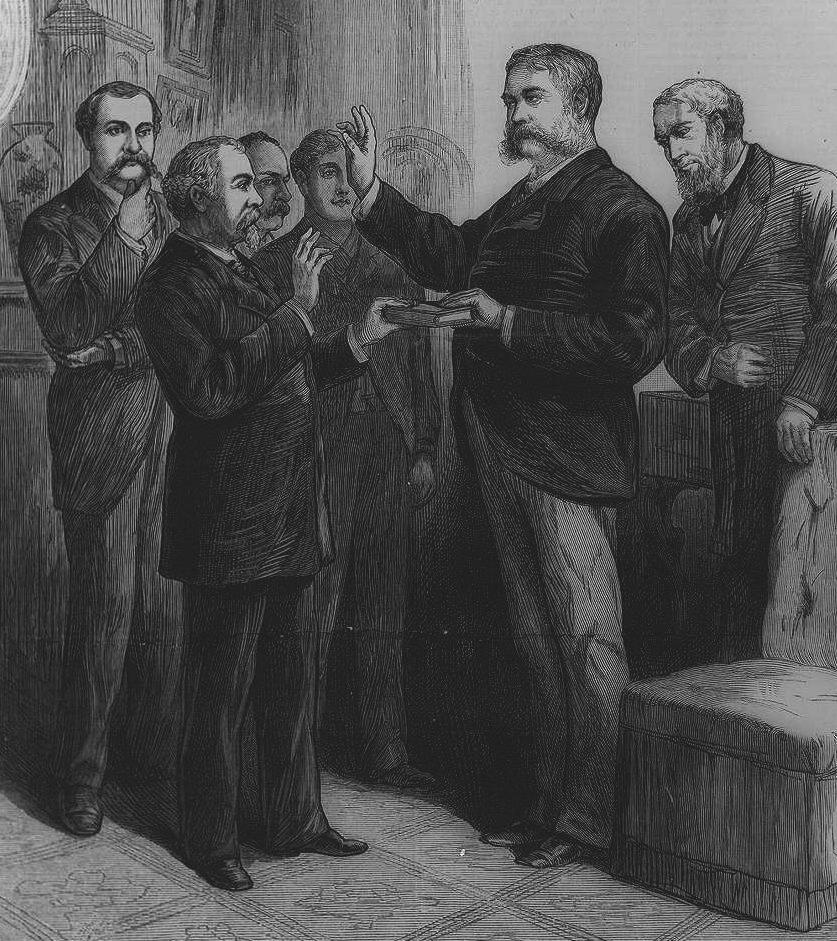
Several hours later, he was sworn in as the 21st President of the United States on September 20, at 2:15 a.m, from the green-shuttered parlor of his home here.
To quote from an excellent biography of Arthur The Unexpected President by Scott S. Greenberger:
“Judge R. Brady of the New York Supreme Court, who had been fetched out of bed, administered the oath of office at 2:15 am. Arthur recited the words solemnly, kissed his son, and accepted the congratulations of his friends. There were several carriages and a handful of reporters outside Arthur’s brownstone, and French had ordered two police officers to patrol the sidewalk in front. Otherwise, there was nothing to indicate that history had been made behind the closed blinds of 123 Lexington Avenue.”
He spend his first two hours as President smoking and chatting with friends, “[t]oo nervous and too excited to sleep.” He finally went to sleep at 5 am, the first morning of his presidency.
The brownstone at 123 Lexington Avenue still exists today. For decades, the Mediterranean grocer Kalustyan’s has inhabited the first two floors of the building.
123 Lexington Avenue, photo by Greg Young
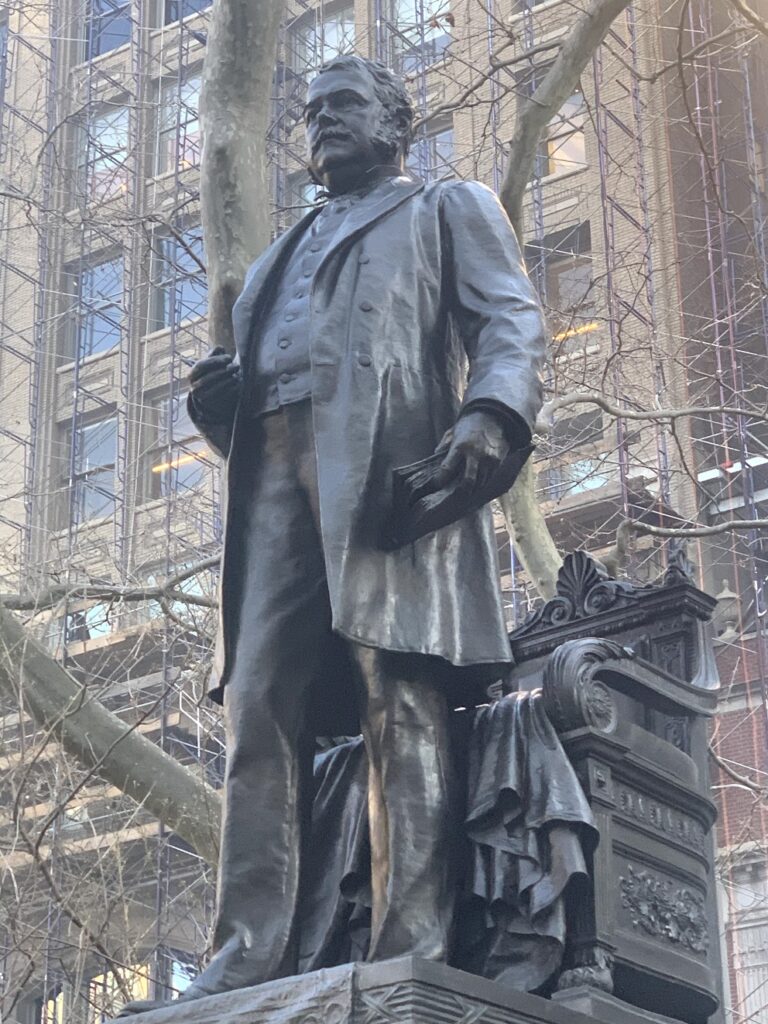
And this is not the only landmark to Arthur in the neighborhood. A bronze statue to the former president stands in the northeast corner of Madison Square Park, dedicated on June 13, 1899.
Photo by Greg Young
FURTHER LISTENING
After listening to this podcast, head back to these past Bowery Boys episodes with similar or related themes:
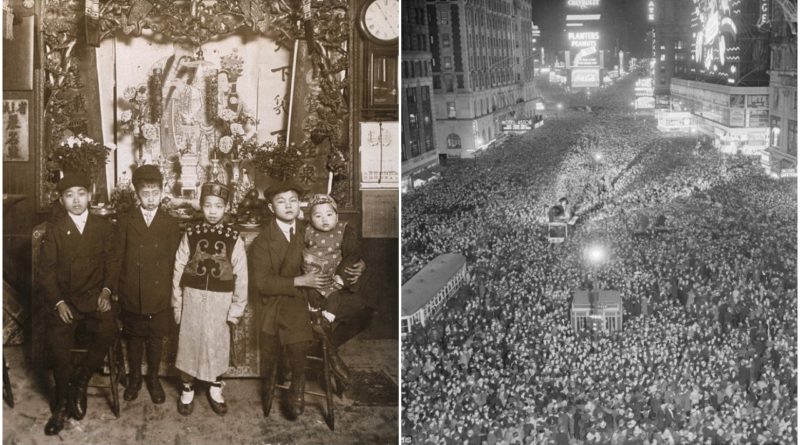
PODCAST The ultimate history of New Year’s celebrations in New York City.
This is the story of the many ways in which New Yorkers have ushered in the coming year, a moment of rebirth, reconciliation, reverence and jubilation.
In a mix of the old and new, we present a history of early New Year’s festivities, before heading to the city’s most famous party — New Year’s Eve in Times Square.
Why did Times Square become the focal point for the world’s reflection on a new calendar year? And how did Times Square’s many changes in the 20th century influence those celebrations? Featuring Dick Clark, Guy Lombardo, Three Dog Night — and Daisy Duke.
THEN Greg brings you the story of the Chinese New Year which has been celebrated in Manhattan’s Chinatown since before there was even a Times Square! The celebration has been at the bedrock of the Chinese experience in New York. But in the 19th century, the customs of the season were met with curiosity, bewilderment and sometimes harsh disapproval. And what’s up with the fireworks?
The Bowery Boys: New York City History podcast is brought to you …. by you!
We are now producing a new Bowery Boys podcast every other week. We’re also looking to improve the show in other ways and expand in other ways as well — through publishing, social media, live events and other forms of media. But we can only do this with your help!
We are now a member of Patreon, a patronage platform where you can support your favorite content creators for as little as a $1 a month.
Please visit our page on Patreon and watch a short video of us recording the show and talking about our expansion plans. If you’d like to help out, there are five different pledge levels (and with clever names too — Mannahatta, New Amsterdam, Five Points, Gilded Age, Jazz Age and Empire State). Check them out and consider being a sponsor.
Visit Times Square NYEfor details about this Tuesday’s party in Times Square. For general information about this year’s Chinese New Year, check out this handy web guide. And visit Better Chinatownfor a map of this year’s parade route.
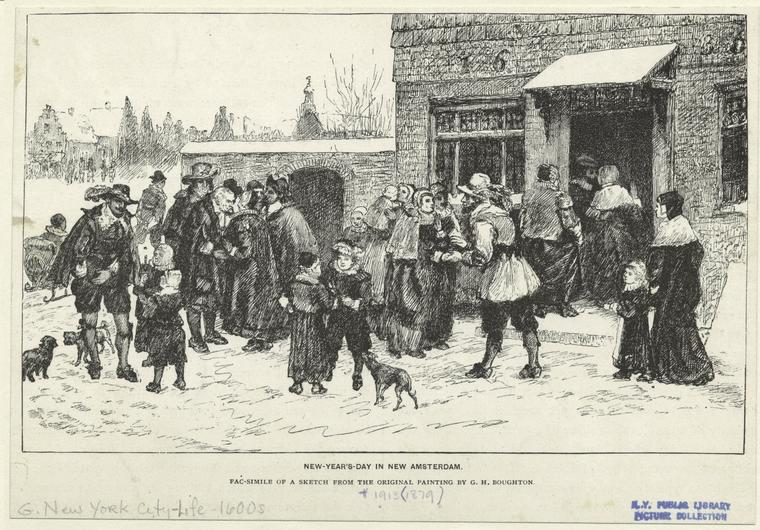
New Years Day celebrations have evolved since the days of New Amsterdam when visitations symbolized a ‘fresh start’ to the year.
Courtesy NYPL
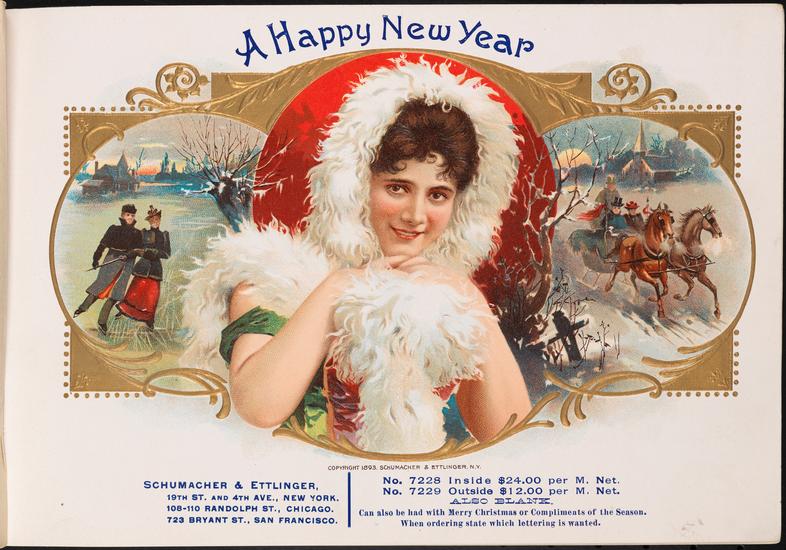
A decorative cigar box from the 1890s, ringing in the new year with a winsome damsel and wholesome scenes of winter beckoning you to smoke a cigar.
Courtesy Museum of the City of New York
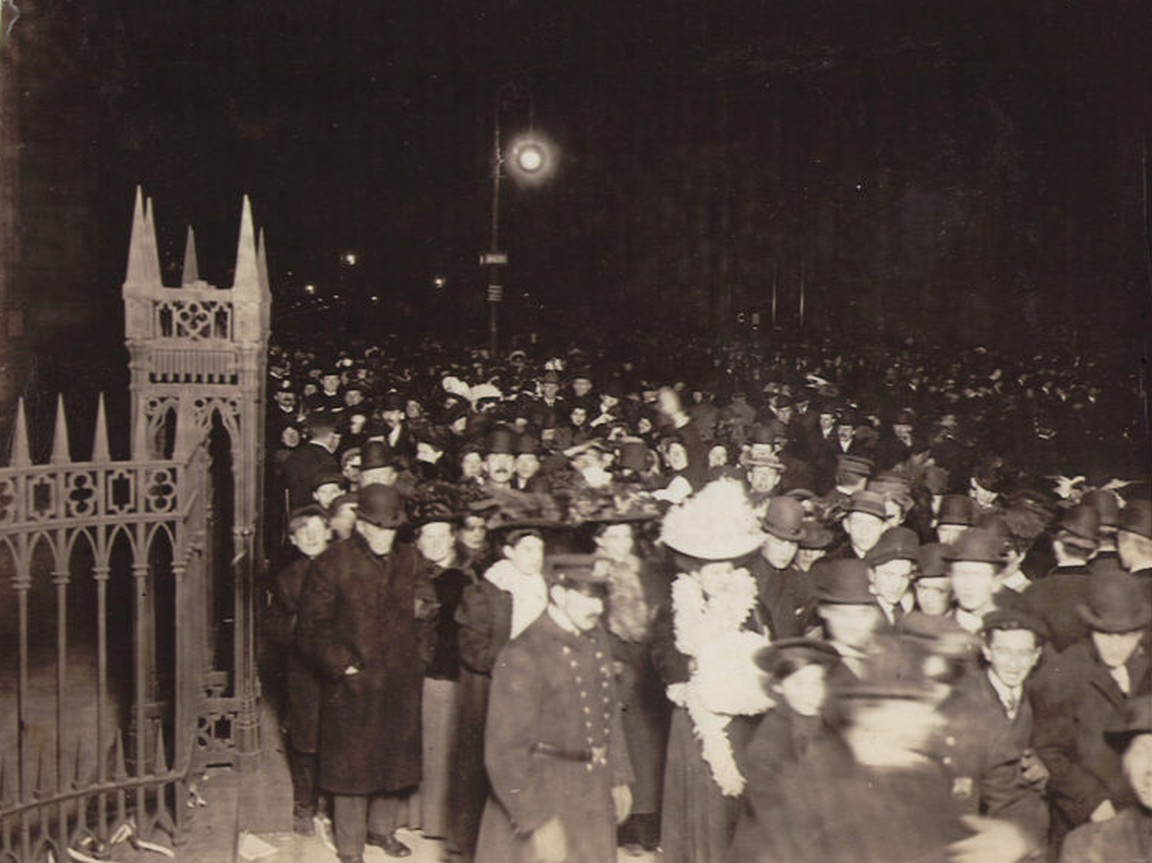
The crowds outside Trinity Church on 1906 gathered to usher in the new year. The church was traditionally the place people gathered before the Times Square celebration took off.
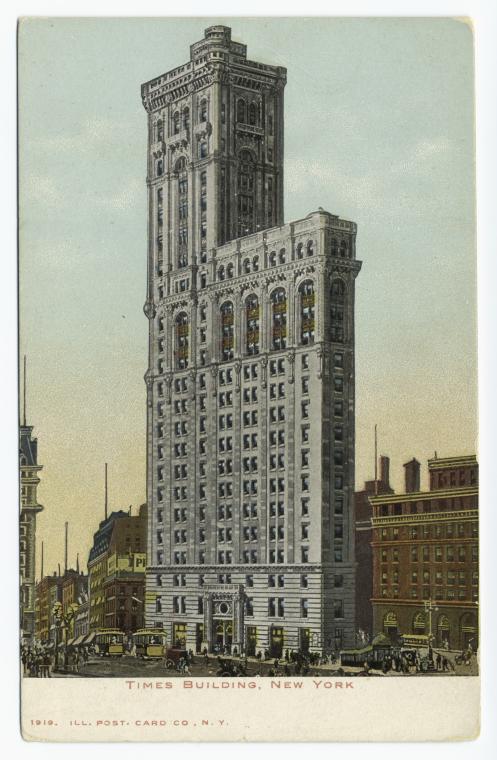
Fated to be the centerpiece of New Years Eve, One Times Square once wore some beautiful architecture until much of it was ripped off to accommodate a frenzy of electronic signs.
Courtesy NYPL
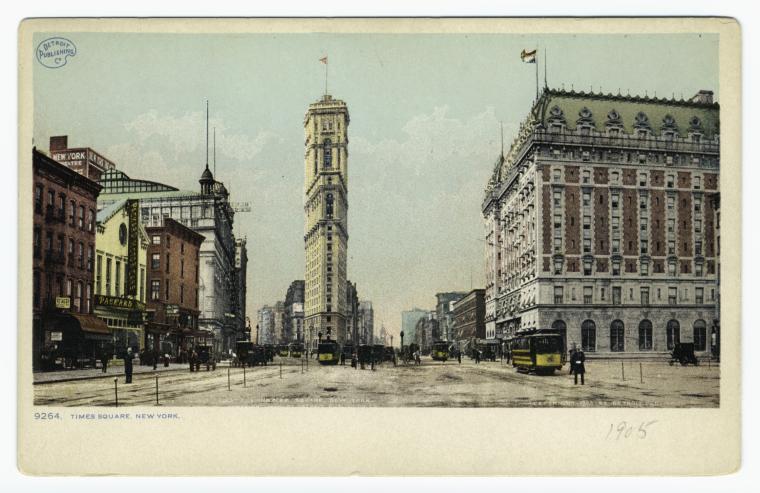
Times Square in 1905 for the very first New Years Eve celebration albeit one with fireworks, not a ball drop.
Courtesy NYPL
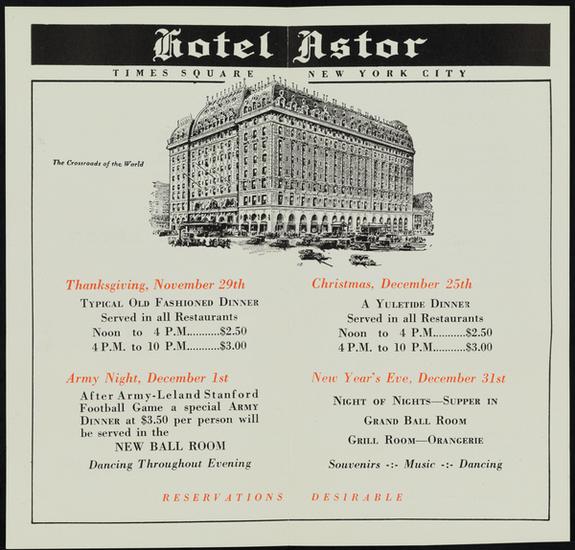
The party offerings at the Hotel Astor in Times Square in 1926.
Courtesy Museum of the City of New York
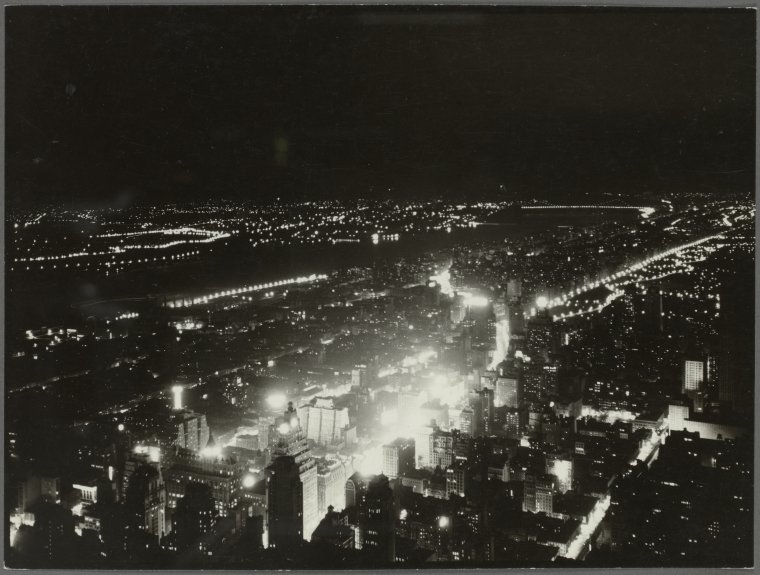
The view of Times Square from the Empire State Building.
Courtesy NYPL
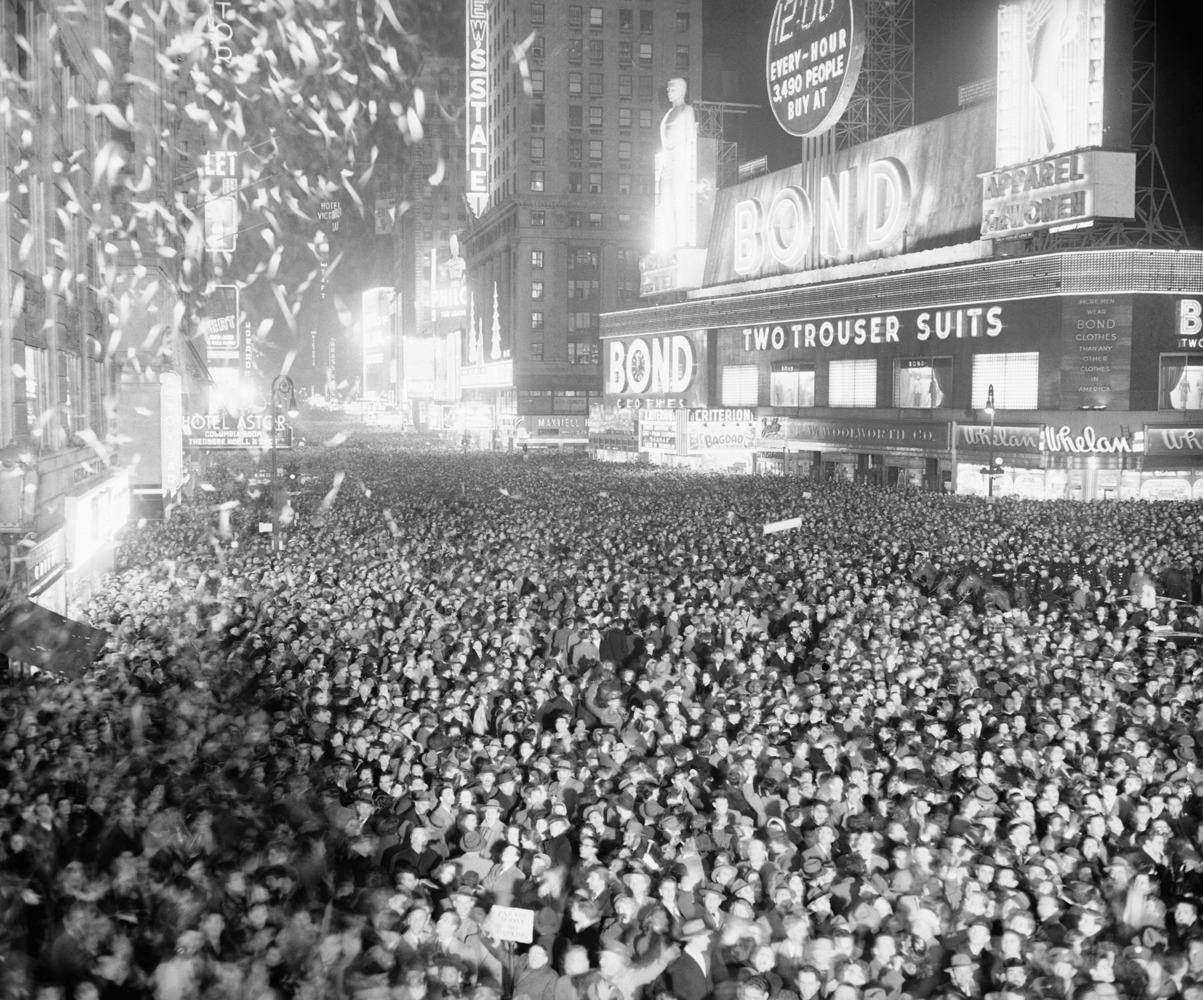
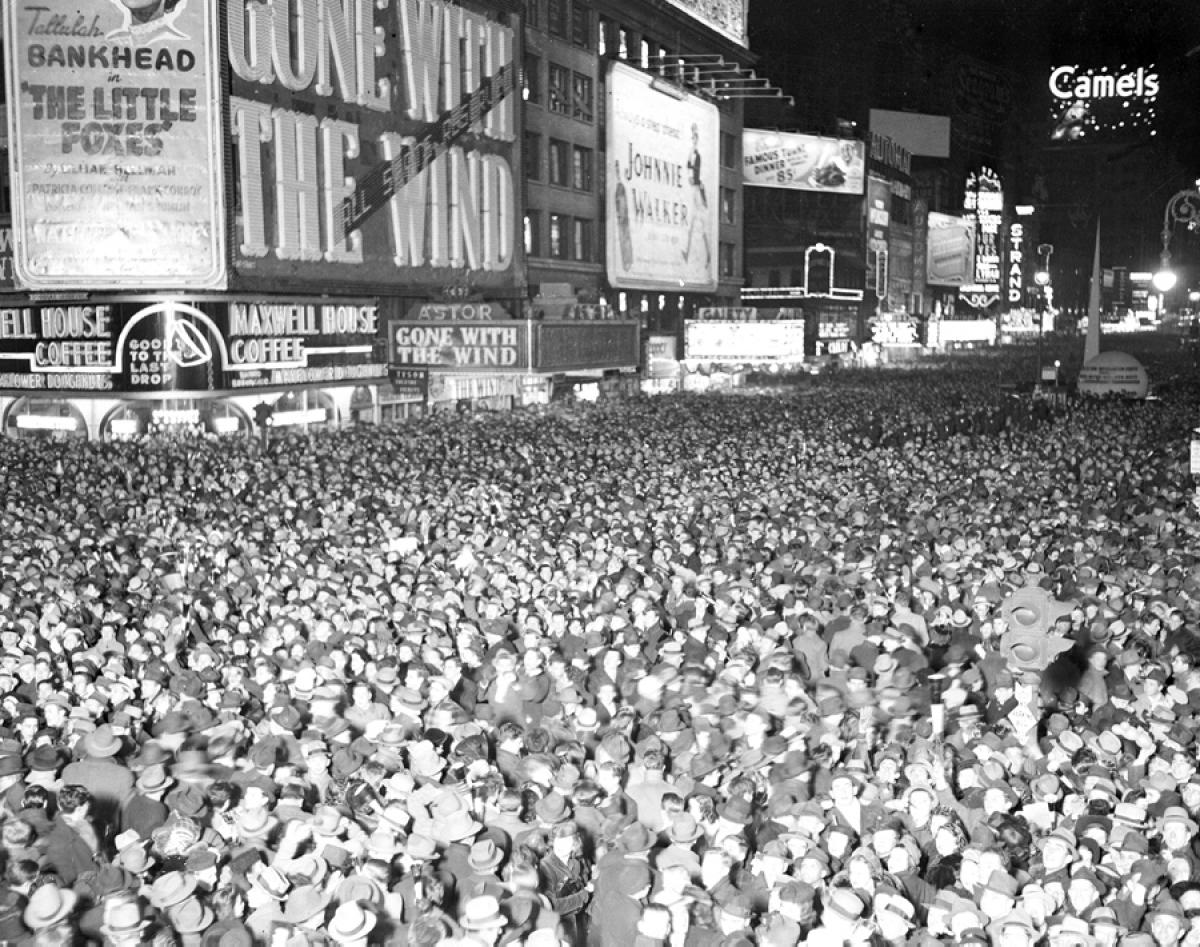
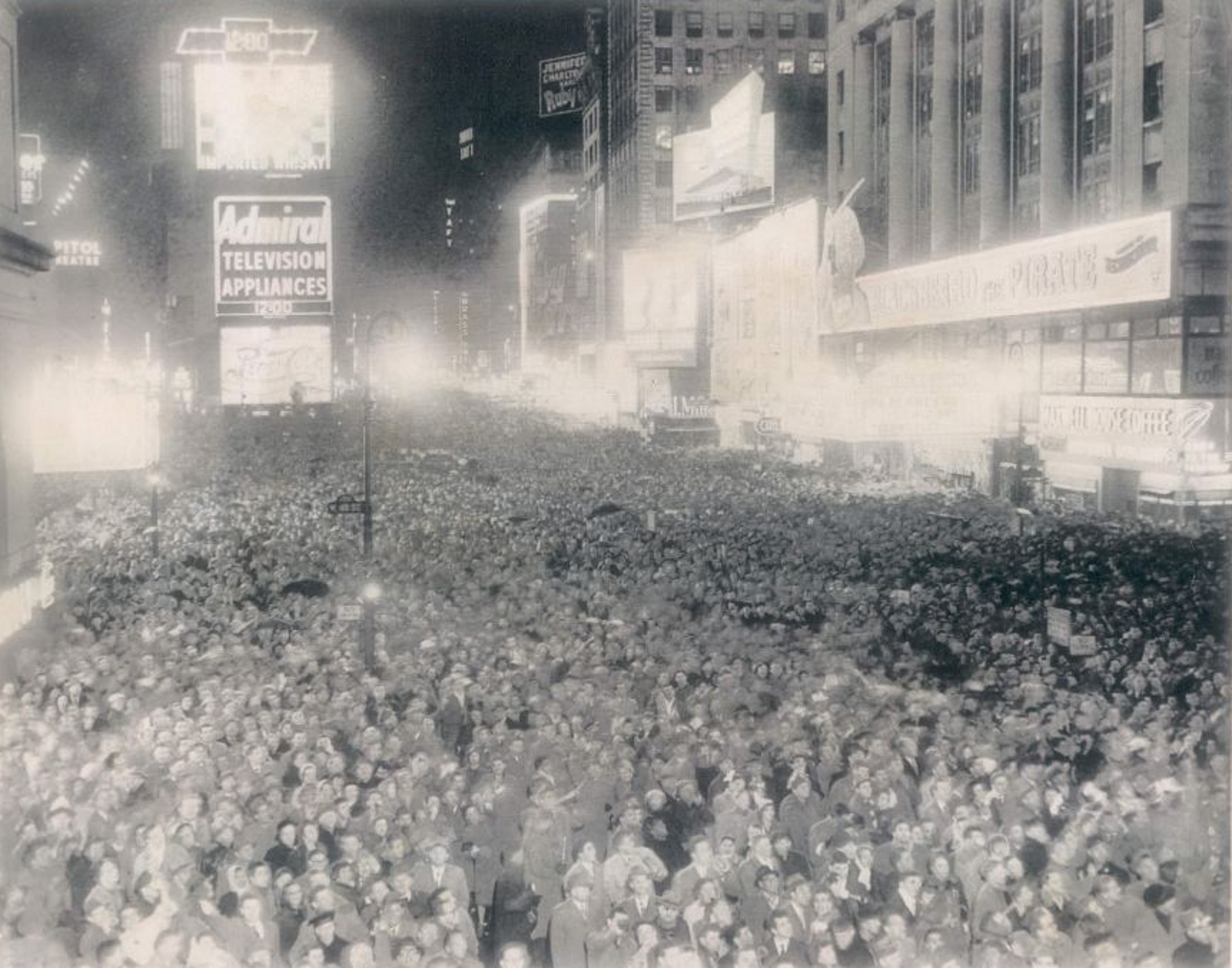
New Years Eve 1938
AP photo
The throngs in 1940 with the Gone With The Wind marquee in the background (not to mention Tallulah Bankhead in the play The Little Foxes!)
Courtesy New York Daily News
Ushering in 1953:
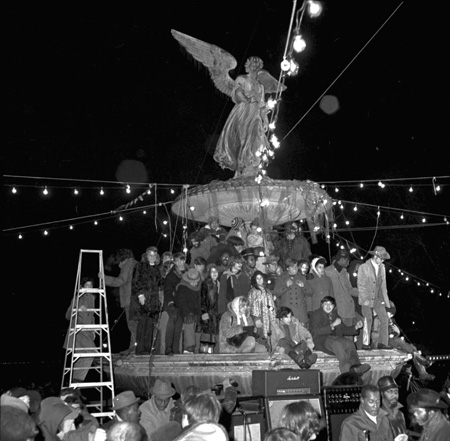
Celebrations were also held for a time in Central Park, like this festive group from 1969:
Courtesy New York Parks Department
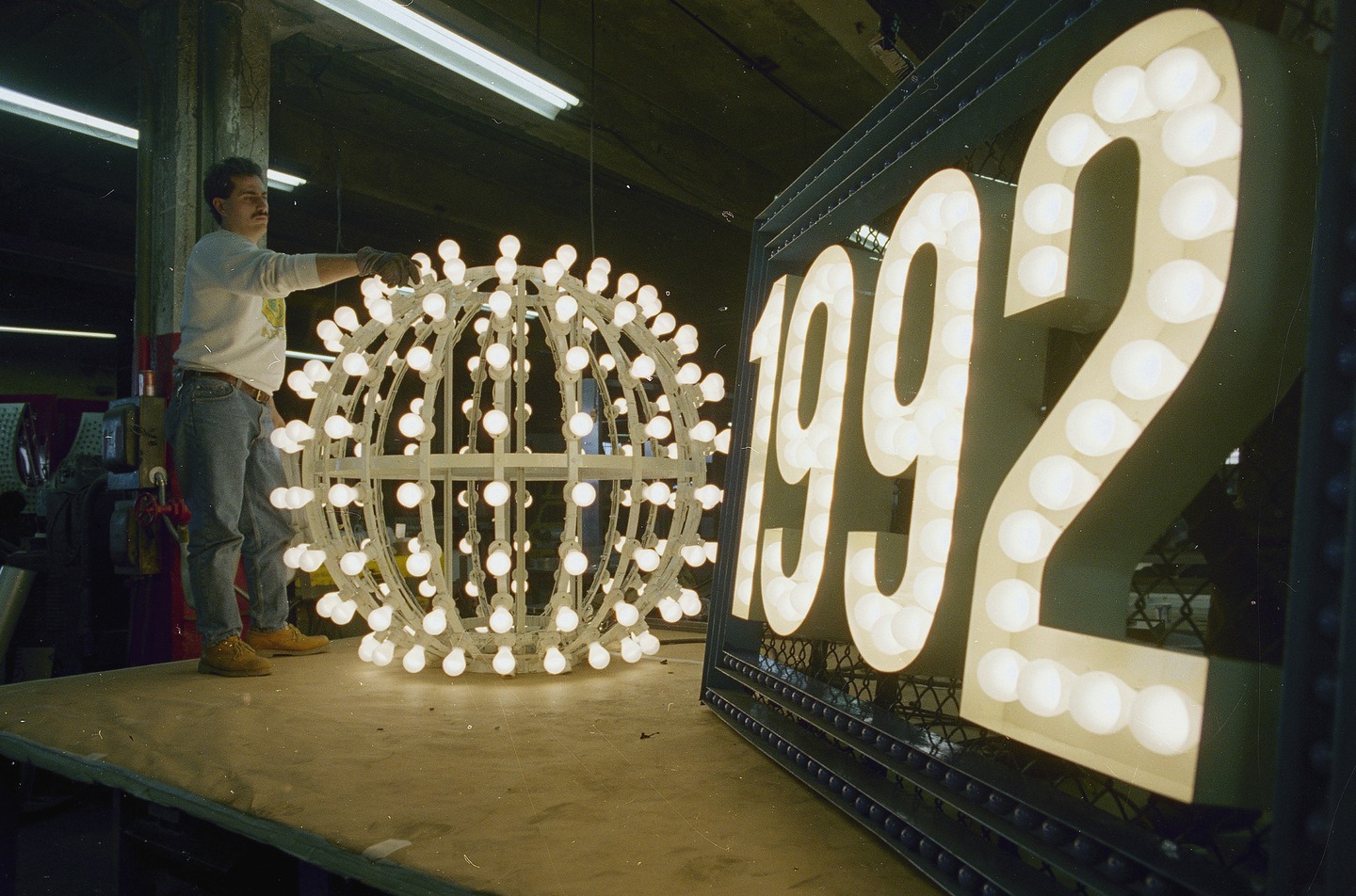
An electrician from the Artkraft Strauss Sign Corporation tests out the lighting effects that will greet the new year in 1992.
MARTY LEDERHANDLER/ASSOCIATED PRESS
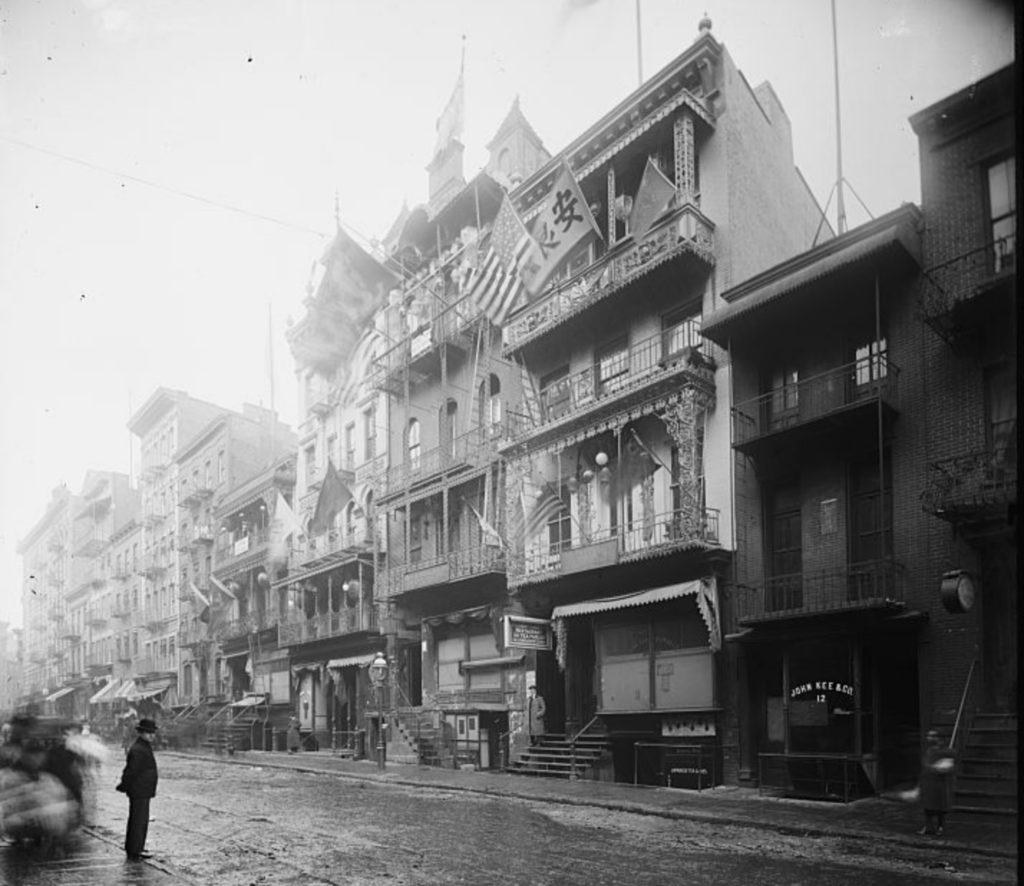
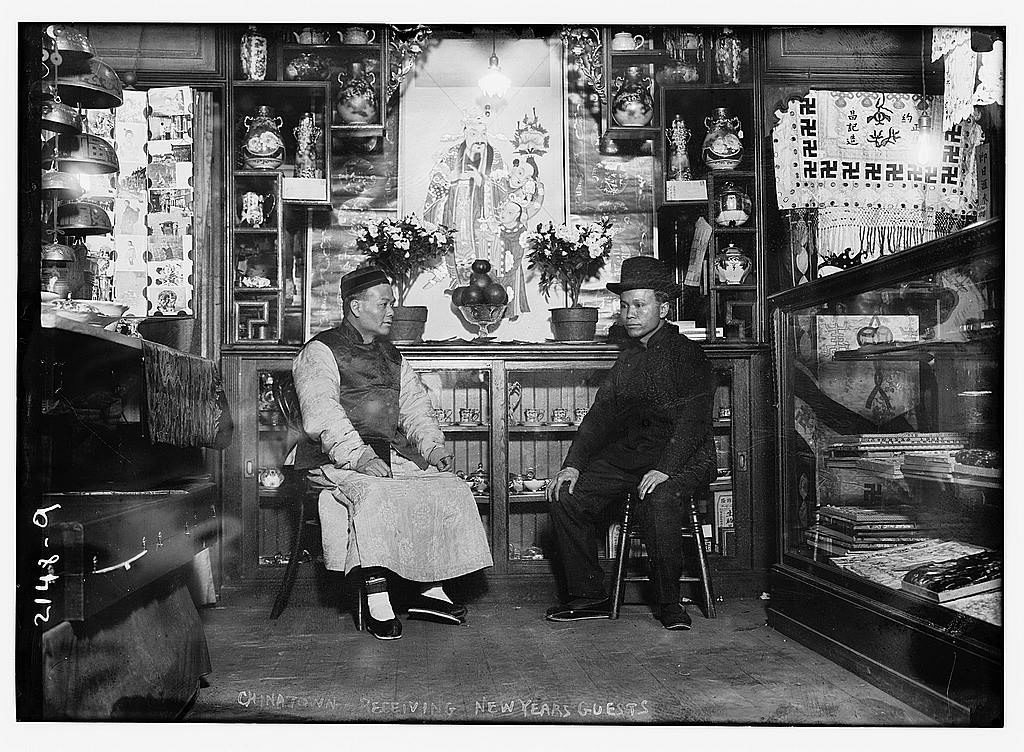
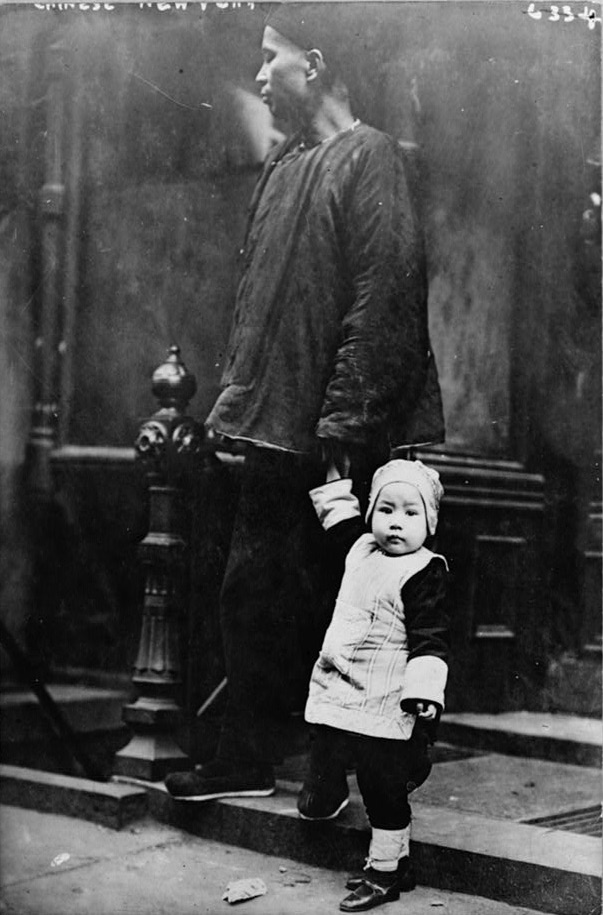
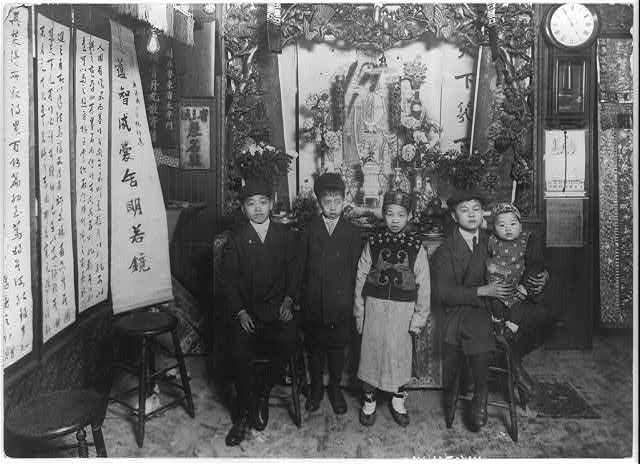
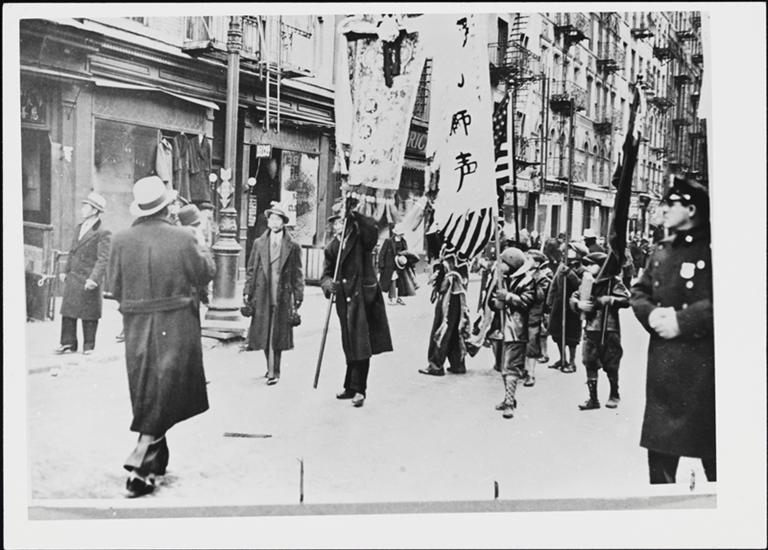
Images of Chinese New Year celebrations in Chinatown from the early 20th century, courtesy the Library of Congress.
[1900] Library of CongressChinese child with an adult on step outside of building, Chinatown, New York City, 1909. Library of Congress[Jan. 30 1911] Library of Congress
The parade in 1936.
Museum of the City of New York
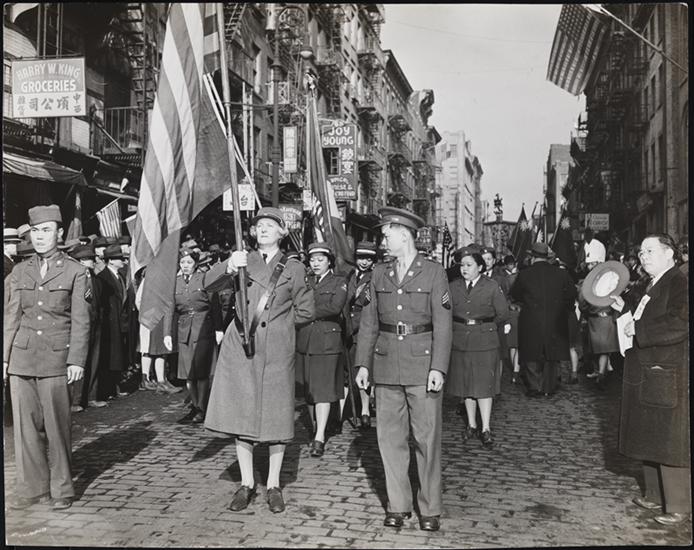
The Chinese New Year Parade of 1943 was decidedly more patriotic
This month marks the 190th anniversary of one of the most devastating disasters in New York City history — The Great Fire of 1835.
This massive fire, among the worst in American history in terms of its economic impact, devastated the city during one freezing December evening, destroying hundreds of shops and warehouses and changing the face of Manhattan forever.
It also underscored the city’s need for a functioning water system and permanent fire department.
So why were there so many people drinking champagne in the street? And how did the son of Alexander Hamilton save the day?
FEATURING Such Old New York sites as the Tontine Coffee House, Stone Street, Hanover Square and Delmonico’s.
To mark this special anniversary, we have newly remastered and edited our classic Bowery Boys podcast on this subject which was originally released on March 13, 2009
LISTEN HERE: THE GREAT FIRE THAT TRANSFORMED NEW YORK
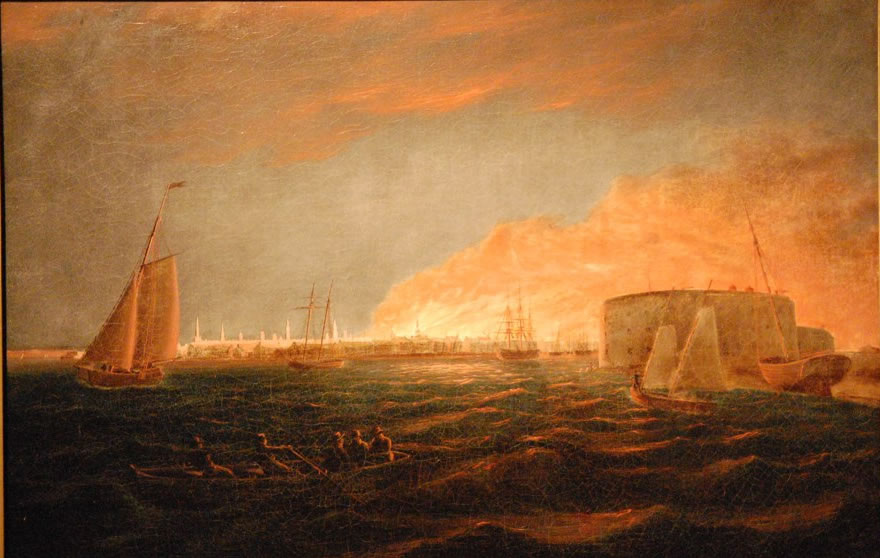
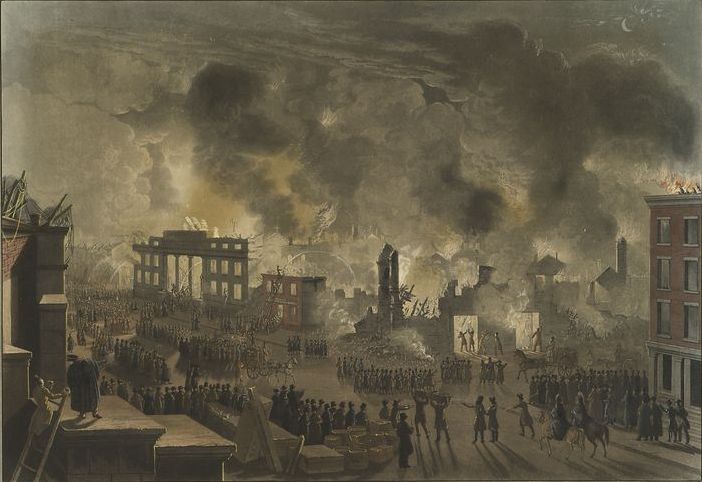
At top: Nicolino Calyo captured the terrible sight of the blaze as it might have looked from Red Hook, Brooklyn
Before the blaze: Charming Wall Street in 1825, from a 1920s guide book. Prosperity from the Erie Canal was just around the bend. (Courtesy Ephemeral New York)
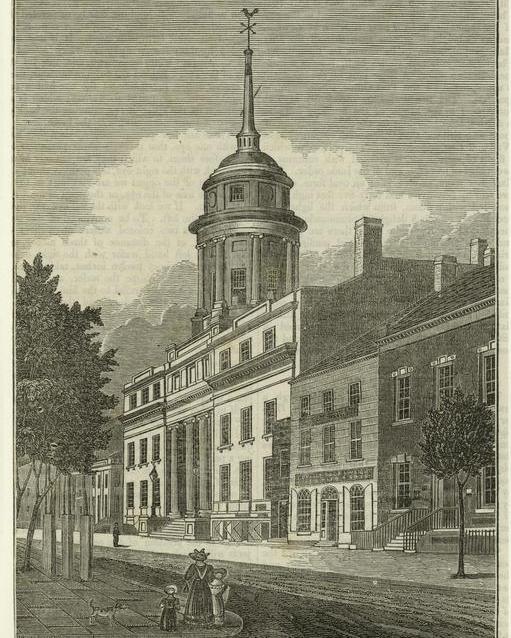
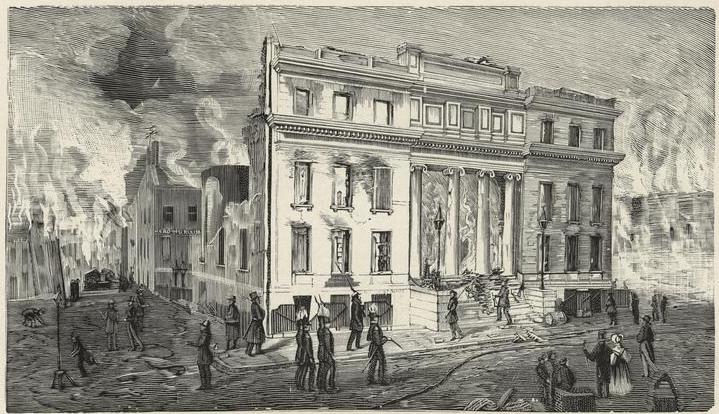
The original Merchant’s Exchange building, one of New York’s more ornate building, featuring a statue of Alexander Hamilton standing nobly in its rotunda. (Illustration courtesy the New York Public Library image gallery)
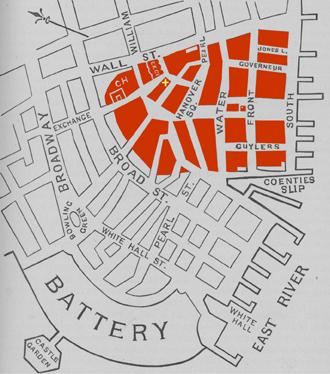
What’s the damage?: the red areas below indicate the blocks destroyed by the swift moving conflagration (map courtesy CUNY)
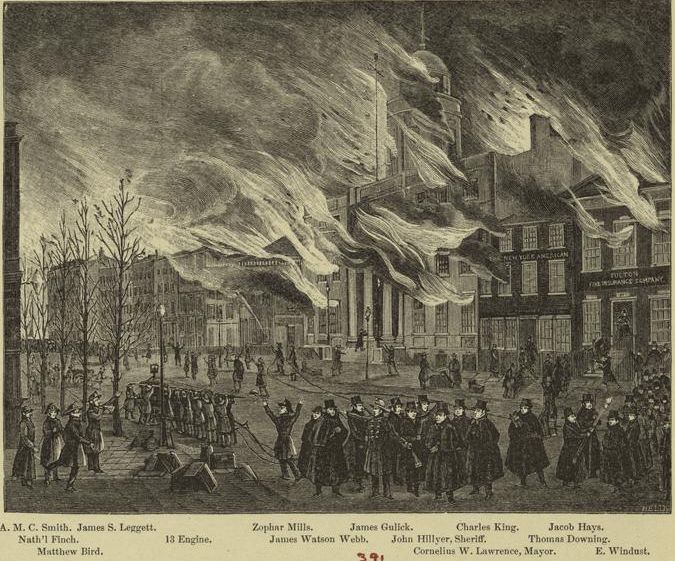
City officials, including mayor Cornelius Lawrence, could only watch and stare as the blaze over takes a stretch of prominent buildings. Also included below is Charles King, who watches as his newspaper the New York American is overcome by the fire.
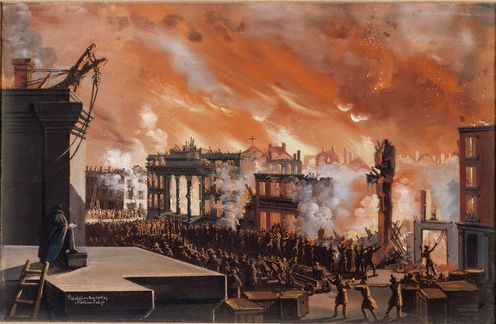
Calyo’s painted depiction of the “Burning of the Merchant’s Exchange”
Another interpretation from the same angle — the futility of battling the blaze was chillingly illustrated from the corner Wall and William streets, where winds carried the flames from building to building, high above the heads of fighters below.
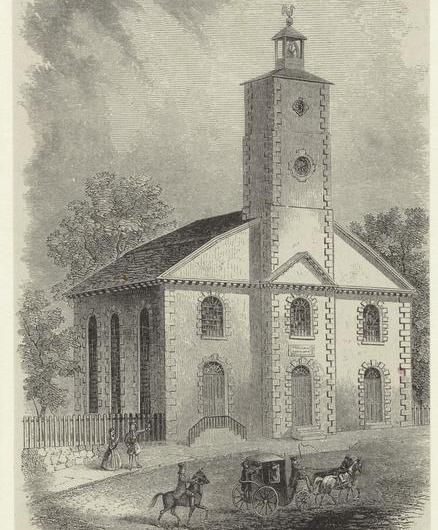
As the old Dutch Church on Garden Street caught fire, a morose parishioner mounted the organ and began playing a dirge. (Where’s Garden Street? According to Forgotten New York, Garden Street was “between William Street and Broadway, just south of Wall Street” and is now part of Exchange Place today.)
Aftermath at the Merchant’s Exchange. Many business owners actually tranferred their stock to the Exchange building, unfortunately thinking it would be impervious to the encroaching flames.
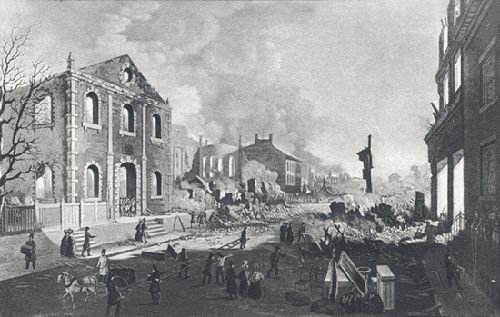
The devastation that met New Yorkers the following day led most to believe the city would never recover.
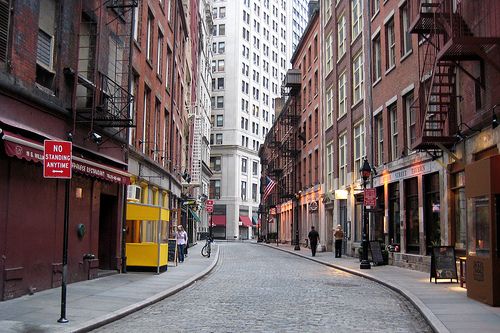
Most of the buildings on today’s Stone Street were built in the immediate years following the fire, Greek Revival-style countinghouses that are refitted for modern times as taverns and restaurants. It’s also one of the few cobblestone streets still around in the Financial District area.
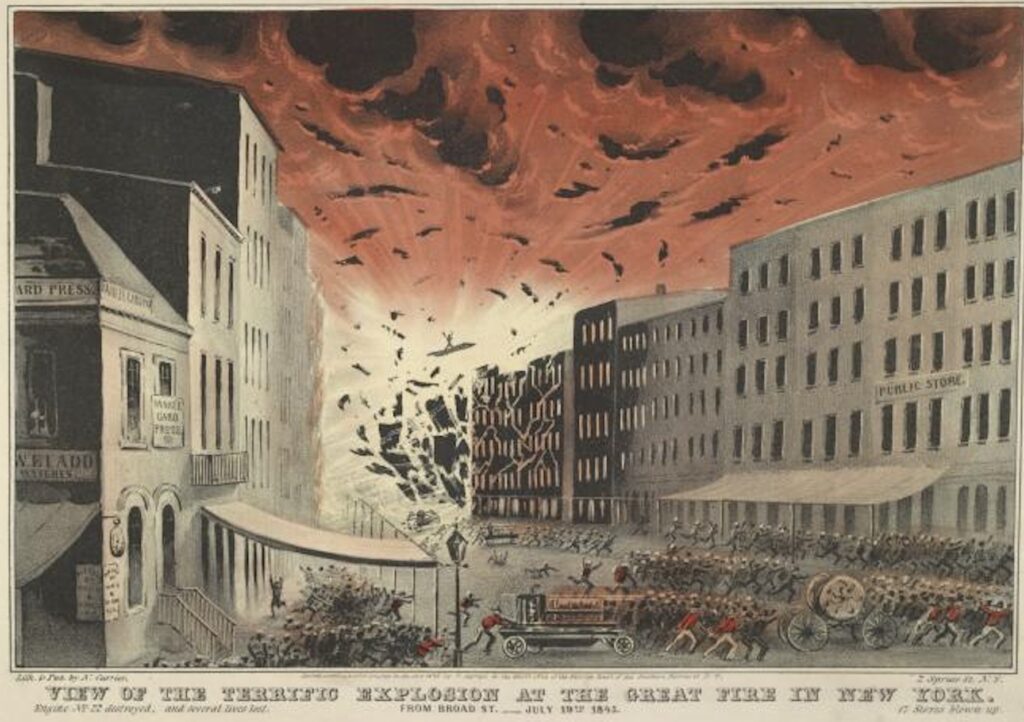
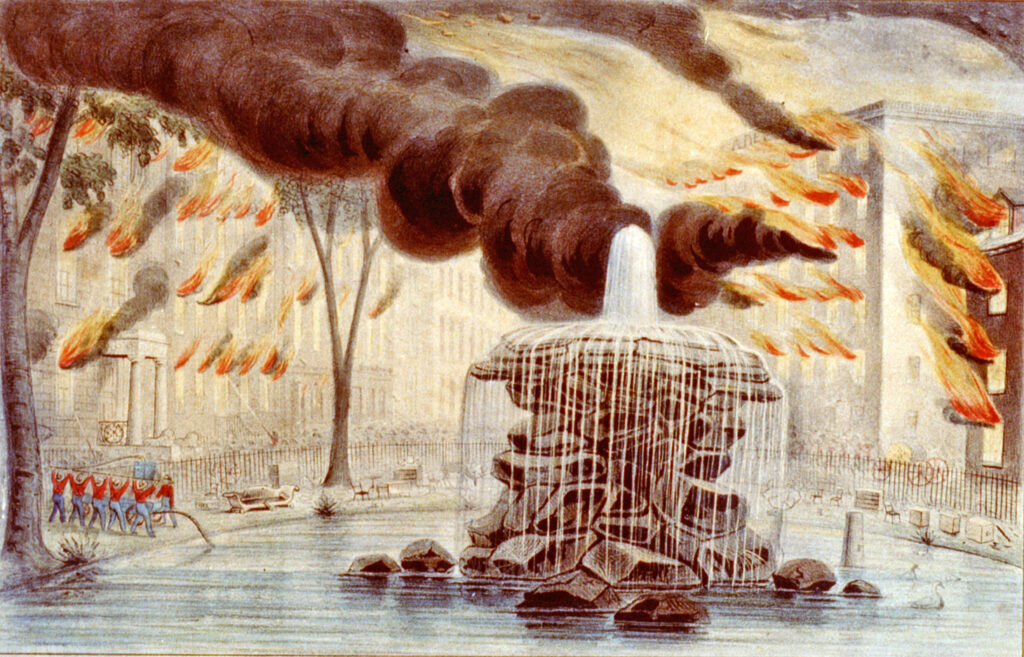
And did you know there was also a terrible fire ten years later — in almost the same location? Check out my article on the Great Fire of 1845 — and these captivating illustrations by Currier and Ives:
In this Currier & Ives lithograph, the serene fountain in Bowling Green as flames consume buildings all around it.
Who exactly was Nicolino Calyo, the man who painted so many vivid pictures of the Great Fire?
Nicolino Vicomte de Calyo was a political dissenter who fled Italy in the 1830s and settled in Baltimore, becoming entranced by the new American landscape.
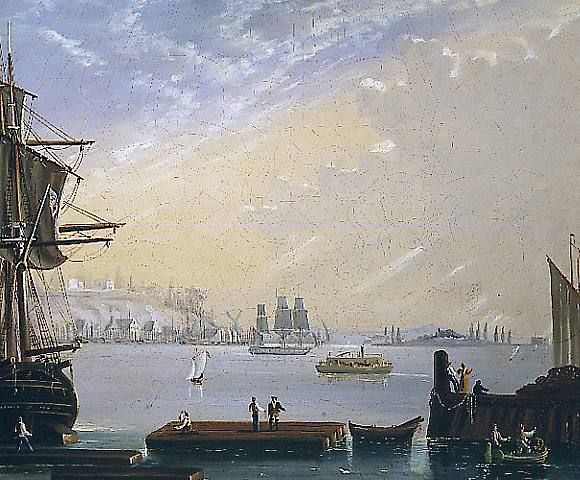
Although his most famous depictions of New York are of the city in flame, he also painted a few serene views (like the one below, a vantage of the harbor from Brooklyn Heights).
His works are in many New York museums, including the Burning of the Merchant’s Exchange which is at the Museum of the City of New York.
Another cool resource on the Great Fire is up at the CUNY website, with more pictures and more backstory as to New York’s capacity to fight blazes in the early 19th century.
FURTHER LISTENING
Other podcasts in our back catalog that relate to this week’s show:
The Bowery Boys: New York City History podcast is brought to you …. by you!
We’re also looking to improve and expand the show in other ways — publishing, social media, live events and other forms of media. But we can only do this with your help!
We are now a creator on Patreon, a patronage platform where you can support your favorite content creators.
Please visit our page on Patreon and watch a short video of us recording the show and talking about our expansion plans.
If you’d like to help out, there are six different pledge levels.Check them out and consider being a sponsor.
We greatly appreciate our listeners and readers and thank you for joining us on this journey so far.
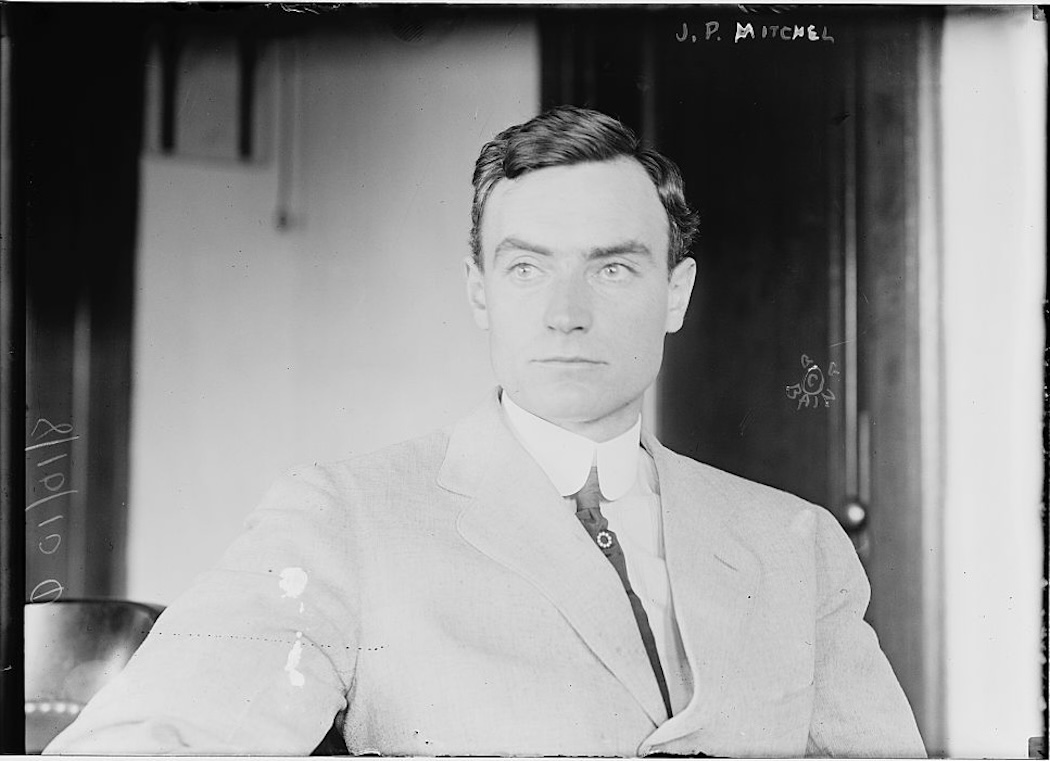
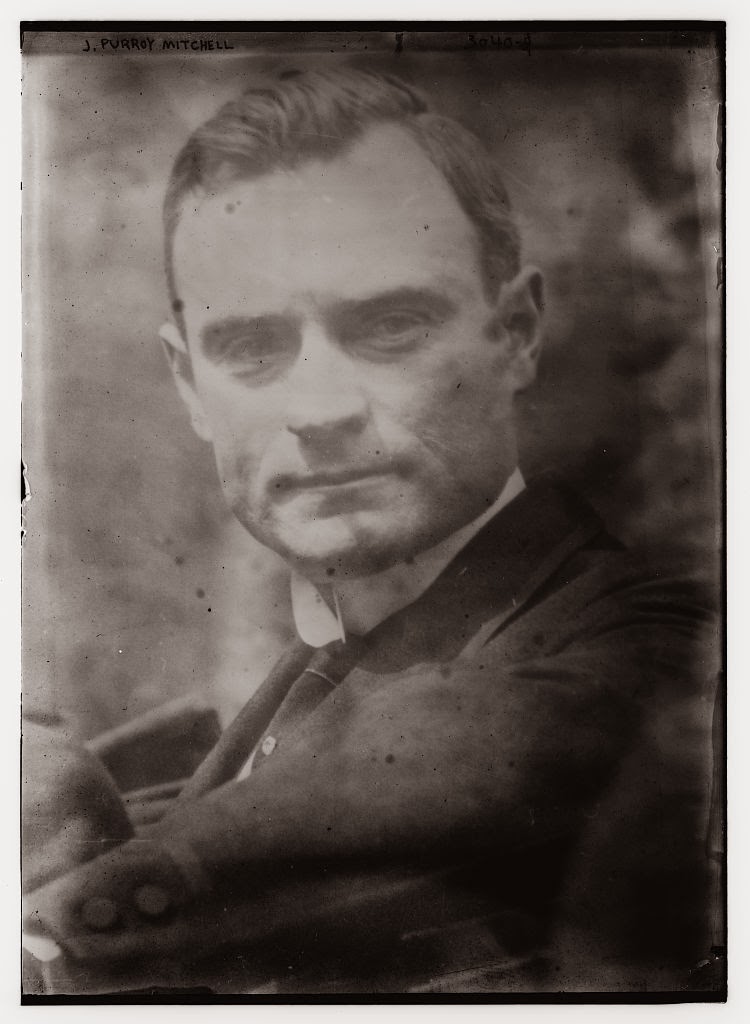
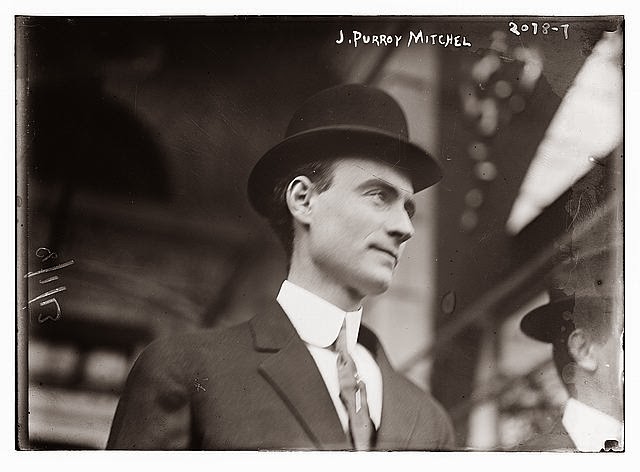
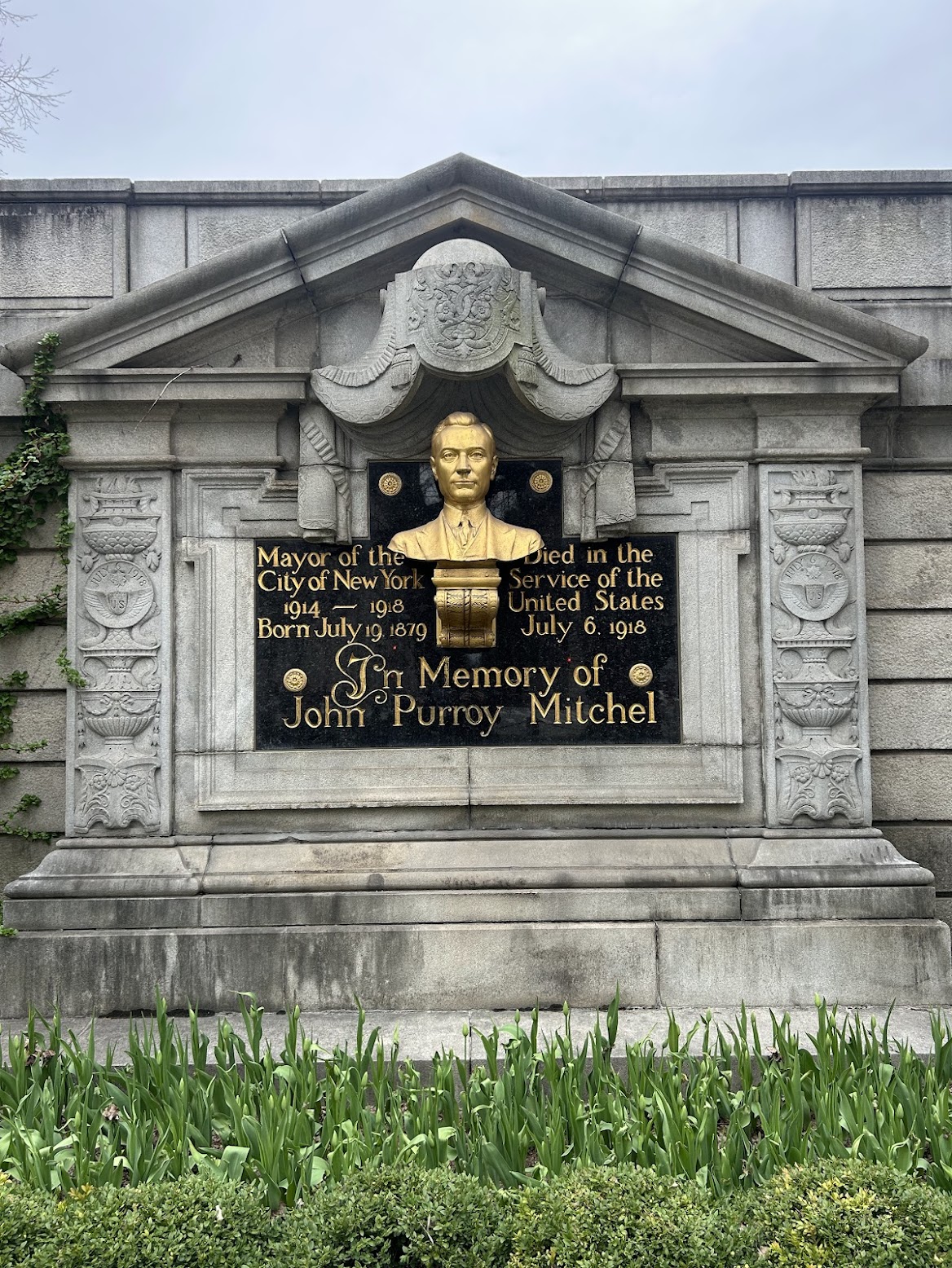
Above: John Purroy Mitchel, the ‘boy mayor’, in 1910 PODCAST As New York City enters the final stages of this year’s mayoral election, let’s look back on a decidedly more unusual contest 110 years ago, pitting Tammany Hall and their estranged ally (Mayor William Jay Gaynor) up against a baby-faced newcomer, the (second) youngest man to ever become the mayor of New York City.
John Purroy Mitchel, the Bronx-born grandson of an Irish revolutionary, was a rising star in New York City, aggressively sweeping away incompetence and snipping away at government excess.
Under his watch, two of New York’s borough presidents were fired, just for being ineffectual! Mitchel made an ideal candidate for mayor in an era where Tammany Hall cronyism still dominated the nature of New York City.
Nobody could predict the strange events which befell the city during the election of 1913, unfortunate and even bizarre incidents which catapulted this young man to City Hall and gave him the nickname “the Boy Mayor of New York“.
But things did not turn out as planned. He won his election with the greatest victory margin in New York City history. He left office four years later with an equally large margin of defeat.
Tune in to our tale of this oft-ignored figure in New York City history, an example of good intentions gone wrong and — due to his tragic end — the only mayor honored with a memorial in Central Park.
PLUS: The totally bizarre death in 1913 of Tammany Hall’s most popular leader
The Bowery Boys Podcast is proud to be sponsored by Founded By NYC, celebrating New York City’s 400th anniversary in 2025 and the 250th anniversary of the United States in 2026.
Read about all the exciting events and world class institutions commemorating the five boroughs legacy of groundbreaking achievements, and find ways to celebrate the city that’s always making history at Founded by NYC.
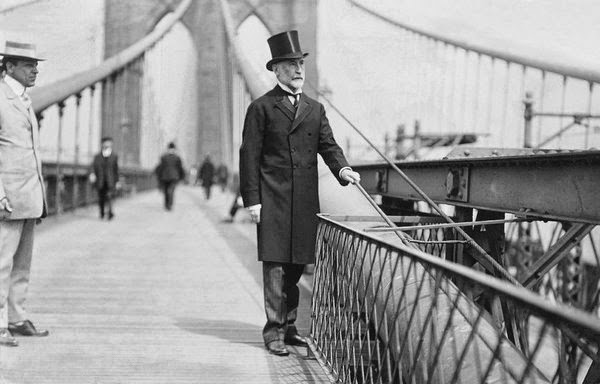
Mayor William Jay Gaynor on his inauguration day in 1909, walking across the Brooklyn Bridge to City Hall, from his home in Park Slope.
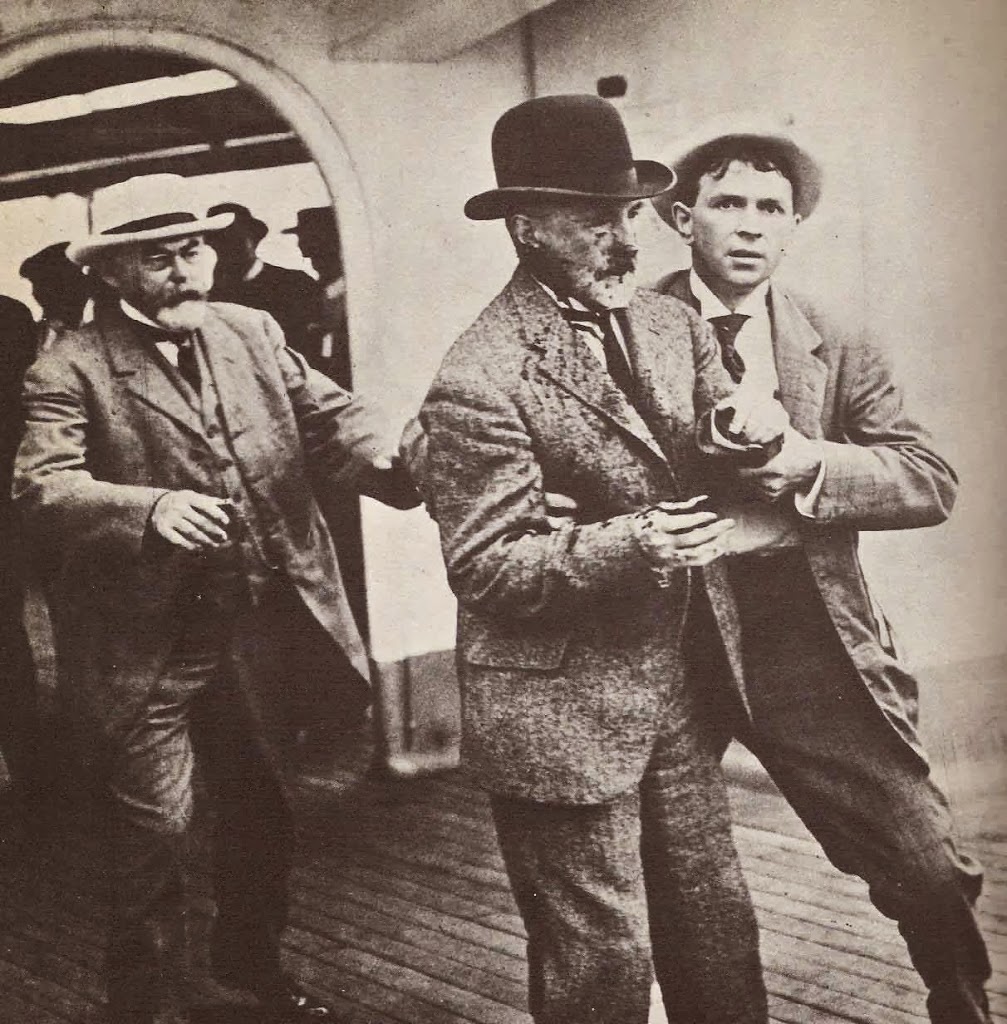
William Jay Gaynor at the very moment he was shot in 1910, on an ocean vessel docked in Hoboken. This picture was taken by a New York World photographer, one of the most famous works of early journalism photography.
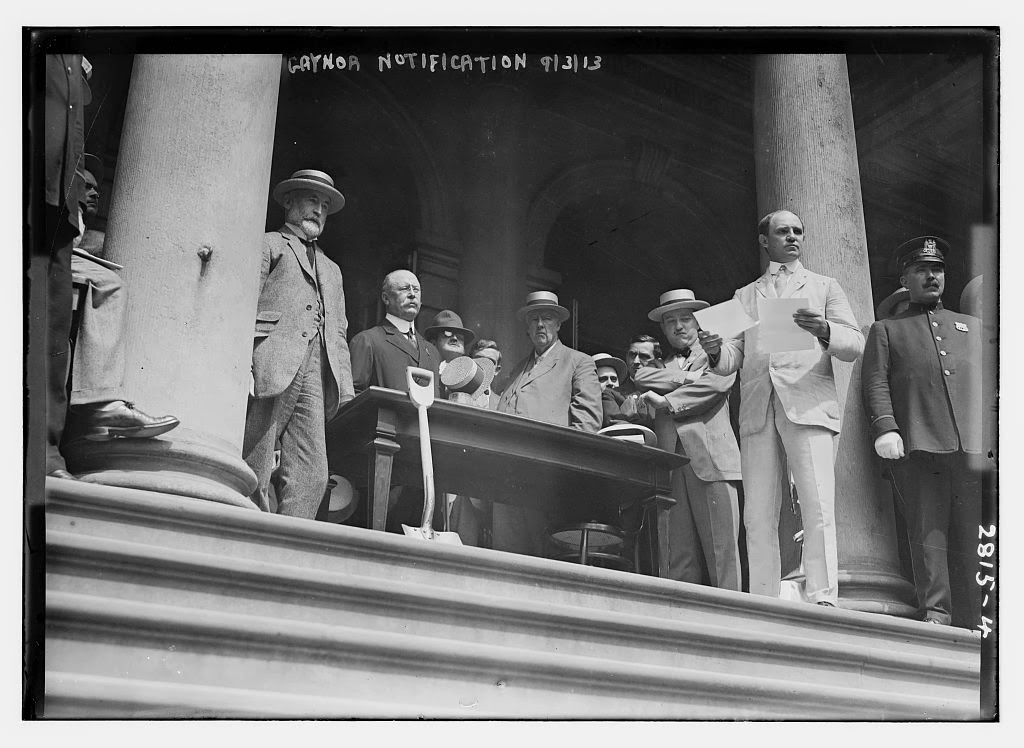
Gaynor (at left) attempted to stage a political comeback (after being by Tammany Hall) at the notification of his independent candidacy at City Hall in September 1913. The shovel in front of him was his campaign emblem.
Within a few days, he would be dead of the assassin’s bullet he received three years earlier.
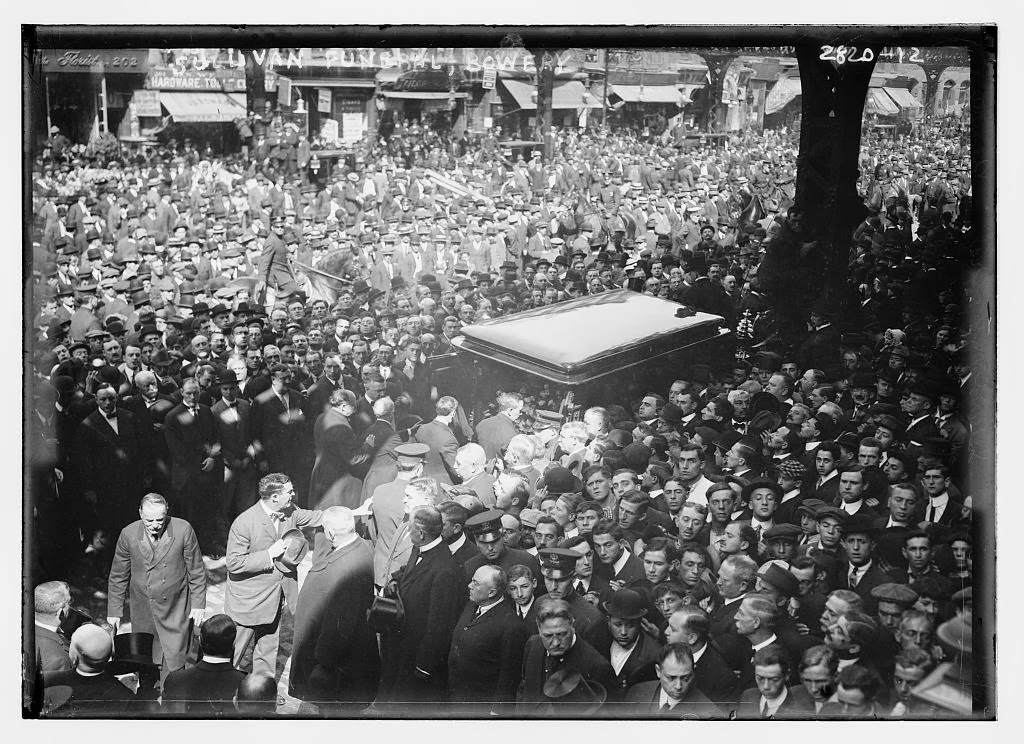
The death of Big Tim Sullivan also caused ripples in the mayoral election of 1913. The picture below is of the Bowery, overflowing with mourners.
While Sullivan was out of politics (and in an asylum) by 1913, his sudden and unusual passing had an effect on Tammany Hall supporters, throwing another strange event into an already tumultuous year.
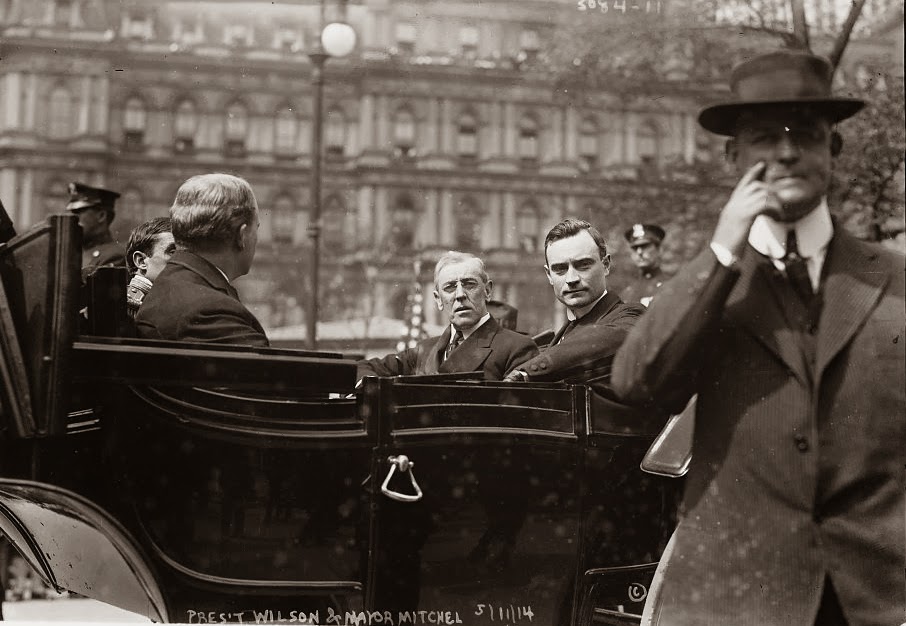
Mayor Mitchel with President Woodrow Wilson in May 1914, at a memorial service for American marines and seamen killed in Veracruz during the Mexican Revolution.
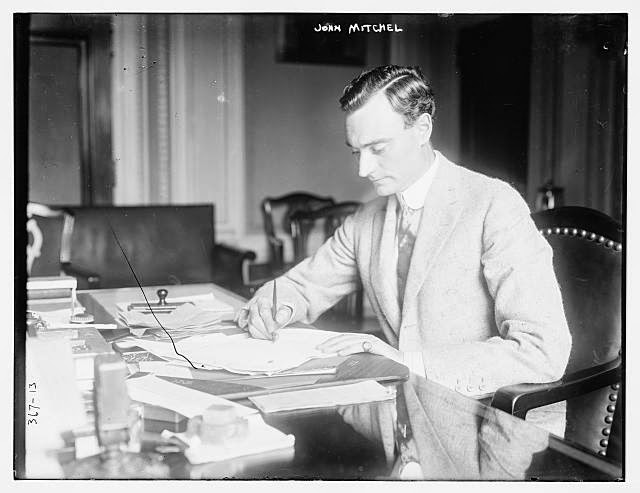
Mitchel at his desk at City Hall, presumably cracking down on some kind of over-expenditure or waste. Or possibly silently suffering from migraine headaches which plagued him during his entire term as mayor.
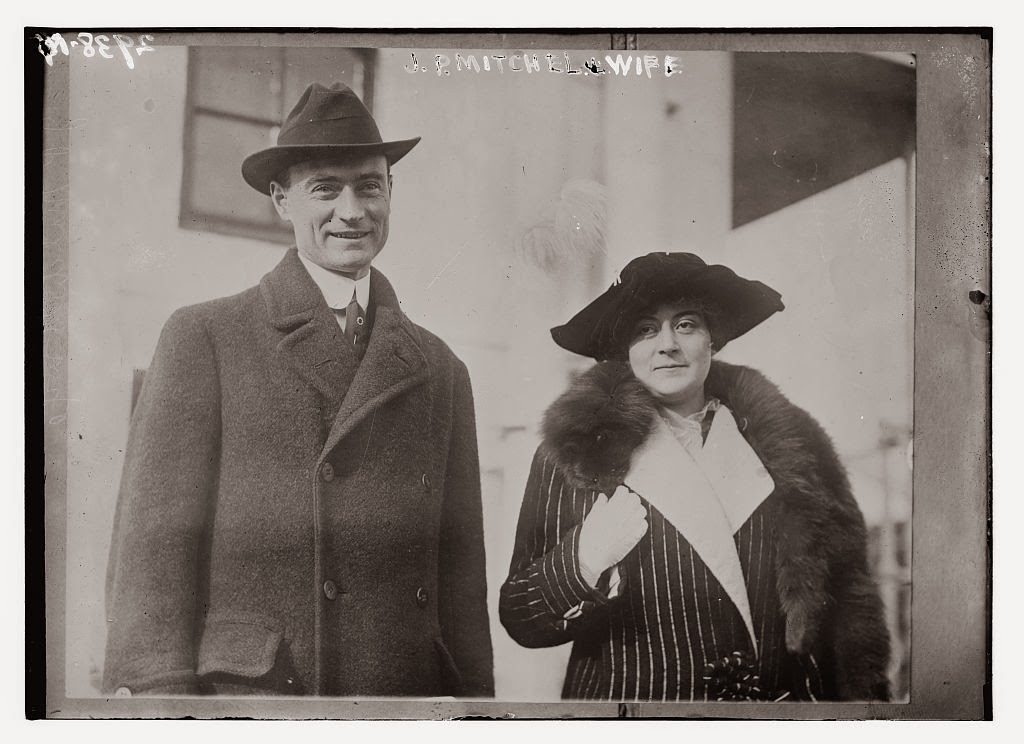
John with his wife Jane.
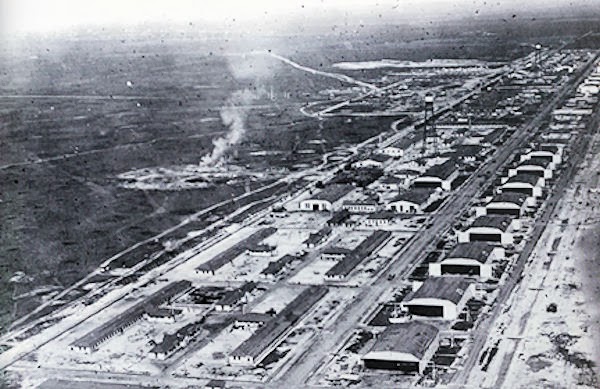
Gerstner Field in Louisiana, where Mitchel had his tragic airplane accident on July 6, 1918.
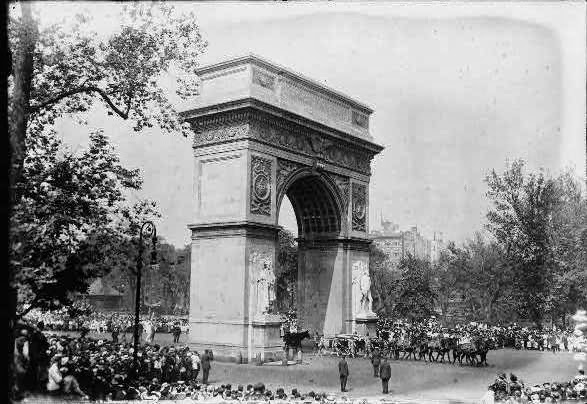
Another New York funeral: The body of John Purroy Mitchel is carried in a procession from City Hall, through the Washington Arch, and up to St. Patrick’s Cathedral.
Theodore Roosevelt, one of the pallbearers at Mitchel’s funeral, leaves St. Patrick’s in this short film by Edison.
The John Purroy Mitchel memorial, near the reservoir in Central Park.
Most pictures above are public domain, courtesy of the Library of Congress
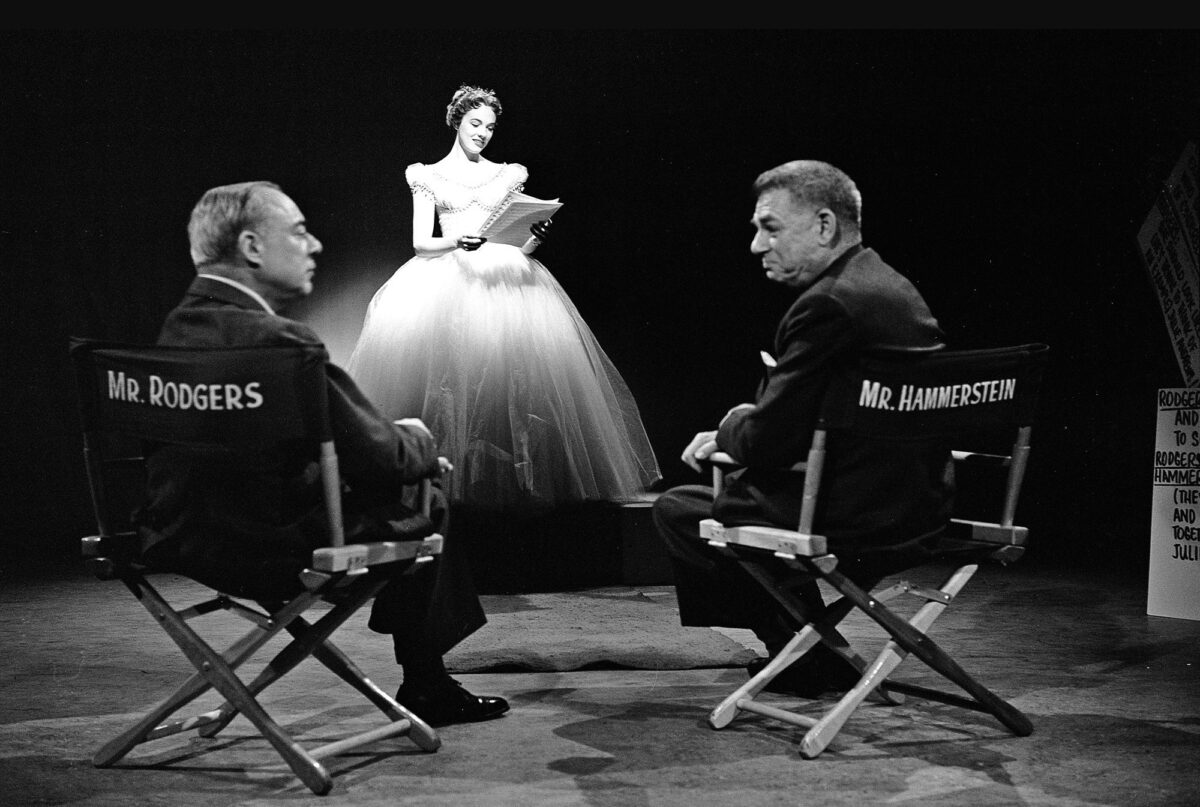
Publicity still for the broadcast of Cinderella in 1957. The television film was seen by more than 100 million people (or well over half the population of the United States.)
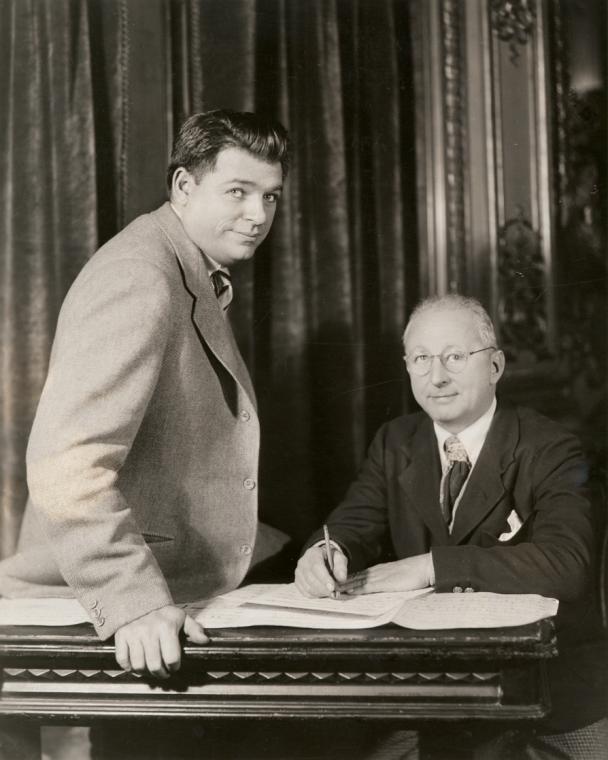
Richard Rodgers and Oscar Hammerstein II are two of the greatest entertainers in New York City history. They have delighted millions of people with their unique and influential take on the Broadway musical — serious, sincere, graceful and poignant. In the process they have helped in elevating New York’s Theater District into a critical destination for American culture.
In this episode, we tell the story of this remarkable duo — from their early years with other creators (Hammerstein with Jerome Kern, Rodgers with Lorenz Hart) to a run-down of all their shows. And almost all of it — from the plains of Oklahoma to the exotic climates of South Pacific — takes place on just two city blocks in Midtown Manhattan!
PLUS: What classic music venue still bears the name of Oscar Hammerstein’s grandfather?
How did the ritzy Plaza Hotel celebrate the fifth anniversary of Oklahoma’s debut?
How is Richard Rodgers associated with Hamilton the Musical?
And what was the final song written by Rodgers and Hammerstein?
LISTEN NOW: RODGERS AND HAMMERSTEIN
The Bowery Boys Podcast is proud to be sponsored by Founded By NYC, celebrating New York City’s 400th anniversary in 2025 and the 250th anniversary of the United States in 2026.
Read about all the exciting events and world-class institutions commemorating the five boroughs’ legacy of groundbreaking achievements, and find ways to celebrate the city that’s always making history at Founded by NYC.
The selection of theater images and memorabilia below are courtesy the Billy Rose Theatre Division at the New York Public Library.
Hammerstein with another musical legend — Jerome Kern — in 1939
NYPL
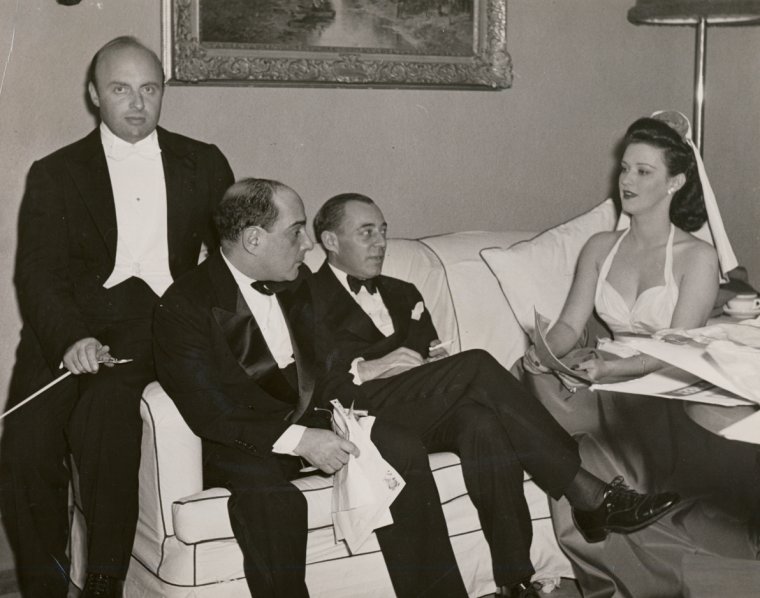
Andre Kostelanetz, Lorenz Hart, Richard Rodgers and Jane Froman, 194o
NYPL
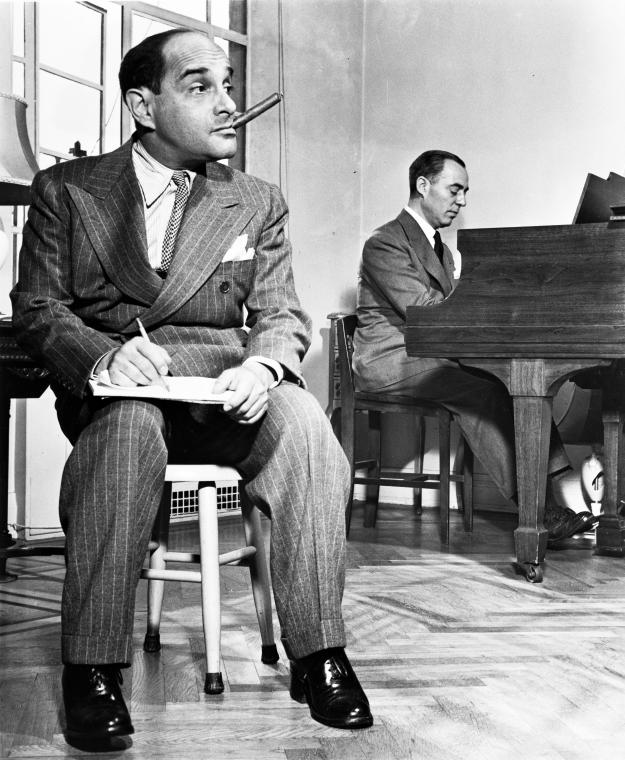
Rodgers and Hart, circa 1940
NYPL
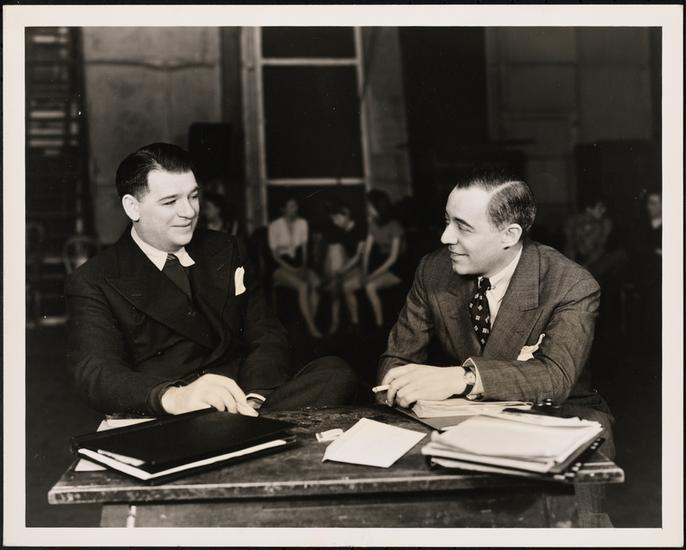
The creators, with performers in the background
Museum of the City of New York/NYPL
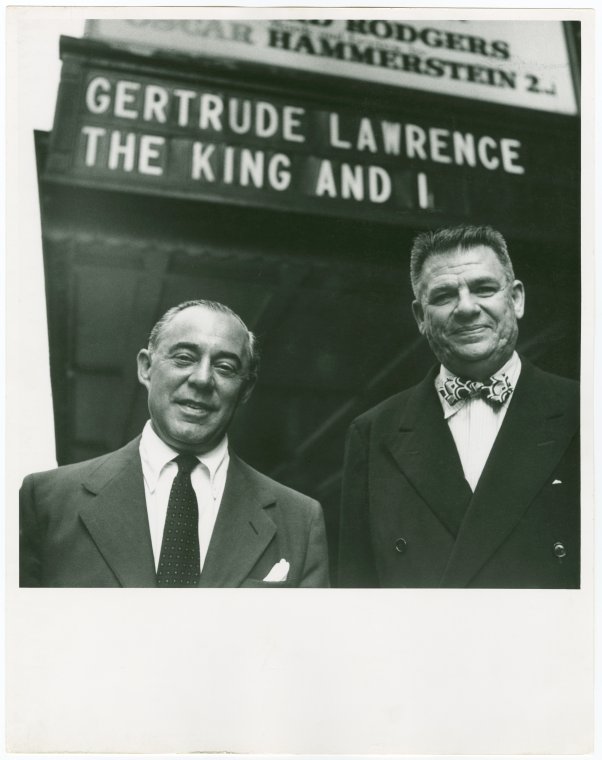
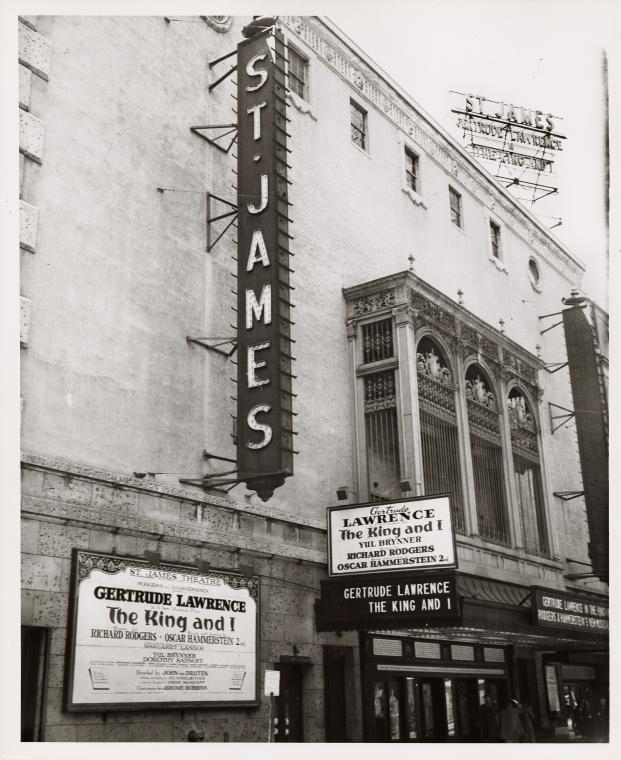
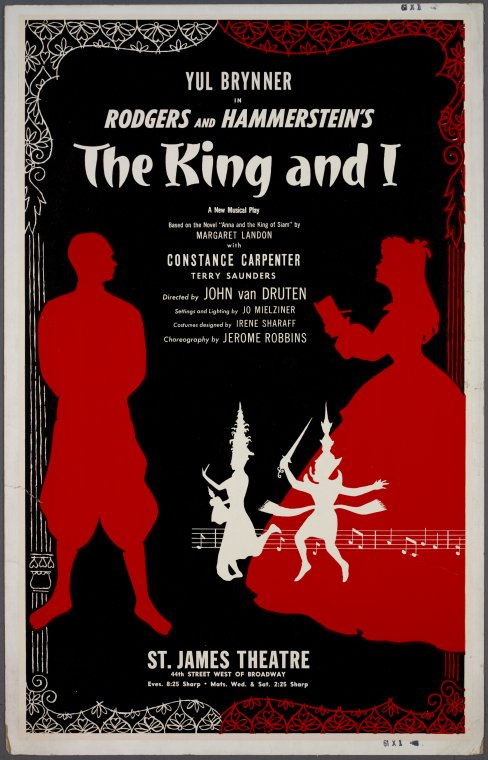
Richard Rodgers and Oscar Hammerstein II at the opening of The King and I at the St. James Theatre
NYPL
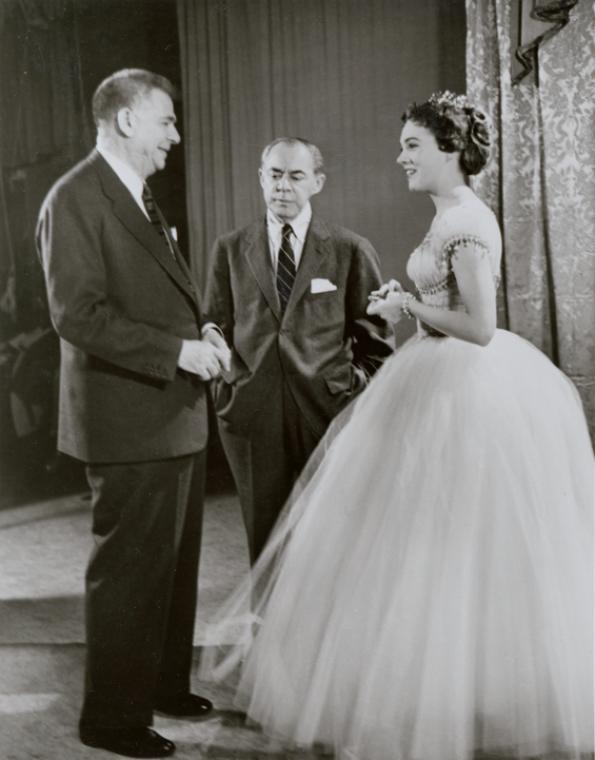
Hammerstein, Rodgers and a young Julie Andrews during rehearsals for the broadcast of Cinderella.
NYPL
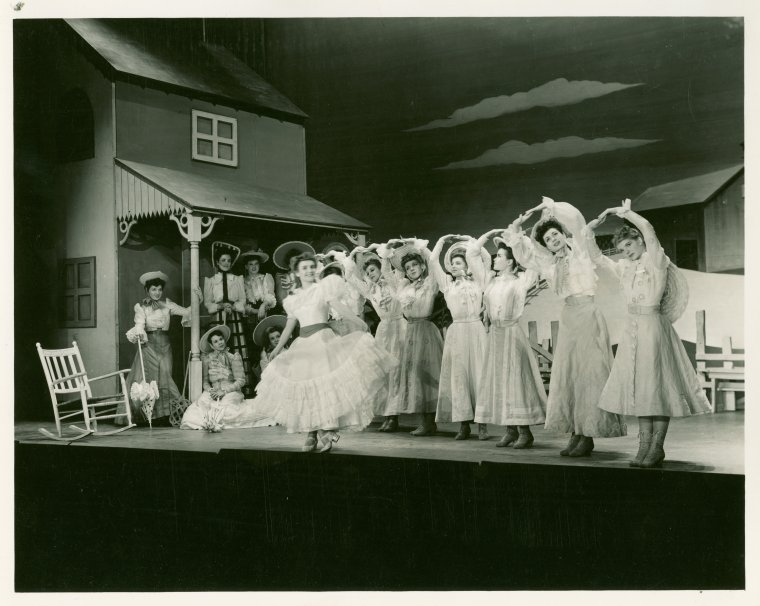
No ‘leggy chorus girls’ here. Joan Roberts and the original cast of Oklahoma! transformed the Broadway musical
NYPL
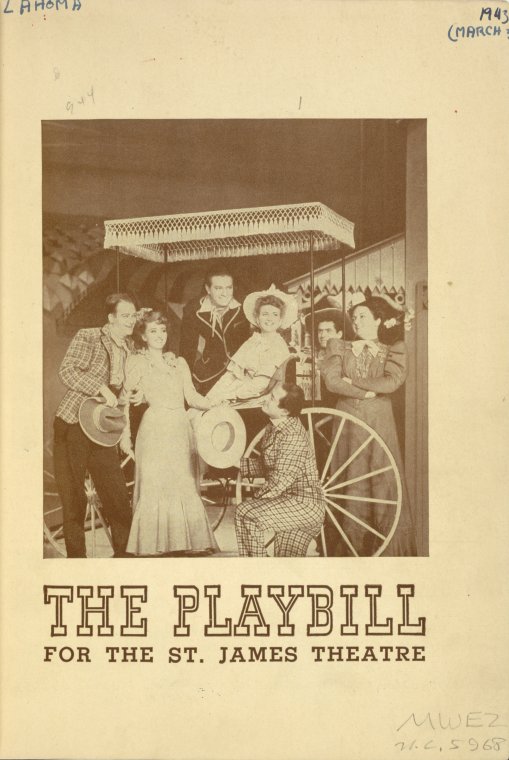
Playbill for the original production of Oklahoma! at the St. James Theatre (1943)
NYPL
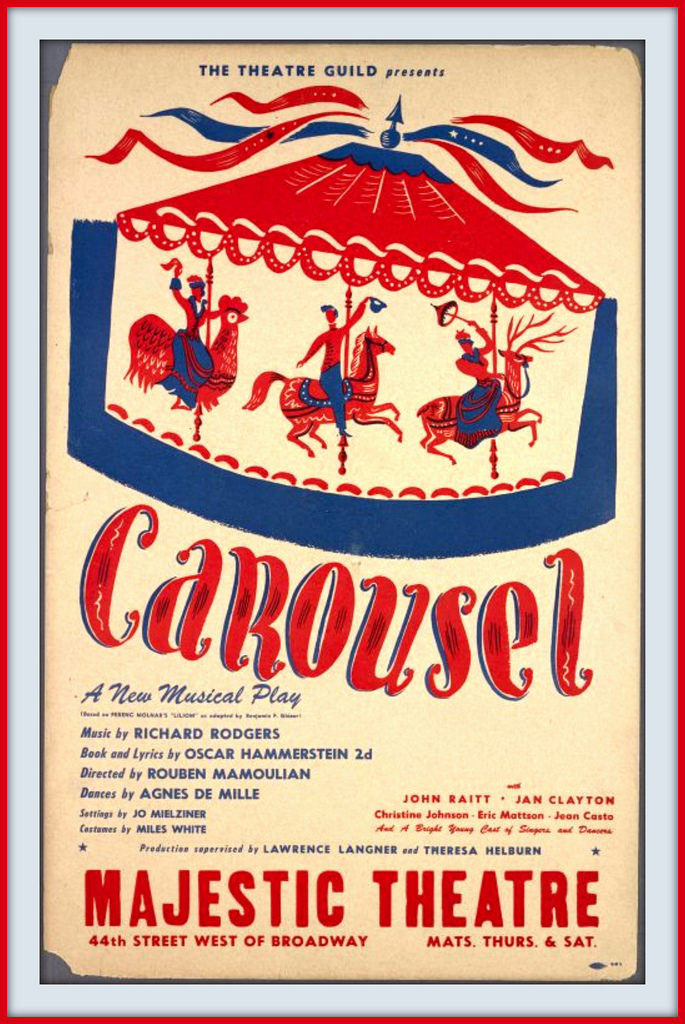
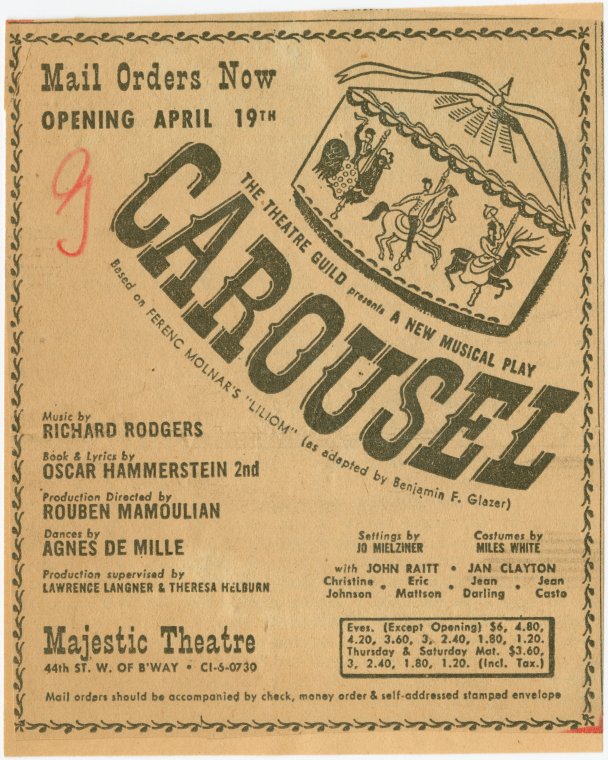
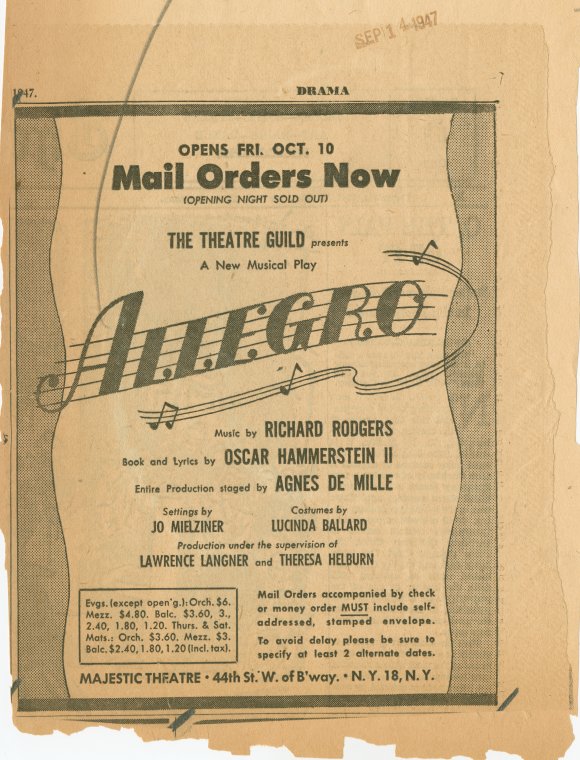
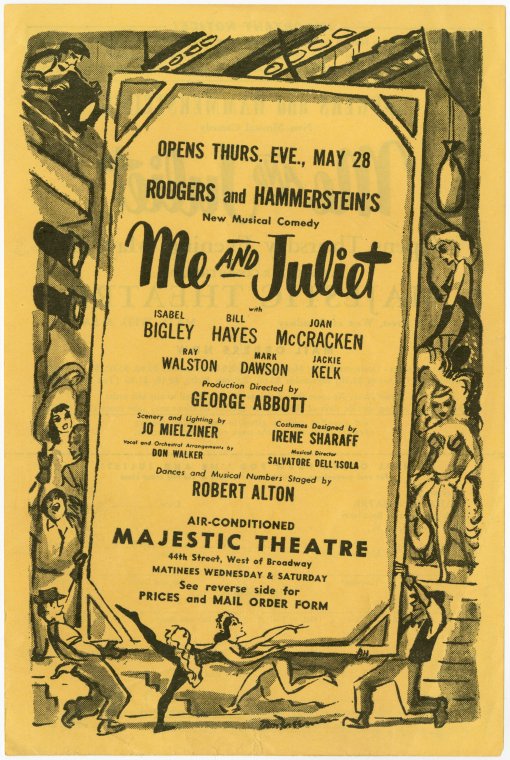
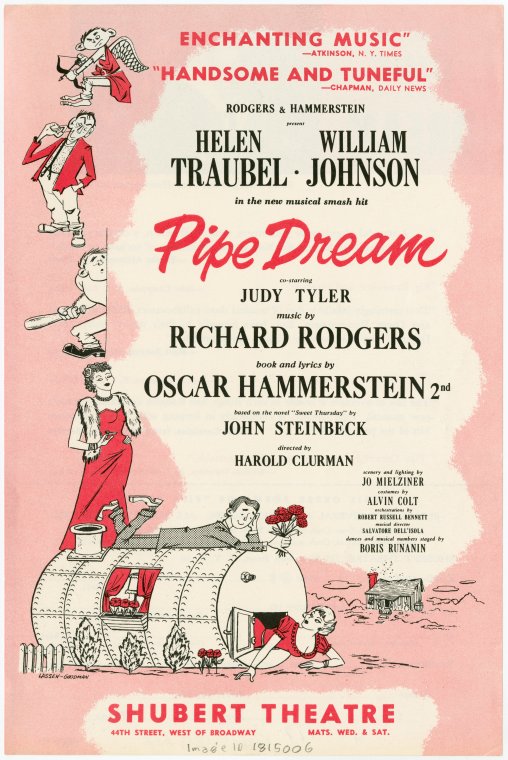
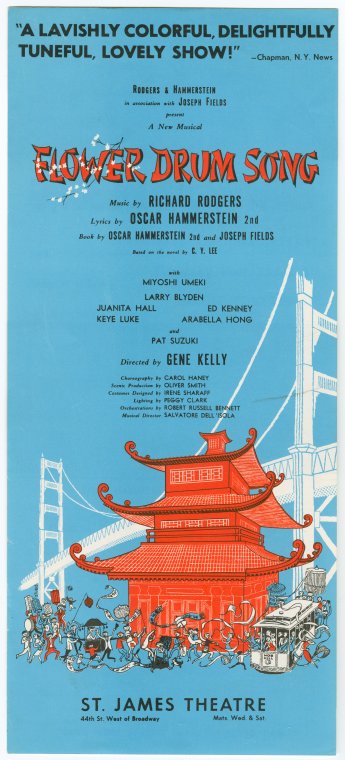
Thanks to advance “mail orders,” Rodgers and Hammerstein shows would be sold out months before opening — and months before the reviews came out.
NYPL
NYPL
NYPL
NYPL
NYPL
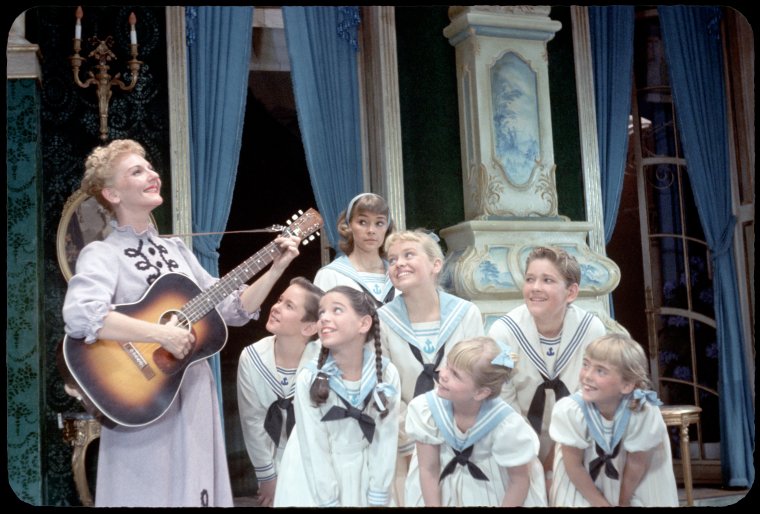
Mary Martin and the child stars of the original production of The Sound of Music.
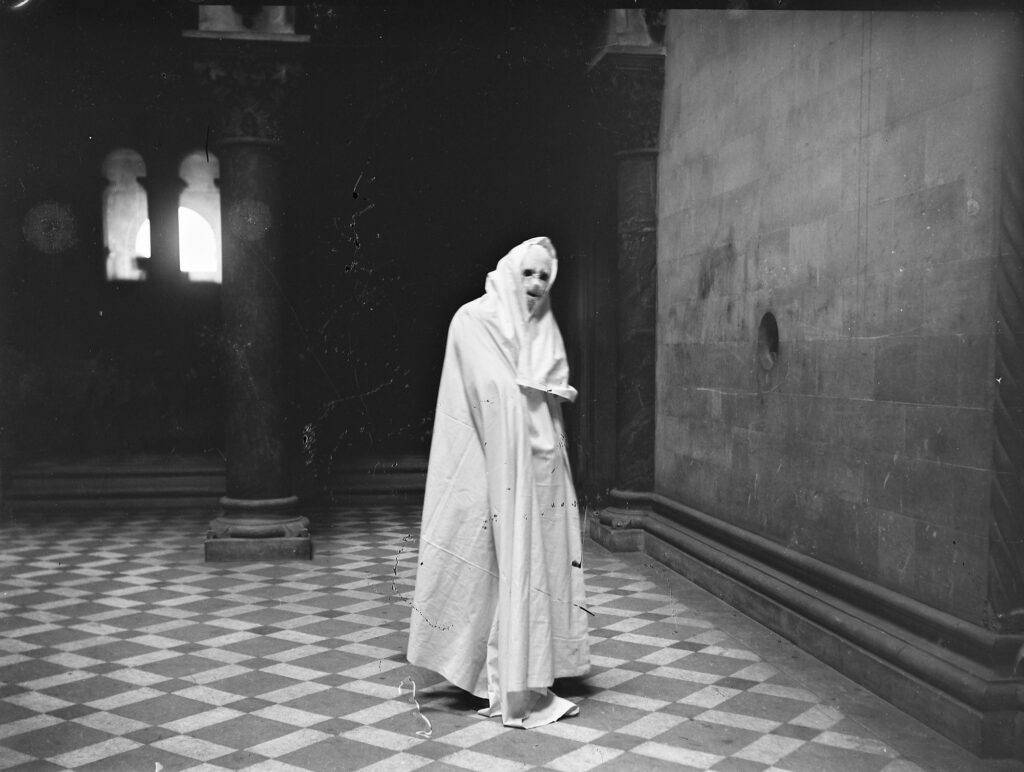
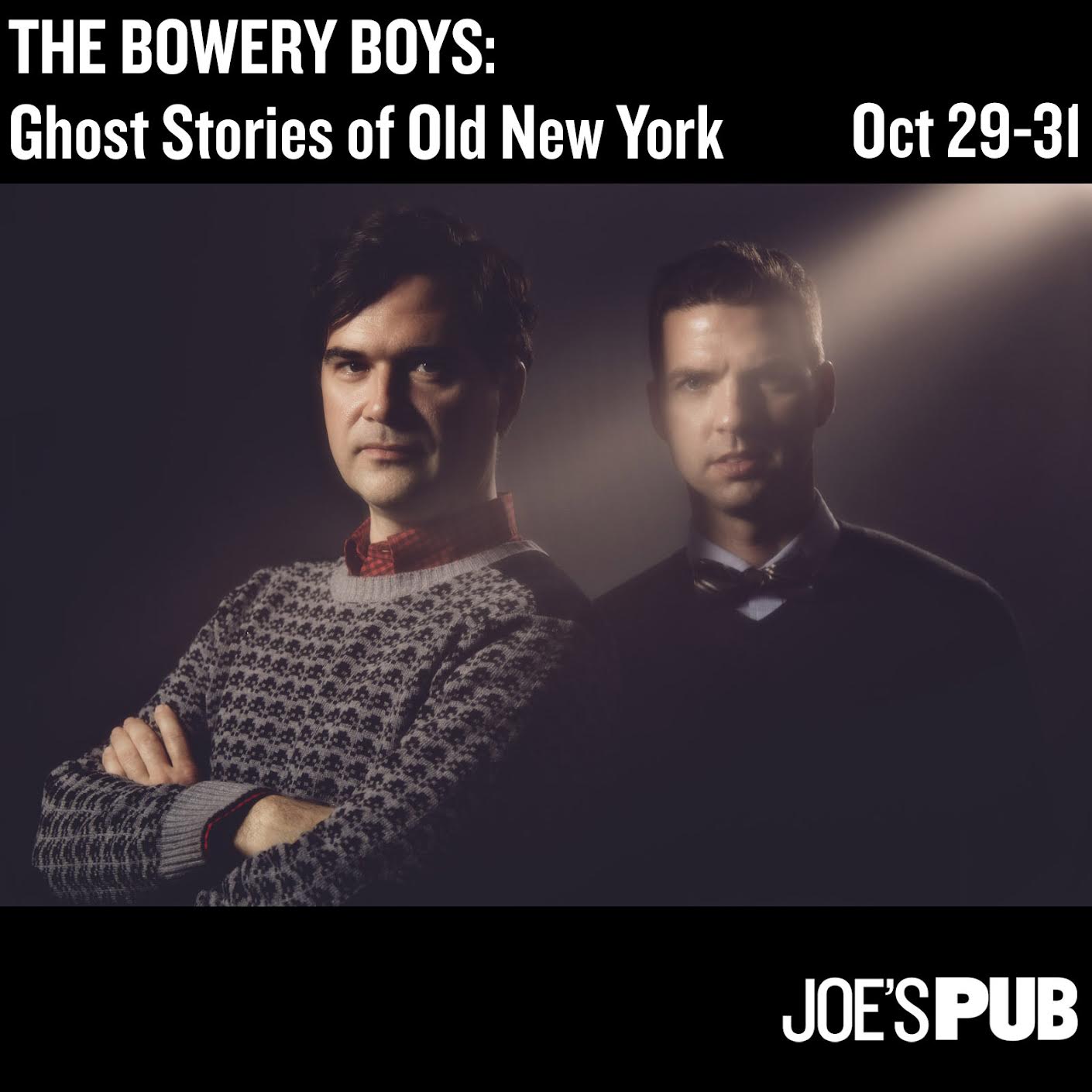
Our first ghost stories show was released on October 11, 2007, featuring New York City’s famous haunted tales and urban legends (with historical context). Since that time we have released nineteen Halloween-related shows as well as a recording of our Joe’s Pub live show.
Take a spooky trip down memory lane with a re-listen to all our past Halloween shows.
Listening tip: The episodes do get better with each passing year so start with the newest one and work your way back to 2007.
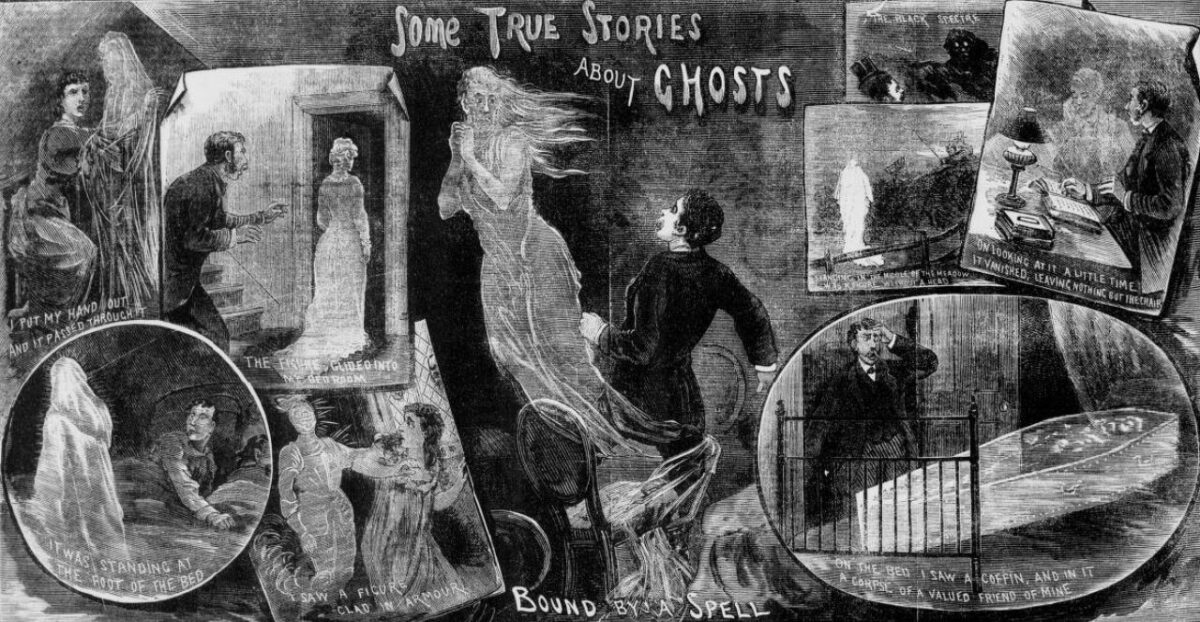
Creep yourself out while listening to these spooky legends of New York City. From the haunted woods of Van Cortlandt Park to spirits haunting Captain Kidd’s treasure on Liberty Island. Psychics at Carnegie Hall, unsettling spirits in Cobble Hill, undead party animals at Grand Central!
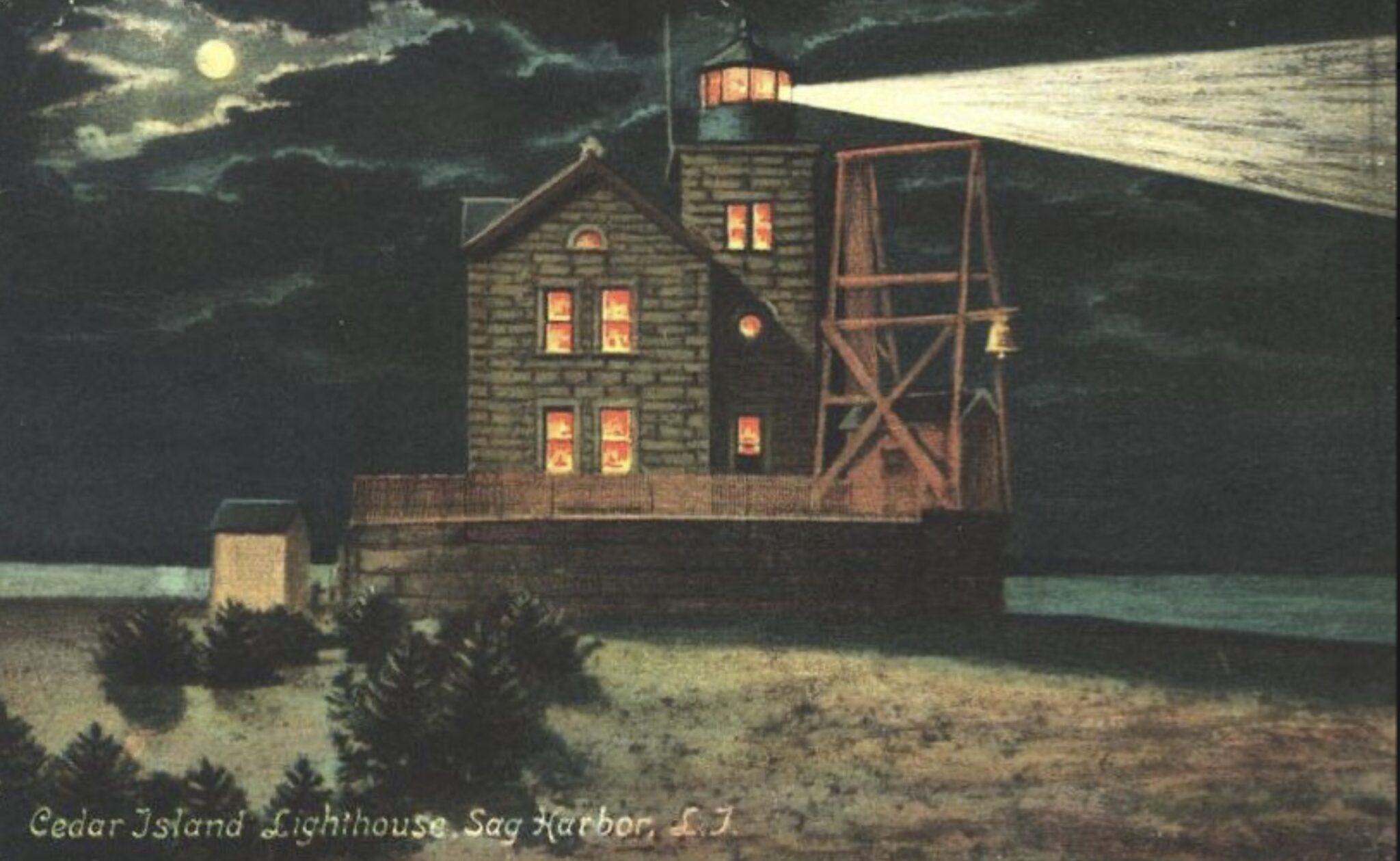
Greg and Tom take a road trip to Long Island to explore the region’s most famous haunted tales from legend and folklore, ‘real’ reported stories of otherworldly encounters that have shaped this historic area of New York state.
Each of New York City’s five boroughs bring their own unique histories and personalities, so we thought we’d give each one the spotlight – or rather the spooklight – to highlight the city’s haunted landscape, from rural escapes to densely populated urban centers.
From a Staten Island cemetery to the Bronx Zoo. From a luxury apartment in Flatbush to the Old Flushing Meeting House in Queens. And what’s the strange light, seen from the Manhattan waterfront, floating in the East River?
The old Furniss mansion, with its dark secrets literally behind a locked door.
Spooky stories from the gaslight era of New York City, the illuminating glow of the 19th century revealing the spirits of another world. Featuring various ghost stories associated with Fordham University, a tale of literary ghosts in Astor Place, a haunted townhouse north of Washington Square Park and a haunted tenement on the East River waterfront.
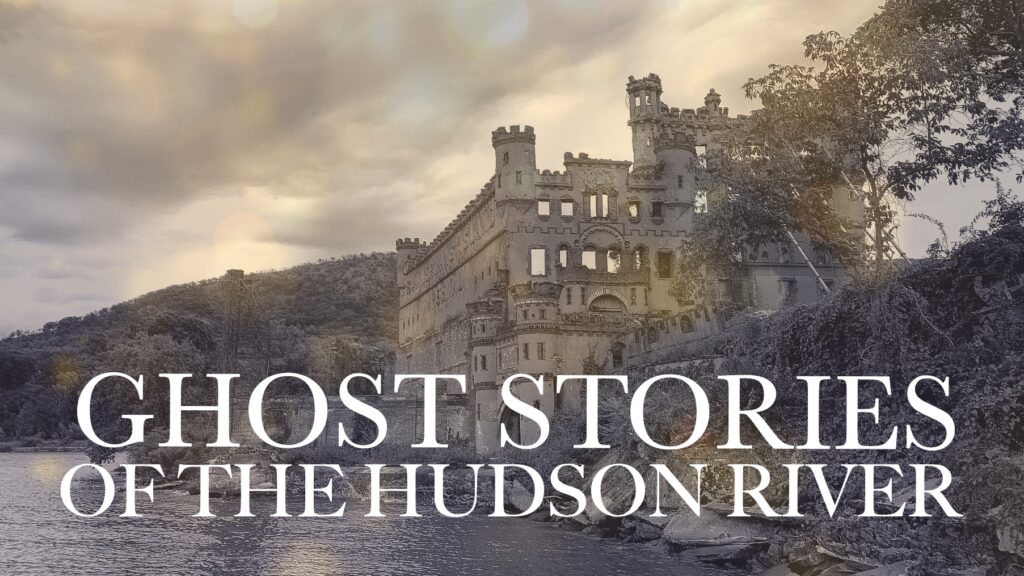
Featuring a ghost-filled mansion in Nyack, New York that holds a unique place among all American supernatural sites; the unsettling tale behind those mysterious ruins known as Bannerman Castle; a ghastly apparition in the Colonial-era Catskills leads to a disturbing life sentence and the secrets of Kingston’s Old Dutch Church with an entity which may trapped beneath its holy steeple.
Cheryl Crow
2021 Gotham’s Greatest Ghosts
For this 15th annual Bowery Boys Halloween ghost story podcast, Greg and Tom taking a look back at their favorites (and yours), the tales which have stayed with us — which have possessed us — like a persistent phantom who refuses to leave.
We present classic tales of the strange and supernatural written by the most famous horror writers in New York City history.
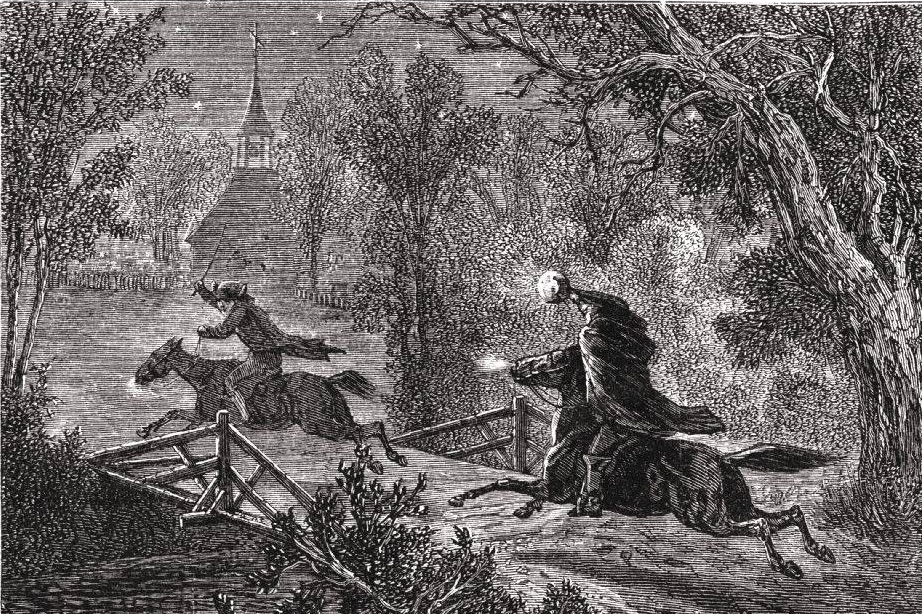
— A celebration of the 200th anniversary of Washington Irving‘s “The Legend of Sleepy Hollow,” featuring the Headless Horseman and the backstory of this classic story’s creation;
— The unsettling nights of H.P. Lovecraft in Brooklyn where his xenophobia, racism and anxiety manifest into a pair of dark, claustrophobic tales, plucked from the waterfront and the West Village;
— A bizarre and allegedly true story (or is it an urban legend?) of an unconventional jewel thief named Fanchon Moncare, made famous by that 20th century purveyor of all things unbelievable — Robert Ripley;
— And a look at the life of Patricia Highsmith — celebrating the 100th anniversary of her birth a bit early — whose nasty little tales of mad murderers have inspired Hollywood and unsettled a new generation of suspense lovers.
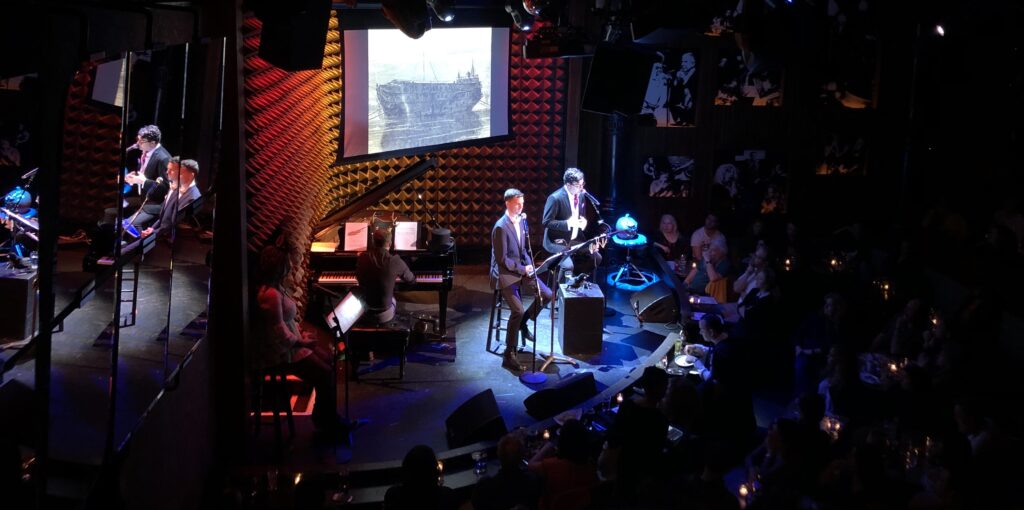
A very special Bowery Boys: New York City History podcast presentation, recorded live on Halloween Night 2019 at Joe’s Pub. Prepare to hear new versions of your favorite ghost stories including:
— A Brooklyn house haunting that may be related to the spirits from a colonial-era prison ship;
— A famous murder trial from the year 1800 and a mysterious well which still stands in the neighborhood of SoHo;
— The ghosts (or other supernatural entities) which guard the treasure of the famous Captain Kidd; and
— The mournful secrets of a famed Broadway theater and the inner demons of a Hollywood icon.
With an ALL NEW GHOST STORY — WHO HAUNTS THE FORMER ASTOR LIBRARY?
Near Madison Square Park, an eccentric writer posts a classified ad, hoping to rent out an attic room to a prospective subletter. Unfortunately the room already an occupant — a greenish ghost with a troubling Civil War history.
— The Conference House in Staten Island played an interesting role in the Revolutionary War, and some residents from that period may still wander its ancient hallways.
— On the Upper East Side, a lavish penthouse ballroom may be permanently vexed with the ghost of a testy spirit named Mrs. Spencer. Can a legendary funny lady and a Vodou priestess manage to keep the ghoul under control?
And for the first time in Bowery Boys ghost-stories history, Greg and Tom record a segment of the show — from within an actual haunted house. Merchant’s House docent Carl Raymond joins them for a close look at the life of Gertrude Tredwell and the rooms where she lived and died — and may, to this very day, haunt.
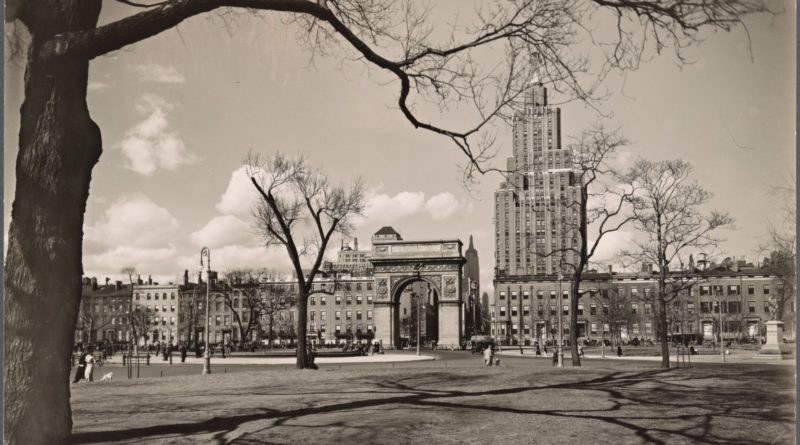
We cautiously approach the dark secrets of Greenwich Village, best known for bohemians, shady and winding streets and a deeply unexpected history. You will never look at its parks and townhouses again after this show!
Featuring: The hidden history of Washington Square Park; the Brittany Residence Hall for New York University students; James Walker Park with its secrets underfoot; and an old Bank Street townhouse with a surprise in its ceiling.
Highlighting haunted tales from the period just after the Civil War when New York City became one of the richest cities in the world — rich in wealth and in ghosts!
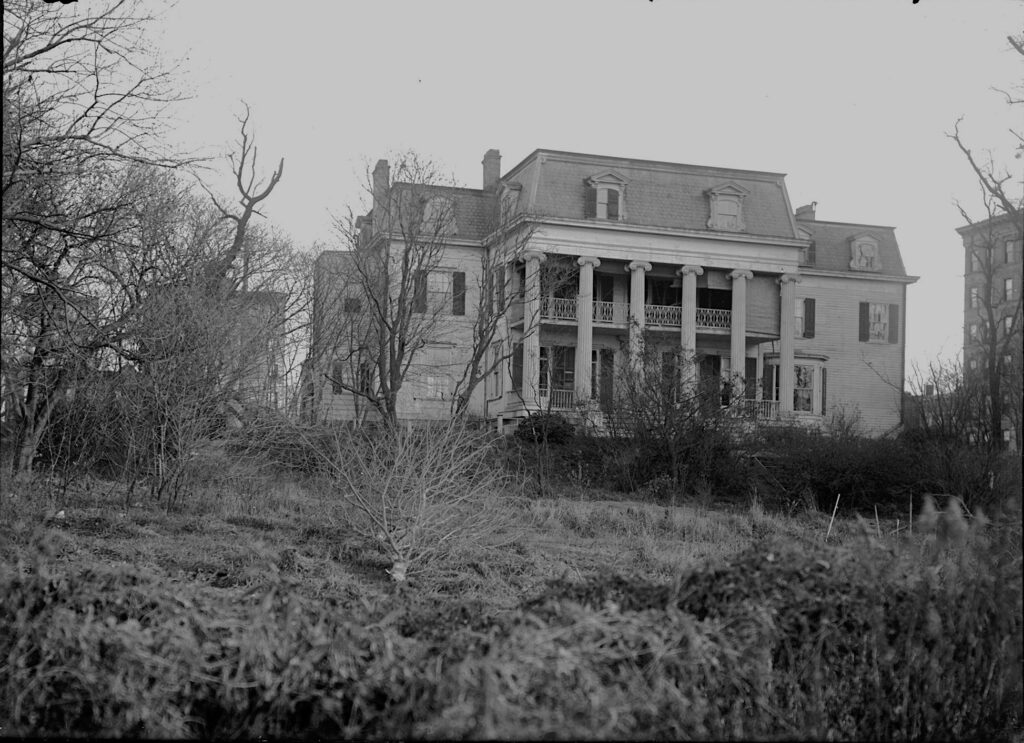
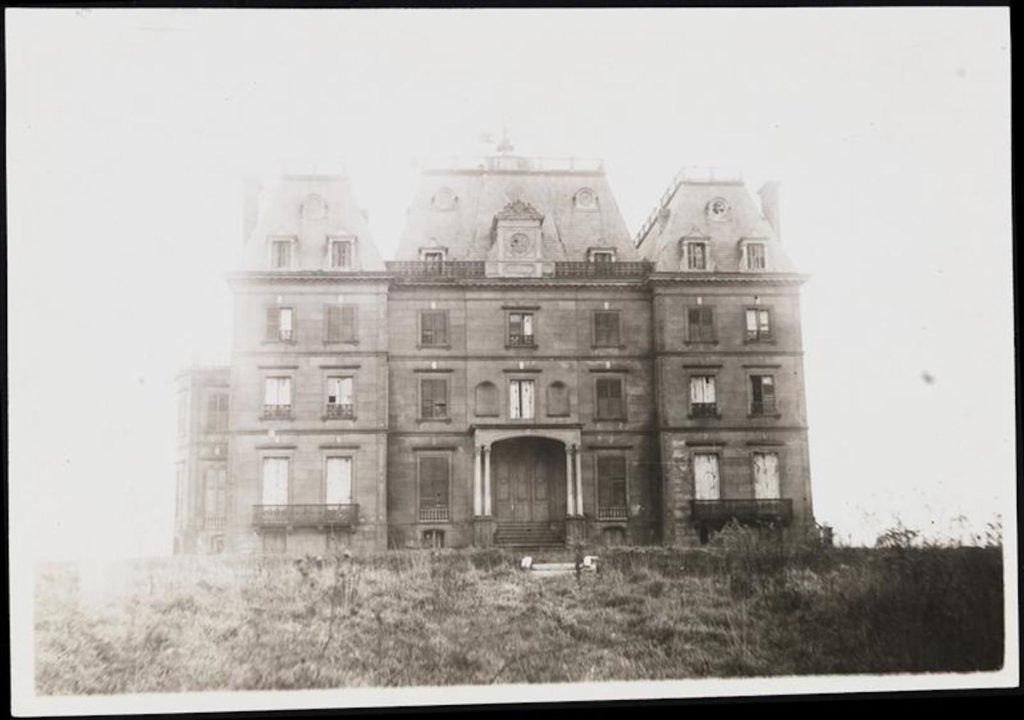
— In the Bronx once stood a haunted house in the area of Hunts Point, a mansion of malevolent and disturbing mysteries.
— Then we turn to Manhattan to a rambunctious poltergeist on fashionable East 27th Street.
— Over in Queens, a lonely farmhouse in the area of today’s Calvary Cemetery is witness to not one, but two unsettling and confounding deaths.
— And finally, in Staten Island, we take a visit to the glorious Vanderbilt Mausoleum, a historic landmark and a location with a few strange secrets of its own.
Ghost stories associated with the city’s most popular and recognizable places from baby-faced spooks at the Dakota Apartments to spirited revelers at Grand Central Terminal.
What’s still lurking in the hallways of the Chelsea Hotel? And whatever you do tonight, do not linger too long on the Brooklyn Bridge at night! A figure from the bridge’s past may still be looking for his head.
Four tales of spirits haunting Brooklyn back in the 19th century when it was still an independent city. Featuring an horrific gangly ghost on the railroad tracks, a historic Clinton Hill home with an invisible hand that would not stop knocking, a Coney Island hotel in 1894 with a secret in room 30, and the wacky wraiths of Bushwick’s Evergreens Cemetery.
The scary revelations of a New York medium, married Midtown ghosts who fight beyond the grave, a horrific haunting at a 14th Street boardinghouse, and the creepy tale of New York’s Hart Island.
The secrets of the restless spinster of the Merchants House, the jovial fright of the Gay Street Phantom, the legend of the devil at Spuyten Duyvil Creek, and the spirit of a dead folk singer.
The drunken spirits of the Algonquin, the mysteries of a hidden well in SoHo, the fires of the Witch of Staten Island, and ‘the most haunted brownstone in New York’.
The ghosts of a tragicZiegfeld girl, a scandalous doyenne of old New York, a bossy theater impresario and the ghoulish bell-ringer of St. Mark’s-in-the-Bowery.
Here are the locations mentioned in all of our New York City ghost podcasts:
Most of the public domain spooky images in this post come from the Internet Book Archive.
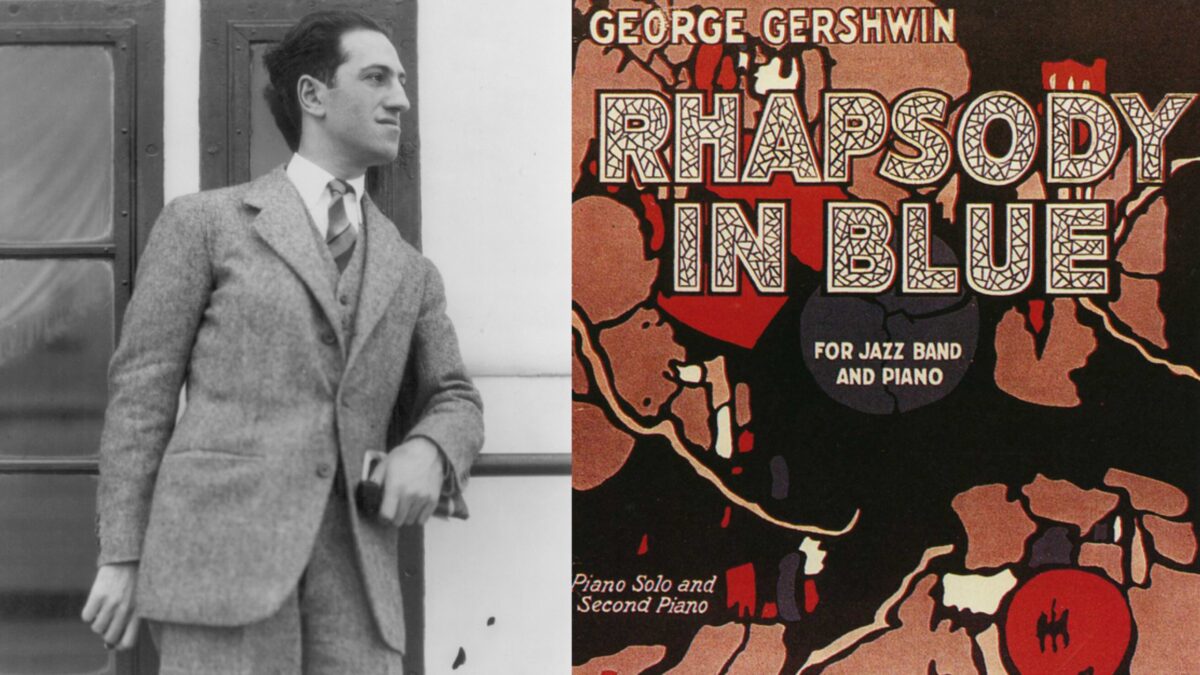
On January 3, 1924, 25-year-old George Gershwin was shooting pool in a Manhattan billiard hall when his brother Ira read aloud a shocking newspaper article: “George Gershwin is at work on a jazz concerto.”
There was just one problem—George had never agreed to write any such piece.
What happened next would change American music forever. In just five weeks, the son of Russian-Jewish immigrants raced to compose what would become “Rhapsody in Blue,” breaking down the barriers between popular music and the concert hall.
From that snowy February night at Aeolian Hall to today’s reinterpretations by contemporary artists, this is the story of how a newspaper lie became a masterpiece—and how one young composer captured the sound of Jazz Age New York in music.
“Summertime” from the 1935 premiere of “Porgy and Bess”
The Bowery Boys Podcast is proud to be sponsored by Founded By NYC, celebrating New York City’s 400th anniversary in 2025 and the 250th anniversary of the United States in 2026.
Read about all the exciting events and world class institutions commemorating the five boroughs legacy of groundbreaking achievements, and find ways to celebrate the city that’s always making history at Founded by NYC.
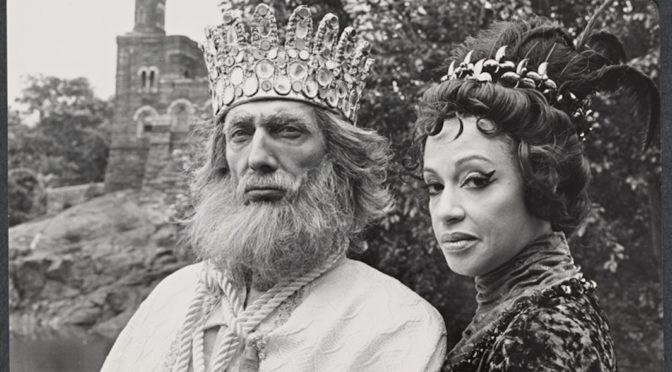
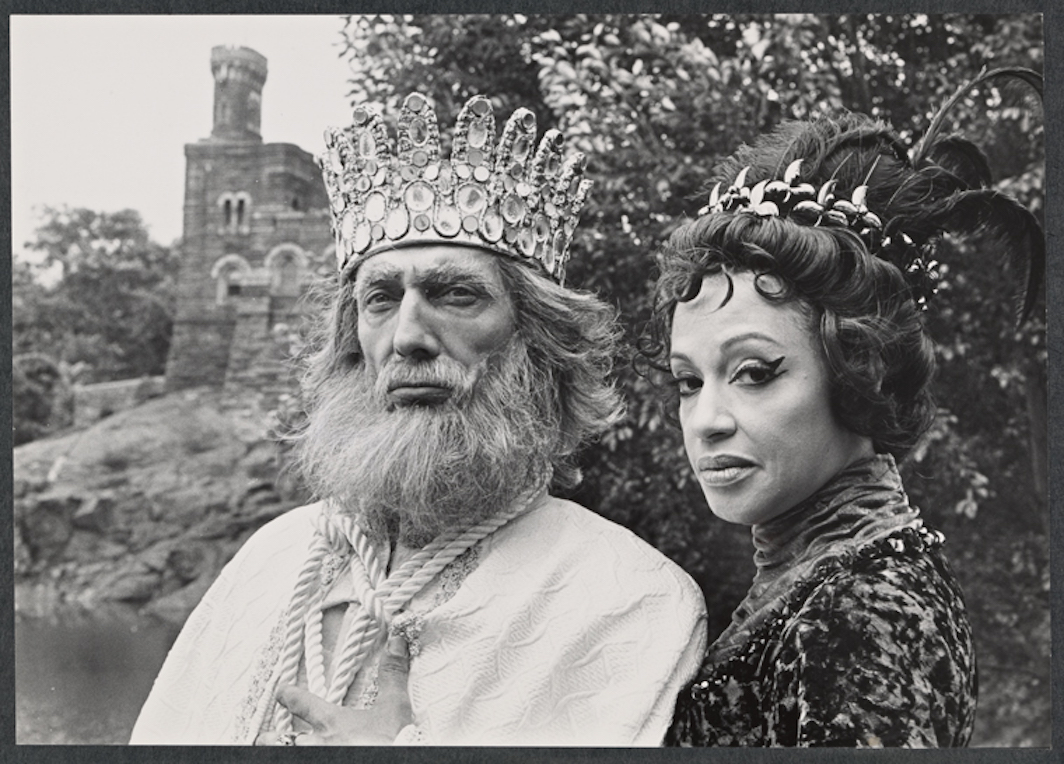
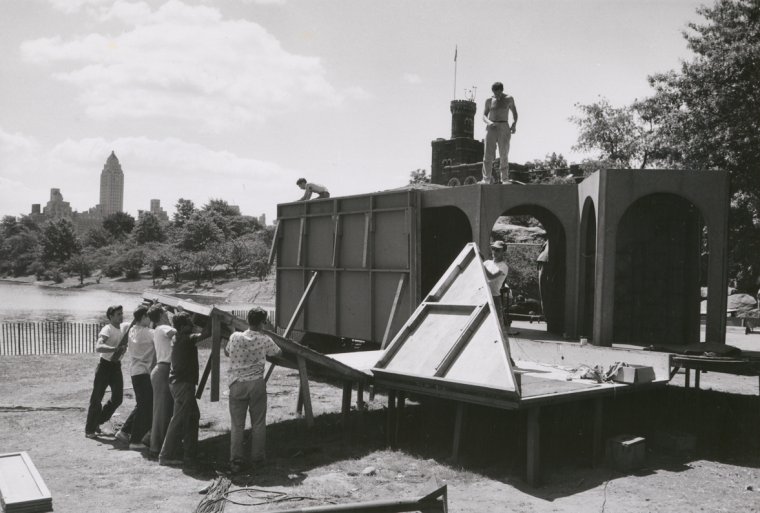
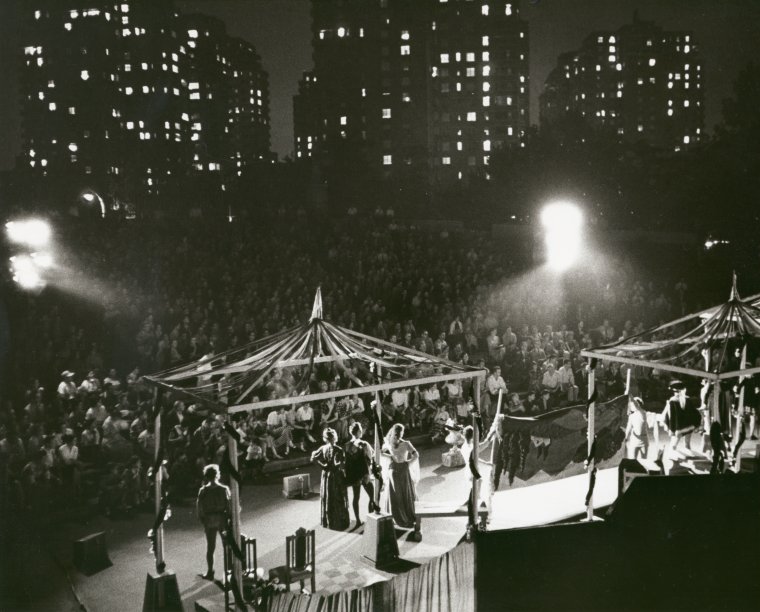
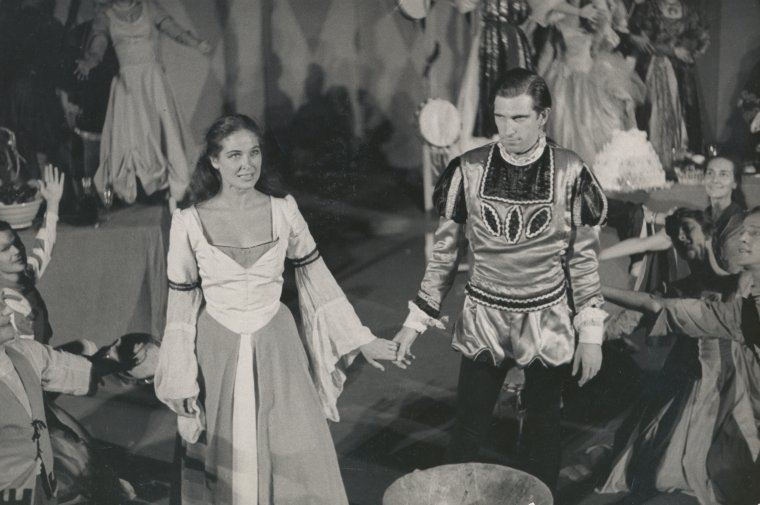
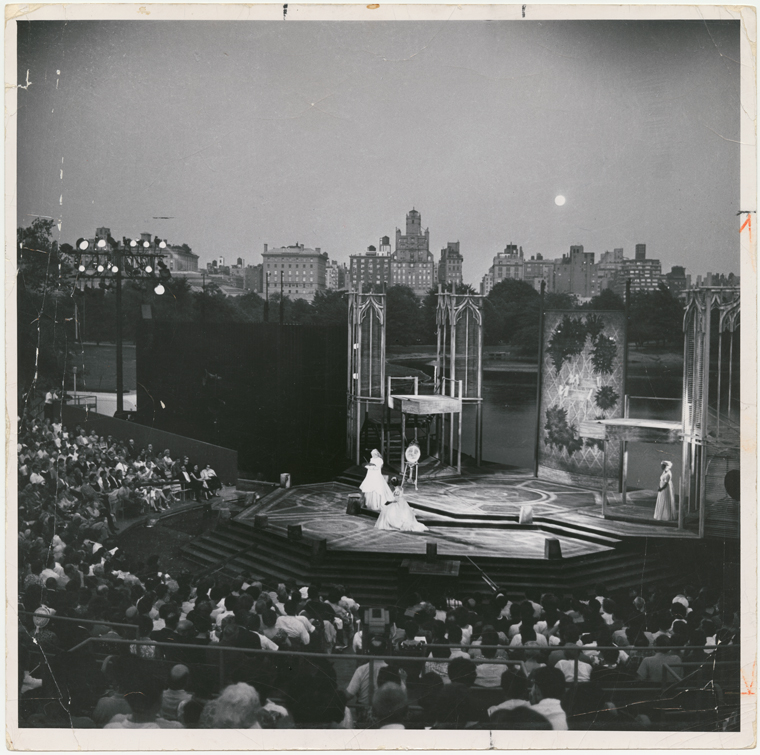
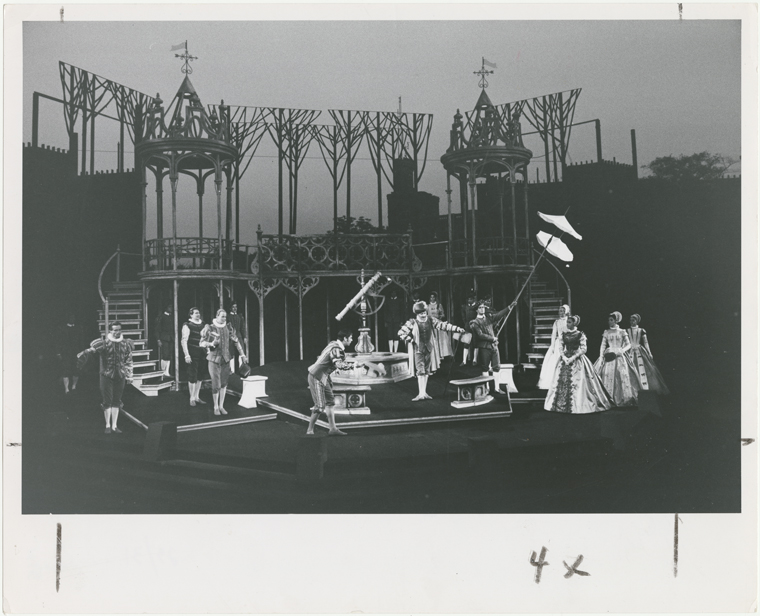
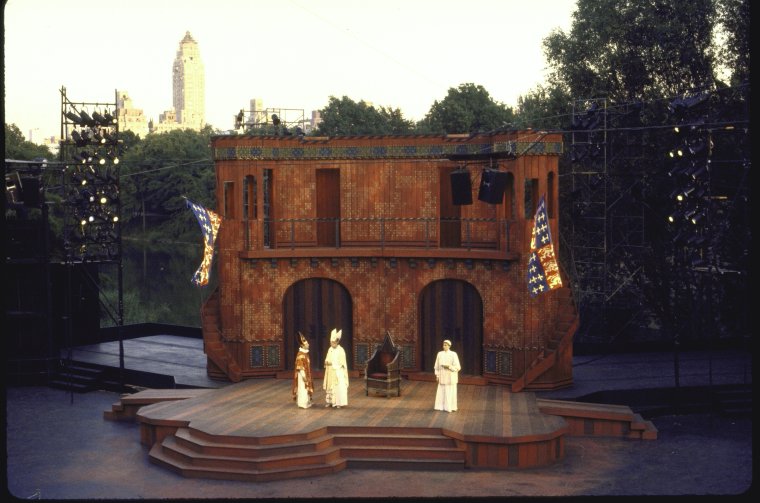
PODCAST The fascinating story of the Public Theater and Joseph Papp’s efforts to bring Shakespeare to the people. (Episode #88)
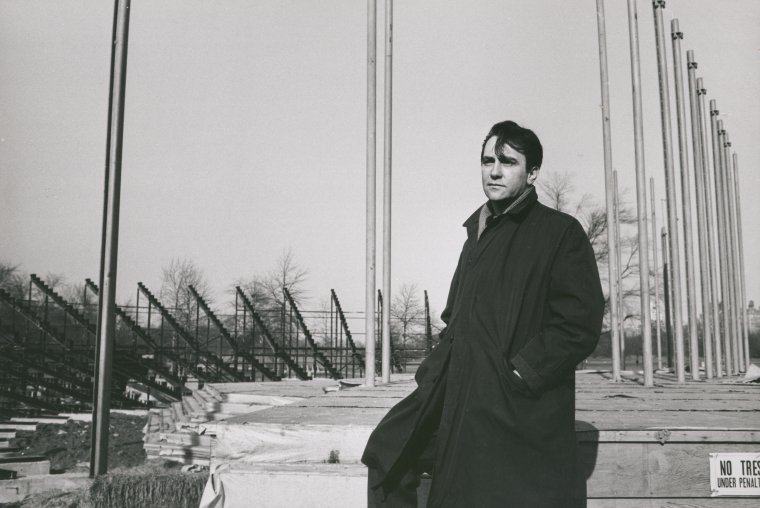
What started in a tiny East Village basement grew to become one of New York’s most enduring summer traditions, Shakespeare in the Park, featuring world class actors performing the greatest dramas of the age. But another drama was brewing just as things were getting started. It’s Robert Moses vs. Shakespeare! Joseph Papp vs. the city!
ALSO: Learn how the Public Theater got off the ground and helped save an Astor landmark in the process.
THIS SHOW WAS ORIGINALLY RELEASED ON JUNE 18, 2009 — MANY, MANY YEARS BEFORE LIN-MANUEL MIRANDA AND ‘HAMILTON’ HIT THE PUBLIC STAGE
The Bowery Boys: New York City History podcast is brought to you …. by you!
We are now producing a new Bowery Boys podcast every week. We’re also looking to improve and expand the show in other ways — publishing, social media, live events and other forms of media. But we can only do this with your help!
We are now a creator on Patreon, a patronage platform where you can support your favorite content creators.
Please visit our page on Patreon and watch a short video of us recording the show and talking about our expansion plans.
If you’d like to help out, there are six different pledge levels.Check them out and consider being a sponsor.
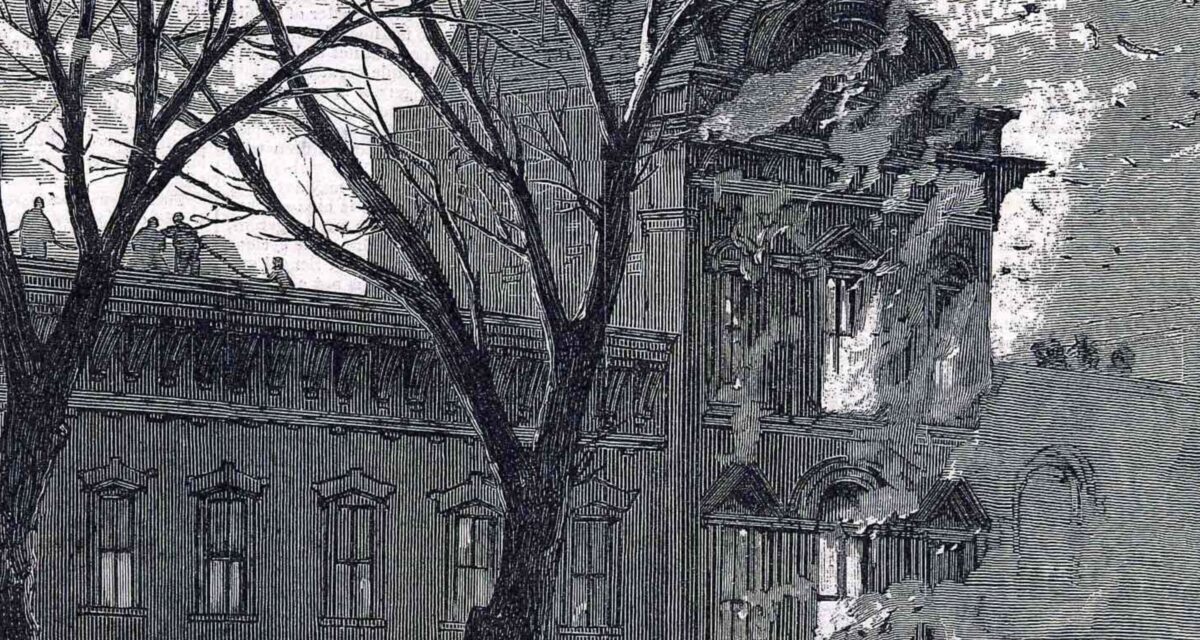
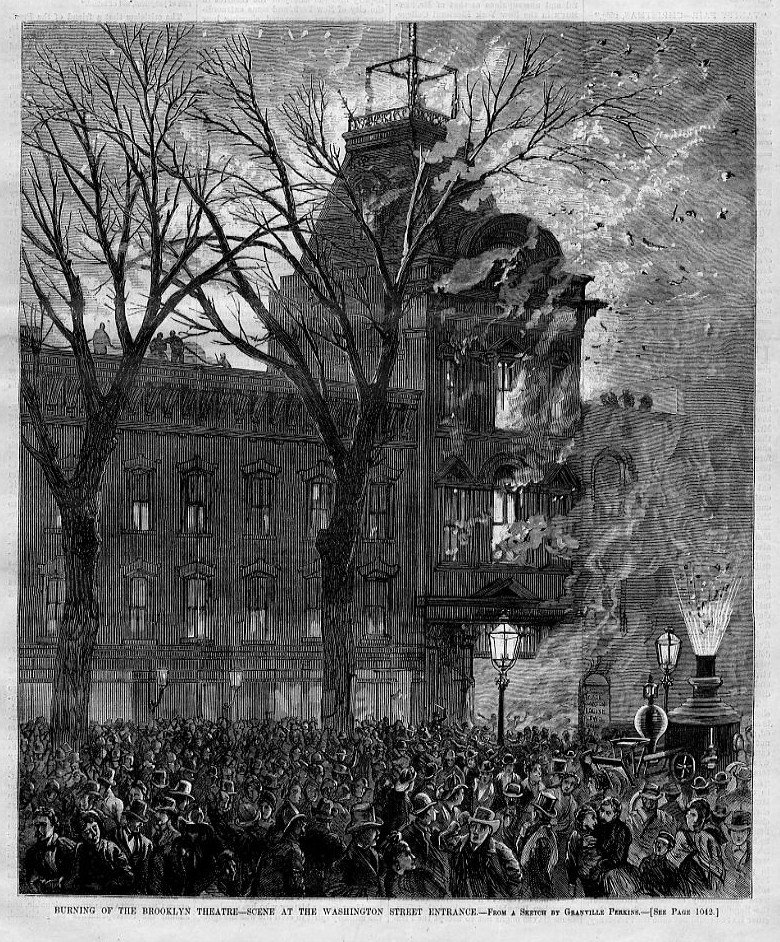
Detail from the Harper's Weekly cover illustration which ran on December 23, 1876.
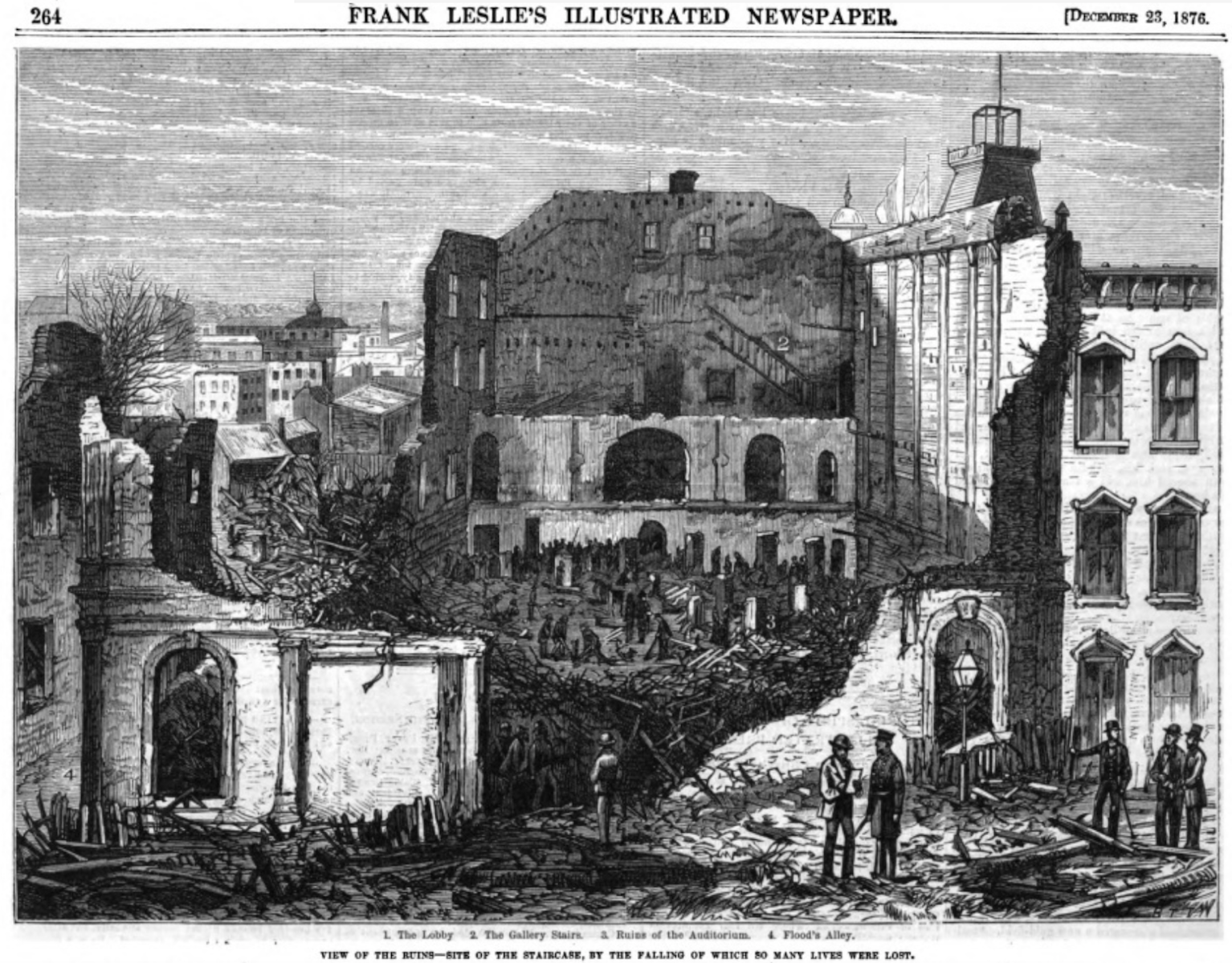
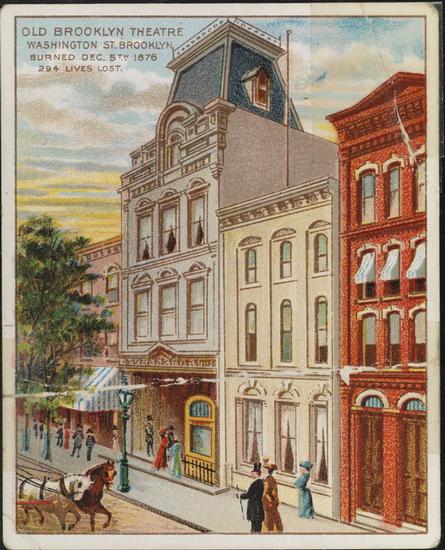
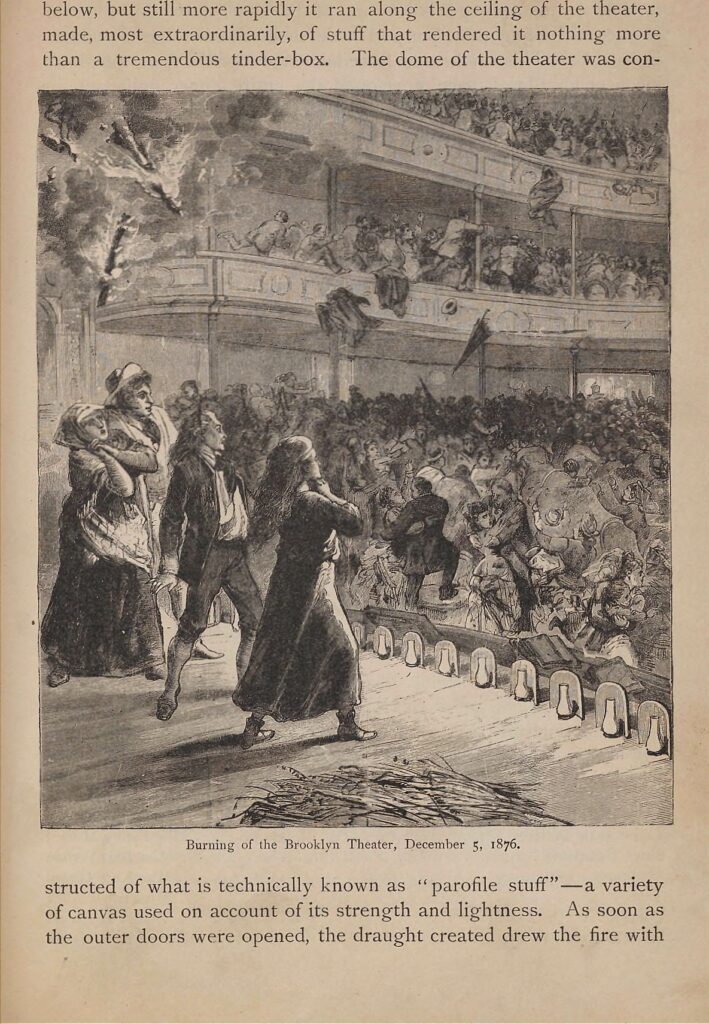
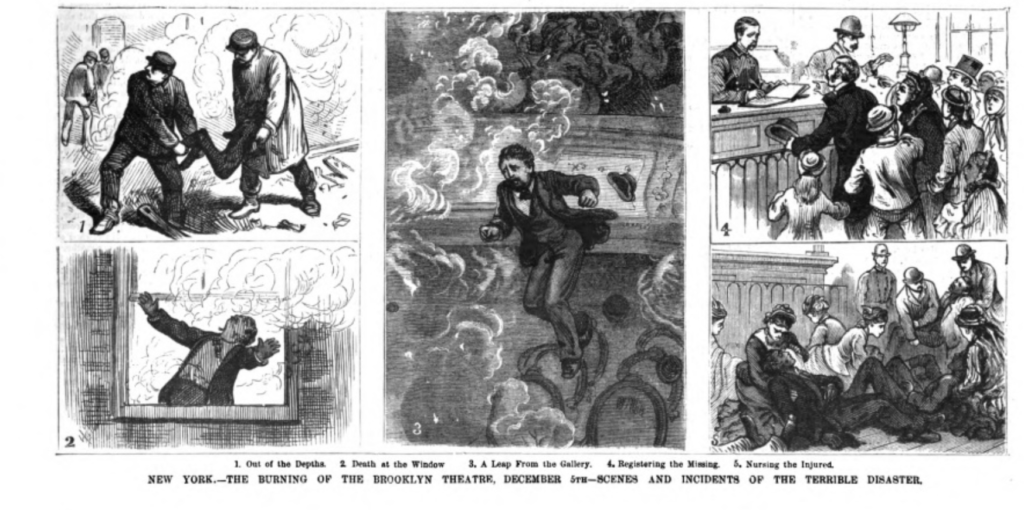
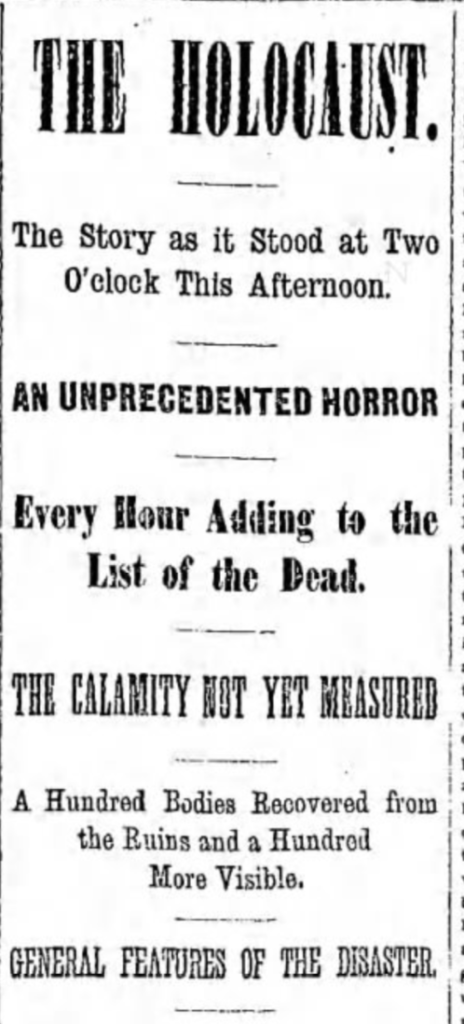
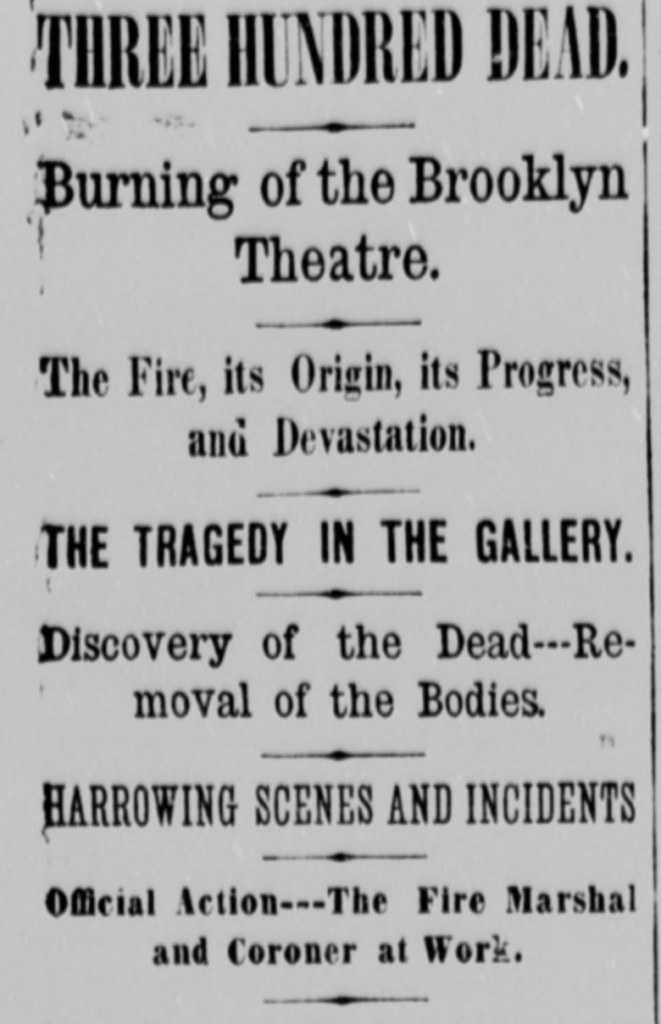
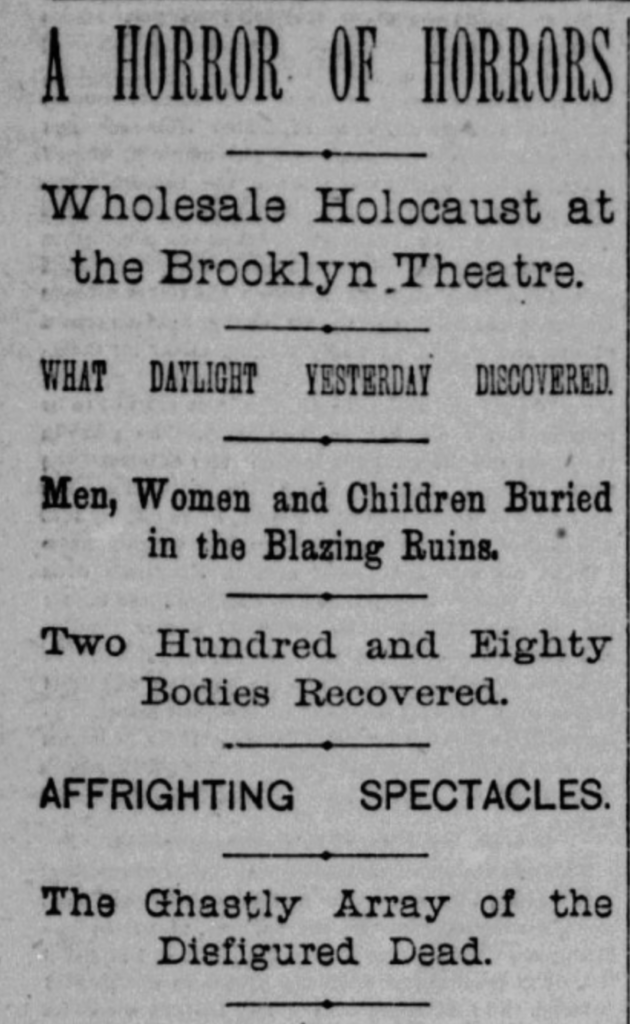
On the evening of December 5, 1876, the glorious Brooklyn Theatre caught fire, trapping its audience in a nightmare of flame and smoke. The theater sat near Brooklyn City Hall (today’s Brooklyn Borough Hall), and the blaze which destroyed it could be seen as far away as Prospect Park.
The horrible truth was revealed in the morning -almost 300 people died in this disaster. To this day, it remains the worst disaster in Brooklyn’s history in terms of lives lost. Of individual one-day disasters in New York City, only the attacks on the World Trade Center and the General Slocum disaster have taken more lives.
But you wouldn’t know it from walking through Cadman Plaza today, a bustling public area popular with skateboarders and office workers on lunch breaks. Several historic monuments decorate the plaza today — but none mark this troubling event in Brooklyn’s history.
It’s a tragic story that also gives us a glimpse into daily life in Gilded Age Brooklyn. And this is a story of the theater world as well — of a popular play which took American culture by storm, and of an actress whose reputation would be forever linked with the disaster. Why was star Kate Claxton unfairly called “the fire witch” in the press?
LISTEN NOW: THE BROOKLYN THEATRE FIRE — FORGOTTEN GILDED AGE TRAGEDY
The Bowery Boys Podcast is proud to be sponsored by Founded By NYC, celebrating New York City’s 400th anniversary in 2025 and the 250th anniversary of the United States in 2026.
Read about all the exciting events and world class institutions commemorating the five boroughs legacy of groundbreaking achievements, and find ways to celebrate the city that’s always making history at Founded by NYC.
FURTHER LISTENING
Two other recent podcasts about 19th century Brooklyn history:
Other episodes about disasters in New York City history:
This podcast is based on the 2016 article Greg wrote about the Brooklyn Theater Fire, reprinted below:
It is difficult to discuss calmly the frightful disaster which happened in Brooklyn on Tuesday night. No such awful sacrifice of human life has ever been known in this country, shipwreck and the casualties of war alone being excepted. — New York Times editorial, Dec. 7, 1876
This is a black-letter day in Brooklyn. The theatre named for and worthy of the city caught fire last night and its interior parts were consumed.
It is a saddening, fearful, most calamitous story which fills the eyes and darkens the homes of the people of Brooklyn, and deposits hundreds of dead within the walls of as many families, whose sorrow becomes, by the right of sympathy, the sorrow of every heart in the town. — Brooklyn Daily Eagle, Dec 6, 1876
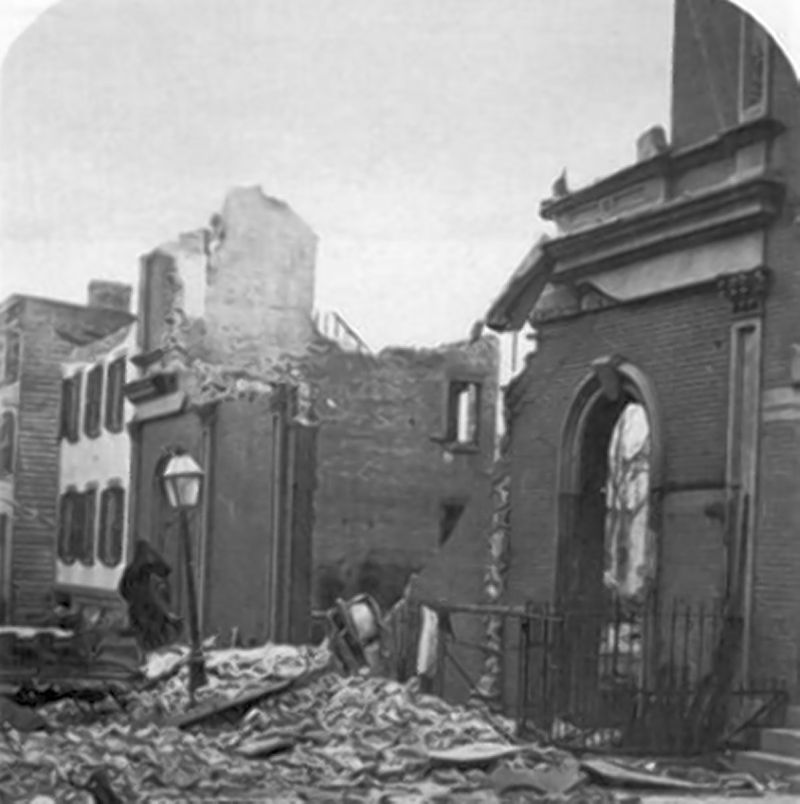
The charred remains of the Brooklyn Theater, courtesy Frank Leslie’s Illustrated Newspaper:
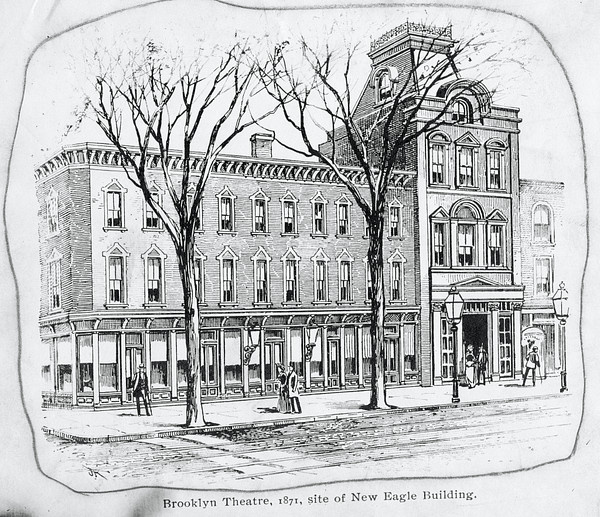
One hundred and forty-nine years, nearly a thousand playgoers entered the Brooklyn Theater, at Washington and Johnson streets near City Hall, to enjoy the well-reviewed (and lengthy) production of N. Hart Jackson’s The Two Orphans.
The play already had a fateful history at this theater which opened in 1871. Sarah Crocker Conway, the Brooklyn Theatre’s well-respected manager and operator, died during the first run of The Two Orphans here at the theater. (Her daughter was in the lead role.)
This particular versionsof the play had just come from a successful run in New York. (In 1876, Brooklyn was not yet part of the city across the river.) The scenery and most of the cast was from a run at the Union Square Theater.
Courtesy Brooklyn Public Library
During the show’s final act, stage hands discovered that a set piece backstage had caught fire.
From Frank Leslie’s: “Miss Kate Claxton, attired in the ragged raiment of the poor blind girl, and one of the ‘Orphans’, was lying on a pallet of straw with Pierre, Mr. Henry S. Hitchcock leaning over her. She heard whispers from the wings behind her — ‘The theater is on fire!’
The actors onstage attempted gamely to stay in character, for fear of causing a panic, until fiery bits of wood and flaming parts of the set began raining down upon them.
As the audience leapt to the aisles in terror, the actors tried to calm people to prevent a stampede, to no avail.
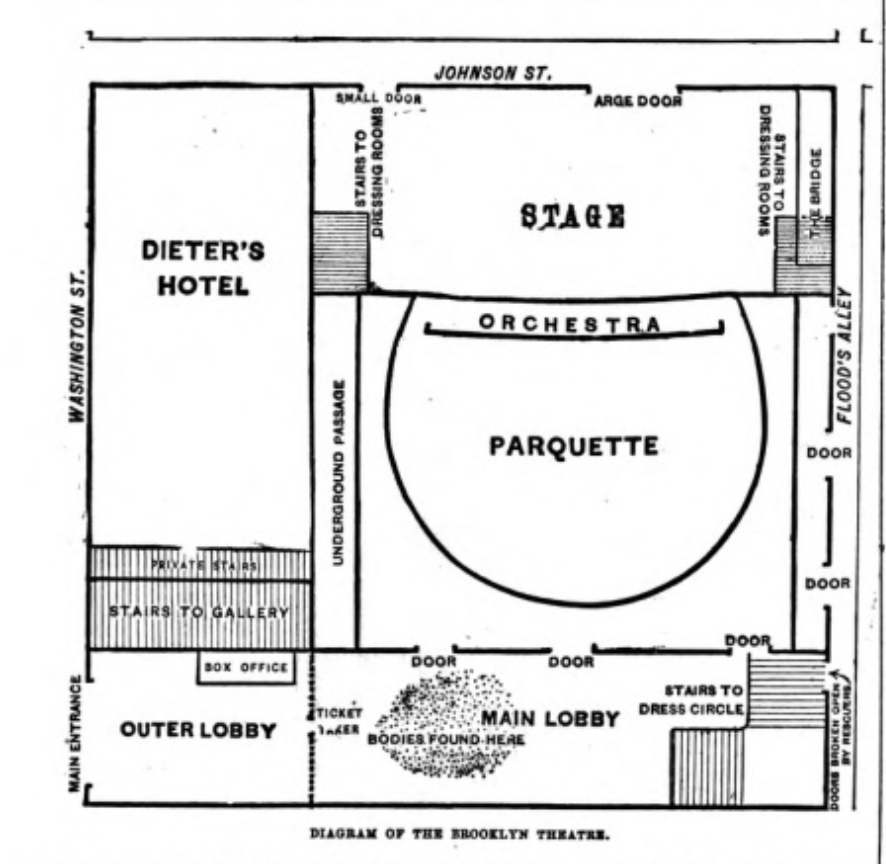
An usher forced open a rarely used exit door to free audience members, but the rush of December air only fed the flames, turning the once elegant auditorium, built only five years previous, into an inescapable trap of heat and asphyxiation.
From Frank Leslie’s Illustrated Newspaper
Those in the upper tiers of the theater — the ‘family circle’, or cheap seats, filled with men, women and children — were trapped by smoke within darkened foyers and unnavigable stairwells.
The panic at the stairway was caused by the tide of flying people from the auditorium meeting that rushing from the gallery, and, in the conflict between the two bodies, men fell, women fainted, children were trampled underfoot, and the whole spectacle was that of a solid body with a myriad of heads struggling for its life, retarded by its own great weight. — Frank Leslie’s Illustrated Newspaper
Some fell from balconies to their deaths. Dozens were crushed heading for doorways, and to some of those who survived, it seemed that all respectability had given way to base animal behavior.
Most perished by suffocation or underfoot, while others were lost into the oblivion of belching smoke when weakened floors gave way.
Twenty five minutes after flames were first spotted backstage, one entire wall of the Brooklyn Theater caved backwards into the inferno, the once elegant ceiling fresco nothing but a crumbling scorch now.
Flaming projectiles caught in the wind settled upon surrounding structures, and firefighters scrambled to soak the inferno, now in fear of scattering randomly through one of Brooklyn’s oldest neighborhood.
A map of the interior of the theater.
Most in danger was the hotel on the corner, where some audience members had found momentary safety.
“The streets were filled with a throng of excited people, who ran hither and thither, calling about the names of dear ones whose voices could not be heard in answer. Many were hatless and coatless, their garments having been torn from them by the pushing and jesting of the crowd. — Frank Leslie’s Illustrated Newspaper
Since 1869, Brooklyn had a paid fire department, and many fought the blaze from the streets. But the rudimentary firefighting implements of the day were unable to combat the inferno.
The Brooklyn Theater burned for several hours more, dying out by early morning. Throughout the night, most could only watch — what to do, plunge into darkness? — and many did watch. Thousands flocked, some to help, others fascinated, horrified.
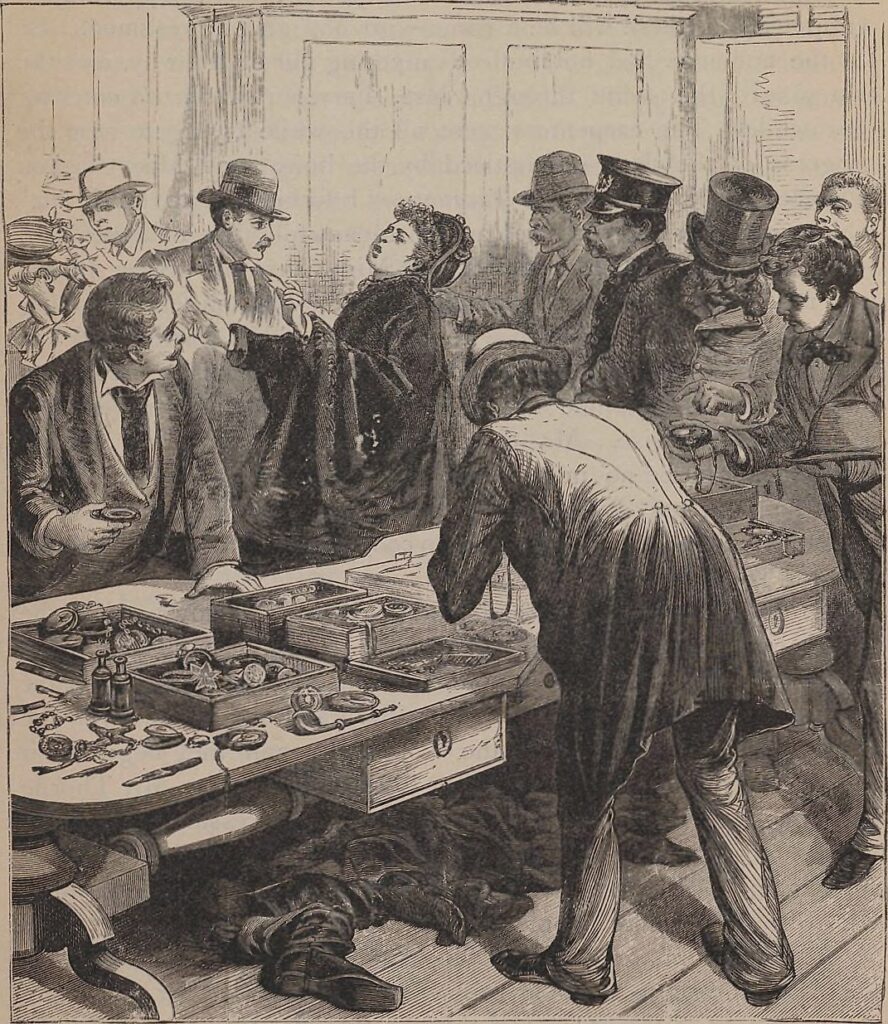
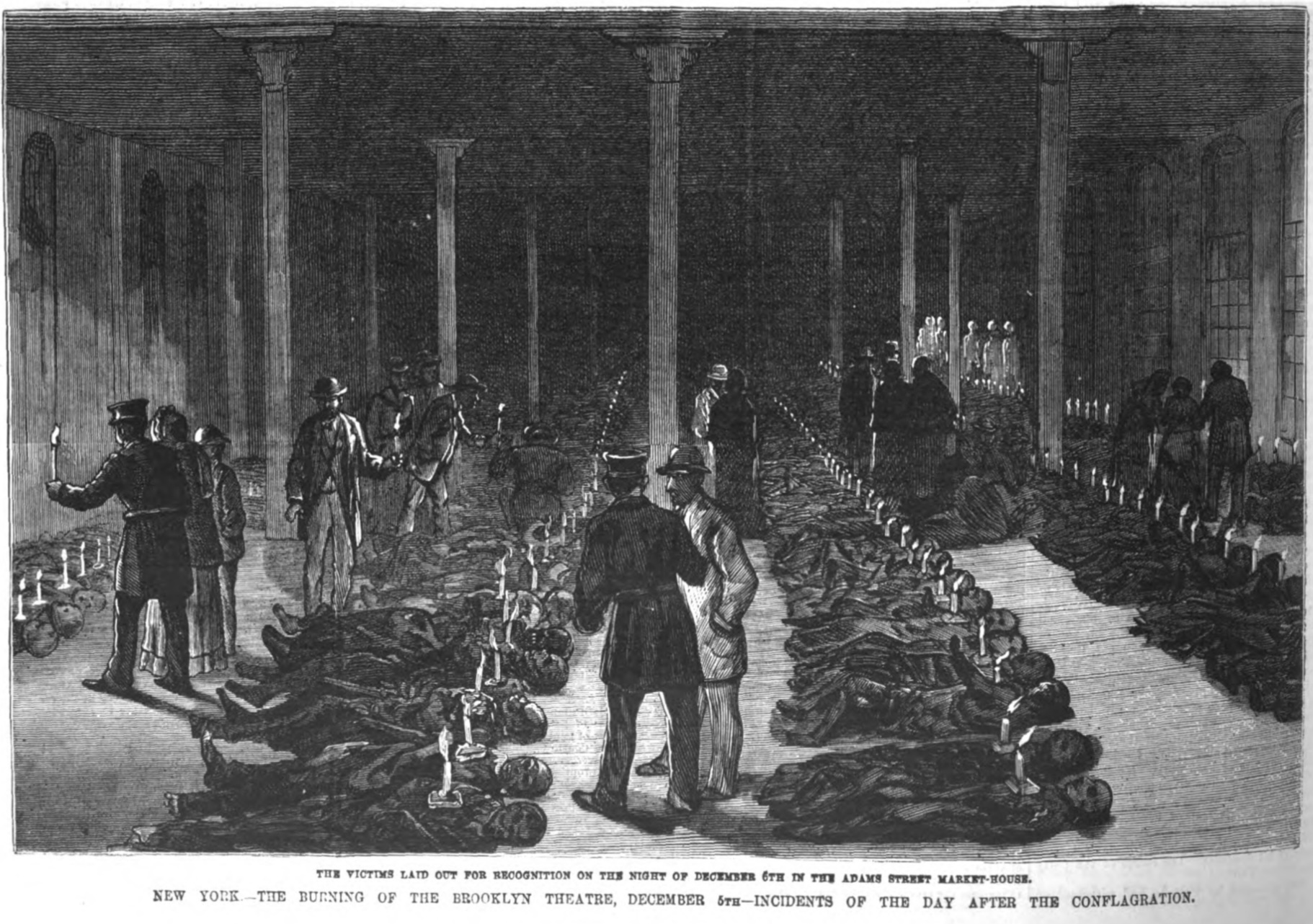
Inspectors found an unspeakably grisly sight the next morning, heaps of burned bodies in formless masses — people choked or crushed, their remains almost unrecognizable amid blackened debris.
In an eerie parallel to two later disasters (the General Slocum explosion of 1904 and the Triangle Factory Fire of 1911), a make-shift morgue was prepared on nearby Adams Street to accommodate the dozens of unidentifiable corpses.
Nobody is sure exactly how many died that evening — some number between 275 to 300 people. It is certainly among the worst disasters in Brooklyn history and one of the most catastrophic fires in American history.
Screenshot
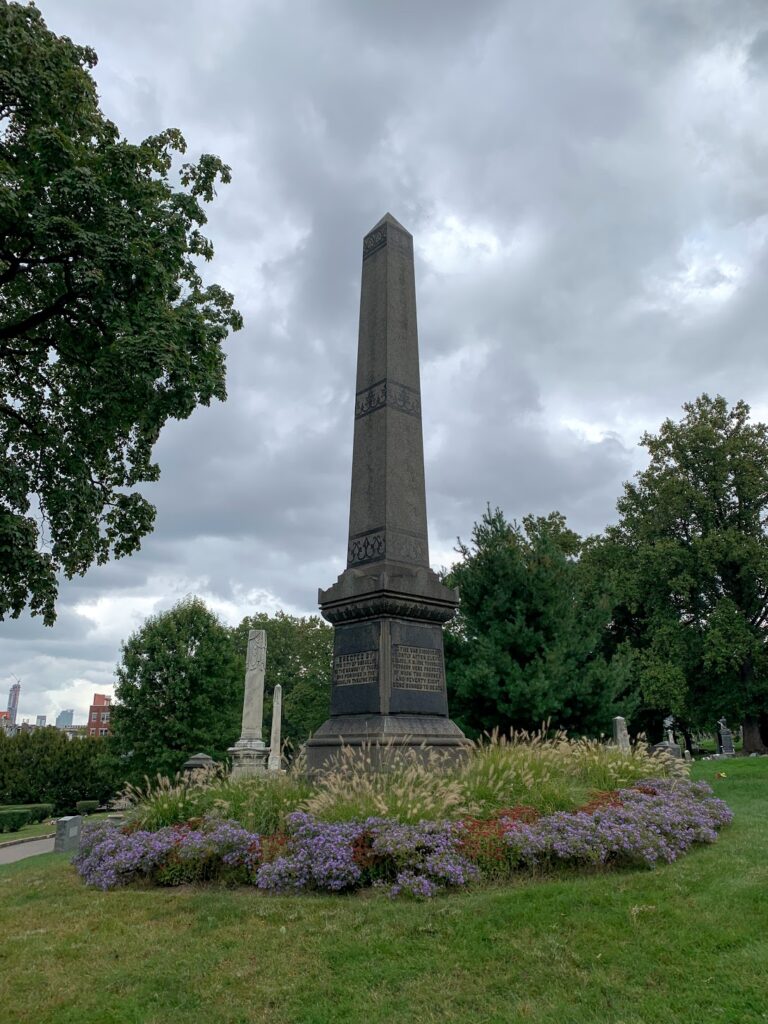
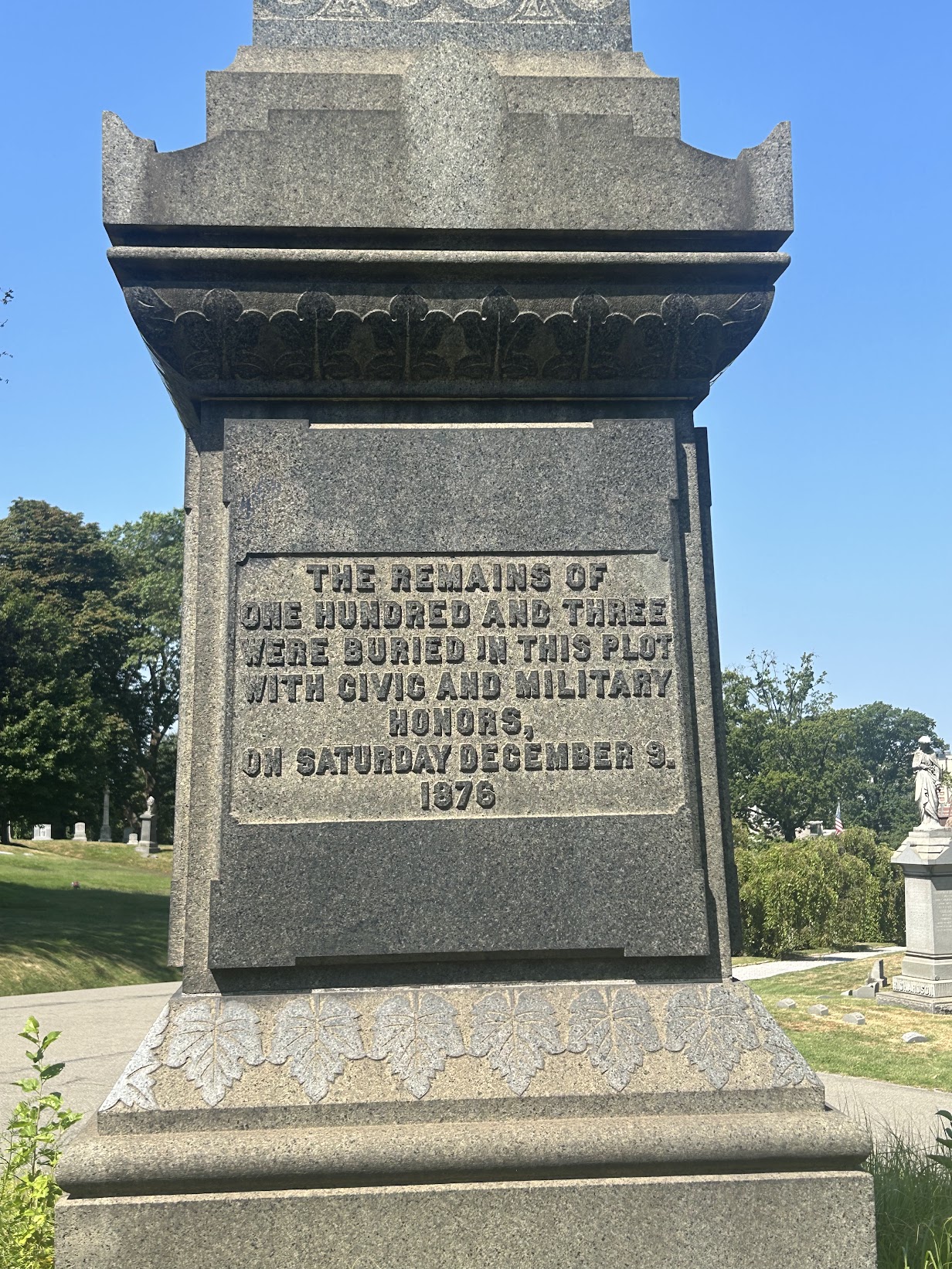
The place where the theater once stood is now occupied by Cadman Plaza, in the grove of trees just east of the Henry Ward Beecher statue. Many of the bodies (over a hundred) are buried together under a memorial at Green-Wood Cemetery.
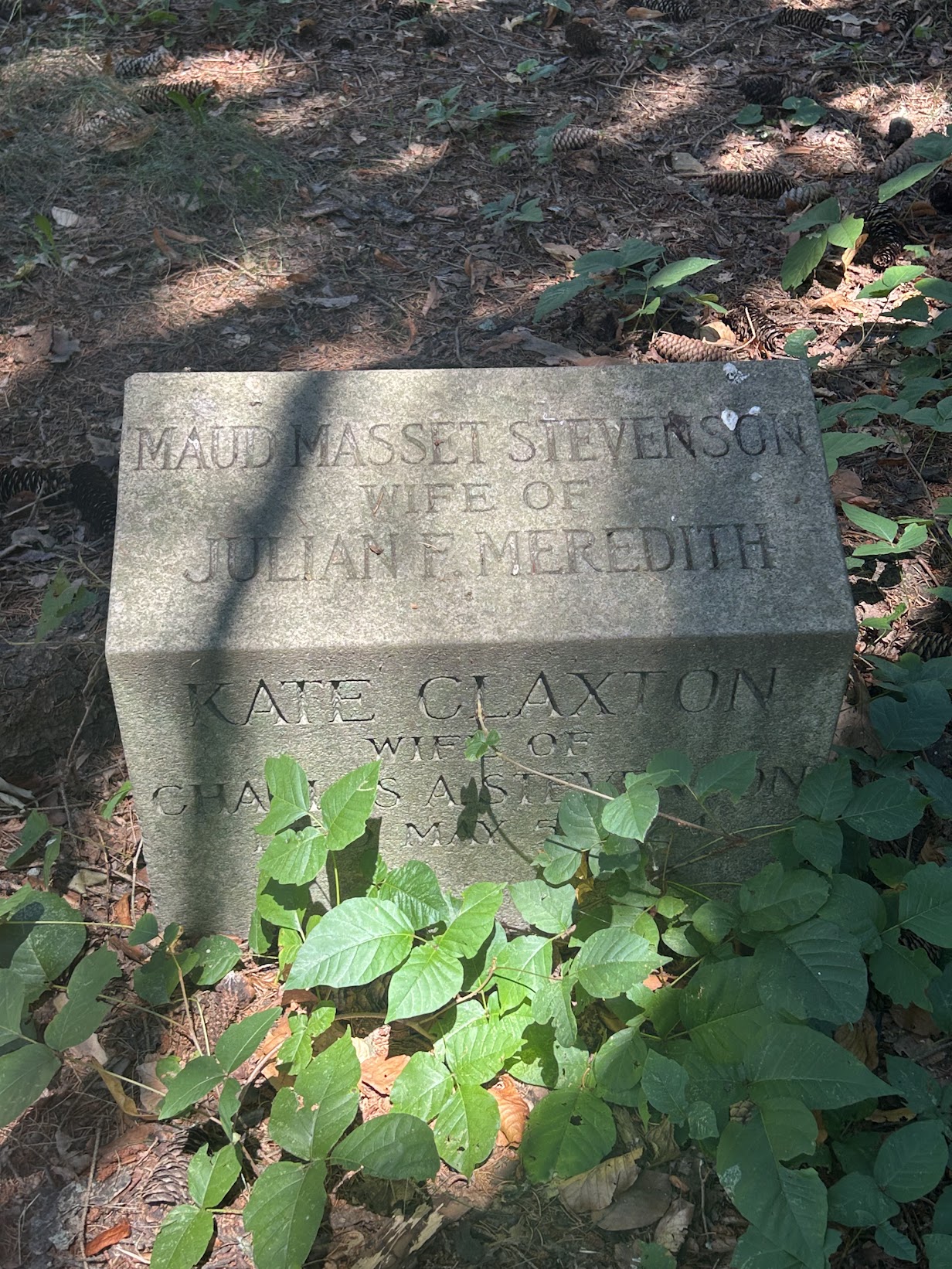
Photo by Greg YoungThe gravesite of Kate Claxton at Green-Wood Cemetery
At present there is no memorial of this terrible disaster at the site itself. Nearby a statue to Brooklyn’s great citizen Henry Ward Beecher, placed here in 1959 after the construction of Cadman Plaza
Below: the area of Cadman Plaza where the Brooklyn Theater once stood.
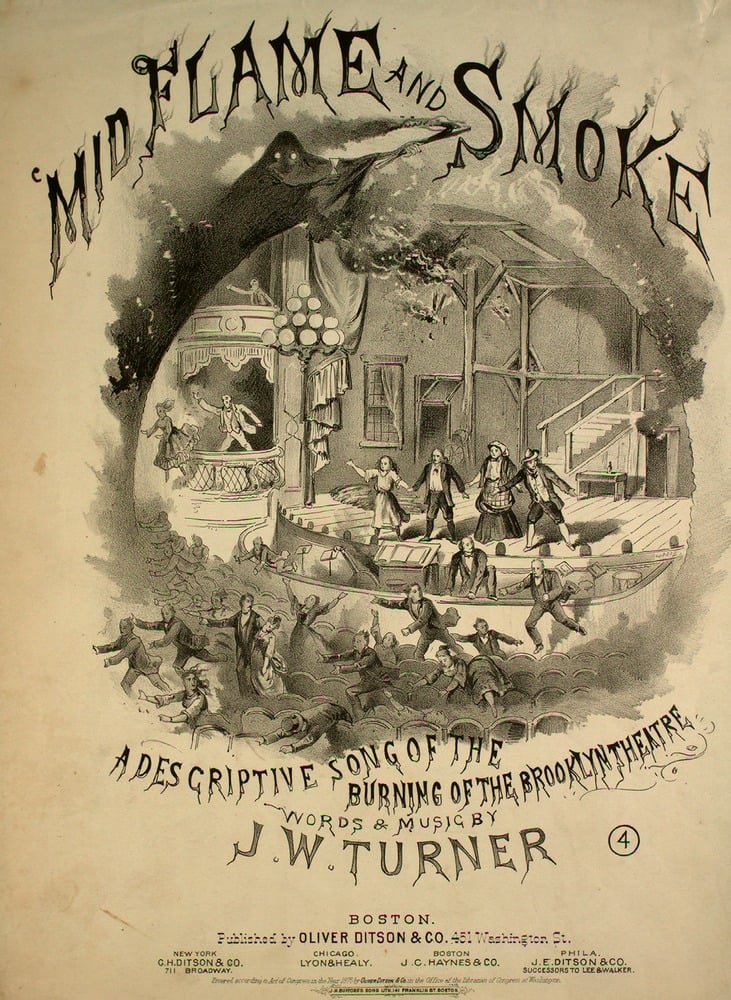
Photo by Greg YoungFor years after the blaze, songwriters attempted to memorialize the disaster. The Brooklyn Public LIbrary has a rundown of its rather stark lyrics.
PODCASTA history of the comic book industry in New York City, how the energy and diversity of the city influenced the burgeoning medium in the 1930s and 40s and how New York’s history reflects out from the origins of its most popular characters.
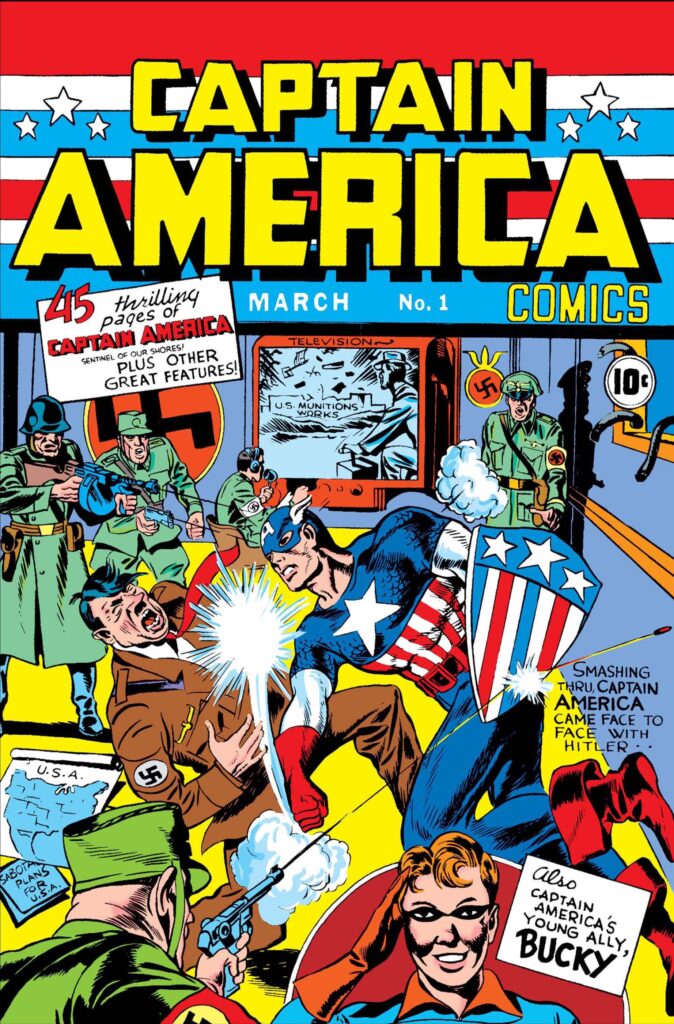
In the 1890s a newspaper rivalry between William Randolph Hearst and Joseph Pulitzer helped bring about the birth of the comic strip and, a few decades later, the comic book.
Today, comic book superheroes are bigger than ever — in blockbuster summer movies and television shows — and most of them still have an inseparable bond with New York City.
What’s Spider-Man without a tall building from which to swing? But not only are the comics often set here; the creators were often born here too.
Many of the greatest writers and artists actually came from Jewish communities in the Lower East Side, Brooklyn or the Bronx.
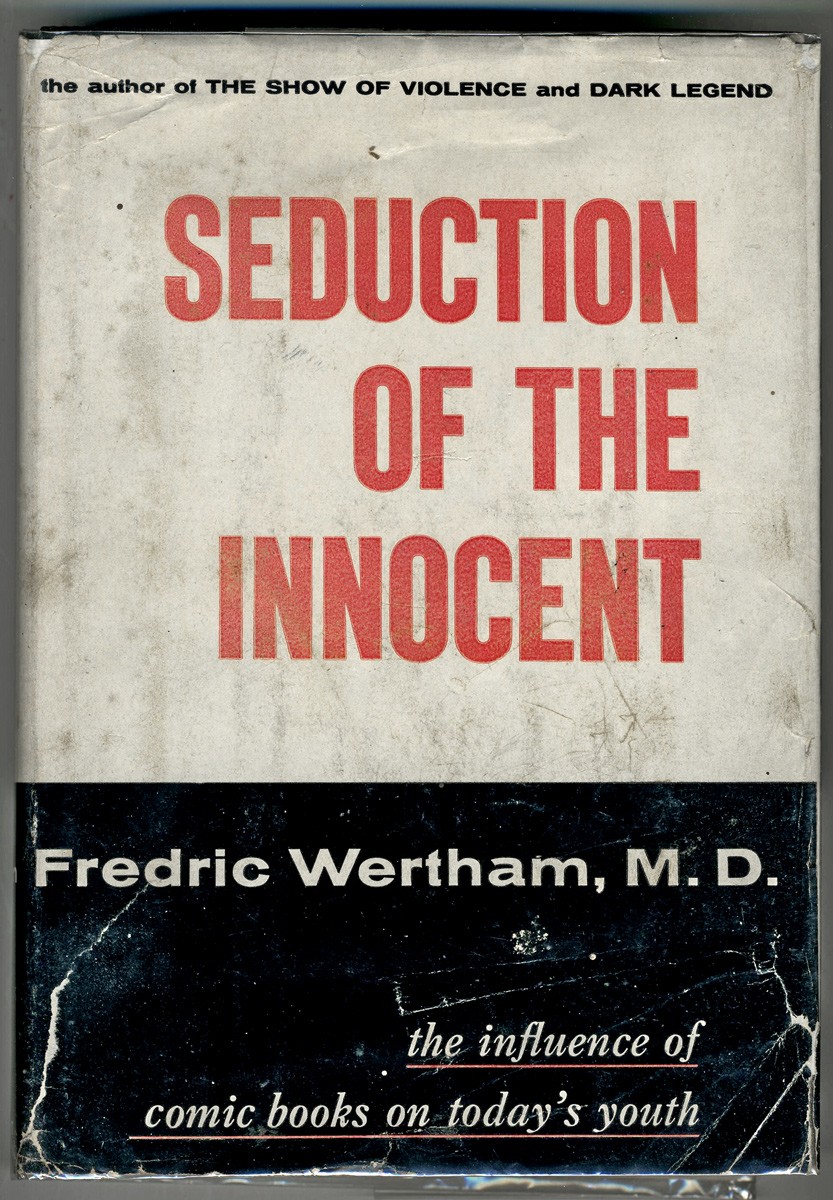
For many decades, nearly all of America’s comic books were produced here. Unfortunately that meant they were in certain danger of being eliminated entirely during a 1950s witch hunt by a crusading psychiatrist from Bellevue Hospital named Frederic Wertham.
FEATURING: The Yellow Kid, Little Orphan Annie, Batman, Doctor Strange, the Watchmen and the Teenage Mutant Ninja Turtles!
To get this week’s episode, download it for free from your preferred podcast player.
Or listen to it straight from here:
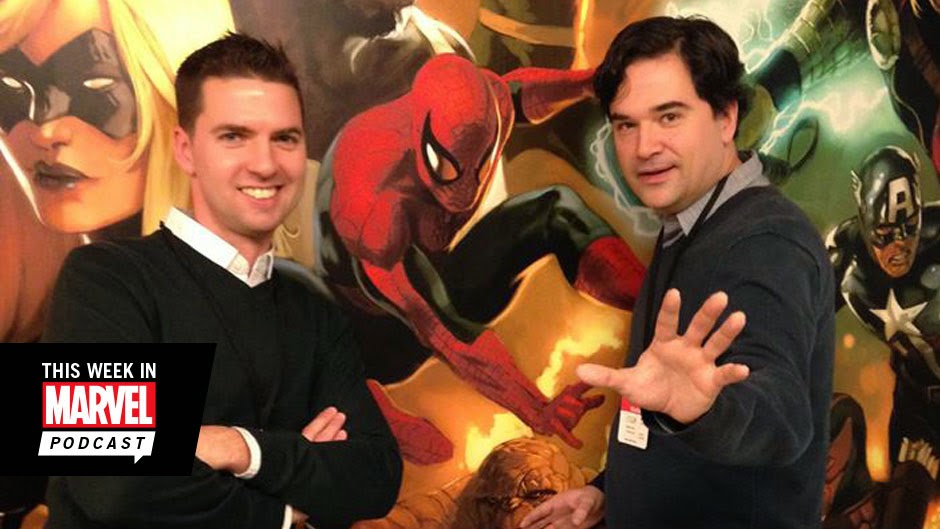
AND after you’re done listening to this history on comic books in New York City, check out Greg’s appearance on an episode of This Week In Marvel, the official Marvel Comics podcast hosted by Ryan “Agent M” Penagos, James Monroe Iglehart, and Lorraine Cink.
In this episode, Greg actually speaks about the Bowery Boys episode about comics and shares his own experiences with reading comic books as a kid.
Find this show here or on your favorite podcast player.
Tom and Greg from their 2014 visit to the Marvel Comics offices in Midtown.
The Bowery Boys: New York City History podcast is brought to you …. by you!
We are now producing a new Bowery Boys podcast every two weeks. We’re also looking to improve the show in other ways and expand in other ways as well — through publishing, social media, live events and other forms of media. But we can only do this with your help!
We are now a member of Patreon, a patronage platform where you can support your favorite content creators for as little as a $1 a month.
Please visitour page on Patreon and watch a short video of us recording the show and talking about our expansion plans. If you’d like to help out, there are five different pledge levels (and with clever names too — Mannahatta, New Amsterdam, Five Points, Gilded Age, Jazz Age and Empire State). Check them out and consider being a sponsor.
We greatly appreciate our listeners and readers and thank you for joining us on this journey so far. And the best is yet to come!
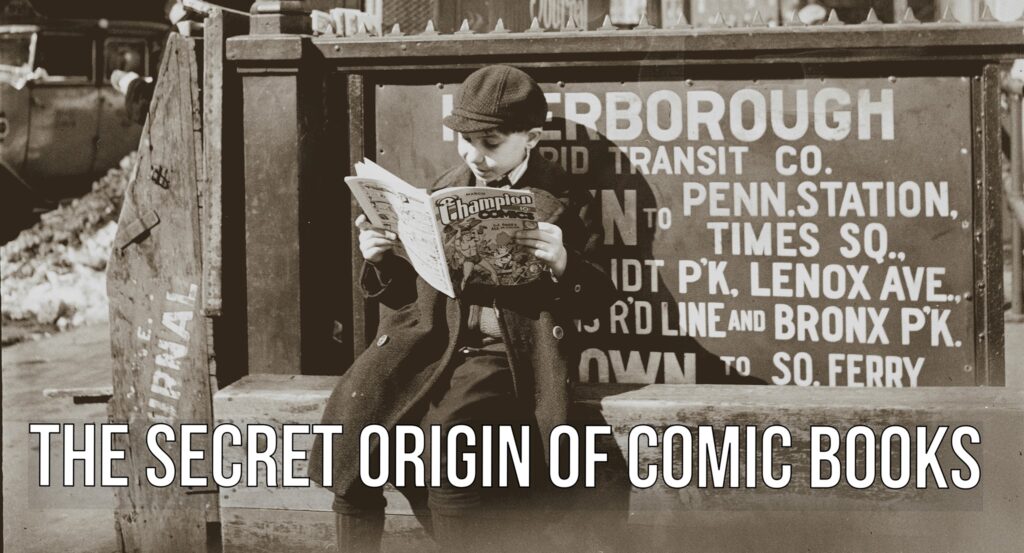
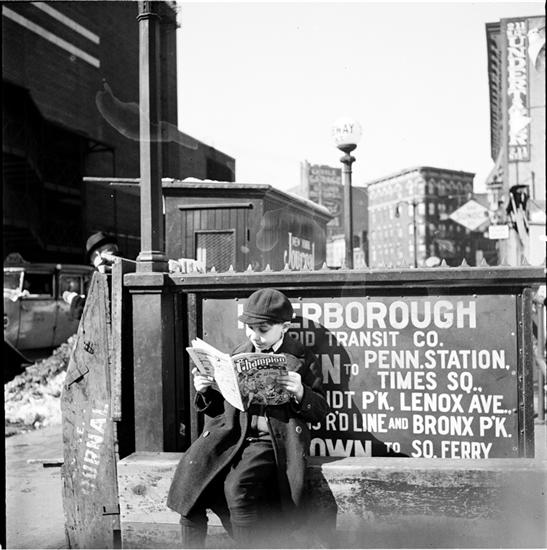
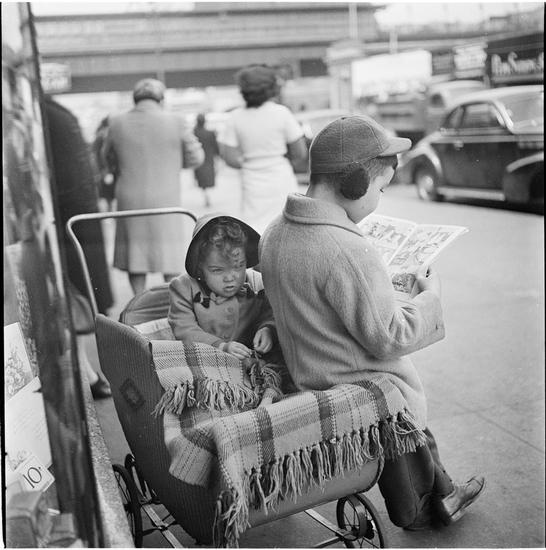
A young New York boy enjoys his comic book on the Bowery. Photo taken in 1940 by Andrew Herman.
Courtesy Museum of the City of New York
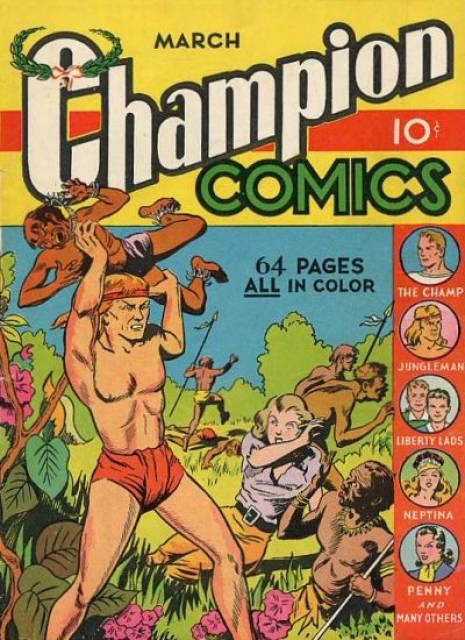
And here’s the comic book he’s reading from March 1940, illustrated by George Papp.
Courtesy Comic Vine
In this 1947 photograph taken by Stanley Kubrick, a boy watches his baby sister and enjoys a Superman comic book while his mother shops inside.
Courtesy the Museum of the City of New York
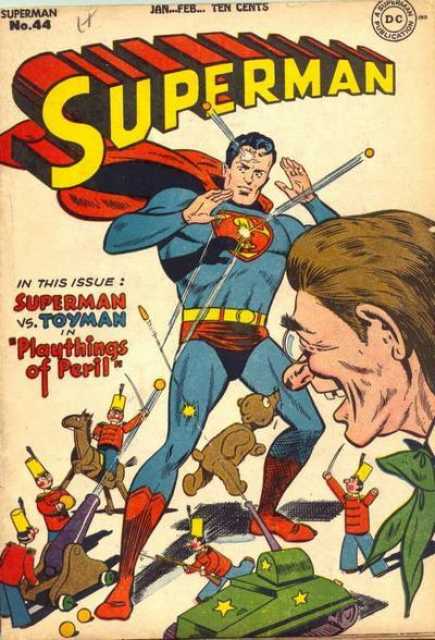
An issue of DC Comics’ Superman from March 1947, with a cover by George Roussos and Jack Burnley
Courtesy DC Comics / Comic Vine
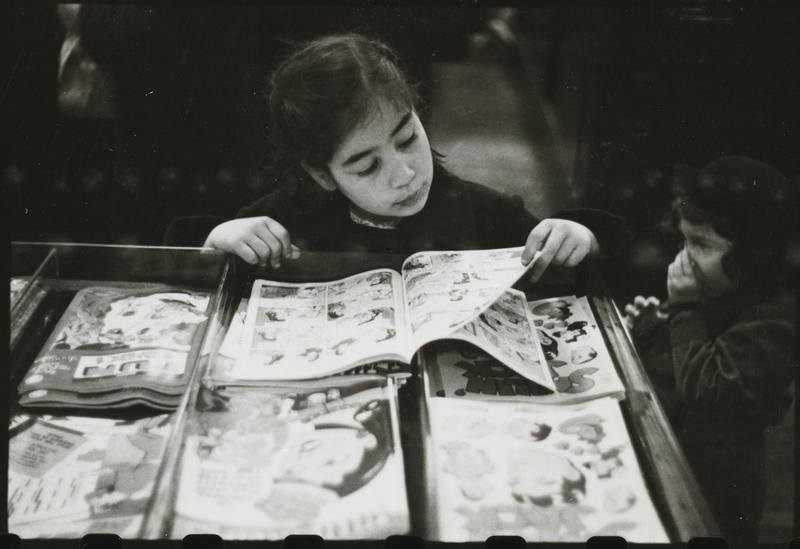
A girl takes a peek at some of the comic book offerings at Woolworth’s. Photograph by Stanley Kubrick taken in 1947.
Courtesy Museum of the City of New York
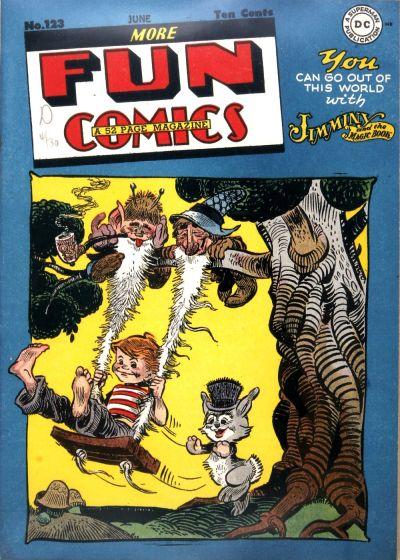
An issue of More Fun Comics from June 1947, produced by DC Comics:
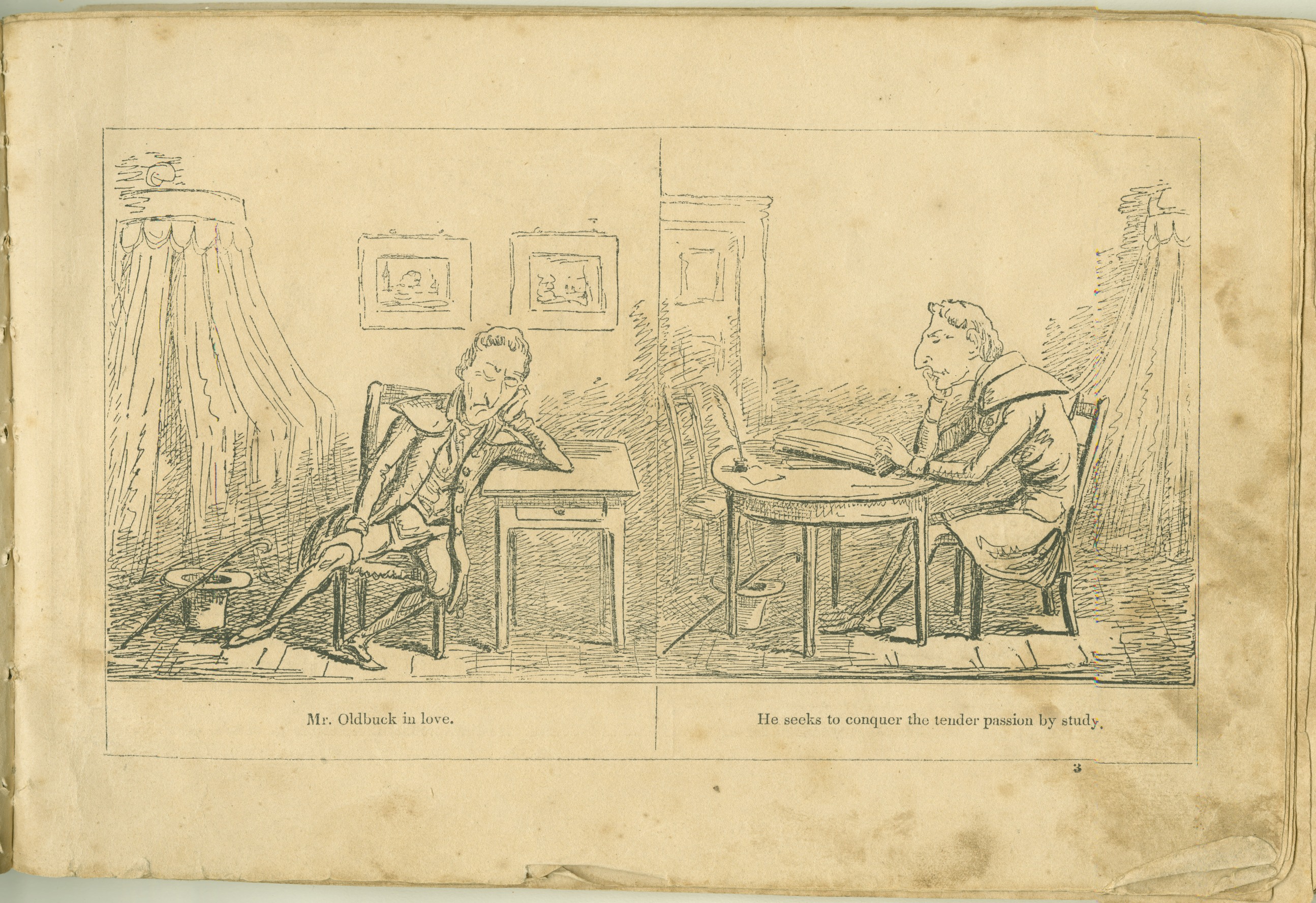
The Adventures of Obadiah Oldbuck, published in 1842, is considered by many to be the wellspring from which the comic medium derives. You can read the entire issue over at the Darmouth College Library website.
Courtesy Dartmouth College Library
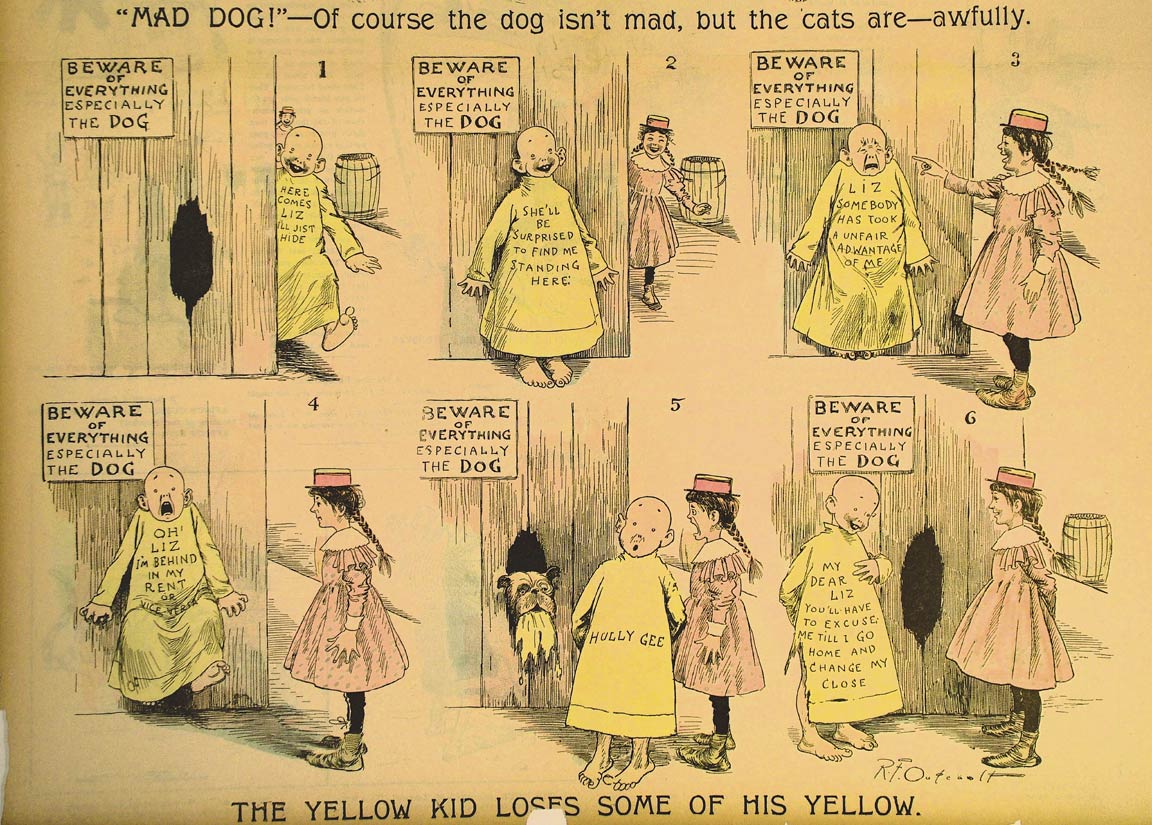
A Yellow Kid adventure which would have sprung out from the newspaper due to its vivid colors.
Image courtesy Comix Takoma; art by Richard Outcault
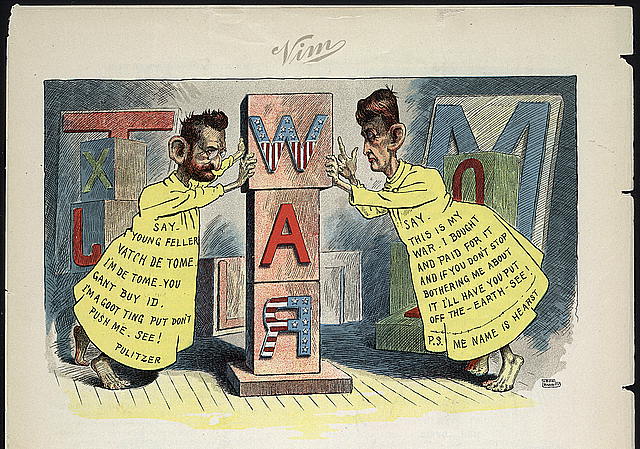
Both Hearst and Pulitzer ran versions of the Yellow Kid comic strip during the years that they were drumming up propaganda which lead to the Spanish-American War.
The unscrupulous nature of their efforts earned them the phrase ‘yellow journalism’, inspired by their war of the popular comic strip by Richard Outcault.
Courtesy the Library of Congress
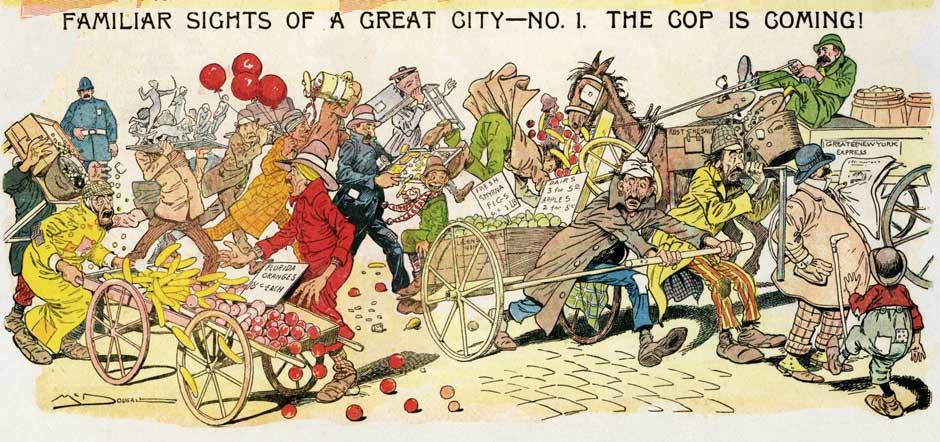
A section of the colorful comics section of the New York Journal, 1898.
“Familiar Sights of a Great City—No. 1 The Cop is Coming!†by Walt McDougall, New York Journal, Sunday, January 9, 1898 via New York Review of Books
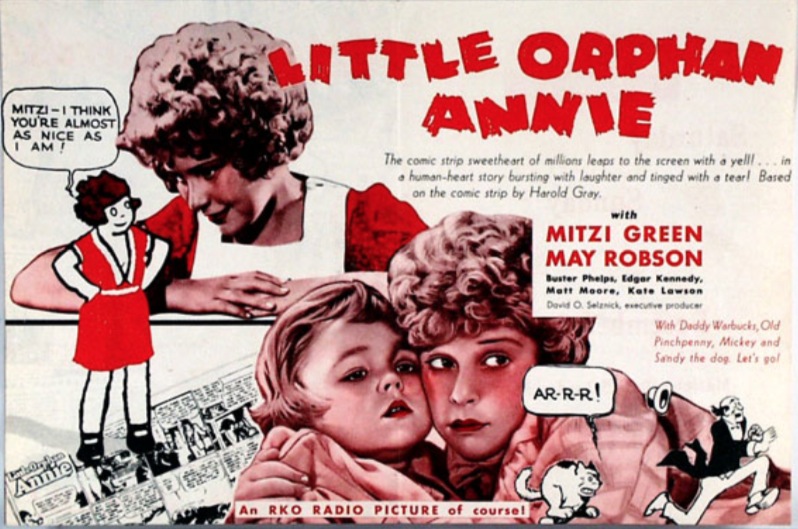
Little Orphan Annie became the biggest crossover star of the early comic strip era. Long before there was a musical, Annie starred in this 1932 melodrama, one of the earliest comic-to-movie crossovers.
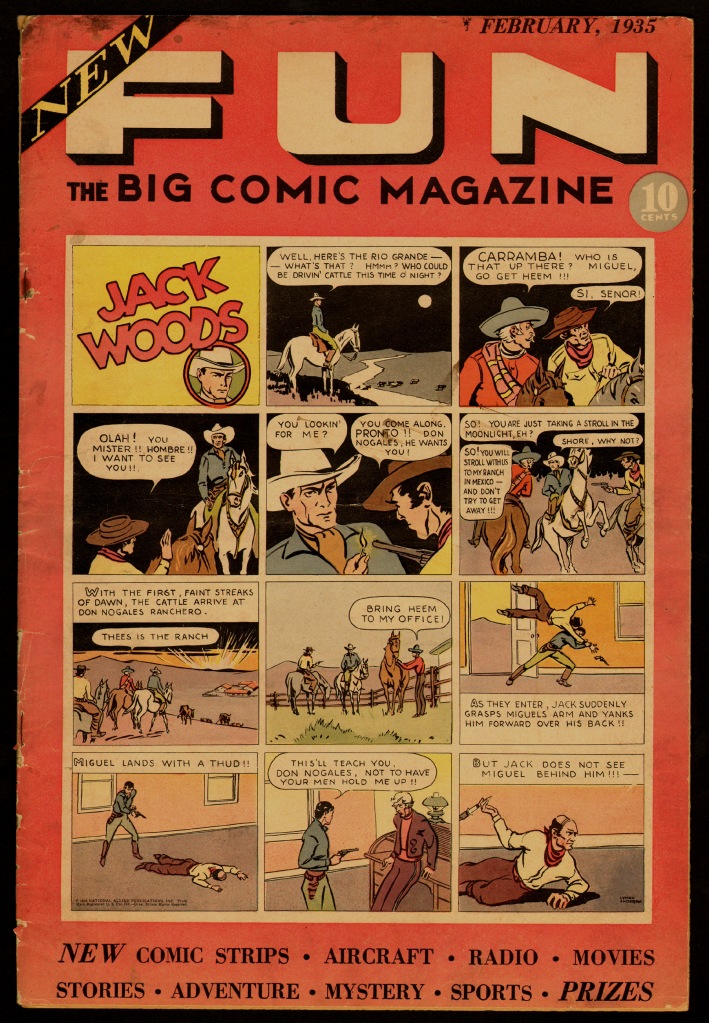
New Fun Comics #1, the very first comic book to contain all new material, and not merely reprints of newspaper comic strips.
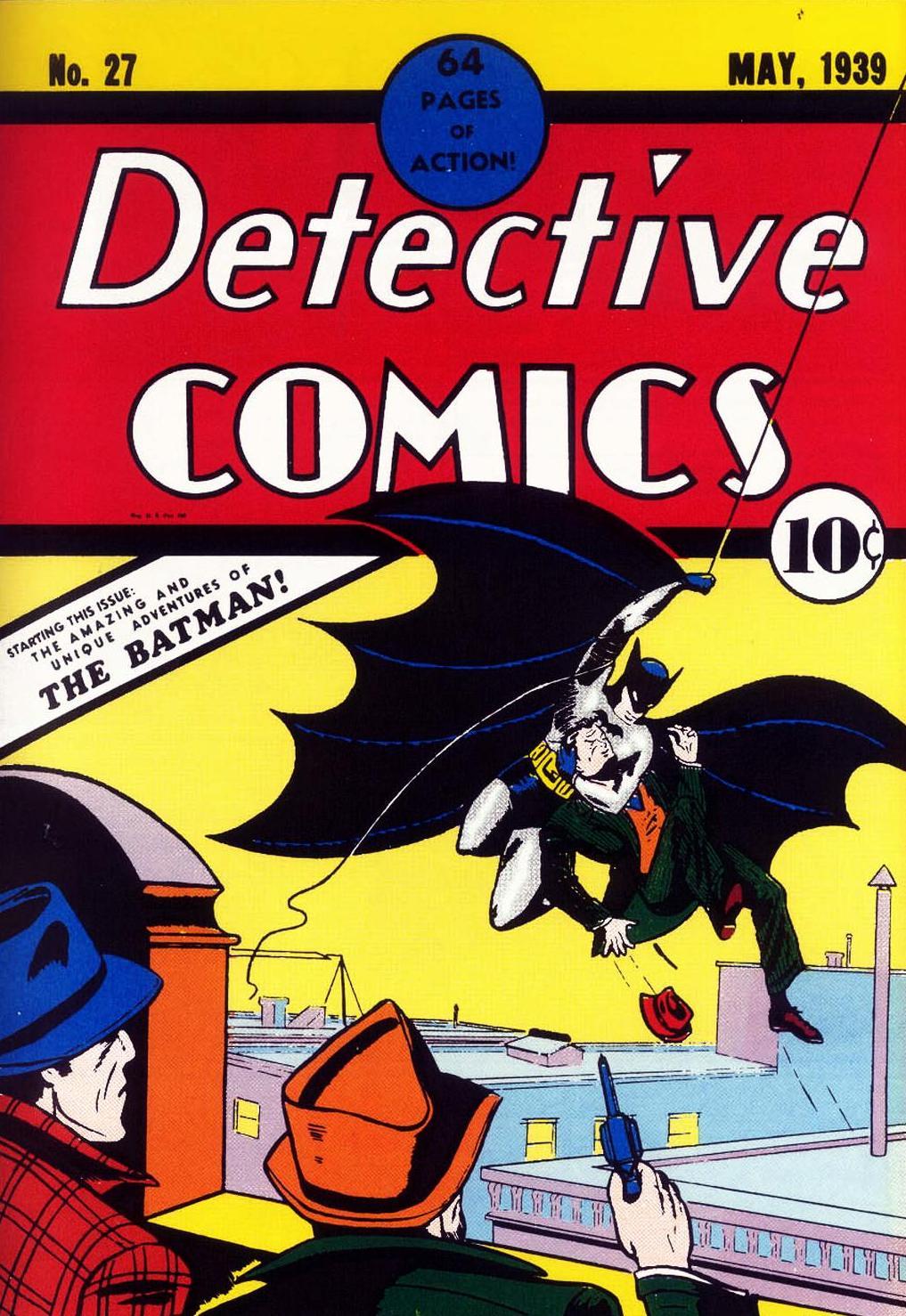
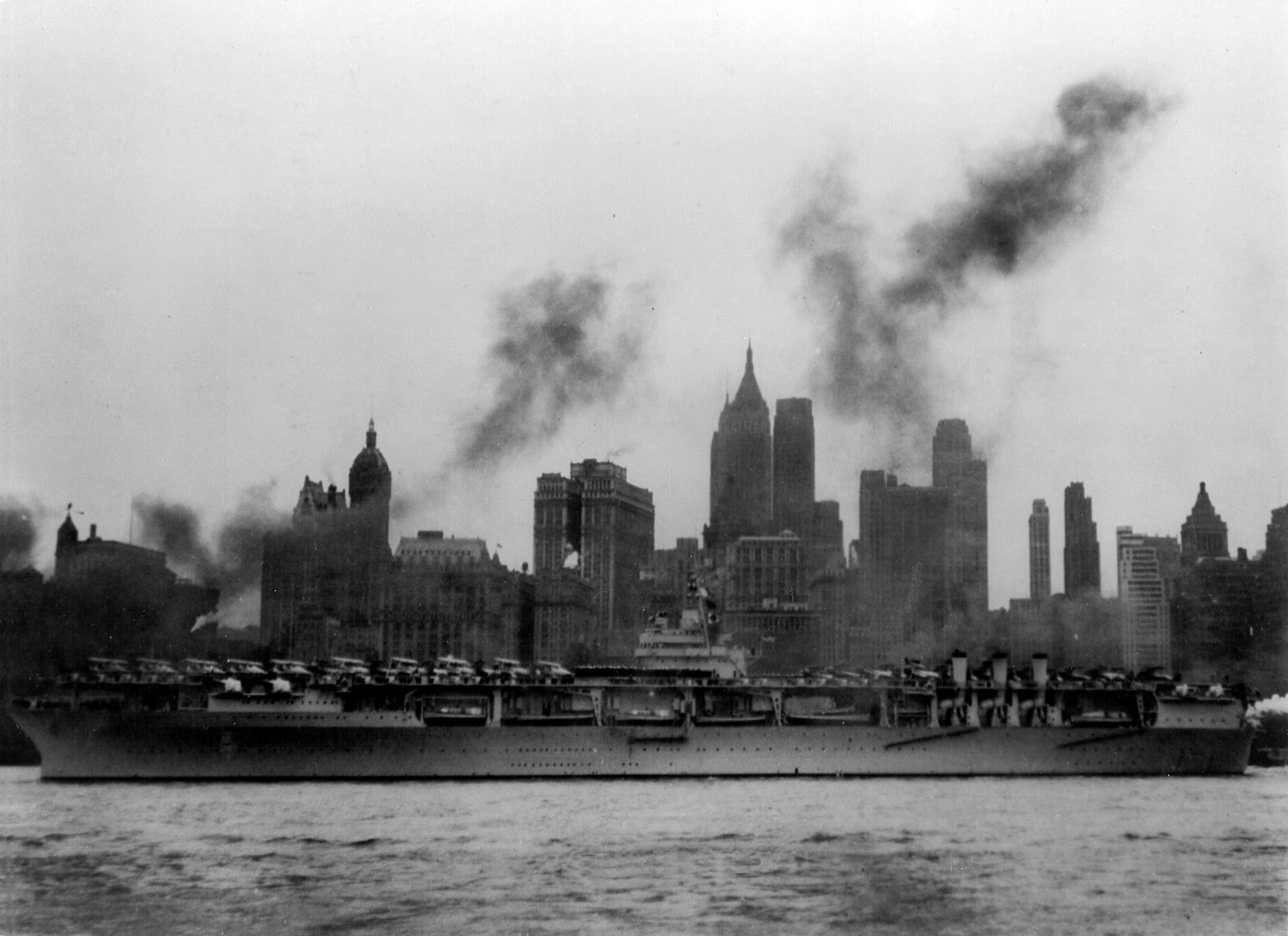
The Batman debuted in Detective Comics in 1939, created by Bob Kane and Bill Finger. The city features in these adventures was Gotham City, startlingly similar to the city outside the creators’ windows.
Courtesy DC Comics
Gotham City, aka New York City, in 1939
Courtesy U.S. Navy National Museum of Naval Aviation
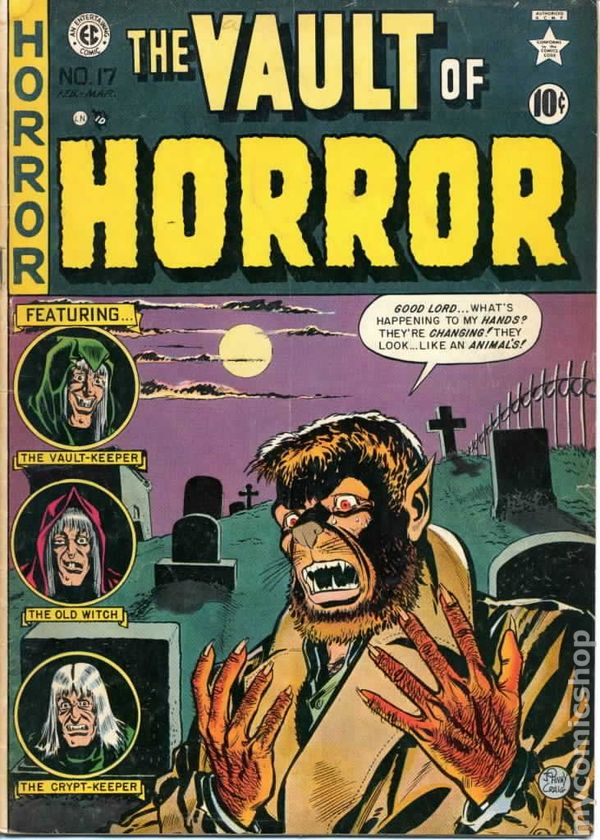
Vault of Horror, one of an assortment of shocking comic books produced by EC Comics in the early 1950s. The cover art is by Johnny Craig.
Courtesy EC Comics
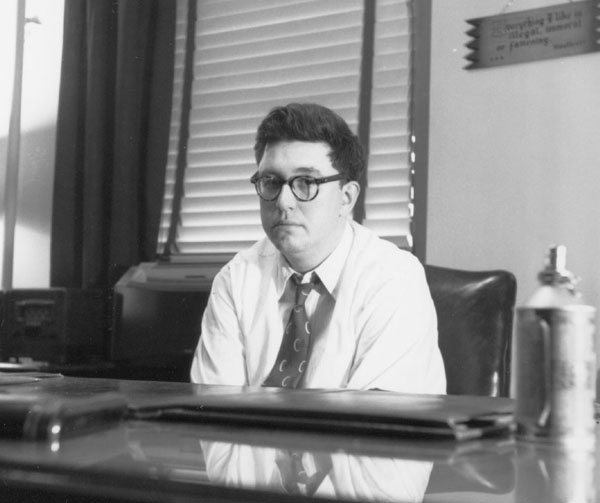
Bill Gaines, publisher of EC Comics, at his offices at 225 Lafayette Street.
Courtesy Tebeosfera
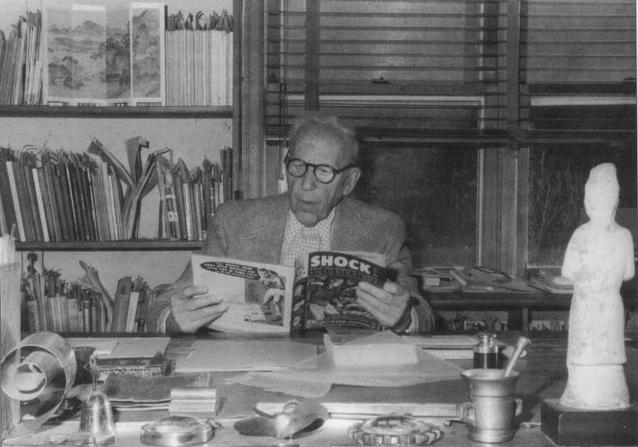
Dr. Fredrick Wertham, the writer of Seduction of the Innocent, who lead a charge against the comic book industry.
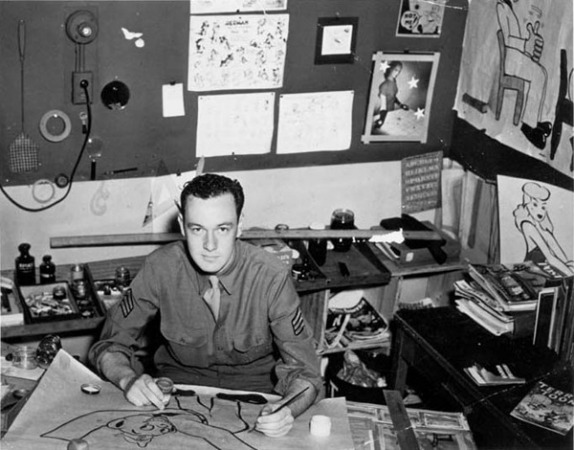
A young Stan Lee during the war as a member of the US Army’s Signal Corps. He even managed to do a bit of illustration for the cause!
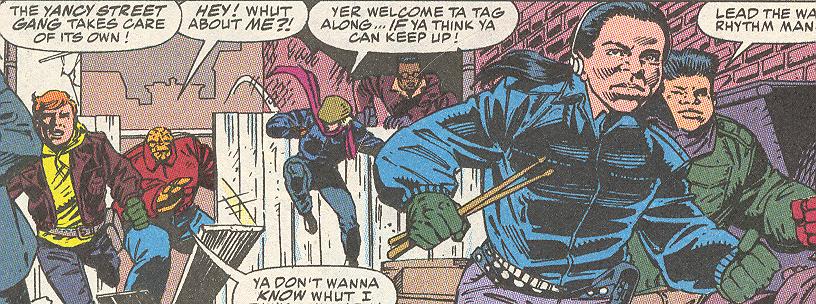
The Thing from the Fantastic Four with the Yancy Street Gang, a variation on Delancey Street in the Lower East Side.
Courtesy Marvel Comics via Comic Viine
Doctor Strange’s Sanctum Sanctorum is located on Bleecker Street in Greenwich Village
Courtesy Marvel Comics
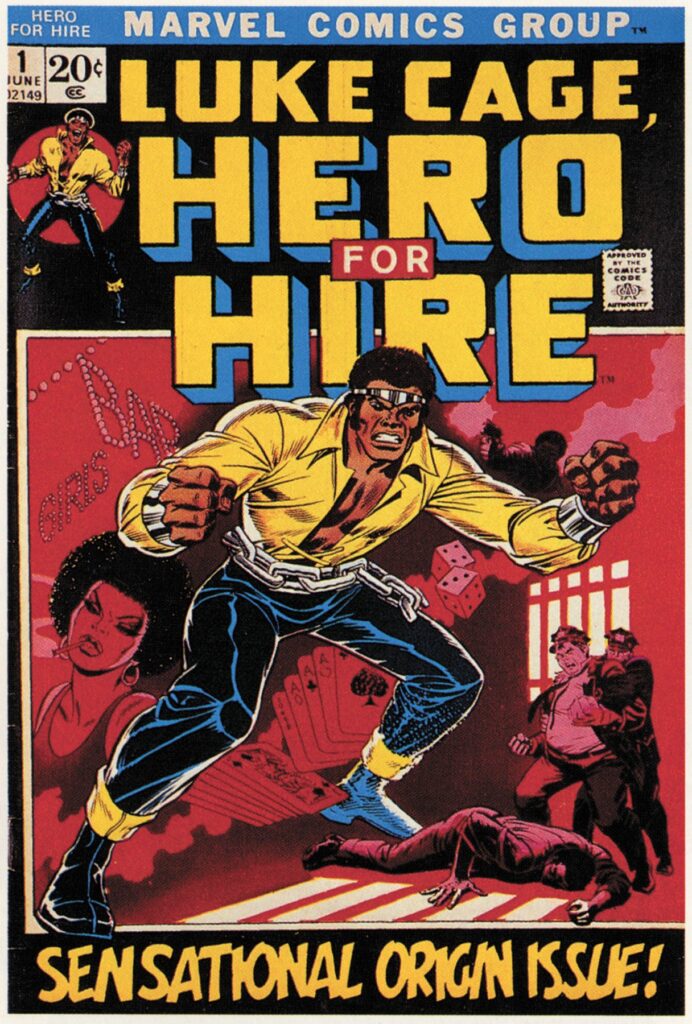
The adventures of Luke Cage, who debuted in his own Marvel Comics series in 1972, could be found mostly in Harlem. But he wasn’t the first African-American superhero from the neighborhood; in 1947 a character named Ace Harlem first appeared in a Philadelphia-published comic book called All-Negro Comics.
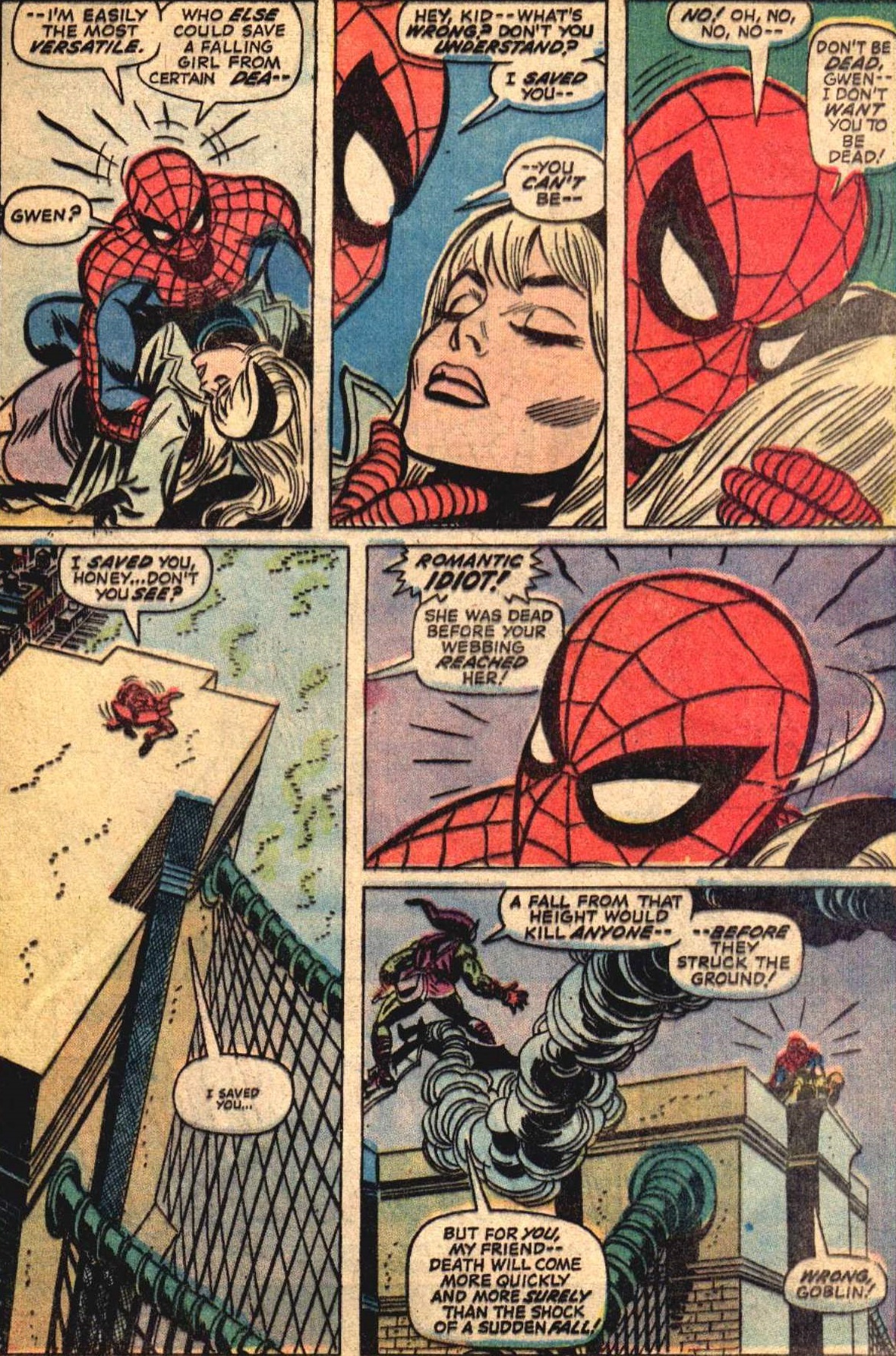
What would Spider-Man be without New York City? The image of the Brooklyn Bridge (called the George Washington Bridge in the story) is featured in a classic tale involving the death of his girlfriend Gwen Stacey, written by Gerry Conway and drawn by Gil Kane, John Romita and Tony Mortellaro.
Courtesy Marvel Comics
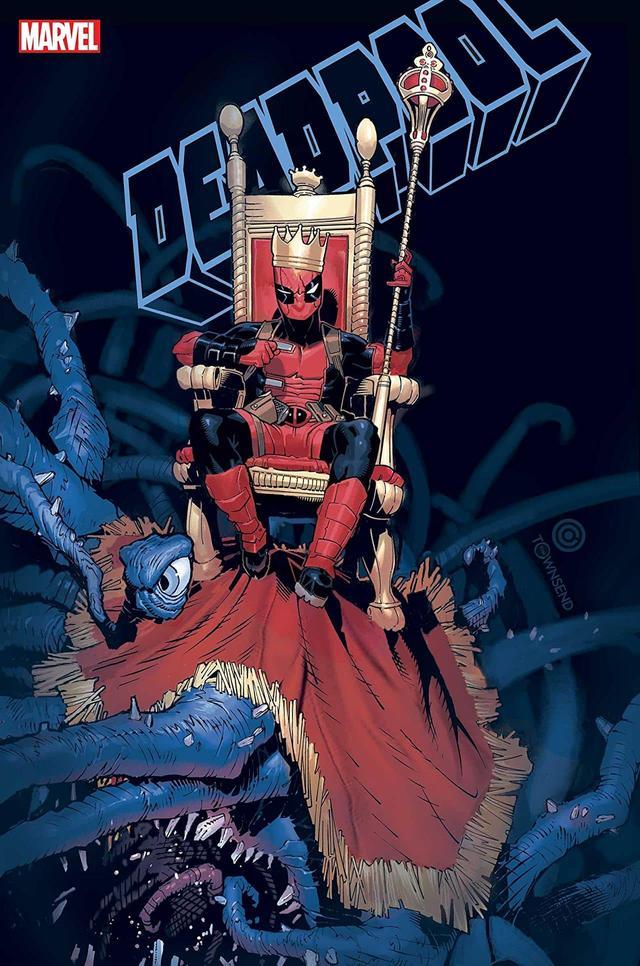
And — oddly enough — Staten Island in the world of Marvel Comics has become Monster Island, ruled by Deadpool. Yes, Deadpool. Haven’t they suffered enough? (Check here for more information.)
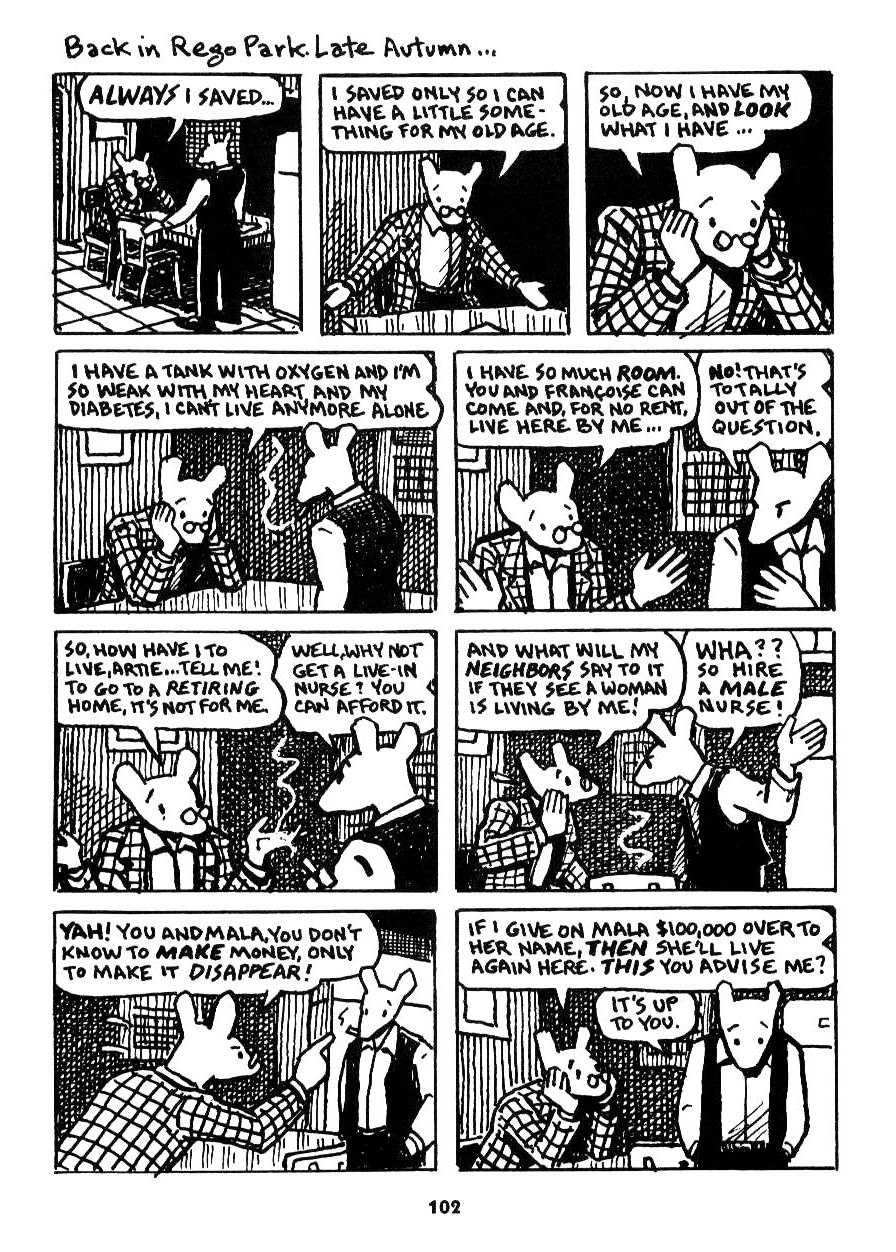
A page from Maus by Art Spiegelman, the graphic novel that brought the medium to a new level of respectability in literary circles.
Courtesy Art Spiegelman
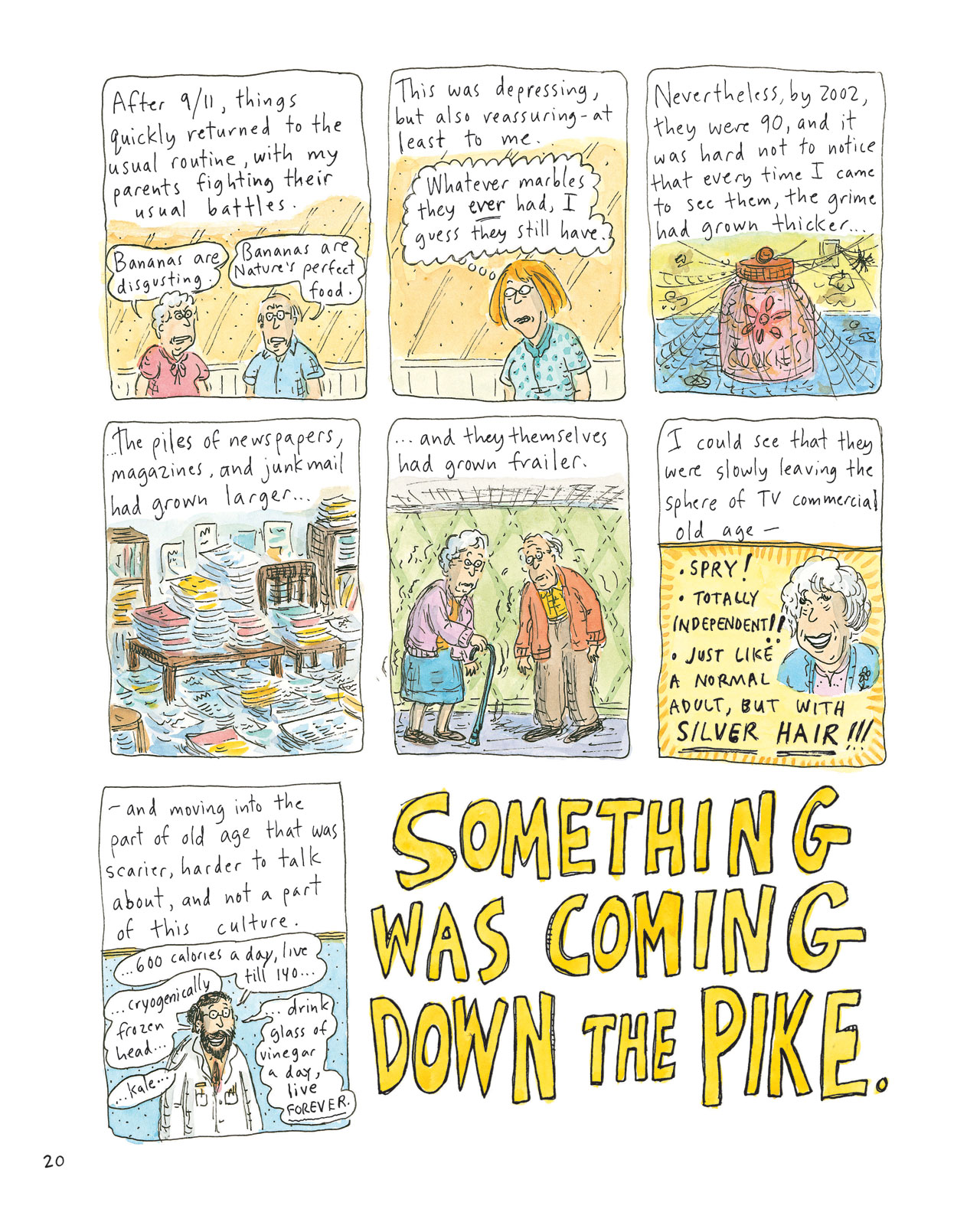
The comic book/graphic novel continues to evolve and reach new heights of success and respectability. Roz Chast’s Can’t We Talk About Something More Pleasant, published last year, won the National Book Critics Circle Award for best autobiography.
Courtesy Roz Chast/Bloomsbury
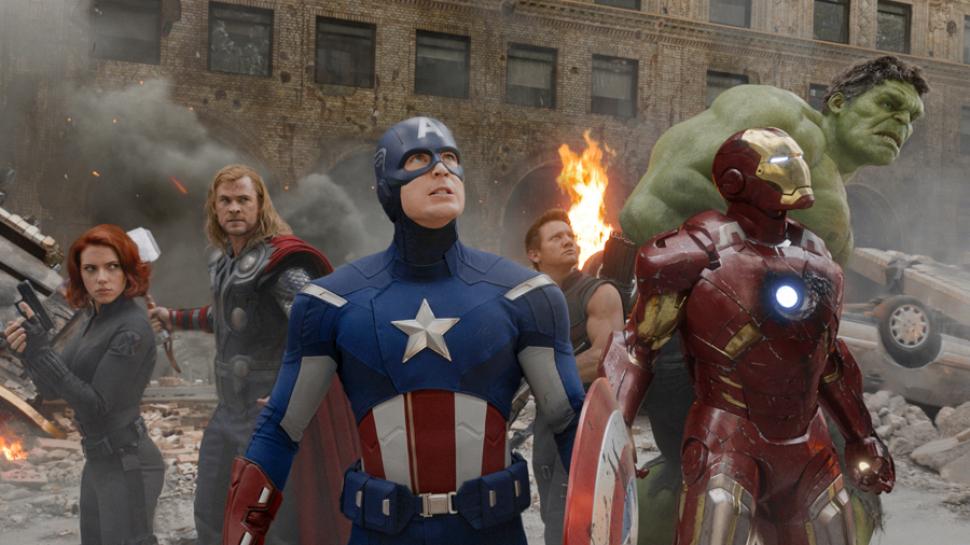
The Avengers defended New York during an alien attack in their blockbuster film in 2012
Courtesy Film Frame/Marvel
All images on this website are owned by the original comic book companies which produced them. Â Please see individual companies for more information.
RECOMMENDED READING:
If you’re into digging more into this subject, here are a few sources that I used for this podcast:
Jews and American Comics: An Illustrated History of An American Art Form, with written contributions by Paul Buhle
The Ten-Cent Plague: The Great Comic-Book Scare and How It Changed America by David Hadju
Men of Tomorrow: Geeks, Gangster and the Birth of the Comic Book by Gerard Jones
Comic Book Century: Â The History of American Comic Books by Stephen Krensky
Tales to Astonish: Jack Kirby, Stan Lee, and the American Comic Book Revolution by Ronin Ro
The Marvel Comics Guide to New York City by Peter Sanderson
Listen to our podcast on the General Slocum Disaster:
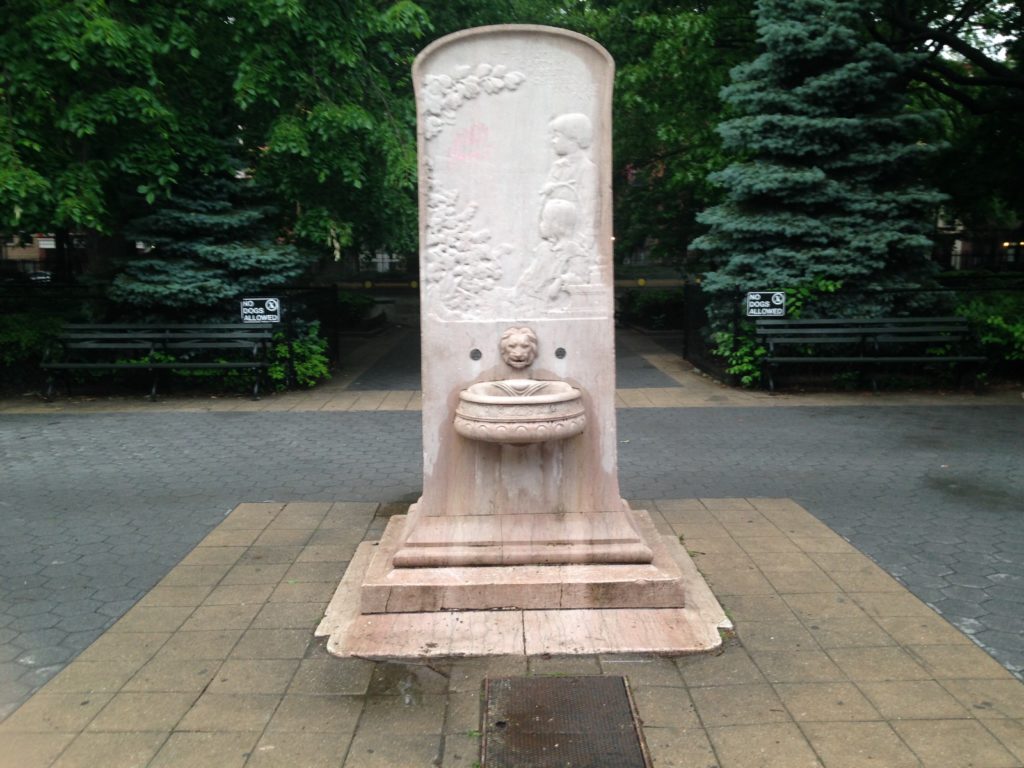
TheGeneral Slocum Memorial Fountain is one of the sole reminders of one of New York City’s darkest days, and it’s not a very awe-inspiring memorial.
This is no dig at the custodians of Tompkins Square Park, where the memorial has been on display since 1906, nor at Bruno Louis Zimm, the fountain’s sculptor whose creation presents two children in idyllic profile, next to an engraving: “They were Earth’s purest children, young and fair.”
Its left side unveils its more tragic context: “In memory of those who lost their lives in the disaster to the steamer General Slocum, June XV MCMIV.”
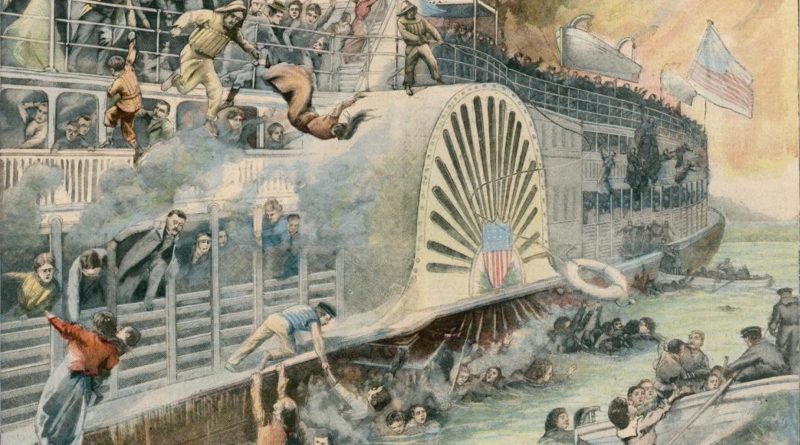
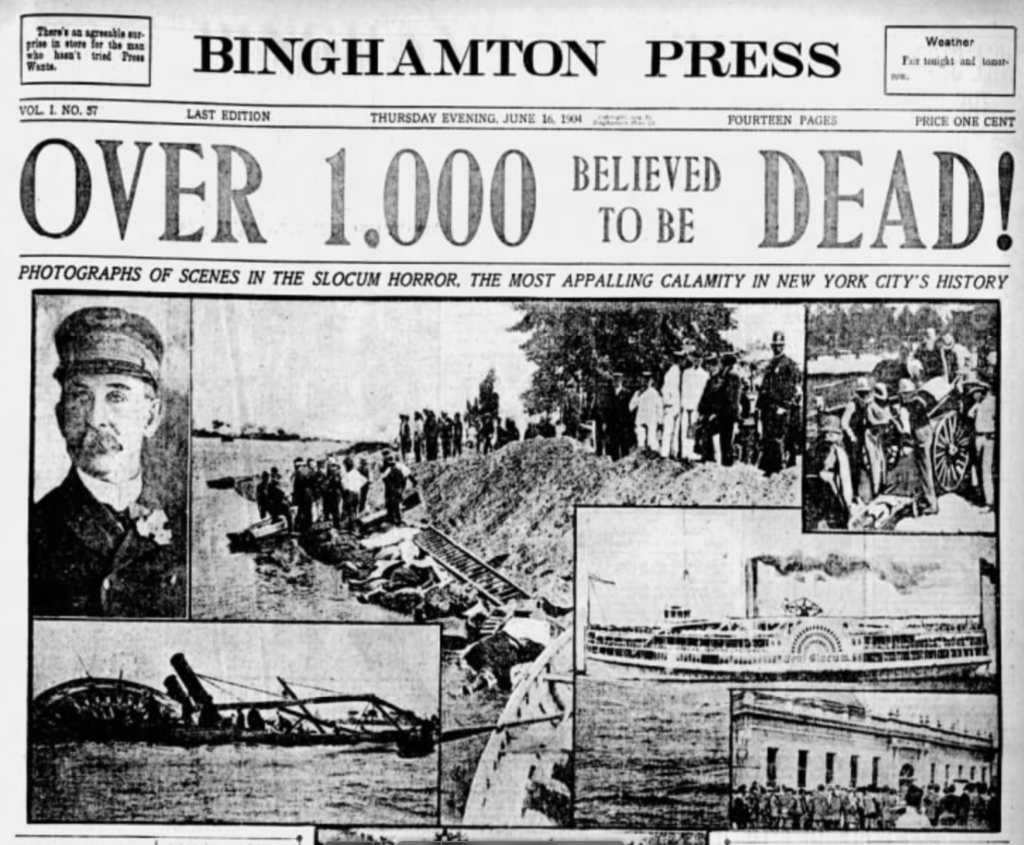
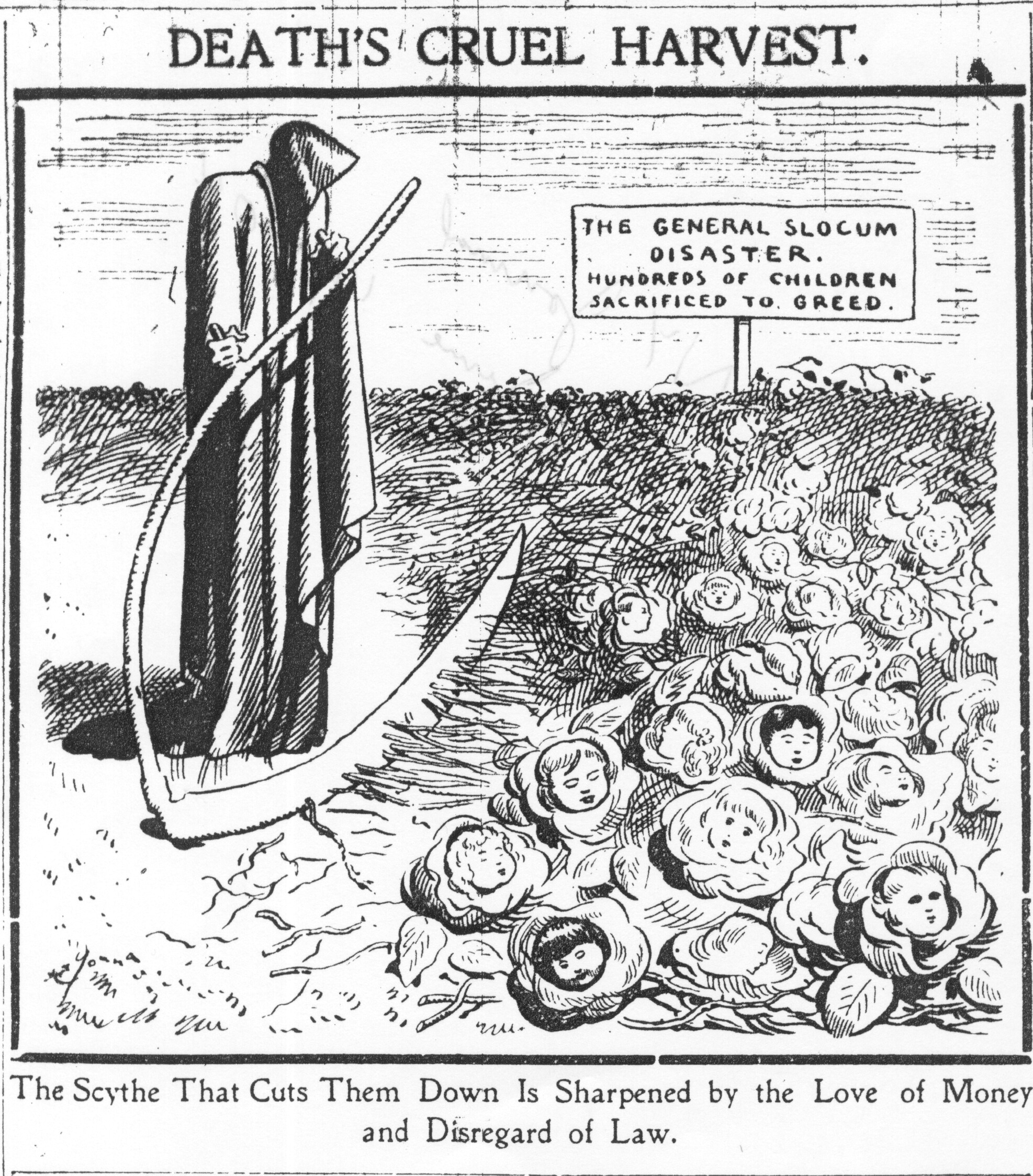
The fountain, while charming and tranquil, is inadequate in expressing the grief and horror that filled New Yorkers on June 15, 1904, when, during a church-sponsored day trip headed for the Long Island Sound, the General Slocum steamboat caught fire and sank in the East River, killing more than a thousand passengers, mostly women and children.
This tragedy was the single deadliest event in New York City history until September 11, 2001.
This disaster virtually wiped out the German presence on the Lower East Side—entire families perished, many of whom had just gotten a foothold in New York a generation before. In a single morning the lights of Kleindeutschland, New York’s Little Germany, permanently faded.
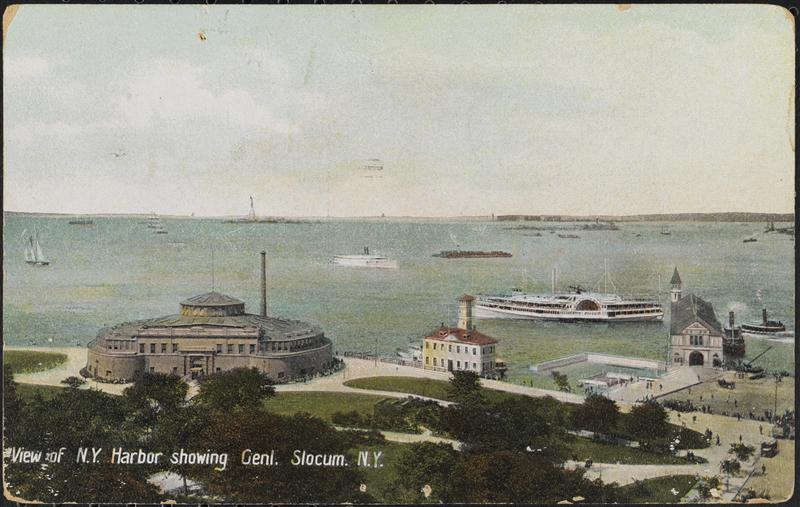
The boat had been chartered by St. Mark’s Evangelical Lutheran Church* for their yearly day trip excursion to the Long Island Sound. The East River was filled with excursion steamers such as the General Slocum and its sister ship the Grand Republic (a vessel with a doomed story of its own).
It was a chance for the congregation to briefly break out of the crowded Lower East Side to enjoy a day in the sun. Among the passengers was the Liebenow family, which consisted of parents and their three daughters, Anna, Helen, and Adella, along with several aunts and cousins.
The Slocum left the pier shortly before 9 a.m. and began its slow crawl up the East River.
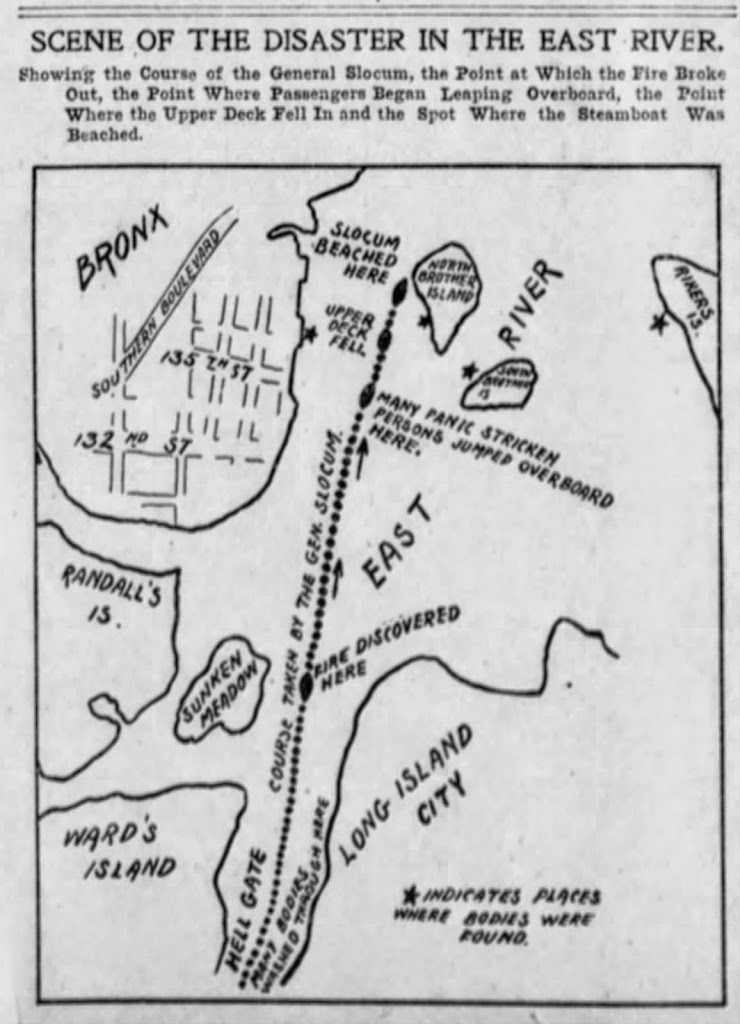
Captain William Van Schaick had been principally concerned that morning with one turbulent spot up the East River, a dangerous confluence of waters known as the Hell Gate. It had already sunk hundreds of vessels as far back as the seventeenth century. By 1904 it was still a dangerous pass, but on this day, the Hell Gate would not be the problem.
About 30 minutes into the voyage, a child noticed that a small fire had started in the lamp room below the main deck.
A crewman tried to stamp it out, throwing charcoal on it in an effort to contain it. But the flames only grew larger.
Crew members grabbed a firehose—only to find it rotten to the point that it burst wide open. These were not men trained for emergency situations; once they realized the hoses were useless, they simply gave up.
from the Brooklyn Daily Eagle
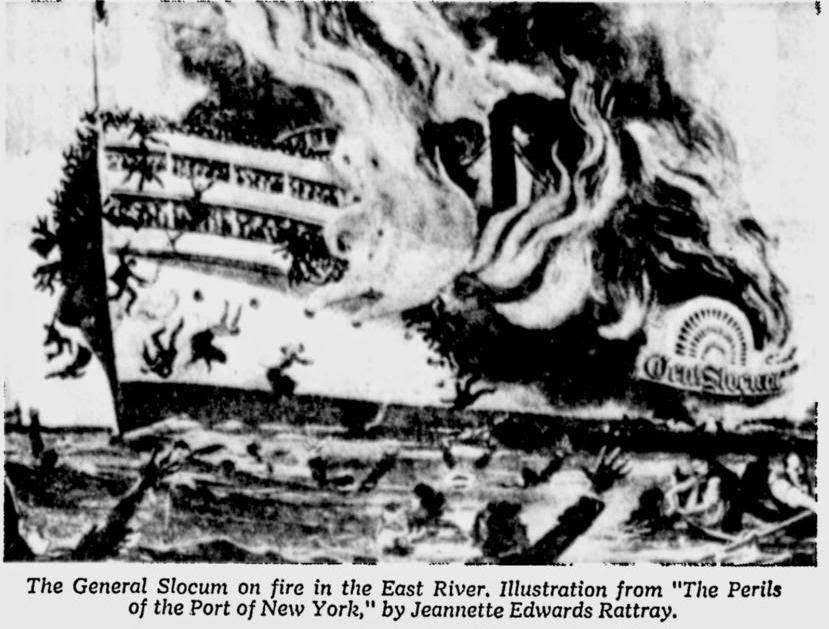
Civilized behavior soon gave way to panic as the flames quickly spread through the lower levels of the steamer, fire jumping from passengers’ clothing to hair.
Families moved away from the flames only to find themselves pressed up against the boat’s railings as panicked crowds pushed forward in search of fresh air. Children lost hold of their parents, never to see them again.
Crowds surged toward the Slocum’s six lifeboats and attempted to hoist them down. But they wouldn’t budge—somebody had wired them to the wall.
The life preservers, never properly inspected, were filled with rotten cork, and several exploded into dust. They were not only useless—they were actually dangerous. Panicked parents strapped preservers to their children and tossed them overboard, only to watch in horror as they sank from sight.
Below deck, passengers were burned to death—huddled in groups and trapped in corners. Smoke choked many, causing unconsciousness; many were trampled underfoot.
Some jumped into the violent waves. “There was little hope that any of the children who jumped overboard could be saved,” reported the New York Evening World. “The current all along the course taken is on a section of the river where not even a strong swimmer can breast the currents. Scores of little ones were sucked in by the whirlpools in Hell Gate.”
Greenwich Village Society of Historic Preservation
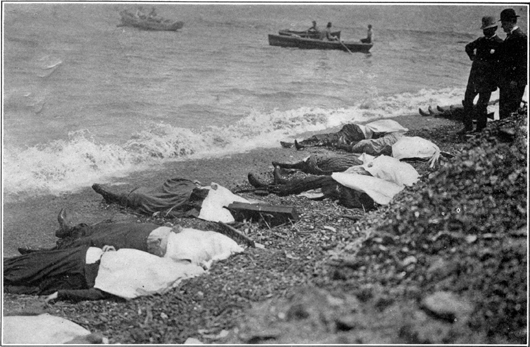
Crowds formed along the shores, and their attention was drawn by the billowing smoke, fire, and horrifying spectacle before them. The captain managed to steer the boat toward North Brother Island, where nurses, doctors, and even patients from the smallpox hospital ran to the water to rescue and attempt to revive those who had washed ashore.
Bodies on the shore of North Brother Island
The Slocum eventually floated out into the Long Island Sound, puffing clouds of cork dust into the air, while leaving a trail of tragedy in its wake.
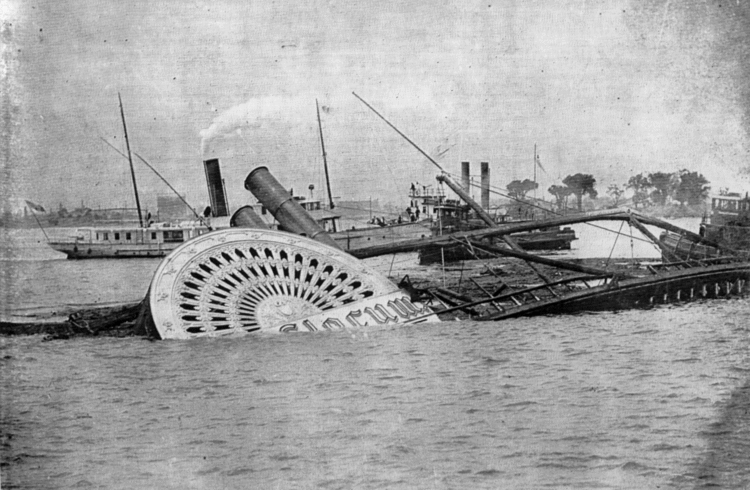
Just after noon, the burning vessel sank, a single paddle box and a smokestack jutting out of the water.
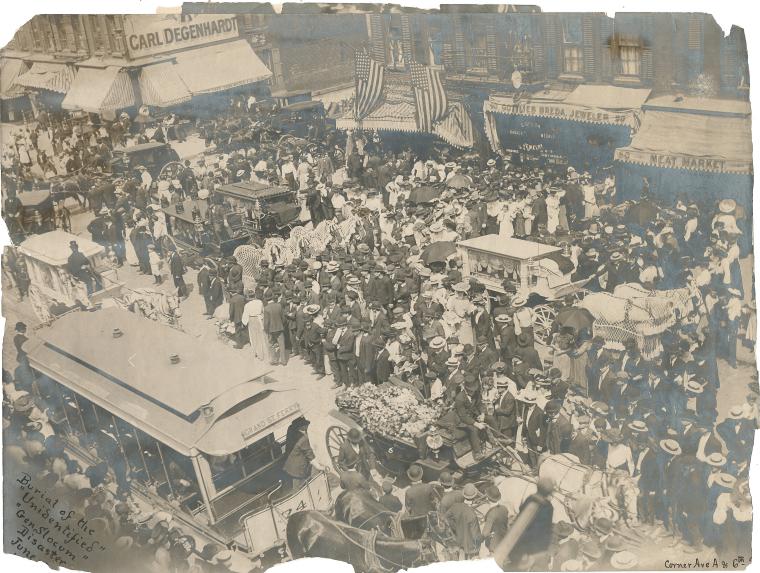
By the final count, 1,021 people perished in the General Slocum disaster that day, making it the deadliest single event in the city’s history up to that date. In the weeks following the disaster, the streets of Kleindeutschland—today’s East Village—were filled with mourners. The community attended funerals in the homes of those who had perished and held solemn processions through the streets.
A mass funeral through the streets of the Lower East Side — “burial of the unidentified”
New York Public Library
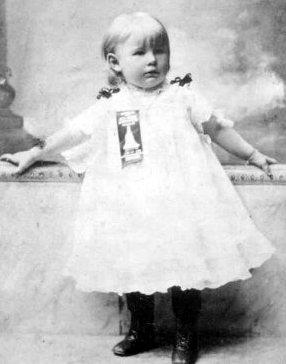
The Liebenow family was hit particularly hard. The entire Liebenow family died in the disaster—all except baby Adella (pictured below), just six months old at the time of the tragedy.
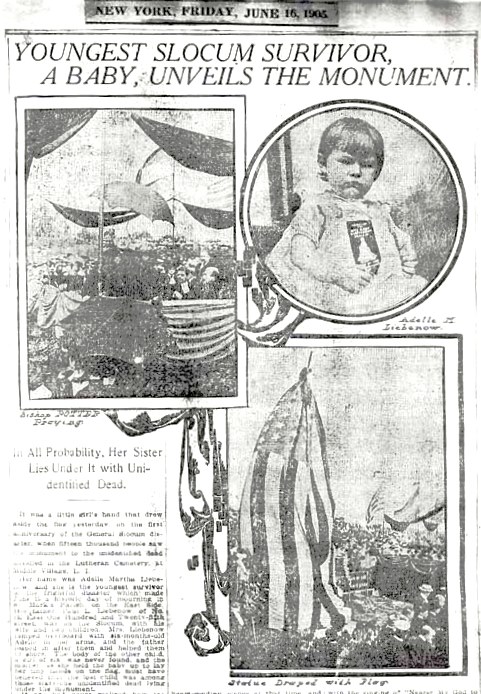
Two years later, now only two-and-a-half years old, Adella was hoisted to a podium here in Tompkins Square Park. She stood before a community that hadn’t yet fully recovered—would they ever?—as she tugged at a cloth to unveil the General Slocum Memorial Fountain.
NYHS
No, the fountain is not perfect. How could it be?
But why hasn’t this tragedy been better memorialized? It’s such an important event in the city’s history, and yet so many don’t know its whole story. There are a few theories about this, many having to do with the anti-German sentiment that cropped up a decade later at the beginning of World War I.
Or was it the social class of the victims that caused it to recede from memory? Adella, who died in 2004, 100 years after the disaster, believed that this might be the case. To a crowd at a 1999 commemoration of the tragedy, she said, “The Titanic had a great many famous people on it. This was just a family picnic.”
*St. Mark’s is located on East 6th Street, between First and Second Avenues, in the heart of New York’s first and largest German neighborhood. A plaque honoring the victims hangs in front.
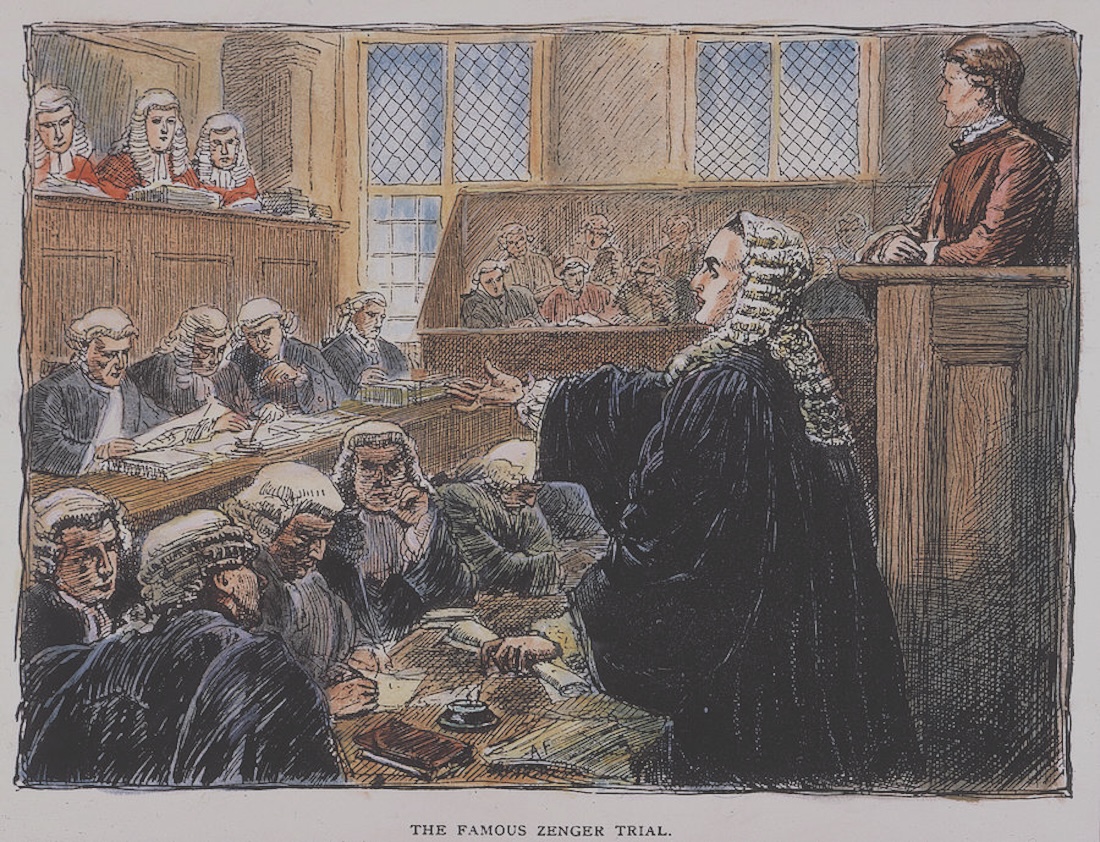
A long, long time ago in New York — in the 1730s, back when the city was a holding of the British, with a little over 10,000 inhabitants — a German printer named John Peter Zenger decided to print a four-page newspaper called the New York Weekly Journal.
This is pretty remarkable in itself, as there was only one other newspaper in town called the New York Gazette, an organ of the British crown and the governor of the colony. (Equally remarkable: Benjamin Franklin almost worked there!)
But Zenger’s paper would call to question the actions of that governor, a virtual despot named William Cosby (at right), and in so doing, set in motion an historic trial that marked a triumph for liberty and modern democratic rights, including freedom of the press and the power of jury nullification.
This entire story takes place in lower Manhattan, and most of it on a couple floors of old New York City Hall at Wall Street and Nassau Street. Many years later, this spot would see the first American government and the inauguration of George Washington.
But many could argue that the trial that occurs here on August 4, 1735, is equally important to the causes of democracy and a free press.
LISTEN NOW: THE TRIAL OF JOHN PETER ZENGER
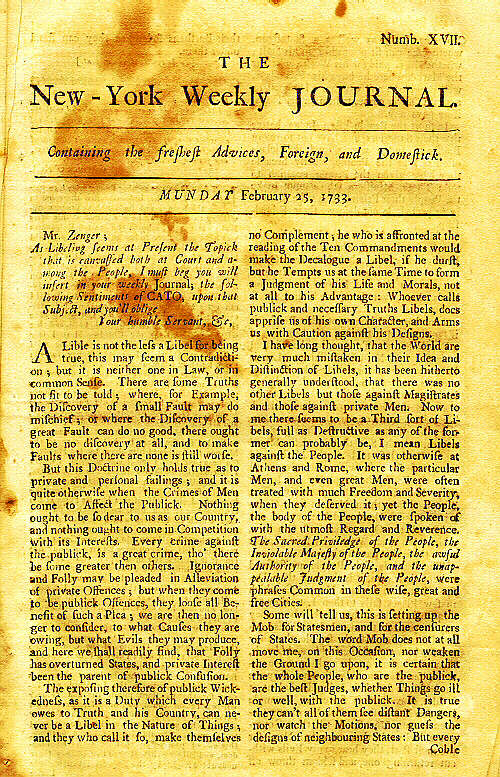
CORRECTION: I can’t read my Olde English very well. In reading from a page of the New-York Weekly Journal, I inadvertently say ‘Fulgom Panagenics’ instead of ‘Fulsom Panagenics’. Fulgom is not a word, fulsom(e) is, meaning very complimentary or flattering.
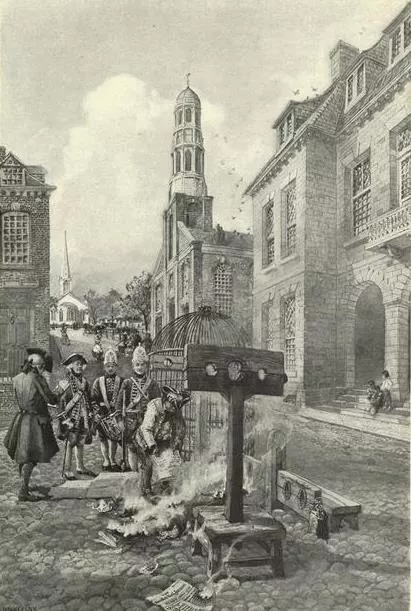
The burning of John Peter Zenger’s ‘New York Weekly Journal’ in Wall Street on November 6, 1734.
A stained copy of the New-York Weekly Journal from 1733
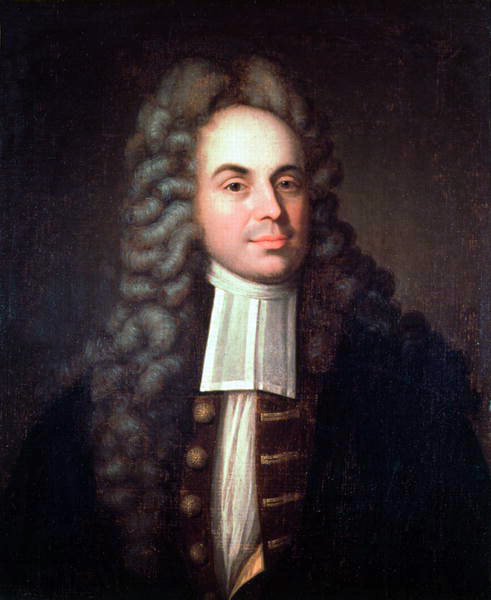
Andrew Hamilton, the lawyer who saved the day in the John Peter Zenger trial. His eloquence and command of language helped win the day for lovers of free press.
Adolf Ulrik Wertmüller – Portrait of Andrew Hamilton (1808).