Categories
Bowery Boys Bookshelf

‘Greater Gotham’: Admiring the biggest, most important New York City history book of the year

Gotham: A History of New York City to 1898, by Edwin G. Burrows and Mike Wallace, is my bible.

It sits with my reference books, not with the other history non-fiction, foundational in its importance to this subject. I’ve read every page, although not in one or even 50 sittings. It winds through about 275 years of history with an exhaustive confidence, exploring every aspect of life in this region with depth and dexterity. The subject is the island of Manhattan and the lands surrounding that will become Greater New York City. Like a Shakespearean comedy, it concludes with a wedding — the Consolidation of 1898.

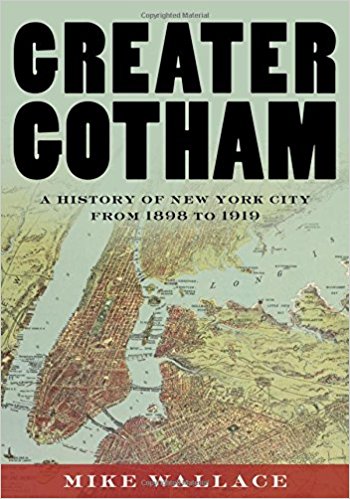
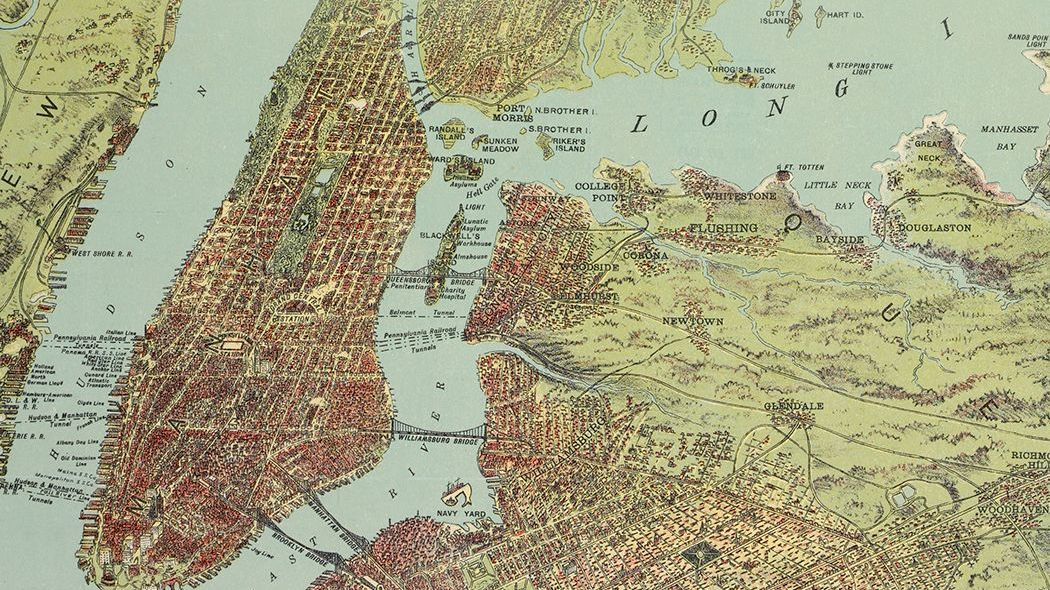
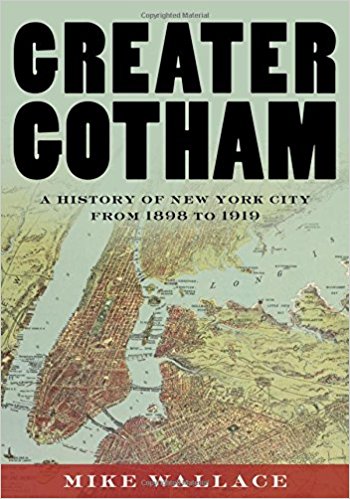
It takes the authors 1,236 page to journey through this story. The new follow-up by Wallace, Greater Gotham: A History of New York City from 1898 to 1919,  takes almost as many pages to tell the story of just a couple decades. But that’s the 20th century for you.

Greater Gotham
A History of New York City from 1898 to 1919
Mike Wallace
Oxford University Press

The decades between Consolidation and Prohibition saw the rise of New York City has an international symbol of American prosperity while being reshaped by an unprecedented collection of modern cultural forces. During the Gilded Age, New York became of city of wealth and a metropolis of stratified classes, forming immigrant enclaves and vital (if often corrupted) social institutions.
In the new century, a pivot occurs. Tradition gives way to the modern and a crowded city finds room for its new personalities.

Professor Wallace, founder of the Gotham Center for New York City, takes Gotham‘s comprehensive powers to new heights with Greater Gotham. Confined by two decades, the book visits virtually every aspect of life by category. It thoroughly explores one element of that critical period — politics or finance, for instance — then refocuses and reboots, starting at the beginning again in the next chapter, observing different histories.

This categorical framing makes Greater Gotham perhaps a more difficult straight-through read, but lends the work an authoritative feel. Will there ever be a better book about this period? How could there be?

The book starts with higher infrastructural forces — from great transportation projects to population movements — then gently settles into turn-of-the-century street life and everyday customs of New Yorkers. Baseball games, Times Square restaurants, Gibson Girls, ragtime music. I found the middle sections to be of special interest, those ‘unofficial’ collaborations borne from the social and intellectual ideas coming in from Ellis Island. Unions and radicals. Progressives and repressives. Maxim Gorky, Arnold Rothstein, Edith Wharton, Madam C. J. Walker.

Greater Gotham really does reach into all five boroughs and even into the extended regions of Westchester County and Long Island. The attempt to tell the total story is bold, perhaps bolder than the first Gotham. New Yorkers were much more diverse — from many backgrounds, many races — than they were even fifty years before. The goal of Wallace and his researchers is to find stories that attach to every New Yorker living here during this twenty-year period.

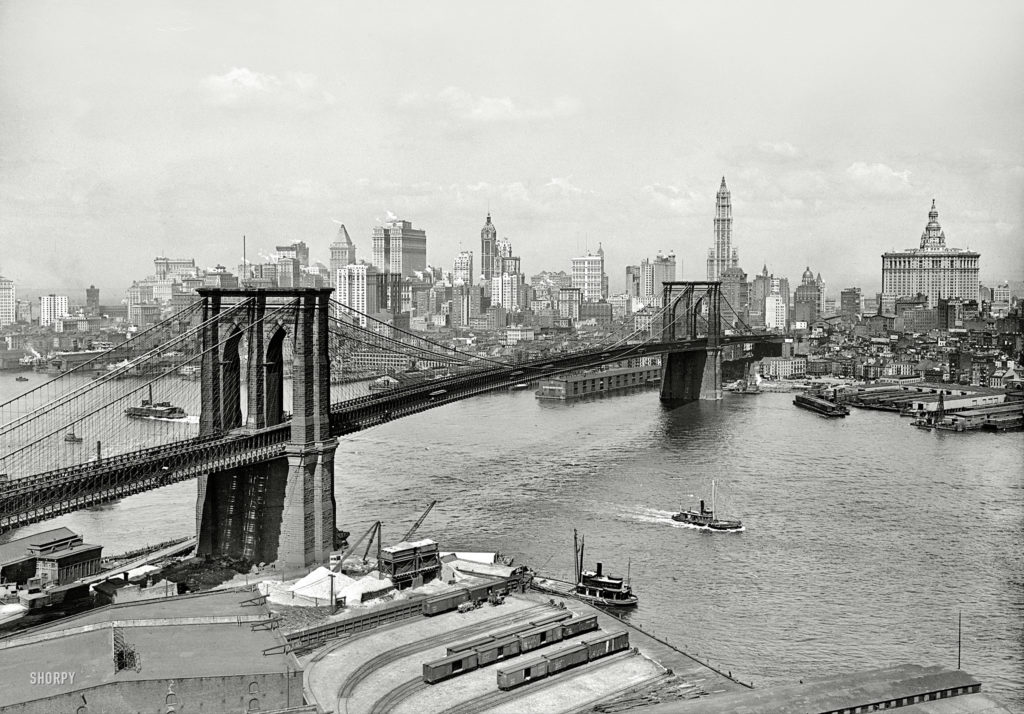
New York City 1915, courtesy Shorpy

As categorically framed, some cultural shifts of the early 20th century may seem even more impressive, seeming to lurch forward with a bewildering speed: the dissolution of corporate trusts, the sophistication of organized crime, the lives of African-American New Yorkers. And this ‘sudden’ modern effect is especially true with the role of women which expanded in practice, if not in custom. “Women had also been contesting the double standard, revising family law, managing economic resources, building female-run institutions, and engaging in politics (despited being barred from the polls).”

Also explored is the rise of outer-borough communities during this period, particularly in the Bronx, Manhattan’s closest companion, becoming transformed by post-Consolidation optimism, from rising institutions in its parks to the residential boom along the Grand Concourse.

I’ve spent a couple months with this book already and have found so many new marvels among the pages. I suspect its trove of particular details will continue to enthrall me in years to come. Time to make room on my reference shelf.


Review by Greg Young

Categories
Gilded Age New York Podcasts

The Rise of the Fifth Avenue Mansions: Revisiting Forgotten Architecture of New York’s Gilded Age

PODCAST At the heart of New York’s Gilded Age — the late 19th century era of unprecedented American wealth and excess — were families with the names Astor, Waldorf, Schermerhorn and Vanderbilt, alongside power players like A.T. Stewart, Jay Gould and William “Boss” Tweed.

They would all make their homes — and in the case of the Vanderbilts, their great many homes — on Manhattan’s Fifth Avenue.

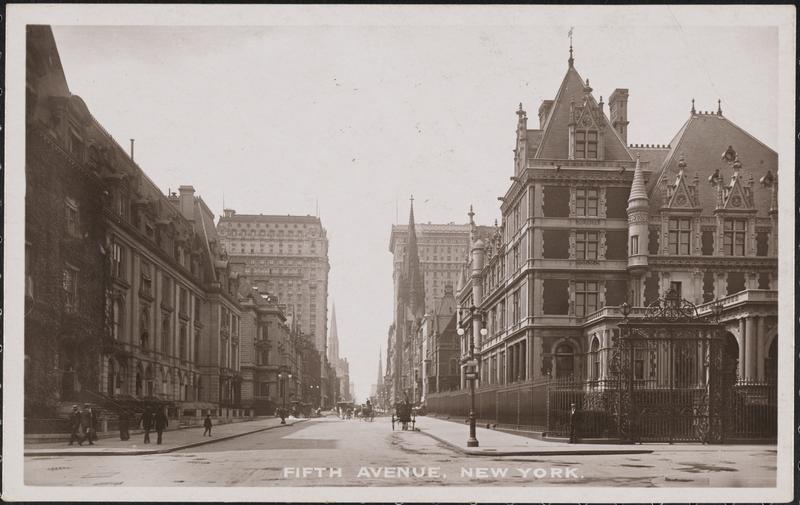
The image of Fifth Avenue as a luxury retail destination today grew from the street’s aristocratic reputation in the 1800s. The rich were inextricably drawn to the avenue as early as the 1830s when rich merchants, anxious to be near the exquisite row houses of Washington Square Park, began turning it into an artery of expensive abodes.

In this podcast — the first of two parts — Tom and Greg present a world that’s somewhat hard to imagine — free-standing mansions in an exclusive corridor running right through the center of Manhattan. Why was Fifth Avenue fated to become the domain of the so-called “Upper Ten”? What were the rituals of daily life along such an unusual avenue? And what did these Beaux Arts palaces say about their ritzy occupants?

CO-STARRING: Mark Twain, Madame Restell, George Opdyke and “the Marrying Wilsons”.


The Bowery Boys: New York City History podcast is brought to you …. by you!

We are now producing a new Bowery Boys podcast every week. We’re also looking to improve the show in other ways and expand in other ways as well — through publishing, social media, live events and other forms of media. But we can only do this with your help!

We are now a member of Patreon, a patronage platform where you can support your favorite content creators — for as little as a $1 a month.

Please visit our page on Patreon and watch a short video of us recording the show and talking about our expansion plans. If you’d like to help out, there are five different pledge levels (and with clever names too — Mannahatta, New Amsterdam, Five Points, Gilded Age, Jazz Age and Empire State). Check them out and consider being a sponsor.

We greatly appreciate our listeners and readers and thank you for joining us on this journey so far.


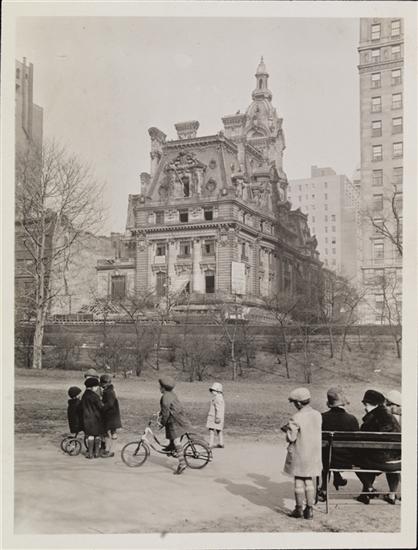
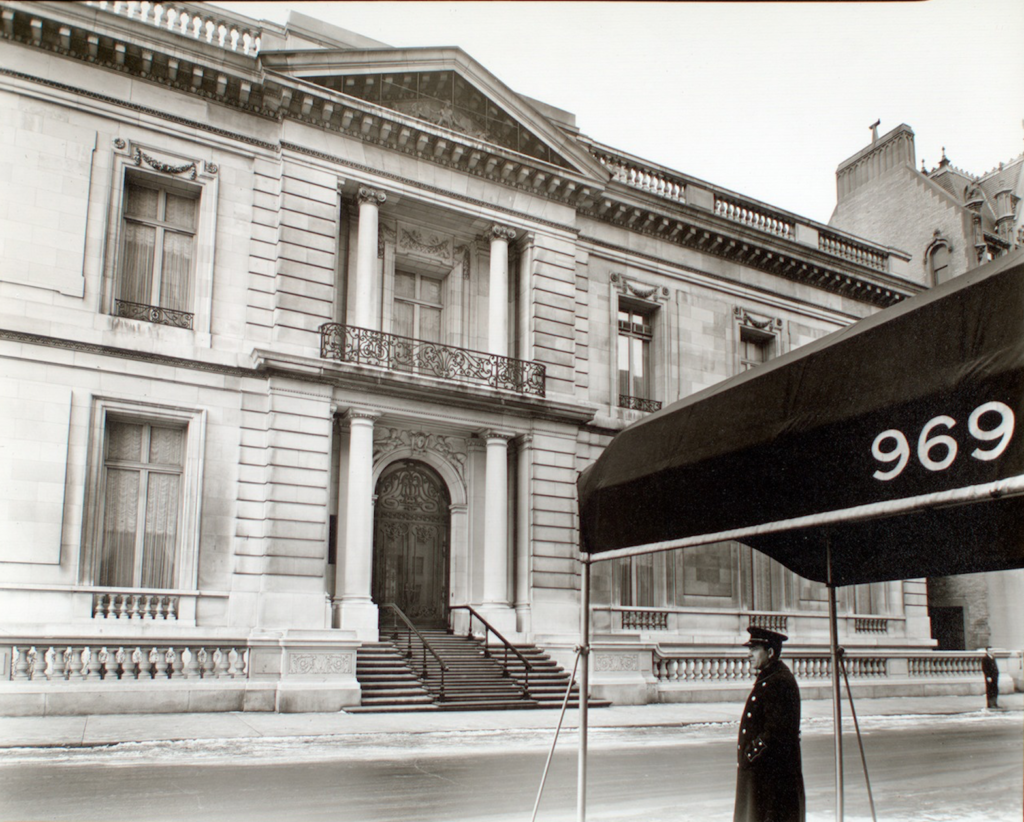
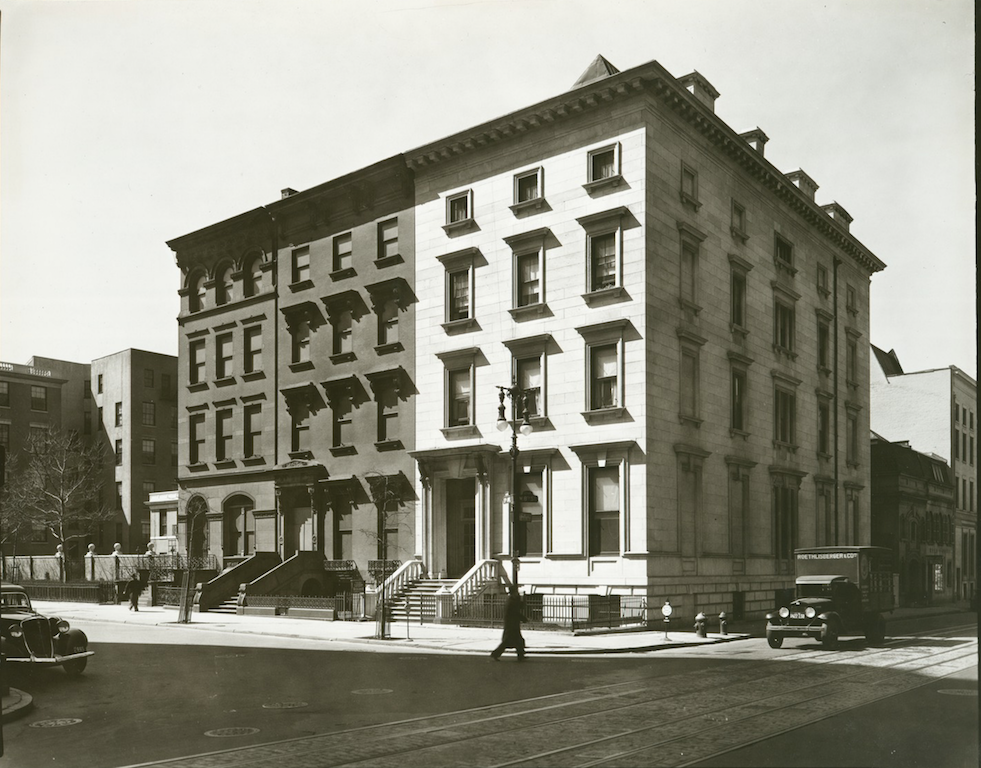
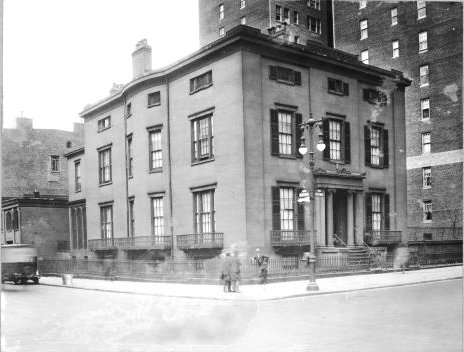
4-8 Fifth Avenue, buildings which were still standing in 1936 for photographer Berenice Abbott.

NYPL

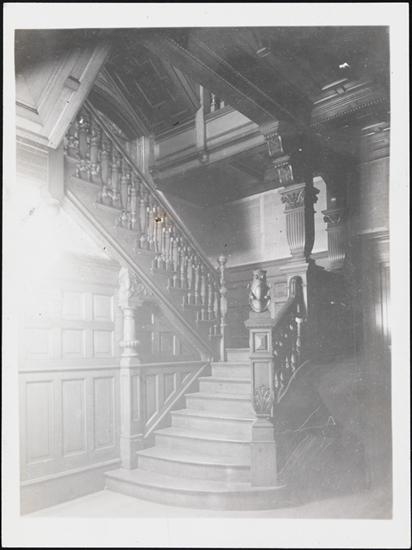
The stairway inside 4 Fifth Avenue, a beautiful relic of old living.

MCNY

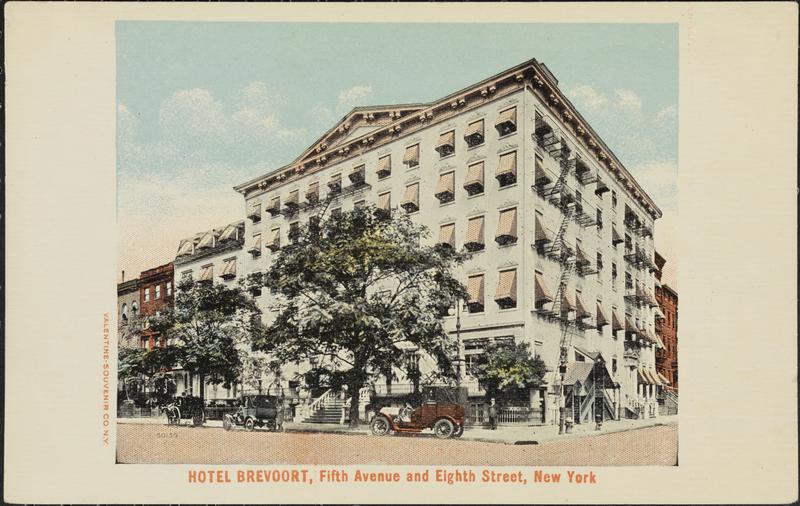
The Brevoort Hotel at Fifth Avenue and 8th Street and the Brevoort Mansion on 9th Street, circa 1925 (the year it was demolished)

NYPL

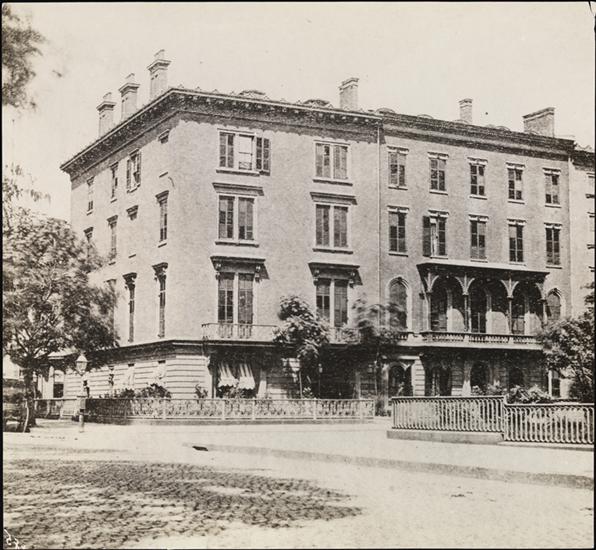
Delmonico’s Restaurant, pictured here in 1865, moved into an old mansion to serve its wealthy clients.

MCNY

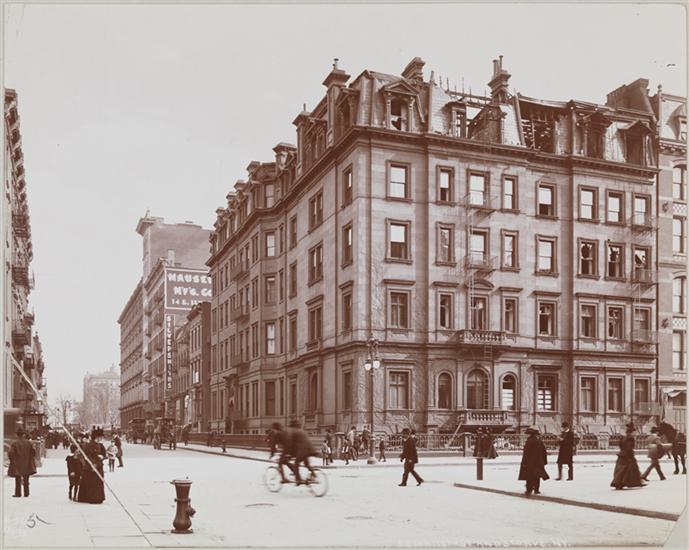
A mansion at the southeast corner of Fifth Avenue and 15th Street. Note that by the date of this photograph (1898), the house has been abandoned and the upper floors are falling in.

MCNY

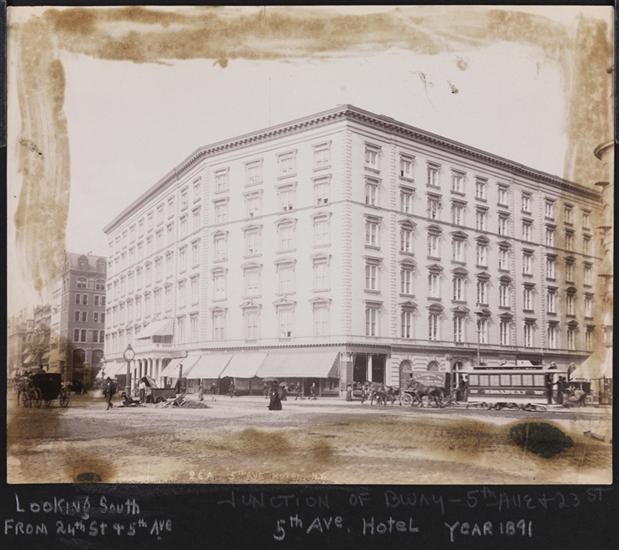
The Fifth Avenue Hotel at 23rd Street and Fifth Avenue, the anchor of the Madison Square area and the spot of great political machinations, especially in the 1870s and 80s.

MCNY

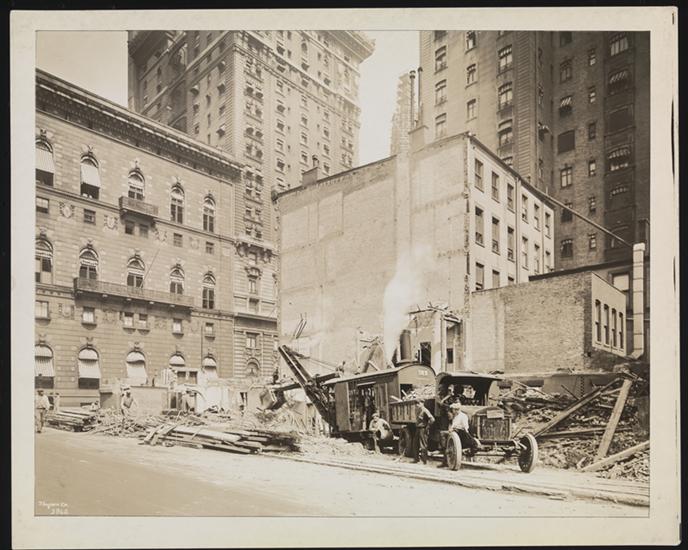
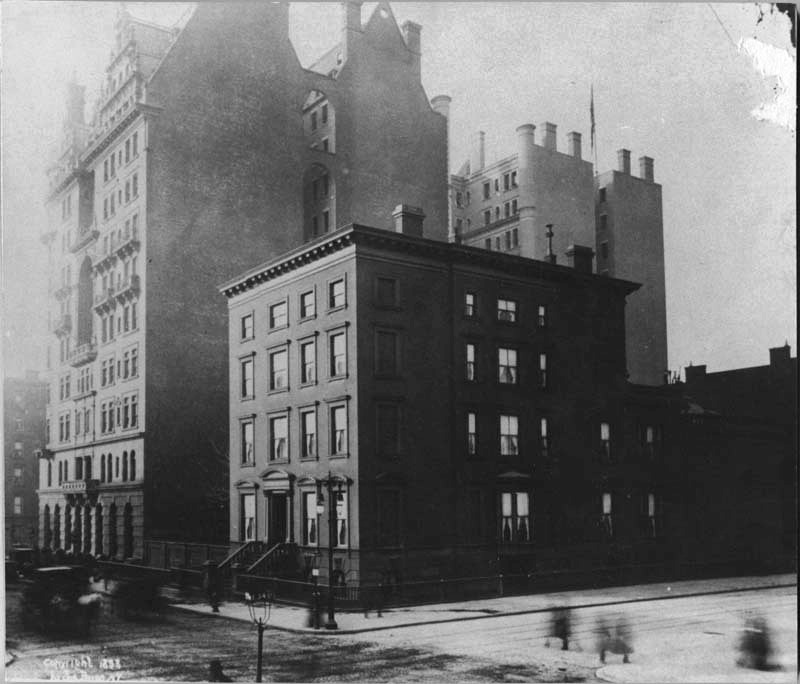
The Waldorf Hotel, rising next to the Astor mansion. Mrs. Astor eventually relented, moving from the house so that it could be demolished and replaced with a companion hotel.

Mina Rees Library, The Graduate Center, CUNY

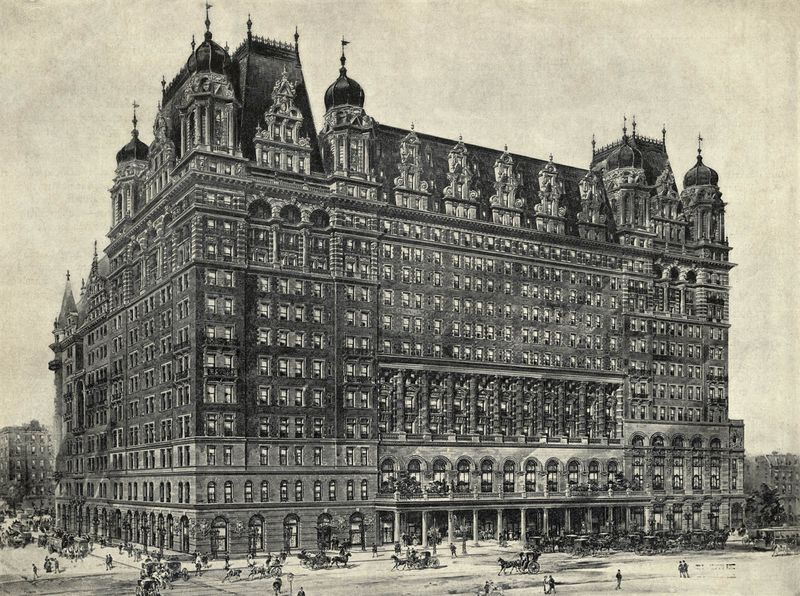
The combined Waldorf-Astoria Hotel would become the center of high-society entertainment in the Gilded Age.

Library of Congress

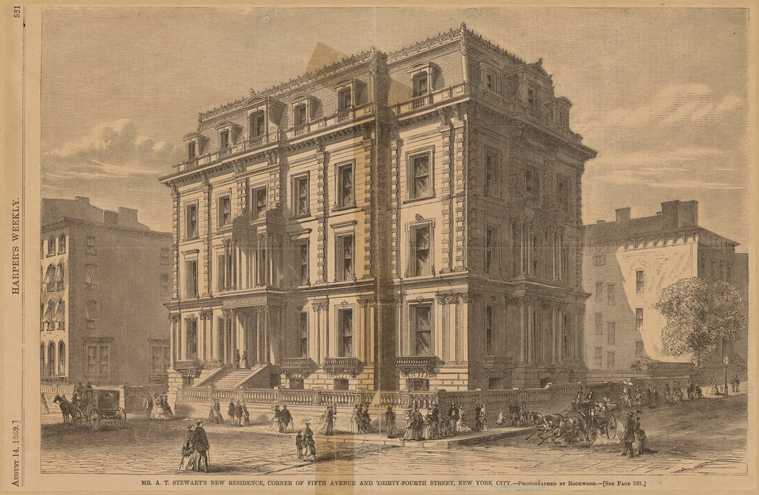
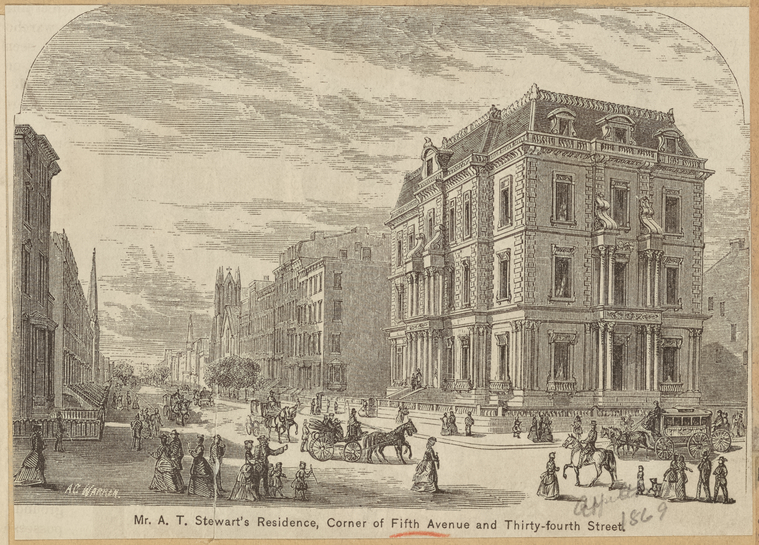
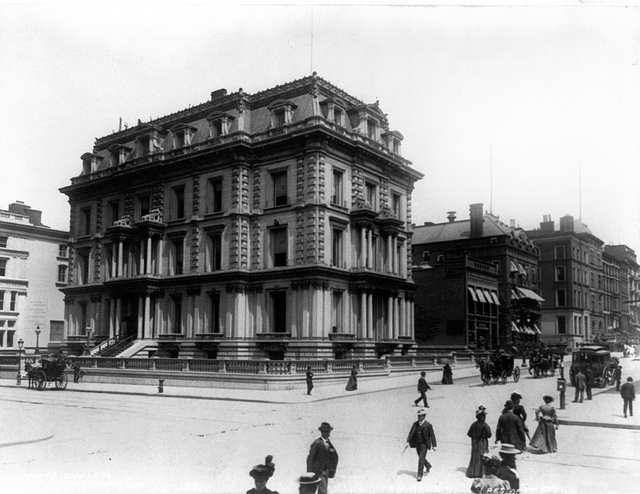
The home of A.T. Stewart — “the glorified shop clerk” — at the corner of Fifth Avenue and 34th Street, across the street from the Astors.

NYPL

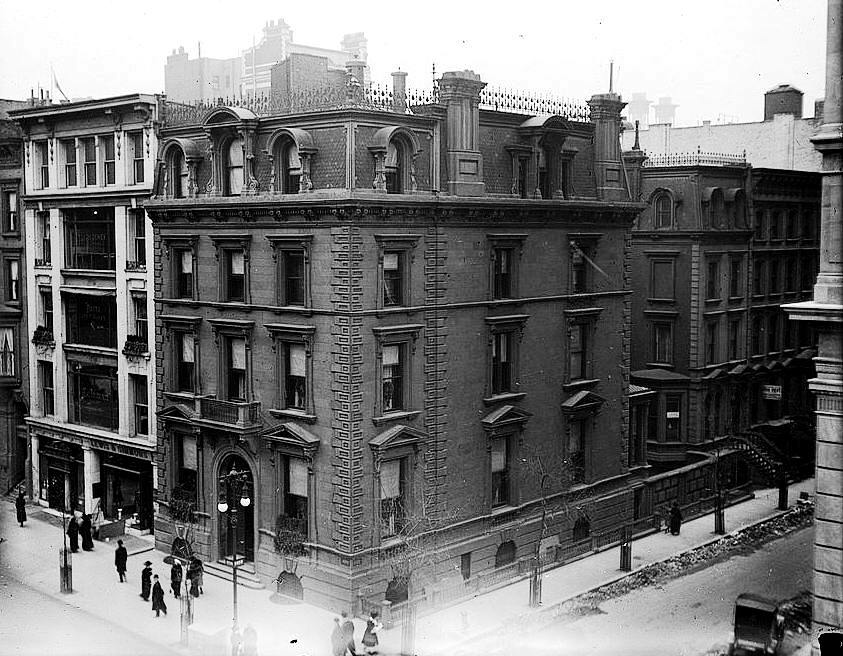
The home of Jay Gould in later years.

Library of Congress

The home of the notorious Madame Restell.

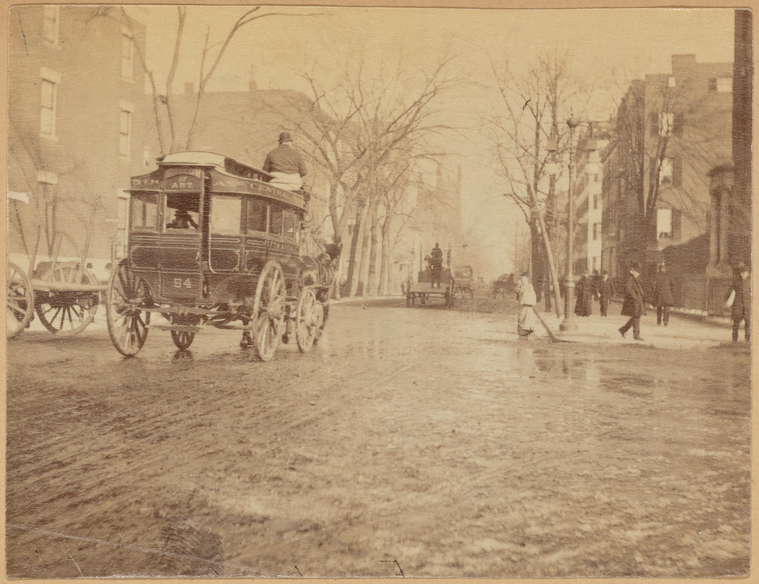
The Fifth Avenue Omnibus, circa 1890, a more elegant alternative to the dirty elevated train which ran just one avenue to the west.

NYPL

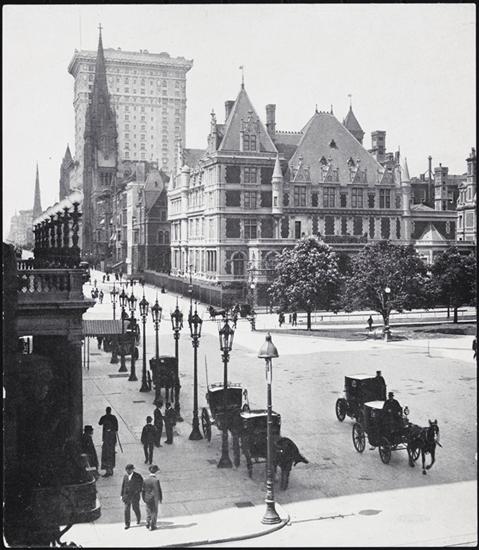
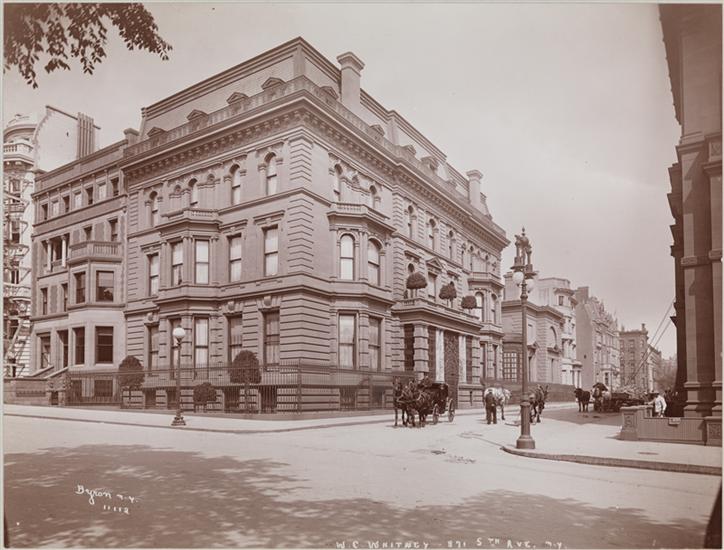
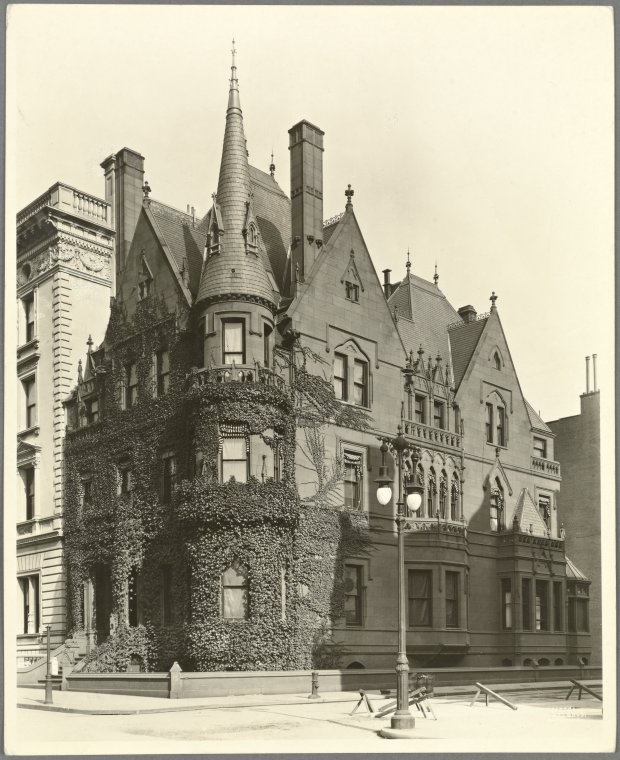
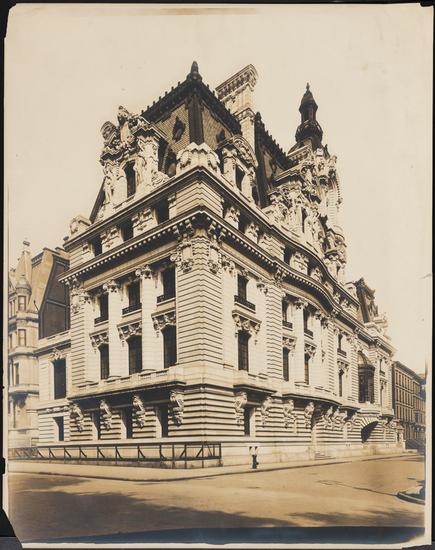
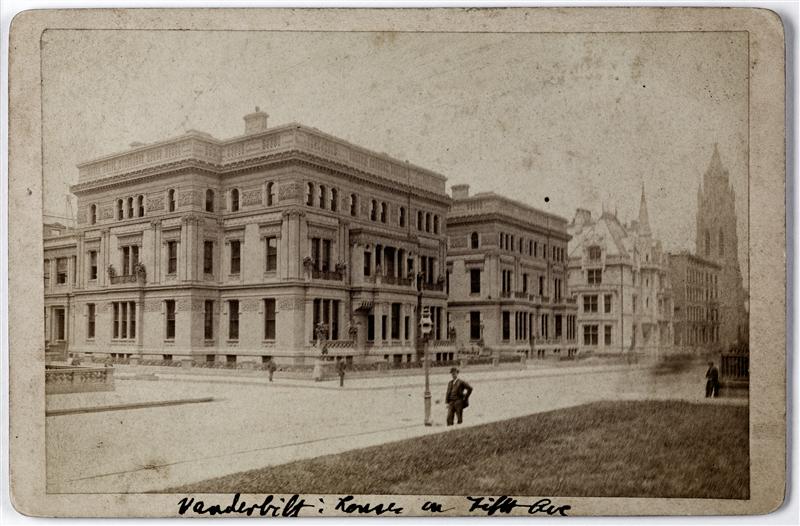
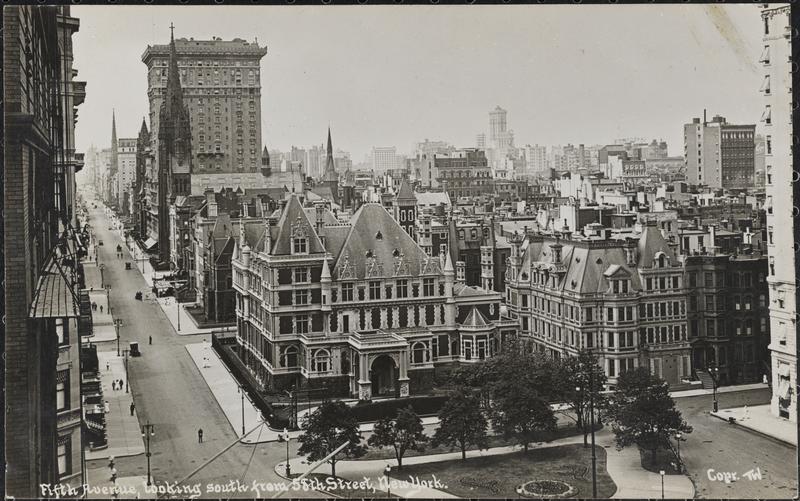
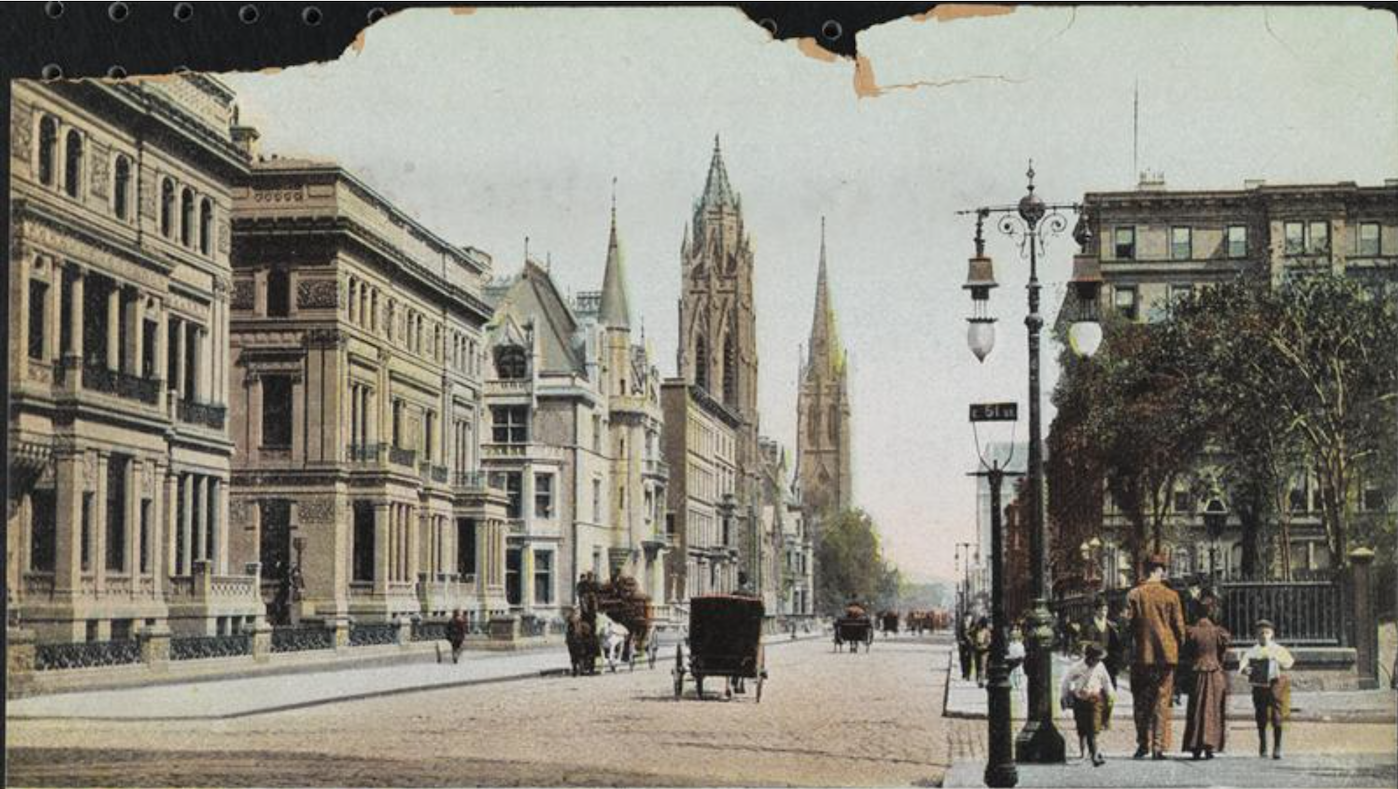
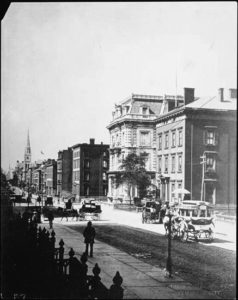
Vanderbilt Row in the 1890s. The family possessed the grandest homes on this stretch of Fifth Avenue from 51st Street to 58th.

NYPL
Vanderbilt University

The mansion known as the Petite Chateau, next door to the Vanderbilt Triple Palace (pictured above)

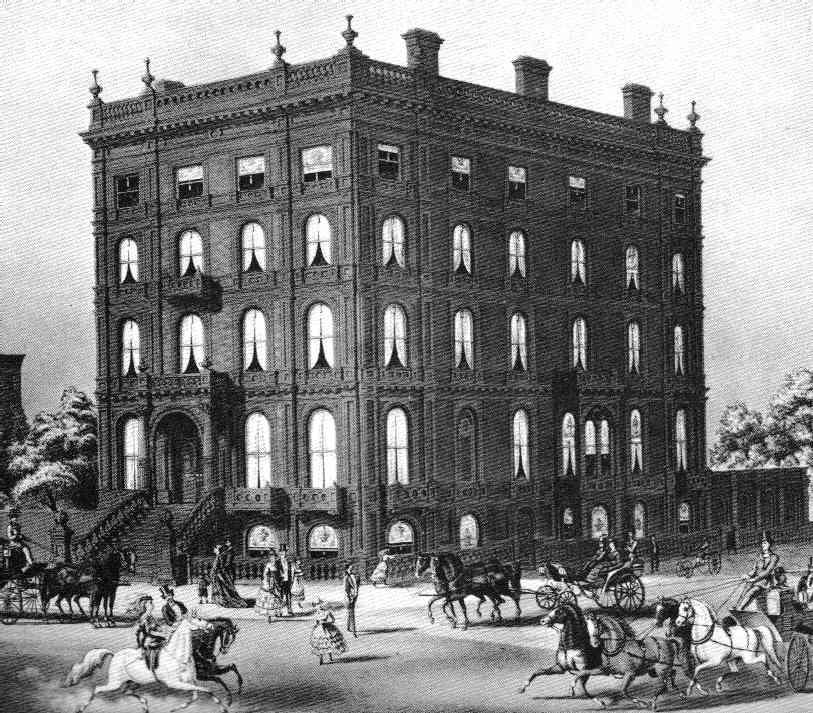
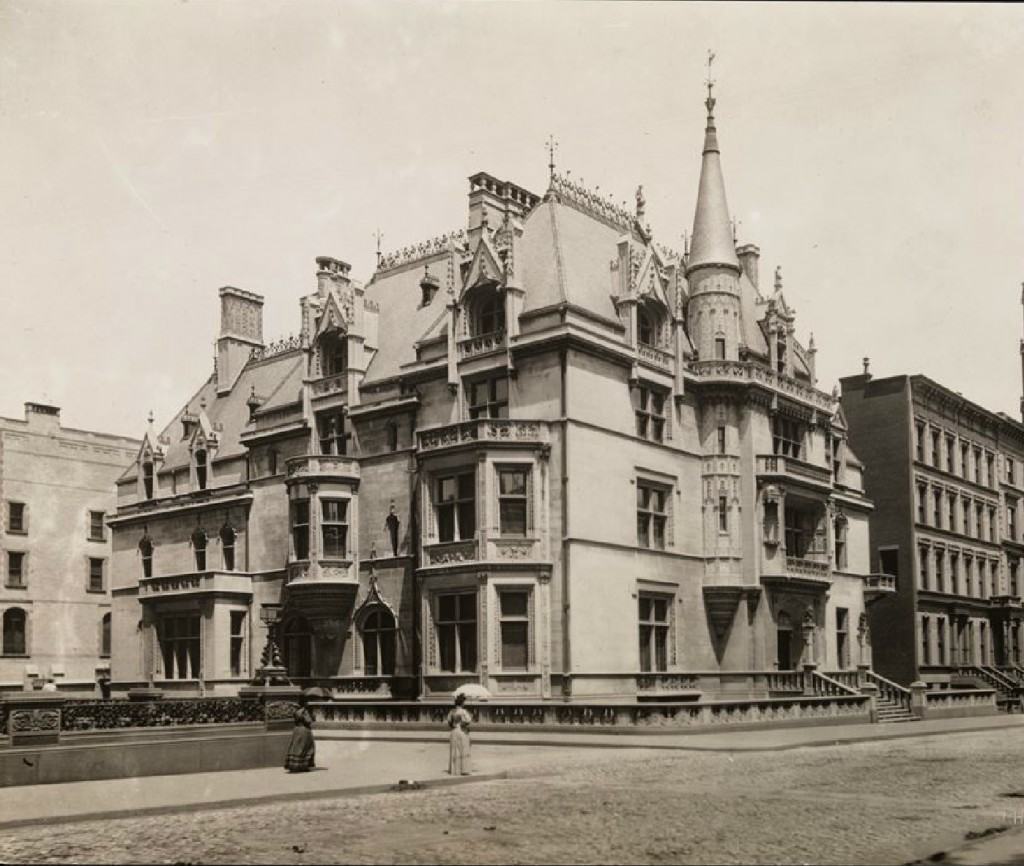
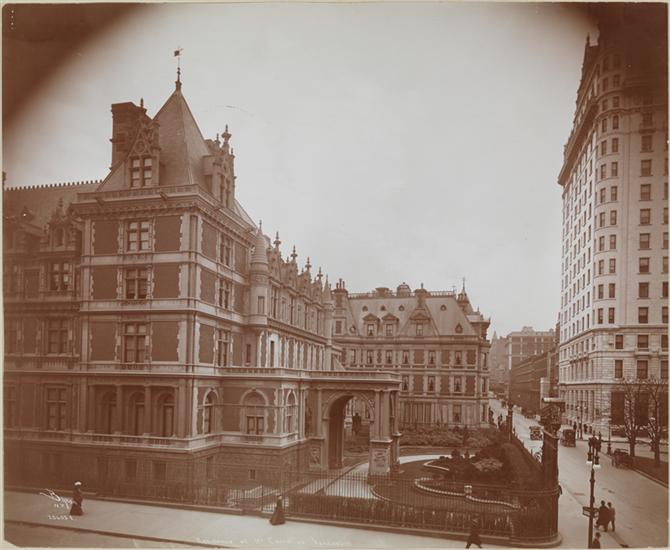
The most insanely lavish of them all — the home of Cornelius Vanderbilt II — at Fifth Avenue between 57th and 58th Streets.

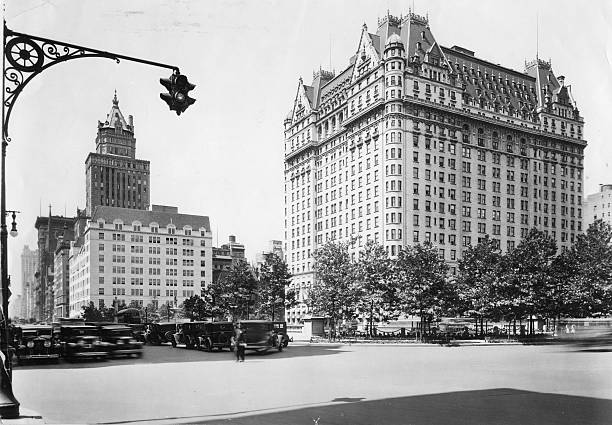
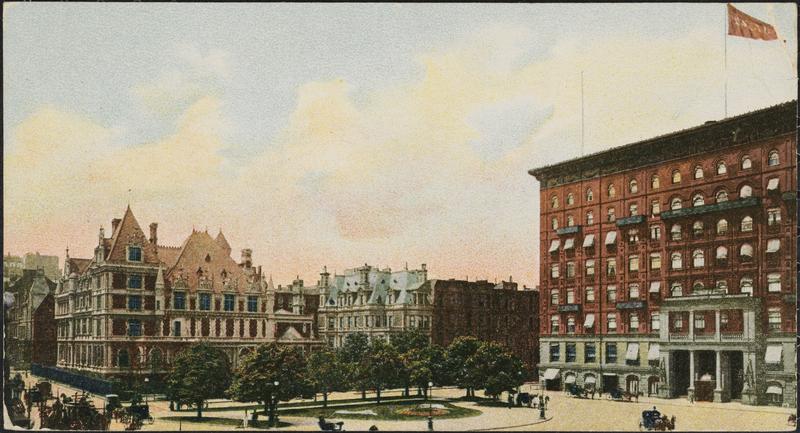
Note in the two images below (from 1901, 1905 and 1906) — both the first and second versions of the Plaza Hotel, in relation to the mansions surrounding it and Grand Army Plaza. All three courtesy Museum of the City of New York

MCNY

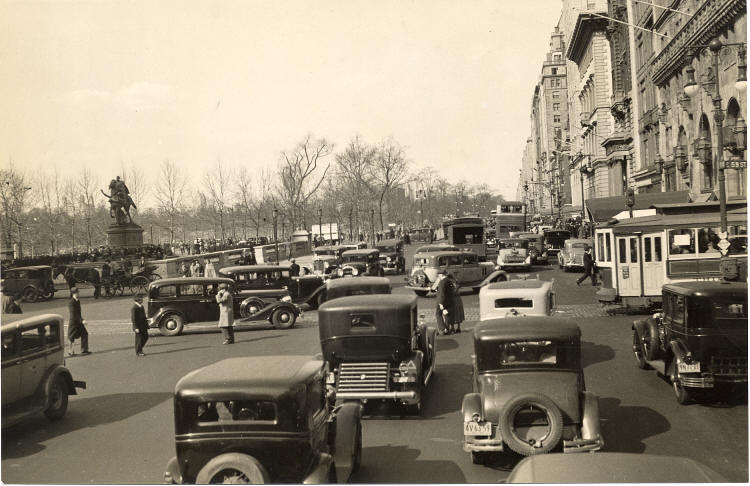
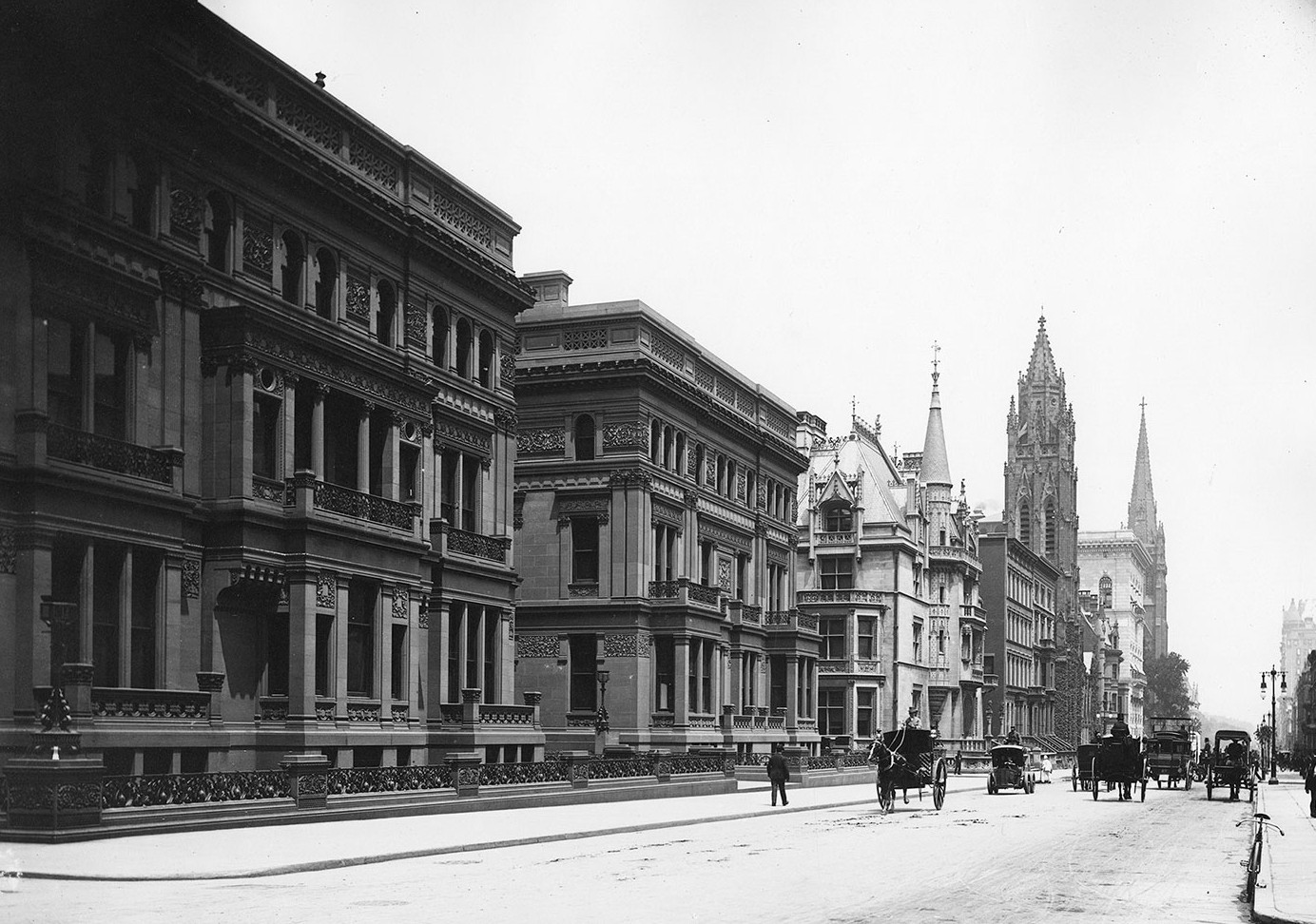
Fifth Avenue as seen in 1906, an avenue in transition by this time.

Categories
Podcasts Preservation

New York In Neon: A History of the City in Lights

PODCAST A neon sign blazing on a rainy New York City street evokes the romance of another era, welcoming or mysterious — depending on how many films noir you’ve watched.

In 2017, a neon sign says more about a business than the message that its letters spell out. It’s an endangered form of craftsmanship although the production of neon is making a hopeful comeback.

In this show Greg briefly take a look at the classic signage in New York City, the kinds of signs you might have seen in New York during the Gilded Age — from a dizzying mass of posters to the first electric signs.

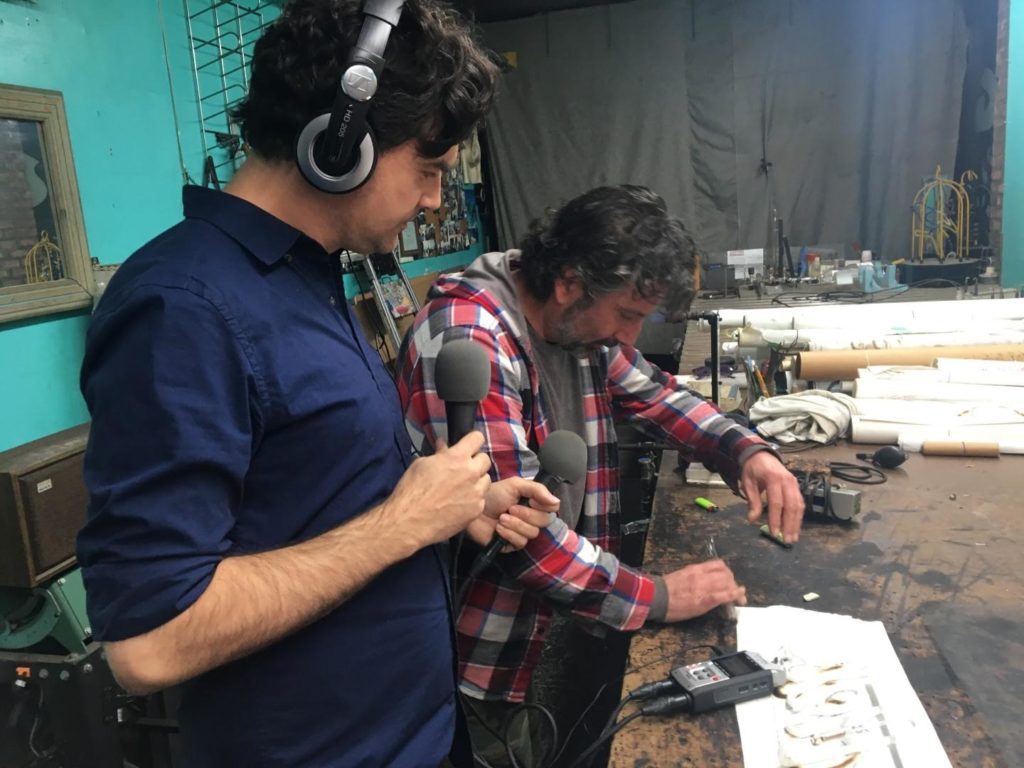
Then he’ll be joined by guest host Thomas Rinaldi, author of the New York Neon book and blog, to figure out what it is about neon that is so essentially New York. And finally because most neon is made by hand, they’ll head out to Ridgewood, Queens, to visit one of New York City’s most acclaimed neon family businesses — Artistic Neon.

Why do so many New York liquor stores have classic neon signs? Why is Fifth Avenue devoid of neon?

From glowing crucifixes in Hell’s Kitchen to the sleaze of ’70s Times Square, from the marquee of Radio City Music Hall to a thousand diners and liquor stores — this is the story of New York in Neon.

PLUS: We come to a consensus on the greatest neon sign in New York City. Do you agree?


The Bowery Boys: New York City History podcast is brought to you …. by you!

We are now producing a new Bowery Boys podcast every week. We’re also looking to improve the show in other ways and expand in other ways as well — through publishing, social media, live events and other forms of media. But we can only do this with your help!

We are now a member of Patreon, a patronage platform where you can support your favorite content creators — for as little as a $1 a month.

Please visit our page on Patreon and watch a short video of us recording the show and talking about our expansion plans. If you’d like to help out, there are five different pledge levels (and with clever names too — Mannahatta, New Amsterdam, Five Points, Gilded Age, Jazz Age and Empire State). Check them out and consider being a sponsor.

We greatly appreciate our listeners and readers and thank you for joining us on this journey so far.


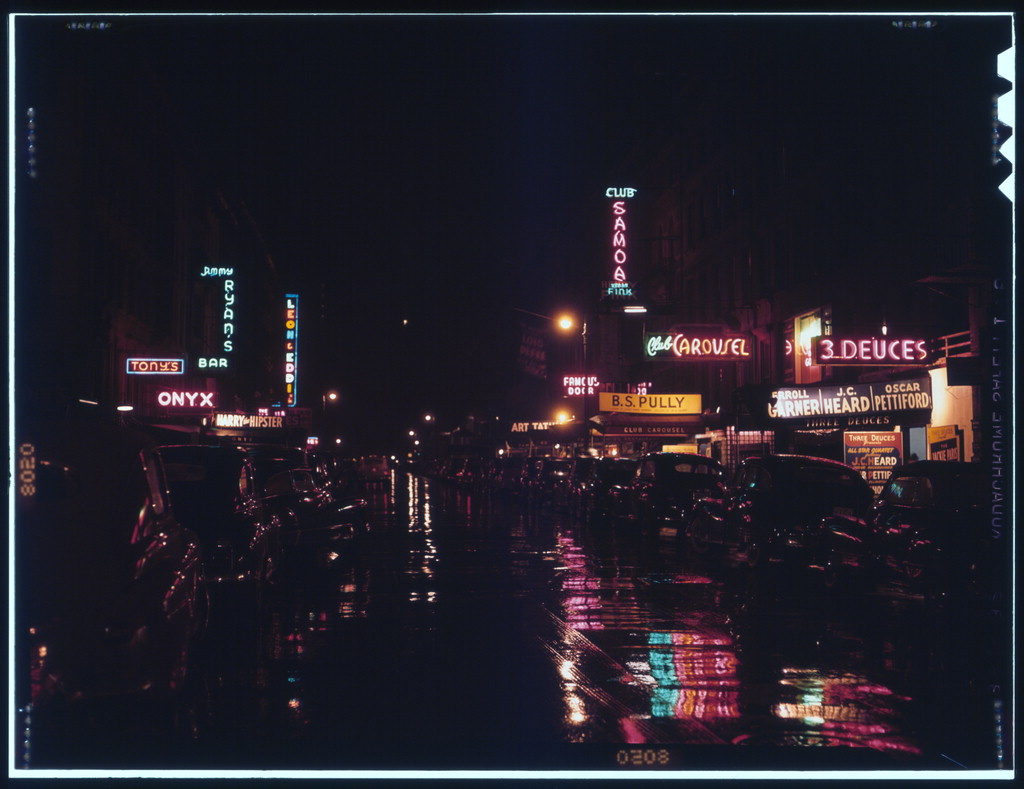
Swing Street, the home of New York jazz in the 1940s, photographed here in July 1948 by William Gottlieb

Library of Congress

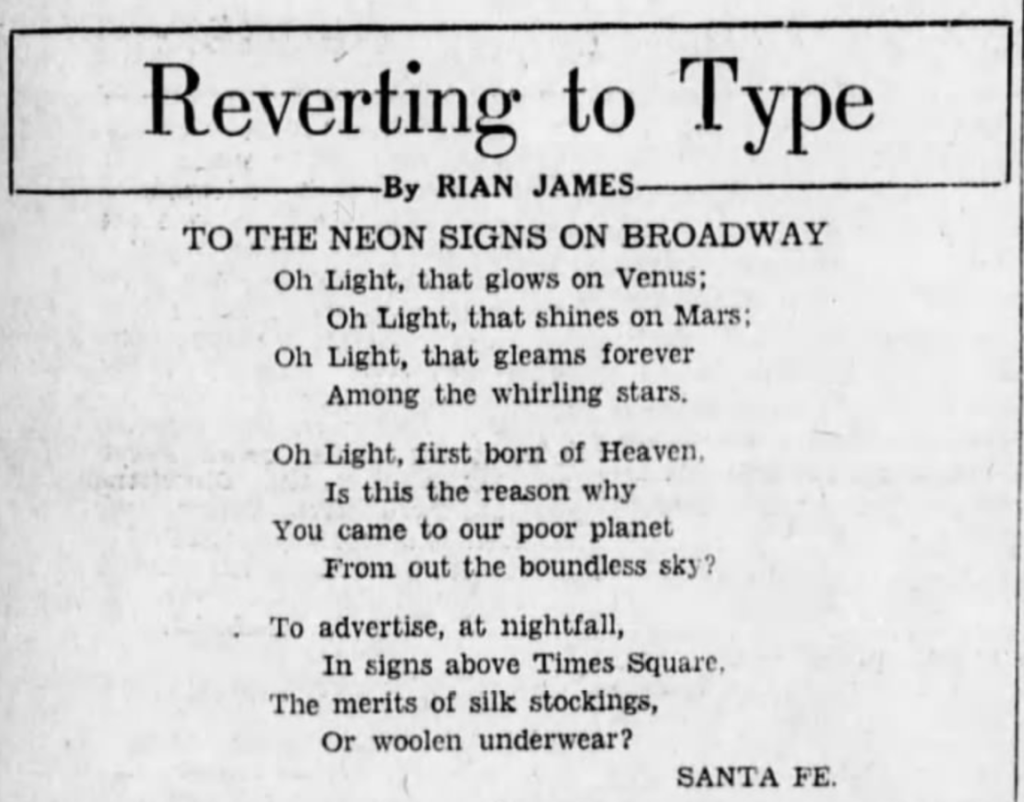
From the Brooklyn Daily Eagle, January 28, 1930 — an ode to neon:

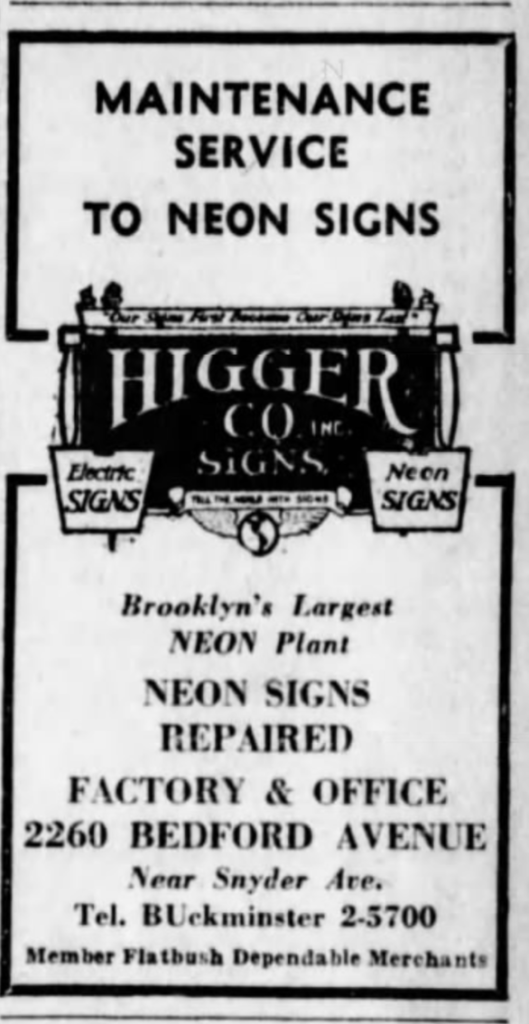
A 1932 advertisement for a Brooklyn neon shop:

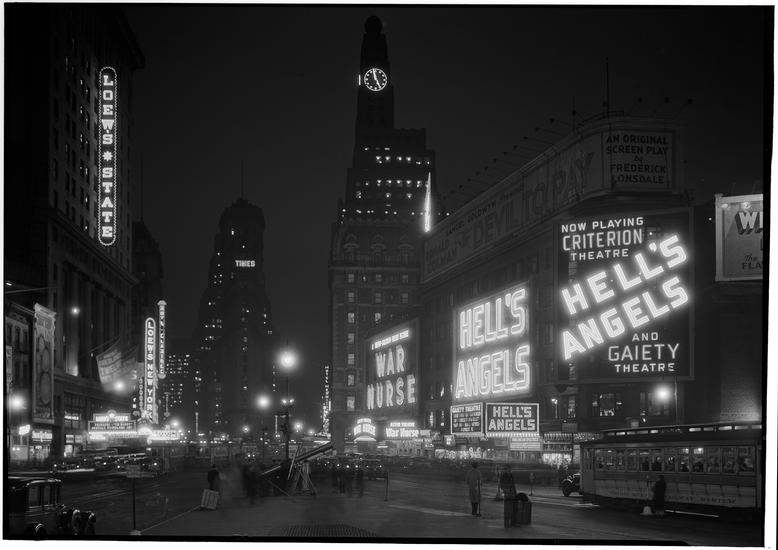
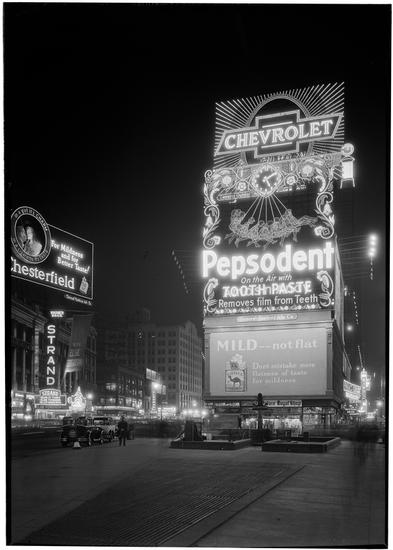
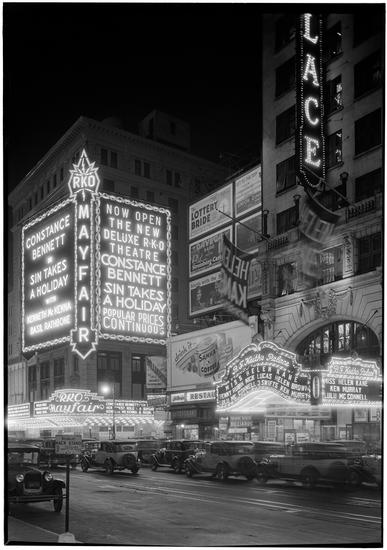
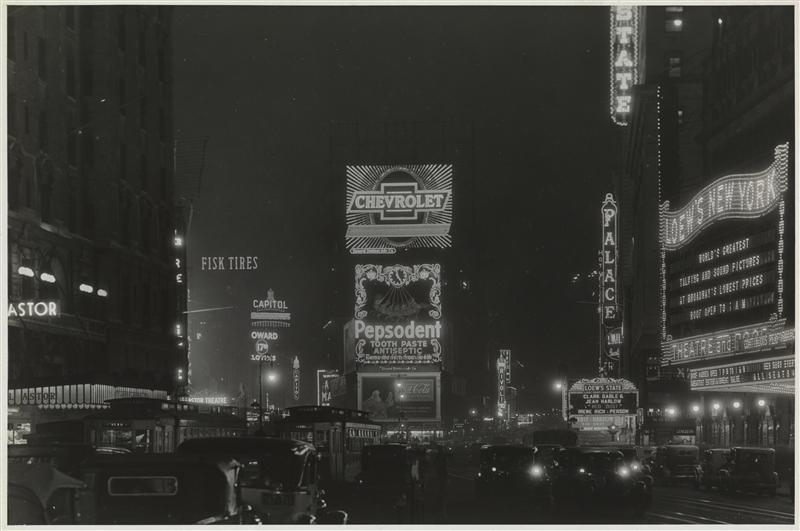
The neon heyday — the 1930s. Images of Times Square  in 1930 from Samuel Gottscho, courtesy the Museum of the City of New York


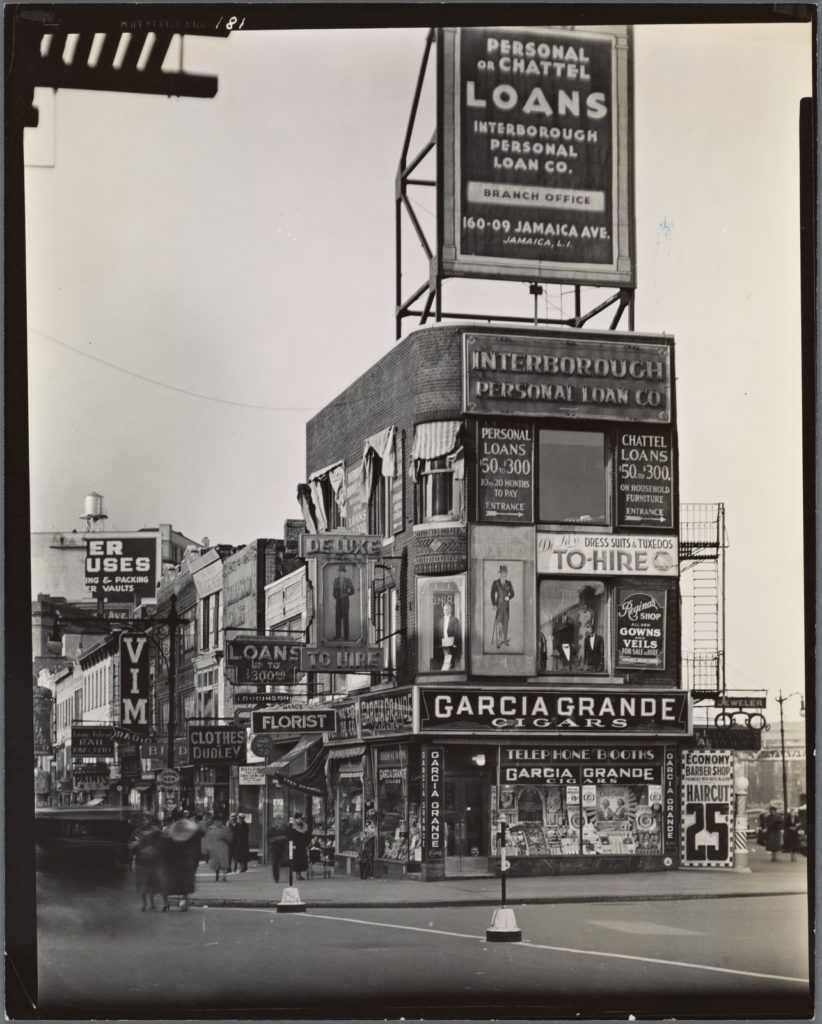
Brooklyn neon 1936 — recognize this corner (photographed by Berenice Abbott)? It’s near the Brooklyn Academy of Music.

NYPL

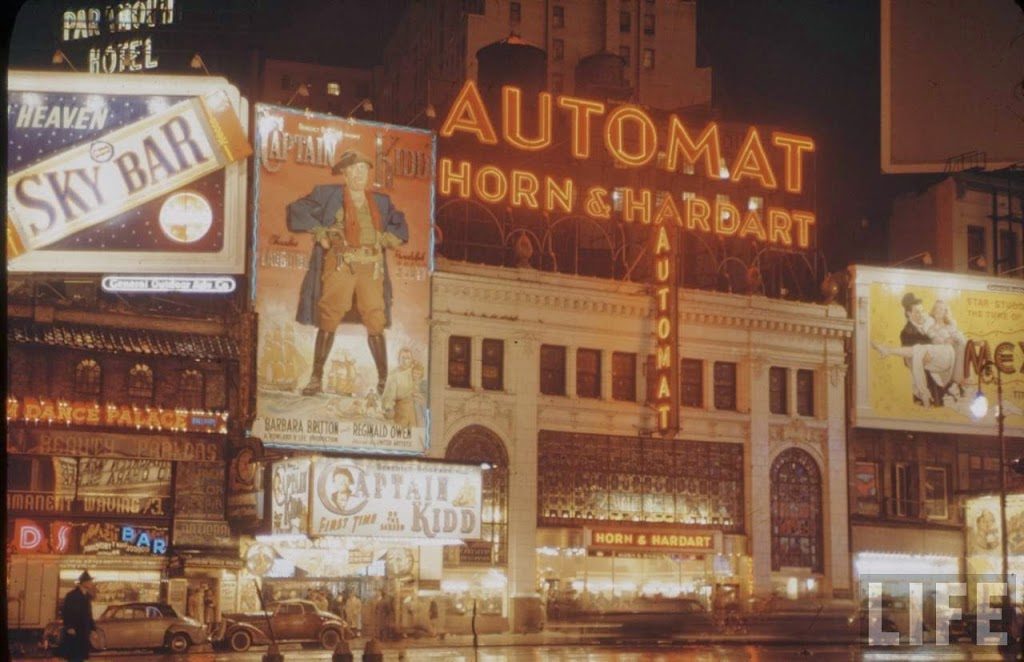
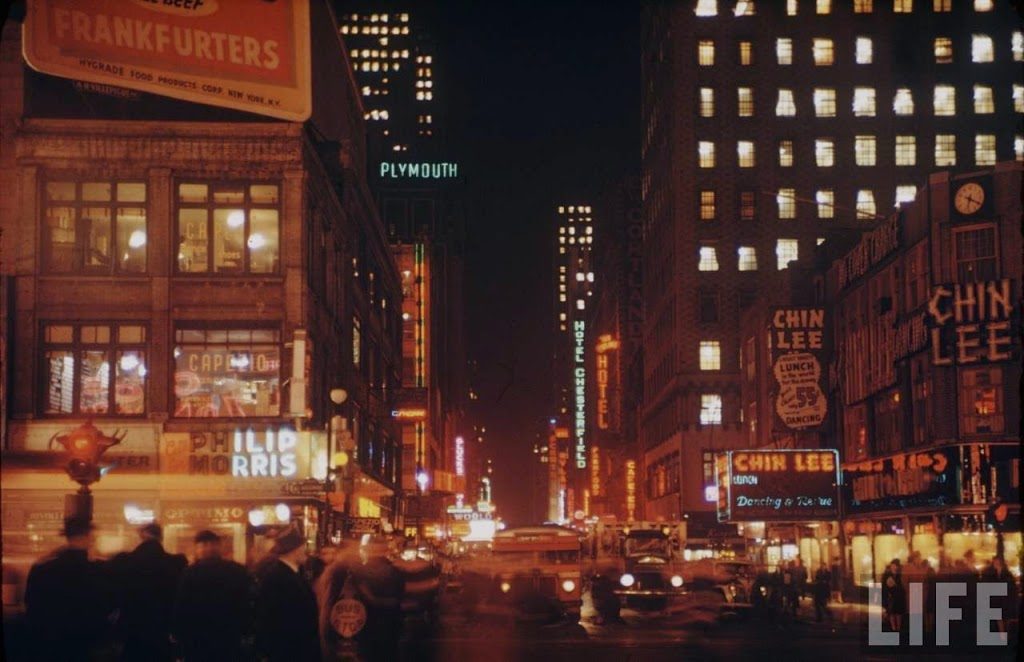
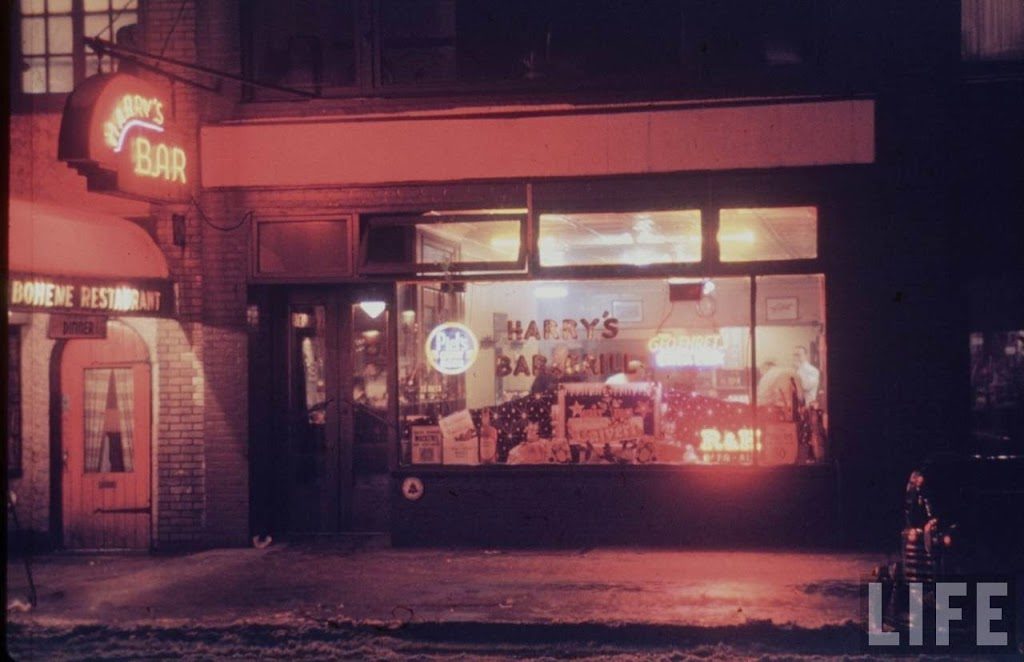
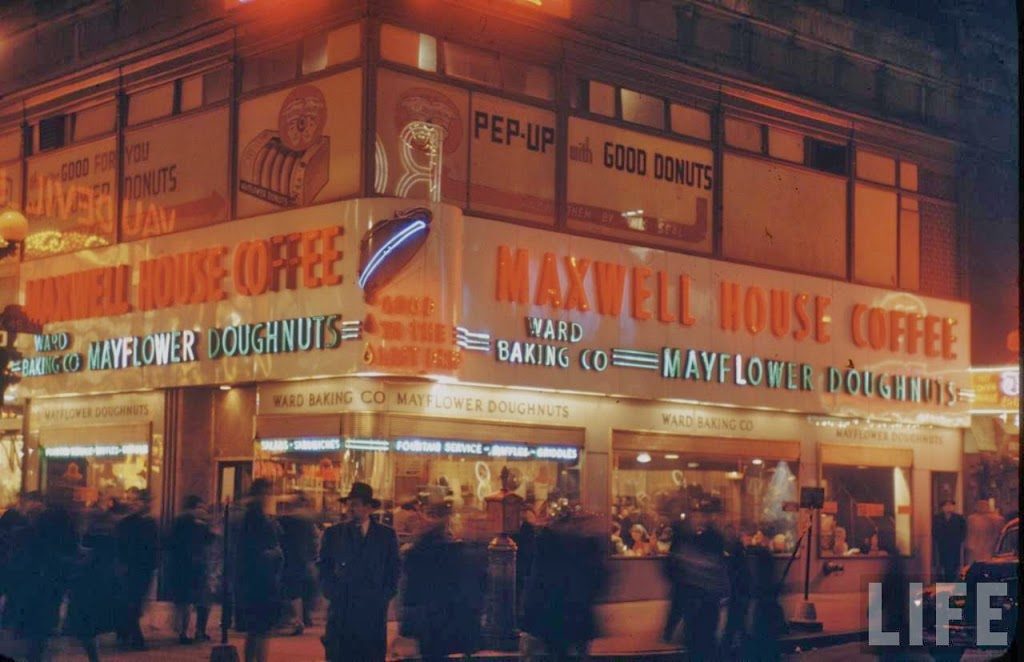
New York City in 1946, via the photography of Andreas Meininger (Life Magazine)

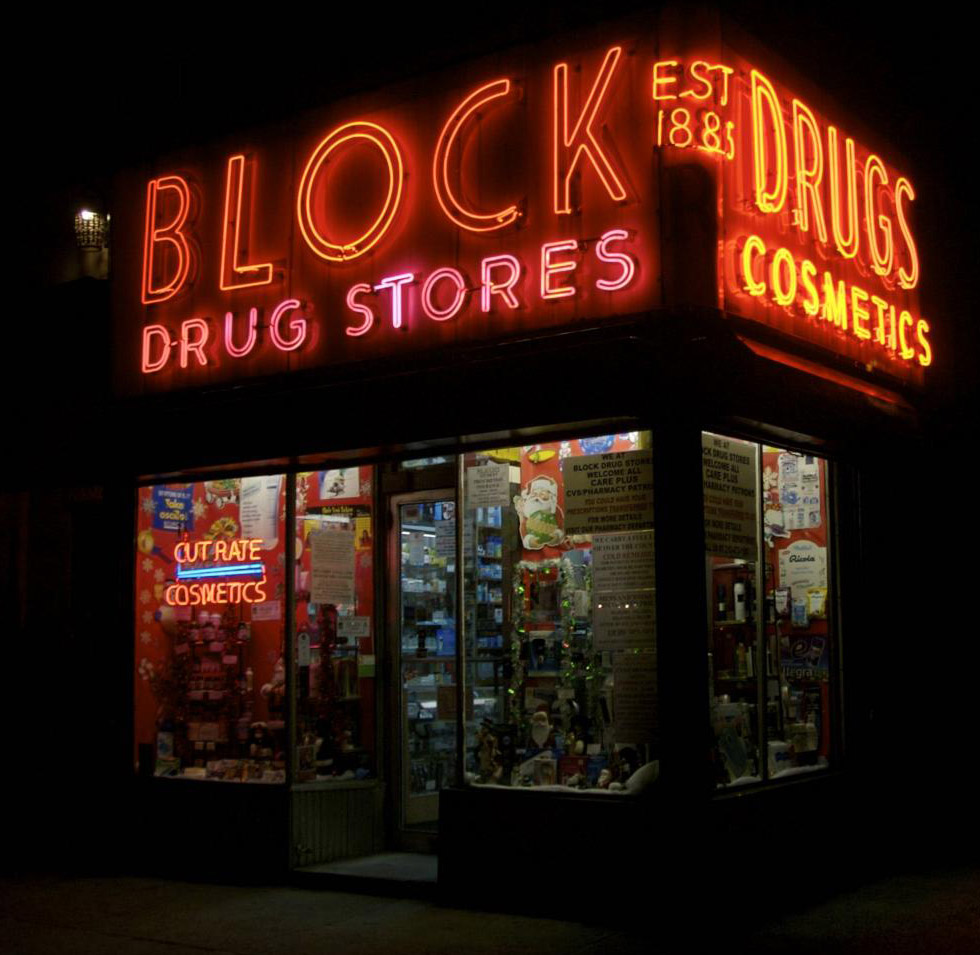
A treasure in the East Village — Block Drug Stores:

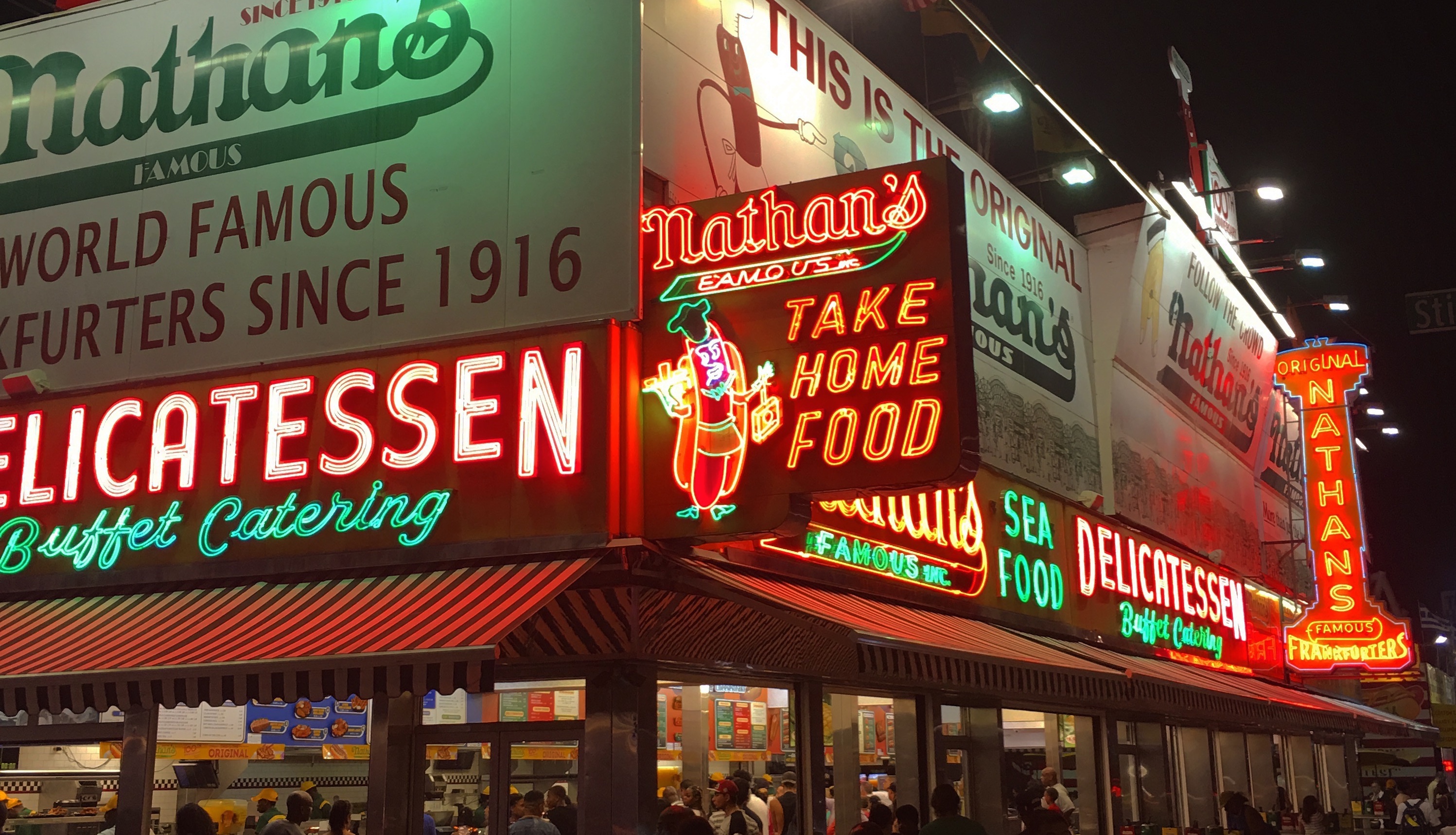
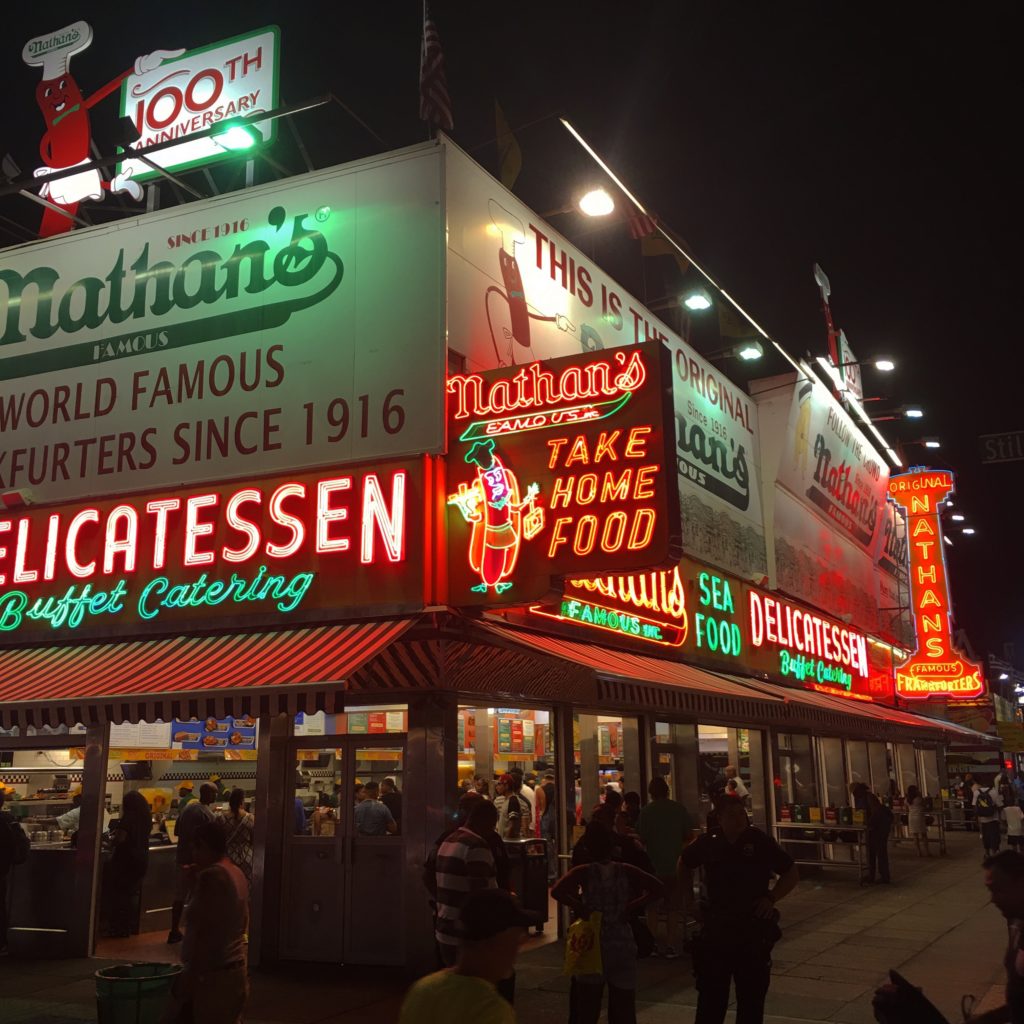
Nathan’s Most Famous …. neon signs! In the show, Thomas Rinaldi shares the incredible secret to the sign’s unusual script.


Inside Artistic Neon with Robbie Ingui:

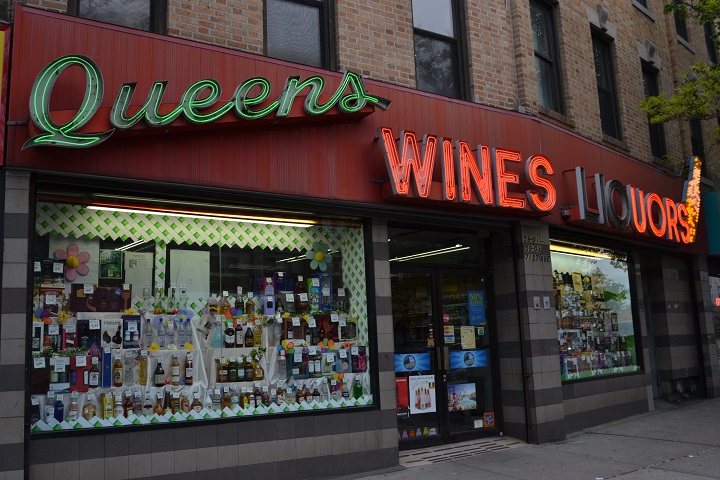
Queens Wine and Liquor in Ridgewood, Queens — the old sign and the letters which were in Robbie’s workshop!


My thanks to Artistic Neon, Brooklyn Glass (for the show’s inspiration) and Thomas Rinaldi. His book New York Neon is currently in stores. And thanks to everyone who called into our toll-free number, leaving your vote for best New York neon sign!

Categories
Planes Trains and Automobiles

Welcome to the ‘subway art museum’: The early battle against ‘disfiguring’ advertisements in the subway

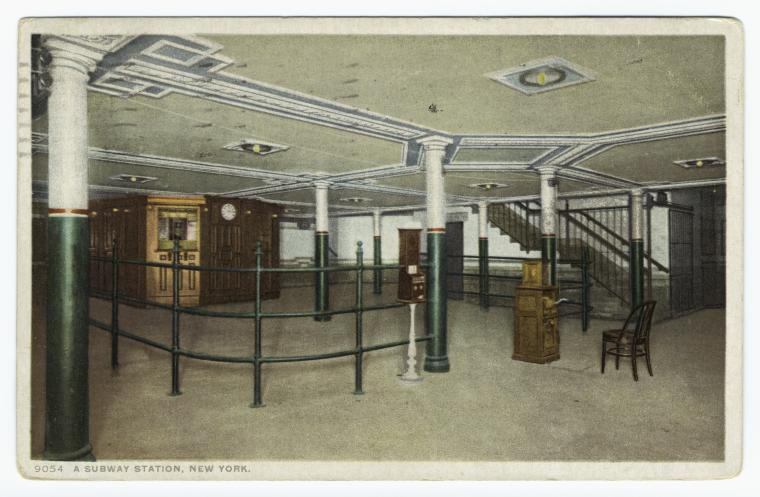
Above: Protect this station from the rueful blight of subway advertisements! (Pic NYPL)

There once was a time, believe it or not, when the city was so concerned for the aesthetic beauty of the subway that an early controversy broke regarding the scandalous inclusion of advertisements in subway stations.
The stations designed for those very first subway rides in 1904 were dictated by the guidelines of the City Beautiful movement, an early-century attempt by American cities to best the beauties of Europe and promote civility through architecture and urban design. Overseeing the process then was the Municipal Art Society, formed just ten years prior by Richard Morris Hunt and bolstered by rich patrons and grateful city involvement. (In fact, one of the Society’s first jobs was covering the ceiling of City Hall with an ornate mural.)

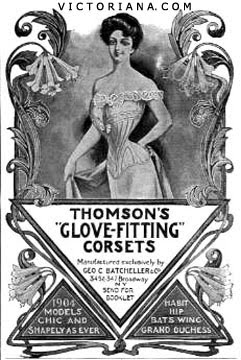
Keeping the subway so very ‘city beautiful’ was crucial to their plans, as the original route ran the length of Manhattan and would unify those tasteful civic ideals. So imagine the absolute mortification one day when a dignified Society member stepped down into a subway station to see a colorful advertisement for a corset.(Such as the 1904 advertisement above.)

Within days the opening of the first subway on October 27, 1904, private companies began descending into stations, hanging advertisements in crude frames upon the tile, in many cases damaging the freshly made walls. As standard paper materials and cheap tin framers were used, the ads quickly deteriorated, creating a drab and unappealing mess. “New York’s $35,000,000 subway, instead of looking like the immaculate place for which the city spent its money, is beginning to look like a billboard in need of the billposters,” claimed the New York Sun.

According to the Nov. 11, 1904, edition of the Tribune, a “peculiar clause” in the original IRT contract allowed for the company to allow “unobjectionable advertising” on the walls.

However, to the Municipal Art Society, no advertising was unobjectionable, and they threatened to sue the IRT.  The governing body in the middle, the Rapid Transit Commission, was at first non-committal. They were urged to visit the ‘model’ subway station at 18th Street. (That station, on the 6 line today, is no longer in service.)

But the organization eventually relented on Nov. 22 by greatly limiting — but not entirely restricting — advertisements.  William Barclay Parsons, the subway’s chief engineer, was even on hand to present the kind of advertising that would be permissible, displayed in an expensive frame “of copper, handsome and heavily finished. The back was of zinc.” In other words, a model way that would prove too expensive to mass produce. Also thrown out: slot machines and flower stands.

Public sentiment leaned towards approval of the commission’s decision. “It is pretty well established that the advertising signs in the Subway are condemned, and very properly condemned, by public opinion,” claimed a Times editorial.

But the IRT believed it was in its rights to open the stations to paying advertisers. The night of the transit commission’s decision, in fact, an odd sort of rebellion occurred: subway stations were swarmed with workers “sent out to affix permanently to the station walls as many of the advertising placards as they could before they were stopped by injunction,” along the way drilling holes into the tile walls, causing hundreds of dollars worth of damage. Curiously, no police action was taken, and most IRT employees looked the other way.

This sent the aesthetes of the Municipal Art Society into a swoon! They petitioned the mayor to charge the IRT with damages — the subway was, after all, city property, although the IRT was franchised to operate it.

It would of course be a losing battle. A meeting of the Architectural League of New York the following month merely concluded that subway stations had been designed improperly and without the option for proper, tasteful advertisement.  In the city’s glee to create a purely immaculate environment, they neglected to take into account the inevitability of public consumption and private corporate power.

With City Beautiful proponents realizing they had little legal standing, the IRT eventually won the battle to allow advertisements, and further, to authorize small independent businesses, “flower stands, slot machines, and the like” to return to the stations.
I do find it amusing that people in 1904 sarcastically referred to the framed advertisements as ‘art’ and the IRT as ‘curators of the subway art museum’. To highlight I reproduce for you a truly snarky editorial that was run in the November 5, 1904 issue of the Evening World:

Alas! How can we ever hope to become a community of culture and refinement when art is thus strangled at its birth? The poster advertisers were rapidly uplifting us from vandalism to aestheticism. They were educating our sense of form and color, till we could thrill with the subtle beauties of a carmine corset upon a purple background, could palpitate with joy at the chiaroscuro of an ultramarine whiskey bottle against a gamboge sunset, could almost faint with ecstasy at the composition of lilac lingerie amid a sea-green cloud effect.

“Are beautiful works of art like this never to cast their lambent lustre from Subway walls?

“Alas! It seems as though in our Subway we shall have to lose the new and higher art which finds expression in corsets and whiskeys and patent medicines and content ourselves with crude white tiles and simple frescoes.

It will be a sad blow to lovers of subterranean picturesqueness.

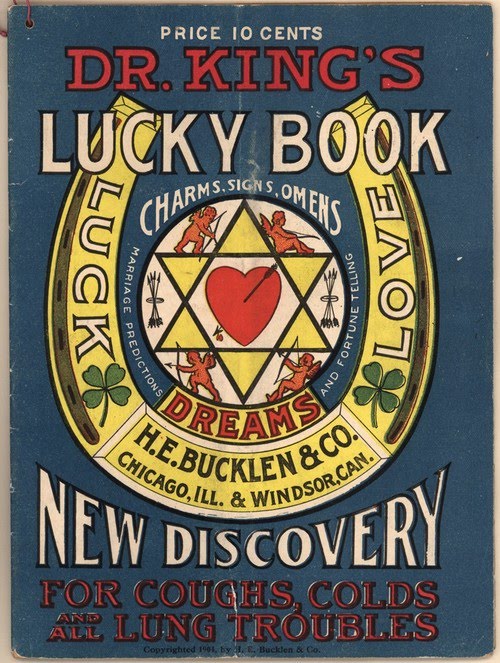
Corset ad from Victoriana. Dr Kings from LOC. Target train from NYC The Blog.

An earlier version of this article was published here in 2010.

Categories
Amusements and Thrills Podcasts

New York and the Dawn of Photography: Mathew Brady, Samuel Morse and the Daguerreotype Craze

PODCAST The saga of the early days of photographic images and how daguerreotypes became all the rage in 1840s New York.

We’re taking you back to a world that seems especially foreign today – a world with no selfie sticks, no tens of billions of photographs taken every day from digital screens, a world where the photograph was a rare, special and beautiful thing.

New York City plays a very interesting role in the development of photography. While the medium was not invented here, many of its earliest American practitioners were trained here. In particular, the students of Samuel Morse (better known for his invention of the telegraph) became masters of the daguerreotype portrait in the early 1840s.

The first space photography was taken from the rooftop of New York University. Broadway was known across the country for its dozens of daguerreotypists and their lavishly appointed galleries.

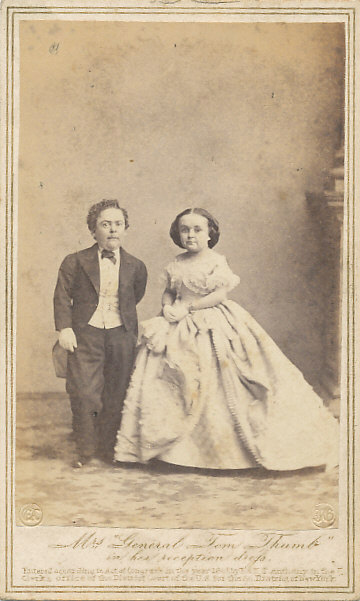
But the greatest of them all was Mathew Brady who, from his famous Broadway studio, focused on capturing the images of the world’s most famous people — from Abraham Lincoln to Barnum favorite Tom Thumb. You may know Brady from his Civil War photography, bringing a dose of realism into the parlors of sheltered New Yorkers. One particular gallery show in 1862 called The Dead of Antietam would shake the city and set the stage for the invention of photojournalism.


The Bowery Boys: New York City History podcast is brought to you …. by you!

We are now producing a new Bowery Boys podcast every week. We’re also looking to improve the show in other ways and expand in other ways as well — through publishing, social media, live events and other forms of media. But we can only do this with your help!

We are now a member of Patreon, a patronage platform where you can support your favorite content creators for as little as a $1 a month.

Please visit our page on Patreon and watch a short video of us recording the show and talking about our expansion plans. If you’d like to help out, there are five different pledge levels (and with clever names too — Mannahatta, New Amsterdam, Five Points, Gilded Age, Jazz Age and Empire State). Check them out and consider being a sponsor.
We greatly appreciate our listeners and readers and thank you for joining us on this journey so far.


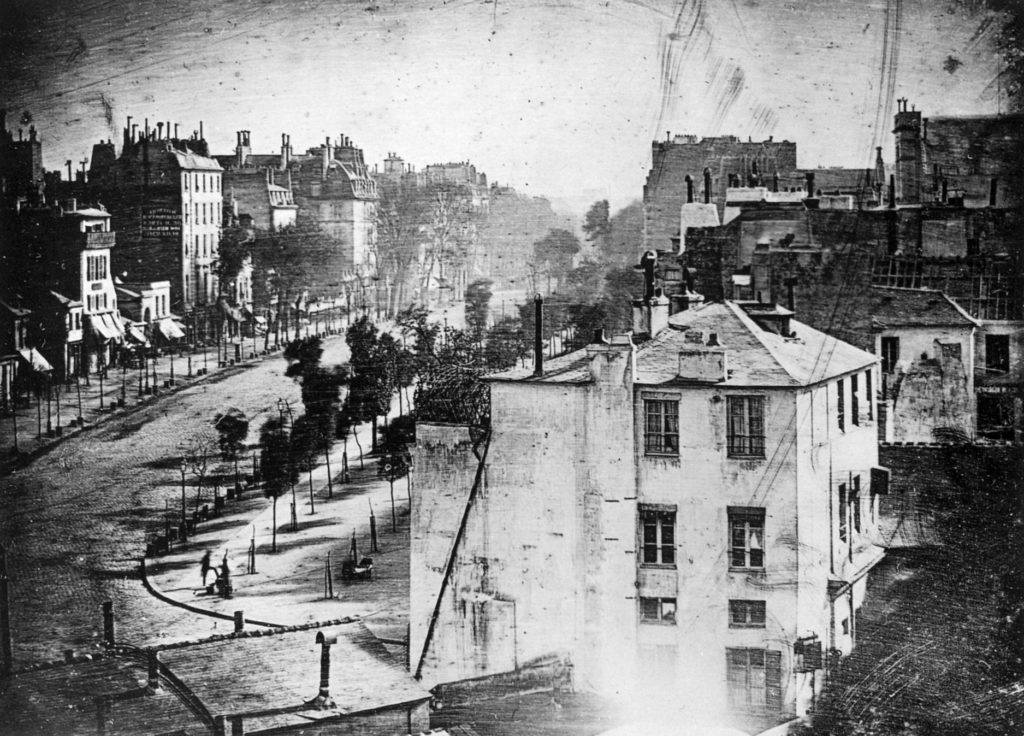
Louis Daguerre’s 1838 picture of Paris’ Boulevard du Temple. On top of being one of the very first images of a city ever taken, it also contains the first image of a human being (the man getting his shoes shined in the bottom left corner).

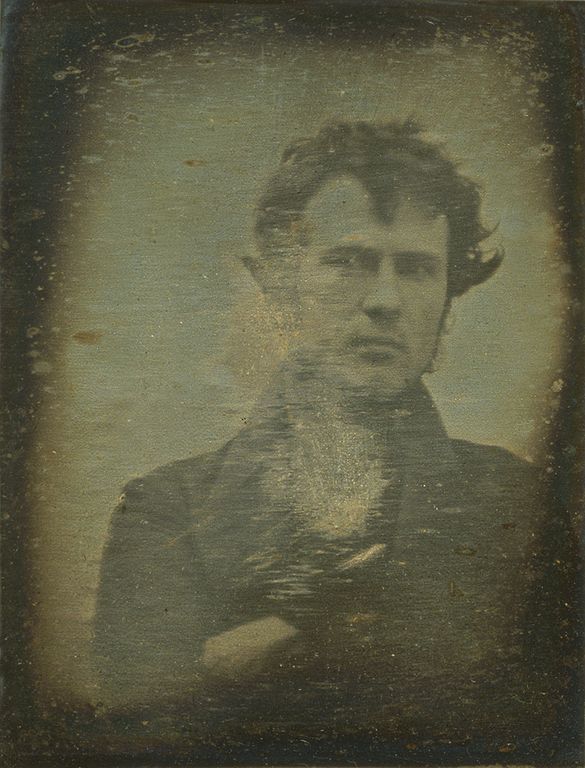
Robert Cornelius’ 1839 images of himself, taken in Philadelphia, is not only the oldest known portrait of a human being, but it’s also the first self-portrait.

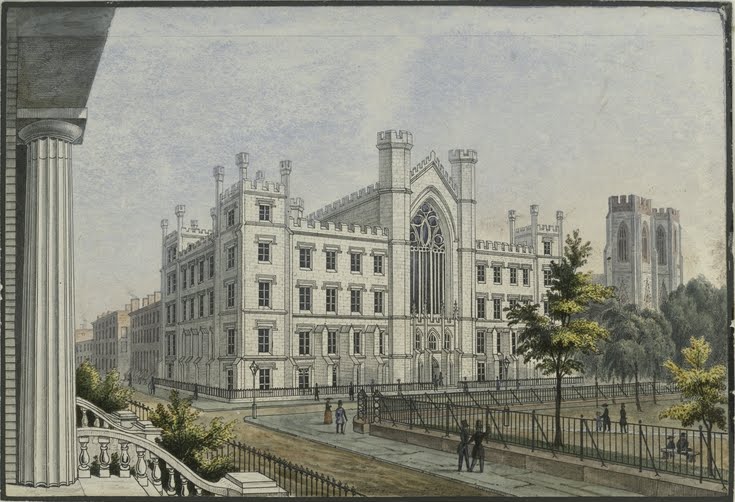
The rooftop of the Old University Building, on the northeast corner of Washington Square Park, was the site of the first photographic studio, maintained by Samuel Morse, John Draper and other budding innovators at the University of the City of New York.

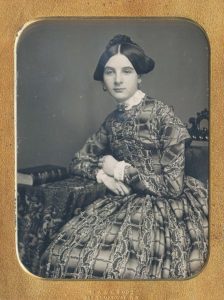
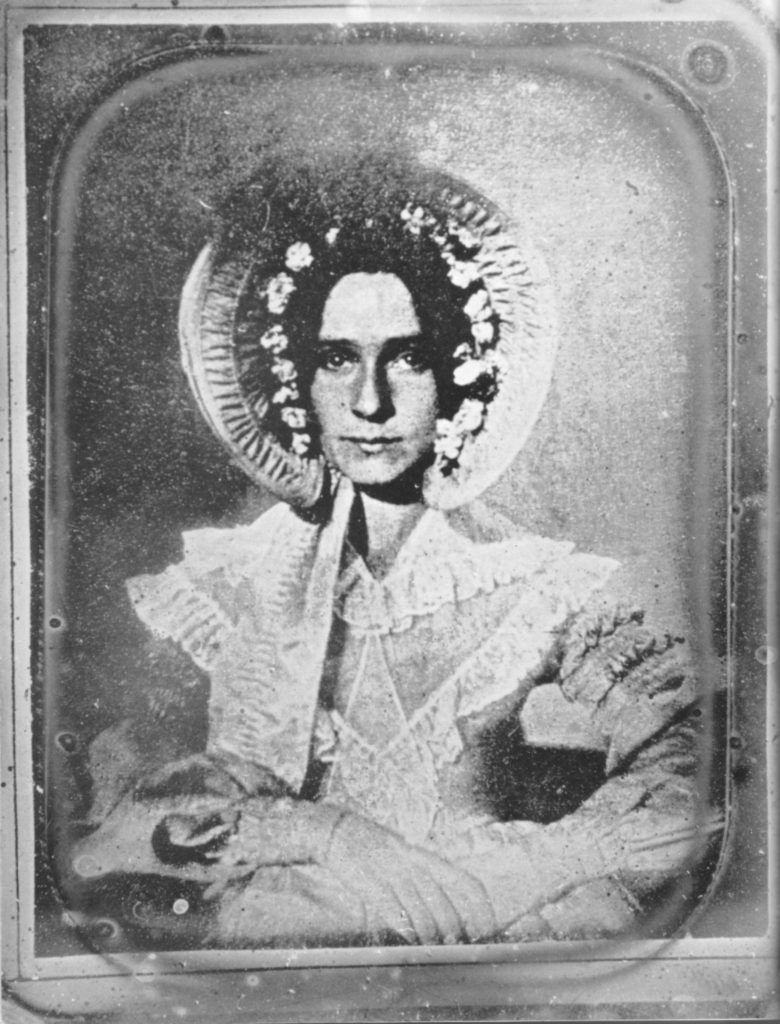
The first portrait of a woman (Dorothy Catherine Draper) taken by her brother John Draper from the rooftop of the University Building.

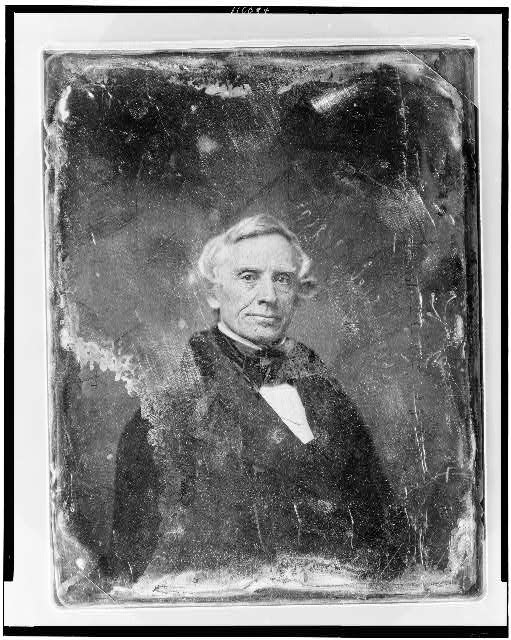
Samuel F.B. Morse, in a daguerrotype made by Matthew Brady

Library of Congress

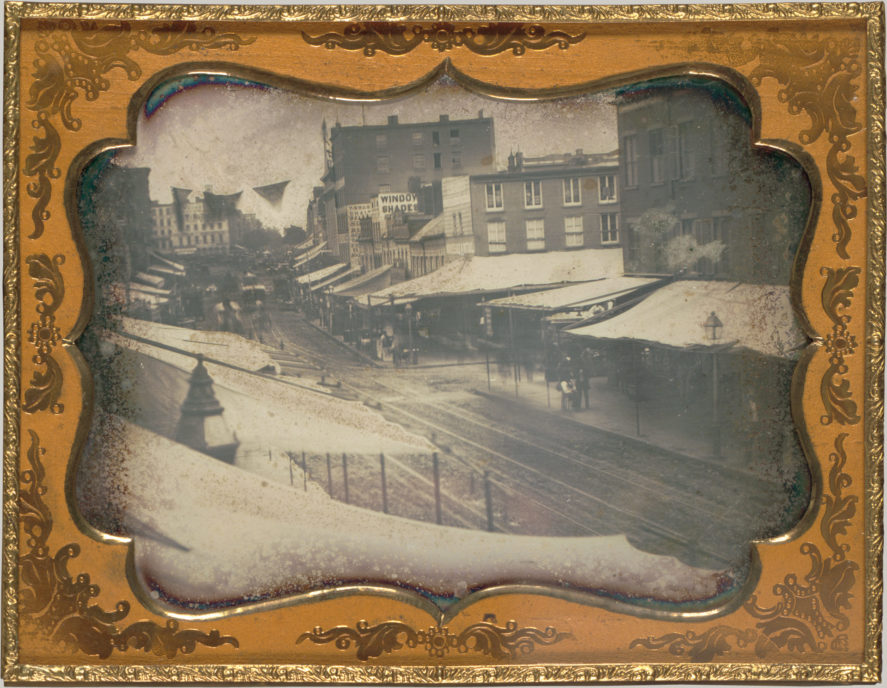
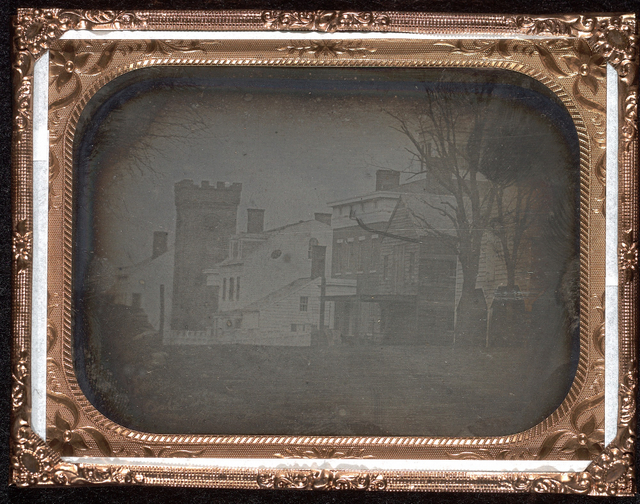
Morse and Draper took this image of a Unitarian Church on Broadway at Waverly Place in late 1839 or very early 1840, making it the oldest existing photographic image of the city in existence.

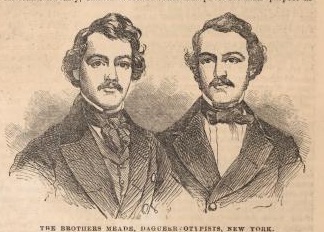
The Meade Brothers, two famed portraitists of the Broadway scene in the 1840s. Most likely this image (taken from a publication) was made from an actual daguerrotype.
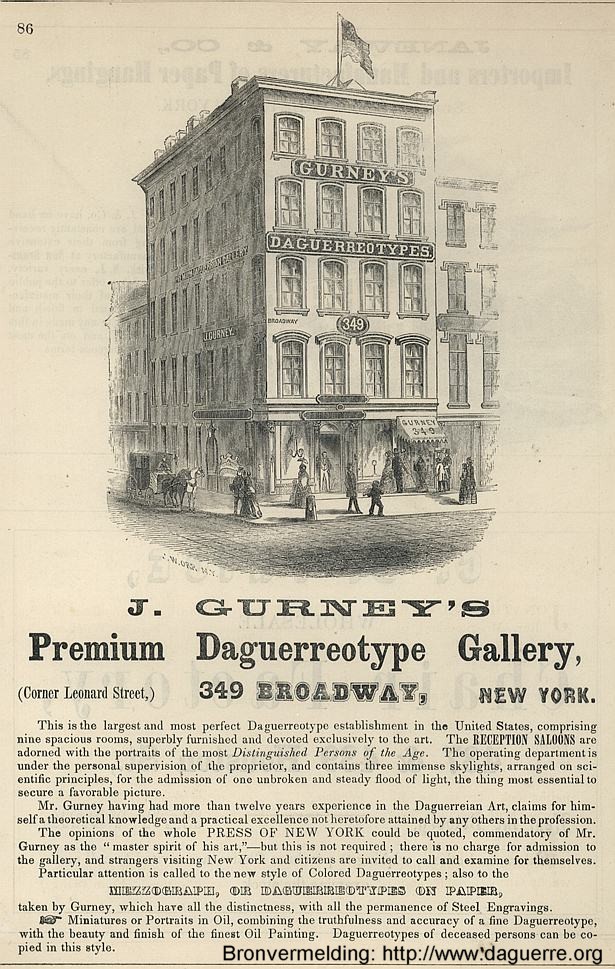
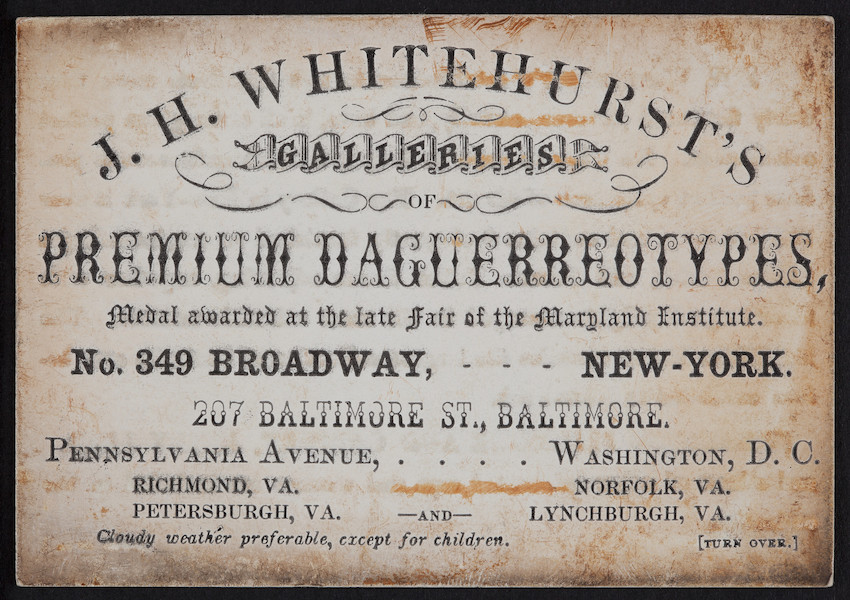
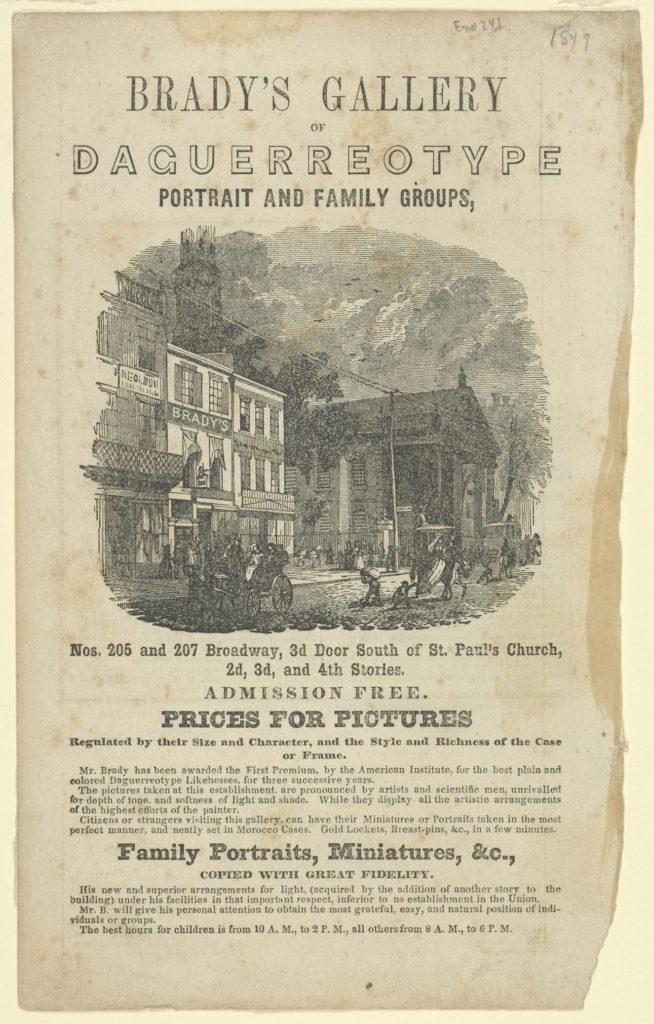
A sampling of advertisements for daguerrotype studios along Broadway:

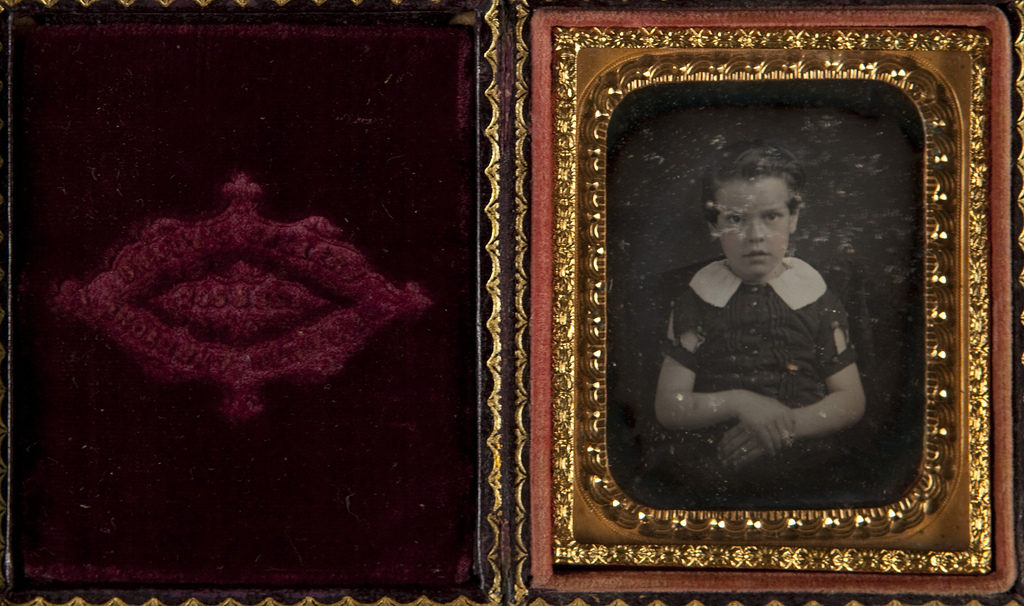
An 1847 portrait from Brady’s portrait studio of a boy in its gilded frame and case. Plates were often painted to bring the image to life.

Museum of Photographic Arts

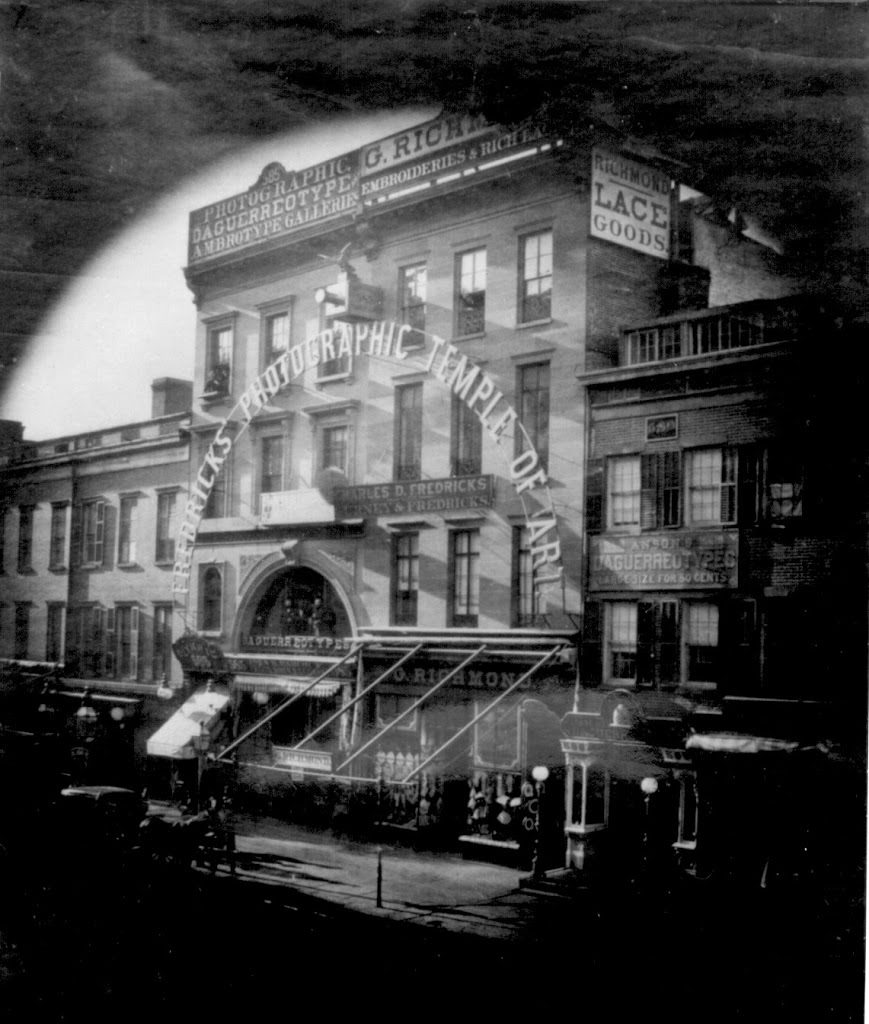
Daguerreotypists lined Broadway and often had flamboyant signage to lure in people from the street. Fredrick’s Photographic Temple of Art was located at 585 and 587 Broadway, right off of Houston Street.

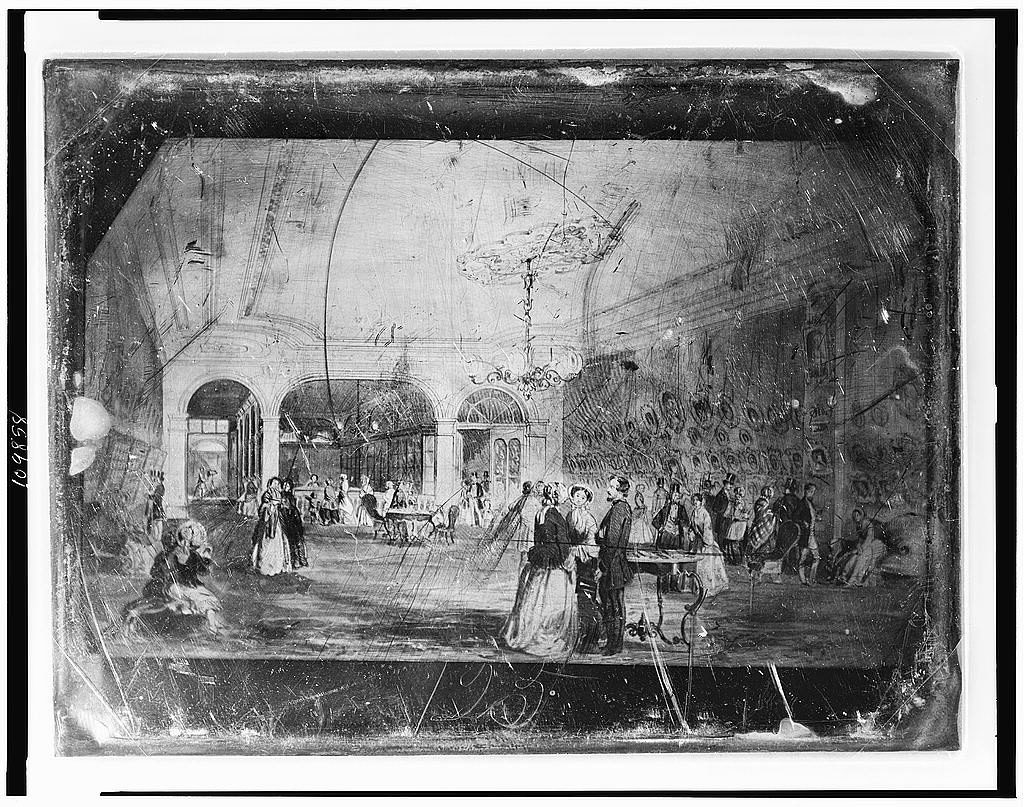
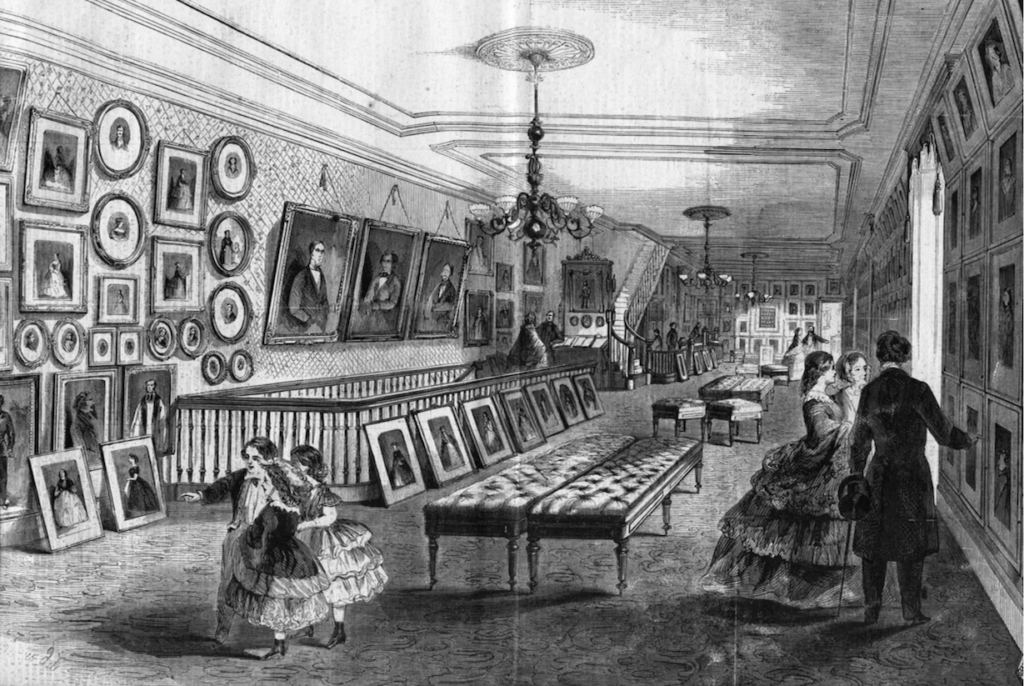
The interior of Brady’s Daguerrian Gallery circa 1854, a sumptuous space with walls lined with spectacular images from Brady and other photographers.

Library of Congress

An illustration of Brady’s Broadway and 10th Street gallery:

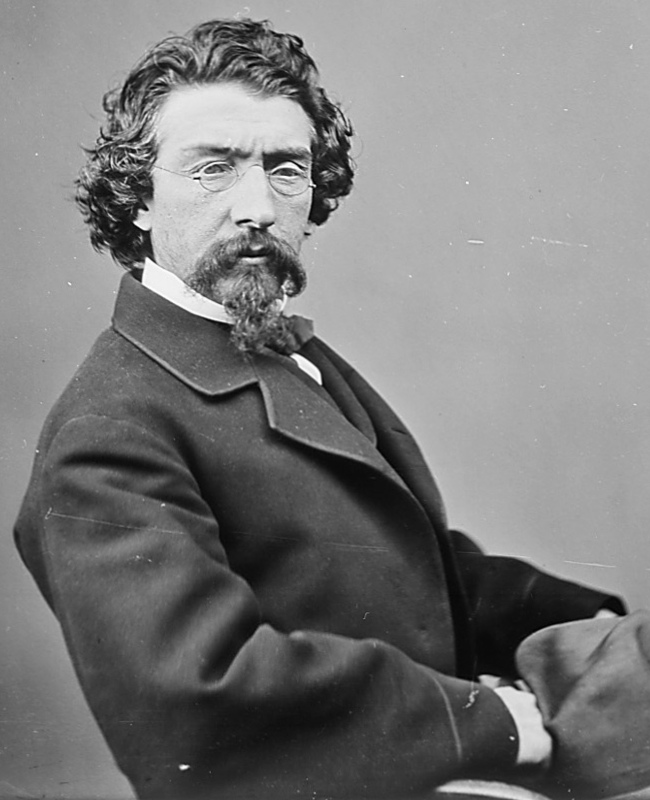
Mathew Brady in a 1865 self-portrait

U.S. National Archives

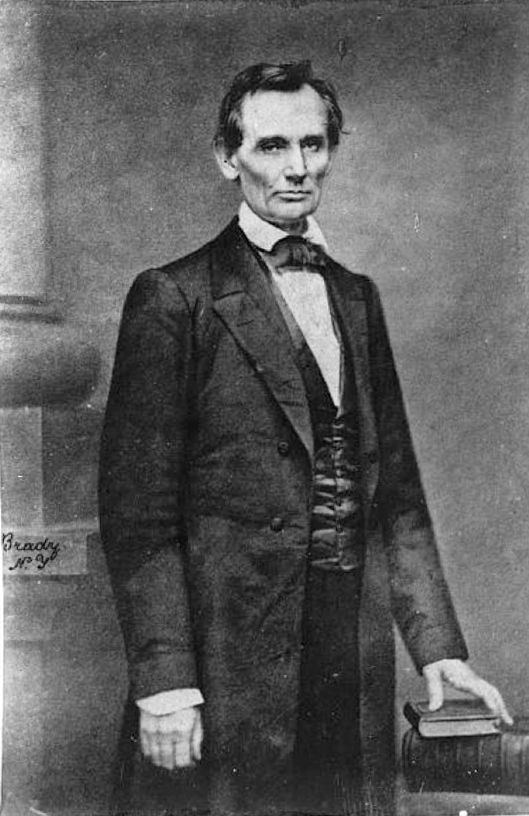
Mathew Brady’s first pictures of Abraham Lincoln, taken from his Broadway/Bleecker studio.

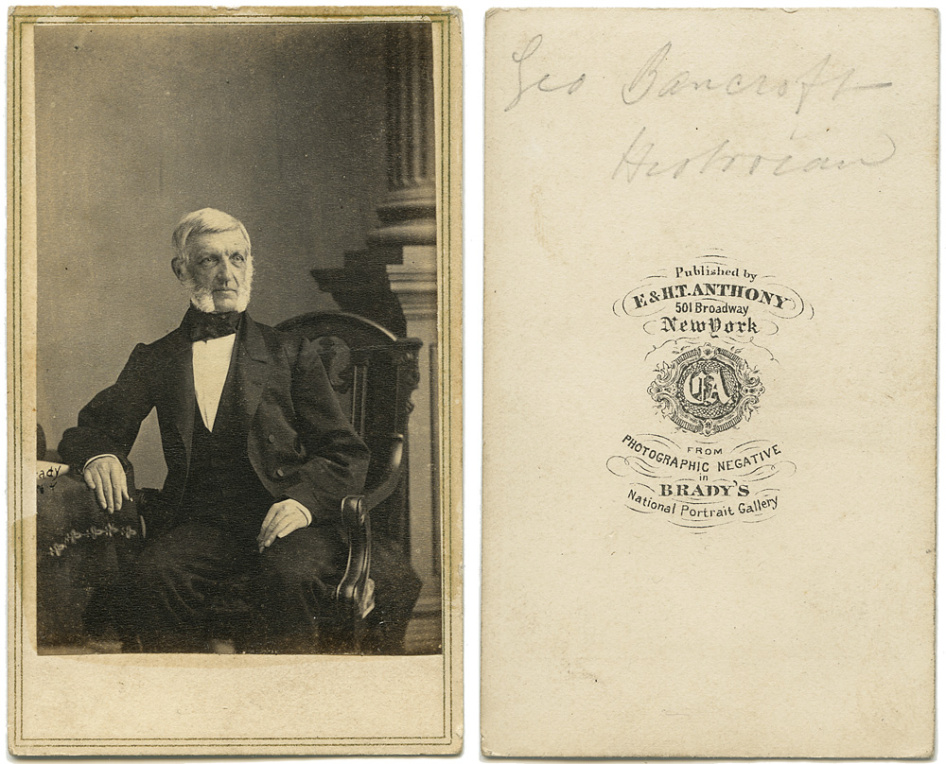
A carte-de-visite of George Bancroft, taken by Mathew Brady

… and of Tom Thumb (Charles Stratton) and Lavinia Warren Stratton, taken in Brady’s Broadway studio.

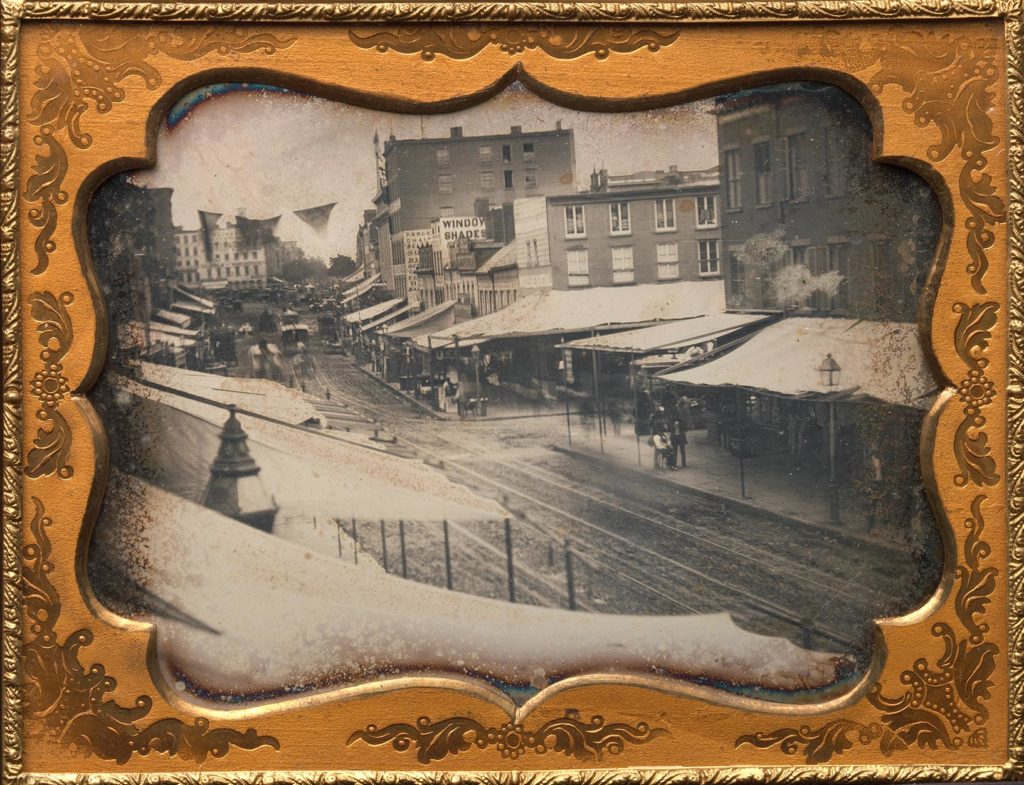
Photographic image of Chatham Square, 1855

RECOMMENDED LISTENING:

The second episode of the Bowery Boys spin-off The First: Stories of Inventions and their Consequences which highlights the story of Dorothy Catherine Draper, the first woman to ever sit for a photograph.

And lots of tie-ins in this show (and in the past two, in fact) to the history New York University. Listen to the entire story here:

Categories
Bowery Boys Bookshelf Wartime New York

‘Shooting Lincoln’: The Complicated Story Behind America’s First Wartime Photographs

Alexander Gardner is a bit of a Nikola Tesla-like figure in American history in that his contributions were largely overlooked in his day, concealed within a partnership with a famous business titan.

That titan was Mathew Brady, the most famous photographer of the 19th century, with studios in New York and Washington D.C. that captured the nation’s most prominent figures in daguerrotype galleries and propelled the popularity of photographic images as the successor to painting and illustration.

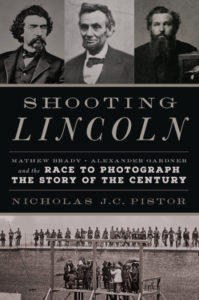
SHOOTING LINCOLN
Mathew Brady, Alexander Gardner and the Race to Photograph the Story of the Century
by Nicholas J.C. Pistor
Da Capo Press

In Shooting Lincoln, the interesting if unusually titled new book by Nicholas J.C. Pistor, we see their partnership, developed in the tasteful parlors of respectable 1850s New York portrait galleries, wither and eventually dissolve during the American Civil War. And yet the pair, along with a legion of other intrepid young photographers, brought the realities of war into the rings of sheltered American society.
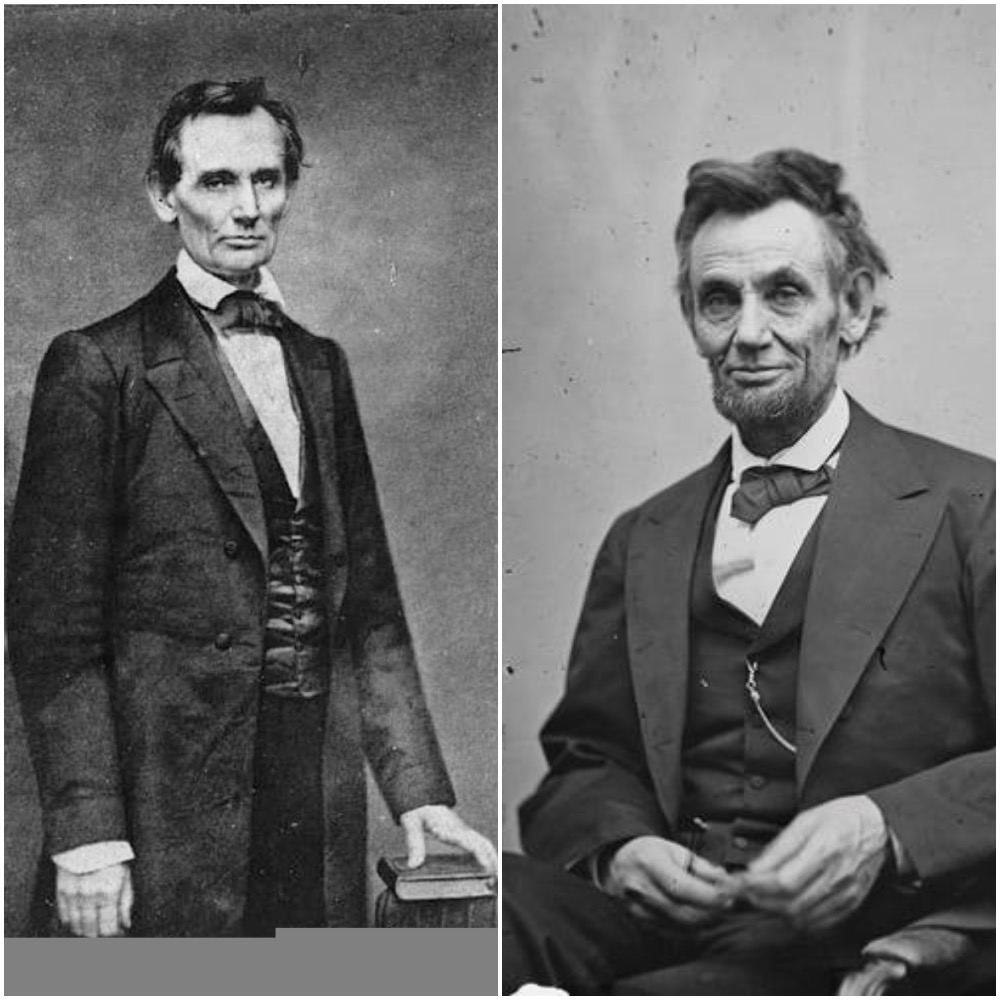
Abraham Lincoln first visited a Brady studio during the winter of 1860, posing for the famous portraitist hours before the seminal Cooper Union speech that would catapult him to his party’s nomination for the presidency. And yet the most famous images of Lincoln (including the Gettysburg portrait) were actually taken by Gardner years later, working first from Brady’s studio in Washington D.C., then from his own.

While Lincoln was not the first president to pose for portraits, he was the first to have his image defined by them — his face resolute, weary, wise. These images would be reproduced for sale and redrawn for newspapers, making the Lincoln the most recognizable human being on the planet.

Both Brady and Gardner took to the carnage-strewn backroads of America to photograph the scenes of war. Their images — a great many posed, a few even doctored — essentially created photojournalism as a defining method for distributing information.

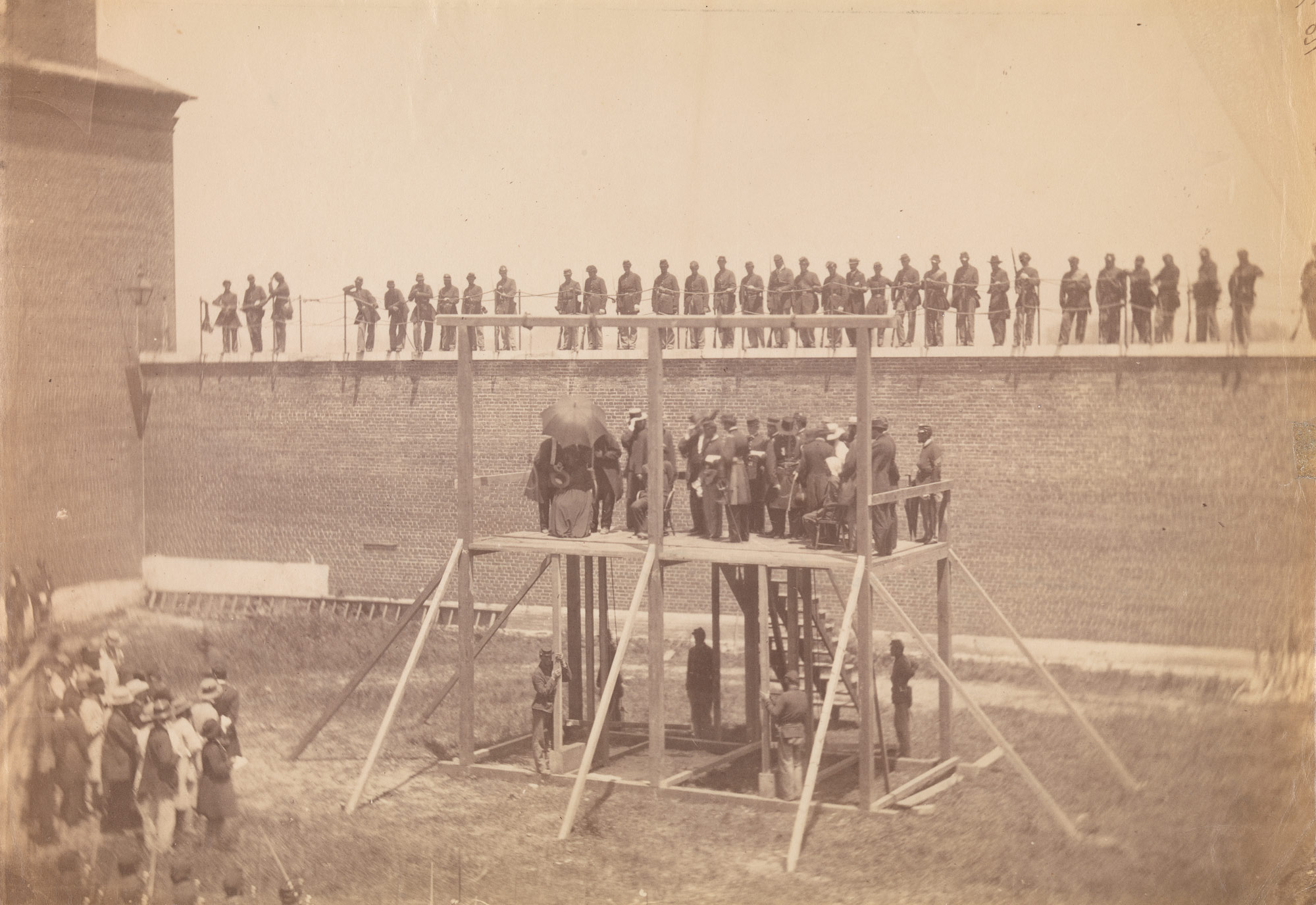
But it’s Gardner who was uniquely situated to photograph the tragic final strains of the war — the aftermath of Lincoln’s assassination and the execution of the conspirators (pictured at the top of this post).  Pistor reveals the many controversies in capturing these important images. These men were capturing history as none had done before.

Below: Lincoln by Brady and by Gardner

Categories
True Crime

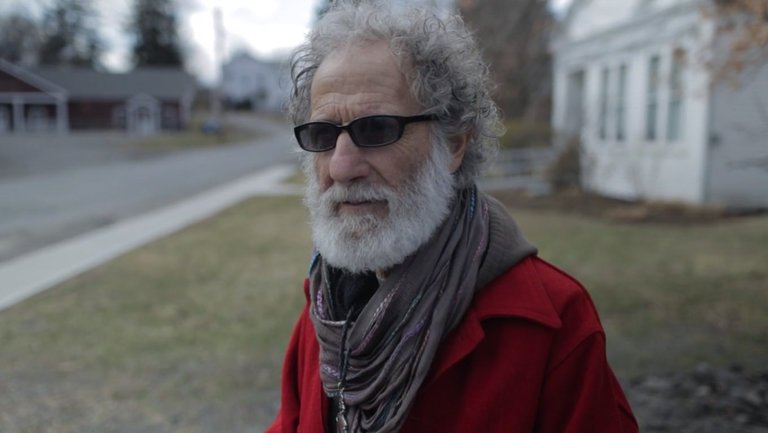
Frank Serpico: A new documentary revisits the making of a hero (and a myth)

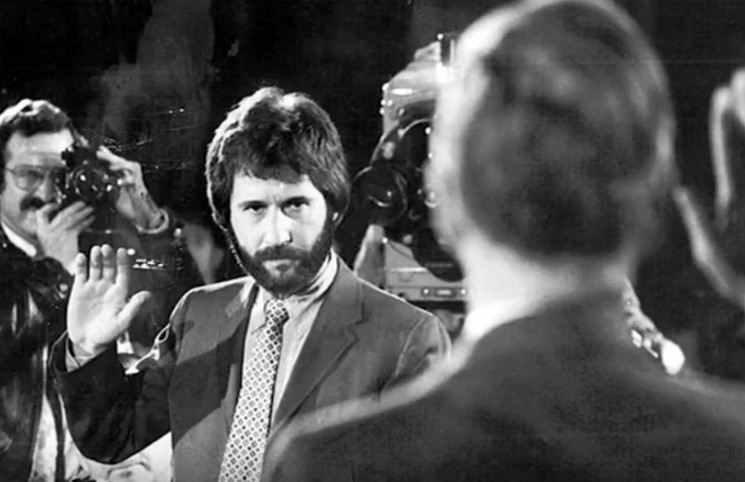
Frank Serpico is a member of an elite group of important American figures (along with Erin Brockovich and Karen Silkwood) that are almost entirely defined by the actors who played them in movies.

Even if you lived in New York City in the early 1970s and remember Serpico from the headlines, most likely you picture him as a young, handsome Al Pacino. Serpico is considered one of the greatest films of that decade, solidifying Pacino’s status as a successor to Marlon Brando, an actor of rare cinematic presence.

But whatever happened to Serpico, the actual Frank Serpico?

Frank Serpico
A documentary by Antonino D’ambrosio
Music by Jack White
In theaters and On Demand

An engaging new documentary by Antonino D’ambrosio tracks down the elusive Serpico and replays his dramatic story, but with a tonal shift. Frank Serpico is the actual star here and he’s no superhero. It turns out that becoming a lauded pop-cultural symbol of honesty and bravery is a hard act to follow.

Serpico, the son of southern Italian immigrants, grew up on the streets of Crown Heights and entered the ranks of the New York Police Department in 1959.  From his Perry Street apartment, Serpico donned various undercover disguises to infiltrate the criminal ranks.

“I got my training in the streets of New York where I played many roles from a doctor to a derelict,” Serpico says early on, in front of a dressing room mirror. “And how well I played those roles, my life depended on it.”

His choice of neighborhood — the West Village was for bohemians and ‘degenerates’ — and his southern Italian heritage set him apart from his mostly Irish brethren and eventually he was moved to plainclothes duty. It was there that Serpico took in the extraordinary network of corruption which has afflicted the police department since the early 19th century. (Historian Luc Sante makes an appearance in the film to remark upon the cyclical nature of police corruption in New York.)

Trevor Tweeten/IFC Films

Instead of keeping quiet about it, Serpico spoke up — despite death threats  — leading to the formation of an investigative commission under the administration of Mayor John Lindsay. In the winter of 1971, Serpico was shot in the face at a routine drug arrest in Brooklyn. Was it a retaliation? In the documentary, Serpico sits with his former partner Arthur Cesare, discussing the incident with no small amount of awkwardness and intimation.

You’re perhaps familiar with most of this from the Pacino film, directed by Sidney Lumet. But what became a landmark piece of cinema only made Serpico’s life worse. While this documentary sometimes loses its focus — and even becomes distracted during its Hollywood segments — it’s absolutely worth it to see Serpico himself reflect upon his unusual legacy. He’s interesting, unassuming, at peace. But there’s little nobility in being right.

Currently playing in New York at the IFC Center

Categories
Bowery Boys Bookshelf

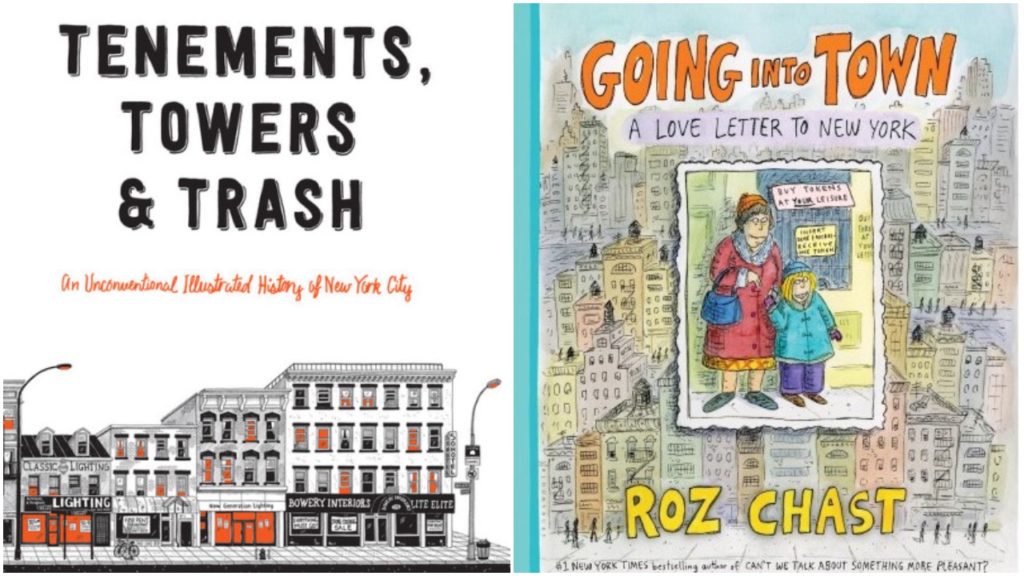
‘Going to Town’: Roz Chast rewrites the guide book

The biggest city in the United States is really a collection of multiverses, full of enshrined anomalies and beloved inconveniences.

Every New Yorker has their own list of wisdoms and observations, a batch of beloved eccentricities that make New York City such a perfect place to live for them. (For instance, I love a good bodega cat. Who cares if the place smells vaguely of urine?)

In essence everybody has their own version of the city with quirks and shortcuts and little pearls of beauty that are appreciated because they are deeply personal.

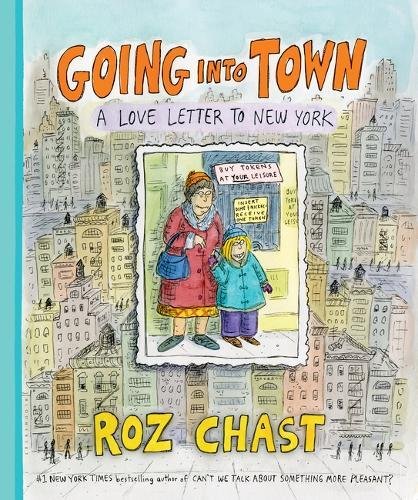
GOING INTO TOWN
A Love Letter to New York
by Roz Chast
Bloomsbury

In Going Into Town, acclaimed cartoonist Roz Chast shares her version. You’re probably familiar with her wry, often zany illustration style from her work at the New Yorker magazine, and hopefully you’ve been introduced to her own city experiences through her devastating graphic novel Can’t We Talk About Something More Pleasant, a bonafide modern classic and ode to her parents and their Brooklyn home. (If you haven’t read that yet, make sure it’s on your reading shortlist.)

Her new book of urban observations is a guide book full of wonder and optimism, a polar opposite of most current-affairs tomes about New York on the shelves today. Even when she remarks disparagingly about tourists or rodents or trash, it’s done with the lightest of touches, graced with vibrating illustrations of herself.

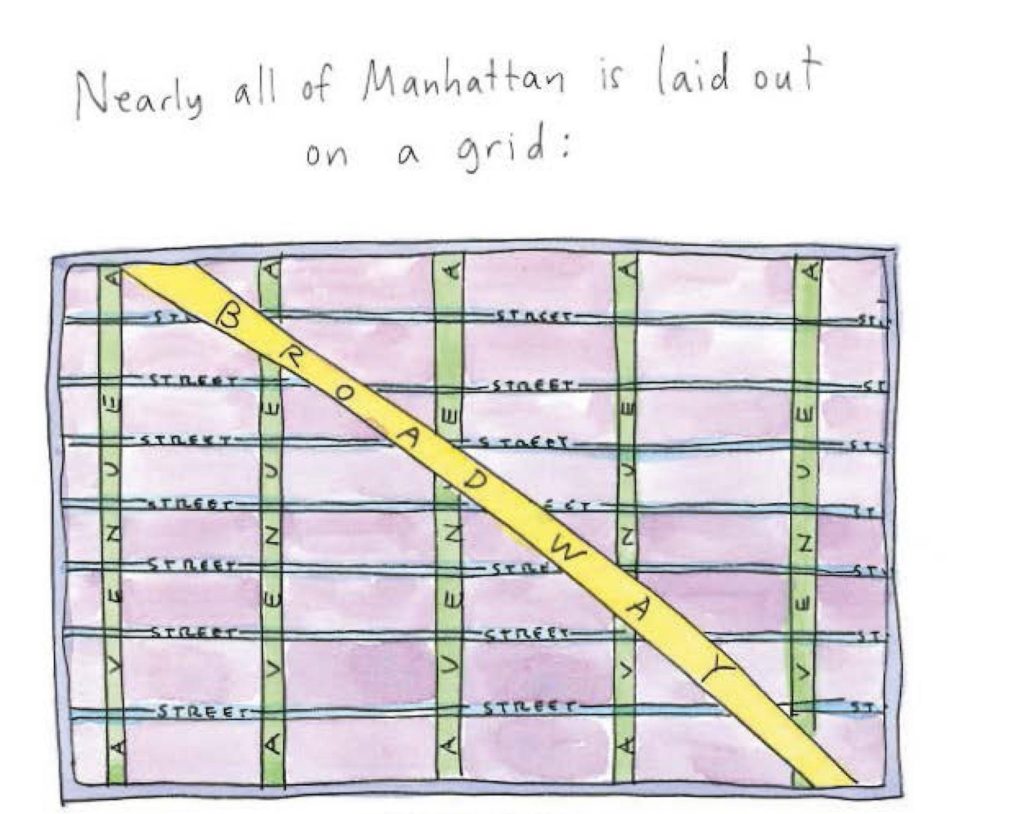
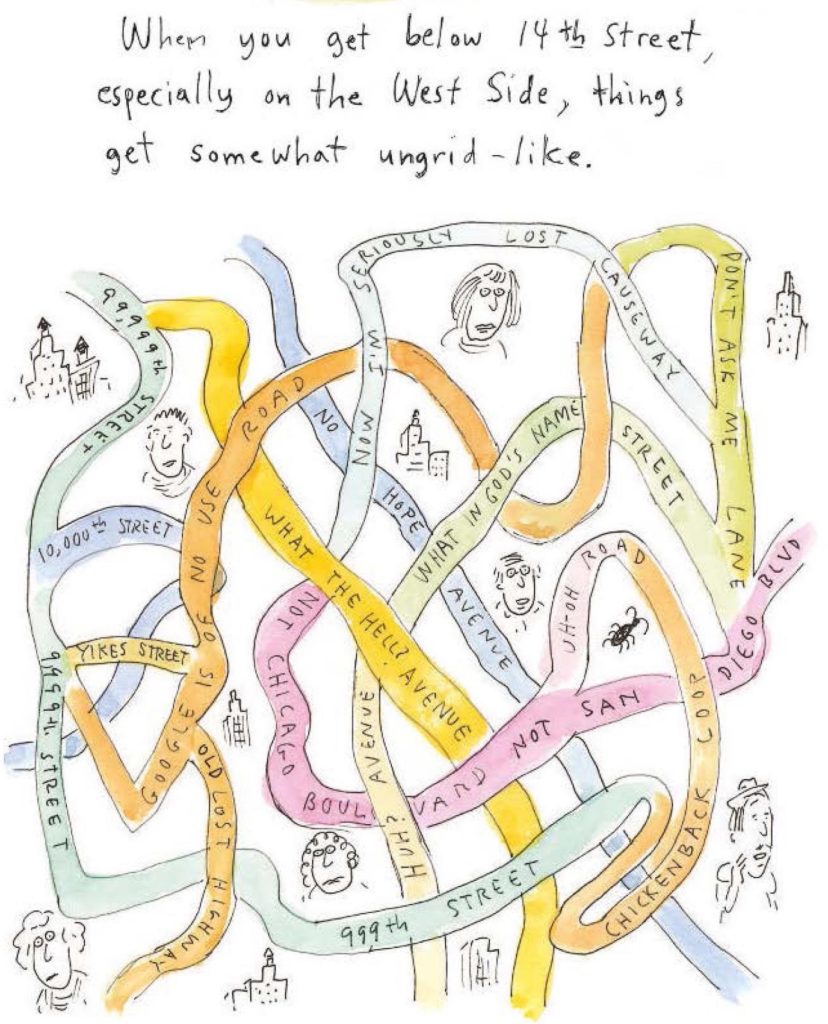
And it really is a guide book — albeit one you can safely read at home — describing the layout of New York’s avenues and cross-streets, exploring its most enchanting institutions and proclaiming love for the most particular things (the Times Square/Grand Central shuttle, the armor gallery at the Met, the pigeon). It’s curmudgeonly but not the least bit cynical.

You’re probably innately aware of some of her suggestions but it’s a genuine treasure to see them spelled out (or rather, drawn out) so colorfully.

A statement in her trademark handwriting — “Pick a random building in New York, examine it from top to bottom, and this is what you might see.” — hovers over a structure containing a juggling supply store, shiatsu massage, a cat psychiatrist and a ’99 Cent and Up or Less Store’.

“I don’t know why that makes me happy to look at, but it does.”

That statement applies to all of Roz Chast’s work, I think, but Going Into Town in particular.


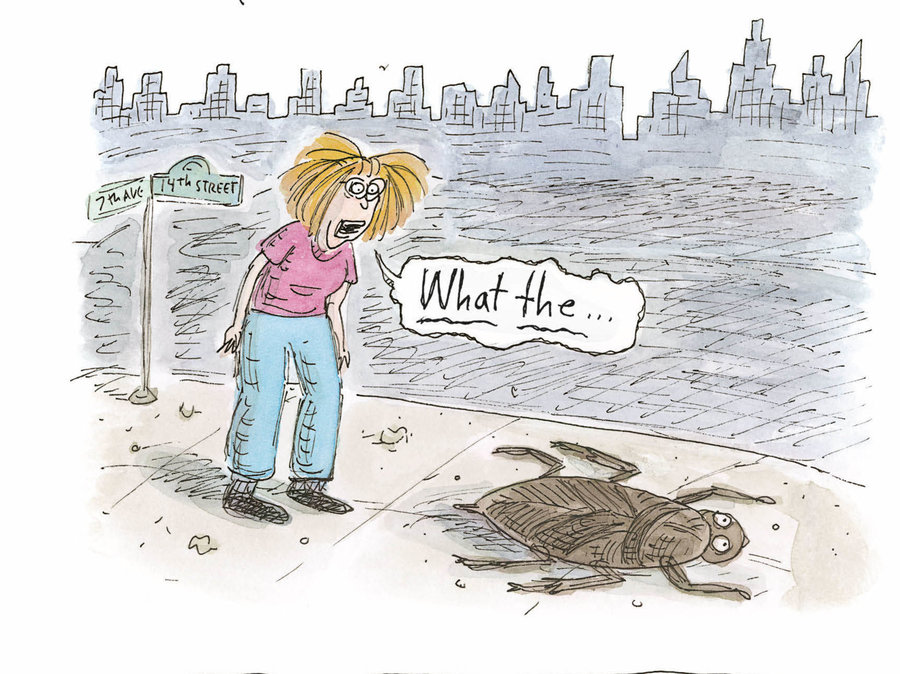
Below: A little sampling of her curmudgeonly chaos

Courtesy Bloomsbury


Categories
Mysterious Stories

The Ghost with the Red Hair: Two Hauntings in Long Island City

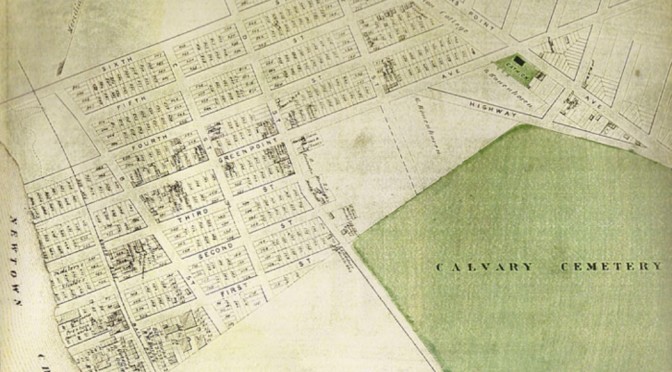
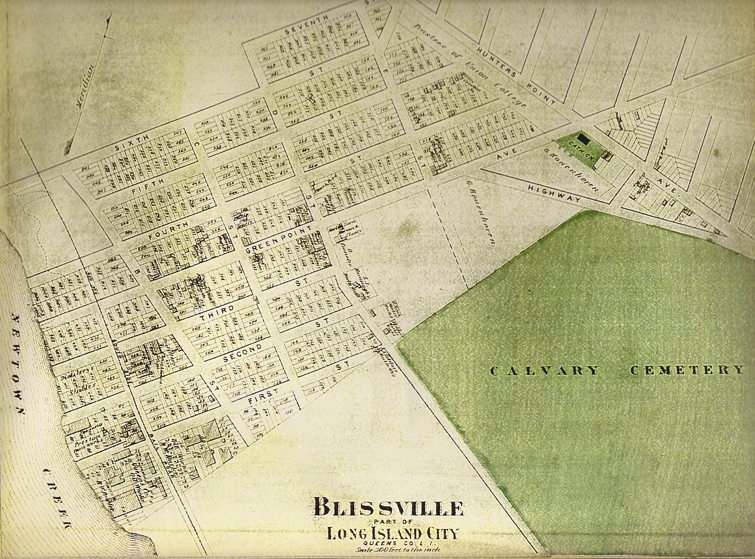
Long Island City is really a confederation of small villages and hamlets along the northwestern shore of Long Island. The name began essentially as a re-branding of Hunter’s Point then grew to eventually include Astoria, Ravenswood, Sunnyside, Blissville and other communities after the development of the Long Island Railroad improved its land value.

“Fifteen years ago, outside of the village of Astoria, there was not a house in the limits of Long Island City, except the dwellings of half a dozen farmers and a line of palatial mansions fronting on the East River, from Hunter’s Point to Hell Gate,” said the New York Times in 1870 at the time of Long Island City’s charter.

It was an area of great change that still retained a rural character, even as two of America’s greatest cities rose to its south. The perfect setting — for a ghost story!

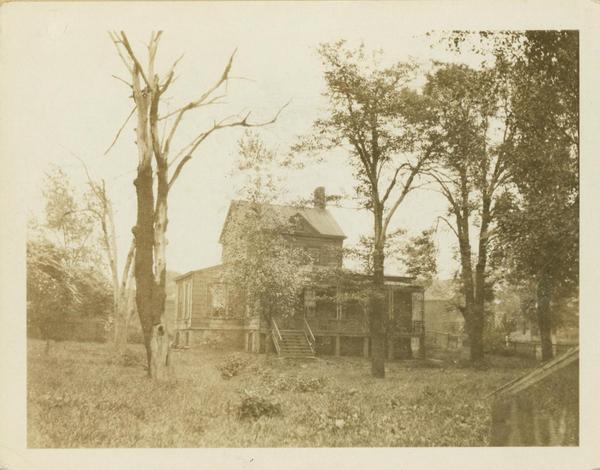
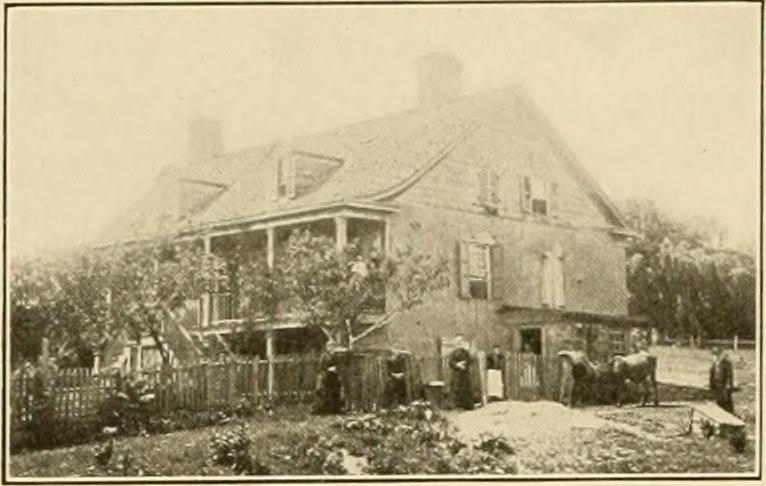
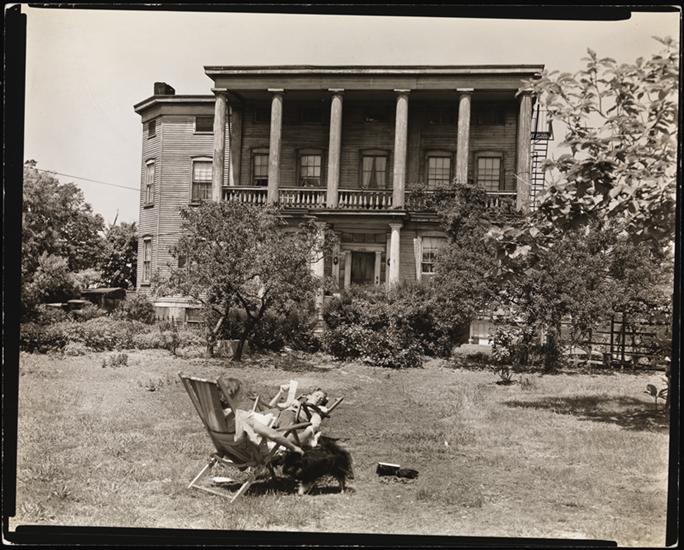
Haunted houses as often simply old mansions that look out of place on a changing landscape. By that definition, Long Island City in transition would have had its share of these. Interspersed within this article are a few old homes and mansions of northwestern Queens. Haunted or not, but still captivating!

I was looking through some newspaper archives looking for some old stories about Long Island when these two spooky stories popped up. Almost as if they wanted to be found and retold! Both are based on newspaper reporting of the day and were reported (albeit with a touch of skepticism) as fact:

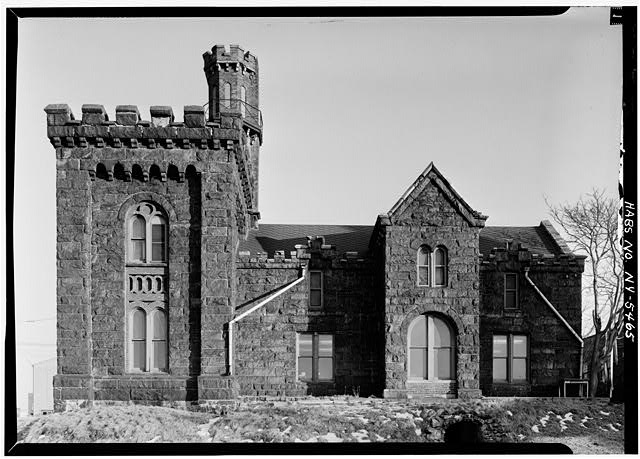
Below: Bodine Castle at 4316 Vernon Boulevard

bodine


A Ghost In Long Island City 
January 29, 1874 [source]

There once was a home at Jackson Avenue and Dutch Kills Road that was quite haunted, so haunted that its landlord was unable to rent it out. Soon a fearless family with the last name of Daly decided to rent the house.

“They were informed that there would be other occupants besides themselves in the house, but that did not deter them.”

They were in the house for a week until one night they heard moans coming from the hallway. The father investigated the hall, then the kitchen. The sound seem to move away from him — into the parlor, then into dank cellar. But there was no evidence of any intruder, no reason for the noise.

“Shortly after this as if some heavy body were falling downstairs were heard.  Mrs. Daly, upon being interrogated, affirmed that the crockery in the cupboard was thrown down and broken, and declared the door was unopened.”

With a disturbing lack of empathy the newspaper then reports, “One child was so thoroughly frightened that it was thrown into violent convulsions and has since died.”

They stayed in the home the following evening to be awakened by horrific cries of ‘Murder! Murder!’ at midnight.  The following day the family finally moved out of this haunted house. “Today a rigid investigation will take place, and the hoax, if it is one, will probably be ventilated.”

No further information was found about this house.

Below: Vernon Boulevard, at the S.E. corner of Astoria Boulevard, showing the Cornelius Rapelye House, built about 1780. A garage was later erected on the site. Eugene L. Arabruster Collection 1922

Courtesy New York Public Library

A Red-Haired, Blue-Eyed Ghost
The Stoutest Hearted Citizens of Blissville Filled With Fear
March 10, 1884 [source
]

“All the hair in Blissville, Long Island, is on end with terror and excitement, and even the stoutest-hearted citizens feared to sleep until they got to church yesterday, because the ghost cries “Oh, ho!” and “Ah, ha! and likewise “Humph, humph” still haunted the Calvary Cemetery, and all Saturday night gave vent to weird and mysterious moans and sighs.”

1

A hotel proprietor names John Powers was stumbling home at night — almost midnight — in some presumed state of inebriation. On the road he passed a very short woman dressed entirely in black, “mov[ing] along in a strange manner, looking neither to the right nor to the left.”

The little woman did not respond when Powers wished her good night.  Finally, “filled with strange forebodings,” he decided to look at the woman. But she had completely vanished.

“There were no houses, trees, nor fences near, nothing that even a cat could have concealed itself behind, and yet the weird apparition had disappeared and left not the slightest indication of its presence.”

Below: The old Payxtar Homestead, area of today’s Jackson Ave. and Queensboro Bridge Plaza, Long Island City

Courtesy Library of Congress

Another man named Thomas Culvert told a similar story that same evening. His description of the spirit is quite bizarre. “She was not more than three feet tall and had red hair, he said, and long curls hung down her back.”

His eyes lingered upon the woman a bit too long for she gazed up at him, making eye contact. “[H]er eyes were of a stony blue that chilled his very blood as she fixed them upon him for a single instant.” Culvert scurried immediately home and locked the door.

Throughout the night the townspeople of Blissville heard a series of shrieks and cries in the vicinity of an abandoned house.  “Numbers of persons, made brave by the daylight, visited the haunted house and locality yesterday afternoon, but shrank away when the shadows began to deepen.”

Efforts were made to disprove these spooky tales but no source was ever found. Thus the residents of Blissville lost many hours of rest. “There will be no peace until the grisly secret is explained.”

Below: 27th Avenue, no. 805, Astoria, taken in 1937

Courtesy Museum of the City of New York, photo by Berenice Abbott


Categories
Podcasts Writers and Artists

Edgar Allan Poe in New York: Places where the master of gloom and horror made his mark

PODCAST Edgar Allan Poe was a wanderer — looking for work, for love, for meaning. That’s why so many American cities can lay claim to a small aspect of his legacy. Baltimore, Boston, Richmond and Philadelphia all have their own stories to tell about the great writer. In this show, we spotlight the imprint Poe made upon New York City.

Poe was in New York both on the year of his birth (as the child of two stage actors) and on the year of his death (fleeing his mournful, longtime home in Fordham). Throughout out his life he came back — again and again — discovering inspiration in the prosperous, growing city of the 1830s and 40s. He lived in Greenwich Village and the Lower East Side. And for a time, he also lived in the area of today’s Upper West Side, in a farmhouse where he conjured to vivid life his most successful poem — “The Raven”.

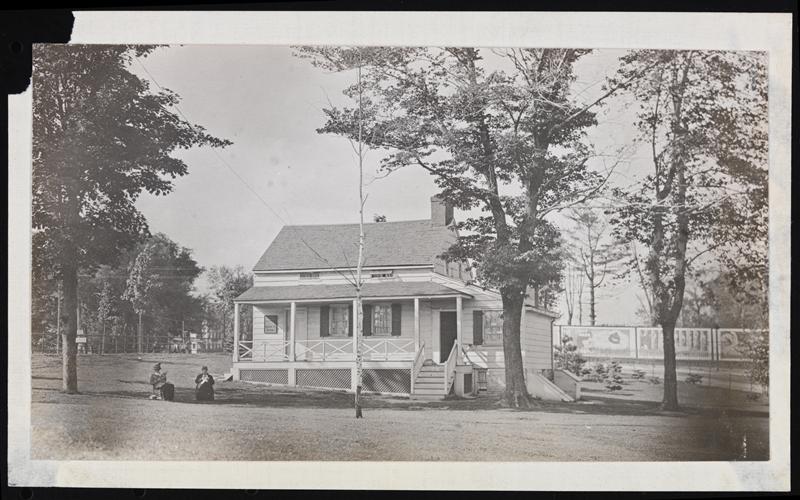
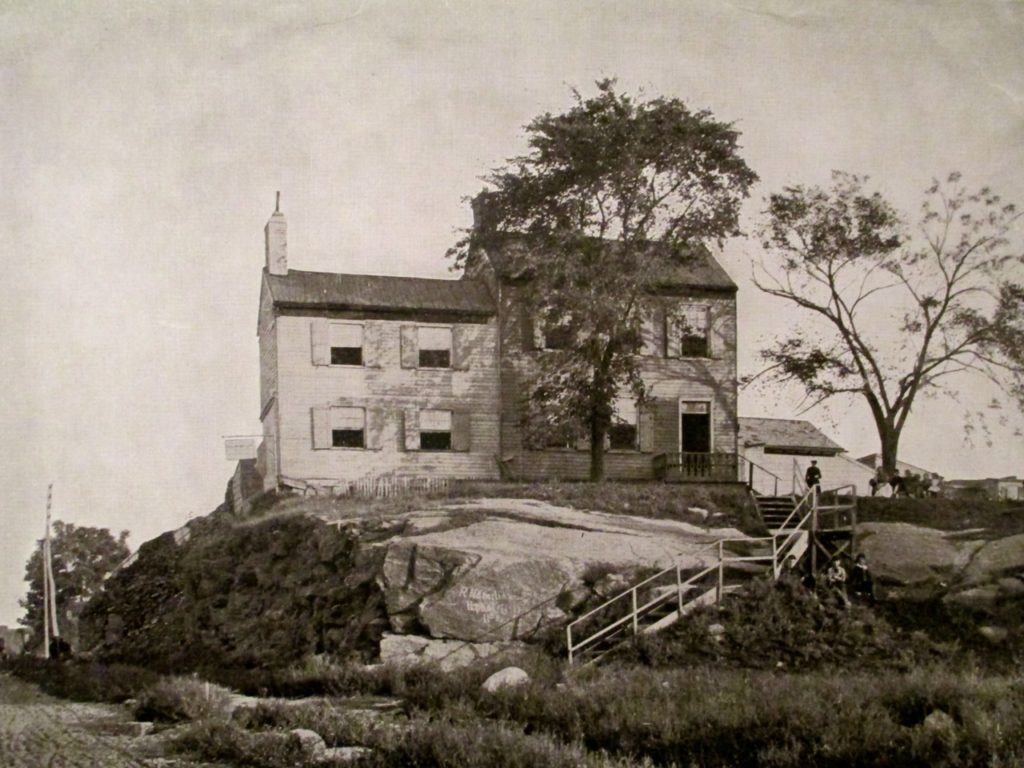
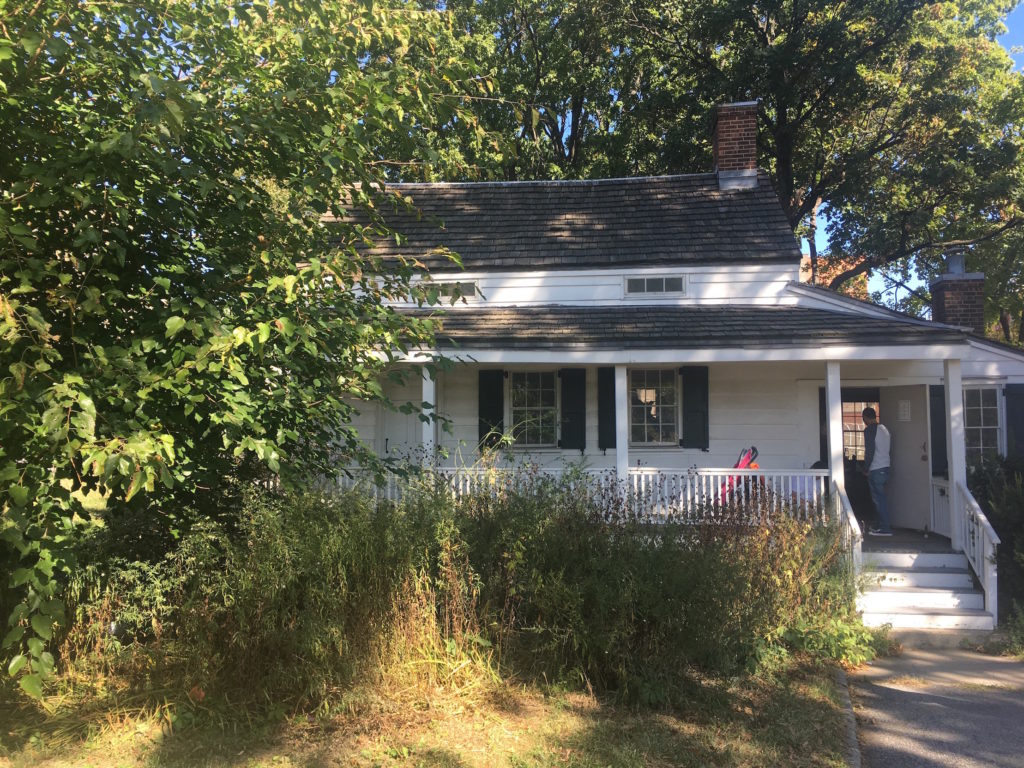
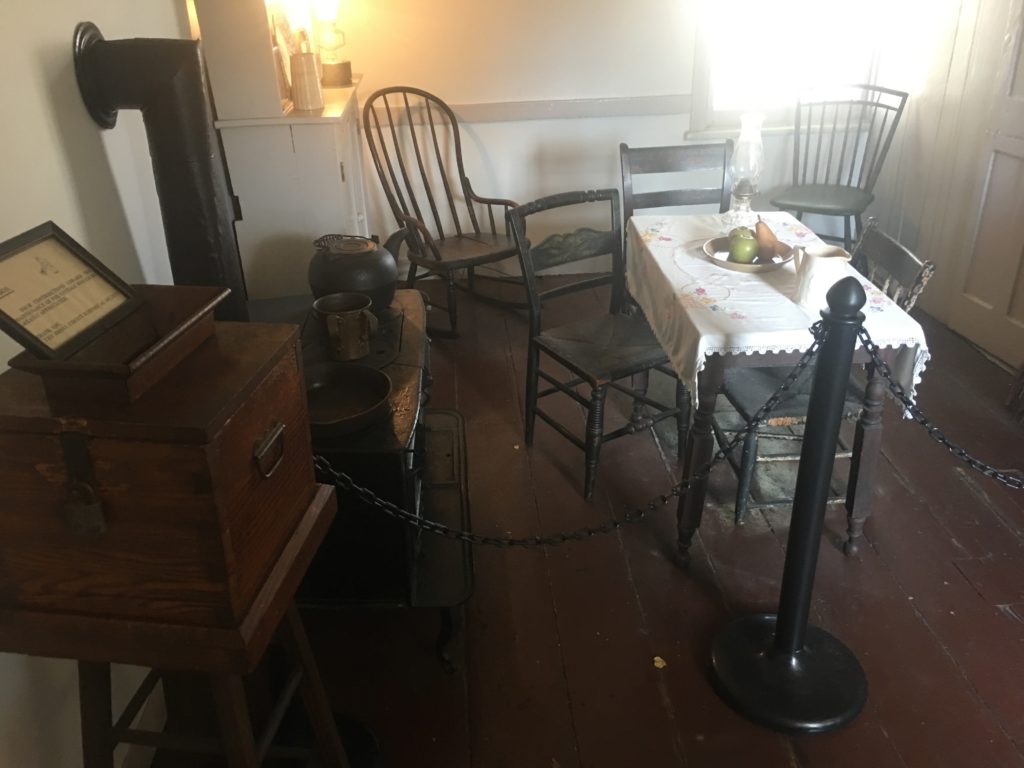
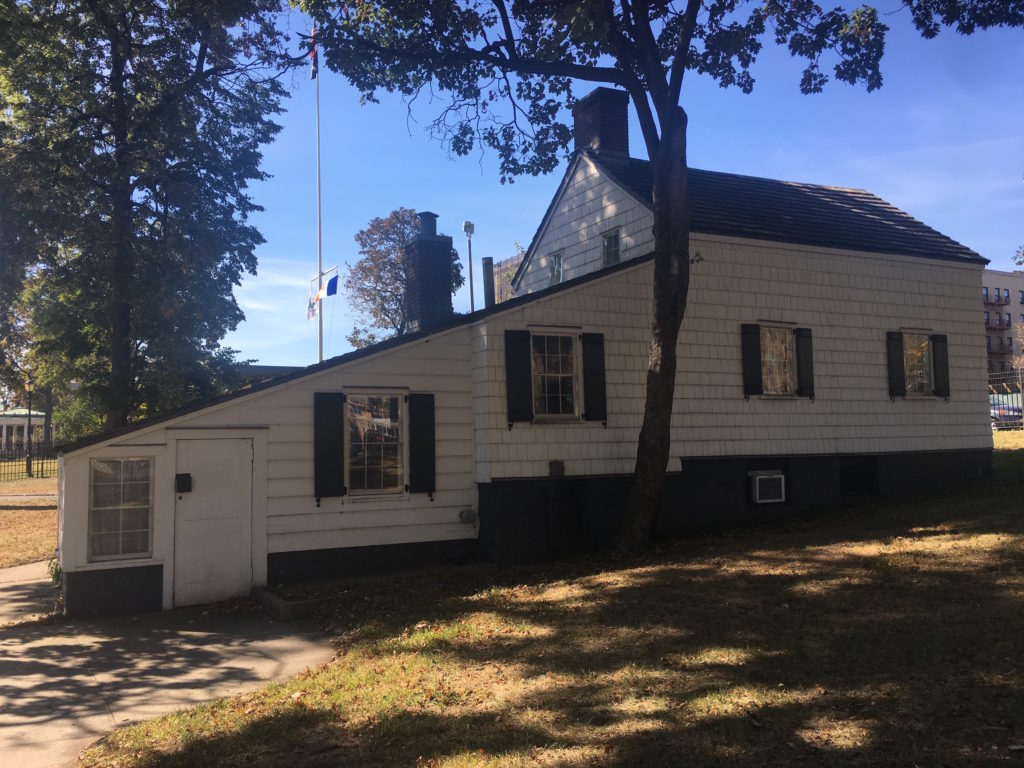
The Poe Cottage in the Bronx is the only extant building where Poe (and his young sickly wife Virginia) actually lived, a modest abode that’s a rare example of surviving working-class housing from the mid 19th century. Through tragedy, Poe sought solitude in the surrounding mounts and fields of Westchester County. The majestic High Bridge would be of a particular strange comfort.

This is a story both of Poe himself and the fragments of buildings and homes left behind with his name attached to them. In many neighborhoods of New York, you can linger with the ghost of Edgar Allan Poe himself.


The Bowery Boys: New York City History podcast is brought to you …. by you!

We are now producing a new Bowery Boys podcast every week. We’re also looking to improve the show in other ways and expand in other ways as well — through publishing, social media, live events and other forms of media. But we can only do this with your help!

We are now a member of Patreon, a patronage platform where you can support your favorite content creators for as little as a $1 a month.

Please visit our page on Patreon and watch a short video of us recording the show and talking about our expansion plans. If you’d like to help out, there are five different pledge levels (and with clever names too — Mannahatta, New Amsterdam, Five Points, Gilded Age, Jazz Age and Empire State). Check them out and consider being a sponsor.

We greatly appreciate our listeners and readers and thank you for joining us on this journey so far.


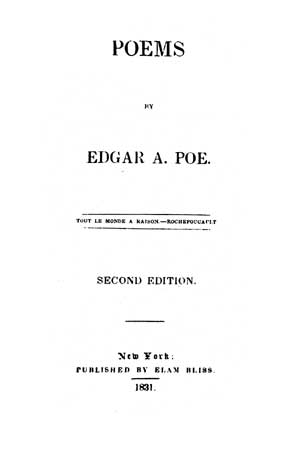
Title page of Poe’s first printed work in New York — Poems (1831) published by Elam Bliss.

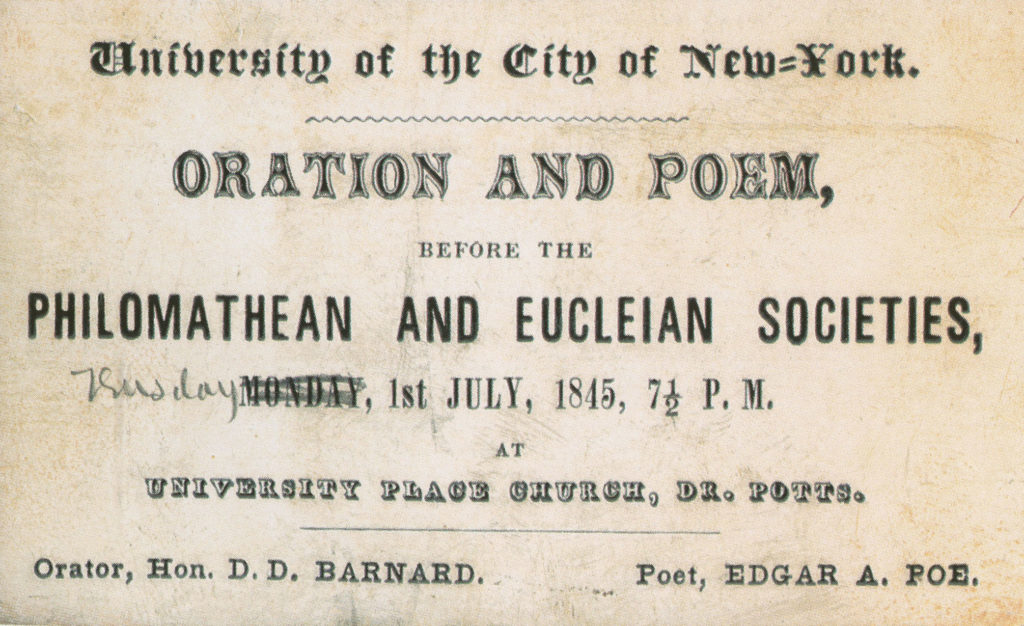
Poe frequently read his works at the University of the City of New York (today’s New York University), especially following his successes with ‘The Raven’.

Courtesy Greenwich Village History blog

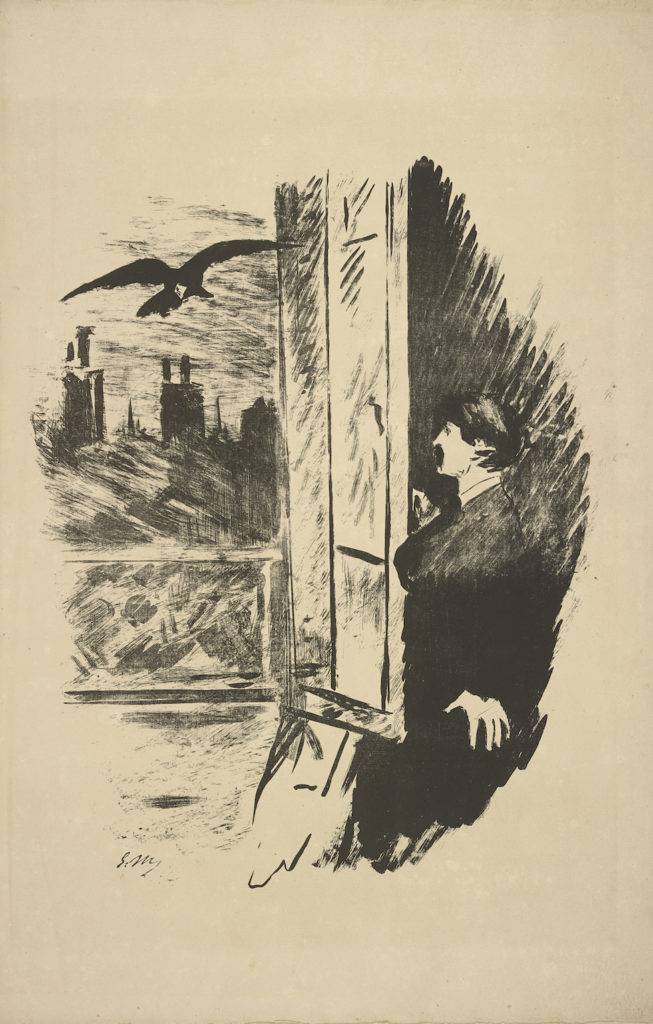
An illustration by Édouard Manet (1832 – 1883) for Le corbeau (The Raven), from The Morgan Library & Museum collection (and featured in their marvelous show from a few years ago Edgar Allan Poe: Terror of the Soul

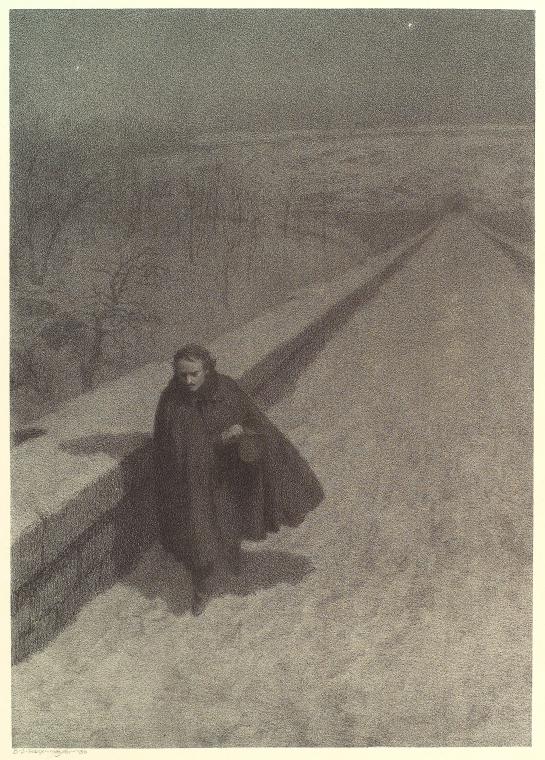
Edgar Allan Poe on the High Bridge, an imagining made by illustrator Bernard (B. J.) Rosenmeyer, circa 1930

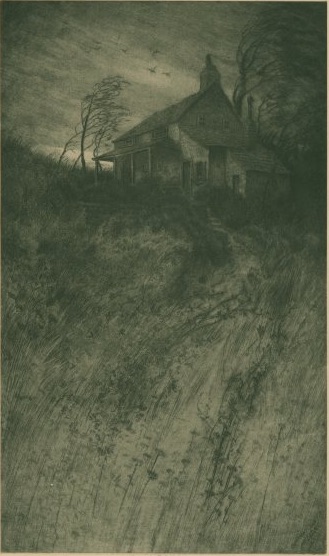
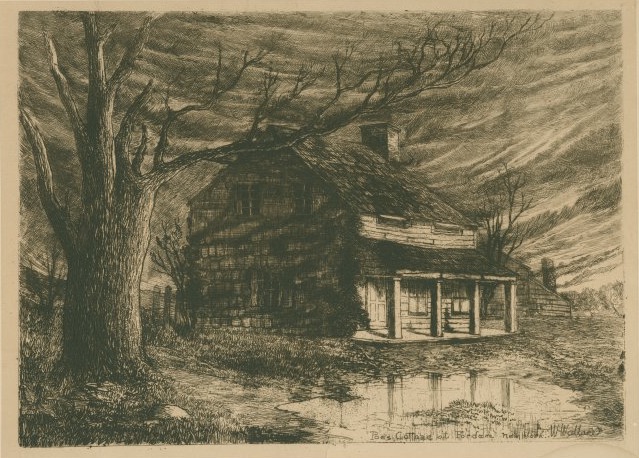
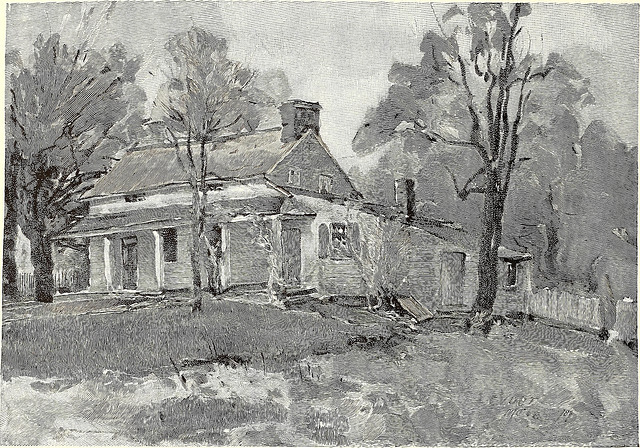
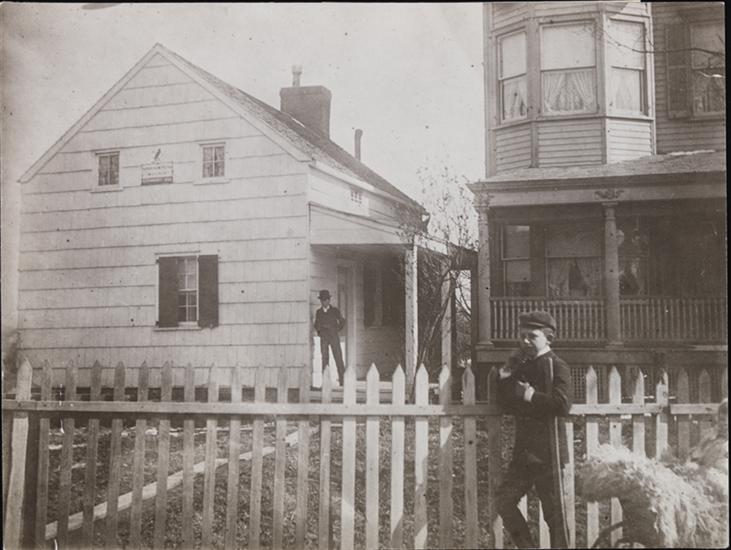
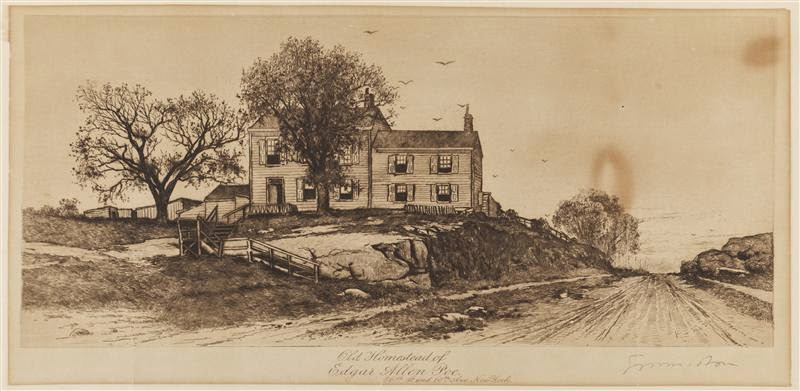
The Poe Cottage — as imagined in illustrations (courtesy the New York Public Library) and photographed in the decades following its occupants’ deaths.

NYPL


NYPL


“The century illustrated monthly magazine” (1882)

Before the cottage was moved to Poe Park (1898)…

Museum of the City of New York

..and after, in 1918.

Museum of the City of New York

The Brennan farmhouse, in the area of today’s Upper West Side (pictured here in 1879)

Museum of the City of New York

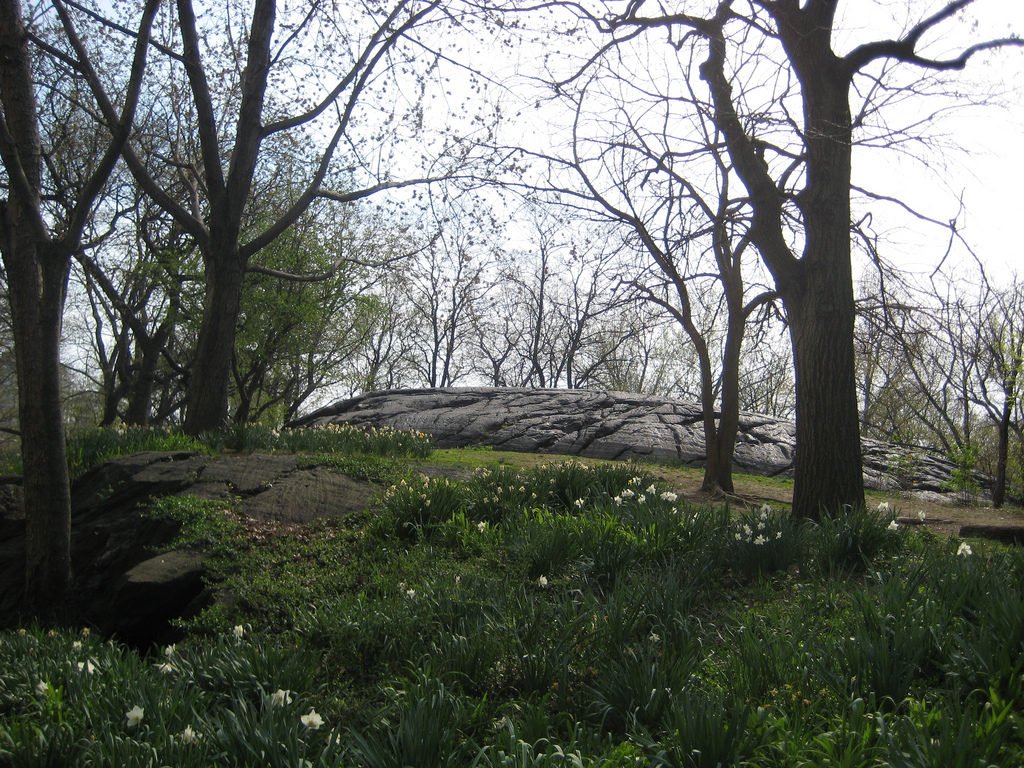
Mount Tom, the rocky patch where Poe often sat pondering the waters of the Hudson River. You can still find inspiration here; the mount is located in Riverside Park.

Flickr/Emily

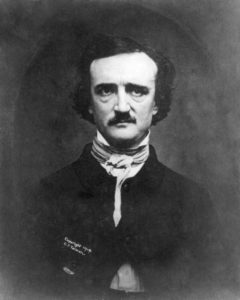
A daguerreotype of Poe, 1848. Courtesy Library of Congress

The Raven, read by Vincent Price:

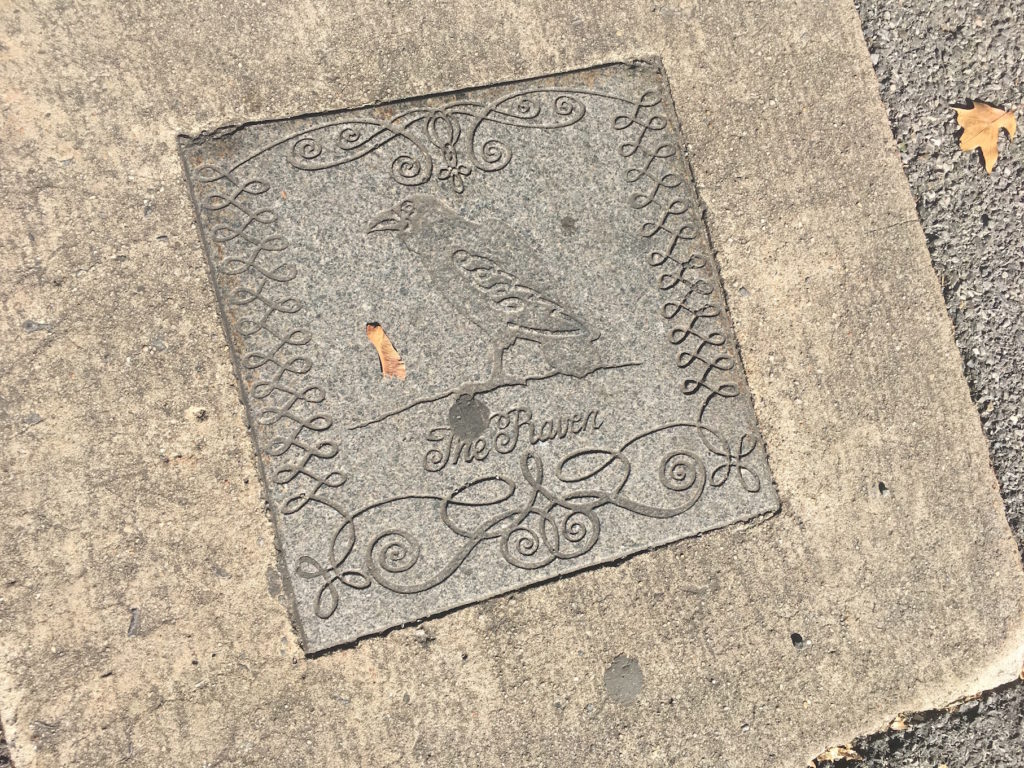
Images from the Poe Cottage from last weekend. Visit the cottage this fall! Check out their website for more information. They have an audio tour of the house and park, but we highly suggest you get in on one of their tours.


Categories
The Deuce

Eleven bits of historical trivia from this season of HBO’s ‘The Deuce’

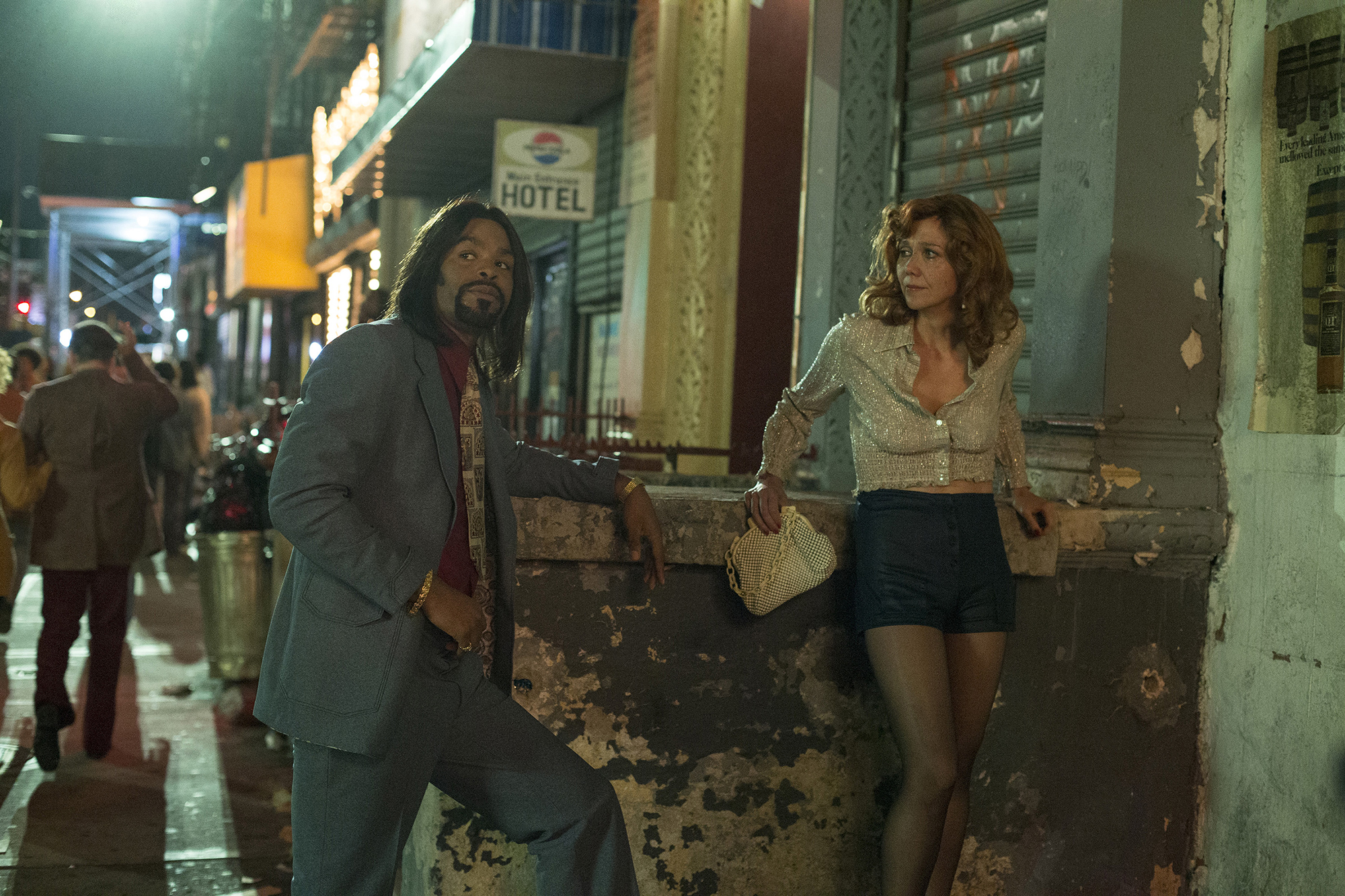
So what do you all think of the HBO’s drama series The Deuce, set in Times Square in the early 1970s? Sexually explicit but literate, with a modern viewpoint that gives rich, nuanced characterizations to women, The Deuce performs a unique negotiation between romanticizing the 42nd Street sex trade and condemning it. Whether or not you connect with the narrative — not every beat hits; in the continuum of David Simon projects, this is more Treme and less The Wire — you can’t deny its excellent achievements in production and tone. And Maggie Gyllenhaal, in particular, gives one of the year’s best performances. (Props also to Gbenga Akinnagbe, bringing a harsh richness to his role of the pimp Larry Brown.)

We devoted an entire show a few weeks ago to this era as a tie-in to the series. Give it a listen if you haven’t already! We’re proud of that show. Some true ‘forgotten history’ needless to say.

The final episode broadcasts this Sunday. For the past few Sundays, I’ve been Tweeting along with the show, throwing out little facts and trivia of things that get referenced in the show. No plot spoilers though! The Tweets have mostly to do with historical context and production details.

Here are a handful of Tweets from prior episodes. Check in with @boweryboys this Sunday to see additional 1970s trivia relating to the show.

Categories
Bowery Boys Bookshelf

‘The Creative Destruction of New York City’: The Tools For Fighting Back Against Unwanted Change

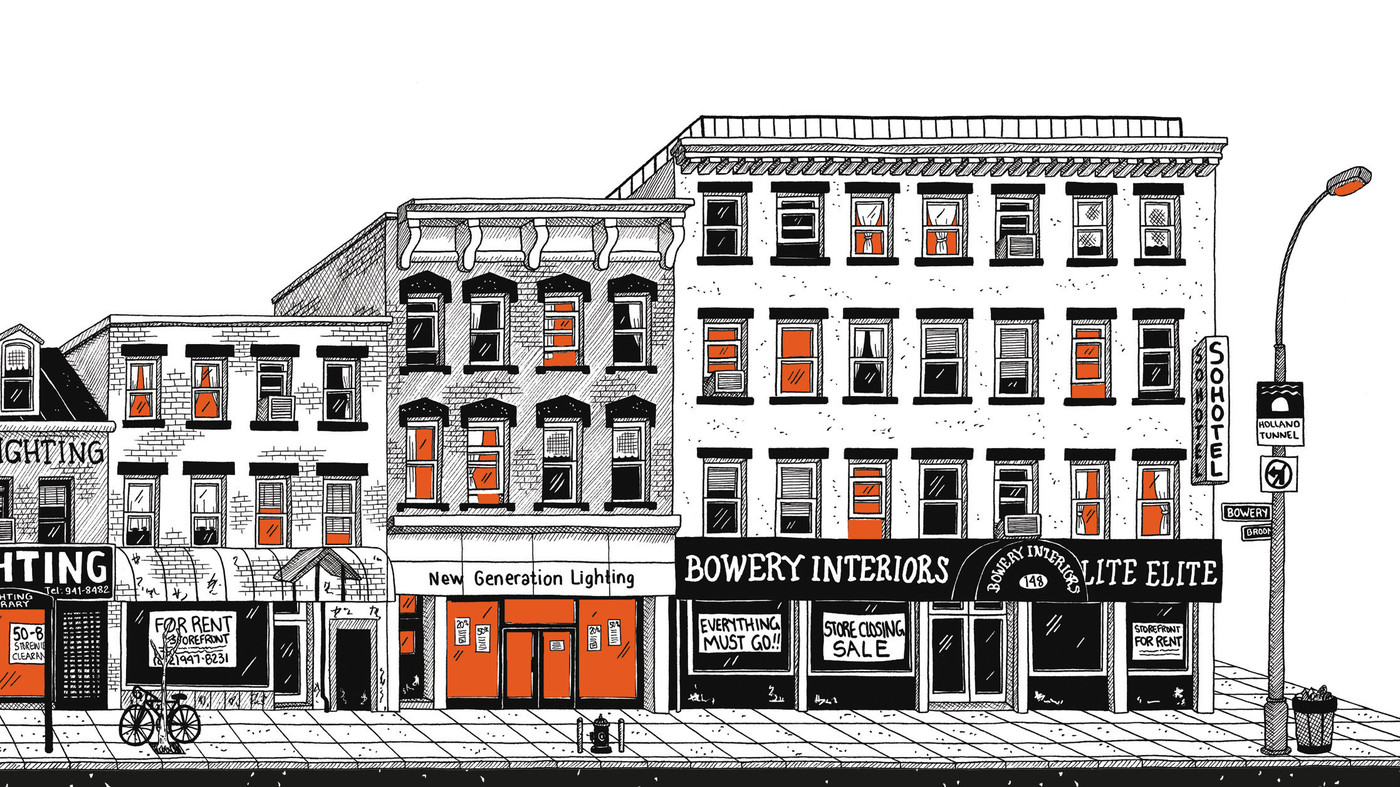
Talk of hyper-gentrification, skyrocketing real estate and the ‘end of New York’ comes bundled with despair and helplessness. Walk down 59th Street and gaze as the super-talls blocking the sun, built for foreign investors who may never once step inside these luxury caverns.

Or stroll along Smith Street in Cobble Hill, observing the rows of boarded-up or vacant store fronts, their rents too high for most actual human retails. Or head to 125th Street to experience the amazing history of Harlem, only to be met with a smorgasbord of national brand retailers with few connections to locals.

What can I do about any of this?, you might think hopelessly. Activism, voting, speaking out — we must all do these things to protect the city we love. But the first step is education on the basic matters of rezoning and gentrification. Where do you even begin?

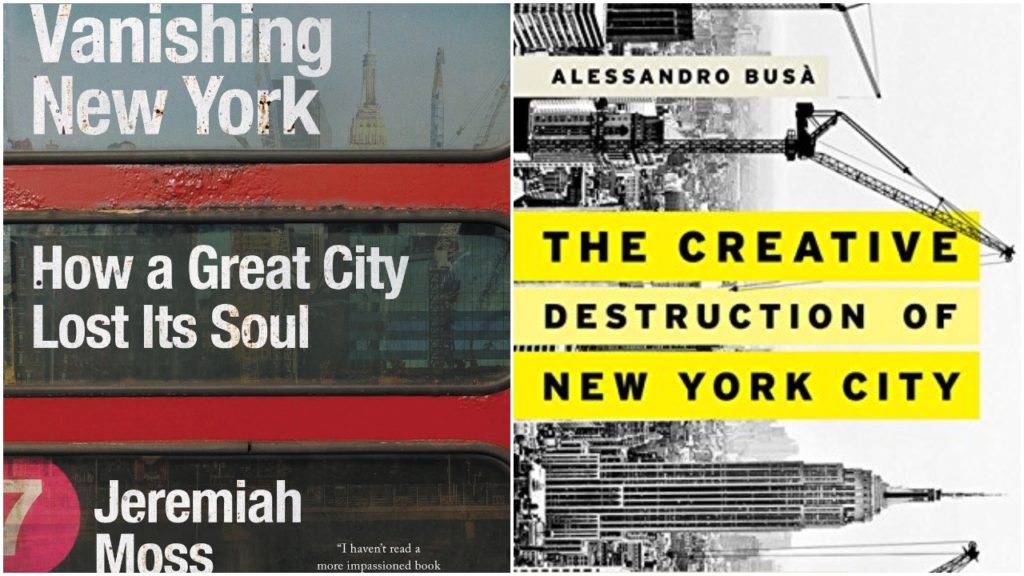
THE CREATIVE DESTRUCTION OF NEW YORK CITY
Engineering the City of the Elite
Alessandro Busà
Oxford University Press

In The Creative Destruction of New York City, a manual for the big-city activist, the critical urban scholar Busà lays out the current crisis in an explanatory, high-level inspection.  One must turn to points in the past — 9/11, the near-bankrupt ’70s, even the destructive shenanigans of Robert Moses — to understand the often soulless and demoralizing changes to the city in 2017. The most troubling development trends began as remedies for past urban decay.  In essence, the city is now choking on its former cures.

Courtesy brklyn is over/Flickr

As examples, Busà focuses on two neighborhoods in particular — Harlem and Coney Island.  Neither of these places were ‘gentrified’ in the traditional sense — as in, initially driven by artists and the artists-formerly-known-as ‘bohemians’ that staked out Williamsburg in the 1980s and 90s. (Unlike other, angrier screeds, Busà mostly steers clear from blanket condemnations of hipsters.)

Portions of Harlem were refitted for big-box retailers who quickly closed in on the mom-and-pop establishments of 125th Street, while luxury housing monopolized on Harlem’s rich history to attract wealthy urbanites looking a condo in a hip neighborhood. Coney Island’s redevelopment woes have eliminated parts of the iconic amusement district and wiped historic buildings from the map.

Below: Target opened in East Harlem in 2010. Today there are at least 15 Target stores throughout the five boroughs. 

ALFRED GIANCARLI/Daily News

At the core of both is that pesky, misunderstood implement known as rezoning. It’s a simple enough concept of course, the mechanism by which certain areas designated for one purpose (residential, commercial, industrial) switch to another. But as Busà says, “As of late, it has become the buzzword loaded with rather negative connotations in New York City. While for some residents it’s nothing more than some technocratic yaw-inducing mumbo-jumbo, for others this loathed word means a call to arms.”

Busà breaks down the major players in city government and civic life who control these decisions and identifies the tools those parties may use in transforming New York, often for less-than-altruistic ends. At times, during the administrations of Bloomberg and De Blasio, rezoning seems to have no more purpose than to create wealth for a few private players.

The Creative Destruction of New York City, written by an academic, is dispassionate and often dry; consider this a compliment. There are many outlets for well-meaning, instructive outrage. (Every time I want to do something — call a congressman or join a protest — I go to Jeremiah’s Vanishing New York first.) Busà‘s more academic take on the crisis will help you understand the rules of the game and those who move the pieces. It’s the book you reach for after you get angry.

Categories
Mysterious Stories Podcasts

The Ghosts of Greenwich Village: Four tales of haunted houses and forgotten graveyards

For this year’s annual Bowery Boys Halloween ghost stories podcast, we cautiously approach the dark secrets of Greenwich Village, best known for bohemians, shady and winding streets and a deeply unexpected history. You will never look at its parks and townhouses again after this show!

The stories featured on this year’s show:

— The hidden history of Washington Square Park featuring the oldest tree in New York — nicknamed the Hangman’s Elm — and some truly grave secrets beneath its lovely walkways

— The Brittany Residence Hall for New York University students has a very famous ghost, a child who experienced a horrible death and continued to haunt the halls of this former hotel, looking for friends to play with

Mayor Jimmy Walker once lived across from an old burial ground in the West Village. But when its ancient plots were replaced with a city park (later renamed after the former nightlife mayor), the bodies and the tombstones were mostly paved over. To this day, a single grave marker sits astride the baseball field, a sole reminder of the area’s macabre past.

— And finally the ceiling of a old Bank Street townhouse reveals an unusual object. This is an epic ghost tale that stretches from the mid 1920s to the early 1980s. And from the haunted streets of the West Village to a peaceful respite in Northern California.


The Bowery Boys: New York City History podcast is brought to you …. by you!

We are now producing a new Bowery Boys podcast every week. We’re also looking to improve the show in other ways and expand in other ways as well — through publishing, social media, live events and other forms of media. But we can only do this with your help!

We are now a member of Patreon, a patronage platform where you can support your favorite content creators for as little as a $1 a month.

Please visit our page on Patreon and watch a short video of us recording the show and talking about our expansion plans. If you’d like to help out, there are five different pledge levels (and with clever names too — Mannahatta, New Amsterdam, Five Points, Gilded Age, Jazz Age and Empire State). Check them out and consider being a sponsor.

We greatly appreciate our listeners and readers and thank you for joining us on this journey so far.


In 2009 a complete headstone was found in Washington Square Park, near the area of the dog park.

Washington Square Park Blog

In 2015, while working on the water pipes underneath the park, workers discovered this grisly find.

Department of Design and Construction

A 1945 advertisement for the Hotel Brittany and a couple other ‘off the beaten path’ hotels.

The former St. John’s burial ground was turned into a park in the 1890s. “One Door that has been opened: St. John’s Park in Hudson Street, — once a graveyard,” says Jacob Riis in the caption for his image of the park.

MCNY

From the New York Times, Dec. 13, 1885:

This show joins our growing collection of Bowery Boys Halloween specials. Creep yourself out while listening to these spooky legends of New York City. From the haunted woods of Van Cortlandt Park to spirits haunting Captain Kidd’s treasure on Liberty Island. Psychics at Carnegie Hall, unsettling spirits in Cobble Hill, undead party animals at Grand Central!

Play them at the links below or find them on iTunes: [Main feed] [Archive feed]

mny221052

2016 Ghosts of the Gilded Age

Highlighting haunted tales from the period just after the Civil War when New York City became one of the richest cities in the world — rich in wealth and in ghosts! In the Bronx once stood a haunted house in the area of Hunts Point, a mansion of malevolent and disturbing mysteries. Then we turn to Manhattan to a rambunctious poltergeist on fashionable East 27th Street. Over in Queens, a lonely farmhouse in the area of today’s Calvary Cemetery is witness to not one, but two unsettling and confounding deaths. And finally, in Staten Island, we take a visit to the glorious Vanderbilt Mausoleum, a historic landmark and a location with a few strange secrets of its own.

5841855416_661144370a_o

2015 Haunted Landmarks of New York
Ghost stories associated with the city’s most popular and recognizable places from baby-faced spooks at the Dakota Apartments to spirited revelers at Grand Central Terminal. What’s still lurking in the hallways of the Chelsea Hotel? And whatever you do tonight, do not linger too long on the Brooklyn Bridge at night! A figure from the bridge’s past may still be looking for his head.

1

2014 Ghost Stories of Brooklyn
Four tales of spirits haunting Brooklyn back in the 19th century when it was still an independent city. A horrific gangly ghost on the railroad tracks, a historic Clinton Hill home with an invisible hand that would not stop knocking, a Coney Island hotel in 1894 with a secret in room 30, and the wacky wraiths of Bushwick’s Evergreens Cemetery.

2

2013 Ghost Stories of Old New York

Tales set mostly before the 1840s featuring sinister stories of murder, shipwreck and death by fright! Spirits of dead Lenape Indians may haunt the forest of Van Cortlandt Park. A romantic West Village restaurant finds its home inside the former carriage house of Aaron Burr. Might the vice president still be visiting? We bring you the legend of an old Brooklyn fort that once sat in Cobble Hill and terrified those who traveled along on old Red Hook Lane. And finally, over at St Paul’s Chapel, a respected old actor wanders the churchyard, looking for his body parts.

3

2012 Mysteries and Magicians of New York

Grab a drink at the Ear Inn, one of New York’s most historically interesting bars, and you might meet Mickey, the drunken sailor-ghost. A frightening story of secret love at old Melrose Hall conjures up one of Brooklyn’s most popular ghostly legends. A woman is possessed through a Ouija board, but while she accept the challenge by one of New York’s first ghostbusters? And a tale of Harry Houdini, Sir Arthur Conan Doyle, and the line between the supernatural and mere sleight of hand.

2011 Haunted Histories of New York

What’s horrors are buried at the foot of the Statue of Liberty? What’s below a Brooklyn Catholic church that makes it so dreadfully haunted? What ghost performs above the heads of theatergoers at The Palace? And what is it about the Kreischer Mansion that makes it Staten Island’s most haunted home?

seance

2010 Supernatural Stories of New  York
The scary revelations of a New York medium, married Midtown ghosts who fight beyond the grave, a horrific haunting at a 14th Street boardinghouse, and the creepy tale of New York’s Hart Island.

2009 Haunted Tales of New York: Urban Phantoms
The secrets of the restless spinster of the Merchants House, the jovial fright of the Gay Street Phantom, the legend of the devil at Spuyten Duyvil Creek, and the spirit of a dead folk singer.

ghost

2008 Spooky Stories of New York
The drunken spirits of the Algonquin, the mysteries of a hidden well in SoHo, the fires of the Witch of Staten Island, and ‘the most haunted brownstone in New York.’

1

2007 Ghost Stories of New York
The ghosts of a tragic Ziegfeld girl, a scandalous doyenne of old New York, a bossy theater impresario and the ghoulish bell-ringer of St. Mark’s-in-the-Bowery.

Here are the locations mentioned in all of our ghost podcasts:

Categories
Bowery Boys Bookshelf Revolutionary History

The Ghost Ship of Brooklyn: Uncovering New York’s darkest secrets of the Revolutionary War

The Brooklyn Navy Yard, no longer a bustling shipyard, lives on as a vibrant commercial compound of movie studios, bourbon distilleries and organic rooftop farms. Its waterfront, facing into Wallabout Bay, is relatively peaceful today. There are no remnants of its genuinely disturbing past.

During the Revolutionary War, New York was a British stronghold, and prisoners associated with George Washington and the Continental Army were often sent here for detainment. Soon the city’s make-shift prisons — sugar houses turned into decrepit jails — became too crowded, and the British needed to look for alternatives.

The answer arrived in the form of old naval vessels, previously used to transport supplies, that were moored off the coast of Brooklyn and turned into prison ships. For the duration of the war, hundreds of men and boys were thrown onto these wretched ships, forced to endure a litany of conditions so brutal and dire that they seem like tortures designed for a modern horror film.

And the worst of all of these was the HMS Jersey.

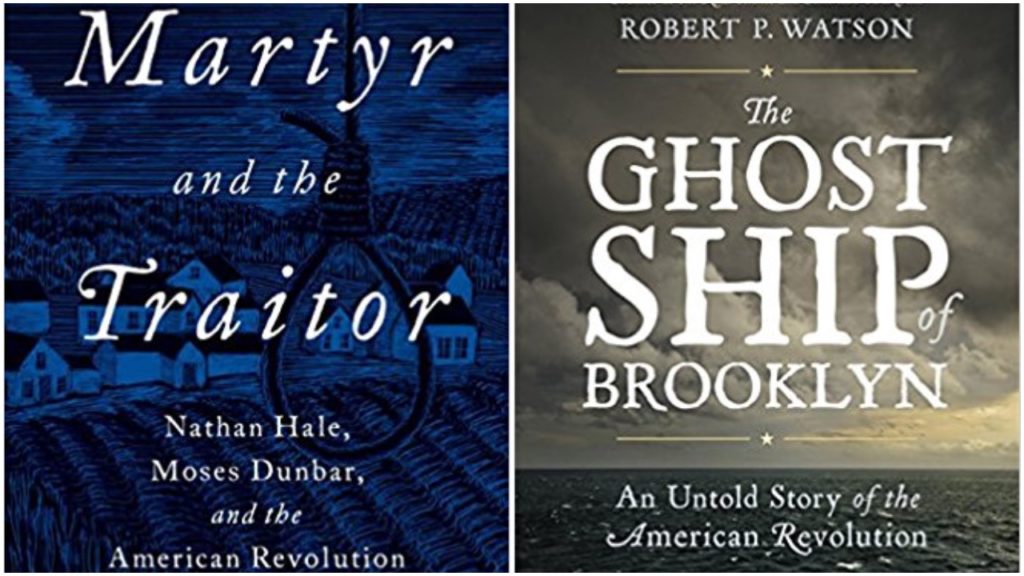
THE GHOST SHIP OF BROOKLYN
An Untold Story of the American Revolution
by Robert P. Watson
Da Capo Press

In Robert P. Watson‘s sharp and incisive new book, the author isolates the grim tale of the prison ships, often deemed a footnote in most Revolutionary War histories, from the actions of the conflict at large. It’s vividly narrow in scope, allowing the reader to experience the ship’s macabre trials in a sort of narrative entrapment. The prisoners themselves experienced the Jersey in such a way, trapped below deck with only the fleeting glimpse of New York across the water. For the damned, Wallabout Bay became an inescapable hell.

Watson weaves several first-hand accounts into the narrative, the tales of the lucky few who managed to escape. There’s a dash of Robert Louis Stevenson in the stories, plights regularly associated with swashbuckling tales of pirates. Except these horrid events took place just meters from the Brooklyn shoreline.

In fact, most prisoners who perished aboard the ship were buried on that shoreline, placed into the shallow ground by fellow prisoners, volunteering for burial duty as a way to say a final goodbye. Many days later, those bodies would be caught in the tide to eventually float out into the river.

But perhaps like a good swashbuckler, Ghost Ship of Brooklyn showcases several stories of impossible survival, daring prison breaks and even a couple surprising rescues. For every grim statistic, there’s a moment of desperate bravery. One of the most inspiring feats comes from the recollections of prisoner Thomas Dring who, seeing men around him dying of smallpox, decides to self-inoculate himself and others.

Several men managed to flee the death holds of the Jersey to later recount these thrilling escapes in memoirs. They were the lucky ones; according to reports of the day, 11,500 people died aboard the Jersey. As Watson notes, “over twice as many Americans were lost on that single, cursed than died in combat during the entirety of the long war!”

NYPL from Booth’s History of New York

(Today the city honors those who died in the bay with Prison Ship Martyr’s Monument, the central feature of Fort Greene Park.)

Categories
Mysterious Stories Podcasts

Murder at the Manhattan Well: A shocking crime and a legendary trial with Hamilton and Burr

PODCAST The murder of a young woman in 1799 and the ensuing trial involving two of America’s Founding Fathers

There once was a well just north of Collect Pond (New York’s fetid source of drinking water in the late 18th century) in a marshy place called Lispenard’s Meadow, in the area of today’s SoHo.

One cold day in December — in the year 1799 — a boy came across a lady’s article of clothing here matching that in the possession of a missing woman named Elma Sands. Upon looking into the old, boarded-up well, investigators discovered a horrifying sight — the lifeless body of Ms. Sands, which had been submerged in the well for several days.

Suspicion immediately shifted to the boarding house where she lived and worked, and the unusual tenants there all became suspects — including Levi Weeks, the brother of a prominent builder. Weeks was soon accused of her murder and thrown into jail.

This is the tale of the extraordinary trial that occurred in March of 1800 featuring two of the most prominent people in New York City — Alexander Hamilton and Aaron Burr. Years before their fateful duel in Weehawken, the two lawyers agreed to defend Weeks against charges of brutal murder.

But Hamilton and Burr were linked to the case in other ways. A banking institution borne from these early days still thrives today. And, believe it or not, the infamous Manhattan well still exists in the basement of a surprising place.


The Bowery Boys: New York City History podcast is brought to you …. by you!

We are now producing a new Bowery Boys podcast every week. We’re also looking to improve the show in other ways and expand in other ways as well — through publishing, social media, live events and other forms of media. But we can only do this with your help!

We are now a member of Patreon, a patronage platform where you can support your favorite content creators for as little as a $1 a month.

Please visit our page on Patreon and watch a short video of us recording the show and talking about our expansion plans. If you’d like to help out, there are five different pledge levels (and with clever names too — Mannahatta, New Amsterdam, Five Points, Gilded Age, Jazz Age and Empire State). Check them out and consider being a sponsor.

We greatly appreciate our listeners and readers and thank you for joining us on this journey so far.


1798 watercolor by Archibald Robertson of the hilly countryside north of Collect Pond. The well would have been located a short distance from here, off to the right.

Sketches of Lispenard’s Meadow by artist Alexander Anderson. The first is dated 1785, the second 1800.

NYPL

NYPL

The illustration above was later re-drawn:

NYPL

The reservoir of the Manhattan Company was built on Chambers Street but the Bank of the Manhattan Company — the real motivation behind starting the company — was at 40 Wall Street.

The scene of the trial — old Federal Hall, pictured here in 1797 in an illustration by Currier and Holland and drawn for D. T. Valentine’s Manual.

MCNY

Notice of Levi Week’s death found in the Mississippi Free Trader — Dec. 15, 1824.

The old Manhattan Well was rediscovered underneath the Manhattan Bistro in the 1980s. The bistro is now the clothing store COS.