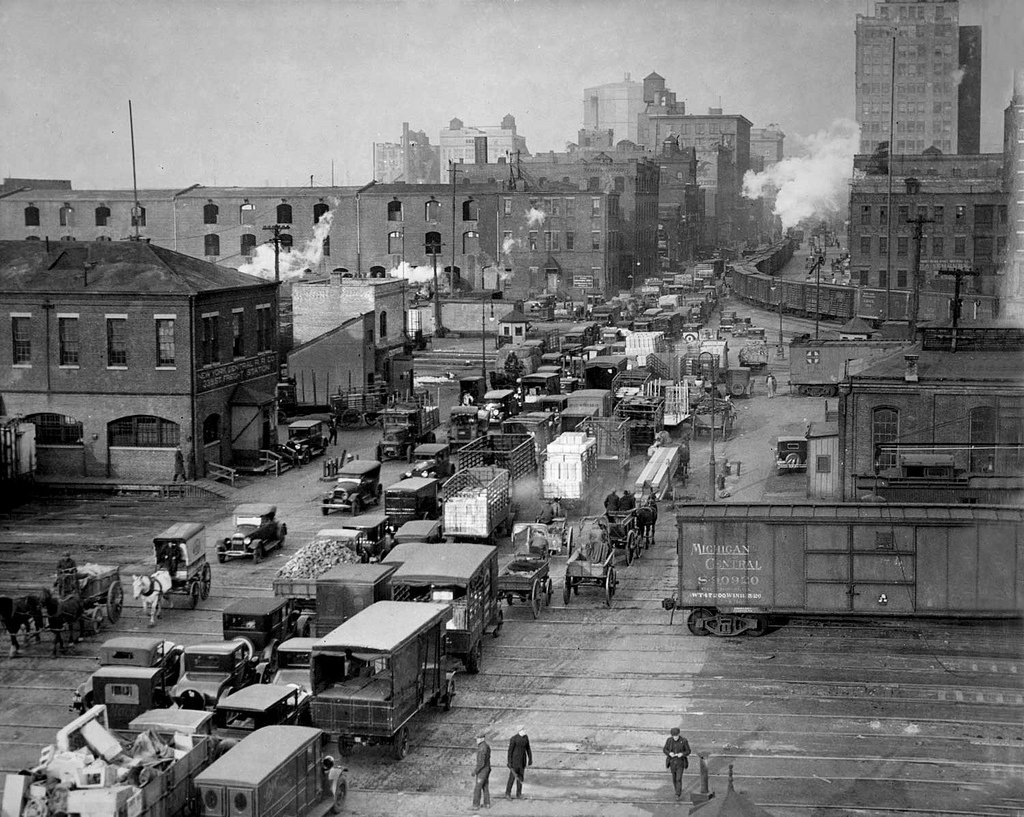
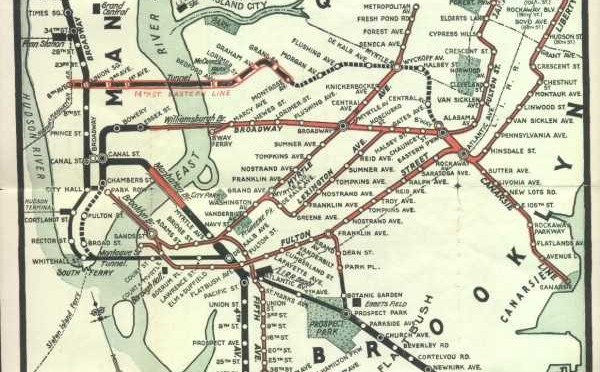
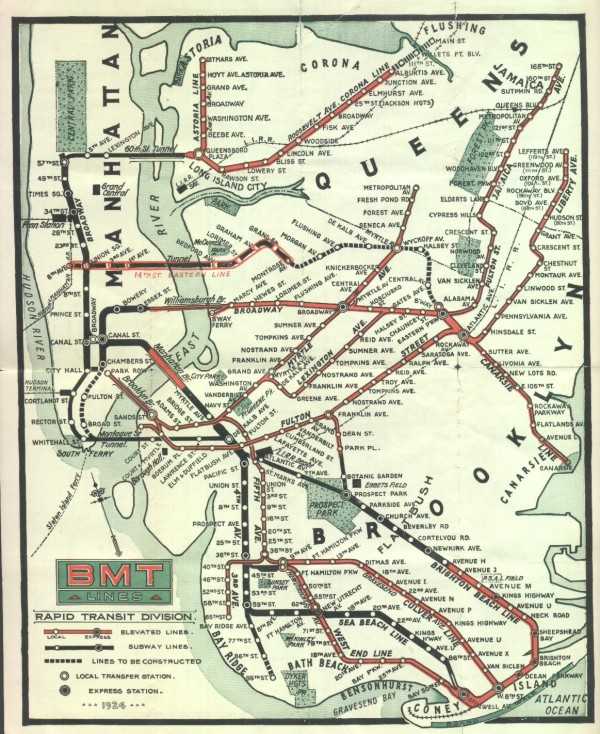
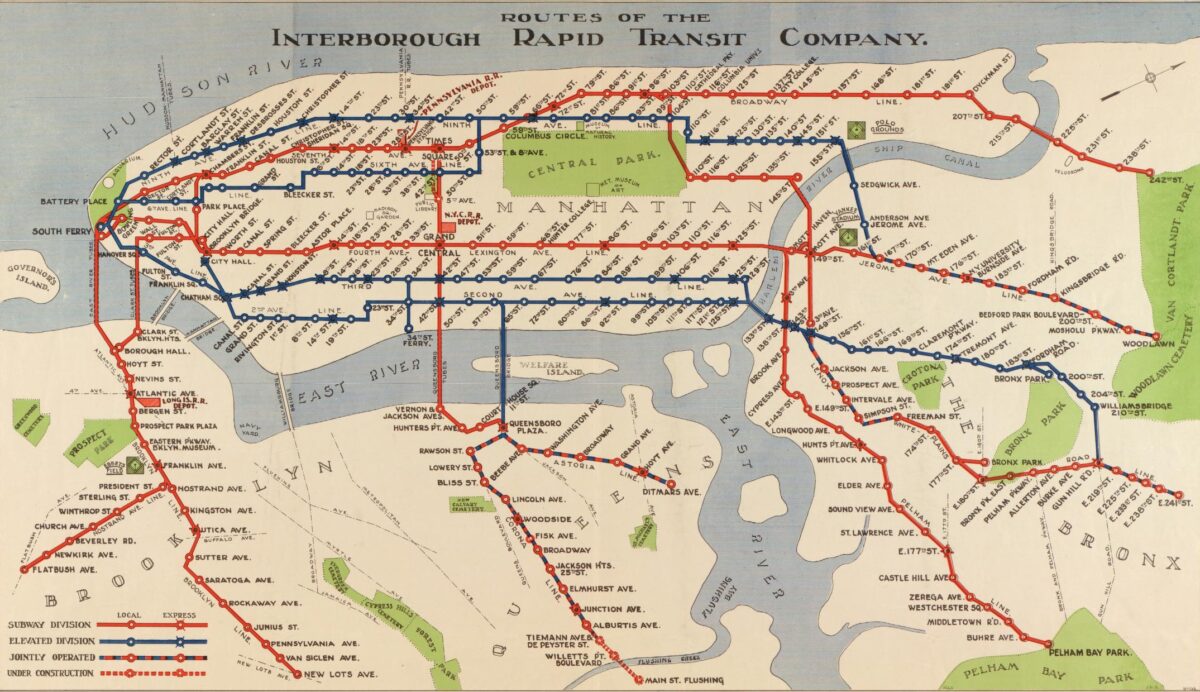
Routes of the Interborough Rapid Transit Company, 1924. Courtesy LIbrary of Congress
The New York City subway system turns 120 years old later this year so we thought we’d honor the world’s longest subway system with a supersized overview history — from the first renegade ride in 1904 to the belated (but sorely welcomed) opening of one portion of the Second Avenue Subway in 2017.
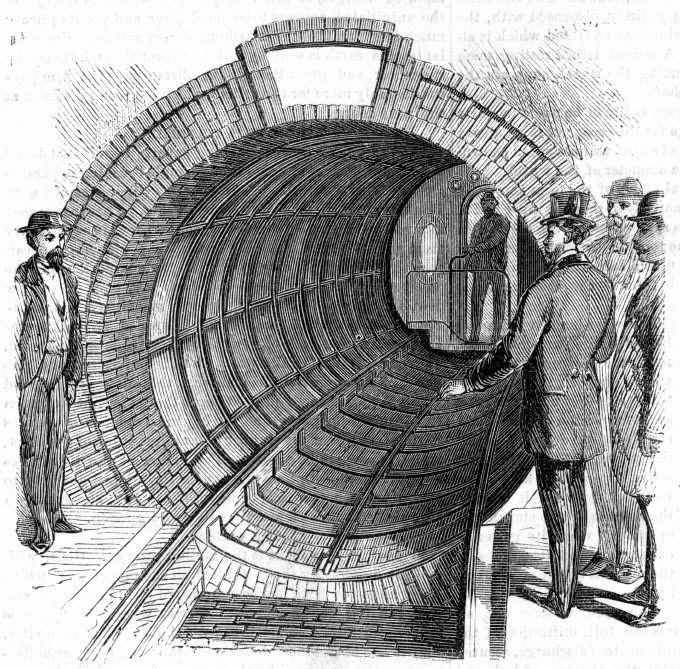
New Yorkers like Alfred Ely Beach had envisioned a subway system for the city as early as the 1870s. Yet years of political delay and a lack of funding ensured that dreams of an underground transit would languish.
It wasn’t until the mid 1890s that the city got on track with the help of August Belmont and the newly formed Interborough Rapid Transit.
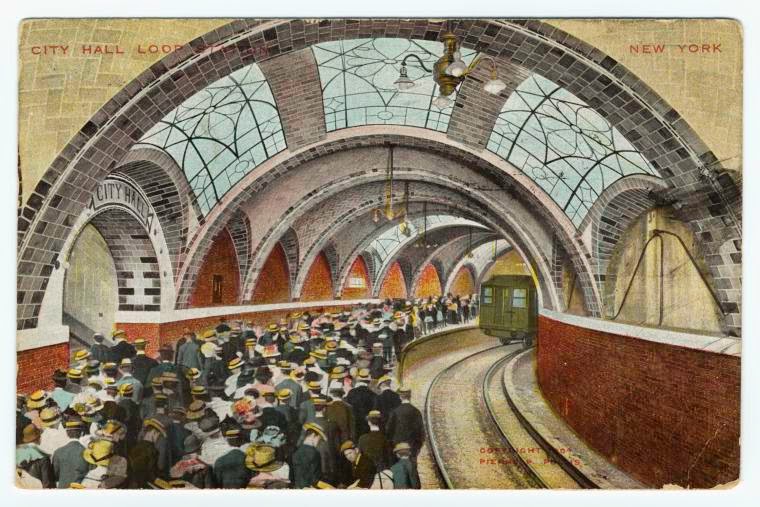
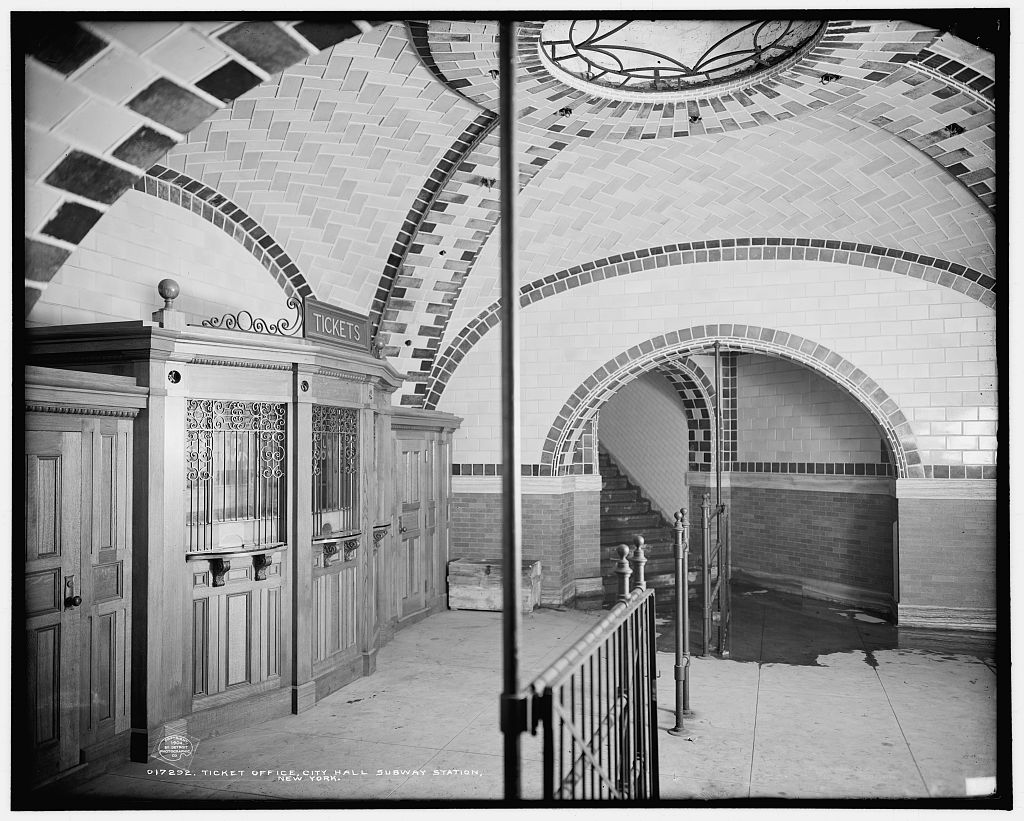
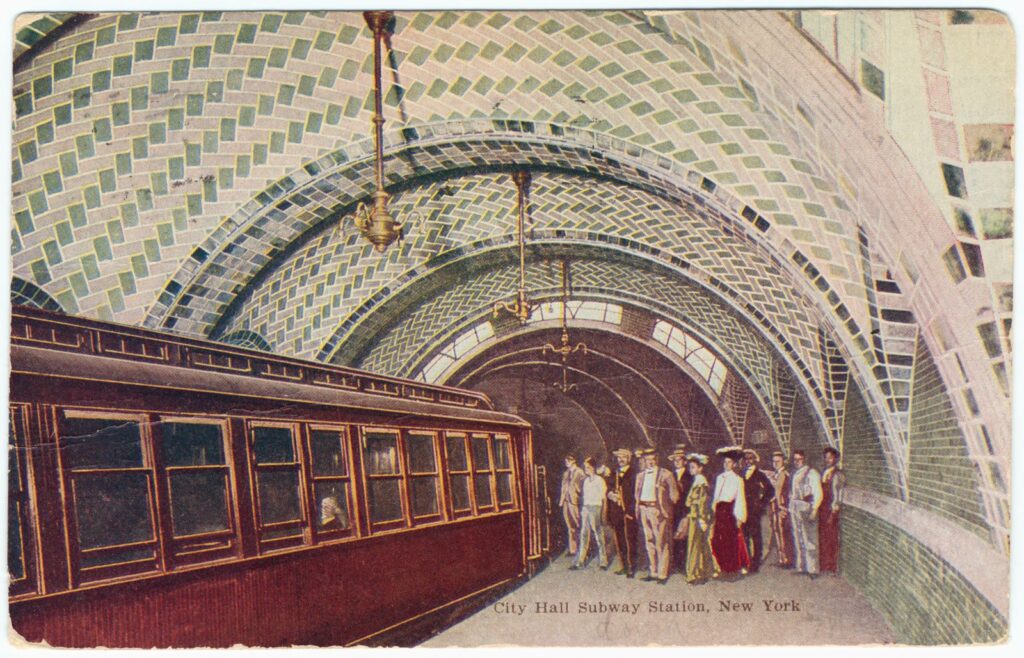
Inside the brand new City Hall station 1904 (Library of Congress)
We’ll tell you about the construction of the first line, traveling miles underground through Manhattan and into the Bronx. How did the city cope with this massive project? And what unfortunate accident nearly ripped apart a city block mere feet from Grand Central Station?
You’ll also find out how something as innocuous sounding as the ‘Dual Contracts’ actually became one of the most important events in the city’s history, bringing the Brooklyn Rapid Transit Company into the mix and creating new underground passages into Brooklyn, the Bronx and (at long last!) Queens.
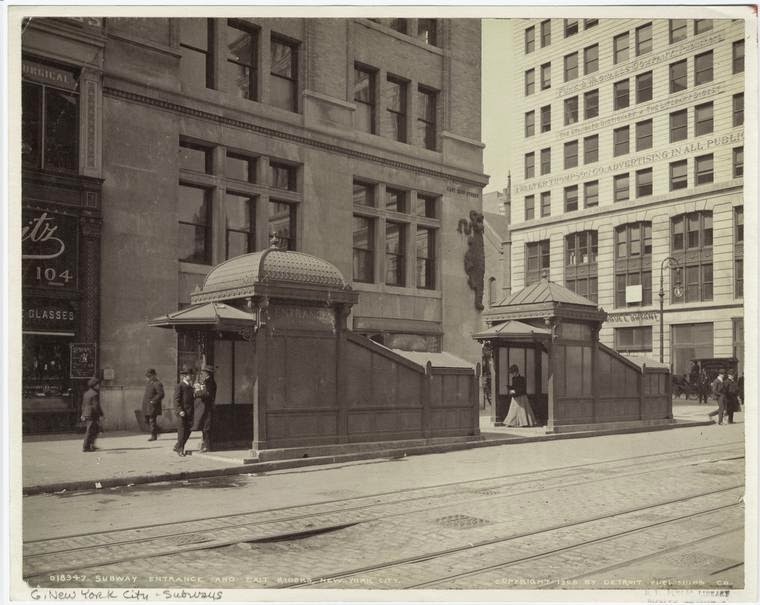
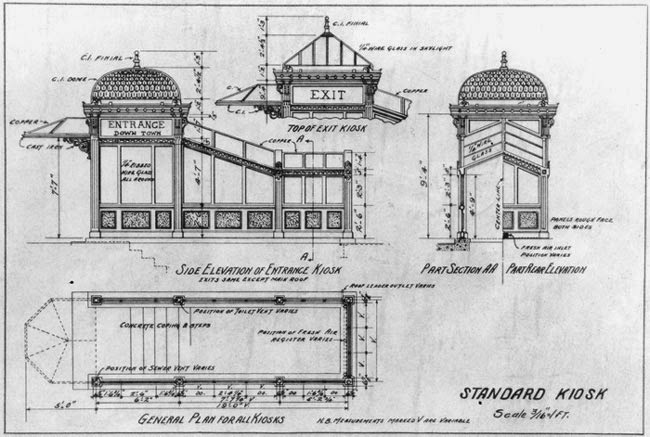
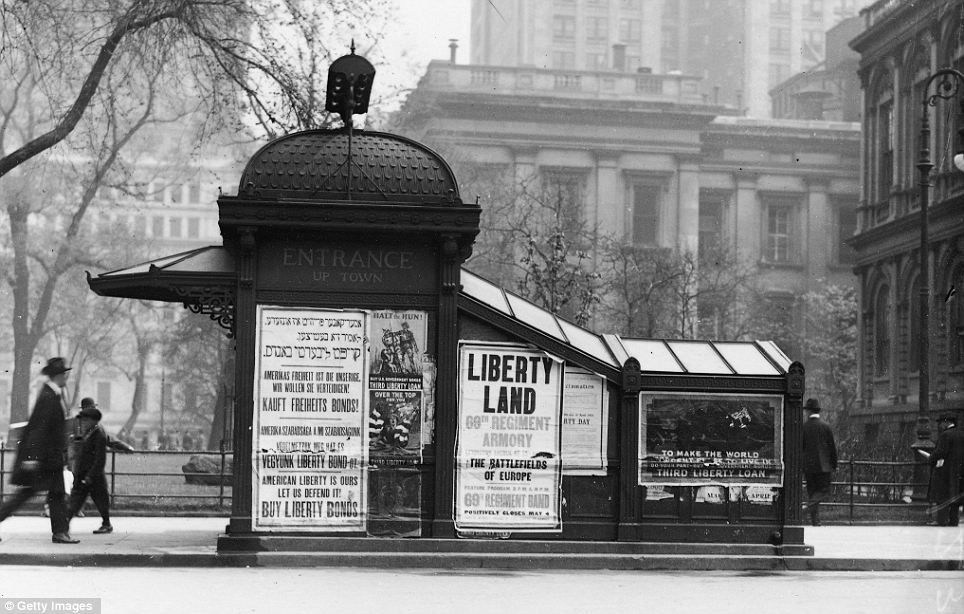
One of New York’s Budapest-inspired kiosks, pictured here 1917
Then we’ll talk about the city’s IND line, which completes our modern track lines and gives the subway its modern sheen.
Through it all, the New York City subway system is a masterwork of engineering and construction. In particular, after listening to this show, you won’t look at the Herald Square subway station the same way again.
Today’s episode is a remastered and reedited edition of two 2011 Bowery Boys podcasts, featuring newly recorded material to take the story to the present day.
LISTEN NOW: History of the New York City Subway
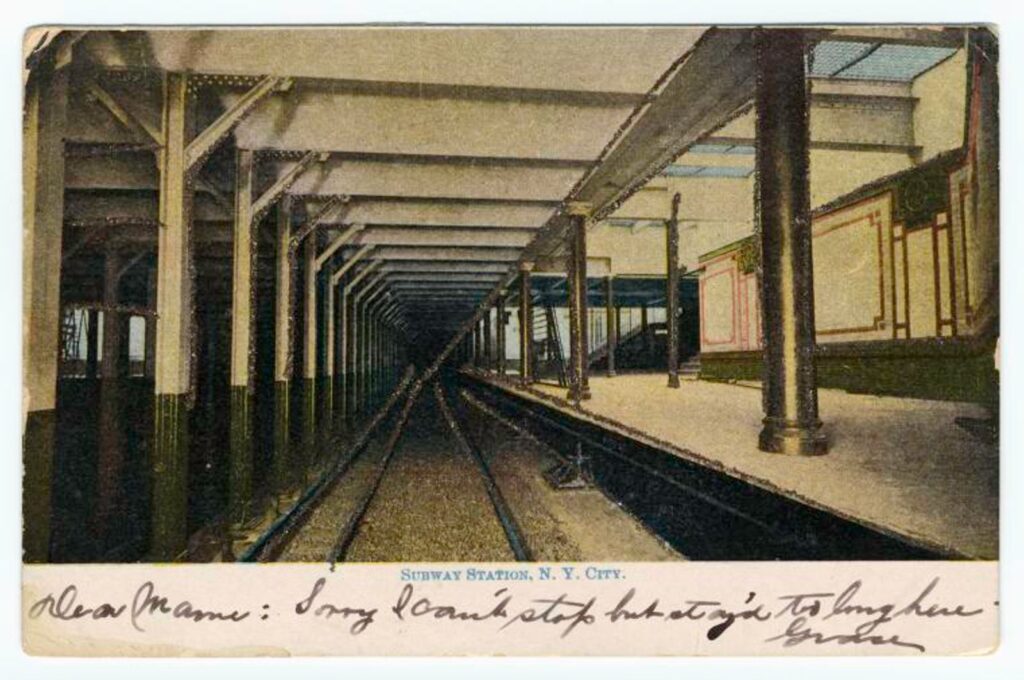
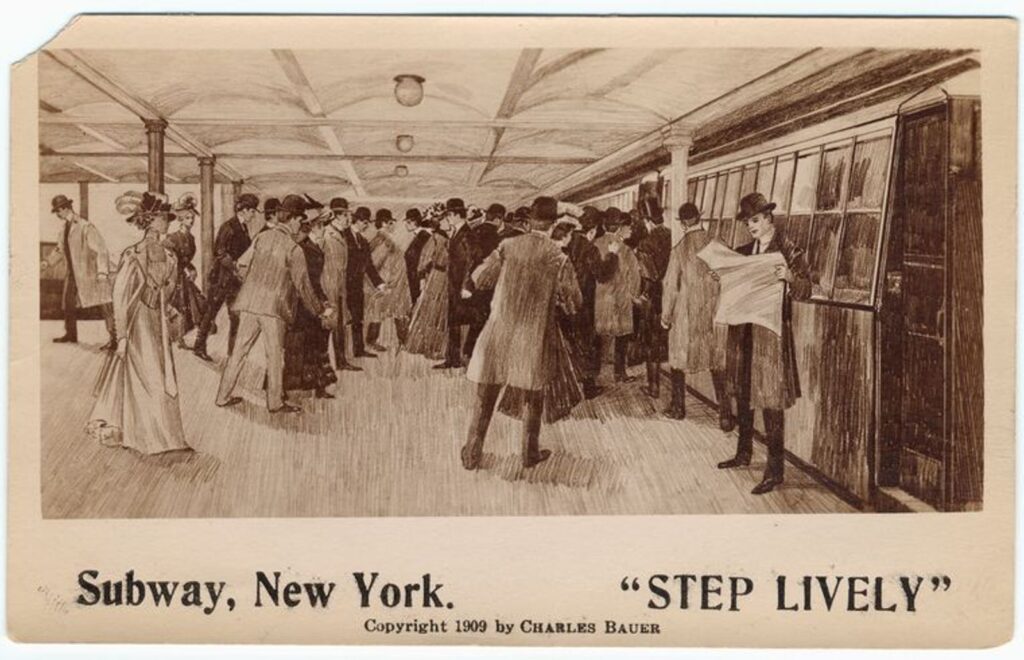
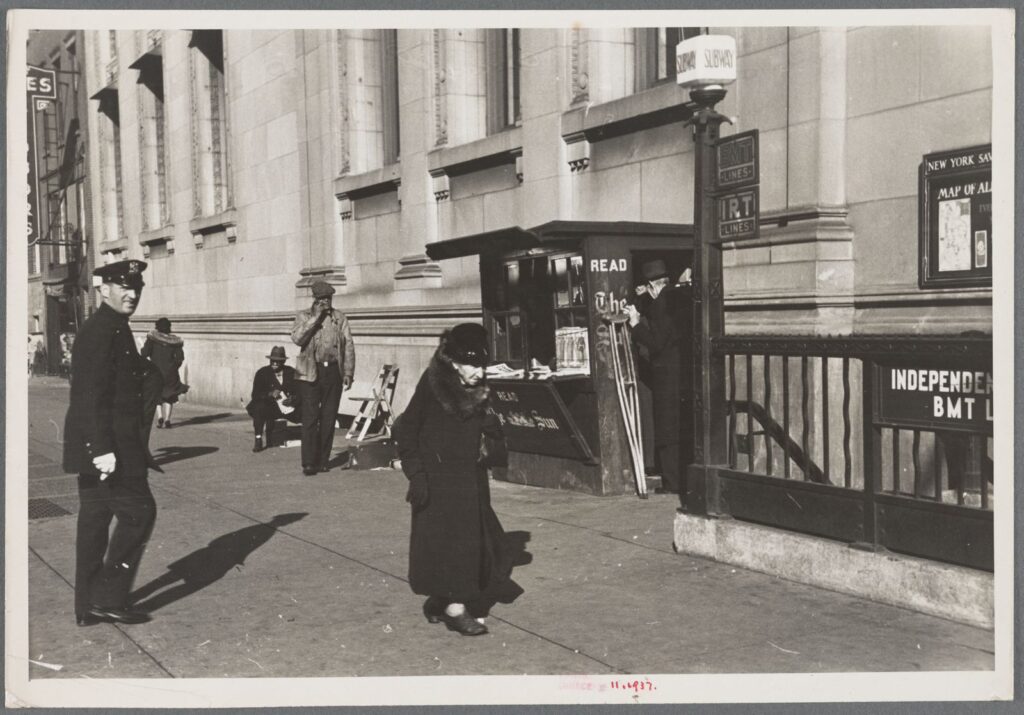
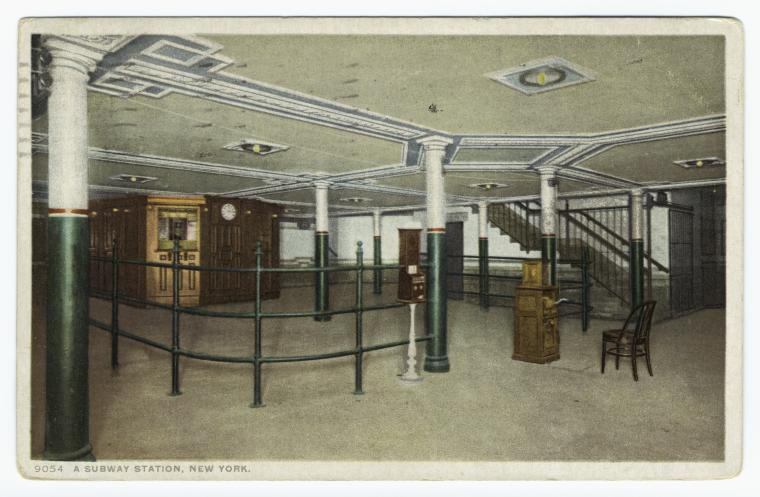
Inside City Hall station, 1906 (NYPL)A 1906 postcard showing — a subway tunnel. Demonstrates what a novel view this was in 1906. (NYPL)The subway in 1909 (NYPL)The Eighth Avenue line, 1937 (NYPL)
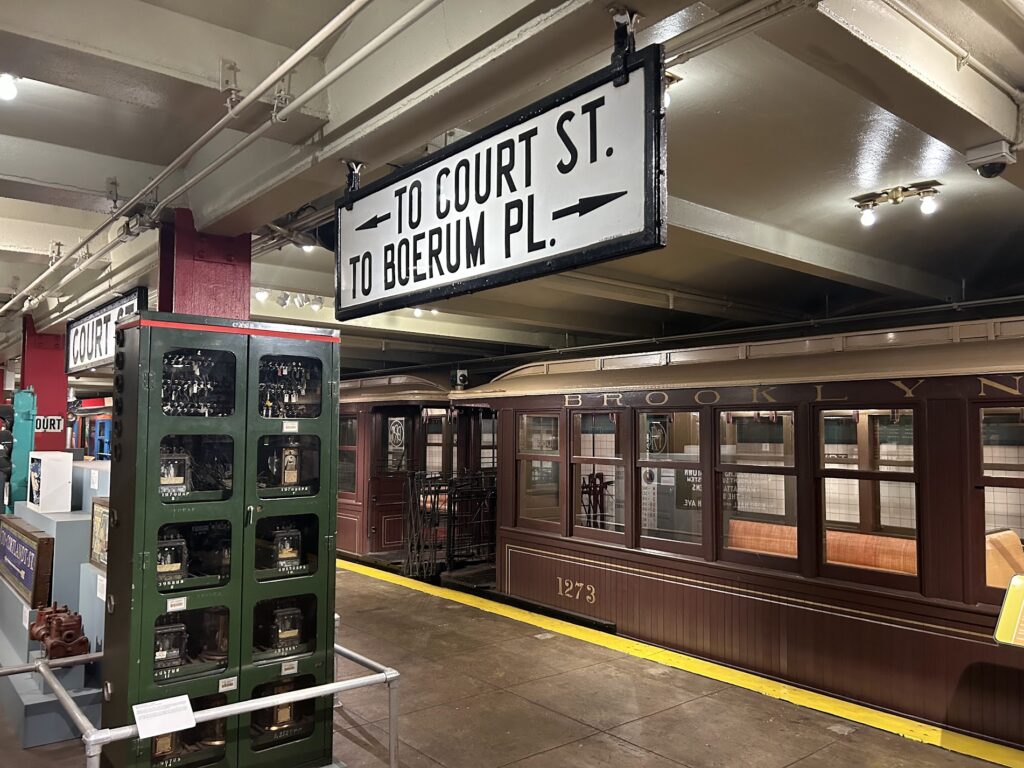
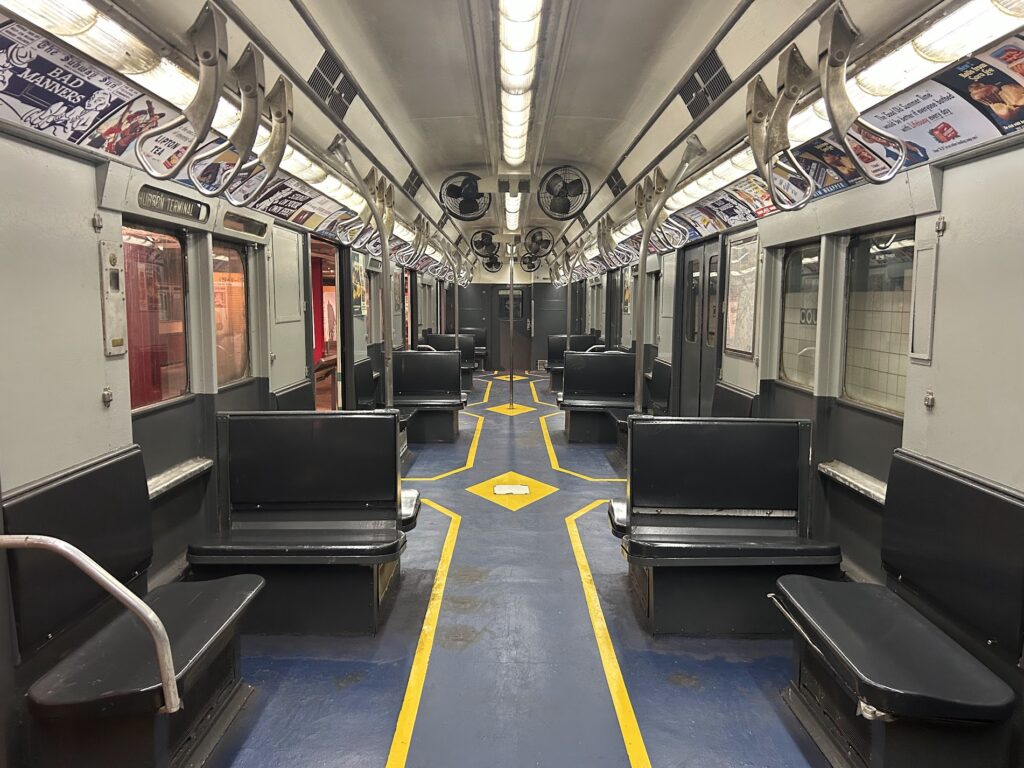
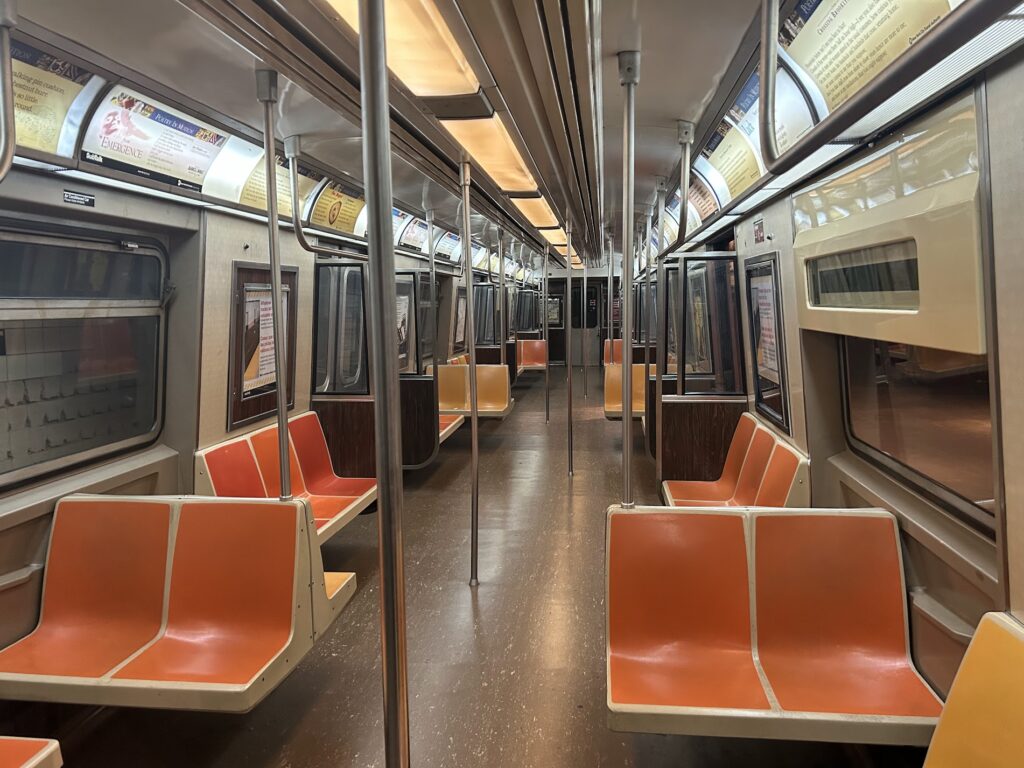
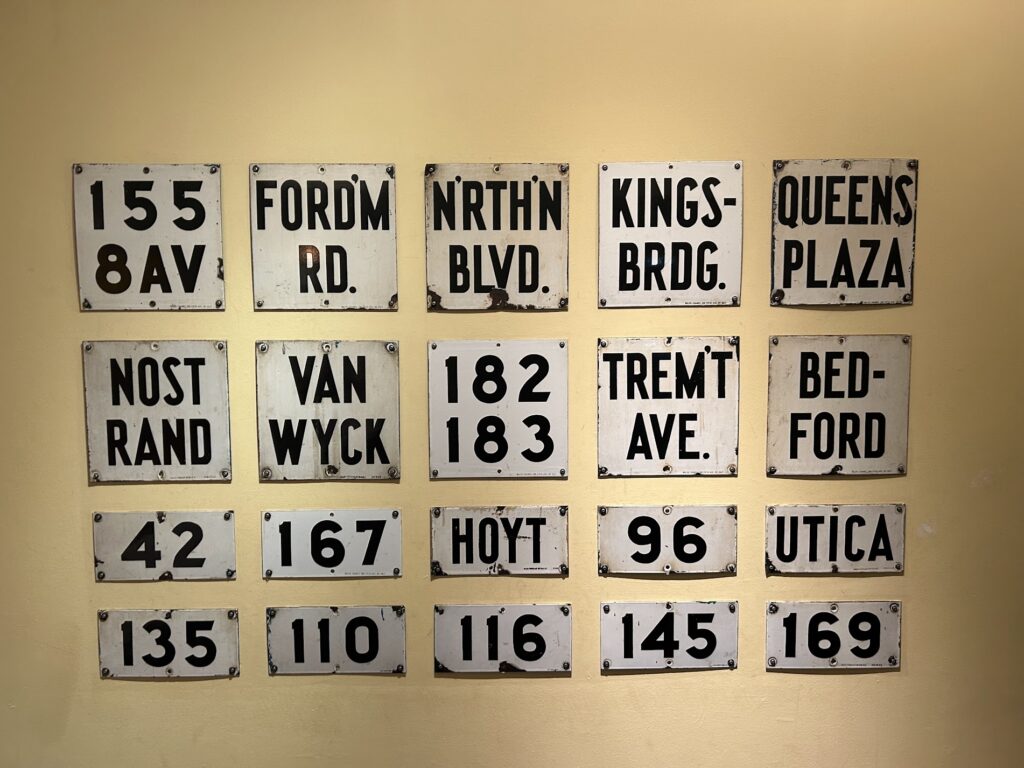
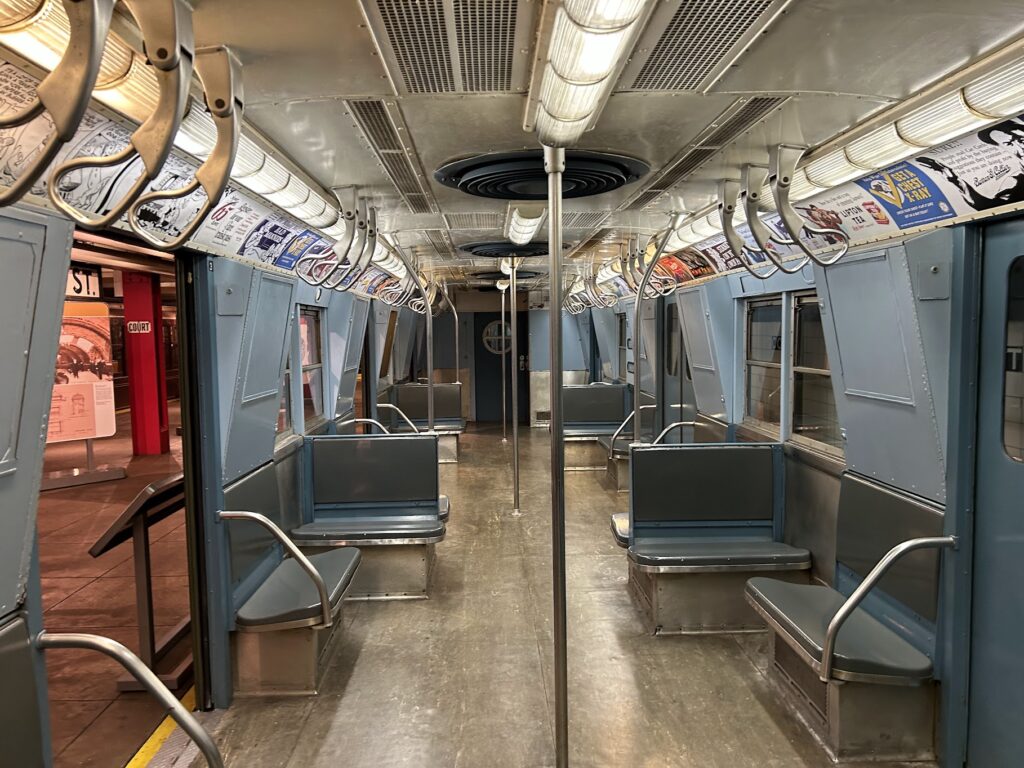
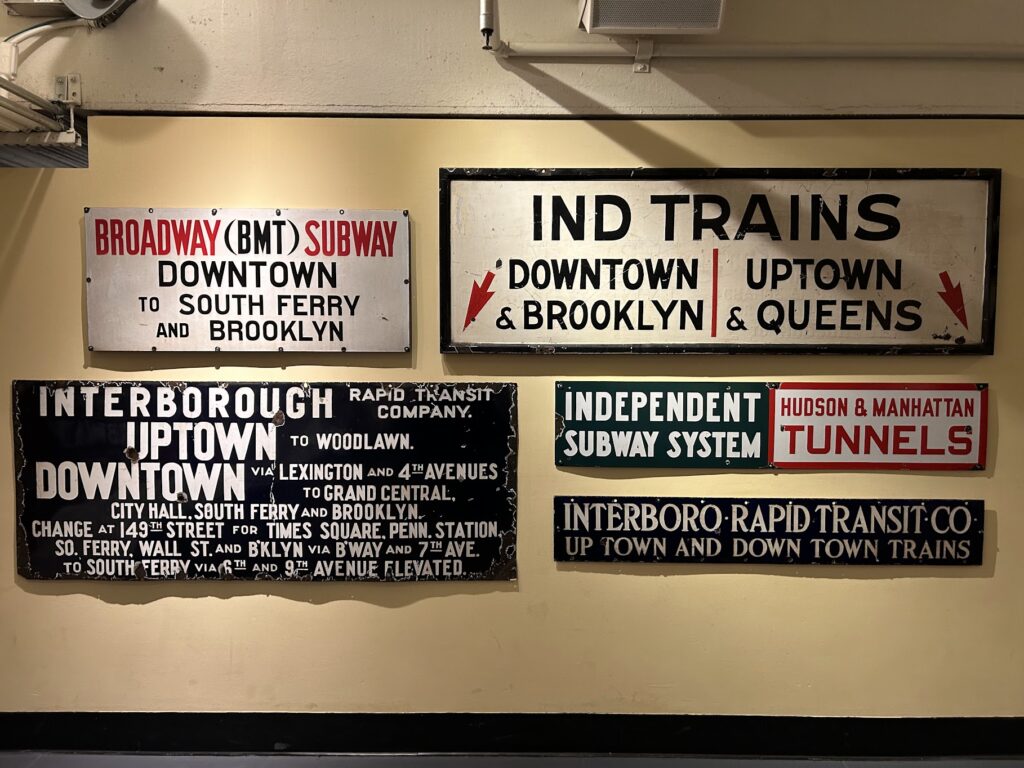
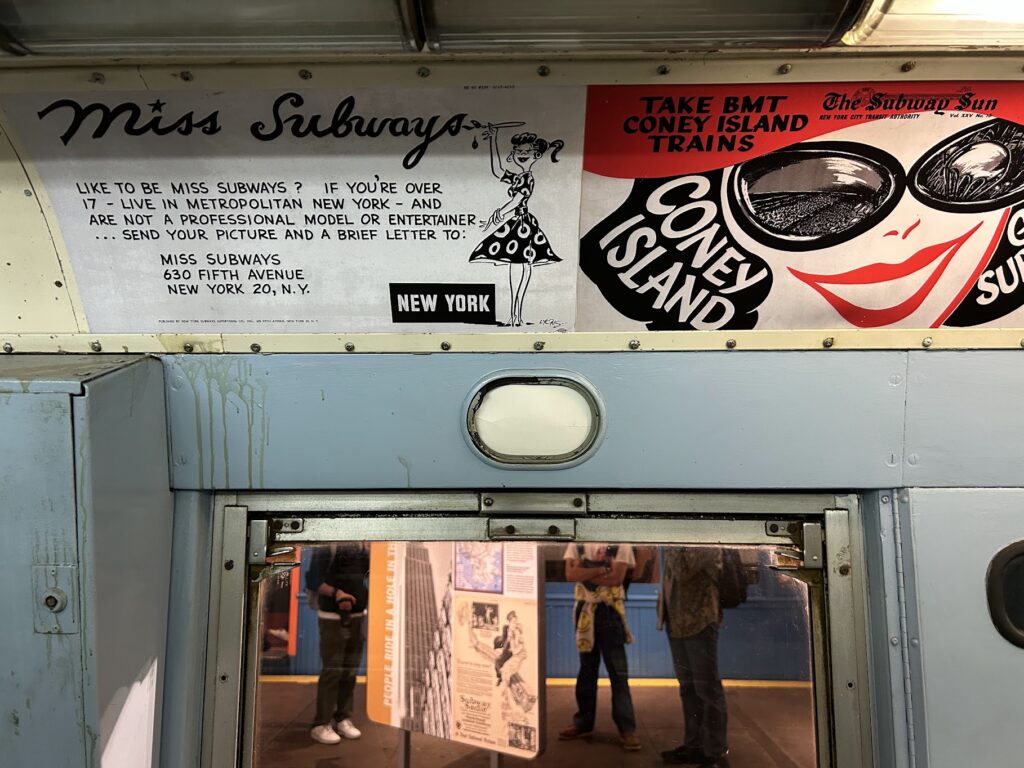
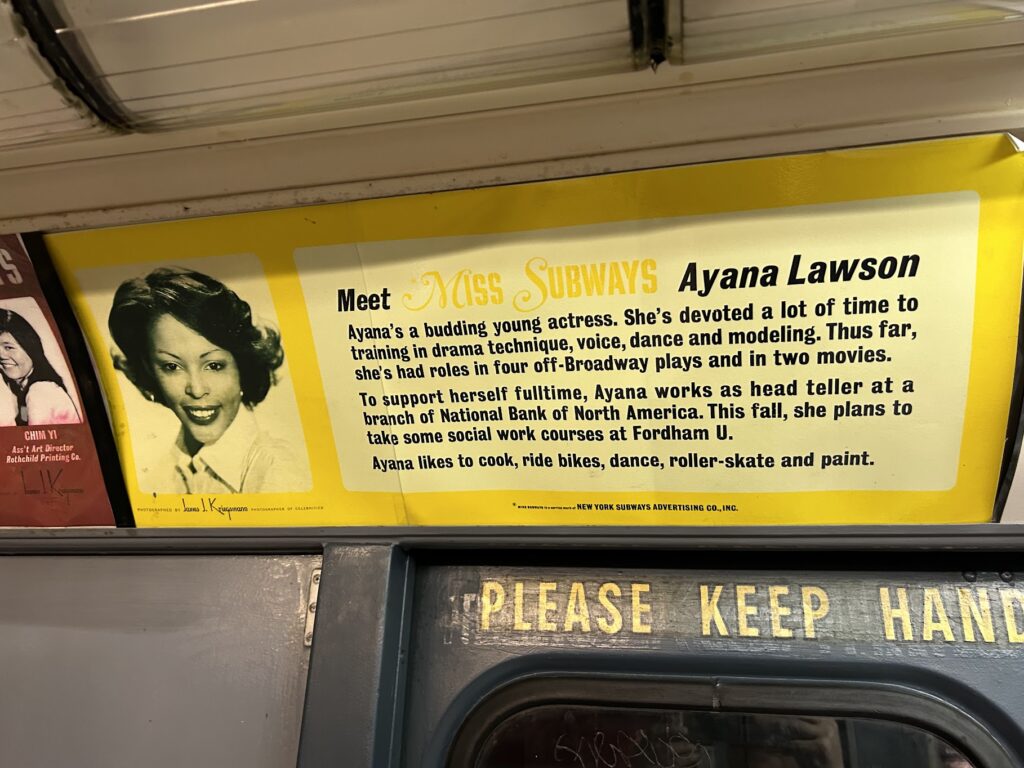
Images from Greg’s recent visit to the New York Transit Museum. Visit the Downtown Brooklyn museum or the gallery in Grand Central.
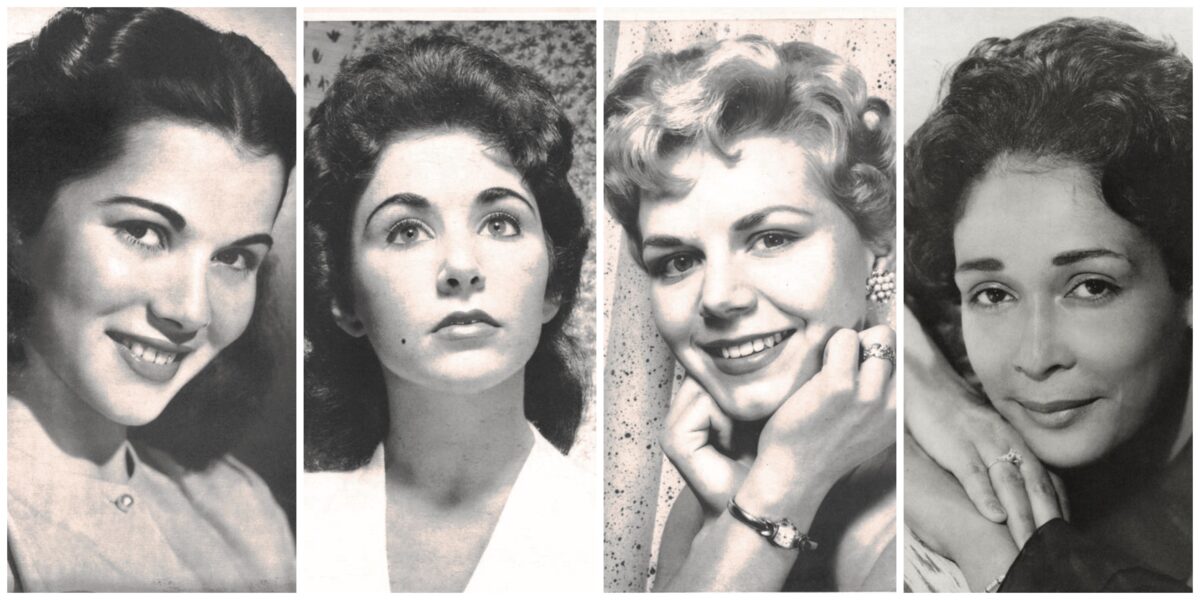
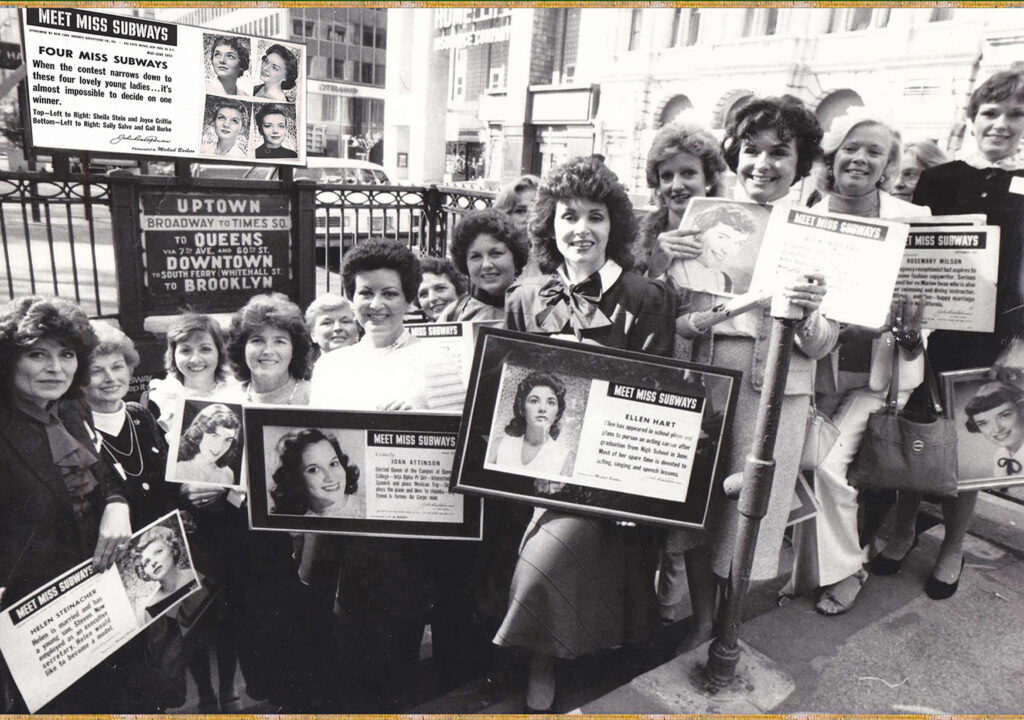
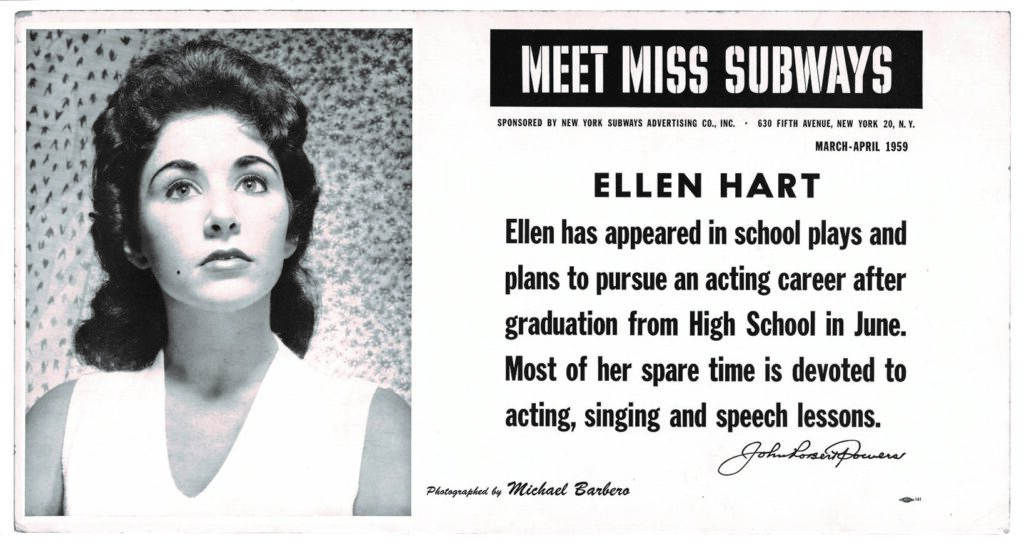
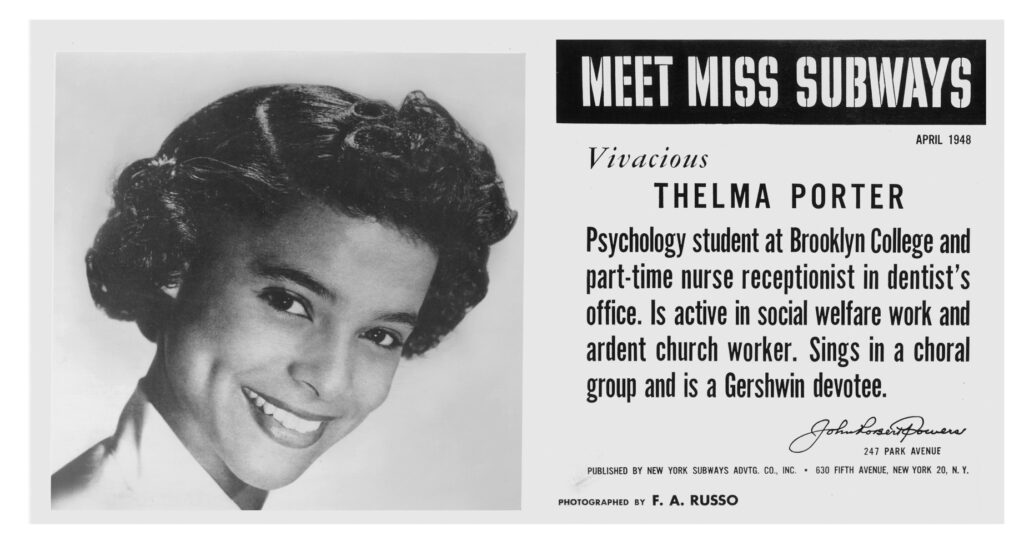
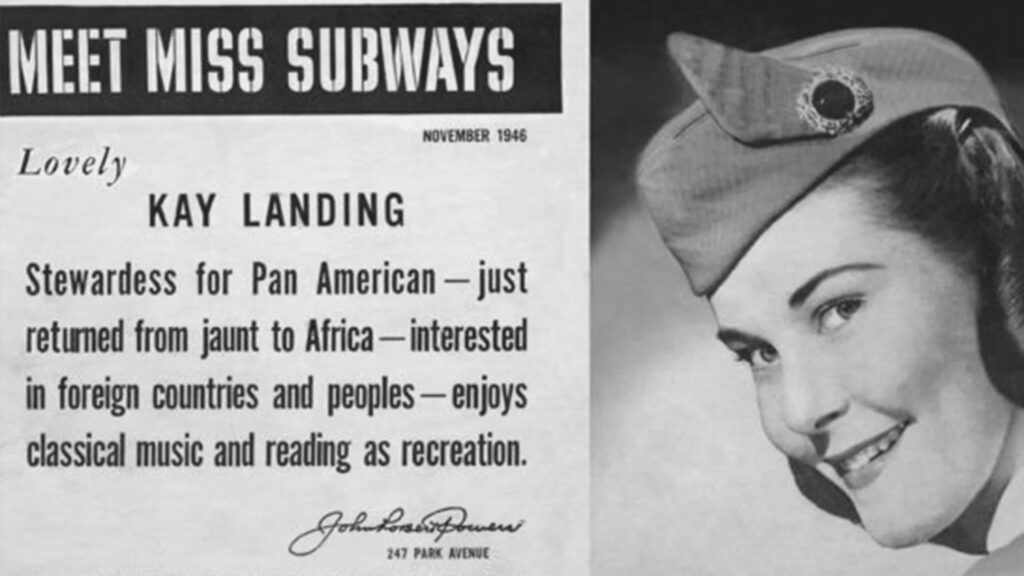
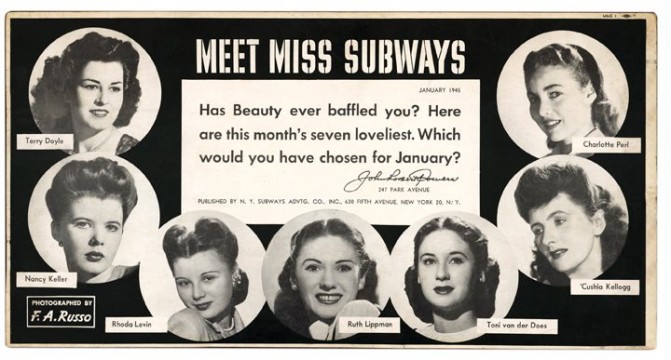
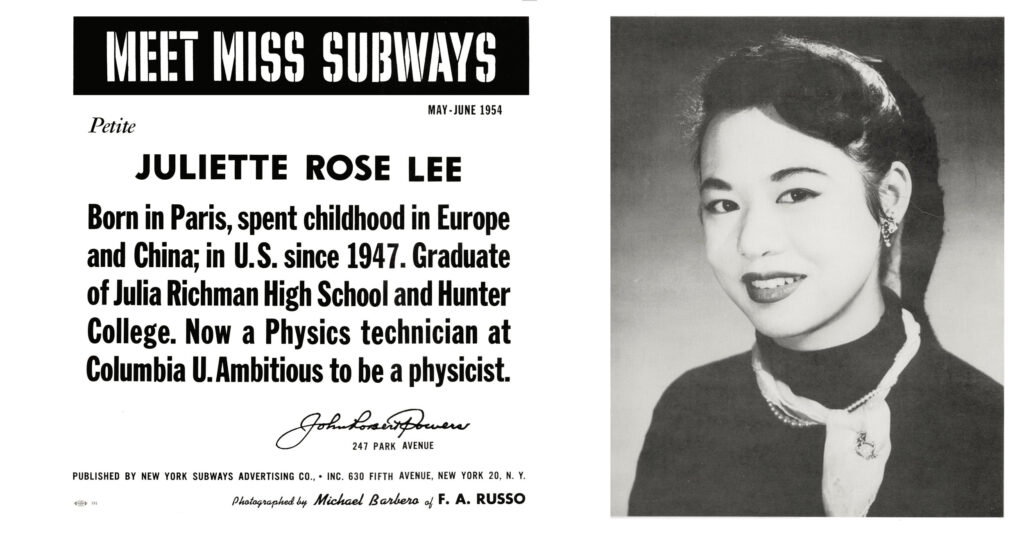
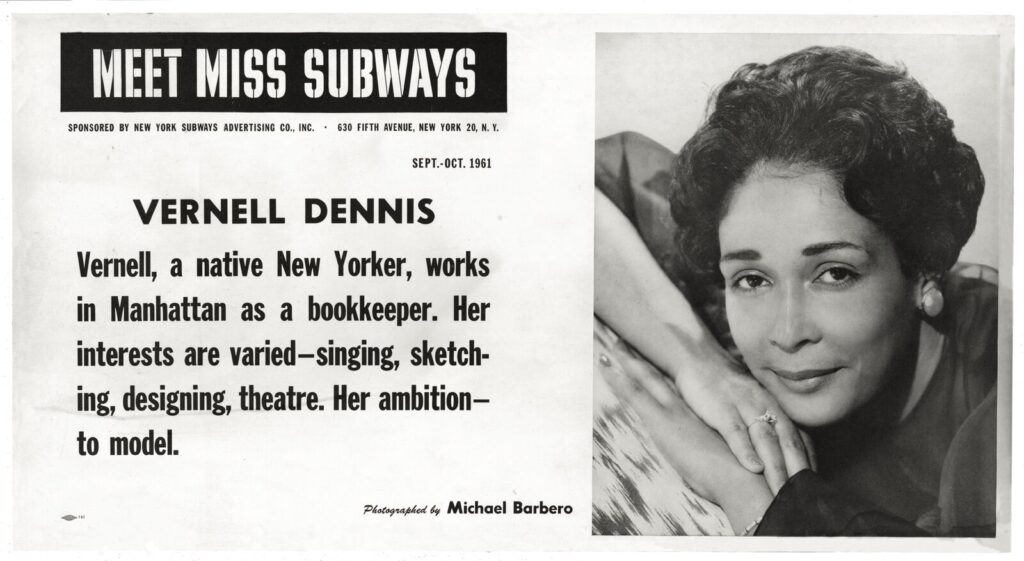
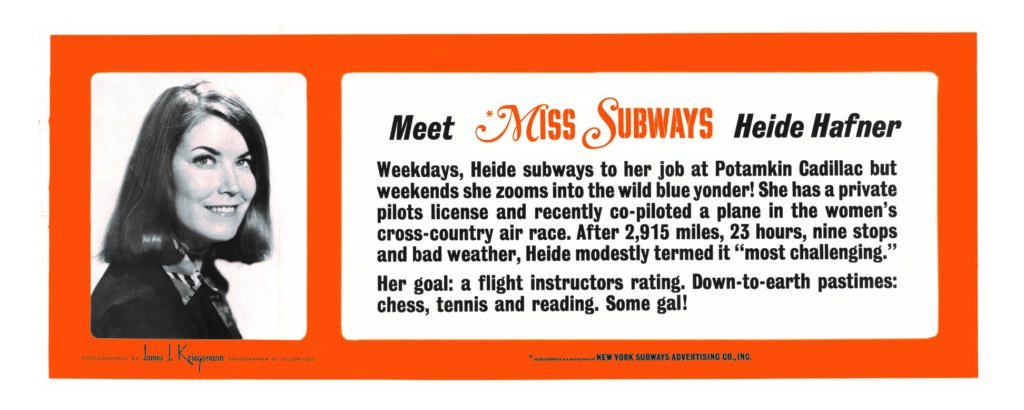
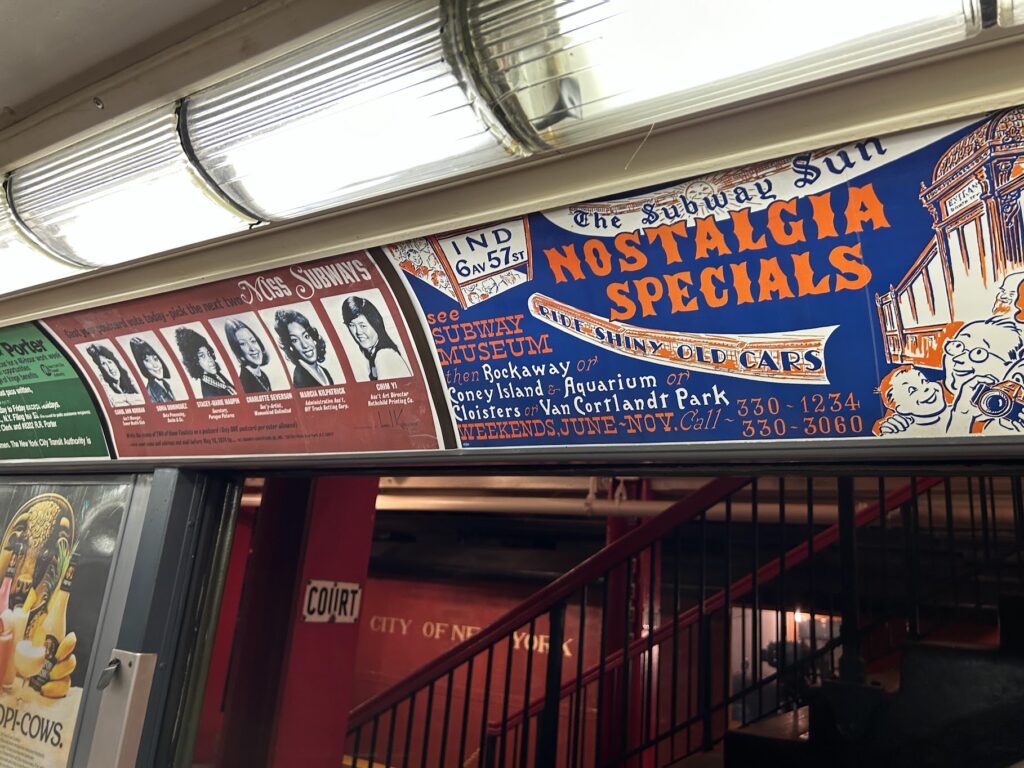
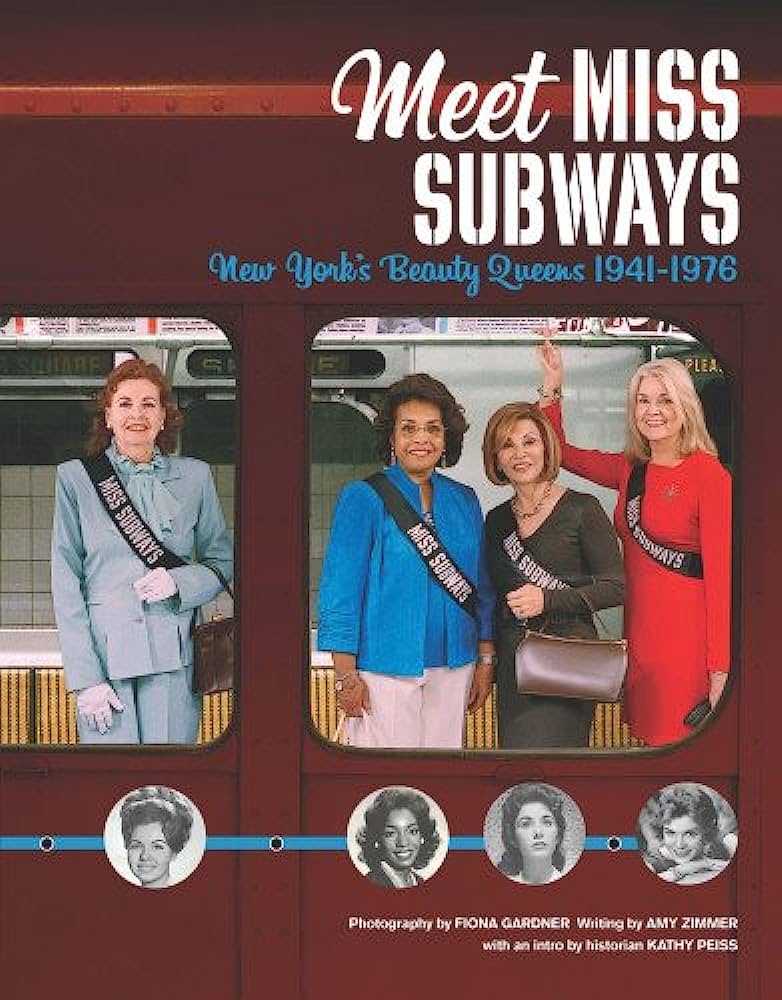
Miss Subways winners Enid Berkowitz (July 1946), Ellen Hart (March-April 1959), Shirley Martin (May-June 1960), Vernell Dennis (Sept-Oct 1961)
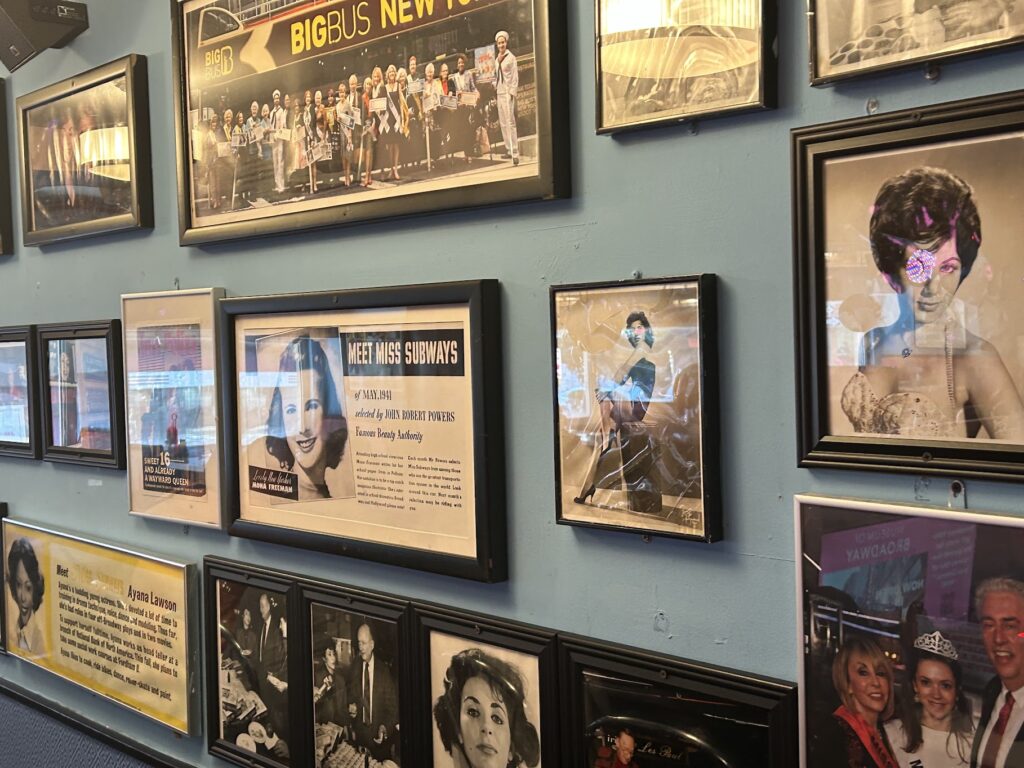
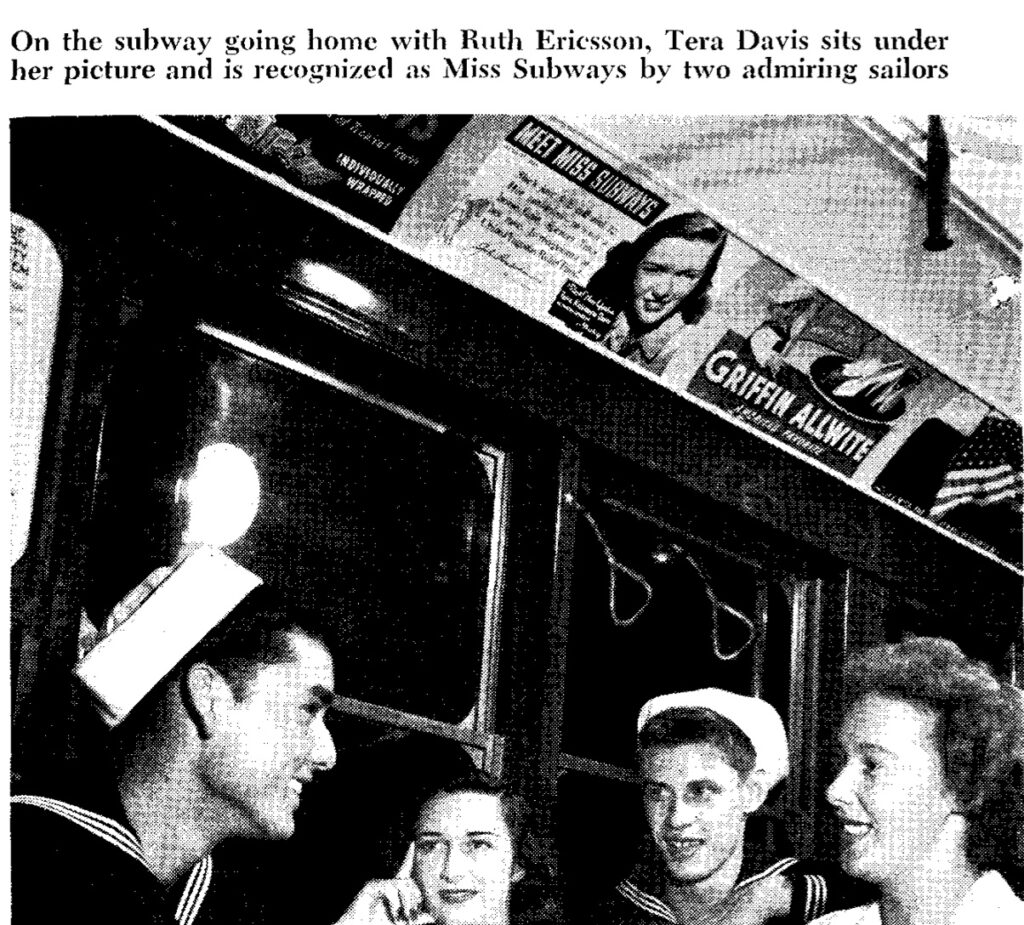
From 1941 and 1976, dozens of young women and high school girls were bestowed the honor of Miss Subways with her smiling photograph hanging within the cars of the New York subway system.
This was not a beauty pageant, but rather an advertising campaign which promoted the subway and drew the eyes of commuters to the train car’s many advertisements for cod liver oil, cigarettes and frozen foods.
The women who were chosen for Miss Subways became overnight local celebrities, aspirational figures for thousands of subway riders.
The program was overseen by modeling agent guru John Robert Powers whose work for mail order catalogs and newspapers would help define the ‘girl-next-door’ image of the mid 20th century.
However this blonde Midwestern template soon looked out of place promoting the subway system of one of the most diverse cities in the world. By the 1960s, winners of this fleeting title began to reflect the many types of women who commuted and used the subway.
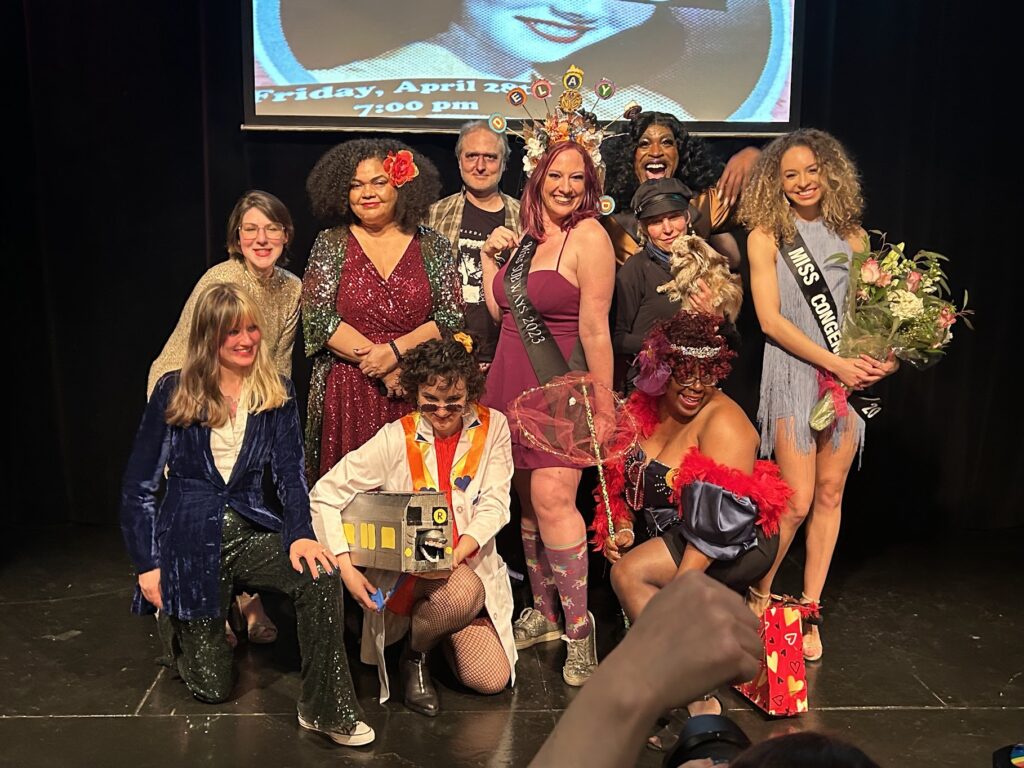
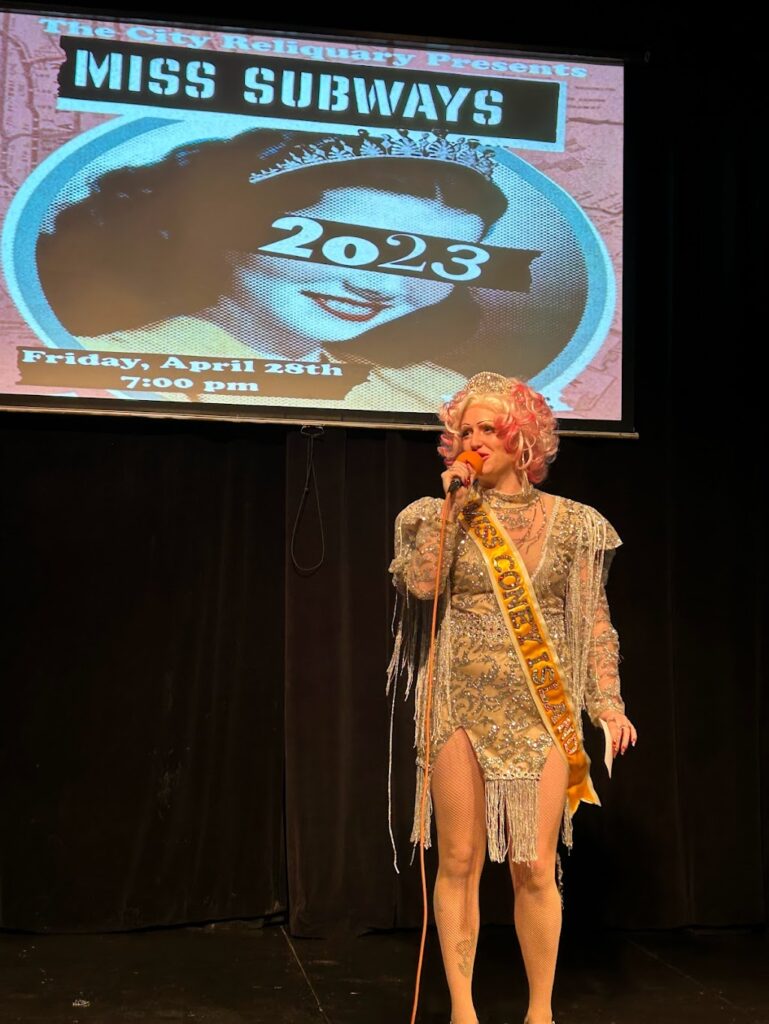
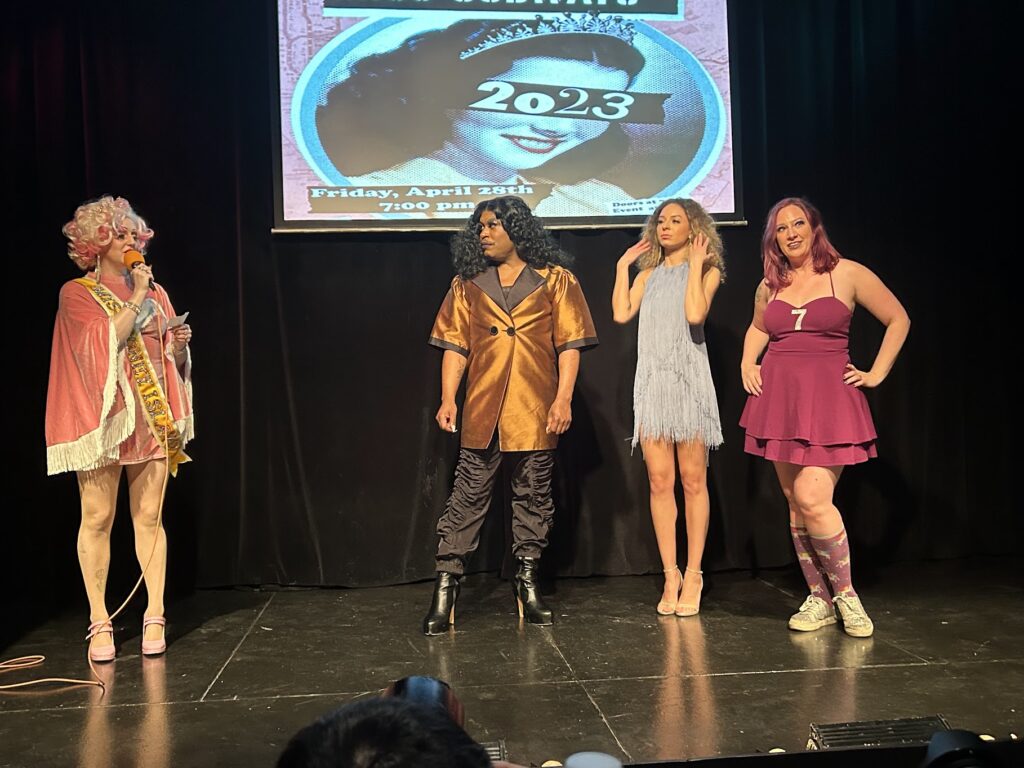
Listen in as Greg tells the story of the Miss Subways pageant then participates as a judge for a brand new Miss Subways competition, held in Coney Island in April. But what does this title mean in 2023?
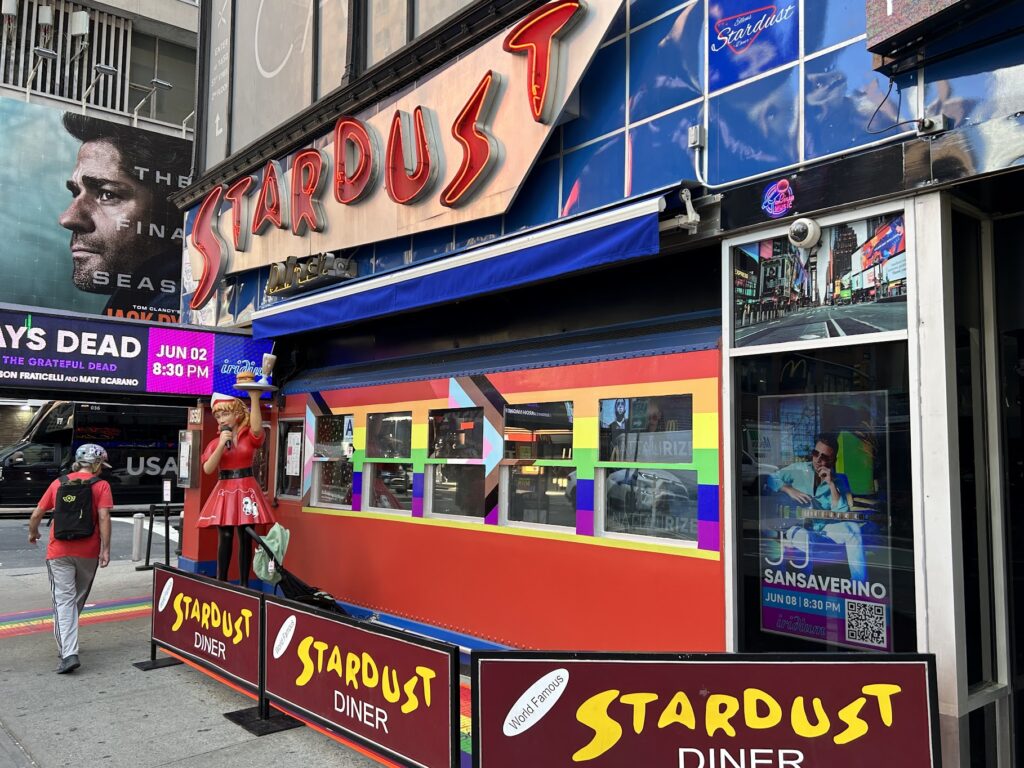
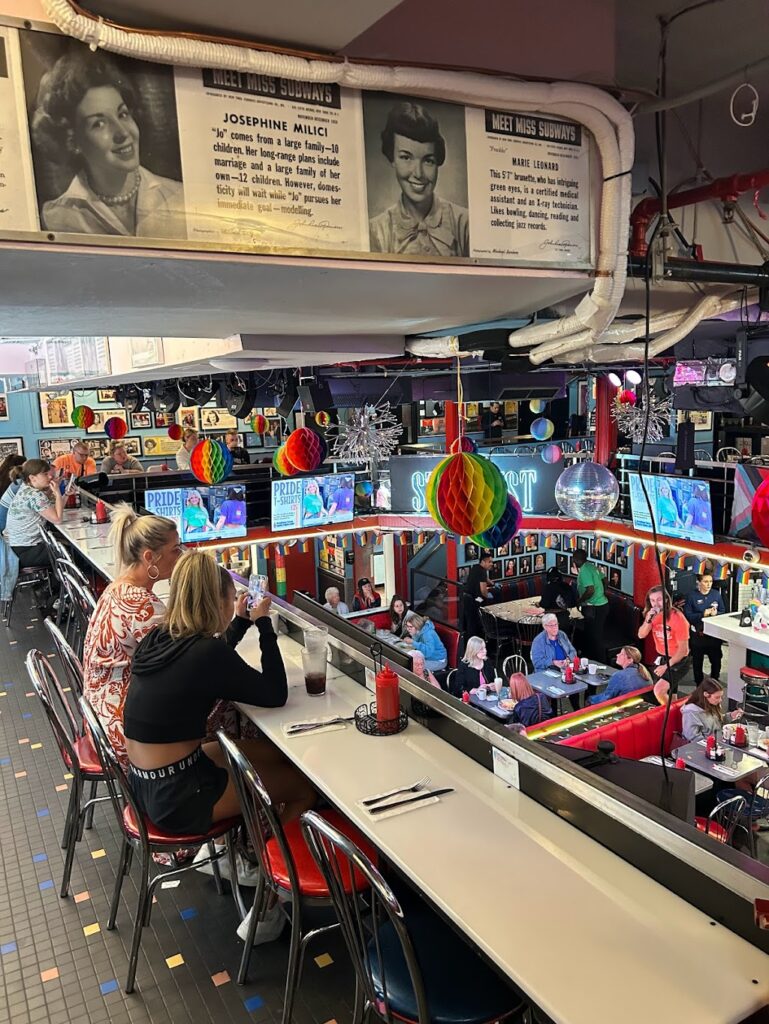
FEATURING A visit to the New York Transit Museum, the City Reliquary, Coney Island USA’s Seashore Theater and Ellen’s Stardust Diner
LISTEN NOW: MISS SUBWAYS: QUEENS OF THE NEW YORK COMMUTE
Harmony Hardcore and the contestants of the 2023 Miss Subways pageantThe glorious Maggie McMuffinThe final three contestants — Lena Horné, Chantelle and Harmony Hardcore
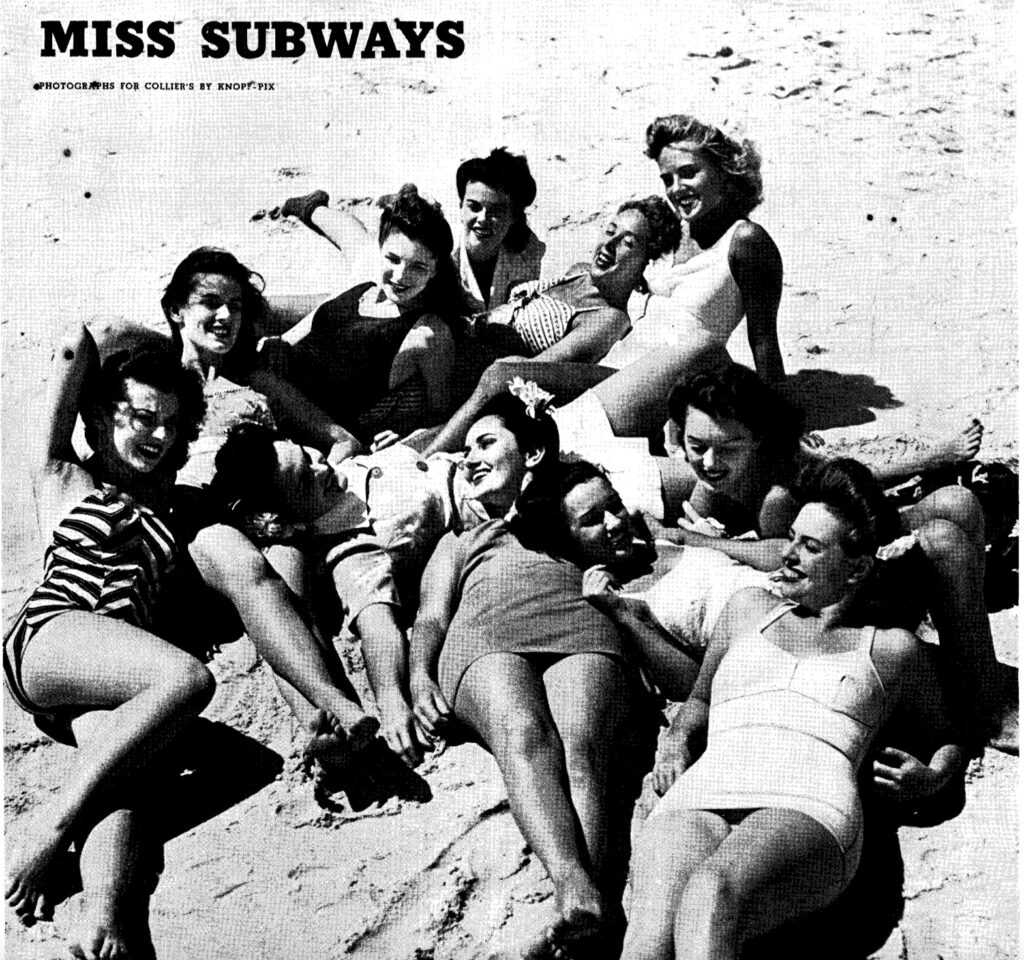
From an article in Collier’s Weekly, September 25, 1943, “Miss Subways: A new kind of beauty brightens the life of New York’s underground commuters,” in a photograph highly influenced by the pin-up photos of Betty Grable and other wartime beauties:
FURTHER LISTENING
After listening to this podcast, head back into our back catalog and listen to these shows with similar themes
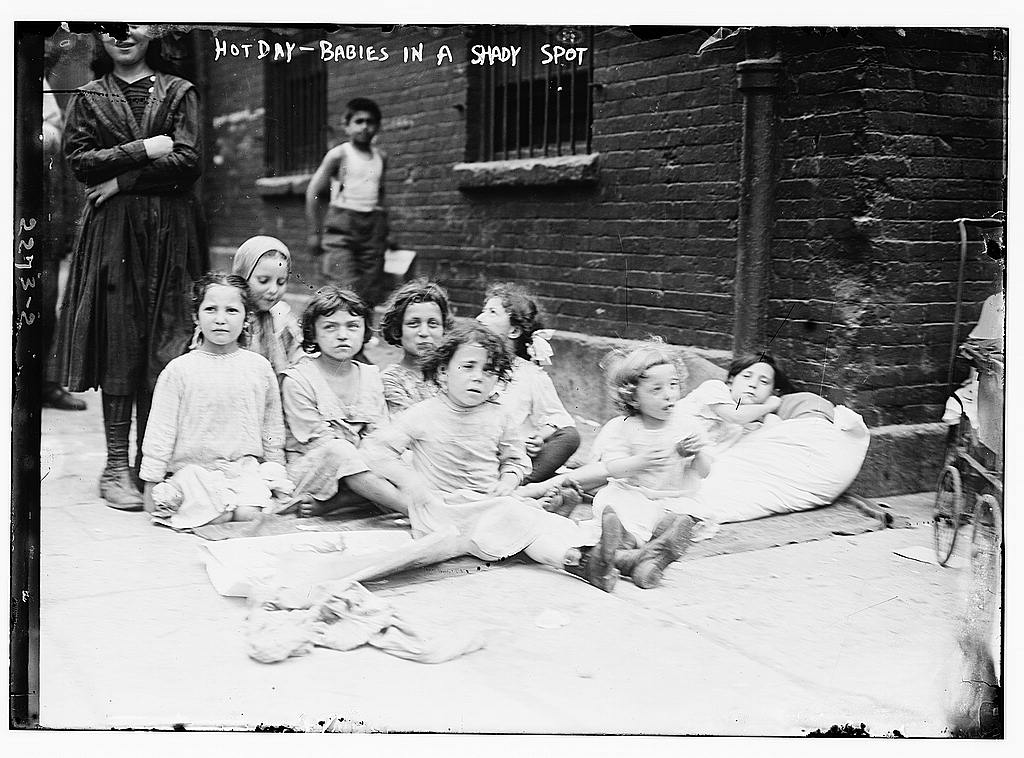
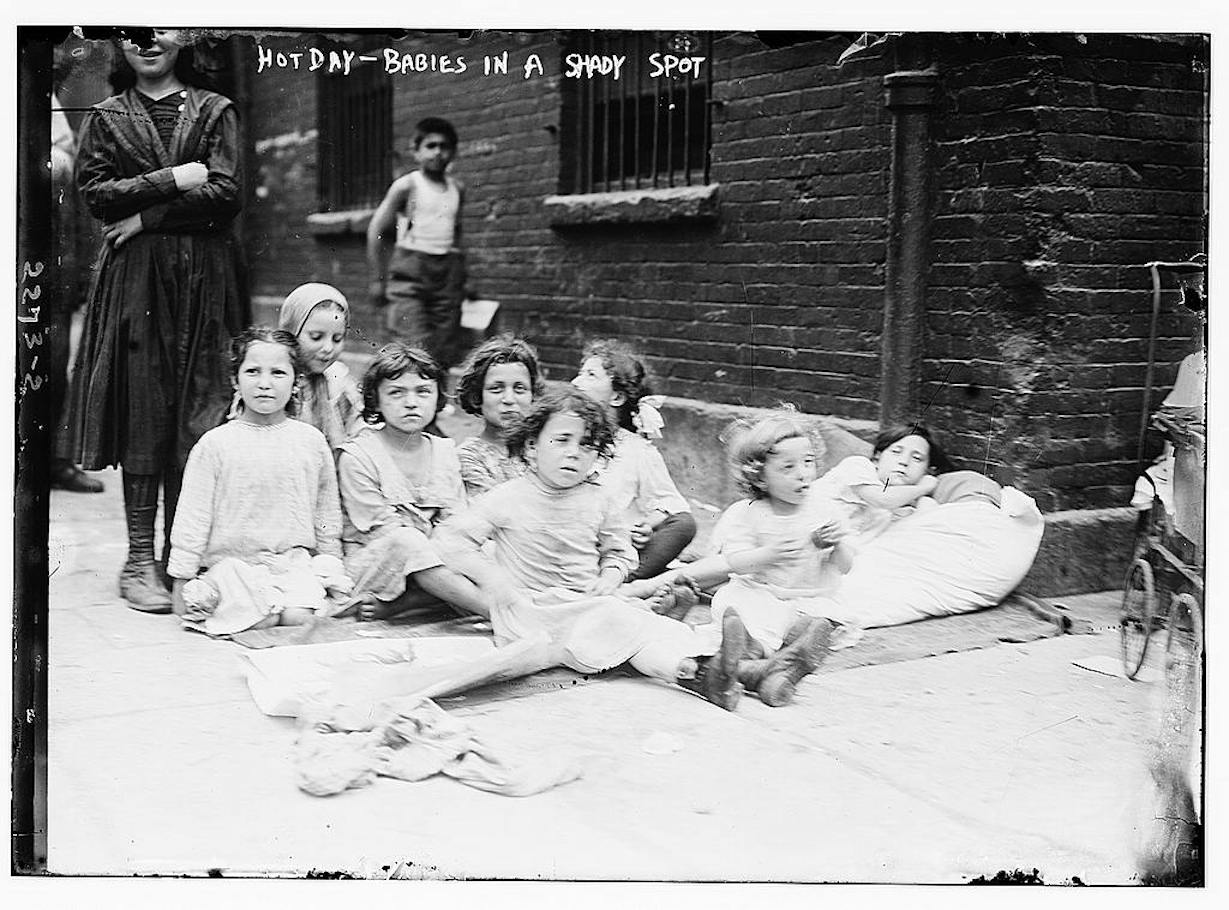
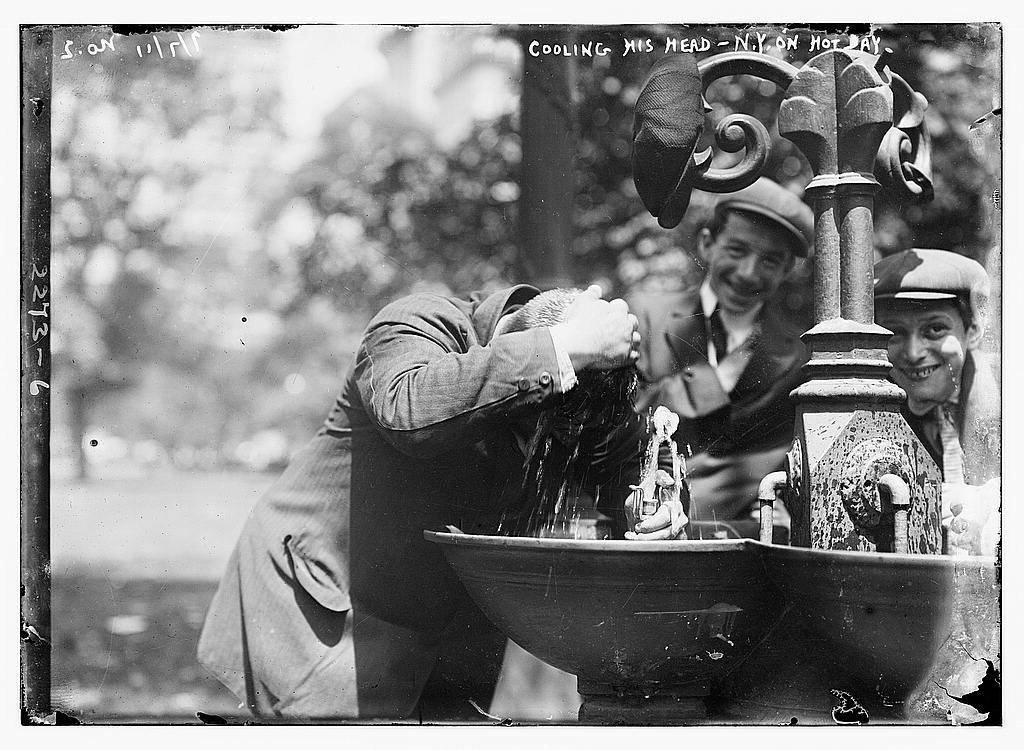
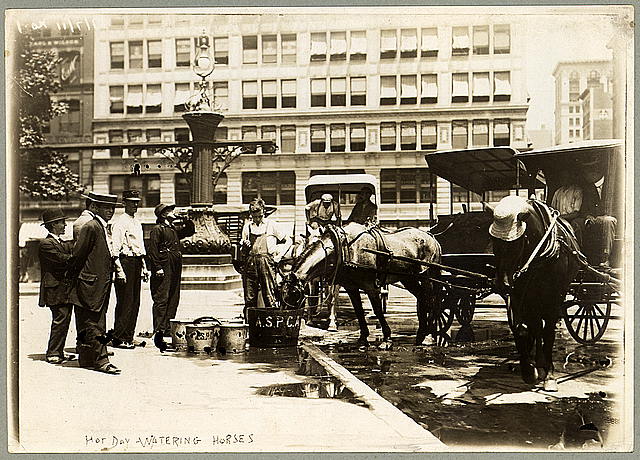
The city was in the midst of a devastating heatwave gripping in the entire Northeast during the first two weeks of July 1911. There was little escape from the scorching temperatures among the cramped tenements. New York’s beaches offered some respite, but you had to cram into a sweltering train cabin to get there. Rudimentary air conditioning had only been invented a few years before and was hardly widespread.
Oh baby, it’s hot! Some tots seek shady shelter during the July 1911 heat wave.
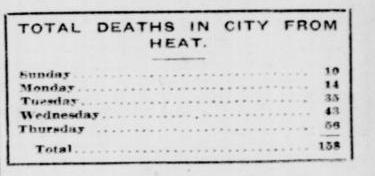
In New York, the thermometer never broke a 100 degreeslike it did in Washington or Boston. But the humidity was deadly, and the city too crowded and ill-prepared for such withering conditions.
Below: A disturbing infographic from the Tribune
Naturally, the brand new subway was not the place to be either.
Riders going from the Brooklyn Bridge to Grand Central suffered a 45 minute ride, and a few passengers passed out. But others underground found relief from the heat; workers drilling the Penn Railroad tunnels under the Hudson River reported luxuriously cool temperatures in the 60s.
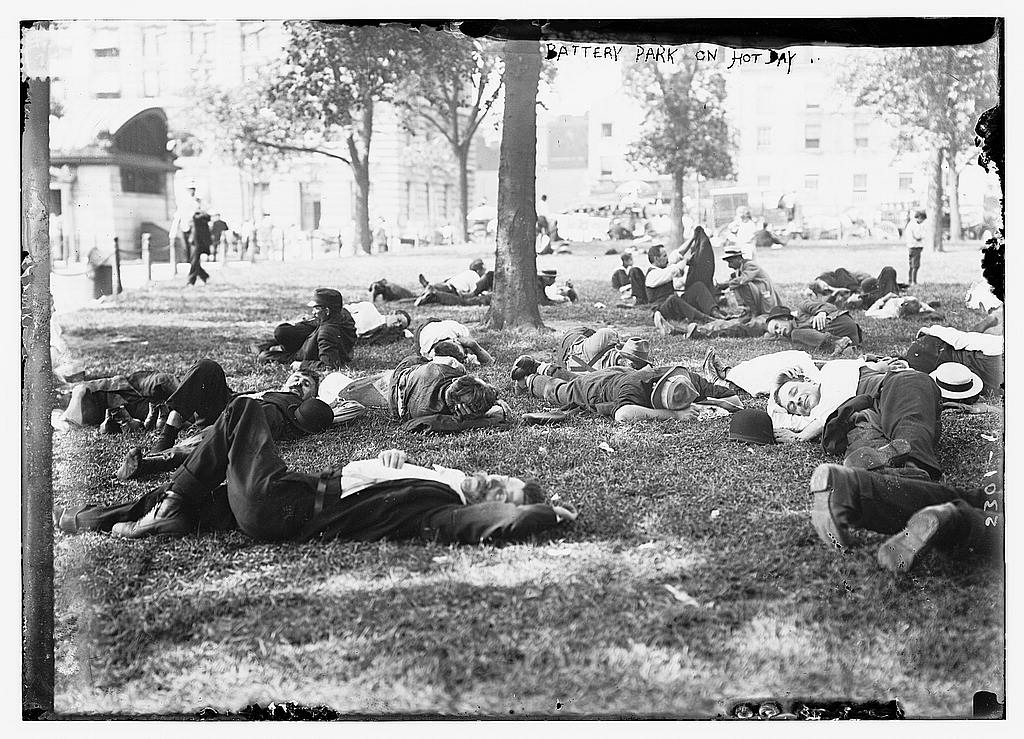
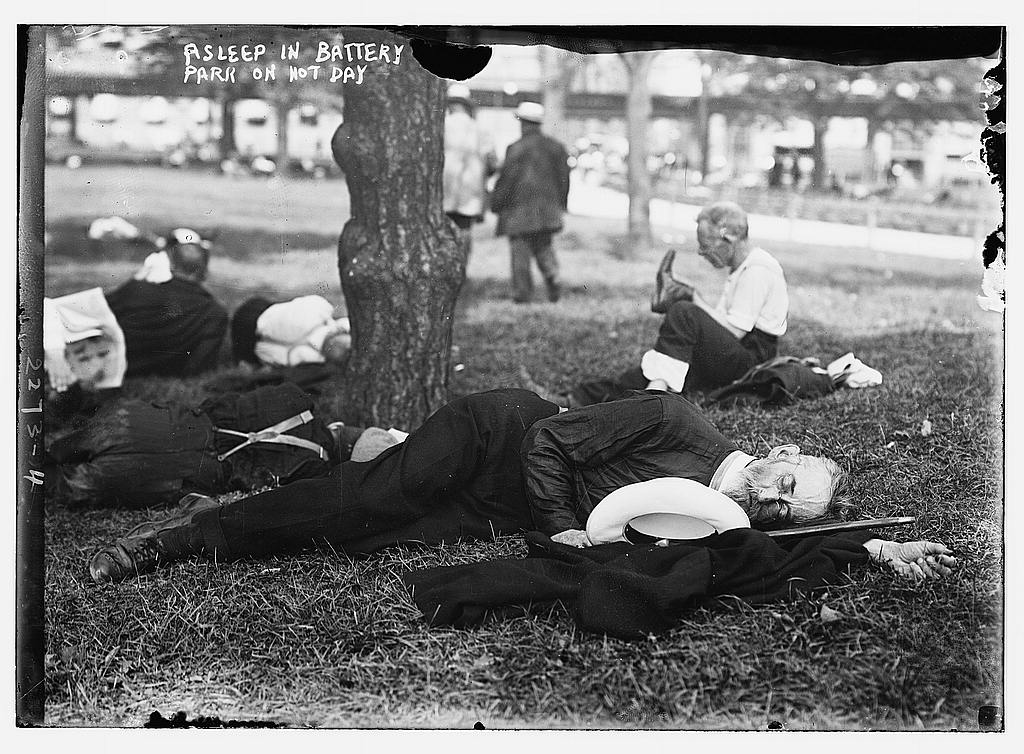
Below: Dozens slept underneath the shady trees in Battery Park at the hottest point of the heat wave.
The sizzling conditions literally drove people insane.
One drunken fool, “partly crazed by the heat,” attacked a policeman with a meat clever. A child on Tenth Avenue, escaping to the rooftop for relief, tumbled down an air shaft. The hospital was filled to capacity. Staten Island’s fire commissioner succumbed to the heat and died in his home.
Some levity as a boy takes off his cap to cool off in a park fountain:
Library of Congress
After July 7th, the temperatures dipped to normal levels but the humidity kept the city in sweaty discomfort. Or as the Tribune dramatically states: “The monstrous devil that had pressed New York under his burning thumb for five days could not go without one last curse, and when the temperature dropped called humidity to its aid.”
By the time rain came to relieve the city, a reported 211 people had fallen to heat-related deaths. But the largest number of victims came from New York’s army of horses, trudging by the thousands through the city’s busy, stagnant streets.
The New York Times estimates that over 600 animals died during the heat wave, so many that the city was unable to pick up all the bodies from the streets. Frequently seen were dead animals pushed to the sides of the road. Add in the oppressive humidity, and I’ll leave you to imagine how horrific it would have been to experience.
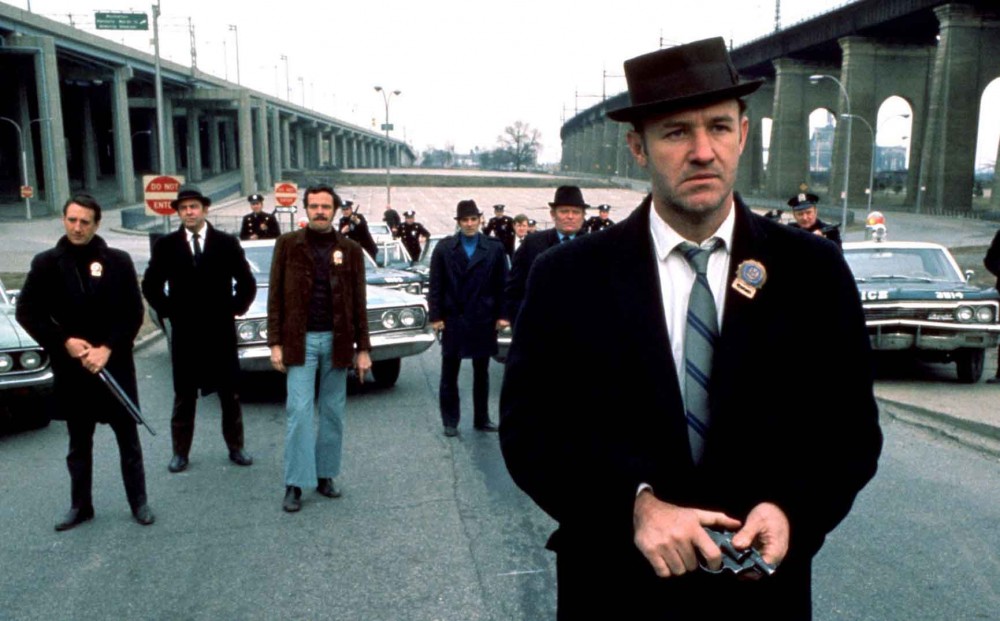
The new episode of theBoweryBoysMovieClub explores the new film The French Connection, the gritty action classic employing an astonishing array of on-location shots — from Midtown Manhattan to the streets of Brooklyn. It’s an exclusive podcast for those who support us on Patreon.
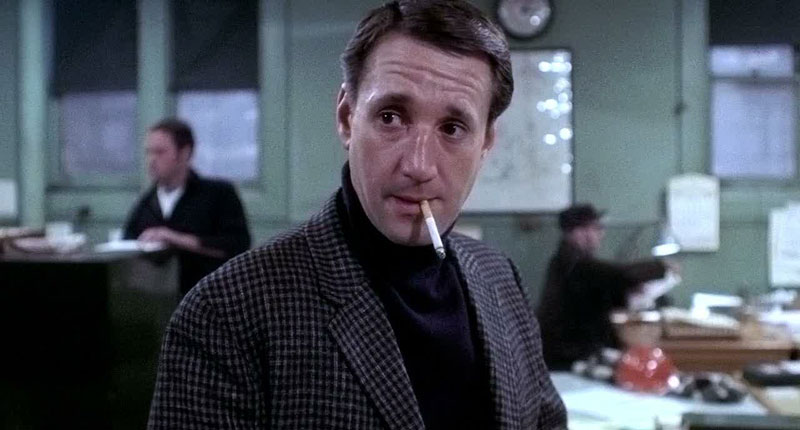
The French Connection, directed by William Friedkin and starring Gene Hackman, was released fifty years ago this year to critical and commercial success.
The movie would change the way film and TV action dramas were presented, a mix of real-life urban decay and brutal violence. But the film has much to say about New York City itself as it swerves into many pre-gentrified neighborhoods.
SPOILER ALERT:The Bowery Boys Movie Club is a movie recap show, mixed with New York City history. We dive into the film, scene by scene… discussing its major plot turns and attempting to put it all into the historical context of New York City in late 60s/early 1970s.
We also discuss the plot, in quite a bit of detail. Haven’t seen the film yet? You might consider watching it first — it’s currently available for rent and also available for streaming on Showtime.
HowdoIlistentheBoweryBoysMovieClub? Once you’re signed in on Patreon, you’ll see a private RSS link that can be put directly into your favorite podcast player. Even easier, it can also be played directly from the Patreon app.
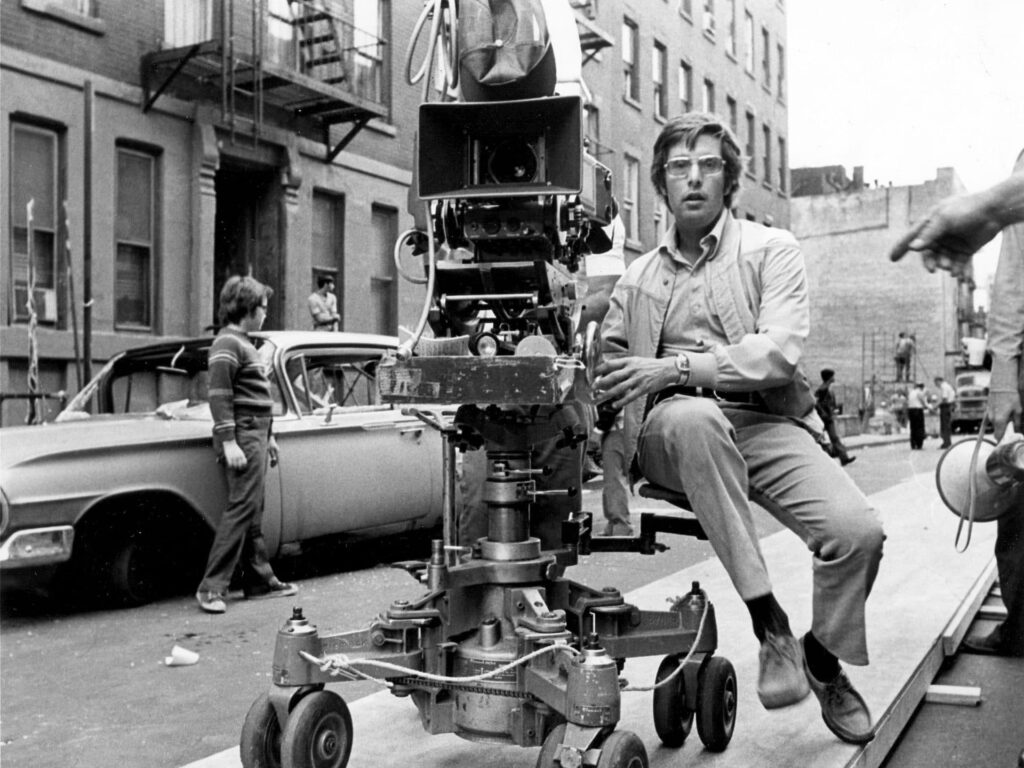
Director William Friedkin on the ‘set’ of The French Connection.
The French Connection was shot in New York — all over the place, uptown, downtown, on bridges, in bars. And much of it, on the fly and illegally. (There are, of course, famous scenes in Marseilles and Washington DC as well.)
Take the film’s most iconic moment, and possibly the greatest car chase scene in the history of film and cars. It’s filmed under the elevated D-line train, near Coney Island, along the course of 26 blocks, over the course of five weeks. However, N train stands in for what was then the B train, because, being New York in the 70s, they could find no clean-looking B trains.
Most of the ‘extras’ were actual residents going to and fro in their daily business. In fact, a car accident that happens at the corner of Stillwell Ave. and 86th Street actually happened; the unlucky vehicle was owned by a guy on his way to work.
The producers later paid for the cost of repairs. Today this would have spawned a multi-million dollar lawsuit!
That was the least of the mayhem. Friedkin and his producers filmed many scenes without the city’s permission at all, including much of the car chase, a staged traffic jam on the exit ramp of the Brooklyn Bridge, and an entire sequence on what is now the S-train between Grand Central and Times Square!
One treasured New York landmark featured in the film is sadly no longer with us. Popeye Doyle (Gene Hackman) and Cloudy Russo (Roy Schieder) stake out at Ratner’s Deli in the Lower East Side right off the Williamsburg Bridge.
Ratner’s was one the city’s legendary old Kosher deli’s, along with Katz’s just a few blocks away. Later in its life, its hidden ‘speak-easy’ Lansky Lounge became a hot spot during the 1990s.
Two Manhattan hotels are also featured prominently, the sumptuous Roosevelt Hotel in Midtown and the former Westbury Hotel, now residences.
Like The Taking of Pelham One Two Three, the movie brilliantly captures a New York on the precipice of near collapse but still retaining its rough-hewn charm. The fact that this classic could be filmed here — almost scot-free — gives a little insight into how massive and uncontrolled the city had gotten.
Beach’s pneumatic subway — the first in the United States — opened 150 years ago today. To celebrate this anniversary, we are re-representing our 2016 show on the history of Alfred Ely Beach and his shortlived (but truly marvelous) invention.
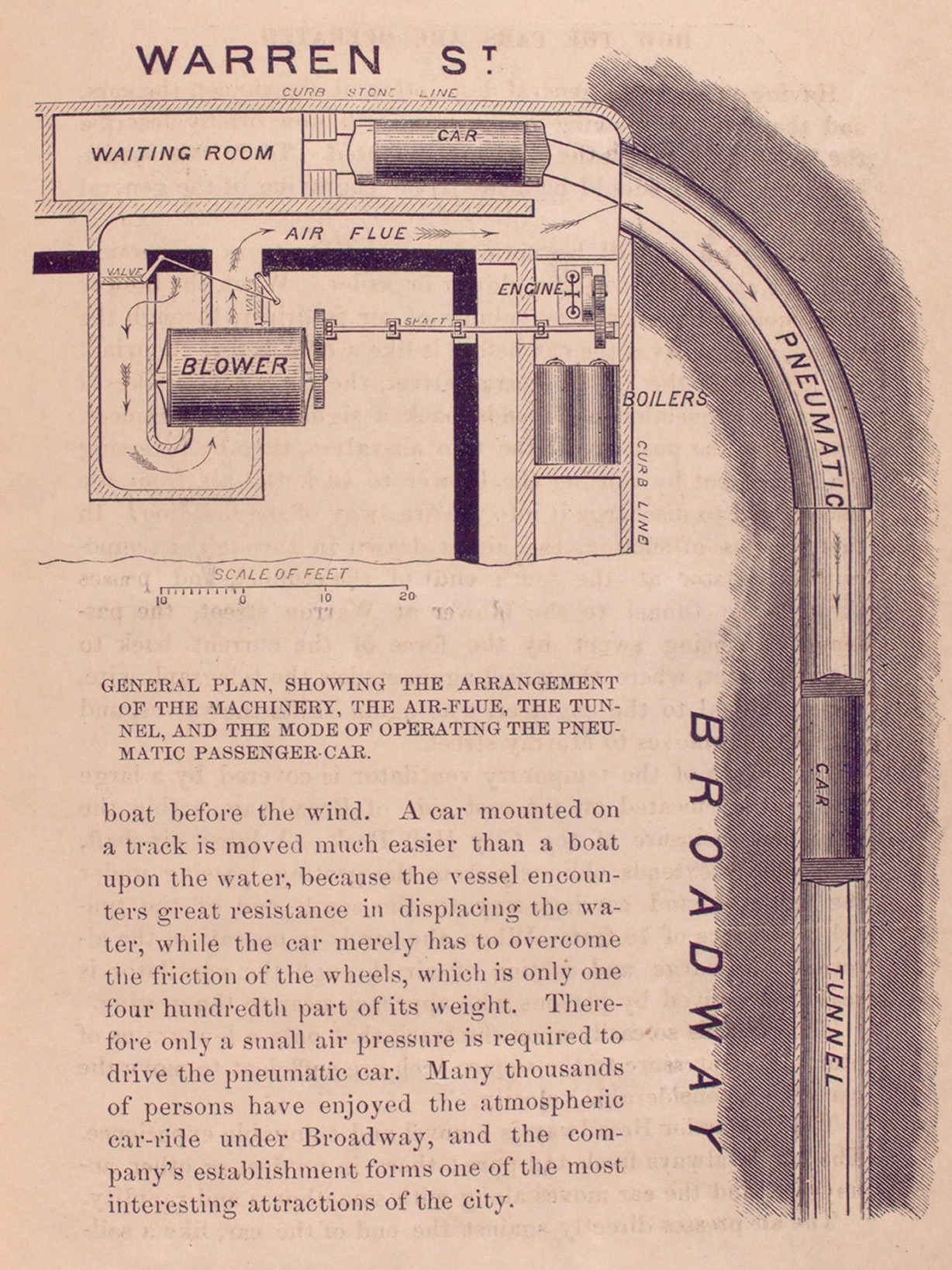
PODCASTThe unbelievable story of Alfred Ely Beach’s Pneumatic Transit, a curious solution from 1870 to New York’s growing transporation crisis.
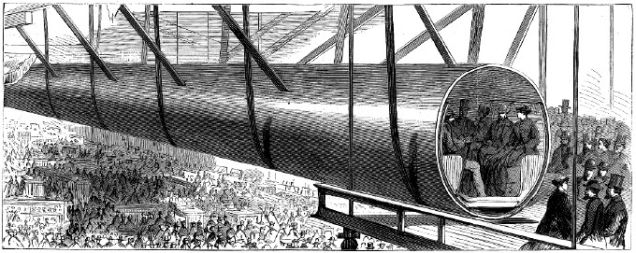
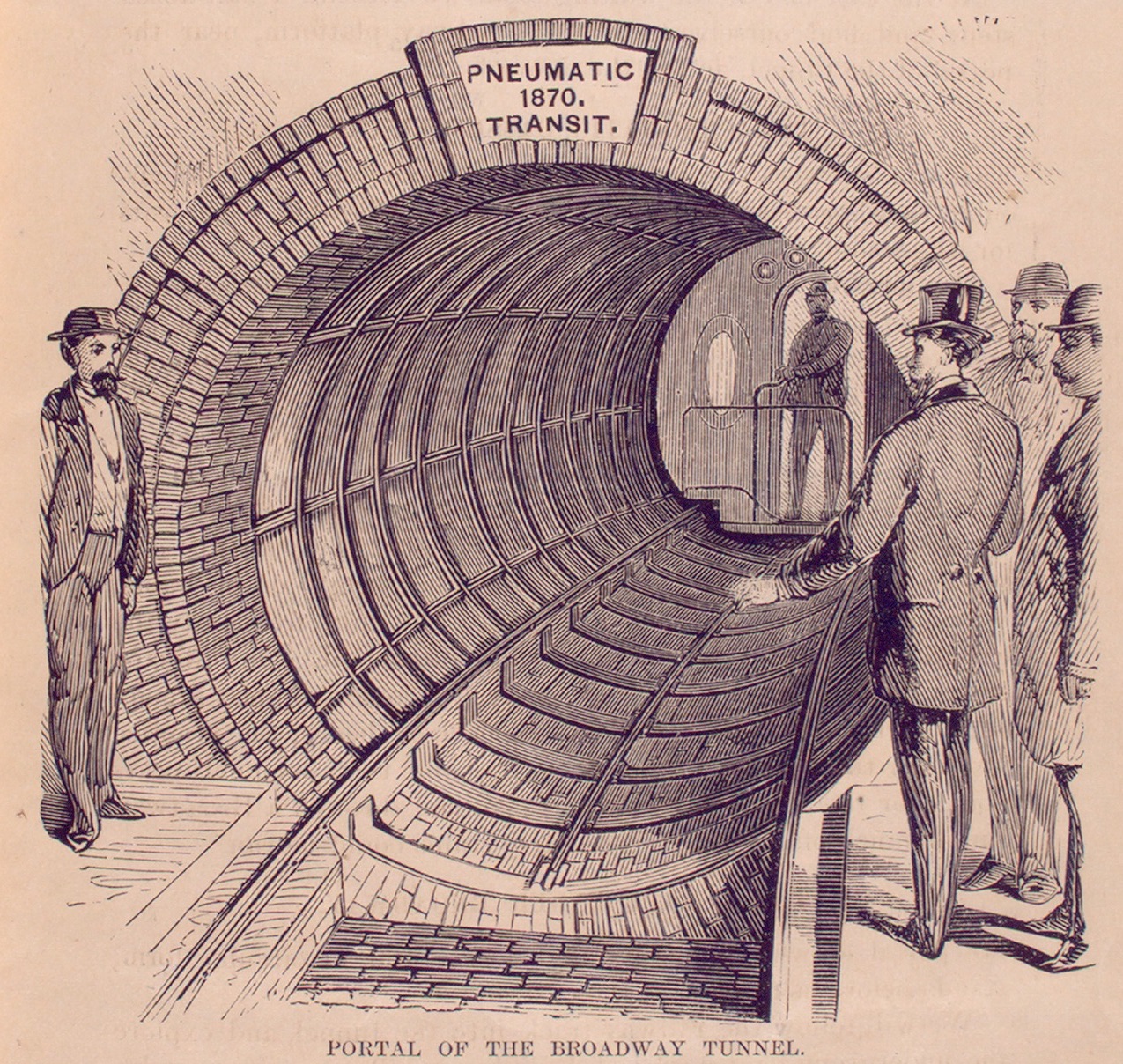
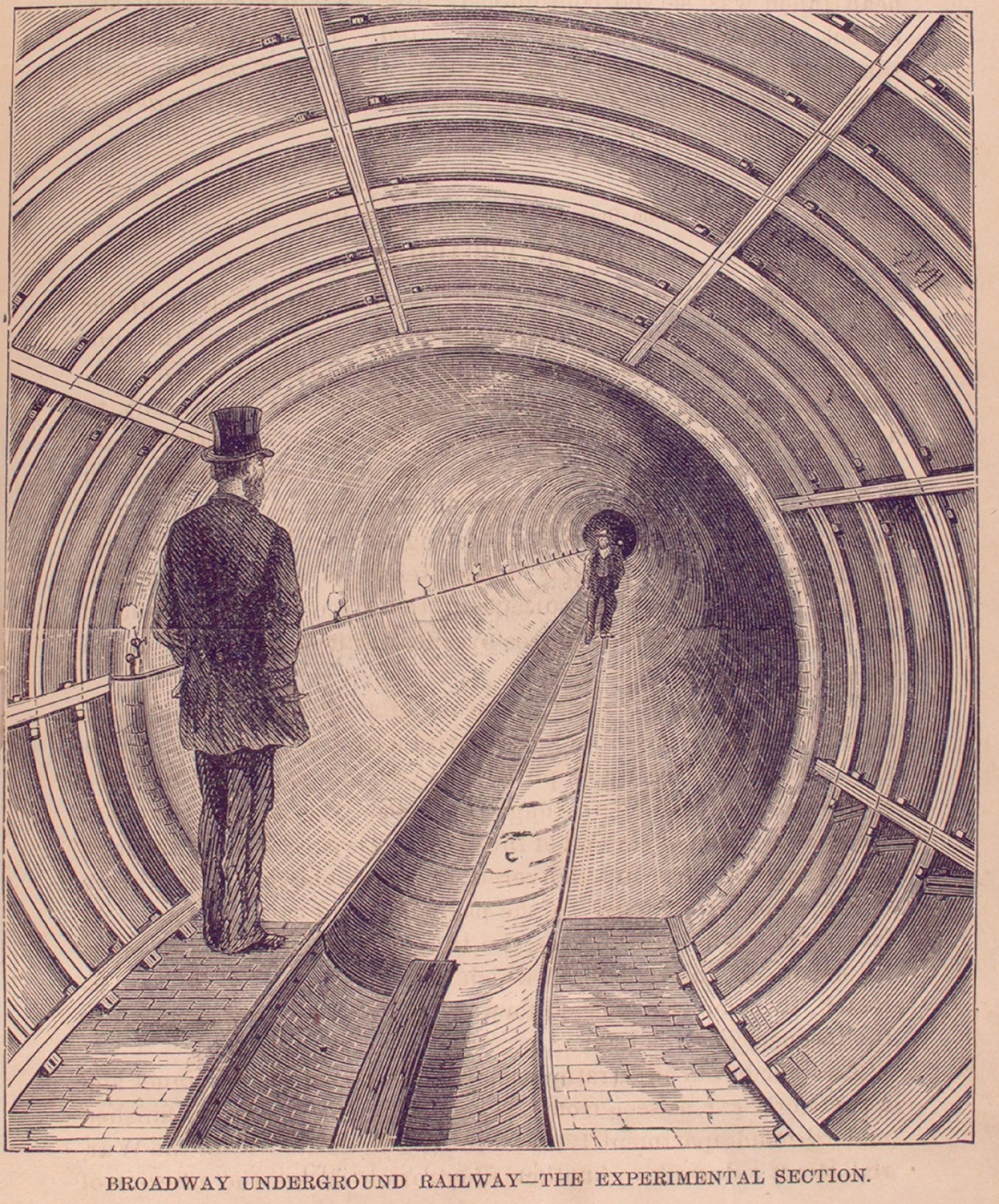
The first subway in New York — the first in the United States! — traveled only a single block and failed to influence the future of transportation. And yet Alfred Ely Beach‘s marvelous pneumatic transit system provides us today with one of the most enchanting stories of New York during the Gilded Age.
With the growing metropolis still very much confined to below 14th Street by 1850, New Yorkers frantically looked for more efficient ways to transport people out of congested neighborhoods. Elevated railroads? Moving sidewalks? Massive stone viaducts?
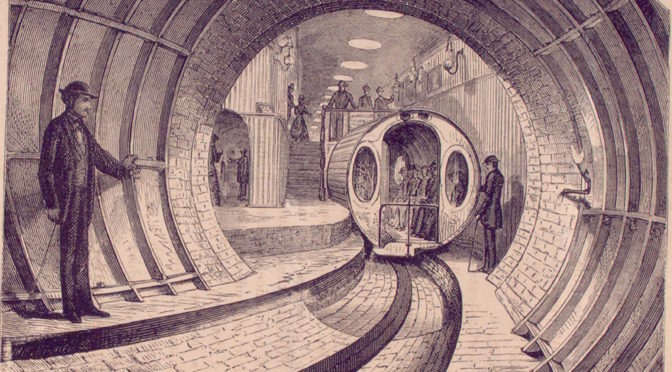
Inventor Beach, publisher of the magazine Scientific American, believed he had the answer, using pneumatic power — i.e. the power of pressurized air! But the state charter only gave him permission to build a pneumatic tube to deliver mail, not people.
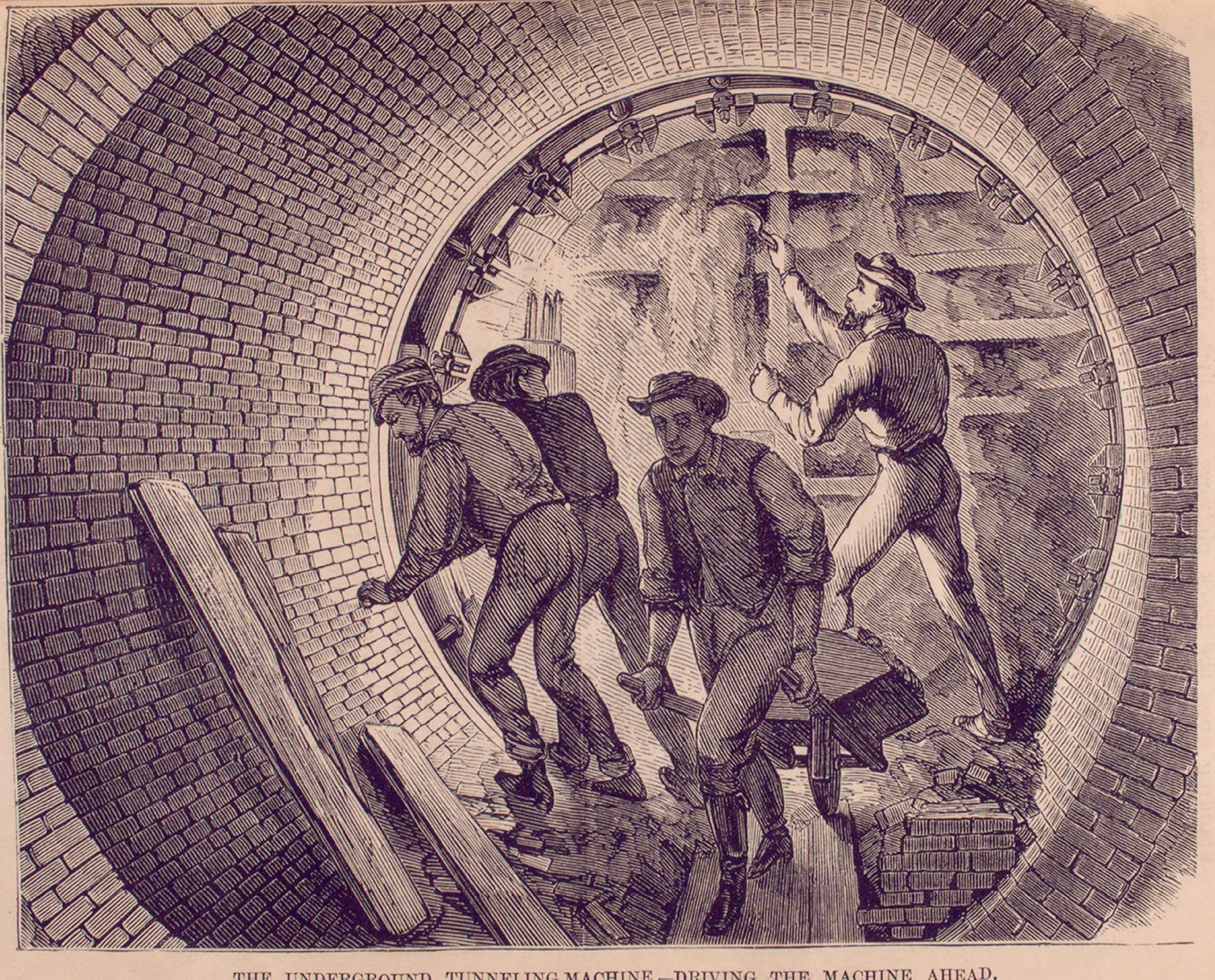
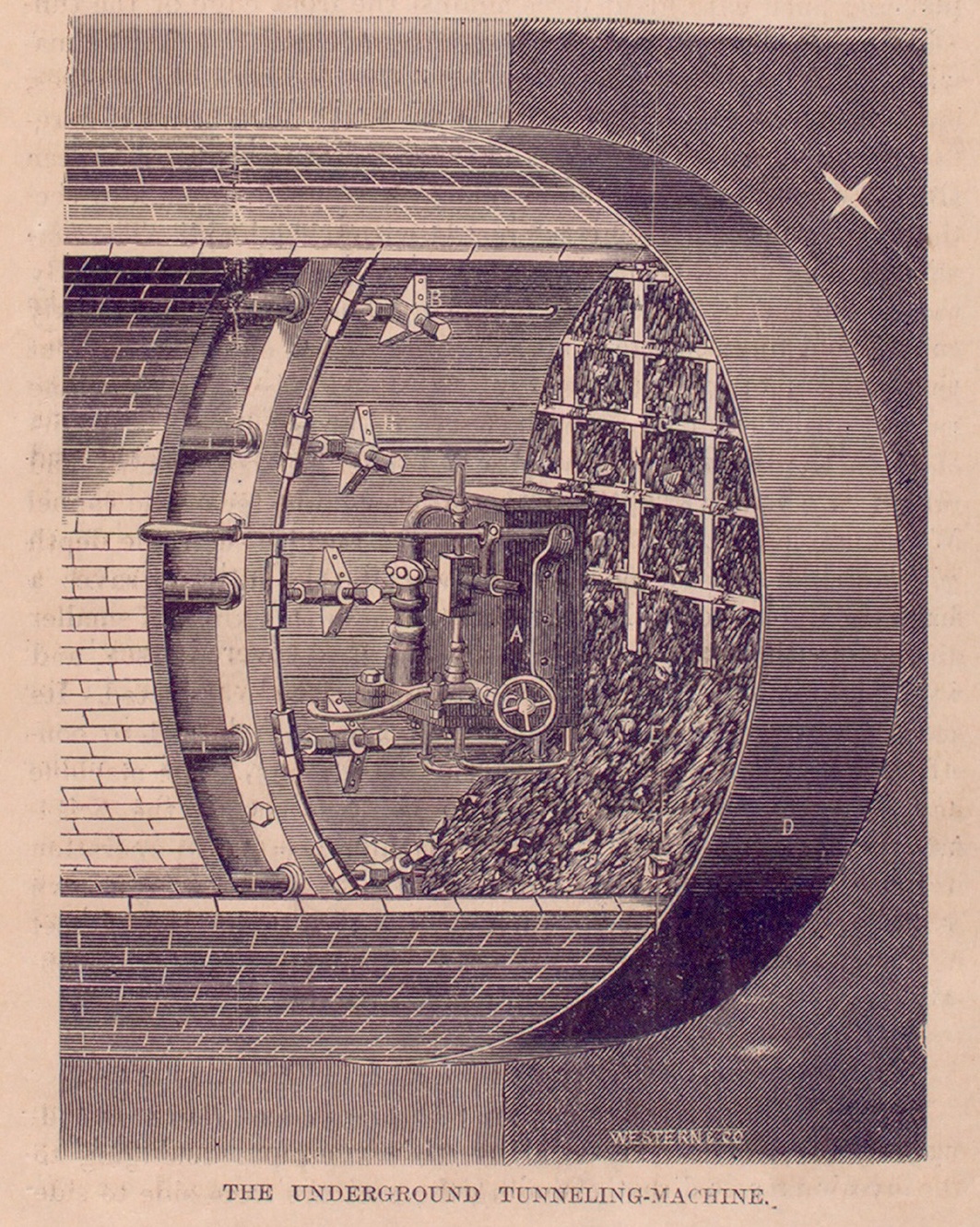
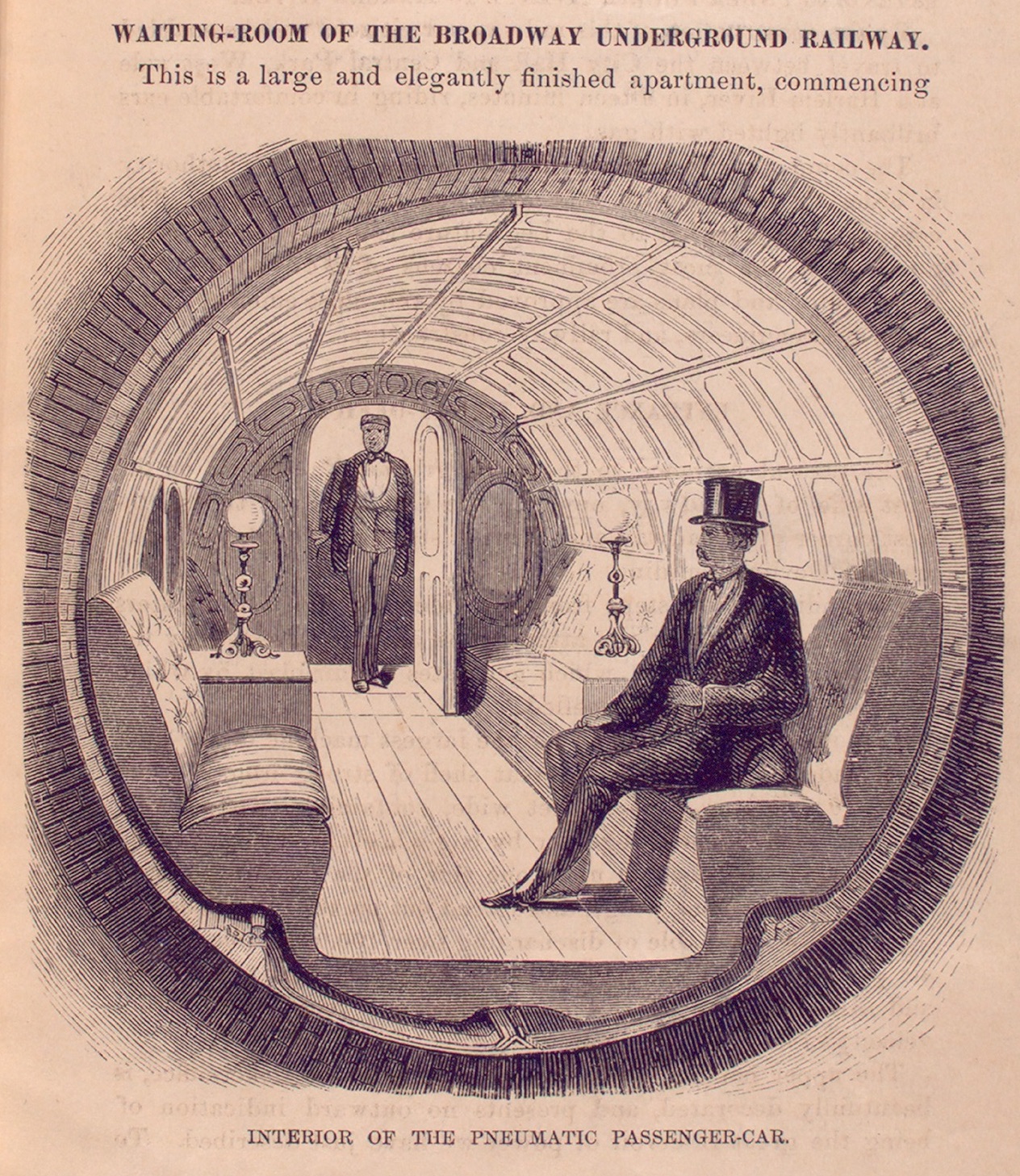
That didn’t stop Beach, who began construction of his extraordinary device literally within sight of City Hall. How did Beach build such an ambitious project under secretive circumstances? What was it like to ride a pneumatic passenger car? And why don’t we have pneumatic power operating our subways today?
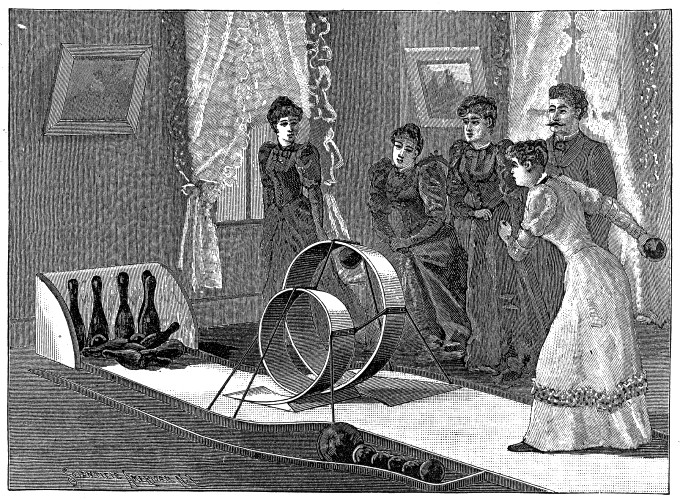
FEATURING: Boss Tweed at his most bossiness, piano tunes under Broadway and something called a centrifugal bowling alley!
To get this week’s episode, simply download or stream it for FREE from iTunes, Stitcher, Spotify or other podcasting services.You can also get it straight from our satellite site.
The Bowery Boys: New York City History podcast is brought to you …. by you!
We are now producing a new Bowery Boys podcast every other week.
We’re also looking to improve and expand the show in other ways —
publishing, social media, live events and other forms of media. But we
can only do this with your help!
We are now a creator on Patreon, a patronage platform where you can support your favorite content creators.
Please visit our page on Patreon
and watch a short video of us recording the show and talking about our
expansion plans. If you’d like to help out, there are six different
pledge levels. Check them out and consider being a sponsor.
ALL patrons at all levels will receive many benefits include the next episode of the Bowery Boys Movie Club,
an exclusive podcast (released every 6-8 weeks) celebrating New York
City in the movies. And patrons at the Five Points ($5) level and up
will get our other exclusive podcast — The Bowery Boys: The Takeout — released every two weeks.
We greatly appreciate our listeners and readers and thank you for joining us on this journey so far.
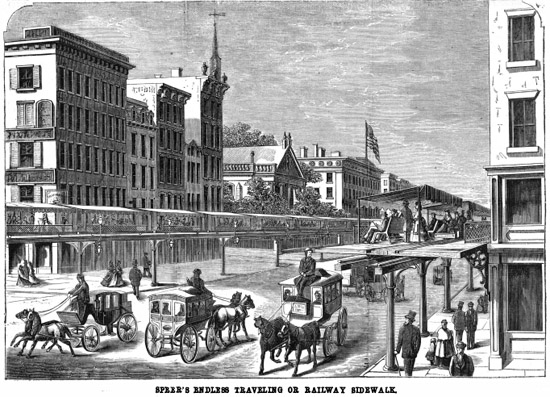
Alfred Speer’s moving sidewalk concept would have lifted pedestrians off the street and onto a moving ribbon that would have stretched up and down Broadway.
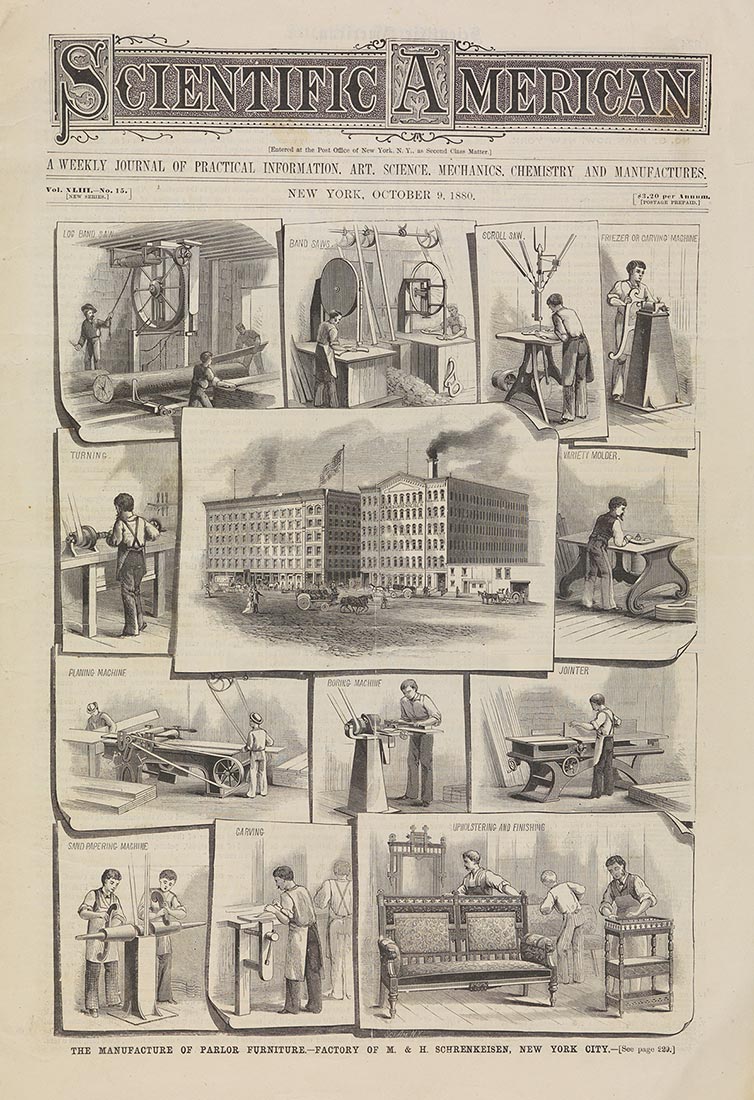
An 1880 issue of Scientific American, the publication owned by Alfred Eli Beach that provided the impetus for many extraordinary inventions during the Gilded Age.
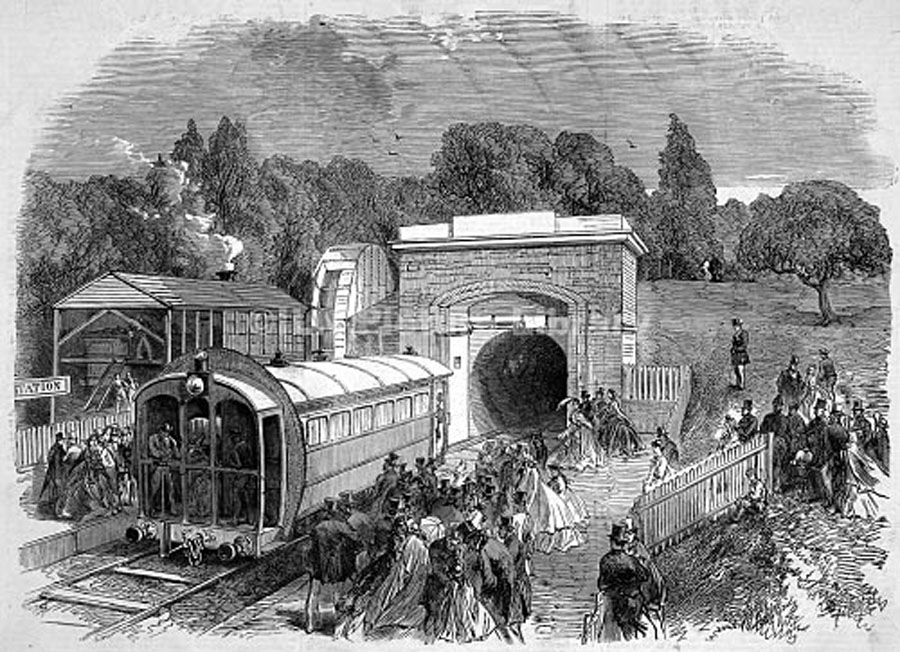
The ‘atmospheric railway’ which ran during London’s Crystal Palace Exhibition in 1864.
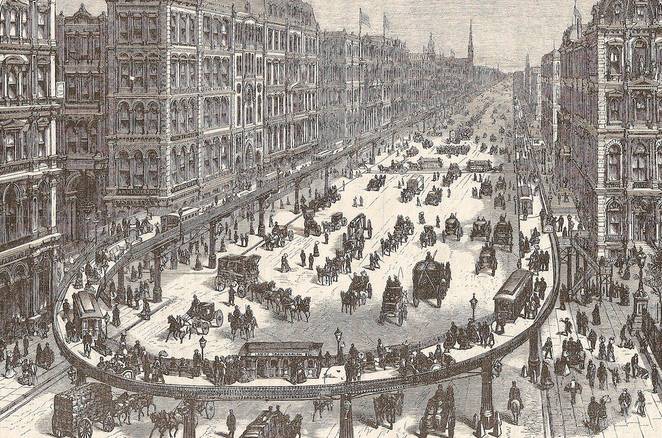
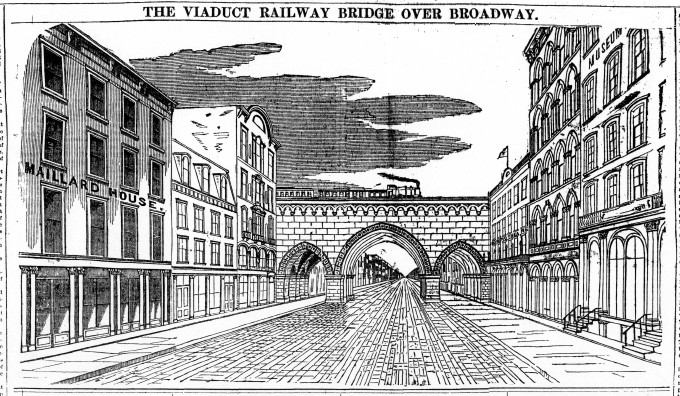
Another idea which transfixed New Yorkers (and in particular Boss Tweed) was the elevated viaduct which would have sliced through dozens of city blocks, creating an epic piece of architecture throughout Manhattan.
From the Tribune, July 8, 1871. Courtesy Columbia University
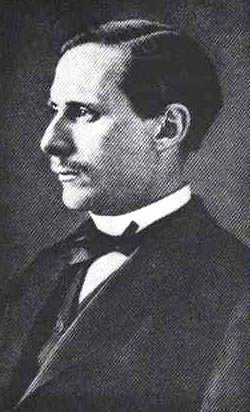
Alfred Ely Beach, mastermind of the Broadway pneumatic tunnel project:
Beach’s ‘passenger tube’ which was displayed to great acclaim at the American Institute Fair in 1867:
Some images from Beach’s 1870 pamphlet on the pneumatic system:
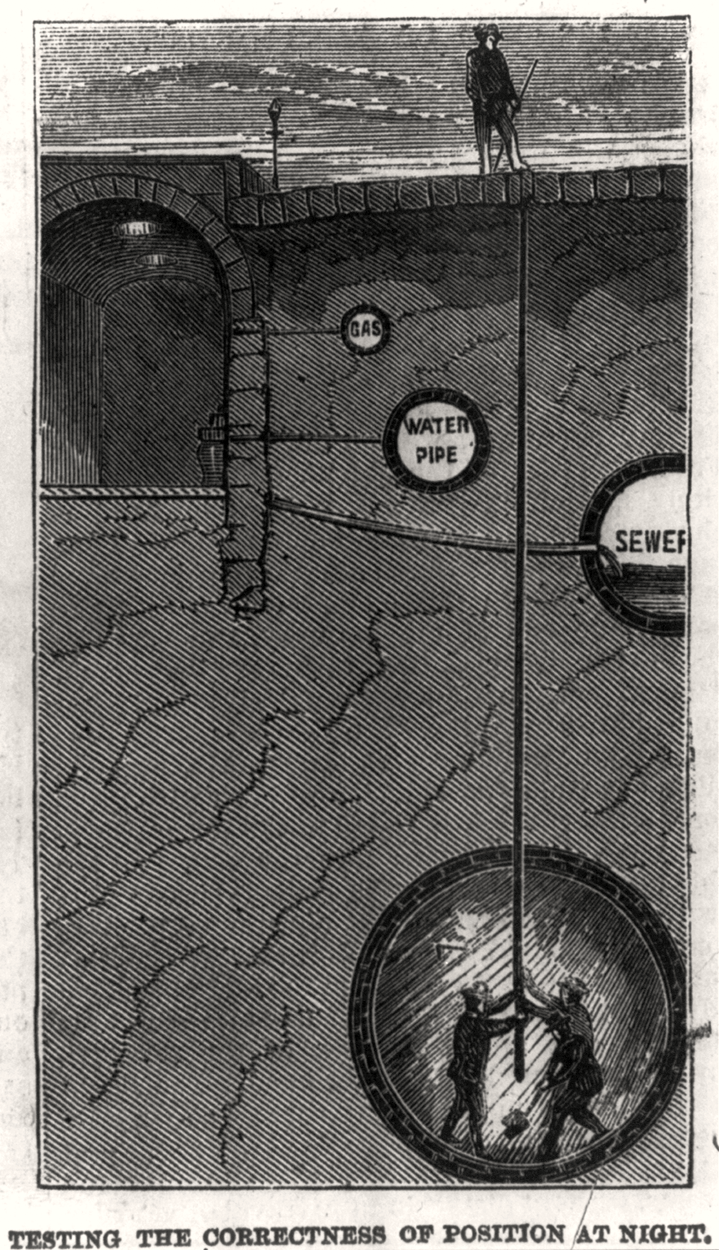
An illustration from a newspaper of Beach’s workers ‘testing the position’ late at night over Broadway:
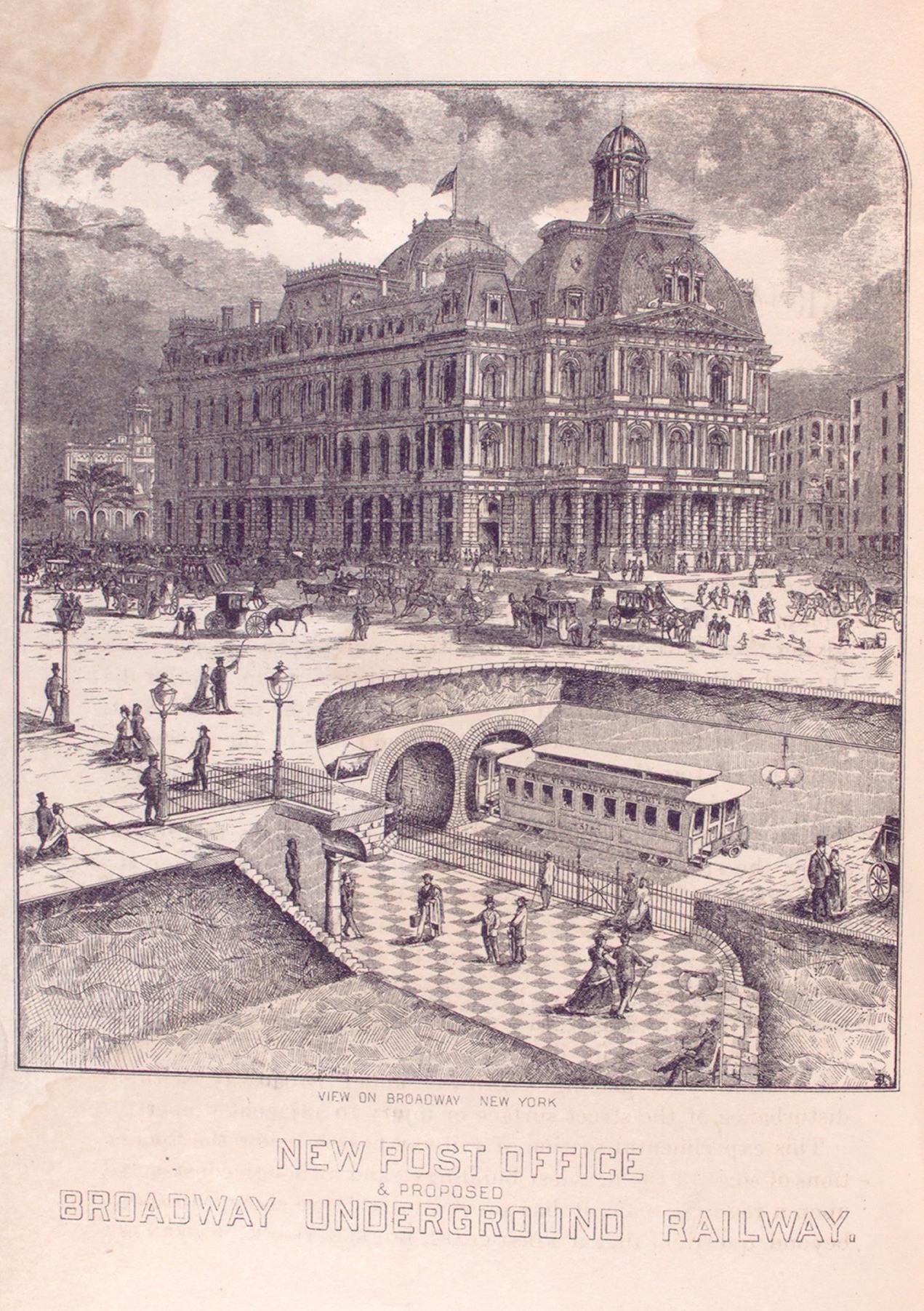
How an underground pneumatic tunnel would have been situated under Broadway. Â Pictured here in relation to the new post office (which sat at the spot of the southern end of today’s City Hall Park).
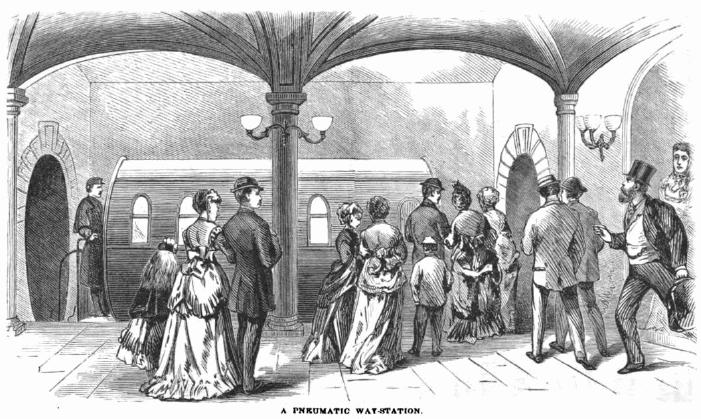
Had the Broadway Underground Railway actually been fully developed, here’s what a station would have looked like:
From NYC Subway
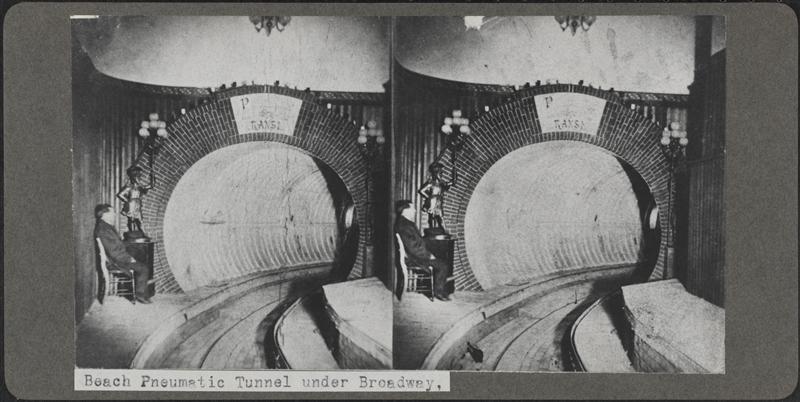
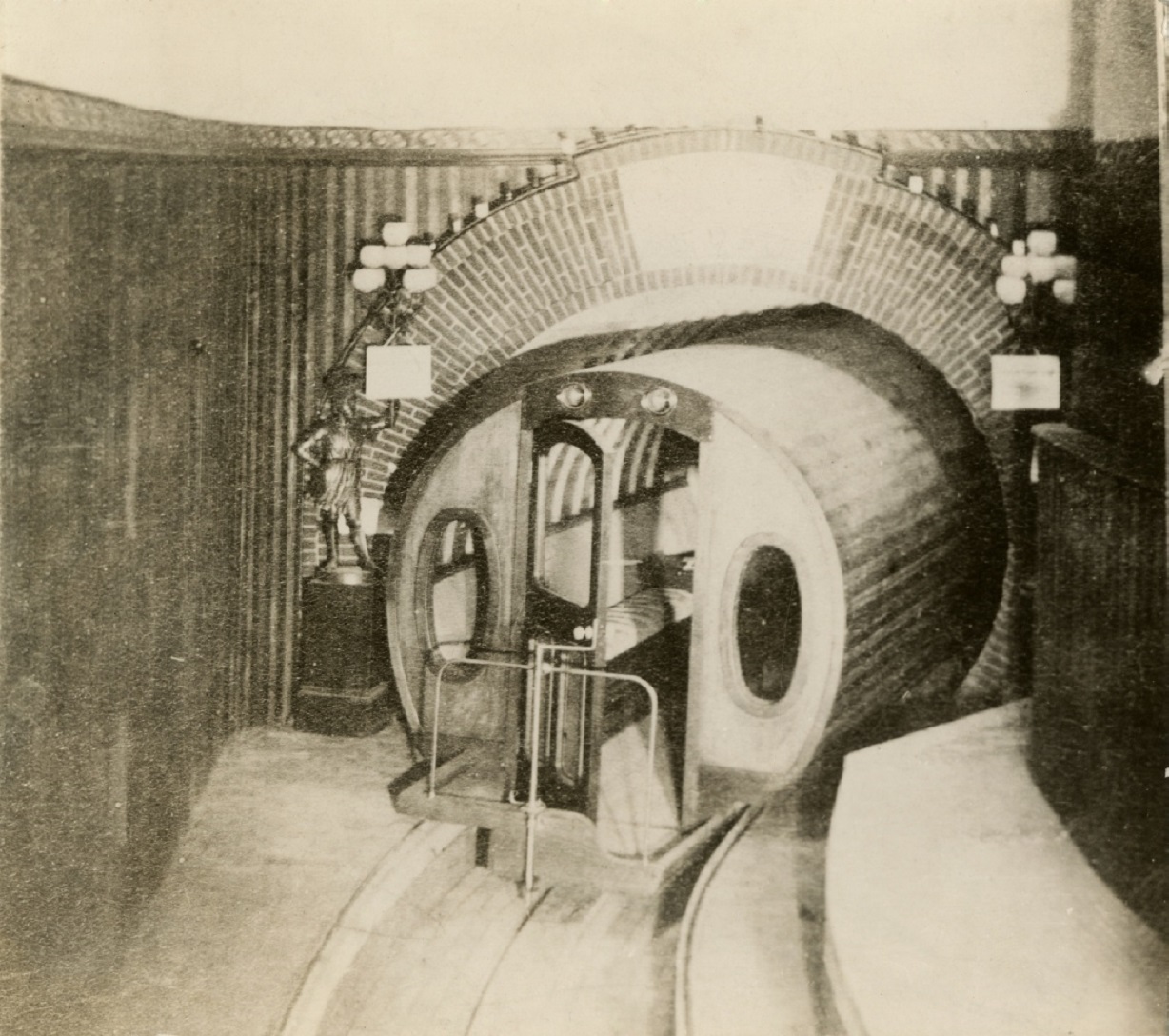
Stereopticon images of Beach’s pneumatic transit tunnel under Broadway, taken in 1870:
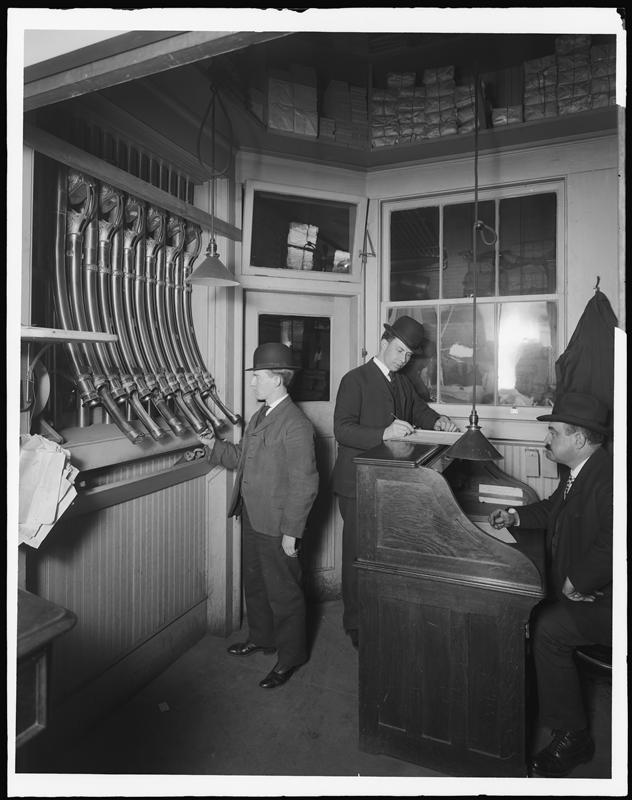
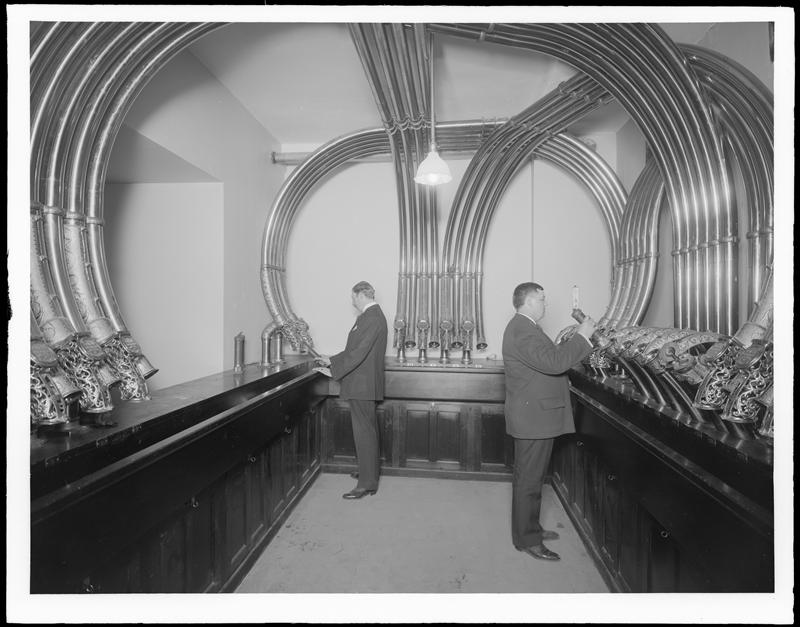
Later application of pneumatic power in New York — shipping office tubes at a location at Franklin and Greenwich Streets (1905) and the series of mail tubes at the National City Bank, 1910.
Courtesy Museum of the City of New York
Courtesy Museum of the City of New York
Start with Joseph Brennan’s excellent research and presentation online. Then jump into one of these great books on the history of New York City transportation — 722 Miles by Clifton Hood, The Race Underground by Doug Most, The Wheels That Drove New York City by Roger P. Roess and Gene Samsone and New York Underground by Julia Solis. There’s even a children’s book on this subject called The Secret Subway by Shana Corey and Red Nose Studio.
Above: Protect this station from the rueful blight of subway advertisements! (Pic NYPL)
There once was a time, believe it or not, when the city was so concerned for the aesthetic beauty of the subway that an early controversy broke regarding the scandalous inclusion of advertisements in subway stations.
The stations designed for those very first subway rides in 1904 were dictated by the guidelines of the City Beautiful movement, an early-century attempt by American cities to best the beauties of Europe and promote civility through architecture and urban design. Overseeing the process then was the Municipal Art Society, formed just ten years prior by Richard Morris Hunt and bolstered by rich patrons and grateful city involvement. (In fact, one of the Society’s first jobs was covering the ceiling of City Hall with an ornate mural.)
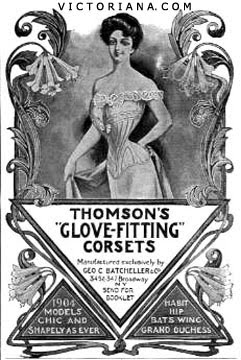
Keeping the subway so very ‘city beautiful’ was crucial to their plans, as the original route ran the length of Manhattan and would unify those tasteful civic ideals. So imagine the absolute mortification one day when a dignified Society member stepped down into a subway station to see a colorful advertisement for a corset.(Such as the 1904 advertisement above.)
Within days the opening of the first subway on October 27, 1904, private companies began descending into stations, hanging advertisements in crude frames upon the tile, in many cases damaging the freshly made walls. As standard paper materials and cheap tin framers were used, the ads quickly deteriorated, creating a drab and unappealing mess. “New York’s $35,000,000 subway, instead of looking like the immaculate place for which the city spent its money, is beginning to look like a billboard in need of the billposters,” claimed the New York Sun.
According to the Nov. 11, 1904, edition of the Tribune, a “peculiar clause” in the original IRT contract allowed for the company to allow “unobjectionable advertising” on the walls.
However, to the Municipal Art Society, no advertising was unobjectionable, and they threatened to sue the IRT. Â The governing body in the middle, the Rapid Transit Commission, was at first non-committal. They were urged to visit the ‘model’ subway station at 18th Street. (That station, on the 6 line today, is no longer in service.)
But the organization eventually relented on Nov. 22 by greatly limiting — but not entirely restricting — advertisements. Â William Barclay Parsons, the subway’s chief engineer, was even on hand to present the kind of advertising that would be permissible, displayed in an expensive frame “of copper, handsome and heavily finished. The back was of zinc.” In other words, a model way that would prove too expensive to mass produce. Also thrown out: slot machines and flower stands.
Public sentiment leaned towards approval of the commission’s decision. “It is pretty well established that the advertising signs in the Subway are condemned, and very properly condemned, by public opinion,” claimed a Times editorial.
But the IRT believed it was in its rights to open the stations to paying advertisers. The night of the transit commission’s decision, in fact, an odd sort of rebellion occurred: subway stations were swarmed with workers “sent out to affix permanently to the station walls as many of the advertising placards as they could before they were stopped by injunction,” along the way drilling holes into the tile walls, causing hundreds of dollars worth of damage. Curiously, no police action was taken, and most IRT employees looked the other way.
This sent the aesthetes of the Municipal Art Society into a swoon! They petitioned the mayor to charge the IRT with damages — the subway was, after all, city property, although the IRT was franchised to operate it.
It would of course be a losing battle. A meeting of the Architectural League of New York the following month merely concluded that subway stations had been designed improperly and without the option for proper, tasteful advertisement. Â In the city’s glee to create a purely immaculate environment, they neglected to take into account the inevitability of public consumption and private corporate power.
With City Beautiful proponents realizing they had little legal standing, the IRT eventually won the battle to allow advertisements, and further, to authorize small independent businesses, “flower stands, slot machines, and the like” to return to the stations.
I do find it amusing that people in 1904 sarcastically referred to the framed advertisements as ‘art’ and the IRT as ‘curators of the subway art museum’. To highlight I reproduce for you a truly snarky editorial that was run in the November 5, 1904 issue of the Evening World:
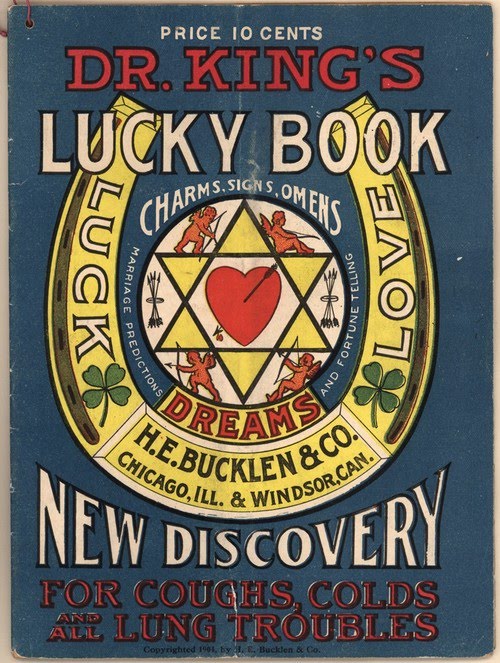
“Alas! How can we ever hope to become a community of culture and refinement when art is thus strangled at its birth? The poster advertisers were rapidly uplifting us from vandalism to aestheticism. They were educating our sense of form and color, till we could thrill with the subtle beauties of a carmine corset upon a purple background, could palpitate with joy at the chiaroscuro of an ultramarine whiskey bottle against a gamboge sunset, could almost faint with ecstasy at the composition of lilac lingerie amid a sea-green cloud effect. “Are beautiful works of art like this never to cast their lambent lustre from Subway walls? “Alas! It seems as though in our Subway we shall have to lose the new and higher art which finds expression in corsets and whiskeys and patent medicines and content ourselves with crude white tiles and simple frescoes. “It will be a sad blow to lovers of subterranean picturesqueness.”
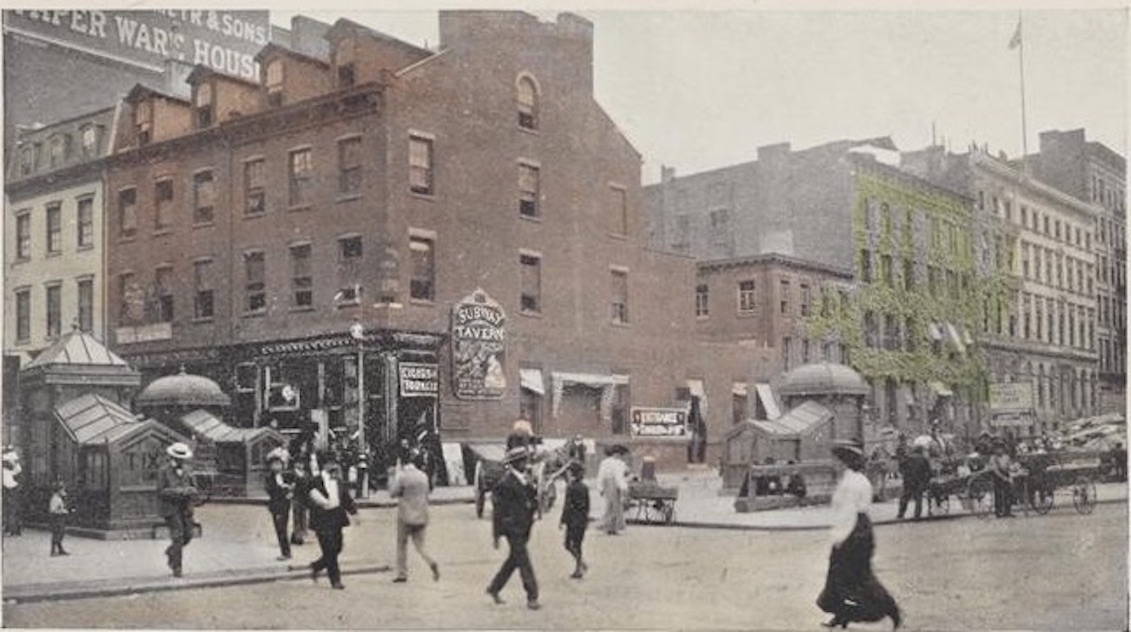
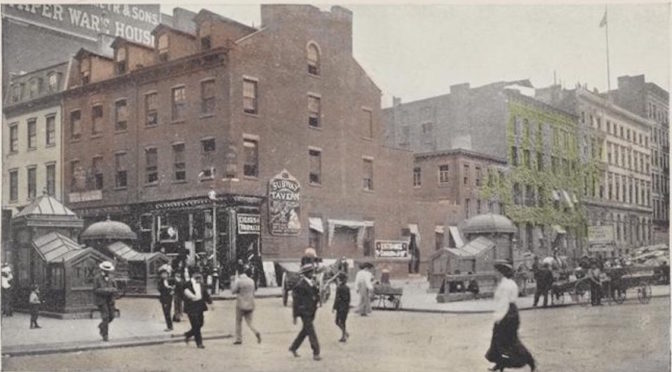
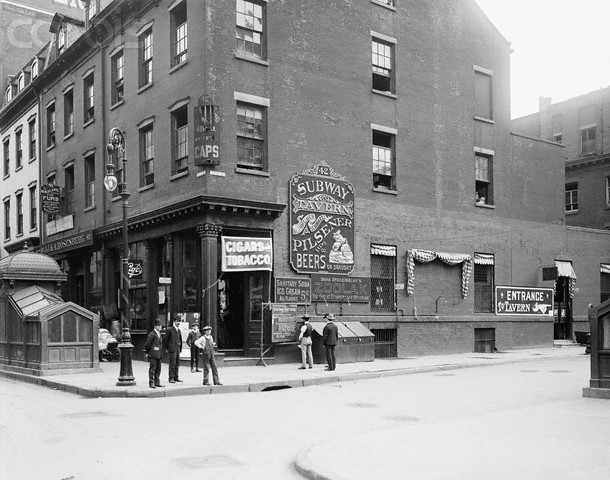
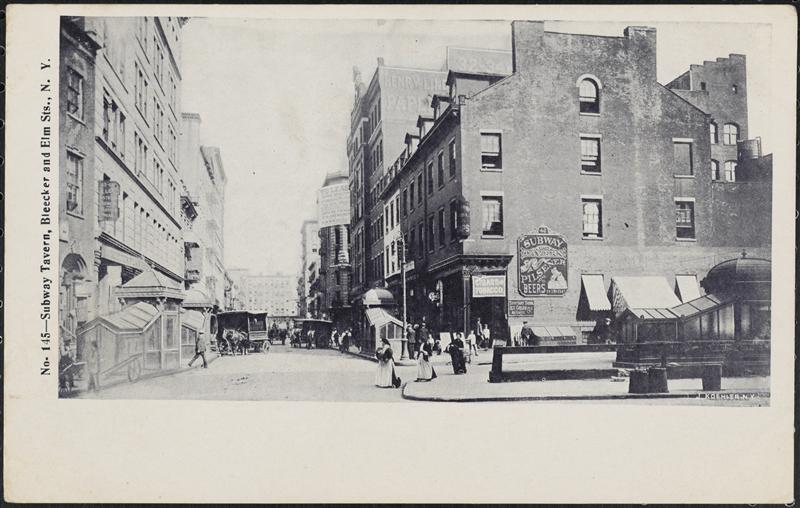
LOCATION:Subway Tavern Bleecker and Mulberry, Manhattan
In operation 1904-05
The early planners of the New York City subway negotiated that very first route through some of the city’s mostly heavily populated areas, those obviously in need of rapid transit. The locations of the first underground stations were based on the amount of available space at key cross streets. If you happened to own property along the route and specifically near a planned station, you would have hit the proverbial jackpot in 1904, the year the subway opened.
And so begins the tale of the Subway Tavern, at the corner of Bleecker and Mulberry, which tried to monopolize on this lottery of suddenly-valuable real estate with the worst idea in the history of New York City nightlife — a moral tavern.
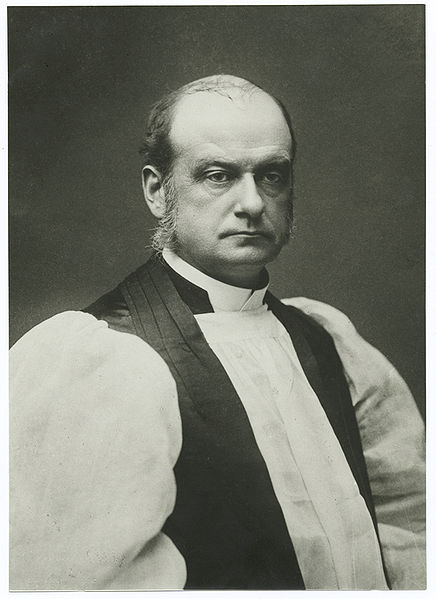
Like all religious leaders, the Bishop Henry Codman Potter of the Episcopal Diocese of New York was gravely concerned with the evils of alcohol upon the poorest classes and the newest arrivals from Ellis Island. Most of the temperance stripe preferred to hit areas most soaked in booze — particularly the Bowery — with bibles in hand and moral example on display. Often to no avail and to the occasional danger to the proselytizers themselves.
Potter (pictured below), a rector at Grace Church, thought outside the box. His own ideas for social reform were radical for the time but some (like daycare in churches) seem standard and even obvious today. Although he lived rather luxuriously — his stately home at 89th and Riverside Drive is still standing — he made a point, even after his ascension to bishop, to work regularly in poor neighborhoods.
He was often a voice for labor groups and consistently berated Tammany Hall for its abuses. Nobody could say the man’s heart was not in the right place. Which made it all the more shocking when he decided one day that the Episcopal Church should open a tavern.
Since it seemed unlikely that people would stop drinking entirely, went his theory, why not found an establishment where proper and gentlemanly drinking would be encouraged? A place where the staff could monitor and guide patrons to more responsible imbibing.
Potter found the perfect location, a former saloon owned by future Fire Commissioner Joseph ‘Oak’ Johnson, at the corner of Bleecker and Mulberry streets and sitting right in front of a new subway entrance. Although the trains would not run for another few months, the new experiment was dubbed the Subway Tavern.
Potter christened the new tavern on August 2, 1904, opened with $10,000 in funds from distinguished citizens, including money from U.S. representative Herbert Parsons and former lacrosse star Elgin Gould. In case anybody was unclear of the intentions of the unusual establishment, a holy doxology was performed to an enrapt, standing-room-only audience.
Courtesy Museum of the City of New York
The Subway Tavern was to operate like a respectable upper-class club, except for poorer folks. “I belong to many clubs which I can go,” remarked the bishop, “but where can the toiler go?” Where, indeed!
Potter honestly believed the Subway Tavern could be jovial and free-spirited without becoming debaucherous. The front room, adored with a sign ‘To The Water Wagon’ playfully overhead, would be open to both sexes “with a ‘sanitary’ soda water fountain where beer will be served to women.” [source] Men would have a private room behind some swinging saloon doors in the back.
As the bar was funded by donations, the ‘evils’ of profit were eliminated. And thus, reasoned Potter, bartenders would not encourage patrons to drink. Men and women could come to converse, read a newspaper and have one — maybe two — drinks. Employees were to closely watch the intoxication levels of customers; if one even looked tipsy — if say, somebody appeared to be enjoying their drink a wee too much — they would be cut off. Healthy food would also be on hand downstairs to soak up any amoral toxins in the belly.
As the New York Times lightly mocked, “The benevolent bartenders … are anguished when they are compelled to serve whisky, and … dimple with joy when sarsaparilla pop is ordered.”
Naturally, many Episcopalians were not too thrilled having their church associated with a tavern just a couple blocks from the Bowery. Many dubbed it ‘The Bishop’s Inn’. The experiment made national headlines and was greeted with remarks like those from Pittsburgh pastor J.T. McCrory: “I supposed the ‘Subway Tavern’ was called that because it is an underground way to hell.” (Several accounts I read seemed to believe the tavern was actually in the subway.)
Another preacher called it a “low down, greasy Bowery saloon.” Shocked clergy flocked from other cities to gander at this oddity and register their opinion to the press. “I do not think it will turn the tide of drunkenness,” said one stunned clergyman, “nor will it solve or diminish the curse of rum.”
The naysayers were right. The Subway Tavern turned out to be a horribly ill-conceived idea, and its flaws were magnified several months after the subway opened in October 1904. When a reporter for the Advance visited the pub in September 1905, they found the exterior covered in ‘tattered’, ‘stained’ advertisements, a main barroom empty and most surfaces covered in flies.
Presumably, patrons quickly grew tired of being stately. As the Advance so plainly stated, “The liquor sold at the Subway does not make men sober. There is no method by which a young man learning the drink habit may not go elsewhere to complete his ruin.”
Within days of the Advance’s visit to the Subway Tavern, the holy drinking establishment closed up and reopened as a no-pretenses ‘out and out saloon’. Bishop Potter died just a few years later with a mostly unblemished record.
Many years later, the structure that once housed the Subway Tavern was ingraciously replaced with this building.
This article originally ran as part of our FRIDAY NIGHT FEVER series entry. Past entries can be found here.
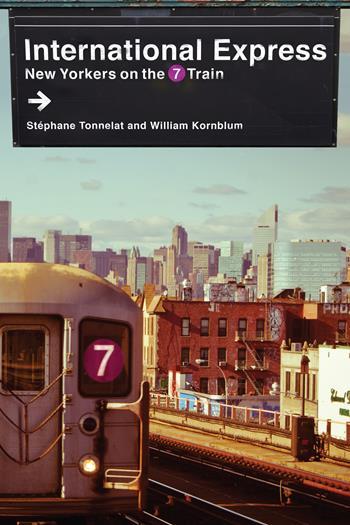
Most of these interruptions are experienced in a unique way, a group of strangers coping with a  situation outside their control. After a few minutes of waiting, people get impatient, pace the train, grumble silently, turn up the volumes on their listening devices. Their spheres of comfort may change, allowing them to speak to a fellow passenger in a sign of solidarity.
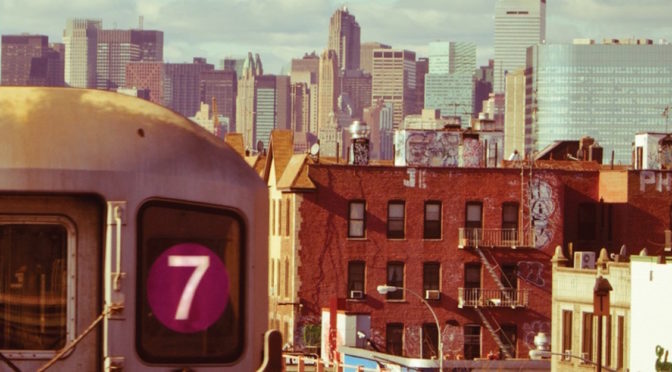
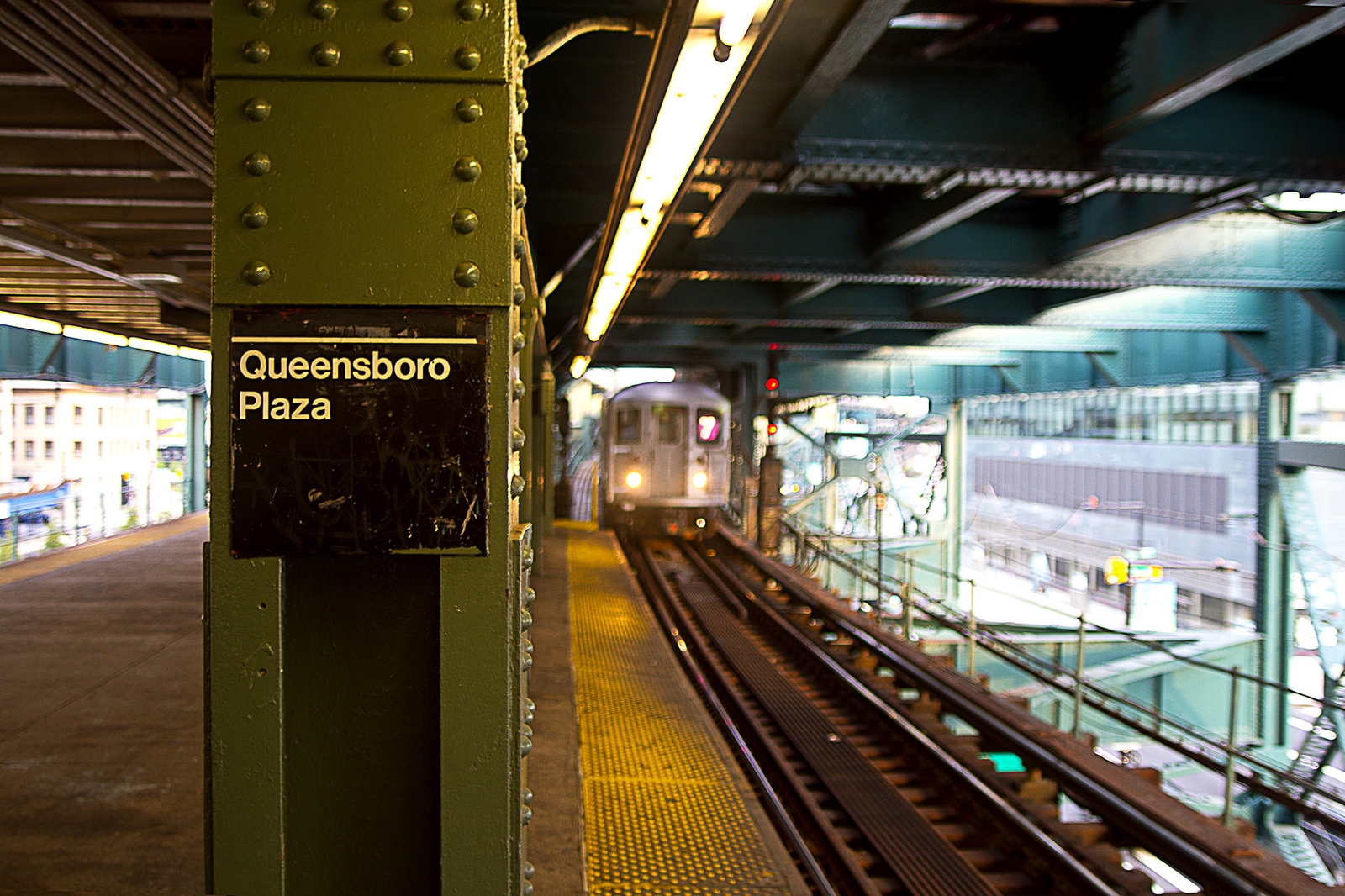
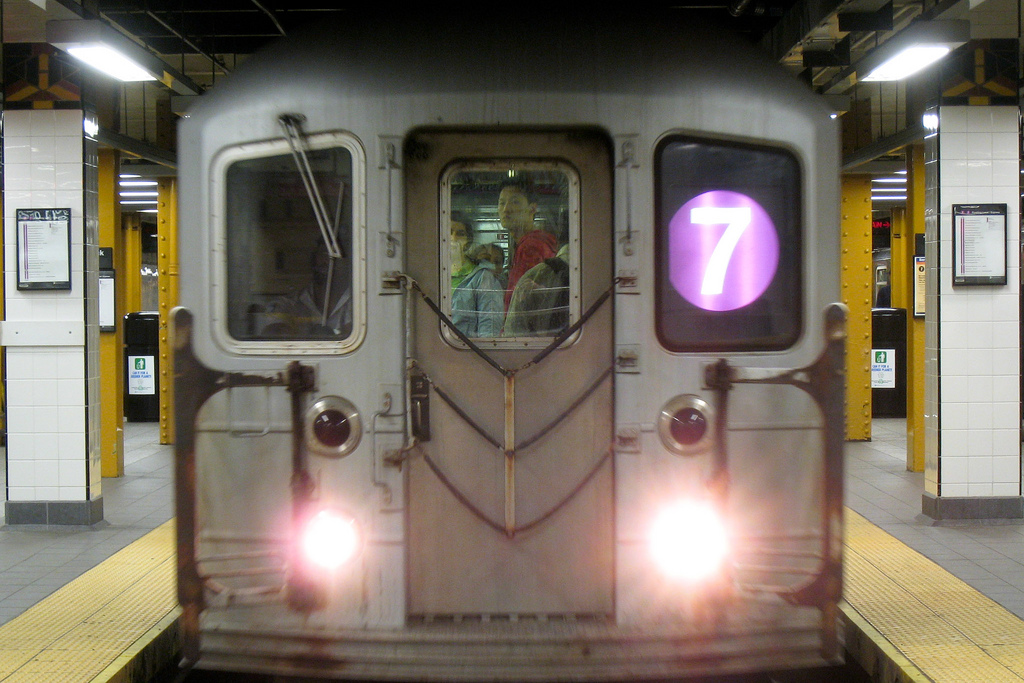
Now take those regular mass-transit routines and observe them on the most unusual train in all of New York  City (if not the world) — the 7 train which travels from the Hudson Yards to Flushing, passing through a wide variety of ethnic neighborhoods. It’s affectionately called the International Express.
As the two authors observe, there really is no experience on earth like riding the subway.
Their observations of human behavior can be read to include all experiences upon the New York subway, but the 7 train provides a very unique mix of languages and cultures, intensifying and sometimes complicating regular daily routines.
Riders in rich ethnic communities of one type may only interact with those of other communities while riding the subway. On the 7, this means sharing a space with people of many ethnic backgrounds at once. Â “Riders are fascinated by the diversity they experience and take pride in learning in learning to read cues regarding the identities of strangers on the trains.”
Flickr/Doug Letterman
In a very blunt but incisive way, the authors identify various aspects of New York that often hard to quantify. “[A]fter paying the fare, we all have an equal right to be on the subway, to be in the city dressed however we please, and to be ready to defend ourselves against stereotyping and bigotry.”
And yet, as observed in interviews with countless 7-train riders, the train becomes a sort-of safe space as well, where individuality is not only allowed but even supported, as it allows every rider to express themselves personally within basic norms of decency. Not that riders don’t personally harbor hostile or racist views at times; but mostly, perhaps as preservation of the 7 train’s neutral space, they keep these thoughts to themselves.
The authors also explore the particular power of the 7 train itself in transforming Queens into the most diverse and second-most populous borough, allowing neighborhoods of specific ethnic character to thrive, even at moments in New York City history where the rest of the city stagnated.
The success of neighborhoods like Jackson Heights and Flushing ultimately depend on the train. The most illuminating sections of International Express seem almost like dire warnings in light of 2017’s recent mass-transit disasters.
Or, as the authors put it, “Despite overcrowding, construction and mechanical delays, sweltering platforms in the summer, and endlessly broken escalators, the physically and socially competent urbanite chooses the subway. Will that always be the case?”
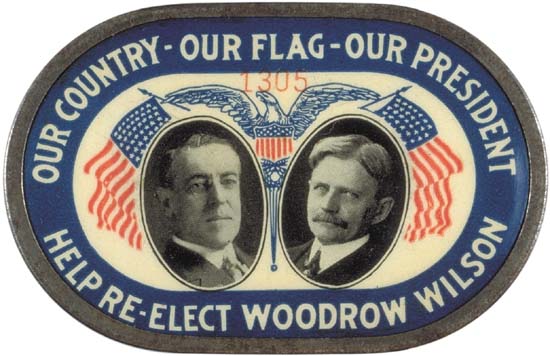
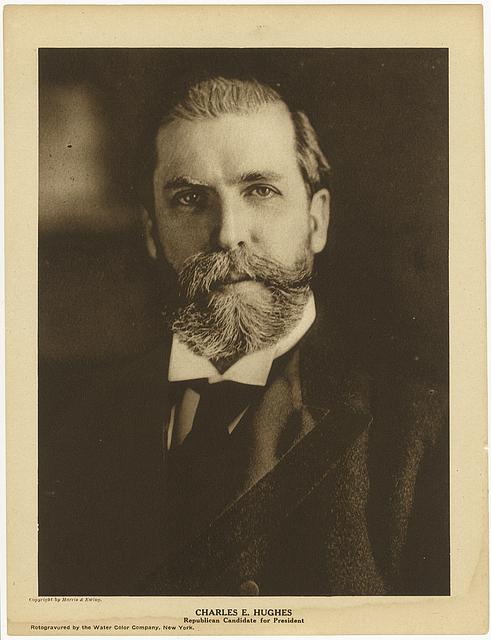
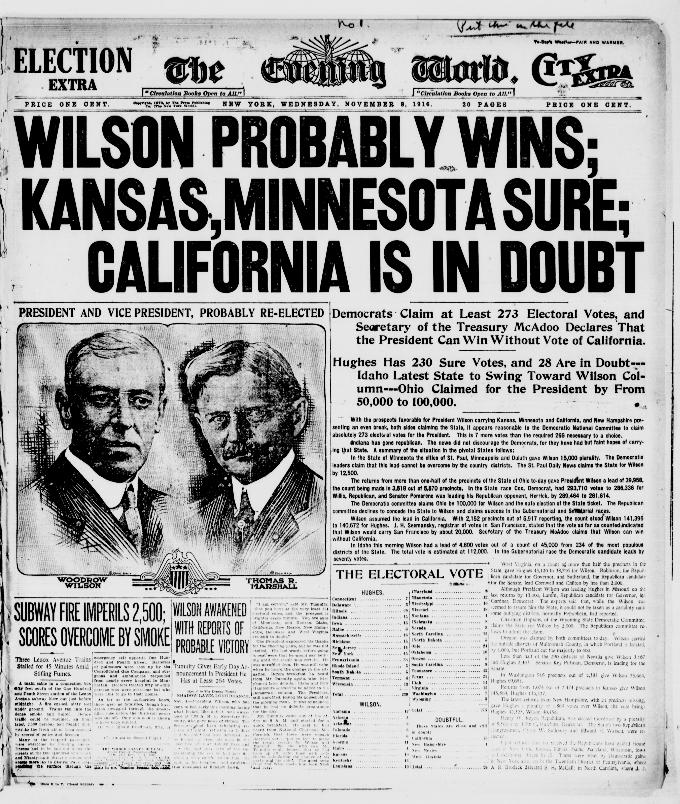
One hundred years ago today, Americans went to the polls to vote for the President of the United States — between the Democrat and incumbent President Woodrow Wilson and the Republican Charles Evans Hughes.
The election was held on November 7, 1916, and it’s interesting to peruse the details of the day itself and the headlines from the following days, looking for parallels to our current election.
Like the current 2016 election, the choice back then sprouted from local political figures, pitting the former governor of New Jersey (Wilson) with the former governor of New York (Hughes). Imagine Chris Christie running against Andrew Cuomo. (On second thought, don’t!)
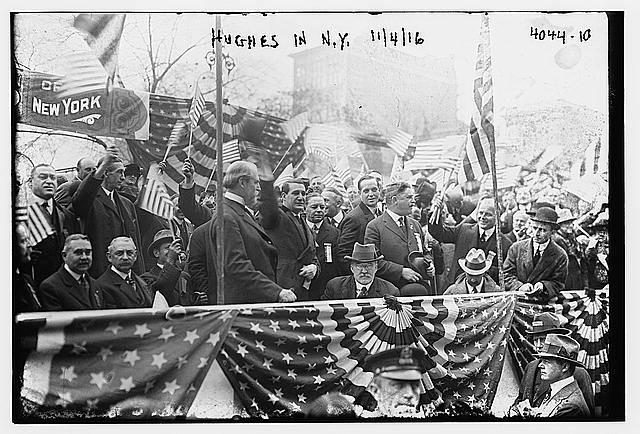
Below: Hughes at a rally in New York a few days before Election Day.
Of course, technically there was a third candidate on the ballot and one with the deepest New York roots — Theodore Roosevelt. After great entreaties by supporters, the former president was submitted as the Progressive Party candidate, only to withdraw his name late in the process to endorse Hughes.
Hughes (pictured above) was a hand-picked recommendation of Charles S. Whitman, the popular New York governor who was himself re-elected that November.
Hughes, who sat on the New York Supreme Court after his tenure as governor, was a popular candidate for President but he was no match for Wilson’s anti-war message. (Literally anti-war. Wilson’s slogan was “He kept us out of war.” President Wilson would eventually enter the war five months after he was elected.)
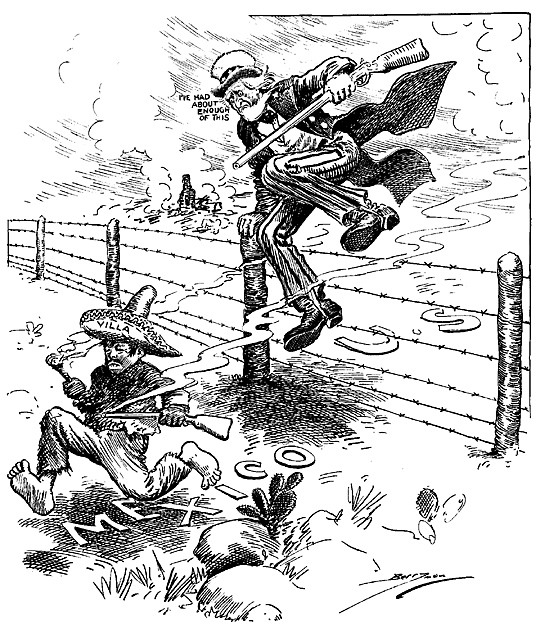
Also on voters’ minds — Mexico. Several Americans had been killed in Mexico and on the border, and the U.S. was in the middle of a punitive attack against Pancho Villa and his militias which had begun that Spring.
Voting looking quite different than it does today. In New York, there were no designated polling places and no absentee voting for non-military members. Half of today’s electorate was missing as women would not achieve the right to vote on the federal level for another few years. (However they would receive voting rights in New York in 1917.)
Secret ballots and voting machines were relatively new installations to the voting process thanks to the election reforms of the 1890s. It was still a wild and relatively imperfect process but a great improvement over the mid-19th century heyday of voter intimidation and fraud.
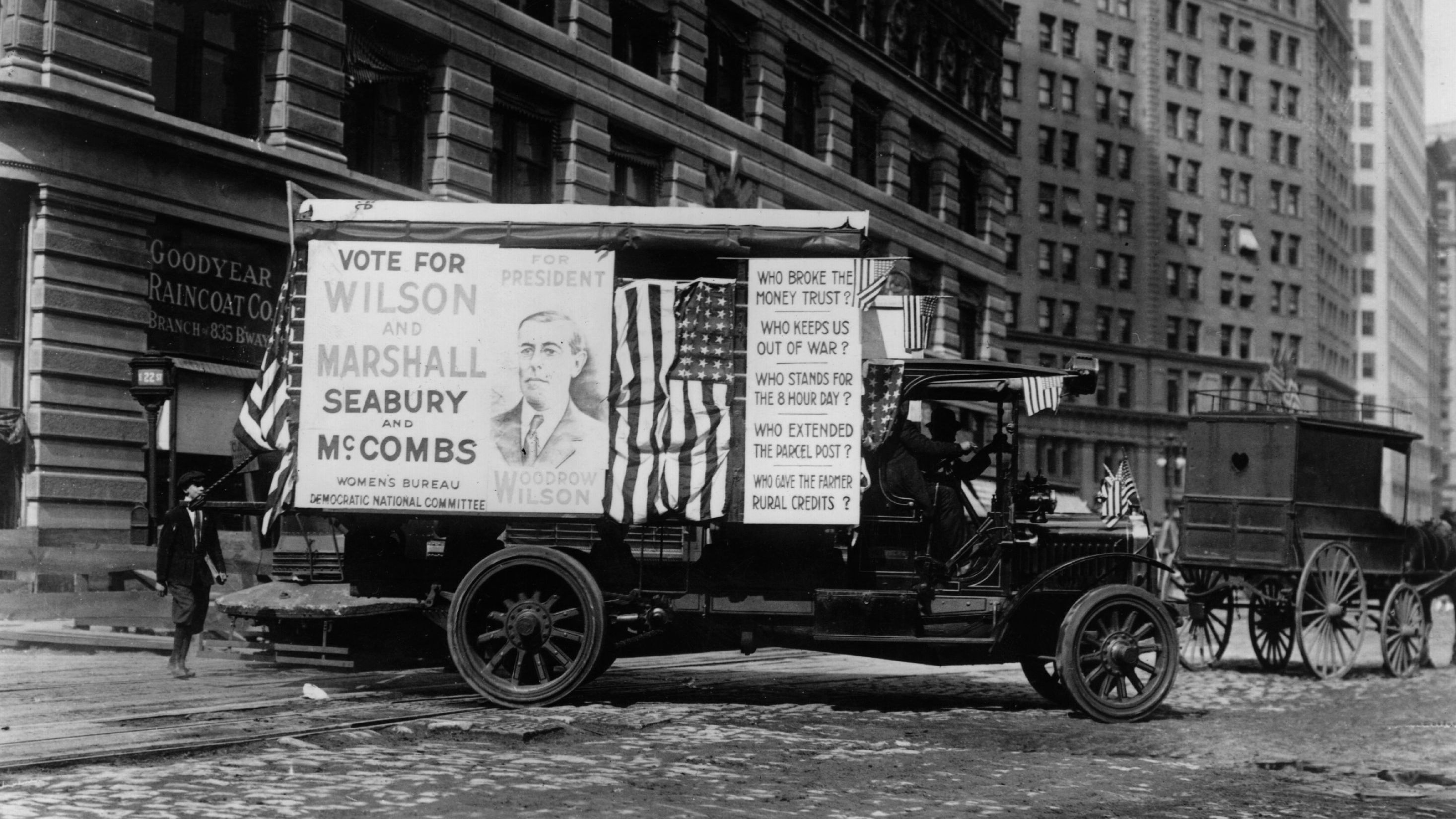
An election campaign car, backing incumbent Woodrow Wilson for president in 1916 in New York.
Of course Hughes was a Republican and at a disadvantage in New York, still considerably controlled by the Democrats and, in particular, the political machine Tammany Hall. Â “Tammany leaders did not give out any figures regarding New York City, but it was asserted at Tammany Hall that Charles F. Murphy was confident that the city would roll up a big Democratic plurality, and that New York state would go Democratic.”
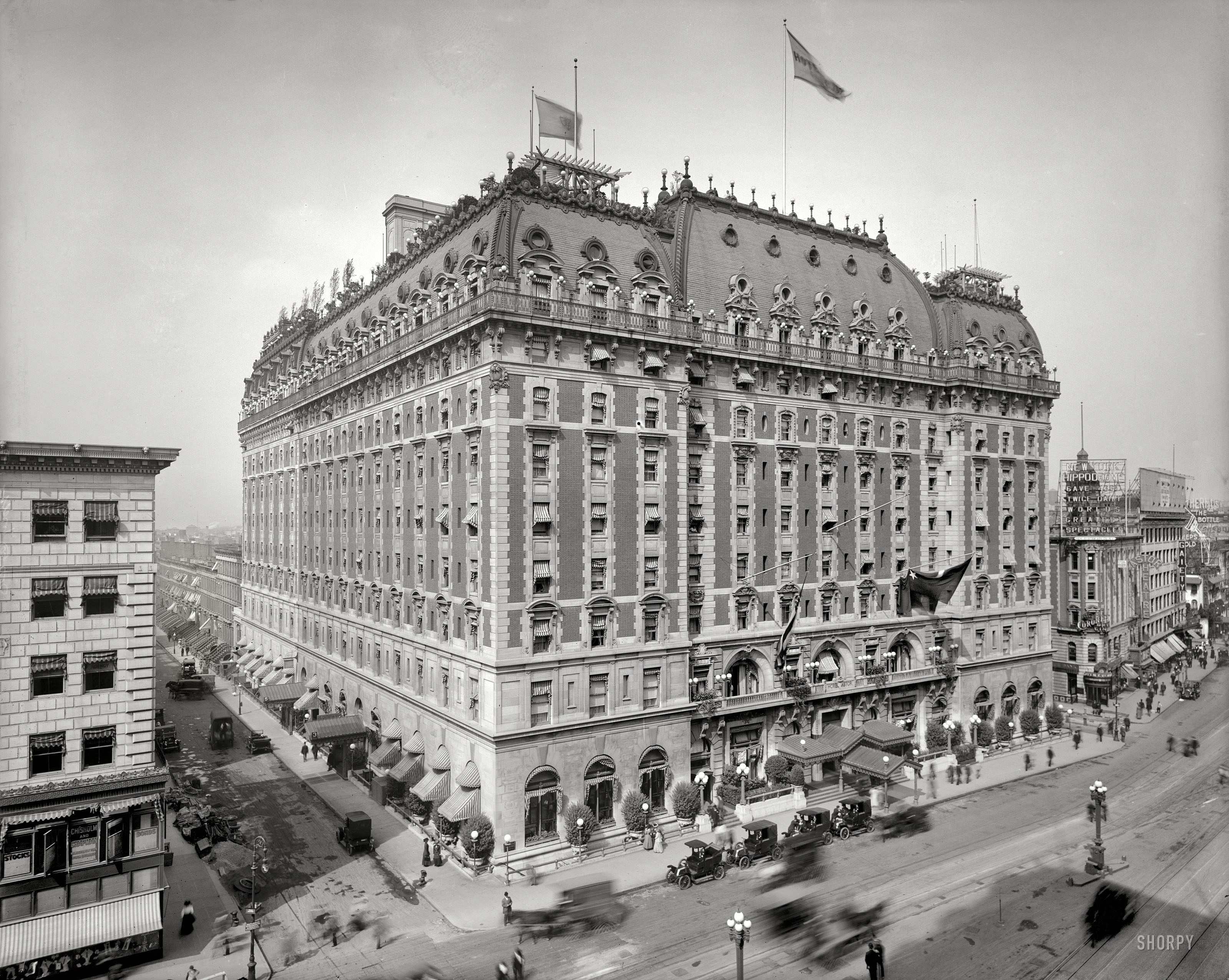
Hughes watched the election results from New York City that day. According to the Times, he voted “in a little laundry in Eighth Avenue between 44th and 45th Streets,” and spent the day at the Hotel Astor in Times Square(pictured below).
While influencers supporting specific candidates were not allowed at the polls, suffragists were certainly there, passing out flyers for their cause and in certain cases, providing poll workers with sandwiches and coffee.
How They Watched The Results
As with many celebrations, there were three gathering points of information, all near newspaper offices — Times Square, Herald Square and City Hall Park. In midtown, people awaited a gigantic searchlight atop of the New York Times building for signs of victory. Late that evening, a red light filled the sky, and New Yorkers who were Hughes supporters began celebrating. At the Hotel Astor, the name HUGHES lit up in electric lights as thousands celebrated below.
It was a confusing time; downtown at the New York World building (pictured below), a white searchlight announced Wilson as the winner. (It would take days for results from all 48 states to come in.)
The streets of Times Square were thick with revelers — it was comparable to New Years Eve crowds and, in fact, probably exceeded them — although this was mostly due to the fine weather and the results coming in at around the same time as the Broadway theaters let out.
Earlier in the week, city officials authorized the shutting down Times Square due subway construction but it seems people still managed to gather around the edges, looking “like the exit of the Polo Grounds after a world’s series game.” The sounds of horns were deafening. Bonfires were set along side streets.
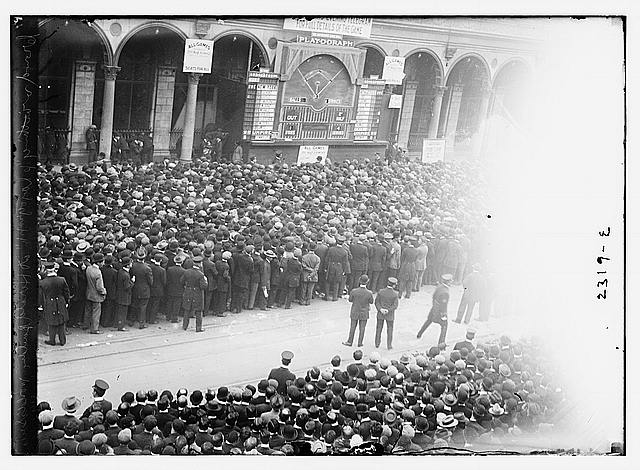
Below: In 1911, in front of the New York Herald building in Herald Square, crowds watch a sporting event via ‘playograph’, a hand-manipulated board. Election results were posted in a similar fashion.
In Herald Square and in Times Square, information on election tallies was delivered via constantly updated bulletins. “[B]ulletins followed each other every few seconds as reports to The Times were telephoned over to the operators from The Times Annex, and the lofty canvas screen was within the view of probably 100,000 people down Broadway and Seventh Avenue.”
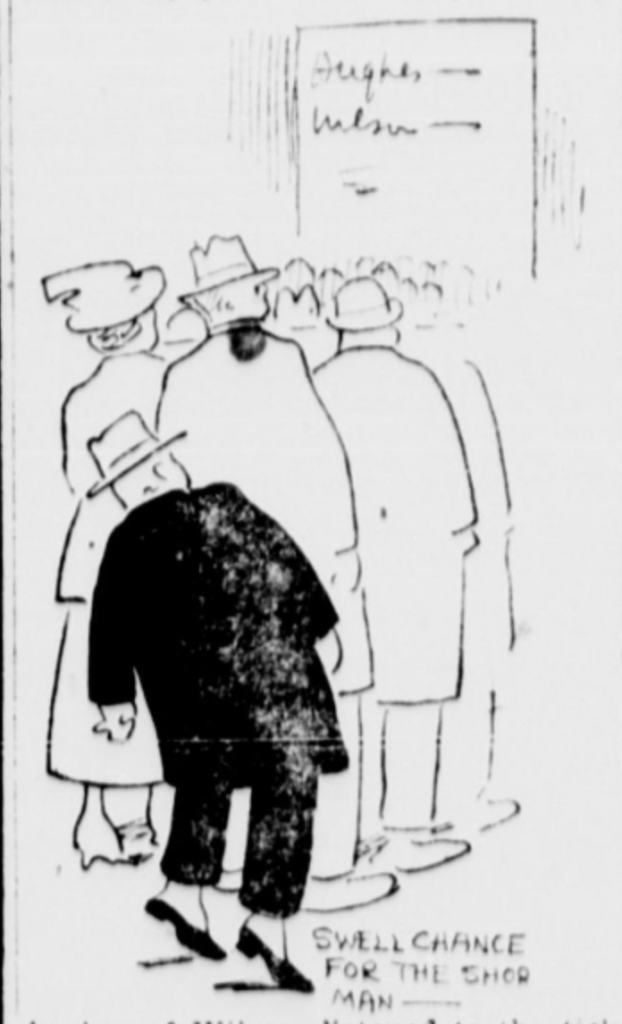
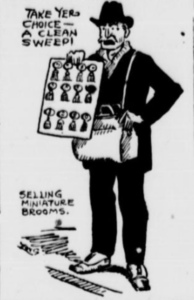
The New York Evening World had a merry go of it, lampooning election enthusiasts on the street. The merry-makers was festively illustrated (see above and below and here for the rest). Yes Election Night used to be fun!
Bulletins were also posted in Columbus Circle. Due to disliked results or perhaps the trauma of the crowd, one man “drop dead there early in the evening.” [source]
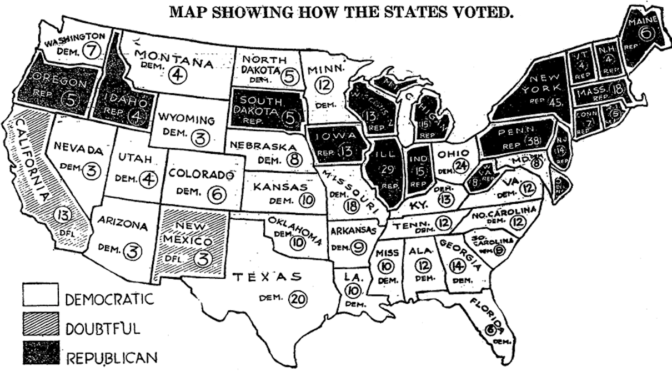
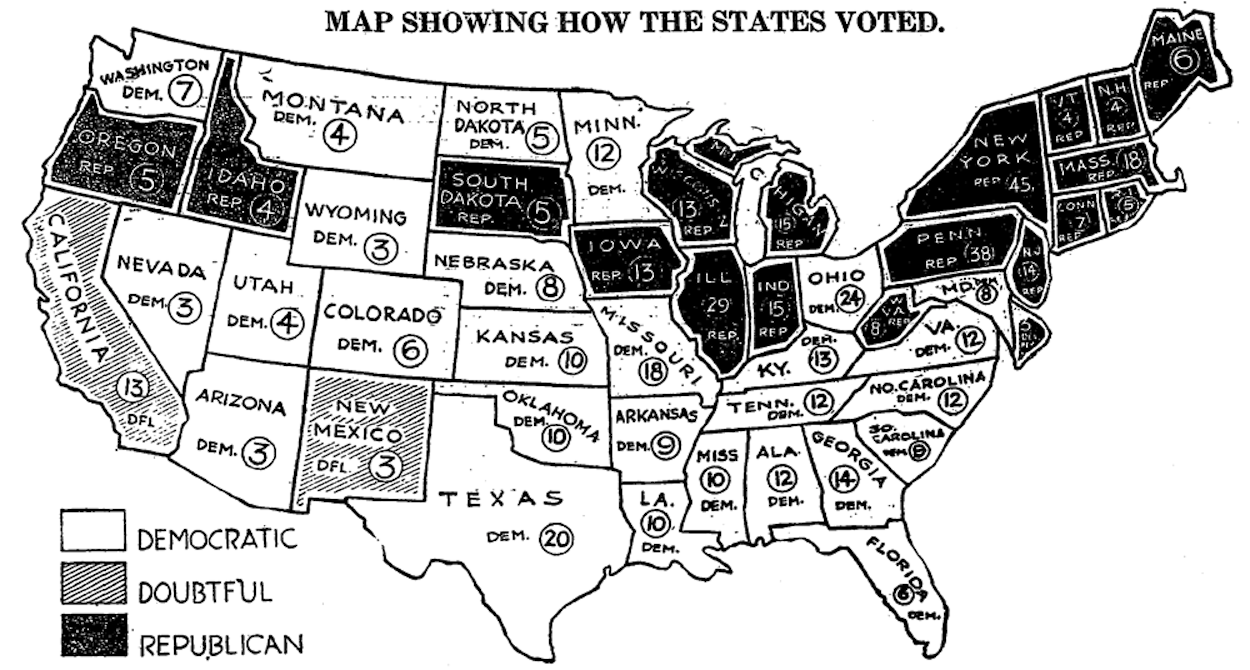
A map of election results which ran in the New York Times on November 8, 1916, is remarkably similar to one which might run in newspapers today. Of course, given the evolution (or de-evolution, depending on you how you choose to look at it) of American politics, the party affiliations have remarkably changed!
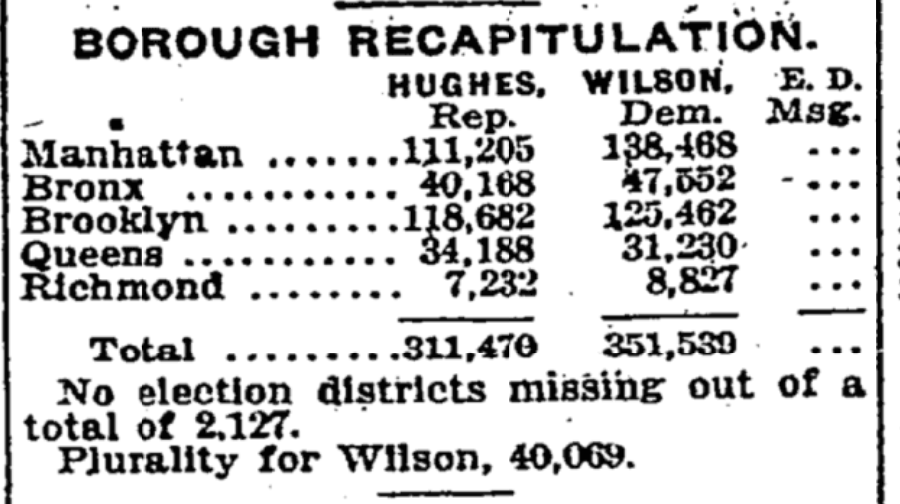
In the end, as with many other elections, New York’s electoral votes went to the Republicans but New York City firmly voted for Wilson. “New York City gave Woodrow Wilson a scant plurality of 40,069 to offset the 186,930 plurality for Charles E. Hughes which the up-State counties sent down to the Bronx line. The city’s vote for Wilson was 351,539, compared with 312,386 which it gave him for President four years ago.” Â [source]
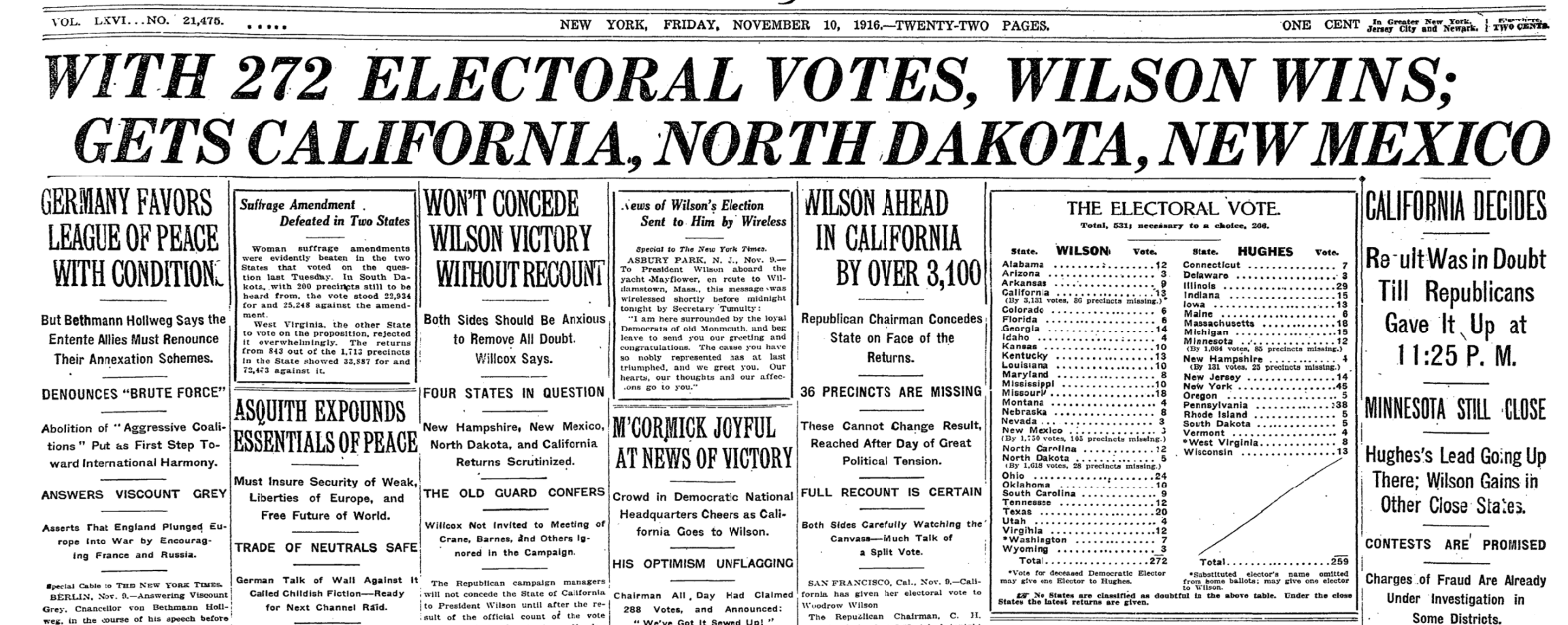
The election was not ultimately determined for a few days. The newspaper front page below is from November 10, four days after Election Day:
Hughes supporters instantly leveled charges of fraud at their opponent but the former governor was too dignified to take the bait. While not yet conceding on November 11, “Mr. Hughes declared that in the absence of absolutely proof of fraud no such cry should be revised to becloud the title of the next President of the United States.” [source]
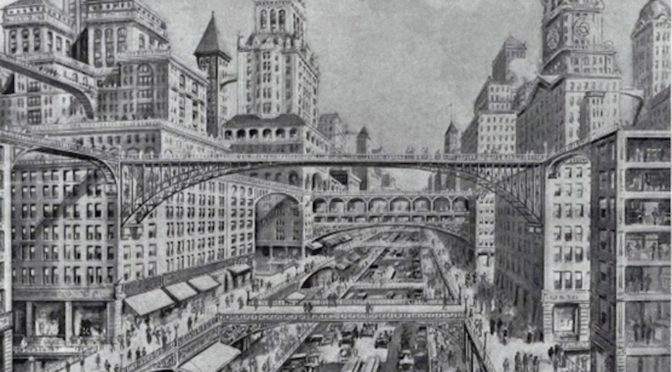
Imagine a city where the High Line isn’t just a novel park, but the primary form of urban conveyance.
In 1913, with the proliferation of the automobile, it seemed humans were being crowded out at ground level.  People were beginning to think of themselves as removed from the street.  Daredevils were experimenting with flight, and small, single-man crafts began appearing over the skies of Manhattan.  The world’s tallest building, the Woolworth Building, had been completed a few months before.  Perhaps the streets themselves could elevate, granting pedestrians a space of their own?
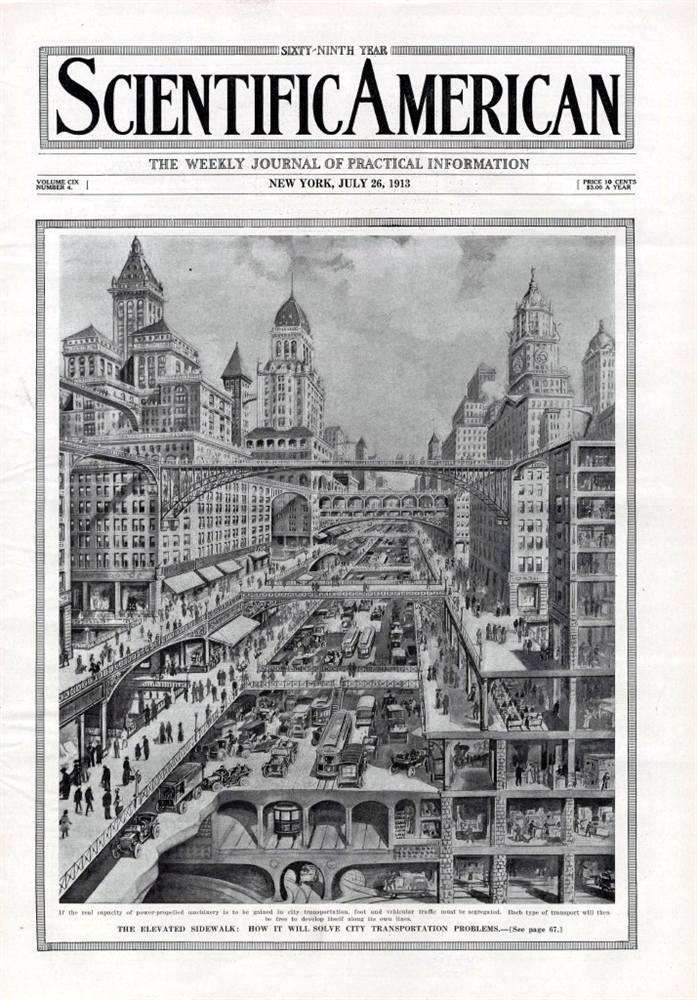
Scientific American suggested the possibilities of a city of elevated layers in its July 26, 1913 issue. “The Elevated Sidewalk: How It Will Solve City Transportation Problems,” written by engineer and science writer Henry Harrison Suplee, posits that humans and automobiles are simply incompatible and opposing engines upon ground level, and that one will have to give way to the other.
“One of the greatest impediments to city transport today is the continuance of the obsolete method of attempting to conduct foot and vehicular traffic upon the same highways.”
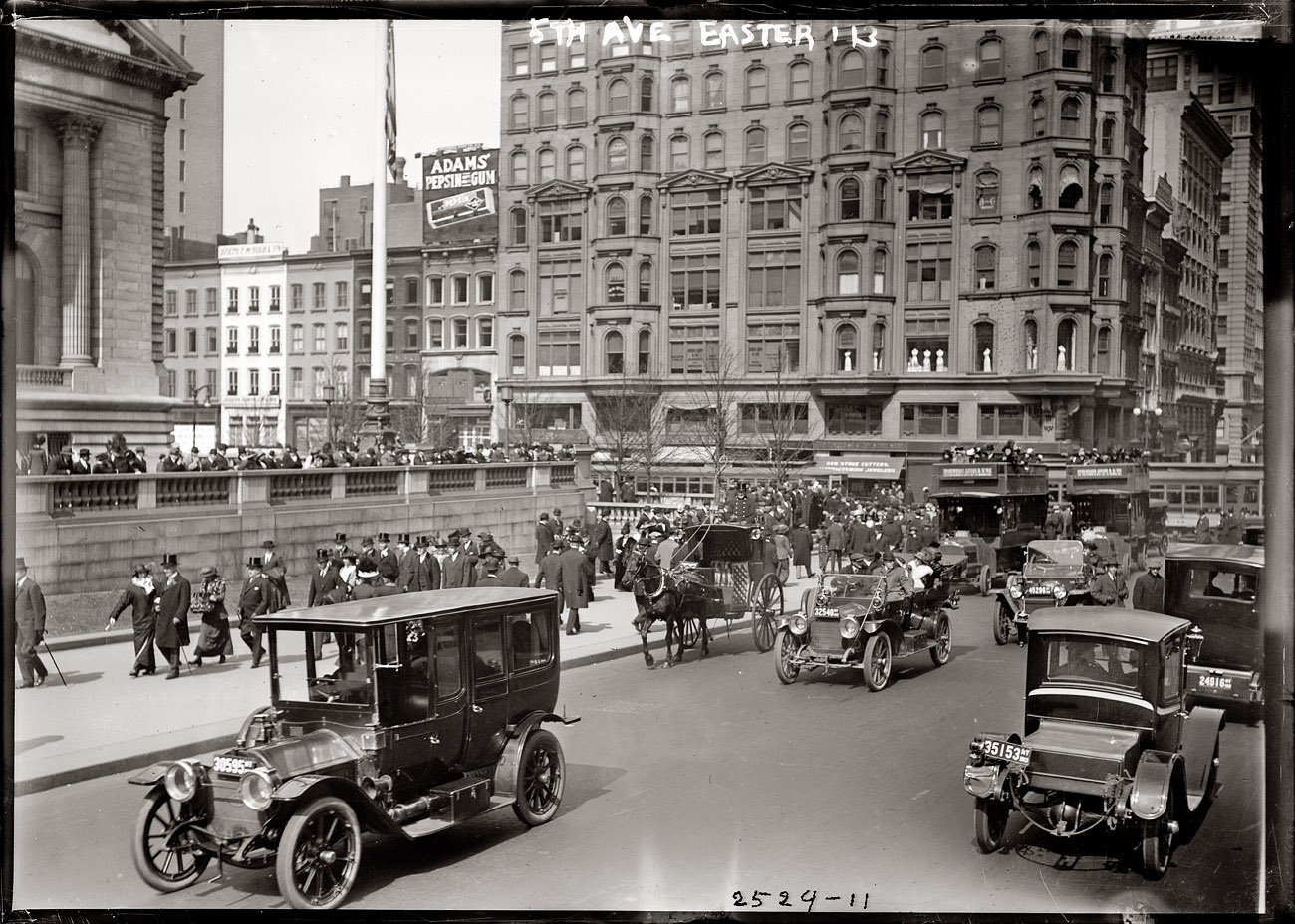
Below: Cars and people seem to co-exist peacefully on Fifth Avenue (pictured here in 1913). But, darn it, automobiles are meant to go fast!Â
Courtesy Shorpy
After all, cars are meant to go fast. Â “In nearly every large city today there appears a tendency to enforce traffic regulations intended to permit the most conflicting elements to be operated together and the result is naturally the impeding of the very traffic which it is desired to help.”
By keeping people and automobiles on the same plane, one risks lives, sure, but more importantly, it slows progress by keeping the potential of auto motion on a short leash.
Suplee’s solution: “Take the foot passengers off the surface of the street entirely, and leave the highways solely for vehicles!”
Below: Evidence of the incompatibility of foot and automobile was being amply displayed all over New York City, most notably on “Death Avenue,” the trecherous tangle of roads on Manhattan’s West Side. Eventually the elevated freight railroad today known as the High Line was built to relieve this issue.
New York had many precedents for this. Â The great passages over the East River (the Brooklyn, the Williamsburg and Manhattan bridges) had all been completed with elevated pathways for pedestrians, situated over or alongside those paths for vehicular traffic. Â Trains were either elevated overhead along the avenues, or buried underneath the ground.
Suplee doesn’t imagine a world were pedestrians become smarter, or any type of place with sophisticated traffic lights or crosswalks. Â Instead, elevated sidewalks would hover over the major thoroughfares; “[S]uch sidewalks might be built on Broadway from the Battery to Union Square, there sloping down to the surface level until further extensions were required,” he writes.
In a city of skyscrapers, bridges could be constructed several stories above the street. Â Store fronts would appear on the second or third floors, while the ground floor would be exclusively used for delivery and store. Â Life would essentially reside many feet above the ground.
Bicycles figure nowhere in his model, but he does carve out one exception to his pedestrian only level. Â “The power vehicles should be kept absolutely to the surface, and there given unrestricted facilities for speed, weight, and numbers; and the foot levels maintained for absolute freedom for pedestrians, with the possible exception of carriages for small children.”
As commenter Boris mentions below, while New York City never adhered to this suggestion, other cities certain did — to a certain extent.
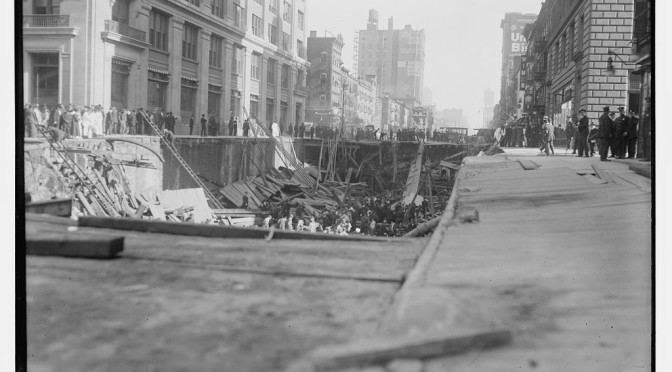
One hundred years ago today, — a horrifying disaster on Seventh Avenue endangered the lives of New Yorkers on their way to work.
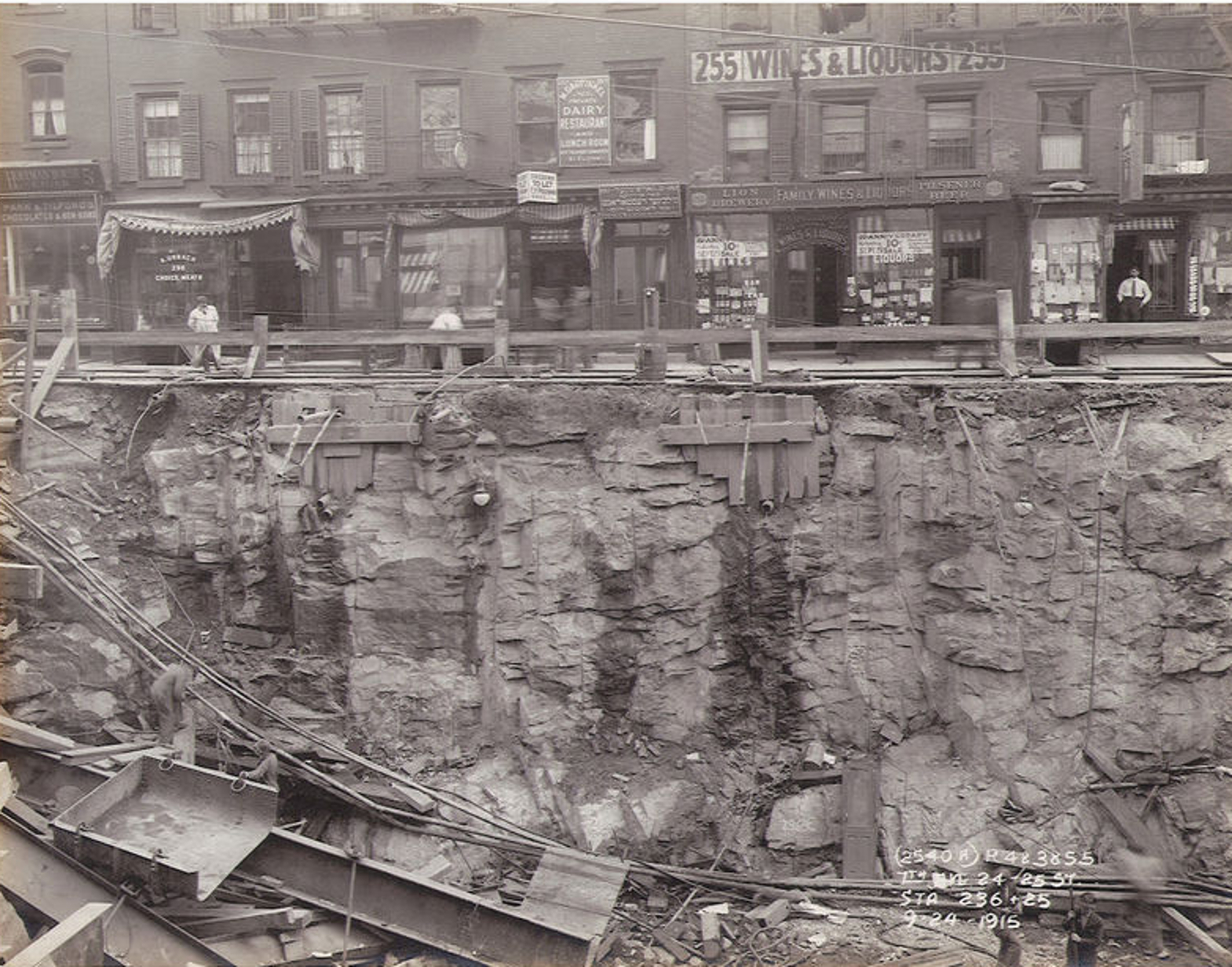
Excavations for the new Seventh Avenue subway line (the IRT Broadway-Seventh Avenue line, aka the 1-2-3 trains) were proceeding well below an active thoroughfare.
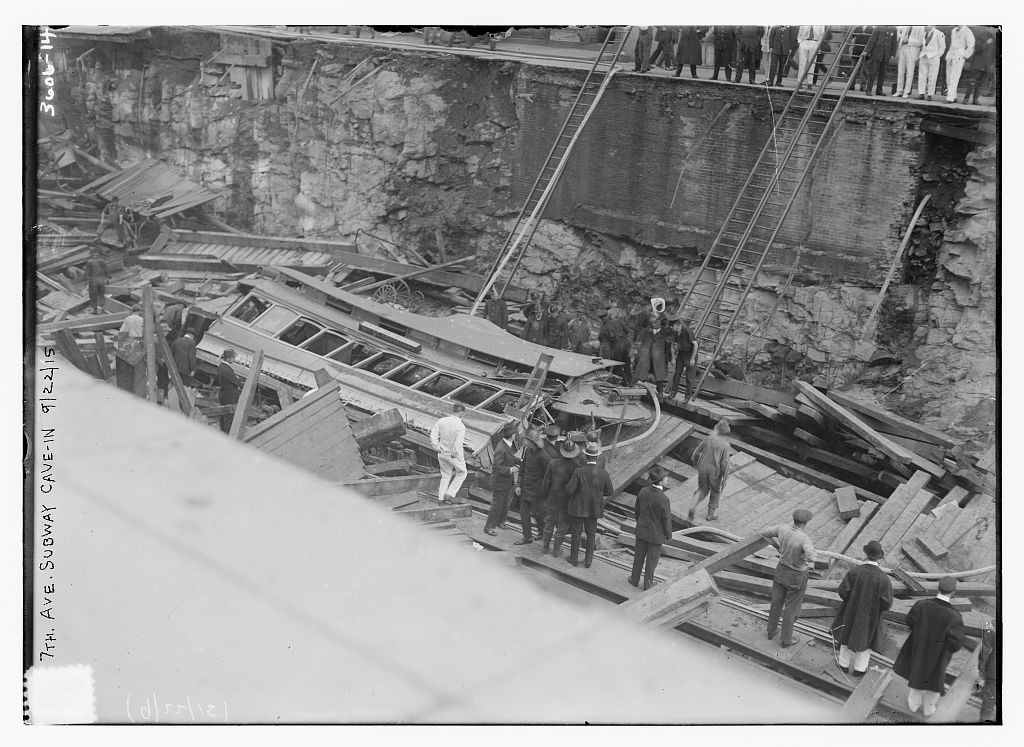
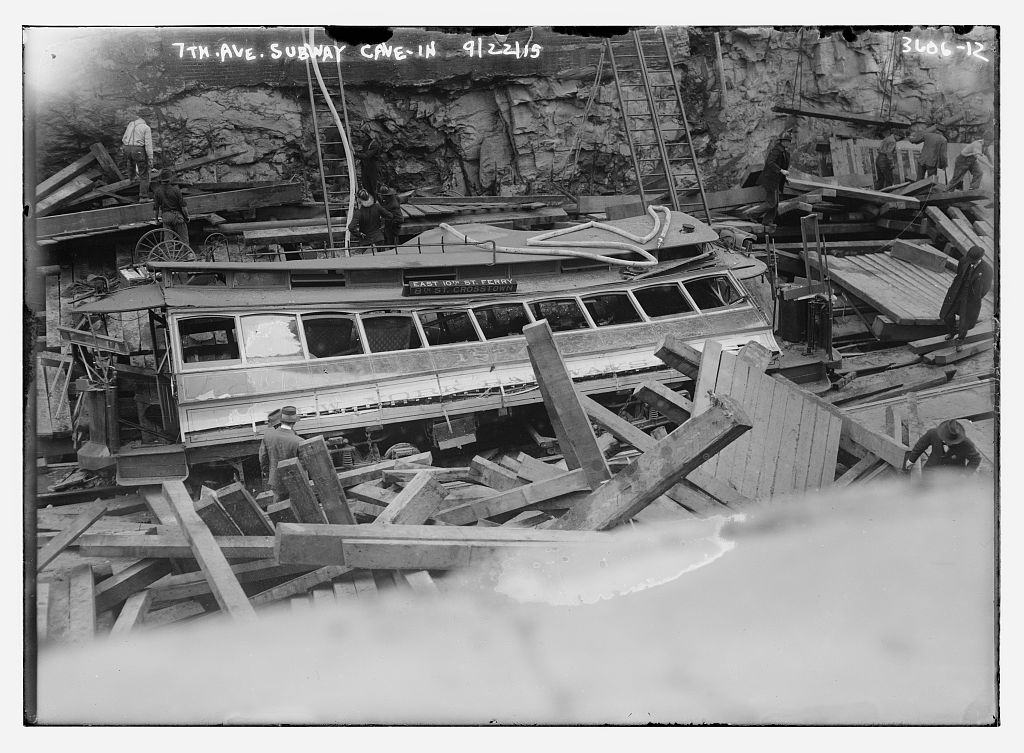
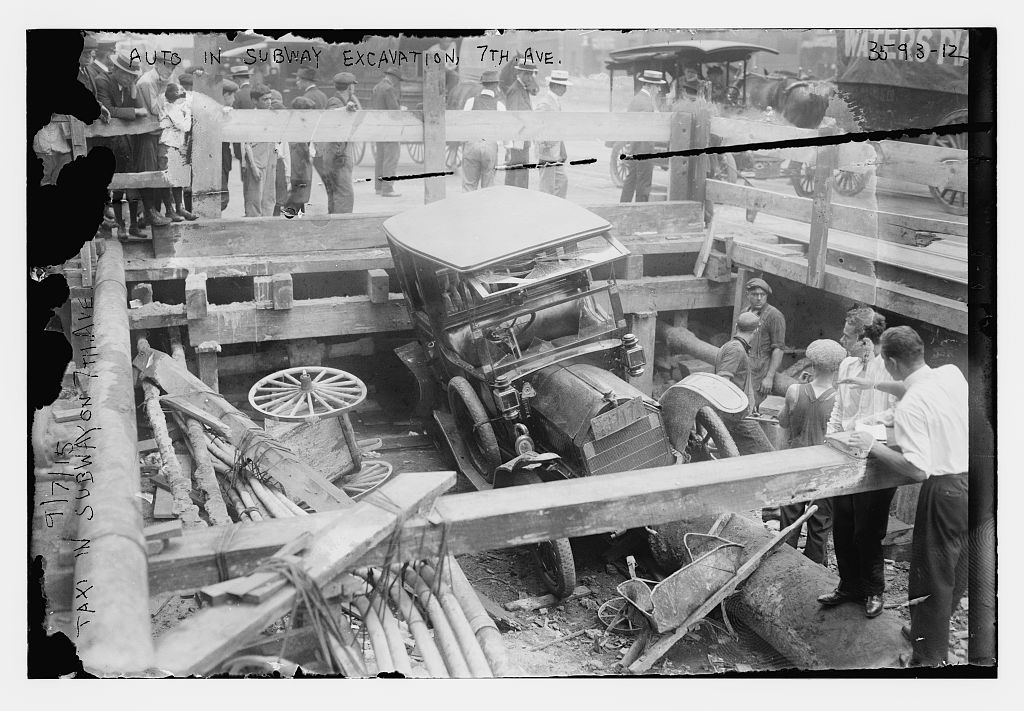
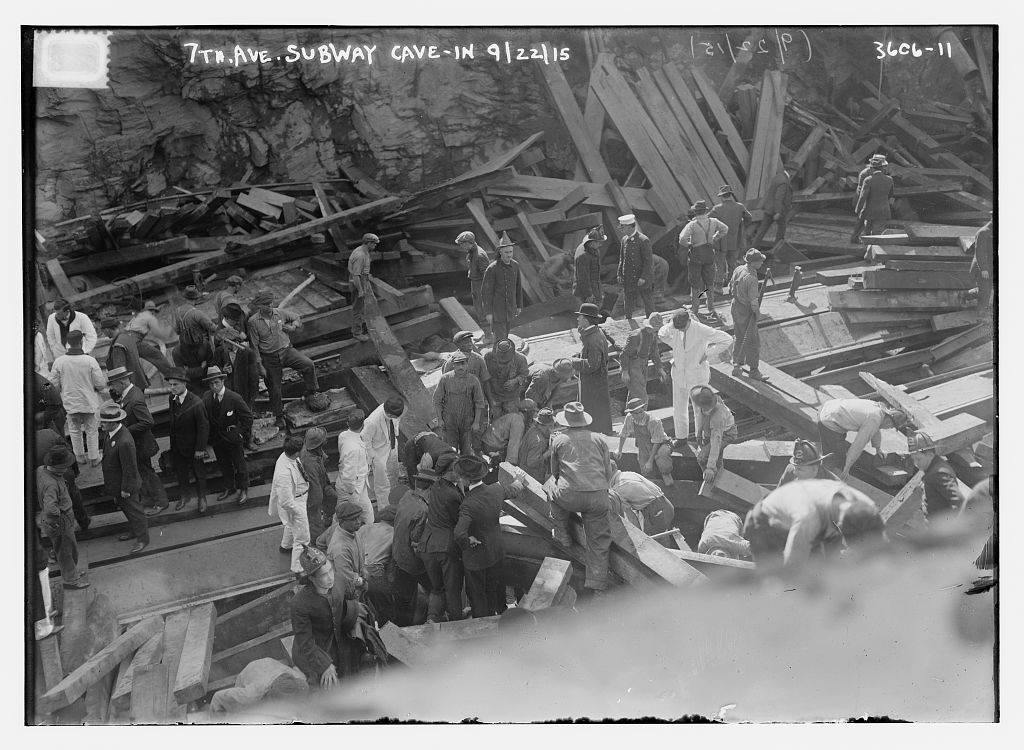
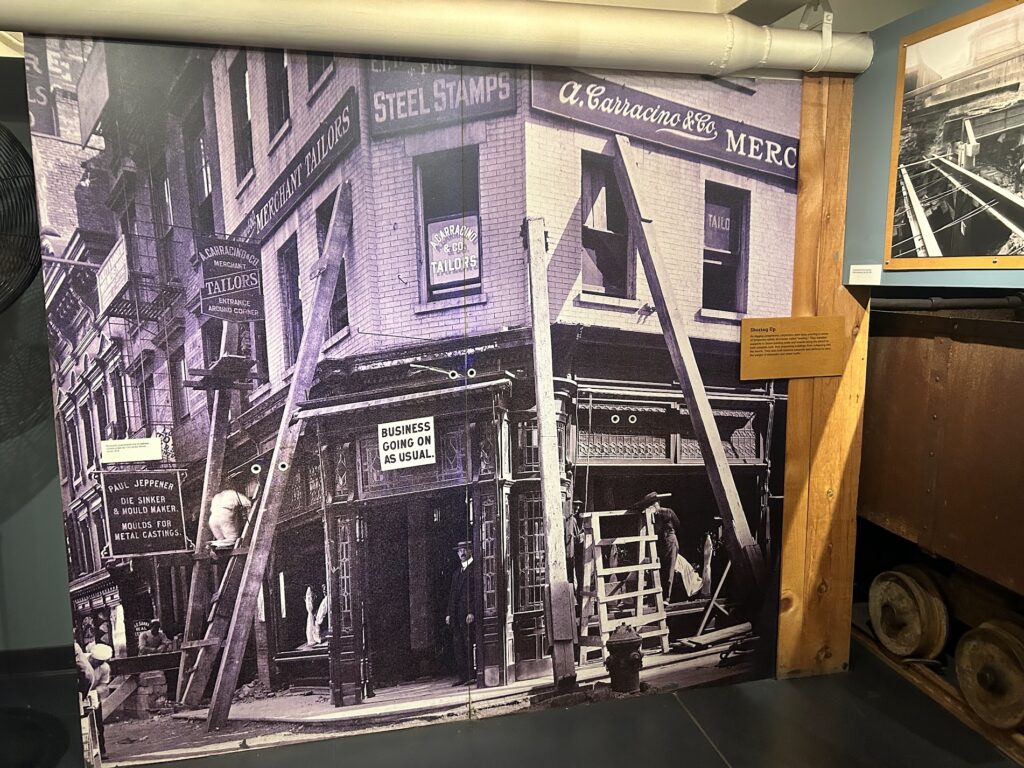
On the morning of September 22, 1915, two detonations inside the tunnel dislodged planking that was holding up the street between 24th and 25th Streets. Dangerously weakened, the temporary roadway folded into the earth, creating a chasm and swallowing up everything on the surface.
The men working below didn’t stand a chance, buried beneath a deluge of automobiles and debris. Among the vehicles thrown into the 30-foot hole was a streetcar filled with passengers. “Heads and arms were thrust from the windows, and those who looked on helplessly could hear the cries of the ones caught in the wreckage.” [NY Sun, 9/23/15]
Courtesy Library of Congress
Courtesy Library of Congress
Both the water main and gas pipes burst open in the tumult, and trapped streetcar passengers panicked as the enclosure began filling with water.
“Witnesses of the accident quickly recovered from the shock of seeing nearly two blocks of city street sink from sight, carrying down all traffic within reach of the cave in.” [NY World, 9/22/15 late edition]
Courtesy Library of Congress
Seven people were killed in the disaster with dozens injured. Most of the deaths were workers in the tunnel although two passengers in the streetcar also died.
Eyewitnesses describe a scene of utter chaos and total confusion. A man named Joseph Urban was standing on the street and got pulled into the hole.
“There was a funny feeling on the planking — a trembling, jerking sort of sensation — and then the whole street seemed to slide down into the hole. There was so much dust that I couldn’t see anything for two minutes. When I could see I appeared to be in a forest of tangled timbers, pointing every which way.” [source]
Police went searching for the culprit. Although it was later deemed an accident, an intentional detonation could not be ruled out especially given the fact that terrorist bombs were going off all over the city. (Back in March, detectives thwarted a second attemptto bomb St. Patrick’s Cathedral.)
Below: Seventh Avenue as it looked 100 years ago
Fingers quickly pointed to the IRT’s inadequate ‘cut-and-cover’ method, identifying other possibly deadly roadways along Seventh Avenue. Mayor John Purroy Mitchelordered additional supports be constructed at many excavation sports, and ‘heavy trucking’ was banned from these problem areas.
This wasn’t the city merely being over anxious. In fact, just three days later, another excavation collapsed at Broadway and 38th Street, swallowing a taxicab and killing its passenger. What makes this especially hazardous was its proximity to the popular Knickerbocker and Casino theaters.
As you might imagine, the collapse snarled street traffic for weeks with street closures and detoured routes turning the Tenderloin and Herald Square districts into a mass of congestion.
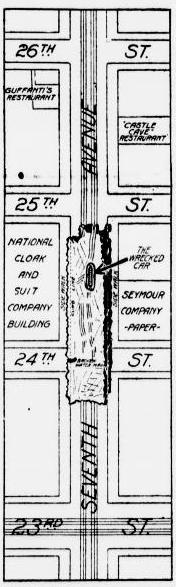
Below: An illustration from the New York Sun, showing the location of the 24th Street street collapse and a Google Maps screen capture of this street today.
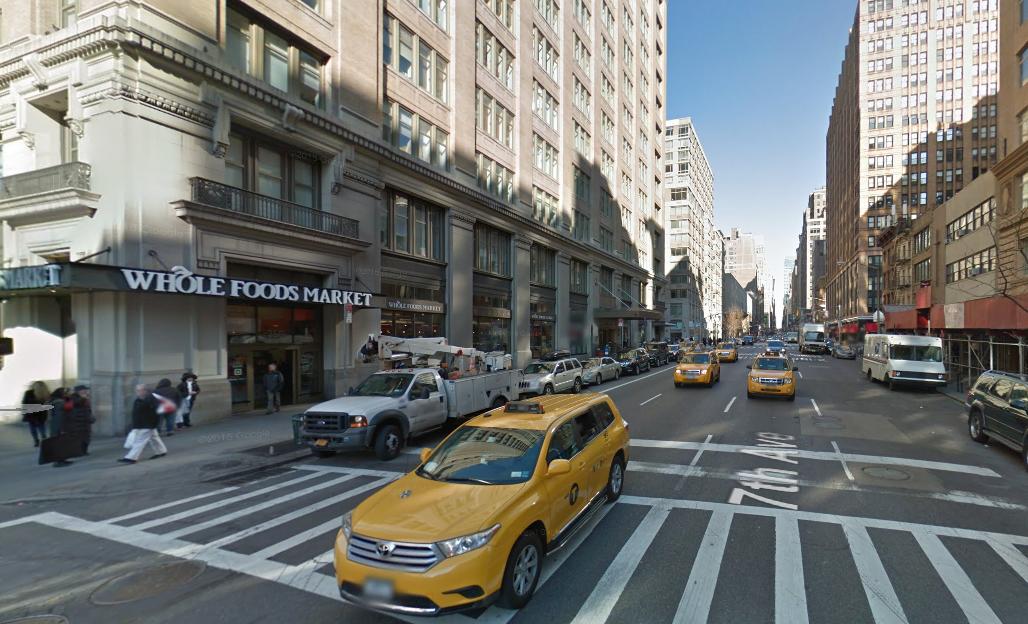
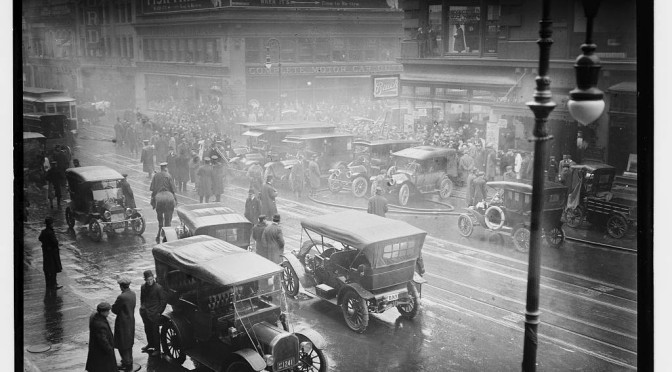
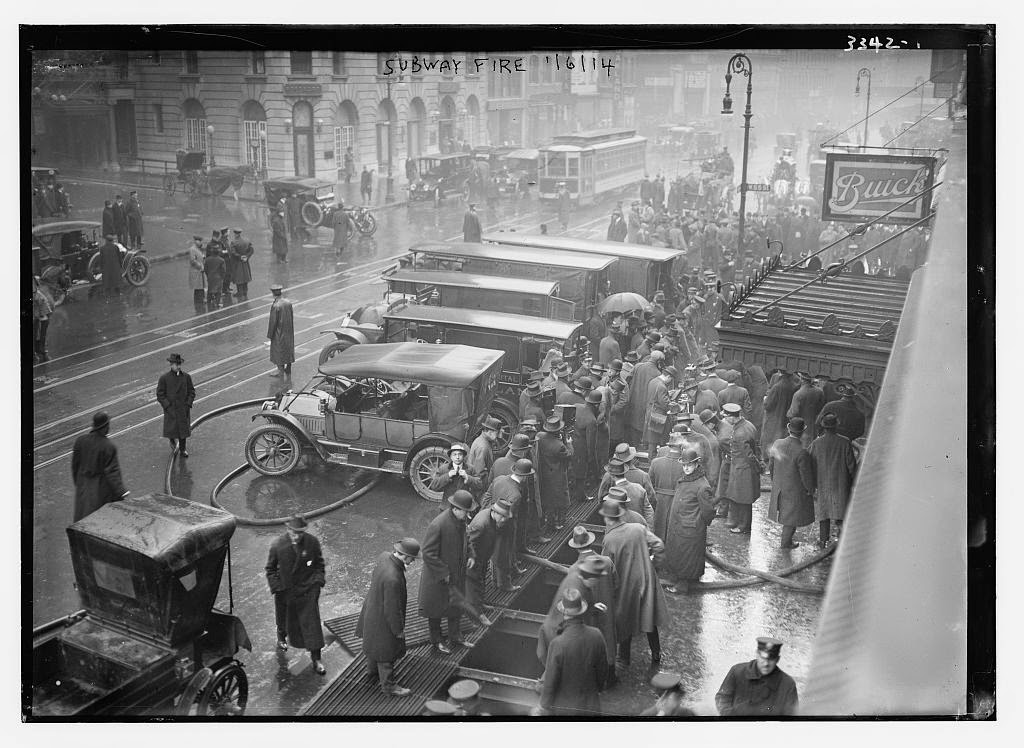
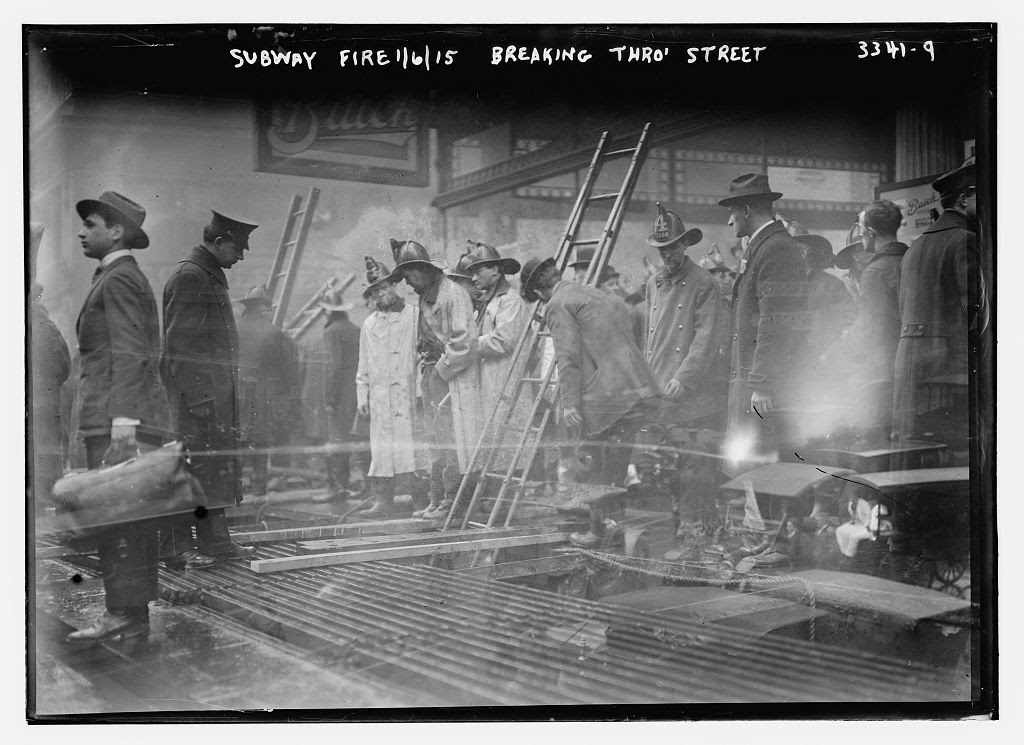
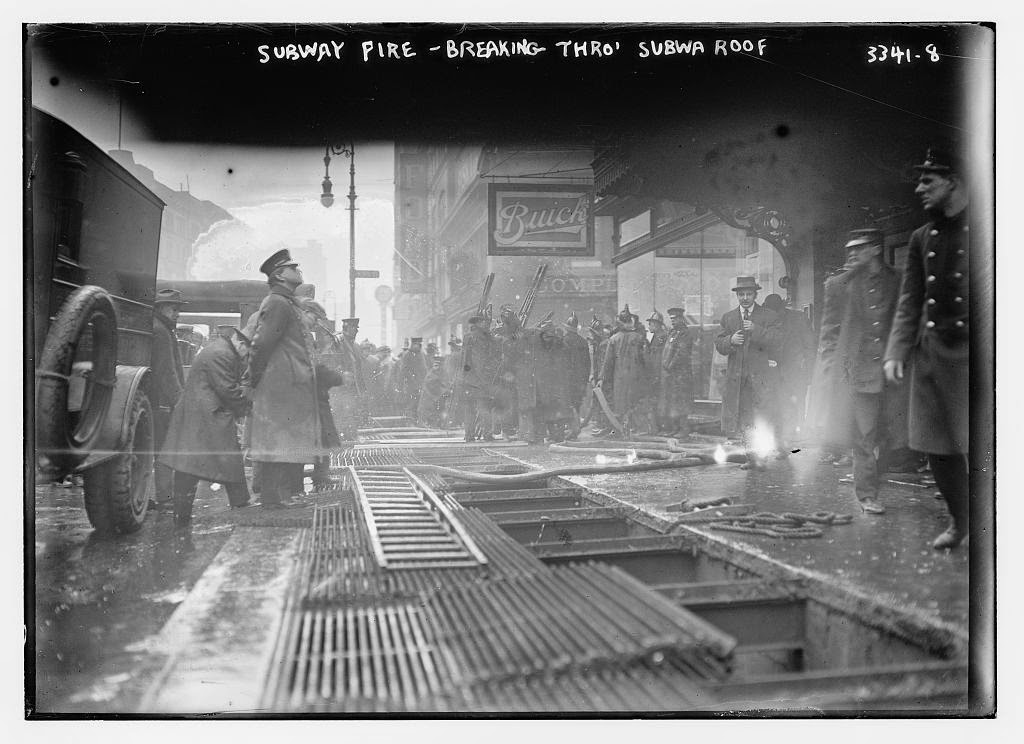
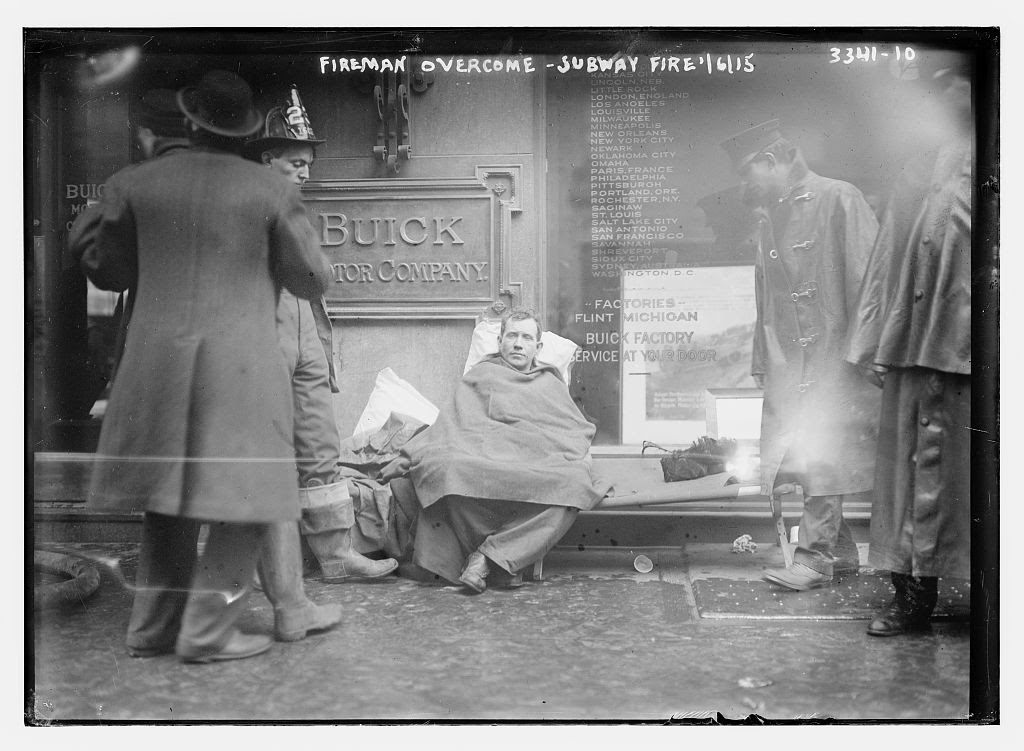
On January 6, 1915, a seemingly minor incident under the streets of Midtown caused a terrible panic, “the worst disaster in the history of the New York subway” up to that date, injuring hundreds of commuters and killing one.Â
That morning, two electrical cables feeding into manholes at Broadway and 52nd Street suddenly shorted out, causing a blackout in the subway tunnels below. The cable insulation, not fireproof, began issuing masses of “dense acrid” smoke that soon filled the tunnels.
The event occurred at the start of rush hour so there where three trains between 50th Street and Columbus Circle that were immediately affected. Over 2,500 people were trapped in the subway cars or stuck inside suddenly dark stations.
Nothing but the wires was actually on fire. Â But the billowing, toxic smoke in darkened tunnels soon caused a panic as passengers began clawing for the doors, trampling the weak underfoot.
From some newspaper sources:
“The firemen found passengers struggling to get out of the few car doors that were opened while hundreds of persons lay upon the car floors, Â having been asphyxiated or trampled on in this panic. Others escaped from cars only to fall besides the tracks blinded and with lungs full of smoke.” [New York Times]
“Blindly shouting and screaming, the passengers ran from the car they were in to the other cars, hoping to find some relief from the fumes and smoke. They knocked each other down in their wild scramble to get air and clawed each other’s clothing……In a few minutes the sound of crashing glass gave higher pitch to the panic.” [New York Tribune]
“There ensued a disgraceful and brutal battle for safety. Men and boys knocked down and trampled women and girls…….Most of the women had practically all their clothing torn off. Many of the men were stripped to the sides from the waist up.” [Evening World]
Hundreds were sent to the hospital with various injuries, mostly smoke inhalation, but many from the horrors of being trampled underfoot. Unfortunately, one woman was killed in the incident.
Firefighters had few options in rescuing passengers. Â Most were delivered up ladders along a small passage at 55th Street. Â The air was so toxic that many firemen were themselves hospitalized.
Subway service was naturally disrupted for a few a days afterwards. Officials initially shrugged off the incident. “In the present state of the art,” said Frank Hedley, general manager of the Interborough Rapid Transit, “there is nothing known which will prevent the recurrence of short circuits.” However, attention soon turned to woefully inadequate insulation used in subway wiring.
“New York received a warning, when hundreds of passengers were suffocated in the subway. Â The next occurrence may be far more serious in loss of life due to a similar cause — suffocation. No time should be lost remedying the most serious defect of the subway, viz. lack of suitable ventilation at all times.” [source]
Redesigned subway cars and fireproof wiring would soon ensure such a disaster would not occur again.
Crowds at the now-defunct City Hall Station of the brand new New York subway system. (NYPL)
One hundred and ten years ago today, the first train of the New York City subway system began its first trip underneath the city, filled with eager and excited passengers. Â Thousands lined up to take this revolutionary new ride, promising a jaunt from City Hall to Harlem in under 30 minutes. At the helm of the very first subway ride was the mayor himself, George B McClellan Jr., refusing to relinquish the wheel until he had completed most of the distance.
The subway is one of the defining creations of New York’s Gilded Age, but it was hardly a foregone conclusion.  Early attempts at underground transportation by innovators like Alfred Ely Beach were waylaid by political corruption.  Elevated railroad and streetcar companies were hardly enthusiastic about it. Even the idea of going below disturbed and frightened some people.  Proponents of the subway in New York must have grimaced when Boston beat them to the punch in the late 1890s.
Both the Boston and New York subway systems benefited from great genius and even greater wealth. As Boston Globe editor Doug Most notes in his terrific book The Race Underground: Boston: New York and the Incredible Rivalry that Built America’s First Subway, the systems even shared wealthy benefactors — the brothers Henry and William Whitney, one in each city, negotiating a  host of political and technical speed bumps on their quest to build the country’s first subterranean route.
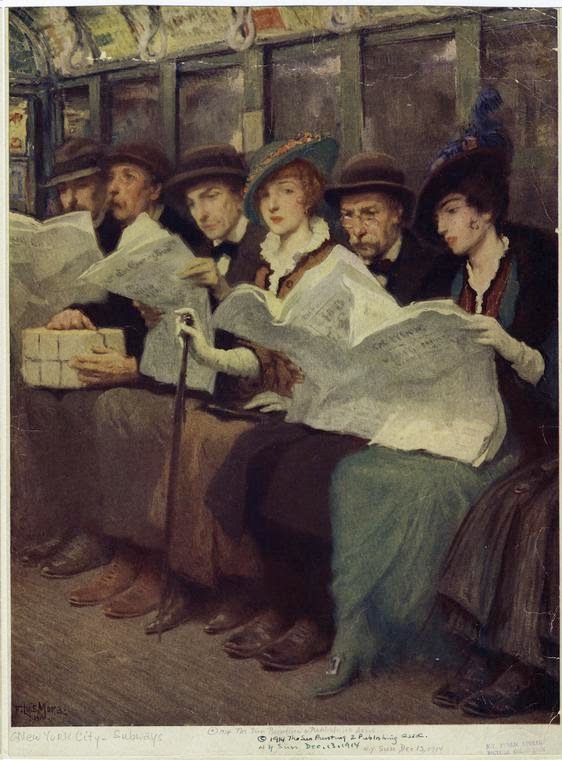
At right: Subway riders, painting by F. Luis Mora, 1914 (NYPL)
Most’s story is especially fascinating in outlining the difficulties of these ambitious projects. Â What seems an absolutely sound decision today was deemed highly risky and politically fraught in its day. Â On this important anniversary, I thought I’d ask the author to elaborate on the significance of this day and the spectacular achievements of these two rival cities. (And I highly recommend picking up his book this week. After all, has there ever been reading material better suited to commute reading?)
The final chapter of The Race Underground is actually titled “October 27, 1904 “? This is obviously an important date for New Yorkers, but what is it about the events of that particular day that make this a milestone in American (and even world) history?
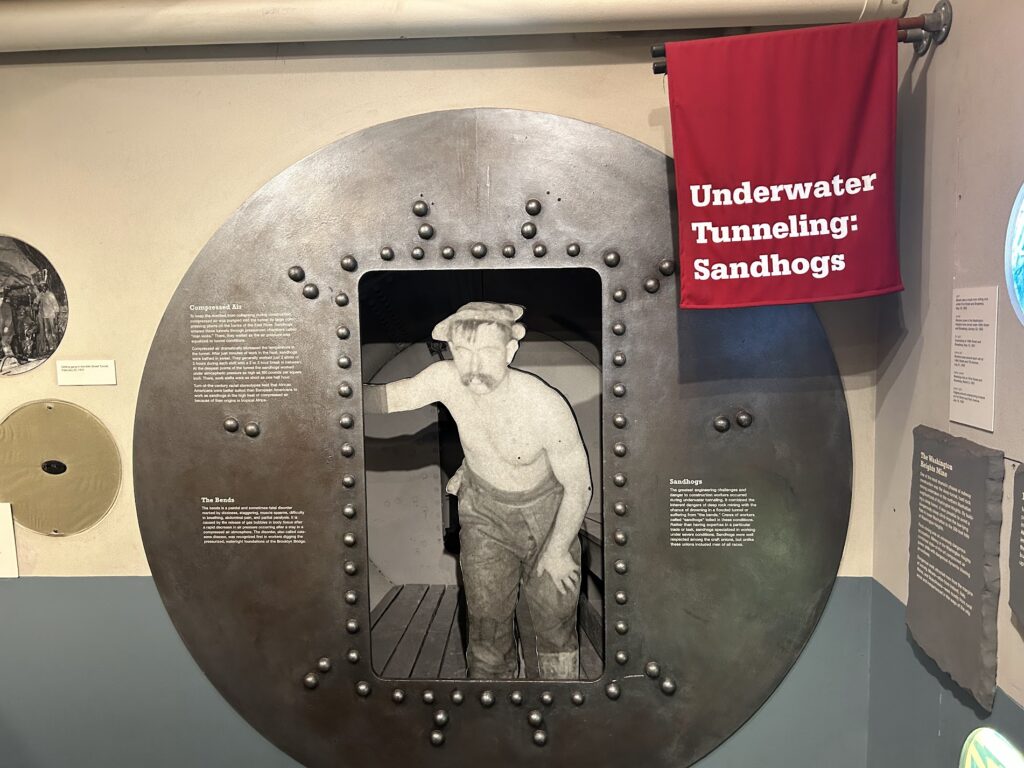
Doug Most: ​Well, first I loved the contrast between how Boston celebrated opening its subway and New York celebrated its subway opening. Boston opened in the morning and just treated it like any other day. Here it is, we built it. New York celebrated like New Yorkers, they made it a spectacle, a party, and all the politicians and key figures wanted to play their part. Very different openings.New York’s subway was a huge achievement for many reasons. That it was built, tunneling through the ​Manhattan schist, using dynamite where needed, was incredible. Many workers died during the construction and my book tells the dramatic story of how they worked, dug, and died tragically. But that’s how society makes progress, right? We have to learn through tragedy. The New York subway was a great example of that.
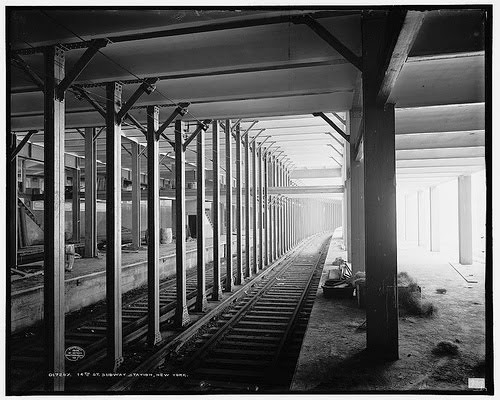
The newly completed subway tunnel in 1904, before the big inaugural ride on October 27, 1904 (Library of Congress)
The greatest obstacle for the creation of the subway wasn’t merely physical or political; it was convincing people that travelling underground could be a clean and safe experience. What were a few of the beliefs or superstitions people held in the early days?
DM:  ​It’s something we take for granted today. We bound downstairs staring at our phones and tablets and papers, and don’t give a second though to the underground. But back then in the 19th century, the underground was terrifying for people. It was where Lucifer lived! The Devil! Where vermin made their home.People needed to be convinced subways could be clean, safe, dry and healthy, that the air would not be poisonous and kill them. I love the story of London opening a pedestrian tunnel around 1840, and thousands of people taking one look down that tunnel and going right back up to the street, refusing to walk through it. That was 1840! In terms of history, not that long ago. It took a long time for society to accept the underground as a safe place to travel.​
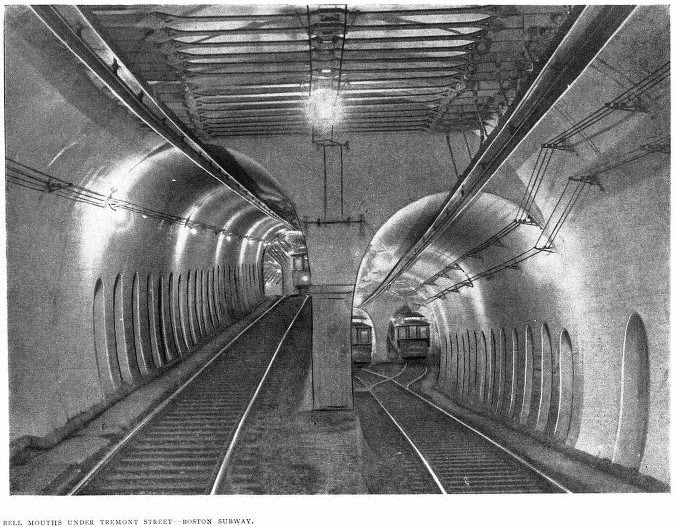
Under Tremont Station in Boston (courtesy nycsubway.org)
Your story is framed as the glorious rivalry between two brothers – Henry and William Whitney – and two rival cities, Boston and New York. But Boston really manages to pull ahead for much of the story. Was this because the needs of the city were easier to accomplish or was it because of New York’s corrupt political system at this time?
​DM:  I think it’s both. New York struggled politically with some big decisions and some key characters stood in the way of progress, including of course Boss Tweed. New York absolutely should have been ahead of Boston; they were talking about a subway in New York in the mid 1800s, but it didn’t get built until 1900.Boston didn’t start thinking subway until 1887 and then moved very quickly. New Yorkers were not happy to see that little podunk city to the north making so much progress while their city kept getting bogged down in politics.​
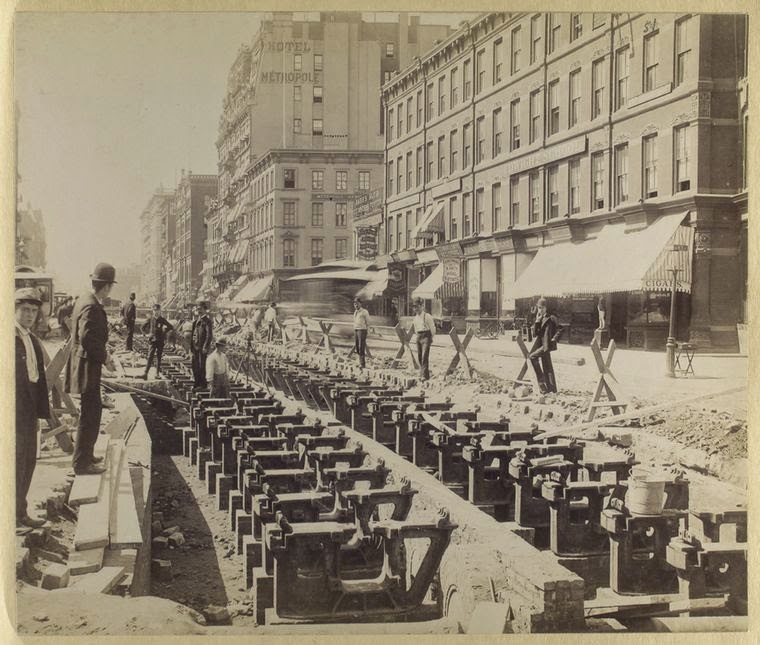
Digging up Union Square to lay cable-car lines, 1891. (New York Public Library)
The story of The Race Underground features an extraordinary build-up of transportation technologies, from noble but failed technologies (the pneumatic tube) to others that led to the birth of the subway (like electric streetcars). What do you personally consider the most interesting or surprising development in transportation prior to the birth of the subway?
​DM:  Well the story of the cable car was fascinating, because it seemed like for a few years that was the future of urban transportation. It was cleaner and faster and smoother than the horse-pulled carriage, and people enjoyed riding them and it really looked like it might take off. San Francisco gave birth to it, and other cities, including New York, experimented with it.But as cities quickly learned, the cable car had a big problem. Those cables could twist and snap and fixing them was slow and expensive. And when a cable snapped, the entire system ground to a halt. Plus, cables were only effective in cities with lots of long straight roads like New York. But in smaller cities, like Boston, with twists and turns and narrow streets, cable cars just didn’t make sense. I love the story of how the cable car was almost our future, and then suddenly, it was gone!​
Now speaking of that pneumatic tube, here’s a what if? – say Beach faced no opposition from Boss Tweed and the elevated railroads. Could New York have actually built a viable transportation system using this method? After all, people are looking into pneumatic systems for possible high-speed travel today!
​DM:  No. Chapter One in my book, the story of Alfred Beach and Boss Tweed, is really my favorite chapter for so many reasons. And the great fan he used, the Western Tornado, to blow his subway car down the tracks. But was a fan really going to blow subway cars all over the island of Manhattan? No it wasn’t. The technology being talked about today is so sophisticated, involving electromagnetic charges and other methods far beyond basic pneumatic tubes. ​But Beach was a dreamer, a lot like Elon Musk of Tesla, and we need dreamers like that to push us forward as a society. So that’s why I love his story so much.
What features of the modern New York City subway system are you the most impressed by today? And what could use some serious improvement?​DM:  The speed is impressive and so is the reach of it — how you truly can reach almost every corner of the five boroughs on the subway. That’s so different than other cities, especially Boston and Washington, for starters, where the transit systems are much smaller and harder to survive on without a car. I am not sure I have any great suggestion for New York’s subway. I’m a big fan of it, and loved riding it when I lived at 80th and Broadway, and love taking my kids on it today when we come back to visit. It’s a treat and it’s a part of history I hope people appreciate.​
Below: New York’s distinctive subway entrances, inspired by the subway system in Budapest, 1905 (New York Public Library)
A subway map from 1924, illustrating the system created as a result of the Dual Contracts agreement.
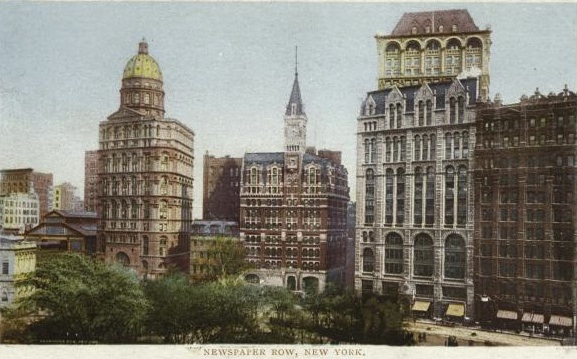
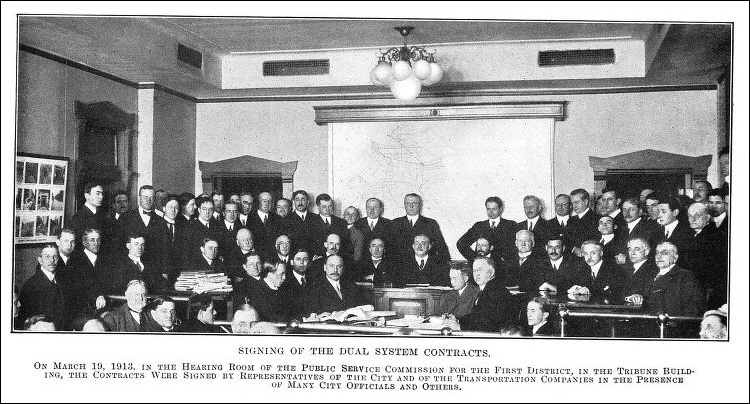
After years of negotiations, false starts and lengthy arguments played out in the press, a group of greatly relieved businessmen entered the large hearing room of the New York Tribune Building (at Nassau and Spruce, where Pace University is today) and put their names to a series of documents that have come to be known as the Dual Contracts.
The beleaguered ceremony ran a half hour late, as a great many gentlemen crammed into the third floor meeting room to sign the official documents, stamped with gold lettering and expensively bound in morocco leather and colored ribbons.
With those signatures, the chaotic New York transportation system — with its fledgling subway and its miles of elevated lines — officially came of age that day — March 19, 1913.
“This makes March 19 a red-letter date on the municipal calendar,” declared the New York Tribune, in whose building the agreement was signed. The Dual Contracts authorized millions of dollars of new tracks, more than doubling the system in size, from 296 miles of track to 618 miles!
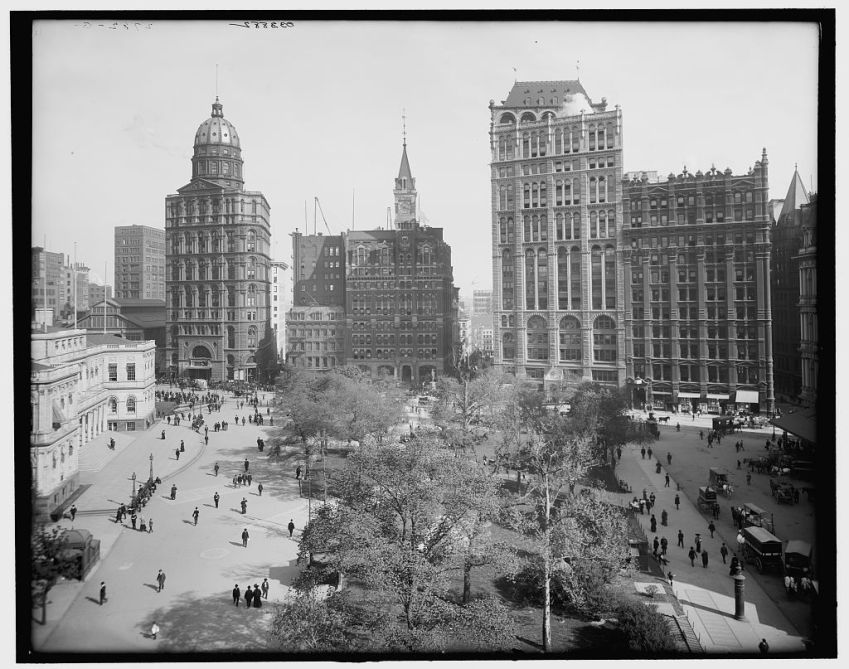
Below: The buildings of Newspaper Row. The towered Tribune Building, in the middle, was the site of the Dual Contracts signing in 1913.
This seminal agreement in American transportation history is ‘dual’ because the city negotiated two separate contracts — one with August Belmont Jr.’s Interborough Rapid Transit Company (IRT) who operated the New York subway, and the Municipal Railway Company on behalf of the Brooklyn Rapid Transit (BRT), who ran most of Brooklyn’s transit system.
Under the agreement, the city would shoulder some of the cost of building new subway services — many into places where New York expected populations to rise in the coming years — and the two private companies would then lease the new routes from the city and profit from their operation.
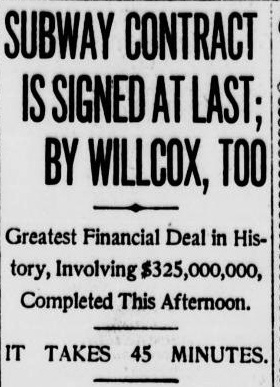
At right: the headline from the New York Evening World
Essentially this gave IRT permission to operate into Brooklyn (once the domain of the BRT) and vice versa. Previously, people arriving from Brooklyn to Manhattan had to immediately change trains once arriving into the new borough.
According to a report by the Public Service Commission later that year: “The Dual System will remove this abnormal condition and give the Brooklyn company a system of subways in Manhattan, by means of which it shall distribute its passengers through the territory south of 59th Street. Thus the present congestion at the Manhattan terminals of the bridges will be ended and the passengers from Brooklyn will be enabled to reach their destinations in lower Manhattan without change of cars or the payment of an additional fare.” [source]
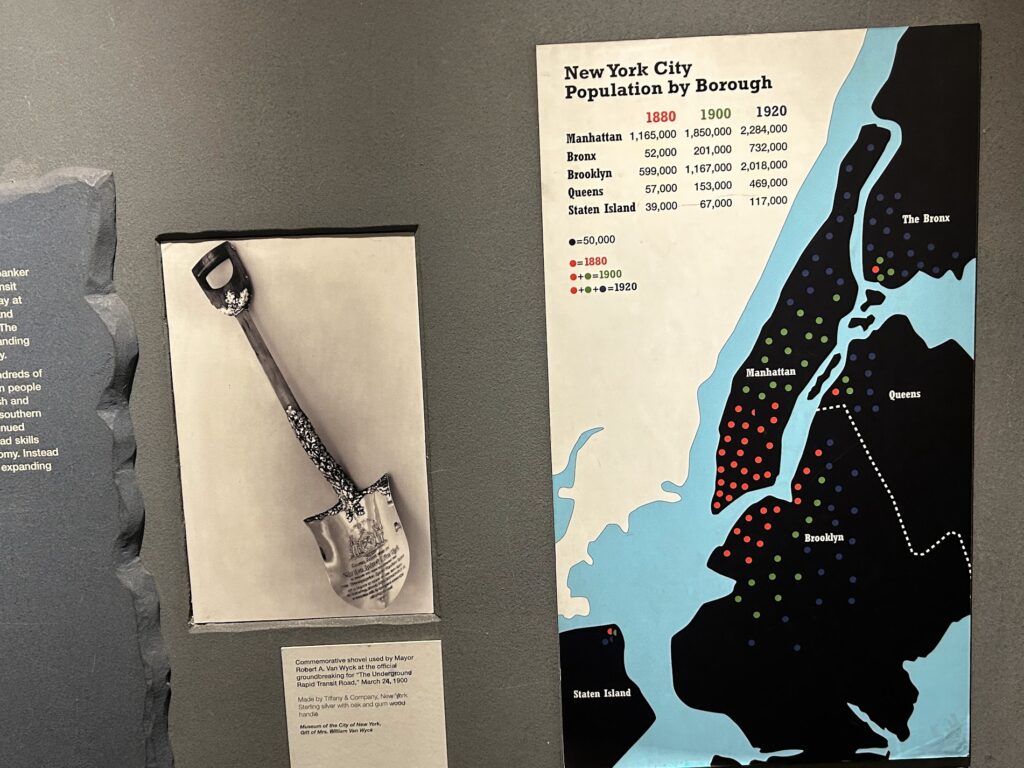
As part of the deal, the two companies agreed to operate two new lines into Queens. The importance of this particular part of the deal cannot be overstated. The borough of Queens was just over a dozen years old by this time and still sparsely populated given its size. (Less than 300,000 people in 1910.) With the arrival of the Queensboro Bridge in 1909, paired with new subway and elevated services provided by the Dual Contracts, the population of Queens would explode in the 1920s to well over a million.
And this didn’t just stimulate development there. The deal brought a subway to the Manhattan’s Upper East Side and to the West Village, to most Bronx neighborhoods and down the Eastern Parkway in Brooklyn. New home and apartment developments into those regions soon followed.
Below: City luminaries gather around to watch representatives from government and the two private companies sign the pretentiously bound contracts. (Picture courtesy NYCSubway, an indispensable destination for transit history.)
The Dual Contracts also created express and local trains, facilitating another great development in the history of New York — the arrival of midtown Manhattan as the heart of business and entertainment.
In all, the contract signed one hundred years ago today made the New York City transit system the largest in the world. In fact, it was larger than all the rapid transit systems of the world at the time — combined (according to Peter Derrick’s excellent book on the subject Tunneling To The Future).
But this also set in motion one of the great flaws of the subway system. Tracks operated by the IRT were a different size from those operated by the BRT. The track gauge was wider on BRT tracks. As a result, today the New York subway system still operates two different sizes of cars. (Ed: See notes below for a slight clarification/better explanation.)
On a humorous note, the original contracts, bound as they were in thick leather volumes, were apparently quite heavy to lift. The president of the IRT remarked, “I am glad that I have enough strength to receive these contracts.”
For more details on the Dual Contracts, please check out the second podcast on the birth of the New York subway system — Subway by the Numbers (and Letters)
Any of you who ride the 4-5-6 train in rush hour will especially relate to this story. It takes place, in fact, on that very line, one hundred years ago.
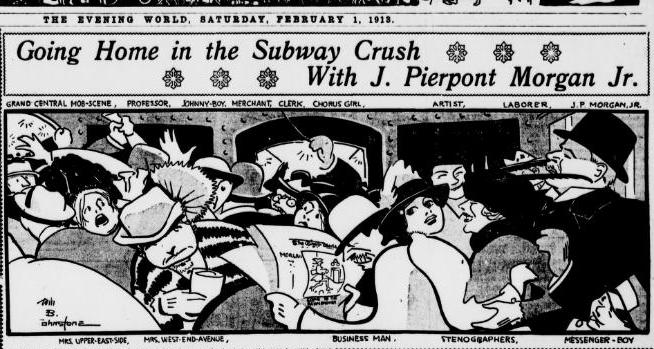
Will B. Johnstone, an artist at the New York Evening World, noticed an interesting sight on his subway ride that morning, February 1, 1913, the day before the opening of Grand Central Terminal. Crammed up against the wall of the train was J. P. Morgan Jr., son of the famous financier.
Such a sight greatly amused Johnstone. “There stood J. Pierpont Morgan Jr. ignominiously caught in the deadly rush hour!” Even more remarkable, the writer notes, was the fact that Morgan was a principal financier for the Dual Contracts project, which would greatly expand the subway system and double the length of tracks into the other boroughs.
“I wondered why he was using the subway instead of a diamond-studded limousine? What did he mean by travelling with the common herd and of all times during rush hour?”
At one point, Morgan was accosted by a young woman with “a large velvet hat and the hat had two long stiff quills projecting from it like the horns of a billy goat, and as dangerous. Mr. Morgan’s face was impaled between them.”
The woman hat jostled about during the bumpy ride, and “[t]he quills began to bob around his face and he was busy trying to avoid them.” Others noticed the financier’s dilemma and began laughing with him.
“She’s going to get me yet,” he laughed to another passenger. “And he was right,” Johnstone noted, “for one side of the quill and then the other jabbed him in the face.”
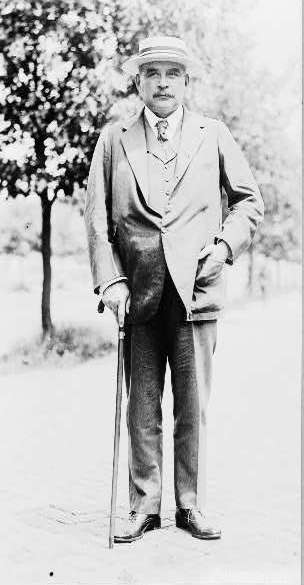
At right: Morgan in 1919
Finally at the Grand Central Station**, he had to push his way through the crowd and barely got of the car before the doors closed.
“This is no way to treat royalty,” Johnstone laments.
Less than two months after this incident, his father Morgan Sr. would die in Rome, leaving him one of the world’s largest business enterprises. I wonder if he ever rode the subway again after that.

 Courtesy Museum of the City of New York