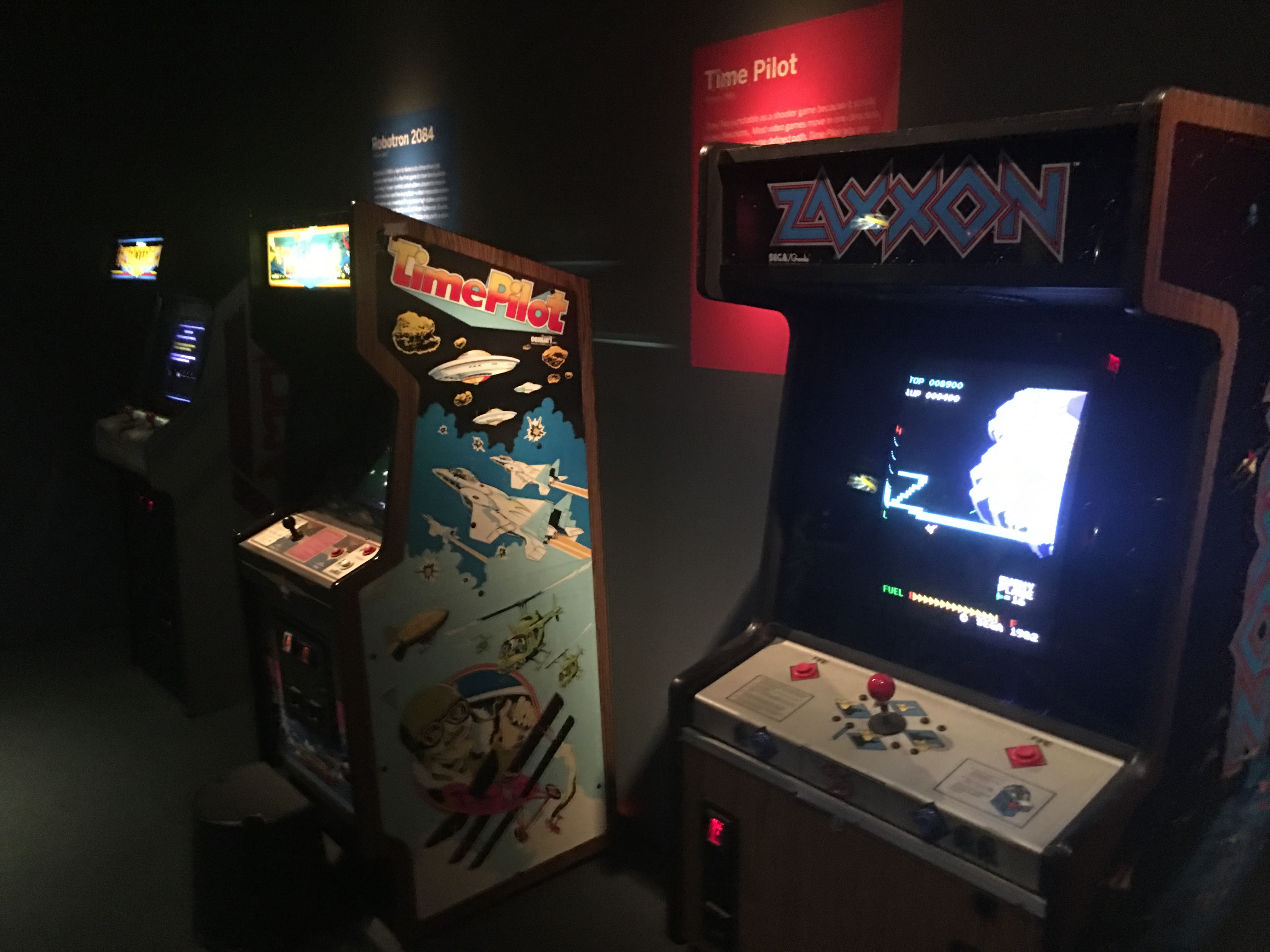
ARCADE CLASSICS, the latest show at the Museum of the Moving Image, pulling from the museum’s regular collection of video arcade games, is indeed an all-star line-up of classics. But without the fussiness of an actual arcade. (For one, the experience is at pleasant decibels.)
The machines will mostly be familiar to anybody who identifies as Generation X, devices of digital merriment released mostly between 1979 and 1984. Asteroids, Pole Position, Defender, Missile Command, Dragon’s Lair, Tron — they stand as sentinels in a Hall of Justice, evenly spaced throughout the third floor. The idea is to remove the machines from the arcade environment just enough so that you become appreciative of their whole artistry, the unity — from the sleek digital landscapes to the cabinet design. On that point, the show is a complete success.
Luckily, you can play most of the games — you get a few complimentary tokens and there’s even a token machine if you want to play more  —  and the echoes through the chamber will certainly bring back childhood memories, even if the presentation is far more austere.
Today a gallery exhibit on video games hardly seems risky. After all these machines are precursors to an entire universe of modern digital images and were themselves influential to later art and fashion.
But the exhibit recalls the Museum’s first attempt at a major retrospective on video game design — 1989’s Hot Circuits, A Video Arcade, considered to be the first-ever video game museum exhibition.
A rare Star Wars game at the current Arcade Classics exhibit.
Sam Branan / Museum of the Moving Image.
At the time, the ‘video game craze’ — fueled by Space Invadersbeginning in 1978 — was a decade old. Most of the consumer focus on video games was on home consoles. The Game Boy, the portable gaming device that would revolutionize game portability, Â debuted on the market a couple months before the exhibit opened.
The New York Times write-up on the exhibition focuses mostly on the difficulty curators had in locating games that were intact. Â “[A]ssembling the exhibition became a yearlong detective story that drew museum curators to arcade warehouses, motel storage areas and basement recreation rooms.
A video game retrospective for a population obsessed with Pokemon Go and Call of Duty seems like an obvious notion. But the idea seemed less obvious in 1989. The Museum’s founding director Rochelle Slovin confessed, “On a general level, I knew that video games were not, as many dismissed them, a trend or fad, but on the contrary, the beginning of something significant. Exactly what, I wasn’t sure.”
Slovan’s original remarks on the show focus on early video games’ similarities to silent film and an appreciation for the elegantly observed artistic choices of the early games.
While stodgier museum goers might have been downright confused by Hot Circuits, it did broaden the Museum’s focus almost immediately into further exploration into digital media. Indeed, in 2016, as you pass the admissions desk into the museum, you will pass a flamboyant wall display on the The Reaction GIF: Moving Image As Gesture. Michael Jackson will eternally eat popcorn and Homer Simpson will continue to sink into the bushes as you enjoy yourself with the digital delights upstairs.
ARCADE CLASSICS, at the Museum of the Moving Image (in Astoria, Queens) runs until September 18. Visit the museum website for more information on the exhibit and visiting hours.
The Bowery Boys Obsessive Guides look very, very closely at a classic movie filmed in New York City, finding buried history, additional context and a few secrets within various scenes and plot points. Filled with film spoilers so read this after you’ve seen the movie — or use it to follow along as you watch it! Check out my previous guides forMiracle on 34th Street, Midnight Cowboy, and The Muppets Take Manhattan.
In 1989 the ghosts returned to New York City streets. Both above and beneath them.
The 1984 blockbuster Ghostbusters holds a unique place in Hollywood cinema, the rare sci-fi comedy to become a genuine classic, due mostly to its terrific cast (Bill Murray, Harold Ramis, Dan Ackroyd, Sigourney Weaver, Ernie Hudson, Rick Moranis, Annie Potts, among others) and to the unique alchemy of theme and location.
The characters run through New York City like kids in a haunted house. In 1984, New York’s reputation was still greatly tarnished by the economic and social crises of the previous decade. Ghostbusters plays upon those perceptions, its heroes battling metaphorical ghosts and demons in historic locations.
The 1989 sequel Ghostbusters 2 takes place in the same city but at the end of an era.  Ed Koch is in his final year as mayor of New York. He had been unseated in the primaries by David Dinkins who, in November, would then defeat  Rudy Giuliani for the office.
Many elements of the city have been ‘cleaned up’ by this time (the once ubiquitous subway graffiti being one casualty) but the high crime rate was still very much the pivotal concern. New Yorkers didn’t need to go to the movies to find terrors in their backyard. The sequel opened less than two months after a jogger was beaten, raped and left for dead in Central Park. According to the New York Daily News, “On a typical day in 1989, New Yorkers reported nine rapes, five murders, 255 robberies and 194 aggravated assaults. Fear wasn’t a knee-jerk reaction; it was a matter of self-preservation. ”
It’s easy to watch Ghostbusters 2 today, disengaged from its historical context. But watch with a close eye and you’ll see bits of a familiar city in the background and hints of the era embedded into the story. Here’s a list of New York historical facts and trivia to watch out for:
CLEARLY THIS ARTICLE CONTAINS SPOILERS. WATCH THIS FILM BEFORE READING OR, BETTER YET, READ ALONG AS YOU’RE WATCHING IT:
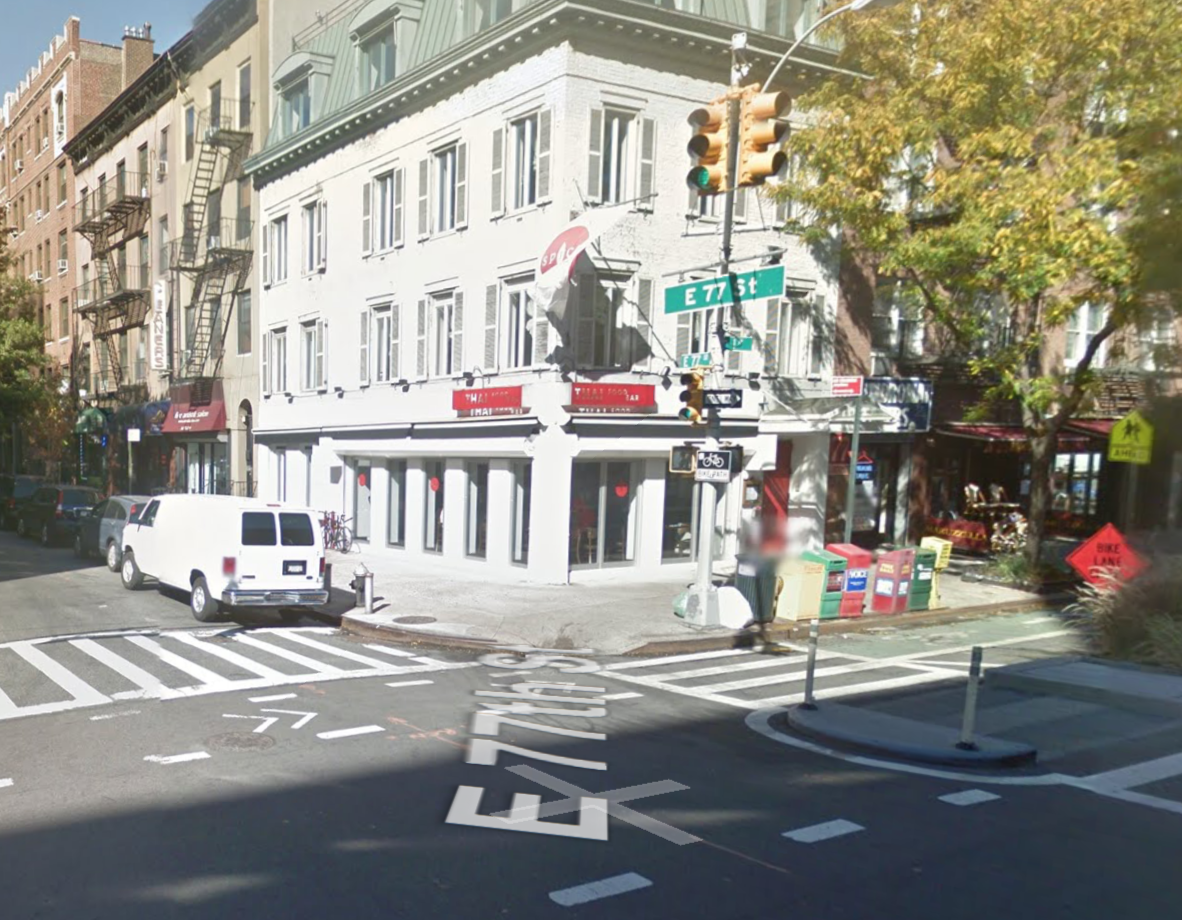
1) The opening scene works as a pastiche of New York City life — arguing neighbors, jogger on the sidewalk, a cop giving a parking ticket — along East 77th Street. Dana, played by Weaver, has arrived with a gigantic baby carriage and her bundle of joy Oscar. Her place, at 325 East 77th Street, built in 1940, is your typical co-op of the neighborhood, a far cry from her last home on 55 Central Park West, which became a demonic portal in the last film.
Interestingly, at Dana’s apartment building, Google Map lists one business — Psychic Works — which would have come in handy had it been there in 1989.
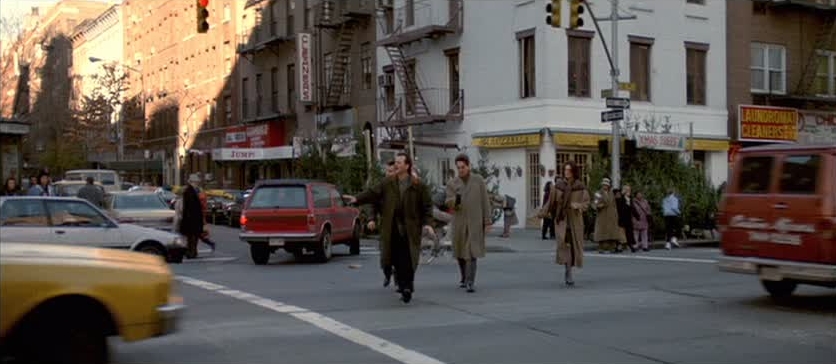
Screen capture courtesy The Raffon
2) Baby Oscar is whisked away by a spiritual presence and hurled into traffic at the corner of East 77th Street and First Avenue. While that corner has been much transformed today — note the placement of the diner in the movie, today’s Green Kitchen  — one business is exactly the same — the signage for the cleaners on the northwest corner.
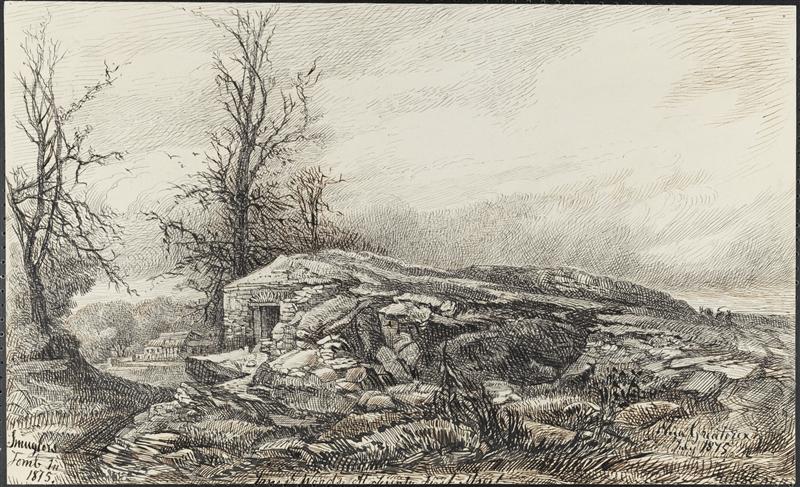
3) Why would this particular corner be haunted? Well, we’ll see what lies beneath in a second. But this particular corner would have been part of old Jones Wood, a 90-acre forest which attracted picnickers and day trippers (including many early German immigrants) long before Central Park was invented.  It was the sight of early ghost stories as the forest contained crypts of prominent families.
Below: The so-called ‘Smuggler’s Tomb’ located at the spot of today’s First Avenue and 71st Street.
Courtesy Museum of the City of New York
In fact, there’s a bar called Jones Wood Foundry on First and 76th Street today.
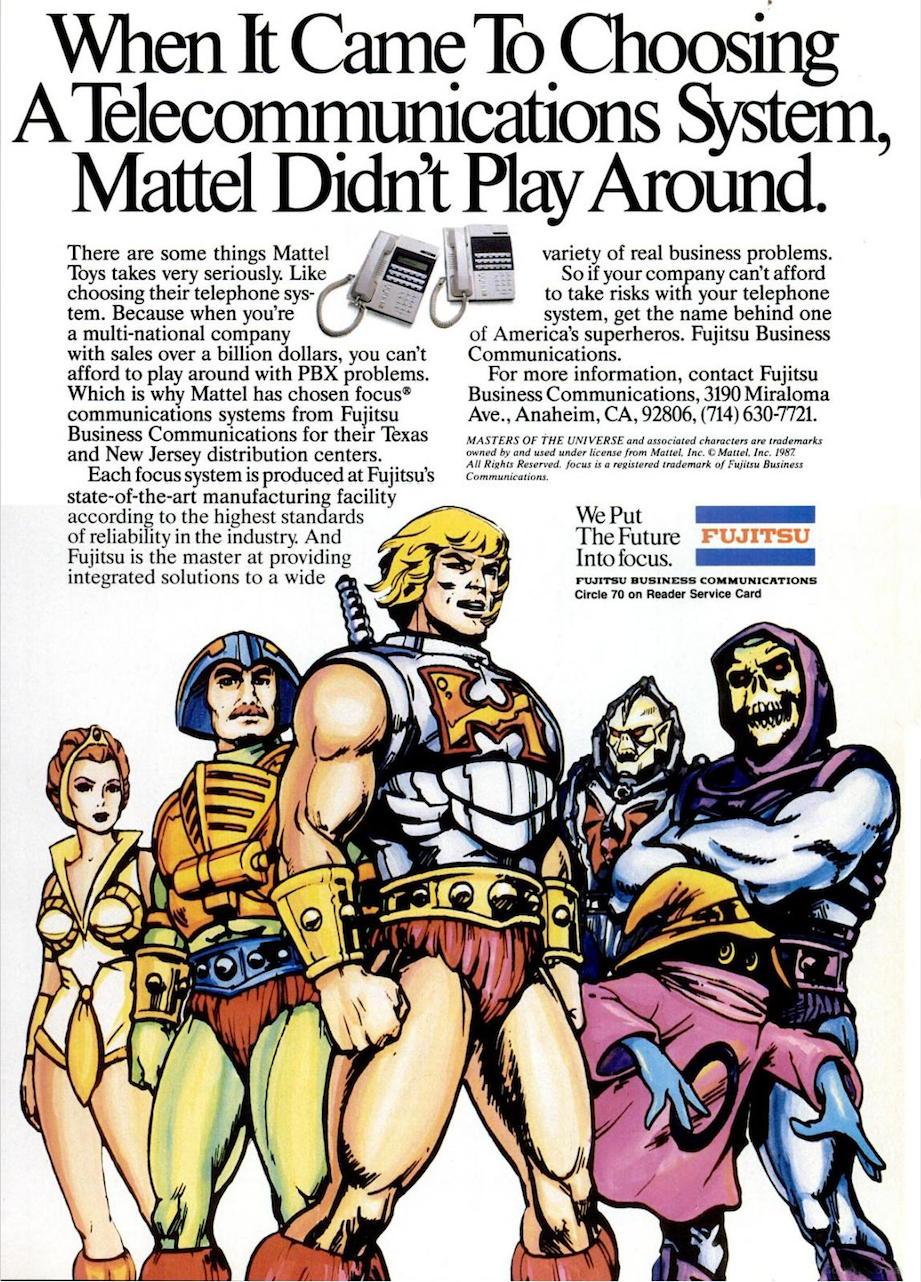
4) Ghost busting has died down in New York City, and our old friends Ray and Winston must demean themselves by entertaining at children’s birthday parties. All the children greet their guests with “I thought it was gonna be He Man!†and a chant “He-Man! He-Man! He-Man!”
The reference in the film is a bit odd. He-Man and the Masters Of the Universe debuted on television in 1983 and had been the subject of a feature film in 1987 starring Dolph Lungren. But the film was a flop, and the animated series had been off the air by then. Perhaps these were young hipsters, already reveling in their childhood past.
“Ungrateful little yuppie larva!â€
Incidentally, Ghostbusters 2 did spawn a toy line, albeit less successful than He-Man and might have been greeted by children with similar enthusiasm.
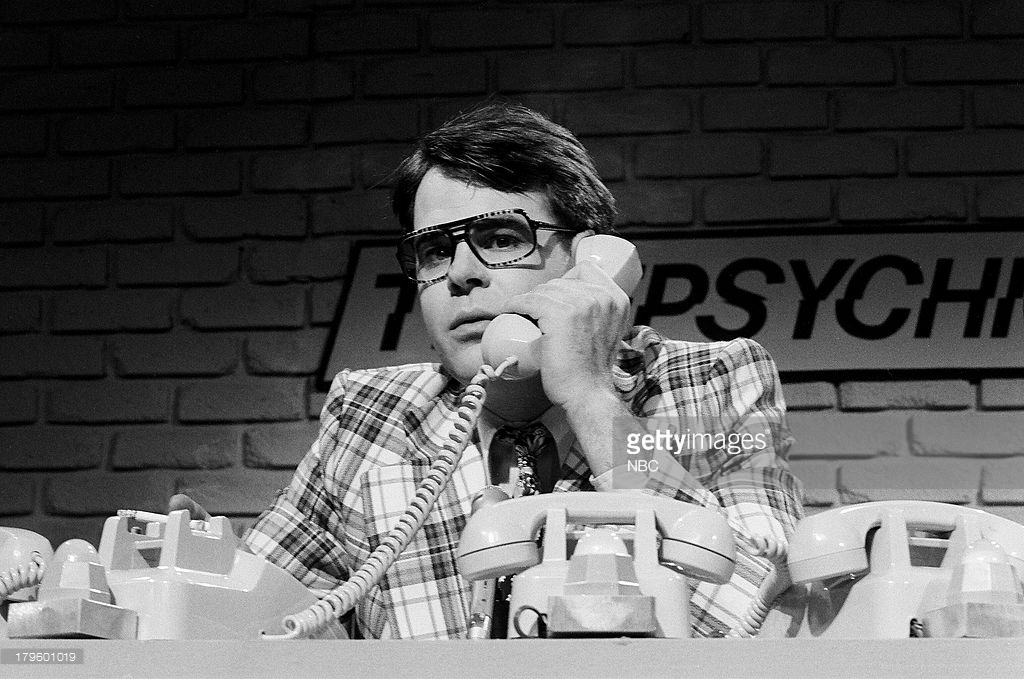
5) Venkman has moved on to his own television chat show called World of the Psychic, broadcast on the fictional WKRR-TV Studio.  While this seems like a legitimate television station in the Ghostbusters world, Venkman’s show is very much influenced by ’80s public access television. The zany underground medium started in the early 1970s and reached a sort of ‘golden age‘ by the 1980s. Shows like Telepsychic certainly inspired this. The Saturday Night Live’s send-up of Telepsychic — starring Dan Ackroyd — most certainly did.
SATURDAY NIGHT LIVE — Episode 8 — Pictured: Dan Aykroyd as Ray during the “Telepsychic” skit on December 9, 1978 — (Photo by: NBC/NBCU Photo Bank)
 Just two years after Ghostbusters 2, Dionne Warwick debuted her Psychic Friends Network.
6) On Venkman’s program, there are two guests who predict the end of the world. Â The first predicts the end of the world “at the stroke of midnight on New Years Eve.”
Well, New York survived. Here’s the actual stroke of midnight, ringing in 1990 in Times Square. Many would certainly consider this hellish, if not apocalyptic. “Goodbye to the ’80s!”
Venkman’s second guest believes the end of the world will be on February 14, 2016!
“Valentine’s Day, bummer.â€
She received the information from an alien at the Paramus, New Jersey, Holiday Inn which is a real place.
7) Ghostbusters New York is still led by Mayor Lenny Clotch (played by David Margulies), an obvious stand-in for Mayor Ed Koch.  In Ghostbusters 2, Clotch is running for governor of New York. Koch did indeed attempt that very feat in 1982, but lost in the primary to Mario Cuomo.  Sadly, Margulies, a regular on the New York stage, died earlier this year.
Courtesy Ghostbusters Wikia
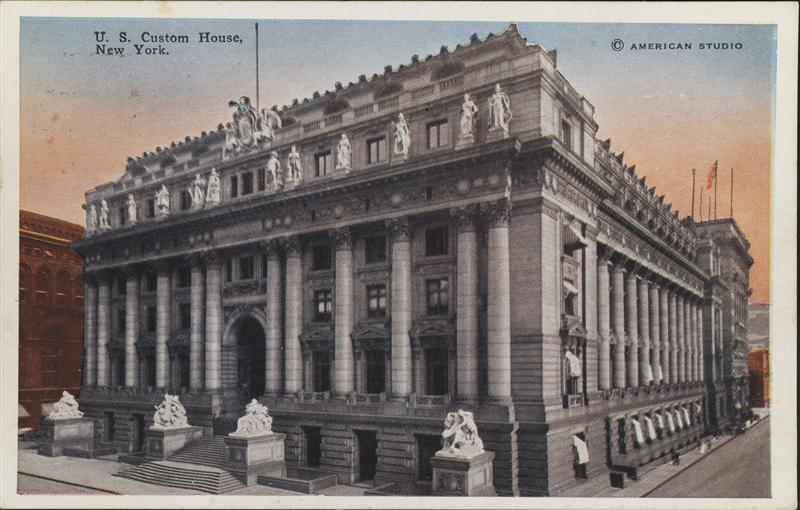
8)  One of New York’s finest works of architecture appears in Ghostbusters 2 — but moved uptown.  The Alexander Hamilton U.S. Custom House stands in for the Metropolitan Museum of Art who apparently didn’t give them permission to use their facade — or their name.  The faux museum is called the Manhattan Museum of Art, and both the Custom House and nearby Bowling Green are magically shifted to Central Park.
Courtesy Museum of the City of New York
The Custom House had just gone through some truly thorough preservation work in 1987. It had already become a gallery for traveling exhibitions, such as in 1988 with “Paris Grands Projets 1979-1989.” Several months after the opening of Ghostbusters 2, plans were underway to move a museum to Native Americans (today’s Smithsonian National Museum of the American Indian) into the building.
The Custom House was renamed for Alexander Hamilton in 1990, a year after the structure’s triumphant and central appearance in Ghostbusters 2.
Courtesy The Reffon
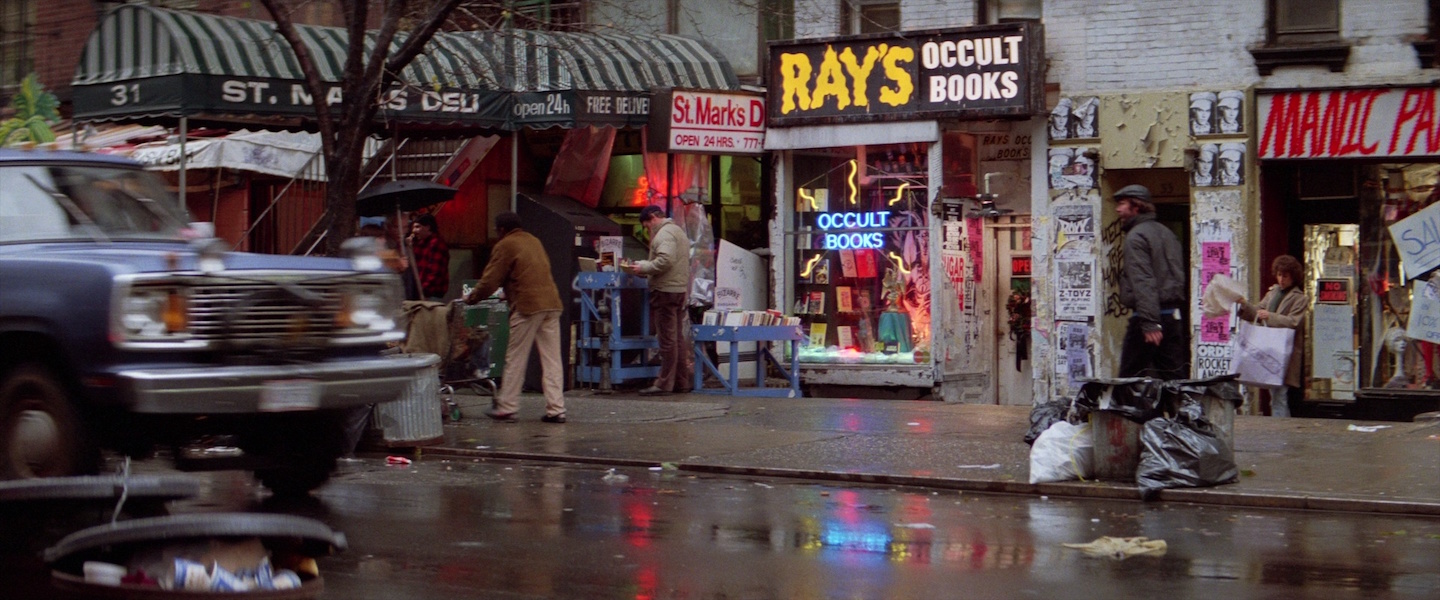
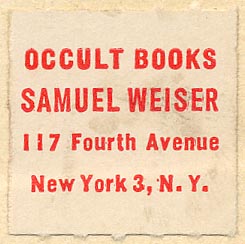
9) What have the Ghostbusters been up to since business has been down? Well, Ray has his occult book store on St. Mark’s Place, still a place of vibrant counter-culture in 1989.  Perhaps this a nod to New York’s most famous occult book store owned by Samuel Weisner which originally opened on ‘Book Row’ at 117 4th Avenue. (By the time of the film, it had moved to 132 East 24th Street. It’s been closed for many years.)
At the right of the screen, you can see Manic Panic, the original boutique which spawned the flamboyant hair-color company. (More information in our St. Mark’s Place podcast.)
10) The Ghostbusters regroup to investigate the mysterious street corner on the Upper East Side. While the daytime scenes are clearly filmed at the corner of First Avenue and 77th, the nighttime scenes — as they’re drilling into the street — are clearly not even in New York City at all. (Note the red subway poles).
Residents of the Upper East Side have become quite familiar with nighttime drilling in the street due to the construction of the Second Avenue Subway.  The project began back in the 1970s but had been placed on a (what seemed like a) permanent hold by the 1980s.
Quoting from the September 1989 New York Times: “There are curiously empty spaces in this cluttered city. The Second Avenue Subway tunnel, dug at great expense and never to be finished.”
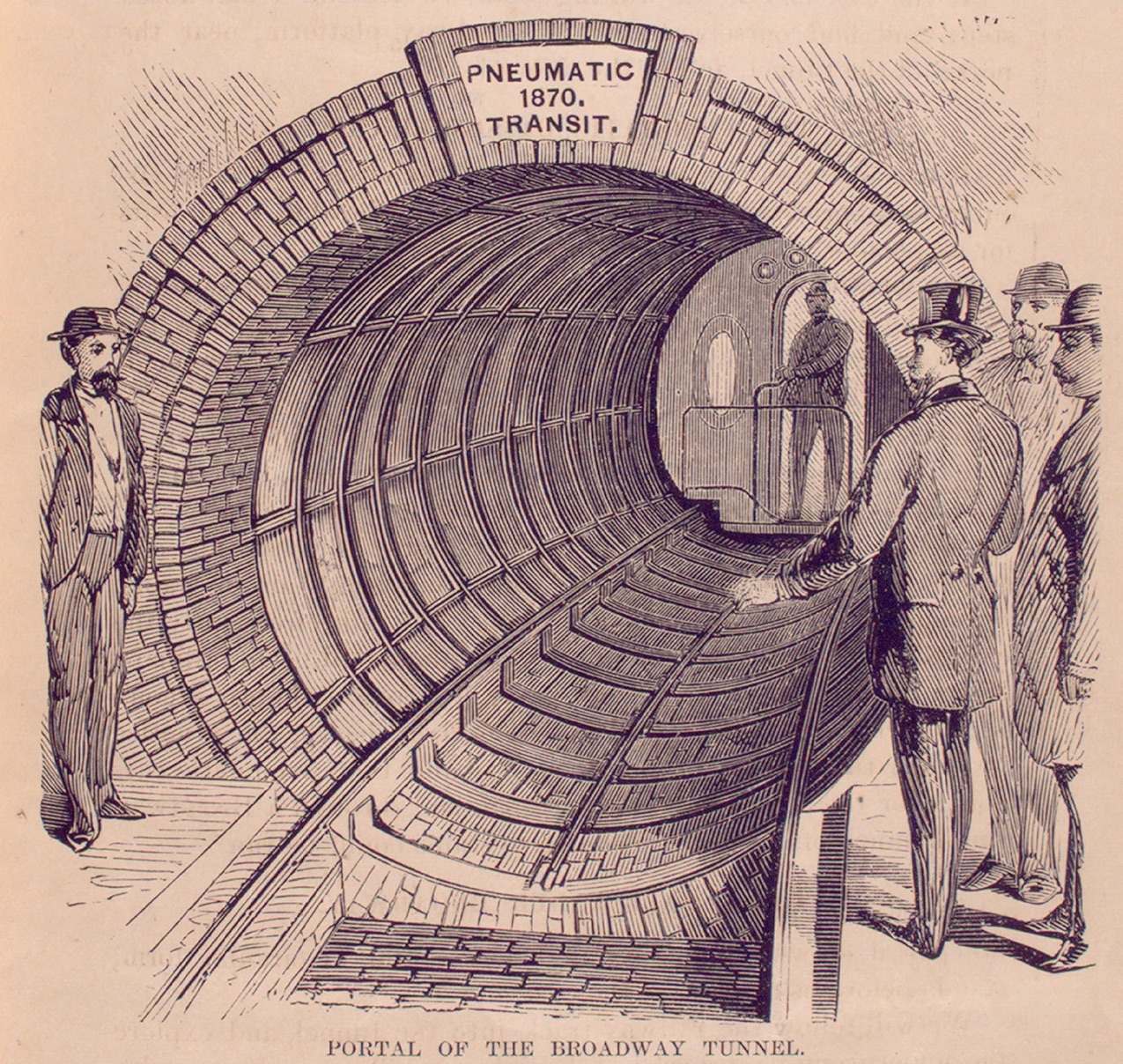
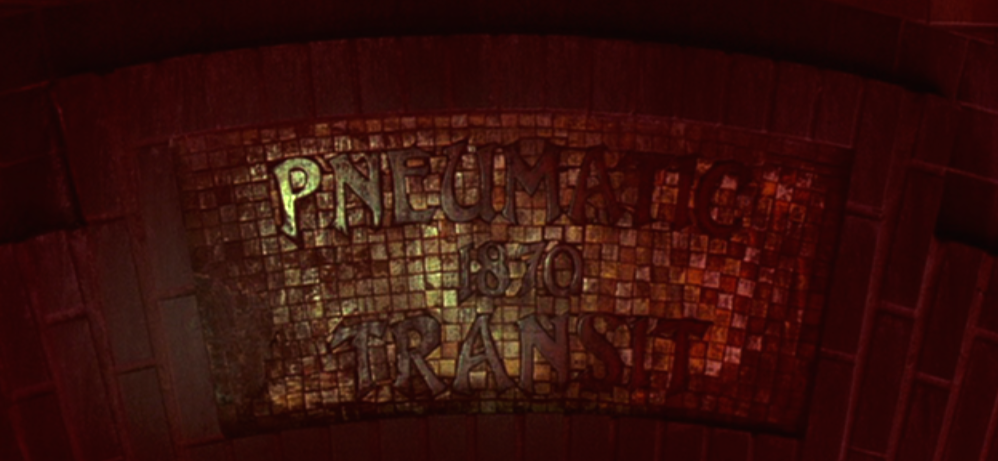
11) Ah but there is a completed tunnel under the street, now filled with a pink, ghostly ooze — at least in the world of the Ghostbusters. Or, as Ray declares, “It’s the old pneumatic tube tunnel!”
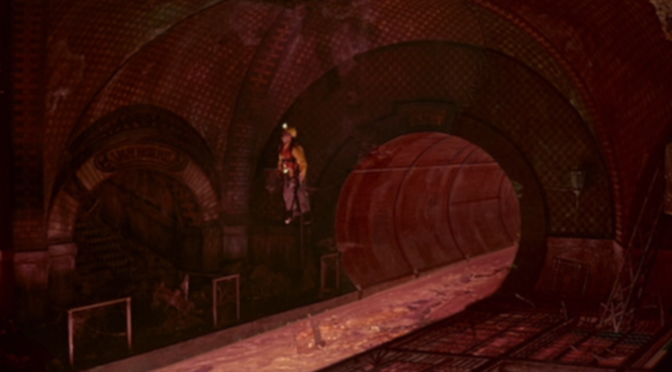
As we spoke about in our recent podcast on Alfred Ely Beach’s Pneumatic Tube, the original tunnel was only carved underground for a single block — near City Hall — in 1870. There were plans to send the pneumatic tube up the entire length of the island (albeit under Madison Avenue, not First Avenue). This is my favorite bit of history from the film and displays a loving nod by the writers to Old New York:
Our gang accidentally takes out some wires which manages to cause a blackout throughout all of New York. The Blackout of 1977 had only occurred a dozen years before, so many audience members might have flinched a bit at that scene.
12) The Ghostbusters are hastily taken to court. Venkman’s defense for the hole in the street: “Well, there are so many holes in First Avenue, we really didn’t think anyone would notice.”
Potholes in the street were a potent symbol for the city’s deterioration and also a way to appease the neighborhood when they were eventually fixed. In 1990, the Times reported in an article ‘Gaining in the Battle on Potholes: “The Department of Transportation claims that the number of potholes in New York City streets dropped 23 percent this year, and the new Commissioner, Lucius J. Riccio, suggested yesterday that potholes ”might have to be put on the endangered-species list.”
The city even opened a phone line for New Yorkers to call in about potholes. From the article: “The pothole hot line – 212-POT-HOLE – expects its 25,000th call this week. The caller will receive a Highway Bureau T-shirt and the dubious honor of filling the pothole of his or her choice.”
13) The sequel features a new version of the Ray Parker Jr. theme song, this time recorded by New York City icons Run-DMC. The rap trio formed in 1981 in Hollis, Queens, and quickly helped develop the basis for modern hip hop music. Â In 1989, they were coming off the success of their massive and mainstream Tougher Than Leather album, produced by Rick Rubin (much later to win a Grammy for producing Adele’s 21).
https://www.youtube.com/watch?v=2Cc5Ikwsg08
Another song from the film actually became a minor hit –Â “On Our Own” by Bobby Brown (who makes a terribly awkward appearance in the film).
14) In a montage of scenes demonstrating the Ghostbusters’ return, we see one ghost running around the Central Park reservoir and another haunting Orrefors fine glassware boutique at  58 E. 57th Street.  Orrefors is no longer there today, but the building sits next to New York’s tallest residential tower — the infamous ‘needle’ building 432 Park Avenue. To quote Wikipedia here: “The building has been much maligned by many city denizens who find it an eyesore and believe it represents New York’s increasing cost of living and ostentatious wealth.”
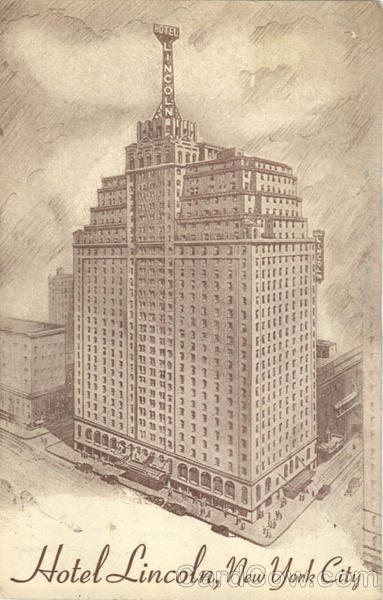
15) Look closely during the ‘haunted toaster’ scene and you will see a marvelous and obscure site on the wall — a vintage poster for the Hotel Lincoln, a glamorous midtown destination which opened in 1928.  This was the hotel mentioned in our Billie Holiday’s New York podcast as the place she began a (controversial) residency with Artie Shaw in 1938. She was forced to enter through the kitchen as a black woman couldn’t be seen coming in the front door.
Hotel Lincoln, 44th to 45th Street at 8th Avenue New York City
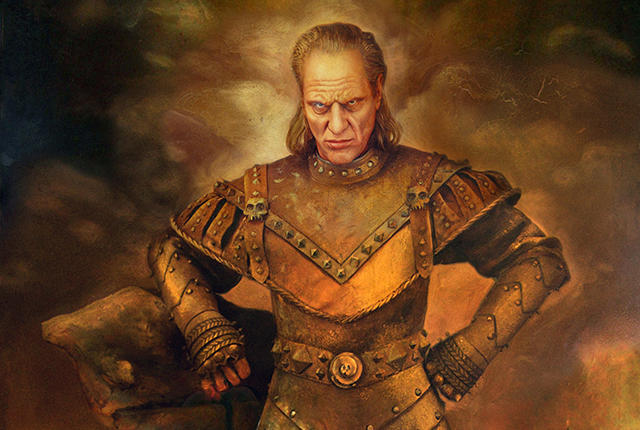
16) This has nothing to do with New York City history, but you must read this extraordinary Deadspin article on Norbert Grupe, the actor depicted in the Prince Vigo painting. Keep in mind Venkman’s words while you read it — “Vigo? He’s a bit of a sissy isn’t he?”
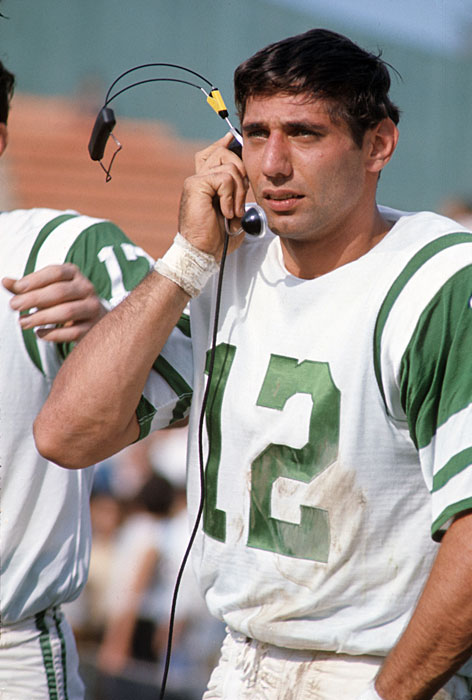
17) Venkman wraps little Oscar in one of his prized possessions — a New York Jets sweatshirt, #12. Â This number, now retired, belonged to Joe Namath, who played with the Jets from 1965 to 1976.
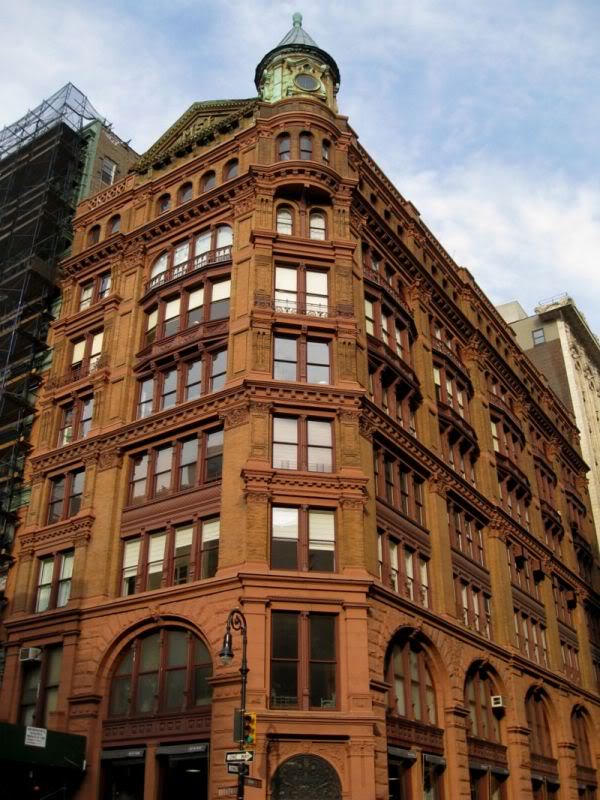
18) Dana and Oscar take shelter in Venkman’s apartment, which just happens to be one of the most glorious apartment buildings north of Houston.  Built in 1891 for the Manhattan Savings Institution Bank Building, 644 Broadway formerly featured the Atrium clothing store on the ground floor. (Read more about this lovely building at Daytonian In Manhattan.)
Photo courtesy Wired NYC
Catch this line: “I’ve got some Laura Antonelli tapes you can watch.” Laura Antonelli was a beautiful Italian sex symbol of the 1970s.
19) As Louis (Rick Moranis) and Janine (Annie Potts) leave Ghostbusters headquarters — the old fire station on North Moore Street — observe the unusual business that sits across the street:Â Hongkong Kowloon Docks Import Inc., a typical example of the sort of business that used to reside in Tribeca during the 1970s and 80s. Â Coincidentally, in China, there was a program called Hong Kong Ghostbusters which took place in a housing development called Kowloon.
20) The Ghostbusters investigate an abandoned subway track whose “lines have been abandoned for 50 years.” They are immediately beset by ghostly figures of all types, from severed heads on sticks to a phantom stream train, the supposed haunted visage of the “New York Central to Albany” which derailed in 1920, killing hundreds.
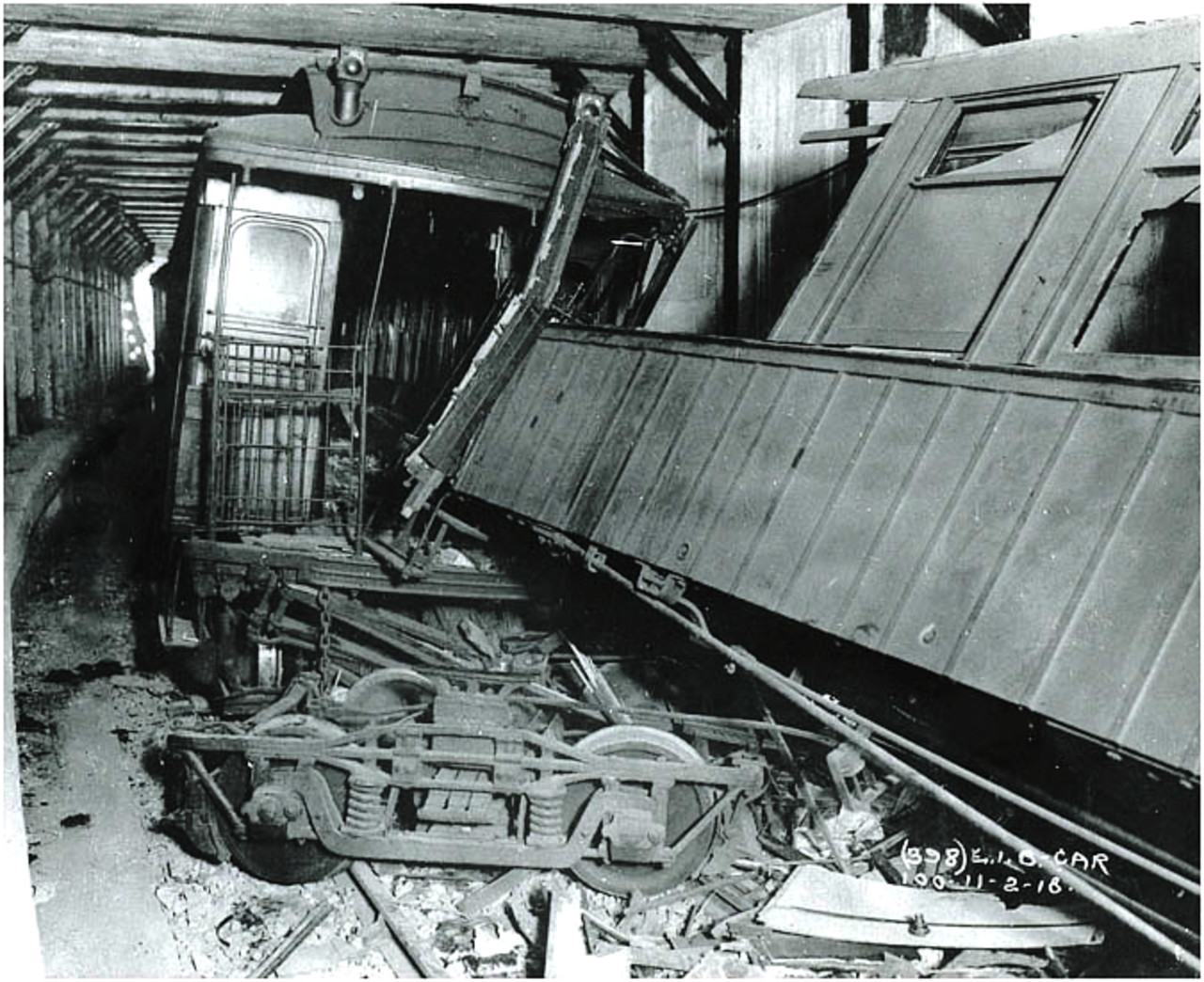
That disaster, of course, didn’t exist. However they could have chosen to use another tragedy from around that same time period — and much closer to  home.  The Malbone Street Wreck in Brooklyn involved two trains colliding underground, killing 93 people.
21) Our heroes are thrown into the Parkview Psychiatric Hospital in order to get them out of the way. This fictional institution is most likely based upon Manhattan Psychiatric Center on Ward’s Island. Timely news the very summer of Ghostbusters 2? New York City’s psychiatric wards were too crowded.
During a thrilling montage of ghost attacks throughout the city, Â three particular things of historical interest pop out:
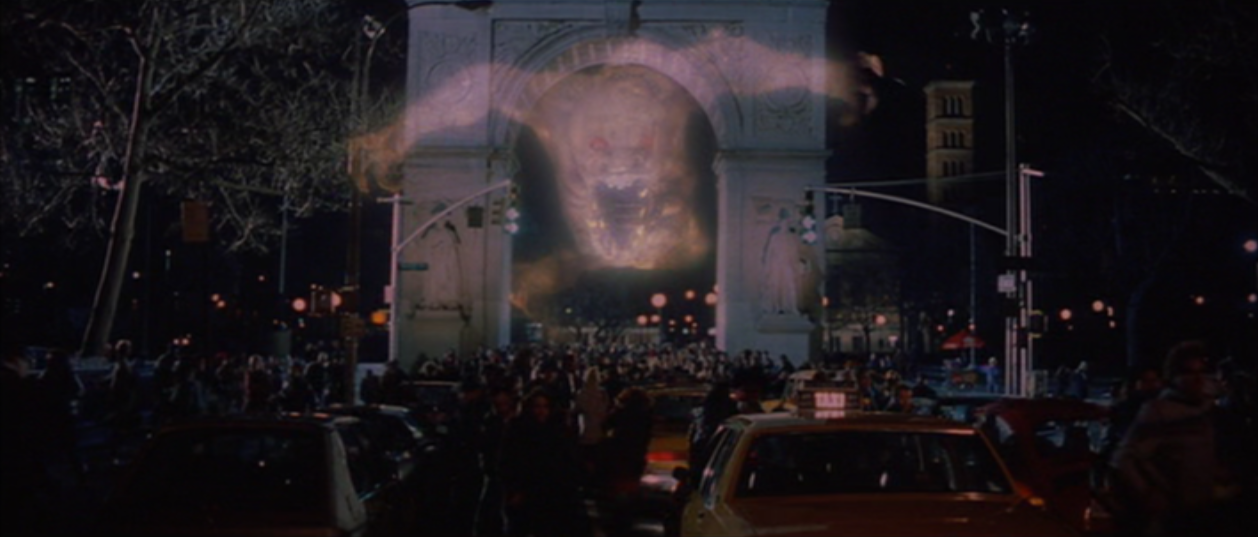
22) Massive Ghost in Washington Square Park — The park is notoriously the site of an old potter’s field, and bodies to this day are often discovered during excavations. “Where now are asphalt walks, flowers, fountains, the Washington arch, and aristocratic homes, the poor were once buried by the thousands in nameless graves.†(Kings Handbook of New York, 1893) Read more on Washington Square’s unusual backstory here.
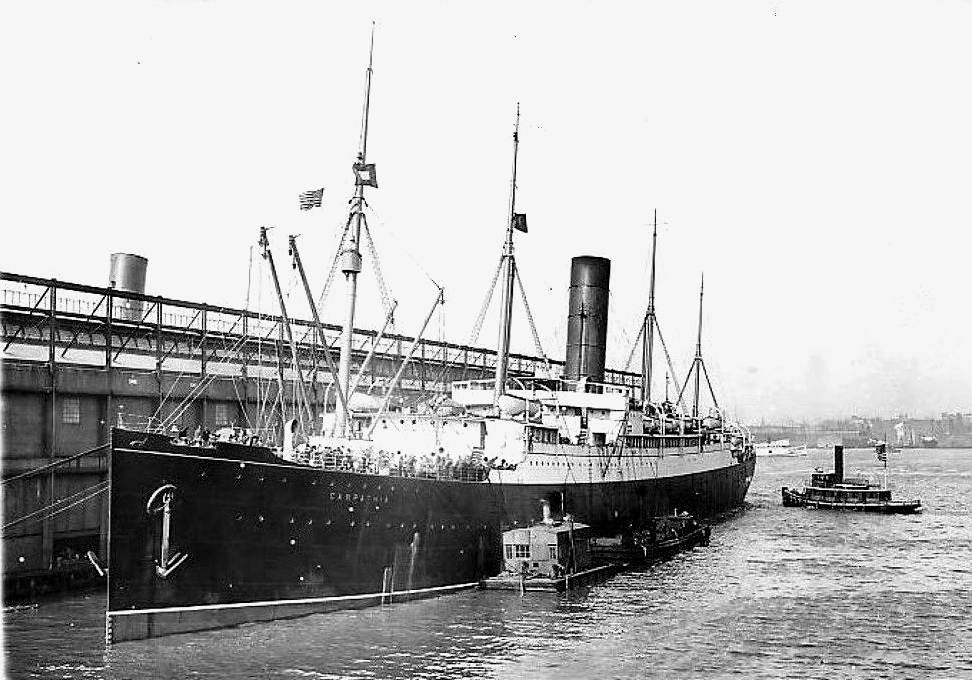
23) Titanic Finally Arrives —  The Titanic was originally supposed to have docked at the White Star Pier 59 (parallel to West 18th Street); instead, the survivors of the shipwreck disembarked from the Carpathia at Pier 54. The framework of the pier still existed today (pictured in 1912 below)
The ghostly passengers actually let out at Pier 34 in the film, to the horror of Cheech Marin in a cameo appearance.
24) The Spirit of Fiorello La Guardia (off screen) — The mayor claims he’s been seeing the ghost of the former mayor “and he’s been dead for 40 years.” Since the events of this scene take place on December 31, 1989, La Guardia would have been gone over 42 years.  He died in his Bronx home of Riverdale. Here’s how the New York Times broke the announcement.
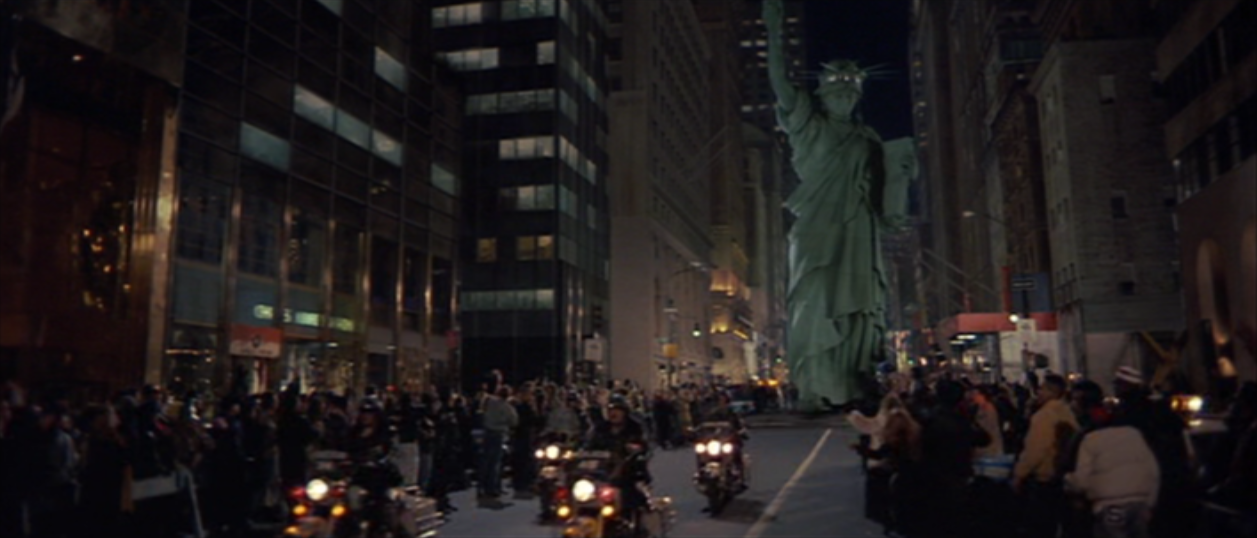
25) The grand finale features the Statue of Liberty pulling a Stay Puft Marshmallow Men, delivering the Ghostbusters to a goo-covered Custom House, er, I mean art museum and saving the day.
This marks the first time that the entire statue has made it to Manhattan. However her arm spent many, many years in New York, well before it was ever attached to the rest of herself.
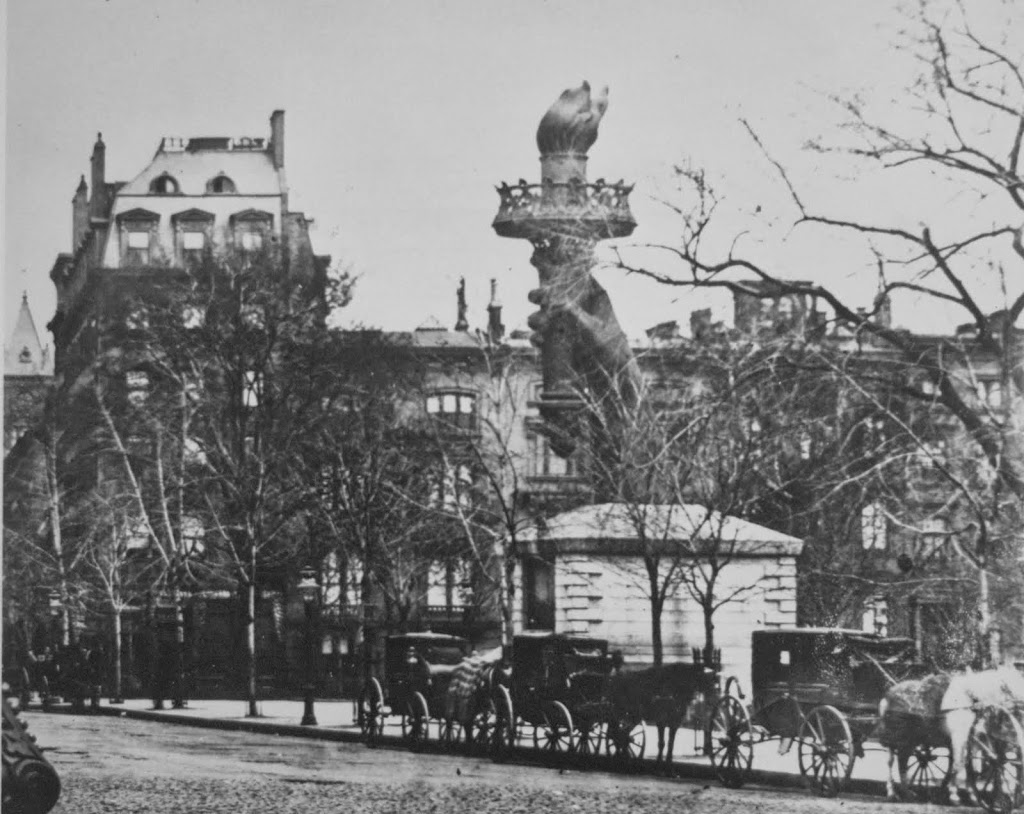
From a Bowery Boys 2014 article: “….the arm and torch would be displayed in the northwest corner of Madison Square Park, from 1876 to 1882.  On July 4th, 1876, a gigantic painting by Jean-Baptiste Lavastre of the completed statue was displayed on a building across the street from the arm.”
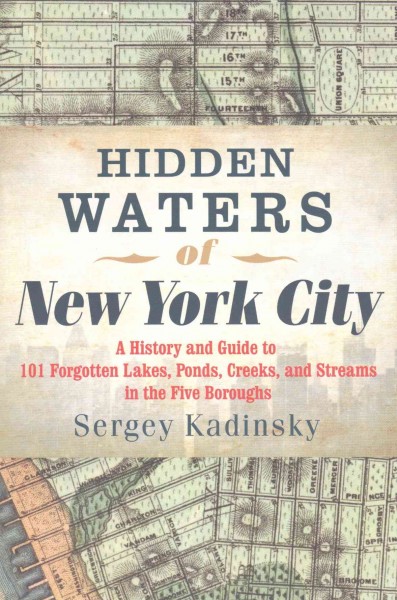
Sergey Kadinsky is our city’s resident Aquaman. His Hidden Waters of New York City was the big New York City exploration guide book of the spring. In a city often characterized by glass, steel and asphalt, it’s magical to consider the metropolis almost like a human body, comprised and reliant upon water for its well-being.
As though armed with a magical divining rod, Kadinsky identifies almost every significant body of water that ever existed in the five boroughs — from ancient reservoirs to the most obscure Staten Island pond — providing modern context and directions for locating them  using public transit.  It’s a combination history book, hiker’s guide and trip planner.  My copy is presently dog-eared in about twenty places with living streams and lakes that I intend to visit this summer for my own personal mini vacations.
But the waterways that are no longer here are, in a way, even more intriguing, highlighting how New York was often sculpted around bodies of water before they were filled in or buried with the modernity of the city.
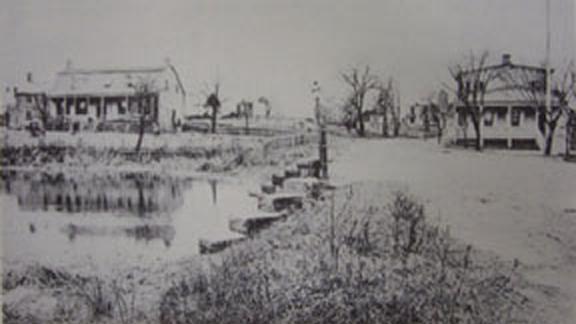
And there are a surprising number of old waterways that have disappeared relatively recently. For instance Jackson Pond in Queens. According to Kadinsky: “In 1966, the lake was dried and covered with concrete after the city determined it to be an unsafe ice-skating site.” Oh, but a Jackson Pond Playground sits upon the ghostly outline of this forgotten water today!
How do you even begin putting together such an ambitious project? Kadinsky is well suited for the task. He’s a long-time Queens resident, staff member at the New York Parks Department and an adjunct professor of history at Touro College. I asked Kadinsky a few questions about how his project came together:
Your book really identifies New York’s inescapable connection to water in almost every aspect of its history. How did you develop the idea to find every water sources (past and present) and put them together in a guide book?
For more than a decade preceding the book, I’ve worked as a Gray Line tour guide, newspaper reporter and Touro College adjunct. These experiences gave me an ability to tell a story in a an easygoing, detailed, and captivating manner.
In my spare time, I led tours and contributed stories to Kevin Walsh’s Forgotten-NY, a blog that has become a book and subject of tours and lectures. It inspired me to think of a specific hidden city element that I felt was not receiving its due.
That’s how Hidden Waters of New York City came to be. Other Islands is a blend of history, travel, and geology, with a journalist’s eye for detail and research. I followed its method in documenting the hidden waterways.
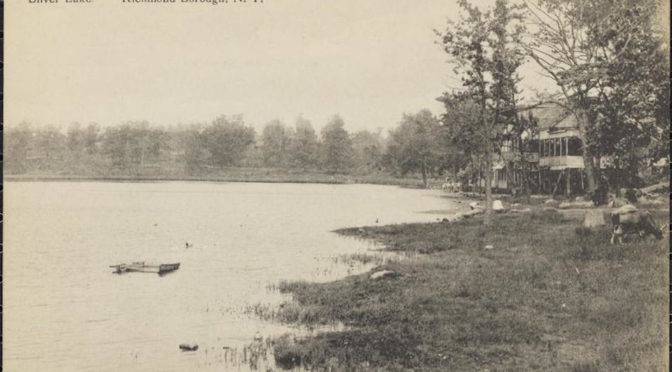
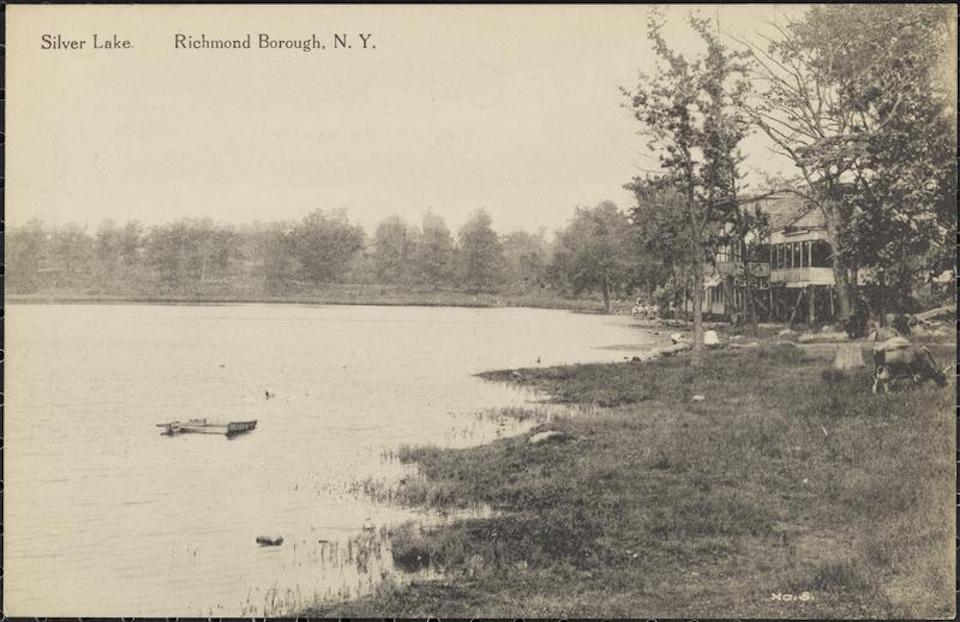
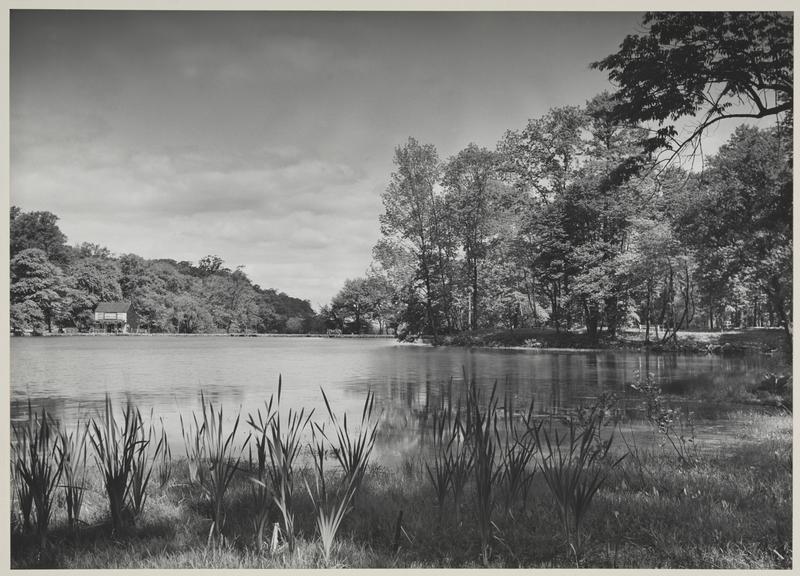
Silver Lake in Staten Island, photographed here in 1915 (and featured on pgs. 246-248 in Kadinsky’s book. Photo courtesy Museum of the City of New York
Courtesy Museum of the City of New York
Hidden Waters feels something like a hiker’s guide to the city. How much walking around and on-foot exploration did you do while researching it?
When it comes to exploring streams that have become sewers, I’ll leave this task to Steven Duncan. Likewise, when it comes to abandoned properties, I’ve found Nathan Kensinger’s reporting helpful in my research. I took a Circle Line around Manhattan and a Seastreak to Sandy Hook, but have yet to take a boat tour of Newtown Creek or a paddle a canoe down the Bronx River.
I explored the streams on foot and bike, following their banks and recognizing the disparity in public waterfront access. While it is possible to almost entirely circumnavigate the shoreline of Manhattan thanks to ribbons of parkland, places like Bowery Bay and Flushing Bay are not as accessible. Only a few dead-end streets allow for views of the water, and the water is not so fine.
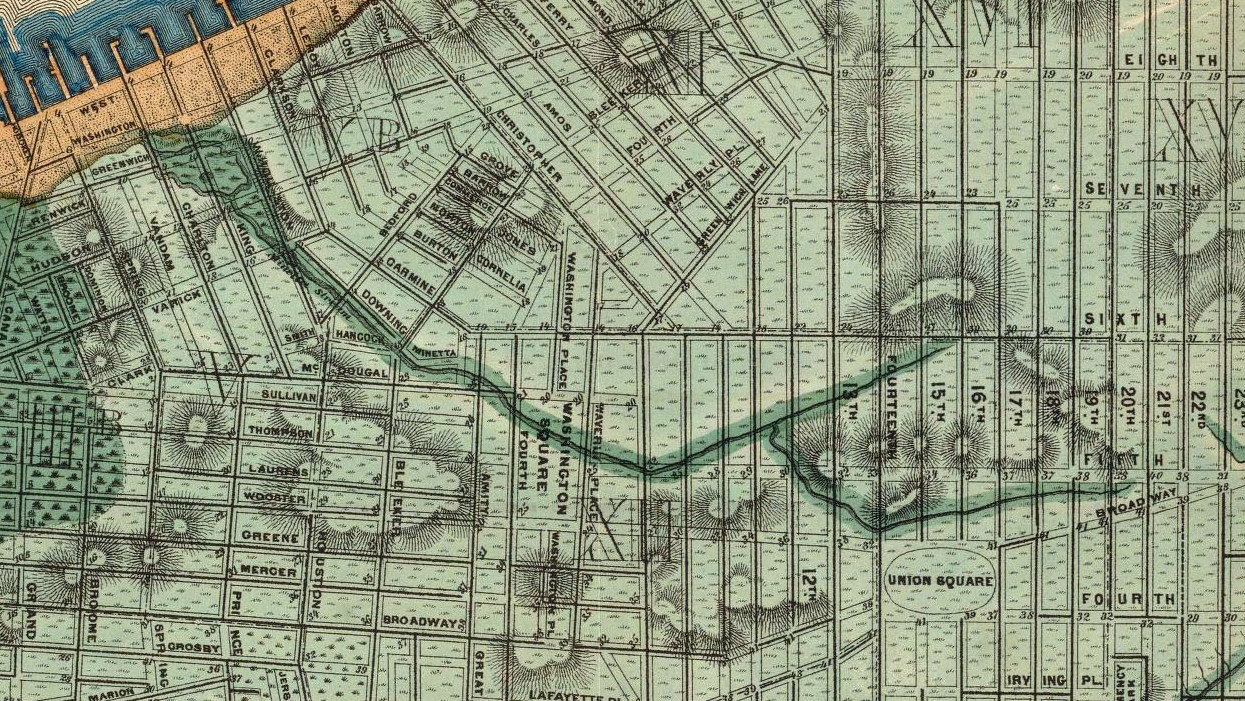
The path of old Minetta Creek from Egbert Viele’s Sanitary & Topographical Map of the City and Island of New York (1865).Â
Perhaps the most famous body of water in Manhattan in one that doesn’t really exist above ground – Minetta Brook. You’ll find its name everywhere and, as you mention, it’s dutifully traced by tour guides. What accounts for its appeal and does it truly exist as strictly an underground stream today as some claim?
Minetta Brook’s place in local lore goes back to the Native period, when it was believed to be possessed by a spirit. The neighborhood’s love of history and storytelling ensured that it would never be forgotten, surveyors laid out the streets and with local culture in mind, Minetta Lane and Minetta Street appeared on the map.
In the 19th century following its burial, flooding in basements built along its former course was a persistent problem. Engineer Egbert Ludovicus Viele dutifully noted and mapped these floods and ascribed them to Minetta Brook. He preceded me by 150 years in tracing Manhattan’s hidden waterways.
The 1938 extension of Sixth Avenue though Greenwich Village created small triangular parks near the brook’s former course- another opportunity to restore it to the map with Minetta Green and Minetta Playground. Historical preservationism, tourism, and a way of imagining a pre-urban Greenwich Village, all appeal to Minetta Brook’s popularity.
I do not think that the brook is flowing today underground along its former course. Its sources in the Flatiron District have been covered entirely with buildings. Streets running atop its course have sewers that do not follow the stream bed’s path. Nevertheless, the soil is much softer where creeks once flowed, and that helps explain for the flooding and groundwater. Even the famous well at Two Fifth Avenue could simply be ground water not necessarily associated with Minetta Brook, though the location makes sense.
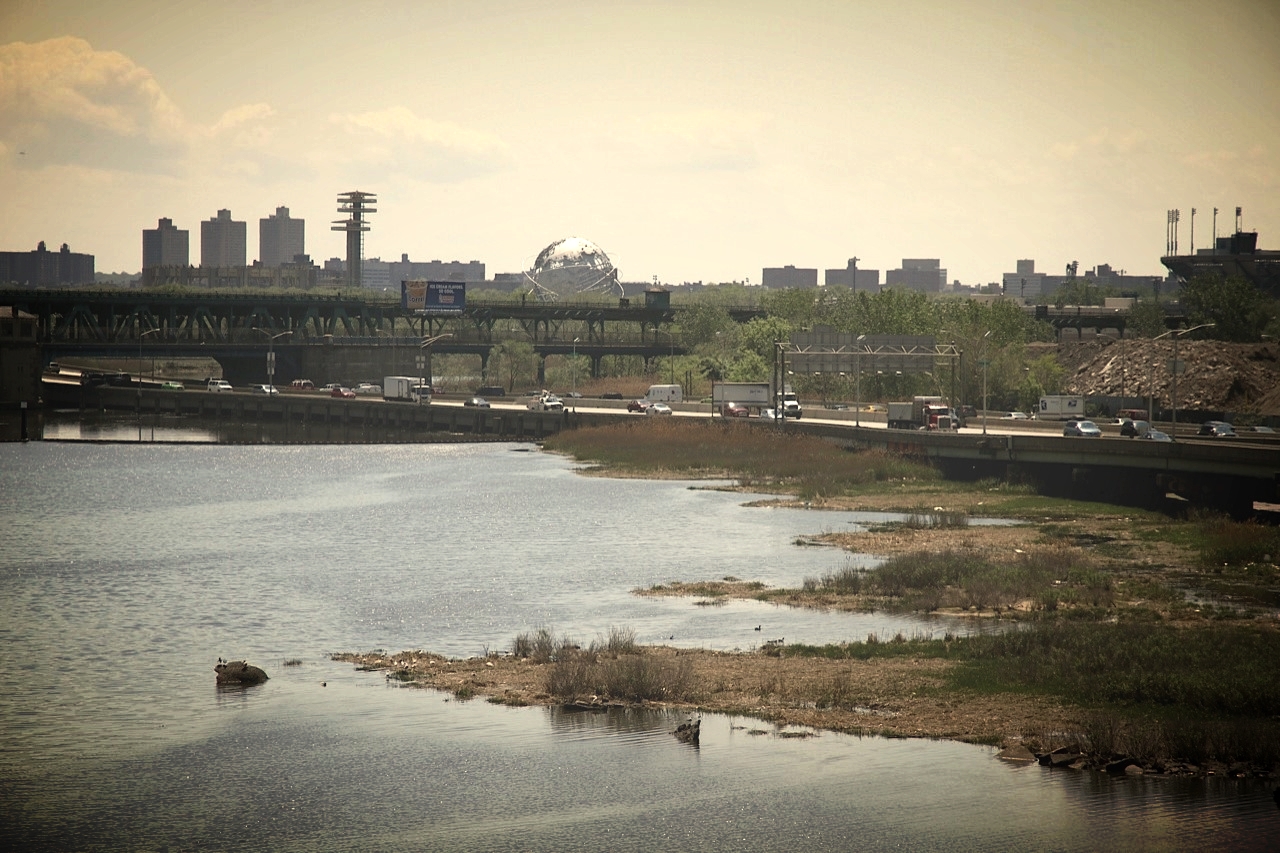
Flushing Creek, with the sites of the old World’s Fair in the distance.
Photo courtesy Friends of Flushing Creek
What is personal favorite body of water in the New York five boroughs (exempting the Hudson and East Rivers of course)?
Flushing Creek, because it’s a block away from my parents’ home and a five minute drive from my home. Unlike Gowanus Canal, Newtown Creek and Bronx River, this creek does yet not have a grassroots citizen-led conservancy group. The creek flows through a series of conditions such as a nature preserve, a recreational lake, a canal beneath highways, a tunnel, Willets Point, and into Flushing Bay.
The creek was a former salt marsh turned ash dump turned fairground turned park. There was talk in 2008 of daylighting the underground sections of it, but heavily used soccer fields are in the way. The creek was also slated for a grand prix racetrack in the 1980s and an Olympic venue in the past decade.
Adding to the subject are the creek’s tributaries, Mill Creek in College Point, Kissena Creek, and Horse Brook, which also are worth mentioning considering their rich histories.
You mention a great number of old waterways that were completely unknown to me. What was the most surprising discovery you made in your research?
This one is very close to home, Coe’s Mill on Horse Brook, which was demolished in 1930 to make way for what would become the Long Island Expressway.
Not enough books mention the English settlers who lived in New Netherlands having fled England and New England in search of religious freedom. Feeling a lack of respect and recognition from the Dutch, they petitioned England to annex the colony. It was like our own Crimea.
Unlike the Bowne House in nearby Flushing, nothing is left of Coe’s Mill. The mill provided food for the settlement of Newtown, one of the original towns of Queens that is now known as Elmhurst. Seeking a path of least resistance when it came to acquiring land for a road, the city built the Long Island Expressway atop the filled stream bed.
A year ago, I wrote a letter to Councilwoman Julissa Ferreras-Copeland, whose district covers this site, requesting to rename a nearby footbridge after the mill, and I have yet to hear back from her.
Alley Pond Park in 1936, before it was rudely interrupted with highways.
Courtesy Museum of the City of New York
Getting back to the notion of Hidden Waters as a pure nature guide, where would you direct people to go in the five boroughs if they really a little bit of the feeling of ‘getting away from it all’?
Alley Pond Park has the creeks and scenery but because it has highways running through it, it’s difficult to appreciate the place. Even deep in the woods where you can’t see any civilization, you hear cars whooshing nearby. That’s why the Greenbelt in Staten Island is truly the get away park in the city. It has forests, creeks and ponds, but no sounds of motorists driving past.
Check out Sergey’s truly excellent Hidden Waters Blog for more information on New York’s fantastic water sources. His book is currently on book shelves
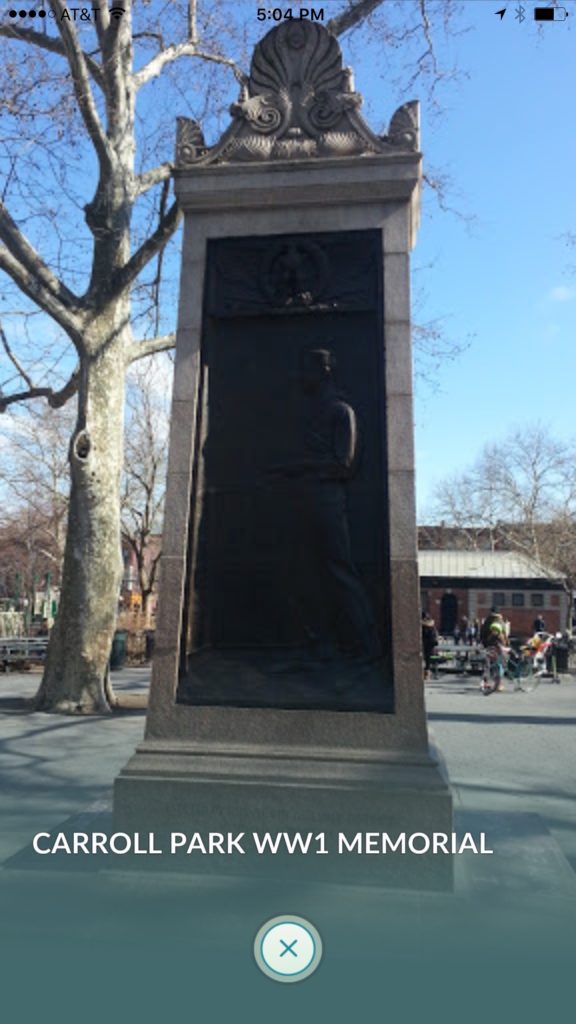
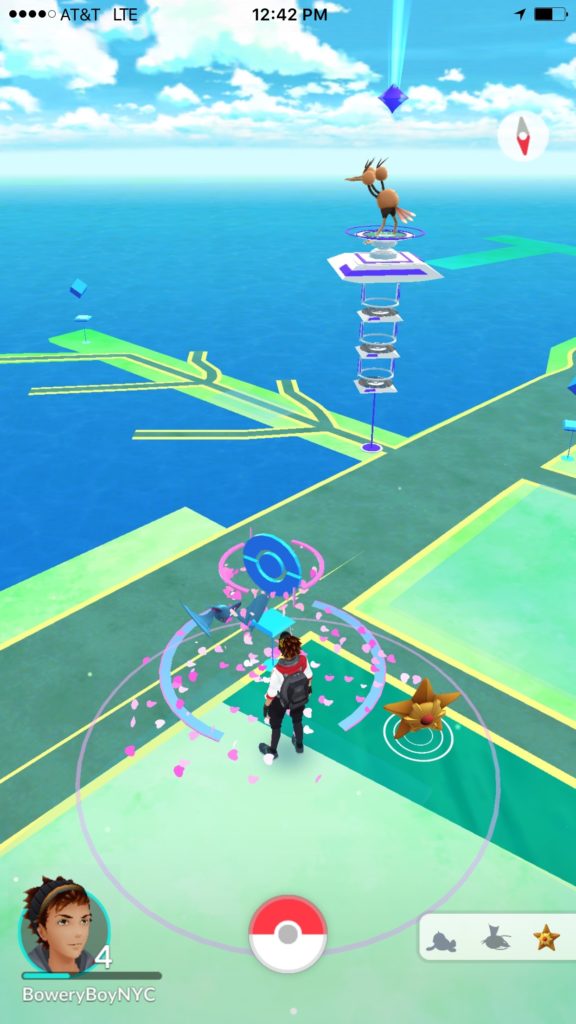
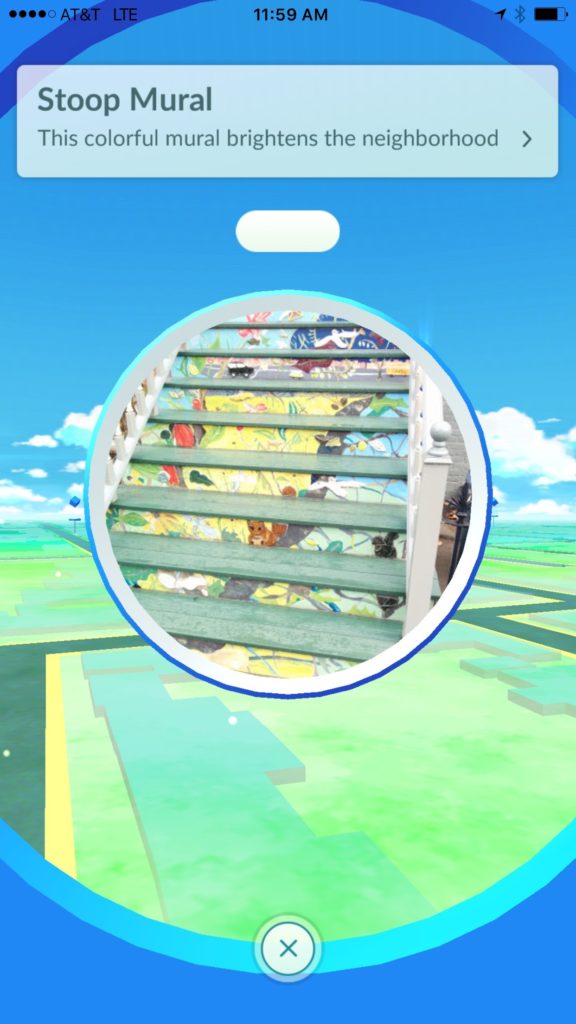
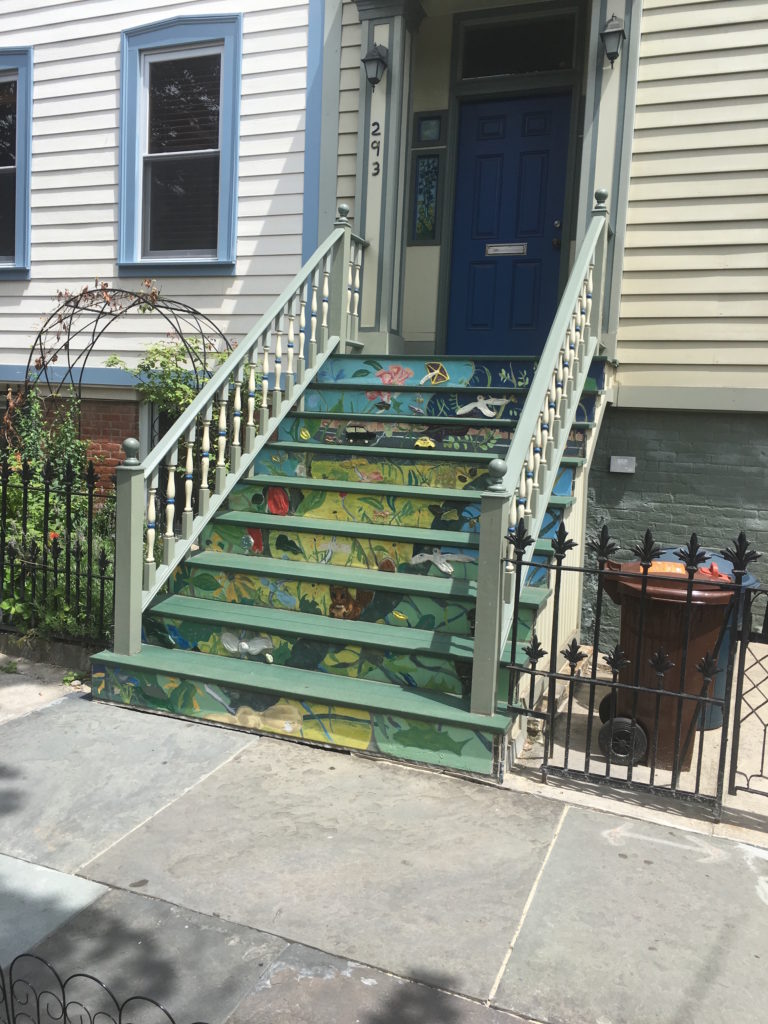
This weekend I strolled around Carroll Park in Carroll Gardens, Brooklyn, and observed at least 8 or 9 people staring intently at their phones, occasionally wiping their index fingers rapidly at the screen.
In the center of the park is an 18-foot-tall World War I memorial dedicated in 1921, emblazoned with the names of those from the neighborhood who had died in the war. On one side of this monolith are the words: “THEY FACED THE PERILS / OF THE SEA AND THE / HIDDEN FOE / BENEATH THE / WAVES.”
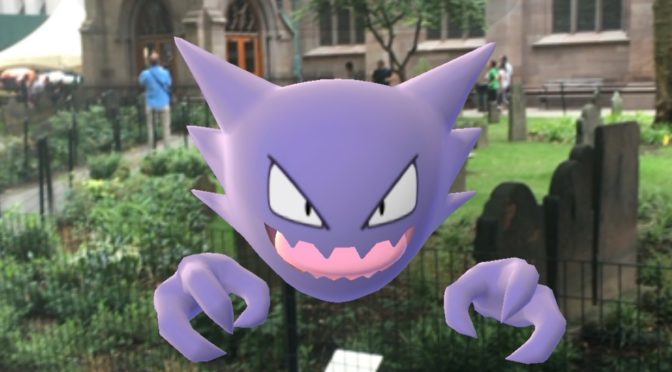
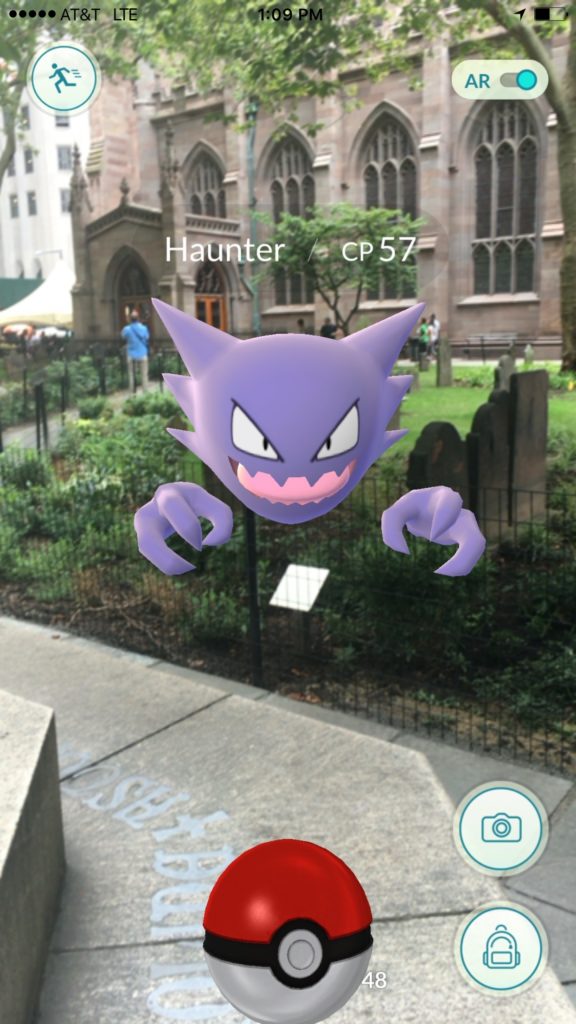
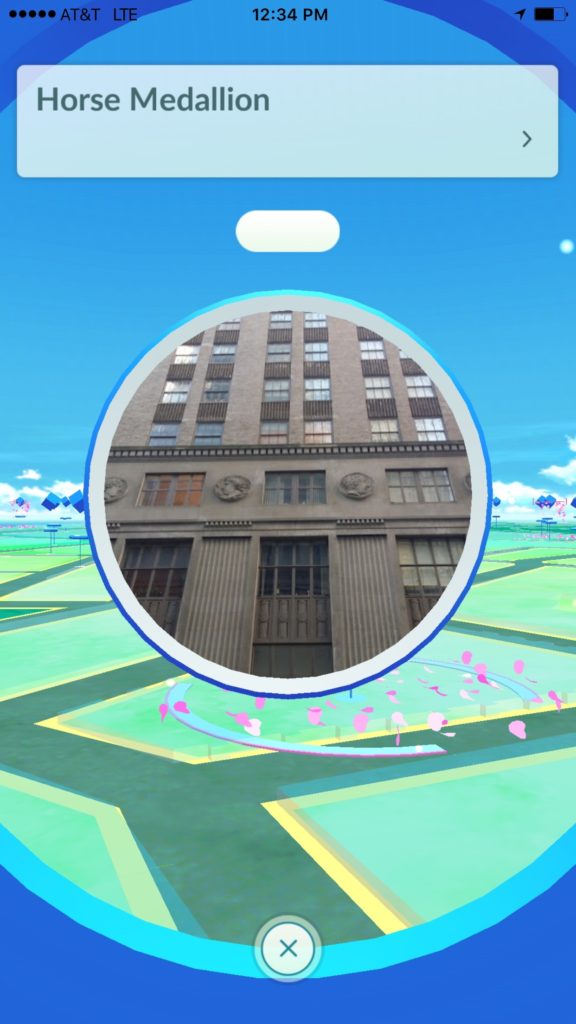
For instance, here was the sight that greeted me yesterday out in front of Trinity Church at Broadway and Wall Street. As tourists were buzzing by and service was just getting out at one of New York’s most famous religious spaces, I was observing the landscape reduced to this:
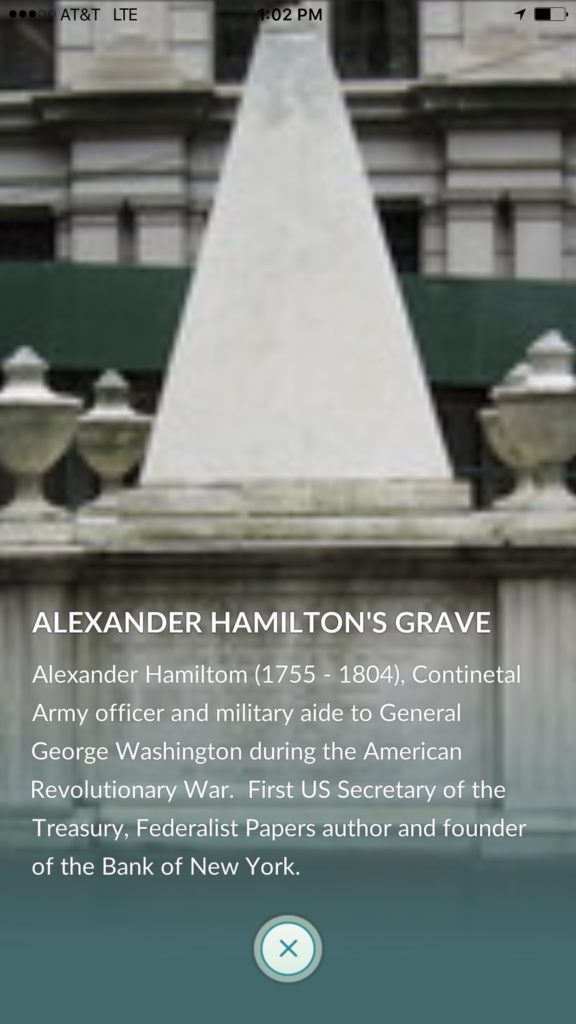
There were several blue squares contained within Trinity Church graveyard. A player could check out those squares from afar but had to actually walk into Trinity and get close to them to seek their rewards.  Even in death, Founding Father and Broadway superstar Alexander Hamilton was providing his countrymen with guidance as one square was hovering over his grave, as though an otherworldly embodiment of his greatness:
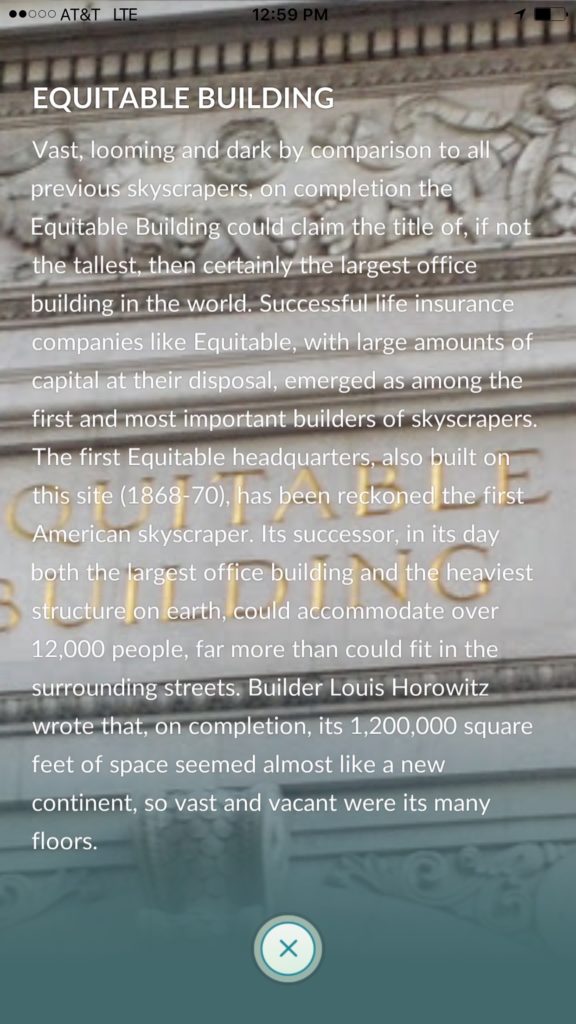
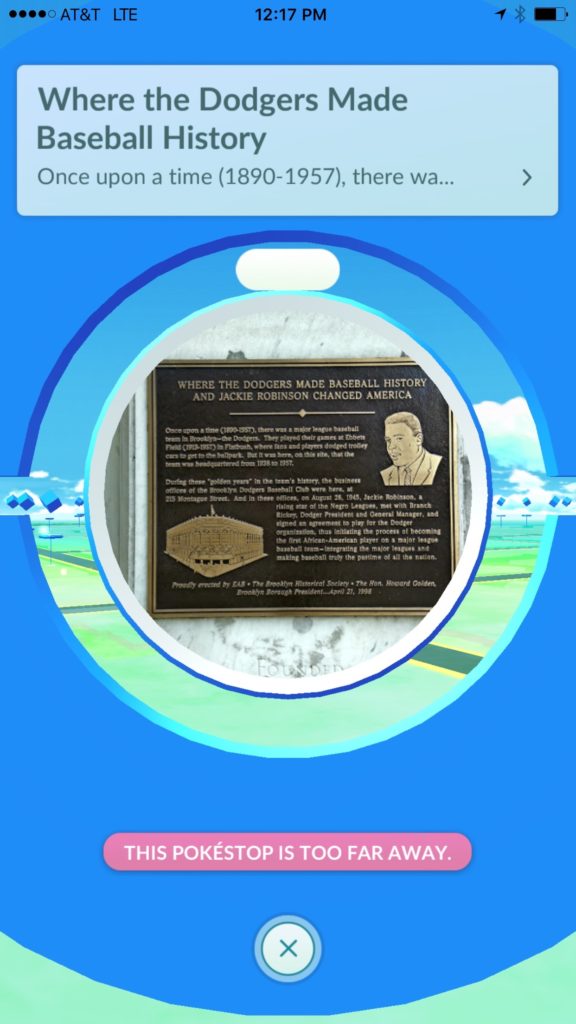
At many sites, a short history is provided with each blue square. Sure, Hamilton is a very popular figure at the moment, so naturally some explanation might be presented here. But how many games primarily geared towards children would have a short history of the building across the street — the Equitable Building?
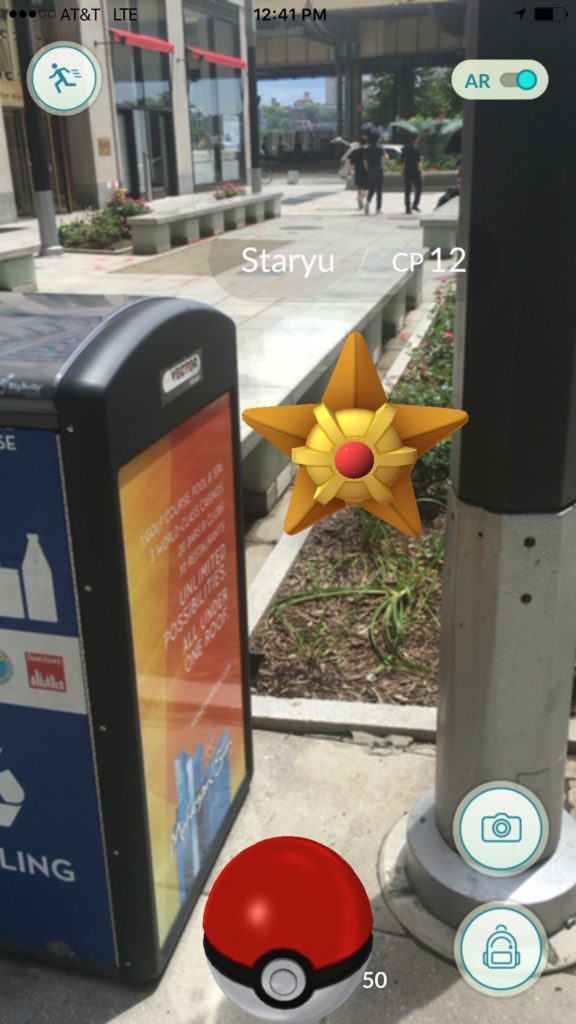
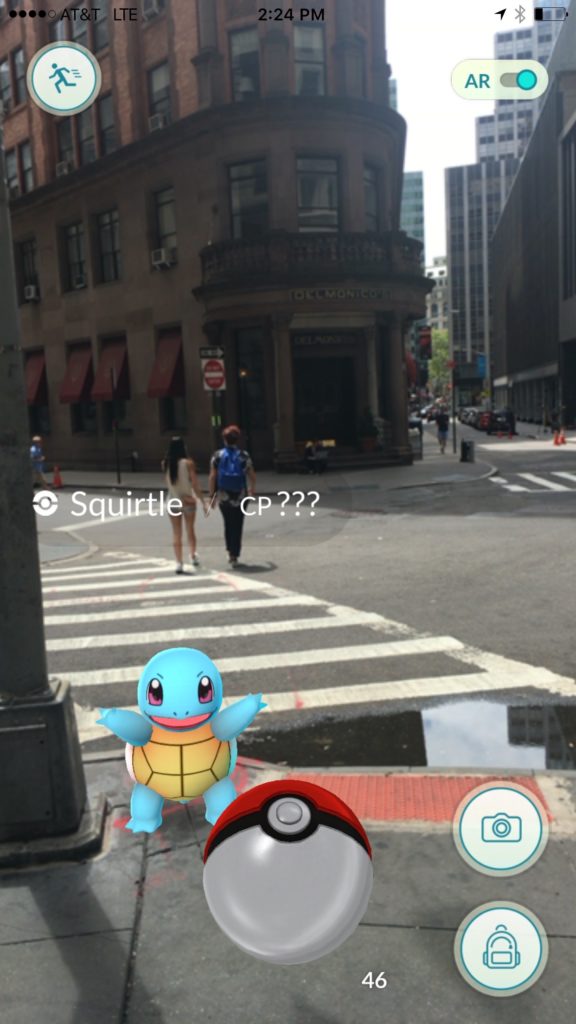
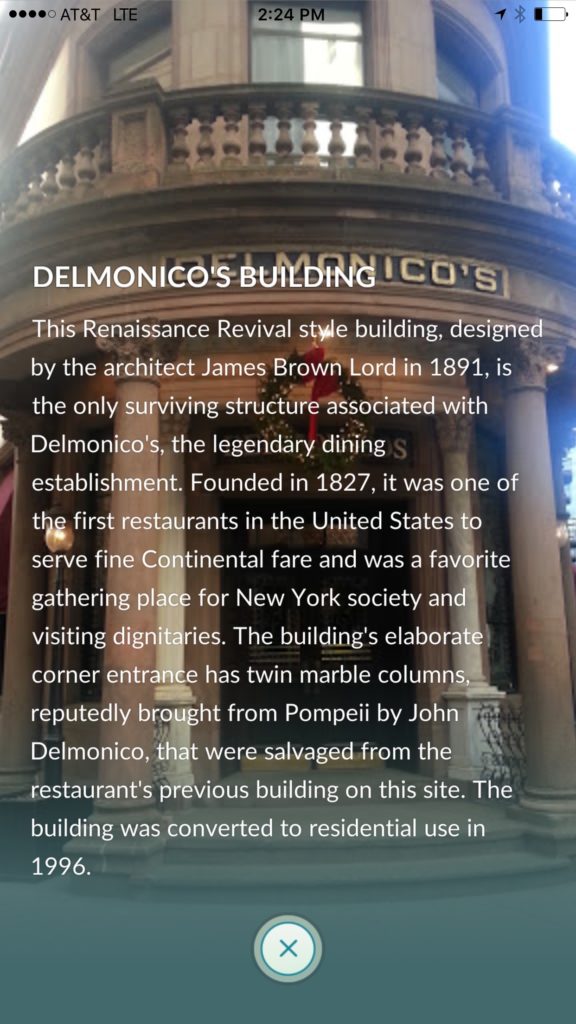
The game provides silly juxtapositions that only history and New York lovers will really appreciate. For instance, it looks like there’s some Squirtle on the menu at old Delmonico’s Restaurant:
At this point, you may be wondering — doesn’t this all seem sort of dangerous? People wandering the streets, staring at their phones, swiping rapidly to capture a nonexistent entity ghoulishly hovering upon a sidewalk that actual people are walking? Indeed there are manypotentialhazards to this game that many people have already identified.
How did an international game developer identify such specific and locally beloved places for a fantasy game?  Niantic basically took the information from a prior game called Ingress which was created from user submissions.
And that’s what makes this app a particular pleasure for use in a big city, where neighborhoods might have had dozens of users populating Niantic’s databases. (I’d be very curious to see how enjoyable this experience is in a rural area.) Not all the landmarks have historical descriptions attached to them, but almost all were at least identified by a regular visitor to that place, perhaps even a neighbor.
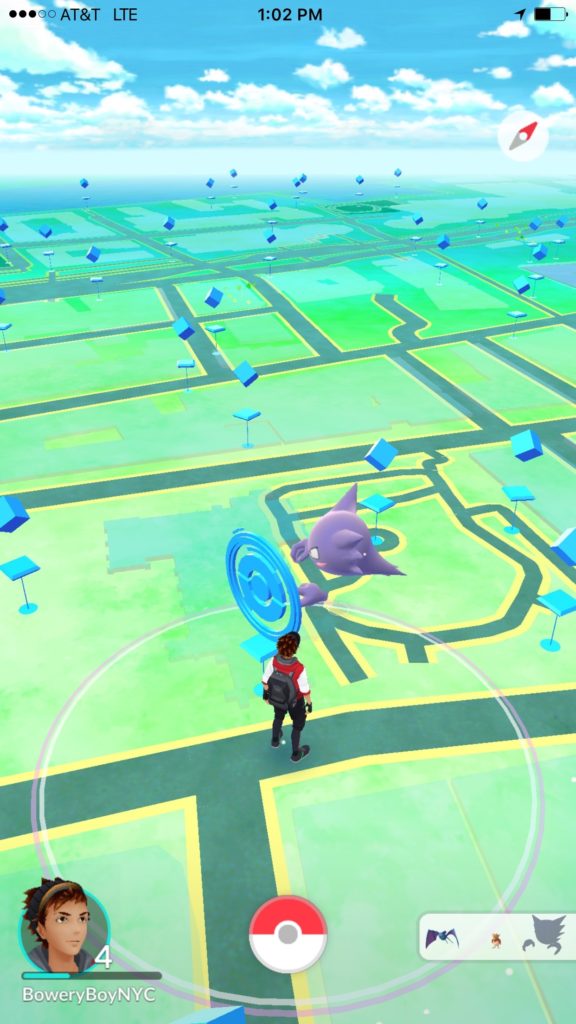
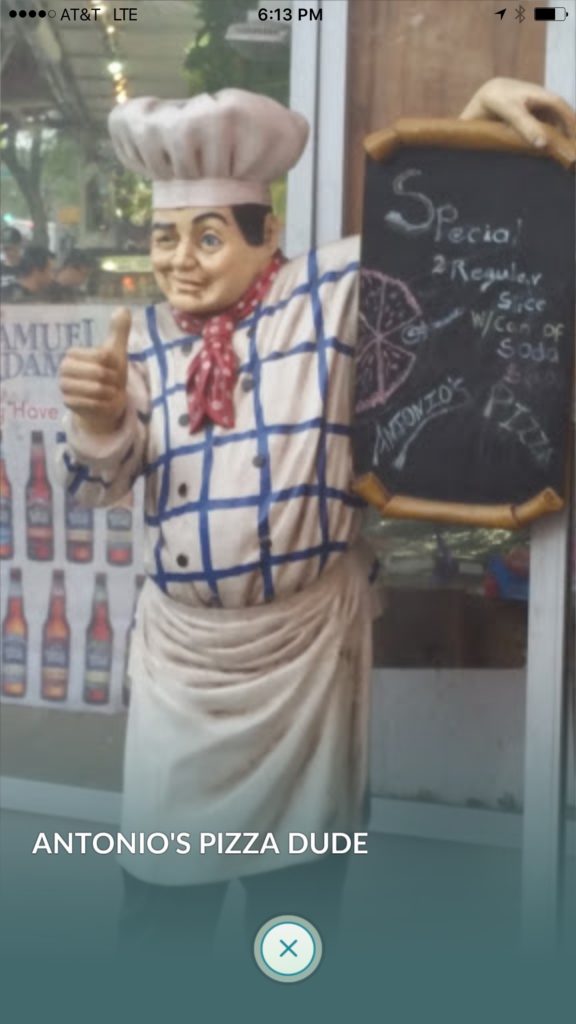
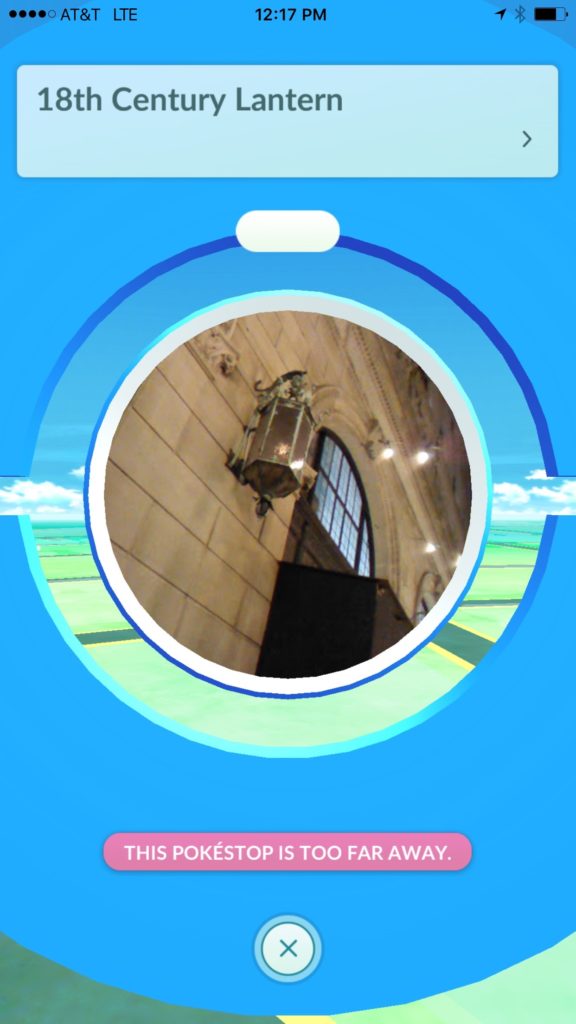
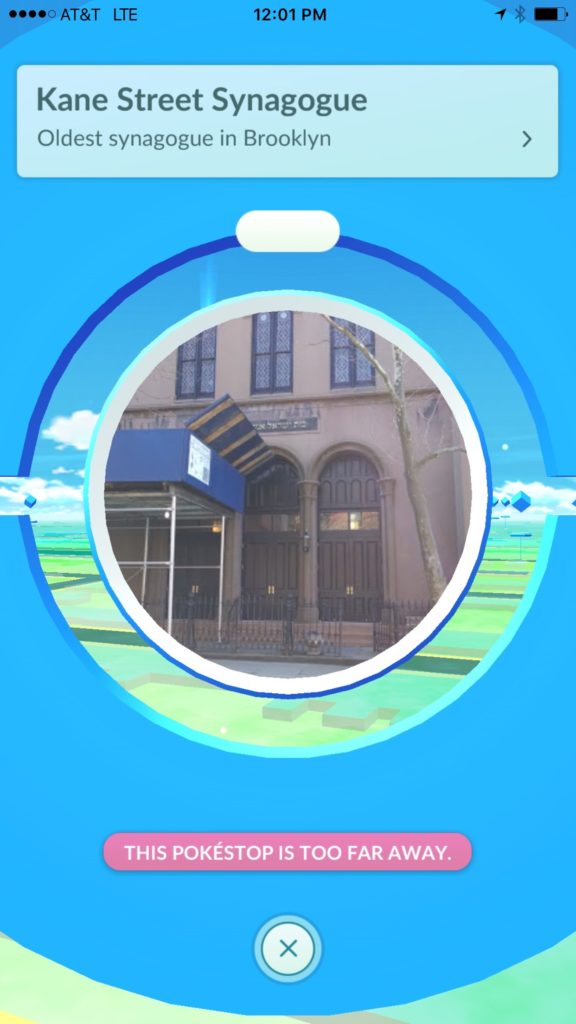
How else to explain such curious oddities as these (from Wall Street and Cadman Plaza, respectively)?
Of course, naysayers might immediately point out that the landmarks are only being used for game purposes and users aren’t expected to really interact in any meaningful way. And should we really be encouraging MORE walking and phone gazing? But even if most people just skitter away after collecting their virtual items, a few people may stop and pay attention. At very least, ignoring the gaming aspect entirely and using the app merely for its locations makes for a great scavenger hunt with your friends.
(You can actually check out all the blue squares from the comfort of your couch, but they can only be used for gameplay if you’re near, thus the message in pink above.)
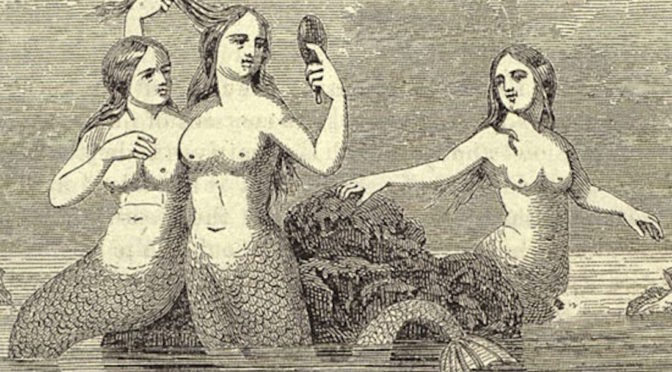
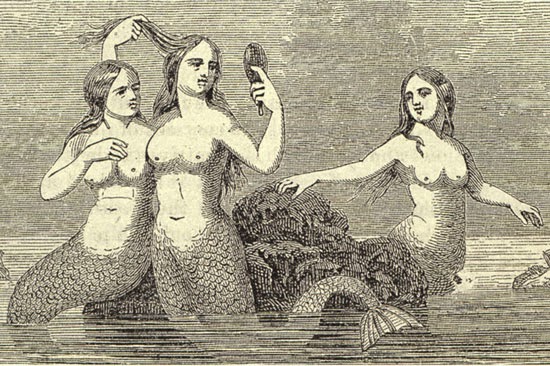
Today let’s give a little love to New York original mermaid queen — the hideous Fiji (Fejee) Mermaid!
This sickening Frankenstein monster — comprising a monkey’s head sewn onto a fish torso — was displayed in  PT Barnum’s American Museum off and on for almost twenty years.  Believe it or not, Barnum actually leased it from an owner who had bought it off of sailors.  It’s actual connection to the Fiji Islands remains tenuous at best.
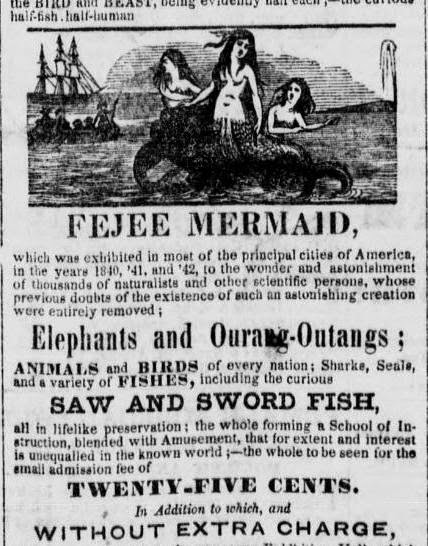
“[M]any naturalists and scientific men who have examined it assert that it is absolutely the work of Nature. Others however insist that its existence is a natural impossibility. Â When doctors disagree, the PUBLIC must decide.”
Here’s how the mermaid was advertised in the newspapers:
This is what it actually looked like:
This was classic Barnum bait-and-switch. Â In fact, he relied on the artifact’s somewhat disappointing appearance to give it a bit of authenticity. See, why would I fake something that looked like this? was the implication.
The mermaid first arrived in New York in November 1842 after a smash debut in Boston,”where her ladyship [referring to the mermaid] has astonished thousands of visitors.” Â Thousands flocked to Barnum’s display at a space called Concert Hall (at 404 Broadway) to take in a glimpse of this bizarre creature. Â In its first week at the American Museum, Barnum raked in three times his average revenue.
From Barnum’s autobiography: “The public appeared to be satisfied, but as some persons always will take take things literally, and make no allowances for poetic license even in mermaids, an occasional visitor, after having seen the large transparency in front of the hall, representing a beautiful creature half woman and half fish, about eight feet in length, would be slightly surprised in finding that the reality was a specimen of dried monkey and fish that a boy a few years old could easily run away with under his arm.”
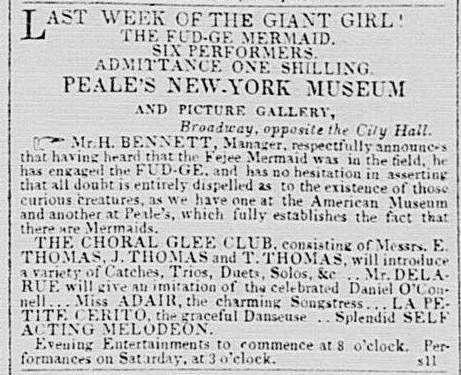
So popular was the exhibit that the old museum of Rubens Peale in today’s City Hall Park debuted its own mermaid, a parody monster called the Fud-Ge Mermaid:
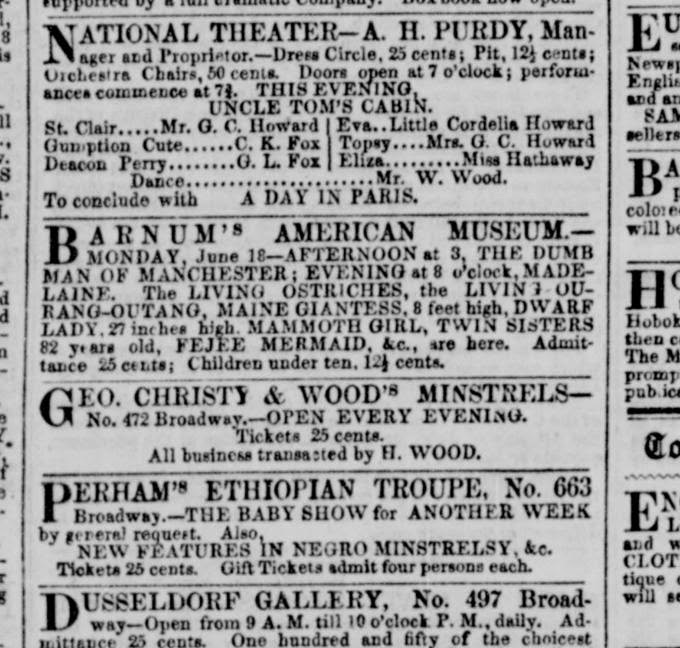
By the 1850s, the Fejee Mermaid was one of a cast of oddities featured at Barnum’s museum. By this point, the grotesque object was probably a commons sight for regular museum goers. Â I imagine it, perhaps, with a light coating of dust, possibly a cobweb. Â Below: An advertisement from the Daily Tribune, 1855:
Whatever became of the mermaid? Â Some say she disappeared during a fire at the museum. Â I’m not sure she was still there when Confederate spies attempted to burn down the museum on November 25, 1864. Â But she lives on as an icon of fabulous hoax, “one of the most scientific fakes ever perpetrated upon the American public.” [source]
And she lives on in our hearts. How can you resist a face like that?
Top image courtesy the Lost Museum (CUNY), an excellent online resource about Barnum’s American Museum.
(This article originally ran on this blog in June 2014)
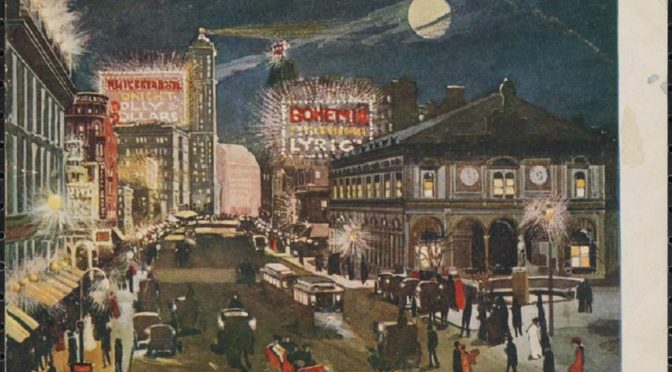
Pictured: The New York Herald newspaper office (in Herald Square, natch) in a flamboyantly colored postcard from 1907. Â The lights of Broadway theaters — many still below 42nd Street — blaze in the background.
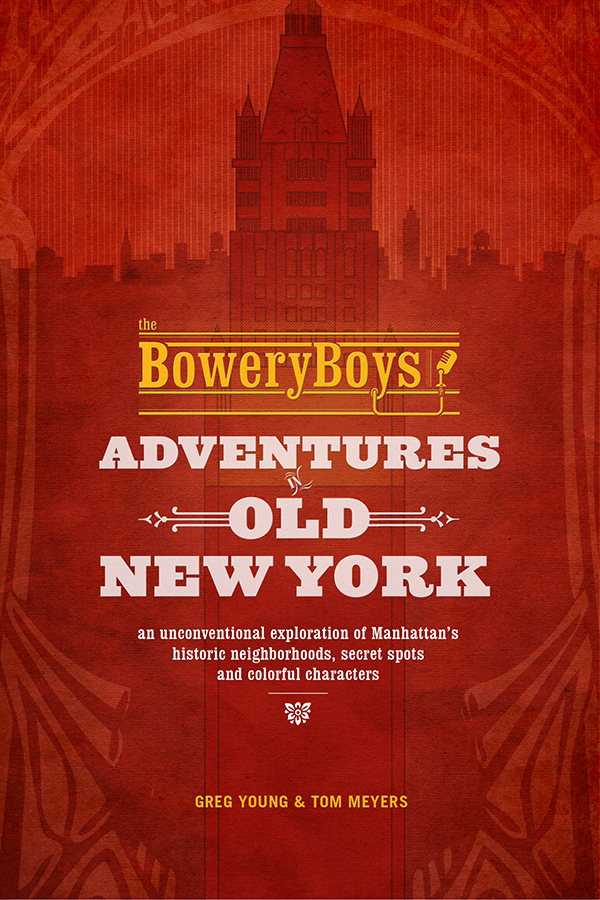
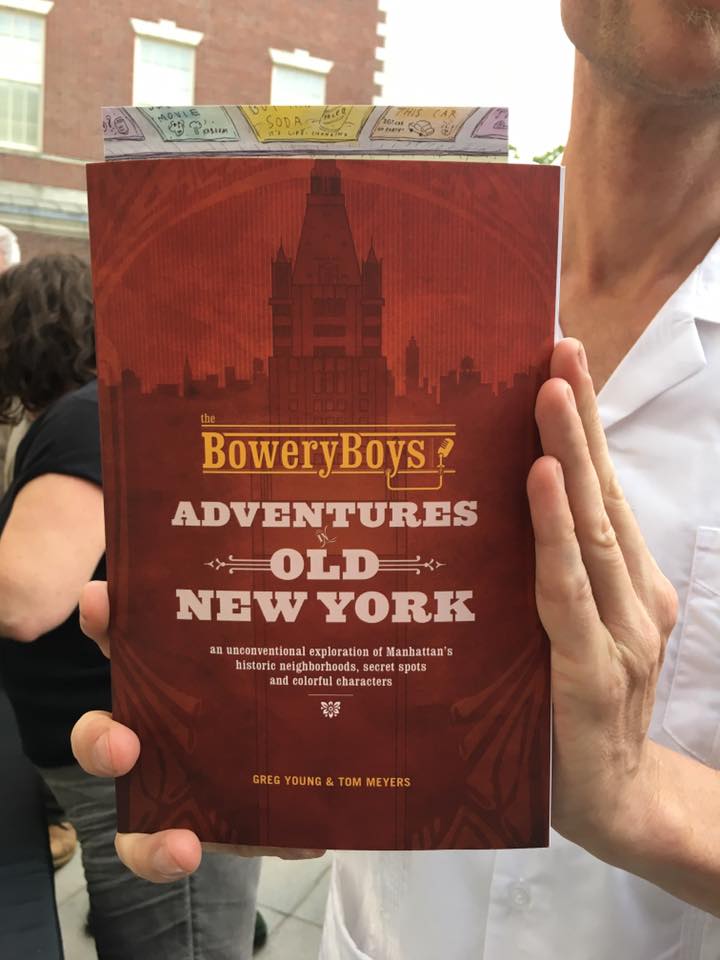
Well, our book Adventures In Old New York is finally out, and we’ve been blessed to have it featured in several newspapers and websites in the past couple weeks. Here’s a rundown of places you can find the Bowery Boys in print and on the web:
I was honored to interviewed by Bill Schulz for his piece for the New York Times on one tragic reminder of the General Slocum Disaster —Small Relics of a Colossal Disaster
And last but not least, Story Trail interviews me about one of the more unusual New York City experiences in my life, regarding a break-up, some cold medicine, and the filming of Godzilla — My CurioCity: Greg Young, Godzilla and Madison Square Park
Â
And more to come throughout the summer of course! Our thanks to these publications for taking time to meet with us and share our joy of New York City history.
Image at top courtesy Museum of the City of New York. Photo of the Bowery Boys courtesy Benjamin Stone Photography
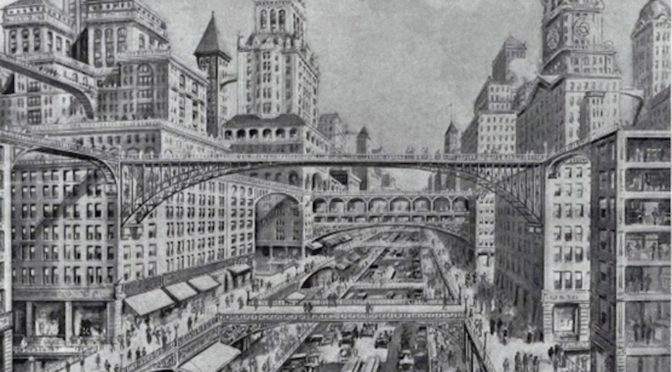
Imagine a city where the High Line isn’t just a novel park, but the primary form of urban conveyance.
In 1913, with the proliferation of the automobile, it seemed humans were being crowded out at ground level.  People were beginning to think of themselves as removed from the street.  Daredevils were experimenting with flight, and small, single-man crafts began appearing over the skies of Manhattan.  The world’s tallest building, the Woolworth Building, had been completed a few months before.  Perhaps the streets themselves could elevate, granting pedestrians a space of their own?
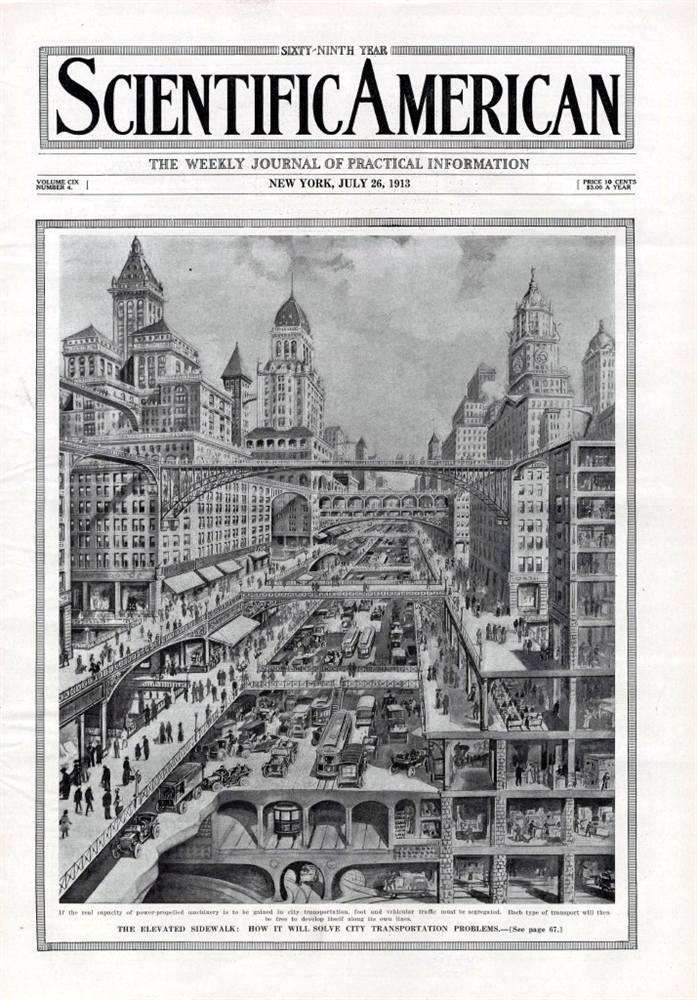
Scientific American suggested the possibilities of a city of elevated layers in its July 26, 1913 issue. “The Elevated Sidewalk: How It Will Solve City Transportation Problems,” written by engineer and science writer Henry Harrison Suplee, posits that humans and automobiles are simply incompatible and opposing engines upon ground level, and that one will have to give way to the other.
“One of the greatest impediments to city transport today is the continuance of the obsolete method of attempting to conduct foot and vehicular traffic upon the same highways.”
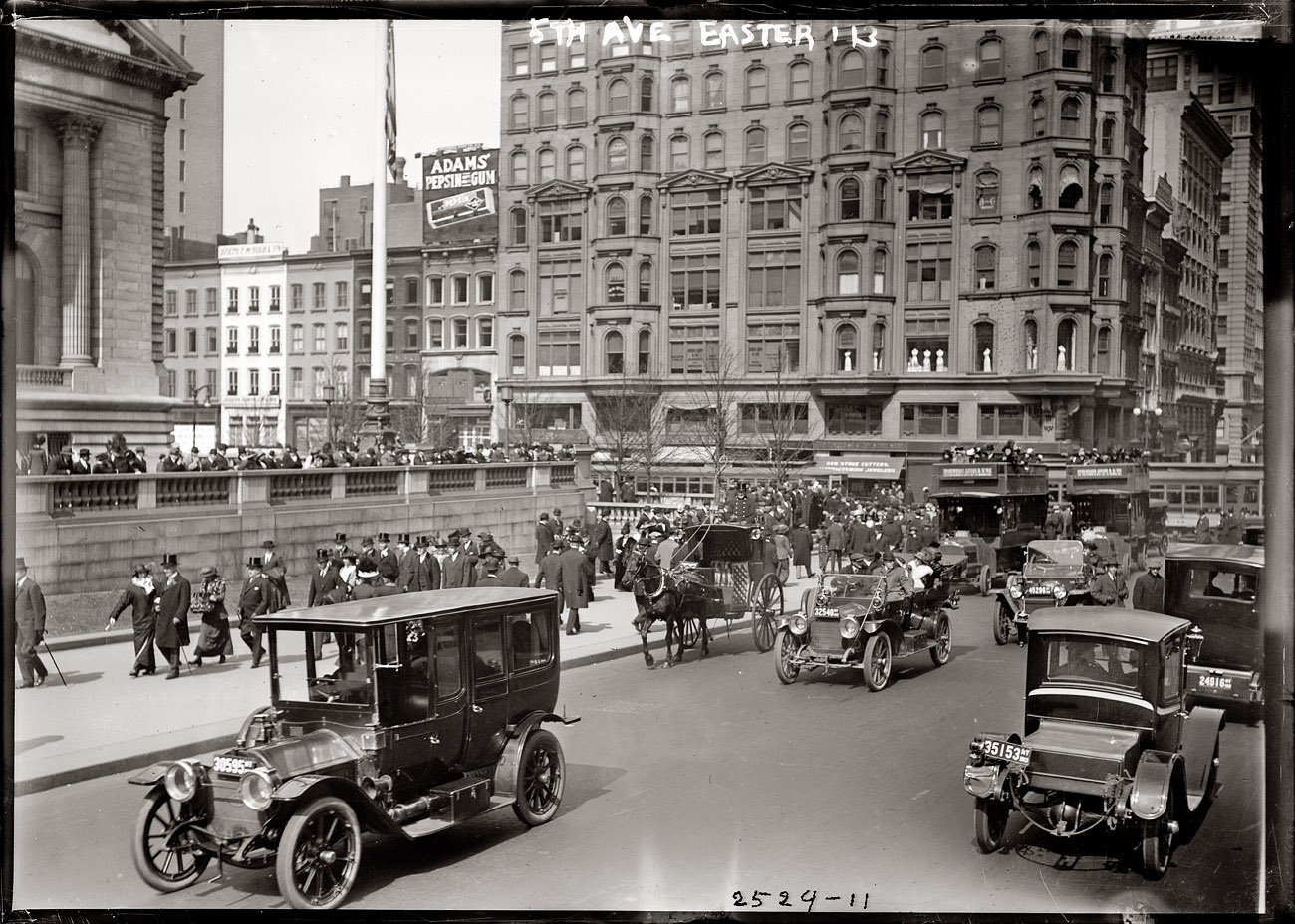
Below: Cars and people seem to co-exist peacefully on Fifth Avenue (pictured here in 1913). But, darn it, automobiles are meant to go fast!Â
Courtesy Shorpy
After all, cars are meant to go fast. Â “In nearly every large city today there appears a tendency to enforce traffic regulations intended to permit the most conflicting elements to be operated together and the result is naturally the impeding of the very traffic which it is desired to help.”
By keeping people and automobiles on the same plane, one risks lives, sure, but more importantly, it slows progress by keeping the potential of auto motion on a short leash.
Suplee’s solution: “Take the foot passengers off the surface of the street entirely, and leave the highways solely for vehicles!”
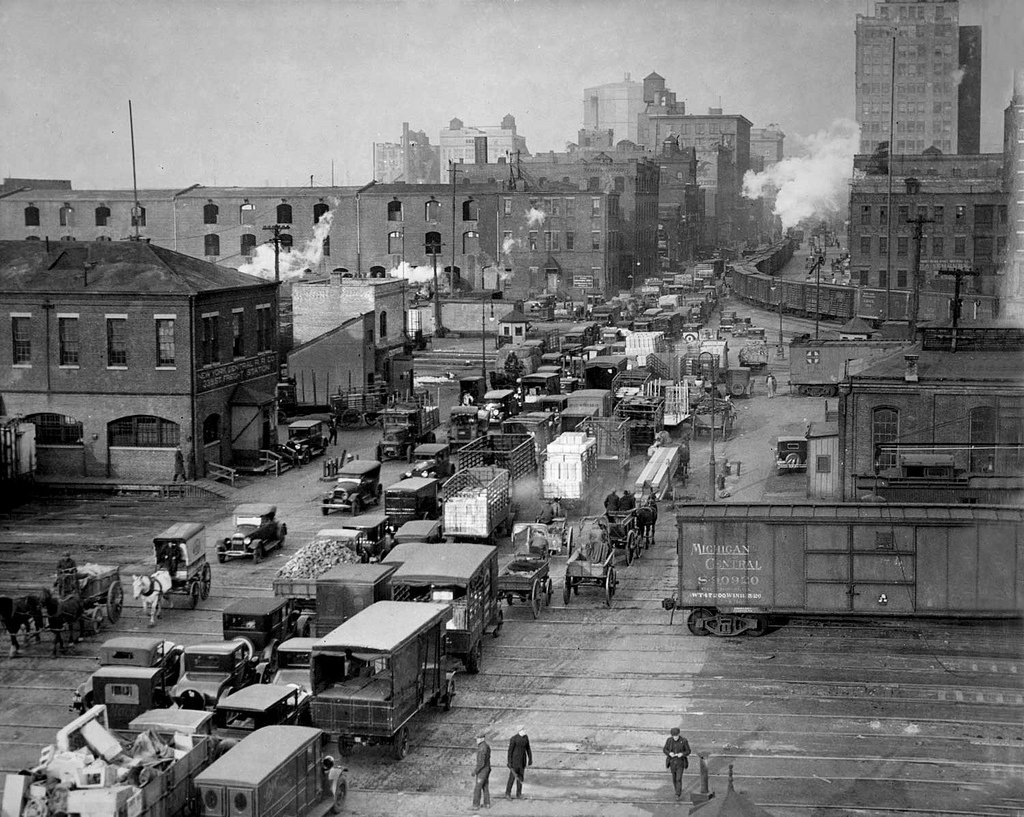
Below: Evidence of the incompatibility of foot and automobile was being amply displayed all over New York City, most notably on “Death Avenue,” the trecherous tangle of roads on Manhattan’s West Side. Eventually the elevated freight railroad today known as the High Line was built to relieve this issue.
New York had many precedents for this. Â The great passages over the East River (the Brooklyn, the Williamsburg and Manhattan bridges) had all been completed with elevated pathways for pedestrians, situated over or alongside those paths for vehicular traffic. Â Trains were either elevated overhead along the avenues, or buried underneath the ground.
Suplee doesn’t imagine a world were pedestrians become smarter, or any type of place with sophisticated traffic lights or crosswalks. Â Instead, elevated sidewalks would hover over the major thoroughfares; “[S]uch sidewalks might be built on Broadway from the Battery to Union Square, there sloping down to the surface level until further extensions were required,” he writes.
In a city of skyscrapers, bridges could be constructed several stories above the street. Â Store fronts would appear on the second or third floors, while the ground floor would be exclusively used for delivery and store. Â Life would essentially reside many feet above the ground.
Bicycles figure nowhere in his model, but he does carve out one exception to his pedestrian only level. Â “The power vehicles should be kept absolutely to the surface, and there given unrestricted facilities for speed, weight, and numbers; and the foot levels maintained for absolute freedom for pedestrians, with the possible exception of carriages for small children.”
As commenter Boris mentions below, while New York City never adhered to this suggestion, other cities certain did — to a certain extent.
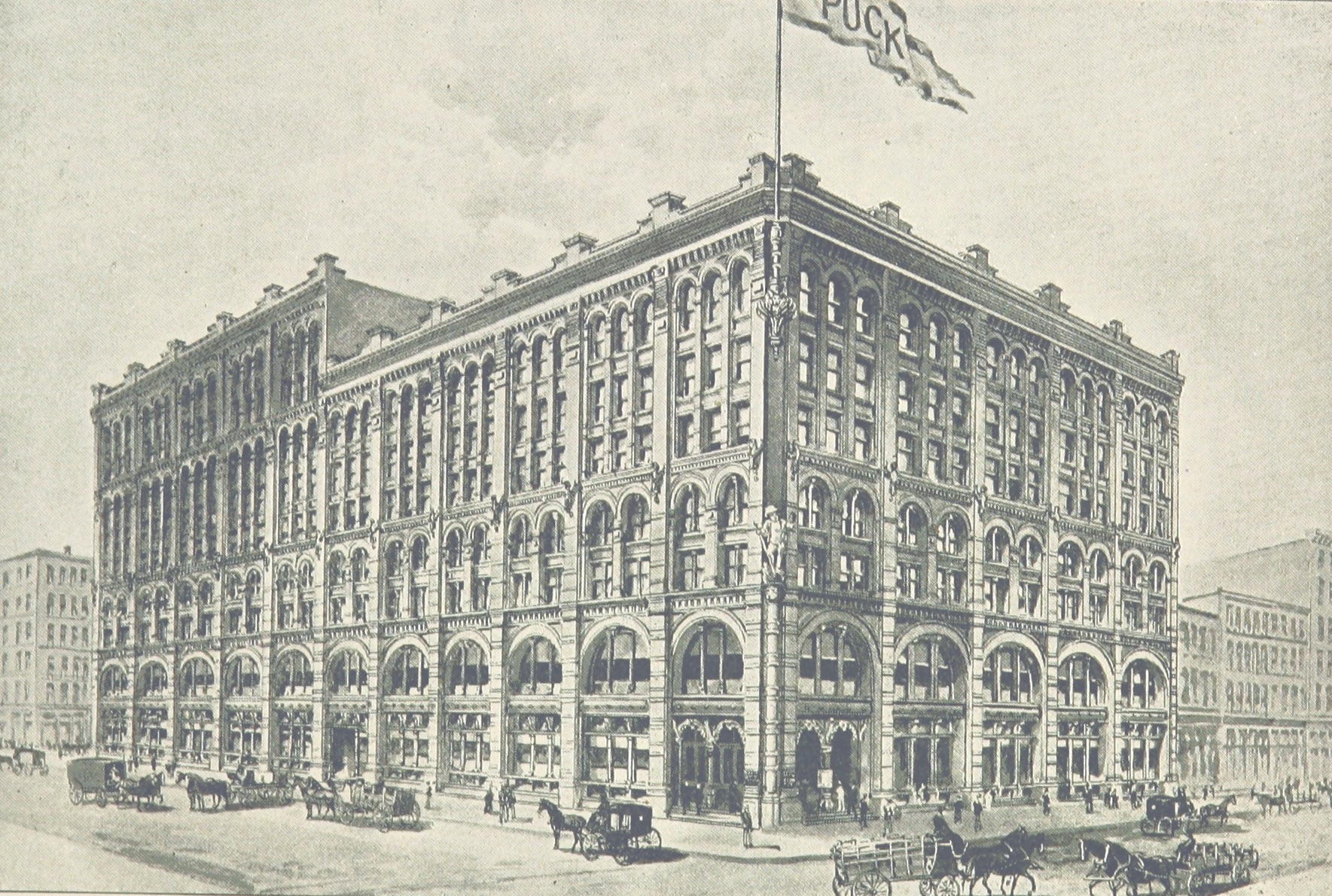
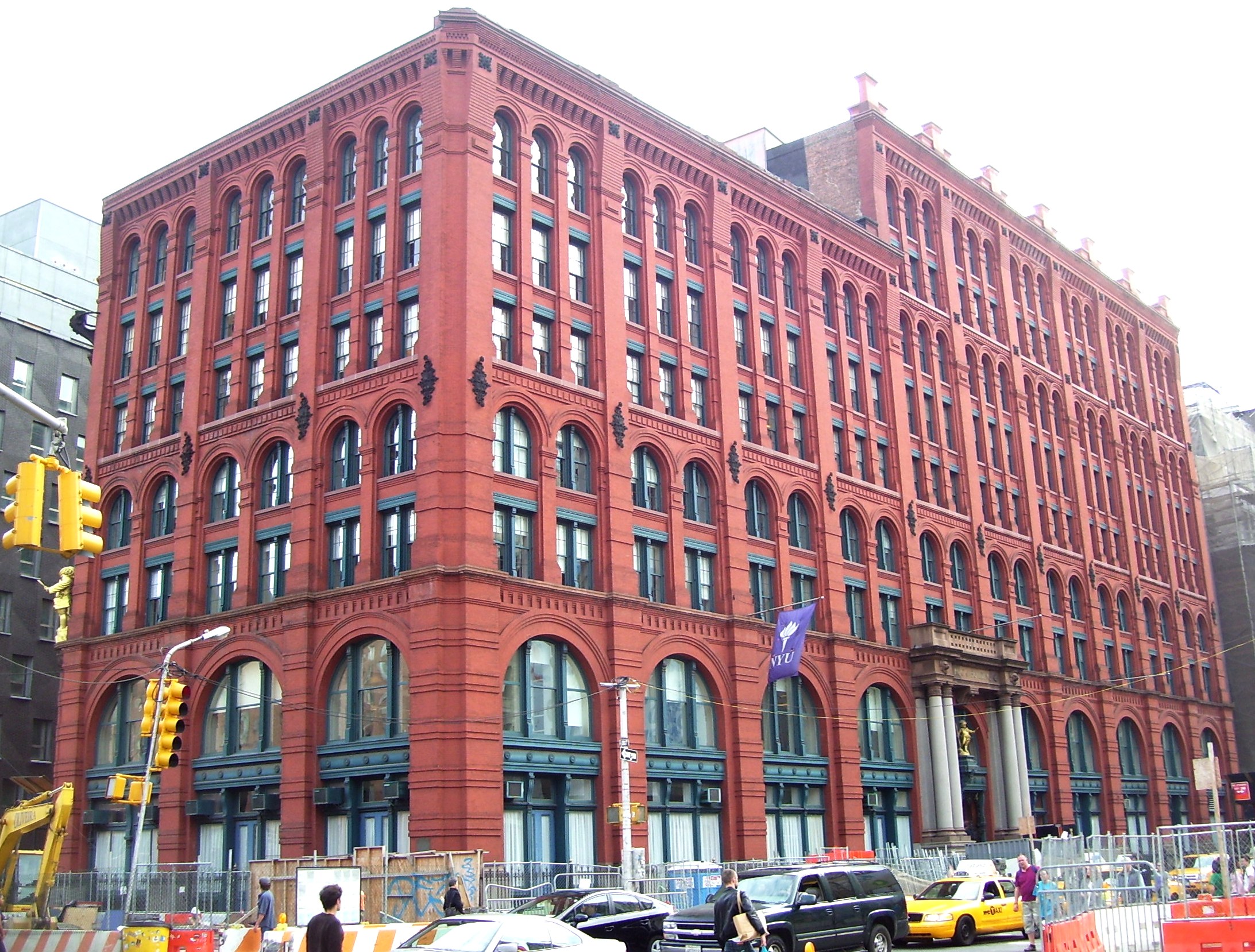
PODCAST Â A 6-foot plump gold impish figure stares down at you as you look up to observe the gorgeous red-brick design of the Puck Building, built for one of the 19th Century’s most popular illustrated publications. But this architectural masterpiece was very nearly wiped away by a sudden decision by the city. How did it survive?
Puck’s utterance “What Fools These Mortals Be!” is the slogan for Puck Magazine and words written by Shakespeare.
WITH several new minutes of material outlining the Puck Building’s recent history!
ORIGINALLY RELEASED APRIL 23, 2009
THIS IS A SPECIAL ILLUSTRATED PODCAST!  Chapter headings with images have been embedded in this show, so if your listening device is compatible with AAC/M4A files, just hit play and a variety of pictures should pop up.  The audio is superior than the original as well. (This will work as a normal audio file even if the images don’t appear.)
The Bowery Boys: New York City History podcast is brought to you …. by you!
We are now producing a new Bowery Boys podcast every two weeks.  We’re also looking to improve the show in other ways and expand in other ways as well — through publishing, social media, live events and other forms of media.  But we can only do this with your help!
We are now a member of Patreon, a patronage platform where you can support your favorite content creators for as little as a $1 a month.
Please visitour page on Patreon and watch a short video of us recording the show and talking about our expansion plans.  If you’d like to help out, there are five different pledge levels (and with clever names too — Mannahatta, New Amsterdam, Five Points, Gilded Age, Jazz Age and Empire State). Check them out and consider being a sponsor.
We greatly appreciate our listeners and readers and thank you for joining us on this journey so far. And the best is yet to come!
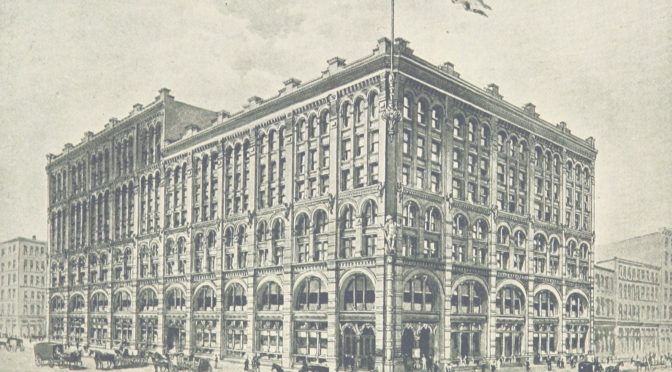
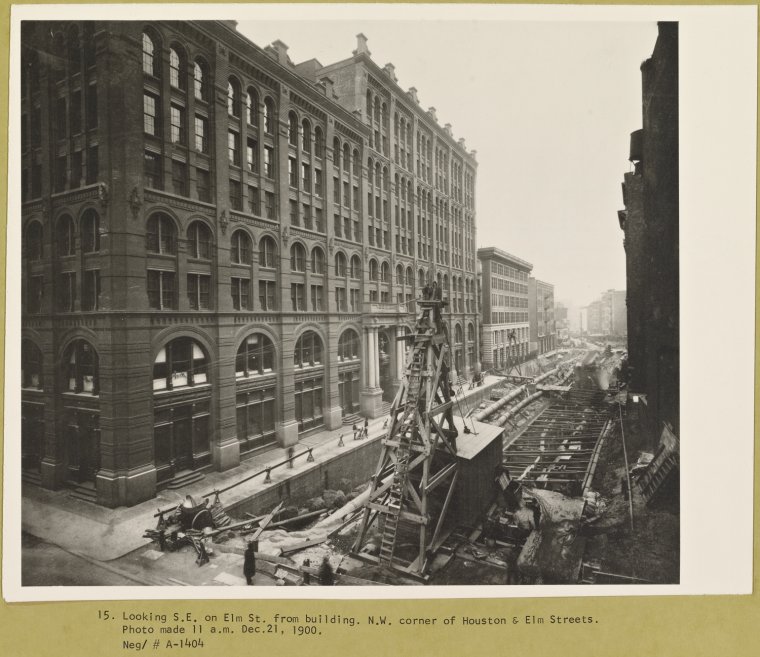
The Puck Building, before the cut — When Lafayette Street was drilled further south, the western part of the Puck had to go…
British Library
After the cut — A new western face greets construction workers building Elm Street (later Lafayette Street)
New York Public Library
Courtesy Beyond My Ken
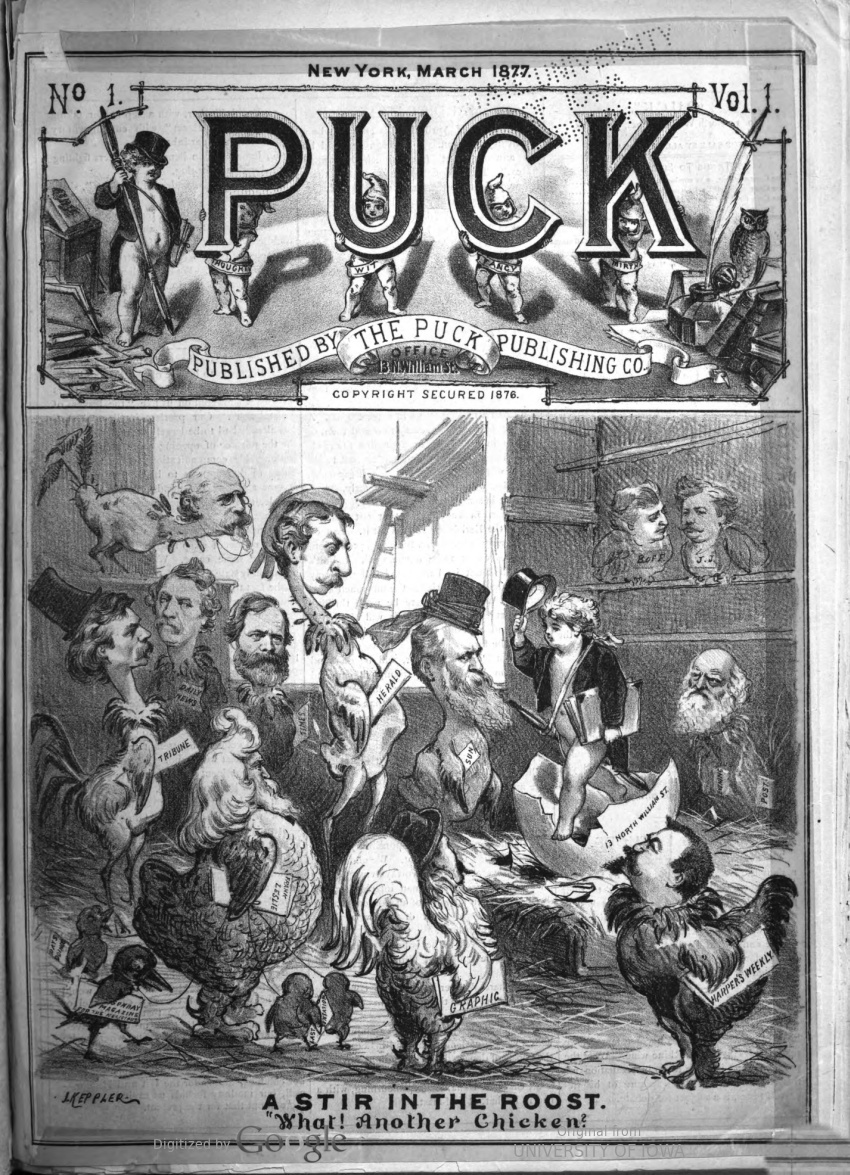
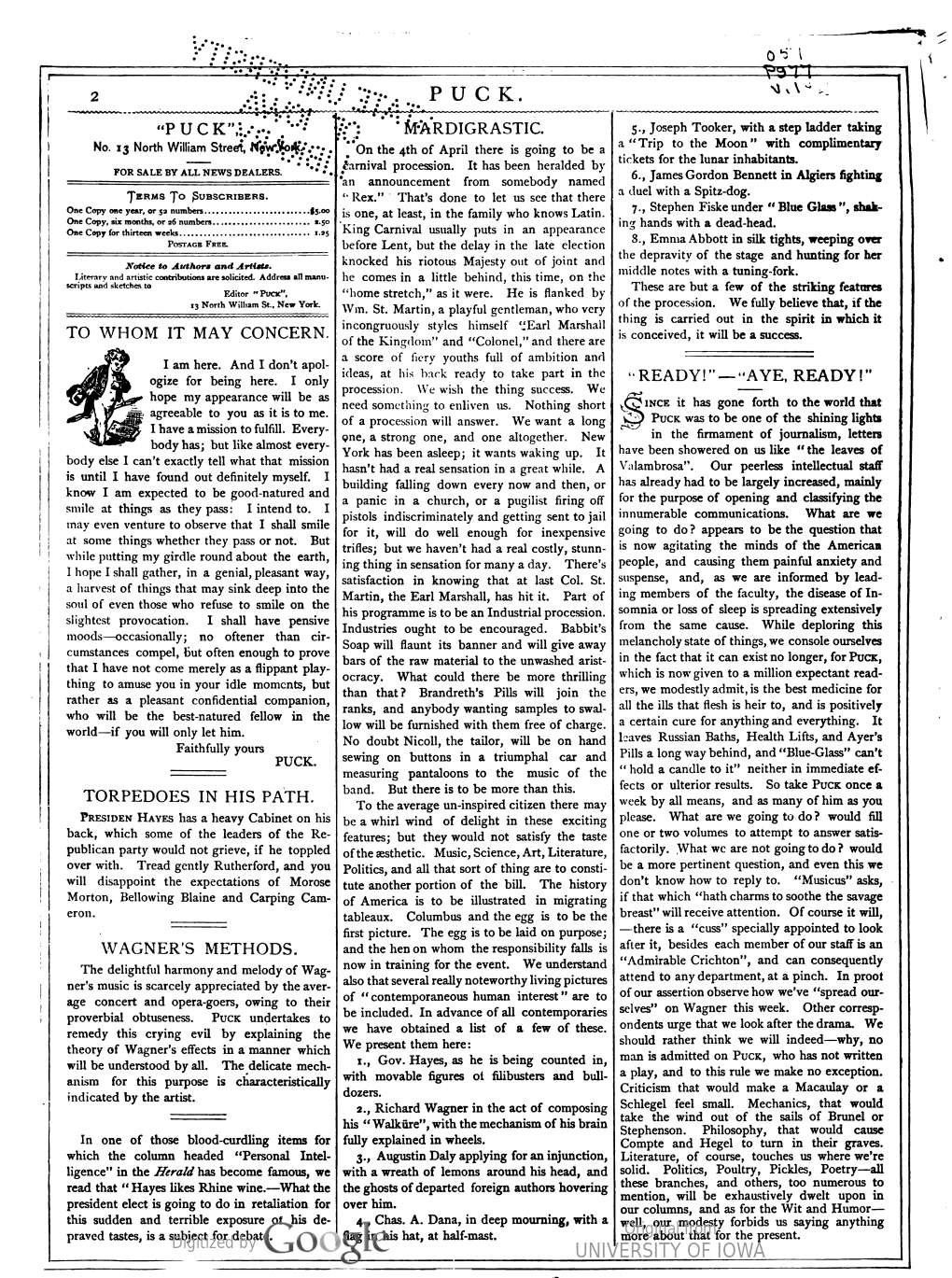
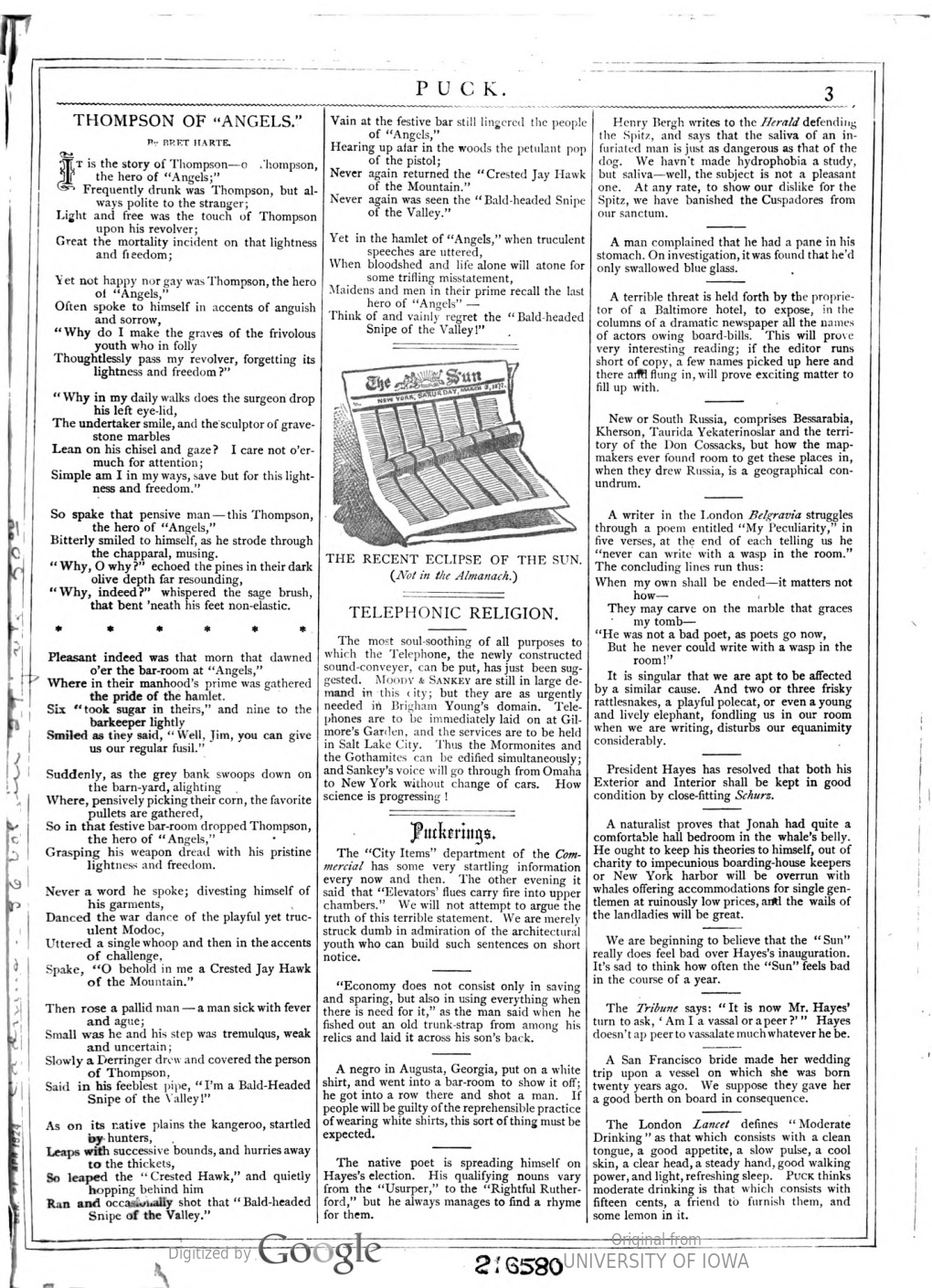
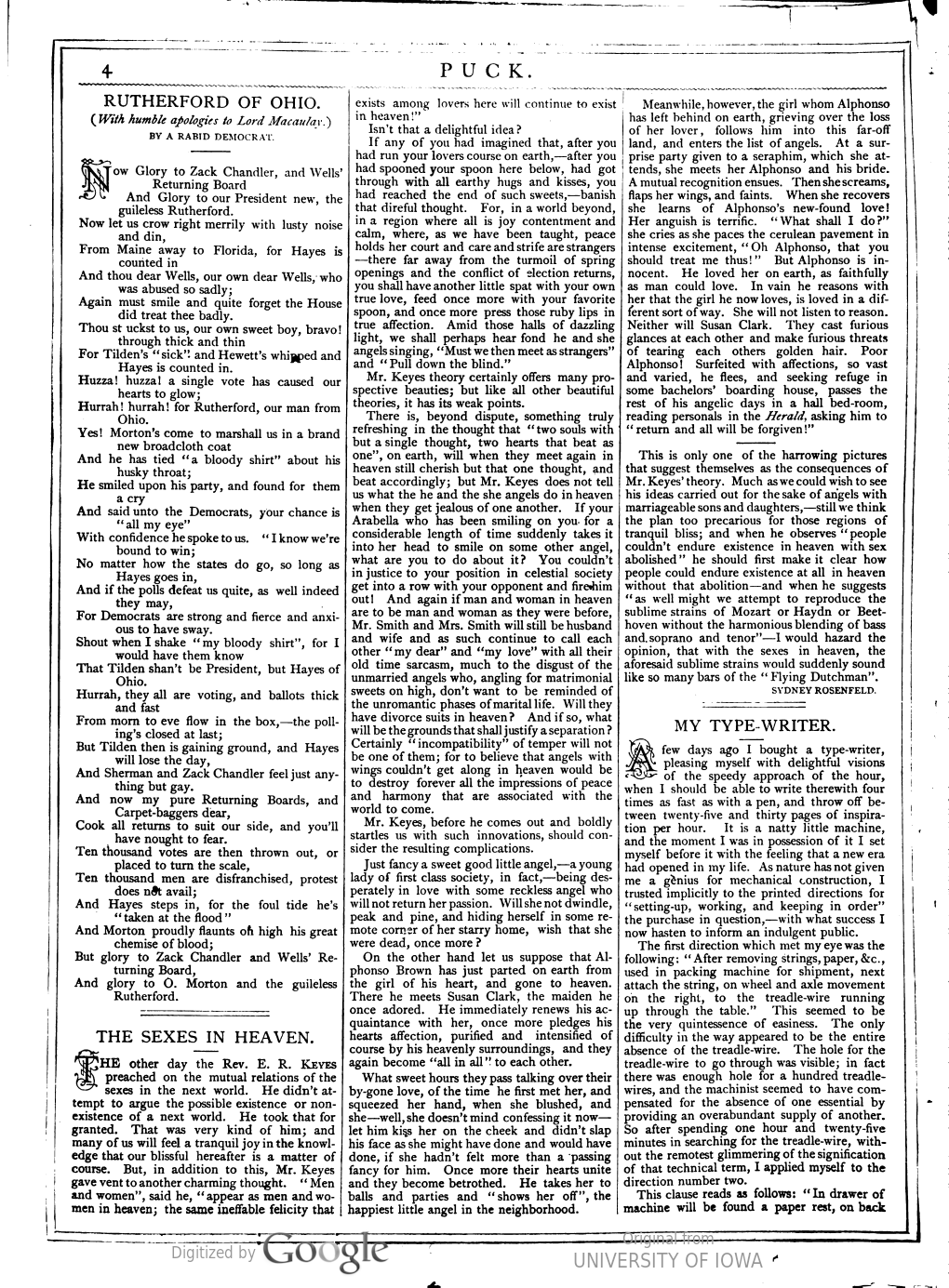
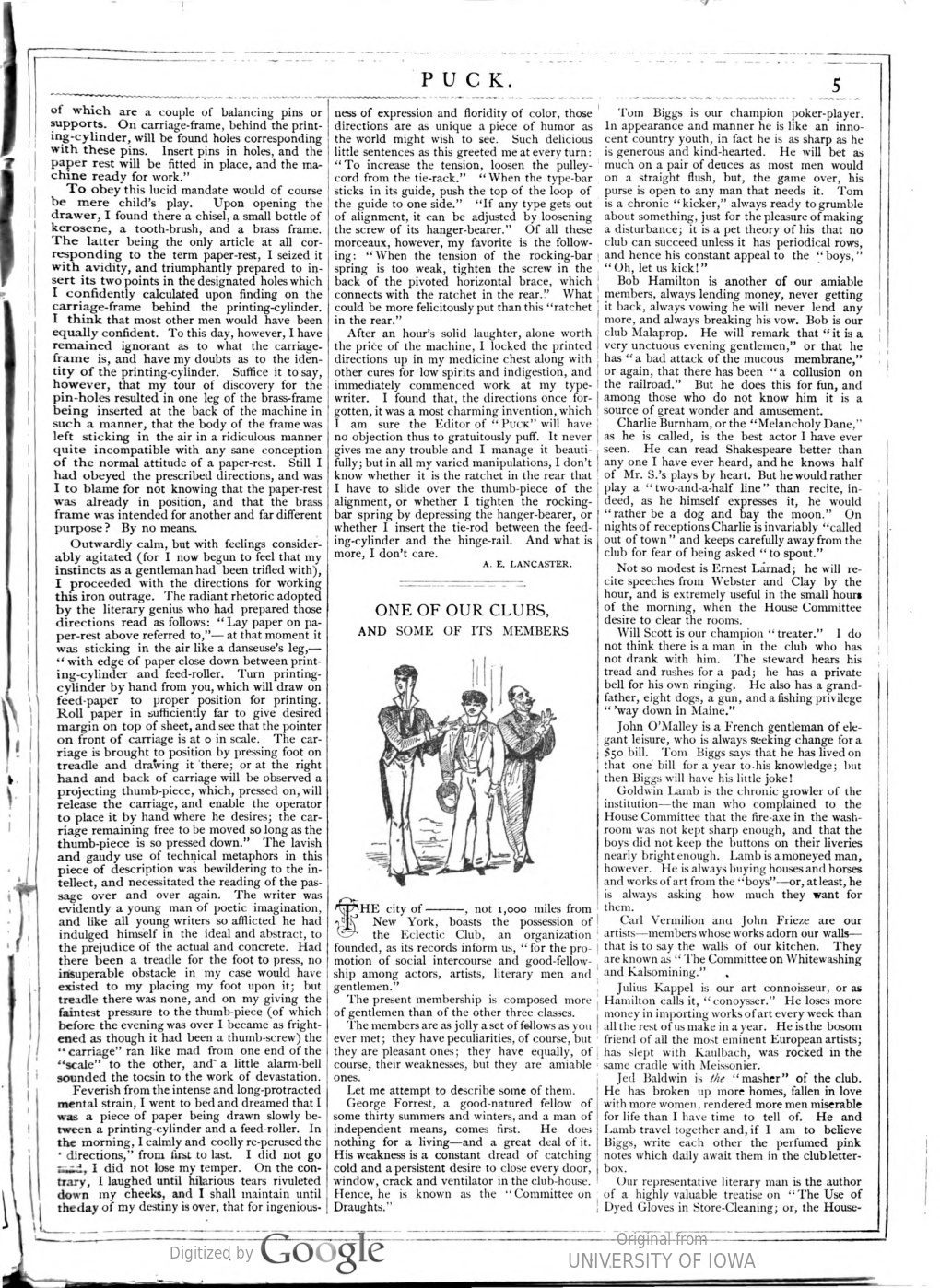
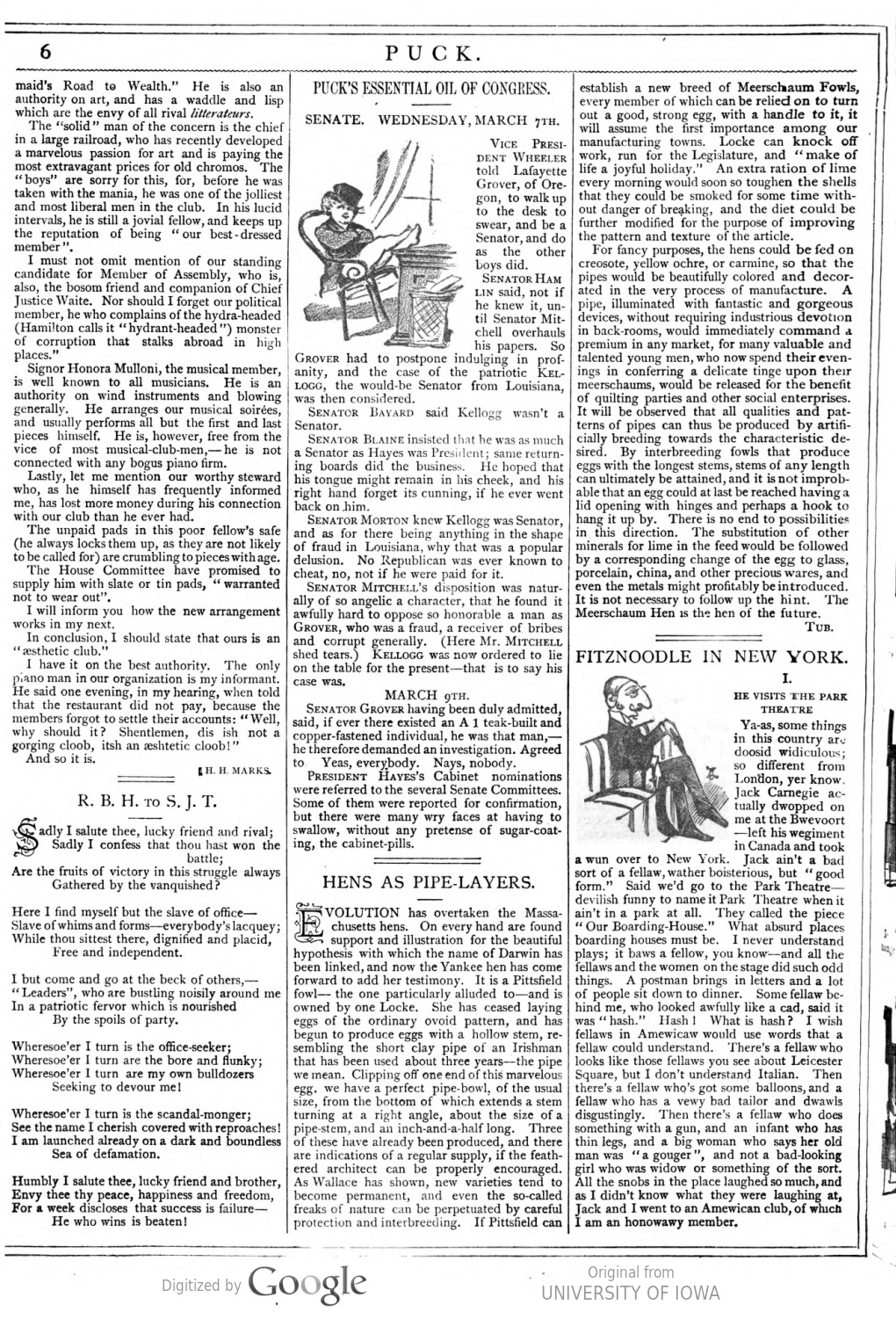
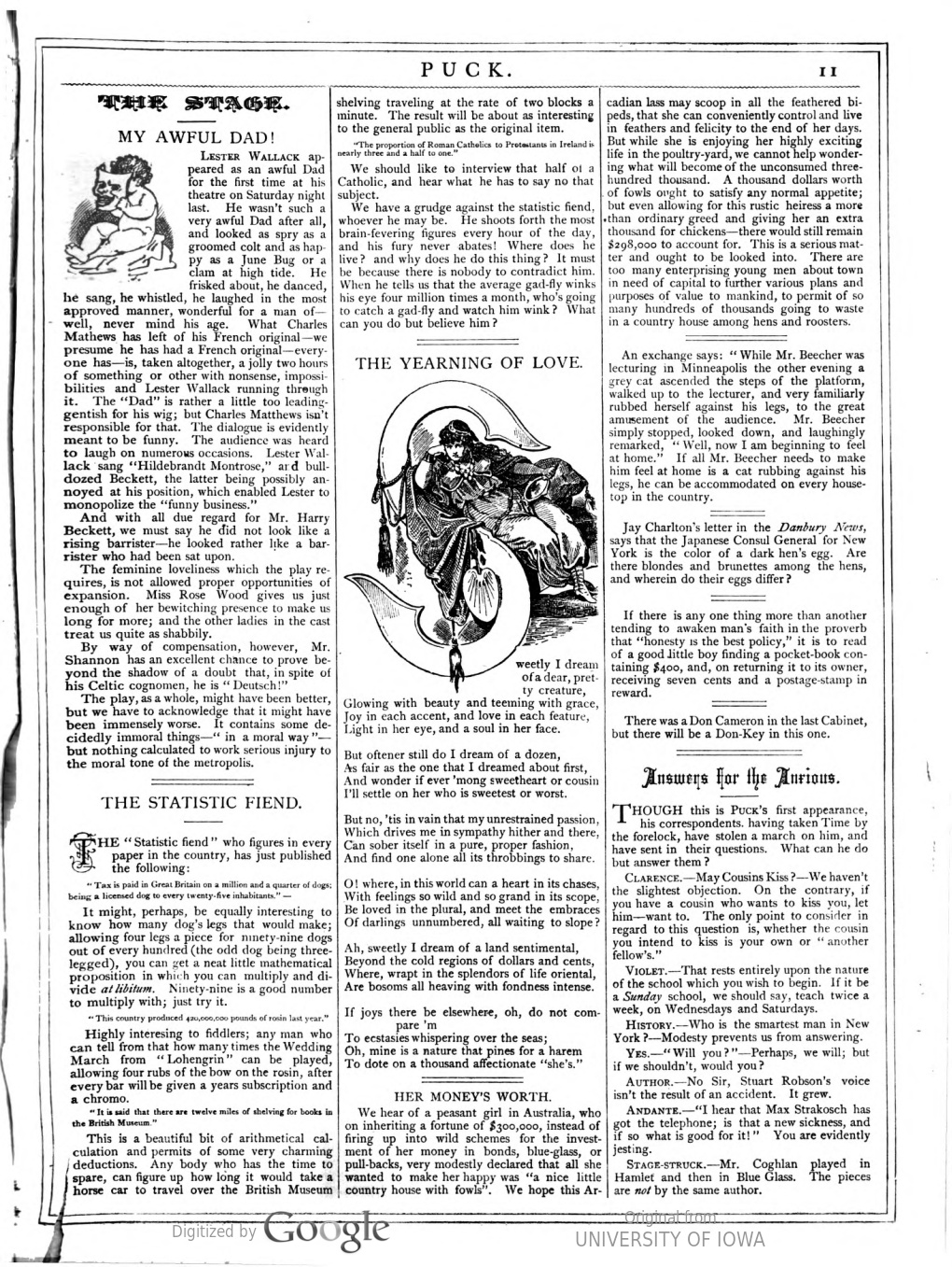
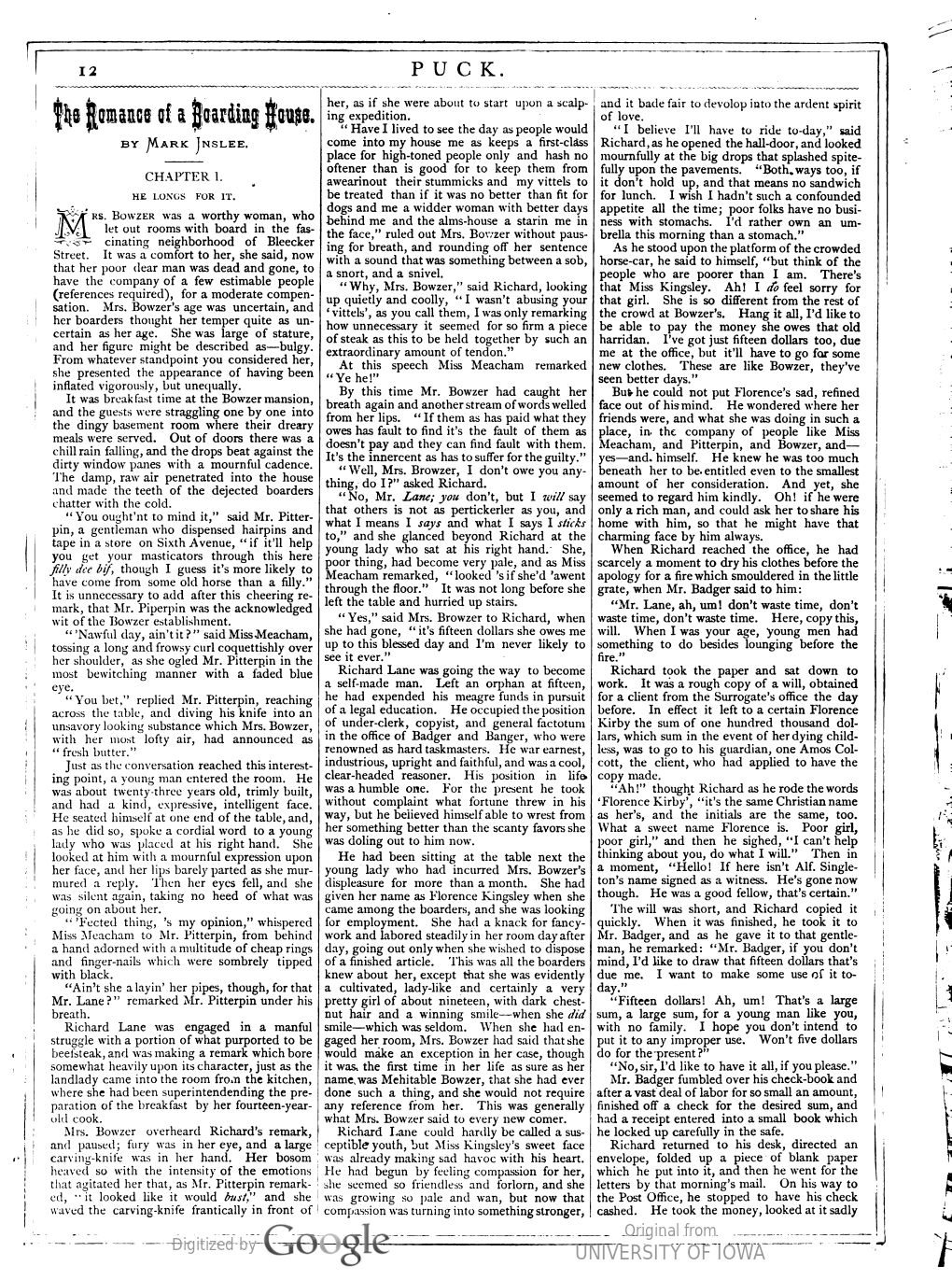
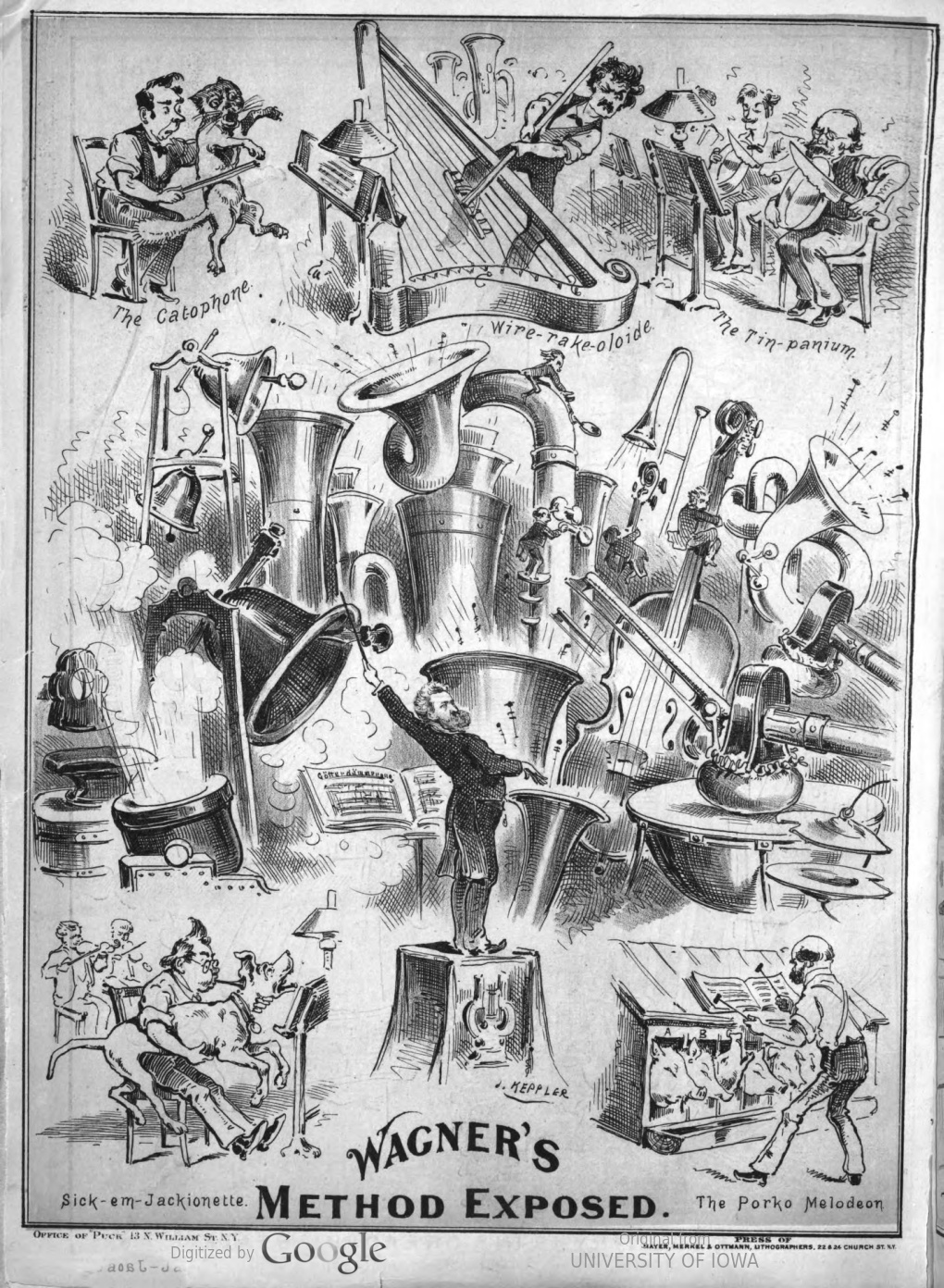
FOR YOUR READING PLEASURE! The entire first issue of the first Puck Magazine produced in New York City. Â (There were of course issues before this one produced in St. Louis.) Â 12 North William Street was the magazine’s address for a brief time before moving into the Puck Building later that year.
This issue is courtesy the Hathi Trust, Google Books and the University of Iowa. Read a whole stack of Puck Magazines from 1877 here:
The cover introduces Puck to the chicken coop of newspapers:
“TO WHOM IT MAY CONCERN:
I am here. Â And I don’t apologize for being here. I only hope my appearance will be as agreeable to you as it is to me. I have a mission to fulfill. Everybody has; but like almost everybody else I can’t exactly tell what that mission is until I have found out definitely myself. Â I know I am expected to be good-natured and smile at things as they pass: I intend to. I may even venture to observe that I shall smile at some things whether they pass or not. But while putting my girdle round about the earth, I hope I shall gather, in a genial, pleasant way, a harvest of things that may sink deep into the soul of even those who refuse to smile on the slightest provocation. I shall have pensive moods — occasionally; no oftener than circumstances compels, but often enough to prove that I have not come merely as a flippant plaything to amuse you in your idle moments, but rather as a pleasant confidential companion, who will be the best-natured fellow in the world — if you will only let him.
Faithfully yours,
PUCK”
“A man complained that he had a pane in his stomach. On investigation, it was found that he’s only swallowed blue glass.”
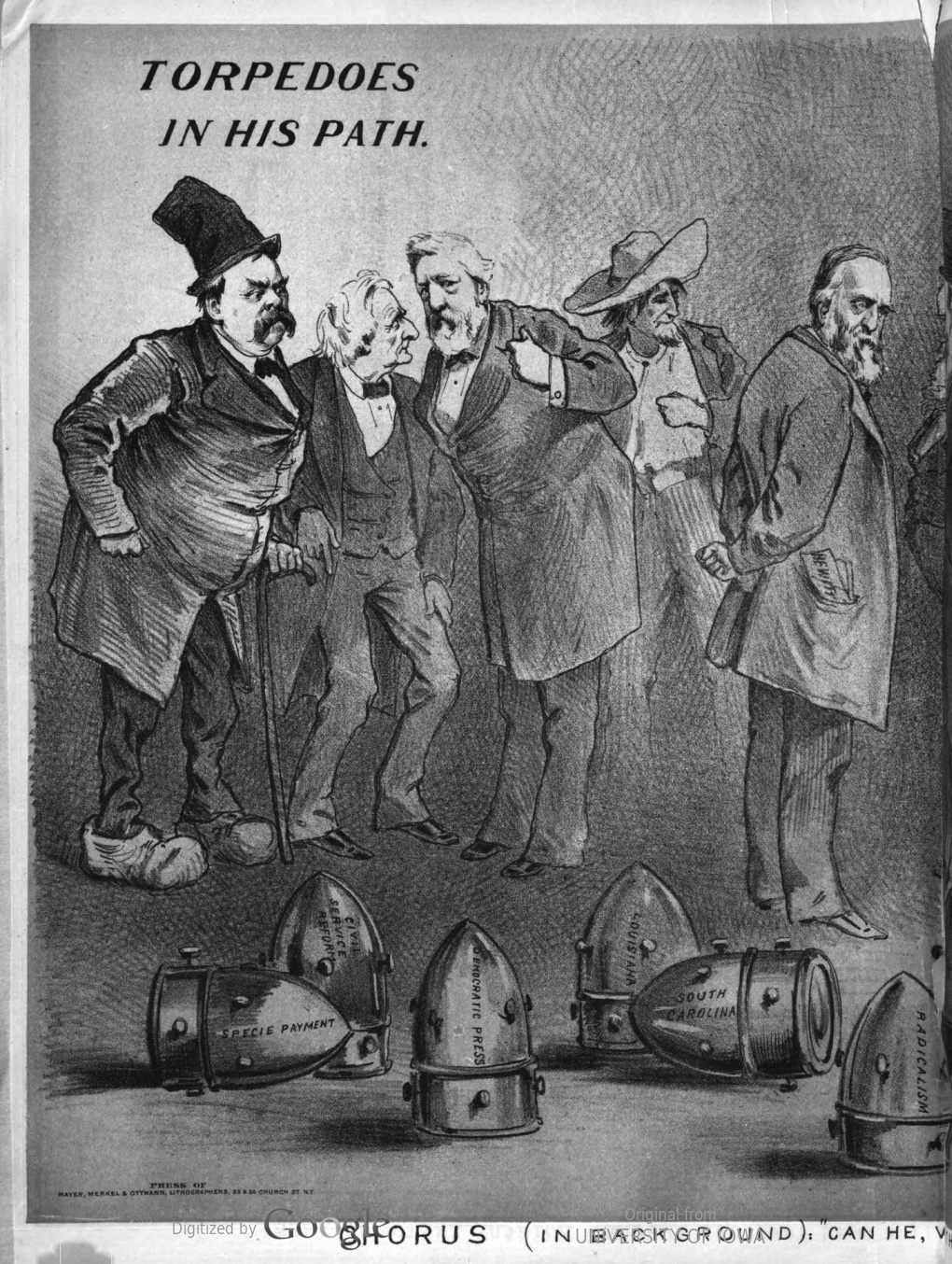
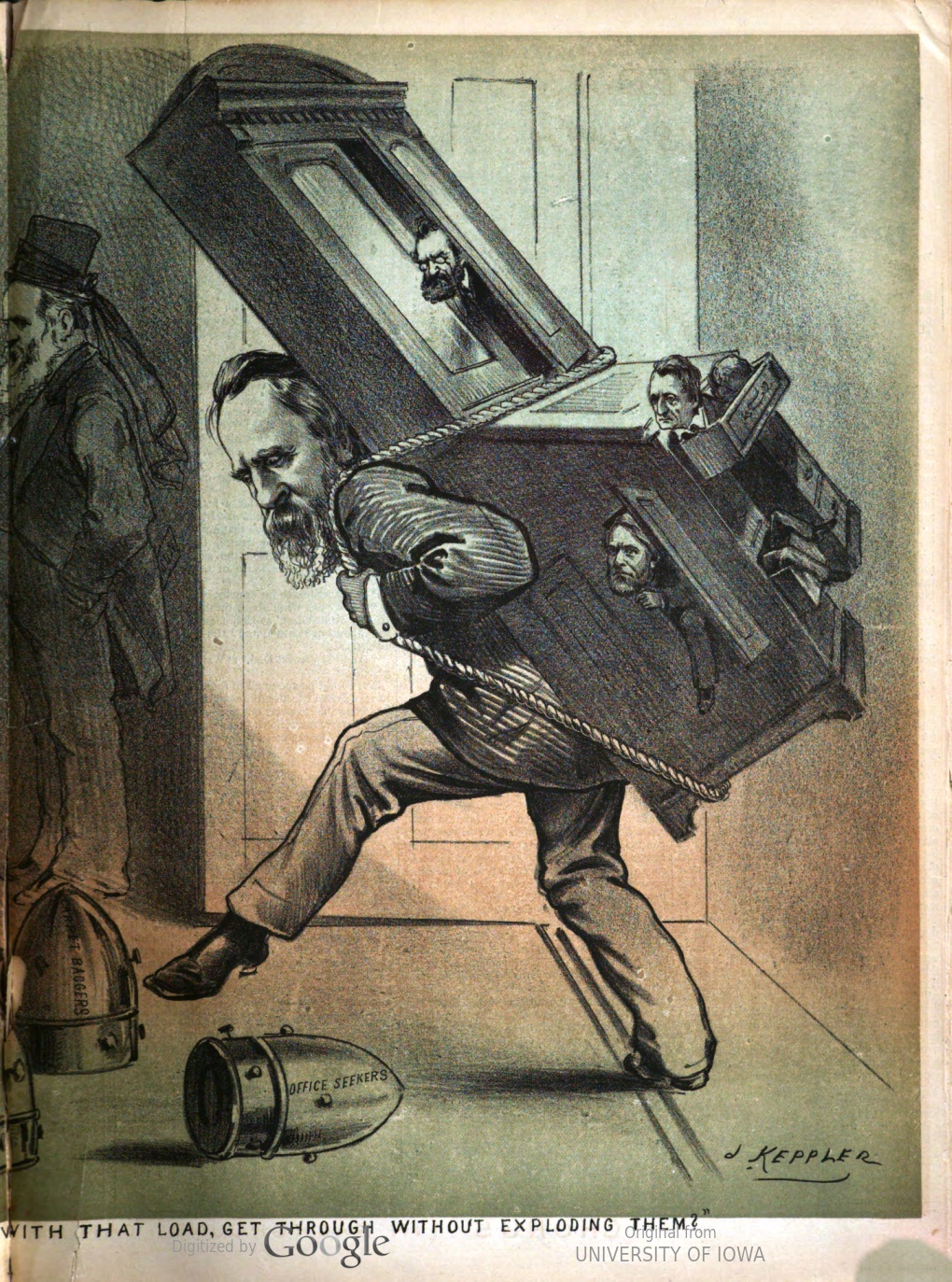
Note the droll political poem about Rutherford B Hayes at top left:
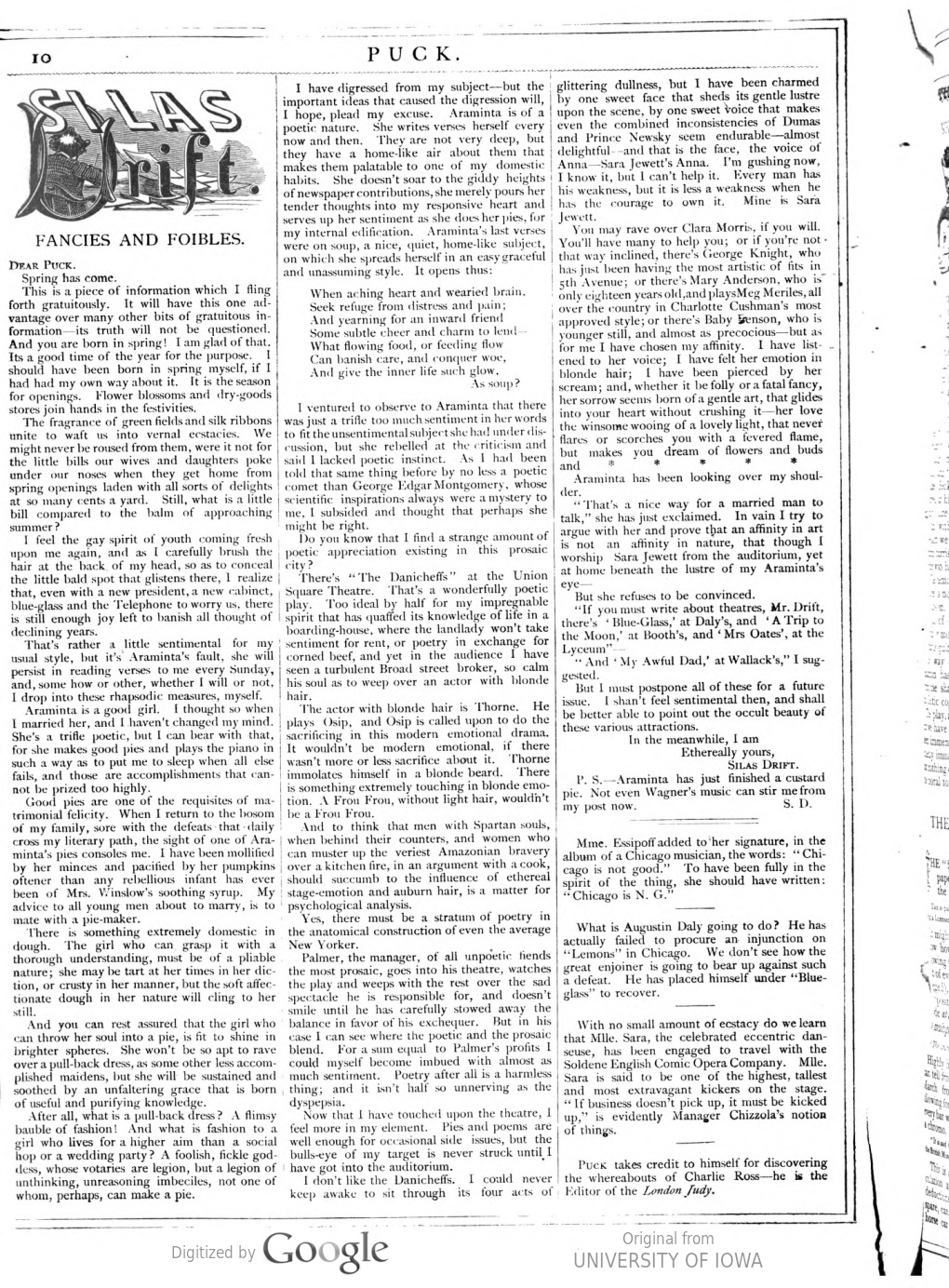
The satire of one of New York’s gentlemen’s artistic clubs might actually be based upon actual men. The writing is so dry it’s a bit hard to tell. “The members are as jolly a set of fellows as you ever met; they have peculiarities, of course, but they are pleasant ones; they have equally, of course, their weaknesses, but they are amiable ones. Â Let me attempt to describe some of them.”
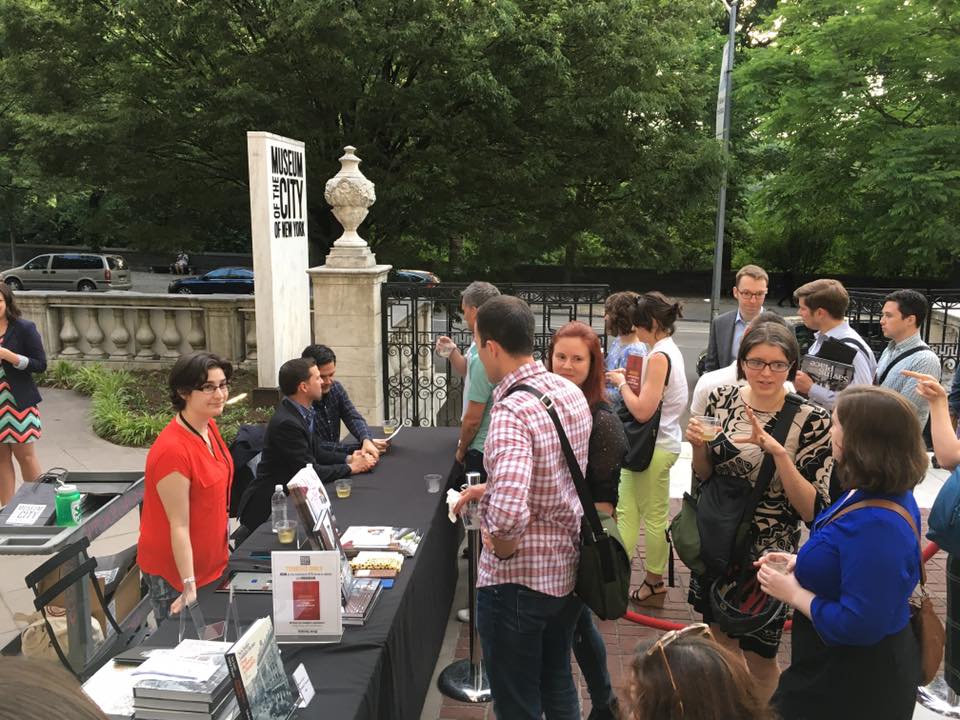
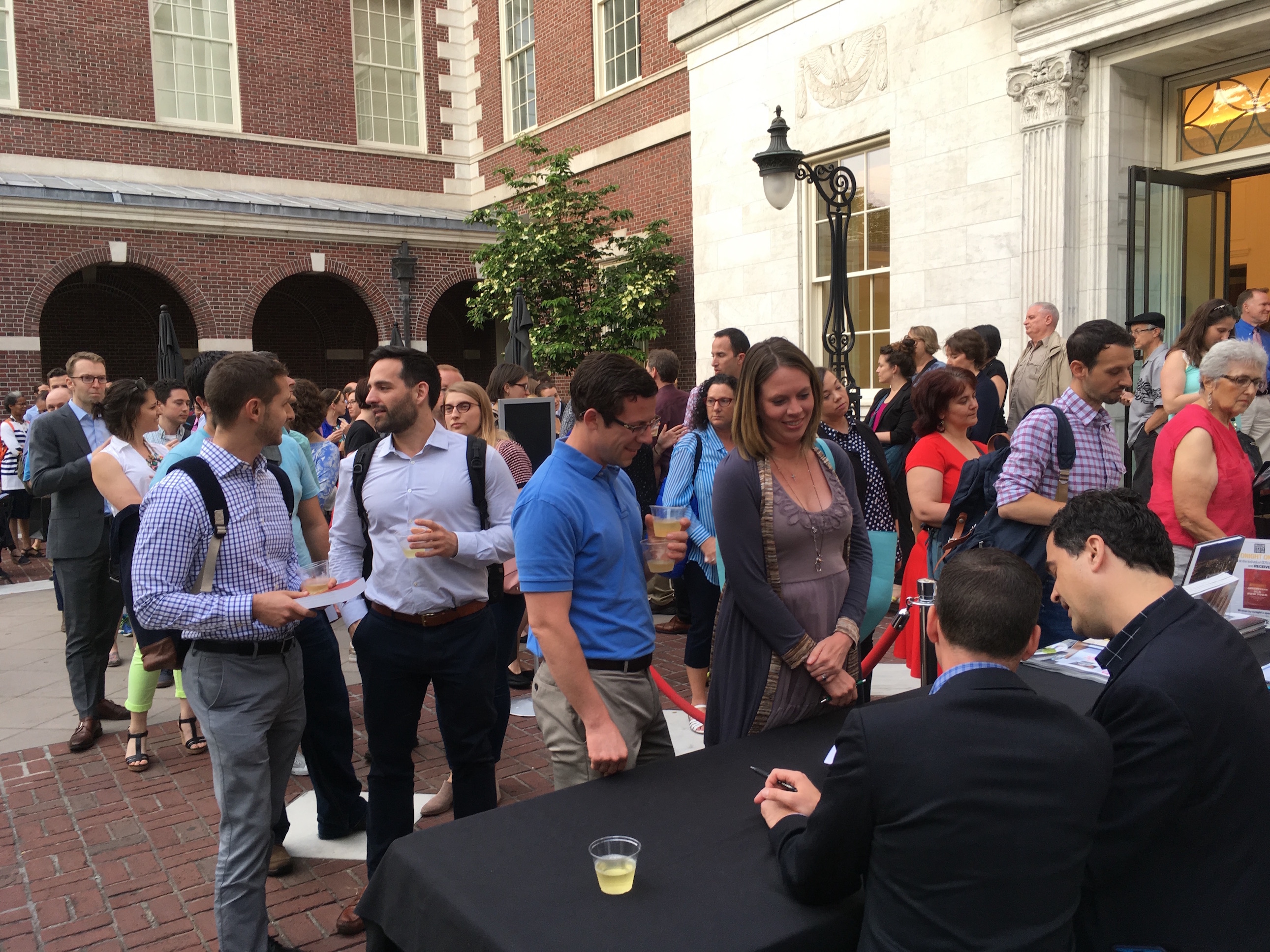
We want to offer heartfelt thanks to the many people who came out to our first live book event last Thursday night at the Museum of the City of New York.  It was a packed house that evening to hear us speak about our new book Adventures In Old New York with moderator Donald Albrecht. Afterwards, we did our very first (OMG!) book signing and got to meet a lot of you there. Thank you, thank you, thank you for being a part of a very important night for us.  Check out the bottom of this post to see some images from that evening.
If you didn’t get to go to that one, we’ll be having several more events throughout the summer and fall. I’ll be posting the information as soon as I get it.
“How much do you really know about NYC’s history? Introducing  a special program celebrating the launch of The Bowery Boys: Adventures in Old New York, the official companion book to the No. 1 travel podcast that offers an unconventional exploration of Manhattan’s historic neighborhoods, secret spots and colorful characters. The Bowery Boys  – Greg Young and Tom Meyers – will be here to discuss among other things,â€Top Ten Hidden Secrets†of New York.
20 West 44th Street (between 5th and 6th Avenues)
To register please  email: meg.stanton@generalsociety.org. Advance registration is recommended.
And if you can’t make this one, many more to come….
The book is finally here! If you pre-ordered it, you should be getting it in the mail this week or early next week.  If you’d like to pre-order it, head on over to Amazon, Barnes and Noble or visit your local independent book store in person. This should be popping up everyone — including international sales. AND digital versions — like this one for the Nook or the one at iTunes.
And there are a few press appearances on the way. SPOILER ALERT: Check our your copy of the New York Post this weekend. Â Also Brick Underground has a nice write-up from our event at the museum last Thursday (but a pretty cool picture of us). Read that here.
Courtesy Benjamin Stone Photography
Oh AND a new podcast this Friday. For this week’s subject, we go way, way, way back….
And finally here are the photos from last Thursday’s event:
That’s Tom’s brother Ben holding a hot-off-the-presses copy:
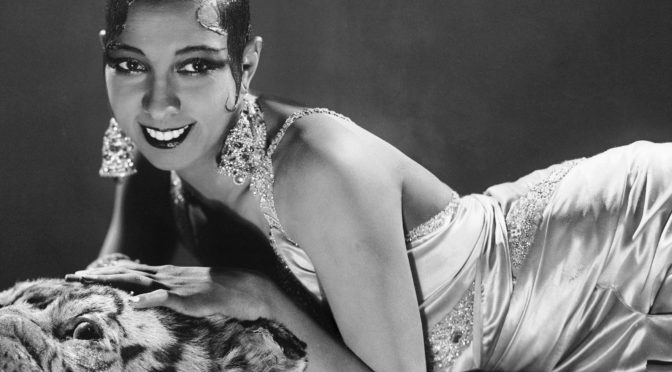
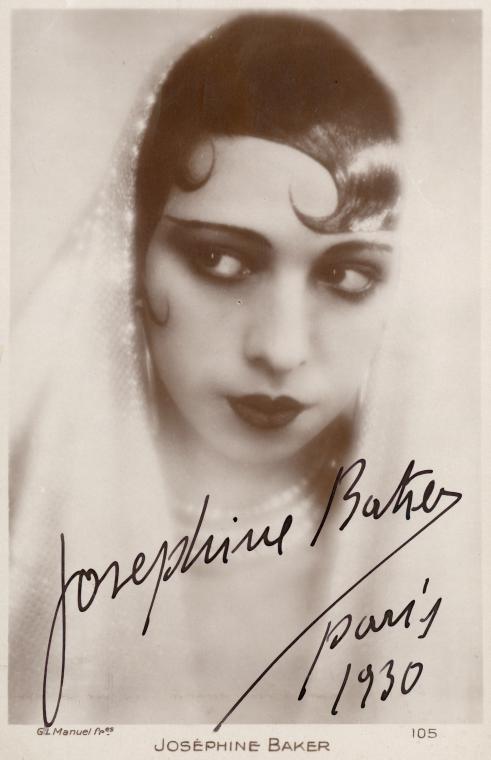
Josephine Baker is a spellbinding icon. Her persona is magnetic, mysterious, intangible, taking inspiration from Sophie Tucker and Bessie Smith, the divas of the silent screen and the flappers of Harlem and Greenwich Village.
And yet this most alluring figure of the Jazz Age was born 110 years ago today in St. Louis, Missouri.
Barely 15 years old, Baker made a quick impression upon her arrival to New York, notably appearing in the original touring production of Shuffle Along.  Her first appearance in 1924 in the New York Times was as part of the show The Chocolate Dandies playing ‘That Comedy Chorus Girl’: “As a freak Terpsachorian artist, Josephine Baker, with her imitation of Ben Turpin’s eyes, made quite a hit.”
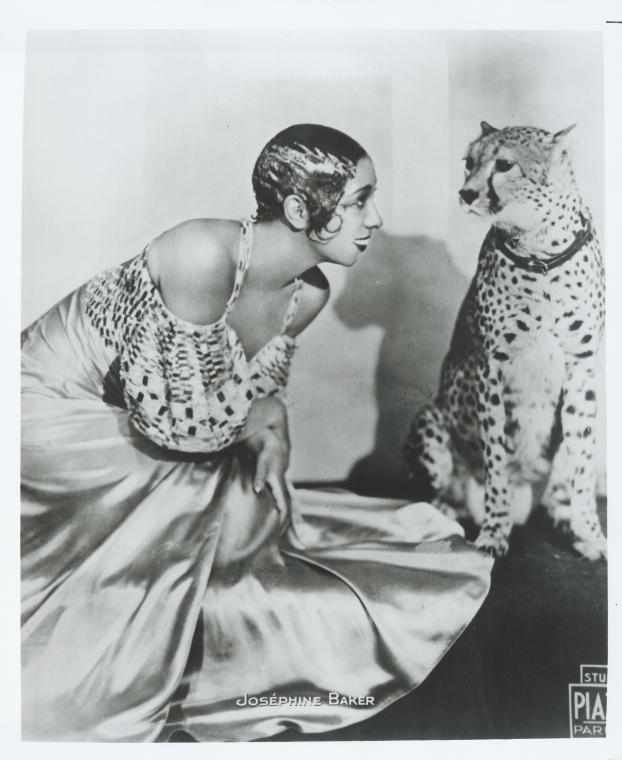
Baker’s career would only really take off after appearing in shows in France. She would accentuate her unique talent and beauty with extravagent style. Baker was famous for her animal companions — a cheetah named Chiquita and a chimpanzee named Ethel.
But the most powerful story about Josephine Baker would transpire back in New York City, many years later, in a incident which blew open the absurd, racist nightclub practices of the 1940s and 50s.  Baker took aim at the segregationist policies of Stork Club, the hotspot frequented by the world’s biggest celebrities.
On October 16, 1951, Baker attempted to have dinner there after a sold-out performance at the Roxy Theatre. While her white dinner companions got their food, she and a fellow black guest were never served. If you think perhaps this was just an oversight, keep in mind that Baker was a prominent civil-rights activist, openly critical of such policies. This was no mistake.
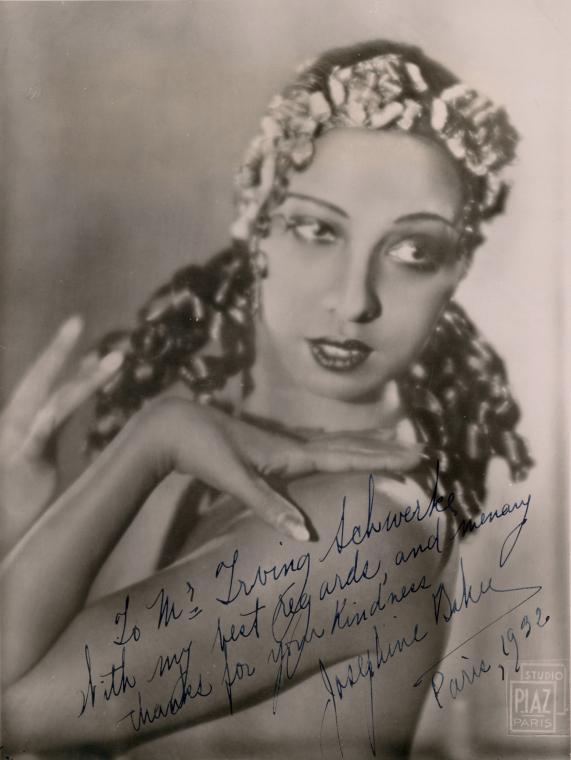
Baker in 1932:
Yet she was eventually excoriated in the press by none other than Walter Winchell, the powerful gossip columnist. Â “The Josephine Baker affair at the Stork Club made Winchell look like a self-serving hypocrite, if not racist; and his weekly radio show fell out of the top ten for the first time.” [source]
But Baker was permanently shaken by the whole affair.  “After that…there was nothing left for me in America. What little there was left, he ruined for me.” [source]
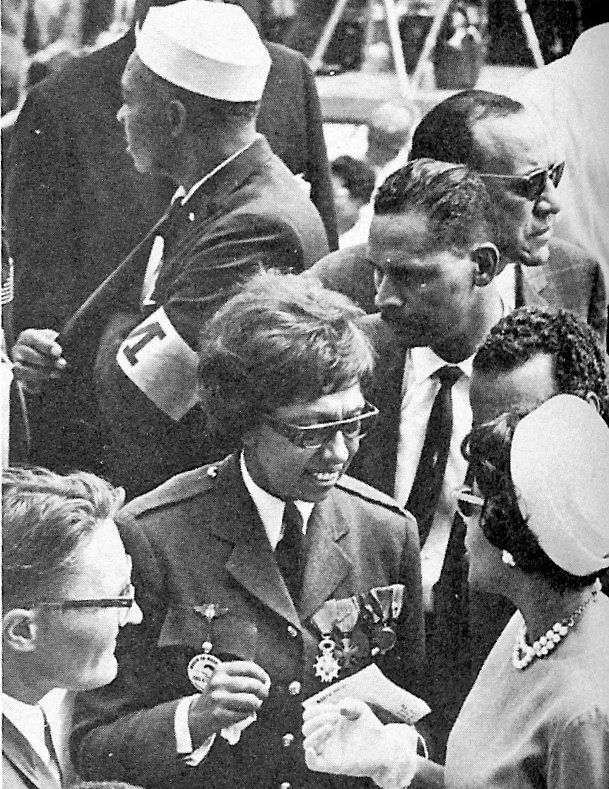
Below: Baker at the 1963 March on Washington where she was the only woman who gave a speech that day. “I am not a young woman now, friends. My life is behind me. There is not too much fire burning inside me. And before it goes out, I want you to use what is left to light that fire in you.”  [source]
Her final New York performances were in June of 1973 — at Carnegie Hall and at the Victoria Theater in Harlem.
(Photo credit PIERRE GUILLAUD/AFP/Getty Images)
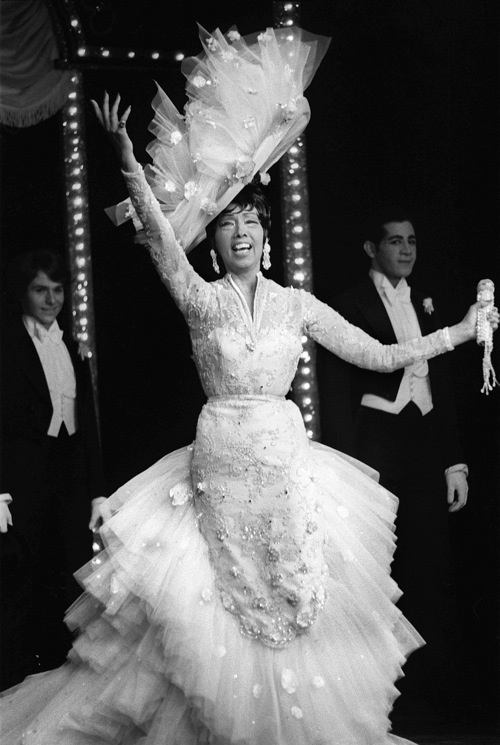
“Josephine Baker knows how to make an entrance. The American-born singer and dancer, who celebrated her 67th birthday on Sunday, brought a full house at Carnegie Hall to its feet cheering and applauding Tuesday evening merely by stepping into a spotlight wearing a spangled body-stocking that left no doubt about the slim, trim, youthful lines of her figure, topped by an outrageously towering headdress of flamingo-colored plumes that was as tall as she was herself.” [source]
Here’s a little number from that very performance, her take on a Bob Dylan number. Â And happy birthday Josephine!
New York had no significant Asian population in 1880 outside of those who lived on a handful of small streets east of the Five Points neighborhood. Primarily focused around Mott Street, the first Chinese residents were businessmen and laborers, mostly men, close knit by design. Accurate population figures are hazy, but between 800 and 2,000 Chinese and other Asians lived in the Five Points and eastern waterfront region in 1880.
In cities around the country, small Chinese enclaves had been formed, most from workers who had arrived to work on the transcontinental railroad and other Western projects. In all places — and especially San Francisco, the  American city with the largest Asian population — the Chinese were met with prejudice, scorn and hatred.
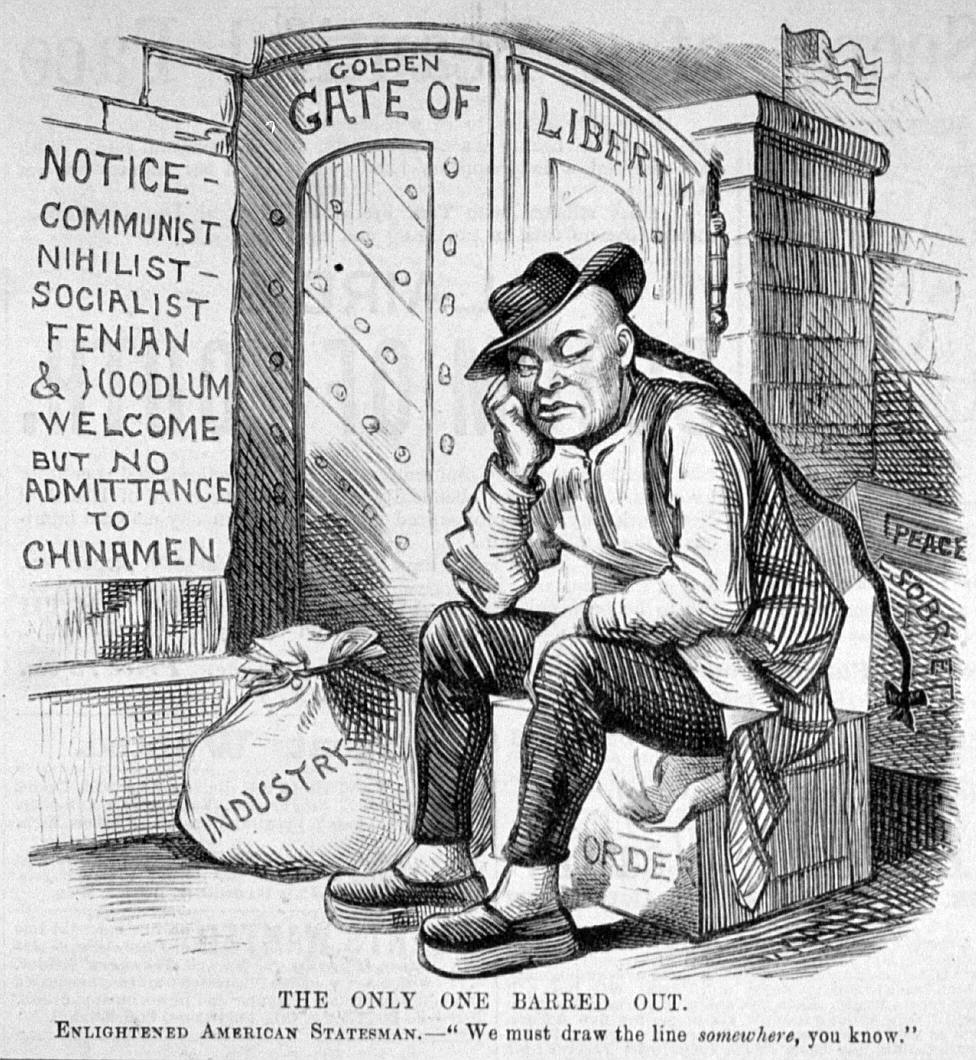
It was for this reason that the United States passed what amounts to one of the most odious laws in this country’s history — the Chinese Exclusion Act of 1882.
Whereas in the opinion of the Government of the United States the coming of Chinese laborers to this country endangers the good order of certain localities within the territory thereof:
….
SEC. 14. That hereafter no State court or court of the United States shall admit Chinese to citizenship; and all laws in conflict with this act are hereby repealed.
Below: From Frank Leslie’s Illustrated Newspaper, April 1882 — “We must draw the line somewhere, you know.”
In these crazy political times, it’s always good to remind ourselves of the fearful restrictions and laws that the United States had once embraced.
A small but poignant exhibit on the effects of the Chinese Exclusion Act arrives in Chinatown this Sunday, May 22 — at the First Chinese Baptist Church (21 Pell Street).  Remembering 1882, The Chinese Exclusion Act and Chinese Railroad Workers Exhibit is a small traveling exhibit explore the racist causes and devastating effects of the law, which was eventually extended and made permanent (before finally being abolished in 1943).
Head over there by 2 pm and catch a screening of the film Ancestors In The Americas: Chinese In the Frontier West.
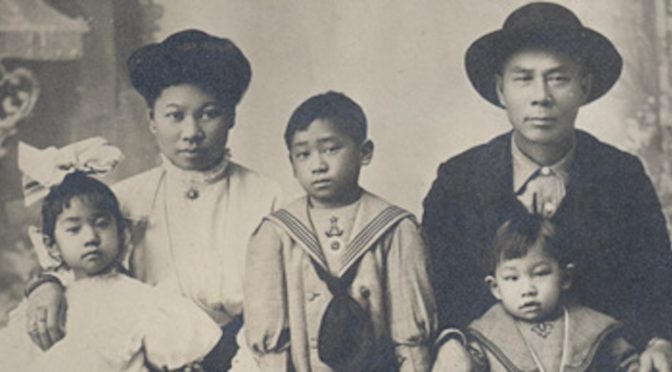
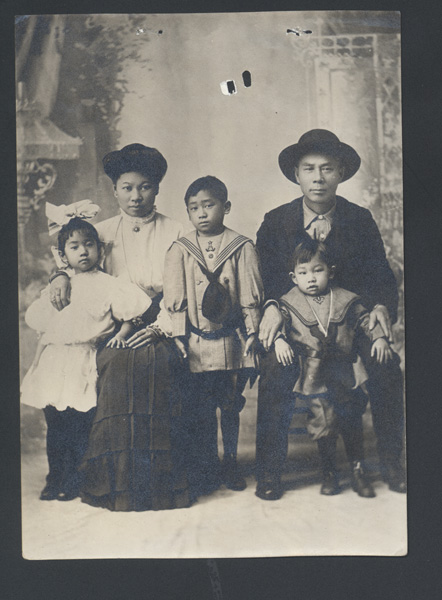
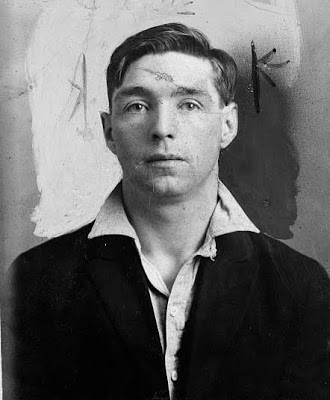
Image at top, per the original caption: Chin Quan Chan; Seattle District, Chinese Exclusion Act Case Files, Applications to Reenter, c. 1892-1900]: Chin Quan Chan Family, Chinese Exclusion Act Case File
PODCAST The musical story of the Cotton Club, the most famous (and infamous) nightclub of the Jazz Age.
The Cotton Club, Harlem’s most prominent nightclub during the Prohibiton era, delivered some of the greatest music legends of the Jazz Age — Duke Ellington, Cab Calloway, Fletcher Henderson, Ethel Waters, the Nicolas Brothers. Some of the most iconic songs in the American songbook made their debut at the Cotton Club or were popularized in performances here.
But the story of gangster Owney Madden‘s notorious supper club is hardly one to be celebrated.
That the Cotton Club was owned by Prohibition’s most ruthless mob boss was just the beginning. The club enshrined the segregationist policies of the day, placing black talent on the stage for the pleasure of white patrons alone. Even the club’s flamboyant decor — by Ziegfeld’s scenic designer, no less — made sure to remind people of these ugly admission practices.
This is the tale of Harlem late night — of hot jazz and illegal booze, of great music and very bad mobsters. Featuring some of the greatest tunes of the day by Ellington, Calloway, King Oliver and more.
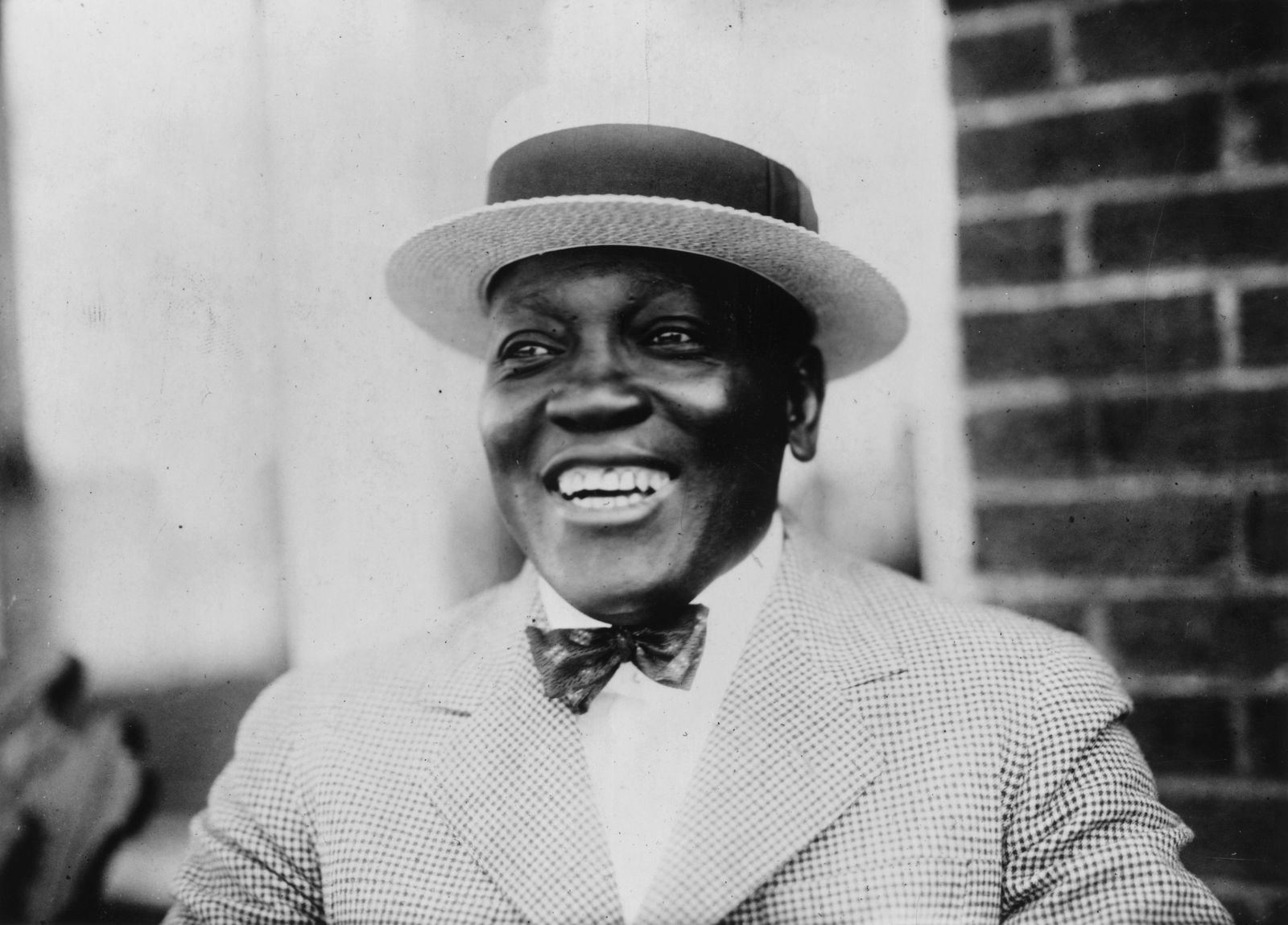
The Cotton Club was spawned from an earlier nightspot called Club Deluxe, owned by boxer Jack Johnson. (Below: Johnson in 1910)
Courtesy Getty Images)
Club Deluxe was renamed The Cotton Club in 1923 by Owney Madden, the mob boss and supplier of illegal booze.
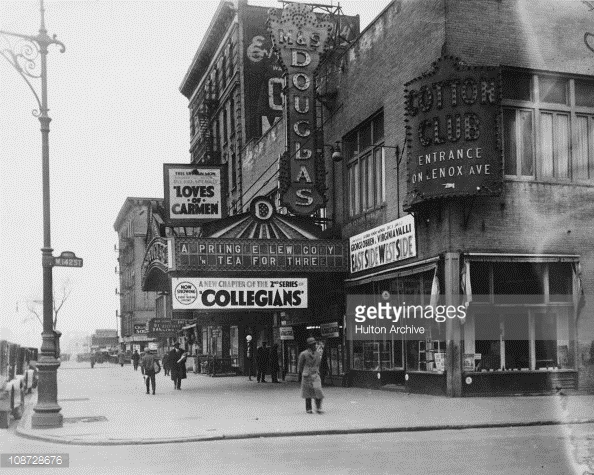
The original Cotton Club at 142nd Street and Lenox Avenue. The Douglas Theater, on the ground floor, is doing much better here, photo taken sometime in 1927:
Courtesy Getty Images
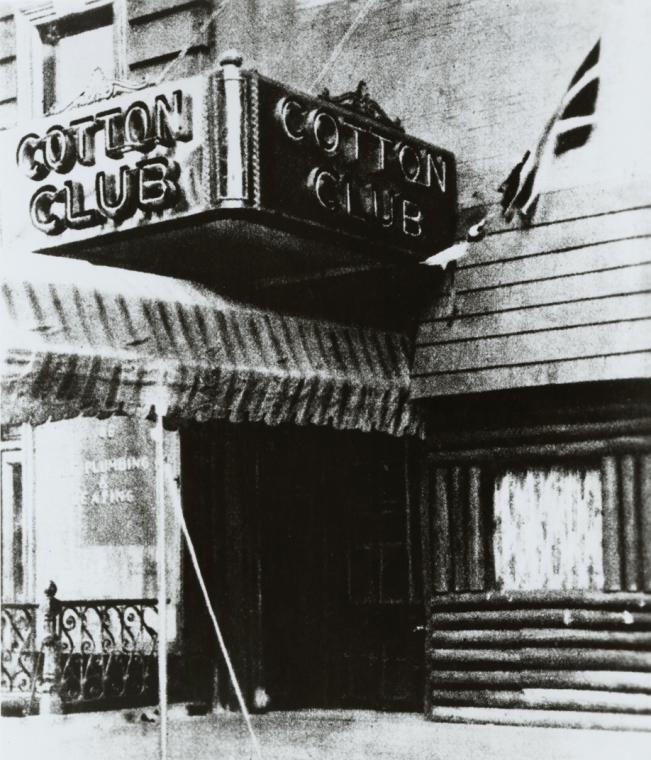
The entrance to the Harlem Cotton Club. Note the log decoration to make it appear like some old rugged shack.
Courtesy New York Public Library
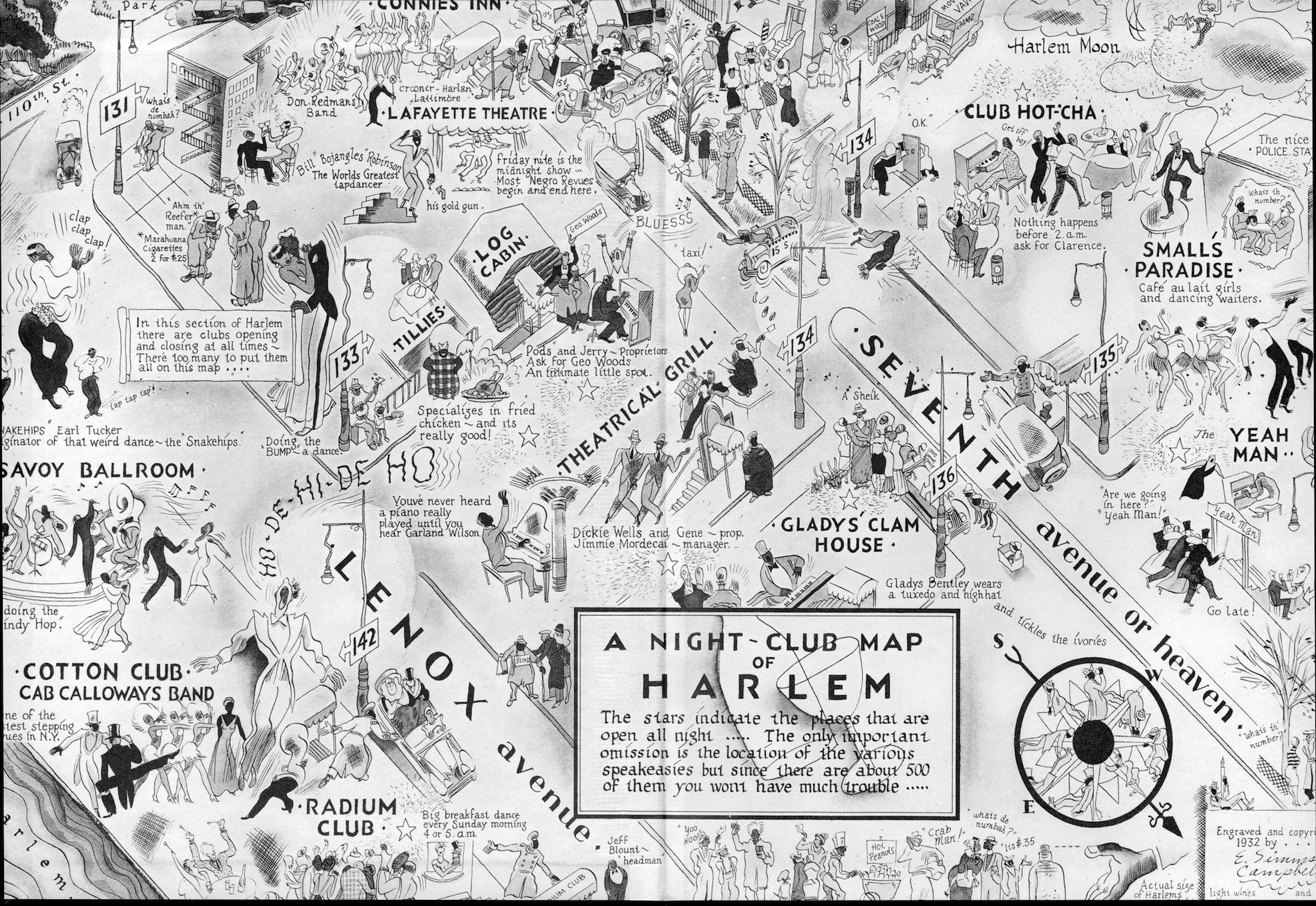
A map from 1932 of the Harlem nightclub scene, featuring the Cotton Club, Small’s Paradise, Connie’s Inn, the Savoy Ballroom and more….
Courtesy Open Culture
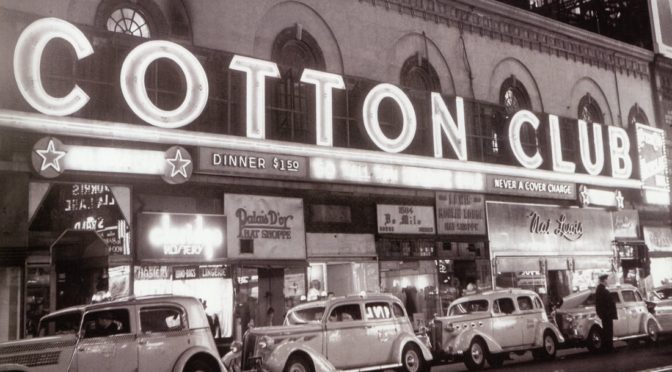
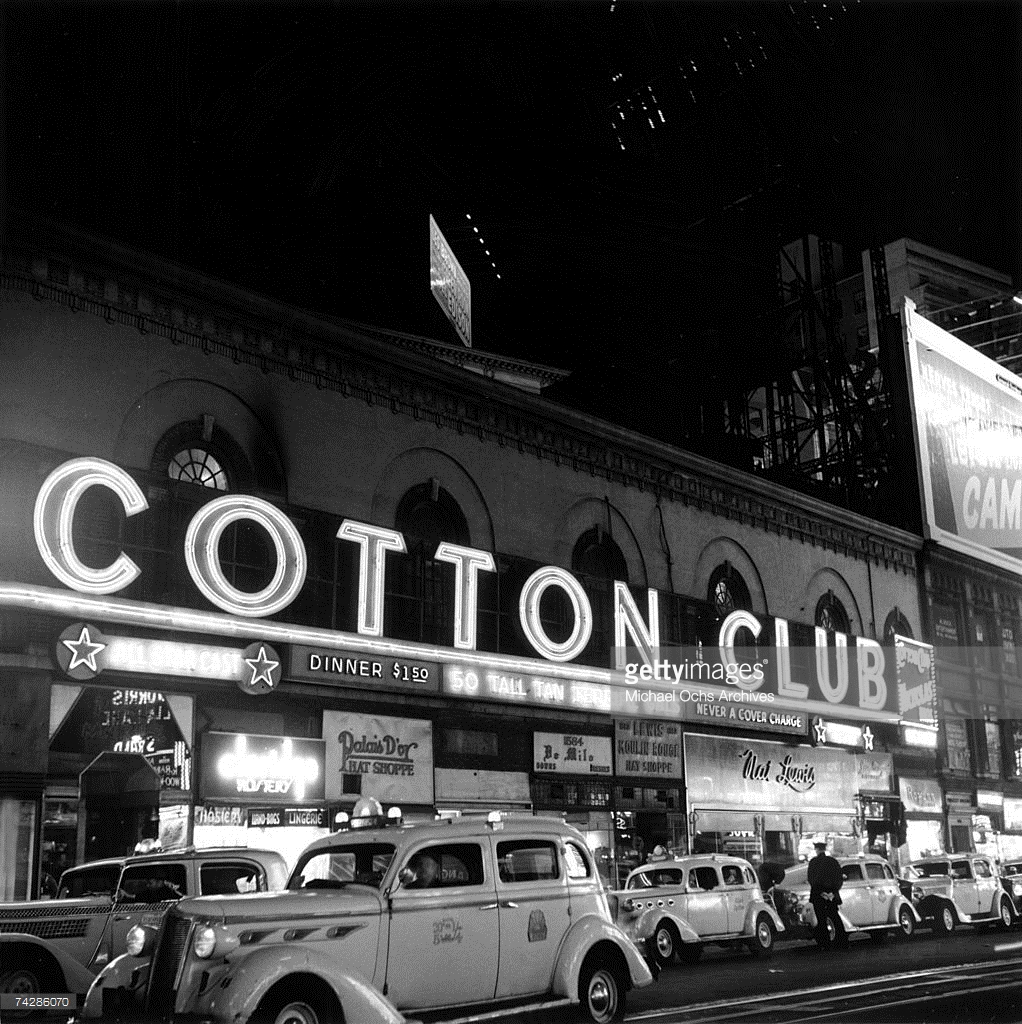
The Broadway Cotton Club as it looked one evening in 1938.
Courtesy Getty Images/ Michael Ochs Archives
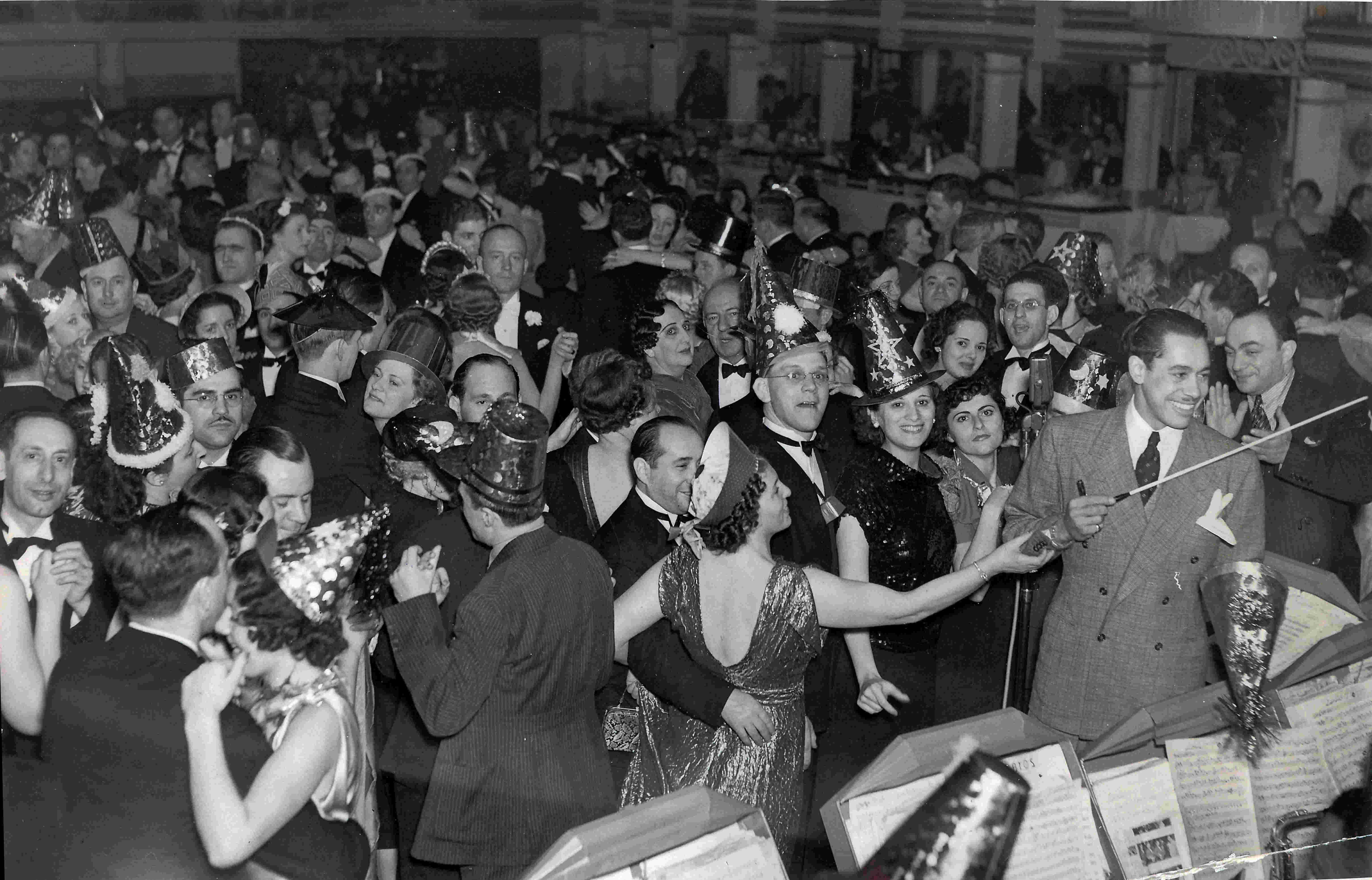
A look at the interior of the Broadway Cotton Club circa, during an New Year’s celebration, 1937, with Cab Calloway conducting.
Courtesy the Hi De Ho Blog, devoted to Cab Calloway
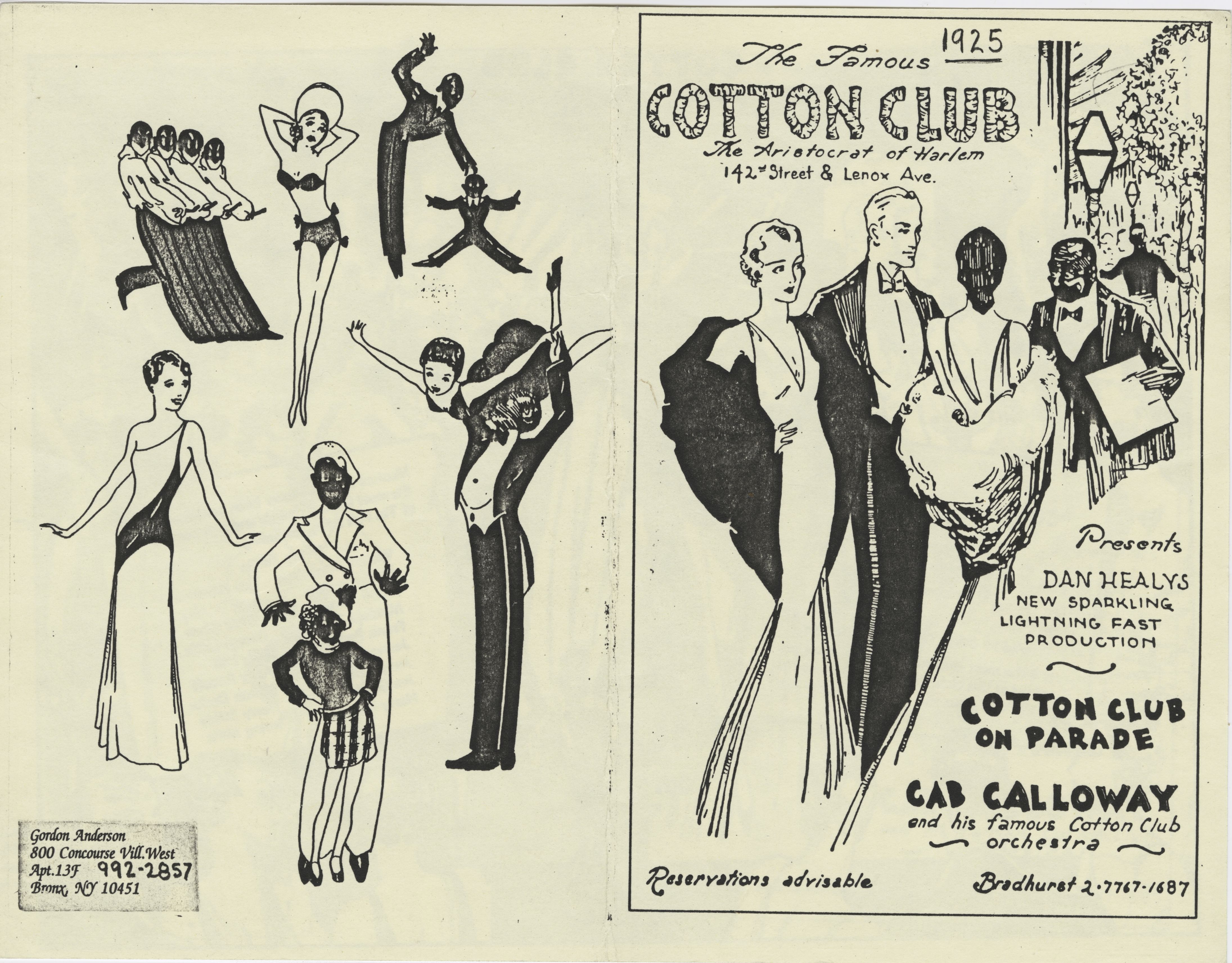
An advertisement or program for The Cotton Club. The year 1925 is penciled in at the top, but it has to be from a later date. Calloway had just graduated from high school in 1925!
Courtesy New York Public Library
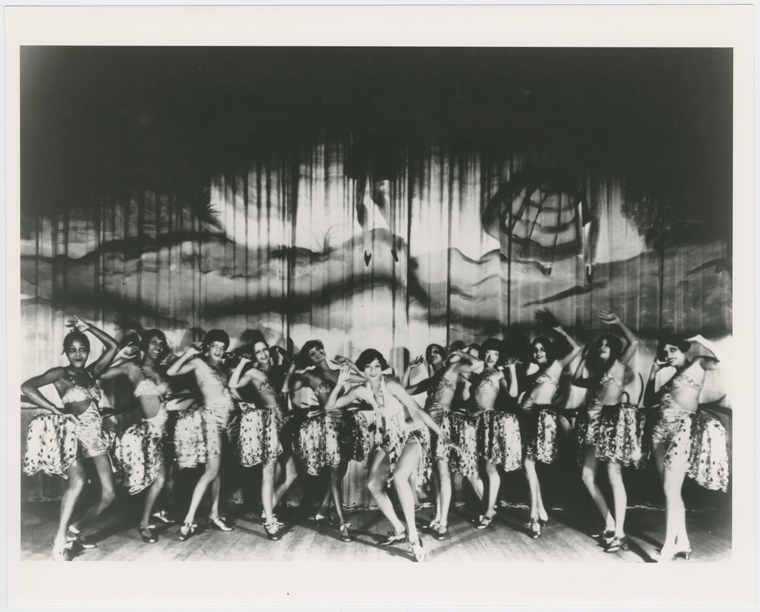
Maude Russel and her Ebony Steppers, performing in the 1929 Cotton Club show called ‘Just A Minute’.
Courtesy New York Public Library
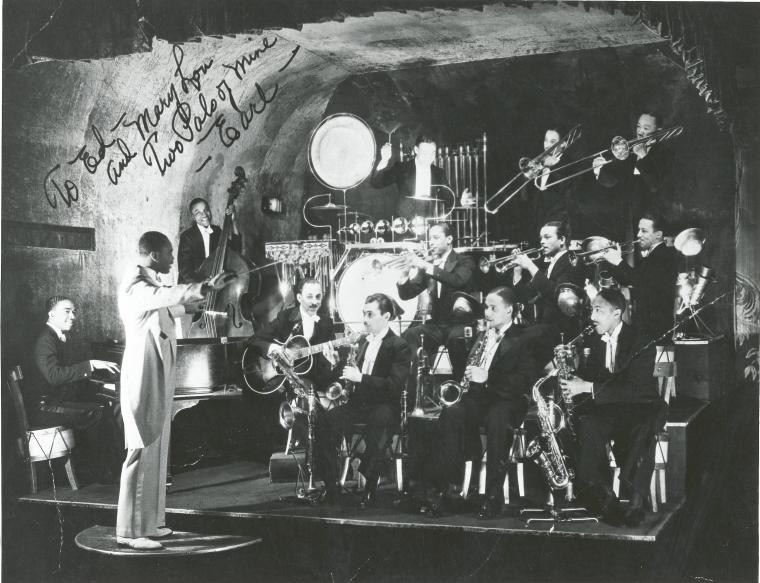
A shot of Jimmy Lunceford and His Orchestra in 1934.
Courtesy New York Public Library
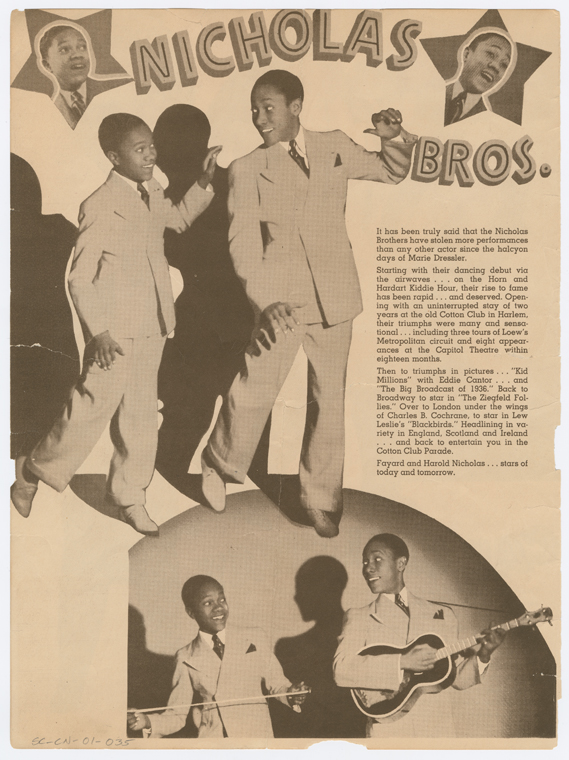
An advertisement for the Nicolas Brothers, for a performance in 1938 at the Broadway Cotton Club.
Courtesy New York Public Library
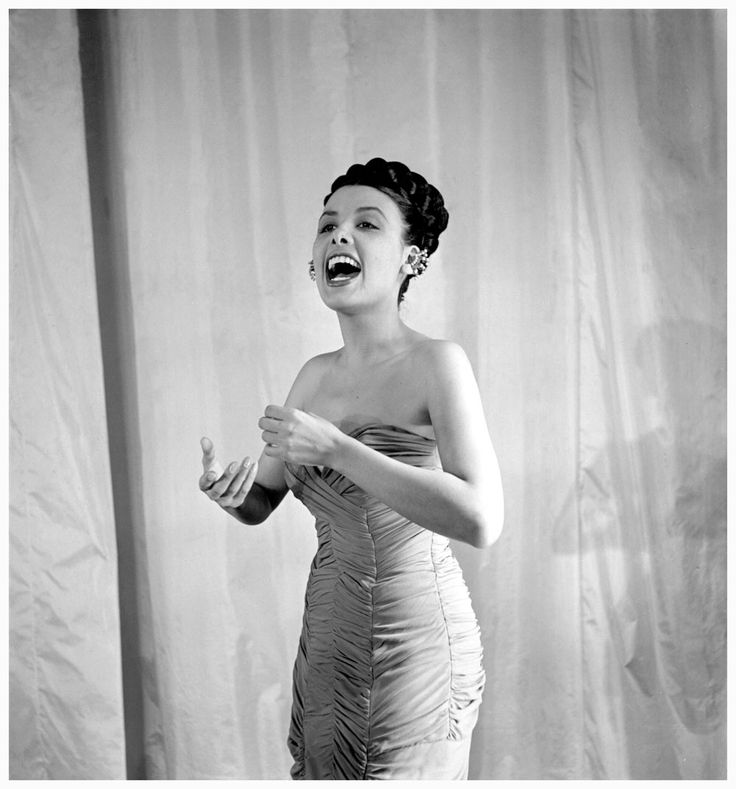
Lena Horne started out in the Cotton Club chorus line but eventually became a headlining star in her own right.
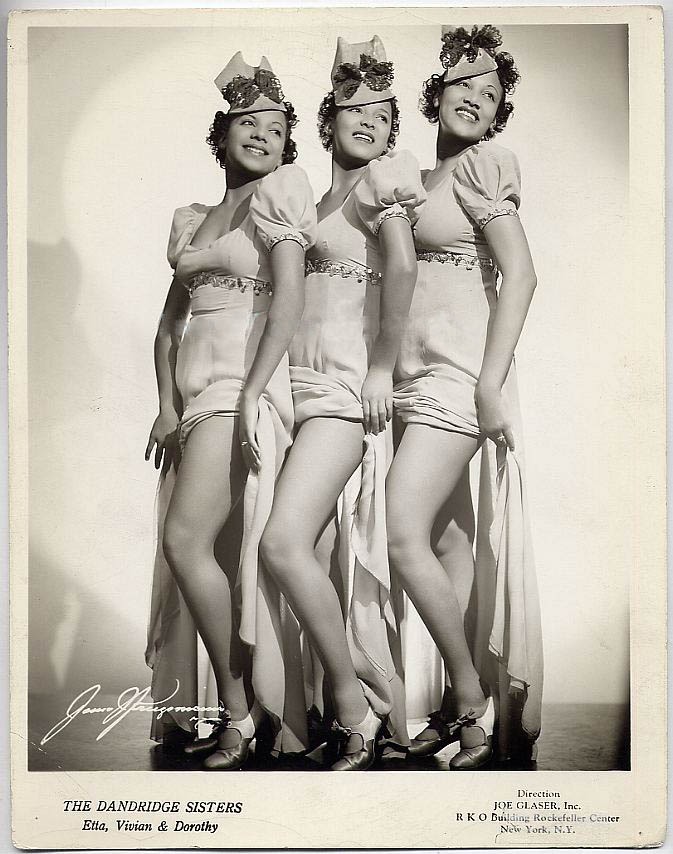
The Dandridge Sisters were notable performers in the final years of the Cotton Club.
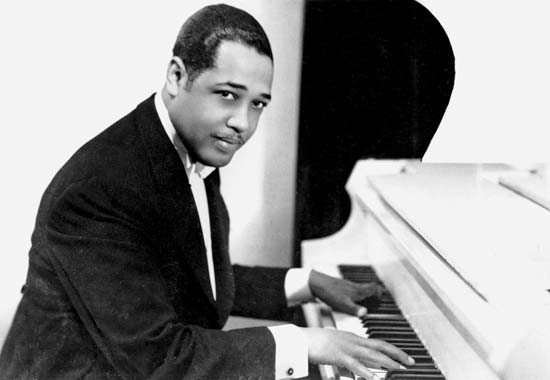
The young and dashing Duke Ellington became a superstar in the years following his Cotton Club residency.
Duke Ellington and his Cotton Club Band, in a 1930 film appearance:
In 1934, Cab Calloway made this short film featuring his music:
Cab Calloway’s here too, in this clip from the film Stormy Weather, but the real stars are the Nicholas Brothers in a breathtaking dance number:
THIS PODCAST FEATURED MUSICAL SNIPPETS FROM THE FOLLOWING SONGS:
Black and Tan Fantasy – Duke Ellington
Drop Me Off In Harlem – Duke Ellington
Speak Easy Blues – King Oliver Jazz Band
Charleston – Paul Whiteman
Mood Indigo – Duke Ellington
Swing Session – Duke Ellington
If You Were In My Place – Duke Ellington
Minnie the Moocher – Cab Calloway
I’ve Got The World On A String – Duke Ellington
Stormy Weather – Ethel Waters
On The Sunny Side of the Street – Duke Ellington
NOTES ON THIS SHOW:
— I made two amusing flubs in this show 1) Duke Ellington’s nickname is probably inspired by the Duke of Wellington, not (obviously) the Duke of Ellington, 2) the name of the movie with Lena Horne and the Nicholas Brothers is obviously named Stormy Weather, not Stormy Weathers (which must be the name of a drag queen somewhere)
— Jack Johnson‘s story is so much more complex and I wish I had more time to talk about him. For more information, check out the incredible documentary (and the book it’s based on by Geoffrey C Ward) called Unforgivable Blackness: The Rise and Fall of Jack Johnson.
The Whyos (pronounced Why-Ohs) were New York’s most notorious gang after the Civil War, organizing their criminal activities and terrorizing law abiding citizens of the Gilded Age. Find out when they lived, how they broke the law and who they were — from Googie Corcoran to Dandy Johnny, as well as two particularly notable guys named Danny.
ALSO: How much does it cost to have somebody’s ear bitten off?
ORIGINALLY RELEASED MARCH 28, 2009
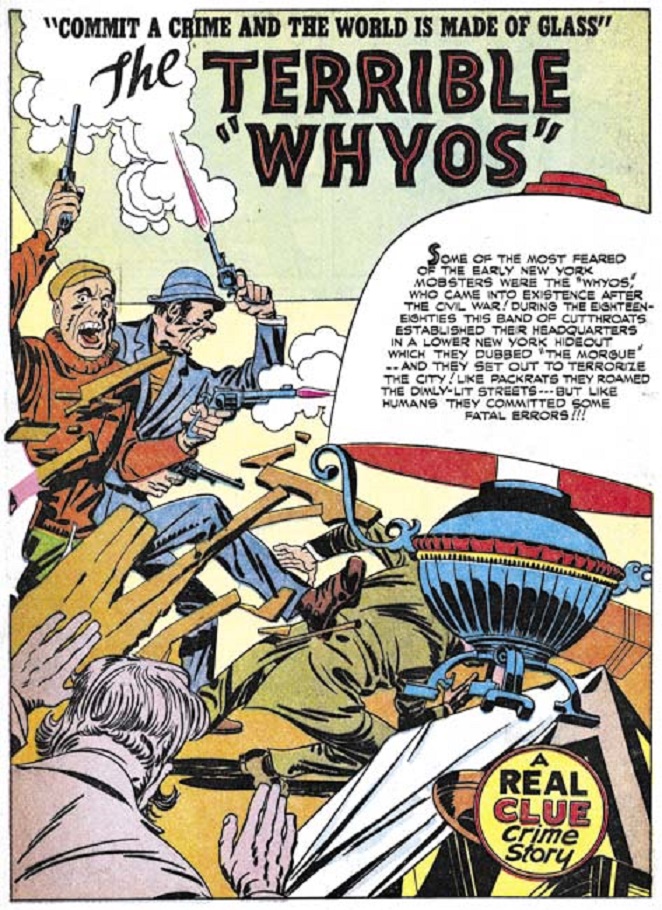
Famed comic creators Joe Simon and Jack Kirby had a fascination with early gang life and once illustrated their adventures for a 1947 comic book called Real Clue Crime Stories.
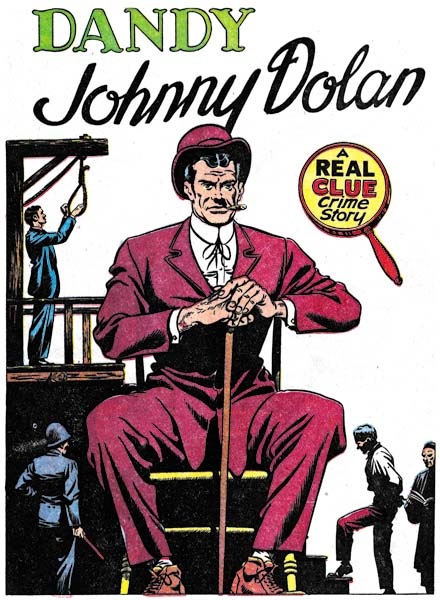
Another artist for the a different issue of the same comic book took a crack at the story of Dandy Johnny Dolan that same year:
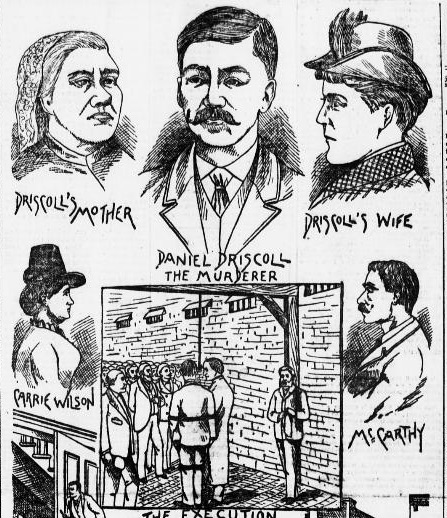
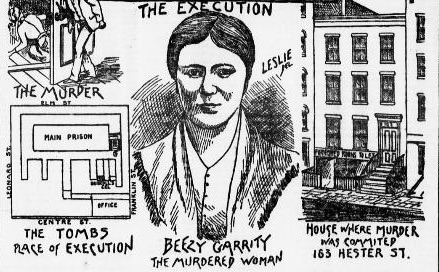
A vivid illustration from the New York World, January 23, 1888, outlining the players involved in Danny Driscoll’s murder of Beezy Garrity.
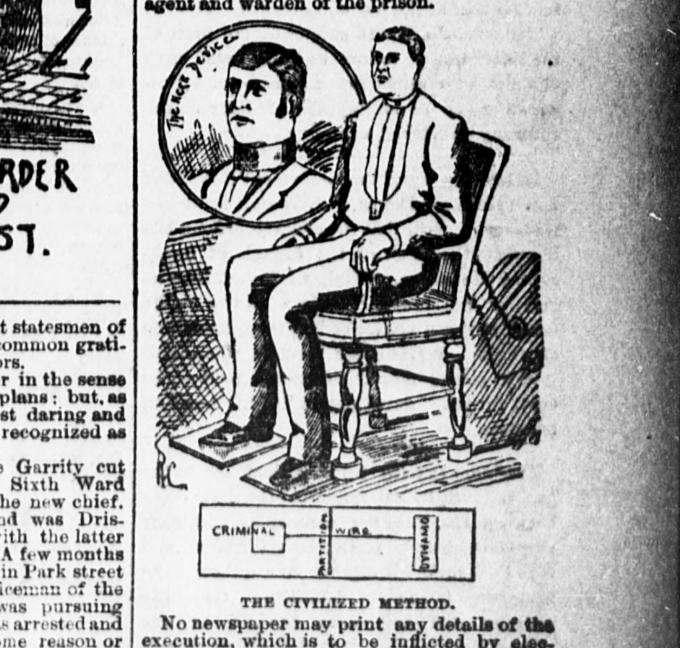
The violent execution of Driscoll lead the World to run a further article (see the right side of the page) condoning the use of a new form of execution — by electrocution.
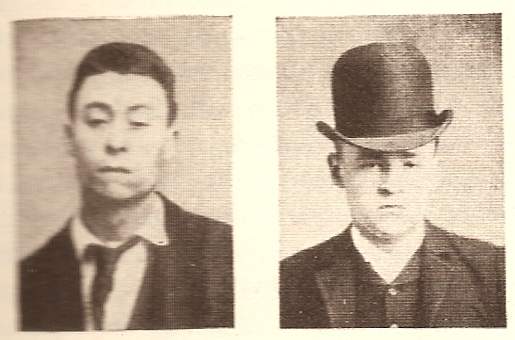
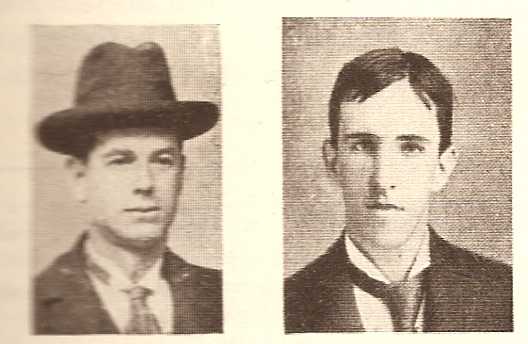
Faces of the Whyo Gang: Googy Corcoran, Clops Connolly, Big Josh Hines and Baboon Connolly
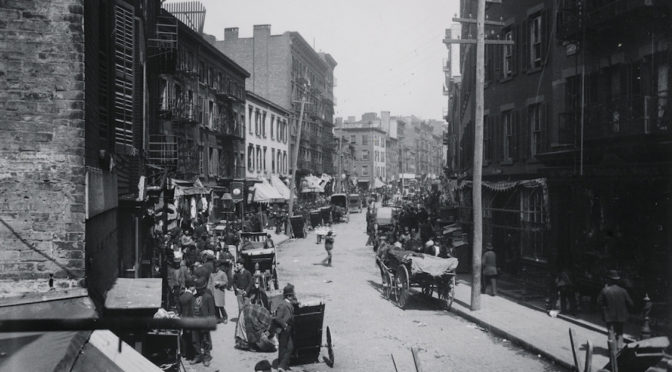
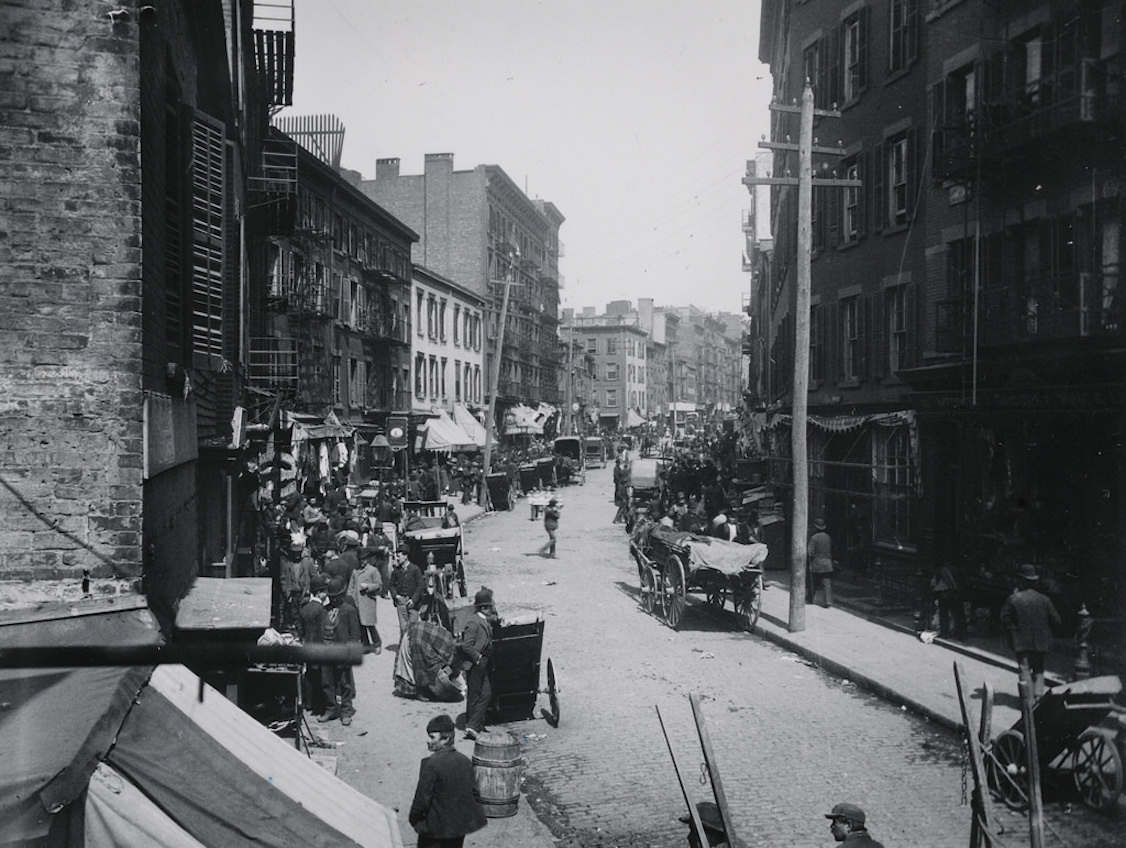
Mulberry Bend: The lair of the Whyos (picture by Jacob Riis)
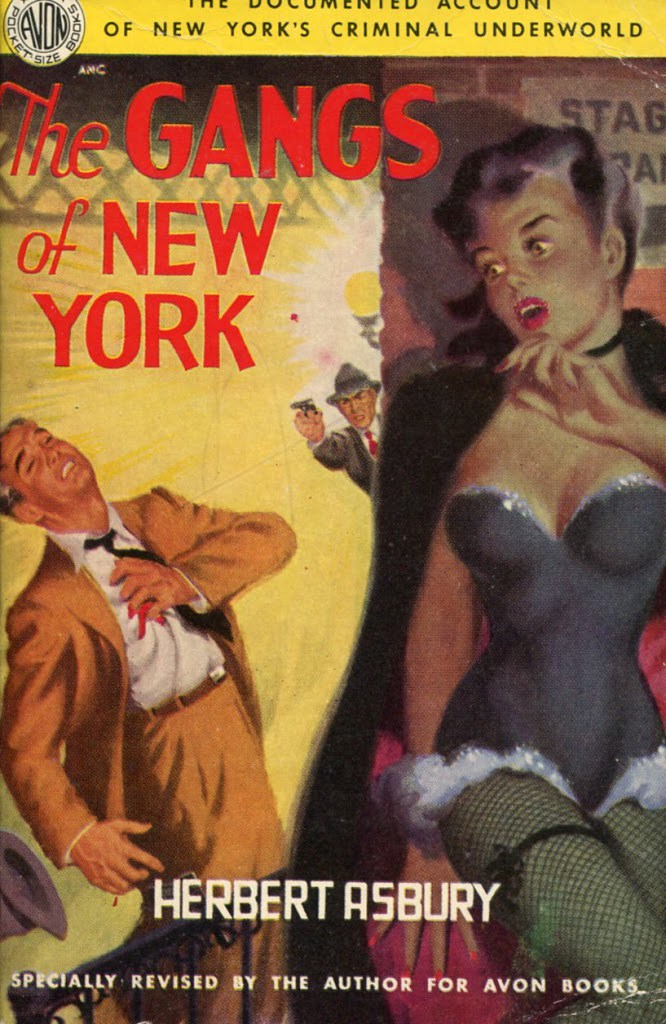
The pulpy cover of Herbert Asbury’s Gangs of New York.
It’s one thing to study facts in a book or read the depictions of events in an old newspaper. It’s quite another to get close up to the historical figures themselves through their actual correspondence, not so much for the information, but for the tone and character of their voices. Â Even though these papers are all mostly business-related, you can really get a sense of Tesla’s personality and how he viewed others. He was ambitious and creative. He was anxious and protective.
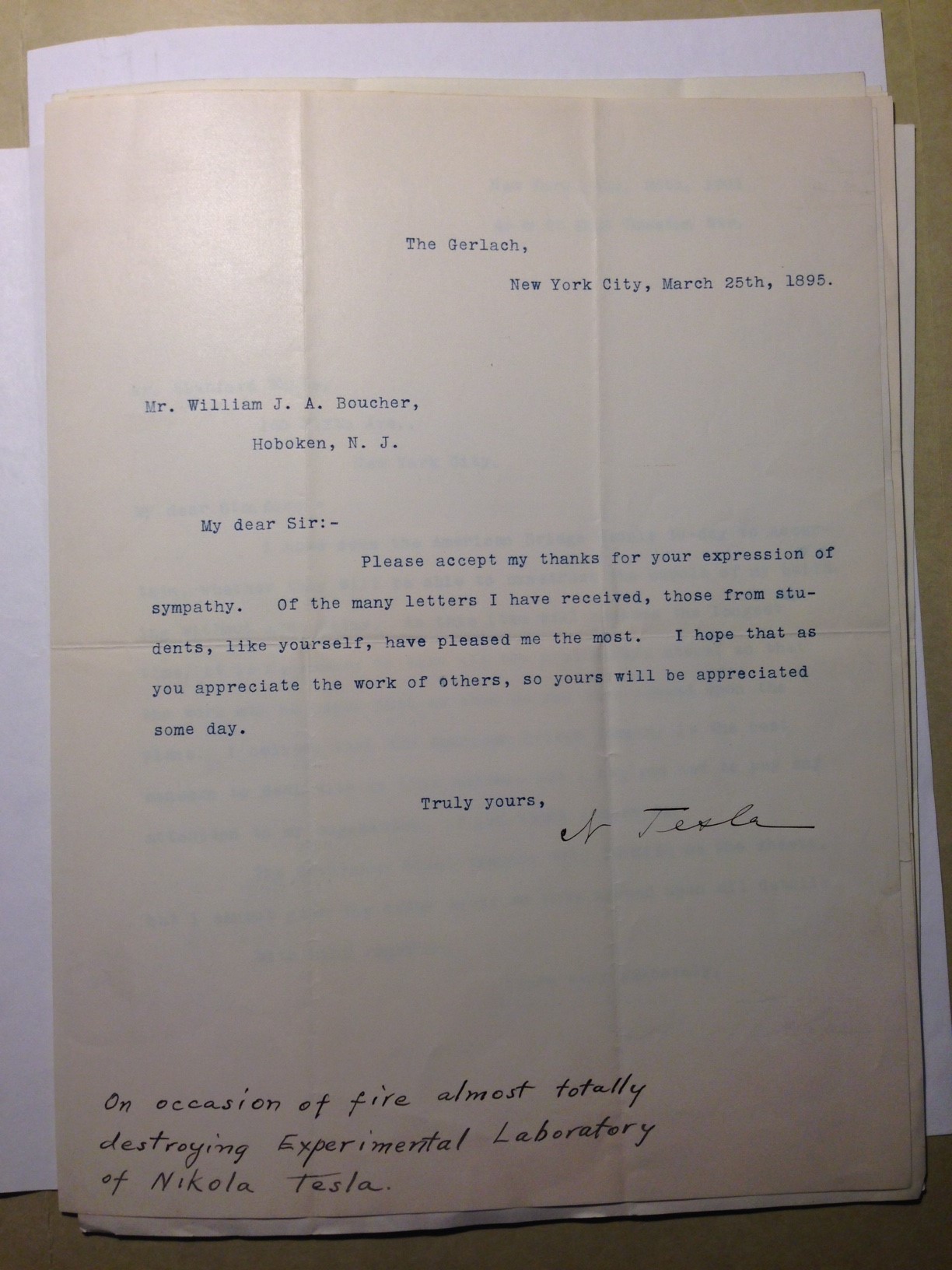
As we mentioned in our podcast on Nikola Tesla, his South Fifth Avenue laboratory was destroyed in a fire on March 13, 1895. It was a well publicized event, especially in scientific journals. Tesla most likely received many letters like the one below at his home at the Gerlach Hotel (today’s Radio Wave Building, named so in his honor).
Courtesy New York Public Library
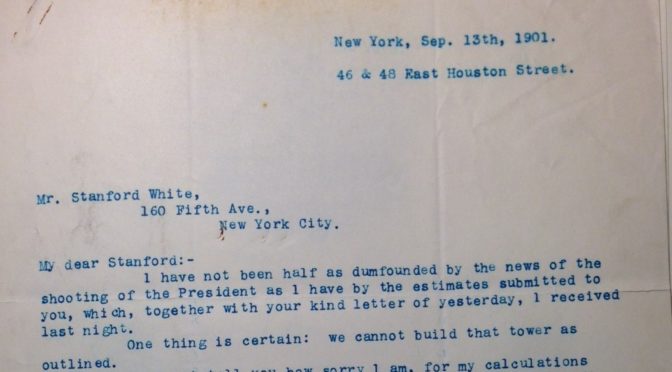
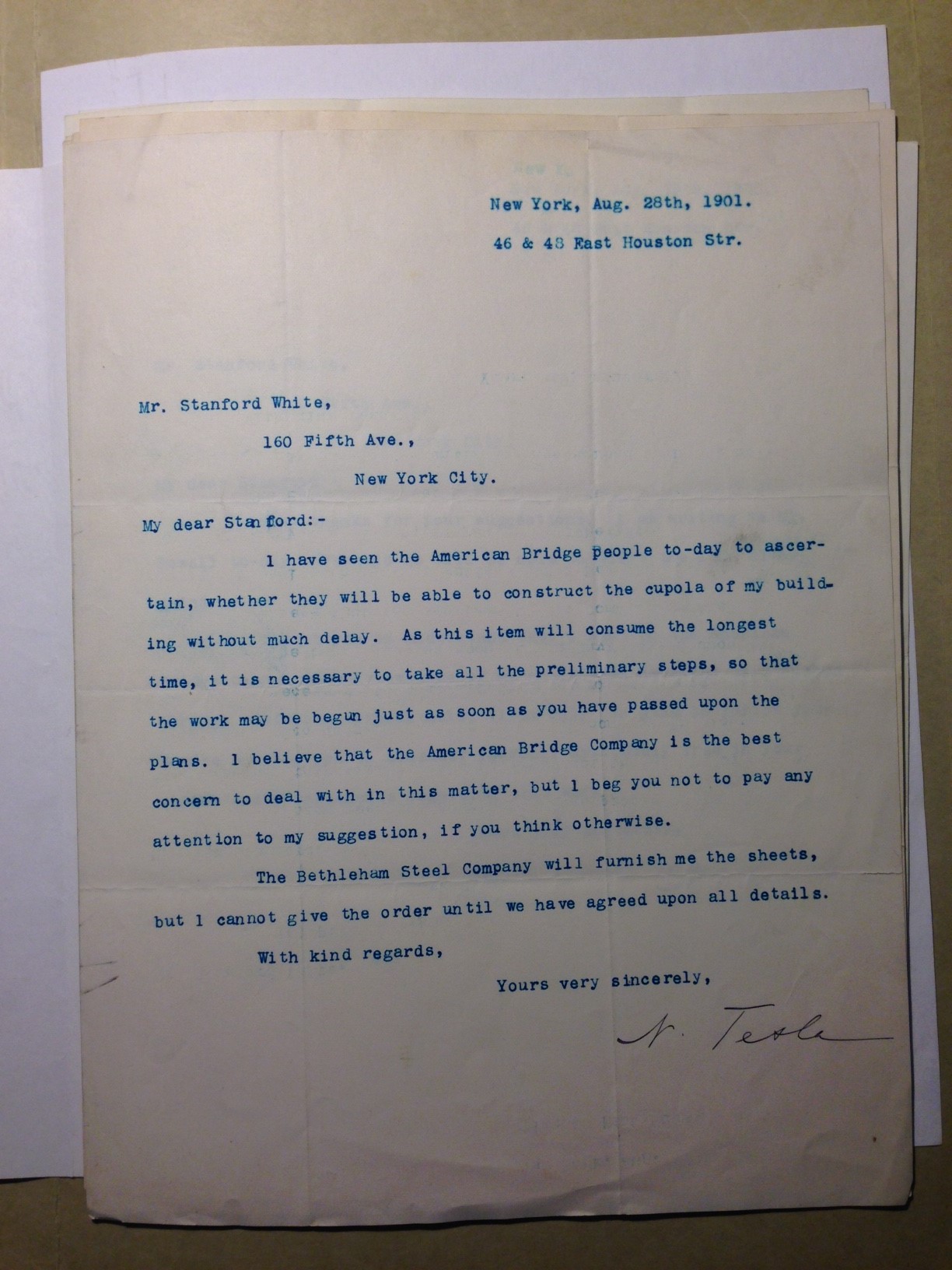
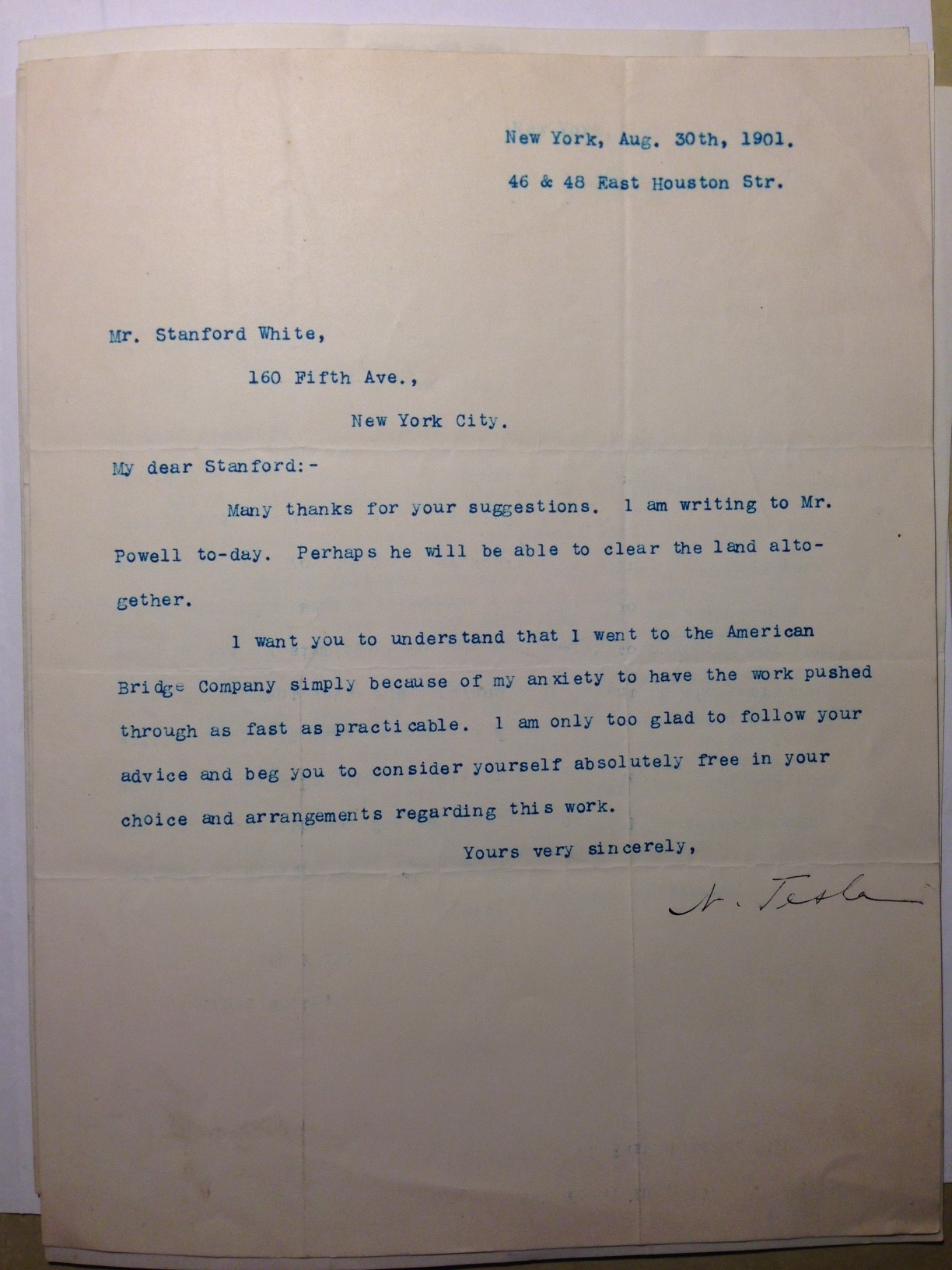
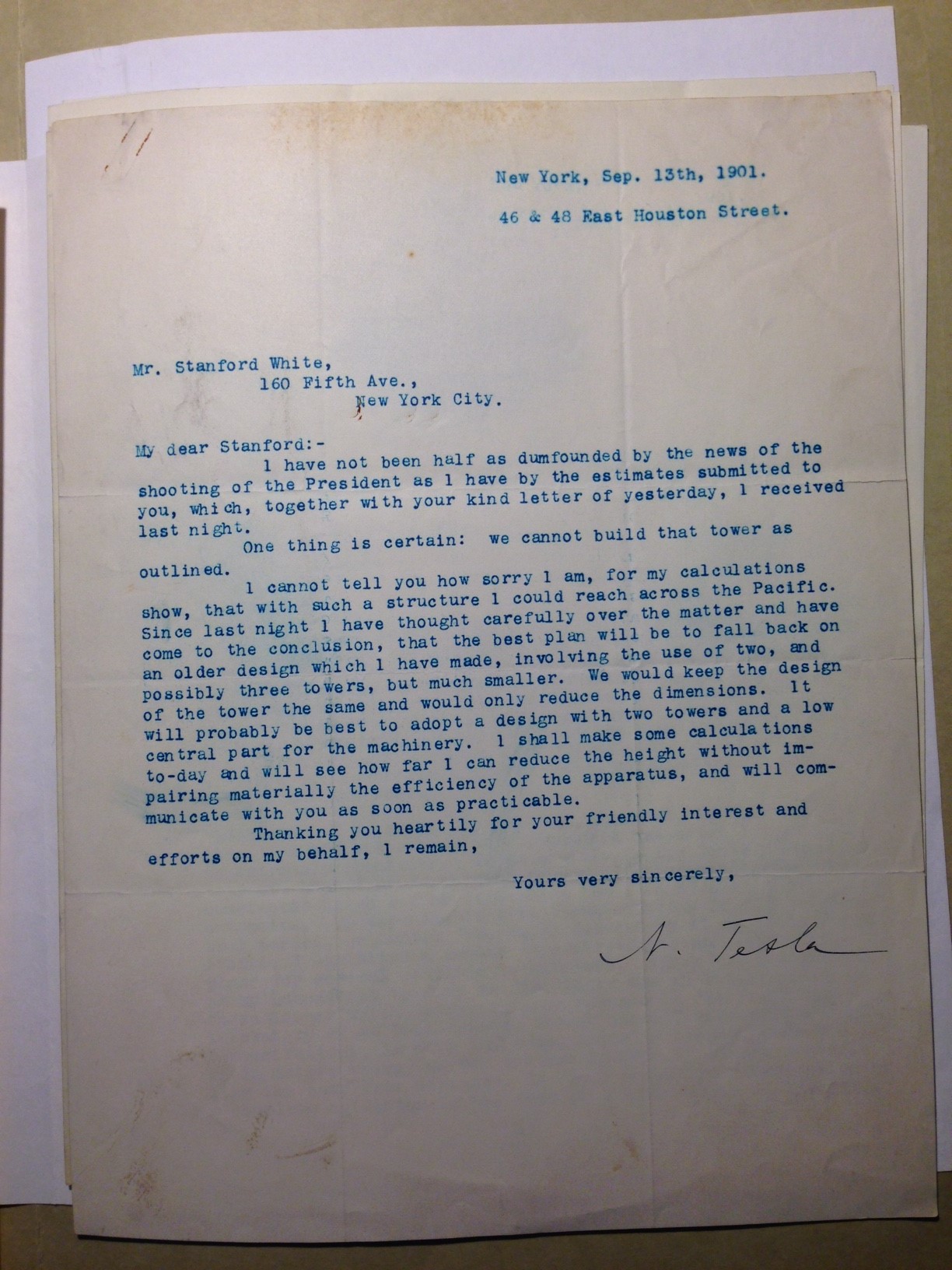
The next three are letters to friend and architect (and scaliwag) Stanford White, outlining the constructionn of Wardenclyffe Tower in Long Island.  The third letter is by far the most intriguing, sent days after the shooting of William McKinley.  The president died the day after Tesla’s letter was sent, and White’s friend Theodore Roosevelt would then ascend to the presidency.
The American Bridge Company was newly formed in 1901 but traces itself to the civil engineering firm that built the Eads Bridge in St. Louis, the longest arch bridge in the world at the time. New York projects for the firm in the 20th century would include the Empire State Building, the Chrysler Building, the Woolworth Building and the Verrazano-Narrows Bridge. They’re still in operation; in fact they’re finishing up work on a project at the George Washington Bridge.
Pennsylvania’s Bethlehem Steel Company was a giant of steel manufacturing in the Gilded Age. Just as Tesla and George Westinghouse got to display the marvels of alternating current at the World’s Fair of 1893 in Chicago, so to did Bethlehem Steel get to employ their wares; the world’s first Ferris Wheel, the grand attraction of the fair, was held together in Bethlehem Steel.
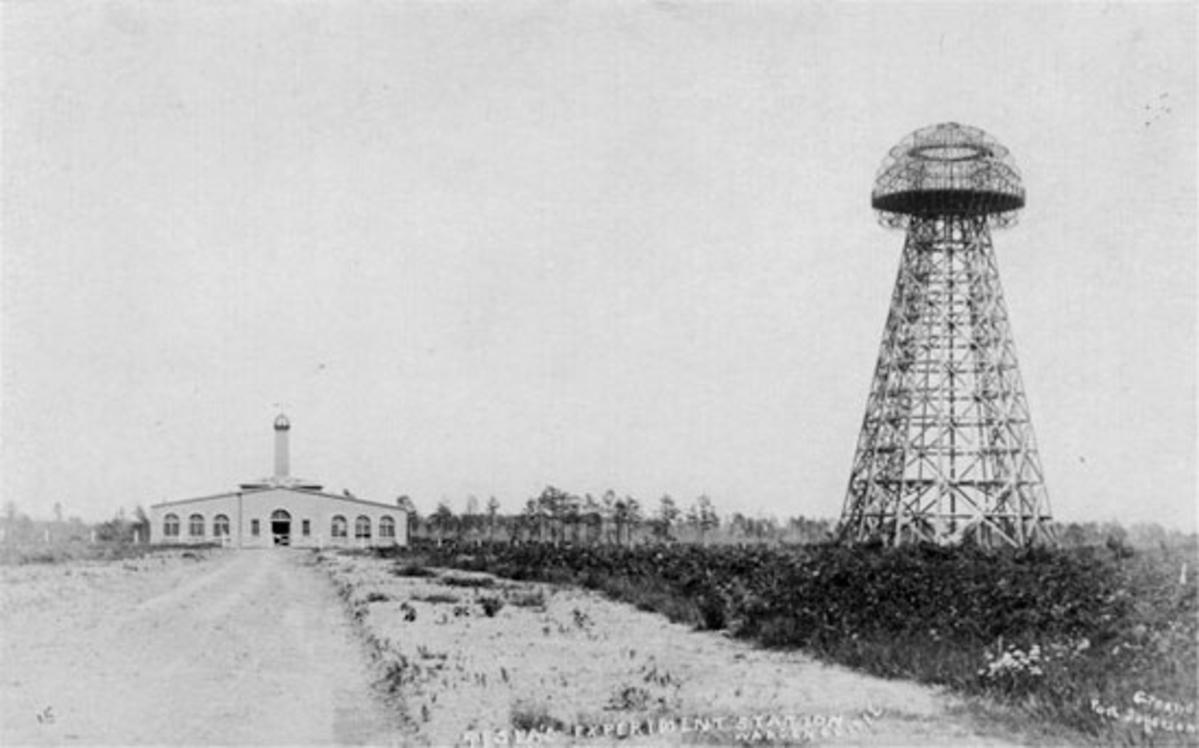
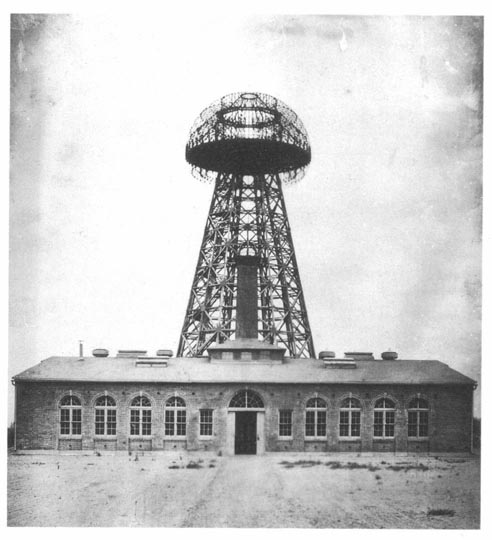
And here was the final result of their labor — the Wardenclyffe Tower in Shoreham, Long Island.
Courtesy Daniel C. Elton
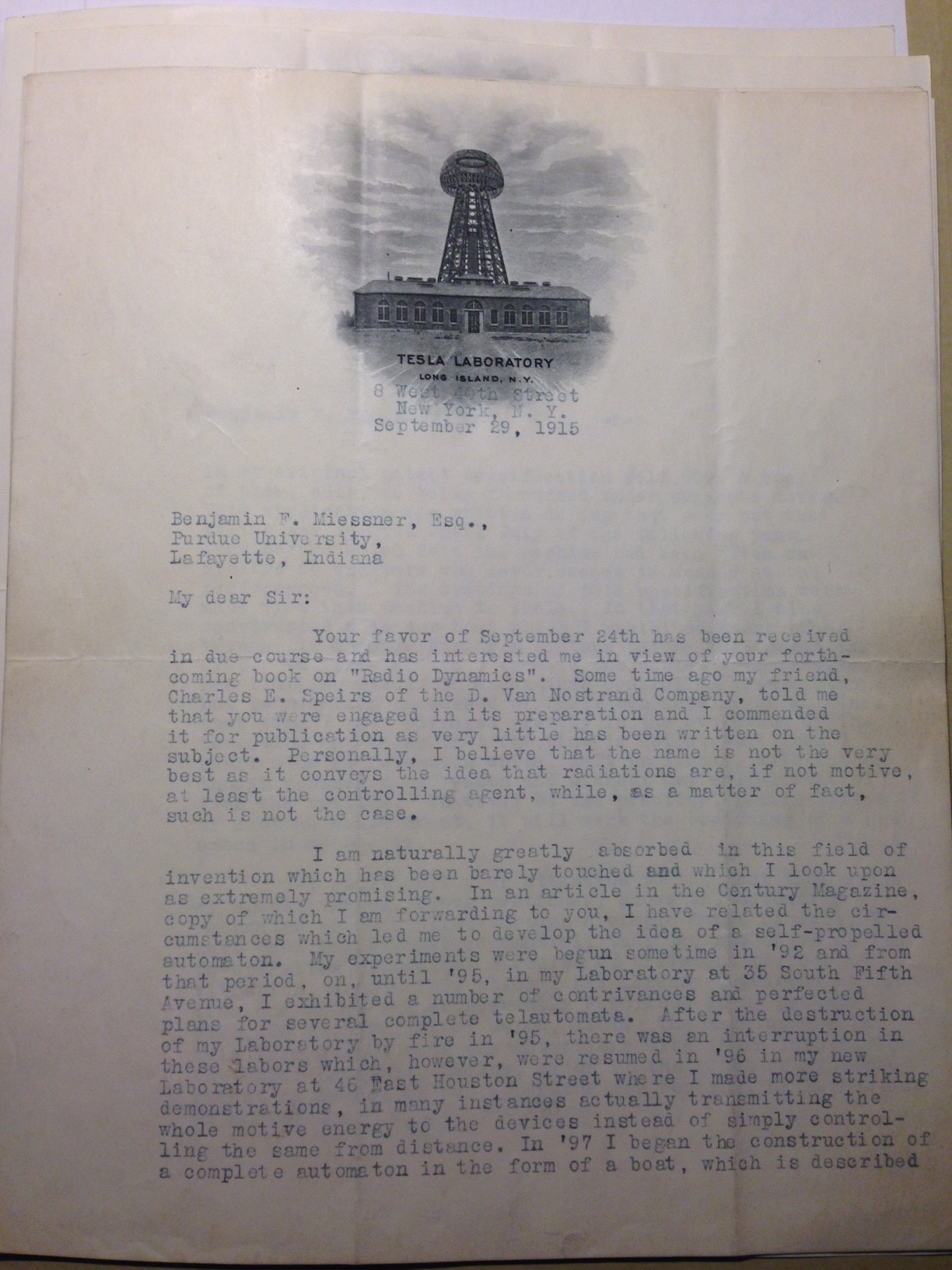
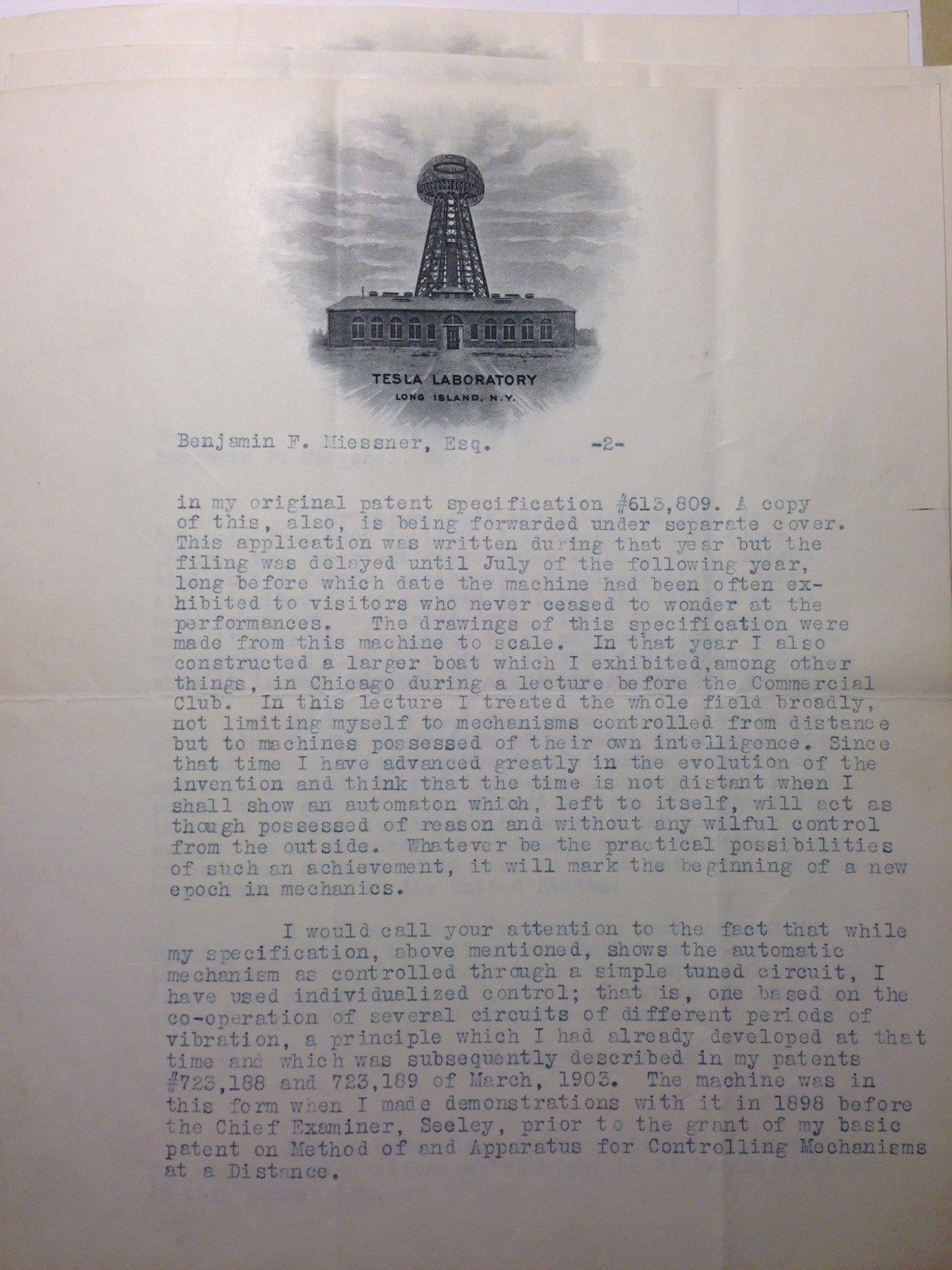
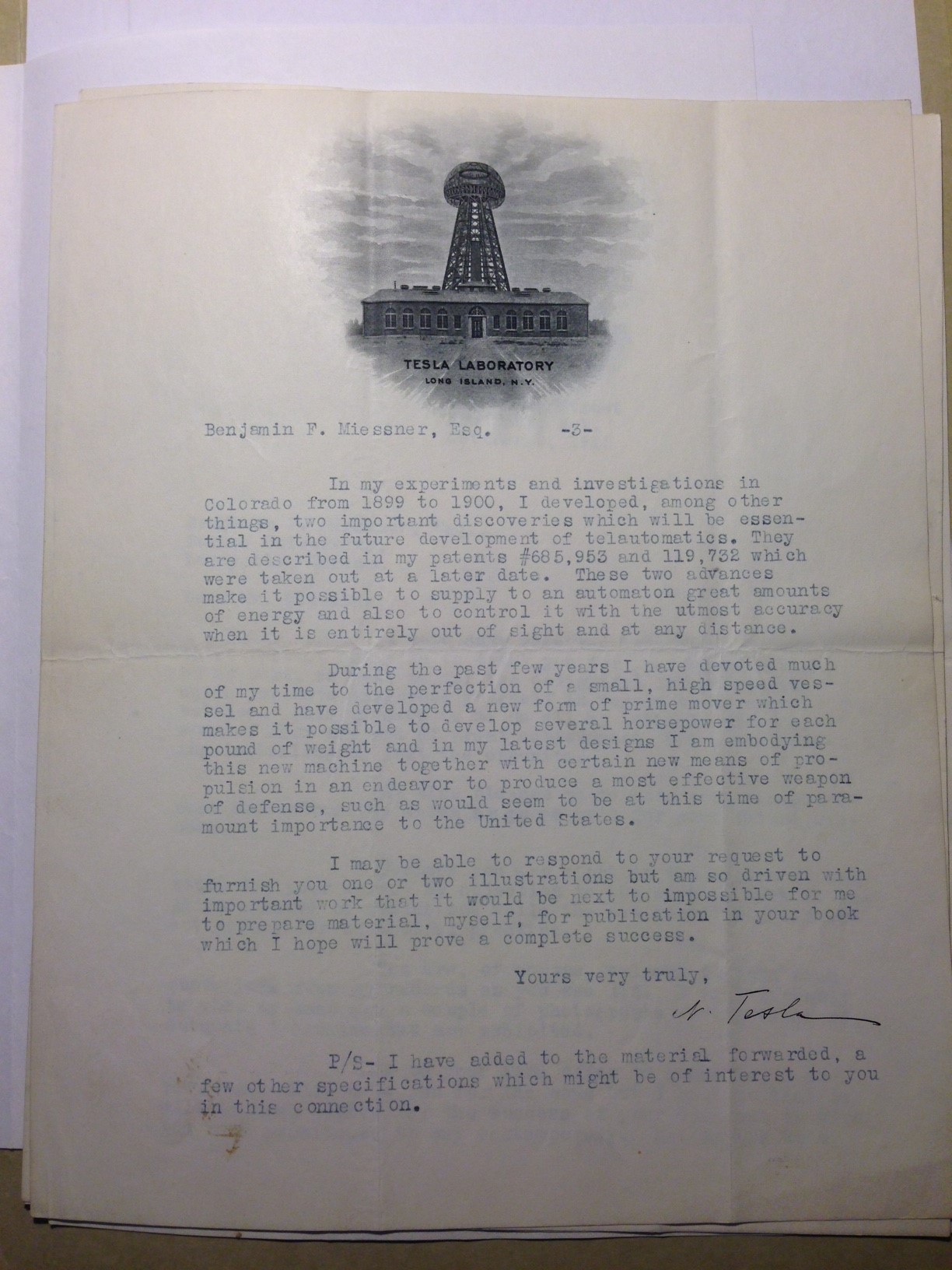
The final letter is intriguing for being written on the official Wardenclyffe Tower letterhead! Of course, in 1915, the tower had been long shut down, and Tesla was racking up the bills at the Waldorf-Astoria Hotel.
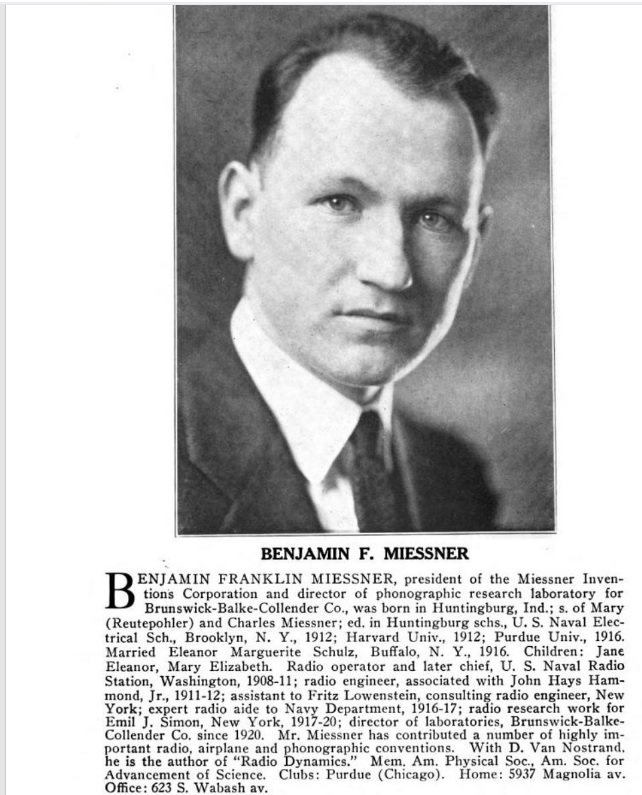
His correspondence is with young inventor Benjamin Miessner who was studying at Perdue University on this date.  Miessner eventually went into acoustical research; he later innovated technologies in sound recording. A picture and biography of Mr. Miessner appear below this letter from thePress Club of Chicago’s Official Reference Book.
In the letter, Tesla references the fire of 1895 and his automaton experiment which was revealed at Madison Square Garden. You can also see a real preoccupation with keeping and protecting patents for his work (and a subtext of preservation of those patents). After all, in 1915, Tesla was out of money!
His correspondence partner Benjamin Miessner in 1922:
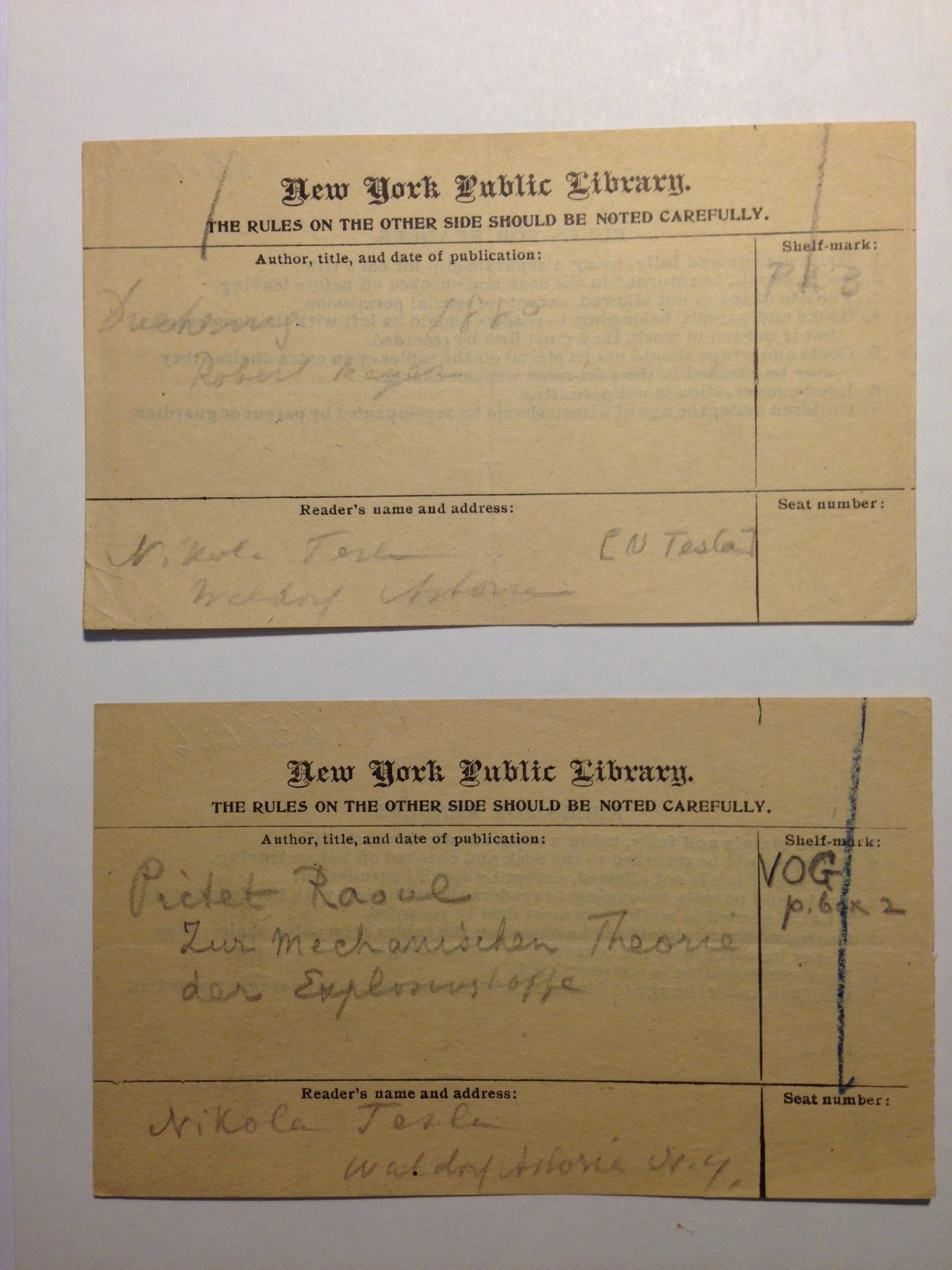
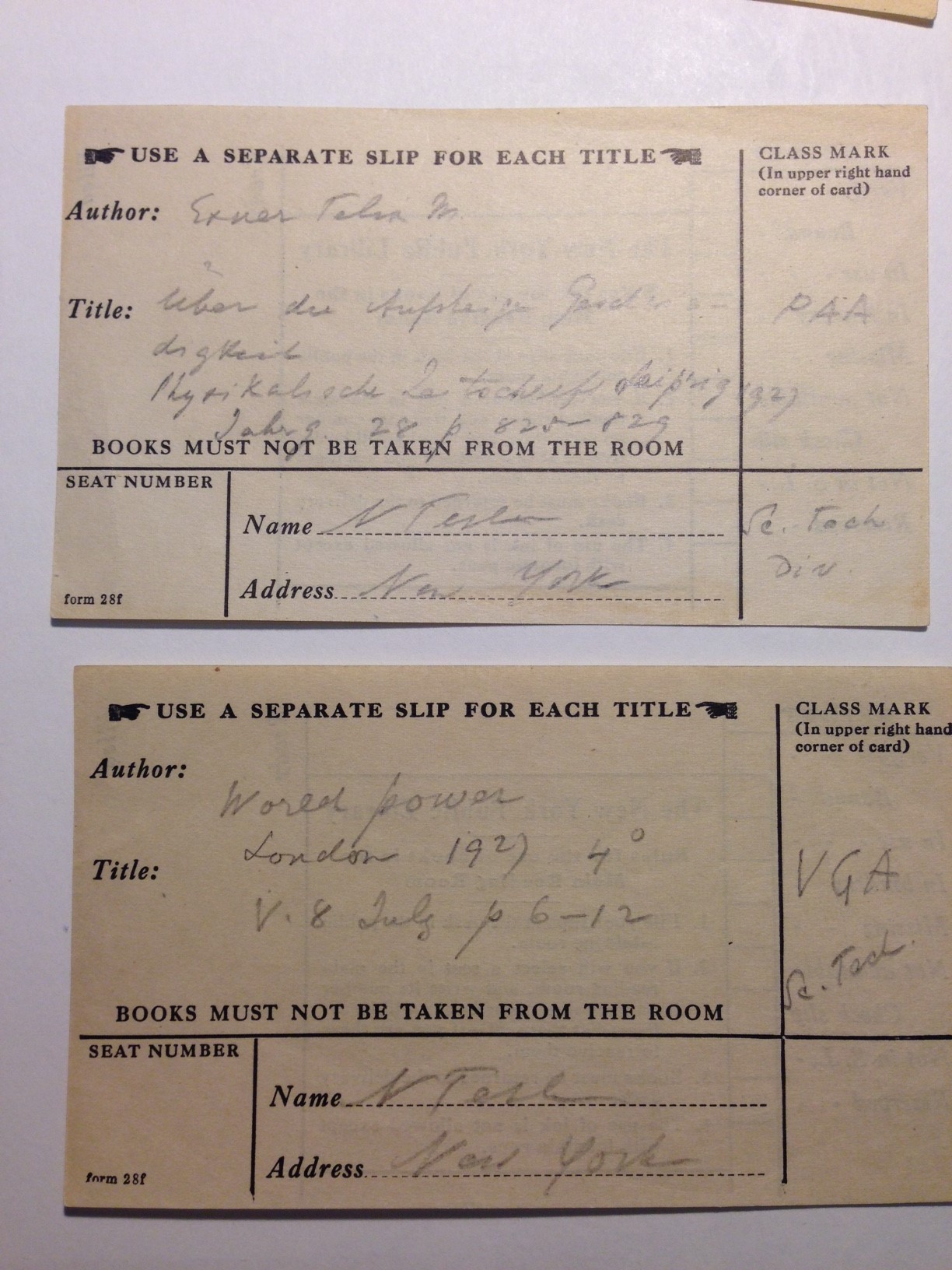
And finally, some library cards that Tesla check out himself, with an address of the Waldorf Astoria (which needed no address):
Documents from the Nikola Tesla letters. Manuscripts and Archives Division. The New York Public Library. Astor, Lenox, and Tilden Foundations. We thank the library for their help with this podcast and with all other things!
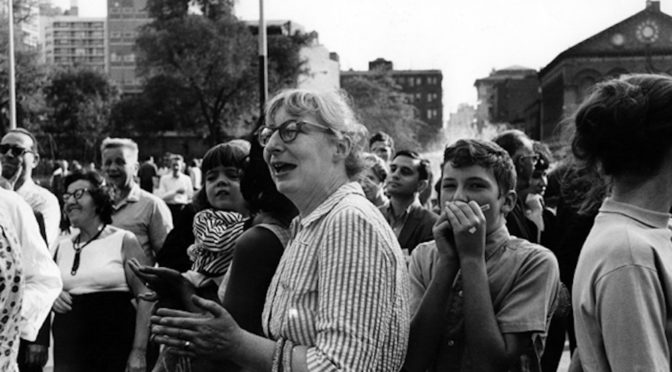
Jane Butzner was born 100 years ago in Scranton, Pennsylvania.  Jane Jacobs died on April 25, 2006, in Toronto, Canada. But for much of her life in between, she changed the way people thought about cities from her perch in North America’s largest — New York City.
Jane Jacobs was a revolutionary thinker in an age where ‘big ideas’ shaped cities. City planners thought about grand plans, not street corners. Jacobs became a breakout philosopher on everyday urban living, revealing practical realities that were completely misunderstood by those making real decisions.
Without Jacobs — and the countless activists and preservationists before and after her — we would not have New York City 2016. (You can take that statement both as a tribute and perhaps as a sly criticism as well.)
Now I didn’t know Jane, but I’m pretty sure she would like you to celebrate her birthday in one of the two following ways:  1) Go to your favorite neighborhood in New York City and spend money there at local businesses, or 2) Go to a neighborhood you’ve never been to before and learn everything you can about it.Â
If you’re looking for something to read today about Jacobs, by all means, jump into Death and Life or perhaps one of these books.
Today’s Google Doodle, celebrating Jane’s 100th birthday:
After that, plan on joining one of the many Jane’s Walks this weekend, sponsored by the Municipal Art Society of New York. There are dozens and dozens of free walking tours, from May 6-8, that you’re sure to find one right in your back yard. (Maybe literally your back yard if you live somewhere historic!)
Check out the entire list right here and plan out a whole weekend of adventures.  Below is a list of ten notable tours that caught my eye and sound like exceptionally unique ways to spend an afternoon.  Plus an extra one that I’m personally invested in:
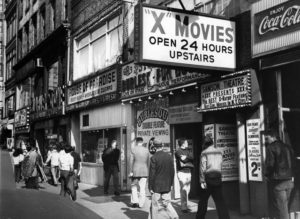
Times Square 1975. Courtesy Getty Images via Gothamist
DIRTY OLD TIMES SQUARE
Manhattan, Meet at Duffy Square
Friday, May 6, at 1pm, 2 hours Details here
Tag line: “Most of old Times Square has been carefully obliterated by generic hotels and office buildings, but there are still vestiges of its seedy past—if you know where to look.”
Led by Robert Brenner
HOW AUDUBON PARK DISRUPTED MANHATTAN’S GRID
Manhattan, Meet at Audubon Monument, 550 West 155th Street
Friday, May 6, at 6pm, 1.5 hours
Saturday, May 7, 1:30pm
Sunday, May 8, 11am and 2pm Details here
Tag line: “The distinctive footprint that disrupts Manhattan’s grid west of Broadway between 155th and 158th Streets—the Audubon Park Historic District—did not come about by accident or from the demands of local topography.”
Led by Matthew Spady
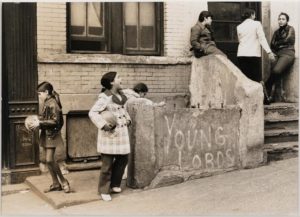
Photograph by Helen Barksy, 1971. Courtesy the Museum of the City of New York
EL BARRIO DREAMS: FOOD, ART, CULTURE (AND CHANGE)
Manhattan, Meet at Vendy Plaza (Park Avenue and 116th Street
Sunday, May 8, 1pm Details here
Led by Flaco Navaja
Tag line: “Our walking tour will explore the dynamics of a community in flux, looking at the history of East Harlem and the political and cultural significance of that history, as well as examining competing visions for the neighborhood’s future. ”
THE LOST HIGH LINE
Manhattan, Meet at NW corner of Washington & Houston Streets
Saturday, May 7, 11am Details here
Tag line: “Today, that remaining section of the High Line has become one of the city’s major attractions. But what about the ghosts of the past along its southern route?”
Led by Joan Schechter
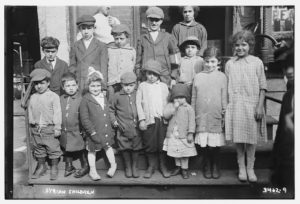
The littlest residents of former Little Syria. Courtesy Library of Congress
MANHATTAN’S LITTLE SYRIA: THE HEART OF ARAB AMERICA
Manhattan, Meet at St. George’s Syrian Catholic Church
Sunday, May 8, at 10:30am Details here
Tag line: “Immigration to the United States from the territories of Greater Syria — now Lebanon, Syria, and Palestine — began in the 1870s and 1880s. The most important neighborhood of the immigration — and its economic and cultural heart — was along Washington Street in the Lower West Side of Manhattan.”
Led by Todd Fine
THE BRONX’S MAIN STREET: WALKING THE GRAND CONCOURSE
The Bronx, Meet at the Bronx Museum of the Arts, North Wing Lobby
Saturday, May 7, 11am Details hereÂ
Tag line: “While visiting key sites along this major thoroughfare, Goodman will provide a brief history of the Grand Concourse and explain the development of its diverse neighborhoods and communities.”
Led by Sam Goodman
Courtesy Museum of the City of New York
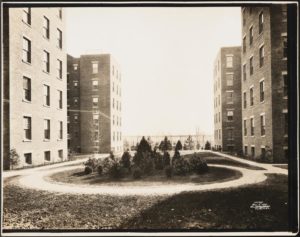
HISTORIC JACKSON HEIGHTS – AMERICA’S FIRST GARDEN APARTMENTS
Queens, Meet at the Chase Bank @ 75th Street and Roosevelt
Saturday, May 7, 11:30am
Sunday, May 8, 11:30 am Details here
Tag line: “We’ll explore the architectural qualities of Jackson Heights, developed by Edward A. MacDougall of the Queensboro Corporation in 1916. The neighborhood contains a variety of architectural styles with private gardens at the center of each city block.”
Led by Michael Limaco
ON LOCATION: THE VITAGRAPH STUDIOS AND THE HISTORY OF FILM IN MIDLAND BROOKLYN
Brooklyn, meet at Midwood Development Corporation
Sunday, May 8, 3PM Details here
Tag line: “At Avenue M and 14th street, The Vitagraph Company of America built the nation’s first modern film studio in 1906, where it operated until 1925 as one of the most prolific moving picture companies in the world, making Brooklyn the epicenter of film production long before Hollywood.”
Led By Nellie Perera and Melissa Frizzling
Photo courtesy the US Coast Guard
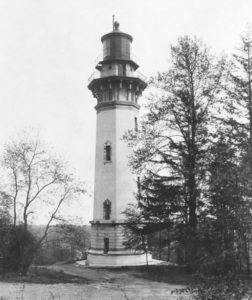
TIBET, OPERA, AND THE LUCKY CHARMS LEPRECHAUN: EXPLORING THE HIDDEN GEMS OF LIGHTHOUSE HILL
Staten Island, meet at the clubhouse of Latourette Golf Course on Edinboro Road
Saturday, May 7, 3PM Details here
Tag line: “Himalayan Buildings, a working lighthouse, a golf course and a widow’s walk are just some of the interesting sights we will see. Some of the historical tidbits include “Why is the neighborhood called Lighthouse Hill?” and “Why are the streets named after places in the UK?” and “What notable people lived here?””
Led By Meg Ventrudo
THE HILLS ARE ALIVE!
Governors Island, meet at the Battery Maritime Building
Friday, May 6, at noon Details here
Tag line: “See New York Harbor from a breathtaking new vantage point 70 feet in the air. Here is your chance to have a sneak peek at the newly planted Hills on Governors Island before they open to the public this summer.”
Led By Ellen Cavanagh
And finally, if you happen to be around Chelsea and the West Village on Saturday, check into the fascinatng tour below led by Kyle Supley. If all goes according to plane, I’ll be making a guest appearance during the tour, speaking at one particular location. Unfortunately, I will not be wearing chaps to this event!
GAY BARS THAT ARE GONE
Manhattan, meet at 515 West 18th Street
Saturday, May 7, 7pm Details here
Led by Kyle Supley
Tag line: “Past patrons, NYC history buffs, and those just looking for a good time, take note! From ballrooms to discos to piano bars, we’ll observe the shifting typology of the gay bar. Together, we’ll cover everything from the raids to the raves.”