Early news reporting on the celebration of Hanukkah (or Chanukah, as it was popularly referred then) in New York usually took a arms-length approach, as most of their readership knew little about the celebration 100 years ago. More than one old Tribune or World carried a variant of the headline ‘Jews Celebrate Chanukah’ , as though there might have been some doubt. A 1905 headline informs: ‘Chanukah, Commemorating Syrian Defeat, Lasts Eight Days.’
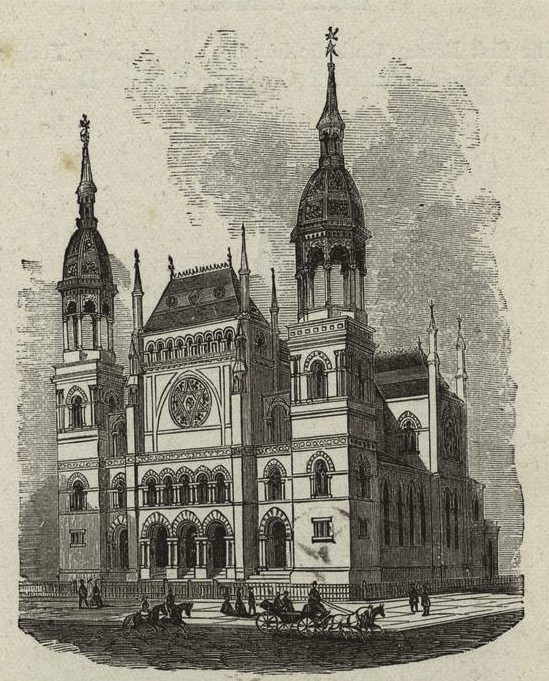
It wasn’t just non-Jews that were misinformed about this seemingly mysterious holiday. A December 1894 edition of the New York Sun asks ‘Christmas or Chanukah?’ as a prominent rabbi from Temple Emanu-El (pictured at right, in its Fifth Avenue incarnation) “rebukes the tendency of Jews to confuse the festivals.”
In fact, many Jewish leaders at this time were concerned that many traditions were being abandoned, the better to acclimate in a city that was decidedly more Christian-seeming.The wife of American Jewish scholar Richard Gotthell*Â worried in 1900 that “this festival occurs so nearly coincident with the Christian festival of Christmas that there is danger that the observance of one may be lost in a gradual assimilation with the other.”But with the mass immigration of Eastern European Jews to New York in the 1900s, soon thousands celebrated the holiday — and newspapers could hardly be so cavalier.
One event they took particular note of was the Chanukah celebration by the Federation of American Zionists, at the Herald Square Theater on January 1, 1911. One anecdote sprang out at me: “Dr. S. Levin spoke in Hebrew for an hour, on ‘Jewish Life and Art.’ He took exception to a certain Jewish speaker who recently declared that the Jews had produced nothing in art. Dr. Levin asserted that he was greievously wrong.”
Across town at that very moment, a young Russian Jew named Irving Berlin was hammering out tunes in Tin Pan Alley and would debut, just a couple months later, ‘Alexander’s Ragtime Band’, while other songwriters of Jewish heritage, such as Jerome Kern, were right then hard at work reinventing the American songbook. So, yes, Dr. Levin, grievously wrong.
And of course, these Jewish songwriters would go on to even help reinvent Christmas itself via a flurry of popular holiday tunes, like Berlin’s own ‘White Christmas.‘
*Gotthell was also the founder of America’s first Jewish fraternity, Zeta Beta Tau, formed in New York in 1898.
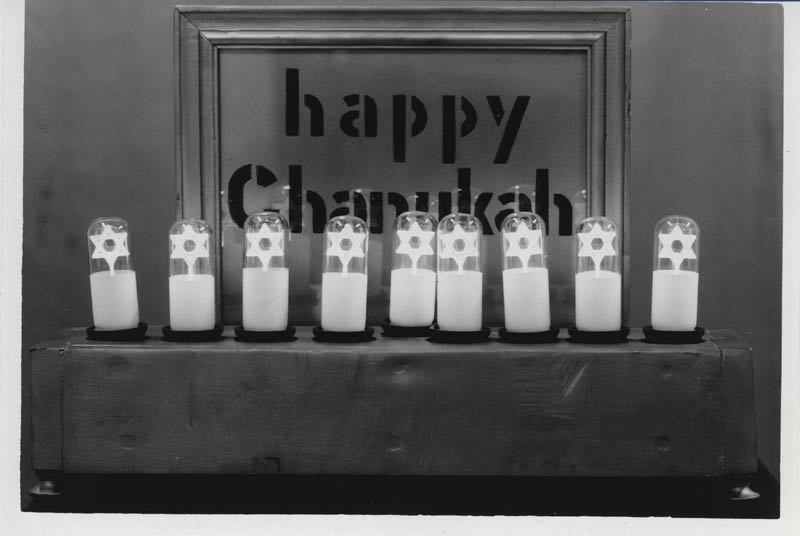
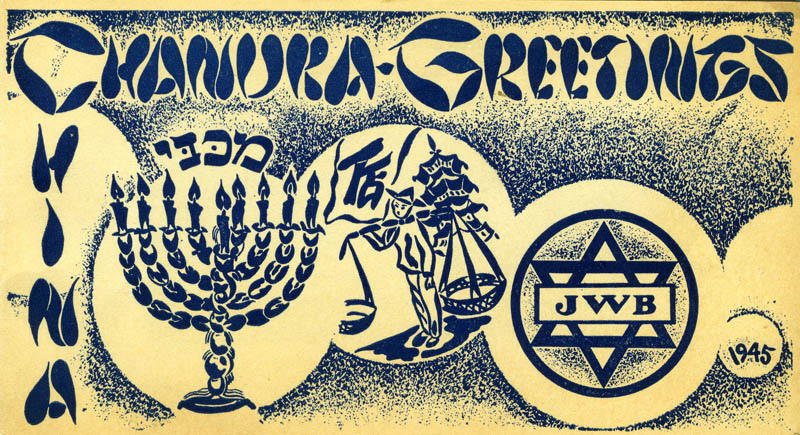
Pictured at top: A 1945Â Hanukah greeting card, issued by the Jewish Welfare Board, 1945
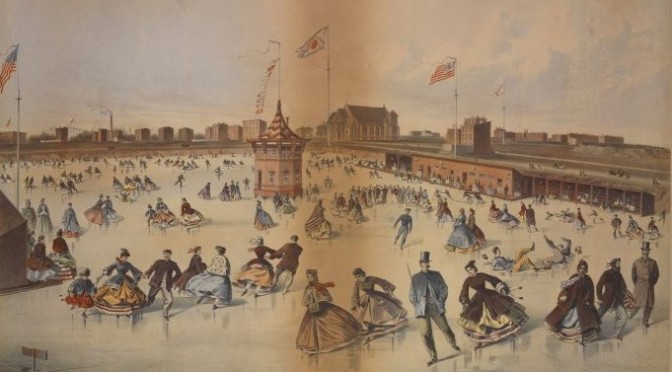
Williamsburg(h)’s Union Pond, one of the finest destinations for ice skating in the city, 1863. It later became America’s first enclosed baseball field.
The nation was at war one hundred and fifty years ago, but that didn’t stop the austere celebrations in the ‘borough of churches’. But while thousands of Brooklyn residents attended church that morning in 1861, many participated in a more whimsical holiday celebration — wild and uncontrollableice skating.
So famous was the city of Brooklyn’s famed ponds — which reliably froze each winter — that New Yorkers by the boatloads crammed into ferries across the East River to join in the icy merriment. On really cold days, of course, it was often the East River itself that froze solid. But in 1861, an unseasonable warmth kept the river disappointingly liquid, forcing thousands of skaters upon Brooklyn’s small ponds where the ice quickly melted.
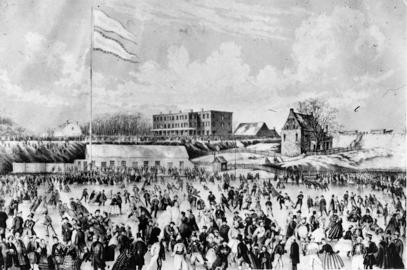
For instance, Washington Pond (at right), at 5th Avenue and 6th Street — then considered Gowanus, today it’s Park Slope — was normally ideal for skating. Horse-drawn streetcars took crowds right from the Fulton Ferry to the door of the nearby old stone house, built in 1699 and famous for its role in the Revolutionary War. (It’s why the pond is named for Washington, after all.) But on Christmas 1861, “the ice was unpleasantly rough” there.
Skaters may have found more success at other Brooklyn skating destinations. The Capitoline Skating Lake, near the train station in the former independent village of Bedford, was known as the “principle pond of the Western District.” In Williamsburg, the versatile ‘world-renown‘ Union Pond drew thousands during the winter and thousands more in the summer — as the nation’s first enclosed baseball field. On this particular day, the newly opened pond in its ‘gay and brilliant appearance’ was crammed with skaters laughing and caroling, in various states of sobriety.
By the afternoon of Christmas 1861, most of the closest ponds were mushy and nearly dangerous. At a pond on Third Avenue, “a gentlemen with two ladies fell trough the ice and took their Christmas immersion without any material damage save a very decided shivering,” according to the Brooklyn Eagle.
Urban ice enthusiasts were forced to follow the advice of horsecars festooned with the signs ‘Good Skating in East Brooklyn’. I’m not sure exactly where crowds went that day, but a New York Times article from a three years later lists several ‘free ponds’ that might have been available for ice skating that day, including Seller’s Pond “in Bedford, near the Jamaica Pond Road”, “Dumbleton’s Pond on Myrtle Avenue” and the Suydam’s Pond, “on Atlantic-avenue near the Hunters-Ferry road.”.
All that skating and merriment drove many to more intoxicating holiday spirits, preferring their drinks ‘on the rocks’, or as the 1861 Eagle reports, “the boys will insist that ‘Christmas comes but once a year’ and with it comes a large measure of ‘good cheer’ and so they must get cheerful.” The most serious altercation came with one reveler, tiring of throwing rocks at boys, attempted to pistol whip a police officer.
The more respectable Brooklynites traipsed home at dawn, as the gaslights meet the fading light, casting the wet snow in a bright glare. Many reformed again for choirs of caroling, or else to distribute presents at charity ‘Christmas tree exercises’, where children lined up outside downtown theaters hoping for presents and a gander at the gorgeously trimmed tree, sparkling with candles.
The gritty image of the scrappy 19th century newsboy, the can-do kid slinging newspapers from the street corner, full of vinegar and character, was an encouraging invention of the newspapers themselves.
Children were cheap labor, willing to sling stacks of freshly printed papers to corners across the city.
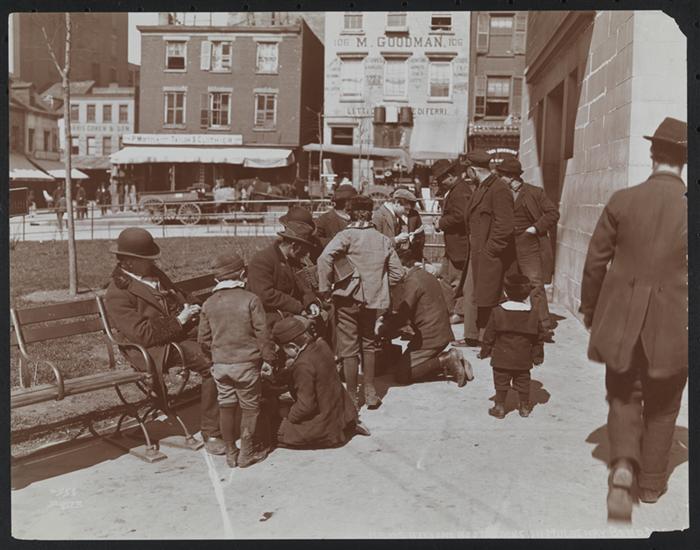
Bootblacks and newsboys at Mulberry Bend, 1898, courtesy Museum of the City of New York
Many kids preferred the profession to that of bootblack or messenger boy, and it was certainly more profitable than peddling door to door.
Newsies were frequently mentioned within general-interest stories of homeless, outcast whelps, considered almost blissfully, as though their own news delivery forces weren’t themselves part of that pathetic number.
The papers stereotyped newsboys (who were occasionally girls, too) as orphans or ‘street arabs’ with purpose, self-sufficient little adults plucked by their profession from the grasp of destitution.
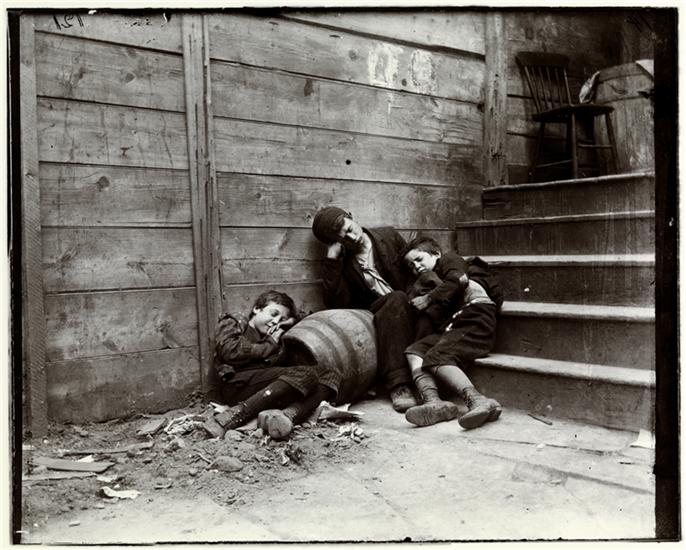
Three boys curled around a barrel, asleep at the bottom of stairs. By Jacob Riis, 1890, courtesy the Museum of the City of New York
Many children were homeless; the lucky ones took shelter in ‘newsboy lodging homes’, but many braved it in doorways and slept over gratings.
Some found this life preferable to New York’s houses of refuge, dreary orphanages that were often grouped with homeless shelters or other asylums.
Those children who did have families took employment out of necessity or as a means of escape. It took organized action (culminating in the Newsboy Strike of 1899) and the work of child-labor activists like photographer Lewis Hine to highlight the unsavory conditions and low pay.
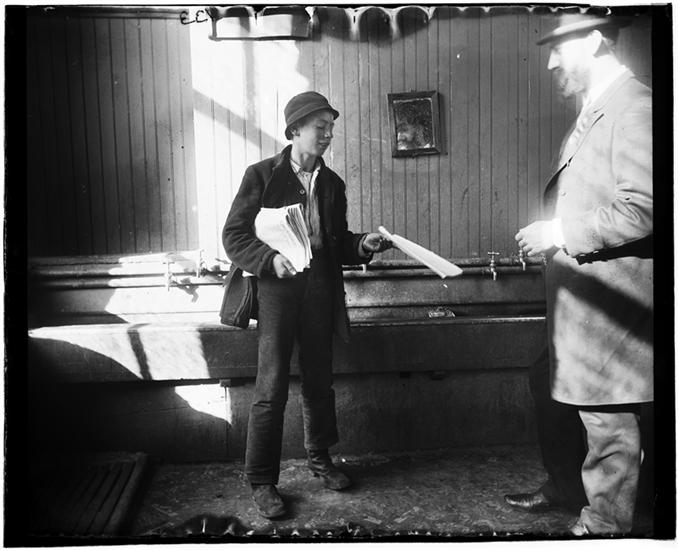
Below: A newsboy posing for a Jacob Riis picture at the Duane Street lodging house, 1889
Newsboy at the Duane Street Lodging House, c 1890, Museum of the City of New York
No time was worse for a newsboy than winter.
Not only was it physically difficult to sell newspapers in cold and snowy weather — or worse, the wet, wintry mix that often typifies the New York season — but children were rarely dressed for comfort.
The idea of Christmas was a luxury. As newspapers were sometimes heavier due to increased page count, some children may have even dreaded the holiday.
But the Gilded Age wealthy were charitable around the holiday, and a few lucky ‘urchins’ got a gracious Christmas handout.
Some groups, like Charles Loring Brace‘s Childrens Aid Society, worked year-round to get children off the streets, via ‘orphan trains’ that sent children to live with families in other places.
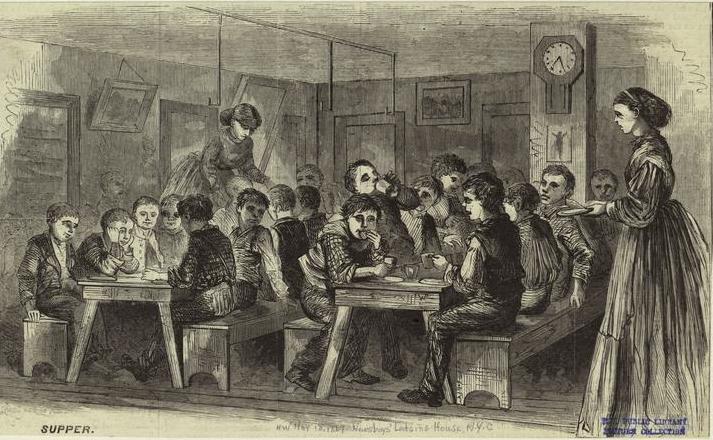
Those that remained in New York, the ones fortunate enough to find shelter at a newsboys lodging house like the one at 9 Duane Street, celebrated the holidays with an large annual feast hosted by importer William M. Fleiss.
The wealthy trader brought annual Christmas meals to the needy children at the lodging house for almost thirty years. “The newsboys were not overlooked by Santa Claus, ” said the New York Times in 1893.
Below: Dinner at a newsboys lodging home, from an earlier period (1867), courtesy NYPL
At the 1897 dinner, the lodging house dining room was festooned with evergreen branches and white linens. Children ate in shifts, enjoying a bountiful feast that included ham, turkey, mashed potatoes and plenty of pie.
A familiar face at some of these lodging dinners was a young police commissioner Theodore Roosevelt, his father being a co-founder of Brace’s aid society.
“Tramp! tramp! comes the to-morrow upon the stage. Two hundred and fifty pairs of little feet, keeping step, are marching to dinner in the Newsboys’ Lodging-House. Five hundred pairs more are restlessly awaiting their turns upstairs….As the file of eagle-eyed youngsters passes down the long tables, there are swift movements of grimy hands, and shirt-waits bulge, ragged coats sag at the pockets. Hardly is the file seated when the pliant rises: ‘I ain’t got no pie! It got swiped on me.’ Seven despoiled ones hold up their hands.”
There was plenty of room for shenanigans at this dinner. Another source confirms that “a few fine, soft pies were deposited down some unfortunate newsboy’s back between his shirt and him.”
By most accounts, however, more food was eaten than thrown.
Fleiss’s generosity, while certainly genuine, kept him in good social company. The wife of William Waldorf Astor (not to be confused with her aunt, in social parlance THE Mrs. Astor) paid for Thanksgiving suppers for the boys.
And for Mr Fleiss, charity may have had a more soul-cleansing motive. In 1894, he was accused during the Lexow police corruption investigationof giving a prominent inspector “about $5,000 to $6.000 as a result of speculation in stocks.”
Another group of newsboys in 1898 enjoyed a bountiful dinner of “oysters on the half shell, consomme julienne, radishes, celery, salmon, mayonnaise dressing, turkey and cranberry sauce” courtesy of early grocery giant Frank Tilford of Park & Tilfords, the Whole Foods of its day.
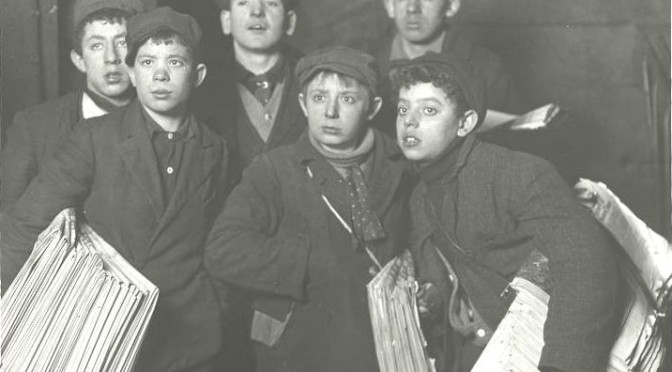
Top picture: Photographed by Lewis Hine, caption “Group of newsboys starting out at Brooklyn Bridge early Sunday morning,” courtesy NYPL
The 24 States: playing field for America’s first board game
HOW NEW YORK SAVED CHRISTMASMy yearly roundup of little events in New York history that actually helped establish the standard Christmas traditions many Americans celebrate today. Not just New York-centric events like the Rockefeller Christmas Tree or the Rockettes, but actual components of the festivities that are practiced in people’s homes. You can read past articles in this series here.
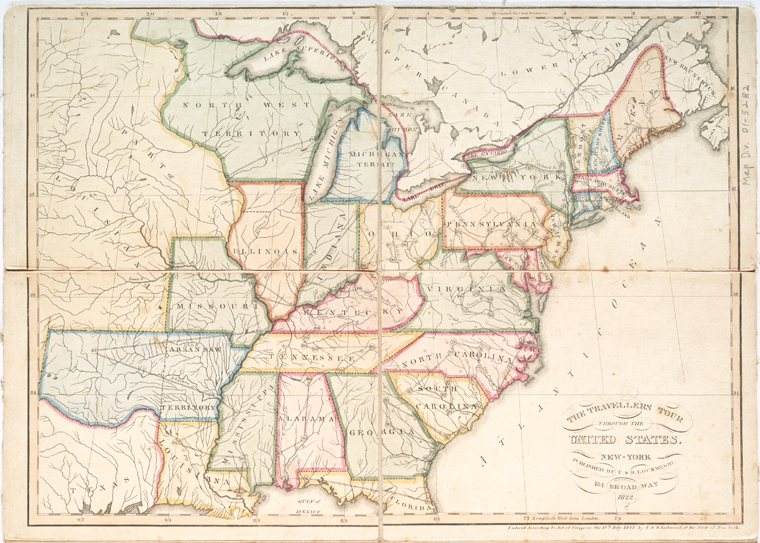
Board games are a staple of the holiday gift-giving season and one of the presents most easily guessed correctly by children when sitting wrapped under the tree. My young niece has already texted me strongly implying she would like to see the new UNO ROBOTO under the tree this year.What if I decided to be the weirdest uncle in the world and give her the first board game ever sold in America — The Travellers Tour through the United States, first manufactured and sold in New York?
Contests played on wooden boards (like backgammon and chess) have been around for millenia, but they were mostly seen as an adult dalliance, often kingly, sometimes undignified, and almost never for children.
The concept of non-physical boxed games for adolescents developed, not surprisingly, for educational uses. Board games are actually the step-children of maps, with many 18th century European models focusing on geographic instruction. Considering the penchant of European countries to invade each other then, this may have been both useful for teachers and vexing for students.
Historians trace the first real children’s board game to that party in a box called The Mansion of Happiness, indoctrinating Puritan values as children maneuvered pieces along a winding, multi-colored path. Although the game was invented in England in 1800, it took several decades to be reproduced in the United States. By this time, New York kids already had their own board game.
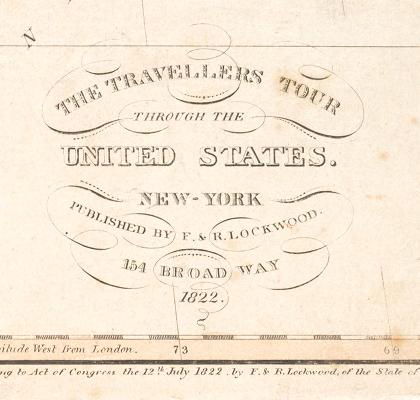
It debuted in 1822, courtesy the brother book publishers Frederick and Roe Lockwood. Their father, the spectacularly named Lambert Lockwood, owned a book store in Bridgeport, Connecticut. According to game historian Joseph Angiolillo, it’s believed Lambert also sold ‘linen games’ which could be unfurled on the floor, folded and put away. (Think of Twister, but less shocking.) The Lockwood’s fine home would not be far from that of the downtown Bridgeport residence of P.T. Barnum.
With father’s help, the young brothers moved to New York in the late 1810s to start their own publishing business, setting up a small shop at 154 Broadway at Liberty Street (today, catty-corner Zuccotti Park). They appear to have specialized in ‘foreign works‘ — probably books in other languages — but had a few startlingly devout titles in their collection, from “Views on Theology: President Edward’s Doctrine of Original Sin, the Doctrine of Physical Depravity” to “The Excellence and Influence of the Female Character.” They even dabbled in game instruction with the 1821 guide “Instructive and Amusing Pastimes.”
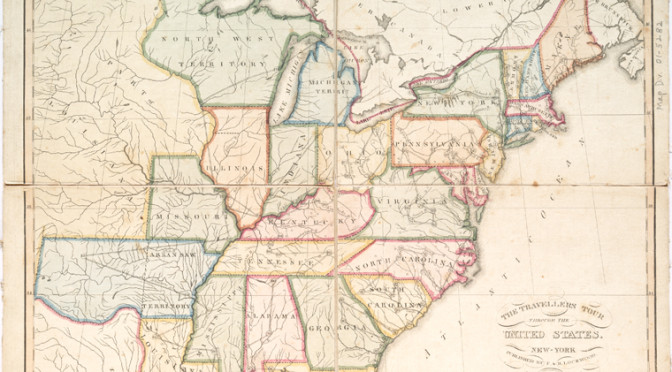
In 1822, they developed an educational tool for the purpose of learning American geography — a topic not terribly complicated back then — and called it The Travellers Tour through the United States. Essentially, it was a map of the states and territories, including the freshly unveiled states of Missouri and Maine and the blue lumpen-shaped Arkansas territory. The map was printed on some type of flexible wooden board that could be folded.
The object of Travellers was to give the names of cities and places, with players following a line around the board. Seems easy, right? In a more advanced version of the game, however, one also had to guess the population total. I cannot think of a more apt symbol of the pride for American expansion than this particular feature. The first player to get to New Orleans won.
There were no dice with The Travellers Tour through the United States, being associated with gambling and vice. Instead, players maneuvered around the terrain via a spinner, a far easier method of cross-country travelling than the one chosen by Lewis & Clark several years previous.
The game was clearly successful enough in their store that two expanded versions were created, The Traveller’s Tour through Europe and The Traveller’s Tour through the World.
The Lockwoods aimed their board games to holiday shoppers. In in the 1820s, however, many New Yorkers didn’t celebrate on Christmas; in a Puritan throwback, many believed celebrating on Jesus’s birthday itself was too unholy. New Years celebrations, however, were just as relevant, with families visiting the homes of friends and neighbors, often bearing gifts.
The brothers Lockwood were ready: “VALUABLE NEW-YEAR PRESENTS,” according to one old newspaper.”The works of Byron, Scott, Cowper, Moore….in elegant bindings.” And among the books they sold backgammon and chess boards. With such games for adults, the Travellers series must have seemed a desirable purchase, lest they leave the children jealous.
The Lockwoods continued making books through the 1820s at this location, although it doesn’t appear they were in business together after 1830. One source mentions Frederick Lockwood as a watchmaker later in life. His brother Roe, however, stayed in the book business, partnering with his son. It appears he even later published the extraordinary illustrations of John James Audubon.
I’m not sure what happened with the building at 154 Broadway, but if it was still standing in 1845, it was surely destroyed in the Great Explosion of 1845.
One final note — in 1822, just as the Lockwoods were debuting their new board game, a wealthy gentleman uptown in his estate (the austere Chelsea manor) became inspired by the holiday season and wrote a festive poem. The following year, that man, Clement Clarke Moore, published it under the title “A Visit From St. Nicholas,” aka ‘Twas the Night Before Christmas.”
It is difficult to discuss calmly the frightful disaster which happened in Brooklyn on Tuesday night. No such awful sacrifice of human life has ever been known in this country shipwreck and the casualties of war alone being excepted. — New York Times editorial, Dec. 7, 1876
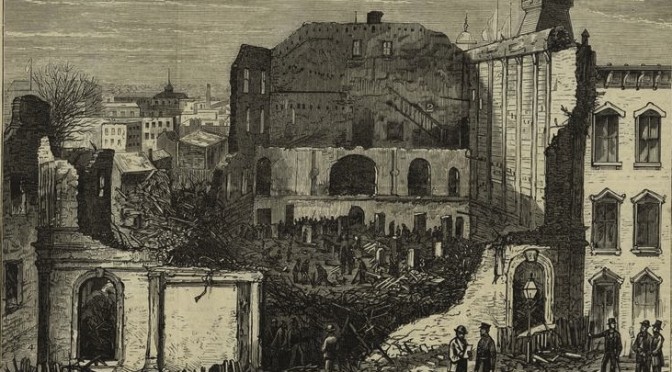
One hundred and thirty-five years this evening, nearly a thousand playgoers entered the Brooklyn Theater, at Washington and Johnson streets near City Hall, to enjoy the well-reviewed (and lengthy) production of N. Hart Jackson’s ‘The Two Orphans’. During the show’s final act, stage hands discovered that a set piece backstage had caught fire. The actors onstage attempted gamely to stay in character, for fear of causing a panic, until fiery bits of wood and flaming parts of the set began raining down upon them.
As the audience leapt to the aisles in terror, the actors tried to calm people to prevent a stampede, to no avail. An usher forced open a rarely used exit door to free audience members, but the rush of December air only fed the flames, turning the once elegant auditorium, built only five years previous, into an inescapable trap of heat and asphyxiation.
Those in the upper tiers of the theater — the ‘family circle’, or cheap seats, filled with men, women and children — were trapped by smoke within darkened foyers and unnavigable stairwells. Some fell from balconies to their deaths. Dozens were crushed heading for doorways, and to some of those who survived, it seemed that all respectability had given way to base animal behavior. Most perished by suffocation or underfoot, while others were lost into the oblivion of belching smoke when weakened floors gave way.
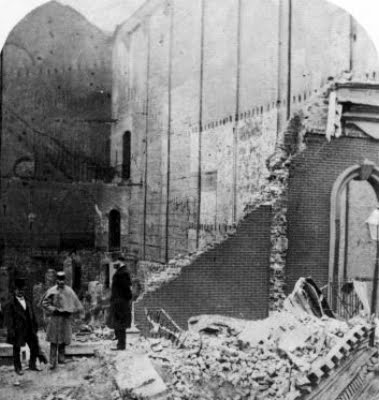
Twenty five minutes after flames were first spotted backstage, one entire wall of the Brooklyn Theater caved backwards into the inferno, the once elegant ceiling fresco nothing but a crumbling scorch now. Flaming projectiles caught in the wind settled upon surrounding structures, and firefighters scrambled to soak the inferno, now in fear of scattering randomly through one of Brooklyn’s oldest neighborhood. Most in danger was the hotel on the corner, where some audience members had found momentary safety.
Since 1869, Brooklyn had a paid fire department, and many fought the fire from the streets. But the rudimentary firefighting implements of the day were unable to combat the inferno. The Brooklyn Theater burned for several hours more, dying out by early morning. Throughout the night, most could only watch — what to do, plunge into darkness? — and many did watch. Thousands flocked, some to help, others fascinated, horrified.
Inspectors found an unspeakably grisly sight the next morning, heaps of burned bodies in formless masses — people choked or crushed, their remains almost unrecognizable amid blackened debris. In an eerie parallel to two later disasters (the General Slocum explosion of 1904 and the Triangle Factory Fire of 1911), a make-shift morgue was prepared on nearby Adams Street to accommodate the dozens of unidentifiable corpses.
Nobody is sure exactly how many died that evening — some number between 275 to 300 people. It is certainly among the worst disasters in Brooklyn history and one of the most catastrophic fires in American history.
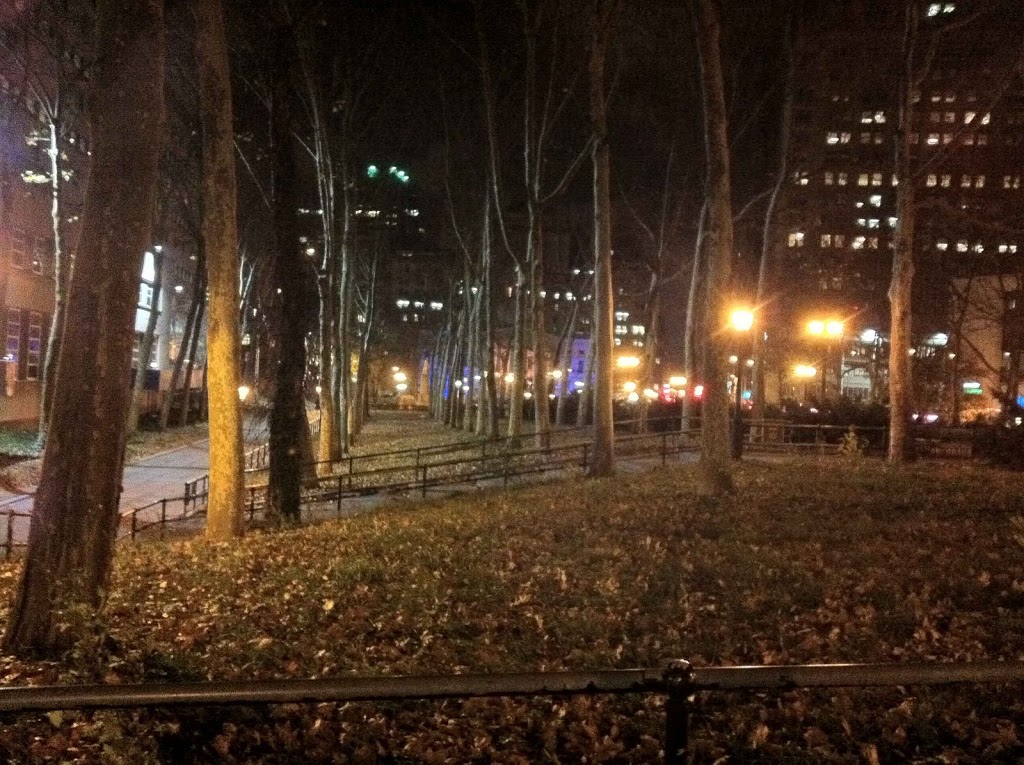
The place where the theater once stood is now occupied by Cadman Plaza, in the grove of trees just east of the Henry Ward Beecher statue. Many of the bodies (over a hundred) are buried together under a memorial at Green-Wood Cemetery.
Top picture courtesy NYPL
Below: the area of Cadman Plaza where the Brooklyn Theater once stood.
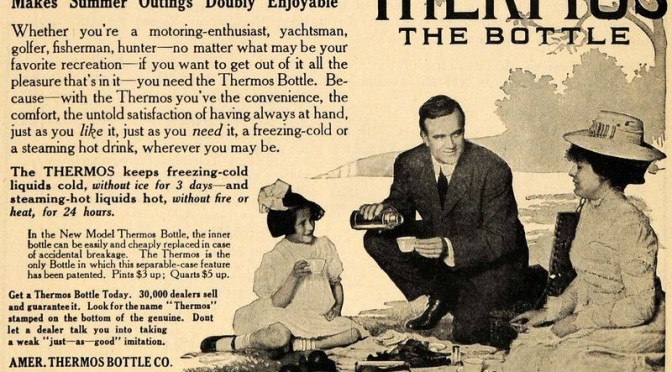
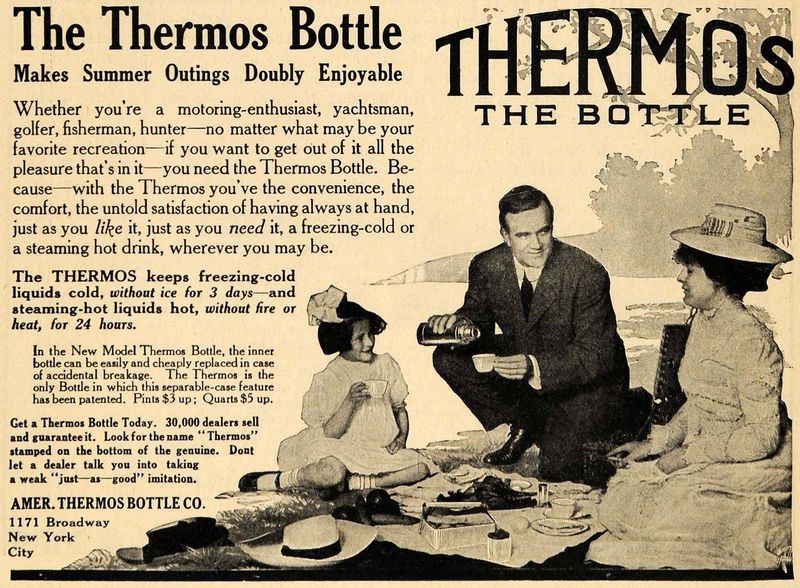
A charming family enjoys its insulated beverages — just as they like it, just as they need it — in an ad from 1909.
The invention of the vacuum flask in 1892 (by Scottish chemist Sir James Dewar) does not rank high among mankind’s most remarkable inventions, but its longevity relies on being a steady companion. The first gas-operated motor vehicle debuted in Massachusetts the following year. In an era before disposable containers, the vacuum flask came along at exactly the right time. Now, people could travel long distances of their own accord and drink a hot beverage along the way. In the 1890s, the road trip was born.
Believe it or not, Dewar was not a member of the family that produced the famed Scottish whiskey, although I suspect much of that intoxicant has been stored in Dewar’s vacuum invention. Like many inventors, Dewar was not terribly business-savvy, and he failed to properly patent and profit from his own creation, unsuccessfully taking rivals to court.
One of those competitors, the German glass blowers Burger and Aschenbrenner, ran away with the industry. They loosely named their revised vacuum flask after the Greek word for ‘heat’ and began producing the Thermos for local use in 1904. Two years later, William B. Walker, an American visiting the Munich-based Thermos plant, became enamored of the magic container and obtained a license from the Thermos company to bring the product to America the following year.
Walker opened the American Thermos Bottle Company in 1907, producing the containers out of a small factory in Brooklyn, in the shadow of the Manhattan Bridge. (Today’s DUMBO neighborhood, 31 Washington Street, to be precise. The building is all condos today, so that means one or more people are living in an old Thermos factory as you read this.)
His timing could not have been more divine. Auto dealerships began popping up around Times Square, driving a market for accessories. New York’s continuing construction boom — paired with less advantageous lunch-break privileges — suggested new uses for the Thermos.
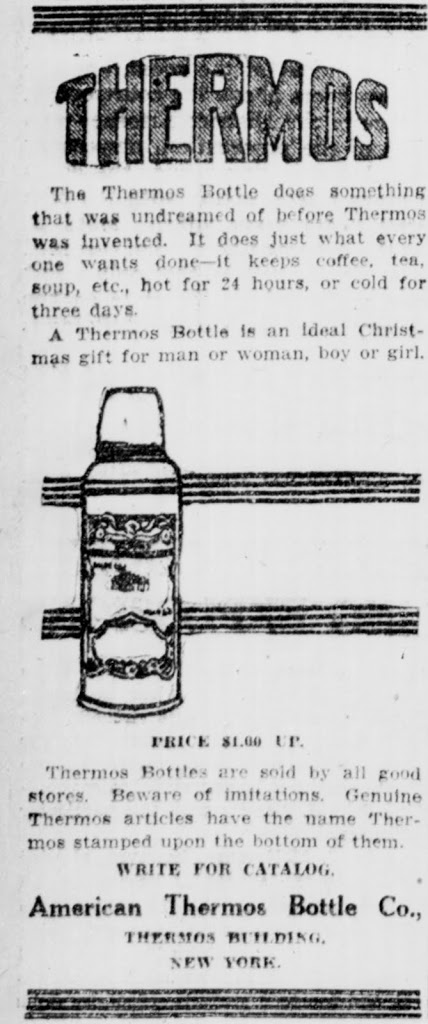
But most likely it was Walker’s clever marketing strategies that made the Thermos a desirable product. As seen in the advertisement at top, the Thermos brought the family together. It was traditional. At the same time, it was a marvel of invention, at an affordable price. An ad (at right) that ran 100 years ago today, in the New York Tribune, heralds its appropriateness as a Christmas present. “It does just what everyone wants done — it keeps coffee, tea, soup, etc., hot for 24 hours.”
Walker soon expanded the Thermos company. While his marketing and distribution team moved to a swank office near Madison Square (1171 Broadway), his production facilities moved to Chelsea in 1910, to 232 West 18th Street, with additional entrances on West 17th Street. “The building will hereafter be known as the Thermos Building,” proclaimed the New York Times.
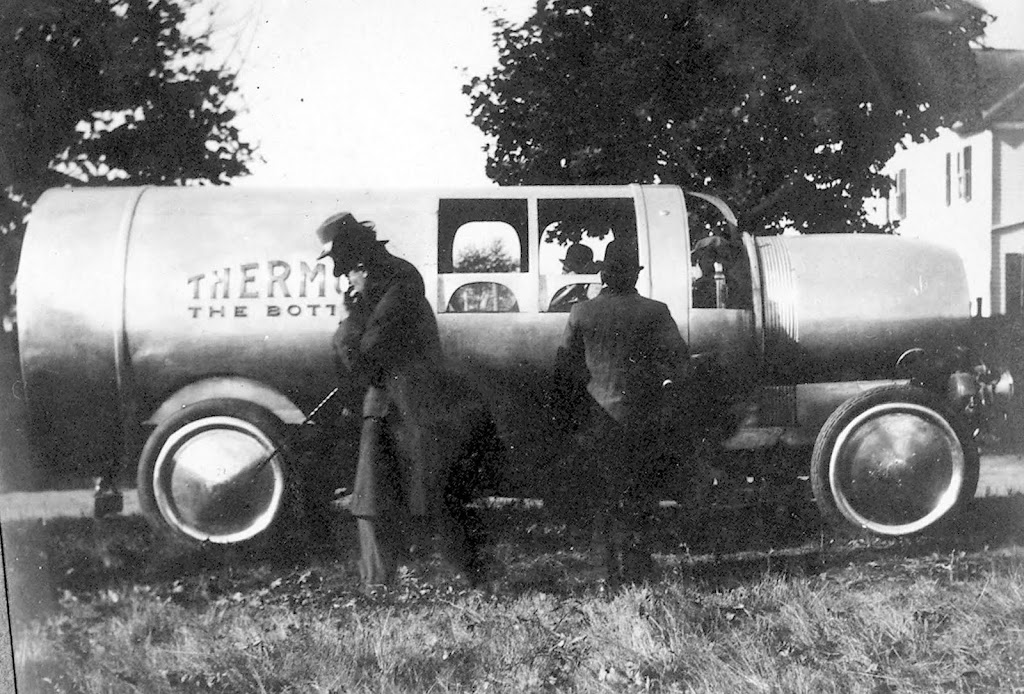
The product began popping up in truly odd places, all engineered for the maximum of publicity. Most of the 200,000 New Yorkers who lined Broadway for an “automobile carnival parade” in 1909 observed one prize-winning vehicle — a car in the shape of a Thermos bottle. (The Thermos car below is from the 1909 Vanderbilt Cup races, in Long Island. I imagine it must be the same vehicle. Pic courtesy Vanderbilt Cup Races.)
The Thermos made a stout companion during the era of exploration. E. H. Shackleton had one during his 1909 voyage to the South Pole, as did Robert Peary on a his similar expedition north. The Wright Brothers allegedly had one on their early planes. Back on Earth, so did the President of the United States that year, William Howard Taft.
Christmas shoppers along Ladies Mile, not far from the Thermos Building, would have found a wide selection of sizes. According to Charles Panati, “A quart-size Thermos sold for $7.50; the pint size for $5.00.” Those are appliance prices; according to the Inflation Calculator, a $5 Thermos in 1910 is equal to a $115 product today. (I don’t know what that ad above is talking about with its $1.00 Thermos.)
Demand soon required larger facilities, and the Thermos company moved out of the Thermos Building. But not before a disaster that struck on May 1, 1913, a fire that quickly swept through the structure, rather unsettling in light of the Triangle Factory Fire that occurred just two years before. Luckily, most of the Thermos employees were out to lunch, and a hero, “Samuel Gumps, a negro elevator man” rescued employees from the top floors. Although “several girl employees” were forced to escape to the rooftop.
The Thermos company moved its headquarters to Norwich, Connecticut. Today the building is a basic residential address, its Thermos Building name long forgotten. (As the building cuts through the block, it’s known today as 245 West 17th Street.) On the 18th Street side, it’s just next door to Barney’s Co-Op. Perhaps they sell Thermos there?
By the way, I love that in the early days of this product, it was sometimes marketed as ‘Thermos, the Bottle.”
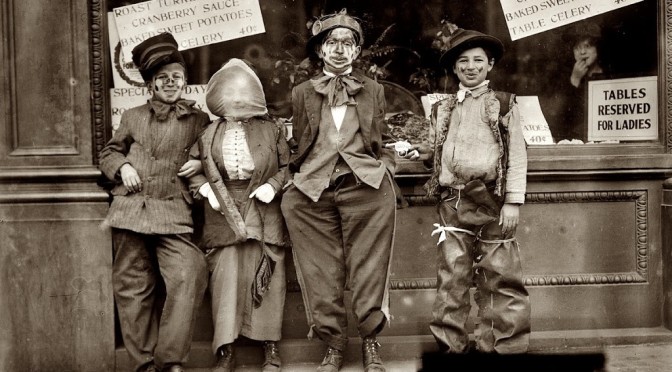
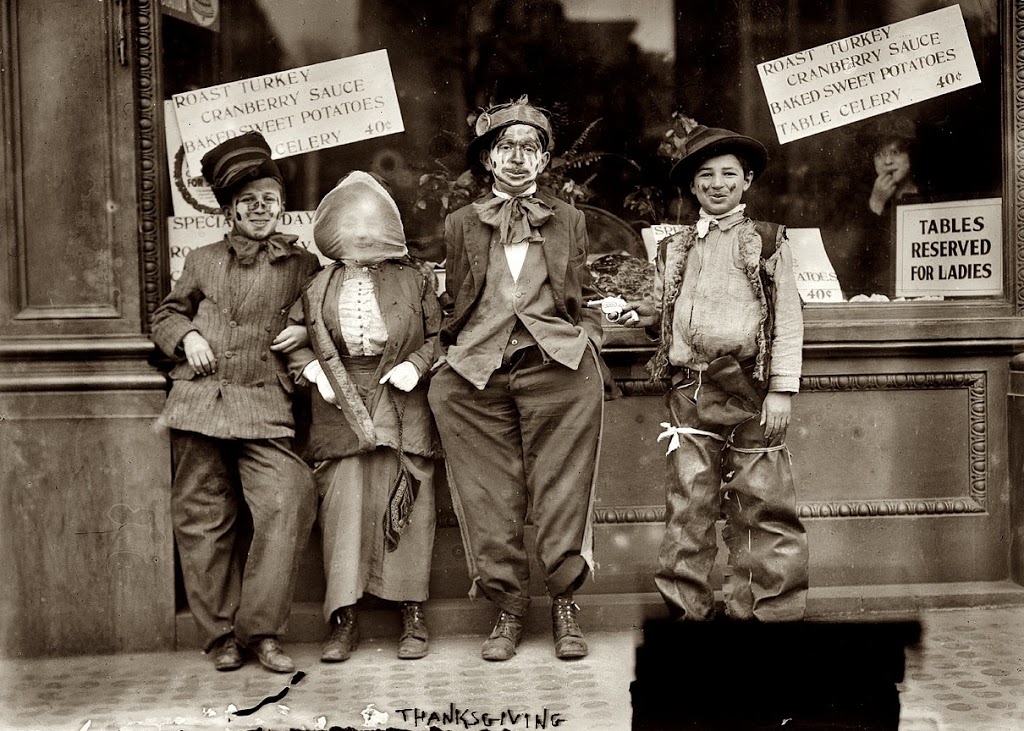
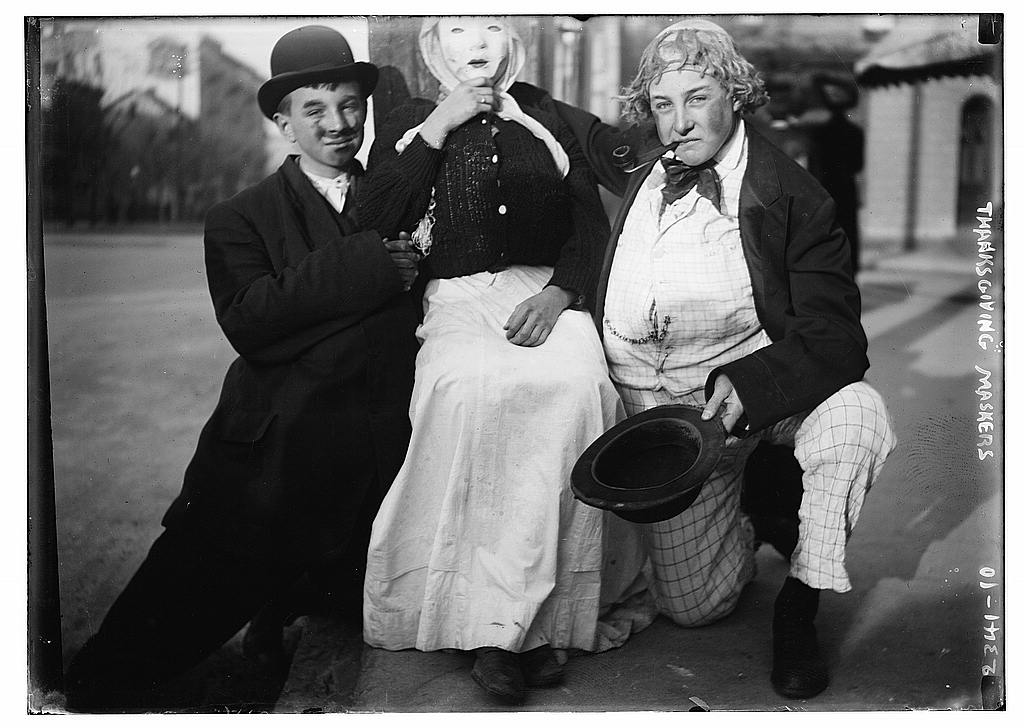
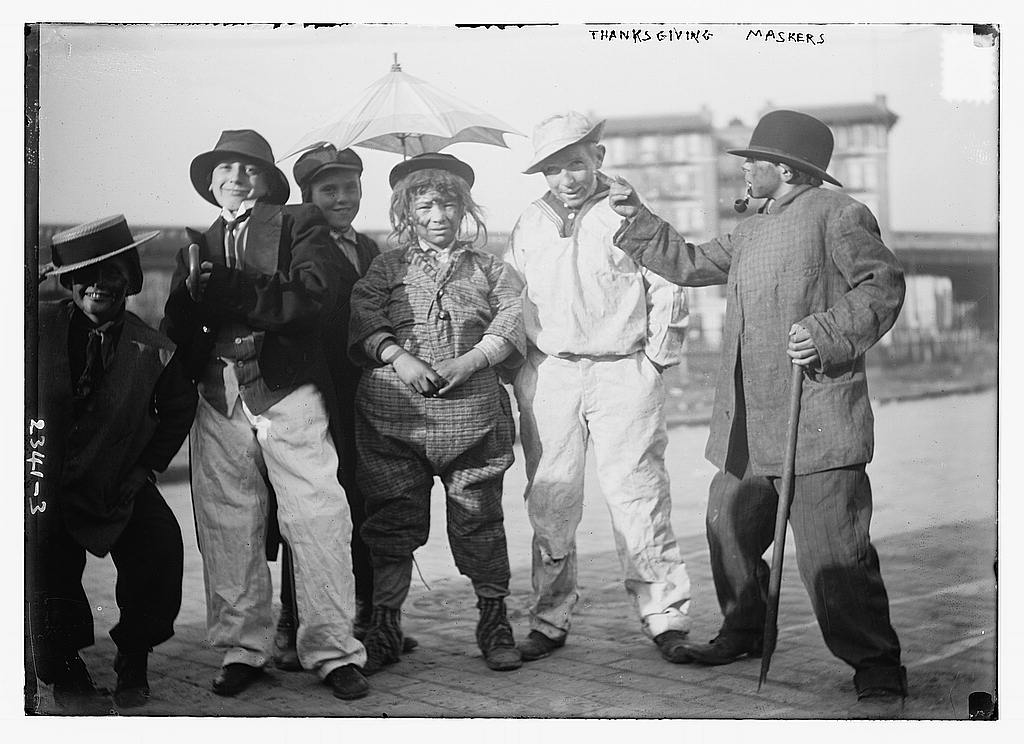
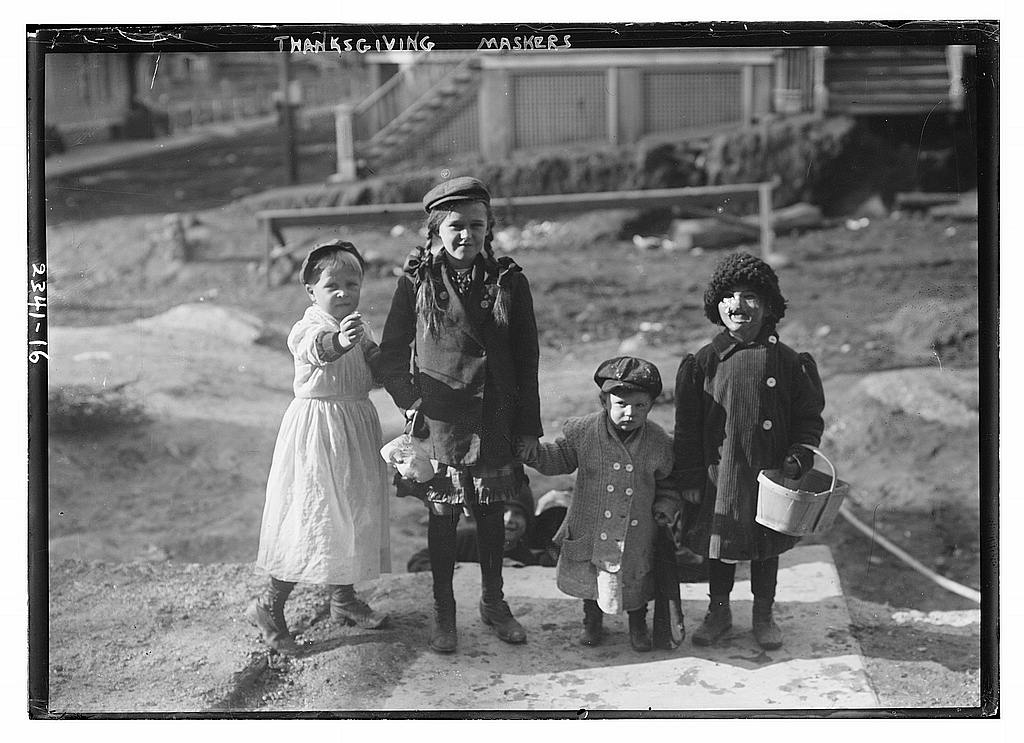
No, these children have not gotten their calendars confused. One early American Thanksgiving tradition amongst rascals and rowdies involved goofy costumes and disguised faces. Sometimes called ‘Thanksgiving masking’, the strange practice stemmed from a satirical perversion of poverty and an ancient tradition of ‘mumming’, where men in costumes floated from door to door, asking for food and money, sometimes in exchange for music. The annual Philadelphia Mummers Parade traces back to the original tradition which some believe began in the 17th century.
By the 1800s, those going door-to-door asking for handouts were most likely homeless and poor. This seems to have inspired a children’s tradition not unlike modern trick-or-treat. “Every street had its band of children,” proclaimed the 1901 Tribune, “dressed as ragamuffins, who kept in the open air for hours.”
Newspapers advertised ‘Thanksgiving masks’ and ‘lithographed character masks’ for the tots. These featureless disguises were often sold in candy stores alongside holiday related treats like spiced jelly gums, opera drops, crystallized ginger and tinted hard candies.
“This play of masking is deeply rooted in the New York child,” said Appleton’s Magazine in 1909. “All toy shops carry a line of hideous and terrifying false faces or ‘dough faces’ as they are termed on the East Side.”
Boys frequently wore girls clothing on this occasion, “tog[ging] themselves out in worn-out finery of their sisters” and spending their afternoon “gamboling in awkward mimicry of their sisters to the casual street piano.”
The New York Times in 1899 found the streets filled with costumed tricksters that Thanksgiving. “There were Fausts, Filipinos, Mephistos, Boers, Uncle Sams, John Boers, Harlequins, bandits, sailors… In poorer quarters a smear of burned cork and a dab of vermilion sufficed for babbling celebrants.”
Those that benefited most — outside of the costumed children, obviously having a ball — were the candy stores that both sold the masks and provided the sweets distributed to the little devils. In particular, Loft Candy stores, headquartered at the corner of West 42nd Street and Eighth Avenue, ran spectacular ads filled with Thanksgiving themed candy treats.
In general however it’s difficult to find too much enthusiasm for this unsavory tradition in newspapers of the day. Thanksgiving was (and continues to be) one of the most austere holidays. Poor, cross-dressing, shoddy-garbed children in masks flew in the face of this perception and was generally discouraged. Editors preferred to focus on family gatherings, recipes and table placements, not only out of social convention but on the behest of advertisers, who made more money selling turkey and china than cheap masks.
While the chaotic tradition was associated with poverty and mischief, some educators saw a bright side to the tradition, especially in the waning years of World War I. One writer on early Kindergarten practices suggested that “the masking on the streets of Thanksgiving Day … has its redeeming quality, in reminding the children of our dear soldiers’ need for real masks.” They would be referring to gas masks. Educational indeed!
Such mischief, not surprisingly, occasionally went out of control. For instance, the New York Tribune in 1907 reports a poor lad “in mask and fantastic garb” who was hit by a train and had his leg amputated.
With the rise and commercialization of Halloween, the practice of Thanksgiving masking seems to have died out. And the entrance of the Macy’s Thanksgiving Day parade in 1924 certain gave focus to the city’s need for costumed celebration.
NOTE: These photos are from the Library of Congress. As such, the locations are unmarked. Most likely they are all of New York children, but a few may be children from other cities in delirious states of costume. (The top photo is courtesy Shorpy)
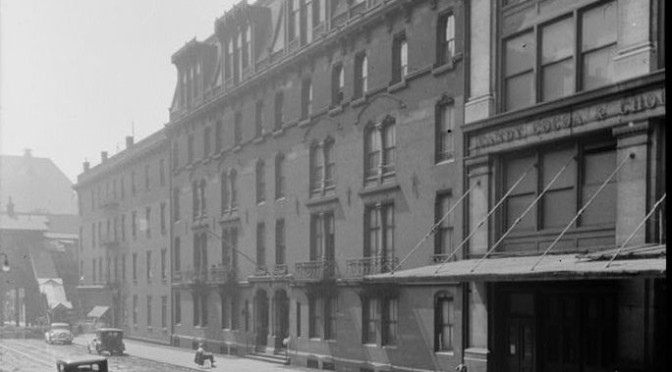
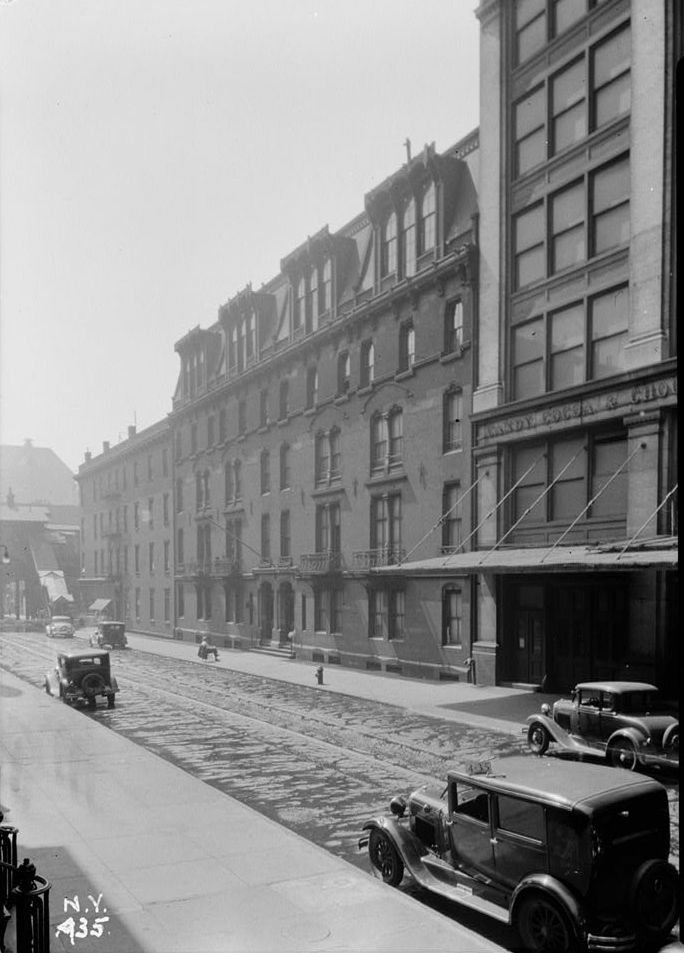
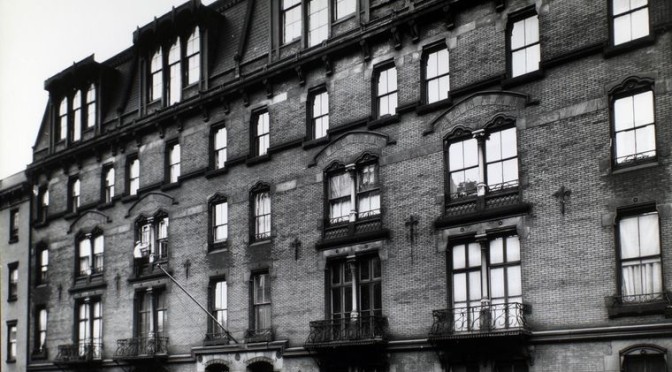
The Stuyvesant Apartments in 1934, already being dwarfed with a newer structure on the right. Please note the ornate entrance to the Third Avenue elevated train to the left of the picture, as well as the streetcar tracks, no longer in use along East 18th Street in 1934, running down the cobblestone street. And I’m fairly sure that’s a taxicab in the foreground.
Here are some notes on podcast #131: The First Apartment Building. To listen to the show, download it from iTunes or from here. And for those who have listened, thanks for making it one of iTunes top three individual programs in the travel/places podcasts section this weekend!
The Distinction of the ‘First’
How did the Stuyvesant Apartment become known as the true ‘first’ apartment? After all, it’s not like there was a banner over the door proclaiming “Welcome to the first apartment building ever! Come inside!” Urban dwellings were being developed of all shapes and sizes. As I mentioned, there’s not much that technically separates a tenement from an apartment, if you subtract social class and building amenities. There were indeed ‘fancy’ tenements. Some of those buildings are still around today and serve as rather lovely renovated apartments.
Author Elizabeth Collins Cromley (more on her later) suggests there were a couple other buildings in New York City that could have held this title built earlier, including another that Richard Morris Hunt built on Wooster Street. Those candidates, however, were smaller and less profitable. (One was even refashioned as a hotel.) The Stuyvesant was ambitious in size, glorious in architecture and glittering in its notable residents.
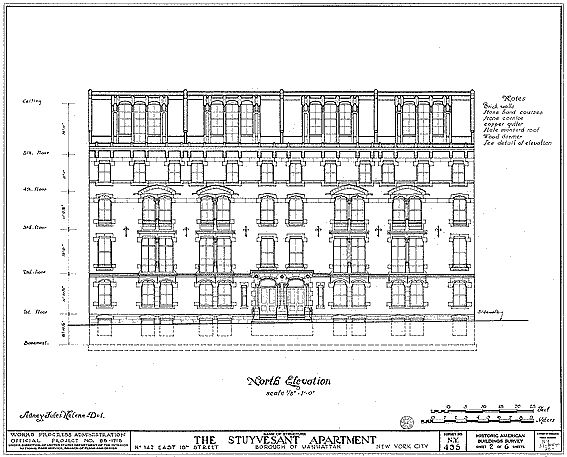
Below: Original drawings of the Stuyvesant Apartments, done by the Historic American Buildings Survey, courtesy Library of Congress
The Other Stuyvesant?
The research for this show became trickier once I realized there was another apartment building that was sometimes referred to the Stuyvesant just a few blocks away, and some scholars have confused the two in their research. For instance, I was quite excited to learn that Clara Clemens, the daughter of Mark Twain, lived at the Stuyvesant until I realized it was most likely the other Stuyvesant. (This author erroneously combines the two structures.)
The second building is right off of Stuyvesant Square, originally addressed 17 Livingston Place. That street no longer exists. Or to quote the wonderful Old Streets blog: Â “On December 3, 1953, in one of the goofier acts of the City Council, it changed the name of Livingston Place (on the east side of Stuyvesant Square) to Nathan D. Perlman Place and simultaneously–perhaps to mollify any offended Livingston descendants–changed the name of Birmingham Street to Livingston Place. The compensation was short-lived. The new Livingston Place was demapped in 1962.”
That building at 17 Livingston Place (valued at drastically less than the Stuyvesant) was apparently demolished too; Beth Israel Medical Center facilities have taken up that side of the square since the late 1910s.
That Stuyvesant Name!
The apartment structure was constructed on old Stuyvesant property. Check out this map of the borders of Stuyvesant farm, which consumes much of today’s East Village and the area dominated by Stuyvesant Town/Peter Cooper Village.
Rutherford Stuyvesant, creator of this luxury apartment, died in Paris, on July 4, 1909. His first wife, a member of the influential Brooklyn clan the Pierreponts, died a few years after the construction of the Stuyvesant Apartments. In 1902 Rutherford took a second wife whose name certainly equaled his own in terms of drama — the Countess Mathilde Elizabeth de Wassanaer [More bio details here]
Stuyvesant built a lavish mansion near Allamuchy, New Jersey called Tranquility Farms, populating the surrounding land with imported trees and animals. The mansion was consumed in fire in 1959. Although the ruins were demolished, many other ancient buildings on the property remain intact. Rusty Tagliareni has taken some fascinating, haunting photos earlier this year of the ruined area. Take a gander here.
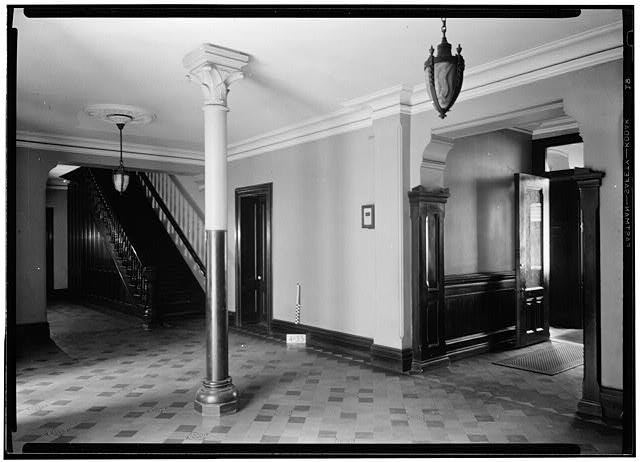
Below: Inside the lobby of the Stuyvesant, circa 1934.
For further reading
There’s a great many books on the history of New York real estate. Definitely invaluable to me this time was Elizabeth Collins Cromley’s ‘Alone Together: A History of New York’s Early Apartments’ and also Steven Gaines’ ‘The Sky’s The Limit’. I learned about the inestimable Mrs. Custer from Shirley A. Leckie’s book ‘Elizabeth Bacon Custer and the Making of a Myth.’
The creation of ‘acceptable’ communal living: The Stuyvesant Flats, at 142 East 18th Street, designed by Richard Morris Hunt, photographed by Berenice Abbott.
PODCASTWell, we’re movin’ on up….to the first New York apartment building ever constructed. New Yorkers of the emerging middle classes needed a place to live situated between the townhouse and the tenement, and the solution came from overseas — a daring style of communal and affordable living called the ‘apartment’ or ‘French flat’.
The city’s first was financed by Rutherford Stuyvesant, an old-money heir with an unusual story to his name. He hired one of the upper class’s hottest architects to create an apartment house, called the Stuyvesant Apartments, with many features that would have been shocking to more than a few New Yorkers of the day.
The building’s first tenants were sometimes well-known, often artists and publishers, and almost all of them with a fascinating story to tell. Listen in to hear about the vanguard first renters of this classic, long-gone building.
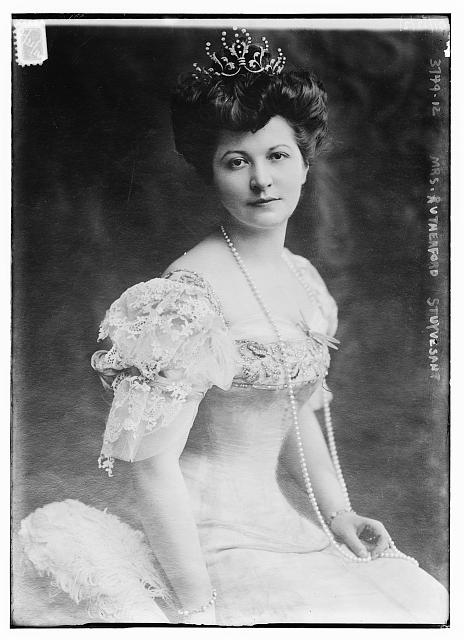
I have been unable to find any portraits of Mr. Rutherford Stuyvesant (aka Stuyvesant Rutherford), the man who financed the Stuyvesant for $100,000. However I have found a picture of Mrs. Rutherford Stuyvesant, who doesn’t look like the kind of lady to mettle around in her husband’s affairs. She would not have found the apartments which bore her name very accomodating. Many, many others did. (Courtesy LOC)
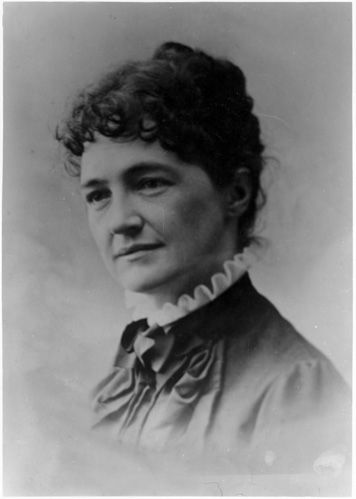
The tenacious Elizabeth ‘Libby’ Custer, photo taken in 1876, the year her husband was killed at the Battle of Little Bighorn. Mrs. Custer moved into Stuyvesant and successfully led her crusade to rehabilitate her husband’s reputation.
Maggie Custer Calhoun, younger sister to General Custer, lived with her sister-in-law at the Stuyvesant before embarking on a successful career as an elocutionist.
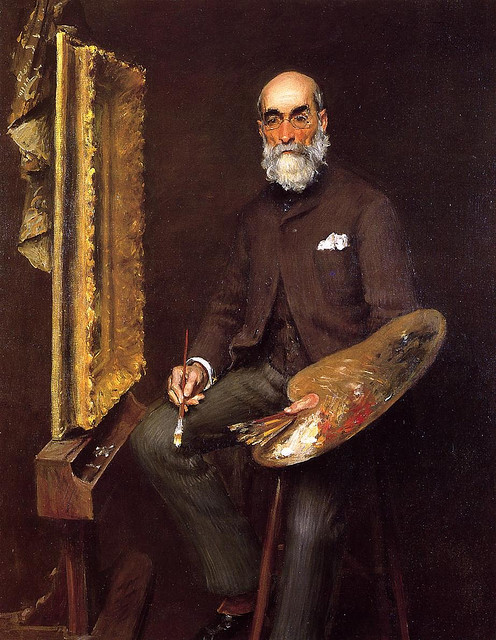
The landscape painter Worthington Whittredge also resided here. In fact, he beamed about it in his autobiography: “I was one of the first to subscribe for an apartment in this house, which was to be erected in 18th Street near Third Avenue and Stuyvesant Square.”
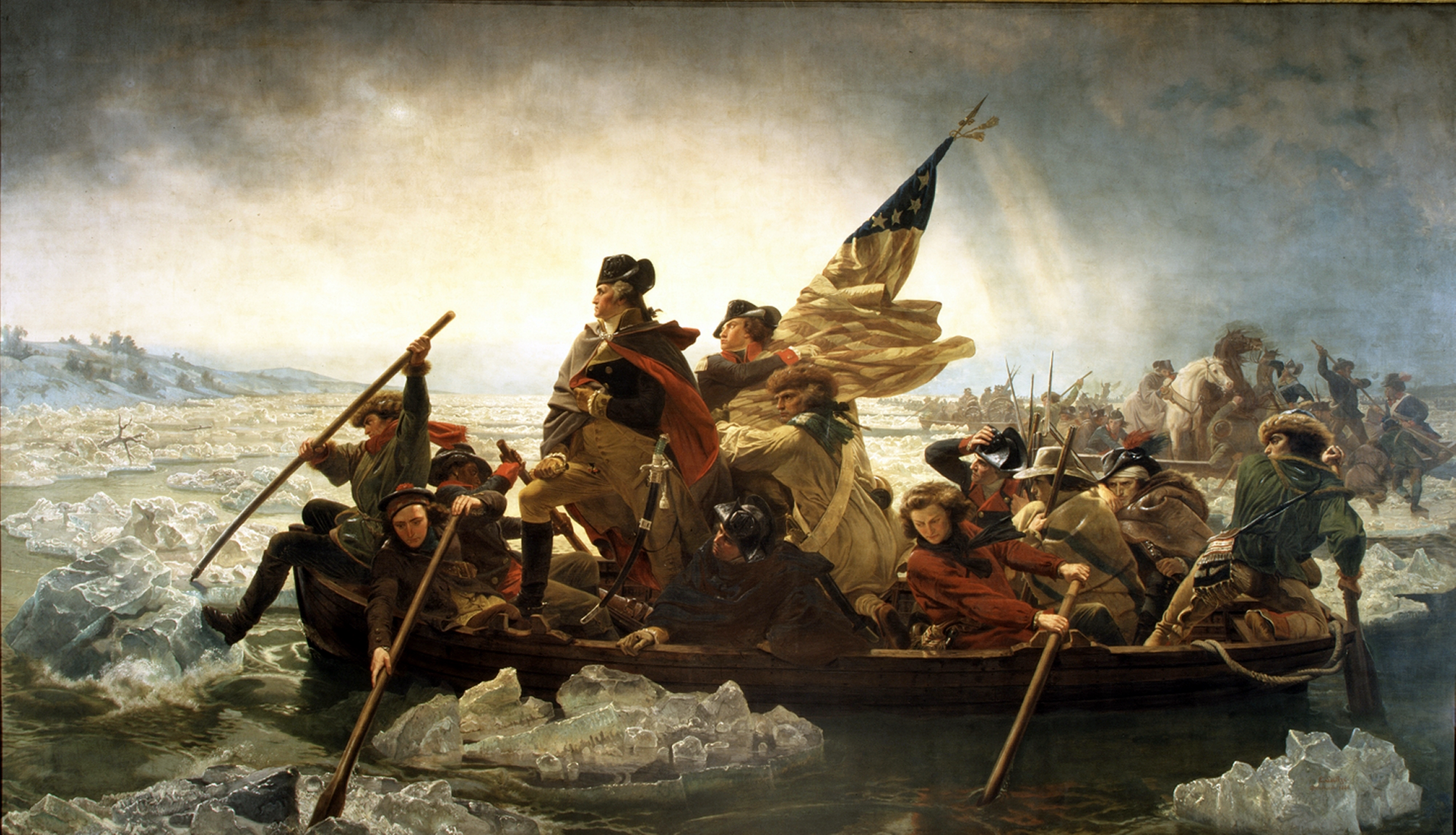
Earlier in his career, Whittredge posed as George Washington while Emanuel Leutze painted ‘Washington Crossing The Delaware’. (Worthington is quite comfortable on both sides of the easel The painting below is by William Merritt Chase.)
In its later years, the Stuyvesant was used as the set for a pivotal scene in the Oscar-nominated film noir ‘Kiss of Death’ starring Richard Widmark. Needless to say, this sort of activity very rarely went on at the Stuyvesant.
Anchors Aweigh: A museum finally opens in one of Brooklyn’s most restricted outposts
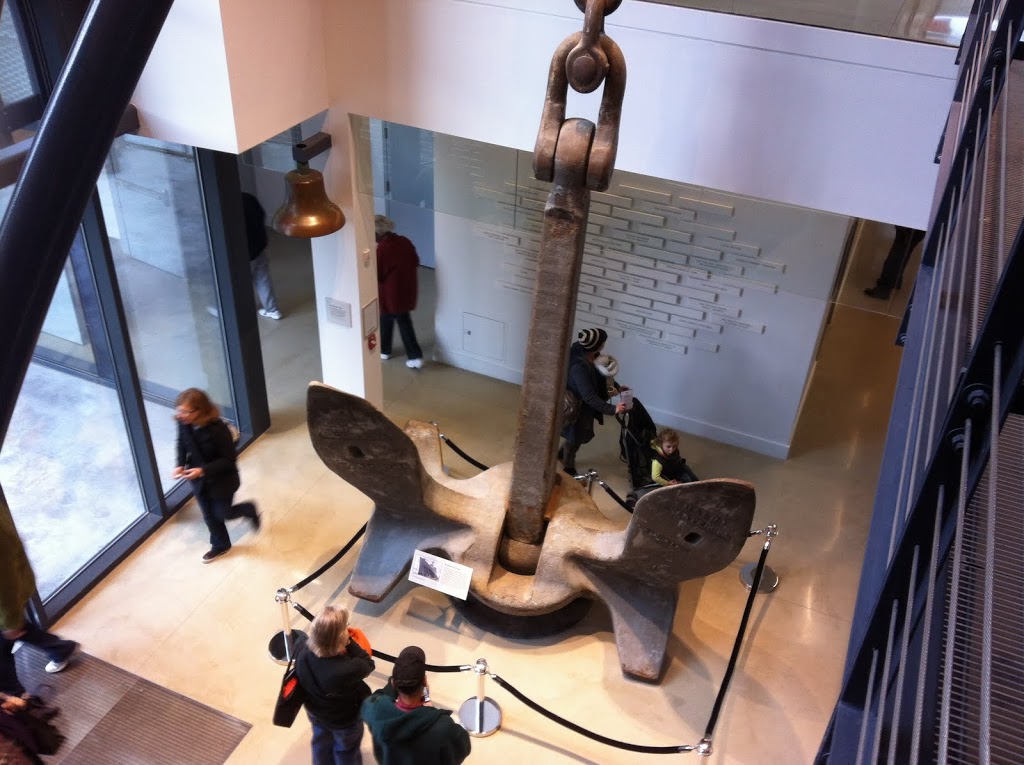
The Brooklyn Navy Yard finally got the museum it deserves this past weekend with the opening of BLDG 92: Brooklyn Navy Yard Center, a badly needed introduction to this long-restricted yet important component of New York history.
The environmentally-friendly new center is affixed to the 1858 Marine Commandant’s residence in one of the city’s better old-new hybrids, and visitors are constantly and playfully reminded of the building’s forward-thinking approach. (Bathrooms supplied with rainwater!) But it’s the history of the Navy Yard — within the context of Brooklyn’s own history — that’s the main attraction here.
The first floor provides an exhaustive but well-spun timeline, weaving the Navy Yard’s beginnings into the context of America’s own naval history. On opening weekend, there was a sailor and a Rosie the Riveter-type on hand, and even they seemed delighted to play around with the interactive consoles. The second floor further describes the day-to-day workings, with kooky artifacts (old whiskey bottles!) and curious trivia (the Yard was once overrun with cats!) mounted to the walls.
On the third floor is a display on the Navy Yard in wartime, its closure in the 1960s and its transformation into an enclosed industrial park. While I hardly found its first-floor displays of modern products produced at the Yard to be awe inspiring, it’s balanced by a moving, even disquieting display of photography on the third floor. The show ‘War Photographers’, is in memory of Tim Hetherington, the photojournalist (and co-director of the film Restrepo) killed in Libya several months ago. Both he and the gallery’s curator Christopher Anderson have a unique connection to the Navy Yards that reinforces this once mysterious place as a vital part of the city today.
Given that admission is free (I believe for the next few weeks, but possibly longer, check their website for more info), this is pretty much a must-see for history buffs and a seamless blend of displays for adults and children. Imagine what this kind of ingenuity could do for the nearby Admirals Row?!
If any place needed a thorough renovation, it was the New York Historical Society. The museum, one of the city’s longest enduring cultural institutions, contains New York’s greatest treasures. Until recently, however, it’s been a tad unpleasant to enjoy many of them.
Not that the Historical Society hasn’t put on spectacular exhibits and lectures in the past. For instance, I consider Alexander Hamilton show from 2004 one of my inspirations for creating this podcast and blog in the first place. But the exhibit spaces were often stuffy with a lack of open space, with oversized exhibits twisting down corridors. The museum’s prized artifacts were often hard to find or dimly presented.
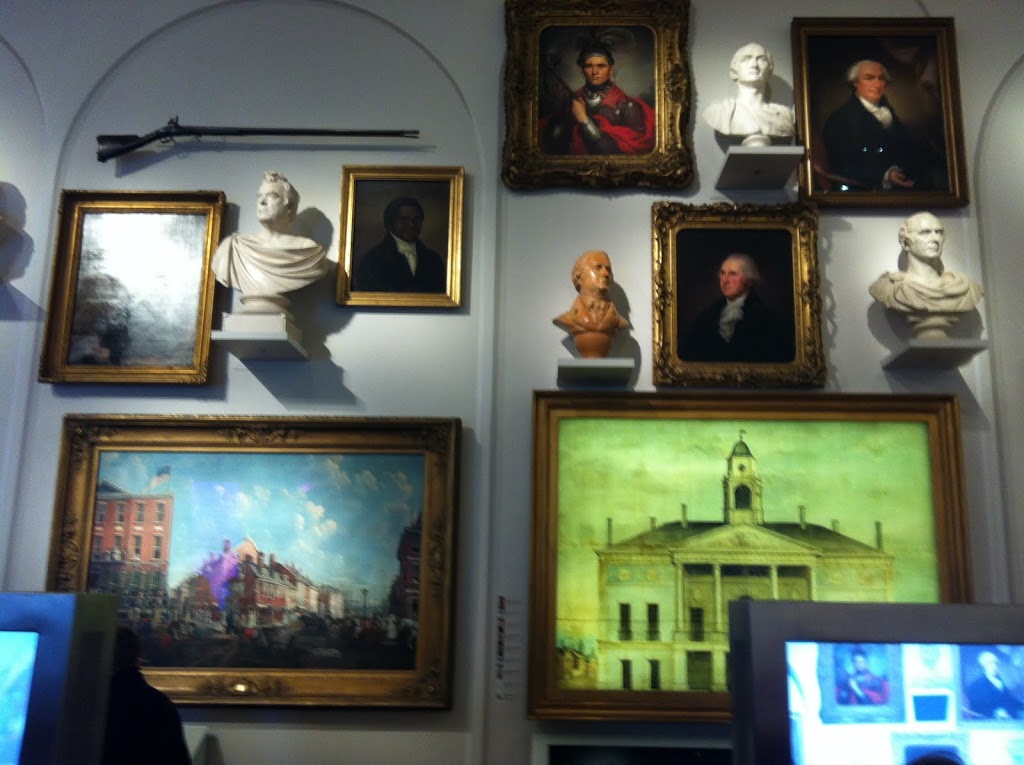
The lavish new first-floor renovation dispenses with any further obscurity. Here in plain day are all the greatest hits of the museum, boldly presented on the wall or within nooks under foot. In fact, one modern treasure — Keith Haring’s whimsical ceiling from the Pop Shop — hangs above the ticket booth. To find this just several feet from Gouverneur Morris’s wooden leg and the dueling guns of Hamilton and Aaron Burr makes for a grand and innovative statement.
Finally, the NYHS makes a hard turn for the modern. The Robert H. Smith Auditorium now shows ‘New York Story’, whisking through New York history with lighting effects, constantly moving screens and a projection of almost IMAX-like proportions. (I was genuinely surprised we didn’t get those 4-D effects like rain mist and soap bubbles, but then that would ruin the fancy new auditorium seating.)
A new ‘sculpture court’ showcases a spectacular rarity (a Revolutionary-War era Torah) while the children’s museum downstairs has been heavily revised and seems a genuinely fun experience. A scarlet-hued first-floor gallery presents the NYHS’s greatest paintings more accessibly than before. Upstairs are three new exhibitions, and of course, still on the fourth is the quirky, oddly charming Henry Luce III Center for the Study of American Culture, essentially the most meticulously arranged attic in the city.
For more information visit their website: New York Historical Society. The museum is open until 8pm on Friday nights and now you can dine at a Stephen Starr restaurant there, Caffe Storico.
Work hard, play hard: The FBI director in his early days
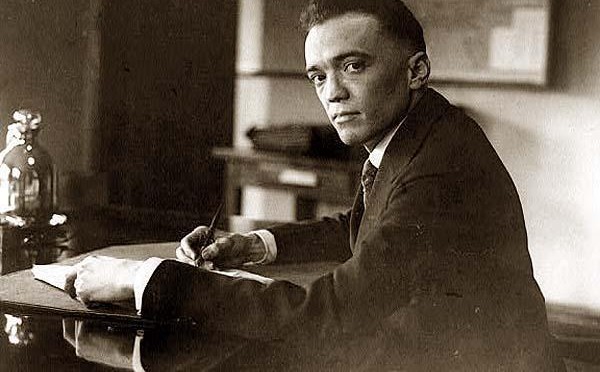
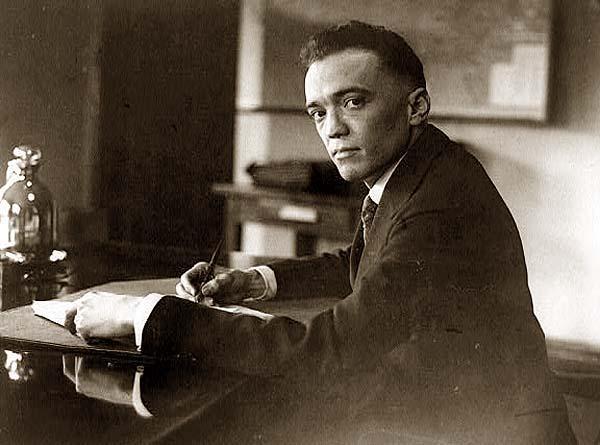
There are at least three scenes in the new Clint Eastwood-directed J. Edgar Hoover biopic‘J. Edgar’ set in New York, one of which might surprise you.
The first features Hoover on Ellis Island, but he’s hardly there to greet new arrivals. The FBI director’s early career was spent ferreting out and deporting anarchists, and his biggest target was Emma Goldman. On October 27, 1919, Goldman was put on trial at Ellis — in the film, the Statue of Liberty stands at odds in the background — and she was eventually expelled from the United Statues using a tenuous interpretation of the status of her American citizenship.
The second scene, depicting the rural Bronx of 1933, typified Hoover’s career in the 1930s as a stiffly facaded embodiment of law enforcement. Here the movie envisions the arrest of Bruno Hauptmann, accused kidnapper of the child of Charles Lindburgh. Hoover’s interest in the case represented an expansion of federal powers for the agency, even if Hoover’s actual involvement is questionable.
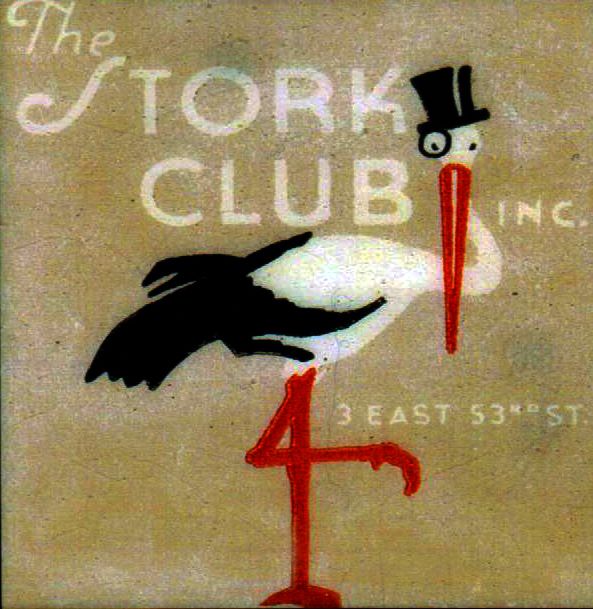
But it’s the third view of old New York that I found more intriguing. Hoover was a teetotaler early in life and demanded his agents aspire to clean, moral living. So its interesting that he — and his companion Clyde Tolson — were regular habitues at New York’s hottest nightclub of the 1930s — the Stork Club.
Sherman Billingsley, a former bootlegger, would have been made Hoover’s enemy list during Prohibition. Instead, he regularly hosted the FBI director as his swanky club at 3 East 53rd Street (at Fifth Avenue).
Hoover schmoozed here with people who were useful to him, journalists like Walter Winchell who assisted with the capture of most-wanted criminals from his banquette in the Cub Room. The unscrupulous columnist was instrumental in the surrender of Louis “Lepke” Buchalter, leader of the mob’s assassination unit Murder Inc., and helped play up the image of Hoover’s G-Men to his millions of readers. In return, Hoover sometimes provided Winchell with FBI employees as bodyguards or drivers.
Winchell and others considered the Stork Club an invaluable nexus of social connections, and Hoover too made it his hangout when he was in town, often downing champagne and chatting with glitterati. The director was so associated with the nightclub in the 1930s, Tolson at his side, that adversaries sometimes called him ‘the Stork Club detective’.
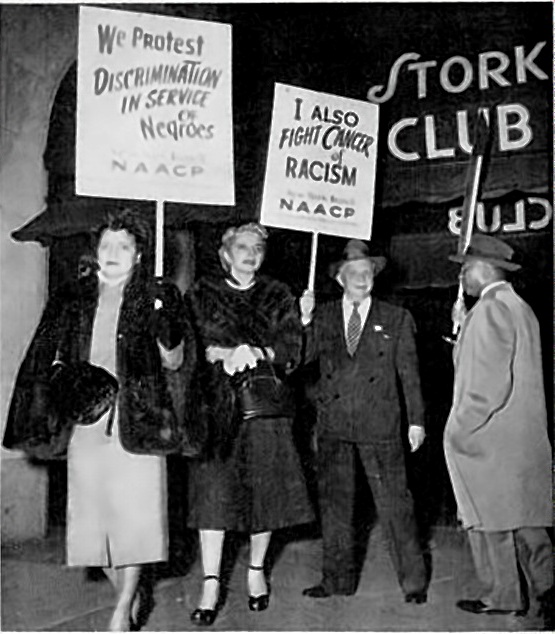
In a telling incident a few years later, in 1951, iconic entertainer Josephine Baker was denied service at the Stork Club. She filed a complaint with the police department, and supporters organized a protest outside the nightclub (pictured at right). When it was recommended that Hoover intervene on the behalf of Baker, he replied, “I don’t consider this to be any of my business.” [source]
Here’s a collection of photos of the Stork Club with musical accompaniment. Mr. Hoover appears in one image around minute 2:40:
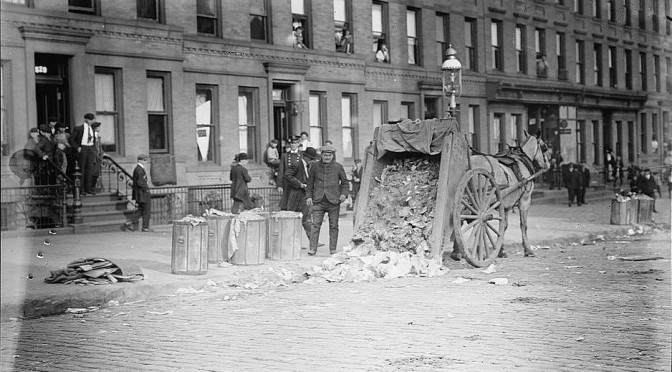
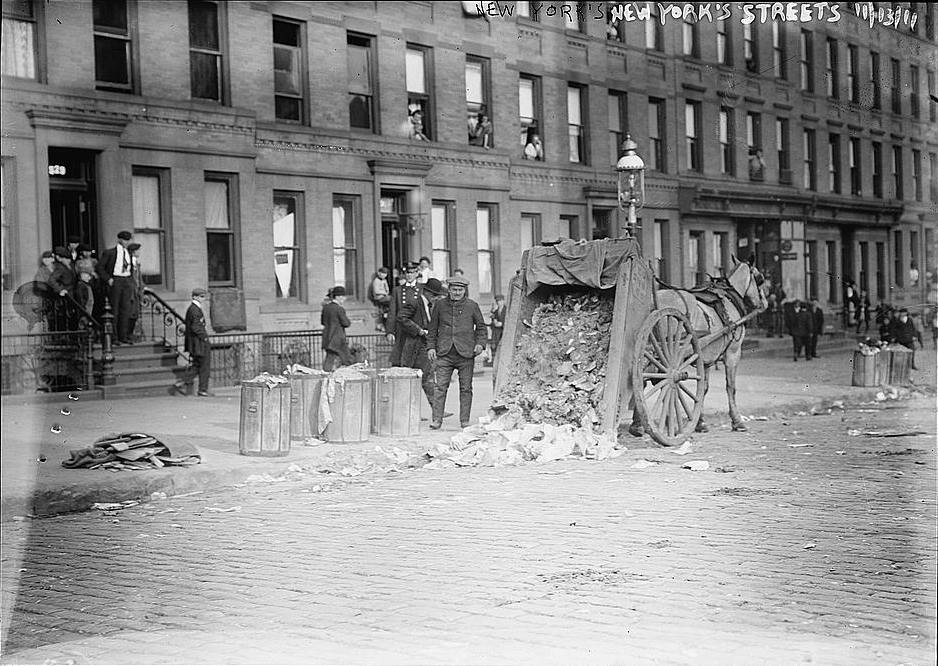
Above: a typical scene during the Garbage Strike of 1911
New York street cleaners and garbage workers (sometimes referred to as ‘ashcart men’) went on strike on November 8, 1911, over 2,000 men walking off their jobs in protest over staffing and work conditions.
More importantly, that April, the city relegated garbage pickup to nighttime shifts only, and cleaners often worked solo. This may have been acceptable in warmer weather, but winter was approaching. At a union rally that evening, a union representative proclaimed, “A 200-pound can was a mighty big load for one man to lift into a garbage wagon ……. [Our] men are already falling ill with pneumonia and rheumatism and … they demanded the right to work in the sunlight and the warmer weather of the daytime.”
By Nov. 11, garbage was heaped along street corners, and coal ash swirled into the street, creating a blackened, smelly stew in the streets. The city brought in temporary workers to carry off the more egregious piles of filth away, but harangues and violence by union protesters required they be protected by police.
New Yorkers had lived through such a strike before, as recently as 1907, but strikers found little public support this time around. Newspapers, little sympathetic to the strikers, highlighted the growing threat of disease and the perceived selfishness of the workers. “The right to strike of public employees, who enjoy the advantage of being listed in the civil service, is more than doubtful,” said the New York Times.
During bouts between strikebreakers and police, over two dozen people were injured and one man was even killed by a falling chimney. Meanwhile, Mayor William Jay Gaynor was resolute in rejecting the cleaners demands. The efforts of the workers failed, and many went back to their jobs the next week, some heavily penalized for their participation in the strike.
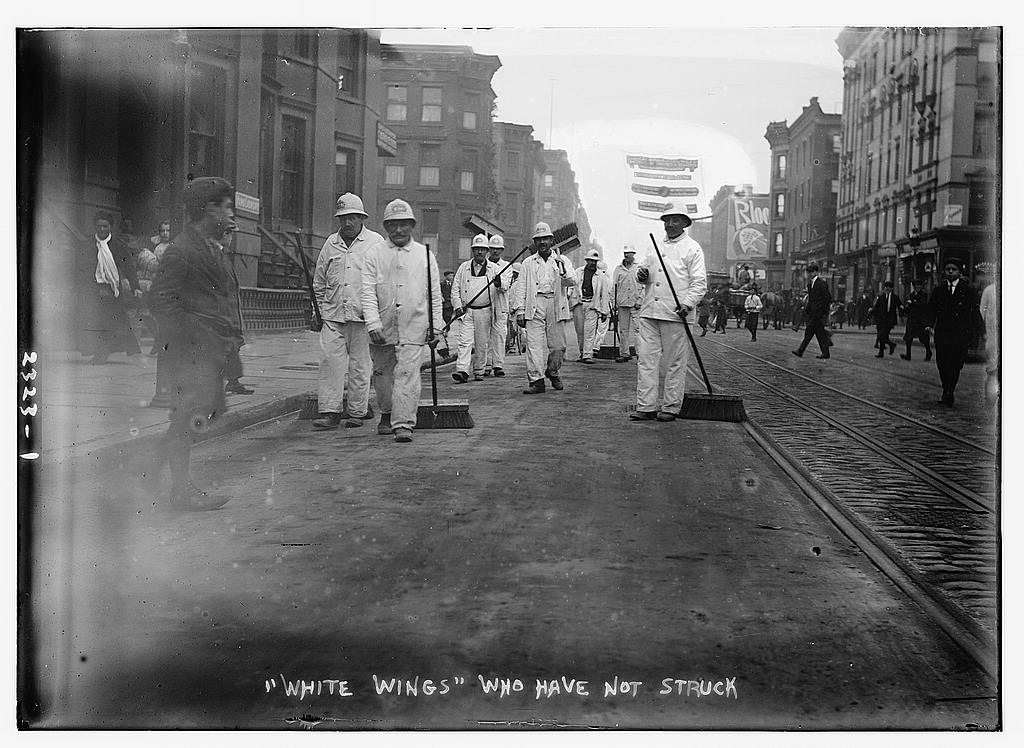
Below: the city shipped in workers from out of town to sweep the streets during the strike
Above: The unusual weather this weekend left my pumpkin with an unfortunate new hairstyle.
We hope you all have a fun and safe Halloween this year! In this year’s ghost-story podcast, I talked about a haunted church in Bushwick, Brooklyn. Apparently, other spirits find the neighborhood desirable. I’m reprinting an article from three years ago about one such reported sighting. The original article is here —-
While doing my ghost research this week, I came across an amusing article from an 1894 edition of the New York Times, back when ghost sightings might have merited a serious investigation. (Or, in this case, not so serious.)
The location of the haunting was Brooklyn’s 27th Ward in today’s Bushwick area.
After charting out the notion that Bushwick is an ideal place for ghost hauntings — a “rocky, bleak, lonesome district” loaded with cemeteries and empty houses — the article describes the ghost in strangely sensuous terms:
“The ghost which is at present disturbing the midnight rambles … is that of a woman, who goes about in the scantiest attire, with disheveled hair and bare feet, and falls into a fit of hysterics as soon as anyone approaches.”
The ghostly vixen spooked a set of women who ran home to tell their brothers, who then brandished revolvers and set out to, uh, do what? I’m not sure guns work too well with ghosts. The cocky search party came upon the apparition which “arose from the ground in front of them and waved its long, lean arms an uttered a weird cry that chilled their blood.” The brothers dropped their guns and ran home.
The next night a bolder party of 200 men reportedly went out to the ghost location, around the cemeteries on the Brooklyn/Queens border (between Knickerbocker and Irving avenues). Having no luck in locating the spirit with the posse, one man braved it alone the next night. He returned home “with a face white with terror.” He had not only glimpsed the spectre, but was privy to a “serpentine dance” and “moaning wail”.
They time, the locals did what anyone would do when faced with supernatural entities — they called the police. Apparently with nothing better to do, the precinct caption dispatched 300 officers, armed with everything from guns to rusty army swords, all in an effort to confront the spirit and, apparently challenge it to a duel. One officer even donned an ill-fitting suit of armor.
Given the dramatic response, it is no surprise that some officers remained skeptical. The theory of one officer Holliday: “I’ll tell you what I think it is. I think it’s whisky….it will make a man see anything — ghosts, snakes or anything else.”
The entire area was covered by dozens of armed ghost hunters. However, as the New York Times drolly states, “three or four times there were cries that [the ghost] was coming, but it didn’t come.”
It is then decided that police might has not only scared away this ghost, but has rid all of Brooklyn of any spectral activity.
“There used to be ghosts in Brooklyn but since Superintendent Campbell took charge of the police department they have all been driven away.” He fears Brooklyn’s impending consolidation with New York, for “anti-ghost orders would be rescinded and our streets would be haunted day and night.”
But it appears that didn’t happen when the consolidation with New York came in 1898. Really, when’s the last time you’ve seen a ghost in Brookyn? Hmmm?
You can read the entire article in all its glorious tongue-in-cheekness here.
The location of this scantily dressed spirit was right around here:
A still from ‘The Wrong Man’, a crime drama shot in New York in 1956. (Courtesy Empire Magainze.)
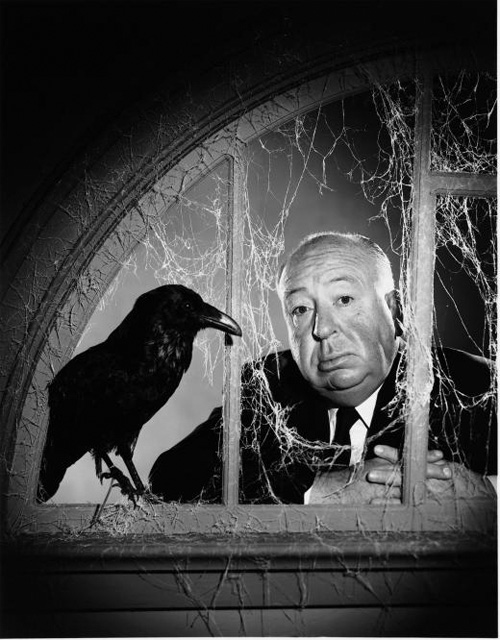
Alfred Hitchcock‘s innovative anthology series ‘Alfred Hitchcock Presents’ debuted on CBS in the fall on 1955. As a filmed dramatic series (vs. the live camera TV hits like ‘I Love Lucy’ and ‘The Honeymooners’), the weekly mystery program brought serious cache to the medium and set the bar high for genre anthology television, to be raised four years later by ‘The Twilight Zone’.
Many episodes were filmed in New York, using Broadway’s rich pool of stars. The city would itself be a star of several Hitchcock films, including one released the next year in 1956. The Henry Fonda crime drama ‘The Wrong Man’, based on real events, concerned a jazz musician from the Stork Club falsely accused of a robbery. Most notable were its scenes shot on location at Queens City Prison in Kew Gardens.
Before beginning production on ‘The Wrong Man’, Hitchcock wanted to wow Warner’s studio executives and reporters with a fabulous New York soiree in March, done up Hitchcock-style. That meant conjuring up many of the mystery and horror themes the director was most famous for. So, on that note, Hitch requested his publicist look for an actual New York haunted house.
Now I can tell you from doing our annual Halloween podcasts that there are no shortage of ‘haunted’ New York locations. But it seems the publicists had a bit of a problem locating a suitable venue — one that could host both ambassadors from the afterworld and a haughty contingent from the film world.
According to reports, Hitchcock loved some ‘abandoned wine cellars’ beneath the Manhattan end of the Brooklyn Bridge. (The article doesn’t clarify where these are. Perhaps they were part of George Washington’s old home?) But costs to install plumbing were prohibitive. Hitchcock “wanted women among his guests in the haunted quarters and women would want washrooms,” according to reports.
He next turned to a very familiar haunted home — the Merchant’s House, allegedly possessed by its former owner Gertrude Tredwell. It was ideal, but the home owners were less than thrilled at hosting a saucy industry party and rebuffed the offer.
Frustrated, Hitchcock’s publicists even put an ad in the paper, looking for ghost-filled venues. After a few disappointing offers — including one in Jackson Heights, Queens, but the master of suspense feared his party guests would never venture that far — he settled on a rustic old townhouse at 7 East 80th Street, right off the park. Not haunted, but plenty ‘cobwebby’, according to the press.
The party went off, with Hitch, without a hitch. The ‘haunted-house’ party included tombstone-shaped ‘Carte de Mort’ menus with a variety of macabre selections, including Corpse Croquette, Vicious-Soisse, Suicide Suzettes, Gibbeted Giblets, Ghoulish Goulash and “Fresh-cut Lady Fingers (in season)”. (Revel in the rest of the menu here.)
Hitchcock received a true fright at the end of the year when ‘The Wrong Man’ was finally released and promptly flopped at the box office. It would be his final film for Warner Bros., whose executives at least got a kooky party out of the deal.
We had a terrific time recording this year’s ghost-story show — Haunted Histories of New York. Here’s some extra details about our four subjects that were left out of this week’s show.
(By the way, if you wouldn’t mind, please vote for us in this year’s 2011 Podcast Awards. We’re in the Best Travel Podcast section. Thanks!)
Liberty Island and the Captain Kidd’s treasure
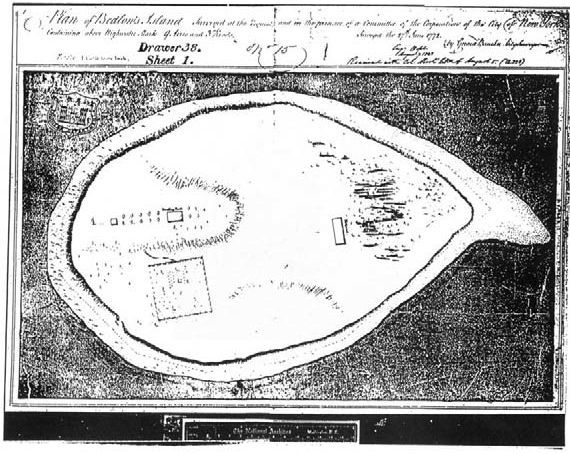
If indeed there was treasure buried on Bedloe’s Island (today’s Liberty Island), William Kidd and his motley crew would have concealed it there under the gaze of the island’s owner. In the 1690s, when Kidd would have lived in New York, the island was owned by a woman — Mary Bedlow Smith.
The small island property was originally owned by a Dutchman Isaack Bedloo, who remained in the harbor after New Amsterdam became New York in 1664. He even Anglicized his name, as evidenced by his daughter’s name. She sold the island in 1732 to one of the most wealthy and powerful men in all the British colony — Adolphe Philipse. From there, the island was often used as a quarantine station or ‘pest house’ to shelter those with communicative disease. Many hundreds of afflicted were thrown here in the mid-17th century, and many died here.
Below: A map of Bedloe’s Island in 1766, before the construction of Fort Wood. The map is strangely situated, but I believe that the stone where Kidd’s treasure was allegedly buried would have near the pointed end. (Courtesy the National Park Service.)
The Holy Ghost — Most Holy Trinity, Bushwick, Brooklyn
Some believe that Most Holy Trinity’s beloved Monsignor Michael May haunts the present halls of the church. On the occasion of May’s funeral in 1895 — he had died on the second floor of the adjoining rectory – the church nearly experienced a tragedy from which it would have surely never recovered.
A New York Times article from February 1895 reveals that a chronic weakness was discovered to the building’s architecture. As I mentioned in the podcast, vast, old passages exist underneath the church, extending to adjacent buildings. These passages had been used for safety during anti-Catholic attacks in the 1850s and even as safe havens for escaping Southern slaves on the Underground Railroad in the 1860s.
Monsignor May was so beloved that almost 5,000 people arrived for his funeral, the most the church had ever seen at one time. I’ll let the article reveal the potential horror of this situation: “Carpenters and masons at work on the vault in the basement discovered that the floor above them had sunk several inches in the centre, and that the cross beams had split, as had the big girders supporting the cross beams.”
The floor actually begin to sway in front of the masons. Within moments, the crowded church would have caved in, easily killing hundreds. What became one of the biggest gatherings in the church history would have instead become an unspeakable catastrophe.
The workmen advised the clergy to evacuate the center aisle and then worked briskly to create temporary braces. The crisis, thankfully, was averted.
The Lonely Acrobat — Ghosts At The Palace Theatre
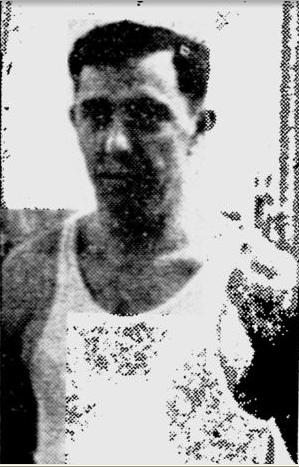
The tragic acrobatic act at the Palace Theatre that inspired the venue’s most famous ghost story is veiled in mystery and misunderstanding. There’s many falsehoods about the incident that Tom successfully dispelled, but there’s one he missed. Most modern retellings call the acrobat in question Louis Borsolino. His actual name, according to local papers in the troupe’s hometown of Reading, PA, list hims as Louis Bossalina, pictured at right.By the way, the name of the particular trick that Bossolina was doing at the Palace Theatre that fateful day? It was called the Death Loop. He is popularly rumored to have died from the accident, an unsurprising assumption considering how many people saw the fall, knowing the name of the failed trick. In reality, Bassolina survived the ordeal and was released from the hospital nine days later. To be clear, he didn’t die at the Palace; he went on to perform with the troupe until they disbanded in 1937.
He lived a perfectly normal life outside the spotlight, for over three more decades, before dying at age 61, in August 1963. If he truly haunts the Palace today, then the torment must have possessed him so greatly during life that he continually returns for repeat performances!
As you heard in the podcast, joining Louis’ ghost at the Palace is an apparition of one of the theater’s greatest stars. Here’s a recording of Judy Garland’s curtain call from her very last performance at the Palace Theatre on August 26, 1967. Judy would be dead within two years of a drug overdose. I wonder if anybody has ever seen the ghosts of Louis and Judy on the same night?
The Tale of Two Houses — Kreischer Mansion
The famously haunted Kreischer Mansion was built for a son of brick mogul Balthazar Kreischer. He made his wealth using Staten Island clay to produce the building materials for a growing city, and he created a company town (appropriately called Kreischerville) near the Arthur Kill. But Kreischer got his start in the Lower East Side — on a street that is no longer there.
Balthazar arrived in New York in 1836 and quickly excelled in construction, in the years following the Great Fire which destroyed hundreds of structures in the heart of the old city. By 1845, Kreischer entered into the brick-making business with one Charles Mumpeson. Although they had already discovered the potential of Staten Island clay — their company was called New York and Staten Island Fire Brick and Clay Retort Works — their original factory was at 58 Goerck Street at Delancey Street.
The odd little street, which ran parallel to the East River from Grand Street to East 3rd, was a vestige of an abandoned city plan, well before the great Commissioners Plan of 1811. Casimir Goerck was the surveyor for the failed plan, working with renown designer Joseph-Francois Mangin, best known for working on New York’s new City Hall building. The plan was discarded, but two small Lower East Side streets from the plan were eventually used — Goerck Street and Mangin Street.
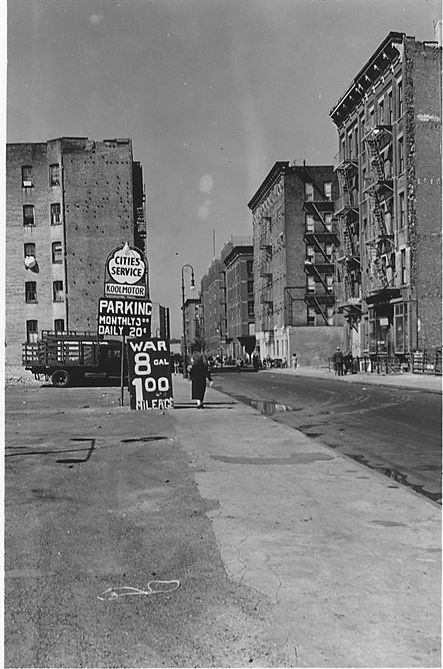
At right: The corner of Goerck Street and Rivington Street in 1939 (NYPL)
Kreischer maintained his brick factory here for years before moving the bulk of his operations to Staten Island. Goerck Street would disappear entirely with the construction of housing developments in the 1940s. A tiny vestige of Mangin Street, however, still hangs on, underneath the Williamsburg Bridge.

 Early news reporting on the celebration of Hanukkah (or Chanukah, as it was popularly referred then) in New York usually took a arms-length approach, as most of their readership knew little about the celebration 100 years ago. More than one old Tribune or World carried a variant of the headline ‘Jews Celebrate Chanukah’ , as though there might have been some doubt. A 1905 headline informs: ‘Chanukah, Commemorating Syrian Defeat, Lasts Eight Days.’