Categories
Mysterious Stories Podcasts

Haunted Histories of New York: What horrors lie beneath the foundations of the city’s treasured landmarks?

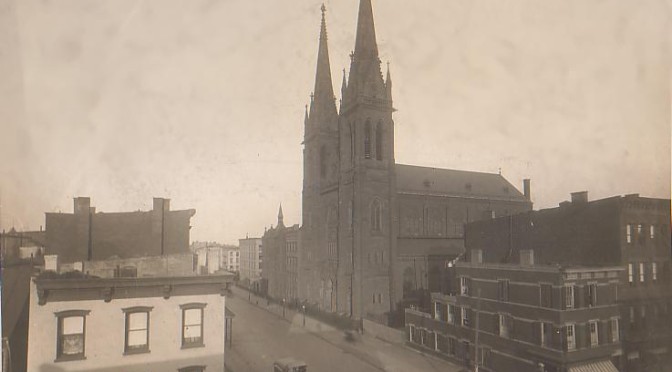
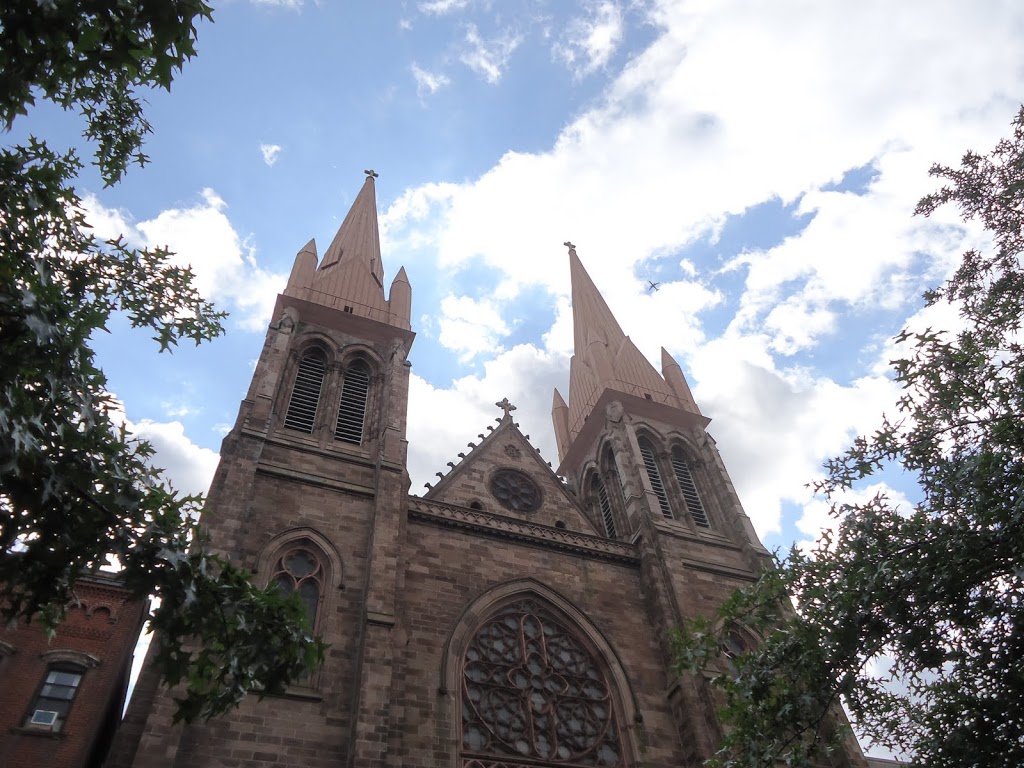
Most Holy Trinity in Bushwick, Brooklyn, shrouded in shadow, a place where the ghosts of former clergy are alleged to lurk the halls and other spirits may torment the nearby school.

PODCAST What mischievous phantoms and malevolent spirits haunt the streets of New York City today? In our fifth annual podcast of local ghost stories, we bring you the histories of four very haunted places from three boroughs and a small island in the harbor.

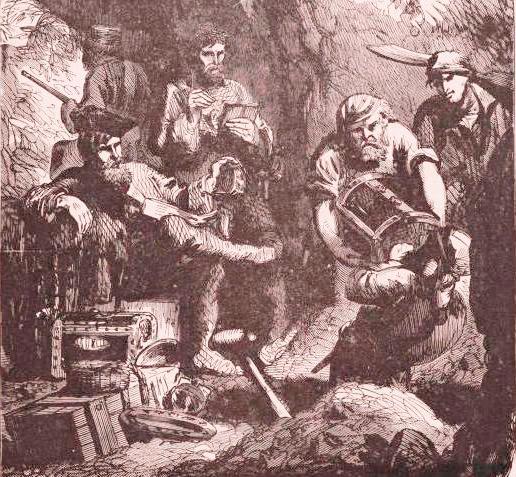
The legend of Captain Kidd‘s buried treasure — alleged to be buried in the New York region — inspires our first ghost tale of two ambitious soldiers on a quest during a full moon, on an island that today contains the Statue of Liberty! Meanwhile, out in Brooklyn, a congregation gathers at a new Catholic church, but maybe they shouldn’t have built it over a graveyard. Do the spirits of dead clergy haunt the halls today?

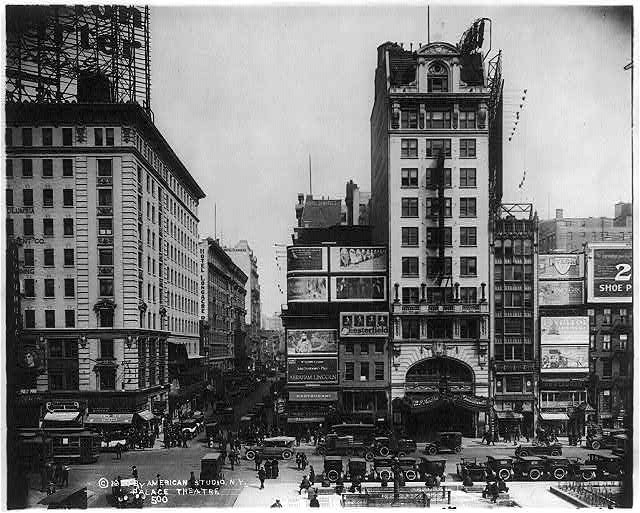
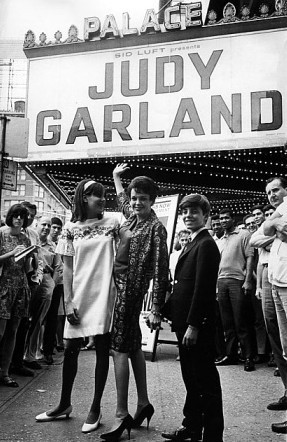
The Palace Theatre in Manhattan has hosted the greatest names in entertainment — and continues to play host to the undead. And finally, we hesitate to bring you the malevolent events at the Kreischer Mansion in Staten Island. What is it about this house that has inspired stories for over a hundred years, and did ghosts from a century ago have something to do with a horrifying and gory crime that took place here just a few years ago?

Click here for more notes on this podcast.

Bedloe’s Island: Below is a depiction of its southern shore in 1831. It was on the northern end during this period that two sentries at Fort Wood had a most unfortunate encounter while searching for buried treasure. (Image courtesy NYPL)
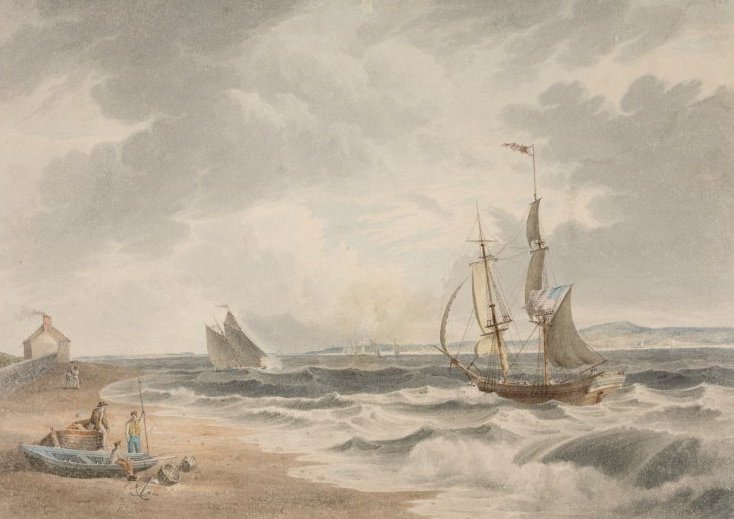
Legends of Captain Kidd’s treasure have possessed New Yorkers for centuries. It’s rumored that he killed one or two of his men and buried their bodies with the treasure to ‘guard’ it. Do these bodies lurk underneath the shadow of the Statue of Liberty? (NYPL)
Most Holy Trinity in Bushwick, Brooklyn, site of alleged hauntings from a variety of spirits.
The Palace Theater rises over Times Square, hosting the greats of vaudeville. But the stage has also attracted its share of ghost sightings over the year, including that of one very tenacious acrobat.
The legendary Judy Garland appeared here in the 1960s. Does she still lurk backstage today?
The Tale of Two Houses: The Kreischer Mansion in southern Staten Island, famous among generations of children as being an iconic haunted house, was actually once two houses. Or rather, a parallel house, mirroring the other in every way, once stood nearby, home built for the sons of a prominent German brick maker.
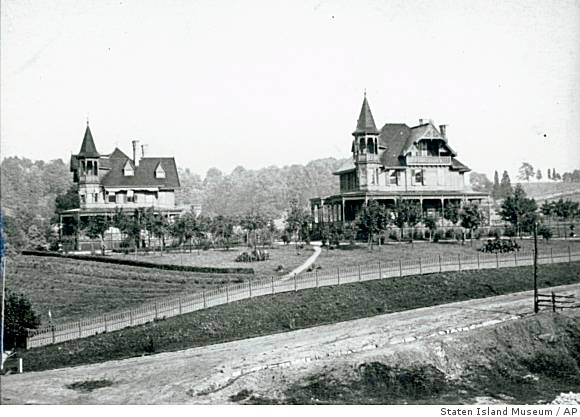
The mansion in the mid 1980s (Courtesy Flickr/Revup67)
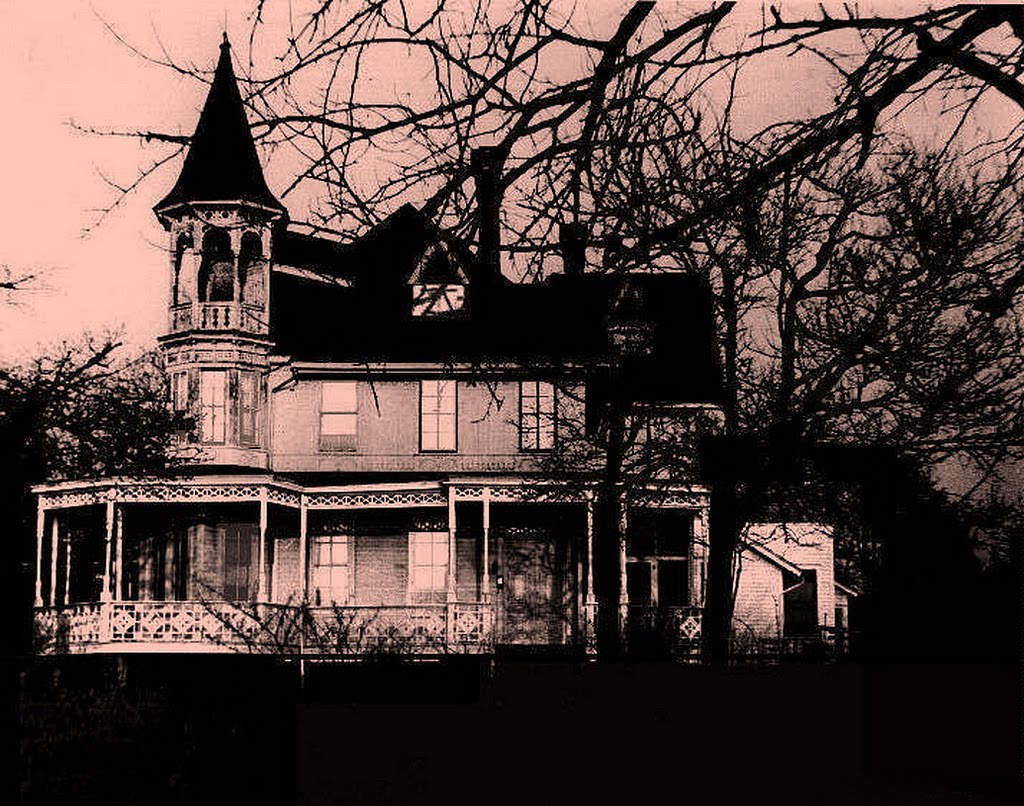
Video filmed of the Kreischer Mansion in 1983:

In 2003, some amateur ghost hunters were allowed to photograph the property, escorted by the house’s caretaker at the time. From description, I believe the caretaker is the same person who committed a gory and terrible murder here just a few years later!
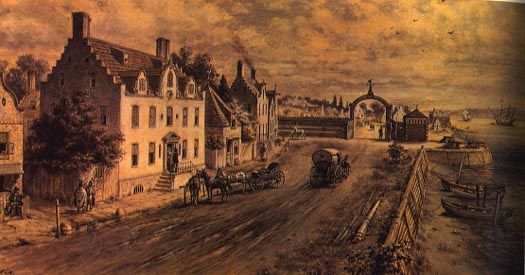
Home & Garden 1691: Captain Kidd’s home on Pearl Street

Kidd’s swanky new home on Pearl Street, which he shared with his high society wife and two lovely daughters. It was near the eastern gate to New York’s northern wall, later to become Wall Street. In later years, landfill will would extend east, removing old Pearl Street residences from the waterfront.

Tomorrow’s podcast will feature a spooky urban folktale about the buried treasure of Captain William Kidd. For a little background on Kidd’s life, I’m reprinting this article from January 2010. (Original is here.)

In our 2009 podcast on Trinity Church, I refer to New Yorker and Trinity Church benefactor William Kidd as one of the most notorious pirates of the Atlantic Ocean. Now I feel that might have been a bit of slander.

It is true that Kidd, forever known to generations of seafarers as Captain Kidd, was vilified by the British for illicit profiteering and eventually hanged in London on May 23, 1701. But Kidd himself fought off the charges voraciously, and today historians believe Kidd was scapegoated and was himself following orders of the governor of the New York colony himself — Richard Coote, the Earl of Bellomont. Yes, the man who tried to annul the charter of Trinity Church!
I’ll save the details of Kidd’s exploits for various pirate-themed blogs. Kidd may have been prosecuted unfairly, but the legend that arose around his real or imagined exploits makes him one of New York City’s most notorious residents of the 17th century. Not only was Kidd one of early New York’s most wealthy residents, but almost without question he had one of the best views in the city from his bedroom.

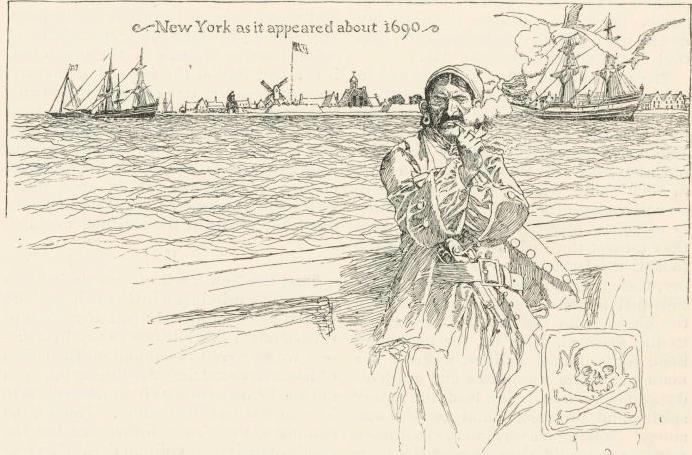
According to historian Richard Zacks, New York was “the pirate port of choice in the English colonies in North America” in 1690s, with its rich harbor and its relatively multi-cultural port. Still a volatile colony amongst England’s land possessions, it was easy to walk around without harassment and recruit other like minded scallywags for upcoming jobs.

Below: A fanciful sketch by artist Howard Pile (dated Nov. 1894) for Harpers Magazine, with fort and windmill also in background [source NYPL]

Kidd was an employee of the Crown, a privateer essentially hired to capture pirates and any foreign vessels that got in England’s way. He was based in New York for many of the same reasons more illicit sea captains were here — opportunities, money and a suitable harbor for his vessel (Kidd’s was called the Adventure Galley).

He came to New York in 1691 and soon married Sarah Oort, a woman with extraordinary bad luck. Her first two husbands had died, one at sea, and after Kidd’s execution, she would then marry a fourth time. William and Sarah would have two daughters who would marry well into New York society despite their father’s notoriety.

Despite his career, Kidd was considered a respectable New York gentleman — much, I imagine, because of his wife’s standing from her prior two marriages. Also, their digs weren’t bad. Although the Kidds owned several properties (again, thanks to Sarah), their primary residence was at the 119 Pearl Street (pictured at top), at the corner of Hanover and Pearl streets, a location which would have been waterfront property back in the day. It was also closely situated to Hanover Square, New York’s retail district and later home of the colony’s first newspapers.

The sizable home was located next to New York’s old wall, a fortification that would be ripped down within the decade and replaced with the street named after it.
The Kidds home was especially lavish for the time, with “104 ounces of silverware,” a healthy wine cellar and the biggest Turkish carpet in the city. Their wealth would have made them candidates for a pew at the newly built Trinity Church in 1696. Although Kidd provided equipment to help build the church, it appears Kidd himself never worshipped there. (His wife Sarah most likely did.)

Virtually no traces of this era exist in downtown Manhattan today, and the land extension east and the skyscrapers built there eradicate the view the Kidds would have had from their home.

Over a hundred years later, at the same address lived a man named Jean Victor Marie Moreau who would also influence world history: he’s best known as one-time right-hand-man of Napoleon Bonaparte, banished for betrayal in 1804 and sent to America, where he lived for a time at 119 Pearl.

You can read a nice, lengthy piece about Kidd and his New York connections here at Maritime History.

Park life: The anniversary of a name change in Chinatown

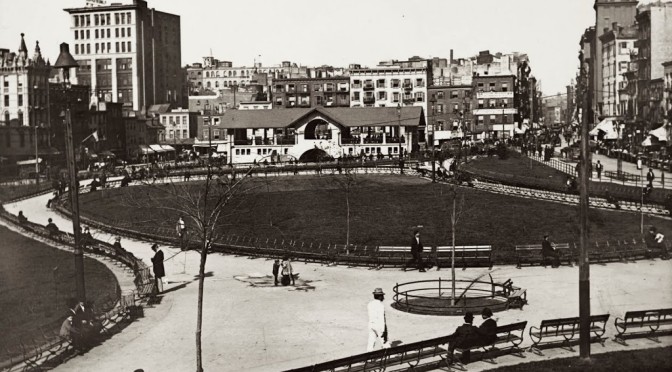
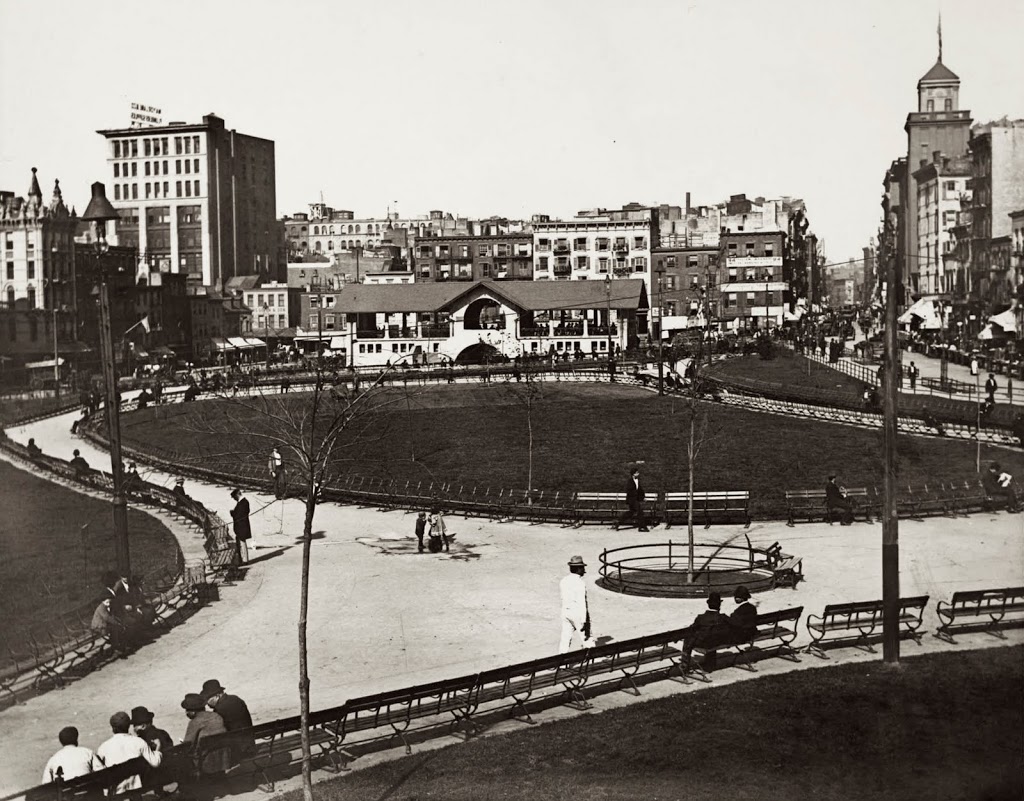
Next week begins ‘ghost stories’ week on the blog, but I need to make one more trip to Chinatown, the topic of the last podcast. As I just wrote about Columbus Day last week, I would be remiss if I skipped this very coincidental date in history. It was exactly one hundred years ago yesterday that the name of Mulberry Bend Park was officially changed to Columbus Park.

The park, of course, originally replaced the most decrepit of Five Points’ slums, allowing a sliver of greenery and sunlight to slip into the overly dense neighborhood. It took the city years to wrestle the original rundown tenements from their owners. “In its place will come trees and grass and flowers,” proclaimed its chief proponent Jacob Riis. The placid, English design by Calvert Vaux, typical for its day, insured a park so formal that people weren’t even allowed on the grass. (Today, located at the cusp of Chinatown and the Civic Center, the park is so busy and cluttered that it appears to almost have no grass at all.)

Mulberry Bend Park, named for the infamous hook in Mulberry Street to the park’s east side, opened in 1897. By this time, the area was populated by a mixture of immigrants, the largest group from Italy. Italian Americans soon defined the culture of the park’s surrounding streets, with obvious exception of those streets to the east dominated by Chinese businesses.

In 1911, the city explicitly declared the neighborhood’s changing character, at the behest of the Italian community, by renaming the park for America’s most famous Italian connection, the explorer Christopher Columbus. A crowd of 8,000 people gathered on Columbus Day that year to reopen the park under its new name.

The park now took on a more athletic character, with new track and field facilities, and on that first day with its new name, Columbus Park hosted competitions between boys from local playgrounds. “There were dashes, relay, half mile and potato races, shot puts and high jumps,” reported the Sun. “Five thousand more or less enthusiastic mamas and babies and papas and little mosquitolike boys insinuated their way to the very bars of the park enclosure…and looked on at the games.”

Above: Mulberry Bend Park in 1900

Categories
Parks and Recreation

That time Christopher Columbus annoyed Robert Moses

Christopher Columbus is among the most honored figures in New York statuary, appearing abundantly throughout the five boroughs — standing prominently, nestled in parks and squares, peering from building features.

I’ve located a seemingly complete list of New York Columbus monuments, strangely enough, on a German website, inclusive even of Chris’s appearance of 8th Avenue subway tiles.

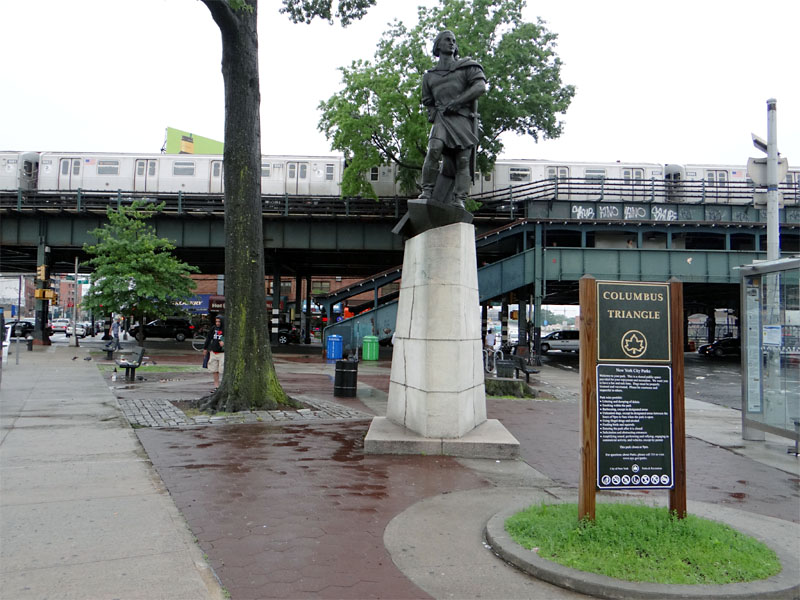
Photo by Kevin Kalish/The Living New Deal

While the one perched atop the column at Columbus Circle is the most famous, perhaps the most interesting one sits in Columbus Park, in Astoria, Queens.

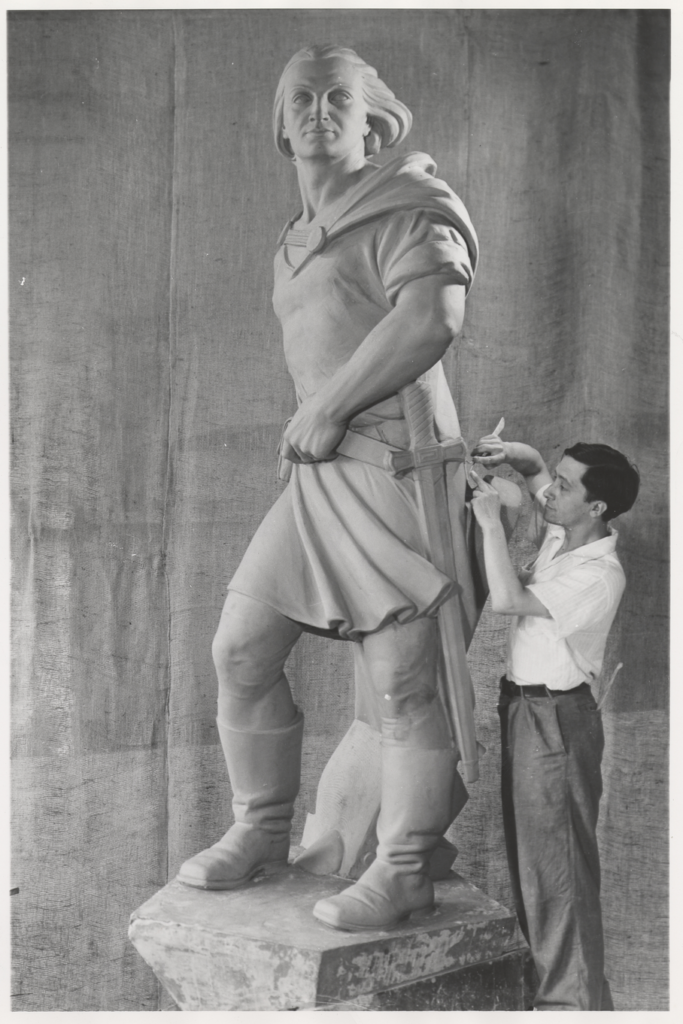
Depicting a young, robust explorer, the statue was erected here in 1941 in recognition of the area’s growing Italian population. But youthful Chris was almost immediately removed to the basement of Queens Borough Hall, for fears it would get melted down in wartime scrap-metal programs.

Racioppi works on Astoria’s Columbus as part of the WPA program.

It was returned to dignity by the end of the war and has commanded the crossroads here ever since.

Had Parks Commissioner Robert Moses had his way, however, the striking, romantic monument would never have seen light of day. “We don’t think the statue looks like anything we have read about Columbus, or that as a piece of symbolism it represents anything associated with Columbus,” Moses complained.

“Anything Moses doesn’t design himself, he thinks is no good,” replied Queens Borough President George U. Harvey.

Nearby you’ll find a dedication plaque from the Italian Chamber of Commerce. Your eyes aren’t deceiving you; it lists a dedication date of 1937.

Although sculptor Angelo Racioppi had completed the work by then, the community couldn’t afford the base until a few years later.

Jack Finney’s ‘Time And Again’, preservation by sci-fi

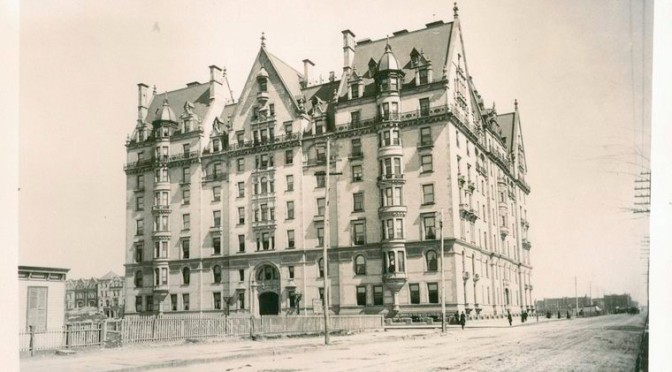
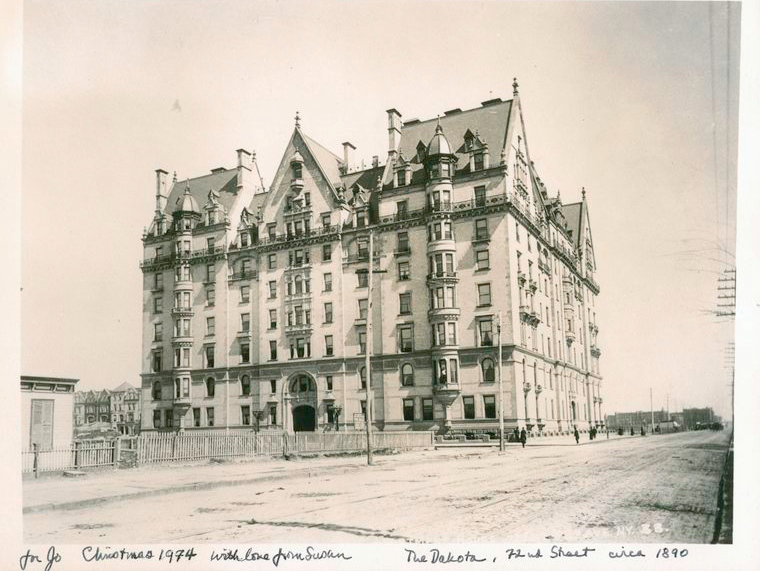
The Dakota Apartment circa the 1890s: If you arranged everything just right, could you go back to it?

The writer Jack Finney, who was born a hundred years ago this week, on October 2, 1911, turned the Dakota Apartments into a time machine in his 1970 novel ‘Time And Again’. He inspired a legion of New York City history lovers (including myself) and a simple (if scientifically absurd) way of traveling in time, technically obtainable by anybody with adroit attention to detail.

Finney was hardly a New York literary figure of note. Born in Wisconsin, Finney moved to New York in the 1940s to work in advertising but detoured in to a successful short-story writer. He had already moved from New York in 1954 when a set of his serialized stories were compiled for the novel The Body Snatchers, which inspired the classic film Invasion of the Body Snatchers and its many derivatives.

Time travel and New York were common themes in his work. In the 1950 tale ‘The Third Level’, a man finds a mysterious concourse at Grand Central Terminal and a train that carries him to the year 1894. Almost two decades later he wrote ‘The Woodrow Wilson Dime’ about a bored advertising executive who enters an alternate New York universe (imagine ‘Mad Men’ as a science fiction.)

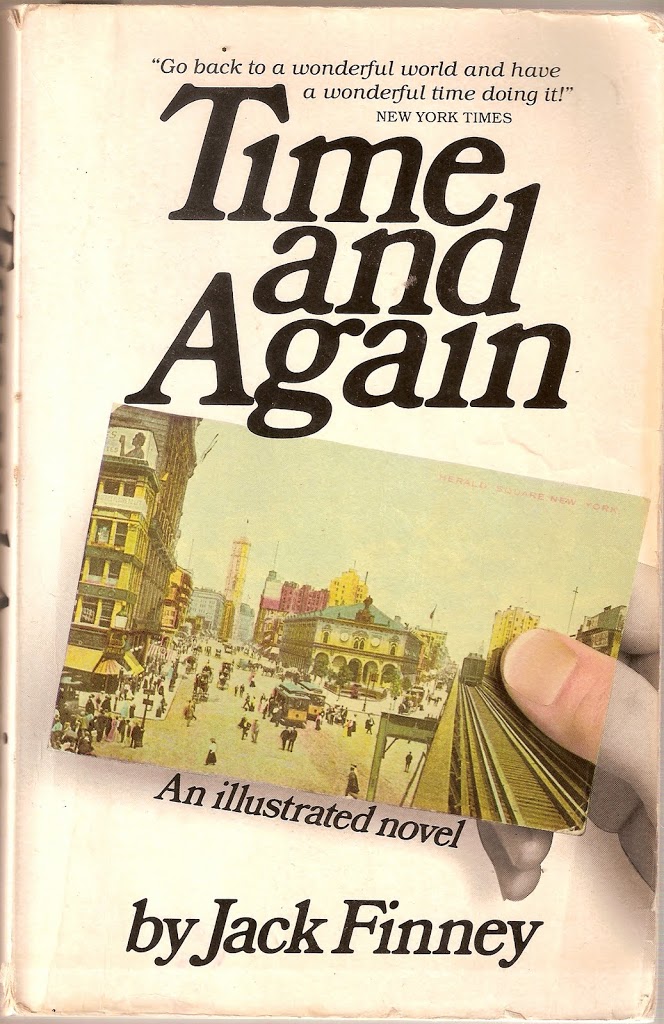
But Time And Again, first published in 1970, was his greatest success, a time-shifting novel short on scientific rationale, but large in nostalgia and architectural romance. The plot involves a curious scientific experiment that delivers a man back to the date January 21, 1882, to locate the sender of a mysterious letter that foretells “the destruction by fire of the entire World.”

The key to the novel’s success were its illustrations and photographic reproductions. Pick up an old copy today and you’ll wonder why the smudged, sometimes darkened reprinted photographs would excite anyone. When I first picked it up, probably twenty years ago, that was part of the allure. The book itself had a creaky, dated presentation and a wide-open earnestness about it. It was ideal for burgeoning history lovers, never lecturing its readers. You felt you were joining Finney himself as he excitedly flipped through a stack of old photographs and imagined a reason for stepping into the images.

Perhaps that’s because the science fiction behind it almost blushingly simplistic. Essentially, anyone can go back in time. All you have to do is recreate a situation exactly as it might have been at a selected date, then hypnotize yourself into thinking it into reality.

For this reason, the Dakota Apartments are chosen for the time experiment. Finney certainly chose the location due to the building’s pristine, unchanged condition. (Meanwhile, as he wrote, Roman Polanski would film ‘Rosemary’s Baby’ here, placing the structure into a far darker fantasy context.)

“We know exactly when all the apartments facing the park have stood empty, and for how long,” proclaims a scientist. “Picture one of those upper apartmenets standing empty for two months in the summer of 1894. As it did. Picture our arraging — as we are — to sublet that very apartment for those identical months during the coming summer….I believe it may be possible this summer, just barely possible, you understand, for a man to walk out of that unchanged apartment and into that other summer.”

Simply by bringing a structure and its surroundings into physical replica of the past can one actually get there. Keep in mind when this was written. Pennsylvania Station had been destroyed seven years before the publication of ‘Time And Again’. The New York Landmark Preservation Commision was but a few years old. People were beginning to fight for their neighborhoods and protect aging city relics.

‘Time And Again’ was a manifesto for preservation. In essense, keeping an area locked in a certain place in history created some kind of metaphysical bridge. Or, more easily put, magic.

Having returned to 1882, the main character wanders the city and marvels in wonder. His adventures take him the offices of the New York World, the old City Hall Post Office and Gramercy Park.. The plot, involving jealous lovers and blackmail, incorporates actual historical detail into the adventure, although not in anyway one would consider subtle. For instance, my favorite detail of the book is easily the disembodied arm of the Statue of Liberty, sitting in Madison Square Park years before it was attached its body.

‘Time And Again’ is written with awe while keeping a certain distance. (Finney was no historian.) The story takes place within a snowglobe of New York more than an actual depiction of it. In other words, there are no visits to Five Points or the Lower East Side, for that matter. Later books, like Caleb Carr’s ‘The Alienist’, would take a more technical, tour-guide approach to its descriptions. ‘Time And Again’ is simple in its tintype illustration of old New York but leaving someting to the imagination makes it an inspiring read, even today.

By the way, Finney wrote a sequel called From Time To Time that was published in 1996, a year after his death. The book takes place in 1911, the year of Finney’s birth.

Top picture courtesy NYPL

Categories
Those Were The Days

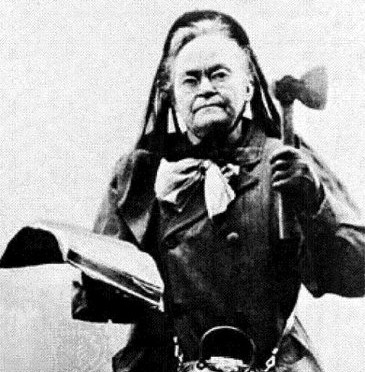
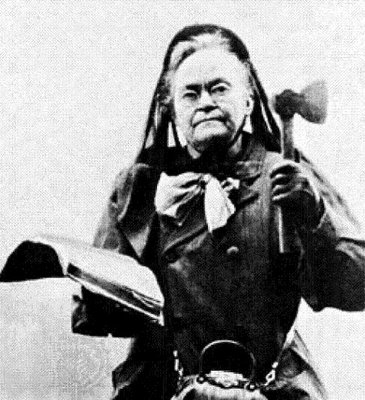
Crazy Sober: Hatchet lady Carrie Nation vs. New York City

I enjoyed the first part of the Ken Burns and Lynn Novak documentary series ‘Prohibition’ which debuted last night. But let’s be honest, the second part — introducing the Roaring 20s and the godfathers of organized crime — should be far more provocative. After all, morally righteous reformers did what they believed was right for their day, but few had dynamic personalities that resonate in our imaginations today.

That is, except for Carrie Nation, that hatchet-wielding temperance terror whose unorthodox and non-peaceful displays of protest made her a national celebrity. Literally taking directives from God, Nation battle-axed her way through small Midwestern towns, protesting the sale of liquor with violent force, chopping at bartops, bottles and furniture with her signature hatchet, accompanied by a righteous choir of church ladies belting hymns while dodging splinters.

Nation was regularly arrested and fined, but under the cover of doing God’s duty — and riding a swell of anti-liquor sentiment — she managed to continue her vicious tirade across the country, becoming the temperance movement’s most colorful star. She even sold minature replicas of her well-known weapon to fund her cross-country adventures.

Nation’s reputation had obviously preceded her when she arrived in New York on August 28, 1901. Law enforcement and nervous saloon owners braced for the worst. After freshening up in a suite of rooms arranged for her at the Victoria Hotel on 27th Street and Broadway, Mrs. Nation headed down to police headquarters on Mulberry Street to address the general drunkenness conditions of the city directly with police commissioner Michael Murphy.

Their exchange was not pleasant. Nation demanded to know why the city kept saloons open on Sunday. Murphy replied that it was legal to do so. She bitterly lectured back with a Bible verse; Murphy replied, “Don’t quote scripture at me, Madame. Go back to Kansas and get that off on your husband.”

After a few more volatile exchanges, Nation was forcefully removed from police headquarters. (Certainly, this result was one she had intended. Her press agent was waiting outside with a throng of curious onlookers.) Nation next decided to harangue the mayor and prepared to visit City Hall. When message was sent that the mayor didn’t care to meet with the fiery reformer, Nation decided to do what came most naturally — she headed for a bar, hatchet in hand.

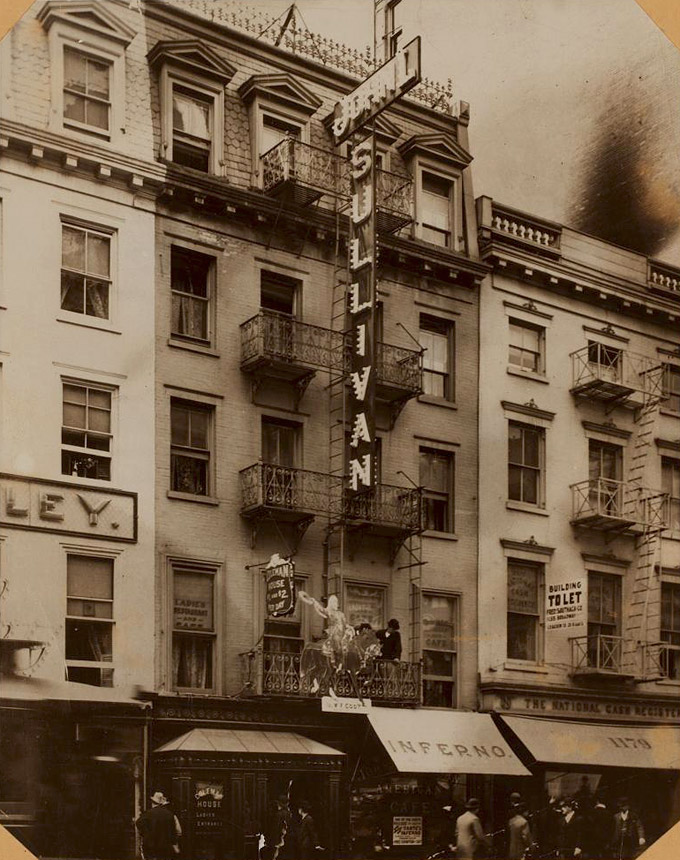
The unfortunate establishment in her crosshairs was that owned by famed boxer John L. Sullivan, himself a celebrity of some flamboyance. Having spent the 1880s as one of America’s most legendary bare-knuckle fighters, he was famously brought down (in a gloved match) by ‘Gentleman’ Jim Corbett in 1892. Like many boxing stars before him, Sullivan ended up in New York as a saloon owner, at 1177 Broadway, between 27th and 28th streets (at right). And right near the hotel hosting Carrie Nation!

In a bit of braggadocio, Sullivan had proclaimed to the press that if Nation ever bothered to stop by, he would “thrust her into a sewer hole.”

Nation accepted the invitation, arriving by carriage and demanding Sullivan meet her out front. The famed boxer, however, refused to come outside, the New York Times even mentioning, “A shutter in one of the blinds in the room usually occupied by Mr. Sullivan was seen to move.”

The mighty athlete was certainly fearful of his property being chopped to ribbons. This wasn’t some Bowery dive bar, after all. But while the authorities were certainly no friends of Nation, she was a very popular symbol among New York’s temperance supporters. Arresting such a known figure would have actually played into Nation’s intentions.

Best to wait out the storm, I suppose. By that afternoon, Nation has left town via Grand Central, off to more wily stunts in the Midwest. Drinkers and cops alike raised a toast in relief.


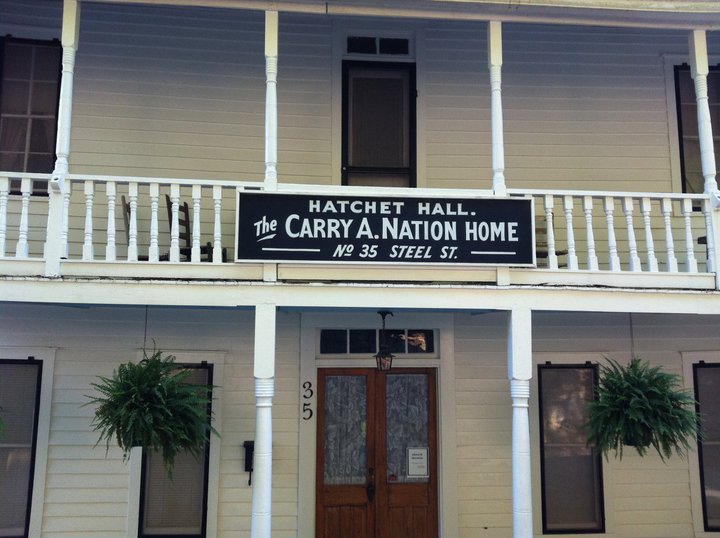
BY THE WAY: This summer I took a trip back to Ozarks (where I’m originally from) and spent an evening in marvelous Eureka Springs, Arkansas. Carrie Nation spent her final years here, appropriately opening a boardinghouse for widows and proper ladies called Hatchet Hall. The Hall is still preserved near the center of town (pictured below) and across from a boarded-up water spring that was also named in Nation’s honor. She collapsed during heated speech right up the road from Hatchet Hall in 1911 and died shortly thereafter in a Kansas hospital.

Picture of Sullivan’s courtesy Sepiatown. Picture of Hatchet Hall courtesy me.

Opium heaven! Fears of Chinatown, immortalized in print

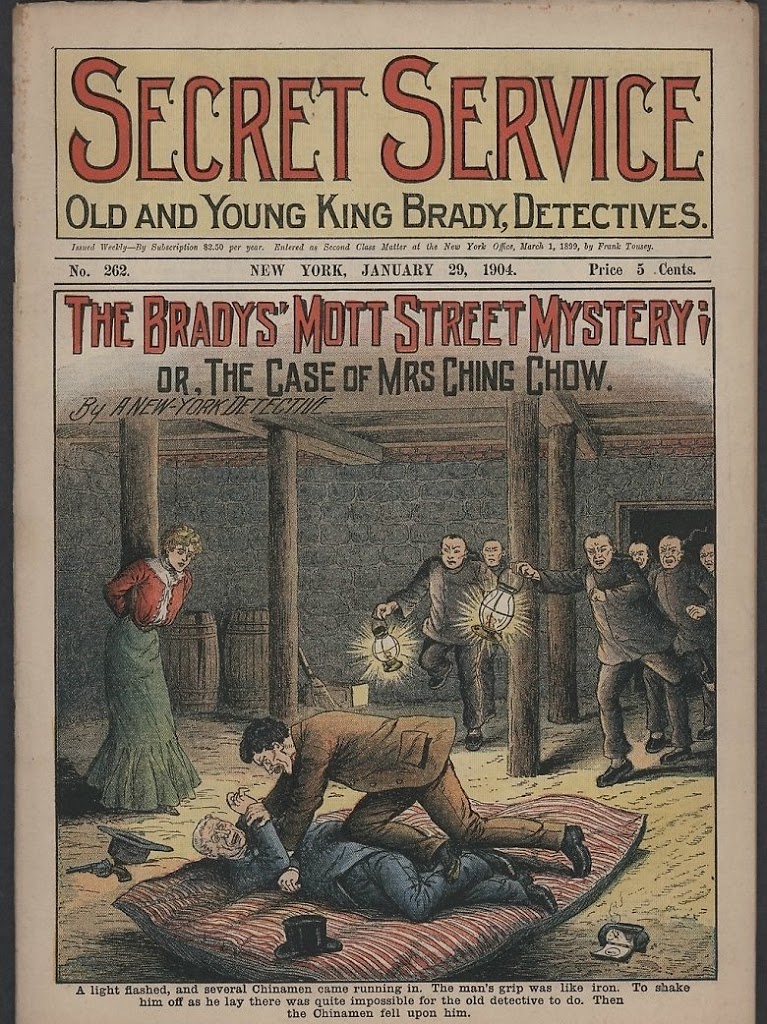
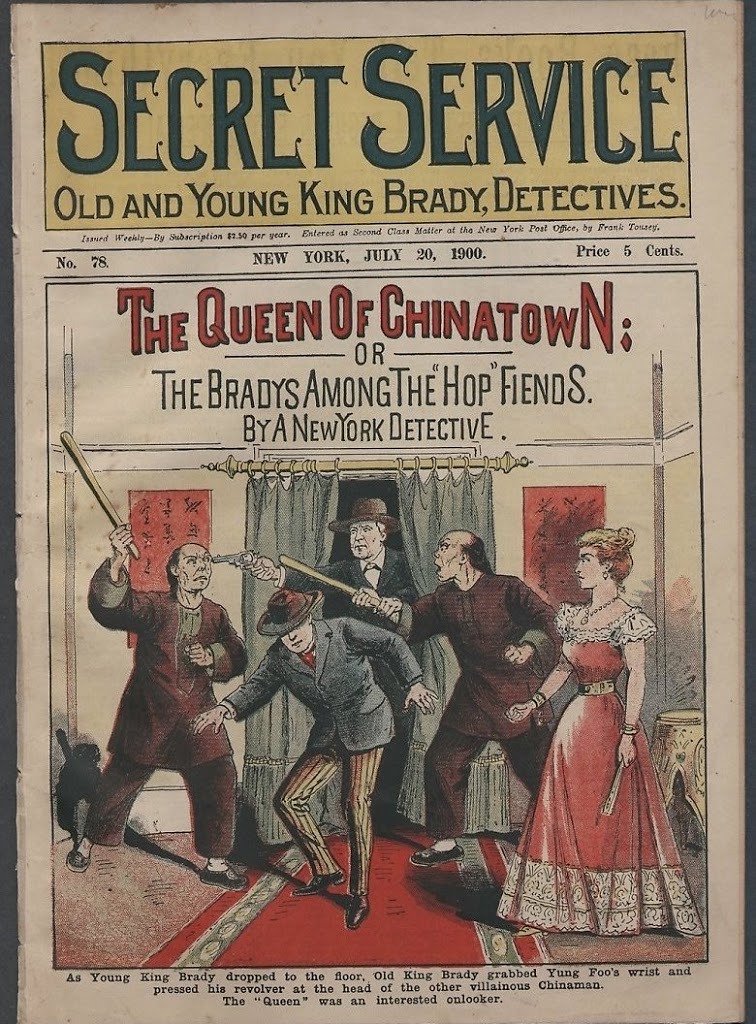
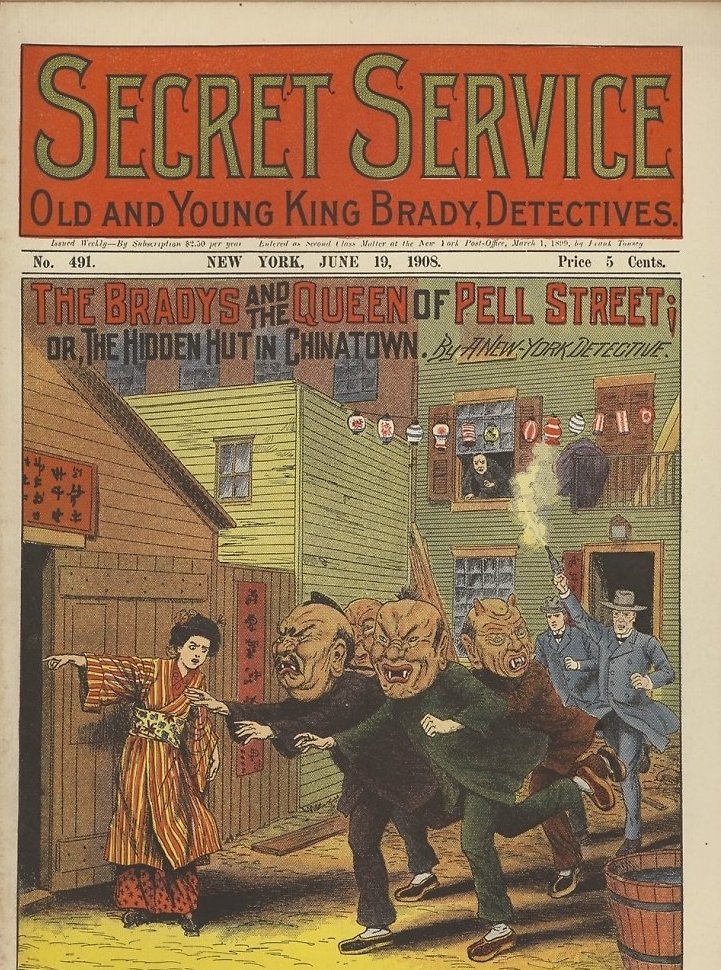
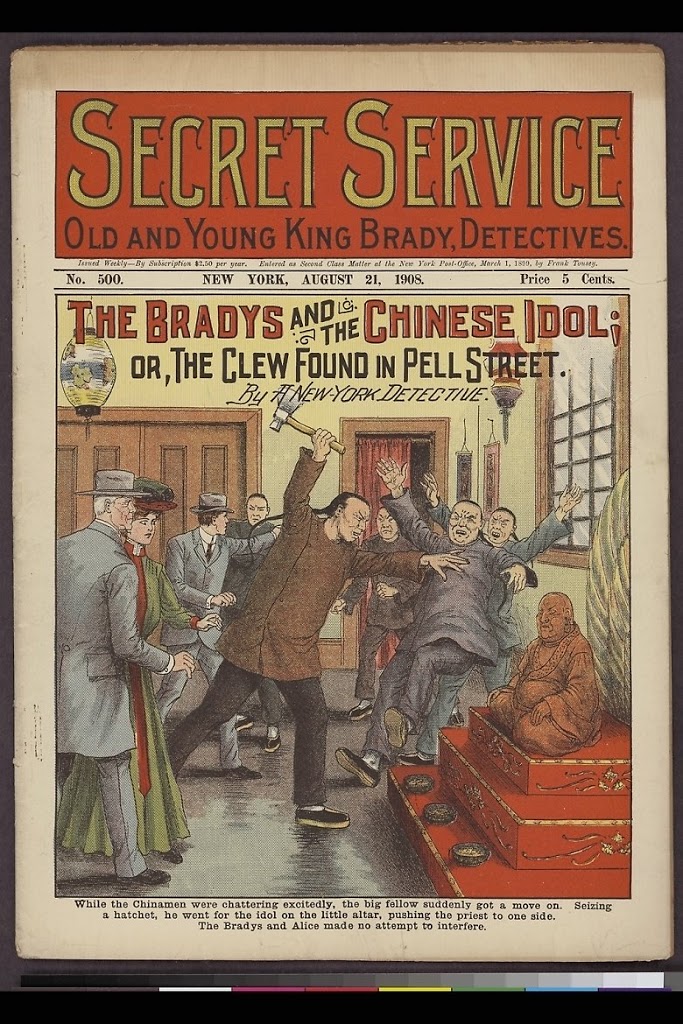
Reading about Chinatown in classic books like ‘Gangs of New York’, one gets a sense that certain mysteries and legends about the neighborhood were already firmly in place. And nothing of these gauzy preconceptions arose to the public consciousness more than the problem of Chinatown’s opium dens. In fact, no other feature of American Chinatowns would resonate more negatively — or in the case of 19th century dime novels, more thrillingly.

The sale of opium may been centered in Chinatown, but it wasn’t new to New York. It’s believed that John Jacob Astor himself, a major trader with the Orient in the 1810s, probably brought Turkish opium to New York. (Edwin G Burrows and Mike Wallace even call him “America’s first large-scale drug dealer.”) But it was mostly associated with the Chinese that arrived in the 1850s and 60s, men from American western territories who brought it with them among their other unique wares.

Opium was a vice of choice for many white New Yorkers, and many became ‘hop fiends’, as described by the scandalized press. It was particularly enjoyed by New York’s small, continental ‘bohemian’ class. By the 1890s there were more opium dens outside of Chinatown than in. Many others experienced the drug via its inclusion in laudanum, prescribed for various medical ills but frequently abused. But no matter; the drug’s foreign, sinister qualities had turned the Chinatown of popular imagination into a devil’s playground.

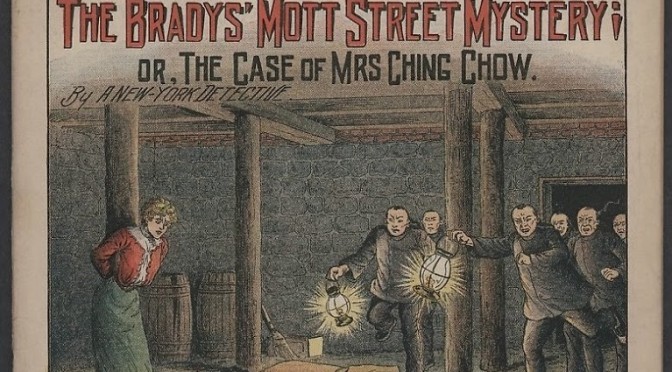
This was reflected most colorfully in the dime novels of the day. A precursor to the pulp novel and the comic book, the dime novel was obtainable entertainment for regular New Yorker, cheaply written and made, filled with adventures that leapt from the stands due to flashy, often brightly hued covers.

The first of these publications was produced a little over 150 years ago with Malaeska, the Indian Wife of the White Hunter. That first story also set the standard for using ‘strange’ ethnic lifestyles as the backdrop for adventure.

One of the most enduring characters of late 19th century dime-novel industry was Old King Brady, who cracked down on crime in New York’s most vicious and dangerous neighborhoods. Naturally that brought him into contact with Chinatown’s opium world.

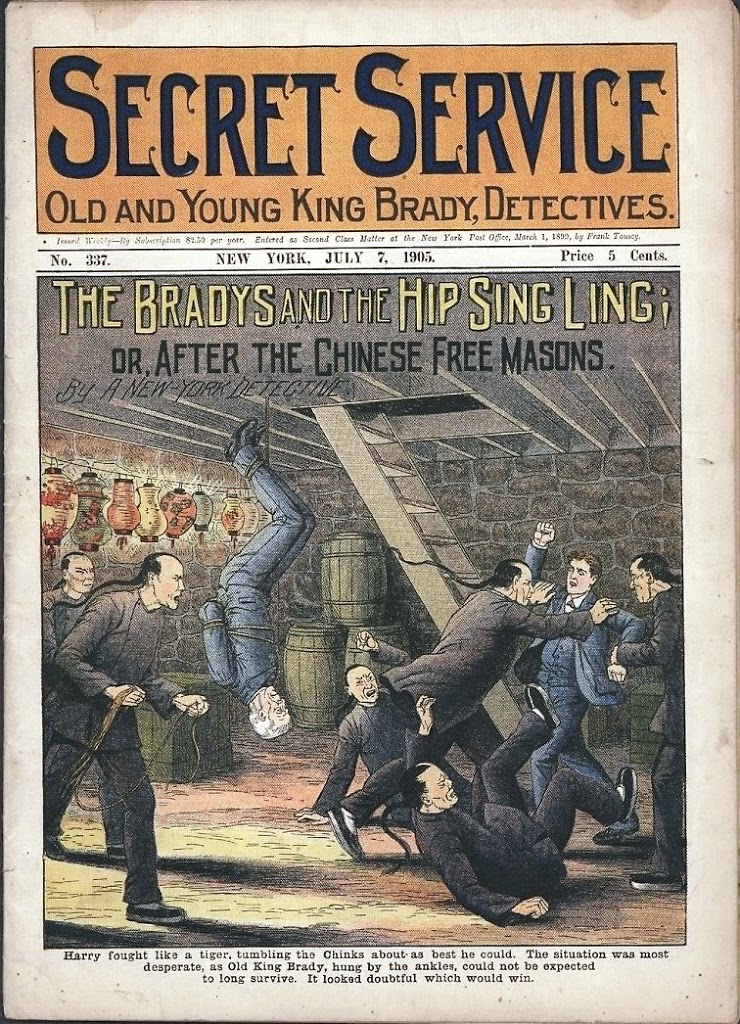
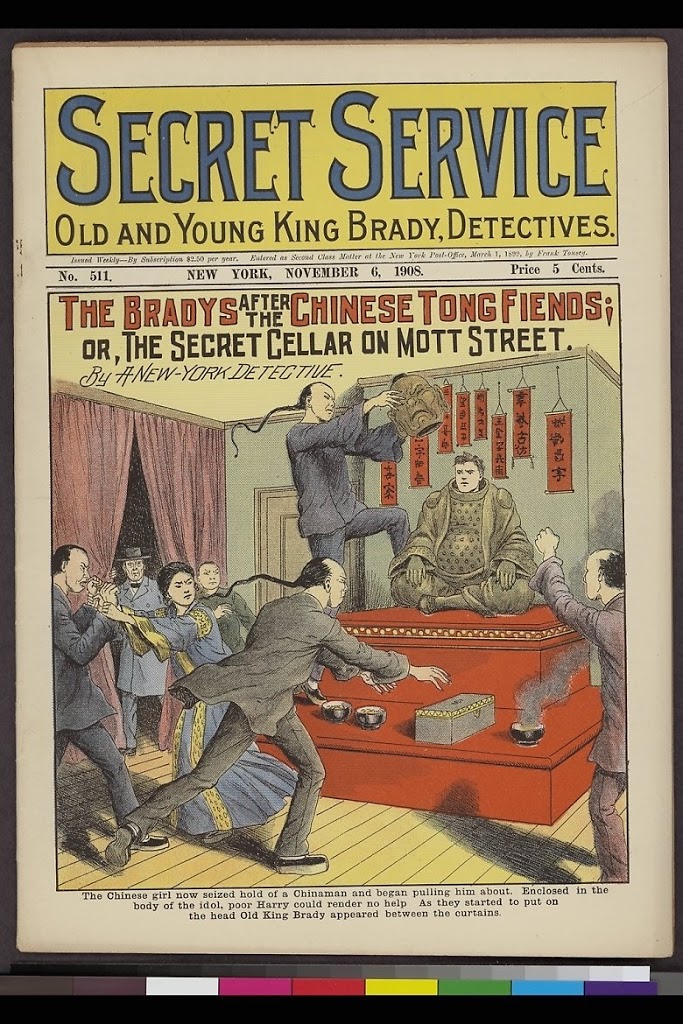
In many issues of ‘Secret Service’, Brady and his young companion would rescue helpless women taken captive in an opium den, with chase scenes through the streets of Chinatown. As you can see from the examples below, depictions of Chinatown were broad, racist and wildly inaccurate. The phrase ‘heathen Chinee’ is often used.

These samples are from the Stanford University collection of dime novels and penny dreadfuls. I highly recommend checking out their website, searchable by themes, including New York street scenes. I’ve chosen a few below which recognizable place names, but there are literally a couple dozen that are specifically set among the ‘Oriental opium world’, often in basements or thickly draped parlors. For some reason, there seems to be a trap door in every story!

NOTE: Be careful before reading some of these captions. Needless to say, there’s some racially insensitive language included within these old books.

This one in particular seems to revel in the highly stereotypical and sensational image of the ‘tong’ member with their wielded hatchets. Below it, a depiction of what may be some variation of the Hip Sing Tong (called ‘ling’ for some reason).

And I won’t even hazard a guess to figure out what is happening here!

Notes from the podcast (#129): Manhattan’s Chinatown

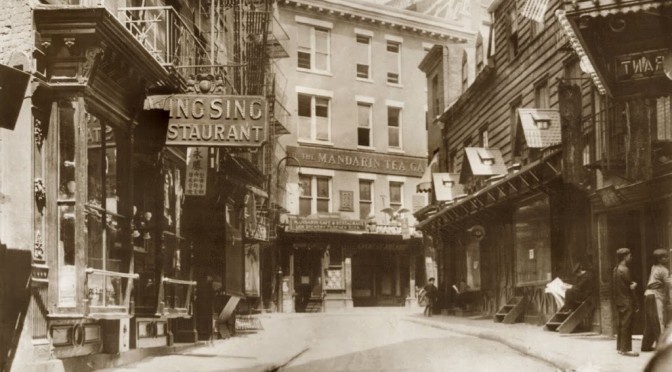
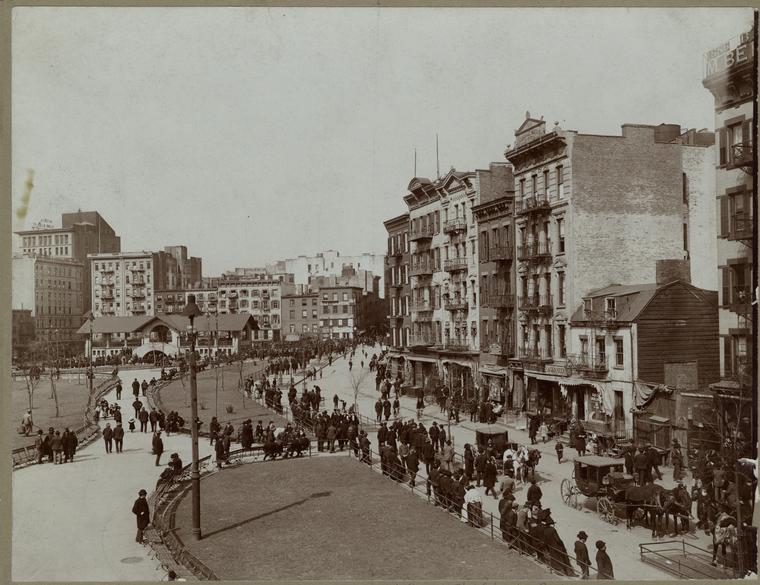
Casual posing at the opening of Doyers Street, circa 1900. (LOC)

I’m so relieved that we finally got to cover a proper New York neighborhood on the podcast. Since reviewing the historic shifts and events of a neighborhood are better covered topically, we hope there wasn’t too much confusion regarding the chronology. Manhattan’s Chinatown was a point of curiosity by the 1870s, but it wasn’t until after the Exclusion Act in 1882 that the community really became a force in the Five Points neighborhood and a destination for some of New York’s better known vices.

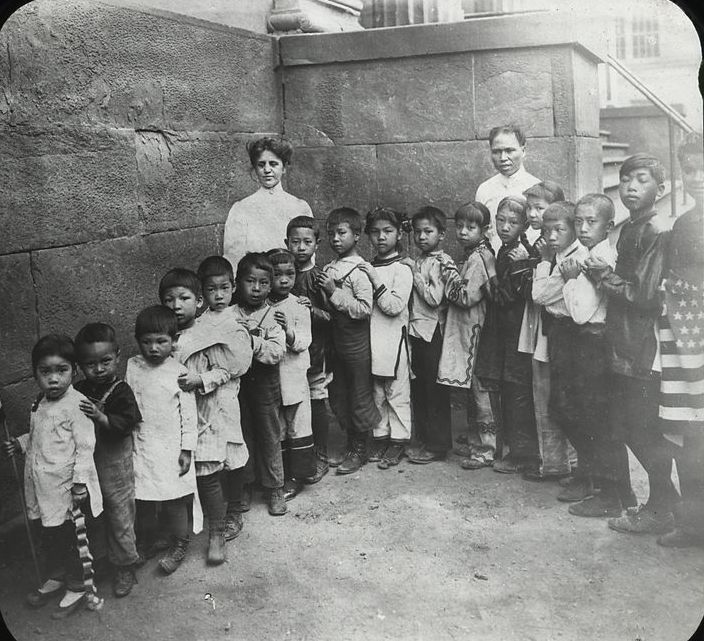
We pretty much hammer home that late 19th century Chinatown was a veritable ‘bachelor’s society’ with few Chinese women. But that does not mean there were no Chinese women. Or for that matter, children, as evidenced in this photograph from 1913. [source]

The caption reads, “Sunday school after a visit to Chatham Square, showing Chinese children lined up by size.” I’m fairly confident this was taken at the Mariner’s Temple at Henry Street.

Pronunciation Proclamation: I’m a New Yawker by way of the Ozarks, so clearly my tongue had a challenge properly pronouncing many early Chinese names. (And Tom had a cold, adding to his difficulty.) Still, I think we did a pretty good job. For certain, I mispronounced Yung Sun Restaurant, the base of operations of one Sister Ping, when I said it the first time, but got it right the second.

For More Information: Speaking of Sister Ping, the best book on modern Manhattan Chinatown history is easily Patrick Radden Keefe‘s “The Snakehead: An Epic Tale of the Chinatown Underworld and the American Dream.” It is a must-read for anybody interested modern New York organized crime.

A perfect summation of late 19th century Chinatown can be found in Tyler Anbinder‘s ‘Five Points’. There are many great books on the early American Chinese experience, the friendliest to read being ‘American Chinatown’ by Bonnie Tsui.

Of our older podcasts, this show would be greatly complemented with a visit to our two most popular podcasts ever: Five Points: Wicked Slum and Five Points: The Fate Of Five Points. If you haven’t listened to them, I recommend downloading the ‘illustrated versions’ of each of these shows, featuring pictures of the things being discussed that pop up on your listening device. You download on iTunes or straight from here and here.

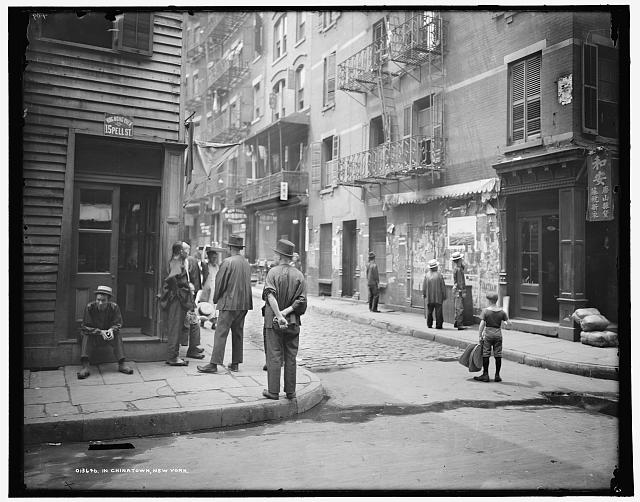
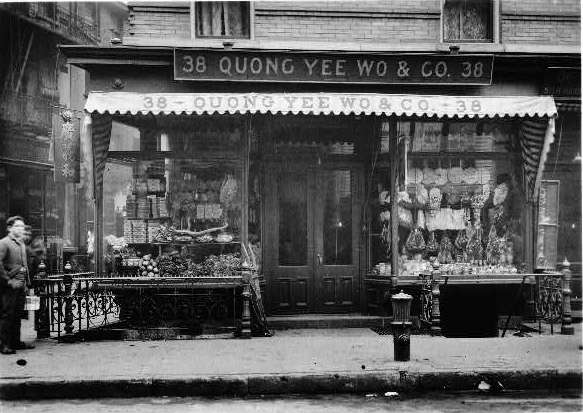
Below: What wares await you at Quong Yee Wo and Co., at 36-38 Doyers Street, corner of Pell Street? [courtesy Library of Congress]

Categories
Podcasts

Manhattan’s Chinatown: a tribute to the old neighborhood, and to the temptations of rich delicacies and basement vices


PODCAST Manhattan’s Chinatown is unique among New York neighborhoods as its origins and its provocative history can still be traced in many of the buildings and streets still in existence. Two hundred years ago, the sight of a Chinese person would have astonished New Yorkers, and the first to arrive in the city were either sailors or the subjects of tacky exhibition.

But with the first Chinese men setting on Mott Street, a new community was born, with thriving variety shops, cigar businesses and gambling dens alongside establishments of a more sensuous nature — opium dens and brothels. This mini-economy produced social clubs and secret societies (the legendary ‘tongs’), and rival gangs soon spilled blood along the neighborhood’s quirkiest lane.

And still today, modern Chinatown hides a few dark, startling secrets of its own.

ALSO: We give you a rundown of addresses along Mott Street and other places nearby. You can use this podcast as your official walking tour of the neighborhood!

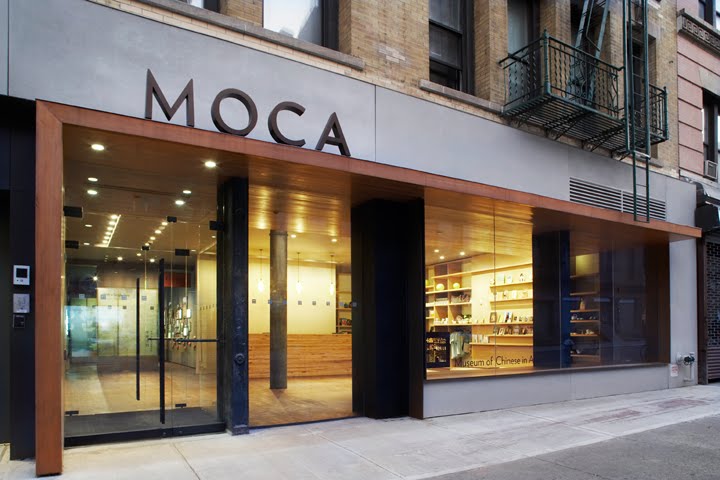
For a lot more information on the Chinese experience in America, I urge you to visit The Museum of the Chinese In America, located at 215 Centre Street. It’s free on Thursday and close to Chinatown. (Photo courtesy CUNY)

And here’s the addresses of places we mentioned in the podcast, as well as a couple other locations of interest. There are other places on these streets of great interest, so please meander freely:

1. 50 Spring StreetQuimbo Appo’s tea shop
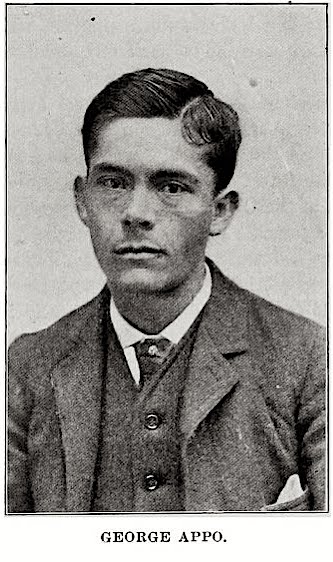
Quimbo, an early Chinese success story in New York was in and out of prisons and mental wards later in his life. His son George Appo (below) was an equally notorious presence in the Five Points slums.

2. 62 Cherry Street Ah Sue’s tobacco and Chinese Candy shop
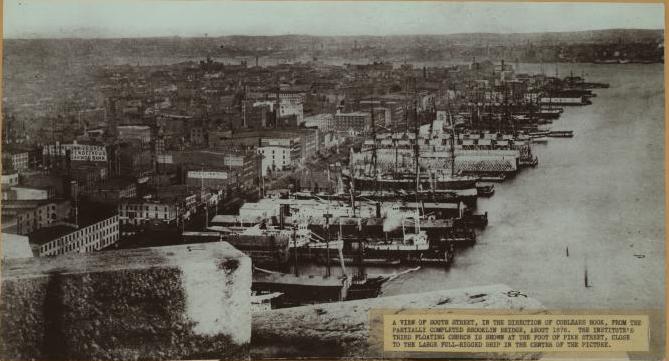
The East River docks stretching to Corlears Hook, where the first Chinese men (sailors) stayed in boardinghouses. This image is from 1876; Ah Sue’s waterfront business was at 62 Cherry Street, near Catherine Slip.

3. Corner of Catherine Street and East Broadway
New York’s first Chinese laundromat

4. Chatham Square
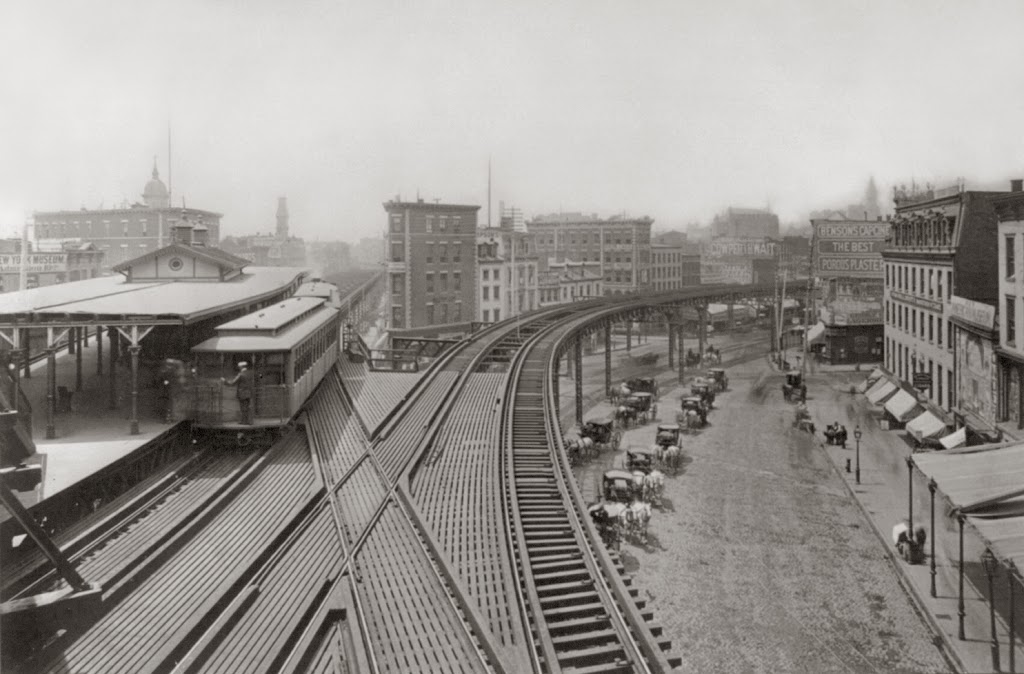
In the 1880s, the open area was consumed with elevated railroad tracks, quite a

5. Confucius Plaza
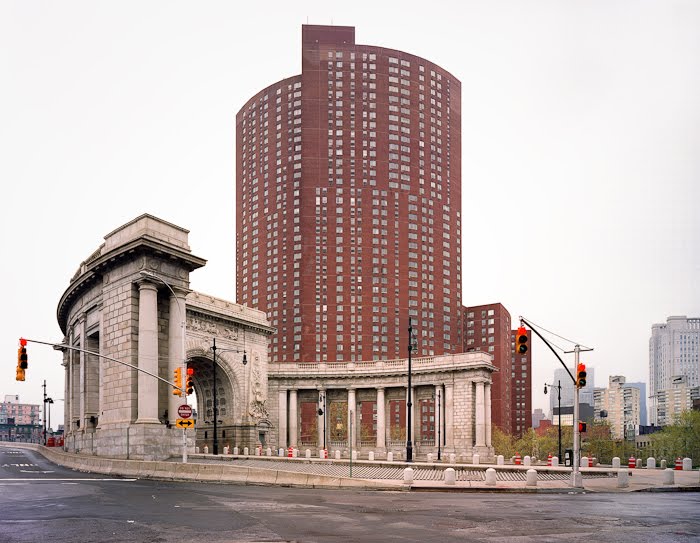
Built in 1975 and one of the largest buildings in downtown Manhattan outside of the Financial District. (Picture courtesy the pretty fabulous blog Iconic Facades)

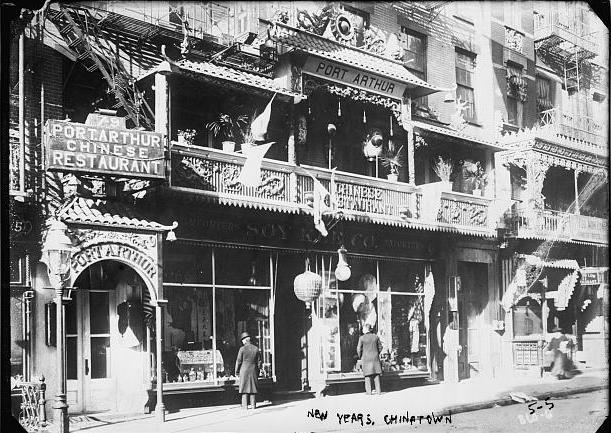
Not mentioned in the podcast, Port Arthur Chinese Restuarant, at 7-9 Mott Street, circa the 1900s, one of the first banquet halls of Chinatown

6. 11 Mott Street – the brothel owned by Tom Lee
7. 16 Mott Street – original home of the Chinese Consolidated Benevolent Association
8. 18 Mott Street – the first Chinese-owned building, and one of the earliest Chinese gambling dens

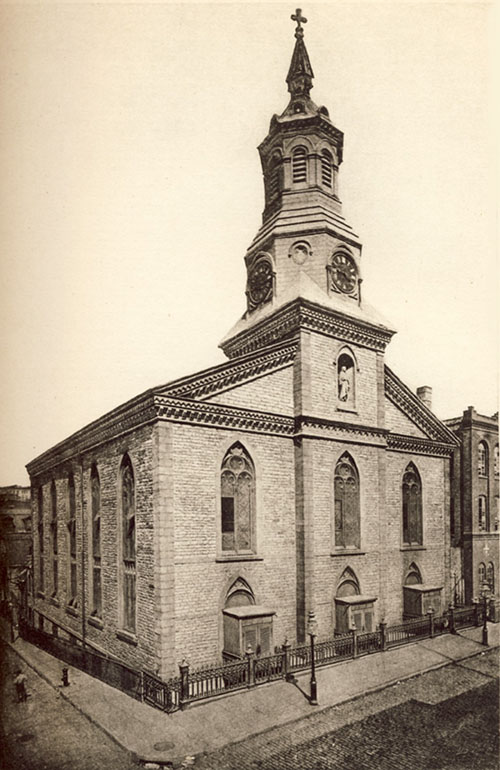
9. 25 Mott StreetChurch of the Transfiguration
Easily the oldest structure in the neighborhood, and home to early congregations that weren’t exactly welcoming to Mott Street’s early Chinese residents.

10. 62 Mott Street — current home of the Chinese Consolidated Benevolent Association, the unofficial ‘town hall’ of Chinatown

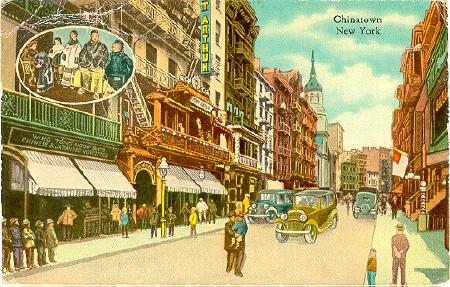
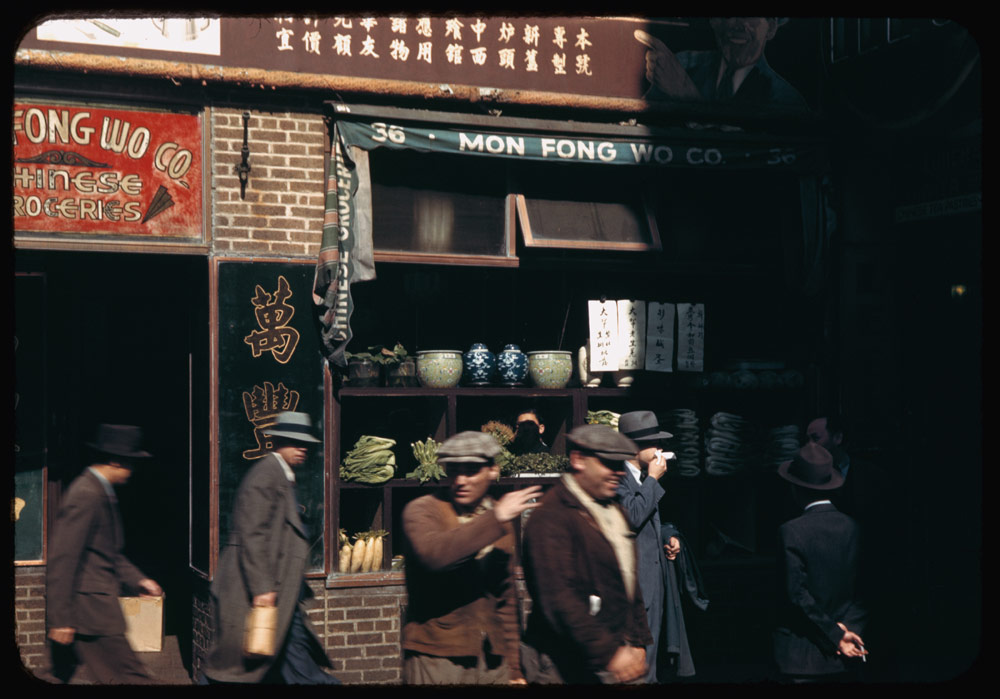
Mott Street in 1942: (Courtesy the Charles W. Cushman Photography Archive)

11. Columbus ParkMany of Five Points most decrepit tenements were eliminated to make way for this park created by Calvert Vaux. The park is a lively part of Chinatown today, particularly on the weekends. [source]

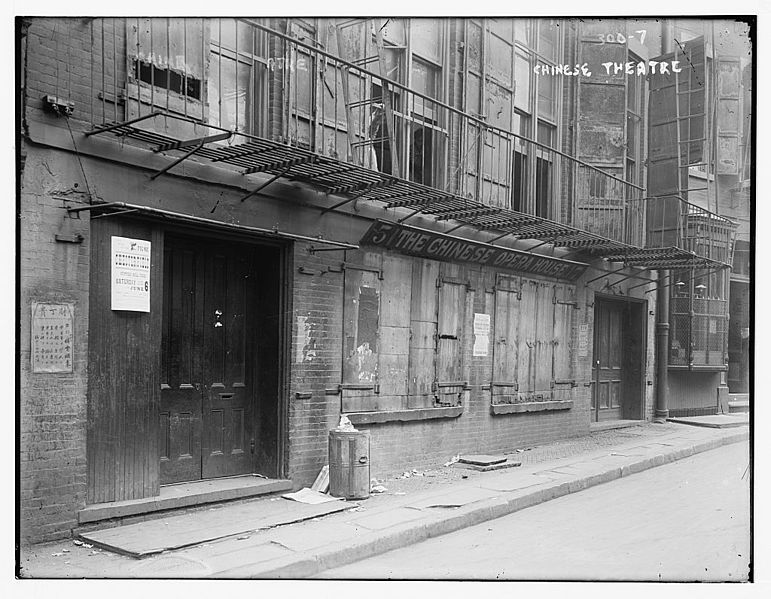
12. 5-7 Doyers Street – Chinese Theater
A regular source of entertainment for locals and the sight of more than few altercations between rival tongs. Bodies were allegedly buried in the basement.

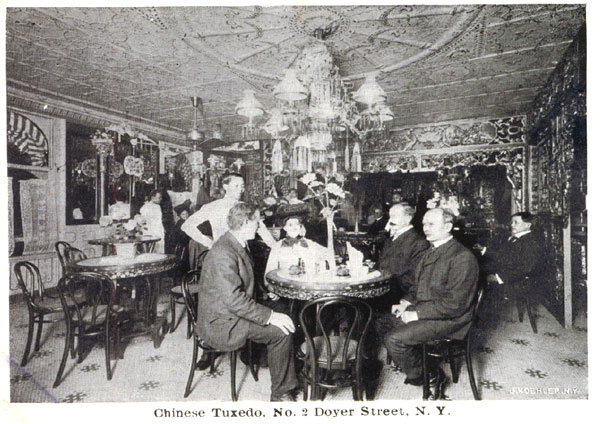
2 Doyers Street — Chinese Tuxedo Restaurant
Chinese had a powerful allure to the non-Chinese and to ‘bohemians’. This restaurant attracted businessmen looking for an ‘exotic’ night on the town. It helped that the Tuxedo was near the elevated train. (Courtesy Flickr/straatis)

13. 9 East Broadway – Former home of the Golden Star Bar
14. 47 East Broadway – Yung Sun Restaurant, once operated by Sister Ping


The sad tale of New York’s first Asian female ‘celebrity’

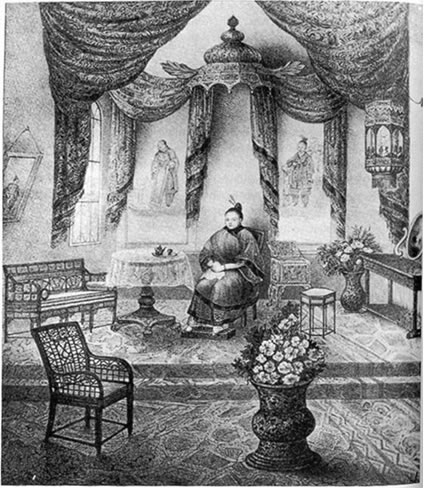
Meet Afong Moy, the Chinese teenager who became the most famous Asian person in America in the 1830s. I would not exactly call her notoriety enviable.

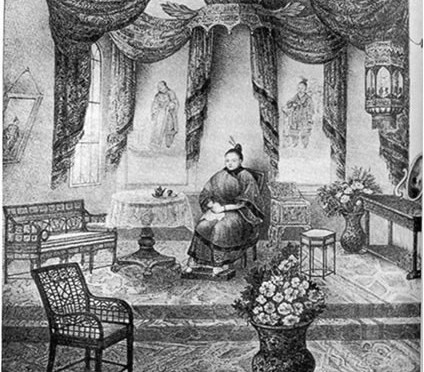
There’s a strong likelihood that Moy (in the illustration at right) was actually the first Asian woman to ever step foot in New York. Early trade with China, beginning in 1784, would have brought New Yorkers in contact with the Chinese for the first time, but the traders and sailors manning the trading vessels would have been male. By the 1830s, it would have been rare but not extraordinary sight to see a visiting Chinese sailor in the boatyards and taverns of Corlear’s Hook.

Moy arrived in New York by boat as well, on a trading ship called The Washington, owned by brother traders Frederick and Nathanial Carne. But she arrived in New York ostensibly as a possession, an exotic companion to a set of rich Oriental objects brought over by the Carne’s for exhibition.

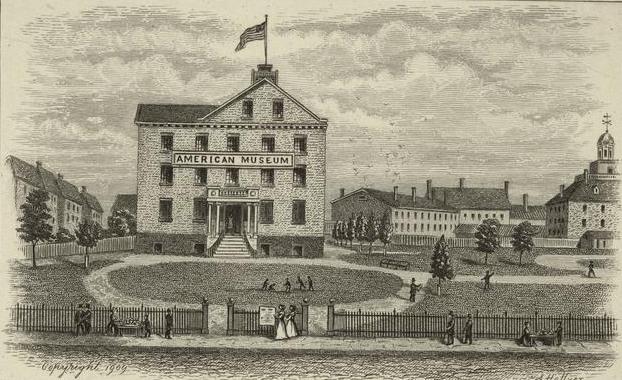
Moy, between 16 and 19 years of age, was brought to the United States as part of a national tour of Chinese treasures, debuting on November 6, 1834. She was garbed in traditional fashion and displayed among a collection of imported finery and trappings brought over by the Carne brothers. It’s no surprise that her presentation was at New York’s American Museum. P.T Barnum wouldn’t own the holdings of the museum until the 1840s, so the museum, housed in the old almshouse in City Hall Park, was still in the hands of the Scudder family. (Listen to our podcast on Barnum’s American Museum for more information.)

Above: Scudder’s American Museum, in City Hall Park (Picture courtesy NYPL)

For fifty cents, the curious could observed Moy in her fabricated ‘authentic’ chamber; “[T]he simple foreignness of Afong Moy was deemed sufficient novelty to warrent her display,” according to author James Moy. Of particular fascination to New Yorkers were her “little feet”. (The New York Times called them “monstrous feet.”) In an ad for a later exhibition at the museum of Rubens Peale, ad copy exclaimed, “Afong’s feet are four inches and an eighth in length, being about the size of an infant’s of one years old. And, to add to the interest of the exhibition, the shoe and the covering of the foot will be taken off.”

Moy would speak to audiences via an interpreter, entertain with a traditional Chinese song, and, at regular intervals, would circle the room and allow people to observe her ‘little feet’ in action. Newspapers made note of her reactions, including her fit of giggles at seeing something so unusual as a left-handed person.

Although she did indeed tour various American cities, she seemed to hit every major New York venue of the day, including Niblo’s Garden, the Brooklyn Institute, and Barnum’s own American Museum, when it opened in 1842.

Not much is known of Afong Moy, which was not her real name. (One thing I’m pretty sure of, her name was not “Juila Foochee ching-chang king, daughter of Hong wang-tzang tzee king,” as was listed in the New York Daily Advertiser.) She toured the country from 1834 to 1847, then disappears from the record. There does not appear to be a single record of an interview of Moy, or any letters or diaries. What we know of this singular woman is seen only through the twisted kaliedoscopic lens of mid 19th century public astonishment.

Top picture courtesy NYPL

Hamilton Grange: Alexander’s home finally stops moving

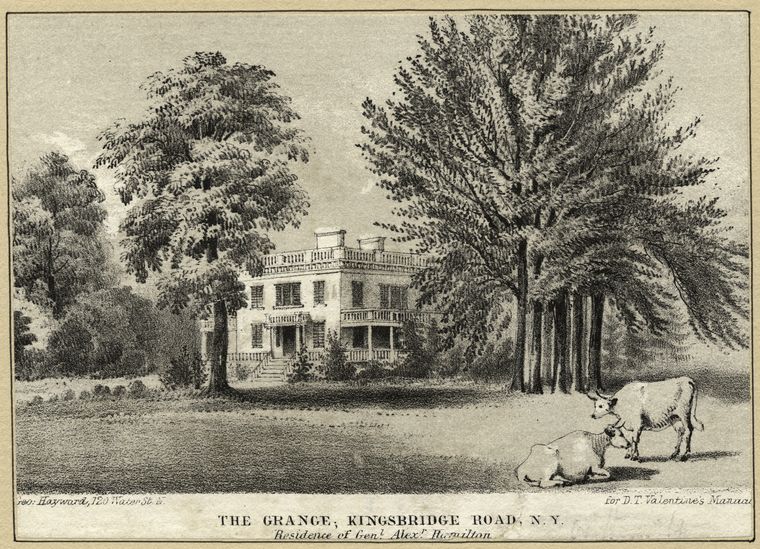
After years of being planted in the wrong place and a lengthy moving process that literally plucked it out of a city block like a slice of cake, Alexander Hamilton’s home — known as Hamilton Grange — is finally ready for visitors at its new home in St. Nicolas Park. The last home of New York’s own Founding Father was opened this past weekend a few years after it was lifted from its old location near St. James Church. The house first moved four blocks in 1889 when the church purchased the famous house and squeezed it against St. James’ main church building.

Visit the National Park Service’s website for more information on tours and visiting hours. As an unabashed Alexander Hamilton fan-geek, I’m thrilled to see it back.  You can read my original 2008 blog post about the move here.

Picture courtesy NYPL

Mayor LaGuardia’s former home and its sci-fi, erotic past

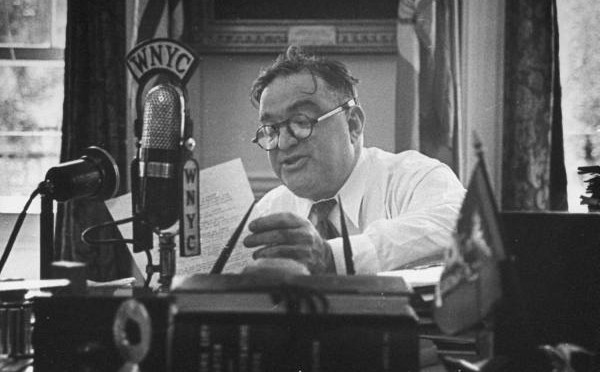
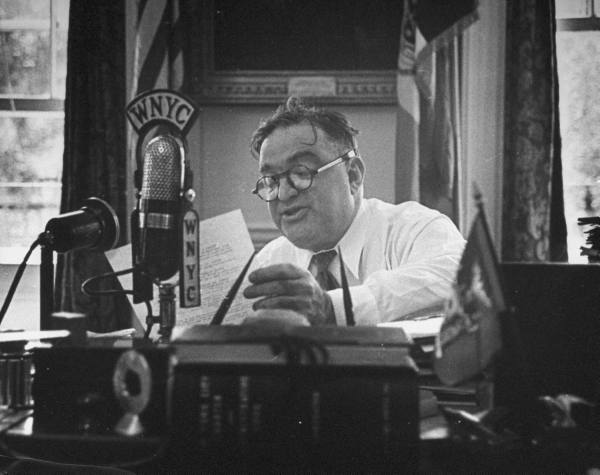
Above: Mayor LaGuardia presenting his weekly WNYC radio show from Gracie Mansion. He would carry on the tradition at his Riverdale home.

Fiorello LaGuardia, among the greatest mayors ever in New York history, died on this date, September 20, 1947, at his home in the Riverdale neighborhood of the Bronx. He arrived at the lovely four-story Tudor home directly from Gracie Mansion, where he served three consecutive mayoral terms. This mansion at 5020 Goodridge Avenue, constructed in 1914-15, was built for famed magazine illustrator Arthur I. Keller.

Retiring from politics, LaGuardia resided at the quiet mansion with his wife and two teenage children, broadcasting a weekly national radio program from his office and occasionally playing host to visitors like Robert Moses.

Less than 15 years later, the old LaGuardia home fell into some very curious ownership.

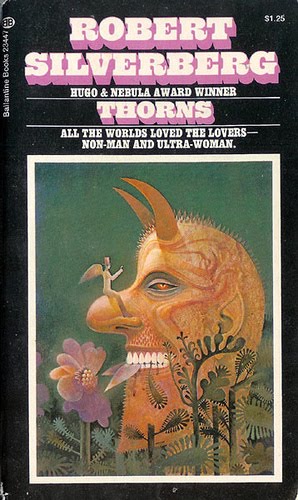
Prolific science fiction author Robert Silverberg crafted pulpy space fiction like Revolt on Alpha C and The Dawning Light right out of graduating from Columbia University in 1956. But he also spent those early years churning out stacks of cheap erotic novels for quick cash, so many and so successfully apparently that, at just age 26, he was able to purchase LaGuardia’s last home in 1961 and transform it into his own inspiration point. He penned several more sci-fi fantasies from this house, including the notable (and sexually charged) Thorns.

The author also wrote (under a pen name) the manual Sophisticated Sex Techniques in Marriage while living here.

Silverberg gave a little nod to the neighborhood in his 1972 novel The Book of Skulls: “How unreal the whole immortality thing seemed to me now, with the jeweled cables of the George Washington Bridge gleaming far to the southwest, and the soaring bourgeois towers of Riverdale hemming us on to the right, and the garlicky realities of Manhattan straight ahead.”

William Seward: a park in his honor, while sitting in another

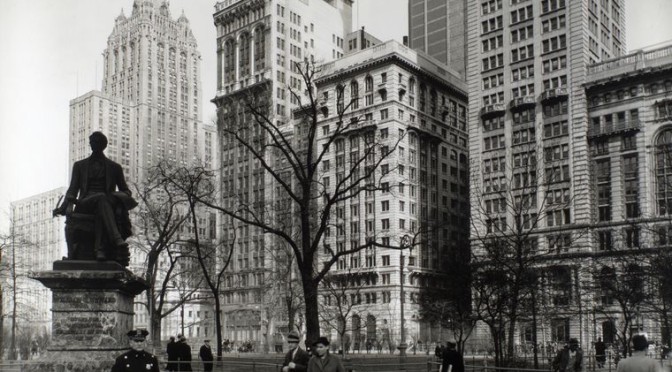
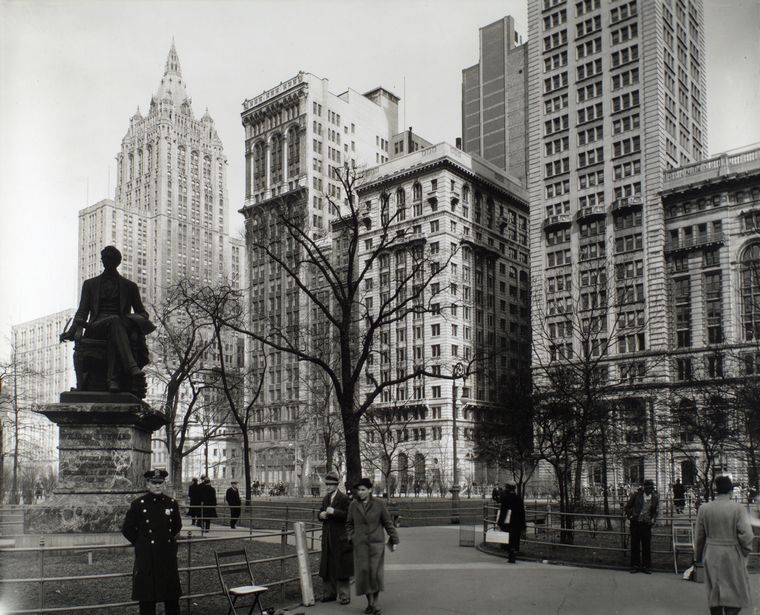
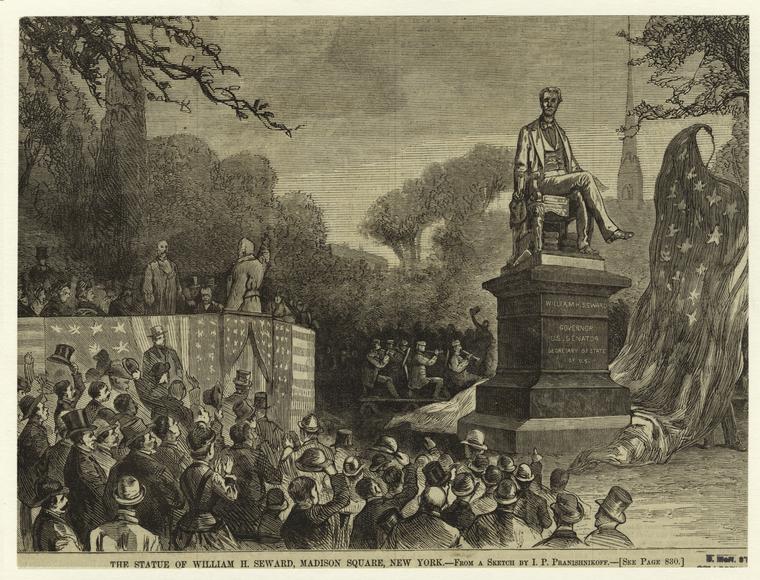
Mr. Seward, with the best seat in the park in 1934. He does seem awfully thin though, almost like a certain president. (At least, some people thought so.)

This month marks the 135th anniversary of an extraordinary gift endowed to Madison Square Park — the statue of William Seward. the former New York governor and Secretary of State under Abraham Lincoln. Indeed, he’s easily one of the most influential New York politicians ever upon the national stage. A master of backroom politics and a proponent of American expansion (best known for negotiationg the purchase of Alaska from the Russians in 1867), Seward died a revered figure, and monuments to his legacy sprouted up throughout the nation, from shore to shore.

In New York City, there are two key landmarks named after him, and they could not be more different.

The aforementioned bronze statue at the southwest corner of Madison Square Park was presented with the maximum of pomp and circumstance in September of 1876. The work, by Randolph Rogers, depicts Seward in a seated, almost languid pose, with unusual proportions. As has been frequently speculated, Rogers might have adapted an earlier seated statue of his, depicting Abraham Lincoln, and simply slapped Seward’s head onto it. This is unproven, of course, but since Lincoln was Seward’s old boss, it makes for amusing symmetry.

But the gathering admirers on the afternoon of its unveiling scarcely seemed to notice. Present at its debut was future U.S. president Chester A. Arthur, who would be graced with his own statue in Madison Square Park 23 years later.

Further downtown, in the Lower East Side, at the convergence of Essex Street, Canal Street and East Broadway, lies Seward Park, also named for the venerated politician. In 1897, in a neighborhood desperate for breathing room, the city condemned a cluster of tenements lining the east side of Essex Street. The fenced-in park was pretty much developed by private groups until the city intervened in 1903, equipping the grounds with a sporting pavilion and leveling areas for a playground.

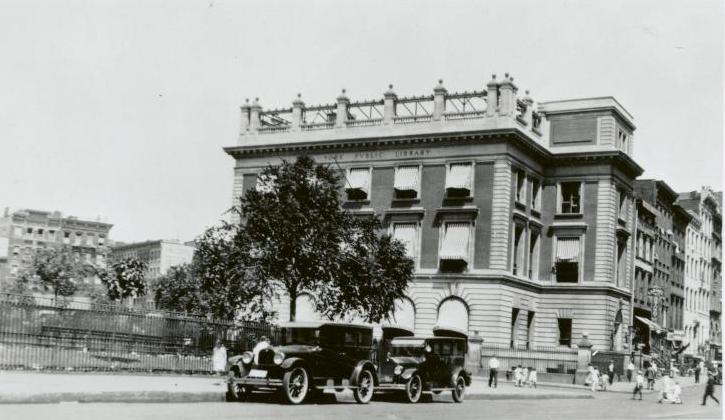
But the real jewel of this park came in 1909 when the Carnegie Foundation placed one of its most stunning libraries here. By the way, Jefferson Street used to separate the library from the park (as evidenced in the picture above). Today, the road has been closed off and the space has been become part of the park itself.

So the development of this park came well after Seward (or the head of Seward, on Lincoln) was placed uptown. And really, they weren’t going to place so a lavish memorial in the midst of so many tenements, were they?

However, Seward himself might have considered Seward Park the far greater honor. During his years as governor (1839-42) and many years following as a New York senator, he supported many pro-immigration policies that were considered extraordinarily progressive for the day. Naming the park after him was a tip-of-the-hat to these early risky political stances.

Pictures courtesy NYPL. (link to top photo here)

Categories
Uncategorized

An evening of cocktails, with tales of quirky characters

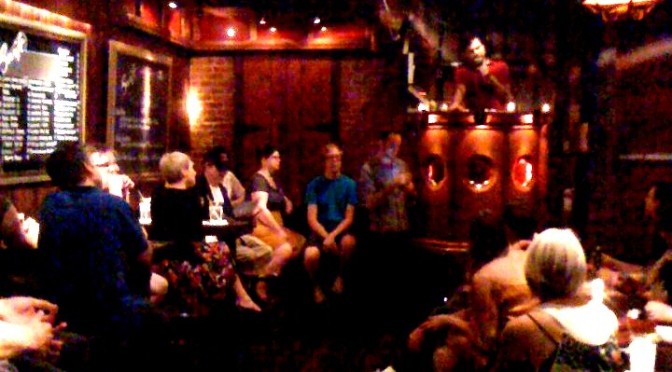
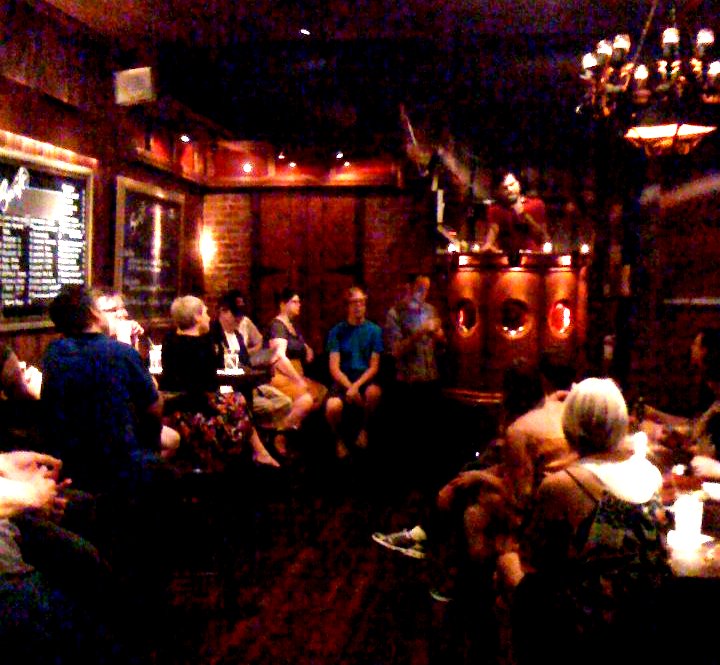
Thanks to everybody who came out on Saturday for our reading at Swift Hibernian Lounge, as part of the 4th Annual Lit Crawl. Swift makes for a incredibly atmospheric place to spin tales of New York history. Or possibly preach the gospel. Or hold an occult ritual. (Above: That’s me behind the massive podium.) And it was really fantastic meeting afterwards with some of the listeners! We love coming out from behind the microphones, and I promise more live events in the near future.

And a special thank-you to Ed Hamilton, who followed up my tale on notorious mayor Fernando Wood with two terrific pieces about Dee Dee Ramone and Harry Smith (an icon of American music scholarship and, apparently, a budding Satanist with fabulous hair). Check out Ed’s blog Living With Legends: Hotel Chelsea and his book on the famous place.

And thanks to the crew at Swift for the Gothic-inspired setup!

Notes from the podcast (#128): The Conspiracy of 1864

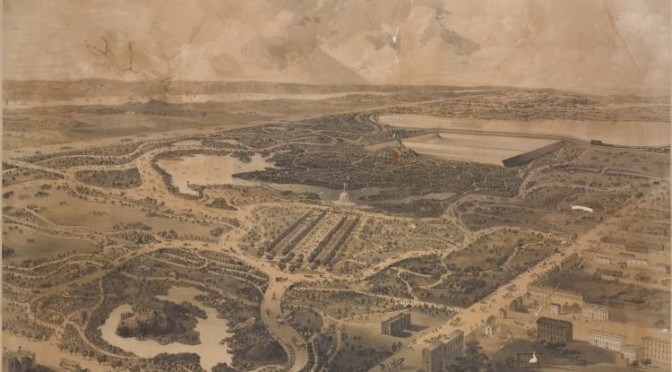
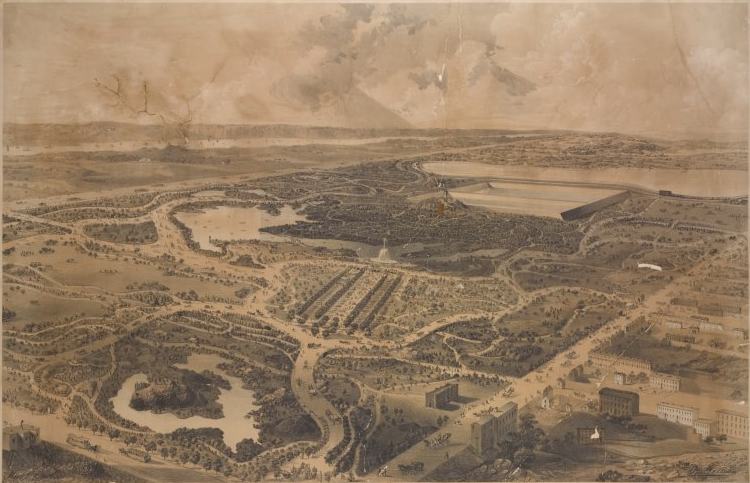
A depiction of Central Park from 1864. The conspirator’s cottage hideout would have been near the southeast corner. (Courtesy NYPL)

The year 1864 wasn’t as pivotal to New York City as 1863 (with the Draft Riots), but it is one of the stranger years I’ve ever come across in studying the city’s history, culminating in the failed attempt by Confederate spies to burn Manhattan’s hotels.

There is one important context about the attempted burning that we failed to mention. You couldn’t just walk around New York City in late fall 1864 if you were a Southerner. Because if intelligence claiming a potential attack on the city, any resident of the South had to register with the city. Our eight Confederate spies, of course, neglected to do this, and although they did indeed wear disguises and shuffle among different hotels to avoid detection, there is no evidence to suggest they disguised their voices.

A few other non-war events from 1864 that were not mentioned in the show:

Central Park was open to visitors but was far from completion. The new public space still felt remote to some New Yorkers — of the human kind, that is. People had begun abandoning unwieldy pets or livestock by securing them in one particular area of the park, in the southeast corner. In 1864, it became an officially chartered menagerie of animals, one of the first official American zoos.

Also that year — and quite against the original designs of Olmsted and Vaux — Central Park received its first statue. The honoree? William Shakespeare.

The area surrounding Gramercy Park was well established by Manhattan’s elite. Years after the disgrace of having a brother by the name of John Wilkes Booth, famed actor Edwin Booth would open his Player’s Club here. But further down on Irving Place, on 18th Street, a modest grog shop opened in 1864 on the ground floor of a building called the Portman Hotel. Drinkers there were certainly gossiping about the war and the Confederate attack on New York. The tavern has survived through various name changes and more than a few drunken artists and writers (including, most notably, O. Henry). You may know better today as Pete’s Tavern.

Some young men spend 1864 holding baseball bats, not rifles. The Brooklyn Atlantics were certainly one of the most well-known ball teams of the mid-19th century and one of the founding members of America’s first baseball league. And in 1864, the team played an undefeated season to capture national championship. (To be fair, to the team they bested was Eckford, also a Brooklyn team.)

For More Information: For a nice overview of New York City during the Civil War, seek out the out-of-print The Civil War and New York City by Ernest A. McKay. Nat Brandt’s The Man Who Tried To Burn New York takes a closer look at Robert Cobb Kennedy, one of the Evacuation Day conspirators. For a look at the conspiracy from the larger context of the war, check out Clint Johnson’s A Vast And Fiendish Plot. And of course, the excellent website Abraham Lincoln and New York, presented by the Lincoln Institute, is worth a look.

The Show Must Go On: And finally, in full, here is P.T. Barnum’s letter to the New York Times regarding the attempt by Robert Cobb Kennedy to burn down his American Museum.

“To the Editor of the New York Times:

In view of the announcement in the morning papers of the attempt to fire my Museum last night, as well as other public buildings, I wish to state the following facts:

Everyday from sunrise until ten o’clock P.M., I have eleven persons continually on the different floors of the Museum, looking to the comfort of visitors, and ready at a moment’s warning to extinguish any fire that might appear. From 10 o’clock at night until sunrise, I have from six to twelve persons in the Museum engaged as watchmen, sweepers, painters, &c.

I always have a large number of buckets filled with water on and under the stage, and a large firehose always screwed on to be used at a second’s notice. I never allow an uncovered light in the Museum, and I heat by steam from a furnace in the cellar.

As a proof of the efficiency against fire, I submit the fact that instead of “slight damage” being done to the Museum last night, as reported by a morning paper, so speedy was the extinguishment of the flames arising from the liquid ignited on the stairs, that not even a scorch is visible.

My own sense of security is proved by the fact that I never insure for one-third the value of the Museum property.

For the safety of visitors in the lecture-room, I long ago opened nine different places of egress, so that the lecture-room, if filled with visitors, could be emptied in from three to five minutes, and the spacious openings to the street in Broadway and Ann street, render mine, I think, as safe a place of amusement as can be found in the world. The Fire Marshal and insurance agents will corroborate this statement.

Very Respectfully,

P. T. BARNUM
AMERICAN MUSEUM, Nov. 26, 1864″