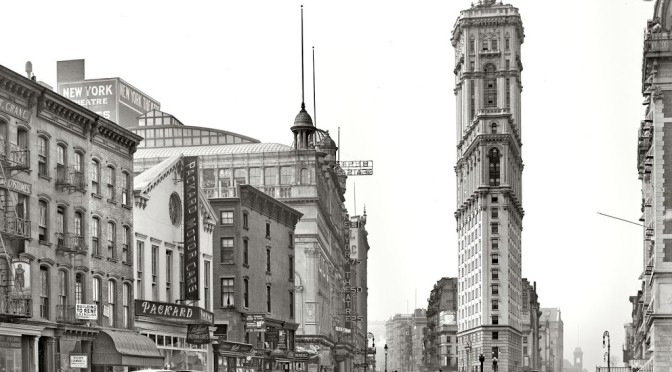
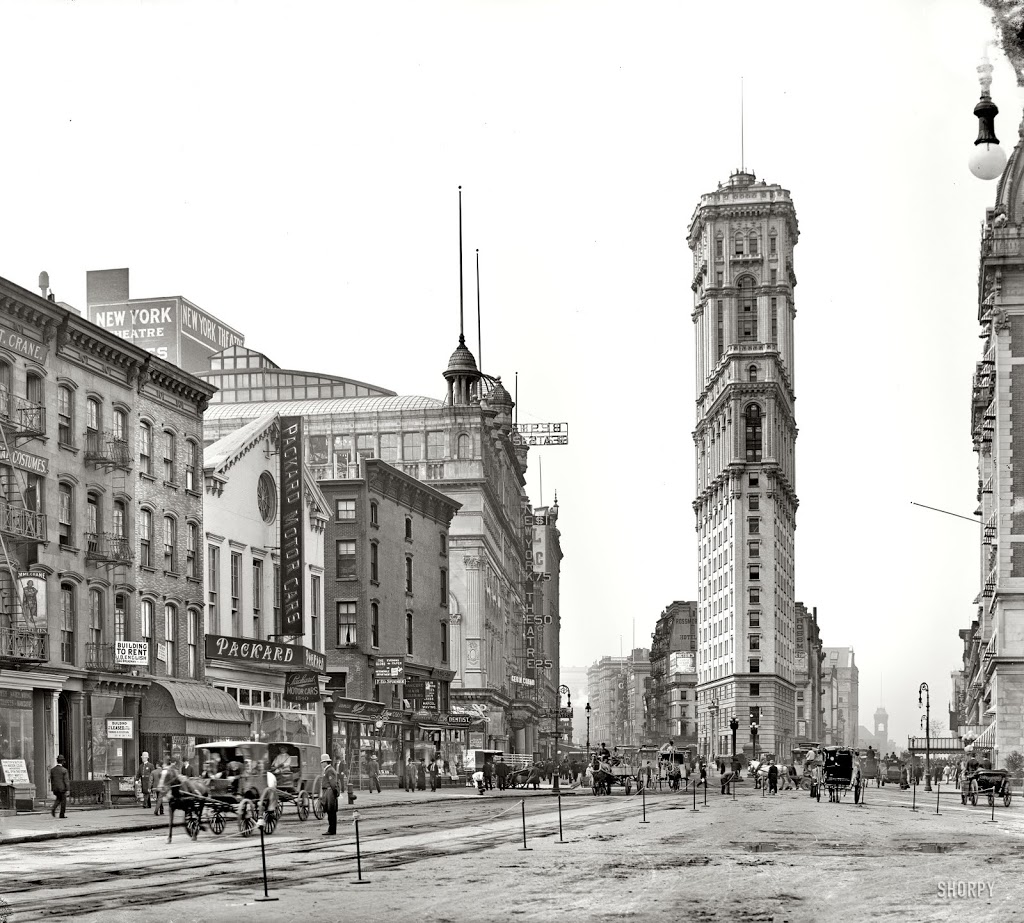
In 1904, the first year that Longacre Square tried on its new name Times Square, it was still populated with horse-related services like carriage shops and stables. But it seems the horse-less carriages were represented too. In the photograph above, the white building with the triangular roof, once a stable, was now home to the Packard Motor Car dealership, its address 1540 Broadway.
The Ohio-based car company would spread out several dealerships throughout the New York area, but made a go of it at this location from 1904-1907. As the fate of Times Square as New York’s entertainment focal point had not yet been solidified, it probably seemed natural to sell cars here. By 1907, they moved to the less chaotic corner of Broadway and 61st Street.
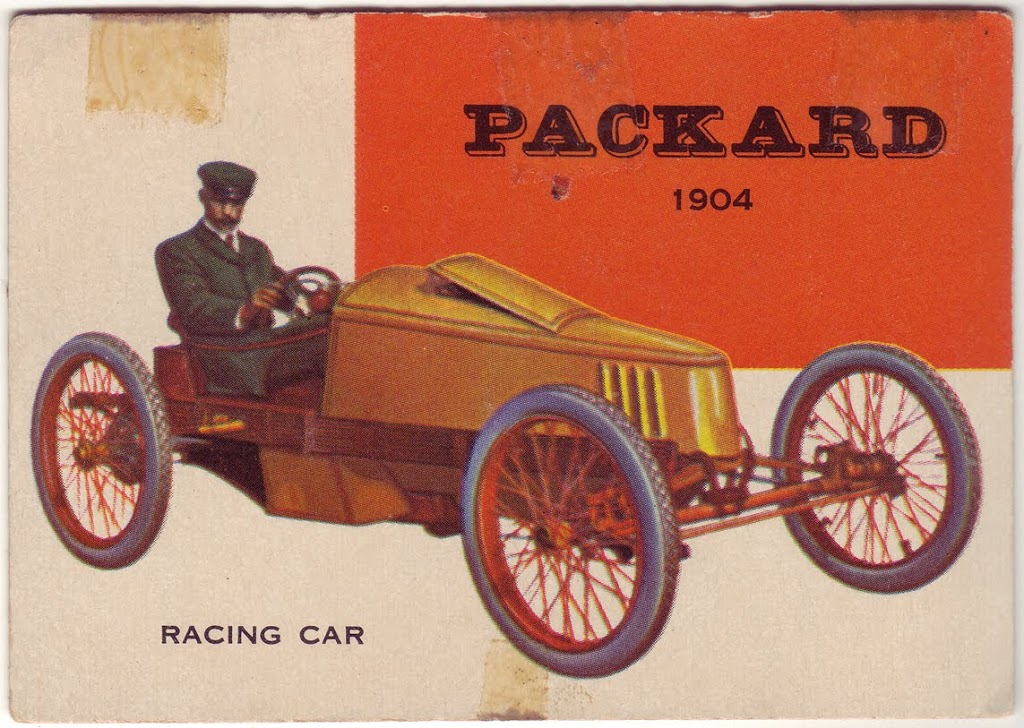
Below: one of the vehicles one might be able to purchase at the shop. And finally an advertisement from a ‘Horseless Age’ trade magazine, mentioning the Packard location:
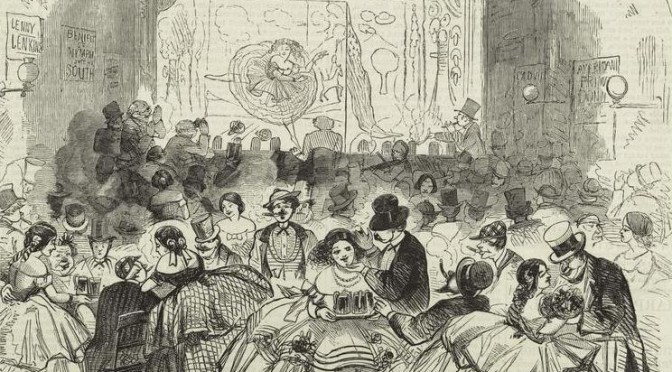
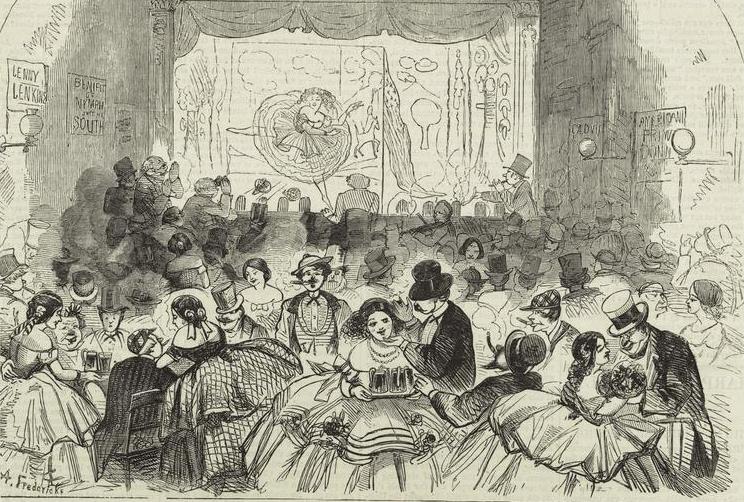
A Broadway saloon in 1859 during a ‘Sunday sacred concert’, as in, not very sacred at all. The Santa Claus probably looked like this on a good night. [Courtesy NYPL]
I’m doing some research on a couple upcoming entries for the How New York Saved Christmas feature which I started last year and came across something rather odd and Christmas-related that didn’t save anything at all.
Broadway was becoming New York’s de facto entertainment district after the 1830s, ushered in by luxury shops, pleasure gardens, and grand theatrical palaces like the Olympic (at Grand Street) and the Chambers Street Theatre. The Bowery, pretender to that title, would stoop (or elevate, depending on your tastes) to tawdrier amusements, starting with horse shows and comedic theater and degenerating into that infamous row of saloons and dance halls.
But the line was never precisely drawn and, anyway, weren’t the bawdier establishments more fun anyway? And so it was that saloons with musical acts seeped over to the more fashionable street, which explains how Santa Claus came to Broadway.
Not the bearded heavy-set gentlemen from north of Canada, but a place named in his honor. Santa Claus was a dance hall originally located at 596 Broadway, placing it adjacent to the newly built Metropolitan Hotel (on the Niblo’s Garden property).
Little is known about the ‘concert saloon’, as it was billed by its owner R. W. Williams. Opening in 1858, it may have attracted mixed clientele just below the line of New York respectability, but its bill of entertainment pretended otherwise. The unadorned long hall had a sawdust floor, a smattering of billiard tables and a high stage for performances from an odd mix of “opera, ballet, concerts, minstrels and gymnasts,” according to advertisements.
It’s not clear why such a place would be named Santa Claus who, as far as we know, is not a drinker. Enjoying the delights of an ‘uncommonly stocked bar’, patrons could enjoy German acrobats, ‘singing and dancing gypsies’, dog tricks, Irish comedians or, for a more somber occasion, the sounds of Dodworth’s Military Band and Cornet Corps. And all for a door charge of twelve cents.
The only review of the place I could find (a fussy, otherwise condescending review from a Dec 1858 issue of the New York Times) paints a dour scene, a ‘cheerless-looking hall’ with ‘a very dingy and forlorn aspect’. Interestingly, the place appears to cater to both white and black patrons, which the Times reviewer did not particular care for.
Santa Claus lost its lease and in 1859 moved a bit south to 72 Prince Street. At its new home, you could hear the talents of ‘pleasing concert singer’ Julia Barton, Spanish dancer Josephine West or minstral comedian Jerry Merrifield.
One source I found calls the Santa Claus “the first recognizable New York variety theater,” although few were recognizing anything here, and it appears that the new Santa Claus never made it to another Christmas.
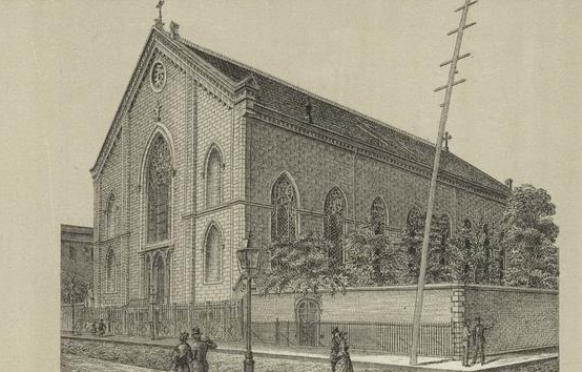
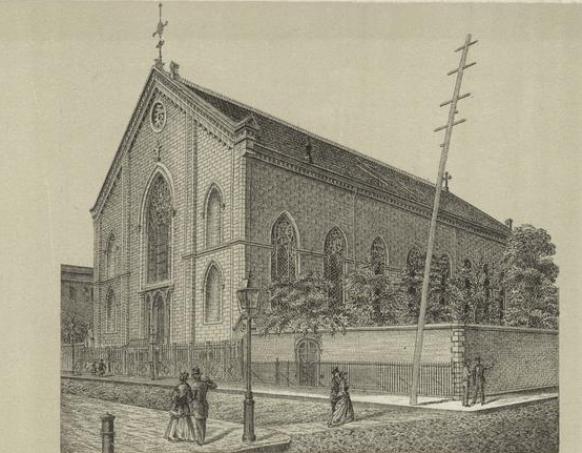
New York’s original St. Patrick’s Cathedral located in Little Italy — or NoLIta, if you must– just got a serious upgrade yesterday, when the Pope deemed the old, revered Catholic church an officially sanctioned basilica.
A Catholic basilica is a church with ‘certain privileges’, an elite designation where various religious rituals can take place. This is Manhattan’s first basilica, although Brooklyn has two churches that have reached this distinction.
Our Lady of Perpetual Help in Sunset Park, which gathered its first small congregation in 1893, became the first on November 1, 1969. I don’t know the specific reason why it became New York’s first, but grandeur certainly helps, and Our Lady’s got it, a massive, Romanesque stone behemoth set back and towering above the intersection at 5th Avenue and 60th Street.
The Cathedral of St. James, designated the city’s second basilica in May 1982, is minuscule and modest in comparison, tucked back from the bustle of Flatbush Avenue. Its austerity lies in its history: it’s the first Catholic Church on Long Island, its cornerstone laid in 1822, just as the population of the young city of Brooklyn was exploding.
But the 1820s were not a welcoming era for Catholics in the United States, and a young Catholic Church in Manhattan, dedicated in 1818 for St. Patrick, bore the brunt of New York anti-Irish, anti-Catholic sentiment in its early years. Although its ornate, showier successor opened in 1879, St. Patrick’s Old Cathedral has weathered on. Its distinction as a basilica just underscores its value as one of New York’s most important historical structures still standing.
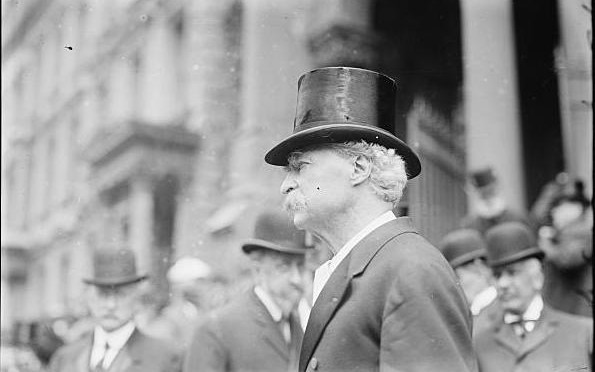
PODCAST You hear the name Mark Twain and think of his classic characters Tom Sawyer and Huckleberry Finn, his locales along the Mississippi River and his folksy wit. But he was equal parts New York as well, and the city helped shape his sharp, flamboyant character. Follow his course, from his first visit as an opinionated young man in 1853, to his later years in 1906 as a Fifth Avenue tenant, decked out with a cigar and signature white suit.
His tale offers a glimpse into the glamorous life of turn-of-the-century New York, from the smoke-filled billiard room at the Players Club to late nights at New York’s dining palace Delmonico’s. Tune in and find out which parts of Mark Twain’s city are still around and which of his old homes you can still visit today.
Co-starring Ulysses S. Grant, Helen Keller, Edwin Booth and other toasts of New York during the Gilded Age.
A slight correction: I mentioned in the show that Mark Twain only worked on one play in his lifetime, called ‘Is He Dead?’. That might have been his only solo attempt, but he did try many years earlier to pen one in collaboration with Bret Harte. The play, called “Ah Sin: The Heathen Chinee”, opened and closed in 1877. It was an unmitigated flop and a total creative failure. He worked on another collaborative play called “Cap’n Wheeler” the next year.
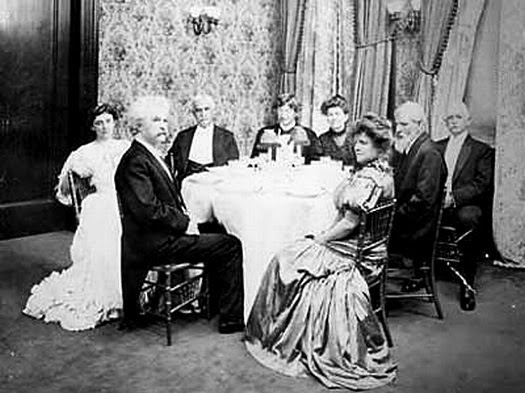
Dinner at Delmonico’s with a few of his closest friends (or at least his fanciest ones) at a celebration for Mark Twain’s 70th birthday.
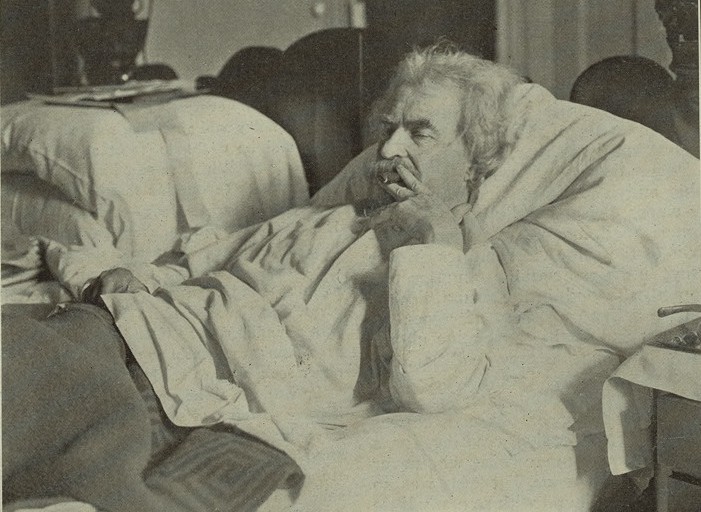
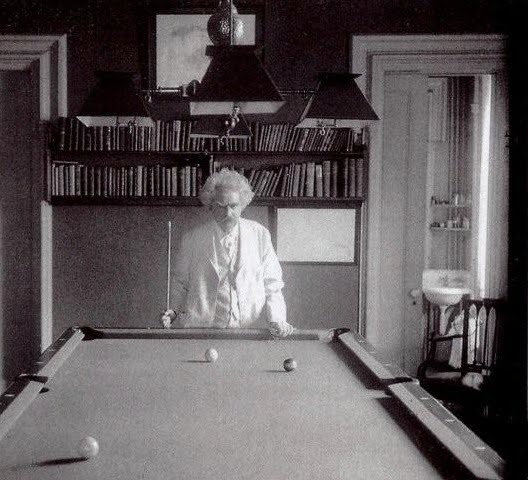
Smoking in bed: Twain’s two favorite places to do business in his Fifth Avenue home was at the pool table and in bed. This wasn’t laziness; in fact, during his final years in the city, the author was constantly out on the town, oftentimes as a guest of honor or featured speaker. He deserved a little time off his feet. (Pic NYPL) A menacing Mark Twain behind his pool table. (I’m not sure whether this is the Fifth Avenue townhouse or his place in Redding, Connecticut.) Due to his white suit and the photographic process in the 1900s, the writer often looks ghostly and pale.
This extraordinary video is pretty much the only moving images we have of Mark Twain, taken by Thomas Edison in 1909 at Clemens new home Stormfield, in Redding, CT. It’ll give you some idea of Twain’s appearance when he lived in New York the year previous.
If you’re a fan of walking tours — and why shouldn’t you be? — there’s a interesting tour led by author Peter Salwen specializing in Mark Twain’s New York. You can check out their website for more infromation.
And finally, here’s a map of some locations pivotal to Mark Twain’s life in New York — places where he lived and lectured. And you can see, he certainly got around!
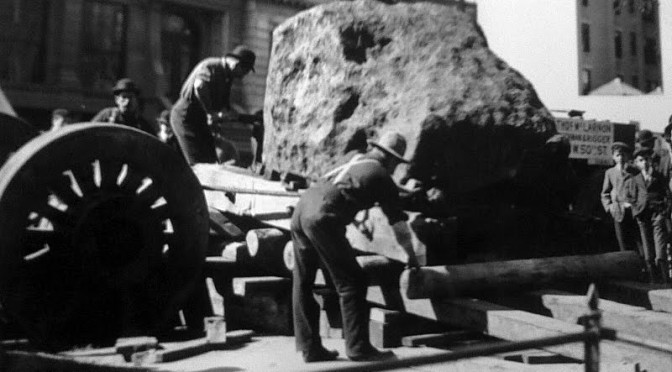
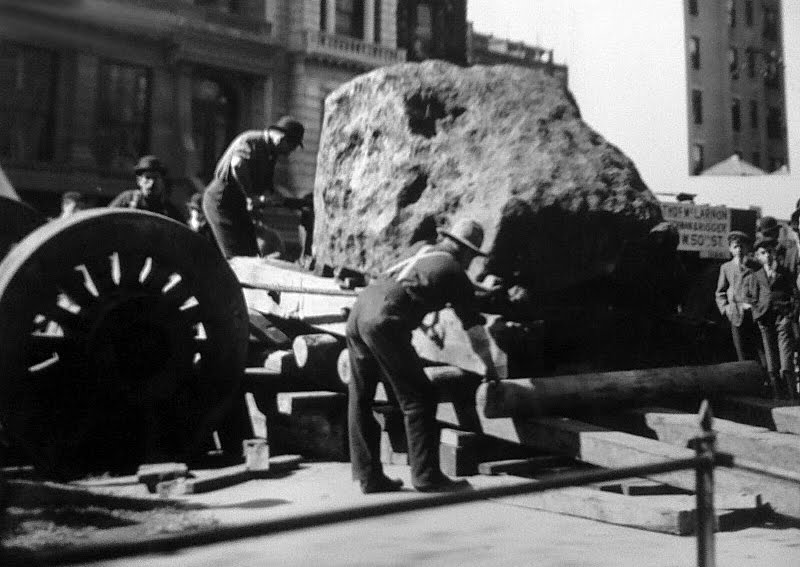
Rock of ages: The meteorite is lifted off its wagon for removal into the American Museum of Natural History. I wonder if those ragamuffins to the right in the photograph have their jackknives ready? (Pic courtesy JFGryphon/Flickr)
As mentioned in last week’s podcast, one of the great treasures of the American Museum of Natural History is the Cape York meteorite — in fact, three separate pieces, the largest being called Ahnighito (Inuit for ‘tent’). Explorer Robert Peary discovered the rock in Greenland and brought it back to New York (along with six unfortunate Inuit companions) in 1897.
The extremely heavy rock — at 31 metric tons — sat at the Brooklyn Navy Yards for many years before Peary’s wife sold the interstellar stone to the museum in 1904. The museum hired a wrecking company to carefully transport the meteorite through New York Harbor to a pier on West 50th Street. From there, it was lifted onto a wagon pulled painfully by 30 hard-working horses, up Eighth Avenue and Central Park West to the museum on 77th Street.
From there, however, the poor unsettled stone, far from home, received its most vicious attack. According to the Tribune: “Hardly had the truckman unhitched their horses when the heavenly body was covered with ambitious boys, all eager to dig out a piece of the metal as a souvenir. Jackknives were broken by the dozen.”
The Cape York meteorite is one of the few items displayed in the museum — may, in fact, be the only item — to appear on an international postage stamp (Greenland, 1978).
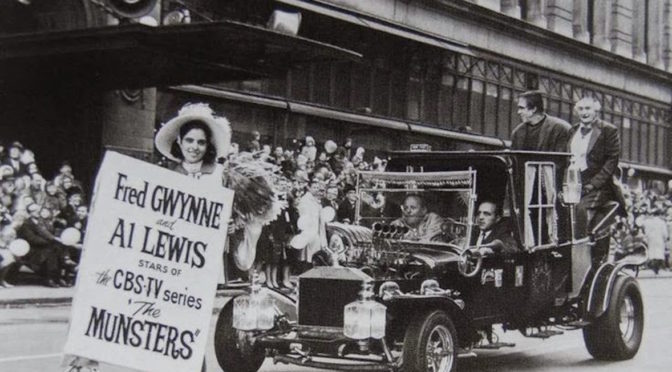
Beautiful monsters: The stars of The Munsters are predictably not on their best behavior during the Macy’s Thanksgiving Day parade of 1964 (Photo courtesy Frankensteinia)
Macy’s Thanksgiving Day Parade is a fixture of the American holiday, as integral as the elements which comprise a standard turkey dinner. Don’t you get in the mood the moment you turn on the TV and hear the sound of marching bands echoing through the corridor of buildings on Broadway?
Since the parade’s debut in 1924, it has helped define Thanksgiving tradition for many people despite touching only occasionally on the whole point of the holiday itself. These days, you are far more likely to see a musical number from ‘Annie’ than a frank depiction of early Puritan life.
But in letting the show into your home — inviting in the floats and balloons, the falloons and the balloonicles, the never ending procession of clowns — you’re also inviting in a blistering microcosm of celebrities that have slowly come to define the event’s jovial interworkings. What was once a simple and earnest celebration by regular Macy’s employees in 1924 is now an event whereby any float can contain any number of unrelated celebrities, in most cases lip syncing to a pre-recorded Christmas track.
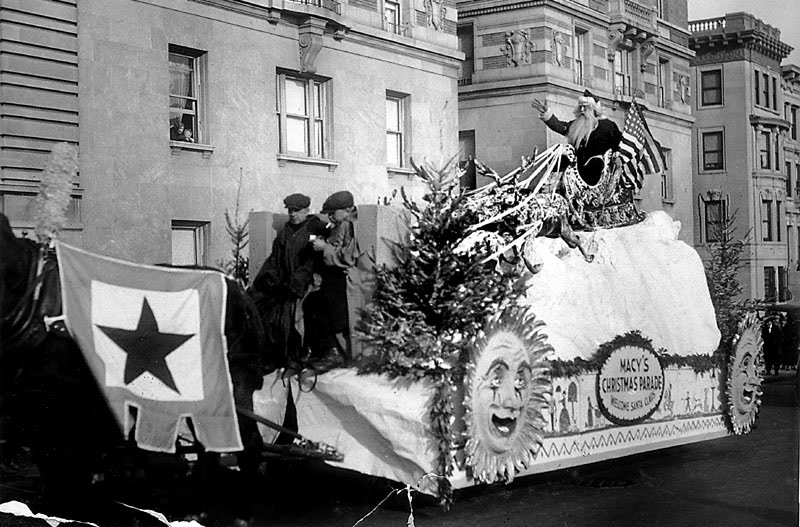
Santa, on his first Macy’s float, in 1924 (pic courtesy Smithsonion)
The Early Years The first parade in 1924 was a labor of love, with employees in gaily colored costumes accompanied by four marching bands, a live animal procession, and modest floats celebrating a host of nursery rhymes figures. The only celebrities were some notable animals borrowed from the Central Park Zoo — this potentially bad idea was scrapped when the balloons came — and Santa Claus, who arrived in Herald Square to unveil the Christmas windows.
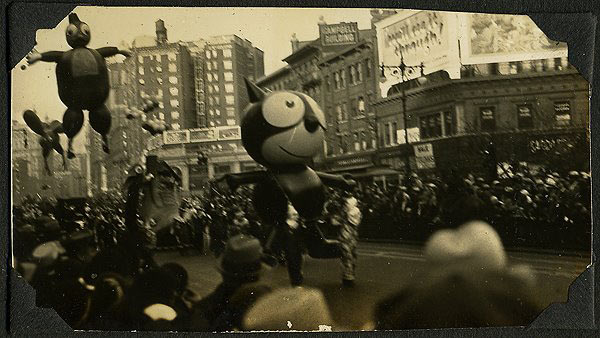
The inflatable balloons debuted in 1927, and along with the nameless dinosaur and dachshund floatables came Felix the Cat, the art-deco feline who had received his own comic strip four years previous. This would make Felix the first non-Macy’s related celebrity (albeit a drawn one) to appear in the parade with something to promote.
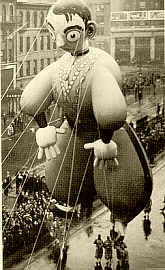
Nobody was really paying attention to the humans below, especially in the days before television. Perhaps that’s why the first human celebrities were accompanied by balloon versions of themselves. Eddie Cantor, who made his first parade appearance in 1935, was a comic song-and-dance man who had appeared in the Ziegfeld Follies and strummed along in silly, Hollywood toe-tappers like ‘Kid Millions’ and ‘Ali Baba Goes To Town’.
In 1940, Cantor made another appearance, in person and, this time, in balloon form (at right). He might have been using the parade to bolster his reputation. The year previous, Cantor had criticized the rants of Hitler sympathizer and Catholic priest Father Charles Edward Coughlin and lost his endorsement deal with Camel cigarettes in the process. It seems that criticizing a priest (even an anti-Semitic one) was not a boost professionally. The parade (and famous friends like Jack Benny) helped resuscitate his career.
It was quite hard to compete with balloons if you were a star. The performances of Eddy Duchin and Dinah Shore were broadcast on the radio, and band leaders like Paul Whiteman and Kay Kyser led their orchestras at the parade’s finish line in Herald Square. But a few celebrities actually braved the parade itself, such as comedian Harpo Marx. In the days before cameras, most of the crowd would never know these famous folk were there, although in 1935 the zany Harpo climbed atop the Macy’s marquee to get noticed. Harpo also brought along a balloon in his likeness, carried along by Macy’s employees dressed like the other Marx Brothers.
Sadly, neither Marx nor Cantor are featured in this newsreel film from 1935:
One of the most notable celebrity appearances in the 1940s was done in disguise. Edmund Gwenn, who played Kris Kringle in the classic ‘Miracle on 34th Street’, a film set partially in Macy’s department store, dressed as Santa Claus for the 1946 event. Footage of his appearance was used in the film; most of the audience was none the wiser. Gwenn would go on to win an Oscar for that role.
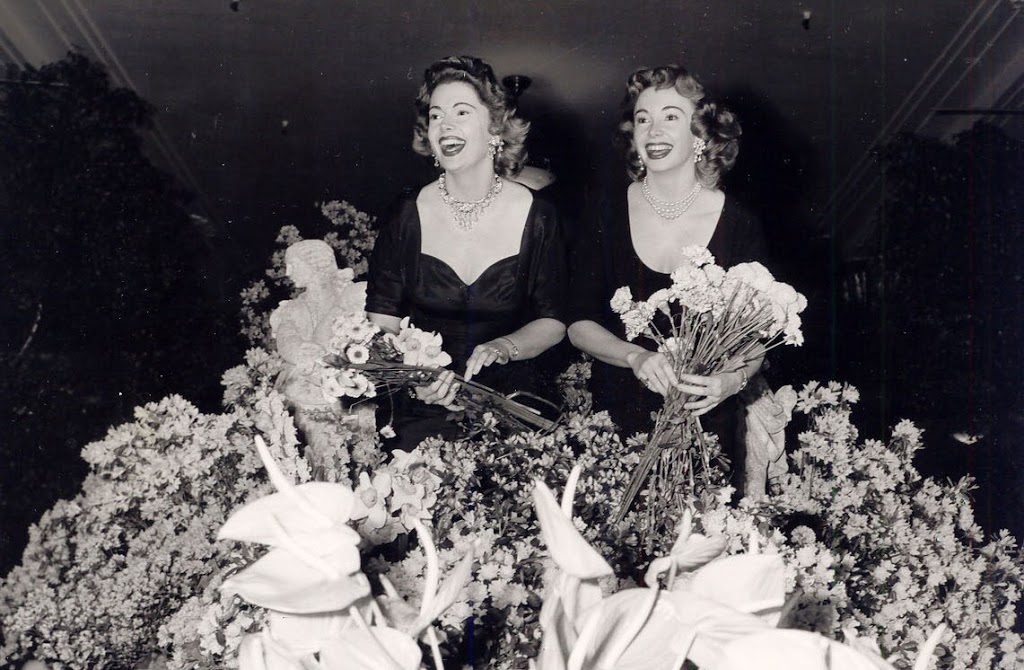
Audrey and Jayne Meadows atop a lavish float, probably 1952 (photo courtesy Macys)
The Debut of Television
The first television broadcast, believe it or not, was in 1939, from a camera mounted atop the American Museum of Natural History. Of course, few had televisions to watch it, and it was shown only locally. But in the years following World War II, America embraced television, and television embraced the parade. CBS would take the first crack at broadcasting the extravaganza nationwide in 1952. NBC took over in 1955.
With cameras come celebrities, and they came in droves in the 1950s. Shirley Temple, well into her 20s, graced the parade, as did Jimmy Durante, Abbott and Costello, Roy Rogers and Dale Evans, Boris Karloff, and arguably one of television’s biggest stars Jackie Gleason, who was grand marshal in 1952.
That year was the debut of Jackie Gleason’s eponymous show on CBS — his TV wife Audrey Meadows also stopped by (see above) — and the comedian’s appearance opened the floodgate for a new breed of small-screen stars that used the parade to cross-promote new projects debuting on the very box broadcasting the parade into American homes.
Danny Kaye, Howdy Doody, Hopalong Cassidy, even the Lone Ranger and Tonto, all made appearances in the parade. The first TV celebrities were clearly those that appealed to children, the key audience of a morning program that featured large buoyant cartoon characters and floats. But that distinction would soon be blurred as the parade began reaching adults as well.
As the volume of celebrities increased, they became embedded in floating dioramas. That wasn’t just Cinderella waving at you; that was Connie Francis dressed as Cinderella, in 1959.
Stars of the Small Screen
In 1961, NBC made the critical decision to expand coverage to two hours. By the end of the decade, the entire parade was broadcast, from start to finish. With all this time to fill — and broadcast technology advanced enough to comfortably record live outdoors — the floodgates opened and a phalanx of small-time stars filled the parade route.
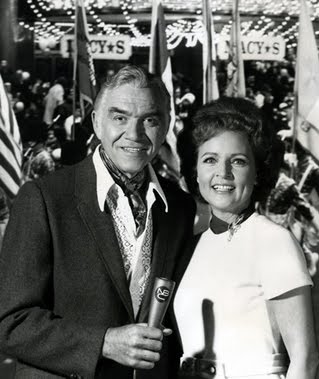
Key in this invasion was NBC’s presentation of the event. The parade was hosted in the 1960s by Bonanza star Lorne Greene and an attractive young comedienne by the name of Betty White (at right). Both achieved their fame from television work, not film. There was little fear that the big stars of that other world (the movies) would spill into frame. Parade entertainment would be gleaned from other places — TV shows, Broadway musicals, cabaret lounges. Even old radio and vaudeville stars would be dusted off and given a go.
In the early 1960s alone, the parade featured such luminaries as Ray Bolger, Gene Krupa, Mitch Miller, Jack Palance, Troy Donahue, Annette Funicello and Greene’s young co-star Michael Landon. Young and old stars, mingling among the clowns, mugging for the cameras.
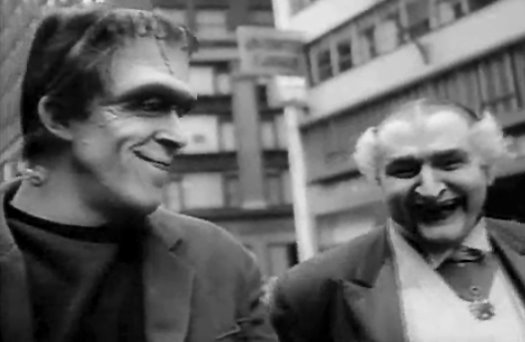
The stars were mostly well-behaved, with some notable exceptions. Fred Gwynne and Al Lewis, stars of The Munsters, appeared in the 1964 parade in their ghoulish costumes, riding along in their ‘Munster Koach’ car. Neither star was very amused. Gwynne was high on ‘nerve medicine’ and began cursing at the crowd. Passing the hosts Greene and White in the media box, Herman Munster fired off a rude expletive in their direction.
The video below captures them in a more sober mood:
Another trend manifested in 1965, when the fledgling McDonalds restaurant opted to sponsor the parade and debut its new mascot on national television — Ronald McDonald. (The man who regularly performed as Ronald — Willard Scott — was not used for the TV debut, which is unfortunate, as Scott would return as host of the parade in the late 1980s.)
Parade goers could greet William Shatner, star of Star Trek, in 1968, and Neil Armstrong, star of an actual space adventure, in 1969. Music, for the most part, was still saccharine, performed by artists like Jack Greene, Bobby Vinton and Dionne Warwick. Although Aretha Franklin brought a bit of soul on her own personal float in 1967.
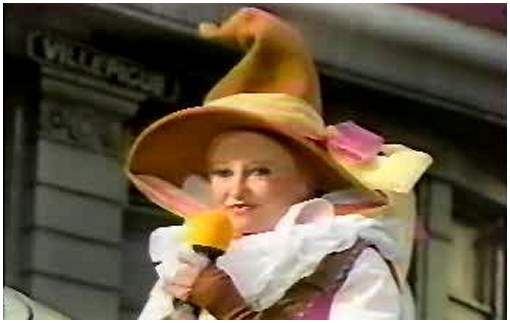
Phyllis Diller as Mother Goose, 1985. Photo courtesy X Entertainment
The Advent of the Super Float
Encouraging celebrity appearances perhaps even more than NBC was the debut of flashy, blockbuster floats into the parade in 1969. Before this, decorative vehicles and floats of modest proportion were interspersed among the bands and balloons. In 1969, parade designer Manfred Bass began construction of giant floats at the Parade Studio in Hoboken — elaborate, multi-staged platforms requiring multiple performers and specifically created to be showcased for television. To that end, these newly introduced floats made ideal platforms to display even more celebrity entertainment.
By the 1970s, television had produced hordes of stars, and the parade became a virtual Hollywood Squares of B-list talents. If you were a sitcom star of the 70s and 80s, it’s possible you were even contractually required to make an appearance. Making this doubly appealing for NBC and parade organizers was the possibility of float sponsorship by third-party products, such as Ocean Spray, who produced a Cranberry themed float and randomly threw ‘Buck Rogers In The 25th Century’ hunk Gil Gerard upon it for good measure.
The biggest television stars of 1976, Laverne and Shirley’s Penny Marshall and Cindy Williams, made a splash in their first appearance that year. According to Williams, “Suddenly there was all this screaming. We looked around to see who they were carrying on about, and it was us!”
The cultural changes of the ’70s hit the parade full force. Early in the decade, lite pop performers like the Fifth Dimension engaged the crowd. But the rising popularity of ’70s country music with pop overtones delivered notable performances, including George Jones and Tammy Wynette singing “We’re Gonna Hold On†in 1973, and a young Dolly Parton bringing “Love Like A Butterfly in 1974.
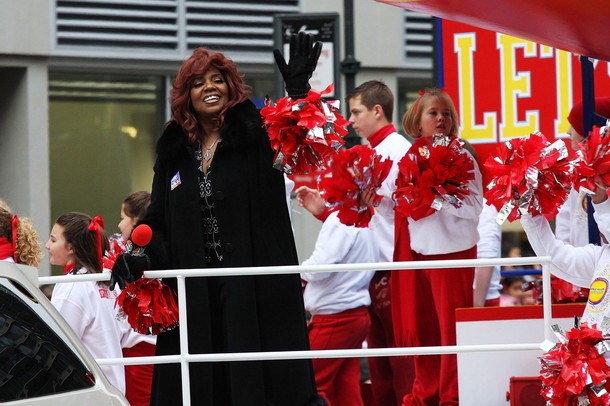
And then there was disco. Borne of decadent nightclubs that could be found just a few blocks from the parade, disco music slithered from the dance floor into the sunlight, walked upright and became mainstream in the mid-1970s. This would explain the appearances of Gloria Gaynor singing you-know-what-song in 1977 atop a Doodle Bug float, and a vibrant performance by the Village People in 1978. The following year, Diana Ross rode a gigantic apple while wrapped in a fur coat.
But the musical genre of choice was and continues to be Broadway, and further broadcast sophistication allowed whole production numbers to be presented. Perhaps the most unusual of all came in 1980, when the unorthodox Public Theater production of ‘The Pirates of Penzance’, starring later Solid Gold host Rex Smith and Linda Rondstadt.
The clip below also underscores the disastrous relationship such performances have with the television requirement to lip sync:
The Surreal Show By the 1980s and 1990s, the parade broadcast has become a full-fledged beast of absurdity, a colorful swath of product placement, celebrity promotional events, and bleached out entertainment. Now it was the balloons and the marching bands’ turn to compete with the increasingly over-the-top celebrity appearances and elaborate Broadway routines, now bolstered with dated camera effects, such as the ones demonstrated in this 1981 performance by Donny Osmond (click here to view).
Further staged combinations hurled the proceedings into the land of the nonsensical. What was going through the mind of Broadway star and pop singer Melba Moore when she was asked to perform a hit by Bonnie Tyler while being accompanied by dancing, gyrating Marvel Comics characters in 1989?
It was now possible to perform in the parade without even being there. Oh, to have beheld the faces of children as they turned on the television sets in 1993 and witnessed this abstract performance by Chita Rivera from the show Kiss Of The Spider Woman:
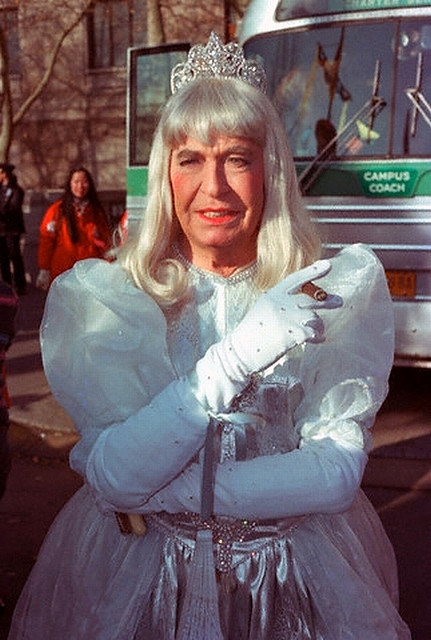
Ultimately, what may have prevented the parade from degenerating into a pure mockery of its former self was the regular appearances of older, seasoned stars like Milton Berle (in drag, seen above), Sammy Davis Jr, and Phyllis Diller garbed as Mother Goose, in 1986.
As a counterpoint to old Hollywood, music artists popular with the parade’s core audience were interspersed to keep the proceedings relevant. Chief among these acts were boy bands like N Sync and the Backstreet Boys and, performing a few years earlier, their precursor, New Kids On the Block, in 1989:
Gone were the rational and linear selection of big band and film celebrities of the 1930s and 40s. Sixty years after Harpo Marx made his first appearance on the Macy’s marquee, in 1995, the parade welcomed a professional grab-bag of entertainers — LL Cool J, Brady Bunch maid Ann B. Davis, Shari Lewis and Lambchop, skating diva Oksana Baiul, country star Shania Twain, Kelsey Grammar, Matthew Broderick, Carol Channing, Stevie Wonder and the cast of Smokey Joe’s Cafe.
Never Can Say Goodbye: Gloria Gaynor makes another Macy’s Thanksgiving Day Parade appearance in 2009. Photo courtesy Day Life
Today’s multi-million dollar procession is as chock-full of stars than ever before and is the only place on television where you can see, for example, British songbird Sarah Brightman and rapper Ne-Yo in the same place (as you could in 2007). Perhaps the key is to simply embrace the absurdity and take in the dizzying, mind-dulling array of entertainment like a virtual dose of strong coffee. And perhaps quietly note that the performers themselves recognize how odd everything seems, as referenced quite nicely in this performance from 2008, featuring the twisted stars of Foster’s Home For Imaginary Friends and a special musical guest:
Believe it or not, this long-gone, unsuccessful attempt at a museum actually figures into the larger tale of a major New York institution, which we cover on this week’s podcast and which will be available for download by Wednesday. This is a reprinted article from May 15, 2008 with some modifications. Original is here.
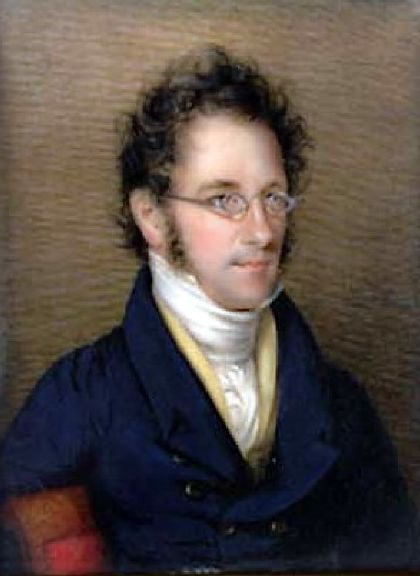
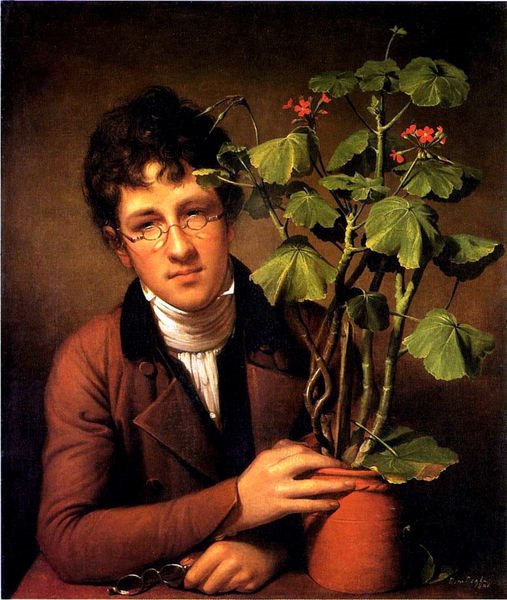
What if your best known accomplishment in this world was the fact that you posed for a well-regarded American masterpiece by your more talented older brother? Welcome to the world of Rubens Peale!
Philadelphians and American art lovers in general should be quite familiar with Rubens’ father Charles Wilson Peale, one of early America’s pre-eminent painters, portraitist to Washington and Jefferson, and patron of what would become the Philadelphia Museum. Peale’s museum for Philly, which opened in 1786, is not only one of this country’s most important natural history institutions, it set the stage for pioneering museums across the country.
Peale graced his children with some truly loaded first names — Raphaelle, Rembrandt, Titian and of course Rubens. And they all attempted to follow in their father’s footsteps, both as painters and as curators of their own museums.
Raphaelle tried to open one in Charleston. Rembrandt set one up in Baltimore (unfortunately timed for the War of 1812). Baby brother Titian took the reins in Philadelphia and became the family’s most prolific naturalist.
Rubens would have more ambitious designs. At first more interested in the sciences than the arts, the youngest and frailest Peale operated the Philadelphia Museum after his father’s retirement before coming to New York City in 1825 to set up his own version of his father’s dream. The address for the Peale Museum of New York City was 252 Broadway, a building better known as the more austere-sounding Parthenon.
Peale’s museum opened on October 26, 1825, to monopolize on a huge city celebration occurring that day: the opening of the Erie Canal. By 1840, Peale would change the name to the New York Museum of Natural History and Science.
In the early days, Peale’s chief competition was the small museum housed in the former almshouse across the street, next to City Hall. The collection of John Scudder, advertised as the American Museum, had thrilled New Yorkers here since 1817. But Scudder was dead by 1825, and his collection was worn and barely upgraded. It was definitely not of the calibre of a Peale museum, or so Rubens believed. Unbeknownst to Peale at the time, his real competition would sprout up just south of the park.
Rubens’ new museum would have had much the same makeup as the one in Philadelphia : great displays of stuffed animals in natural settings, display cases of butterflies and insects, postulations of pre-Darwinian scientific theories laid out over several rooms and supported with lectures and even theatrical productions. One book refers to Rubens as a “popularizer of scientific discoveries and a manager of theatrical attractions.”
In 1826, Rubens imported two mummies from Cairo for display; after 16 days of presenting the draped bodies, he presented for the interest of the “scientific and the curious” the unwrapping the age-old corpses in the museum lecture room.
His museum also featured fine arts and historical portraits, some by his own family members, others by respected painters as Bass Otis.
Rubens was sensitive to some of the cheap ploys of the Philadelphia Museum (live animals, displays of human deformities) and tried to keep his New York museum a dignified affair, although today we would find its use of waxworks and flashy lectures rather silly.
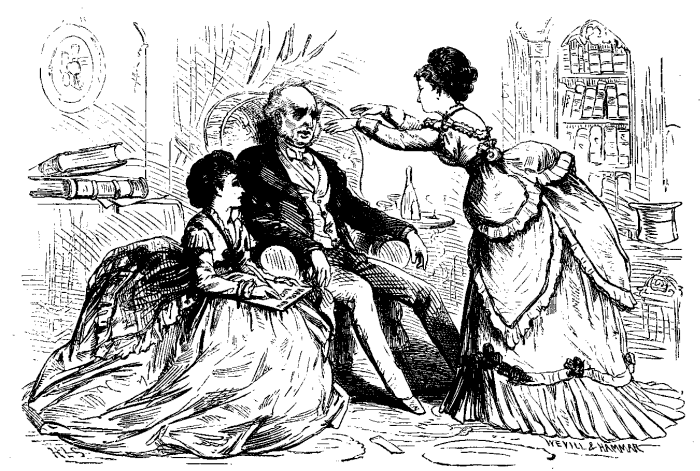
Above: an illustration entitled ‘Mesmerism on Wall Street’
Rubens adherence to the scientific led him into some unusual directions. He became mesmerized, if you will, by the theories of Fredrich Anton Mesmer, who believed a magnetic fluid in the body controlled the personality. A precursor to hypnotism and later the intellectual embrace of clairvoyance, mesmerism was such a popular distraction that Rubens placed a New York newspaper advertisement on February 8, 1841, claiming “a demonstration on the principle of animal magnetism” would be presented at his museum.
“The time is not far off when it will be said where is the person that doubts its existence,” he later said in a letter to his brother Rembrandt.
Unfortunately he could not quite predict the financial disaster that was the Panic of 1837 which sent his museum deeply into debt for years, later unable to keep up with the flamboyant American Museum just opened down on Broadway and Ann Street (south of City Hall Park) by showman P.T. Barnum.
Rubens had to eventually sell his entire collection, and it ungraciously ended up in the hands of Barnum himself in 1843. (The old John Scudder exhibits now belonged to the flamboyant showman as well.) Included in the sale: one of the surviving mummies that had been brought from Cairo.
Almost as a slap in the face, Barnum actually kept Peales’ museum open under the original name as a faux rival to the much more popular American Museum on the other side of City Hall. Eventually its contents were absorbed in the bigger museum
Rubens drifted to his brother’s museum in Baltimore, and, swallowing his pride, even tried to interest Barnum in a collaboration there, involving P.T’s newest star Tom Thumb. Eventually, Rubens retired from museum operations entirely, turning first to his love of taxidermy then to a dalliance in painting. He did achieve a certain amount of renown for his excellent still lifes, up until his death in 1865.
Rubens’ earnest collection set the stage for the world-class museums that we have in our city today. However, art historians probably know him best as the subject of his brother Rembrandt’s portrait Rubens Peale With Geranium (below).
Illness and a crazy schedule this week have conspired to delaying this weeks podcast, but we promise to have it ready to download by Wednesday morning.
In the meantime, you can check out our television debut on the Brian Lehrer Show, which was recorded on Wednesday. It’s running throughout the week on CUNY TV, Channel 75.
We talk about Robert Moses, Union Square, the birth of the subway and debut a lot of old videos.
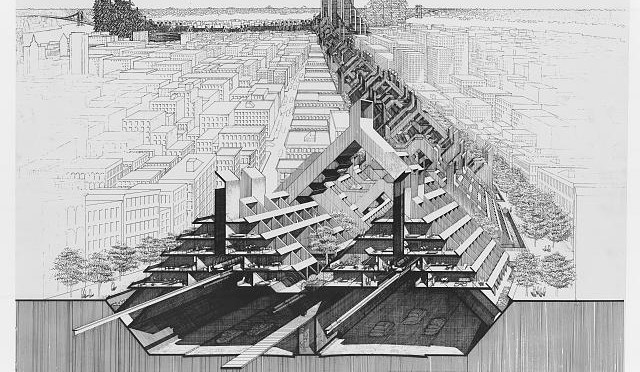
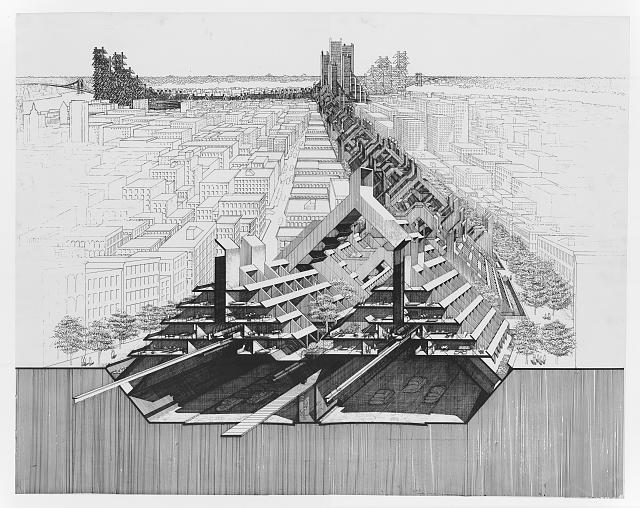
This is beautiful because it’s not real: a cross-section of Paul Rudolph’s cross-Manhattan proposal, looking east towards the two approaches consuming the Williamsburg and Manhattan bridges.
This is your last week to catch the fascinating and strange drawings of Paul Rudolph at the Arthur A. Houghton Jr. Gallery in Cooper Union. Rudolph drafted proposals for Robert Moses’ devastating Lower Manhattan Expressway which would have cleaved the island with an elevated highway, linking the East River bridges to the Holland Tunnel.
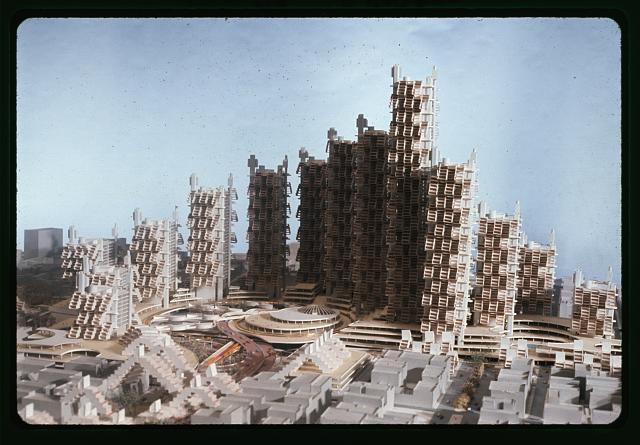
Community opposition and New York’s woeful financial crisis killed the Lower Manhattan Expressway project. Rudolph, a Bauhaus-influenced architect, was the rare master of the Brutalist style, as clearly evidenced in these drawings and mock-ups. Magnificent as stand-alone works of science fiction, Rudolph’s ideas unveil nothing less than a complete reconstruction of downtown Manhattan, with crystaline multi-level towers of concrete that evoke ancient architecture and a heavy, dreary aesthetic firmly planted in the late 1960s.
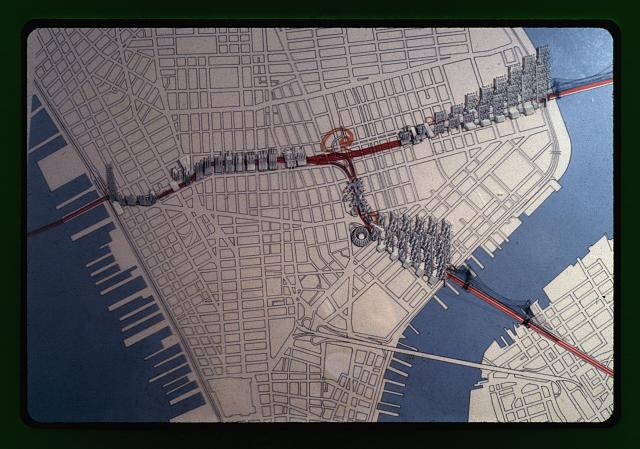
Here are a couple more images from the exhibit, courtesy the Library of Congress. The show runs through this Saturday and also feature an actual model reconstruction of what LOMEX would have looked like. More information about the exhibit can be found here.
The Arthur A. Houghton Jr. Gallery The Cooper Union (7 East 7th Street, 2nd floor) Wednesday-Friday 12:00-7:00pm, Saturday 12:00-5:00pm
An overhead map laying out the course through downtown, eating up the Bowery, Chrystie, Delancey and Broome streets.
Rudolph’s proposal didn’t just include highways, but a massive network of transportation hubs, skyscrapers and apartment towers. LOMEX wouldn’t just assist traffic flow; it would have defined downtown.
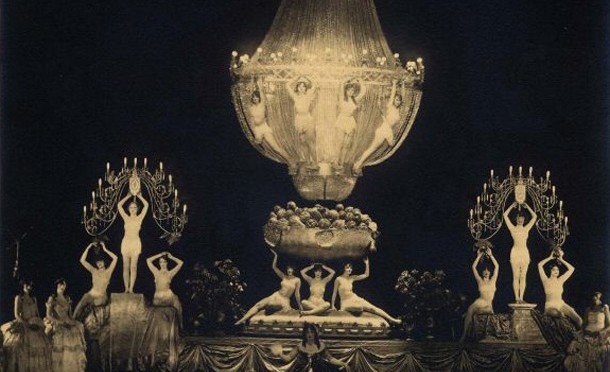
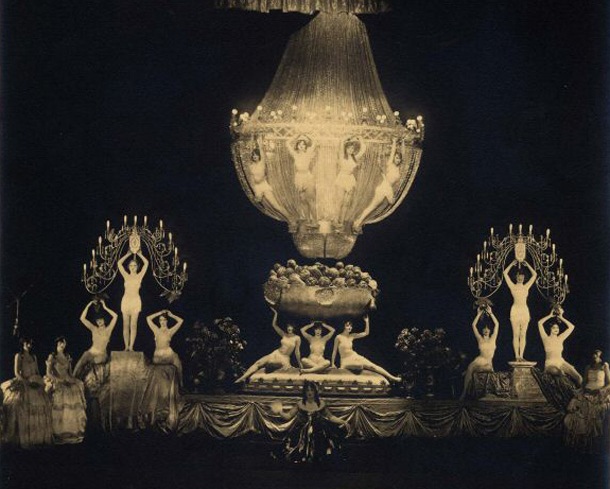
An exotic tableau from the Ziegfeld Follies. The presentations by Burton in the mid-19th century would have been less ornate, but certainly more tantalizing. (photo source)
FRIDAY NIGHT FEVERTo get you in the mood for the weekend, on occasional Fridays we’ll be featuring an old New York nightlife haunt, from the dance halls of 19th Century Bowery, to the massive warehouse clubs of the mid-1990s. Past entries can be found here.
LOCATION:Palmo’s Opera House/Burton’s Chamber Street Theater 39-41 Chambers Street, Manhattan In operation 1844-1870s
The sexual appetites of New Yorkers in the pre-Victorian era would sometimes manifest themselves in peculiar ways. Let me take you back to the 1840s, when raunch and salacious behavior infiltrated the Bowery theater scene, and even respectable downtown playhouses like the Park Theater cordoned off the third tier for encounters with prostitutes. A statesman of the time, Francis Grund, complained: “[F]ew ladies….are ever seen at the theater; and the frequenting of them, even by gentlemen, is not considered a recommendation to their character.”
Public sexual practice become distorted under conflicting cultural movements that smashed together like tectonic plates. On the one hand, New York’s growing international prominence combined with new American religious fervor to create a chaste facade of propriety, a population that seemingly had no sexual life. On the other, growing immigration filled the streets with single men and women, restless and crammed together. The ‘sporting man’ culture — erudite, rich men of well-tweezed masculinity — created New York bachelorhood; a couple social classes below, the Bowery b’hoy, did the same, and had more fun doing it.
It’s under these conditions that a strange new craze erupted — the artist-model tableau, New York’s first unofficial flesh show. I call it the Era of the Nude Body Stocking.
Before the days of burlesque and striptease, New Yorkers could enjoy all the nude flesh they desired. It just pretended to be art. And often, it pretended to be nude.
In the early 1830s, legitimate stages began presenting tableaux of the human form, ‘living statues’ as they were called, stationary figures in nude or white body stockings, in classical poses. Assumably there would be some musical accompaniment or a reading of poetry, with tasteful lighting illuminating the heavenly contours of the human form. Very tasteful, right?
Down-market stages ran with the idea, eventually contorting it for a more tittilated crowd. Early instances of the ‘artist model’ presentations had men dressed as women. Quickly, women joined them on stage. And then, sometimes, the body stockings came off entirely.
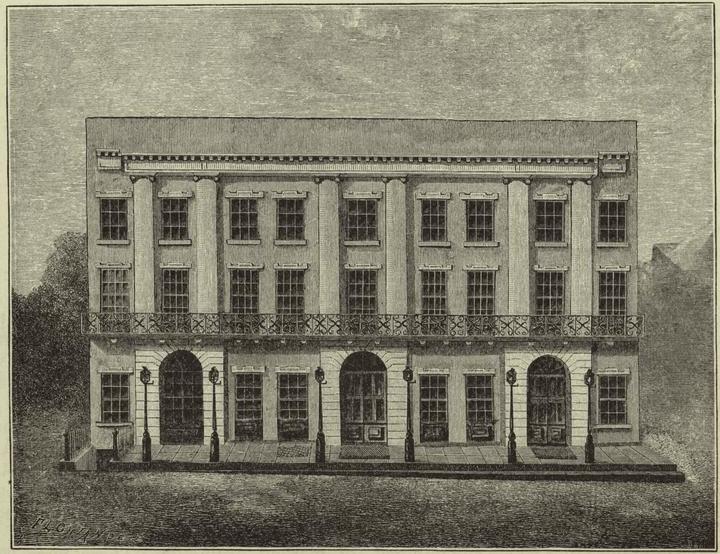
One of the most famous stages for this skimpy sort of tableau vivant began with less prurient intentions. Palmo’s Opera House (pictured above, 39-41 Chambers Street), opened in 1844 by an Italian immigrant Ferdinand Palmo. Italian opera had debuted in New York in 1825 at the Park Theatre, and instantly meshed with the upper class notions of acting more European. But working class New Yorkers didn’t quite warm to it; according to Mark Caldwell, “[o]pera was the ambrosia to a self-professed elite but chloroform to the masses.”
Palmo, owner of the Cafe des Mille Collones right around the corner, threw his money into the new opera house in an effort to bridge the gap. His first production was Bellini’s ‘I Puritani’, launched in February 3, 1844. The masses stayed away, in droves. Palmo kept the opera house open for two years, fending off mounting debts. At one point, performers went on strike — in the middle of a performance — because they had not yet been paid.
The restaurateur lost all his money in the endeavor and promptly lost his opera house as well. The stage then passed through various hands, some taking a crack at legit amusements, with ballet and even Greek tragedy.
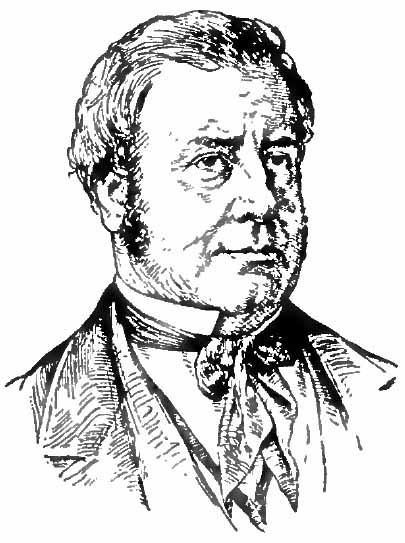
A showman William Burton (at right) took over the lease in 1848 and threw out those high-falutin acts. Burton was concerned with mainstream entertainment, not art per se. And it was during Burton’s variety programs — which notably featured the best minstrel acts in Manhattan — that this unusual, shall we say, indiscreet tableaux made its debut, a presentation of lilywhite, illuminated flesh decorating an evening of song and dance.
In most cases, it was presented as a straight-up art lesson, with such mythology themed dioramas as ‘Psyche Going To The Bath’ and ‘Venus Rising From the Sea’. But, as I said, Burton didn’t care to sell art. He sold a view to nude bodies — or bodies that at least appeared nude — and soldout crowds raced to have a look.
But what if you wanted to see all this solitary nudity but the damned horse carriage had made you late? No worries, for at the newly named Burton’s Chamber Street Theater, you were provided with a New York first — numbered reserved seats.
Burton’s stage wasn’t the only place displaying ‘artist models’; it soon became so common on New York stages that it soon became incorporated into productions, such as the extravagant ‘The Black Crook’ at Niblo’s Garden in 1866, considered the first Broadway musical.
Obviously, the degree to which onstage nudity appeared scandalized proper New Yorkers. In fact, in 1848, police raided several establishments, including Barton’s. According to a contemporary account by Foster Rhea Dulles, a “beautifully formed creature, just drawing on her tights for the Greek Slave, and some of the others, were so dreadfully alarmed at the sight of the police with their clubs in hand that they seized up a portion of their garments in order to hide their faces, forgetting their lower extremities, thus making a scene mixed up with the sublime and the ridiculous.”
While prudish tastes frowned upon such displays, they never quite went away. Even as late as the 1920s, Florenz Ziegfeld frequently paid homage to the craze during his famous Follies.
As for the old opera house, it would continue featuring minstrel shows and comedy pieces well into the 1860s. For a short time it even served as federal courthouse before its demolition in 1876.
And here’s the final kicker — Palmo’s Opera House and its later incarnation as Burton’s Chamber Street Theatre was sat on top of — you guessed it — the African Burial Ground!
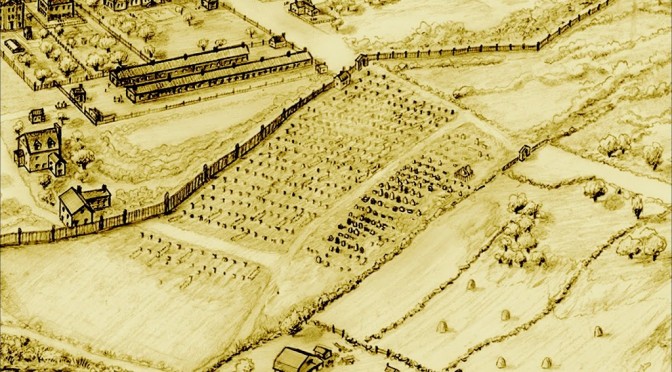
A small cemetery for African slaves and free black New Yorkers developed along the southern edge of Collect Pond. But when that filthy body of water was drained and filled, the burial ground disappeared underground with it. (Image courtesy Preserve America)
PODCAST During the construction of a downtown federal administration building, an extraordinary find was discovered — the remnants of a burial ground used by African slaves during the 18th Century.
In the earliest days of New Amsterdam, the first Africans were brought against their will to build the new Dutch port, slaves for a city that would be built upon their backs. Later, forced to repress the cultural expressions of their forefathers, the early black population of British New York did preserve their heritage in the form of burial rites, in a small ‘Negro Burial Ground’ to the south of Collect Pond (and just a couple short blocks to today’s City Hall).
How did this small plot of land — and its astounding contents — become preserved in the middle of the most bustling area of the most bustling city in the world? And why is it considered one of the most spectacular archaeological finds in New York City history?
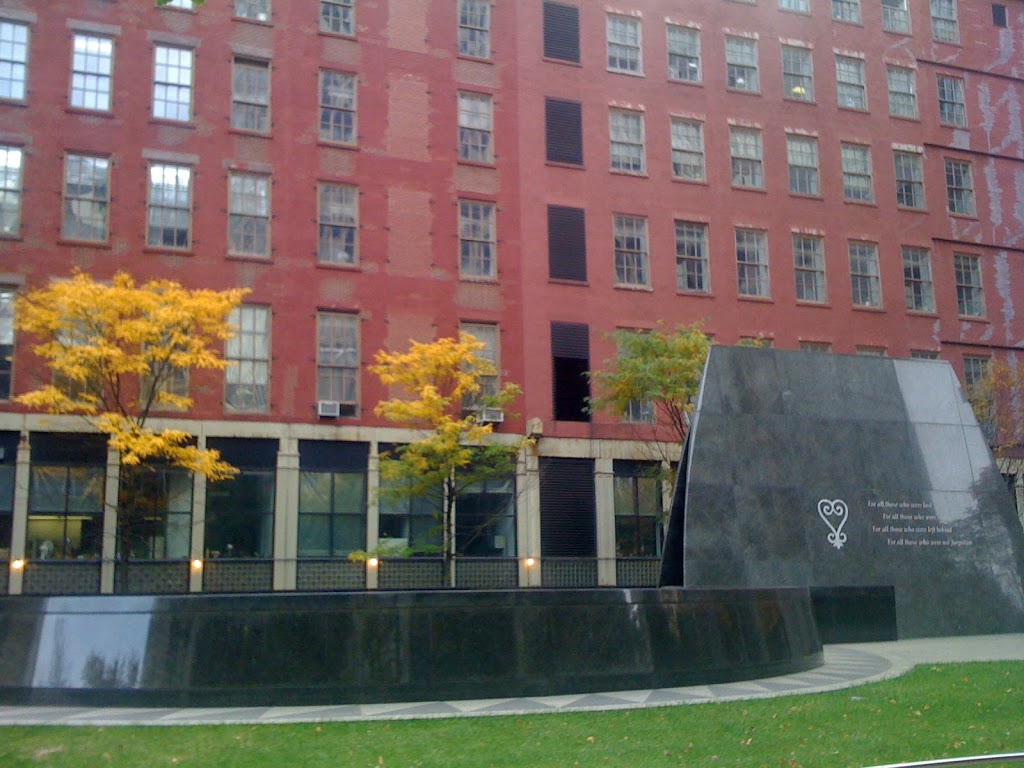
The African Burial Ground monument, at street level. Designed by Rodney Leon, the monument in contained on a quiet patch of land that seems to escape the bustle of the city around it.
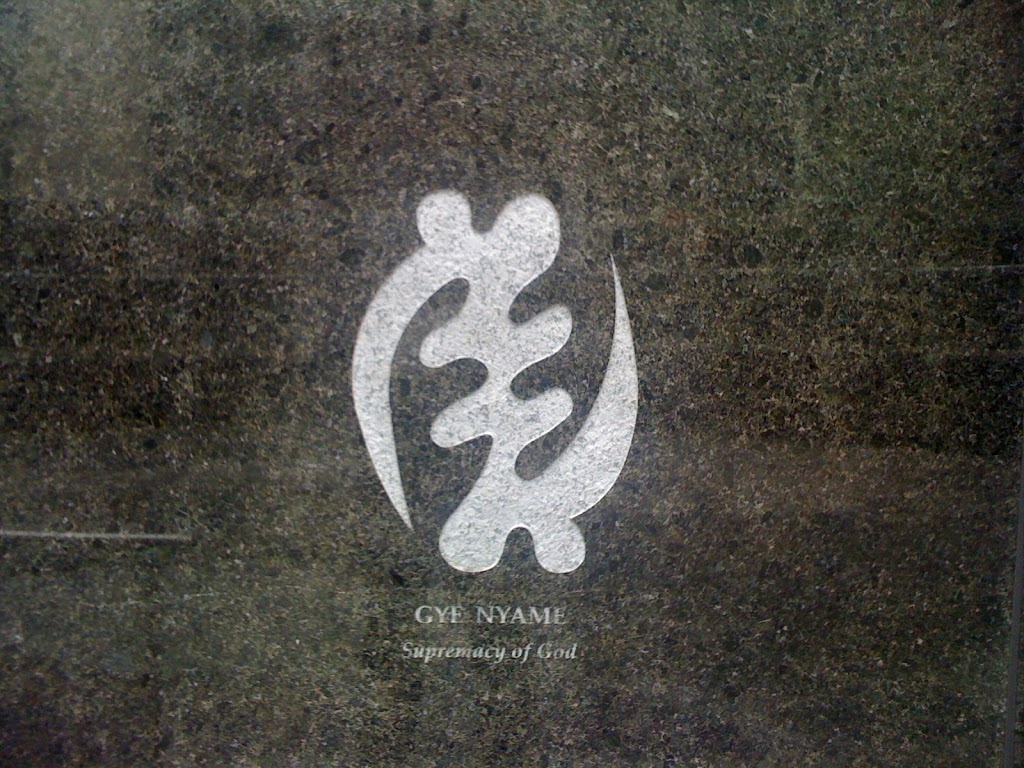
Within the ‘Circle of Diaspora’ are various spiritual and religious symbols, many quite exotic.
There’s no shortage of information about the history of slavery in New York. I would definite start with the materials related to the New York Historical Society’s extraordinary show from a few years ago. The GSA’s site on the African Burial Ground is a treasure trove of information as well.
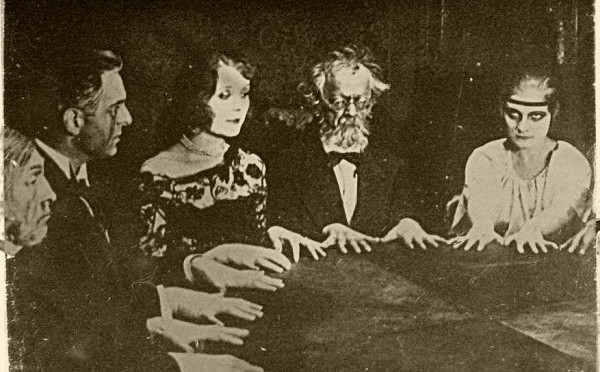
Many late 19th century New Yorkers were hypnotized by the the glamor of the spiritualist circuit, mediums, magicians and mind readers purporting communications with the ghostly world and conveniently in performance form with hefty ticket prices.
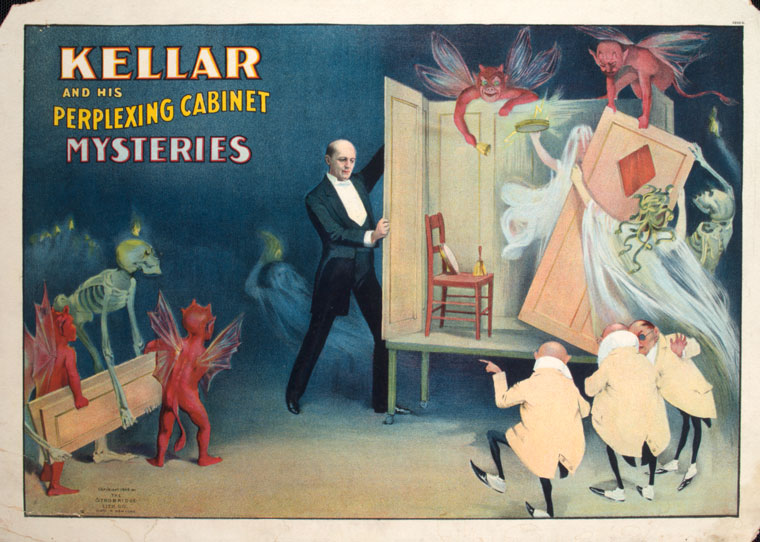
One of the most popular was Harry Kellar, Kellar the Magician, whose technical slight of hands in such tricks as ‘The Vanishing Lamp’ and ‘The Levitation of Princess Karnac‘ made him a popular draw on legitimate stages like Daly’s (30th and Broadway) and the minstrel house Dickstader’s Theater.
The poster above highlights one of Kellar’s greatest illusions via the ‘spirit cabinet’, a hokey convention of magical spirit diving that was actually invented by Kellar’s mentors the Davenport Brothers. By confining himself to the cabinet while feats of unexplained trickery manifested around him, Kellar could ‘prove’ the tricks were products of an unseen spiritual hand.
In April 1905, Kellar played the old Majestic Theater in Columbus Circle. One of the highlights included “two persons in the audience playing a game of euchre, the progress of which was suggested by large playing cards that appeared above the spirit cabinet on the stage.”
The tricks of Kellar enthralled New Yorkers and set the stage for one of his biggest fans, Harry Houdini, to become king of the magic circuit.
Kids these days! With their fancy selection of Halloween costumes, with ornate detailing and comfort, with their diversity and realism.
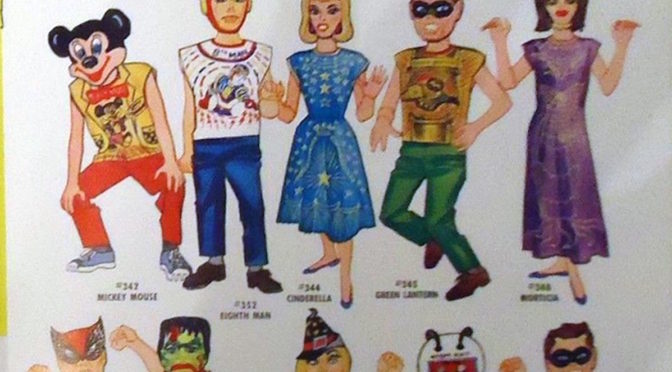
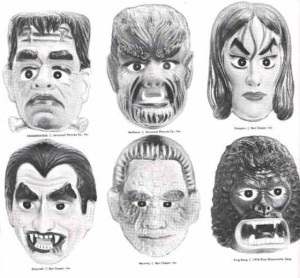
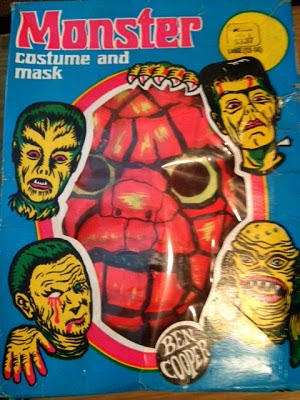
For thrifty parents in the 1970s and 80s, the decision to costume their children usually led to the rows of Ben Cooper Halloween smocks and plastic body garb, topped with a mask (held to the head with a rubber band) looking vaguely like the character it alleged to embody. On top of the standard fair Draculas and Frankensteins, one could often find Chewbaccas, Spider-Mans, Mickey Mouses and other, non-traditional creations. The many visages of the Ben Cooper brand: faces from a 1980 product catalog. (You can check out the whole catalog at Plaid Stallions)
They reeked strongly of plastic and were one-size-fits-all. Still, throw in a plastic jack-o-lantern to hold your candy and a flashlight, and you were set for trick-or-treating every October 31st.
Halloween was synonymous with Ben Cooper products for many children. The variety and simplicity of the little synthetic outfits — paired with the company’s savvy licensing division — made them staples of the season, until an early ’80s damper that brought on a decade of financial woes and eventually bankrupted the company.
Ben Cooper Inc., the company that manufactured these tiny costumes, was a homegrown New York company through and through. The headquarters for this magical, mystical place of costumes was located near the edge of Sunset Park (a couple blocks away from Green-wood Cemetery), at 33 34th Street, Brooklyn, New York, among the nondescript warehouses and storage facilities that face into the Gowanus Bay, not far from the very first settlement (in 1636) in a region that would become Breukelen. If only the Ben Cooper company had known! He could have made Dutch Walloon masks and smocks.
The man behind the cheap costume empire, Benjamin Cooper, was born in 1906 in the Lower East Side and was given his first costume (a little devil suit) at age 7. After a brief stint as a songwriter on Tin Pan Alley, Cooper segued into the theatrical costume business in 1927 when he was 21, making costumes for chorus girls at the Cotton Club in Harlem and even a few latter-year Ziegfeld Follies.
Cooper pretty much fell into the Halloween regalia business. American businesses were turning holidays into retail opportunities, upgrading obscure traditions and inventing new ones. Religious iconography and culture-specific celebrations were forced to share its holidays with mainstream, family-friendly motifs. The practices of Hallowe’en, with its Celtic, Christian and medieval origins, were melded with newer modified customs that were, conveniently, fueled by American retail products.
Namely, trick-or-treating, which was not a widespread component of the holiday until the 1930s. One source I read theorizes that the organized custom of going house to house for a candy treat developed as a way to control late-night Halloween vandalism like egging and papering houses — although, of course, it’s hardly stopped those practices. (I can’t find any reference to ‘trick-or-treating’ in the New York Times before the 1940s)
The growing popularity of trick-or-treating facilitated a need for mass-produced costumes, and Cooper was there to make them. He left theatrical costuming entirely and started his new company, Ben Cooper Inc., in Red Hook in 1937.
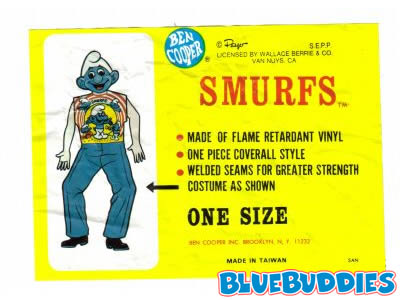
The secret to his success was licensing. During his first year, he merged with a company that held the merchandising rights to Walt Disney’s characters and would soon define his business using the imagery of pop culture favorites. (At right: Smurfs rendered in the Ben Cooper aesthetic, courtesy the Smurf website Blue Buddies.) Cooper dominated this market for most of the mid century with few competitors, offering children of the 1950s ensembles like Davy Crockett and Raggedy Ann. Real humans entered the mix in the 1960s with a popular set of Beatles costumes. (Less popular in 1963 was the unfortunate manufacture of JFK and Jackie costumes.) Film and television stars dominated the 1970s, with characters from Star Wars, Sesame Street, even (controversially) the monster from Alien. And most manufactured here in Red Hook.
“The entire line of flame-retardant capes, playsuits (sizes 4-14), ponchos and masks sells for $2 to $5 in K marts, Kresge’s, Woolworth’s and other chain stores across the U.S.” says a 1979 People Magazine profile of Ben Cooper.
Ben Cooper Inc. fell upon hard times in the 1980s, when the Tylenol cyanide fear spread to paranoia about poisoned Halloween candy, for a time curtailing the yearly ritual and sending profits plummeting. Costumes by rival companies were also getting more sophisticated; they already had to fend off the likes of Collegeville and Don Post, who cornered the rubber-mask market.
The company declared bankruptcy and moved out of New York in 1991 and was swiftly folded into another rival Rubies Costumes. Ben Cooper remains one of New York’s greatest contributions to the Halloween tradition and is fondly remembered today, even if nobody will ever admit to being very comfortable wearing the nostalgic, plastic garb.
Trick or treating, by the way, didn’t shoehorn its way into the practices of American children without a fight. Indeed, in 1948, members of the Madison Square Boys Club, most likely encouraged by their adult members, marched in a city parade protesting the practice of going to strangers’ houses and asking for candy. Their banner? “American Boys Don’t Beg.”
Here’s a chilling thought for the Halloween season: if you’re visiting one of New York’s many amazing parks and squares, most likely you’re standing on land that was formerly used as a cemetery or potter’s field. And in some cases they even left the bodies behind!
If you’re fluent in your New York history, you probably know a couple of these. Most of these burial plots date from before 1851, when the city passed an ordinance forbidding further burials (without explicit permission) below 86th Street. Historical cemeteries (like those at Trinity Church and Old St. Patrick’s) and land with private vaults (such as the East Village marble cemeteries) were allowed to remain, and unique exceptions have been made, such as the singular grave of William Jenkins Worth at Madison Square.
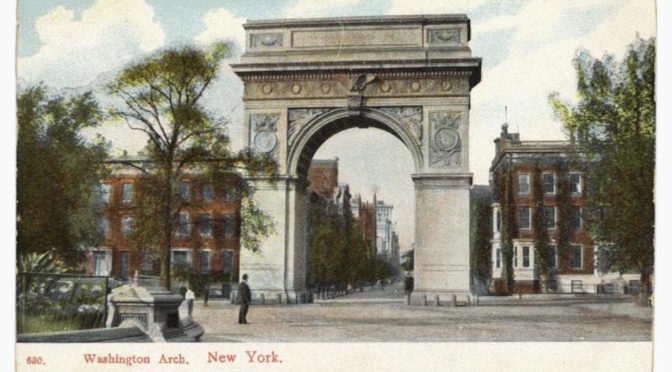
Washington Square Park, Manhattan 1797-1825
“Where now are asphalt walks, flowers, fountains, the Washington arch, and aristocratic homes, the poor were once buried by the thousands in nameless graves.” (Kings Handbook of New York, 1893) When fashionable New Yorkers moved from the confines of lower Manhattan to the area of Greenwich Village, the burial ground was closed for business and a lovely park placed on top of it.
While this might seem truly morbid, in fact the city considered this a preventative and sanitary option. According to city records, a recommendation was made that “the present burial ground might serve extremely well for plantations of grove and forest trees, and thereby, instead of remaining receptacles of putrefying matter and hot beds of miasmata.”
Today, that ‘hot bed of miasmata’ serves as one of New York’s most bustling and vibrant outdoor spaces. But the city simply built over the burial ground. It was claimed during the 19th century that a blue mist could be seen hanging over the park at night, the creepy vapor of the remains underground.
Leverish Street and 71st Street, Queens
1765-1818?
A private cemetery once used by the Leverish family, a prosperous Long Island clan descended from English minister, the Rev. William Leverich. According to a family genealogy site: “The contemporary location of the burial ground is a rectangular plot located immediately behind the rear yards of several private residences that face on Leverich Street, and on the other side immediately behind a parking lot behind several apartment buildings that face on 35th Avenue at the intersection of 71st Street.”
Are the bodies still there? According to author Carolee Inskeep, “there is no evidence to suggest that the bodies were removed.” How many? Unknown
Liberty Place (at Maiden Lane), Manhattan
1700-1823
This burial ground served New York’s first Quaker congregation, formerly called the Little Green Street Burial Ground of the Society of Friends (Liberty Place was once known as Little Green Street). Its location is currently in the shadow of the New York Federal Reserve.
Are the bodies still there? Probably not, but the city gave them only six short months to move all the remains to a new location, so you never know what they might have left behind.
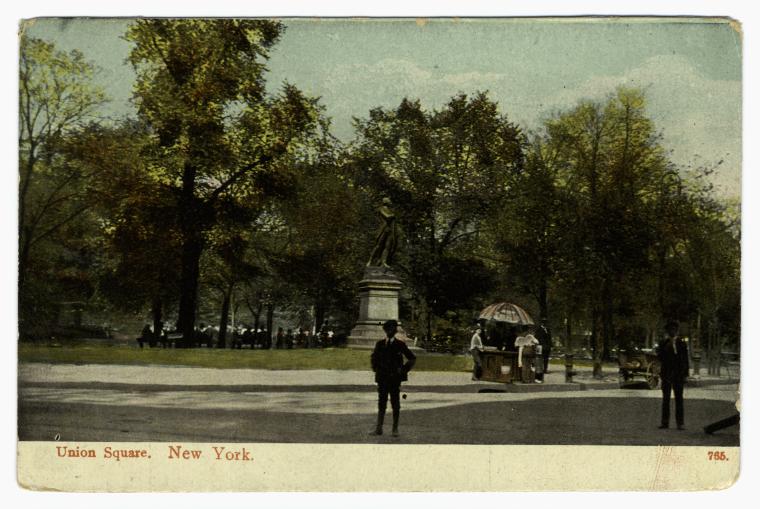
Union Square, Manhattan (above)
?-1807
Potter’s fields — where the poor or unclaimed were buried — moved frequently around the city as land values improved with the city’s growth. This particular area at 14th Street was once comfortably outside of town, but its proximity near Bloomingdale Road (the future Broadway) soon required its functions as a burial plot be transferred to other usable fields, like Washingon Square. The land here was transformed into the ellipse-shaped Union Place, a strolling park surrounded by an iron fence. By the 1830s, Samuel Ruggles would modify it further into New York’s toniest park Union Square, luring the wealthy who quickly built homes of ‘costly magnificence’ around it.
Are the bodies still there? Certainly not, given the park’s frequent renovations and the subway station right underneath.
Madison Square Cemetery, Manhattan
1794-1797
The short duration of this burial ground stems from the fact that it was used only to inter those who died at nearby Bellevue Hospital and the local almshouse during a devastating yellow fever epidemic. Later, with fears of a new war with England looming, the land was given to the U.S. Army as an arsenal, and the land that was later Washington Square became the official place to bury the dead.
Are the bodies still there? There’s some evidence to suggest that some of the remains were never moved.
How many? Unknown, although the epidemic took hundreds in the 1790s, and according to my estimation, there could be up to 1,000 buried here.
New York City Farm Colony Cemetery (Castleton Corners), Staten Island
1830-1910
This land served New York’s Farm Colony, an occupational asylum for the elderly and orphaned, and later a convalescent home for those with tuberculosis. The cemetery was once well kept, but today most of the tombstones are gone, and the land is virtually unmarked. Part of the farm colony has become part of the Greenbelt. The ruins of the Farm Colony are, frankly, unbelievable.
Are the bodies still there? Yes, the plots simply stopped being maintained How many? Hundreds
Old Newtown Cemetery (92th Street and 56th Avenue), Queens
Off and on between 1652-1880
A family cemetery that became a horse pasture in the 19th century, cut through with cross streets, then designated a New York city park in 1932. Today, it’s the Newtown Playground.
Are the bodies still there? Many (notably from reputable families) were moved piecemeal to family plots or to Hart Island, but it’s not clear that the city ever methodically moved all the bodies. But something else is definitely there. A Queens Annual Report from 1927, as referenced by the parks department, claims “[a]ll the old headstones, which stuck up like eyesores, were laid flat and covered with soil.” So enjoy that swing set, kids!
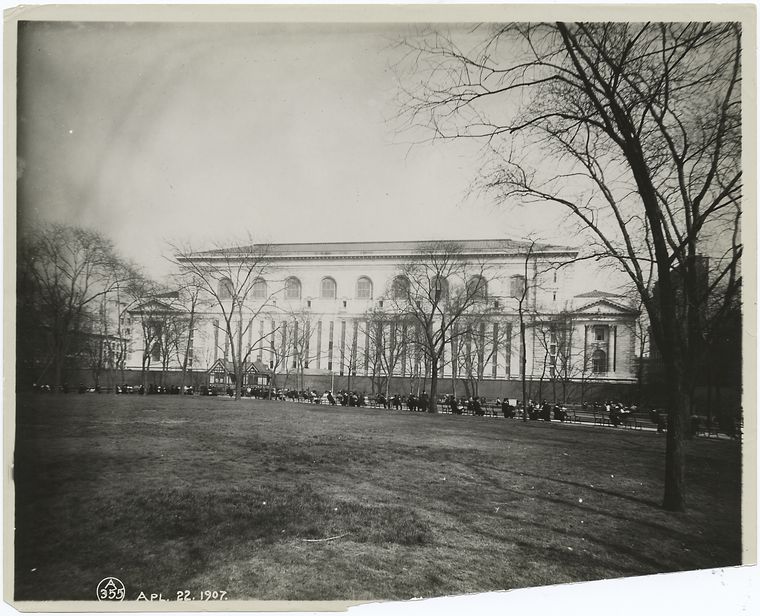
Bryant Park, Manhattan (above, from 1907)
1823-40 but possibly used as late as 1847
Yet another burial plot for paupers, still further north of city center. Soon however the adjoining land became an ideal spot to put the Croton Reservoir, supplying the city with drinking water. And it wouldn’t do to have a bunch of gravaes next to it, right? Following a short time as the location of the Crystal Palace, the land was turned into a park, named after William Cullen Bryant.
Are the bodies still there? The only thing you’re going to find under Bryant Park are miles and miles of library books, in tunnels owned by the New York Public Library.
Park Avenue and 49th Street, Manhattan
1822-1859
In the early 18th century, the area soon to become known as the richest street in America was home to railroad tracks, cattle yards, various grim asylums and, yes, Manhattan’s last potter’s field. When Columbia University moved uptown, it sat near the shoddy field, so decrepitly maintained that “the ends of coffins still protruded from the ground,” according to Edward Sandford Martin “a malodorous neighbor much in evidence and disrepute.”
In the late 1850s, the city forced the potter’s field off the island entirely and the bodies were slated for removal to Ward’s Island. Given municipal corruption and delays, however, the project took years, with train passengers often greeted with the sight of coffin stacks and grisly open pits.
Today, that former burial plot is occupied by the Waldorf=Astoria Hotel, built on the property in 1929, long since transformed by the Central Railroad and burial of tracks into Grand Central Station.
Are the bodies still there? Given the deep excavations underneath Park Avenue to accommodate trains and skyscrapers, I don’t imagine anything remains.
NOTE: Some of the dates above are estimates as record keeping for these kinds of things were hit and miss. Many dates are from Carolee Inskeep’s exhaustive survey of old New York burial grounds The Graveyard Shift.
PODCAST It’s our fourth annual Halloween history special, and we’ve got four bloodcurdling stories for the season. The first three are spooky ghost tales — a haunted boardinghouse on 14th street with violent, vain spirits; a short history of New York’s seance craze and a man tormented by the spirit of a dead painter; and a glamorous pair of Jazz Age lovers whose angry spats in their midtown Manhattan penthouse kept up the neighbors, even beyond the grave.
ALSO: A tale with no ghosts at all, but a story with truly spine-tingling facts, featuring the eeriest island in New York and the final resting place for over 850,000 souls. If you ever make it to Hart Island, it means that things have gone very badly for you.
Home to the American Society of Psychical Research on W. 73rd Street, the organization headed by James Hyslop in the early 1900s. Hyslop led the investigation of dozens of reported cases of paranormal and supernatural activity.
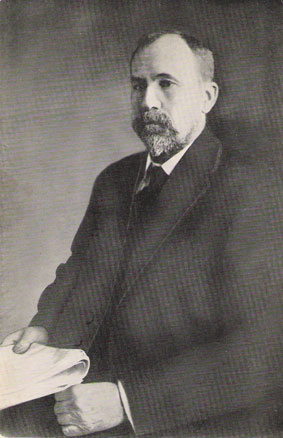
Hyslop, pictured below, believed that he spoke with famous philosopher William James through a medium, and he himself spoke to his secretary via this technique many months after he died.
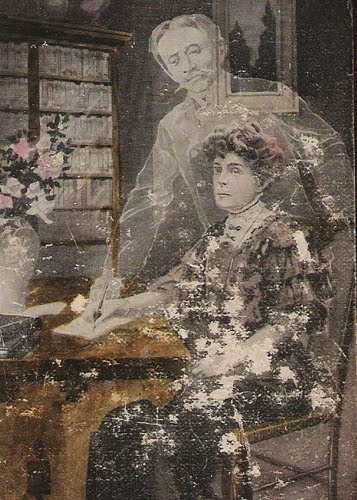
A bizarre image depicting medium Etta De Camp being visited by author Frank Stockton. Ms. De Camp believed her hand was being controlled by Stockton and even wrote a entire book under the control of Stockton.
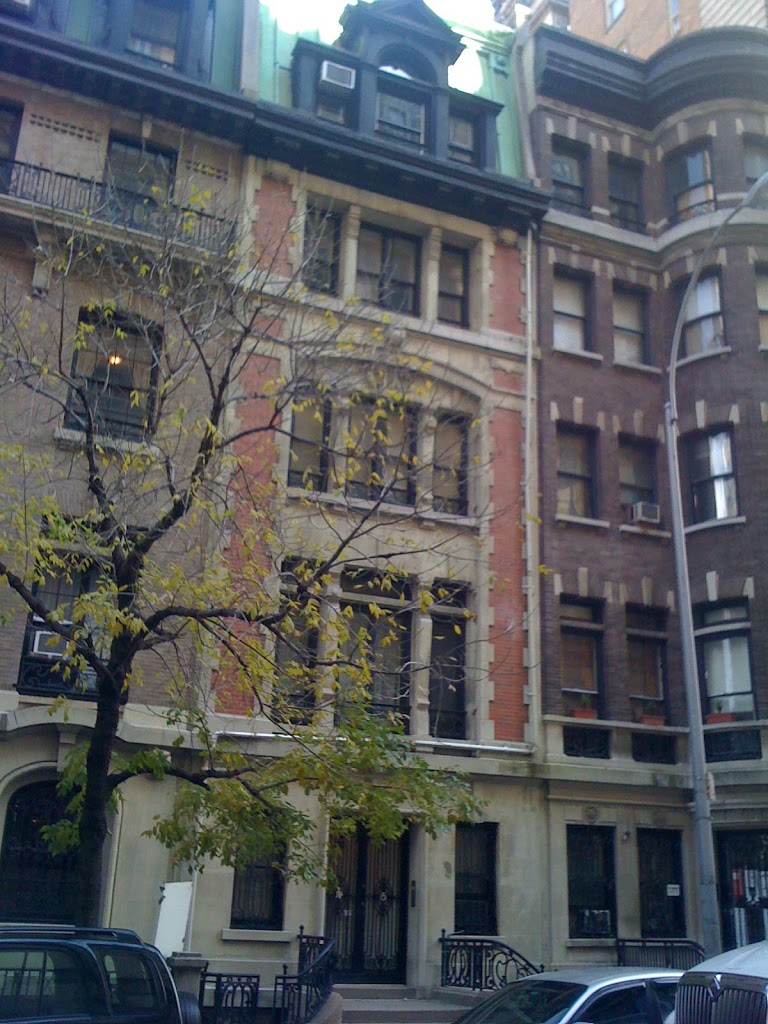
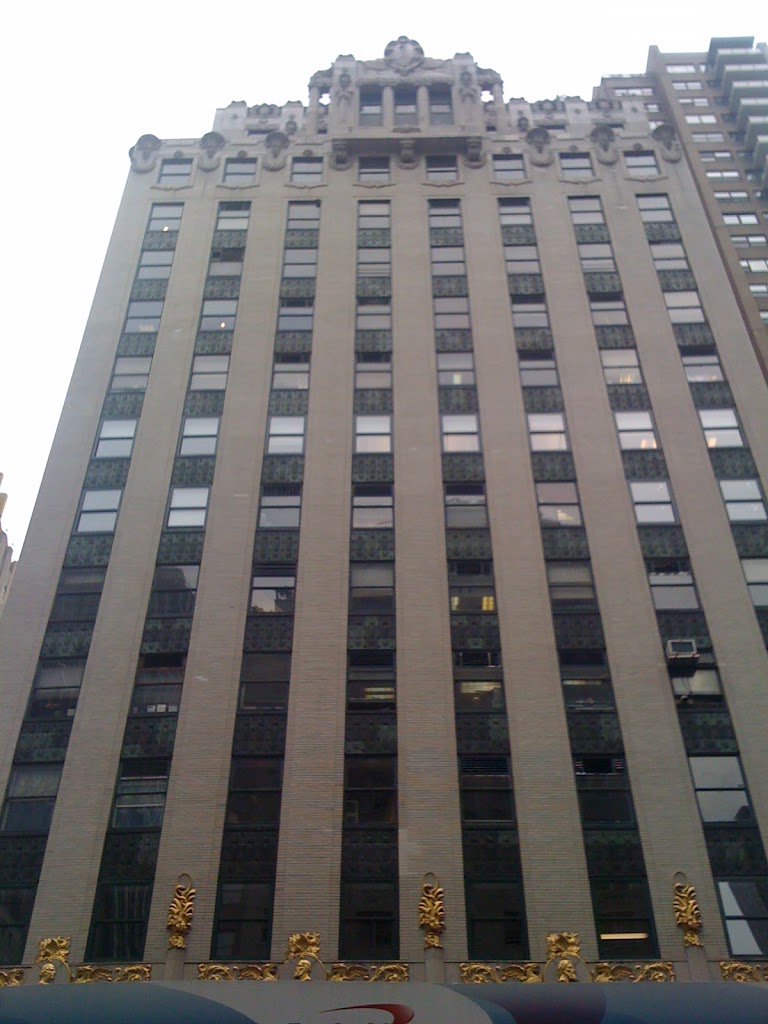
Looking up at the former penthouses of 57 W. 57th Street, where Edna Champion and her lover Charlie argued their way into the grave, then tormented the unfortunate tenants for many years later. Today, these formerly haunted floors are slated to be occupied by Ford Models.
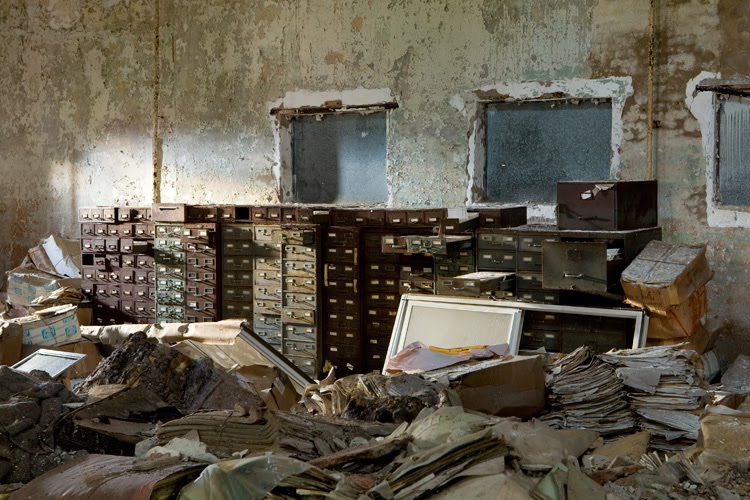
An abandoned records room on Hart Island. This and many other wonderful photographs of Hart Island can be found at Kingston Lounge, bravely venturing to the island in 2008 to witness the strange and forlorn island in person.
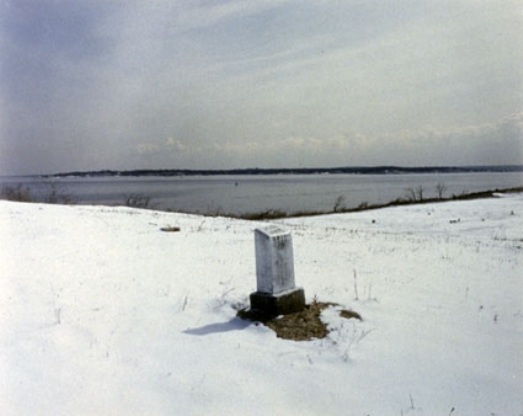
The Hart Island Project has been drawing needed attention the island for years, obtaining lists of people buried there and assisting in families looking for loved ones there. It’s also features a fantastic collection of photographs, such as the one below (of a lonely grave marker) by Joel Sternfeld.
And finally, a fascinating and priceless local news report from 1978 on Hart Island, looking a bit more populated than it is today. Unbelievably, there was talk of actually developing Hart Island for more than just the city’s potter’s field.
If you’re looking to craft your own personal ‘haunted’ walking tour, this map lists all the places we’ve talked about in prior ghost stories podcasts. Simply look up a location and download that particular episode: