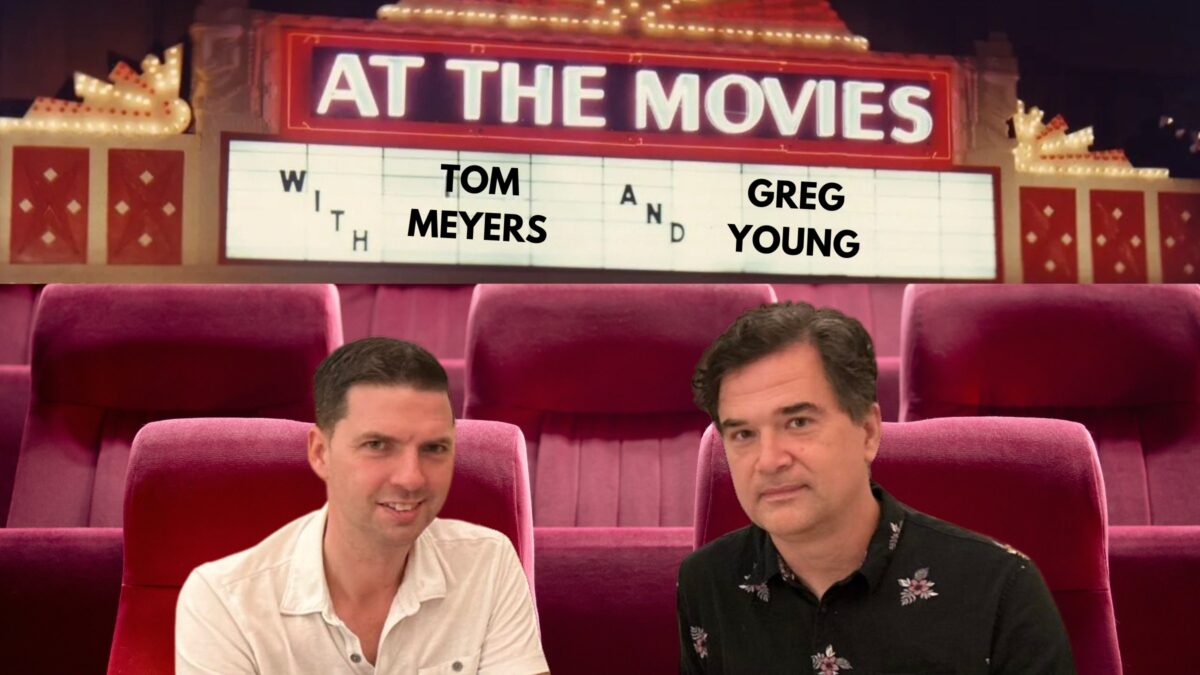
Greg and Tom have taken off their historian hats for a minute and have suddenly become — movie critics? Close but not quite!
This week we’re giving you a ‘sneak preview’ of their Patreon podcast called Side Streets, a conversational chat show about New York City and, well, whatever interests them that week.
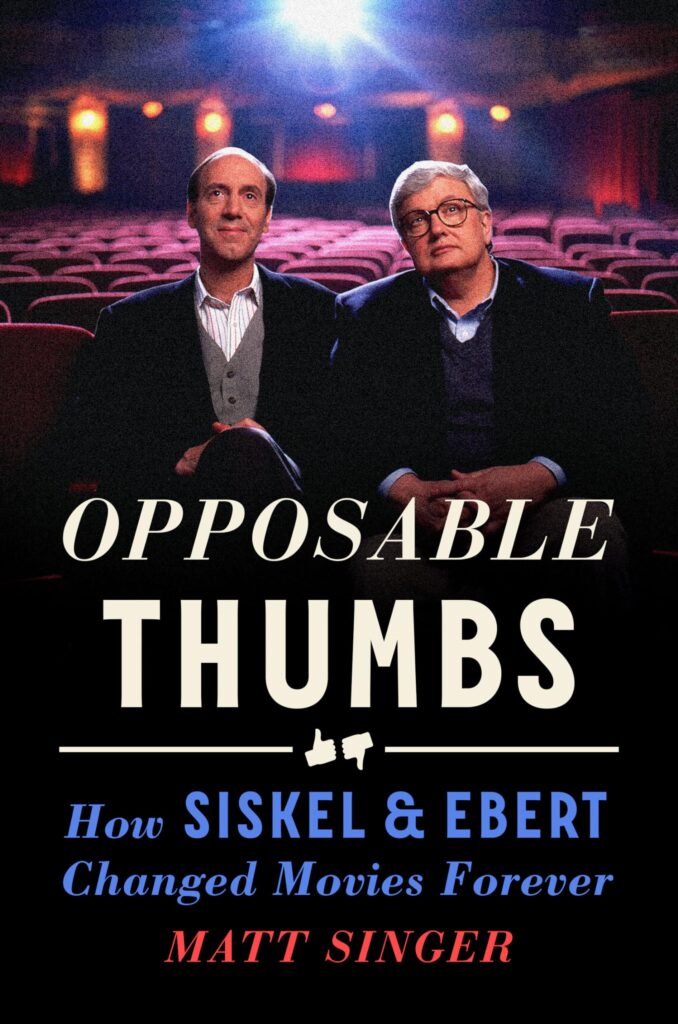
In honor of the Academy Awards, the Bowery Boys hosts pay homage to the great Gene Siskel and Roger Ebert while looking at five award-worthy films with strong New York City connections:
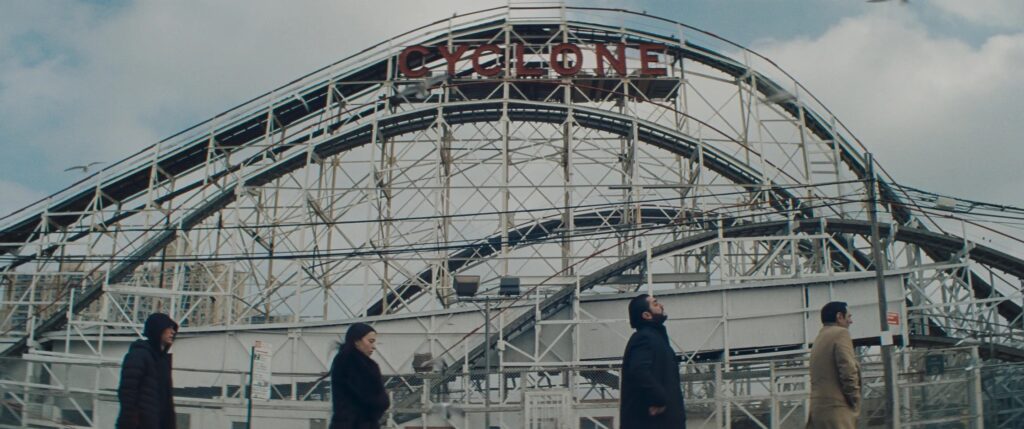
— Anora with its captivating south Brooklyn locations
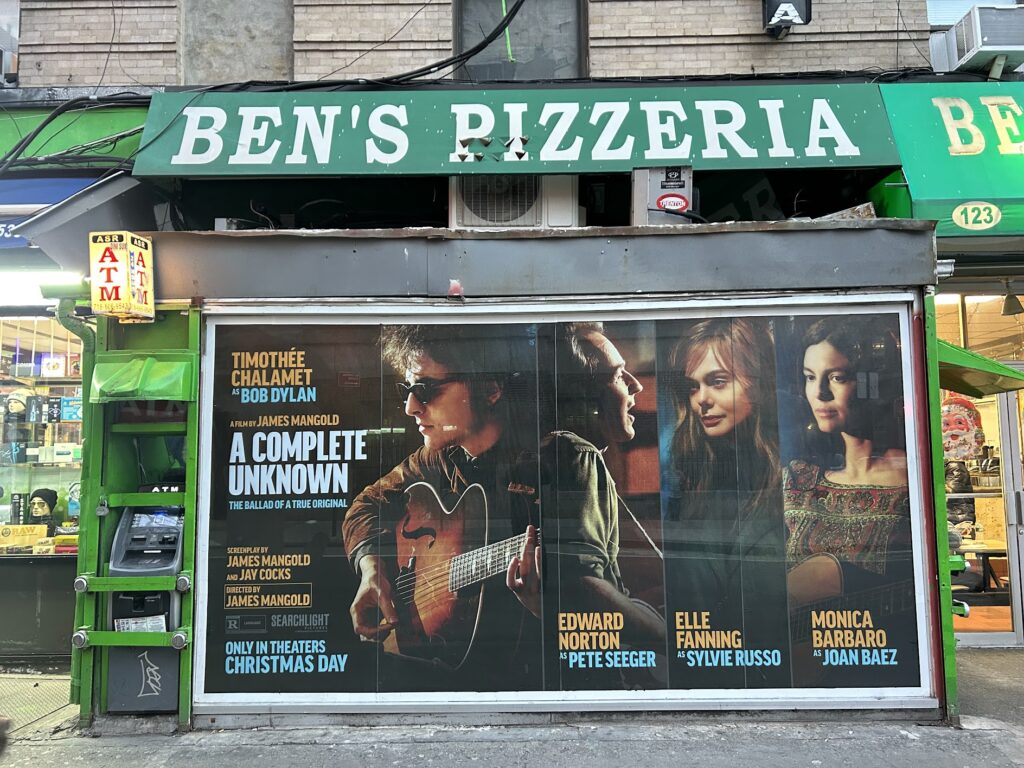
— A Complete Unknown, taking us back 1960s Greenwich Village
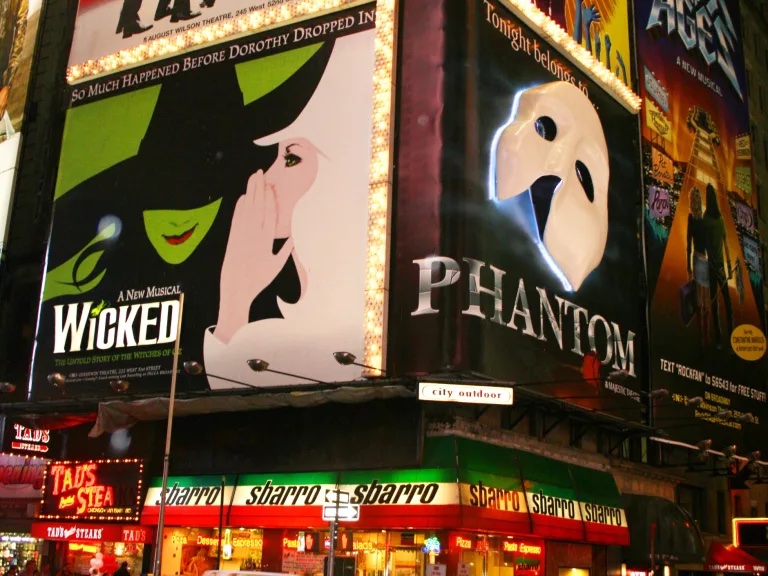
— Wicked, a spritely interpretation of the Broadway musical
— The Brutalist, an epic about more than just architecture
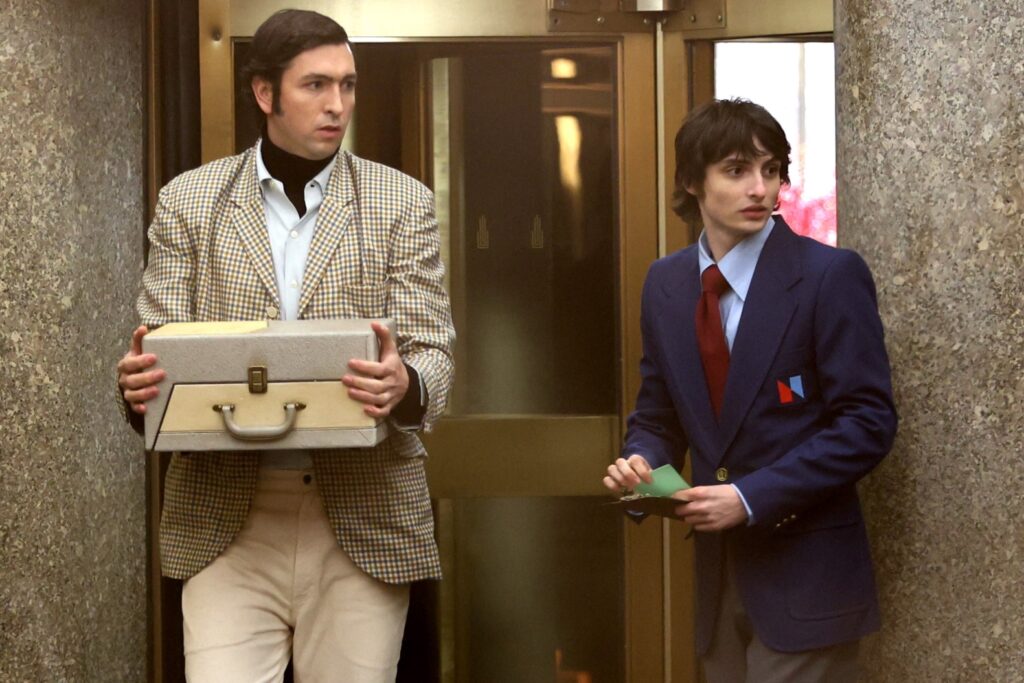
— Saturday Night, a frenetic tribute to the comedy-show icon which turns 50 years old this year
NOTE There are light spoilers (especially to locations used in some of these films) but nothing that will ruin your enjoyment of these movies.
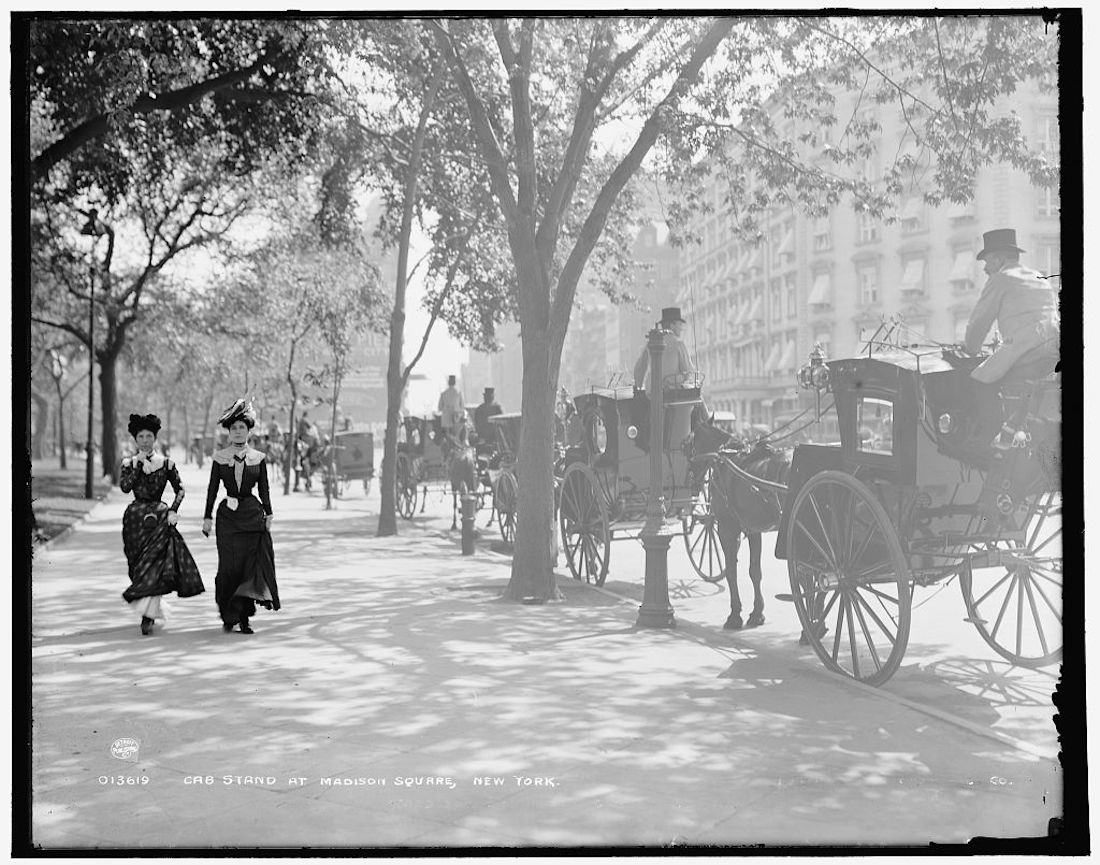
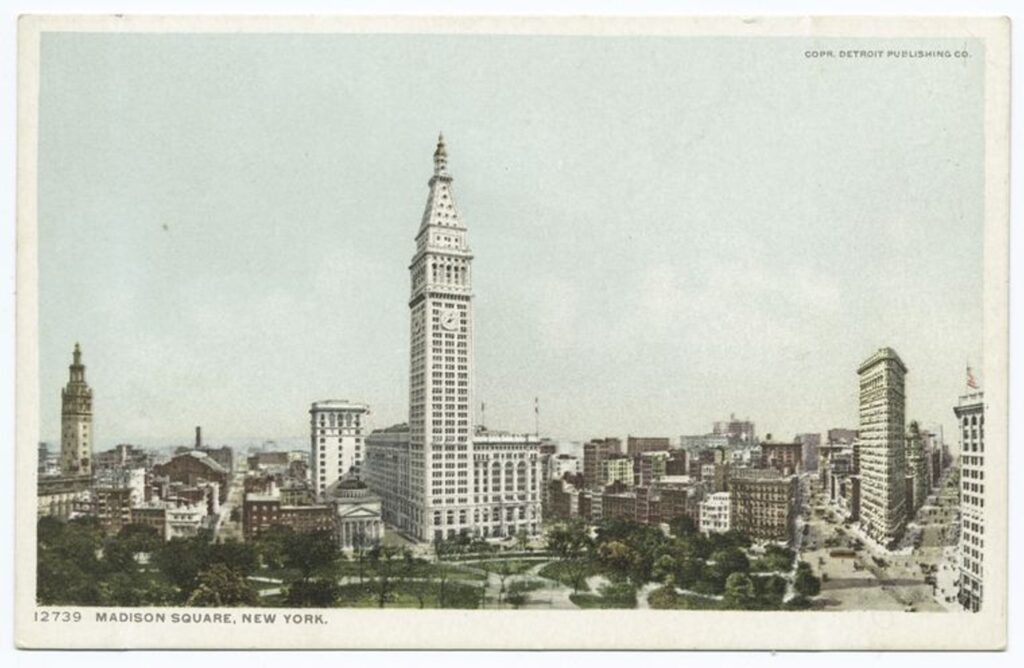
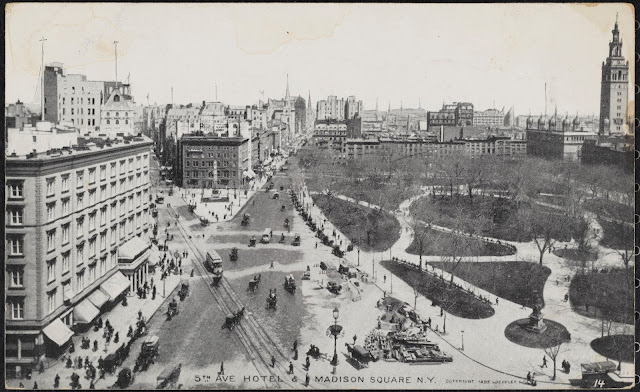
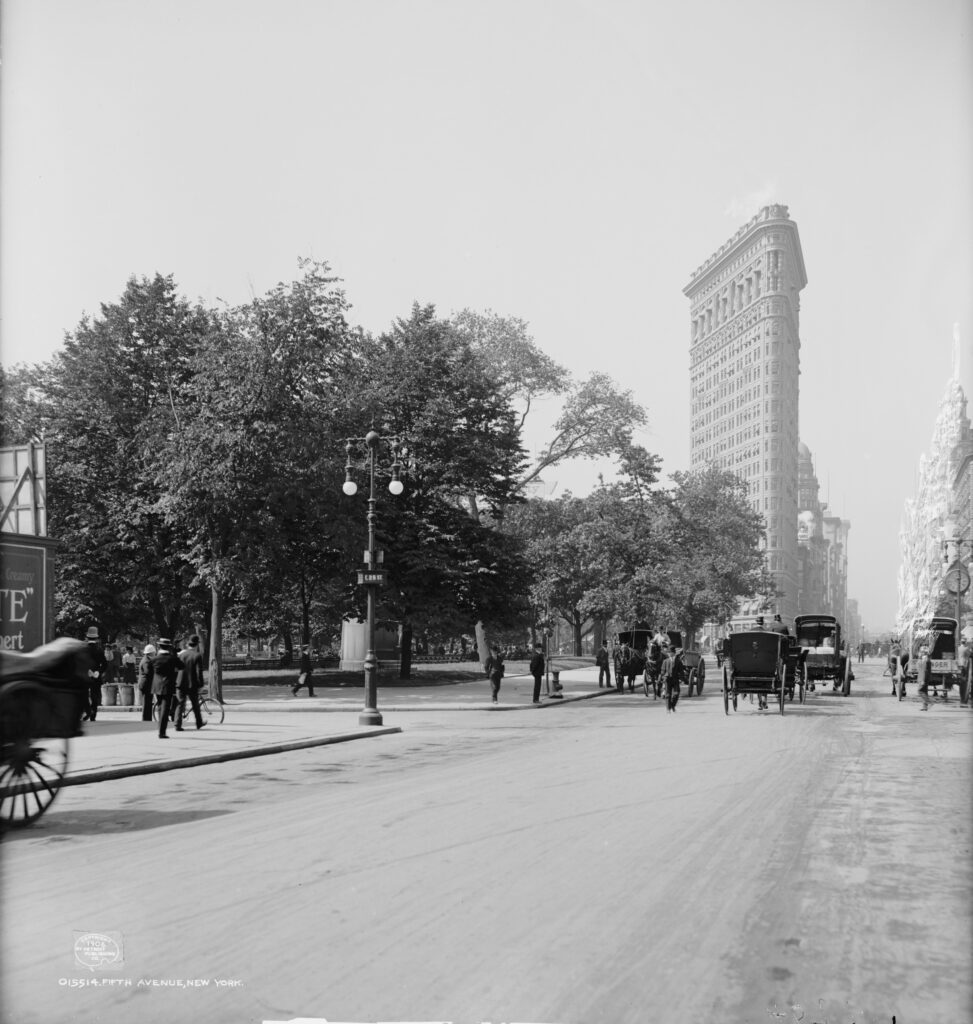
Cab stand at Madison Square, 1900. Courtesy Detroit Publishing/Library of Congress. This image is looking south down the edge of the park. Within two years, the Flatiron Building would be rising in the distance.
So much has happened in and around Madison Square Park — the leafy retreat at the intersections of Broadway, Fifth Avenue and 23rd Street — that telling its entire story requires an extra-sized show, in honor of the Bowery Boys 425th episode.
Madison Square Park was the epicenter of New York culture from the years following the Civil War to early 20th century. The park was really at the heart of Gilded Age New York, whether you were rushing to an upscale restaurant like Delmonico’s or a night of the theater or maybe just an evening at one of New York’s most luxurious hotels like the Fifth Avenue Hotel or the Hoffman House.
The park is surrounded by some of New York’s most renown architecture, from the famous Flatiron Building to the Metropolitan Life Insurance Tower, once the tallest building in the world.
The square also lends its name, of course, to one of the most famous sports and performing venues in the world – Madison Square Garden. Its origins begin at the northeast corner of the park on the spot of a former railroad depot and near the spot of the birthplace of an American institution — baseball.
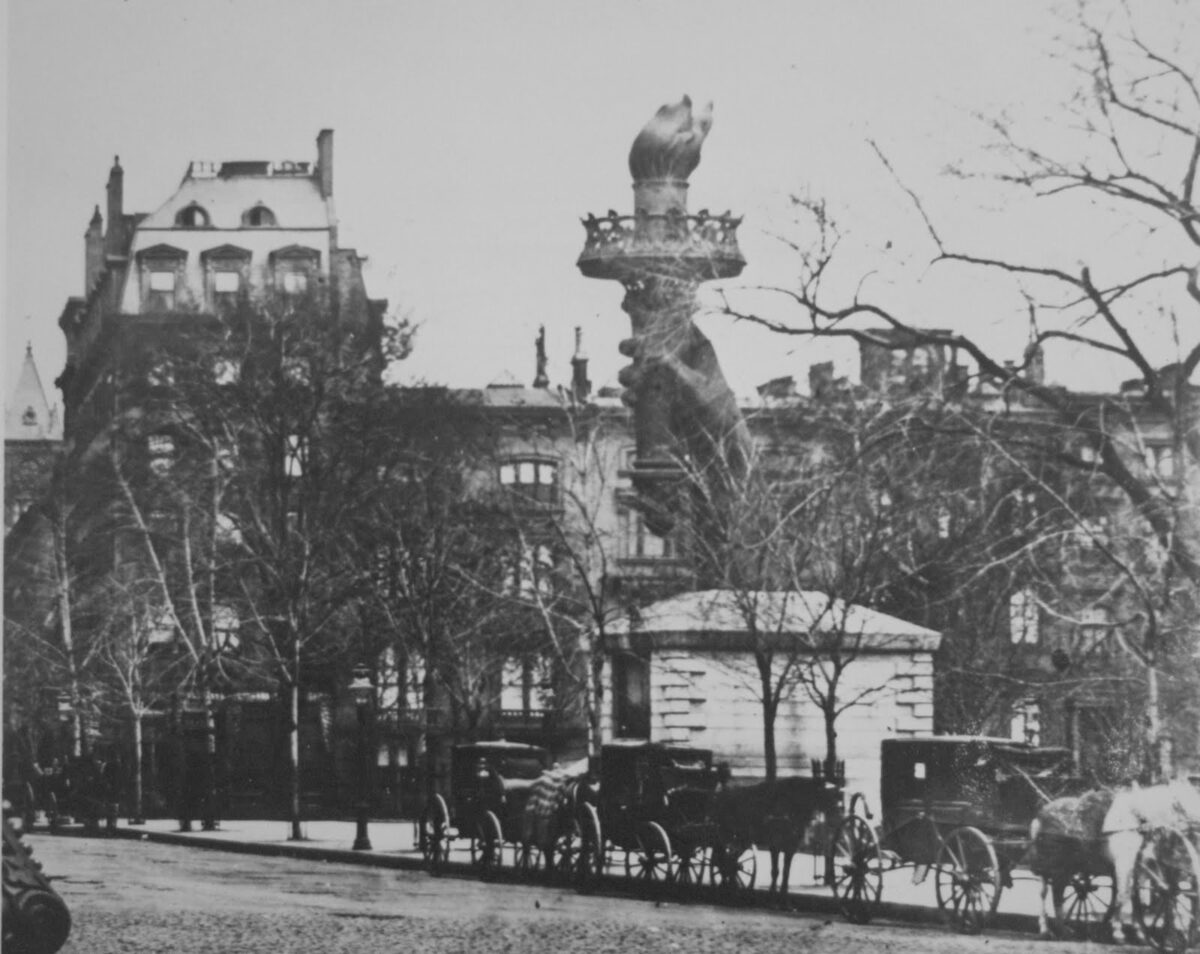
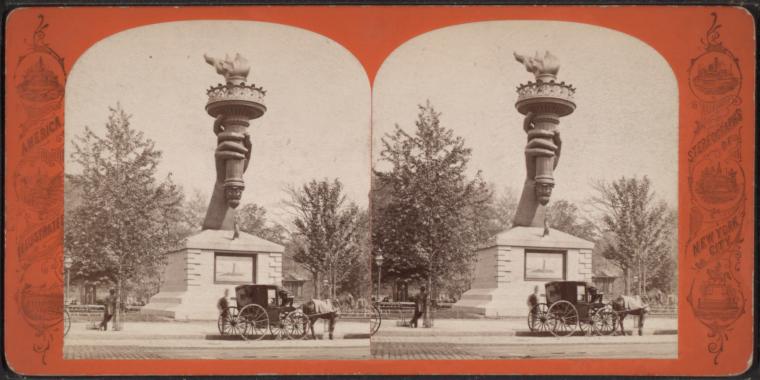
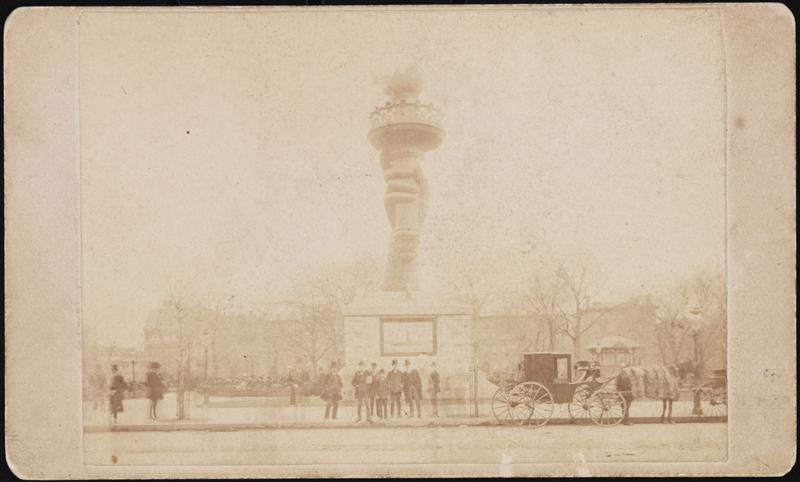
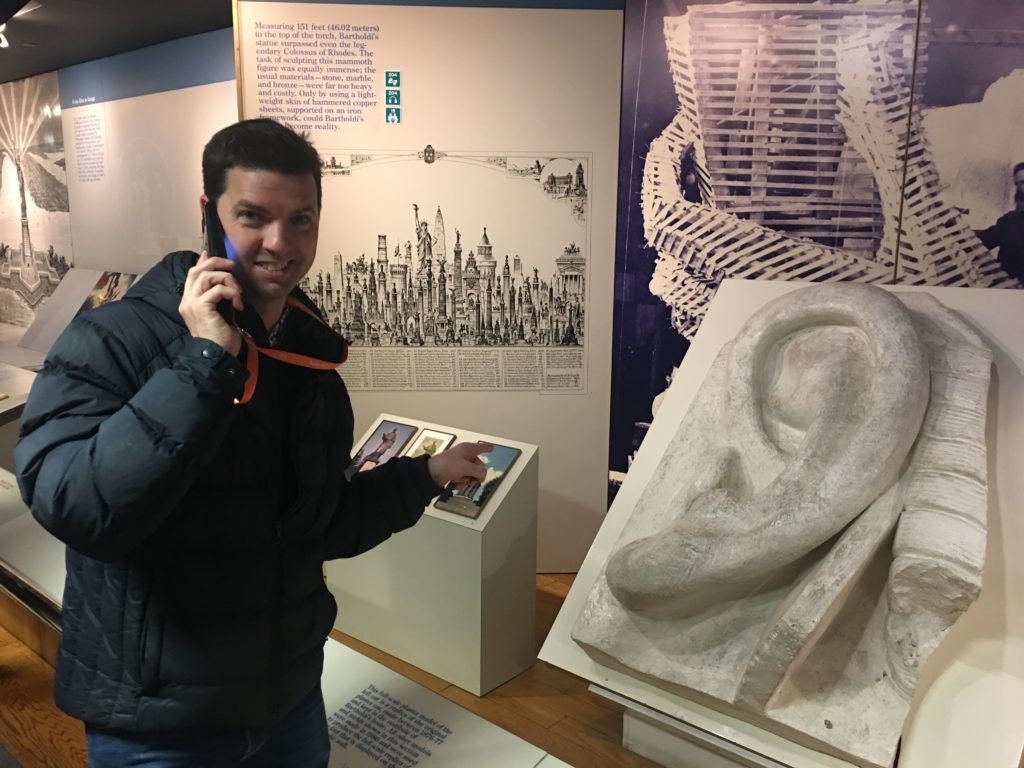
The park introduced New Yorkers to the Statue of Liberty … or at least her forearm and torch. It stood silently over the bustling park while prize-winning dogs were championed at the very first Westminster Kennel Club Dog Show nearby, held at Gilmore’s Gardens, the precursor to Madison Square Garden.
Today the region north of the park is referred to as NoMad, which recalls life around Madison Square during the Gilded Age with its high-end restaurant and hotel scene.
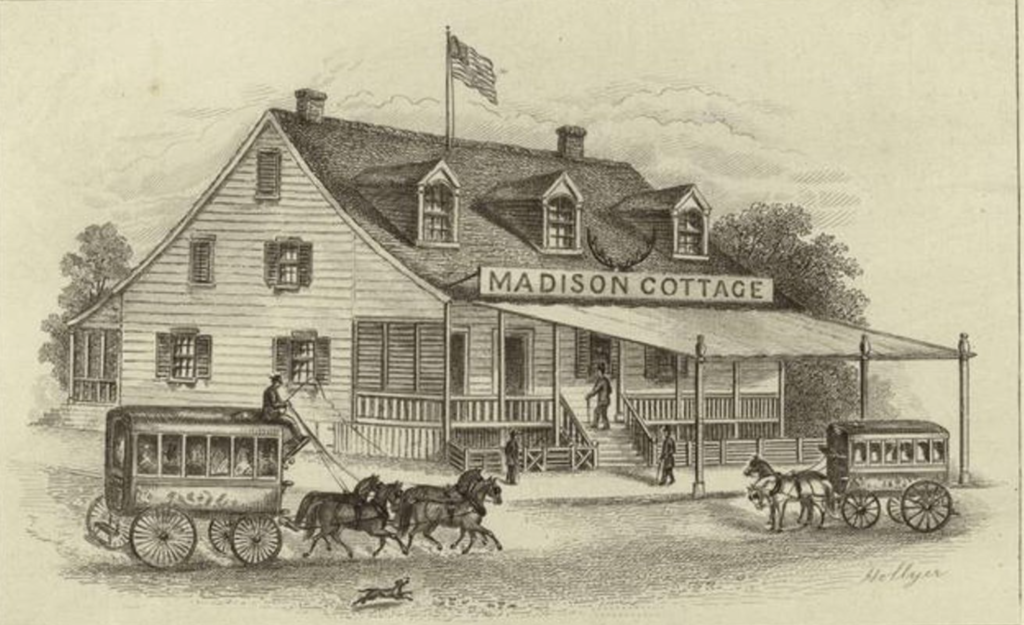
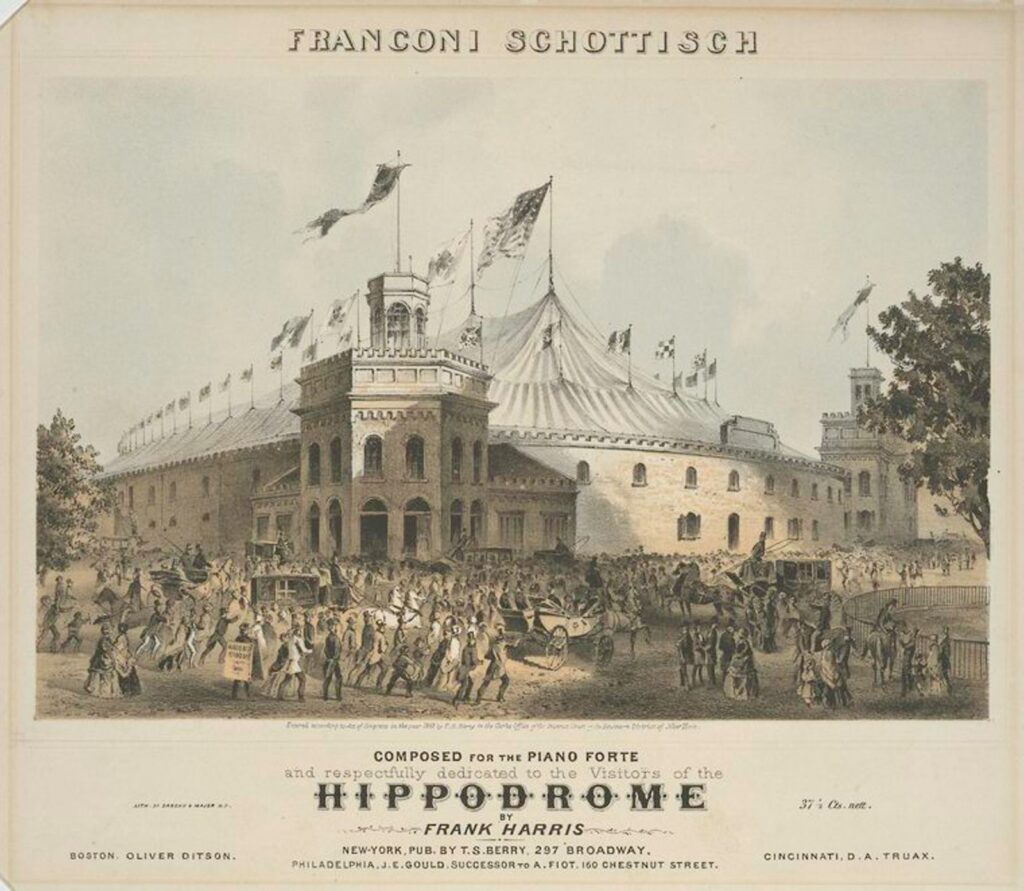
Tom and Greg invite you on this time-traveling escapade covering over 200 years of history. From the days of rustic creeks and cottages to the long lines at the Shake Shake. From Franconi’s Hippodrome to the dazzling colonge fountains of Leonard Jerome (Winston Churcill’s grandfather).
LISTEN HERE: IT HAPPENED AT MADISON SQUARE PARK
This episode’s title pays homage to one of favorite books about park history — It Happened On Washington Square by Emily Kies Folpe.
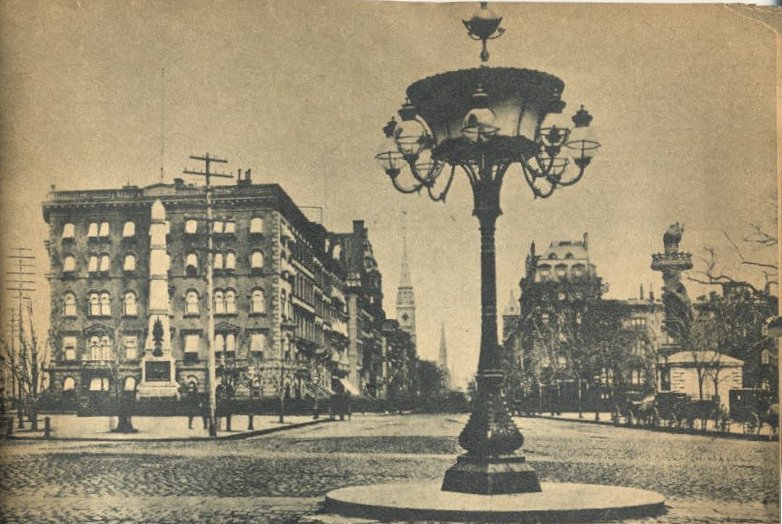
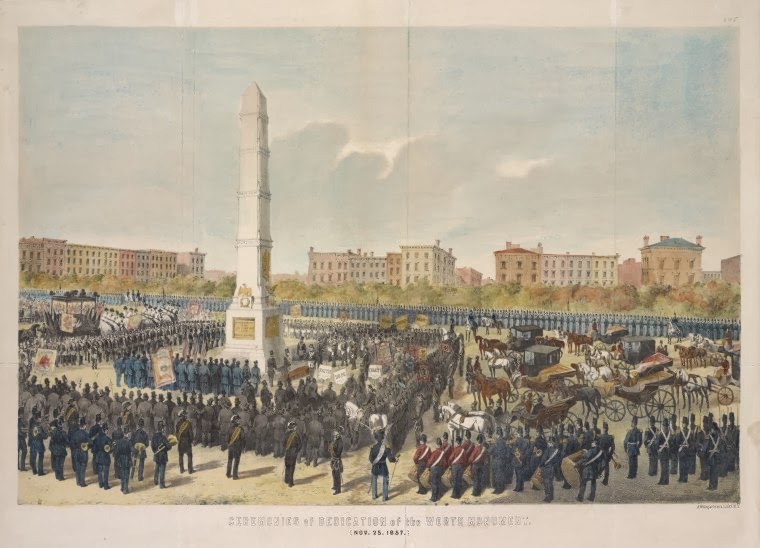
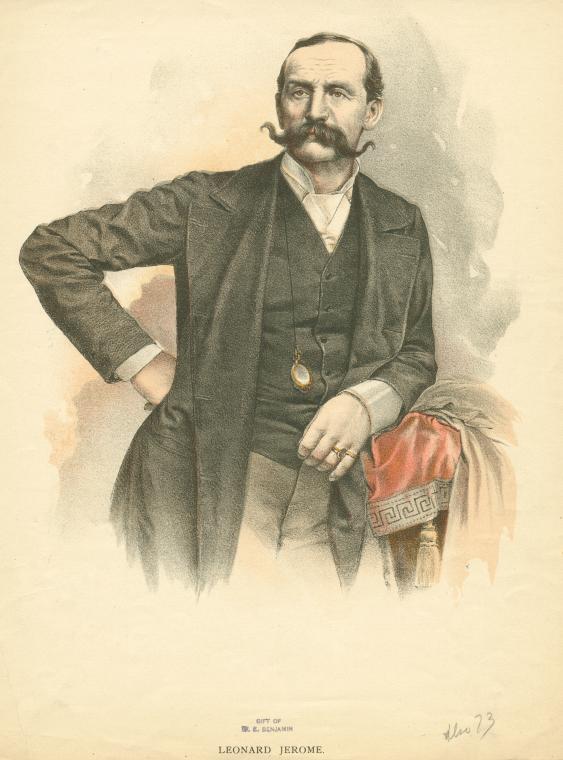
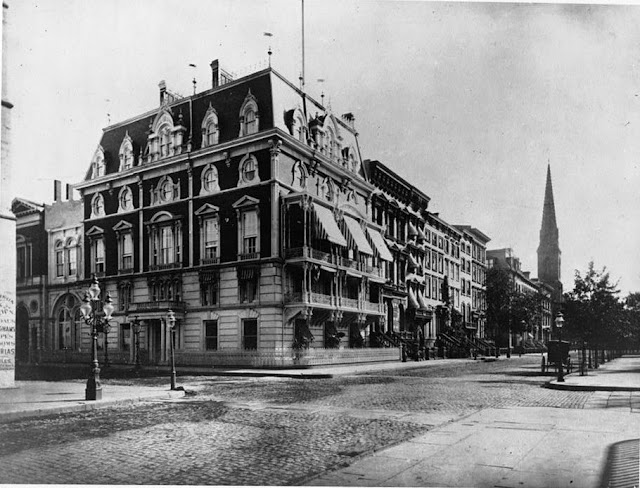
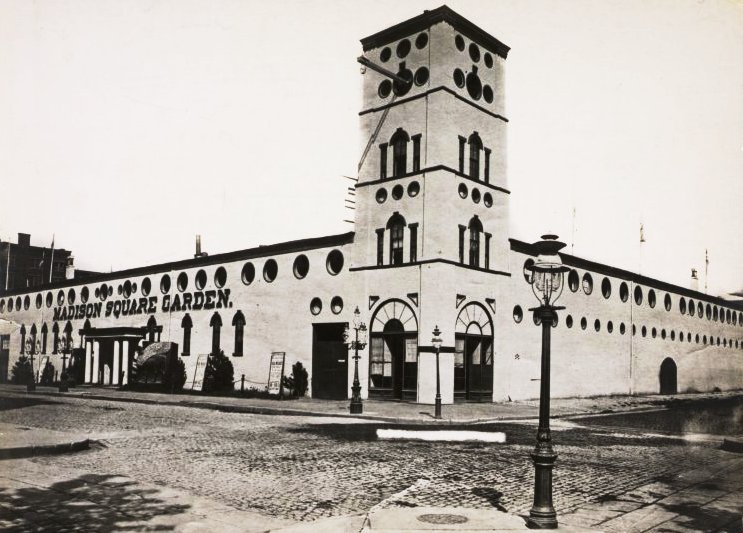
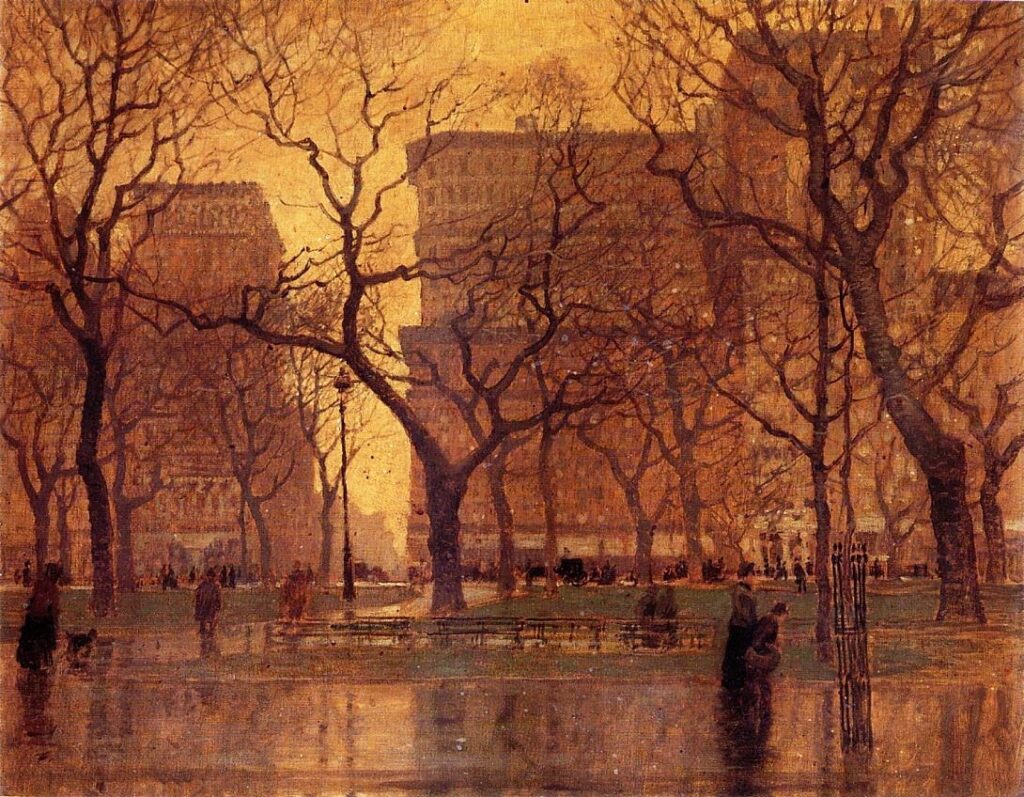
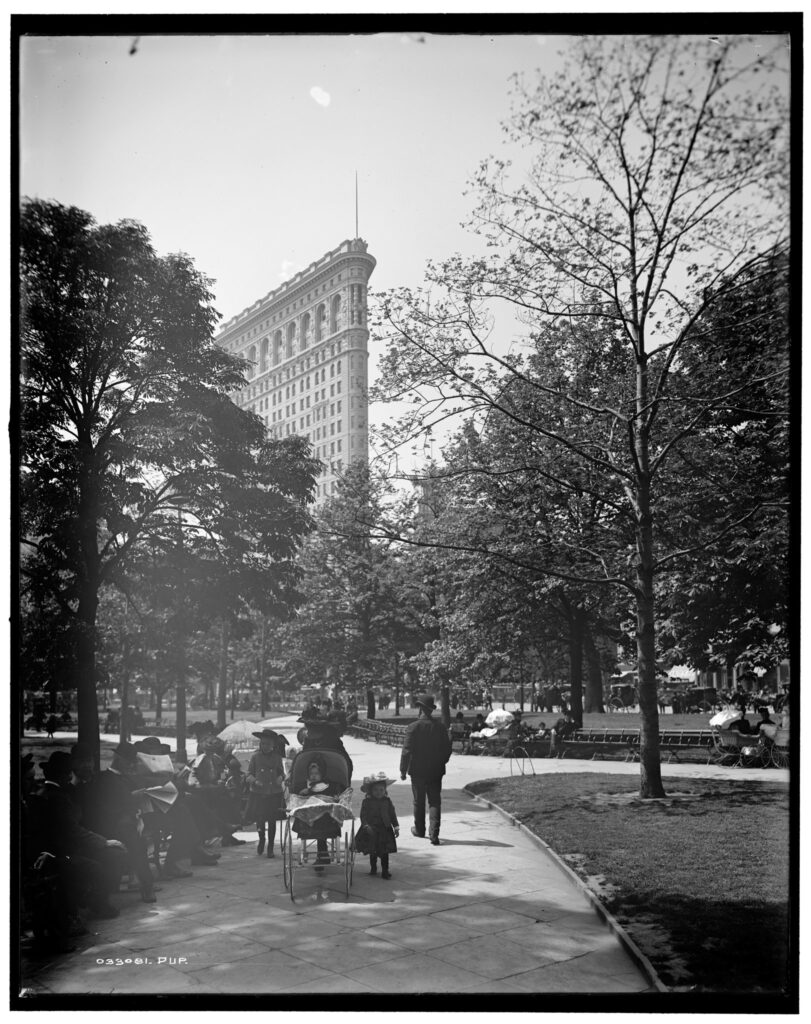
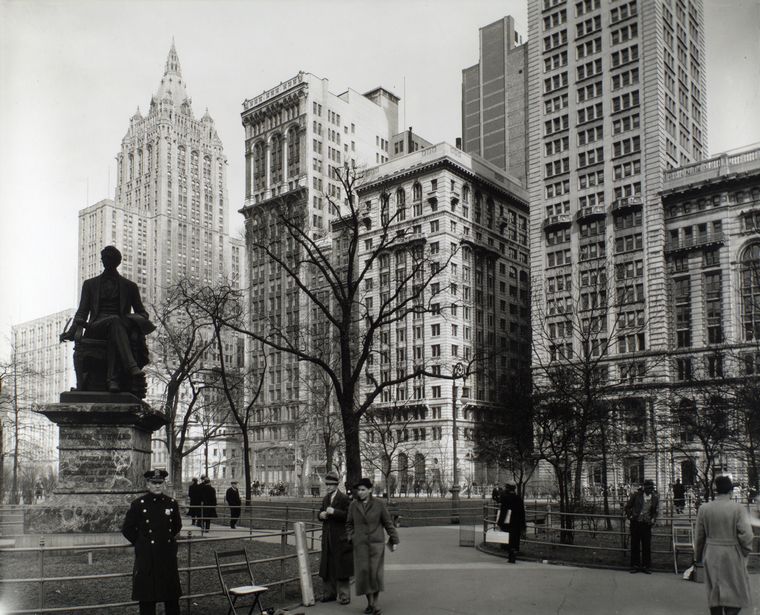
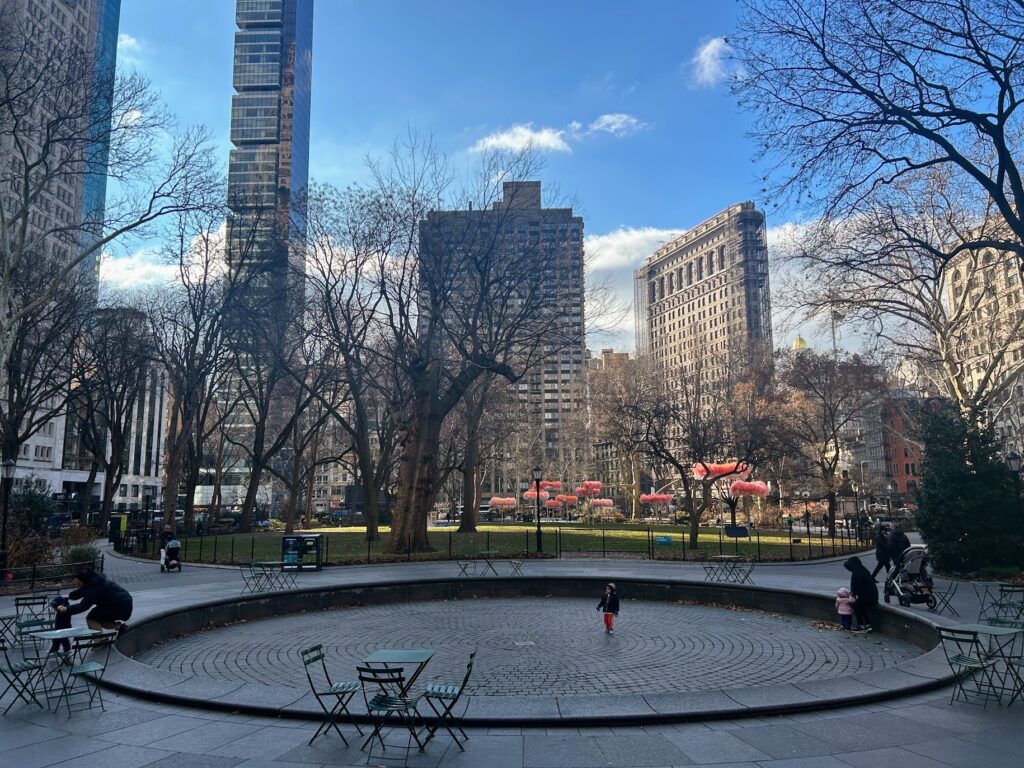
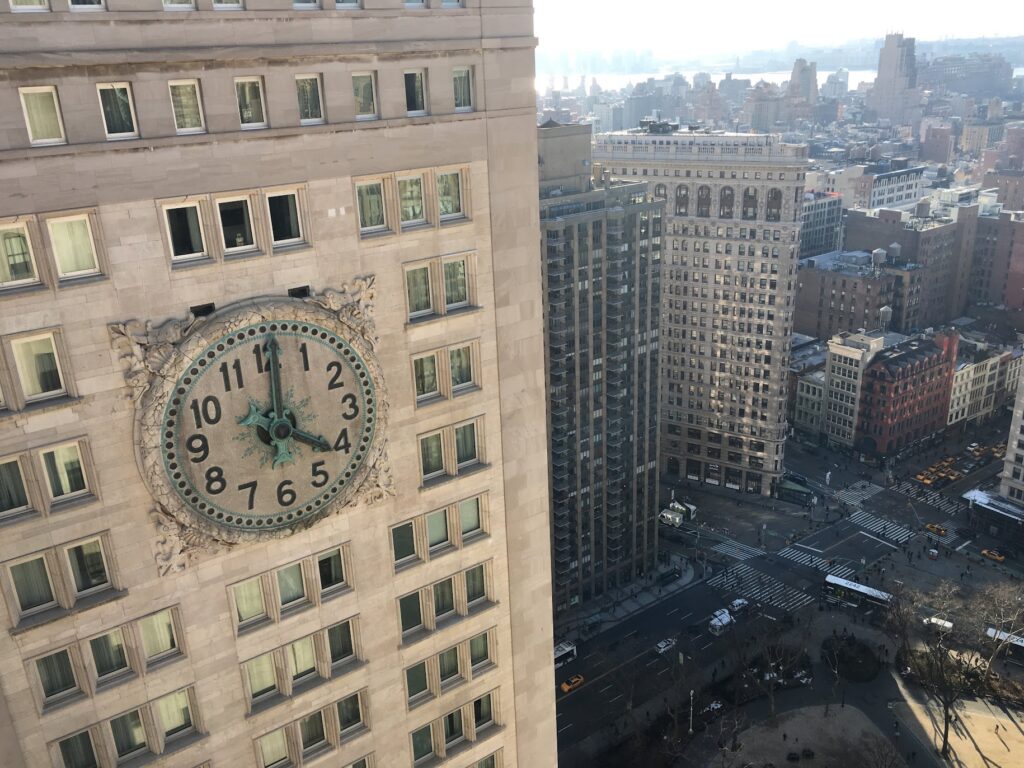
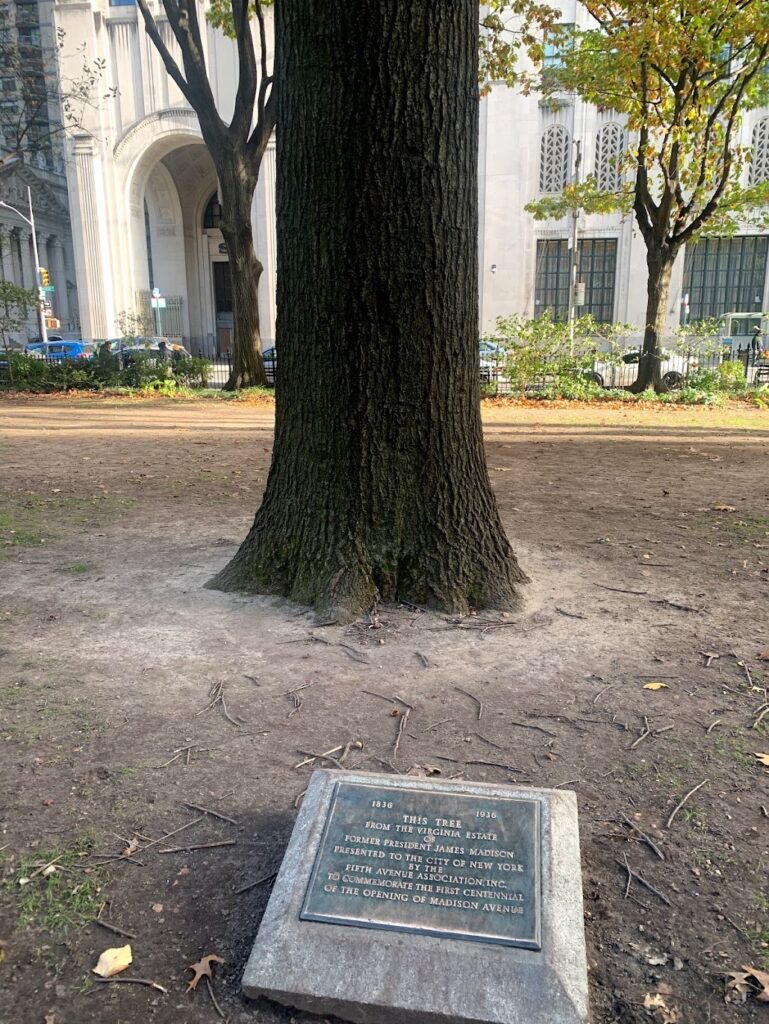
Madison Cottage, courtesy NYPLFranconi’s Hippodrome, 1853, courtesy NYPLDedication of the Worth Monument in 1857. In the background you can see the development of the surrounding areaLeonard Jerome….… and the Jerome Mansion. In the distance is the Madison Avenue Presbyterian Church. The former Gilmore’s Gardens, renamed Madison Square GardenRain on Madison Square, painting by Paul CornoyerCourtesy NYPLMadison Square 1936 , photo by Berenice AbbottNorthern pool in Madison Square Park. Photo by Greg YoungLooking down at the Metropolitan Life Tower and the Flatiron Building. Photo by Greg YoungThe park features a tree from James Madison’s Virginia plantation.
FURTHER READING
A Block in Time: A New York City History at the Corner of Fifth Avenue and Twenty-Third Street / Christiane Bird The Flatiron: The New York Landmark and the Incomparable City That Arose with It / Alice Sparberg Alexiou The Grandest Madison Square Garden: Art, Scandal, and Architecture in Gilded Age New York / Suzanne Hinman Incredible New York: High Life and Low Life from 1850 to 1950 / Lloyd Morris Liberty’s Torch: The Great Adventure to Build the Statue of Liberty / Elizabeth Mitchell Madison Square: The Park and Its Celebrated Landmarks / Miriam Berman Madison Square Garden, 100 Years of History / Joseph Durso
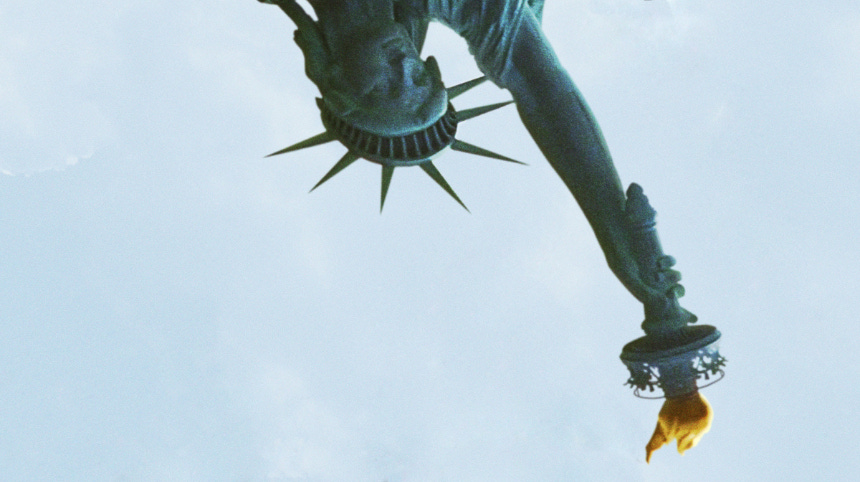
Above: The arm of the Statue of Liberty stood solitary in Madison Square for six years, from 1876 to 1882.
Eugene Emmanuel Viollet-le-Duc, one of the forgotten names in Statue of Liberty history was born in Paris. As the godfather of historical restoration, Viollet-le-Duc would rescue countless medieval structures from decay, helping to preserve the spirit of French architecture through such buildings as Notre-Dame and Mont Sant-Michel.
But it’s through his association with his student Frédéric Bartholdi that Viollet-le-Duc would make his mark in America, as the original designer of the Statue of Liberty‘s brick-laden skeleton.
Viollet-le-Duc would work with Bartholdi in creating both the head and the arm, parts that would then travel to the United States to raise funds for the completed structure.
In particular, the arm and torch would be displayed in the northwest corner of Madison Square Park, from 1876 to 1882. On July 4th, 1876, a gigantic painting byJean-Baptiste Lavastreof the completed statue was displayed on a building across the street from the arm.
Below: The arm would also make its way to the 1876 Philadelphia Centennial Exposition.
Sadly, Viollet-le-Duc would never again see these portions of the statue, as he died in 1879 before the entire structure was completely built. Bartholdi then turned to another architect to complete the work — Gustave Eiffel. It’s Eiffel’s redesigned interior that supports the statue today.
In 1889, three years after the Statue of Liberty finally made its home in New York harbor, Eiffel debuted his better known work — the Eiffel Tower — at the Paris World’s Fair.
But the somewhat radical theories of restoration espoused by Viollet-le-Duc would inspire American architects and inform the direction of modern historical preservation.
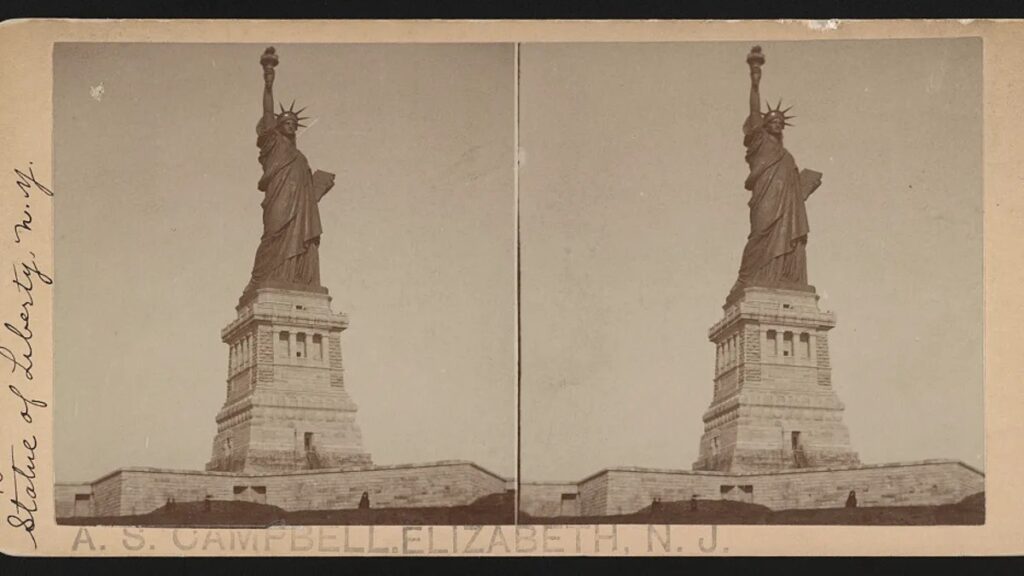
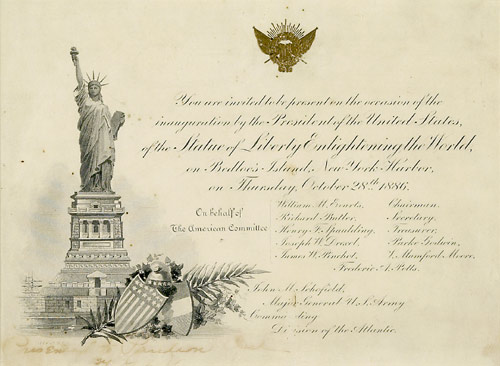
The Statue of Liberty celebrates her 135th birthday today. Technically, I suppose, it’s the anniversary of her dedication, a star-studded, pomp-laden ceremony that took place on Friday, October 28, 1886.
But for many months previous, she was a fierce presence in the harbor, as the copper monument was arduously stitched together from far flung pieces — including an arm which sat in Madison Square Park for many years — upon a contentious new pedestal by Richard Morris Hunt.
The dedication ceremony was not the sterling event of pure American patriotism that one might expect. The reality of her debut proved far more interesting:
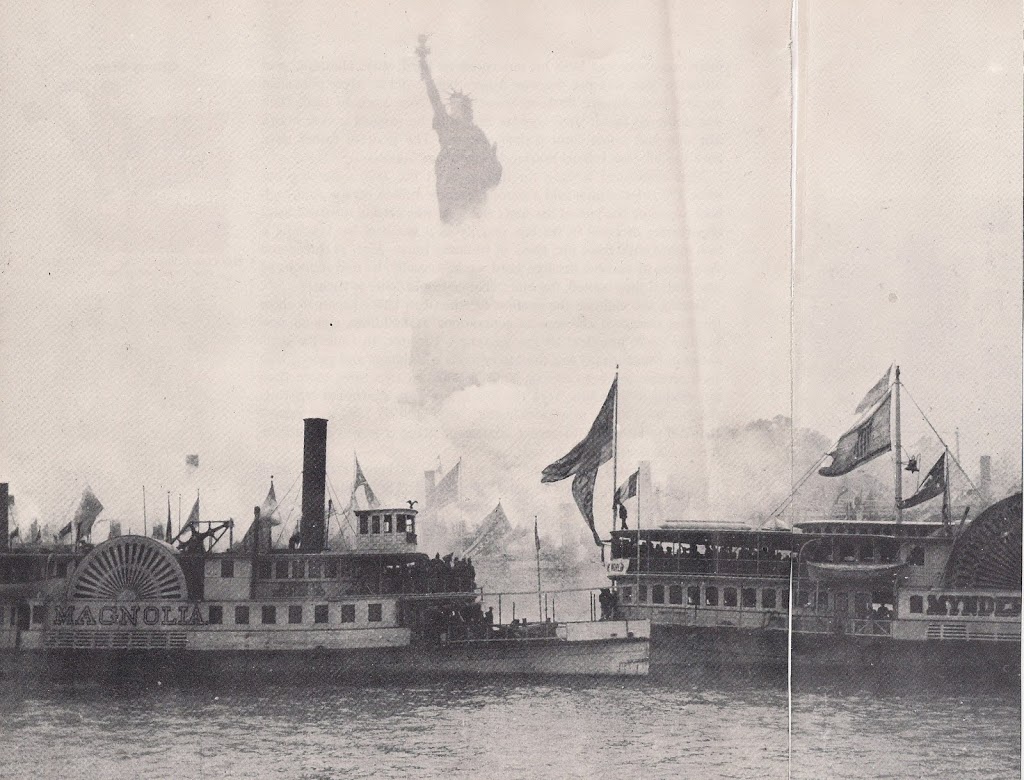
1) The weather was totally awful that day. Nasty weather, rainy and wet, nearly wrecked the day, with the statue surrounded in mist and then a ‘regular London fog‘.
2) It was as much a celebration of the French as it was of the statue. Despite the rain, a contingent of 20,000 men in French uniform marched down Fifth Avenue in the morning, and the French tricolor was waved alongside the flag of the United States from virtually every window and balcony.
3) The early action took place in Madison Square Park. The official ceremony began near the Worth Monumentnext to Madison Square Park, with President Grover Cleveland, the statue’s creator Frederic Bartholdi and other luminaries in a parade reviewing stand, enjoying marching bands in the pouring rain. Apparently, Cleveland stood in the downpour for over two hours without an umbrella. (This is most peculiar behavior, considering what is popularly believed to have happened to President William Henry Harrison a few decades previous.)
4) No respect for veterans! A minor controversy erupted involving the participation of the three remaining living veterans of the War of 1812. They had been slated to join the parade, but somebody neglected to send a carriage for them. “The Memorial Committee of the Grand Army forgot us three times. We will never appear on a public occasion again,” proclaimed 90-year-old General Abram Daly.
Below: The official invitation to the inauguration ceremony.
5) Lady Liberty was covered in a gigantic French flag. After the parade, all New Yorkers, en masse, rushed towards Battery Park, ostensibly to watch the dedication ceremony (but then, of course, it was too foggy to see anything).
The dignitaries, meanwhile, maneuvered a boat through crowded waters over to Bedloe’s Island. They were greeted by a looming, shadowy figure draped in a gigantic, wet French flag.
The effect, according to the newspapers, was one of mystery and eeriness. “[T]he nearest of the men-of-war could be seen floating like phantoms on what might either have been fog or water so far as the eye could see.” [source]
6) There’s only room for one Lady at this ceremony. Despite being a celebration of a large, glorious woman, there were less than a dozen actual women invited to the Bedloe’s Island ceremony, of the 2,500 or so that slowly made their way to their seats. (A boat of bold suffragists did navigate close to the island.)
In one way, it was for the best; it took hours for people to arrive at the island. The bandleader, the estimable Patrick Gilmore, played a bevy of marches and French folk songs until he and his musicians was soaking wet.
7)Â It was really too loud to be having a ceremony at all. Explosions and whistles, the “impish screech” of steamships and tugboats, filled the harbor in celebration, and nobody on Bedloe’s Island could really signal to anybody to get them to stop. The dedication prayer and several speeches were drowned out. Ferdinand de Lessups, developer of the Suez Canal and head of the French delegation, dryly remarked of the noisy steamships, “Steam, which has done so much good in the world, is just now doing us a good deal of injury.”
8) Unveiling fiasco! At the close of a very grand speech by New York senator William Evarts, a series of signals was to be sent to Bartholdi, holding a cord which would pull away the gigantic flag.
There was a miscommunication however — in the middle of Evarts speech — and the cover was pulled off of Lady Liberty too early. This elicited a deafening, celebratory cry of horns, cannons and shouts from all around the harbor.
Evarts, however, was still speaking. Nobody could hear him, and thus people at the ceremony actually began dispersing. Everts ended by turning to President Cleveland, who sat nearby, and uncomfortably finished his prepared remarks. Awkward!
9) No ‘Enlightening the World’ today. The weather was so bad that the Statue of Liberty’s torch could not be illuminated, so plans for an elaborate ‘pyrotechnic display’ were scrapped.
10) The disaster that almost was: There were so many boats in the water — with fog and mist still impeding visibility (as pictured above) — that it is actually quite incredible that President Cleveland and the French dignitaries made it off of Bedloe’s Island alive. In fact, the president had to transfer to a smaller boat which successfully got him to the Penn Railroad station on the New Jersey side.
11) Occupy Wall Street? The celebration didn’t stop there. Parades and marching bands marched well into the evening, with apparently little crowd control. At around Broadway and Wall Street and further south to Maiden Lane, streets were so clogged that there was literally no movement for over an hour.
Overhead, people shouted from rooftops and even shot off pistols. Meanwhile, further north on Canal Street, somebody actually had the wise idea of placing a cannon on a rooftop and firing it in celebration. (No word on any suspected damage.) The city’s grand fireworks display did eventually take place, on November 1st.
EPISODE 342 A very special Bowery Boys: New York City History podcast presentation, recorded live on Halloween Night 2019.
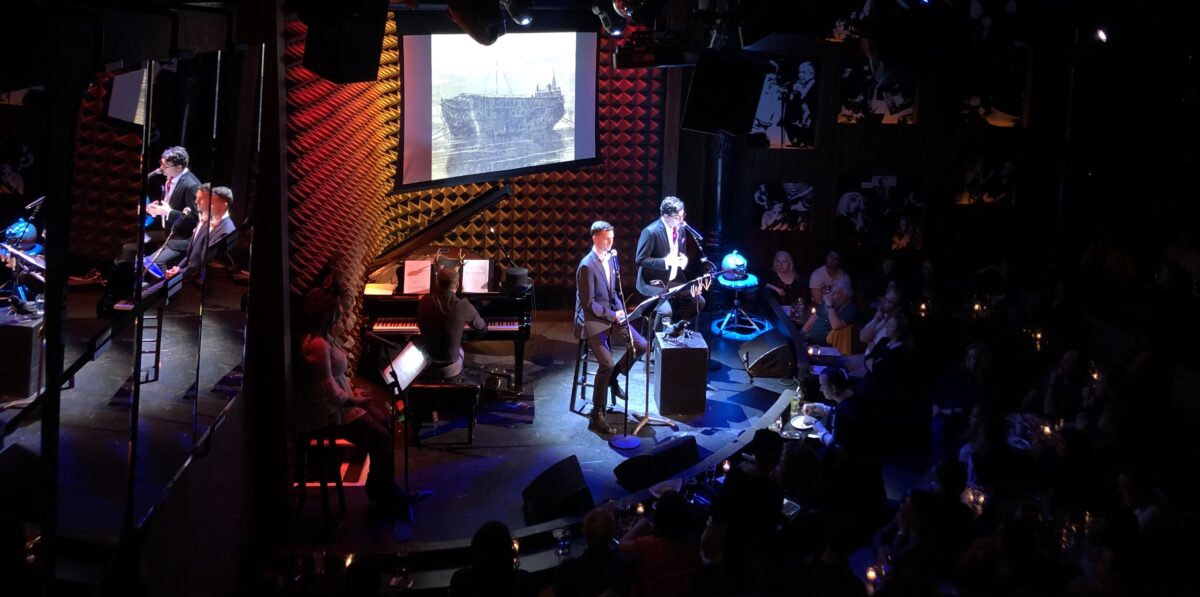
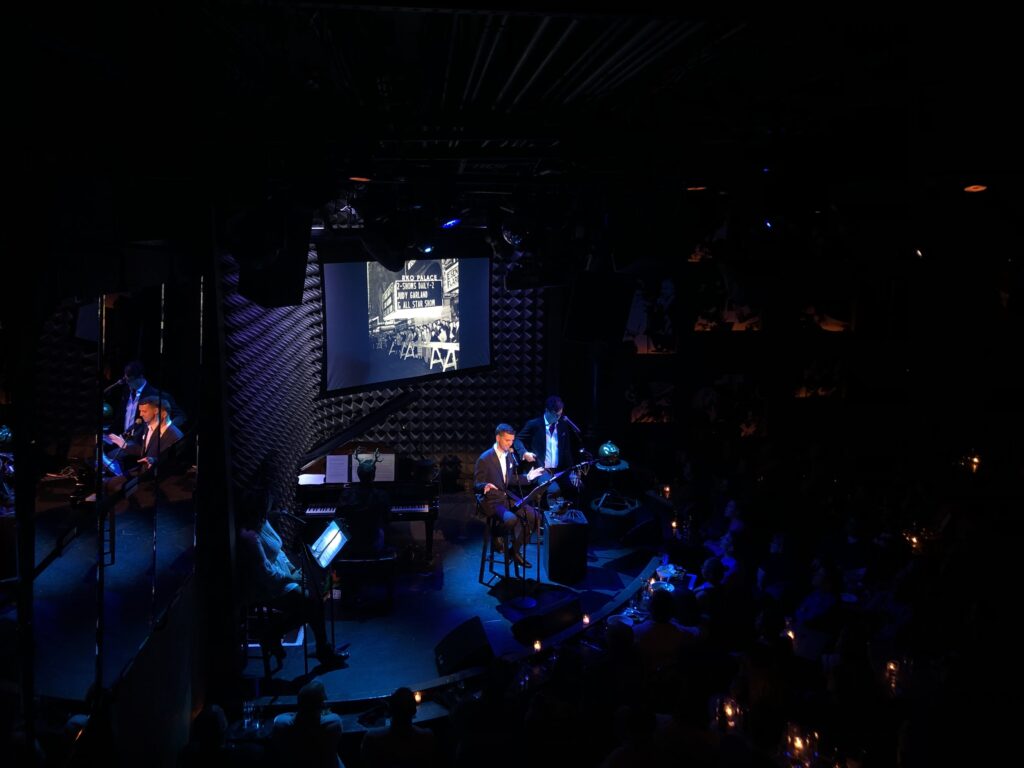
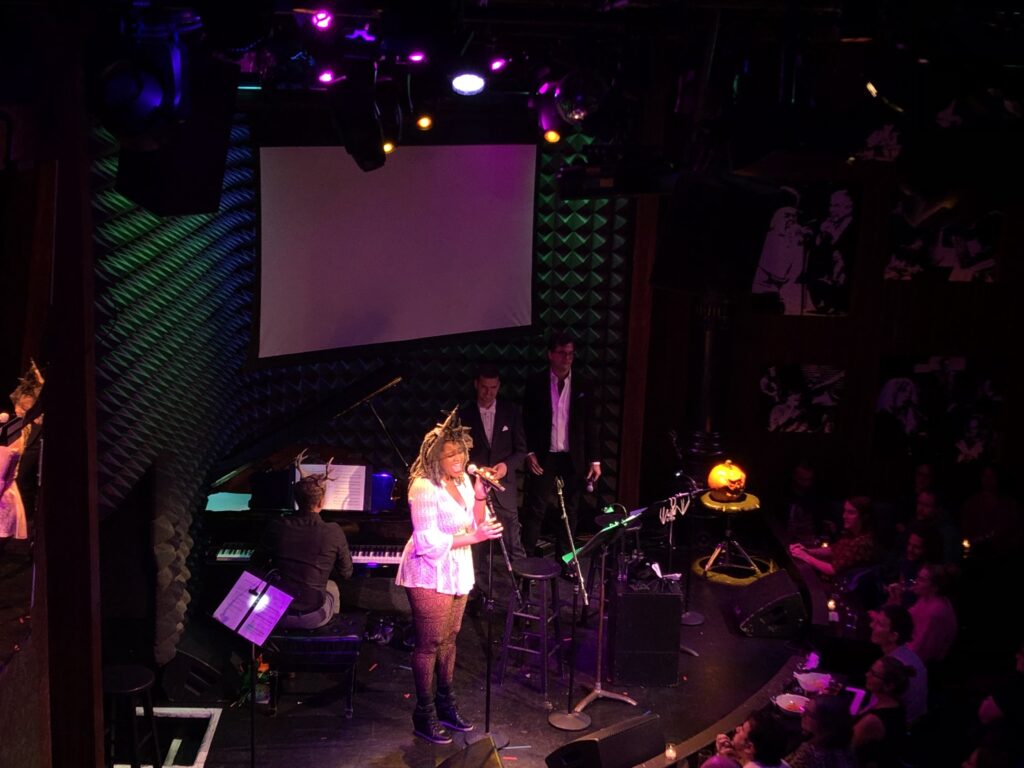
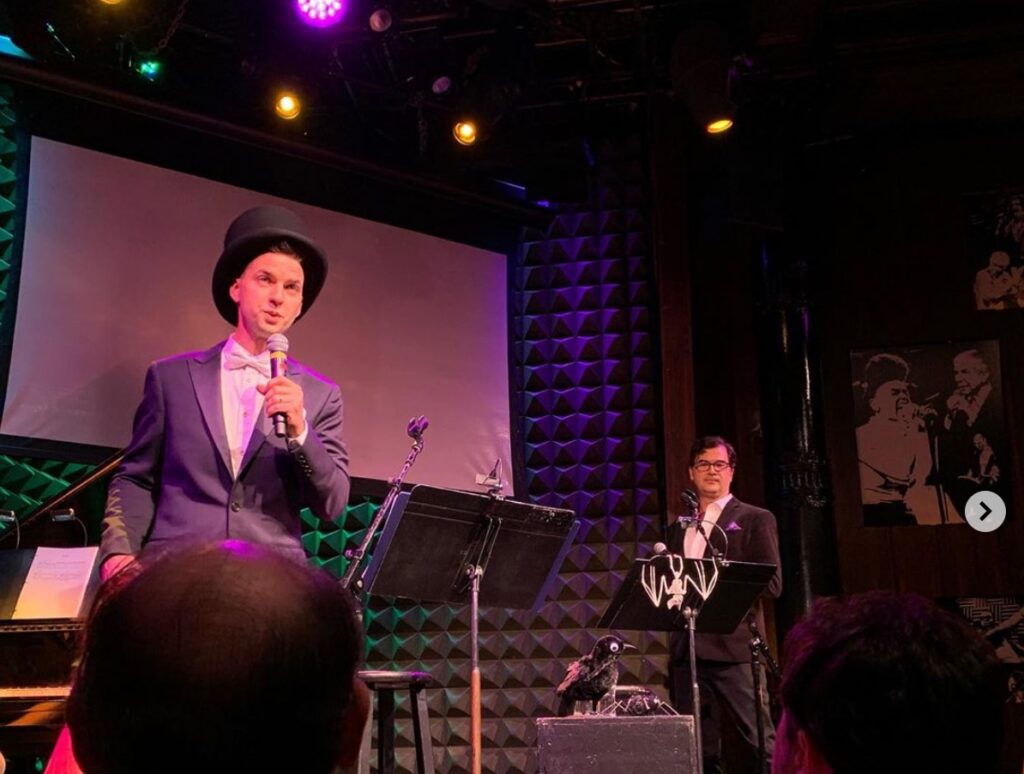
For the past couple years we have put on a LIVE cabaret version of our annual Ghost Stories podcast at Joe’s Pub at the Public Theater.
For reasons related to the fact that it’s the hellish year of 2020, we cannot bring you a live performance this year.
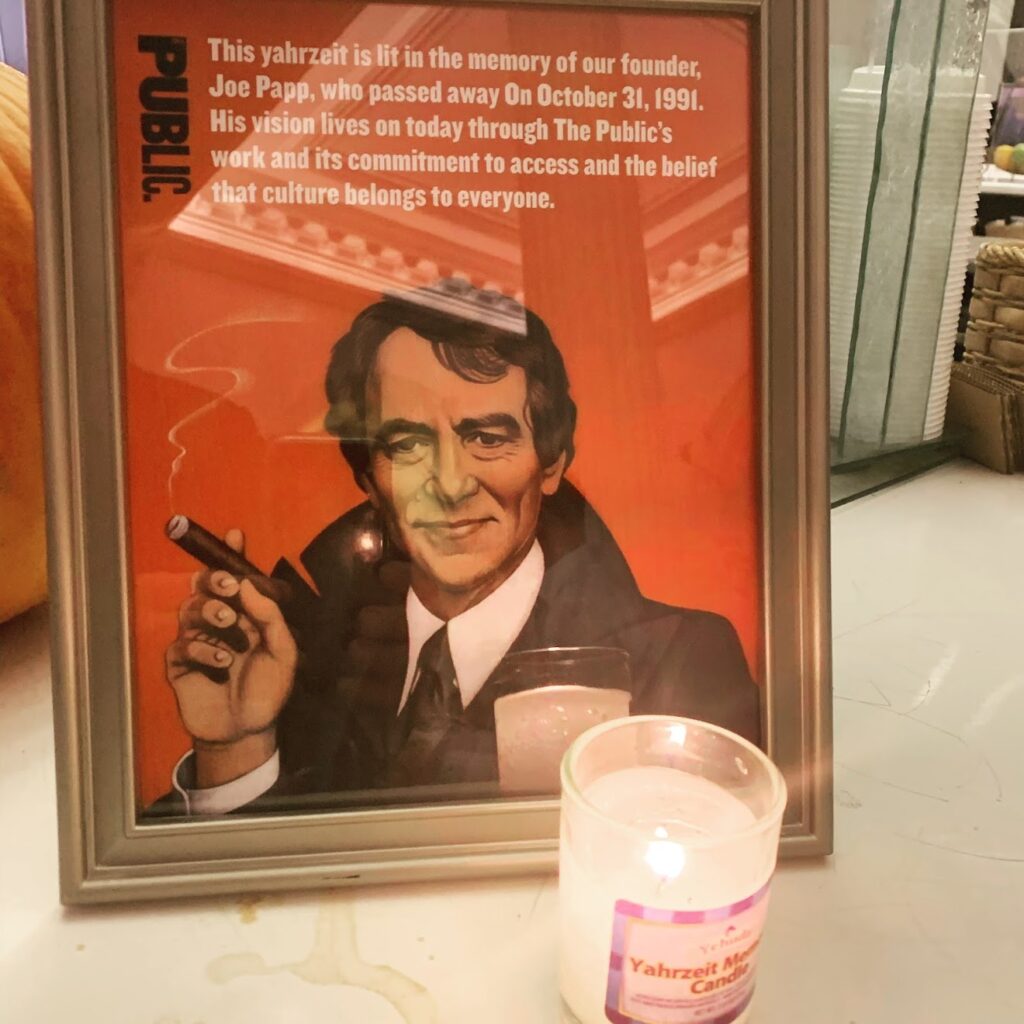
Every Halloween night, a candle is placed in the lobby of the Public Theater in honor of its founder Joseph Papp.
But we miss the wonderful Joe’s Pub so much – and we miss being with our listeners in a cabaret setting with cocktails – that we’re presenting to you a live recording of our last show at the storied venue, recorded on Halloween night 2019, featuring pianist and composer Andrew Austin and vocalist Bessie D Smith.
Prepare to hear new versions of your favorite ghost stories including:
— A Brooklyn house haunting that may be related to the spirits from a colonial-era prison ship;
— A famous murder trial from the year 1800 and a mysterious well which still stands in the neighborhood of SoHo;
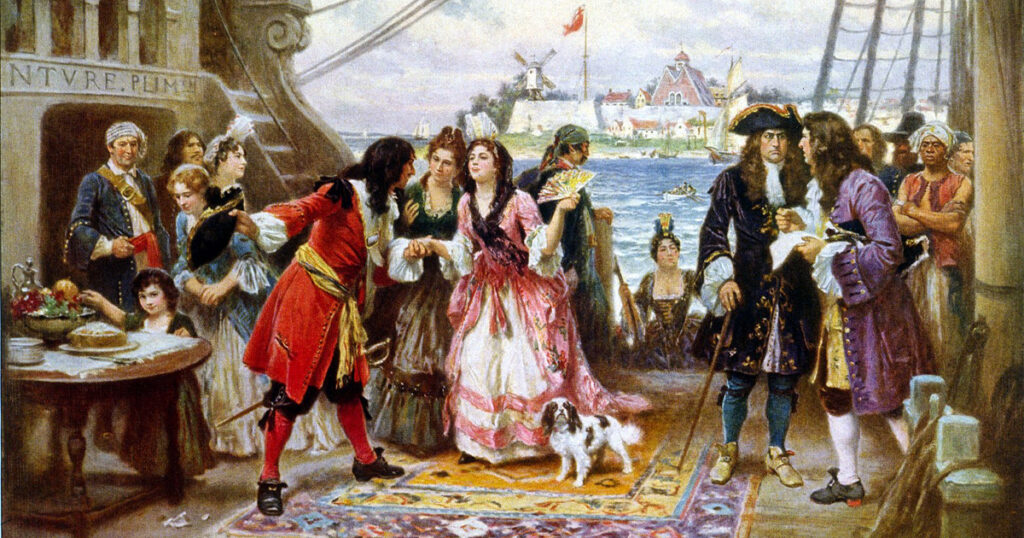
— The ghosts (or other supernatural entities) which guard the treasure of the famous Captain Kidd; and
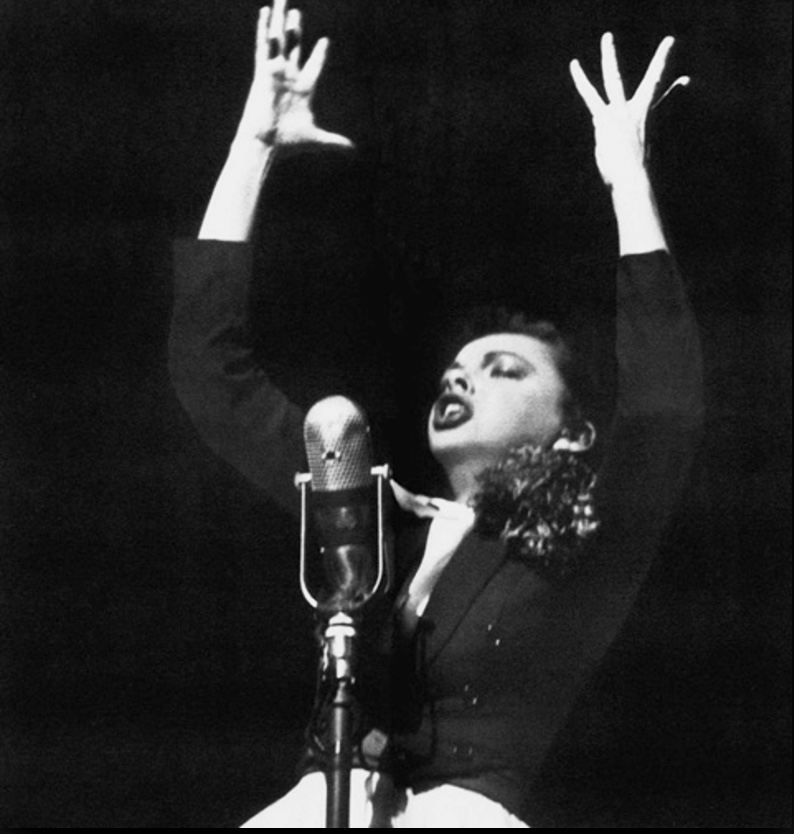
— The mournful secrets of a famed Broadway theater and the inner demons of a Hollywood icon.
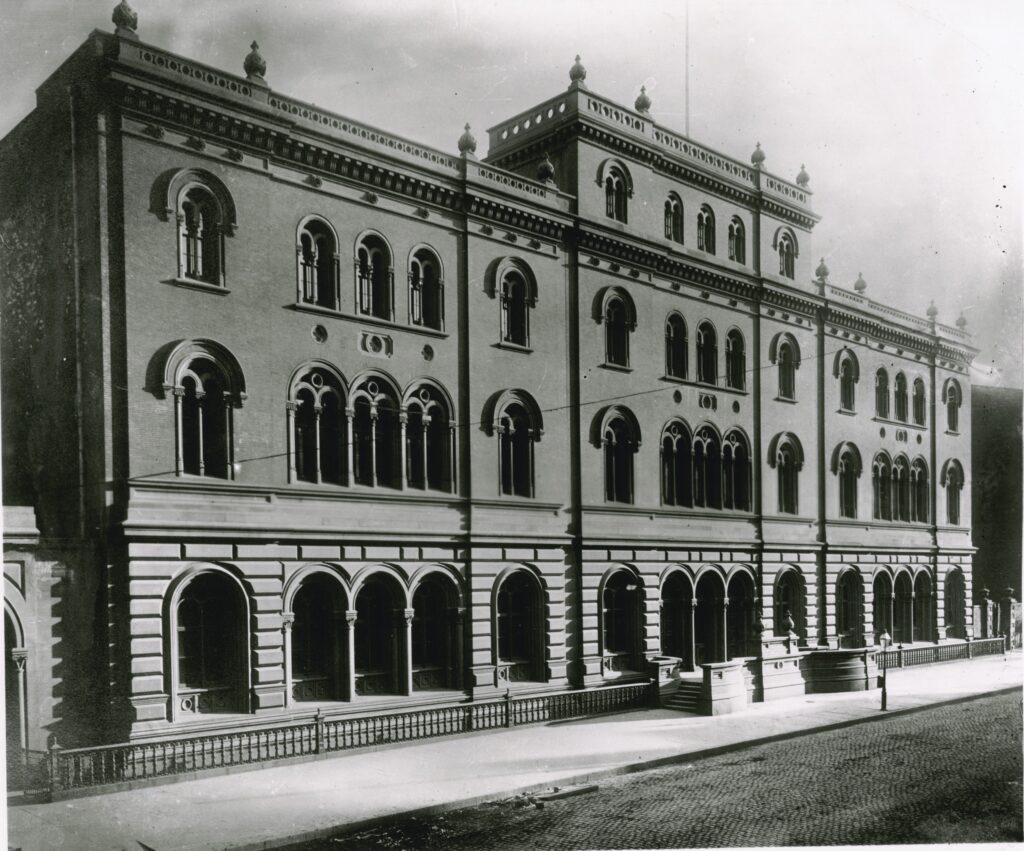
With an ALL NEW GHOST STORY — WHO HAUNTS THE FORMER ASTOR LIBRARY?
Listen today on your favorite podcast player:
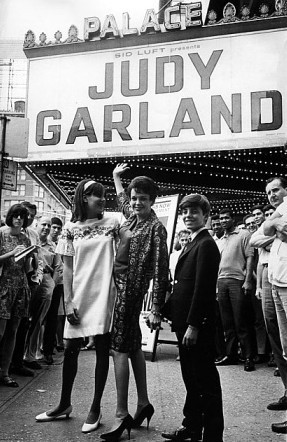
Photos by Julia Press136 Clinton Avenue in Brooklyn back when it was very, very close to the shoreline.The remainder of old Manhattan Well. (Image courtesy Scouting NY)Captain Kidd in early New York, depicted in a 1920 painting by Jean Leon Gerome FerrisJudy Garland at the Palace TheaterAstor Library, later the Public Theater. Courtesy New York Public Library
The Bowery Boys: New York City History podcast is brought to you …. by you!
We are now producing a new Bowery Boys podcast every week. We’re also looking to improve and expand the show in other ways — publishing, social media, live events and other forms of media. But we can only do this with your help!
We are now a creator on Patreon, a patronage platform where you can support your favorite content creators.
Please visit our page on Patreon and watch a short video of us recording the show and talking about our expansion plans.
If you’d like to help out, there are six different pledge levels.Check them out and consider being a sponsor.
We greatly appreciate our listeners and readers and thank you for joining us on this journey so far.
PODCAST The words of “The New Colossus,” written 135 years ago by Jewish poet Emma Lazarus in tribute to the Statue of Liberty, have never been more relevant — or as hotly debated — as they are today.
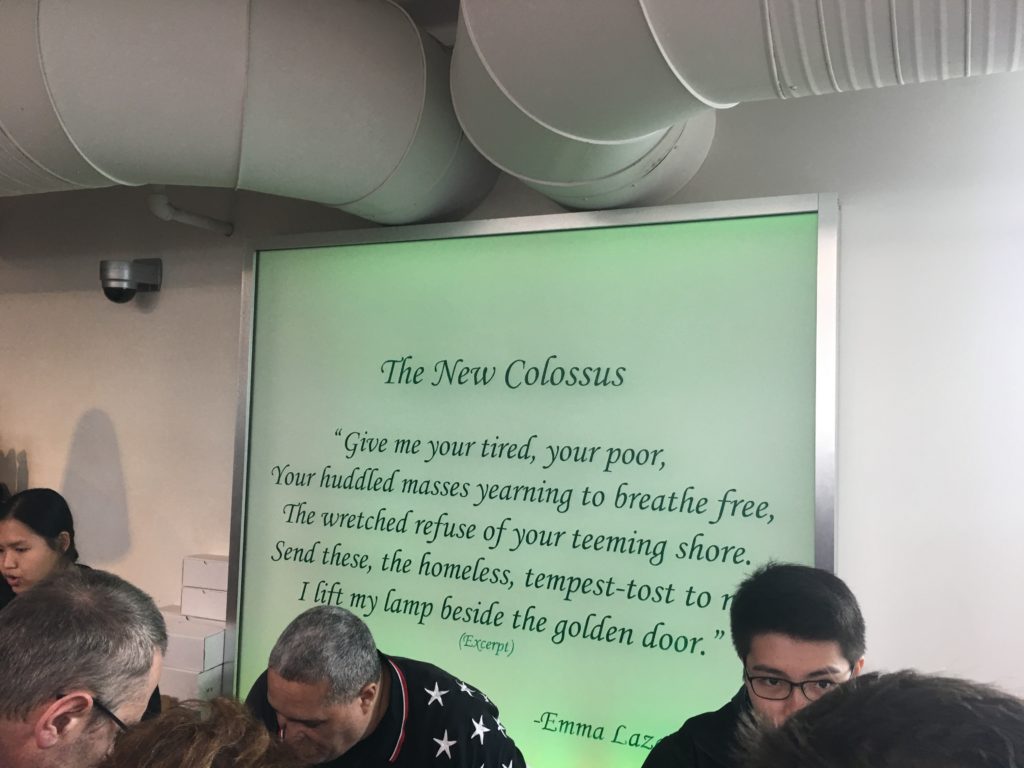
What do they mean to you? “Give me your tired, your poor/Your huddled masses yearning to breathe free/The wretched refuse of your teeming shore.”
In this episode, Tom and Greg look at the backstory of these verses — considered sacred by many — and the woman who created them.
Emma Lazarus was an exceptional writer and a unique personality who embraced her Jewish heritage even while befriending some of the greatest writers of the 19th century. When the French decided to bestow the gift of Liberty Enlightening the World to the United States, many Americans were uninterested in donating money to its installation in New York Harbor. Lazarus was convinced to write a poem about the statue but she decided to infuse her own meaning into it.
This icon of republican government — and friendship between France and America — would soon come to mean safe harbor and welcome to millions of new immigrants coming to America. But are Lazarus’ words still relevant in the 21st century?
The Bowery Boys: New York City History podcast is brought to you …. by you!
We are now producing a new Bowery Boys podcast every other week. We’re also looking to improve the show in other ways and expand in other ways as well — through publishing, social media, live events and other forms of media. But we can only do this with your help!
We are now a member of Patreon, a patronage platform where you can support your favorite content creators for as little as a $1 a month.
Please visit our page on Patreon and watch a short video of us recording the show and talking about our expansion plans. If you’d like to help out, there are five different pledge levels (and with clever names too — Mannahatta, New Amsterdam, Five Points, Gilded Age, Jazz Age and Empire State). Check them out and consider being a sponsor.
We greatly appreciate our listeners and readers and thank you for joining us on this journey so far.
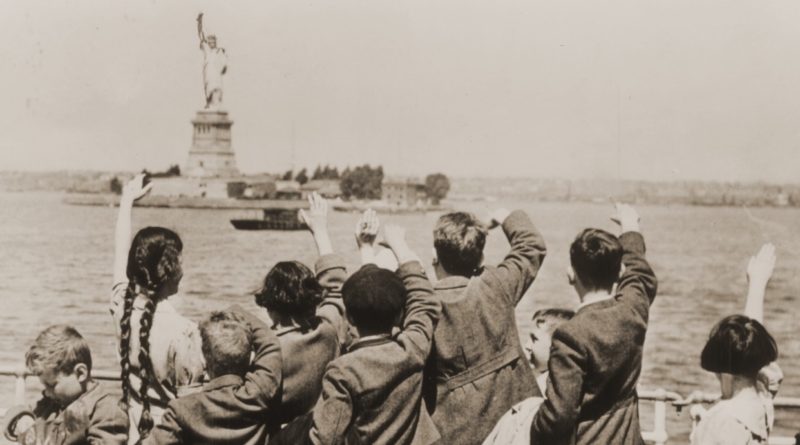
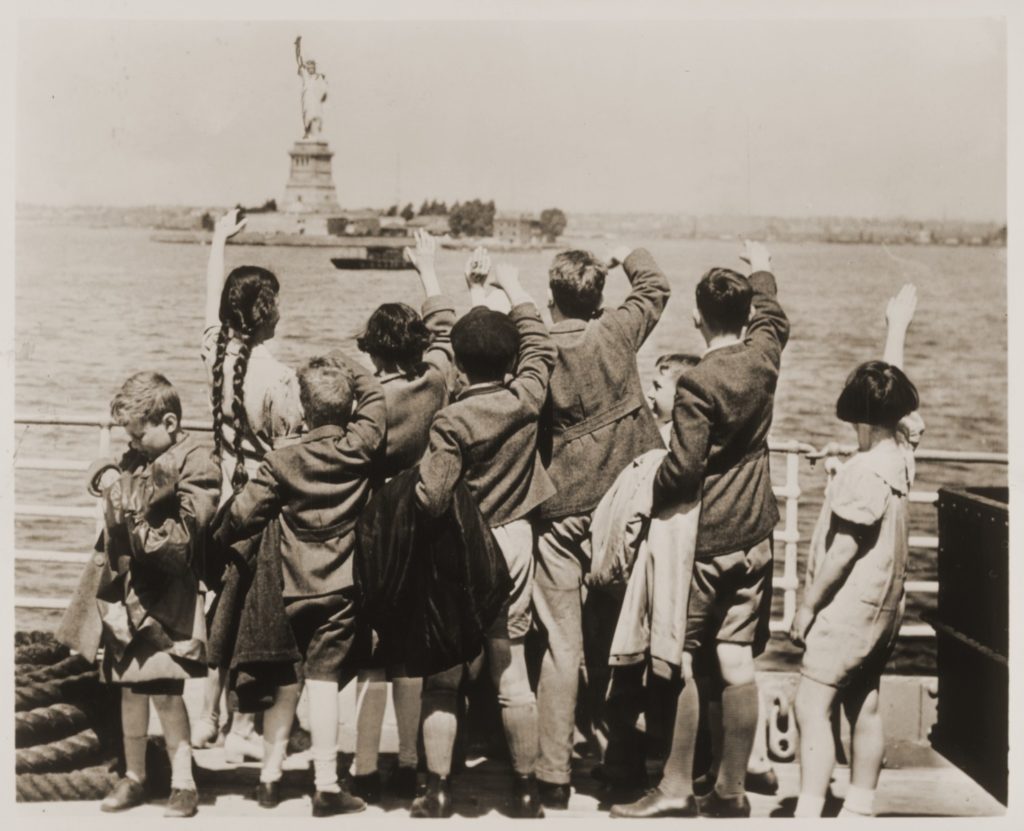
A group of fifty Jewish children, en route to Philadelphia in 1939, were placed into foster homes.
United States Holocaust Memorial Museum, courtesy of Anita Willens
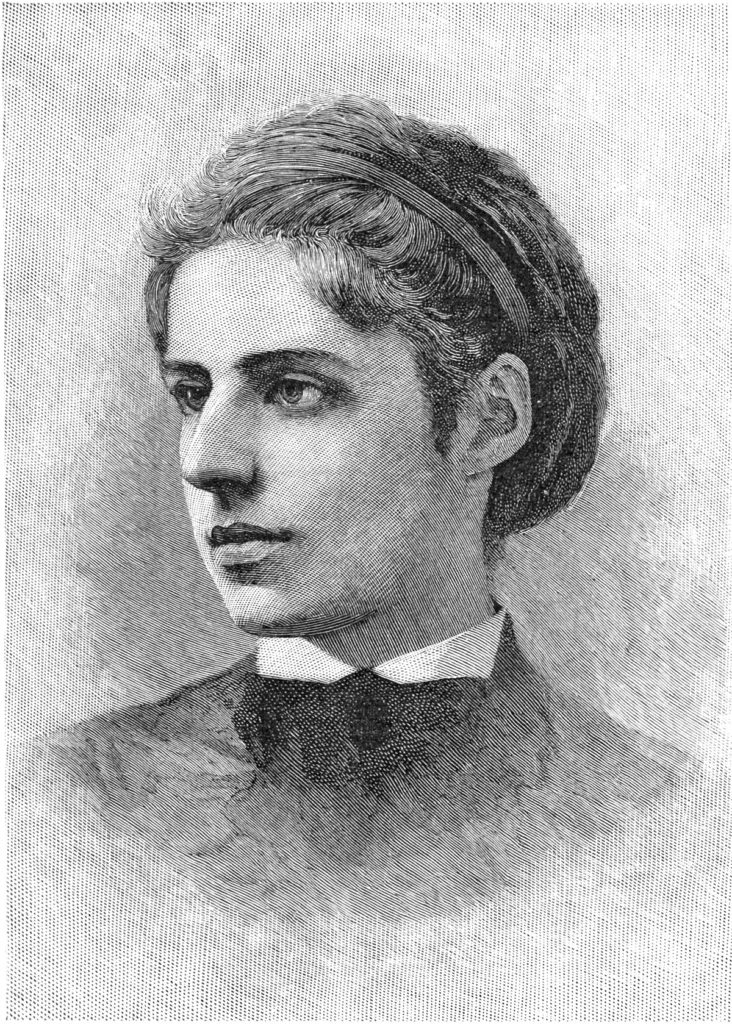
Emma Lazarus (1849-1887), a woman of exceptional writing skills who eventually embraced her Jewish heritage and worked to bridge the divide between settled Americans and newly arriving immigrants in need of assistance.
New Yorkers first saw a small portion of Lady Liberty — her arm and torch, displayed in Madison Square Park in an effort to raise money for her installation in New York Harbor.
Museum of City of New York
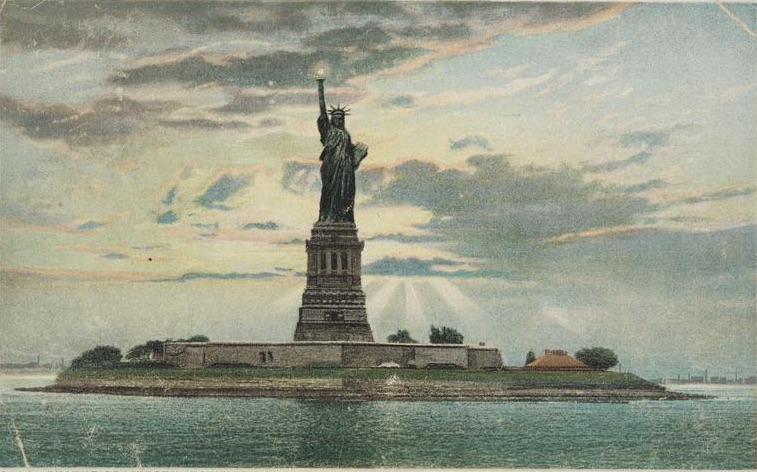
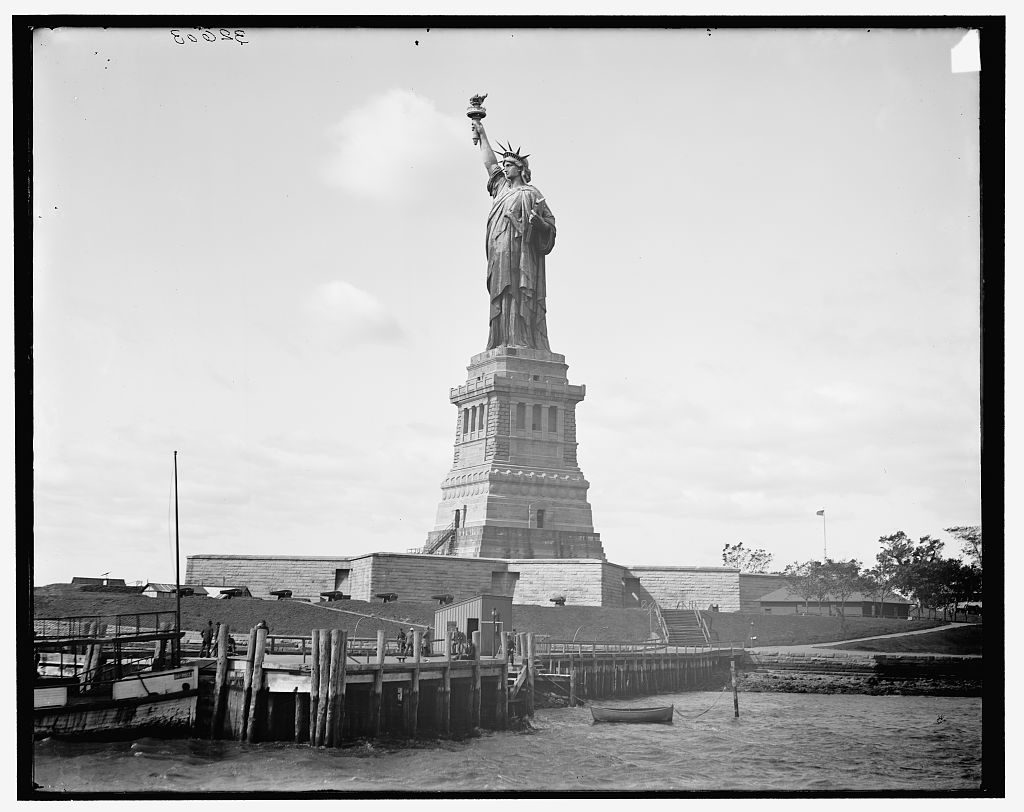
Liberty in 1890, prepared to welcome millions of new immigrants in the harbor. She’s actually copper at this time, not green.
Library of Congress/Detroit Publishing Co
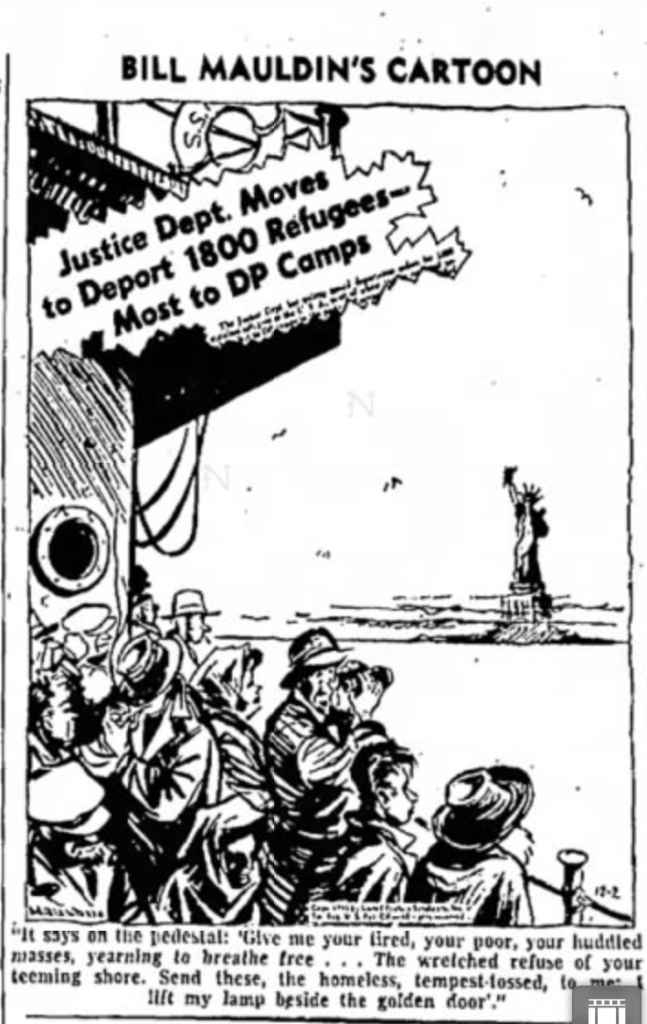
From a 1946 newspaper:
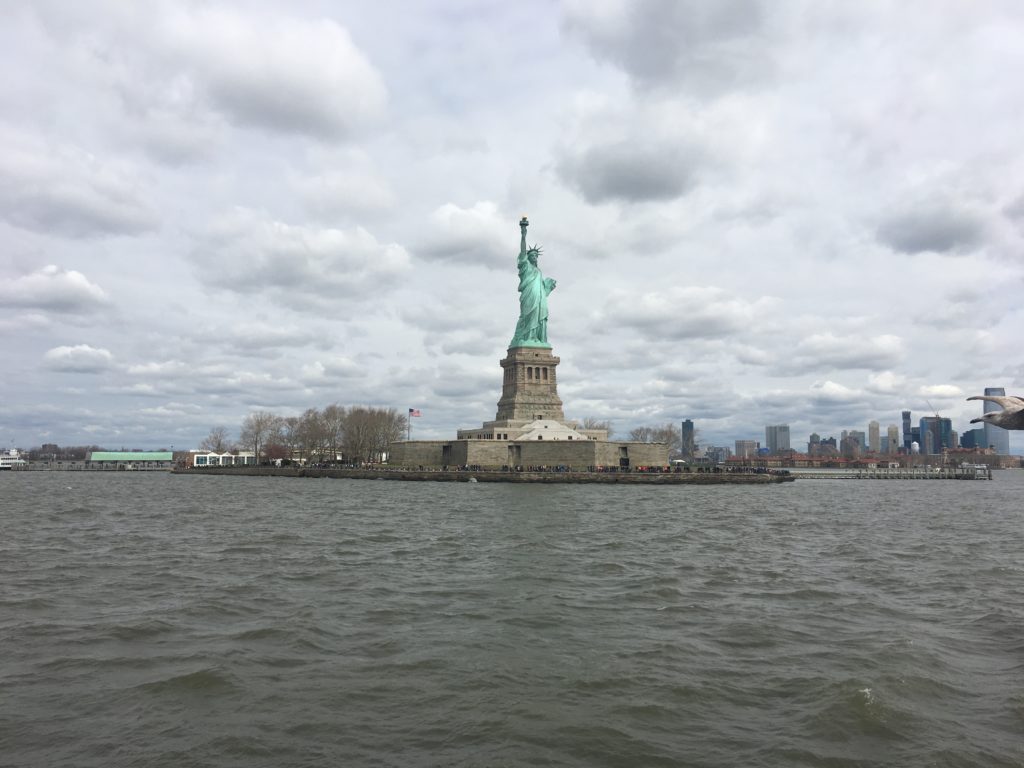
From our recent trip to the statue:
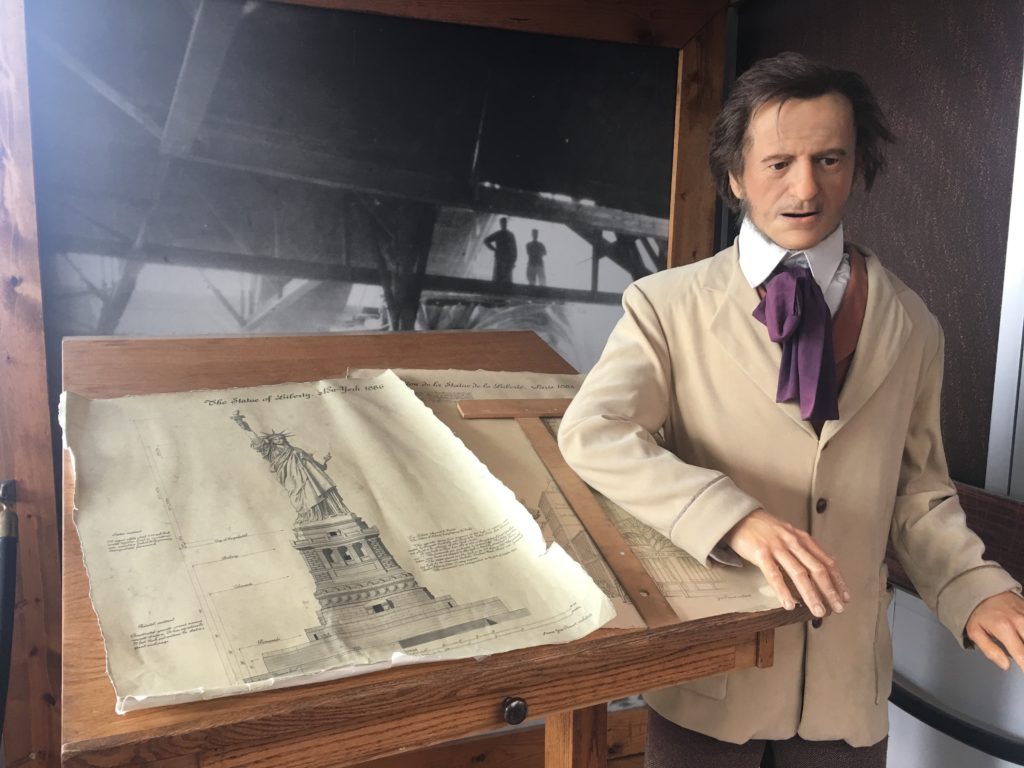
A waxen replica of Bartholdi in the gift shop:
The words of Emma Lazarus, at gift shop checkout:
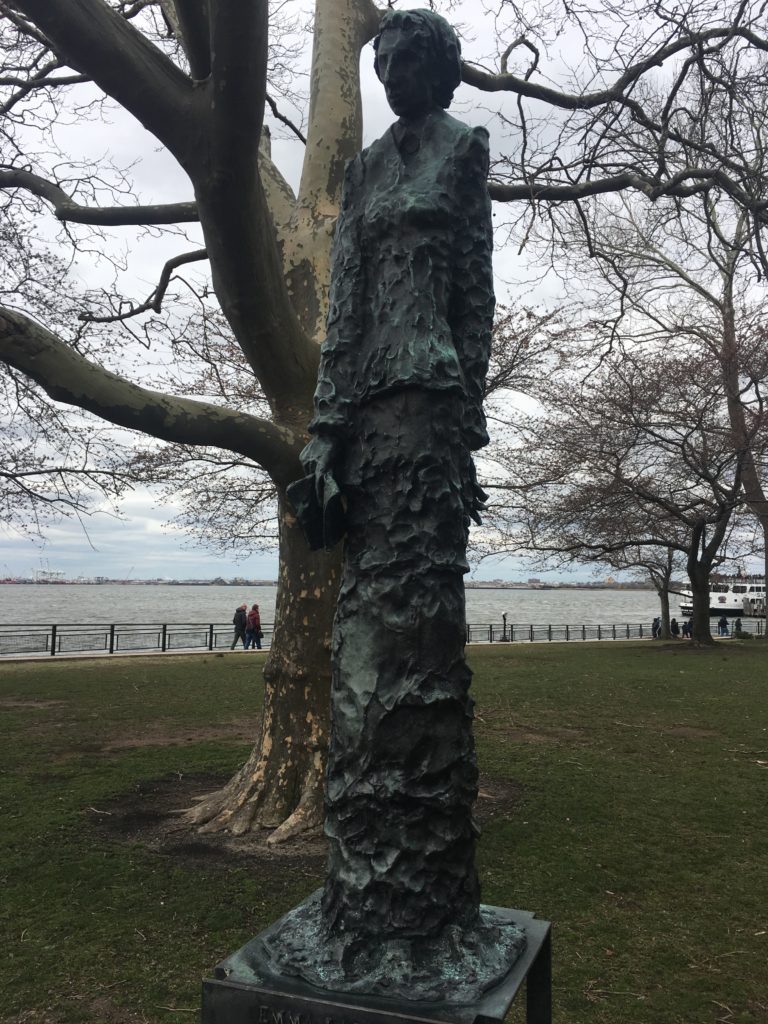
A statue of Lazarus herself, in the shadow of Lady Liberty:
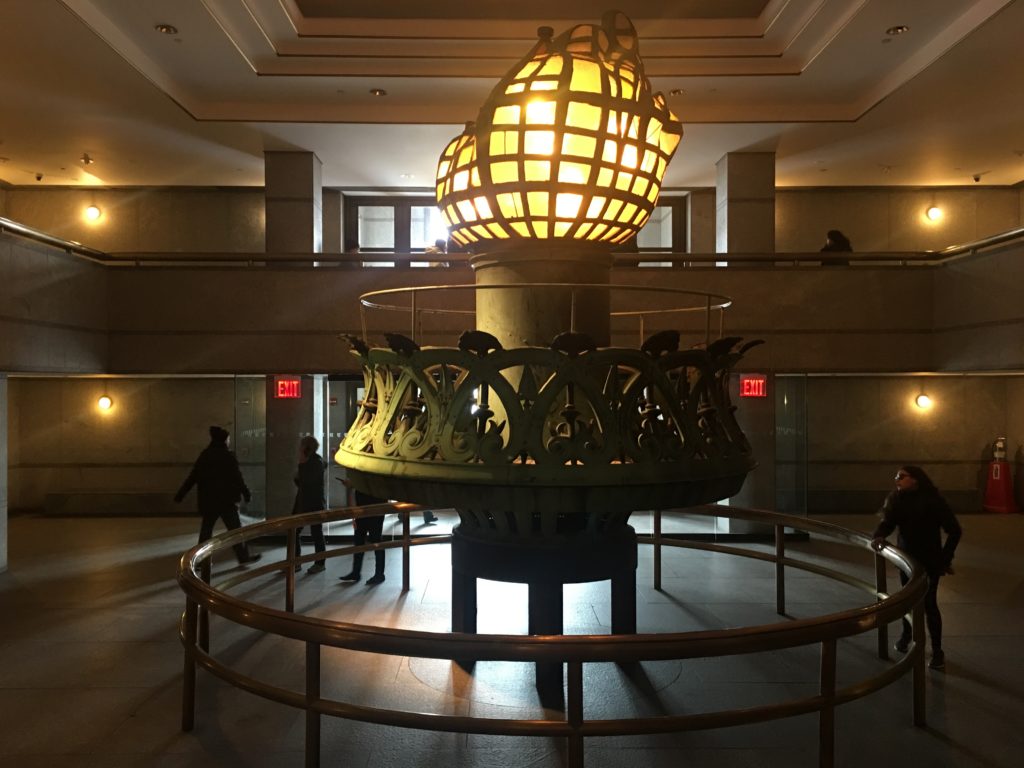
The statue’s original torch, which leaked and had to be replaced:
Tom enjoying the museum audio tour:
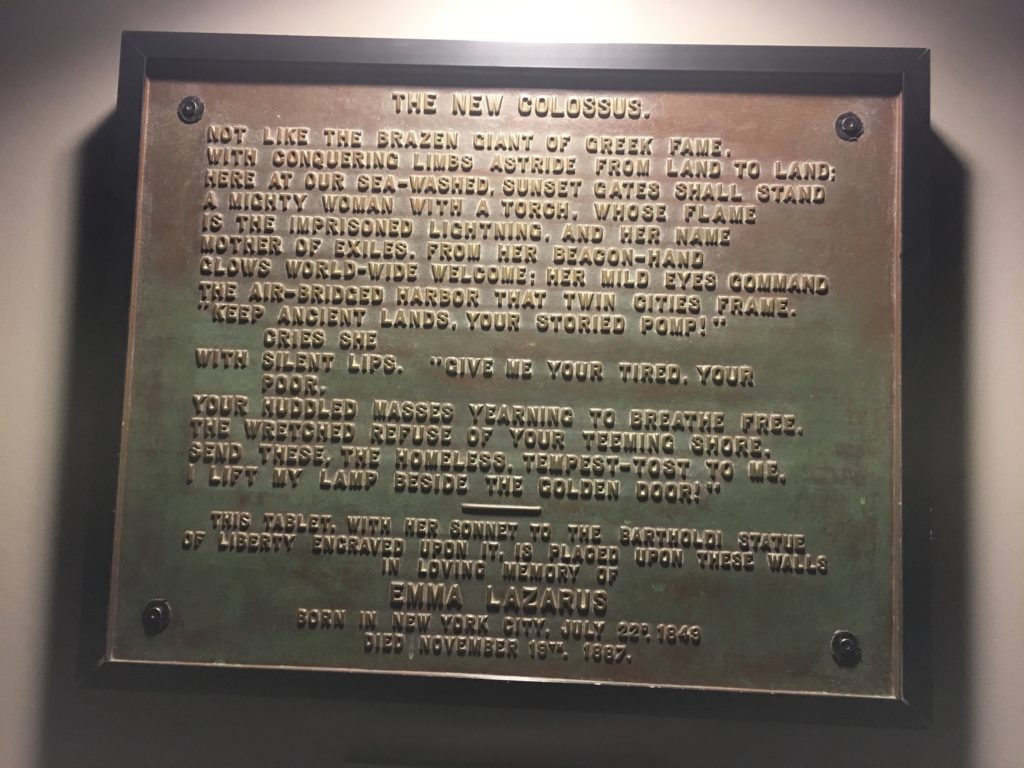
The original Emma Lazarus plaque which once sat just inside the pedestal. Today its home is in the Statue of Liberty museum:
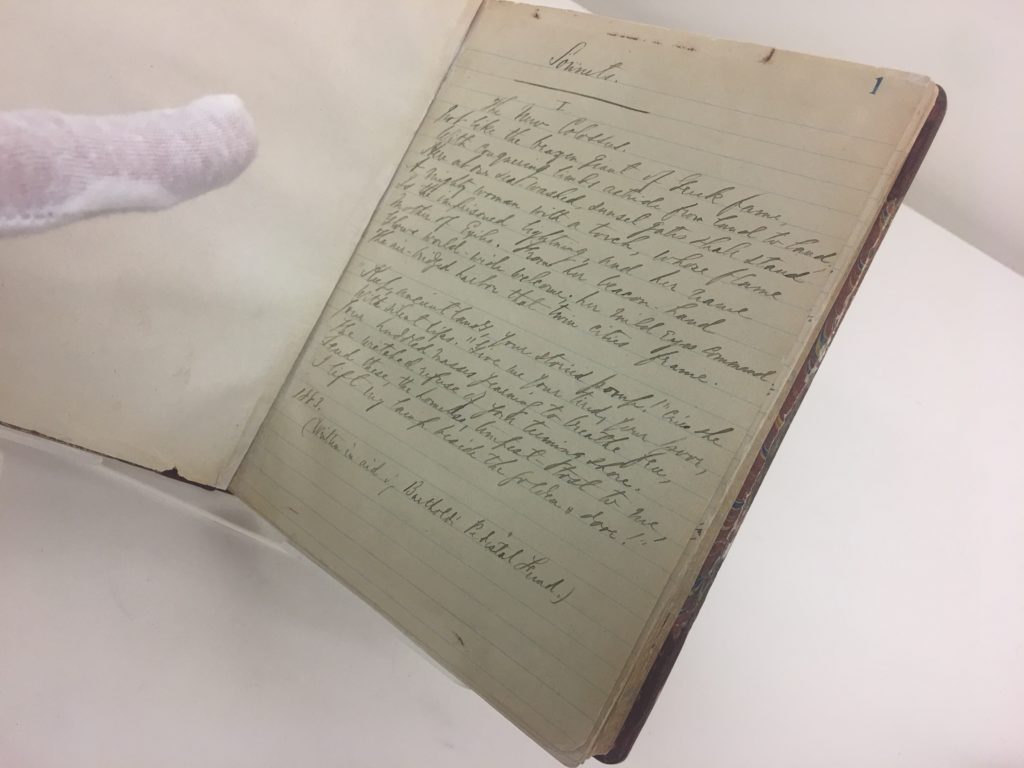
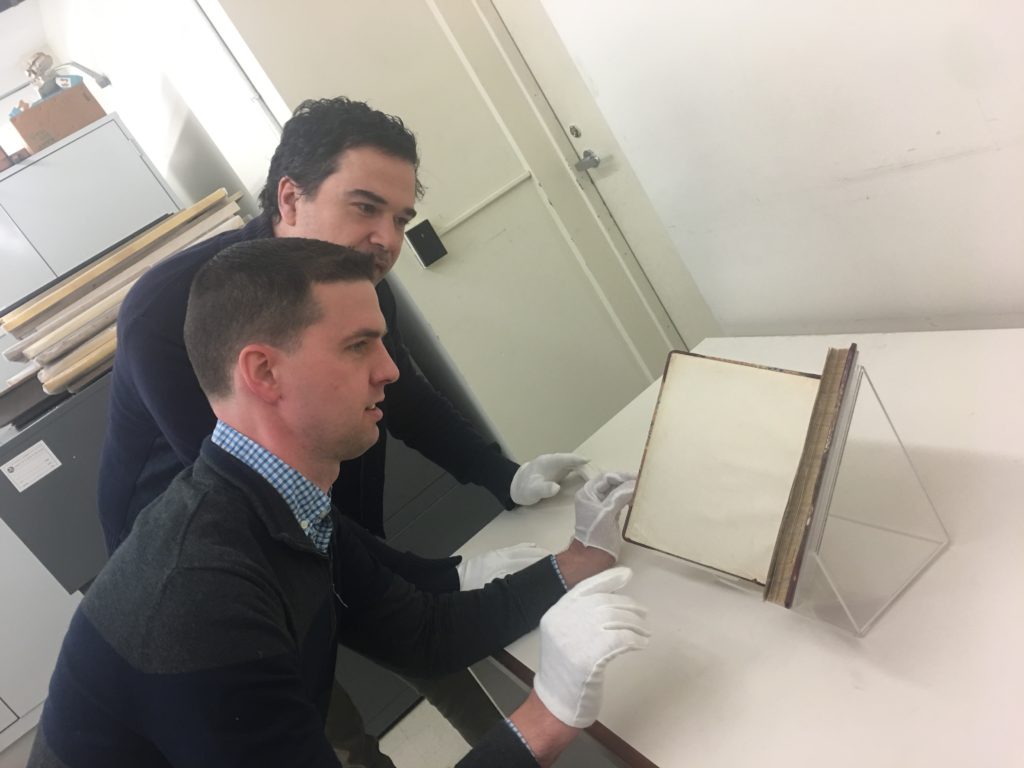
At the American Jewish Historical Society, a peak into Lazarus’ handwritten journal, piecing together some of her favorite poems. She placed “The New Colossus” in the very front:
Emma’s Greenwich Village home on West 10th Street:
FURTHER READING Enlightening the World: The Creation of the Statue of Liberty by Yasmin Sabina Khan Liberty’s Torch: The Great Adventure to Build the Statue of Liberty by Elizabeth Mitchell Emma Lazarus by Esther Schor Emma Lazarus in Her World: Life and Letters by Bette Roth Young
FURTHER LISTENING After listening to our show Mother of Exiles, check out these podcasts from our back catalog with similar themes:
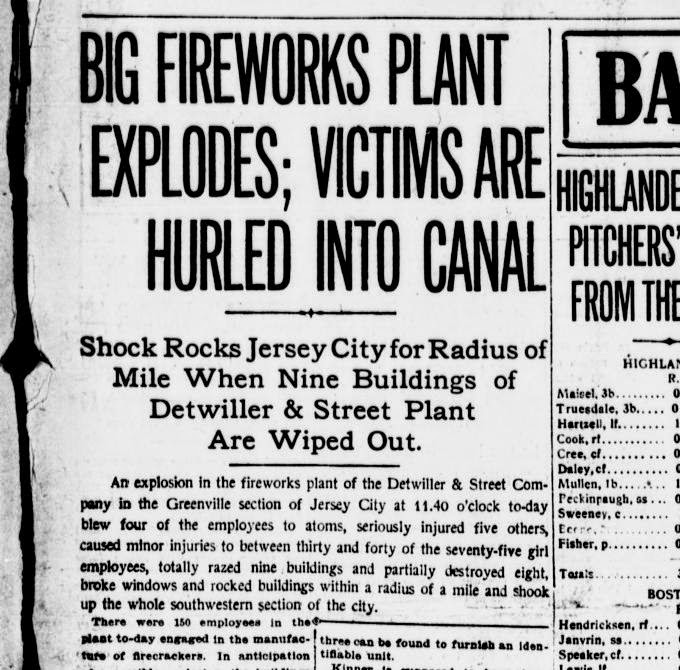
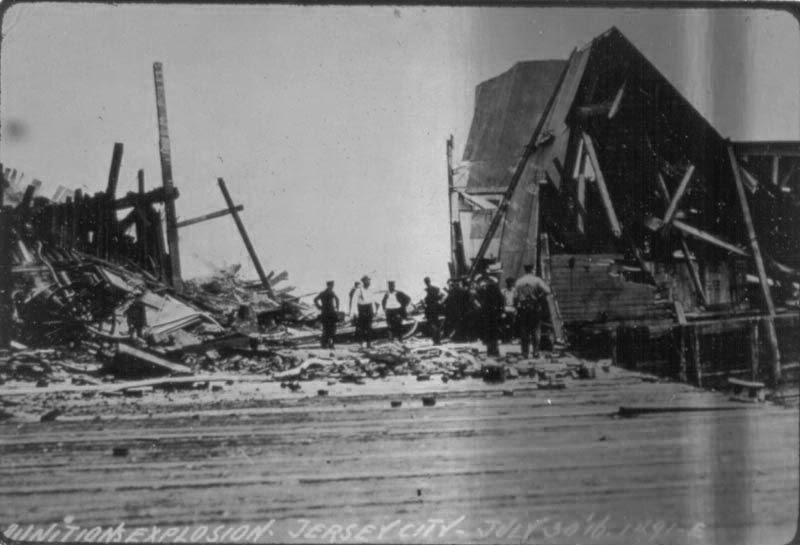
One hundred years ago today, the Detwiller & Street fireworks plant, located in the Greenville section of Jersey City, exploded in a horrible shower of fire and glass. Â Four men were killed instantly and dozens of employees were injured. Â Several surrounding buildings “fell to pieces like houses of cards.” Â The rumble shook buildings throughout the city, up to Weehawken and even into Manhattan and Staten Island. [sources]
This was the sad, weird reality of munitions plants in the New York metropolitan area. Â Staten Island was one of America’s largest producers of fireworks and saw its share of disasters, including a 1907 explosion in Graniteville.
But there was one huge difference between the 1907 Graniteville disaster and the 1914 Jersey City explosion — World War I. Â Fireworks manufacturers during the war also produced munitions. Â As the United States wasn’t yet engaged in the European conflict, some manufacturers were hired directly by the Allied nations.
The New York Tribune notes the unwillingness of executives to talk about the blast, and eventually the plant’s superintendent was eventually charged with “violations of the Crimes act, which makes it unlawful to store high explosives within 1,000 feet of a  highway unless in a fireproof vault.”
From the Evening World, October 3, 1914:
While the press reports of the day never explicitly mention Detwiller & Street’s munitions productions, it’s clear from later incidents that this was probably at least part of the plant’s output that year. Â Another explosion at the very same plant in 1917 killed nine, all women. Â A safety report clearly indicates then that “[t]he company is engaged in the manufacture of munitions for the Russian government.” Â On hand to rescue some of the women was a Russian munitions inspector. [source]
This naturally leads to a more disturbing question — was the 1914 explosion sabotage by the German?
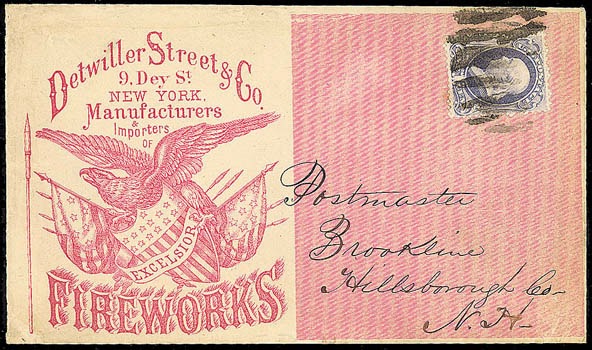
An early postcard from 1873. Â The New York based Detwiller & Street specialized in “fireworks, time danger signals, railroad track torpedoes, etc.” Â They were also responsible for the spectacular fireworks display at the opening of the Brooklyn Bridge.
That’s one suggestion according to a 1918 book The German Secret Service In America 1914-1918, listing a set of suspicious fireworks accidents in New Jersey before Oct. 3, 1914, Jersey City disaster. While these early accidents may have been due to increased munitions contracts in the hands of inexperienced employees, the authors admit ominously, “These explosions were the opening guns.”
German orders from that year make clear the focus on American targets. Â From the German Secret Service book: “[A] circular dated November 18, issued by German Naval Headquarters to all naval agents throughout the world, ordered mobilized all ‘agents who are overseas and all destroying agents in ports where vessels carrying war material are loaded in England, France, Canada, the United States and Russia.”
This had horrible consequence for the United States and those plants in New Jersey, New York and Pennsylvania in particular, leading to the greatest act of sabotage prior to America’s involvement in World War I — the Black Tom Explosion. (Pictured above: Aftermath of the Black Tom Explosion, courtesy Liberty State Park)
On July 30, 1916, a munitions depot on Black Tom pier in Jersey City was set ablaze by German agents.  The resulting explosion killed seven people on neighboring Ellis Island in Jersey City and ricocheted through the metropolitan area, shattering windows in Times Square and over at St. Patrick’s Cathedral and shaking people from their beds in Brooklyn.  The Statue of Liberty also suffered damage from this act of sabotage.
And so it’s hard to read accounts of the Jersey City explosion from one hundred years ago and not imagine the possibility of sinister intention.
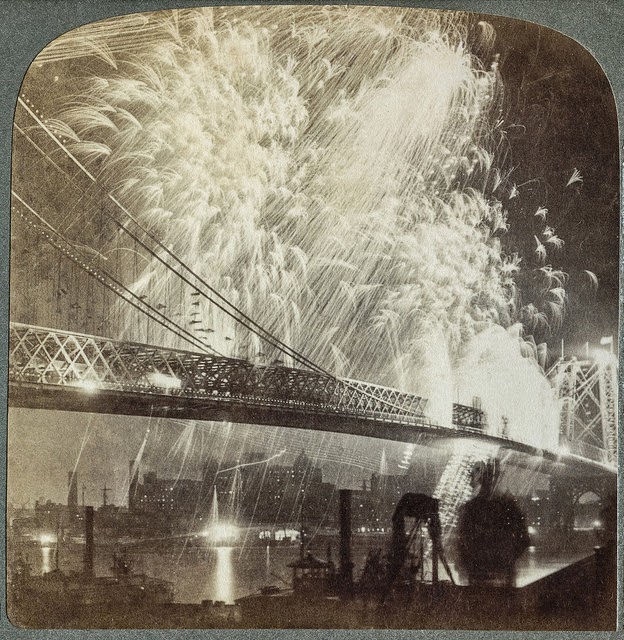
Above: One of my favorite pictures of the Williamsburg Bridge, at its opening in 1903
Nothing befits a fireworks display quite like a skyline to frame it, and no city has a skyline quite like New York City. Â And so, despite the obvious dangers of setting off thousands of pounds of explosives in a crowded, flammable city, the city has been subject to some of the most beautiful feats of pyrotechnics in American history.
Here are ten of the greatest examples in the city’s history — celebrations not only of holidays, but vivid displays that highlighted the finest landmarks and accomplishments:
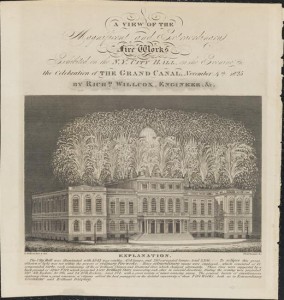
1. Opening of the Erie Canal — November 4, 1825
“On November 4, 1825, a spectacular extravaganza celebrated the just finished Erie Canal. City Hall, brilliantly illuminated, proudly overlooked a fireworks display in the park. There was good reason to celebrate: Â the canal was the match that lit the fuse that detonated the boom of the 1830s” — Mark Caldwell, New York Night
(Illustration by John Francis Eugene Prod’Homme, Image courtesy MCNY)
2. Celebration for the Transatlantic Telegraph Cable — September 1-3, 1858
This called for a variety of elaborate pyrotechnic displays, including one 21-part program, which included “some new principles were attempted for the first time in the pyrotechnic art,” “two light houses connected by a line of rolling waters, on which the ships slowly moved towards their destination” and “all the splendor of the dazzling colors, assisted by all the mechanical contrivances of which the art is capable”. [source]
Incidentally, this fireworks festival caught City Hall on fire, burning down the cupola! (NYPL)
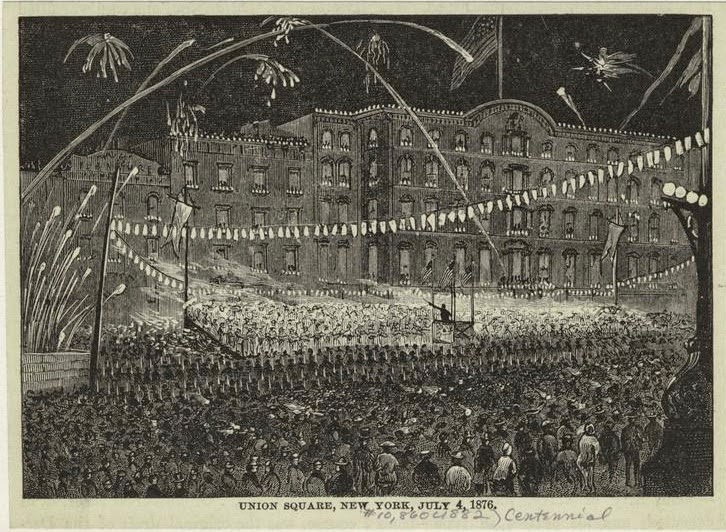
3. American Centennial — July 4, 1876
The all-day centennial celebration culminated in fireworks “representing the Goddess of Liberty sitting on a cloud in the act of greeting,” as well as several street-level “allegoric representations” illuminated in colorful fireworks. [source]
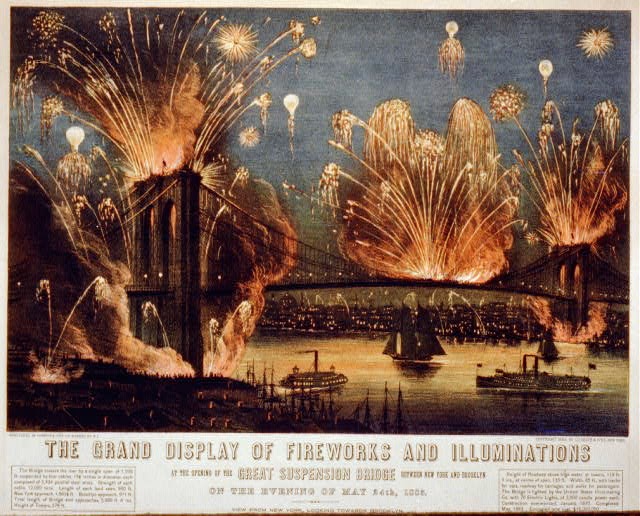
4. Opening of the Brooklyn Bridge — May 24, 1883
“Forty pyrotechnists superintended the display. There were 6,000 four-pound skyrockets, 400 bombshells and 125 fountains of colored lights. Â Zinc bombshells of about ten inches in diameter were fired from mortars 500 feet in the air. Each bombshell held 600 stars of various colors. Â A newly-invented rocket was displayed. Â It held seven parachutes of cloth. Â From these hung colored balls of fire. Â The rockets burst, leaving the parachutes floating in the air. Five of these rockets were fired at once. Â The result was thirty-five balls of colored fire floating in the air…..” [source]
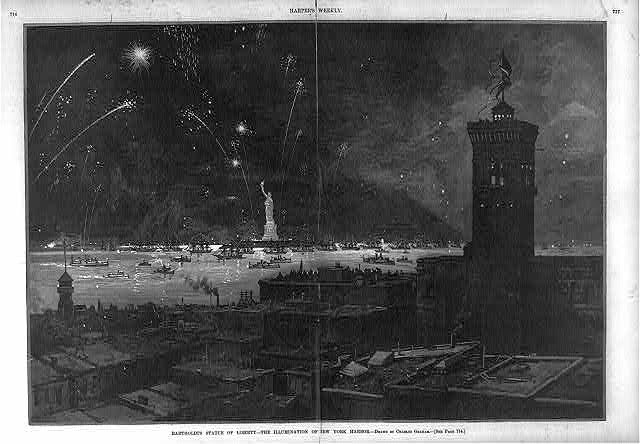
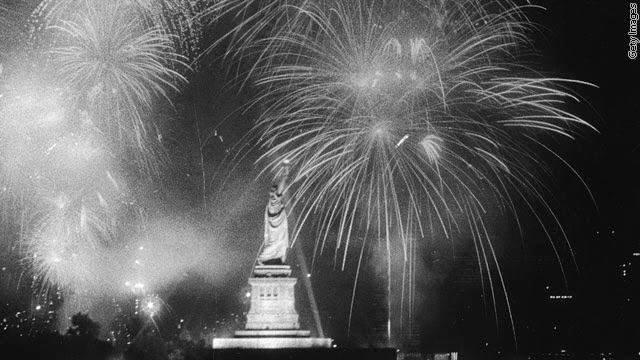
5. Dedication of the Statue of Liberty — October 28, 1886
Well, actually, three days later, on November 1. Â A soggy day killed off the fireworks on the day of the statue’s dedication, but were finally launched the following Monday.
“At precisely the hour fixed there came a burst of kaleidoscopic lights from Bedlow’s and Governors Island, and in an instant the air was filled with flying fire balls of every color of the rainbow.”
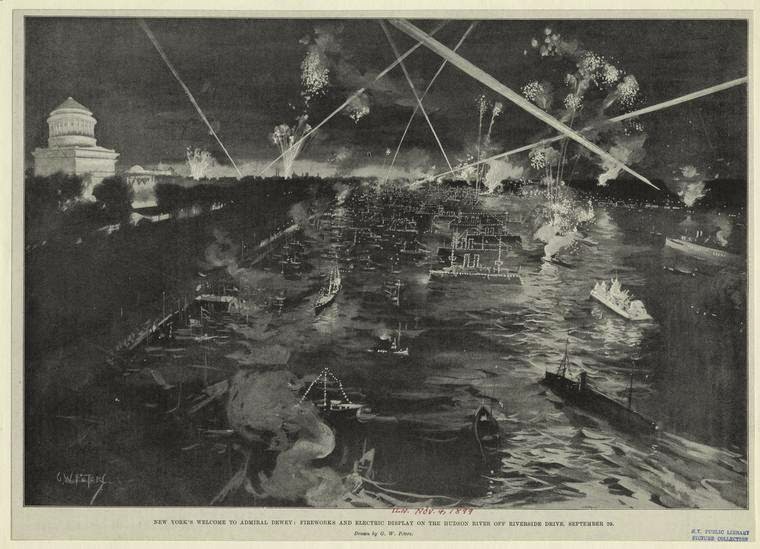
6. Hero’s Welcome for Admiral George Dewey — September 29, 1899
The arrival of Admiral Dewey, the face of the U.S.’s victory in the Spanish-American War, Â inspired an exuberant celebration throughout the city.
“The day of Dewey celebration on the water ended in a roaring, popping, banging blaze of glory last night. Fireworks displays lit up the east side, the west side and all around the town. Not only did great boats loaded down with fireworks sweet down all the water-ways and circle about the lower Bay, but in the parks throughout the middle of the city the sky was painted red, white and blue and all the other shades of color known to the pyrotechnic art. ” [New York Sun] Â (Illustration by GW Peters, courtesy NYPL)
7. Opening of the Williamsburg Bridge — December 19, 1903
“Then, without warning, the bridge was suddenly transformed into a sheet of flame. Â From tower to tower the flames turned and writhed and flared high in the air, illuminating the waterfront for blocks. Â Then came a kaleidoscopic medley of colors, red, green, purple, orange, violet — more colors than French ribbon dealer could enumerate — from huge rockets that sails two hundred feet above the bridge.” [source]
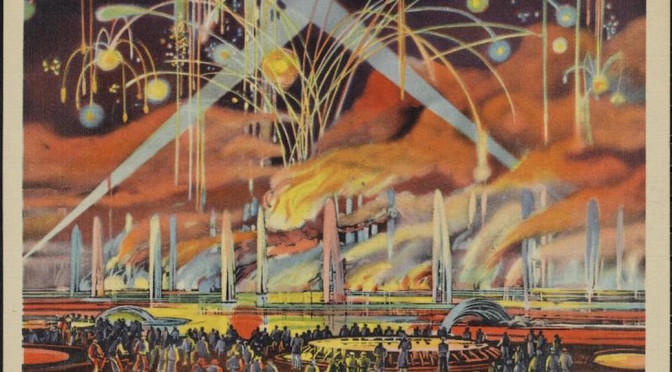
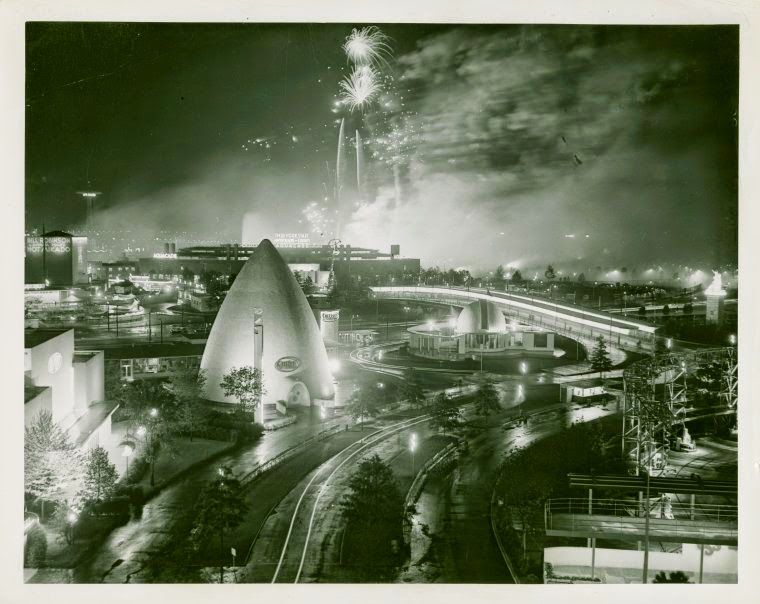
8. New York World’s Fair — July 4, 1939
“Fireworks colored the sky with the red, white and blue of the nation’s colors over the World’s Fair Grounds last night as two spectacular and elaborate displays of fire, water and music were set off, first from the Lagoon of Nations in the exhibit area and a short while later from Fountain Lake in the amusement area.”
9. America’s Bicentennial — July 4, 1976
This event was notable not only for its visibility across the nation — thanks to a television special — but it was the first fireworks display sponsored by Macy’s. Â Â “New York Harbor became more brilliant than Broadway last night as the biggest and most colorful fireworks display in the city’s history exploded for half an hour in celebration of the nation’s Bicentennial.” [NYT]
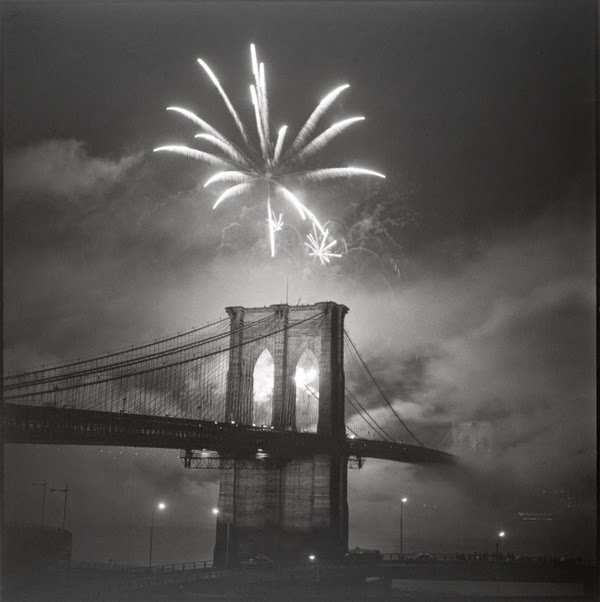
10. Brooklyn Bridge 100th Birthday — May 24, 1983
“Then the sky simply exploded with fireworks. Red, white and blue shells, golden comets changing to silver, crackling stars in red and green, appeared to fill the entire sky, while hundreds of thousands of people gasped at the sheer dazzle of it all.” [New York Times] (Bruce Cratsley, courtesy Brooklyn Museum)
Liberace is the embodiment of a certain California flamboyance, but New Yorkers were as susceptible to his allure as anyone.
In fact, for this brightly-painted musical showman, Radio City Music Hall was a second home. He continued to smash box office records here year after year as late as the 1980s, well past his prime as anything more than a jewel-encrusted artifact. In 1985, his stint here grossed more than $2 million.
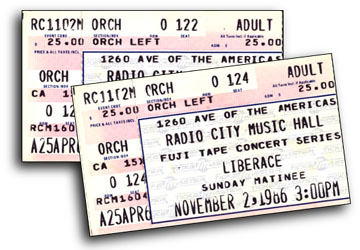
He went out, of course, in a blaze of glory and sequins. His final live show anywhere was at Radio City on November 2, 1986, capping two weeks of consecutive shows at the venue. (Most stars have a hard time packing the house one night!)
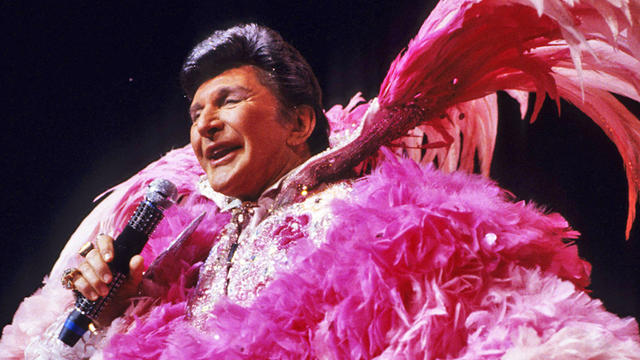
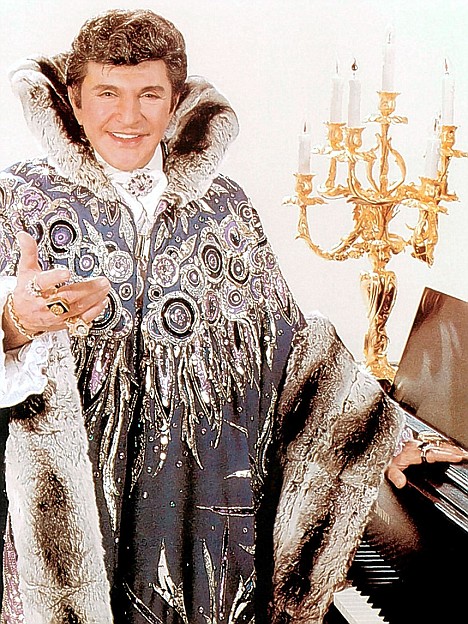
The entertainer, with his flowing robes, acres of feathered frippery, furs and wires and “dancing waters,” was enough spectacle for any stage, but for this series of shows, he was also joined by the Rockettes and a gigantic simulation of the Statue of Liberty holding a candelabra. Photo of the tickets courtesy Bob’s Liberace
Time Magazine’s Richard Corliss, in a 1986 article called ‘The Evangelist of Kitsch, sets this scene: “The lights go down in Manhattan’s deco dream palace, Radio City Music Hall, and Mr. Showmanship makes his entrance, flying across the huge stage in a cocoon of feathers, enough for a whole flock of purple ostriches.”
That’s right; in a move that would inspire future boy bands, Liberace flew in, “attached to a wire like a puffed-up Peter Pan, in a hundred pounds of purple and white feathers,” according to the New York Times.
The audience lapped up every bon mot of coy comedy. Corliss: “They laughed as he sat down on his studded coattails and remarked, ‘If the rhinestones are turned the wrong way it’ll kill ya.'”
Liberace was assisted on stage by his new handsome assistant Lee; his last assistant and chauffeur — and not-so-secret lover — Scott Thorson had settled his palimony lawsuit out of court just earlier that year for $95,000. (This is the subject of Sunday night’s Behind the Candelabra with Michael Douglas and Matt Damon.)
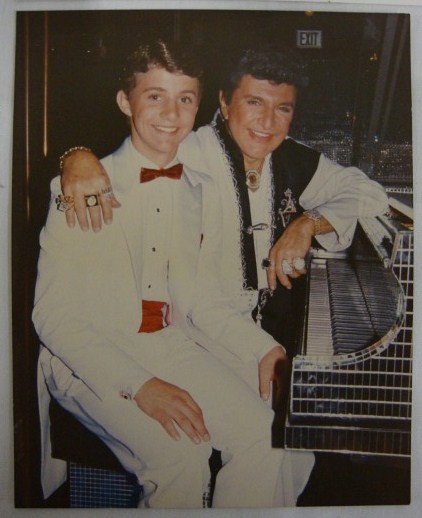
Believe it or not, it wasn’t Lee or the Rockettes that got the most stage time with Liberace during the Radio City Music Hall performances. That honor belonged to 14-year old child pianist and “Liberace protege”Eric Hamelin, who performed a piano duet with the feather-frocked superstar (“Slaughter on Tenth Avenue”) and a couple other numbers. At right: the star and his protege (source)
Stephen Holden at the Times was understandably critical of the actual performance. “His heavy-miked pianism is at once metallic sounding, exaggeratedly florid in ornamentation and unbendingly rigid in tone and phrasing,” said the critic.
But the audience lapped it up, as he buoyantly hopped from classic to classic with jokey classical trills linking the songs together. His tribute to Chopin led right into “Mack the Knife.” His mournful, dripping “Send In The Clowns” spiraled into the silly ’60s novelty song “Bumble Boogie.”
His final song that final evening was “I’ll Be Seeing You”. The audience leaped to their feet as Liberace in his sumptuous robes and dazzling bejeweled rings gave his final bow. Three months later, Liberace would be found dead of AIDS-related pneumonia in his Palm Springs home.
He left the stage with his personal charms intact even as his engineered facade had practically disintegrated. “Too many young performers have forgotten that the most important part of show business is not the second word, it’s the first,” he was quoted as saying . “Without the show there’s no business.”
Believe it or not, video footage from those final Radio City Music Hall concerts. While this footage is poor quality, the fact that it exists at all is extraordinary. Pop open the champagne and enjoy!
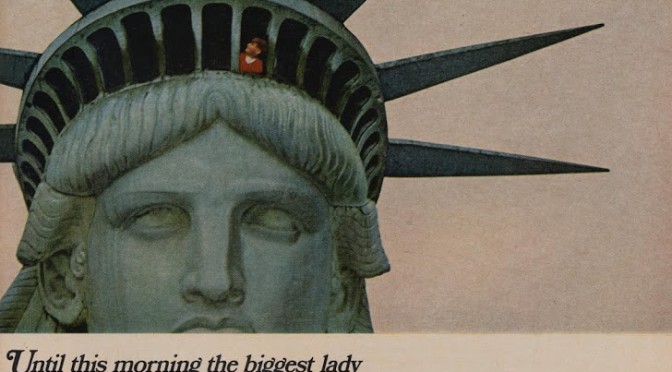
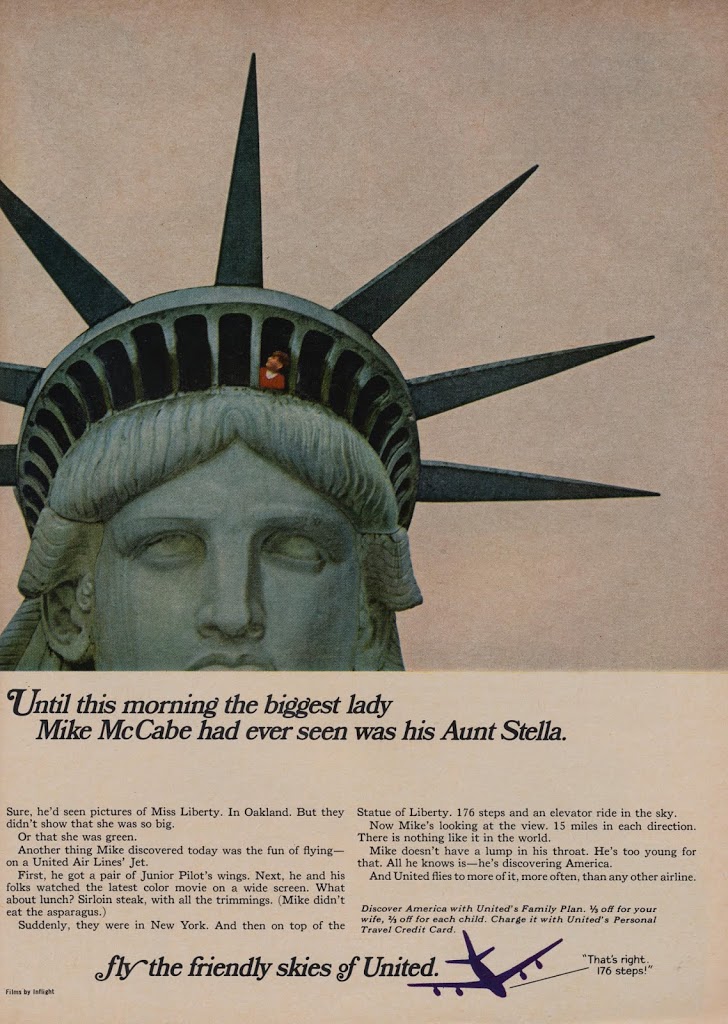
The lady of Liberty Island makes an appearance in a 1965 United Airlines ad campaign. Don Draper, of course, prefers American Airlines. (Courtesy Flickr/What Makes The Pie Shop Tick)
WARNING The article contains a few spoilers about last night’s show, so if you’re a fan of the show, come back once you’re watched the episode.
‘Mad Men’ returned to AMC last night, ramping up its regular displays of well-primped, misogynistic Madison Avenue ambition. On Mondays here on the blog, I’ll drill down for inspiration into the smaller details from the show that deal specifically with New York City history. And on Sundays, during the show itself (when possible), I’ll beplaying along on Twitter, throwing out little trivia tidbits as quickly and accurately as humanly possible.
Everybody seems to be talking about the slinky performance of Gillian Hill‘s ditty ‘Zou Bisou Bisou‘ — or ‘Zoo Be Zoo Be Zoo’ if you prefer the Sophia Loren version — by Don Draper’s new wife Megan. And civil rights issues finally begin to bubble to the surface when a nasty water-balloon incident by a rival firm (based upon a real event, down to the dialogue!) somehow ends with Sterling Cooper Draper Pryce possibly hiring their first African-American secretary.
But I was struck by a throwaway line uttered early in the episode by Don’s son Bobby Draper — played by yet another young actor, the fourth Bobby in the show’s five seasons. With the children over at Don and Megan’s Manhattan apartment for the Memorial Day holiday, Don emptily suggests this will be the day they go visit the Statue of Liberty. Bobby shrugs and says, “We always say that, but we never do.”
The remark is meant to imply all the cheerful, all-American things that the Draper family never seem to do together anymore. When Don drops the kids off at the home of ex-wife Betty and her new husband, he refers to the couple inside as ‘Morticia and Lurch‘. (Did Don know that ABC had just cancelled The Addams Family the month before?)
Oh, but I do wish the Drapers had gone to the Statue of Liberty at that moment, in late May 1966, as they might have witnessed a rather remarkable sight — the virtual invasion of Liberty Island by stolid representatives from Jersey City!
Once called Bedloe’s Island, the alleged hiding place of pirate’s treasureand the home of Frederic Bertholdi‘s statue since 1886, Liberty Island actually sits within the state line of New Jersey, as does its partner Ellis Island. In fact, some of Ellis Island’s reclaimed land is still considered part of New Jersey. However, Bedloe’s has been within the jurisdiction of New York since a compact between the two state governments was signed in February 1834.
New Jersey has not always been happy with this arrangement. On the afternoon of May 23, 1966, a group of over four dozen Jersey City Chamber of Commerce members stormed across the water and ‘conquered‘ Liberty Island, pressing their contention that the island should be part of their state.
With ‘the Federal Government cooperating as a friendly non-belligerent’, the New Jersey businessmen, joined by Jersey City mayor Thomas J. Whelan in a ‘festive, bloodless invasion’, rattled off their demands, including equal recognition of Jersey City and New York, direct access to Circle Line boat service from the island, and even a change to Liberty Island’s postal address.
Don could have even brought his new bride Megan — of ‘French extraction’ as she might say — as a representative of the French government was also on hand to confirm friendly relations between the two parties. (I assume he meant between America and France.) Afterwards, Air France even provided a box lunch to the Jersey City aggressors!
The event was, of course, mostly for show, for greater plans were already in play. In the previous year, the Statue of Liberty and Ellis Island were enjoined as a national monument under one administrative entity, the National Park Service. By October 1966, they were also listed as inaugural members of the U.S. National Register of Historic Places.
The Statue of Liberty often served as a complicated symbol for 1960s political debate, a touchstone for civil rights activists and an ironic construct for many antiwar protesters embittered by the Vietnam War.
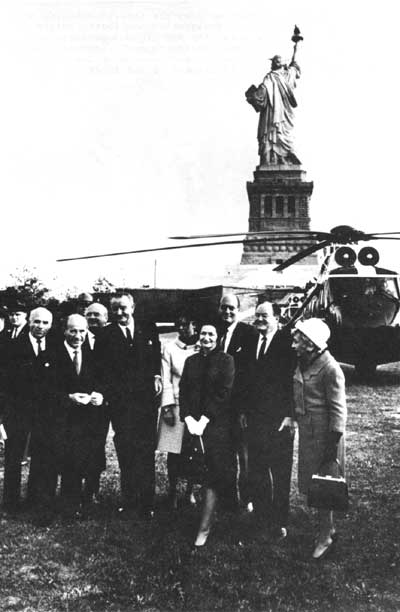
In 1965, the FBI and New York police snuffed out an attempt by the Black Liberation Front to smuggle dynamite onto the island and blow up the statue. That same year, President Lyndon B. Johnson (at right) traveled to Liberty Island to sign into law the Immigration and Naturalization Act, a pivotal and far-reaching change to American policy that essentially eliminated immigration quotas.
A few years later, antiwar activists staged a Christmastime demonstration here, barricaded themselves inside the statue for almost two days. In sad need of disrepair by the late 60s, Lady Liberty even represented a certain dislodging of the American dream to many, a sentiment strongly recognized by the 1970s which led to the statue’s rehabilitation for her 1986 centennial celebration.
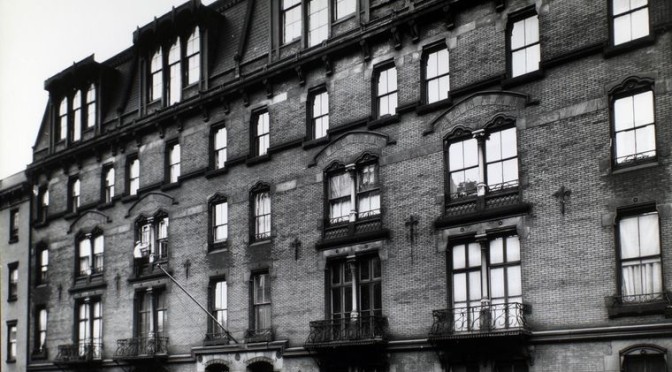
The creation of ‘acceptable’ communal living: The Stuyvesant Flats, at 142 East 18th Street, designed by Richard Morris Hunt, photographed by Berenice Abbott.
PODCASTWell, we’re movin’ on up….to the first New York apartment building ever constructed. New Yorkers of the emerging middle classes needed a place to live situated between the townhouse and the tenement, and the solution came from overseas — a daring style of communal and affordable living called the ‘apartment’ or ‘French flat’.
The city’s first was financed by Rutherford Stuyvesant, an old-money heir with an unusual story to his name. He hired one of the upper class’s hottest architects to create an apartment house, called the Stuyvesant Apartments, with many features that would have been shocking to more than a few New Yorkers of the day.
The building’s first tenants were sometimes well-known, often artists and publishers, and almost all of them with a fascinating story to tell. Listen in to hear about the vanguard first renters of this classic, long-gone building.
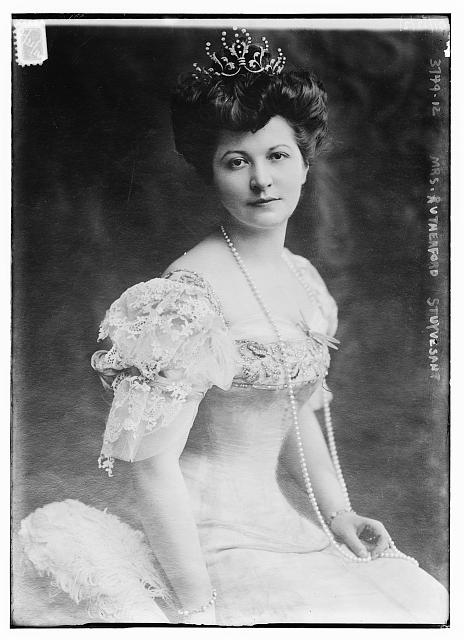
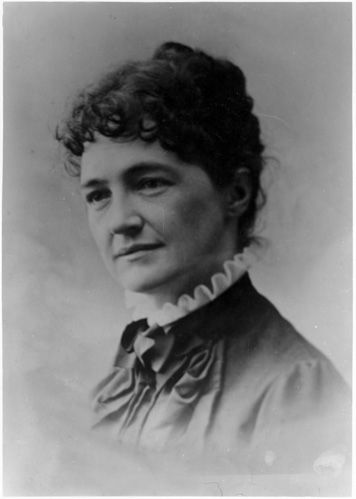
I have been unable to find any portraits of Mr. Rutherford Stuyvesant (aka Stuyvesant Rutherford), the man who financed the Stuyvesant for $100,000. However I have found a picture of Mrs. Rutherford Stuyvesant, who doesn’t look like the kind of lady to mettle around in her husband’s affairs. She would not have found the apartments which bore her name very accomodating. Many, many others did. (Courtesy LOC)
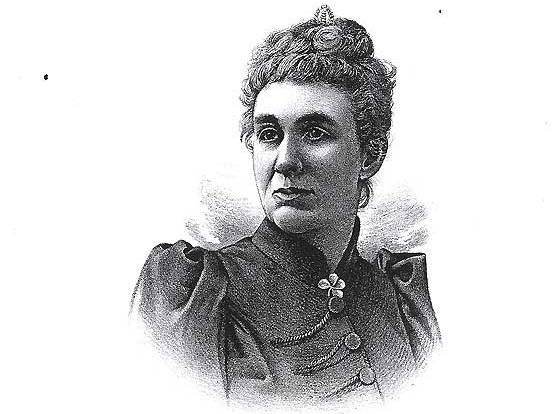
The tenacious Elizabeth ‘Libby’ Custer, photo taken in 1876, the year her husband was killed at the Battle of Little Bighorn. Mrs. Custer moved into Stuyvesant and successfully led her crusade to rehabilitate her husband’s reputation.
Maggie Custer Calhoun, younger sister to General Custer, lived with her sister-in-law at the Stuyvesant before embarking on a successful career as an elocutionist.
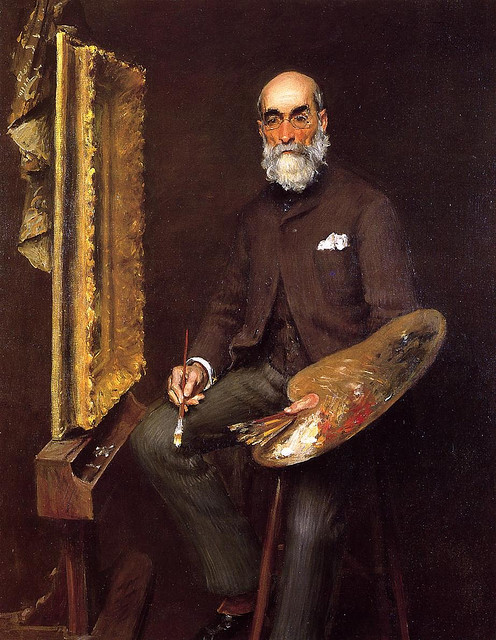
The landscape painter Worthington Whittredge also resided here. In fact, he beamed about it in his autobiography: “I was one of the first to subscribe for an apartment in this house, which was to be erected in 18th Street near Third Avenue and Stuyvesant Square.”
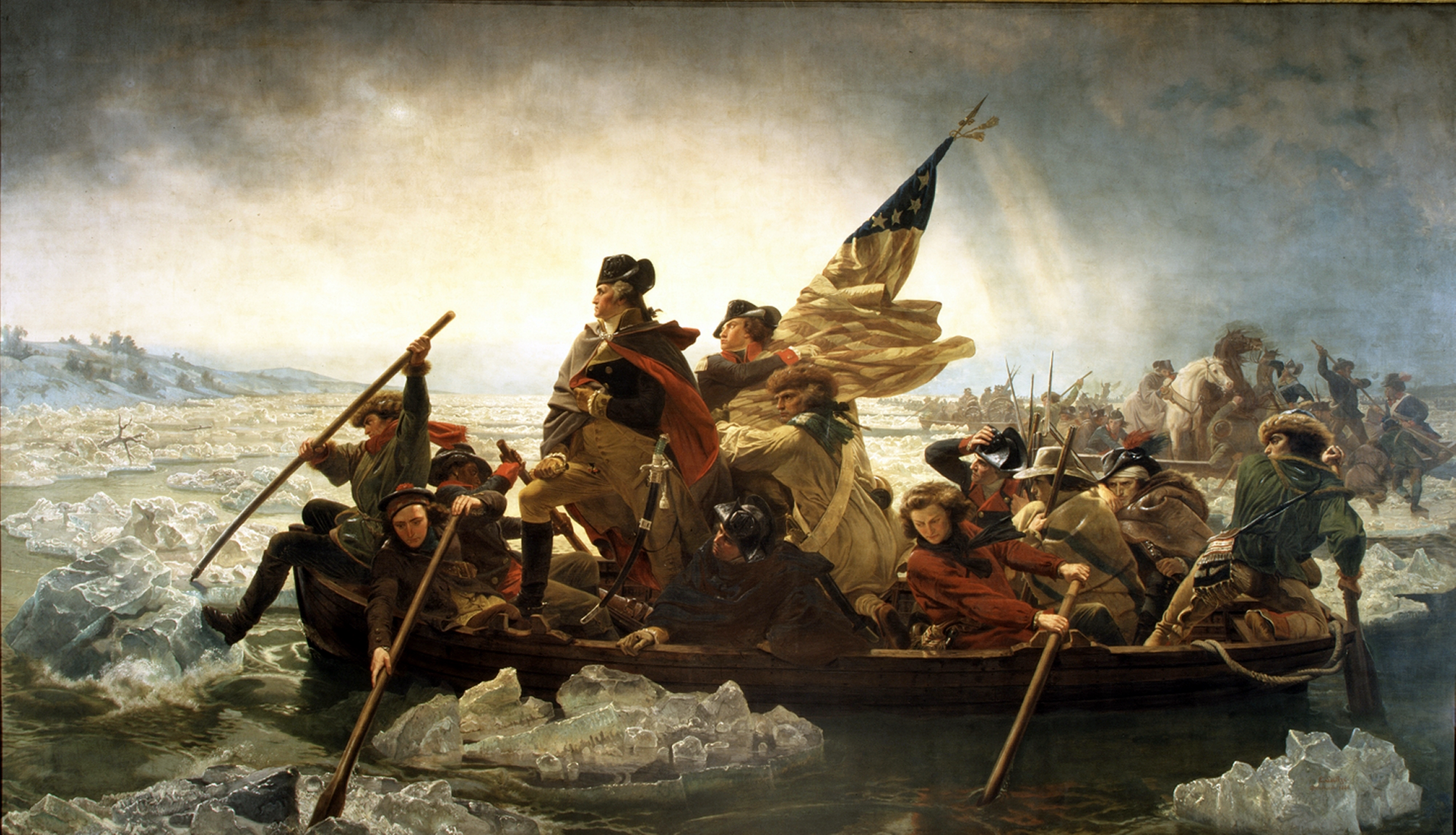
Earlier in his career, Whittredge posed as George Washington while Emanuel Leutze painted ‘Washington Crossing The Delaware’. (Worthington is quite comfortable on both sides of the easel The painting below is by William Merritt Chase.)
In its later years, the Stuyvesant was used as the set for a pivotal scene in the Oscar-nominated film noir ‘Kiss of Death’ starring Richard Widmark. Needless to say, this sort of activity very rarely went on at the Stuyvesant.
We had a terrific time recording this year’s ghost-story show — Haunted Histories of New York. Here’s some extra details about our four subjects that were left out of this week’s show.
(By the way, if you wouldn’t mind, please vote for us in this year’s 2011 Podcast Awards. We’re in the Best Travel Podcast section. Thanks!)
Liberty Island and the Captain Kidd’s treasure
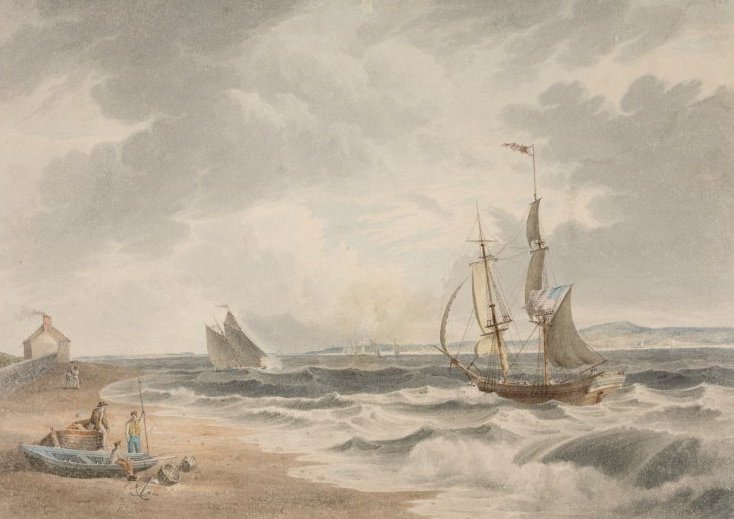
If indeed there was treasure buried on Bedloe’s Island (today’s Liberty Island), William Kidd and his motley crew would have concealed it there under the gaze of the island’s owner. In the 1690s, when Kidd would have lived in New York, the island was owned by a woman — Mary Bedlow Smith.
The small island property was originally owned by a Dutchman Isaack Bedloo, who remained in the harbor after New Amsterdam became New York in 1664. He even Anglicized his name, as evidenced by his daughter’s name. She sold the island in 1732 to one of the most wealthy and powerful men in all the British colony — Adolphe Philipse. From there, the island was often used as a quarantine station or ‘pest house’ to shelter those with communicative disease. Many hundreds of afflicted were thrown here in the mid-17th century, and many died here.
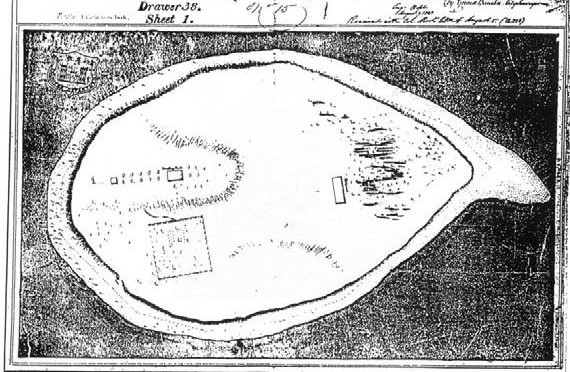
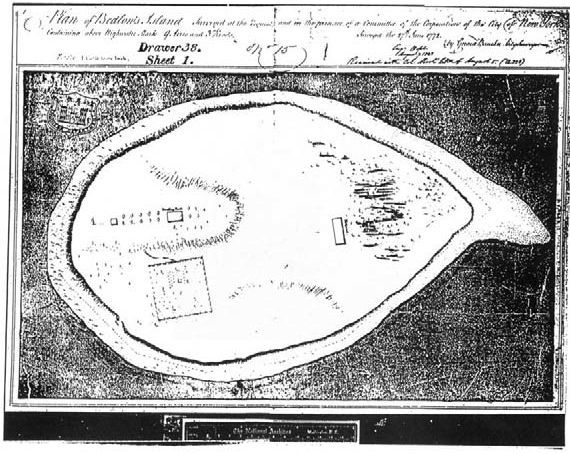
Below: A map of Bedloe’s Island in 1766, before the construction of Fort Wood. The map is strangely situated, but I believe that the stone where Kidd’s treasure was allegedly buried would have near the pointed end. (Courtesy the National Park Service.)
The Holy Ghost — Most Holy Trinity, Bushwick, Brooklyn
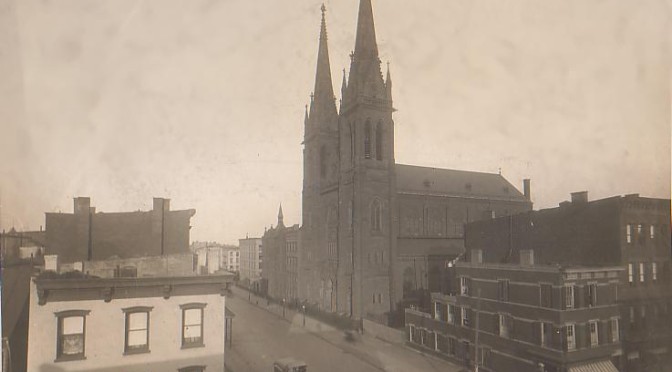
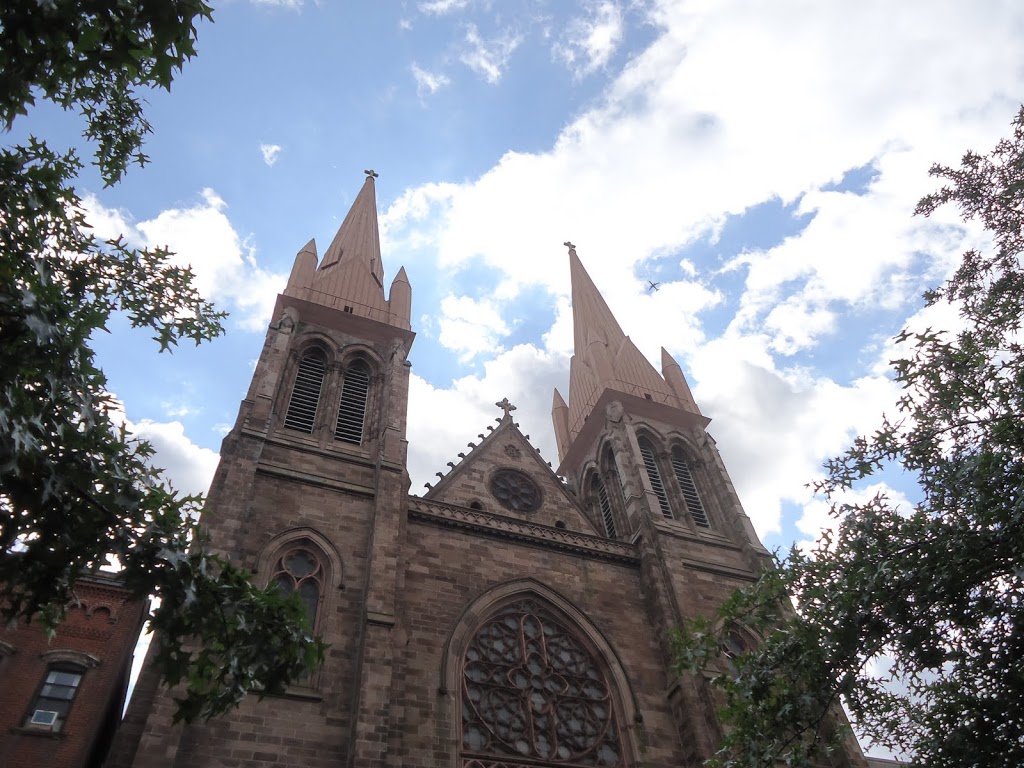
Some believe that Most Holy Trinity’s beloved Monsignor Michael May haunts the present halls of the church. On the occasion of May’s funeral in 1895 — he had died on the second floor of the adjoining rectory – the church nearly experienced a tragedy from which it would have surely never recovered.
A New York Times article from February 1895 reveals that a chronic weakness was discovered to the building’s architecture. As I mentioned in the podcast, vast, old passages exist underneath the church, extending to adjacent buildings. These passages had been used for safety during anti-Catholic attacks in the 1850s and even as safe havens for escaping Southern slaves on the Underground Railroad in the 1860s.
Monsignor May was so beloved that almost 5,000 people arrived for his funeral, the most the church had ever seen at one time. I’ll let the article reveal the potential horror of this situation: “Carpenters and masons at work on the vault in the basement discovered that the floor above them had sunk several inches in the centre, and that the cross beams had split, as had the big girders supporting the cross beams.”
The floor actually begin to sway in front of the masons. Within moments, the crowded church would have caved in, easily killing hundreds. What became one of the biggest gatherings in the church history would have instead become an unspeakable catastrophe.
The workmen advised the clergy to evacuate the center aisle and then worked briskly to create temporary braces. The crisis, thankfully, was averted.
The Lonely Acrobat — Ghosts At The Palace Theatre
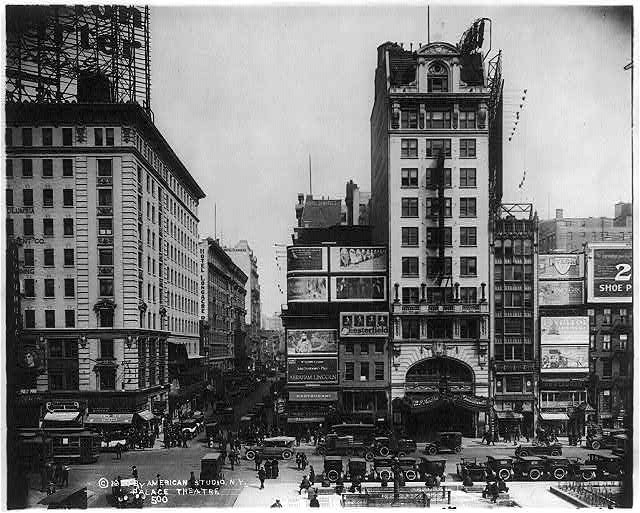
The tragic acrobatic act at the Palace Theatre that inspired the venue’s most famous ghost story is veiled in mystery and misunderstanding. There’s many falsehoods about the incident that Tom successfully dispelled, but there’s one he missed. Most modern retellings call the acrobat in question Louis Borsolino. His actual name, according to local papers in the troupe’s hometown of Reading, PA, list hims as Louis Bossalina, pictured at right.By the way, the name of the particular trick that Bossolina was doing at the Palace Theatre that fateful day? It was called the Death Loop. He is popularly rumored to have died from the accident, an unsurprising assumption considering how many people saw the fall, knowing the name of the failed trick. In reality, Bassolina survived the ordeal and was released from the hospital nine days later. To be clear, he didn’t die at the Palace; he went on to perform with the troupe until they disbanded in 1937.
He lived a perfectly normal life outside the spotlight, for over three more decades, before dying at age 61, in August 1963. If he truly haunts the Palace today, then the torment must have possessed him so greatly during life that he continually returns for repeat performances!
As you heard in the podcast, joining Louis’ ghost at the Palace is an apparition of one of the theater’s greatest stars. Here’s a recording of Judy Garland’s curtain call from her very last performance at the Palace Theatre on August 26, 1967. Judy would be dead within two years of a drug overdose. I wonder if anybody has ever seen the ghosts of Louis and Judy on the same night?
The Tale of Two Houses — Kreischer Mansion
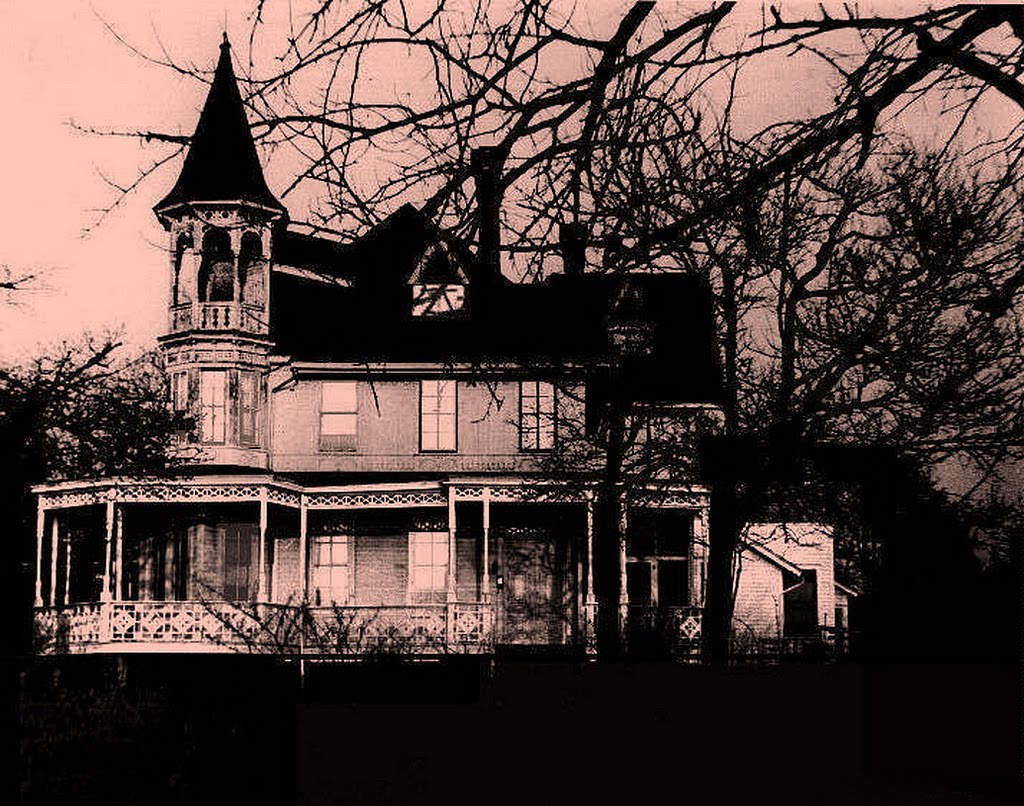
The famously haunted Kreischer Mansion was built for a son of brick mogul Balthazar Kreischer. He made his wealth using Staten Island clay to produce the building materials for a growing city, and he created a company town (appropriately called Kreischerville) near the Arthur Kill. But Kreischer got his start in the Lower East Side — on a street that is no longer there.
Balthazar arrived in New York in 1836 and quickly excelled in construction, in the years following the Great Fire which destroyed hundreds of structures in the heart of the old city. By 1845, Kreischer entered into the brick-making business with one Charles Mumpeson. Although they had already discovered the potential of Staten Island clay — their company was called New York and Staten Island Fire Brick and Clay Retort Works — their original factory was at 58 Goerck Street at Delancey Street.
The odd little street, which ran parallel to the East River from Grand Street to East 3rd, was a vestige of an abandoned city plan, well before the great Commissioners Plan of 1811. Casimir Goerck was the surveyor for the failed plan, working with renown designer Joseph-Francois Mangin, best known for working on New York’s new City Hall building. The plan was discarded, but two small Lower East Side streets from the plan were eventually used — Goerck Street and Mangin Street.
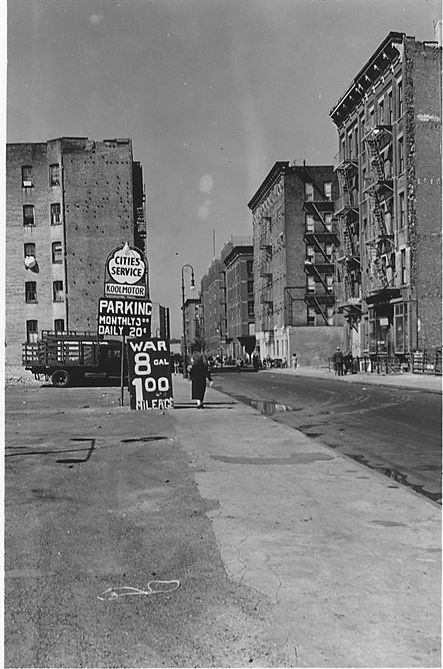
At right: The corner of Goerck Street and Rivington Street in 1939 (NYPL)
Kreischer maintained his brick factory here for years before moving the bulk of his operations to Staten Island. Goerck Street would disappear entirely with the construction of housing developments in the 1940s. A tiny vestige of Mangin Street, however, still hangs on, underneath the Williamsburg Bridge.
Most Holy Trinity in Bushwick, Brooklyn, shrouded in shadow, a place where the ghosts of former clergy are alleged to lurk the halls and other spirits may torment the nearby school.
PODCAST What mischievous phantoms and malevolent spirits haunt the streets of New York City today? In our fifth annual podcast of local ghost stories, we bring you the histories of four very haunted places from three boroughs and a small island in the harbor.
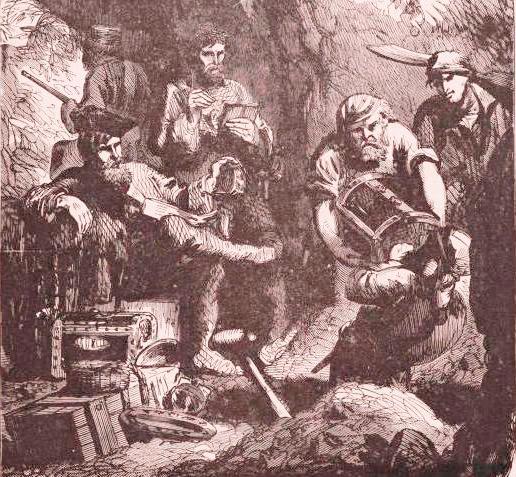
The legend of Captain Kidd‘s buried treasure — alleged to be buried in the New York region — inspires our first ghost tale of two ambitious soldiers on a quest during a full moon, on an island that today contains the Statue of Liberty! Meanwhile, out in Brooklyn, a congregation gathers at a new Catholic church, but maybe they shouldn’t have built it over a graveyard. Do the spirits of dead clergy haunt the halls today?
The Palace Theatre in Manhattan has hosted the greatest names in entertainment — and continues to play host to the undead. And finally, we hesitate to bring you the malevolent events at the Kreischer Mansion in Staten Island. What is it about this house that has inspired stories for over a hundred years, and did ghosts from a century ago have something to do with a horrifying and gory crime that took place here just a few years ago?
Bedloe’s Island: Below is a depiction of its southern shore in 1831. It was on the northern end during this period that two sentries at Fort Wood had a most unfortunate encounter while searching for buried treasure. (Image courtesy NYPL)
Legends of Captain Kidd’s treasure have possessed New Yorkers for centuries. It’s rumored that he killed one or two of his men and buried their bodies with the treasure to ‘guard’ it. Do these bodies lurk underneath the shadow of the Statue of Liberty? (NYPL)
Most Holy Trinity in Bushwick, Brooklyn, site of alleged hauntings from a variety of spirits.
The Palace Theater rises over Times Square, hosting the greats of vaudeville. But the stage has also attracted its share of ghost sightings over the year, including that of one very tenacious acrobat.
The legendary Judy Garland appeared here in the 1960s. Does she still lurk backstage today?
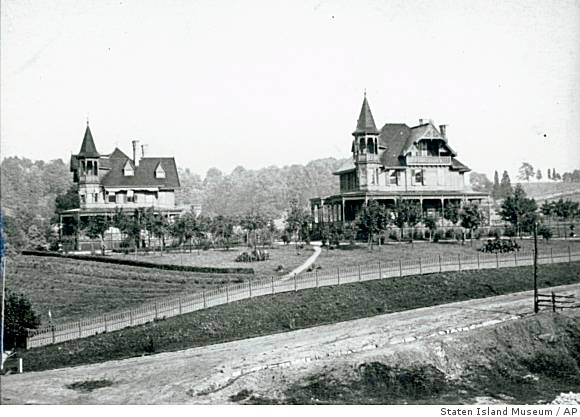
The Tale of Two Houses: The Kreischer Mansion in southern Staten Island, famous among generations of children as being an iconic haunted house, was actually once two houses. Or rather, a parallel house, mirroring the other in every way, once stood nearby, home built for the sons of a prominent German brick maker.
The mansion in the mid 1980s (Courtesy Flickr/Revup67)
Video filmed of the Kreischer Mansion in 1983:
In 2003, some amateur ghost hunters were allowed to photograph the property, escorted by the house’s caretaker at the time. From description, I believe the caretaker is the same person who committed a gory and terrible murder here just a few years later!
I’m an unabashed junkie of the sci-fi TV series ‘Fringe’, and the writers (or at one of them) seems to be a fan of New York history.
One of the conceits of the series involves an alternate universe with things are just slightly different from ours. Most notably, the World Trade Center was never attacked. And there are other changes to the skyline, one of which I wrote about last year — the construction of Antonio Gaudi’s comically absurd skyscraper.
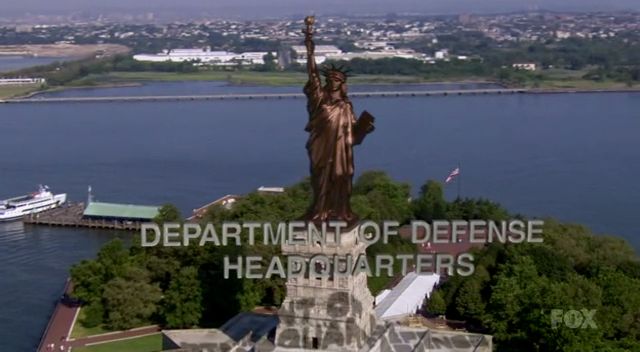
But in this bizarro world where Manhatan is spelled with a single ‘t’, a shining beacon still stands in New York harbor. The Statue of Liberty, ever in stark brown copper, stands in for the ominous “Department of Defense.” And considering that this world is constantly attacked by temporal warps — that’s why Madison Square Garden is encased in amber — this building has an elevated, even sinister purpose.
This correlation is a clever nod to the structure on which Lady Liberty currently stands, the star-shaped Fort Wood.
Many of the great forts that dot the New York harbor turn or will be turning 200 years old over the next year or so. Several fortifications, including Fort Wood, Castle Clinton and Castle Williams on Governor’s Island, were construction during the tense build-up of the War of 1812, anticipating that the city would need a tougher coastal defense. Older defenses, such as Staten Island’s Fort Wadsworth, were brought up to speed.
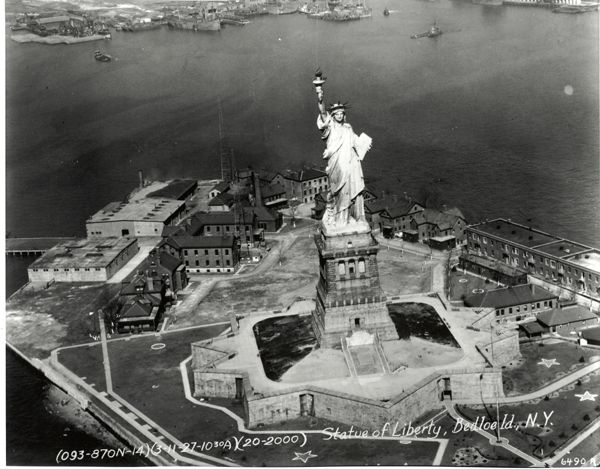
The fort on Bedloe’s Island, the original name of Liberty Island, was constructed like a starburst, a traditional 15th century European design and of the type one might build if your greatest enemy was a cannonball. This dynamic structure must have looked imposing sailing past, one of several a wary vessel would have see on its way into town.
Completed sometime in 1811, it was named after respected fort designer Colonel Eleazer Wood in 1814, the year he died in a battle against British forces near the Canadian Fort Erie.
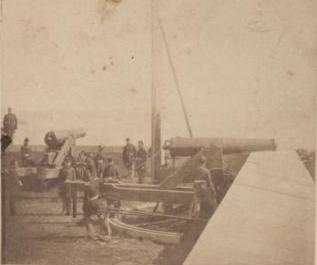
That intense conflict that re-matched the British with its young former colony never drifted into the harbor, and so the forts were thankfully never used. It and the forts on Governor’s Island prepared for battle again during the Civil War, holding ammunition and, on occasion, infirm Confederate prisoners. (At left, from a stereoscopic view of Fort Wood, equipt with manned cannons, most likely during the 1860s, pic courtesy NYPL)
With little need by the 1880s for so many fortifications, Bedloe’s Island prime location in the harbor made it an ideal home for Fredric Bertholdi’s elaborate piece of outdoor art, the Statue of Liberty. The fort was refitted for this new usage, and the statue of officially dedicated in 1886.
However, even after the statue arrived, the military remained on the island in new barracks, believe it or not, until 1937. (You can see them in the black and white photo above.) And in a sense, old Fort Wood has been besieged ever since, with millions of tourists, and has become central to an American icon, at least in our universe.
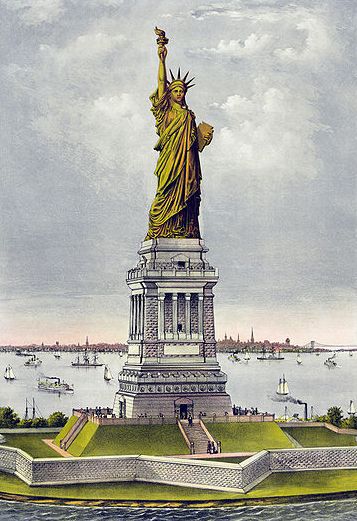
Below: Liberty as rendered by Currier & Ives, years before she went green
For millions of Americans, Ellis Island is the symbol of introduction, the immigrant depot that processed their ancestors and offered an opening into a new American life.
But for some, it would truly be an ‘Island of Tears’, a place where they would be excluded from that life. How did an island with such humble beginnings — ‘Little Oyster Island’, barely a sliver of land in the New York harbor — become so crucial? Who is the ‘Ellis’ of Ellis Island? And how did it survive decades of neglect to become one of New York’s most famous tourist attractions?
Dedicated to my niece Courtney, who specifically suggested this episode.
PODCAST Listen to it for FREE on iTunes or other podcasting services. Or click this linkto listen to the show or download it directly from our satellite site
CORRECTION: In the show, we mention that island namesake Samuel Ellis bought Little Oyster Island in 1784. In fact, it’s possible he owned the island well before that, possibly by 1770.
___________________________________ As always, click on pictures for a bigger view
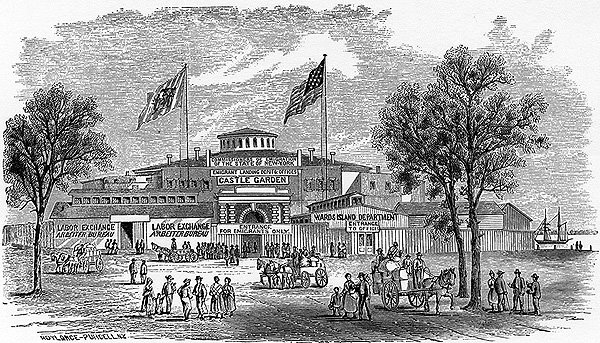
Before Ellis, there was Castle Garden, the former performance hall that became New York’s immigration depot from 1855 to 1890. The building bore witness to a great influx of German and Irish immigrants, however the facilities were seen as inadequate and unsafe.
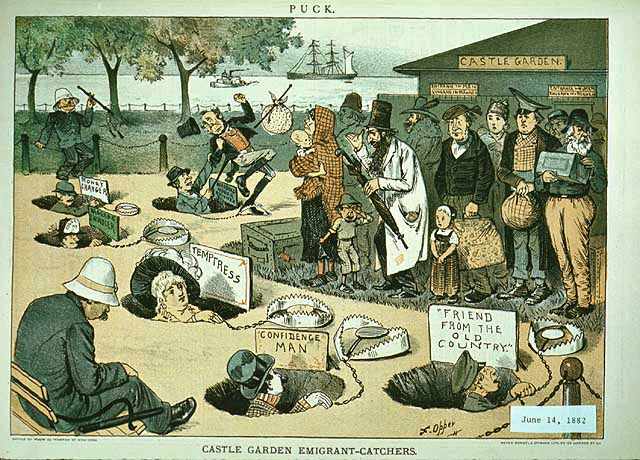
New immigrants emerging from Castle Garden would find themselves beseiged by grifters, runners and utter chaos, as evidenced by this 1882 illustration from Puck Magazine.
___________________________________
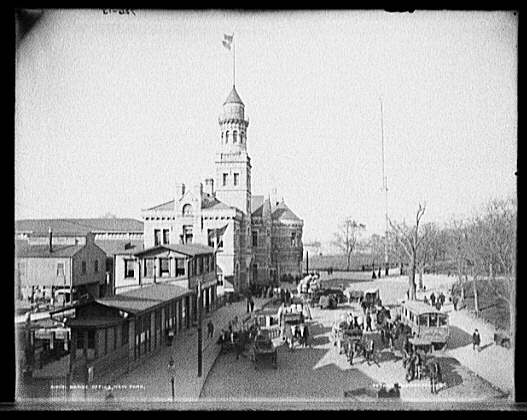
Temporary Digs: For four non-consecutive years, the Barge Office nearby Castle Garden would serve as New York’s immigration depot. It would serve first in 1890-92 when the state government closed Castle Garden and the federal government was still getting Ellis Island ready. Later, after the original structured on Ellis Island burned down, immigration would return here, from 1898-1899.
___________________________________
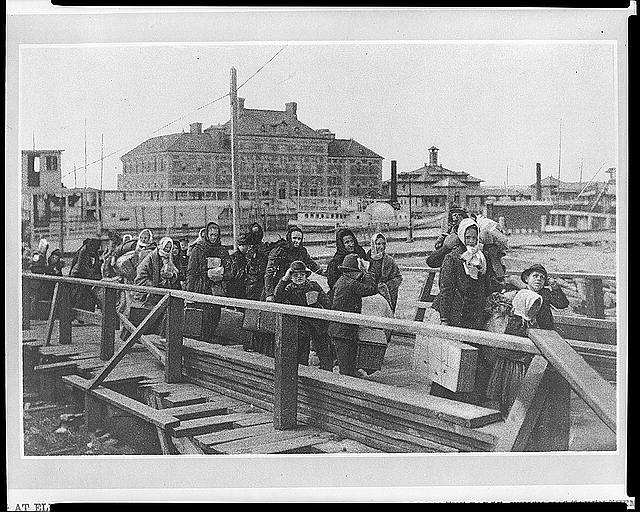
The Long Way Around: New immigrants unload in front of the doors of the main Ellis Island building in 1902. Steamships would coast into New York harbor, arrive at their Manhattan dock to release their first class passengers, then pack the steerage people into a barge which would take them to Ellis. (Pic courtesy here)
___________________________________
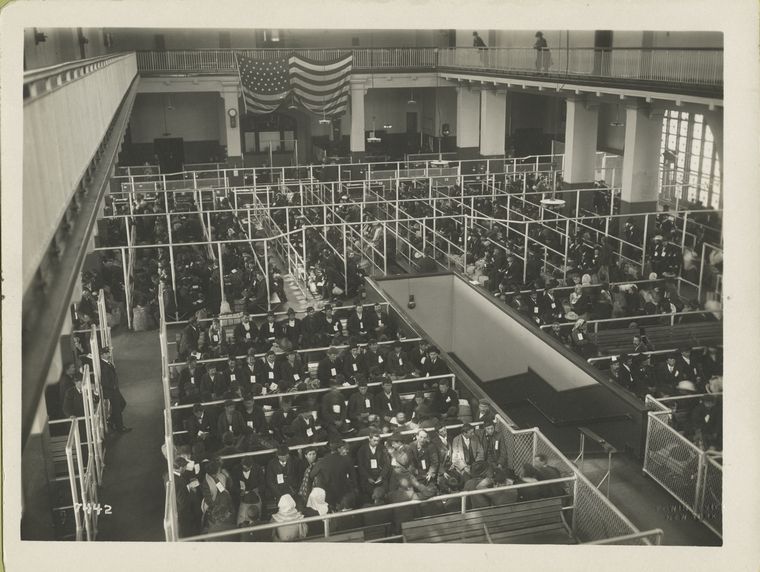
Penned In: See, it really was like cattle! The registry room of Ellis Island would keep people at close quarters as officiates began the arduous process of examining everyone.
___________________________________
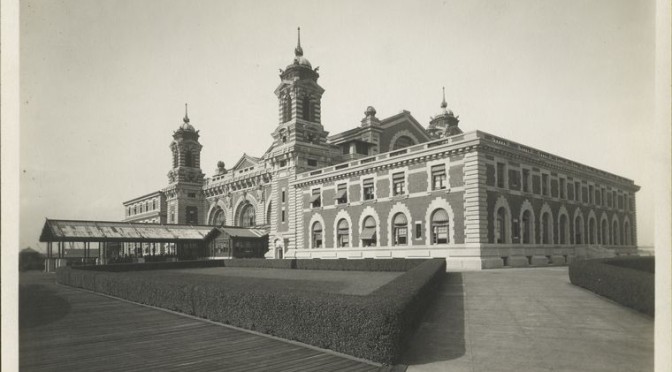
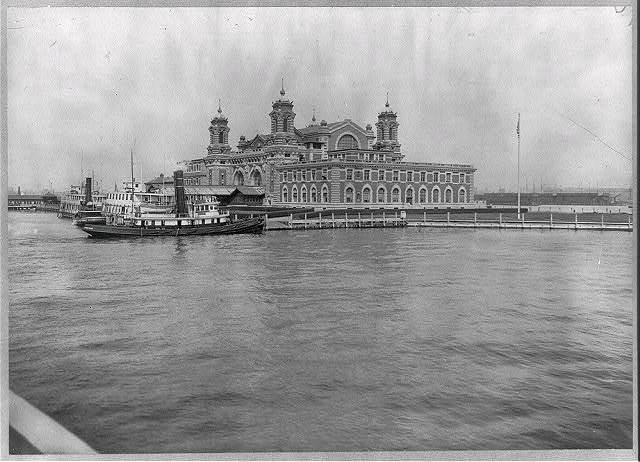
OVERDRESSED? William A. Boring and Edward Lippincott Tilton gave the new Ellis Island center an elegant Beaux-Arts touch with exotic towers and limestone ornamentation. Immigrants would be greeted with a building that resembled European structures back home.
___________________________________
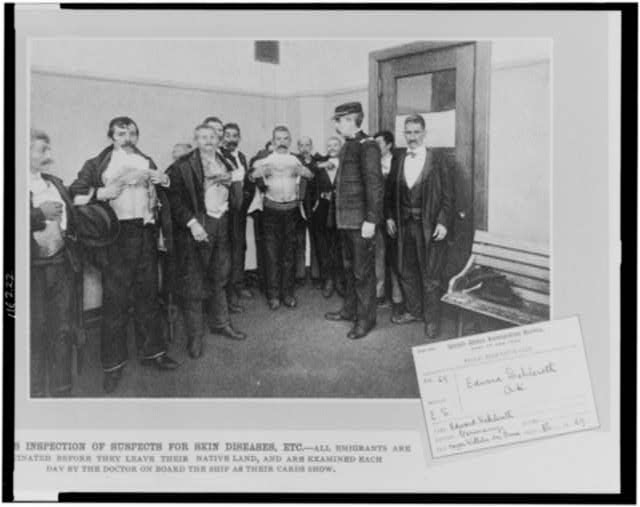
Revealing: Some unfortunates who were pulled aside for further evaluation, this time for potential skin diseases. The room they are standing in is now one of several museum displays detailing the grueling experience of those who were ‘pulled aside’. (Pics courtesy here.)
___________________________________
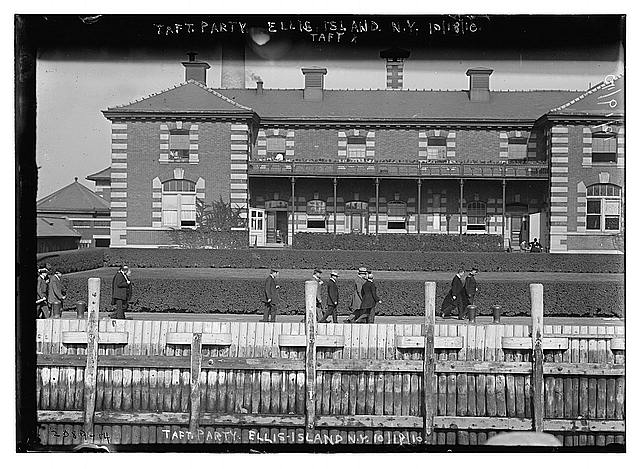
The Grand Tour: President William Howard Taft goes on an inspection tour of the Ellis Island facility. The immigration center was frequently a sore spot politically, a lightening rod for restrictionists and immigrant aid agencies alike. (Pic courtesy here)
___________________________________
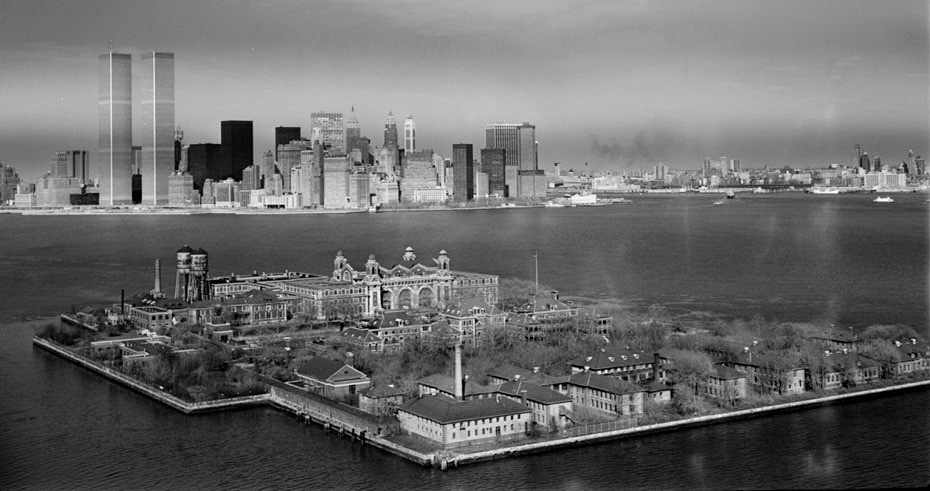
Itself Excluded: Ellis Island was a mess of ruins and overgrowth by the 1970s, a victim of decades of neglect. Even the National Parks service failed to do much with it before Lee Iacocca and the Statue of Liberty-Ellis Island Foundation came along to save it.
The picture below is from 1978. Most of the island is created from landfill. The buildings to the front of the image were not only hospital facilities, many of them specifically for the care of measles, a common malady of immigrant children. (Courtesy here.)
You can visit the Ellis Island website to check to see if any of your family members happened their way through the island.
And finally, Thomas Edison’s 1906 silent footage of immigrants arriving at the island.