Categories
Podcasts Religious History

The secrets of the Cathedral of St. John the Divine, the unfinished beauty of Morningside Heights

PODCAST The history of the Cathedral of St. John the Divine and a tour of its unique artistic treasures

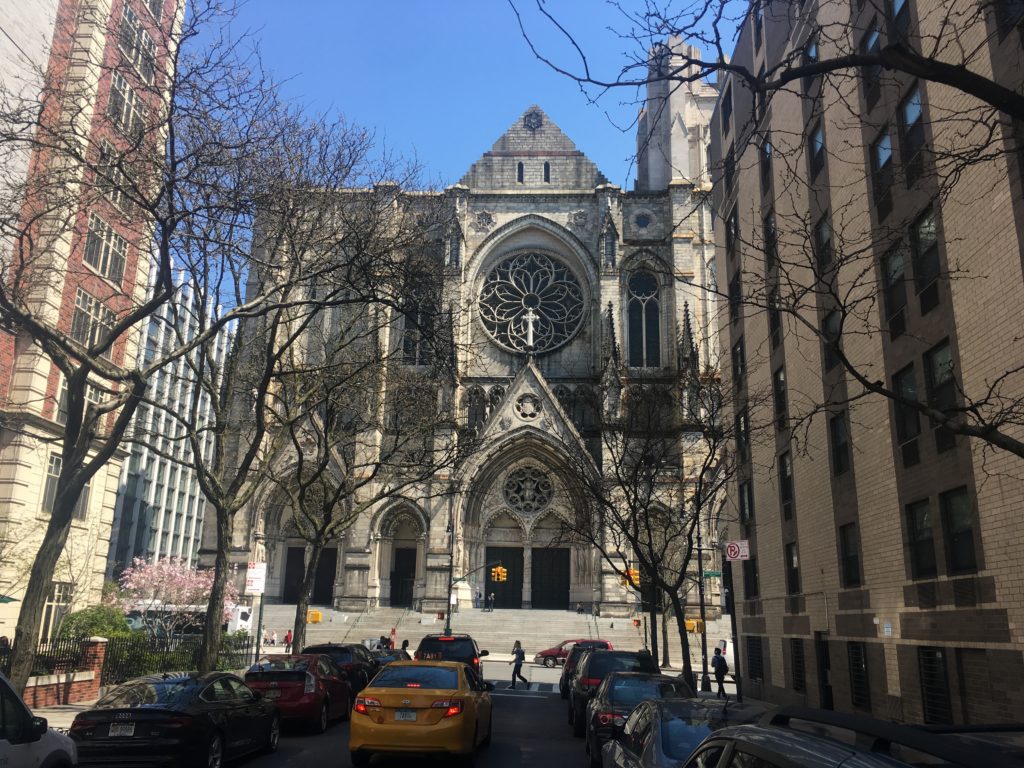
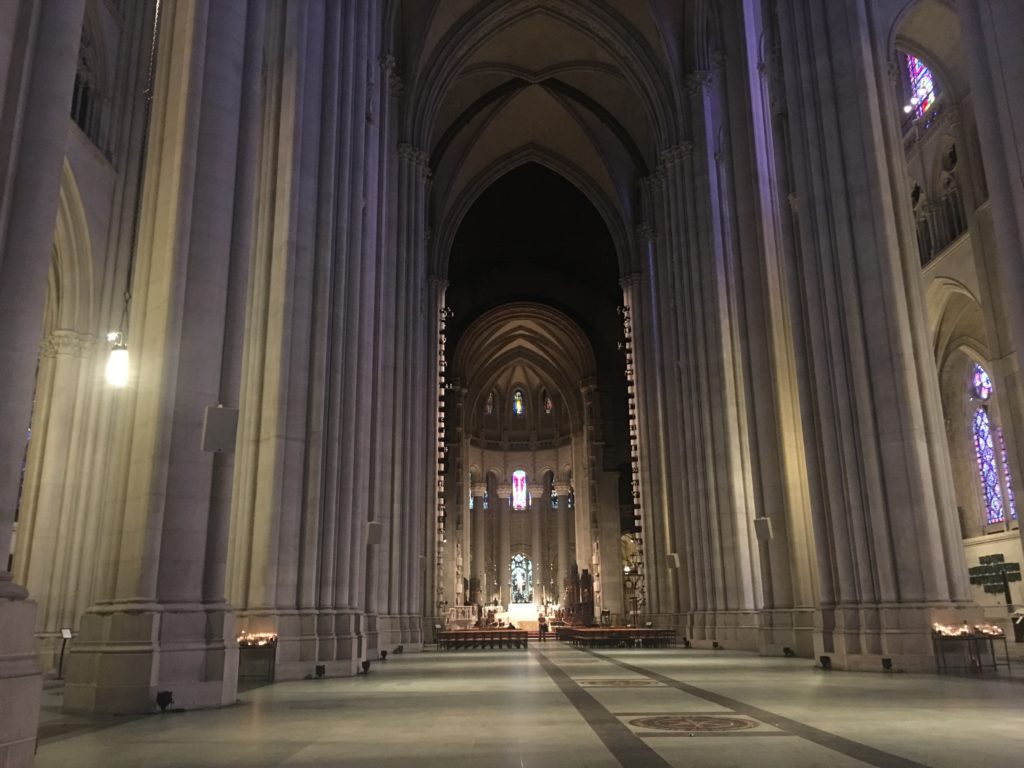
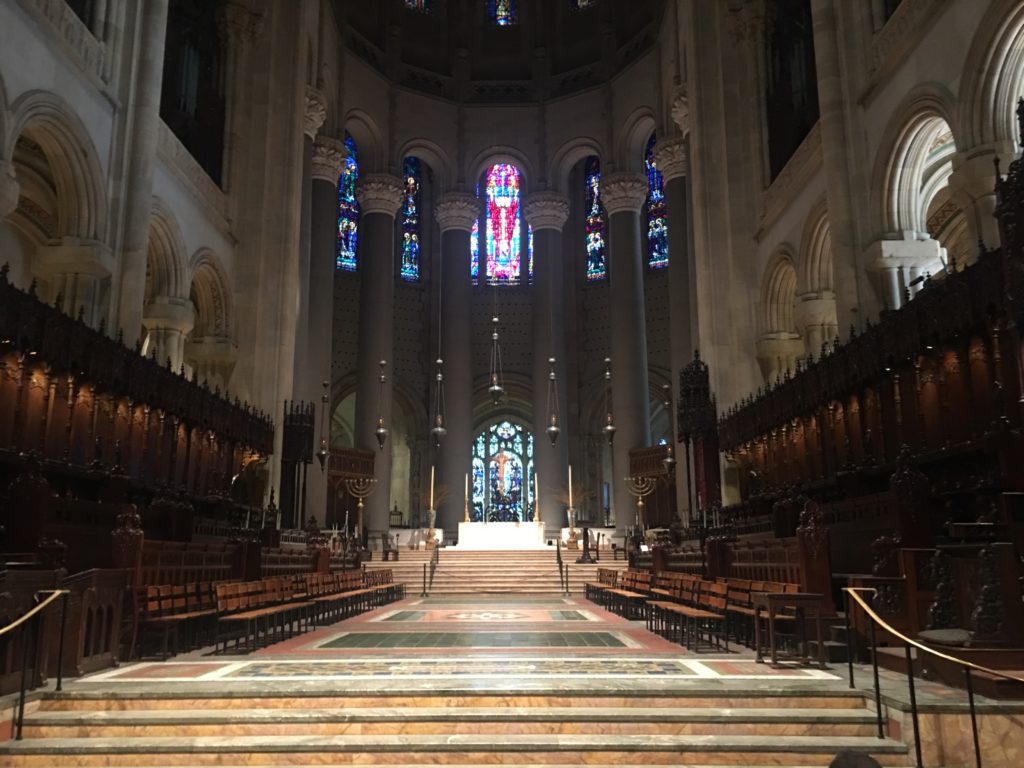
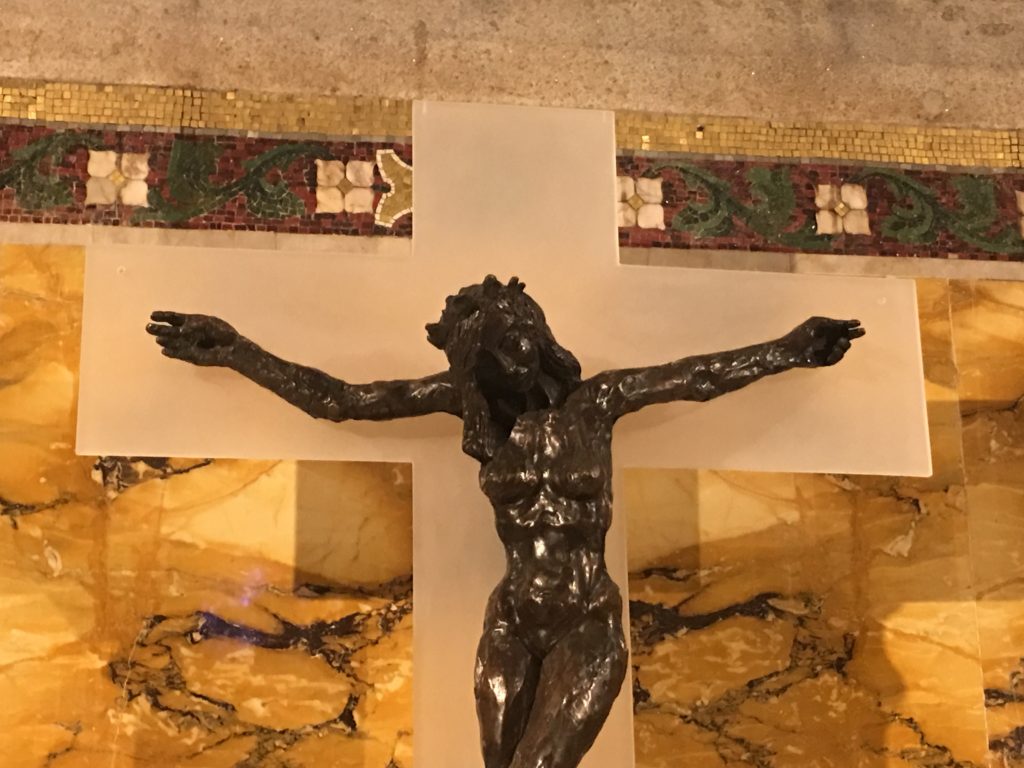
The Bowery Boys have finally made it to one of the most enigmatic and miraculous houses of worship in America – the Cathedral of St John the Divine. This Episcopal cathedral has a story like no other and a collection of eccentric artifacts and allegorical sculpture – both ancient and contemporary – that continues to marvel and confound.

Located in Morningside Heights in Upper Manhattan, St. John the Divine – named for the Apostle and author of the Book of Revelations — is no ordinary cathedral (if such a thing exists). Every corner seems to vibrate on a different frequency from other Christian churches.

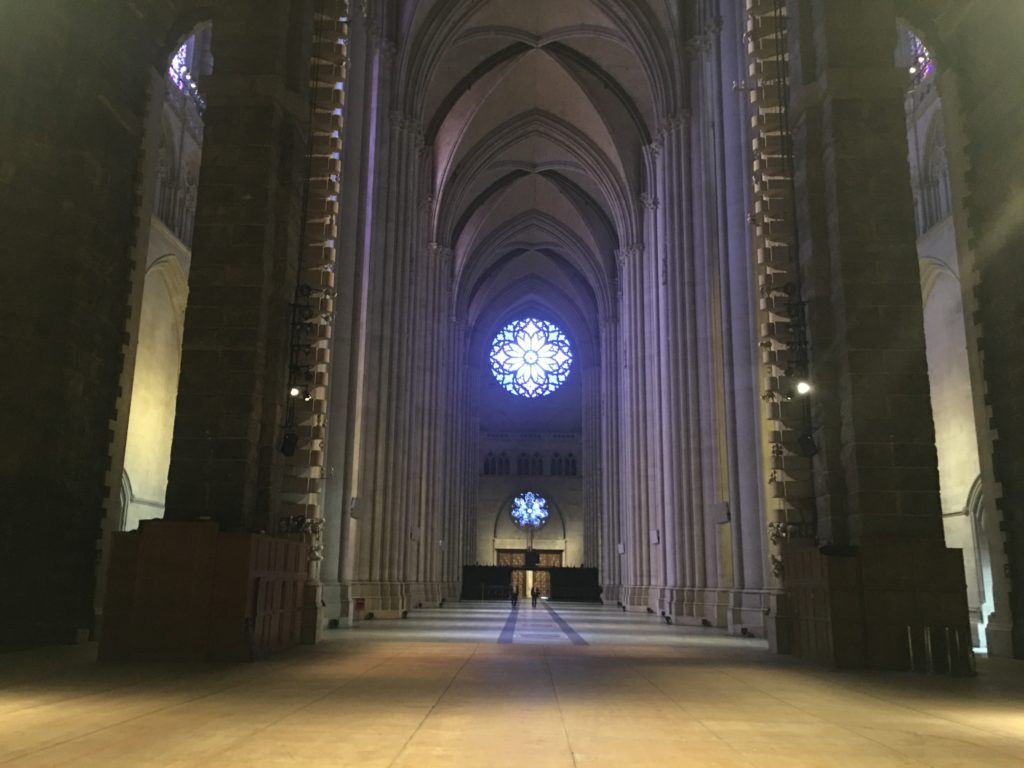
Many ideas have gone into creating St. John the Divine’s unique personality – a quirky mix of architectural styles, some outside-the-box ideas about community outreach, its embrace of the unconventional. But one particularly striking detail sets it apart from the rest: the Cathedral remains unfinished.

FEATURING: Franklin Delano Roosevelt, Keith Haring, Duke Ellington, Martin Luther King Jr. and the high-wire antics of Philippe Petit

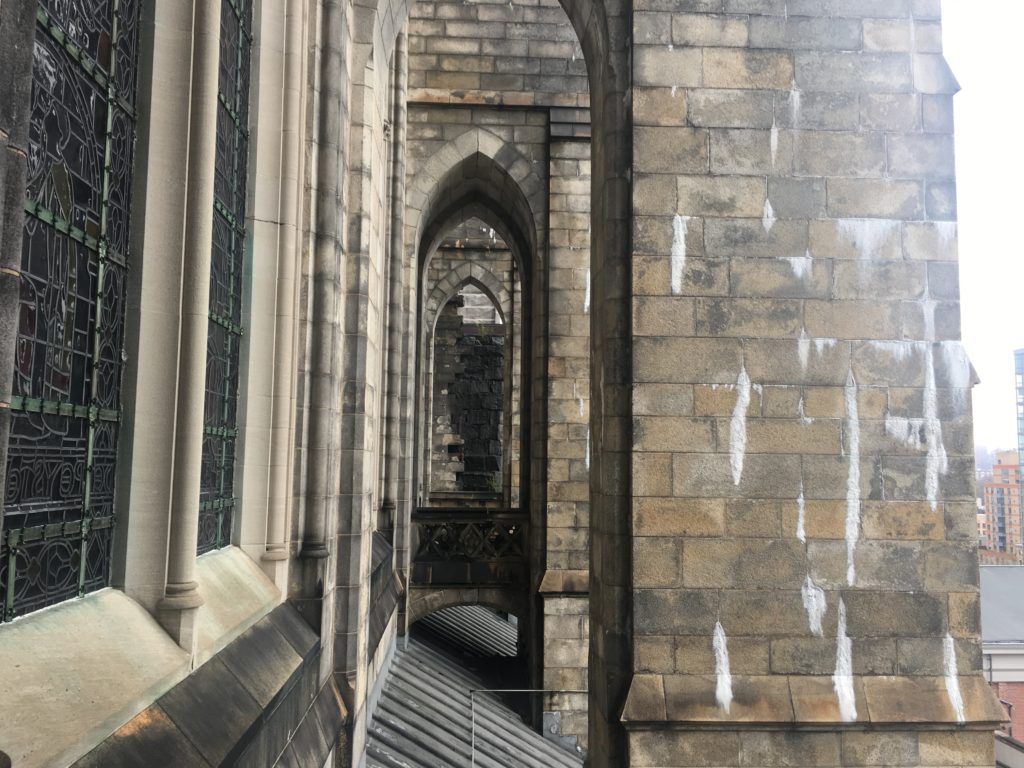
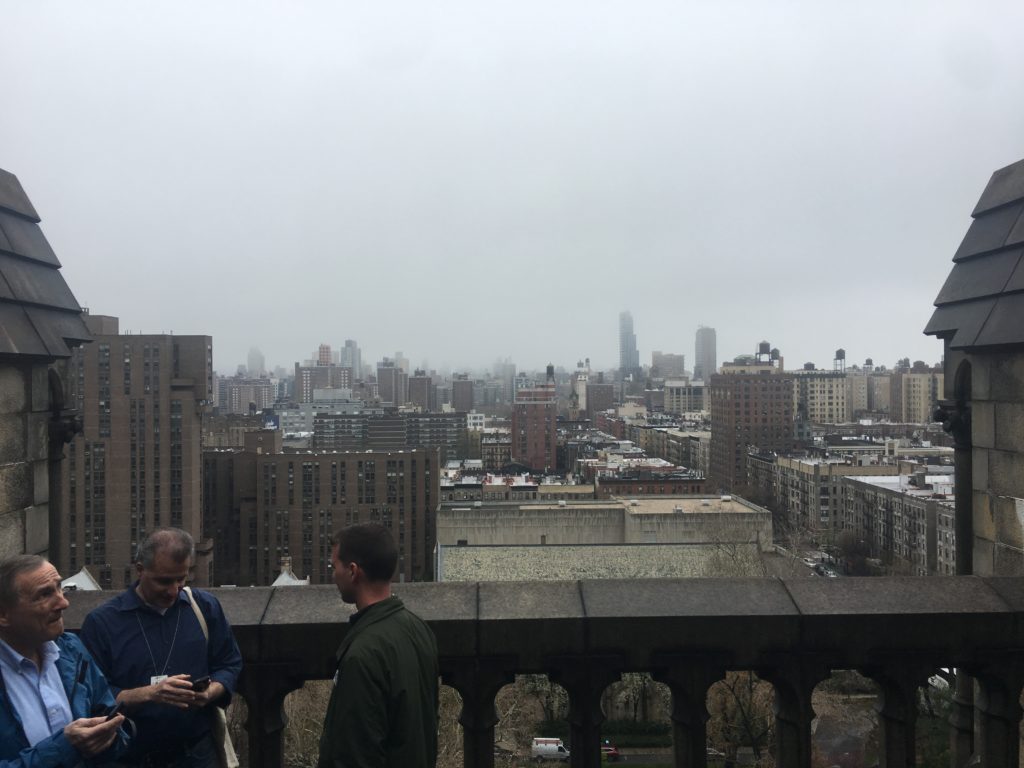
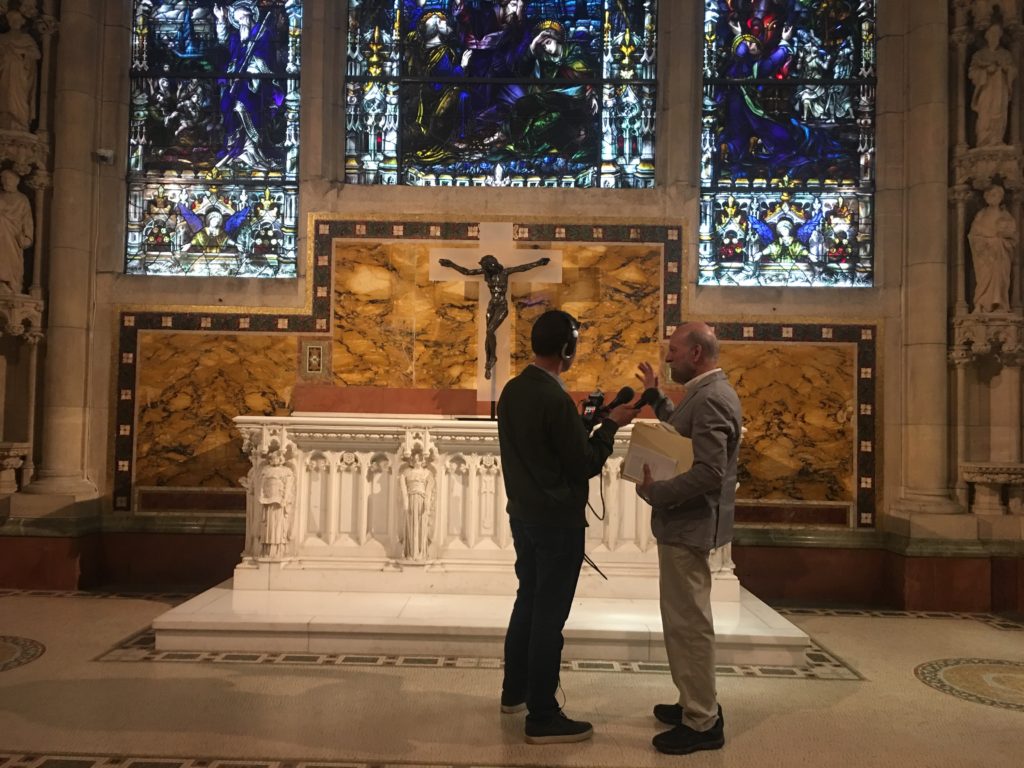
ALSO: Tom and Greg explore the Cathedral — from the crypt to the rooftop – with tour guide Bill Schneberger.

Listen Now: Cathedral of St. John the Divine Podcast

Or listen to it straight from here:

______________________________________________________

The Bowery Boys: New York City History podcast is brought to you …. by you!

We are now producing a new Bowery Boys podcast every other week.  We’re also looking to improve the show in other ways and expand in other ways as well — through publishing, social media, live events and other forms of media.  But we can only do this with your help!

We are now a member of Patreon, a patronage platform where you can support your favorite content creators for as little as a $1 a month.

Please visit our page on Patreon and watch a short video of us recording the show and talking about our expansion plans.  If you’d like to help out, there are five different pledge levels (and with clever names too — Mannahatta, New Amsterdam, Five Points, Gilded Age, Jazz Age and Empire State). Check them out and consider being a sponsor.

We greatly appreciate our listeners and readers and thank you for joining us on this journey so far. 

_______________________________________________________

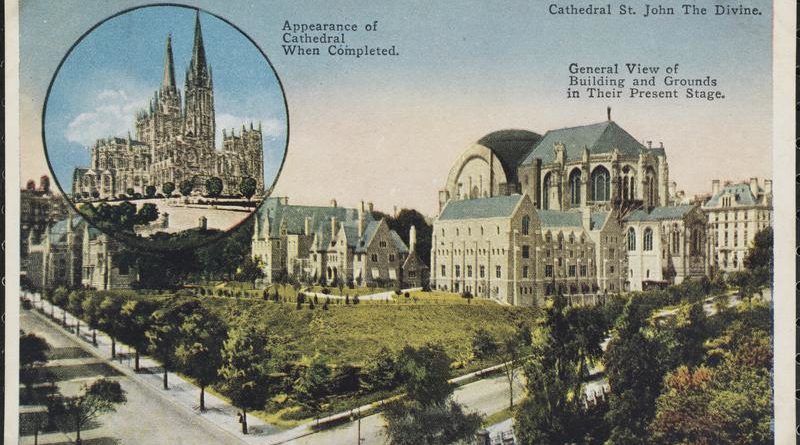
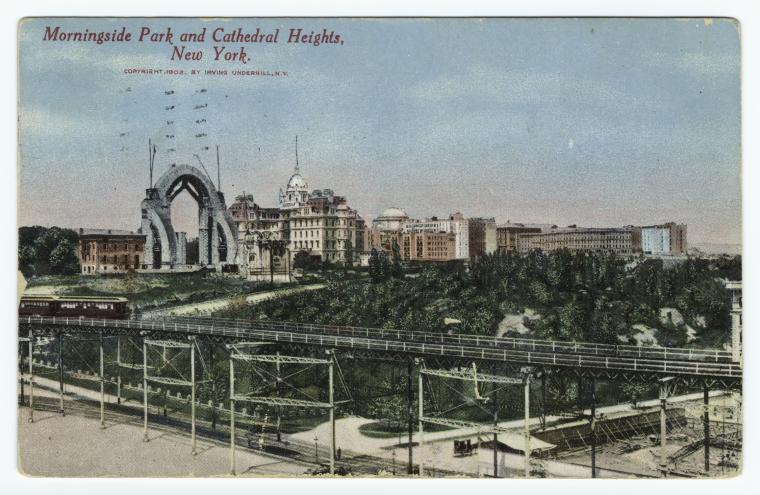
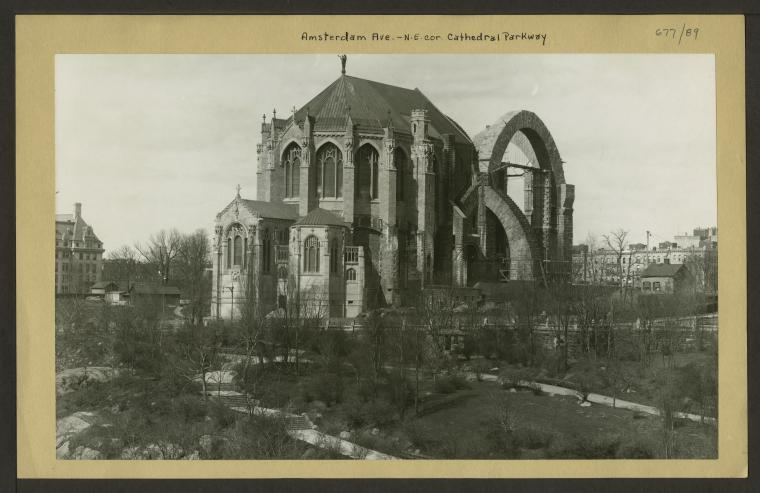
A postcard from 1902 with only a gigantic arch built. The nearby campus of Columbia University was only a few years old by this time.

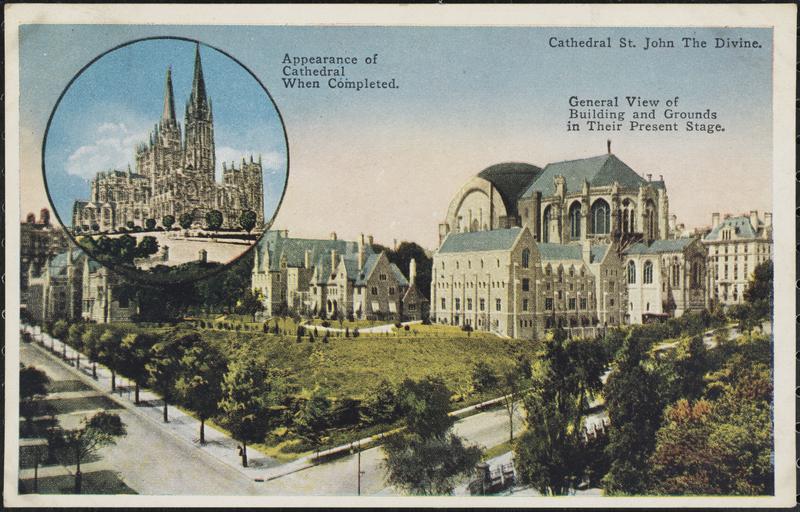
A postcard from 1910. Little did they know that it still would not be finished over a century afterwards.

Museum of the City of New York

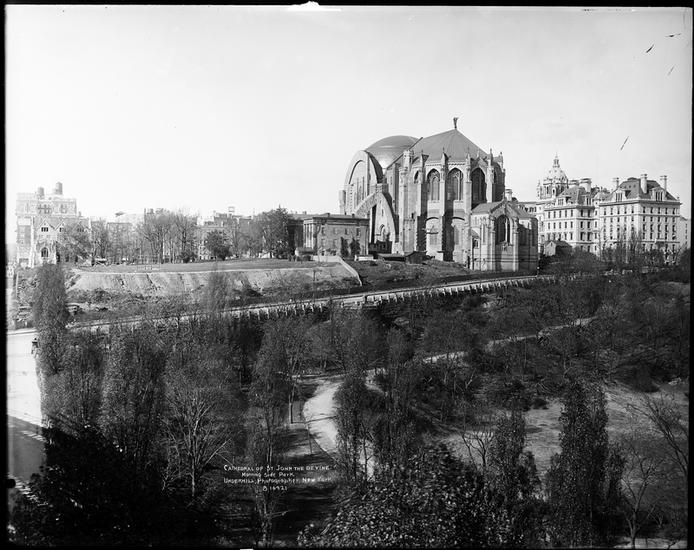
What the church actually looked like in 1910.

Irving Underhill/Museum of the City of New York
New York Public Library

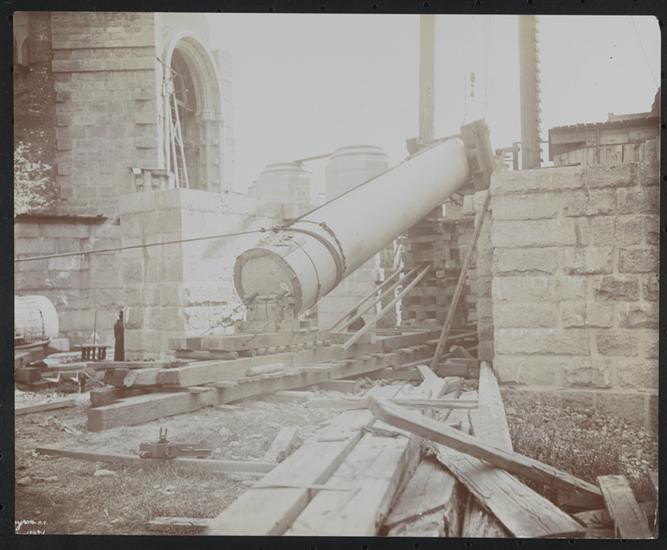
Bringing the columns into the future nave of the church, 1904.

Museum of the City of New York

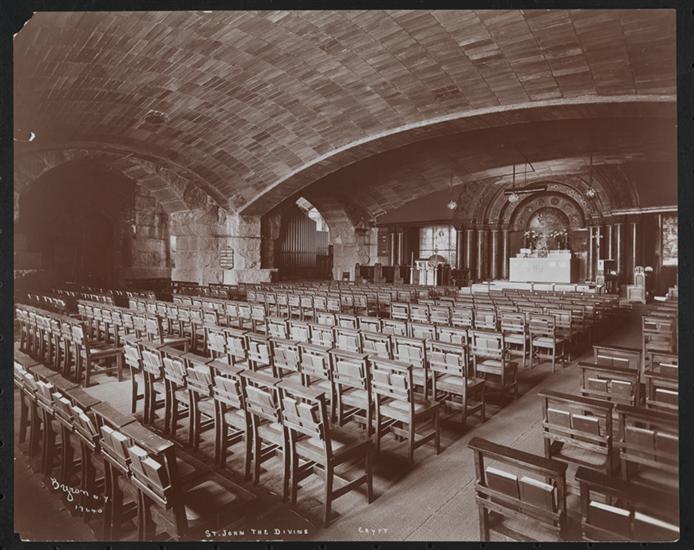
The first services were actually held in the crypt. Note the beautiful Guastavino tiling on the ceiling.

MCNY

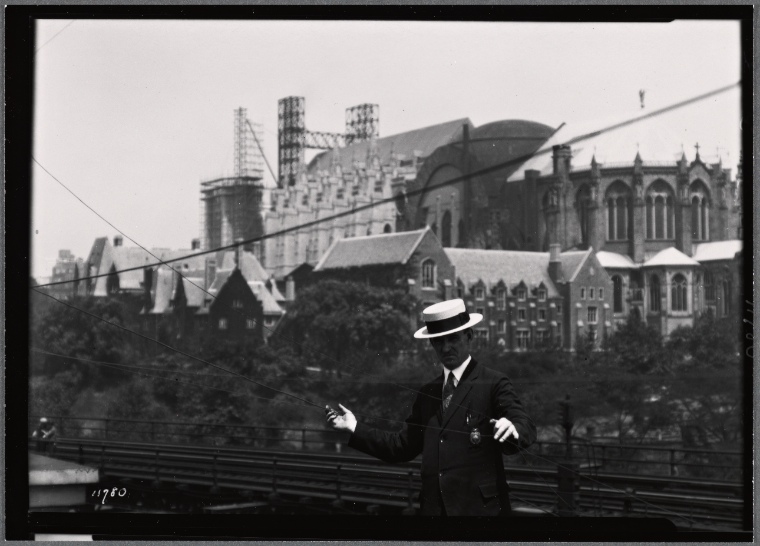
Considerably more work has been done by 1934 as shown in this photograph.

NYPL

The western end of the cathedral as seen from the children’s garden at the foot of the REALLY weird Peace Fountain by sculptor Greg Wyatt.

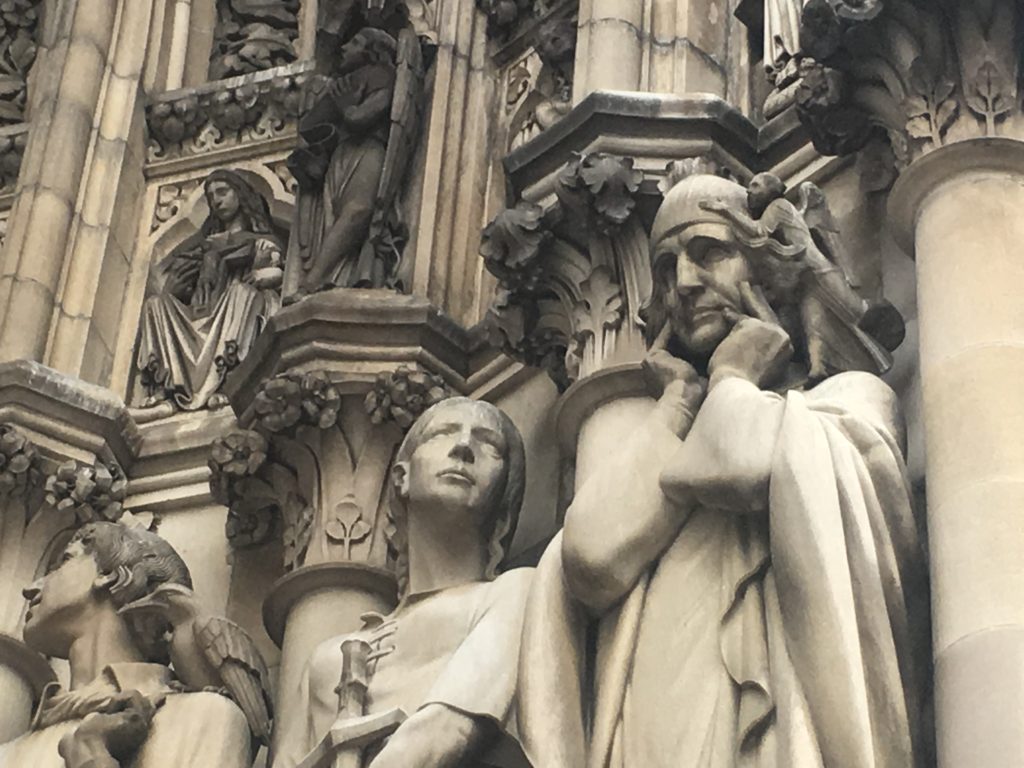
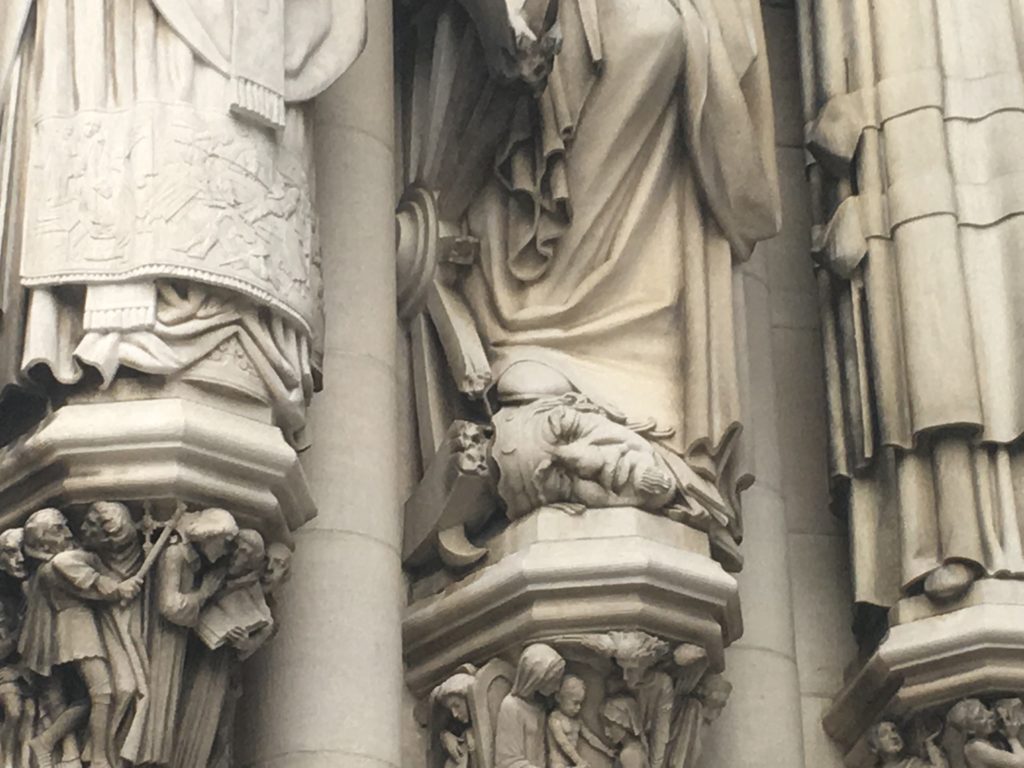
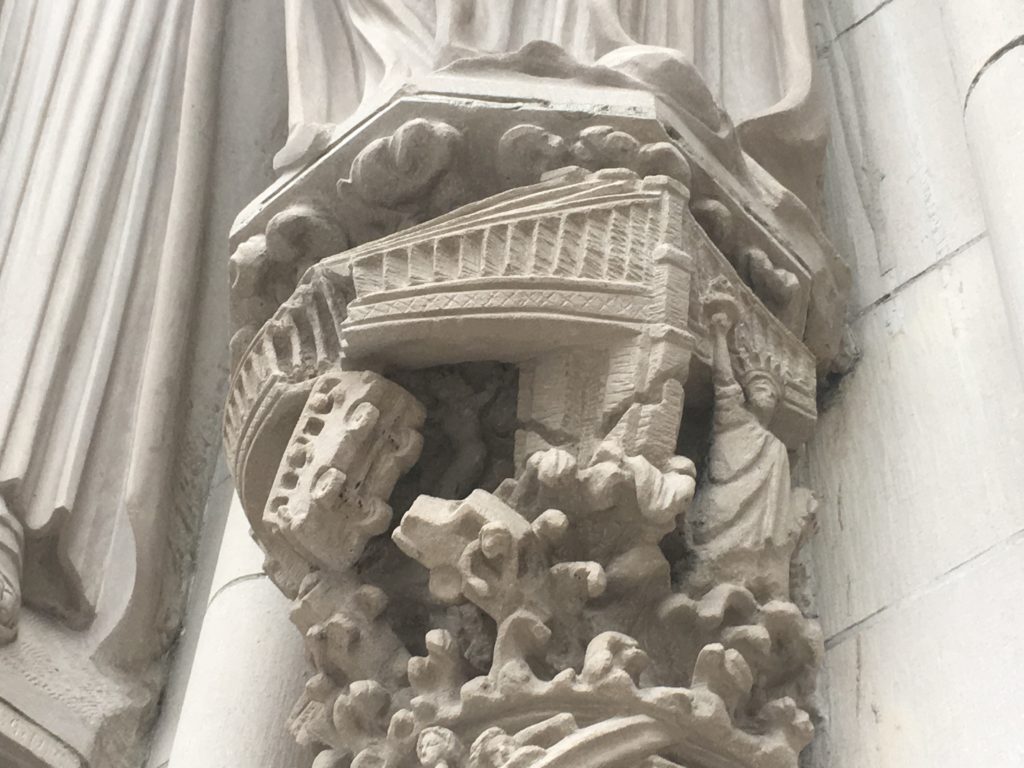
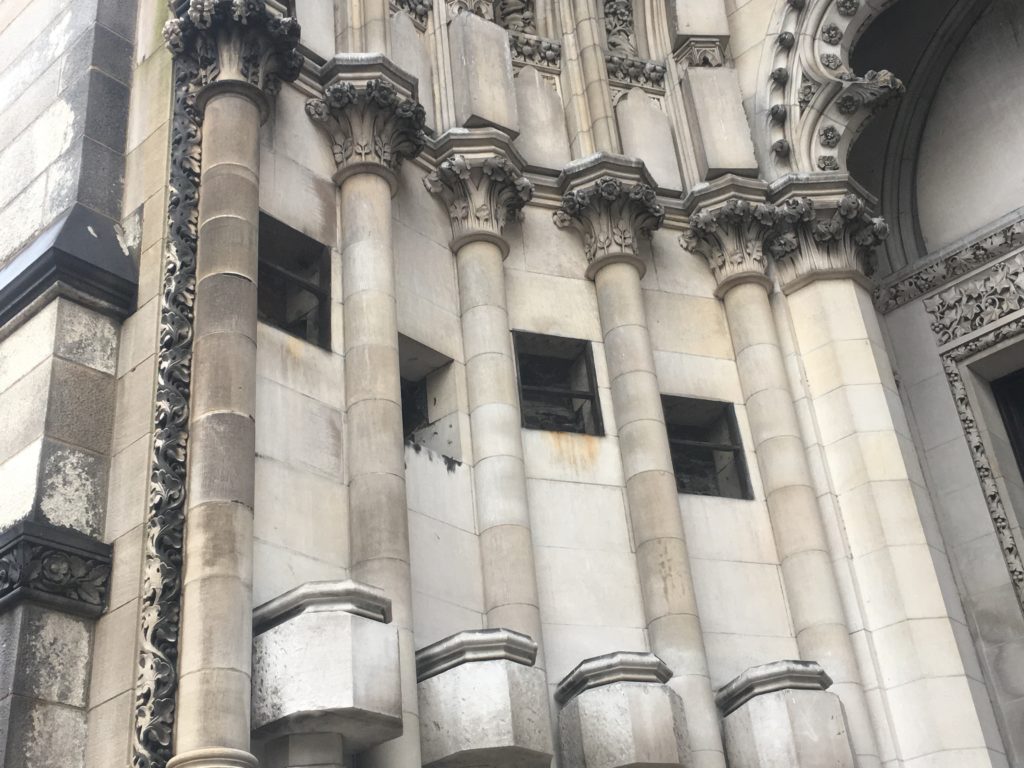
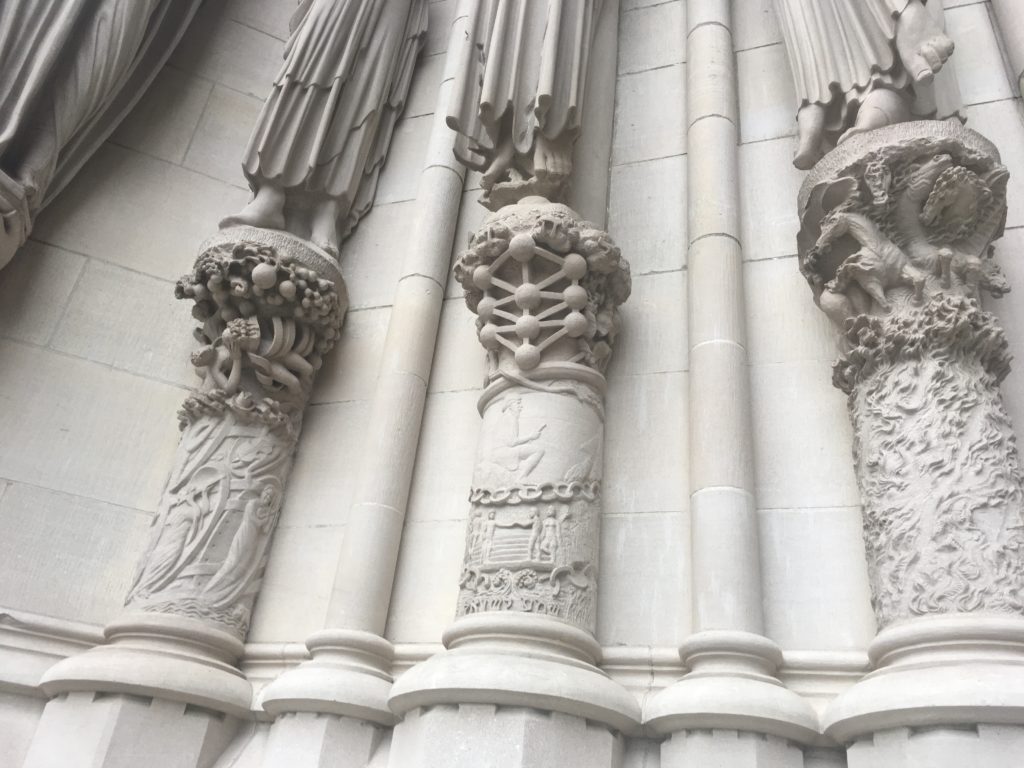
From the western entrance of the church, a collection of curious, strange and even unsettling carvings:

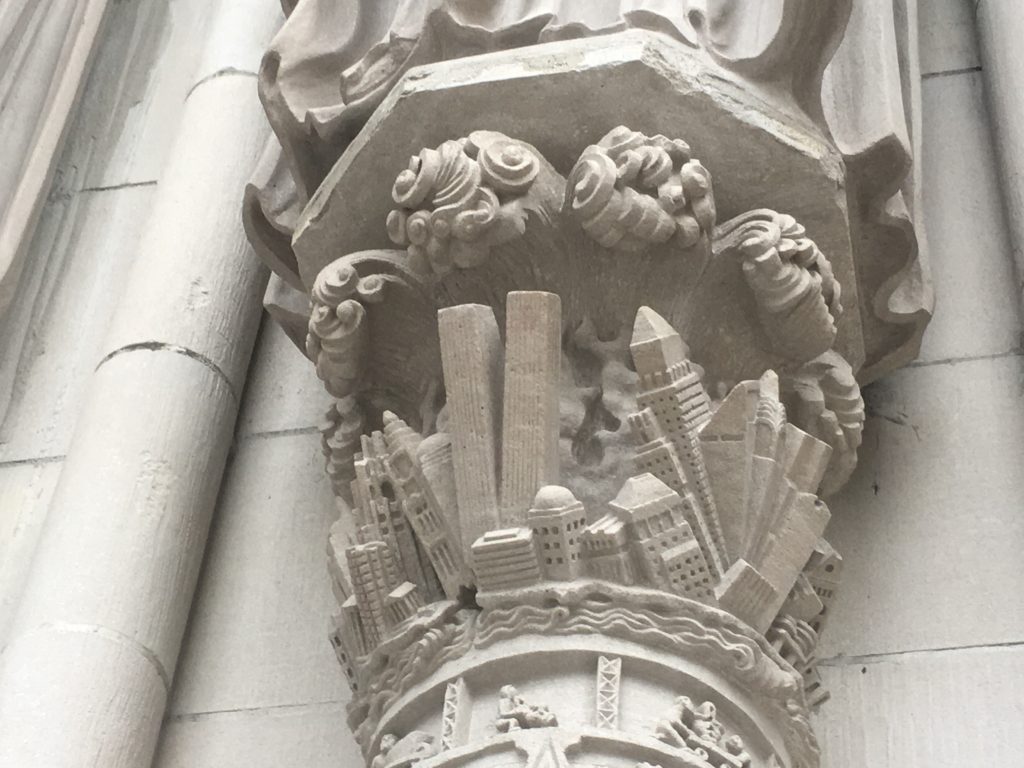
Befitting John’s authorship of the Book of Revelations, a grim depiction of the Apocalypse (and carved well before the events of September 11).

The southern archway had yet to be populated with statues.

From its northern side, an excellent view of the diverse styles in their unfinished state.

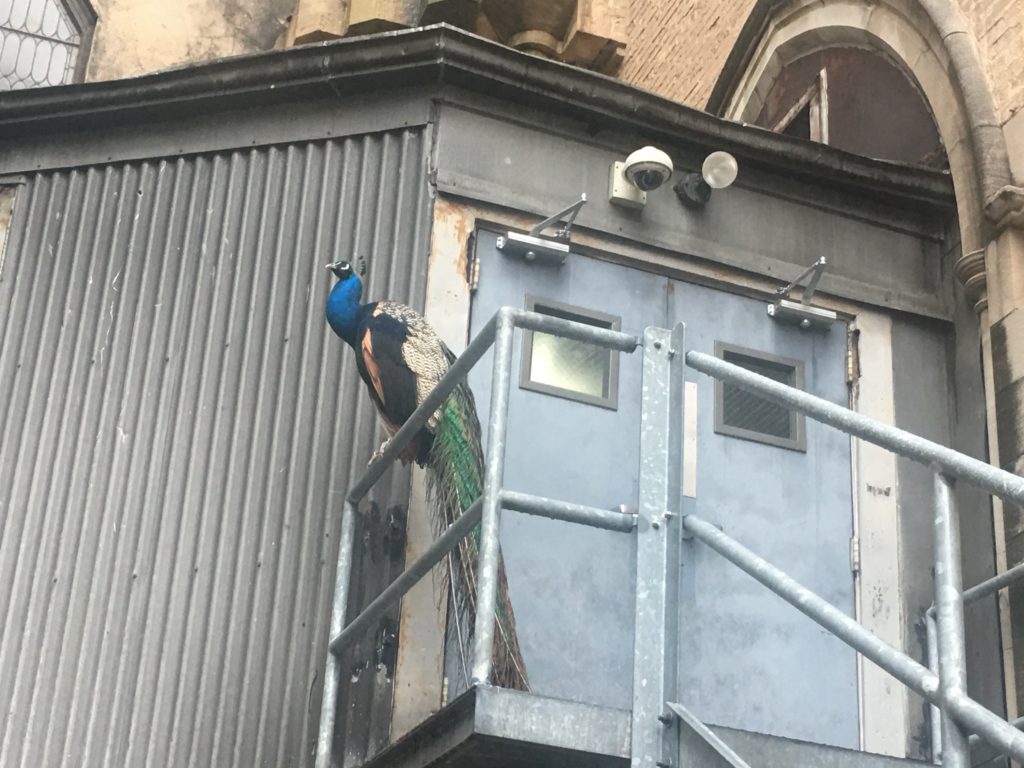
Don’t forget to look and listen for the peacocks which roam the cathedral grounds.

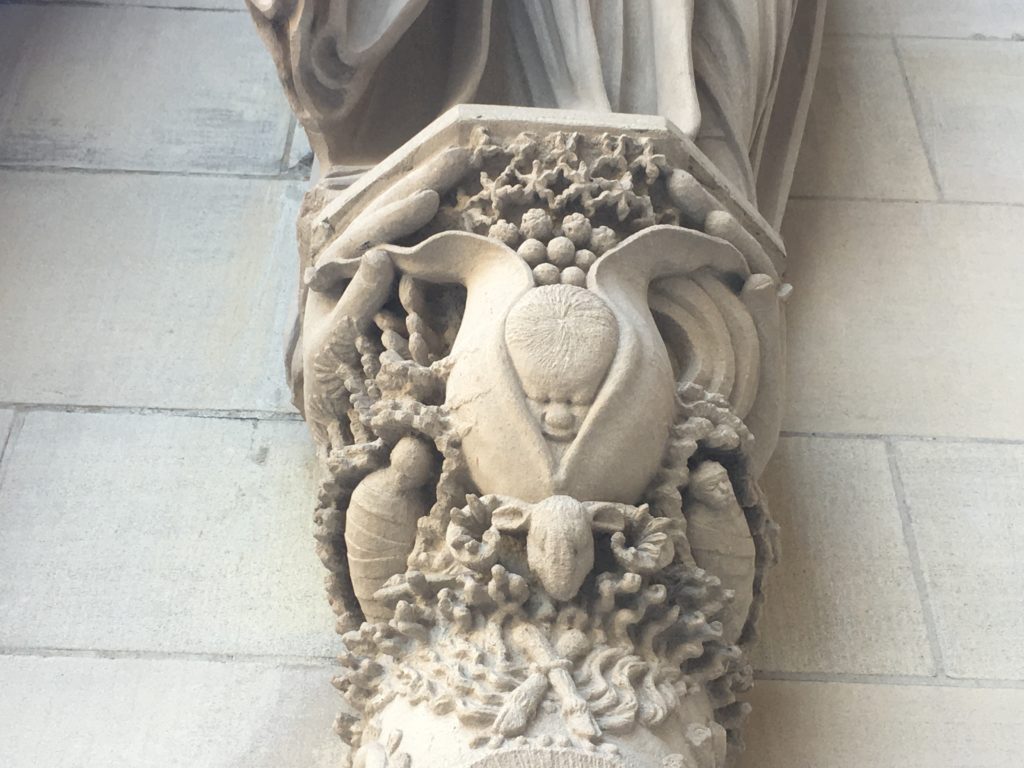
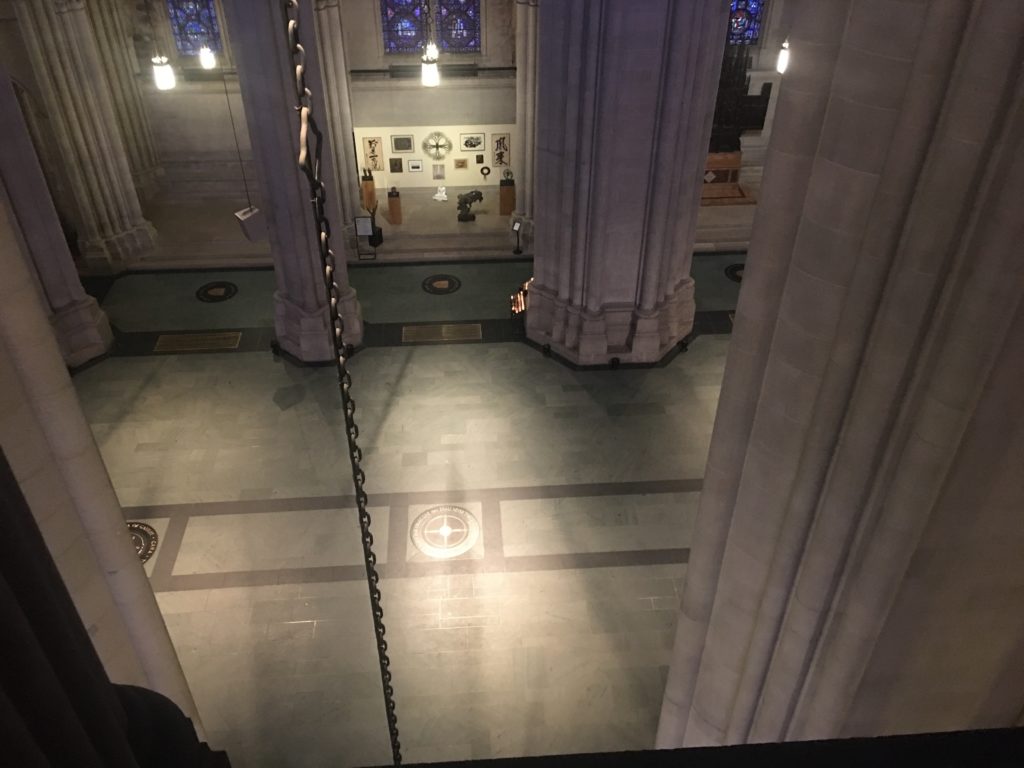
From the triforium, our tour guide Bill Schneberger points out a very bizarre detail, recently revealed. In a sea of flower decorations, one stone carver made the face of a boy. (Video is not great but trust us! It’s there.)Video Player00:0000:14

This video actually shows the very, very top of the church — the ceiling which is enclosed in a separate space, protected from the elements.Video Player00:0000:10

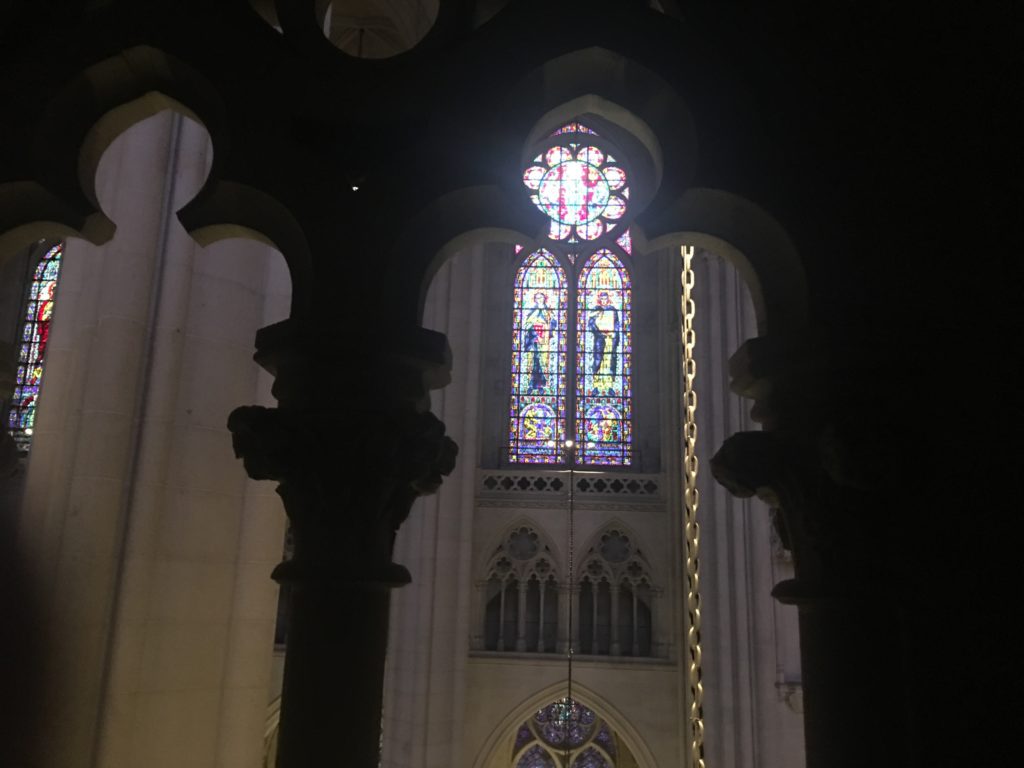
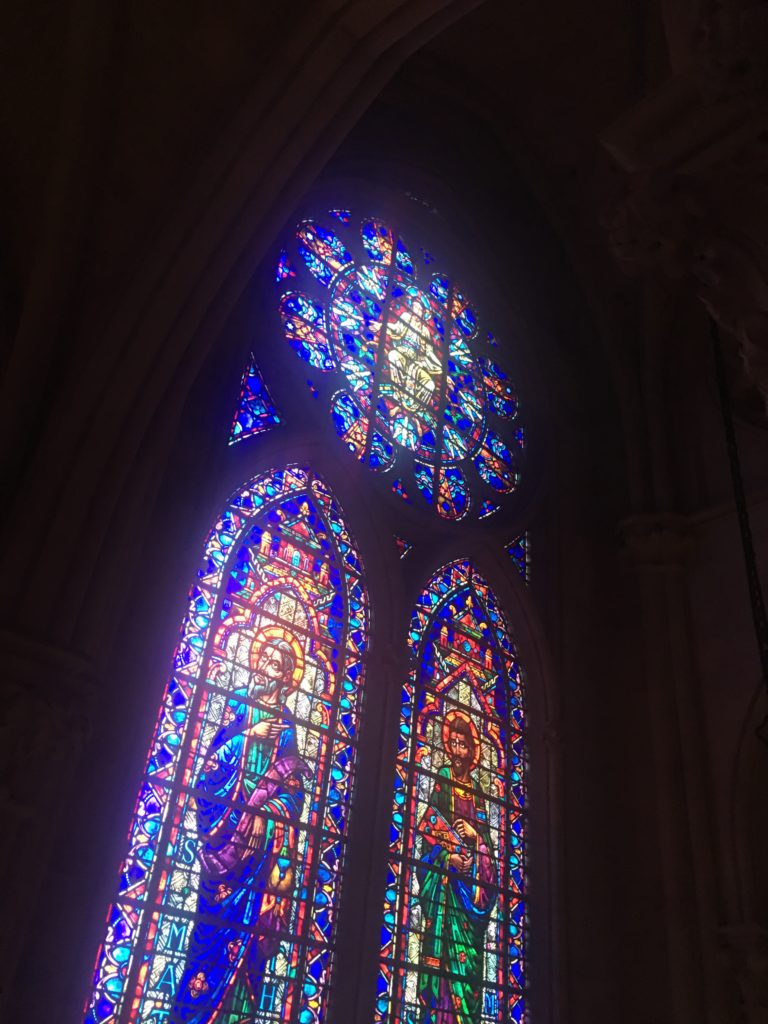
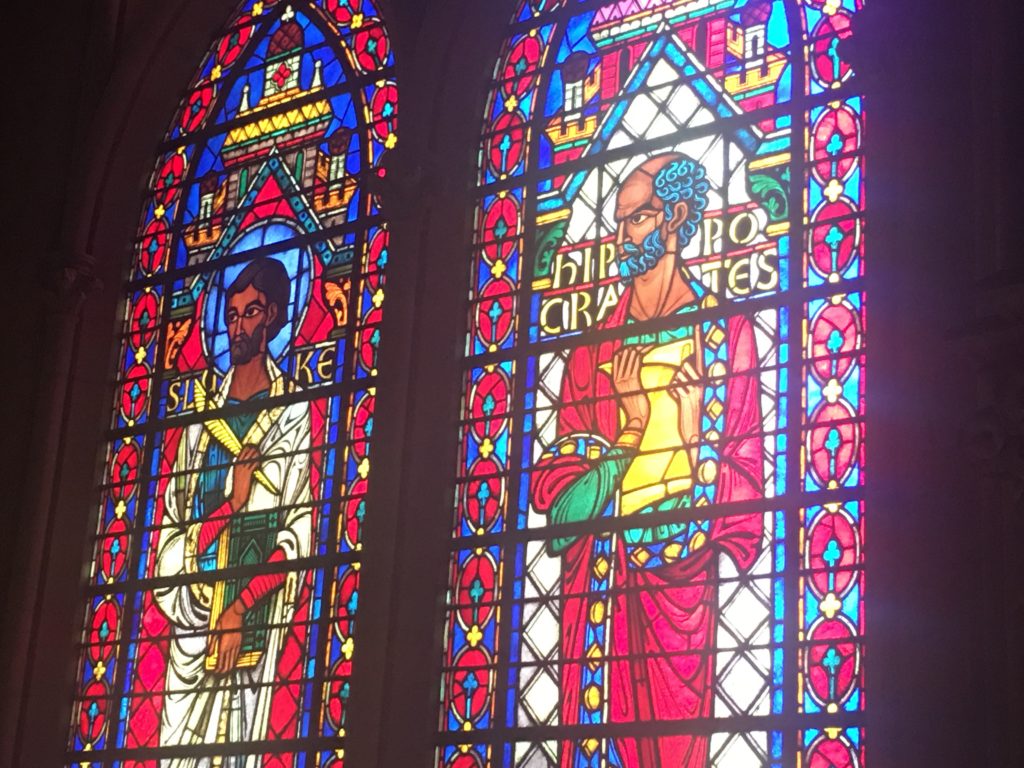
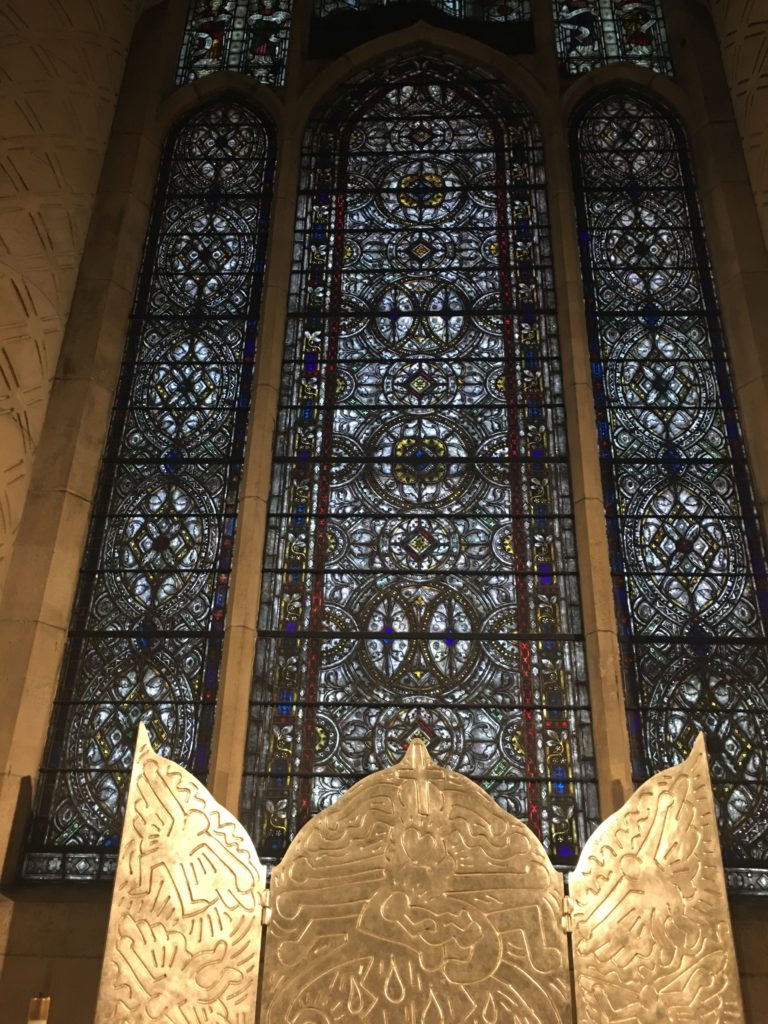
The Keith Haring triptych in contrast to the extraordinary patterned stained-glass window.

Video Player00:0000:41

And finally, we’re pleased to announce that we will emceeing a very special event at the Cathedral later this month — a party for its 125th birthday!

More details here and check this website in the coming days for even more information

The Cathedral Church of Saint John the Divine
invites you to
The 37th Annual Spirit of the City Gala
Celebrating 125 years of this historic landmark!
With a special tribute to José V. Torres and his leadership in the Cathedral’s education programs for children
on Wednesday, May 23rd

Dinner & Party Tickets
An exquisite buffet dinner featuring international foods in the chapels followed by drinks and live music at 6 pm

$1000 Regents Ticket
Includes annual membership in the Cathedral’s Society of Regents, invitations to Cathedral events, and recognition in the evening’s program.

$500 Supporting Ticket
Includes recognition in the evening’s program and invitations to Cathedral events.

After-Party Tickets
Featuring signature cocktails by Highland Park Whiskey along with beer, wine, and desserts and a performance by The Duke Ellington Legacy Band followed by a DJ

Doors open at 7:30 pm
$150 after April 30th

To reserve your ticket online, please click here.

Those who support the Bowery Boys on Patreon will receive a discount code later next week, so check your messages!

Proceeds from the evening benefit the Cathedral.

Categories
American History Podcasts

The Huddled Masses: Emma Lazarus and the many meanings of the Statue of Liberty

PODCAST The words of “The New Colossus,” written 135 years ago by Jewish poet Emma Lazarus in tribute to the Statue of Liberty, have never been more relevant — or as hotly debated — as they are today.

What do they mean to you? “Give me your tired, your poor/Your huddled masses yearning to breathe free/The wretched refuse of your teeming shore.”

In this episode, Tom and Greg look at the backstory of these verses — considered sacred by many — and the woman who created them.

Emma Lazarus was an exceptional writer and a unique personality who embraced her Jewish heritage even while befriending some of the greatest writers of the 19th century. When the French decided to bestow the gift of Liberty Enlightening the World to the United States, many Americans were uninterested in donating money to its installation in New York Harbor. Lazarus was convinced to write a poem about the statue but she decided to infuse her own meaning into it.

This icon of republican government — and friendship between France and America — would soon come to mean safe harbor and welcome to millions of new immigrants coming to America. But are Lazarus’ words still relevant in the 21st century?

Listen Now: Emma Lazarus Podcast

___________________________________________________________

The Bowery Boys: New York City History podcast is brought to you …. by you!

We are now producing a new Bowery Boys podcast every other week.  We’re also looking to improve the show in other ways and expand in other ways as well — through publishing, social media, live events and other forms of media.  But we can only do this with your help!

We are now a member of Patreon, a patronage platform where you can support your favorite content creators for as little as a $1 a month.

Please visit our page on Patreon and watch a short video of us recording the show and talking about our expansion plans.  If you’d like to help out, there are five different pledge levels (and with clever names too — Mannahatta, New Amsterdam, Five Points, Gilded Age, Jazz Age and Empire State). Check them out and consider being a sponsor.

We greatly appreciate our listeners and readers and thank you for joining us on this journey so far. 

____________________________________________________________

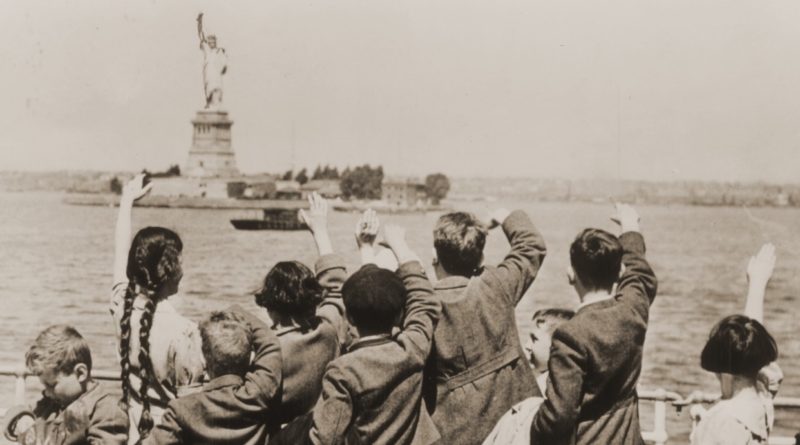
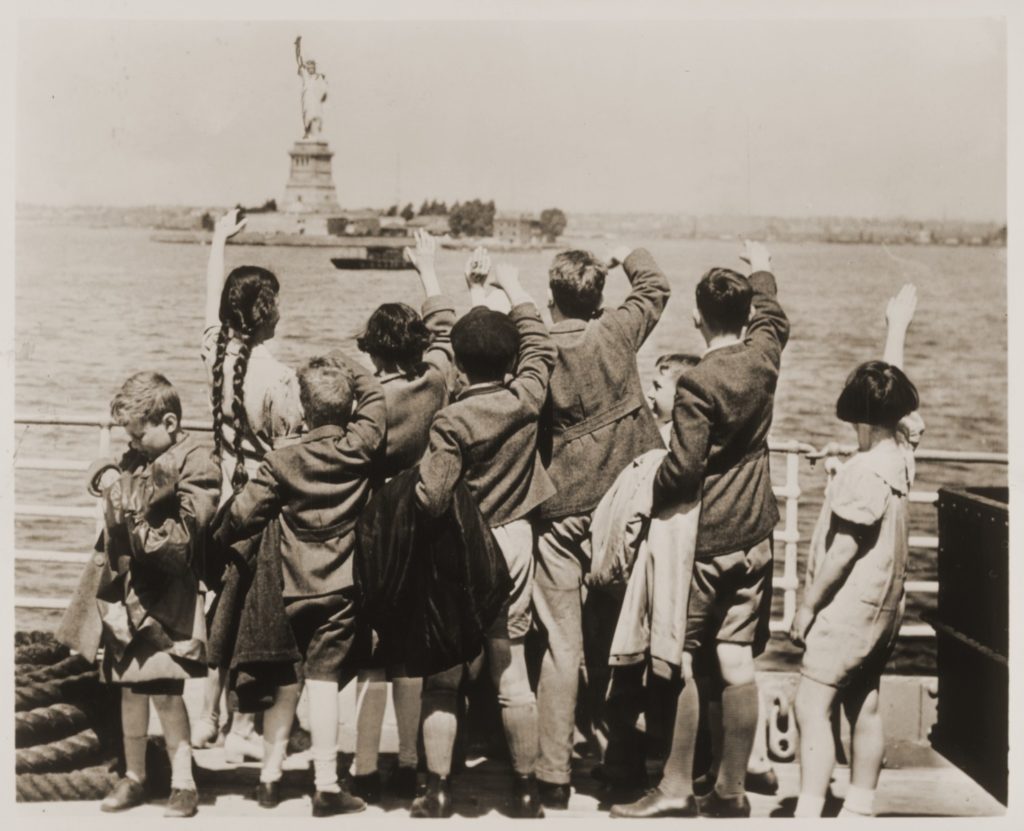
A group of fifty Jewish children, en route to Philadelphia in 1939, were placed into foster homes.

United States Holocaust Memorial Museum, courtesy of Anita Willens

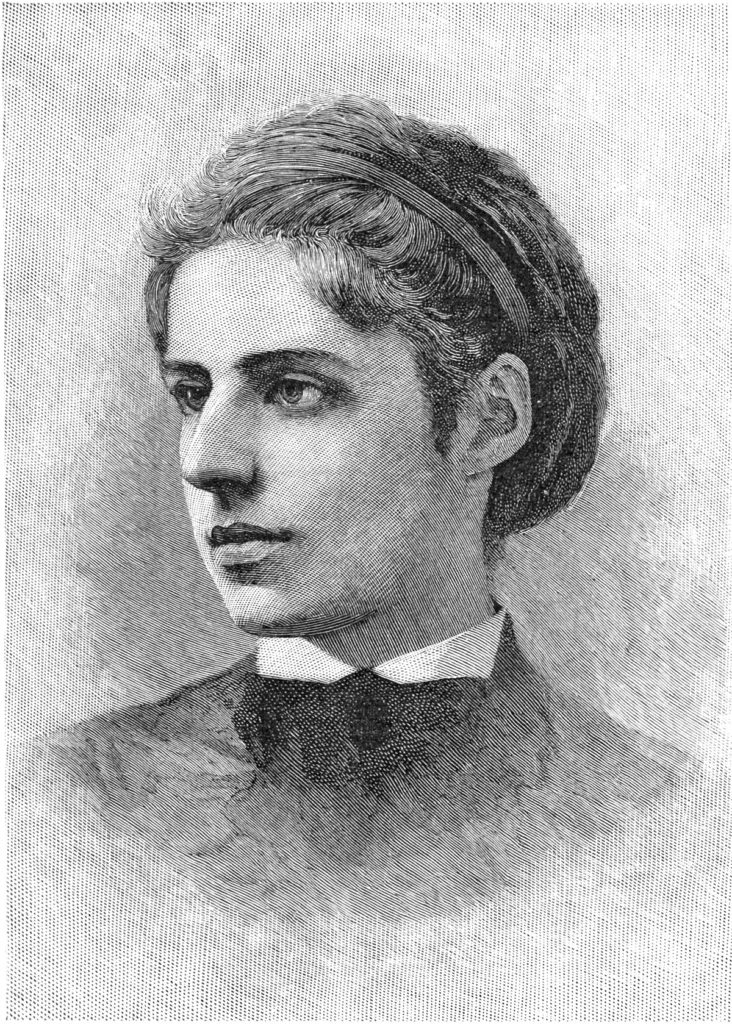
Emma Lazarus (1849-1887), a woman of exceptional writing skills who eventually embraced her Jewish heritage and worked to bridge the divide between settled Americans and newly arriving immigrants in need of assistance.

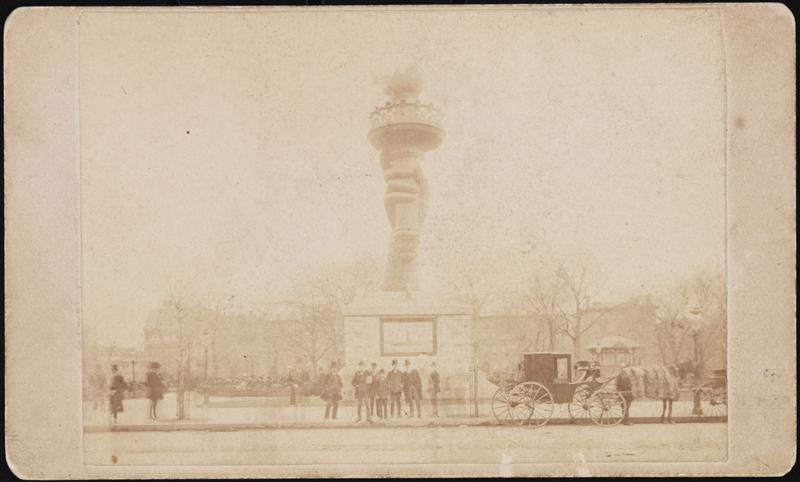
New Yorkers first saw a small portion of Lady Liberty — her arm and torch, displayed in Madison Square Park in an effort to raise money for her installation in New York Harbor.

Museum of City of New York

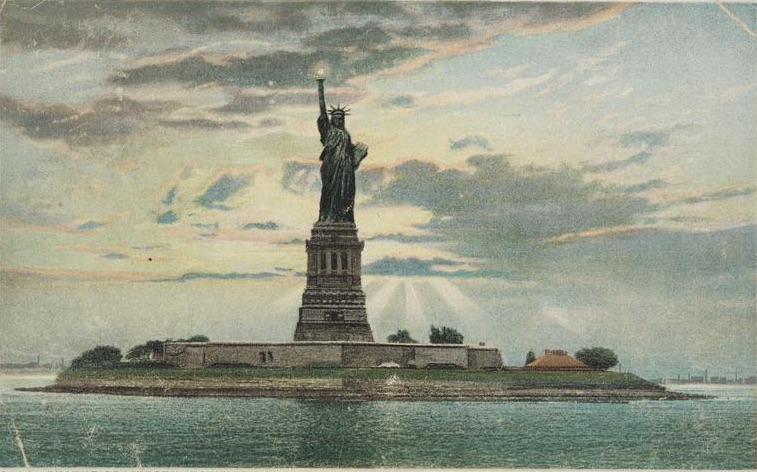
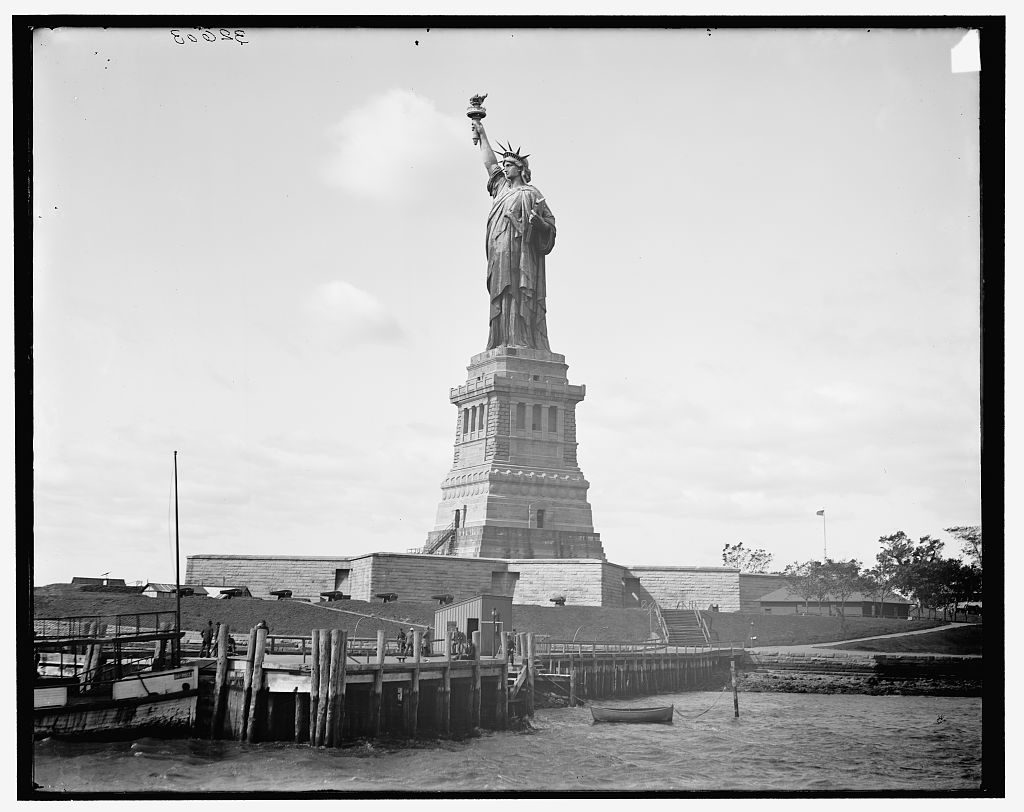
Liberty in 1890, prepared to welcome millions of new immigrants in the harbor. She’s actually copper at this time, not green.

Library of Congress/Detroit Publishing Co

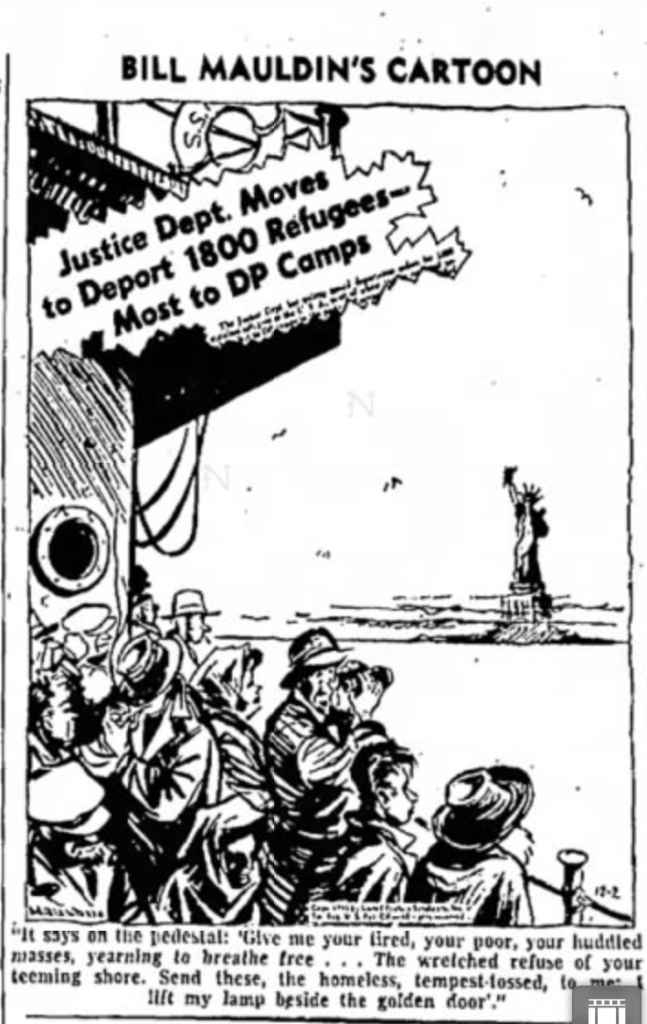
From a 1946 newspaper:

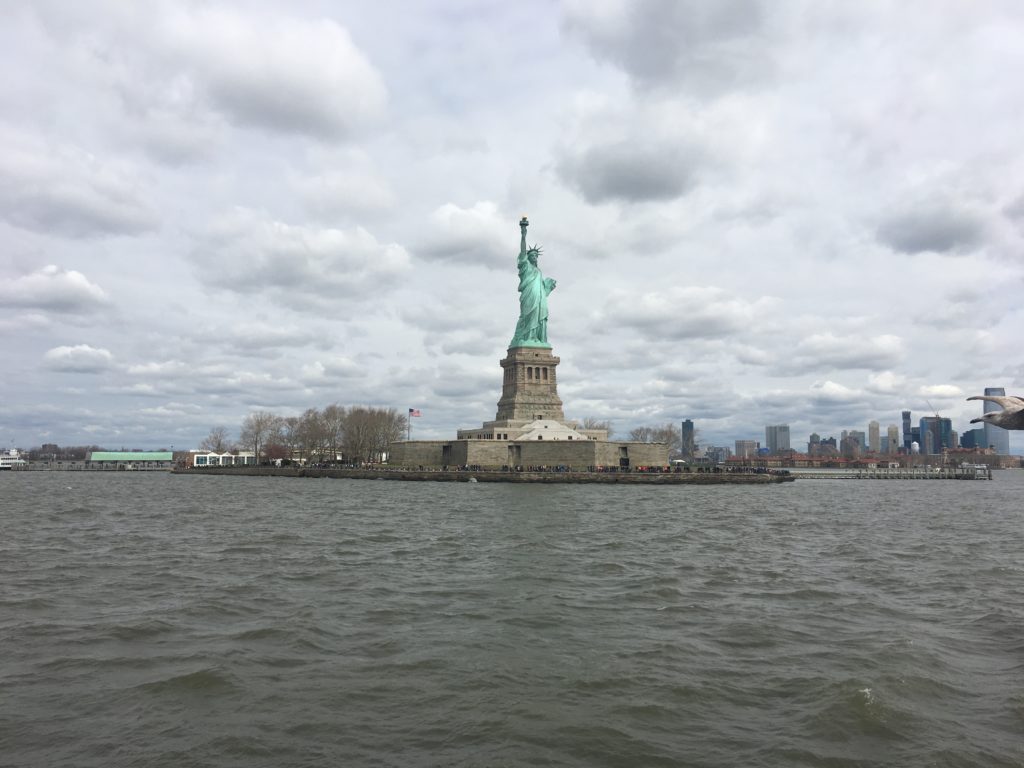
From our recent trip to the statue:

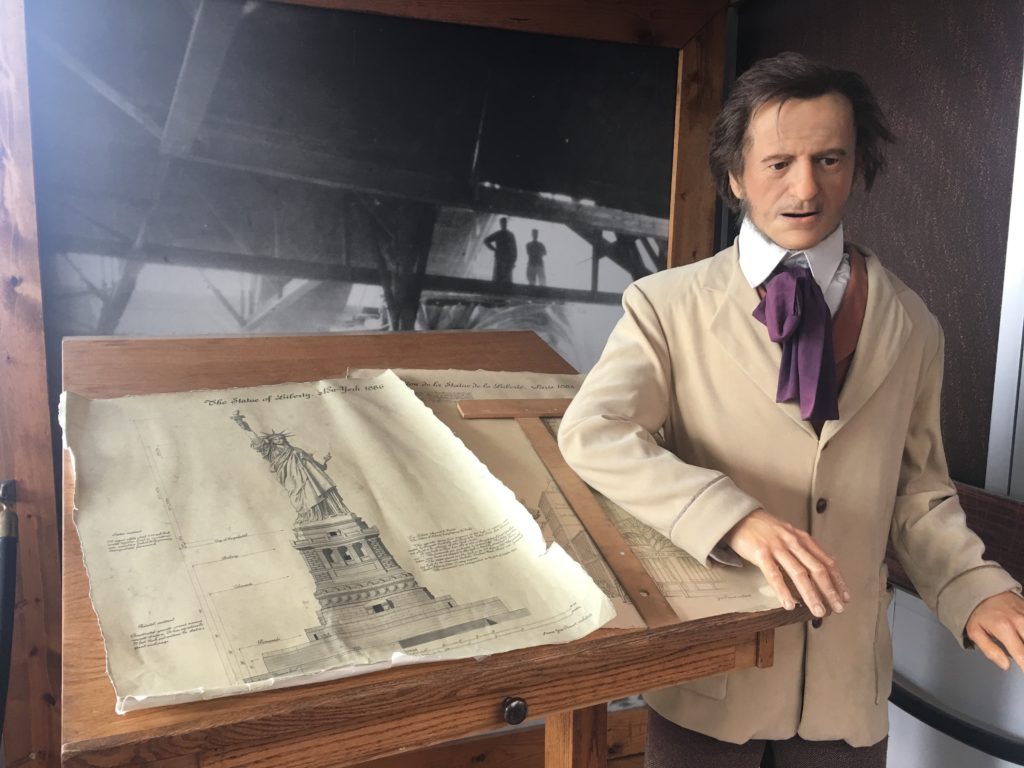
A waxen replica of Bartholdi in the gift shop:

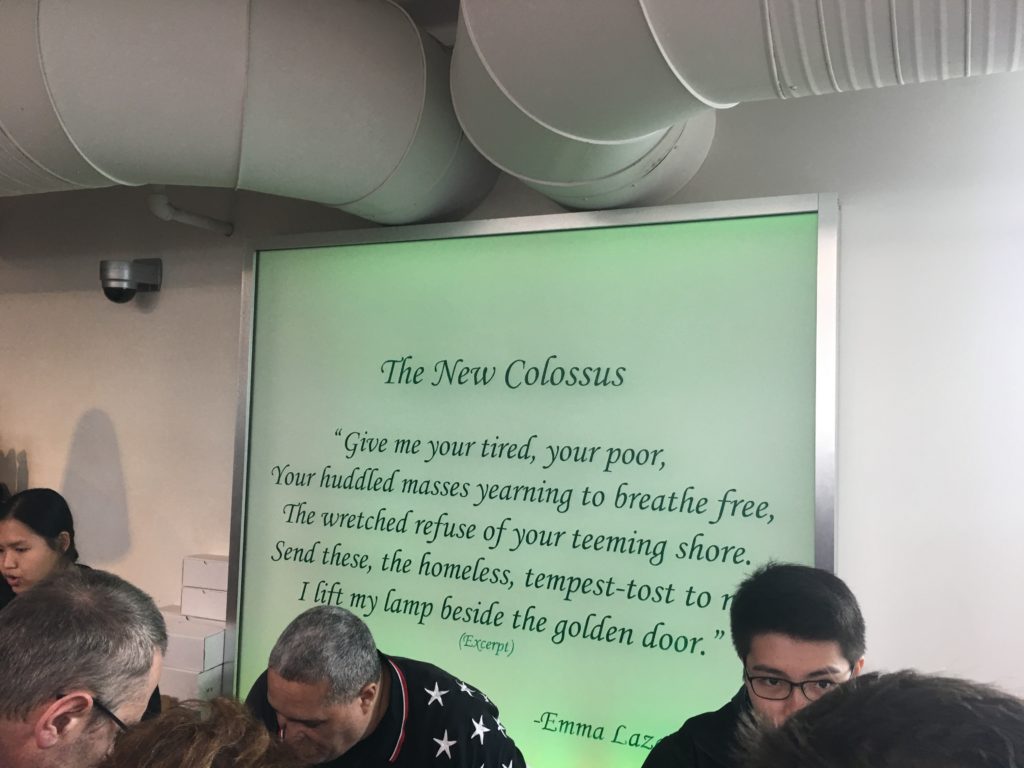
The words of Emma Lazarus, at gift shop checkout:

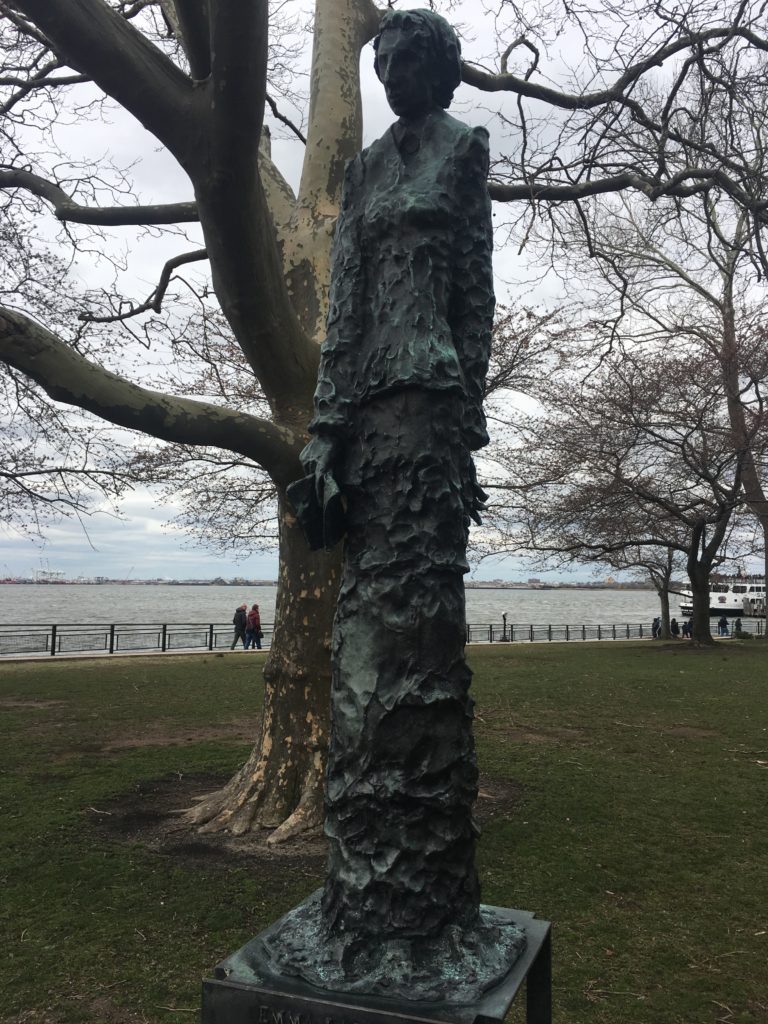
A statue of Lazarus herself, in the shadow of Lady Liberty:

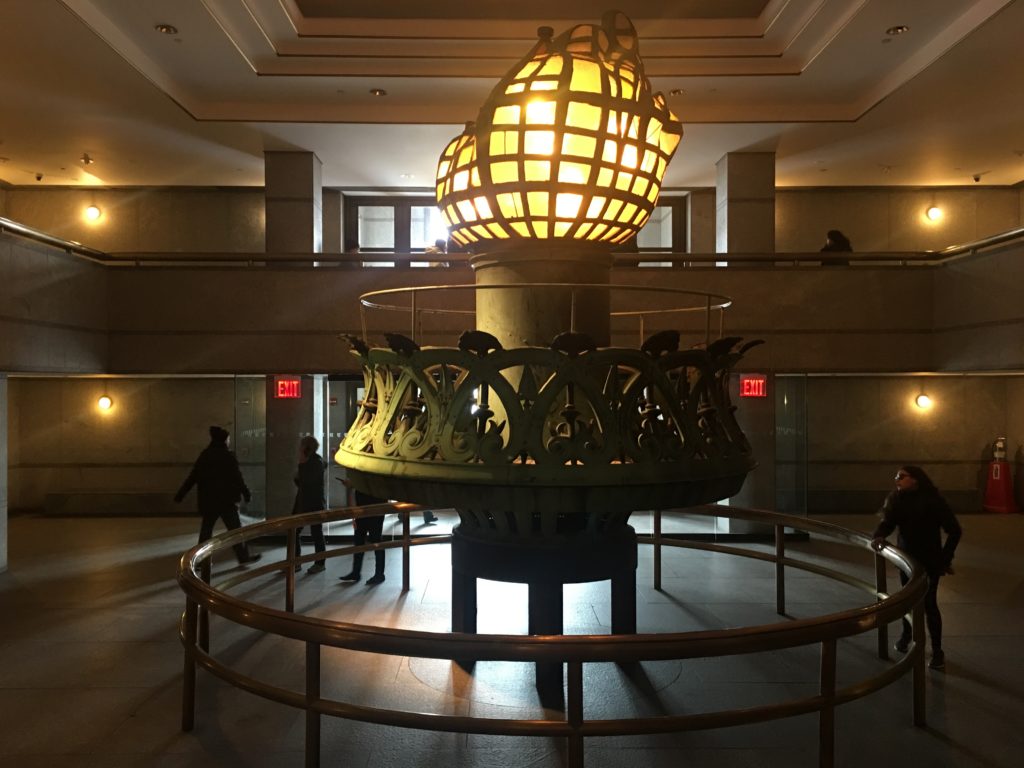
The statue’s original torch, which leaked and had to be replaced:

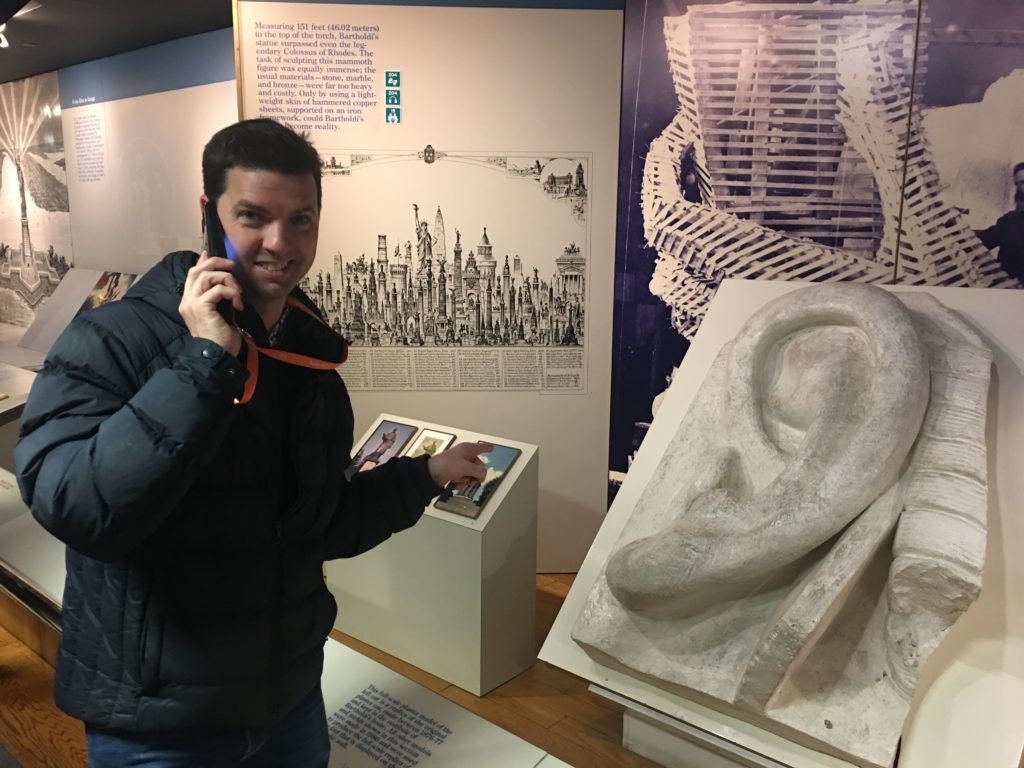
Tom enjoying the museum audio tour:

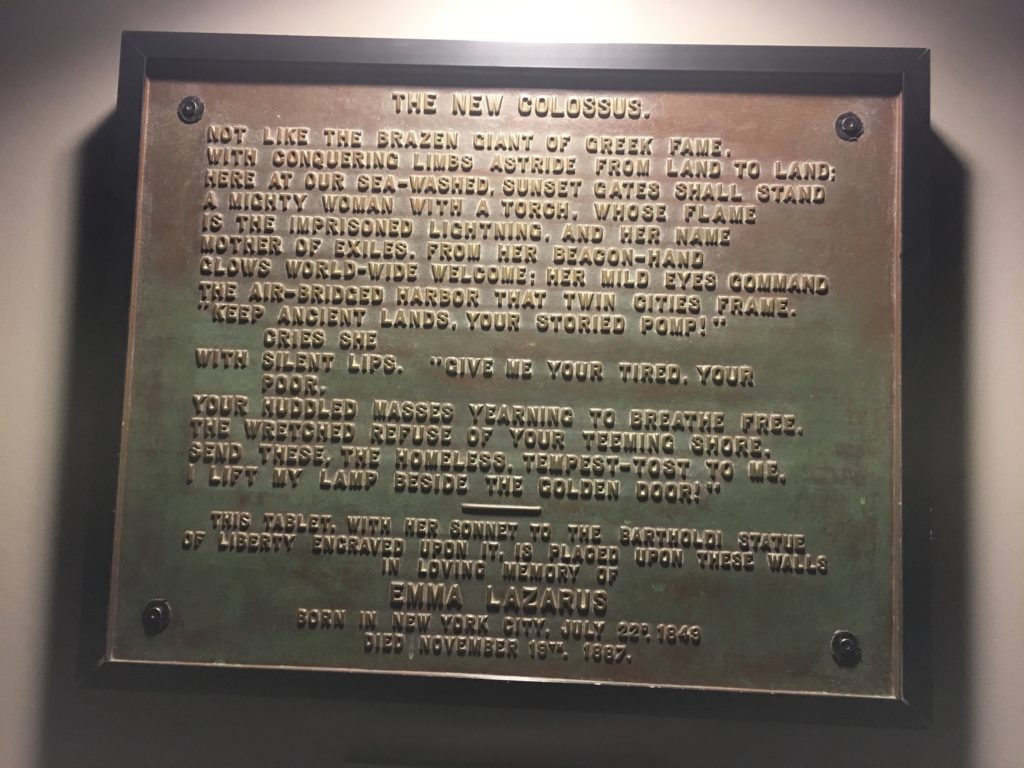
The original Emma Lazarus plaque which once sat just inside the pedestal. Today its home is in the Statue of Liberty museum:

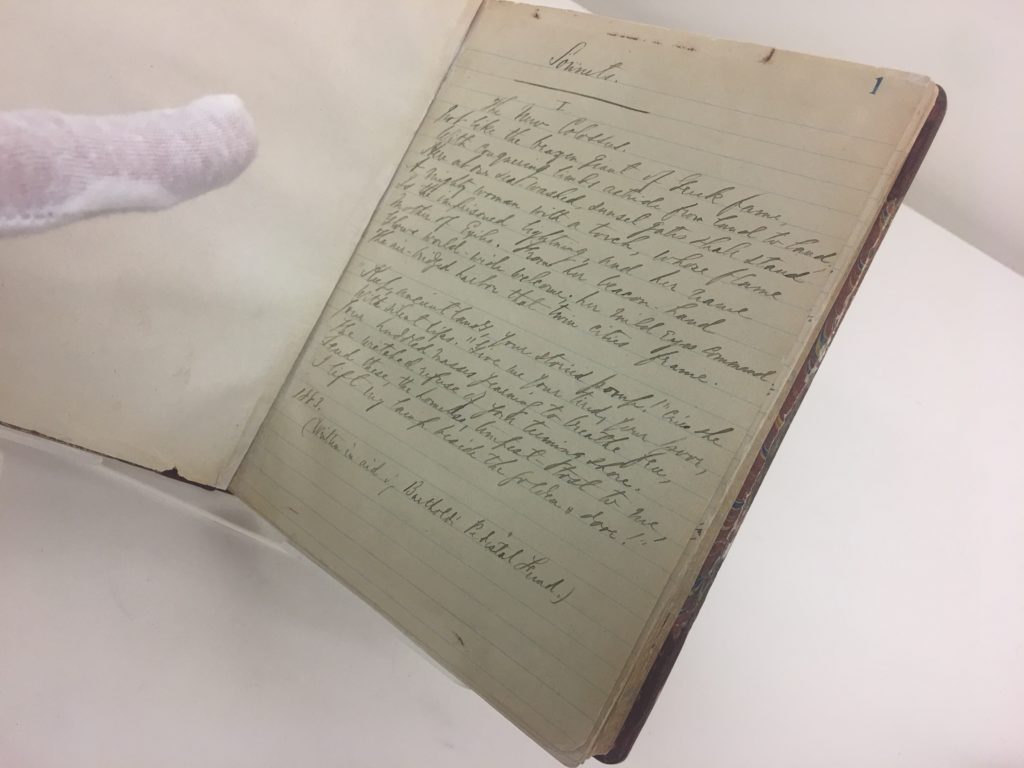
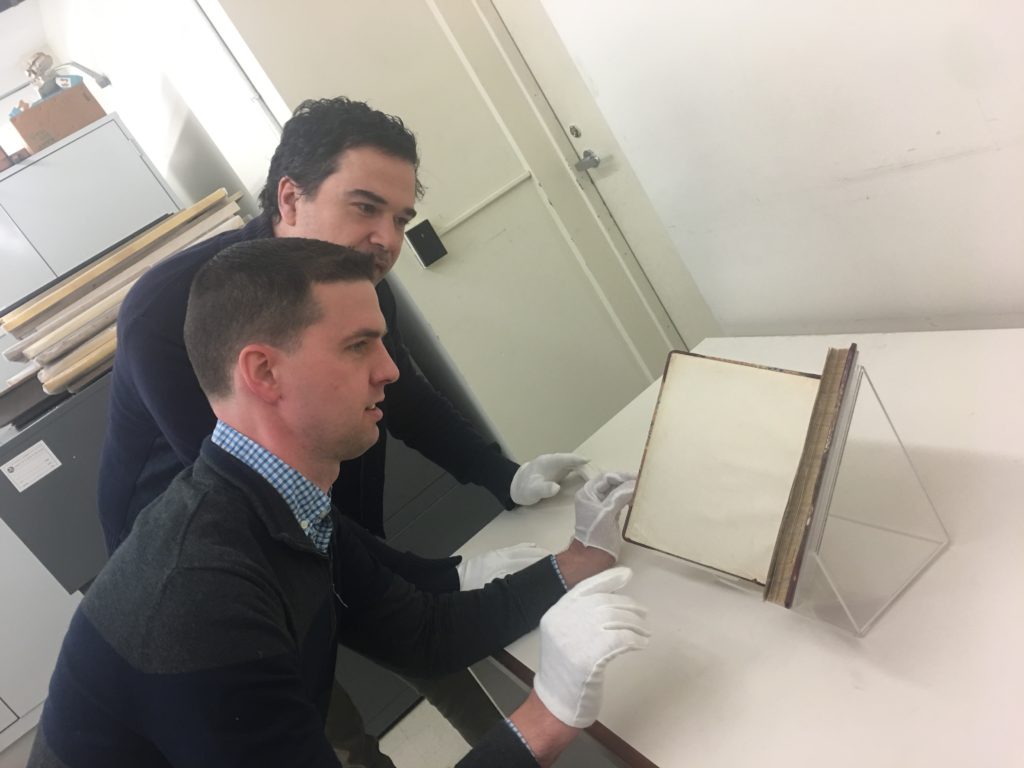
At the American Jewish Historical Society, a peak into Lazarus’ handwritten journal, piecing together some of her favorite poems. She placed “The New Colossus” in the very front:

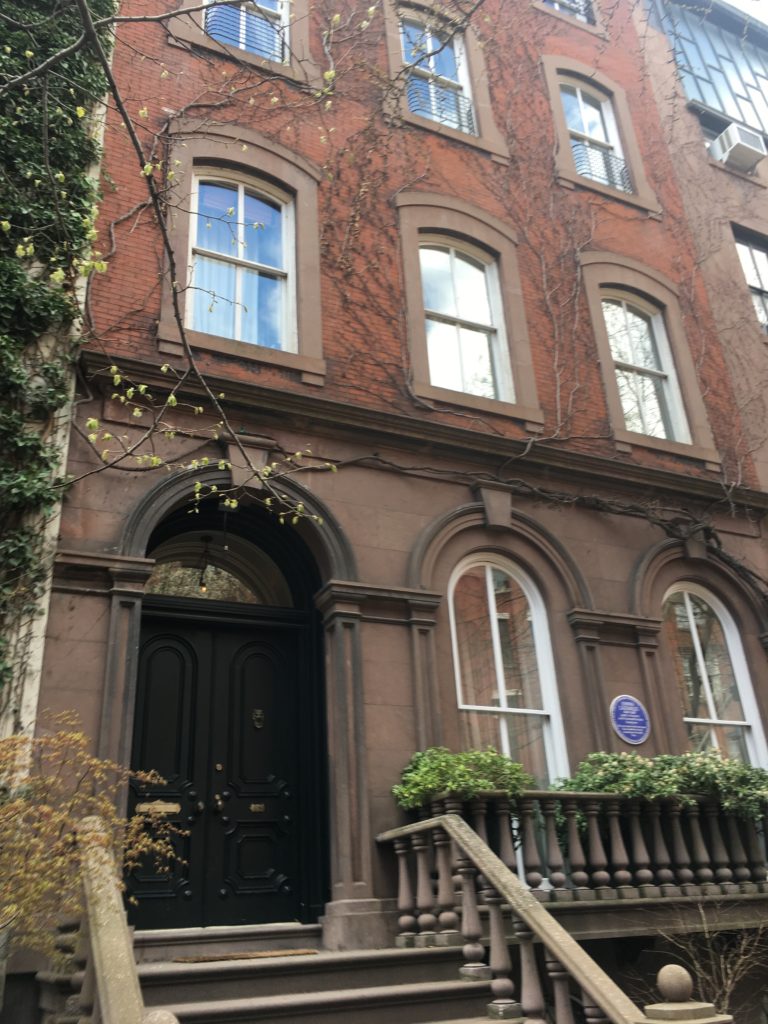
Emma’s Greenwich Village home on West 10th Street:

EXHIBITIONS
American Jewish Historical Society — Our BIG thanks to Annie Polland, executive director at AJHS, for showing us some of the astonishing artifacts in their collection. Visit their rotating exhibition of objects from their collection and check out their list of programs and events.

FURTHER READING
Enlightening the World: The Creation of the Statue of Liberty by Yasmin Sabina Khan
Liberty’s Torch: The Great Adventure to Build the Statue of Liberty by Elizabeth Mitchell
Emma Lazarus by Esther Schor
Emma Lazarus in Her World: Life and Letters by Bette Roth Young

FURTHER LISTENING
After listening to our show Mother of Exiles, check out these podcasts from our back catalog with similar themes:

Categories
Brooklyn History Podcasts

Crossing to Brooklyn: How the Williamsburg Bridge Changed New York City

PODCAST The story of the Williamsburg Bridge — poorly received when it was built but vital to the health of New York City

Sure, the Brooklyn Bridge gets all the praise, but the city’s second bridge of the East River has an exceptional story of its own.

In this episode, we’ll answer some interesting questions, including:

— Why is the bridge named for a 19th century industrial neighborhood in Brooklyn and why is it not, for instance, called the Manhattan Bridge (a name not in use yet in 1903) or the East River Bridge (which was its original name)?

— Why did everybody think the bridge looked so unusually ugly and how did the city belatedly try and solve the problem?

— Why did one population in the Lower East Side find the bridge more important than others?

— And why was the bridge is such terrible shape in the 20th century? Did it really almost collapse into the river?

PLUS: How the fate of the two neighborhoods linked by the Williamsburg Bridge would change radically in the 115 years since the bridge was opened.

Listen Now: Williamsburg Bridge Podcast

________________________________________________________

The Bowery Boys: New York City History podcast is brought to you …. by you!

We are now producing a new Bowery Boys podcast every other week.  We’re also looking to improve the show in other ways and expand in other ways as well — through publishing, social media, live events and other forms of media.  But we can only do this with your help!

We are now a member of Patreon, a patronage platform where you can support your favorite content creators for as little as a $1 a month.

Please visit our page on Patreon and watch a short video of us recording the show and talking about our expansion plans.  If you’d like to help out, there are five different pledge levels (and with clever names too — Mannahatta, New Amsterdam, Five Points, Gilded Age, Jazz Age and Empire State). Check them out and consider being a sponsor.

We greatly appreciate our listeners and readers and thank you for joining us on this journey so far. 

_________________________________________________________

We’d also like to thank WeWork for sponsoring the Bowery Boys podcast. Enter to win a 1-month hot desk membership to WeWork checking into this link. This contest only last a few more days and the winner will be announced on March 30.

we.co/boweryboyshotdesk

And we’d also like to thank our additional sponsors Hulu (and the gripping new thriller The Looming Tower) and Audible. For a free 30-day trial (and a free audiobook) go to audible.com/bowery or text the word BOWERY to 500-500

________________________________________________________________________

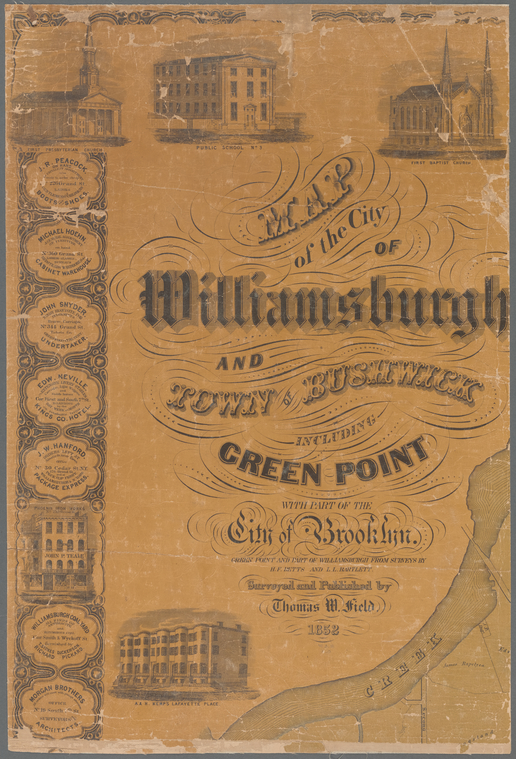
A map of the City of Williamsburgh and Town of Bushwick including Green Point, 1852

NYPL

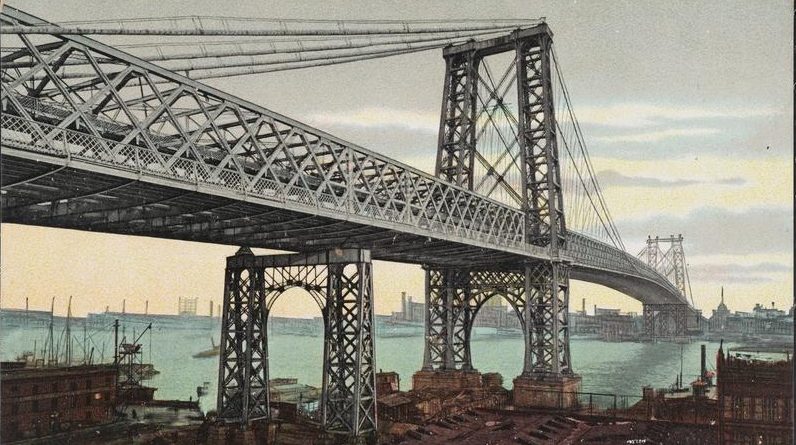
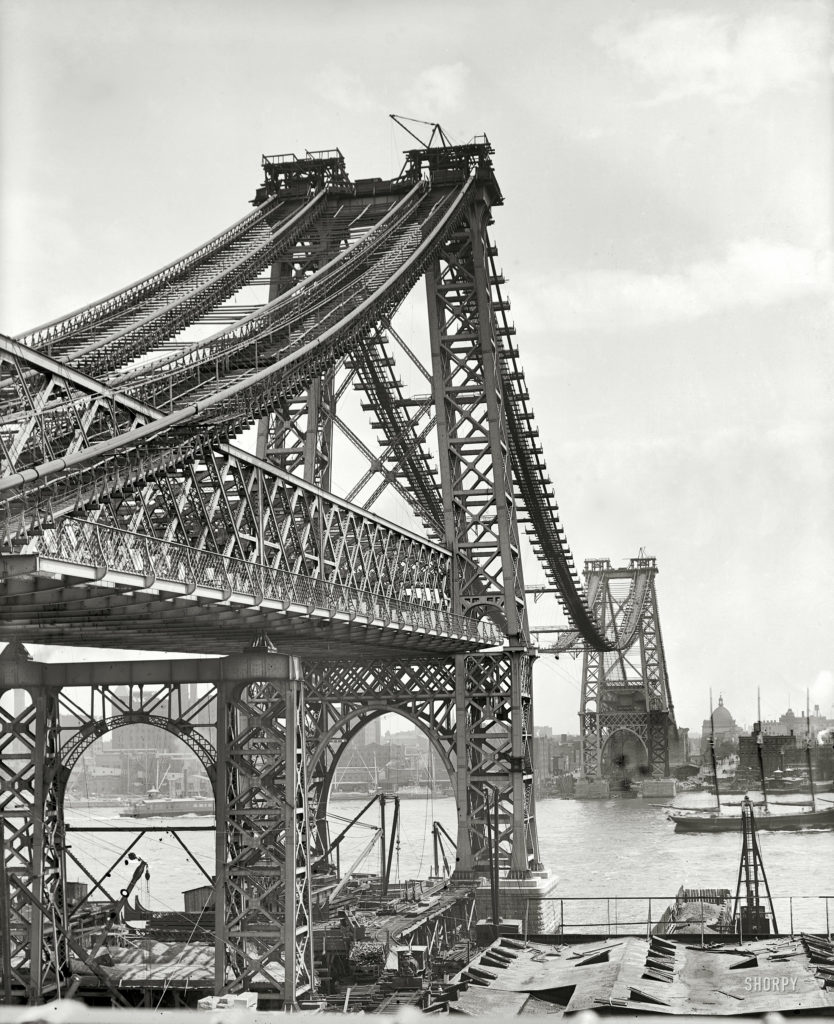
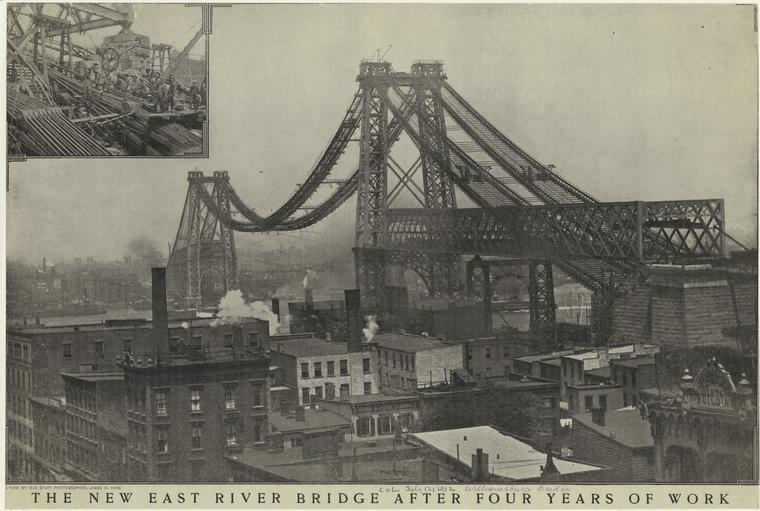
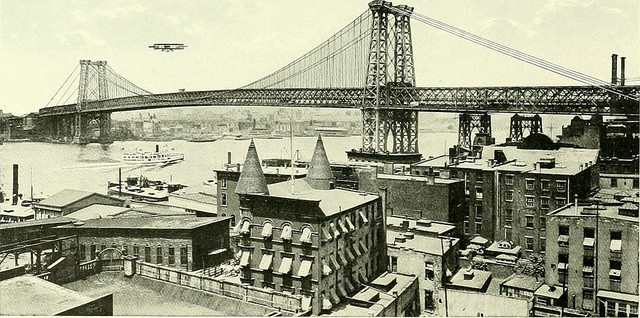
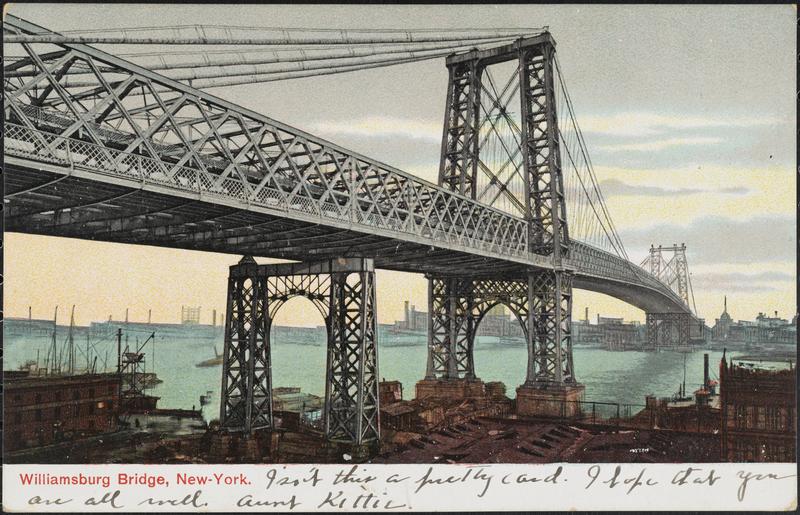
In 1902, the bridge was finally near completion, but many were worried about the bridge’s functional plainness.

Library of Congress/Cleaned up image courtesy Shorpy
New York Public Library

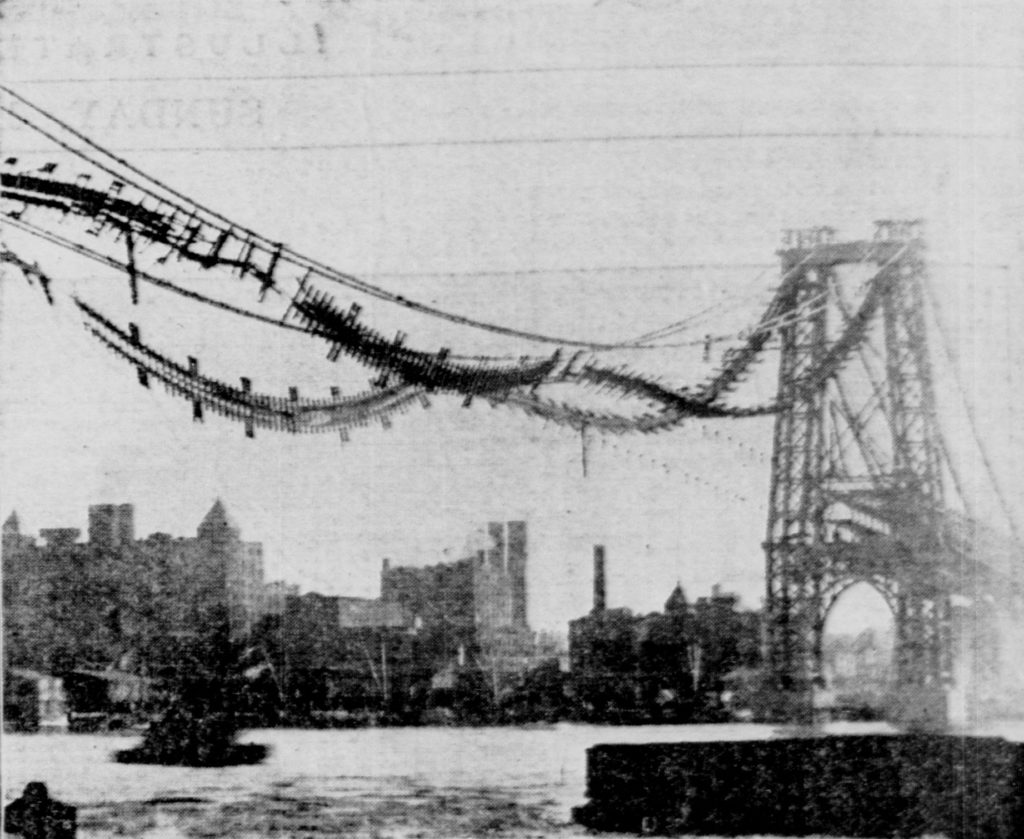
A 1903 fire on the bridge created a scary scene over the East River, but the cables and wires proved durable.

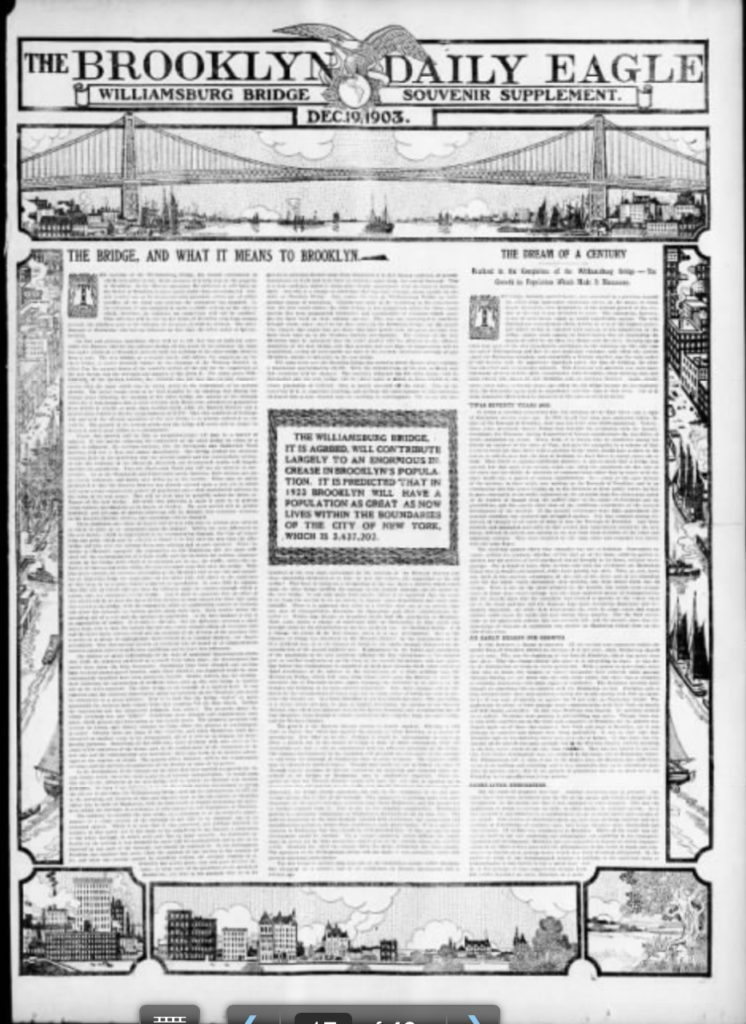
From the Brooklyn Daily Eagle souvenir section celebrating the opening of the bridge:

Bertrand Brown/MCNY

An illustration from the 1915 book New York: The Wonder City

Flickr commons

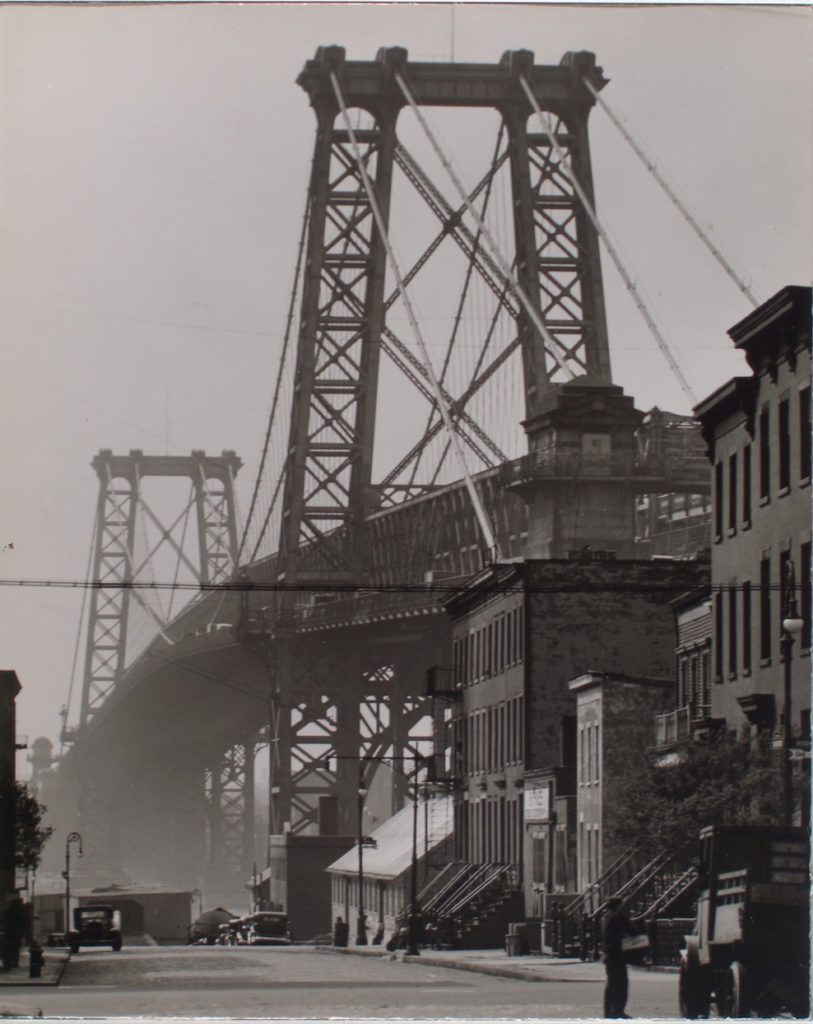
Seen from South Eighth and Berry Streets in Brooklyn, 1935.

Berenice Abbott/NYPL

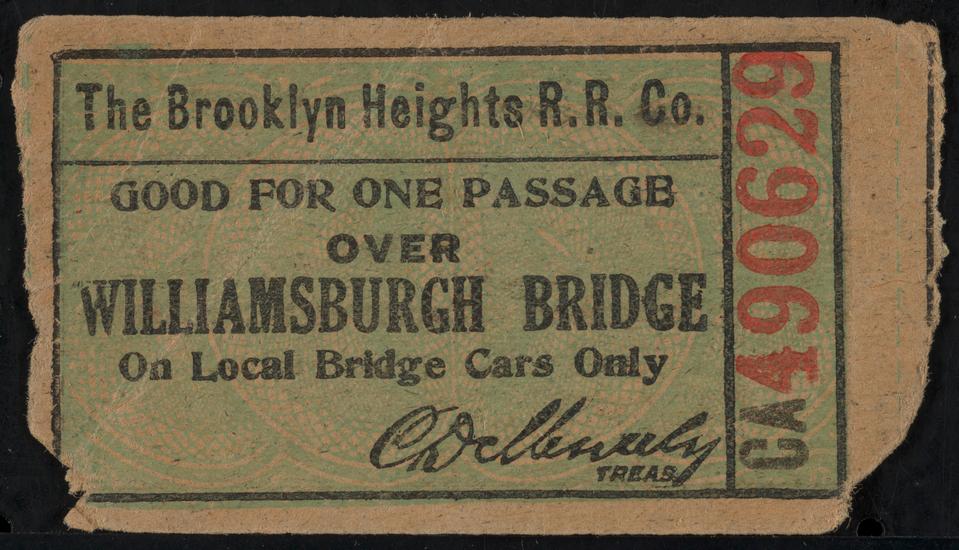
The old spelling of the name continually popped up in various places as late as the early 20th century. This passenger tickets dates to between 1903 and 1915.

MCNY

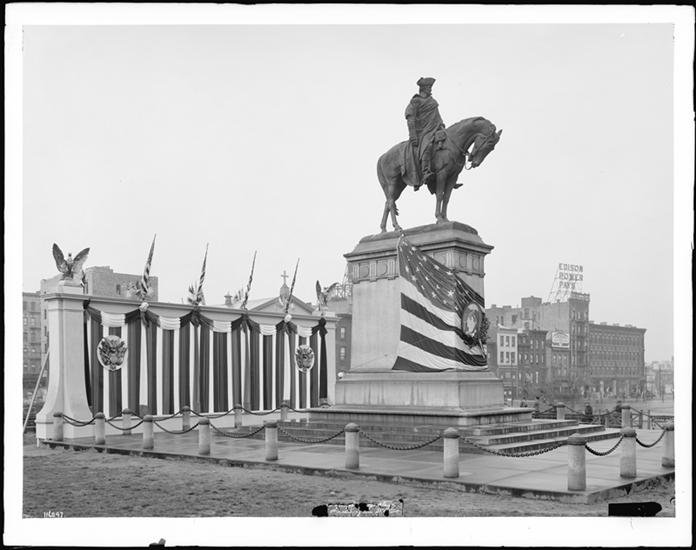
Williamsburg Bridge Plaza — and the handsome equestrian statue of George Washington — festooned with banners at the start of World War I.

MCNY

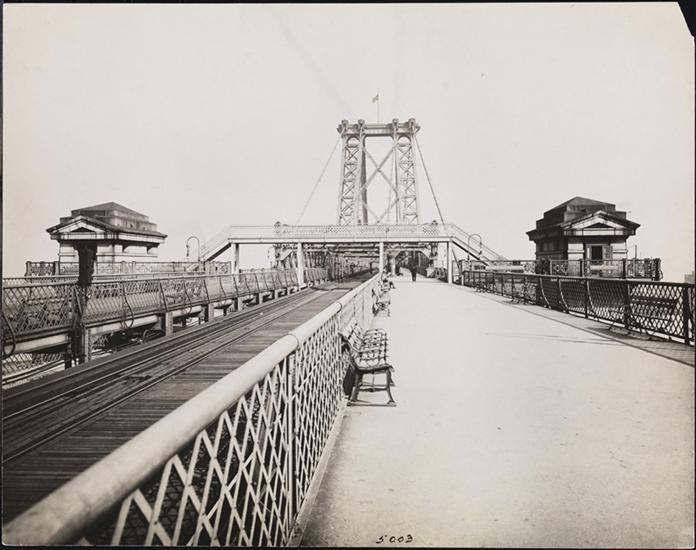
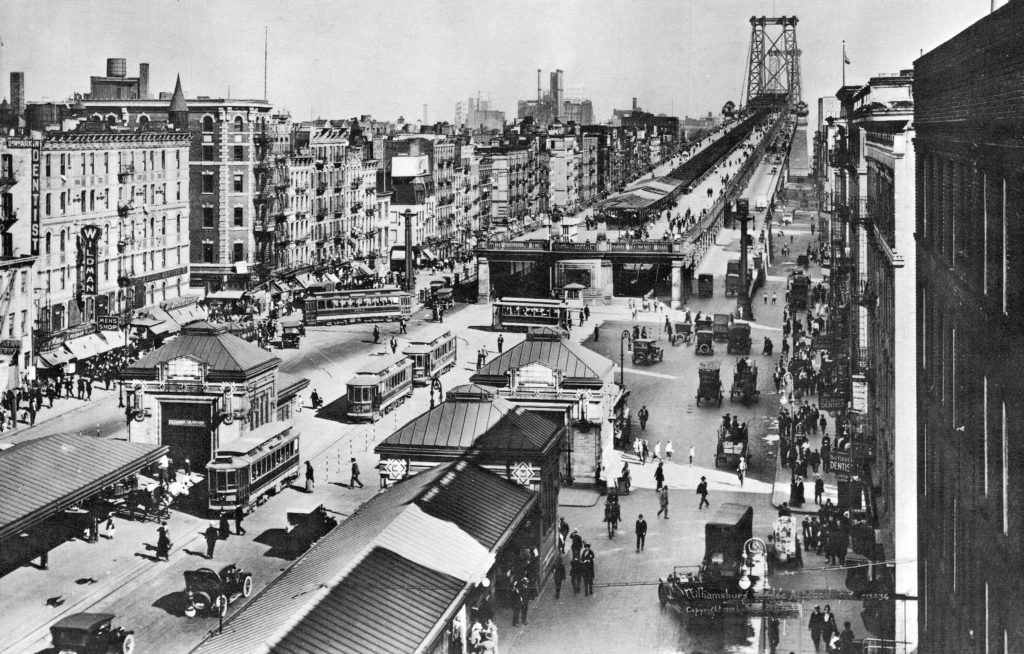
The approach to the Williamsburg Bridge from the Manhattan side. Delancey Street had to be widened to accommodate the influx of transportation options flooding onto the bridge.

The bridge is central to the growth of New York’s immigrant (and particularly Jewish) communities. While its construction did displace thousands of people, the bridge would actually facilitate better living conditions for Lower East Side immigrant groups by encouraging migration to less populated Brooklyn neighborhoods.  The New York Herald even called it the “Jews Highway” as those of Eastern European and Russian Jewish heritage transplanted to Williamsburg.

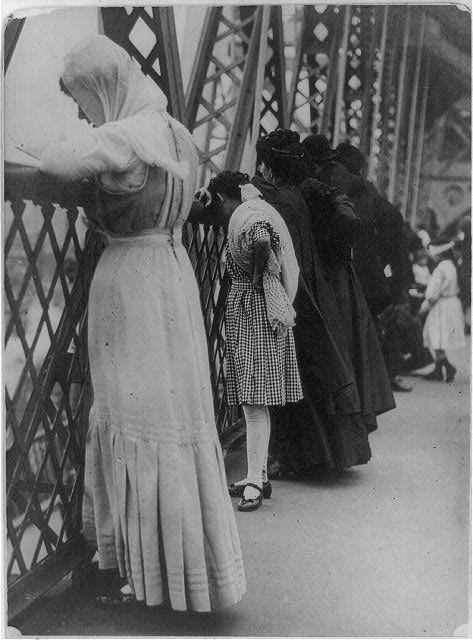
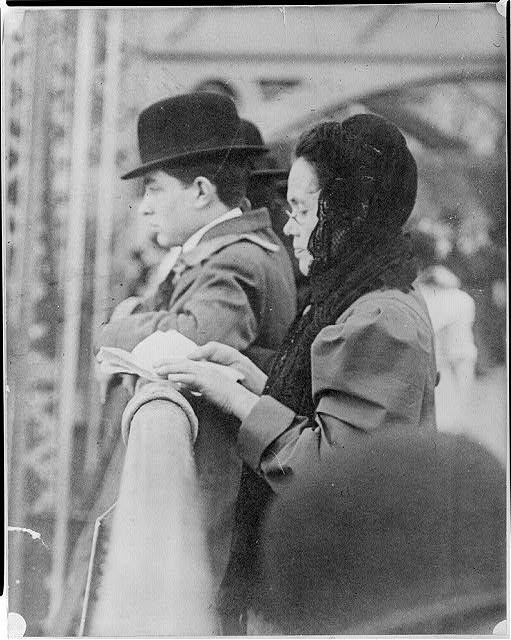
The ritual of tashlikh  תשליך‬‎ has often been performed on the bridge.

Library of Congress

From the film The Naked City

FURTHER LISTENING

These past episodes were mentioned in this week’s podcast. After finishing the Williamsburg Bridge show, go back and give these a listen:

Categories
Neighborhoods Podcasts

Tales from Tribeca: The Hidden History of Manhattan’s Old Market Neighborhood

PODCAST Tribeca (or TriBeCa, Triangle Below Canal) is a breathtaking neighborhood of astounding architectural richness. But how much do you know about this trendy destination and its patchwork of different histories?

You’ll be surprised to learn about the many facets of this unusual place, including:

 Lispenard’s Meadow, tracing back to the property’s first Dutch settlers;

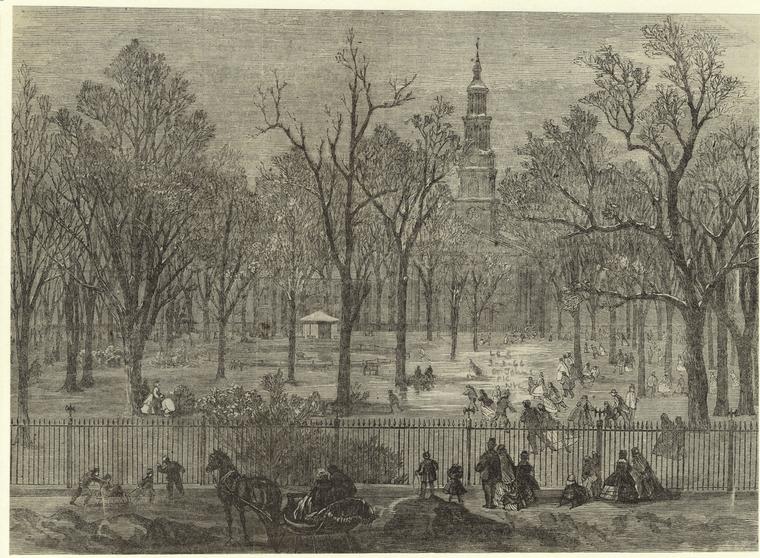
— St. John’s Park, New York’s first ritzy residential district;

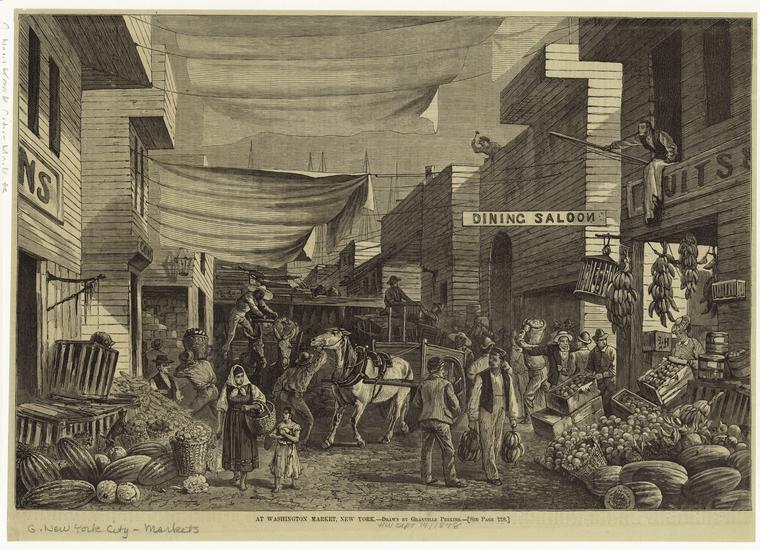
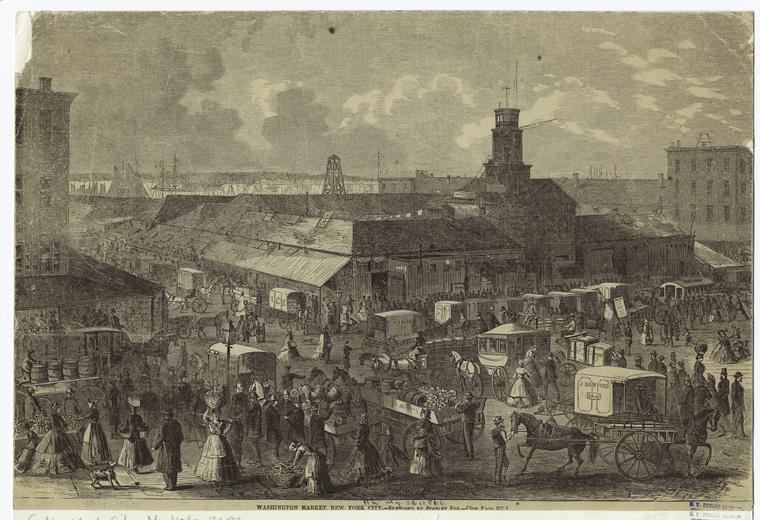
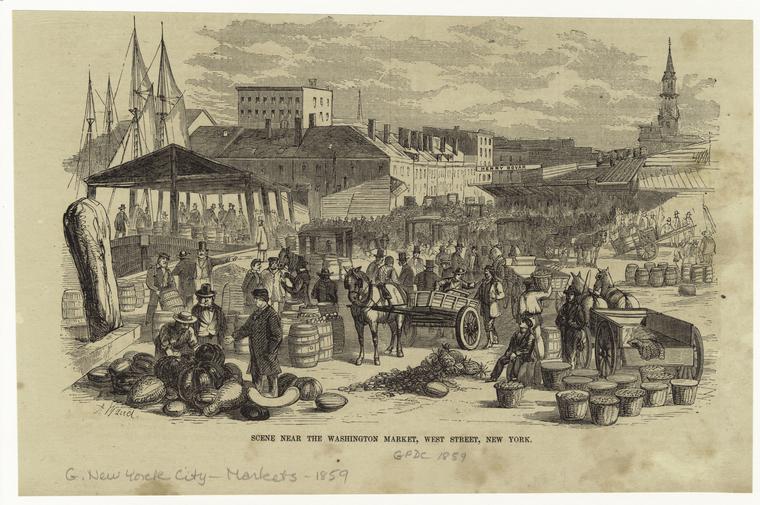
— Washington Market, the open-air marvel that fed New Yorkers for 150 years;

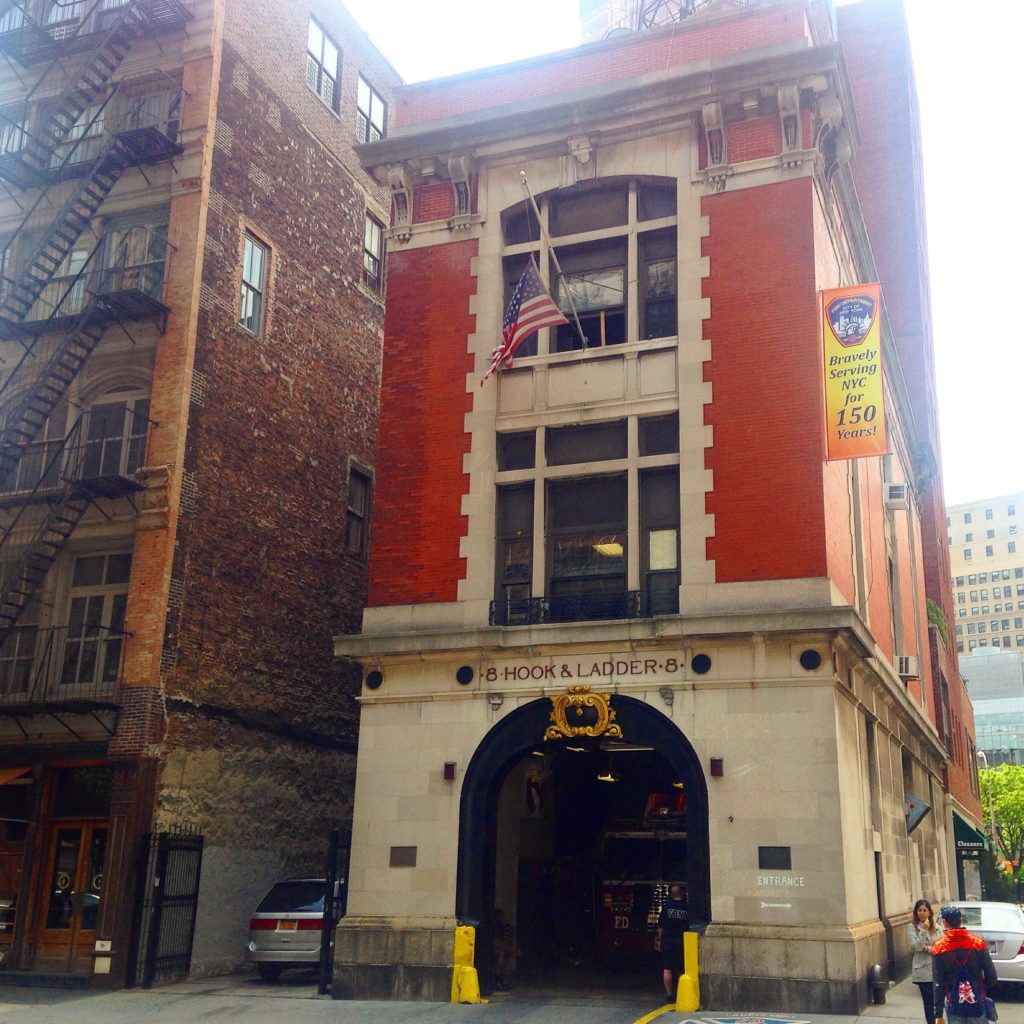
— the Ghostbusters Fire House, a pop-culture landmark that witnessed an astonishing architectural shrinkage;

— the AT&T Long Lines Building, an imposing monolith with mysterious secrets contained inside;

and the TriBeCa Film Center, bringing a new direction to the neighborhood thanks to its co-founder Robert De Niro

PLUS: What are codfish cheeks? Pert nurses? Weekend leathers?

Listen Now: Tribeca History Podcast

_________________________________________________________

The Bowery Boys: New York City History podcast is brought to you …. by you!

We are now producing a new Bowery Boys podcast every week.  We’re also looking to improve the show in other ways and expand in other ways as well — through publishing, social media, live events and other forms of media.  But we can only do this with your help!

We are now a member of Patreon, a patronage platform where you can support your favorite content creators for as little as a $1 a month.

Please visit our page on Patreon and watch a short video of us recording the show and talking about our expansion plans.  If you’d like to help out, there are five different pledge levels (and with clever names too — Mannahatta, New Amsterdam, Five Points, Gilded Age, Jazz Age and Empire State). Check them out and consider being a sponsor.

We greatly appreciate our listeners and readers and thank you for joining us on this journey so far. 

________________________________________________________
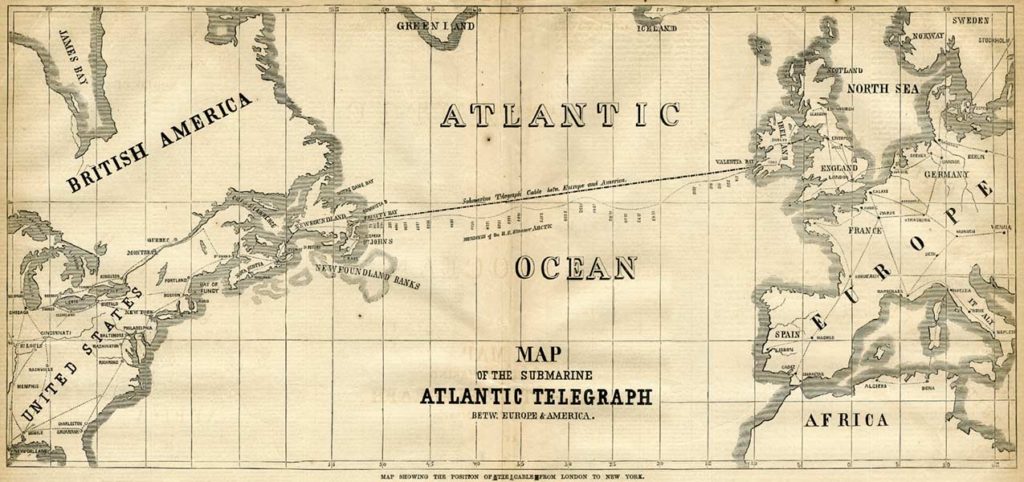
The glory days of St. John’s Park

NYPL

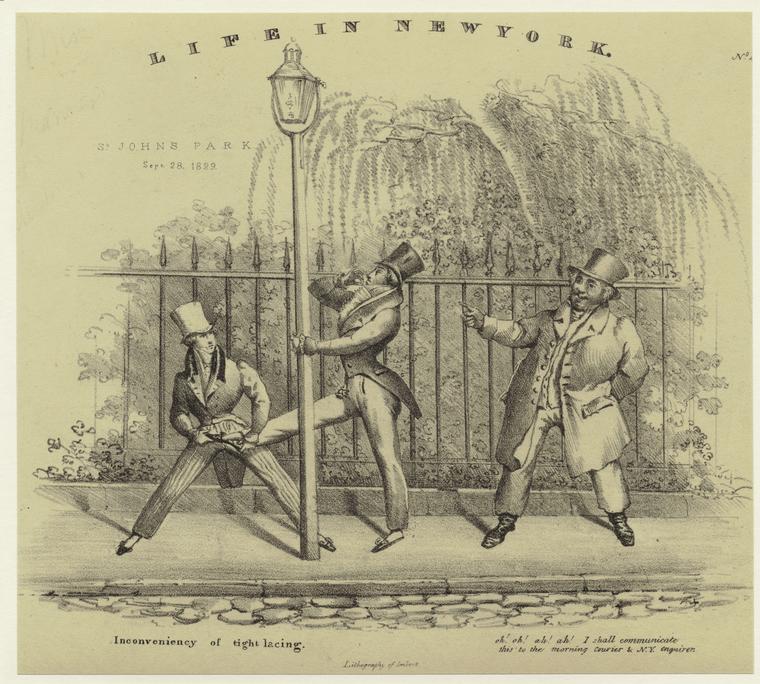
Dandies encircling St. John’s Park, 1822.

NYPL

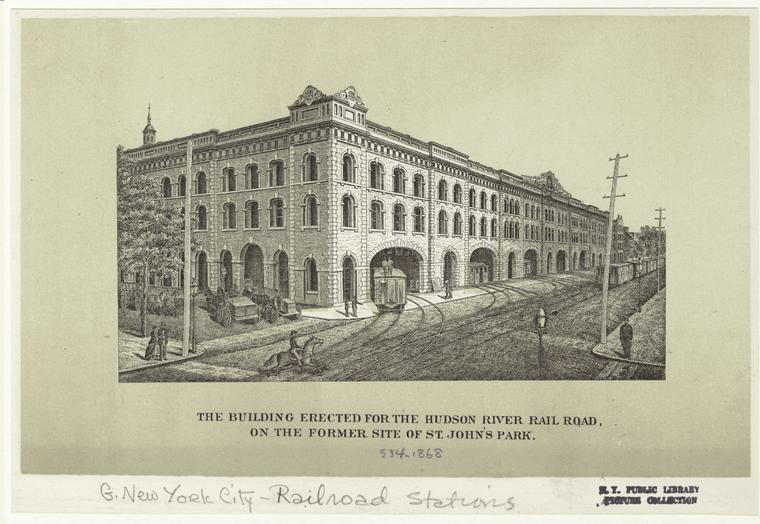
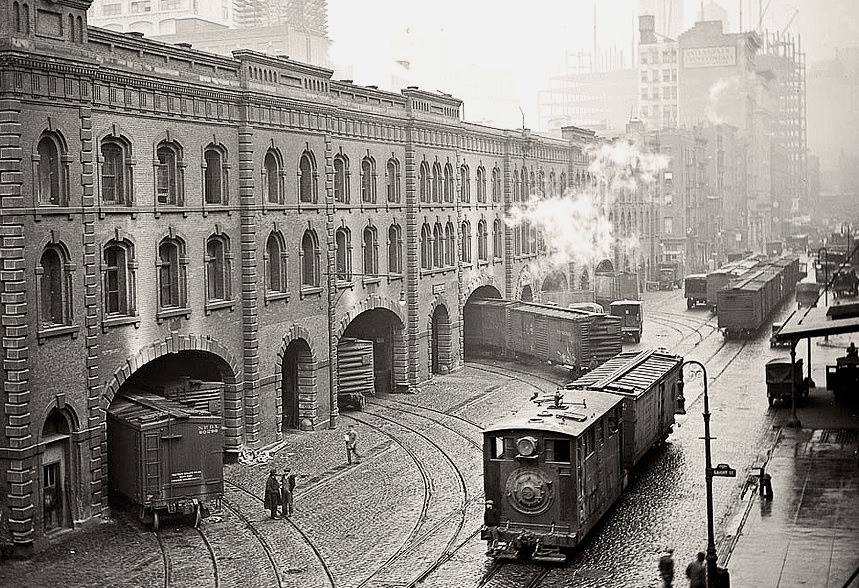
The park was replaced with St. John’s Freight Terminal with a statue of Cornelius Vanderbilt affixed at top.

NYPL

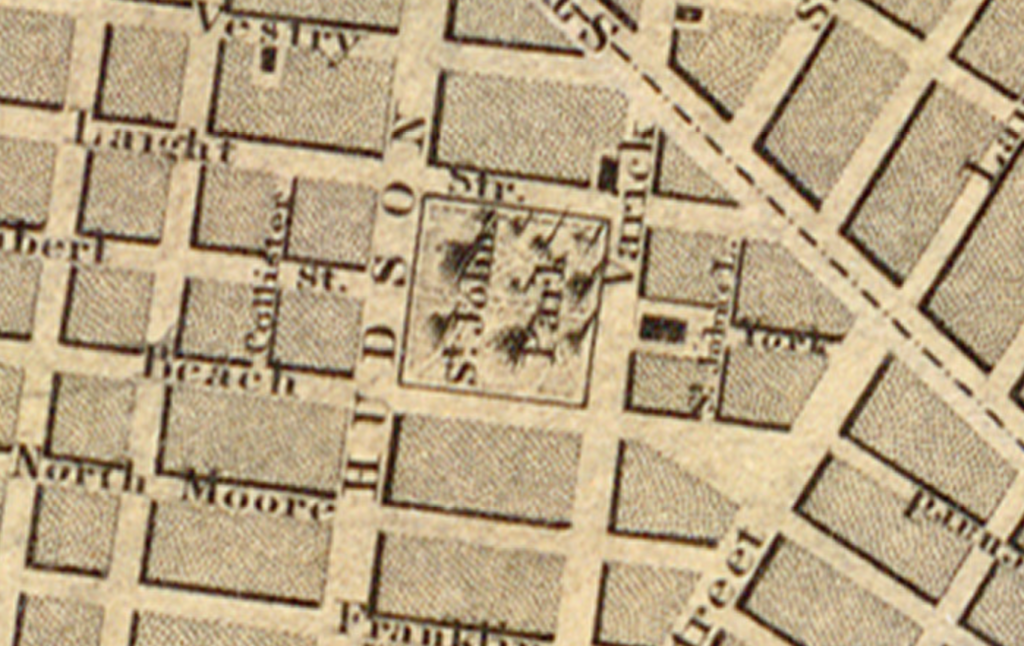
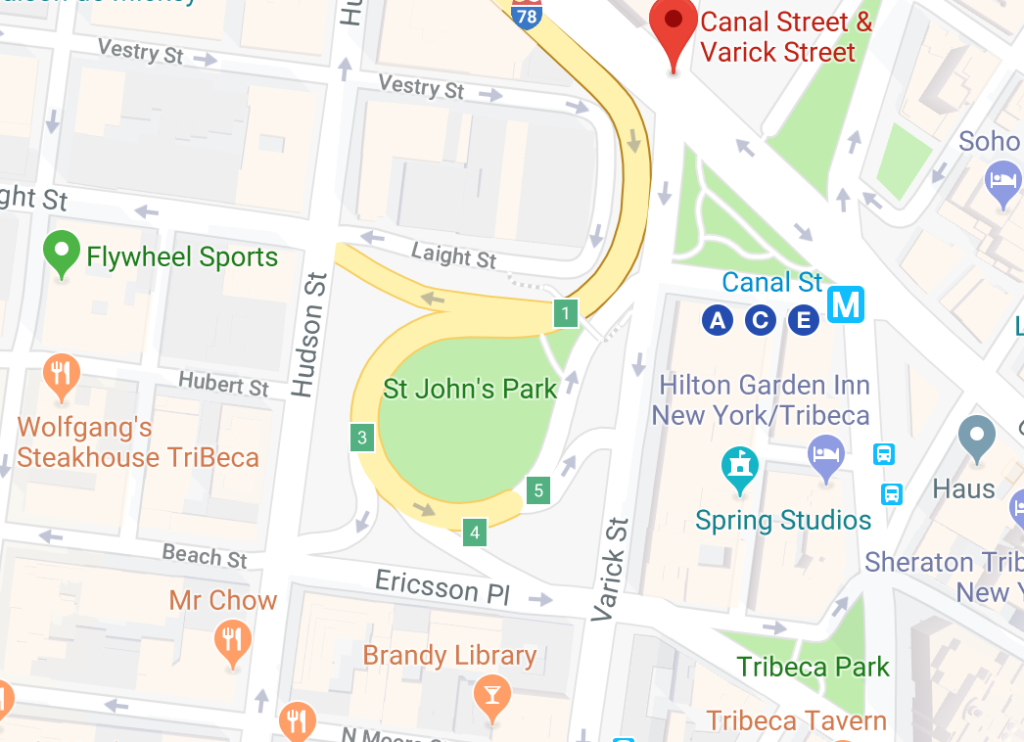
The location of St. John’s Park in 1836 and its footprint, clearly seen, in a modern Google Map

NYPL, David Rumsey map collection

Images of Washington Market (depicted between 1820-1860) from the New York Public Library collection. It’s hard to property visualize how dominant the market was to the street life of the future Tribeca neighborhood. Hundreds of vendors spilled out into the street and soon the many blocks surrounding it served the market’s purposes.

NYPL

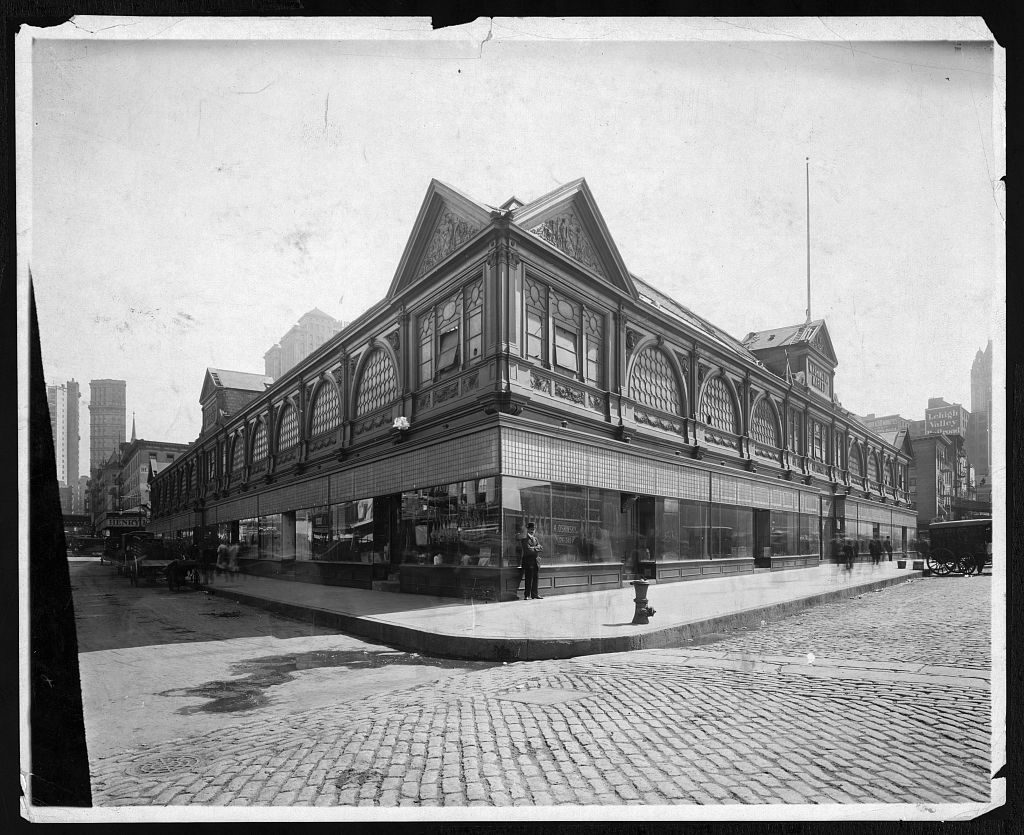
Washington Market in 1912 — a century of service with many decades to go.

Library of Congress

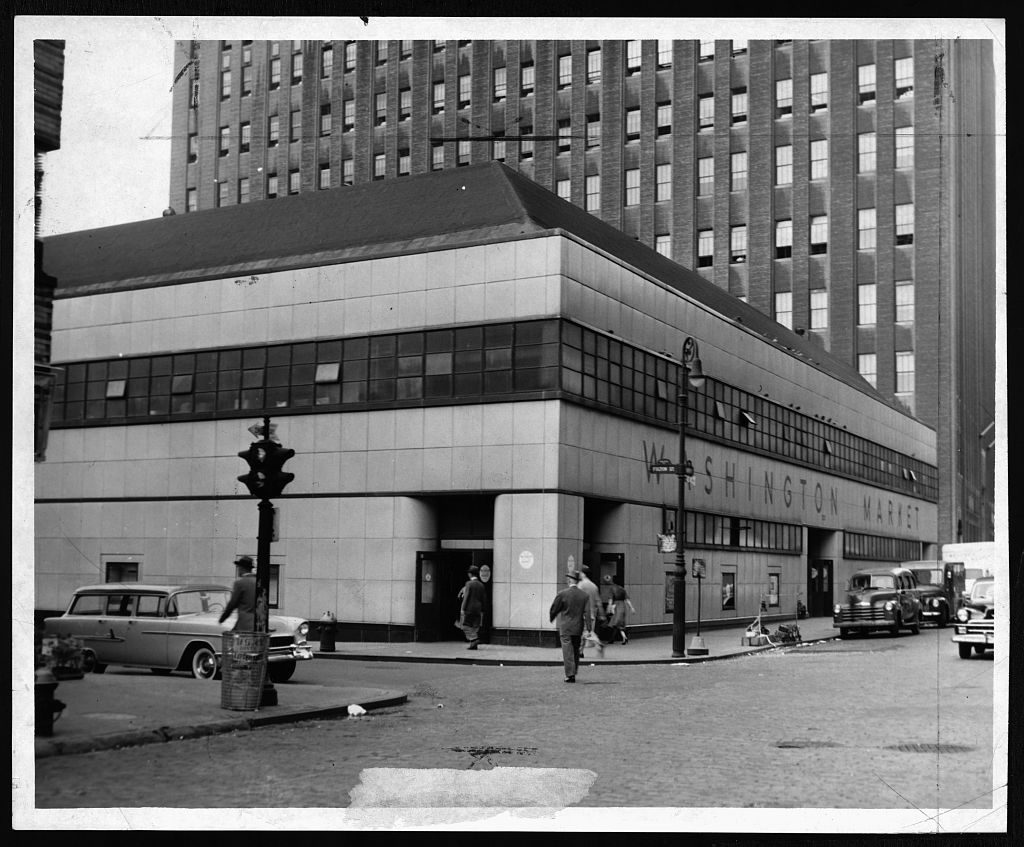
By the 1950s, most of the market district was contained in a new Washington Market structure. It was torn down in the 1960s to make way for the World Trade Center.

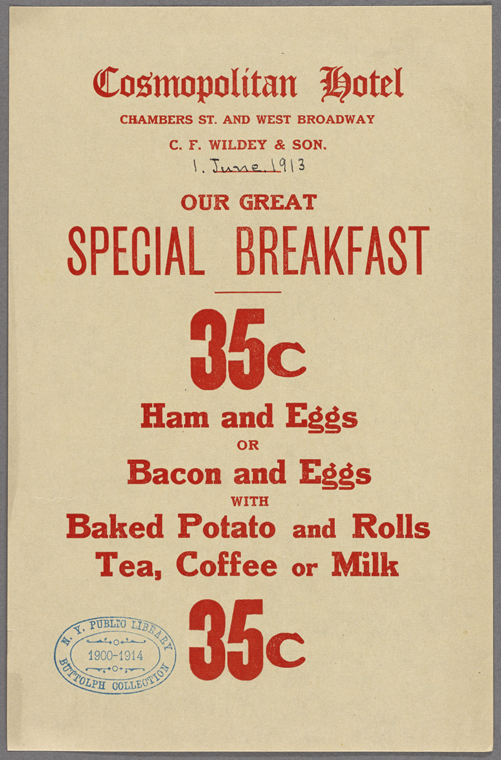
Hotels like the Cosmopolitan were built when the center of New York culture was near City Hall. As cultural institutions moved north, the Cosmopolitan successfully transitioned into a businessman’s accommodation, serving both the dry goods district and the Washington Market. Believe it or not, the Cosmopolitan is still around as The Frederick Hotel.

NYPL

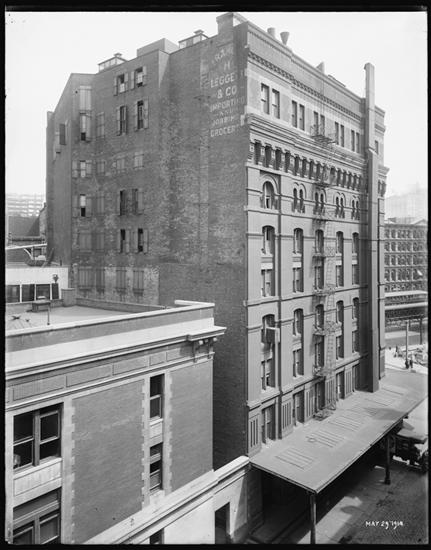
An example of spectacular market architecture at Franklin and Varick streets, combining metal awnings, Romanesque detailing and early 20th century ‘ghost signage’.

MCNY, Wurts Brothers

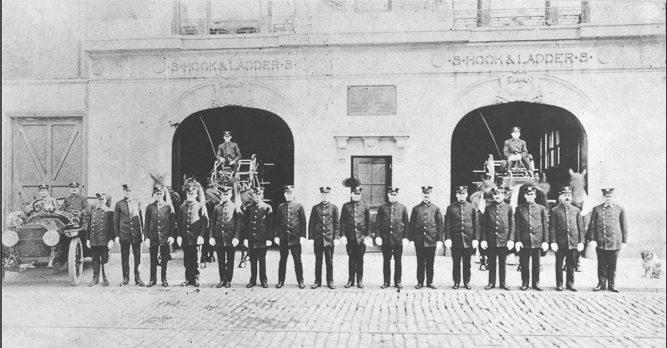
Firehouse, Hook & Ladder Co. 8 — before the widening of Varick Street and after

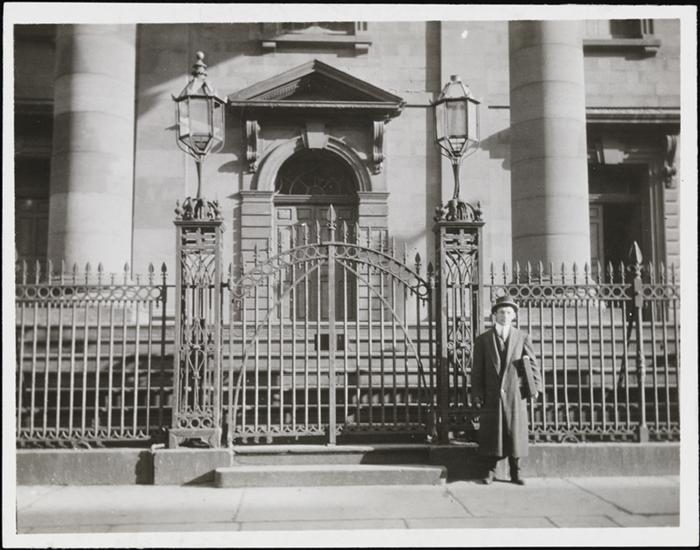
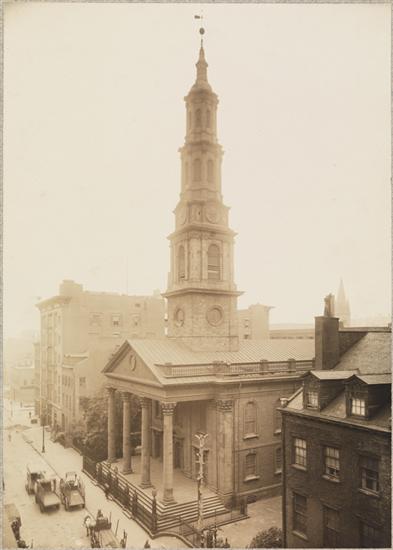
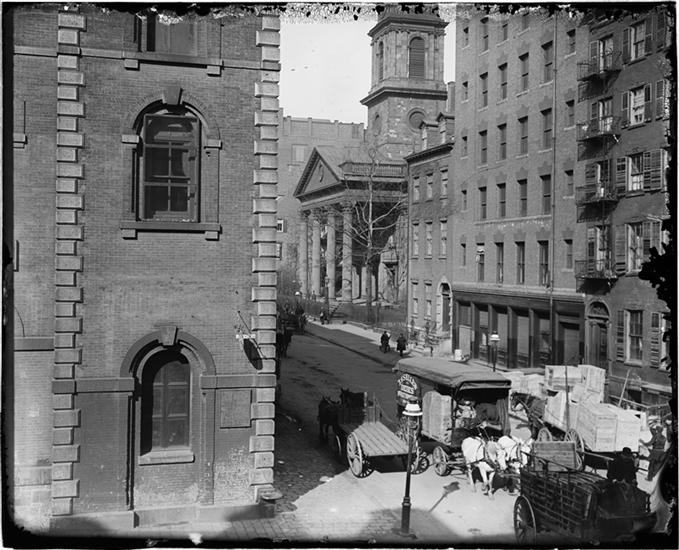
Pictures of old St. John’s Chapel in its final years, courtesy the Museum of the City of New York collection:

MCNY, New York Edison Company, 1910
MCNY, Robert Bracklow, seen from Beach Street
1910 interior, Wurts Brothers, MCNY
MCNY

Harrison Street Houses

MCNY, Edmund Vincent Gillon

Looking south on Hudson Street, 1978

Edmund Gillon, 1978, MCNY

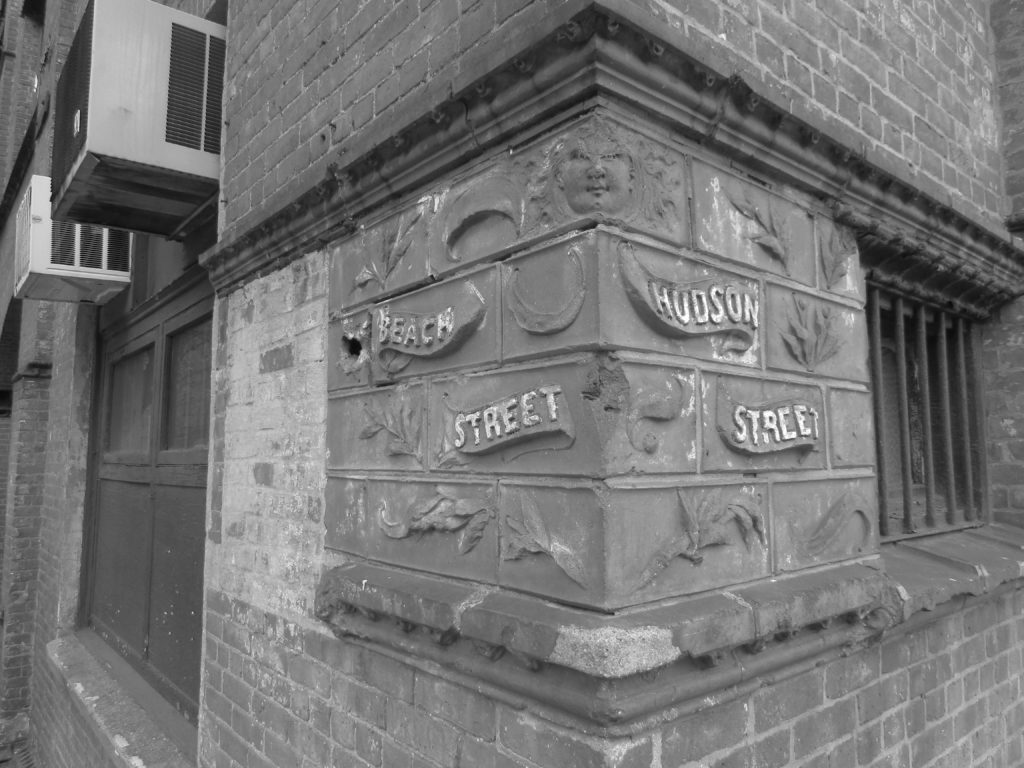
Unique street tiling at Hudson and Beach Streets

Greg Young

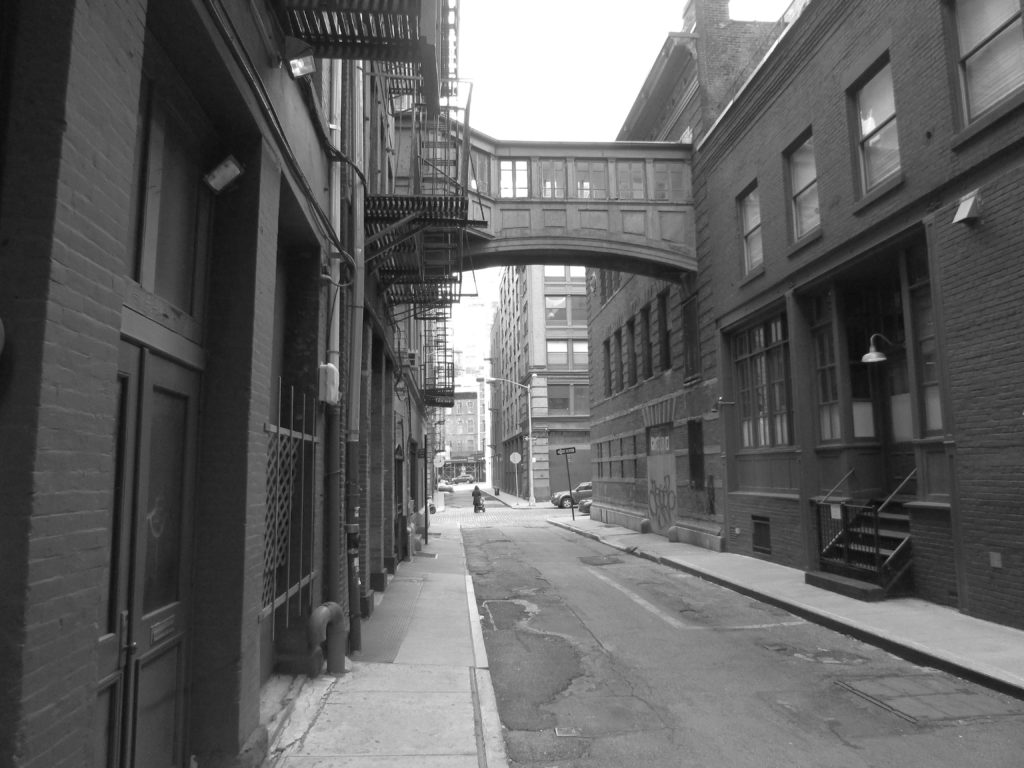
Staple Street with its distinctive skybridge.

Greg Young

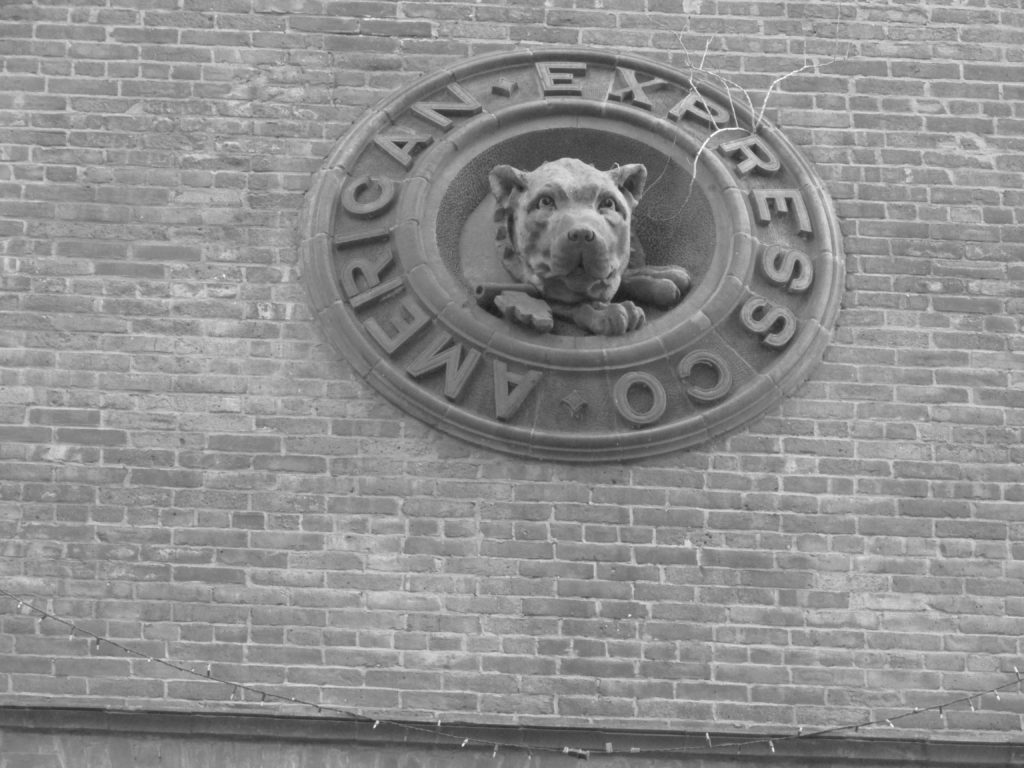
At the top of the old American Express stables is a curious fellow staring down at you.

Greg Young

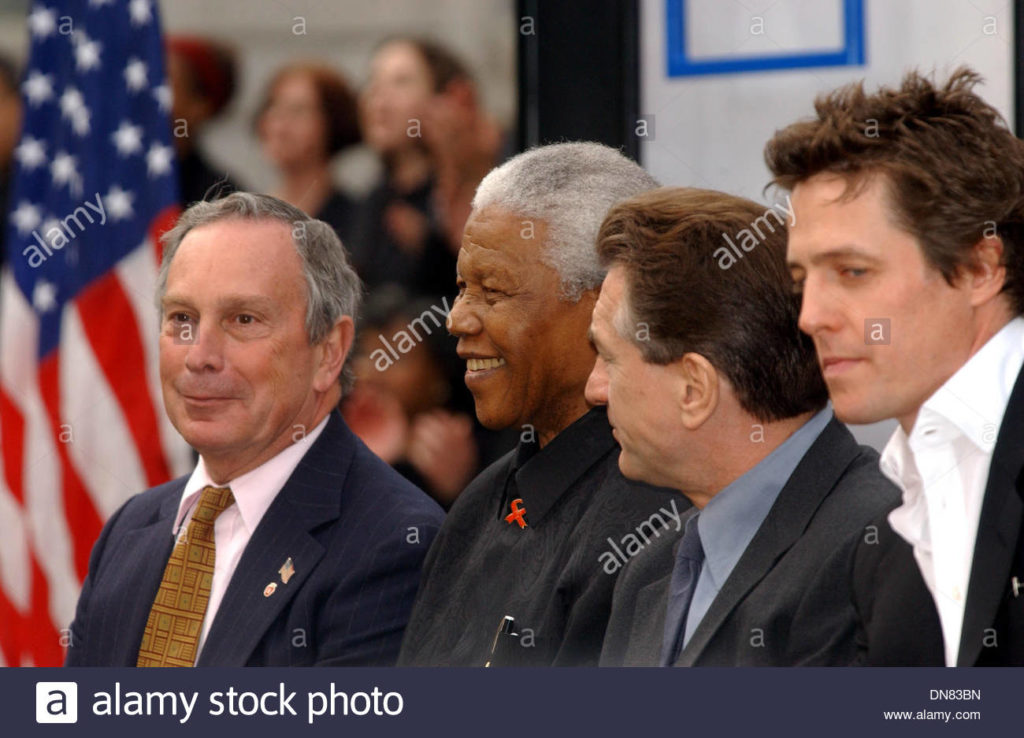
Mayor Michael Bloomberg, Nelson Mandela, Robert De Niro and Hugh Grant at the opening ceremony of the first TriBeCa Film Festival, May 8, 2002.


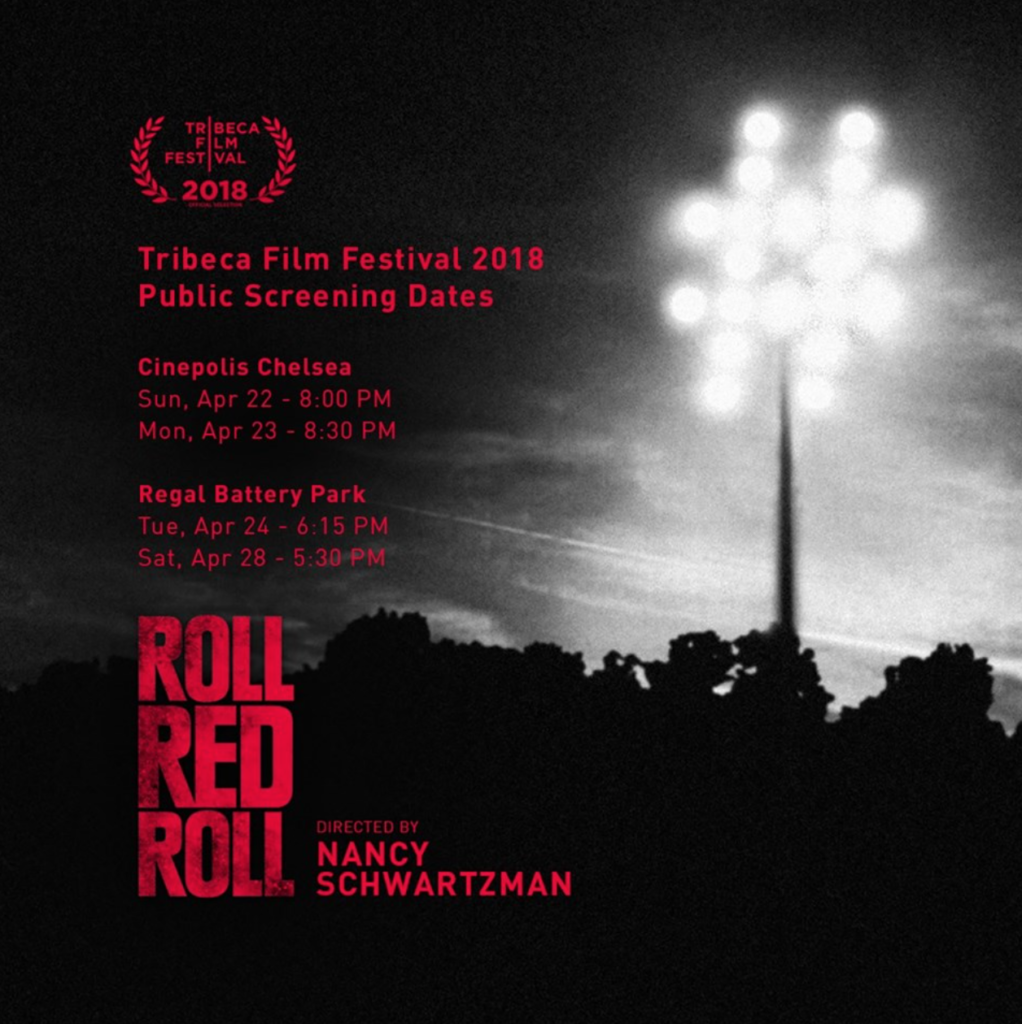
We’re dedicating this show to our good friend Nancy Schwartzman whose upcoming documentary Roll Red Roll will make its debut at the Tribeca Film Festival next month.


Categories
Brooklyn History Podcasts

The History of DUMBO, the Brooklyn neighborhood built upon a legacy of coffee and cardboard boxes

PODCAST The history of Brooklyn’s DUMBO neighborhood — from its industrial past to its hi-tech future.

Down Under Manhattan Bridge Overpass (DUMBO) is, we think, a rather drab name for a historically significant place in Brooklyn where some of the daily habits of everyday Americans were invented.

This industrial area between the Brooklyn and Manhattan bridges traces its story to the birth of Brooklyn itself, to the vital ferry service that linked the first residents to the marketplaces of New York. Two early (lesser) Founding Fathers even attempted to build a utopian society here called Olympia.

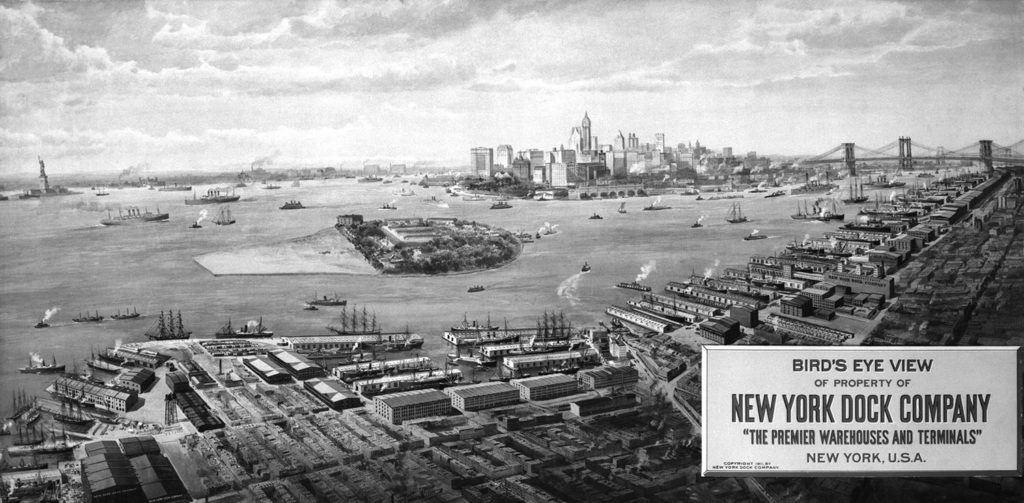
Instead the coastline’s fate would turn to industrial and shipping concerns. Its waterfront was lined with brick warehouses, so impressive and uniform that Brooklyn received the nickname ‘the Walled City‘.

The industries based directly behind the warehouses were equally as important to the American economy. Most of their factories comprise the architecture of today’s DUMBO, grand industrial fortresses of brick and concrete, towering above cobbled streets etched with railroad tracks.

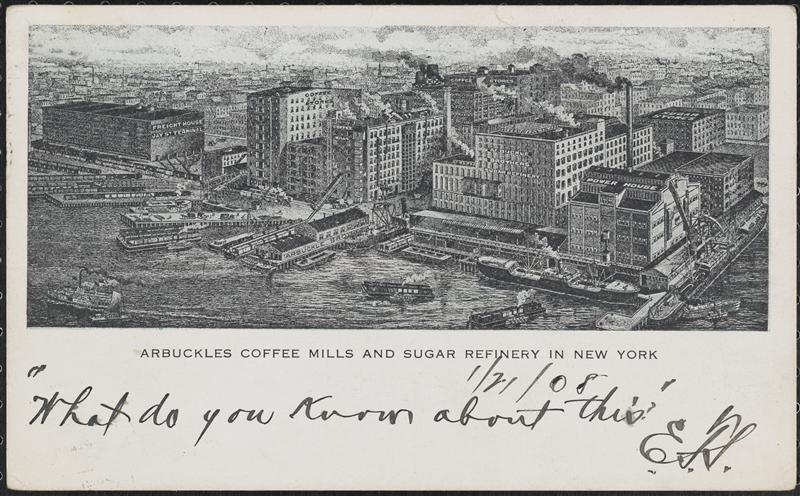
The cardboard-box titan Robert Gair was so dominant in this region that his many buildings were collectively referred to as Gairville. But coffee and tea traditions also came here — not just the manufacture, but the revolutionary ways in which people with buy and drink those beverages.

How did this early New York manufacturing district become a modern American tech hub, with luxury loft apartments and splendid coffee shops? This story of repurpose and gentrification is very different from those told in other neighborhoods.

PLUS: And, no, really, what is up with that name?

Listen Now: DUMBO History

Or listen to it straight from here:

________________________________________________________

The Bowery Boys: New York City History podcast is brought to you …. by you!

We are now producing a new Bowery Boys podcast every week.  We’re also looking to improve the show in other ways and expand in other ways as well — through publishing, social media, live events and other forms of media.  But we can only do this with your help!

We are now a member of Patreon, a patronage platform where you can support your favorite content creators for as little as a $1 a month.

Please visit our page on Patreon and watch a short video of us recording the show and talking about our expansion plans.  If you’d like to help out, there are five different pledge levels (and with clever names too — Mannahatta, New Amsterdam, Five Points, Gilded Age, Jazz Age and Empire State). Check them out and consider being a sponsor.

We greatly appreciate our listeners and readers and thank you for joining us on this journey so far. 

_______________________________________________________

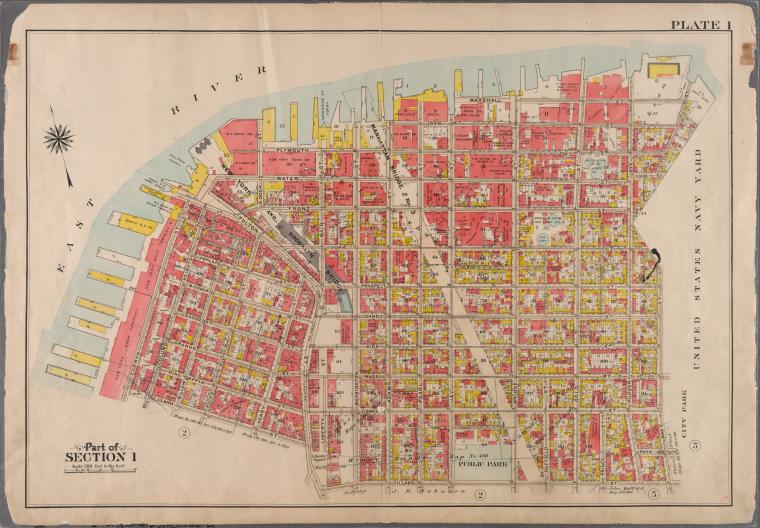
The DUMBO neighborhood, Brooklyn Heights and downtown Brooklyn on this 1908 survey map.

New York Public Library

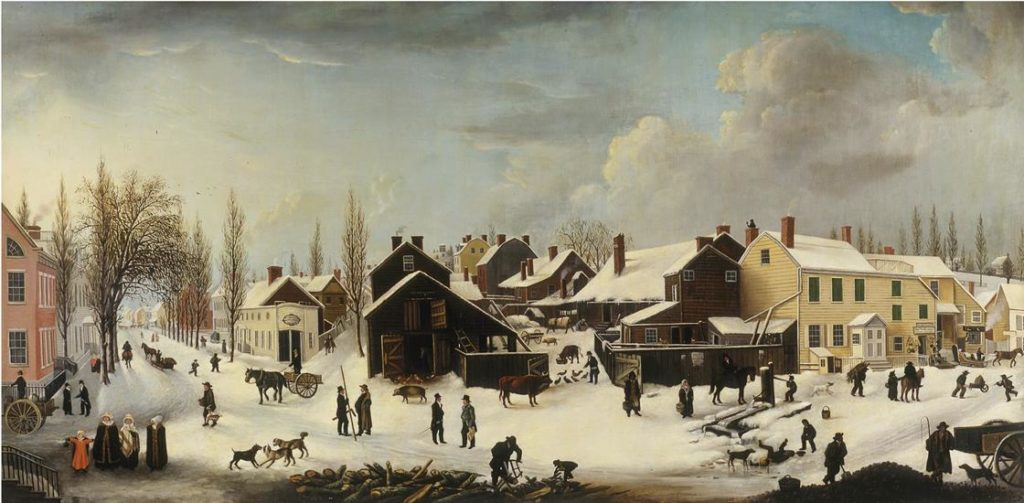
This painting by Francis Guy) actually depicts the area of downtown Brooklyn as it looked during the area’s ‘Olympia period’.

MCNY

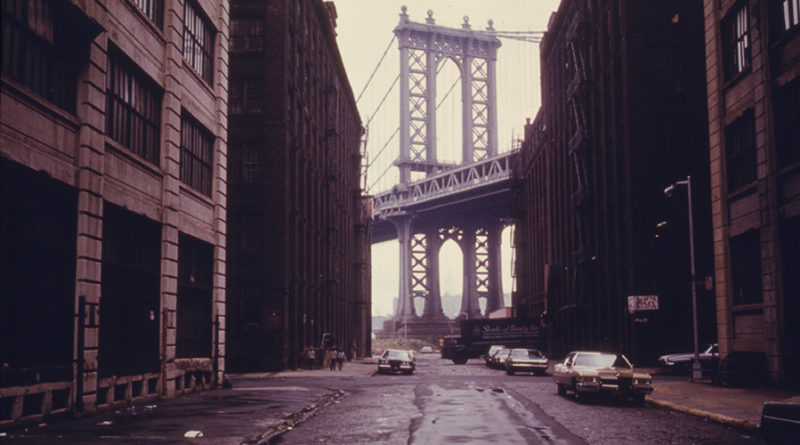
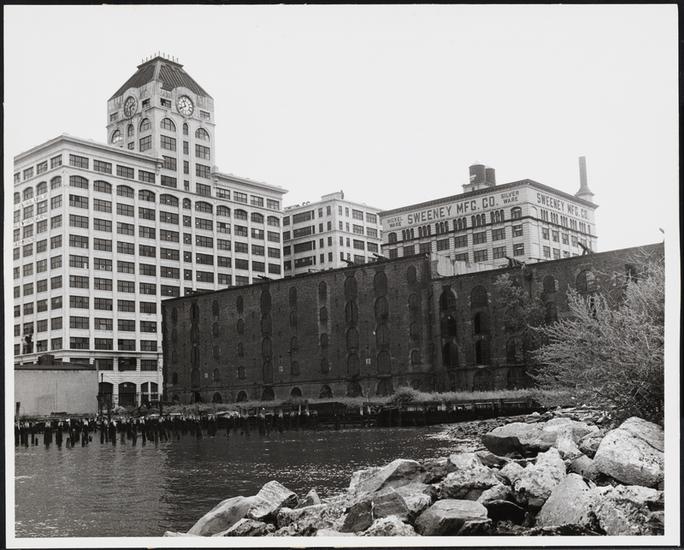
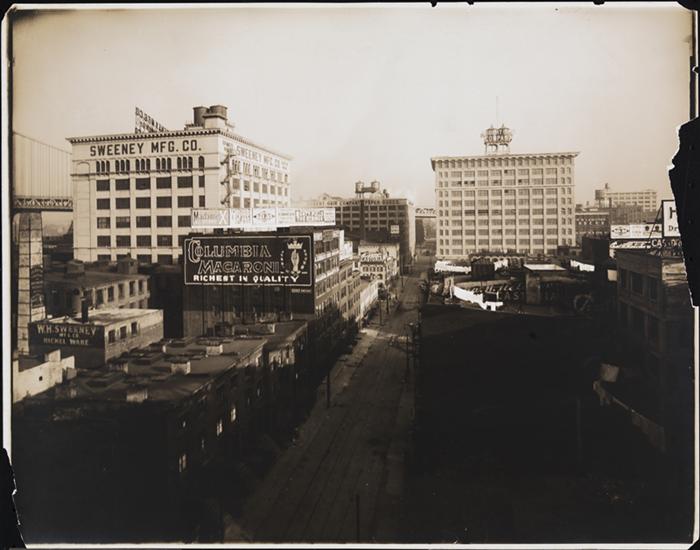
The waterfront in 1974 — the Empire Stores, the former Gair building (1 Main Street) and Sweeney Manufacturing (the kitchenware company)

MCNY
MCNY

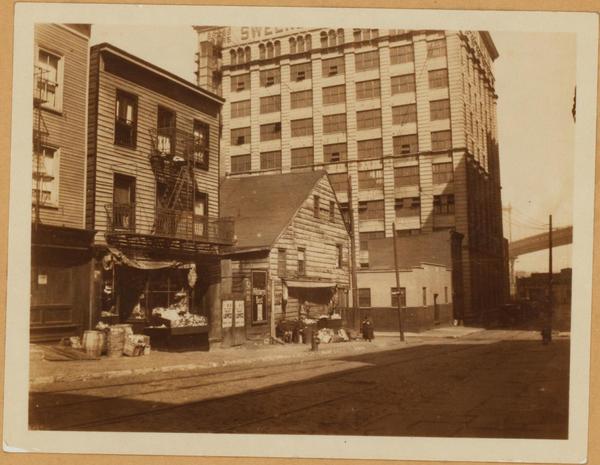
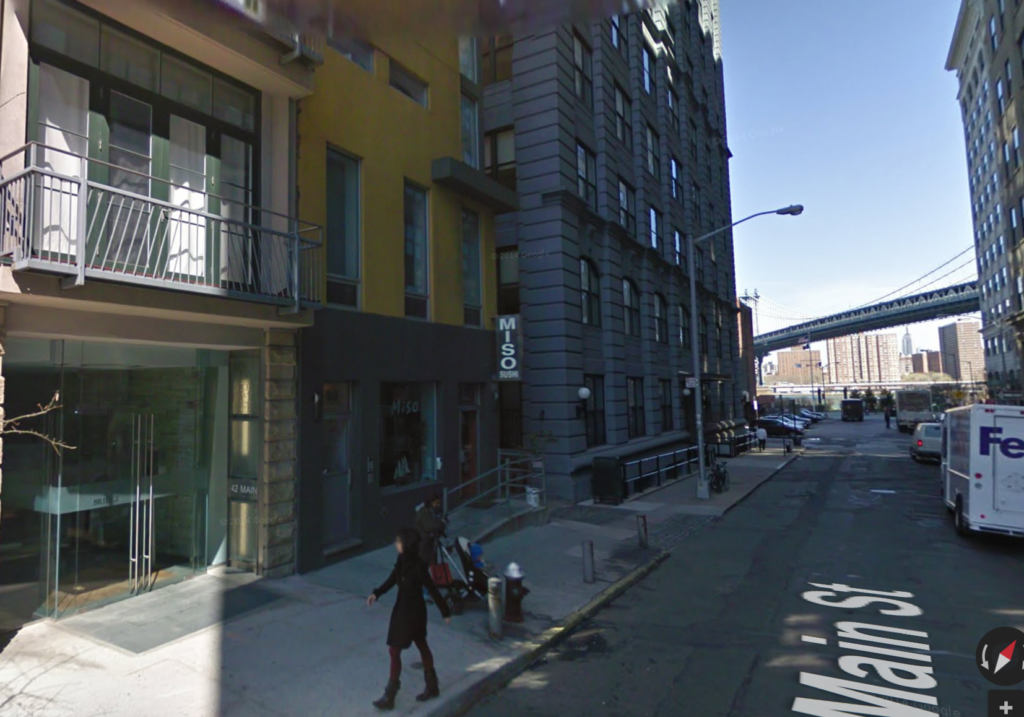
While the neighborhood is dominated by industrial architecture today, it wasn’t always so. This picture from 1924 (looking down Main Street with the wooden building sitting at Howard Alley) and the same view today

NYPL

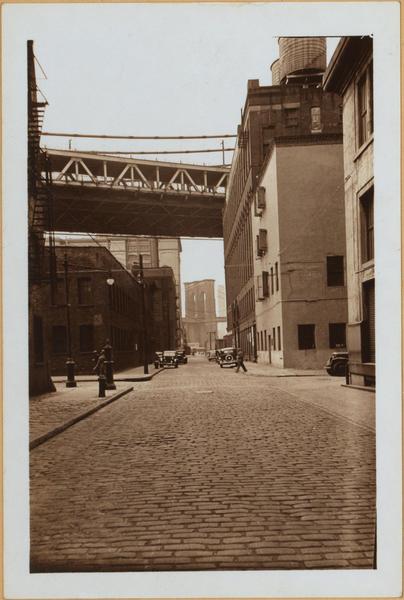
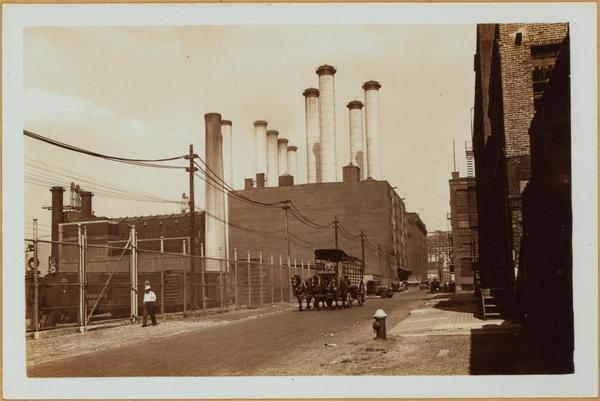
Plymouth Street, west from Pearl Street, showing at the right one of the Arbuckle Bros. Coffee Co. building. April 4, 1938.

NYPL

John Street, east from Jay Street, 1938

Brooklyn waterfront was lined with warehouses during the 20th century. Here’s a view of the coastline from the Fulton Ferry area down to Red Hook.

Brooklyn Historical Society

A 1908 view of waterfront properties from Jay Street to Washington Street (pre Manhattan Bridge of course)

MCNY

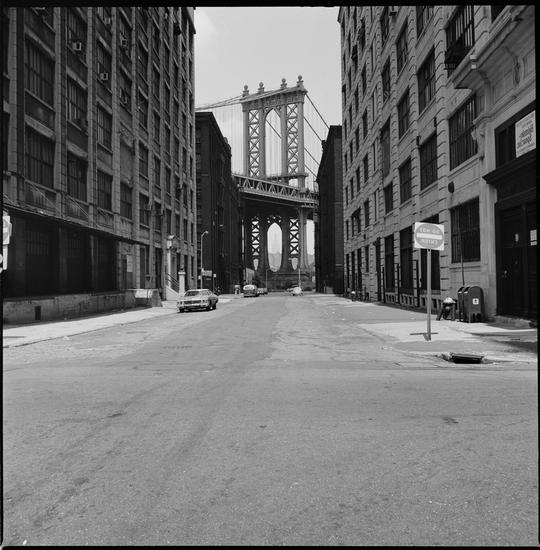
Today you’ll find dozens of people every day on the street, taking selfies in front of this view. But back in 1978, the district was virtually abandoned.

MCNY

Inside the repurposed Empire Stores, now the headquarters of West Elm and home of the Brooklyn Historical Society annex.

EXHIBITS
Waterfront at the Brooklyn Historical Society’s DUMBO gallery
Featuring many aspects of life along the Brooklyn waterfront. Plus an excellent short film At Water’s Edge surveying 20,000 years of Brooklyn history.

FURTHER LISTENING
We mentioned these past Bowery Boys podcast on the show. After you’ve finished listening to our DUMBO: Life on the Brooklyn Waterfront show, give these a try!

Categories
Landmarks Podcasts

The Rescue of Grand Central Terminal: Jackie and the Landmark Express go to Washington

PODCAST The story of how Grand Central was saved from the wrecking ball.

The survival of New York City’s greatest train station is no accident. The preservation of Grand Central Terminal helped create the protections for all of America’s greatest landmarks.

By the 1950s, this glorious piece of architecture — opened in 1913 as a sensational example of Beaux-Arts architecture — was severely unloved and truly run down. It was also in danger. Long distance railroad travel was no longer fashionable and its real estate seemed better suited for a trendier skyscraper.

With the destruction of Penn Station in the mid-1960s, it seemed Grand Central was next. Let’s make room for progress! So how did it manage to survive?

In this episode, we welcome special guest Kent Barwick, the former executive director of the Municipal Art Society, who was there, in the middle of the fight to save Grand Central. He joins us to talk about the preservation battle and the importance of one particular ally — Jacqueline Kennedy Onassis.

It certainly took thousands of people — idealists, activists and regular New Yorkers — to save this iconic building. But how did this one woman of great renown and prominence bring her personal history into the building, all in earnest efforts to save it?

Listen Now: Grand Central Terminal Podcast

___________________________________________________________

The Bowery Boys: New York City History podcast is brought to you …. by you!

We are now producing a new Bowery Boys podcast every week.  We’re also looking to improve the show in other ways and expand in other ways as well — through publishing, social media, live events and other forms of media.  But we can only do this with your help!

We are now a member of Patreon, a patronage platform where you can support your favorite content creators for as little as a $1 a month.

Please visit our page on Patreon and watch a short video of us recording the show and talking about our expansion plans.  If you’d like to help out, there are five different pledge levels (and with clever names too — Mannahatta, New Amsterdam, Five Points, Gilded Age, Jazz Age and Empire State). Check them out and consider being a sponsor.

We greatly appreciate our listeners and readers and thank you for joining us on this journey so far. 

___________________________________________________________

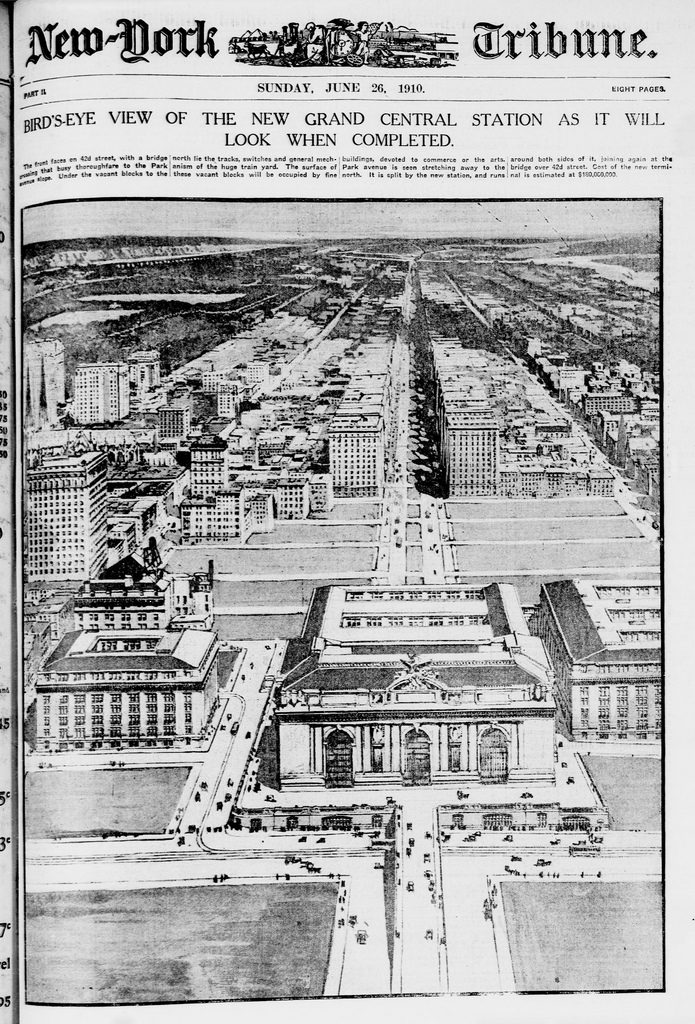
The original plan for Grand Central, burying its tracks (to create Park Avenue) and concealing its rail yard, creating valuable real estate above it.

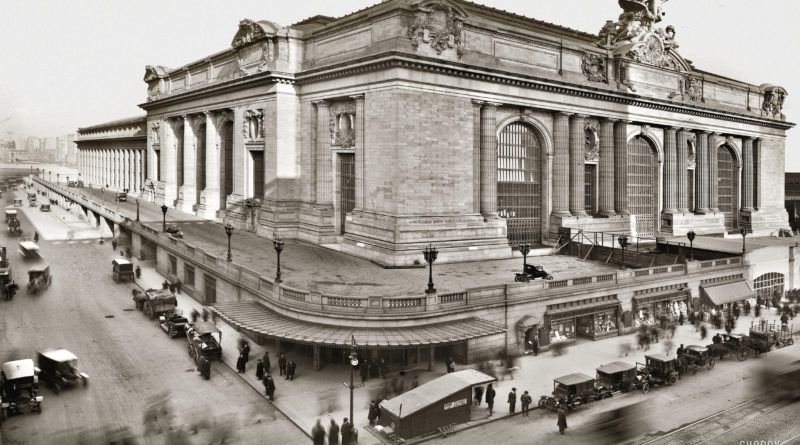
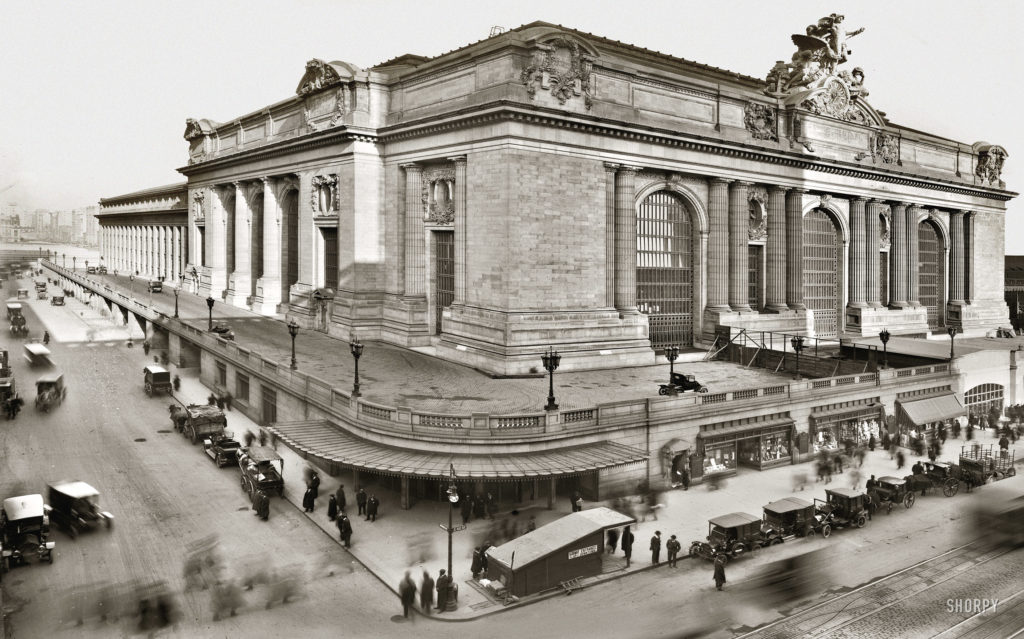
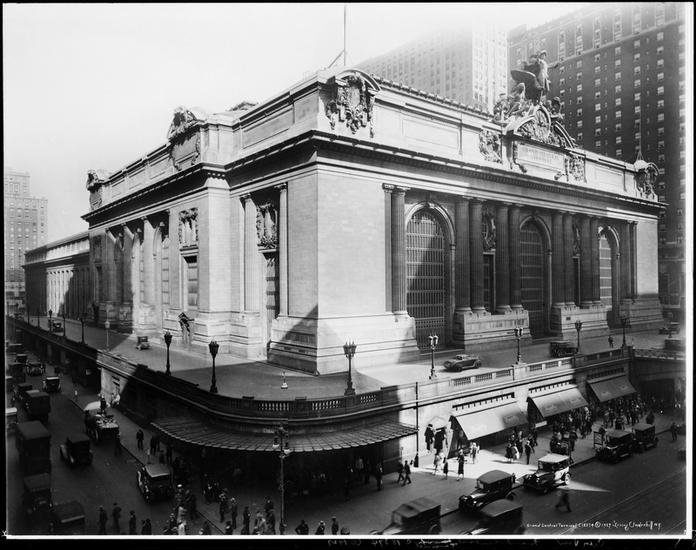
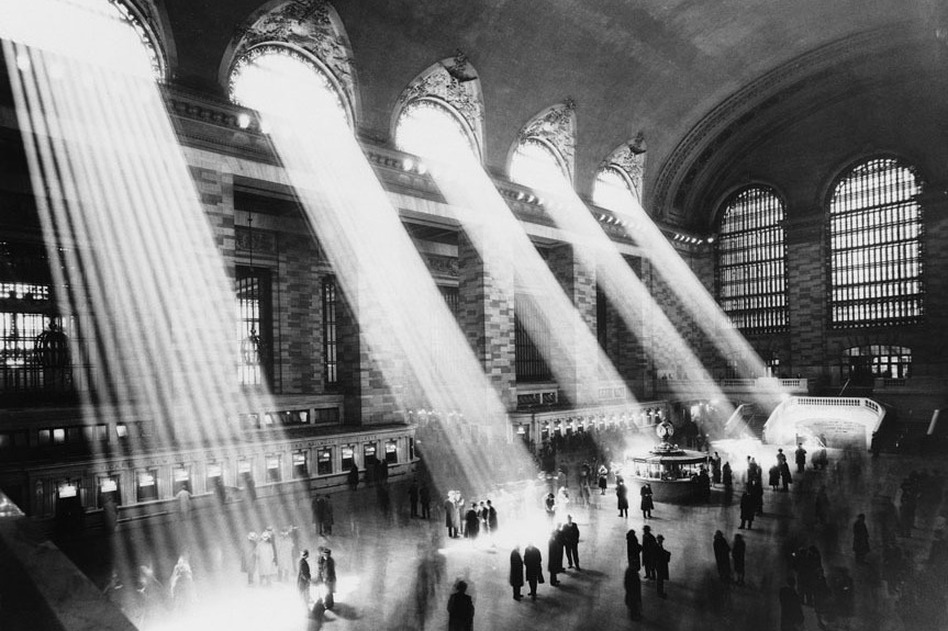
The terminal in 1913 and again in 1927. Note the difference in surroundings.

Library of Congress/Clean-up version by Shorpy
Irving Underhill, MCNY

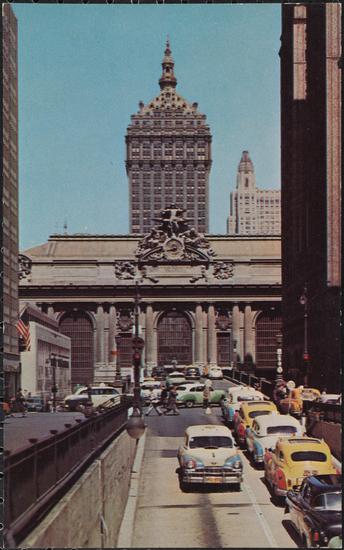
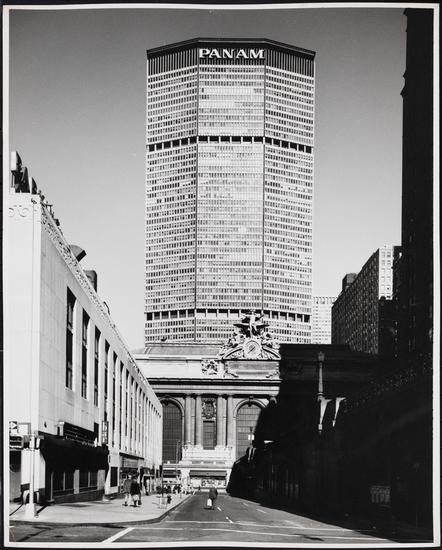
1960s — before the Pan Am Building ….

Alfred Mainzer/MCNY

…. and after.

Edmund Vincent Gillon/MCNY

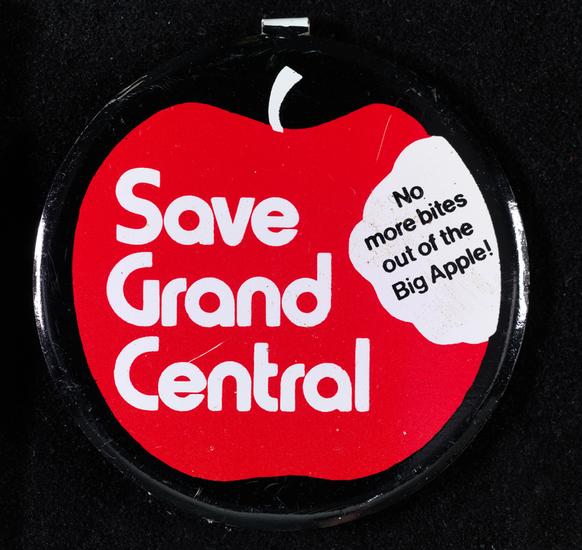
A lapel button from 1968, promoting the preservation of Grand Central. No such buttons were made for Penn Station a few years earlier, but the demolished train station would boost preservation efforts for other endangered buildings.

Museum of the City of New York

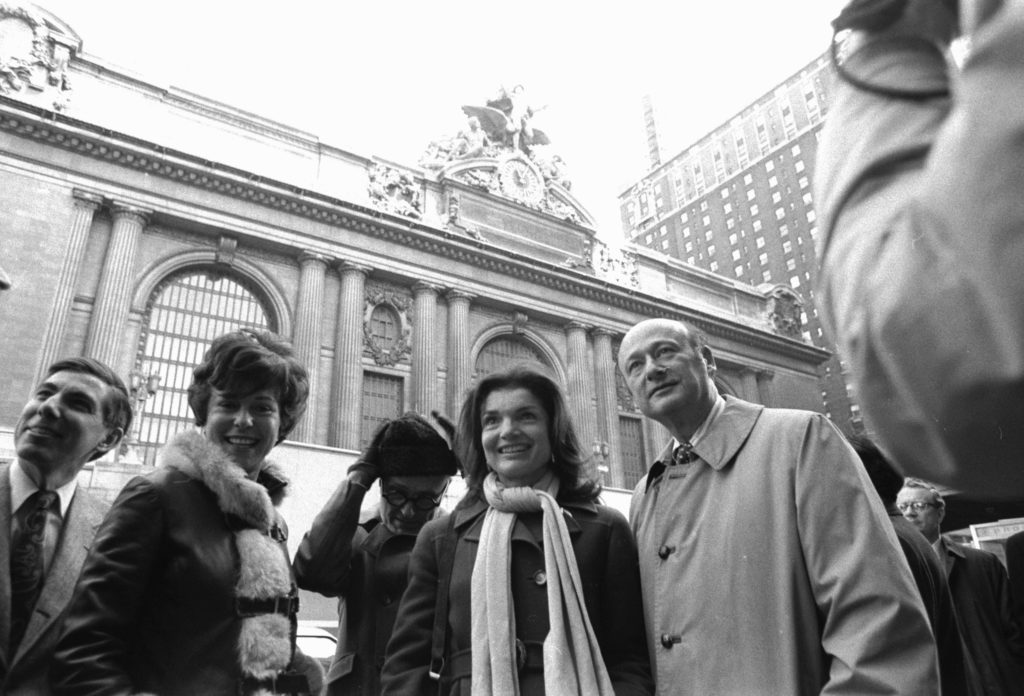
Jackie stands in front of Grand Central, preparing to turn on the lights in 1976. Mr. Barwick mentions this event in our interview with him.

CHARLES RUPPMANN/Courtesy New York Daily News

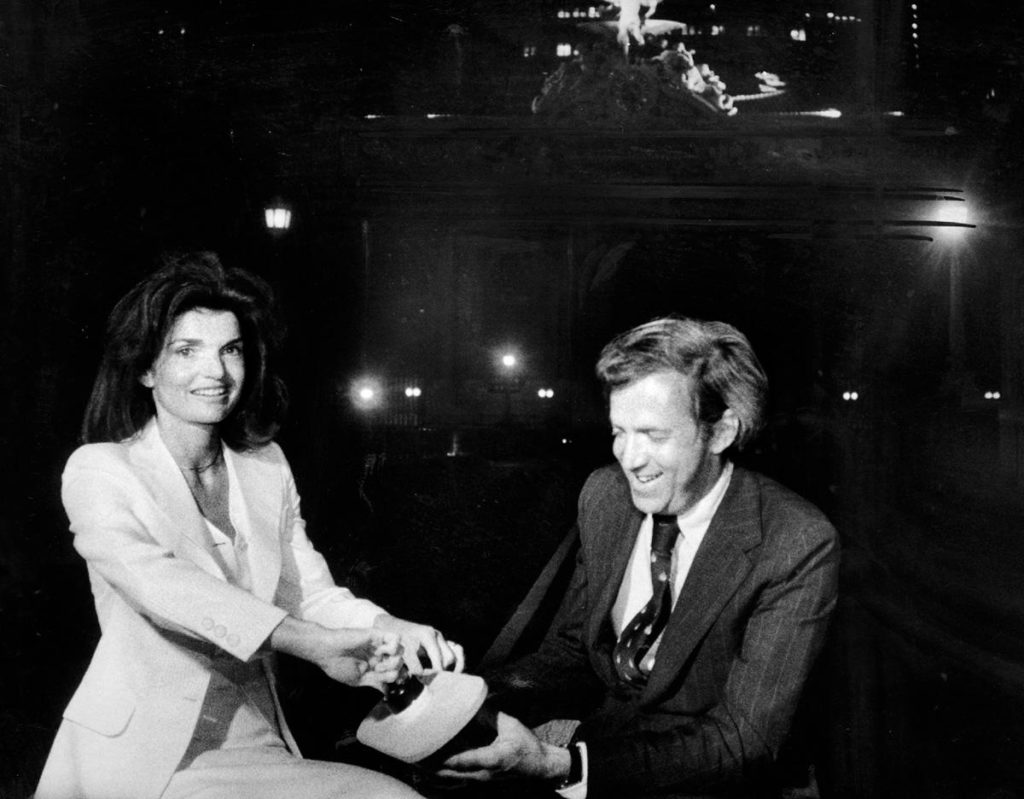
Bess Meyerson, Philip Johnson, Jackie Kennedy Onassis and then-congressman Ed Koch in 1975

Mel Finkelstein/NY Daily News Archive

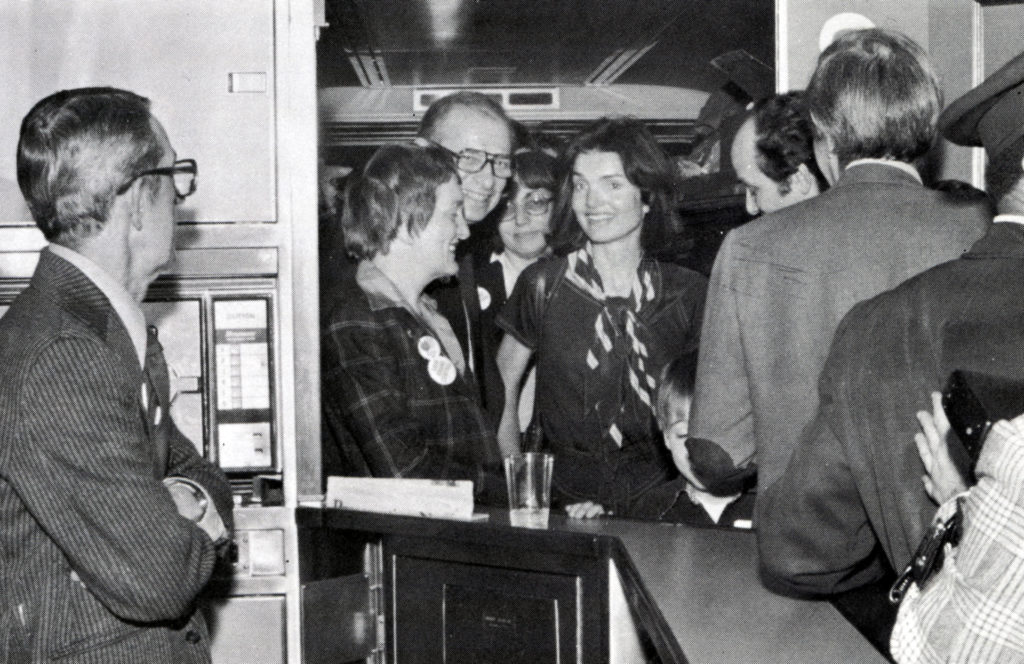
Jackie and other activists, all aboard the Landmark Express!

Amtrak NEWS

TOURS
Official Grand Central Docent-Led Tours from the Municipal Art Society
Prowler NYC — Architectural/Historical Walking Tours of New York featuring the tour  Jacqueline Kennedy Onassis and the Preservation of Our Architectural Treasures

FURTHER LISTENING
We mentioned these past Bowery Boys podcast on the show. After you’ve finished listening to our Rescue of Grand Central show, give these a try!

Categories
Planes Trains and Automobiles Podcasts

Opening Day of the New York City Subway: Stand Clear of the (Very First) Closing Doors Please!

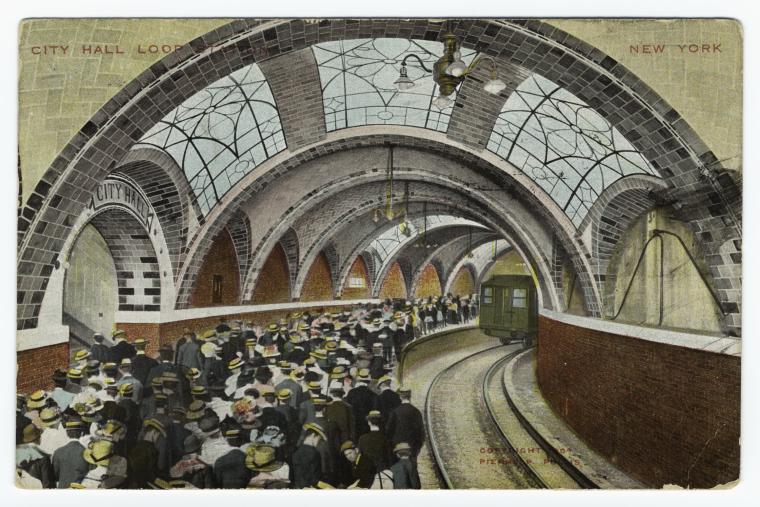
PODCAST What was it like to experience that epic symbol of New York City – the world famous New York City subway system – for the first time? In this episode, we imagine what opening day was like for the first New York straphangers.

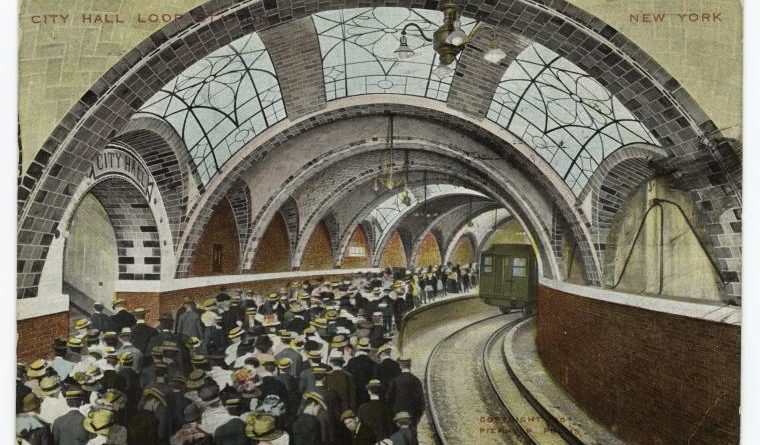
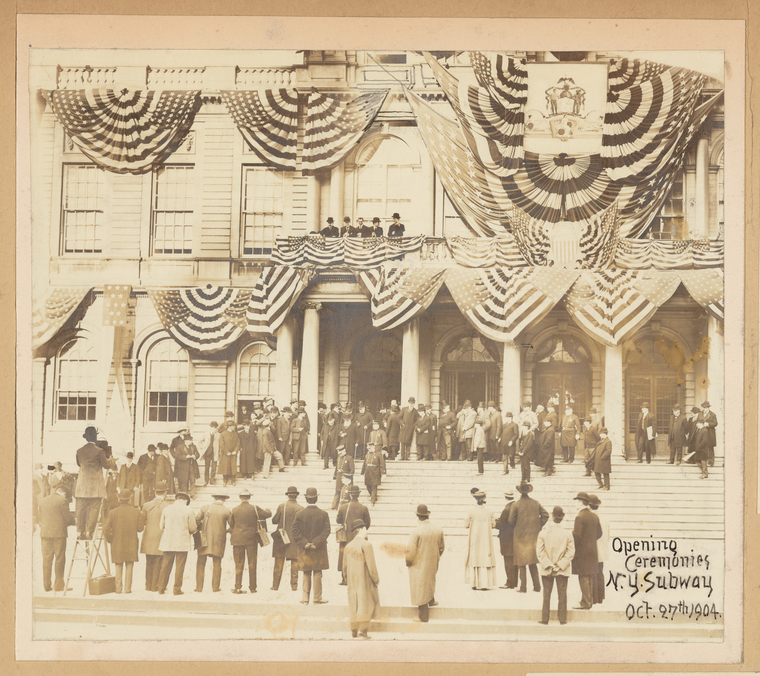
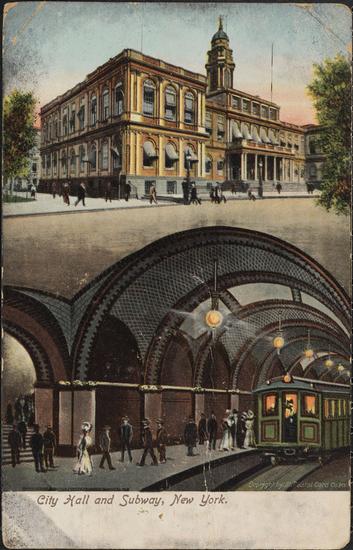
We begin by recounting the subway system’s construction and registering the excitement of New Yorkers in the days leading up to the opening on October 27, 1904. That fateful day was sheer pandemonium as thousands of people crammed into brand spanking new station to push themselves into the system’s new subway cars.

“For the first time in his life Father Knickerbocker went underground yesterday; went underground, he and his children, to the number of 150,000, amid the tooting of whistles and the firing of salutes, for a first ride in a subway which for years had been scoffed at as an impossibility.” [New York Times, October 28, 1904]

After listening to this show, we hope you gain a new appreciation for this modern engineering marvel. Hopefully, it will make that next subway delay more bearable!

Listen Now: NYC Subway Opening Podcast

_________________________________________________________

The Bowery Boys: New York City History podcast is brought to you …. by you!

We are now producing a new Bowery Boys podcast every week.  We’re also looking to improve the show in other ways and expand in other ways as well — through publishing, social media, live events and other forms of media.  But we can only do this with your help!

We are now a member of Patreon, a patronage platform where you can support your favorite content creators for as little as a $1 a month.

Please visit our page on Patreon and watch a short video of us recording the show and talking about our expansion plans.  If you’d like to help out, there are five different pledge levels (and with clever names too — Mannahatta, New Amsterdam, Five Points, Gilded Age, Jazz Age and Empire State). Check them out and consider being a sponsor.

We greatly appreciate our listeners and readers and thank you for joining us on this journey so far. 

_______________________________________________________

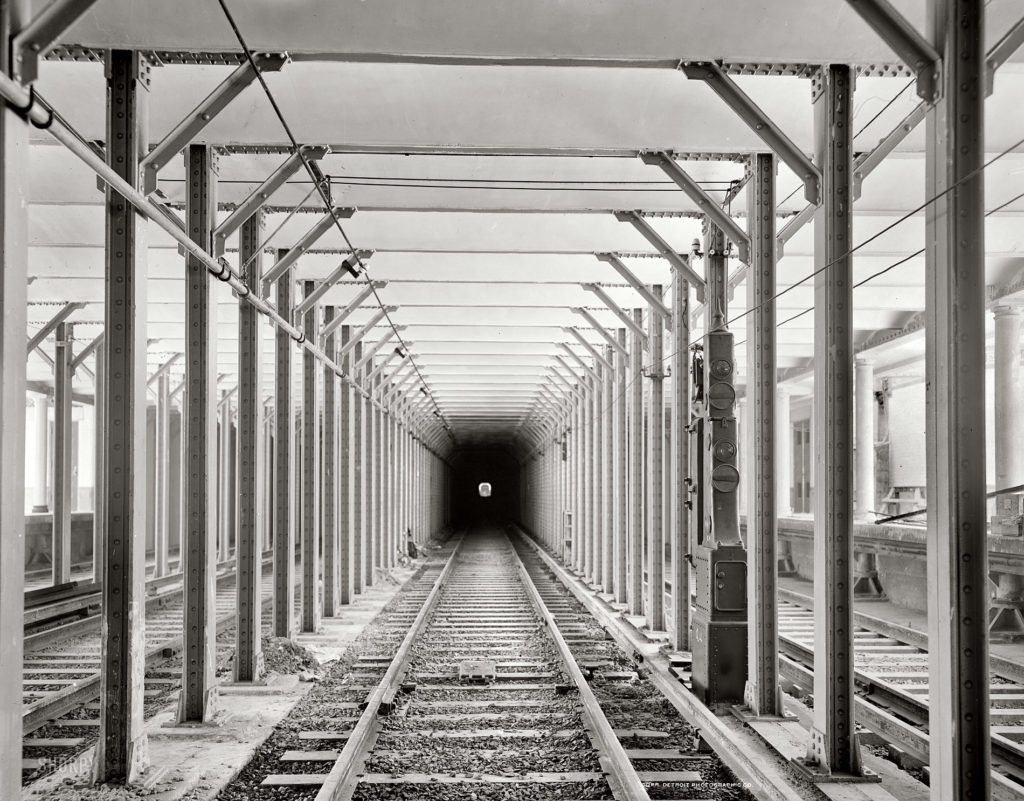
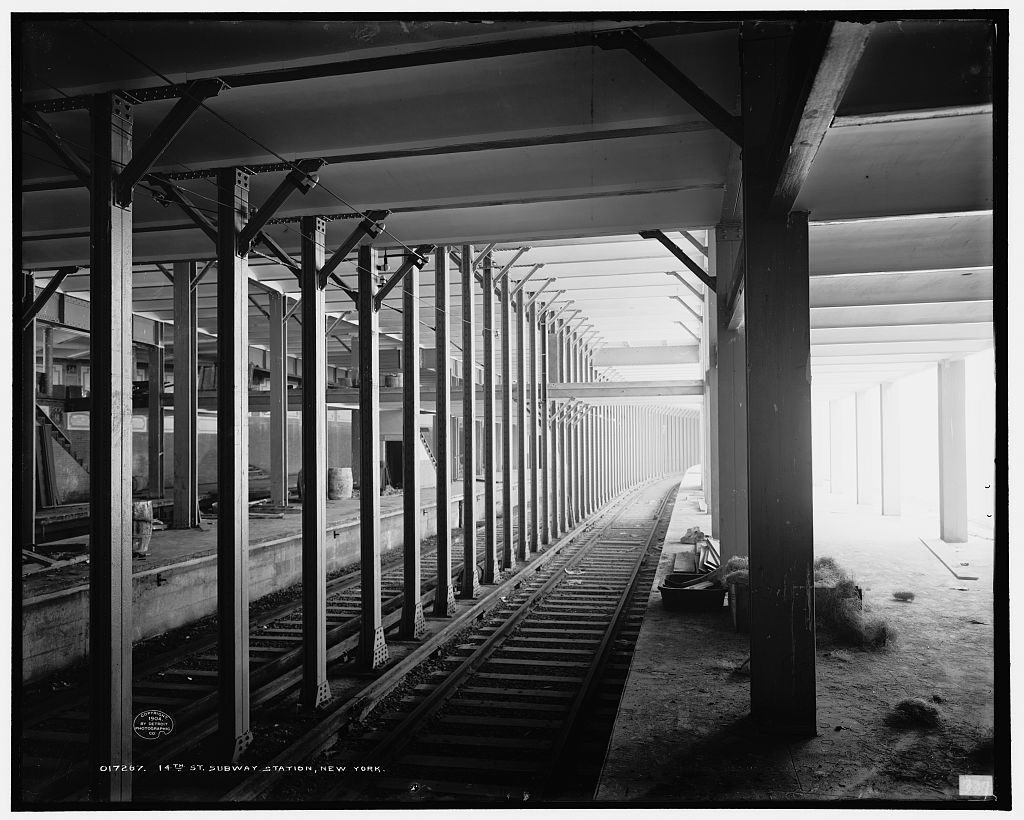
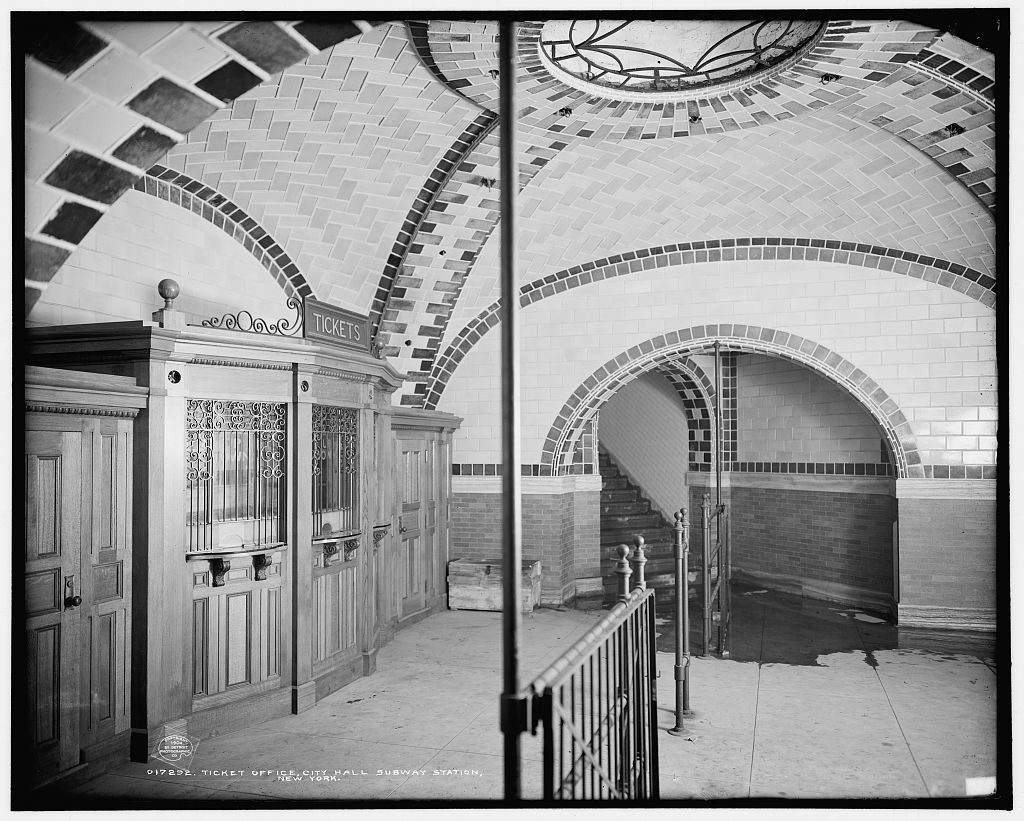
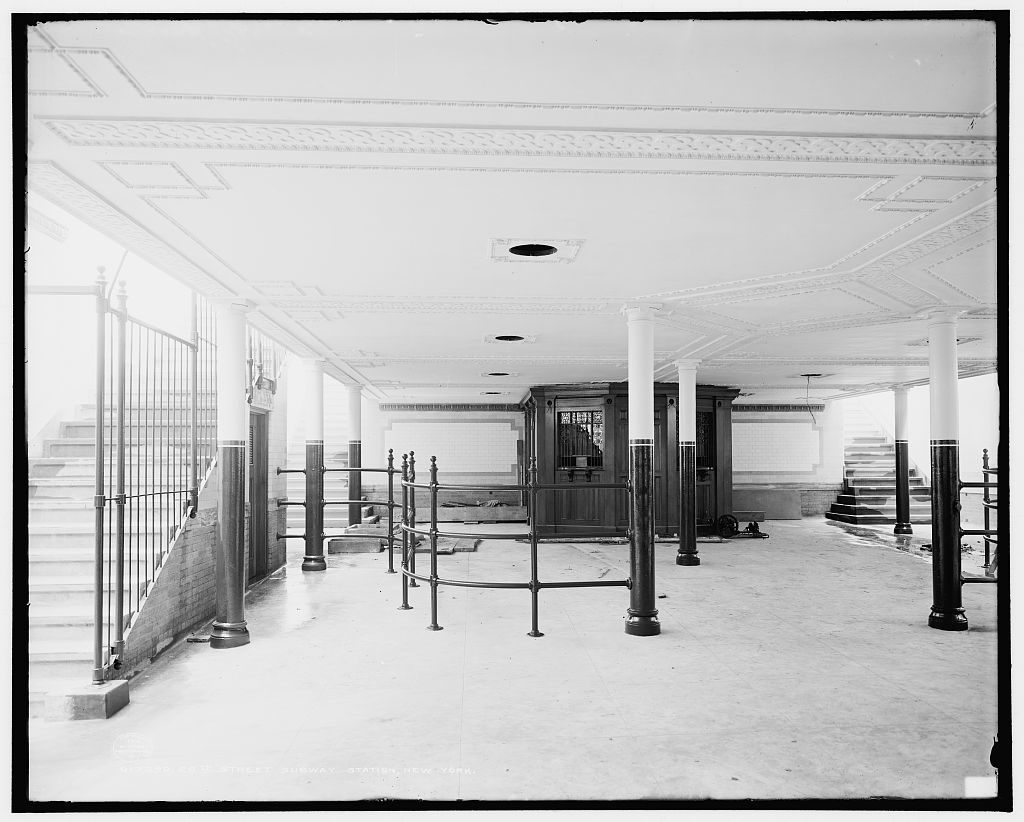
Library of Congress/cleaned up version courtesy Shorpy
Detroit Publishing Co

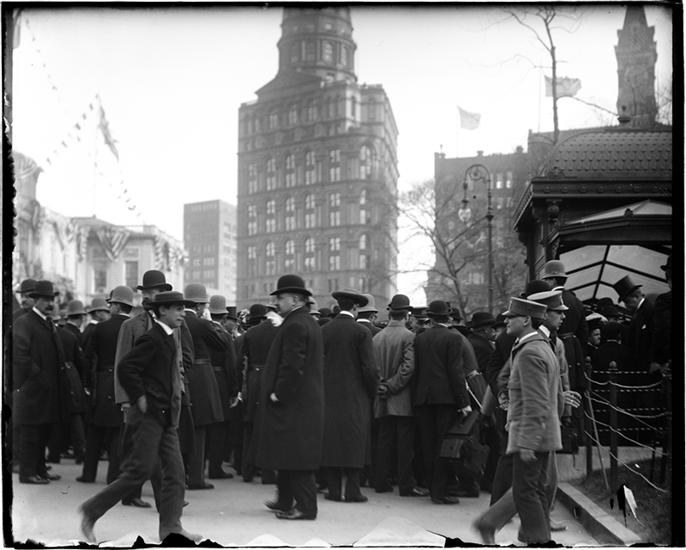
Crowds gather in front of the Brooklyn Bridge subway kiosk on the subway’s opening day (Oct 27, 1904).

MCNY
NYPL

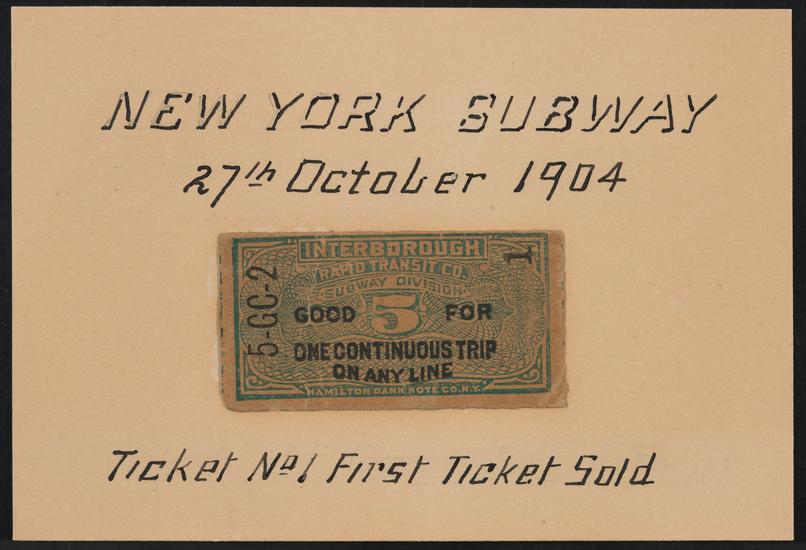
Reportedly an image of the first ticket sold for regular entrance to the subway, sold at the Grand Central hub.

MCNY

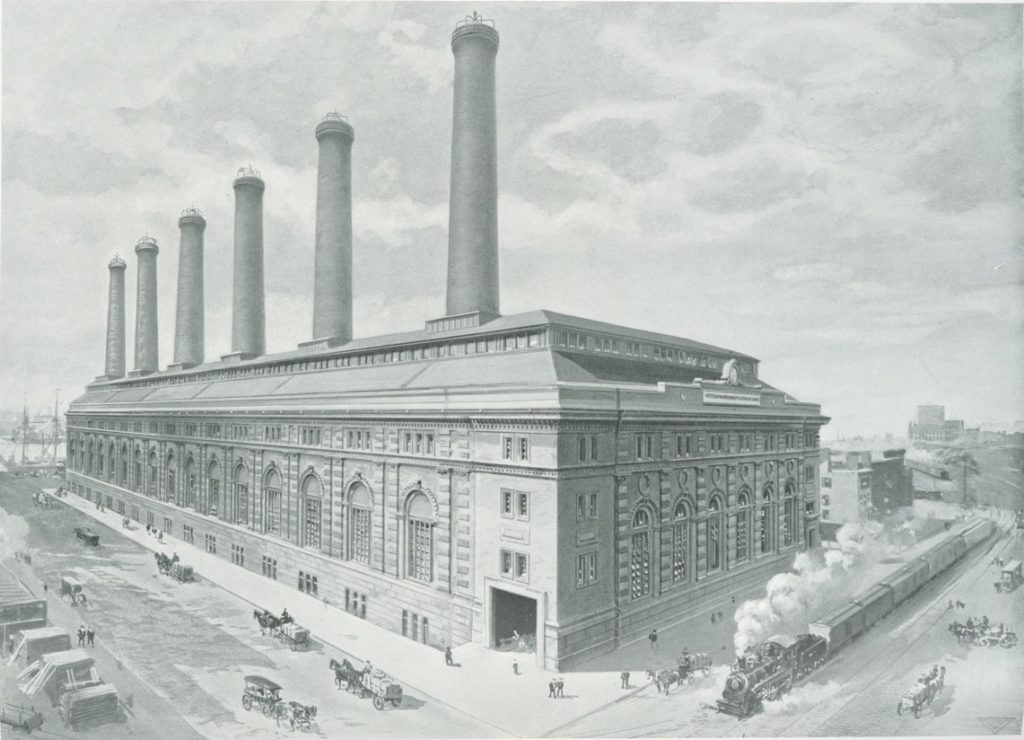
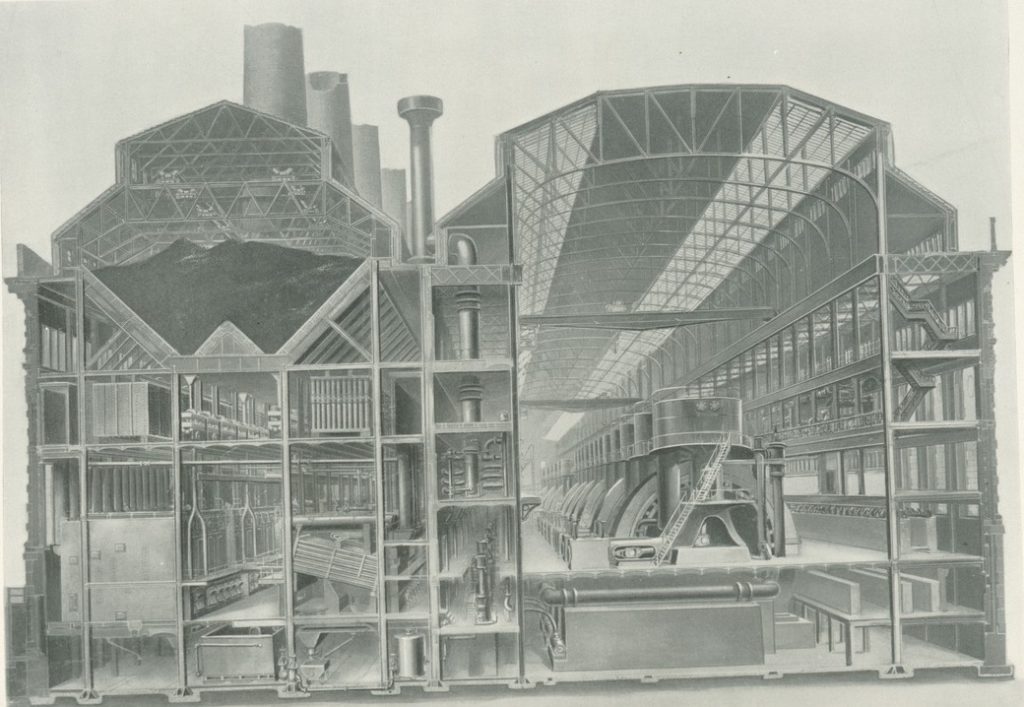
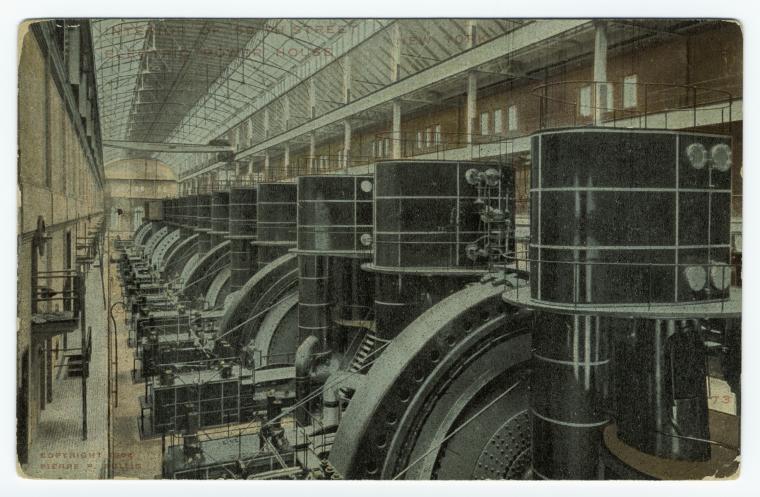
The IRT Power House on the Hudson River was the first truly elegant portion of the subway first seen above ground designed by Stanford White in the City Beautiful traditions.

NYPL

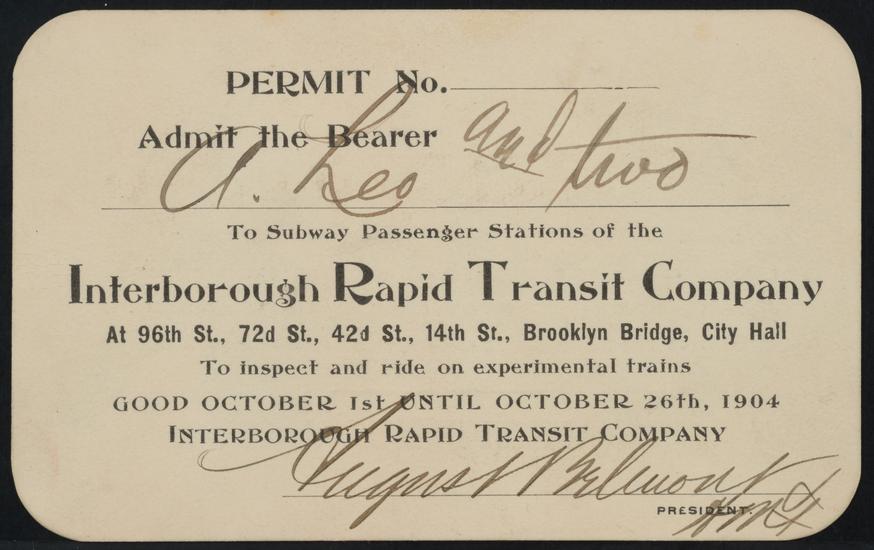
The subway was actually in regular operation in the weeks before the opening with regular test runs and even a few ‘experimental trains’ which ran at regular intervals for VIPs.

MCNY
NYPL

WATCH THIS
Seven month after the opening of the subway, the film studio American Mutoscope and Biograph Company made an incredible film underground — Interior New York Subway, 14th Street to 42nd Street. According to the National Film Preservation Foundation, the movie “required coordinating three trains: the one we watch, the one carrying the camera, and a third (glimpsed on the parallel track) to carry the bank of lights.”

FURTHER READING
722 Miles: The Building of the Subways by Clifton Hood
The Race Underground by Doug Most — read our interview with the author here
Subway Style: 100 Years of Architecture & Design in the New York City Subway by the New York Transit Museum
New York Subways: An Illustrated History of New York City’s Transit Cars by Gene Sansone

EXHIBITIONS

The New York Transit Museum has examples of early subway cars, as well as other aspects of the first subway experience, including turnstiles, ticket booths and more.

FURTHER LISTENING
For some more information on New York City transportation history, dive back into our five-part transportation series.


Special thanks to Kieran Gannon for helping with editing this week’s show.

Categories
Podcasts Politics and Protest

New York City and the Underground Railroad: Escaping to freedom through a hostile city

PODCAST For thousands of people escaping the bonds of slavery in the South, the journey to freedom wound its way through New York City via the Underground Railroad.


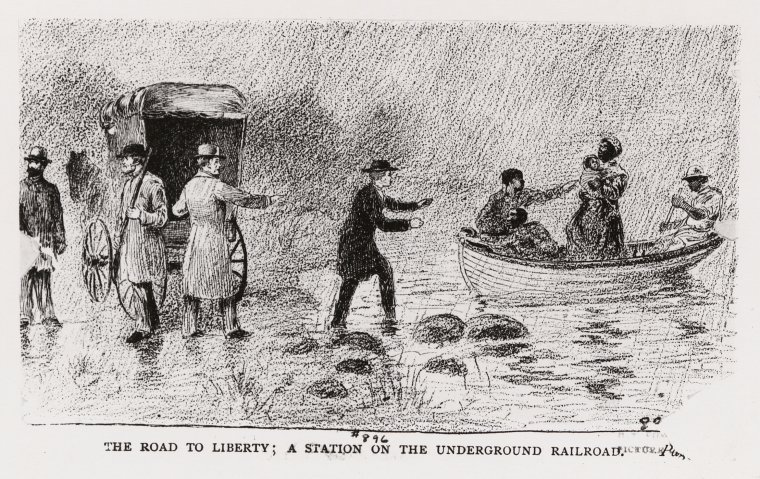
The Underground Railroad was a loose, clandestine network of homes, businesses and churches, operated by freed black people and white abolitionists who put it upon themselves — often at great risk — to hide fugitives on the run.

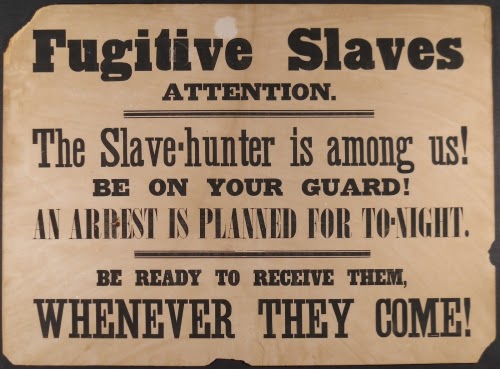
New York and Brooklyn were vital hubs in this network but these cities were hardly safe havens. The streets swarmed with bounty hunters, and a growing number of New Yorkers, enriched by Southern businesses, were sympathetic to the institution of slavery. Not even freed black New Yorkers were safe from kidnapping and racist anti-abolitionist mobs.

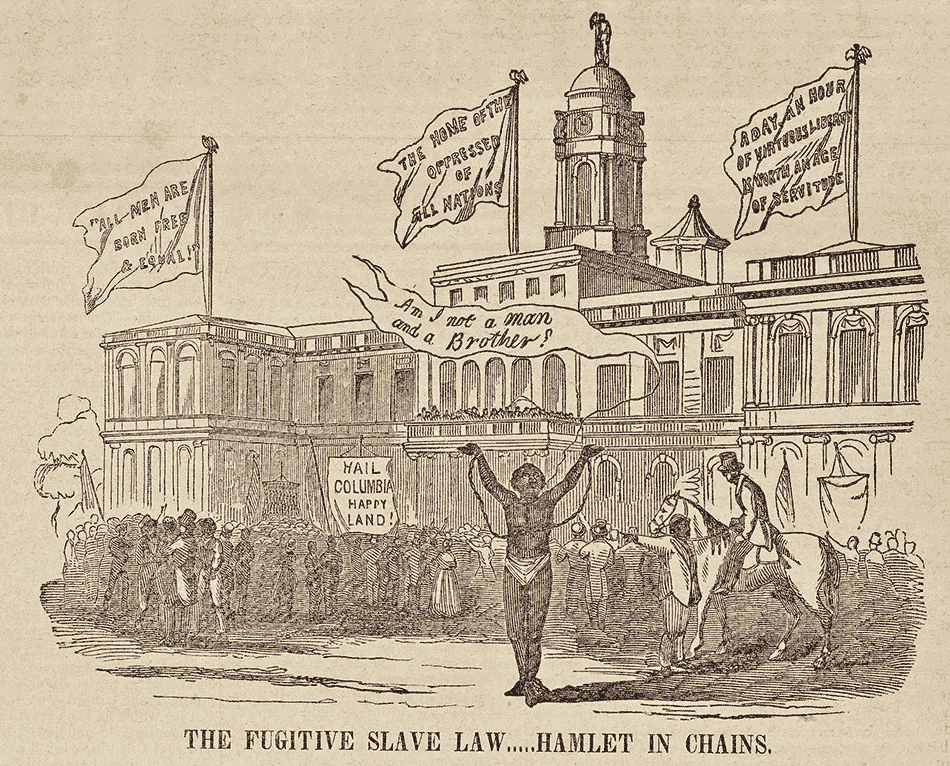
In this podcast we present some of the stops in New York along the Underground Railroad — from offices off Newspaper Row to the basement of New York’s first African-American owned bookstore. You’ll be familiar with some of this story’s leading figures like Frederick Douglass, Harriet Tubman and Henry Ward Beecher. But many of these courageous tales come from people who you may not know — the indefatigable Louis Napoleon, the resolute Sydney Howard Gay, the defiant David Ruggles and James Hamlet, the first victim of the 1850 Fugitive Slave Act.

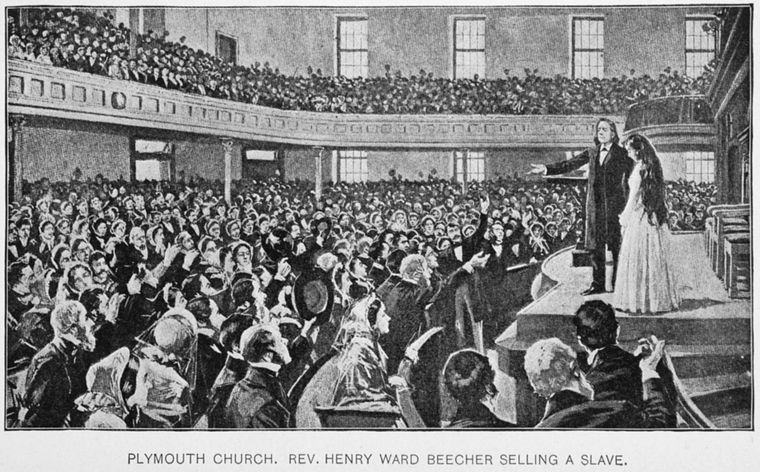
PLUS: A trip to Brooklyn Heights and the site of New York’s most famous Underground Railroad site — Plymouth Church

LISTEN HERE:

_______________________________________________________

The Bowery Boys: New York City History podcast is brought to you …. by you!

We are now producing a new Bowery Boys podcast every week. We’re also looking to improve the show in other ways and expand in other ways as well — through publishing, social media, live events and other forms of media. But we can only do this with your help!

We are now a member of Patreon, a patronage platform where you can support your favorite content creators for as little as a $1 a month.

Please visit our page on Patreon and watch a short video of us recording the show and talking about our expansion plans. If you’d like to help out, there are five different pledge levels (and with clever names too — Mannahatta, New Amsterdam, Five Points, Gilded Age, Jazz Age and Empire State). Check them out and consider being a sponsor.

We greatly appreciate our listeners and readers and thank you for joining us on this journey so far. 

________________________________________________________
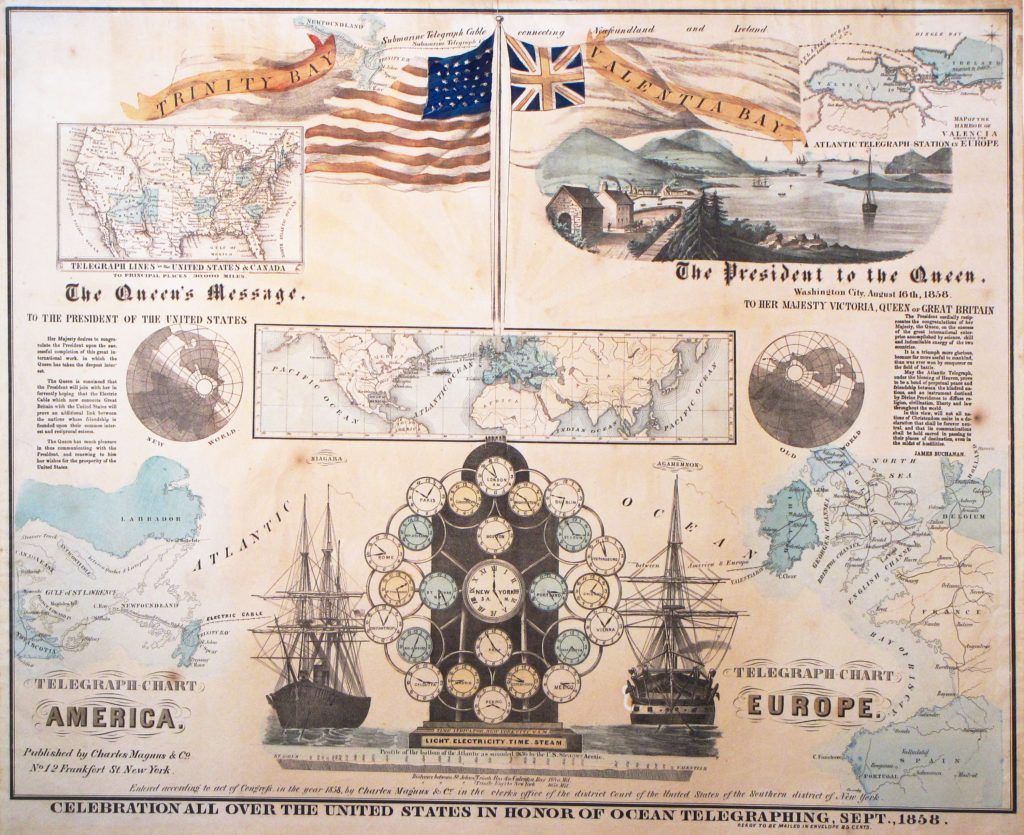
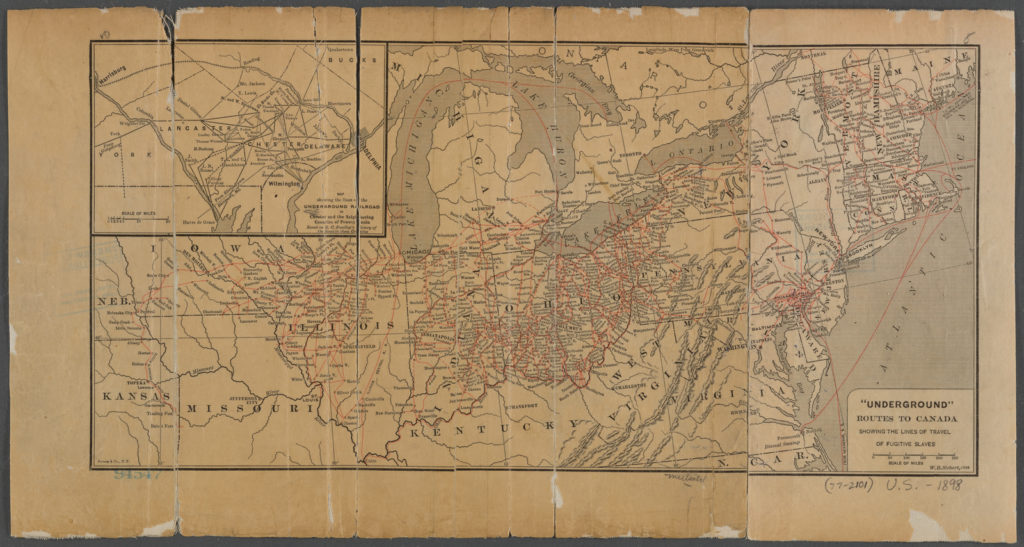
The many routes of the Underground Railroad, in an 1898 map by cartographer Wilbur Henry Siebert.

New York Public Library

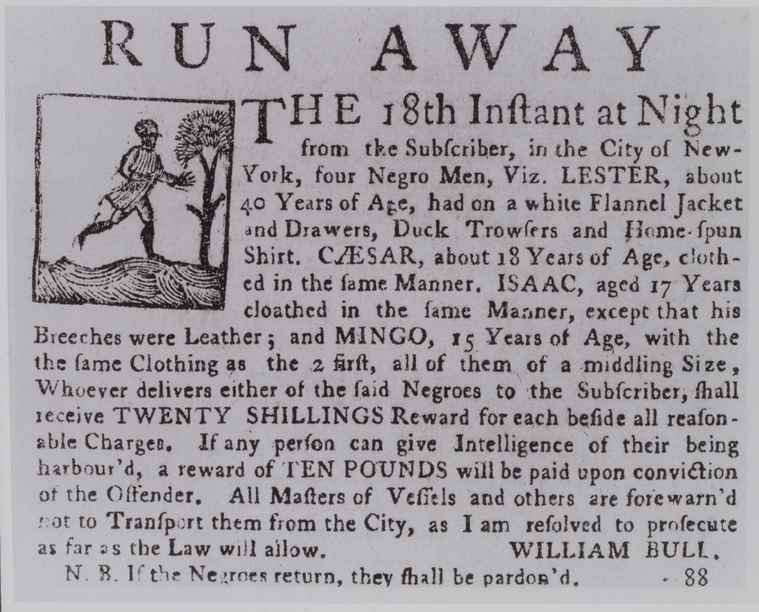
An advertisement for the capture of a runaway slave, published during the colonial era (1760s)

Schomburg Center for Research in Black Culture, Photographs and Prints Division

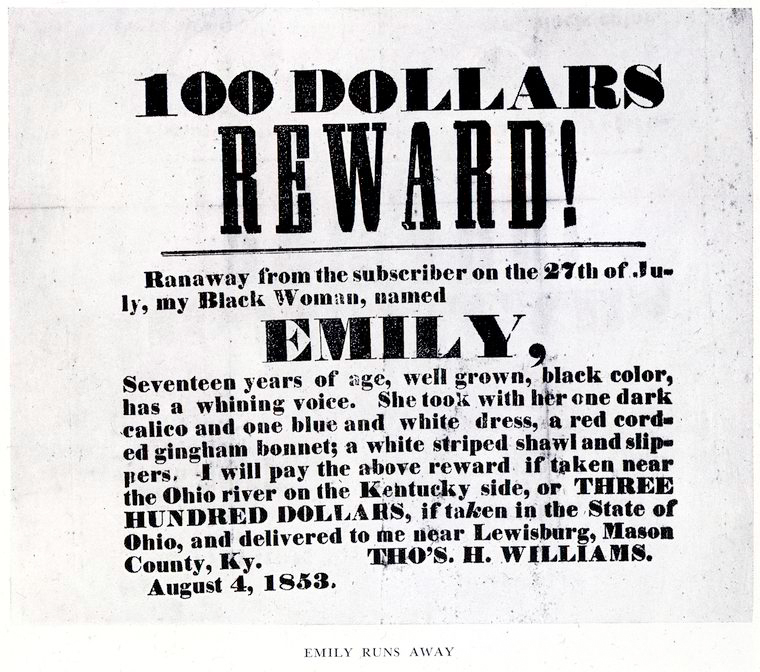
….and another, from 90 years later.

Schomburg Center for Research in Black Culture, Photographs and Prints Division

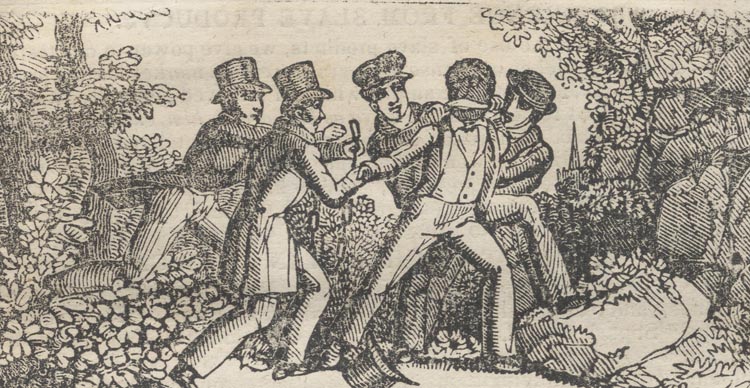
African-American New Yorkers lived in fear of being kidnapped by bounty hunters.

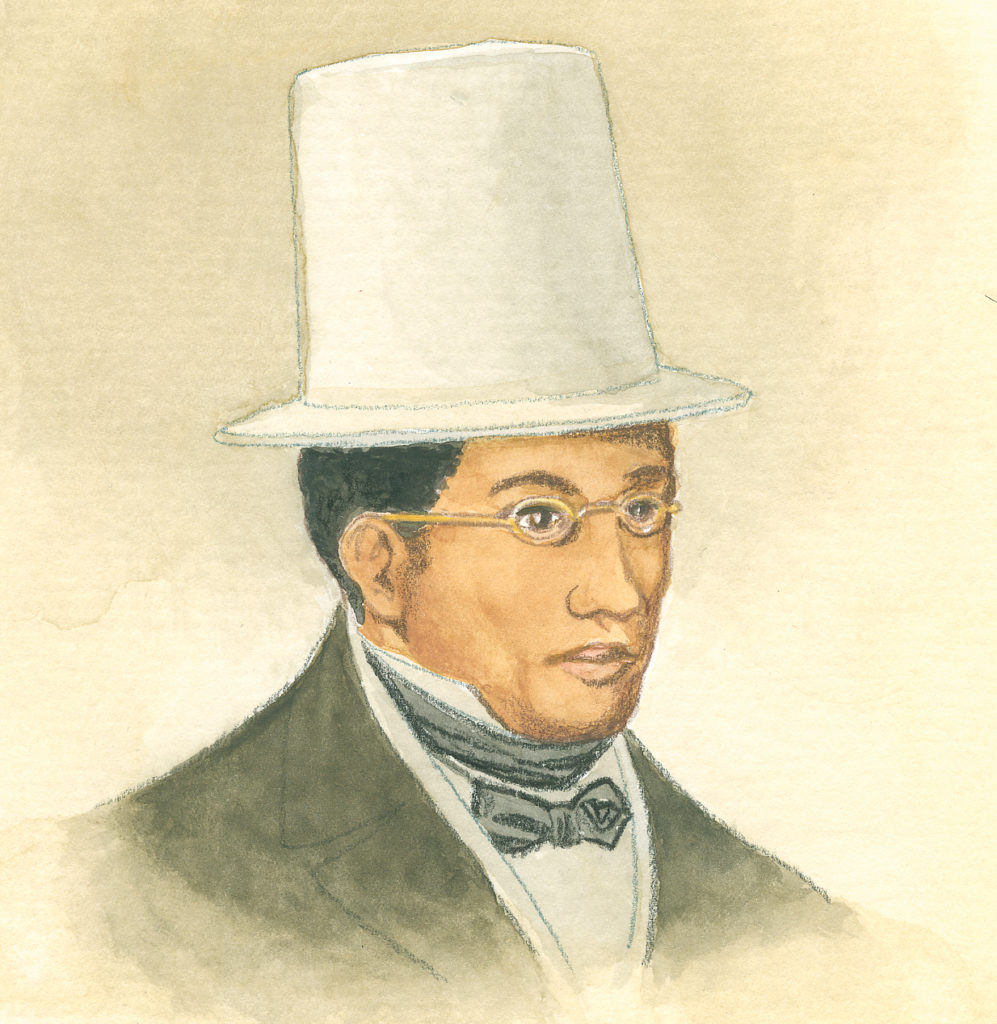
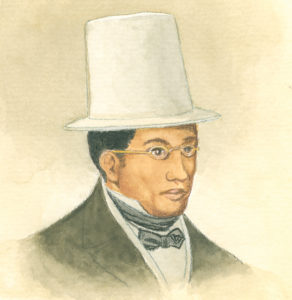
David Ruggles who operated America’s first African-American library and reading room on Lispenard Street. His home was also a stop on the Underground Railroad.

Illustration by Bob Powers (from original engraving)

At the release of James Hamlet (i.e. the purchase of his freedom by the AME Zion Church), this handbill was distributed

Rare Books and Manuscripts Library, Columbia University

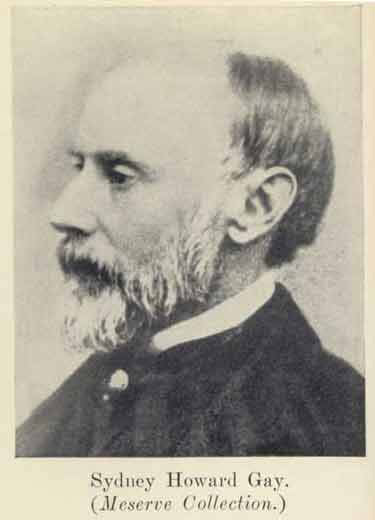
Sydney Howard Gay worked with several operatives on the Underground Railroad and was one of the few to keep records of new fugitive arrivals.

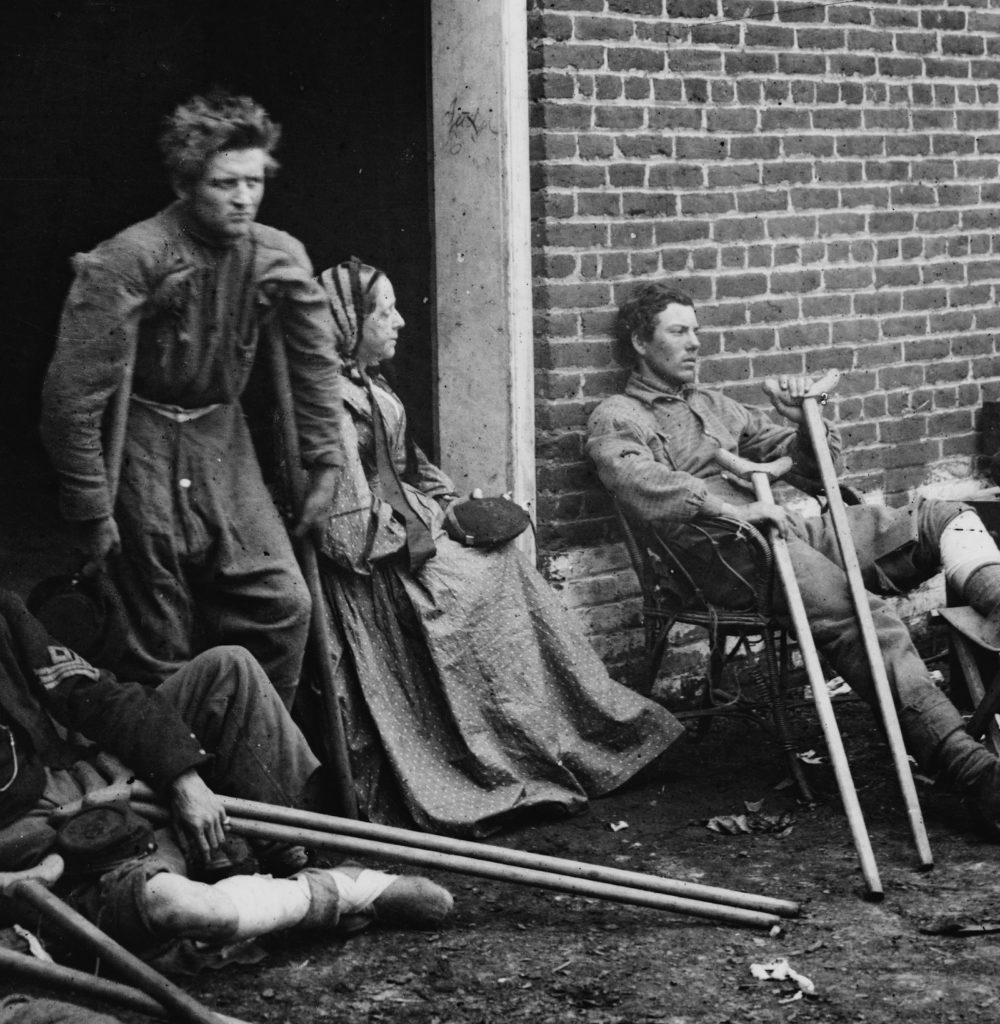
Abigail Hopper Gibbons, daughter of esteemed abolitionist Isaac Hopper, worked as a battlefield nurse in the early years of the Civil War. She returned to New York in 1863, only to be chased from her home by angry mobs during the Civil War Draft Riots.

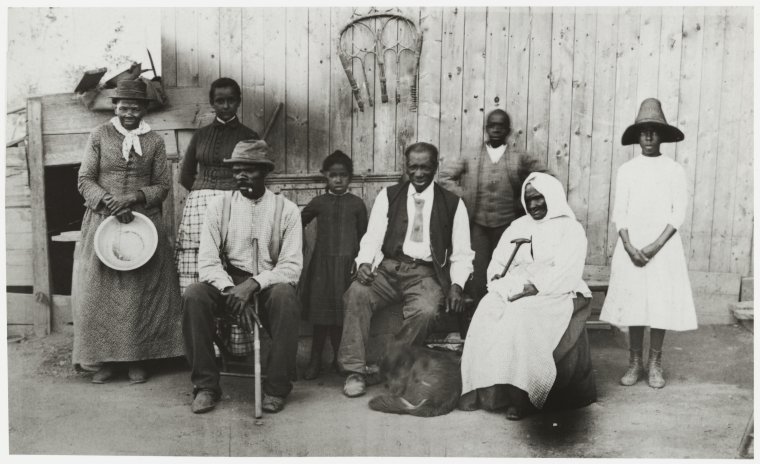
Harriet Tubman and her family — Gertie Davis [Tubman’s adopted daughter]; Nelson Davis [Tubman’s husband]; Lee Cheney; “Pop” Alexander; Walter Green; Sarah Parker [“Blind Auntie” Parker] and Dora Stewart [granddaughter of Tubman’s brother, John Stewart].

Schomburg Center for Research in Black Culture, Photographs and Prints Division

An illustration of Henry Ward Beecher‘s ‘auction’ of the enslaved woman nicknamed Pinky, held at Plymouth Church.

Schomburg Center for Research in Black Culture, Manuscripts, Archives and Rare Books Division

TOURS
Inside Out Tours: Slavery and Underground Railroad Walking Tour
Walks of New York
Black Gotham Experience

Plymouth Church — Public tours every Sunday at 12:30. Visit their website for more information

Plymouth now has a New Abolitionists ministry, tied into New York state’s anti-human trafficking initiatives. Visit Plymouth’s website for further information.

FURTHER READING
Bound for Canaan: The Epic Story of the Underground Railroad by Fergus M. Bordewich
Gateway to Freedom: The Hidden History of the Underground Railroad by Eric Foner
The Underground Railroad: Authentic Narratives and First-Hand Accounts (African American) by William Still

and, of course,

The Underground Railroad by Colson Whitehead

EXHIBITIONS

Brooklyn Historical Society — In Pursuit of Freedom: A long term installation celebrating the lives of Brooklyn abolitionists

Weeksville Heritage Center — Site of one of America’s first free black communities in the 19th century

You may also be interested in New-York Historical Society‘s online exhibit New York Divided: Slavery and the Civil War

FURTHER LISTENING
We mentioned these past Bowery Boys podcast on the show. After you’ve finished listening to our Underground Railroad show, give these a try!

Categories
Politics and Protest

Frederick Douglass and the life saver of Lispenard Street, a stop on the Underground Railroad

In the early and mid-nineteenth century, the Underground Railroad secretly escorted tens of thousands of Southern enslaved people to Northern destinations, where slavery was illegal. The African American publisher David Ruggles was born a freeman in Connecticut and moved to New York to energize the emerging abolitionist move- meant via the New York Vigilance Committee, one of the city’s most influential abolitionist collectives.

And thank goodness David Ruggles was there.

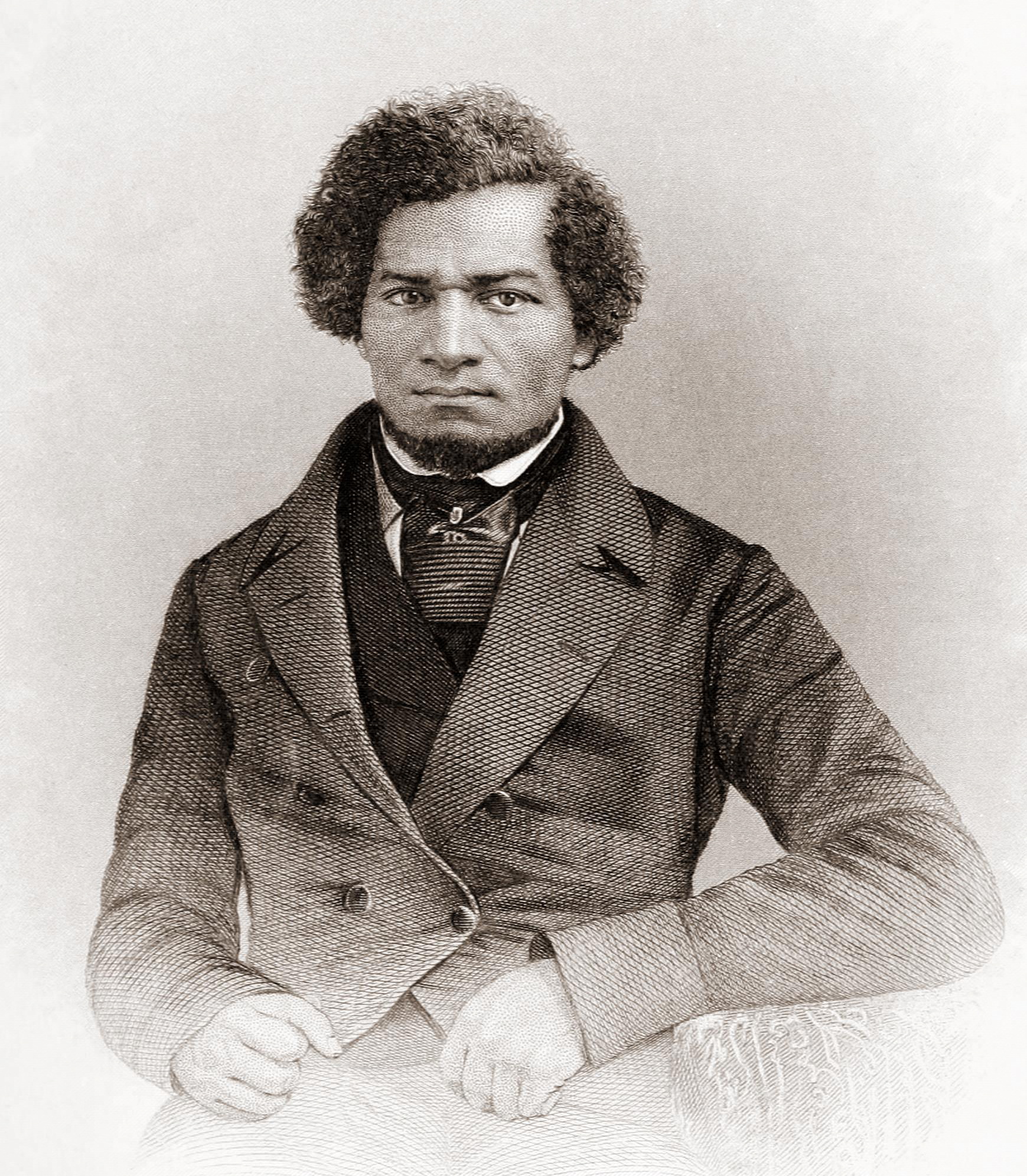
Below: One of the few extant depictions of David Ruggles

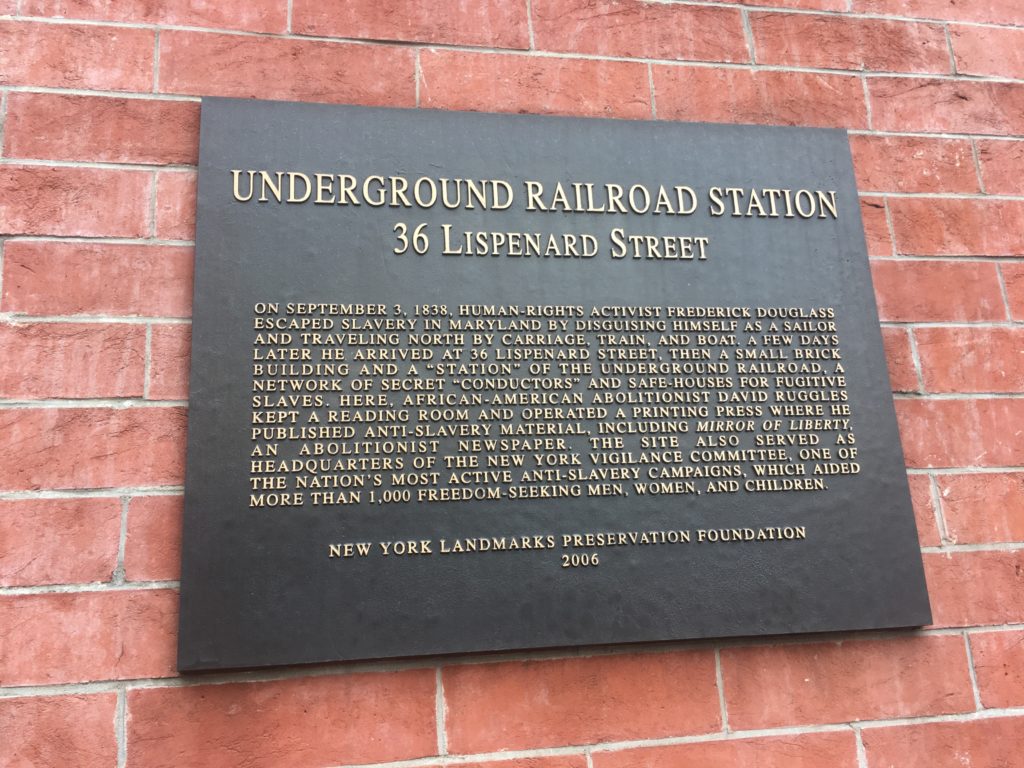
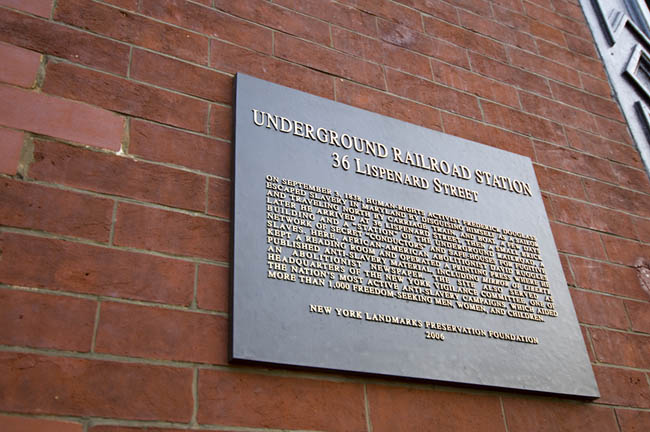
At his home at 36 Lispenard Street (in today’s Tribeca neighborhood), Ruggles ran a printing press and reading room for abolitionist literature. He also sheltered an estimated 600 fugitive slaves here over the years, including in 1838 a man named Frederick Washington Bailey, who had escaped a life of slavery in Maryland.

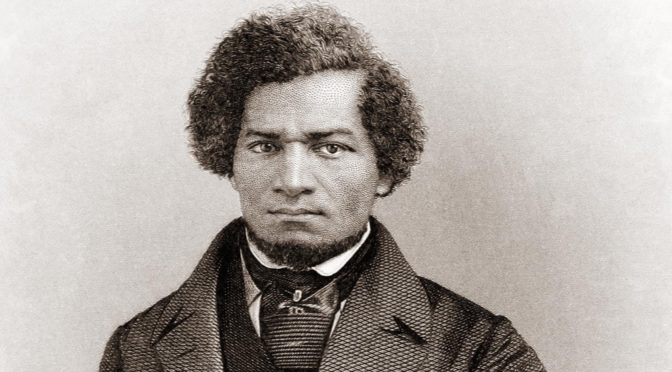
Under a new name, the abolitionist Frederick Douglass later wrote about how he felt arriving in New York. The following words are from the Life and Times of Frederick Douglass: From 1817-1882:

“My free life began on the third of September, 1838. On the morning of the fourth of that month, after an anxious and most perilous but safe journey, I found myself in the big city of New York, a free man – one more added to the mighty throng which, like the confused waves of the troubled sea, surged to and fro between the lofty walls of Broadway.

Though dazzled with the wonders which met me on every hand, my thoughts could not be withdrawn from my strange situation.

I have often been asked how I felt, when first I found myself on free soil; and my readers may share the same curiosity. There is scarcely anything in my experience about which I could not give a more satisfactory answer. A new world had opened upon me. 

If life is more than breath, and the ‘quick round of blood,’ I lived more in one day than in a year of my slave life.

In a letter written to a friend soon after reading New York, I said: “I felt as one might feel, upon escape from hungry lions.”

Anguish and grief, like darkness and rain, may be depicted; but gladness and joy, like the rainbow, defy the skill of pen or pencil.

While the building which sheltered Douglass on Lispenard Street is no longer there, a plaque is affixed to the current structure at that spot, marking Ruggles — and New York’s — contribution to the liberation of Southern slaves.

Columbia University

In tomorrow’s new Bowery Boys podcast, we’ll look at the story of Mr. Ruggles more closely and explore the many paths taken through New York City along the Underground Railroad.

This is an excerpt from the Bowery Boys Adventures In Old New York, now available in bookstores everywhere.

Categories
The Alienist

The Slide, New York’s Most Notorious ‘Fairy Resort’: History Behind The Scene (The Alienist)

HISTORY BEHIND THE SCENE What’s the real story behind that historical scene from your favorite TV show or feature film? A semi-regular feature on the Bowery Boys blog, I’ll be reviving this series as we follow along with TNT’s limited series The Alienist. Look for other articles here about other historically themed television shows (Mad Men, The Knick, The Deuce, Boardwalk Empire and Copper). And follow along with the Bowery Boys on Twitter at @boweryboys for more historical context of your favorite shows.

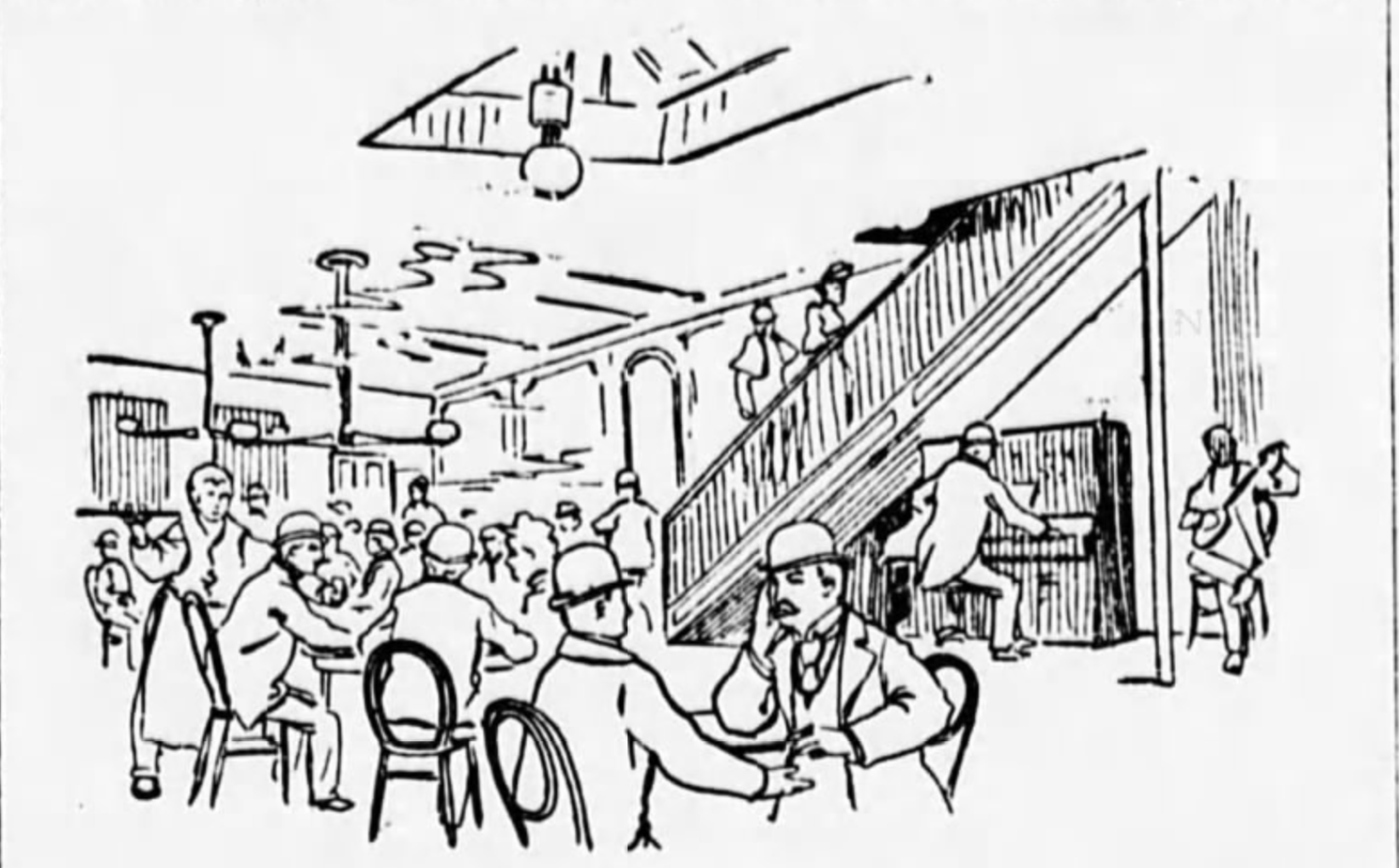
This week’s episode of The Alienist featured a debauched venue for same-sex male pleasures that would have scandalized Gilded Age New York, a rowdy dance hall with cross-dressing entertainers and a vast labyrinth of rooms for intimate paid encounters.

But did such places really exist in the mid 1890s? More than you might expect, actually. Let us introduce to one of the most infamous.

Gay and lesbian life in 19th century America meant reading between the lines, latching on to known code words to locate a community buried deep under the mainstream. But you may not have had to look very far in the early 1890s to locate one of New York’s most notorious and flamboyant bars The Slide (at 157 Bleecker Street).

1

We know of its existence primarily due to the pearl-clutching reaction of moral-minded New Yorkers. While you can’t trust police blotters and morality crusaders to give an accurate depiction of what The Slide was truly like, an attempt to peel back the hyperbole provides a sight that would rival the bawdiest gay bars of today’s Hell’s Kitchen.

The Slide was a basement dive, packed every night with men who fancied “male degenerates” and the occasional female looking for something outrageous. Music, drinking and laughter prevailed until the early morning; female prostitutes mingled with the boys to create what must have been a dizzying stew of genders, the air filled with cheap booze, wild sex (“orgies beyond description—) and tunes banged out on an old piano.

Newspapers described it as a “fairy resort.” Men openly wore drag to the delight of patrons, of which there were many, according to one scandalized report, “one to three hundred people, most of whom are males, but are unworthy the name of men.” Rouged and powdered waiters “sang filthy ditties” into all hours of the morning. The Slide’s most notable patrons went by such names as Princess Toto, Madam Fisher, Maggie Vickers, Phoebe Pinafore and Queen of the Slide.

Homosexual behavior of any stripe would have been condemned in this era. Such flagrant and open displays would have been unthinkable then.

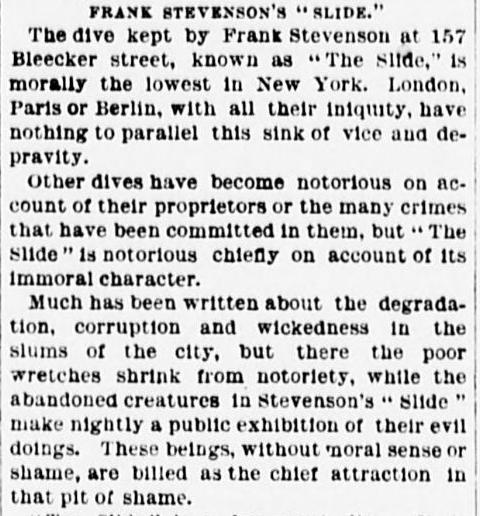
The urges displayed at The Slide were, according to reports, “inhuman and unnatural.” The New York Evening World, owned by Joseph Pulitzer, was perhaps the most horrified, suggesting that “London, Paris or Berlin, with all their iniquity, have nothing to parallel this sink of vice and depravity.” A bar today might be honored to be strapped with such description!

Here’s the complete quote in all its scandalized glory:

3

Such abandon could not be allowed to exist for very long. Pulitzer’s paper went on a vendetta against The Slide and other Bleecker Street dives, and soon it was permanently shuttered.

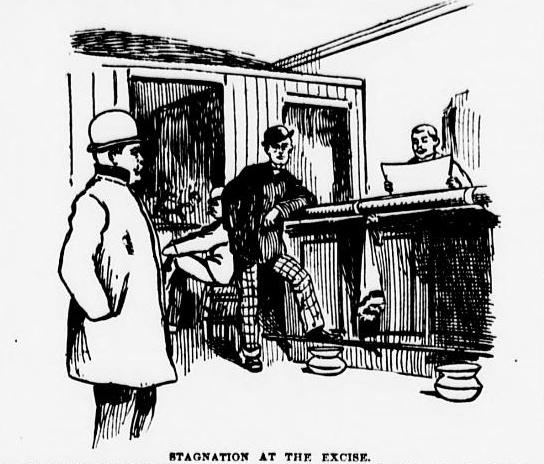
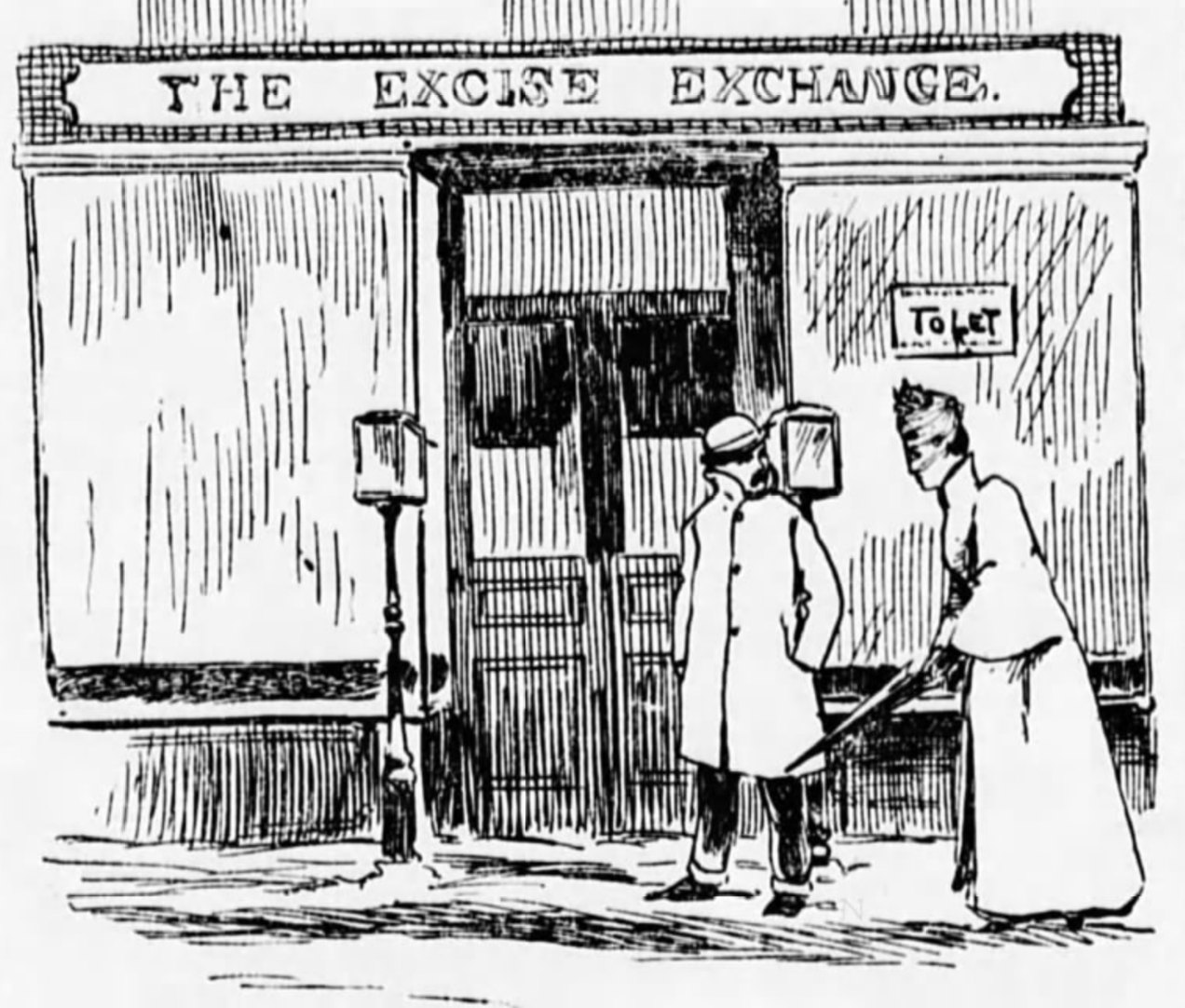
But you couldn’t simply extinguish a scene as lively as that of The Slide. On those days the city managed to close the Slide, its crowd simply moved to a dive called the Excise Exchange (336 Bowery), a place “frequented by the same painted, abandoned men and women, the surroundings are the same and the conversation quite as low and vulgar.” [New York Evening World, Jan 7, 1892]

New York Evening World

“The ‘attractions’ at the Excise Exchange are not the women, but the class of men who frequent it. They imitate the dress and manner of women — paint their faces and eyebrows, bleach their hair, wear bracelets and address each other with female names.” [source]

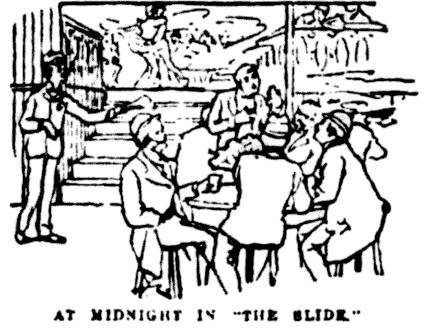
The New York World celebrated the bar’s closure with a front page article and illustration.

The building which housed The Slide still stands today at 157 Bleecker, now home to a far more respectable establishment.  (The bathrooms are in the basement is you want to stand in the place of the old ‘degenerate’ bar.)

The Bowery Hotel sits directly across the street from the location of the old Excise Exchange. But the spirit of these two bars live on, down the Bowery, down Bleecker, through the Village and all around late-night New York.

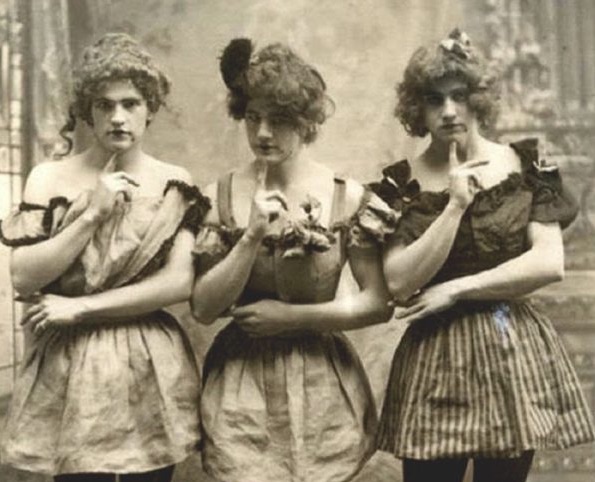
At top: Yale students in drag, circa 1880s

Illustrations on this page are directly from contemporary reports in the New York Evening World.

Categories
Landmarks

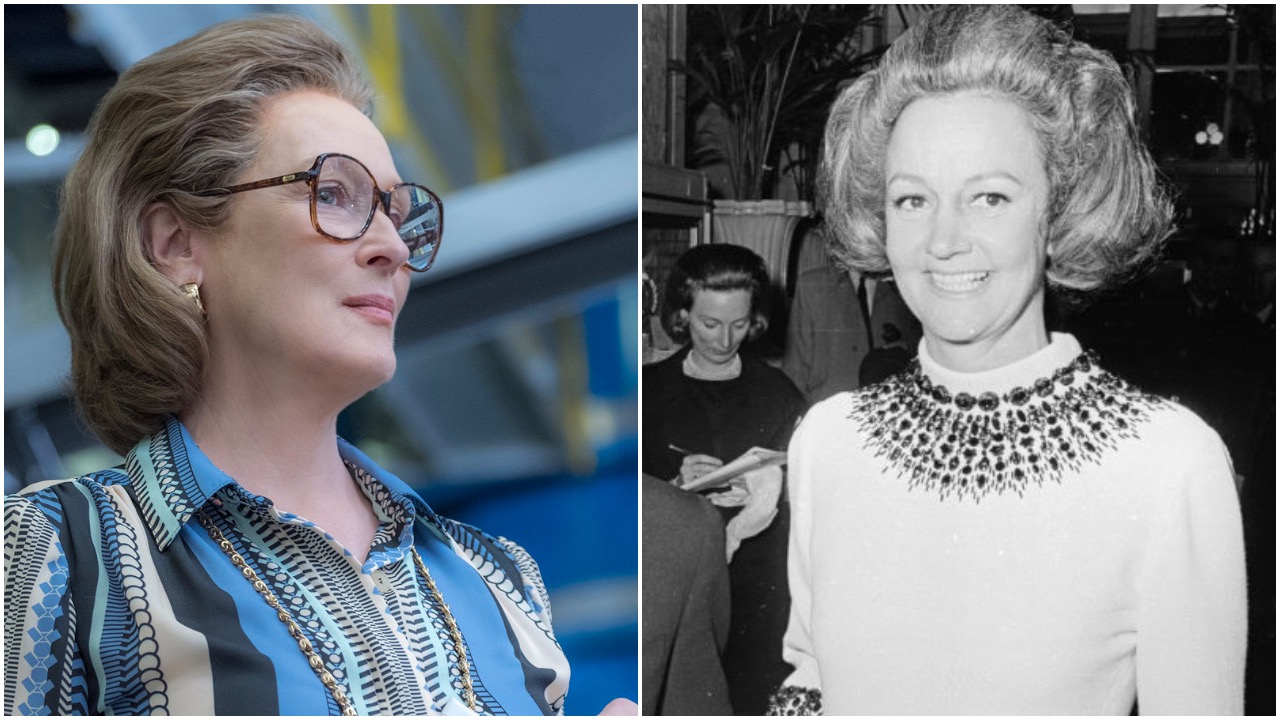
In ‘The Post’, Katharine Graham returns to the scene of the party — the Plaza Hotel

Journalism history is on full, optimistic display in the Academy Award Best Picture nominee The Post, starring Meryl Streep as Washington Post publisher Katharine Graham. In this fast-paced drama, Graham heads a newsroom (headed by Ben Bradlee, played by Tom Hanks) in possession of the Pentagon Papers, damning reports exposing the U.S. government’s clandestine decision-making during the Vietnam War.

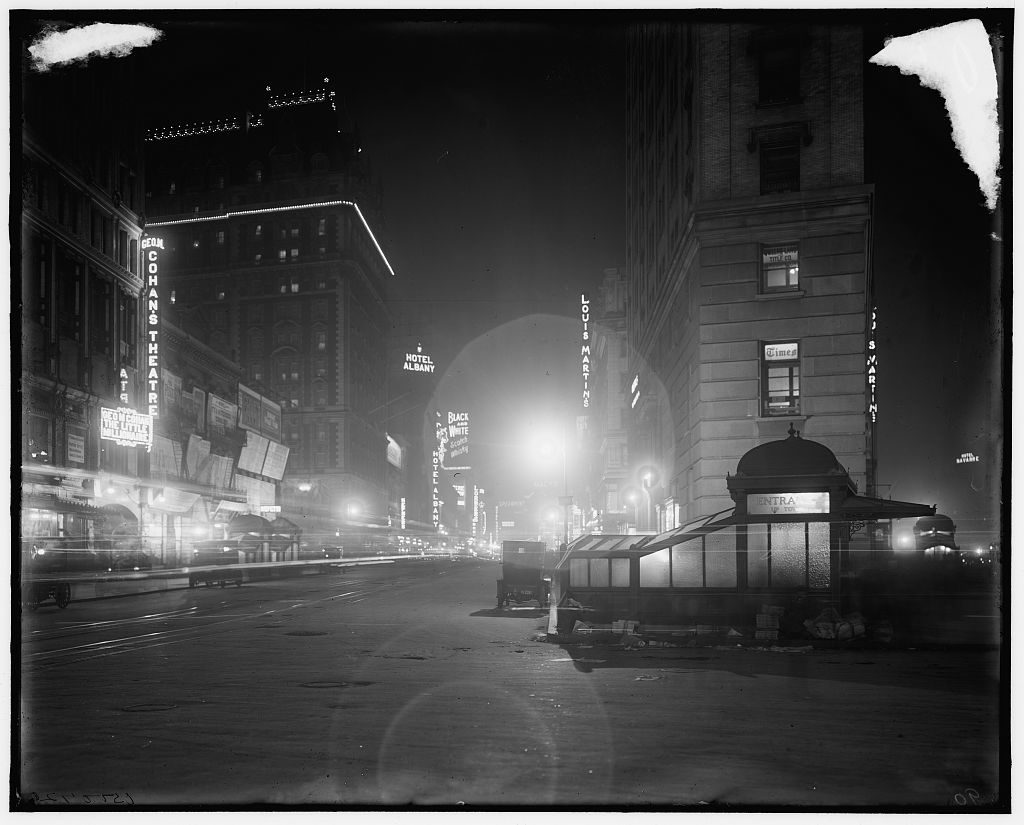
While the film is naturally set in the Washington D.C. surrounding area, The Post occasionally takes visits to 1971 New York City, at one point even visiting the New York Times 43rd Street office off Times Square. We like to imagine The Post shares the same universe as this fall’s HBO drama The Deuce, also set in 1971 and taking place on 42nd Street, one block away from the Times building.

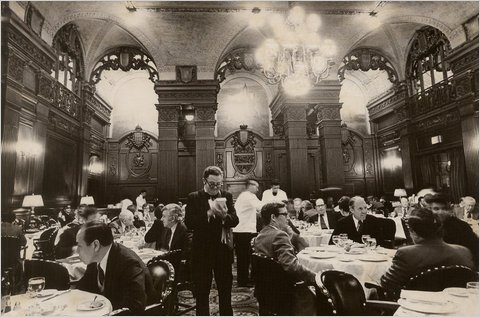
We always love when we get to see Streep on the streets of New York City and thankfully we get a scene with Graham meeting up with an editor of the New York Times in a very familiar location – the Oak Room at the Plaza Hotel. 

Paul Hosefros/The New York Times.

Above: The Oak Room in 1974

Now why would Graham meet her Times contact at the Oak Room?

Interestingly, the wedding of Julie Nixon and David Eisenhower — held at the Plaza a few days before Christmas in 1968 — is referenced early in the film.

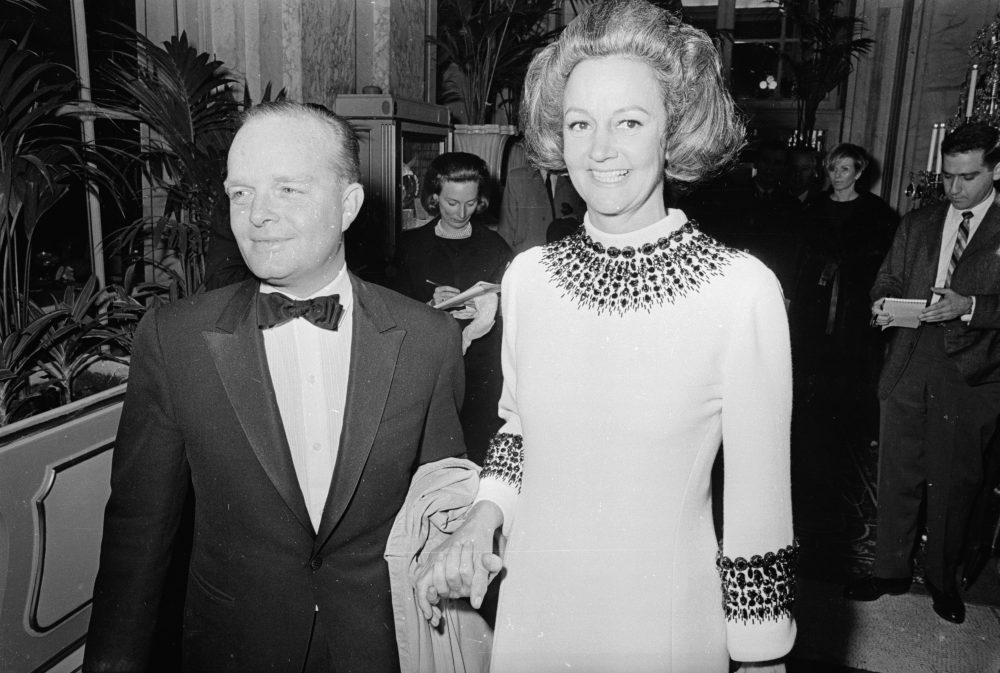
But the scene is also a nod to a somewhat wackier moment in Graham’s personal biography — Truman Capote’s Black and White Ball.

In 1966, Capote had released In Cold Blood and was at the height of his popularity and social prominence. And he wanted to celebrate this by throwing an impossibly lavish ball at the Plaza. Invitations were sent to the most famous people in the world, a most curious assortment of notables.


But he insisted he throw the party in honor …. of somebody. And the somebody he chose was Katharine Graham.

In her words: “Truman called me up that summer and said, ‘I think you need cheering up. And I’m going to give you a ball.’…I was…sort of baffled….I felt a little bit like Truman was going to give the ball anyway and that I was part of the props.”

How was the party? For more information please listen to our podcast on Truman Capote’s Black and White Ball.

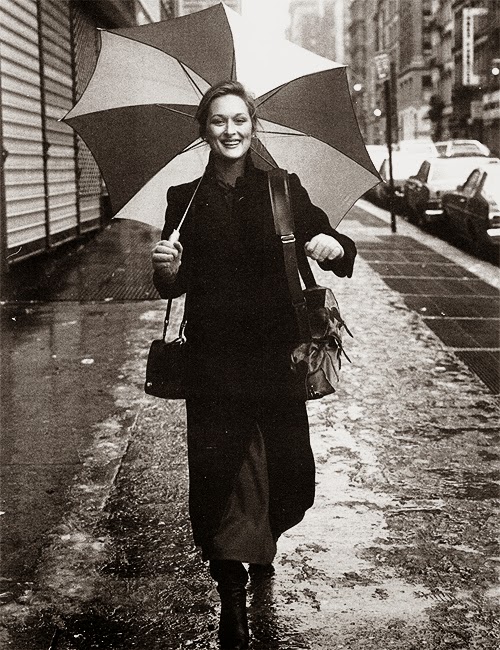
And to take a look at what the actress playing Graham was up to in the 1970s, check out the Bowery Boys article on Meryl Streep’s early adventures in New York City.

Categories
Gilded Age New York

The Unexpected President: Chester A. Arthur and the joys of reading about a mediocre man

“The nomination of Arthur is a ridiculous burlesque …. He never held an office except the one he was removed from. His nomination attached to the ticket all the odium of machine politics and will greatly endanger the success of [James] Garfield. I cannot but wonder why a convention, even in the heat and hurry of closing scenes, could make such a blunder.”
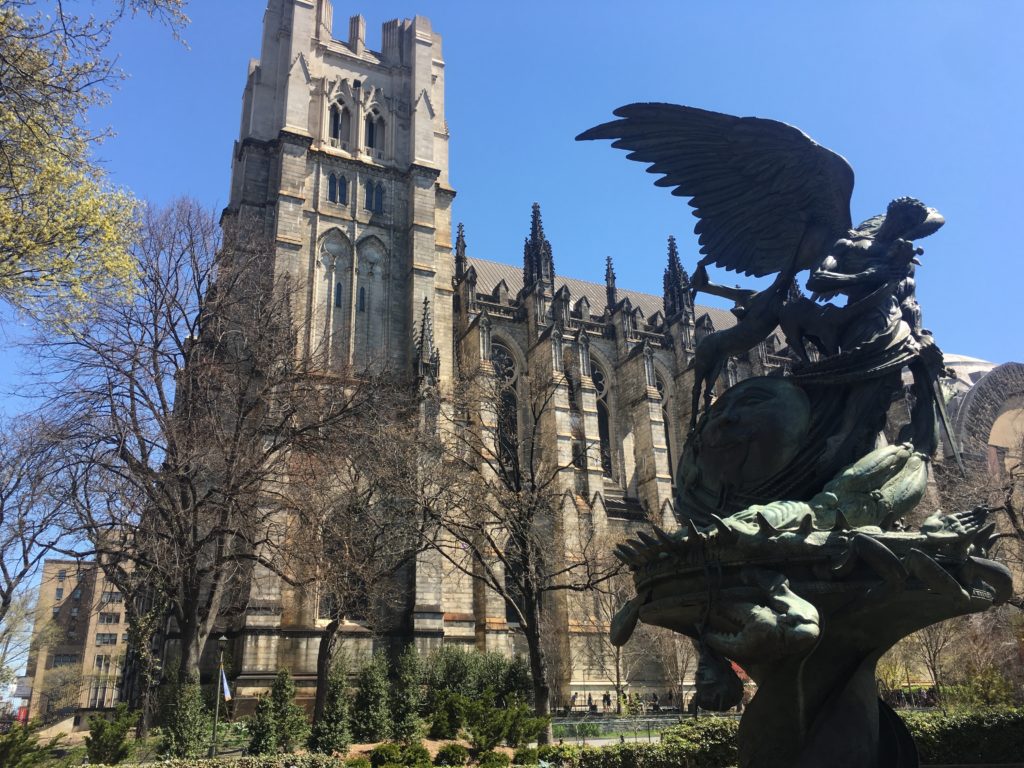
— John Sherman

A monument to Chester A. Arthur stands in the northeast corner of Madison Square, solitary and deadened, an homage to a president standing in a park named for a better president.

Arthur was not a great man, nor was he as terrible as his legacy suggests either. His primary skill was loyalty, a reliable foot soldier who achieved an impressive career almost by accident. And yet the biographies of such men can make for excellent reading, not because of their character but because of their circumstance.

The Unexpected President
The Life and Times of Chester A. Arthur
by Scott S. Greenberger
Da Capo Press

In The Unexpected President, Scott S. Greenberger’s excellent page-turning biography on Arthur, the Vermont attorney-turned-New York social climber is respectfully drawn, but the author never makes excuses for his subject’s lack of charisma. In fact, his mild charms would become an asset.

To become the 21st President of the United States, Arthur piggybacked upon the ambitions of more calculating men — Republican Party founder Thurlow Weed and, most famously, Republican boss Roscoe Conkling. To make a somewhat vulgar modern analogy, he’s like that reality show contestant who wins the competition by not making any real moves at all. He’s one of our nation’s great Under The Radar Americans.

The most fruitful job Arthur ever held was as collector at the New York Custom House, an appointed position that offered hundreds of free jobs to political climbers.  Although he would be removed from the position in 1878 after a highly publicized corruption investigation, Arthur’s reputation remained strangely unblemished. Indeed, he threw himself into promoting Republican candidates in an era where Democrats (fueled by Tammany Hall) were often seen as most politically ruthless.
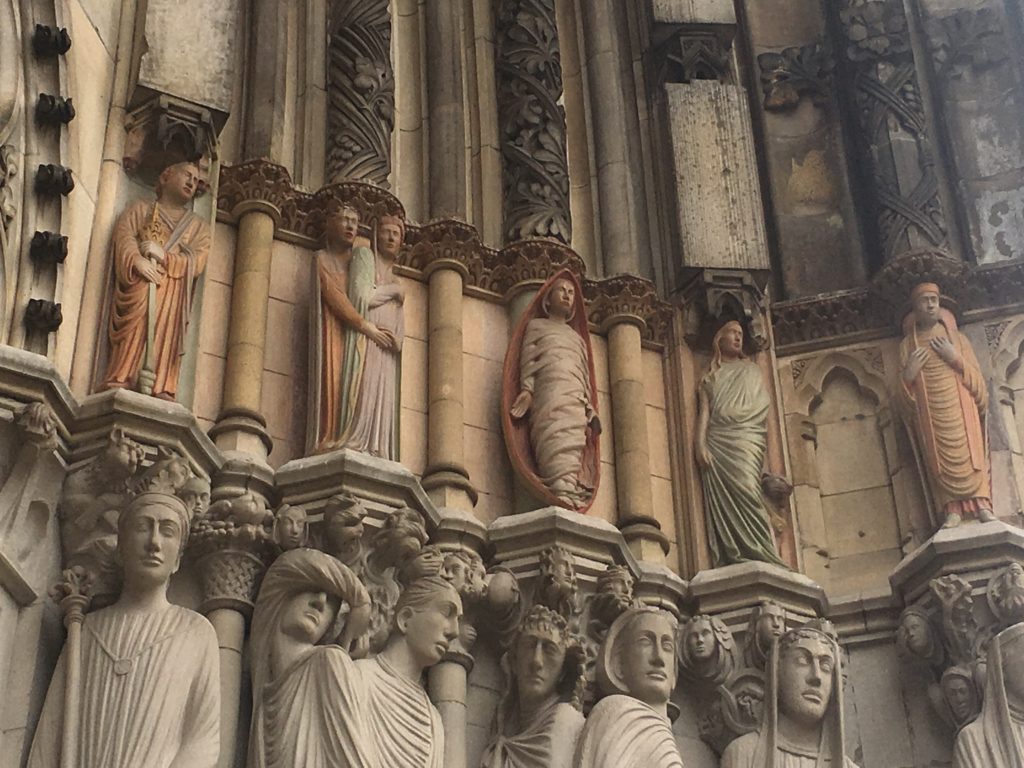
The New York Times noted at “[Arthur’s] name very seldom rises to the surface of metropolitan life and yet moving like a mighty undercurrent this man during the last 10 years has done more to mold the course of the Republican Party in this state than any other one man in the country.”

Greenberger’s book is filled with zesty jabs between politicians and corrupt machinations of the spoils system that were once so prevalent (and are, perhaps, prevalent again). In the most entertaining sections, Arthur is often off to the side, whether it be dutifully wrangling votes or dollars in dramatic presidential elections or watching his boss Conkling practice political suicide by resigning from office.

He became James A. Garfield‘s vice president almost by accident and later became president by tragedy (Garfield’s assassination in 1881). He was sworn in as the 21st President of the United States on September 20, 1881, at 2:15 a.m, from the green-shuttered parlor of his home at 123 Lexington Avenue (at right), one of many wonderfully drawn New York City locations described in Greenberger’s book.

Another of these locations is, of course Delmonico’s Restaurant, the premier destination for America’s cigar-chewing industrialists and power brokers, where the drunken Vice President Elect rose to give a speech “that reinforced the widely held view that he was a machine politician unfit for high office.”

And yet this minor president did manage something rather unexpected once in office, taking up a cause few would have assumed he was interested in at all — civil service reform. Under pressure, this tool of machine politics would begin to demonstrate his own style of leadership.

Categories
Bridges The Alienist

The Construction of the Williamsburg Bridge — History Behind the Scene (The Alienist)

HISTORY BEHIND THE SCENE What’s the real story behind that historical scene from your favorite TV show or feature film? A semi-regular feature on the Bowery Boys website, I’ll be reviving this series as we follow along with TNT’s limited series The Alienist. Look for other articles here about other historically themed television shows (Mad Men, The Knick, The Deuce, Boardwalk Empire and Copper). And follow along with the Bowery Boys on Twitter at @boweryboys for more historical context of your favorite shows. See the bottom of this article for more information on how to watch more episodes of The Alienist.

The Alienist begins — as it does in Caleb Carr‘s best-seller — with a bizarre and gruesome discovery one frozen evening in 1896: the violently mutilated body of a young man.

New Yorkers occasionally found such nasty sights along the waterfront; drunken sailors fell from their ships from time to time. But these human remains were seemingly displayed, laid upon “an elaborate maze of steel supports,” adjacent to the old creaking seaport.

The supports depicted in this scene were but the first steps in the construction of one of New York’s last great engineering projects of the 19th century — the New East River Bridge a.k.a the Williamsburg Bridge.

This bridge, the second to ever span the East River, is truly under appreciated, dwarfed of course in architectural achievement by the first — the Brooklyn Bridge. But the start of its construction in the waning months of 1896 marked a bold and exciting turning point for the city of New York.

Here’s some details about the bridge:

from the Brooklyn Daily Eagle, May 3, 1896

The bridge that would be called the Williamsburg Bridge was started (in 1896) when Brooklyn was an independent city and completed (in 1903) when Brooklyn was part of Greater New York.  When it opened in 1883, the Brooklyn Bridge linked two of America’s biggest cities — New York and Brooklyn.

But city planners like Andrew Haswell Green hoped to unite the entire region as one thriving metropolis, sharing vital resources.

Despite great resistance by many powerful Brooklynites, plans to unite the two cities — along with areas of Queens County, Richmond County (Staten Island) and portions of Westchester County (the Bronx) — were well in place by 1896. By January 1, 1898, it would all officially become Greater New York.

(For more information, listen to our podcast on the story of the Consolidation of 1898.)

Museum of the City of New York

But technically it was a bridge to yet another former city — Williamsburgh. In 1883, the Brooklyn Bridge linked the heart of New York civic life with the center of the City of Brooklyn — from New York City Hall to Brooklyn City Hall (what became Brooklyn Borough Hall). Upon its wildly successful opening, many began plotting a second bridge across the East River.

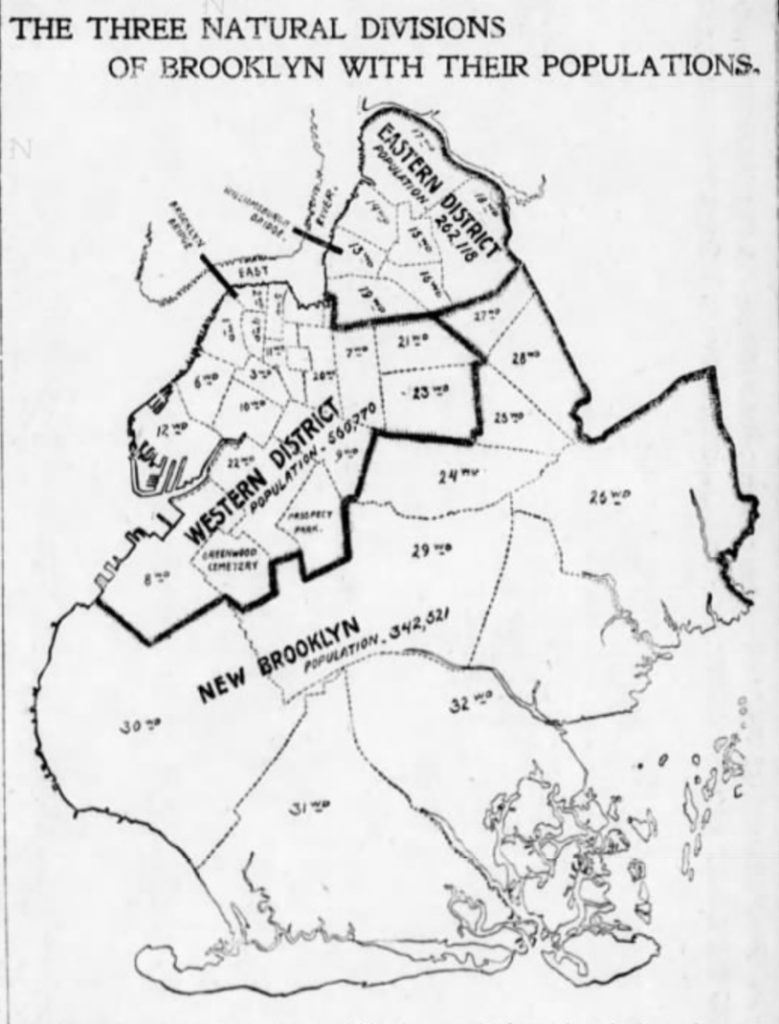
This second bridge, however, would link an area of Brooklyn north of the city’s center — in an area called the Eastern District.

Why was the eastern section of Brooklyn considered apart from the rest? Because at one point, for a brief period between 1852 to 1855, Williamsburg (or Williamsburgh, see below) was its own city, comprised of the modern neighborhoods of Williamsburg and Greenpoint. In 1855 it was absorbed — along with the Town of Bushwick — into the expanding city of Brooklyn and these new additions, more industrial and immigrant in nature, were referred to as the Eastern District.

(For more information, listen to our podcast on the history of Greenpoint, Brooklyn.)

Below: Above the East River, the bridge under construction, 1900

Museum of the City of New York

Brooklyn could thank one very powerful politician for the bridge. The namesake of Williamsburg’s popular McCarran Park — State Senator Patrick McCarran — is largely responsible for getting the new bridge placed in the Eastern District on the Williamsburg waterfront. According to one glowing eulogy, “The bridges, the parks, the improved means of transit, the better paved and lighted streets by which the Brooklyn of to-day is distinguished are due more to the legislative efficiency of Senator McCarren than to the influence of any other individual.” Of course he was also a bit of a corrupt scoundrel, but weren’t most politicians just a little bit dirty back then?

(Check out my article on rascally Mr. McCarren for more information.)

Library of Congress

Excuse me, that’s the Williamsburgh Bridge (with an H) The original village of Williamsburgh was named after the esteemed Lt Col. Jonathan Williams, former Secretary of War and grand-nephew of Benjamin Franklin, who surveyed the land along the Bushwick shore. In its early days there was an H affixed to the area’s name, but by the completion of the bridge in 1903, many references to the neighborhood dropped it. Nobody really knows why this happened, but it probably has something to do with the better known Williamsburg in Virginia.

By the time the bridge was completed, it was commonly known as the Williamsburg Bridge although a plaque on the bridge preserves the original spelling.

Museum of the City of New York

On the New York side, planners were using the project as a way to clear away one of its most notorious districts –Corlears Hook.

Where Manhattan juts the furthest into the East River, Corlears Hook once had the greatest concentration of shipbuilding businesses in the nation, and the shoreline was completely obscured with piers, ships, and vessels of all sorts. In the 1830s, it had become a notorious red-light district, with “ladies of the night” setting up shop in the neighborhood’s saloons and cellars. (As popular legend would have it, the ladies of the Hook would give the oldest profession a new name: hookers.)

But by the 1880s, however, New York was in the throes of civic reform, clearing away slum neighborhoods and replacing them with parks or grand architectural projects. The old neighborhood of Five Points became Columbus Park and New York’s Civic Center. Even the Brooklyn Bridge cleared away the decrepit tenements of the old waterfront.

The bridge is central to the growth of New York’s immigrant (and particularly Jewish) communities. While its construction did displace thousands of people, the bridge would actually facilitate better living conditions for Lower East Side immigrant groups by encouraging migration to less populated Brooklyn neighborhoods.

The New York Herald even called it the “Jews Highway” as those of Eastern European and Russian Jewish heritage transplanted to Williamsburg.

Below: Jewish women praying on the Williamsburg Bridge (1909)

Library of Congress

Library of Congress

How they envisioned the bridge in the fall of 1896 ….

…and how it looked at completion.

Library of Congress

Believe it or not, the opening of the Williamsburg Bridge was actually captured on film by the Edison company.

Categories
Mysterious Stories Podcasts The Alienist

The Sinister Story of McGurk’s Suicide Hall: The Bowery’s Most Notorious Dive

PODCAST The unbelievable story of the most infamous dance hall in New York City.

The old saloons and dance halls of the Bowery are familiar to anyone with a love of New York City history, their debauched and surly reputations appealing in a prurient way, a reminder of a time of great abandon. The Bowery bars and lounges of today often try to emulate the past in demeanor and decor. (Although nobody was drinking expensive cocktails back in the day.)

But the dance hall at 295 Bowery, the loathsome establishment owned by John McGurk, was not a place to admire. It was the worst of the worst, a dive where criminal activity thrived alongside bawdy can-can dancers and endless pours of putrid booze.

In early March of 1899, a woman named Bess Levery climbed to one of the top floors of McGurk’s — floors given over to illegal behavior — and killed herself by drinking carbolic acid. Within a week, two more women had ventured to McGurk’s, attempting the same dire deed.
By the end of 1899, the dance hall had received a truly grim reputation, and its proprietor, capitalizing on its reputation, began calling his joint McGurk’s Suicide Hall.

What happened to the Bowery, once the location of fashionable homes and theaters, that such a despicable place could thrive — mere blocks from police headquarters? This is the history of a truly dark place and the forces of reform that managed to finally shut it down.

FEATURING: Theodore Roosevelt, Jacob Riis and some rowdy fellows by the names of Eat Em Up McManus and Short Change Charley.

This episode is sponsored by TNTs new limited series The Alienist.
LISTEN HERE:

________________________________________________________

The Bowery Boys: New York City History podcast is brought to you …. by you!

We are now producing a new Bowery Boys podcast every week.  We’re also looking to improve the show in other ways and expand in other ways as well — through publishing, social media, live events and other forms of media.  But we can only do this with your help!

We are now a member of Patreon, a patronage platform where you can support your favorite content creators for as little as a $1 a month.

Please visit our page on Patreon and watch a short video of us recording the show and talking about our expansion plans. If you’d like to help out, there are five different pledge levels (and with clever names too — Mannahatta, New Amsterdam, Five Points, Gilded Age, Jazz Age and Empire State). Check them out and consider being a sponsor.

We greatly appreciate our listeners and readers and thank you for joining us on this journey so far.

_________________________________________________________

In March 1899, New York Herald ran a comprehensive timeline of McGurk’s whereabouts.

The location of McGurk’s dance hall (295 Bowery), circa 1910 or so. By this point, its neighbor would be a church outreach spot — Hadley Rescue Hall. (Read this fascinating post from Greenwich Village History for more information.)

Library of Congress

The building became a flophouse called the Liberty Hotel with a restaurant and bar on the ground floor.

New York Transit Museum

Here’s what 295 Bowery looked like before it was razed in 2005:

Global Graphica

An ominous piece of graphic art on one of the floors above McGurk’s.

Pictured at top: The Bowery as it looked in 1900. The Bowery Savings Bank is still there (today it’s the nightclub event space Capitale) as are some of the buildings to its right which are part of the Bowery’s lighting district. McGurk’s was located a few blocks uptown.

Library of Congress

RECOMMENDED READING:
OLD BOWERY DAYS: The Chronicles of a Famous Street by Alvin F Harlow
LOW LIFE: Lures and Snares of Old New York by Luc Sante
THE BOWERY: The Strange History of New York’s Oldest Street by Stephen Paul DeVillo
THE GANGS OF NEW YORK: An Informal History of the Underworld by Herbert Asbury

Listen to the other shows in The Alienist ‘podcast takeover’, other podcasts inspired by the TNT limited series including new episodes from Criminal, Casefile, Serial Killers, Thinking Sideways, Unsolved Murders: True Crime Stories, Generation Why and Last Podcast on the Left. Full listing here.

If you liked this episode of the Bowery Boys, check out these following shows in our catalog with subjects that featured into this show:

TIMES SQUARE IN THE 1970s
The dangers street prostitutes faced in the 1890s didn’t fade away with reforms. Those who walked 42nd Street in the 1970s faced similar perils — including corrupt cops.

NEW YORK’S ELEVATED RAILROADS
The street life of Manhattan was inexorably altered with the arrival of railroads overhead.

A HISTORY OF THE SOUTH STREET SEAPORT
The rowdy nightlife of the Bowery was fueled by the sailors and seamen coming from New York’s vast port waterfront. But by the 1880s, the area that would become the South Street Seaport district had devolved into something truly decrepit.

Categories
Planes Trains and Automobiles

The Bowery under the Third Avenue Elevated: Capturing the soot and shadow of Old New York

It’s a vivid image (for some bleak, other romantic) that most New Yorkers cannot imagine. But a few people still living today remember it quite well — the Bowery underneath an elevated train line.

Lee Sievan

The Third Avenue Elevated was constructed in 1878, connecting South Ferry with Harlem via a sturdy, darkening railroad track, hoisted over the street. The entire length of the Bowery was covered with it, from its south end (in what would soon become Chinatown) to its northern section, merging with Third Avenue at Cooper Square.

At right: Bowery and Mott Street, 1946

Our perceptions of the Bowery have greatly shifted over the past decade and it can be hard to find traces of its extraordinary history anymore.

The former farm road of Peter Stuyvesant had once been a fashionable destination for New York elite in the 1830s, but the arrival of immigrant communities drove the old wealth away. The culture of the mid-19th century Bowery included bawdy theatricals, minstrel shows, dime museums and even circus troupes, mixing with saloons and beer halls.

The elevated railroad hastened the Bowery’s fall into a purely disreputable district. Even with the beer dens, dance halls and brothels swept from the street by the early 20th century, its reputation remained dire, becoming New York’s Skid Row. The decades of soot which covered the buildings and sidewalks only helped paint the Bowery as an avenue of depression and woe.

Below are a selection of images from these years — from the 1880s until 1955 — courtesy the Library of Congress and the Museum of the City of New York — showing the Bowery tangled and contained by the steel latticework of the Third Avenue El.

Next time you walk the Bowery, imagine it with trains in the sky.

And after viewing these — check out these images of the 1955 deconstruction of the lower Manhattan sections of the Third Avenue El by Sid Kaplan, from a show last year at the Transit Museum.

For more information, please listen to Bowery Boys: New York City History podcast Episode #107 on the history of New York’s elevated railroads. 

The Bowery at Canal Street, 1880

Museum of the City of New York

The Bowery, 1886, specific location unknown

Museum of the City of New York/Adolph Witteman

144 Bowery to the left, 1895

Library of Congress/Strohmeyer & Wyman

70-72 Bowery to the left, 1897

Library of Congress/Keystone View Company
Museum of the City of New York/Robert Bracklow

The Bowery and Grand Street, 1900

Library of Congress

Outside the Bowery Savings Bank (designed by Stanford White), 128-130 Bowery, 1905

Library of Congress

Outside the Bowery Mission, 55 Bowery, 1910

Library of Congress

293 Bowery, between 1910-15

Library of Congress

The Bowery 1900, exact location unknown (any clues?)

In the Bowery’s former Diamond District, February 1912

Lewis Hine, Library of Congress

115-117 Bowery, an early restaurant supply store, 1932

Museum of the City of New York/ Charles Von Urban

103 Bowery, 1935

Berenice Abbott/NYPL

264 Bowery, 1935

Berenice Abbott/NYPL

The Bowery and Division Street, 1935

Berenice Abbott/NYPL

The Bowery, Chatham Square Station, 1940

Arnold Eagle

The Bowery at 4th Street, 1942

Library of Congress/Marjory Collins

The Bowery at Cooper Union, 1942

Library of Congrss, Marjory Collins

The Bowery and St. Mark’s Place, 1942

Library of Congress, Marjory Collins

The Bowery, location and photographer unknown, 1945

Museum of the City of New York

An apothecary at 6 Bowery, 1947

Museum of the City of New York/Don Morgan

The Bowery at Cooper Square, 1955

Museum of the City of New York/Calvin S. Hathaway