Categories
Bowery Boys

The Bowery Boys on NPR: Morning Edition!

The Bowery Boys were featured in a profile this morning on NPR’s Morning Edition!  You can give the segment a listen here.  You can also download the segment from that site.

Our sincere thanks to NPR and to Caitlin Dickerson for featuring us on the show.

If you’re interested in any of the particular episodes mentioned in the piece:

Freedomland USA podcast and blog post
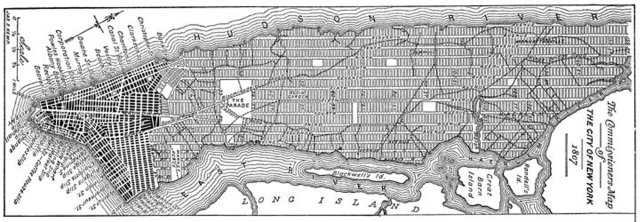
The Grid: Commissioners Plan of 1811podcast and blog post
Tin Pan Alleypodcast and blog post

Categories
Parks and Recreation

Marks of the grid: A remarkable find in Central Park

So this random little bolt in a rock may not look like much, but it could be the last remaining on-site evidence of the creation of New York City’s grid plan.

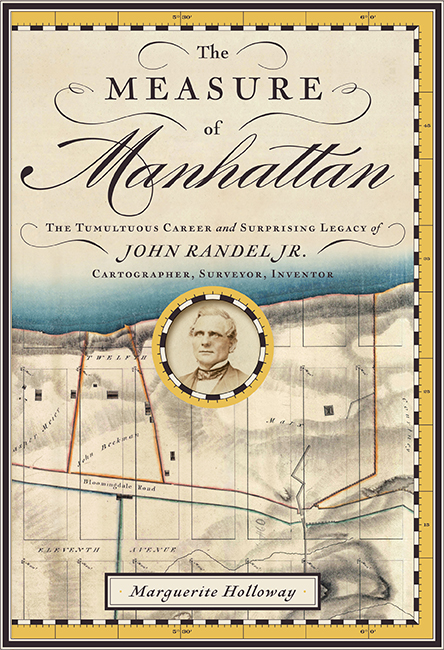
Inspired by Marguerite Holloway’s book ‘The Measure of Manhattan‘, I went looking for this unusual object hidden in Central Park, discovered by geographers several years ago and believed to be a bolt used in the original survey of Manhattan by John Randel Jr. in the 1810s.

Randel and his team poured over the island, marking spots along a delineated grid that would become the intersection of streets and avenues.  Reuben Sky Rose-Redwood, one of the researchers who discovered the odd bolt, believes it’s from Randel’s original survey due to its placement.

Indeed this would have be the exact location of an upper Manhattan intersection had Central Park not been carved out in the 1850s.  If this random little bolt is indeed part of that original survey, then it’s truly an extraordinary link to New York City history.

I’m not going to reveal the location of the bolt, but you can search around the web for clues to its whereabouts.  Needless to say, if you do go on a hunt for this potential key to the Manhattan grid plan, please leave it be if you find it.  (Also, this means you’re a bonafide history geek like me. Congratulations!)

If it’s ever definitively confirmed to be a tool of Randel’s, hopefully the park will provide some kind of protection.  Rarely does one find historical objects in situ.

Categories
Bowery Boys Bookshelf

‘The Measure of Manhattan’: The grid plan of New York comes to life, as does its eccentric creator


BOWERY BOYS BOOK OF THE MONTH Each month I’ll pick a book — either brand new or old, fiction or non-fiction — that offers an intriguing take on New York City history, something that uses history in a way that’s unconventional and different or exposes a previously unseen corner of our city’s complicated past.  Then over the next month, I’ll run an article or two about some of historical themes that are brought up in the selection. 


The Measure of Manhattan: 
The Tumultuous Career and Surprising Legacy of John Randel Jr.
by Marguerite Holloway
WW Norton & Company

The man at the center of Marguerite Holloway’s ‘The Measure of Manhattan’ is a genuine riddle.

The surveyor John Randel Jr. rarely wrote about himself, jotting down observations of land elevation and incompetent workmen as he mapped out the legendary grid plan along the island of Manhattan.

This ambitious task, occurring early in his career, would assure his place as a pivotal, if quiet, figure in American history.  During this period, he is studious, focused and, let’s just say it, a mite uninteresting.  But just as the grid is completed, Randel’s personal story comes to life.

A traditional historian might not know what to do with the life of Randel, a man who ages into astonishing eccentricity and temperament.  But.Holloway, a journalism professor at Columbia University, treats this story as a two-fold mystery, turning something that could into a real unexpected — and often unpredictable — treat.

Her first concern is the grid itself, the orderly row of streets and avenues that arose out of the former hills and streams of Manhattan, following researchers who are attempting to determine how drastically the landscape has been altered over the years.

Evidence of the original surveying job — which sliced through private property and reorganized nature into something unrelenting and orderly — can be found in Central Park.  In fact, a bolt sits lodged in a rock, the last remaining evidence of Randel’s assiduous work.  It’s an astonishing discovery.

As is Randel, the man who probably put it there.  The young surveyor, taken under wing by the well connected DeWitt family at the start of the 19th century, worked on the grids to Manhattan and Albany before he was 30 years old, braving the wrath of farmers to mark rectangles in the landscape.  So unusual was the island’s terrain that Randel invented his own surveying equipment specifically suited for the job at hand.

But even as Holloway goes deep into Randel’s technique, there appears to be a vacuum at the center of the story.  Randel’s personality seems opaque, even non-existent.  But wait.

The most fascinating aspects to Randel’s character come after the grid is completed, when the surveyor attempts to cash in on his remarkable accomplishment.  He naturally attempts to sell copies of his maps but, in these heady days before copyright, is thwarted by a competitor who basically duplicates his work

From that point, he seems to spend as much time in lawsuits as he does doing field work.  He goes to work on an upstate length of the Erie Canal, only to annoy his peers and tarnish his reputation.  Is it professional jealousy at Randel’s enormous skills, or is the great, embittered surveyor becoming obstinate?

As Benjamin Wright, canal engineer and enemy of Randel’s, once said of his rival in 1824: “I think him the most complete hypocritical lying nincompoop (and I might say scoundrel if it was a Gentlemanly word)…..”

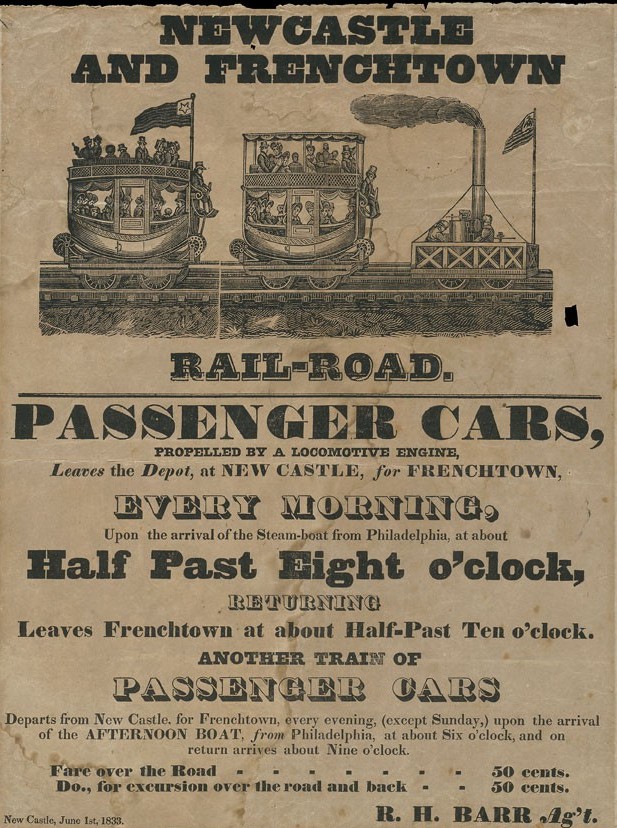
At left: A notice for another of Randel’s great projects, the New Castle and Frenchtown railroad, the first railroad in Delaware 

Far from a career of increasingly applauded works, Randel becomes stepped in controversy at every turn, even as he moves from canals to railroads.  He’s perpetually strapped for cash, even attempting to build his own estate (amusingly called Randelia) with unfortunate results.  In a desperate act of “piracy”, according to the author, he even attempts to collect his very own tolls from a canal he himself surveyed and engineered!

Holloway, employing an extraordinary depth of research, describes a man of great talent who gets ripped asunder by America’s rapid growth, defined not by accomplishment but debt.  In a way, this is as pure an American story as it gets.

The tale often pulls back at times to modern day, constantly reminding us of Randel’s most stunning accomplishment, a New York grid plan so implanted that it seems impossible to imagine that anything else ever existed here.  In particular she turns her focus to Eric Sanderson and his amazing 2009 Mannahatta project, pulling a reverse-Randel in trying to map out the original landscape as it appeared in the year 1609.

Randel returns to New York near the end of his life for the industrial exhibition held at the Crystal Palace in 1853, America’s first great show of its technological prowess. It is here that Randel reveals his last, greatest idea — an elevated railroad transporting passengers up and down the length of avenues he had himself marked over forty years earlier.

His visionary ideas were rejected.  Over fifteen years later, well after Randel’s death, New York built an elevated railroad anyway.

Categories
Those Were The Days

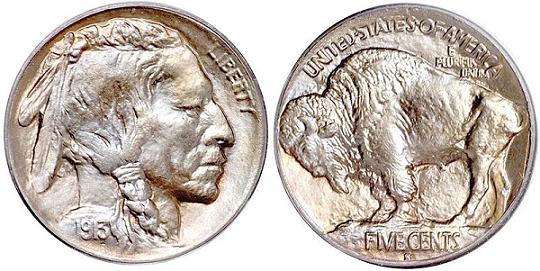
Fun money: The Buffalo nickel, 100 years old this month, makes Wall Street messenger boys rich (for a couple hours)


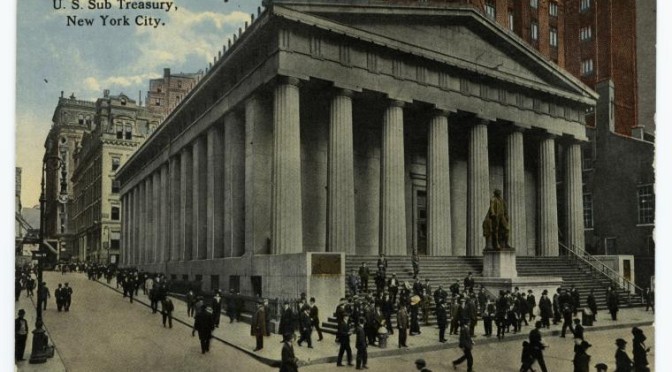
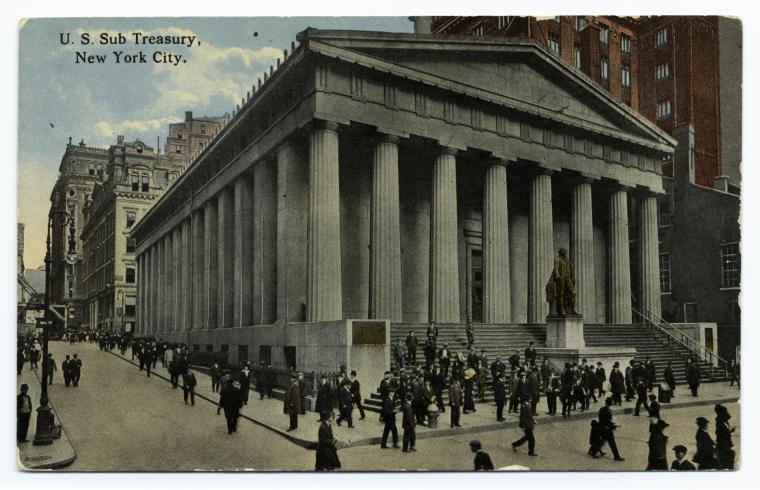
The U.S. Sub Treasury Building — today’s Federal Hall — as it appeared in a colorized postcard in the 1900s (courtesy NYPL)


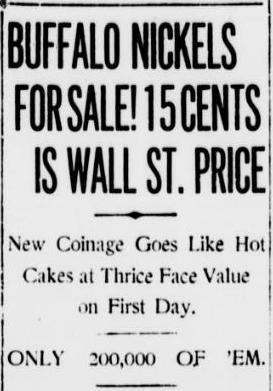
“Hey! Getcha buffalo nickels here. Only 15 cents!”

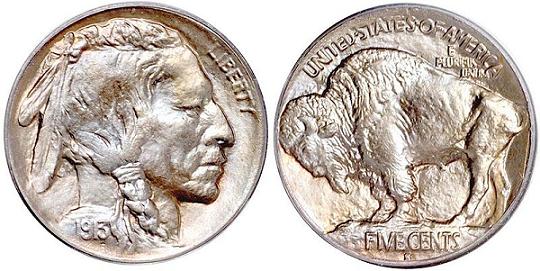
On March 1, 1913, the usual bustle of Wall Street was enlivened with the voices of young men — mostly messenger boys, bank runners and peddlers, according the Evening World — with handfuls of shiny new nickels, the first run of what would become known as the Indian Head nickel or the Buffalo nickel.  And in these heady morning hours, many managed to sell the five-cent piece for triple its value.

“The down-at-the-heels men, who sell picture postcards and neckties from pushcarts on Ann Street, scented a bargain and hurried to the Pine Street El Dorado to sink their little capital in nickels.”   The “Pine Street El Dorado” in that quote refers the New York Sub Treasury building, later referred to as Federal Hall.  (It’s second entrance is on Pine Street.)  The Sub Treasury received $10,000 worth of new nickels in ten wooden kegs.

Unfortunately for these budding young nickel entrepreneurs, the novelty wore off by noon and the Buffalo nickel sunk back down to its original face-value cost.

The new nickels were designed by the sculptor James Earle Fraser, a former assistant of the estimable Augustus Saint-Gaudens and best known in New York perhaps for his equestrian statue of Theodore Roosevelt outside the American Museum of Natural History.

Fraser, a professor at the Art Students League, designed the new coin from a studio at 3 MacDougal Alley, off of Washington Square Park.  An admirer of Western and Native American imagery, Fraser used a series of models for the noble Indian profile on the front of the coin.  For the buffalo on the reverse side, Fraser reportedly went to Central Park Zoo and used their old buffalo Black Diamond for a model.

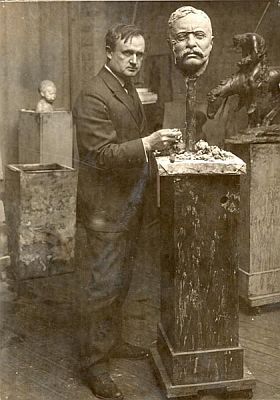
At right: James Earle Fraser in 1912 with a clay model of a Theodore Roosevelt bust (courtesy National Cowboy Museum)

Or at least, Black Diamond has always been considered the model for the buffalo nickel.  In fact, Fraser may also have used specimens from the Bronx Zoo including a fiesty beast named, appropriately, Bronx.  Given the renown of the Bronx Zoo collection — the institution essentially saved the buffalo from extinction — it might have made more sense to use their animals as models.

Despite outcries from manufacturers of coin operated devices — who claimed the new five-cent piece would not fit in their machines — the buffalo nickel was minted in February 1913, replacing the Liberty Head nickel that year.  (A small handful of Liberty Heads were made in 1913, becoming some of the most prized coinage among the numismatic set.)  Americans got a preview of the new coin when a small number were distributed by President William Howard Taft at the groundbreaking for the National American Indian Memorial in Staten Island, a monument that was ultimately never built.

A week later, on the first day of March, rolls of the new buffalo nickels were distributed to New Yorkers on Wall Street, and millions more sent across the country for distribution.

Perhaps Fraser’s design was a tad too whimsical for some.  The term ‘buffalo nickel’ soon became slang for something nearly worthless.  Just a month later, the New York Sun reported, “[T]he $1,500 mathematical job didn’t mean anymore to him yesterday afternoon than a buffalo nickel.”

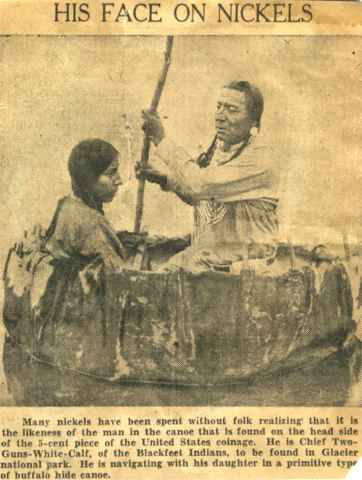
In 1921, one of Fraser’s human models, the chieftain Two Guns White Calf, pitched his teepee atop the luxury Hotel Commodore next door to Grand Central Terminal in a publicity stunt.

The buffalo nickel was replaced in 1938 by the more familiar Thomas Jefferson model.

Below: A news clipping featuring an image of Two Guns White Calf with his daughter. (Courtesy Flickr/sharknose)

Coin image courtesy Coin Collecting For Beginners

Categories
Pop Culture

The Broadway Melody: New York’s first Oscar victory and an ironic success for the Astor Theatre in Times Square

The second film to ever win the Academy Award for Best Picture was hardly a movie at all.

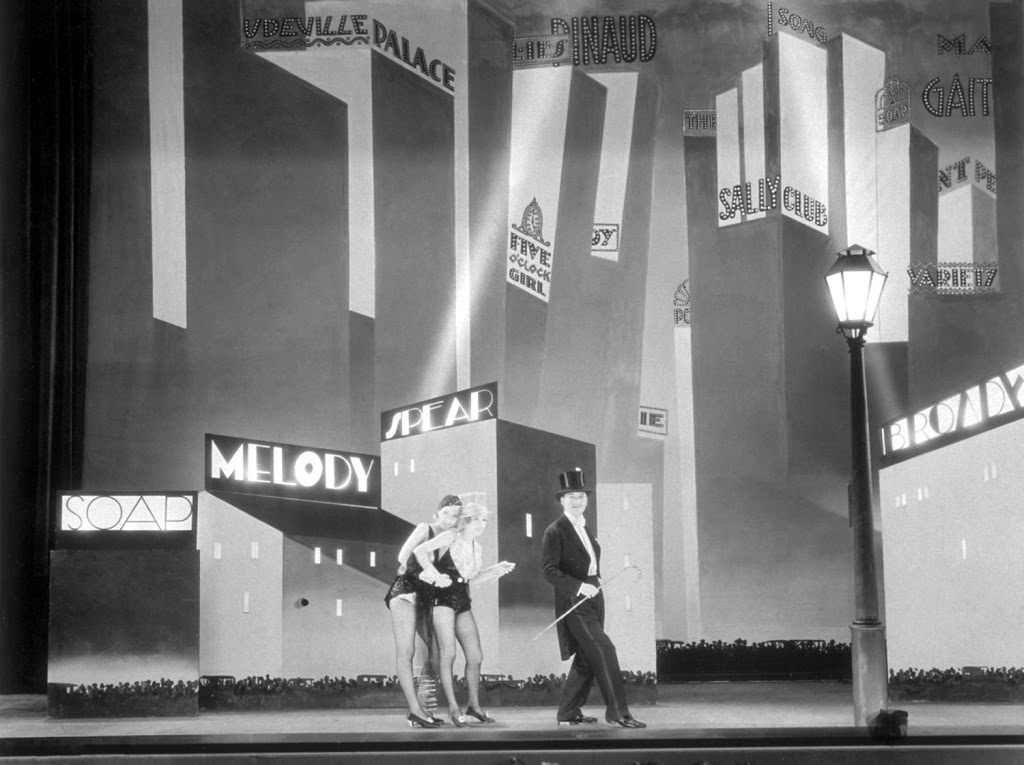
‘The Broadway Melody’, a frothy Hollywood revue about the mounting of an frothy Broadway revue, was a total celebration of every strength and weakness of the early Broadway stage, and a hopeful sign that the New York entertainment world would still wield some influence over its West Coast counterpart.

“Before an enthusiastic throng there was launched last night at the Astor Theatre a talking picture teeming with the vernacular of the bright lights and back-stage argot,” began the New York Times’ original review by Mordaunt Hall, when the movie opened on February 8, 1929.

One of the first-ever movie musicals, ‘Broadway’ was, of course, not filmed on Broadway, but in Hollywood, on an MGM soundstage.  Even when movies were regularly filmed in New York in the early years, they were rarely filmed on an actual Broadway stage.

But the movie’s opening shot is within an office on Tin Pan Alley, that sector of songwriters at 28th Street and Broadway who changed American pop music.  The melody of the film’s title is delivered to Zanfield (a thinly disguised Florenz Ziegfeld) who uses it as a vehicle to make stars out of a couple freshfaced sisters.

The puffy love triangle at the heart of ‘The Broadway Melody’ is merely an excuse to launch various musical numbers in the vaudeville-variety style.  The movie was produced at astonishing speeds; filming began in October 1928 and was ready for its two-city premiere (Grauman’s Chinese Theater in Los Angeles, the Astor Theatre in New York) by early February.

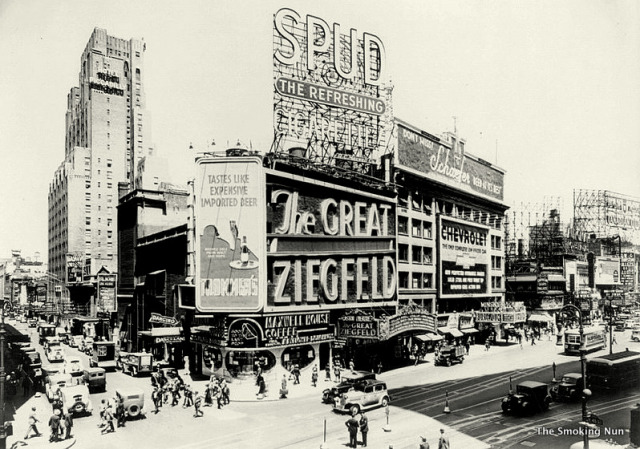
The Astor Theatre, in Times Square at Broadway and 45th Street, played host to ‘The Broadway Melody’ for an entire year.  Some might have thought that deeply ironic, as the Astor had once been a legitimate stage that permanently switched to motion pictures in 1925.  And with great success it was now exhibiting a motion picture about the legitimate stage.

Below: The Astor Theatre in 1936, exhibiting another Broadway-themed film that would go on to win the Oscar for Best Picture —  The Great Ziegfeld (Courtesy LOC)

It’s been claimed that the film was made by MGM’s Irving Thalberg on a suggestion from the owner of the Capitol Theatre, up the street from the Astor.  If so, its debut here must have been a real slap in the face!

In this tenuous day of movie sound, many were unsure people a film with music would work.  “Although the audible devices worked exceedingly well in most instances,” Hall continued in his review, “it is questionable whether it would not have been wiser to leave some of the voices to the imagination, or, at least to have refrained from having a pretty girl volleying slang at her colleagues.”

Audience members, especially those in the Astor’s $2 reserved seats, were rapturous for it.  “‘Broadway Melody’ has everything a silent picture should have outside of its dialog,” praised Variety in 1929.  A basic story with some sense to it, action, excellent direction, laughs, a tear, a couple of great performances and plenty of sex….It’s perfectly set at the Astor.  And will it get dough around the country. Plenty.”

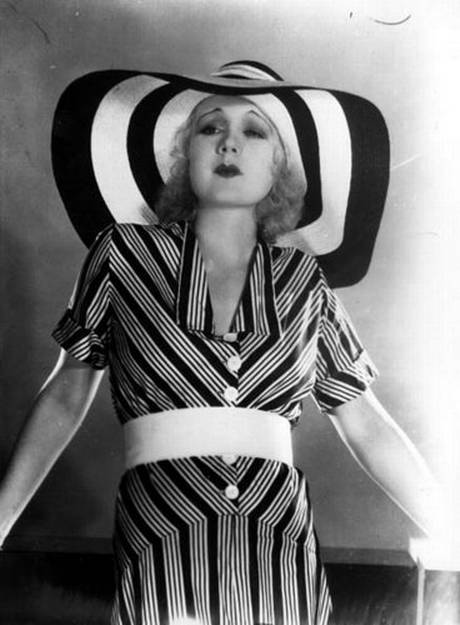
At right: Anita Page, one of the stars of ‘The Broadway Melody’, from Flushing, Queens!

The very first Academy Awards the previous year had rewarded serious fare — and all silent.  The first Best Picture winner, ‘Wings‘, had also been a big box office hit in New York, making its debut in August 1927 at the Criterion Theater, just one block away from the Astor!

But Oscar voters went carefree for their second Best Picture winner. Additionally, ‘The Broadway Melody’ became the first sound picture to be awarded the Best Picture Oscar. And the first of a great many to find inspiration in that great big city on the opposite coast.

It would also introduce a lasting connection between the movies and stage musicals, a connection that still lasts today with the Oscar-nominated ‘Les Miserables’, which had its Broadway debut on March 12, 1987 at the Broadway Theatre (Broadway and 53rd Street).

Categories
Brooklyn History Pop Culture

The curious tale behind the first film ever made in Brooklyn

Millions and millions of hours of television and film have been made within the five boroughs since the invention of the camera.  But have you ever wondered where the very first roll of film was ever shot?

That distinction most likely goes to a nondescript rooftop studio built atop a building at 1729 St. Marks Avenue in Brooklyn.  Of course in 1894, Brooklyn wasn’t yet a borough of New York proper, but would be within five years.  So I think it’s fair to grant it the title of New York’s first ever film shoot, or at very least, Brooklyn’s first movie.

The idea of moving pictures was barely a decade old by then, still very experimental and produced under controlled environments.  Europeans like Eadweard Muybridge had already captured the movements of animals by the early 1890s, and the Lumieres Brothers would have completed the development of the cinematograph, the first successful motion picture camera to gain widespread acceptance in Europe.

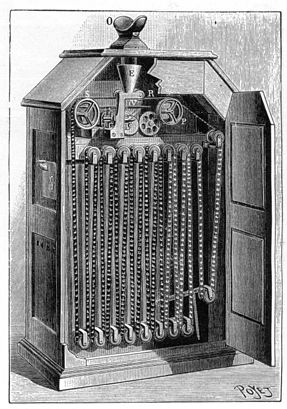
In America, engineers working for Thomas Edison began experimenting with film devices as early as the late 1880s out in his Black Maria studio in West Orange, New Jersey.  It was William Kennedy Dickson‘s work for Edison which produced the Kinetoscope, a cabinet peep-show where a rapid flipping of cards created instant movement.  An observer would hunch over the box, looking into a view-finder to witness the amazing visual trick contained inside.

In 1893, a completed Kinetoscope made its debut to the world at the Brooklyn Institute of Arts and Sciences (the precursor to the Brooklyn Museum).  Observers there were treated to the very first American film, Blacksmith Scene.

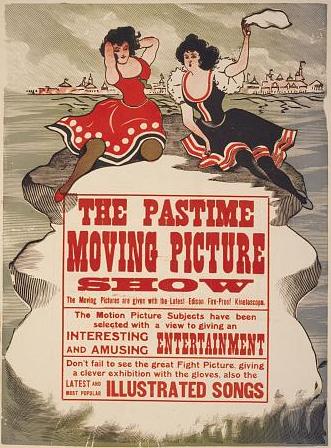
Above: A poster for a series of Edison kinetoscope films, including a boxing movie or ‘Fight Picture’ (Courtesy LOC)

But that’s not Brooklyn’s only stake in early American film history, thanks in part to another of Edison’s employees named Charles E. Chinnock.

The London-born inventor came to Edison as a telephone electrician and soon moved on to work on other key projects, including the lighting of lower Manhattan via the Pearl Street Station in 1882.  Chinnock excelled so ably at his management of the station that, as legend has it, Edison paid him a bonus of $10,000 right from his own pocket.  As the electrical grid expanded throughout Manhattan and into the future boroughs, Chinnock was put in charge of the Edison Electric Illuminating Company of Brooklyn, preparing Brooklyn for its own electrical lighting grid.

Like so many of Edison’s employees, Chinnock fell out with the inventor-mogul and left to pursue his own electronic concerns, including the creation of his very own version of the Kinetoscope.  In fact, Chinnock would be a minor competitor of Edison’s for the New York Kinetoscope market in the 1890s.  While Edison would strike first, Chinnock’s machines would eventually grace the saloons of Coney Island and the lobby of the Eden Musee on 23rd Street in Manhattan.

So obviously, Chinnock would need his own films to exhibit, as Edison would certainly not give permission for his.  Chinnock lived in Brooklyn at this time — in a townhouse at Sixth Avenue and St. John’s Place in Park Slope — so it would make sense that his own makeshift film studio would be nearby.

At right: One of Edison’s kinetoscopes. Chinnock’s would have looked quite similar.

In November of 1894, Chinnock began making films for his own version of the Kinetoscope.  The place was a rooftop at 1729 St. Mark’s Avenue, a couple miles east from his home, at the edge of today’s neighborhood of East New York.

Chinnock’s rooftop studio was probably similar to Edison’s Black Maria, a small black-walled room built to capture as much natural light as possible. The filming space was very small and could accommodate only a couple subjects.  For this reason, boxing became a popular subject of early films because it was compact, thrilling, full of movement and — for its day — rather bawdy.

Edison has already filmed a boxing match, so Chinnock decided to do the same.  Two boxers unknown today in the annals of sport — James W. Lahey and Chinnock’s own nephew Robert T. Moore — were chosen to compete, and their battle was captured sometime that November in 1894.  The film would have been quickly produced and distributed to Kinetoscope operators.

No copies of the Moore-Lahey faceoff exist today. However, this Edison film featuring the Glenroy Brothers was made just a couple months prior to Chinnock’s old film, so this gives you a good idea of what it could have looked like:


Chinnock continued to rip off Edison films, with his own blacksmith scene, a few dancing girls and even a cock fight.

A few months later, the Latham Brothers, another competitor of Edison’s, filmed another boxing match between Young Griffo and Battling Charles Barnett at Madison Square Garden.  This movie holds the distinction of being the first film projected for a paying audience vs. Chinnock’s the soon-to-be-unfashionable kinetoscope.

Chinnock, of course, is no household name.  He was eventually run out of the film business by Edison and others.  He died in his Park Slope home in 1915.

Chinnock’s real failure may have been a simple one — instead of humans boxing, he should have had cats do it.  Just a few months before Chinnock put his nephew in the ring, Edison placed two cats in a ring against each other at the Black Maria studio, in what must certainly be the world’s first LOLCATS video.

In fact, these two were a popular vaudeville act of the day — Professor Welton’s Boxing Cats, named Corbett and Mitchell.


For more on this era of film history in New York City, check out our 2010 podcast NYC and the Birth of the Movies

Chinnock picture courtesy Victorian Cinema

Categories
Newspapers and Newsies

What if? Meteors over Manhattan, 1922

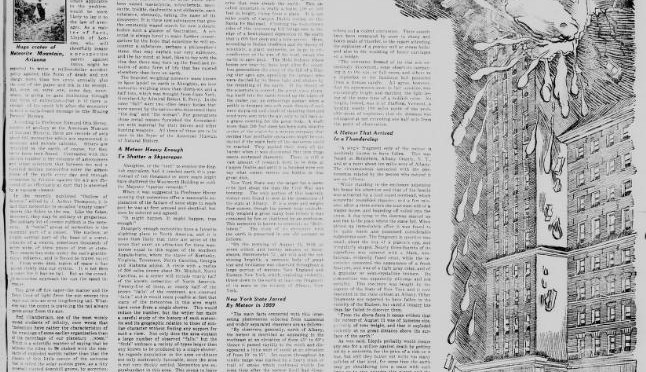
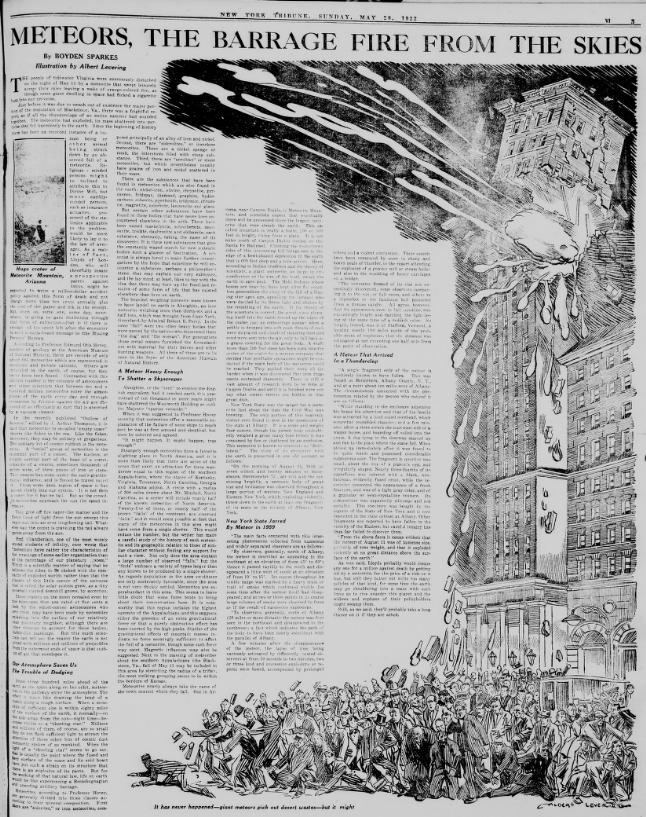
In 1922, the New York Tribune envisioned what it would be like if a meteor hit downtown Manhattan. 

The article is a real scare piece on the potential of meteors destroying life on Earth.  It references the American Museum of Natural History‘s own meteor, Ahnighito, brought to the institution by Robert Peary in 1904.  As I mentioned in my post from 2010, that famous rock was of no particular threat and in fact was itself pummeled by the jackknifes of rowdy young children.

“Ahnighito … had it reached Earth this year instead of ten thousand or more might have shattered the Woolworth Building,” writes Boyden Sparkes in the Tribune article.

Unfortunately, as you’ve probably noticed, this image also accidentally recalls other, more recent tragedies. You can find the original image at the Library of Congress (read it here)

Just in case you think the recent meteor in Russia is somehow an aberration and a true sign of the times, you should remember that meteors have already landed much closer to home  here.   For instance, in 1922, a meteor almost crashed into Asbury Park, NJ!

Categories
Holidays

Whip it! Early Valentine’s Day custom in old New York involved public displays of flirtatious flagellation

In old New York, there was a curious Valentine’s Day custom involving young women running around town whipping men with rope.

Yes, you read that correctly.  This form of socially acceptable violence was popular in the colonial era and extended well into the early 1800s.  It derives from a tradition practiced as part of an early Dutch holiday known as Vrowen Dagh* (or Woman’s Day) and was likely popular among the young ladies of New Amsterdam, New York’s precursor.

According to the 1850 history ‘Rural Hours’ written by Susan Fenimore Cooper (daughter of James), “[e]very mother’s daughter … was furnished with a piece of cord, the size neither too large or too small” and fitted with a “due length left to serve as a lash.”  Cooper elaborates on this playfully violent custom:

“On the morning’s of this Vrowen Dagh, the little girls — and some large ones, too, probably for the fun of the thing — sallied out, armed with such a cord, and every luckless wight of a lad that was met received three or four strokes from this feminine lash.”

Young men of marrying age dashed from place to place, fearful of being flirtatiously struck in this whirlwind of flying rope.

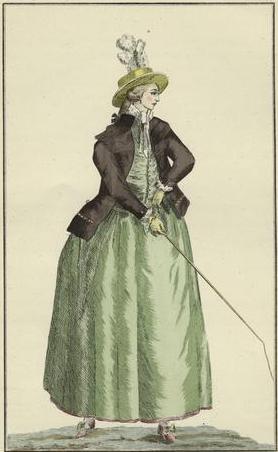
At left: Woman with a whip, 1780

“Every lad whom they met was sure to have three or four smart strokes from the cord bestowed on his shoulders,” writer Gabriel Furman recalled in 1875.  “These, we presume, were in those days considered as ‘love-taps’, and in that light answered all the purposes of the ‘valentine’ of more modern times, as the lasses were not very likely to favor those with their lashes whom they did not otherwise prefer.”

There obviously seems to be some statement about domestic violence in this practice.  At one point, injured males suggested the following day be a “Men’s Day,” allowing men to chase women around with these braided whips.  But they were told “the law would thereby defeat its very own purpose, which was, that they should, at an age and in a way most likely never to forget it, receive the lesson of manliness — he is never to strike.” [source]

At some point in New York, this custom actually did blend with the English custom of Valentine’s Day, and young women of the colonial era continued enjoying this frivolous custom — in fact, well into the early 1800s.  It blessedly vanished by the mid-19th century, replaced with the more recognizable gesture of sending valentines through the mail.

“We heard that 20,000 [valentines] passed through the New  York office last year,” Cooper writes in 1850.  But it seems the writer had grown tired of even this custom. “They are going out of favor now, however, having been much abused of late years.”

*I think the actual Dutch word would be Vrouwendag but I’m preserving the original spelling from Fenmore and Furman’s text. An 1832 Dutch dictionary says Vrouwendag means ‘Lady Day’!

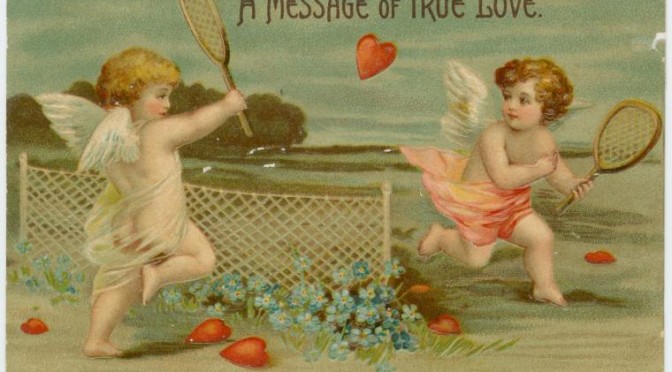
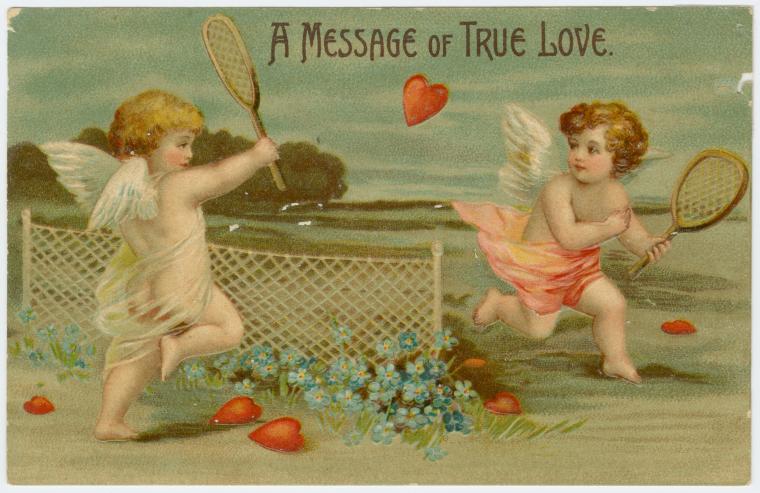
Vintage valentine and whip lady courtesy New York Public Library

Categories
Gilded Age New York

“The First Dandelion” and Walt Whitman’s very bad timing

In 1888, the New York Herald ran this poem by the great Walt Whitman:

                                         The First Dandelion

                                         Simple and fresh and fair from winter’s close 
                                                    emerging, 
                                        As if no artifice of fashion, business, politics, 
                                                   had ever been, 
                                       Forth from its sunny nook of shelter’d grass— 
                                                  innocent, golden, calm as the dawn, 
                                      The spring’s first dandelion shows its trustful 
                                                  face 

Whitman was a living legend by this point.  The infirm 78-year old writer lived in Camden, New Jersey, and rarely left his home.  His most notable appearance in New York the previous year had been as a lecturer at the Madison Square Theater, discussing the legacy of Abraham Lincoln to an audience which included Mark Twain and Augustus Saint-Gaudens.

A poem by Whitman would have been reason alone to buy an edition of the New York Herald. And indeed, as the Herald’s ‘poet laureate’, several of his most notable works had debuted there.  “Mannahatta,” for instance, debuted in the Herald on February 27 that year.

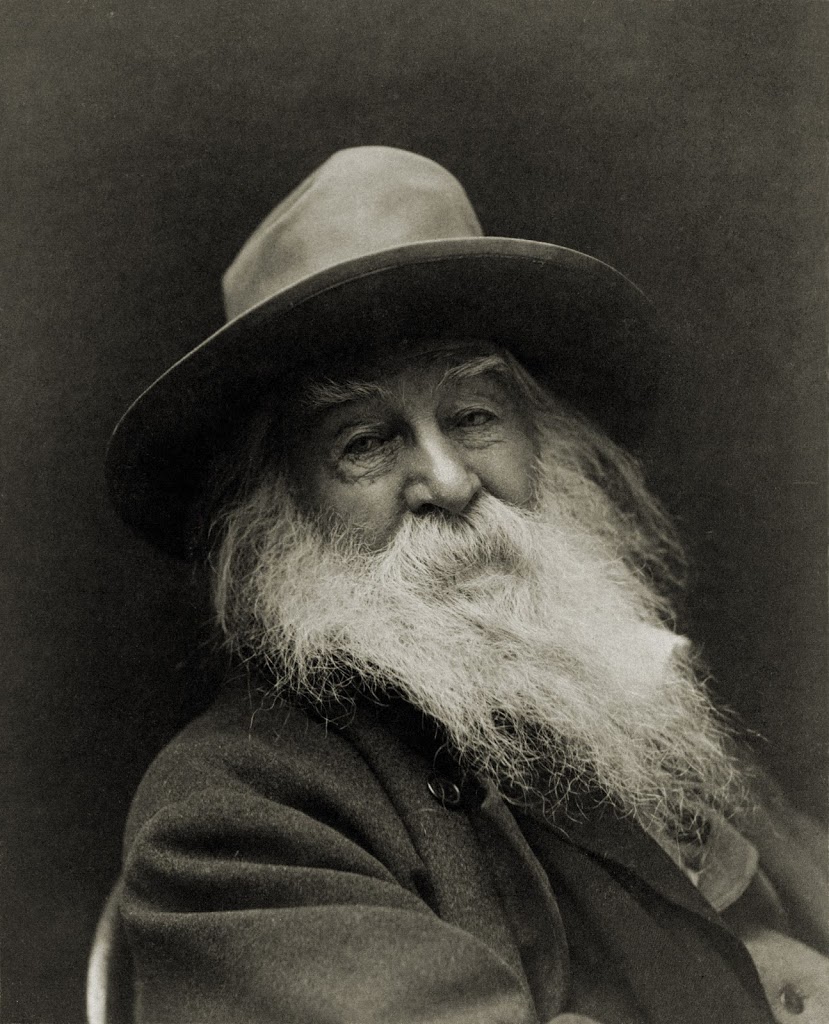
At right: Walt Whitman in 1887, taken in New York by George C. Cox

Unfortunately, “The First Dandelion,” a little ode to the coming spring, ran on March 12, 1888, the worst day of the Blizzard of 1888, a day when several feet of show and deathly winds were making the American northeast a very unpleasant place to be. The poem “made its appearance at a most unfortunate time,” said the journal Illustrated American in 1892.

Nobody wanted to read about a gentle dandelion that day.  And in proceeding issues of the Herald, the poem was roundly mocked with parody verse.  Two days later, ran a verse below, signed simply “After Walt Whitman.”

                                     The First Blizzard

                                     Simple and fresh and fierce, from Winter’s close 
                                          emerging, 
                                    As if no artifice of summer, business, politics 
                                         had ever been, 
                                   Forth from its snowy nook of shivering glaciers– 
                                        innocent, silver, pale as the dawn, 
                                  The Spring’s first blizzard shows its wryful 
                                         face. 

Not quite finished, the Herald ran another mocking poem the following day:

                                  Served Him Right

                                  The poet began an ode to Spring–
                                 “Hail, lusty March! Thy airs inspire
                                 My muse of flowers and love to sing–“
                                 And then the blizzard struck the lyre

Neither the Herald nor its readership held it against Whitman personally. Four days later, the paper published “The Wallabout Martyrs,” his tribute to those held capture aboard prison ships during the Revolutionary War.

And the reputation of “The First Dandelion” was saved when it appeared in the ‘deathbed’ edition of Whitman’s Leaves of Grass, where its beauty was better appreciated.

Categories
Gilded Age New York Podcasts

Frozen in time: The Blizzard of 1888 knocks New York City off its feet, creating the deadliest commute in history

PODCAST This year is the 125th anniversary of one of the worst storms to ever wreak havoc upon New York City, the now-legendary mix of wind and snow called the Great Blizzard of 1888.

Its memory was again conjured up a few months ago as people struggled to compare Hurricane Sandy with some devastating event in New York’s past. And indeed, the Blizzard and Sandy have several disturbing similarities. But the battering snow-hurricane of 1888, with freezing temperatures and drifts three stories high, was made worse by the condition of New York’s transportation and communication systems, all completely unprepared for 36 hours of continual snow.

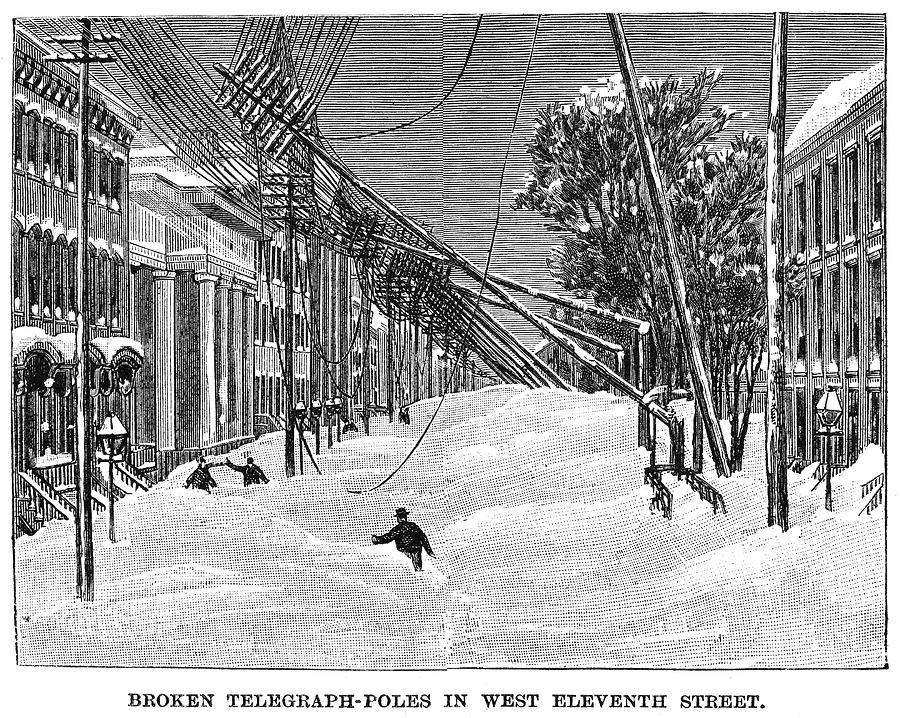
The storm struck in the early hours of Monday, and many thousands attempted to make their way to work, not knowing how severe the storm would be. It would be the worst commute in New York City history! Fallen telephone and telegraph poles became a hidden threat under the quickly accumulating drifts.

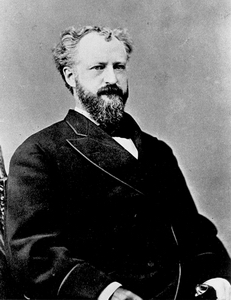
Elevated trains were frozen in place, their passengers unable to get out for hours. Many died simply trying to make their way back home on foot, including Roscoe Conkling (at right), a power broker of New York’s Republican Party.

But there were moments of amusement too. Saloons thrived, and actors trudged through to the snow in time for their performances, And for P.T. Barnum, the show must always go on!

STARRING: Hugh Grant (although maybe not the one you’re thinking)


NOTE: And, yes, we can’t believe the timing of this one, releasing on the same date of an ACTUAL blizzard. We really had this one planned for awhile, delayed it a bit because it seemed too eerie to do it so close after Hurricane Sandy.

So if you’re in New York or the northeast United States, stay inside, stay safe and let this podcast be the only dangerous snow drifts you experience this week!


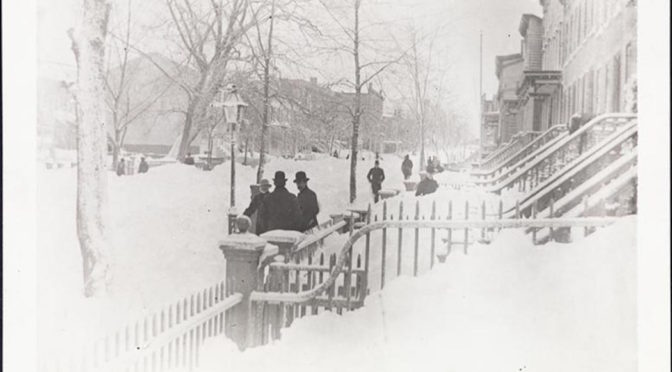
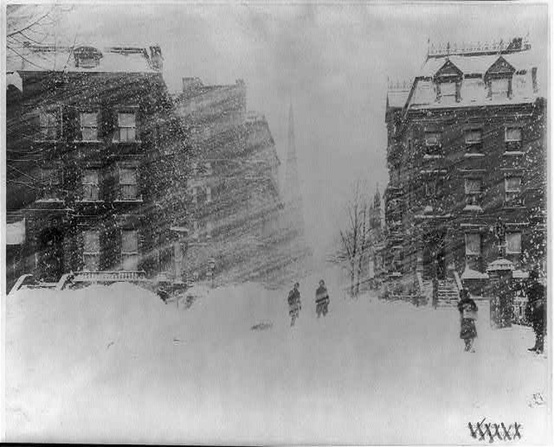
In the blizzard of 1888, the streets disappeared and the snow came down almost horizontally. Imagine being trapped at work, several miles from your home. This was the plight experienced by thousands of New Yorkers (and others throughout the northeast) that Monday. (Library of Congress)

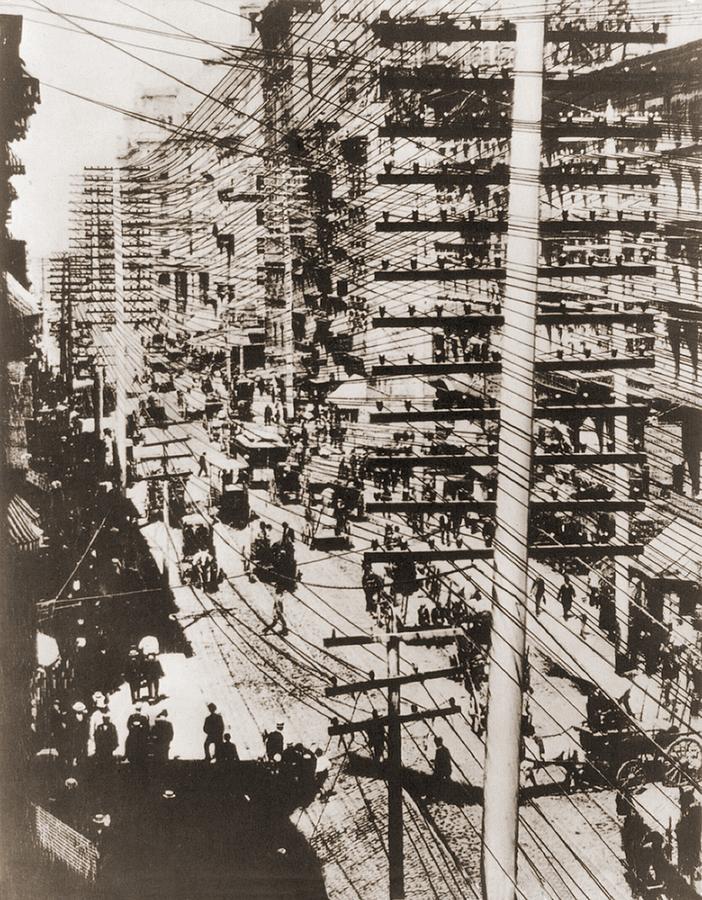
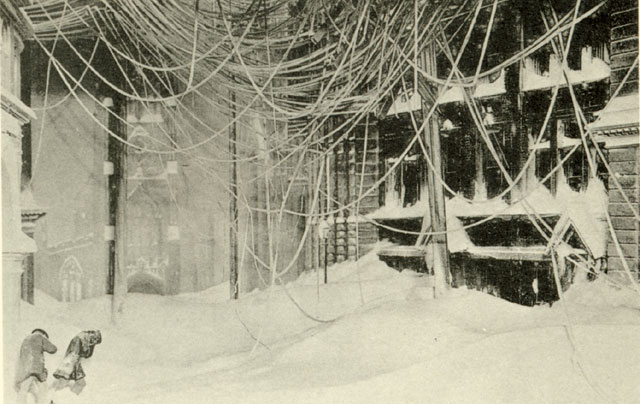
Why did the 1888 blizzard become such a hazard for New Yorkers? Let this picture be your first clue. The city was a cobweb of elevated telegraph, telephone and electric wires. This picture is from 1887. (LOC)


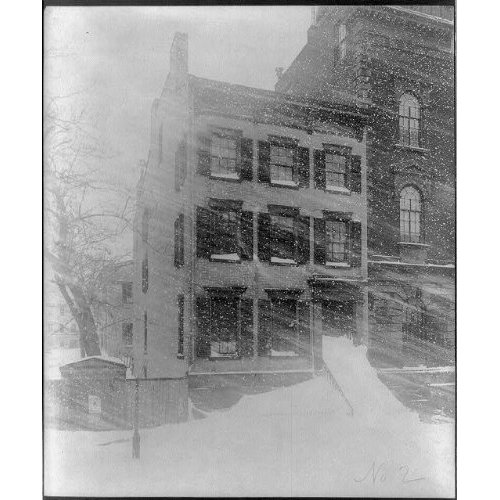
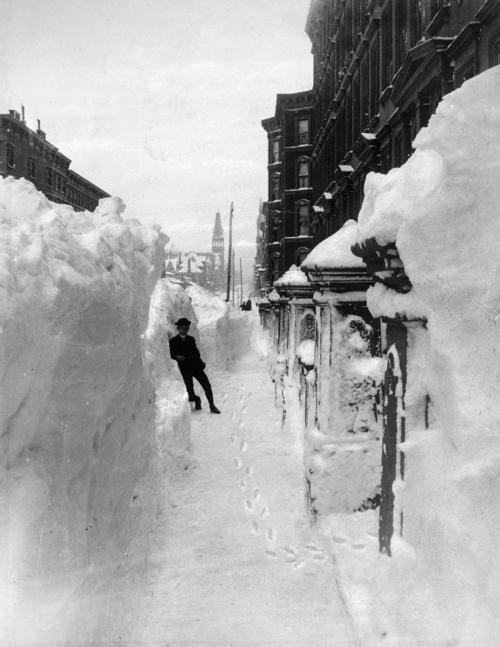
One example of a terrible (although minor) snow drift that might have kept this family in their home all day. Because of the unpredictable changes in wind, some houses might have been drift-free, while others close by completely locked in with snow. (LOC)

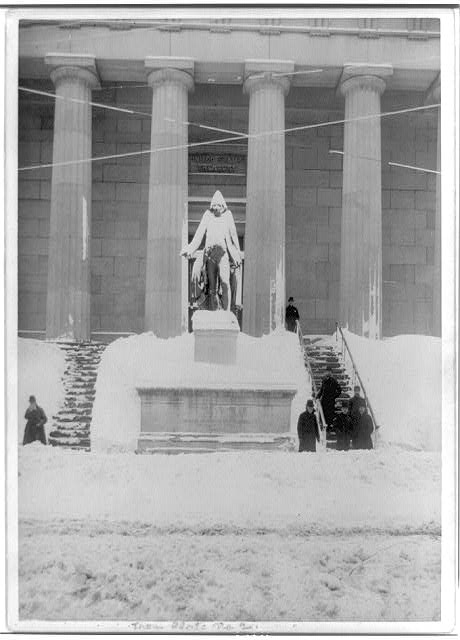
George Washington at the Sub-Treasury Building (today Federal Hall). I ran this photo a few weeks ago, but it’s so bizarre that I think it needs a second posting.

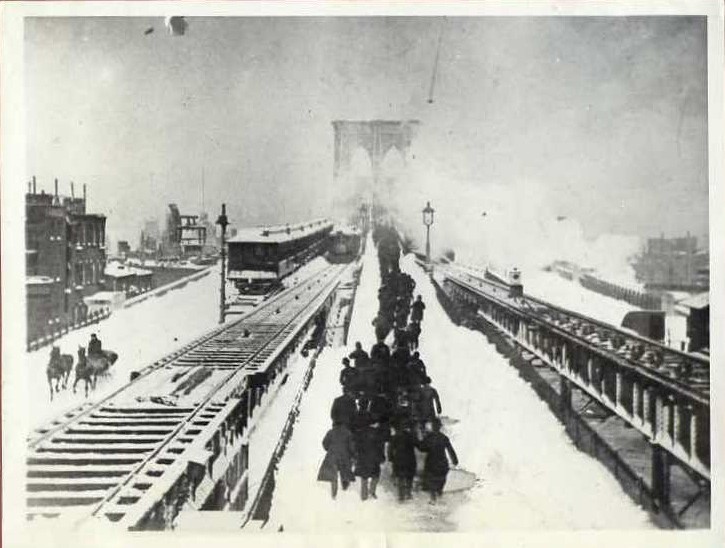
The Brooklyn Bridge, not even five years old, weathered the winds quite well, but became a hazard due to ice. In this picture, people are crossing over as there was no other way to get between Manhattan and Brooklyn. It’s not clear if any of the trains are operating in this picture.

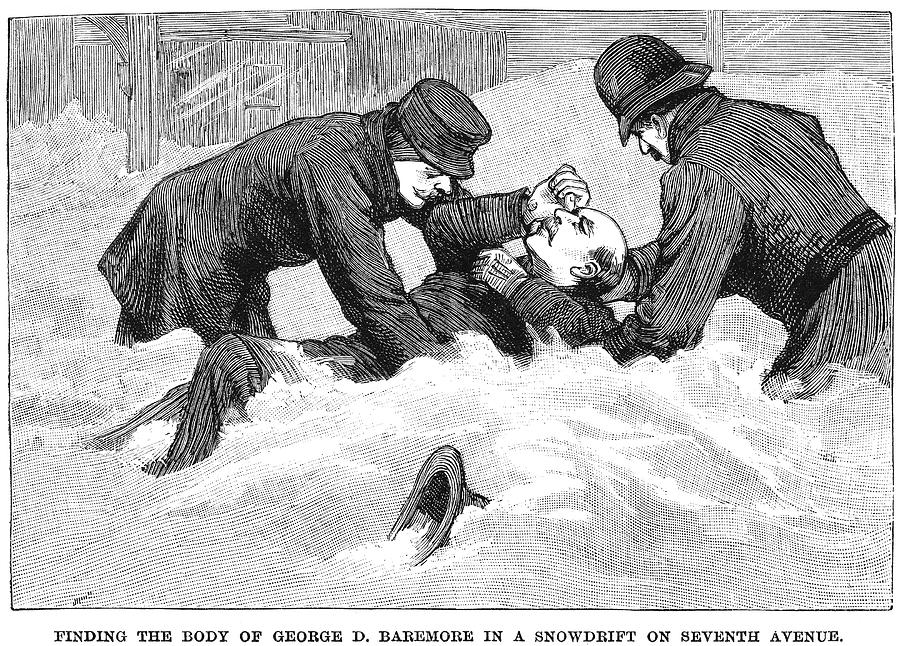
The biggest danger for those venturing outside were the hundreds of downed telegraph, telephone and electrical poles, no match for the intense gusts. The poles would quickly fall then get covered with snow, creating deadly hazards for people walking past. The snow would just as quickly cover over an unconscious individual; many New Yorkers froze to death when they fell and were instantly shrouded.


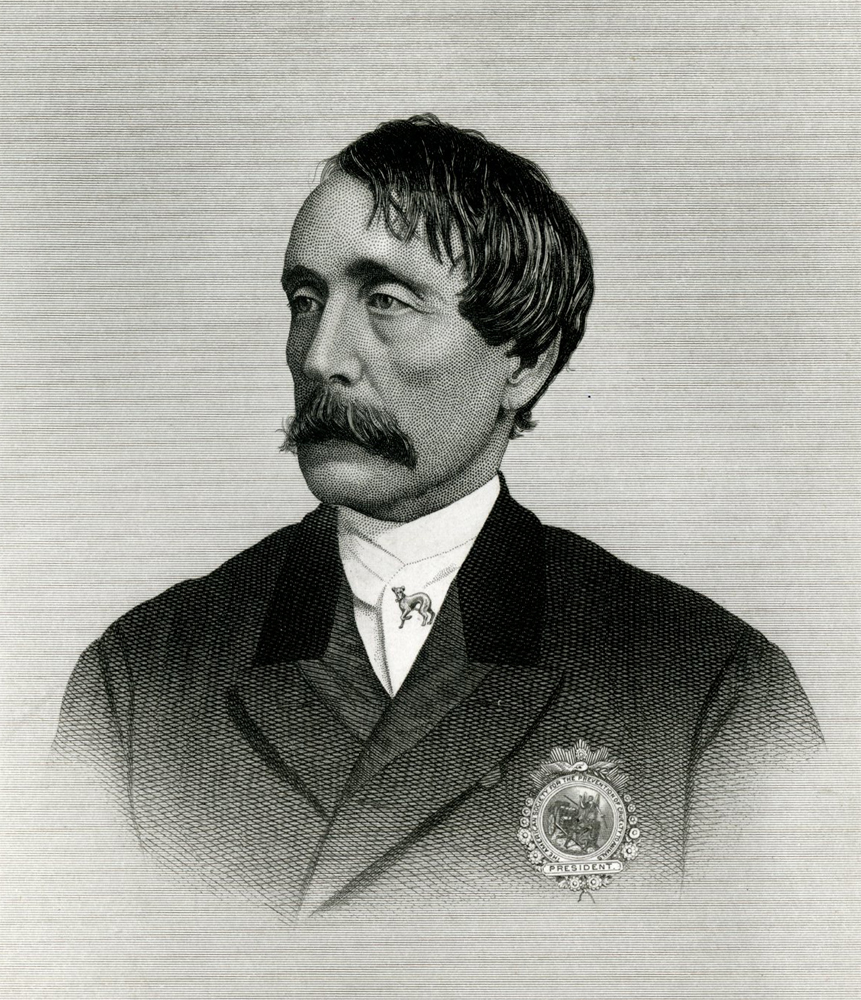
Henry Bergh, founder of the American Society for the Prevention of Cruelty to Animals. He did not survive the blizzard. (NYHS)

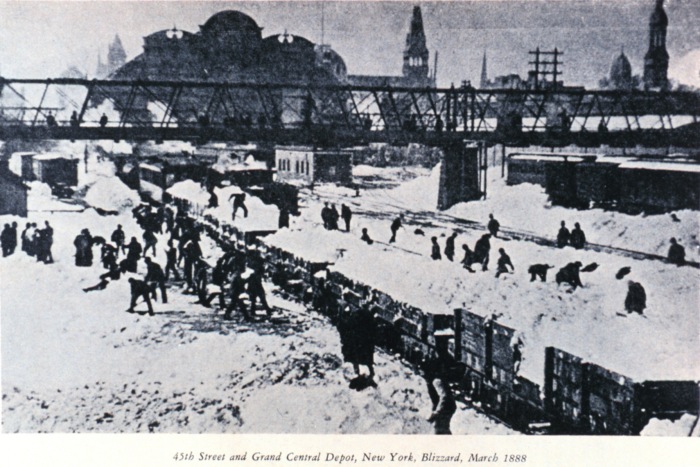
Transportation in and out of the city was at a complete standstill for half the week. Here workers frantically try to clear the way for trains going into Grand Central Depot.


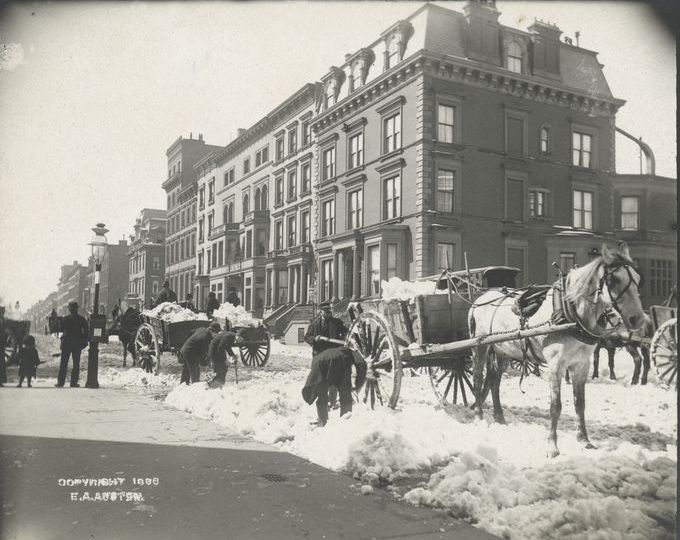
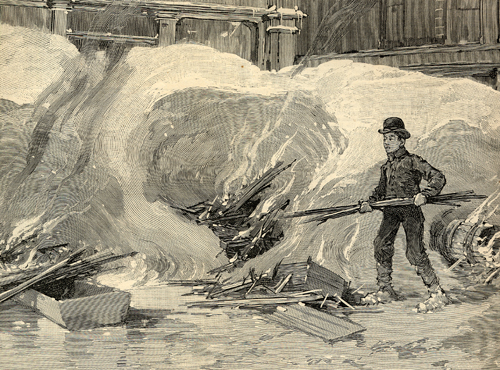
Clean-up was truly chaotic, a feeble effort by the city paired with private contractors with horses, shovels and carts. The piles of snow were taken to water’s edge and dumped, or, in a few less preferred cases, people just started bonfires and melted it away. (For a great picture of a snow dump in the river, see this photo at Shorpy of a blizzard from 1899.) Top pic courtesy LOC, at bottom Maggie Blanck.


The cover of Frank Leslie’s Illustrated Newspaper, usually one of the more sensational pieces of journalism people might have found at their newsstand.

Categories
Gilded Age New York

Before Al Roker and Sam Champion, there was Farmer Dunn, New York’s weather guru of the late 19th century

How did New Yorkers know to panic over the weather in the 19th century? How could they know to run through the streets in terror at the upcoming snowpocylpse/blizzardtastrophe if there was no brightly colored Accuweather radar or a friendly weather person with perfectly coiffed hair?

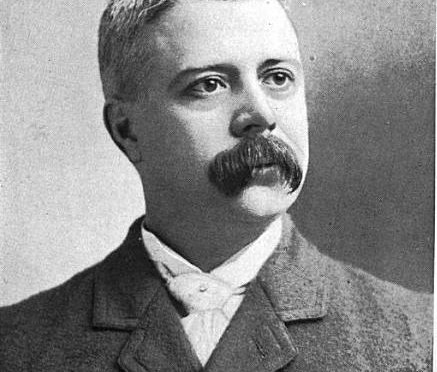
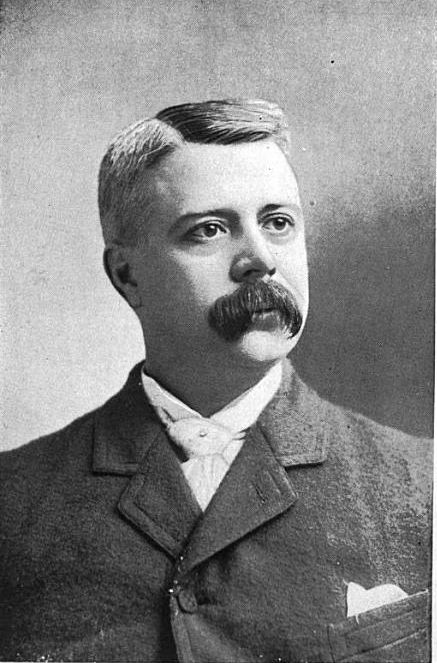
In the 1880s, New Yorkers turned to one man — the Brooklyn-born Sergeant Elias B. Dunn (at right, with his dashing moustache, 1902).  He was so trusted for his weather predictions — more accurate than an almanac! — that he was given the almost devout nickname of Farmer Dunn.

Nationwide weather forecasts had been steadily compiled by the federal government since 1814, but such  prognostications — or “probabilities” as there was sometimes called — were never taken very seriously until the late 19th century.

With the invention of the telegraph, a national signal office was established in 1870 and placed under the auspice of the Secretary of War as it was believed that “military discipline would probably secure the greatest promptness, regularity and accuracy in the required observations.”  Members of the military were enlisted throughout the United States to telegraph current weather conditions to the Washington D.C. signal office, where meteorologists could piece together the information and make more accurate predictions.  In 1890, this responsibility was moved to the Department of Agriculture.  (This is where Dunn got his unique nickname.)

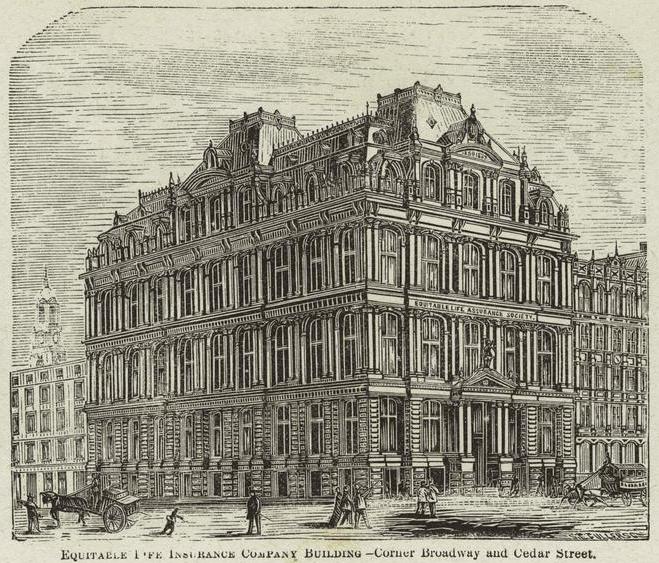
New York’s weather conditions were assigned to Dunn, a decorated sergeant, and a four-man team, set up in a telegraph office located in the 1880s at the old Equitable Building at 120 Broadway. (In 1894, they moved to the taller Manhattan Life Building at 64-66 Broadway.)  The team would telegraph present conditions by using barometric instruments located on the roof.  They would then report statements from the D.C. signal office to the press.

Below: the original Equitable Building, headquarters for Farmer Dunn and his telegraph crew. The ornate structure famous burnt down in 1912 during a frightfully chilly evening. (courtesy NYPL)

Dunn “is one of the very best known men in the city.” according to an 1894 New York Times article.  “His popularity, except with his legion of friends, is of a varying quality.”  Farmer Dunn would embody the weather for many New Yorkers;  his name would be cursed when it rained and praised on sunny days.

When his predictions failed, he was jovially mocked in the press. “ELIAS IS NOT A PROPHET,” declared the Times in 1895 after a sudden rain dampened spirits on Independence Day.

He was a man of science, eschewing folk traditions of predicting weather. “We made a list of all the farmers’ beliefs and the sailors’ beliefs, and we submitted them to investigation,” Dunn told the New York Sun.  “The result that we found was that they just don’t work out.  The study of weather is an exact science which cannot be left to squirrels and nuts.”

Dunn was on hand during one of the worst weather events in New York City history — the Blizzard of 1888, which struck the city just after midnight on Monday, March 12.  He and his team frantically sent telegraphs to DC and received no response, as most of the telegraph poles further south had been dismantled by the storm’s brutal winds.  In fact, it was only when he received a message from London — via the Atlantic Cable, buried under the ocean — that he realized the full impact of the blizzard.

Later in life, Farmer Dunn became a published author, spilling his meteorological secrets in books such as “The Weather and Practical Methods of Forecasting It.”  He must  have inspired an entire generation of buddy weather enthusiasts, describing technical terms in a plain manner and even recommending equipment.  For instance, if you were looking for a polymeter (it “gives the relative and absolute humidity”), Dunn recommends purchasing one from “Gall & Lemlike, 21 Union Square.”

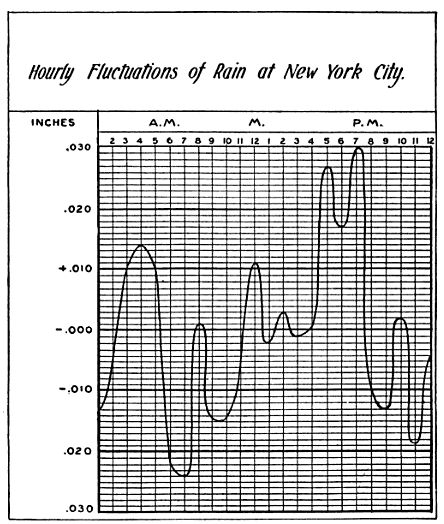
At right: An illustration from Dunn’s book, 1902

He also became a popular newspaper columnist, distributing such wisdoms in 1900 as “the popular idea that the spots on the sun produce excessive heat on the Earth is erroneous.” (source)

It seems he also got into the “moving picture” business, although I can find no other information on this other than the fact that he sued Thomas Edison in 1900!

Later in life, Farmer Dunn ran as a Republican for a seat in the U.S. Congress. He was touted for his six-word platform: “Americanism; local option; no entangling alliances.”  He lost, which he did not predict.  The weather guru died in 1943, enjoying many years of retirement in Miami.

Categories
Bowery Boys Bookshelf

How to make a mermaid: A chat with Mark Siegel, the creator of ‘Sailor Twain, or The Mermaid in the Hudson’

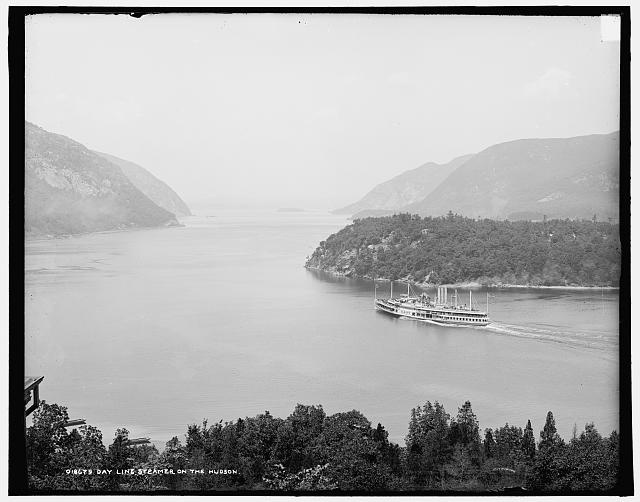
A passenger steamer passes along the Hudson, early 1900s. (Courtesy LOC)
As a kick-off to the Bowery Boys Book of the Month section, I thought I’d ask Mark Siegel, the author of Sailor Twain or The Mermaid in the Hudson,” a few questions on his inspiration for the graphic novel.  I was especially interested in the origin of the book-within-a-book, as it seemed like something familiar….

So which inspiration came first, a history-based story set on the Hudson or a love story involving a mermaid?

It’s hard to say, because the Hudson River and the mermaid have been inseparable in my mind for the nine years I was working on the book.  But the compulsion of a siren’s song was the initial spark—these things in life that compel us and override our reason and our common sense, things we would follow . . . down, down, down.

 The 1887 setting revealed itself very early.  There’s the romance of the Gilded Age, but also the cross currents of that time which I found irresistible: the industrial revolution waxing and the scientific mind in ascendance, the women’s suffrage movement, the uphill fight for Black people’s rights, the lingering shadows of the Civil War, and with poetry and literature, a search for a new and unique American myth and magic—from Irving to Twain to Whitman to Emily Dickinson… Such rich soil to plant a story’s seeds in.  But yes, the seed itself is a love story, or rather three interwoven love stories.

Why did you decide to name the captain Twain? The story makes a couple clever allusions to Mark Twain then launches into a genre quite unlike a Twain story. Is the randy Lafayette an allusion to a real life character as well (say Marquis de Lafayette perhaps)? 

With every major character in Sailor Twain I was interested in finding a resonance in the American psyche. Lafayette evokes the Marquis of course; a great emblem of France, and in the love-hate relationship between France and the United States, that name belongs on the love side: a France that embraces the American ideal.  Now at first, the Lafayette in our story seems like a cliché of the lecherous Latin man, but then his destiny takes him someplace beyond that.

Twain is a dangerous name to give a protagonist—it’s such a trademark of that Samuel Clemens fellow. And Captain Twain even resents being asked if he’s related to the writer! He grumbles “That’s not his real name, you know…” But that’s only the starting point.  Sailor Twain also plays with the Doppelganger theme—so splits or “twainings” of all kinds:  in the Captain, the passengers, the recent Blue and Grey Coats of the Civil War, even in the mighty Hudson herself.  The Algonquian name for the Hudson was “The River That Flows Two Ways.”  So the name Twain runs throughout every level of the story.  Early on in the making of it, it couldn’t be any other name for our doomed captain.

At the core of the graphic novel is a mysterious book ‘Secrets & Mysteries of the River Hudson’ written by the equally mysterious C.G. Beaverton. There’s something very vaguely familiar about this book, perhaps like something similar I’ve read doing research. Is it based on a real book? 

Oh good!  I hoped for exactly that sort of vague familiar feeling.  I wrote out most of that book within the book, so I could know it myself.  It’s like some travelogues, but also the mystical searches of Graham Hancock like in his The Sign and the Seal—part rigorous history, part guidebook, part fable and mystery-dream.  Leonardo DaVinci‘s travel journals were oddly enough an early inspiration: they’re mostly very detailed, very exact and truthful, and suddenly he talks about visiting foreign lands and seeing giants and impossible creatures and all kinds of baffling things. I love that.

How the Beaverton book evolved though, is the author became more of a story-collector than a visionary—something like Zora Neal Hurston, or the folk-song collectors in the Appalachian mountains.  Some of the Beaverton stories draw from actual Hudson folklore, and from all real places—plus some of my own strange visions in some of these places.


Your artistic style also seems inspired by old photographs, not just in the use of ink but in the framing of certain scenes (on the waterfront or in Central Park, for instance). What was your research process with ‘Sailor Twain’ and did any old archival photos or books inspire the direction of the story?

I collected thousands of pictures from all up and down the Hudson, indoors and outdoors, fashions, carriages, ship menus and timetables, anything I could get my hands on.  Lots online—imagine my joy when I first came across The Bowery Boys, which I have plundered shamelessly—but also many hours spent in New York historical societies, at the great NYHS itself, and the NY Public Library, for archival prints, 1880s newspapers and old maps especially.
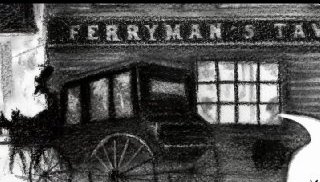

In a few instances I would draw directly from a photograph, or an engraving from Harper’s Weekly (“The Journal of Civilization”!) but more often than not, I “digested” the pictures and let them evolve in my imagination before drawing the finished pages of Sailor Twain.

Occasionally, some face in an old daguerreotype would strike me deeply, a beautiful face, or a mournful pair of eyes, and I would bring that person into the story, if only in the background. But I don’t think the story really took its cues from archival photos; everything I found seemed pressed into the service of the story, rather than the other way around.

The art has a mix of Gothic and impressionistic elements, with a few dips into the playful. (Lafayette, that nose! Twain, those eyes!) How did you settle upon the haunting, mystical tone of the images?

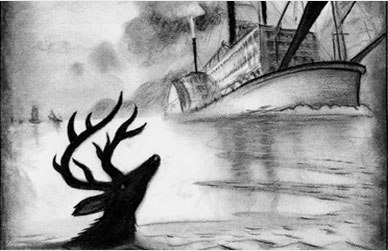
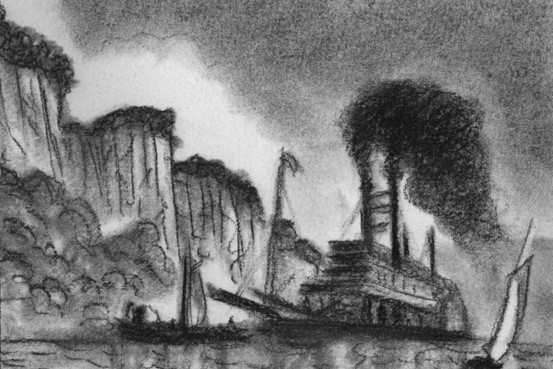
 There’s something I love about comics, something they can do which movies can’t too easily: mixing styles in different registers, blending for instance realistic characters with more cartoon-y ones.  Since I worked in charcoals, everything was unified by the shading; but within the smoky, smudgy, steamy atmosphere of it, there are some characters who are very naturalistic, others very iconic, almost geometric, like Captain Twain himself.  The mermaid, oddly, looks much more realistic than he is.

I was hoping for a mystical, haunting mood for the Hudson in this very stormy summer of 1887… Again the magic of charcoal lent a fog-shrouded quality, a bit like classical Chinese painting, where things appear and disappear in the mist…

And I enjoyed sabotaging some of the more serious moments with humor. Like in an early dramatic plot point, when the Captain finds a wounded mermaid, bleeding on his deck one night, and tries to pick her up—as it turns out, she is quite slimy and slippery and she slips through his arms and bonks her head on the floor.  Talk about killing the romantic buzz.   I like being able to go playful, then serious again, visually and narratively.

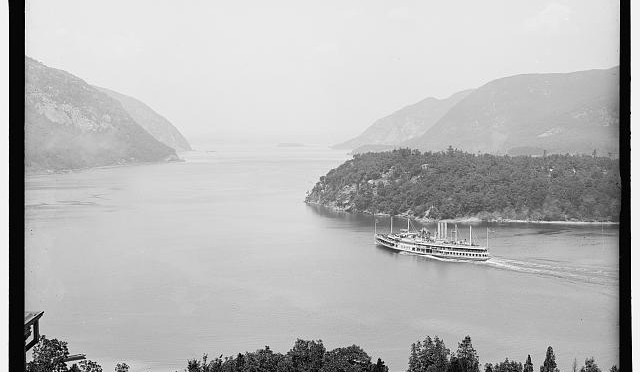
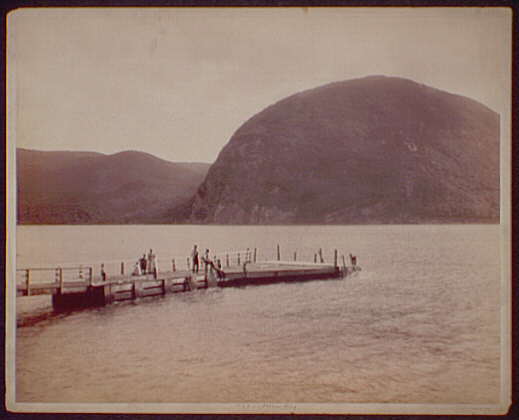
Storm King Mountain, circa 1890, from a photograph by William Henry Jackson (courtesy LOC)

Mermaids may not actually be living in the Hudson, but there are plenty of other urban legends associated with the Hudson River Valley. Any that are your particular favorite? 

 Mermaids may not be living in the Hudson, you say… But treacherous currents alone can’t account for all the shipwrecks at World’s End, just south of West Point Academy!

 But you’re right, there are so many great legends up and down the Hudson River Valley… The stories about Spuyten Duyvil; the supposed origin of the term “cocktails” in an Elmsford tavern where drinks were served with a cock’s feather in them (not true, I am told); the ghosts and various spirits attached to some of the Hudson mountains, like Storm King and Anthony’s Nose; of course I have a soft spot for Sleepy Hollow and Rip Van Winkle… I also like the one about Henry Hudson and the Catskill Gnomes.


Categories
Bowery Boys Bookshelf

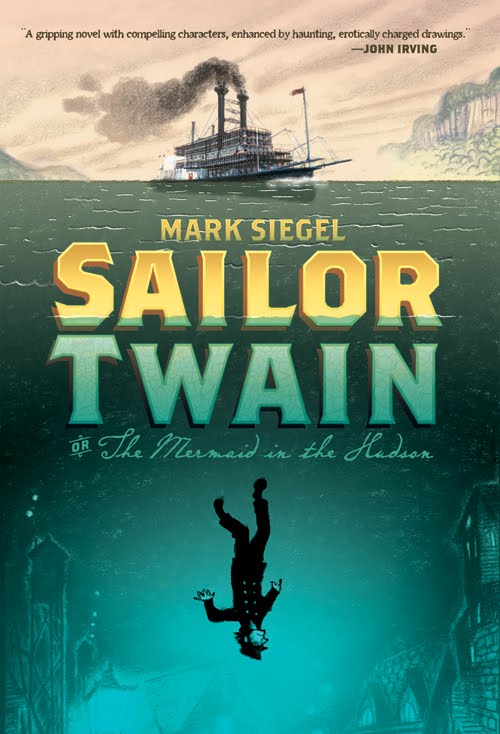
‘Sailor Twain’ : A mystery at the bottom of a haunted river (Bowery Boys Book of the Month)


We’re trying out a new feature here on the blog by debuting our very first ever Bowery Boys Book of the Month selection!  Each month I’ll pick a book — either brand new or old, fiction or non-fiction — that offers an intriguing take on New York City history, something that uses history in a way that’s unconventional and different or exposes a previously unseen corner of our city’s complicated past.  Then over the next month, I’ll run an article or two about some of historical themes that are brought up in the selection. 

For the inaugural selection, a page-turning graphic novel that turns to the Hudson River’s 19th century steamship trade for inspiration…..

Sailor Twain, or The Mermaid In The Hudson
by Mark Siegel
First Second Books

Something lurks in the waters of the Hudson River in Mark Siegel’s moody new graphic novel.

“Sailor Twain; or the Mermaid In The Hudson,” shaded darkly and finely formed out of moody atmosphere, is an ethereal rumination on American urban legend, borrowing from history to create myth.

The Lorelai is a passenger steamship delivering Gilded Age passengers along a bustling Hudson riverfront in 1887, with the major city in New York Harbor ever at its root.  It untethers northward along a river famously known for strange secrets which lurk beneath its currents.

Elijah Twain has a familiar name for a steamboat captain in the late 19th century. “Are you related to the writer?” asks a fine lady.  “That’s not his REAL –” Twain attempts to explain before being interrupted by the boat’s owner, a French Lothario named Lafayette.  (I can’t help but think that this dandy is a nod to another historical figure, the Marquis de Lafayette.)

Their vessel the Lorelai, named for the famous siren who led sailors to their deaths, travels up and down the Hudson through murky and sometimes surreal waters, inviting to eccentric passengers and otherworldly specters alike..

Books mysteriously appear, as do two ghostly little boys.  Lafayette’s unexplainable lust for female passengers seems connected to his brother’s recent suicide.  Twain’s own moodiness derives from his wife Pearl, bedridden at home and seemingly a distant reality away.

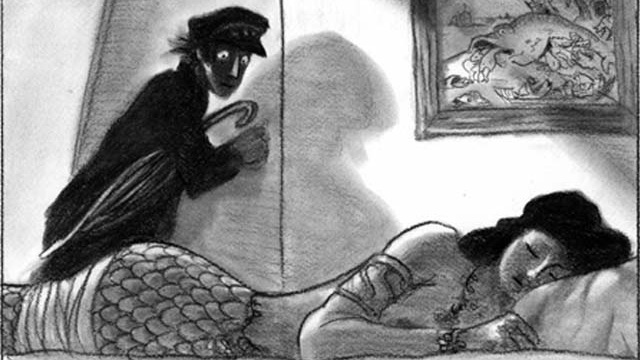
One evening Twain discovers what appears to be a woman who’s fallen overboard.  He lifts her to the deck to discover she’s a mermaid, naked down to her scaly fins and severely injured.  He secrets her away to his room, where the creature slowly casts an erotic spell over the captain.  Even his cabin is affected by her charms as ghostly seaweed slowly breaks through the floor.

Lafeyette’s randy exploits and Twain’s mysterious guest have a very sinister connection, potentially revealed by a book — inexplicably popular with New Yorkers — of local occult stories “Secrets and Mysteries of the River Hudson” by the reclusive C.G. Beaverton.  The author soon boards the Lorelai during a book tour and proves to carry secrets too scandalous even for print.

The heavy, charcoal-like images are a perfect complement to the story.  The Hudson River, as illustrated by Siegal, seems like the end of the earth, a world so choked in mist that it feels like the artist’s ink will rub off on your fingers. Siegal presents a lush, romantic view of historical New York, at equal points comic, erotic and melancholy. Some faces are cartoonish, others delicately real.  The art holds the mood as the story unfurls, from Gothic romance to horror parable.  It felt like a fog was rolling in each time I opened the book.

The moments where ‘Sailor Twain’ enters 1880s New York — from its cabarets and saloons to even Steinway Hall on 14th Street — are moments where sun and nostalgia briefly shine, before (and I mean this literally) submerging the main characters into the Hudson itself, entering a world H.G. Wells might have imagined.

We get to see the table of contents of Beaverton’s book, a fictional tome which promises other mysteries of the Hudson River Valley: famous shipwrecks, Indian legends, the ‘Wood People of Pocantino Hills’ and even cigarette-smoking ghosts.  Perhaps Siegel’s ‘Sailor Twain’ is just the first illustrated chapter of a whole menagerie of mysteries?

TOMORROW: A few questions with the creator of ‘Sailor Twain’ Mark Siegel!

Categories
Know Your Mayors

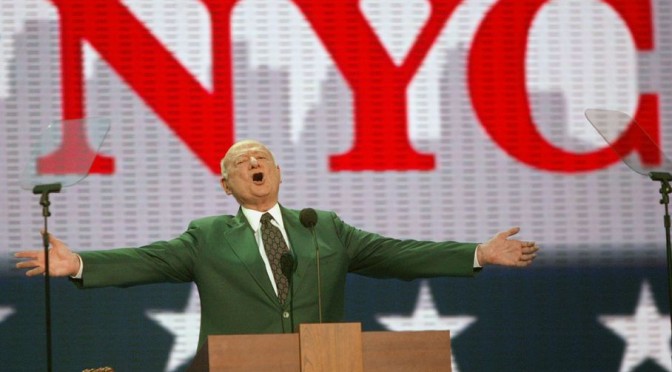
Ed Koch, the 105th Mayor of New York, 1924-2013

Koch in 2004 at the Republican National Convention which was held in New York City. Photo by Joe Cavaretta, courtesy the Associated Press

Did you know Koch already had his gravesite already picked out (at Trinity Church Cemetery) and had even erected the tombstone? More info in my 2011 article on where all the New York City mayors are buried.

Categories
Landmarks

Grand Central Terminal’s Ten Greatest Moments on Film

Grand Central Terminal has seen millions of people rush across its Main Concourse over the past one hundred years, and more than a few movies have captured that commuter ebb and flow.  But while Grand Central is occasionally a backdrop for romance — especially during World War II, when returning soldiers would arrive to meet their loved ones — filmmakers have preferred to capture a darker aspect to the landmark.

The Beaux-Arts train station has become an ideal location for thrillers, mysteries, fantasies and horror films, a backdrop for chases and a metaphor for chaos and disorientation.  In the movies, its concourse feels even more cavernous and mythic, its train tunnels havens for the unknown.

During its first half-century, Grand Central was known mostly for its trains — in particular, the Twentieth Century Limited, the luxurious passenger locomotive that attracted the most famous people in the world.  In fact, the most common place to see a celebrity in the 1930s and 40s would probably have been Grand Central, watching politicians and stars boarding the most famous train in the world.

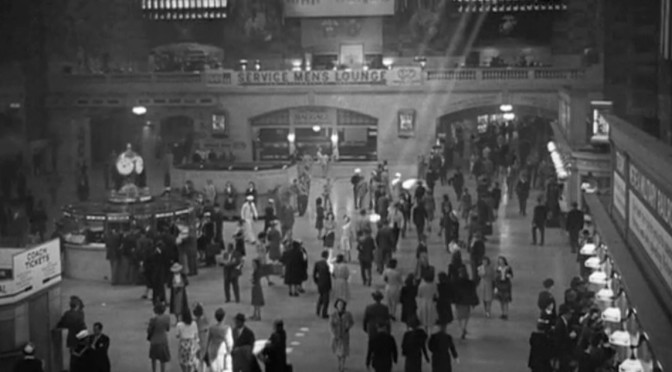
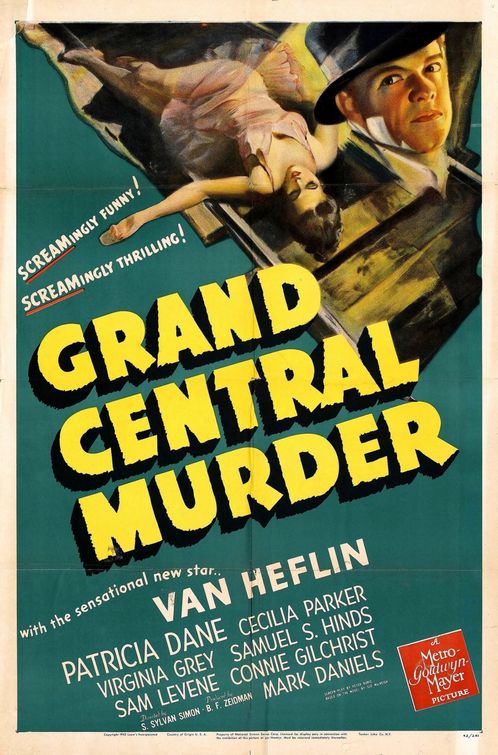
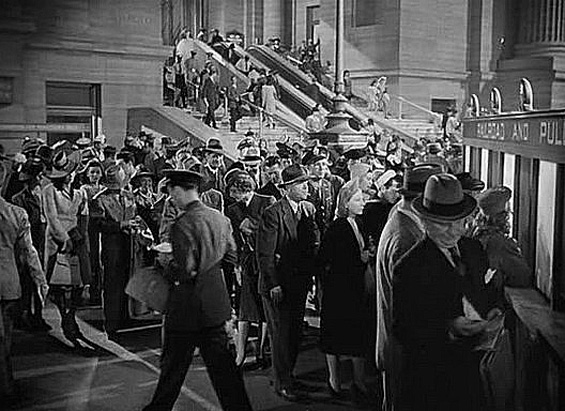
So it’s no surprise that Grand Central’s most notable early film appearances relate to the Twentieth Century, including, of course, Twentieth Century, the ribald 1934 comedy that made Carole Lombard a star.  Other glamorous features of this era — including Grand Central Murder (1942) and The Thin Man Goes Home (1945) — use Hollywood reconstructions of Grand Central as a backdrop.

Below: A phony version of Grand Central Terminal used in the film The Thin Man Goes Home. (Courtesy On The Set of New York)

As the train station deteriorated after the 1950s — as train travel itself fell into disregard — Grand Central became a darker, dangerous place in the movies. The travelers, the commuters, are now a backdrop for chase scenes and violent shootouts, homeless people and even psychos stalking the yellowing, banner-filled concourse of the 1970s and 80s.
Its rehabilitation in the 1990s brought monumentality back to Grand Central and brought it back to the movies as a place of respect and beauty. I would never recommend you watch the remake of Arthur starring Russell Brand except for this particular scene which demonstrates the Terminal’s remarkable transformation.
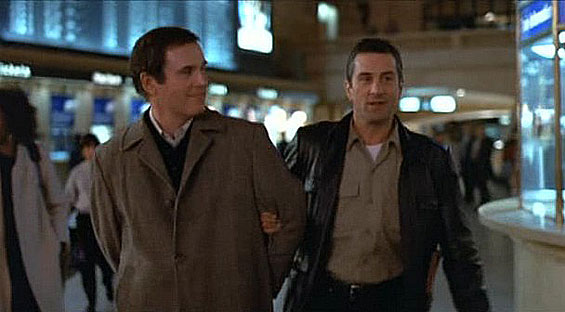
Grand Central makes a brief appearance in the 1988 comedy Midnight Run with Charles Grodin and Robert DeNiro. (Courtesy On The Set of New York)


Here are my personal choices for Grand Central’s top ten moments in cinema.  I’m sure I’m forgetting a few choice ones, so please add them in the comments section if they come to mind:

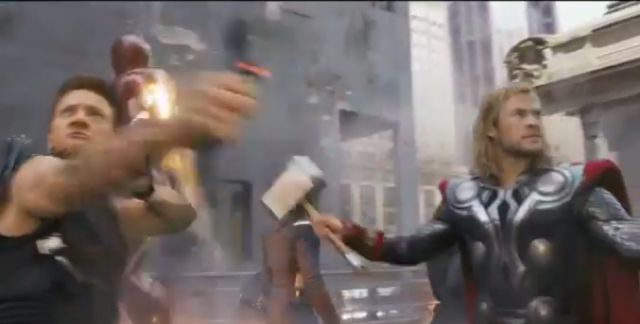
10 The Avengers (2012)
The Terminal as a fortress, a hall of justice.  The MetLife Building behind it is completely dismantled and replaced with Iron Man‘s new headquarters, but nobody would ever think of doing that to Grand Central. In fact, our heroes fight inter-dimensional aliens right in front of it, their phalanx mounted on the overpass below.  As Earth’s finest stand in akimbo waiting for the attack, the statue of Cornelius Vanderbilt stands equally defiant in the background.  (For another sci-fi use of Grand Central’s exterior, see Will Smith in I Am Legend.)

9  Necrology (1971)
The building has inspired the avant garde as well.  Years after Andy Warhol turned his camera to the Empire State Building, experimental filmmaker Standish Lawder found supernatural inspiration inside Grand Central for this odd little film ostensibly about the afterlife.  Stay for the credits.

8 Spellbound (1945)
This isn’t even Alfred Hitchcock‘s best film usage of Grand Central (see below), but it’s notable in that both Grand Central and Pennsylvania Station are used in this psychological thriller starring Ingrid Bergman and Gregory Peck.  I can’t recall any other film that would have included both iconic New York landmarks. With this film, Hitchcock also playfully mocks Grand Central’s wartime reputation as a place for departing lovers, even while giving into those romantic impulses.

7 The House on Carroll Street (1988)
This somewhat unsuccessful thriller (with a spectacular cast) is notable for its creativity involving a climactic chase scene up in Grand Central’s inaccessible upper tiers.  You can see a little bit of it in this trailer:

6 Superman (1978)
Lex Luther’s secret lair, eccentrically decorated, is hidden in a forgotten tunnel underneath Grand Central.  His lackey Otis (Ned Beatty) is tracked to the concourse by police officers, but Luther has set a deadly trap for one of them.  Another reason not to roam the tracks by yourself!

Later, the super villain waxes about the benefits to his Grand Central lair as the trains rumble overhead.

5 A Stranger Is Watching (1982)
Had Lex not been defeated, he would have been sharing the tunnels with the maniacal killer of this schlocky thriller, based on a novel by Mary Higgins Clark.  While this movie is pretty bad, Grand Central is used to superb effect, a veritable haunted house of dark tunnels and abandoned elevators.  There’s even mention of Franklin Delano Roosevelt’s secret elevator!

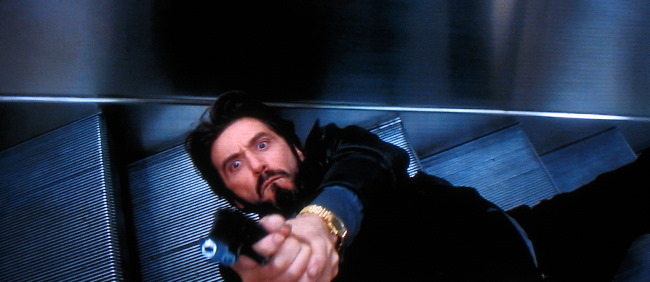
4 Carlito’s Way (1993)
The famous escalator shootout scene (it’s Battleship Potemkin-meets-violent cop show) is probably the goriest scene ever filmed directly in Grand Central, topped by Carlito (Al Pacino) running to meet Penelope Ann Miller.  Let’s just say, he misses his train.  Watch the scene here.

3 Seconds (1966)
This bizarre John Frankenheimer drama starring Rock Hudson uses Grand Central Terminal (and a unique camera angle) to set the film’s off-kilter and twisted perspective.  It becomes the crossroads where opportunities of a second chance are literally handed to you, if you dare to take them.

2 The Fisher King (1991)
Having hosted various mentally disturbed escapades in prior films, we now get to look in on an actual Grand Central fantasy in this Robin Williams film, as the deranged hallucinations of his character turn the bustling room into a glorious dance floor.

1 North By Northwest (1959)
Has Grand Central Terminal ever looked as beautiful as it does in this pivotal scene from Hitchcock’s great 1959 masterpiece?  It gives Cary Grant opportunities to be suave, pensive and fabulous all at once.  It also embodies the tension and danger that would influence other filmmakers in later years to come to Grand Central for inspiration.