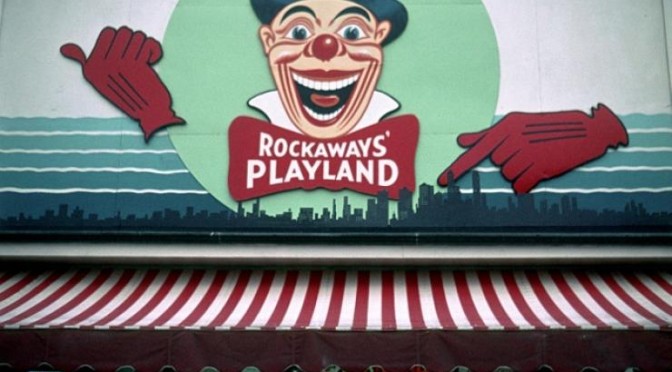
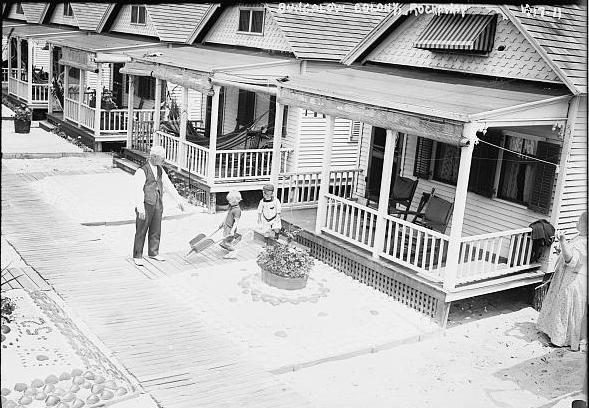
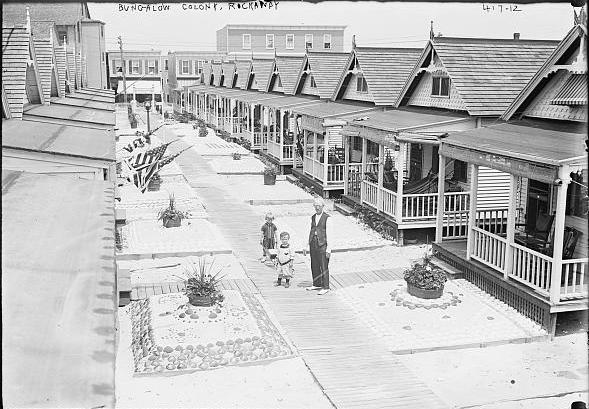
The entrance to Rockaways’ Playland in the 1960s, one of the more nostalgic reminders of an era in the Rockaways gone by. (Image courtesy the blog Sand In Your Shoes)
PODCAST The Rockaways are a world unto its own, a former resort destination with miles of beach facing into the Atlantic Ocean, a collection of diverse neighborhoods and a truly quirky history.
Retaining a variant of its original Lenape name, the peninsula remained relatively peaceful in the early years of New York history, aland holding of the ancestral family of a famous upstate New York university.
The Marine Pavilion, a luxury spa-like lodging which arrived in 1833 featuring the new trend of ‘sea bathing’, opened up vast opportunities for recreation on the peninsula, and soon Rockaway Beach was dotted with dozens of hotels, thousands of daytrippers and a even a famous amusement park.
Not even the fiasco known as the Rockaway Beach Hotel could drive away those seeking recreation here, including a huge population of Irish immigrants who helped define the unique spirit of the Rockaways.
The 20th century brought Robert Moses and his usual brand of reinvention, setting up the Rockaways for an uncertain century of decreased tourism, urban blight and uncommon solutions to preserve its unique identity.
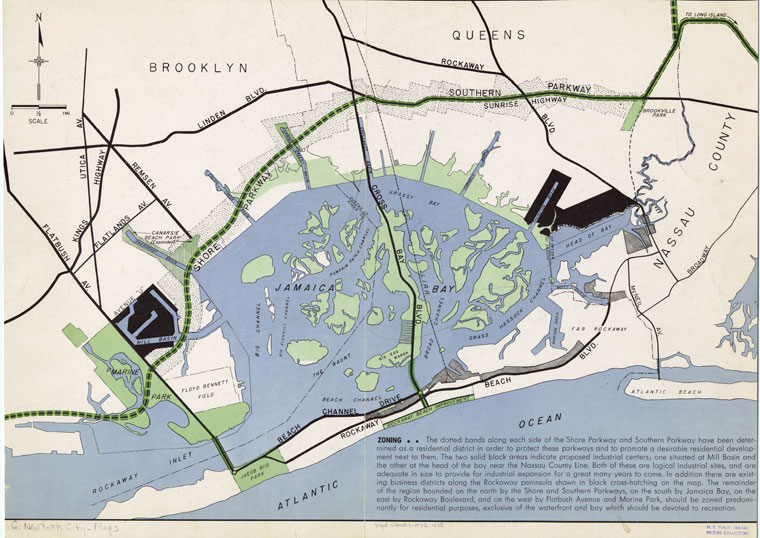
A zoning map of the Jamaica Bay region from 1937, featuring the Rockaway peninsula. A few interesting things to note about this, including: 1) no Idlewild Airport at this time, but Floyd Bennett Field was still in operation, 2) Rockaway Beach Improvement, 3) Everything west of Jacob Riis Park is basically ignored. [source]
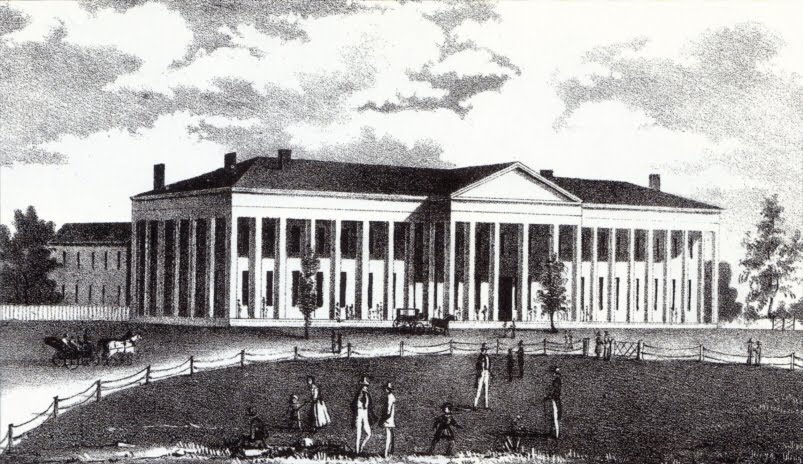
The Marine Pavilion, the first significant resort destination in the Rockaways, introduced the notion of sea bathing to New Yorkers and attracted famous writers and actors to this peaceful area. [Courtesy Rockaway Memories]
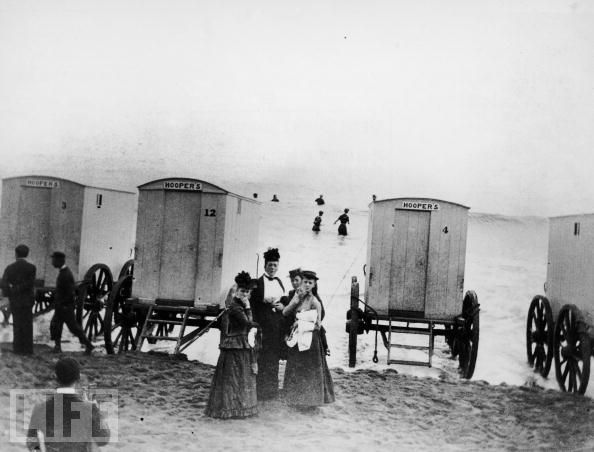
This is not an image from the Rockaways, but ‘bathing machines’ like these were most certainly used in the early days of Rockaway Beach.
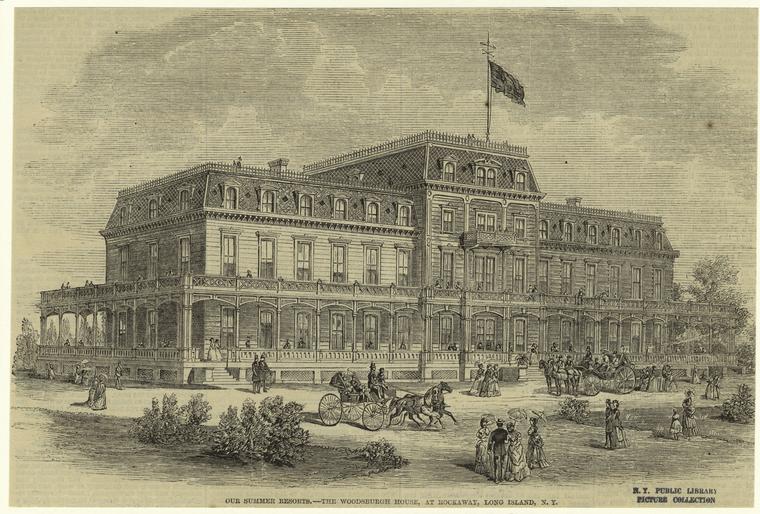
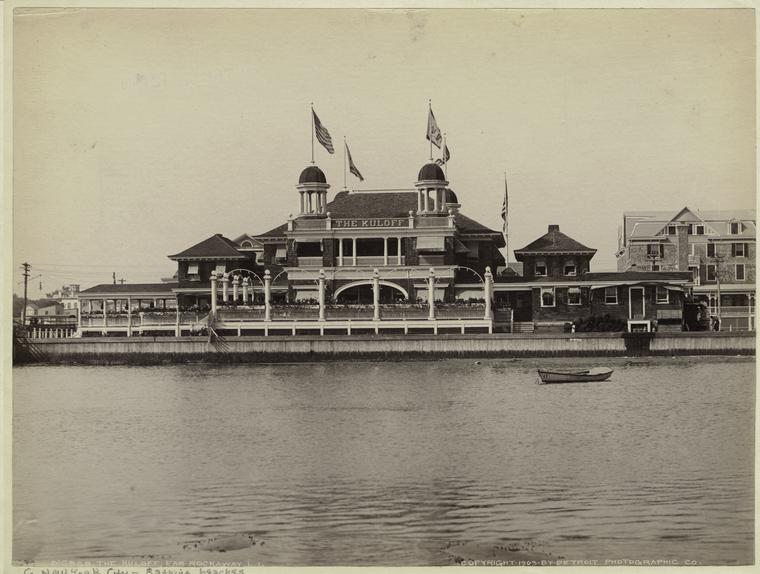
A couple examples of hotels that once filled the peninsula during the late 19th century, early 20th century, the Woodburgh House (at top) from 1870, the Kuloff (at bottom) from 1903.
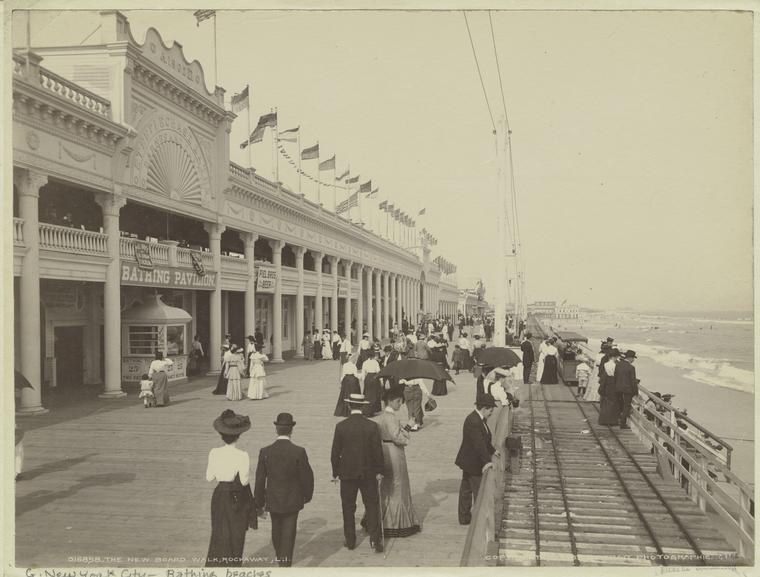
The boardwalk from 1903 in front of or near a section of Steeplechase Park, I believe, judging from the mini-railroad tracks along the side. [source]
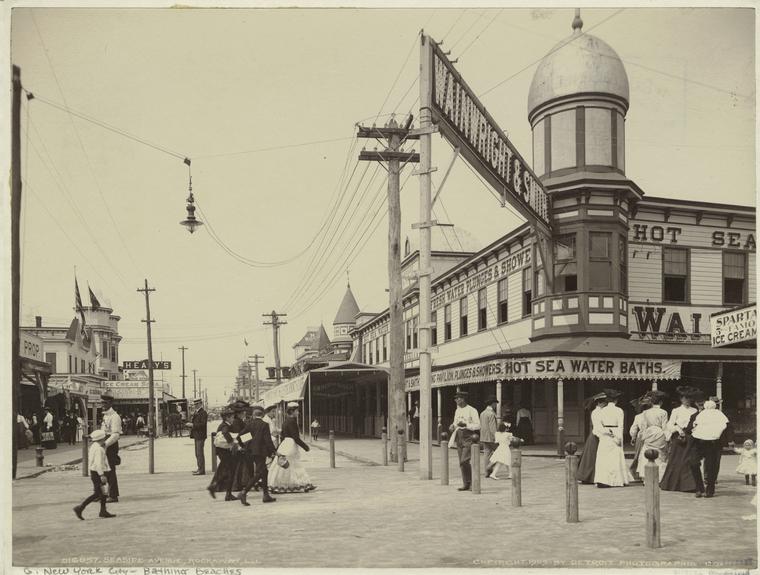
Along Seaside Avenue, possibly depicting an area of ‘Irishtown’, in 1903, rebuilt after a devastating fire the decade previous.
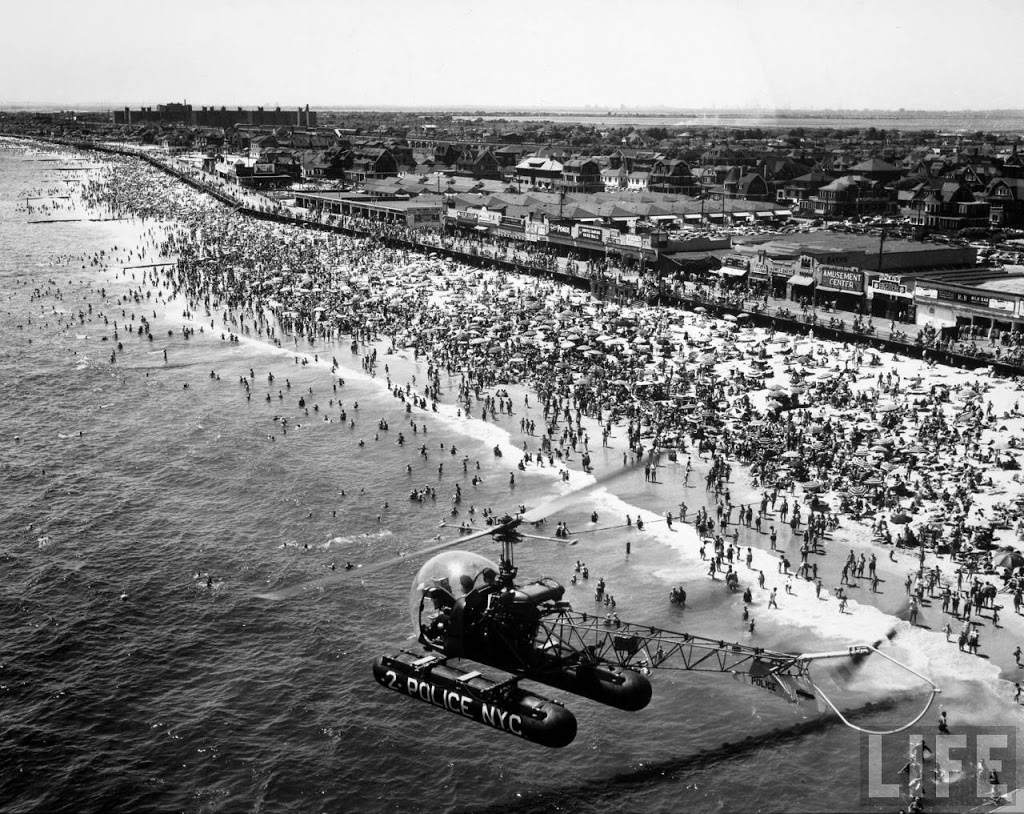
The 1950s began a long era of difficulties for the Rockaways, but you wouldn’t know it from this summertime Life Magazine photo from 1956. Click into the image to inspect some of the interesting and long-vanished shops and amusements along the boardwalk.
This almost-ghostly skeleton of a high-rise housing development never built stood for years as the residents of neighboring Breezy Point successfully fought to kill that project and other intrusive plans by the city in the late 1960s. Picture courtesy Arthur Tress/US National Archives.
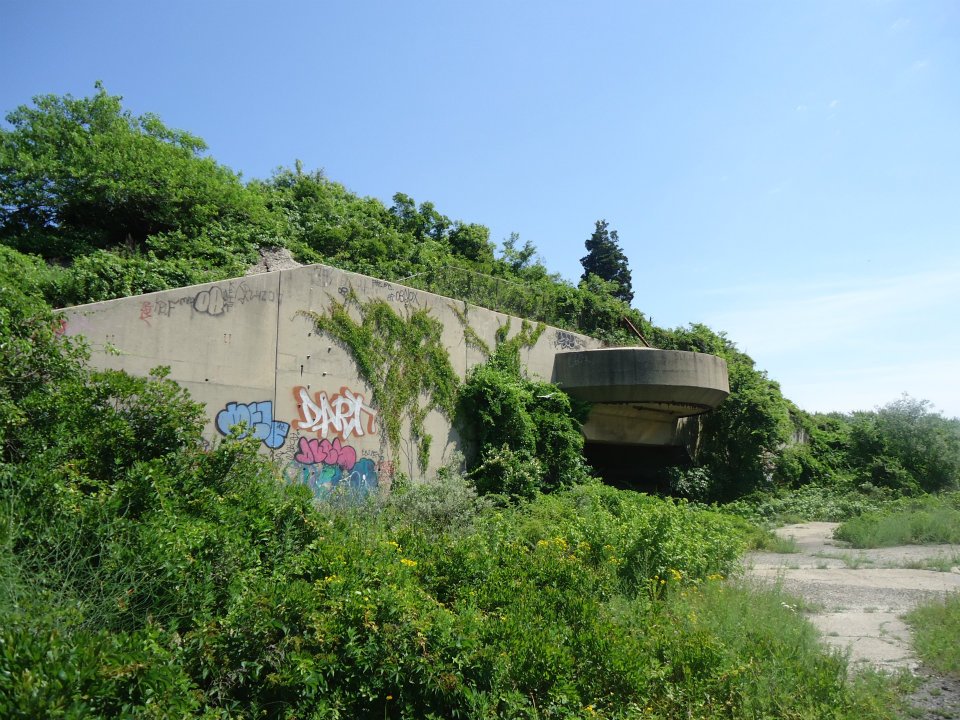
The mysterious remains of old Fort Tilden, now part of the Gateway Recreation Area and completely taken over by nature. For many more pictures of this area, please visit our Facebook page and check out my photo album on the ruins of Fort Tilden.
The thrashing waves of Rockaway make for good surfing:
And, what posting about the Rockaways would be complete without:
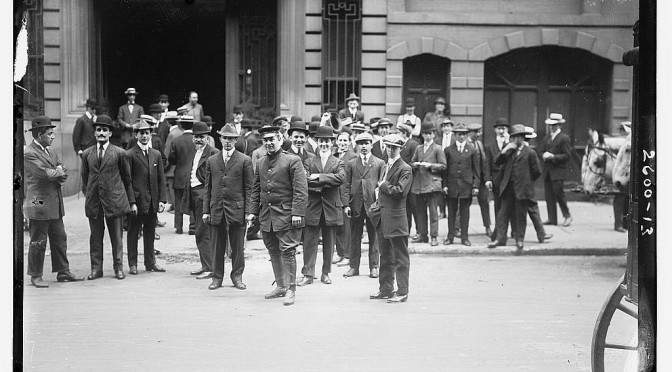
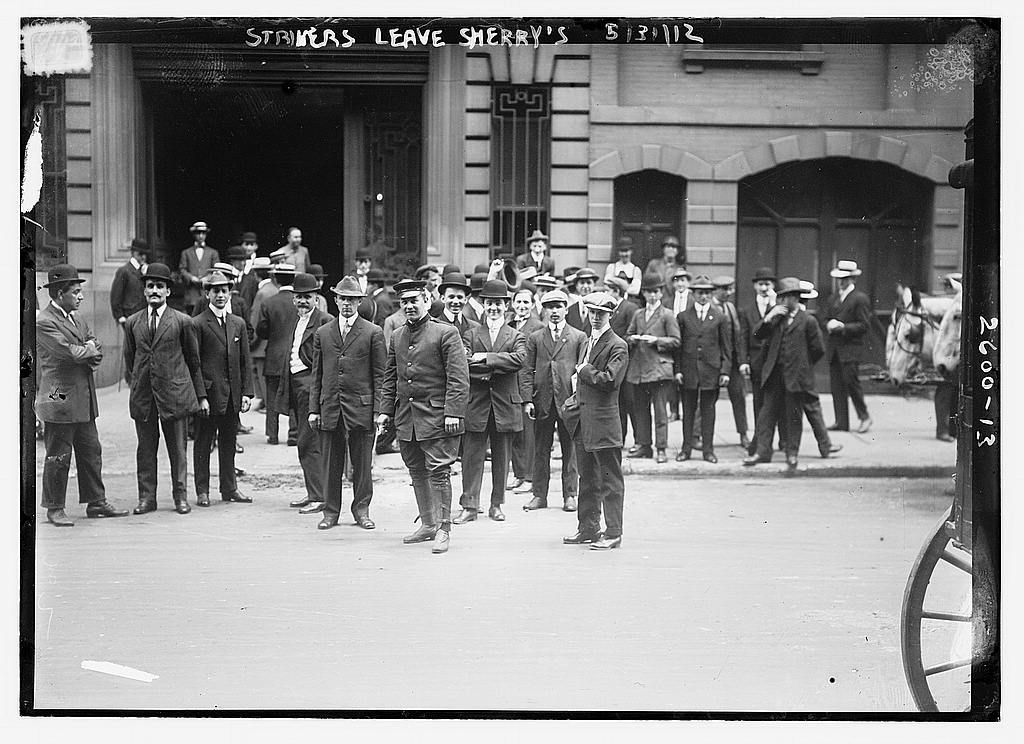
Above: Restaurant workers walk off the job at Sherry’s Restaurant at Fifth Avenue in 1912
One hundred years ago today, a rather peculiar worker’s strike ended, a protest which had paralyzed New York’s restaurant and hotel industries for almost two months. The strike had begun in early May, and by the month’s end, thousands of employees had walked off their jobs, leaving diners in emptied restaurants and wealthy hotel guests to carry their own luggage.
What made this particular walkout unusual weren’t the demands — improved conditions and pay, recognition of their newly formed union — but the locations where the strikes occurred. The employees of the very toniest and best known restaurants and hotels left their jobs in unison. Establishment affected includedthe Plaza, the Hotel Astor, Hotel Knickerbocker, the Waldorf-Astoria, the St. Regis, the Vanderbilt, and restaurants like Delmonico’s and Sherry’s (pictured above), among dozens of others.
Workers decided to return to work after a mass gathering on June 25, at the old New Amsterdam Opera House at 44th Street and Eighth Avenue. While some employers agreed to a few paltry changes, most of the strikers demands were not met, including the recognition of their union. (And to this day, they’re not unionized.)
Some hotels actually refused to hire back anybody who had join the strikers. Or as the proprietor of the Waldorf put it: “I told these men that a job at the Waldorf is not an apple hanging on a tree. I told them that we were doing better than ever, then I told them goodbye.”
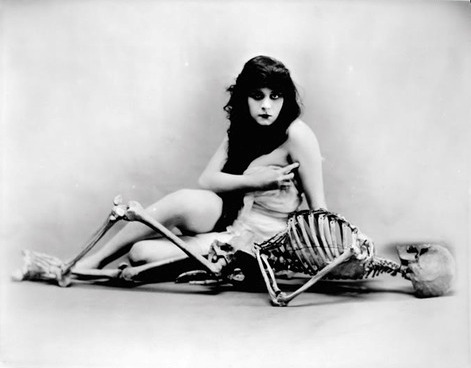
Maneater: Theda Bara in an unconventional portrait. Her publicist claimed it was her lover and that ‘not even the grave could separate them’.
“A vampire is a good woman with a bad reputation, or rather a good woman who has had possibilities and wasted them” — Florenz Ziegfeld
Progressive, liberated women were clearly so frightening one hundred years agothat equating them to undead, bloodthirsty creatures borne of Satan didn’t seem so unusual.
In the late 1910s, women were on the verge of winning the right for equal representation in the voting booth. Women were asserting power in unions, and, in the wake of disasters like the Triangle Factory Fire, those unions were influencing government policy. They were taking control of their destinies, their fortunes, even their sexuality (Margaret Sanger‘s first birth control clinic opened in 1916).
This surging independence came just as the entertainment industry heralded the female form as one of its primary attractions. Ziegfeld’s sassy, flesh-filled Follies — and its many imitators — defined the Broadway stage, mixing music, sex and glamour with a morality-shattering frankness.
But it was the birth of motion pictures that gave the allure of female bodies an unearthly, flickering glow, as nickelodeon shorts became feature-length films, and the first era of the movie siren was born.
Combine the power of liberation with the erotic potential of cinema, and in the late 1910s, you got the vampire (or as we would come to know, the ‘vamp’).
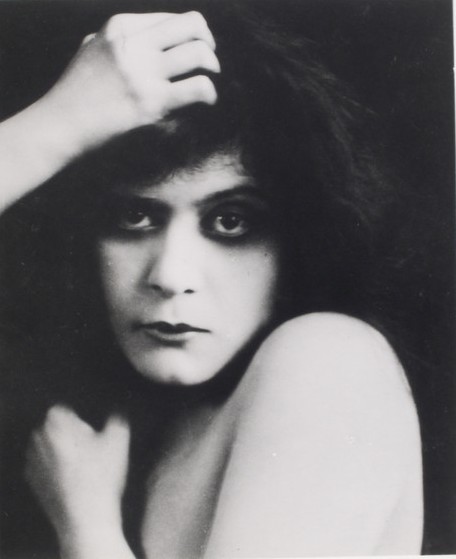
The queen of the vamps was one of America’s most mysterious movie stars — Theda Bara (at left). The magnetic actress, with her steely gaze and jetblack hair, was the prototype for a movie bad girl. She shook convention so dramatically that a critic called her a “flaming comet of the cinema firmament.”
From 1915-1919, she made over three dozen films, most in movie studios located in Fort Lee, New Jersey. It were here that she acquired her famous nickname, based upon her role as a home wrecker in a film inspired by Rudyard Kipling’s ‘The Vampire’. During this period, Bara lived in Manhattan’s Gramercy Park with her family — at 132 E. 19th Street.
She put a face to a new sort of young lady. These were the spiritual children of the prior generation of newly empowered women who fought against the constraints of Victorian society. A few years later, as another vein of female power (the temperance movement) helped bring about Prohibition, these young women would be called flappers, carefree and fueled on the powers of jazz and illegal alcohol.
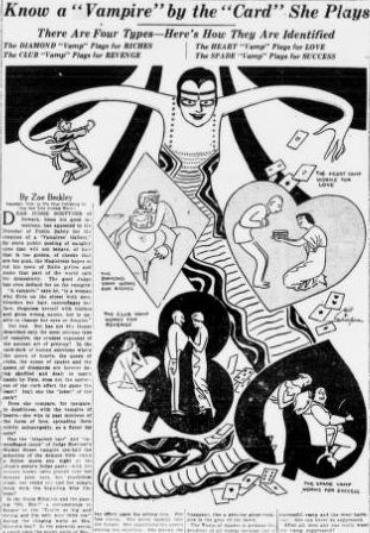
But to the established class, these ladies weren’t trend-setters. They were devils in black gowns. ‘Know a ‘Vampire’ by the Card She Plays‘, warned a New York Evening World article from March 1919, accompanied by a Theda Bara-like illustration of a snake-like monster.
The article recounts the efforts of a Newark judge attempting the rid the streets of “flirty girlies,” as he called them. “A vampire is a woman who flirts on the street with men, bleaches her hair, camouflages her face, disguises herself with clothes and gives wrong names, but is unable to change her eyes or dimples.” The article laughs off his puny efforts. “Can vamps, of whatever sort, BE suppressed?”
Vampires were of course more readily seen in Times Square, dancers, actresses or cabaret stars. But even your stenographer could be one!, warned one article.
Unlike Bara’s iconic identity as a raven-locked seductress, most ‘real’ vampires were blondes. “[T]he vampire of real life hath the golden hair of an angel, which is never disarranged, same when she letteth it down, to DISPLAY it, on the beach,” warned columnist Helen Rowland, with a little tongue in cheek. (Ms. Rowland was famous for her writings as a ‘bachelor girl’.)
“No one ever saw a vampire in a high neck dress,” said an Evening World advice columnist in 1918. “All vampires must reveal their collar-bones and the contiguous territory.”
The woman vampire was an urban creature, up all night, sleeping all the day. The city was partial cause for her condition. As the New York Times suggested in 1920, “The idea of New York as a vampire to the rest of the country is one which a number of persons have entertained and expressed. To some of them the vampire is Wall Street, to others it is the region of white lights [Broadway].”
Many actress got stuck with the term ‘vamp’ or ‘baby vampire’ — or else, embraced the coy terminology. Juliette Day was a known ‘baby vampire’ for her role in the scandalous 1916 play ‘Upstairs and Down’. It’s no surprise that in the film version from 1919, the role is reprised by the notorious Olive Thomas, a Ziegfeld girl who met a bitter end the following year.
Some actress fought against the alleged stigma. Actress Clara Joel, playing a vampire-type role in a 1918 film, made it known in the Tribune that “she is not a vampire and that she was born in Jersey City.”
The irony of stage actresses trying to shed a vampire image is that Theda Bara, the original vampire, in her first stage attempt in 1920, flopped. The play was supernatural-themed ‘The Blue Flame‘ which opened at the Shubert Theater to cavalcades of unintentional laughter.(A ‘terrible thing’, according to the Times critic.) Bara, who had to deliver such lines as “Did you remember to bring the cocaine?” was roundly trashed.
Shortly thereafter, the vampire moved to Los Angeles. Her film career lasted a few more years, but sound pictures and a strict Hollywood production code pretty much eradicated the existence of vamps on the screen. In New York, meanwhile, her sultry spawn morphed into flappers, populating the speakeasies and cabaret nightclubs of the city.
Below: A 1919 romp called ‘The Vamp’ performed by the Waldorf-Astoria Orchestra
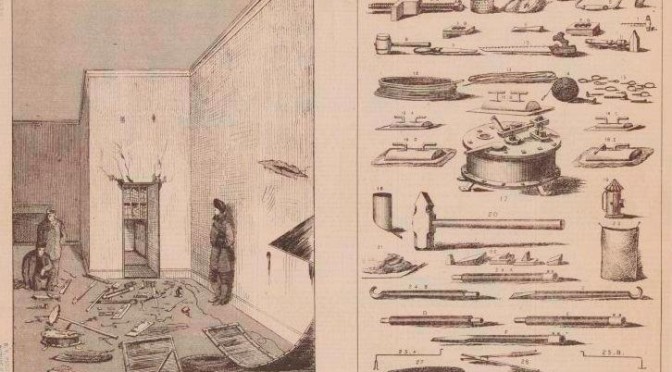
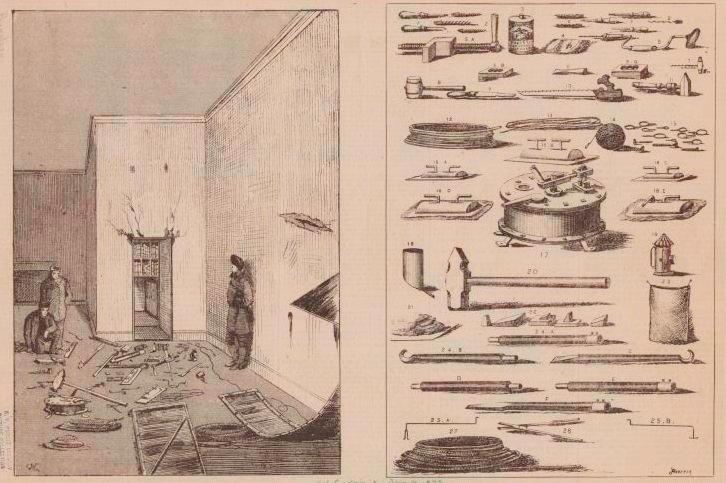
‘Red’ Leary was one of the famous bank robbers of the 1870s, assisting in heists all along the Northeast. Above is an illustration of a bank robbery in Montreal, Canada, displaying some of the tools found at the crime scene.
They don’t talk about ‘Red’ Leary anymore down in the streets of the Lower East Side. In the hipster bars and boutiques, in the graphic design firms and the Chinese foot-massage parlors, his name goes virtually unspoken.
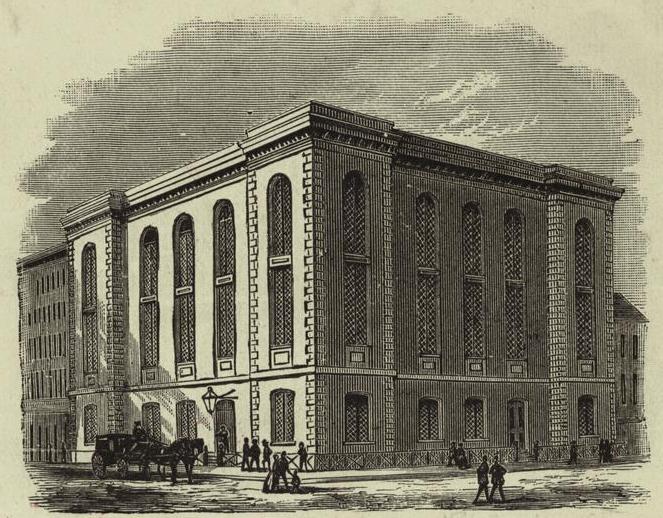
But over one hundred and thirty years ago, his unusual escape from the Ludlow Street Jail (pictured below) captivated New Yorkers, willing to overlook the rascal’s criminal misdeeds to marvel at the ambitiously planned jail break, orchestrated by his wife Kate Leary. ‘A Hero and a Burglar’ proclaimed the New York Times, appalled that teenagers were “absolutely besides themselves and exultant over the daring deed, each individual boy wishing, for the moment, that we was a Red Leary.”
John ‘Red’ Leary was one of the northeast’s most notorious bank robbers of the 1870s, frequently pairing with other known criminals of the day to pull of spectacular heists. In particular, as a part of the gang of George Leonidas Leslie (nicknamed “king of bank robbers”), Leary helped make off with thousands of dollars in stolen sums, involved in tricky operations that sometimes took years to plan.
According to Herbert Asbury, Leslie’s gang was responsible for 80% of the bank robberies between 1874-84. Not sure how that number was specifically settled on, but needless to say, as a critical member of Leslie’s operation, ‘Red’ Leary was a master at his chosen profession.
However, in December 1878, after a robbery at the Northampton Bank in Massachusetts (making off with a staggering $1.6 million), Leary was promptly captured back in New York at Second Avenue and 92nd Street, in connection with another bank robbery. It was decided to extricate Leary to Massachusetts to answer for the robbery there, so he was thrown into Ludlow Street Jail to await transferal.
Leary would be sure not to meet the same fate, thanks in part to his wife, the fiery Coney Island pickpocket Kate Leary, and some of Red’s criminal cohorts. Included among them were Shang Draper, a crooked saloon owner famous for drugging customers and shanghaiing them onto ships.
Kate had already helped her husband escape capture once before, in August 1877, when the duo eluded several officers at a hotel near Fort Hamilton in Brooklyn. A lightly guarded prison in the middle of one of the most populated neighborhoods in the world was certainly no match for a woman as determined as Kate, known as much for her intelligence as for her venality.
In May of 1879, Mrs. Leary, in disguise, rented a tenement flat next door to the jail at 76 Ludlow Street. She and her accomplices then knocked out a wall, drilling through the thick prison defenses until they broke through into the prisoner’s bathroom, perfectly timed with Red’s arrival there.
As author B.A. Botkin‘s describes: “No alarm was raised, nor was the tunnel leading to the room with its neatly piled ton of excavated brick discovered until 10:30. By that time the fugitive was on his way to Coney Island in a light truck.”
As a judge has explicitly stated that Leary would probably try to escape, the clean extraction of the high profile criminal elicited mocking scorn at the jailers and officers involved. Saving face, Ludlow officials declared Leary’s assisted release was “one of the most daring and skillfully-planned affairs of the kind to ever occur in the city,” “executed by shrewd and bold criminals.” [source] The Ludlow jail would never really shake its, shall we say, porous reputation and was eventually demolished in the 1920s. Both the jail and the address 76 Ludlow Street would make way for Seward Park High School (pictured below, from 1930)
So dramatic was the 1879 Ludlow prison break that Leary and his crew were soon turned into folk heroes by the more rebellious residents of the Lower East Side. For this reason, the Leary escape is sometimes listed as a New York urban legend. But in fact, newspapers of the day spilled over with reports of the bold getaway.
According to Botkin’s 1956 book ‘New York City Folklore’, the legend of Red Leary even briefly entered sports vernacular. “So celebrated did the exploit become, that …. [a] coach who wanted to instruct a player to break loose and steal a base simply yelled, “Red Leary!“
And so our little history podcast experiences a little bit of a historical milestone itself.
Five years ago today, Tom Meyers and I sat down to record our very first podcast, over a bottle of wine and some brand new recording equipment. That first episode went by the unfortunate and unoriginal name ‘New York ‘Cast’, a name which we abandoned in the second show, having been suddenly inspired by a certain well-dressed street gang described in Herbert Asbury’s ‘Gangs of New York’. This blog came along a couple weeks later.
The first topic of our first show was Collect Pond and Canal Street. We re-explored the topic to far more interesting effect in our 50th episode.
Hopefully you’ll indulge us over the next few weeks as we look back on some of our big moments and give nod to some of the history we’ve already discussed.
I’m also using this occasion to launch a couple other Bowery Boys projects later this summer. The first should be ready to go starting late next month!
We’ve recorded 139 shows, with number 140 coming up next week. Although I’ve recorded a few solo shows — and there have been a handful with special guests — the most popular have featured both myself and Tom. If you haven’t yet listened to the podcast yet, give it a try! Go to iTunes and download a few shows.
Here’s a list of what I would consider our most successful episodes — either by number of total listens/downloads or by the overall quality of the program. If you wouldn’t mind, please vote for your favorite. This will help us come up with new ideas for the rest of the year.
Below: Take our poll!
The Bowery Boys: New York City History podcast: What’s your favorite episode?
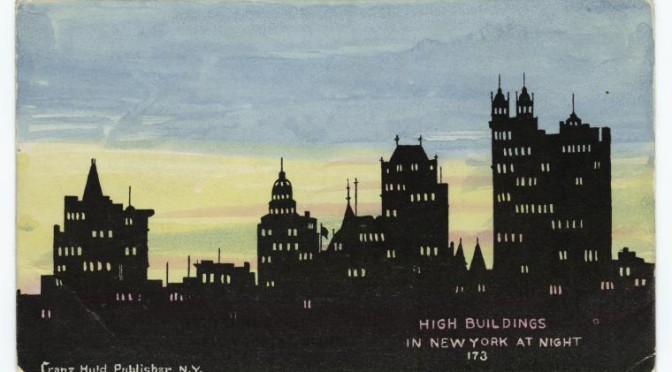
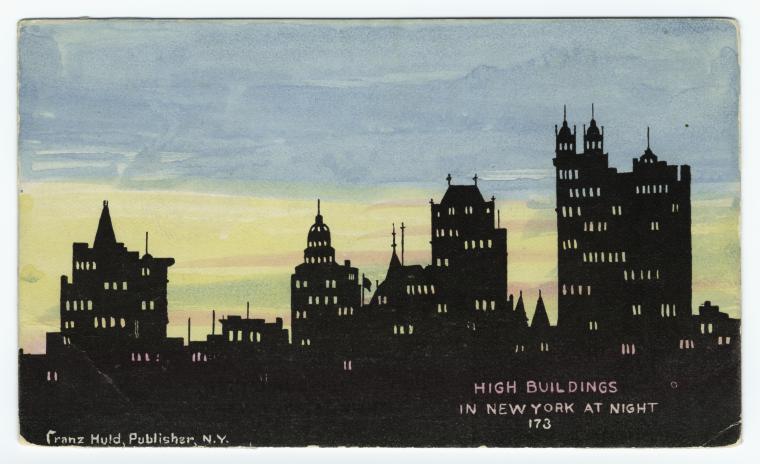
At top: A rather unconventional looking New York City skyline. ‘High buildings in New York at night.’ Turn of the century postcard, courtesy the New York Public Library
WARNING The article contains a couple spoilers about last night’s ‘Mad Men’ on AMC. If you’re a fan of the show, come back once you’re watched the episode. But these posts are about a specific element of New York history from the 1960s and can be read even by those who don’t watch the show at all. You can find other articles in this series here.Â
And so, in the end, we find that the biggest historical influence within the fifth season of ‘Mad Men’ wasn’t a race riot, a Southeast Asian war, a counter culture movement or a reduced hemline. It was Sylvia Plath.
(This article is so spoiler-y, that I’m placing the rest of it after the jump) Â
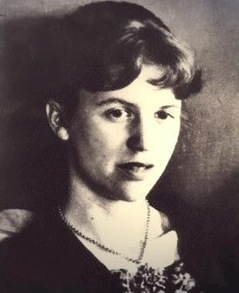
The tortured poet is not mentioned a single time in the final episode. (Although she was clearly nodded to in the episode entitled ‘Lady Lazarus‘.) But the themes of her only novel, The Bell Jar, partially set within the publishing world of New York, unfurled throughout this entire season of ‘Mad Men’ in a variety of ways, manifesting in the fragile, even scarred, mentality of several characters. The novel, originally published in 1963 under a pseudonym, was finally released under her own name in the same year the fifth season of ‘Mad Men’ ends — 1967.
The season evokes Plath not only literally (with the suicide of Lane Pryce) but figuratively among the psychic states of the ‘Mad Men’ women, dealing with anxieties brought about by male chauvinism (Peggy), sex (Joan), career (Megan) and body image (Betty). Then there’s the abuses upon Sally Draper, presented with several clumsy introductions to adulthood this season, enough to drive her to the prescription drugs her grandma so inappropriately gave her.
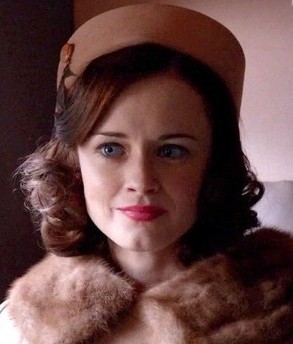
Episodes this season have plunged abstractly through the recesses of the mind — chemical experimentation (with LSD), spiritual enlightenment (with the Hare Krishnas), even feverish hallucinations (Don Draper‘s strange murder evening).  And finally, bluntly, a most surprising cruelty — the submission of one character to electroshock therapy, a drastic antidote to her ‘feeling blue’ that literally leaves her blank.
That character, Beth, pines for some reason for Pete Campbell, who’s been stubbornly transplanted to the suburbs, and it’s that attraction that indirectly get her admitted into a mental ward. The actress who plays Beth, Alexis Bledel, is most famous as the character of Rory on ‘Gilmore Girls‘, a character possessed by the work of Sylvia Plath. Of course, Plath also went through electroshock therapy for depression, just like Bledel’s character Beth. A rare pop-culture Mobius strip!
By 1967, submitting a loved one to this sort of treatment would have been considered a form of abuse in the public imagination, if not legally so. (The first lawsuits against shock treatment wouldn’t arrive in the courts until 1975.) But for decades, it was the catch-all treatment for almost any psychological problem.
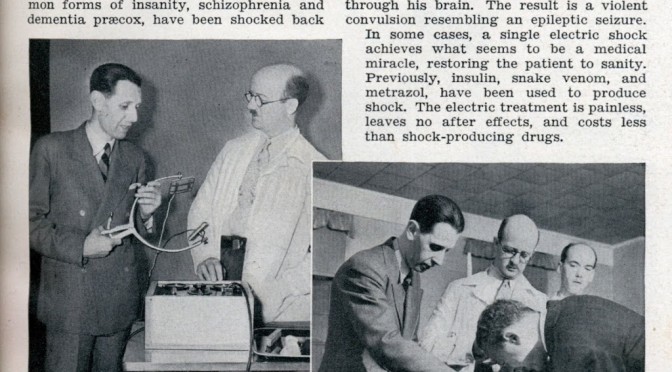
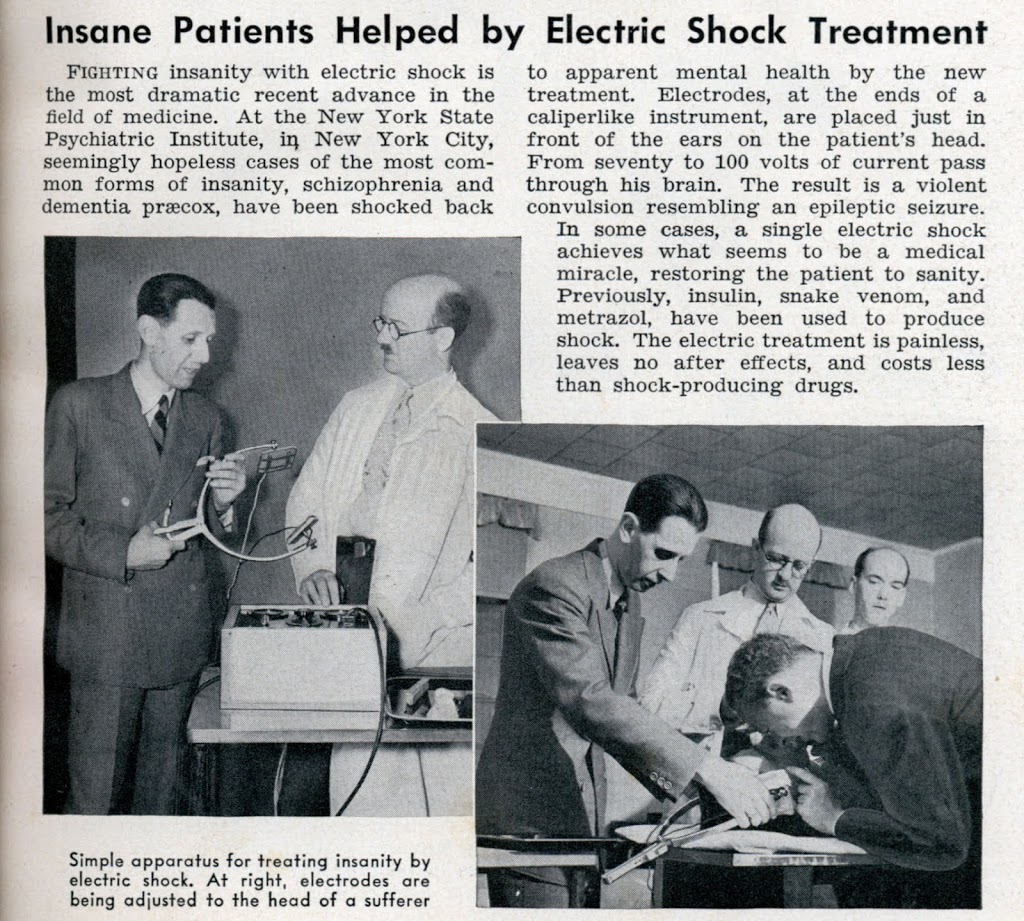
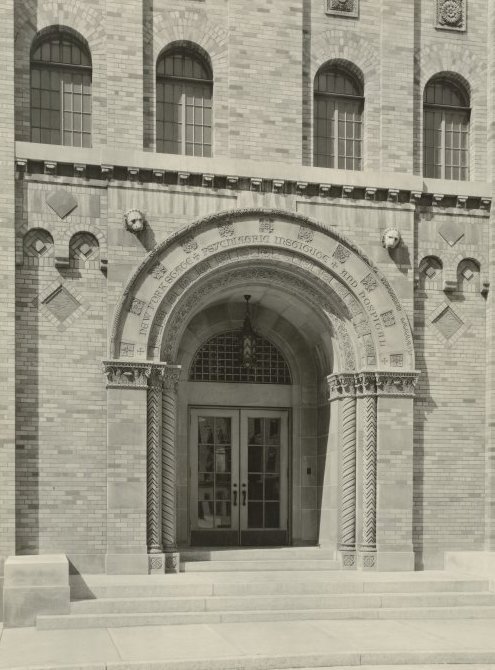
Previously, the hot medical solution in the 1930s for certain mental illnesses was insulin therapy (putting patients in a comatic state), practiced in various hospitals in New York, including Bellevue Hospital. Electroconvulsive therapy (ECT), which debuted in Italy in 1937, made insulin therapy basically obsolete when it was introduced into the United States in 1939Â at the New York State Psychiatric Institute (below).
From its patient care facilities on 1051 Riverside Drive, the Institute displayed a technology that seemed to have unlimited application to many mental illnesses thought untreatable. Modern Mechanix heralded its use on insanity, “a single shock achiev[ing] what seems to be a medical miracle, restoring the patient to sanity.” It became “psychiatry biggest fad,” despite such obvious side effects like memory loss.
According to authors Edward Shorter and David Healy, two-thirds of all the patients at the Institute were there to receive ECT. It became a sort of mecca for electroshock, with doctors from around the country coming to observe the treatment.
ECT reigned as the primary form of treatment for depression for almost two decades. However, with the undeniable violence suffered upon a patient who received the treatment — and the fact that well over half of ECT patients were women — most considered it a barbaric practice by the 1960s. Ken Kesey‘s ‘One Flew Over The Cuckoo’s Nest‘, published in 1962, accelerated public distaste with the treatment and was pretty much responsible for its near-elimination by the time the film version, starring Jack Nicholson, was released in 1975.
Electroconvulsive therapy has returned in recent years as a last-ditch therapy for severe depression and certain kinds of catastrophic mental illness. But I’m quite sure that having an affair with Pete Campbell would not have been placed in any of those categories today. What we saw in the season finale was yet another example of the abusive power men sometimes wielded over women, a theme ‘Mad Men’ will most likely continue to visit well into its final season.
If you’re ever attempting to make the case that New York isn’t as fun as it used to be, just use the following post as an illustration. The New York City area was once home to dozens of roller coasters, set up at major amusement destinations around the city, in every borough. Even Manhattan!
Coney Island’s Switchback Railway (1884) is often considered the first ‘real’ roller coaster. Not only was its size key to the stomach-churning thrill, but amusement parks soon relied on its proportions and sweeping shapes as a kind of branding backdrop, an immediate identifier as a destination of instant fun and relaxation. It was the first thing people saw as they approached the area; the cranking of the wheels and screams of its victims, heard from a mile away, set the rhythm for early 20th century beaches.
Not only are all these roller coasters gone, but the resort districts that hosted them have been radically transformed. Only Coney Island — the home to America’s very first roller coasters — remains.
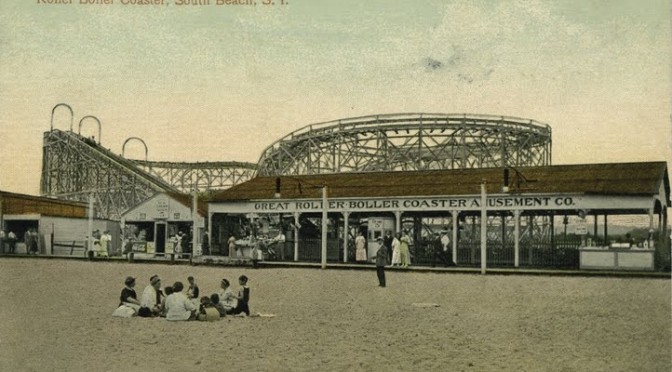
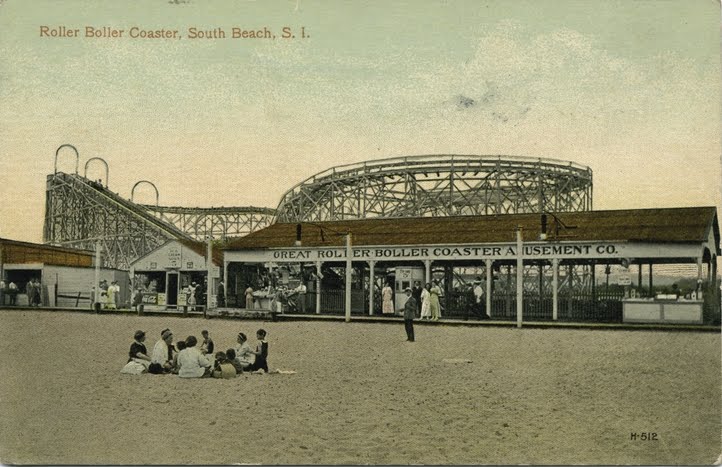
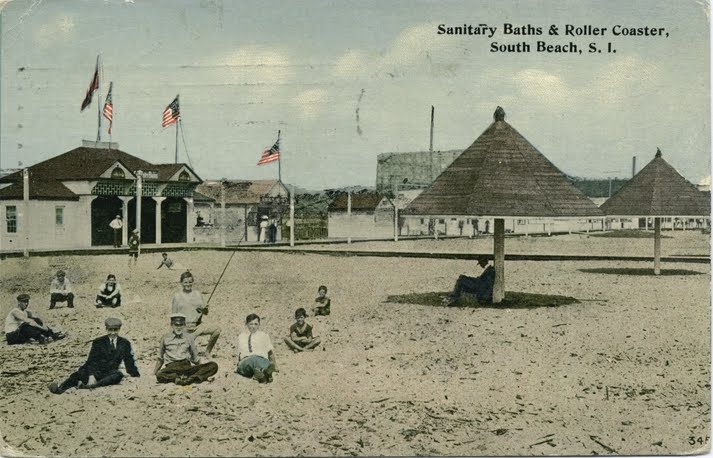
Roller Boller Coaster (seen above and in the background below) Staten Island (South Beach) In operation: Unknown, but probably lasted until late 1910s South Beach popular thrived around the same time as Coney Island’s did. Likewise, its amusement parks (like Happyland) were similarly felled by fire.
Starlight Park Rollercoaster The Bronx (West Farms) In operation: 1918-early 1930s Starlight’s rollercoaster was abandoned even the park limped along for most of the 1930s. In 1932, the coaster caught fire, the victim of rampant bonfires set along the Bronx River. (More information on my blog post about Starlight Park)
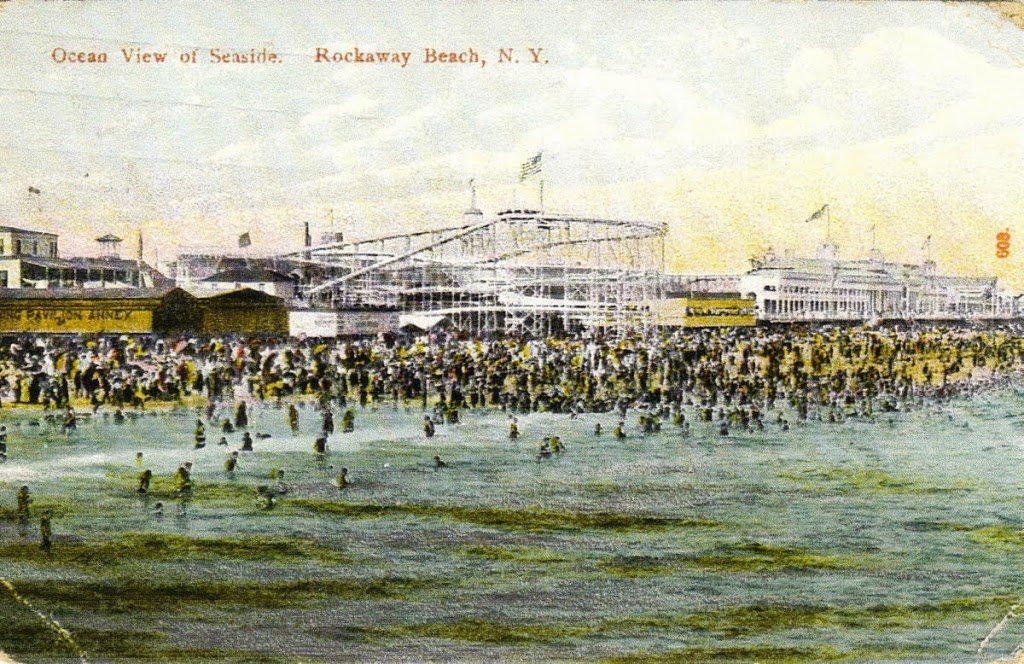
Wolz’s Thriller and the Atom Smasher Queens (Rockaway Beach) In operation: Thriller 1916-1937; Atom Smasher 1938-1985 A ‘dollar’s worth of ride for just ten cents’, the Thriller (top picture) was a backbone of Rockaway’s early amusement industry, one of ten rollercoasters eventually built for the resort area. Perhaps Rockaway’s most famous rollercoaster was the Atom Smasher (at bottom), the anchor of Playland. Rockaway lost all its amusements in the 1980s.
Courtesy Rockaway Memories
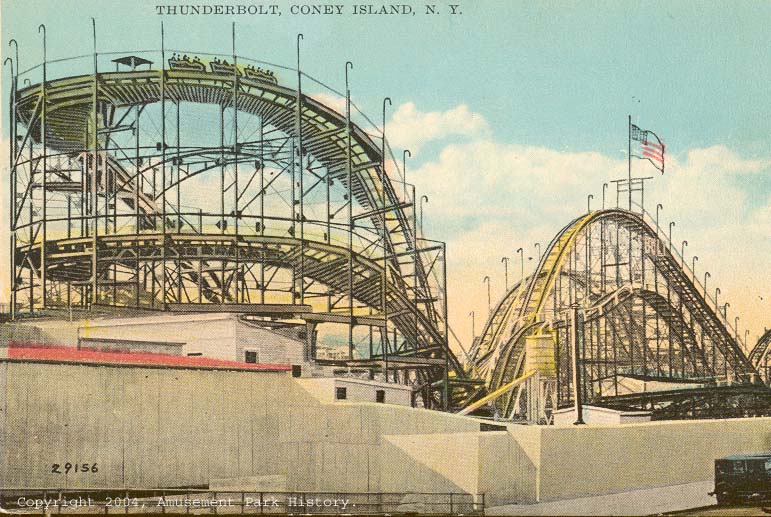
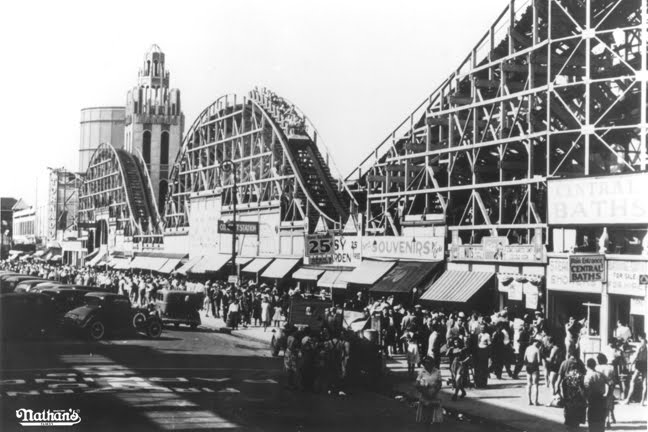
Thunderbolt and the Tornado Brooklyn (Coney Island) In operation: Thunderbolt 1925-1982; Tornado 1926-1977 Brooklyn has had more rollercoasters than any other borough. In fact, thanks to Coney Island, it’s had more coasters than most American states — 47 by the count of the Roller Coaster Database.
While the still-extant Cyclone is the granddaddy of them all, amusement lovers recall fondly the Thunderbolt , made famous in Woody Allen’s Annie Hall, which stood as a ruin for almost two decades. It outlasted its cousin the Tornado (at bottom), considered a marvel of engineering with its almost 3,000 feet of track undulating at a relatively low height.
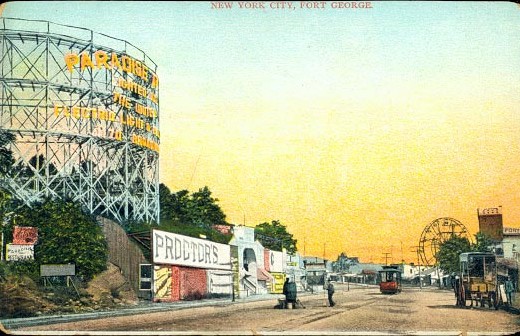
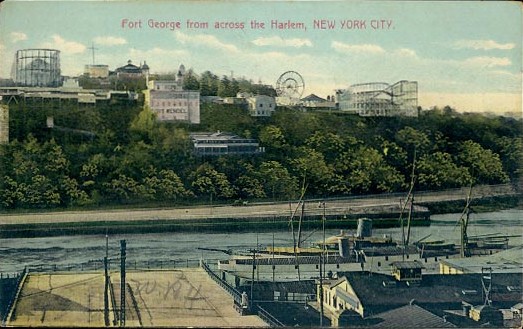
Paradise Park Roller Coasters Manhattan (Inwood) In operation: 1895-1914 Yes, there was a roller coaster in Manhattan! Although this appears to be the only place the island has ever had them, located in an amusement park camped out in today’s Highland Park. This amusement park actually had a couple roller coasters, according to one source. Yes, it eventually burned down as well, but its owners moved across the Hudson and opened the Palisades Amusement Park. (Courtesy myinwood.nethttp://myinwood.net/fort-george-amusement-park/)
Mayor Michael Bloomberg‘s latest crusade against sugary beverages in excessively large containers had me thinking about the origins of soft drinks. Most major brands of soda started in the South — Coca-Cola in Georgia, Pepsi in North Carolina, Dr. Pepper in Texas, Mountain Dew in Tennessee. Even the Big Gulp, an invention of the 7-11 convenience stores, originated in Texas. But those companies simply branded and perfected a kind of beverage made popular by the 19th century American soda fountain.
And for the roots of that bubbly innovation, we need to turn our attention — believe it or not — to the Manhattan neighborhood of Kips Bay.
Soda water, an English invention infusing regular drinking water with carbon dioxide, was considered a medicinal treatment during the 18th century. However bubbly water (or “charged water”) would eventually prove to have a variety of tasty uses — as a mixer for alcohol or ice cream, or even as a refreshing beverage itself, if mixed with wine, herbs or spices.
The first attempt to sell New Yorkers soda water came in 1809 when Yale professor Benjamin Silliman installed rudimentary fountains at two prominent locations — the Tontine Coffee House and the posh City Hotel (which opened in 1794). Both places attracted wealthy businessmen, and Silliman attempted to sell his carbonated mineral water, generated from a manual pump, as a wine mixer and as a healthy elixir on its own. Technical problems bedeviled Silliman — the pumps produced irregular carbonation — and he even ran up against false reports of the deadliness of chilled beverages. “Swallowing a large ice cube was thought to cause spasms of the stomach and fatal inflammation of the bowels.” [Darcy O’Neil, source]
As a light beverage, soda water still had a way to go. But early American pharmacists were attracted to the supposed tranquil qualities of warm soda and slowly began installing fountains in their shops. Later, even when its curative properties were largely disproven, pharmacies continued to install soda fountains as a way to attract customers.
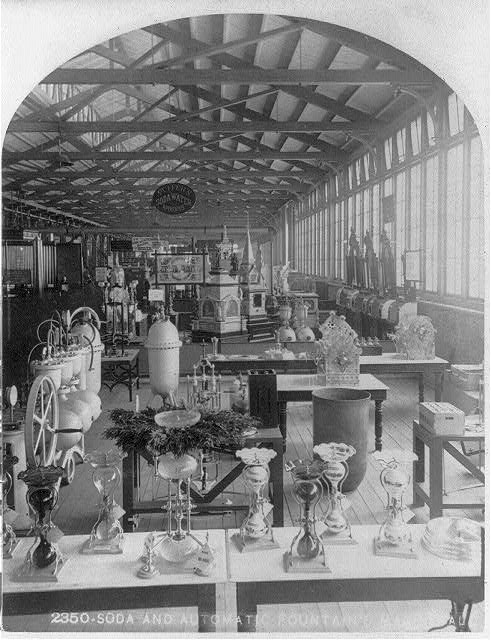
At right: A selection of soda fountains displayed at the Philadelphia Centennial Exhibition in 1876
In the mid 19th century, these early soda fountains were principally manufactured by two businessmen — John Lippencott in Philadelphia and John Matthews in New York. They would design rival soda fountain machines that would define the industry.
Although Lippencott trumped Matthews by first debuting machines that directly dispensed varied flavors, his New York rival eventually made the bigger splash.
Matthews was an English immigrant and former apprentice to lock maker Joseph Bramah, the inventor of the hydraulic press and an early developer of the indoor toilet. The young apprentice moved to New York in 1832 and set up his own modified water carbonation pump in a shop at 55 Gold Street.
The key to Matthews success was sophisticated equipment and one rather unappetizing-sounding addition — the use of ground-up marble chips to produce the carbonic acid gas for his water. Matthews procured these bits of marble from architects around the city and later even scooped up several barrels of the stuff from the construction site of St. Patrick’s Cathedral!
Matthews’ most famous employee was likely Ben Austin, a Southern freed slave who operated one of Matthew’s portable pushcart fountains and was known for testing the pump pressure by holding his thumb upon the instruments. “If this thumb was forced away by the pressure the fountain was charged,” wrote the New York Times, who recounted the story of ‘Ole Ben’ as though it were a folk tale.
John Matthews was a savvy operator, hiring inventors to streamline his equipment, then purchasing the rights to those inventions outright to mass manufacture. By the 1860s, he had moved production to a plant at 331-337 East 26th Street (at First Avenue) in old Kips Bay, employing over a hundred men to assemble the latest in soda-fountain technology.
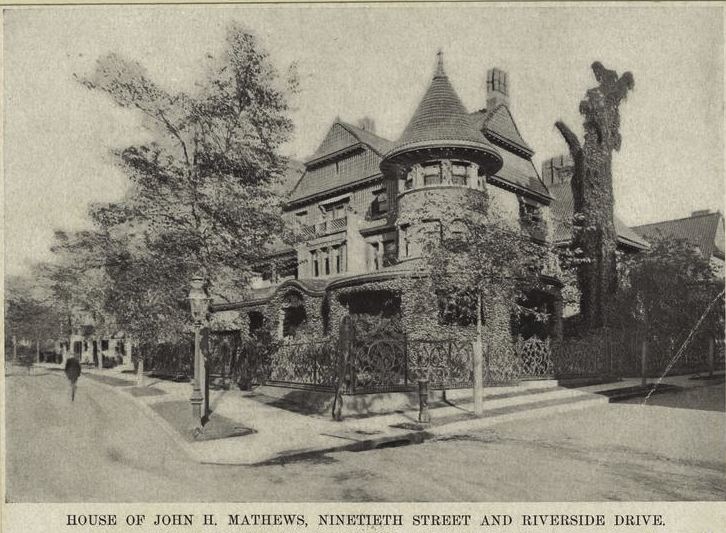
Below: The house that soda built — Matthews mansion on 90th Street and Riverside Drive (Picture spells his name wrong)
With improved technology came better flavors, more consistent carbonation and safer operation. (Early soda-water pumps tended to explode.) And of course greater distribution; fountains were installed not only in pharmacies, but in “hotels, saloons, restaurants” and even street corners. To offer energy and refreshment, some flavored soda waters were infused with exotic ‘healthy’ ingredients, including caffeine or cocaine.
By the time of his death in 1870, Matthews had become the face of soda fountains in the United States, the ‘soda fountain king’ and ‘the Neptune of his trade’, owning hundreds of soda fountains throughout the country. So associated was he with his product that he was interred in a fanciful and commanding tomb in Green-Wood Cemetery, abstractly resembling an old soda fountain and complete with gargoyles that — during rainstorms — dispense a steady flow of water.
His family stayed in the soda game, selling more than 20,000 fountains from this First Avenue factory the following decade. By the end of the century, descendants of the former rivals Lippencott and Matthews would merge with two other companies — like so many industries of this period — to form a virtual monopoly on the soda fountain business.
However, the future of soda would depend on its portability. The drink was still associated with medicinal qualities and people wanted to bring it home with them. Entrepreneurs elsewhere would refine soda for the purposes of bottling and selling for home consumption. While the soda fountain would thrive well into the mid-20th century, its destiny lay in glass bottles. Or, in Bloomberg’s case, large, 16-ounce containers.
Pictures courtesy NYPL, except for the Philadelphia photo, courtesy the Library of Congress
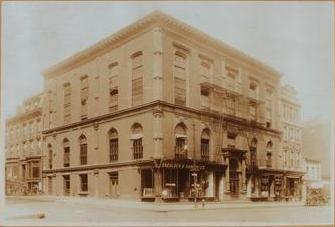
Mentioned in our podcast this week was the precursor to the Brooklyn Academy of Music, the three-story ‘centre of Brooklyn culture‘ known as the Brooklyn Athenaeum and Reading Room. Founded in 1848 and incorporated in 1852, the Athenaeum was a combination concert hall, store for intellectuals and library (in an era before public libraries), serving the gentlemen of the city of Brooklyn.
Not only BAM but the Brooklyn Public Library traces its lineage to this structure which sat at the northeast corner of Atlantic Avenue and Clinton Street. It was also the original home of the Brooklyn Philharmonic.
Perhaps the place was best known as a prime stop on the lecture circuit. Abolitionist Wendell Phillips spoke to thousands here in October 1860 — “crowded to its utmost capacity” — encouraging the Southern states to secede from the Union, months before any of them did so.
By the 1890s, the more elevated arts had escaped to other venues, and the Athenaeum hosted various political functions. Economic reformer and former candidate for mayor of New York Henry George spoke to a crowd of a thousand here on October 25, 1897, four days before dying of a stress-induced stroke.
Events had wandered way off the original course by 1901, when police closed down the Athenaeum due to a planned meeting of East Coast anarchists.
The following year, the top floor was occupied for three decades by the New York Court of Special Sessions. It was unceremoniously torn down in 1942. At some point a modest structure was placed on the lot, and today is hosts a Key Food supermarket.
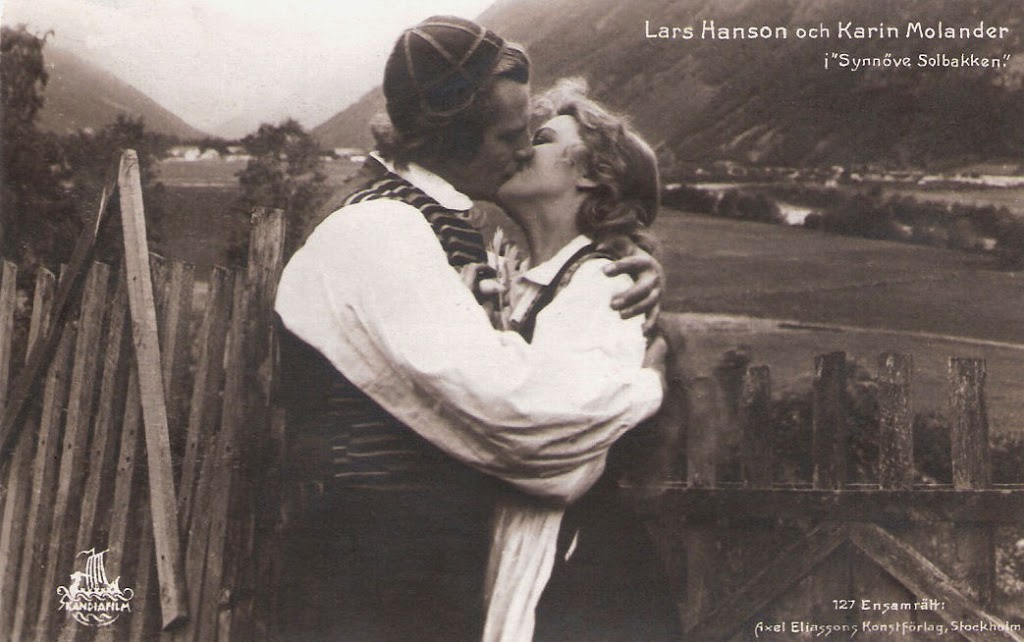
ALSO FROM THE PODCAST: One of the very first films shown at the Brooklyn Academy of Music (in 1921) was the Swedish silent romance Synnøve Solbakken (“The Fairy of Solbakken”), screened decades before BAM’s stage collaborations with Sweden’s greatest filmmaker, Ingmar Bergman.
Looks like a spellbinding movie. Wish I knew Swedish! Top picture courtesy NYPL Film photo courtesy Flickr/Truus, Bob & Jan too!
WARNING The article contains a couple spoilers about last night’s ‘Mad Men’ on AMC. If you’re a fan of the show, come back once you’re watched the episode. But these posts are about a specific element of New York history from the 1960s and can be read even by those who don’t watch the show at all. You can find other articles in this series here.Â
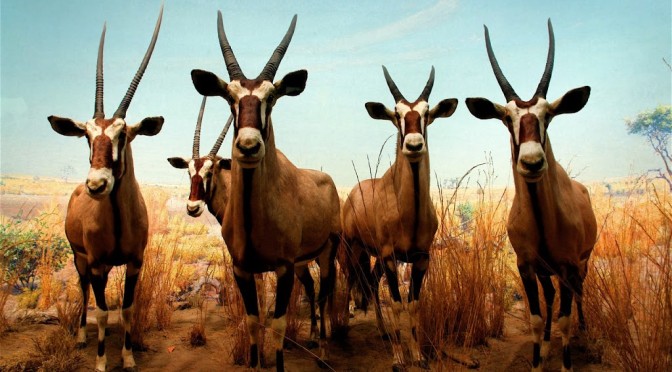
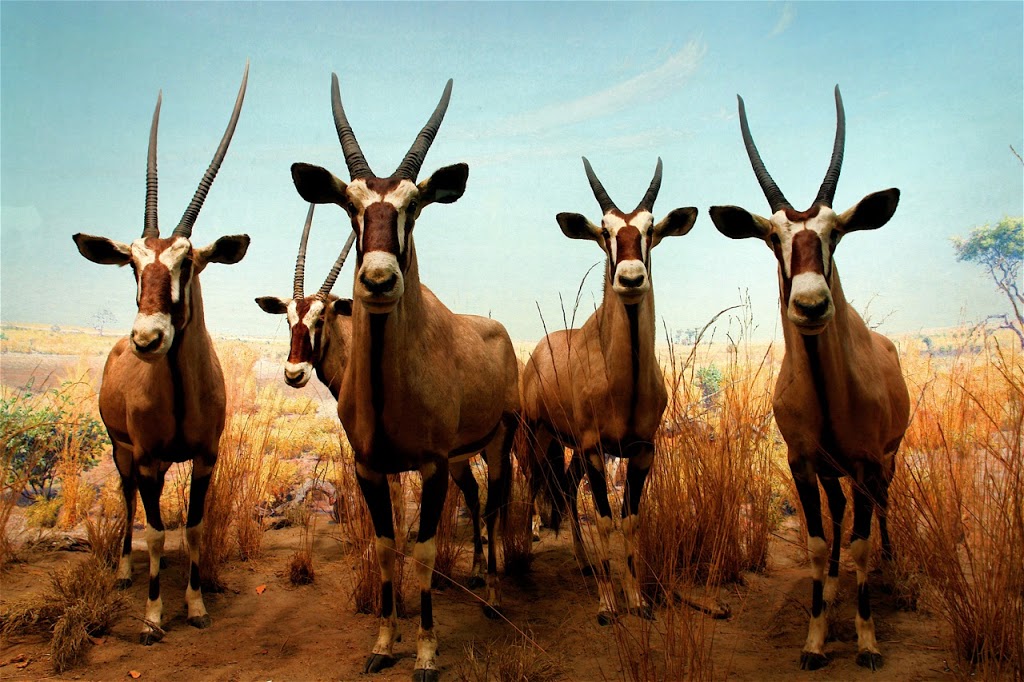
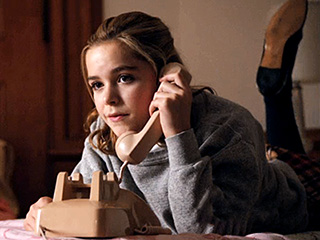
Theodore Roosevelt did not donate all the mounted animals at the American Museum of Natural History, as Glen casually suggested to Sally Draper (below) in last night’s episode. Just a great, great many of them, not least of those prizes from his 1909 post-presidential safari, literally thousands of African specimens captured, killed and presented for display here, at the Smithsonian, and other American museums. New York’s museum even holds the contents of Roosevelt’s ‘natural history cabinet’, his collection of taxonomy which he started at age nine from his home on East 20th Street.
With Roosevelt’s African collection also came expert taxidermist Carl Akeley, who had gone on safari with the former president in 1909 and remained at the Natural History museum to mount and curate its African exhibit. The hall of African mammals is named in his honor and continued to define the museum in the popular imagination.
The early 20th century was a golden era for taxidermy, as greater understanding of natural habitats allowed curators to present their specimens in ‘realistic’ settings and lifelike poses. But such understanding placed a deadline upon classical museum taxidermy; the more one understood the underpinnings of the natural world, the more absurd such displays seemed.
With the 1960s came a greater awareness of the plight of rare animals and their disappearing habitats that rendered the presentation of mounted taxidermic displays into antiquated, often vulgar set pieces. The first federal endangered species act was passed in 1966 and greatly expanded upon with the Endangered Species Act of 1973, ‘the Magna Carta of the environmental movement‘.
The staid animal galleries at the American Museum of Natural History faced other surprising challenges. The museum reached record attendance in 1967, but people weren’t necessarily there for the mounted elephants. The American Apollo missions ignited a public passion for space science, and with the installation of the awe inducing Zeiss projector in 1960, the museum’s Hayden Planetarium easily became its hottest attraction.
Leading up to its centennial in 1969, the museum prepared several new halls (including several of the current anthropology exhibits) and renovated many others; thus Glen and Sally most likely would have seen many ‘Closed for Renovation’ signs during their trip here. Â Had Sally not had a certain emergency which sent her from Glen’s side, the pair might have wandered over to the bright, new exhibits in theHall of the Indians of the Plains, which opened in February 1967.
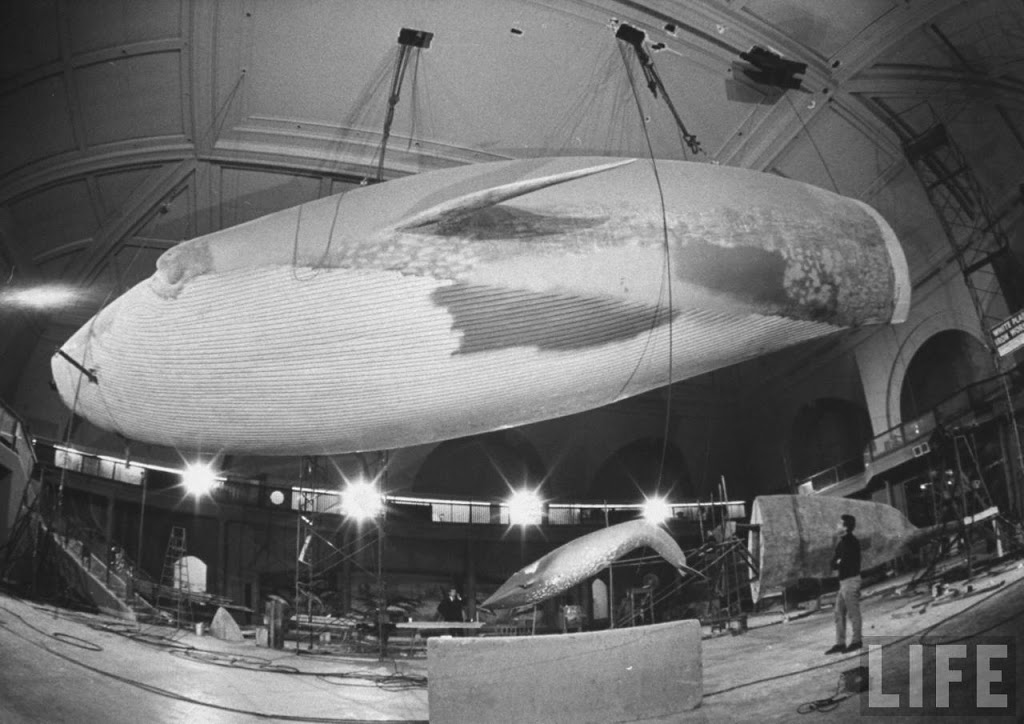
A refreshed Milstein Hall of Ocean Life would dazzle audiences upon its reopening in 1969, and the museum’s trademark blue whale was presented in a new context — the 1966 worldwide ban on hunting the endangered ocean mammal. The extensively revitalized exhibition also presented a new 1960s museum trend — the use of artificial, plastic models over actual animal carcasses.
By 1967, New York’s natural history museum — which once touted a staff of 20 full-time taxidermists — employed only two. “There’s not much left to collect and mount (we don’t say stuff),” lamented staff taxidermist David Schwendeman.
But in the vaunted hallways of the American Museum of Natural History, the elder animal displays serve a new educational purpose — a preservation of science’s evolving views on the natural world.
NOTE: Since ‘Mad Men’ doesn’t film in New York,  Jen Carlson at Gothamist deftly notes that the exhibit displayed in the episode is from Los Angeles’s natural history museum.
Top picture courtesy flickr/Getty Images Lower picture: Prepping the blue whale in 1968, photo by Yale Joel, Life/Google images
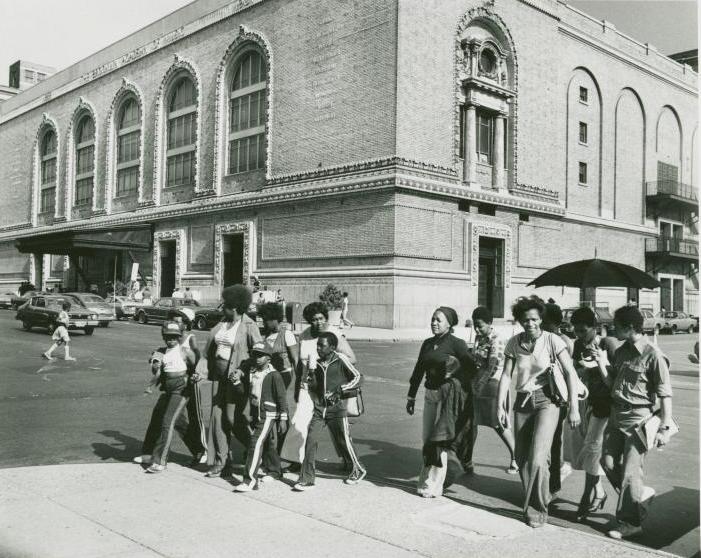
PODCAST One of America’s oldest cultural institutions, the Brooklyn Academy of Music (or BAM) has an unusual history that spans over 150 years and two separate locations. We trace the story from the earliest roots of a Manhattan-Brooklyn rivalry and a discussion of high-class tastes to the greatest stars of the performing arts, including a couple tragic tales and a bizarre event involving the mother of modern dance.
Featuring horse tricks, French balls, a ‘flirtation’ post office, a bit of ski jumping.and a cavalcade of BAM’s greatest stars — Enrico Caruso, Merce Cunningham, Edwin Booth and his brother John Wilkes Booth!
ALSO: We uncover what may be the very first foreign films ever shown at the Brooklyn Academy of Music, many decades before the opening of their movie theaters.
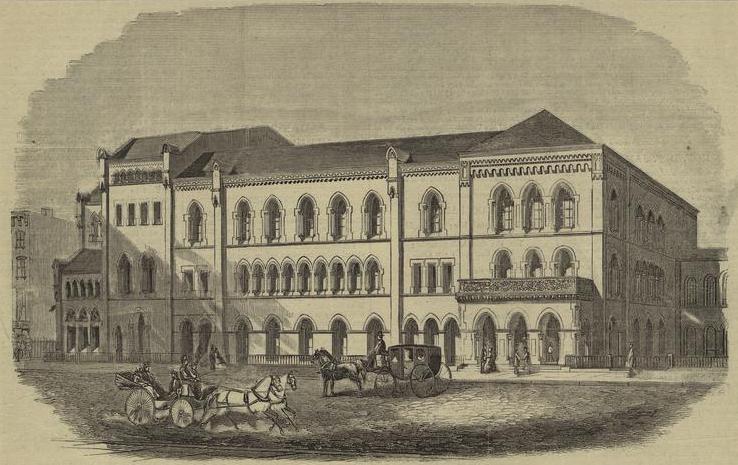
The first Brooklyn Academy of Music, on Montague Street, nearby Brooklyn City Hall. Among the decades of great events here were Brooklyn’s Sanitary Fair, a speech by Booker T. Washington, an amusing lecture by Mark Twain and the final stage performance of Shakespearean actor Edwin Booth. (source)
The building was destroyed by fire in 1903, and not everybody was sad to see it go. Here’s actual film footage of the flames atop the old Brooklyn building:
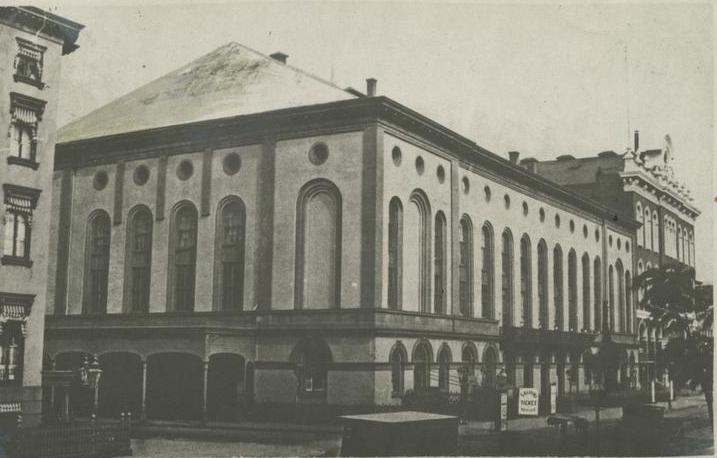
Compare this to New York’s own Academy of Music, at 14th Street and Irving Place. Although this venue brought the American debuts of many famous operas (including Carmen), festivities deteriorated once the Manhattan wealth moved up to the Metropolitan Opera House. This building was demolished in 1926. [source]
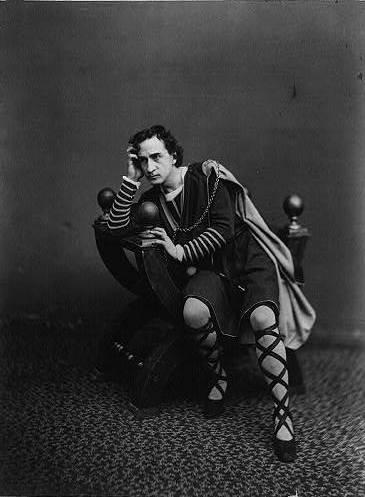
Edwin Booth, in his signature role as Hamlet, 1870. If some at the original Brooklyn Academy of Music had had their way, Booth would never have performed there! [LOC]
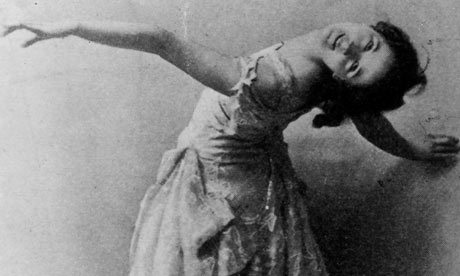
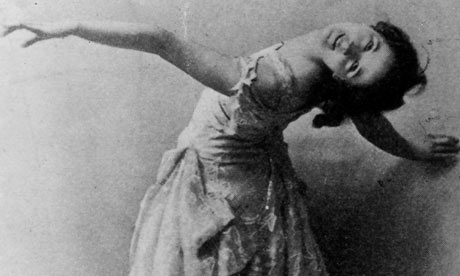
Isadora Duncan, who brought modern dance to BAM, and it never left. (source)
BAM in 1978: After a few decades of hardship, the venue, at its new home on Lafayette Avenue, rebounded in the 1960s, serving the artistic passions of the neighborhood and fostering a provocative relationship with the biggest names in avant garde performance. (Pic by Dinanda Nooney, NYPL)
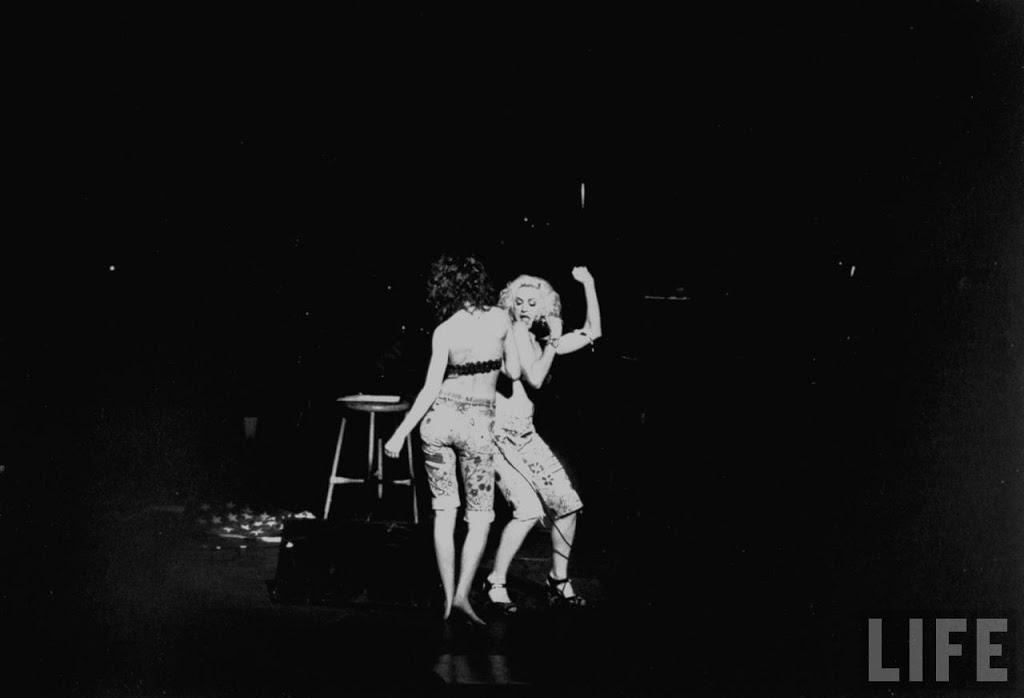
The fascinating directions that BAM executive direction Harvey Lichtenstein took the venue opened its stage up to new and exciting performances. And, often, a raucous good time as well, as with this 1989 rain forest benefit, featuring Madonna and Sandra Bernhard. (Photo by Albert Ferreira, LIFE)
MORE PICTURES ON THE WAY LATER THIS WEEKEND
For more information on their schedule, visit the BAM website. They also have a great history blog BAM 150 Years where we obtained some of our information.
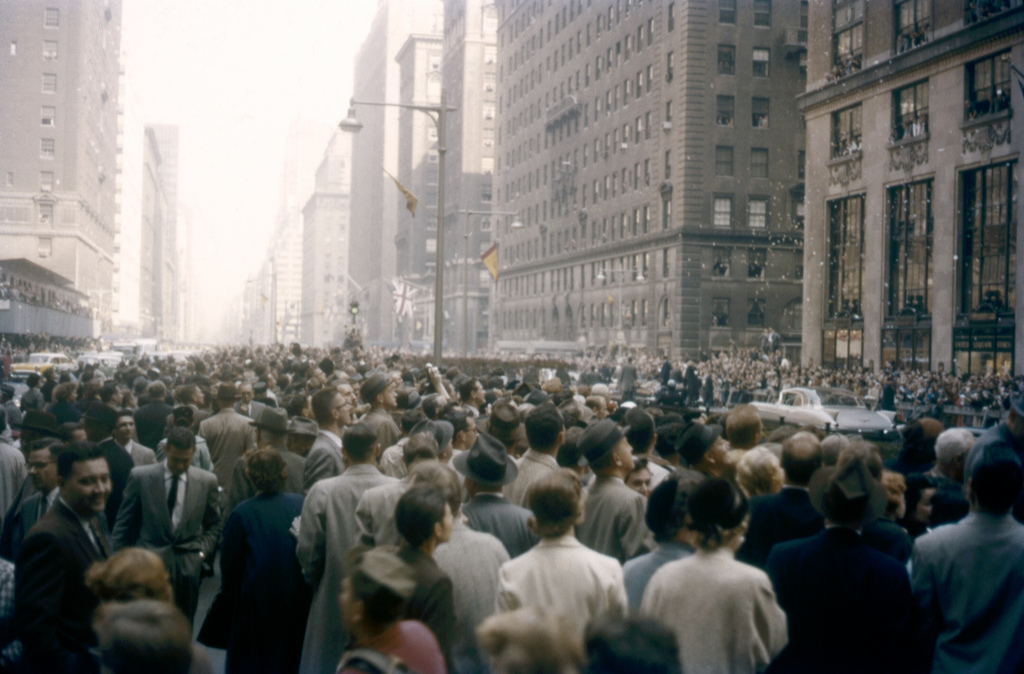
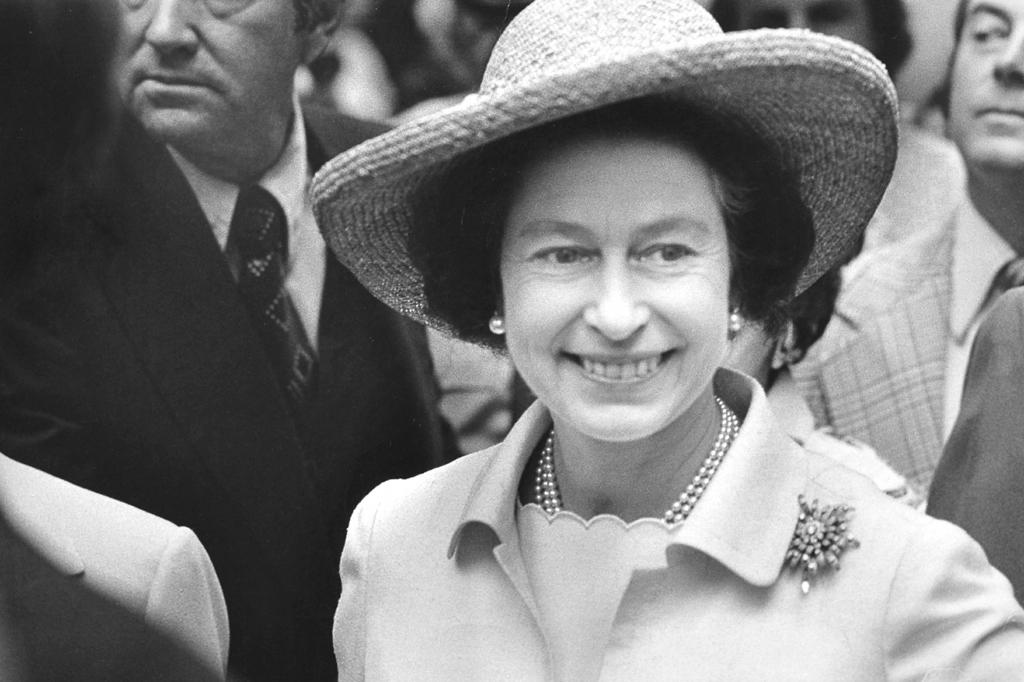
New Yorkers greet the Queen with a tickertape parade in 1957. Courtesy jeffs4653/Flickr
What do you buy a queen on her Diamond Jubilee, celebrating 60 years on the British throne?
Well, most royal figures are quite difficult to buy for, but luckily, Queen Elizabeth has already revealed her preference in local department stores.
For back in 1976, the woman who never goes shopping found herself one late afternoon perusing the merchandise at Bloomingdale’s department store.
Queen Elizabeth has been to New York three times during her sixty year reign over the Commonwealth.
In a couple cases, she came specifically to address the governing body at the United Nations Headquarters but managed to squeeze in a few extra activities each time, befitting her status as one of New York’s wealthiest, most high profile tourists.
She first arrived in 1957, via Staten Island, riding over to Manhattan in an Army ferryboat. In the harbor, she caught sight of the newly built replica of the Mayflower (the Mayflower II), fresh from its completed voyage retracing the Pilgrims’ course over the Atlantic.
The Queen was practically wide-eyed during the ticker tape parade in her honor, with over a million New Yorkers lining the streets to see the young monarch, from City Hall to the Waldorf-Astoria.
Her favorite moment arrived after the UN session, when she was whisked to the top of the Empire State Building to gaze out of the hazy city.
Like any great New York trip, she was out too late, arriving at Idlewild Airport at 2 in the morning for her trip home.
She shared her thoughtful take on her experiences here: “The mental pictures of New York are nearer reality than those of any other city.”
Below: Queen Elizabeth on her second visit to New York, 1976, courtesy Madison Guy/Flickr
In 1976, she and Prince Phillip returned the city, a bit older and less desirous of scaling skyscrapers this time around.
As part of the city’s bi-centennial celebrations — and perhaps inspired by the Mayflower on her previous visit — the Queen decided to participate in a little historical reenactment herself.
Most famously, the Queen graced the steps of Trinity Church to receive back rent owed the crown — 279 peppercorns. (I wonder where they found peppercorns in 1976 Manhattan, this being the days before Whole Foods?) A bronze plaque presently marks the spot at Trinity where she accepted the peppercorns.
After a luncheon at the Waldorf (“relaxed, animated and fairly hungry”), the royals fit in a couple unusual stops.
The first was a spot of afternoon tea at the Morris-Jumel Mansion, accompanied by the Daughters of the American Revolution. Afterwards, they sped downtown for a tour of Bloomingdale’s, not only stopping traffic, but reversing it, to allow the Queen to exit her vehicle from the right side.
She quietly moved from floor to floor, admiring the many displays of products of British make, particularly the pottery and furniture. She was also greeted to a private fashion show, Her Majesty led through a room of mannequins garbed in the latest stylish trends from 1976.
Along the way, a few American designers made appearances to greet Queen Elizabeth, including Calvin Klein.
What accounts for such an unusual detour in the Queen’s itinerary?
Apparently, bedazzled by her 1957 trip, she wanted to do as New Yorkers do. Or, as a representative of Bloomingdale’s remarked, “we thought — and the Queen agreed — that it would be a very American experience for her to go amidst all the crowds and just pretend she might be shopping.” [source]
If the entire event seems a tad surreal to you, this was then reinforced by the presentation of a Sioux peace pipe to the Queen, meant to “symbolize the peace that has existed between Great Britain and the United States.”
This would be her lasting memory of New York for 35 years, until 2010, when she returned again for a few hours to address the UN and to visit Ground Zero.
Given the sobriety of her visit, she did little sightseeing but braved the 100-degree weather with her trademark stolid grace.
The recent trailer to Baz Luhrmann’s The Great Gatsby, aka ‘Moulin Rouge in Manhattan’, seems to have left everyone in a state of awe (and horror) in its vivid, hyper-electro-glossy depiction of Prohibition-era New York. And it left many feeling slight panic, even apoplexy, especially considering the entire spectacle will be rendered in 3D when it’s released in December. Oh God. Will flappers kick whimsily towards the camera?
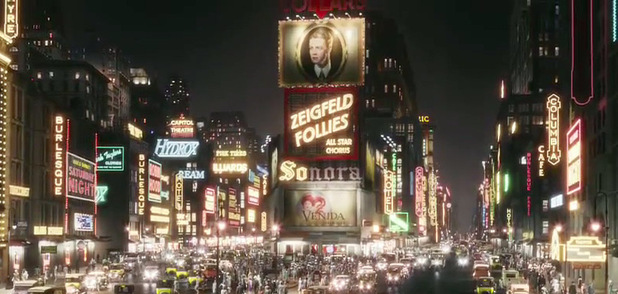
So how accurate was Lurhmann in his glamorous take on Times Square of 1922? How accurate was it supposed to be? Many have already taken note of one glaring and unforgivable error — misspelling the name of Florenz Ziegfeld on the sign for the ‘Ziegfeld Follies’. That ridiculous mistake overshadows a possibly smaller error, that the Follies were actually performed down at the New Amsterdam Theatre on 42nd Street in 1922. However, the Follies from the year before were hosted at the Globe Theater on West 46th Street (today’s Lunt-Fontanne Theatre), quite close to this sign. So perhaps they just kept it up.
Here’s the entire trailer:
Clearly, Luhrmann is interpreting New York, not emulating it. ‘Moulin Rouge’, after all, was Paris through a hazy scrim. He’s filtering the glitz of F. Scott Fitzgerald‘s work through his own dreamlike aesthetic and doesn’t need to fact-check every sign and street corner. Still, the trailer does feature some interesting obscure details, and I can’t help myself. If you saw a different detail, please post about it in the comments section:
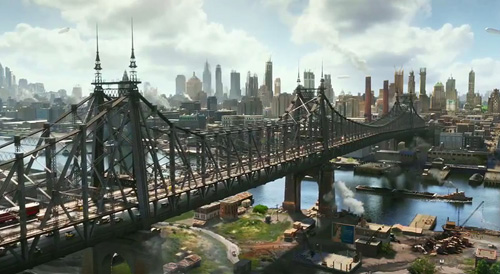
— Queensboro BridgeThe trailer opens with a spectacular look at the Queensboro Bridge, a potent symbol in the Fitzgerald novel. “Over the great bridge, with the sunlight through the girders making a constant flicker upon the moving cars, with the city rising up across the river in white heaps and sugar lumps all built with a wish out of non-olfactory money.”
The bridge opened in 1909, and it’s a defining image of the Jazz Age, not least of which because the population of Queens almost tripled during the 1920s. There were certainly trains on the Queensboro — it was built to accommodate them — but I’m not sure about that particular train. Below it sits grimy old Blackwell’s Island, renamed Welfare Island in 1921 and certainly looking the part.
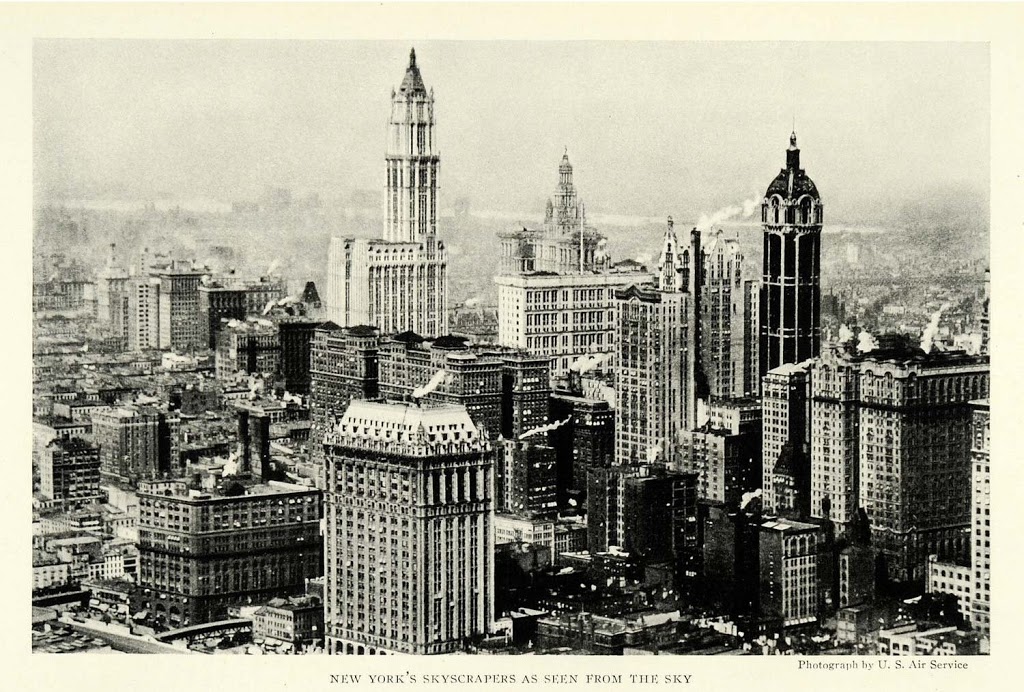
— SkyscrapersOh Lord.I don’t think this depicts New York at all but is a composite view of various buildings of the age. Far to the left in the trailer I see structures that look like the Singer Building and the Woolworth Building, but they would not be seen from this angle. Besides, the Woolworth would be taller than the Singer. See below for a size comparison, in a picture from 1922, looking northeast.
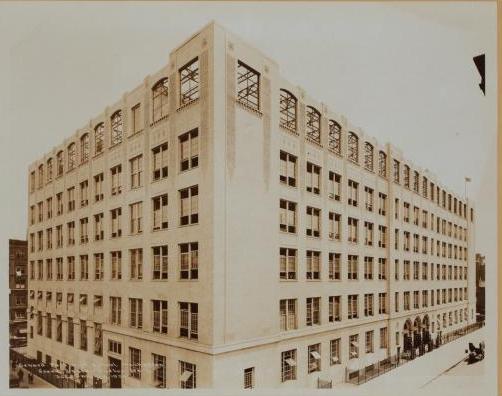
There are some vaguely Flatiron Building/Met Life Tower type structures, but they look like they’re on 42nd Street. And why do I think I can see something that clearly looks like the New York Central Building (later the Helmsley Building) which wasn’t finished until 1929?
— Times Square Signs An array of illuminated products logos — in various colorful hues foreign to Times Square in 1922 — gives the Crossroads of the World a mystical glow. The tony Hotel Astor adorned in lights dominates the plaza to the left. Nearby is an ad for Douglas Fairbank‘s ‘Robin Hood’, released in October 1922. It played at the Lyric Theatre. Fairbank’s rival Rudolph Valentino and actress Norma Talmadge created a buzz when they attended the film’s premiere together here.
It’s next to the advertisement for Hydrox (the sandwich cookie which debuted in 1908) and the Capitol Theater, a movie palace which opened in 1919. The tire ad is a nice touch, recalling Times Square’s status as the center of automobile sales and repair during the early 20th century.
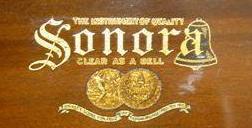
Below the Zeigfeld [sic] Follies sign is an advertisement for Sonora, a phonograph company that began producing radios in 1924. Their slogan ‘Clear As A Bell’ harkens back to the company’s original product line — clock chimes.
Later on in the trailer, an ad can be seen for Arrow Collars, the detatchable shirt collar company that went on to spawn America’s first male model type, the ‘Arrow Collar Man’, the sort of debonair type who populates the world of Gatsby. Of course, the demand for collared shirts pretty much killed of this industry by the end of the decade.
— Grand Central Oyster BarThere appears to be a brief scene at this lush location with its vaulted ceilings. The Oyster Bar would have indeed been a thriving spot in 1922 and an ideal place to mix business with pleasure. A few years later, so goes the legend, David Sarnoff formed RKO Pictures over a few oysters here with Joseph Kennedy. In 1922, Tin Pan Alley lyricist Al Lubin met his music partner Harry Warren here. They went on to create the film musical 42nd Street in 1933.
— Yellow Cab Co.? There are many brief glimpses of taxicabs, including those of the Yellow Cab fleet, which would later be purchased by the Checkered Cab company in 1929. In 1922, the Yellow Cab successfully won a ruling barring other paid-ride automobiles from being painted yellow. ‘1,000 Cabs Face Change of Paint.‘
— Blood And Sand A prominent movie marquee is shown near the trailer’s end for Rudolph Valentino‘s ‘Blood And Sand’, a summer box office smash in 1922. This film debuted at the Rivoli, at 1620 Broadway, at 49th Street. From the New York Times film review on its debut: “Mr. Valentino has not been doing much acting of late. He’s been slicking his hair and posing for the most part. But here he becomes an actor again.” Let’s hope the same can be said of Leonardo DiCaprio, who plays Mr. Gatsby.
By the way, the 1974 version of ‘The Great Gatsby’, starring Robert Redford and Mia Farrow, premiered — with attendees in full ’20s regalia — at the Loews State Theater at 1540 Broadway at 45th Street. “The guests, many of them in Teflon or Daisy white, whatever you want to call it, were greeted by hundreds of celebrity gawkers, reporters and photographers.” [source]
Below: A clip from the Valentino film:
As I rewatch the trailer over the next few days, I may amend this article with further information. If there’s something obvious that I’ve missed, please let me know in the comments below!
Thanks to Michael Raisch, whose Tweet to me last night inspired this article. Screenshots courtesy of Curbed and Entertainment Weekly.
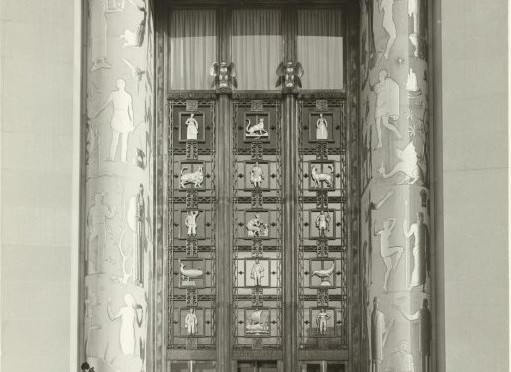
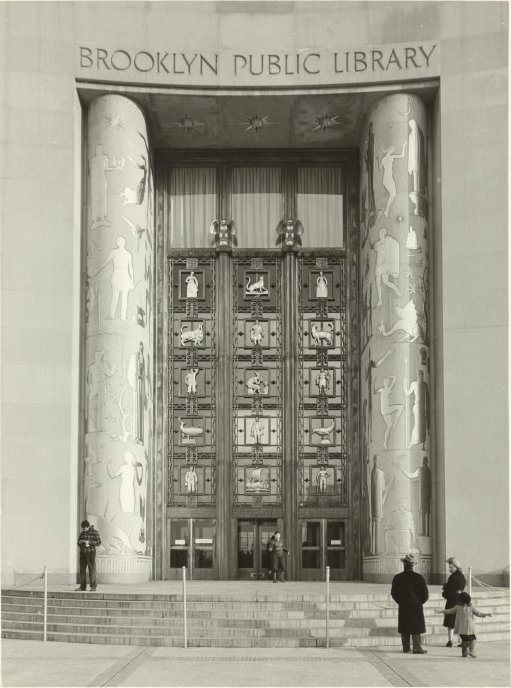
These doors just won a lot of grant money. (Photo by Wurts Brothers, NYPL)
The votes have been counted, and Brooklyn (more specifically, Park Slope) and the Bronx ran away with the Partners In Preservation initiative, sponsored by American Express and the National Trust for Historic Preservation.
But for the others, there’s good news! The grant proposals for the top four don’t even add up to $1 million, and the initiative will now determine how to distribute the remaining $2.1 million among the other finalists. They will announce the choices in June.
————————————-
I recorded an interview with Andrew Johnstone for the Podcast Squared show (essentially, it’s a podcast about podcasts), discussing the philosophies behind the Bowery Boys: New York City History podcast, as well as some information on how we got started as a look behind the scenes at our process. They also give us a great review!
You can find the show (Episode #99: Golden Age of New York) on iTunes or download it directly from their website. Or listen to some of it here:
——
Patell and Waterman’s History of New York
Meanwhile, over at Patell and Waterman’s History of New York, they’ve posted my wrap-up interview regarding the Networked New York event from March which was held at New York University. The questions are specifically focused on the relationship of history writing and new digital media, but I talk about the challenges of producing a podcast and the relationship between blogs and newspapers. Check out that interview here.
With the quote: “History enriches peoples’ lives abstractly, of course, but I argue that it does so practically as well. It’s about context. Your pizza tastes a whole lot better when you realize it’s been made in New York’s oldest pizza kitchen. (Whether it actually tastes good is besides the point.) This is the tourist perspective of New York. But to infuse that perspective into a daily experience here is profound. Suddenly, every street corner, every building, has a particular uniqueness. Everything talks back to you.”
WARNING The article contains a couple spoilers about last night’s ‘Mad Men’ on AMC. If you’re a fan of the show, come back once you’re watched the episode. But these posts are about a specific element of New York history from the 1960s and can be read even by those who don’t watch the show at all. You can find other articles in this series here.Â
An unusual subplot takes Harry Crane, Sterling Cooper Draper Pryce’s smug television liaison, down to Second Avenue and the temple of the Hare Krishnas where he finds new recruit Paul Kinsey, a former agency employee. In his prior existence as a pipe-smoking gadabout, Kinsey always made note of his own hipness, and, in this case, as an acolyte of a religious thought only a few months old, we can confirm that he’s ahead of the curve again.
The Hare Krishna movement, derived from Hindu philosophies and reformatted for the groovy ’60s, was actually fostered and popularized here in the East Village.
A.C. Bhaktivedanta Swami Prabhupada, a Hindu teacher and proponent of Gaudiya Vaishnavism, left India in 1965 to spread his religious teaching. Eschewing material possessions, he arrived in New York in 1966 and gravitated towards the East Village, the nucleus of cultural counter-culture.
His reputation preceded him and soon gathered a small group of followers, including artist Harvey Cohen, who soon set up Prabhupada in an apartment on 72nd Street on the Upper West Side and a small studio for religious practice on the Bowery. From here the swami formed the core of what would become the Hare Krishna movement, aka the International Society of Krishna Consciousness.
Given the location, most of his early followers were young people, fascinated by Hindu imagery in books and music and in particular by Prabhupada’s expressions of religious thought, purifying secular consciousness expanding rhetoric into a simple spiritual regiment.
For many, he was as much a mystery as an answer. One early follower confessed later, “I didn’t know what Prabhupada was about. I mean we understood about one-millionth of what Prabhupada was saying.”
Key to religious practice is the ubiquitous mantra, rhythmically repeating the name of God. Said Prabhupada in a lecture in 2010. “[T]his sound, this Hare Krsna, Hare Krsna, Krsna Krsna, Hare Hare. Hare Rama, Hare Rama, Rama Rama, Hare Hare, is the sound representation of the Supreme Lord.”
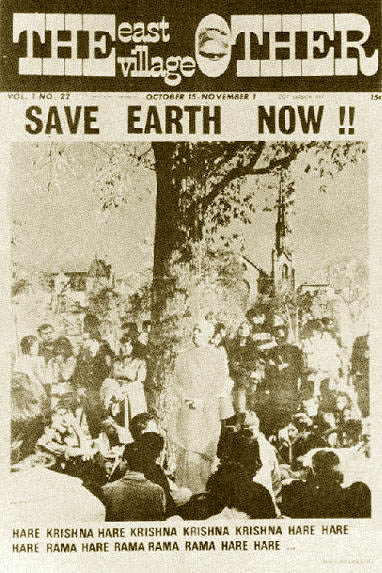
Prabhupada and his followers would frequently be heard chanting their familiar mantra throughout the East Village, but they would be known for one particular destination. On October 19, 1966, Prabhupada led an outdoor chant underneath a elm tree in Tompkins Square Park that lasted for almost two hours, so transcendent that even the New York Times took notice: ‘Swami’s Flock Chants in Park to Find Ecstasy.’ Today that tree (called the Hare Krishna tree) is one of the park’s most popular spots and a mecca for current adherents.
Above: From the late October issue of the East Village Other, in front of the  Hare Krishna tree [source]
By this time, Prabhupada had a new home, a former curio shop at 26 Second Avenue (between First and Second Streets). They kept the old sign ‘Matchless Gifts’ over door, while followers decorated the interior with handmade tapestries. This became the central New York temple and remains central to local worshippers to this day. “[I]n this small room on Second Avenue, guest found themselves transported into another dimension, a spiritual dimension, in which the anxieties and pressures of New York City simply did not exist.” [source]
In that first year, 1966, Prabhupada had only a few dozen followers, but at least one famous one — Allen Ginsberg.
Below: Video of Prabhupada and followers at Tompkins Square Park in 1966