Henry Street Settlement: From the doors of old townhouses springs the compassionate heart of the Lower East Side

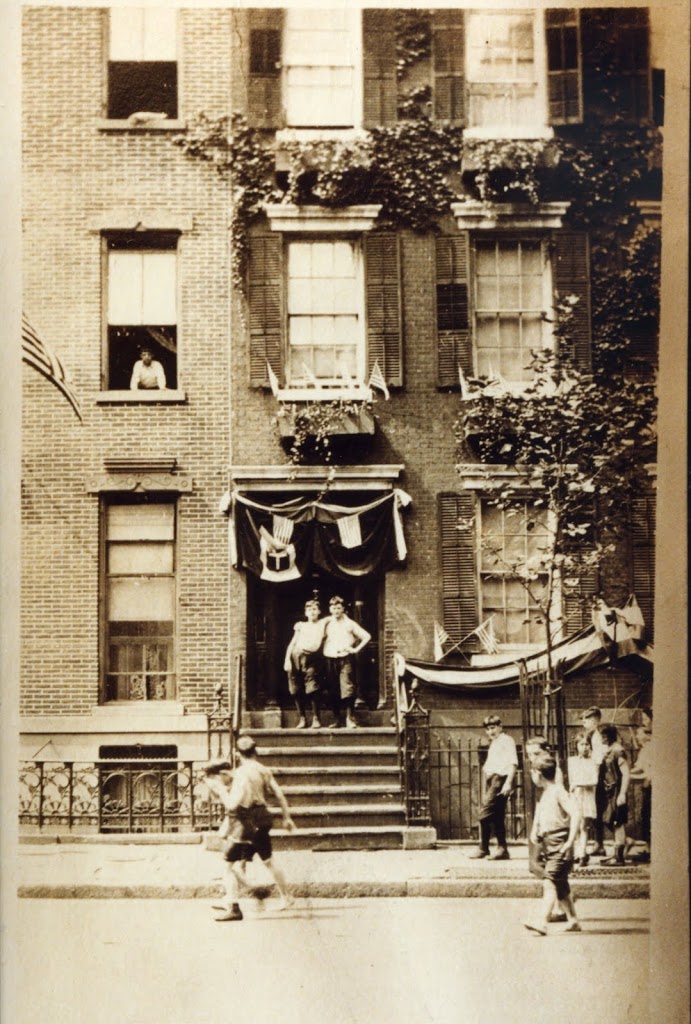
Children gallivant and pose for pictures outside 265 Henry Street, date unknown (Courtesy Henry Street Settlement)

FOR YOUR CONSIDERATION Until May 21st, you can vote every day in the Partners In Preservation initiative, a program that will award grant money to certain New York cultural and historical sites among 40 nominees. Having trouble deciding which site to support? I’ll be featuring a few select sites here on the blog, providing you with a window into their history and hopefully giving you many reasons to visit these places, long after this competition is done. Read about other candidates here.


Historic Site: Henry Street Settlement


Without perhaps intending it, social services pioneer Lillian Wald, in her desire to help thousands of poor immigrant women and children in the Lower East Side, also saved a rare and forgotten part of New York City history.

 The modern Henry Street Settlement is spread throughout several buildings in the neighborhood, providing health care, shelter, job training and a host of services to the community.  But it started out in just three adjacent Federalist-style townhouses on Henry Street, recruited into duty by Wald and her benefactor Jacob Schiff to stem the tide of disease and harm that threatened families in the world’s most densely populated neighborhood in the late 19th century.


A Different Lower East Side
As New York grew northward in the 19th century, wealthy landowners carved up their land with hopes of profit and a desire to foster New York’s next great elegant neighborhood. Revolutionary War colonel Henry Rutgers, who lends his first name to the street where the Settlement makes its home, sold off his property near Corlear’s Hook to businessmen with financial concerns along the Manhattan waterfront.

Below: An illustration from Forgotten NY, outlining the dividing line (literally, Division Street) between surrounding properties and Rutger’s own (in yellow). The buildings discussed are at Henry and Montgomery.
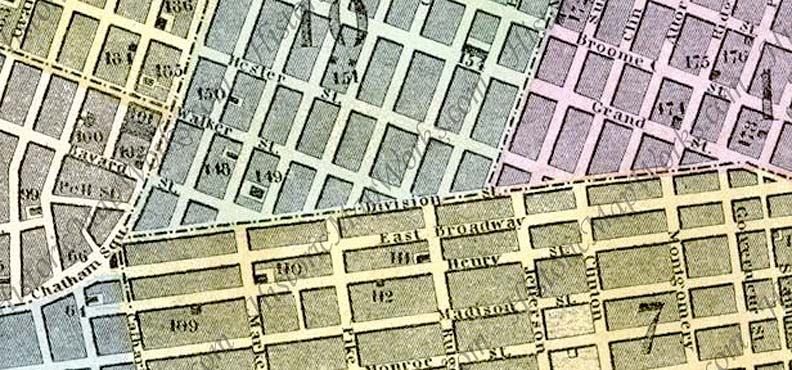
Many of the great shipbuilders lived in today’s Lower East Side (in the 1810s, it might have been called the Upper East Side) in fabulous residences within walking distance of the shore. Even by the 1850s, when the character of the neighborhood began to change, the mayor of New York Jacob Westervelt still resided at 308 East Broadway close to his shipyards. His neighbor at 281 East Broadway was city surveyor Isaac Ludlam.

Typical of the buildings that defined the neighborhood were 263 and 265 Henry Street, Federalist townhouses built in 1827. Its neighbor 267 Henry Street is a touch more ornate, with a different shade of brick  in a Georgian Eclectic style.

Picturing these streets today lined with such buildings is requires a vivid imagination. That’s because of the sudden mass of immigrants who arrived in New York by the 1850s, moving into poorer neighborhoods along the waterfront and in places like Five Points. Most of the homes along once-elegant Henry Street were torn down and replaced with tenements. Later, many of those tenements were themselves replaced with blocks of apartment complexes in the early 20th century.

These three Henry Street buildings have survived (as well as a few others, including Ludlam’s old home) because they were repurposed by a woman of uncommon compassion, one of New York’s most important figures in health and social services.

Settling Down
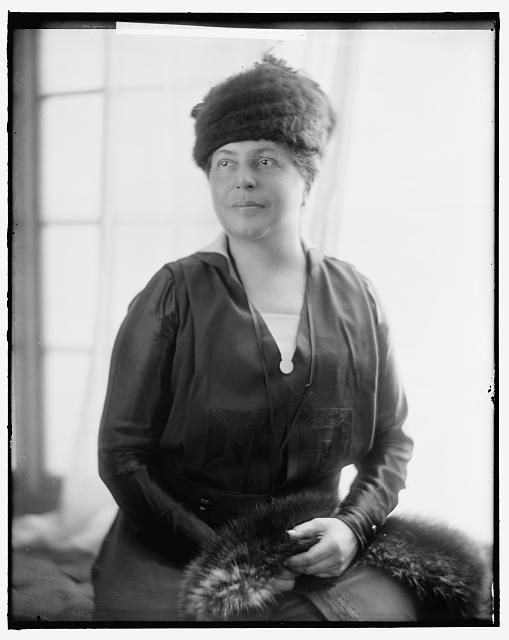
Lillian Wald first came to the city in 1891 as a student of New York Hospital’s nursing program. An intelligent and ambitious woman from Rochester, Wald quickly found purpose in one of the few respectable professions in the late 19th century where women could rapidly excel. She’s marveled at today as a person of extraordinary compassion. But in many ways Lillian was a modern entrepreneur, able to latch onto the progressive instincts of the day to solve the immediate social ills facing New York with great imagination and a bold lack of prejudice.

When Wald (at right) founded the Nurses Settlement in 1893, she was building upon the practices of altruistic Christian programs (like the Methodist missions into Five Points) that brought social services into the very heart of slum-filled, overcrowded neighborhoods. However Wald was Jewish, and her perspectives involving health care were profoundly nonreligious and ‘universalist’ for the day.

In that year she also met wealthy banker Jacob Schiff (who himself had immigrated to New York in 1865) who purchased the three Henry Street buildings for Wald to properly set up her nursing agency. From that moment, it became the Henry Street Settlement, housing a squad of nurses sent out into the neighborhood to tackle an ungainly number of health issues.

In an era where poor patients were often turned away from standard hospitals, Wald and her team of extraordinary women provided care for free, often risking their own lives to enter squalid tenements and exposing themselves to many illness that today have been completely eradicated. (One of her nurses, Margaret Sanger, would later become America’s leading birth control advocate.)

The Settlement had no problem making the former Henry Street residences into working clinics. The rooms still felt like a home in its decor, a respite for many visiting patients. The nurses lived upstairs in rows of small bedrooms, most of which today have been turned into cozy offices. The most lively (and historically important) room at the Settlement was the dining room, with large mahogany tables where Wald entertained a wide variety of guests, from poor patients to the great thinkers and Progressive voices of the day.
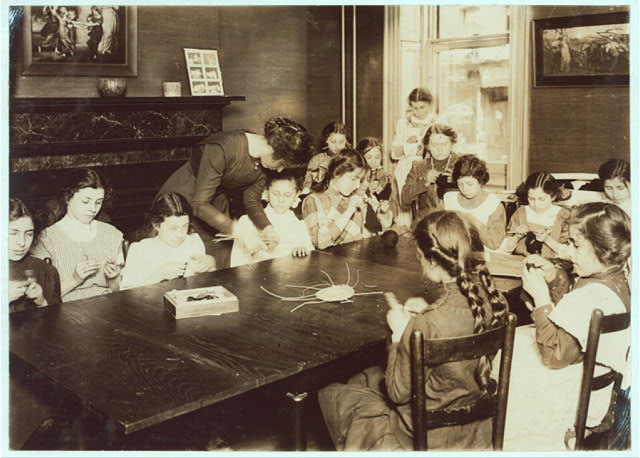


Below: A knitting class in the famous Henry Street dining room, May 1910. The fireplace at left is still very much intact. [LOC]

Beyond Borders
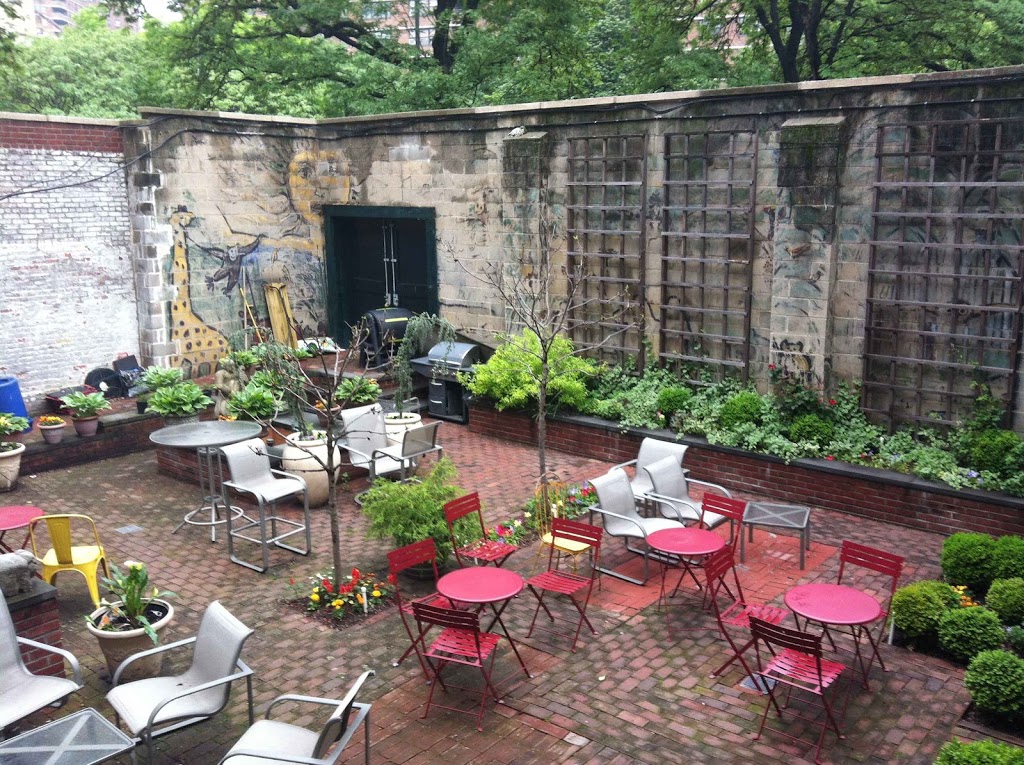
The Henry Street Settlement soon expanded its mission statement to generally improve the quality of life in the Lower East Side. Concerned that neighborhood children had no place to play, Wald set aside her courtyard to become one of New York’s first playgrounds in 1902.


Below: The location of the playground, just behind the Henry Street structures.
Wald frequently held meetings here for strikers rallying against the women’s garment industry. In 1909, she invited both white and black guests for a dinner, organizing a group that would soon grow to become the National Association for the Advancement of Colored People (the NAACP).

An excerpt from her 1915 book ‘A House On Henry Street‘ illustrates the racial politics of such a seemingly simple dinner party:

“At the time of the first convention of the organization, [the NAACP] formed to further better race relations in this country, the occasion promised to be almost too serious unless some social provision were made. 


I suggested a party at the House, but even the organizing committee was fearful. ‘Oh, no!’ they protested. ‘It won’t do! As soon as white and colored people sit down and eat together there begin to be newspaper stories about social equality.’ 


‘But two hundred members of the conference couldn’t sit down,’ I submitted. ‘Our house is too small. Everybody would have to stand up for supper.’ ‘Then it would be all right,’ they said with relief, and the party was successful.”
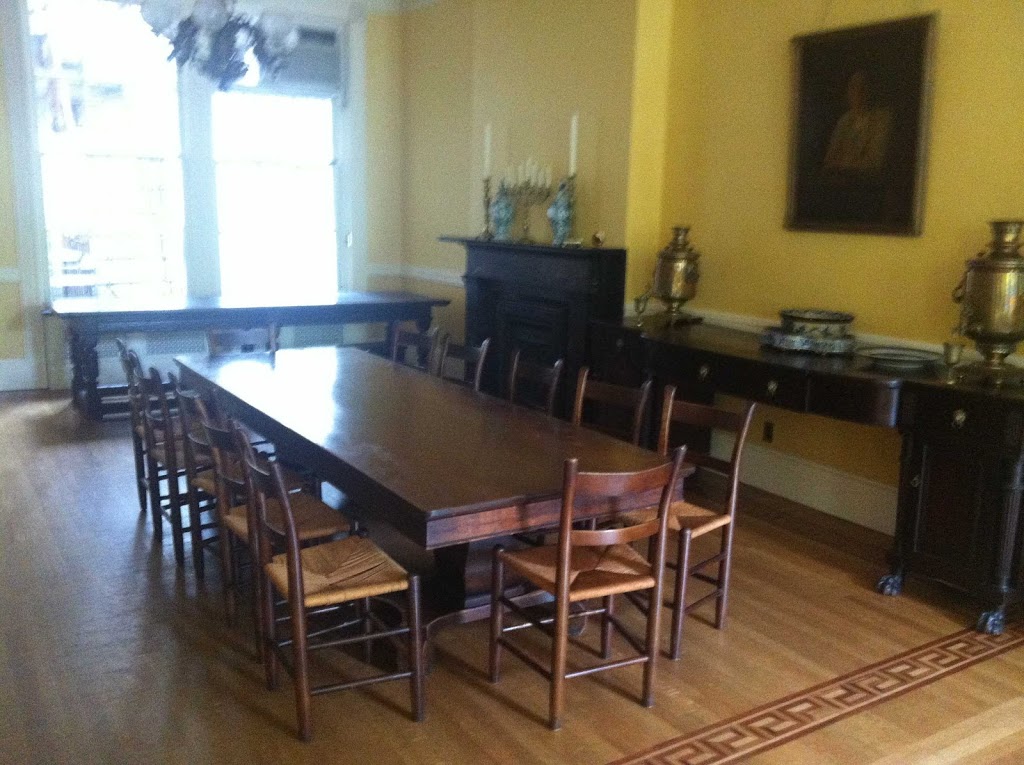
Above: One of the two original dining tables. Wald hosted hosted dozens of intellectual luminaries in this room, including Jane Addams, Eleanor Roosevelt, Jacob Riis and Theodore Roosevelt.

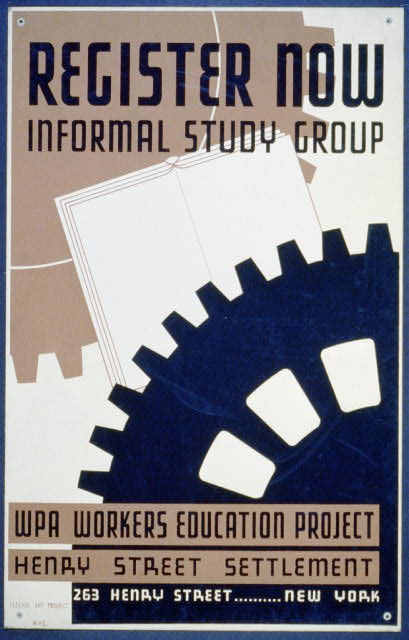
Wald would become a leading figure for New York social programs, often enlisted by the city to bring improvement to the city’s other public services. (In 1902, Henry Street’s Lina Rogers become the very first school nurse.)  The Settlement even become an important venue for the arts with the debut of the Neighborhood Playhouse theater in 1915. The tradition lives on at the Abrons Arts Center, another part of the Settlement that continues to be a critical part of the Lower East Side cultural community. (At right: A flyer for a WPA meeting, between 1936-41, LOC)
Wald died in 1940, but her Henry Street Settlement has only expanded in the years since her passing. Today they have facilities in over a dozen buildings throughout the neighborhood, expanding their focus to include job training, mental health services, adult education, a shelter for victims of domestic violence and even a computer lab.

Those original three buildings, housing mostly administrative offices today, are still a wonderful expression of an early era of New York history. Traces of that history sits next to the practicalities of office life; in one room, an original kitchen hearth and brick oven from the original tenants sit next to a couple photocopiers. Employees sit at laptops in Lillian Wald’s original bedroom with its spectacular sleeping porch overlooking the former playground.

The Henry Street Settlement hopes to use the Partners In Preservation grant money to combat the challenges of keeping their nearly two-centuries old offices in working order, to upgrade and prepare these old rooms for many more decades of providing a little more life to the Lower East Side.

Disclosure: I have partnered up with Partners in Preservation as a blog ambassador to help spread the word and raise awareness of select historical sites throughout the tri-state area. Though I am compensated for my time, I have not been instructed to express any particular point of view. All opinions expressed here are strictly my own. And since writing about New York landmarks is kinda my thing anyway, I’m thrilled to share my love of these places!
Categories
Mad Men

‘Mad Men’ notes: Between Julia Child and Weight Watchers

WARNING The article contains a couple spoilers about last night’s ‘Mad Men’ on AMC. If you’re a fan of the show, come back once you’re watched the episode. But these posts are about a specific element of New York history from the 1960s and can be read even by those who don’t watch the show at all. You can find other articles in this series here.

This week’s episode was set in the week before Thanksgiving 1966, certainly a moment of great apprehension for many American housewives like the embittered Betty Francis (the artist formerly known as Betty Draper).

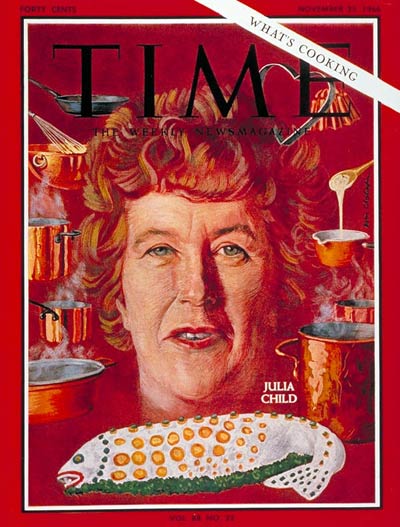
The cover of Time Magazine that week (11/25/66) featured a psychedelic portrait of Julia Child, framed in a chorus of saucepans with some kind of odd,decorated fish below her. Her Boston-based program The French Chef had been on the air over three years by then, bringing rich, savory delicacies into American homes. “Her fingers fly with the speed and dexterity of a concert pianist. Strength counts, too, as she cleaves an ocean catfish with a mighty, two-fisted swipe or, muscles bulging and curls aquiver, whips up egg whites with her wire whisk.” [source]

Child made classic, wholesome dishes with generous portions of high-calorie ingredients. But the 1960s also shoehorned greater artificiality into American kitchens — a barrage of food products loaded with preservatives, in unnatural shapes and presentations. The two food products most substantially featured on this week’s episode were canned whipped cream and Hostess Sno Balls, pink mounds of firmly molded, processed cake coated in a gelatinous frosting of uncertain origins. Even as Child stressed classic meals with fresh ingredients, actual food production was moving further away from easily digestible ingredients.

Made available to American grocery stores between 1965 and 1967: Bac-Os bacon bits, Shake ‘N’ Bake, Doritos, Easy Cheese, SpaghettiOs, Tang, Cool Whip.

If eating patterns in the 1960s set the county on a path of future health problems, they also spawned America’s first significant weight loss regiment. Betty, mortified by her extra pounds and judging herself against the lanky frame of her ex-husband’s new wife, turns to a community group that would grow to become the most successful weight loss program of the 20th century — Weight Watchers, a Queens-based company formed in 1963 that brought weight control to the mainstream.

Founder Jean Nidetch described herself in a 1971 biography as a “fat Brooklyn girl who grew up to be an even fatter Queens housewife.” She graduated from high school in Bedford-Stuyvesant in the 1940s and worked for the Internal Revenue Service before marrying in 1947. By the 1950s, she found herself in the massive garden apartment complex Deepdale Gardens in northeast Queens raising two sons and developing a compulsive eating habit.

Trying every available fad diet to no avail, she eventually visited a city-run obesity clinic in the neighborhood of Kips Bay in Manhattan, where she was advised to eat a so-called ‘prudent diet’: “two pieces of bread and two glasses of milk a day, fish five times a week and a weekly meal featuring liver.” [source] What they didn’t prescribe was camaraderie.

Nidetch took the food plans back to her apartment complex and organized a small cluster of neighborhood women to support each other in their quest to shed pounds. By 1962, she had lost dozen of pounds and had gained valuable insight into the power of group support to control eating habits. Using the ‘prudent diet’ as a rough guideline, she moved her regular meetings into a loft above a movie theater in Little Neck, charging $2 per meeting — the same price as the movie tickets being sold downstairs.

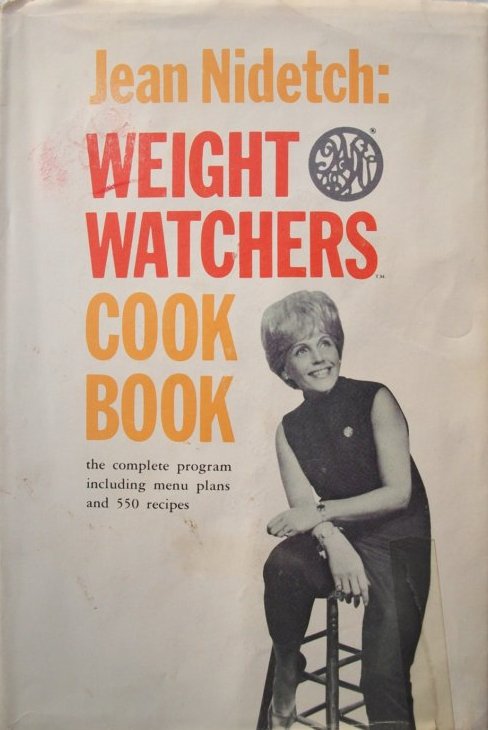
As depicted in this week’s episode, set in November 1966, Weight Watchers was still very much a regional program. Nidetch’s first Weight Watchers cookbook was released earlier in the year, debuting the regimented eating plan and structured point system.
A sampling: “Luncheon: 4 ounces fish or lean meat or poultry, or 2/3 cup cottage cheese or pot cheese or 4 ounces farmer cheese or 2 ounces hard cheese or 2 eggs. All you want of unlimited vegetables. 1 slice bread.”

As she confesses from the back cover: “Weight Watchers began when I invited to my house six overweight friends – have you ever noticed that most fat people have fat friends? – and much to the surprise of all of us we found that there were other people hiding cookies in the bathroom and eclairs in the oven.”

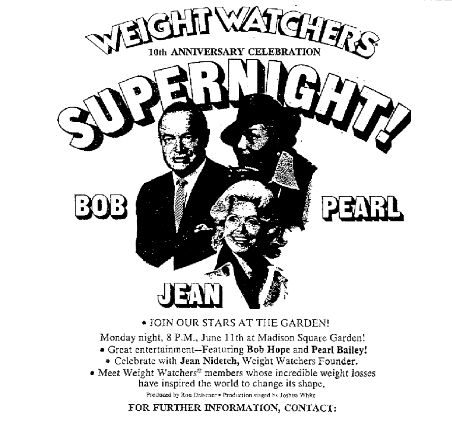
By the end of the decade, Nidetch’s new company — incorporating its famous food-points system and a methodology of daily calorie targets — would go worldwide. By 1972, Nidetch would invite 20,000 national devotees to a tenth anniversary party at Madison Square Garden, featuring guest appearances by Bob Hope and Pearl Bailey. (Ad below from Lubbock, TX, newspaper)

In 1978, Weight Watchers was acquired by the H.J. Heinz Company (which, in ‘Mad Men’ continuity, has been a most frustrating client for our favorite ad staff) who would mass produce Weight Watchers frozen foods.
Categories
Uncategorized

The Avengers Disassemble the MetLife Building

Fare thee well, you who we once called the Pan Am. We hardly knew thee. Image from Comic Book Movie

Warning: This story contains light spoilers.

Recent fantasy films and TV shows have found ways to alter New York City through the creation of alternate universes.  On Fox’s Fringe, a parallel world features a New York where the World Trade Center wasn’t destroyed, the Department of Defense is in a newly-bronzed Statue of Liberty, and Robert Moses never drove the Dodgers from Brooklyn. (The show also showed us what the skyline might look like with some Antonio Gaudi architecture.)

Comic book movies delight in showing super villains destroying the city — this summer’s ‘The Dark Knight Rises’ blows up bridges and ravages Federal Hall, while ‘The Amazing Spider-man’ will trash Midtown — and sometimes they even re-write history itself.

In ‘Captain America: The First Avenger’, the title character, a resident of Red Hook, discovers underground government laboratories in downtown Brooklyn during World War II.  Elsewhere in this Marvel Comics timeline, Moses’ World’s Fair of 1939-40 was such a smashing success that Tony Stark (aka ‘Iron Man’) turns the site into a year-round glittering expo of technology!

The latest Marvel adventure ‘The Avengers’ takes a more proactive approach to revising the city landscape, as though the entire film was a surly New Yorker architecture critic.

Thanks to the Commissioners Plan of 1811, allowing for a grid striped with long uninterrupted canyons, grotesque alien beings from Asgard can fly down the avenues unabated, wrecking havoc through Manhattan — Park Avenue in particular. Fortunately our heroes gather at Grand Central Terminal‘s traffic overpass, a critical location that they turn into a picturesque battleground. (Honorary Avenger Cornelius Vanderbilt, or at least his old statue from St. John’s terminal, stands resolutely in the background, ready to employ his superpower of acquiring railroads.)

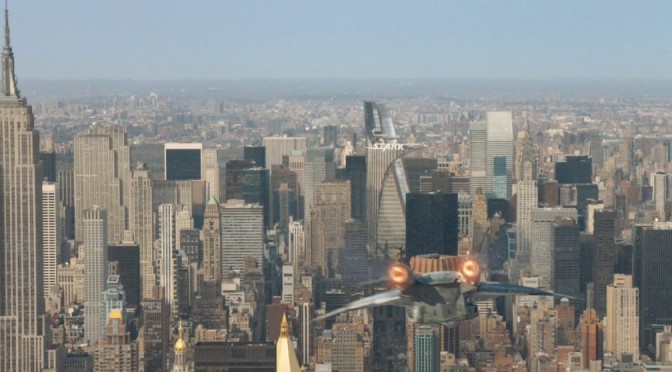
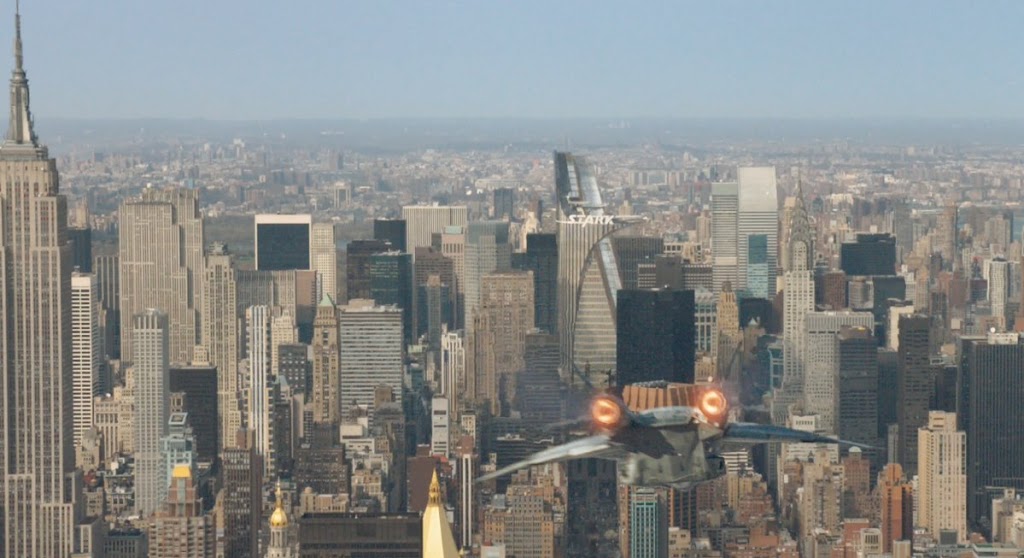
But one famous New York building is notably missing from these shenanigans. Stark, played by Robert Downey Jr., has constructed an energy-efficient new supertower for Stark Industries right on Park Avenue itself. To build this, he has clearly gotten permission from the city to methodically dismantle the MetLife Building (the former Pan Am Building).

The filmmakers have specifically chosen not to merely erase the MetLife Building, but to specifically display it being taken apart. The building is shown greatly reduced in height, decorated with cranes disassembling it like a tinker toy.

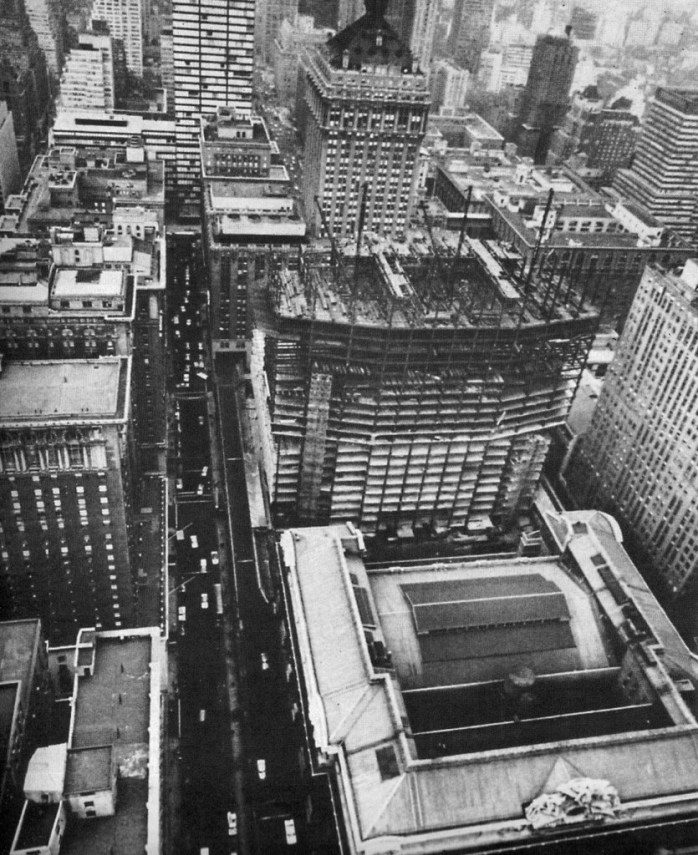
While other buildings enjoy the glamour of being reduced to rubble by gigantic mechanical space fish, the MetLife is ignobly taken apart to be replaced by an even taller, uglier structure. In fact, the dismantling looks a bit like this picture, an image of the Pan Am Building during construction in 1969:

(You can find a few more interesting construction pics here.)

The MetLife Building is easily one of the most disrespected structures in Manhattan and has been almost since the beginnings. Ada Louise Huxtable famously wrote: “A $100 million building cannot really be called cheap. But Pan Am is a colossal collection of minimums.”

According to author Meredith Clausen, “The Pan Am Building and the reaction to it signaled the end of an era. Begun when the modernist aesthetic and the architectural star system ruled architectural theory and practice, the completed building became a symbol of modernism’s fall from grace.”

Its broad-shouldered silhouette calls a halt to Park Avenue in a dated style that hovers between two Beaux-Arts structures (Grand Central to its south, the Helmsley Building to its north). Yet people blame the building for somehow ‘ruining’ Park Avenue — when the two other structures already blocked it — and its sly octagonal shape today makes it one of New York’s more interesting Brutalist-style examples.

Modernism happened, and if you use the same criteria that we might apply to other treasured New York structures, then the MetLife Building is a unique and exemplary building. But can you ever imagine a time when the MetLife Building might ever be landmarked?

This is what I was thinking while Thor and the Hulk were tearing into alien lifeforms.

But ‘The Avengers’ isn’t entirely disrespectful of architecture. In fact, the Chrysler Building is practically fetishized as an ideal view from the newly built penthouse of the Stark Building.

Its antenna spire, which makes it New York’s fourth largest building, is even utilized by Thor in the battle to save the Earth. William Van Alen, the building’s architect, would have been quite amused. This very spire was hoisted to the top of the structure from within the building itself in October 1929, a surprise accessory that allowed the Chrysler to take the title of New York’s tallest building from 40 Wall Street.

Pic above courtesy Bleeding Cool

Who are Barnes and Price? And other notes from the podcast

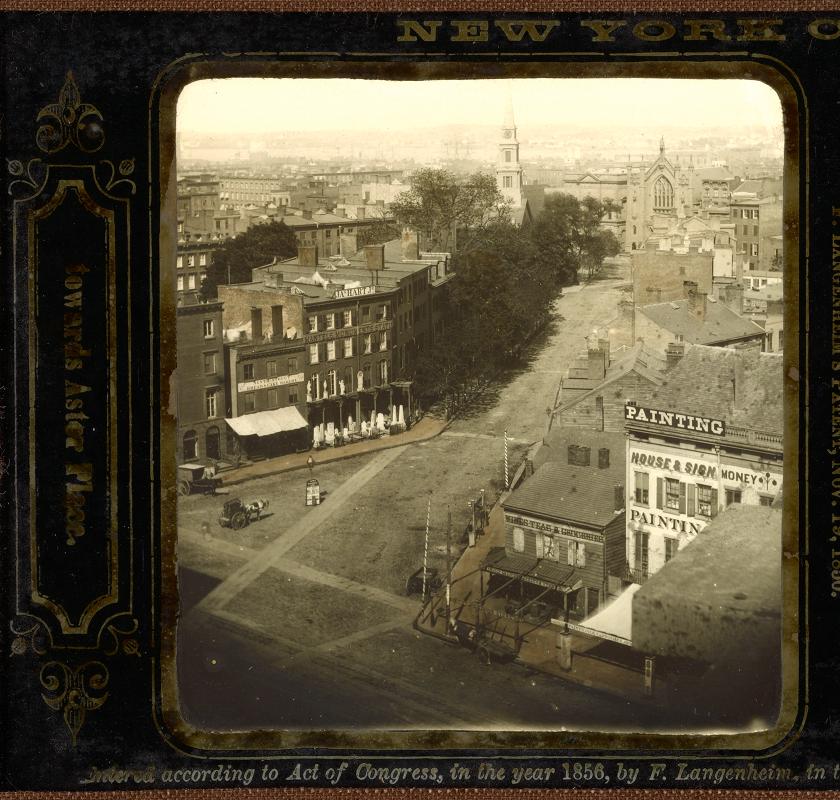
Stuyvesant Street in 1856, an aberration to the city grid plan thanks in part to the presence of St. Mark’s Church and its well-established churchyard. The small building in the foreground is where the St. Mark’s Bookshop stands today. You can see the steeple of St. Mark’s. Hmm, what what’s the other 
church in the background? (Pic courtesy East Village Transitions)

Some notes on our podcast, Episode #139: St. Mark’s-in-the-Bowery

THANK YOUS: For of all, we’d like to thank Rev. Winnie Varghese and Roger Jack Walters from St. Mark’s Church for telling us some wonderful stories on a sunny Sunday afternoon as volunteers worked busily to repaint that 1838 iron fence. This is one landmark is really good hands!


THE MYSTERY OF BARNES AND PRICE: There was once a second cemetery one block north of St. Mark’s that contained the bodies of less wealthy individuals in the community. In September 1864, their bodies were exhumed and moved to Evergreen Cemetery at the border of Brooklyn and Queens. The New York Times report on the exhumation mentions two individuals in particular: “The remains of two dramatic notables, BARNES and PRICE, of the Old Park Theatre, have been removed from this cemetery.”

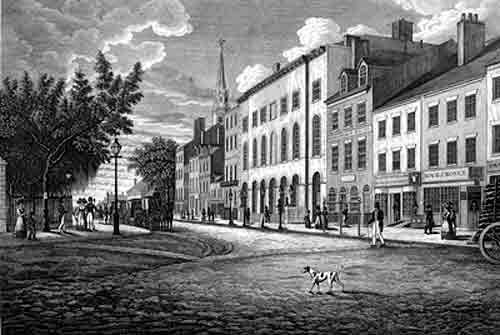
The Park Theatre (pictured at right) is considered New York’s first great theater, sitting on Park Row in the days before there was a City Hall, a Printer’s Row or anything else recognizable or familiar about that area today. The stage entertained British officers during the Revolutionary War, and in the early 19th century presented entertainment of the highest class.

The PRICE buried in the old St. Mark’s Cemetery is most likely its former manager Stephen Price, who specialized in importing British stage stars for their American debuts. One of those was Julius Brutus Booth, who debuted Shakespeare’s Richard III here in 1822. Booth’s children Edwin Booth and John Wilkes Booth would enter the acting profession in the mid-19th century.

But who’s the BARNES? Most likely it was English actor John Barnes who frequented the Park and died in 1841. However, his wife Mary, billed as Mrs. John Barnes, was in many ways a bigger star, the resident ‘heavy-tragedy lady‘ who made here debut here in 1816. The two often appeared on stage together — husband for the comedy, wife for the drama.

Mary Barnes outlived her husband by a quarter century, remarrying and becoming a successful theater manager in her own right. She died in the same year that her first husband’s body was moved to Evergreen. An assessment of her career:  “In melodrama and pantomime her action was always graceful, spirited and correct.” [source]


JAMES BOGARDUS: The portico of St. Marks is one of the last remaining examples of original cast-iron construction designed by Bogardus, but there are four other buildings in New York attributed to Bogardus that still exist: 254 Canal Street, 85 Leonard Street, 75 Murray Street and 63 Nassau Street. In TriBeCa today, you’ll find Bogardus Garden, a lush, green-fitted traffic triangle. Bogardus is buried at Green-Wood Cemetery.


FURTHER LISTENING: Although Augustus Stuyvesant was the last living direct descendant, there are others named Stuyvesant that trace their lineage to Rutherford Stuyvesant. To find out why this doesn’t quite count, listen in to my podcast on Rutherford’s pet project The Stuyvesant apartment, New York’s first of its kind. (Episode #131: The First Apartment Building).

We tell a ghost story about Peter Stuyvesant and St. Mark’s Church In-The-Bowery in our most popular of our ghost story podcasts. (#91 Haunted Tales of New York)

And of course, for more information on Peter Stuyvesant himself, we devoted an entire podcast to the director-general back in 2007. (Episode 14# Peter Stuyvesant)

SLIP UPS: This weeks verbal slip-ups include me saying ‘St. Mark’s ON-the-Bowery’ twice (it’s referred to in many ways, but never that).

Categories
Mad Men

‘Mad Men’ notes: The delirious world of Off-Off-Broadway

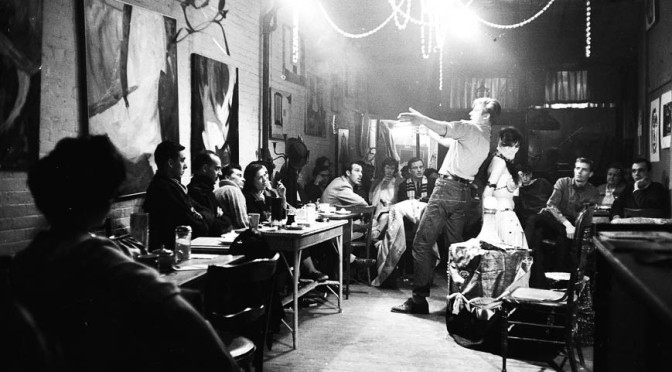
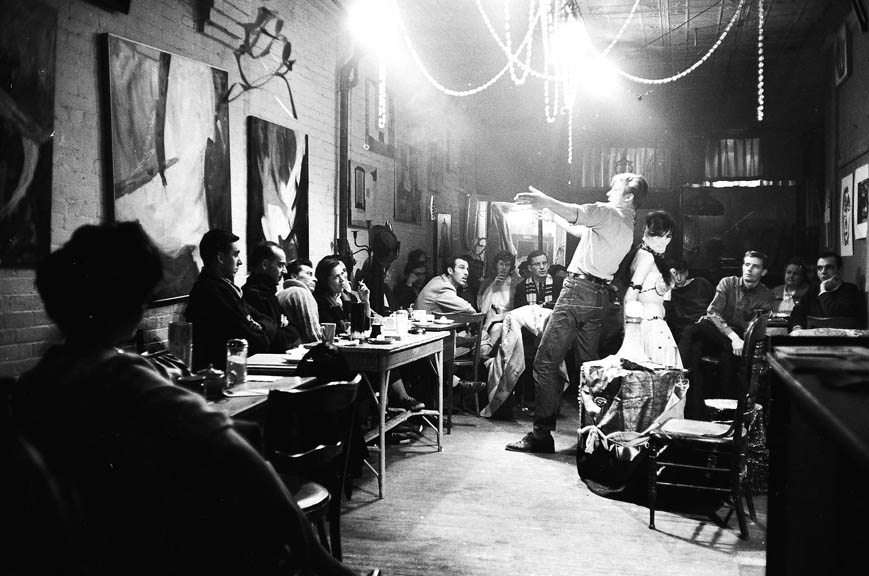
Radical thoughts, limited spaces: a performance at the Caffe Cino. Photo by Ben Martin (from an excellent website by Robert Patrick about this important off-off-Broadway site)

 WARNING The article contains a couple spoilers about last night’s ‘Mad Men’ on AMC. If you’re a fan of the show, come back once you’re watched the episode. But these posts are about a specific element of New York history from the 1960s and can be read even by those who don’t watch the show at all. You can find other articles in this series here.

 Megan might be Sterling Cooper Draper Pryce’s hottest new pitchwoman, but deep in her heart of delicate French extraction, she wants to be an actress. And in last night’s show, she steals away to an audition of an unnamed off-off-Broadway production. She didn’t get the part, but the experience leads her to make a jarring decision.

This wasn’t merely a plot contrivance, but rather another use of New York geography to delineate character. Don Draper was busy at Danny’s Hideaway, a Midtown East restaurant along famed ‘Steak Row‘ shimmering with late 50s — and, by 1966, ever fading — glamour. Megan’s off-off-Broadway audition could only be one place, and that was downtown below 14th Street, in the thriving epicenter of New York counter culture.

Aspiring performers have made New York their destination for fame since the late 19th century with the birth of the Broadway theater circuit. By the 1950s, playwrights and producers who challenged the preconceptions of standard, mainstream theater found homes for their work off Broadway both literally and metaphysically. The art of theater could now be explored for smaller crowds and with smaller budgets.

But even off-Broadway was not immune to financial realities. By the end of the decade, the popularity of off-Broadway created a parallel industry, “a smaller-scale version of Broadway itself.” [source] If you were to look back at the greatest off-Broadway hits of this era (plays by Tennessee Williams and Edward Albee, musicals like Threepenny Opera) you’d notice that most of them have had subsequent Broadway debuts. Indeed, off-Broadway continues to be a sort of a minor league tryout for future Broadway shows.

By the 1960s, unconventional creative voices were emerging that seemed positively alien even in that world. What do you call the alternative to something that was itself the alternative? Although Village Voice critic Jerry Tallmer is credited with coining the phrase ‘off-off-Broadway’, the phrase might have sprung up naturally the first time audiences came in contact with the early works of this field — modest, broken-down, difficult and experimental shows eager to discard every theatrical trapping that had built up for the past four hundred years.

The first ‘true’ off-off-Broadway performance, according to Tallmer’s fellow Voice critic Michael Smith, was a surreal revival of Ubu Roi, performed at a Bleecker Street coffeehouse in 1960. Theatrical experimentation complimented the Village music scene nicely, as even the smallest venues could now host a production. Only in this new creative world could a cramped, smoke-filled coffeehouse like Caffe Cino, at 31 Cornelia Street, become center stage for a new theatrical revolution.

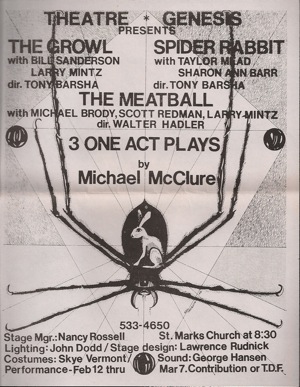
If the art was nontraditional, so too were the venues. Two churches became important homes for alternative theater in the early 1960s and they remain so to this day. Judson Memorial Church, off Washington Square, may seem austere with its elegant Italianate bell tower, turned its meeting room into an off-off-Broadway stage in 1961. And, of course, St. Marks-in-the-Bowery, took a page from its own 1920s radical bohemian past to become home to the Poetry Project and Theater Genesis (performing sometimes sexually explicit plays in the churches parish hall). Above: A poster for Theater Genesis

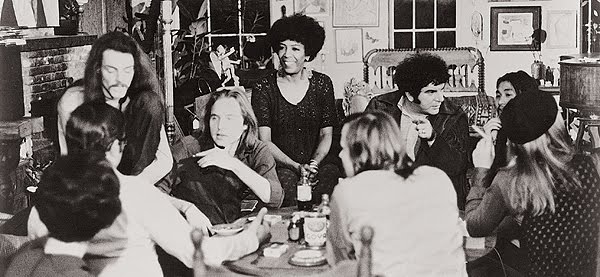
But just as many pivotal and provocative voices of off-off-Broadway were developing further east, in an area of the Lower East Side heavily influenced by Greenwich Village counterculture idealism and referred to by the mid-60s as the East Village. The chief among these, Ellen Stewart’s mold-breaking La Mama Experimental Theatre, opened in 1961 and rejected most theatrical instincts, featuring only new plays in a stripped-down, almost barren theatrical space. Pictured above: Ellen Stewart in 1970. Picture courtesy TCG

By 1966, off-off-Broadway became a banquet of experimental ideas, spaces for gay, feminist and African-American playwrights and performers. In effect, the opposite of a certain ad agency, where creative flowering is hindered by the whims of client preference and the banality of subject.

Categories
Neighborhoods Podcasts

The secrets of St. Mark’s Church in-the-Bowery, and uncovering the East Village footprint of Peter Stuyvesant


FOR YOUR CONSIDERATION Until May 21st, you can vote every day in the Partners In Preservation initiative, which will award grant money to certain New York cultural and historical sites among 40 nominees. Having trouble deciding which site to support? I’ll be featuring on a few select sites here on the blog, providing you with a window into their history and hopefully giving you many reasons to visit these places, long after this competition is done. Read about other candidates here.


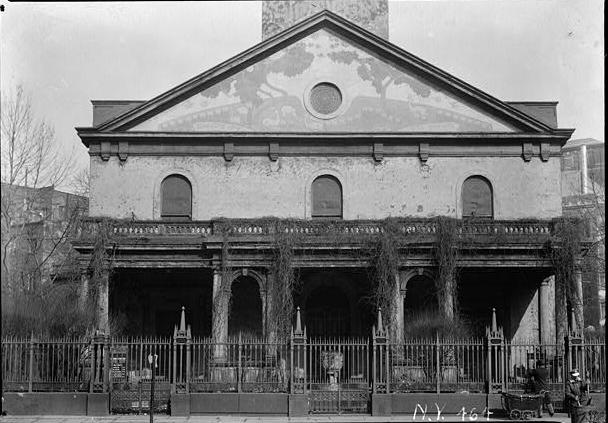
PODCAST The church of St. Mark’s-in-the-Bowery is one of Manhattan’s most interesting and mysterious links to early New York history. This East Village church was built in 1799 atop the location of the original chapel of Peter Stuyvesant, New Amsterdam’s peg-legged director-general. His descendants — with the help of Alexander Hamilton and the architect of New York City Hall — built this new chapel with the intention of serving the local farming community of Bowery Village.

But in many ways, the more thrilling tales occur among the honeycomb of burial vaults underneath the church, the final resting place of vice presidents, mayors, and even Peter himself.

St. Mark’s reflected the changes that swept through Greenwich Village during the 20th century, with experimental and sometimes scandalous church activities, from hypnotism, modern dance and even a trippy foray into psychedelic Christian rock.

ALSO: Find out why you can never EVER go down into the vault of Peter Stuyvesant. And why is the church IN the Bowery, not ON the Bowery?

NOTE ABOUT THE NAME: The modern name of this historic structure is technically St. Mark’s Church In-The-Bowery. However most 18th-19th century sources drop the ‘church’ from the middle of the name. The hearty bust of Peter Stuyvesant in the courtyard calls it ‘Saint-Mark’s-in-the-Bowerie’.

Hyphens are liberally or reservedly applied based on the source. As we decided to spend a great deal of time talking about the old farm and the early years, we settled on ‘St. Mark’s in-the-Bowery’. But I even twisted myself around during recording and said ‘on-the-Bowery’ accidentally at least twice, so sorry for the confusion!

I’ll post some more notes on the show next week, some thank-yous, further information and some further sources to check out for more information.


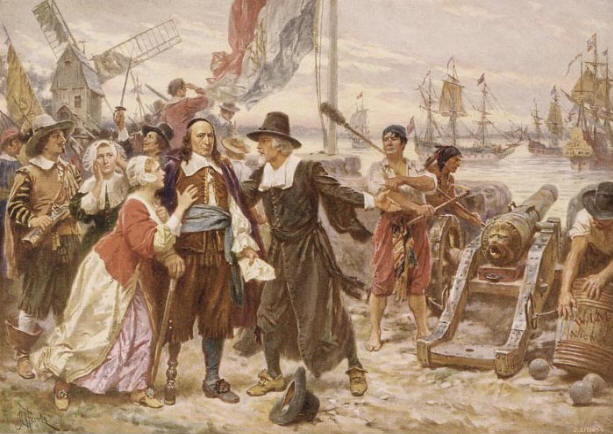
Below: The residents of New Amsterdam beseech Peter Stuyvesant to surrender to the coming British forces in 1664. He is clearly not pleased. The official surrender actually took place at Stuyvesant’s farm house, two miles outside of town along the bouweij or Bowery road. Listen here for the real pronunciation of bouwerij.

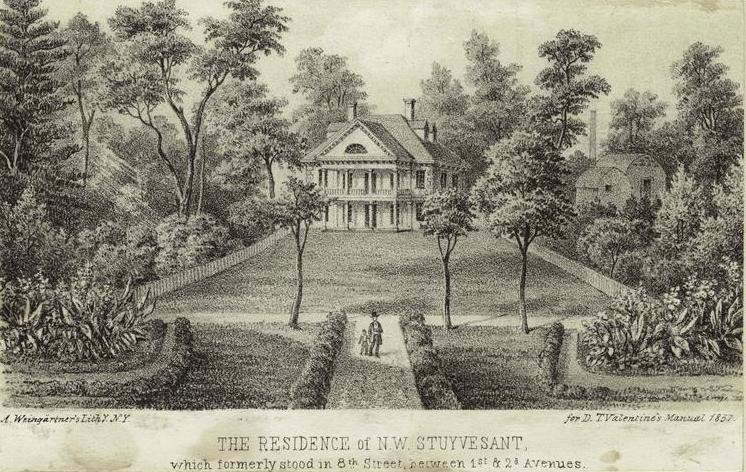
The caption reads ‘The Residence of N.W. Stuyvesant’ which formerly stood in 8th Street, between 1st and 2nd Avenue‘, one property on the land estate of the Stuyvesants during the 18th century. (NYPL) I’ve seen this same illustration differently labeled, dated 1800 and called simply ‘the Bowery House’.

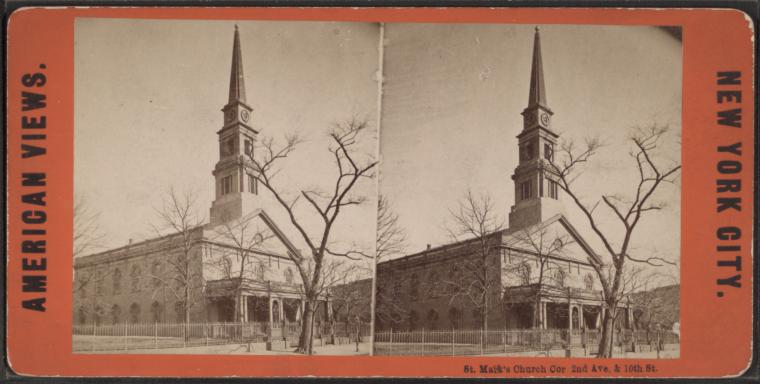
 St. Marks in 1865, rendered in an early stereoptic photograph. The church itself looks pretty much as it does today. But the surrounding churchyard would be radically transformed. (NYPL)

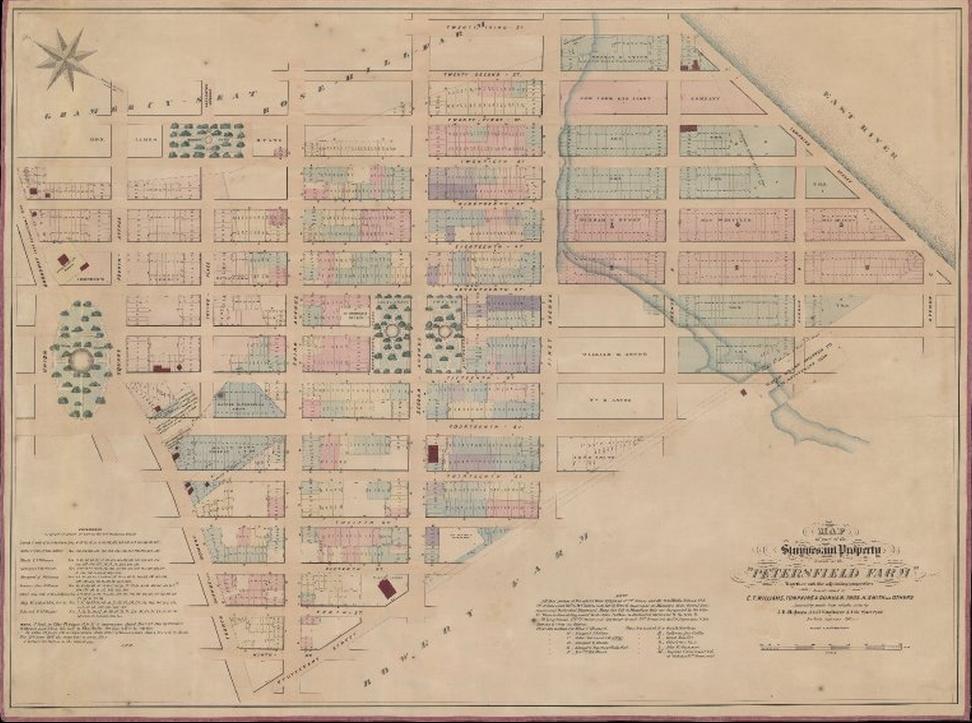
A real estate map, imprinted with the grid plan over the Stuyvesant property. You can see Stuyvesant Street at the bottom. The collected properties were also known as ‘Petersfield’ after a manor home of one of the Stuyvesant descendants. (NYPL)

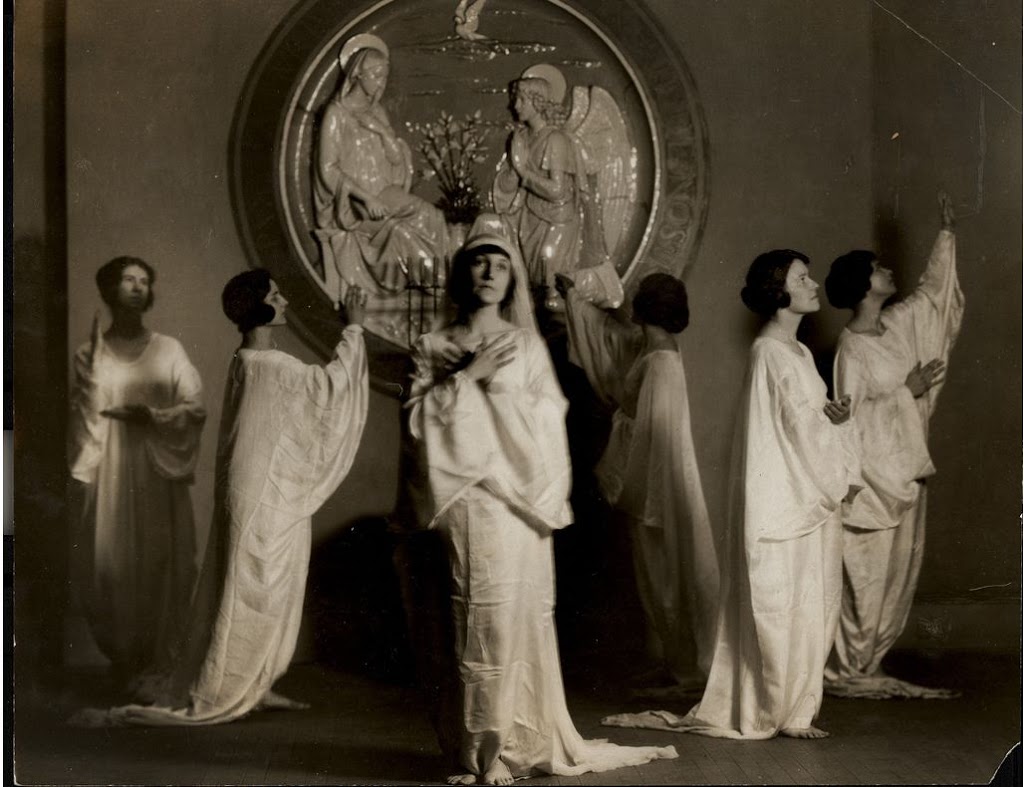
The interpretive dancers of Dr William Norman Guthrie,  the Scottish clergyman who oversaw many radical changes to the standard St. Mark’s services.


An excerpt from the Mind Garage’s ‘Electric Liturgy‘, which was performed at St. Mark’s Church in 1969


Visit St. Mark’s website for a virtual tour of the St. Mark’s church yard.

  Disclosure: I have partnered up with Partners in Preservation as a blog ambassador to help spread the word and raise awareness of select historical sites throughout the tri-state area. Though I am compensated for my time, I have not been instructed to express any particular point of view. All opinions expressed here are strictly my own. And since writing about New York landmarks is kinda my thing anyway, I’m thrilled to share my love of these places!
Categories
Staten Island History

Camera Ready: The Alice Austen House, a rustic reminder of an uncommon artist and a cottage shrine to a life in pictures

DSC00654


FOR YOUR CONSIDERATION Until May 21st, you can vote every day in the Partners In Preservation initiative, which will award grant money to certain New York cultural and historical sites among 40 nominees. Having trouble deciding which site to support? I’ll be featuring on a few select sites here on the blog, providing you with a window into their history and hopefully giving you many reasons to visit these places, long after this competition is done. 


Historic Site: The Alice Austen House
On the banks of Staten Island’s eastern shore sits a worn but elegant cottage, where once lived a woman of modern artistic gifts that just a few decades earlier would have been considered magical.

Alice Austen was a photographer of sublime ability, in an era when the artistic potential of photography was still being assessed. She’s the sort of historical figure whose life could easily be overlooked. In fact, it was, for almost half a century. Her existence at times seems sequestered, in a habitat of old wealth, her universe principally residing in a borough that itself sometimes gets unfairly disregarded. In some ways, it’s the Alice Austen House, in Rosebank, Staten Island. that keeps her legacy in the conversation — as a revolutionary artist, an enigmatic social eccentric and a famous New Yorker.

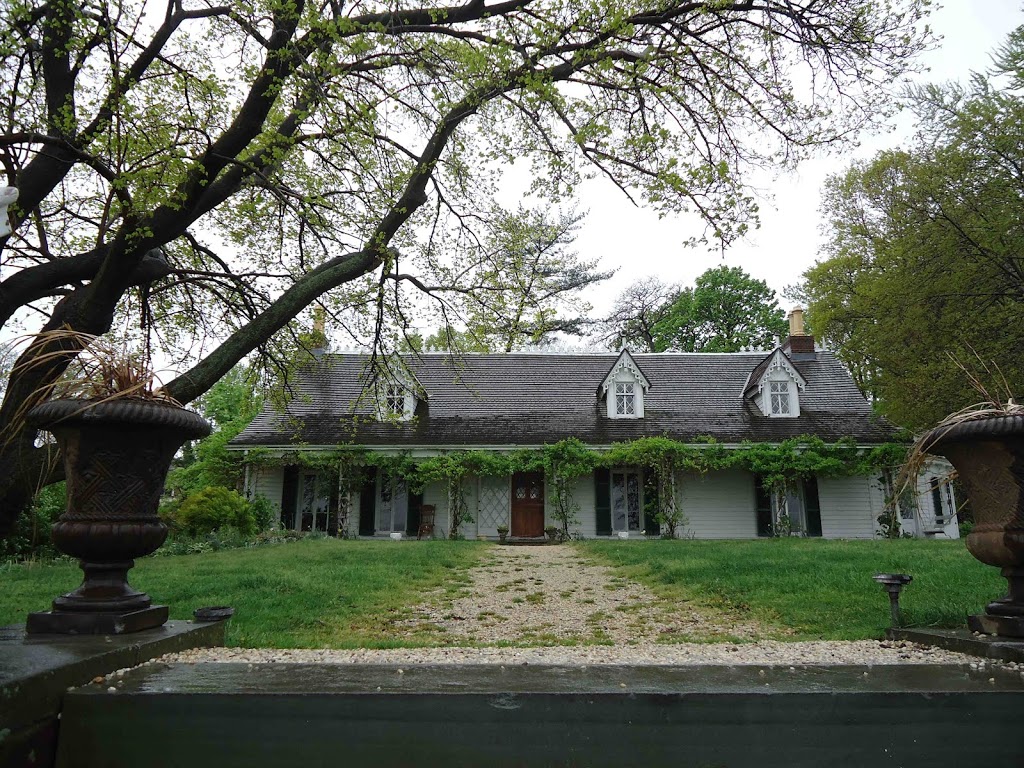
Portions of this curious house — named Clear Comfort, but readily known today as the Alice Austen House, after its most famous resident — can be traced to a modest one-room structure built in the 1690s, when Staten Island (or, as the British preferred to call it, Richmond County) had only about 1,000 residents, mostly Dutch farmers.  From the windows of the original farmhouse, the residents might have seen the British, using Richmond as a base, attacking Washington’s forces on the opposite shore in Brooklyn in August 1776.

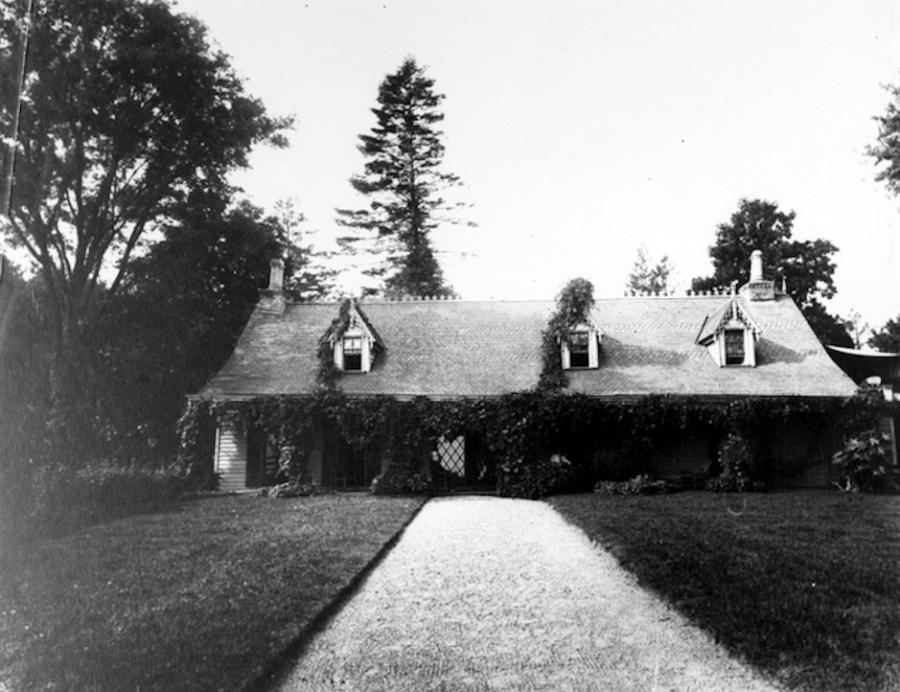
18951

Above: Alice’s photo of her home, 1895

By the early 19th century, the house shared the northeastern shore with a smattering of ferry docks, including one owned by an ambitious young periauger operator named Cornelius Vanderbilt.  As New York grew to become a busy port city and a capital of wealth, some prominent residents flocked to the Staten Island shore for respite. Moguls, businessmen, socialites, even Vice Presidents (Daniel D. Tompkins) built lavish homes a short carriage ride away.

That this shoreside Dutch farmhouse survived to even this point in history– hogging a view of the Narrrows that any mansion builder might envy — is extraordinary. As a later history of Staten Island dramatically put it, “[I]t is a relief to the more conservatively inclined to find in Greater New York a house that still defied the sword of the destroying angel….One of these, which for centuries has defied destruction, is the Austen homestead.”

In 1844, a lower Manhattan dry goods merchant John Haggerty Austen purchased the old Dutch house, dilapidated but still desirable due to its view of a harbor clogged with ships. Austen greatly expanded the property into a Gothic revival summer cottage worthy of an old European fairytale. Soon, several members of the Austen clan lived here year-round. And in 1866 they were joined by Austen’s unmarried daughter and her small infant Alice.

The pair had been abandoned by Alice’s father, a situation one might normally consider dire in the mid-19th century. However the Austen family doted upon the child, and their wealth provided a cushion for the girl to pursue her ever bolder ambitions in comfort.

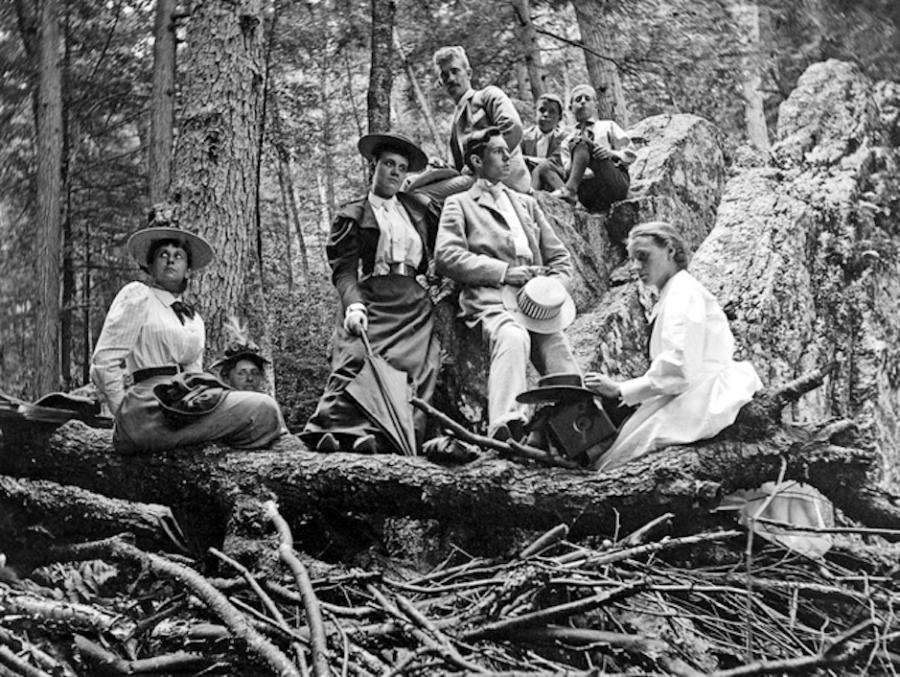
Above: Alice Austen in a self portrait on the porch of Clear Comfort, 1892 [source]

The first camera came to Clear Comfort in 1876, the present of Alice’s uncle, Oswald Muller, a Danish sea captain who demonstrated the bulky, wooden device in the Austen garden. Alice became immediately fascinated, and, although it was certainly unladylike in the Victorian era for a young woman to hunch in front of a large wooden tripod, her talents soon became evident. Another uncle, a chemistry professor, guided her through the development process, and an upstairs closet was eventually transformed into her own personal darkroom. In this dank, inconspicuous room, Austen patiently developed some of the most beautiful pictures of old New York ever taken.

mountains

Above: Lounging in the woods, 1893


A THOUSAND WORDS
Alice Austen was not a professional photographer. She did not get paid to document the world or to hover over developing chemicals. She took pictures because she loved it.

The photographic process before the 1890s — before the introduction of camera film — was a complex and frustrating production. The pursuit of leisure photography, capturing casual, outdoor scenes using a portable camera, was a relatively recent phenomenon. And a camera was only ‘portable’ in the sense it could be used outside a studio. A wooden-box camera with a tripod and a satchel of delicate lens and exposed plates would have been difficult to transport.

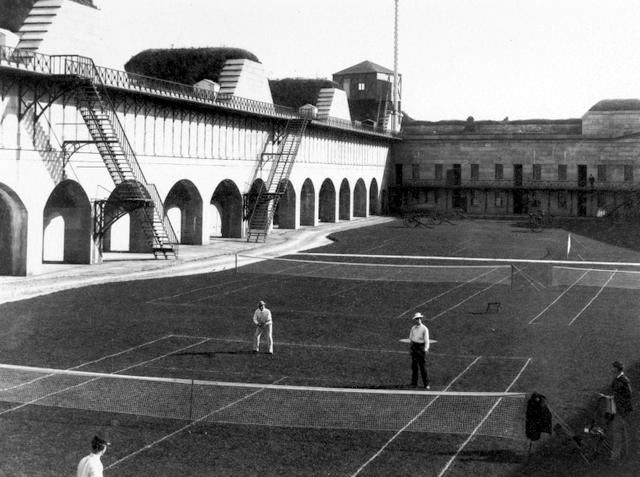
Below: The Staten Island Cricket Club in St. George, in 1893, employing the sort of subject framing that would typify art deco photography a couple decades later.

tennisjpg

Alice’s first images were taken at home, on the grounds of Clear Comfort.  From here she developed the poise, the skill and the guts to take the camera on the road — around Staten Island, along rocky mountainous areas and winding trails. And eventually, to Manhattan itself. What a sight it would have been to behold young Alice Austen on her bike, weaving through the streets of Manhattan with her equipment strapped to the back.

What comes through from her photography is a zest for life rarely documented in images of the era. Due to the conventions of the photographic process, subjects had to stand still or risk being rendered a ghostly blur. Equally important, people rarely knew how to pose. But in the world of Alice Austen, frivolity overrides stiffness. Austen documented her social circle with a provocative candidness, allowing her subjects to goof around, create visual gags, even cross dress.

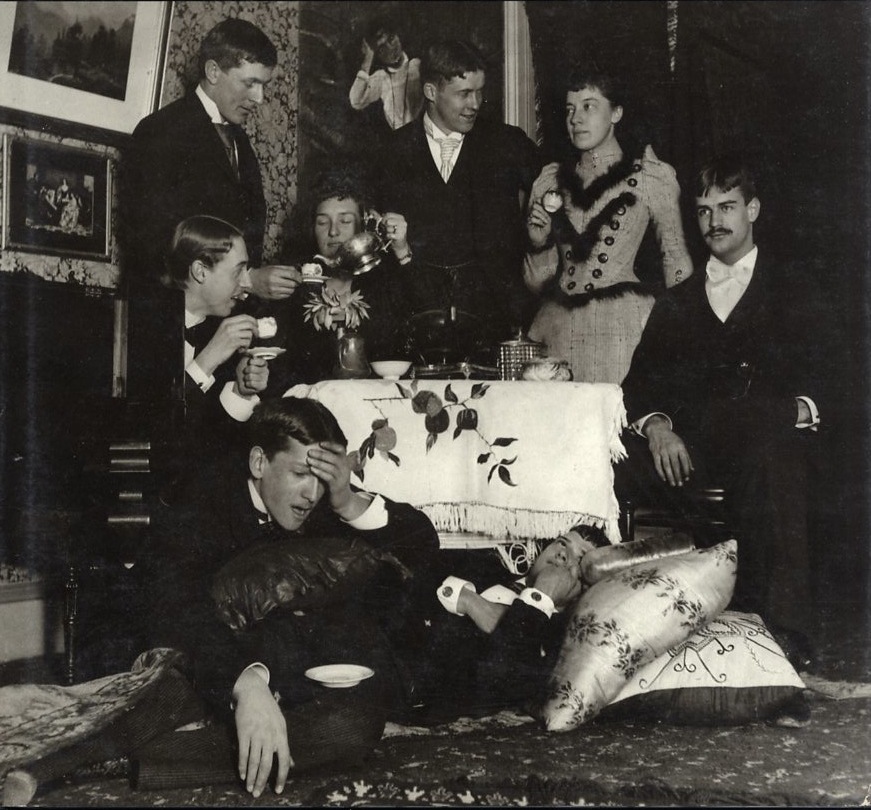
My favorite of all her images finds Alice herself posing awkwardly with a group of men at a mock tea party. What are they doing? This picture presages a billion future Facebook photographs of people acting in a nonsensical fashion.

alices

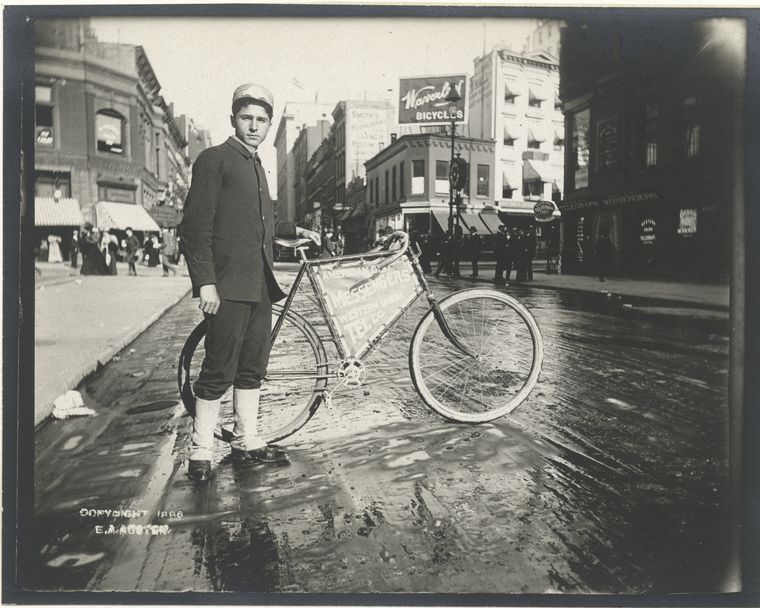
On the streets of New York, Austen found composure and beauty in common situations. More stunningly, she found it among lower class subjects — bike messengers and street urchins, rag pickers and fishmongers. Most likely, she knew ‘proper’ New Yorkers would never have posed so spontaneously for her. Perhaps her choices were informed by contemporary New York photographers of the day, people like Lewis Hine and Jacob Riis, who chose the same subjects but for more social reformist purposes.

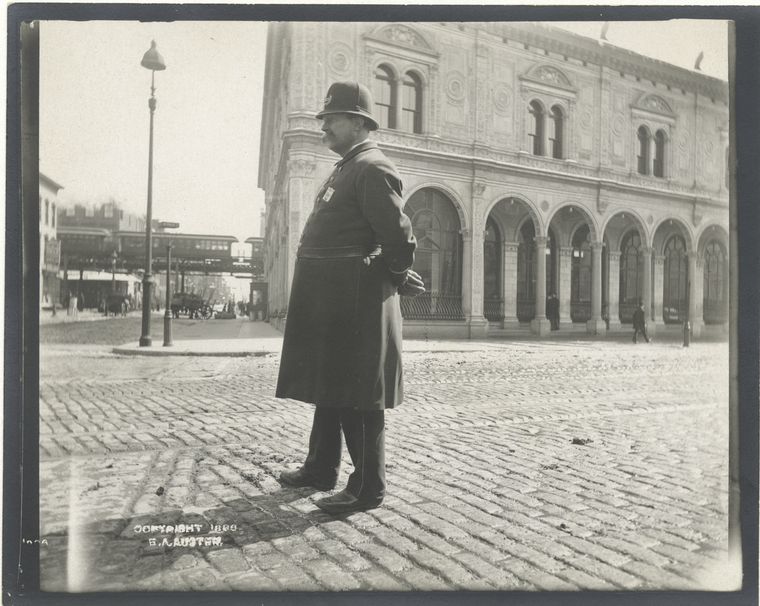
In 1896, Alice stopped a messenger boy on the street to create a masterpiece of composition and form. She would do the same with policemen, postmen, even street sweepers. (NYPL)

1896
police

Her travels took her around New England and even to Europe, but she always returned home to Clear Comfort, and her house and the Narrows framed beautifully in front would remain her most popular subjects.

ALICE AND GERTRUDE
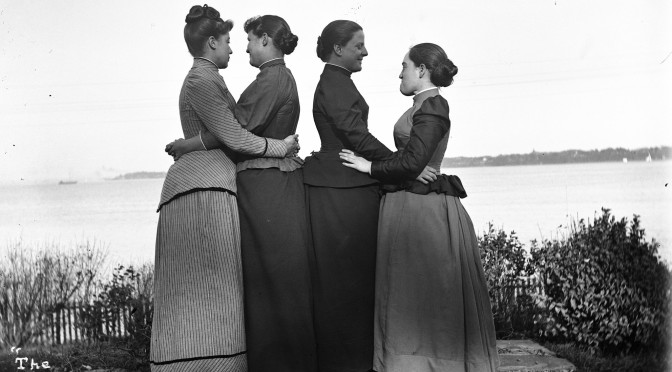
Alice Austen is also an important figure in gay and lesbian history, although she might have recoiled from the word ‘lesbian’, a term which seemed to apply more to the debauched female bohemians of Greenwich Village than an old-money doyenne living in a seaside cottage. In 1899, she met Brooklyn school teacher and dance instructor Gertrude Tate and began a companionship that culminated in 1917 when Gertrude, over objections from her family, moved into Clear Comfort with Alice.

Yes, another female power couple named Alice and Gertrude. Although unlike the Parisian bon vivants of the day, the true relationship led by Austen and Tate continues to remain closed to the world. They were companions for the rest of their lives, even through the troubling trials that would soon befall the residents of Clear Comfort

She had survived this many years quite comfortably on the interest from her grandfather’s wealth. But the Great Depression wiped out most of the family finances. Austen resorted to opening her front yard as a tea room, and when that failed, she mortgaged the house and sold off most of her possessions. Fortunately in 1945 she confided her glass plate negatives to Loring McMillan at the Staten Island Historical Society — although she expected to get them back! (McMillan would later be instrumental in the creation of Historic Richmond Town as a repository of some of the borough’s oldest, most famous structures.)

19511

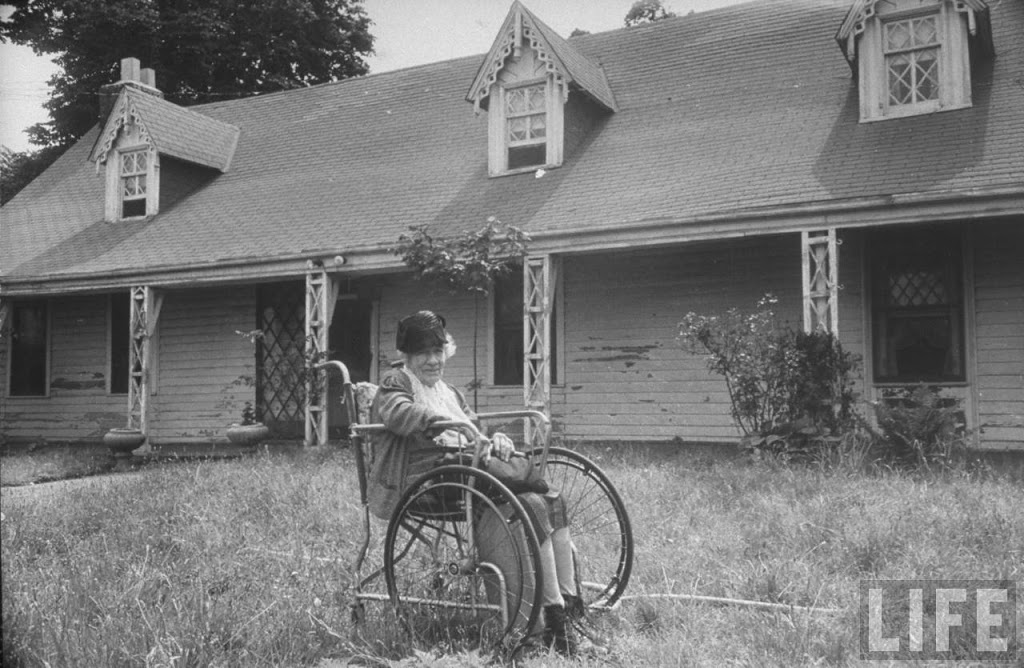
Above: For a Life Magazine article in 1951, Austen was reunited with her tattered old home.

Alice Austen has the rare distinction of being rescued herself by a historical preservation society.  Even as situations became so dire for her in 1950 that she moved into the Staten Island Farm Colony, a pauper’s retreat in Sea View, the Staten Island Historical Society began work with a publisher to publish her photos, most seeing light for the first time in decades. From the proceeds she was able to spend her final years in a private nursing home, the subject of magazine articles and belated tributes. She died in on June 2, 1952.

Gertrude outlived her by ten years. Her request to be buried next to Alice was not honored by her family.

PRESERVING THE IMAGE
Alice Austen’s home was rescued by the community in the 1960s, designated a New York City landmark in 1971 and exhaustively renovated in the 1980s. Today it’s one of Staten Island’s most unusual treasures, close to industry and a heavily developed residential area, but serene as though kept under glass.

The house is as reverent to the craft of photography as it was when Alice was alive. On the blustery afternoon I spent at the Alice Austen House, the rooms were buzzing with children arriving for a workship on how to make and use pinhole cameras. Replicas of her equipment are featured in exhibits fashioned from Alice’s old drawing room.

While the home is in remarkable shape for a building over three centuries old, standing on the shores of the Narrows provides a special challenge for preservation, and the grant it has placed with the Partners In Preservation program would help weatherproof the structure, with additional repairs to the chimney and roof.

The Alice Austen House is digitizing many of her 3,500 existing photographs, available on their newly launched website. You can also go there for information on how to visit.

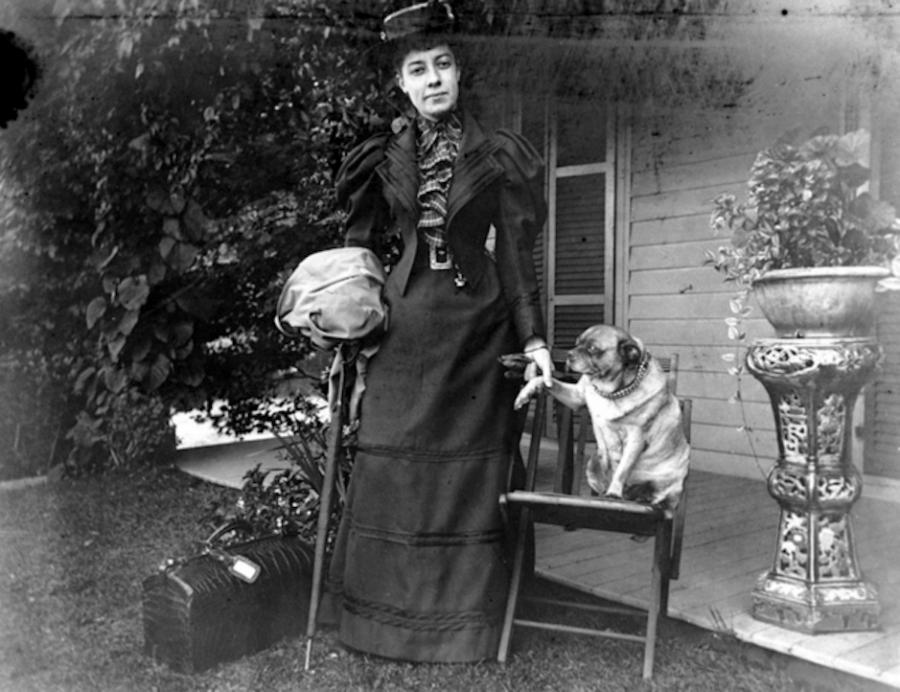
Below: Alice in a self-portrait with her dog Punch, 1893 [source]

punch

Disclosure: I have partnered up with Partners in Preservation as a blog ambassador to help spread the word and raise awareness of select historical sites throughout the tri-state area. Though I am compensated for my time, I have not been instructed to express any particular point of view. All opinions expressed here are strictly my own. And since writing about New York landmarks is kinda my thing anyway, I’m thrilled to share my love of these places!
Categories
Mad Men

‘Mad Men’ notes: Executive (and bohemian) dining


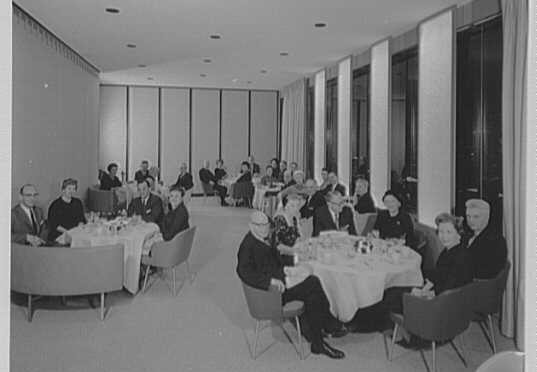
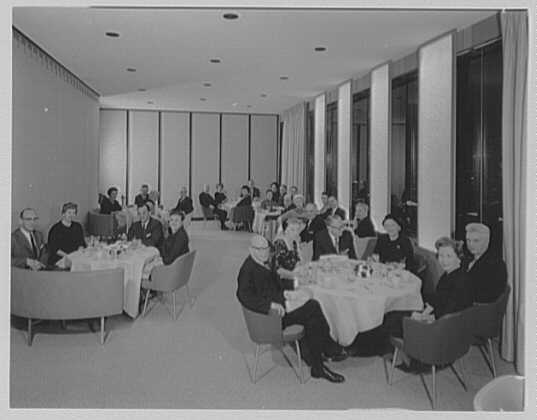
A square meal: The Tower Suite’s packed dining room   


WARNING The article contains a couple spoilers about last night’s ‘Mad Men’ on AMC. If you’re a fan of the show, come back once you’re watched the episode. But these posts are about a specific element of New York history from the 1960s and can be read even by those who don’t watch the show at all. You can find other articles in this series here.

In trying to contrast the life-altering decisions made by two of ‘Mad Men’s central characters, the writers certainly did an excellent job last night in choosing two appropriate and familiar locales.

Don Draper (with Megan in tow) made a last-ditch effort to win over a difficult client by dining at the Tower Suite in the Time & Life Building. (The offices of Sterling Cooper Draper Pryce were actually several floors below.) The restaurant on the 48th floor served as an executive dining room during the day called the Hemisphere Club, one of a number of elevated lunch spots in midtown Manhattan. The destination for businessmen looking to impress — waiters were dressed as butlers  — was opened by George Lang of Cafe des Artistes fame in 1961.

By many accounts however, the Tower Suite was considered a starched and even dreary dining experience. And quickly passe. In 1970, New York Magazine intoned “[T]he Tower Suite is still ideal for enchanting sheltered in-laws, teenagers, the hopelessly in love and out of town clients from Saginaw.”

Peggy Olsen, meanwhile, had a more personal dilemma to attend to downtown in the heart of Greenwich Village where she’s seen much of her personal growth. She’s presented with a decision to make over dinner at Minetta Tavern, a corner Italian restaurant on MacDougal Street at the foot of small Minetta Lane.

This was the former location of The Black Rabbit, one of Greenwich Village’s best known speakeasies, operated by Eve Addams. Her infamous tearoom Eve’s Hangout right up the street was one of New York’s first lesbian hangouts. The Black Rabbit switched to proper Italian cuisine in 1937.

The tavern had been immortalized the previous year in Joseph Mitchell‘s ode to eccentric bohemian Joe Gould, who frequented Minetta’s in his later years. ‘Joe Gould’s Secret’ would become one of Mitchell’s best  known New York tales. (It was also be his last book.)

With the Tower Suite long gone, you can no longer enjoy its faux-butler service, but Minetta Tavern was renovated and reopened in 2009 by restaurateur Keith McNally.

Categories
Mad Men

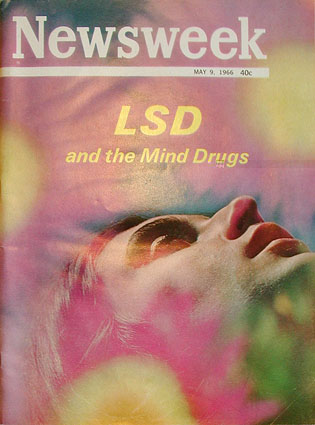
‘Mad Men’ notes: New York becomes an LSD playground


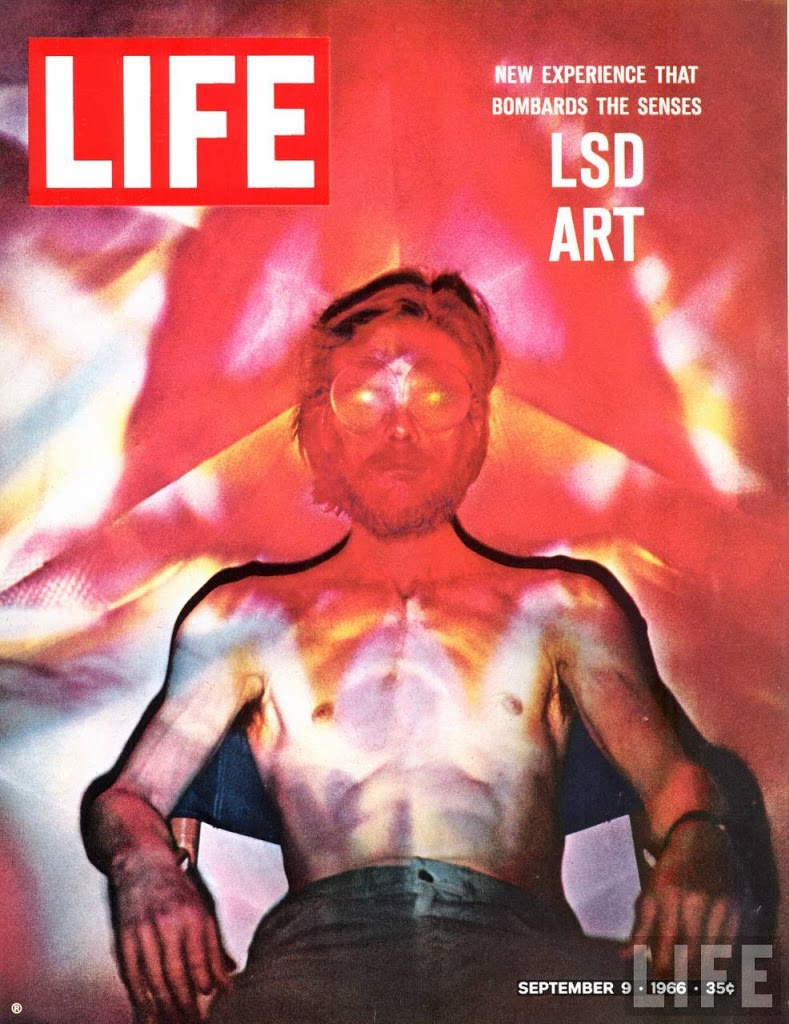
A mind-twisting exhibit at the Riverside Museum, formerly at 310 Riverside Drive/103rd Street, makes it on the cover of a national magazine. But not everybody would enjoy the trip.


WARNING The article contains a couple spoilers about last night’s ‘Mad Men’ on AMC. If you’re a fan of the show, come back once you’re watched the episode. But these posts are about a specific element of New York history from the 1960s and can be read even by those who don’t watch the show at all. You can find other articles in this series here.

Sure, it’s 1966. I thought maybe Peggy Olsen might be the one to trip the light fantastic. (She was otherwise engaged this week.) But I never expected hallucinogenics to materialize as they did on last night’s ‘Mad Men’. After a staggeringly serious dinner party narrated with empty philosophical conversation, Roger Sterling and his wife are invited to take the drug LSD by their host. Far from the dorm rooms and basement clubs of Greenwich Village where one might expect such experimentation, this evening of psychedelia was presented as a drawing-room intellectual exercise, with serene music unspooling from a reel-to-reel and no object more trippy than a mantel mirror.

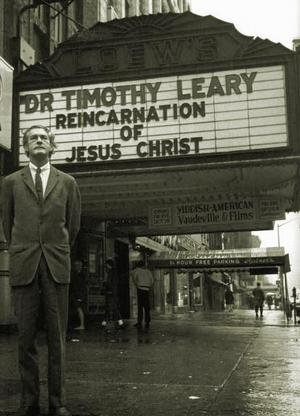
Lysergic acid diethylamide, which I doubt can actually be said while experiencing its effects, was considered a mind-opening tool for some early psychiatrists, laying bare subconscious feelings and forcing the user to confront difficult issues in a surreal environment. By the mid ’60s, its leading advocate was Timothy Leary (below), a psychologist who had studied the benefits of psychedelic drugs to explore the mental capacities. Today we might naturally lump him with the trappings of ’60s counter-culture, but in 1966, with the parameters of psychiatry still in flux, his experiments also appealed to intelligentsia.

The depiction of ‘Mad Men’s after-dinner drug soiree seem to follow Leary’s instruction quite explicitly. In 1966, he advised, “Don’t take LSD unless you are very well prepared, unless you are specifically prepared to go out of your mind. Don’t take it unless you have someone that’s very experienced with you to guide you through it. And don’t take it unless you are ready to have your perspective on yourself and your life radically changed, because you’re gonna be a different person, and you should be ready to face this possibility.”

An article in March 25, 1966, LIFE Magazine laid out the details of the drugs in almost an introductory fashion. “A black market dose costs only $3 to $5. But that’s enough to send a person on a 10-hour ‘trip’.”

The same article also underscored a growing fear: “A few pounds of it dumped into the water supply of a major city would be enough to disorient millions.”

The federal government had been concerned of this supposed conspiracy as early as the 1950s, fearful that Russians might pollute New York’s water and “turn drug-addled American citizens against their own government.” [source] Of course, the CIA itself experimented with LSD during this period with its covert Project MKULTRA, which conducted experiments in New York during the mid-50s, using prostitutes and junkies they found in local bars in Greenwich Village. An experiment performed on CIA operatives themselves led one agent in 1953 to leap from a window at the Statler Hilton, today’s Hotel Pennsylvania. (Or was it murder?)

By the 1960s, the drug had become a virtual entrance exam for New York’s blossoming counter-culture music scene, or so the more hysterical believed. “In New York, San Francisco and Los Angeles, a girl just off the bus from Boise can find it quicker than the YWCA merely by asking around for ‘a trip’,” warned Life Magazine.

The fear of an unwitting populace overtaken with LSD only grew with the 1960s, and this time, some thought it was New York’s counter-culture rebels itself who may be wielding it.  A 1967 journal opined on the urban legend with all seriousness. “[A] single ounce will provide fuel for 300,000 trips, reported one periodical, and it is believed that a few pounds dumped into the water supply of New York City would disorient the nearly 8,000,000 residents.”

Perceptions of LSD were slowly divorced from its supposed therapeutic qualities, especially as the drug soon found itself as the subject of films like Roger Corman‘s The Trip and ‘Enormous Midnight‘, where town water supply is poisoned with LSD and turns its citizens into orgiastic zombies. In New York, LSD entered the club world; hallucinogenic mid-60s destinations like Cerebrum and the Electric Circus (which became Andy Warhol‘s preferred spot in 1966) seem almost conceivable without it.

New York legislators quickly vowed to outlaw the new drug. Bellevue Hospital reported over 200 new patients affected by the drug. In April 1966, two local crimes energized the press: a Brooklyn girl accidentally ingested a sugarcube coated with LSD, and a week later, a ex-mental patient killed his mother-in-law, allegedly under the influence of the drug. With the Stagger-Dodd bill in 1968, the possession of LSD became illegal in the United States.

While that effectively ended the living-room therapy sessions such as the one experienced by Roger Sterling, the drug, now underground, would increasingly influence all aspects of New York bohemian culture.

From the Cerebrum club mentioned above:


Pictures courtesy Newsweek and Life Google Images. For more information on the CIA’s LSD experiments, you might be interested in watching this video.


If you’re watching ‘Mad Men’ when it broadcasts at 10 PM EST, then follow along with me on Twitter at @boweryboys. I’ll be giving a live fact-Tweeting, dropping little factoids about the events being depicted on the show

Categories
On The Waterfront

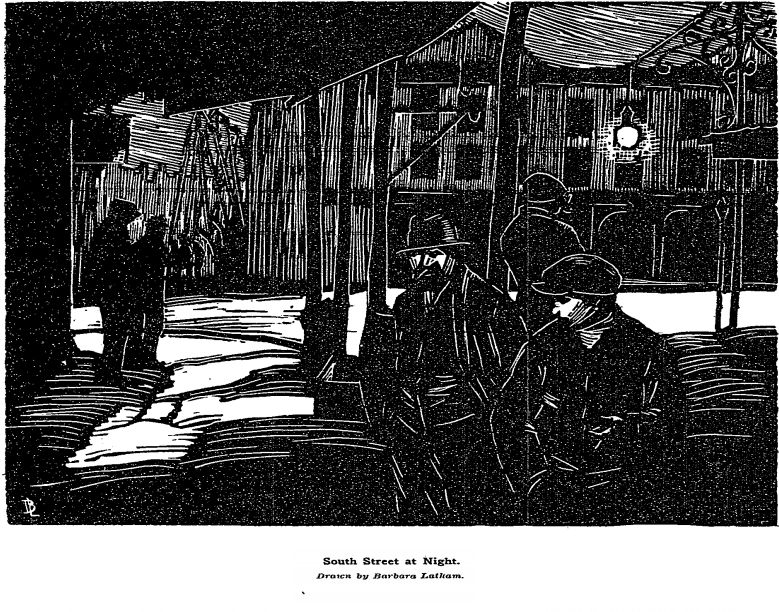
The South Street kidnappings: During Prohibition, did ‘shanghai gangs’ really lurk in the shadow of the ports?

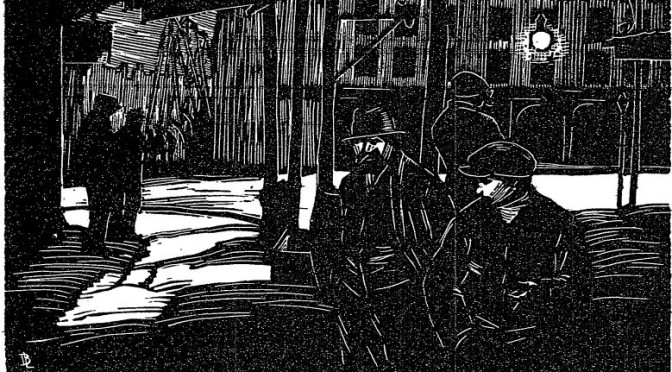
The old port at night was no place to be.

Weathered taverns and boardinghouses sit next to uninhabited warehouses, separated by dimly lit South Street from the shadow of rocking masts and creaking piers that sank into the black water of the East River.

A lonely sailor, soused from the wares of the cheapest Water Street saloon, stumbles down the cobblestone. A figure emerges from the corner. A whistle. Another man steps from behind. And the lonely sailor has vanished.

The fear of ‘disappearing’ in New York kept many awake at night in the 19th century. In a world where everybody was essentially ‘unplugged’ and ‘off the grid’, there was a sense that people could simply vanish, almost as if absorbed into the urban environment without a trace.

Moral crusaders, in a tirade against personal independence, warned parents to keep close watch on their daughters for fear they would be snatched from the street, plied against their will with opium and turned into prostitutes.

Some thought this might have been the fate of ‘cigar girl’ Mary Rogers back in 1841. And as late as 1911, some speculated this was the fate of the socialite Dorothy Arnold, one of the most prominent disappearances of the Gilded Age. [Hear more about her story in our podcast from last May.)

But it was men who were often the victims of street kidnapping. The transient nature of the New York port world mixed with the influx of new immigrants — many of them younger men — fostered a disturbing cottage industry of so-called impressment (or ‘shanghaing’ in the old vernacular), where drunken men were either forcibly taken off the street or taken advantage of in their inebriated state and put to work on a sailing ship.

In 1870, a sailor ‘under the influence of liquor’ was tied up and dragged onto a boat. A Fort Hamilton soldier in 1882 was kidnapped and placed aboard a ship off Staten Island. While his message, thrown overboard in a bottle, was received, officials were unable to rescue him as the boat sailed for its destination: Hamburg, Germany.

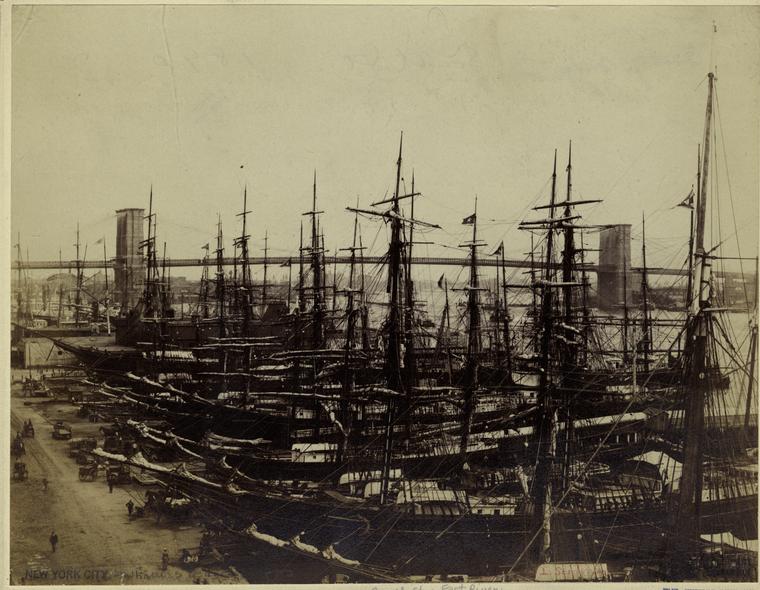
Below: The forest of masts along South Street, 1890

It’s impossible to know exactly how many men were forced onto boats along New York’s port, as the victims were frequently drunk, thrown onto boats that embarked on long voyages and then failed to press charges when they returned. An article in 1910 claims that ‘[h]undreds of sailors were captured [in New York Harbor], usually in the saloons, beaten into insensibility, to awake when the ship was at sea and the Captain an absolute tyrant.”

There would be an actual, near legal version of shanghaiing called crimping where the sailors, still taken at will, would be forced to sign an agreement, paid for their services but not allowed to leave. They would embark on often long voyages, and by the time they got back, “his anger is likely to have died out.”

By the late 1910s, federal laws protected the rights of seamen, and most shanghaiing and crimping practices were abolished. Except, of course, for those in illegal industries, and especially a brand new one created by the advent of Prohibition in 1920.

This type of kidnapping was perhaps the most frightening of all. “South Street Whispers of Shanghaing” announced a rather in-depth New York Times article in 1925. Now, instead of ‘crimps’, who lurked in sailor’s boarding houses, looking for possible captives, it was whole ‘shanghai gangs’ that ruled the shadows of the seaport.

“I have been drugged and held captive on a ship,” claimed one note found in a bottle and mailed to the police. An anonymous shipping master reported hearing of a victim “drugged in one of these newfangled speakeasies that are run as drug stores. They said along the street that a shanghai gang had got him, stole his money and shipped him to sea….The man is gone, and who can trace him?”

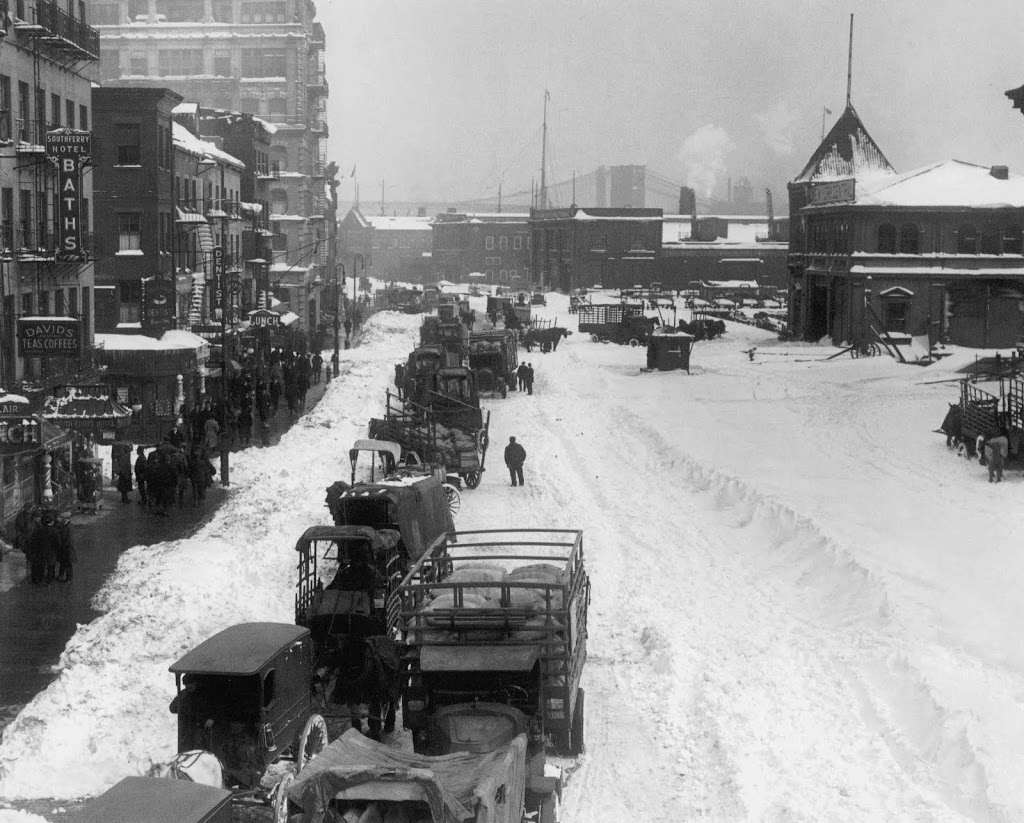
Below: South Street in 1920 in a snowstorm during the first year of Prohibition (Courtesy Flickr/wavz13)

The destination for these unlucky men wasn’t a long-distance voyage but rather a line of near-invisible vessels permanently moored off the American coast. ‘Rum Row‘ facilitated the distribution of alcohol into the United States, with product passing to smaller boats and shady, midnight deals made between mobsters and smugglers. It was an unpleasant and dangerous job, constantly under the fear of capture, betrayal and accident. In an illegal industry with few rules, unwilling men could be discarded.

This also made Prohibition-era impressment a mystery and something of an urban legend. How much forced capture really went on? The Times report interviews several sailors and even a salty South Street bartender, but their names are kept out of the story. Two men, thrown aboard a Rum Row schooner, “were made to work, starve and suffer for water, under threats,” only escaping when the vessel was captured by authorities.

South Street’s changing fortunes may have prevented a widespread problem of the sort which occurred in the 19th century.  The old pubs and grog houses were closed or turned to speakeasies, and heavy shipping had moved on to other ports throughout the harbor, on the Hudson River side, and in Brooklyn and New Jersey. The ports themselves were heavily controlled by mob bosses — and the promise of mob money — which perhaps made such forced recruitment unnecessary. And of course the success of illegal Prohibition industries relied on knowing which laws to abide and which to skirt.

Yet the fear of vanishing kept men on their toes at night as they passed through the neighborhood, keeping in the light as they stumbled down South Street.

At top: Drawing by Barbara Latham courtesy New York Times.  It accompanied the article mentioned above.

Categories
Amusements and Thrills

Commodore Nutt: Barnum’s dwarf star, NYC police officer

The attentions of most New Yorkers 150 years ago today were understandably occupied by the events of the Civil War. The general mood in April 1862 had turned cynical and grim. It had been one year since the first battle at Fort Sumter. The bloodiest skirmish yet, the Battle of Shiloh in northwestern Tennessee, left thousands dead on the battlefield just two weeks before, and attention now turned to the standoff at Fort Pulaski.

And yet the city in April 1862 was overflowing with distraction. The jewellers Ball Black & Co. displayed a framed personal letter from Queen Victoria, thanking New Yorkers for their well wishers following the death of her husband a few months earlier. Across the street, at Niblo’s Garden, theatergoers could delight in ‘The Enchantress’, featuring actor William Wheatley, who would later stage the world’s first Broadway musical, ‘The Black Crook’, on that very stage. Merry gentleman and naughty ladies drank up in lower Manhattan’s various concert saloons, bracing for the effects of a new law passed that month that would effectively close down such bawdy amusements. (Luckily, the law had little effect.)

But New York’s merry king of showbiz in 1862 was P.T. Barnum, his American Museum still New York’s most popular attraction. That April, Barnum featured a ‘living hippopotamus’ and two beluga whale in its basement, and among the museum’s many shows at Broadway and Ann Street was the feature ‘Hop O’ My Thumb, or The Ogre And The Dwarf’ starring Barnum’s biggest small star General Tom Thumb.

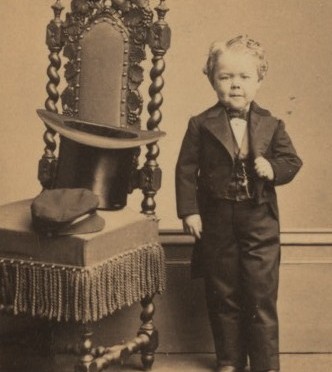
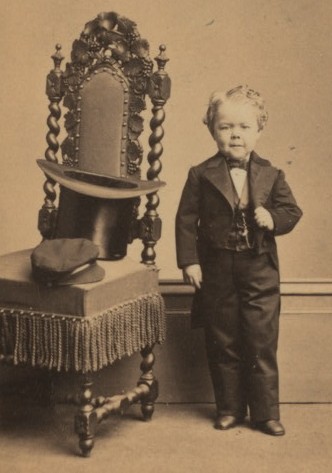
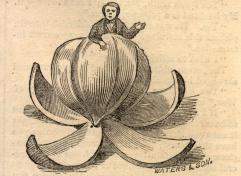
Thumb, however, was not Barnum’s only dwarf star in 1862. Earlier that year, Barnum unveiled a New Hampshire teenager afflicted with dwarfism and presented him with the stage name Commodore George Washington Nutt. Known as the ‘$30,000 Nutt’ due the amount of money he was supposedly paid (although later disproven), the young man was advertised as “the Smallest Man in Miniature in the known world” and “Most Attractive and Interesting human being ever known.”

At right: Nutt in an illustration from Harpers Weekly, February 1862, ‘bursting out of his shell’

Although Nutt would perform at the museum, he was frequently used as an instrument to promote Barnum’s many endeavors. He would serve as Tom Thumb’s friendly rival for the hand of diminutive actress Lavinia Warren (whom Thumb later married at Grace Church in 1863) and tour throughout Europe with Barnum. But on April 17, 1862, Nutt had a local duty to perform — at the headquarters of the New York Police Department.

According to the Daily Tribune, Nutt met with local police commissioners in an effort to get an officer specifically assigned to Barnum’s museum. And just in case the idea would be met with indifference, Nutt himself applied to become a New York police officer, although his height of three feet might have precluded him from such an occupation.

A uniform was immediately ordered for the young star, and by telegraph to the Ninth Precinct, he claimed he would hold ‘extraordinary powers to arrest’ troublemakers at the Museum. It appears, however, that Nutt held few responsibilities for the police force.

During his tour of the police facilities, including the famed Rogue’s Gallery, the charming performer even got in a rather dirty joke. According to the article, “Some one said that on the stage the Commodore had been seen to kiss a girl on the mouth. ‘Well, that was the right place, wasn’t it?’ was the reply.”

Top picture courtesy NYPL

Categories
Mad Men

‘Mad Men’ notes: The numbing horror of the New Haven line

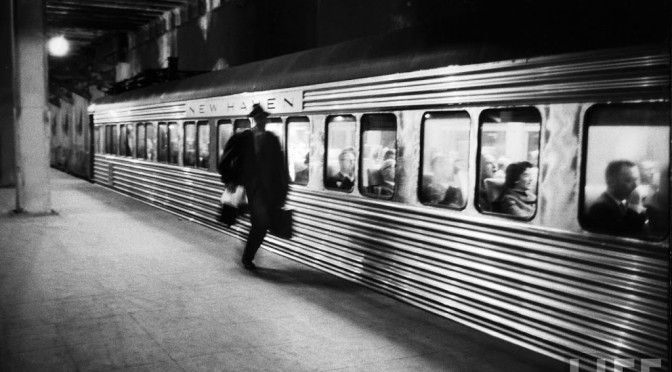
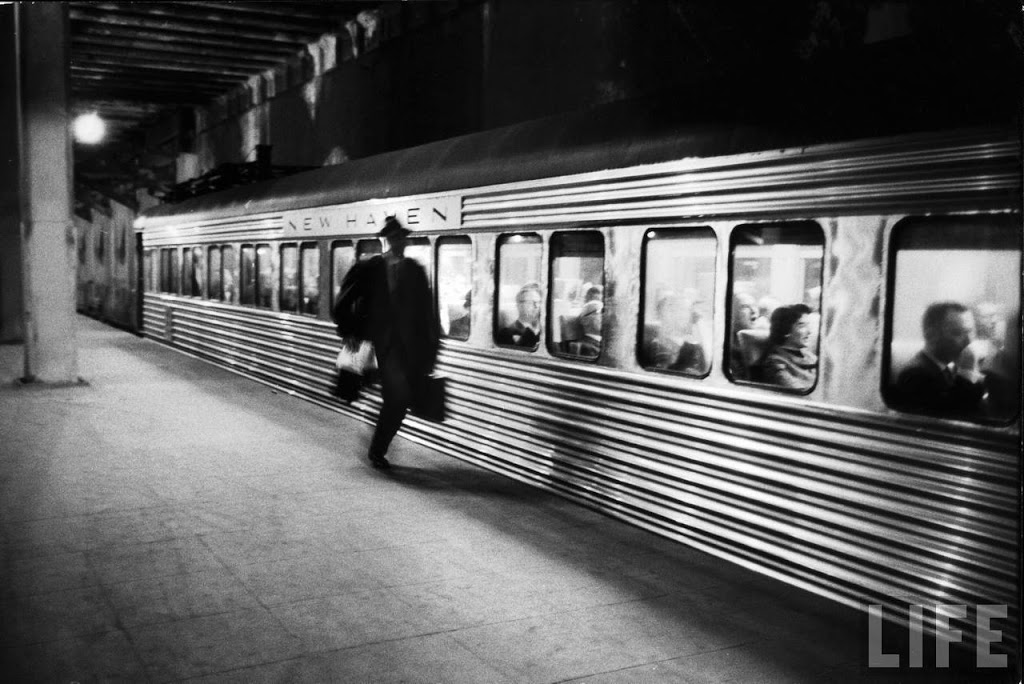
The train gang: Grand Central Terminal, 1961, photo by Alfred Eisenstaedt (LIFE images)

WARNING The article contains a couple spoilers about last night’s ‘Mad Men’ on AMC. If you’re a fan of the show, come back once you’re watched the episode. But these posts are about a specific element of New York history from the 1960s and can be read even by those who don’t watch the show at all. You can find other articles in this series here.

Oh, the mundane ritual of the daily commute! Of all the conformities of modern living, what is it in particular about the commute along the New Haven line — from Grand Central to points of suburbia along the south shore of Connecticut — that must drive the perpetually frustrated Pete Campbell to the edge of insanity?

In past ‘Mad Men’ episodes, we’ve seen the eager and ambitious adman strive for the trappings of ’60s urban success. He’s achieved a certain degree of material status, from a beaming, pregnant wife to a small but lovely home in Connecticut, equipped with a monstrous (some might say coffin-shaped) hi-fi stereo console. But the banality of a regular commute, robbed of privacy and forced into polite chatter — with the same insufferable people, day in, day out — has forced Campbell into taking driver’s education courses with teenagers.

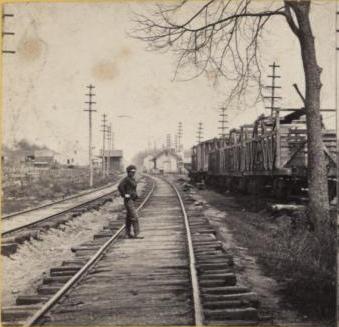
The New Haven line has been a popular transportation route almost since the advent of the railroad itself. First laid and operated in 1848, Appleton’s was proclaiming a decade later that the shoreline railroad was “the most expeditious way between New York and Boston,” linking the Connecticut city with Williams Bridge in the Bronx (pictured at left, from 1865, courtesy NYPL). From there, a connecting track, shared with the Harlem Railroad, took trains directly down to the train depot at 27th Street and Fourth Avenue. When city laws forced the depot up to 42nd Street, that old depot became a storage shed and, later, the first Madison Square Garden.

Few urban professionals attempted daily commutes to and from New York until the early 20th century, when post-war lifestyles, affordable automobiles and an expensive and overcrowded city facilitated an exodus to the surrounding areas. By 1950, the suburbs were such an entrenched place — a lifestyle unto themselves, with unique social requirements — that people even began speaking of the exurbs, communities even further outside the chain of traditional suburbia. “[T]he suburbs are the first 25 miles out; the ‘exurbs’ are the next 25 miles out,” according to author Irving Lewis Allen, and initially appealed to the most wealthy professionals from “advertising, broadcasting and publishing.”

We can thank city planners like Robert Moses for much of this change, obsessed as he was with highway building. But new roads alone couldn’t facilitate the move to suburbia. Mass transit was required to provide a convenient and cost-effective alternative for the ‘second wave’ suburbanites — those aspiring professionals wishing the emulate the lifestyle behaviors of their bosses without the paychecks to secure it. People, say, like Pete Campbell.

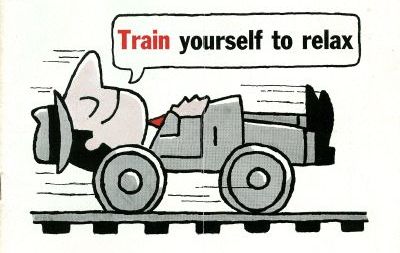
Above: A whimsical graphic from a 1966 New Haven Railroad timetable attempts to distract its passengers.

Unfortunately, the massively unprofitable New York, New Haven and Hartford Railroad, no longer just a long-distance passenger train service, was never fully capable of handling the thousands of commuters traveling to and from the city. Once considered ‘profitable, clean and punctual’ according to Robert Caro, the line was bankrupt by the mid-1960s, operating overcrowded, less-than-comfortable trains solely on federal money by 1965. Some considered it worse than even the crippled, dysfunctional Long Island Railroad.

The New Haven was such an undesirable property that the newly merged New York Central Railroad and Pennsylvania Railroad (aka Penn Central) was literally forced to take possession of the line in 1968 by the Interstate Commerce Commission. New York Governor Nelson Rockefeller was especially concerned that a deterioration of the New Haven line would create an traffic burden which would reverberate through the entire northern New York City-Westchester County corridor.

Oh, things would only get worse for the New York area railroads in the 1970s! So I hope Pete’s taking copious notes in his driver’s education classes and that those gruesome Signal 30 films are hitting home.
Categories
It's Showtime

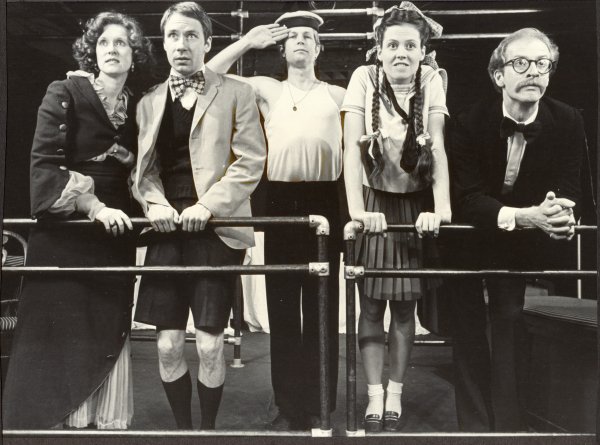
Sigourney Weaver boards an off-Broadway ‘Titanic’ in 1976

Queen of the world: Weaver sets an uncharted course on a small SoHo stage.

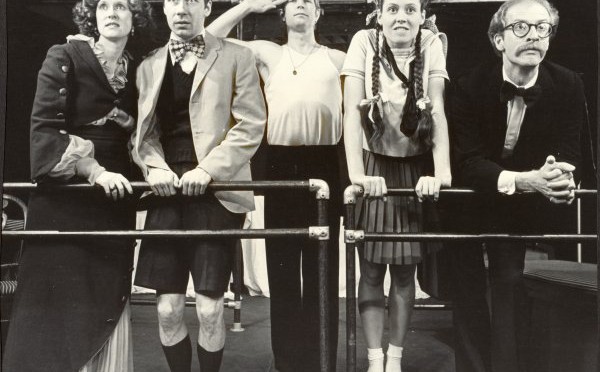
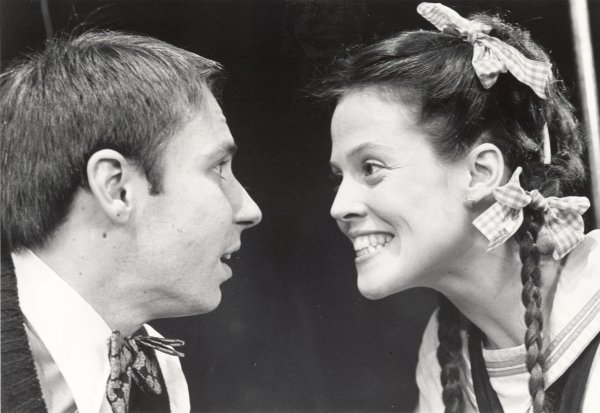
Perhaps you are as confused as I am by the picture above, one that appears to put the lovely young Sigourney Weaver‘s face upon the body of a child. Ah, the magic of the theater! The future film star was in her late 20s when she joined this peculiar production of the ‘Titanic‘ tragedy, written by her friend and frequent collaborator Christopher Durang.
The bizarre one-act made its debut at the tiny Midtown theater before making a proper off-Broadway launch at the Van Dam Theatre (today’s SoHo Playhouse) in May 1976. Far from concerning itself with the eventual tragedy, Durang’s comic-farce is a sex romp which eventually pairs up provocative combinations of the show’s cast, a ribald smorgasbord of sexual fluidity.

Weaver, playing the role of Lidia, transforms into a variety of different women, including the daughter of the captain of the Titanic. Critics proclaimed her the “principal attraction” of the unusual play. “She begins in pigtails and tiny skirt as a sexy Shirley Temple and ends as a predatory black widow in deep decolletage,” said Times critic Mel Gussow.


This was not the only doomed ocean liner lampoon by Weaver and Durang! Inserted astride ‘Titanic’ was a Brechtian cabaret co-written by the pair, called ‘Das Lusitania Songspeil. In 1980, an expanded version of this randy show made its debut on the boards of the Westside Theater in Hell’s Kitchen, a late-night wintertime smash that earned the pair Drama Desk nominations.

Keep in mind this is a few months after the release of her breakthrough film ‘Alien’, whose sequel (which she also starred in) was directed by James Cameron, who would also find later inspiration on sunken ships. Although I think most of us prefer her as a Hollywood star, Weaver’s off-Broadway credits were so impressive by this time that New York Magazine referred to her in 1981 as “just about the best all-purpose actress in town.”

Durang’s ‘Titanic’ — which he himself considers a “really difficult play” — is sometimes revived on college campuses. Broadway would eventually embark on its own ‘Titanic‘ in 1997, an expensive musical production by Maury Yeston and Peter Stone that would debut at the Lunt-Fontanne at 205 W. 46th Street*. Although dogged with early technical difficulties and critical skepticism that would parallel the issues faced by “Spider-Man: Turn Of The Dark,” it became a modest hit, thanks in part to the film version directed by James Cameron.

*Currently home to ‘Ghost’ a musical based on a film.

Pictures above are courtesy Christoper Durang, a website that has lots more information about this curious play.

Categories
Mad Men

‘Mad Men’ notes: The secrets of the New Yawk accent


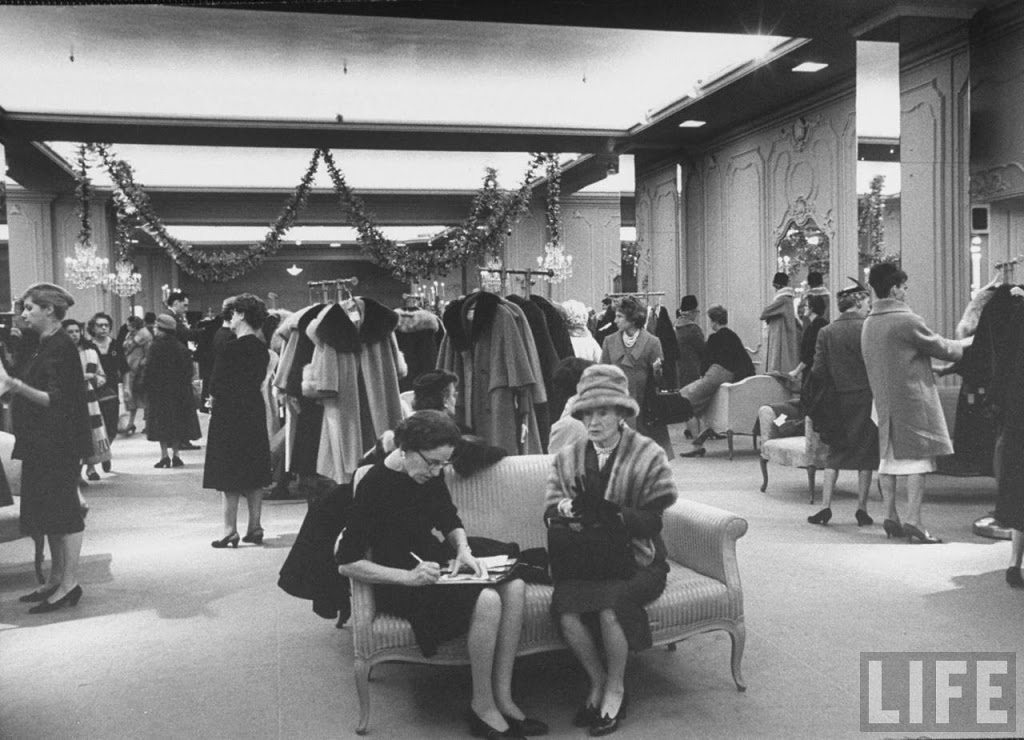
On the upper floor — or flooah? — with the upper crust: Ladies coats at Sak’s Fifth Avenue in 1960, photo by Alfred Eisenstaedt (LIFE)


WARNING The article contains a few spoilers about last night’s ‘Mad Men’ on AMC, so if you’re a fan of the show, come back once you’re watched the episode.

A culture clash between New Yorkers from different races and classes came barreling through the storyline of ‘Mad Men‘ this week. While Peggy Olson had an awkward bonding moment with the new black secretary Dawn, a morbidly ill Don Draper took out his emotional tensions on the new Jewish copywriter Michael Ginsberg.

As revealed last week, Ginsberg is a ‘real’ New Yorker, living in a tiny apartment with his very devout father with a thick Yiddish accent. This week, Draper chastised the casual, Brooklyn-esque tone of Ginsberg voice, possibly implying a dig at the character’s Jewish roots. In response, Ginsberg defended his ‘regional accent’ and pointed out that Don, too, had an accent. The new kid eventually shines at a pitch meeting emulating a presentation style (and even vocal techniques) ripped from the Draper playbook

On a personal note, I’ve been fighting with accents my whole life, born with an Ozarks drawl only to develop the standard Midwestern ‘newscaster’ voice by high school, then living in New York for almost two decades and now slowly beginning to sound like it. So I found Don’s personal affront particularly interesting, as everything about him is a facade, including the voice. (I also went to school with fellow Missourian Jon Hamm, but that’s for another posting.)

Until last night, it never occurred to me that the secret to New York’s modern local tone — the many borough-specific variants of the New Yawk accent, if you will — was actually ‘discovered’, academically speaking, in a published study released in 1966, the year this season of ‘Mad Men’ is set.

Linguist expert William Labov was a Columbia University doctoral student in the early 1960s when he embarked on an extraordinary and influential study of the New York accent, the results of which were released as The Social Stratification of English in New York City in 1966.

The standard New York accent was historically presented as street jargon, whether it be the New York Times writing out the words of newsboys phonetically (“Dere’s tree t’ousand of us and we’ll win sure”) or the broad slang-filled movies of the Bowery Boys acting troupe (“Whadda ya hear! Whadda ya say!”). Upper class New Yorkers from old families frequently carried a New England lilt in their voices.

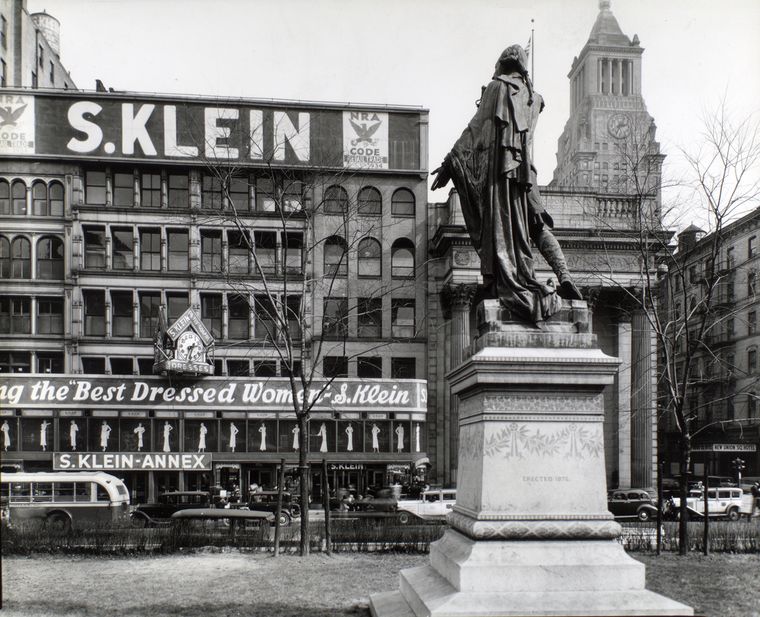
What seems inherent from comparing those two examples was flatly proved by Labov’s fascinating experiments done in three New York City department stores — the affordable S. Klein’s in Union Square, the higher priced Macy’s in Herald Square, and the very exclusive Saks Fifth Avenue — attracting shoppers from different social classes.

Below: Klein’s ‘on the Square’ in 1936, photo by Berenice Abbott.

I would have loved to have assisted Mr. Labov out with his experiments. Throughout the day, he asked employees from each store where the women’s coat department were located. In the case of these three stores, it was on the fourth floor. Or the fowth flooah or even the fowt flooah. When asked to repeat what they said, people would most likely restate ‘fourth floor’ with the -r more carefully said, as though it was their accent that had caused the confusion.

Those employees of S. Klein were far more likely to lose their -r sounds, while those from Saks were least likely. But Labov’s study found an additional quirk. On higher floors, where more expensive items were sold in each case, people more likely kept their -r sounds.

His conclusion found that “rhocity increased with the prestige of the department store” and that it even increased within the store itself. How the words were clearly pronounced and presented did not specifically depend on the geographical origin of the speaker, but on socioeconomic considerations. Labov concluded that New Yorkers of the 1960s generally disliked their own accents and subconsciously chose to mask it. “The term ‘linguistic self-hatred’ is not too extreme to apply to the situation,” he stated in his report. “As far as language is concerned, New York City may be characterized as a great sink of negative prestige.” [source]

Labov’s 1966 study is considered one of the most important linguistic findings of the late 20th century. Today Labov is considered the father of sociolinguistics. Whether his conclusions still apply today is a question for modern researchers. But they add an interesting new context to this burgeoning competition between Draper and Ginsberg, a symbolic competition between the ‘fake’ and the ‘real’.

Categories
Neighborhoods

The toy radio magic of Fulton Street’s Electro Importing Co.

If you were the type of child who idolized the inventor over the sports hero, then the decade of the 1900s was something of a creative revolution. Children enamored by the flurry of new inventions in the late 19th century — the railroad, the telegraph, the camera — could only imagine interacting with these devices. The Lionel train set, introduced by a toy store on Cortlandt Street in 1900, was a perfectly marvelous device. It just wasn’t the real thing.

But with new wireless telegraphy (soon to be called ‘radio‘), one needed only the basic technology — the battery, the tubes, the coils. No tracks, no excessive lengths of wiring, no expensive film processes. A curious child could jump right into the world of radio, into the very same airwaves being used by adults.

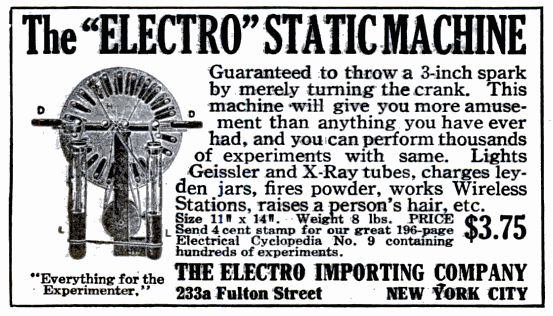
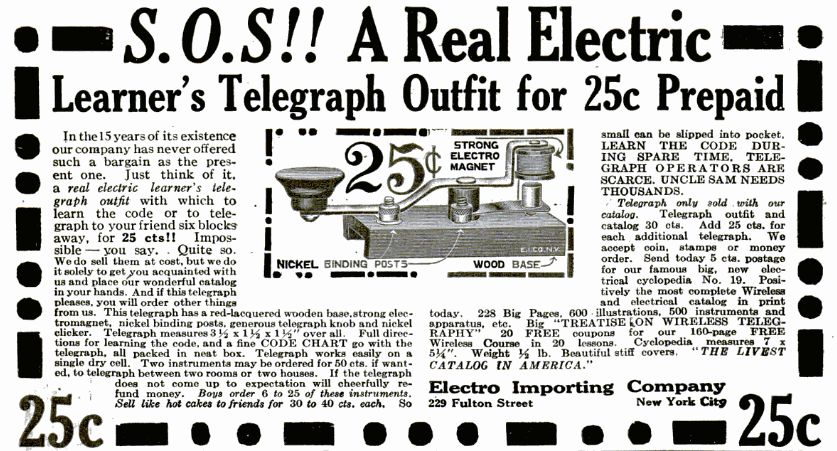
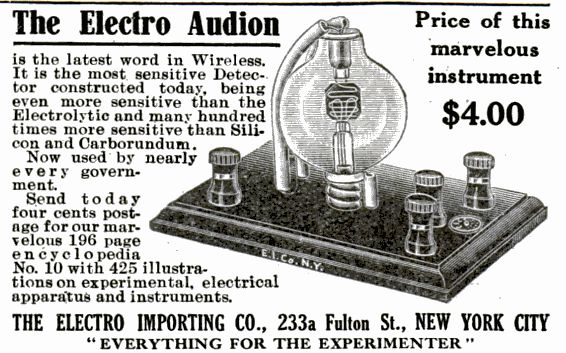
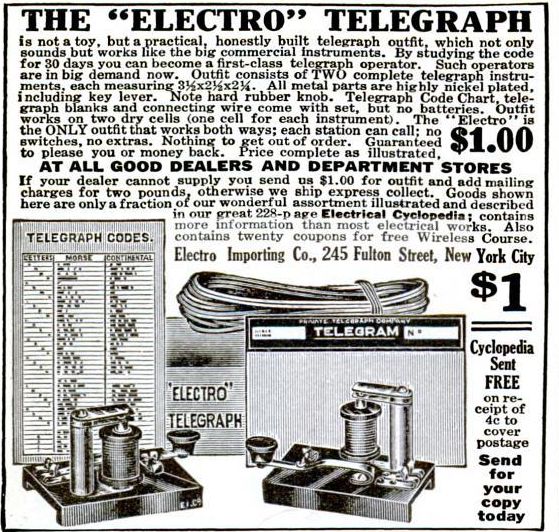
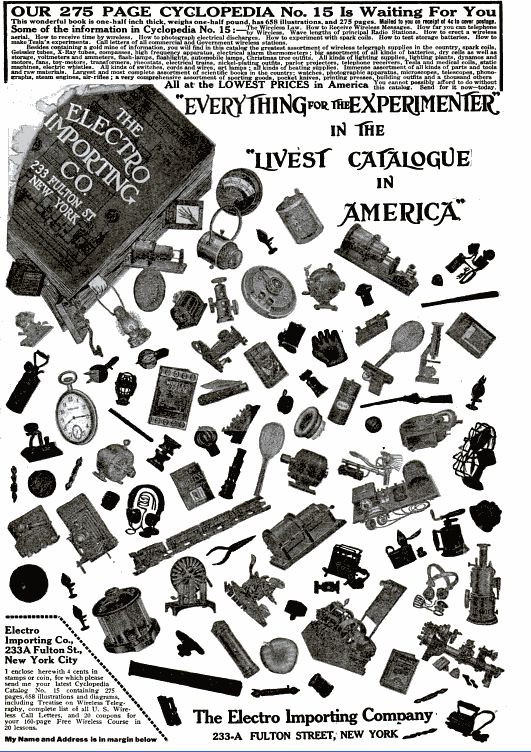
Radio technology was barely a decade old when a marvelous company appeared in downtown Manhattan called the Electro Importing Company which opened for business in 1905. They soon moved to permanent offices on 233 Fulton Street. (An ad below also listed an office at 245 Fulton Street.) Although they also sold radio parts to adult wireless operators, basic receivers and transmitters could be produced and sold to children as sophisticated toys. As radio was vastly unregulated before World War I, a young boy or girl could literally send and receive transmissions from their own bedroom, sending out Morse code and picking up messages from miles away.

Just imagine having that power as a 12-year-old. One hundred years later, children would be dazzled by handheld technologies (video games, cell phones) that not even adults could explain how they work. With Electro products, children could emulate professional wireless operators and quickly understand how the core processes worked. In essence, anybody could imagine themselves on the path to becoming a great inventor. In fact, the early Electro products were almost an exact duplication of devices used by radio inventors Gugliemo Marconi and Lee De Forest.

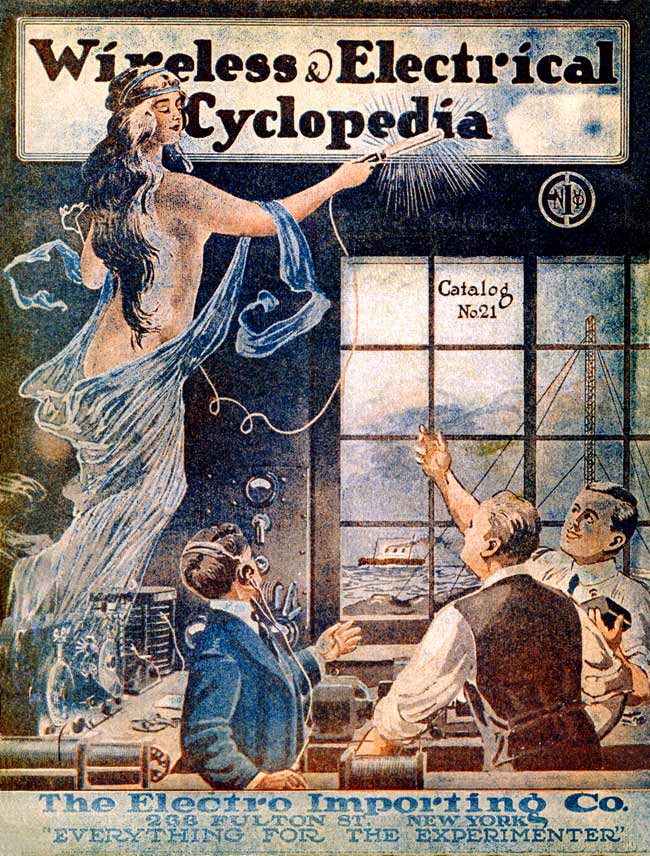
Below are a few advertisements for Electro Importing products advertised in various issues of Popular Mechanics magazine from the 1910s. Although the products were aimed at all radio enthusiasts and in one ad are explicited advertised as ‘not a toy’, their yearly catalogs — as amply illustrated for the cover above — make it clear who their desired audience was ‘every wide-awake American boy’. [source]

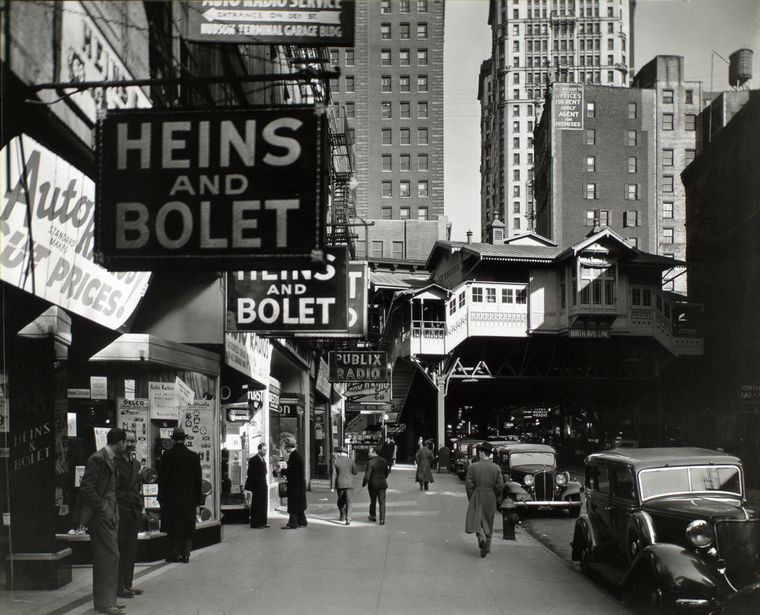
Perhaps this is coincidental, but a few years later, New York’s famed Radio Row soon developed in the neighborhood surrounding the Electro Importing offices. A mere block away, on Cortlandt and Greenwich streets, retailers specializing in home radios sprouted up in the early 1920s. Radio Row soon became the place to buy the latest in home console entertainment.

In the 1960s, the former offices of the Electro Importing Company and all of Radio Row was demolished to make way for the construction of the World Trade Center.

Below: Radio Row in 1936, photo by Berneice Abbott