Categories
Those Were The Days

Love on the airwaves: New York’s first female radio operator

She’s not exactly a Howard Stern or a Robin Quivers, but Anna A. Nevins does deserve to be considered as something of a radio pioneer in New York.

One hundred years ago, ‘wireless telegraphy’ was mostly used to communicate with vessels crossing the Atlantic Ocean. And these weren’t signals with human voices, but rather in the dots and dashes of Morse code. Experiments with sending vocals over the airwaves were already being conducted in New York by Lee De Forest as early as 1907, but radio wouldn’t seriously be considered as a means of voice transmittal for almost another decade.

It was a tool mostly used by the U.S. Navy and commercially by the telegraph companies. It was from the ashes of a De Forest company that the United Wireless Telegraph Company was formed in 1906. It heralded dozens of receiving stations throughout the country and, in particular, three in New York. Their corporate office at 42 Broadway was one, extremely convenient to the offices of the major passenger ship lines of the Cunard (25 Broadway) and the White Star (9 Broadway). They had another out at the luxury hotel spot Manhattan Beach, Brooklyn, where some wealthy New Yorkers spent the summers.

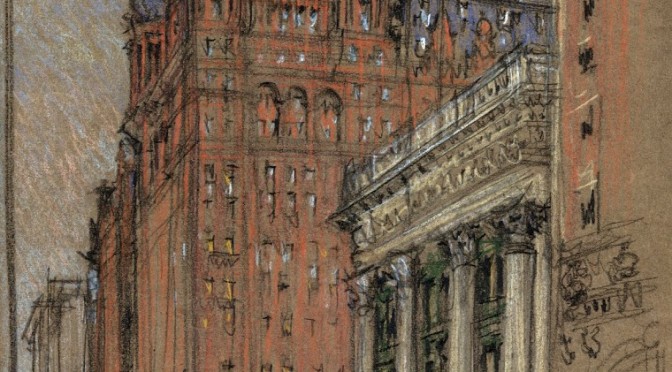
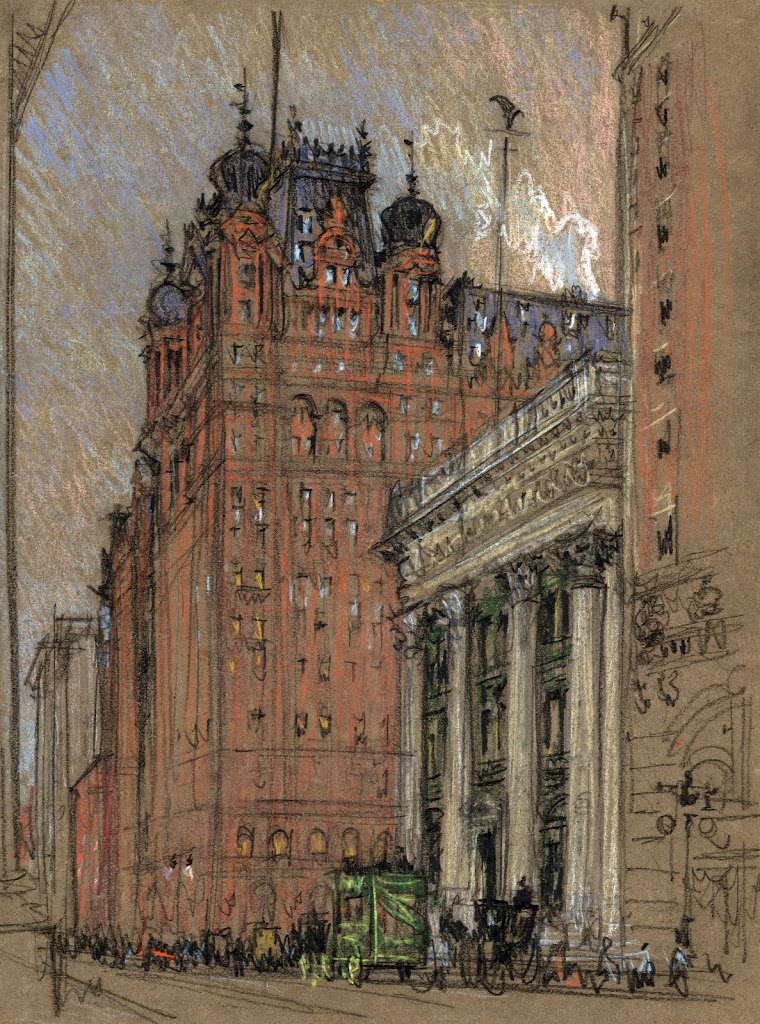
But by far the most notable of these wireless stations in Manhattan was atop the original Waldorf-Astoria, one of the most famous hotels in the world, at 34th Street and Fifth Avenue. (Above: Drawing of the Waldorf-Astoria in 1904 by Joseph Pennell.) From here, operators could send messages to ships hundreds of miles away and even to other cities like Chicago. “The operating room is a model in every respect,” claimed Modern Electrics Magazine in September 1909. “This station without a doubt is the most popular one in New York…. [T]he lofty aerial stretches its wires clear over one side of the famous roof garden.”

Below: the United Wireless telegraph station atop the Waldorf-Astoria Hotel, 1909
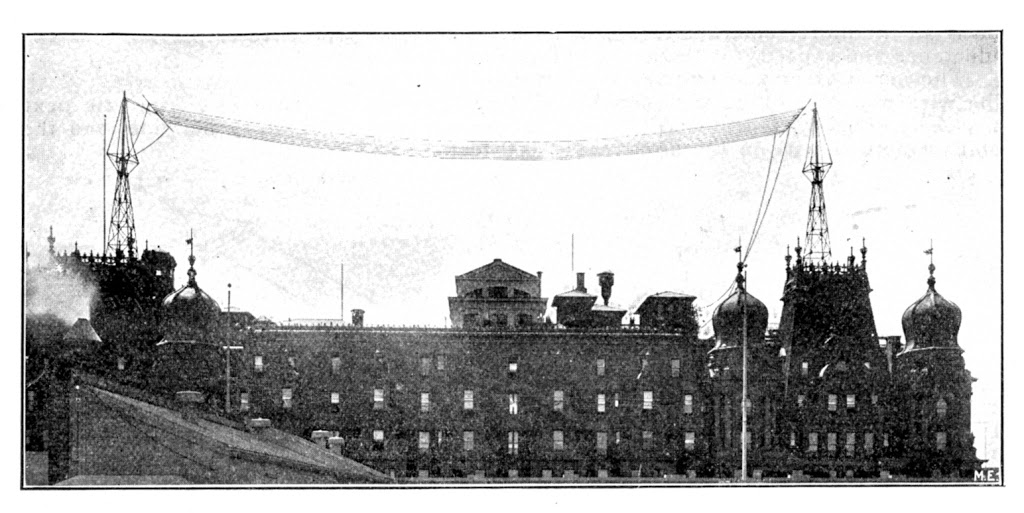
But they had another badge of pride — America’s first female wireless operator. Young Anna A. Nevins, 22 years old, worked eight hours a day at the Waldorf-Astoria station, considered by her colleagues “an expert in wireless instruments” By virtue of her sex, this was a news item in papers across the country in 1909.


It was not entirely shocking to see a women at a telegraph desk, but the newness of wireless technology and challenges of early radio would have made Anna’s skills rather unique. It’s believed she trained under De Forest as early as 1906.


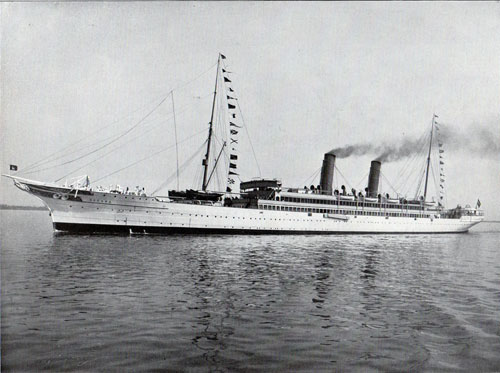
The juicy spin, of course, was romance. According to reports, Nevins had a beau “Jack” on the steamship Oceana (below)), a Hamburg-American line traveling to destinations in the West Indies. The young wireless operator would send ‘messages to her sweetheart’ over the wireless, alleged as far as 1,000 miles away, engaging in an ‘aerial conversation’ believed to be the longest exchange of its kind for the day. (Then again, this sounds like newspaper hyperbole!)

Did reporters seem fascinated to ask about what it was like to be the sole woman working within a new technology? Not when you can ask her about love! In a syndicated article from 1909, she’s quoted as admitting, “Yes I know the young man. When he’s in town, I see him. But almost every day I hear from him.”


The Waldorf station was the jewel in United Wireless’ crown. Unfortunately, United’s reputation as a corrupt company tied to Wall Street shenanigans and perpetually hounded with legal issues caused its demise in 1912, when it was sold to American Marconi. As for Anna, I can’t locate any trace of her after these initial reports. Perhaps she met and married ‘Jack’, whoever he was. Hopefully, years later, she was asked more interesting questions of her career.
Categories
Mad Men

‘Mad Men’ notes: The rock gods of Forest Hills, Queens


WARNING The article contains a few spoilers about last night’s ‘Mad Men’ on AMC, so if you’re a fan of the show, come back once you’re watched the episode.

Lusty groupies, ample drug intake, smoky hallways and deafening rock music. One might have thought last night’s ‘Mad Men’ — partially centered around the backstage antics of a Rolling Stones concert — was taking place at Shea Stadium, where the Beatles famously performed to their largest audience in 1965. Or maybe that was Madison Square Garden, the one on Eighth Avenue and 50nd Street, where Marilyn Monroe sang happy birthday to John F. Kennedy in 1962?

No, that mad, bacchanalian event took place at an esteemed tennis club — the West Side Tennis Club in Forest Hills, Queens.

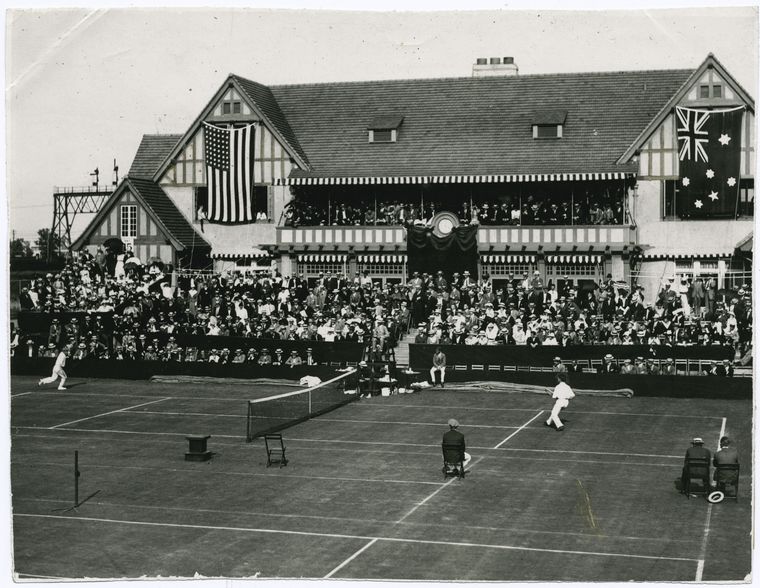
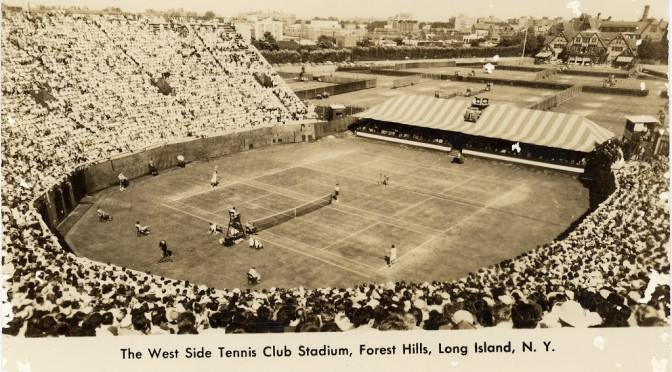
Organized in New York in the 1890s, the tennis organization and social club quickly outgrew various venues in Manhattan and made their way to Queens. The momentary inconvenience of relocating to an outer borough was swiftly forgotten when the venue opened in 1914, a sumptuous series of grand courts, manicured lawns and a spectacular Tudor-style clubhouse designed by Grosvenor Atterbury* and John Almay Tompkins. A later court addition would provide seating for 14,000 spectators.

The clubhouse reflected the style of  homes in nearby Forest Hills Gardens, also planned by Atterbury as a private, upper class community. To this day, the ‘cottage community’ is one of Queens most exclusive neighborhoods.

Below: A vigorous match between Maurice McLoughlin and Norman Brookes in 1914.  The larger court would not be built for several more years. Courtesy NYPL

The grounds were so abundant that it drew the U.S. Open from Newport, Rhode Island, in 1915, and they remained here until 1987. In fact, for most of the 20th century, the tennis club became the American capital for the sport, seeing victories by sports icons like Arthur Ashe, Jimmy Connors, Althea Gibson and Billie Jean King. Alfred Hitchcock even filmed a pivotal scene in ‘Strangers On A Train’ here.

Tying in some of these themes of this season of ‘Mad Men’, there was even a scandal involving the exclusion of black and Jewish members from the club in the 1959, a scandal that involved an under-secretary from the United Nations.

But the appeal of a large and vibrant permanent outdoor venue soon drew, shall we say, less buttoned-up events. The Forest Hills Music Festival was a weekend precursor to New York’s many outdoor concert events today, bringing modern stars to the courtyards and giving this upper crust cloister a taste of counter-culture and teen-fueled rock and roll. One of its organizers was Ron Delsener, later to become a renown concert promoter in the New York area.

Beginning in the late 1950s, concert events were staged on the court itself. At first, the venue drew acts like the Kingston Trio, Frank Sinatra, Harry Belafonte, Barbra Streisand, and even Woody Allen with a stand-up performance. But not of those performers brought the frenzy quite like the Beatles, who played two nights in late August 1964 and drew such passionate crowds that their helicopter had to land on the court itself, their fans separated from the performance area by an eight-foot fence.

Forest Hills was known for its ungainly crowds. Bob Dylan performed there in August 1965 and was booed by audience members outraged that he would deign perform with electric accompaniment, “betraying the cause of folk music,” according to music historian Tony Glover.
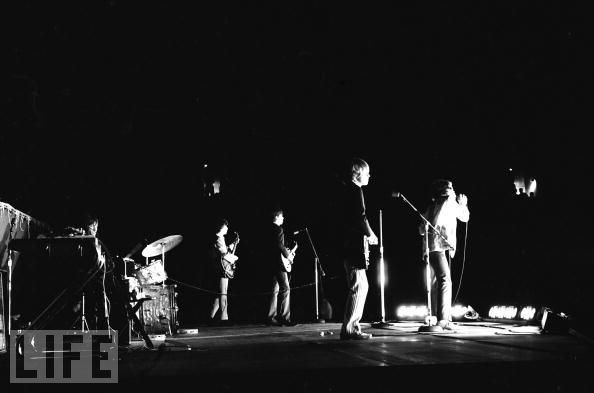
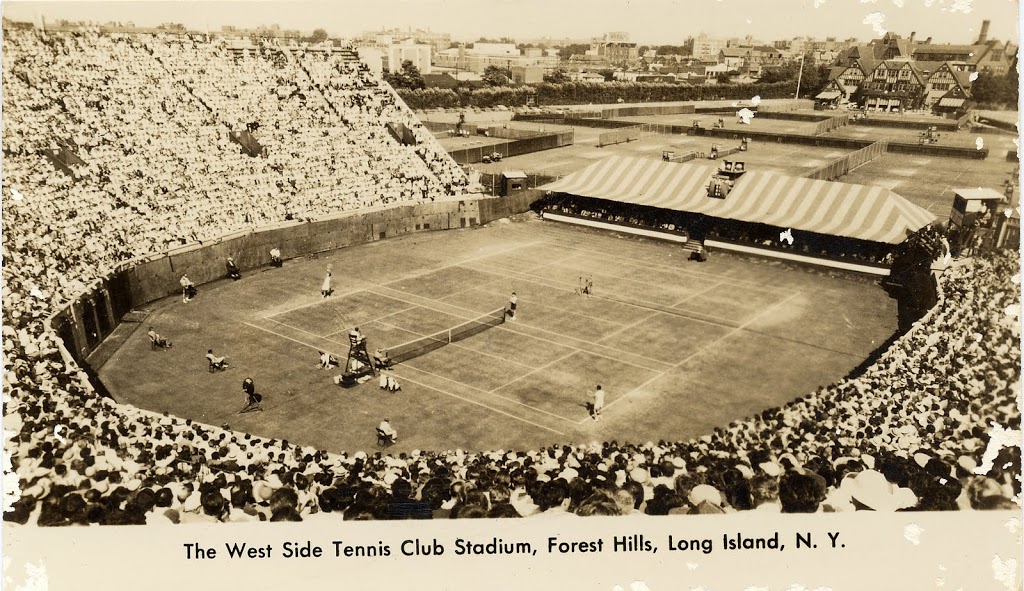
So with all that in mind, imagine the passionate crowds which awaited the shaggy ragamuffins from Dartford, the Rolling Stones, on July 2, 1966, appearing in the United States just as radio stations were buzzing with their number one song, ‘Paint It Black‘.

After three opening acts (including the Trade Winds), the Stones played ten songs at Forest Hills (pictured above), including ‘Lady Jane’, ‘Get Off My Cloud, and of course ‘Satisfaction’, to a crowd of 9,400 people.Yes, believe it or not, they didn’t sell out the venue, but that’s because the most expensive seats (an unheard-of $12.50!) went unsold, and the temperature for the outdoors concert was in the high 90s.

But those that were in attendance were frenzied enough that 250 cops were deployed to the show, armed with tear gas and nightsticks, holding back frothing audiences of young people sent “into peroxsyms” by the British stars. “A dozen youngsters willfully broke through the police line,” according to the Times. “Within seconds the park lights went up and the Rolling Stones’ helicopter took off into the night.”

Far from the maddening crowd, members of the band hit the club circuit in Manhattan, first Cafe Wha? in Greenwich Village, and then Ondine’s at 59th Street, where they were wowed by the energy of a young guitarist named Jimi Hendrix.**

And here’s some further context you should keep in mind. That was the summer of 1966. The biggest American musical artist that year was actually two young sons from Forest Hills, Queens — Paul Simon and Art Garfunkel — and their album The Sounds of Silence would become the biggest album of the year.
Believe it or not, the tennis club lost its bid recently to become a New York landmark.
Top picture courtesy the Rego-Forest Preservation Council

*Mr. Atterbury also played a significant role in the renovation of New York’s City Hall in the early 1900s. We have a ball with Grosvenor in our City Hall podcast from 2009


**There seems to be a little confusion here. Keith Richards bios recall Cafe Wha?, while the diary of Bill Wyman mentions Ondine’s. Hendrix played at both venues a few times, so either (or even both) is possible. Keep in mind, everybody was probably stoned.

Categories
Newspapers and Newsies

Before ‘Newsies’: The Brooklyn Newsboys Strike of 1886

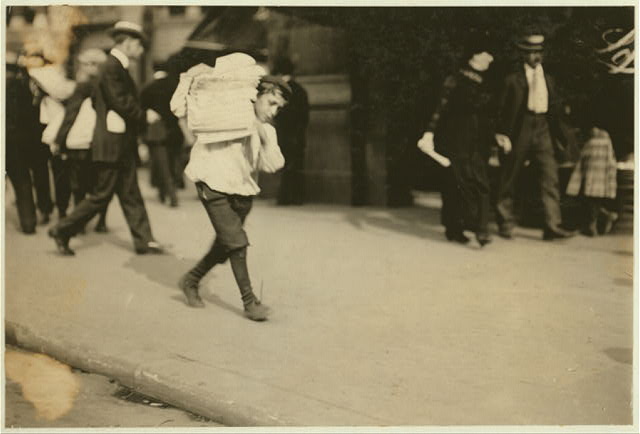
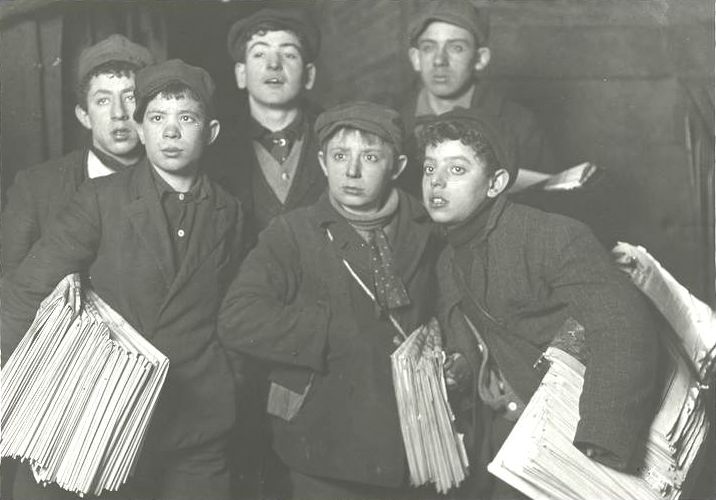
The grueling life of a Brooklyn newsboy, taken by Lewis Hine, 1910 (Library of Congress)

The new Disney-produced Broadway musical ‘Newsies‘ puts melody to the events surrounding the Newsboys Strike of 1899. For one week that summer, young newspaper sellers fought back against their employers’ unfair pricing schemes, turning their former street corners into places of mass protest. [You can hear all about in our 2010 podcast on The Newsboys Strike of 1899.]

But did the producers of the Broadway show realize they’re opening their new musical on the anniversary of another significant strike?

The organized disobedience of 1899 was only the grandest of New York’s newsboy strikes. Despite their youth and inexperience, newsies fought back on several occasions throughout the late 19th century. While the image of the street-smart, scrappy whelp was a stereotype often relayed by the newspapers themselves, in some cases, journalism’s youngest workforce used its hot-blooded pluck to great advantage.

With the growth of New York after the 1850s came a fierce competition among its many dozens of newspapers, leading to lamentable and unfair business practices aimed at those who actually sold their product. After all, selling newspapers was a grueling job with low financial reward. Adults looked elsewhere for higher paying work, so in the era before substantial child labor laws,  newspapers often employed younger New Yorkers, mostly boys. And children, cynical publishers believed, were a pliable workforce.

The independence the job required initially appeared to discourage any kind of organization, and newspapers felt they could systematically underpay their ‘freelance’ sellers, often pitting groups of newsboys against each other. A newspaper across the East River, in the pre-consolidation city of Brooklyn, made just such a mistake in March of 1886.

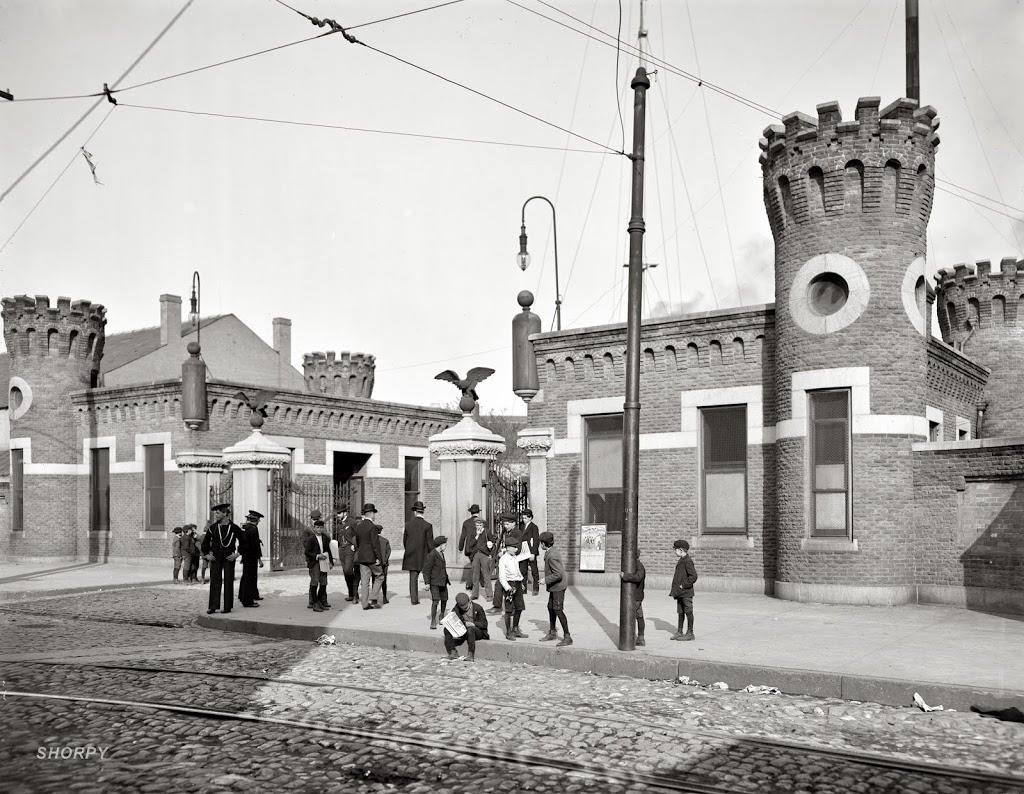
Above: Determined Brooklyn newsies hang around the Brooklyn Navy Yard (at Sands Street) looking for potential buyers. 1903 Picture courtesy Shorpy 

Brooklyn Takes Sides
The Brooklyn Times employed newsboys all throughout the city of Brooklyn, a fast expanding metropolis by the mid-1800s. Originally just the area we consider Brooklyn Heights and the Fulton Ferry, the burgeoning city grew to absorb many Long Island towns along the bay. In 1854, it also expanded to include the independent city of Williamsburgh (today’s neighborhood drops the -h) and Bushwick. These new additions were often referred to as the Eastern District.

However, the city of Brooklyn had a good deal more expansion ahead of it and would eventually swell to include many towns south and southeast of its original borders, an area referred to back then as the Western District, including areas like Bay Ridge, Red Hook, and many others. (This is a tad confusing today as many of these areas were later called South Brooklyn; the Eastern/Western distinction makes sense of you orient it with ‘true north’.)

In an effort to expand sales into the newer regions of Brooklyn, the Times made a unique deal to Western District newsboys. They would receive stacks of newspapers at a lower cost (one cent per paper) than those sold to Eastern District newsboys (one-and-a-fifth cent per paper). The Times publishers believed this would boost sales by encouraging the Western District newsies to “push sales vigorously in new directions.”

Above: Newsies gathered near the Brooklyn Bridge. Courtesy NYPL

Riot on South Eighth Street!
Oh, but when the Eastern District newsboys found this out the following day! On March 29th, according to a report by the Brooklyn Daily Eagle, a hundred newsboys, armed with sticks and stones, stormed the Times distribution offices at South Eighth Street and tried to prevent two wagons of newspapers from heading to the Western District. A whip-wielding wagon driver and arriving police officers thwarted the boys, but one of the trucks was later overturned at the area around today’s Brooklyn Navy Yard.

Many Williamsburg newsies refused to sell the Times, even defying orders of older, more compliant newsboys. Wagons filled with papers were continually attacked on their way south. Any regular newsboy caught selling the Times was set upon by other boys, often roving bands “backed by a number of roughs.” The Daily Eagle reports of some young newsies hiding newspapers in their jackets, selling them to customers in secret, for fear of reprisal.

The Brooklyn newsboy strike lasted for a couple days. Like the later newsboys strike of 1899, the key to success came from adult newspaper sellers at regular newsstands. Once a few of them joined the boycott, the Times agreed to lower their wholesale cost to just one cent per paper for newsboys in both areas of Brooklyn.

By April 1, 1886, newsies returned to their street corners, their hands stained with the ink of the Times and glowing with the satisfaction that their efforts might reward them with a little extra money that day.

SIDE NOTE: It’s probably a good guess to say that many of these young workers lived at the Brooklyn Newsboys Lodging House at 61 Poplar Street, which opened its doors in 1884, one year before the opening of the Brooklyn Bridge.

Categories
American History

Fiasco! New York’s first Republican presidential primary

One hundred years ago yesterday, New York hosted its first-ever Republican presidential primary. Not only was it an organizational failure of epic proportions, but the results handed a stunning and rare defeat to one of New York’s most iconic politicians.

Making the 1912 primary a unique contest was that it was between two presidents — the current one, William Howard Taft, and the prior one, Theodore Roosevelt. (Robert La Follette was also on the ticket, serving as a bit of a Ralph Nader-esque outsider.) Dissatisfaction with Taft’s administration had convinced Roosevelt to obtain his party’s nomination once again, having served in the White House for almost eight years already.

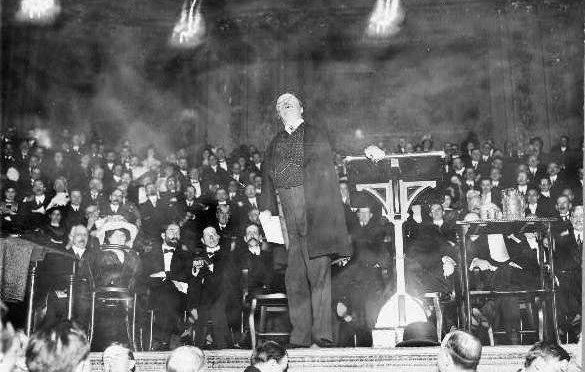
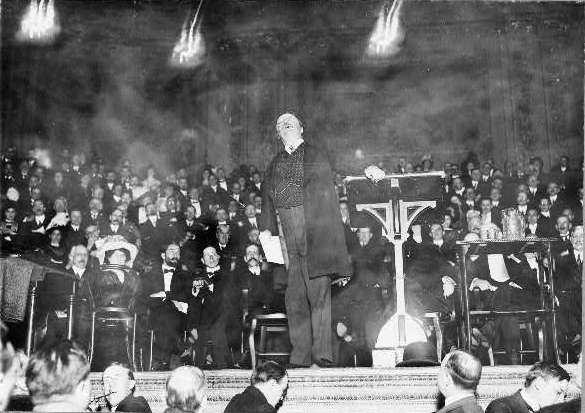
Roosevelt laid out his plank during a memorable speech at Carnegie Hall (pictured above) on March 20, 1912: “THE great fundamental issue now before the Republican party and before our people can be stated briefly. It is: Are the American people fit to govern themselves, to rule themselves, to control themselves? I believe they are. My opponents do not.”

Getting out a powerful incumbent was a difficult task, one that Roosevelt supporters thought could be overcome with the debut of the Republican primary process to the political system. The primary system was considered progressive for its day, putting the delegate process to a popular vote. But New York’s first Republican primary, held on March 26, 1912, quickly dissolved into chaos.

Poll workers were ready to make history that morning, only to arrive at polling stations bereft of ballots. Voting locations throughout the city opened that day with nary a ballot in sight. The outer boroughs suffered greatly, and in over a hundred locations, ballots never arrived. Voters waited in line for hours, only to be told that would not get an opportunity to select a candidate. At some voting locations, ballots arrived a few minutes before the polls closed at 9 p.m.

Kings, Queens and Richmond Largely Disenfranchised,’ proclaimed the New York Sun, while the Tribune found ‘Big Confusion Throughout the City‘. Some clever operators quickly hammered out unofficial ballots on typewriters for anxious voters, hoping they would be accepted.

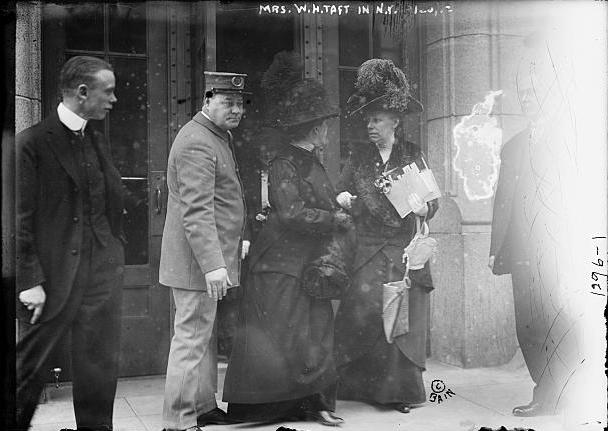
Below: First lady Helen Herron Taft makes greets supporters in New York

Manhattan voters had fewer problems at their polling stations, as moving vans rushed ballots to locations throughout the city. But the result did not help out the former president.

Political machines still held sway in local politics, and New York was now firmly in Taft’s camp. The incumbent easily won the state, although the voting hiccups throughout the other counties allowed Roosevelt supporters to cry foul. A representative of Roosevelt’s election committee wailed to the New York Times that “the primary election here today was not only a farce, but goes beyond that and is an insult to the city.”

Roosevelt came back from this messy defeat to win nine primaries in other states. Unfortunately, most states still chose delegates at state conventions, a system that favored Taft. At the national convention, Taft was chosen again as the Republican candidate. Roosevelt bolted and ran as a progressive third party candidate (the so-called ‘Bull Moose’ party).

While campaigning in Milwaukee, Roosevelt was shot in the chest by an insane saloon keeper, surviving the impact due to his eyeglass case and a voluminous speech absorbing most of the blow.

Both Taft and Roosevelt lost that November to the Democrat Woodrow Wilson.

Pictures courtesy the Library of Congress

Categories
Mad Men

‘Mad Men’ notes: New Jersey invades the Statue of Liberty


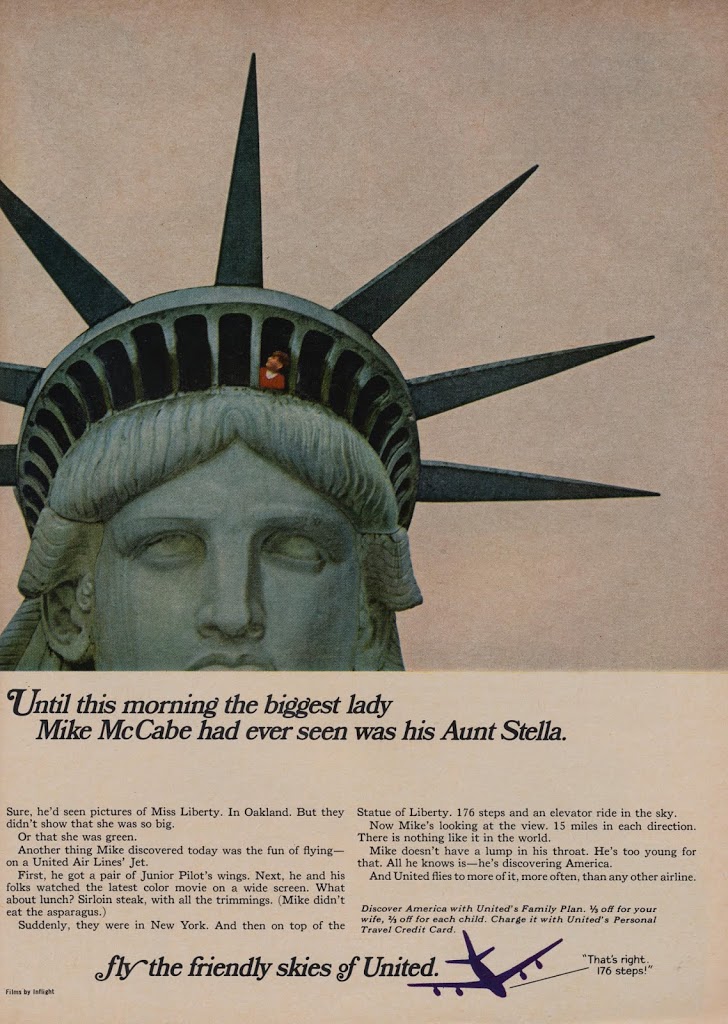
The lady of Liberty Island makes an appearance in a 1965 United Airlines ad campaign. Don Draper, of course, prefers American Airlines. (Courtesy Flickr/What Makes The Pie Shop Tick) 

WARNING The article contains a few spoilers about last night’s show, so if you’re a fan of the show, come back once you’re watched the episode. 


‘Mad Men’ returned to AMC last night, ramping up its regular displays of well-primped, misogynistic Madison Avenue ambition. On Mondays here on the blog, I’ll drill down for inspiration into the smaller details from the show that deal specifically with New York City history. And on Sundays, during the show itself (when possible), I’ll be playing along on Twitter, throwing out little trivia tidbits as quickly and accurately as humanly possible.

Everybody seems to be talking about the slinky performance of Gillian Hill‘s ditty ‘Zou Bisou Bisou — or ‘Zoo Be Zoo Be Zoo’ if you prefer the Sophia Loren version — by Don Draper’s new wife Megan. And civil rights issues finally begin to bubble to the surface when a nasty water-balloon incident by a rival firm (based upon a real event, down to the dialogue!) somehow ends with Sterling Cooper Draper Pryce possibly hiring their first African-American secretary.

But I was struck by a throwaway line uttered early in the episode by Don’s son Bobby Draper — played by yet another young actor, the fourth Bobby in the show’s five seasons. With the children over at Don and Megan’s Manhattan apartment for the Memorial Day holiday, Don emptily suggests this will be the day they go visit the Statue of Liberty. Bobby shrugs and says, “We always say that, but we never do.”

The remark is meant to imply all the cheerful, all-American things that the Draper family never seem to do together anymore. When Don drops the kids off at the home of ex-wife Betty and her new husband, he refers to the couple inside as ‘Morticia and Lurch‘. (Did Don know that ABC had just cancelled The Addams Family the month before?)

Oh, but I do wish the Drapers had gone to the Statue of Liberty at that moment, in late May 1966, as they might have witnessed a rather remarkable sight — the virtual invasion of Liberty Island by stolid representatives from Jersey City!

Once called Bedloe’s Island, the alleged hiding place of pirate’s treasure and the home of Frederic Bertholdi‘s statue since 1886, Liberty Island actually sits within the state line of New Jersey, as does its partner Ellis Island. In fact, some of Ellis Island’s reclaimed land is still considered part of New Jersey. However, Bedloe’s has been within the jurisdiction of New York since a compact between the two state governments was signed in February 1834.

New Jersey has not always been happy with this arrangement. On the afternoon of May 23, 1966, a group of over four dozen Jersey City Chamber of Commerce members stormed across the water and ‘conquered‘ Liberty Island, pressing their contention that the island should be part of their state.

With ‘the Federal Government cooperating as a friendly non-belligerent’, the New Jersey businessmen, joined by Jersey City mayor Thomas J. Whelan in a ‘festive, bloodless invasion’, rattled off their demands, including equal recognition of Jersey City and New York, direct access to Circle Line boat service from the island, and even a change to Liberty Island’s postal address.

Don could have even brought his new bride Megan — of ‘French extraction’ as she might say — as a representative of the French government was also on hand to confirm friendly relations between the two parties. (I assume he meant between America and France.) Afterwards, Air France even provided a box lunch to the Jersey City aggressors!

The event was, of course, mostly for show, for greater plans were already in play. In the previous year, the Statue of Liberty and Ellis Island were enjoined as a national monument under one administrative entity, the National Park Service. By October 1966, they were also listed as inaugural members of the U.S. National Register of Historic Places.

The Statue of Liberty often served as a complicated symbol for 1960s political debate, a touchstone for civil rights activists and an ironic construct for many antiwar protesters embittered by the Vietnam War.

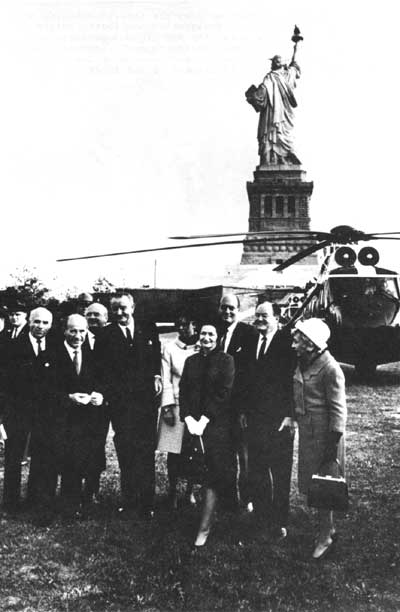
In 1965, the FBI and New York police snuffed out an attempt by the Black Liberation Front to smuggle dynamite onto the island and blow up the statue. That same year, President Lyndon B. Johnson (at right) traveled to Liberty Island to sign into law the Immigration and Naturalization Act, a pivotal and far-reaching change to American policy that essentially eliminated immigration quotas.

A few years later, antiwar activists staged a Christmastime demonstration here, barricaded themselves inside the statue for almost two days. In sad need of disrepair by the late 60s, Lady Liberty even represented a certain dislodging of the American dream to many, a sentiment strongly recognized by the 1970s which led to the statue’s rehabilitation for her 1986 centennial celebration.

Categories
Friday Night Fever

Rays of light: Madonna and the music video club, 1984

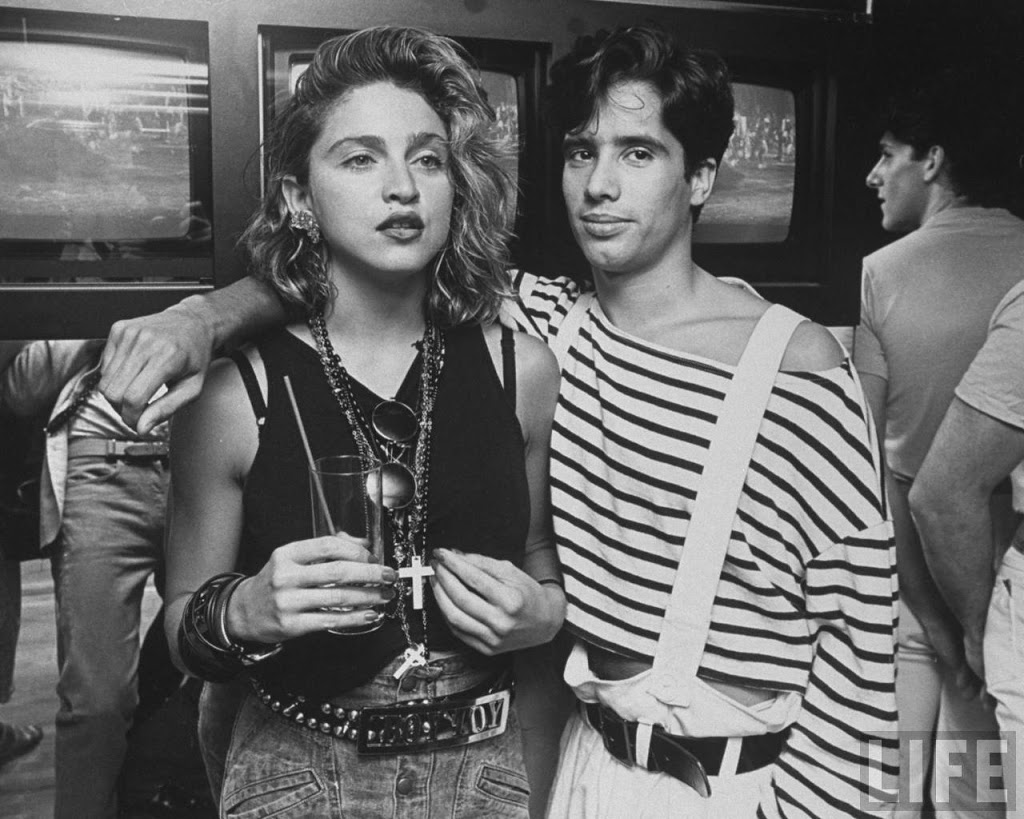
Girl gone wild: Madonna enjoys the video opulence of Private Eyes with former boyfriend and producer Jellybean Benitez, July 17, 1984

It’s 1984, and the hottest trend in American pop culture is the music video . MTV had debuted a channel of non-stop music videos in 1981, and just three years later, most new pop superstars were being defined by them– Michael Jackson, Prince, Duran Duran, Cyndi Lauper, Wham, Culture Club.

One of the more notable New York club opening in the summer of 1984 was Private Eyes, a trendy gay lounge at 12 W. 21st Street, poised to meet the video future with full-on glittery radness. With MTV revolutionizing pop music by the early 80s, nightclubs rushed to incorporate the new trend into their aesthetic. At Private Eyes, clubgoers needn’t have worried about a frenetic disco floor; they were literally invited to be mesmerized. “There is no defined dance area — it’s like a living room with the coffee table pushed aside.” the owner told Billboard magazine in November 1984.

The club was state-of-the-art for its day, with almost three dozen television sets, an immense library of 3/4th inch VHS cassettes and the technology to make “beat-for-beat transitions between videos, as well as wipes, fades and full mix effects for the club’s six tape decks.” New York Magazine listed it among their ‘environment clubs‘ of 1984, “like a department-store television section, except at Private Eyes you can have a beer and you can’t change the channel.”

In its opening months, Private Eyes scored a few appearances by music video’s biggest female star of the day — Madonna.

As a friend of owner Robert Shalom, Madge allegedly swore by the club, sometimes popping in after a day of recording her album Like A Virgin over at the Power Station studios on W. 53th Street*. “I don’t have MTV,” she remarked. “I do see videos, I go to Private Eyes.”  Her record label hosted a party in celebration of her new album, released in November that year. Several months later, Madonna was photographed at the club with her rowdy companion Sean Penn on their first date.

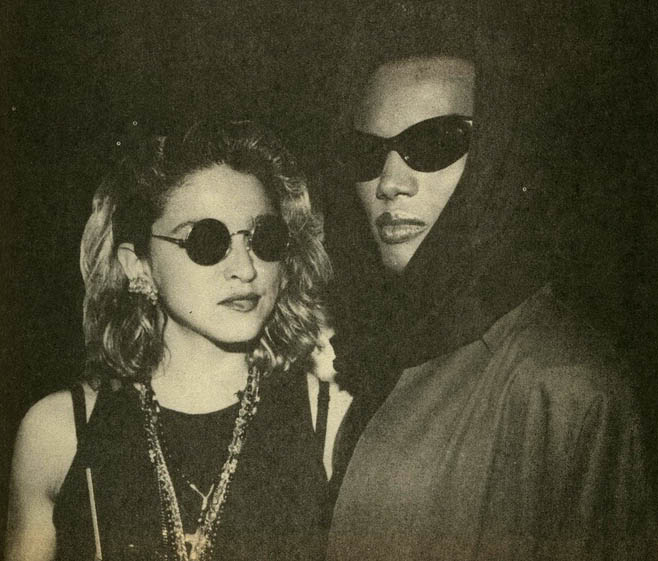
Below: Madonna, inside Private Eyes with Grace Jones, sometime in 1984, perhaps both having difficulty watching music videos with sunglasses on

The strict notion of a ‘video club’ in New York faded when it became cheaper for smaller clubs to install multiple screens and access video material. And, of course, as more common clubs joined the video revolution, the swankier ones eschewed it. Dance clubs that did opt for visual entertainment embraced ambient sets of computer animation by the early 90s, often leaving standard music videos for MTV and other cable networks. (Eventually even MTV left music videos.)

Private Eyes morphed with the times, eventually becoming the Sound Factory Bar in the 1990s, a spin off of sorts to the renown but troubled all-hours club on W. 27th Street, in the shadow of the West Chelsea’s elevated tracks. It refreshed its image a few years later under the name Cheetah.

Madonna, who had starred in five music videos by the time she first stepped foot in Private Eyes in the summer of ’84, has gone on to make a total of sixty-nine of them, including one that was just released this week.

*The year before, Bruce Springsteen recorded portions of ‘Born In The U.S.A.’ in the same studios.


Top picture courtesy Life Google images. Second image courtesy Madonna Scrapbook

Categories
Mad Men

Mad Men 1966-67: Speculation, context and flashbacks

Our favorite randy, drunken Madison Avenue suits return this Sunday with an extra-special long episode of ‘Mad Men‘ this Sunday. As with prior seasons, I’ll try and follow up most shows on Monday with a little historical commentary.

The wonderful thing about this show is that they’re nothing if not hyper-sensitive about historical accuracy. From hints given by producers, it appears the new season will open sometime late in the year 1966 or perhaps early 1967. Some significant events during that year that may come into play on the show, either in major disruptive ways or in fine, knowing details:

— It’s the first year of the John Lindsay mayoral administration. Although he governs over a metropolis in steep financial crisis and paralyzed by striking workers, he still considers it a ‘fun city’.

Pennsylvania Station is ceremoniously demolished. The fate of the treasured train station has been the subject of prior episodes. Could its final destruction represent something more for the troubled ad agency?

The World Trade Center begins construction. I’ll be very surprised if some mention isn’t made of the envious offices with their magnificent views.

— ‘Cabaret‘ opens on November 20, 1966.  Finally, something opens in New York more debauched than an ad agency Christmas party!

— New York’s most fabulous club is The Electric Circus on St. Mark’s Place, drawing the magnificent and the mod, including the entourage of former advertising illustrator Andy Warhol.

— This is the year of color and camp. New on TV: Star Trek, Batman, The Monkees, Dark Shadows

— In 1966, there 385,000 American troops in Vietnam, of which over 6,000 would be killed that year alone. A massive protest hit the streets of New York in April 1967 and dozens burned their draft cards in Central Park. A Maxwell House coffee can was famous used to burn the cards. A new client for Don Draper?

— Cassius Clay had fans last season at Sterling Cooper Draper Pryce. As Muhammad Ali, will he still have them after he becomes a conscientious objector against the war?

The most important album of 1966 comes from two boys from Forest Hills, QueensPaul Simon and Art Garfunkel.

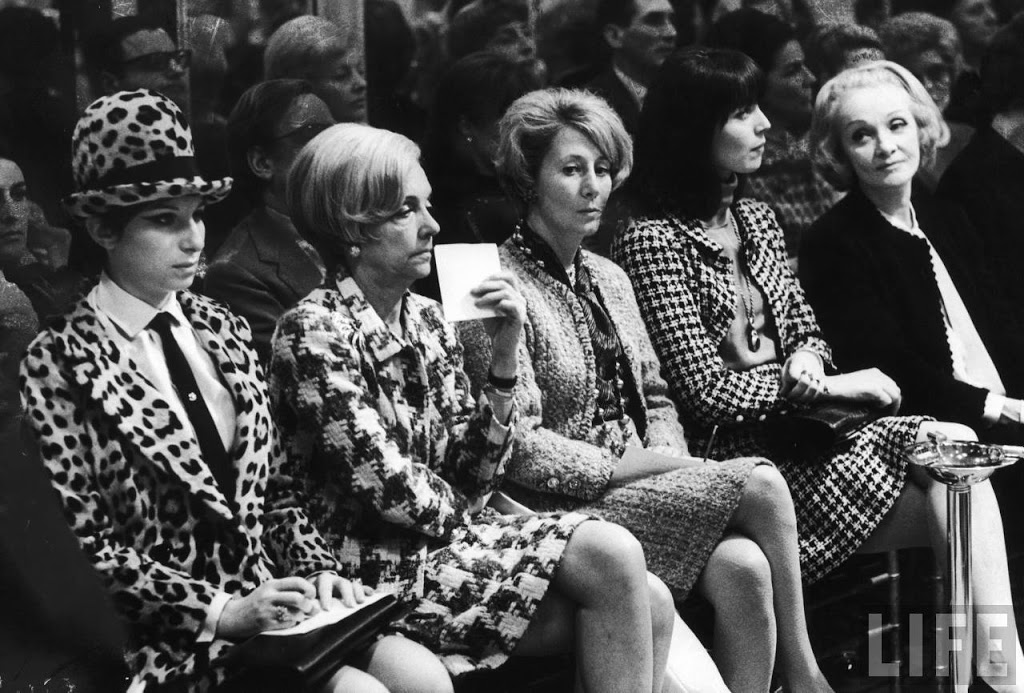
— New York played second-fiddle to the colorful imported fashion trends of London. Fashion became daring, flamboyant and colorful, even the dress suits. Skirt hems elevate. Pictured above: New York’s hottest star Barbra Streisand on one side, Marlene Dietrich the other, and the currency of 1966 fashion in between, at a Paris fashion show. Pic courtesy Life Google images

— A strange year at the movies, the top box office hits were ‘Hawaii‘ and ‘The Bible‘. However the cultural zeitgeist was surrounding the third biggest film of the year — ‘Who’s Afraid Of Virginia Woolf?‘ Can you imagine a time when a stage adaptation was the third biggest film of the year?

— Gay rights protests begin popping up around the Village, including a slightly botched ‘sip-in’ at Julius Bar in April of 1966. Might we see a reappearance of Sal in this context?

— New York gets its first FM rock music station in 1966 — WOR-FM. While I doubt this fact makes the show, expect a soundtrack heavily laced with sweat and reverb. (Or perhaps, laced with something more tangible?)

— On top of color televisions, potential clients for the agency include such newfangled inventions as disposable diaper, the synthetic fiber Kevlar, lawn replacement AstroTurf, the sugar substitute NutraSweet and any product related to the American quest to reach the moon.

Here’s a sampling of some articles I’ve written for the blog on ‘Mad Men’ episodes. You can find them all by clicking on the label ‘Mad Men‘:

‘Mad Men’ returns: a guide to eating (and drinking) options
‘Mad Men’ notes: The once and future Hotel Pennsylvania
‘Mad Men’ notes: A movie theater classic in its final days
‘Mad Men notes: Naked truths about New York nudism
‘Mad Men’ notes: Upscale flowers in a mystery mansion
‘Mad Men notes: Konnichiwa, New York City!

Categories
Planes Trains and Automobiles

Motor hotels: Manhattan’s most luxurious parking garage “Your car never touched by human hands!”

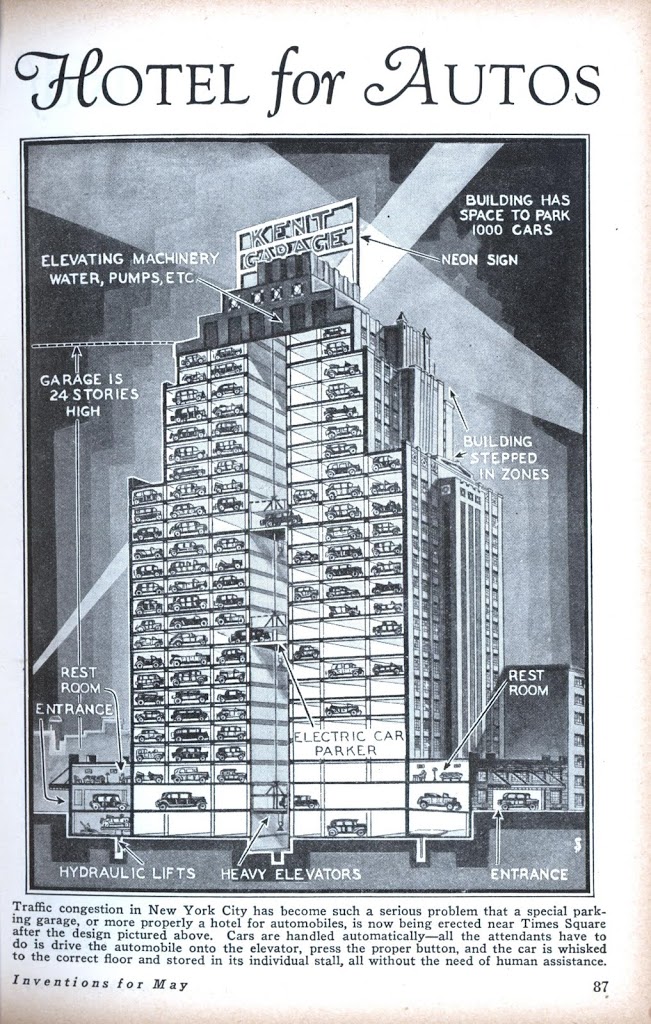
If you don’t already check in to the marvelous Modern Mechanix blog from time to time, then you’re missing out on some retro-futuristic genius. The blog usually highlights visionary drawings from the Modern Mechanics archives. But in the case of one illustration from May 1929, one particular wacky, wondrous dream was actually carried out — and promptly fizzled.

Automobiles had been a part of midtown Manhattan since the beginning of the 20th century, with dealerships lining the streets of the plaza that would soon take the name Times Square. But it wouldn’t be until the 1920s that the city recognized a crisis that would bedevil New Yorkers into today — where do you park your car?

Some cities outright banned curb parking during the decade. Chicago became the first city to charge motorists to park along city streets. But in New York, some private endeavors tried to solve the problem.

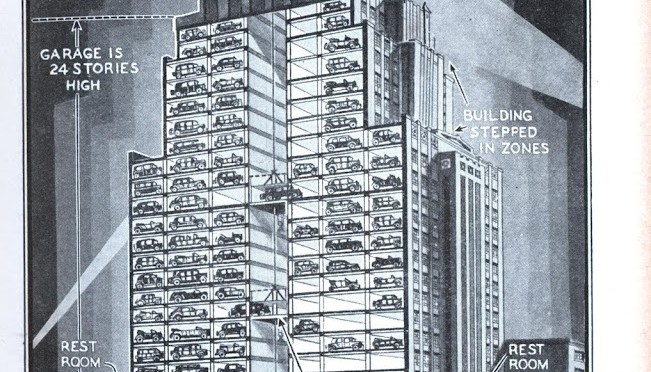
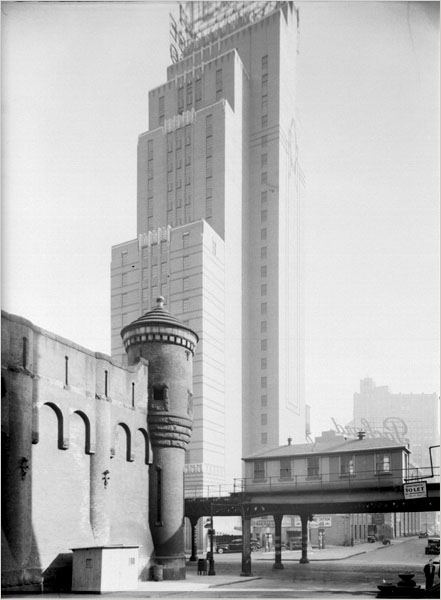
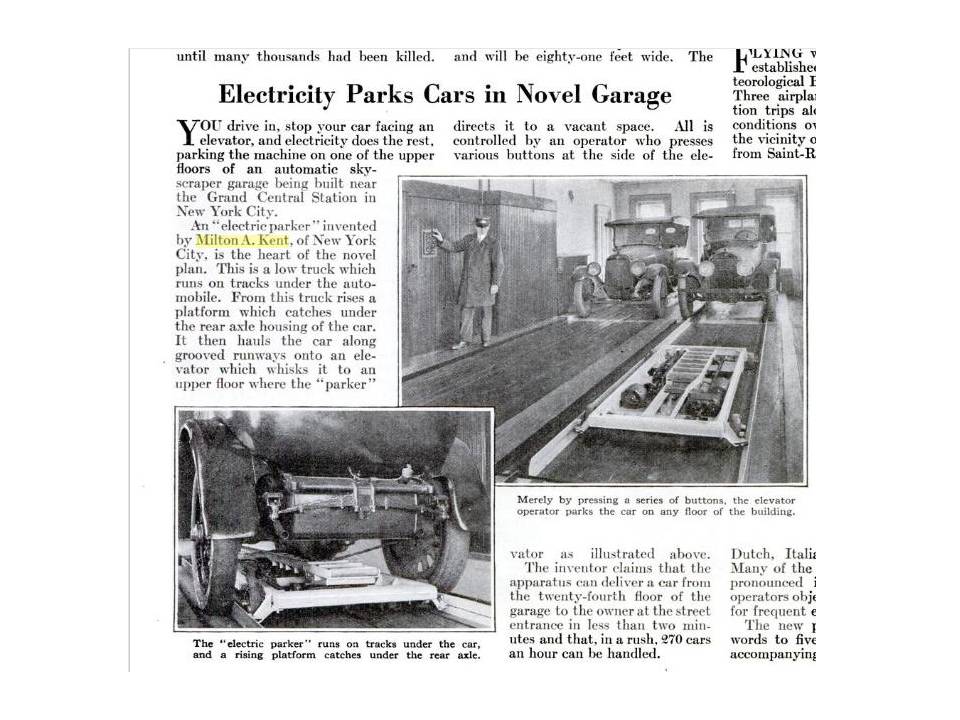
Perhaps seeing a bit of cross promotion, Packard Motors sold an area of property on Ninth Avenue and 61st Street (today’s 43-45 W. 61st Street) to the Kent Garage Investing Corporation in 1928. the brainchild by Westchester insurance salesman Milton A. Kent, the ambitious company opened a dizzying 25-floor* mechanical parking garage in a ‘flamboyant brick and terra-cotta’ art deco tower,  that could accomodate 1,000 cars, using an automatic elevator system that stored cars in upper floors. The cars were rolled into and out of elevators to desired slots in the structure, in theory using few human operators.  (See the clipping from the December 1928 issue of Popular Science at the bottom of this article.)

Advertisements touted the garage as a ‘motor hotel’. “Your car never touched by human hands!” went the Kent Garage slogan.

At right: The glamorous garage at West 61st Street, harkening a bit in appearance to the RCA Building, which would be completed in 1933. [source]

Kent Garages opened another location at 44th Street and 3rd Avenue and seemed to be the solution to the coming automobile boom that would fuel the ambitions of city planners like Robert Moses in the coming decade. Unfortunately, the Kent Garages were extremely inflexible, not suitable for cars of certain sizes, and employed highly defective machinery. And as you can probably gather, these were hardly swift forms of storage. It might take almost 30 minutes to retrieve your automobile during rush hour!

The garages were done in before they really got started thanks to the Great Depression. The Kents sold the 61st Street garage in 1931, although the building remained as a more conventional parking garage until 1943, when the building was refitted as a warehouse. (It’s an apartment building today.)

*Advertisements of the day tout a 25 floor structure, while the building’s landmark designation report lists a 24-floor building.

Top image courtesy of Modern Mechanix

Categories
Bowery Boys Bookshelf

‘The Irish Way’ to becoming American: a hard-fought history of the dockworkers, the vaudevillians and the chambermaids

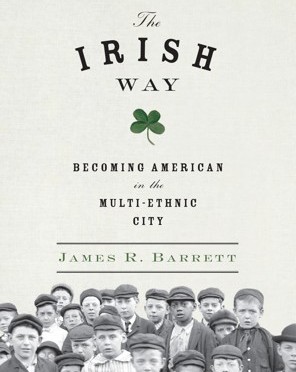
The Irish Way: Becoming American in the Multi-Ethnic City
part of the Penguin History of American Life series
By James R. Barrett
Penguin Group

The Irish were the first to immigrate to this country en masse in the 1840s, only to find themselves near the bottom of almost every aspect of American life. In James R. Burnett‘s tidy and studied cultural history ‘The Irish Way: Becoming American In The Multi-Ethnic City‘, we found out how they fought their way into American life, transforming it, and paving the way for others.

Burnett, a professor from the University of Illinois at Urbana-Champaign, explores the Irish influence on American life via the collisions and conflicts which occurred between the new arrivals and nativists, and the new arrivals and the newer arrivals. A profound theme of the book is that the definition of being American Irish came not from seclusion that would define later immigrant groups, but from clashes with those groups. By the 20th century, Irish influence came from their successful entry into American life and, according to Burnett, “in strategies for dealing with newcomers.”

The book is categorized into various aspects of modernity as it would have looked to a late 19th century immigrant — The Streets, The Parish, The Workplace, The Machine. Although it purports to be a survey of American Irish urban life, it’s almost wholly based on the New York Irish experience. And for good reason; by the turn of the century, more people of Irish descent lived here than in Dublin.

Many aspects of modern life trace back to more robust strains of Irish defiance. The Catholic Church may have been a powerful organizer of the Irish community, but the many Irish social reformers who pushed against it (even those among the clergy itself) helped fashion modern social reform. The roots of union organizing came from Ireland. And, with nods to the likes of “Big Tim” Sullivan, the modern political machine was essentially fueled by powerful collaborations with Irish community leaders.

If early Irish New Yorkers strived for assimilation, later generations defined their ethnicity against the grain, combating black, Italian and other immigrants in alleyways and along the docks — for territory, for jobs, for identity. The Irish dominated the worlds of minstrelsy and vaudeville. Victimized by horrid stereotypes, Irish entertainers turned the tables with equally vulgar presentations of groups they often considered beneath them. (Those tables could be turned again; as Irish entertainers often did ‘yellowface’, so too could a Chinese entertainer do a broad Irish impression in those years.)

There are lovely details of New York life scattered throughout, from the birth of New York’s first black Catholic Church to the final foothold of Irish dock workers in the neighborhood of Chelsea. While Burnett spends little time amid the grit of early Irish neighborhoods, there are plenty of depictions of fisticuffs and riots to indulge your pugilistic impulse. While it does beautifully illustrate the roots of Irish American pride, ‘The Irish Way’ is not a manual but a map, a reflection upon their path to influence on life in the United States.

Categories
Planes Trains and Automobiles Podcasts

The High Line: The wild, wild West Side, cowboys included, inspires an elevated railroad and a remarkable park

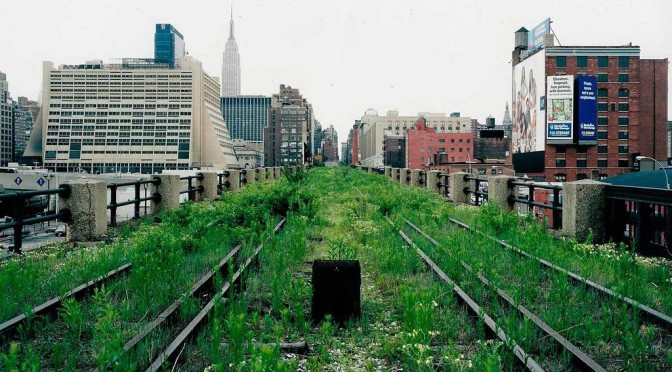
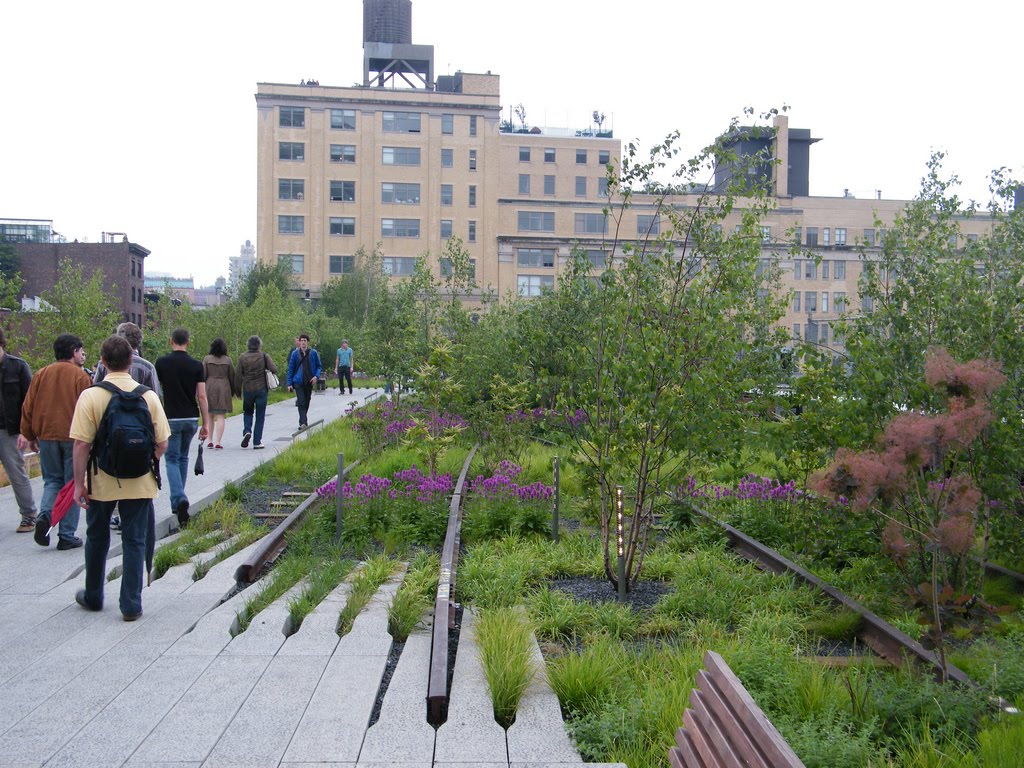
Joel Sternfeld’s extraordinary four-seasons photographs of the High Line — displayed in his 2002 show Walking The High Line — revealed a ribbon of nature surrounded by urbanity and presented a peek into forgotten history. These images greatly influenced the later design of the park, a mix of seamless design and tastefully untethered flora. Courtesy Joel Sternfeld

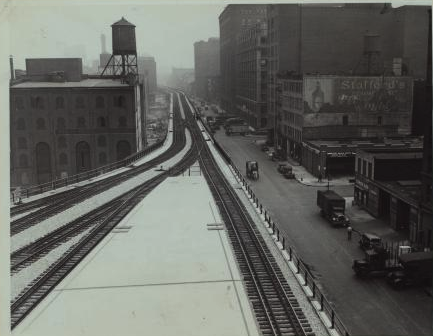
PODCAST  The High Line, which snakes up New York’s west side, is an ambitious park project refitting abandoned elevated train lines into a breathtaking contemporary park. This is the remnant of a raised freight-delivery track system that supported New York’s thriving meat, produce and refrigeration industries that have defined the city’s western edges.

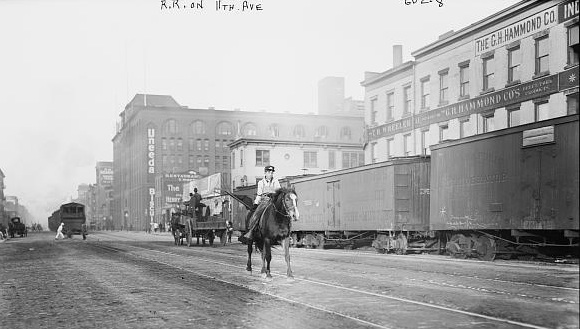
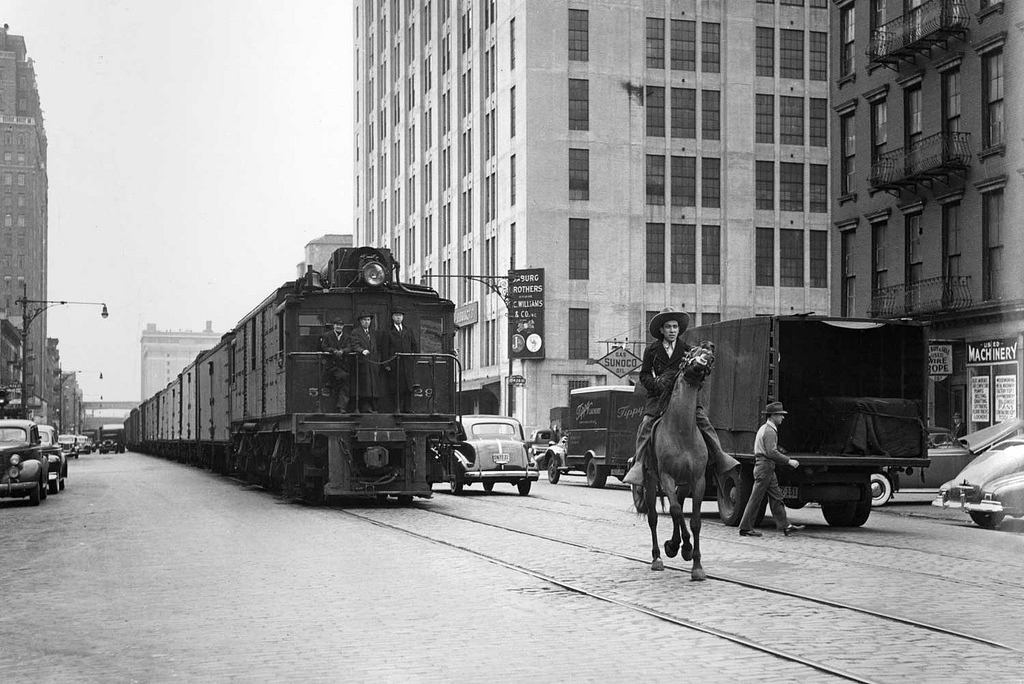
 You can trace the footprints of this area back almost 200 years, to the introduction of the Hudson River Railroad and Cornelius Vanderbilt, who transformed the streets along the Hudson River into ‘the lifeline of New York’, filled with warehouses, marketplaces and abattoirs. And, of course, lots of traffic, turning 10th Avenue and 11th Avenue into ‘death avenues’, requiring New York’s first ‘urban cowboys’.  The West Side Elevated Freight Railroad was meant to relieve some of trauma on the street. That’s not exactly how it worked out.

We’ll tell you about its downfall, its transformation during the 70s as a haven for counter-culture, and its reinterpretation as an innovative urban playground.

FEATURING: Cows, dining cars, Russian caviar and sex clubs!


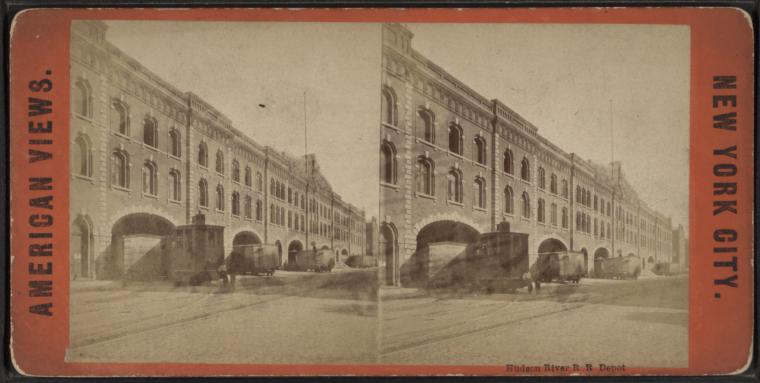
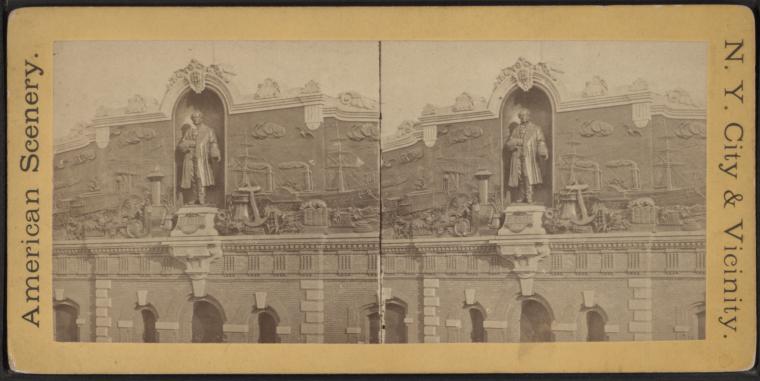
St. John’s Freight Depot, built in 1871. The Cornelius Vanderbilt statue stood watch over the bustling activity until the building was demolished in the 1930s. Mr. Vanderbilt was then moved to Grand Central Terminal, where he still stands today. Pictures courtesy NYPL digital images


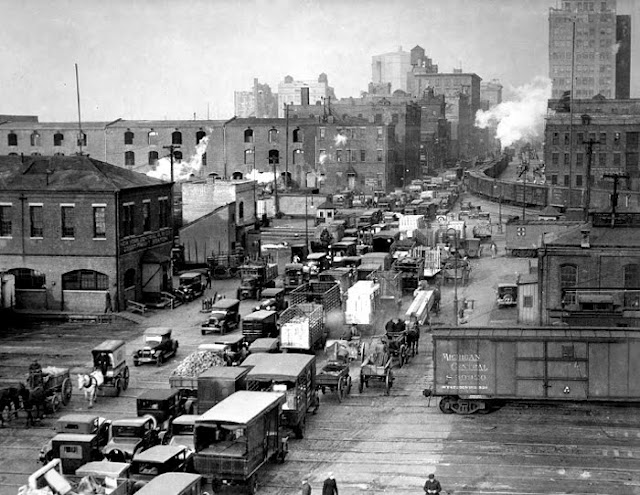
The businesses, the trains and the marketplaces of the west side created a nightmare traffic situation along 10th and 11th Avenues, resulting in dozens of death and the sinister moniker ‘Death Avenue’. (Picture courtesy Friends of the High Line)

Rangers of Eleventh Avenue: A railroad cowboy marches ahead of an approaching train. Below that, many years later, another cowboy has his work cut out for him going up the avenue in 1922, the era of automobiles.


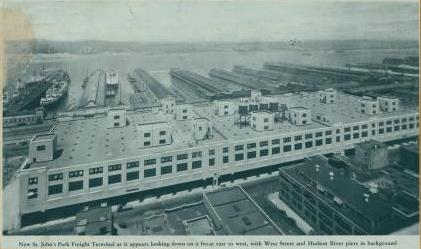
The relatively ‘modern’ St. Johns Terminal on Spring Street.

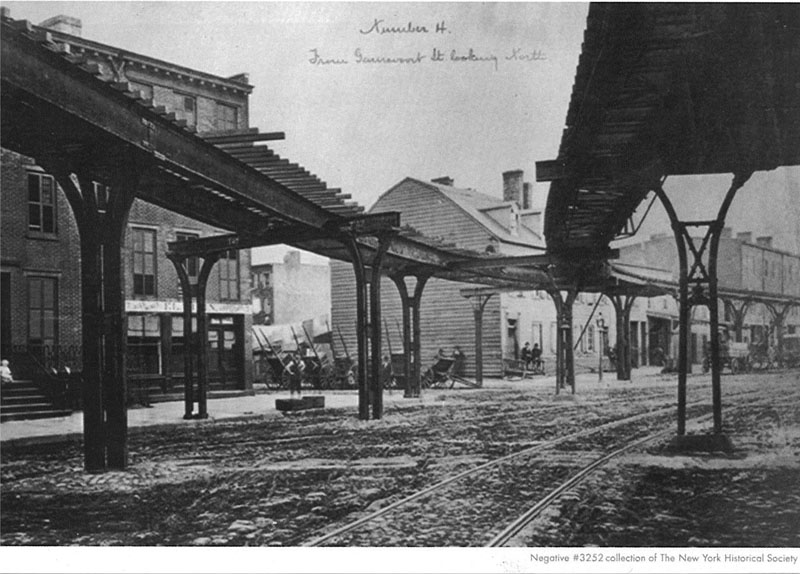
Building the elevated freight railroad: At Gansevoort Street, looking north. Picture courtesy the New York Historical Society

The elevated in 1934, West Street and Spring Street. This was one of the sections that was later ripped down. (Courtesy NYPL)

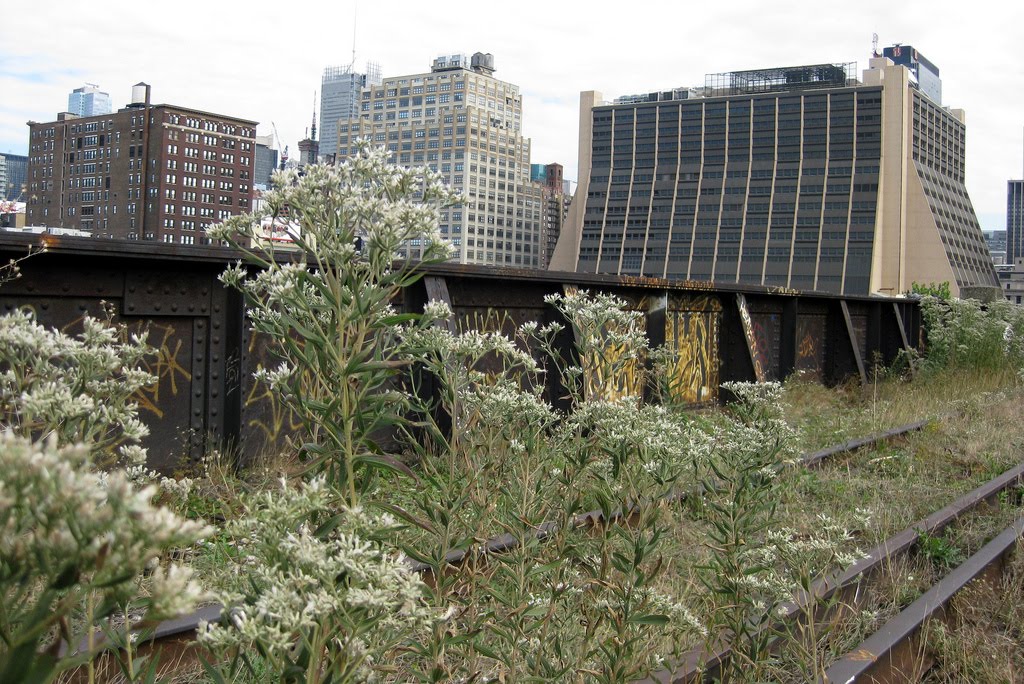
After the elevated railroad closed for good in 1980, the track sat abandoned, covered in natural overgrowth of the likes hardly seen anywhere else in Manhattan. ‘Urban explorers’ often traipsed along the mysterious rails, capturing the dichotomy between sudden natural landscape and metropolitan backdrop. (Photo courtesy wally g/Flickr)


The High Line Park opened in 2009, after almost a decade of awareness and fundraising. The linear park has helped transform the neighborhoods below it and has created a new must-see destination for tourists. (Courtesy Friends of the High Line)

Categories
Brooklyn History

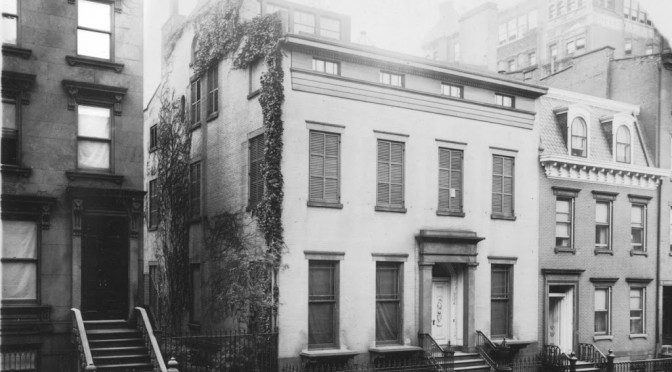
Ten fabulous facts about 70 Willow Street, Brooklyn Heights, aka ‘the Truman Capote house’

The strange, yellow Brooklyn Heights mansion best known as the home where Truman Capote wrote ‘Breakfast At Tiffany’s’ has finally been sold for $12 million, after many months of humbling markdowns from its original hefty pricetag.
Located in the heart of old Brooklyn, the new owners will be winning more than a literary prize. The house has a rather unusual past full of influential inhabitants and has been used in some curious ways:
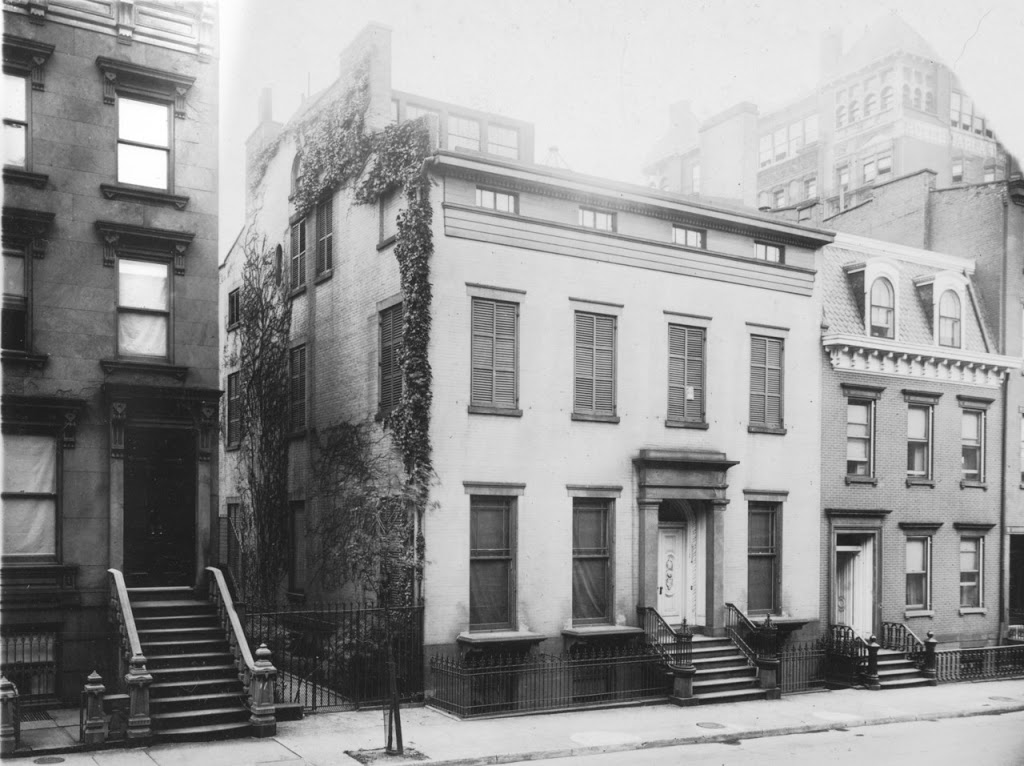
1) 70 Willow Street, in the popular Greek revival style of the day, was built in 1839 by Adrian Van Sinderen, the descendant of original Dutch settlers in New Amsterdam and a fiery Revolutionary War-era reverend from Flatbush, Ulpianus Van Sinderen. Van Sinderen’s lavish urban villa — it has almost a dozen fireplaces — is one of the oldest houses in the neighborhood, but not the oldest. There are a few neighboring houses that are older, including 24 Middagh Street, just a couple blocks away and built in 1824.
2) The house passed to his son Adrian Jr., a prominent New York lawyer, who fell spectacularly from grace when he mishandled the family trust. He died nearly penniless and alone in New Lots, far outside the sphere of wealth, in 1864. (There’s an avenue near that east Brooklyn neighborhood named for the Van Sinderen family.) His descendants appear to have done better. Another Adrian Van Sinderen has an annual book-collecting competition named for him at Yale University.
3) The ‘estate of Van Sinderen’, as it was often called then, was built for a single family, but by the late 1860s, the roomy floors were being split up for several tenants. From an October 1869 classified ad in the Brooklyn Eagle:”One large, handsomely furnished second floor room for gentleman and wife or gentlemen willing to room together.”***

4) The primary resident during the late 19th century was the banker William Putnam, better known as a significant trustee for the Brooklyn Museum in its early years. He betrothed to the museum paintings by Rembrandt and Monet, as well as some ‘Royal Copenhagen  porcelain’ that rivaled that of European rulers, according to the Times.

5) The house was a pivotal location for the women’s suffrage movement. Scratch that, the anti-women’s suffrage movement. The newly married lady of the house, Caroline Putnam, and her sister Lillian joined other local ladies of means in organizing protests against granting women the right to vote or, in the words of their 1894 petition, to protest “the obligations of the ballot upon the women of the state.” Mrs. Putnam also hosted French conservation classes and literary salons from her parlor here. [source]
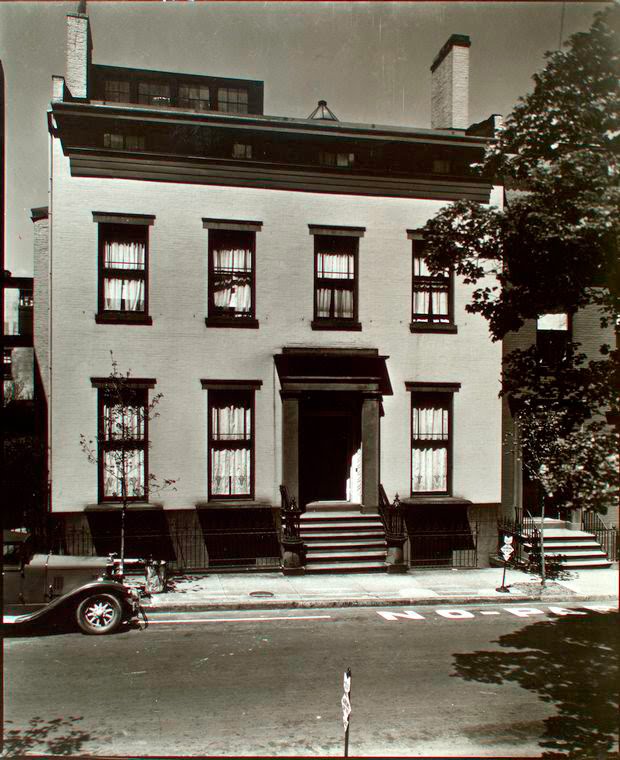
The picture at top shows the house as it looked in 1922. At right, the home in 1936. (Pictures courtesy New York Public Library.)
6) After Mrs. Putnam died in 1940, the house sat entirely vacant until 1944, when it was donated to the Red Cross. They used the house as a classroom, teaching arts and crafts, Braille to the blind and cooking classes to the wives of returning soldiers from World War II.

7) In 1953, the old house landed in the hands of renown Broadway stage designer Oliver Smith, responsible for the original scenery from great American musicals like Oklahoma!, Guys and Dolls and West Side Story. In his lifetime, he was nominated for 25 Tony Awards. With some of his earnings from the musical On The Town, Smith bought 70 Willow Street and lived here until he died in 1994.

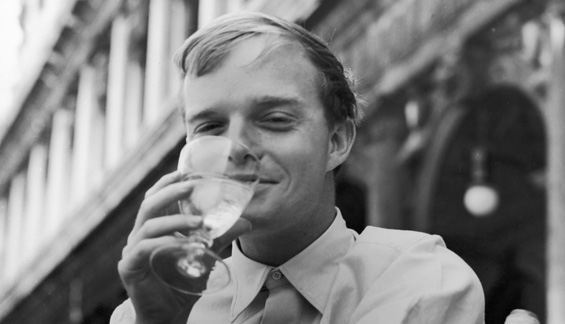
8) From 1955 to 1965, he lent the basement apartment to his friend Truman Capote. The blond Southern writer was simply wild about Brooklyn Heights and basically charmed himself into a permanent room on Willow Street. From his essay ‘A House on the Heights,‘ Capote describes, “We [Smith and Capote] sat on the porch consulting Martinis — I urged him to have one more, another. It got to be quite late, he began to see my point; yes, twenty-eight rooms were rather a lot; and yes it seemed only fair that I should have some of them.”

9) Decked out in green wallpaper and odd knickknacks, “an atmosphere of perpetual Christmas,” the house would prove a place of great inspiration for Capote. He wrote part of ‘Breakfast At Tiffany’s‘ here. Perhaps more notably, it was here that he picked up a New York Times are read about the brutal slaying of a Kansas family. Capote set about working on what became ‘In Cold Blood‘ the next day.

10) I can’t leave the tale of 70 Willow Street without mentioning one of its most famous lunch guests — Jackie Kennedy. Capote conveniently left out the fact that the house was Smith’s, not his. “She laughed about it, because suddenly in the middle of lunch she got the idea that it wasn’t his,” Smith recalled later. “I suppose I acted as if it were mine.”

And here’s some literary bonus points — it’s just down the street from the old home of Arthur Miller (155 Willow Street)

***A reader emailed me to say that the addresses for Willow Street were differently numbered before 1865 and that this ad probably refers to a neighbor of 70 Willow Street. In that case, I’ll replace that fact with one I should have mentioned in the lede of this article — as reported by Brownstoner, the $12 million final price tag for 70 Willow Street makes it the most expensive house purchase in Brooklyn history. Does this mean that nobody has yet bought my dream apartment in DUMBO?

Categories
Bowery Boys Bookshelf

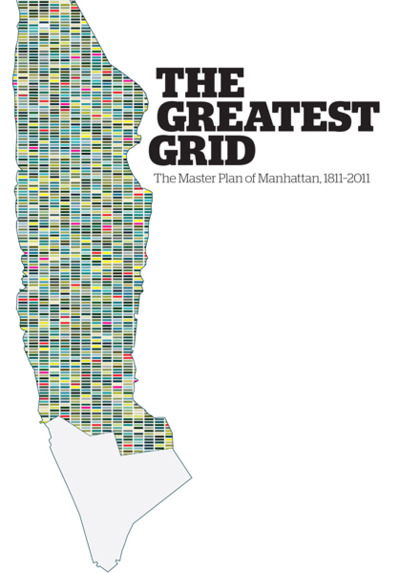
‘The Greatest Grid’ and an even greater book

Reason to love New York No. 12,306: A museum honoring the city’s history has a hit on its hands with an elaborate show about surveying and real estate.

The Greatest Grid: The Master Plan of Manhattan 1811-2011, the smash-hit exhibition at the Museum of the City of New York, is the most fully realized and in-depth show they’ve produced in a few years, and it’s done almost entirely without the help of traditional three-dimensional objects.  (The show has also been extended, until July 15.)

The story of the Commissioners Plan of 1811 and the effects of the Manhattan grid plan are wondrously illustrated with an extraordinary collection of maps and photographs, documenting the island’s almost century-long conversion into a major metropolis. The most substantial, non-printed object is a small marble surveying post.

But there’s a problem with a show based on maps. You actually want to touch things, draw your finger along familiar areas, and stand staring at pictures unfamiliar landscapes, trying to find evidence of your present street corner. More than once I caught myself poking an artifact in sudden amazement. (My apologizes to the museum curators.)

This is what makes the exhibit’s companion volume ‘The Greatest Grid: The Master Plan of Manhattan 1811-2011‘, edited by Hilary Ballon, pretty much invaluable. Published in a slender landscape binding, the book condenses the exhibition but allows for unabated curiosity and imaginative wanderings over vivid prints of aged topography.

This exhibit stands in contrast with Mannahatta/Manhattan, another excellent show from 2009 which aroused New York history lovers. Mannahatta was map-based, but pure speculation, an imagining of what the island was like before European habitation. ‘The Greatest Grid’ starts from many of the same sources — the Mannahatta Project was built upon early 18th century topographical maps — but elaborates forth upon the present landscape with stunningly detailed drawings of almost every inch of Manhattan.

While the show gives nods to the original three commissioners — and of course to John Randel, the surveyor tasked with outlining every foot of land — it’s the later applications of the grid plan that I found most fascinating. The book reprints images of country homes next to street plans that would shortly cut through the property. It’s a melancholy display, I guess, the destruction of natural beauty has rarely been as fascinating.

Original surveying maps are complemented with lithographs and photography illustrating the final product, in some cases carved blocks with lonely structures, waiting for the city to catch up to them. The companion guide, stuffed with short essays and full-bodied artifact descriptions by museum staff, reprints almost every image from the show.

Many such exhibition books suffer from the transfer. As an extreme example, last year’s lustrous, blockbuster Alexander McQueen exhibit at the Metropolitan Museum of Art was rendered into a diminutive curio with its accompanying companion book. ‘The Greatest Grid’ suffers no such problem, especially to those of us who find tinted topographical maps and black-and-white images of old New York as scintillating as haute couture.

——
Our podcast on the Commissioners Plan of 1811 merely skims the surface of material presented in ‘The Greatest Grid’, but I think it makes for a fine introduction. And I’m not ashamed to say we spend quite a bit of time talking about Gouverneur Morris. [You can download it from here.]

Categories
Those Were The Days

Ladies, it’s your day! A Leap Year tradition, New York style

 â€œWhen a woman has reached the age of thirty there is nothing left for her but to be good. I am going to make clothes for the poor. Hand me down that roll of flannel, Rachel: I mean to begin at once.” 

“If it will be any comfort to you, my dear,” began Rachel, soothingly, if monotonously. “I read the other day that women of thirty were all the fashion, and that girls of twenty were quite out of it.” 


“That was written by a person of forty then, my dear.”

— excerpt from ‘A Woman of Thirty’, New York Times, 1893

Happy Leap Day, single ladies! Put a ring on it! For four years — 1,460 straight days — men have been the initiators in romance. Women were to mildly express interest in a mate, her demure politeness disguising anything possibly resembling passion as she awaited a marriage proposal from the confines of her parents home. But not so on February 29, according to custom. On this day, women get to playfully assert themselves in the parlor, boldly proposing to the men they desire.

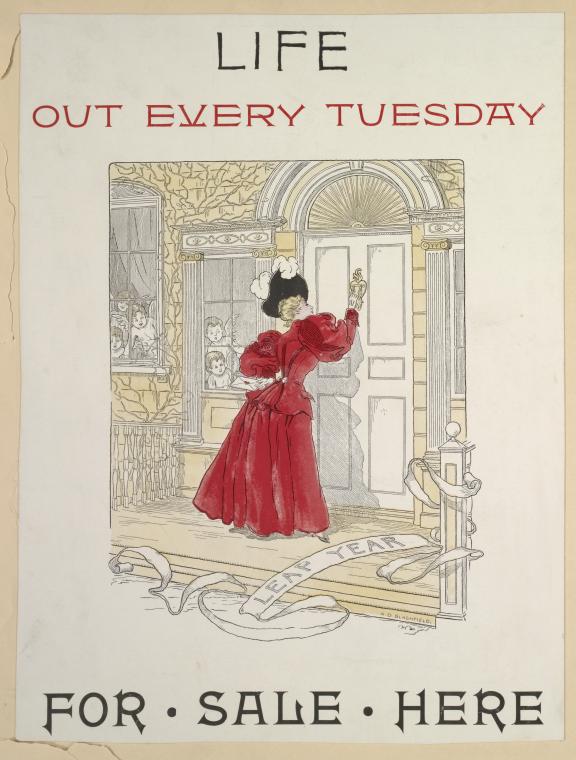
Although this Leap Day tradition allegedly dates back to the Elizabethan era and even further, the proper folk of the Victorian — and within the societal confines of New York — embraced it almost-seriously. But this was no mere pantomime of dating ritual, not simply a crusty poke at female status. Citing ‘common law’, the Independent in 1908 proclaimed, “[A]ny man refusing a woman’s proposal on leap year shall give her a silk dress. Every maiden, widow or divorcee has, therefore, an opportunity this year to replenish her wardrobe even if she fails to satisfy her affections.” (The advertisement at top seems to reference this detail of the ritual.)

The tradition in 19th century New York was recognized enough that an uptick in advertisements from female suitors could be found in newspapers on that particular day. A reporter for the Times peers in on “the ladies of Harlem” in 1856 to discover “the fairer half of the assemblage asserted the prerogatives which Leap Year confers upon them to the fullest extent. They selected their own partners for the dance and very probably some of them exercised their privilege of choosing a party for life.”  There was even a well-received play by J.B. Buckstone which debuted in 1850 called ‘Leap Year – A Ladies Privilege’.

But was this ridiculous tradition ever really taken seriously? There was doubt, even in the Gilded Age. I mean, women proposing marriage? Can you imagine? “It seems almost incredible to us that there was a time when it was considered a humorous thing for a civilized community to assume that women were in the habit of doing what no woman is known ever to have done,” wrote a Times columnist in 1880

As with old customs, this might have been taken more seriously outside of major cities, as evidenced by this letter which ran in the New York Times in 1864: “A remarkable (Leap Year) courtship and marriage came off in our quiet village last week, resulting disastrously to all the parties concerned.”

For New Yorkers, Leap Day does not seem to have been a ‘holiday’ that received serious consideration. Among the upper crust, a woman’s proposal would have been scoffed at, regardless of the season, while it’s doubtful certain lower class women wouldn’t have waited for a calendar anomoly to do what she wished. If anything, the urban legend might have actually deterred potential marriage proposals. According to an 1884 article, “The ladies are afraid to marry this [leap] year because people will say they popped the question.”

Even William Jay Gaynor, mayor of New York 100 years ago, dismissed the custom and the women of New York in a single swoop: “I do not think women care about leap year. They can propose if they want to, but bless them, leap year or no leap year, they would rather have the fellow propose to them.”

Of course, I suppose some are trying to keep this weird custom alive even today.

Illustration at top from the Club Women of New York journal from 1904. Life advertisement courtesy New York Public Library.

Categories
Gangs of New York

Execution in Five Points: Piracy, slave trade and the Tombs

Sometimes you can look back at history and think that nothing ever changes. And sometimes you find something that makes New York seem extraordinary unrecognizable, a city besieged by near barbaric crises.

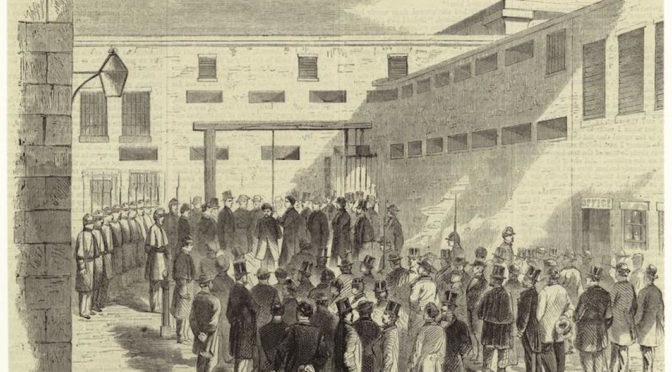
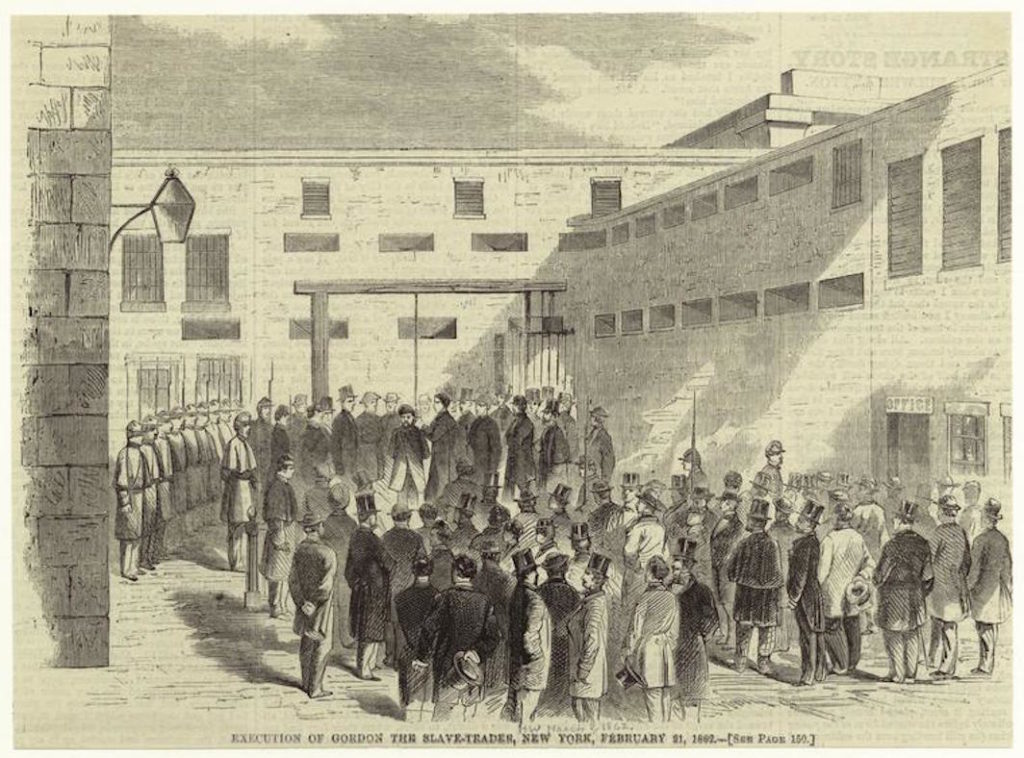
The image above depicts a scene from February 21, 1862, in the courtyard of the famous Tombs prison in the Five Points neighborhood.

The notoriously dank and foul-smelling complex was the scene of a great many public executions since its opening in 1838, but the one which took place on February 21 was particularly urgent, the crime cutting to the core of America’s central dilemma.

The man being hanged was Nathaniel Gordon, and his crime was international slave trade.

America was in the throes of a Civil War between the North and South, waged with slavery as its central issue. But the import and export of slaves into the United States has technically been banned decades earlier, and the U.S. Piracy Act of 1820 included human cargo in its definition of international piracy.

This did not deter Gordon, who sailed to North Africa in 1860 and loaded a boat with almost 900 people, intending to sell them to Southern plantations.

From a vivid description from Harper’s Weekly, the boat was overloaded with “eight hundred and ninety-seven (897) negroes, men, women, and children, ranging from the age of six months to forty years. They were half children, one-fourth men, and one-fourth women, and so crowded when on the main deck that one could scarcely put his foot down without stepping on them. The stench from the hold was fearful, and the filth and dirt upon their persons indescribably offensive.”

Gordon was caught just 50 miles offshore and brought to the United States for trial. He would have received a stern sentence even before the war, but with the conflict in full swing by the time of his trial in late 1861, Gordon’s defense team never stood a chance.

Despite pleas from wealthy supporters, Gordon was sentenced to die on February 7, 1862. President Abraham Lincoln commuted the sentence by two weeks, and Gordon’s supporters might have even convinced him to commute it further had Lincoln’s young son Willie not died of typhoid on February 20.


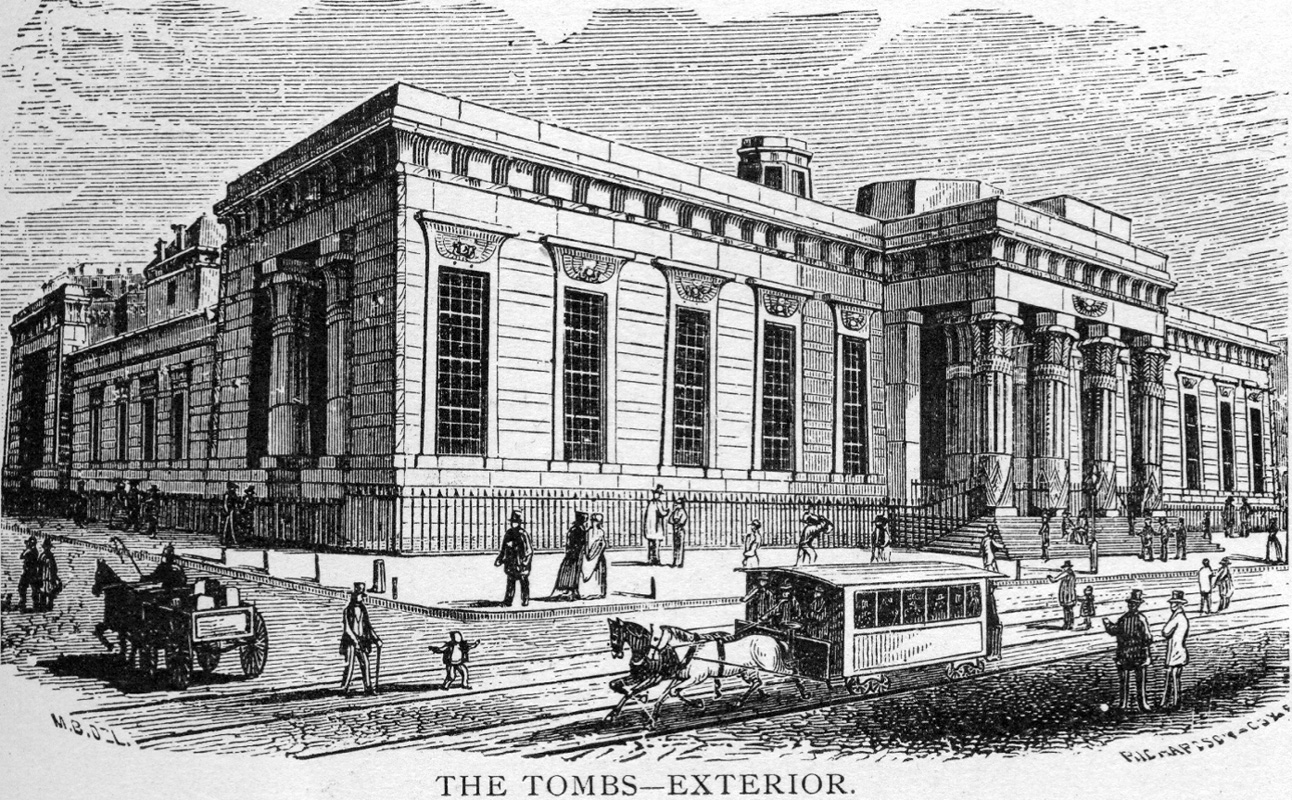
One notable fact about this execution is the Tombs (pictured above, in 1863) is a city prison, but the crime was a federal offense, the only such national execution to have taken place here.

Most federal executions took place at military installations. For instance ‘Pirate’ Albert Hicks was hanged on Bedloe’s Island, home of Fort Wood (and today the residence of the Statue of Liberty). Robert Cobb Kennedy, one of the Confederate conspirators who attempted to torch various New York hotels in November 1864, was executed at Fort Lafayette off the coast of Bay Ridge, Brooklyn.

Gordon was also the last person ever executed by the U.S. government for violations of the Piracy Act.

For more details on the execution, check out the great Corrections History blog which details the messy particulars of the execution.

Illustration above courtesy New York Public Library

Categories
Neighborhoods

This woman’s work: Exhausting images of Astor Place and Lafayette Street

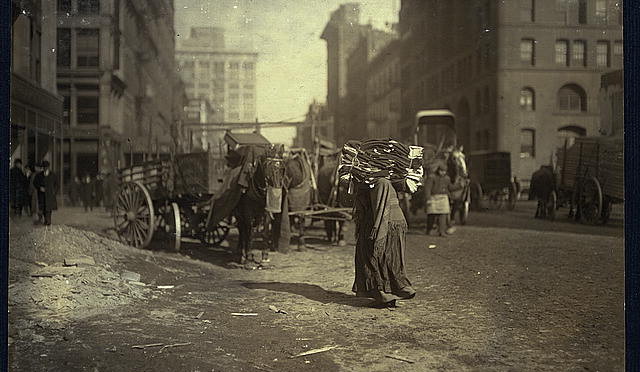
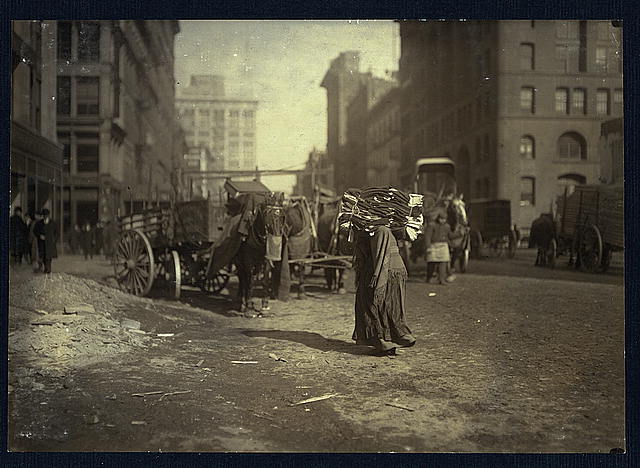
Gritty streets, circa 1912. Looking up Lafayette Street, below Astor Place. “The breaking point. A heavy load for an old woman.” The building to the right is the DeVinne Press Building, built in the 1880s, and today home to Astor Center Wine & Spirits. In the distance: the Wanamaker Department Store building, today the home to K-Mart! Look here and turn the angle north for the present view of this street. [Source: LOC]


Lewis Hine hit the streets of New York in 1912 looking for dirt. And he found it. The teacher-turned-social activist and photographer had found the camera a useful tool in illustrating poverty and had already drawn attention to deplorable child labor conditions. In the wake of early social crusaders like Jacob Riis, Hine’s photos helped the poorest New Yorkers by showcasing their daily toil in a landscape of decrepit quality.

Beyond the social commentary, however, these are still fascinating portraits of New York. None are more striking to me personally than his images taken one hundred years ago this month from Astor Place and along Lafayette Street. Many New Yorkers marveled that month at the exploits of daredevil pilot Frank Coffyn over New York harbor, but after the fun was over, many came home to this.

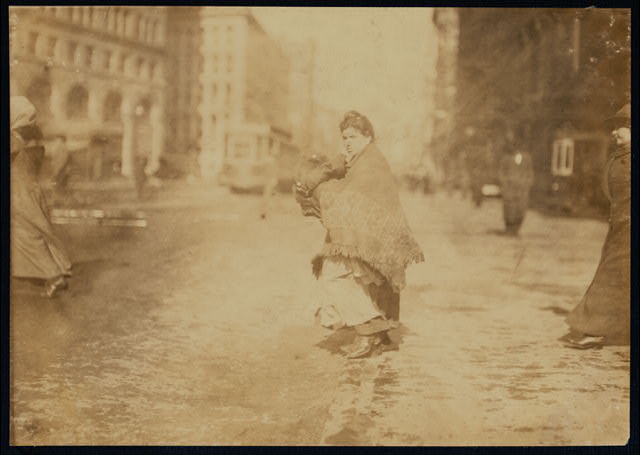
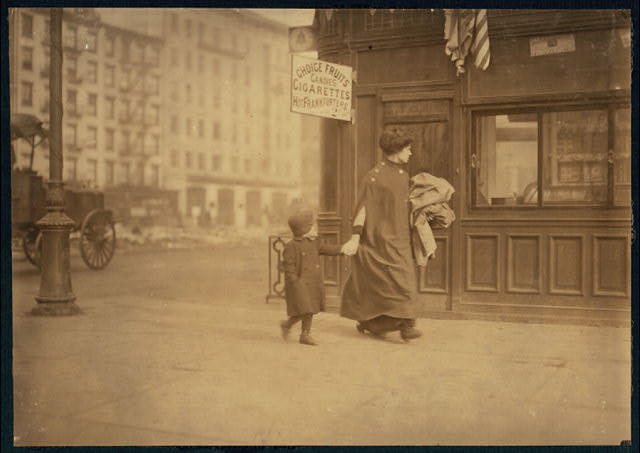
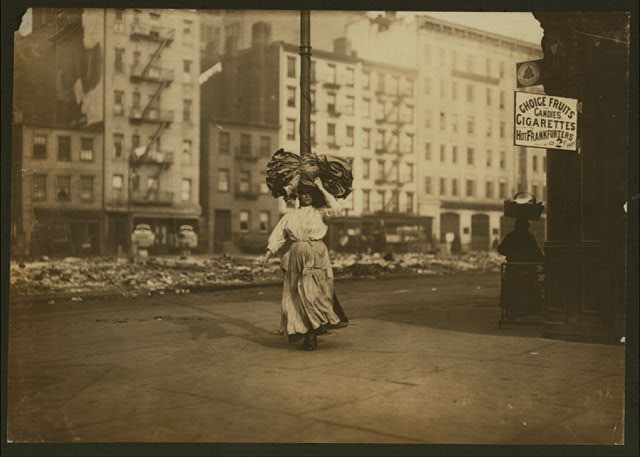
A highly energetic crossroads today, the destination of college students, shoppers, and theater goers, Astor Place has clearly cleaned up its act since Hine sat his tripod here a century ago. With these particular images, Hines was specifically commenting on ‘home-work’, poor women and children taking raw materials or clothing to mend back to their tenements, turning their confined living quarters into personal sweatshops.

They say other things to us today. The street conditions speak for themselves. But see if you can identify some of these street corners!

Caption “Woman crossing Astor Place with home-work”: Looking up Fourth Avenue, with the Wanamaker department store building (designed by the great Daniel Burnham in 1904) to the left.

Two pictures on the same street corner. Notice the condition of the street in the background. The shop sign advertises ‘Choice Fruits, Candies, Cigarettes, Hot Frankfurters’. They also have a public AT&T telephone.

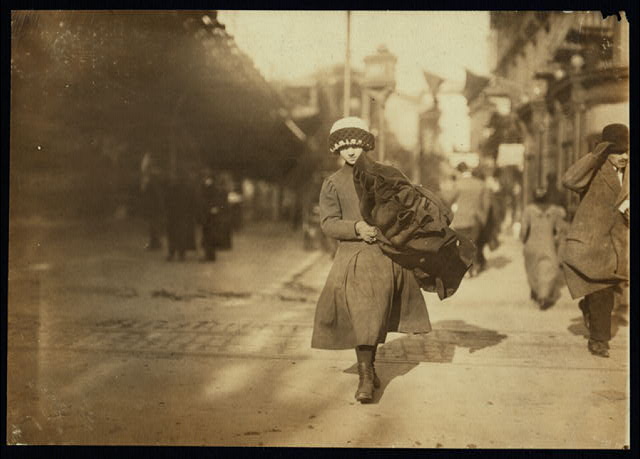
I find this one the most intriguing. “Young girl carrying bundle of coats home to be finished.” She’s clearly walking up (or down?) along the Third Avenue elevated train. Keep in mind, in context to last week’s post on the Coffyn flight, that it’s so cold in New York at this time that the East River has frozen over in many places.

Pictures courtesy of the Library of Congress. You can check out their digital archives for hundreds of other Hine photographs from this era.