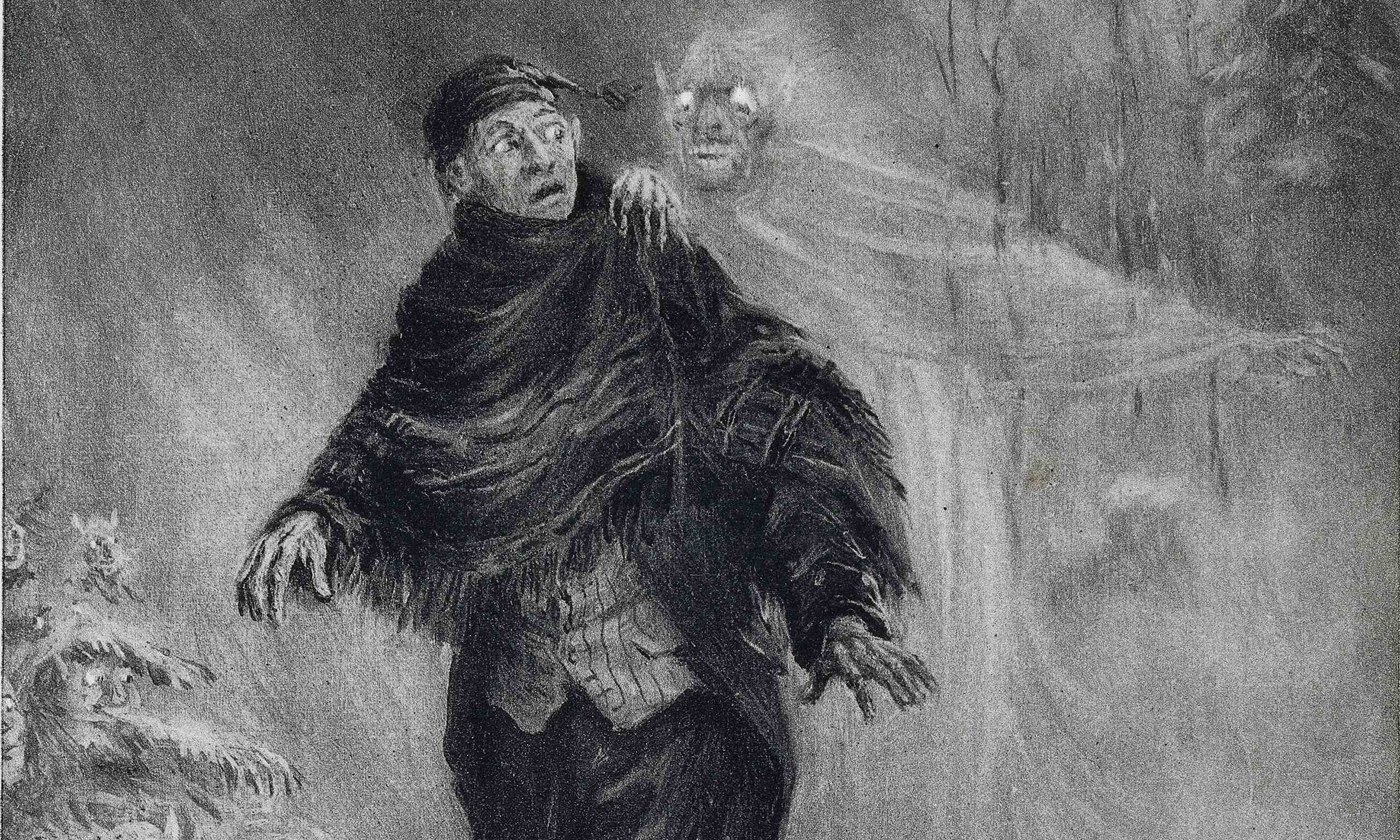
In this blog roundup, a Bowery Boys appearance in Vice, a threat to preservation, a classic restaurant closes, the story of two hotels with very different histories and more!
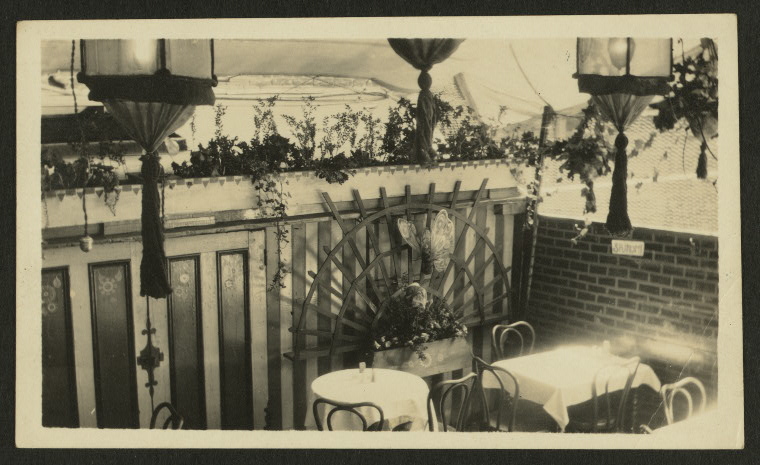
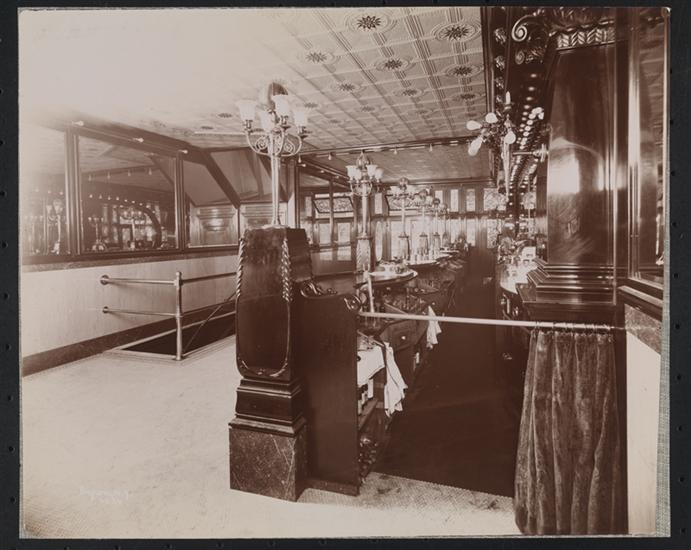
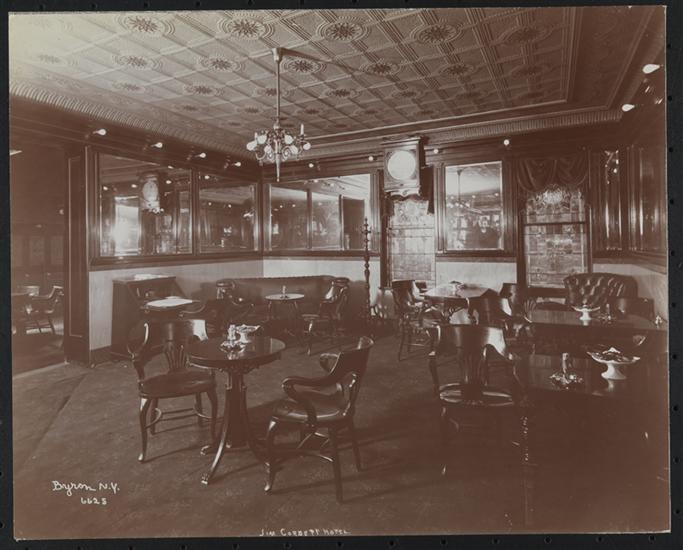
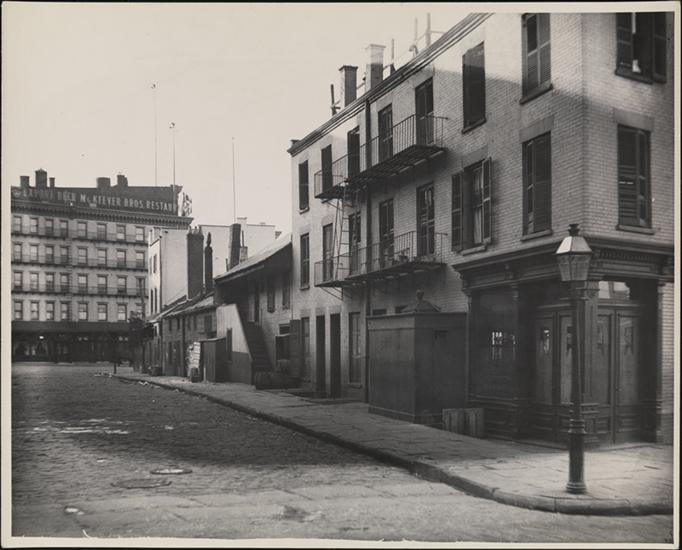
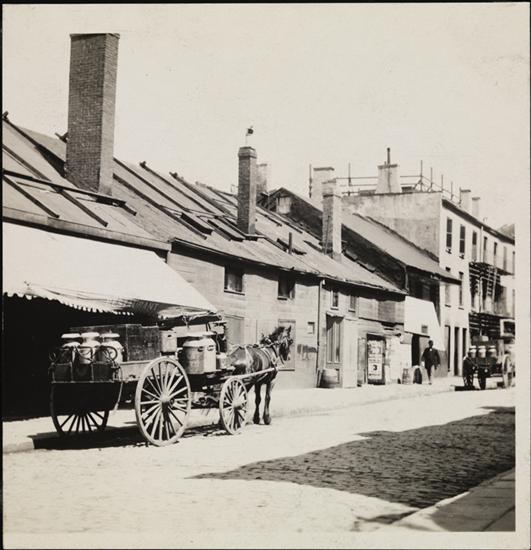
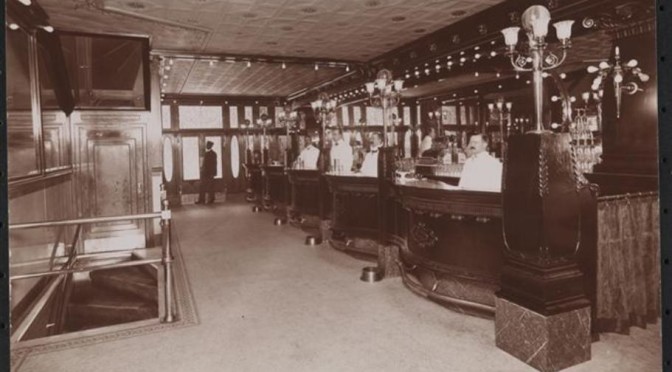
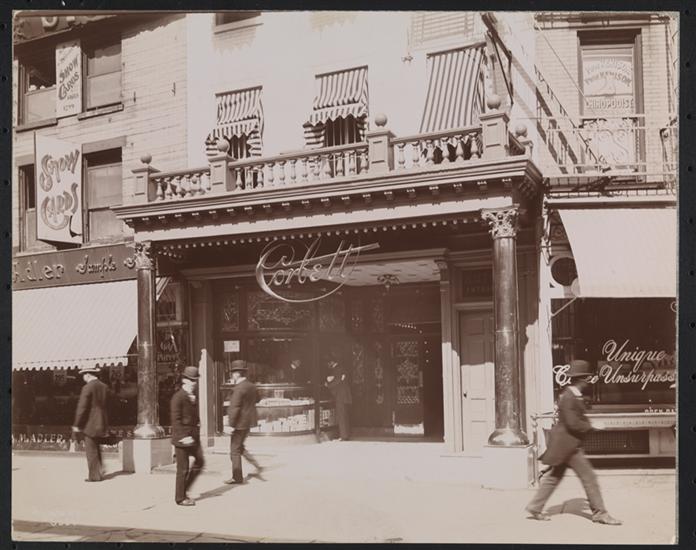
In the photo above and below — From the Museum of the City of New York collection, some images of the so-called Prize Fighters Saloon (at Sixth Avenue and 33rd Street) owned by boxer James J. Corbett.
LINKS OF INTEREST
— Vice Magazine’s John Surico wrote a great piece called ‘Why New Yorkers Love New York” and interviewed the Bowery Boys for it! Also — if you want to see us dressed in ridiculous Mermaid Parade costumes, you should definitely check this out. [Vice Magazine]
— An inconceivable and dangerous threat to New York landmark preservation is being debated at City Hall today.  “Intro. 775 would for the first time impose ‘do-or-die’ timeframes for buildings and neighborhoods being considered for landmark designation. If the deadlines are not met, buildings and neighborhoods, no matter how worthy or endangered, would automatically be disqualified for designation.” [Greenwich Village Society for Historic Preservation]
—  Destruction update! The beloved original location ofThe Palm restaurant — with its quirky wall of murals — has been closed for good. “The beloved hand painted caricatures were housed on walls made of plaster, which made it impossible to remove the caricatures for preservation purposes.” [Vanishing New York]
Below: The exterior of Corbett’s Prize Fighters Saloon:
Courtesy Museum of the City of New York
— The spectacular tale of thePierrepont Hotel in Herald Square, built in 1898 as a rare residential hotel for unmarried men.   “It is not so very long ago that the bachelor was not considered to be entitled much consideration; any old thing was good enough for him….” [Daytonian In Manhattan]
— That rather strange, kinda seedy, little-Flatiron hotel in Chelsea called the Liberty Hotel? Â That building has actually been standing there for well over one hundred years. Oh if only those walls could speak! [Ephemeral New York]
— Some rather sweet and amusing images pop up in this New York Times photo essay on the first day of schoolthrough the years. [New York Times]
— “The coolest place to eat is outside a smallpox hospital.” [New York Post]
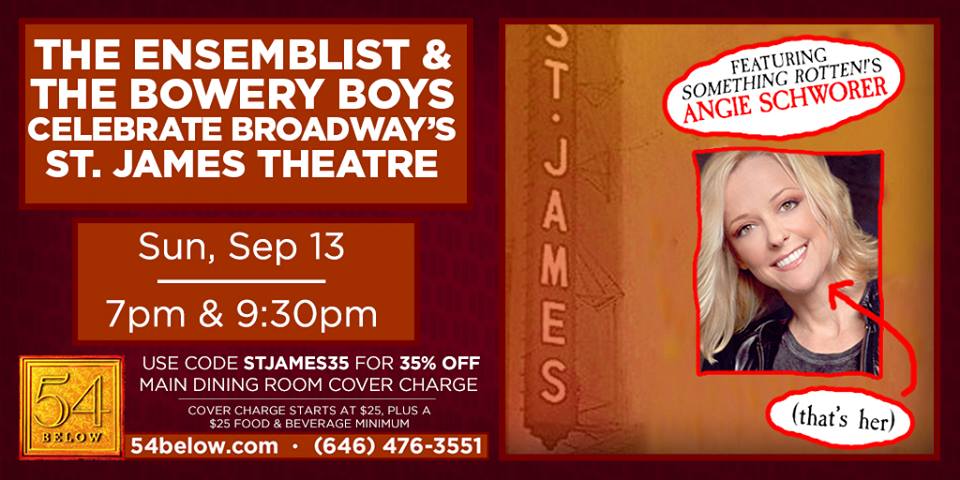
TICKETS ARE GOING FAST for our live event with The Ensemblist this Sunday, September 13th, at 54 Below. Â Click herefor more information or go directly to 54 Below’s websiteto get your tickets!
Below: Another look at the interior of Corbett’s fancy saloon.
Courtesy Museum of the City of New YorkCourtesy Museum of the City of New York
Howard Philip Lovecraft — aka H.P. Lovecraft — was born 125 years ago today in Providence, Rhode Island.
The pulp-fiction storyteller, known for claustrophobic tales of the occult, lived for a time in Brooklyn. He did not enjoy it.
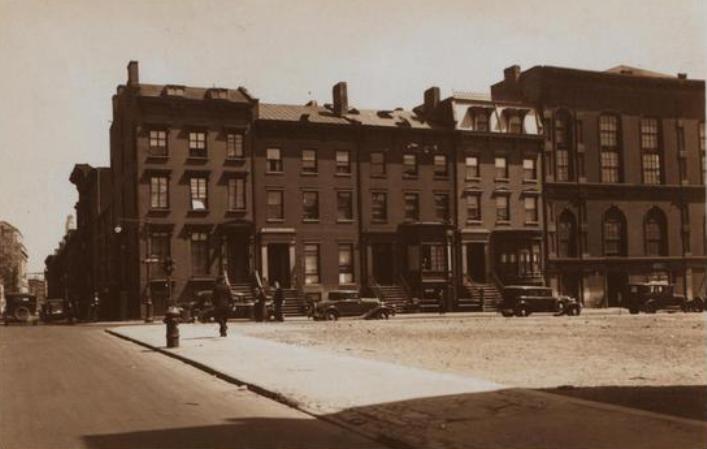
In 1924, he moved to 259 Parkside Avenue in Flatbush, Brooklyn, close to Ebbets Field and Prospect Park. When his new wife relocated for work in Cincinnati, Lovecraft moved from the pleasant Flatbush neighborhood to a small flat at169 Clinton Street in Brooklyn. He only lived here until 1926 but during his stay, possessed of anxiety and neurosis, he practically starved himself.
Below: The boardinghouse at 169 Clinton Street, pictured here at left, from 1935. The first four buildings still exist. The building at the far right is the old Brooklyn Athenaeum.
Courtesy New York Public Library
Lovecraft had contempt for New York’s thriving immigrant population and those workers who sustained Brooklyn waterfront in the 1920s.
In particular he negatively interacted with the residents of Brooklyn’s so-called “Little Syria” on Atlantic Avenue.
I find his invective ugly and even a little obsessive, but it illustrates that occasional truth that the culture of New York City is simply not for everybody, especially if you have certain racist dispositions mixed with a little mental instability.
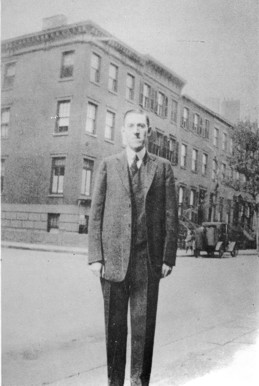
Below: Lovecraft in Brooklyn Heights in 1925. The house behind him may be his Clinton Street boarding house. Compare to the image above and the current view here. (Photo courtesy HPL.com)
In a comparison with Philadelphia, Lovecraft wrote “[Philadelphia has] none of the crude, foreign hostility and underbreeding of New York — none of the vulgar trade spirit and plebian hustle.” He further described New York as “an Asiatic hell’s huddle of the world’s cowed, broken, inartistic, and unfit.” [source]
According toauthor Donald Tyson, “when [H.P.’s wife Sonia] and Lovecraft were walking the streets of New York and encountered a group of immigrants, Lovecraft would become so animated and enraged that she feared for his sanity.”
The renovated, wealthy houses of today’s Brooklyn Heights were often working-class housing in the 1920s, many turned into affordable boarding houses. Lovecraft disliked his ethnic neighbors and held particular scorn for his Irish landlady. “Only later was I to learn of her shrewish tongue, desperate household negligence, miserly watchfulness of lights and unwatchfulness of repairs, and reckless indifference to the class of lodger she admitted.” [source]
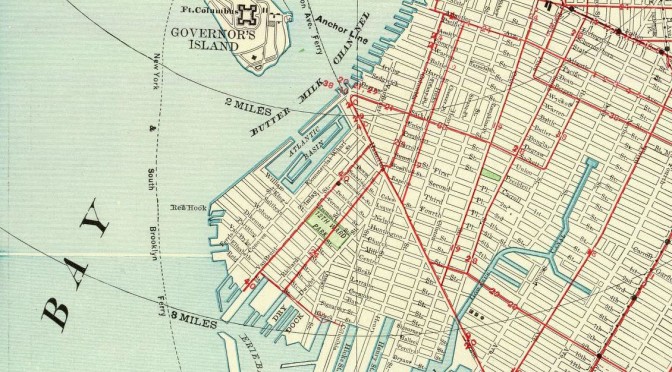
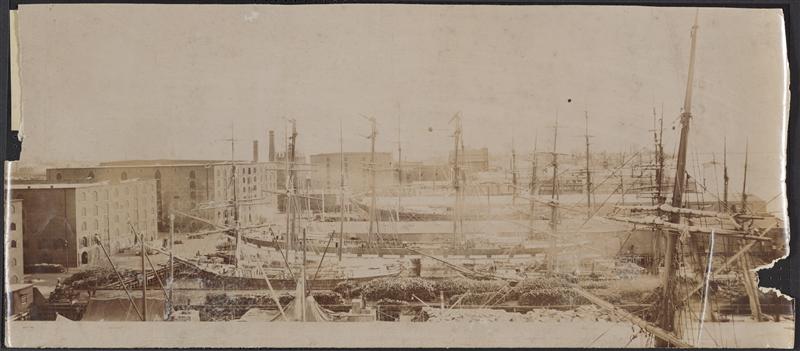
He would have lived with mostly single men of differing ethnicity, many employed along the congested docks that lined the waterfront all the way down to Red Hook, culminating in two self-contained shipping areas — the Atlantic and Erie basins. Back in the 1920s, it was the busiest freight port in the entire world.
Below: Ships along the waterfront heading towards Red Hook, circa 1890
Courtesy Museum of the City of New York
He seemed to filter all his untethered anxiety into the very building at 169 Clinton Street. “I conceived the idea that the great brownstone house was a malignly sentient thing — a dead, vampire creature which sucked something out of those within it and implanted in them the seeds of some horrible and immaterial psychic growth.”
Yet Lovecraft saved his greater fantasies for the neighborhood south of here. He eventually funneled all this tortured and deranged hysteria into his horror writing with the publication of “The Horror at Red Hook,” a story that literally depicts the neighborhood as a gateway to Hell.
Naturally he wrote it over a two-day period from the Brooklyn Heights boardinghouse.
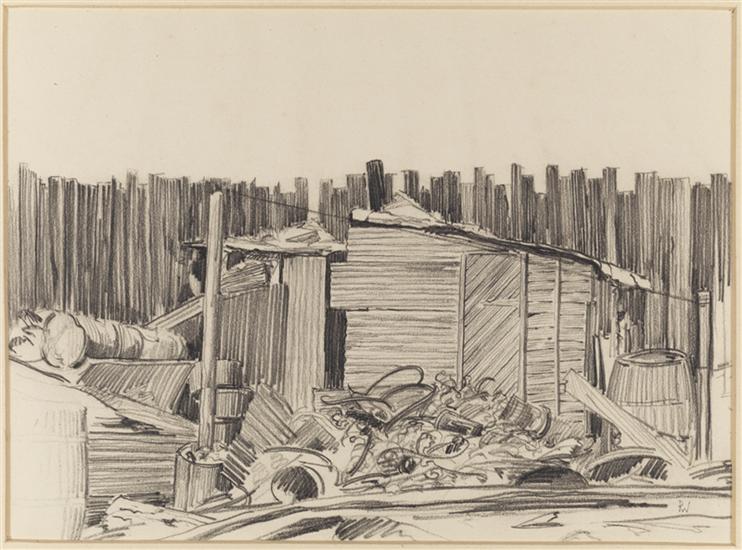
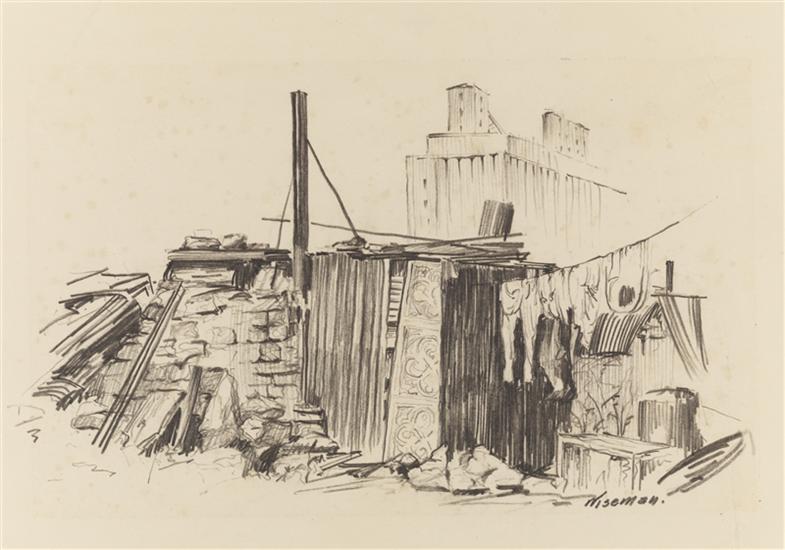
Below (the next two pictures): Some striking illustrations by Robert Cummings Wiseman of shanties around the Atlantic Basin in 1930, courtesy the Museum of the City of New York
The short story, one of his best known, is an amusing curiosity to read today.
Its a muddled, sometimes incomprehensible work with some occasional flashes of creepy description. Clearly the story is self-therapy as much as it is an actual story, an early 20th century entry in the field of conspiratorial fiction. It’s undeniably haunting if you manage to forgive the vast amount of virulent, anti-immigrant description:
“Red Hook is a maze of hybrid squalor near the ancient waterfront opposite Governor’s Island, with dirty highways climbing the hill from the wharves to that higher ground where the decayed lengths of Clinton and Court Streets lead off toward the Borough Hall. Its houses are mostly of brick, dating from the first quarter to the middle of the nineteenth century, and some of the obscurer alleys and byways have that alluring antique flavour which conventional reading leads us to call “Dickensianâ.”
The population is a hopeless tangle and enigma; Syrian, Spanish, Italian, and negro elements impinging upon one another, and fragments of Scandinavian and American belts lying not far distant. It is a babel of sound and filth, and sends out strange cries to answer the lapping of oily waves at its grimy piers and the monstrous organ litanies of the harbour whistles.”
Courtesy Museum of the City of New York
I won’t spoil any of the plot points of the story. (If you’re interested in reading ‘The Horror At Red Hook’, you can check it out here. ) But let’s just say the author confirms his suspicions — the street gangs and liquor rackets of the Prohibition era are really just dens of age-old evil:
“The soul of the beast is omnipresent and triumphant, and Red Hook’s legions of blear-eyed, pockmarked youths still chant and curse and howl as they file from abyss to abyss, none knows whence or whither, pushed on by blind laws of biology which they may never understand. As of old, more people enter Red Hook than leave it on the landward side, and there are already rumours of new canals running underground to certain centres of traffic in liquor and less mentionable things.”
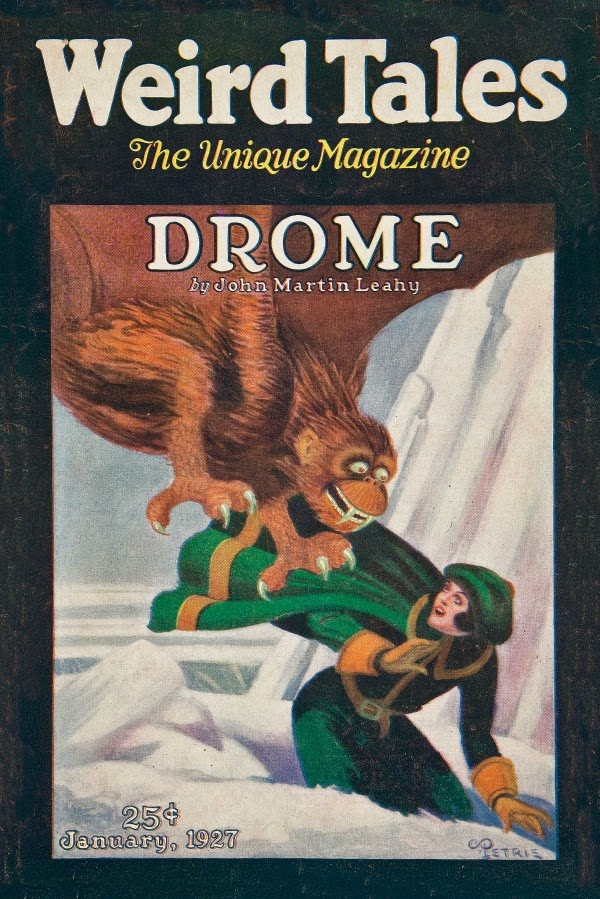
The story would be published in 1927 in the pulp magazine Weird Tales. Notably, their offices were in Chicago, not in New York
Once he left New York, he pursued some of his more famous writing projects, using his anxiety to more disturbing effect in runic, terror-filled stories of the occult. He died in 1937, revered by many as a truly boundary-breaking writer, greatly inspiring writers like Stephen King.
It would be almost fifty years before an author attempted to look at south Brooklyn with similar monstrous intent — in the 1970s horror novels The Sentinel and The Guardian by Jeffrey Konvitz.
Top picture: Detail from a 1897 Rand McNally map of Brooklyn
You really should take a stroll down here. It will take you all of one minute; the street is approximately 63 feet long.
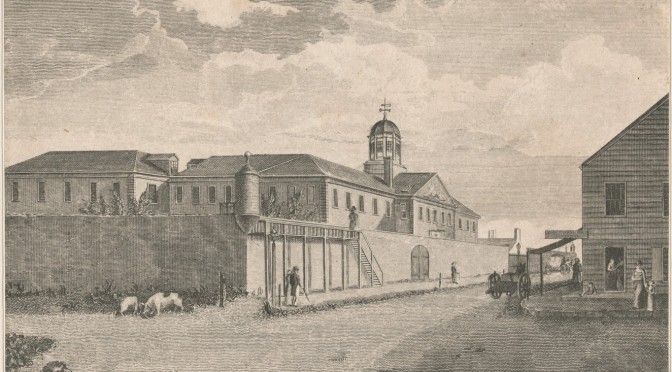
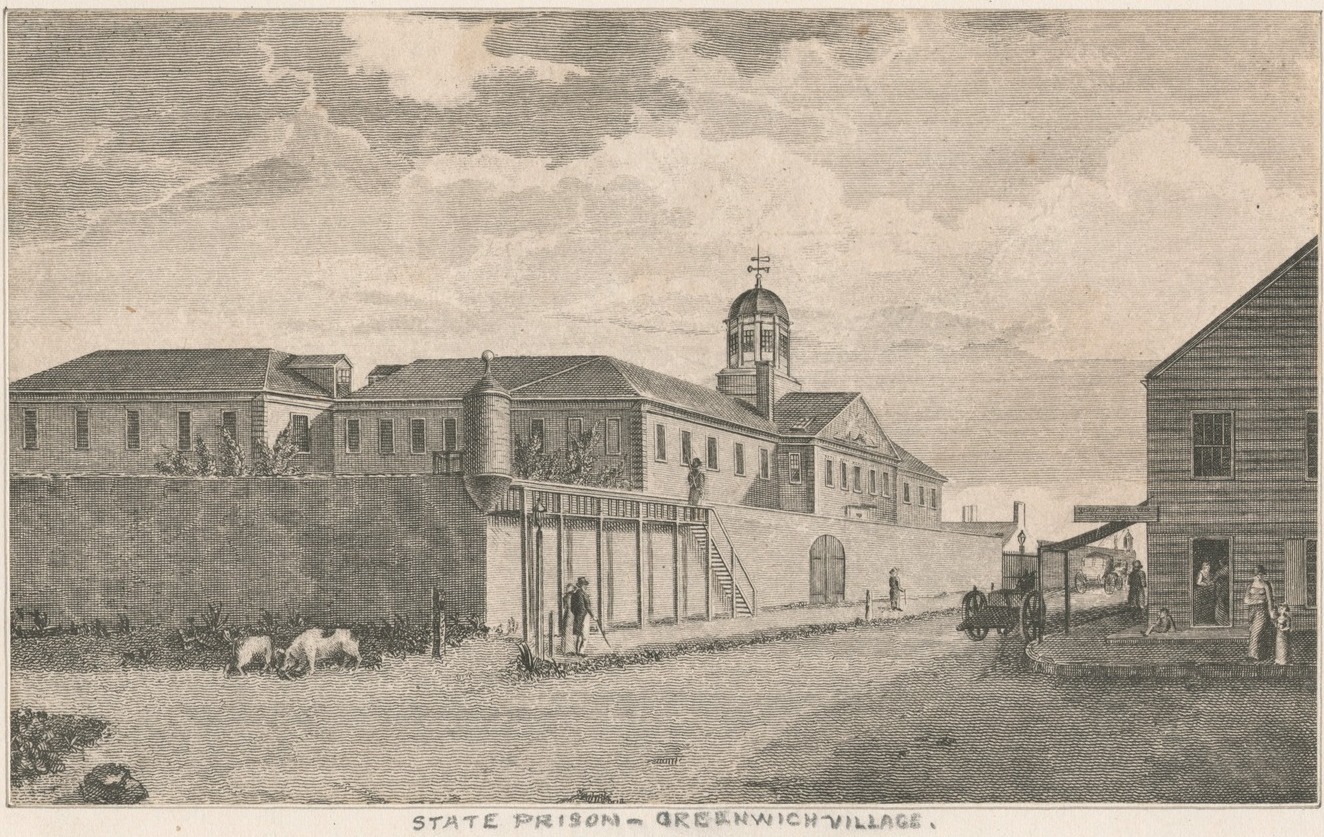
But a surprising structure once sat on this very spot two hundred years ago — Newgate Prison, the official state prison of New York from 1796 to 1828.
The city of New York was still very much confined to the area below today’s Canal Street. The new prison lay on the outskirts of Greenwich Village, a hamlet of farms and estates that served as New York’s first suburb of sorts.
Just a few feet from Newgate was the Greenwich Market, south of Christopher Street (on the spot of the big red,Federal Archives Building).
The prison was considered a progressive upgrade to New York’s dreadful Bridewell Prison, which sat near the area of today’s City Hall.
Built before the Revolutionary War, Bridewell had no windows and wretched facilities; prolonged incarceration here often met death.
Courtesy New York Public Library
With Newgate, enlightened reformers moved the prison out of the middle of town — always a good thing — and nearest the water, providing better ventilation and access to ferry transportation. “A more pleasant, airy, and salubrious spot could not have been selected in the vicinity of New York,” said one writer in 1801.*
Newgate was named (or rather nicknamed) for its larger, more infamous counterpart in London which became a favorite setting in Charles Dickens novels. New York’s Newgate was similarly ominous, with high stone walls mirroring the shape of forts along the waterfront. Â
Indeed Fort Gansevoort, in the area of today’s Meat-Packing District, was built several years after Newgate.
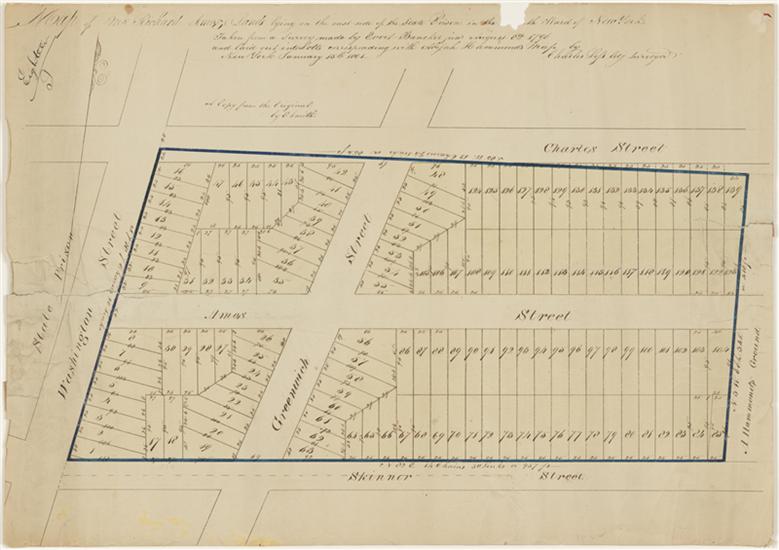
Below: From the original 1796 survey of the spot where Newgate was constructed. Today’s Weehawken Street would have been later laid at the spot of the prison’s western border. Skinner Street would later be known as Christopher Street. Amos Street is now West 10th Street.
Courtesy Museum of the City of New York
This soon proved an inadequate and ill-placed facility. Overcrowding led to prison riots and jail breaks, hardly the behavior you want to see across the street from a civilized public market. By the 1820s, the area of Greenwich Village became desirable real estate as the boundaries of New York — bolstered by the slow development of the 1811 Grid Plan — moved northward.
The western edge of Greenwich Village would be spared from the installing the grid thanks to tenacious land-owners. But it certainly wouldn’t do to have a wily prison sitting next to a developing neighborhood. In 1824, former New York mayor Stephen Allen (technically the first elected mayor) was put in charge of relocating the state prison to someplace more remote. And so, in 1828, Newgate’s prisoners were transferred to a new facility — in Sing Sing.
The hefty walls of Newgate were torn down, and l’il Weehawken Street — all 63 feet of it — was then created and paved in 1830.
By the way, Weehawken Street did get its name from the town of Weehawken, as it was the dock of a colonial ferry that connected with the picturesque New Jersey town. Weehawken was the site of the famous duel between Alexander Hamilton and Aaron Burr in 1804.
They both get their name from the same Lenape Indian source meaning either “place of gulls” or “place of rocks that look like trees.”
PODCASTThe tale behind the brutal murder of renown architect Stanford White on the roof garden of Madison Square Garden, the building that was one of his greatest achievements.
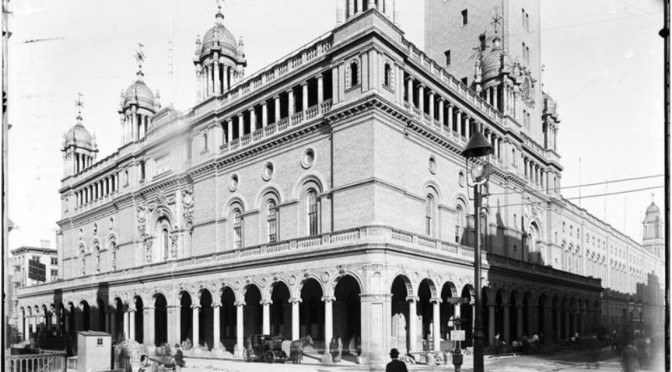
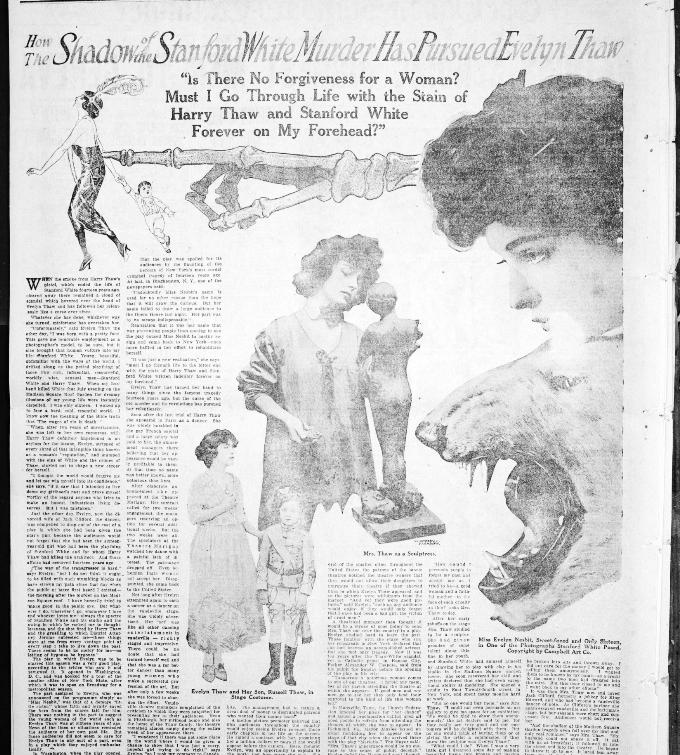
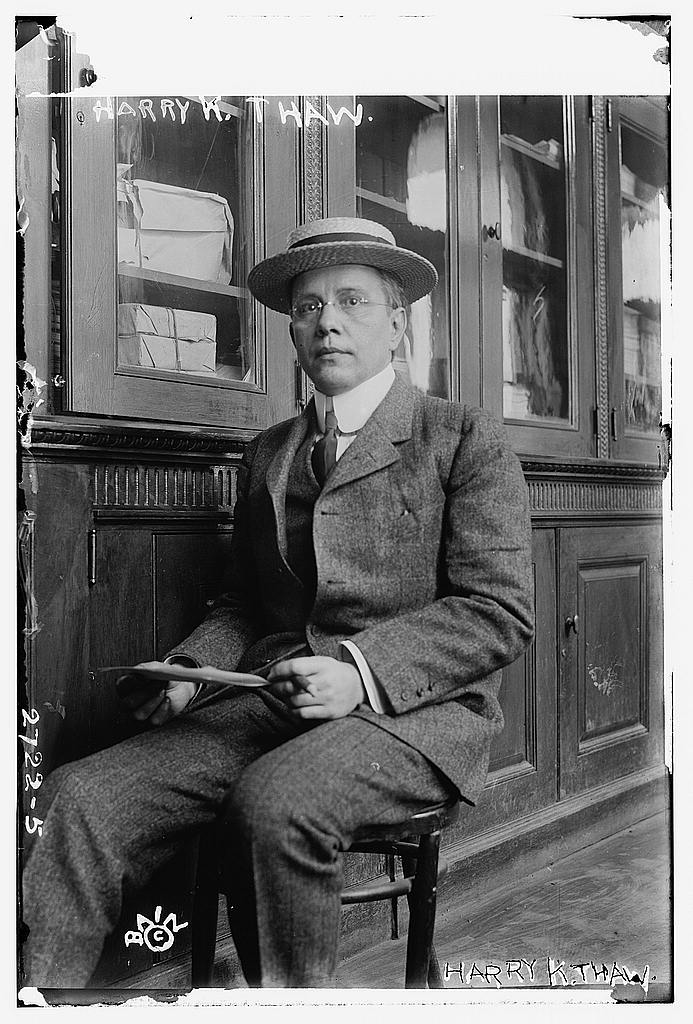
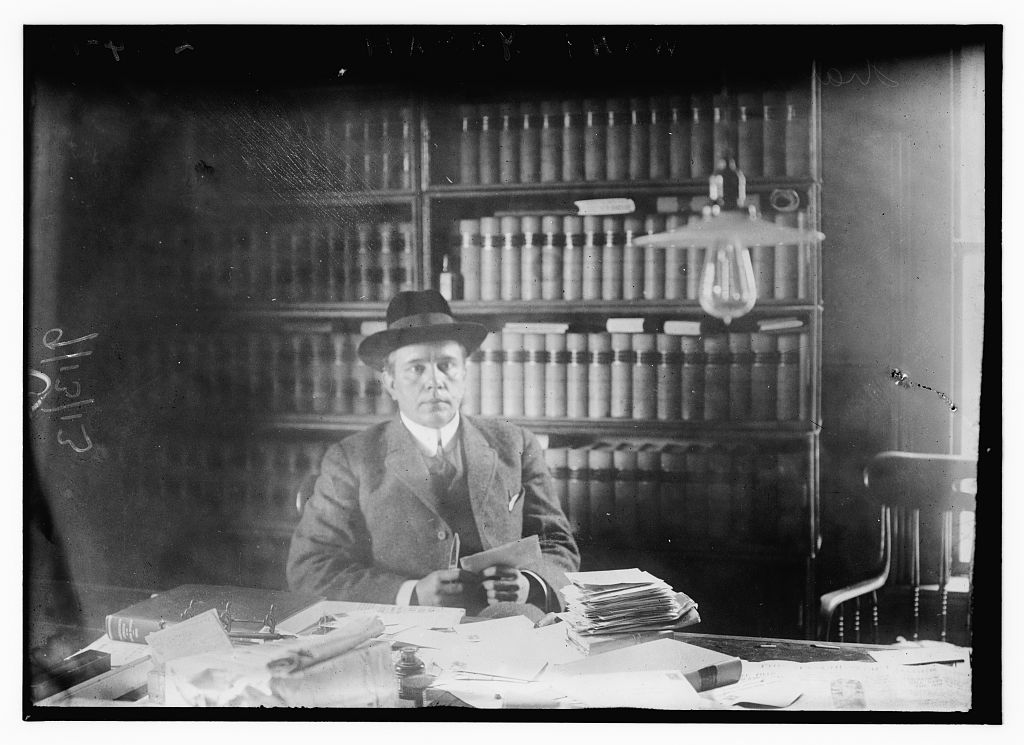
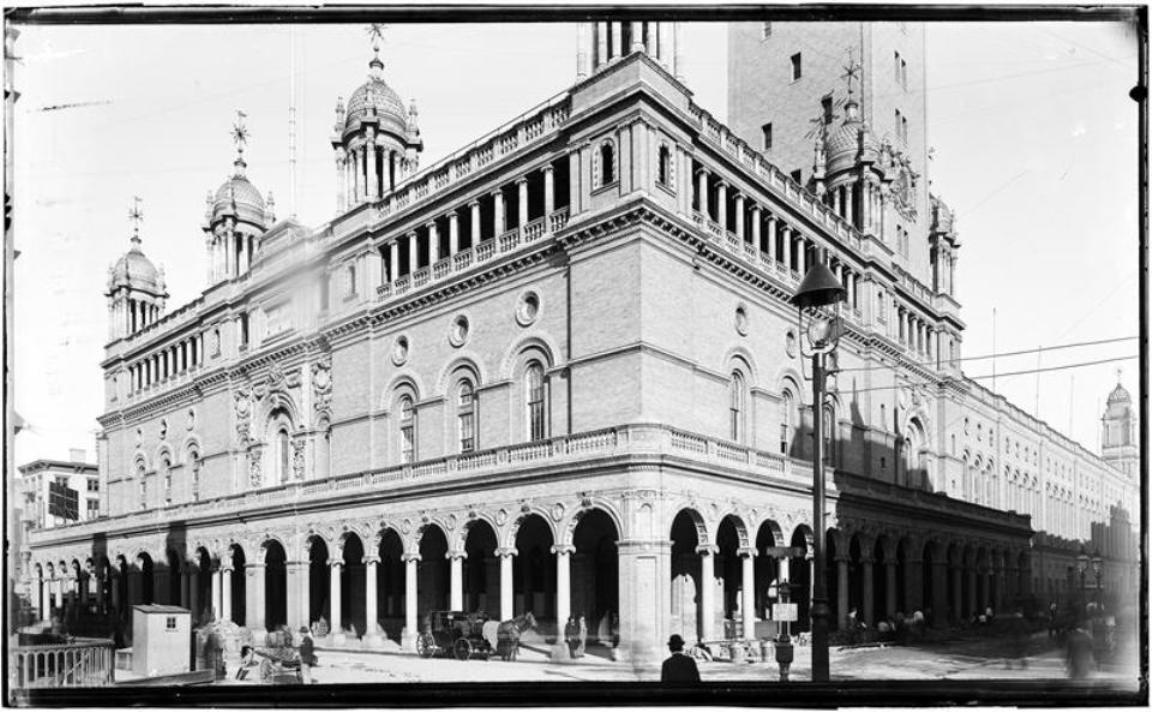
On the evening of June 25, 1906, during a performance of Mam’zelle Champagne on the rooftop of Madison Square Garden, the architect Stanford White was brutally murdered by Harry Kendall Thaw. The renown of White’s professional career — he was one of New York’s leading social figures — and the public nature of the assassination led newspapers to call it the Crime of the Century. But many of the most shocking details would only be revealed in a courtroom, exposing the sexual and moral perversities of some of the city’s wealthiest citizens.
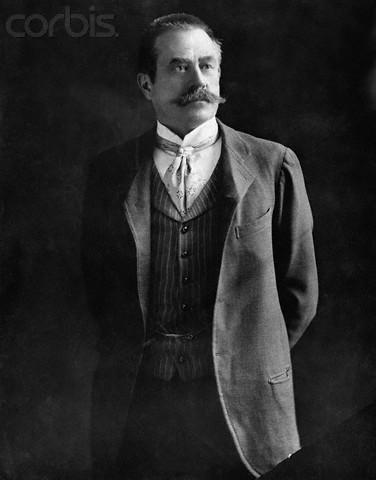
White, as a member of the prestigious firm McKim, Meade and White, was responsible for some of New York’s most iconic structures including Pennsylvania Station, the Washington Square Arch and Madison Square Garden, where he was slain. But his gracious public persona disguised a personal taste for young chorus girls, often seduced at his 24th Street studio, famed for its ‘red velvet swing’.
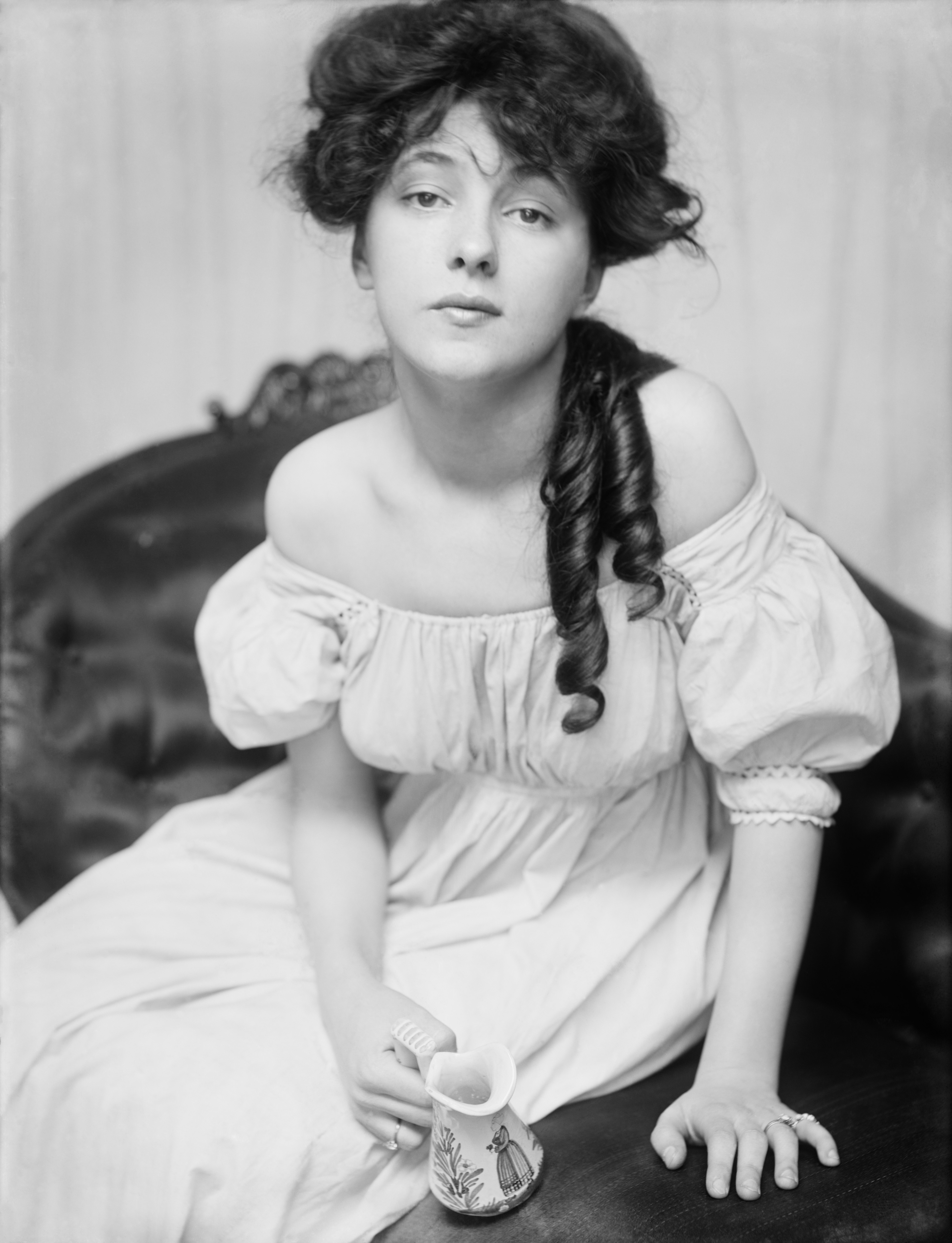
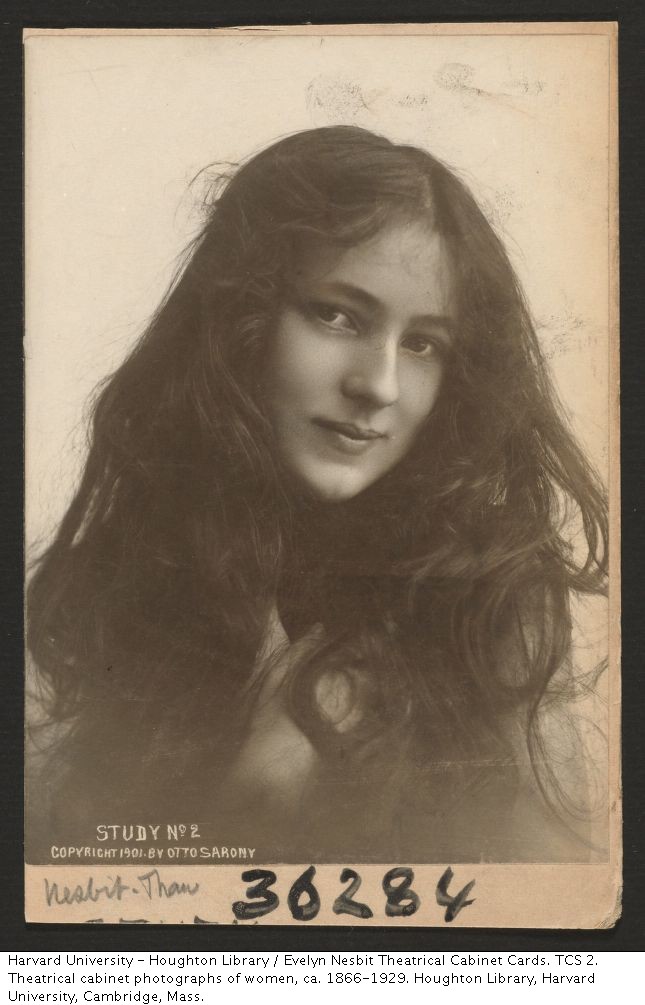
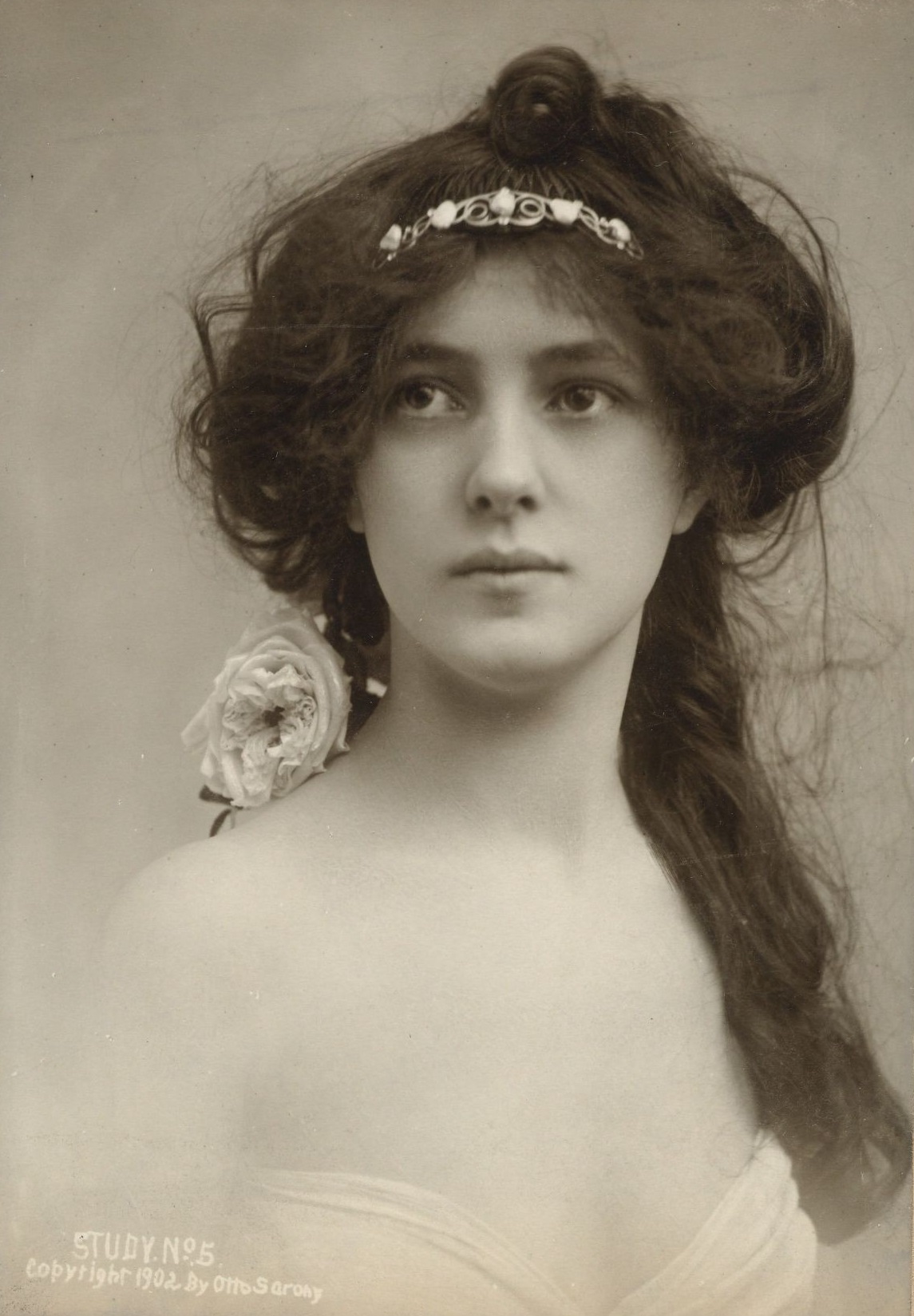
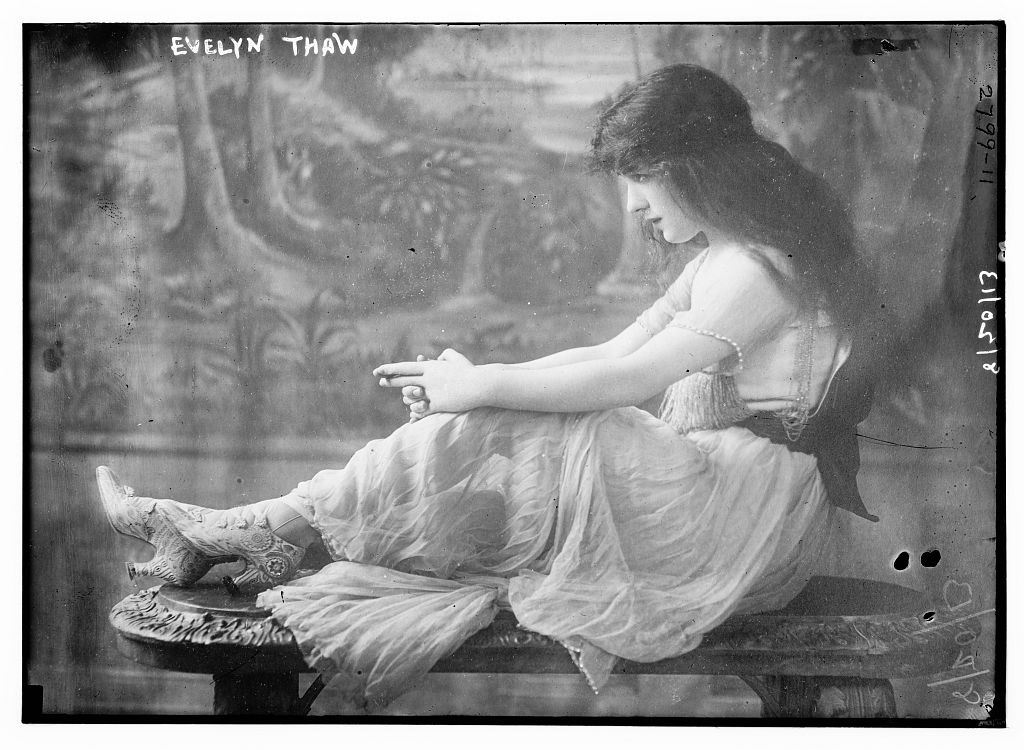
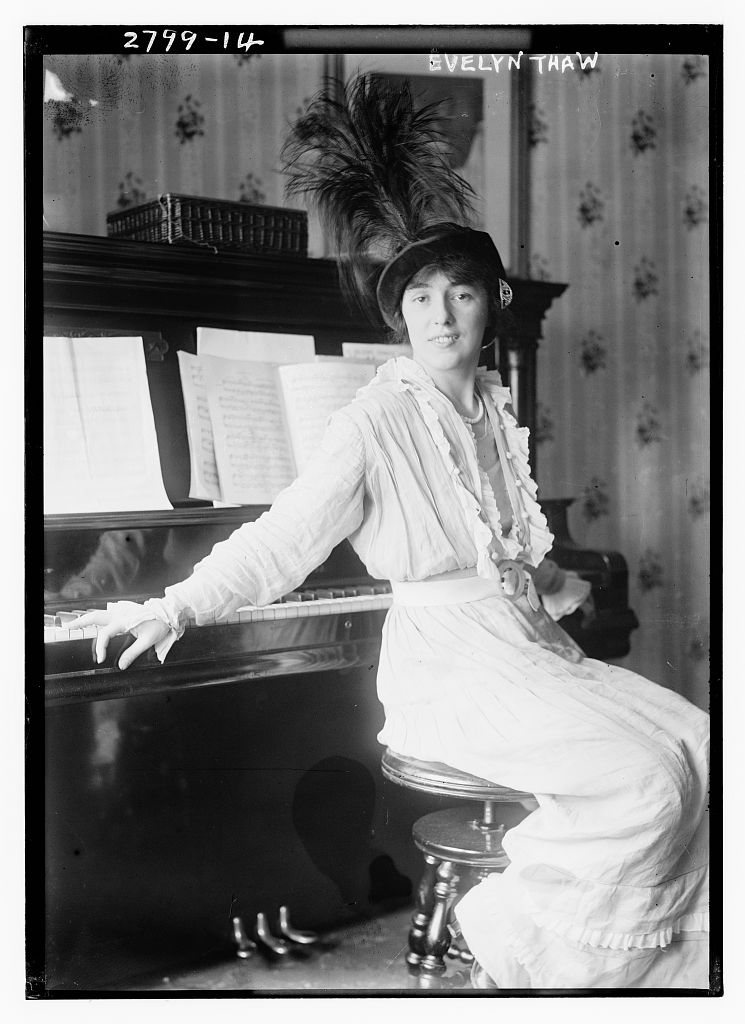
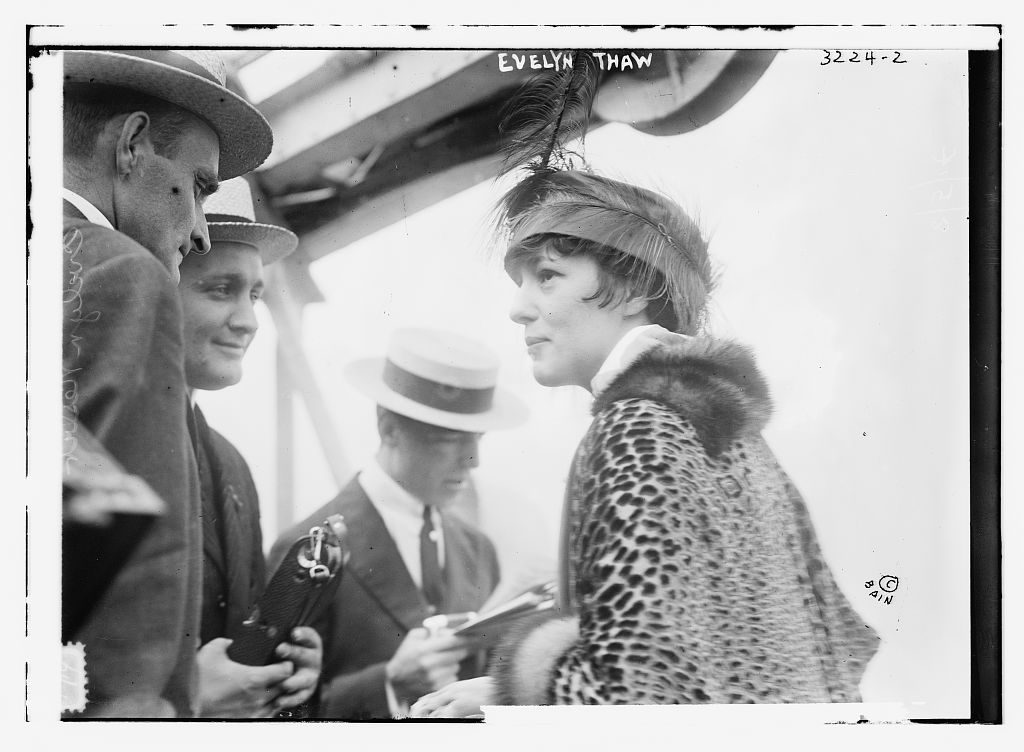
Evelyn Nesbit was only a teenager when she became a popular artist’s model and a cast member in Broadway’s hottest musical comedy. White wooed her with the trappings of luxury and subsequently took advantage of her. The wealthy playboy Harry Thaw also fell for Nesbit — and grew insanely jealous of White. Soon his hatred would envelop him, leading to the unfortunate events of that tragic summer night.
The Bowery Boys: New York City History podcast is brought to you …. by you!
We are now producing a new Bowery Boys podcast every two weeks. We’re also looking to improve the show in other ways and expand in other ways as well — through publishing, social media, live events and other forms of media. But we can only do this with your help!
We are now a member of Patreon, a patronage platform where you can support your favorite content creators for as little as a $1 a month.
Please visitour page on Patreon and watch a short video of us recording the show and talking about our expansion plans. If you’d like to help out, there are five different pledge levels (and with clever names too — Mannahatta, New Amsterdam, Five Points, Gilded Age, Jazz Age and Empire State). Check them out and consider being a sponsor.
We greatly appreciate our listeners and readers and thank you for joining us on this journey so far. And the best is yet to come!
THE UNFORTUNATE TRIO
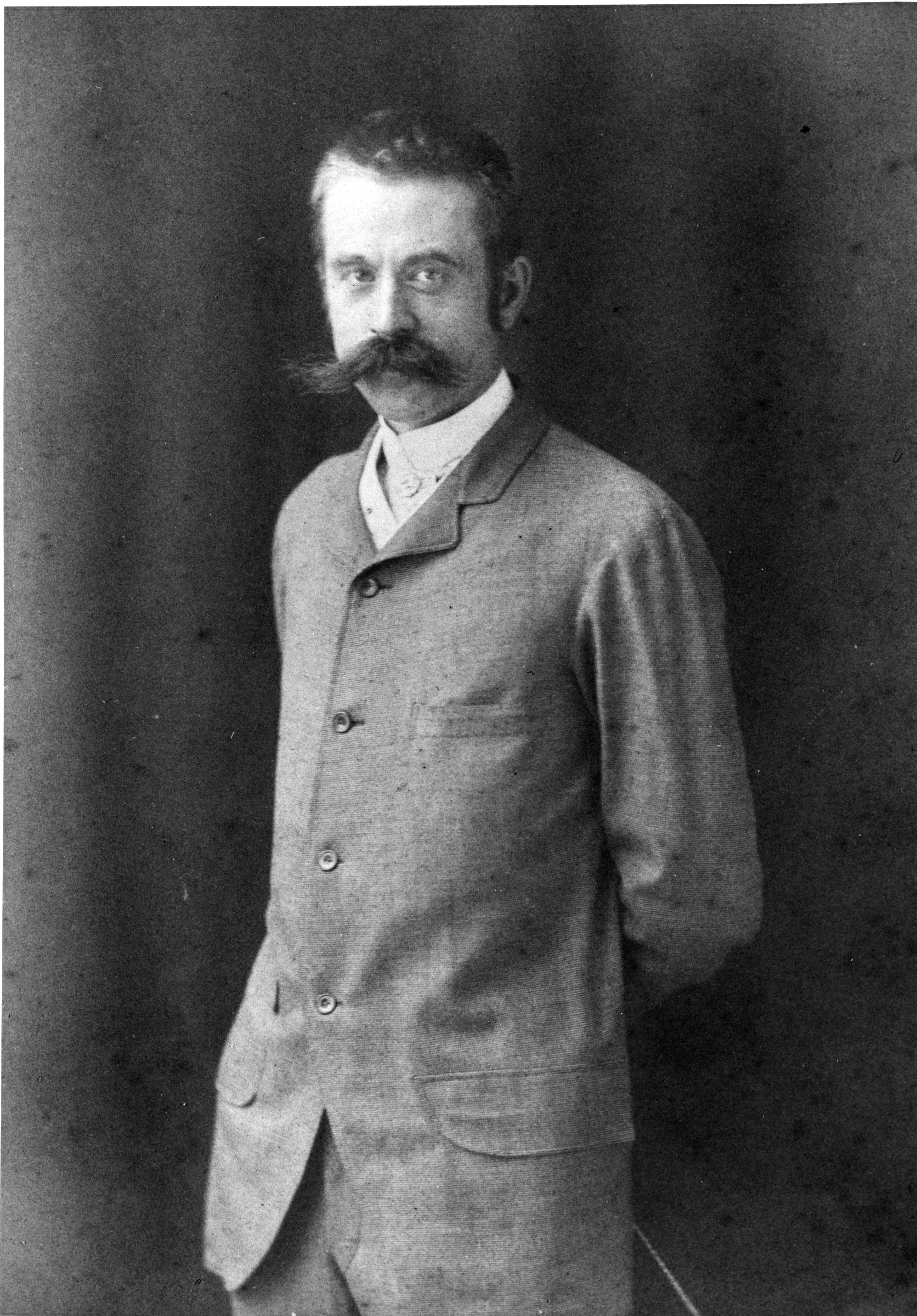
Stanford White
White as a young man (with an enormous mustache!)
Stanford White — date unknown but presumed to be 1906, the year he died.
in September 1913, Thaw escaped from the institution to Canada. He was eventually captured and brought back to the states. Here he is in New Hampshire, awaiting transportation back to Matteawan.
Library of Congress
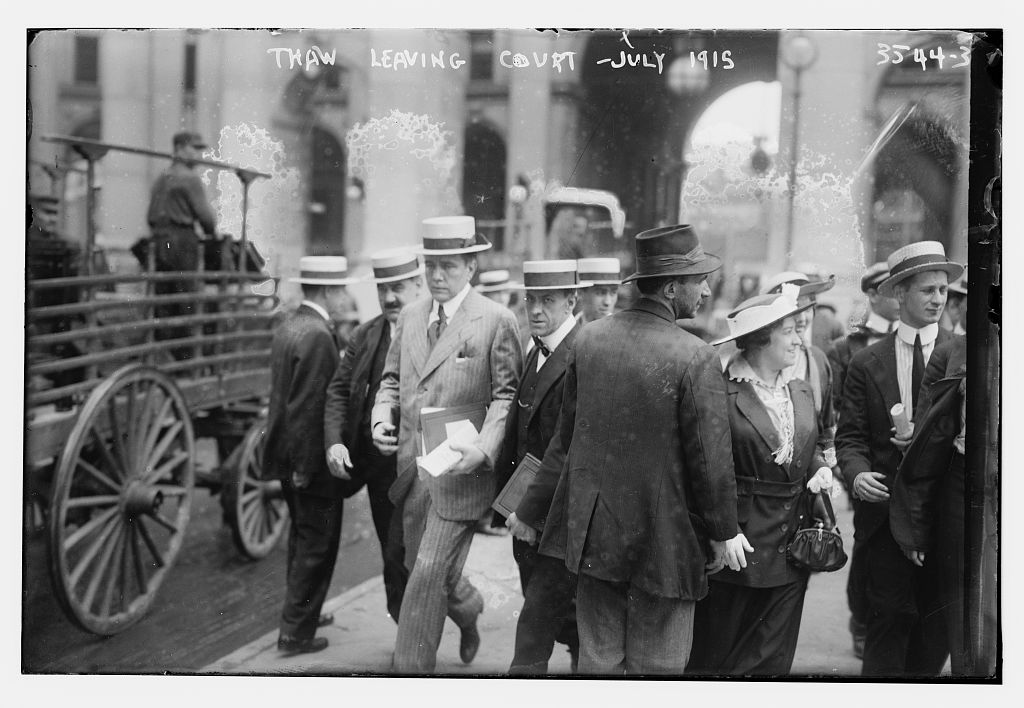
Thaw leaving court in July 1915 after he was declared mentally sane.
Library of Congress
SCENE OF THE CRIME
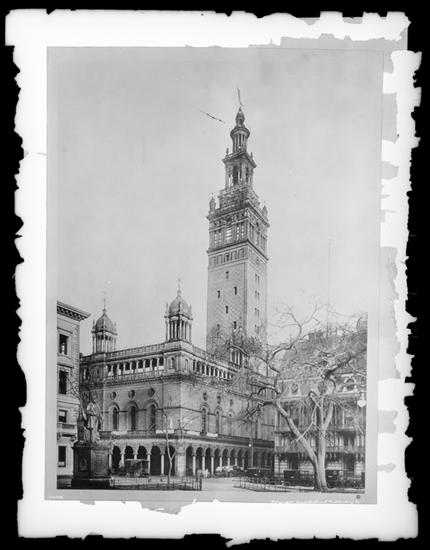
Madison Square Garden, taken in 1905 from inside the park
Museum of the City of New York
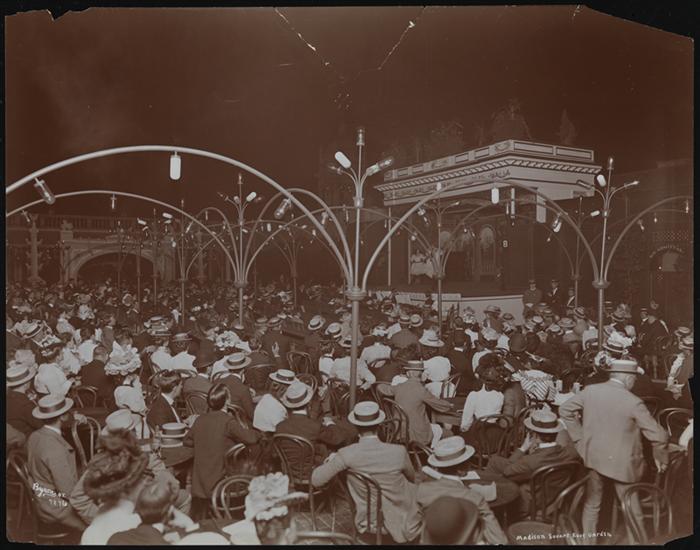
The rooftop theater at Madison Square Garden, pictured here circa 1900
Courtesy the Museum of the City of New York
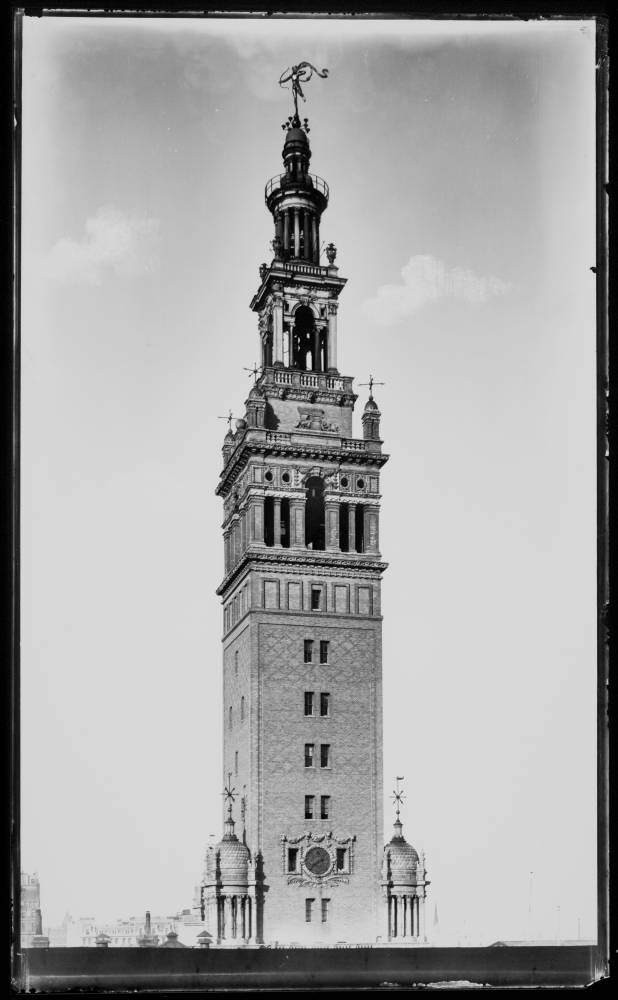
The tower at Madison Square Garden, topped with the scandalous Diana weather vane.
Courtesy George Eastman House
OTHER SETTINGS
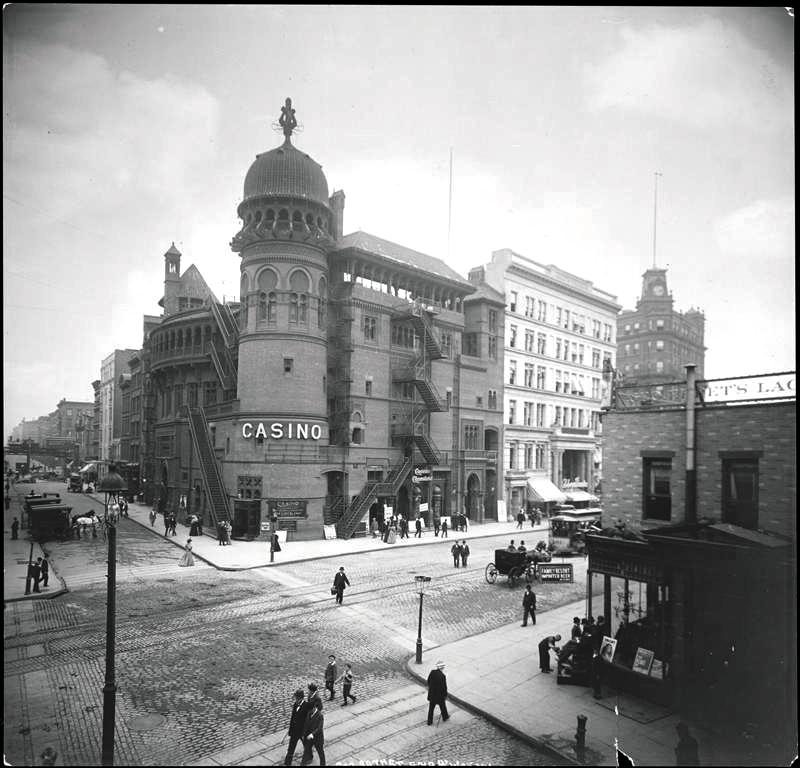
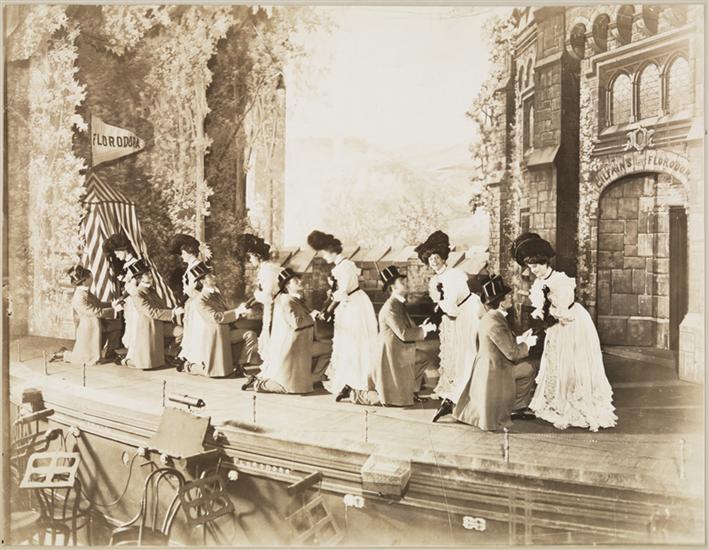
The Casino Theatre, home of the show Florodora, where Evelyn Nesbit was featured, despite her young age
A scene from Florodora in 1900
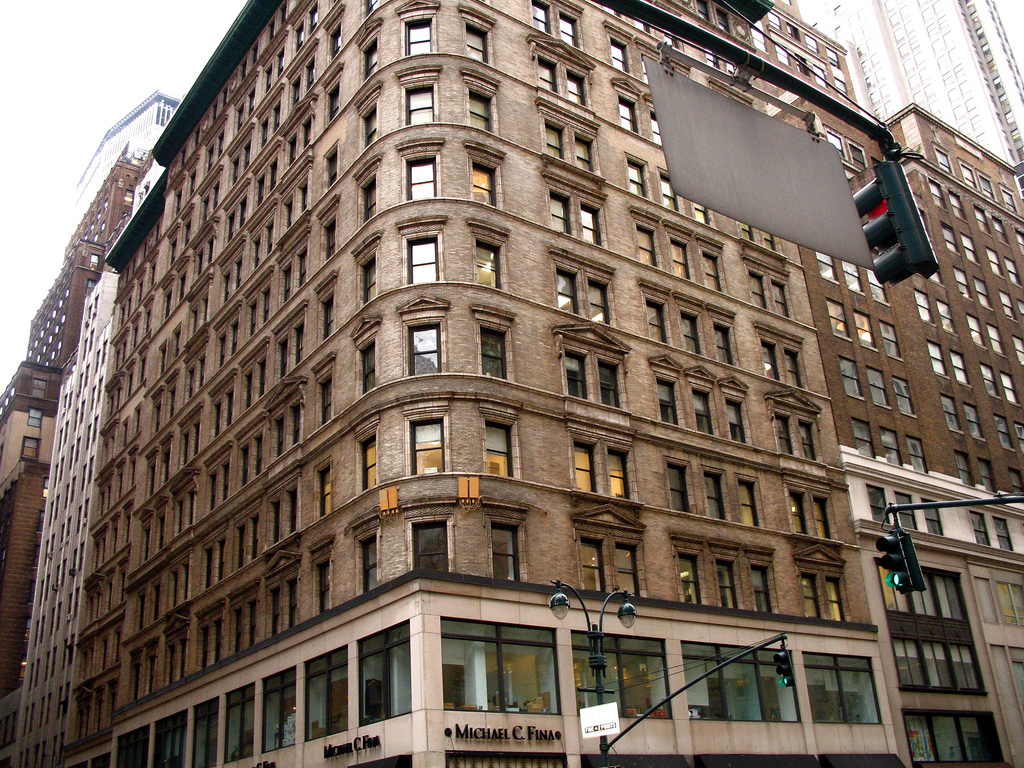
The former Hotel Lorraine, where Nesbit and Thaw were staying on the night of the murder. The address is 545 Fifth Avenue.
Courtesy Flickr/Anonymous A
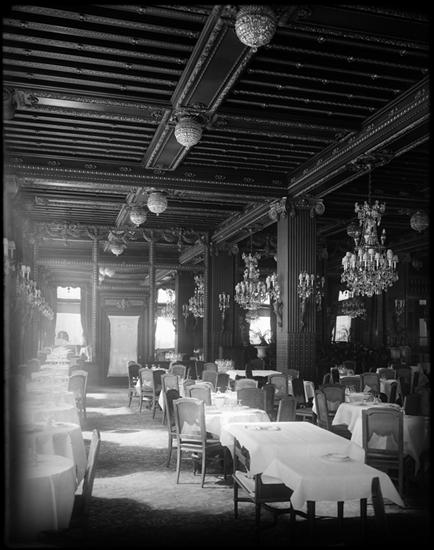
Inside the dining room of Sherry’s Restaurant (44th and 5th Avenue), where Harry Thaw got boozed up before meeting with Evelyn.
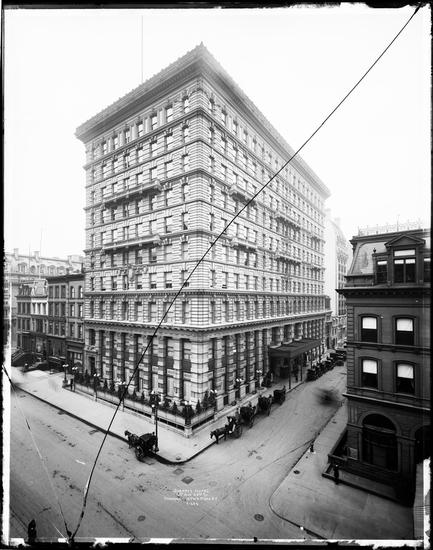
Sherry’s in 1905 — 44th Street and 5th Avenue
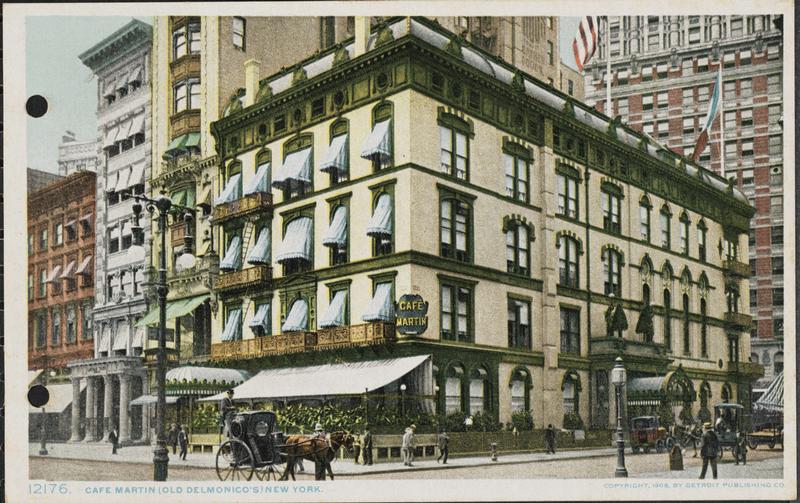
Cafe Martin in 1908, where Evelyn and Harry had dinner before the show
Museum of the City of New York
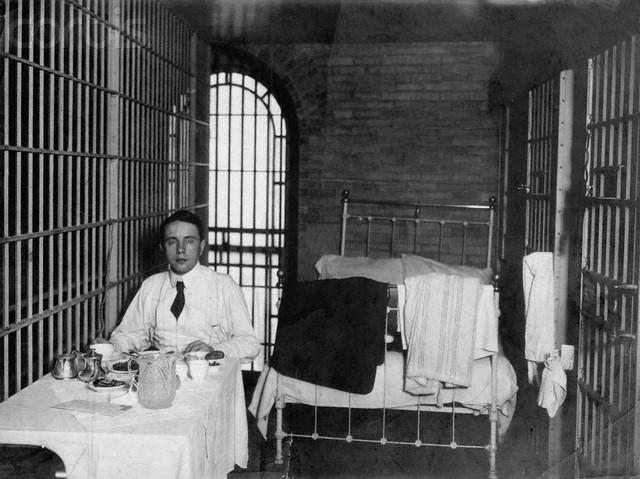
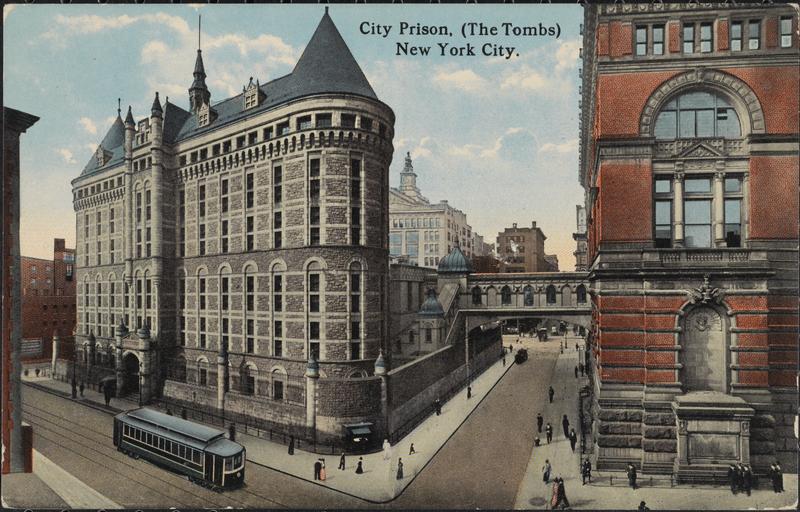
The Tombs — Where Harry Thaw was imprisoned during the original trial
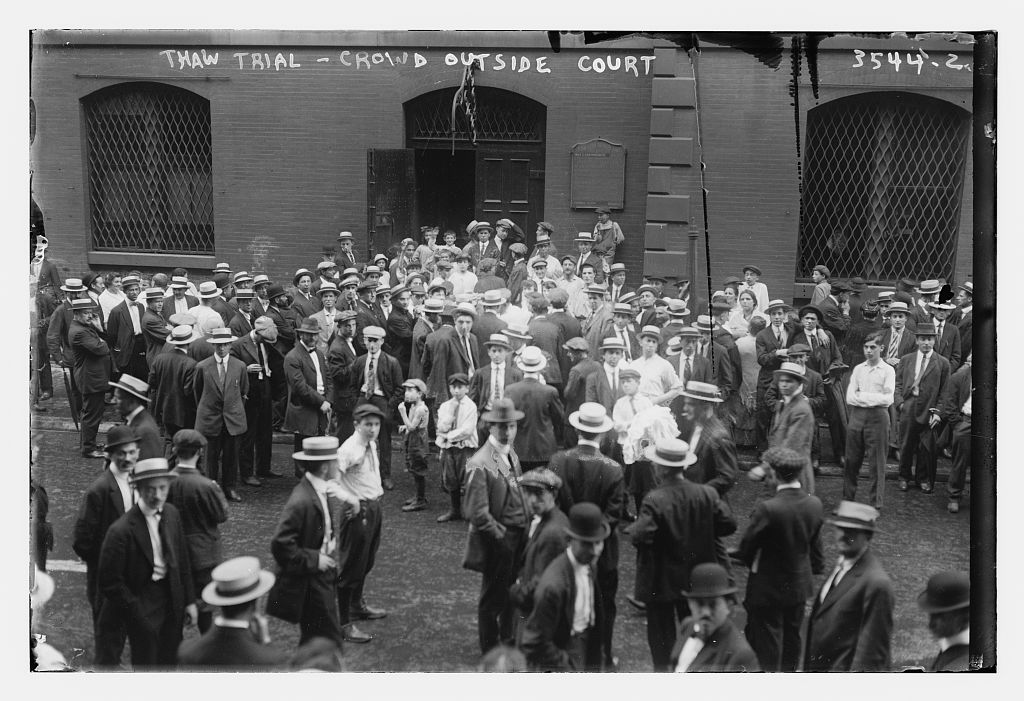
Ludlow Street Jail — Crowds linger outside during the last of the many Thaw trials. For most of his jail time, he was held in the Tombs. According to a Library of Congress commenter: “His lawyers successfully asked the court to move him from The Tombs to the Ludlow Street Jail, on the basis that he was not charged in a criminal matter, but that he was to have a jury trial only as to his present sanity.”
Library of Congress
A 1907 nickelodeon film called The Unwritten Law about the crime.
https://www.youtube.com/watch?v=6rE2WjXqf7U
Newsreel footage from 1915 of Thaw’s release.
Evelyn Nesbit performing in a nightclub in the 1930s (not sure of the club). Start the video at around 2:15:
The trailer to The Girl In The Red Velvet Swing, a highly fictionalized account of the crime. Nesbit was a consultant for the film.
In 1987, Donald Trump released the book Trump: The Art of the Deal, a distillation of the 1980s that looked like a pocket-sized version of the real-estate mogul’s own brass-coated palace Trump Tower.
The book was a national best-seller, a staple of airport bookstores, aimed at business travelers.
But a more unflattering look at Trump’s business savvy could be found just a few feet away on the newsstand.
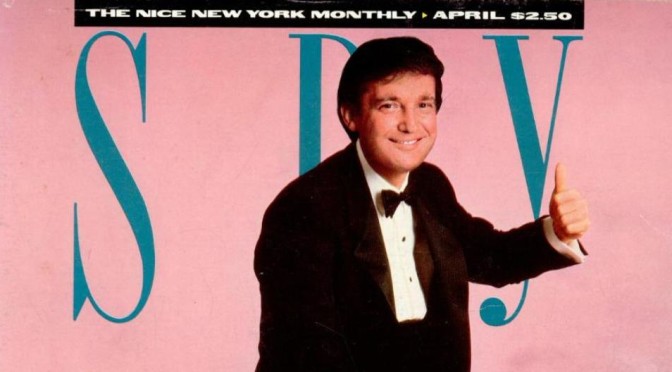
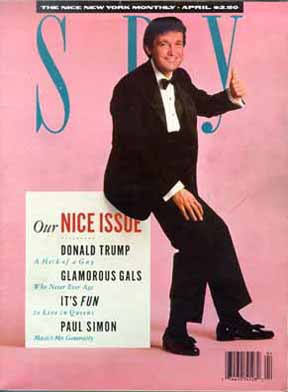
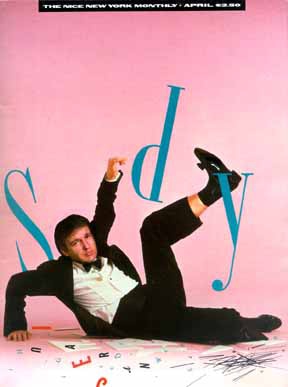
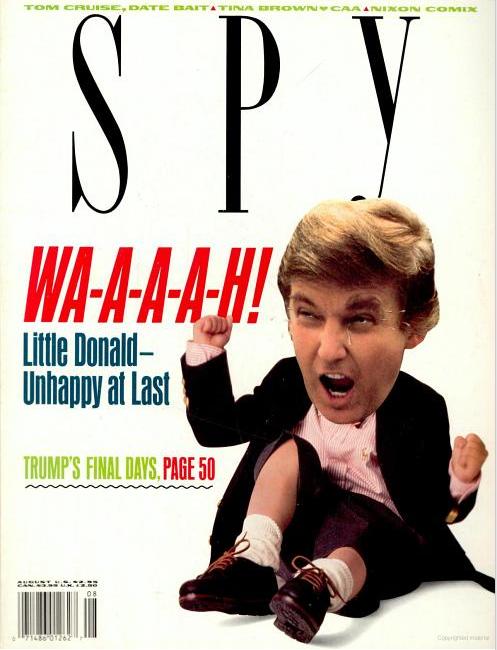
Spy Magazine, founded in 1986 by Kurt Andersen and Graydon Carter, defined the 1980s as much as Trump did, a sharp, acidic publication whose victims were bold-faced New York celebrities. Its mix of pointed mockery, cynical wit and serious reporting was a droll, refreshing twist on the concept of satirical news.
In fact it was a great-grandchild of late 19th century publications like Puck Magazine, skewering the pretension of public figures, exposing their corruption, their foibles — all within invitingly designed pages. Today you see the influences of Spy all over the place, from The Daily Show with Jon Stewart to Gawker.
Naturally, Spy Magazine and Donald Trump were on a collision course. He was the very thing Spy was designed to mock. Trump was one of the most frequent targets for almost six straight years — in almost every issue. His wobbly finances and bristling reputation were common targets, but the editors were not above more superficial accusations about his marriage or his level of taste.
The entire back-catalog of Spy Magazine is available over at Google Books, and it’s worth an afternoon to drift through their pages, an emporium of 1980s and 1990s nostalgia.
Here are a few of my favorite Spy vs Trump moments from the magazine, arbitrarily ranked because that’s how Spy would have certainly have wanted it.
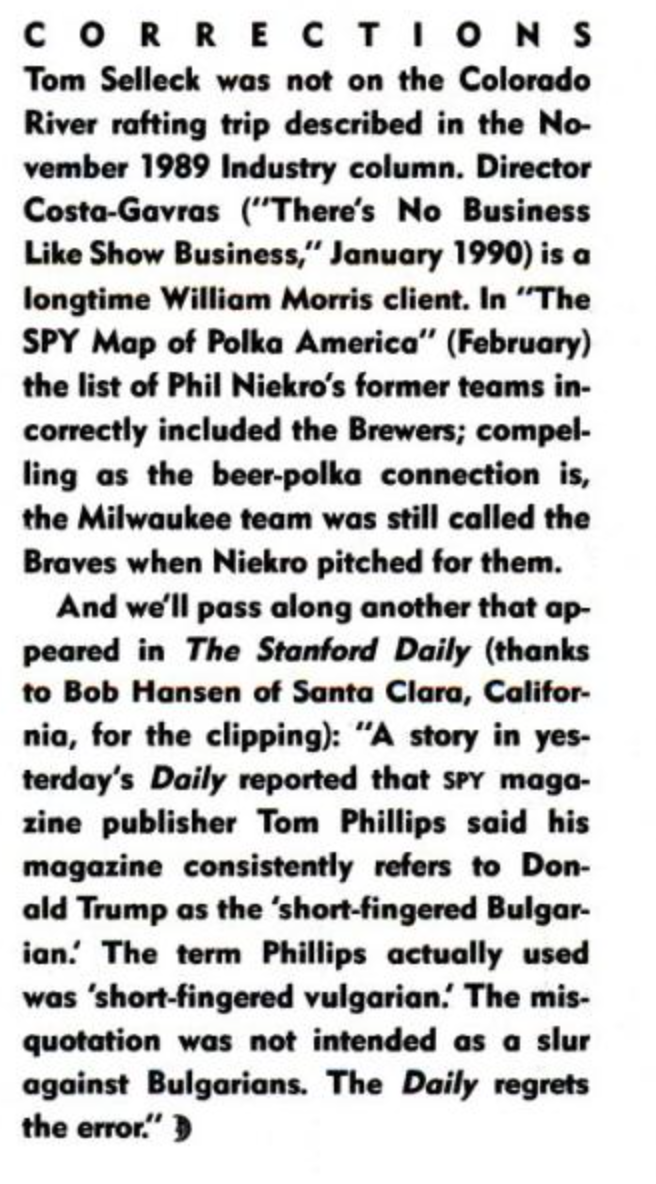
10. In the January 1988 issue came the nickname Spy would frequently use to describe Trump — “Short-fingered vulgarian.” This letter to the editor from March 1990outlines an amusing twist to this name:
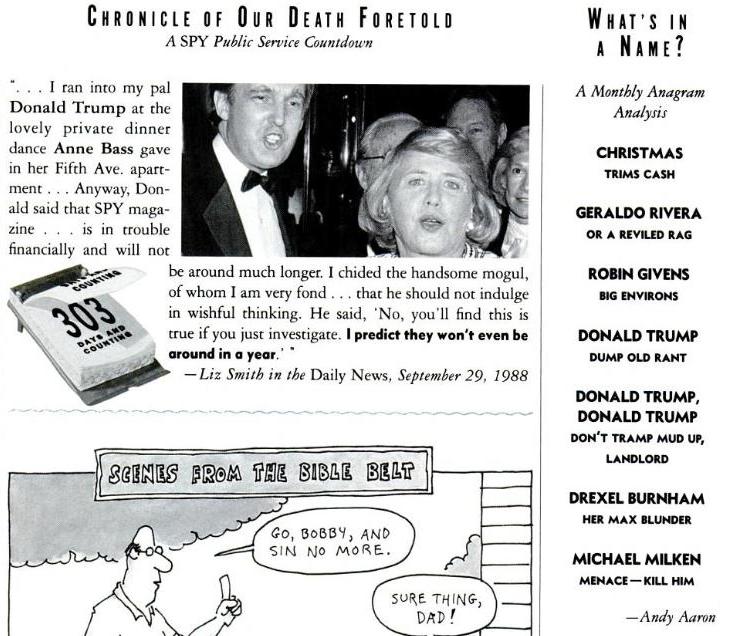
9. Another frequent target was New York Post columnist Liz Smith whose relationships with her subjects was a bit more cordial, needless to say. In September 1988, she spoke to Trump about the fate of Spy. The magazine then ran the quote almost every month under the heading ‘Chronicle of Our Death Foretold’. (Pictured below: December 1988)
They often ran a tally of celebrities mentioned in Liz Smith’s column (Donald always made the list).
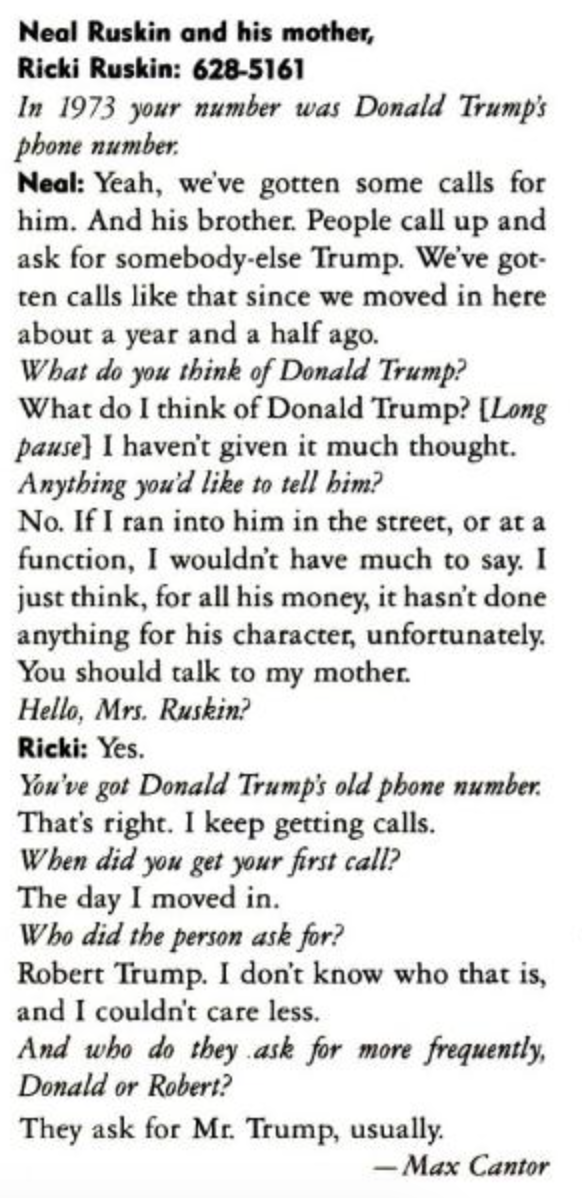
8. In the June 1990 issue, journalist and actor Max Cantor foundDonald Trump’s old phone number and called it:
7. For the July-August 1992 issue, Spy sent out a questionnaire to several death-row inmates. One of the questions was about Donald Trump. “If you could say anything to Donald Trump, what would you say?” Some of the responses included:
— “What went wrong? Are you gay? And do you really have to have all that money?”
— “Get a life.”
— “Tough luck, bro. Get back on that horse.” (Trump went into business bankruptcy in 1991.)
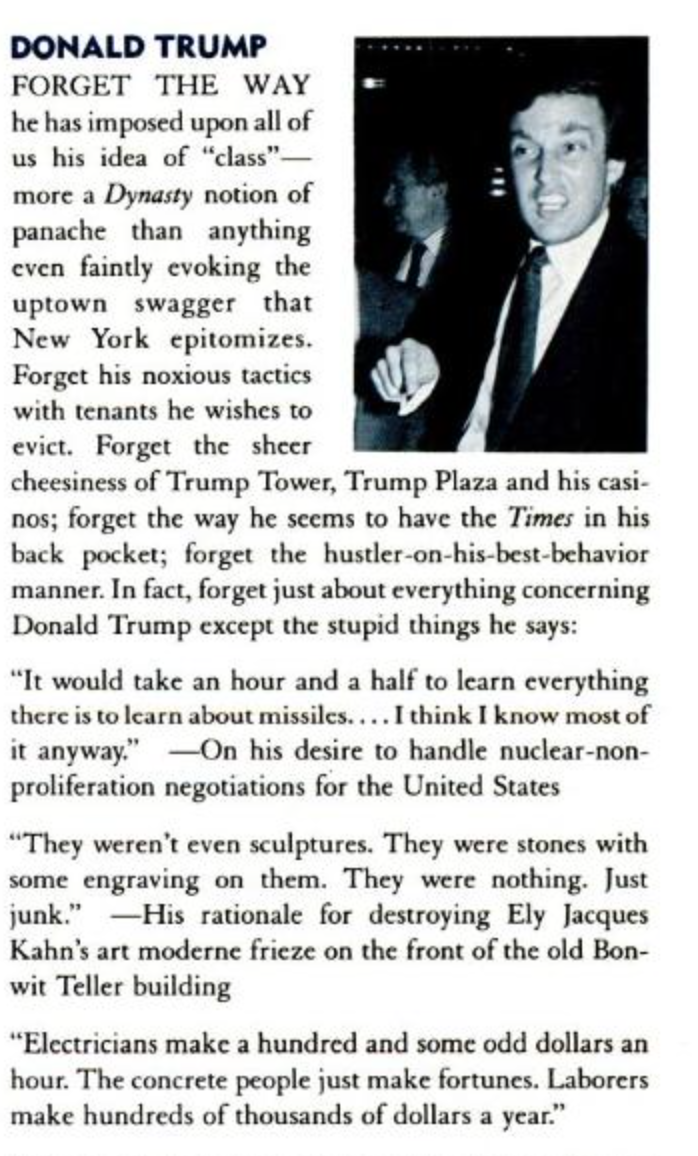
6. The magazine often took low blows at Trump’s personal taste and decisions to tear down old architecture and replace it with something modern. In the inaugural October 1986 issue, in one of their first harangues at Trump, they quote Trump regarding the destruction of the Bonwit Teller department store (where Trump Tower stands today):
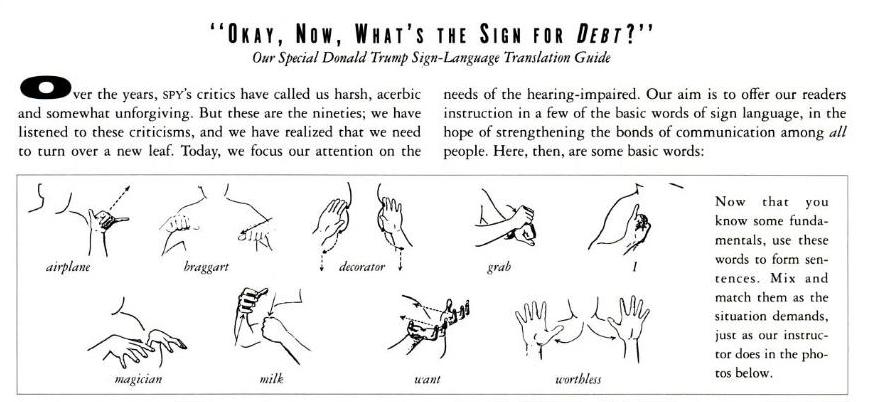
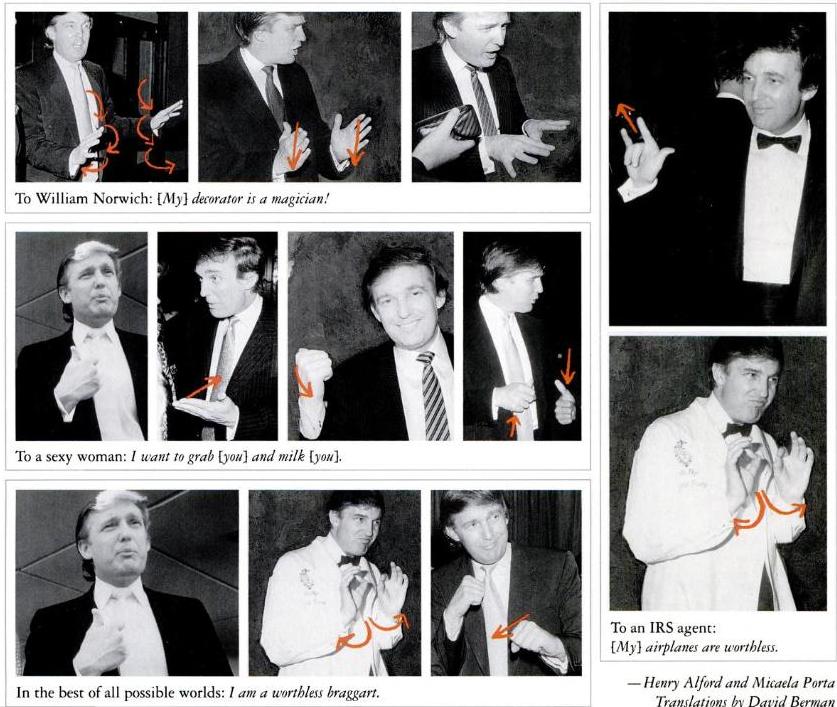
5. Spy was merciless in their mockery of Trump’s financial situation. In one of their most absurd barbs (in February 1991), Spy attempts to translate Donald’s ‘debt sign language’:
4. Perhaps the most popular features in Spy Magazine were its visual celebrity gags. Naturally Donald Trump made frequent appearances in these. Regular features like Celebrity Math ….(below: July-Aug 1994)
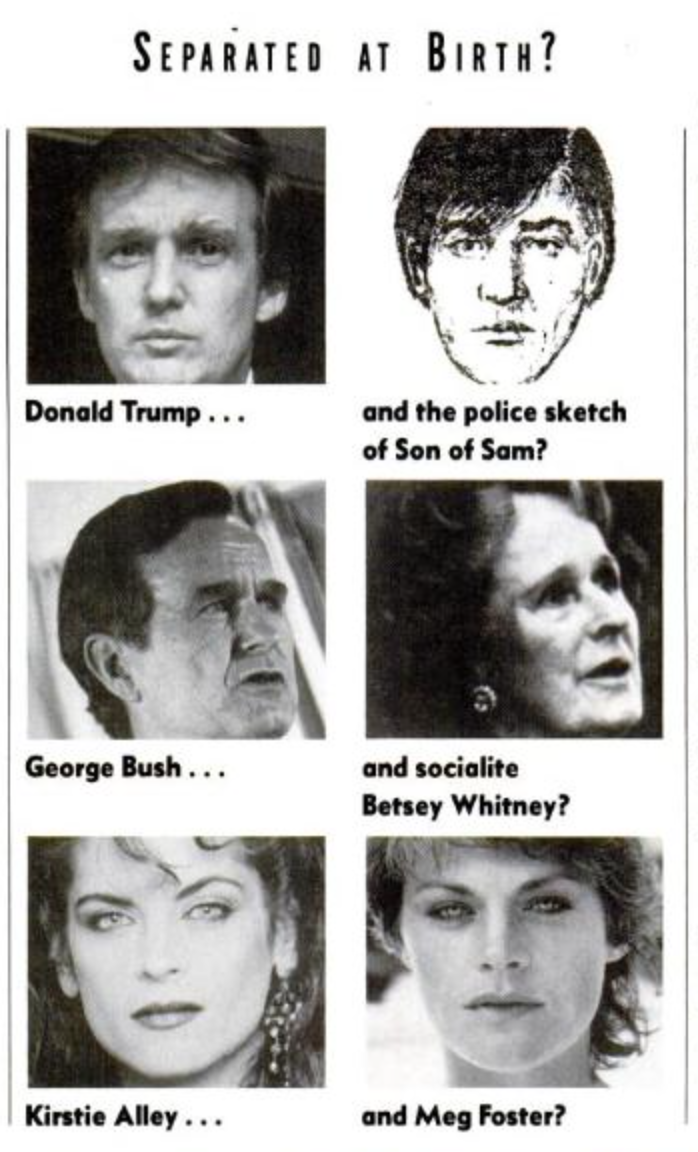
… and of course Separated at Birth (below: March 1989):
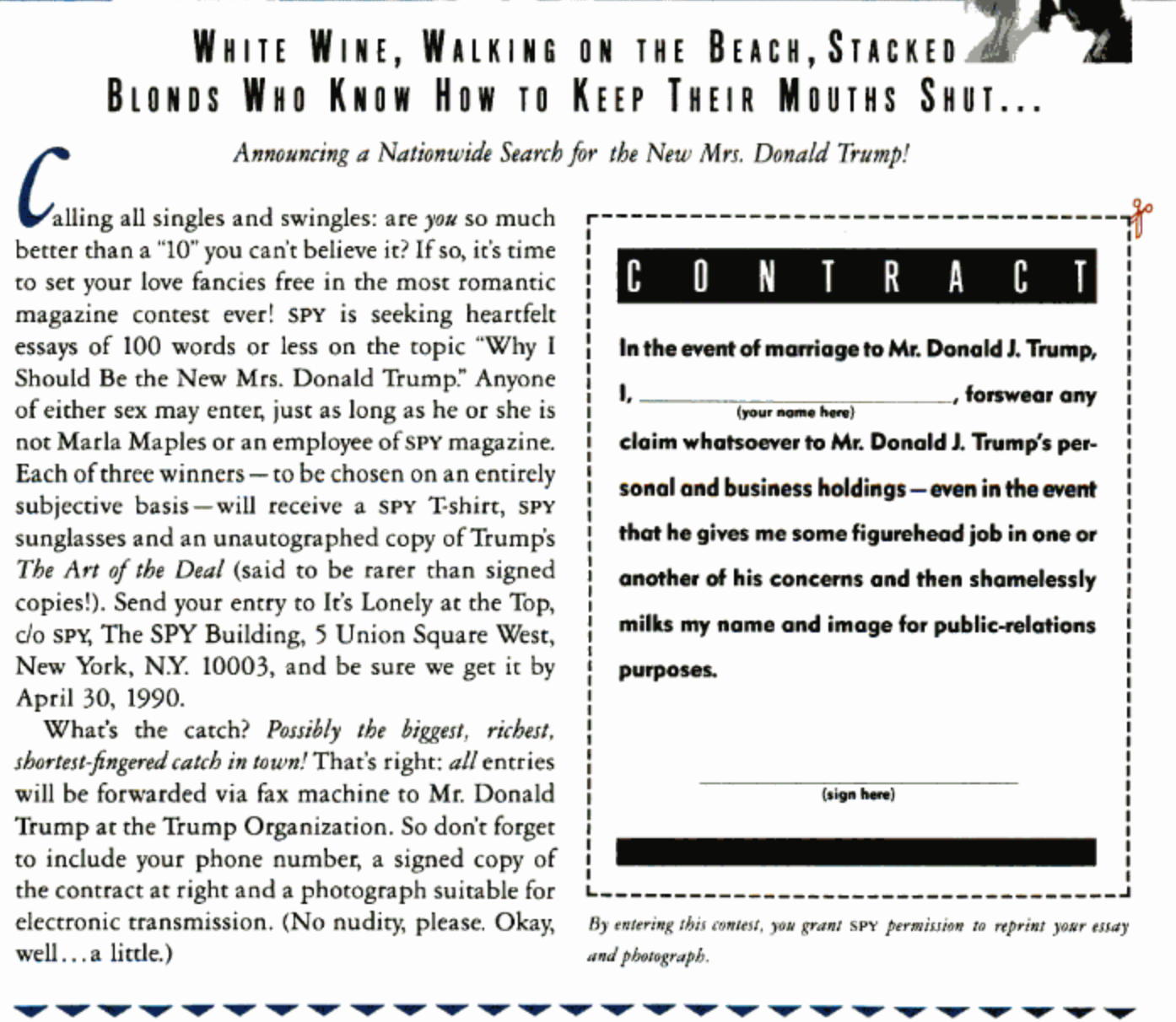
3.Trump’s marital woes with Ivana Trump were in the news in April 1990 when Spy decided to find him a wife in their pages. “Anyone of either sex may enter, just as long as he or she is not Marla Maples or an employee of Spy magazine.”
The accompanying article features a brutal ‘scrapbook’ of fictional articles that essentially document Trump’s deteriorating fortunes in the future.
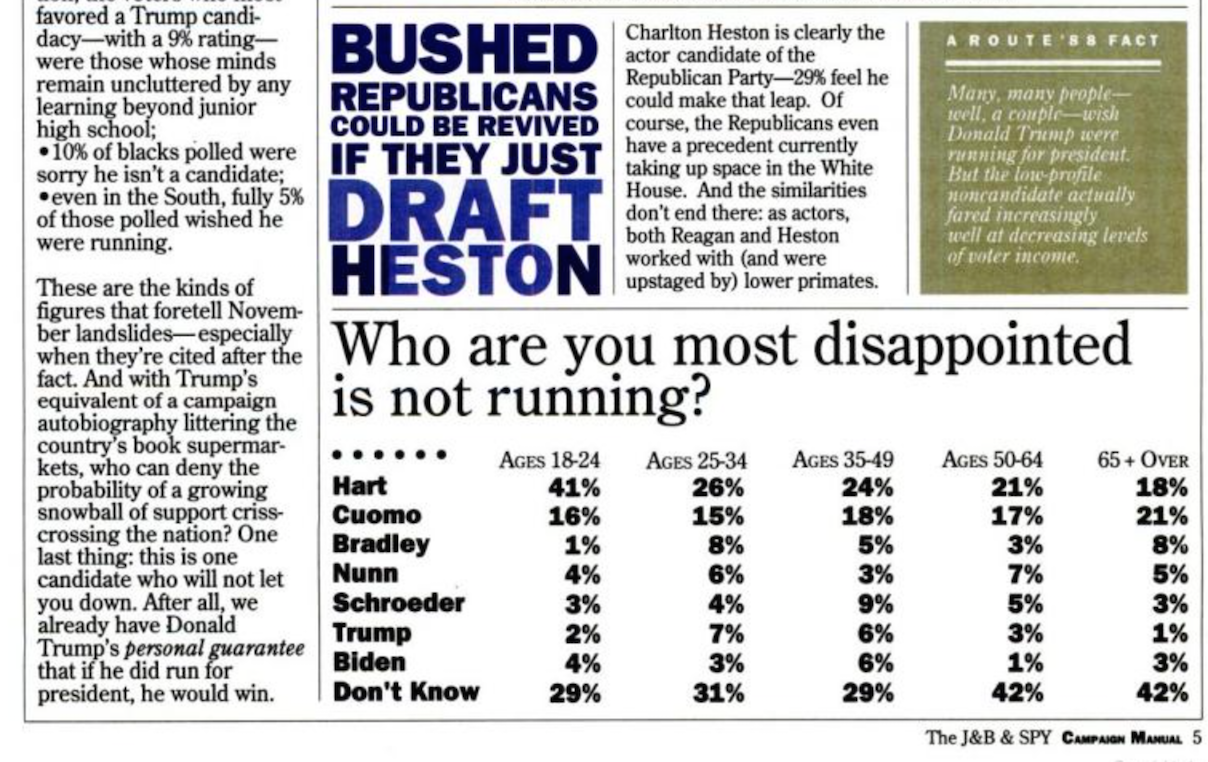
1. Speaking of predicting the future, inthe Jan-Feb 1988 issue, Spy Magazine urges Trump to run for president.
“We have come to believe that a Donald Trump candidacy is viable. “
“[T]his is one candidate who will not let you down. After all, we already have Donald Trump’s personal guarantee that if he did run for president, he would win.” Read the entire issue here.
BONUS: In 1990, Spy Magazine produced a television comedy special called Spy Magazine PresentsHow To Be Famous, hosted by upcoming comedian Jerry Seinfeld. The special received with mixed reviews. (People magazine called the jokes “tiresome and even cruel.”)
Here, too, Spy spoofed Trump in a cartoon parody:
By the 1990s, Spy Magazine had trained its verbal artillery elsewhere, onto public figures like John F. Kennedy Jr., Martha Stewart and Hillary Rodham Clinton.
You could say that, in the end, Trump had the last laugh. The magazine folded in 1998. Trump followed with a host of new construction projects, the TV show The Apprentice, and, well, who knows where it will end?
For more information on Donald Trump’s unique connection to New York City history, check out the Bowery Boys podcast from 2011 — Episode #123A Short History of Trump.
All images, articles and magazine clips above are courtesy Spy Magazine. Read the entire run of Spy issues here.
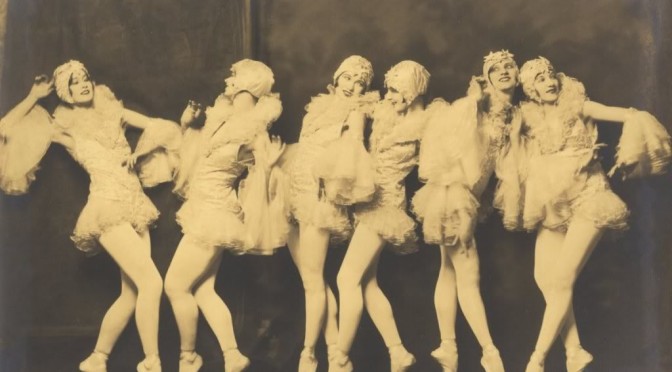
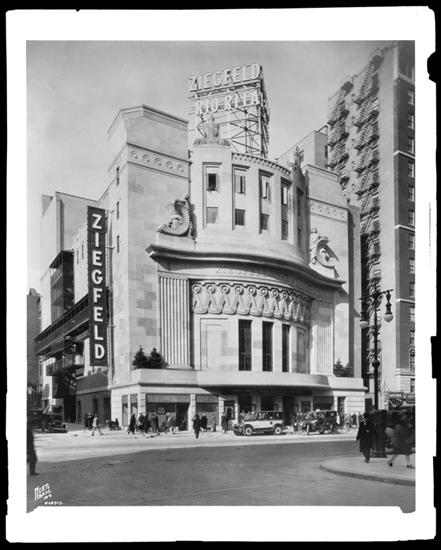
PODCASTCue the dancing girls, lower the props, raise the curtain 00” we’re taking on Broadway’s most famous producer, Florenz Ziegfeld! We give you a brief overview of the first days of Broadway, then sweep into Ziegfeld’s life from his early successes (both professional and personal) to his famous Follies. And find out how the current Ziegfeld Theatre, a movie house, relates to the original Ziegfeld Theatre, home of Broadway’s first “real” musical, Show Boat.
This was originally released on January 16, 2009.
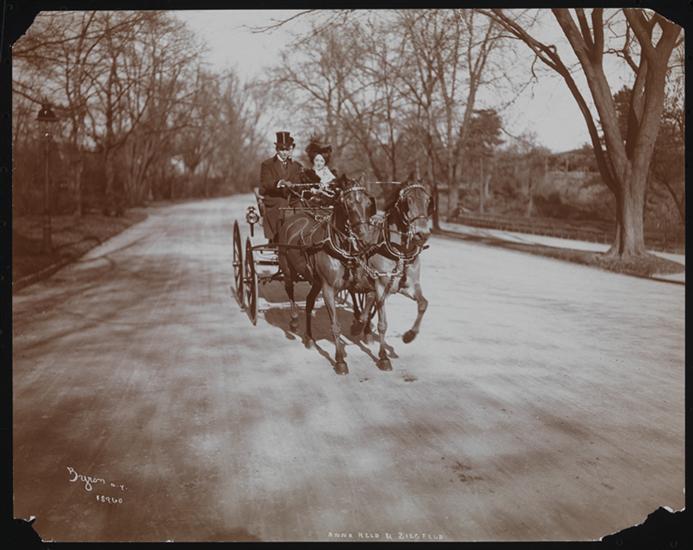
Florenz Ziegfeld and Anna Held on a quick carriage-ride jaunt in 1904
Courtesy the Museum of the City of New York
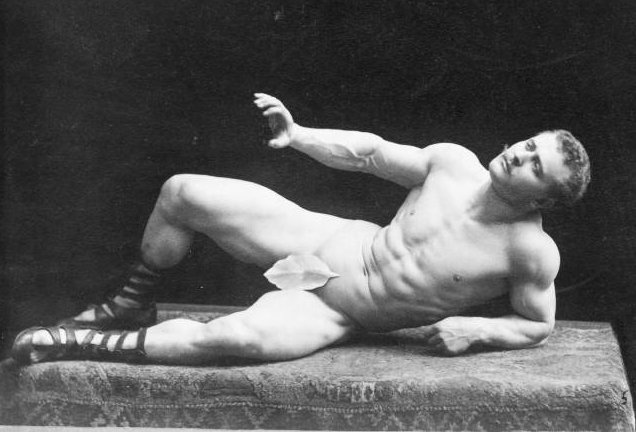
Ziegfeld’s first star — the strongman Eugen Sandow. As with his later female dancers in the Follies, Ziegfeld often posed his stars in scantily-clad ‘classical’ pose. As long as they didn’t move, this sort of tableaux vivant was not considered obscene!
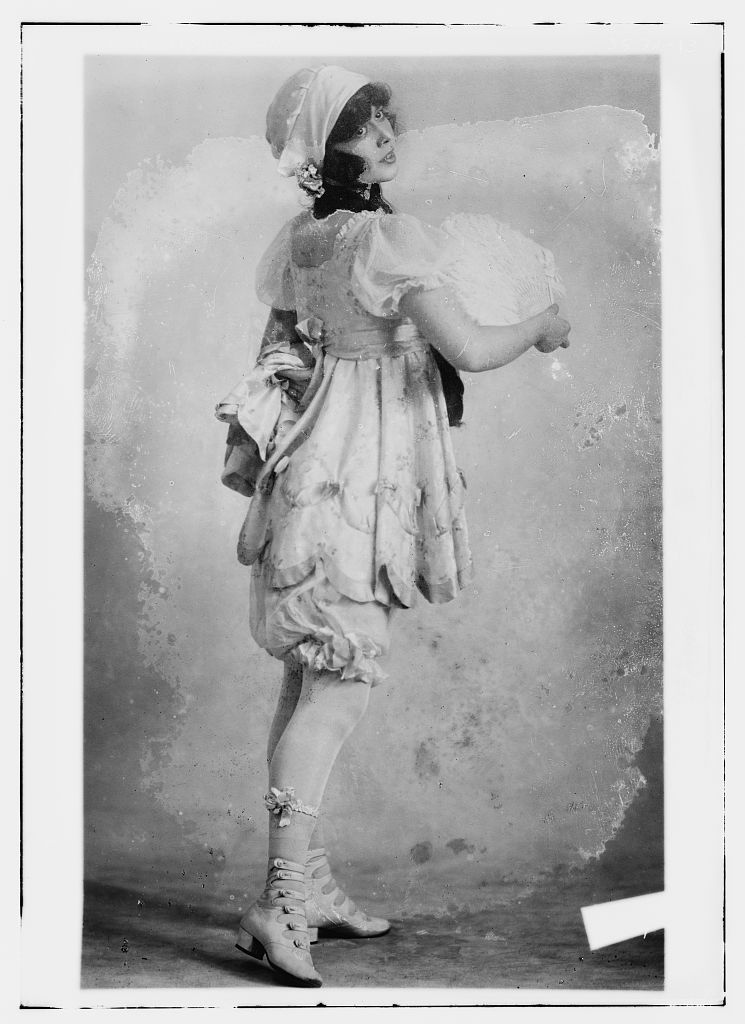
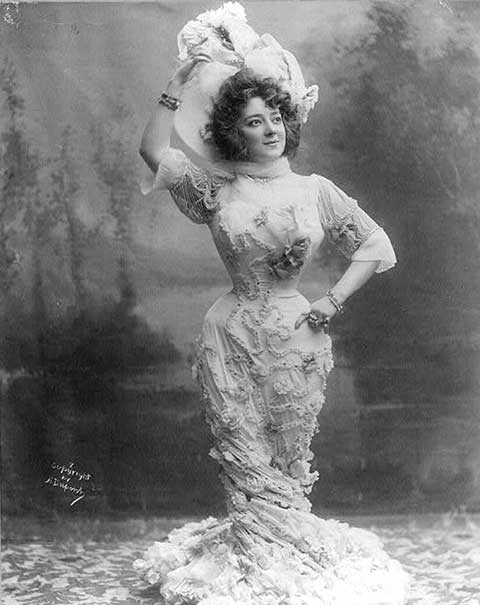
Anna Held — Ziegfeld’s lover and biggest star — posing for ‘A Parlor Match’
The original Ziegfeld Theatre at 54th Street and Sixth Avenue, taken in 1927
Courtesy Museum of the City of New York
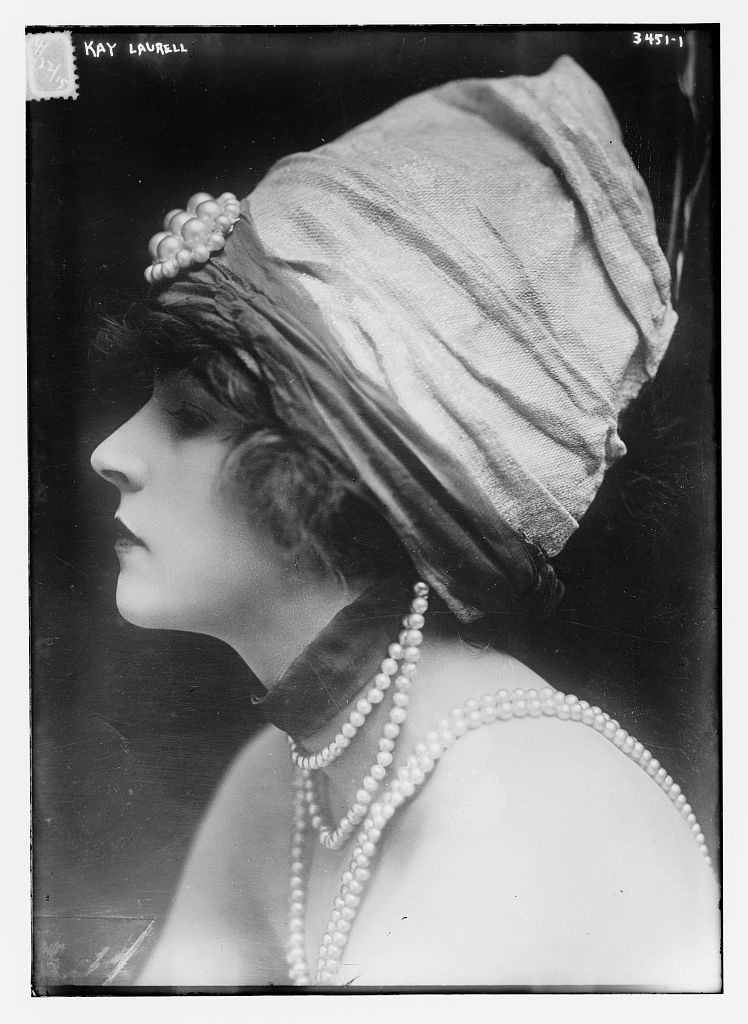
A few more notable Ziegfeld girls — like Kay Laurell (photo taken in 1915)
Courtesy Library of Congress
Anna Pennington, photo taken 1910-1915
Courtesy Library of Congress
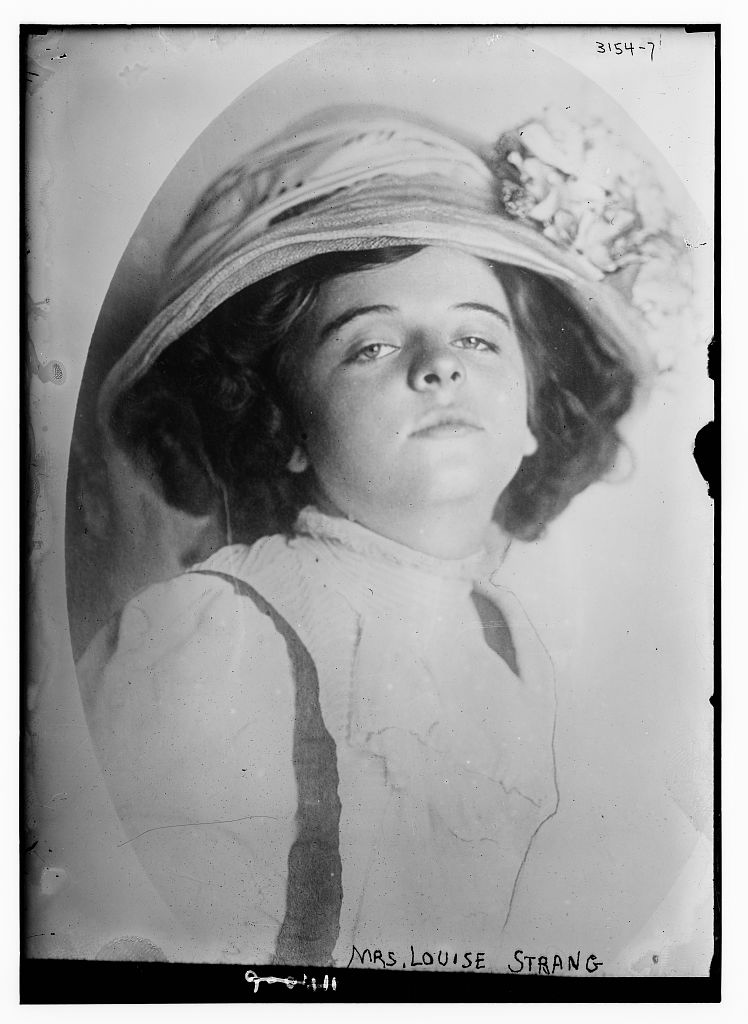
Louise Alexander, later Mrs. Louise Strang, photo taken 1908
Courtesy Library of Congress
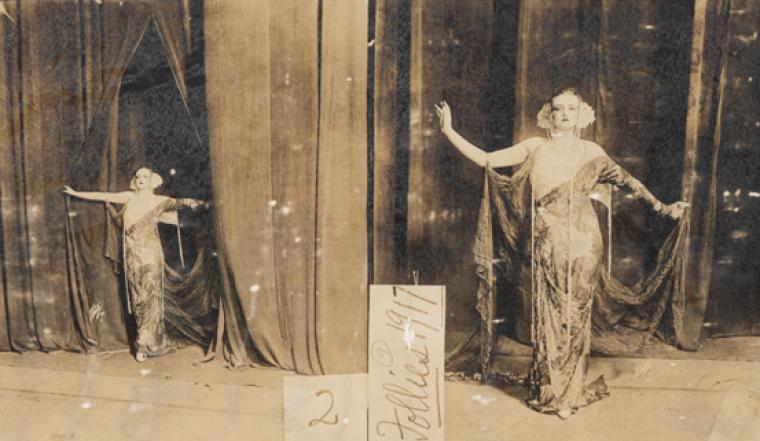
Unidentified showgirl from the Follies of 1917
Courtesy New York Public Library
Unidentified performer in the Ziegfeld Follies of 1931
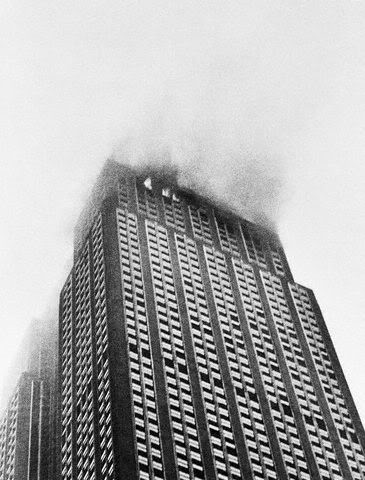
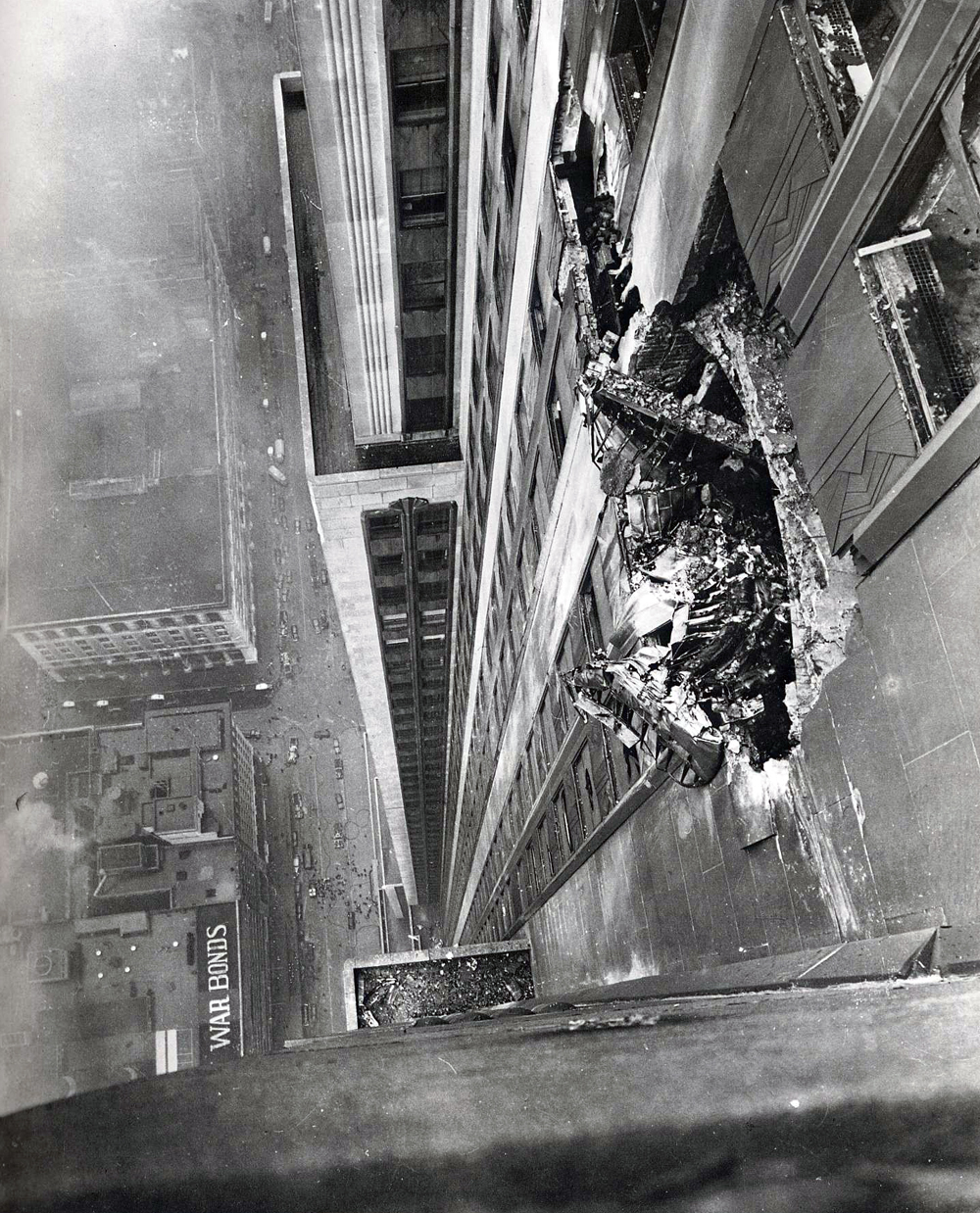
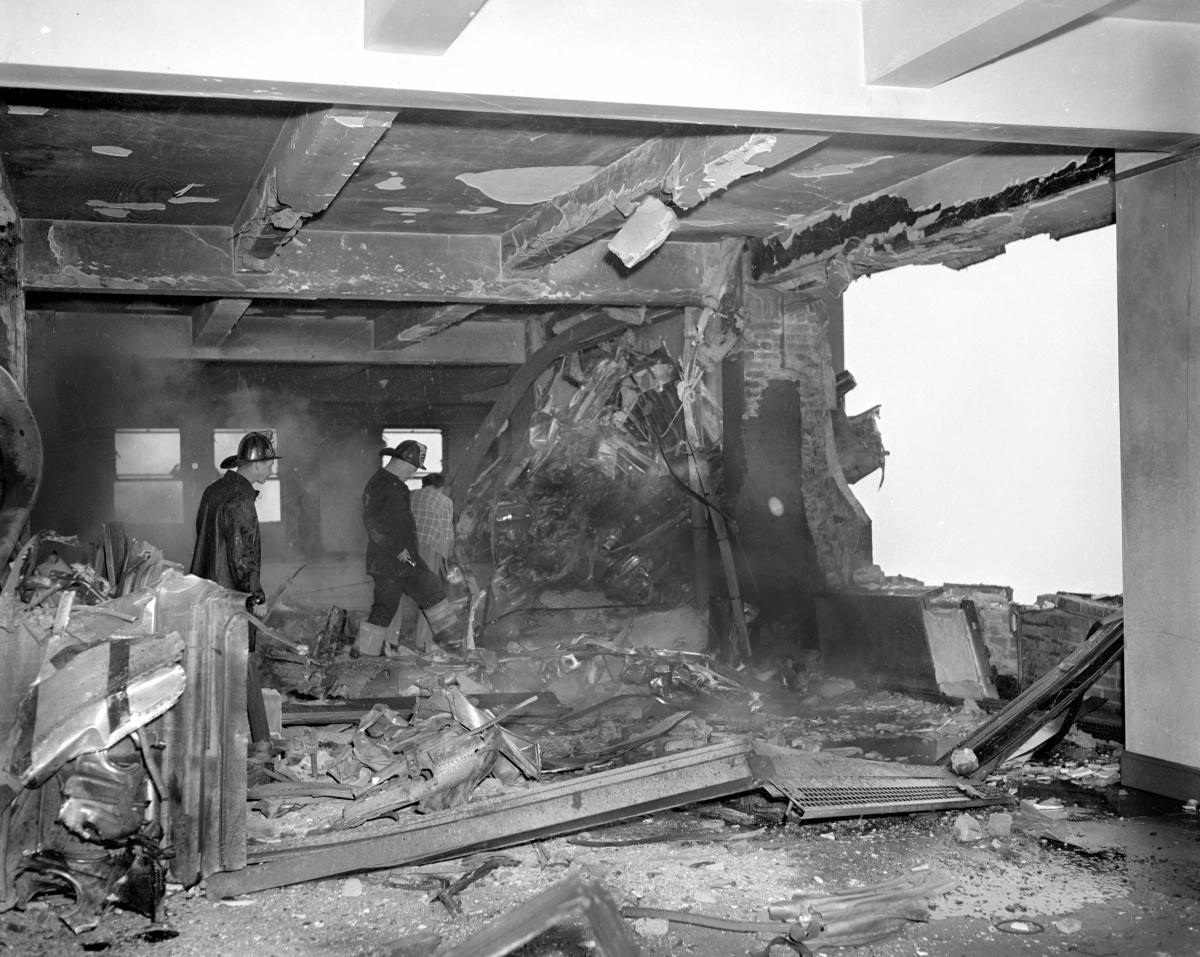
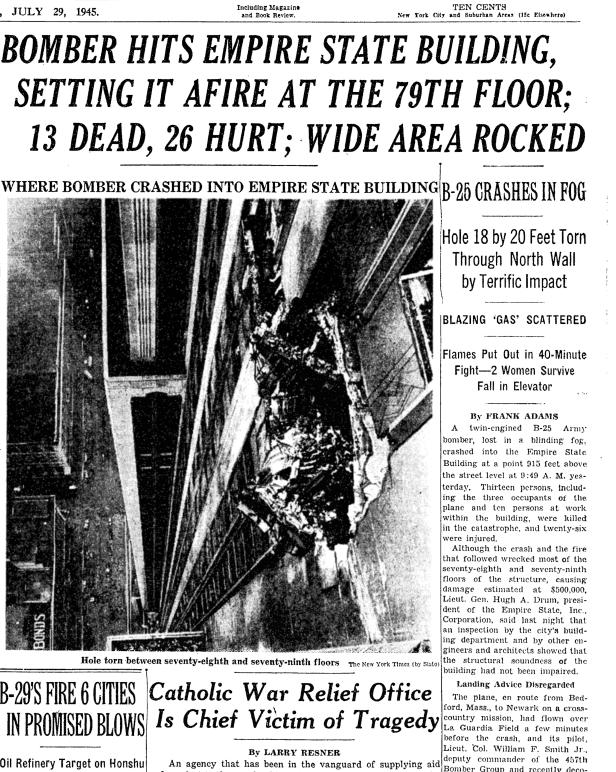
Seventy years ago today, July 28, 1945, a B-25 bomber on its way to Newark Airport swerved off course, meandering over the foggy city and smashing into the Empire State Building. Some rather startling details of the event:
— The pilot, Lt. Colonel William Smith, was simply on his way to pick up his commanding officer.
— Finding himself off-course and over the city, Smith managed to avoid crashing into the Chrysler Building, Rockefeller Center and the New York Central building (today’s Helmsley Building).
— It was impenetrably foggy that morning, which would explain his final words: “From where I’m sitting, I can’t see the top of the Empire State Building.”
Corbis
— It was a Saturday, however a few businesses were open that day. As a result 11 people in the building died that day, on top of the three crewmen in the plane. Eight employees of the Catholic War Relief Office, on the 79th floor, were killed.
(Photo by Ernie Sisto/New York Times)
— One engine crashed through the entire length of the building and came out the other side to land and promptly destroy the penthouse apartment (and thousands of dollars of artwork) of sculptor Henry Herring at 10 W. 33rd Street, a building owned by Vincent Astor.
Photo/New York Daily News
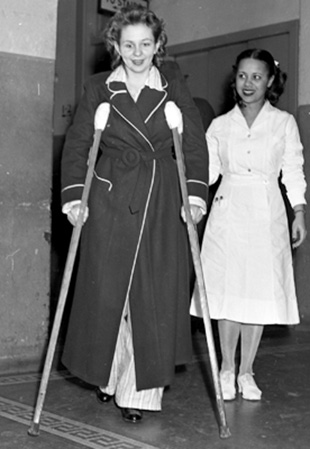
— Elevator operator Betty Lou Oliver (seen below) was on the 80th floor and barely escaped the crash. When rescuers attempted to lower her out of the building via the elevator, the cables snapped and she and the elevator car plummeted 75 stories (over 1,000 feet). She survived.
– While the pictures are quite dramatic, the crash only caused about  half a million dollars worth of damage, and the structural integrity of the building was not compromised.
— The Army ended up shelling out payments for damage, including compensation for a restaurant plate-glass window that had been blown out over ten blocks away.
The end of the 19th century saw many new ways to get people out of New York City’s over-crowded tenement districts, with trains to beach havens like Coney Island and Rockaway Beach and steamers making day-trips up the Hudson River and to spots in Long Island.
For those who didn’t have the luxury of a free afternoon, Â some relief was provided in the form of new community parks such as Columbus Park (1897),Seward Park (1903) and DeWitt Clinton Park (1906).
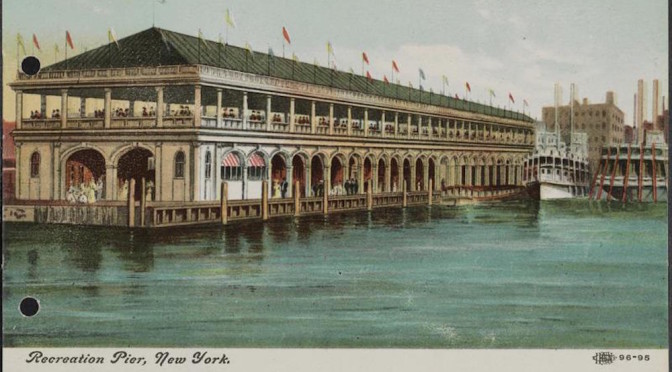
But what if you wanted some fresh ocean breezes? The piers of the East River and the Hudson River were clotted with industry and hardly suitable for relaxation.  But the city did attempt to make the waterfront available with the introduction of so-called ‘recreation piers’.
There were a great many industrial piers redesigned in the 1890s for public use. By 1905, the New York Times reports recreation piers on the East River side (at Market Street, 3rd Street, 24th Street and 112th Street) and a couple facing the Hudson River (Christopher/Barrow Street and 50th Street).
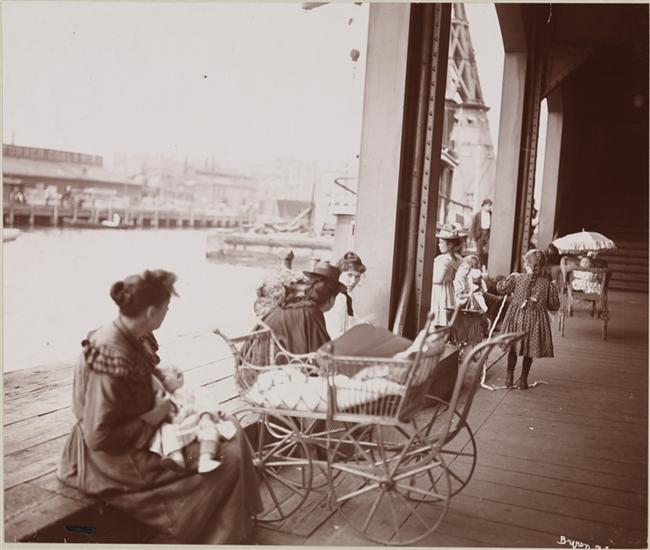
Below: Mothers and their children on the Harlem pier, 1901
Courtesy the Museum of the City of New York
By noon, during the summer months, the piers were packed with mothers and their babies, groups of young women off work, and scores of children darting through the crowds.
From the Times article: “The average for the pier at the East River and 24th Street alone is 10,000 persons a day. Almost directly across town, at 50th Street and the North River, which the police call the ‘mad dog’ pier, the daily attendance is nearly as large.”
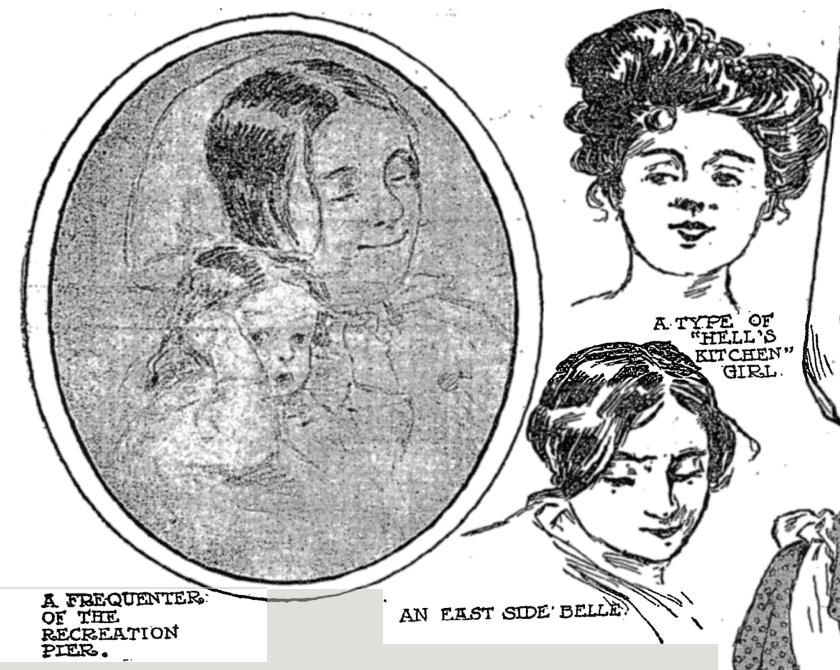
An illustration from the New York Times, June 25, 1905:
The piers provided a well-policed safe space for poor families, abundant cross breezes, and floating pools and swimming holes for those looking to escape the heat. Many of them regularly provided food vendors, musicians and even street performers, allowing city dwellers to enjoy the illusion of a short vacation getaway.
While no liquor was sold at the pier, many did their best to smuggle it past the watchful eye of the police officers. Â “Flirting and open love making are prohibited,” warned the Times, “Smoking is not. A youth may puff away on his cigarettes, and a man may smoke as vile a cigar as he pleases, anywhere he pleases.”
Below: Children on the Hell’s Kitchen pier, 1903
Courtesy Harvard Libraries
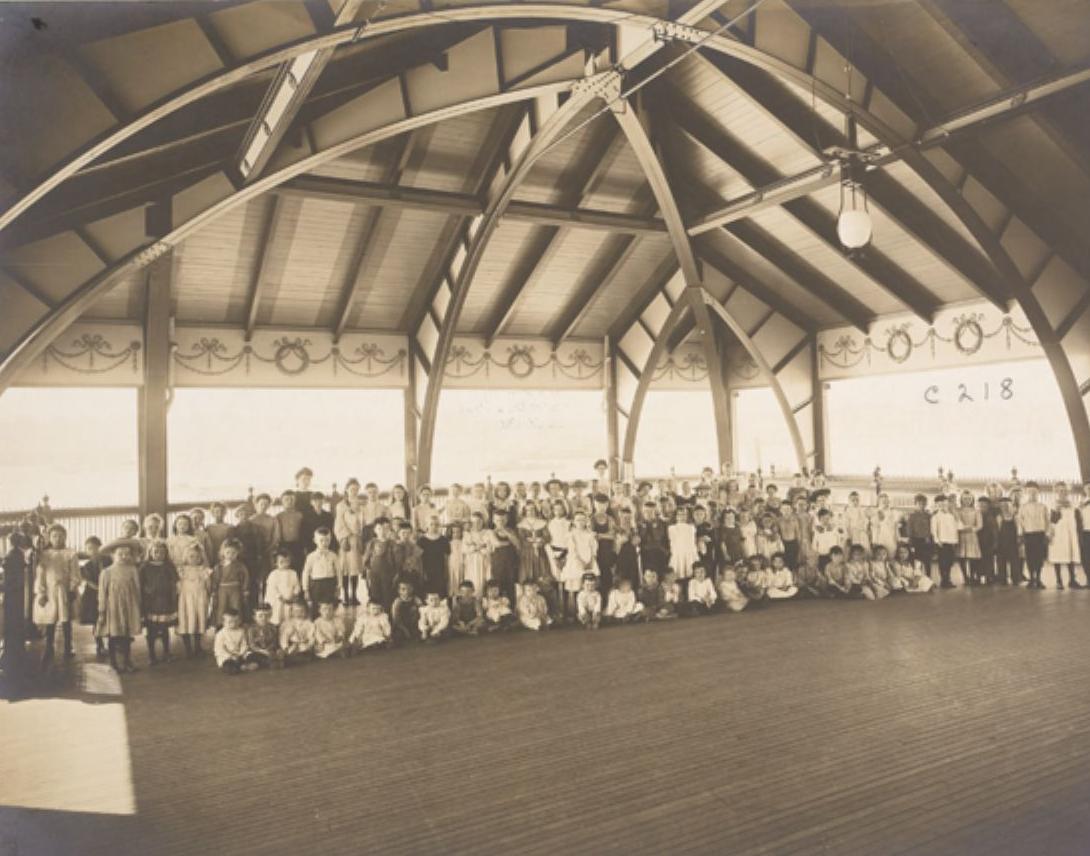
The Third Street pier provided immediate relief for residents of the Lower East Side.
“That long, low building jutting out into the water changed the ending of Third Street from a sandy, ugly refuge for crap playing boys into a breathing place for thousands of dwellers in the tall tenements all around. It is still sandy and ugly, away from the pier itelf, but there is lots of fun going on, and when you are tired of looking shoreward there is the river, with its endless excitement.” [New  York Tribune, 1901]
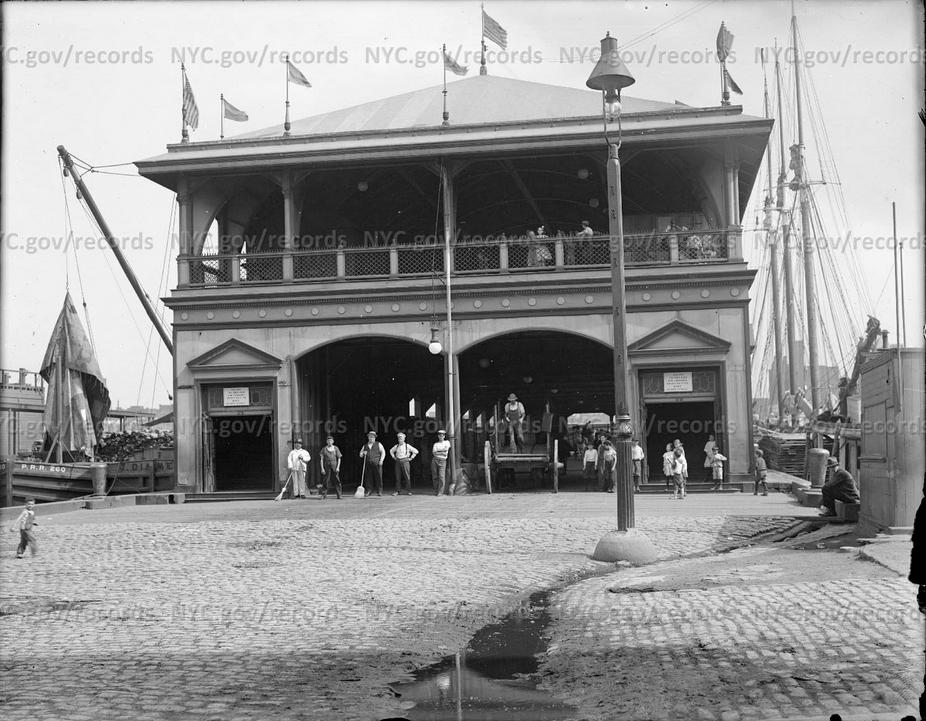
Below: The Third Street pier. According to the signs over the door: “Dancing on this Pier for Children from 3 to 5pm Daily Except Sunday”
Department of Records
The piers were also popular spots for young lovers at night, the open air and the river traffic providing a bit of romance and mystery. The Harlem pier at 129th Street seems particularly enchanting as it was far from the center of the city and its bright, distracting lights.
“When the moon is shining the scene along this garden spot of the Hudson is not to be equaled anywhere around New York. There is nothing of the bustle of the city up here.” [source]
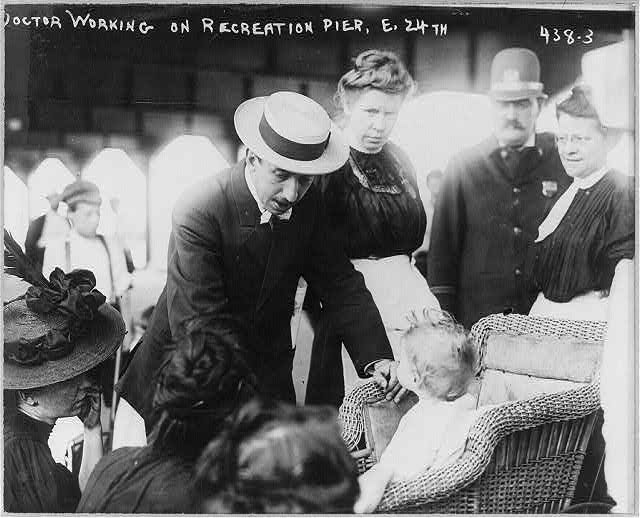
The city took advantage of the piers’ popularity with tenement dwellers in order to provide medical and social services. In 1912 ‘clean milk dispensaries’ provided mothers with free milk for their babies. Â Below: a doctor inspects a young baby at the East 24th Street pier.
Library of Congress
Not to be a buzzkill, however, but most of the piers were hardly secluded from the regular activities of the busy city. The Hell’s Kitchen pier, which opened in 1900, was perfumed with smells from the trash dump two piers away, not to mention flecks of filth from the neighboring ash dump. And crossing the busy avenue just to get to the pier was somewhat of a task.
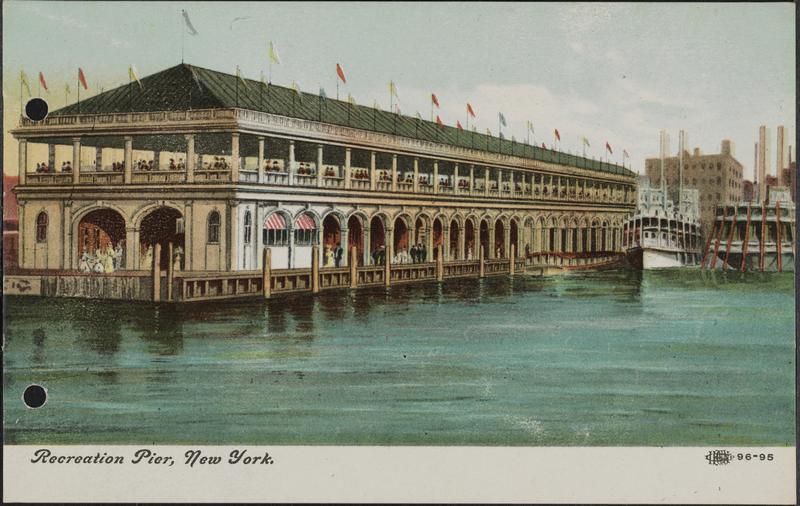
Today’s network of waterfront spaces in New York City are certainly more accommodating and convenient than these old piers, but I can’t help but wish one or two were still around, especially if they looked like this:
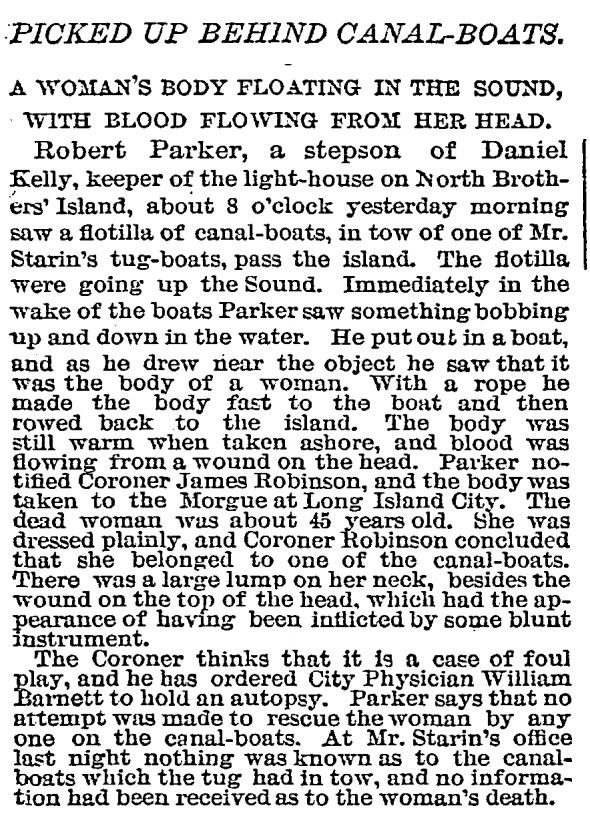
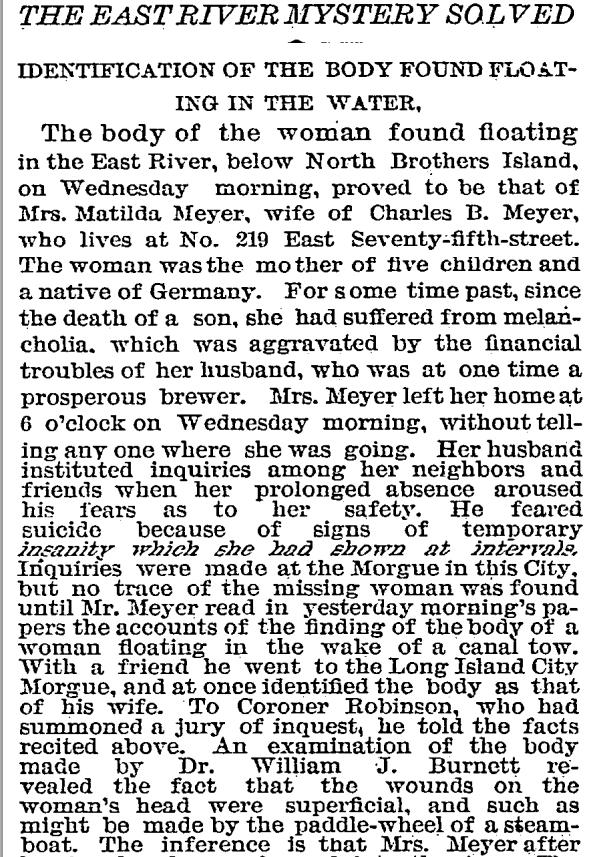
Many of you have asked if we were ever going to do a live event in the near future. Finally you can see us live this September for one night only AND on Broadway!
The Bowery Boys are pairing up with The Ensemblist podcast (hosted by wonderful Mo Brady and Nikka Graff Lanzarone) to present a one of a kind event — the history of an iconic Broadway theater featuring musical performances by people who have performed there.
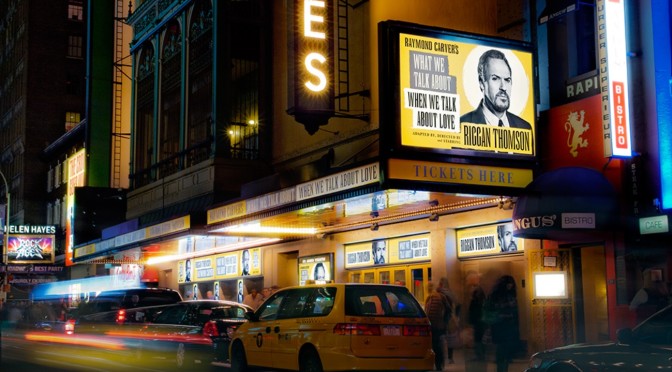
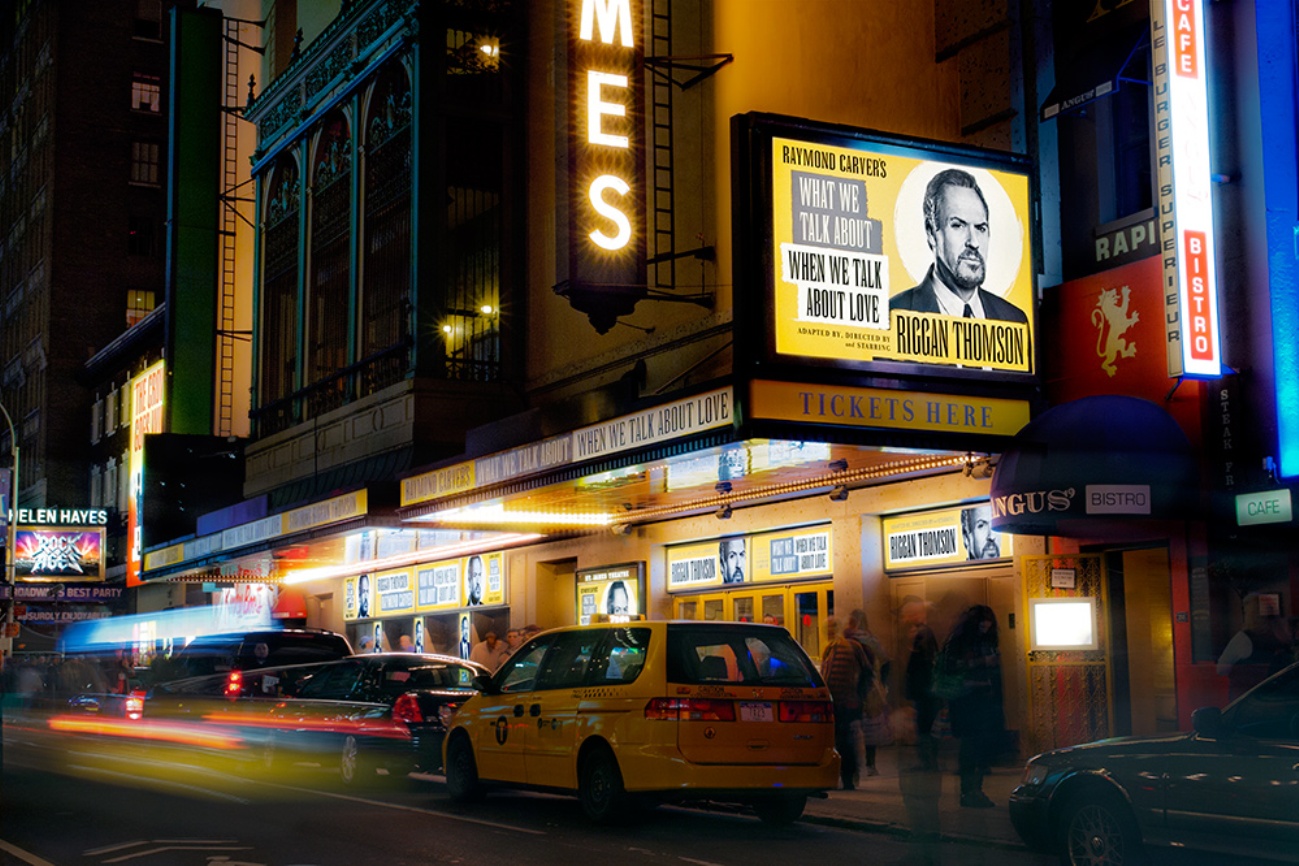
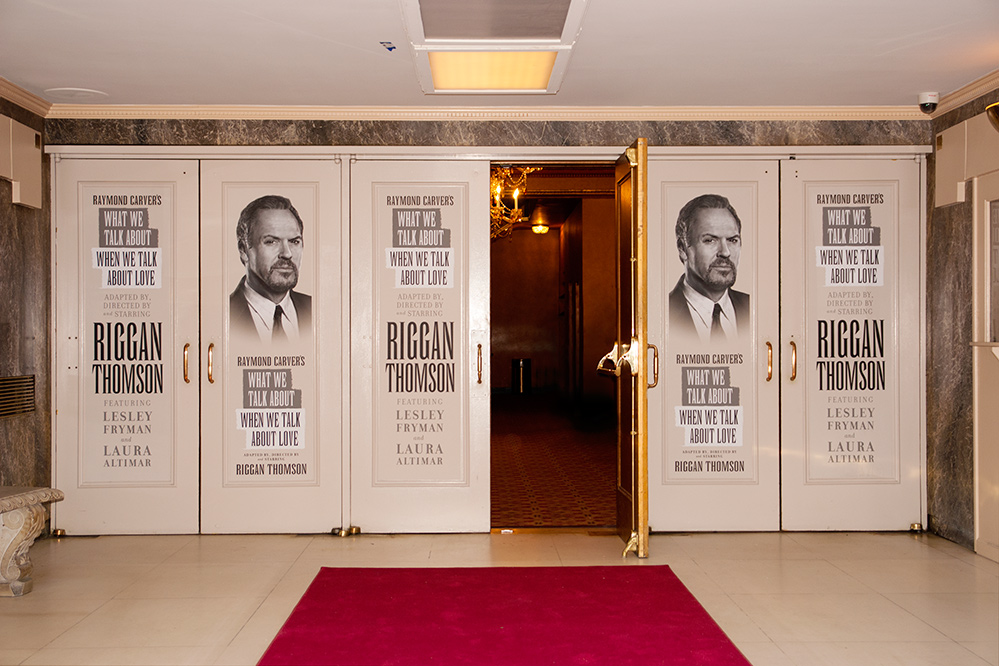
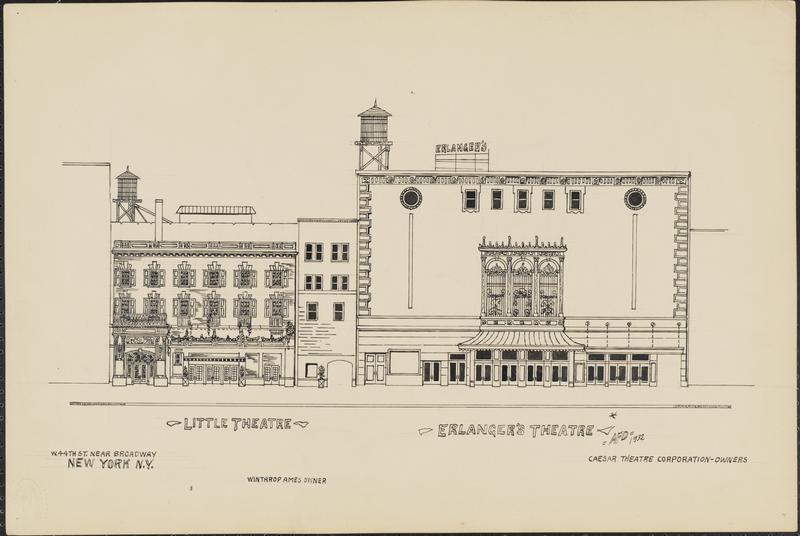
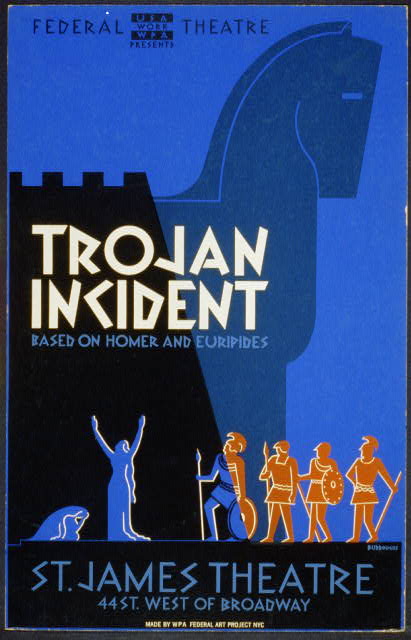
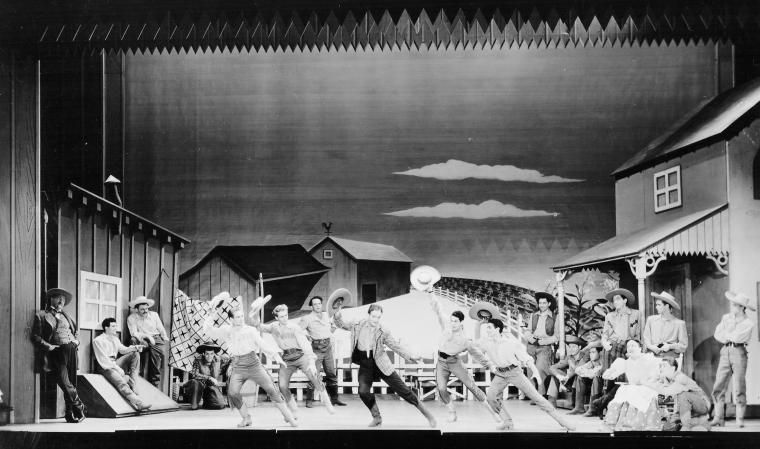
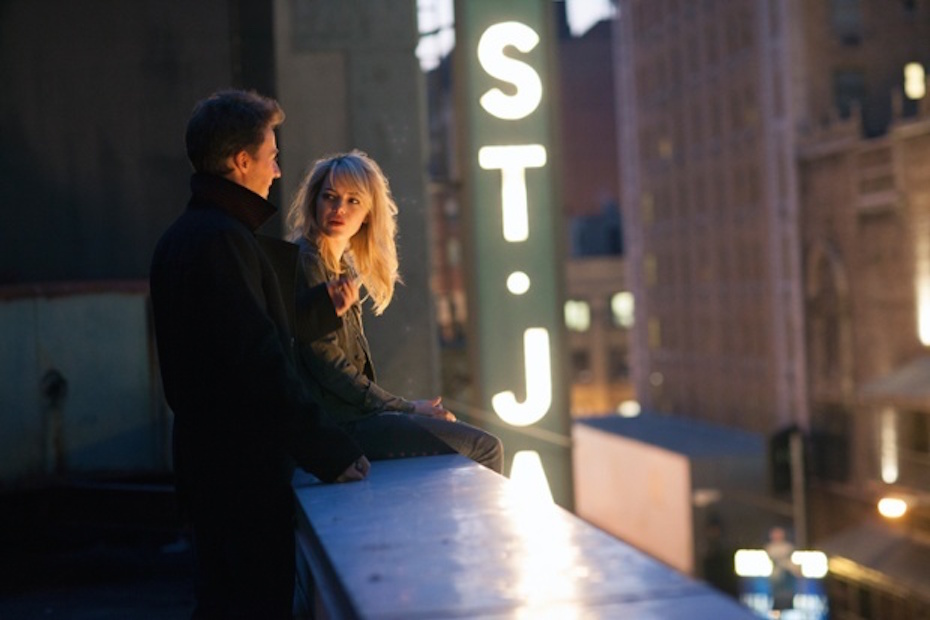
The star of our show is the St. James Theatre, a Broadway stage which opened in 1927 on the spot of the original Sardi’s Restaurant. It was here that many great Broadway musicals originated including Oklahoma!, The King and I, The Pajama Game and Hello Dolly. Â Most recently the theater was prominently featured in the Oscar-winning film Birdman or (The Unexpected Virtue of Ignorance) with Michael Keaton and Emma Stone.
We’ll be discussing some of the history of this classic theater amid an entire roster of Broadway singers performing music that the St. James made famous.  The line-up is tbd at this point but we’ll present the names of the performers as soon as we have them.
This is going to be a cabaret extravaganza — so naturally the show will be held at one of New York’s greatest cabaret spaces —54 Below (254 W. 54th Street). This is the basement of the former Studio 54. Maybe we’ll dress up like Andy Warhol and Bianca Jagger?!
This is a ONE NIGHT ONLY event— two shows on Sunday, September 13, 2015. Â Visit their websitefor more information about the show andCLICK HERE to get your tickets.
PODCAST What can you find on Governors Island? Almost 400 years of action-packed history! This island in New York Harbor has been at the heart of the city’s defense since the days of the Revolutionary War, and its story takes us back to the very beginnings of European occupation in America.
Its two fortifications — Castle Williams and Fort Jay — still stand there today, evidence of a time when New York was constantly under threat of attack and invasion. During the Civil War, these structures served as prisons for Confederate soldiers.
The rest of the island was a base for the U.S. Army for almost 150 years before ceding to the Coast Guard in the 1960s. Their community transformed the island into a charming small town, quite the contrast with the city across the water!
Today Governors Island has become an exciting park ground and events area, hosting art, music festivals and Jazz Age picnics. But its history remains evident all around. In this show, we head out to Governors Island for an exploration of its magnificent story firsthand.
The Bowery Boys: New York City History podcast is brought to you …. by you!
Starting this month, we are doubling our number of episodes per month. Now you’ll hear a new Bowery Boys podcast every two weeks. We’re also looking to improve the show in other ways and expand in other ways as well — through publishing, social media, live events and other forms of media. But we can only do this with your help!
We are now a member of Patreon, a patronage platform where you can support your favorite content creators for as little as a $1 a month.
Please visitour page on Patreon and watch a short video of us recording the show and talking about our expansion plans. If you’d like to help out, there are five different pledge levels (and with clever names too — Mannahatta, New Amsterdam, Five Points, Gilded Age, Jazz Age and Empire State). Check them out and consider being a sponsor.
We greatly appreciate our listeners and readers and thank you for joining us on this journey so far. And the best is yet to come!
A depiction of Fort Columbus (Fort Jay) in 1816. Published in D.T. Valentine’s Manual, 1860.
Courtesy the Museum of the City of New York
A view of Castle Williams and New York Harbor, painted in 1820
Courtesy Museum of the City of New York
Another view of Governors Island, this time from Manhattan, a watercolor made in 1825
Courtesy New York Public Library
Governors Island in a photograph taken by Matthew Brady sometime during the Civil War.
Library of Congress
Prince Louis of Battenberg arriving at Governor’s Island with Rear admiral Robley Evans during his 1905 visit to New York.
Museum of the City of New York
Castle Williams, seen in 1905
Photo by the George Eastman House, courtesy Library of Congress
An illustration made in the 1910s laying out what Governors Island would look like after its landfill expansion. As you can see Liggett Hall has not yet been conceived!
New York Public Library
Colonels Row, photo taken in 1913. This area pretty much looks exactly like this today!
New York Public Library
Troop training on Governors Island, with Lady Liberty positioned neatly in the background.
Here’s an interesting view of the south side of island from 1924.
Museum of the City of New York
Inside Castle Williams in the 1920s
Governors Island made a striking contrast to the city even in the 1930s!
Museum of the City of New YorkPhoto by Samuel H. (Samuel Herman) Gottscho. Officer’s apartments, Governors Island, N.Y. 3/4 view cannon foreground. Courtesy Museum of the City of New York
The exterior of Castle Williams in 1936, still serving as a disciplinary barracks at this time.
A beautiful engraving by Charles W. Beck of Manhattan from the vantage of the Governors Island shoreline (although it looks a bit too close if you ask me!)
New York Public Library
Flying over Governors Island in 1937, the two forts in view and a clear dividing line seen between the old section and the new section of the island.
From the vantage of 60 Wall Street, looking south toward New York Harbor and Governor’s Island. Taken by the Wurts Brothers.
The vestiges of America’s oldest wars surround us to this day.
New York City has had more military fortifications contained within it than perhaps any other major American city. Part of this has to do with its roots in the American Revolution and the subsequent fears of a return invasion in the early 19th century.
Today’s existing forts — and those that remain in part or in ruin — make for a stark architectural contrast to the modern city. Their walls of stone and brick may conjure up a history far older than New York’s or images of a made-up fantasy world. You could pretend, for a few moments, to be a character on Game of Thrones while exploring places like Fort Wadsworth or Castle Williams on Governors Island
Here’s a list of some of the best known forts in the New York City area. Most are still around in some form. Some exist only in commemorative markers.  Others are completely gone but they leave their names as a reminder of their existence.  How many of these have you seen in person?
1 Fort Wadsworth
Location: Staten Island
Placed at a strategic site on the Narrows, Wadsworth and its associated defense buildings are perhaps the most dramatic military remains in New York City. It traces to an old Revolutionary War-era fort called Flagstaff Fort.  While it serves minor military functions to this day, Wadsworth has become a popular Staten Island attraction.
1979, photographed by Edmund V. Gillon, Museum of the City of New York
2 Fort Jay (formerly Fort Columbus)Â Location: Governor Island
A star fort constructed from an original 1776 earthen defense. In 1806 its name was changed to Fort Columbus and changed back in the 20th century.
3 Castle Williams Location: Governors Island
Specifically designed in 1807-1811 to defend the harbor from probable British invasion. While the British did invade America during the battles of the War of 1812, New York was spared. Today, its maintained by the National Park Service, as is Fort Jay.
1936, by Samuel Gottscho, courtesy Museum of the City of New York
4 Fort Gibson (or Crown Fort) Location: Ellis Island
Built by the Army in 1795 and greatly upgraded in 1809 as part of the beefing up of harbor defenses. It was dismantled by the 1860s although the island was used to hold naval munitions for decades before its transformation into Ellis Island Immigration Station.  Today you can find exposed ruins outside the main building.
Courtesy NPS
5 Fort Wood
Location: Liberty Island
This too was completed during the 1810s and was later named for Eleazer Derby Wood, an officer killed at a battle at the Battle of Lake Erie in 1814. Today the Statue of Liberty and her pedestal are affixed atop of the old fort. You can see a trace of the original brickwork on an exposed wall near the exit.
New York Public Library
6 Castle Clinton Location: Manhattan (Battery Park)
Lower Manhattan was formerly guarded by Fort Amsterdam/Fort George, but that had been dismantled in 1790. (It stood where the Alexander Hamilton U.S. Custom House is today.) Castle Clinton — named for Governor DeWitt Clinton — was built in 1808-1811 to protect lower Manhattan.  It was originally set into the water and connected with a footbridge.  After stints as the performance hall Castle Garden, New York’s pre-Ellis Island immigration station and New  York Aquarium, it sits today as a national monument in its own right.
Library of Congress
7 Fort Gansevoort Location: Manhattan (Meat-Packing District)
Also called the White Fort, this forgotten redoubt once flanked the western waterfront, built at the same time as the harbor forts. It was named for General Peter Gansevoort (the grandfather of Herman Melville) and stood here until the 1850s. Nothing remains of this fort today but its name, found on the street which cuts through that area — Gansevoort Street.
New York Public Library
8 Blockhouse No. 1 Location: Manhattan (Central Park)
This curious little structure stands on the northern end of Central Park, a fortification almost two hundred years old.  Its the oldest structure contained within Central Park (although obviously Cleopatra’s Needle, which was moved here, is much, much older.)
Library of Congress
9 Fort Washington
Location: Manhattan (Washington Heights)
This fort predates most of the rest, built as a companion for Fort Lee on the New Jersey side. It was here that the Battle of Washington Heights was fought on November 16, 1776, and the fort was captured by the British. While this particular fort is no longer there, some stone walls and a plaque mark its former location. Fort Washington Avenue also pays tribute.
10 Fort Tryon
Location: Washington Heights
This was actually a northern redoubt that was an extension of Fort Washington. When the British took it over, they renamed it for William Tryon, New York’s last British governor. For some reason, the name just stuck! Its location in preserved in the breathtaking Fort Tryon Park, completed in 1935 and designed by the son of Frederick Law Olmsted.
11 Fort Sterling
Location: Brooklyn (Brooklyn Heights)
This fort, tracing to the Revolutionary Era, is unique it that it was almost immediately dismantled once the British left.  There was another fort nearby called Fort Brooklyn that lasted a bit longer,demolished by the 1820s to allow for the growth of Brooklyn’s first wealthy neighborhood. Today, near the Brooklyn Heights Promenade, stands small Fort Sterling Park, with a plaque and a flagpole commemorating the location of this critical defense.
12Â Cobble Hill Fort
Location: Brooklyn (Cobble Hill neighborhood)
This unusual corkscrew shaped fort — which we talked about in one of our previous ghost story podcasts — is notable for receiving George Washington as he observed his troops during the Battle of Long Island in 1776. Â A handsome plaque on the old bank-turned-Trader-Joe’s at Atlantic Avenue and Court Street marks the location of this forgotten fortification.
Courtesy the blog South Brooklyn
13 Fort Greene
Location: Brooklyn (Fort Greene neighborhood)
There really was a fort here in the area of Fort Greene Park today, on the highest point of the hill, a traditional five-point fortification similar to that on Governors Island. In the 1840s it was torn down to construct one of Brooklyn’s oldest parks — called Washington Park. Oddly enough, the original fort here was called Fort Putnam. There was a Fort Greene (named for Nathaniel Greene) but it was in another area of Brooklyn, closer to today’s area of Boerum Hill.
Museum of the City of New York
14 Fort Hamilton Location: Brooklyn (Bay Ridge)
This is the last active military headquarters in the New York City area. Built in the late 1820s-30s, it was named for Alexander Hamilton who was an officer in the Revolutionary War. Although an active site, you can visit the Harbor Defense Museum which is housed here.
Robert Bracklow, Museum of the City of New York
15 Fort Lafayette
Location: Off the coast of Brooklyn (Bay Ridge)
This imposing island fort was built in the 1810s and named for the Marquis De Lafayette. Like many of New York’s forts, it held Confederate and enemy prisoners during the Civil War. The fort was later dismantled for the construction of the Verrazano-Narrows Bridge. You can see where it would have stood as the bridge’s Brooklyn-side tower stands on the location today.
16 Fort Tilden Location: Brooklyn (Rockaway Beach)
While defenses of various kinds have sat out on Rockaway Beach since the early 19th century, Fort Tilden was fully built up during World War I, named for Samuel J. Tilden. Today its ruins peering through overgrowth can be found near the beach as part of the Gateway National Recreation Area.
17 Fort Schuyler
Location: Bronx
Completed in the 1850s, this unique fortification protected New York for any possible attack from enemies approaching along the Long Island Sound. Abandoned for strictly military use in the 1920s, today it houses the State University of New York Maritime College and a maritime museum.
Museum of the City of New York
18 Fort Totten
Location: Queens
This fortification traces to worries relating to the Civil War. It was constructed in 1862 to protect the East River with its companion across the water Fort Schuyler.  You can still visit Fort Totten today as the area has been opened up as a public park with regular tours of the old buildings.
New York Public Library
At top: Fort Lafayette in a painting by Thomas Hicks (1861)
This article originally appeared in the 2015 NYC Pride Guide. You can check out the entire digital issue here or pick up pretty much anywhere in the West Village, Chelsea or Hell’s Kitchen this weekend!
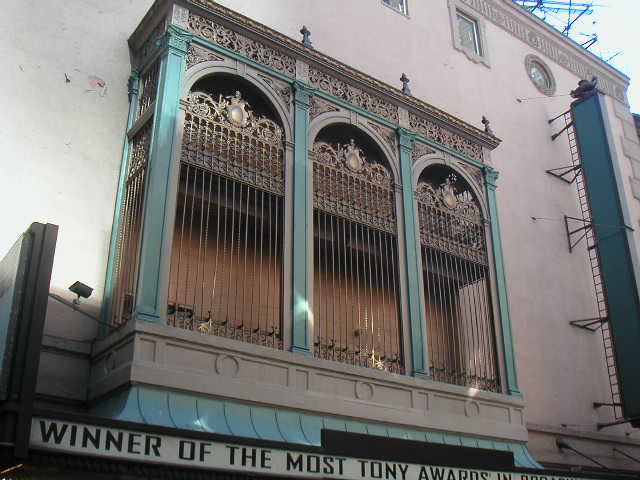
Gay and lesbian life in 19th century America meant reading between the lines, latching on to known code words to locate a community buried deep under the mainstream. But you may not have had to look very far in the early 1890s to locate The Slide (at 157 Bleecker Street), once New York’s most notorious and flamboyant bars.
We know of its existence primarily due to the pearl-clutching reaction of moral-minded New Yorkers. While you can’t trust police blotters and morality crusaders to give an accurate depiction of what The Slide was truly like, an attempt to peel back the hyperbole provides a sight that would rival the bawdiest gay bars of Hell’s Kitchen.
The Slide was a basement dive, packed every night with men who fancied “male degenerates†and the occasional female looking for something outrageous. Music, drinking and laughter prevailed until the early morning; female prostitutes mingled with the boys to create what must have been a dizzying stew of genders, the air filled with cheap booze, wild sex (“orgies beyond descriptionâ€) and tunes banged out on an old piano.
Newspapers described it as a “fairy resort.†Men openly wore drag to the delight of patrons, of which there were many, according to one scandalized report, “one to three hundred people, most of whom are males, but are unworthy the name of men.†Rouged and powdered waiters “sang filthy ditties†into all hours of the morning. The Slide’s most notable patrons went by such names as Princess Toto, Madam Fisher, Maggie Vickers, Phoebe Pinafore and Queen of the Slide.
Homosexual behavior of any stripe would have been condemned in this era. Such flagrant and open displays would have been unthinkable then.
The urges displayed at The Slide were “inhuman and unnatural.†The New York Evening World, owned by Joseph Pulitzer, was perhaps the most horrified, suggesting that “London, Paris or Berlin, with all their iniquity, have nothing to parallel this sink of vice and depravity.†A bar today might be honored to be strapped with such description!
Here’s the complete quote in all it’s scandalized glory:
Such abandon could not be allowed to exist for very long. Pulitzer’s paper went on a vendetta against The Slide and other Bleecker Street dives, and soon it was permanently shuttered.
But you couldn’t simply extinguish a scene as lively as that of The Slide. Its crowd simply moved to a dive called the Excise Exchange (336 Bowery), a place “frequented by the same painted, abandoned men and women, the surroundings are the same and the conversation quite as low and vulgar.†[New York Evening World, Jan 7, 1892]
“The ‘attractions’ at the Excise Exchange are not the women, but the class of men who frequent it. They imitate the dress and manner of women — paint their faces and eyebrows, bleach their hair, wear bracelets and address each other with female names.” [source]
The building which housed The Slide still stands today at 157 Bleecker, now home toa far more respectable establishment.  (The bathrooms are in the basement is you want to stand in the place of the old ‘degenerate’ bar.) The Bowery Hotel sits directly across the street from the location of the old Excise Exchange. But the spirit of these two bars live on, down the Bowery, down Bleecker, through the Village and all around late-night New York.
Big news in the world of numismatics — the U.S. Treasury Department has announced that Alexander Hamilton, long the solitary face on the $10 bill, will be joined by a woman. But who? His wife Eliza Schuyler? Harriet Tubman? Eleanor Roosevelt? And how will she featured?
Thankfully he’s not leaving the bill which he has graced since 1928. Here’s a few other interesting tidbits about his appearance on currency:
1) Why is Hamilton, who was never a president, on money in the first place? He was America’s first treasury secretary, of course, from 1789 to 1795. But in many ways he’s also the inventor of American money!
According to Ron Chernow, Hamilton encouraged the use of the dollar bill as the basic unit of currency and called for a series of coins broken into smaller values, a new concept in an age when bartering was the preferred method of transaction. Â To encourage the new American spirit, he recommended putting presidential faces on the money. Since there was only one president at that time, this meant the basic unit currency went to Hamilton’s good friend George Washington.
2) Hamilton was the first Secretary of the Treasury, but he was NOT the first Treasurer of the United States. That honor went to Michael Hillegas, a wealthy Philadelphian who led the treasury through the duration of the American Revolution. His face was actually on an early version of the $10 well before Hamilton’s.
3) Hamilton was never in charge of actually making money. While Hamilton is partly responsible for the creation of the U.S. Mint (established in 1792), it was placed under the job of Secretary of State Thomas Jefferson.  Chernow: “Unfortunately, Jefferson ran the mint poorly.  Hamilton later tried, in vain, to arrange a swap whereby the post office would go to State in exchange for the mint coming under Treasury control, where it belonged.”
The first director of the U.S. Mint was David Rittenhouse, on which Philadelphia’s Rittenhouse Square is named.
Below: The first U.S. Mint building in Philadelphia
Courtesy 1794largecents.com
4) Hamilton is only one of only three non-Presidents to currently grace American paper money, the others being Benjamin Franklin ($100) and Salmon P. Chase ($10,000).  But non-presidents have lived upon paper money since its invention.  William Tecumseh Sherman, George Meade and Lewis and Clark have all been on U.S. printed currency.
5)  For decades, Alexander Hamilton was actually the face of the $1,000 bill.
6) The current image of Hamilton on the $10 bill is based upon a portrait by John Trumbull which currently hangs in New York City Hall. That painting was completed posthumously in 1805; Hamilton had been shot and killed in a duel with Aaron Burr the year before.
7) Alexander faces left where the other members of the Faces On Money Club are turned right. There is a rarely used $100,000 bill with Woodrow Wilson which faces a similar direction but I doubt you will ever see that in your lifetime.
Hamilton Grange in 1895, courtesy Museum of the City of New York
8) Having your face on money doesn’t mean that you had much. At the end of his life, Hamilton overspent on his new home in upper Manhattan (Hamilton Grange) and was nearly broke.  To William Cooper, he wrote, “I have been building a fine house and am very low in Cash; so that it will be amazingly convenient to me to touch your money as soon as possible”
9) The most interesting thing about the that 1928Â $10 bill with Alexander Hamilton on the front is actually a small detail which appears on the back — a very small automobile. According to the blog US Dollar Bill: “The car parked outside of the Treasury Department building is based on a number of different cars manufactured at the time and was the creation of the Bureau designer who developed the artwork that served as a model for the engraving, because government agencies were prohibited from endorsing any specific manufacturer or product, according to a bureau of engraving and printing pamphlet.”
10)Â There is already a woman on the $10 bill, or at least, part of her. On the redesigned 2006 bill, Hamilton breaks free of the oval which has traditionally confined the portrait. He is looking left towards the hand and torch of the Statue of Liberty. Â Lady Liberty’s torch once sat in Madison Square Park for several yearsas a way to drum up funds for the statue’s pedestal. Â The park’s namesake, James Madison, wrote the Federalist Papers with Alexander Hamilton and John Jay.
And a bonus fact –Â Aaron Burr has never been on the face of any currency.Â
Below: Aaron Burr, to be found nowhere on money
At top of this post — Alexander Hamilton’s first $10 bill, gold certificate edition, printed in 1928
PODCASTFor our 8th anniversary episode, we’re revisiting one of New York City’s great treasures and a true architectural oddity — the Flatiron Building.
When they built this structure at the corner of Madison Square Park (and completed in 1902), did they realize it would be an architectural icon AND one of the most photographed buildings in New York City?
The George A. Fuller Company, one of the most powerful construction firms in Chicago, decided to locate their new New York office building in a flashy place — a neighborhood with no skyscrapers, on a plot of land that was thin and triangular in shape. They brought in Daniel Burnham, one of America’s greatest architects, to create a one-of-a-kind, three-sided marvel, presenting a romantic silhouette and a myriad of optical illusions.
The Flatiron Building was also known for the turbulent winds which sometimes blew out its windows and tossed up the skirts of women strolling to Ladies Mile. It’s a subject of great art and a symbol of the glamorous side of Manhattan.
In this show, we bring you all sides of this structure’s incredible story.
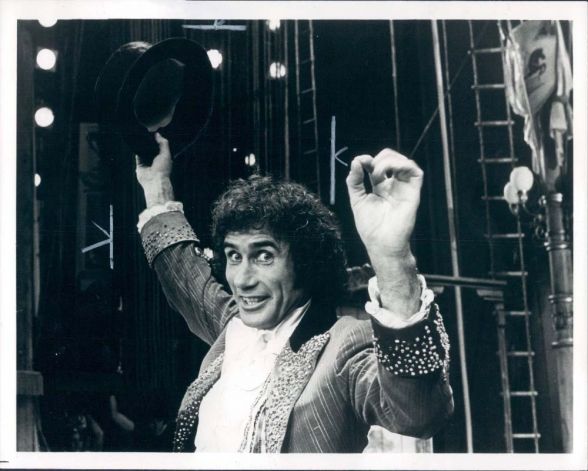
Below: A cleaned up look at the Flatiron Building, courtesy Shorpy. Click here for a look at the details!
Courtesy Shorpy
The Bowery Boys: New York City History podcast is brought to you …. by you!
Starting this month, we are doubling our number of episodes per month. Now you’ll hear a new Bowery Boys podcast every two weeks. We’re also looking to improve the show in other ways and expand in other ways as well — through publishing, social media, live events and other forms of media. But we can only do this with your help!
We are now a member of Patreon, a patronage platform where you can support your favorite content creators for as little as a $1 a month.
Please visitour page on Patreon and watch a short video of us recording the show and talking about our expansion plans. If you’d like to help out, there are five different pledge levels (and with clever names too — Mannahatta, New Amsterdam, Five Points, Gilded Age, Jazz Age and Empire State). Check them out and consider being a sponsor.
We greatly appreciate our listeners and readers and thank you for joining us on this journey so far. And the best is yet to come!
A dramatic illustration of 23rd Street and Fifth Avenue, where the Flatiron Building would soon stand. From here you can see the taller Cumberland building which would be used for billboards.
The structures that pre-dated the Flatiron Building, pictured here in 1897.
Courtesy Museum of City of New York
The smaller buildings have already been cleared away for the construction of the Fuller/Flatiron Building, but the taller building remains to some promotion of Heinz products.
Courtesy vintageimages.com
Construction of the Flatiron, picture from late 1901 or early 1902.
Courtesy Library of Congress
From every angle, the Flatiron takes on a new shape…..
Courtesy New York Public LIbrary
…inspiring artists like Edward Steichen to frame the building in romantic and even mysterious ways (such as his iconic shot from 1904)
A view, similar to the classic one above, of the Flatiron after a snowstorm in 1905
Courtesy New York Public Library
The Flatiron has inspired thousands of photo-mechanical post cards back in the day, highlighting its alluring shape-shifting form upon the changing New  York skyline.
Courtesy Museum of the City of New York
The cigar store in the narrow ‘cowcatcher’ served as a recruitment office during World War I, topped with military weaponry.
Courtesy Library of Congress
Another postcard focused on the Flatiron’s particularly windy properties!
American Mutoscope and Biography Co. filmed this humorous look at ladies in the wind on October 26, 1903:
A Max Ettlinger illustration from 1915 — Flatiron, you’re drunk!
Courtesy Museum of City of New York
A July 4th parade, passing up Fifth Avenue.
Courtesy Museum of the City of New York
The Flatiron in 1935, from an angle that makes it appear almost two dimensional.
CORRECTION: A small correction to this week’s show. The beautiful Madison Square Garden tower — with the nude Diana statue — is actually in a Spanish style, not an Italian style.
Memorial arches have been a dramatic way to honor military victories, dating back to the Roman times. Naturally, in a city with abundant Beaux-Arts classical-style architecture, New York has erected its share of grand archways. Two spectacular examples exist today — the Washington Square Arch and the Soldiers and Sailors and Sailors Memorial Arch in Brooklyn.
But the area which has been host to the most arches has been Madison Square Park. Sadly the only arches you can find near here are McDonalds Golden Arches on 23rd Street and Madison.
There are been four total arches here, all of them on Fifth Avenue near the park:
The George Washington Arches – 1889
Courtesy the Museum of the City of New York
Two arches celebrating the 100th anniversary of George Washington’s inauguration were on Fifth Avenue — one at 23rd Street at the southern side of the park, and another at 26th Street at the northern side.
These, of course, were accompanied by another arch further down Fifth Avenue at Washington Square Park. That arch, designed by Stanford White, was considerably better received than the Madison Square versions, so much so that White designed a permanent one in 1893.
Below: The 1889 arch up at the northern corner of Fifth Avenue and 26th Street
Courtesy the Museum of the City of New York
Courtesy Museum of the City of New York
The Dewey Arch – 1899-1900
This ornate and exceptionally lavish structure was built to commemorate a then-recent event — the victory of Admiral George Dewey at the Battle of Manila Bay, which took place on May 1, 1898.
The Dewey Arch was far showier than the earlier arches: “The great triumphal arch to be erected in this city in honor of the return of Admiral Dewey will not only be worthy of the occasion, but will be the most elaborate and artistic structure of its kind ever attempted here or in Europe.” [NYT]
Madison Square Garden, just on the other corner of the park, was closed to construct the statue. For Dewey’s triumphant arrival in New York in late September 1899, the entire city was lit up with ‘fairy lamps‘ to greet the procession. The fireworks display for the event would be the greatest the city has ever seen.
It seems, however, that the Dewey Arch was massively rushed, built in “hot haste“ according to reports. Although a great many petitioned for a permanent Dewey Arch in its place that winter, people had moved on by the winter of 1900 when it was unceremoniously torn down.
Courtesy Library of Congress
Courtesy of Museum of City of New York
Victory Arch — 1918-20
By 1918, the area around Madison Square Park was quite a transformed place with the Metropolitan Life Insurance Company Tower and the Flatiron Building now in attendance to witness the fourth arch, built to honor those in New York who had died thus far in the battles of World War I.
This arch was equally as ornate as the previous arch occupant, designed by Thomas Hastings (co-architect of the New York Public Library). It was built in wood and plaster and also, apparently, in haste.
Below: The ‘Altar of Jewels’Â glowing to signal victory
At the completion of the war, It was the focal point of a gigantic parade greeting arriving troops on March 25, 1919, a parade which turned quite rowdy. “The greatest crowd that ever gathered in New York City upon any occasion, and the most difficult to handle,” was how the New York Times described it. “The worst point of disorder was the district around the Victory Arch at Twenty-Third Street, where thousands and thousands fought among themselves or combined against the police in an effort to get a vantage point.” [source]
This arch was not spared either. It was soon villified as an icon of wasteful spending by no less than future mayor Fiorello LaGuardia. “The Altar of Liberty was renamed the “Altar of Extravagance,” the Victory Arch “Wasteful Arch,” and the Altar of Jewels — the “Arch of Folly.”
It was ripped down in the summer of 1920, although the damage to the park would last throughout the year. [source]