Categories
The Knick

Checked In: On the set of ‘The Knick’

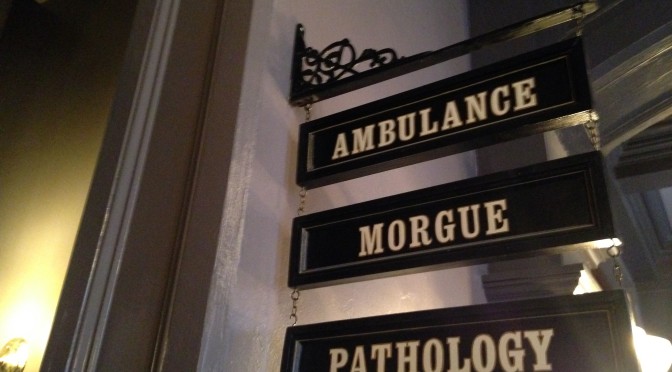
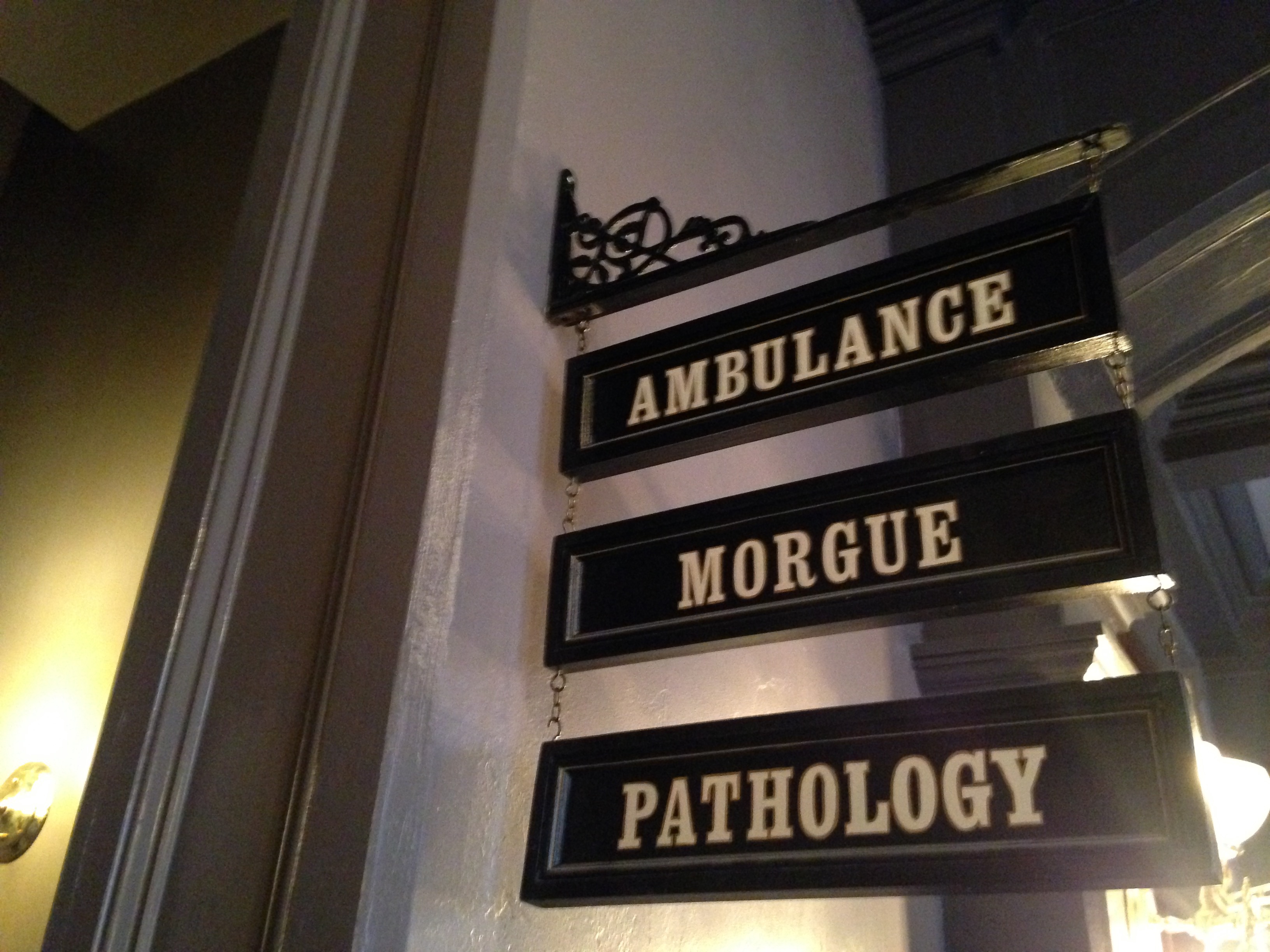
A couple weeks ago I was fortunate to be given a tour of the set of The Knick, the Cinemax’s historical drama set within the fictional Knickerbocker Hospital (which shares some traits with the actual Knickerbocker Hospital). Now, touring a TV or film set is pretty great in a normal situation. But touring a historical set is a bit like drifting through an old photograph.

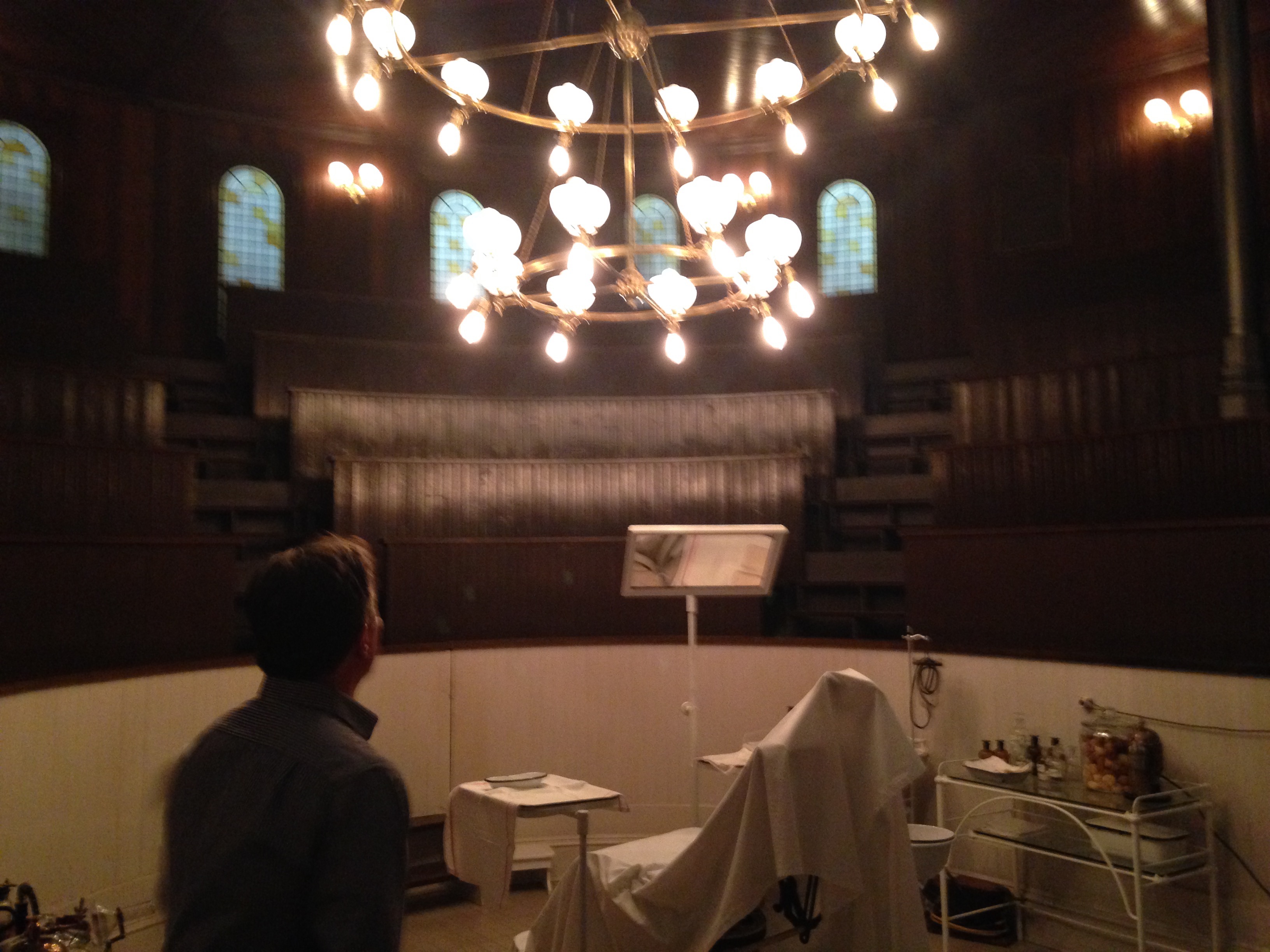
Below: Production designer Howard Cummings introduces us to the room where all the lovely, gory magic happens — the operating theater.

IMG_7492 IMG_7494

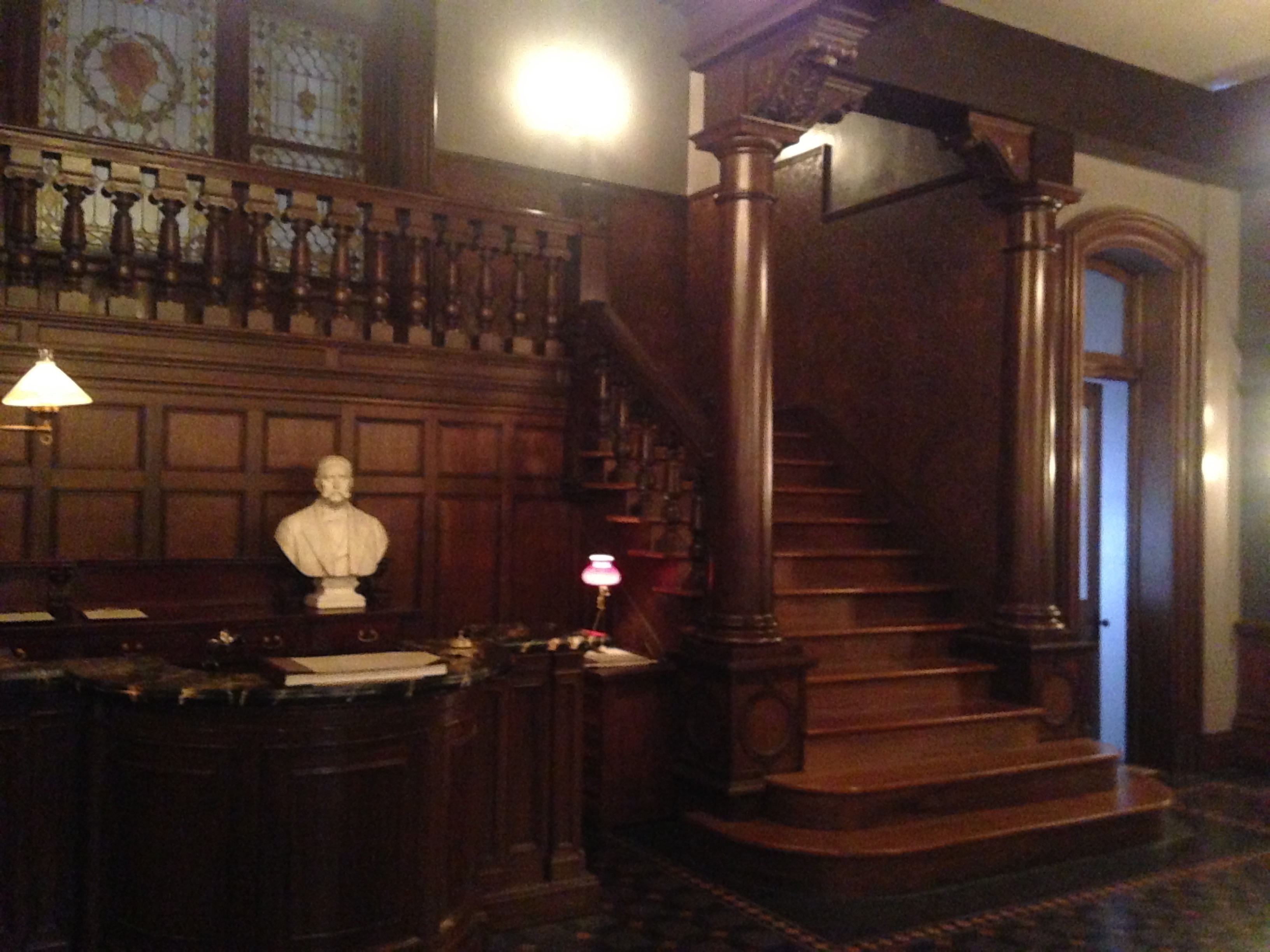
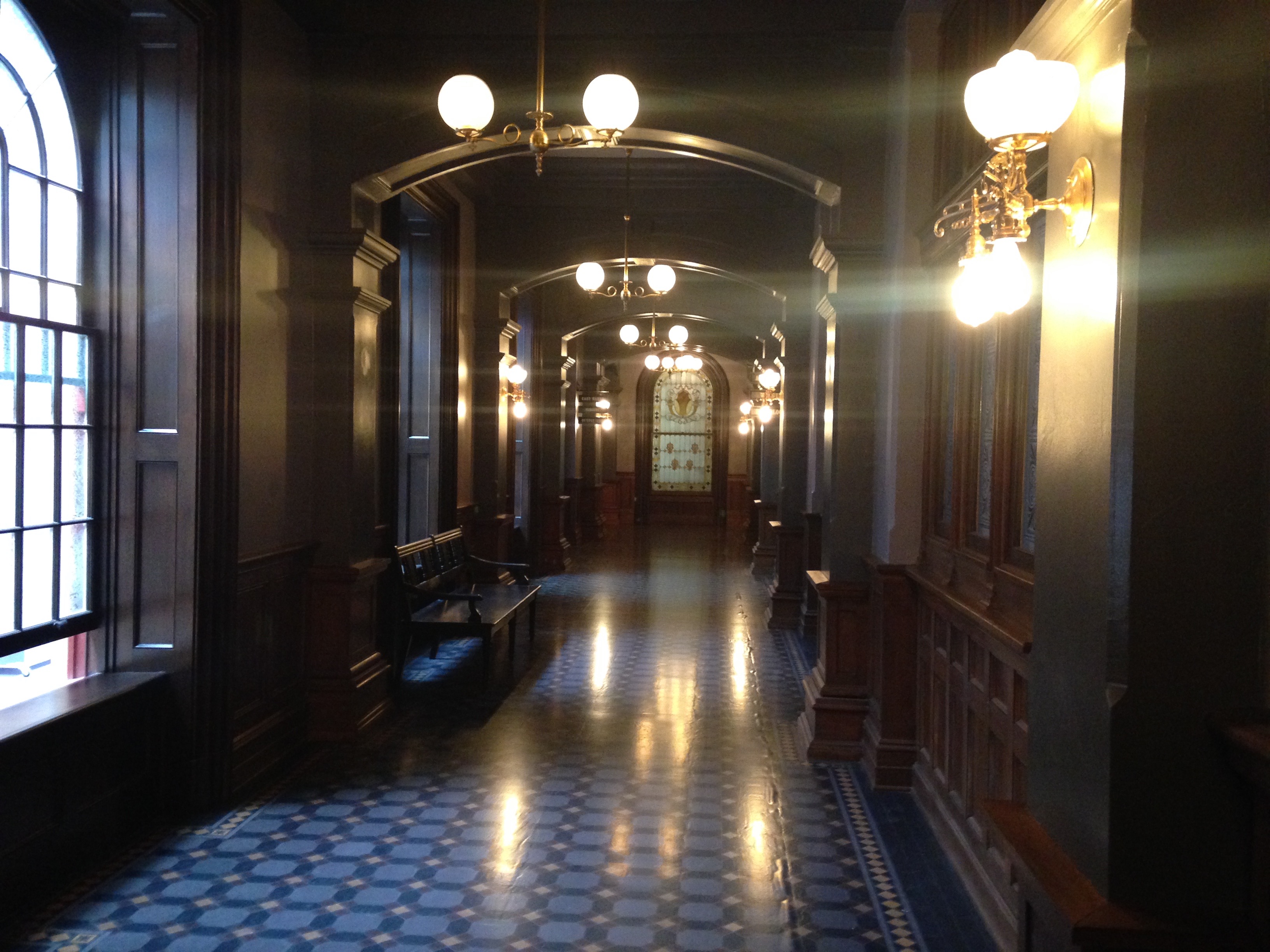
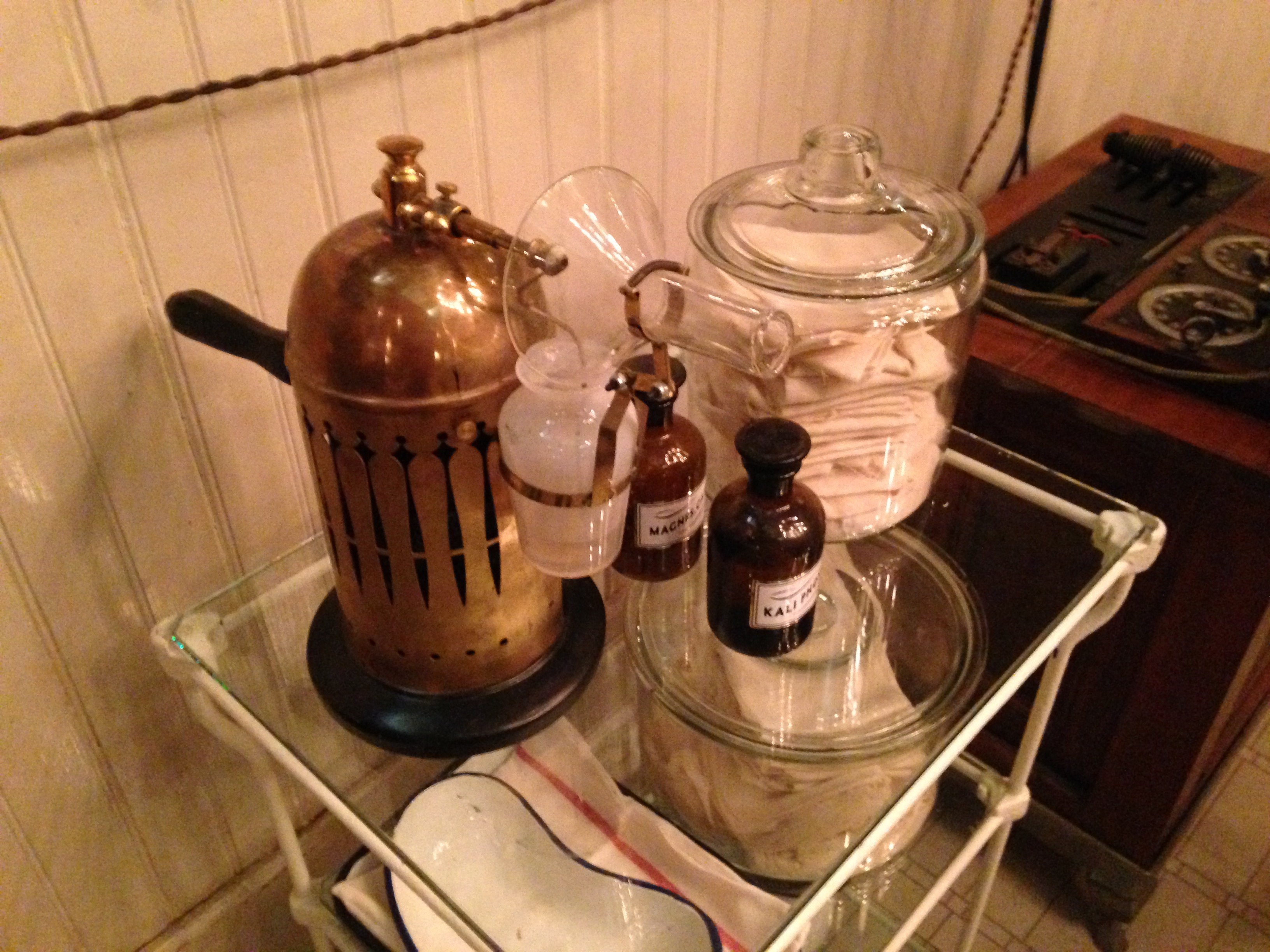
The first season of The Knick filmed a few scenes on Broome Street. (Tom took some pictures of that experience which we posted here.) And now I got my turn to wander through a bit of dreamlike historical recreation, passing through ornate hospital and laboratory sets.

A few impressions:

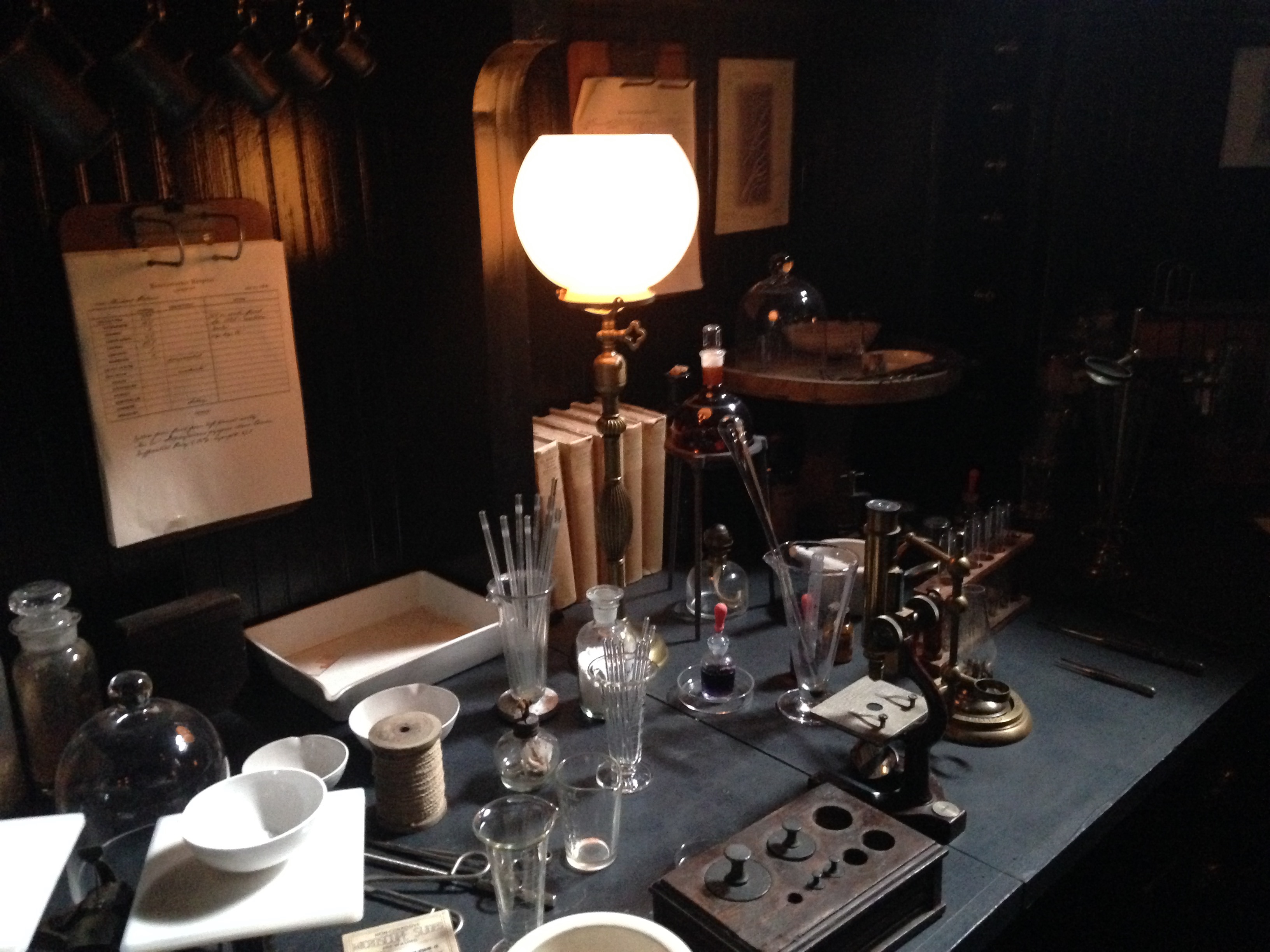
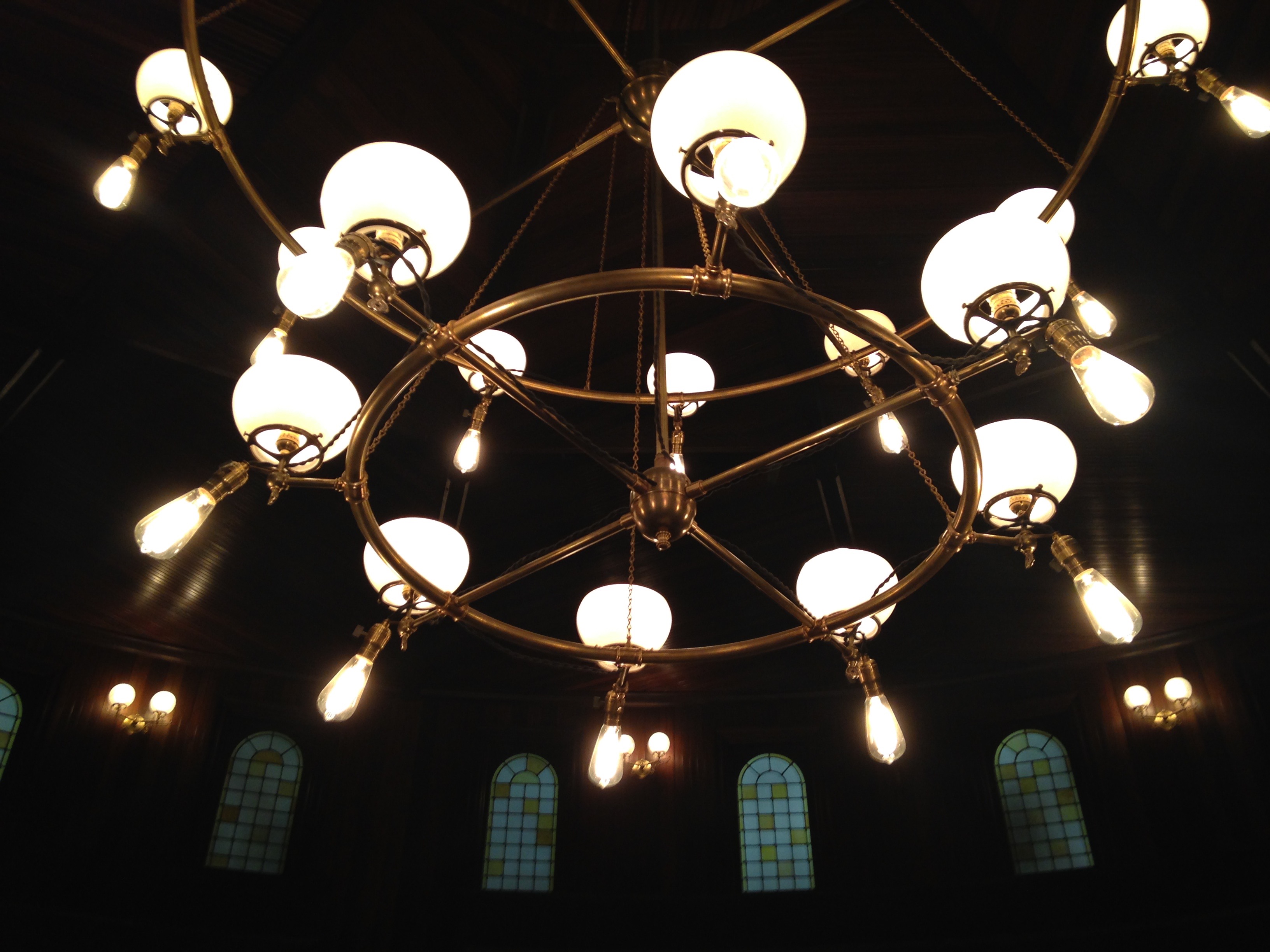
1) My pictures aren’t that good because, well, I’m not really a great photographer. But also because everything is lit with those Edison-style lightbulbs, creating a warm and sometimes ominous glow. The show films using only these light sources. I’m pretty sure I ate at a restaurant on the Bowery last week that had a similar lighting scheme.

IMG_7515 IMG_7518

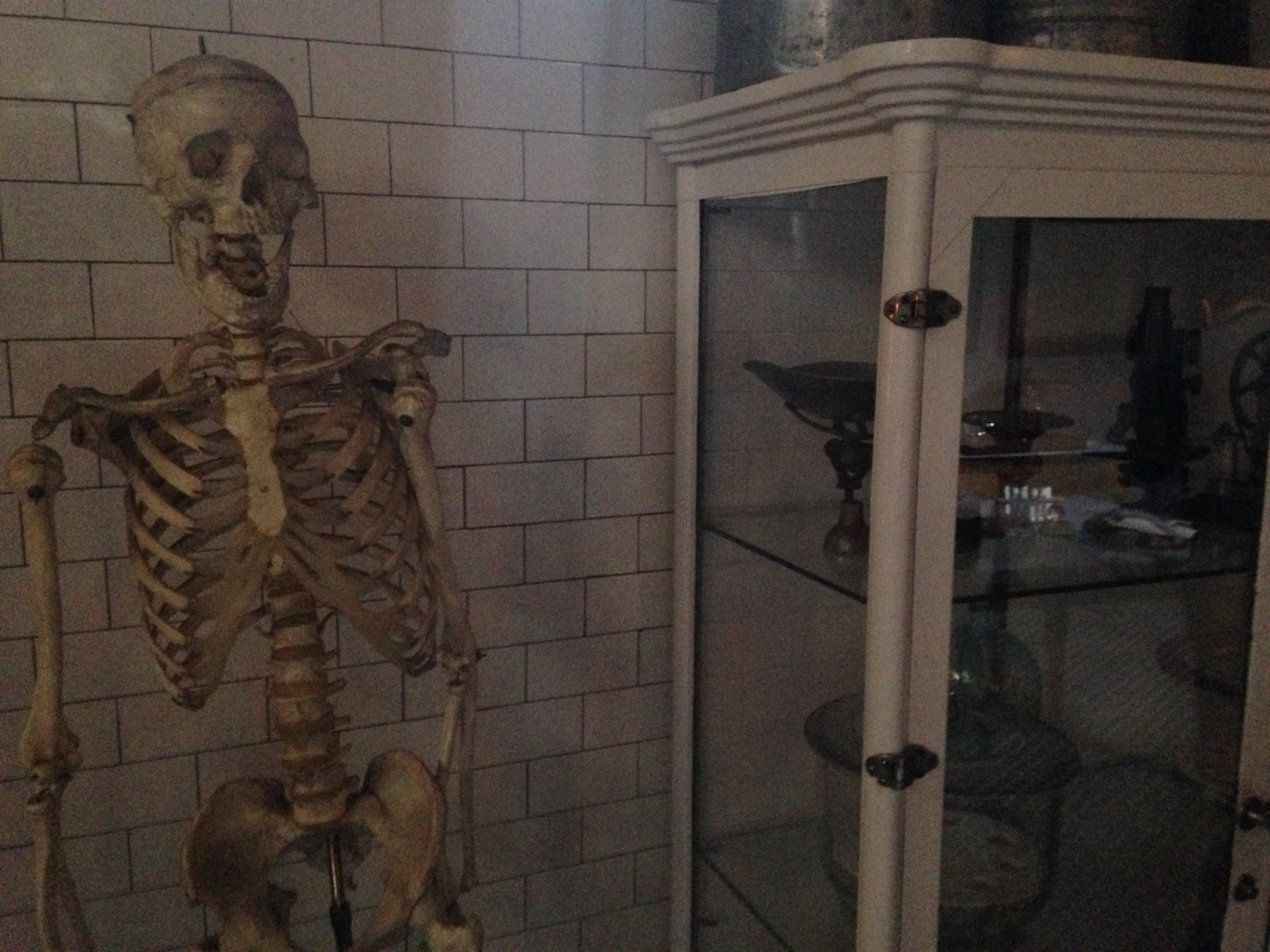
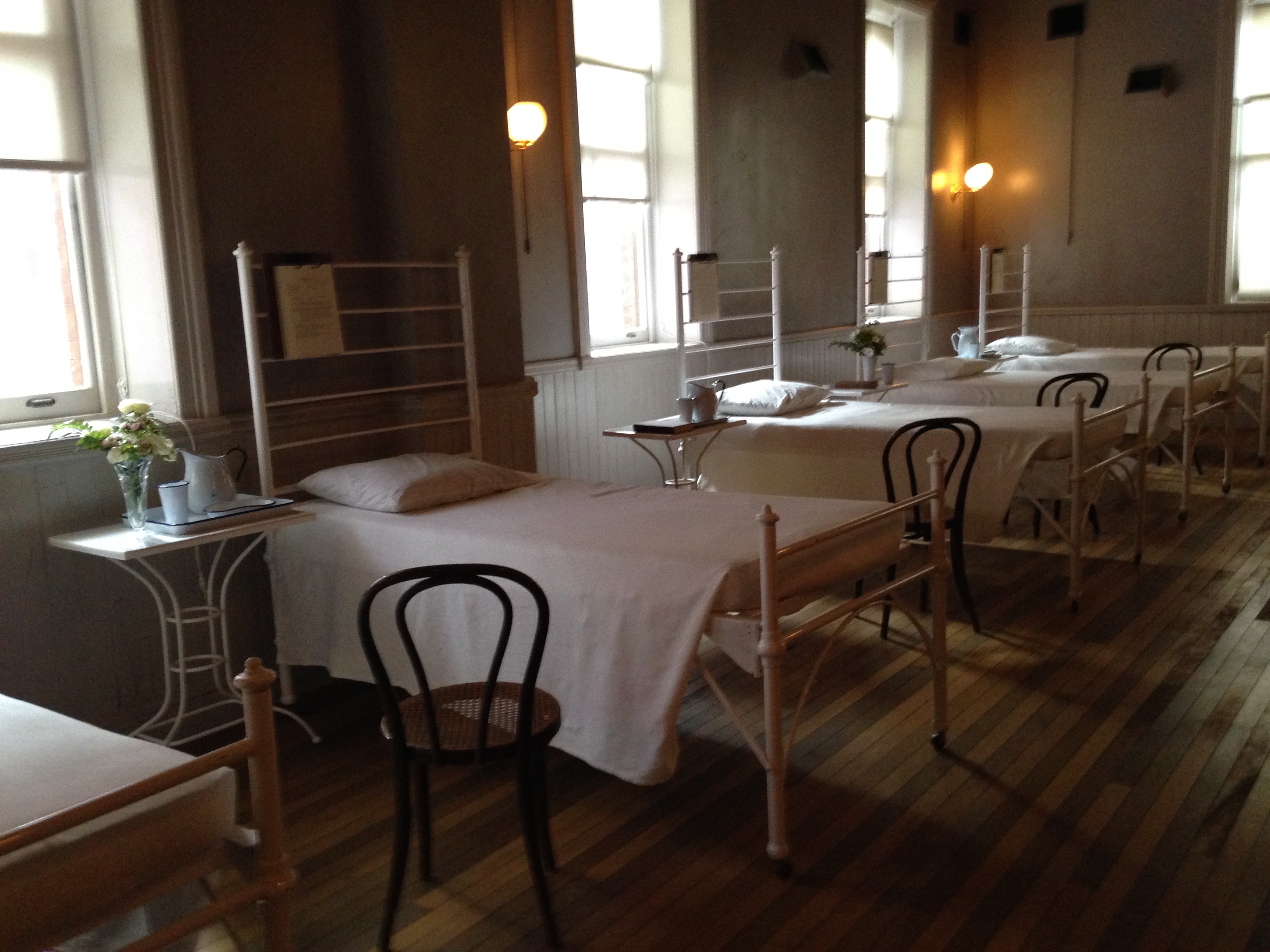
2) As there are no huge pieces of equipment following Steven Soderbergh with his camera around the sets, they’re designed with more realistic dimensions. The production designer Howard Cummings walked us through the labyrinth of darkened set pieces that at times felt like the cleanest haunted house in the world.  The various hospital rooms actually look like they could admit patients.  The notorious operating theater really felt like a small classroom.

IMG_7495 IMG_7496

3) I’m certain that Cinemax could turn the sets into a popular nightclub during the off-season. Since it films in Brooklyn, this might not be a bad investment idea.

IMG_7524 IMG_7526

4) The show’s medical adviser is Dr. Stanley Burns who has an almost frightful depth of knowledge and an amazing trove of materials from  which to draw inspiration.  Check out the Burns Archives (which has some digital assets available) to peer into the plot possibilities.

IMG_7501 IMG_7504


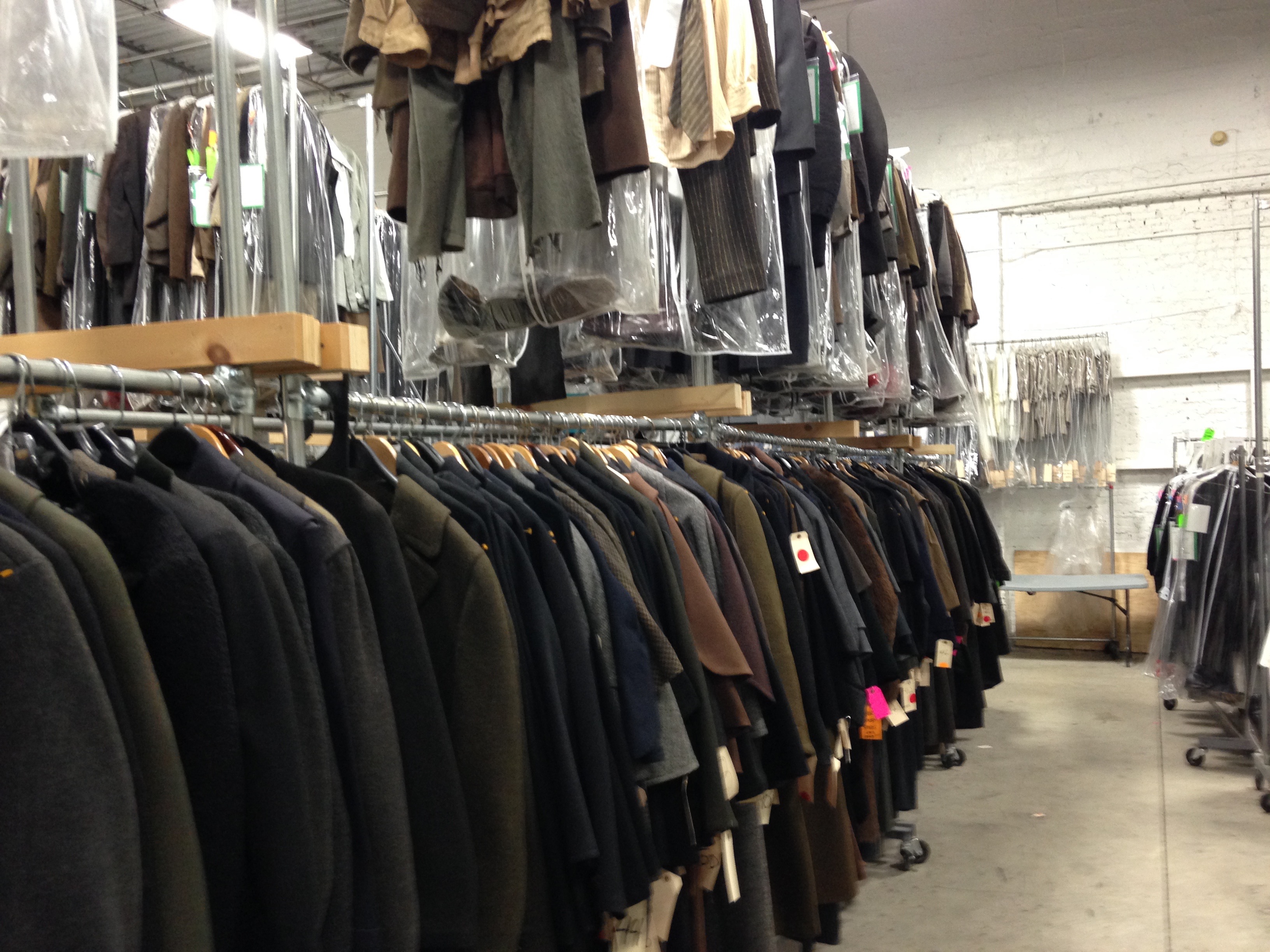
5) When the show returns, be sure to pay extra-special attention to the wardrobe. We met the costume designer Ellen Mirojnick who walked us through a literal warehouse of historical pieces. My first thought was that I want her to design all the outfits for my wedding one day. Her domain was like the world’s best thrift store, occupied only by garments from the Gilded Age. Corsets, boiler hats, ball gowns, medical robes. The show’s unsettling feel (transmitted through music, tone and set color schemes) is subtly interpreted through each character’s dress. Probably an obvious point to make, but again, startling to see in period costumes.

Below: Racks and racks of coats, suits and hats that could literally clothe thousands of hipsters.
IMG_7489


6) Finally I could have talked for hours to the writers who we met at the end of our tour – Jack Amiel, Michael Begler and Steven Katz. The show has a pretty high degree of difficulty (set in the past and in a hospital) so it was interesting to explore how they craft a plot around historical events and unusual medical practices.

And, no, I didn’t get to see Clive Owen, but I did get to see all of his hats!

The show returns to Cinemax later this fall. As usual I’ll be Tweeting along with the show during its initial broadcast, even through those portions of blood-soaked medical surgeries that make me feel like I’m going to vomit.

IMG_7499 IMG_7500


IMG_7520

IMG_7533

Categories
Sports

And now, the New York Female Giants: (Briefly) A League Of Their Own

For a very brief period — likely just a single year — there was a female counterpart to the New York (Male) Giants.

The New York Female Giants seem to have an unofficial affiliation with the better known Giants, the city’s most popular baseball team.  Author Michael Carlebach speculates the team was probably formed by Giants manager John McGraw.

2

Early women’s teams — called ‘Bloomer Girls’ — often had a few men playing alongside them.  Occasionally those men even disguised themselves as women as in a revealing case in the summer of 1913 in Washington DC: “Four thousand angry fans surged on the diamond in the old Union League baseball park this afternoon when they learned that the “Bloomer Girls,” who were playing against a team of young men, were not girls. The deception was suspected when the “girl” playing in centre field threw the ball from deep centre to the home plate.” [source]

(The All-American Girls Professional Baseball League, featured in the movie A League Of Their Own, would not be formed until the 1940s.)

The Female Giants don’t appear to be all women players either although there are no disguises at least. The men featured in these pictures played with the New York Giants.

The female players were mostly girls from local high schools and women athletes from other fields of sports.  Following her stint with the Female Giants, their captain Ida Schnall would head to Hollywood and become a silent film actress. She would later become an accomplished swimmer and an advocate for women’s sports, petitioning the National Olympics Committee to expand their offerings for women. Below: Ida in a glamorous pose

ida


They broke up into two teams — the ‘Red Stockings’ and the ‘Blue Stockings’– and played a notable exhibition game for almost 1,500 people on Sunday, May 25, 1913 at the Lenox Oval, a sports field at Lenox Avenue and 145th Street.

Below: A 1919 soccer game being played at the Lenox Oval

Courtesy Museum of the City of New York

It seems their typical game schedule went unnoticed by the press which is probably a good thing. That May 25th game was written about by the New York Tribune in the following fashion : “The batter hitched up her skirt.  The pitcher nervously adjusted a side comb. Girls will be boys, and the Reds and the Blues of the New York Female Giants were playing an exhibition game at Lenox Oval, 145th Street and Lenox Avenue.” [source]

Below: A catcher from the New York Giants, playing alongside a diminutive young player

3

We know about this particular game because it got shut down by the cops.  In the ninth inning, a detective stepped out onto the field and handed the third baseman — a 17 year old teenager named Helen Zenker – a subpoena to appear in Harlem court.

Due to New York ‘blue laws’, teams were not supposed to legally sell tickets to a baseball game on Sundays. While the women were indeed playing a practice game, Helen had been caught selling programs. She claimed that no such sales activity had taken place; people were just giving her money, including the detective. [More details in this amusing New York Times article from 1913.]

Fortunately, the young Zenker (“seventeen, pretty, active, intelligent, and has the easy gait and springy step of the athlete”) easily charmed the judge, and the case was dismissed. [source]

The photos in this post obviously take place on another date as they’re wearing uniforms which they were not allowed to do on a Sunday.

4


5


EDIT: After going live, I later included the line about the All-American Girls Professional Baseball League and also to clarify that the team also featured adult women playing along with high schoolers. For instance, Ida Schnall, who went on to greater athletic fame, was 24 or 25 at the time of the game described above.
Categories
Bowery Boys Bookshelf

‘Spectacle’: The Story of Ota Benga

In 1906, visitors to the Bronx Zoo observed a rather bizarre sight in the Monkey House — the exhibition of a man in African dress, often accompanied by a parrot or an orangutan.


An African pygmy, so read the sign, “Age, 23, Height, 4 feet 11 inches, Weight 103 pounds, Brought from the Kasai River, Congo Free State, South Central Africa.” Displayed in one of America’s foremost institutions devoted to the display and care of exotic animals. Elephants, tigers, polar bears, snow leopards, bison. And one young man named Ota Benga.
2

He is the subject of Pamela Newkirk’s engaging new book Spectacle: The Astonishing Life of Ota Benga, both a sincere ode to his tragic life and a contemporary accusation of the terrible forces that exploited him over a century ago.

But the story is really about the ghost of Ota Benga.

He spoke little English and there are no accounts from his perspective. Almost everything we know is from the perspective of a jaundiced press and the glare of condescending authority. He was the subject of great fabrications over the years; the truth is almost impossible to extricate from hyperbole.

While his story is front and center in Spectacle, but he barely raises his voice. He never had one.

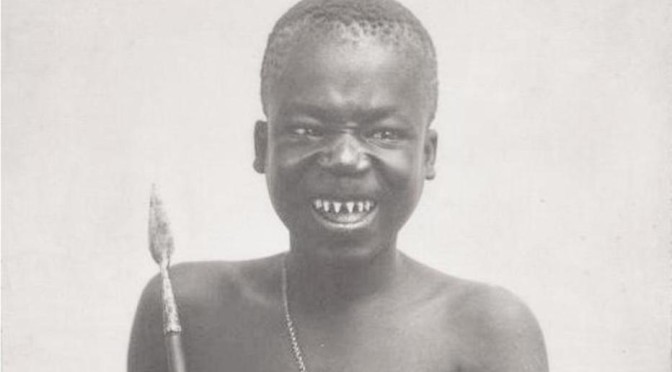
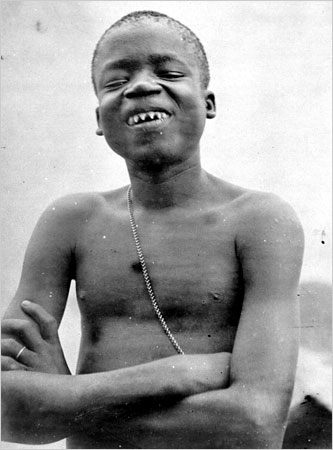
1906 photograph of Ota Benga, described as being taken at Bronx Zoo. (Wikimedia) Title: Ota Bengi     Creator(s): Bain News Service, publisher     Date Created/Published: [no date recorded on caption card]     Medium: 1 negative : glass ; 5 x 7 in. or smaller.     Reproduction Number: LC-DIG-ggbain-22741 (digital file from original negative)     Rights Advisory: No known restrictions on publication.     Call Number: LC-B2- 3971-2 [P&P]     Repository: Library of Congress Prints and Photographs Division Washington, D.C. 20540 USA http://hdl.loc.gov/loc.pnp/pp.print     Notes:         Title from unverified data provided by the Bain News Service on the negatives or caption cards.         Forms part of: George Grantham Bain Collection (Library of Congress).         General information about the Bain Collection is available at http://hdl.loc.gov/loc.pnp/pp.ggbain     Format:         Glass negatives.     Collections:         Bain Collection     Bookmark This Record:        http://www.loc.gov/pictures/item/ggb2005022751/
1906 photograph of Ota Benga, described as being taken at Bronx Zoo. (Wikimedia)
Creator(s): Bain News Service, publisher 
Ota Benga is probably not even his real name. And even then, it’s twisted and distorted mercilessly, sometimes by the man himself. (When he died in 1916, he was known as Ota Bingo.)  In 1904 he was rescued from captivity in the Congo by the explorer and would-be scientist Samuel Phillips Verner.

This is probably true although Verner is an unreliable source, often changing his own biography to burnish his reputation in the science community.  Verner was the product of his age, seeing Africans as inferior beings but seeing their continent as a source of revenue. Verner sought to profit handsomely from his ‘explorations’ both by currying favor with the Belgian King Leopold II (the ruthless leader who exploited the people of the Congo) and by snatching human specimens for display in America.

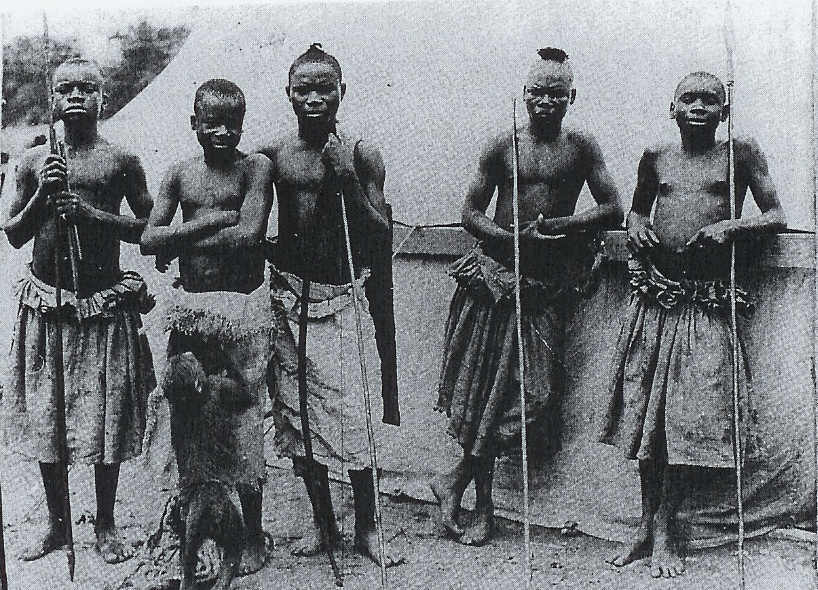
Ota Benga first arrived with a group of other men and boys for an exhibition at the 1904 St. Louis World’s Fair.  People delighted at his mischievous nature and unusual appearance. His teeth were filed into points, a decorative trait that exhibitors (including Verner) proclaimed were the product of a cannibalistic nature.

Below: Ota Benga at the St. Louis World’s Fair with other men taken from Africa 

1

He went back with Verner to Africa only to arrive back in America by 1906 where he was placed in the care of the American Museum of Natural History. Ota Benga actually lived inside the museum, subject to more than a few indignities. “I have bought a duck suit for the Pigmy,” wrote Hermon Carey Bumpus, the director of the museum, to Verner. “He is around the museum, apparently perfectly happy and more or less a favorite of the men.”

Ota Benga’s removal to the Bronx Zoo and subsequent display in the Monkey House has certainly been a blight to that institution’s history. The decision reveals the outmoded and racist philosophies that pervaded scientific thinking of the day.

At best, Ota Benga was simply an object in an exotic diorama with audiences prodding him to do tricks. His humanity was barely considered. At worst, the exhibition lays bare the racism of the day in the most baldy sinister way possible, corroding even the most esteemed institutions of the day.

It’s a small relief to hear of the many criticisms the zoo received in the press back in 1906. Sanity soon prevailed and Ota Benga left the zoo to live in an orphanage in Weeksville, Brooklyn.

2Newkirk gives the life of Ota Benga a proper eulogy. She crafts an intriguing tale around the many uncertainties of his biography, sometimes even stopping to analyze his state of mind.  I greatly credit the author for parsing through volumes of inaccurate news reports in search of even the smallest grains of truth.

His story ends with an unsatisfying hollowness, outside New York and far from the Congo. Few in his life ever treated him as an equal. In fact, due to his size, he was frequently treated like a boy, although he mostly like ended his life in his early 30s.  He never found a place to fit in.

There’s only a single moment in the book where Newkirk lets us in on his marvelous potential, on a life that could have been under more fair and enlightened circumstances.

He becomes, for a moment, “a father figure and hero” to a group of small African-American boys in Lynchburg, Virginia.  “In Benga they found an open and patient teacher, a beloved companion, and a remarkably agile athlete who sprinted and leaped over logs like a boy. And with his young companions Benga could uninhibitedly relive memories of a lost and longed-for life and retreat to woods that recalled home.”

Spectacle: The Astonishing Life of Ota Benga

Amistad, HarperCollinsPublishers

by Pamela Newkirk


Other recently reviewed books on the Bowery Boys Bookshelf:

Categories
Neighborhoods Podcasts

The Grand Tale of Orchard Street and Life on the Lower East Side

PODCAST The Lower East Side is one of the most important neighborhoods in America with a rich history as dense as its former living quarters. Thousands of immigrants experienced American life on these many crowded streets. In this podcast, we look at this extraordinary cultural phenomenon through the lens of one of those — Orchard Street.

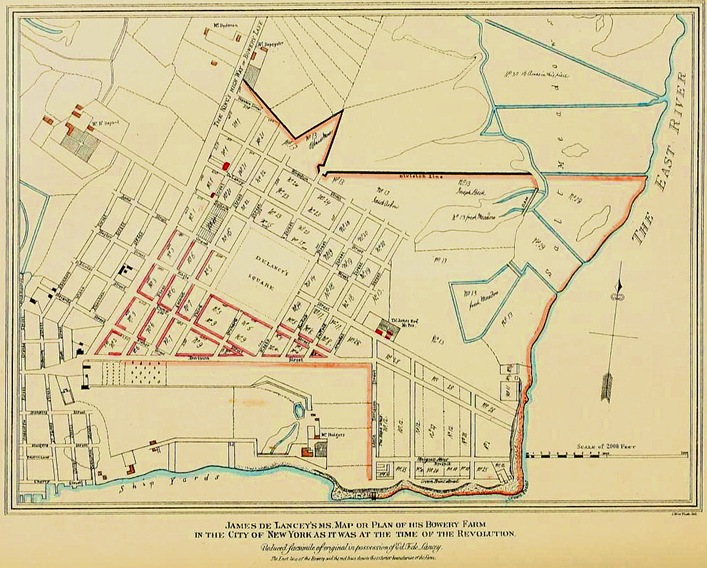
Its name traces itself to a literal orchard, owned by James De Lancey, a wealthy landowner and Loyalist during the Revolutionary War. By the 1840s the former orchard and farm was divided up into lots, and a brand new form of housing — the tenement — served new Irish and German communities who had just arrived in the United States.

A few decades later those residents were replaced by Russian and Eastern European newcomers, brought to the neighborhood due to its affordability and its established Jewish character.

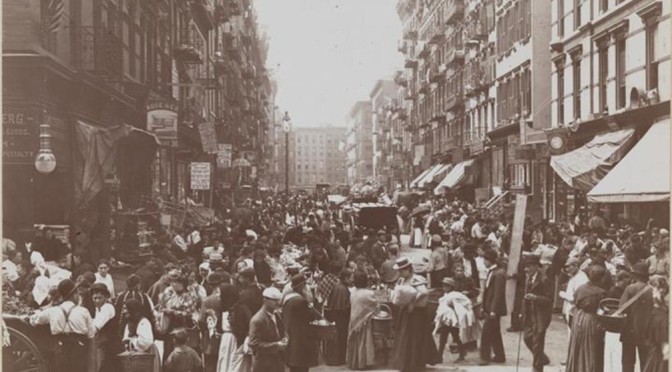
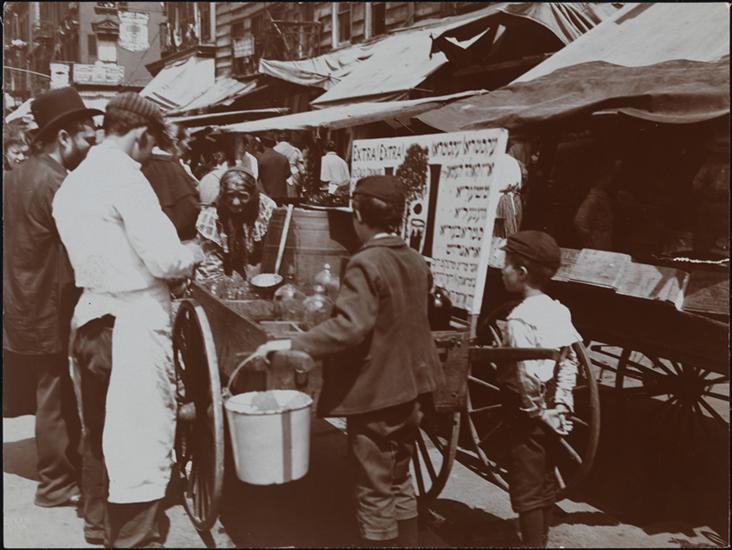
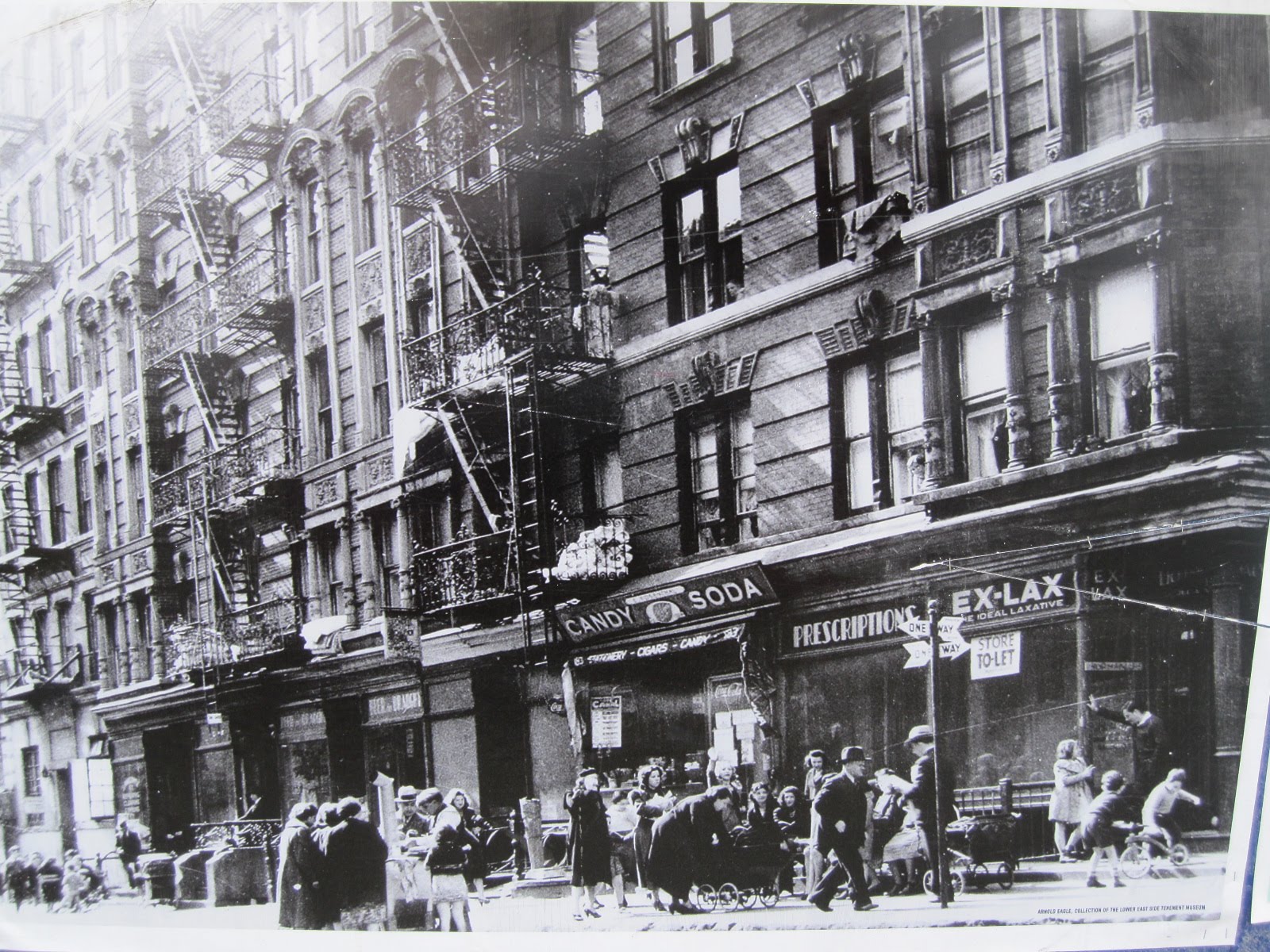
Living conditions were poor and most tenement apartment doubled as workspaces. Meanwhile, in the streets, tight conditions required a unique retail solution — the push cart, a form of independent enterprise that has given us some businesses that still thrive on Orchard Street today.

You can see this century-old life along Orchard Street today, if you know where to look. Luckily that’s what we’re here for! With some help from Adam Steinberg at the Tenement Museum, where the best place to interact with a preserved view of the old days.


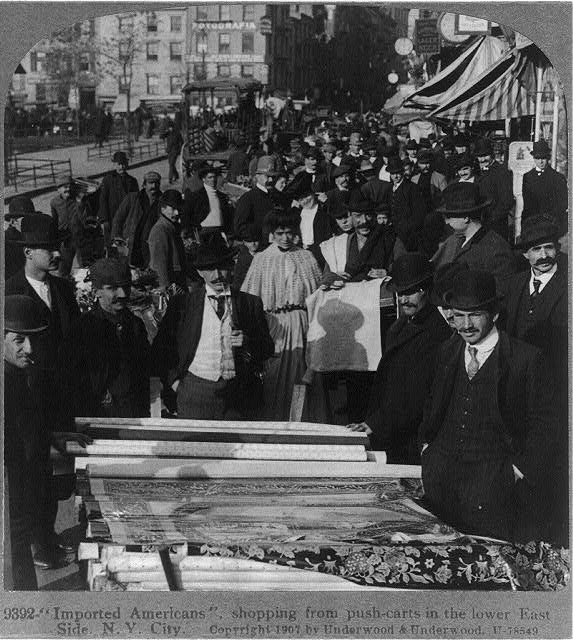
Below: “Imported Americans” — from a photo card, courtesy Library of Congress

imported

The Bowery Boys: New York City History podcast is brought to you …. by you!

Starting this month, we are doubling our number of episodes per month. Now you’ll hear a new Bowery Boys podcast every two weeks. We’re also looking to improve the show in other ways and expand in other ways as well — through publishing, social media, live events and other forms of media. But we can only do this with your help!

We are now a member of Patreon, a patronage platform where you can support your favorite content creators for as little as a $1 a month.

Please visit our page on Patreon and watch a short video of us recording the show and talking about our expansion plans. If you’d like to help out, there are five different pledge levels (and with clever names too — Mannahatta, New Amsterdam, Five Points, Gilded Age, Jazz Age and Empire State). Check them out and consider being a sponsor.

We greatly appreciate our listeners and readers and thank you for joining us on this journey so far. And the best is yet to come!


A look at the property of James De Lancey and his sophisticated plans to turn his farm into a wealthy neighborhood, probably in the spirit of St. John’s Park. The blog Manhattan Unlocked goes really deep into the story of De Lancey’s land holdings here.

1

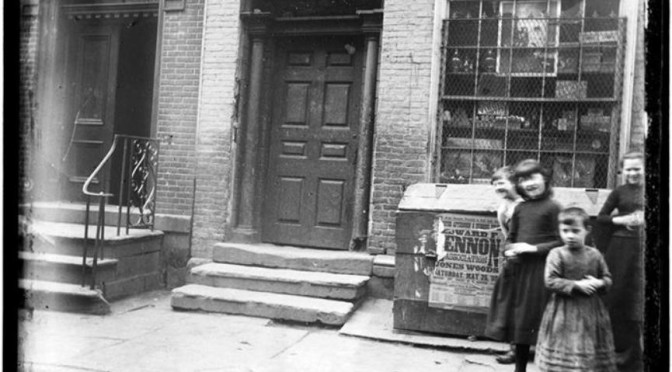
I’m not sure where this picture was taken but it illustrates a cluster of buildings constructed before the advent of tenement construction.

11

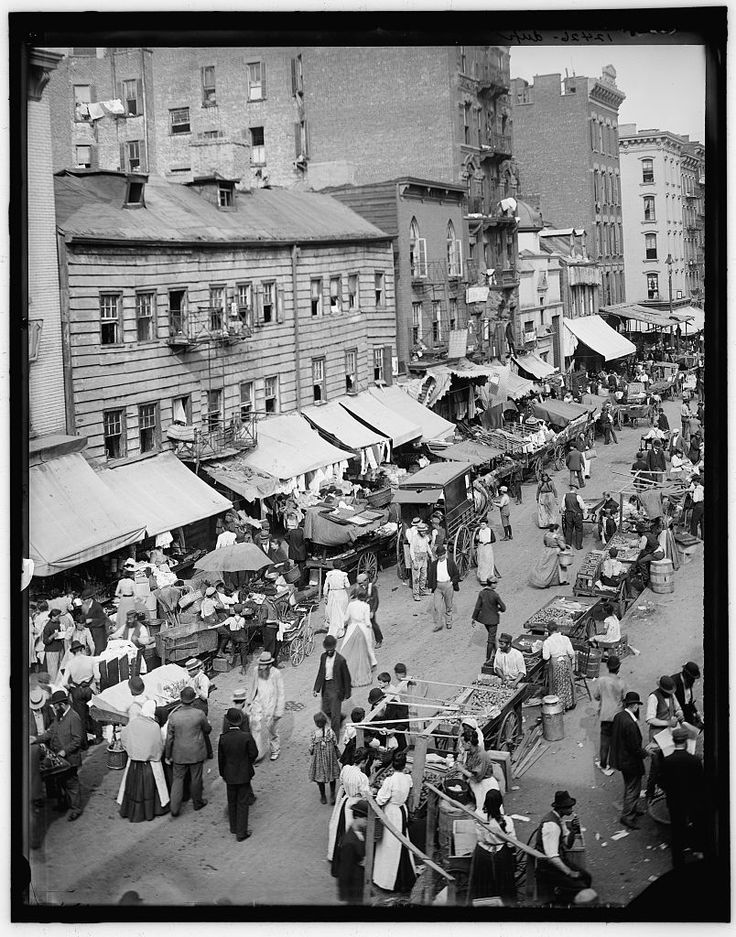
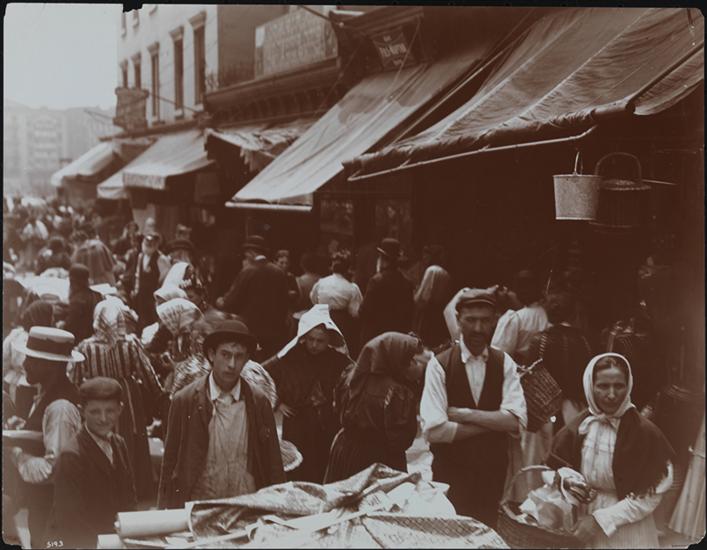
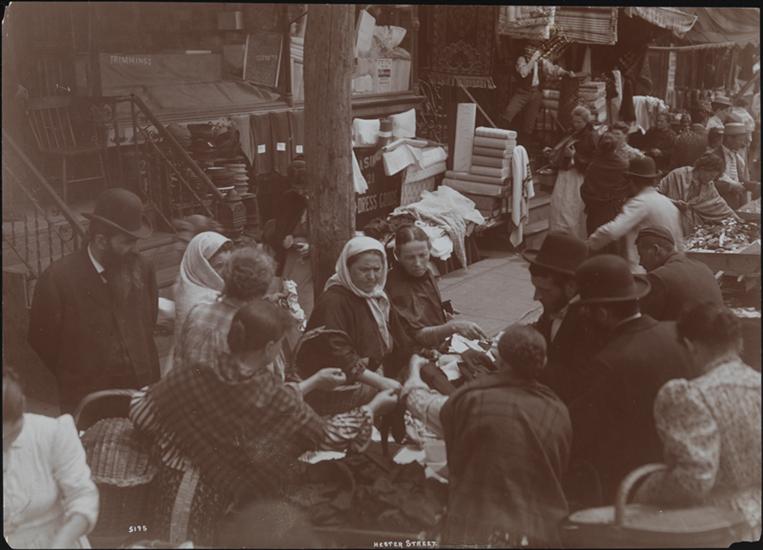
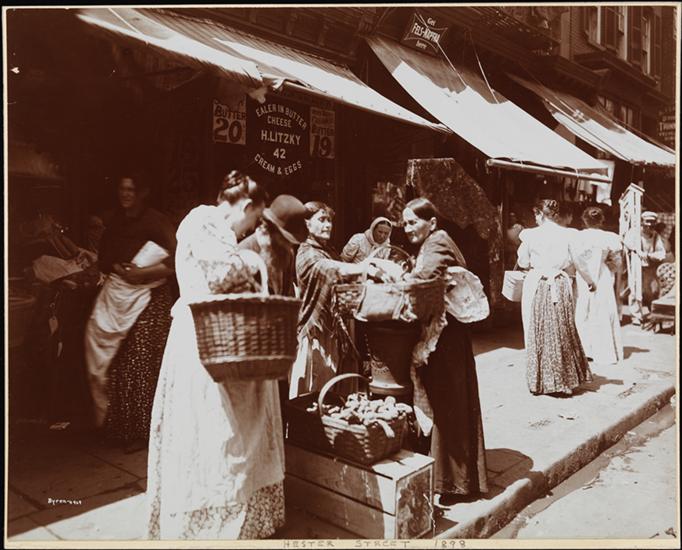
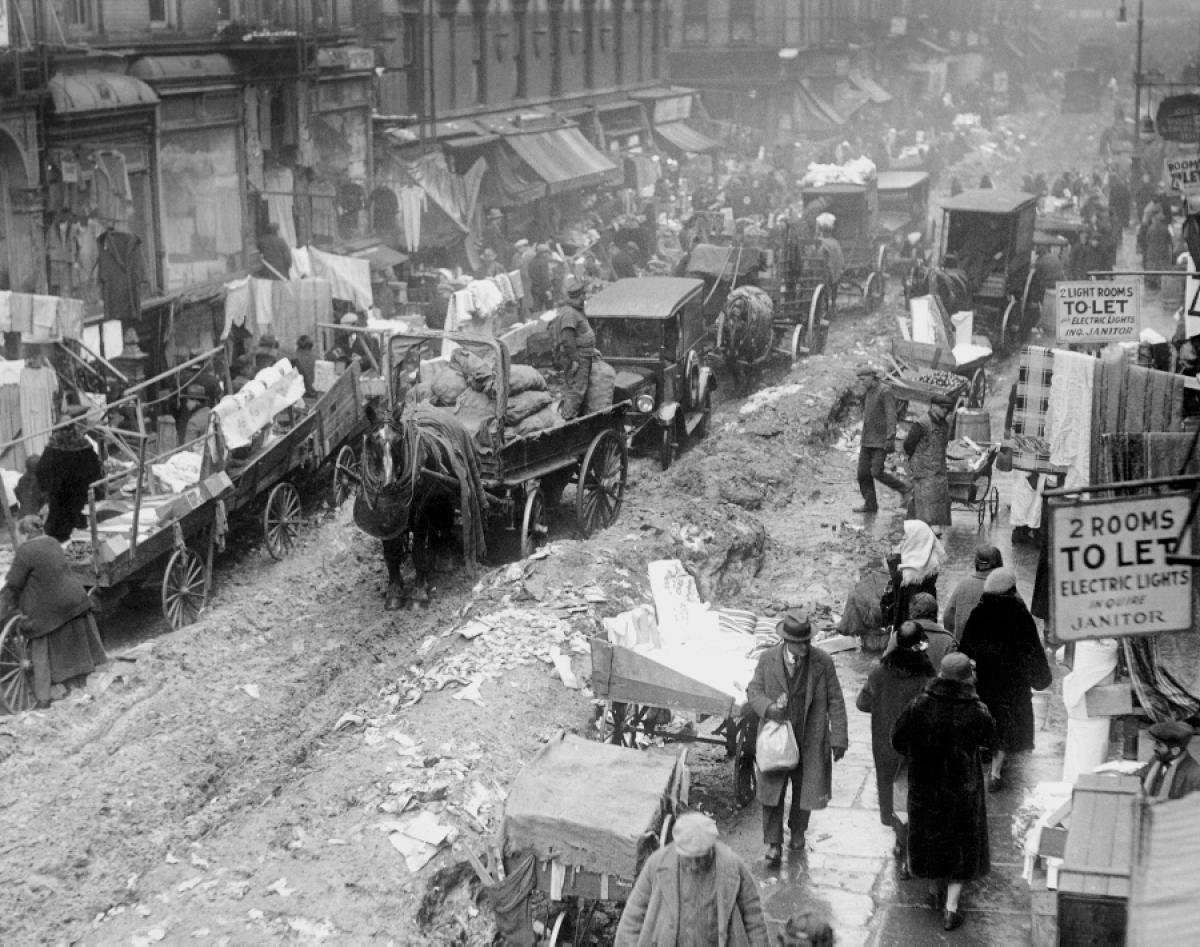
Here’s a selection of photographs from the archives of the Museum of the City of New York, illustrating the clogged streets of Orchard and Hester Streets, busy with the commerce of the day. All of these are from 1898.

1
2
3
5

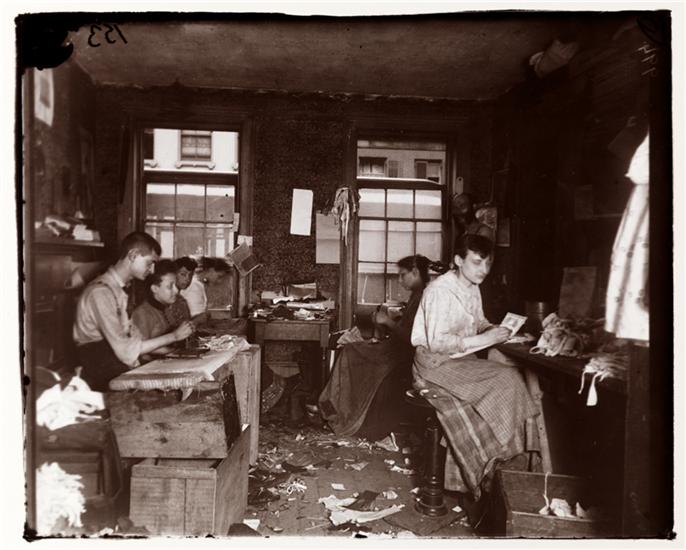
The home sweatshops, cramming an industry and several people into the parlor of a tenement building. Here’s a necktie ‘factory’ on Division Street in 1890.

Courtesy the Museum of the City of New York

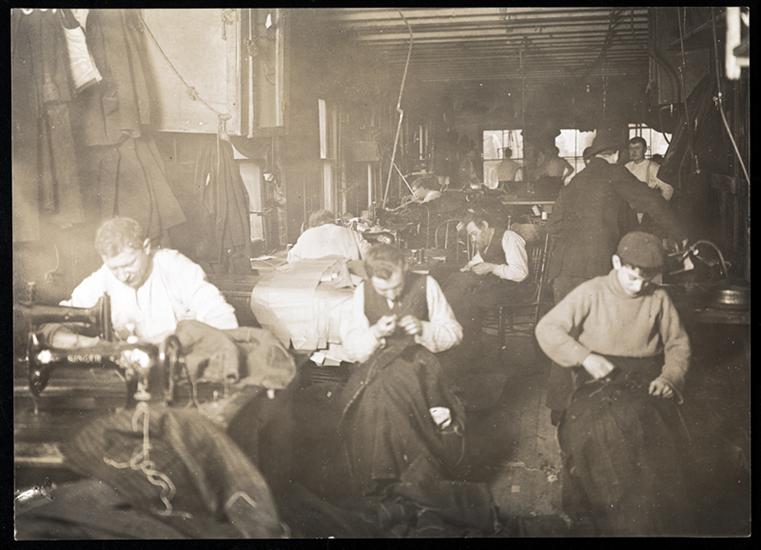
And another from 1911. Child labor in full view!

MNY8435

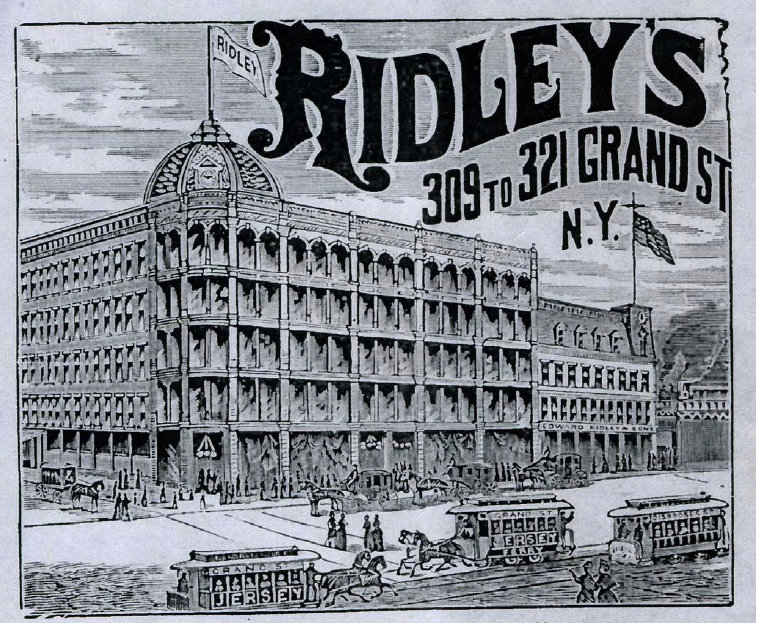
Ridley’s Department Store on the corner of Grand and Orchard Streets. They’ve really cleaned up the streets in this advertisement, haven’t they?

Courtesy the Tenement Museum

Here’s what all that mess on Orchard Street looks like in the winter! Pictured here in 1926.

Courtesy New York Daily News

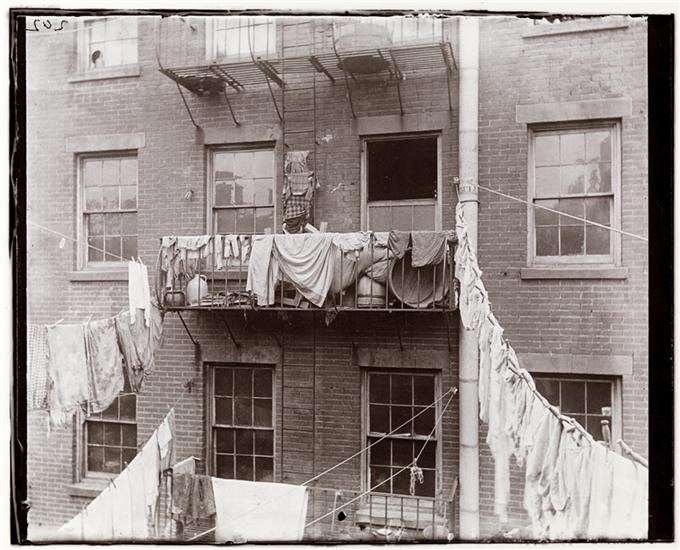
An Allen Street tenement fire escape from 1890, obviously used for more purposes than emergencies! [source]

Courtesy Museum of City of New York

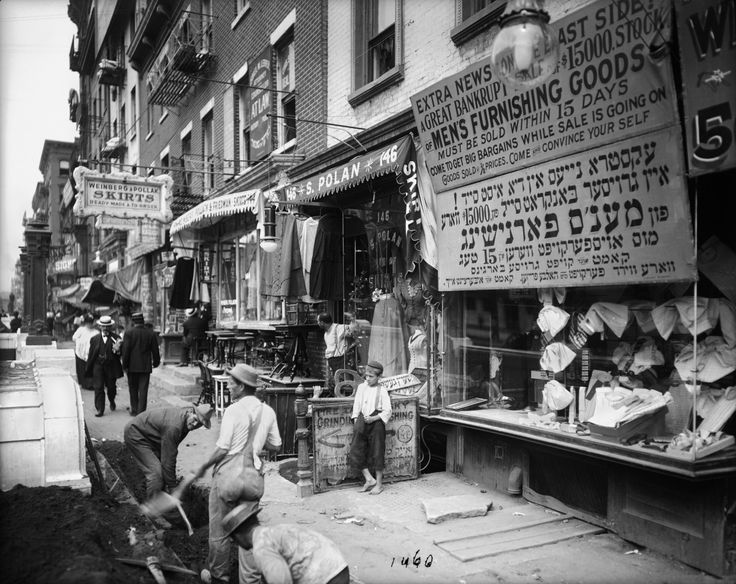
This photo was taken in 1908 (or somewhere around that date) showing a bit of the expansion of Delancey Street. Workers labor in the street while a Jewish boy looks on. (Department of Records)

12

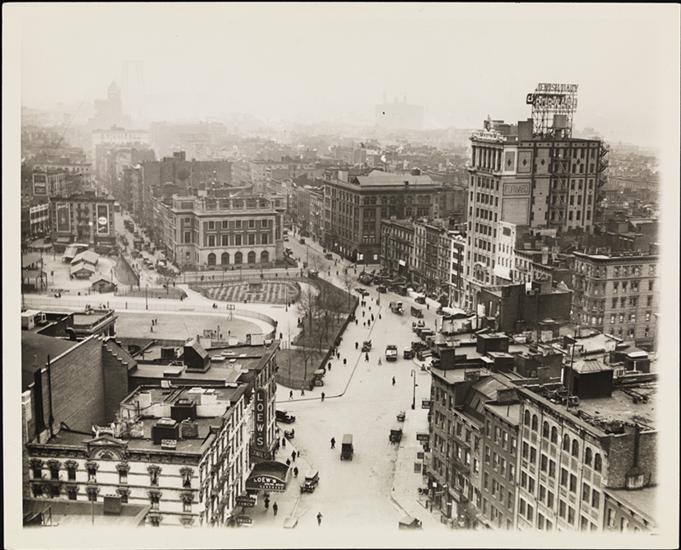
An overhead view of the intersection of East Broadway, Essex Street, Division Street and Canal Street, showing Seward Park and the library, both built to provide air and education to the Lower East Side. Photo is from 1928. [source]

9

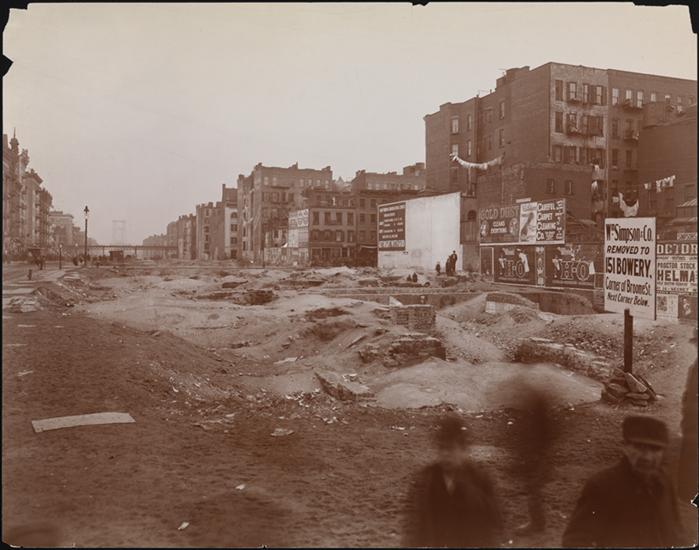
An extraordinary view of Delancey Street in 1904 during the widening process for access to the Wililamsburg Bridge.

Courtesy Museum of the City of New York

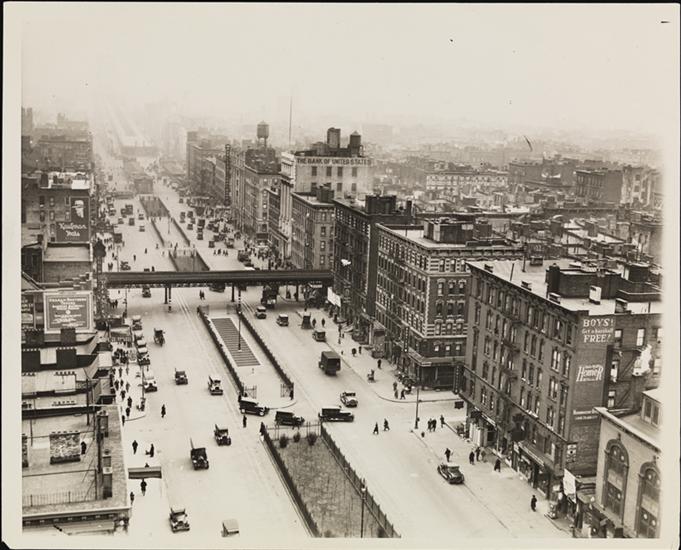
And here’s what Delancey looked like in 1928. This is from the top of a hotel from Delancey and Chrystie. You can see the elevated train that went down Allen Street. Orchard Street is the next block in the distance. Allen Street too was subject to expansion. And see the building labeled Bank of the United States? Here’s a little bit more about its fascinating history.

delancey

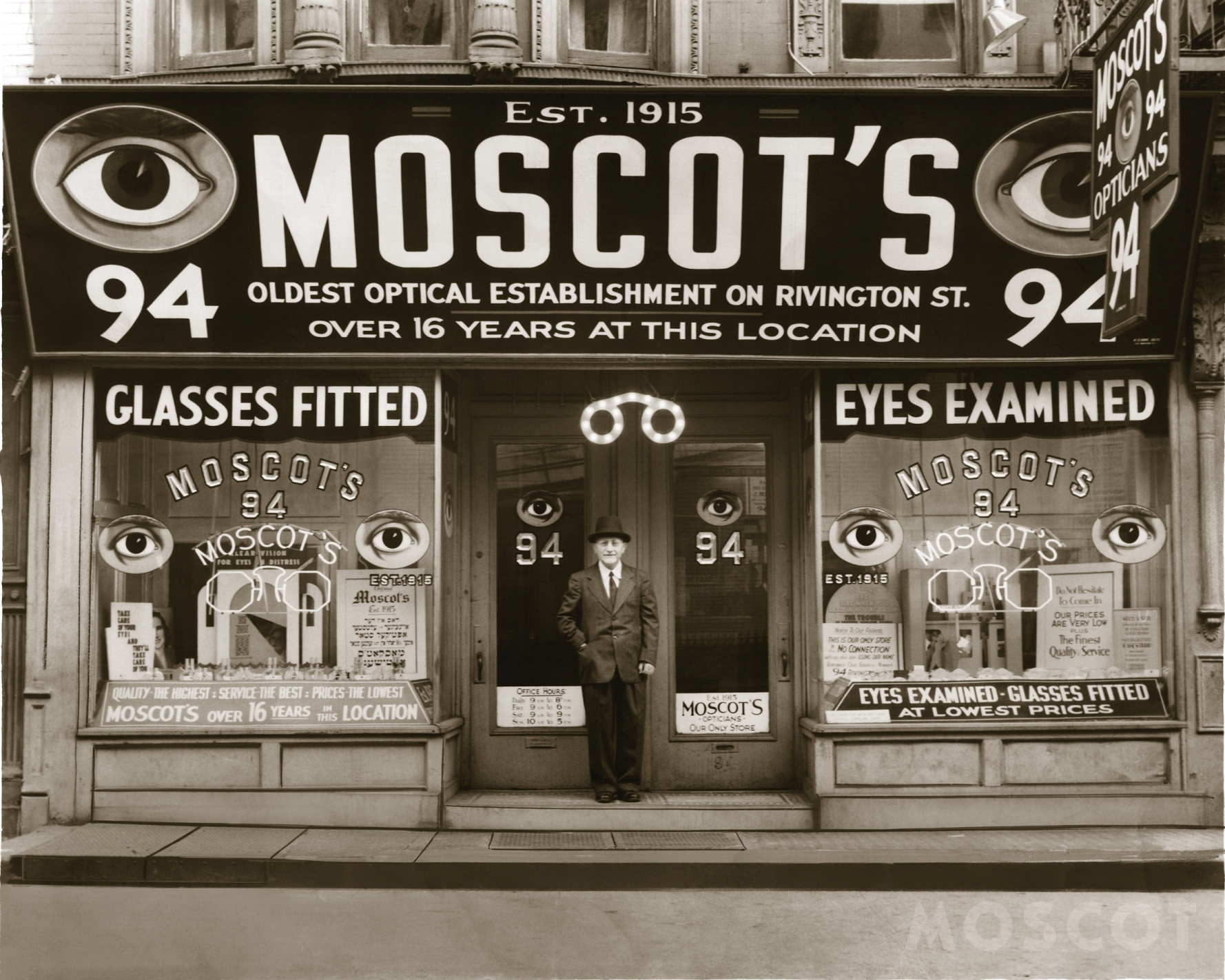
Hyman Moscot stands outside of his shop at 94 Rivington Street sometime in 1934. He began his business selling eyeglasses out of a pushcart.

Courtesy Sol Moscot
Courtesy Sol Moscot

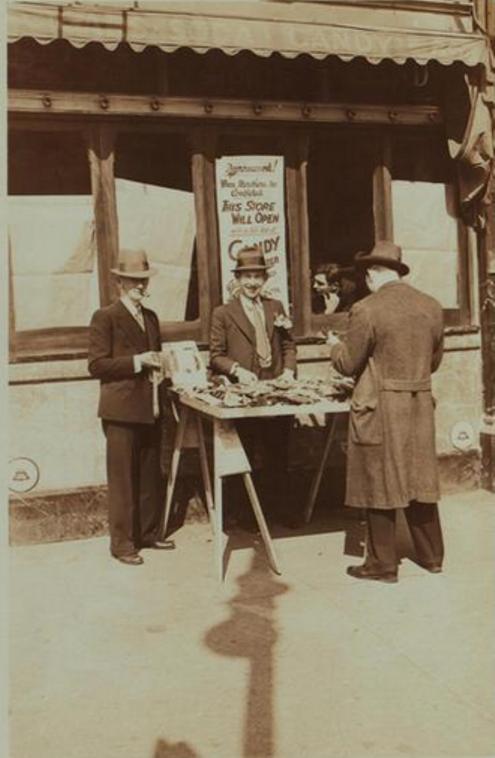
A men’s tie peddler has some success selling his ties on the street corner at Orchard Street and Delancey. Courtesy New York Public Library. Click here for more historic views of this corner.

Courtesy New York Public Library

The Lower East Side in the 1930s — less crowded in the streets with very active storefronts.

Courtesy Trace Work
Courtesy Trace Work


Jarmulowsky’s Bank at Orchard and Canal. The perch at top is no longer on the building. It was originally built there because Sender Jarmulowsky wanted to have the tallest building in the Lower East Side.

bank

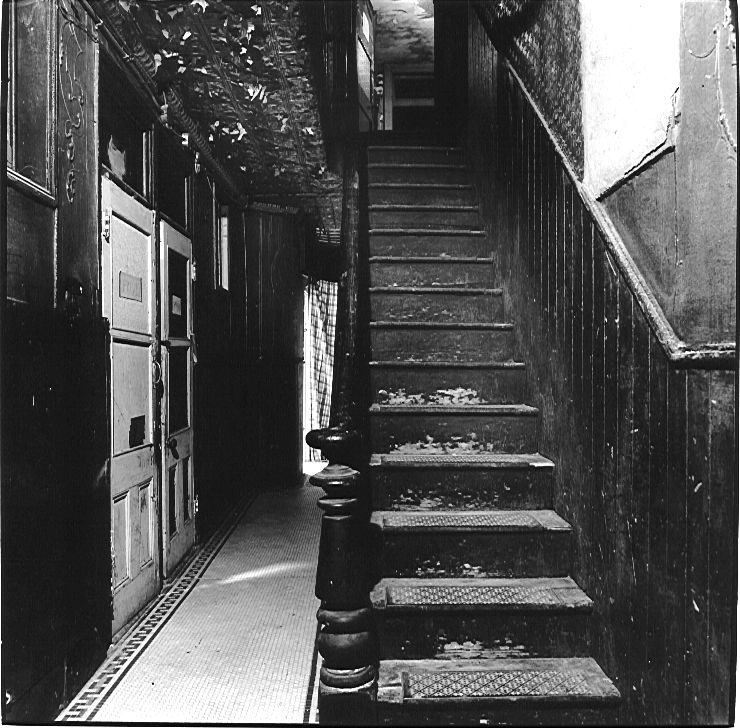
The interior of 97 Orchard Street (today’s Tenement Museum) in 1988.

Courtesy the Tenement Museum

A big thanks to Adam Steinberg at the Tenement Museum! Visit their website for more information.

Categories
Neighborhoods

Gotham Court and the lost neighborhood of Cherry Hill

Yesterday I went searching for remnants of the old Cherry Hill neighborhood. There are none, as far as I could tell.

It’s not the first New York City neighborhood to entirely vanish in the rush of progress — is it, Robert Moses ? — however it may be the one that began with the most impressive pedigree.

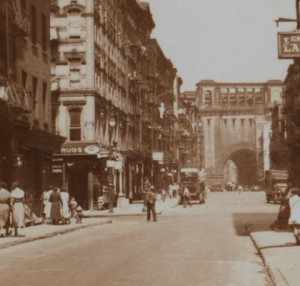
Cherry and Catherine streets, looking towards the Manhattan Bridge anchorage, in the once glorious Cherry Hill neighborhood. Pic courtesy Knickerbocker Village, who guesses photo to be from 1920s)

I’m not referring to the part of Central Park called Cherry Hill or even the upstate farm of Cherry Hill, best known for the prominent New York family the Van Rensselaers.

Downtown Manhattan’s Cherry Hill once lay near the waterfront in the area more literally called Two Bridges today, between the Brooklyn Bridge and the area just northeast of the Manhattan Bridge.

The Two Bridges Historical District was created in 2003, just to the north of the site of old Cherry Hill. Indeed there is nothing much left of the Cherry Hill neighborhood at all.

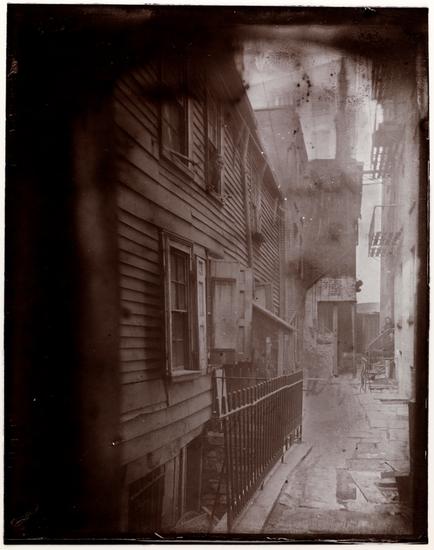
In 1890 Jacob Riis, in documenting what the neighborhood had become, referred to its early days as the “proud and fashionable Cherry Hill.” (pictured below)

Named for a Dutch cherry orchard, Cherry Hill featured a row of homes with a beautiful vista of the East River and hosted no less than George Washington‘s during his first term as president, at 1 Cherry Street.

Although he later moved to 39 Broadway, the neighborhood remained high on the list of the rich and important, including John Hancock (at 5 Cherry Street) and DeWitt Clinton (who moved into Washington’s old home).

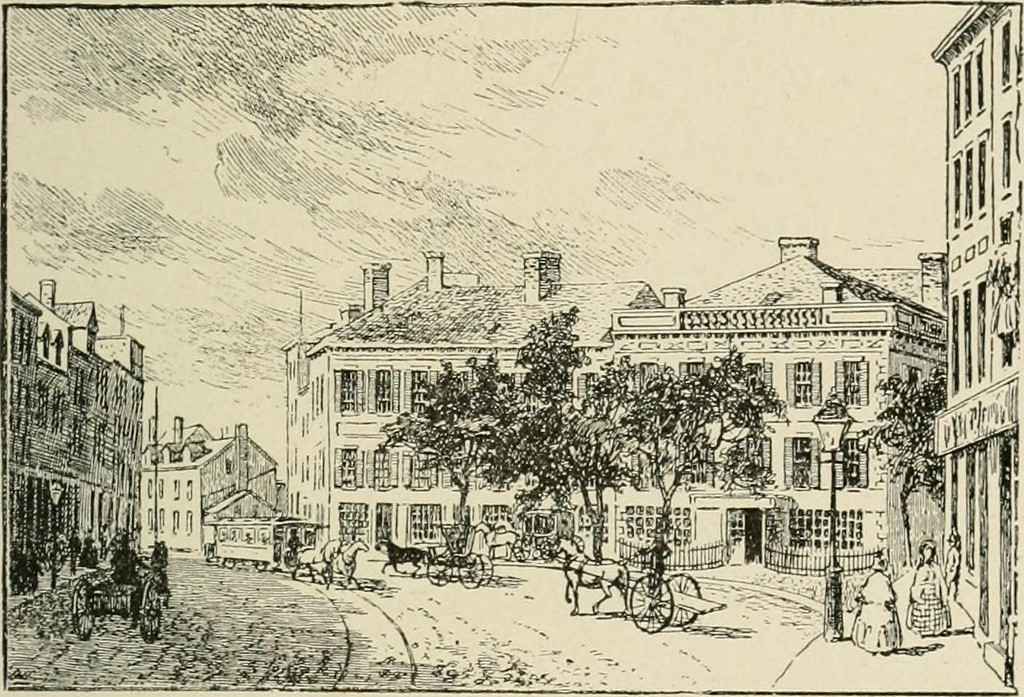
Below: An illustration of the more genteel days of Cherry Hill, taken from the book When Old New York Was Young (written in 1902)

Courtesy Internet Archives Book Images

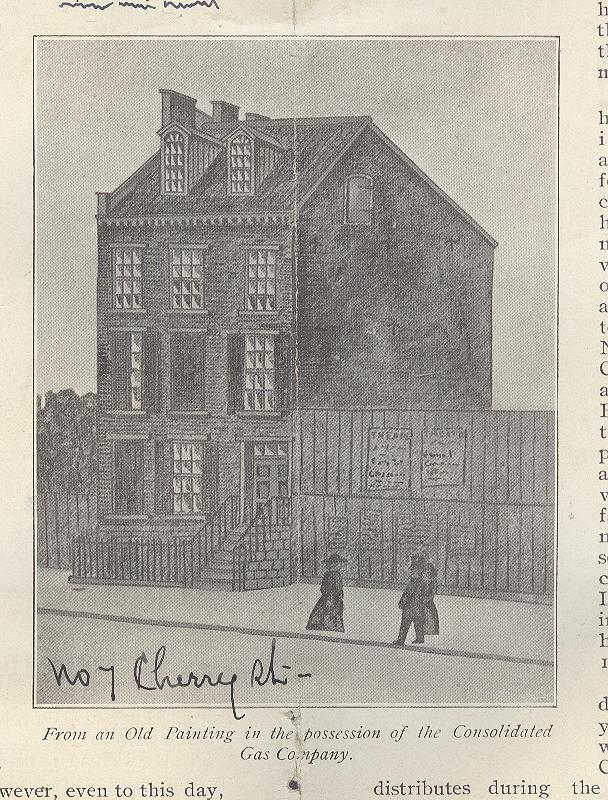
Even as late as the 1824, the area featured fine homes such as that of Samuel Leggett, founder of the New York Gas Light Company (later Con Edison), who enjoyed New York’s first interior gas lighting.

Here’s a picture of the first gas-lit home at 7 Cherry Street. (More information here)

louisa-leggett-001

If you’re looking for a symbolic date of Cherry Hill’s demise, look no further than April 3, 1823, birth date of William ‘Boss’ Tweed, who was born here and worked at a Cherry Hill chair shop in his early years.

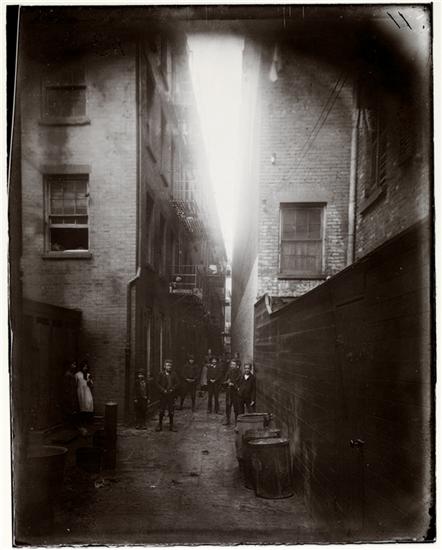
Below: Mullen’s Alley in Cherry Hill, picture taken by Jacob Riis in 1890. Courtesy the Museum of the City of New York

1

As many well-to-do neighborhoods would later do, Cherry Hill devolved into a slum, paralleling the decline of nearby Five Points. Its well-intentioned tenements soon became the worst in the city.

Located in the Fourth Ward, Cherry Hill abutted the saloons, boarding houses and brothels along Water Street, including the legendary Hole In The Wall (the former Bridge Cafe).

None of this would assist the neighborhood in escaping its fate.

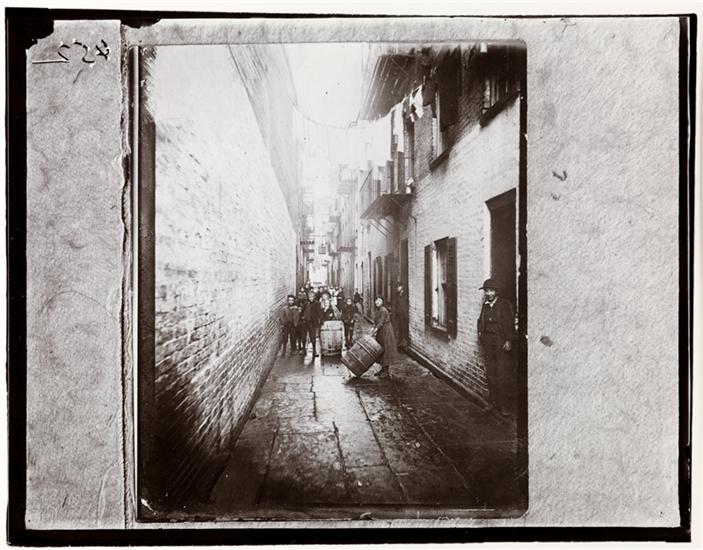
Below: Blindman’s Alley at 22 Cherry Street, taken by Jacob Riis

Courtesy Museum of the City of New York

Cherry Hill is most unfortunately known for its most horrific slum — Gotham Court, “one of the worst tenements along the East River.”

It would later be made infamous in Jacob Riis’ renown 1890 blistering survey of How The Other Half Lives.  According to Riis:

“It is curious to find that this notorious block, whose name was so long synonymous with all that was desperately bad, was originally built (in 1851) by a benevolent Quaker for the express purpose of rescuing the poor people from the dreadful rookeries they were then living in.”

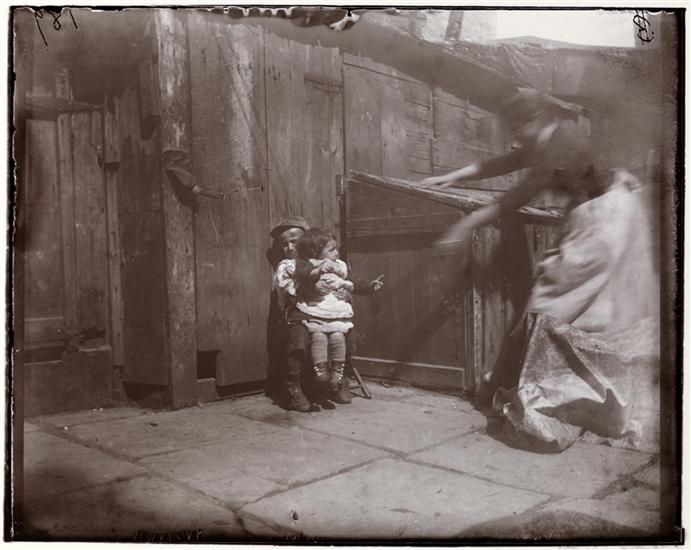
Below: photo from Gotham Court by Jacob Riis, 1890. “Minding the baby; Baby yells a Whirlwind Scream, Gotham Court.”

MNY200983

How long Gotham Court continued to be a so-called model tenement is not on record. It could not have been very long, for already in 1862, ten years after it was finished, a sanitary official counted 146 cases of sickness in the court, including “all kinds of infectious disease from small-pox down.”

Courtesy Museum of the City of New York

In 1894, the New York Tribune went as far as to make several attempts to describe Gotham Court as a prison. From the piece ‘Life in Gotham Court’:

The side alleys are narrower. They are not more than three or four feet wide. In order to enter either of these alleys one has to pass through an iron arch. The gate has been taken away, but enough remains to give unpleasant suggestions of a penitentiary..

The idea is not dissipated by the appearance of the houses inside the alley. The small windows with tiny panes of glass, the low, dark doors, through which iron gratings can be seen, and the bare brick walls are like those of a prison. The people move about free, as the prisoners do during exercise hour at the Tombs. All the doors are alike, all the windows are alike, and all are dilapidated, forlorn and forbidding.

Gotham Court and the rest of Cherry Hill were not long for this world. In the wake of Riis expose, Gotham Court was demolished in 1897.

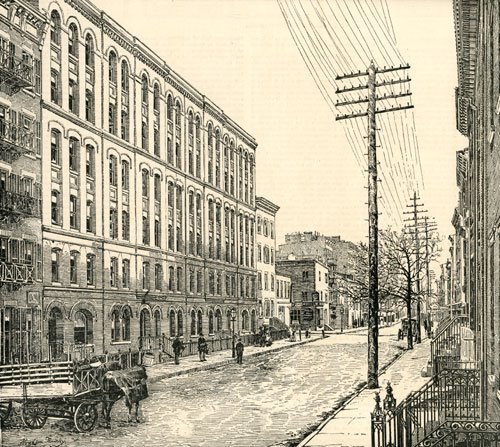
By that time, efforts were made to construct more amenable tenements, including those built at 340, 342 and 344 Cherry Street in 1888. (See below, courtesy of Maggie Blanck)

By that time, the anchorage to the Brooklyn Bridge — and in 1909, with the Manhattan Bridge anchorage — would block in the neighborhood from the circulation of the city. The construction of traffic ramps to the Brooklyn Bridge and the downtown section of the FDR Drive (opened in 1942) obliterated much of what remained.

In its place would be more ambitious housing “super projects,” most notably one in the form of the Alfred E. Smith Houses, built in 1953 and named for the governor and saavy politico born very close by, at 25 Oliver Street.

His old street and a couple around it may give you the closest idea of what some areas of Cherry Hill may have looked like in earlier years.

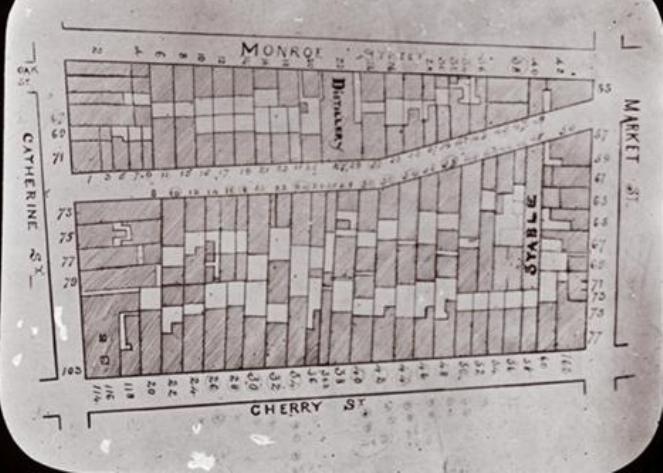
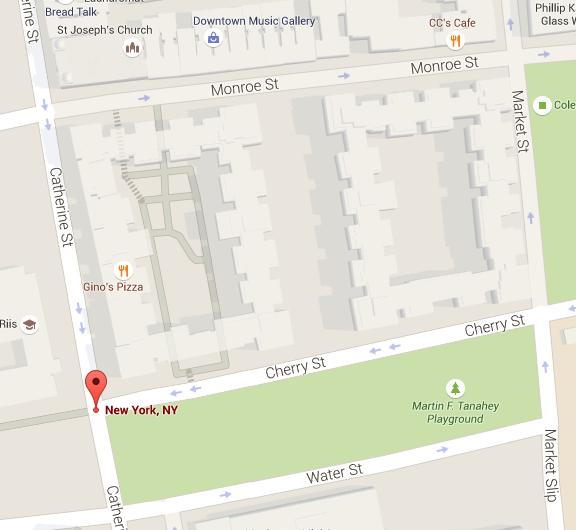
Two maps — one block of tenements in Cherry Hill in 1890 (from a map by Jacob Riis) and a Google map of the same block today:

2
1

Given its rather uniform appearance, I found it quite impossible to picture Cherry Hill’s early days here.

A shortened version of this article originally ran August 18, 2008. I’ve left the comments from that original run as they relate to the history.

Categories
Neighborhoods

The hole that swallowed Greenpoint and other treasures at Old NYC

The New York Public Library‘s Old NYC interface is pretty much one of the best things to happen to New York City history this year. It selects photographs from their extensive archives and maps them out — all five boroughs and pretty much most major intersections.  It’s like a Google Maps street-view of the past.

It’s been a true delight (and a major distraction) to revisit random avenues and see what things looked like over 75-100 years ago.  Try it out. Pick a street, any street.

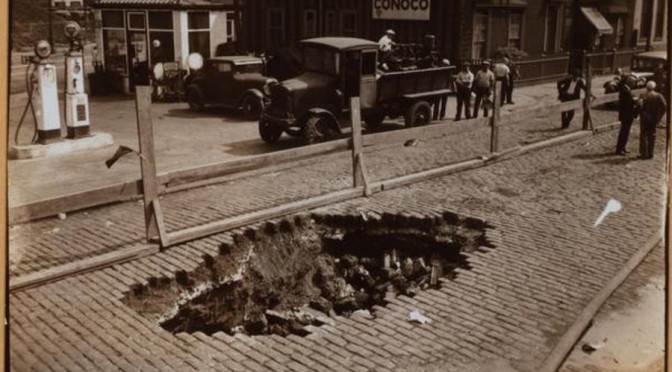
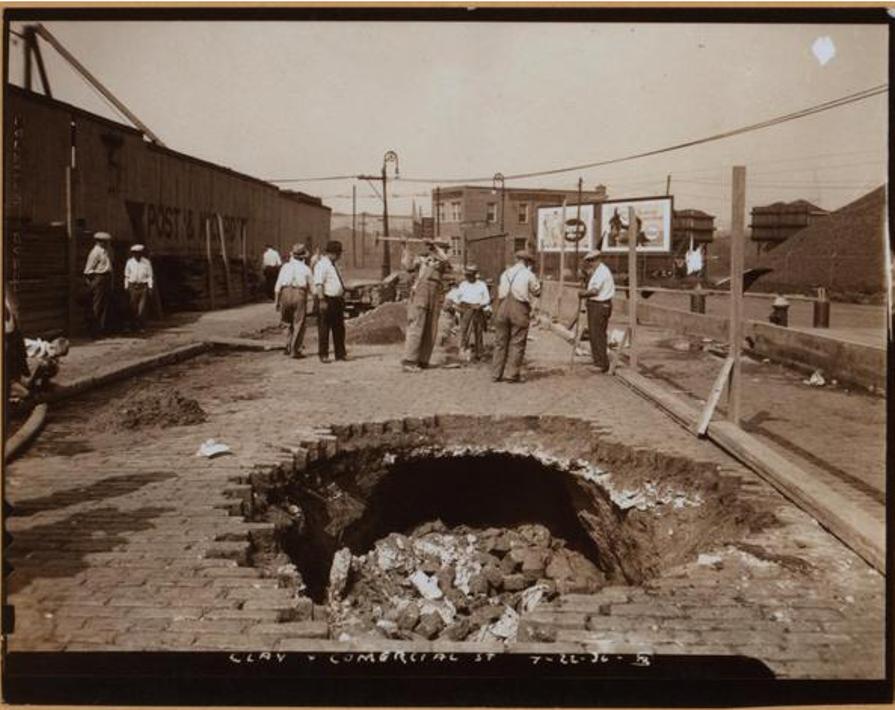
While stumbling through Brooklyn history, I can upon a startling sight at Clay Street and Commercial Street in Greenpoint.  According to the caption, the photos show “operations on a W. P. A. sewer project.”

Here’s another view (and check out the others here):

2


An in-depth plunge through this resource finds all sorts of unusual items from the past. Here are a few more that I discovered but, by all means, go hunt around for yourself!

A spooky cemetery in Woodside, Queens, at 32nd Avenue and the northwest corner of 54th Street (or this intersection):

3

Back when one could just park your jalopy at the foot of West Street, 1920s. Here’s that view today. [source]

4

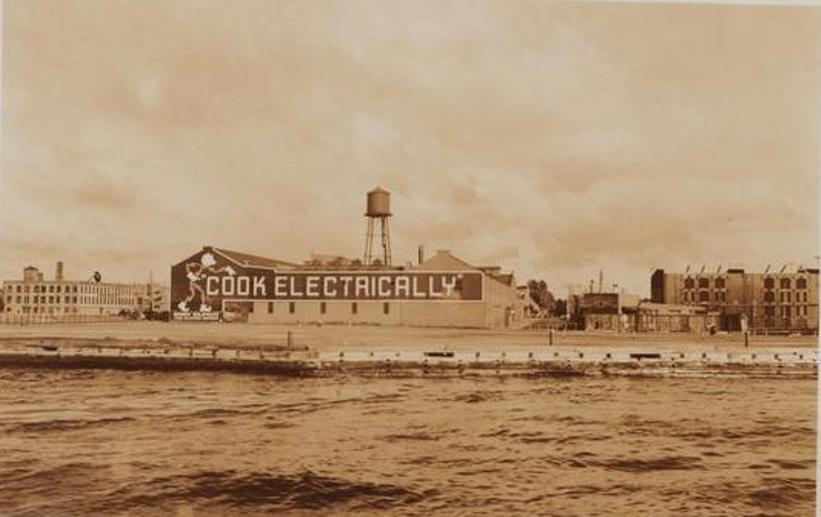
Edison Electric Company wants to encourage you to ‘COOK ELECTRICALLY’ from the vantage of a Ferris Street sign in Red Hook, Brooklyn. [source]

8

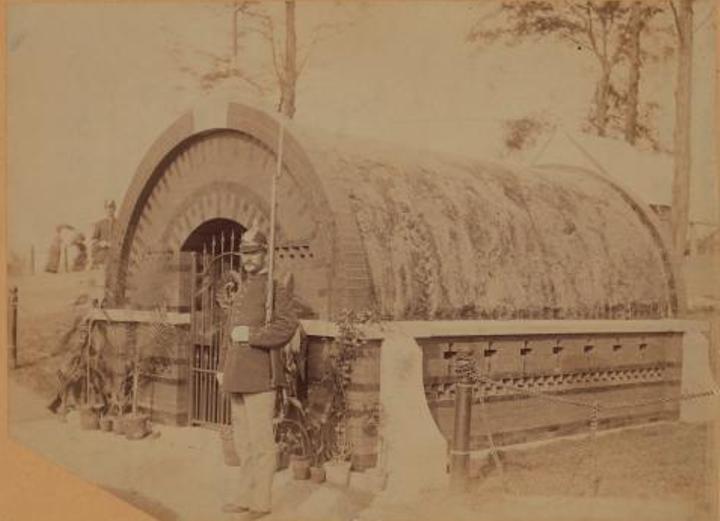
Before Ulysses S. Grant was interred in the monument that bears his name, he was kept in a temporary tomb near the same spot.  This picture is from the 1880s. [source]

9

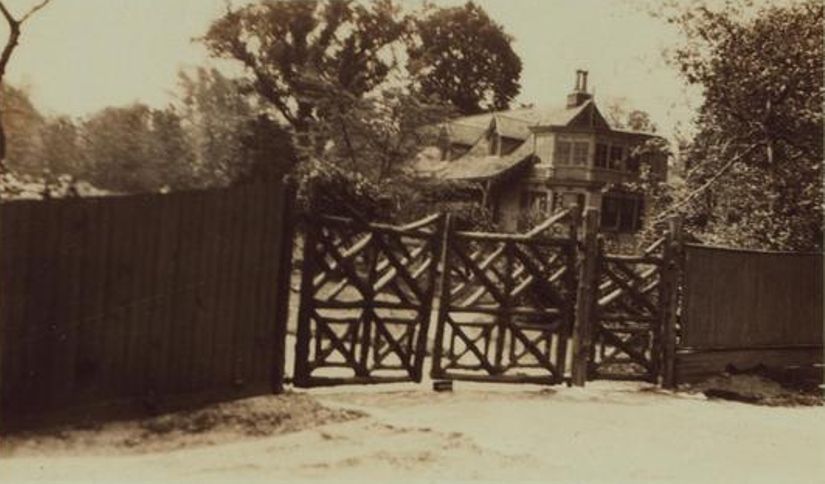
A rustic view of the Alice Austin House in Staten Island from 1926. Here’s that same view today:

5


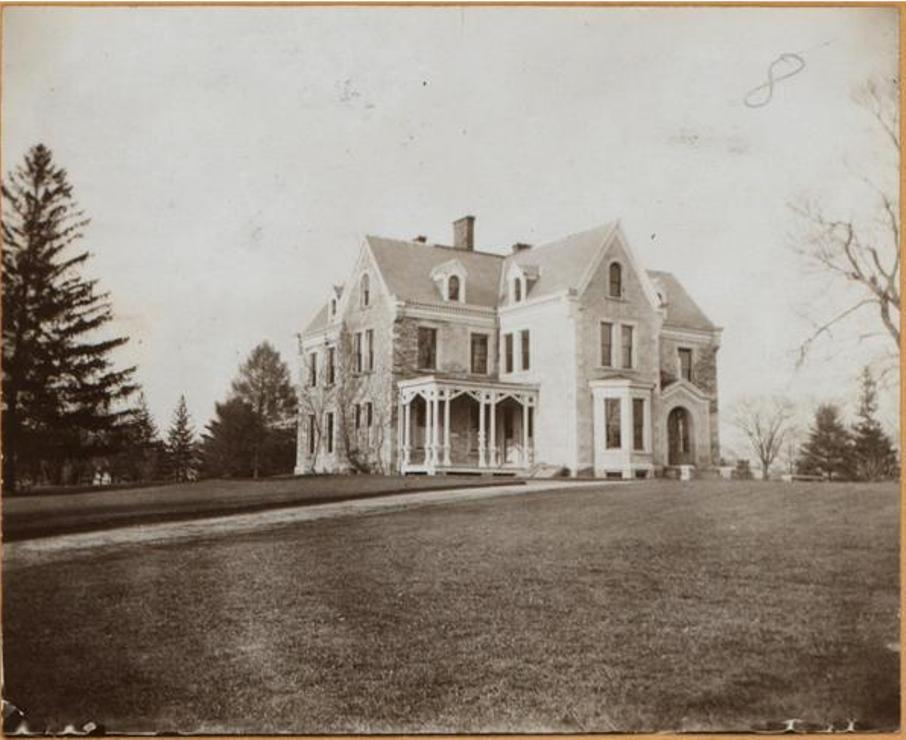
Graceful and long-gone Zborowski Mansion which once sat in Claremont Park in the Bronx. More information about this house here.


6


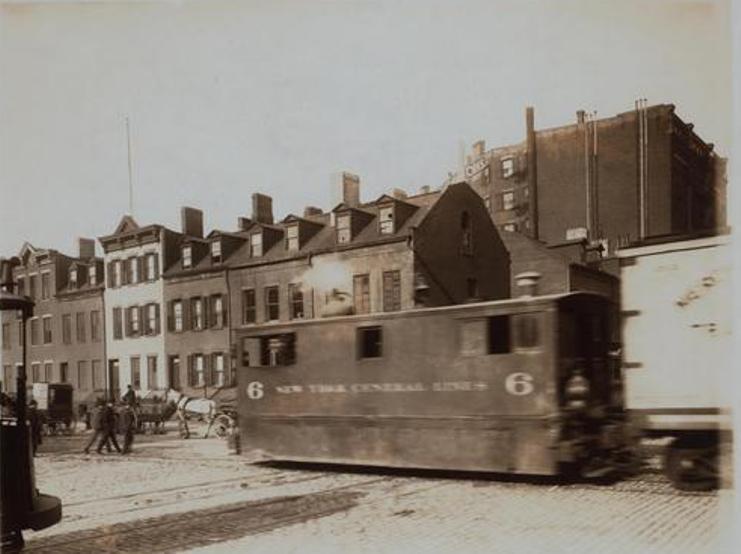
New York Central Railroad cars, just sailing down the street, at the corner of Hudson and Vestry Streets, in Manhattan. [source]

7


Categories
It's Showtime Podcasts

Diamond Girl: How Mae West Brought ‘Sex’ and Scandal to Broadway

PODCAST Mae West (star of I’m No Angel and She Done Him Wrong) would come to revolutionize the idea of American sexuality, challenging and lampooning ideas of femininity while wielding a suggestive and vicious wit. But before she was America’s diamond girl, she was the pride of Brooklyn! In this podcast, we bring you the origin story of this icon and the wacky events of 1927 that brought her brand of swagger to the attention of the world.
1The Brooklyn girl started on the vaudeville stage early, inspired by the influences of performers like Eva Tanguay. She soon proved too smart for the small stuff and set her aim towards Broadway — but on her terms.

West’s play Sex introduced her devastating allure in the service of a shocking tale of prostitution. It immediately found an audience in 1926 even if the critics were less than enamored. But it’s when she devised an even more shocking play — The Drag — that city leaders became morally outraged and vowed to shut her down forever.

From Bushwick to Midtown, from the boards of Broadway to the workhouse of Welfare Island — this is the story of New York’s ultimate Sex scandal.


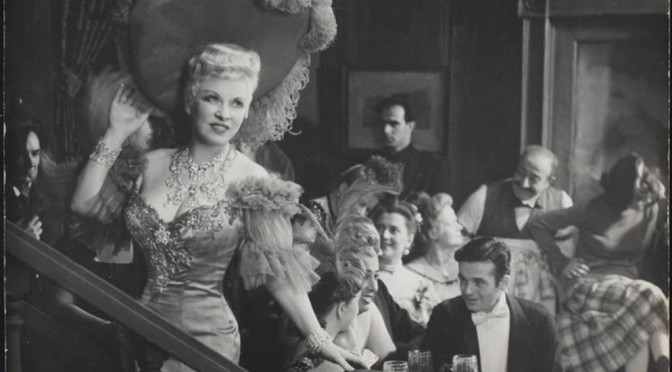
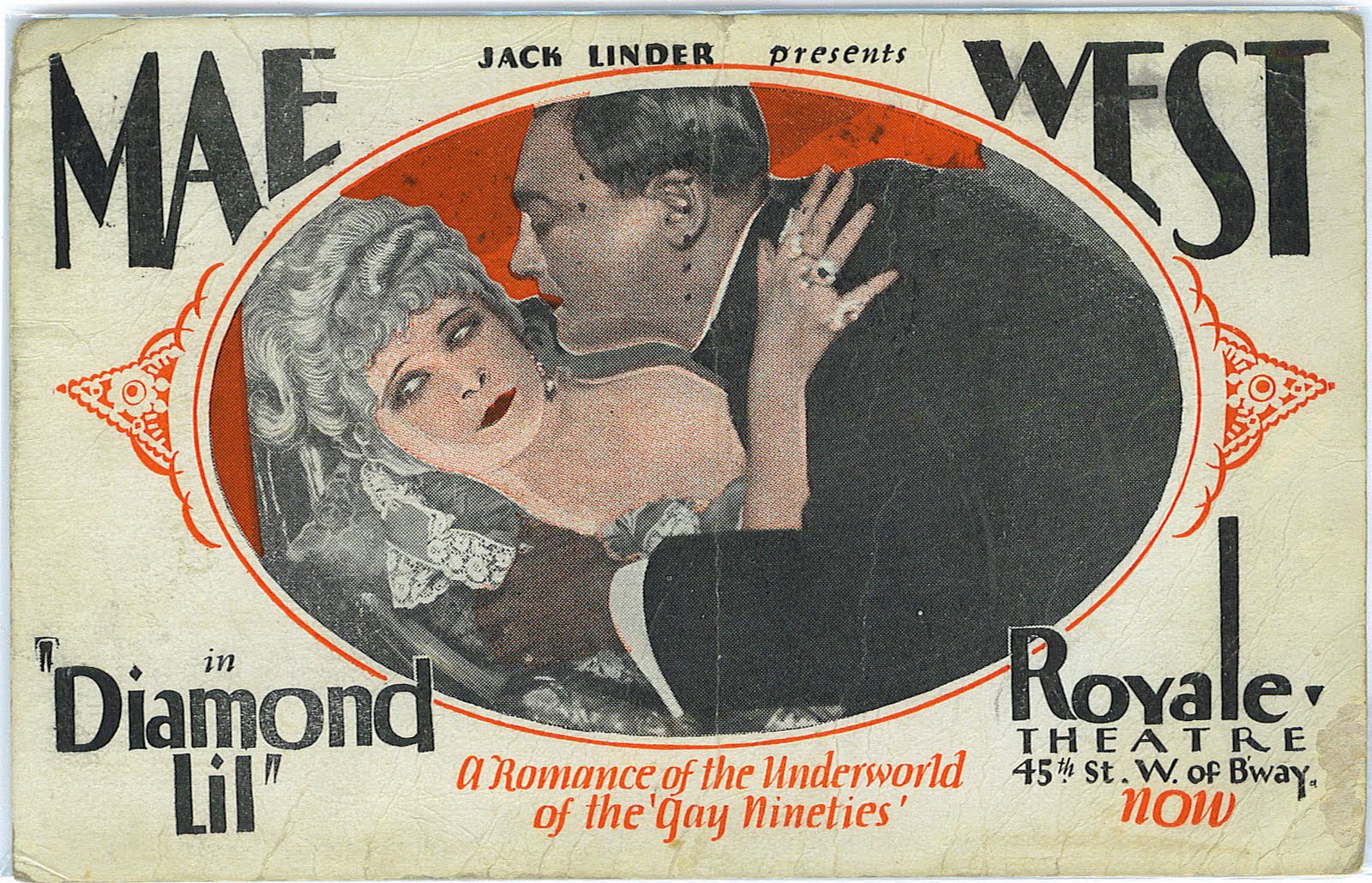
Picture at top: Mae West in a publicity still for her Broadway hit Diamond Lil. (Courtesy Museum of City of New York)
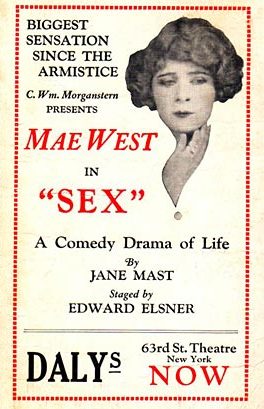
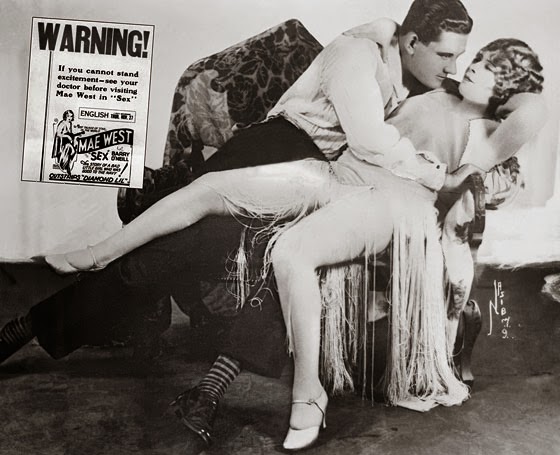
Inset: The poster for Sex by Jane Mast (aka Mae West)

Special thanks to Esther Belle from The West (a Mae West-inspired coffeehouse and bar in Williamsburg). We recorded an interview with her about the legacy of Mae West but weren’t able to use it. But it will be available for Patreon supporters!


The Bowery Boys: New York City History podcast is brought to you …. by you!

Starting this month, we are doubling our number of episodes per month. Now you’ll hear a new Bowery Boys podcast every two weeks. We’re also looking to improve the show in other ways and expand in other ways as well — through publishing, social media, live events and other forms of media. But we can only do this with your help!

We are now a member of Patreon, a patronage platform where you can support your favorite content creators for as little as a $1 a month.

Please visit our page on Patreon and watch a short video of us recording the show and talking about our expansion plans. If you’d like to help out, there are five different pledge levels (and with clever names too — Mannahatta, New Amsterdam, Five Points, Gilded Age, Jazz Age and Empire State). Check them out and consider being a sponsor.

We greatly appreciate our listeners and readers and thank you for joining us on this journey so far. And the best is yet to come!


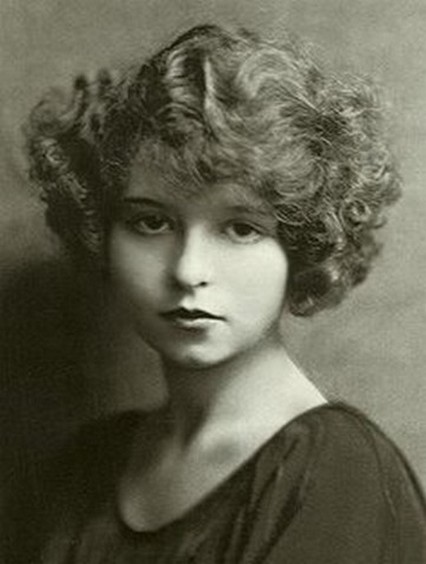
A young Mae West, already a seasoned performer by her teenage years.

Courtesy Notes On The Road

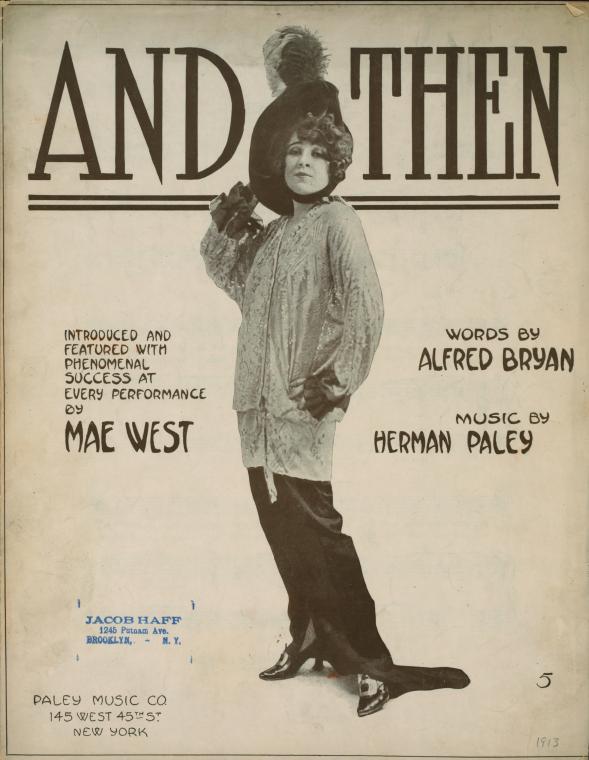
From Mae West’s vaudeville days, a piece of Tin Pan Alley sheet-music she performed in the stage:

Courtesy New York Public Library

A saucy promotional still from Sex

4

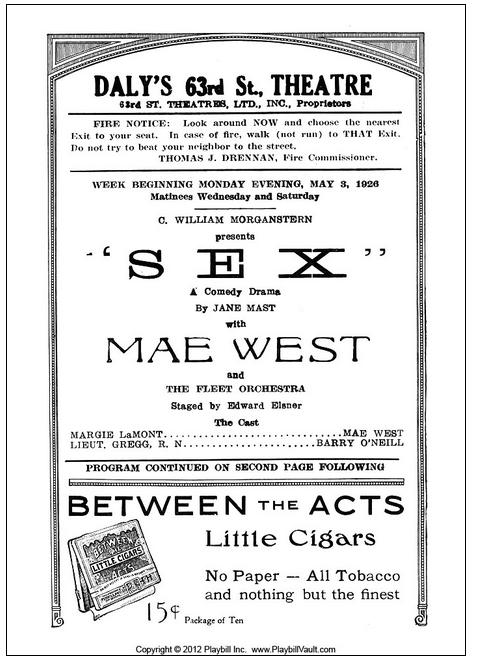
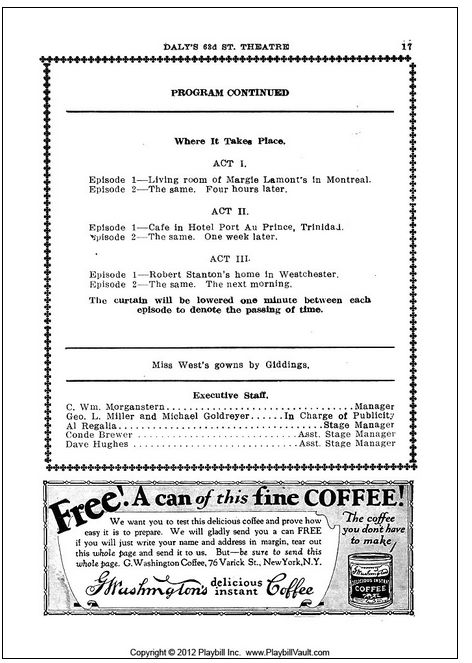
From the original program for Sex:

Courtesy Playbill Vault

1

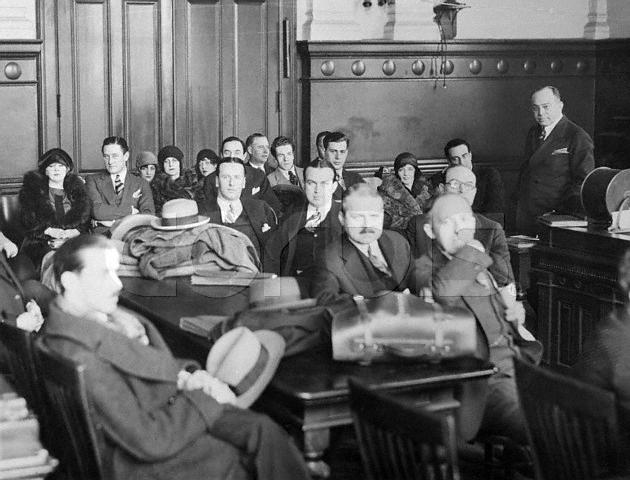
Mae West at the Jefferson Market courthouse:

Original caption: Cast of  Tried By Jury.  New York, New York:  Photo shows scene in courtroom of general sessions part II at start of members of  company.  Mae West and Barry O'Niel, in productions leading roles, can be seen at extreme left. March 28, 1927 New York, New York, USA
Original caption: Cast of Tried By Jury. New York, New York: Photo shows scene in courtroom of general sessions part II at start of members of company. Mae West and Barry O’Niel, in productions leading roles, can be seen at extreme left. March 28, 1927 New York, New York, USA

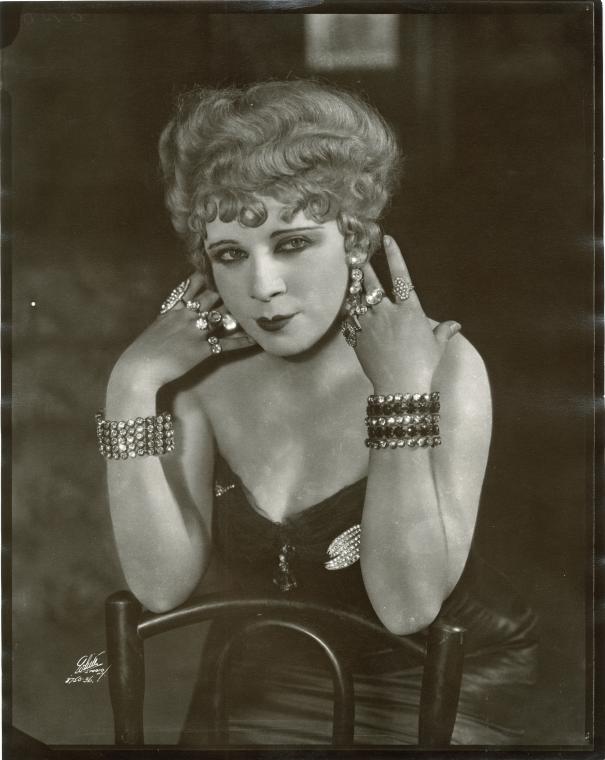
Mae West in the original photography for the 1928 production of Diamond Lil. She attempted during this period to open the controversial show The Pleasure Man but it was shut down after two days. (Courtesy New York Public Library)

1

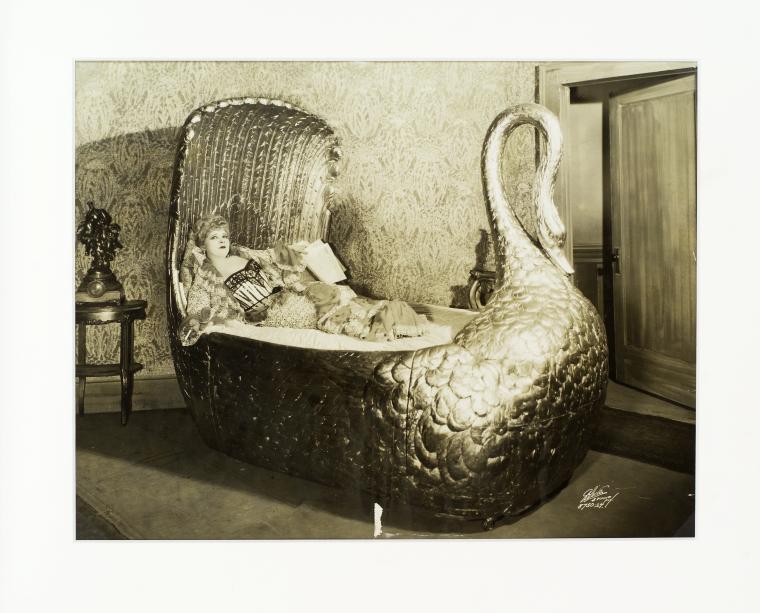
Another odd shot from Diamond Lil, of Mae reclining in a golden swan bed. (source)

Courtesy New York Public Library

5

Mae West in the 1949 Broadway revival of Diamond Lil. Once a provocateur of the stage, she settled into her larger-than-life personae in later years, formed mostly from her successes in this role (and its film version She Done Him Wrong). (Courtesy Museum of the City of New York)

Courtesy the Museum of the City of New York

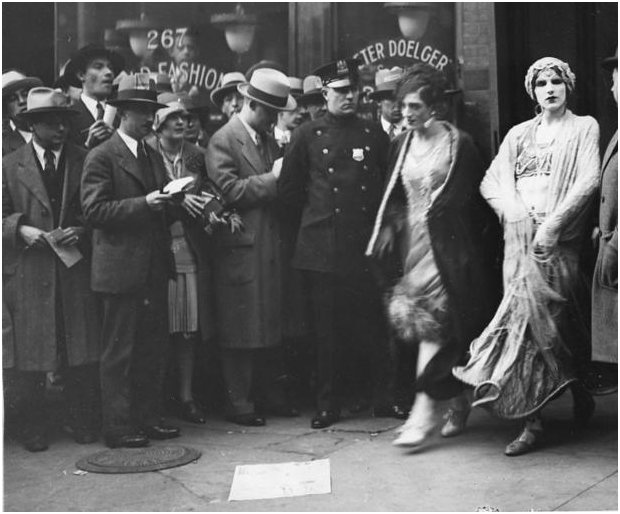
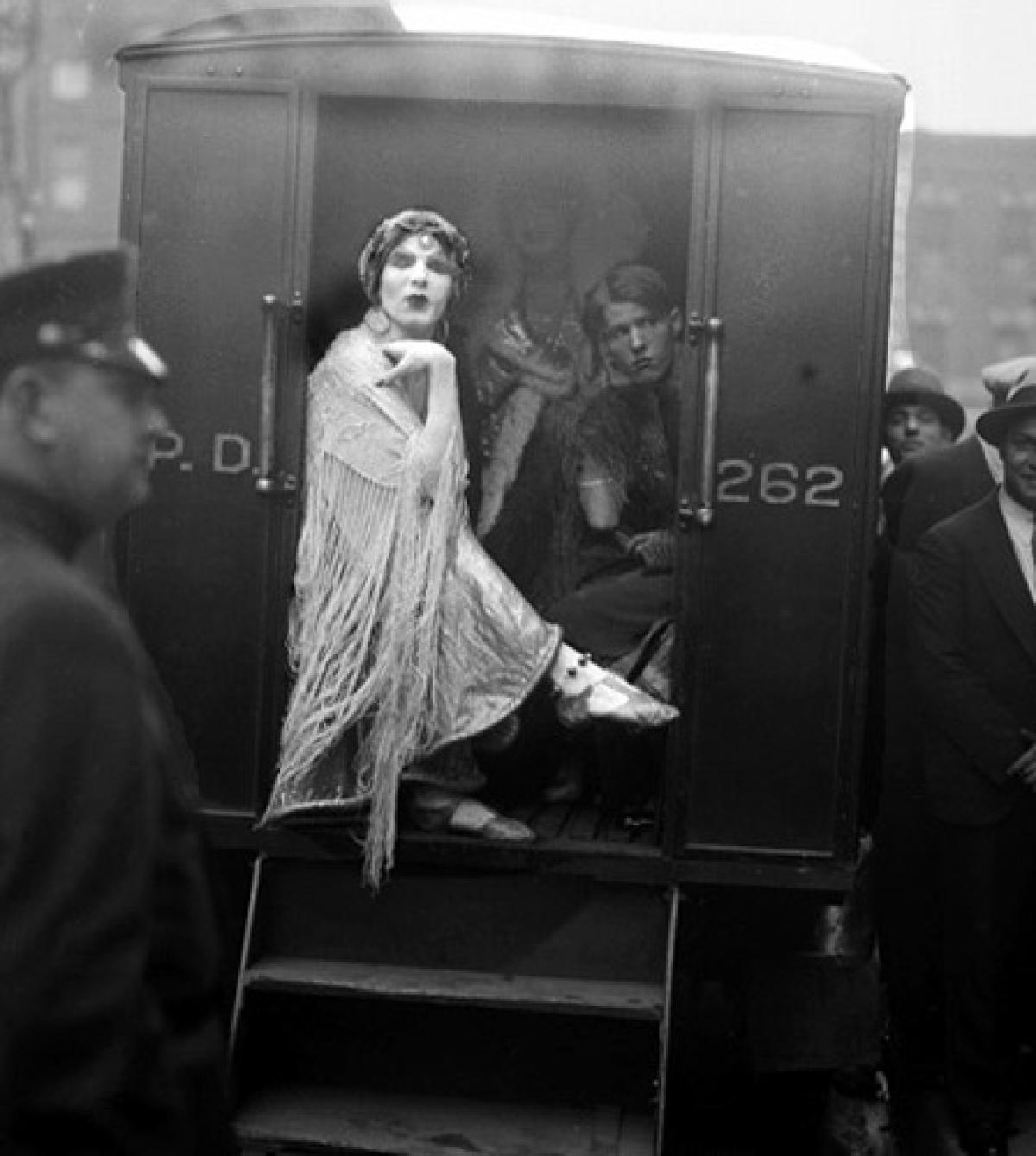
Members of the cast of The Pleasure Man being arrested by police, 1928.

Courtesy Queer Music Heritage -- http://queermusicheritage.com/fem-arts6.html
Courtesy Queer Music Heritage — http://queermusicheritage.com/fem-arts6.html

Courtesy New York Daily News

Mae West (and a young Cary Grant) in She Done Him Wrong

In the hilarious I’m No Angel:

Ladies and gentlemen, Mae West and Mr. Ed:

And her last film — the camp classic Sextette

Categories
Mad Men

Timeless: How ‘Mad Men’ changed history on television

In 1972 the Robert Altman film M*A*S*H was turned into a weekly half-hour situation comedy series. In retrospect I’m stunned that anybody thought to make this. The landscape of television comedy was cluttered with novelty premises and perfect families dealing with contrived scenarios which always, always resolved in a happy freeze-frame.

There was no sense of reality to television before 1972. Westerns set in the 19th century had no historical sense to them.  Gunsmoke and Bonanza rarely if ever referenced an understandable place and time. The Ponderosa was somewhere in Nevada, set vaguely in the 1860s.

Television’s M*A*S*H broke both of these molds. It was real life, affected by real history. It was in a recognizable place, and its characters were changed by events that were vividly real. For the first time it felt like a show was operating by the same cosmic rules as its viewers.

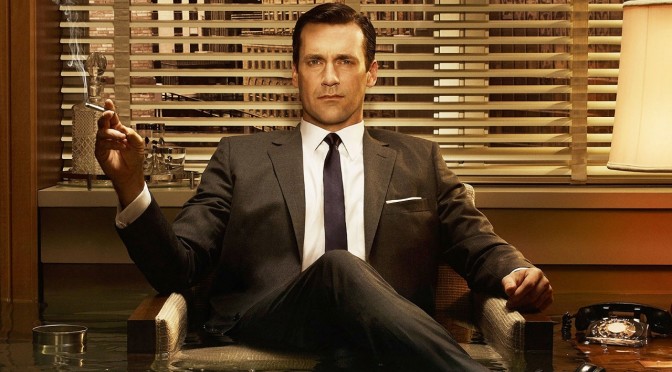
The year that Altman’s film was released is the year that the last season of Mad Men, which finishes its run this Sunday, is set.  We know this because creator Matthew Weiner and his writing team make very sure to watermark almost every scene.

Every detail — from the buttons on Joan’s dresses to the brand of cigarette in Betty’s hand — speaks to the show’s obsessive need to plant its coordinates into the narrative.

Mad Men has re-envisioned the historical television show in exactly the same way that M*A*S*H reinvented the sitcom. You can no longer make a television show set in the past without following (or rebelling against) the example set by the adventures of Don Draper and crew.

Cognizant of the harsh mistress of social media, Mad Men has created a flawless timeline, leaving a masterful, rarely obvious path of breadcrumbs that have led viewers through the 1960s. The first episode “Smoke Gets In Your Eyes,” is set in March 1960. The last episode, named “Person To Person,” will be set in either November or (most likely) December 1970. 

Episodes are crammed with historical and pop cultural references, but very rarely are they front and center. Don ate and drank his way through the finest restaurants in New York. Joan made out with somebody at the Electric Circus, while Peggy went to a happening at Washington Market. Kinsey joined the Hare Krishnas!

Shock treatment, LSD, race riots, Weight Watchers, moon landings, assassinations — the entirety of America in the 1960s was fully and richly presented, in far greater volume and diversity than perhaps even a college course would provide.

But not once — not a single time in its seven seasons — did the events of this tumultuous decade overtake the storyline. The characters, their lives, were always front and center.

It has been an extraordinary pleasure the past few years to Tweet along with live viewings of Mad Men on Sunday night. I’m not paid to do it. It’s just a total blast. I just love a good scavenger hunt.

Weiner and the Mad Men production team can infuse entirely new themes, sometimes with traces of irony, that only reside within the borders of an episode. Far from history being a binding and limiting framework, Mad Men has turned it into a set of playground monkey-bars from which to playfully swing.

Setting the show in New York, but not filming it here, seemed, at first, like a troubling and even annoying decision. But it worked because the Manhattan skyline is a dead giveaway, like the rings of a tree.

And Mad Men‘s not the kind of show that uses CGI. (A New York-filmed show might have been tempted to have Don swagger down the street with the under-construction World Trade Center in the background. Thank god Mad Men is not that show.)

History has been a vivid hue on Mad Men, as vivid as one of Pete Campbell’s most flamboyant ties. They don’t just plan episodes “in the spring of 1967.” There are usually clues that accurately pinpoint a scene to an actual day and, sometimes, an actual minute. You never had to be consciously aware of this information. It sits like a juicy footnote at the bottom of the page, waiting to reveal another facet of the story.

Will this formula work for future historically based television programs? Mad Men had the luxury of a cast of fictional characters, so history can coalesce around them with convenience.

Shows like Turn or Boardwalk Empire, on the other hand, have characters based on real-life individuals, and negotiation around historical events is trickier.

I wonder where the Mad Men effect will turn up next. The Knick, set in 1900s New York, makes obvious nods to Weiner’s precise use of historical detail, but understandably, it’s not consistent. (Being set over a century ago, it has a higher degree of difficulty.)

The writers of Downton Abbey love their history, but it’s often an interloper.  It invades more than informs. Outlander would probably not be a good show if characters stopped to wonder what day it was.  Halt and Catch Fire could be a successor to Mad Men if it pulls its storylines together in the next season.  

Farewell Mad Men! And thank you for the best time-traveling adventure on television. Throughout this article is a sampling of a few of my Mad Men Tweets over the past few years to illustrate some of the details that the production team has incorporated into its shows.

You can find the complete list of my Mad Men Tweets right here!  And for other Bowery Boys articles on Mad Men, you can check them out here.


Categories
True Crime

‘Days of Rage’ and Nights of Terror

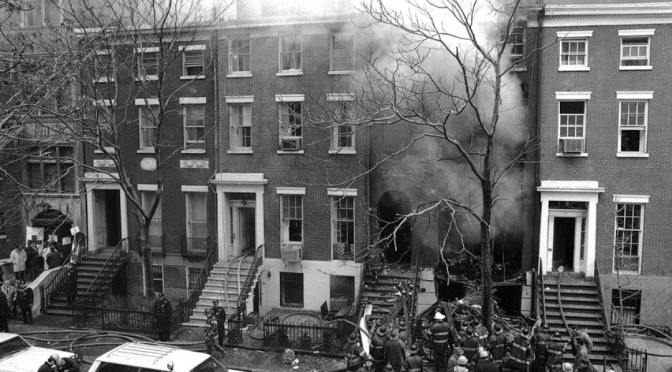
Right before noon on March 6, 1970, an explosion tore open a lovely Greenwich Village townhouse at 18 West 11th Street and awoke New York City to a violent new threat.

The remains of three bodies were discovered in the smoking debris but they weren’t residents of this quiet neighborhood. They were members of The Weather Underground, a radical underground unit absorbing the counter-culture spirit of the 1960s and unleashing it — oftentimes randomly and irrationally —  onto a new decade.

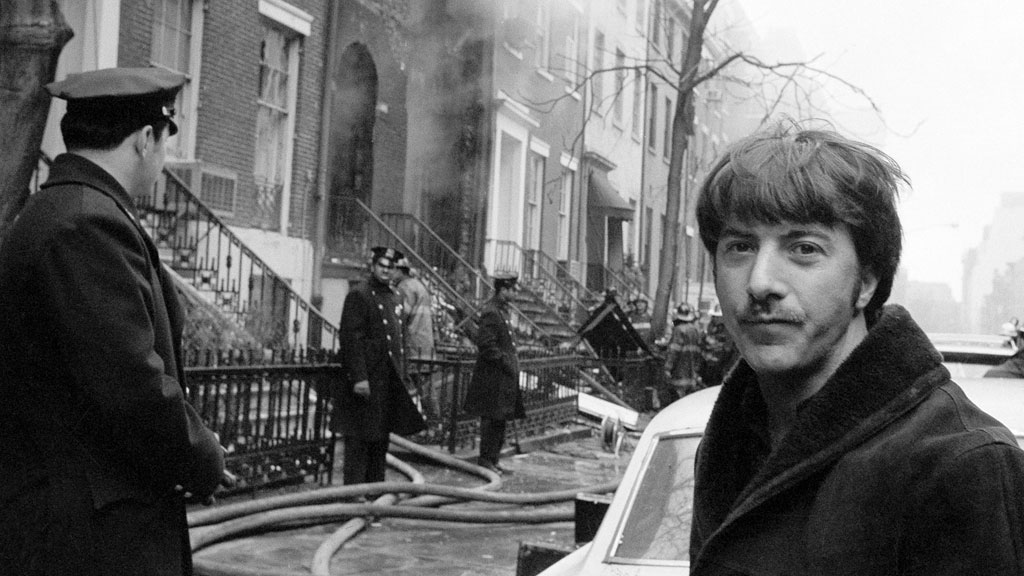
Below: Oddly enough, the townhouse explosion occurred next door to the home of Dustin Hoffman and his wife.

Courtesy AP file photo

Less than two years later, two New York police officers were brutally assassinated in the East Village, among the most brutal and shocking crimes against the NYPD in its history.  This wasn’t a random crime but a hit placed upon the officers by members of the Black Liberation Army, wielding some of the philosophies of the Black Panthers to dangerous ends.

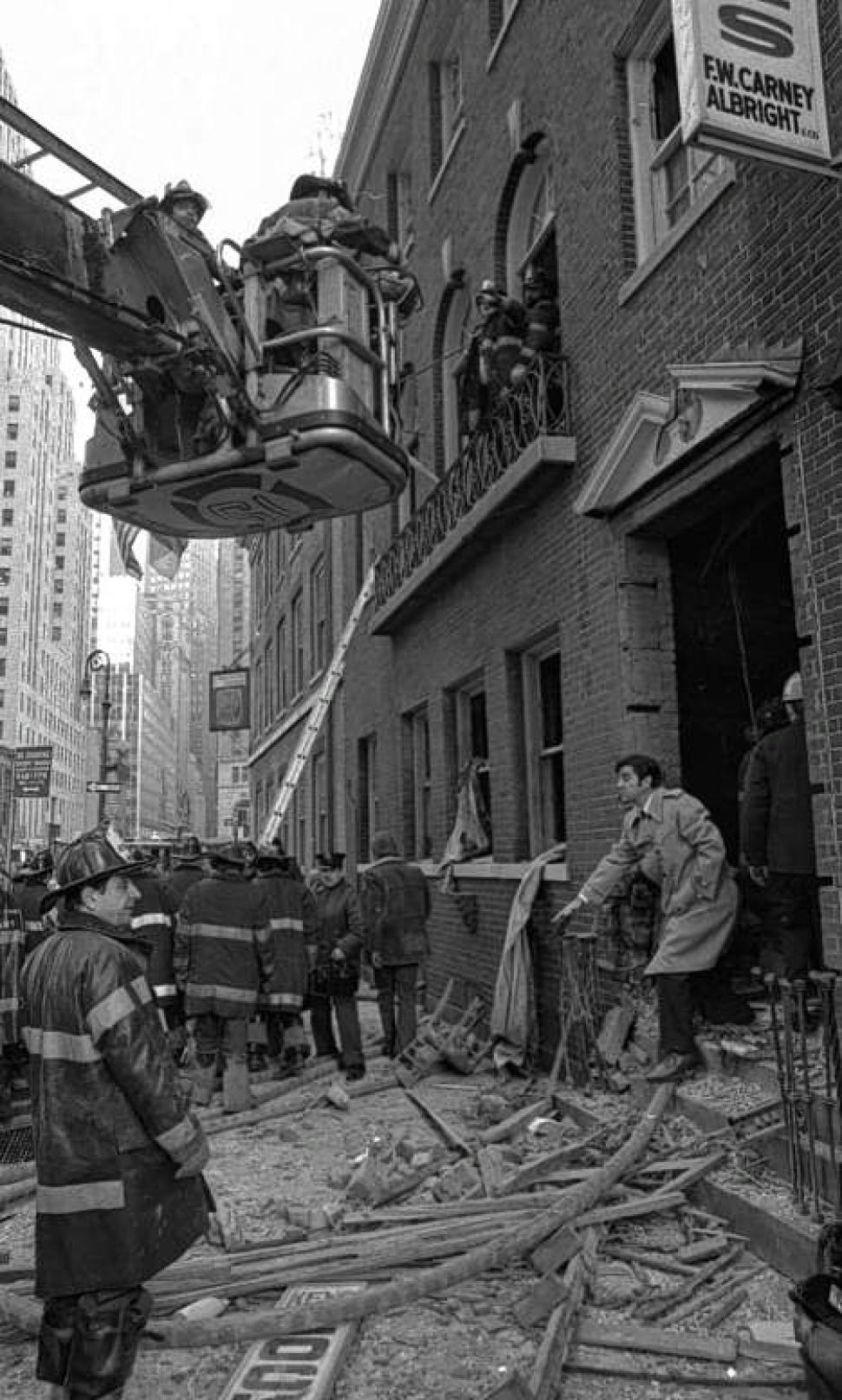
Almost three years later, a bomb exploded inside the historic Fraunces Tavern during in the middle of a busy weekday lunch. Four men were killed in the sudden attack, made by the Armed Forces of Puerto Rican National Liberation (or FALN).

Below: Aftermath of the explosion at Fraunces Tavern (courtesy New York Daily News)

faln

In between these terrible disasters were several other bombings of other significant buildings, here in New York and in other cities through the United States.  All of them indicative of a violent (and ultimately failed) form of protest, as turbulently described by Bryan Burrough in his new book Days of Rage: America’s Radical Underground, The FBI, and the Forgotten Age of Revolutionary Violence.

This is probably one of the most frightening non-fiction books I’ve read in recent memory, a broad and exquisitely told tale that loosely links together a variety of American revolutionary action groups from the 1970s.

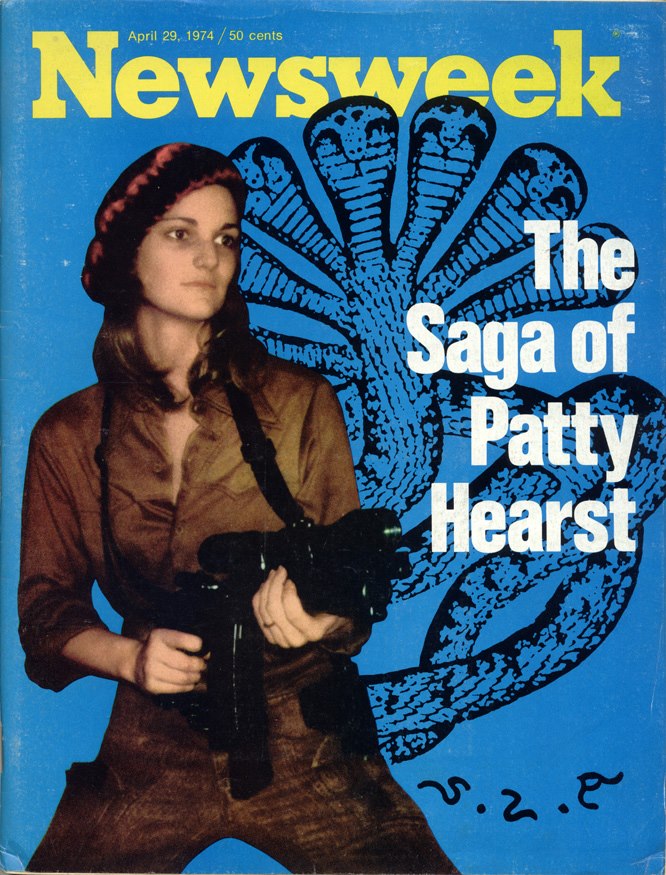
Some of the principal players of these groups are recognizable (Bill Ayers and Bernadine Dohrn,  Patty Hearst), but the breadths of their actions has been seldom studied. Through interviews with members who’ve never spoken, Burroughs patches together connections among these disparate groups — even if those connections are more philosophical than physical.

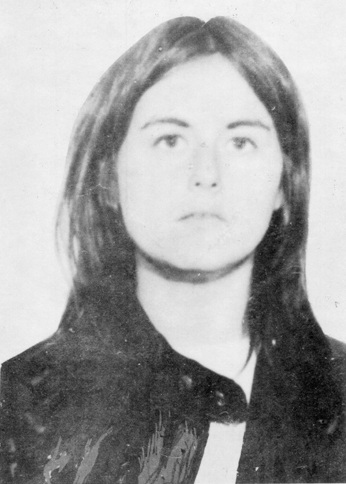
Below: The mugshot of Bernadine Dohrn, 1970

Bernardine_Dohrn_published_1970


Most shared the belief that violence, disruption and chaos would lead America to a new revolutionary age. As Burrough points out, most were inspired by civil rights movement and the plight of black Americans, taking their anger and frustration into far more radical directions than the mainstream leaders who advocated non-violence and change through the law.

While the vulgar and gut-wrenching violence was often doused with machismo, many of these groups were led or operated by women.

The title comes from a series of demonstrations that occurred in Chicago in the fall of 1969, seen as a sort of kick off to this festering revolutionary movement.  Much of the book details the ‘underground’ hideouts and escape routes of these organization, whether holed up in Manhattan’s Chinatown or San Francisco (as the Weathermen were, often dressed in silly disguises) or running from capture through rural Georgia.

Burrough does not flinch from the horror, graphically describing the aftermath of many of the more loathsome crimes.  The 1972 deaths of two NYPD officers in the East Village is especially grim. (You can read news of the original account here.)

patty

In particular, I found the tale of the Symbionese Liberation Army especially gripping, notable less for their violent actions (although there certainly was some) than for the somewhat random notion to kidnap the granddaughter of William Randolph Hearst.  Many of these stories will replay in your memory as a reel of black-and-white news footage or a set of iconic photographs (such as the one above of Hearst).  Days of Rage offers a vivid and refreshing new context.

Burrough — a Vanity Fair writer perhaps best known for Barbarians At The Gate — is a thorough story-teller, conjuring fully blown narratives from the sometimes untrustworthy recollections of the surviving participants.  He’s often too thorough, sometimes including superfluous details because they’ve “never before been told.”

Chaos was an organizing principal for these groups which is partially way they were ultimately unsuccessful. As shocking as some of these horrifying attacks seem today, it’s a wonder many of them were successful orchestrated at all, given the tentative organizational structure and often incompetent leadership of these groups.


Top photograph courtesy Marty Lederhandler/AP Images.

Categories
On The Waterfront

A Haunting Look Inside the Lusitania

The Lusitania gets dwarfed by recollections of the Titanic.  But in many ways, the destruction of the Cunard Line’s premier ocean liner on May 7, 1915, was a deeper tragedy than that of the White Star liner.

As a casualty of war — sunk by a German U-boat off the coast of southern Ireland — the Lusitania disaster began a slow but inevitable march towards the United States’ entry into World War I. Â Its destruction send a shockwave through Americans and Britons alike. Nobody sailing the Atlantic was safe.

Almost 1,200 people died that afternoon of May 7th. Among the deceased were millionaires (Alfred Gwynne Vanderbilt),  impresarios (Charles Frohman), writers, scientists,  nurses and soldiers.

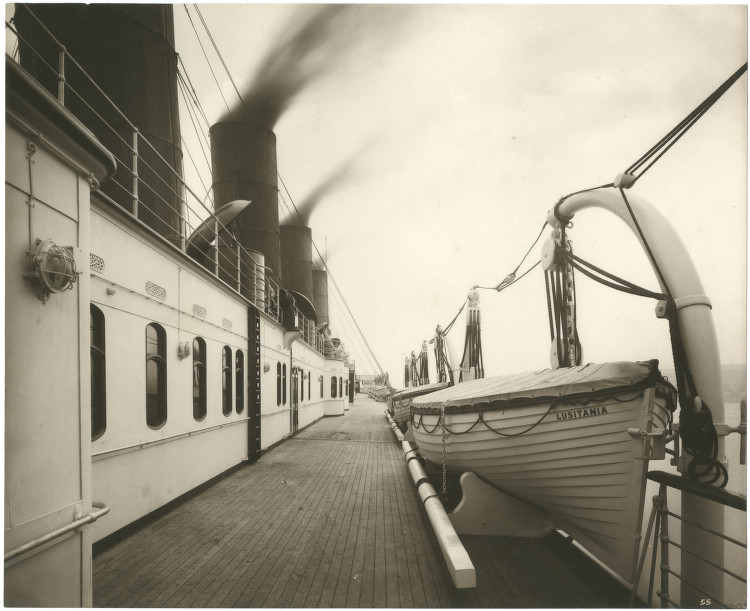
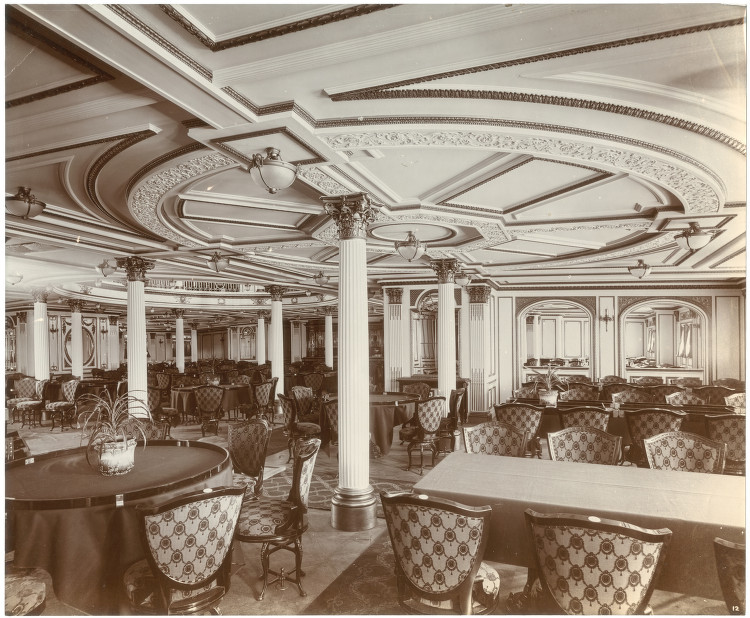
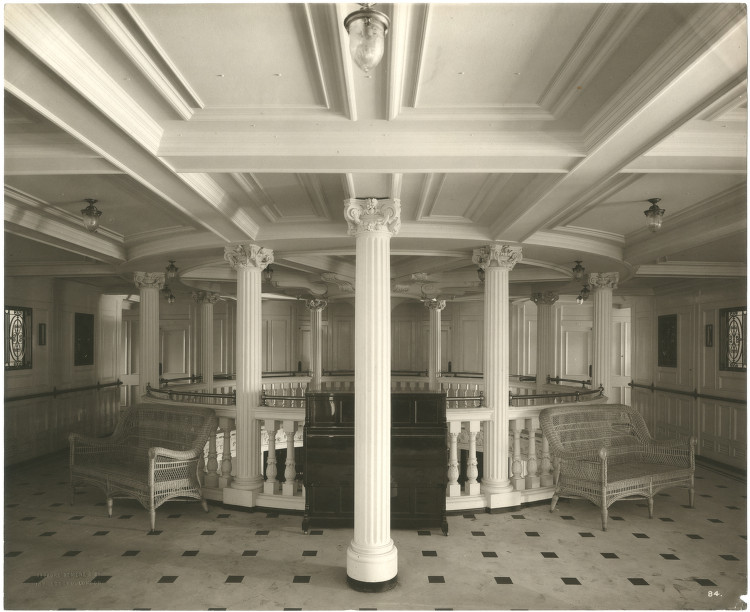
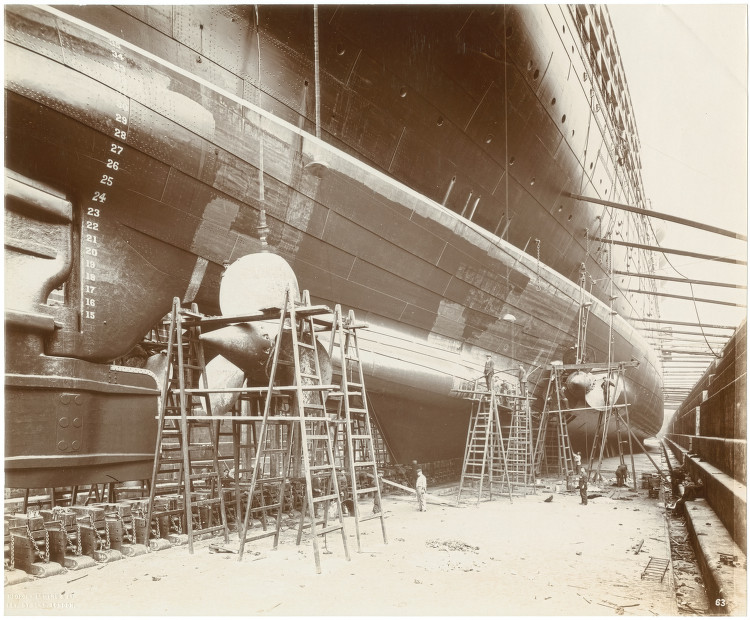
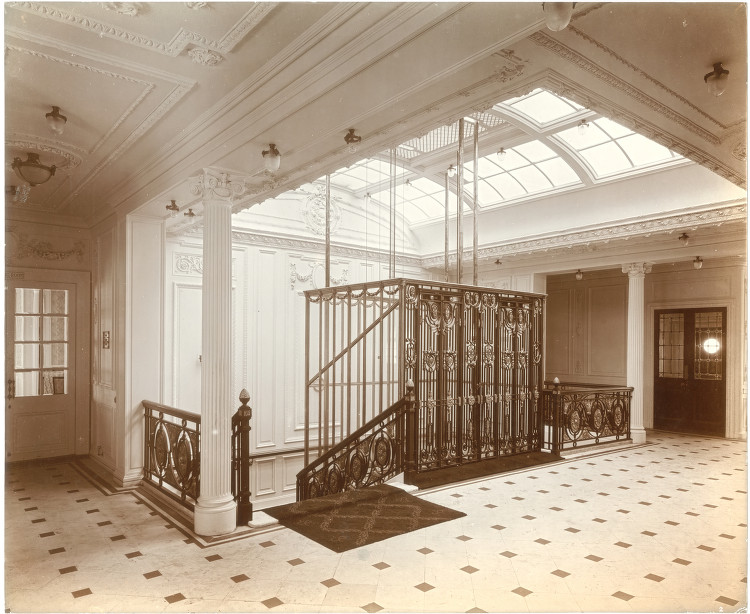
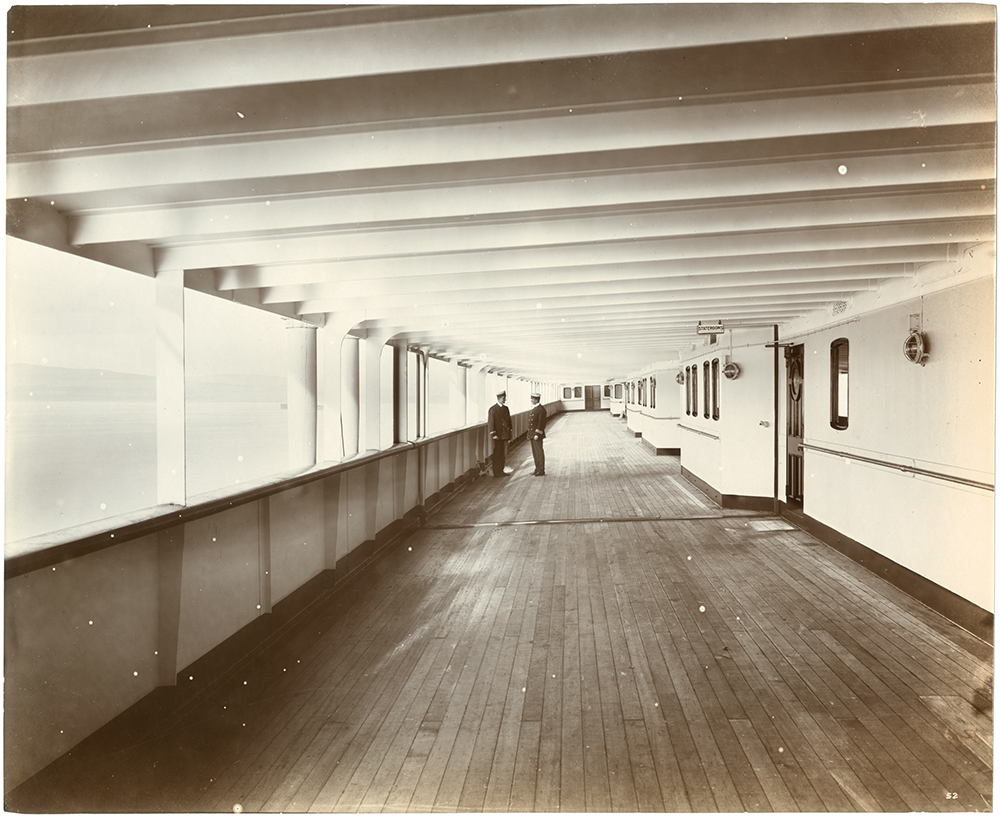
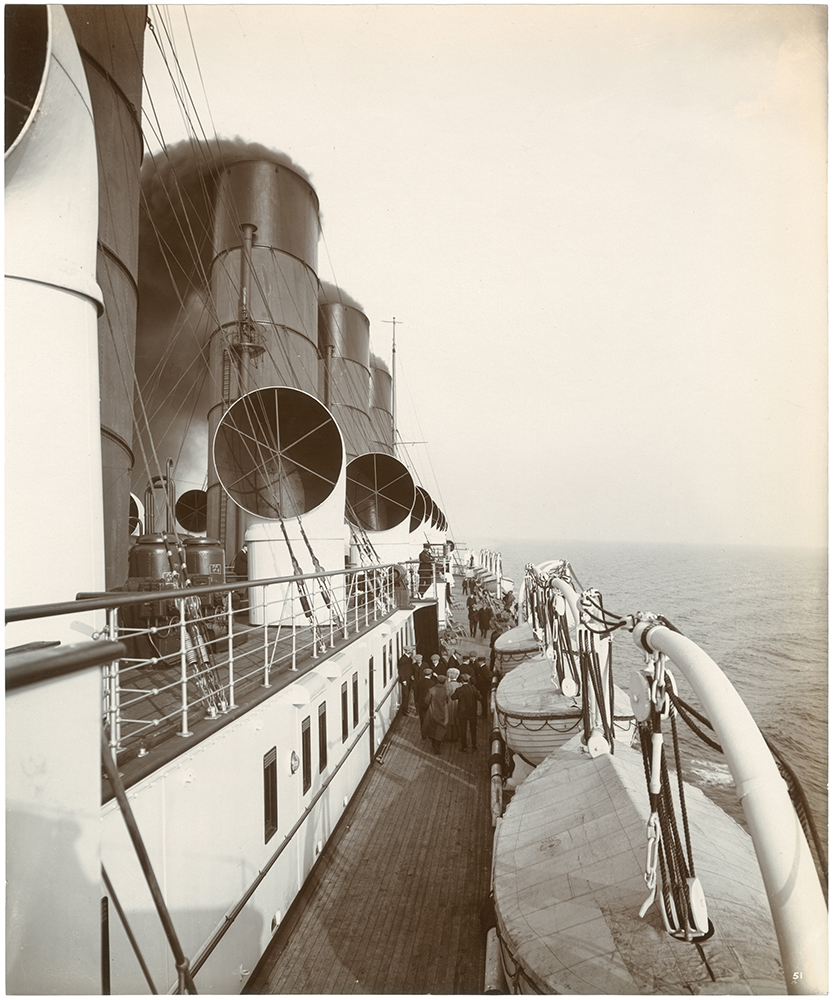
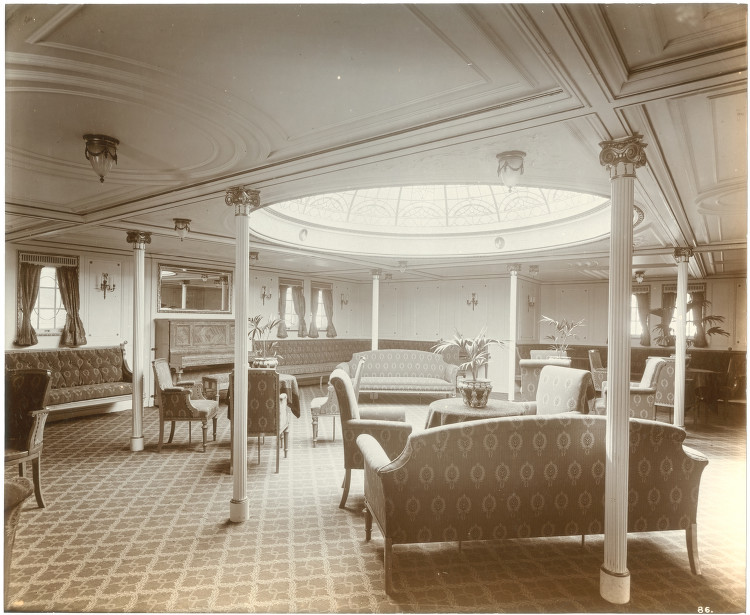
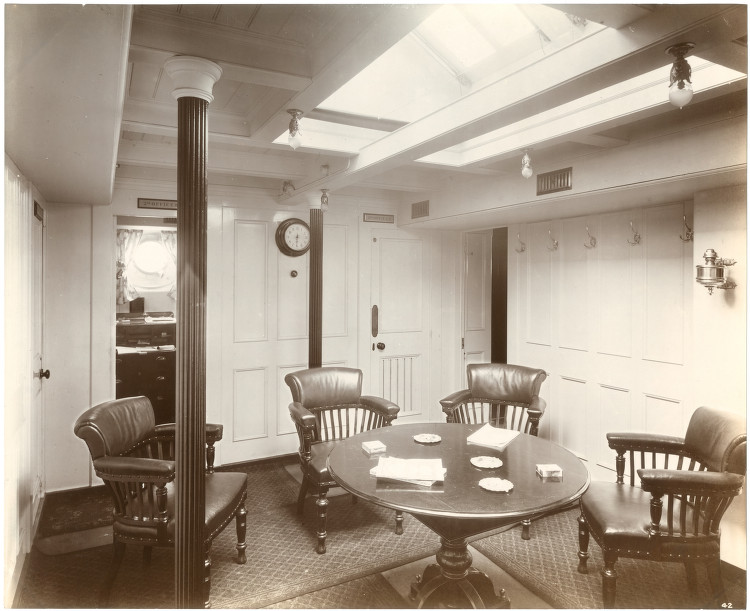
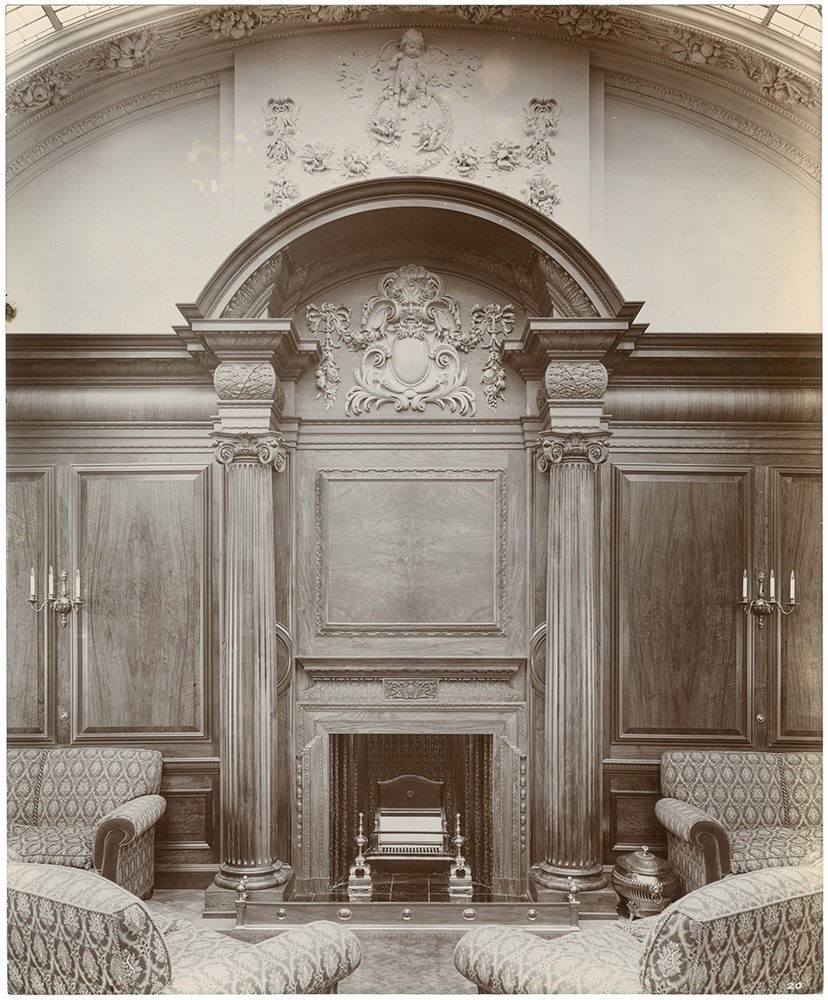
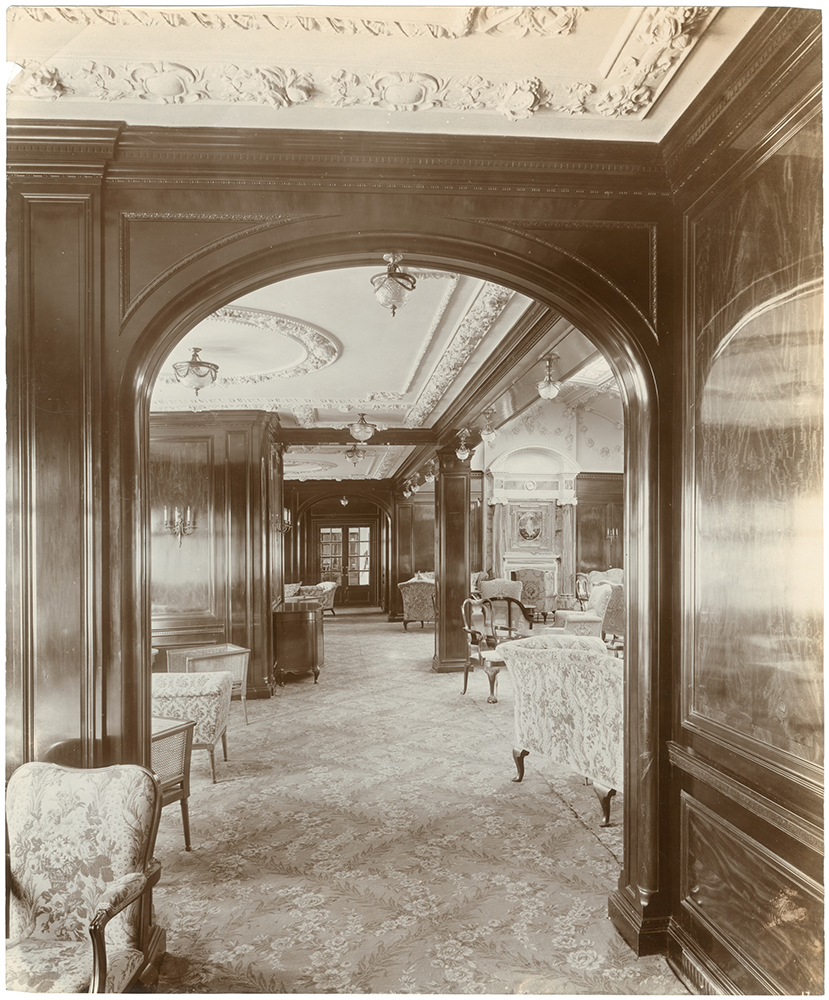
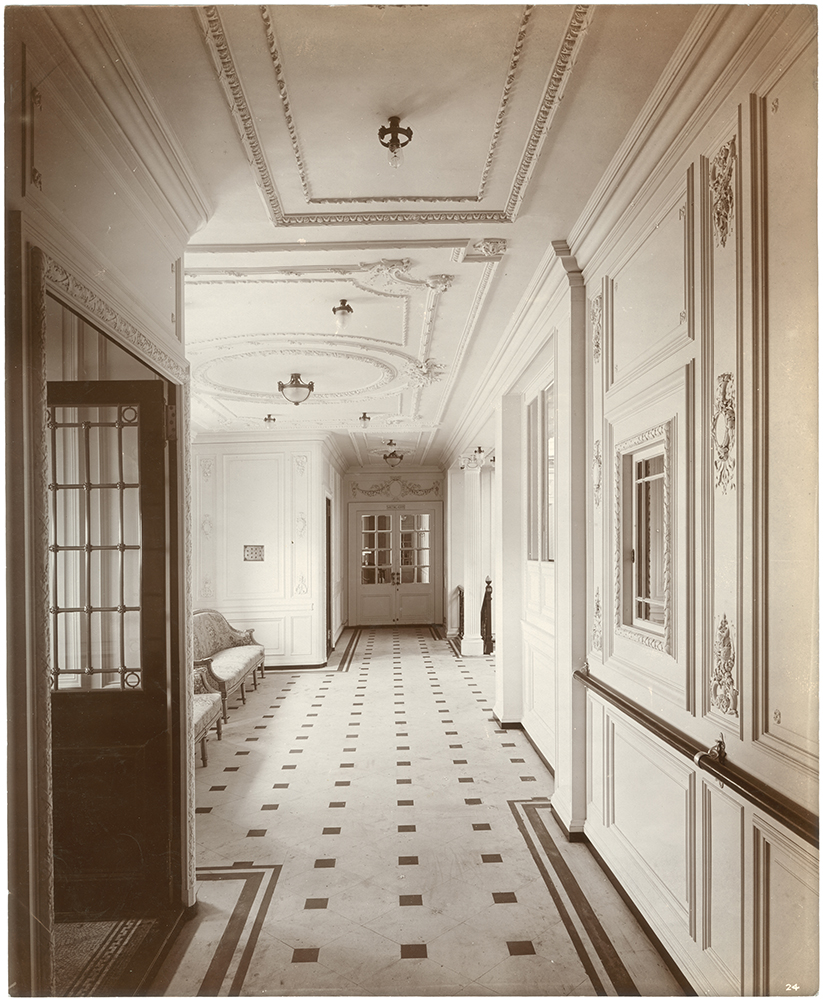
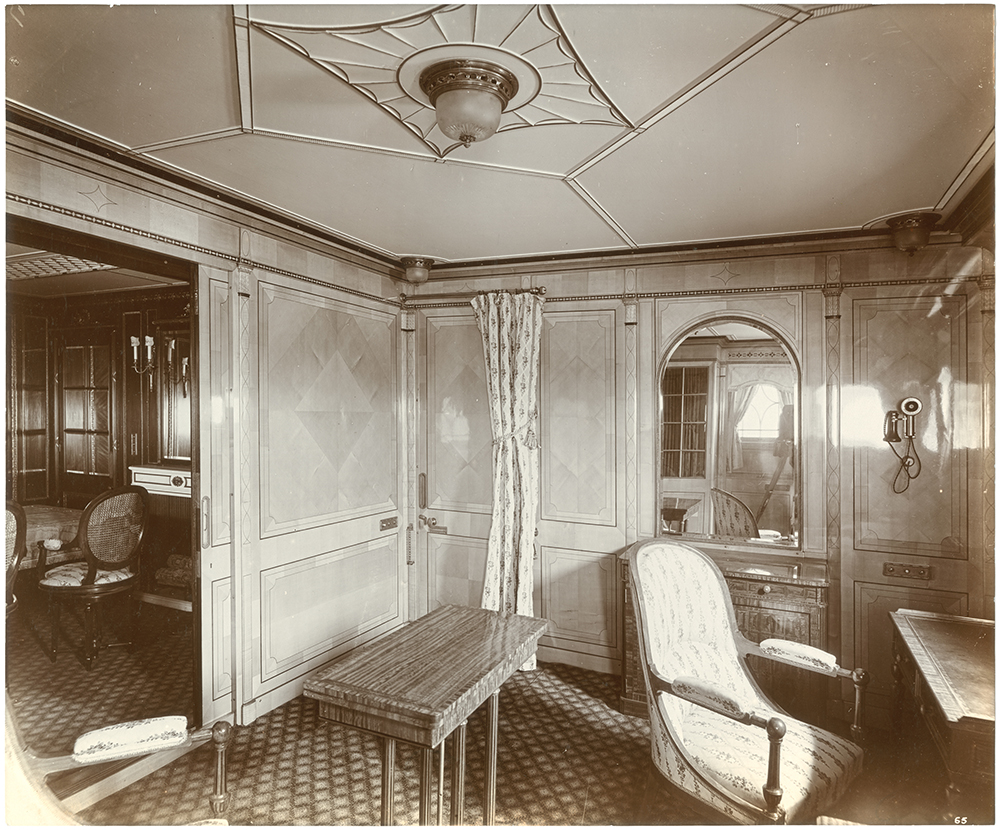
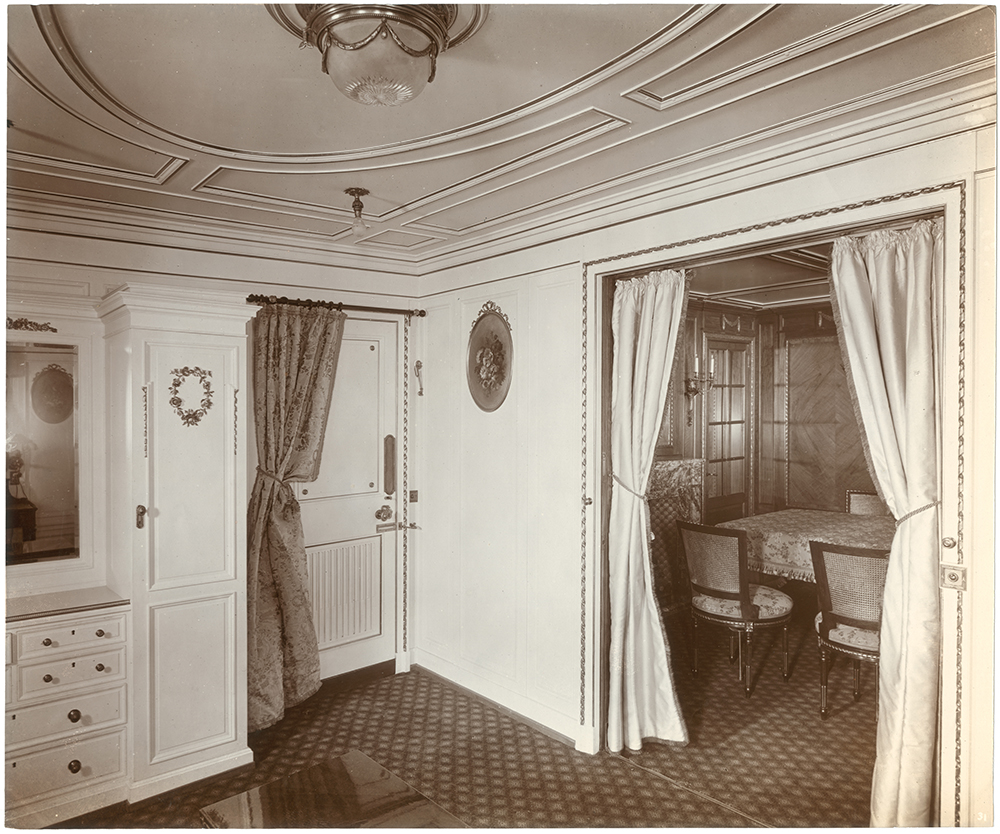
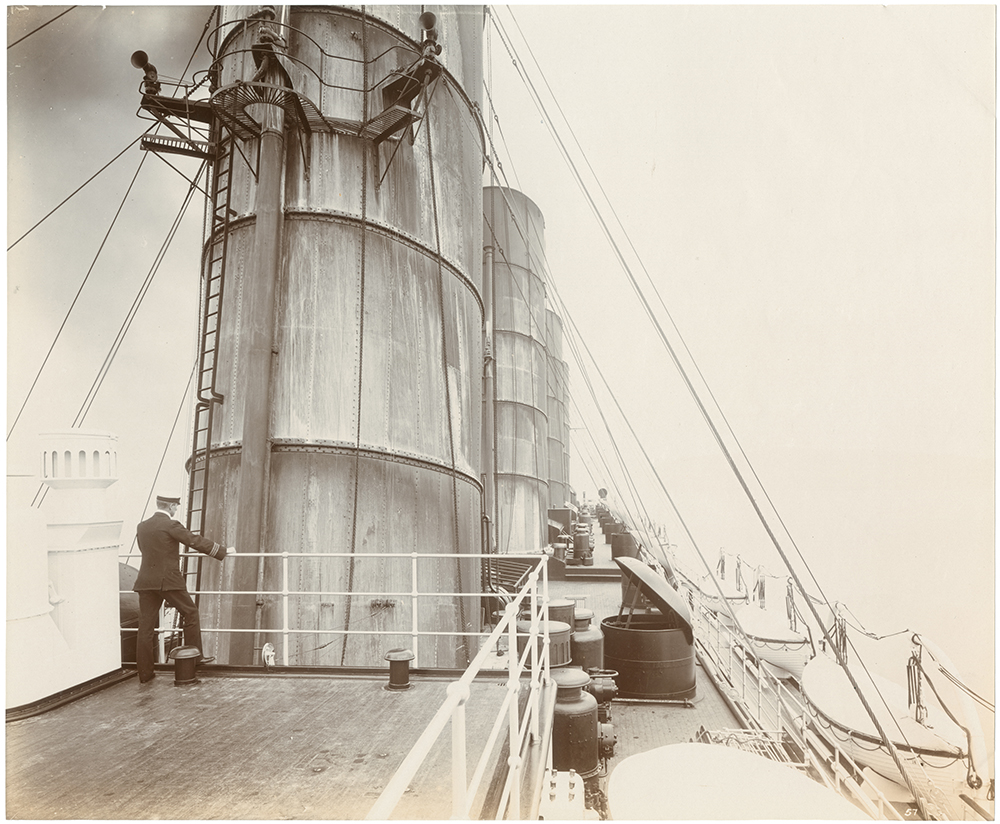
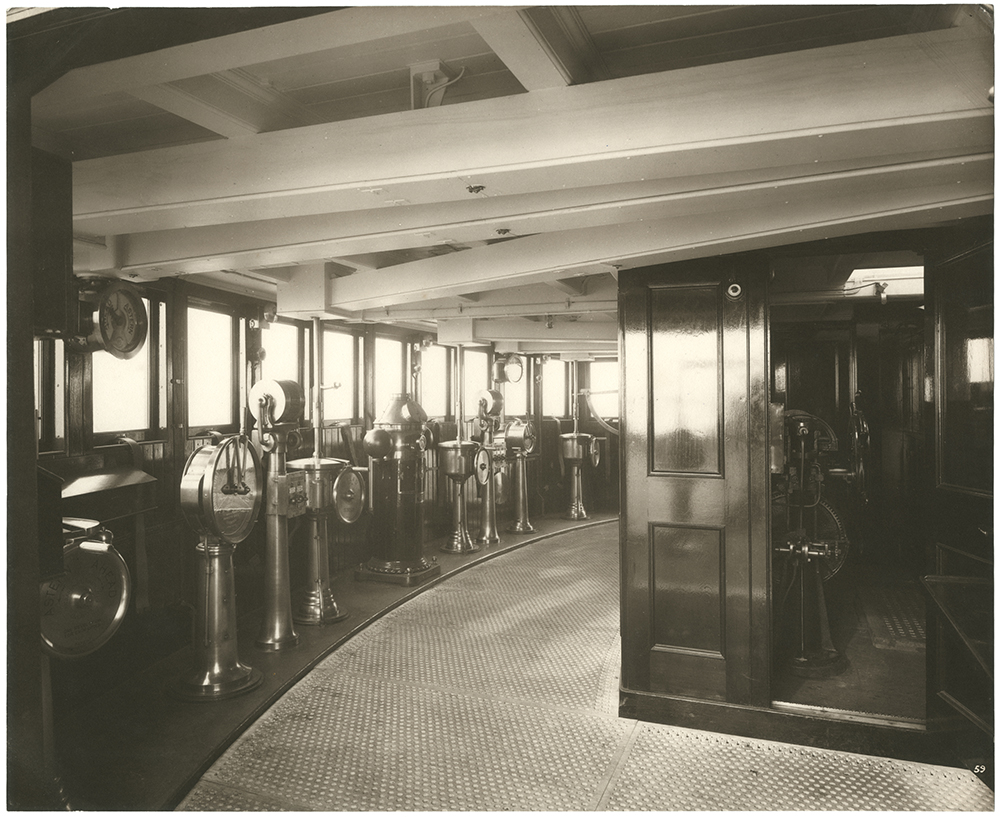
The ship itself was a major loss both for Cunard and the British military as the ship was fitted for active service. Here are a selection of images from 1905 (courtesy SMU Central University) of the Lusitania in all her glory, years before her demise.

Interspersed are some newspaper clippings from its initial launch in 1906 and some from 1907, the year the vessel first sailed to New York.

For more information on the Lusitania, check out our podcast on the Chelsea Piers or read my book review of Dead Wake, the latest by Erik Larson.

1

“GLASGOW, Scotland, June 7. — The new Cunard Line steamer Lusitania, the world’s largest liner, was successfully launched at Clydebank to-day, and was named by Dowager Lady Inverclyde. Hundreds of visitors from all parts of the country, besides thousands of the local population, witnessed the ceremony.

The Lusitania is the first of the giant Cunarders to be launched, and her sister, the Mauretania, will follow her into the sea a month ago.  The Lusitania is 790 feet long, and her greatest breadth is 88 feet, while her depth molded is 60 1/2 feet.”

2

Cabin accommodations:  552 first class, 460 second class, 1,186 third class. 2,198 total

Second class entrance

NYT , July 31, 1907:  “LUXURIOUS OCEAN TRAVEL. The new Cunarder Lusitania is now afloat, and will soon be on her way to New York. She is at the present moment the largest and most richly appointed ocean steamship in the world, though she may take second place within a year or so.”

Side view of Lusitania showing the launching cradle and the propellers
Interior staircase and elevator

Headline from the New York Times, September 7, 1907:

LUSITANIA STARTS FIRST TRIP TO-DAY; Will Race the Lusitania Across in an Effort for a New Record. BOTH BOATS ARE FULL Colossal Ferries Groomed for the Event — Lusitania Will Burn 1,000 Tons of Coal Daily.

First class promenade deck
2

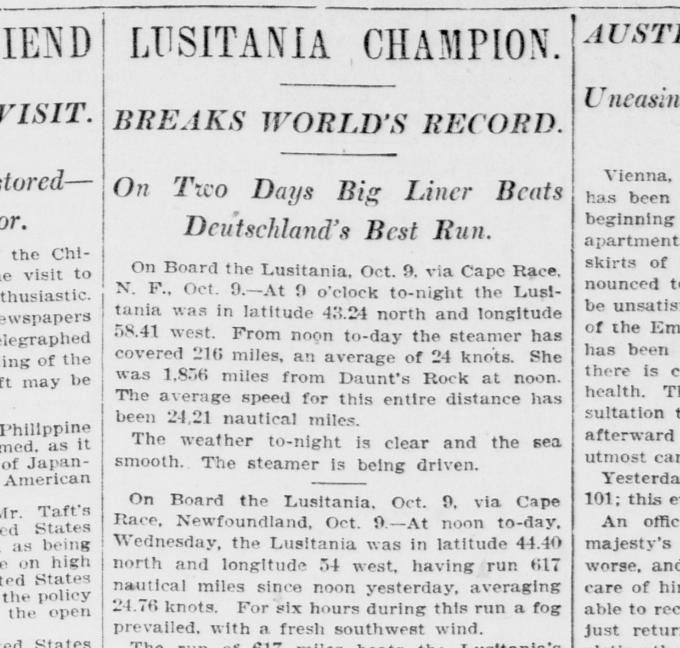
From the New York Tribune, October 10, 1907

1

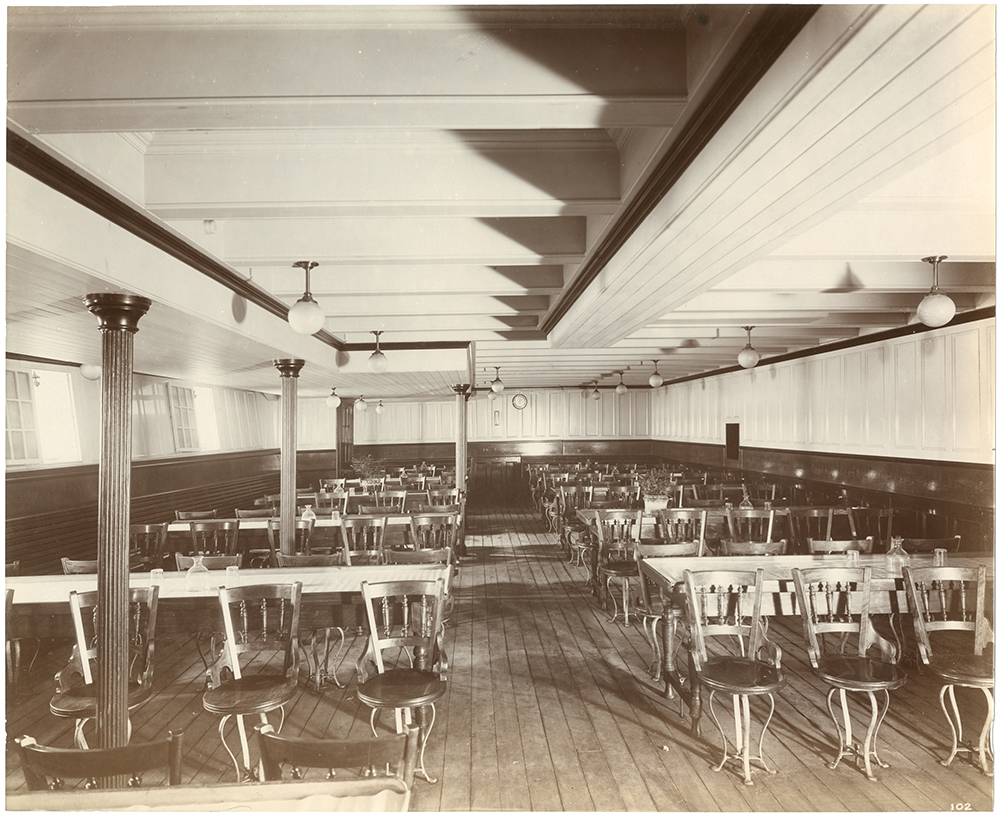
Third class:

1

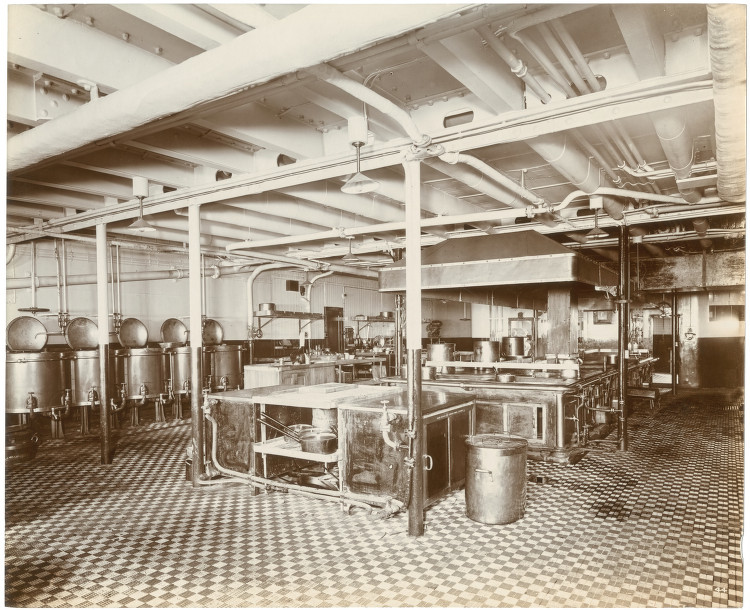
The kitchen:

2

Second-Class Ladies Lounge:

3

Officers smoking lounge:

4

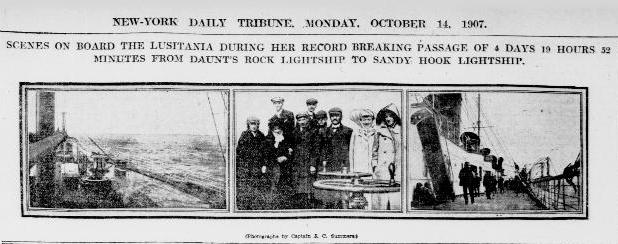
From the New York Tribune, October 14, 1907

1


First class smoking room, music lounge, and library entranceway:

5
6
7

And pictures of the ‘regal suite’, the nicest rooms on the boat:

1
2

An officer atop the navigation bridge:

1

And finally — the navigation bridge

bridge

You can find many more images at Flickr Commons, courtesy Southern Methodist University, Central University Libraries, DeGolyer Library

Categories
Brooklyn History Podcasts

Park Slope and the Story of Brownstone Brooklyn

PODCAST Park Slope — or simply the park slope, as they used to say — is best known for its spectacular Victorian-era mansions and brownstones, one of the most romantic neighborhoods in all of Brooklyn. It’s also a leading example of the gentrifying forces that are currently changing the make-up of the borough of Brooklyn to this day.

During the 18th century this sloping land was subject to one of the most demoralizing battles of the Revolutionary War, embodied today by the Old Stone House, an anchor of this changing neighborhood. In the 1850s, the railroad baron Edwin Clark Litchfield brought the first real estate development to this area in the form of his fabulous villa on the hill. By the 1890s the blocks were stacked with charming house, mostly for occupancy by wealthy families.

Circumstances during the Great Depression and World War II reconfigured most of these old (and old fashioned) homes into boarding houses and working-class housing. Then a funny thing happens, something of a surprising development in the 1960s: the arrival of the brownstoners, self-proclaimed — pioneers — who refurbished deteriorating homes.

The revitalization of Park Slope has been a mixed blessing as later waves of gentrification and rising prices threaten to push out both older residents and original gentrifiers alike.

PLUS: The terrifying details of one of the worst plane crashes in American history, a disaster that almost took out one of the oldest corners of the neighborhood.

And a special thanks to our guests on this show — Kim Maier from the Old Stone House; Julie Golia, Director of Public History, Brooklyn Historical Society; and  John Casson and Michael Cairl, both of Park Slope Civic Council.


The Bowery Boys: New York City History podcast is brought to you …. by you!

Starting this month, we are doubling our number of episodes per month. Now you’ll hear a new Bowery Boys podcast every two weeks. We’re also looking to improve the show in other ways and expand in other ways as well — through publishing, social media, live events and other forms of media. But we can only do this with your help!

We are now a member of Patreon, a patronage platform where you can support your favorite content creators for as little as a $1 a month.

Please visit our page on Patreon and watch a short video of us recording the show and talking about our expansion plans. If you’d like to help out, there are five different pledge levels (and with clever names too — Mannahatta, New Amsterdam, Five Points, Gilded Age, Jazz Age and Empire State). Check them out and consider being a sponsor.

We greatly appreciate our listeners and readers and thank you for joining us on this journey so far. And the best is yet to come!


The Vechte Cortelyou House (aka the Old Stone House) depicted as it looked in 1699 (from a hand colored lithograph by the firm of Nathaniel Currier, MCNY)

MNY323785

A collection of classified ads from the December 1, 1912 issue of the Brooklyn Daily Eagle, offering several living options in the park slope area.

Screen Shot 2015-05-01 at 9.03.50 AM
 
The stark Fourteenth Street Armory, located in the South Slope, depicted here as it looked in 1906 — “a pretty place” (MCNY)
M3Y44090
 
 
Congregation Beth Elohim, pictured here on September 16, 1929, located at Garfield Place and 8th Avenue. (MCNY)
MNY195546

The horrific place crash of December 16, 1960 — United Airlines Flight 826, bound for Idlewild Airport, colliding with Trans World Airlines Flight 266, heading to LaGuardia Airport. 128 passengers were killed, along with six people on the ground. (Top picture courtesy New York Daily News; the two after are from the New York Fire Deparment. You can find further images here)

park-slope-plane-crash-1960
6523090255_8a5f5ab891_b
6523086749_f7564b2665_o

Some images from 1961 by John Morrell from the archives of the Brooklyn Historical Society:

A view along Prospect Park West at and 16th Street and Windsor Place.

V19749246

View of east side of 8th Avenue between 15th and 16th Streets looking north. n.e. cor. 16th Street (right) & 8th Avenue.

V19749250

Prospect Park West looking south toward Prospect Park/branch, U.S. Post Office (at northeast corner of Prospect Park W. & 16th Street).

V19749245

By the 1970s so mansions and brownstones close to the park were getting renovated by ‘pioneers’ with the means to restore these homes to their original splendor.

Landscape

In 1969, New York Magazine touted the ‘radical’ alternative of moving to Brooklyn in an article by Pete Hamill:

1969-0714-cover-250

TOP PHOTOGRAPH by Luci West from Moving Postcard

Categories
Brooklyn History

Ungentrified: Brooklyn in the 1970s

The new Bowery Boys podcast that comes out this Friday will be about Brooklyn. So let’s get in the mood with some pre-Instagram tinted photography from the U.S. National Archives, most of them taken in 1974 by Danny Lyon. followed by some black and white images by Edmund V Gillon.

You might have seen many of these photographs before (perhaps even here on this blog), but it’s striking to revisit them in context of Brooklyn current gentrification patterns.

The homes of Brooklyn Heights began seeing the arrival of ‘bohemians’ as early as the 1910s, and brownstone revivalists (the so-called ‘pioneers’) discovered the neighborhood after World War II.

But a noticeable trend of Brooklyn gentrification happened in earnest in the late 1950s, with wealthy escapees from Manhattan (fending off the urge to suburbanize) moving into South Brooklyn brownstones and row houses and giving enclaves attractive new names like Boerum Hill, Cobble Hill and Carroll Gardens.

The most successful example occurred up on the park slope as a movement of urban activists and historical preservations refurbished and brought to life one of Brooklyn’s original Gold Coasts. Its official name became, of course, Park Slope.

While the ‘brownstone Brooklyn’ movement was well at hand in 1974-5 — the date of most of these photographs — much of the borough was still facing blight and deterioration then.  Most of the neighborhoods pictured below are today considered ‘hot’, trendy places with incredibly high rents.

DUMBO, a name invented in the late 1970s, Down Under the Manhattan Bridge Overpass.

Landscape

The RKO Bushwick Theater, at the Bushwick/Bed-Stuy border.

Portrait

Bushwick Avenue

Landscape

Two pictures of Bond Street

Landscape
Landscape

Across from Lynch Park, near the Brooklyn Navy Yard

Landscape

There’s no location listed in the caption but probably Park Slope?

Landscape
Landscape

Fort Greene, across from the park.

This is taken on Vanderbilt Avenue but I can’t ascertain exactly here. Perhaps today’s Prospect Heights area.

Landscape

Images of the Fulton Ferry area in 1975 (courtesy the Brooklyn Historical Society)

V19891866
V19891847-1

And a couple images from the Museum of the City of New York archives, all from 1975, taken by Edmund V Gillon. You can find many more of astounding photographs here:

397 Dean Street, considered part of Park Slope today

MN112866

Williamsburg, looking east on Broadway from Bedford Avenue and South 6th Street.

MN112215

Boarded-up buildings and the Bedford Avenue façade of the Smith Building, 123 South 8th Street

2013_3_2_ 546

Clinton Hill: Row houses on the eastern side of Washington Avenue between Dekalb and Lafayette Avenues

66cm_2013_3_2_ 025
Categories
Amusements and Thrills

The 1965 New York World’s Fair: Opening Day

The New York World’s Fair opened for its second and last season on April 21, 1965.  The grand opening the previous year had been rocky indeed — protests, rain, even a parking lot riot.  Thankfully the second season was met with beautiful weather and abundant crowds.  In order to jazz it up a bit — not too much, just enough to increase ticket sales — Robert Moses authorized a host of changes, great and small.  Some of the exciting guest stars and new features that awaited entrants to the 1965 World’s Fair that day included:

1

Opening the World’s Fair that day: Mayor Willie Brandt of West Berlin; Robert Moses naturally; Vice President Hubert Humphreys; Chief Justice Earl Warren and New York Mayor Robert Wagner (from NYT file photo)

Vice President Hubert Humphrey took a leisurely stroll through the fair, creating quite a stir. “He’s a walking pavilion,” cracked one observer. His entourage included Chief Justice Earl Warren.  During his visit to the New York State Pavilion, a riot almost ensued.  “Children cried out in terror, parents shouted, toes were trampled, cameras clicked.”

Courtesy Life Magazine

Hall of Presidents: Appropriately, Humphrey’s appearance coincided with the opening of some striking new exhibits within the United States Pavilion (which had opened the previous year) featuring memorabilia from over a dozen American presidents, including original copies of the Bill of Rights, Washington’s inaugural and farewell addresses and Lincoln’s Gettysburg Address.  Meanwhile, a crude Animatronic version of Lincoln continued to greet visitors.

Photo by Bill Cotter/NYT

Under The Dome: One of the most anticipated new arrivals to the fair was the Winston Churchill Center, a tribute to the former British Prime Minister who had died in January.  “Included in exhibits documenting Sir Winston’s career are some of his own paintings, and photographs of him at various periods in his life. Also on display are a replica of Churchill’s study at Chartwell; models of Blenheim Palace, where he was born, and Bladon churchyard, where he lies buried; and an exhibit of his personal effects, including his desk, which once belonged to Disraeli.”

The dome of this dramatic pavilion would later be used as the Queens Zoo Aviary.

heinz

MORE FOOD: According to the New York Times, “the number of restaurants has been increased from 111 to 198. This means the fair can now serve more than 38,000  person simultaneously, or about 8,000 more than last year. ”  Certainly there was food to be found at the Theater of Food-Festival of Gas Pavilion?

The Gutenberg Bible: If you were craving a more spiritual exhibition, look no further than the latest resident of the Vatican Pavilion, one of six existing copies of the Gutenberg Bible. Also on site: The Pope’s jeweled tiara.  These two items were joining the Pieta, perhaps the most historically significant work of art at the fair.

dino

New Dinosaurs at Sinclair’s Dinoland : And not just any dinosaurs, but automated dinosaurs that could roar. “Last year we were of the school that dinosaurs had no vocal cords,” said the exhibit’s fuddyduddy spokesman. “This year we are in a new school.”

Kiddie Phone Center : As a way to get children excited about using the phone, Bell Telephone opened a Phone Fun Fair featuring a variety of wacky telephone games. “The center has three tot-sized phone booths where a youngster, by dialing, can get a pleasant message from one of six Disney characters, or a commercial message from an operator.” BONUS FUN:  “A voice Mirror lets you hear how you sound on the telephone. Weather-phones allow you to dial Weather Bureau information in selected cities. Quiz games, solar battery display — and much more!”

fiesta

People To People Fiesta: The youth oriented People to People International is a youth outreach non-profit started by President Eisenhower in 1956. “Africa, Asia, Europe, as well as the Americas, are represented in a “village” of kiosks which display and sell a variety of folk art. Admission is charged; proceeds go to a center for world understanding.”   The ‘fiesta’ “will stress folk singing and dancing in the setting of colorful tents.”

Today PTPI takes the World’s Fair’s slogan — Peace Through Understanding — as its own.

(Image courtesy Worlds Fair Community forum.)

mars

MARS! One of the more innovative new exhibits was located in Space Park with a focus on Mariner 4, a spacecraft launched the previous year that would successfully take the first images of Mars. Photos sent by Mariner 4 would be displayed here as they came in on July 14-15. Above: An image of Mars sent by the orbiting spacecraft.

Kensington Runestone: And finally no trip to the fair in 1965 would be complete without a viewing of the mysterious Kensington Runestone, an ancient stone marking found in Minnesota in 1898.  Some believe this to be a link to 14th century Swedish explorers although how it got to Minnesota is anybody’s guess. It was debunked as a hoax in 1910, and yet here it is at the  World’s Fair! It was accompanied, naturally, by the 28-foot-tall Viking that you see below:

viking

Picture courtesy the World’s  Fair Community boards

Categories
On The Waterfront Podcasts

Chelsea Piers: New York City in the Age of the Ocean Liner

PODCAST The Chelsea Piers were once New York City’s portal to the world, a series of long docks along the west side of Manhattan that accommodated some of the most luxurious ocean liners of the early 20th century.

1

Passenger ocean travel became feasible in the mid 19th century due to innovations in steam transportation, allowing for both recreational voyages for the wealthy and a steep rise in immigration to the United States.

The Chelsea Piers were the finest along Manhattan’s busy waterfront, built by one of New York’s greatest architectural firms as a way to modernize the west side.  Both the tragic tales of the Titanic and the Lusitania are also tied to the original Chelsea Piers.

But changes in ocean travel and the financial fortunes of New York left the piers without a purpose by the late 20th century. How did this important site for transatlantic travel transform into one of New York’s leading modern sports complexes?

ALSO: The death of Thirteenth Avenue, an avenue you probably never knew New York City ever had!

__________________________________________________________

The offices of Steamship Row near Bowling Green and Battery Park. With the rise of ocean travel in the mid 19th century, passengers went to these buildings to make voyage accommodations.

These were later replaced with more lavish offices, many of which are still around in the neighborhood today.

Courtesy Museum of the City of New York
A jaunty song written for the Cunard ship Mauretania, sister ship of the Lusitania.

The crazy scene out in front of West Washington Market in 1905. The market was built well before the Chelsea Piers and helped preserve a bit of 13th Avenue when most of that street was eliminated for the Piers’ construction.

Courtesy Museum of the City of New York

Construction of the Chelsea Piers complex in progress, looking northwest from 16th Street, 1910.

Courtesy New York Department of Records
Courtesy Library of Congress

The lavish Chelsea Piers headhouse, designed by Warren and Wetmore of Grand Central Terminal. This picture was taken in 1910 at their completion. It looks very calm on the street in front, a rarity!

Courtesy the Museum of the City of New York

An insurance map from 1885, detailing the streets near the areas of waterfront along West Village and the Meat-Packing District. Note the location of 13th Avenue along the water, running along the top from center to right. Most of this was removed for the construction of the piers.

Courtesy New York Public Library

The arrival of the White Star ocean liner Olympic into New York harbor, 1911.

Courtesy Library of Congress

The Titanic on its maiden voyage on April 10, 1912. This was obviously taken from Southhampton where they had much more room for massive ocean vessels!

Titanic

Crowds gather at a location near Chelsea Piers awaiting the survivors of the Titanic disaster.

Courtesy Library of Congress
People gather in New York to await the arrival of survivors of the sinking of the RMS Titanic aboard the RMS Carpathia

The RMS Carpathia arrives at Pier 54 on April 18, 1912.  Reporters scurry to interview survivors of the Titanic.

Courtesy New York Times

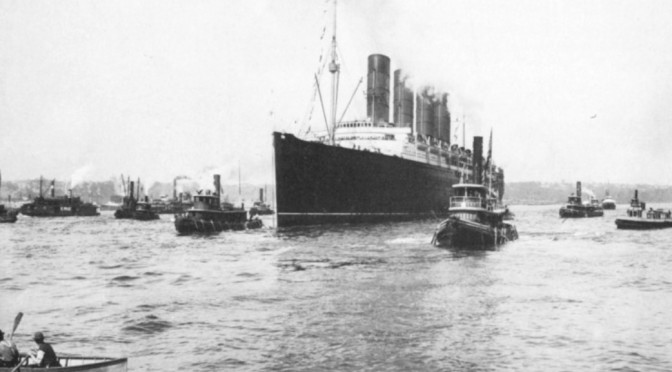
The Lusitania in New York Harbor, and other with the Lusitania at Pier 54 (date unknown but obviously before the Chelsea Piers were completed)

lusitania
pier54cunardlusitania

This striking image (cleaned-up photography courtesy of Shorpy) shows the Chelsea Piers in context with the streets of Chelsea in front of it. 1920

Courtesy Shorpy
Courtesy Shorpy

An excellent image of the crazy pier situation in lower Manhattan. This picture is from 1931. Chelsea Piers would be in the upper left-hand corner.

Courtesy Internet Book Image Archives

There were of course other pier structures running down the Hudson shoreline, many of them quite imposing such as this one at Pier 20 and 21 for the Erie Railroad Company at the foot of Chambers Street, picture taken in 1930.

Wurts Brothers, courtesy Museum of the City of New York

A photomechanical postcard of the piers further south of Chelsea Piers, 1916.

Courtesy New York Public Library

The three largest ships in the world in 1940, all docked in mid-Manhattan, not Chelsea Piers because it could not accommodate their size.

The three largest ships in the world, all docked in mid-Manhattan, not Chelsea Piers because it could not accommodate their size (Courtesy State Library of New South Wales)
(Courtesy State Library of New South Wales)

This is what Pier 54 looked like in 1951 after Cunard and White Star merged to become a single transatlantic company.

Courtesy New York Public Library

The piers of Washington Market in the 1970s. Most of the pier structures along the water had badly deteriorated by then.

Courtesy Andy Blair/Flickr

The Elevated West Side Highway being torn down in front of Pier 62. The area looks quite different today. In fact Pier 62 is part of the Hudson River Park system.

Photo by Edmund V. Gillon, courtesy the Museum of the City of New York

The Chelsea Piers sporting complex was constructed in the 1990s, saving a portion of the original Chelsea Piers from further deterioration. Although I think we can all agree the exterior could be a bit sexier.

chelsea

Meanwhile Pier 54 continues to find a variety of new uses. Here’s a dance party deejayed by Paul Van Dyk from 2008.

Courtesy Rukes/Paul Van Dyk Fan Board

And finally….

The complete words of Charles Dickens, describing his voyage over on the Cunard steamship Britannia to the United States in 1842 :

To say that she [the ship] is flung down on her side in the waves, with her masts dipping into them, and that, springing up again, she rolls over on the other side, until a heavy sea strikes her with the noise of a hundred great guns, and hurls her back — that she stops, and staggers, and shivers, as though stunned, and then, with a violent throbbing of her heart, darts onwards like a monster goaded into madness, to be beaten down, and battered, and crushed, and leaped on by the angry sea — that thunder, lightening, hail, and rain, and wind, are all in fierce contention for the pastry — that every plant has its grown, every nail its shriek, and every drop of water in the great ocean its howling voice — is nothing.  

To say that all is grand, and all appalling and horrible in the last degree is nothing. Words cannot express it. Thoughts cannot convey it. Only a dream can call it up again, in all its fury, rage and passion.

This is in describing his voyage to the United States. Horrible, to be sure. But given the thousands of people who involuntarily traveled across the Atlantic in the decades earlier, and the wretched conditions they faced, it’s hard to be overly sympathetic to Mr. Dickens’ inconvenience!

Categories
Bowery Boys Bookshelf

The Lusitania’s final voyage, breathlessly told

They said the Lusitania couldn’t be sunk. The German telegrams to the contrary were merely cheap scare tactics. Besides, England will provide protection once in their heavily guarded waters. The boat is simply too big to sink. There are plenty of lifeboats, enough for the entire passenger list. Even those in steerage!

And the best one — there are Americans on board. Germany wouldn’t risk dragging her into war.

The excuses made by the passengers and crew of the Lusitania seem strikingly naive now, almost 100 years to that May 7th afternoon when the premier vessel of the Cunard fleet was taken down — by a single German torpedo — and brought to the bottom of the ocean in all of 18 minutes.

The deck of the Lusitania, 1905-07, courtesy SMU Central University

Dead Wake, the captivating new narrative non-fiction by Erik Larson, follows the tragic fate of the Lusitania from four sectors.

In England, a group of cryptoanalysts in shadowy Room 40  attempt to crack German messages as their U-boats began prowling through British-controlled waters. Meanwhile, President Woodrow Wilson, still mourning the loss of his wife, attempts to keep American neutrality intact in the face of growing threats.

But the two central perspectives are what grant Dead Wake its lurching, inevitable dread.  And Larson switches between them like the dance of predator and prey in a nature documentary.

The Lusitania on one of its early voyages, 1906, courtesy Royal Museum Greenwich

In New York, docked at Chelsea Piers, passengers from all walks of life board the Lusitania, ready for leisure and occupied with trivial affairs of the day. The bookseller Charles Lauriat Jr. boards with a valise of valuable literary works.

Theodate Pope, the spirited, independent woman who’s clearly Larson’s favorite, hits the decks with her mysterious male companion Edwin Friend. A pregnant Bronx woman named Margaret Kay boards with her young son Robert, destined to get the measles. An entire family with the last name of Luck boards the ship, never a good sign in these kinds of books.

And then there’s the enigmatic Preston Prichard, a Canadian medical student described in such striking, beatific terms that it spells doom for him almost immediately.

Meanwhile, thousands of miles away, the other narrative course follows the U-20 submarine captained by Walther Schwieger, a stern and sometimes unforgiving man in charge of a lonely vessel cutting through the waters of the Irish Sea.

Submarine warfare was primitive by nature and callous by design. Captains gauged the success of a mission not by numbers of ships sunk, but the amount of tonnage destroyed. Human lives were lightly considered.

Sinking of the Lusitania, European postcard

Larson is best known for a certain flamboyant style of storytelling, meshing two or more sometimes unrelated story arcs to create a swelling crescendo of melodrama. His books bristle with energy even when artificially cultivated. His best known book, The Devil In the White City, works entirely because of this particular narrative mechanism, weaving together the tales of the Chicago World’s Fair and a ruthless serial killer

But in Dead Wake, it’s the inevitable confrontation between the Lusitania and the U-20 that drives the story, and Larson finely manages the tension.

He prefers to spend time with lesser known people aboard the Lusitania and barely looks at its most famous passengers — Alfred Gwynne Vanderbilt or the Broadway impresario Charles Frohman. Once the torpedo hits, you’re genuinely invested in situations all throughout the boat.

The book has a cinematic feel and comparisons with the film Titanic will surely be made. You can almost feel the urge to transform passengers like Pope or Prichard into the next Rose or Jack.

But the story never lapses into phoniness or boisterous, over-descriptive speculation for long. There are thankfully few of those artificial “she felt the wind in her hair” moments that hamper other narrative non-fiction book events. Larson is the master of this particular genre, and once the torpedo hits the ocean liner on that fateful May afternoon, he’s in full control of the story.

When you get to Dead Wake‘s halfway point, prepare to keep your afternoon open, because you won’t want to put it down.

Dead Wake:  The Last Crossing of the Lusitania
By Erik Larson
Crown Publishers