Categories
Podcasts

Case Files of the New York Police Department 1800-1915

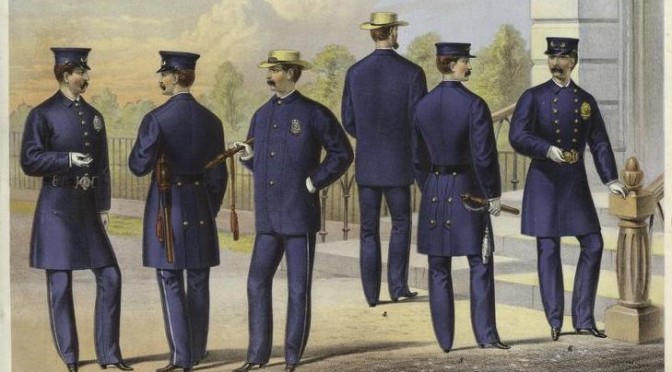
Uniformly chic: Law enforcement officers of the New York Metropolitan Police from 1871 show off their fancy blue threads. Twenty years previous, they weren’t even required to wear standardized apparel. (Courtesy NYPL Digital Library)

PODCAST We’re playing Good Cop / Bad Cop this week, as we take a close look at four events from the early history of the New York Police Department. You’ll meet shining stars of the force like Jacob Hays, who kept the peace in the early 19th century armed with a mean billyclub — and the only man to ever hold the title of High Constable of New York. And then you’ll encounter Joseph Petrosino, the Italian immigrant turned secret weapon in the early battles against organized crime.

Not all the early men in blue were so recommendable. During the Police Riot of 1857, cop turned against cop while the city burned and “Five Points criminals danced in the streets.” And finally there’s the lamentable tale of officer Charles Becker, the only member of the New York Police Department to be executed for criminal misdeed.

But did he really commit the crime — commissioning the murder of a nervous gambler who was prepared to rat him out?

#1 The Saga of High Constable Hays
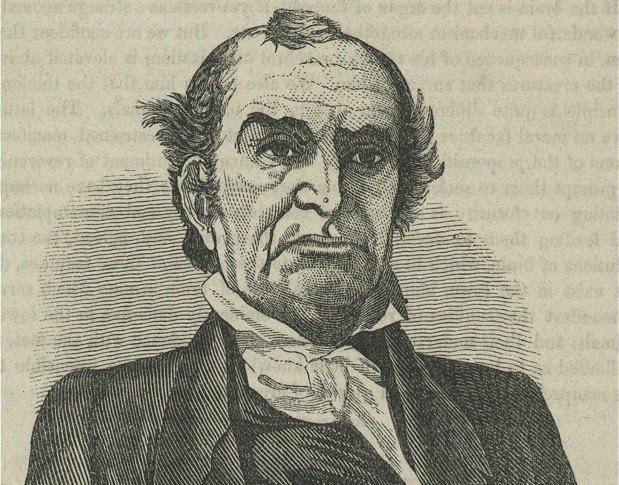
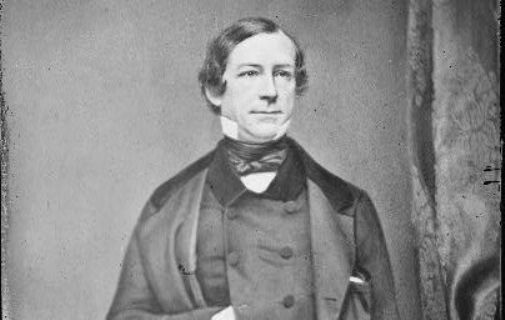
Imagine encountering this face on a gaslit street at night! Jacob Hays watched over the streets of New York for over 40 years, one of the most dedicated men ever to watch over the city. Hays would become one of New York’s best known — and most feared — men, thanks to his agility with a billy club and his early skills of detection and crime solving. (NYPL)

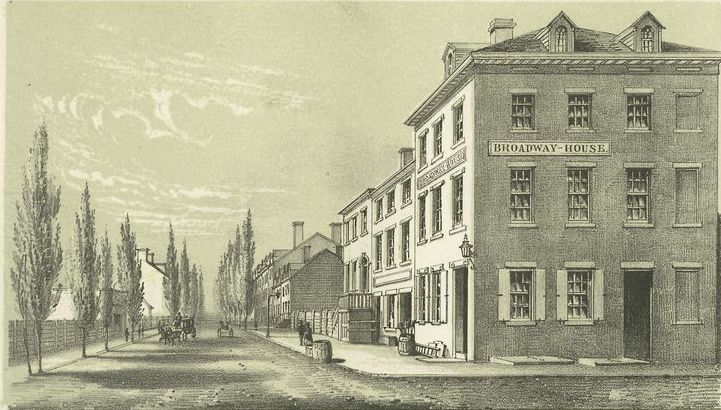
This is the corner of Broadway and Grand Street in 1818. A wildly bustling street corner today, but quite a different story back in Hays’ day. The constable roamed over a much smaller city — this was at the northern outskirts — and a far different range of crimes. By 1818, he would have only had about a couple dozen officers in his employ, all of whom reported directly to him. (NYPL)

#2 The Police Riot of 1857
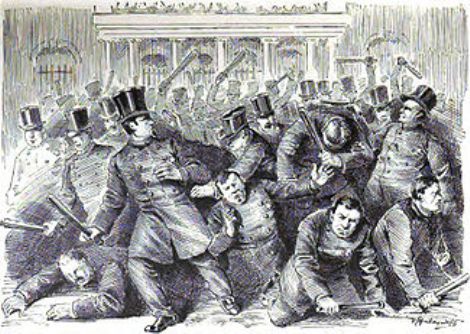
New York once had two different — and competing — police forces and boy they just did NOT get along. It all came to blows one June day in 1857, with state-sponsored Metropolitan police officers attacking the renegade men of the Municipal police force.

And it was because of Fernando Wood, the crafty mayor of New York in the 1850s who refused to comply to the state’s authority over city law enforcement. Wood used the police for his own political advantage and hastened its descent into corruption.

#3 Petrosino!
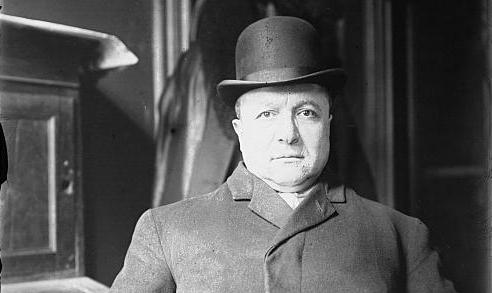
The short Italian immigrant Joseph Petrosino, who become the NYPD’s most potent tool against the growing forces of organized crime during the first years of the 20th century.

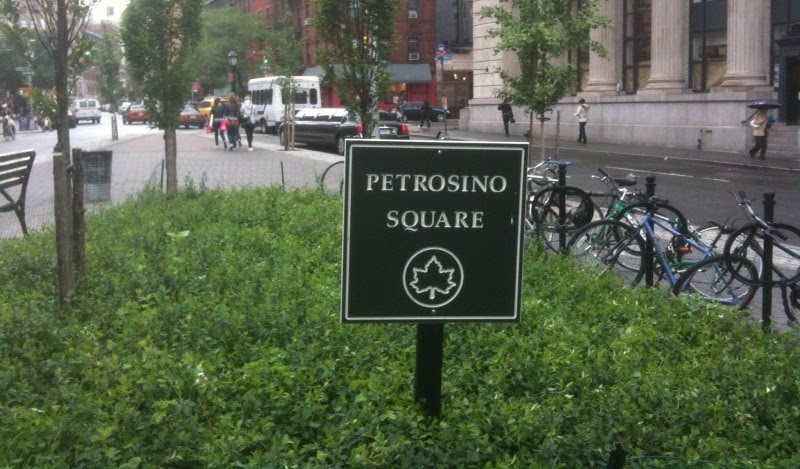
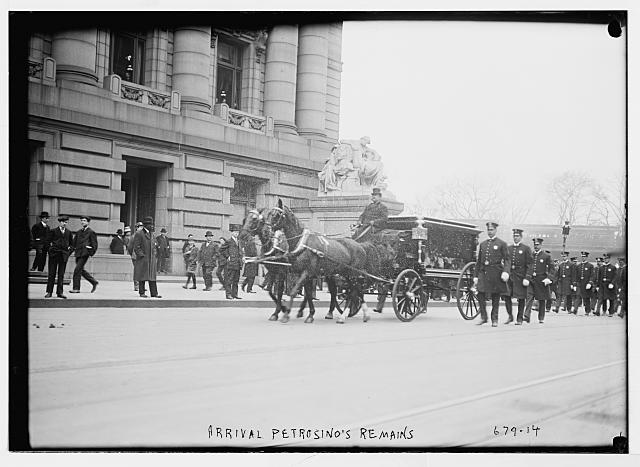
Petrosino was assassinated in Italy by the mob and his funeral procession through the city drew thousands of mourners. Today, you can visit the freshly refurbished Petrosino Square at Lafayette and Kenmare streets and see many artifacts relating to Petrosino at the New York City Police Museum.

Petrosino’s funeral procession passed by the U.S. Custom House, April 9, 1909. (LOC)

#4 Murder At The Metropole
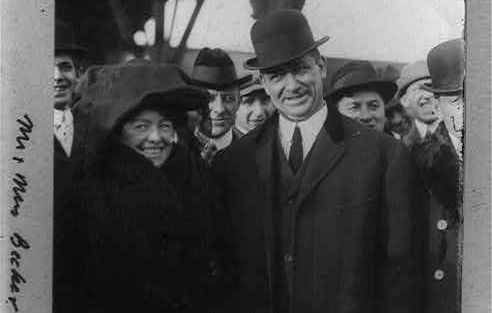
Charles Becker and his wife beaming to the press, although I don’t know what they’re smiling about. Becker was convicted of authorizing the murder of down-and-out gambler Herman Rosenthal. The disgraced cop was eventually sent to the electric chair.

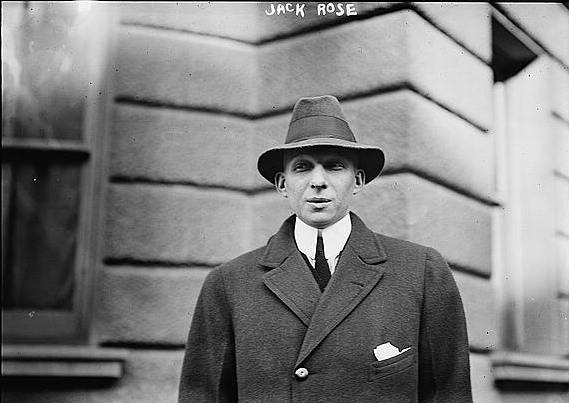
The prime witness against Becker was the otherworldly looking Bald Jack Rose, who claimed to have intimate details linking the officer to the vicious crime, which took place outside the Metropole Hotel in midtown.

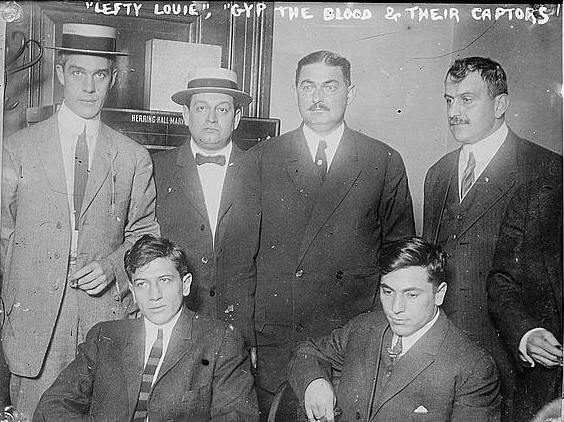
Two of the gunmen in the Rosenthal murder, nicknamed Gyp The Blood and Lefty Louie, pictured here with the men who brought them in.

I wish the first three tales had full-length histories as good as Mike Dash’s Satan’s Circus, which recounts the excrusiating tale of Herman Rosenthal’s murder and Becker’s arrest. The Becker story is actually recounted in several books, including a fairly recent one by Rose Keefe called The Starker: Big Jack Zelig, the Becker-Rosenthal Case, and the Advent of the Jewish Gangster.

CORRECTION: In referring to the new components of the Metropolitan Police, I mention the ‘city of Richmond’ when I meant the ‘county of Richmond’ — aka Staten Island.

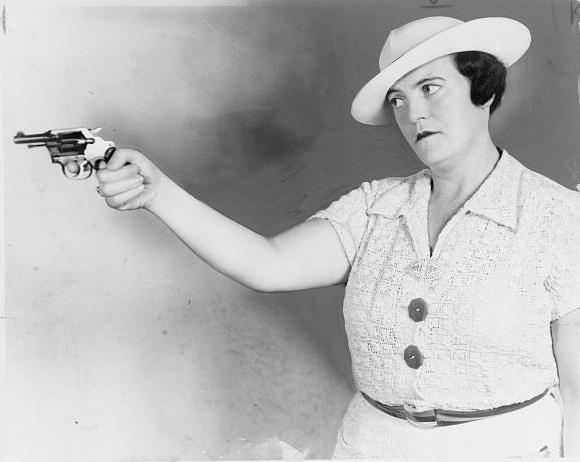
Detective Mary Shanley, armed and disarming

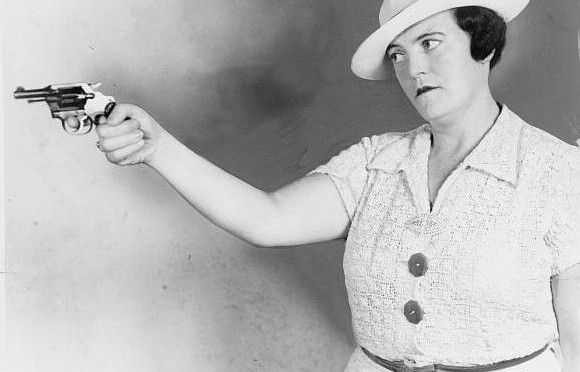
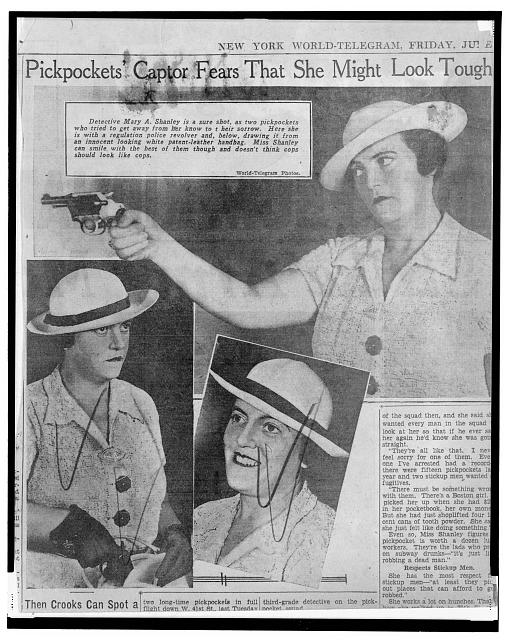
While perusing through the Library of Congress archive, I found these arresting images from 1937. Caption: “Mary A. Shanley, New York City detective – “pickpockets’ captor fears that she might look tough”

“Detective Mary Shanley is a sure shot, as two pickpockets who tried to get away from her know to their sorrow. Here she is with a regulation police revolver, and, below, drawing it from an innocent looking white patent-leather handbag. Miss Shanley can smile with the best of them though and doesn’t think cops should look like cops.”

Shanley was known for catching pickpockets and ‘seat tippers’, thieves who specialized in theater crimes. According to authors James Lardner and Thomas Reppetto, the Irish dynamo once tried to stop a felon right in front of St. Patrick’s Cathedral by shooting her gun in the air.

Apparently, things don’t end well for Miss Shanley. According to a 1941 New York Times article: “WOMAN DETECTIVE IN BRAWL DEMOTED; Mrs. Mary A. Shanley Fires Shot in Barroom After Drink Is Refused.” She was apparently off duty when she fired off her revolver.

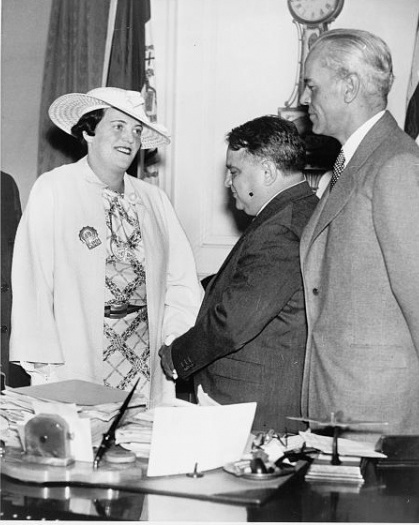
Let’s remember her in more pleasant surroundings. Below, Mary meets Mayor LaGuardia, 1937:

All pictures courtesy Library of Congress

The Limelight – a church, then a nightclub, now a mall!


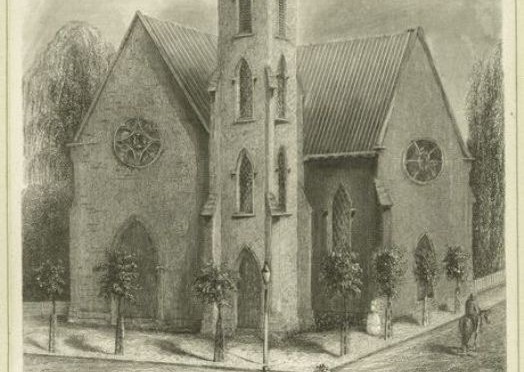
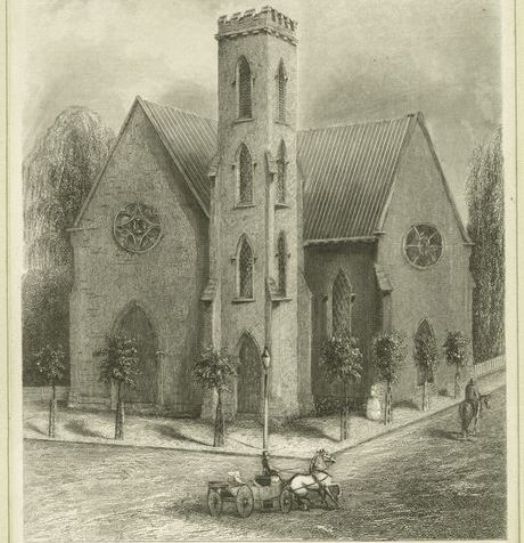
The sanguine days of the Holy Communion, pictured here over 150 years before it would be reconfigured as a shopping mall (from Booth’s History of New York, mid 19th century, courtesy NYPL)

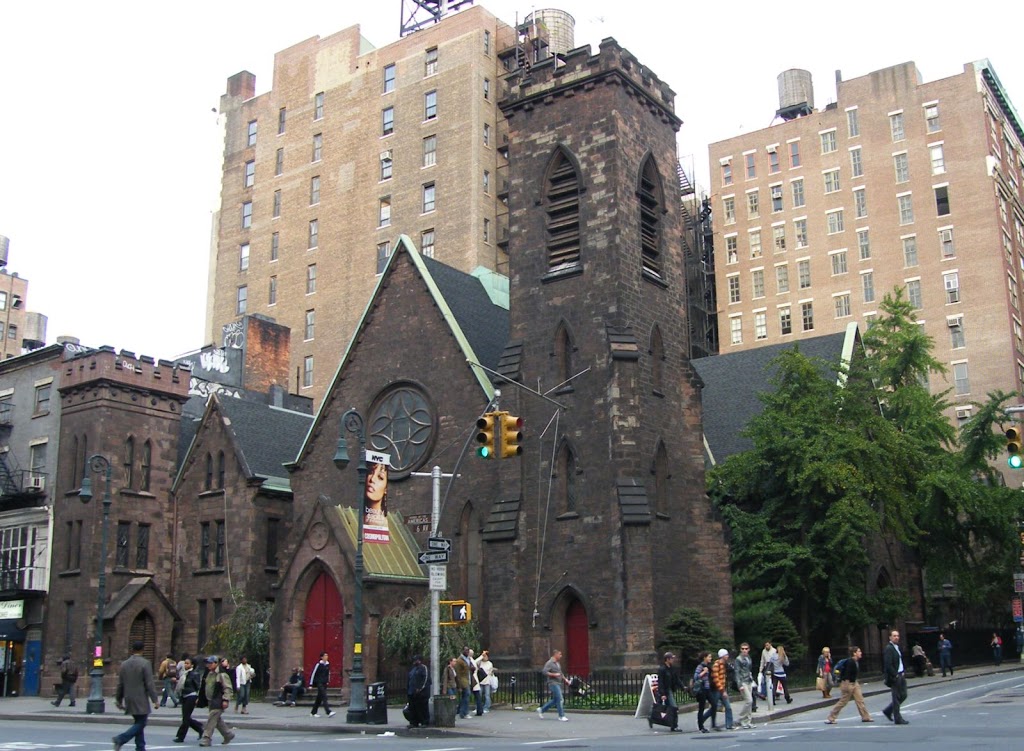
On Friday afternoon, yet another completely implausible transformation will overtake Holy Communion Episcopal Church when it reopens as the Limelight Marketplace, a spacious mall with 60 retailers sitting aside Gothic church features and the ghosts of strung-out club kids.

In honor of this curious transformation, I’m reprinting (with revisions) my history of this building and its later incarnation as the Limelight, one of the most notorious dance clubs of the 1990s. (Originally posted on Aug 10, 2007)


Holy Communion Episcopal Church was never meant to be the gateway to Hell. This lush Gothic style was designed and completed between 1844-1846 by Richard Upjohn, one of early America’s great architects, the master of Gothic Revival style and creator of downtown’s Trinity Church. It was built during a grand time for new churches in the city; in addition to Trinity (which opened in 1846), James Renwick was finishing up work that same year on Grace Church.

Upjohn designed the new chapel for its founder, the Reverend William Muhlenberg, a rector from Flushing, Queens, and known today as the founder of the Episcopal religious school movement. Perhaps the architect could foresee the church’s future tilting towards the bizarre, as it’s the first asymmetrical Gothic church in America. The first! Think of all the uniform symmetry in most churches over 150 years old, and you’ll appreciate its uniqueness.

In its prime, the toast of New York filled its pews, including Cornelius Vanderbilt, John Jacob Astor and Jay Gould. A shadow of its altruistic days can still be seen hovering over St Luke’s Hospital (now St. Luke’s-Roosevelt Hospital Center), which the congregation helped found. To tie this into our podcast on the Dakota Apartments, it was in this hospital that John Lennon died of his wounds sustained at the Dakota.

A convent was added in 1854 where the “Guardians of the Sisterhood of the Holy Communion” — one of the first Anglican orders of nuns — cared for the sick and infirm, well into the new century.

The church fell upon hard times by the mid-century and was eventually sold to a drug rehabilitation center. According to a bishop at the time, there was an implicit understanding that the house of worship was always meant to help the needy. Then Peter Gatien came along, catering to a different kind of need.

Gatien was a club owner who gobbled up nightclub spaces and transformed them into branded clubs called the Limelight — first in Hollywood, Florida, then Atlanta, and London. (He would eventually own many clubs in Manhattan, including the Tunnel, the Palladium downtown, and Club USA.) The Gothic church on 6th Ave proved too enticing — the one in London was also in a former house of worship — and soon Gatien turned the once reverent spot into a house of decadence, opening on November 1983.

From People Magazine’s coverage of the club opening: “Is this consecrated ground?” asked fashion photographer Francesco Scavullo nervously. “Everybody’s having a good time, so I’m not putting it down,” said supermodel Cheryl Tiegs, there with hubby Peter Beard. “Listen,” chimed in Judy Garland’s daughter Lorna Luft, “they’ve been dancing in churches for a long time. Now we’ve just got a little bass added.”

The Limelight distorted Upjohn’s Gothic furnishings through a funhouse mirror. Its labyrinthine hallways and stairwells spilled into ornately designed lounges and dancefloors. Old marble crypts sat next to rows of liquor bottles. The chapel became a VIP lounge. Upstairs, surrealist illustrator HR Giger, famous for his designs of the creatures from the Alien films, created a signature dance floor.

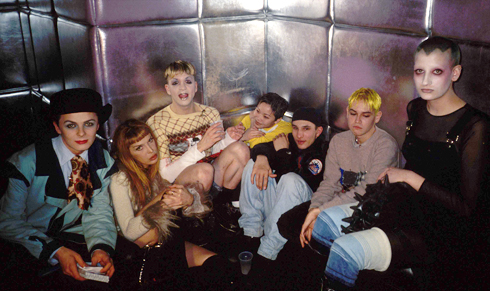
However it was its occupants that made the headlines. In the late 80s and 90s, Peter Gatien and the Limelight helped foster its own buffet of self-made celebrities, the club kid, brightly colored freakshows whose only purpose was to shock and make everybody feel smaller.

Ruler among them was Michael Alig, an extravagent promoter of both his club, his lifestyle and himself. A protege of another nightlife maven James St James, Alig’s wild parties at the Limelight were the stuff of urban legend.

Actual celebrities who frequented the club, like Eddie Murphy and Michael Douglas, were no match for Alig and his menagerie, which often included a few New York celebrities around today — Amanda LaPore, Rupaul and the duo Heatherette, now legitimate fashion designers in their own right.

The avarice of the early ’90s would lead to the downfalls of the Limelight’s main characters. Alig would be charged with murdering fellow club kid Angel Melendez. Gatien was arrested on drug charges in 1996 — by then, the Limelight was a veritable candy store for ecstacy and ‘special k’ — and in 1999 for tax evasion. Alig is in prison, serving a 20-year sentence; Gatien is in Canada, presumably forever.

The Limelight itself? After a dramatic shuttering in 2001, the club was reopened under the name Avalon, and still entertains throngs craving a thumping beat and a really expensive cocktail. The club kids are gone, but ghosts remain, as do the crypts.

You can of course catch a glimpse of the decadence in the film Party Monster, about the kooky days of Alig and the Club Kids, both in documentary and Macauley Culkin-vehicle formats. Harvey Keitel also takes a visit to the club in Bad Lieutenant.

Categories
Podcasts

Brighton Beach and Manhattan Beach, at your leisure

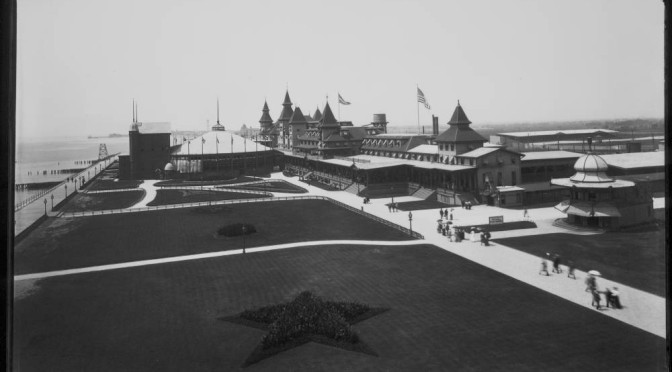
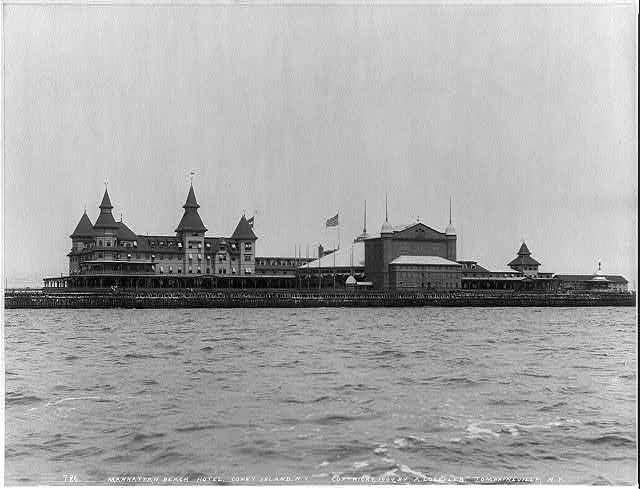
Above: Manhattan Beach Hotel

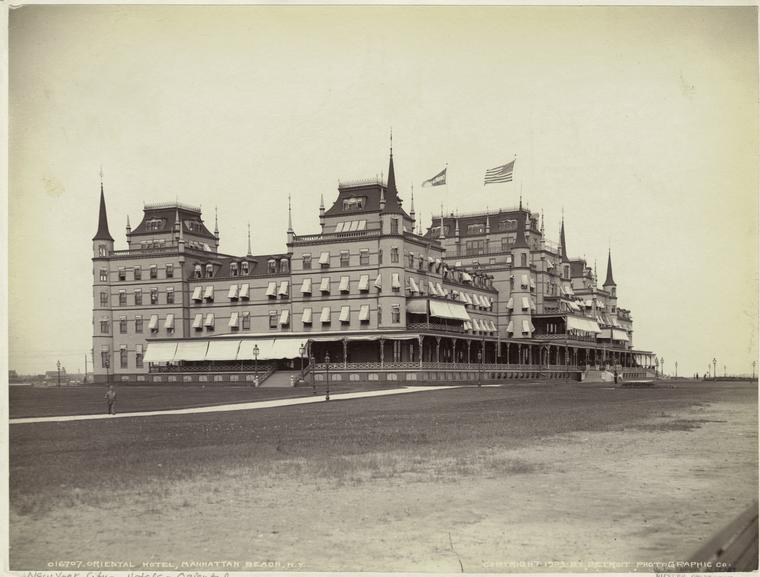
EPISODE 102 Today Brighton Beach is known for Brooklyn’s thriving Russian community, while its neighbor Manhattan Beach is calm and family oriented. But over a hundred years ago, these neighborhoods were the homes of giant, lavish hotels catering to the upper classes. While regular folk were playing at Coney Island’s Steeplechase Park, Dreamland and Luna Park, the wealthiest were enjoying ‘the tonic of sea bathing’ at three of the most toniest hotels on the East Coast — Brighton Beach Hotel, the Oriental Hotel and Manhattan Beach Hotel.

Find out the origins of these long-gone resorts and how they make their mark on the current neighborhoods of Brighton Beach and Manhattan Beach.

ALSO: Why should we care so much about one particular raging anti-Semite? And why did the Brighton Beach Hotel, several thousand tons of it, have to get dragged inland 500 feet?

Music in this episode is the “Manhattan Beach March” by John Philip Sousa!

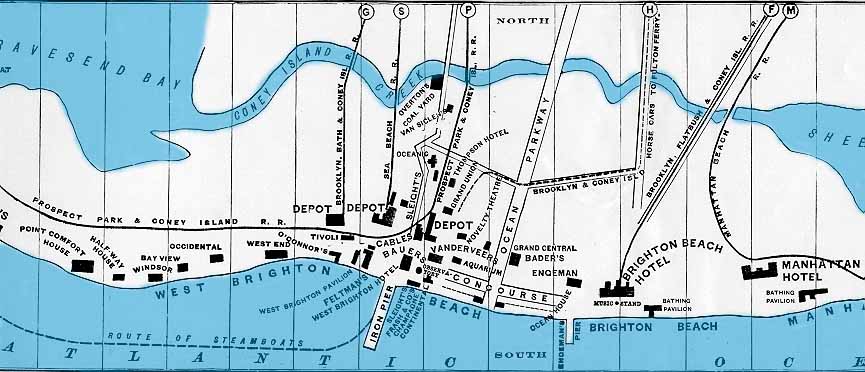
A map of Coney Island from 1879. Click into it to see the detail of the various train and horsecar lines traveling over bridges to the island. The Oriental Hotel was built in 1880 and is thus not listed. (Find the original here.)

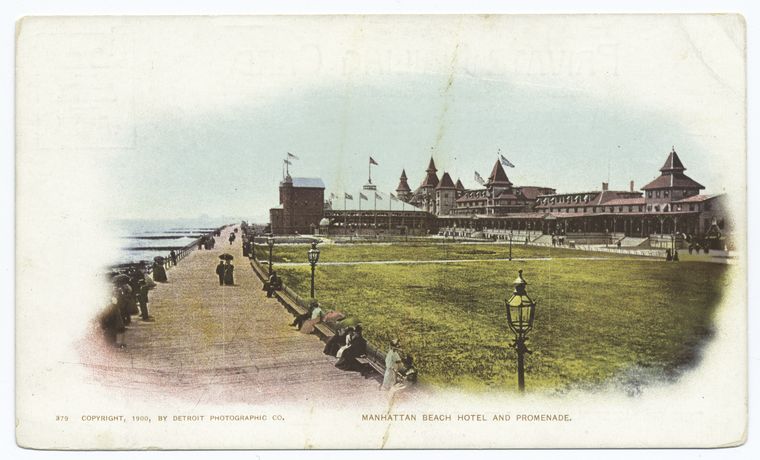
The Manhattan Beach Hotel by postcard

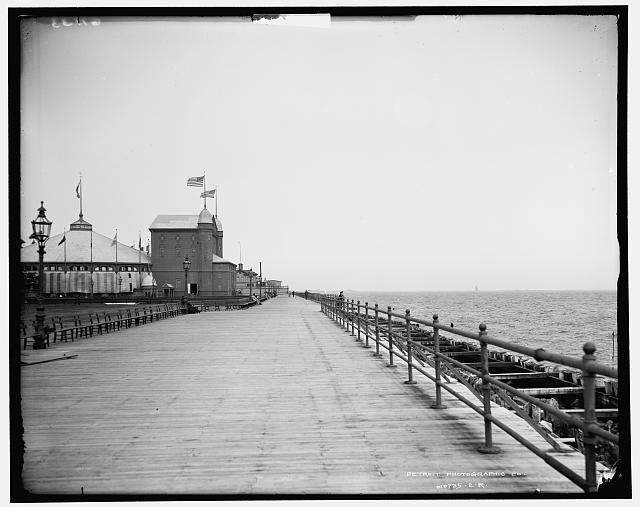
Facing the other way — the boardwalk of the Manhattan Beach hotel.

And from the water. The hotel was built in 1877 by railroad financier Austin Corbin. He would later scandalize progressive New Yorkers by prohibiting Jewish guests from staying at the resort.

The Oriental Hotel, built in 1880. Click here for another view by George Bradford Brainerd.

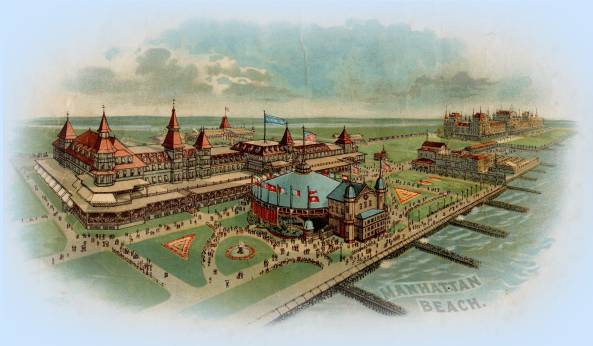
An illustration of the Manhattan Beach Hotel in the foreground, the Oriental in the distance. (Courtesy MMCSL)

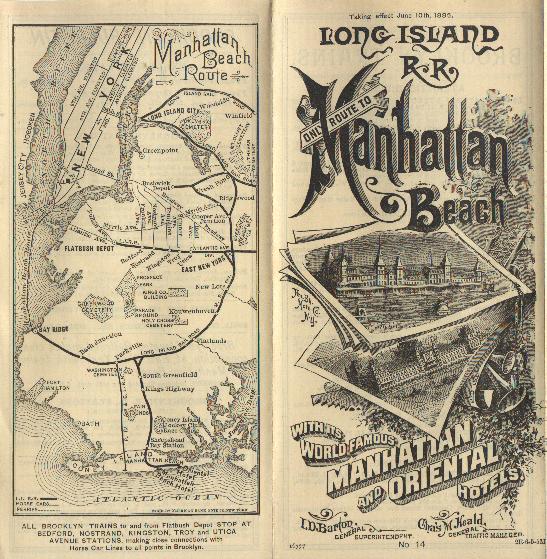
An illustrated train map for the New York and Manhattan Beach Railway, featuring the two Corbin hotels on the flap. (Courtesy LIRR history)

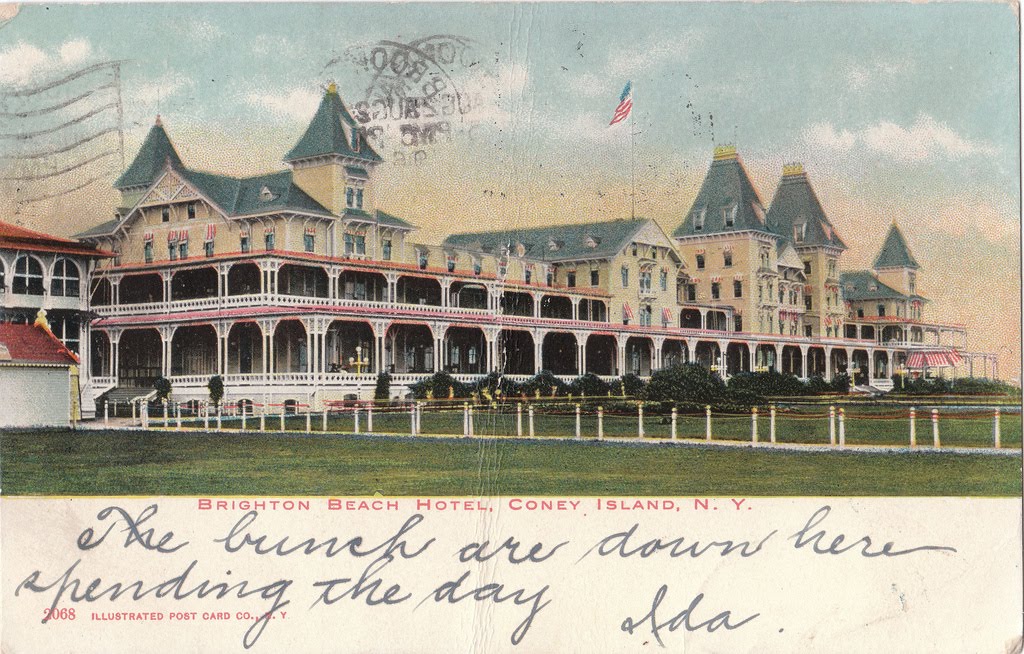
The Brighton Beach Hotel in 1906. Even as millions streamed into Coney Island to enjoy the frenetic rides and attractions, others could relax here, just a few hundred feet away.

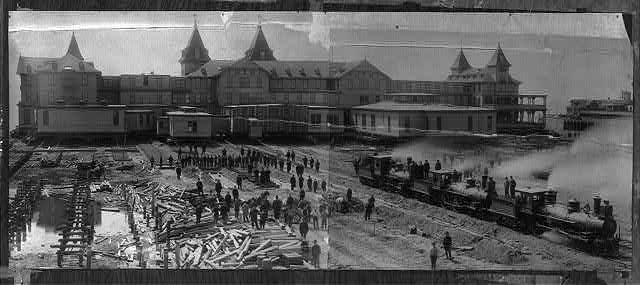
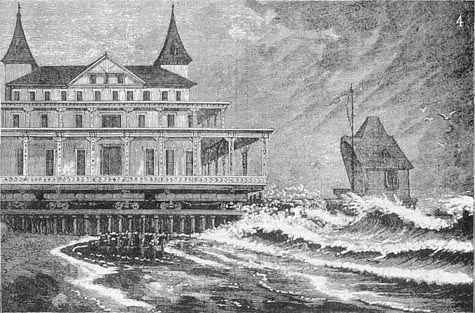
The Brighton Beach was moved — all 6,000 tons of it — in 1888 when the beach in front of it eroded. (Click into pic for better view.) Below it, an illustration of the hotel under siege by the sea. (Courtesy Weather blog)

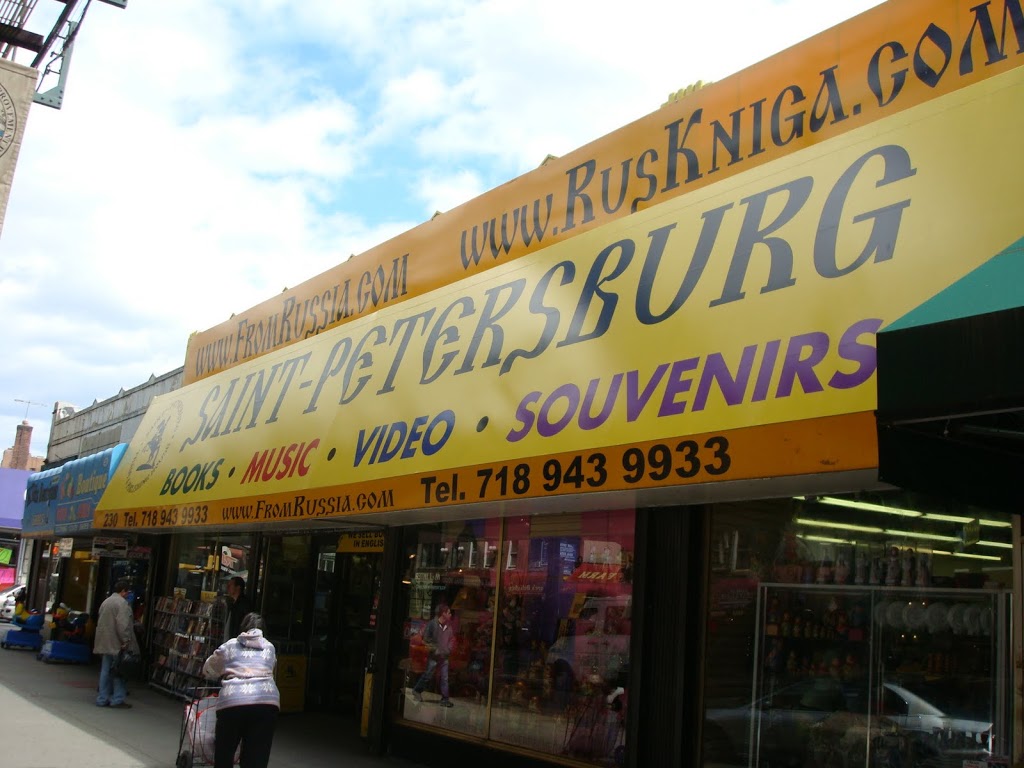
Along today’s Brighton Beach Avenue, you can find a host of shops and restaurants harkening to the tastes of old Russia.

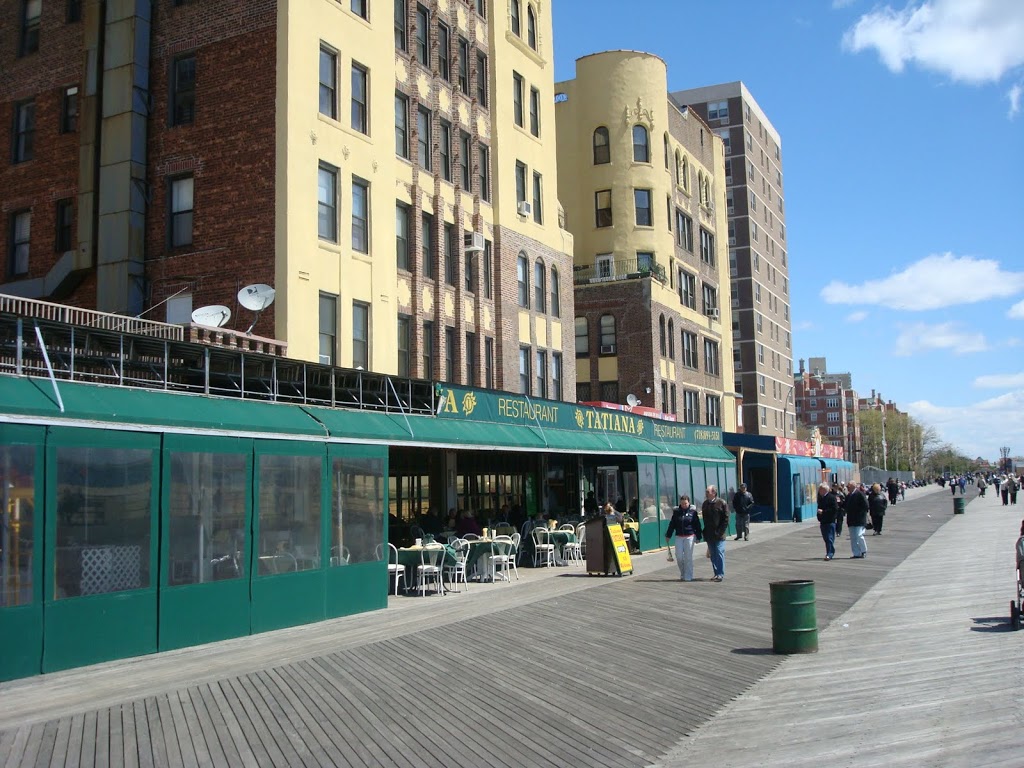
The real fun lies along the boardwalk at night, a string of Russian restaurants and clubs where the action sometimes spills out to the beach. Up the street at Brighton Beach Avenue, you can find The National restaurant, the closest a New Yorkern can come to finding Atlantic City style dinner entertainment.

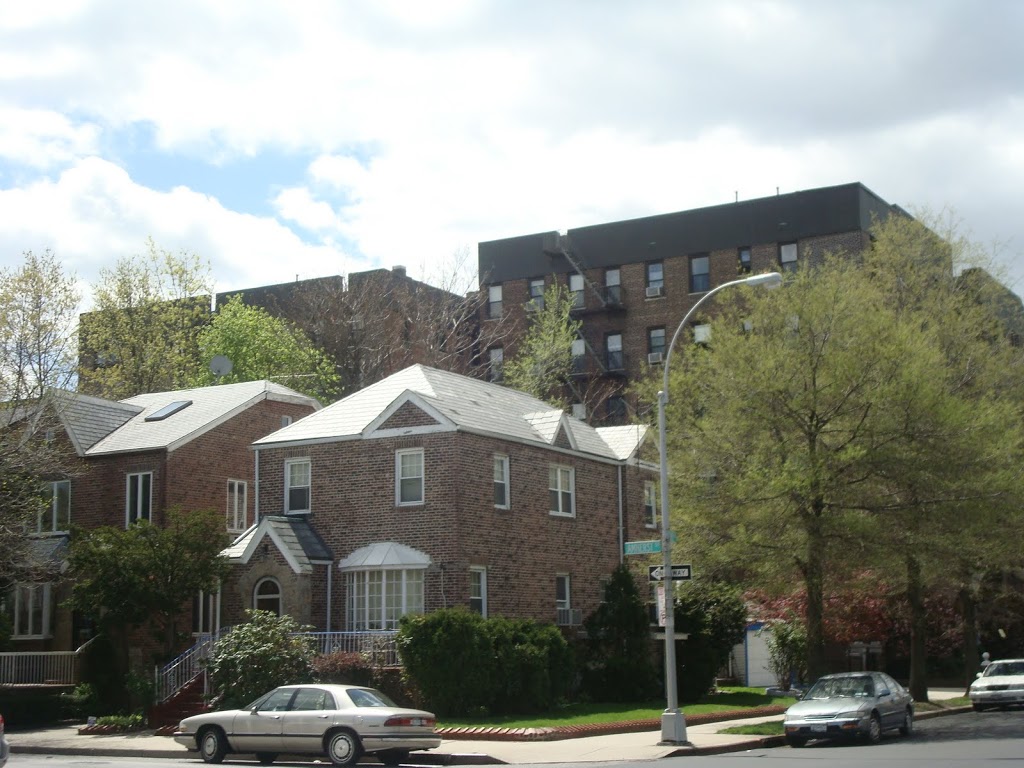
In places, you can almost see the line where William Engeman’s Brighton Beach property ends and Austin Corbin’s Manhattan Beach/Oriental Hotel property begins. Brighton Beach is distinguished by handsome pre-war apartment buildings; Manhattan Beach is more single-family homes, many recently built and some very ornate.

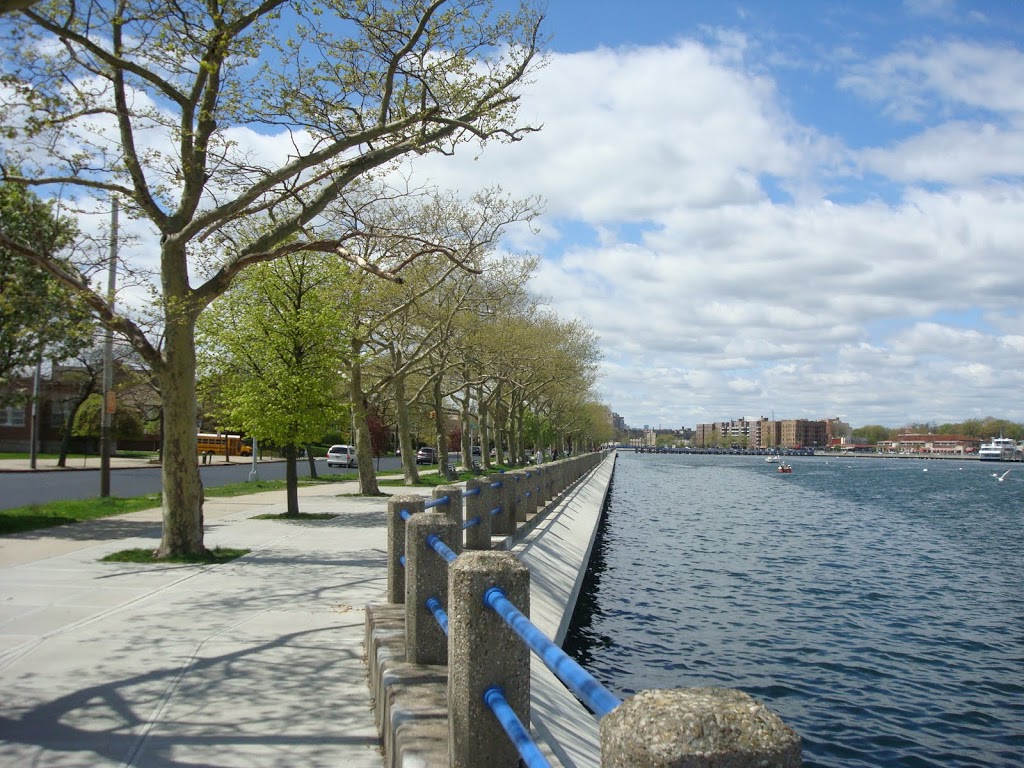
Sheepshead Bay, north of Manhattan Beach, is named for a fish which no longer swims here.

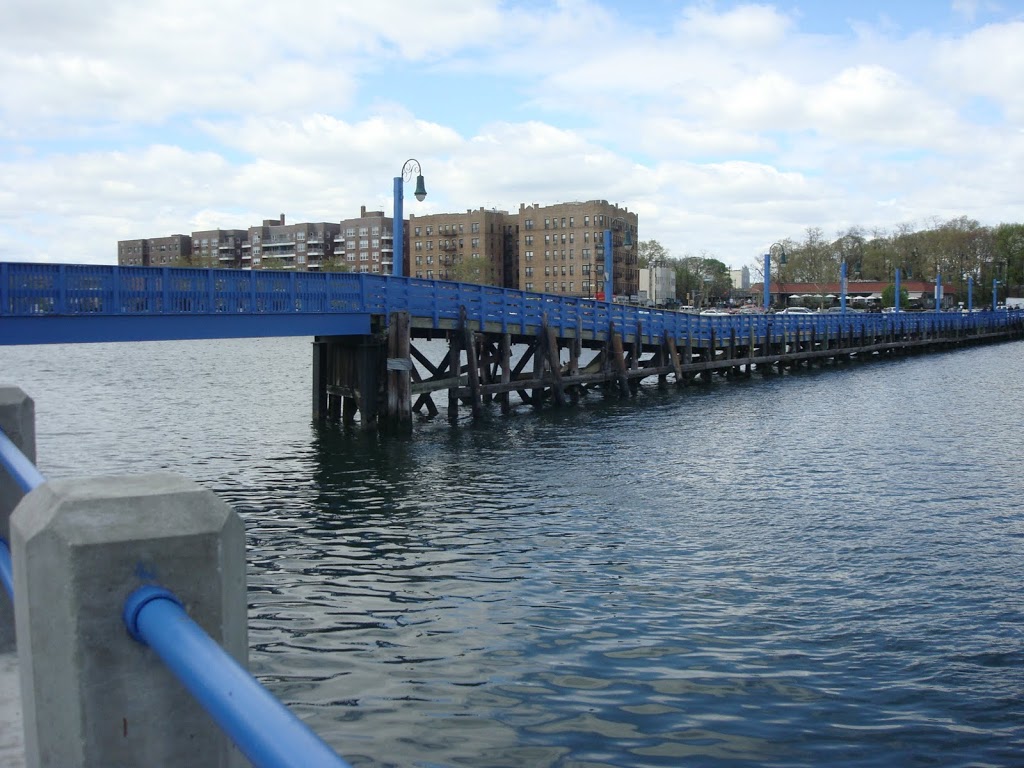
One of my favorite things in all of Brooklyn — the Ocean Avenue footbridge. Originally built in 1880, commissioned by Austin Corbin, the pedestrian bridge links the promenade in Manhattan Beach with the one in the neighborhood of Sheepshead Bay. According to Forgotten New York, Corbin kept closing the bridge, worried about ‘undesirables’ flocking to his precious upper-class hotel.

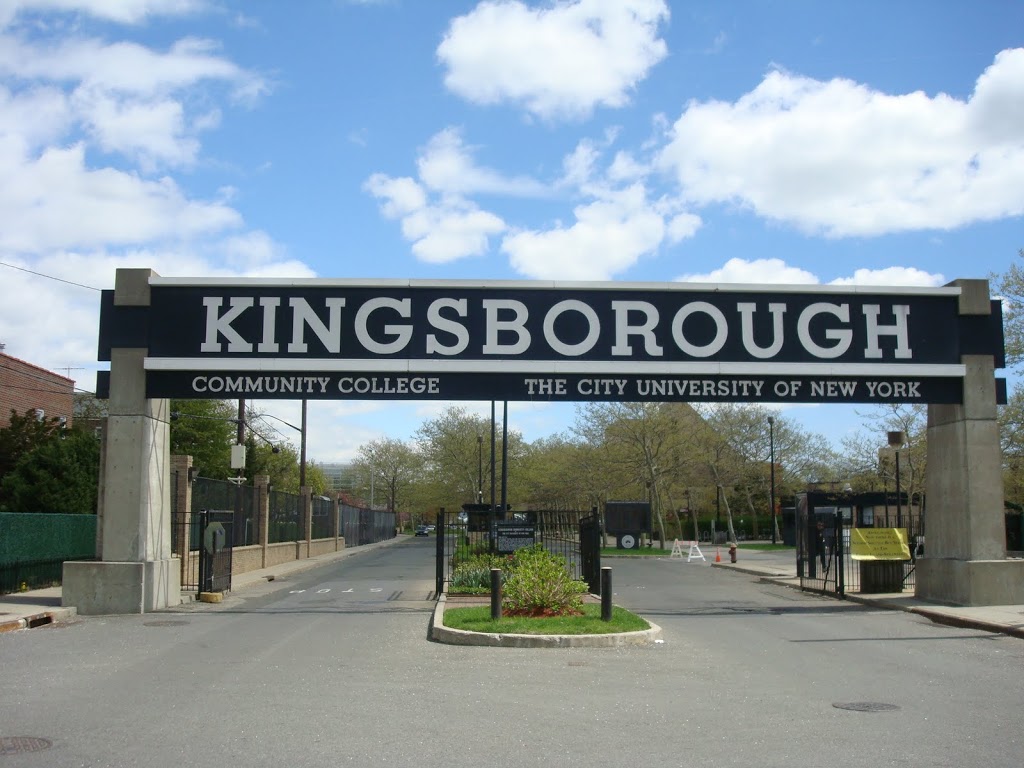
Kingsborough Community College at the far eastern end of the former island. If the college feels a bit like a military barracks, that’s because it was. After Corbin’s hotels were demolished, most of the land went to private home developments. But the far tip went to the Coast Guard and later served as a training base for the United States Maritime Service.


Manhattan Beach Park, a seemingly out of place sandy oasis in the quiet neighborhood of Manhattan Beach, is a remnant of the former resorts.

Categories
Amusements and Thrills

Elephantine Colossus: Brooklyn’s most unusual hotel


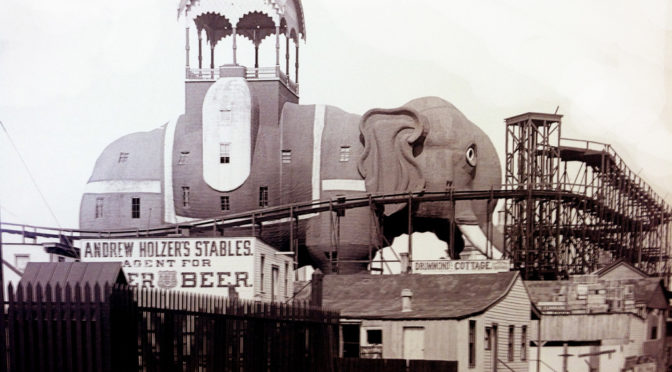
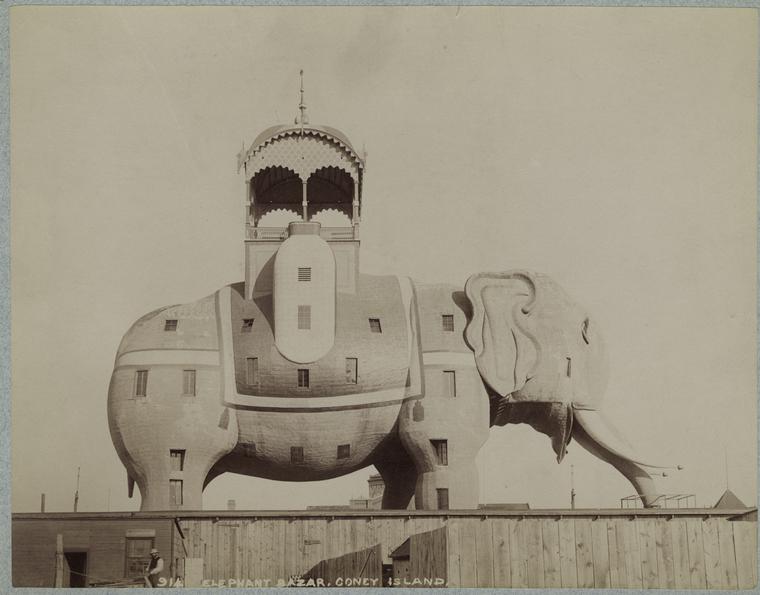
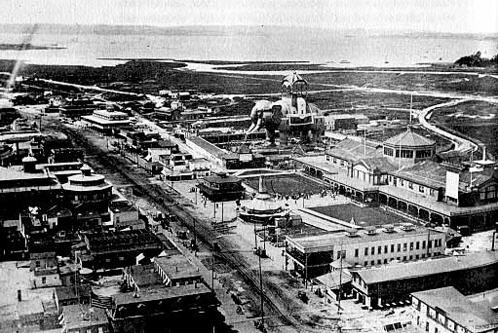
Visitors to pre-20th century Coney Island would have enjoyed a most unusual site — Elephantine Colossus , more famously known as ‘the Elephant Hotel’, an actual guest house which stood watch over the entertainment district’s beach amusements.

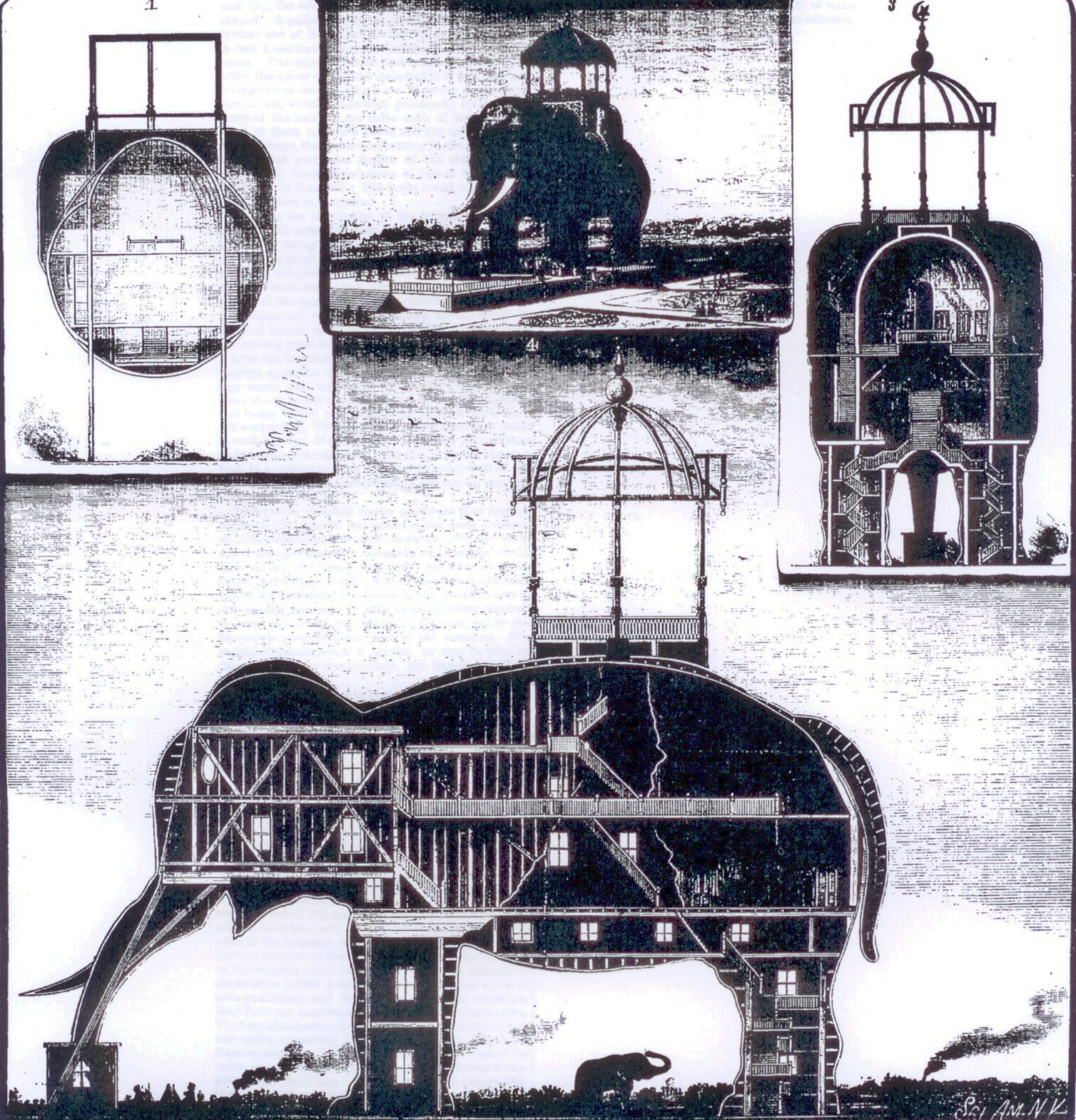
The hotel opened in 1885, a 12-storey pachyderm with 31 organ-themed guest rooms that faced the ocean and featured an observation deck and a cigar store in its leg.

Below: an 1885 diagram 

elephanthotel


The press was given a tour when it opened that spring: “The ‘Stomach Room’ … is 60 by 35 feet and trinagular in shape. From the stomach room the explorers walked through the elphant’s diaphragm and along his liver up into his left lung, where a museum is to be situated during the summer. Then the course was from the lung into the ‘Shoulder Room, then up the ‘Cheek Room, where they looked through the elephant’s right eye out onto the ocean.”

Another newspaper account from 1889 gives a charming, nostalgic description of the scene: “The discordant notes of a dozen barrel organs, calliopes and orchestrions attached to the merry-go-rounds of Coney Island floated in on the cool sea breeze, the locomotive whistles of constantly coming and going trains on the half dozen railways and the engine bells lent their share to the busy sounds from the outside world, while the rattle of the toboggan slide built around the big elephant hotel acted as castanets for the other music.”

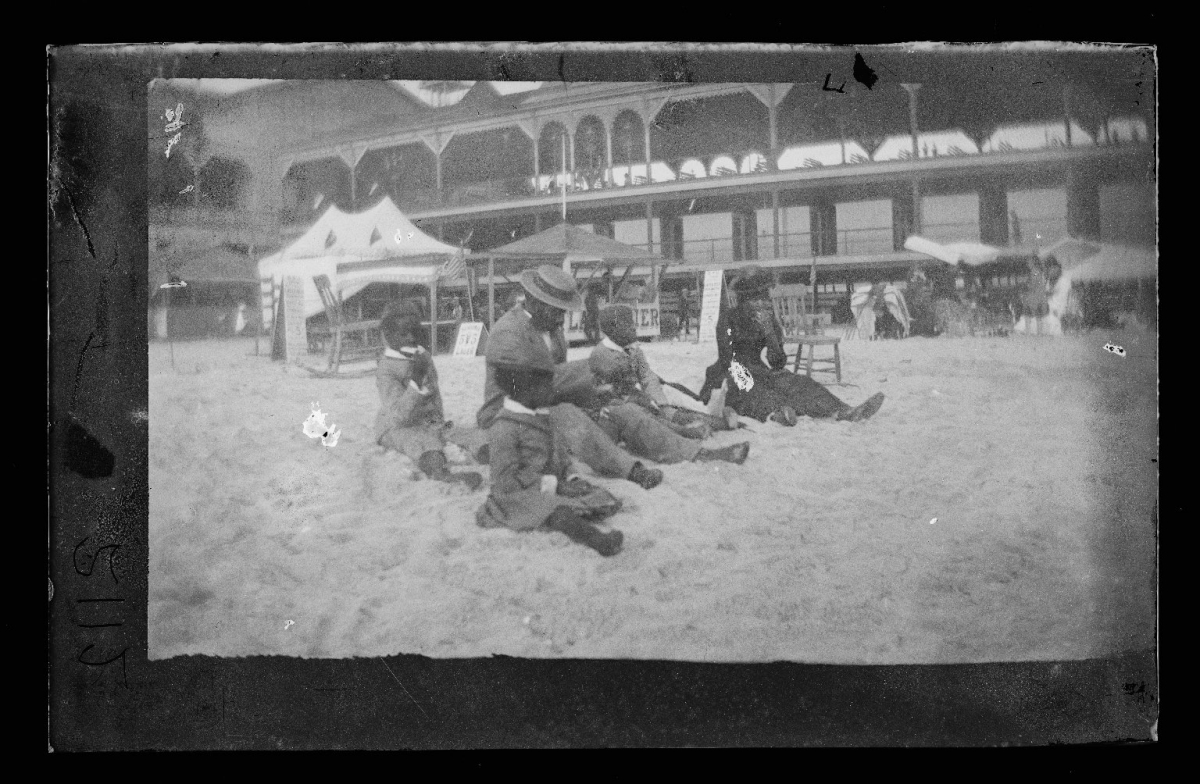
A family on the beach in 1885, the year the elephant hotel opened. Those clothes look hot!

Brooklyn Museum/Brooklyn Public Library,
George Bradford Brainerd — Brooklyn Museum/Brooklyn Public Library,

If that doesn’t seem absurd enough, in the 1890s its oddly shaped rooms served as a brothel. According to Emil R. Salvini, “‘Seeing the elephant’ became synonymous with an adventure that you would not discuss with your kids.”

Like so many things from Coney Island’s early days, the hotel burned down, a victim of a fire on Sept. 27, 1896 that also took out the nearby Shaw Channel Chute, a roller coaster that encircled the hotel. It was, not surprisingly, often referred to as the Elephant Scenic Railway.

James Lafferty, the owner of the hotel, also built the New Jersey roadside attraction, Lucy the Elephant, which you can still find hanging out in Margate City.

You can find more info on this intreguing entry into New York’s hotel history here.
elephant

The two pictures above are courtesy the NYPL Digital Library

Below, the Elephant in perspective (1886):

Bringing news of King Tut (and his curse) to New York


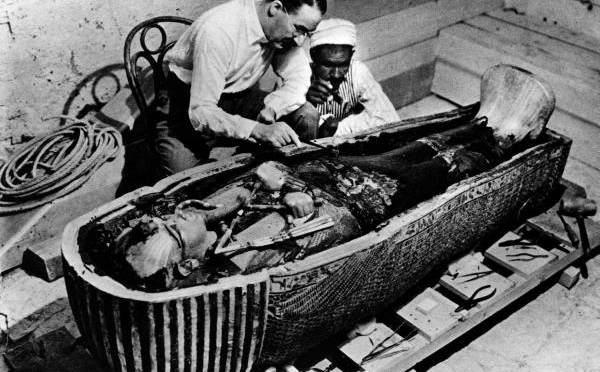
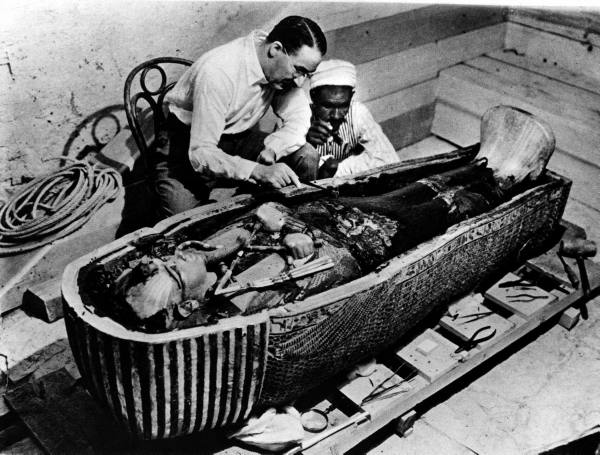
Howard Carter with his very favorite king (courtesy Life Images)

Years after the Steve Martin novelty hit, King Tut mania returns to New York City. The heavily hyped Tutankhamen and the Golden Age of the Pharaohs finally opened last week at the Discovery Times Square Exposition, promising rooms of priceless artifacts from the tomb of the young Egyptian king.

British archaeologist Howard Carter opened the tomb of King Tut in February 1923 and spent the year investigating the treasures within, even as legend of the ‘curse of King Tut’s tomb’, fueled by the mysterious death of Carter’s financier Lord Carnarvon, electrified the press.

A disagreement with the Egyptian government in 1924 grounded work on the excavation. So in the interim, Carter decided to take news of his discoveries on the road — and started in New York City.

Arriving on the ocean liner Berengaria in April, Carter took to a round of lectures throughout the city. Carter was caught off guard by his reception, finding himself “celebrated and adulated like a star.” And although his proper British diction and inexperience at public speaking turned off a few naysayers, his tales, helpfully illustrated in photos by Met photographer Harry Burton, ultimately helped spark the interest in his discoveries and in Egyptian culture.

He began with with a couple invitation-only discussions at the Waldorf-Astoria for the Metropolitan Museum of Art, an unflagging collaborator with Carter for many years. In fact, the Met’s assistant curator Arthur Mace worked with Carter at the dig and would allegedly fall victim to the curse in 1928.

Carter then presented to a larger audience in a series of four lectures at Carnegie Hall, the first on April 25, 1924. In a venue better known for dynamic musical performances, Carter was still able to pack in over 2,500 people and a madly fascinated press.

According to the Times: “Step by step, he led them to the point where the cover was lifted off the great stone sarcophagus containing the mummy of the Egyptian monarch interred 3,300 years ago.”

For a week in April, dusty Howard Carter became one of the most toasted men in New York City. He spent his days in the city traveling to other venues to share his work — one at the Museum of Natural History, two separate functions at the Brooklyn Academy of Art, and more appearances at Carnegie. At night, he was feted at private dinners.

He carried that enthusiasm with him throughout the country, hitting stops in New Haven, Pittsburgh, Baltimore, Philadelphia and Chicago. He even swung by the White House to have tea with President Calvin Coolidge. (The picture at right is Carter taken at one of these locations, May 1924, courtesy LOC)

Carter left New York for England on the Mauretania in July 1924 and eventually resumed work on the tomb. He took with him Met Museum photographer Harry Burton, who documented further exploration of the dig, providing the most startling and iconic images of the world’s most famous mummy.

The Met would continue to involve itself with the discoveries, and in the 1970s organized its best-known tour of the United States, which culminated in the Met’s own hallways in the winter of 1979.

As for the ‘curse’ of King Tut, you might be interested in reading a 1978 article in New York Magazine about the Met’s 1979 show and the allegations — by no less than their former director Thomas Hoving — that the Met might have used Carter’s appearance as a ‘cover’ to obtain stolen art from the tomb.

Categories
Uncategorized

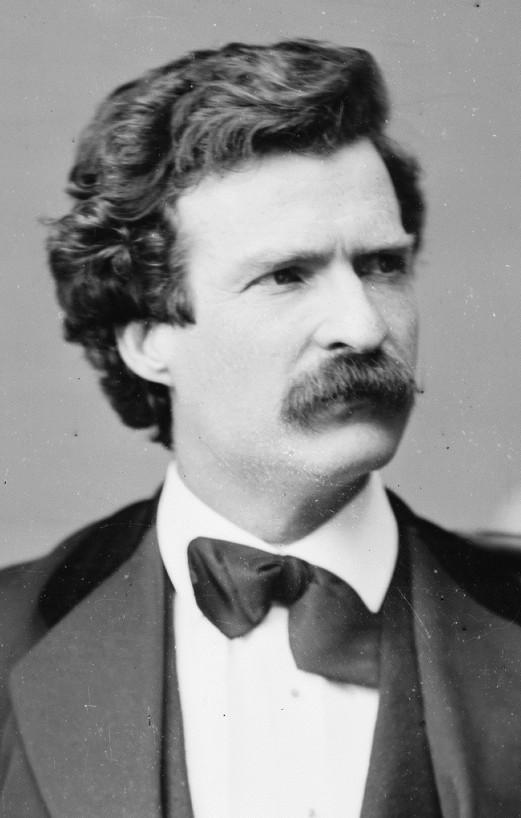
Mark Twain and the long century without him


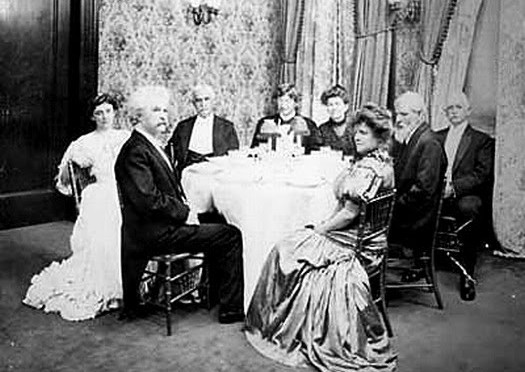
Above: Mark Twain at Delmonico’s Restaurant

One hundred years ago today, Mark Twain died of a heart attack in Connecticut, famously the day after Hailey’s Comet whisked by the earth.

Although obviously more known for his reminiscences of Missouri and his later life in Hartford, Conn., New York City figured significantly in his career. Twain first came to New York when he was just 18 years old and would live here at times throughout his life, contributing to various newspapers and journals. He certainly had a love-hate relationship with the city.

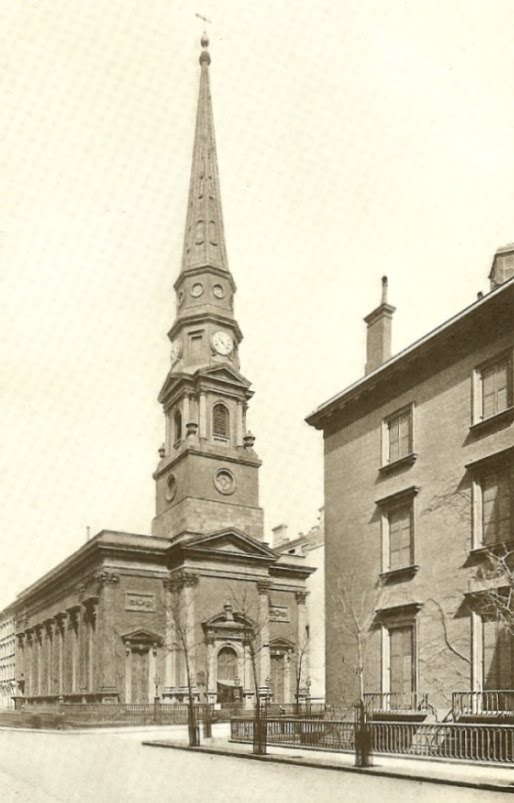
But did you know Twain’s funeral actually took place here, in Manhattan, at the Brick Presbyterian Church at 5th Avenue and 37th Street (at right, pic courtesy NYCAGO)? Both it and the townhouses which surrounded it are all gone. However, the congregation built a new church at Park Avenue and 91st which still stands; the church bell within the new building is from the old structure and bore witness to Twain’s funeral.

Twain’s body arrived in town before noon that April 23 at Grand Central Station and was somberly escorted uptown to the church, where a crowd had gathered. Upon Twain’s casket somebody had thrown a bouquet with the words: “”From one who has read ‘Pudd’nhead Wilson.'”

The funeral was clearly the big event of the day. The Associate Press article reports,” “Holders of tickets were admitted first. Millionaires and paupers rubbed elbows in the vast crowd that stood outside.”

After a series of dramatic eulogies, thousands of people streamed by the open coffin, the writer dressed in his recognizable white coat and pants. The doors were closed at 10 p.m., and Twain’s body was transported to its final resting place — Elmira, New York, a much-beloved summer respite for Twain in his youth and the place where he met his wife.

Finally, here’s one humorous recollection of New York City by Mark Twain, published in a letter for a San Francisco newspaper in 1867. Who hasn’t felt this way before?:

“There is something about this ceaseless buzz, and hurry, and bustle, that keeps a stranger in a state of unwholesome excitement all the time, and makes him restless and uneasy, and saps from him all capacity to enjoy anything or take a strong interest in any matter whatever–a something which impels him to try to do everything, and yet permits him to do nothing.

He is a boy in a candy-shop–could choose quickly if there were but one kind of candy, but is hopelessly undetermined in the midst of a hundred kinds. A stranger feels unsatisfied, here, a good part of the time. He starts to a library; changes, and moves toward a theatre; changes again and thinks he will visit a friend; goes within a biscuit-toss of a picture-gallery, a billiard-room, a beer cellar and a circus, in succession, and finally drifts home and to bed, without having really done anything or gone anywhere. He don’t go anywhere because he can’t go everywhere, I suppose.”

Below: Mark Twain in a portrait taken by Matthew Brady (although I believe the photograph was taken in Brady’s D.C. studio, not in New York)

By the way, here’s a pretty extraordinary tale from New York Press by Craig Fehrman about the fight to save Mark Twain’s Fifth Avenue home from demolition.

Goldman Sachs: things were much simpler then

The villain du jour of the latest financial scandal is investment firm Goldman Sachs, accused of fraud by the Securities and Exchange Commission for misleading investors on the shady details of certain ‘exotic’ mortgage-backed securities.

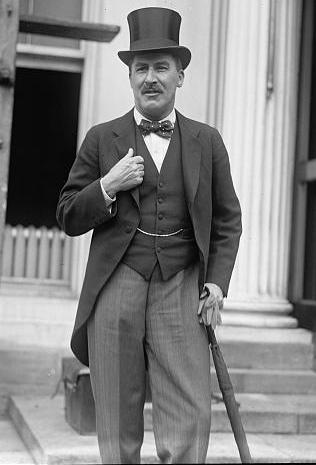
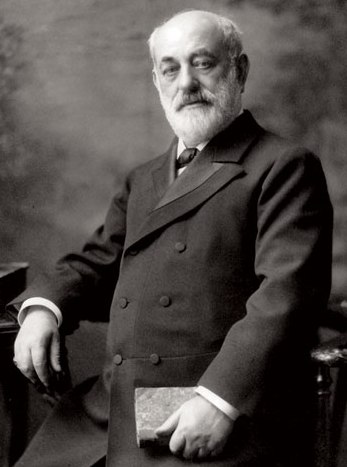
The magnitude of Goldman Sachs’ ambitions over the past 140 years — its seismic up and downs, through booms and recessions — belie its modest beginnings in a basement office next to a coal chute on a small block in downtown Manhattan. It’s doubtful that its founder, Marcus Goldman (at right), would recognize his own company today. Sitting upright on a single stool, well groomed in a Prince Albert jacket, the uniform of New York’s financial class, Goldman prepared to leap into a new venture, the future uncertain. His most important business accessory was a tall, silk hat.

The roots of Goldman Sachs lies within the increasing numbers of German immigrants who came to the United States starting in the late 1840s. There were 100,000 German in New York by 1860 with their own newspapers, schools and churches influencing the city’s cultural identity. Among them were publishers, musicians, bakers, merchants. And lots of bankers.

Early German financiers like Joseph Seligman (later known as the broker of railroad baron Jay Gould) were already established on Wall Street by the time young schoolteacher Marcus Goldman arrived here from Frankfurt in 1848. He started a family in Philadelphia, his wife Bertha employed as seamstress for society ladies while Marcus himself peddled from a horse-drawn cart, later opening his own clothing store.

But it was soon time for some reinvention. Closing his store, in 1869 the Goldmans moved to New York at his wife’s insistence, residing in a Murray Hill brownstone among the families of new wealth. Marcus opened a small business on 30 Pine Street, a small sign “Marcus Goldman, Banker and Broker” barely noticable among the counting houses, book stores and sidewalk trade made up the street parallel to Wall Street.

Goldman’s office was modest indeed, furnished only with a stool and a desk, employing a young apprentice and, according to Stephen Birmingham, “a wizened part-time bookkeeper (who worked afternoons for a funeral parlor).”

It didn’t matter, because Goldman was constantly on his feet anyway. His unique trade was as a broker of IOUs, the at-this-time new busness of commercial paper, transacting between the small merchants of the jewelry and leather trades and the uptown banks. Wandering down Maiden Lane, Goldman would visit the mostly Jewish tradesmen of the area, cultivate their trust and buy their debt at a set rate of interest, shoving notes into his silk hat until it bulged. According to Lisa Endlich, “It was said that a banker’s success each day could be measured by the ‘altitude of his hat’.”

Single-handedly, Goldman was making $5 million a year, keeping his family in finery and a growing number of servants. By 1880, the firm was raking in $30 million. Two years later, he was able to expand his business further by bringing his son-in-law into the fold — Samuel Sachs, son of a Bavarian saddlemaker, who also happened to be friends with one Philip Lehman, whose firm the Lehman Brothers would frequent partner with Goldman’s firm. (And would, 128 years later, file for bankrupsy.)

The new Goldman Sachs company allowed the two participating families to thrive in New York society. And soon, the lucrative firm would no longer be just a family affair, inviting in partners to become Goldman Sachs and Co. in 1885.

Samuel would take over for Marcus at his death in 1904 and would steer the company’s fortunes until his retirement in 1928, a year before the start of the Great Depression. Its fortunes at that point would be guided by Sidney Weinberg, a former janitor who climbed the corporate later to head the firm in 1930, aiming beyond the business dealings once stuff in Goldman’s hat and towards the wave of the future: investment banking.

Categories
Podcasts

The Bronx Zoo: the tale of NYC’s biggest animal house

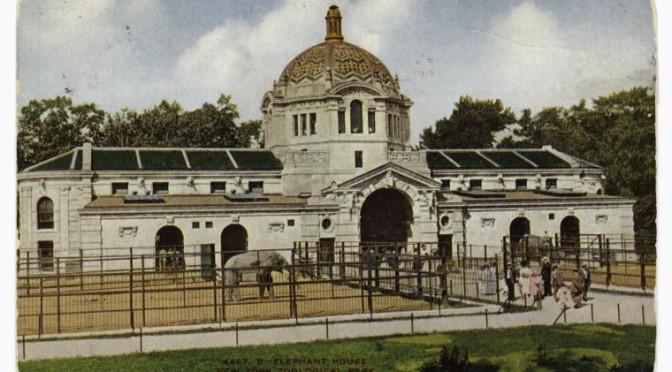
Postcard of the elephant house, now the central Zoo Center — and home today to a baby rhino below. (Courtesy NYPL)

PODCAST New York City’s most exotic residents inhabit hundreds of leafy acres in the Bronx at the once-named New York Zoological Park.

Sculpted out of the former DeLancey family estate and tucked next to the Bronx River, the Bronx Zoo houses hundreds of different species from across the globe, many endangered and quite foreign to most American zoos.

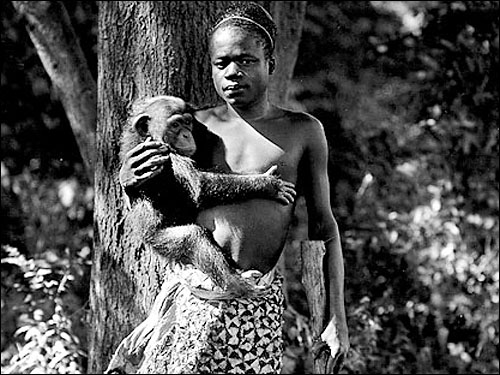
The well meaning attempts of its founders, however, have sometimes been mired in controversy. The highlight of the show — and the institution’s lowest moment — is the sad tale of Ota Benga, the pygmy once put on display at the zoo in 1906!

ALSO: We take you on a tour of the zoo grounds, unfurling over 110 years of historical trivia, from the ancient Rocking Stone to the tale of Gunda, the Indian elephant who may also have been a poet.

CLICK INTO PICTURES BELOW FOR GREATER DETAIL

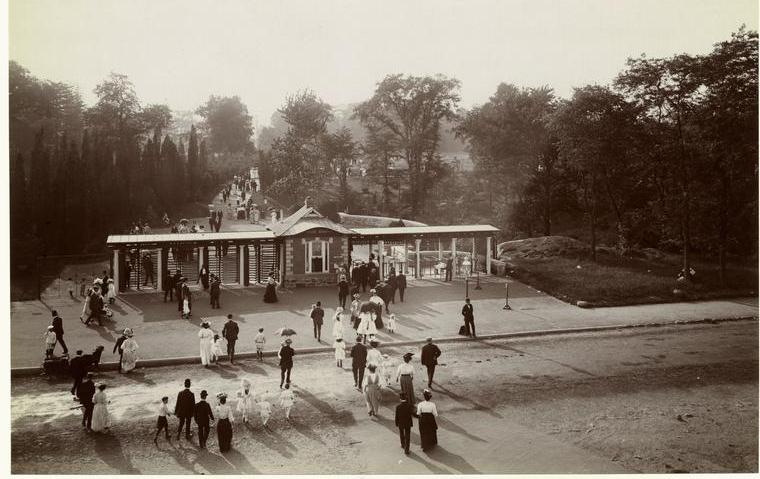
Well-dressed families arrive at the south zoo entrance in 1911. (NYPL)

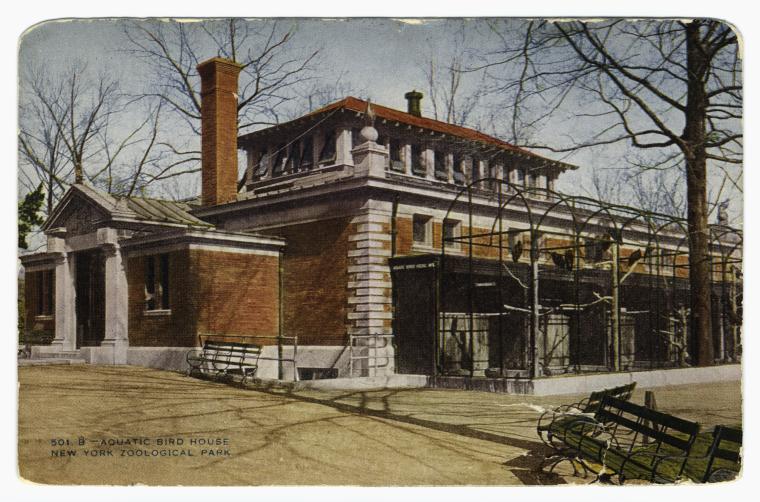
The aquatic bird house, one of the first buildings completed when the zoo opened in 1899. Another building from this date, the House of Reptiles, still stands and you can see it further below. (NYPL)

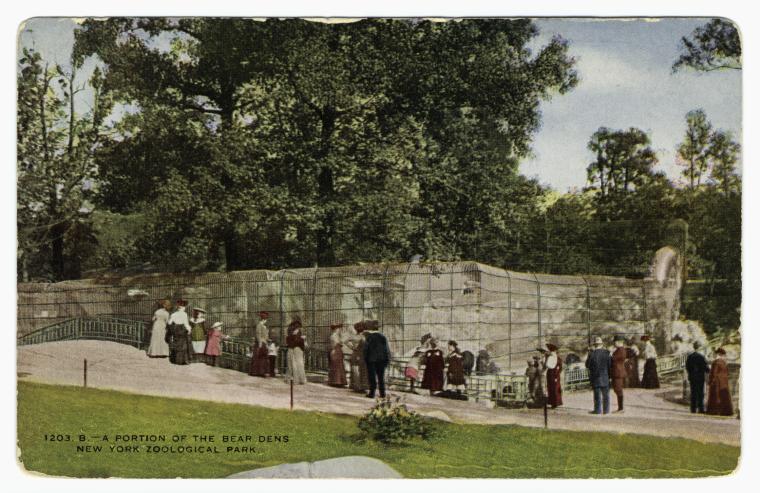
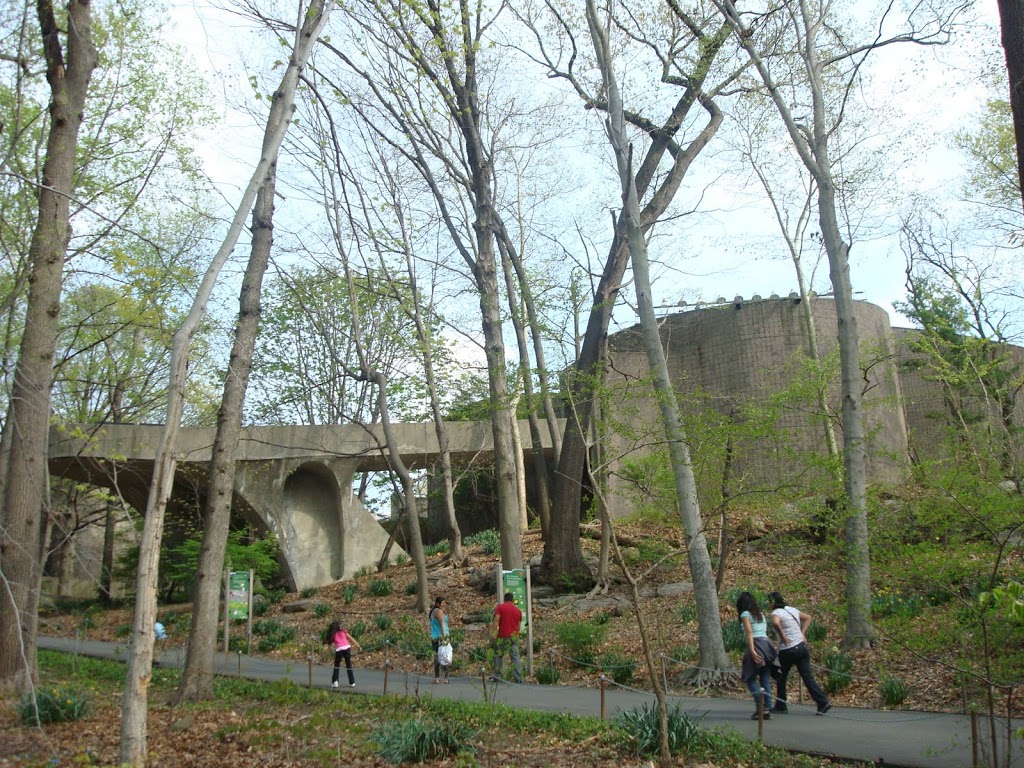
Bears behind fences. Zoo planners used Bronx Park’s natural topography to build enclosures into the very rocks themselves.

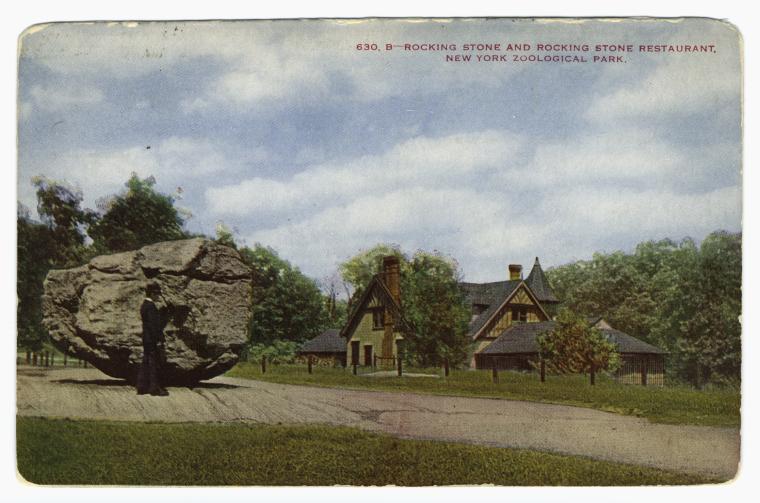
The mysterious Rocking Stone, next to the Rocking Stone Restaurant. Today there’s a World of Darkness exhibit there (presently closed to visitors).

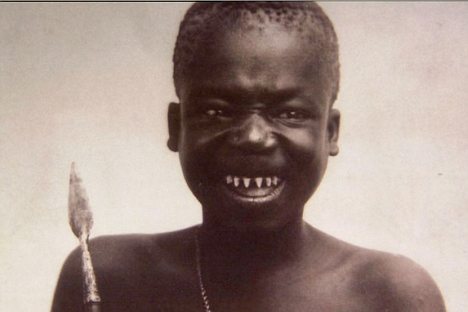
Ota Benga at the Bronx Zoo. The Congolese pygmy once lived at the Museum of Natural History (where he was forced to wear a duck costume!) before being scandalously exhibited for a short time in the Bronx Zoo monkey house in 1906.

Part of his allure to shocked New Yorkers were his filed teeth and his size (4’11’).

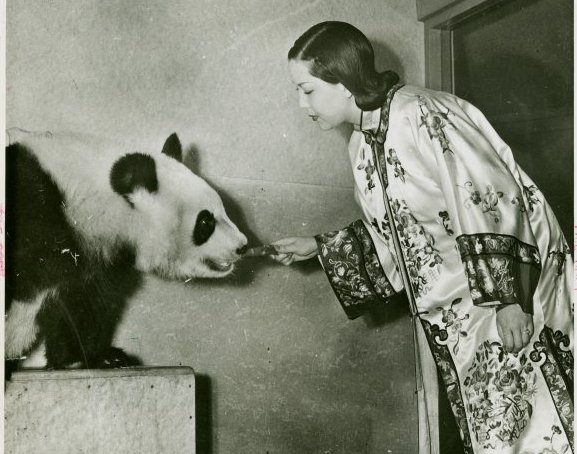
Pandora, the zoo’s first panda bear, from 1938. Pandas never lived for very long at the Bronx Zoo, and they stopped regularly keeping them. Pandas Ling Ling and Yun Yun were briefly housed here in the 1980s.

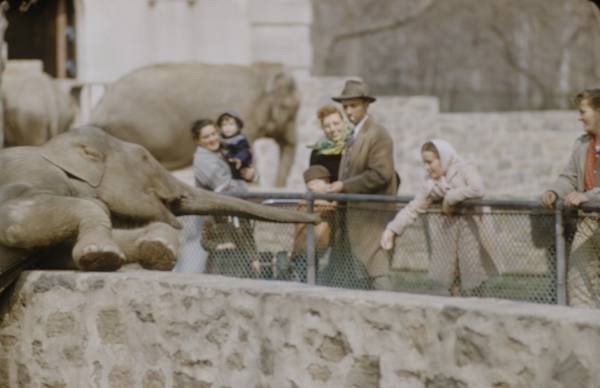
The elephant exhibit, circa the 1960s. The Bronx Zoo’s population of elephants has dwindled to just three animals. Very soon there may be none. (Photo courtesy Life Images, Nina Leen photgrapher)

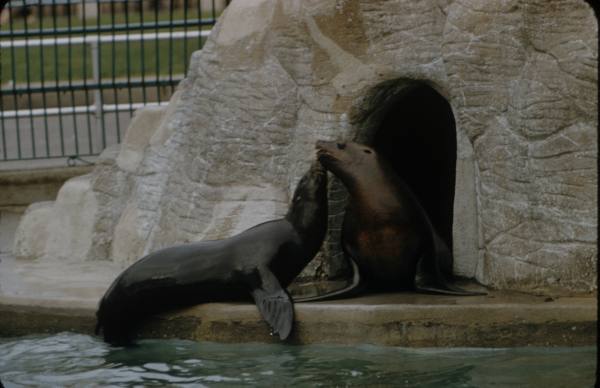
From the same time period as the picture above, but pretty timeless. The sea lions have been the centerpiece of the zoo since it opened in 1899. (Nina Leen)

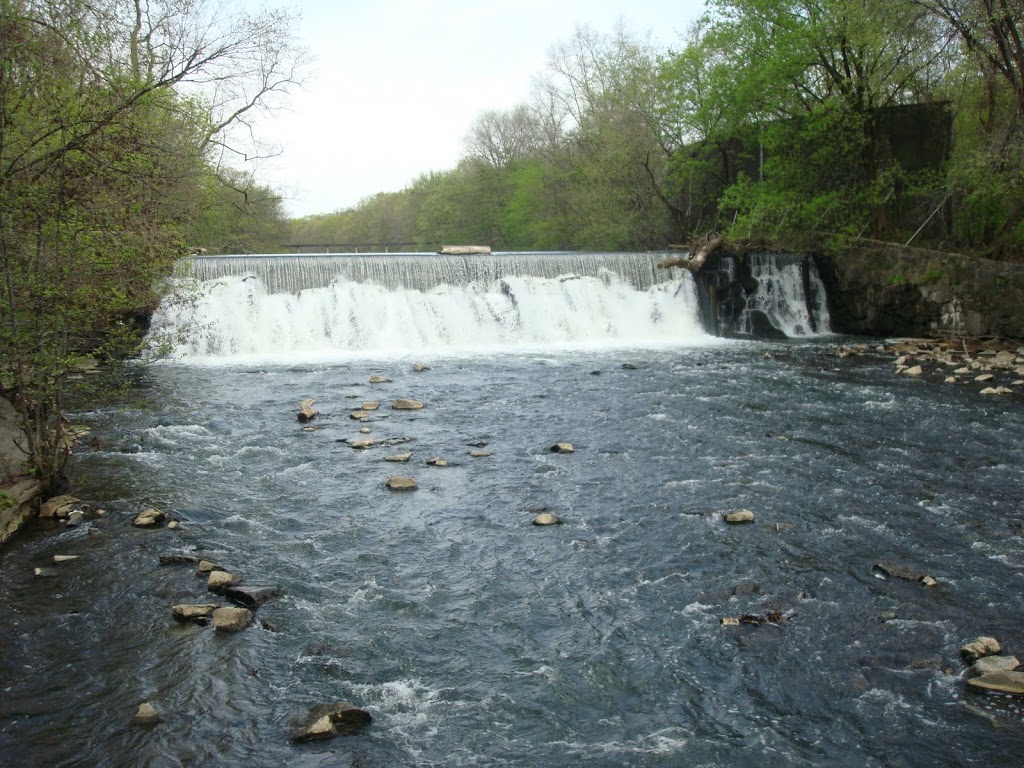
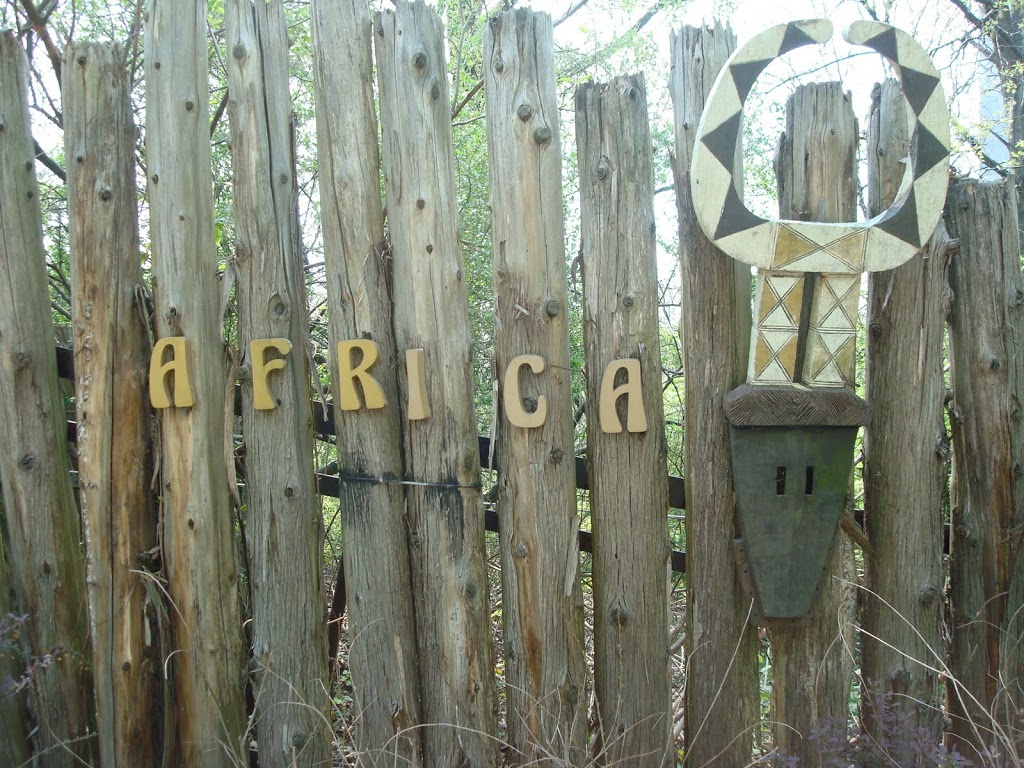
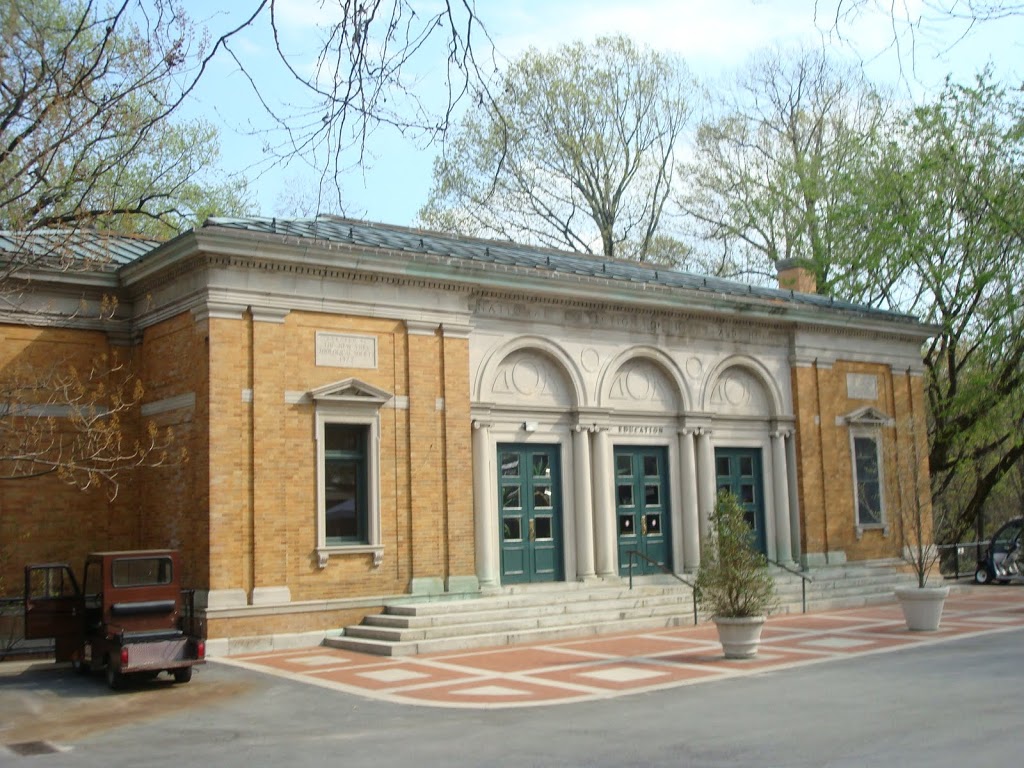
Some pics from my trip last week are below. The zoo is one of the greatest places to see the spectacle of the Bronx River. (Click into them to see the detail.)

The Butterfly Garden is one of the newer exhibitions, an intimate greenhouse featuring dozens of varieties of butterflies flying all around you (and sometimes, even on you).

American allligators, the small, unthreatening kind. For something more severe, visit the nile crocodile in the Madagascar exhibit.

A display of some of the zoo’s marvelous, cheeky fontage.

The House of Reptiles, one of the zoo’s oldest structures, from 1899.

The brutalist wonder that is the House of Birds.

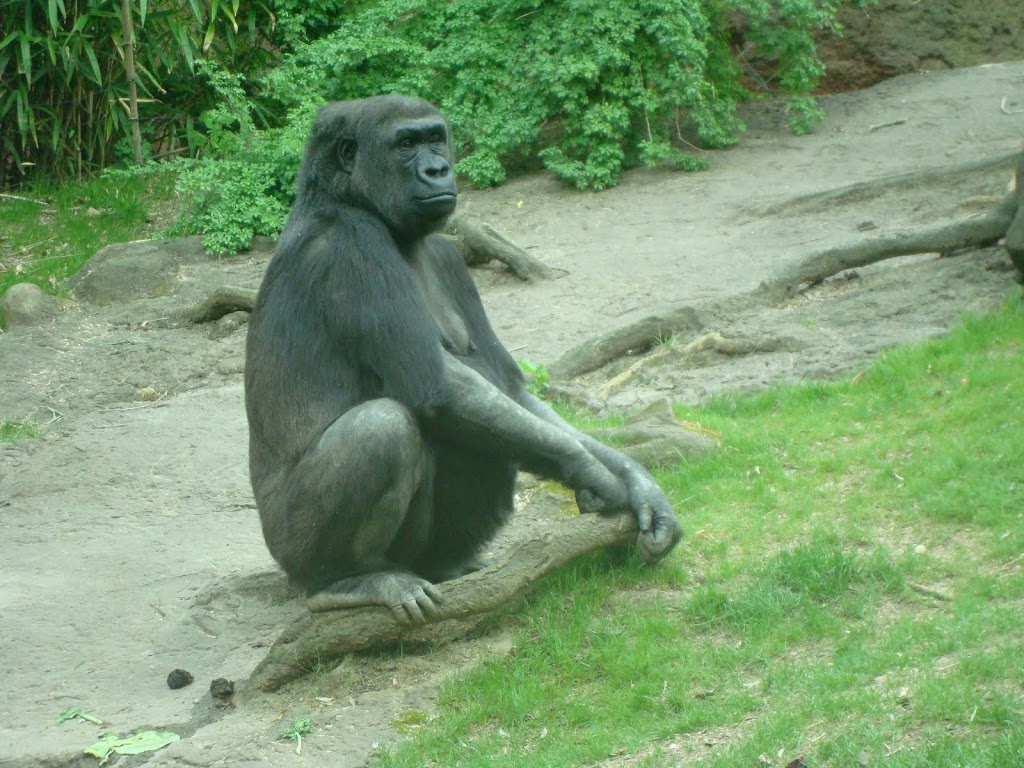
A young female gorilla, one of several who look on at gawking zoo visitors in curiousity and confusuion.

From the Madagascar exhibit:

You can find a baby Asian one-horned rhinoceros named Krishnan at the Zoo Center.

And finally, the Bronx Zoo movie star Andy the orangutan in his feature debut Andy’s Animal Alphabet:

Categories
It's Showtime

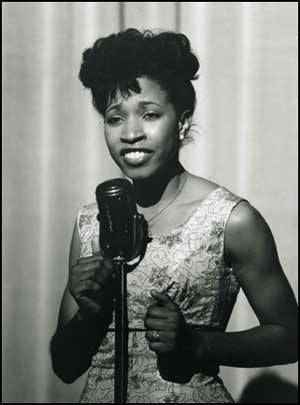
Lady Day to Lady Gaga: where 20 stars got their starts

Here’s a sampling of female entertainers from the last one hundred years, focusing on one particular venue that figures into shaping that person’s professional career. Obviously, most of these women performed in dozens of places throughout the city. I’m just focusing on location pivotal to their beginnings.

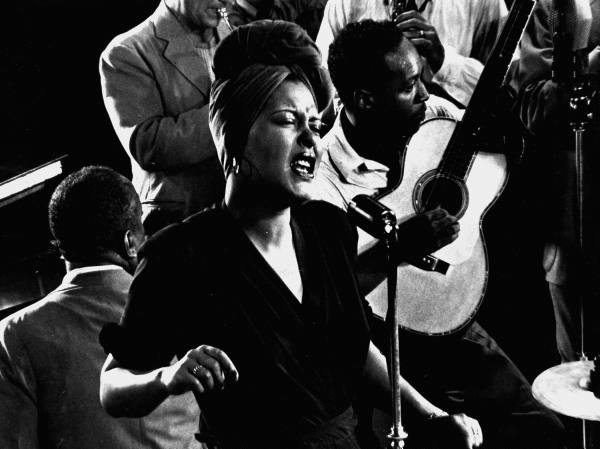
Billie Holiday in a jam session, 1943 (Gjon Mili, courtesy Google Life)

Most of these places are long gone, but you can still visit a couple of them (namely the Bottom Line, The Apollo, and St. Mark’s.)

Sophie Tucker 1918
Reisenweber’s Cafe
58th Street and 8th Avenue
One of New York’s true “red hot” ladies of nightlife, Tucker got her start in the Ziegfeld Follies and developed her sassy schtick in vaudeville. The bawdier contours of her act she picked up on the nightclub circuit, cemented in her appearances at Reisenweber’s Cafe. [Read more in my prior article on Reisenweber’s.]

Ethel Waters 1919
Edmonds Cellar
130th Street
Although she would later be associated with gospel music, Waters’ debut at this dank piano bar brought out the bawdy in this future star, learning to incorporate her natural bluesy with popular standards. The combination, mixed with a sass honed in front of drunken, rowdy clientele, would make Waters (at right) one of the biggest black stars of the Harlem Renaissance.

Josephine Baker 1923 
Plantation Club
126th St and Lenox Ave
That ambitious little showgirl from St. Louis came to New York as a chorus girl in a traveling show and stayed to wow the crowds of Broadway and Harlem, in particular at the Plantation Club, a sleek competitor of the mafia-run Cotton Club. French producers, catching Baker stealing one of her shows at the Plantation, invited her to Paris. And the rest is burlesque history.

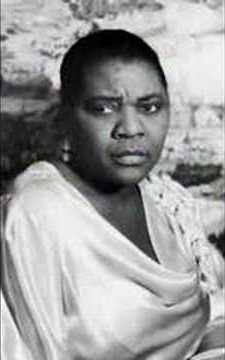
Bessie Smith 1923
The Nest

169 West 133rd Street
Bessie (at left) was not the glamorous kind; her dark bluesy performances tended burrow into your soul. Her 1923 performances at the new Harlem club The Nest marked a turning point for her career; she got her Columbia recording contract that year and began a successful run of Broadway and vaudeville performances, until alcoholism and a tragic car accident cut short her career in the 1930s.

Billie Holiday 1933
Covan’s

West 132nd St
You would need a really large map to chart out all the places Billie sang. The moment Elinore Harris left the workhouse (thrown there after a prostitution conviction) and changed her name to Billie Holiday, she worked stages both in Harlem and in Greenwich Village. It was at Covan’s nightclub that a Columbia Records producer heard her. “The way she sang around a melody, her uncanny harmonic sense and her sense of lyric content were almost unbelievable in a girl of 17.” Within a year, Lady Day would make her first recording with Columbia.

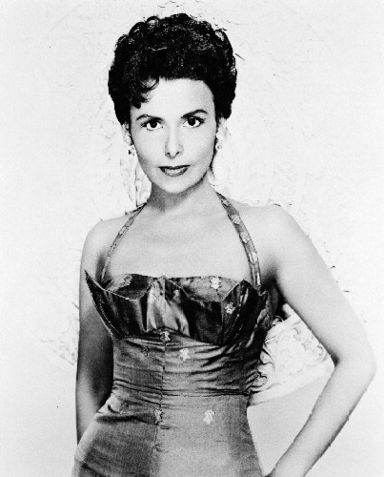
Lena Horne 1933
The Cotton Club

142nd St and Lenox Ave
It was the most famous club in Harlem; she was a lovely young 16 year old girl with barely any experience. As the Cotton Club’s youngest chorus girl, Horne (at right) grew up fast, absorbing the presence of the marquee stars, befriending band leaders, and learning the hard knocks of a color segregated entertainment industry — experience she would take with her to Hollywood years later.

Ella Fitzgerald 1935
Savoy Ballroom

140th St. and Lenox Ave
In New York in the 1930s, the best place to hear swing was the Savoy Ballroom, and the best person to hear sing the swing was a young singer who had just been discovered at the Apollo Theater a few months before. The amateur singer was invited to join Chick Webb’s orchestra for a residency at the hoppin’ ballroom, and as dancers jived, a legend was born on stage.


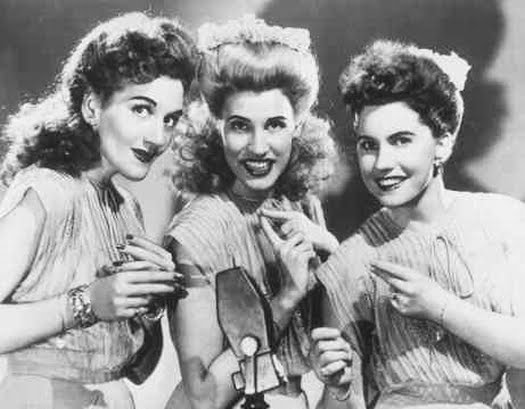
The Andrews Sisters 1937
The Terrace Room @ Hotel New Yorker

481 Eighth Avenue
Years before a war would turn them harmonies into anthemic radio hits, the cornbread sister trio hoped their March 1937 breakout performance at the Terrace Room in the Hotel New Yorker would make them stars. Although the hotel management would find them bland, record executives didn’t. Within the month, they were making music for RCA Victor.

Betty Hutton 1938
Casa Manana

753 Seventh Avenue (at 50th Street)
A scrappy, gangly Midwestern girl who cut her teeth singing in speakeasies and at lake resorts, Hutton was discovered by bandleader Vincent Lopez and taken to New York, where she was given a rare opportunity — to perform in a nightclub owned by impresario Billy Rose. And did she run with it. New Yorkers loved her wacky, electric style, and within a year, she was a scene-stealing co-star in an Ethyl Merman musical.


Pearl as Hello Dolly (Courtesy Google Life)

Pearl Bailey 1944
The Blue Angel

152 East 52nd Street
The choir-trained Virginian songstress had made her rounds on the big band scene — and even toured with the USO during the war — when she took a two-week gig at the swank east-side nightclub the Blue Angel. Her warm, belting voice and stage presence electrified New Yorkers; her two-month stint turned into eight-months, and awaiting her on the other side were a recording contract with Columbia Records and roles on Broadway and in motion pictures.

Nina Simone 1960
The Village Gate

158 Bleecker Street
Simone was already an accomplished musician by the early 1960s, Julliard trained, performing in cabarets of Atlantic City and even scoring a recording contract. But her distinctive sound, the gravity and intensity of her beliefs, would only manifest themselves musically in New York lounges like the Village Gate, one of the few clubs she would enjoy returning to. One live recording from her appearances there became one of her greatest albums, released in 1962. Fun fact — her opening act that night was a new comedian Richard Pryor.

BELOW: “If He Changed My Name” from Nina’s Village Gate release

Barbra Streisand 1960
The Lion

62 West Ninth Street
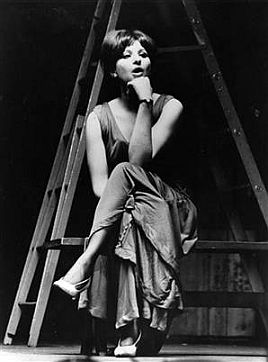
She had barely left her parents home in Brooklyn when young Barbra Joan Streisand turned to singing as a way to become a star. Her New York debut was at a quiet, mafia-run gay club called The Lion, who had a weekly talent show. Barbra, needing the money, entered with the song ‘A Singing Bee’, and won the prize money. She stayed at the Lion for weeks afterwards, fostering her very first gay fanbase.

Ronnie Spector 1961
Peppermint Lounge

128 West 45th Street
Phil Spector might have transformed (and later married) Spanish Harlem resident Ronnie Bennett, but he did not make her a star. Two years before meeting him, Ronnie, her sister Estelle and cousin Nedra were hired as dancers at the crowded new rock club the Peppermint Lounge. One day they were mistaken for the main act, and so the trio just went with it, performing a Ray Charles cover and winning over the audience. [Read more about the Peppermint Lounge here.]Joni Mitchell 1967
Cafe Au Go Go
152 Bleecker Street
The coffeehouses of Greenwich Village launched their share of careers in the 1960s. Mitchell was a seasoned performer from the folk scenes in Toronto and Detroit when she arrived in New York and played regular performances at the Cafe Au Go Go, a cramped basement space best known as the place comedian Lenny Bruce was arrested on obscenity charges. Opening for Richie Havens one October, Mitchell met her future manager Eliot Roberts here. Within six months, she would release her first album, Songs To A Seagull.


Bette Midler 1970
Continental Baths, Ansonia Hotel

2109 Broadway
It seems impossible to imagine — a gay bathhouse as performance venue. But this was the late ’60s/early ’70s, and everything’s possible! Bette had arrived in New York five years previous and was just starring in her first Broadway show when she debuted an odd little cabaret act here at the Continental. With waterfall trickling in the background, Midler created her Divine Miss M persona here, wrapped in a towel. On occasion she even had a shy, betoweled Barry Manilow with her. (Bette wasn’t the only stars to stake out the Continental; Melba Moore, Patti Labelle, Nell Carter and the Pointer Sisters also tried out their acts here.

Patti Smith 1971
St. Marks-On-The-Bowery

131 East 10th Street
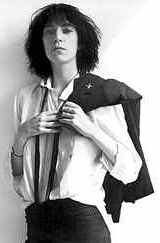
While Bette was in a bathhouse, Patti was at church. The career of New York’s pre-eminent 1970s rocker ignited at the rock venue CBGB’s. She and Robert Mapplethorpe would learn the ways of celebrity at Max’s Kansas City. But her first musical appearance was at a more unusual venue — the basement of St. Mark’s On The Bowery, counter-culture community center since the late 1960s. She was there as a poet, but with Lenny Kaye on guitar, she sheepishly sang a few numbers (even a cover of “Mack the Knife”) which kicked off her ascent into rock icon status.


Deborah Harry 1974
CBGBs

315 Bowery
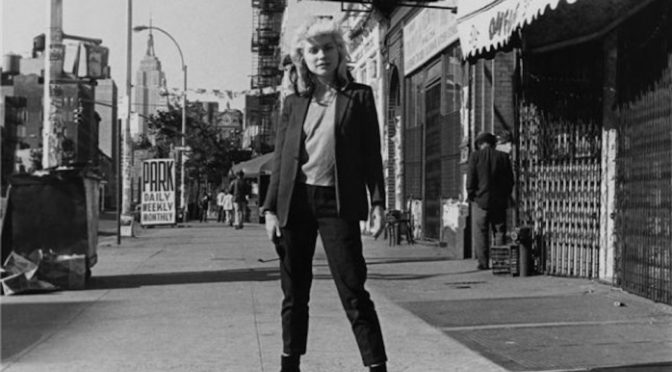
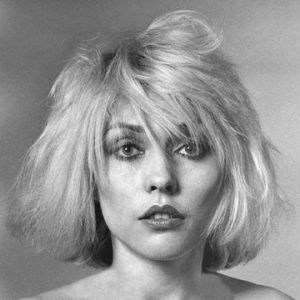
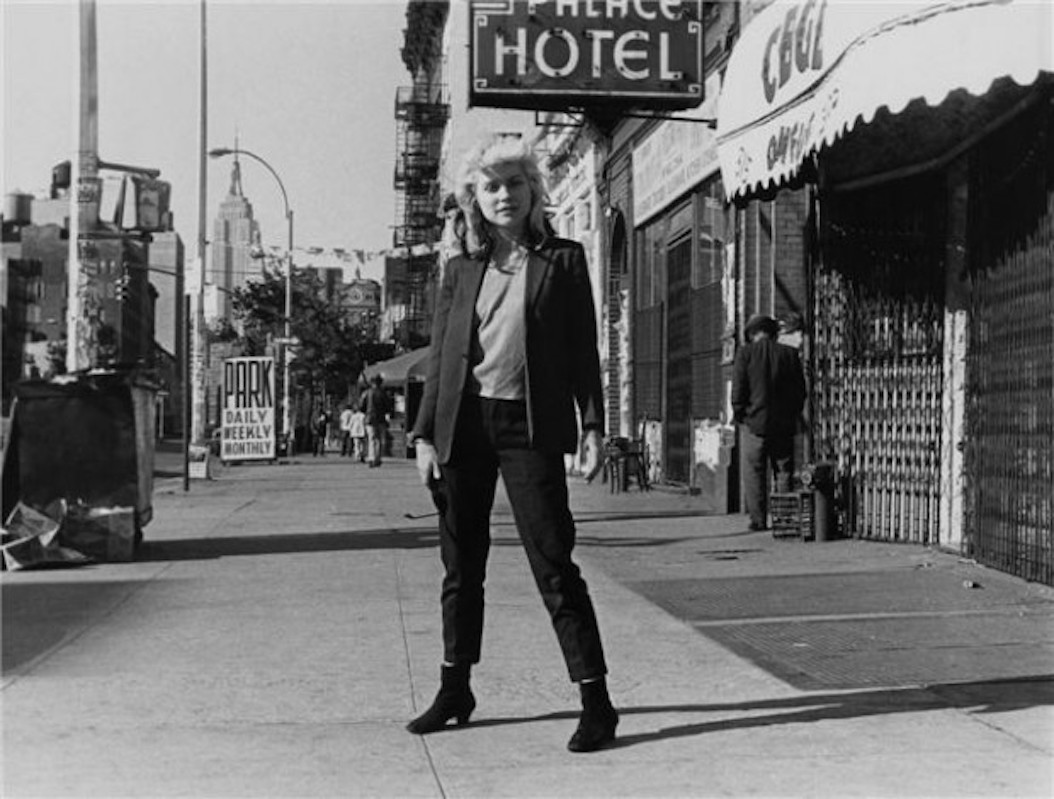
She knew she was star material, but it just took her a couple tries to get it right. The former Max’s Kansas City waitress has already worked through one band, the Wind In The Willows, and tried out another one — the Stilletos, debuting at CBGB’s in May 1974. They folded, but a year later, she took lover and bandmate Chris Stein and formed Blondie. The band would build its reputation on the sturdy little CBGBs stage, easing it into the era of New Wave.

Madonna 1983
Danceteria

30 West 21st Street
She was going to be famous, no matter what. Her time to strike was one evening in 1982, when Danceteria’s flirty hat-check girl slipped her demo cassette “Everybody” to deejay Mark Kamins. A year later, now signed to Warner Bros., she would come back as a performer, and the Madonna identity — more than a mere vocalist — would strike its first pose. [Read more about Danceteria here]
BELOW: Madonna at Danceteria

Mary J Blige 1991
The Apollo Theater

253 W. 125th Street
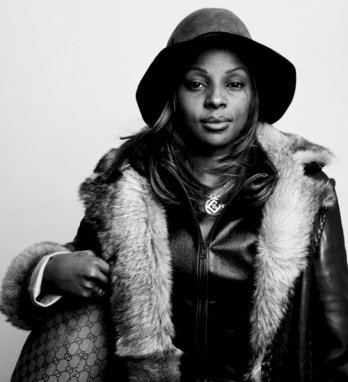
No surprise that people get discovered at the Apollo; what impresses me is that people still use it as a springboard for fame, decades after it opened. Bronx resident Blige actually got signed to a label deal after being discovered at a White Plains shopping mall. But that deal went nowhere until she started showing up at the Apollo, singing backup to other performers. During those Apollo years, she survived bouts of alcoholism and depression which later fueled her confidence as R&B’s reigning diva. (Photo at left by Annie Leibowitz.)

Lady Gaga 2006
The Bitter End

147 Bleecker Street
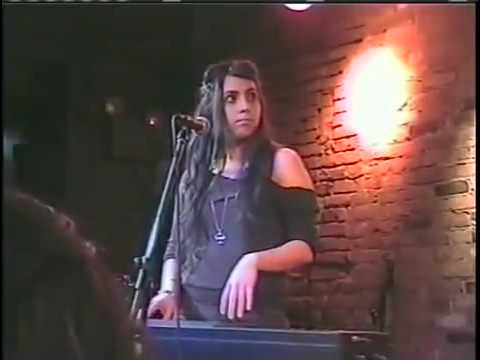
Of all the performers to grace the legendary Bitter End stage during its almost 50-year history (Bob Dylan, Woody Allen, Bruce Springsteen), odd that a woman who once went by the name of Stefani Germanotta would be among the lucky few to become superstars. The January 2006 performance might have been the pinnicle of the young singer-songwriter’s career “She was learning how to put on a show,” says Bitter End owner Kenny Gorka. “She learned to get people to listen.” [Daily News] But something about the downrock rock scene set her on a different path, one of complete re-invention. She went to Los Angeles, and came back Lady Gaga.

Lounge Cher: Great moments in wacky NYC music history


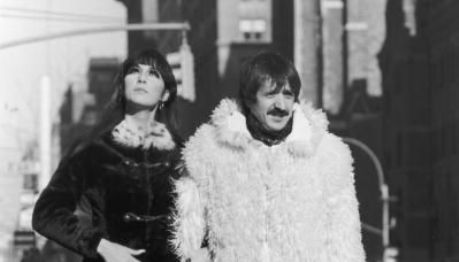
Sonny and Cher in New York City (picture courtesy Getty Images)

June 1, 1970: Sonny and Cher begin a two-week stint at the Empire Room at the Waldorf-Astoria.

The Empire was one of the swankiest hotel lounges in Manhattan, usually the site of stars slightly past their prime, pop and jazz musicians of the prior generation.  Dinah Shore, Ray Bolger, Eddie Fisher — they all played the Empire . In fact, in July 1971, Louis Armstrong would give his final performance here at the Empire.  And just a couple months before the debuts of Salvadore ‘Sonny’ Bono and Cherilyn ‘Cher’ Sarkisian , Peggy Lee delighted audiences here with remakes of ‘Bridge Over Troubled Water’ and ‘Is That All There Is?’

So what, exactly, were the nation’s trendiest pop duo doing here?

It had actually been a few years since their biggest hit, ‘I’ve Got You Babe’, and the duo since then had seen their share of flops, both in music and film.  Cher took the first part of 1969 off to give birth to her daughter Chastity.

It was Sonny’s idea to turn the pair into a Las Vegas showstopper, and their first stop before hitting the gambling capital was New York’s Empire Room, to try out a loungier version of their act.

The pair played off their catty, flirty banter and made particular fodder of Cher’s outrageous costumes.  The cheesy repartee obviously did the trick, but it was TV, not Vegas, that came calling.  Within a year, they had their very own prime-time program, The Sonny And Cher Comedy Hour, a ratings bonanza that might have lasted forever if not for their divorce in 1974.

Meanwhile, at the Empire Room, Sonny & Cher were followed up in late June with a more appropriately loungish headliner — Latin troubadour Trini Lopez.

Sedated: Great moments in wacky NYC music history

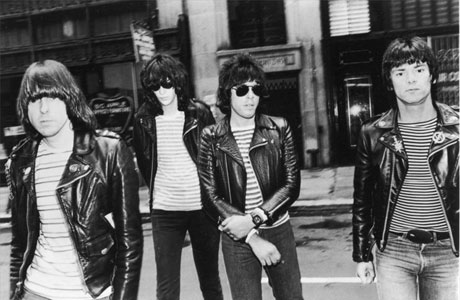
March 30, 1974: The Ramones, the pride of Forest Hills, Queens, play their first public concert together at Performance Studio, a small space on East 20th Street* managed by future member Tommy Erdelyi (later Tommy Ramone). For their debut set, there were just three of them, and Dee Dee Ramone sang lead

How did it go? Johnny Ramone: “We were awful. We didn’t have the image down yet. Our friends didn’t even want to talk to us anymore after that.”

The jumbled mess of a set did not please an audience comprised of mostly friends, who paid $2 for the privilege of seeing a visibly nervous Dee Dee Ramone accidentally crush his bass underfoot.

It would take a few months for the band to get their musical footing, in time for their debut at CBGB’s on August 16th.

You can read more about this long-forgotten performance space (which also hosted shows by the New York Dolls and Blondie) here.

*Many sources list the studio at 23rd Street, not 20th Street. Anybody have an idea as to its exact address?

Categories
Uncategorized

Triangle Factory Fire: 99 years later

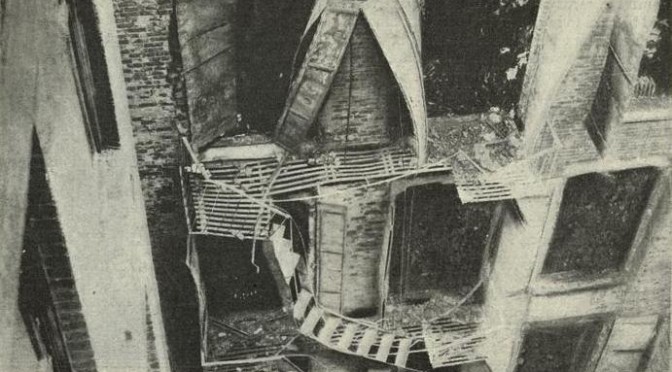
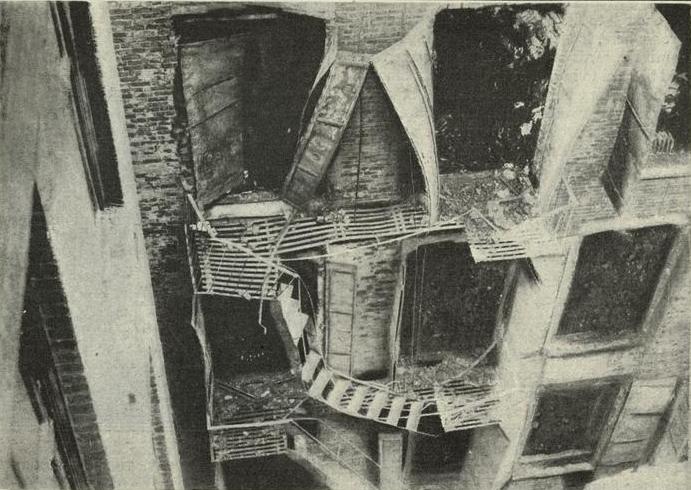
Above: the mangled remains of a flimsy fire escape which sent many Triangle Factory workers to their death

A tragic marker in New York City history: the devastating fire that swept through the upper floors of the Asch Building in 1911, through the sweatshops of the Triangle Shirtwaist Factory, killing 146 people.

Today, March 25th, is the 99th anniversary. I suspect there will be some marking of this grim anniversary today at the corner of Greene Street and Washington Place.

You can download my podcast on the Triangle Factory Fire from our NYC History Archive page on iTunes or you can get it directly from here.

Photo courtesy NYPL

Categories
Podcasts Preservation

Robert Moses: Did he save New York — or destroy it?

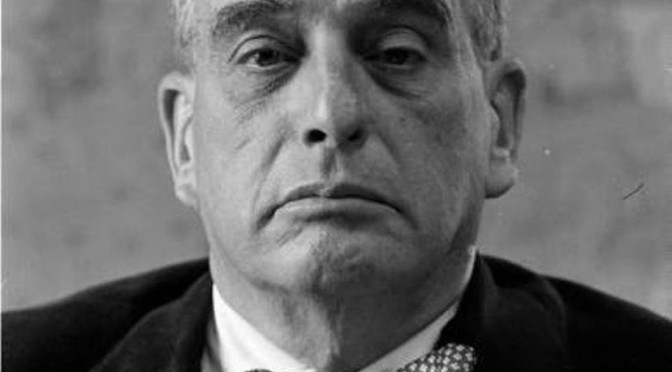
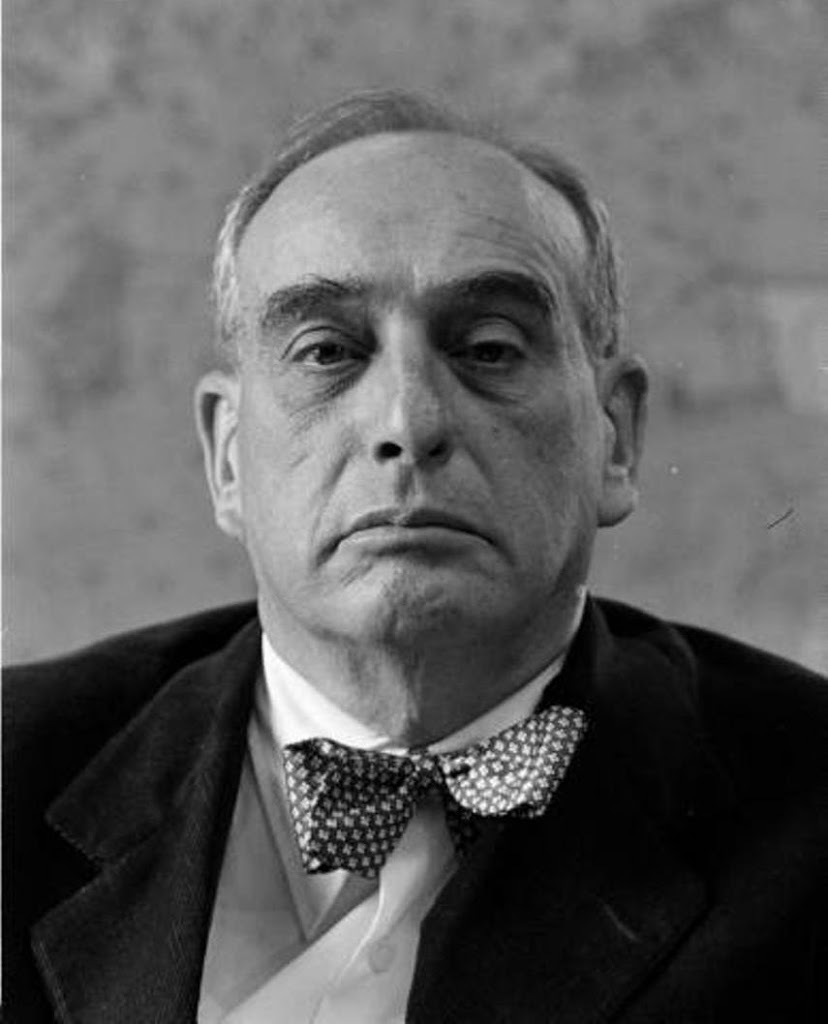
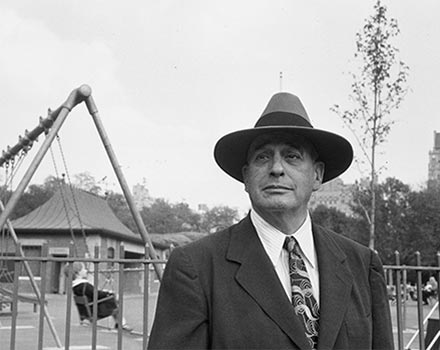
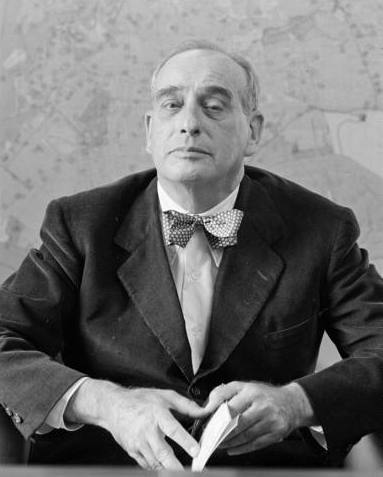
Photo above: Robert Moses, October 1952 by Alfred Eisensteadt (Courtesy Google Life)

PODCAST: EPISODE 100 We obviously had to spend our anniversary show with the Power Broker himself, everybody’s favorite Parks Commissioner — Robert Moses.

A healthy debate about Moses will divide your friends, and we provide the resources to make your case for both sides. Robert Moses was one of the most powerful men in New York from the late 1920s until the late 1960s, using multiple appointed positions in state and local government to make his vast dream of a modern New York comes to fruition.

That dream included glorious parkways and gravity-defying bridges. It also included parking lots and the wholesale destruction of thousands of homes. World’s fairs and innovative housing complexes. Elevated highways plowed through residential neighborhoods — straight through Harlem, midtown Manhattan, and SoHo.

We get into the trenches of some of Moses’s most renown and controversial projects — the splendor of Jones Beach; the revolutionary parks and pools; the tragedy of the Cross Bronx Expressway, and his signature project, the Triborough Bridge.

What side will you come down on — did Robert Moses give New York City the resources it needs to excel in the 20th century, or did he hasten its demise with short-sighted, malignant vision?

You can tune into it below, download it for FREE from iTunes or other podcasting services, get it straight from our satellite site.

CORRECTION TO THIS WEEK’S PODCAST: Once again, a misinterpretation of my own handwritten notes creates a somewhat hilarious mistake this time around. Although Jones Beach was indeed truly popular in its first year, it did not see an attendance of 150 million people in its first year. (That would have been more people than lived in the entire United States.) The correct number is 1.5 million.
___________________________________________________

KING OF PARKS: As the first five-borough Parks Commissioner, Moses was responsible for the creation and renovation of hundreds of city parks. If you see a park in New York, Robert Moses either commissioned it or radically altered it. Shunning the ‘waste’ of natural beauty, Moses replaced groves and meadows with tennis courts, playgrounds, drinking fountains and other things made with concrete and asphalt.

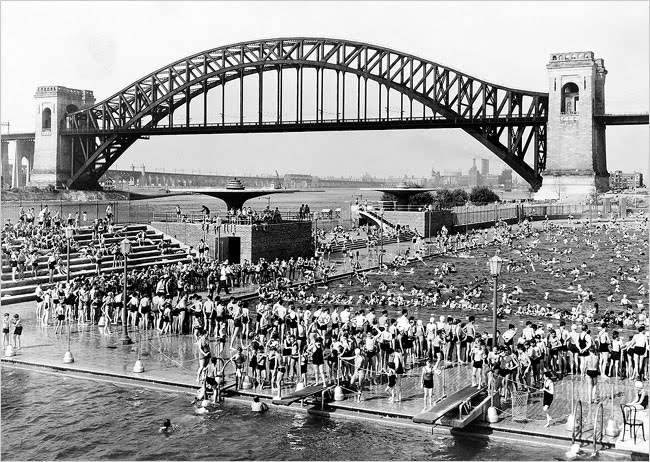
ALL WET: Being a swimmer himself, Moses placed an emphasis on public pools throughout the city, including this one in Astoria, Queens. For pools in East Harlem where he wanted to encourage white attendence, Moses reportedly authorized that the temperature of the water made colder — because black people disliked cold water. (Um, Bob, nobody likes cold water.)

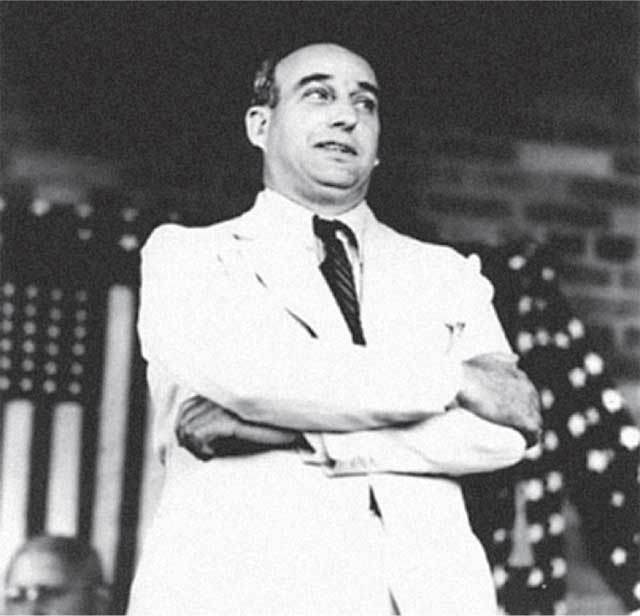
CAN’T LIVE WITH ‘EM….: Mayors and governors alike latched onto Moses’s remarkable progress; newspaper editors and community leaders fell over each other to praise him. Voices of dissension were few and ignored. By the 1940s, he was immensely powerful, leading at one point a dozen local and state commissions and authorities. Picture from August 18, 1937. (Courtesy of the Long Island State Park Region Photo Archive)

BRIDGE TO NOWHERE: Moses with a model of his Brooklyn Battery Bridge, which would have cut straight over New York Harbor, linking Battery Park with Red Hook, Brooklyn. To build this monstrosity would require turning Governor’s Island into a gigantic anchorage and eradicating the New York Aquarium, housed in historic Castle Clinton.

The project was defeated by some backroom machinations from President Roosevelt, but Moses got his revenge — on the New York Aquarium. He ripped it out of Castle Clinton and threw it out on Coney Island.

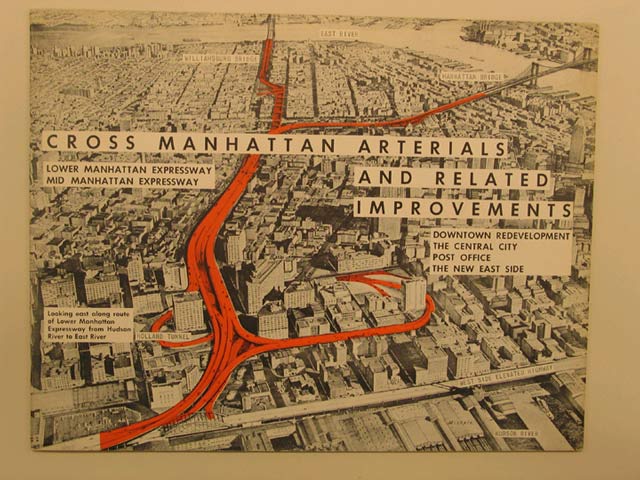
HIGHWAY CITY: Had Moses’s ideas come to full fruition, an elevated highway would have cut through lower Manhattan at Broome Street, a mid-Manhattan version would have landed onto 30th Street, and the culture of Harlem’s 125th Street would have been eliminated by a Cross Harlem Expressway. The two uptown extensions died quickly, but Moses was so close to making LoMaX (the Lower Manhattan Expressway) that one segment, at Chrystie Street, was actually built and abandoned.

SCANDAL: The drab structures at Park West Village belie the scandal of Manhattantown, a proposed development exposed as an elaborate development scam spawned from the federal government Slum Clearance Program — a program overseen by Moses in New York.

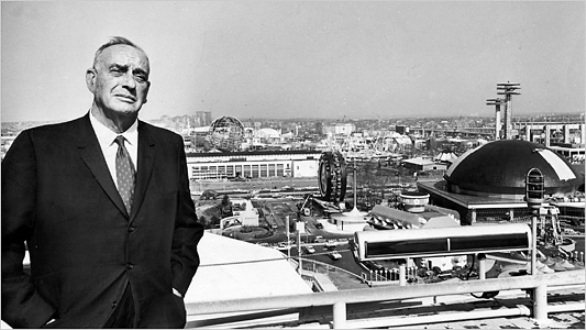
NO FAIR: A visibly bitter Moses stands aloft his World’s Fair of 1964-65, a chaotic, financial flop that gave the press, once so adoring of their former Parks Commissioner, ample fodder for mockery.

Robert Moses has divided urban planners, politicians and regular New Yorkers for decades. The 1970s saw the devastating bio The Power Broker by Robert Caro, elaborating in great, grim detail the evils of Moses’s decisions. His legacy was re-evaluated in a critical 2007 exhibition at the Queens Museum.

Photo by Alfred Eisensteadt (Courtesy Google Life)


Categories
Uncategorized

A History of New York City in 100 Buildings (Nos. 51-100)

THE FINAL PART UPDATED BELOW – THE FUTURE CITY
See map below for all the locations mentioned in this story
I’m splitting the second half of this series off into a separate posting for easier navigation. Please see the post below this one for the introduction and entries 1 through 50.

————————————————————————-
PART SIX: SUBWAY CITY
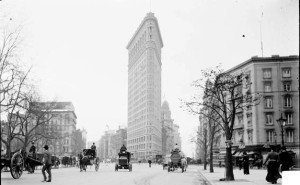

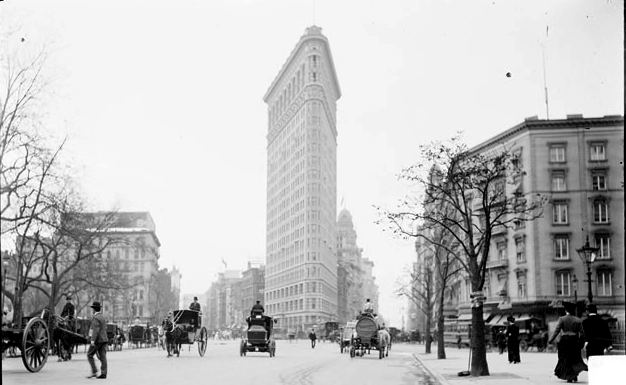
51 Flatiron Building (Manhattan)
At the start of the new century, a lust for building tall — now anchored in technologies like steel-beam construction and the invention of the elevator — firmly possessed the world. Before 1890, the tallest building in Manhattan had been a church; in the buildup to 1900, three other took the title, of which only one (the Park Row building) still survives. The Flatiron (1902) was never New York’s tallest, but it was — and still is — it’s most graceful. Chicago’s most famous architect Daniel Burnham took on the challenge of creating a 22-storey, stretched Italian Renaissance office building on a odd triangular sliver of land. The resulting structure (through its near-infinite reproduction on postcards) would almost become a brand representing the nostalgia of New York’s glory days.

52 Sherman Square Subway Station (Manhattan)
In the 19th Century, mass transit meant trains and trolleys, both limited and costly means of transportation always fated to mar the landscape. But New York in the 1900s was in the throes of a new aesthetic: the City Beautiful movement. So in that respect, the introduction of the subway (first opened in 1904) wasn’t just a convenience or a technological marvel. It allowed for the slow elimination of ugliness.

Evidence of this remains in one of the last original subway stations still existing, the entrance for the original Interborough Rapid Transit Company station sitting at Sherman Square on the Upper West Side. Here, the past meets the future, Beaux-Arts trappings for a new form of transportation.

ALSO: Built the same year, the subway entrance at Bowling Green near Battery Park is smaller. Opened in 1905, it wouldn’t be used for Brooklyn traffic until a few years later. The station today still features some unused platforms.
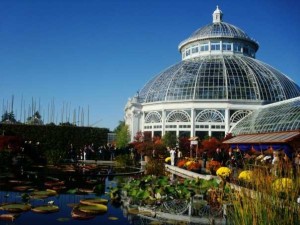

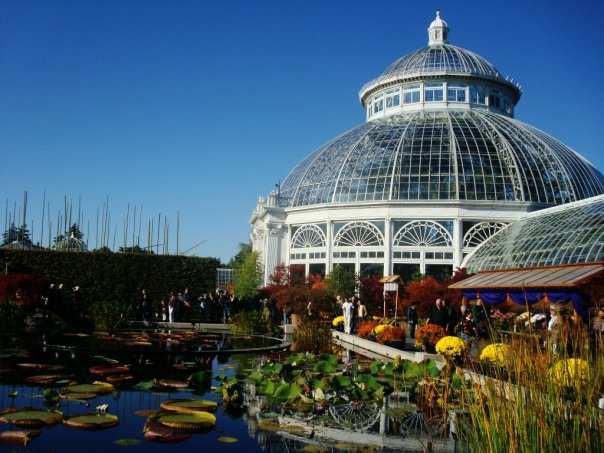
53 Haupt Conservatory (Bronx)
The 1900s was a decade of gigantic public endeavors. The opening of the subway allowed for new projects to be built further afield. And since there was no room in Manhattan anyway, the immediate benefactor were the two boroughs most closely connected by new subway track that decade — Brooklyn and the Bronx.

Both the Bronx Zoo and the New York Botanical Gardens had been opened in the Bronx shortly after the five-borough consolidation in 1898 and would expand greatly in the new century. The Enid A. Haupt Conservatory, completed in 1902, reflects the park’s nod to Victorian era formality, where the rich friends of the garden’s creators could feel at home and the general public could be wowed with a world-class collection of flora.

54 Andrew Carnegie Mansion (Manhattan)
And the upper class didn’t have to travel quite as far to get there. Over the decades, a cluster of great mansions had been floating up Fifth Avenue. In lower Fifth Avenue neighborhoods, the old mansions would be ripped down to make apartment buildings (such as those below 14th Street) hotels and department stores. But the richest families were now installed along Central Park, with Andrew Carnegie throwing down the gauntlet at the most northern locale yet, a monster 91st Street estate, built in 1901.

The 64-room mansion enjoyed “such state-of-the-art features as a water filter system, the first residential elevator, and a rather sophisticated ventilation system akin to an early form of central heating and cooling.” Today, the palatial space houses the Cooper-Hewitt National Design Museum.
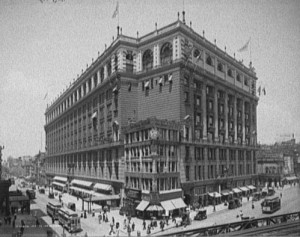

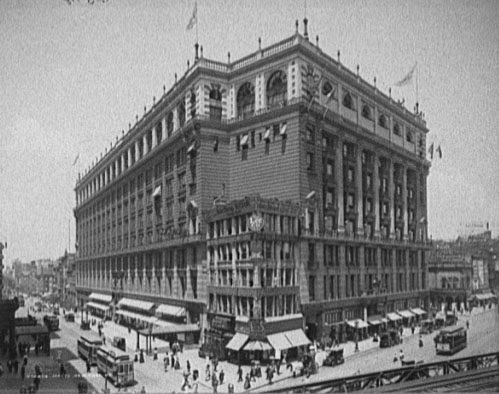
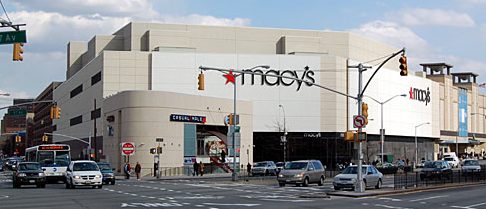
55 Macy’s Department Store (Manhattan)
Retail and entertainment also witnessed a slow migration north, and in that thrust towards mid-Manhattan, the area around one particular elevated train stop — Herald Square — soon became the busiest shopping point in the city. Macy’s, moving from the heart of old Ladies Mile, was not the first department store to lay a claim in Herald Square, but its choice corner location (opening in 1902), reputation for innovative new products and clever promotional opportunities (including a certain yearly parade) made the Straus family business the unofficial gateway to the new Midtown.
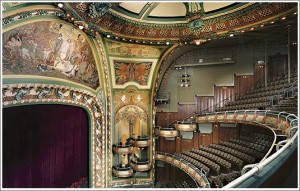
courtesy Times Square NYC

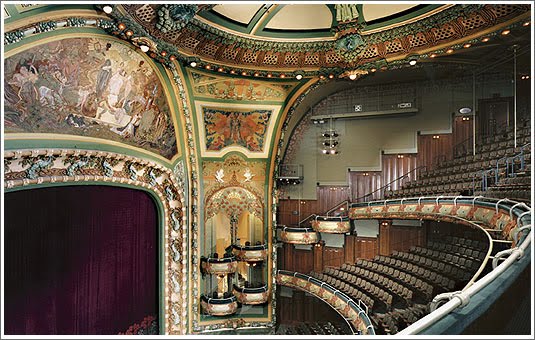
56 New Amsterdam Theater (Manhattan)
Entertainment venues were making a similar trek. Theater producers had already transformed the area around Broadway and 42nd Street into the unofficial new theater district when two members of the powerful Theatrical Syndicate opened the New Amsterdam in November 1903. It became one of Broadway’s most successful theaters, hosting the first few Ziegfeld Follies and many of the biggest stars of the pre-film days. It’s one of the few survivors of the Great White Way, a critical stage at the center of 20th century American entertainment. After some sorry days as a movie house, Disney rescued the decrepit house and its renovation became a key part of the ‘clean up’ and revitalization of 42nd Street in the late 1990s.

57 One Times Square (Manhattan)
Opening night crowds at the New Amsterdam could see the silhouette of a new tower rising just to the west, the new home (1905) for one of the city’s most influential newspapers, the New York Times. They only used it for a few years; its significance lies in its superficial qualities. It’s one of the first skyscrapers built over a subway line (with a station constructed right underneath it), and its surfaces were soon covered with electronic bulletin boards and news tickers broadcasting breaking news. An embodiment of the neon-electric revolution that took over the city, it’s no surprise that the most illustrious light show of all — New York’s annual New Years Eve celebration — debuted on its rooftop in 1907.
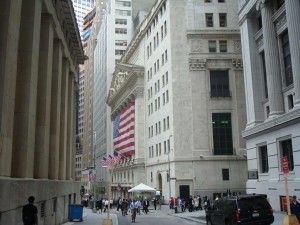

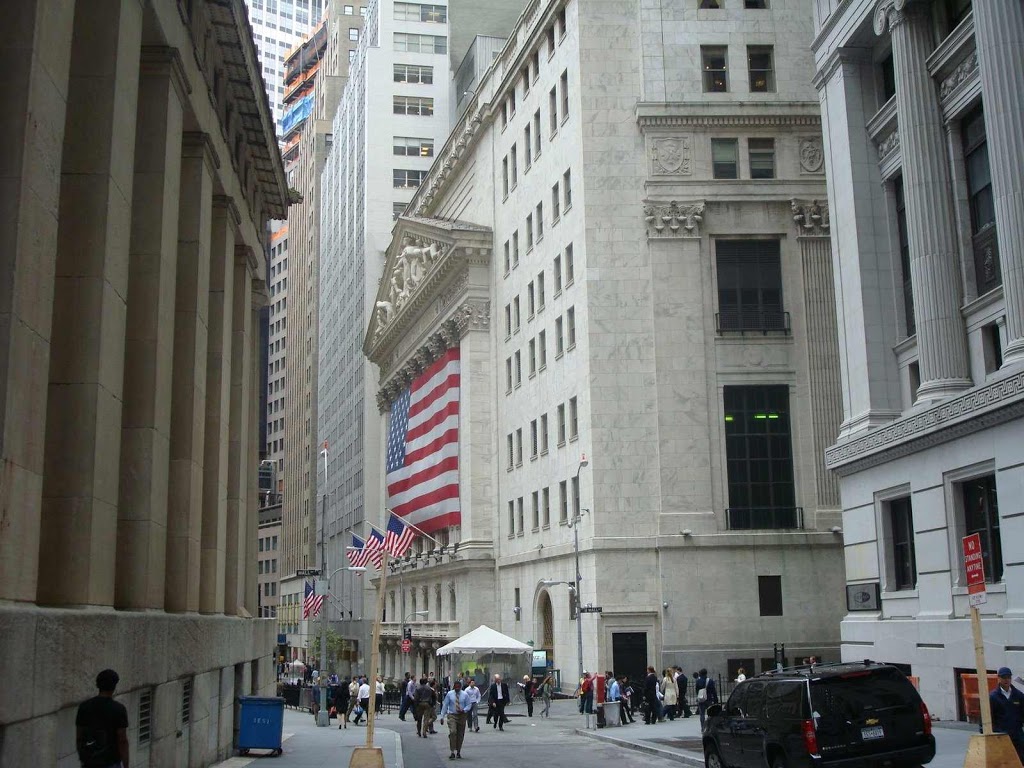
58 New York Stock Exchange (Manhattan)
It’s remarkable that so many structures that define classical notions of New York City are from this slender period (1898-1910). The prior decade had experienced a devastating depression, the result of banking and railroad financing catastrophes leading to the Panic of 1893. By the new century, America had recovered and then some.

Even Wall Street, one of the sources of the meltdown, benefited from the upswing, with a dazzling new home for the New York Stock Exchange (1903) by the master of neo-classical architecture George Post. The fate of America’s financial future runs through this building’s trading floor. Wealth is bred here, as is misery — namely recessions and depressions, including that Great one, on October 29, 1929 (aka Black Tuesday).
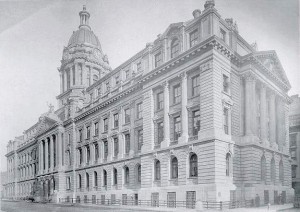

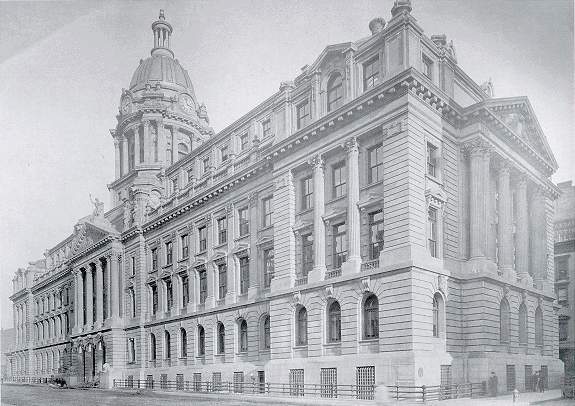
59 New York Police Headquarters (Manhattan)
The shenanigans of corrupt men weren’t relegated to the moguls. The elegant 1909-10 headquarters built for the New York Police Department may have been a way to shake off the force’s shaky reputation for being too pliable to corrupt political winds. In the last decade, the Lexow Committee exposed widespread malfeasance, leading to the installment of police reformer Theodore Roosevelt as new commissioner. With its old boss now in the White House — and the force now comprising officers for all five boroughs — they were given a lavish new home on Centre Street. They stayed until 1973; the building was later converted into luxury apartments, popular with supermodels in the 1990s.
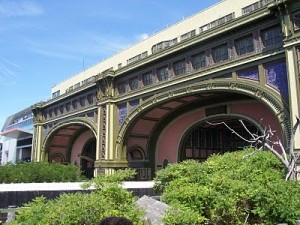

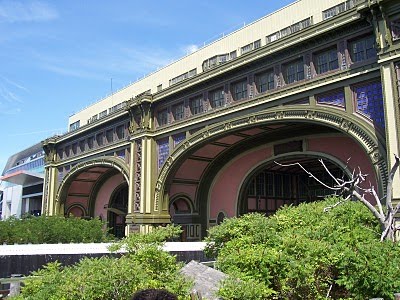
60 Battery Maritime Building (Manhattan)
The Staten Island Ferry has always been a crucial transportation hub for New Yorkers, the only way most Staten Islanders ever commute into Manhattan, even today. The brand new terminal leaves no trace of its history, but the building next to it, the lumbering green Battery Maritime Building (1907) gives you some idea of how the earlier terminal might have looked and operated. And luckily, after years of abuse, the terminal is open for business as a ferry terminal for Governor’s Island and its future may hold some rather extravagant twists.

61 Brooklyn Academy of Music (Brooklyn)
There were fears by those critical of consolidation that any borough not named Manhattan would lose their cultural vitality, becoming neglected suburbs. The criticism was muted the day that the new hall for the Brooklyn Academy of Music opened in 1908, replacing their old home which had been destroyed in a blaze five years earlier. BAM remains Brooklyn’s central cultural organization. Everyone from Enrico Caruso to Nirvana has played here.
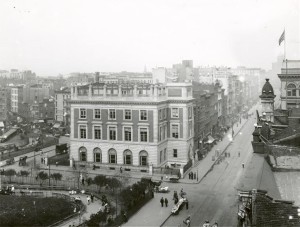

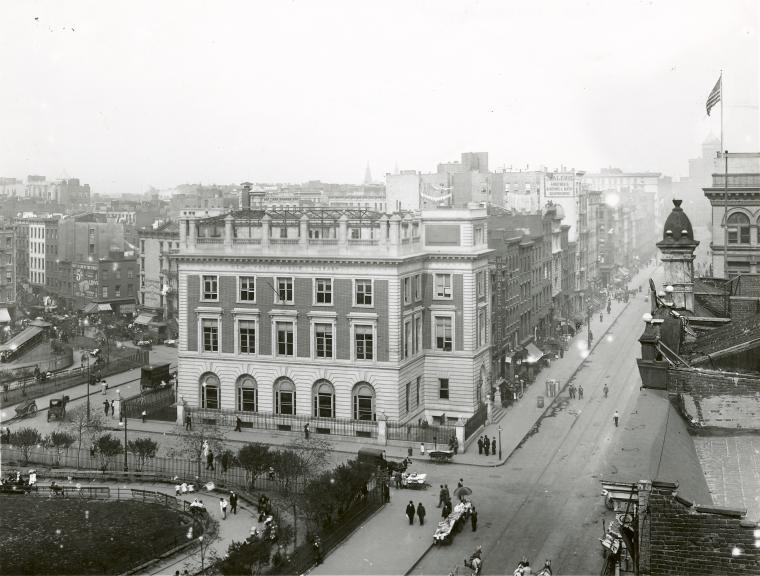
62 Seward Park Library (Manhattan)
Despite the best efforts of cultural organizations and charitable endeavors, the residents of neighborhoods like the Lower East Side still did not have access to many basic city services. The city was get a grand central library in 1911 (built by Carrere and Hastings), but it would be smaller community libraries that would have greater effect over the daily lives of New Yorkers.

Andrew Carnegie, in his later years a philanthropist, built hundreds of libraries around the country, often in neighborhoods most in need of them, and New York was recipient of dozens throughout the city. The one at Seward Park, from 1909, is one of the city’s oldest, replacing an older structure with a virtually flawless Beaux-Arts gem facing into the park — which, as a two-for-one for history lovers, houses the city’s oldest municipal playground.

And yes, the Seward Park area desperately needed a library, especially one filled with newspapers and books in the foreign languages of the neighborhood’s occupants. In 1913, it had the highest circulation of any library in the city.

ALSO: Right across the street, the Jewish Forward newspaper would build a stunning new headquarters in 1913 where it would remain for six decades. Or if you’re looking for a more regal library, turn your attention uptown to the book repository built for J.P. Morgan in 1906 which actually outlived the owner’s mansion next door.

FOR MORE INFORMATION: Listen to our podcasts on the Flatiron Building, Macy’s Department Store, the Ziegfeld Follies, One Times Square, the New York Stock Exchange and the New York Public Library

————————————————————————-
PART SEVEN: METROPOLIS
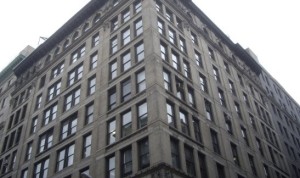

The ugly story behind the plain, upper floors of the Asch Building

63 Asch Building (Manhattan)
There are two buildings from the 1910s that hold a very practical importance to the daily lives of New Yorkers still today — places that aren’t necessarily classics in any aesthetic sense, but serve as object lessons to a growing city.

Today known as NYU’s Brown Building of Science (at Greene and Washington Place, off Washington Square), the Asch Building held the sweatshop factory of the Triangle Shirtwaist company on its top three floors. On March 25th, 1911, a fire sparked in a bag of rags quickly built into an unstoppable inferno, trapping hundreds of workers, many who fatally leapt to the sidewalk below. The 146 dead, mostly women newly immigrated to the United States, were mourned by the city, and tragedy forced an improvement in radical new building fire and safety codes.

64 Equitable Building (Manhattan)
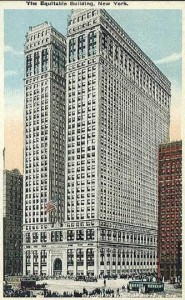
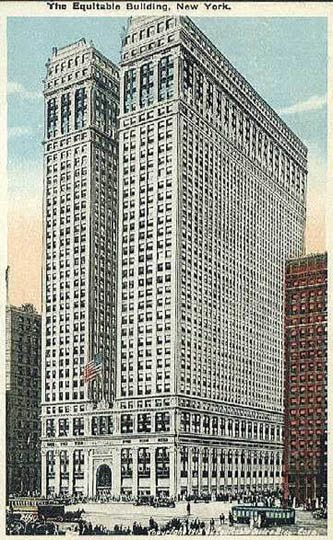
The other ‘lesson’ represents something of a crisis averted — a new home at 120 Broadway for a life insurance company (who was moving here because a fire had destroyed their last office) that represents a metaphorical slamming of the brakes, the moment when New Yorkers realized that they actually had to live in a city of skyscrapers. Maybe new skyscrapers shouldn’t all be block-length, 38-story uninterrupted slabs that blocked out the light.

The Equitable colossus (at left,1915) sent a shiver through the spine of the city. Within a year, new zoning laws would dictate how future skyscrapers should be made — beginning an era of ‘wedding cake’ setbacks and the birth of innovation in the New York City skyline.

65 Woolworth Building (Manhattan)
The new headquarters for Frank Woolworth’s retail chain was completed in 1913, three years before the zoning laws. Yet it was rapturously received by New Yorkers, both for its classic beauty (a Cass Gilbert original) and iconic stature, for it was now the tallest building in the world.
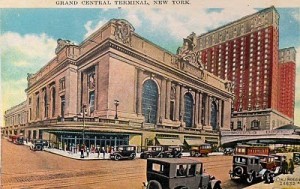

66 Grand Central (Manhattan)
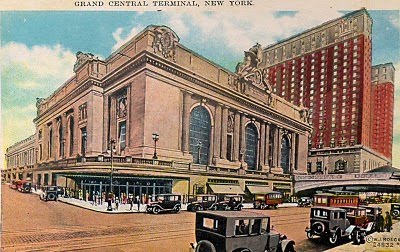
I’ve stated in our podcast for Grand Central Terminal that I thought this was New York’s most important building (1913), and I stand by that. Not only is it essential as a transportation hub for millions of travelers, but its dramatic rescue from developers wanting to rip it down in the 1970s went all the way to the U.S. Supreme Court, empowering the New York Landmarks Preservation Commission and saving countless other buildings in the process.

And forget that it’s New York’s greatest example of Beaux-Arts architecture! Grand Central’s key contribution to the city rolls out in front of it northward; sinking New York Central Railroad’s tracks under the ground created the midtown section of Park Avenue, soon to become one of the most expensive streets in America.
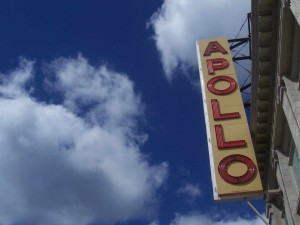

67 Apollo Theater (Manhattan)
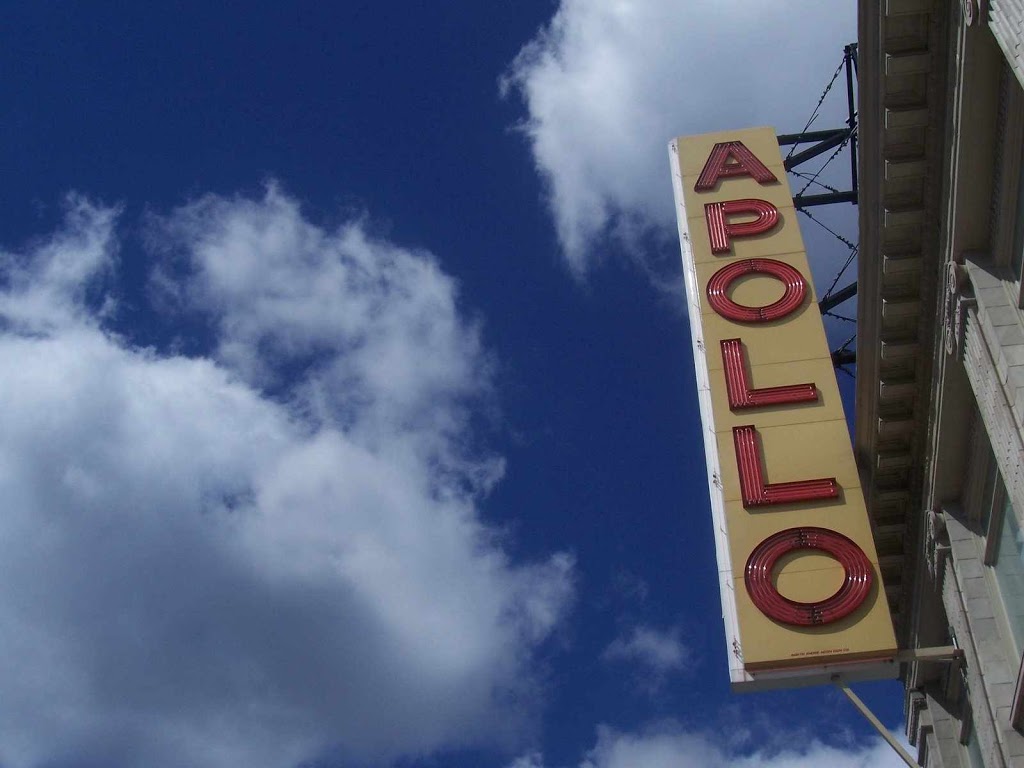
Next to perhaps only the long-gone Savoy Ballroom, the Apollo Theater is the largest venue most associated with the Harlem Renaissance, a cultural explosion of black writers, artists and musicians which electrified the Roaring ’20s and beyond, the product of one of the city’s most significant population shifts.

Harlem was a neighborhood in flux in the 1910s, displayed nicely within the Apollo’s own history. The theater opened as a burlesque house for white audiences in 1914, although by the ’20s Harlem was fast becoming a mecca for new African-Americans in the city. The neighborhood evolved, but many of its closed-minded businesses paid no heed. Apollo wouldn’t reopen for black audiences until 1934 — missing much of the early musical talent of this American Renaissance, but launching the careers of many more stars (Ella Fitzgerald, Billie Holiday, James Brown).

68 Kaufman Astoria Studios (Queens)
Cinema, probably more than any other medium, has helped form the exotic allure of New York City. But there was a period when New York’s entertainment venues — its vaudeville and flashy Broadway stages — feared the coming of movies, a medium that would eventually bleed from them their audiences.

For a brief time before the era of motion picture talkies, New York’s film cred wasn’t merely as a city of plush cinemas. It helped make most of the pictures too. Adolph Zukor’s Famous Players Film Company (a precursor to Paramount Pictures) opened a movie studio in Queens in 1920, one of several major film companies based in the New York metropolitan area. Today, as Kaufman Astoria Studios, it still produces entertainment, though mostly for television.

ALSO: Zukor had a second space in Chelsea at West 26th Street which also still functions as a soundstage and rehearsal studio (Chelsea Studios).
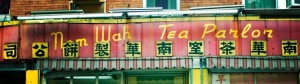

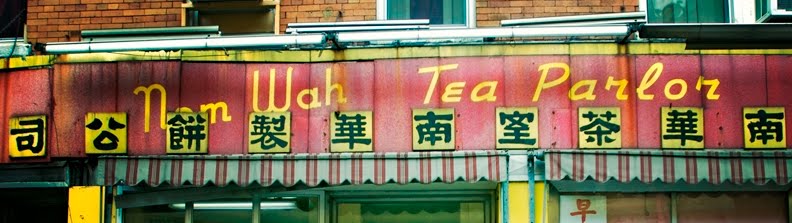
69 Nam Wah Tea Parlor (Manhattan)
This tiny, beaten-up shop at the hook of Doyers Street is a real survivor, a window into the early days of Chinese life in New York. The slums of Five Points had been paved into a park, and municipal buildings were soon to be built to the west. But just north and east of the former slum were the homes and businesses of thousands of new residents — Italians and a small but growing number of Chinese.

Reportedly open since 1920, Nam Wah would have been witness to some remarkable history on its street — to the shadowy speakeasy across the street where Irving Berlin and Al Jolson regularly performed; hatchet-wielding tongs wars that gave this crooked street the nickname the ‘Bloody Angle’.

70 Colonial Court, Sunnyside Gardens (Queens)
We know the 1920s as the Jazz Age, of Prohibition, flappers, gangsters and Times Square. But in the course of New York City history, the big story of the decade was the population explosion in Queens. With the construction of the Queensboro Bridge in 1909, the door were thrown open to a virtually untouched area of the city.

Between 1920 and 1930, the population more than doubled. Making this possible were experimental new housing projects like Sunnyside Gardens, an extension of the British ‘garden city’ movement, with affordable apartment rentals scattered around large, well-kept outdoor spaces. Colonial Court (1924) were the first buildings erected and were so marvelous for the day that pioneering urban theorist Lewis Mumford immediately moved in.

ALSO: Manhattan also received its share of this new, fleeting style of apartment complexes, as evidenced by the playful towers in Tudor City on midtown’s east side, beckoning new residents with promise of “tulip gardens, small golf courses, and private parks.”

71 Williamsburgh Savings Bank Tower (Brooklyn)
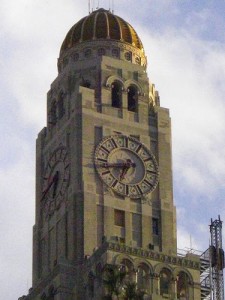
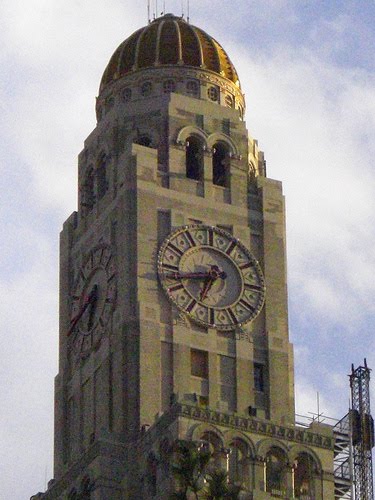
The skyscraper craze, like a floating seed gone astray, landed in the middle of Brooklyn and spawned a home for a bank steadfastly keeping that H in the name of Williamsburgh. It stood out like a beautifully sore thumb for other reasons: built in 1927, it was one of the first large examples of art deco architecture in the city. And its fabulous interior, gold and blue and framed in signs of the Zodiac, rivals almost anything in Manhattan.

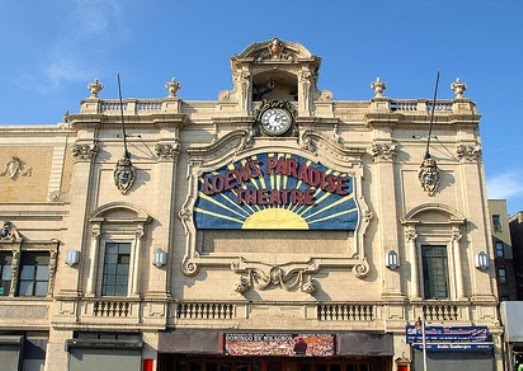
72 Loews Paradise Theater (Bronx)
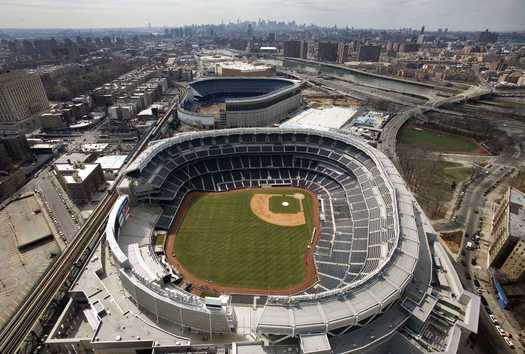
Yes, consolidation was truly proving its point: the city was expanding from all sides. In the Bronx, that growth is best viewed from the Grand Concourse, a wide, Parisian style boulevard that marches up through the center of the borough. Along it sprung luxury apartment buildings, tony businesses and, in 1923, even Yankee Stadium.

The glamour of the boulevard’s early days can best be seen at its finest existing movie palace the Paradise Theater (1929), recently renovated to match its former glory. How this building managed to survive the 1970s and 80s, I’ll never know.

ALSO: A parallel movie house, St. George Theater in Staten Island (1928) was rare not for its location and its dazzling, gilded interiors, but for the fact that it was built by an independent theatrical producer, during the days when film companies and theatrical syndicates made their own venues.

Below: The Paradise Theater, the Bronx
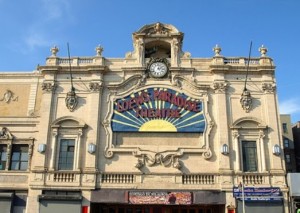
73 Waldorf-Astoria Hotel (Manhattan)
The greatest hotels in New York City have been associated with the Astor family, including the old Astor House near City Hall and the original Waldorf-Astoria, a product of familial rivalry that set the standard for elegance and attracted New York’s wealthy classes like a flame.

The Waldorf-Astoria on Park Avenue is associated with the family in name only, but its reputation as New York’s most famous hotel, while faded, remains unblemished. FYI, they’ve recently decided to hyphenate themselves with a ‘=’ today.
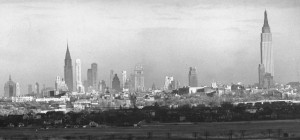

74 Chrysler Building and
75 Empire State Building (Manhattan)
The Depression hit in October 1929, an economic apocalypse that threatened to slow the momentum of New York’s growth. Curiously, at that very moment, the two greatest buildings in New York City were just rising into the sky.

The Chrysler Building was the victor of a race between the car mogul William Chrysler and the Bank of America, who was racing to make the world’s tallest building down at 40 Wall Street. While the downtown building was finished first, it was dwarfed (in both height and appearance) when William Van Alen’s art deco, automobile-inspired masterpiece lifted up its silver spire in October 1929.

Several blocks away, work began on a tower to surpass Alen’s, in a pit that had once been the original Waldorf-Astoria. It rapidly rose into the sky, completed in May 1931 — and pretty much stayed empty. New York had its Empire State Building, the structure which would define it for generations, and for years, all people could do it look at it and see a monumental failure. Few associate this tourist mecca with underachievement today. But its current might is tinged with grief; on September 11, 2001, it returned to being New York’s tallest building.

Picture above by Andreas Feininger, Sept 1946 (courtesy Life Google Images)

For more information: listen to our podcasts on the Triangle Factory Fire, the Woolworth Building, Grand Central, the Apollo Theater, the Astor family, and the Chrysler Building.

————————————————————————-
PART EIGHT: THE MODERN CITY
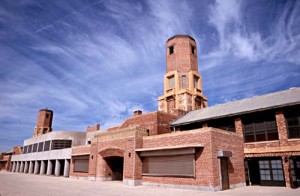
Courtesy Liberty Stone

76 Jacob Riis Bathhouse (Queens)
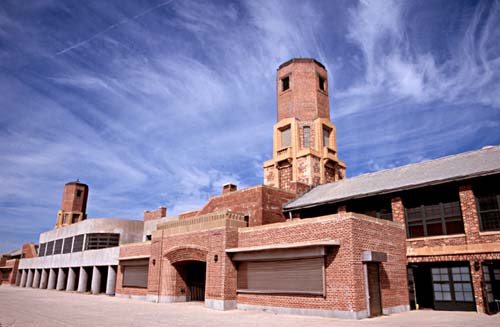
Although he wouldn’t be named parks commissioner by mayor Fiorello LaGuardia until 1934, Robert Moses was already remaking areas of New York City as a member of Governor Al Smith’s state parks team. Nowhere as spectacular as his work at Jones Beach, Moses’ Jacob Riis Park — named for the journalist and social reformer — brought the verisimilitude of beach life to this former naval base on the Rockaway Peninsula.

The classic art-deco bathhouse (1932) reflects Moses’ early attention to beautiful detail, a proclivity that would fade over the years. Setting nearby is another special touch of the powerful commissioner — a massive parking lot.

77 Robert Moses Administration Building (Randall’s Island)
This nice but fairly plain little building on Randall’s Island belies its importance in the history of New York. It’s from here, in the shadow of his triumphant Triborough Bridge (1936), that Robert Moses conducted the development of hundreds of new projects — parks, highways and housing. As Robert Caro famously summed it up, “Moses’ decision to built his main office there was, intentionally or not, symbolic of his independence of the city.”

78 RCA Building (Manhattan)
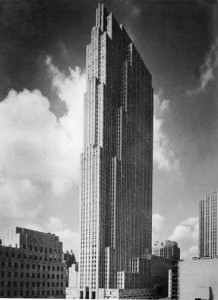
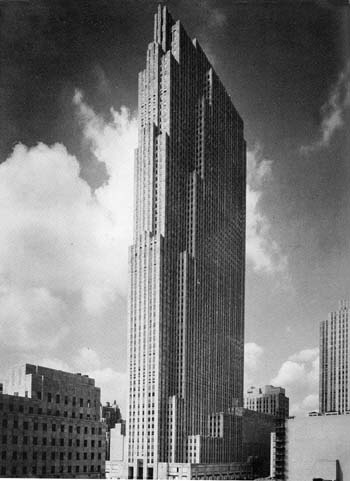
Before the FDR’s New Deal programs and the adrenaline of Moses, virtually the only game in town during the Great Depression was the construction of Rockefeller Center. Junior’s multi-block complex in midtown Manhattan was a true risk, opening new retail and office space when the city’s pre-existing spaces were going empty.

30 Rock, the former RCA Building, became midtown’s center of gravity when it was completed in 1933. Within a few years, both it and the other Rockefeller Center offices were filled to capacity.

79 Tavern on the Green (Manhattan)
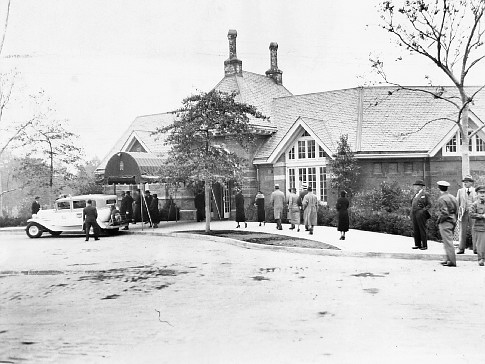
If you’re looking for a defining building that embodies Moses’ park philosophy, you’ll find it in this oft-troubled restaurant in Central Park. Olmsted and Vaux’s vision of natural respite seemed old-fashioned to Moses, who thought parks should provide venues, playgrounds and sporting courts. Tavern-on-the-Green (1934) was originally created as an ‘affordable’ dining alternative for the middle class. To build it, Moses threw the sheep (actual sheep) out of nearby Sheep Meadow and transformed their sheepfold into this privately-owned restaurant. Later, in the 1950s, when Moses tried to expand its parking lot by paving over a playground, the public revolted.

Below: Tavern on the Green in 1934
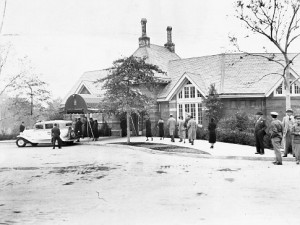
80 Arthur Avenue Retail Market (Bronx)
Speaking of sheep, the land below Arthur Avenue’s busy market was also once a sheep’s grazing meadow. (It’s also on the former estate of the Lorillard tobacco family, see No. 22.) When Mayor LaGuardia dictated that unregulated pushcart salesmen, the lifeblood of many ethnic neighborhoods, move their wares indoors, he commissioned indoor markets throughout the city, including this one (1940) in what was becoming a booming new Italian neighborhood.

Inside, you’ll find one of Arthur Avenue’s most famous vendors, Mike’s Original Deli, which moved here in the early ’50s and never left.

ALSO: The same strategy was applied to La Marqueta (1936), which provided for the neighborhood’s growing Latino and Puerto Rican communities. A shadow of its former self today, the market at its height housed stalls for over 500 merchants.

81 New York City Building (Queens)
Flushing Meadows-Corona Park’s only surviving structure from both the 1939-40 and 1964-5 World’s Fairs, this home to the Queens Museum today (1939) holds the Panorama, a miniature replica of the city of New York. For a short time, the United Nations even met here. Moses had hoped that the international delegation would choose Flushing Meadows Park, one of his closest pet projects, as their permanent home…..
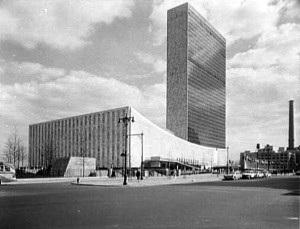

82 United Nations Building (Manhattan)
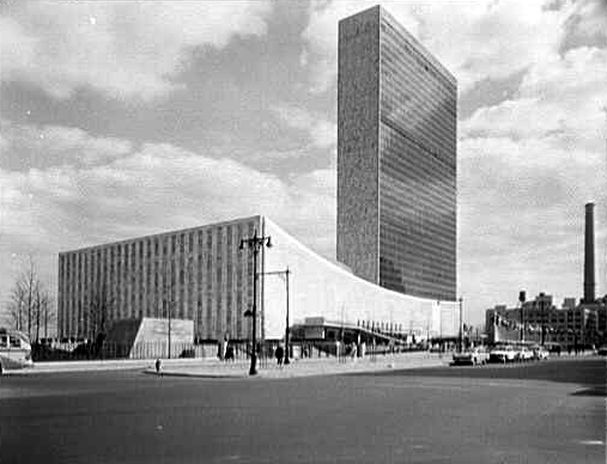
…but they recoiled at that thought, choosing instead this customized property on the east side of Manhattan (1950). The U.N. Headquarters is globally significant, of course, but its an innovative architectural marvel as well, the first of dozens of towers in the glass-curtained International Style. For better or worse, it keeps New York City front and center as a focal point for international politics.

83 Seagram Building (Manhattan)
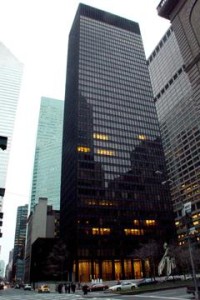
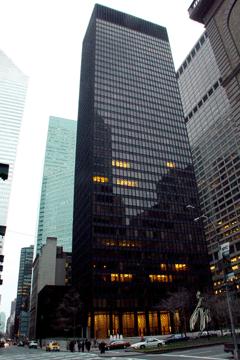
That modern style would be used and abused for the next two decades, as modern commerce embraced tall, boxy high-rises as the critical form of construction. The cleanest example is Mie Van Der Rohe’s graceful black monolith (1958), powerful and utterly lacking in ornamentation. The key to the building, constructed for the alcoholic distiller, is the large public plaza in front of it, reinterpreting the old zoning laws to such an extent that the laws themselves were changed, in 1961.

As lovely as the Seagram Building is — and its companion across the street, the Lever House, from 1952 — those zoning alterations have doomed Midtown to a host of ugly, darkened ‘communal spaces’ and glassed-in plazas.

84 La Luz Del Mundo Church (Brooklyn)
Williamsburg, a former industrial heart of Brooklyn, saw a unusual population shift after World War II, with white residents moving out to be replaced by Puerto Ricans families living next to a tightknit Hasidic enclaves. As New York became a true melting pot after the war, divergent communities grew used to living side by side.

Many 19th century buildings were repurposed by this modern mixture. One hundred years after Congregationalists worshiped here at this brownstone chapel, the Spanish Penecostal congregation La Luz Del Mundo moved in (1955).
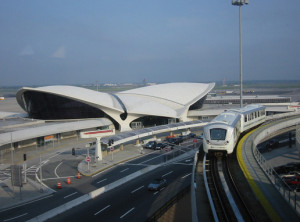

Courtesy MAS

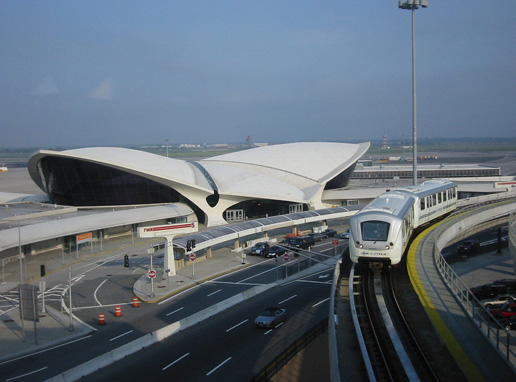
85 Trans World Flight Center (Queens)
Idlewild Airport represented the future of flight when it was proposed in the late 1940s, utilizing a single, gigantic terminal that would ease traffic at the beleaguered LaGuardia Airport. Flash forward 20 years — the completed airport is now named John F. Kennedy International Airport, LaGuardia is still busy, and instead of one terminal, there were several, of innovative modern design. The best was made for TWA (1962) by Eero Saarinen, reflecting an almost innocent outlook towards the possibility of air travel, an archetype of public design. Reflect on the halcyon days of commercial flight as you’re sitting at JFK today, waiting for your delayed flight.
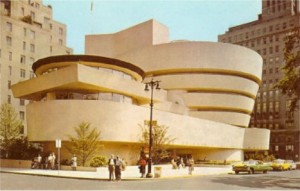

86 Guggenheim Museum (Manhattan)
Presaging the work of modern artists who would define the city’s cultural tastes in the 1960s, aging architect Frank Lloyd Wright displayed a goofy flourish with the construction of the Guggenheim Museum (1959).

87 Park West Village (Manhattan)
This cluster of ordinary-looking apartment dwellings (1960) sit on top of the former slum of Manhattantown — an unspectacular place if not for the shady machinations of developers Caspert and Company. Empowered by the federal government’s Title 1 housing act, Moses sanctioned Carpert in 1947 to clear away slums and develop new apartments. Instead, the land sat there — countless delays — while the developers scooped up the rent. The press had a field day, tarnishing Moses’ public image.

The land was eventually transferred to other developers who built Park West Village — of a gloomy standard that would become commonplace with new dwellings.

ALSO: But for something extraordinary, check out the largest ‘building complex’ on my list, Co-Op City (finished between 1968-71), the largest ‘building complex’ on my list. For despite being surrounded by highways, despite housing available for 50,000 residents, the city within a city remains virtually remote, with no convenient subway access.

88 Stonewall Bar (Manhattan)
Luckily, this was the 1960s, and communities protested, students protested, everybody protested. Sometimes, people in power even listened. But one revolt decidedly not on City Hall’s radar was the riots outside Stonewall Bar (1969) between police on a routine shutdown of West Village gay bars and a clientele (and rabble from the park across the street) reaching their breaking point. Within a year, the events at this shoddy, mafia-run bar had united a community and jump-started the gay movement.
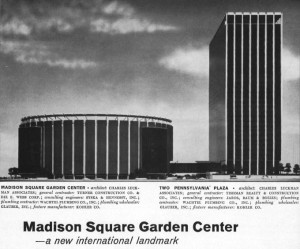

89 Madison Square Garden (Manhattan)
*Sigh* And finally we get to the enormous bundt cake pan that calls itself Madison Square Garden (1968) after the three prior, spectacular incarnations of the same building. Not disparaging any of the wonderful entertainment that goes on inside, the Garden and the subterranean Penn Station are testaments to a mindset of the 1960s, a short-sighted vision of the future that through its lumbering, brutalist qualities threatened to dynamite any glimmer of livability.

The city is currently figuring out how it wants to transform Penn Station into Moynihan Station using the 1912 James Farley Post Office building across the street, an ironic move that would allow the ‘modern’ train station to slither out of the shadows via an old Beaux-Arts structure similar in form to the building that was demolished to build the Madison Square Garden/Penn Station combo in the first place.

For more information, listen to our podcasts on Randall’s Island, Rockefeller Center, the World’s Fair of 1964-65, the United Nations Headquarters, Freedomland U.S.A., the Guggenheim Museum, Penn Station and Madison Square Garden

————————————————————————-
PART NINE: THE FUTURE CITY

91 Show World Center (Manhattan)
Ah, New York City in the 1970s. People wax nostalgic about it even though nobody in their right mind would take a time machine and return there, except maybe to go to CBGBs. Crime, blackouts, poverty, filth, disco.

But the course that 42nd Street took in the 90s — going from sleazeland to Disneyland — was so dramatic and final that one can’t help be slightly wistful, for that street of lonely marquees, interspersed with poop booths and neon signs for EXOTIC GIRLS. Not the drugs or prostitution, but a street, in the center of Manhattan, that wasn’t so primly cultivated.

Show World Center, right off 42nd on Eighth Avenue, is a holdover from this gritty world, a flashy, trashy video store from 1975 that’s emblematic of Times Square’s days of deterioration, a place that the Times mentions that “burlesque historians say was once a widely imitated model for the industry.”

ALSO: You can find another reflection of Times Square further east, at the TKTS booth, which originally opened in 1973, though the high-tech, staircase-laden revision, which opened two years ago, is a jewel case version of the bombast currently inhabiting the Square today.
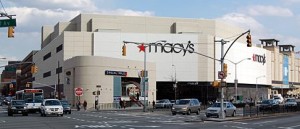

92 Queens Center Mall (Queens)
A hundred years before, it was Ladies Miles. In the 1970s, it was shopping malls. New York City generally shuns some of the standardizations of modern America, but with the blooming of larger residential areas, the lure of modern conveniences like fast food restaurants and shopping malls soon infiltrated. New York’s first McDonald’s opened in 1973. That same year, a humongous shopping mall opened in Elmhurst, a staple of suburbia refitted for the big city.

ALSO: Snooty Manhattan would not be immune; the strangely depressing Manhattan Mall opened in 1989.

93 41st Precinct Station aka “Fort Apache” (Bronx)
FORD TO CITY: DROP DEAD cried the Daily News in 1975, a rebuff by the federal government to New York City’s financial woes. Buckling at its knees, New York spent years consumed with urban blight, catastrophic crime statistics, an abysmal public image and even a roaming serial killer.

During the blackout of 1977, there was probably no place less safe to be than the South Bronx (although Crown Heights, Brooklyn, might win honorable mention). Construction of the Cross Bronx Expressway, widespread poverty and inadequate resources led to a vast crime wave. The officers at the Bronx 41st Precinct (1086 Simpson Street) personified the city’s remaining shreds of determination to fight back, so much so that it even became a melodramatic Paul Newman film, “Fort Apache, the Bronx.” The cops are gone, but the 1914 structure still stands as a reminder of grimmer times.

94 Jacob Javits Convention Center (Manhattan)
The late 1970s and early 1980s weren’t a watershed age for architecture, but at least it was oftentimes functional as with the Jacob Javits Convention Center (completed 1986), a valiant if unsuccessful attempt to reaffirm New York as the home for big business. In its own modest, boxy way, it recalls the city’s great spaces of old, both the grand (the Crystal Palace) and the unsightly (the New York Coliseum).

95 Trump Tower (Manhattan)
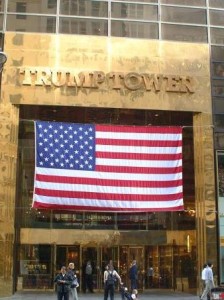
Has one building ever typified an entire decade more than this gaudy palace to Donald Trump? Even as the city began picking itself up, its flashiest developer was embodying a greed-is-good mantra in his decision to throw a gold monolith onto Fifth Avenue (1983).

ALSO: Another tower of wealth, the Citicorp Building becomes the tallest building outside Manhattan (1990).

96 Fresh Kills Methane Treatment Plant (Staten Island)
If you have to point to one thing that symbolized the uneasy relationship between Staten Island and the rest of New York, it would be the former site of the Fresh Kills Landfill, a disastrous Robert Moses idea that turned 2,200 acres of calm, bucolic farmland into the largest garbage dump in the world.

Closed in March 2001, the city has been transforming this toxic site into a future park, a task that will literally take a generation to complete. Industrial structures like the methane treatment plant reform the soil as the former mounds of garbage are transformed into a charming meadow.

97 Deutsche Bank Building (Manhattan)
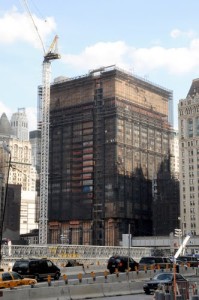
Even as new construction finally rises from the site of the World Trade Center, the terrorist attack still has one more victim to take. The Deutsche Bank Building was heavily damaged by the September 11, 2001 attacks, but, unlike the buildings surrounding it, did not immediately collapse. However it’s been deemed unsalvagable and, after years of delays, is finally in the process of being deconstructed — a couple floors at a time.

By next year at this time, the building should be gone. (Barring delays, of which there’s been a few.)

98 The New York Times Building (Manhattan)
The New York skyline welcomed a bevy of new skyscrapers courtesy of the publishing world, just in time for the pending death of that very industry. Conde Nast (2000) stands over Times Square like Anna Wintour staring at a sales rack, and the hive-like Hearst Tower (2006), planted on top of the base of the old building, looks like its crushing it.

But none seem as strangely cursed as the new offices for the New York Times (2007); the newspaper took a loan out on the new building a year after they moved in, and the sleek design by Renzo Piano has encouraged adventurers and nuts alike to climb along the side of it.
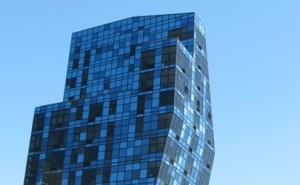

99 The Blue Condominum (Manhattan)
The past decade saw many formerly middle- or low-income neighborhoods with the occasional maverick artist enclave in the process of gentrification — from Manhattan’s Lower East Side to Greenpoint in Brooklyn and well beyond. While one effect of this has sometimes been a richer appreciation of local history, some changes stand in bold contrast, as luxury hotels and pre-bust condos sprout up casting shadows and a foreboding sense of takeover.

The Blue Condominium (2006) is representative of architectural hipsterism, a model of strange proportional absurdity; being so blue, it would stand out anywhere, but especially on Norfolk Street, in sight of the Williamsburg Bridge. And yet, in a city that prides itself on structural diversity, where Beaux-Arts and brutalism stand hand in hand, it’s not necessarily a cause for alarm (as long as people can afford to live here).
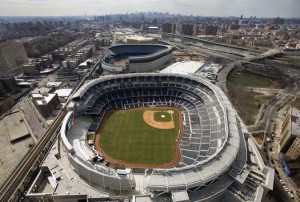
The new stadium, next to the old, courtesy of umpbump
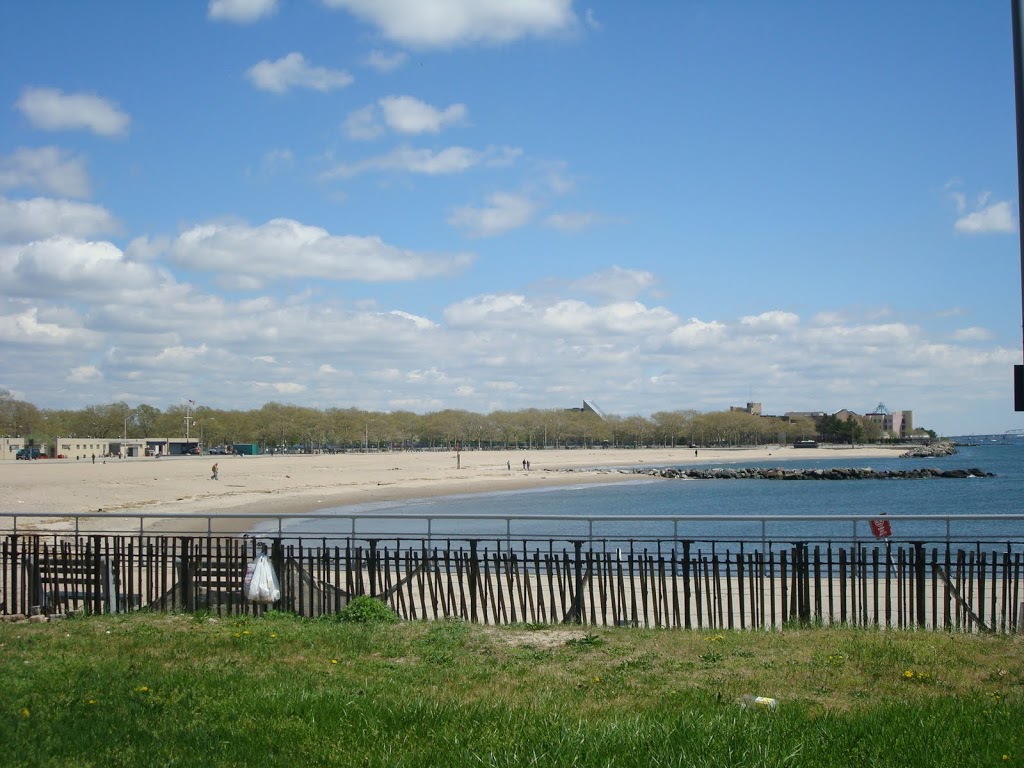
100 Yankee Stadium (Bronx)
Tradition and consistency are key components to the love of professional sports, and those two forces are at work in the new Yankee Stadium (2009). It’s both a stadium and a theme park to the past. Although the new home for Derek Jeter mirrors trends popping up in other nostalgia-inspired ballparks, it nicely contrasts as an opposite of the Blue building in finding ways to preserve the past and live in the present.
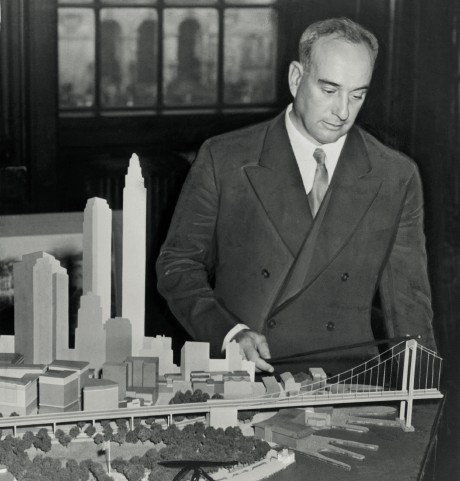
What’s the balance between being false to the spirit of a neighborhood and being so technically exact that it’s like architectural drag? Eh, who cares, let’s play ball!

For more information, check out our podcasts on the New York City Blackout, a short history of Staten Island and the New York Yankees


View History of New York in 100 Buildings in a larger map