Categories
Uncategorized

A History of New York City … in 100 Buildings (Nos. 1-50)

PART FIVE UPDATED BELOW – CONSOLIDATED CITY
See map below for all the locations mentioned in this story
One of the truly great podcast pleasures of the past two months has been the BBC’s A History of the World In 100 Objects, a daily chronological journey through human history via carefully selected items from the British Museum. Stone axes! Golden toothpicks! If you haven’t listened to it, give it a try, especially if you enjoy history conveyed through very proper British accents.

Since we’ve begun work on our 100th podcast (to be released on March 19th), I thought I’d take on a wacky experiment here on the blog, to try the same concept in charting New York City’s history, but using its bulkiest commodity — buildings.

Generally speaking, history is never kind to buildings. With a story filled with great fires, draft riots, urban renewal projects, terrorist attacks and greedy developers, New York City changes its landscape often, with financial downturns, community activism and landmark designations often the only forces stemming the tide.

But with a little creativity, it is possible to chart the city’s entire history from currently standing structures (or in certain cases, reconstructions of original buildings). These 100 buildings and complexes represent just my own perspective, based on my work here on the blog and the podcast. Another person could attempt this same task using a completely different list of buildings. This is not meant to be in anyway authoritative, just my opinion based on stuff I’m picked up thus far on this little trek through history.

There’ll be an update once a day (or so) so check back every day for more. At the bottom of this post will be a Google map of all the locations mentioned. Hopefully this will inspire you to visit a landmark you’ve never heard of or plan a self-guided walking tour around a favorite neighborhood

I’m crunching a lot of data here, so if you see any errors with dates or other information, just drop me a note here or at boweryboysnyc@earthlink.net. Also, if you have a favorite place to add, feel free to leave a note in the comments section. Hope you like it!
_______________________________________________________
PART ONE: NEW CITY
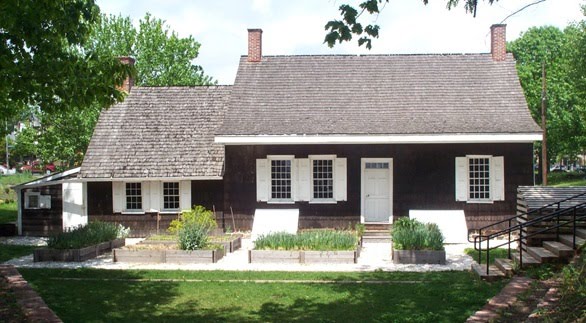

Photo courtesy Wyckoff Association

1 Wyckoff Farmhouse (Brooklyn)
In the beginning, there was the Pieter Claessen Wyckoff House (above). At least, that’s what the Landmarks Preservation Commission, borne of the destruction of old Penn Station, thought in 1965 when they named this modest saltbox frame abode the very first New York City landmark.

No traces outside of a museum exist of old New Amsterdam, but the mark of the Dutch farmers who came along for the ride are still with us. Pieter Claesen was granted this land directly from Wouter van Twiller after the director-general of New Amsterdam bought it from the Lenape inhabitants in the late 1630s. A few Dutch farmers had already ventured onto this wild patch by the time Claesen (who would take the surname Wyckoff after the British took over) built his farm here.

Part of the current structure is from this original home, built in 1652. Many changes came to the house over the years, but the Wyckoff family in some form stayed until 1901. It takes virtually little imagination to stand in front of his sturdy brown house and envision a open, wild Brooklyn landscape behind it.
2 John Bowne House (Queens)
Bowne’s house, in Flushing, is significant to me for one big reason: it was witness to Peter Stuyvesant. Or rather, his temper.

Quaker Englishman John Bowne and his family settled in Dutch territory mostly to escape the Puritanism of his former residence, Boston. No luck here however. Stuyvesant arrested for holding Quaker gatherings (wild, dangerous Quakerism!) in his home. Sent to Holland for trial, he was acquitted and came back to Flushing with a reprimand to Stuyvesant — a reinforcement of New Amsterdam’s religious tolerance.
3 Voorlezer’s House (Staten Island)The transition from Dutch to British rule is easily seen in this simple two-story building (at right) in the vicinity of Historic Richmondtown. Built sometime between 1680 and 1696 by the Dutch Reformed Church, this home for a ‘voorlezer’ (reader and instructor) is considered the oldest elementary school in the United States. Despite British control over the newly named Richmond Country, society would still have leaned heavily Dutch-inspired for decades after.
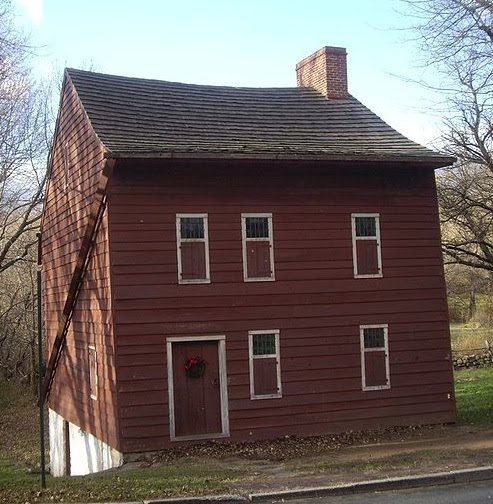
4 Conference House (Staten Island)
Although Richmond County was very pro-British by the 1760s, it was pulled into the conflict between the crown and American rebels by the island’s situation in New York harbor, across from rebellious New York. This home of Christopher Billopp, built in 1675, would take center stage in the conflict a hundred years later, when Continental Congress representatives John Adams, Benjamin Franklin, and Edward Rutledge met with British military to fend off an encroaching war. To no avail.
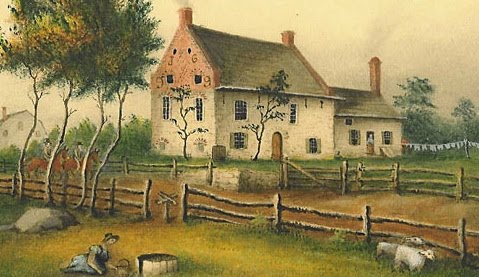
Courtesy Old Stone House/NPS
5 Old Stone House (Brooklyn)
Within the month, British forces swept into Long Island, turning back George Washington’s men at every bend. Here at a simple stone farmhouse overlooking Gowanus Creek, Washington’s troops briefly rallied, holding the old house and firing against the British. “What brave men I must this day lose,” George reportedly said as he look down upon the beleaguered little building. (Pictured above in more bucolic times.)

This current house is actually a reconstruction from 1930 — using materials from an original Dutch home from 1699 — and it may be difficult to see redcoats whizzing by from its vantage near Park Slope.
6 Fraunces Tavern (Manhattan)
This too is a reconstruction of the original tavern which sat here, a key meeting point before, during and well after the Revolutionary conflict. Artifacts in the second-floor museum will give you a good idea of life in Colonial New York, but even having a drink in Fraunces’ darkened bar downstairs, one can envision hushed conversation from impassioned revolutionaries or perhaps a brawl between drunken British soldiers.
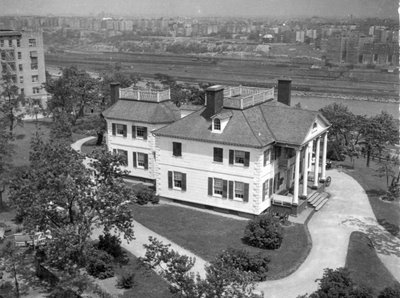
Courtesy Jumel Terrace
7 Morris-Jumel Mansion (Manhattan)
The oldest home in Manhattan (1765) is pretty much how the other half lived; British colonel Roger Morris built this palatial estate well outside New York in tumbling, secluded hills and hosted his superiors here after they succeeded in rushing George Washington and his men out of Manhattan. (Washington himself even took over the home briefly on the army’s way out.)

Post-British era, the home’s dining room entertained many of our country’s founding fathers. However, its history only gets more absorbing when the house is purchased by merchant Stephen Jumel and his scandalous Eliza, who took up with Aaron Burr after Stephen’s mysterious death.
8 St. Paul’s Chapel (Manhattan)
This chapel (from 1766) is, in my humble opinion, New York’s greatest colonial landmark. Surviving the fire of 1776 which wiped clean most of New York’s early historic structures, St. Paul’s is the only true surviving witness of the years when the seat of federal government sat a few downs down at Federal hall. Alexander Hamilton trained as a soldier outside in the churchyard; Washington worshipped here as president of the new country. The chapel is such a symbol of fortitude that even during the Sept 11 attack in 2001, just blocks away, nary a window was even broken.
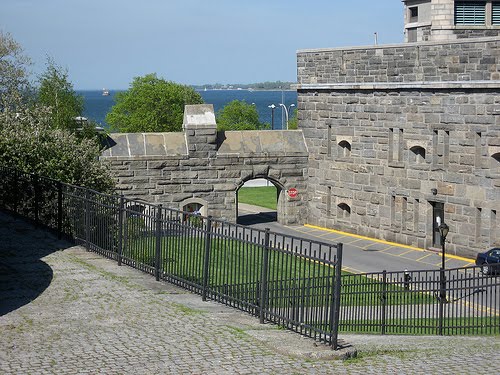
9 Fort Jay (Governor’s Island)
The current fort structure was built in 1806, but it was constructed over an original earth fortification used first by the Americans, then by the British during their occupation from late 1776-1783. One example of dozens of such primitive forts, now lost to redevelopment, the original placement of these early can be seen in the ripples of earth inside the fort. It was rebuilt in 1806 — and originally called Fort Columbus — and served as one of many harbor defenses. The fort held upper-tier Confederate officers during its years as a Civil War prison.
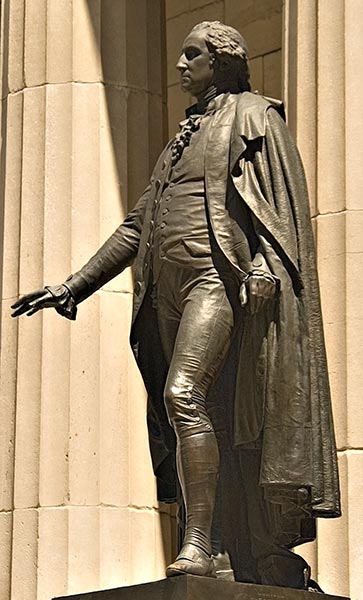
10 Federal Hall (Manhattan)Nothing exists of the original hall (demolished in 1812), so from the perspective of a chronological history, this building is disappointing. This current structure (1842) was New York’s original custom house, processing the flow of imports and exports into one of the busiest ports in the world. However it would revert to a shrine of the earlier Hall within a few decades; today, you cannot get a physical sense of the original building, but the museum inside and the lustrous 1882 Washington statue outside will give you a virtual sense of New York’s importance in 17th century Colonial America.
For more information: try our two podcasts on the Revolutionary War (The British Invasion: New York 1776 and Life In British New York) or a listen to everybody’s favorite director-general, Peter Stuyvesant
_______________________________________________________
PART TWO: PORT CITY
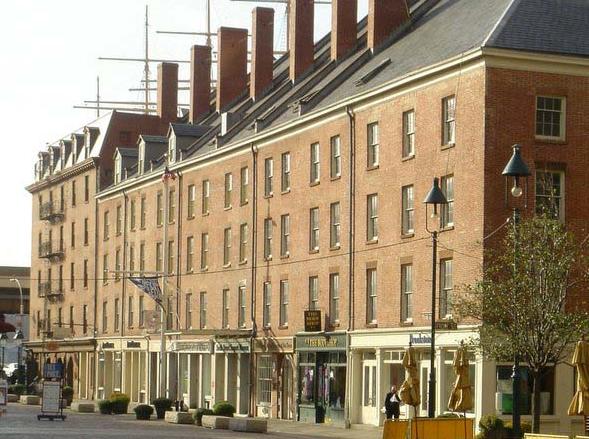

11 Schermerhorn Row (Manhattan)
After the war, New York flourished as an international port of commerce, the harbor filling with foreign merchandise to be distributed throughout the new country, the waterfront lined with boat slips all along from the bottom of Manhattan island up to South Street. With the opening of the Erie Canal in 1825, the floodgates of wealth opened further. Schermerhorn Row (1810-12) is one of the few remaining survivors of this early period of ship-based commerce.

In 1810, Uber-wealthy merchant Peter Schermerhorn began work on this row of plain storeroom buildings to lease out to prospective counting houses. They were north of the core merchant area, which saved them from destruction when the Great Fire of 1835 swept through lower Manhattan. They barely survived an even greater disaster — the 1970s — when they were given landmark status in 1977. A skyscraper stands just a few feet away to remind visitors of the alternative. Today the row of Federal Style buildings house the Seaport Museum and various shops and restaurants.
12 Castle Clinton (Manhattan)
New York’s preeminence as a port also made its residents understandably skittish about another invasion, and rumbles of another war with the British convinced New Yorkers to built fortifications all along the harbor. Although the events of the War of 1812 never quite made it to New York, the city was prepared, building Castle Williams on Governors Island, and out in the water right at the tip of Manhattan, Castle Clinton (
1811), named for governor DeWitt Clinton.

The noble brown shell housing tourists today hints but slightly at its glory days as the grand performance hall Castle Garden, as New York’s pre-Ellis Island immigrant station, and, as a home for penguins and seals, the New York aquarium. Although not a shot was fired at the elderly fort, it still managed to survive its greatest villain, Robert Moses, in his quest to rip it down in the 1940s.
ALSO: On the opposite shoreline, the U.S. government builds the Brooklyn Navy Yard in 1806. Although you can’t go inside, you can sneak a peek at the gated, wonderfully out of place Commandants House (built 1805-6) in the neighborhood of Vinegar Hill.
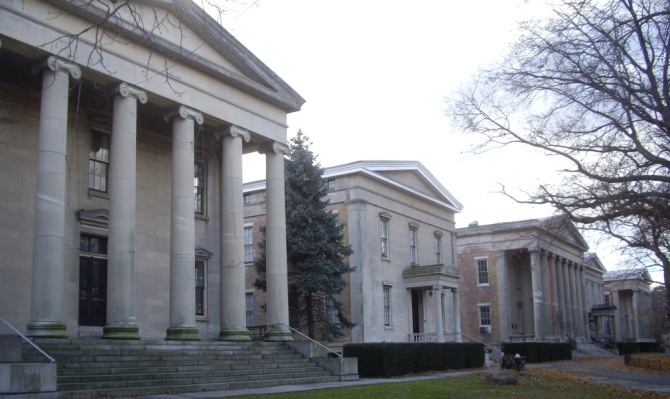
13 Building C, Sailors Snug Harbor (Staten Island)
Perhaps the fact most greatly underscoring New York’s naval importance is the way in which the city honored and took care of its
retired sailors and seamen. The Staten Island estate of Robert Richard Randall was transformed into a sumptuous retirement home, a quiet respite within sight of the harbor where many of its elderly residents spent their careers. The new Sailors Snug Harbor (above), opened in 1833, featured the greatest selection of Greek Revival architecture outside Washington D.C., with Building C (1831-33), the centerpiece, its most lavish survivor.
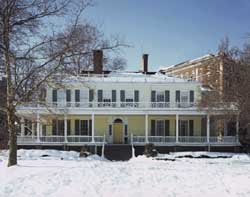
14 Archibald Gracie Mansion (Manhattan)
The kings of shipping, the new merchant princes, built their homes along the water as a testament to their growing wealth. Shipping tycoon Archibald Gracie plants his estate (at left) just north of the
supposedly haunted Jones Wood in 1799. Although he had to later sell it to pay off debts, the rustic, Federal Style home later became the official mayor’s residence, from Fiorello LaGuardia to Rudy Guiliani (who moved out mid-term).
ALSO: On a small island strip in the East River, the island’s owner James Blackwell builds his home here in 1794, the oldest structure standing on today’s Roosevelt Island. Another house, the Hamilton Grange, is constructed in 1802 near on the Hudson River side of the island; its owner, Alexander Hamilton, would only enjoy it a few years before his untimely death.
15 St. Marks Church in-the-Bowery (Manhattan)
St. Marks Church (built
1799) stands on former farmland of Peter Stuyvesant, sitting at an angle next to tiny Stuyvesant Street — vestiges of the original lay out on the estate. The rest of Stuyvesant’s farm was carved up by the 1811 Commissioners Plan, a visionary work of urban planning, taking Manhattan island and mapping out hundreds of streets and avenues over land that was mostly undeveloped wilderness. The plan was so successful in creating uniformity that it’s difficult to envision the rambling disorder of streets before they were carved into need orderly rectangles. At St. Marks, you can take solace imagining the former layout while visiting the crypt of ole Stuyvesant (who might still be haunting here).
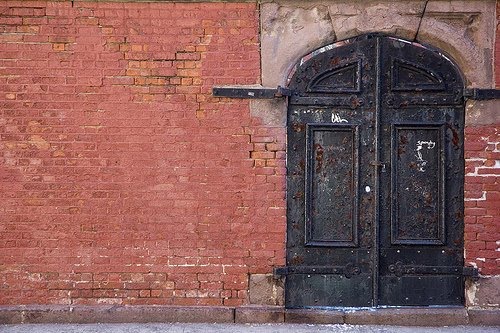
16 St. Patrick’s Old Cathedral (Manhattan)
An altogether different house of worship lower down the Bowery, St. Patrick’s (built
1809) catered to the lowest rung of New York society of the time — the first wave of Irish Catholic immigrants. St. Patrick’s (above) was often a church under siege; in 1835, anti-Catholic mobs stormed the place, its parishioners rushing to the chapel’s defense. The cathedral would become safe haven for different ethnics, most notably the growing Italian community at the start of the 20th century.
17 65 Mott Street (Manhattan)
In the 1820s, the area around St. Patrick’s was still considered the outskirts of town. With New York’s center becoming overcrowded, the poor clustered in communities of cheaply made structures. To the south of St. Pat’s, crumbling townhouses sinking into marshy land would soon give way to the darkened slums of the Five Points neighborhood.

These homes would be refitted for multiple families. Constructed in 1824, the plain structure (by today’s standards) at 65 Mott Street would become the first specifically made for multiple tenants — the first tenement building. Within years, these tenements would become the standard style of living, each packed with hundreds of poorer residents.
18 Washington Square North 1-3 (Manhattan)
Not everybody lived this way naturally. The poor may have had little choice where to live. But wealthier New Yorkers could venture further north and west, and when yellow fever epidemics made cramped urban living unsafe, many ventured to newly affordable plots in the area of Greenwich Village.

When the city landscaped the new Washington Square Park in 1826, it naturally attracted the wealthiest of New Yorkers, who built row houses along its northern rim. The oldest surviving buildings here, 1-3 Washington Square North (built in 1833), would be iconic representations of early American comfort, over the decades becoming home to well-connected families, dignitaries and artists. And they would kick off the triumphal upper-crust procession up Fifth Avenue.
ALSO: For some visitable interiors, you can get a fuller sense of how ‘the other half’ lived further east at the Merchant House Museum (1832). The even older building at 326 Spring Street — known as the James Brown House, (1817) — was a former boardinghouse and home to Brown, an ex-slave Revolutionary War hero. Today, you can delight in its history while having a beer as the Ear Inn, its incarnation since the 1970s.
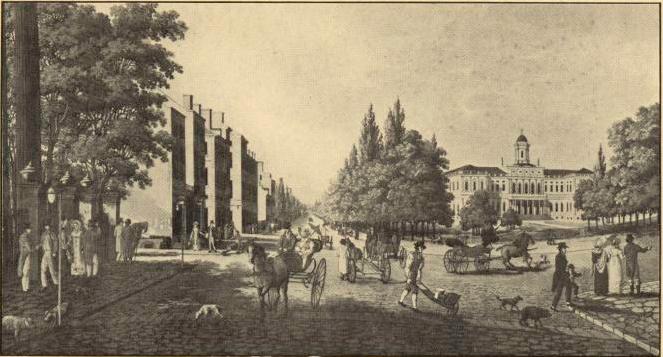
City Hall and environs in 1820
19 City Hall (Manhattan)
With great fanfare, city leaders decided to move city offices from Federal Hall on Wall Street up to a new structure built on a worn patch of public ground up north on Broadway. The new building, completed in
1812, reflected the popular feeling of the day; the northern side, facing up the island to a drained Collect Pond, scattered lower class developments, was originally constructed with less quality materials.

City Hall would survive fires, renovations and corrupt administrations to remain the oldest, continuously operating center of city government in the United States.
20 24 Middagh Street, ‘Queen of Brooklyn Heights’ (Brooklyn)
Meanwhile, across the river, speculators were beginning to lure New Yorkers over to the small town of Brooklyn, with spectacular views and a brand spanking new Fulton Ferry service (which began operating in 1814). Within a few years, the first developments would pop up on the bluff later to be called Brooklyn Heights.

The area’s oldest structure, the home built by Eugene Boisselet at 24 Middagh Street (1824), is considered the ‘queen of Brooklyn Heights’. Its woodframe Federal Style glamour are a sharp contrast to the great brownstones that would define the neighborhood many years later. The ‘queen’ would quickly find herself surrounded as the area became popular with eager New York escapees, the first commuters. But not every area of Brooklyn was quite ready to urbanize….
21 Flatbush Dutch Reformed Church (Brooklyn)
The rest of Brooklyn would earn its reputation as a ‘City of Churches’ with buildings like Flatbush’s fine old chapel, completed between 1792-8.

The third church in this very spot — the first sanctioned by Mr. Stuyvesant himself in 1654 — the dark stone chapel held together a quiet, bucolic Long Island farming community, removed from the bustle of the harbor. The independent town of Flatbush, one of six in Kings County, contrasted sharply with Brooklyn and would retain its autonomy from that growing city for most of the century.
For more information: try our podcasts on DeWitt Clinton, Collect Pond, Washington Square, Green-Wood Cemetery (for a brief history of Brooklyn Heights), St. Patrick’s Old Cathedral, Castle Clinton and New York City Hall _______________________________________________________
PART THREE: INDUSTRIAL CITY
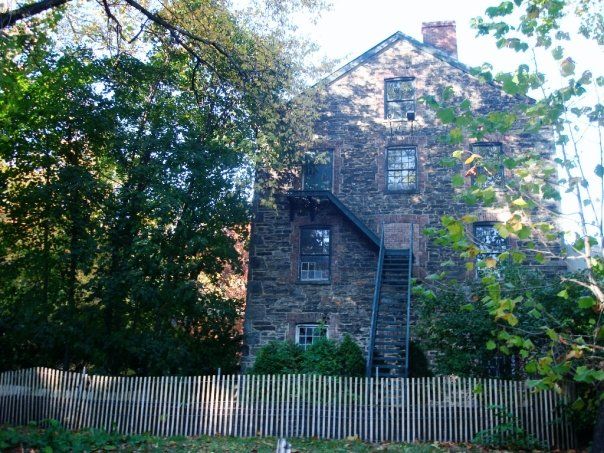

22 Lorillard Snuff Mill (Bronx)Throw a rock in the Bronx before 1840, and you’re likely to hit a cow. However, being north of Manhattan, it was only a matter of time before its uninterrupted stretches of farmland were soon met with change. Before the 1840s, it was nothing but cows, wheat fields, and the occasional estate (see below). But the industrial progress of New York soon began to seep into this future borough, and the advent of the railroad and the rise of immigration began to turn the tide for this agrarian outskirt.

The Lorillard tobacco manufacturer, who got their start in Manhattan back in 1760, built its snuff mill here (above( in a Bronx riverbed, using water power to meet up with the growing demand of homegrown tobacco. It’s one of the oldest surviving examples of early American industry. Today, you can find it nestled in the New York Botanical Garden — and currently undergoing renovation.
23 Wave Hill House (Bronx)
Another Bronx landmark of the period has also succumbed to flowering beauty. Wave Hill represents one of the best preserved examples of homes overlooking the Hudson River still within the city today, a modern rarity from a period of dozens of cliffside homes. Lawyer William Lewis Morris, from a family of wealthy Bronx landowners, built his Victorian estate (1843) as a summer retreat; later, the house (below) would entertain the likes of Mark Twain and a young Theodore Roosevelt. The city took it over in the 1960s, and today its a public garden with its breathtaking views intact.
ALSO: Ten years later, railroad magnate Edwin Clark Litchfield had his equally impressive and quite curious Italian-style home, Litchfield Villa, erected on land later bought for Prospect Park.
Below: Wave Hill House, in one of the most beautiful spots in the Bronx
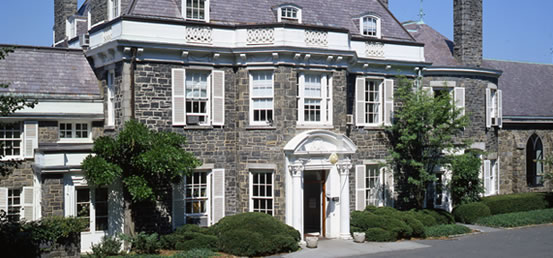
24 Hunterfly Road Houses (Brooklyn)
Slavery was abolished in New York state in 1827, but in practice, black city residents had few of the property rights as their white neighbors. The African-American settlement of Seneca Village was eradicated by the creation of Central Park, and blacks were not welcome in many New York neighborhoods.

But evidence of a seven-block African-American development in Brooklyn still exists at 1698 Bergen Street, the remains of the settlement of Weeksville, a small neighborhood developed (1840) by a black developer for black residences, “the second largest known independent African American community in pre-Civil War America”, according to the Weeksville Heritage Center.
25 Trinity Church (Manhattan)
The tallest building in New York (from its creation in 1846 to 1890) with the wealthiest most power congregants, the third Trinity on this spot would be defining symbol upon a growing New York skyline. Even without the fabulous Richard Upjohn design, the church would remain the city’s most powerful landlord. But it always helps to look good.
ALSO: The uptown Grace Church, consecrated the same year, would grow in prominence as high society began moving up the island. If you weren’t a member of a powerful family, don’t bother looking for a pew.
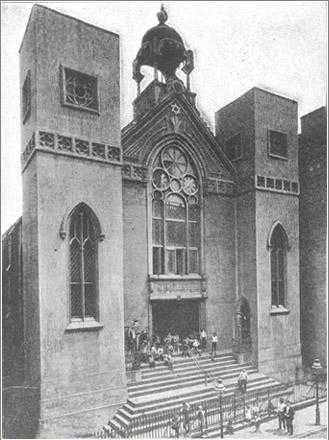
26 Beth Hamedrash Hagadol (Manhattan)
The Lower East Side’s oldest synagogue (1850) is the most spectacular reflection of the neighborhood’s changes of the period, as immigrants from Europe crammed into affordable tenements. Within a few years, the new residents would turn this stretch of land below Houston into the most concentrated Jewish community on earth.
ALSO: Beth Hamedrash is the oldest, but the close-by Eldridge Street Synagogue (1886-7) is probably the most beautiful
27 India House/1 Hanover Square (Manhattan)
Further downtown, New York cleans up from the great fire of 1835 and resumes business. Hanover Square had been a center for publishing and retail since the British days; in the flourishing New York economy, it became an extension of Wall Street with banks and exchanges.

The India House (1851-53) became both — first as Hanover Bank when it was built, then as the first commodity market in 1870 (the New York Cotton Exchange). Given the fervor for skyscrapers in the region, it’s a wonder this great example of mid-19th century commerce still exists.
28 Cooper Union (Manhattan)
In the right people, economic power and growing population breeds benevolence. Inventor and philanthropist Peter Cooper created Cooper Union (1853-59) as a place for free education — to both men and women. In construction of this brownstone Astor Place anchor, he also provided one of the great auditoriums of the city, which a year hosted a young politician named Abraham Lincoln.
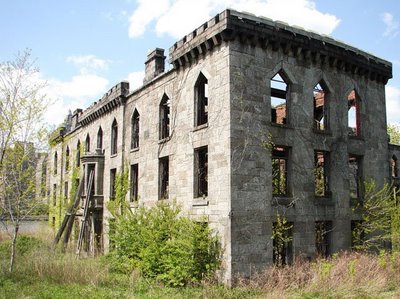
29 Smallpox Hospital (Roosevelt Island)
Sometimes though, economic power and a growing population breeds, well, indifference. New York is best known for putting its undesirables on islands, and in defining those undesirables rather broadly — criminals, orphans, delinquents, infirm, diseased, or just really poor.

Blackwell’s Island was the most notorious of these, although nearly all of New York’s islands have enjoyed their shares of hospitals and prisons. The ruins of James Renwick’s Smallpox Hospital (1856) are a vivid reminder.
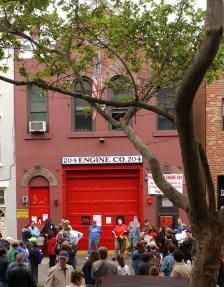
30 Engine Company 204, Cobble Hill (Brooklyn)
As soon as they put stuff up, it was burning down. New York, Brooklyn and the surrounding cities and towns were under constant threat for fire. As a result, in the years before paid firefighting services, the methods became territorial, with competing gang-controlled fire operations. Fighting fire was less a community service than a sign of sporting-man machismo.

There are excellent architectural examples of still-operating 19th century firehouses throughout the city. The one at 299 Degraw Street in Cobble Hill is not one of them. However, it is the oldest firehouse that I can locate, built in 1855 for the volunteer Montauk Hose Company in the years before Brooklyn had an organized firefighting unit. This structure held the horses; the volunteers slept across the street. After a valiant community effort to save the company, the city decommissioned the building.
ALSO: If you prefer an active firehouse, try Engine Company No. 5 at 340 East 14th Street in Manhattan, designed by Napoleon LeBron in 1880.
31 Plymouth Church (Brooklyn)
Another kind of fire was stirring at the center of Brooklyn high society — Plymouth Church (1849-50). By 1854, Brooklyn had absorbed Williamsburg and Bushwick to become the third largest city in the United States. Its preeminence was embodied by Plymouth’s fiery celebrity preacher Henry Ward Beecher, who was Brooklyn’s defining voice even after scandal knocked him from the podium in the 1870s.
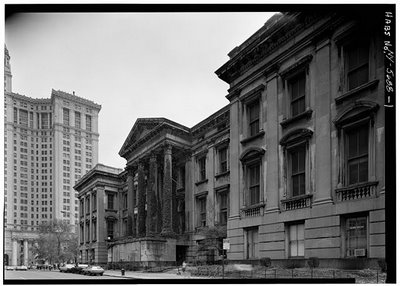
32 Tweed Courthouse (Manhattan)
But if it’s scandal you’re looking for, look no further than the exploits of Boss Tweed and his corrupt political machine Tammany Hall. Nothing embodies the excess and wastefulness of Tammany graft than the courthouse unofficially named for the man who kept it filling its contractors’ pockets with money. Taking twenty years to build (1861-1881), it’s one of the most expensive buildings ever built in the 19th century.
Courtesy Flickr
33 Fort Schuyler (Bronx)
New York’s participation in the Civil War was more than just that pitiful and deadly distraction known as the Draft Riots. New York residents became soldiers, financiers, supporters and critics of the conflict. The city played a more direct role as a holding station and hospital base for thousands of militia. Fort Schuyler, began in 1833 and not fully dedicated until 1856, held hundreds of Confederate soldiers and housed thousands more Union troops on their way to battle. Today students wage for battle here as the site of
Maritime College, a branch of SUNY.
For more information check out the following podcasts on the above subjects: Trinity Church, Henry Ward Beecher, Great Fire of 1835, Roosevelt Island and Cooper Union.
___________________________________________

PART FOUR: SOPHISTICATED CITY

Courtesy Tenement Museum
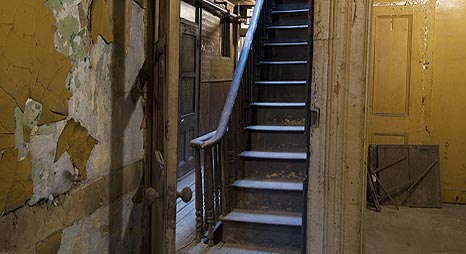
34 97 Orchard Street (now Lower East Side Tenement Museum) (Manhattan)
Rarely do we get to see how people of the past lived, in the place they lived it in, with furniture and items they actually used. This tenement from
1863 fell into the proverbial tar pit in 1935 when the building’s owner, rather than renovating and re-renting, simply closed off the upper floors — contents and all — to remain undisturbed until 1988, when urban archaeologists discovered the place and transformed it into today’s Tenement Museum.

Inside lies the story of thousands, of Eastern European immigrants funneling from the Castle Garden immigrant depot to enclaves in the Lower East Side and beyond. As New York in the 1870s and 80s becomes decidedly extraordinary, how amazing is it to find something from the same period celebrating the little banalities of 19th century life.
35 Aschenbroedel Verein building (Manhattan)To make those new Americans feel at home, cultural organizations preserving their foreign music and heritage popped up throughout New York. For Germans, who began coming to the United States en masse after 1850, music was a particular cultural touchstone (as evidenced by early German success story of the Steinways.)
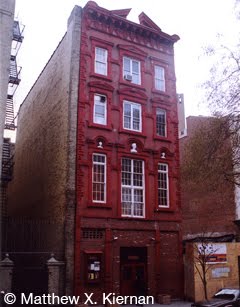
To quote a 1896 New York Times article on the German music troupe Aschenbroedel Verein: “A generation ago German-American musicians were not always quite so welcome in musical circles in thsi country as they are now.” In 1873, the organization opened its own clubhouse at 74 E. 4th Street in the East Village — the heart of Kleindeutschland “little Germany” — cultivating a generation of musicians who later dominated the field of orchestral music — favorite of the upper classes.

And the building’s cultural legacy was not over; in 1969, the building reopened as a stage for Ellen Stewart’s La Mama Experimental Theatre Club, without argument New York’s “most influential” off-off Broadway stage.
ALSO: For a more fanciful theatrical transformation, go around the corner to the former Bouwerie Lane Theater, a cast-iron beauty, born a bank in 1873 and transformed into an off-Broadway stage in 1974. It’s a trendy clothing store now.
36 901 Broadway: Lord and Taylor (Manhattan)By the early 1870s, fashionable society had wound its way up Fifth Avenue, expanding between Union and Madison parks with new developments of brownstones, theaters and shops. Heralding this change was the flourishing of Ladies Mile, a collection of tony, often cast-iron-clad department stores.
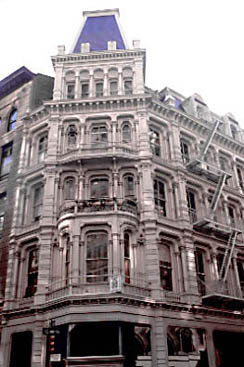
The trend begun by A.T. Stewart (his first store opened in 1823 north of City Hall) had become a retail revolution. In 1869, Samuel Lord and George Washington Taylor opened a luxury retailer in the heart of the mile, here at 901 Broadway. In my humble opinion, the corner store, in its pompous French Second Empire style, is the most beautiful example of the many storefronts that still exist.
37 Samuel Tilden Home, Gramercy Park (Manhattan)
The flamboyant tastes of the privileged classes made for some outlandish homes. Just contrast the simple tenement above with the ornate
15 Gramercy Park. Structurally from the 1840s, no less than Central Park co-creator Calvert Vaux overhauled the building in 1881 for his client, failed presidential candidate Samuel Tilden. The whimsical exterior decor is literally a reflection of its inhabitant; the writers busts and animals adorning the front were based on a few of Tilden’s favorite things.

The home was considered so lavish that when Tilden died, the prestigious (and private) National Arts Club moved in in 1906 — and has been there ever since.
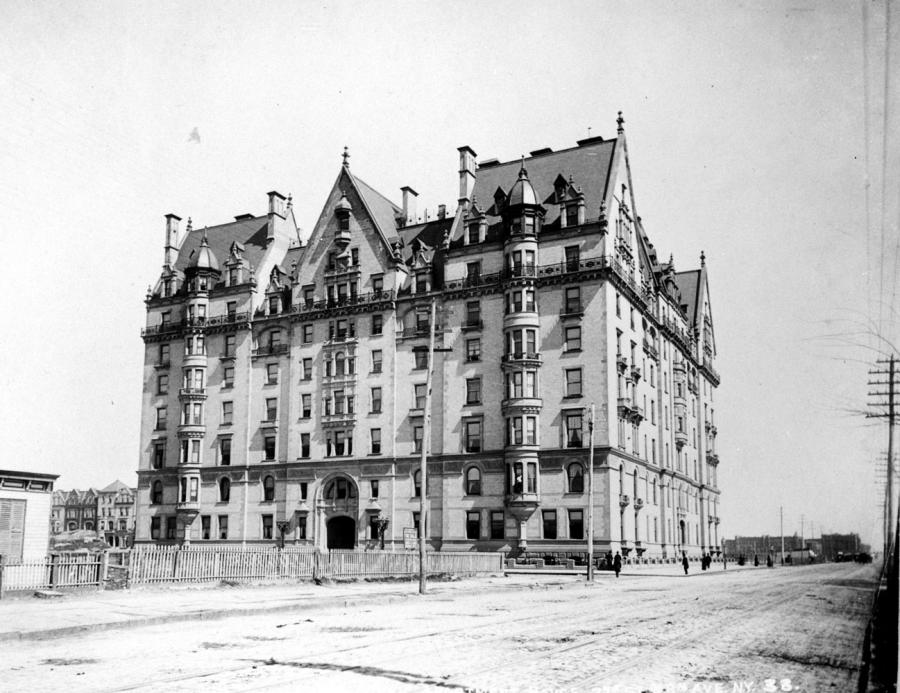
38 Dakota Apartments (Manhattan)
But not all who could afford such luxury necessarily desired it. By the 1880s, Central Park had changed the city, not only as ‘the lungs of the city’ but the real estate fortunes surrounding. The Upper West Side, still quite remote for most people, was slowly being defined by a new form of domicile — the apartment building.

The Dakota Apartments, designed by Henry Janeway Hardenbergh and opening in 1884, brought lavish lifestyle together with ‘shared services’ and such unique features as a courtyard, community stables and windows arranged for cross breezes — unusual for the time.
ALSO: The Chelsea Hotel began its life as a similar facility as the Dakota; needless to say, it went in a different direction.

Above: the rather farm-looking original Met, today mostly covered up (thankfully!) Courtesy the JSS Gallery

39 Metropolitan Museum of Art (Manhattan)
New York’s primary cultural institution for almost 140 years, the Met reflects everything the city wanted to be in the 1870s — namely, the American Europe. The original building, opened in
1878, would never have thought to cater to the, gasp!, general public or feature, clutch the pearls!, American artists.

How things change. Most notably the entire building, consumed in later additions. However, if you want to see the 1878 original, simply enter by the front, climb that impressive staircase and hang a left — part of the original Gothic, red brick version sits exposed here to this day.
40 Jonathan W Allen Stable (Manhattan)Imagine this: before the early 20th century, the street was filled with horses. Horses, horses, trains and horses. The smell of exhaust, the noise of buses and cars replaced the smell of manure, but a refreshingly quiet clomping. Trolleys would whiz by, trains elevated and spewing black smoke — but horses were still critical to the livelihood of New Yorkers.
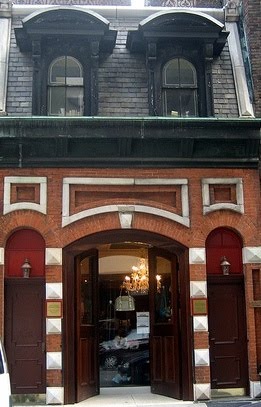
There are dozens of homes and businesses in New York that are converted stables of days past. In particular, what I like about the stable at 148 East 40th Street, owned by broker Jonathan W Allen who lived close by, is that it was built in 1871 — years before its equine inhabitants would even see (and get spooked by) a future of ‘horseless carriages’. Also, the stable is close to Longacre Square (future Times Square), the center of New York’s horse-driven carriage industry.
41 Domino Sugar Refinery (Brooklyn)
Meanwhile, across the East River, the former village of Brooklyn had expanded to the size of a small metropolis — half a million people, with thriving centers of industry, amassing all the towns in the vicinity to nearly become the size of the present borough today. In 1883, the Brooklyn Bridge united the city with its big sister, and rumblings of a consolidation were underway.

It rivaled Manhattan as the king of monopolies, in particular, in the commodity of sugar. In 1884, the Havemeyer family, who dominated the marketplace, opened their waterfront refinery as the unofficial kings of the city, one of its largest employers. It changed its name in 1900 to Domino Sugar; its distinctive sign (added in 1967) would define the waterfront.
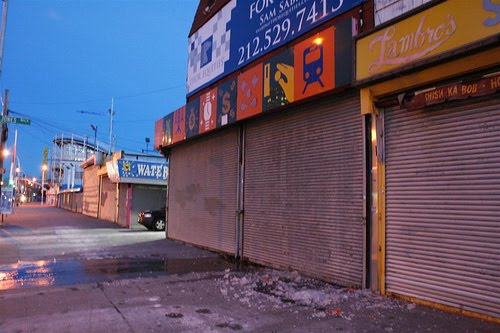
Photo Bruce Handy/Pablo 57 Flickr
42 Grashorn Building (Brooklyn)
There are many classic buildings still standing from Coney Island’s glory days; Nathan’s Hot Dogs hasn’t budged since it opened in 1916, and the exterior of Childs Restaurant on the beach still looks as good as it did in the 1920s. But the plain Grashorn Building has a special distinction: it saw it all coming.

Unimpressive today, the former Surf Avenue hardware store was built in the late 1880s for Henry Grashorn, a Coney Island business leader who helped foster the city’s reputation as the amusement capital of New York, organizing the neighborhood’s annual Marti Gras parades. Coney Island was a big destination spot in the 1880s, but days of the massive, glorious amusement parks wouldn’t come until the new century.

Today, the Grashorn is dreary, underused and always in fear of being torn down. Kind of like Coney Island always is, generally.
For more information check out the following podcasts on the above subjects: the Dakota Apartments, Coney Island: The Golden Age, Steinway & Sons and a history of Williamsburg

___________________________________________
PART FIVE: IMMIGRANT CITY
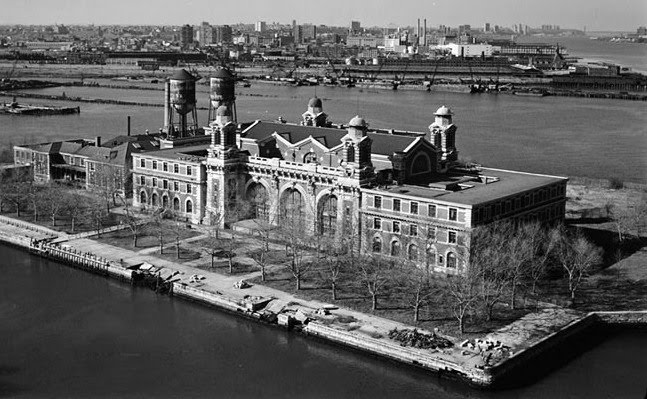
43 Ellis Island Immigration Station (Ellis Island)
The most important period in New York City history (the half-century before World War II) began with a major signifier in 1890 — the federal government would now be in charge of immigration, wresting it from the hands of lackidaisical control of the state. By shifting it an uninhabited island in the harbor, new arrivals could essentially be quarantined from the city.

By this time, New York was in the throes of its Beaux-Arts period, and even a processing center for poor immigrants needed to be ornate. The new station (1892) would eventually process 12 million arrivals, most in the following decade and would be first witness to the change from the Irish and German arrivals of the mid-century new hopefuls from Italy and Eastern Europe.

44 Henry Street Settlement (Manhattan)
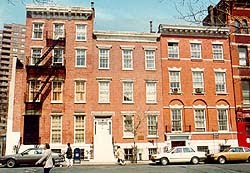
None of these new arrivals is making live in lower Manhattan easier. But charitable New Yorkers and a rising progressive movement proved worthy of the challenge. In 1893, a group of nurses purchased some abandoned Federal Style townhouse — back from the days when wealthy shipbuilders lived close to Corlear’s Hook — and set up a service organization for the sick and educational opportunities for children. In the most densely populated neighborhood in the world, they were the life preserver.
And they didn’t just save people. They also had the unintended result of saving a group of very attractive old townhouses from the crawl of tenements. Today, the landmarked Settlement buildings look like a time capsule from another time.

45 Webster Hall (Manhattan)
The wave of reforms in ethnic communities didn’t stop at basic care. Labor groups organized for better work conditions, better pay and fairer wages. Along the way, they had a little fun too. When Webster Hall opened in 1886, it was as a general service venue. However it soon became an outpost for protest and fund raising for these progressive groups.

Later in the new century, the likes of Emma Goldman would throw lavish money-making parties here, wild escapades that would presage the swinging jazz age. If you’re looking for a temple to pre-1920s bohemia — of the kind that would typify the East Village in later years — you’ve come to the right place.

46 Carnegie Hall (Manhattan)
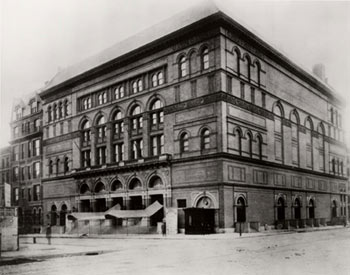
Oh, but the upper class yearned to have fun too. Operas and chorales! But their entertainments — as much for social networkers as for actual music lovers — were scattered throughout the city, in antiquated old buildings. Enter the vastly wealthy Andrew Carnegie, who cleared away a bunch of old saloons and slums just south of Central Park and opened (in 1891) what is today still the most respected home of the highest cultural arts.

His new deluxe concert hall also set a new mark for the upper crust to cluster. By the turn of the century, the mansions of Fifth Avenue had crawled their way to the southern border of Central Park, just a few blocks from Carnegie Hall.

ALSO: When a luxury apartment building (built in 1890) at Fifth Avenue and 59th Street didn’t quite pan out, they replaced it with The Plaza Hotel (1907).

47 Low Memorial Library (Manhattan)
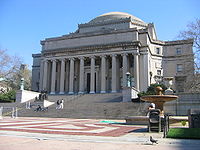
Columbia University, no slouch in the landowning department, moved way uptown during the 1890s to Morningside Heights. And to cap the occasion, they hired the hottest design firm in New York, McKim, Mead and White, to create the campus’s key structures, including the classically inspired Low Library (1895), named after the father of Columbia president (and later mayor of New York) Seth Low.

The design firm would help define the Gilded Age. Columbia, on top of educating, would be home to decades of new technical innovations. But it wouldn’t be the only place for them….

48 Bell Laboratories Building (Manhattan)
Few today know that the far West Village housed one of the most important homes for media invention in the United States. This collection of laboritories (1898), scattered throughout the city but many concentrated here, were forefront in the invention of the transitor radio, the television set and even laser technology. In the 20th century, the first radio and television broadcasts — and the first sound motion pictures — would come from here. Long after Bell moved to the suburbs in the mid 20th Century, the Westbeth artist complex moved into the building at West and Bethune, reinventing an abandoned industrial space.

49 P.S. 1 (Queens)
A similar repurposing would happen over in Queens. Before 1898, Long Island City was one of Queens county’s most vigorously governors communities, in its later years as an independent city controlled by colorful and corrupt mayor Patty “Battle-Axe” Gleason. The austere First Ward Primary School (later P.S. 1) is evidence of LIC’s maverick days, its first school and the largest in all of Long Island when it was constructed in 1892-3.

Eventually closed and left abandoned, the artists of The Institute for Art and Urban Resources revitalized the structure as a home for art, and today it’s affiliated with the Museum of Modern Art under its original numerical designation as the P.S.1 Contemporary Art Center.
50 Brooklyn Borough Hall (Brooklyn)
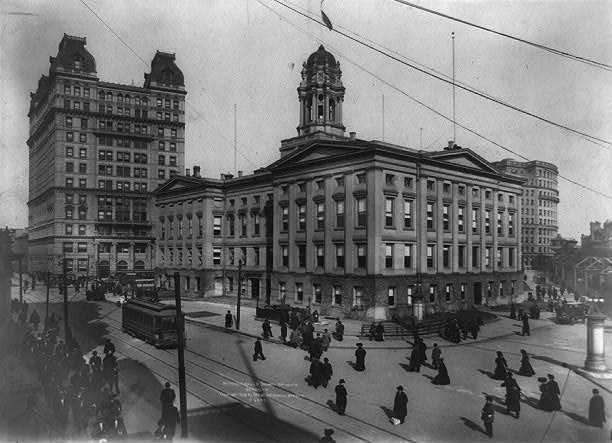
The worst demotion in the history of New York City buildings — at least since the federal government left Federal Hall — happened here, on January 1, 1898, when the lovely Brooklyn City Hall became Brooklyn Borough Hall. The consolidation of the five boroughs would unite the heavily urban with the deeply rural, big city politics with small town political machines — all in an attempt to meld the competing priorities of a metroplitan area into one defined urban vision.

This meant the powers of the great city and town halls of all the other cities and towns were greatly diminisheed. In Queens, the town hall of Jamaica is long gone, as are those village halls in Staten Island. Luckily, the city of Brooklyn had become coterminous with the county of Kings by the time of consolidation, so its grand city hall, completed in 1849, just modified its responsibilities. Today, its one of Brooklyn’s proudest buildings, a reflection of a time of independence.

For more information, check out our podcasts on Ellis Island, Carnegie Hall, Webster Hall and Columbia University


View History of New York in 100 Buildings in a larger map
Categories
Friday Night Fever

Reisenweber’s Cafe: glamour, late nights and hot jazz


FRIDAY NIGHT FEVER To get you in the mood for the weekend, on occasional Fridays we’ll be featuring an old New York nightlife haunt, from the dance halls of 19th Century Bowery, to the massive warehouse clubs of the mid-1990s. Past entries can be found here.

LOCATION Reisenweber’s Cafe
Columbus Circle, 58th Street and 8th Avenue, Manhattan
ERA 1856 (as a tavern)-1922

On this day in history, February 26, 1917, the instrumental ensemble Original Dixieland Jass Band recorded the very first usable* jazz recordings in a Victor studio here in New York. I can’t confirm exactly where that studio was, but according to here, Victor’s studios in 1917 were at 46 West 38th Street.

The thick 78 record “Livery Stable Blues” and B-side “Dixie Jass Band One Step” was pressed and released one week later March 6.

And yes, that’s Jass. They changed it to Jazz a year later. (The term was still coming into its own back then.) And though they started in New Orleans in the Dixieland jazz scene, they made their name in Chicago and moved on to New York in 1916. Oh right, and they were a white ensemble who popularized for white audiences a genre created and performed mostly by black musicians.

They were possibly the first white musicians to make jazz fashionable to New York nightlife; as a result, we can thankfully hold them partially responsible for the coinage of the Jazz Age. For from the moment of that first recording, the youth of the late ’10s went wild for the naughty sound of jazz.

Before the release of this recording, the only way to hear the ensemble was live, and the place to hear them live in New York was Reisenweber’s Cafe, one of the most fashionable clubs of the 1910s.

The restaurant/nightclub hybrid — one of the first true ‘entertainment complexes’ –was owned by John Reisenweber, whose father had owned a small tavern at this very corner in 1856. Needless to say, John was far more ambitious plans.

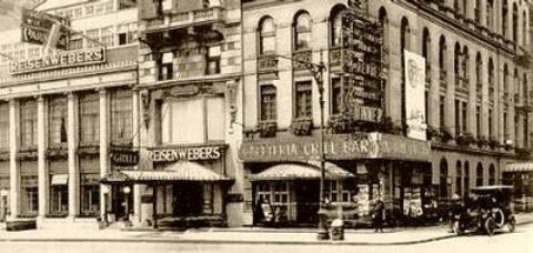
Below: Columbus Circle in the 1900’s. You can see the Reisenweber’s marquee to the left of the picture, on 58th Street.

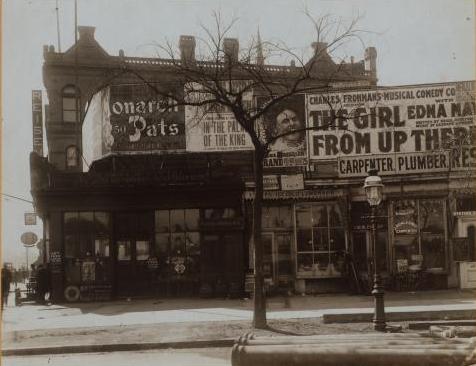
Reisenweber’s was truly a product of the decade, expanding in 1910, closed by 1922. It held court in Columbus Circle at 58th Street and Eighth Avenue during a time when this corner of Central Park was a popular destination for theater goers, of both the high and low brow varieties. The most famous — and respectable — stage in the neighborhood was the Park Theatre (formerly the Majestic) featuring the hottest names in drama and musical comedy. So, naturally, Reisenweber’s became a magnet for theater stars and their champagne entourages.

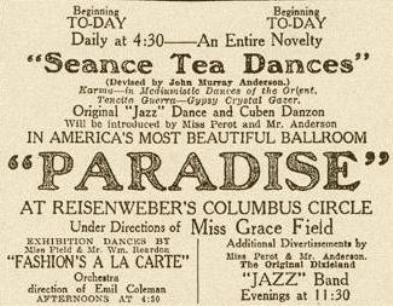
Producers would fete their leading ladies here, in festivities that would begin in the downstairs restaurant, move to the second floor 400 Club cabaret, pause for a dance in the elegant third-floor Paradise Supper Club (featuring the first dancefloor within a restaurant), and settle in either the cheeky Hawaiian Room on the fourth floor or up at the rooftop garden.

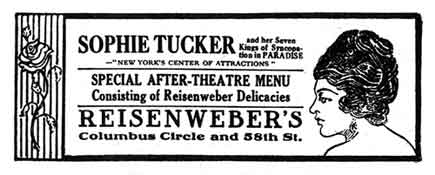
Below: From an advertisement dated March 1917 (thanks to Mule Walk & Talk blog, where there are many more examples)

The Dixieland ensemble hit Reisenweber’s 400 Club in January 1917 (thanks in part to a recommendation from Al Jolson) and were an immediate hit, combining furious, syncopated sound with a comedic touch, perfect for a smoky cafe full of trendy New Yorkers.

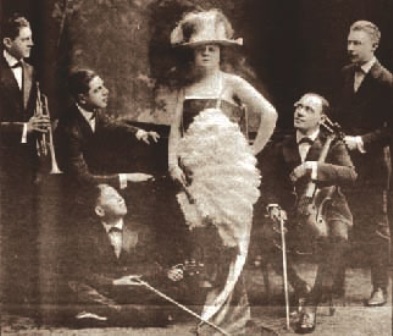
But they weren’t the biggest star at Reisenweber’s. The lady that drew them in 1918 was one of the era’s biggest celebrities and the first star of the Ziegfeld Follies — Sophie Tucker (pictured above).

Tucker was a sassy, vibrant, bawdy performer, hammering out hits loaded with double entendre, inviting starlet pals and even regular cafe patrons on stage to perform with her. Her escapades upstairs to sellout crowds in the 400 room, during her so-called ‘Bohemian Nights’, were so popular that Reisenweber shrugged and remained it The Sophie Tucker Room in 1919.

In fact, Tucker’s regular engagements helped popularize the cabaret form in New York. According the Musicals 101, “Delmonico’s, Reisenweber’s, Palaise Royale and Shanley’s all became legendary night spots. Within a few years, dance floors became a required part of the cabaret environment.”

Reisenweber’s fused together elements that now seem quite commonplace together — music, food, dancing, celebrity, performance — in a way that was both respectable and yet edgy and scandalous for its day. It also introduced a staple of New York nightlife: the cover charge (25 cents).

At its height, Reisenweber’s was one of Manhattan’s best known restaurants, “hous[ing] a dozen dining rooms, employed more than 1,000 in help and seated 5,000 diners at one time” according to the owner’s obituary.

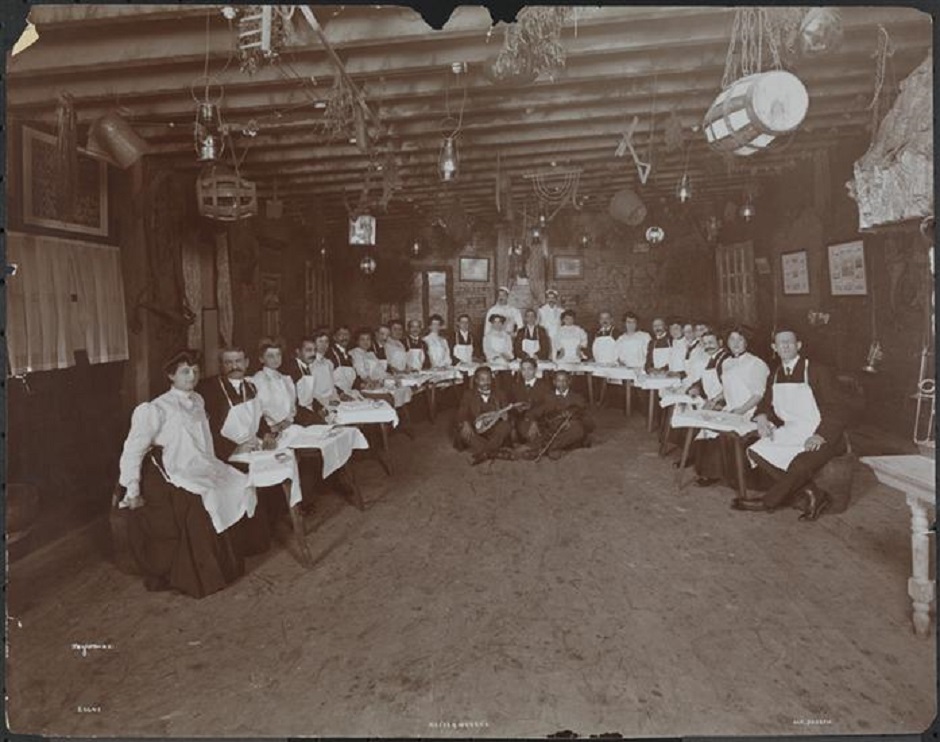
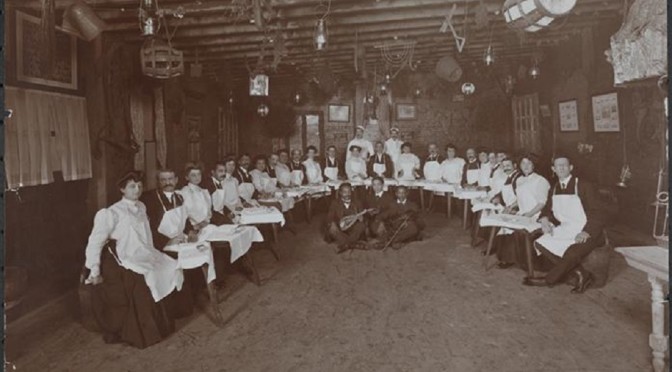
The employees and musicians of Reisenweber’s in 1905 (courtesy Museum of the City of New  York)

MNY40486

In a way, it mirrored the most appealing elements of its neighborhood: the glamour of the theater, the abandon of the taverns, the glitz of the rich, the abandon of the working class. This mix would perfect itself by 1920, the time of Prohibition, when it would go underground.

The modern nightclub would be born there in the shadows; unfortunately Reisenweber’s would not join it. It was an easy target for temperance groups; screamed the headlines in 1922, “CLOSE REISENWEBER’S, DRY OFFICIALS DEMAND“. Crippled by constant police raids — including a bummer of a raid on New Years Eve 1922 — it was closed for good that year.

By 1925, the Original Dixieland Jazz Band would break up. But Sophie Tucker would thrive during the Roaring 20’s, moving on to movies and radio.

Finally, for your listening pleasure, that recording of the “Livery Stable Blues,” a tune which certainly lit up the floors of Reisenweber’s as the champagne flowed….

*A month earlier, they apparently performed for management of the Columbia Gramophone Company and may have recorded for them, but nothing was ever released.

Mayor John O’Brien: his heart is as black as yours!

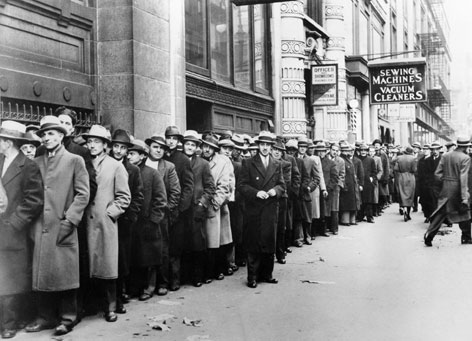
Above: An unemployment line in November 1933. The O’Brien administration offers no relief to the city.

KNOW YOUR MAYORS Our modest little series about some of the greatest, notorious, most important, even most useless, mayors of New York City. Other entrants in our mayoral survey can be found here.

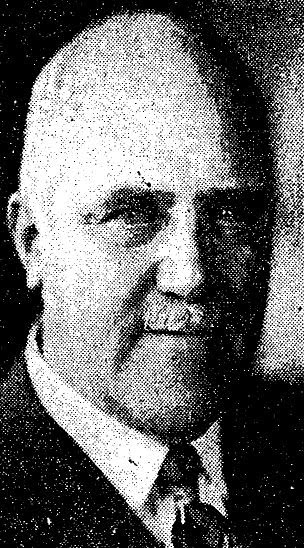
Mayor John Patrick O’Brien
In office: 1933

There’s not much to say about New York mayor John P. O’Brien that’s very positive. He’s one of the most forgettable mayors of the 20th century. But I haven’t forgotten!

His obscurity is partially due to his length of term; he was mayor for only a year. But thank goodness. He was the last pure mayoral puppet of Tammany Hall. His blandness is further accentuated by the fact that his duration of mayor is sandwiched between that of the debonair Jimmy Walker (1926-1932) and the reformer Fiorello LaGuardia (1934-1945) — two men of great charm and strong personal narrative.

What makes his mediocrity less than humorous is the fact that O’Brien governed the city during the pitiful year of 1933, the last truly disastrous year of the country’s greatest depression, a year when the nation’s unemployment rate actually hit 25%.

His predecessor Walker was a political illusionist, known more for his style than his substance. He hypnotized the city while keeping its corrupt, ineffective infrastructure churning. When no-nonsense, progressive judge Samuel Seabury exposed widespread malfeasance in the New York legal system, all roads eventually led to ‘Beau James’, who resigned in September 1, 1932. [More in the Know Your Mayors entry on Jimmy Walker.]

In the wake, Walker’s deputy mayor Joseph V. McKee was declared temporary office holder until a special election could be hastily prepared to find someone to complete Walker’s term. Normally, such wholesale exposure of corrupt Democratic leadership would have assured their immediate ouster at the polls; however, the anti-Tammany forces had yet to properly gel when the special election took place two months later in November 1932 — and the political machine was able to squeeze in one more elected representative.

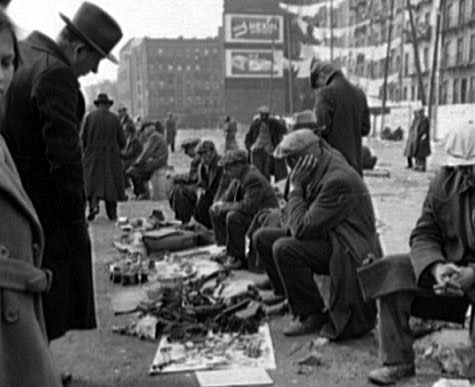
Below: New York in 1933, and it’s not pretty. Men selling their possessions on the street.

John O’Brien, a lawyer of some renown, was known as a quiet but obedient public servant. (“Loyal and industrious” according to Allan Raymond.) The man was stiffer than stiff, a devout Catholic who wore his holy medals everywhere, even on gym clothes. Born to Irish immigrants in Massachusetts in 1873, O’Brien graduated from Georgetown, moved to the city, and moved into and up through the ranks of the Democratic machine to become Corporation Counsel in the early 1920s. (A nice description of what the Counsel is can be found here.) He was later appointed a New York Surrogate Court judge.

As deputy mayor, McKee was merely a fill in. Even at veiled gestures that McKee would cut wasteful city jobs was too much for the liking of Tammany leaders, who often filled those very jobs. Also McKee was also from the Bronx. That will never do!, cried party leadership.

So they went hunting for a more malleable choice, and found O’Brien. With opposition scrambling for a real candidate for the full election a year later, O’Brien handily won the special election on December 1932, double the votes of his inept republican competitor, former Brooklyn borough president Lewis H. Pounds.

Square jawed” O’Brien went right to work — doing virtually nothing. Despite being in the midst of the Great Depression, little was truly accomplished. Even if he had wanted to do something — and there is no evidence he did — he was so beholden to his Tammany Hall masters that he had little latitude for change. Those jobs he did eliminate were those least interesting to his Democratic overlords, namely school teachers.

He did secure a agreement with private banking firms to continue loaning to the city until 1937, so long as the city stopped raising real estate taxes. This balm merely disguised a rueful out-of-balance city budget that would weigh heavily upon his successor. Even worse, emergency relief funds from the federal government (what we would call ‘stimulus money’ today) was re-routed to the pockets of Tammany rank-and-file, dispersed almost at random instead of places in the city of greatest need.

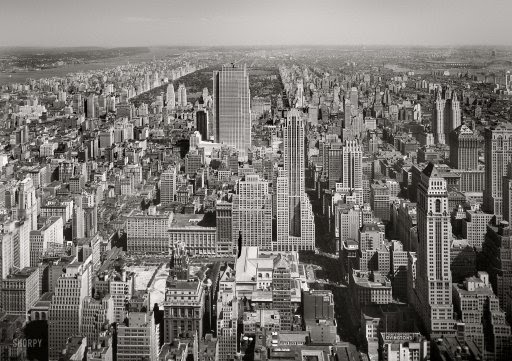
Below, midtown Manhattan in 1933 (Pic courtesy Shorpy)

By design, O’Brien was selected in contrast to slick party hound Jimmy Walker. Unfortunately this also meant that the party was over, that “a pious, laborious dullard” occupied City Hall, “a hack given to malapropisms,” according to George J. Lankevich.

To African-American crowds in Harlem, O’Brien proclaimed proudly, “I may be white but my heart is as black as yours.” To Jewish constituents, he herald the talents of ‘that scientist of scientists, Albert Weinstein.”

Even worse, he was apparently not bright enough to disguise the Tammany strings affixed to his back. Famously (in fact, it’s the soundbite he’s most known for), O’Brien, when asked by the press who New York’s new police commissioner would be, replied, “I don’t know. They haven’t told me yet.” D’oh!

By the end of his term, O’Brien had wasted any shred of credibility he might have had. Yet Tammany stuck with him going into full election in November 1933. A fusion coalition of Republicans and anti-Tammany Democrats had the upper hand going into the election. Their first pick for mayor was young parks commissioner Robert Moses (who called O’Brien “a winded bull in a china shop.”) Moses was considered too divisive, even back then, so Samuel Seabury, revered voice of the fusion ticket, convinced party leadership to switch to a mayoral also-ran, former city alderman and house representative Fiorello La Guardia.

La Guardia had run for mayor before and lost — in 1929, to Jimmy Walker! The stock market crash had occurred two weeks before election day, and Walker was still charming. This time, however, La Guardia had the winds of reform carrying him.

O’Brien, naturally, stood no chance. In the final outcome, even former temp-mayor McKee, as a candidate for the hastily assembled Recovery Party, beat him. It was the most crushing defeat of a Democratic hopeful in decades.

The start of La Guardia’s term in 1934 would usher in the beginning of the end for Tammany Hall. O’Brien, for his part, remained faithful to his party to the end, even serving as a delegate to the Democratic National Convention a few times. Having rescued his reputation by returning to law in his later year, O’Brien lived in the Upper East Side until his death there in September 27, 1951.

Categories
Uncategorized

Yes, there really was a FIFTH Madison Square Garden

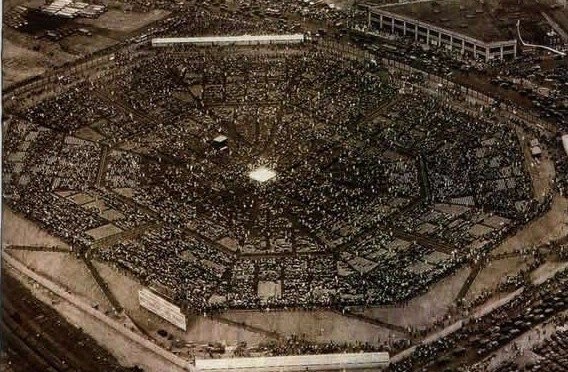
A packed house at MSGBowl on June 21, 1932, turning out for a prizefight between Max Schmeling and Jack Sharkey Picture courtesy Awesome Stories

There was so much to speak about during the Madison Square Garden podcast that we didn’t have time to mention that, for a brief time, the borough of Queens once had its own Madison Square Garden — one that spawned a ‘cinderella’ sports legend.

Situated in Long Island City, the Madison Square Garden Bowl was a roomy Depression-era spinoff of Tex Rickard’s midtown Manhattan branch, built in 1932 at 45th Street and Northern Boulevard, an immense outdoor stadium that could seat up to 72,000 people. It was not a regular venue but instead hosted big-ticket events during the summer. The Bowl cost the Garden only $160,000 to build, designed for high capacity if not longevity.

It may not have exactly been a popular place among name boxing stars. Sometimes referred to as the ‘Jinx Bowl’ or ‘The Graveyard of Champions’, reigning champs who boxed here frequently lost, heavyweight championship titles regularly changing hands here. “It was the arena where champions went to die,” according to author Jeremy Schaap.

People were willing to pay up to $25 for ringside seats because of the talent sparring in the ring, including Max Baer, Joe Louis, Henry Armstrong, and (most famously) James Braddock, aka ‘Cinderella Man’. A depiction of the Bowl naturally pops up in the Russell Crowe film ‘Cinderella Man’ about Braddock.

The Bowl hosted more than boxing, famously hosting several vigorous “midget auto races” (that’s like NASCAR for really small cars). “They had these midget auto races there and a lot of times the fumes of whatever it was they used to keep ’em going would spill through the entire neighborbood,” recalled Yankees legend and neighbor Whitey Ford. “If the wind was blowin’ the right way, we could get asphyxiated in our apartments if we didn’t keep the windows closed.”

During World War II, the arena saw little use, and Garden management soon gave up on it entirely, tearing it down in 1942, to be replaced with a mail depot for the U.S. Army. At some point that too was ripped down. As you can see, the area remains singularly unexciting today.


View Larger Map
Categories
Podcasts

Madison Square Garden, World’s Most Famous Arena(s)

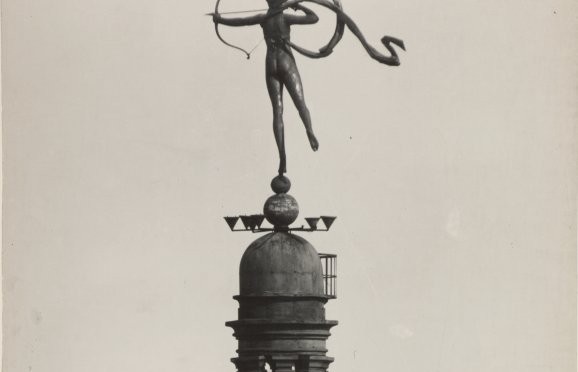
Augustus Saint-Gauden’s Diana twirling overhead on the second and arguably greatest version of Madison Square Garden

Madison Square Garden is certainly the recognizable name in arena entertaining, hosting Rangers and Knicks games, concerts, even political conventions. But it inherited that reputation from three other buildings which also called themselves ‘Madison Square Garden’.

The first, inspired by P.T Barnum and a popular bandleader, staked its claim in the hottest area of New York in the 1870s. The second, a classic designed by the city’s most famous architect, featured both trendy new sports and high society events. The third Garden, moving up town, stripped off the glamour and helped make the Garden’s sporting reputation.
We’ll also tell you about the most famous event to ever happen in any Madison Square Garden — a shocking and brutal murder which led to the ‘trial of the century.

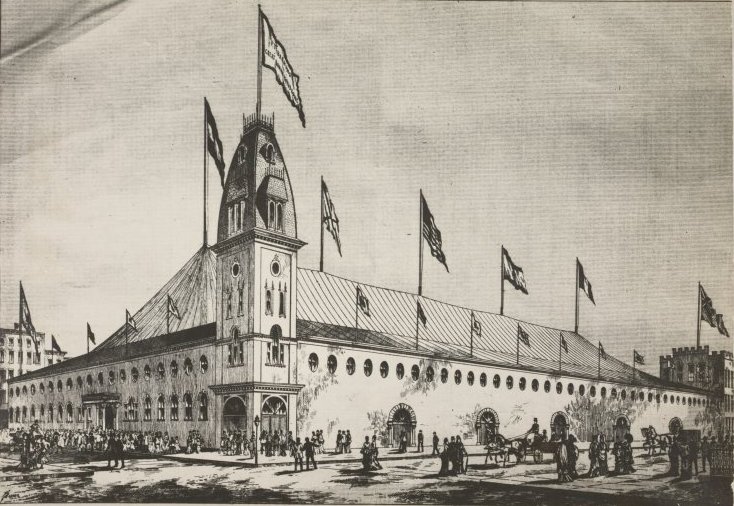
Pre-Garden: It was all Barnum, with his spectacular tented Roman Hippodrome.

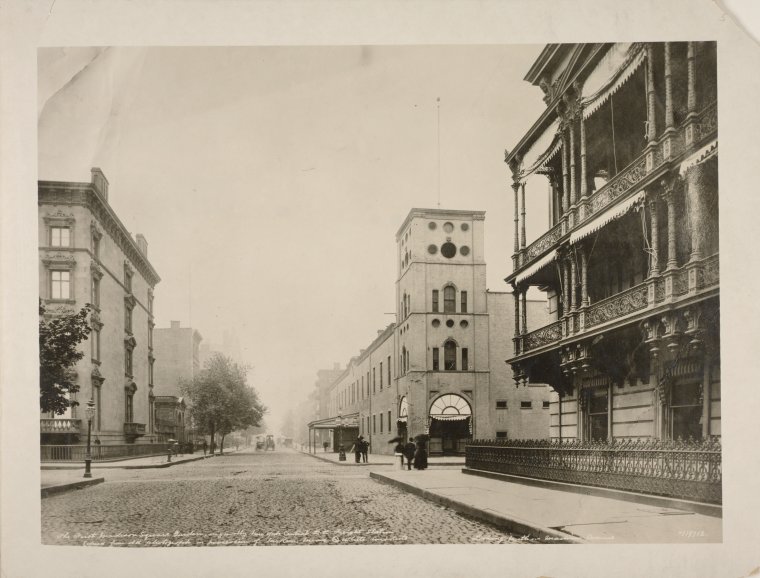
Madison Square Garden I, built for William Kissam Vanderbilt, grandson of Cornelius Vandebilt. Click for larger view. Photo courtesy NYPL

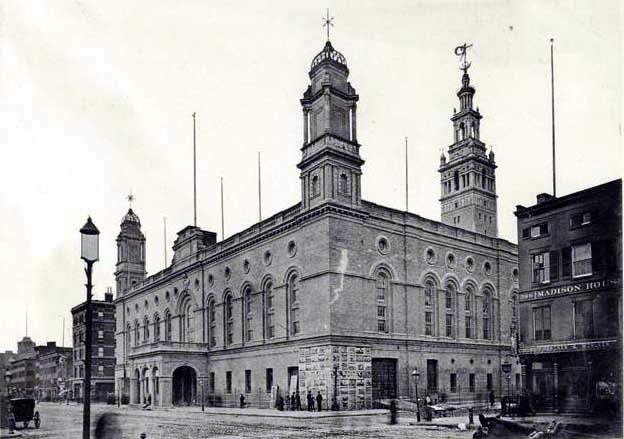
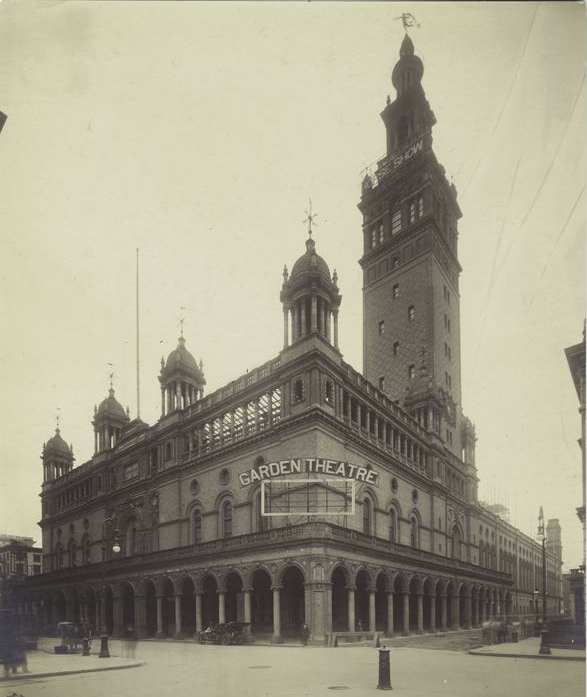
Madison Square Garden II, designed by Stanford White, studded with towers, weathervanes, grand arches and other Moorish touches. (Courtesy NYC Architecture, also a good place to find more information about the building’s design)

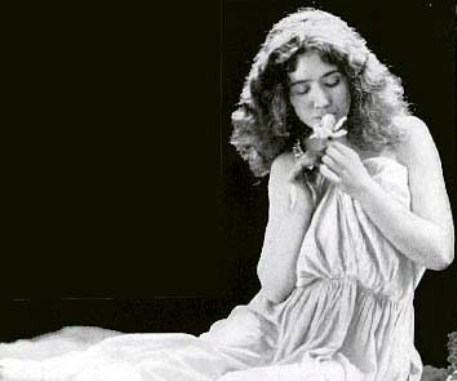
The two beauties of Madison Square Garden. The first, Julia Baird, was the model for Diana. Her nude exploits in its creation cause quite a fervor in the press.

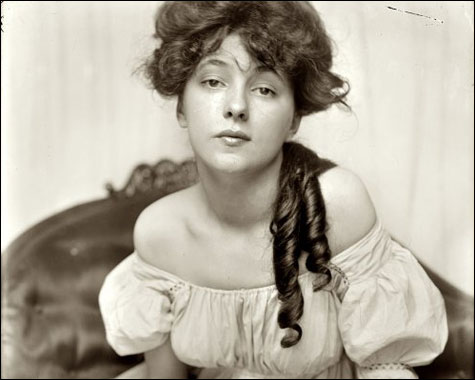
The tragic, beautiful Evelyn Nesbit, caught up between a powerful man and an insane spouse. Read here for an in-depth look at the murder and trial of Henry Thaw.

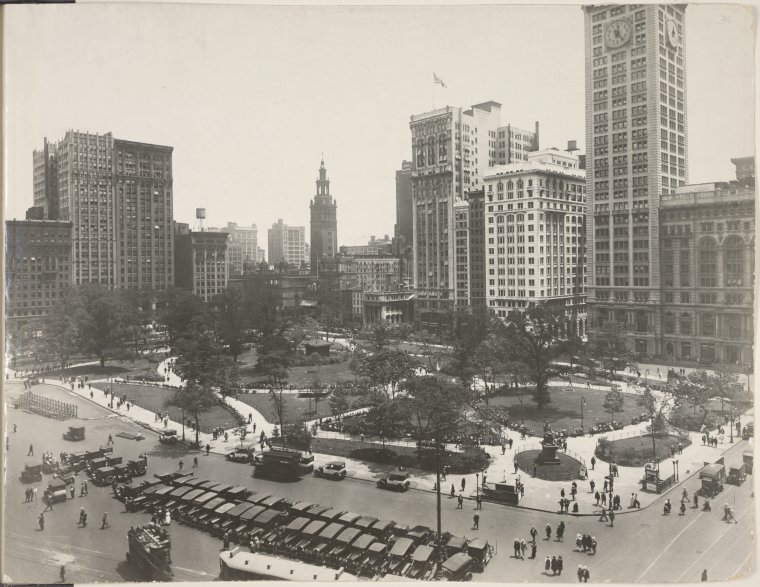
White’s Garden in context with the neighborhood in 1925, the year of its demolition. This one will require you to click into the picture for greater detail to see the full effect. (courtesy NYPL)

Madison II being demolished in 1925. (See full image here)

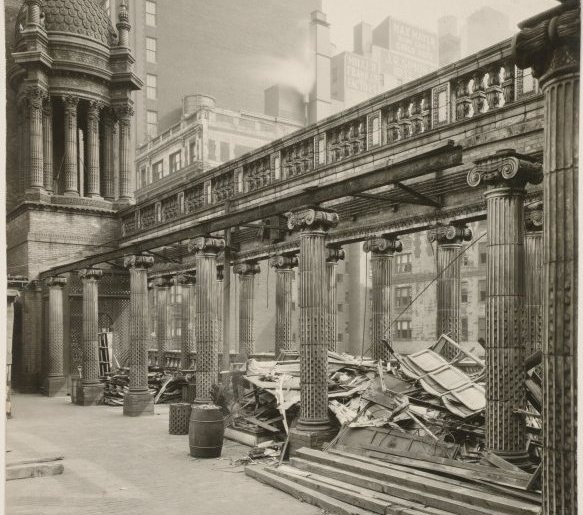
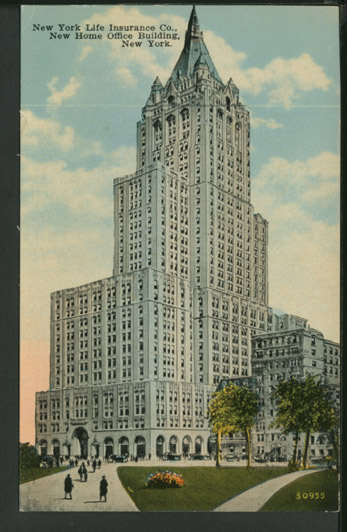
Unlike so many architectural calamities, at least it was replaced with something of equal beauty — namely the golden Cass Gilbert gem New York Life Insurance Building, looking here as though it were situated in California.

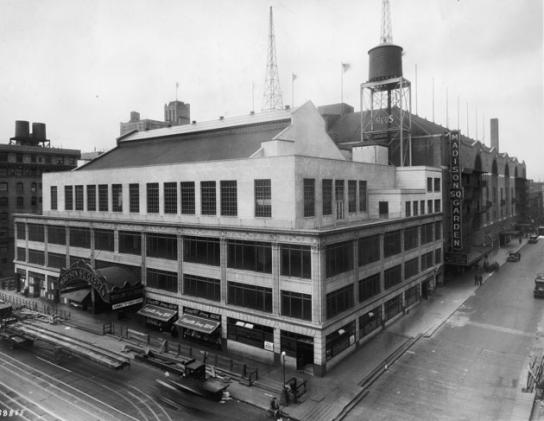
Madison Square Garden III. Why be fancy? Tex Rickard, moving the venue uptown to 50th Street, was more concerned with the entertainment inside than the flash and fancy outside. His glitz came from the lighted marquee and the big names blazing across it.

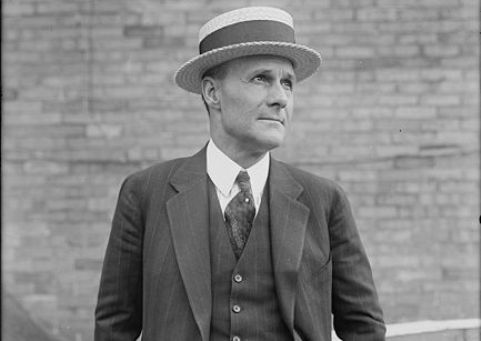
Promoter Tex Rickard, who helped form the New York Rangers and changed the sport of boxing forever with dozens of sell-out matches at his Garden.

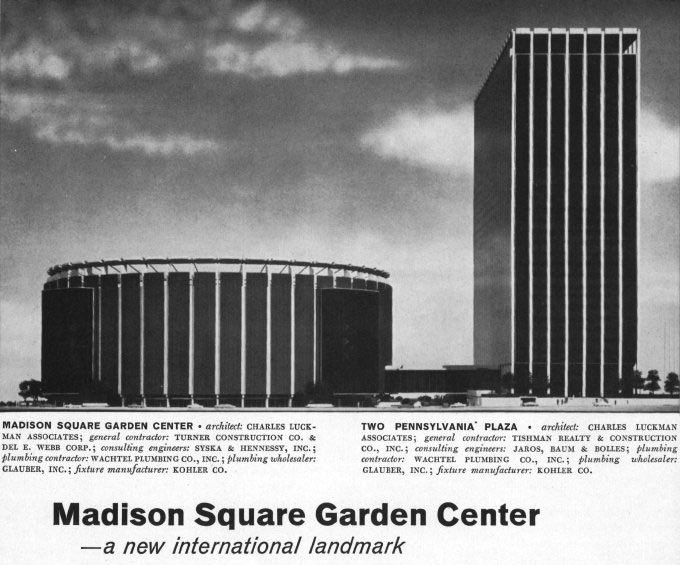
Madison Square Garden IV, designed by Charles Luckman Associates. This may surprise no one, but their other claims to fame include designing both Kennedy Space Center in Florida and Johnson Space Center in Texas. The firm also designed Los Angeles’s convention center which was partially demolished over a decade ago to make room for the Staples Center. (Pic from New Penn Station)

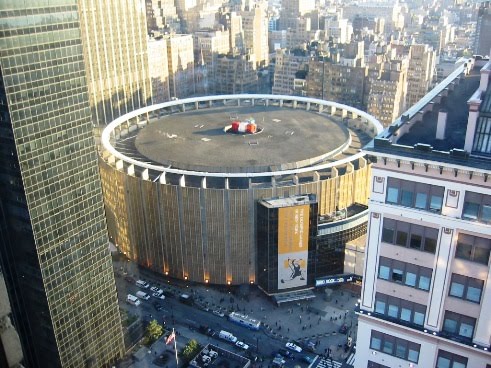
Although I can’t say it’s aging well, the current MSG will have officially outlasted all others in a couple years. Photo courtesy here


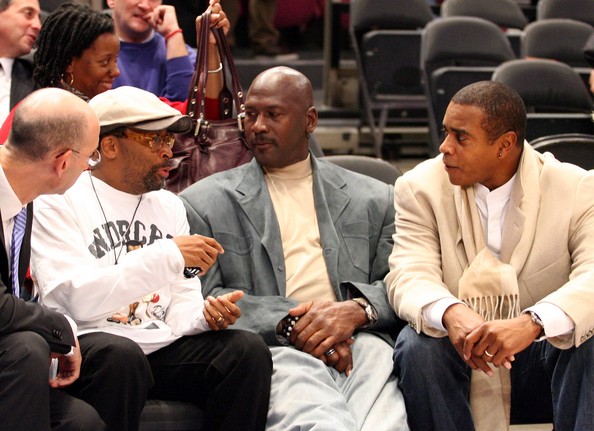
However, with the exception of Fashion Week, there may not be a fancier, more celebrity-laden row of seats than courtside during a Knicks game (below, Spike Lee, Michael Jordan and Ahmad Rashad, 2008).

For more information on special events, visit Madison Square Garden’s official website.

Finally, some great events hosted by Madison Square Garden. First of all, some pro-wrestling from January 30, 1920 at MSG II. Very rough footage, but extraordinary to watch if you have the patience.

Marilyn Monroe sings to JFK on his birthday (and just a few months before her death) at MSG III.

Elvis Presley in 1972, during one of his last performances here, at MSG IV

Categories
It's Showtime

Stars of MSG: Two great Johns on a Thanksgiving night

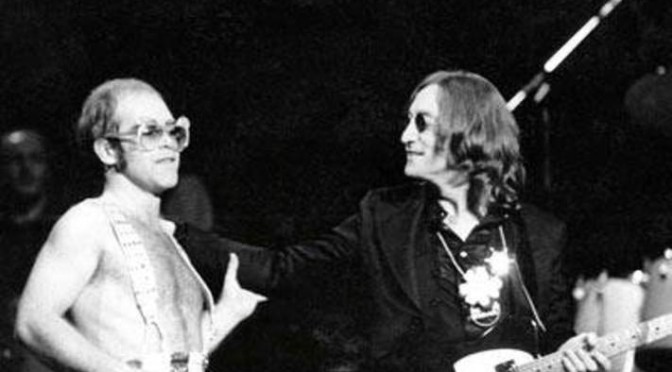
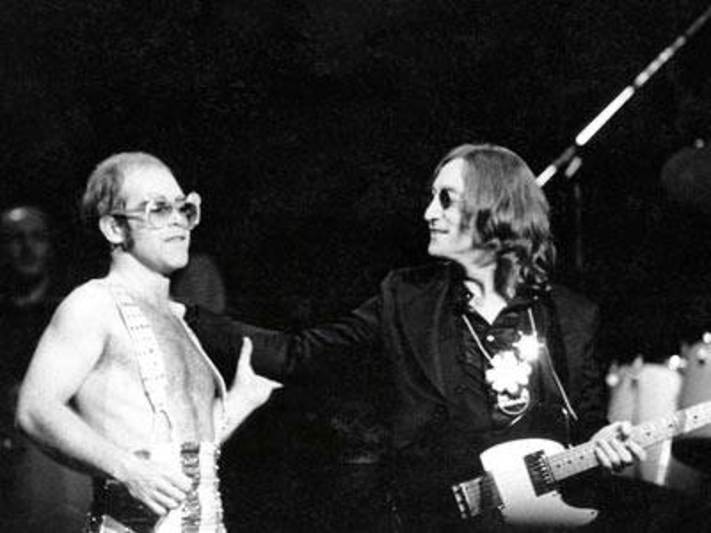
STARS OF MADISON SQUARE GARDEN: Elton John and John Lennon
LOCATION: MSG IV

John Lennon’s last stage performance ever took place on 1974 at Madison Square Garden, and he only did it because he lost a bet.


Elton John, an up and coming young star fresh from the successes of his album Goodbye Yellow Brick Road, collaborated with the Beatles icon on the Lennon single “Whatever Gets You Thru the Night,” providing piano and background vocals. As legend has it, Lennon was incredulous that the song would have mass appeal and agreed to perform with Elton in concert if the song hit number one.


Appearing on Lennon’s album Walls and Bridges, “Whatever Gets You Thru the Night” did indeed hit #1 on the charts — the only Lennon solo track to ever reach that spot.


And so, at the Elton’s Thanksgiving performance at MSG, November 28, 1974, Lennon took to the stage, and the two Johns plays a small set together which included renditions of “I Saw Her Standing There” and “Lucy In The Sky With Diamonds.”


More info at the Franklin Mint blog, where you can also hear the live performance.

Stars of MSG: Fears of Ku Klux Klan and a political dud

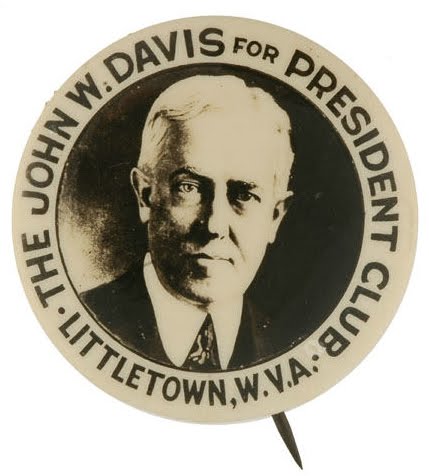
STARS OF MADISON SQUARE GARDEN: John W. Davis
LOCATION: MSG II

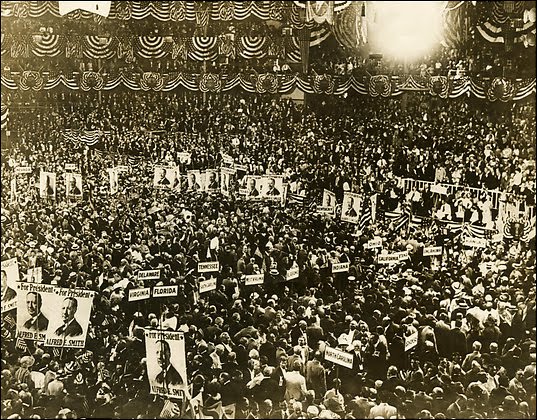
Both the Republicans and Democrats have held presidential nomination conventions here at Madison Square Garden, and with some success. The Republicans, in their only New York convention, re-nominated George W. Bush here in 2004. The Democrats propelled both Jimmy Carter and Bill Clinton from MSG conventions, in 1976 and 1992, respectively. (They also re-nominated Carter here in 1980, but we won’t talk about that.)

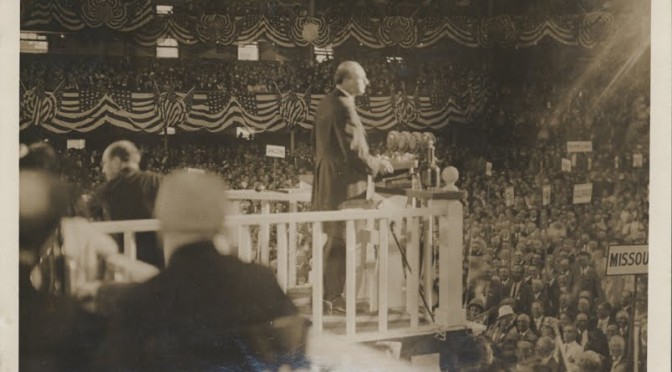
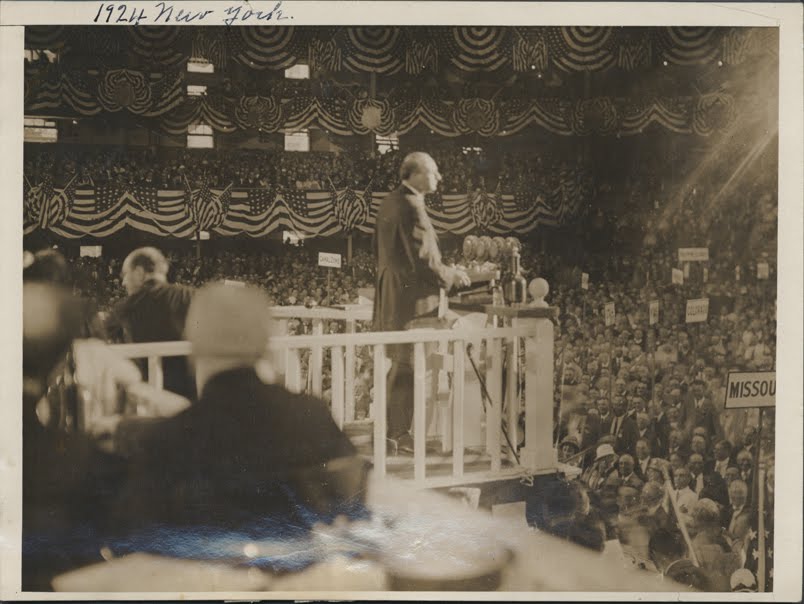
All these triumphs have been in the current Madison Square Garden, the one opened in 1968. But the second Garden, the one from 1890, hosted just one convention, but boy what a doozy. And after all the drama, they produced one of the most forgettable political candidates of the 20th Century — John W. Davis.

Davis was not a horrible candidate, per se; born in West Virginia, the dignified Davis practiced law in New York and served as the US ambassador to England. He was a staunch old-school conservative with somewhat centrist opinions on race, eventually making him a safe choice in Prohibition-era 1924. In fact, nobody truly wanted him.

The real battle at the Garden convention, held June 24 to July 9, was between Woodrow Wilson protege William Gibbs McAdoo and New York governor Al Smith. At issue was the rise in the South of a revitalized Ku Klux Klan who garnered some support in the conservative wing of the party. Also not helping matters — Al Smith was Catholic and obviously taking all his orders from the Pope (claimed the racist organization).

The battle between factions on the Garden floor were ferocious, Smith taking the progressives, McAdoo receiving support from the conservatives. (Peter Carlson of the Post calls the conflict representative of “the two sides of America’s cultural divide — what today’s TV yappers would call the red states and blue states.”) After the first vote, McAdoo was in the lead; John W. Davis was SEVENTH. A candidate needed two-thirds of the vote to be declared the nominee.

By the 20th vote or so, candidates were weeded out, but McAdoo and Smith were still battling for the lead. Davis had now moved to third position. With deals swiftly being made on the convention floor, handshakes and whispers gradually shifted the vote over the course of literally dozens more vote calls — and over the course of two weeks — with the lead gradually shifting from McAdoo to Smith. But still, no consensus, no two-thirds. Deadlock.

Things were getting out of hand, with demonstrations and fistfights breaking out. Not even Franklin Delano Roosevelt delivering the now famous ‘happy warrior’ speech, in support of Smith, clarified matters. Inflaming matters further was the fact that this was the first political convention broadcast on the radio. Americans must have thought politicians mad.

Davis, consistently in third place, suddenly became something of a compromise; while conservative, he openly reprimanded the KKK. Most importantly, for McAdoo supporters, he wasn’t Smith, and for Smith supporters, vice versa. After 103 ballots, Davis became the nominee. And was promptly destroyed in the election that following November by incumbent Calvin Coolidge. Coolidge even beat Davis in New York City.

Incidentally, all political conventions held in New York have taken place at some version of Madison Square Garden, except for one. In 1868, Democrats were so firmly in the grasp of Tammany Hall that, heck, they just decided to have the convention there, at their new headquarters on East 14th Street. The boss of Tammany at the time was, of course, Boss Tweed; the candidate? Horatio Seymour, like Smith, a governor of New York. (He lost to venerated war general Ulysses S. Grant.)

TOP Photo courtesy University of Mississippi, and check out their great site on presidential elections

Stars of MSG: the Garden goes gospel – summer 1957

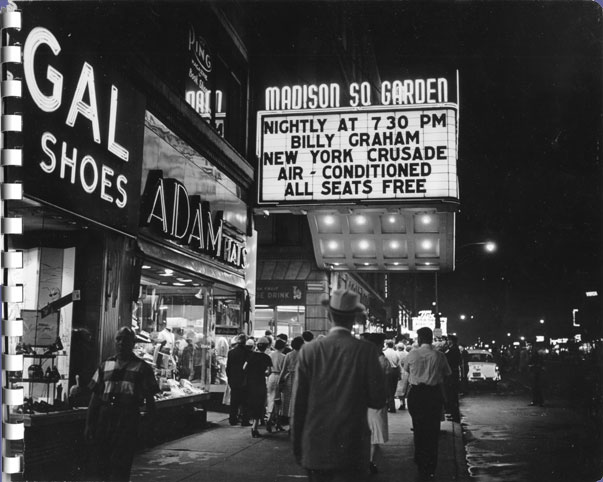
STARS OF MADISON SQUARE GARDEN: Billy Graham
LOCATION: MSG III

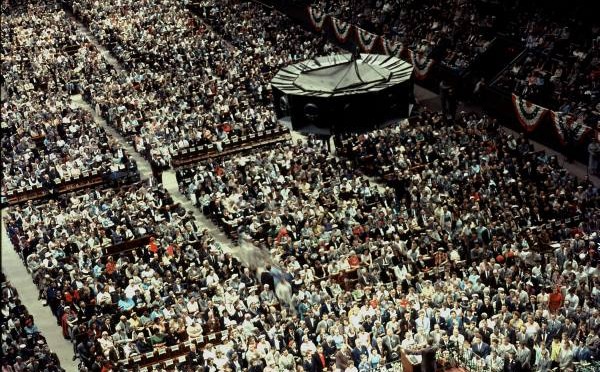
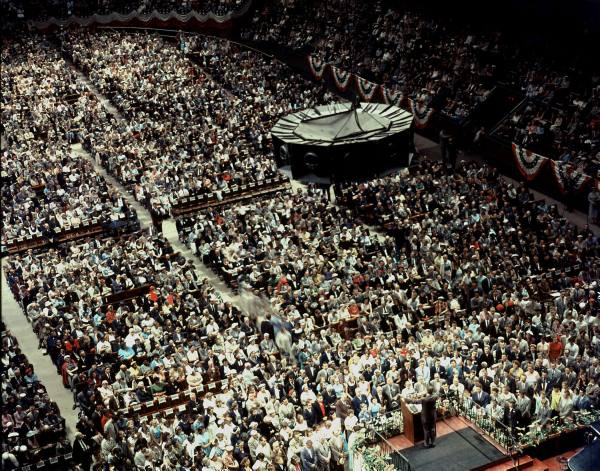
Sitting squarely where boxers and hockey stars frequently bloodied themselves, worshippers sit and listen to evangelist Billy Graham, during a run of 98 ‘Crusade’ sermons at the Garden in 1957, beginning on May 15. Events that summer would also continue onto Times Square and Yankee Stadium. Graham would famously include African-American preacher Howard O. Jones in the line-up, a radical step for its day.

According to Jones: “When news hit the street that Billy was thinking of bringing me on board, he received an alarming number of disparaging letters: ‘You should not have a Negro on your team,’ came the warnings. ‘You’re going to ruin your ministry by adding minorities. We may have no choice but to end our support.'”

Much, much more information at the Wheaton College website

Top photo courtesy Life images. Bottom photo courtesy here

Stars of MSG: The deadliest roller skating event ever

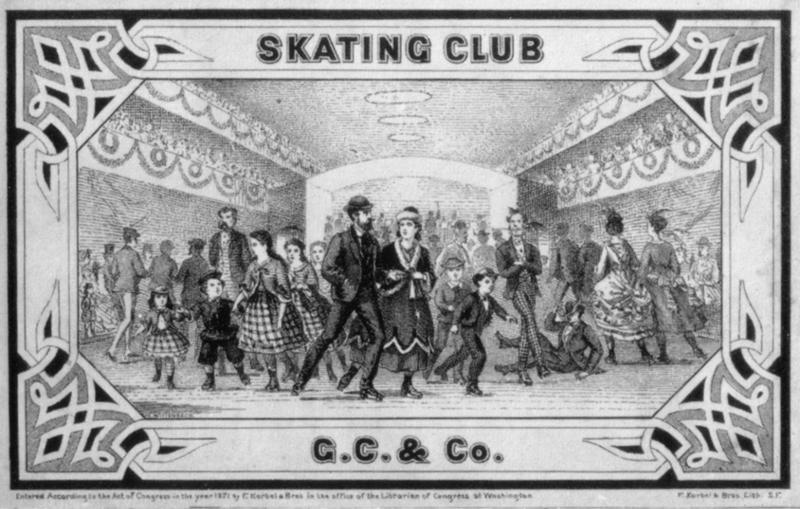
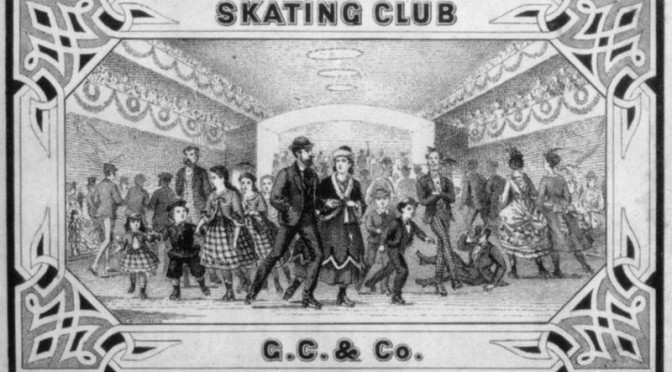
People were just wild about skating in the 1880s.

STARS OF MADISON SQUARE GARDEN: Six-day skater William Donovan
LOCATION: MSG I

People were a touch insane in the 1880s and 90s. One of the most popular sports was the six-day bicycle race, a sport so popular, particularly in Madison Square Garden II (debuting there in 1891), that they were referred to as ‘madison events’ in international circles.

But they were preceded by six-day rollerskating marathons, the first one in New York on March 1885, in the original Madison Square Garden — an event so strenuous it actually killed the young 19-year-old winner, William Donovan.

Donovan was a newsie from Elmira, NY, who trained for the event with a man who went by the name ‘Happy Jack Smith.’ The event, a ‘go as you please’ event involving a velodrome built within the garden, attracted 36 skaters aiming for a $500 prize.

The dangers of this event were apparently well elaborated. ” ‘It’s the first test of endurance that has ever been made on roller skates,’ said a sporting man, ‘and I believe that over half the men entered will cripple themselves for life.’ “ [source] Great, where do I sign up?!

I can’t help but think this sort of event would attract a certain sort of young, brash derring-do, possibly with lots of time on his hands. From the same article, two spectators were quoted describing a participant:

” ‘I shouldn’t think his mother would let him come out of the house looking that way,’ said a pretty little miss.

” ‘Perhaps he’s an orphan,” said her companion. “He looks like he’s seen a lot of trouble.’ ” [source]

Contestants would frequently collapse in a faint, be taken off the track, revived, then taken back to the course. Spectators actually sat in the arena for the entire six days, in apparently some kind of come-and-go ticket arrangement. There was an ongoing carnival and bicycle demonstrations to keep ticket holders busy when the skating got boring.

It appears athletes were allowed to rest off-track, but obviously the time spent sleeping was taken off their total. Many of the most popular skaters were given nicknames; redheaded Donovan, for instance, was ‘Sorrel-top’, I assume for the color of red sorrel, not green. The total length of the track multiplied by the 144 hours of non-stop riding meant that young Donovan had ridden 1,092 miles, awarding him the prize money and a fine diamond belt.

A few days later, while staying nearby at the trendy Putnam House, the victor Donovan caught pneumonia. While looking out his window at people streaming to P. T. Barnum’s Greatest Show on Earth (holding court at, yes, Madison Square Garden), Donovan collapsed and died within 36 hours — of acute pericarditis (heart inflammation).

Newspaper investigation of his death reveals that the boy had skated the course with a ‘dead bone’ (necrosis) on his right leg.

Within days it was revealed that a second skater who participated in the event, Joseph Cohen, had also died afterwards.

Now, why the heck would anybody be interested in roller-skating for six straight days?

Rollerskating was a popular craze in the 1880s, with mass production and sale beginning then, so a six-day roller-skating fest would have been the 1885 equivalent of x-treme sports.

Evaluating the safety of the event was indeed in its infancy, as this excerpt from a medical journal in 1885 illustrates:

“The mind acts “exoneurally,” we are told, and the vibrating brain-cells of the enthusiastic roller-skater communicate their rhythmical pulsations to the previously insensitive spectator. Whatever the mechanism, there is certainly at present a morbidly exaggerated passion for, and indulgence in, roller-skating. And the question comes home to the physician, whether it is doing any physical or mental harm.”

Too much skating, as Donovan proved, was dangerous. Organizers of the skating marathon booked the Garden for a second event in May 1885, but participants were handpicked only the most experienced and healthy, including a few surviving the last go-round. Shortly afterwards, official skating events were prohibited from being longer than four hours in length.

Stars of MSG: Indoor fishing in an outdoor wonderland

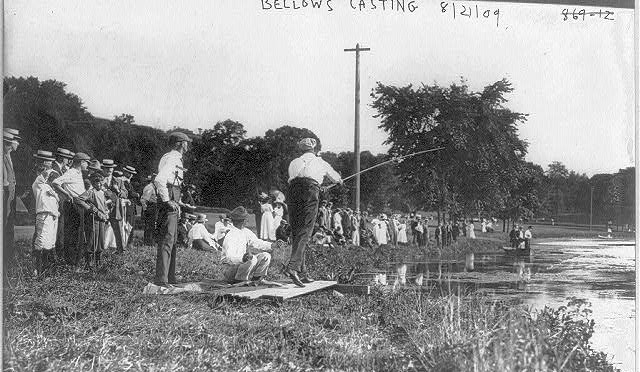
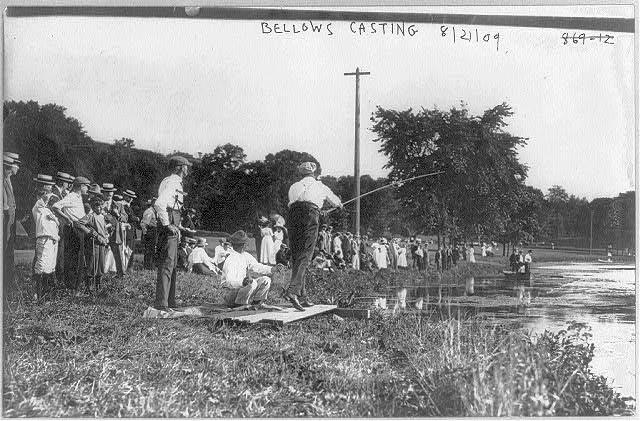
ABOVE: Fly fishing in Van Cortlandt Park in the Bronx, August 1909. Meanwhile, downtown, people cast for greater prizes indoors. (Pic courtesy LOC)

STARS OF MADISON SQUARE GARDEN: R.C. Leonard, fisherman
LOCATION: MSG II

Of all the curious events to ever happen at Madison Square Garden — from the first one to the latest — no competition seems more surreal to me as a spectator sport than watching somebody fish. But in fact, for many years, Madison Square Garden II had quite popular fly fishing contests, either on their own or as part of elaborate hunting and fishing extravaganzas, the Bass Pro Shops meets Disneyworld.

The luxe, new Madison Square Garden, designed by Stanford White, was equipped with its own aquatic tank for water polo events, but in sporting season, it was apparently used for fishing events as well. The arena was obviously dressed up to resemble the ‘great outdoors’. In a tournament in 1911, an artificial mountain and waterfall were even designed as casting sites. The following year promised “so complete will be the change in the appearance of the amphitheatre that it will be hardly recognizable.” [Times]

For the fishing competitions, there was both ‘dry fly-casting’ using distance and accuracy markers, as well as the naturalistic kind, immersed in these natural dioramas.

And the leader of this sports was apparently one R.C. Leonard, who set a record for fly casting for black bass – at 101 feet and 6 inches — at the very first indoor fishing event at MSG, on March 15, 1897. He was still setting records as late as 1905: “He made the most notable cast that has ever been seen in the Garden,” according to the Times, breaking a distance record that he himself had set a few years previous. When Leonard made this “most notable” cast, the “rubber frog” hurled over the end of the 130-foot tank and hit the decorative “rustic bridge”!

Leonard, born either in 1862 or 1863, was the undisputed master of the sport, by 1905 the winner of 55 gold medals in the sport.

Leonard might have met his match many years later in 1911 — in the form of a four-year-old girl. If ever a novelty act existed, it was Madge Seixas, a tot with an impressive arm, “having a mark of forty-five feet with a fly rod weighing about four ounces.” She climbed the fakemountain, situated on the Park Avenue (Fourth Avenue back in the day) side of the auditorium, and “insisted upon casting into the waterfall.”

Fishing was only one of several curious displays honoring the great outdoors. As part of an annual Motor Boat and Sportsmen’s Show festival, the 1905 event also featured canoe races at the Garden on a makeshift lake, and a whole hunter’s paradise — tent, camp fire and all, with a recently killed deer suspended from a tree and other game dangling from other faux foliage. In addition, there was a shooting range for schoolboys.

Incidentally, the New York Boat Show, held just a few weeks ago at the Jacob Javits Center, traces its lineage back to this 1905 convention.

Stars of MSG: No miracles on ice — Russians beat USA!


STARS OF MADISON SQUARE GARDEN: 1980 Russian Olympic Team
LOCATION: MSG IV

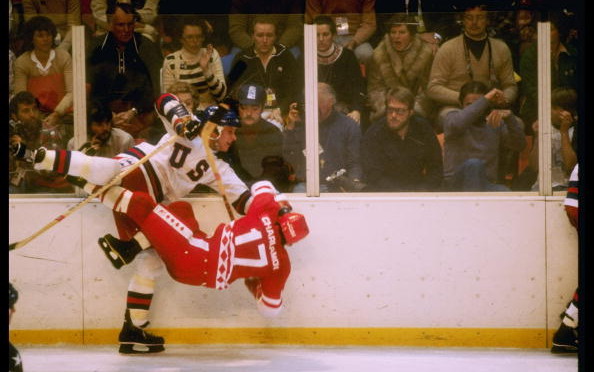
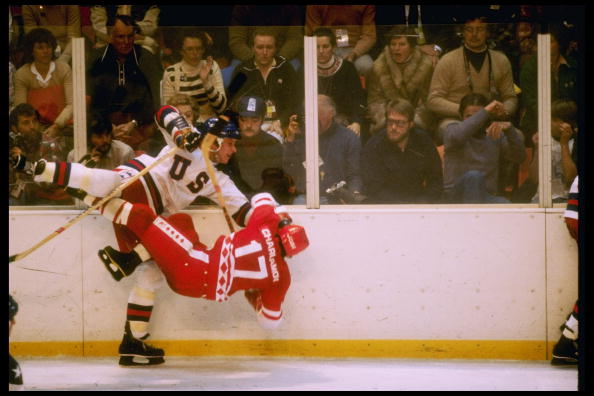
Nope, that headline is not from an alternate timeline. Thirty years ago, the most memorable moment in US Winter Olympics history occurred on February 22, with the victory of the US men’s hockey team against its athletic and ideological rivals from the Soviet Union. What’s lost in the mists of history is that these two teams has played each other two weeks earlier, in New York, at Madison Square Garden — and the Russians iced the US team.

In promotion of the 1980 Olympics that year, in Lake Placid, NY, the two squads played an exhibition round for fired-up New Yorkers on February 9th, 1980, just three days before the opening ceremonies. Despite an openly hostile crowd, the Russians handily beat the young team of American athletics, 10-3.

According to sportscaster Al Michael, “Anybody who left Madison Square Garden that day thought to themselves: ‘The Soviets will win every game in the Olympics, take home the gold medal, and never be challenged.'”

Of course, in the game that really counts, the American team swept aside the Russians in Lake Placid, 4–3, in what has been called ‘the greatest sports moment of the 20th century.”

The Sheila Variations has a nice, full write-up of the MSG battle

Picture from the Lake Placid match-up, courtesy World Hockey

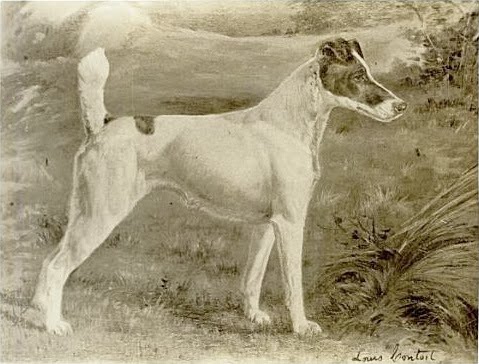
Stars of MSG: Warren Remedy, the winningest dog

STARS OF MADISON SQUARE GARDEN: Warren Remedy
LOCATION: MSG II
The picture above is of the Katharine Hepburn of dogs, Warren Remedy, the only dog to ever win the Westminster Kennel Club Dog Show three times in a row.  Despite the name, this smooth-haired Fox Terrier canine superstar was female.

She also kicked off the storied Best In Show competition, which was held for the first time in 1907 and chosen from the winning dogs in other categories by a panel of ten judges.  The annual dog show, of course, predates all incarnations of Madison Square Garden, with the first one on May 8, 1877 — easily the oldest continuing sporting event in New York City.

Warren Remedy, “the fantastic bitch whose major achievement has yet to be duplicated” according to Harold Nedell, was owned by the appropriately named Winthrop Rutherfurd.  She’s the only dog to win Best In Show in successive years, and given the highly political nature of the dog show today, I can’t imagine this ever happening again.

According to the Times, “The little white twenty-month-old son of Sabine Resist … was handed out of the ring to the attendant who had handled him [sic] since his birth on Mr Rutherford’s New Jersey farm and was wild with exultation. He hugged the little champion ecstatically and hurried off to the dong’s bench, where he and the winner held an improptu reception that continued most of the afternoon and evening.”

The New York Tribune gives a fuller desciption of the little girl’s charms:  “Warren Remedy is practically true to type. She is tan marked, with strong head, keen expression, good outline and grand ribs. She was in fine coat also, and should be worthy of winning in the best company in England.”

Apparently, the spirited dog barked herself hoarse — although that was more likely a bit of anthropomorthism by the Tribune reporter.

Her owner Rutherfurd, with kennels in Allamuchy, NJ, got in the Fox Terrier breeding business quite suspiciously; their first terrier was from an English lot stolen in Liverpool and smuggled over.  It is unclear whether Warren Remedy is from this pirated lot.

Above illustration by Gustav Muss-Arnolt, a New York illustrator who actually specialized in dog portraits, drawing over 170 portraits for American Kennel Club Gazette.

Previously: My article “Who Let The Dogs In?” on the first dog show. And for the truly adventurous of you, my very first solo podcast, from way back in 2007 — the Famous Dogs of New York.

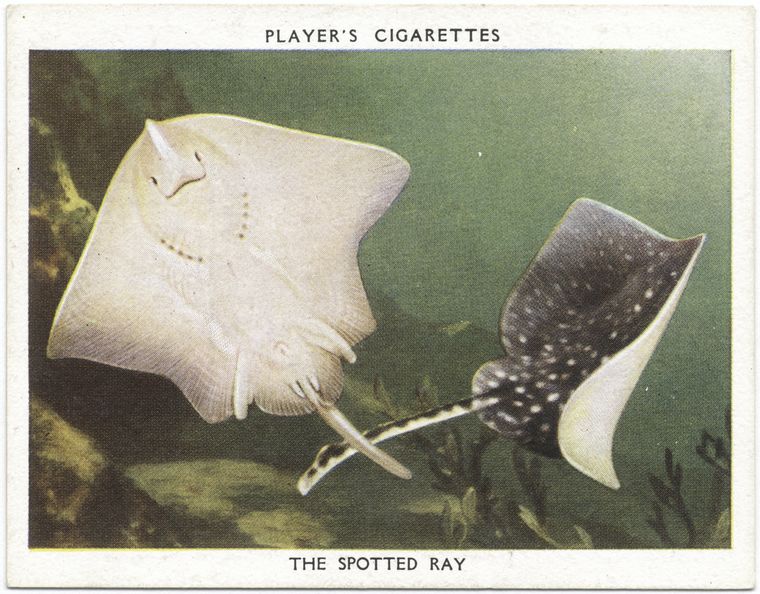
Will an aquarium come to midtown Manhattan– again?

From a pack of old, aquatic themed ‘cigarette cards’, naturally [NYPL]

Yesterday the Wall Street Journal reported that a Canadian developer may bring a luxury, multi-floor aquarium to a new skyscraper in Times Square. The proposed aquatic amusement, to feature “sharks, rays, penguins, otters” and a pirate museum, would liven up the freshly built, so-called 11 Times Square, at the corner of 42nd and 8th Avenue, a corner once famous as a place for picking up male hustlers.

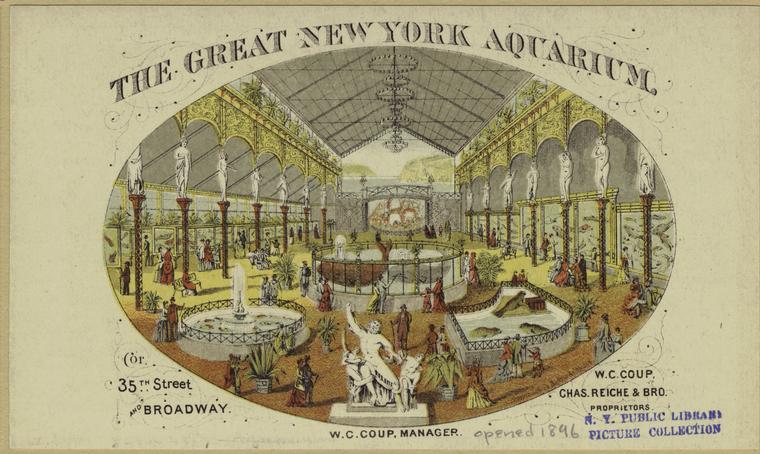
This would not be the first time an aquarium graced midtown Manhattan. In fact, the first aquarium in this region was also a privately run endeavor — The Great New York Aquarium, located at 35th Street and Broadway, the latest escapade by William Cameron “W.C.” Coup, a former employee of P.T. Barnum.

Coup knew something about spectacle as manager of the earliest incarnation of Barnum’s greatest contribution — P.T. Barnum’s Great Traveling Museum, Menagerie, Caravan, and Hippodrome, soon to the alleged ‘Greatest Show On Earth’, the first travelling circus. The show would soon make its home in Manhattan in 1874 on the site of an old train depot off Madison Square, a block that would later be built up to become the very first Madison Square Garden.

The Great New York Aquarium, glorious and rather tragic (for the aquatic captives, that is). Pic courtesy NYPL

For his next feat, opening on October, 11, 1876, Coup would bring the oceans to Manhattan. Of course, 35th Street was hardly “midtown” then; Central Park had only been completed a few years prior, Macy’s was still on 14th Street, and Longacre Square (future Times Square) was still the smelly home of horse stables and carriage houses. But theaters and concert halls, newspapers and restaurants, all of New York society was booming from Union Square to 34th Street, and thus Coup’s aquarium would have been nicely situated.

This was no ordinary aquarium. Like many museums and other ‘well-meaning’ spectacles of the time, the Aquarium mixed the outlandish with the intellectual, with libraries and laboratories on site, as much to give the joint credibility as for actual research.

The centerpiece was a gigantic tank fit for a whale; too bad the whale died in transit, sitting empty for opening day. Displays for porpoises, sharks and sea lions were scattered around it, swimming in small tanks with painted backgrounds featuring the creature’s native flora and fauna.

Like aquatic displays before it — such as the basement of Barnum’s American Museum — the environment was probably not very healthy for sea creatures. However, Coup did feature a set of fish hatcheries for display, possibly the first such nurseries ever featured in a public aquarium.

Coup’s venture was an immediate success, and he soon opened a smaller outlet in Coney Island. He was not long for the Great New York Aquarium however; after financial disagreements with his partner, animal importer Henry Reiche, Coup left to pursue other bizarre projects, including something called The New United Monster Shows.

Reiche, for his part, had made quite a name for himself in animal trade. He and his brother Charles had a pet store at 55 Chatham Street (that street is now Park Row today), equipped with a backyard pen for lions, monkeys and even gnus — all for sale to private collectors. (This helps explain the founding of places like the Central Park Zoo, formed from discarded animals left in the park.)

Reiche gnu, er, knew his animals, but he didn’t know business. An expensive endeavor to maintain and to import new creatures, Reiche attempted to draw audiences with theatrical performances and even pigeon shows set among the glowing tanks. Nothing worked, and so in 1881, the aquarium’s contents were auctioned off. I can’t imagine the creatures displayed here benefited well from this.

Of course, New York City would get its very first official aquarium many years later, in 1896, with the opening of one at Castle Garden (the once and future Castle Clinton). When Robert Moses drove it out of here in 1941, the city aquarium took up residence in Coney Island, where it remains today.

New York governor resigns* in disgrace (in 1913)!


STRESSED: William Sulzer in 1911, a New York City representative on his way up…and out

*okay, technically he was removed in disgrace

As bloggers, newshawks and politicos wait to see what, if anything, comes of the latest New York Times supposed bombshell about current governor David Paterson — he’s already protesting “I DID NOT HAVE SEX WITH THAT WOMAN” in the Post — I thought I’d turn to state politics for a day and see how many of our state’s governors have been shamed into resigning. Certainly, in the wild-west days of state politics, there must have a been a few, right?

In fact, there’s only been two — the infamous Eliot Spitzer and of course, that dastardly William Sulzer.

Who?

Sulzer is a perfect example among many as to why you never trust Tammany Hall, especially if you’re one of them. Sulzer was a handchosen successor for the governor’s seat in 1913, a man of middling talents selected to do the Democratic machine’s bidding in state affairs. But like a bad gangster movie, you step outta line, you pay the price.

Sulzer was a practicing young lawyer during the 1880s who like many men worked his way into politics using the sticky graces of Tammany patronage. Sulzer more than paid his dues; in 1895, he served as representative of the various electoral districts in the U.S. House of Representatives, and served there up until the events described below.

They called him ‘Plain Bill’ Sulzer for entirely fictitious reasons; in fact, he was a “vain and self-important,” according to author Oliver Allen, miming the role of an elder statesman in dress and deed. He made grandiloquent statements about the public good but was mocked down in the Bowery saloons as a bit of a peacock. “When it comes to preserving our liberties, ” said one reporter, “Willliam is a whole canning factory.”

But he was subservient to Tammany, a loyal Freemason and, most important, well liked in an over-crowded district of potential voters. When governor John Dix, a Tammany Democrat who swiftly proved overwhelmed by the job, was nudged aside in 1912 by Tammany’s boss Charles Murphy, he was replaced by Sulzer on the ticket. Despite a challenge from a surging Progressive Party — led by former president Theodore Roosevelt — Sulzer was handily elected.

Perhaps it was the way in which his predecessor Dix was swept aside. Perhaps it was stupidity. Perhaps it was failed ingenuity. Whatever the case, Sulzer took office and immediately began ignoring Murphy’s requests for appointments. Even worse, he began calling for inquiries into questionable state construction contracts — always a hornet’s nest of illicit behavior by Democratic lawmakers. Looking to deeply here would expose dozens of legislators to accusations of graft and bribery.

Sulzer is not the first Tammany representative to turn his back on the corrupt organization. In fact, the same thing had been going on in New York with mayor William Jay Gaynor, a former golden boy of Murphy’s who proved difficult to control. Gaynor, however, was a deft, able politician who managed to step on Tammany’s toes without crushing them; Sulzer was simply too bold in his rebellion.

By the fall of 1913, Tammany would have neither Gaynor nor Sulzer to deal with. Gaynor would die that September during an overseas voyage of a latent bullet wound, received years earlier in a failed assassination attempt. Sulzer was felled in a more successful assassination, by Murphy, via accusations of improper allotment of campaign finances for personal use.

Sulzer did, in fact, dip into campaign money during the election; in 1910s politics, who didn’t? The investigation was created for the sole purpose of discrediting Sulzer, and its victim proofed feeble to the task of defending himself.

Perhaps sensing futility Sulzer didn’t even show up to trial to defend himself. He was hastily found guilty of “falsifying campaign documents,” impeached and removed from office in October 1913. Sulzer would die in November 1941 as the only governor of New York ever removed from office. And all for giving sass to the party politic.
Categories
Podcasts

Manhattan Bridge: New York City’s dysfunctional classic

[from Flickr, taken by ajagendorf25]

We love the Manhattan Bridge, but there’s no doubt it’s had a rocky history. For one hundred years, it’s withstood more than just comparisons to its far more iconic neighbor, the Brooklyn Bridge.

Built to relieve pressure on the East River’s best known bridge, the Manhattan Bridge went through two different engineers — and a couple different ambitious designs — before finally being completed by another architect, who then went on in 1940 to design one of the WORST bridges in America. And serious design flaw afflicts the bridge to this day?

Listen in and find something to appreciate in this seriously under appreciated marvel of the East River:


I mention many bridge engineers in this podcast — Leffert Lefferts Buck, Gustav Lindenthal and Leon Moisseiff — but due to time constraints on the show this week, the contributions of Henry Hornbostel were left out. Hornbostel was instrumental in the work with Buck on the Williamsburg Bridge and with Lindenthal on the Queensboro. When we do podcasts on those bridges, he will get his fair due.

Preliminary work on the Manhattan Bridge began in 1901 under Buck, with Lindenthal taking reign of the project a year later. When Moisseiff was brought in to rework the bridge in 1904, construction kicked into high gear. Lindenthal’s innovative suggestion to use eyebars was discarded for a more conventional wire structure. [Pics courtesy Life Google images]

Stringing the cable across the East River took only four months in 1908. Indeed, the traffic snarls on the Brooklyn Bridge demanded them to work quickly. It was also mayor George McClellan’s intention to finish the bridge before he left office. [Photo by GG Bain and cleaned up by Shorpy, see a nifty close-up image here]

Gustav Lindenthal, born in Brno (now in the Czech Republic), came to the United States, built many bridges, and dreamt up many more that were never completed, like the North River Bridge, which would have spanned the Hudson River, and a monumental Manhattan Bridge designed with 14 lanes of traffic.

The bridge opened on December 31, 1909, although the pedestrian walkways were not completed and no trains were ready to go over it at that time. Setting it apart from its sister bridges was the flat, blue two-dimensional towers. As you can infer from this photo, facing both sides of the bridge were rows of docks and industrial ports. [Pic courtesy NYPL]

Berenice Abbott has some spectacular views of the Manhattan Bridge, taken in the 1930s. For crisp, dreamlike pictures of Manhattan, you can’t do better than Abbott. [courtesy NYPL]

Speaking of Berniece Abbott, Gothamist has some great shots taken by her of the area below the Manhattan Bridge on the Brooklyn side — today it’s DUMBO, known then as the strangely desolate Irishtown. [Flashback: Brooklyn 1936]