What’s in a name? In Kingsbridge’s case, a New York first

NAME THAT NEIGHBORHOOD Some New York neighborhoods are simply named for their location on a map (East Village, Midtown). Others are given prefabricated designations (SoHo, DUMBO). But a few retain names that link them intimately with their pasts. Other entries in this series can be found here.

NEIGHBORHOOD: Kingsbridge, the Bronx

DUMBO, for Down Under Manhattan Bridge Overpass — a stretch to create an geographic acronym if there ever was one — is not the only neighborhood influenced by a bridge which passes by, through, or over it. It might be the most obvious thing I’ve ever typed, but the neighborhood of Kingsbridge in the Bronx is named for an actual bridge, and the King’s Bridge at that.

The Spuyten Duyvil creek, that short, narrow span of water that separated the far north edge of Manhattan from the west side of the Bronx, has vexed travelers for hundreds of years, due to choppy waters and devilish legends. One translation of its name has traditionally been ‘Devil’s Spout’. Folklore sent Anthony Van Corlaer to his death here. (Listen to last year’s Haunted Tales podcast for more information.)

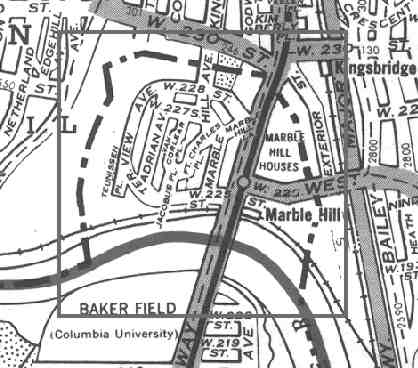
In the past 150 years, the course of this waterway has been re-routed, shut off and landfilled to accommodate needs of Harlem River shipping traffic. In fact the neighborhood of Marble Hill, once a part of Manhattan island, has been affixed to the Bronx by drilling a canal though its southern part (in 1895), then filling in the Spuyten Duyvil to its north (in 1914). This disembodied nub of Manhattan is still administratively considered part of the island.

(Forgotten New York has a wonderful write-up explaining it all. Picture below is from there; the dotted line is where the Spuyven Duyvil once flowed. The solid line is the Harlem River.)

But it’s not Marble Hill we’re looking at here, but rather the neighborhood to its east, Kingsbridge. Way before the Spuyten Duyvil was filled in, the creek posed a challenge for early Dutch farmers wishing to transport their wares into the city markets. However it was narrower than trying to attempt a crossing of the far-broader Harlem, and many farmers used their own boats to get across.

The earlier inhabitants of the land, the Lenape, simply used canoes when they wished to pass across it; it was at this spot that a well-trodden Indian trail led into the wilderness beyond. By the time of the Dutch, this path had been turned into a workable road, the Upper Trail Road and later the Boston Post Road, which led into New York to the south.

In 1669, in those tentative years of England’s early occupation of the former New Netherland colony, one enterprising Dutch farmer Johannes Verveelen set up a pay ferry service, at the area of the former creek today situated at 231st Street and Broadway — both to serve those who didn’t have their own vessels and to monetize those who had previously preferred their own. This would be fine for awhile, until greater number of travelers to and from New York on the post road commanded that a more permanent solution be found.

Enter wealthy adventurer and servant to the crown Frederick Philipse. He was actually born in Amsterdam, a slave trader who married into money, came to the New York colony and acquired an estate (or rather, “hunting ground”) encompassing land between the Spuyten Duyvil creek and the Croton River further upstate. He built a lavish home here with breathtaking views of the Hudson.

This land once had been owned by Lenape and farmed by Dutch farmers; now it was part of a wealthy lord’s estate, part of a vast property that would later become the western Bronx and Yonkers. Of course, in the southern part of his estate, there was that pesky road that abutted his property, heavily trafficed with people crossing at the creek. No matter. He built a bridge — the King’s Bridge as it was “established by royal grant” — and charged a fee, payable to the crown.

Philipse’s toll bridge can be seen as a physical representation of the later unrest between England and the colonies. Philipse and his descendants were faithful to the English; his great-grandson would still own the property during the Revolutionary War and would flee when the British were kicked out in 1783.

In the meantime, a mild form of protest was being displayed by neighboring farmers Benjamin Palmer and Jacob Dyckman, who build the aptly named wooden-plank Free Bridge in 1758, at around 226th and Broadway. This rebellion was celebrated with a wild feast, an ox roast, “thousands from the city and country …. rejoiced greatly.” Of course, Dyckman wasn’t totally altruistic, I suppose; sitting next to the bridge was the family owned Hyatt Tavern. Dyckman’s bridge was burned down by British soldiers, but they left the tavern still standing.

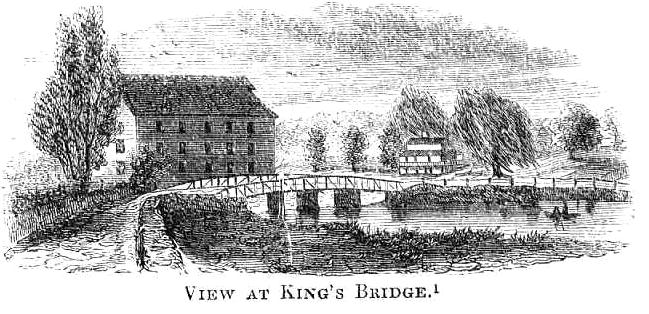
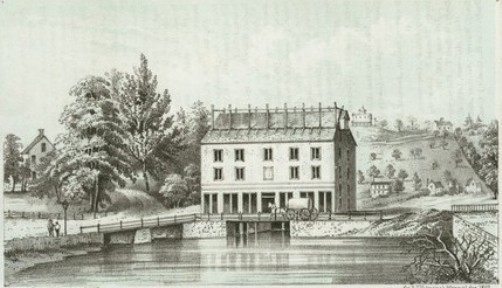
As for the King’s Bridge, it too was destroyed — by Washington’s forces, as they fled in 1776 — but was rebuilt after the war. The community of that developed around King’s Bridge, losing the space and the apostrophe, was officially part of Yonkers until the city of New York annexed it in 1874, years before the creation of the Bronx borough.

Below: The bridge as it looked in 1856

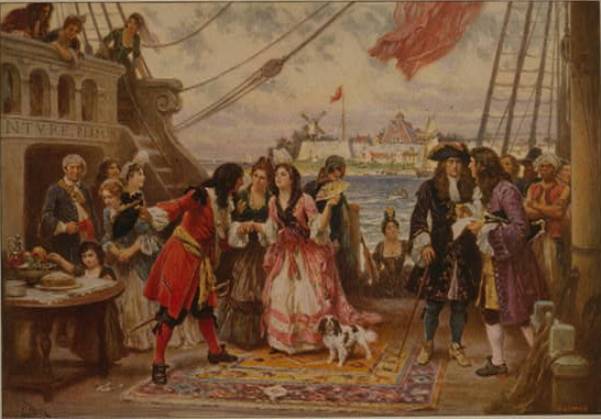
Captain Kidd and his swanky New York waterfront home

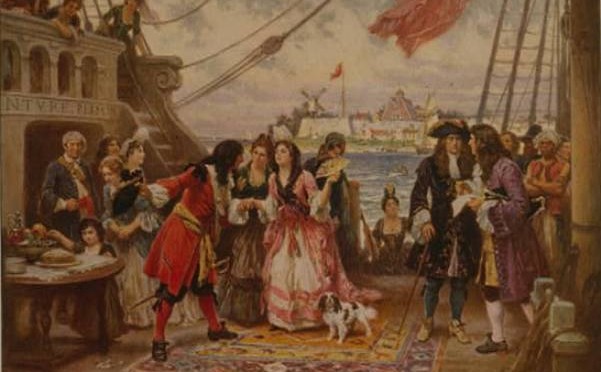
Above: A fanciful painting of Captain Kidd in New York Harbor, by Jean-Leon Gerome Ferris, 1911. Notice Fort James (former Fort Amsterdam) and the adjoining windmill in the background

In this week’s podcast, I refer to New Yorker and Trinity Church benefactor William Kidd as one of the most notorious pirates of the Atlantic Ocean. Now I feel that might have been a bit of slander.

It is true that Kidd, forever known to generations of seafarers as Captain Kidd, was vilified by the British for illicit profiteering and eventually hanged in London on May 23, 1701. But Kidd himself fought off the charges voraciously, and today historians believe Kidd was scapegoated and was himself following orders of the governor of the New York colony himself — Richard Coote, the Earl of Bellomont. Yes, the man who tried to annul the charter of Trinity Church!

I’ll save the details of Kidd’s exploits for various pirate-themed blogs. Kidd may have been prosecuted unfairly, but the legend that arose around his real or imagined exploits makes him one of New York City’s most notorious residents of the 17th century. Not only was Kidd one of early New York’s most wealthy residents, but almost without question he had one of the best views in the city from his bedroom.

According to historian Richard Zacks, New York was “the pirate port of choice in the English colonies in North America” in 1690s, with its rich harbor and its relatively multi-cultural port. Still a volatile colony amongst England’s land possessions, it was easy to walk around without harassment and recruit other like minded scallywags for upcoming jobs.

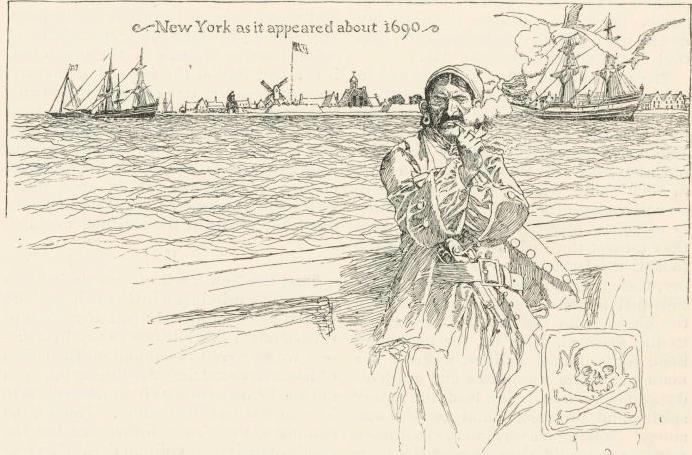
Below: A fanciful sketch by artist Howard Pile (dated Nov. 1894) for Harpers Magazine, with fort and windmill also in background [source NYPL]

Kidd was an employee of the Crown, a privateer essentially hired to capture pirates and any foreign vessels that got in England’s way. He was based in New York for many of the same reasons more illicit sea captains were here — opportunities, money and a suitable harbor for his vessel (Kidd’s was called the Adventure Galley).

He came to New York in 1691 and soon married Sarah Oort, a woman with extraordinary bad luck. Her first two husbands had died, one at sea, and after Kidd’s execution, she would then marry a fourth time. William and Sarah would have two daughters who would marry well into New York society despite their father’s notoriety.

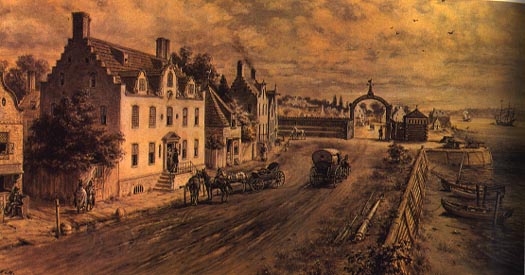
Despite his career, Kidd was considered a respectable New York gentleman — much, I imagine, because of his wife’s standing from her prior two marriages. Also, their digs weren’t bad. Although the Kidds owned several properties (again, thanks to Sarah), their primary residence was at the 119 Pearl Street, at the corner of Hanover and Pearl streets, a location which would have been waterfront property back in the day. It was also closely situated to Hanover Square, New York’s retail district and later home of the colony’s first newspapers.

The sizable home was located next to New York’s old wall, a fortification that would be ripped down within the decade and replaced with the street named after it. Kidd’s home is pictured below (i.e. the big white one):

The Kidds home was especially lavish for the time, with “104 ounces of silverware,” a healthy wine cellar and the biggest Turkish carpet in the city. Their wealth would have made them candidates for a pew at the newly built Trinity Church in 1696. Although Kidd provided equipment to help build the church, it appears Kidd himself never worshipped there. (His wife Sarah most likely did.)

Virtually no traces of this era exist in downtown Manhattan today, and the land extension east and the skyscrapers built there eradicate the view the Kidds would have had from their home.

Over a hundred years later, at the same address lived a man named Jean Victor Marie Moreau who would also influence world history: he’s best known as one-time right-hand-man of Napoleon Bonaparte, banished for betrayal in 1804 and sent to America, where he lived for a time at 119 Pearl.

You can read a nice, lengthy piece about Kidd and his New York connections here at Maritime History.

Categories
Podcasts

Trinity Church: anchor of Wall Street, New York’s landlord

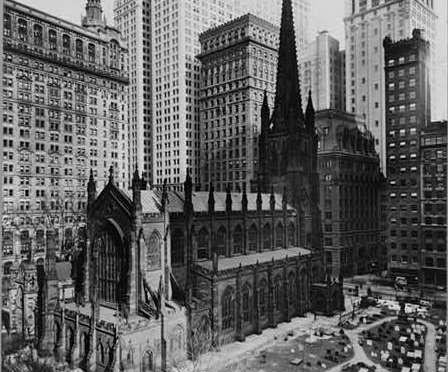
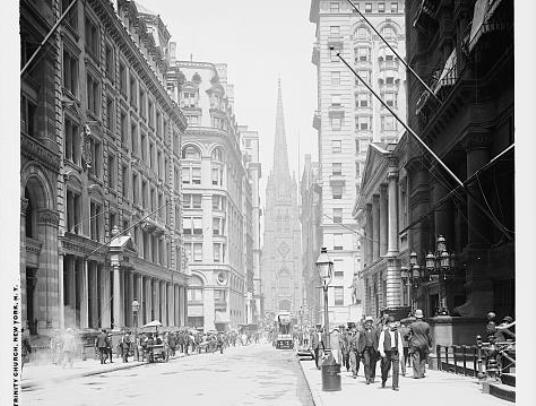
Above: The seemingly unchanged Trinity in 1916, already dwarfed by skyscrapers

PODCAST Trinity Church, with its distinctive spire staring down upon the west end of Wall Street, is more than just a house of worship. Over three different church buildings have sat at this site, and the current one by architect Richard Upjohn is one of America’s finest examples of Gothic Revival architecture.

The church collected Manhattan’s upper crust for decades and functions as one of the city’s most powerful landowners. Listen to our short history on the New York institution and find out who’s buried in their famous churchyards — Founding Fathers, inventors and a whole lotta Astors.

___________________________________
Clarification: In discussing the religious make-up of late 17th century New York, we failed to clarify that there were many Anglicans that already lived in the city but were not associated with the Church of England. These “English dissenters” belief systems were similar to the Anglicans but they disagreed with state meddling into religious affairs.
___________________________________

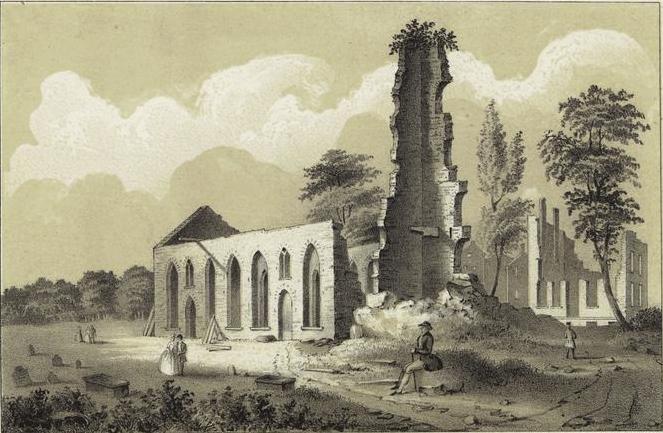
Fire Walk With Me: Below is a 19th century illustration of the ruins of the first Trinity Church, gutted in the fire of 1776 which subsequently destroyed one quarter of the entire city. The remains sat for many years undisturbed, and a second church would only be rebuilt after the British were expelled from New York. [NYPL]

___________________________________

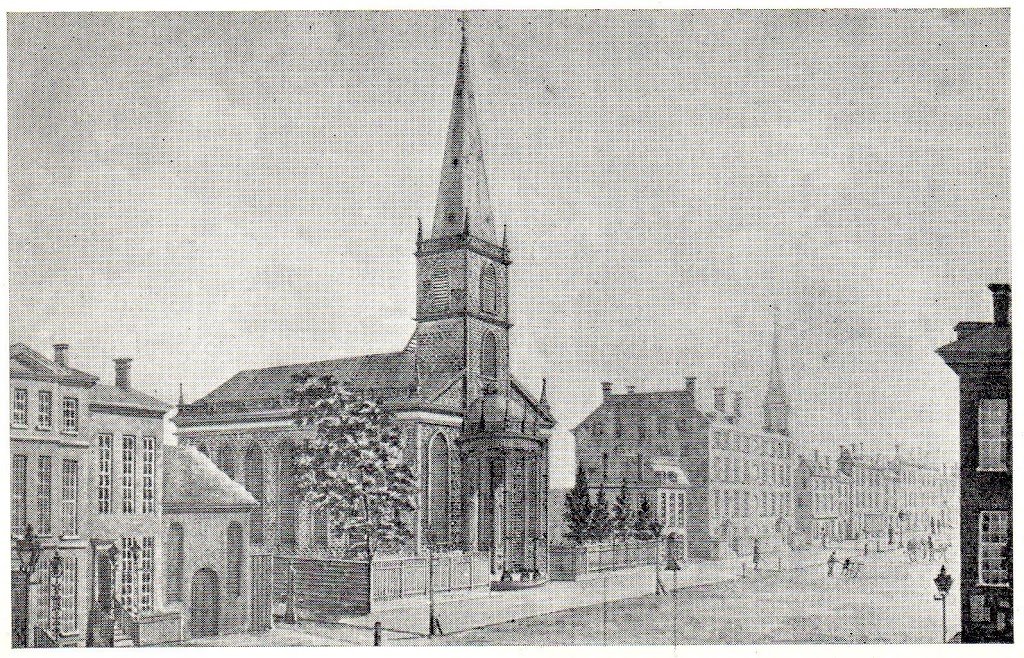
Snowed In: The second Trinity church, built on the same spot as the first, sat for over four decades until weight from massive snows during the winter of 1836 weakened the roof to such an extent that the entire structure had to be demolished. [NYPL]

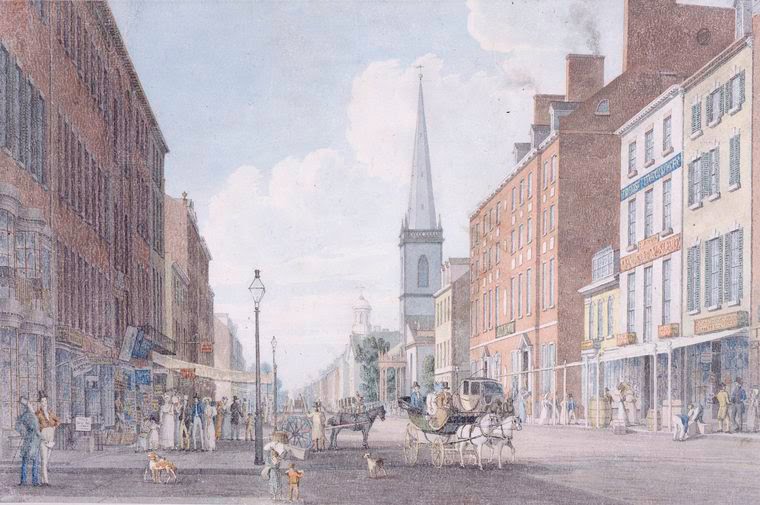
Another view of the second one (dated 1830), looking down Broadway. Trinity’s distinctive spire was already considered the city’s most recognizable landmark.

___________________________________

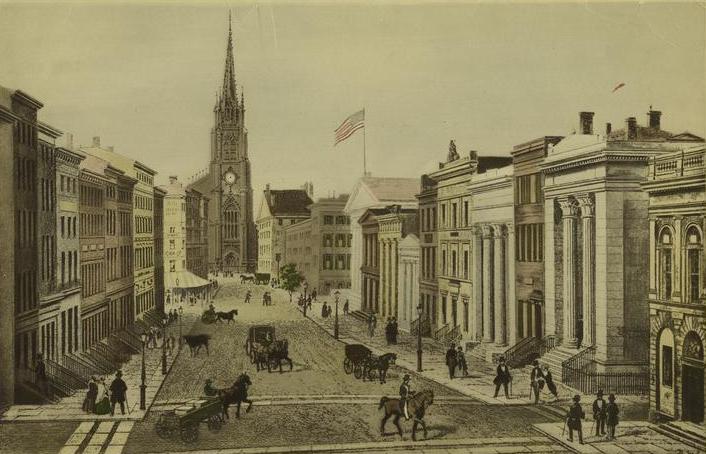
Third Times A Charm: Richard Upjohn’s Gothic Revival masterpiece was the tallest building in New York from the time it opened in 1847 (the date of this lithograph) until 1890, when it was finally usurped by the New York World building. [NYPL]

The same view, from 1903, as the city morphs rapidly around Trinity.

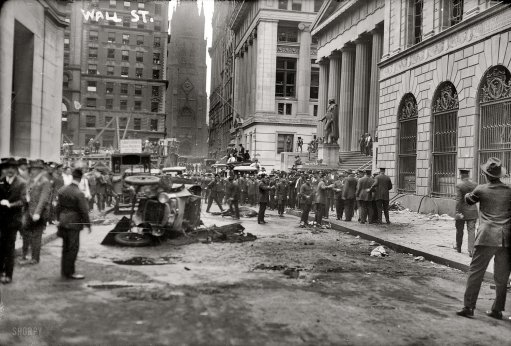
Witness to the September 16, 1920, terrorist bombing in front of JP Morgan’s….

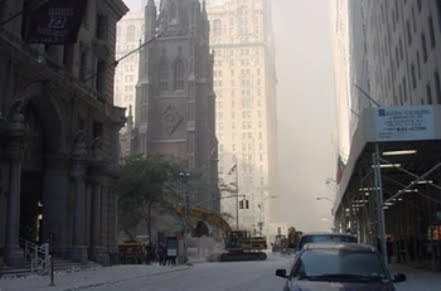
…and the World Trade Center attack on September 11, 2001. [courtesy Sacred Destinations]
___________________________________

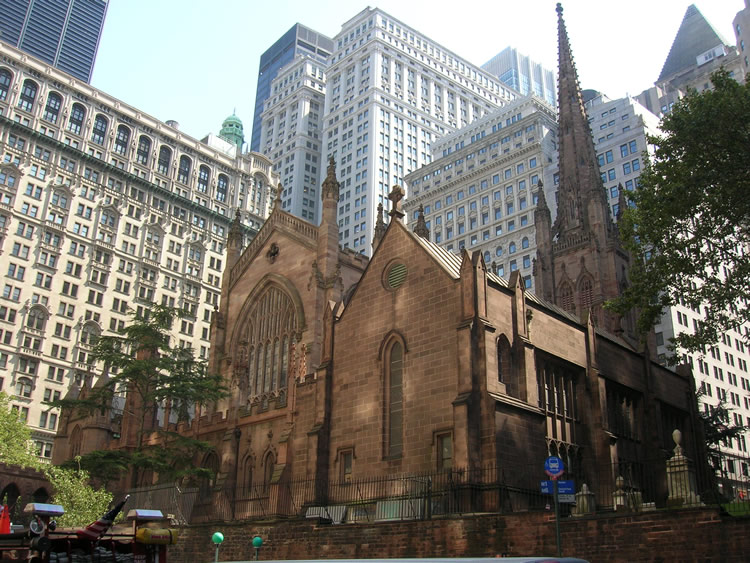
Looking good from all sides. [Courtesy Sound Mind]

___________________________________

Below is the Trinity Building from 1911. This is the replacement of a building that once stood here that is commonly considered New York’s very first office building. That five-story building, also designed by Upjohn, stood here for about fifty years and was demolished in 1904 to make way for the Beaux-Arts beauty standing there today.

For more information, visitin the Trinity Wall Street website for information on tours and afternoon concerts. And as always, thanks to the New York Public Library for use of some of the images above.

100 Years Ago: The Brooklyn Botanic Garden opens


Photo by Louis Buhle (1915), courtesy of the BBG

The Brooklyn Botanic Garden is celebrating its 100th anniversay this year. Like Flushing Meadow-Corona Park in Queens, the Garden was created out of an ash dump, landscaped by the Olmsted Brothers (later of Fort Tryon fame), “for the advancement and diffusion of a knowledge and love for plants.” The garden’s patron saint is most certainly Alfred Tredway White, whose name you’ll most likely see a few times as you wander the various gardens; White was an enlightened Brooklyn tenement owner and philanthropist who lobbied for and later helped fund the garden’s creation and maintenance.

They’re currently offering free weekday access to the grounds, an offer I took them up on yesterday. Obviously, the dead of winter is not the most ideal time to visit a public garden, however the greenhouses are still open, and the ice and cold provides some rather unusual natural phenomena, like the frozen brook below:

The Steinhardt Conservatory Gallery at the garden’s greenhouses is currently featuring a small show of photos from the BBG’s past.

Also debuting exactly 100 years ago:

Yonah Schimmel’s Knishery begins selling their famous, hearty potato treats. We highlighted them couple years ago in our Katz Delicatessen podcast.

— Jacob Gimbels opens his Gimbels Department Store in 1910 in a space originally designed by Daniel Burnham, just a block away from Macy’s. Today, that department store space has the distinction of being the wretched Manhattan Mall. However Gimbels did build that spectacular copper pedestrian bridge — which is still hanging over 32nd Street.

And if you’ve be interested in these ‘100 Years Ago’ columns over the last few days, you should check out a recent article in the Brooklyn Eagle Looking Back to 1910.

100 Years Ago: Worst theatrical review ever written?

Readers of the New York Times on January 19, 1910, were greeted with the following theatrical review:

FAT PEOPLE MUST AVOID THIS FARCE;
Unless They Want To Put On Extra Pounds To Prove An Old Adage

If you’re confused, the lead of the review elaborates:

“If to laugh is to grow fat, obesity patients had better take to the other side of the road when they see the sign ‘William Collier in ‘A Lucky Star’ looming up in front of the Hudson Theatre on Forty-Fourth Street.”

This is actually from a glowing review of a new farce by Anne Crawford Flexner. Do you know anybody who says ‘to laugh is to grow fat’ anymore? Thank goodness that one died out.

Flexner, by the way, was a fascinating woman, an ardent feminist and suffragist whose daughter Eleanor became a revolutionary in the field of women’s studies.

Thanks to absurdly positives reviews like the one in the Times, Flexner’s ‘A Lucky Star’ continued on Broadway for three more months. Read the full review here.

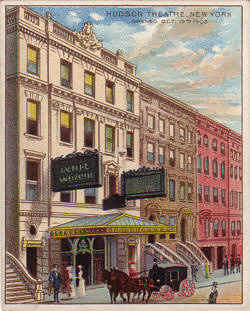
Incidentally, the Hudson Theatre (141 W. 44th St., at left), now landmarked, is still around as convention space for the Millennium Broadway Hotel. Notably, the first production of Arsenic and Old Lace debuted here on January 10, 1941. Given all the news about ‘late night TV’ wars, you may be interested to know that it all started here: the first Tonight Show, with original host Steve Allen, was first broadcast here, at the Hudson Theatre, in 1954.

100 Years Ago: Curtiss and the first long-distance flight

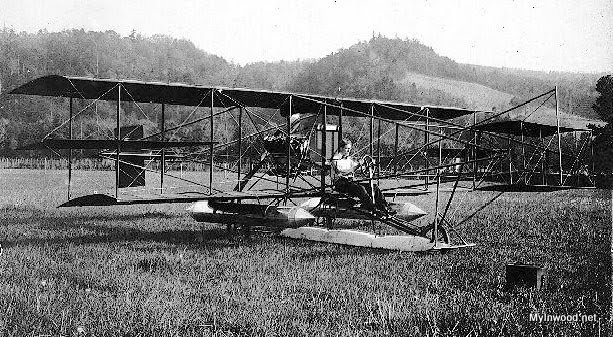
Up In The Air: Glenn Curtiss and his Hudson Flyer
Picture courtesy glenncurtiss.com

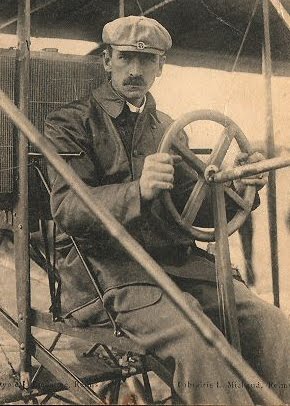
In 2010, there will be well over 100 million passengers coming and going from the New York metropolitan area’s three principal international airports. In 1910, you could count the number of passengers on your hand. And the pilot and passenger of the very first long-distance flight to New York was professional aerial derring-do Glenn Curtiss.

There had not even been an airplane over New York skies until the previous year, when Wilbur Wright flew over the length of Manhattan in honor of the Hudson-Fulton Celebration. (Hear more about it in our LaGuardia Airport podcast.) Curtiss, who had proven himself earlier that year in the world’s first air meet in France. was also commissioned to fly alongside Wright in a separate plane from Governor’s Island that October 1909, but his craft barely made it off the ground. A crushing defeat, because he and the Wright Brothers were hardly friends.

In fact, the Wrights were suing Curtiss (and his collaborator, the phone man Alexander Graham Bell) for patent infringement in a New York court in 1910; his early flying machines were similar in design to the Wrights, they claimed. The nasty court proceedings would cost both parties thousands of dollars; Wilbur would even die in 1912 before the case resolved (eventually in the Wright’s favor).

Every flight Curtiss took cost him royalties to the Wrights. Luckily for the speedster, raising money wasn’t difficult for a young daredevil, as newspaper men of this time loved offering prize money for spectacular stunts. News moguls like Joseph Pulitzer and William Randolph Hearst just loved to pay people to create news.

In January, Curtiss would win a speed race in Los Angeles funded by railroad magnate Henry Huntington, who more than made up his $50,000 prize offering when 20,000 spectators took his train to the event. Pulitzer’s New York World would provide a smaller prize ($10,000), but it would have been of great appeal to Curtiss: the cash went to the first person to fly from Albany to New York, about 150 miles, essentially the first long-distance flight between cities ever made. Still smarting from Wilbur’s 1909 Hudson-Fulton victory, Curtiss wanted to make his mark over New York City.

On the morning of May 29, 1910, Curtiss and his newly named Hudson Flier took off from Van Rensselaer Island, just next to Albany, and glided above the Hudson, as a trainload of New York Central passengers (including Curtiss’s wife) followed from below. Pilots would not yet have the fuel capacity to make one continual flight; it was enough I suppose just to make it from one destination to the other in the same plane, in one piece! Curtiss stopped once for a fuel break in Poughkeepsie; an hour later, winds off of Storm King Mountain almost ripped his plane asunder.

Right as Curtiss set his sights on the young Manhattan skyline, his plane began leaking oil and the pilot had to touch down again, unceremoniously landing in New York City — but in Inwood, not the finish line at Governor’s Island. He touched down unannounced on the estate of William B. Isham, where Isham’s daughter Flora and her husband Minturn Post Collins offered the pilot gasoline and oil.

By that time, a crowd of New Yorkers had descended onto the Isham estate to witness this incredible sight. Curtiss thanked Collins and his wife, rolled his plane off the estate and into the air. He coasted along Manhattan’s west side, over the harbor and around the Statue of Liberty, finally landing at Governor’s Island just in time for lunch.

Within the month, Curtiss’ amazing flight would be bested by his friend Charles Hamilton, flying round trip in June 1910 from New York to Philadelphia and also winning a $10,000 prize in the process.

You can read more about Curtiss’ time in Inwood at here.

100 Years Ago: Frankenstein monster stalks the Bronx

In 1910, DW Griffith made the first film ever made in Hollywood, CA, called In Old California. Before then, film production companies were scattered throughout the United States, with two of the most successful based here in New York City.

The American Vitagraph Company, originally located at the Morse Building on 140 Nassau Street, made film shorts on the roof before moving to the Brooklyn neighborhood of Midwood in 1906. Vitagraph is best known for producing a five-part serial on The Life of Moses strung together to make what some call the first ever feature length motion picture.

More influential, however, was Edison Studios, the film company owned by inventor Thomas Edison. With principal studios in the New Jersey town West Orange — and original laboratories in Menlo Park (now Edison, NJ) — Edison eventually set his sights on a Manhattan studio.

He initially moved into the heart of the city in 1901, in a studio at 41 East 21st. Such a move made sense at the time; movies were only a few minutes long, essentially just filmed sequences of activities, and had no sound. A small studio smack in the center of New York would not have been disturbed by the bustle of the city.

With the growth into narrative films — longer movies with elaborate sets and casts — Edison needed to expand into a larger space and in 1908 moved production to a warehouse in the Bronx, at Decatur Avenue and Oliver Place, close to the New York Botanical Garden.

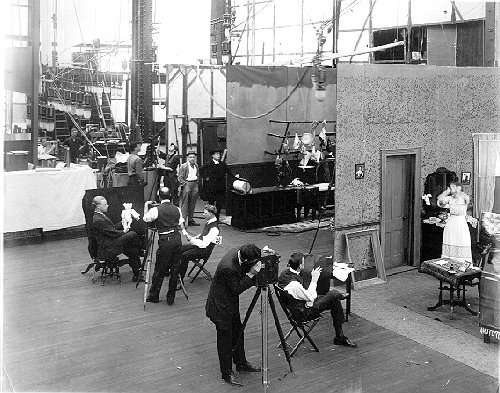
Below: Inside Edison’s Bronx studio

“The Edison Studio is said to be one of the finest and largest of its kind in the world,” reported [the theatrical trade paper] The Dramatic Mirror. “The building itself is 60 by 100 feet, built of concrete, iron and glass. The scenic end of the studio, corresponding to the stage in a theatre, except that it is not raised is 60 by 60 feet and 40 feet high. Here the scenes for film productions that cannot be made with natural outdoor backgrounds are painted and set.” [source]

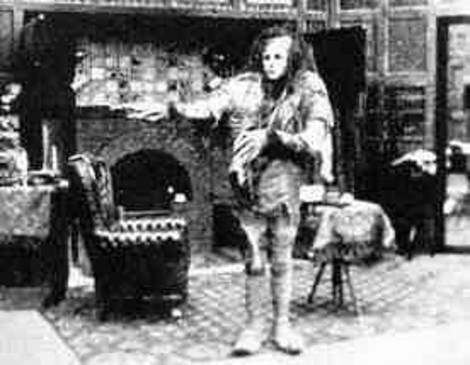
It was at this new Bronx studio in 1910 that Edison’s company produced one of its greatest works, the very first film adaptation of Mary Shelley’s Frankenstein. Shot in a week — rather lengthy for a film shoot in those days — the loose adaptation featured Charles Ogle as the famed monster. Believe it or not, the film began production on January 17, 1910, and was released by March of that year! Since there just weren’t that many movies houses in 1910, a film released constituted about 40 copies which were distributed around the country, then returned several months later.

The film was reportedly lost forever before a single negative was found and restored in the 1970s. I present to you the Bronx-made psycho-horror masterpiece in all its glory (watch it below or click here):

You can find more information about the film at Frankensteinia.

100 Years Ago: Beer, tradition and the new Bohemians

Pic by Coney Girl/Flickr

FRIDAY NIGHT FEVER To get you in the mood for the weekend, on occasional Fridays we’ll be featuring an old New York nightlife haunt, from the dance halls of 19th Century Bowery, to the massive warehouse clubs of the mid-1990s. Past entries can be found here.

LOCATION Bohemian Hall
Opened: 1910-still open!
Astoria, Queens

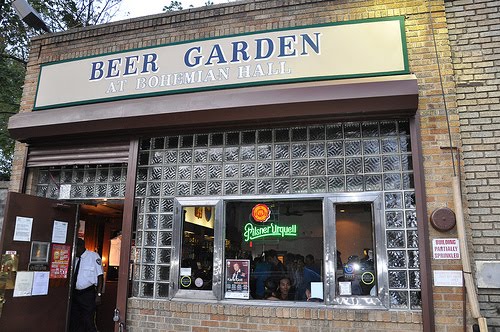
How about a story on the positive effects of alcohol on New Yorkers? This year is the 100th anniversary of the city’s oldest beer garden, Bohemian Hall, an understated, well-worn treasure in Astoria, Queens, which belies its importance to the borough’s Czech community. It may also be the only place in the New York City that sells liquor in the same building as a school.

These aren’t bohemians of the floaty literary 19thCentury (or 60s groovy) stripe, but an actual culture who trace their lineage to the sizable region of Bohemia, located in the modern Czech Republic today. Sandwiched between the Bohemian Forest and the Ore Mountains, this ancient area of Central Europe was part of the Austro-Hungarian empire and would, later in the 20th century, become the heart of the newly formed Czechoslovakia.

In 1910, New York City is at the tail end of the massive immigration boom hurtling through Ellis Island, with 6 million people processed through the center in the prior decade. Bohemians were among the great throng of new Americans, although not at a rate comparable with other nationalities. According to the US Census, by 1910, 200,000 first generation Czechs lived in the United States, up from about 10,000 total in the 1850s.

There was a sizable Czech community in New York during the late 19th century; one source claims that almost 95 percent of Czech working adults and children were employed in the cigar business. “The factories in the regions of Seventieth street, New York, are filled with Bohemian women and girls employed in the making of cigars,” according to Jane Robbins.

Like other national groups, the Czechs and Slovaks of New York had their own support groups and newspapers (the first two: New Yorske Listy, founded in 1879 and Slovak v Amerike, in 1889) and developed small enclaves throughout the city, including the old Czech neighborhood in Manhattan’s Upper East Side in Yorkville and out in Astoria, among others.

It was in Astoria in 1892 that the Bohemian Citizens’ Benevolent Society was formed to help the transition for new immigrants and provide a community bond for everybody else. In fact, the society is still around today, with purposes that certainly sound very similar to old objectives: “to encourage, support and maintain Schools, Dramatics, Lectures and Libraries for Czech and Slovak children …. [and] to maintain a nonprofit making social home for people of Czech and Slovak ancestry, in which the Czech and Slovak culture may be taught and blended with American traditions and culture, thereby tending to make the members better Americans.”

By 1910, the society would raise funds to open a community center and buy up some available lots in Astoria, some on former farmland. The cornerstone for the modest brick Bohemian Hall was laid October 1, 1910, and the original building swiftly constructed by volunteers in the community.

Selling beer was merely one function of the new building; a meeting hall was constructed soon after, hosting political functions and family functions, and by 1919 an outdoor seating area was completed, in the style of many German outdoor drinking and eating located throughout the city for years. The Society’s enthusiasm to capture the beer garden spirit was felled only by the coming of Prohibition. When legal drinking returned, the Hall in 1933 received a new fence to wrap out the vast yard (200-by-125 feet) and some scattered linden trees, the national tree of the Czechs.

The Hall was more than a place to toss back a few Pilsner Urqells. The Hall provided (and, in fact, still provides) Czech and Slovak language courses specifically for children and once even offered Sokol gymnastic courses, essentially an old-school form of calisthenics dating back to 1862.

Time has pretty much stopped at Bohemian Hall; like any bar, televisions have been added and the patrons are young locals and beer lovers, but I imagine that the vibe is almost identical to what it might have been like 70-80 years ago. Like McSorley’s Old Ale House, the focus is beer — all day, every day — but bolstered with a menu of traditional dishes and (during the summer) barbecue.

In a city were beer gardens once flourished — thanks to the millions of Germans and German-Americans who have lived and worked here — Bohemian Hall is now the last remaining vestige. (Obviously there are many brand-new beer gardens scattered throughout today.)

For some more information on Bohemians, Chechs and Slovaks in New York, check out the blog Slavs of New York. Bohemian Hall’s official website has more information about their hours and other services.

Located at 29-19 24th Avenue in Astoria, Queens, right off the Triborough Bridge

100 Years Ago: Celebrity writer drinks himself to death

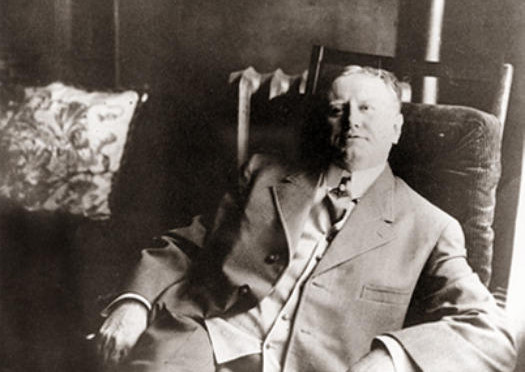
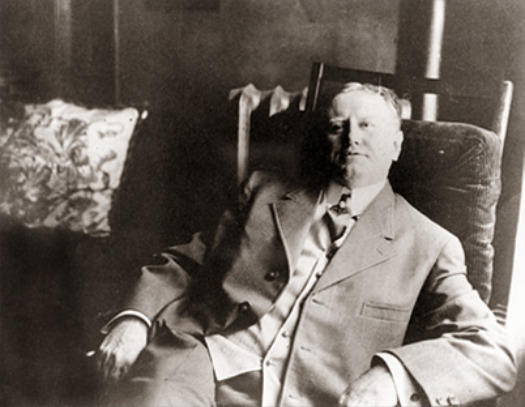
O. Henry in 1909. He may even be drunk here.

New York City has a fine, macabre tradition of harboring famous artists, writers, musicians and actors on the cusp of an alcohol or drug-fueled demise. The city naturally attracts the creative, oddballs and innovators looking for like minds amid the flourishing artistic communities of the city. Many of these also tragically detoured into the city’s equally impressive collection of taverns, saloons, opium dens, speakeasies, nightclubs, coke dens and crackhouses.

Countless have drank and drugged themselves to ruin in the city’s 400-year history, either unintentionally or with suicidal design. If you’re looking to pinpoint the first major instance of this trend among the major icons of American history, look back in New York City history exactly one hundred years ago to the death of one of this country’s most iconic writers, O. Henry.

Henry (real name William Sydney Porter) is not the first American writer to die of the effects of alcoholism. Probably the most infamous was one-time New Yorker Edgar Allen Poe, who died in a Baltimore gutter in 1849. I’m not even going to claim that O. Henry was even the first notable alcoholic death in New York City. For instance, Jewish poet Naphtali Herz Imber collapsed and died in the Lower East Side from an alcohol binge in 1909.

But O. Henry was an undisputed American star at the time of his death, one of the country’s most famous writers and the pioneer of the short story. Artists at the height of their success in 1910 do not die of alcohol abuse, at least officially. In fact, his death by cirrhosis on June 5, 1910, is heavily glossed over in contemporary sources.

Porter first became O. Henry in 1899, in an article for McClure’s Magazine. It should be noted he wrote that particular story while in an Ohio prison, serving a five year stint for embezzlement. He moved to New York City in 1902 where he flourished, writing hundreds of stories and becoming America’s most prolific and most popular writers.

Many of his stories are set in New York, although his popular ‘The Ransom of Red Chief’ (one of favorite stories as a kid) is a kidnapping yarn that takes place in Alabama. Probably his most famous tale, the 1906 ‘Gift of the Magi’, was written, according to legend, at Pete’s Tavern near Gramercy Park.

So yes, like many writers, Porter wrote and drank, both prolifically and magnificently. In fact, he kept drinking even though his body began deteriorating from the effects of cirrhosis and diabetes.

On June 3, 1910, Porter collapsed after writing a letter and was taken to the New York Polyclinic Hospital at 218 East 34th Street (today near the entrance of the Queens Midtown Tunnel), checking in under a false name to throw off the newspaper reporters. He died two days later, his last words reportedly, “Turn up the lights. I don’t want to go home in the dark.”

Biographies of the day barely mentioned Porter’s drinking problem and the cirrhosis which killed him. The writer was buried in Asheville, NC, the hometown of his wife Sara.

For the next hundred years, troubled celebrities would follow his morbid example — from Dylan Thomas to Billie Holiday, Heath Ledger, GG Allin, Lorenz Hart, Sid Vicious, Jean-Michel Basquiat, Montgomery Clift, Julia Bruns, and many more.

“It couldn’t have happened anywhere but in little old New York.” — O. Henry

100 Years Ago: Somebody actually shot the mayor

New York City started 2010 with an important bit of ceremony: the swearing-in of Michael Bloomberg. One hundred years ago, New Yorkers did the same thing, but with a new face — former state Supreme Court judge William Jay Gaynor, replacing George B. McClellan.

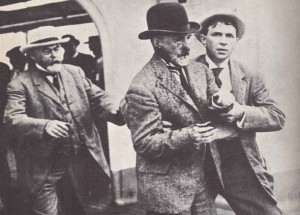
I did a whole Know Your Mayors posting about Mr. Gaynor awhile back, so I won’t elaborate too much about his biography here. However, just eight months after taking the job, on August 9, Gaynor was almost killed by an assassin’s bullet. As I originally wrote:

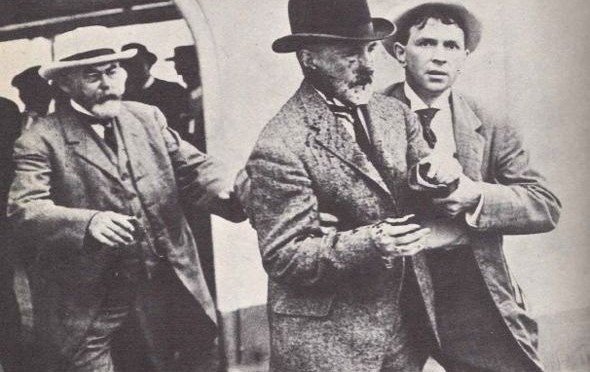
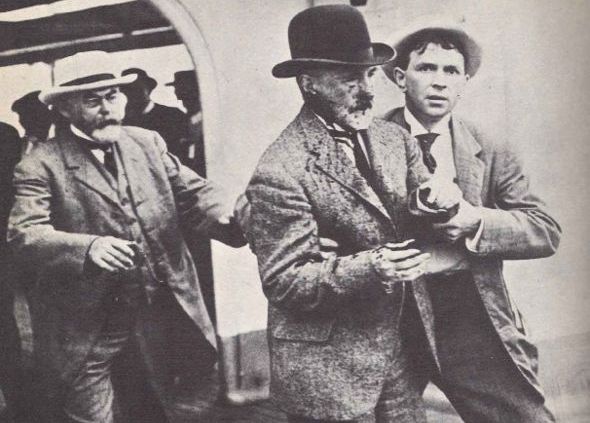
“While vacationing on the ocean liner SS Kaiser Wilhelm der Grosse, a disgruntled city employee James J. Gallagher, fired from his job on the docks, took out his frustration on Gaynor, shooting him through the back of the neck. Gallagher claimed, “He took away my bread and meat. I had to do it.” Really, James?

Unbelievably, a photographer for the New York world William Warnecke happened to catch the incident, which quickly became one of the most startling photographs in the short history of photo-journalism. [The photo above!]

Gaynor recovered somewhat, although the bullet would remain lodged in his throat, and for his entire term of mayor, he would remain weakened and haggard. He would even use the injury as a reason to get out of discussing delicate subjects, saying, “Sorry, can’t talk today. This fish hook in my throat is bothering me.”

Somebody should have advised Gaynor, however, to avoid ocean liners altogether. On Sept. 4 1913 he boarded the Baltic for yet another oceanic vacation and six days later was found dead on a deck chair, his body finally giving in to lingering internal injuries. Curiously, Gaynor’s would-be assassin Gallagher had died just a few months prior — at an insane asylum in Trenton, New Jersey.”

Read the rest of the piece here

Other political stories of 1910:
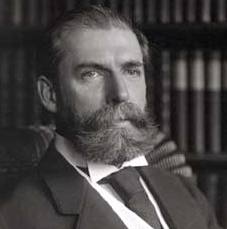
This was the final year in the term of New York governor Charles Evans Hughes (pictured), but it was hardly the last anybody would hear of the distinguished New Yorker. After an unsuccessful bid for president of the United States in 1916, President Warren G. Harding made him Secretary of State in 1921. Then he became the Chief Justice of the Supreme Court in 1930, where he resided over the greatest court in the land for an entire decade, helping bring Franklin D. Roosevelt’s New Deal policies to life.

What a surprise: corruption in the New York state senate! Senate Majority Leader Jotham P. Allds resigns on March 29, 1910, after it’s revealed that he took bribes from bridge construction companies to kill some undesirable legislation. In April, other senators, including notorious Lower East Side power broker “Big Tim” Sullivan, are implicated in several other bribery schemes, involving streetcar and fire insurance companies.

Capping it off is testimony in September 1910 that several lawmakers, with Williamsburg senator Patrick Henry McCarren smack in the middle, were given “a legislative corruption fund of $500,000” in early 1909 — during a dinner at Delmonico’s Restaurant, no less — to squash some critical anti-race track gambling legislation.

Nobody was censured — and McCarren had died in late 1909 — but the largely Republican scandal was probably key in getting a Democrat, John A. Dix, into the governor’s seat the next year.

[You can find all the juicy details in Gustavus Myers’ wonderful History of Tammany Hall.]

—-
AND SPEAKING OF RATS…
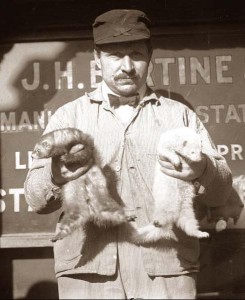
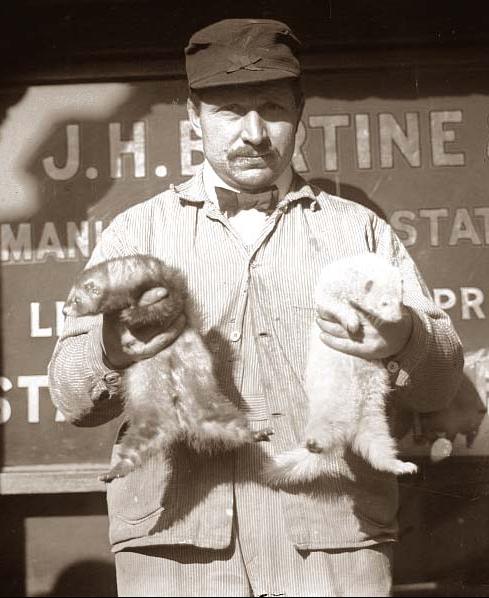
ABOVE: A New York City ratcatcher, photo taken during the 1910s, but those don’t look like rats to me. In fact, I think the ferrets are used to sniff out vermin. (Picture courtesy the great Old Photos blog)

And finally, for no reason other than humor, I present to you a letter that Mayor Gaynor wrote in March 20, 1910, to one Charles M. Frey, noted and ‘learned’ city ratcatcher. Imagine Mayor Bloomberg penning such a missive to one of his constituents:

“Dear Mr. Frey, Your letter of March 15 is at hand, describing how your calling of ratcatcher is being constantly interrupted by your being summoned to serve as a juror.

Sooner than have the city overrun with rats and everything eaten up by them I would have you relieved of jury duty. Do you not think we had better have a bill introduced in the Legislature to exempt ratcatchers from jury service?

The difficulty is, however, that so many exemptions have already been passed by the Legislature that there seems to be only ratcatchers and a few other people left to serve on juries. That might possibly impede the progress of your bill if sent to Albany.

I will have to carefully consider the matter, and some day when you are down this way, come in and we will talk it over, and also about rats. I see that you are a classical scholar, judging by the motto at the head of your letter. My experience is that learned men are to be found everywhere. As we read in Don Quixote: “The mountains breed learned men and philosophers are found in the huts of shepherds.”

[More of Gaynor’s fascinating correspondence here.]

100 Years Ago: Women still can’t vote, but they can march

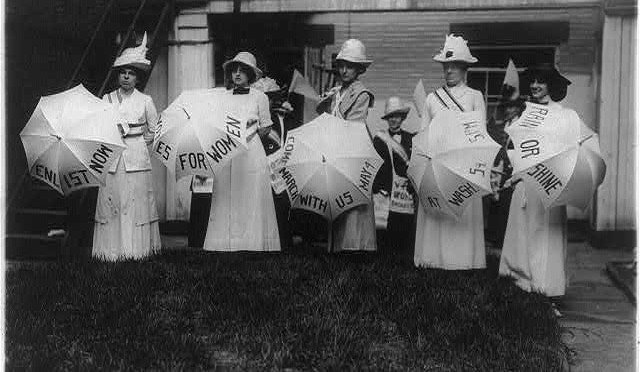
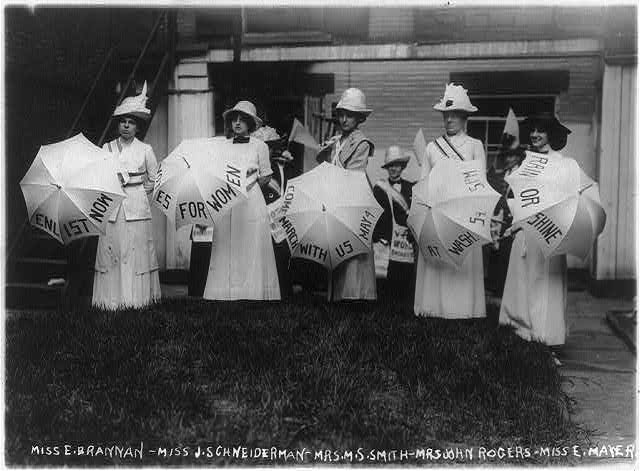
All The Single Ladies: though I believe the women above are actually garbed for a suffrage march in 1912, I just couldn’t resist this photo (Courtesy LOC, click pic for detail)

It seems so bizarre now that it feels funny writing it — one hundred years ago, women didn’t have the right to vote in this country. Actually it’s worse than that –it wasn’t until 1920 that the 19th Amendment was ratified — but the 100-year mark is significant as it marks the first significant public march devoted to suffrage in New York City.

New York state is of course the epicenter for the women’s rights movement in the 19th Century. Liberty Party presidential candidate Gerrit Smith gave a heralded speech in Buffalo in 1848 urging “universal suffrage.” The convention in the small town of Seneca Fall, NY, later that year united the country’s great civil rights and proto-feminist leaders for a bevy of women’s causes. Susan B Anthony and Elizabeth Cady Stanton both lived in New York City at one time, and the National American Woman Suffrage Association formed here in 1900 with Carrie Chapman Catt as president.
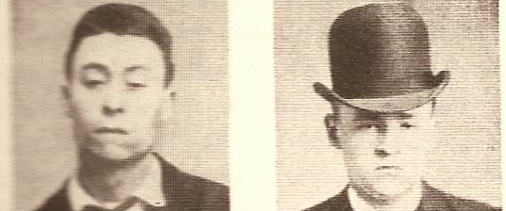
But the tipping point for suffrage seems to have begun in 1910 at the peak of a so-called ‘suffrage renaissance’, nationally with the first state referendums (yes to suffrage in Washington, no in Oregan, California would pass it in 1912, Ohio would defeat it) and locally with the first large-scale women’s suffrage march through the streets of Manhattan on May 21, 1910.*

Like later social causes, early suffrage organizations tended to be passionate, but fragmented. The May 21st march was actually organized by the newer Women’s Political Union (formerly called the Equality League of Self Supporting Women!), but its participants drew from a wide range of supporters — activists, working women, socialites, students.

Led by Union president Harriot Stanton Blatch, the daughter of Elizabeth Cady Stanton, the parade of almost 400 women might have been dwarfed by other processions, but the sight of such a large cluster of loud, boistrous (and unaccompanied!) women, many of great wealth, wearing ‘Votes For Women’ sashes, riding in automobiles or holding banners such as “New York State Denies the Vote to Idiots, Lunatics, Criminals, and Women” and all of them dressed in white — all of this clearly piqued the curiousity of New Yorkers.

The modest 1910 march did the trick, leading, according to the Library of Congress, to much larger processions down Fifth Avenue on May 1911 (3,000 marchers), May 1912 (10,000 marchers) and November 1912 (20,000 marchers).

Parades were even more powerful 100 years ago at catapulting your cause into the mainstream. According to journalism professor Linda Lumsden, “Women’s public agitation for the vote–in the form of parades, pageants, and pickets–helped them elevate their cause to a national level.”

Within seven years, in 1917 New York state would grant women the right to vote. The country would ratify the new amendment to the Constitution three years later, in time for the presidential election of Warren G. Harding.

*It appears that minor suffrage marches — mostly activists, relegated to less than 100 marchers — occurred in 1908 and possibly even 1905. Of course much larger worker’s rights marches would sometimes include people marching for the suffrage cause as well.

100 Years Ago: Queens and the influence of Penn Station


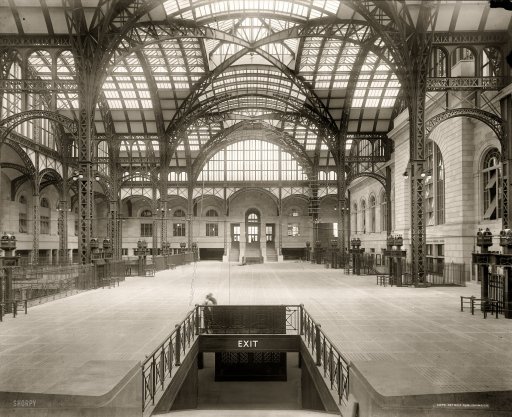
Pic courtesy Shorpy

Over the next few posts, I’m turning back to exactly one hundred years ago, to contrast the beginning of 2010 with the events of 1910. New York City was in the midst of its Gilded Age, at the beginning of the skyscraper era, more confident as a worldwide center of finance, media and power even as it was still learning to provide for a massive, increasingly multi-cultural population.

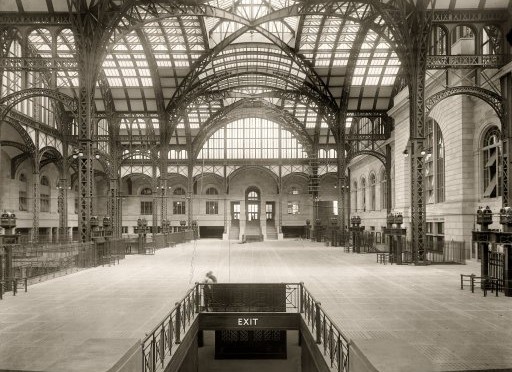
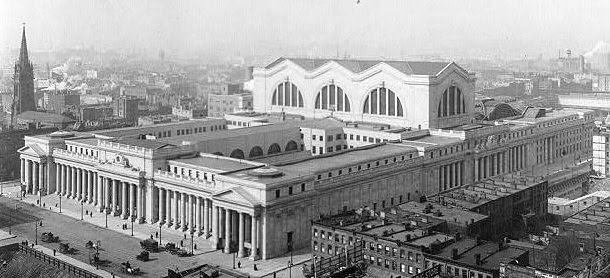
One of New York City’s most important historical events of 1910 was the opening of old Pennsylvania Station, the hallmark of Beaux-Arts grandeur and Manhattan’s most impressive building. However its impact would be felt more importantly in a borough it wasn’t even in: Queens.

Queens was brought into New York City with consolidation of the five boroughs in 1898, an assemblage of small towns, village and farmland once united only by county designation. There was certainly no Queens identity, and the population was sparse, the second-least populated after Staten Island. Population numbers in 1900 place 152,999 residents of the borough versus 1,850,093 in Manhattan (or just 8.3% of Manhattan’s total). Today, Queens has a greater population than Manhattan.

The slow beginning of that shift started with two neatly parallel events from 1909 and 1910. First was the opening of the Queensboro Bridge on March 30, 1909. Over a year later came something arguably more significant — the opening of the Penn Station tunnels on September 8, 1910, connecting with the Long Island Railroad, now owned by Penn Central Railroad. Residents of Queens could now commute directly into the city, while the borough became an option for Manhattan residents who wanted to escape the city.

With convenient passage between an over-populated island and its new, sparsely populated sister borough assured by 1910, it’s no surprise that the decade has been referred to Queens’ ‘construction period’, becoming the fastest growing borough of the decade.

Other events in Queens history from the year 1910:

— Presaging the population growth, the Neponsit Realty Company bought a stretch of land on the Rockaway Peninsula in January 1910 and formed the wealthy outpost neighborhood of Neponsit. Today it’s still row upon row of large homes, most dating from the 1920s and 30s.

— In 1910, the descendants of Albon P. Man, whose lavish estate dominated central Queens during the 19th century, began parceling out pieces of the estate to small landowners and developers, having decided to call the area Kew Gardens after London’s botanical garden complex.

As for Penn Station, regularly timed train service was finally initiated in November 27th of that year. According to Jill Jonnes, “By nine o’clock, excited New Yorkers, bundled up against intimations of snow or freezing rain, were converging upon the station’s Doric colonnades,” creating a mob scene on the new platforms. The hottest ticket in town that year was, strangely enough, a ticket outta town.

Penn Station was the most significant but hardly the only opening of 1910. The Madison Avenue Bridge, connecting Manhattan with the Bronx, opens that year, as do the Ritz-Carlton Hotel at 46th and Madison, and Liberty Tower at 55 Liberty Street. Also this year, work begins on the Woolworth Building.

Categories
Uncategorized

The Bowery Boys 2009: A Year of Podcasts In Review

Here’s the whole menu of our 2009 podcasts. As always, you can download them all for free from iTunes and or your favorite podcast aggregator. The original blog page for each is listed below, along with a link to download directly from our satellite site.

WEBSTER HALL

Blog page: Webster Hall, more than a dance hall
Download here

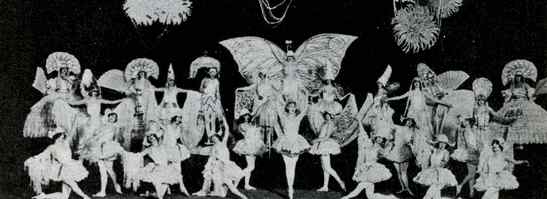
ZIEGFELD!

Blog page: Ziegfeld, the maker of dreams
Download page

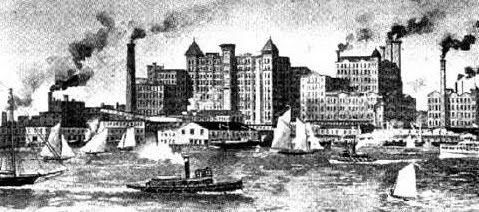
WILLIAMSBURG(H) BROOKLYN

Blog page: Williamsburg(h), Brooklyn — upstart city, sugar king
Download here

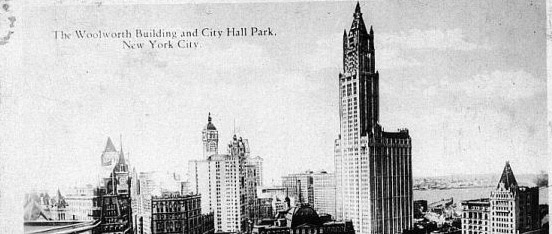
WOOLWORTH BUILDING

Blog page: Woolworth Building and the birth of the New York skyscraper
Download here

FREEDOMLAND USA

Blog page: Freedomland U.S.A., Bronx forgotten icon
Download here

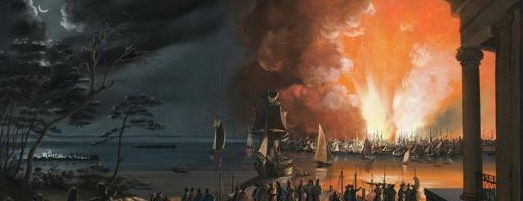
THE GREAT FIRE OF 1835

Blog page: The Great Fire of 1835, downtown disaster!
Download here

THE WHYOS, GANG OF NEW YORK

Blog page: The Whyos, Gang of New York
Download here

PENNSYLVANIA STATION

Blog page: Pennsylvania Station — Manhattan’s Missing Treasure
Download here

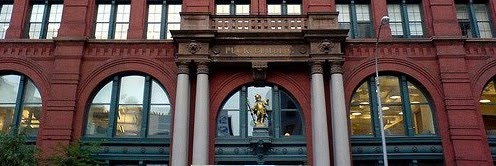
PUCK BUILDING

Blog page: The Puck Building “What Fools These Mortals Be”
Download here

ROOSEVELT ISLAND

Blog page: Roosevelt Island, New York’s former ‘city of asylums’
Download here

HENRY HUDSON

Blog page: Henry Hudson and the European Discovery of Mannahatta
Download here

PROSPECT PARK

Blog page: Prospect Park and the return of Olmsted and Vaux
Download here

SHAKESPEARE IN THE PARK

Blog page: Shakespeare In The Park, the drama behind the drama
Download here

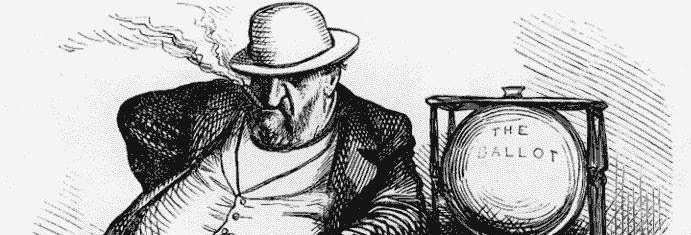
BOSS TWEED AND TAMMANY HALL

Blog page: William ‘Boss’ Tweed and the bitter days of Tammany Hall
Download here

KINGS OF NEW YORK PIZZA

Blog page: Kings of New York Pizza: Lombardi, Totonno, Patsy, Ray?
Download here

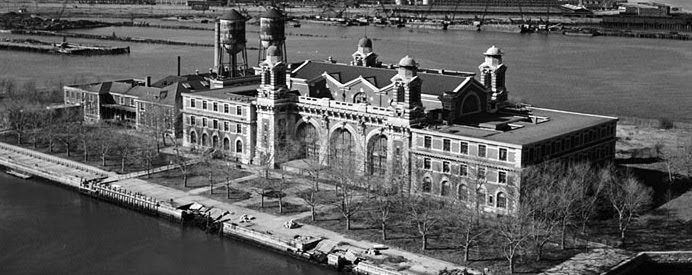
ELLIS ISLAND

Blog page: Ellis Island, when the world came to New York City
Download here

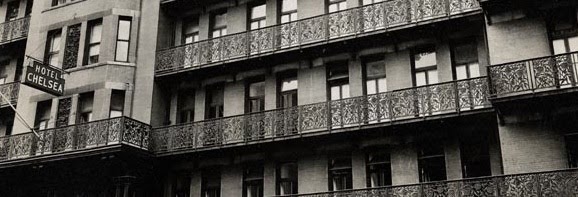
CHELSEA HOTEL

Blog page: Chelsea Hotel, the muse of New York counterculture
Download here

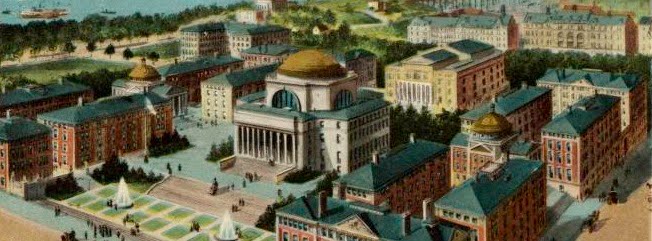
COLUMBIA UNIVERSITY

Blog page: Movin’ On Up: From Kings College to Columbia University
Download here

HAUNTED TALES OF NEW YORK

Blog page: Haunted Tales of New York: Urban Phantoms
Download here

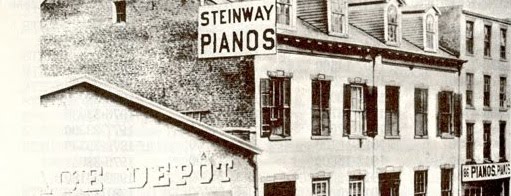
STEINWAY: THE PIANO MAN

Blog page: Steinway and Sons: piano men and kings of Queens
Download here

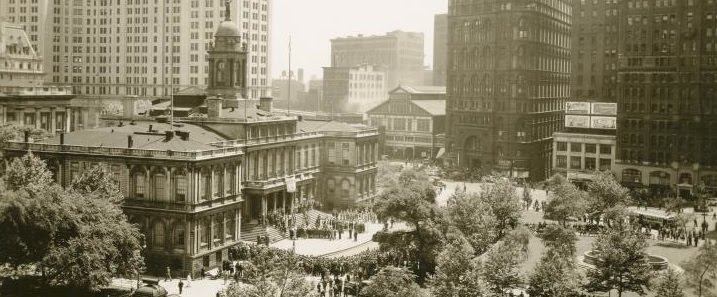
CITY HALL AND CITY HALL PARK

Blog page: Epicenter: the glorious history of New York City Hall
Download here

CORLEARS HOOK AND THE PIRATES OF THE EAST RIVER

Blog page: Corlears Hook and the Pirate Gangs of the East River
Download here

TIN PAN ALLEY

Blog page: Tin Pan Alley and the birth of modern popular music
Download here

THE CLOISTERS

Blog page: Going medieval at the Cloisters and Fort Tryon Park
Download here

Doing this podcast is such a wonderful experience and Tom and I are totally thrilled to share our joy of New York City with you. Thank you for tolerating our continued geekiness and wonder of this awesome city. We’d like to wish you all a wonderful 2010 and we look forward to presenting more shows in the coming year. Thanks for listening!

Categories
Uncategorized

From New Amsterdam to Alicia Keys: NYC history in 2009


(Photo courtesy of Only In Holland)

In 2009, New York went Dutch. One hundred years ago, the city threw an elaborate party, the self-important, historically aware (often inaccurate) and undeniably prideful Hudson-Fulton Celebration, honoring the 300th anniversary of Henry Hudson sailing into New York harbor and Robert Fulton’s invention of the steamship. Although we didn’t go all out for the 400th anniversary of Hudson’s discovery this year — we’ve advanced from the days of cheesy historical floats — the occasion brought the early days of New York City history yearlong recognition.

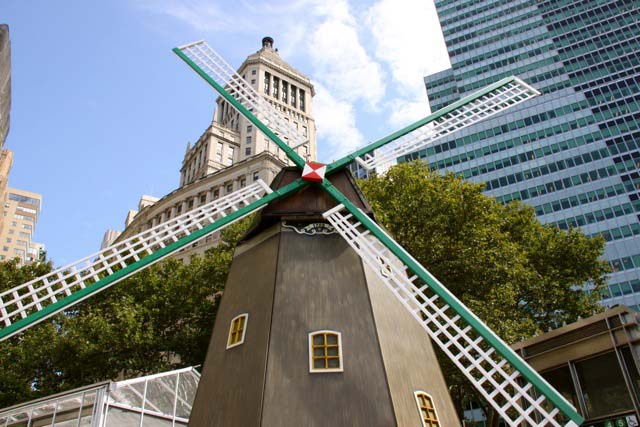
Replicas of Henry Hudson’s Half Moon sailed the Hudson. New York tipped its hat to its precursor New Amderdam with NY400, a celebration that had Dutch royalty visiting a replica of an old New Amsterdam village and unveiling a permanent plaza called New Amsterdam Plein.

Museums jumped aboard with Hudson and the royals, with exhibits ranging from maps of the island’s original shoreline to the display of Manhattan’s official ‘birth certificate’. The Museum of the City of New York’s Amsterdam/New Amsterdam: The Worlds of Henry Hudson was probably the best primer for the occasion.

Of course, it wasn’t just Dutchophiles in an anniversary state of mind this year. A few New York bridges (like the Manhattan and the Queensboro) coincidentally hit significant anniversaries; the Grand Concourse turned 100 years old with a celebration at the Bronx Museum and a new book.

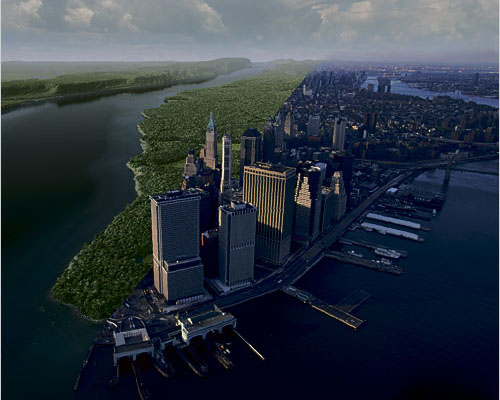
Some ventured even further back. Eric Sanderson unveiled the Mannahatta Project, easily the most exciting project for New York history lovers, taking a hearty stab at remapping the original ecology of Manhattan island, block by block. The website is hours of geeky enjoyment. I don’t really have any particular award to give, but if I did, Sanderson would be New York City history’s Man of the Year.

The event of the year, to me personally, was the June opening of the High Line, a raised park made from a re-purposed stretch of abandoned elevated train tracks. Those tracks have always held a great deal of mystery for me, so I was sure I was going to cringe at the results. The Meatpacking District had already been turned into luxury retailers; what horrors awaited these strange, unique structures along the west side? But the end result respects its initial allure while creating a quiet, pedestrian friendly destination. You can balk at some of the design choices, but the project as a whole is a beautiful addition to life in the city.

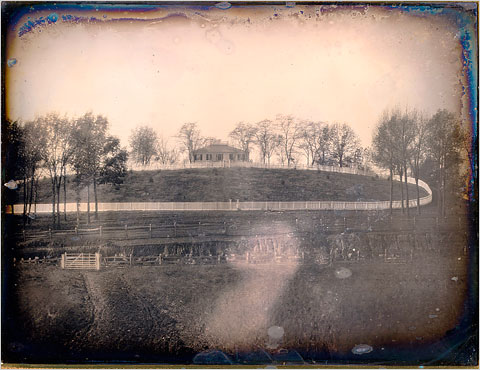
Some New York advertising icons returned (the Long Island City Pepsi Cola sign), others disappeared forever (the pre-9/11 DKNY ad on Houston). A few treasures thought lost rose from the silt, like the old bell from Dreamland park in Coney Island. My favorite archaeological city find has to be that spooky tombstone found in Washington Square, the marker of one James Jackson who died in 1799. Almost 50 years after Jackson’s death, someone would take one of the first photographs of New York — an early daguerreotype of the Upper West Side (see below) — which would then sell at auction at Sotheby’s in 2009 for $62,500.

A few buildings officially became New York landmarks this year, including the La Mama Experimental Theatre Club building in the East Village and The Paramount Hotel in Midtown, and the neighborhoods of Prospect Heights and Perry Avenue became official historical districts.
Politicians made history, most of it questionable. As New York state politicians from the city prove they’re every bit as ludicrous as their 19th century Tammany Hall forebears, Michael Bloomberg capitalized on the change to term limits and was re-elected as mayor. At the completion of his third term, he will be one of New York’s longest serving mayors and the city’s fourth third term mayor in the past 100 years (LaGuardia, Lindsay and Koch also share this distinction.)
The musical which created The Public Theater, Hair, successfully turned a 2008 stint in Central Park into a viable Broadway smash and the Tony for Best Musical Revival. Both the Yankees and the Mets left their past behind with new stadiums this year; only the Yankees christened their new field with a World Series victory, paralleling the team who first moved into the original Yankee stadium.

British epic novelist Edward Rutherfurd released his much-anticipated fictional tribute to city history, New York: The Novel, which I am at this very moment making my way through. But if I had to name a New York book of the year, two very good histories (Sanderson’s companion to his Mannahatta project and Anthony Flint’s zesty document of the Robert Moses/Jane Jacobs battle, Wrestling With Moses) would have to be runner-up to the National Book Award winning biography of Cornelius Vanderbilt by T.J. Stiles, a book so wonderfully written, I completely forgot it weighed about a dozen pounds.


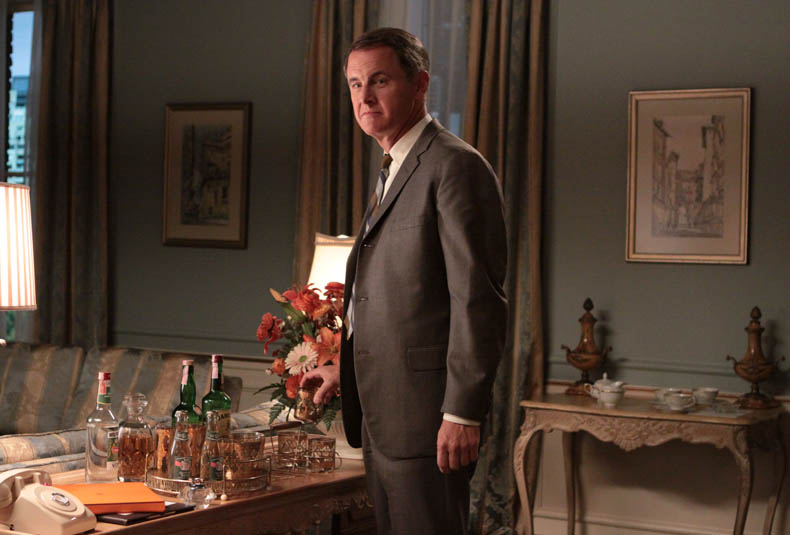
They’re made men: Swell cocktails at the Hotel Pierre

Depictions of New York history didn’t fare so well in movies this year. A fictional 80s New York was obliterated in the Watchmen movie (although not as satisfying as it was in the original graphic novel.) Frank Lloyd Wright’s Guggenheim Museum was shot to pieces in The International, and a true New York film classic, The Taking of Pelham 1-2-3, was itself mutilated with a mediocre remake. It might be worth watching the awful Night At the Museum sequel just to see the three-minute sequence that takes place in a black-and-white 1940s Times Square. On second thought, wait for it to pop up on cable next year.
For a more satisfying look at New York history in pop culture, you had to turn once again to Mad Men, the third season of which saw Don Draper’s job and marriage disintegrate, but not tragically so, in either case. As a result, it’s not surprising that the hints of the past fed to alert viewers were of midtown’s most glamorous hotels, most notably the Hotel Pierre, temporary home to the new Sterling Cooper.
And how great is it that the year ends with one of the most popular songs in the nation being an ode to New York nostalgia? If this blog had a theme song, it would have to be Alicia Keys’ version of her hit with Jay-Z, “Empire State of Mind“:

Categories
Holidays

Jacob Riis’ Not-so-Rockin’ ‘Sane’ New Years Celebration

Social reformer Jacob Riis is one of the most important men to New York City history, exposing the ghastly living conditions of city tenements and using his connections to enact change that affected thousands of New York’s poorest residents. In spreading the word, he wrote a social history masterpiece ‘How The Other Half Lives’ and innovated multi-media techniques to inform and titillate crowds. But not all of his ideas were inspired.

At the end of his life, Riis railed against corrupting influences like alcohol and their effects on poor communities. So imagine his disgust when the New York Times began sponsoring wild New Years Eve parties outside its new headquarters on 42nd Street. Inaugurated by a lavish firework display during the first seconds of 1905, the Times Square celebration eventually incorporated its famous balldrop in 1907. (Hear all about it in our Midnight In Times Square episode.)


As today, the outdoor celebration encourages revelry, drunkenness and chaos, things Riis did not believe benefited the city. To this extent, and with the help of former president (and good friend) Theodore Roosevelt, Riis proposed a ‘safe and sane New Years Eve’.


According to Riis, the good men of the city “have observed the licentious and riotous conduct of New Years crowds, with their tin horns, ticklers and bags of confetti. Anyone who has seen the crowds of rowdies on Broadway breaking hats and insulting women knows that a saner manner of celebration is desirable.”


The new celebration will feature organized singing at various city plazas throughout the city, including City Hall, Union and Madison squares, with Salvation Army singers, organized bands and bandstands, leading ‘civilized’ public outcries of celebration via “the singing of patriotic songs and New Years ballads,” per Riis.


It would be an uphill battle that evening of December 31, as the somber chorale of hymns and polite exaltation of the downtown rallies would be entirely drowned out by the throngs of cheers and music drifting from downtown. “SANE FESTIVAL SUBMERGED,” shouts a New York Times headline from the next day. “The choral hosts greeted the new year with song last night, but the songs were not heard for the very good reason that in each instance there were just enough horns, rattles and other noise-making apparatuses in the hands of the din-making contingent to render even the ‘Star Spangled Banner’ and ‘America’ unrecognizable.”


Such mass city-organized, end-of-year civility would never seriously be attempted again. And Riis would only live to see one more New Years Eve, dying on May 26, 1914.


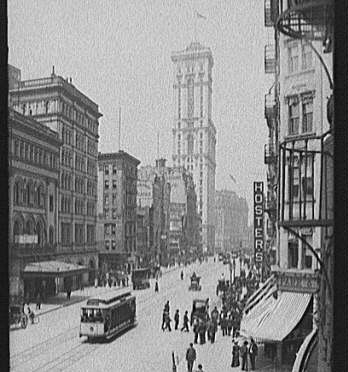
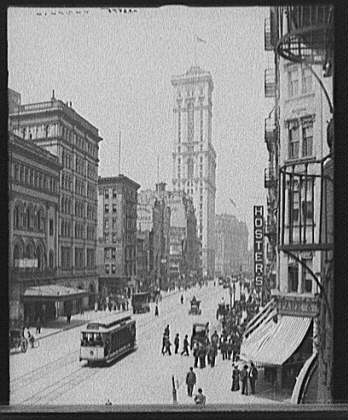
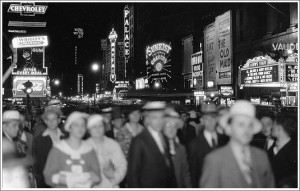
Top picture above: Time Square during the day, taken between 1903 and 1910. Courtesy LOC. Second picture, from the 1930s, courtesy Times Square NYC