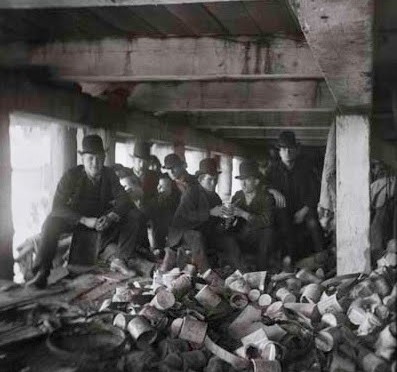
The Short Tail Gang sit underneath a pier at Corlears Hook, picture taken in 1890, long after all the great pirate gangs of the area had disbanded, been eaten by rats, or joined the Confederate army (listen to podcast for explanation!)
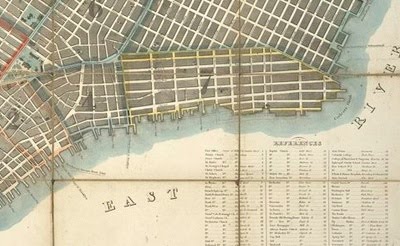
___________________________________ An illustrated map of the ward system of New York in 1817 highlights the Corlears Hook shorefront area of the Seventh Ward and the even more notorious Fourth Ward further down the coast. Much of the Seventh Ward was owned by the Rutgers family, who slowly parcelled out the neighborhood to shipbuilders, business owners and, eventually, tenements.
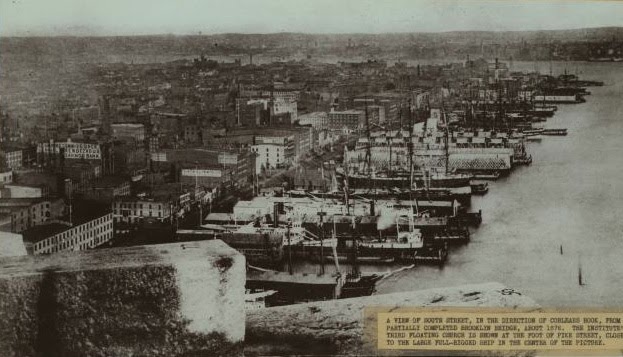
The East River shore in 1876, looking northeast from the uncompleted Brooklyn Bridge, all the way to Corlears Hook
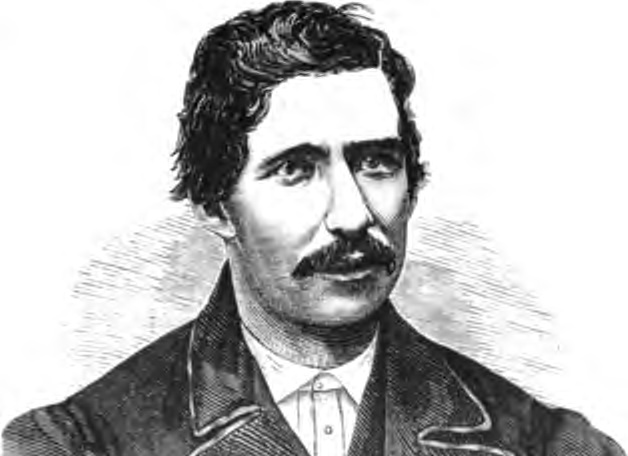
___________________________________ Patsy Conroy, leader of one of the East River’s most ruthless and ambitious gangs, terrorizing shipping vessels throughout New York Harbor.
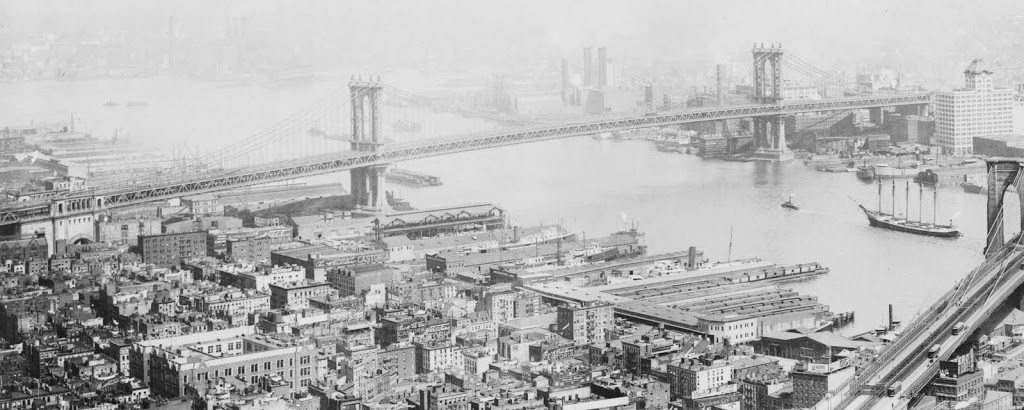
___________________________________ The shore between the Manhattan and Brooklyn bridges, early 20th century.
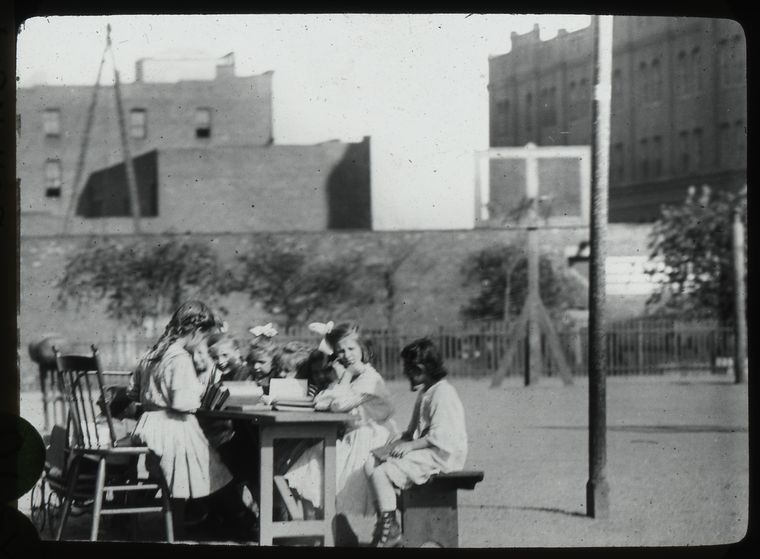
Corlears Hook Park was one of the first municipal parks, opening in 1905. This Lewis Wickes Hine photograph is from 1905 (courtesy of NYPL)
And finally, here’s a film from 1903 depicting the entire East River waterfront at that time. This is more lower Manhattan than Corlears Hook, but it should give you some idea of how clotted and bustling the shoreline was.
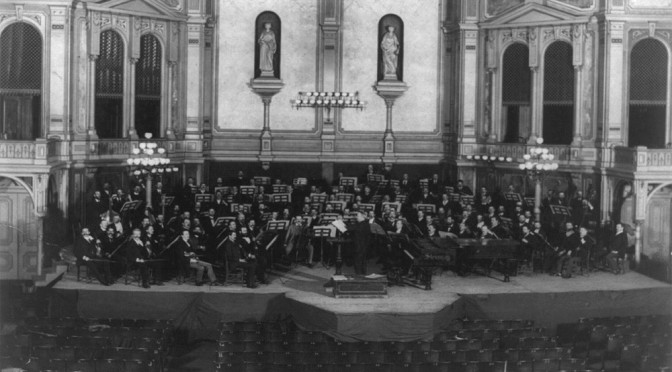
Inside Steinway Hall 1890: the 14th Street concert venue could seat 2,000 and also functioned as a showroom for Steinway pianos
Henry Steinway, a German immigrant who came to New York in 1850, made his name in various showrooms and factories in downtown Manhattan, enticing the wealthy with his award-winning quality pianos. At their grand Steinway Hall on 14th Street, the family turned a popular concert venue into a clever marketing opportunity.
But their ultimate fate would lie outside of Manhattan; the Steinways would graduate from an innovative factory on Park Avenue to their very own company village in Queens, the basis of a neighborhood which still bears their name today. You may not know much about pianos, but you’ve crossed path with this family’s influence in the city. Tune in for this short history of Henry Steinway and his sons.
PODCAST Download this show it for FREE on iTunes or other podcasting services. Click this linkto download it directly from our satellite site. Or click below to listen here:
___________________________________
As always, click on pictures for a bigger view
Hello Henry: Heinrich Steinweg made his first piano as a present for his bride. A year later he completed his very first grand piano and began a small manufacturing practice with his sons. They took the show on the road to New York in 1850.
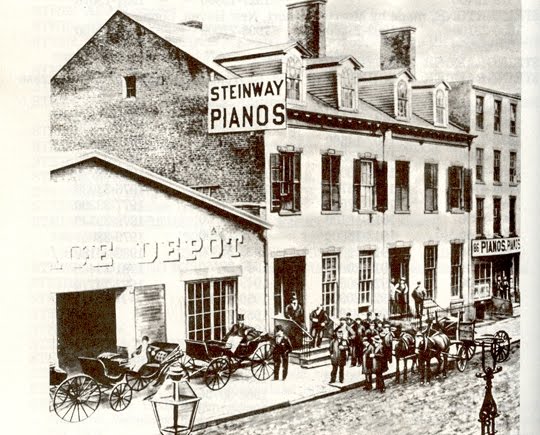
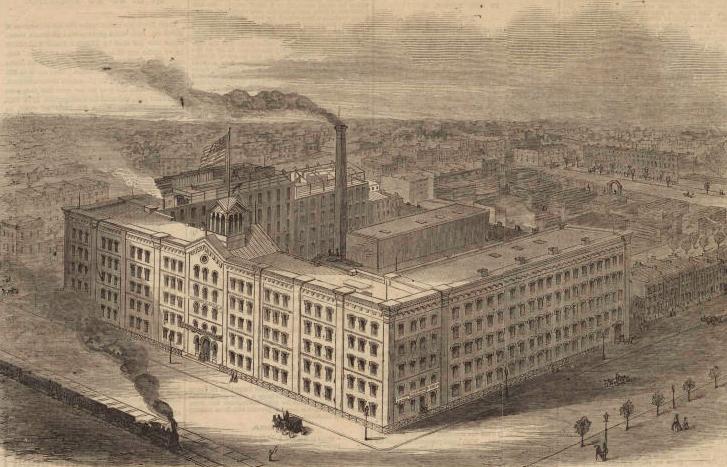
First movement: Within three years of arriving in New York harbor, the Steinways had opened their first workshop on Varick Street, then moved to a larger space on at 82-88 Walker Street (illustrated below).
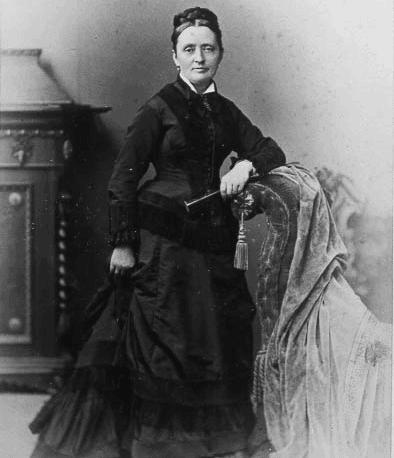
Daughter Doretta Steinway, in her later years. Doretta was key to Steinway’s early success, due to her generous offering of free piano lessons to anyone who purchased an instrument from them.
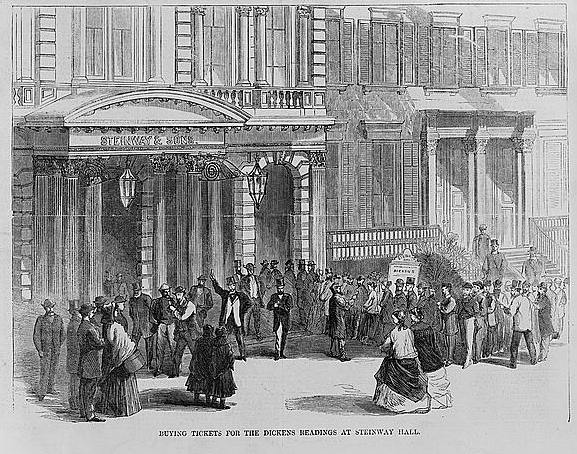
Steinway Hall, built in 1864, was located at 71-73 East 14th Street, right off of fashionable Union Square. The hall hosted a great variety of functions, not just music performances. The illustration below depicts the frenzy outside of a Charles Dickens reading.
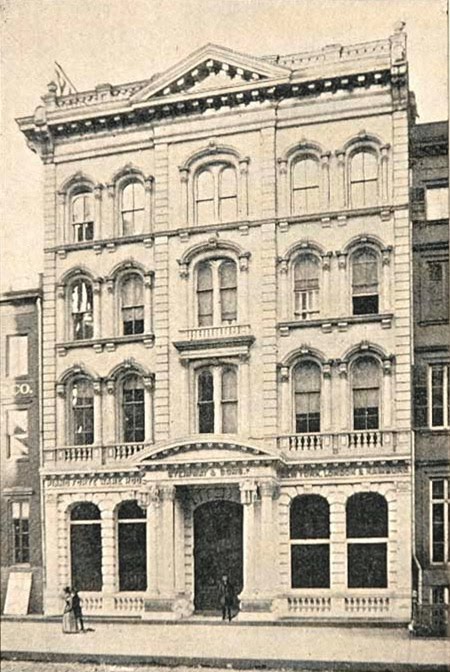
The front of the hall, which also featured a showroom of all the latest Steinway products. The venue was such a smashing success that other halls opened around the world.
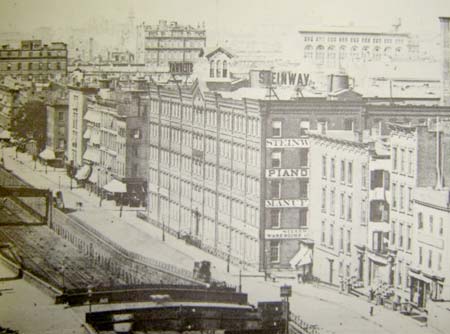
To illustrate how fast the city was moving uptown, this photo shows the same factory just 30 years later. Its dated 1890, although at this time most Steinway operations had moved to their headquarters in Queens. Either they were still doing some work here at this time, or else nobody bothered to rename the building! Note the train tracks in front, rolling their way down to the Grand Central Depot.
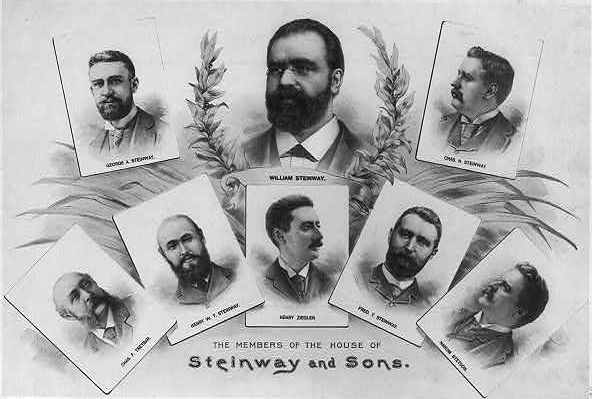
Full house: After Henry’s death in 1871, the Steinway boys would move the company’s operation to Queens. William Steinway would display ambitions far beyond pianos, expanding his pursuits to include public transportation and even automobiles.
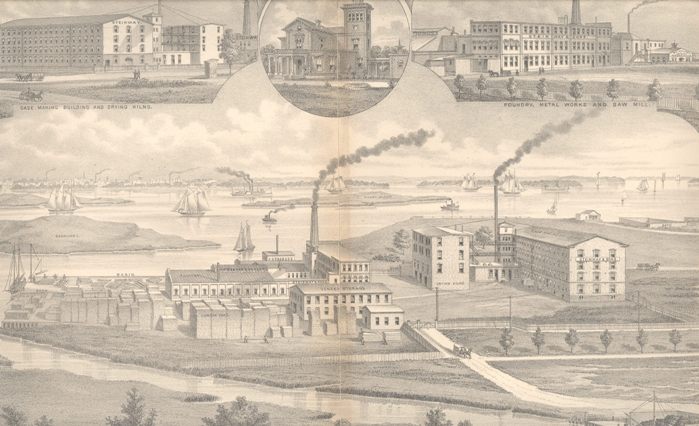
A bucolic illustration of Steinway’s Astoria factory, with river access and company village for their workers. The move allowed the Steinways to expand; it also thwarted labor groups and gave the company more power over its employees.
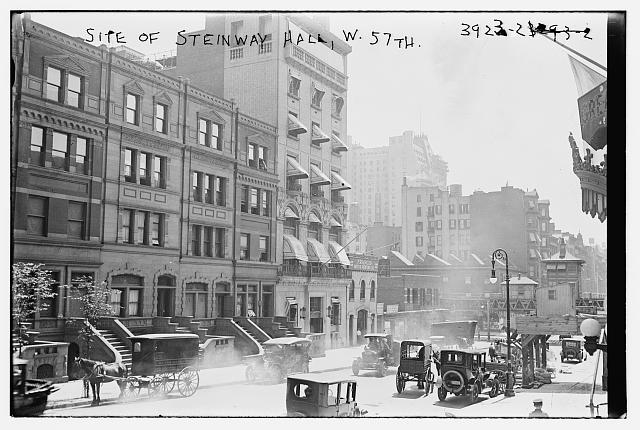
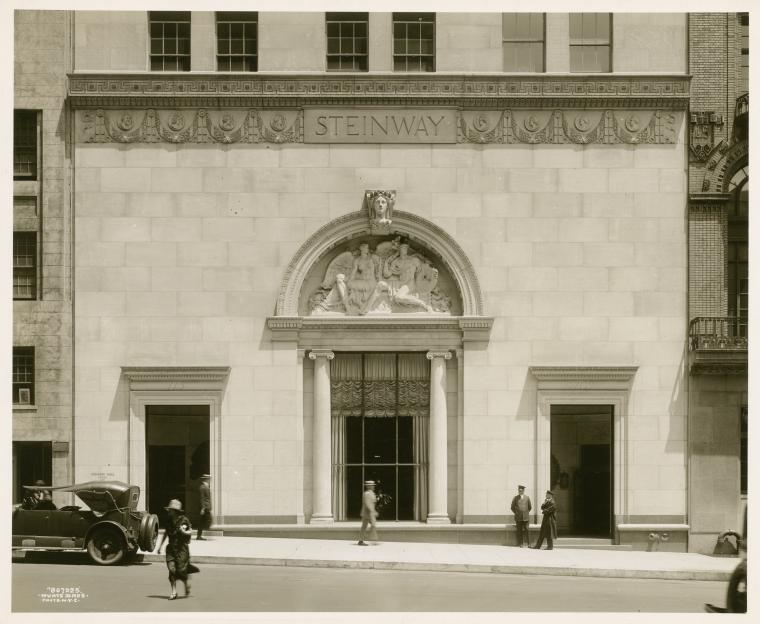
In 1925, Steinway Hall moved uptown to 57th Street, not so terribly far away from their old factory. The sooty, smelly neighborhood had become Park Avenue, and 57th Street was graced with Carnegie Hall. So naturally, the Steinways got out of no-longer-fashionable Union Square and joined the high society ranks accumulating uptown.
The new hall, designed by Warren and Wetmore, was a far smaller venue but still featured a Steinway piano showroom. You can still stroll through it today and peruse their instruments.
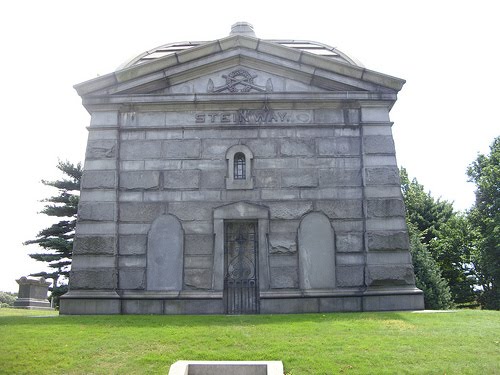
The Steinway vault at Green-Wood Cemetery. I greatly encourage a visit to Green-Wood. And while you’re visiting the Steinway, swing over and say hello to Boss Tweed! He’s buried right nearby.
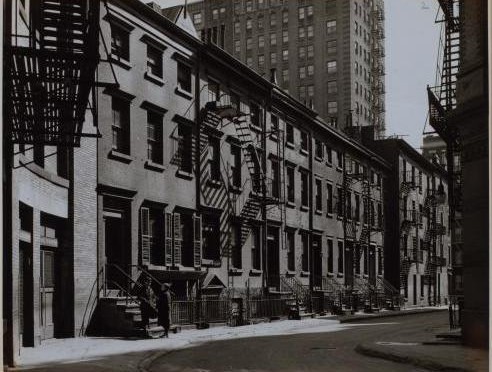
Historic Gay Street, 1940: a tiny little lane literally crammed with ghosts
It’s time for our third annual ‘ghost stories’ episode, our mix of historical facts and spooky legends from the annals of New York’s past.
For this round of scary tales, we visit a famous 19th century townhouse haunted by a lonely spinster, a West Village speakeasy with some guests who still haven’t gone home, and the site of a former restaurant that might be possessed with the spirit of a famous folk singer.
ALSO: we go back all the way to New Amsterdam for an old legend involving Peter Stuyvesant, a turbulent river, and the Devil himself!
PODCAST Download this show it for FREE on iTunes or other podcasting services. Click this linkto download it directly from our satellite site. Or click below to listen here:
___________________________________
As always, click on pictures for a bigger view
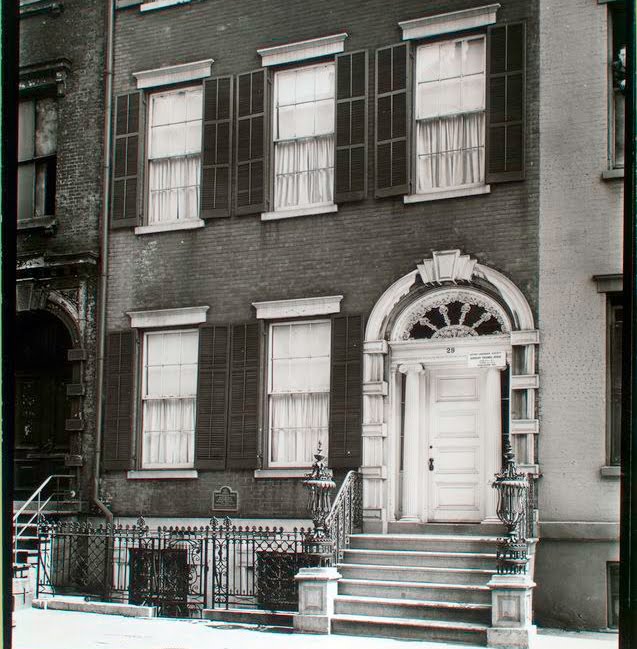
POSSESSIONS: The former home of Seabury Tredwell at 29 E. 4th Street, now billed as the Merchant’s House, is one of New York’s most famous haunted houses, alledgedly still home to his daughter Gertrude. The house is a rare ‘trapped in amber’ experience, with family possessions that have never left the house since the family moved there in 1835.
Photo from 1936 by Berniece Abbott, but really, the house looks exactly the same:
Click here for more information on the Merchant’s House Museum’s October Halloween plans, which include funereal decoration, a coffin procession to nearby New New York City Marble Cemetery, and candlelight tours: Merchant’s House ___________________________________
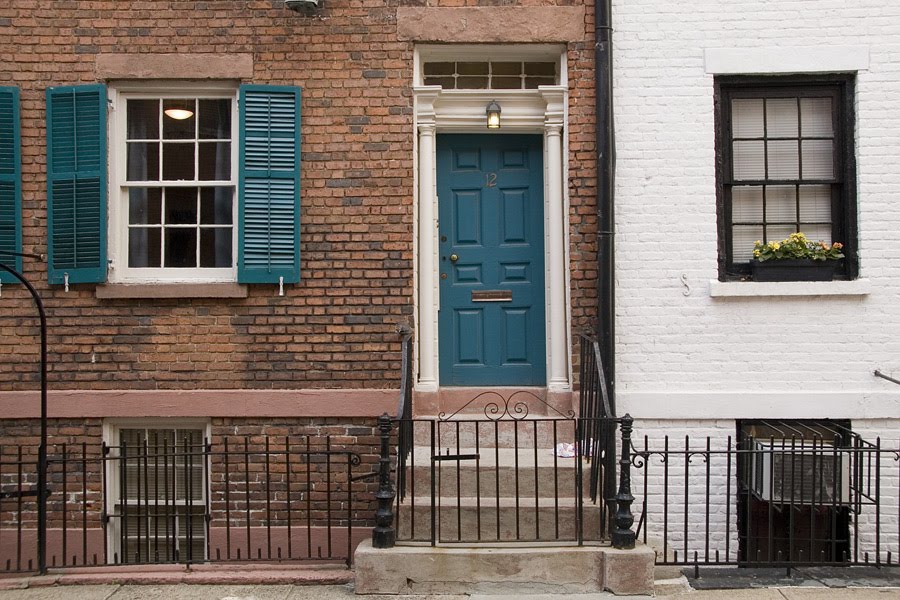
THE PARTY NEVER ENDS: 12 Gay Street, once a horse stable, housed Mayor Jimmy Walker’s mistress Betty Compton and the creator of Howdy Doody. However, it was a former speakeasy in the basement that’s given the building a rather ghostly entourage of spooks and apparitions, including the cloak-wearing Gay Street Phantom. Do deceased flappers and dead drunks still haunt this quiet little street?
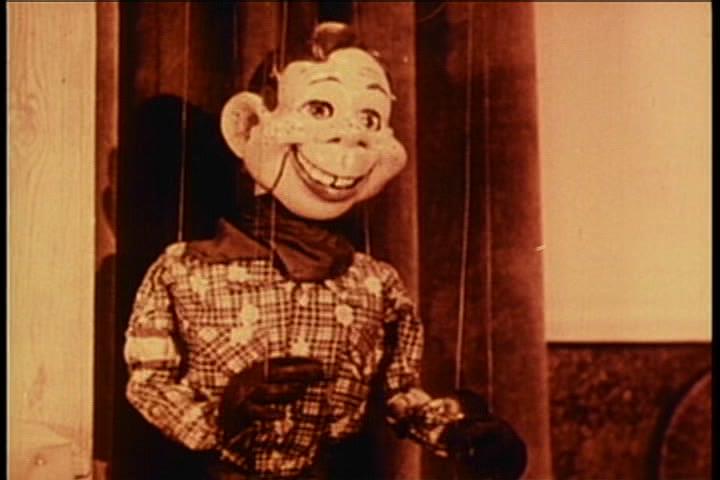
HORROR: This famous puppet was born in the location of a former speakeasy. Might it too have been possessed with its former revelers? ___________________________________
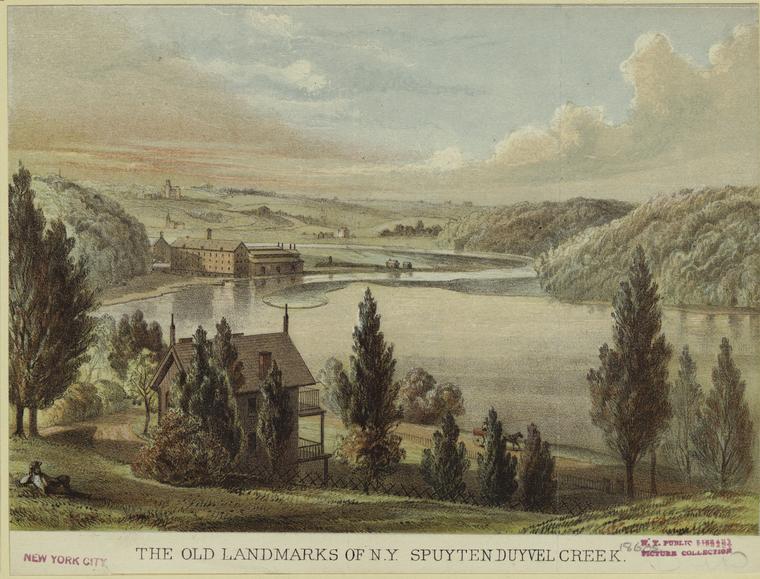
WHAT LIES BENEATH: The rushing waters of Spuyten Duyvil Creek, linking the Harlem River to the Hudson River, have spawned many legends since the Dutch arrived. Does its unusual name hide a secret of something that lives underneath the turbulent waters? (Illustration courtesy NYPL)
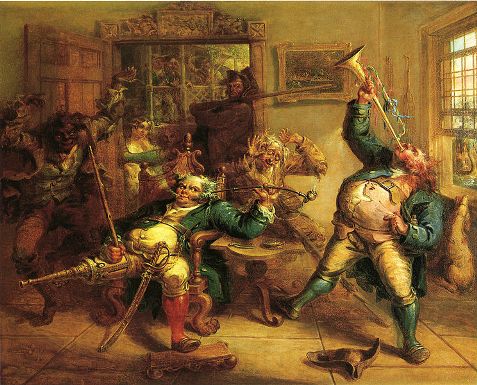
DOOMED: Anthony Van Corlaer, trumpeter and sentry assigned by Peter Stuvesant to warn rural Dutch settlers of impending attack, met a watery end at the hand of the Devil himself, according to legend. Below: from the painting Antony Van Corlear Brought Into the Presence of Peter Stuyvesant ___________________________________
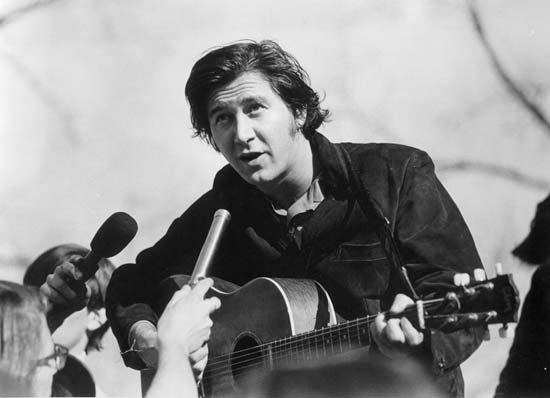
IN LIMBO: The tortured folk singer Phil Ochs killed himself in Far Rockaway, but is his spirit still haunting a former restaurant in SoHo?
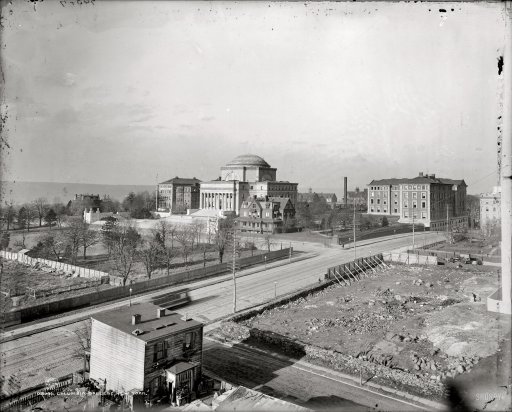
We’re going back to school with one of New York’s oldest continually operating institutions — Columbia University. Or should we say, King’s College, the pre-Revolution New York school that spawned religious controversy and a few Founding Fathers to boot.
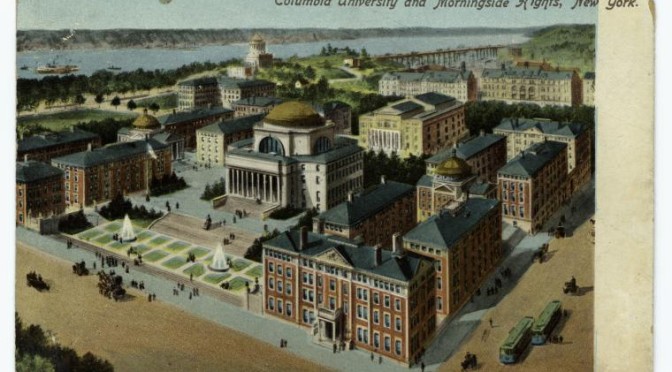
Listen in as we chart its locations throughout the city — from the vicinity of Trinity Church to midtown Manhattan. And finally to its permanent home on the ‘Academic Acropolis’ in Morningside Heights.
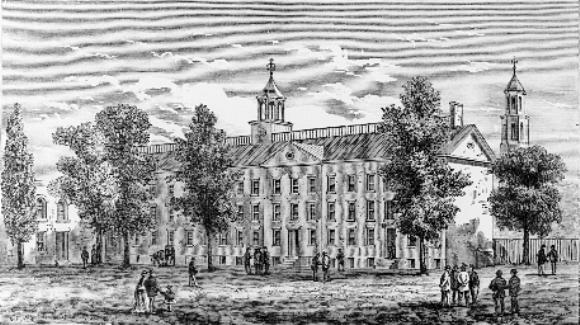
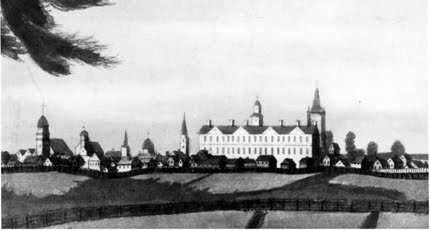
Freshman Years: The King’s College campus in 1770, along Park Place overlooking the Hudson River. Things would not be peaceful for long on this quiet campus; several students, including young Alexander Hamilton, would join the fight for independence from England. The school would close in 1776 and become a military hospital.
___________________________________
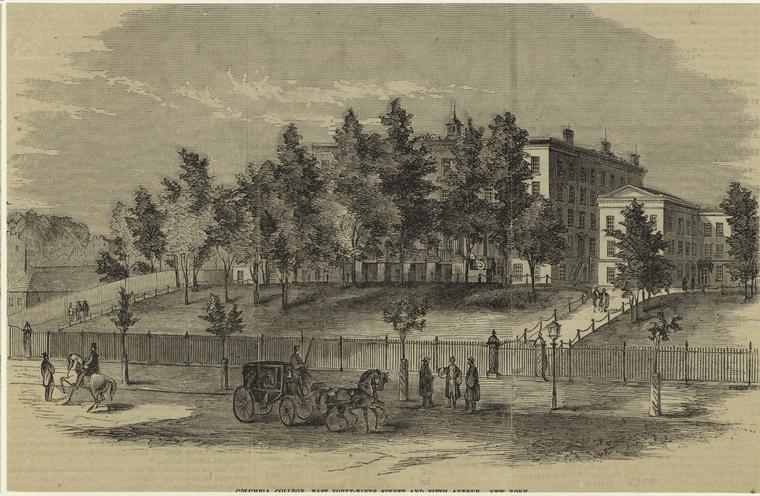
Believe it or not, this is the corner of 49th Street and Madison Avenue, site of Columbia’s campus during most of the second half of the 19th Century. It moved into a space formerly inhabited by the Institute of the Deaf and Dumb. Curiously, when it would move uptown in 1897, it would take over property held by the Bloomingdale Insane Asylum.
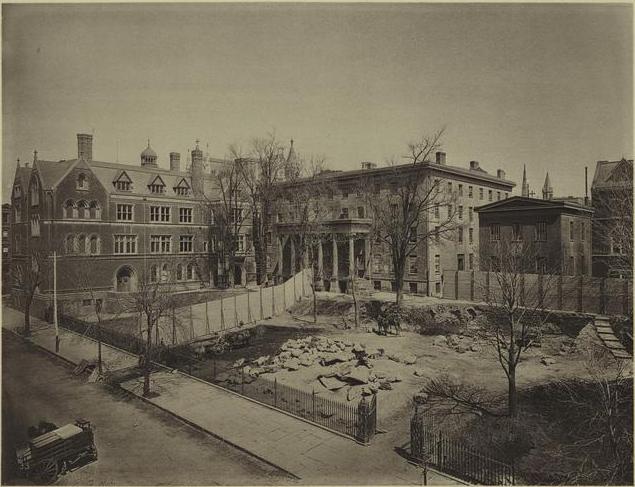
The same campus, in a photograph from 1882. The encroaching growth of the city northward seems to have taken a toll on the campus grounds. Columbia would move from midtown fifteen years later.
___________________________________
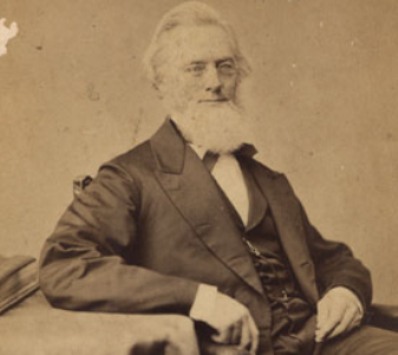
Frederick Augustus Porter Barnard, president of Columbia (back when it was Columbia College) from 1864-1889. In addition to bringing some prestige to the institution, his forward-thinkinig philosophies regarding education for both men and women eventually led to the formation of Barnard College.
___________________________________
Good Morning: The new campus slowly rises from Morningside Heights with the already completed Low Memorial Library in the background. When this photo was taken in 1897, there was little real development in the area, and it was barely even serviced by public transportation. McKim, Mead and White would turn the area into a veritable classical city.
___________________________________
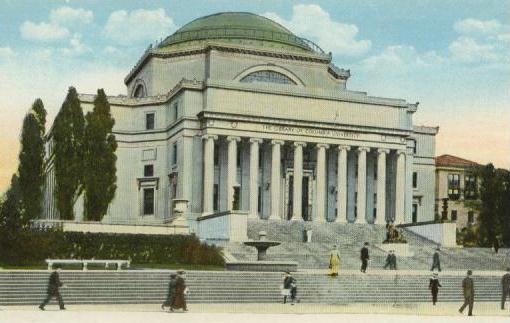
The Low Down: The Low Memorial Library was constructed under the tenure of Columbia president Seth Low. However the building is named not for Seth, but his father Abiel Abbot Low, a successful Brooklyn silk merchant. The library is probably one of McKim, Mead and White’s most beautiful existant works in the city. It’s not, however, a library any more.
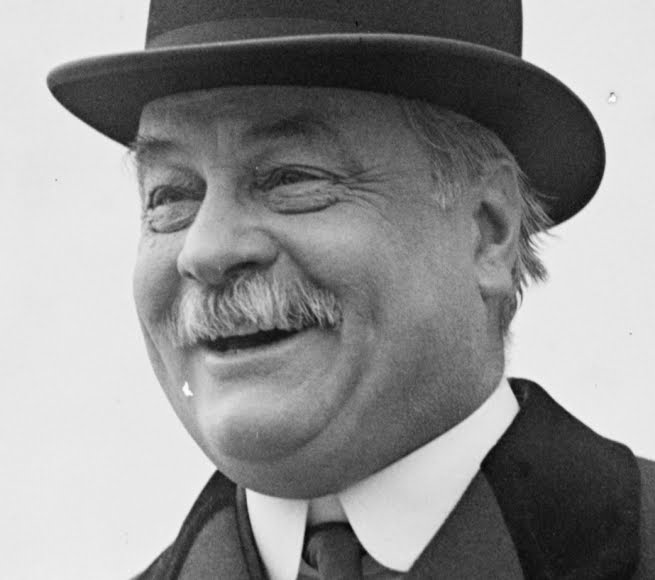
Nicholas Murray Butler, arguably the most influential (and controversial) president in Columbia’s history, presided from 1901 to 1945, overseeing vast growth and prestige for the school.
Pictures courtesy Library of Congress, New York Public Library, Wikimedia and Columbia University
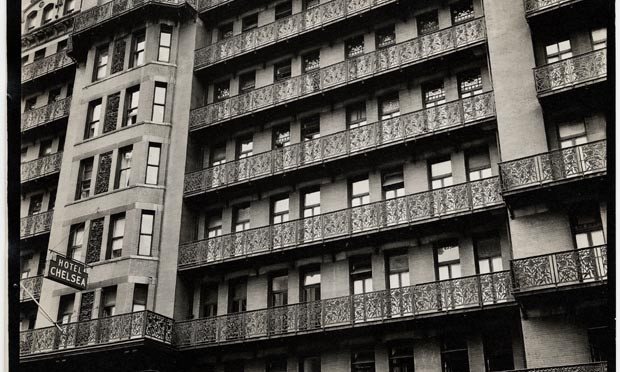
Arguably New York’s least conventional hotel, the Chelsea Hotel (or rather, the Hotel Chelsea) is the one of New York’s culture centers, a glamorous, art-filled Tower of Babel for both creativity and debauchery. From Mark Twain to Andy Warhol, it’s been both inspiration and accommodation for artistic wonder.
We wind back the clock to the beginnings of the Chelsea neighborhood and to the hotel’s early years as one of the city’s first cooperative apartment buildings. What made the Chelsea so different? And why are people still fighting over this storied structure today?
___________________________________ As always, click on pictures for a bigger view
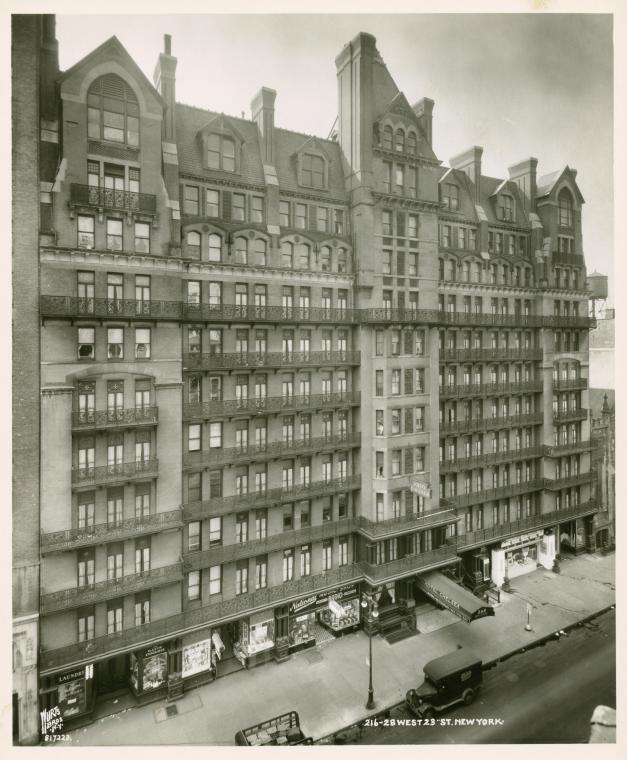
Standing Tall The Chelsea Hotel, built in 1883, was originally intended as a cooperative apartment building for wealthy tenants. However, by 1905, the building was turned into a hotel. Throughout its history, the Chelsea accommodated residents staying there for a few days … or a few decades. (Photograph by the the Wurtz brothers)
___________________________________
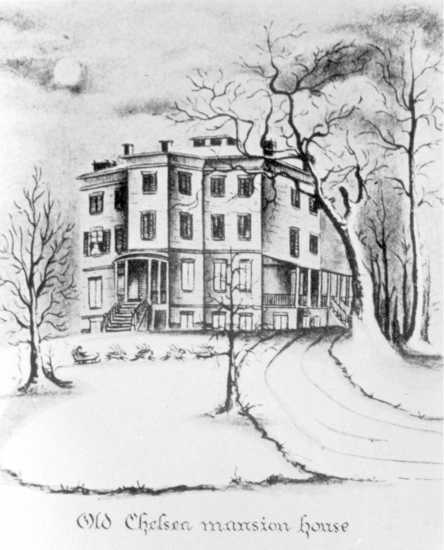
Old Chelsea Mansion The neighborhood of Chelsea was carved from the estate of Captain Thomas Clarke and his descendants. Clarke named his large, hilly estate after the still-operating Royal Chelsea Hospital, a respite for retired British soldiers. The Clarke mansion home sat approximately where the intersection of 23rd and 9th Avenue is today — just down the street from the Hotel Chelsea.
___________________________________
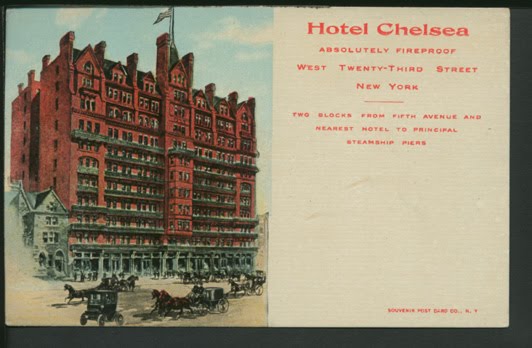
Absolutely Fireproof Many of the Chelsea’s sturdy amenities would come in handy when it began hosting rowdy musicians and artists. The buildings fireproofs claims would be put to the test when certain residents (Edie Sedgwick, Sid Vicious, to name a couple) would set fire to their rooms. And the building’s soundproof walls would be of service when rock bands stayed here.
___________________________________
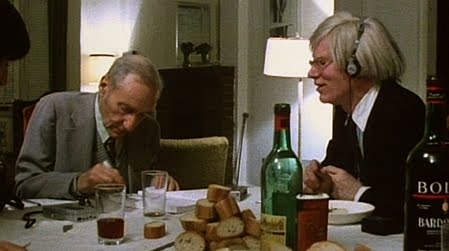
Bird Of A Feather William Burroughs and Andy Warhol in a room at the Chelsea, from a scene in Abel Ferrera’s documentary Chelsea On The Rocks, a film hopefully seeing the light of day very soon.
___________________________________
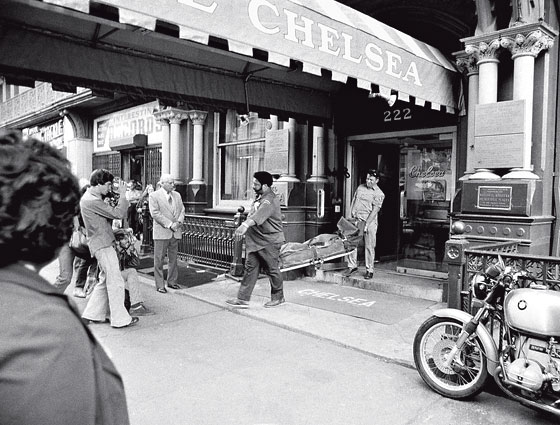
Tragedy 1978 No resident of the Chelsea was as infamous as Sex Pistols bassist Sid Vicious and his girlfriend Nancy Spungen, a raucous tragic pair who literally tore up the hotel. Vicious woke from a drug stupor in his room on October 12, 1978 to find his girlfriend stabbed to death. Sid would eventually die of a drug overdose the next year. Below, her body is carried from the hotel.
___________________________________
Below: A clip from Andy Warhol’s Chelsea Girls, filmed in various rooms at the hotel.
For millions of Americans, Ellis Island is the symbol of introduction, the immigrant depot that processed their ancestors and offered an opening into a new American life.
But for some, it would truly be an ‘Island of Tears’, a place where they would be excluded from that life. How did an island with such humble beginnings — ‘Little Oyster Island’, barely a sliver of land in the New York harbor — become so crucial? Who is the ‘Ellis’ of Ellis Island? And how did it survive decades of neglect to become one of New York’s most famous tourist attractions?
Dedicated to my niece Courtney, who specifically suggested this episode.
PODCAST Listen to it for FREE on iTunes or other podcasting services. Or click this linkto listen to the show or download it directly from our satellite site
CORRECTION: In the show, we mention that island namesake Samuel Ellis bought Little Oyster Island in 1784. In fact, it’s possible he owned the island well before that, possibly by 1770.
___________________________________ As always, click on pictures for a bigger view
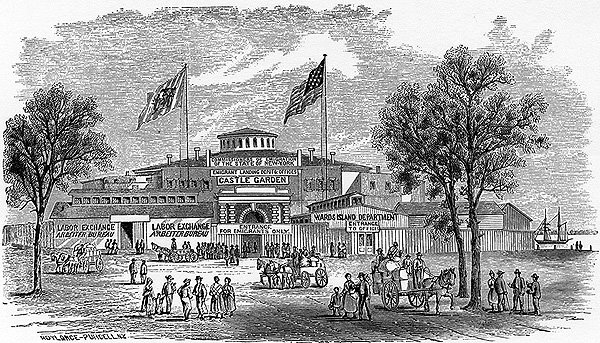
Before Ellis, there was Castle Garden, the former performance hall that became New York’s immigration depot from 1855 to 1890. The building bore witness to a great influx of German and Irish immigrants, however the facilities were seen as inadequate and unsafe.
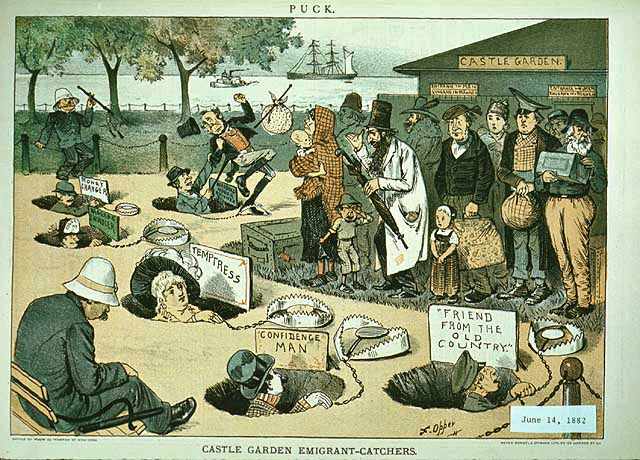
New immigrants emerging from Castle Garden would find themselves beseiged by grifters, runners and utter chaos, as evidenced by this 1882 illustration from Puck Magazine.
___________________________________
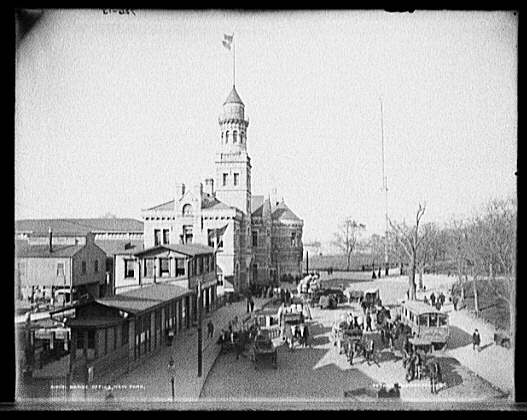
Temporary Digs: For four non-consecutive years, the Barge Office nearby Castle Garden would serve as New York’s immigration depot. It would serve first in 1890-92 when the state government closed Castle Garden and the federal government was still getting Ellis Island ready. Later, after the original structured on Ellis Island burned down, immigration would return here, from 1898-1899.
___________________________________
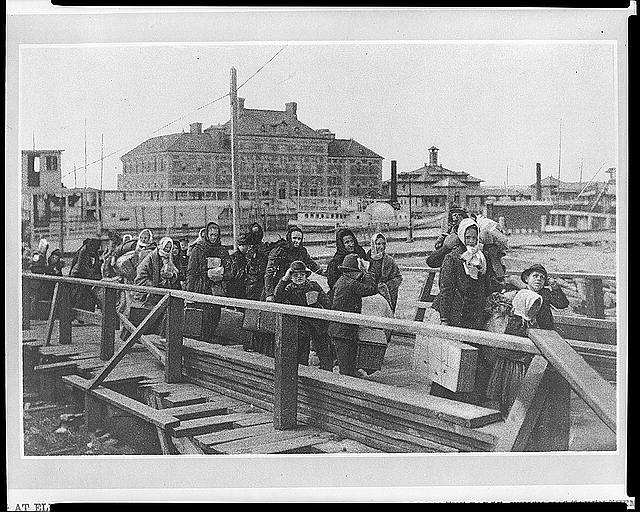
The Long Way Around: New immigrants unload in front of the doors of the main Ellis Island building in 1902. Steamships would coast into New York harbor, arrive at their Manhattan dock to release their first class passengers, then pack the steerage people into a barge which would take them to Ellis. (Pic courtesy here)
___________________________________
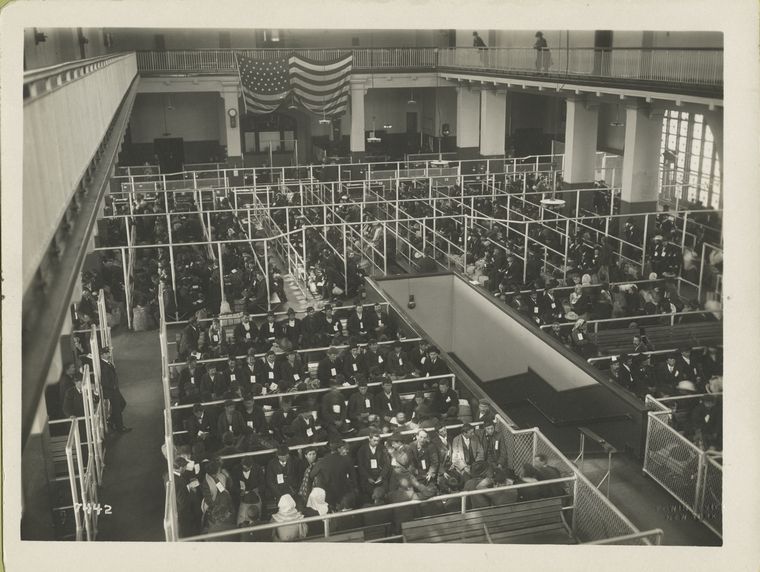
Penned In: See, it really was like cattle! The registry room of Ellis Island would keep people at close quarters as officiates began the arduous process of examining everyone.
___________________________________
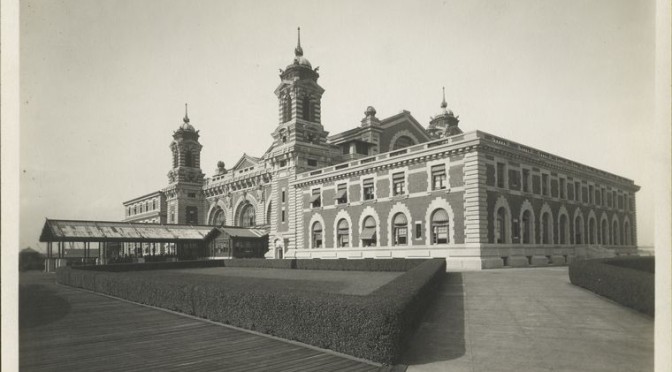
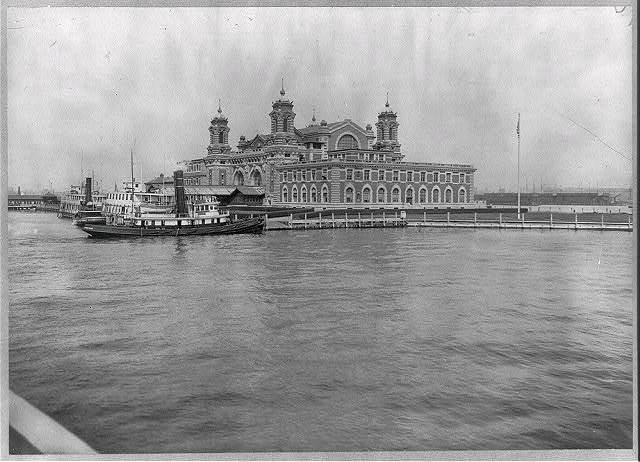
OVERDRESSED? William A. Boring and Edward Lippincott Tilton gave the new Ellis Island center an elegant Beaux-Arts touch with exotic towers and limestone ornamentation. Immigrants would be greeted with a building that resembled European structures back home.
___________________________________
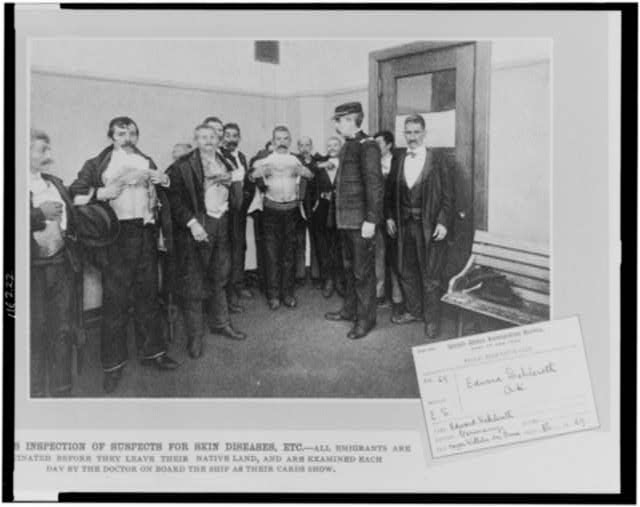
Revealing: Some unfortunates who were pulled aside for further evaluation, this time for potential skin diseases. The room they are standing in is now one of several museum displays detailing the grueling experience of those who were ‘pulled aside’. (Pics courtesy here.)
___________________________________
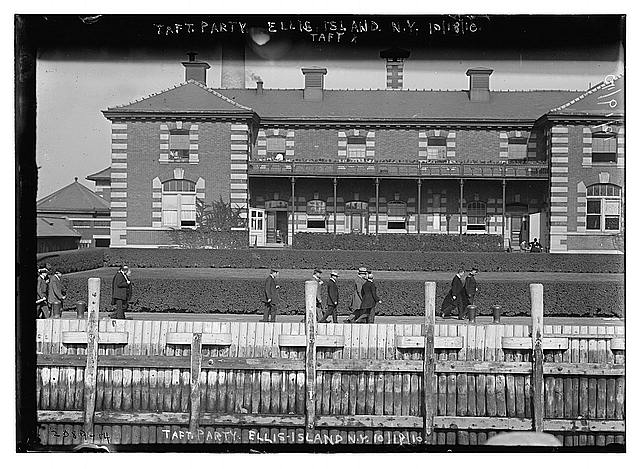
The Grand Tour: President William Howard Taft goes on an inspection tour of the Ellis Island facility. The immigration center was frequently a sore spot politically, a lightening rod for restrictionists and immigrant aid agencies alike. (Pic courtesy here)
___________________________________
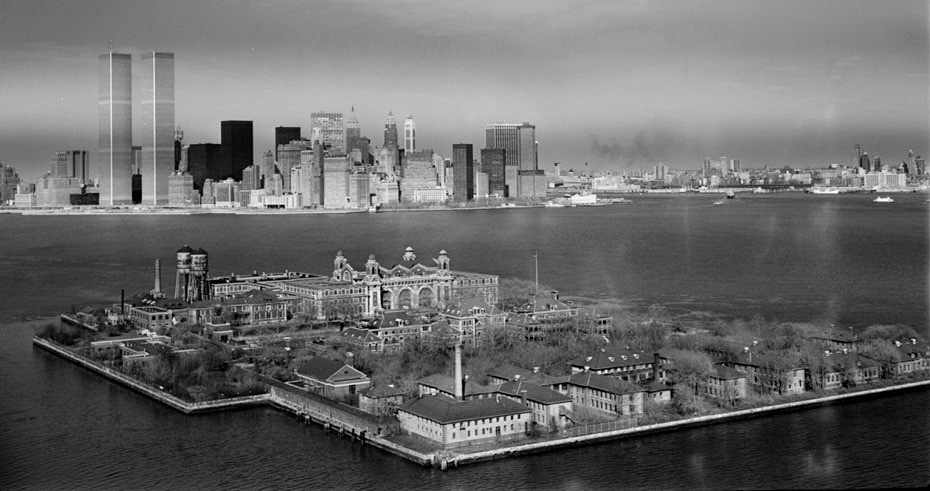
Itself Excluded: Ellis Island was a mess of ruins and overgrowth by the 1970s, a victim of decades of neglect. Even the National Parks service failed to do much with it before Lee Iacocca and the Statue of Liberty-Ellis Island Foundation came along to save it.
The picture below is from 1978. Most of the island is created from landfill. The buildings to the front of the image were not only hospital facilities, many of them specifically for the care of measles, a common malady of immigrant children. (Courtesy here.)
You can visit the Ellis Island website to check to see if any of your family members happened their way through the island.
And finally, Thomas Edison’s 1906 silent footage of immigrants arriving at the island.
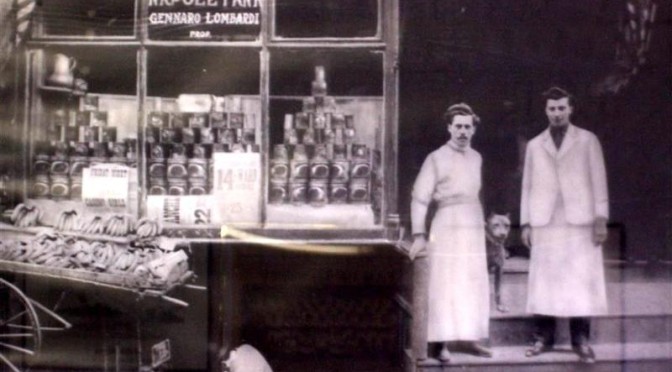
Gennaro Lombardi and (I believe) Antonio Totonno Pero with a dog who must have been fed very well. You’ll notice that Lombardi’s is still a grocery store in this picture. Some bananas with your pizza? Although Gennaro is credited with opening New York’s first pizzeria, it may have been Antonio who came up with the pizzas.
___________________________________
New Yorkers are serious about their pizza, and it all started with a tiny grocery store in today’s Little Italy and a group of young men who became the masters of pizza making. In this podcast, you’ll find out all about the city’s oldest and most revered pizzerias — Lombardi’s, Totonno’s, John’s, Grimaldi’s and Patsy’s, in all its variations.
But if those are the greatest names in New York-style pizza, then who the heck is Ray — Original, Famous or otherwise?
___________________________________
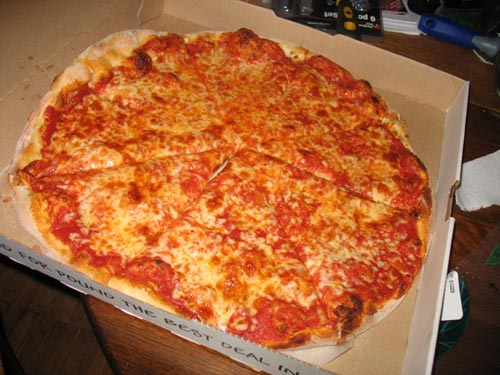
New York-style pizza, in its purest form. Lombardi’s pizza was also sold by the slice back in the day, though today its strictly whole pies. And they no longer don’t wrap them up in paper and tie them with string like they used to!
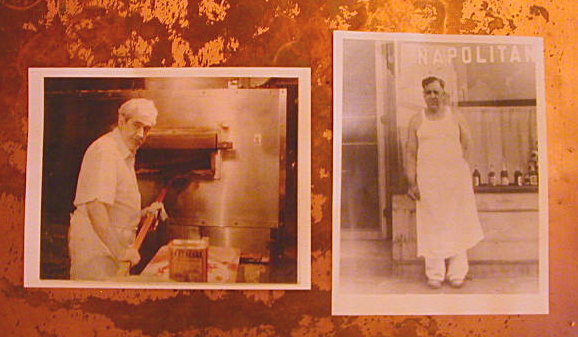
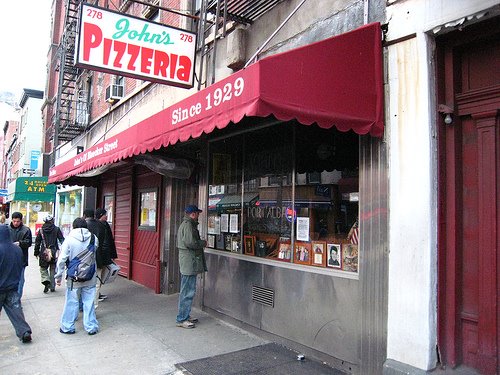
Although John Sasso had the great misfortune of opening his small pizzeria just as the Great Depression was getting started, it managed to survive through hard times to become the West Village’s go-to destination for classic slices.
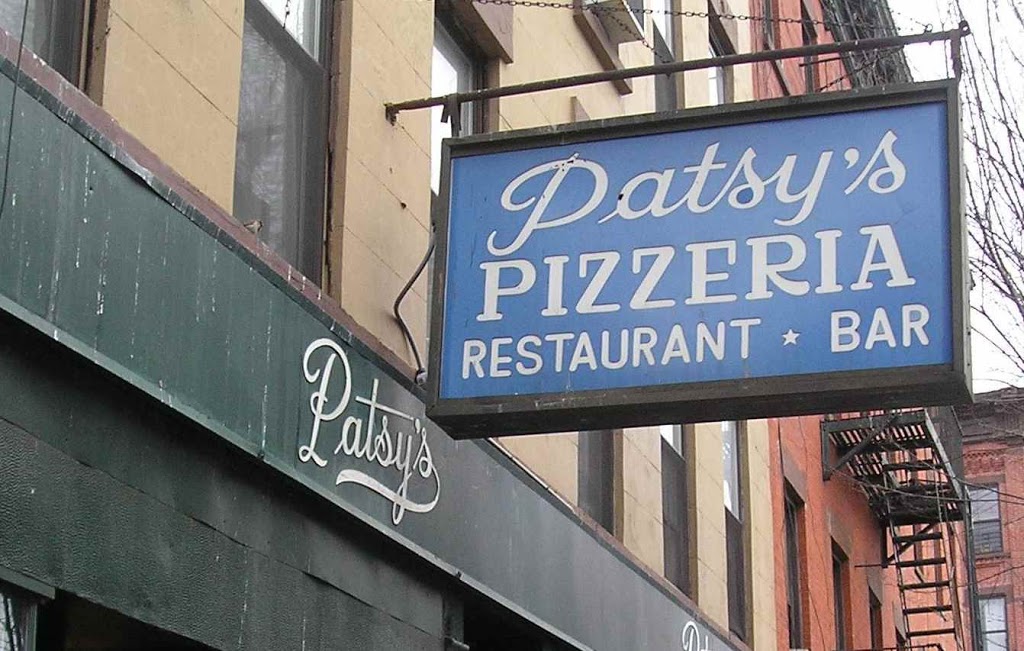
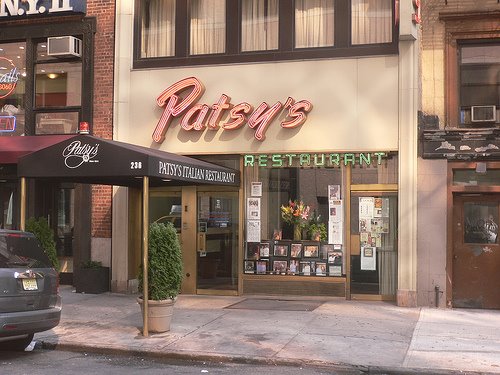
NOT to be confused with this place — the venerable Patsy’s Italian Restaurant in midtown. This Patsy’s does not sell pizza.
To make sure you don’t confuse the two, why don’t you read a U.S. District Court document ‘Patsy’s Italian Restaurant v Patsy’s Pizzeria‘. The words ‘Sauce Litigation’ are actually used.
___________________________________
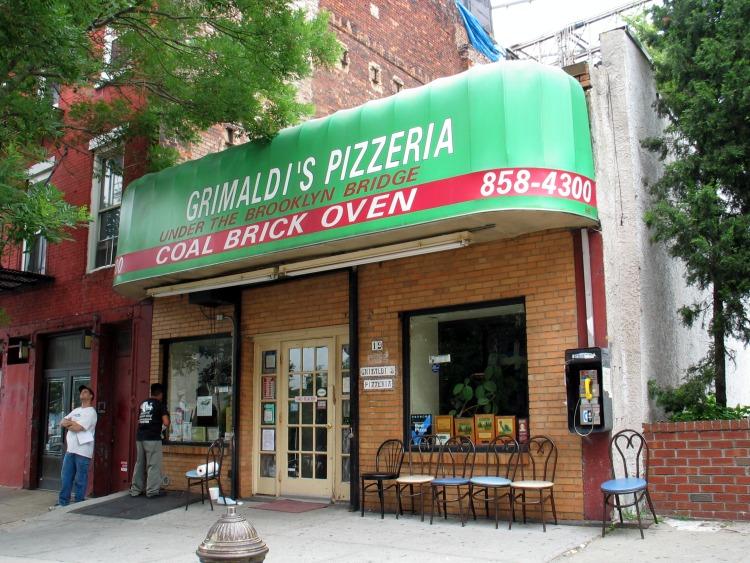
Grimaldi’s “under the Brooklyn Bridge” used to also be a Patsy’s. Today it’s your surest bet for a long line, reportedly still worth the wait.
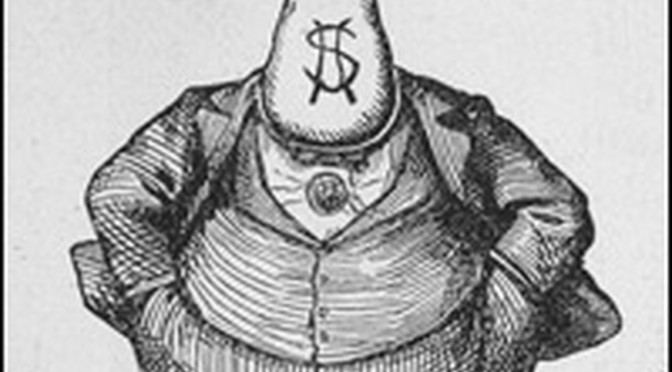
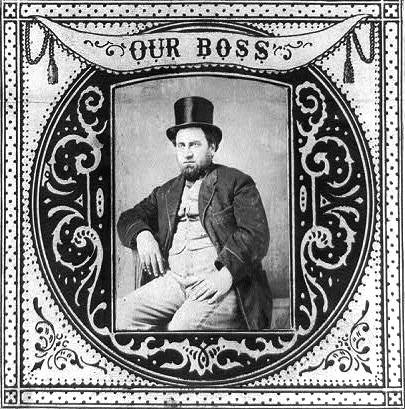
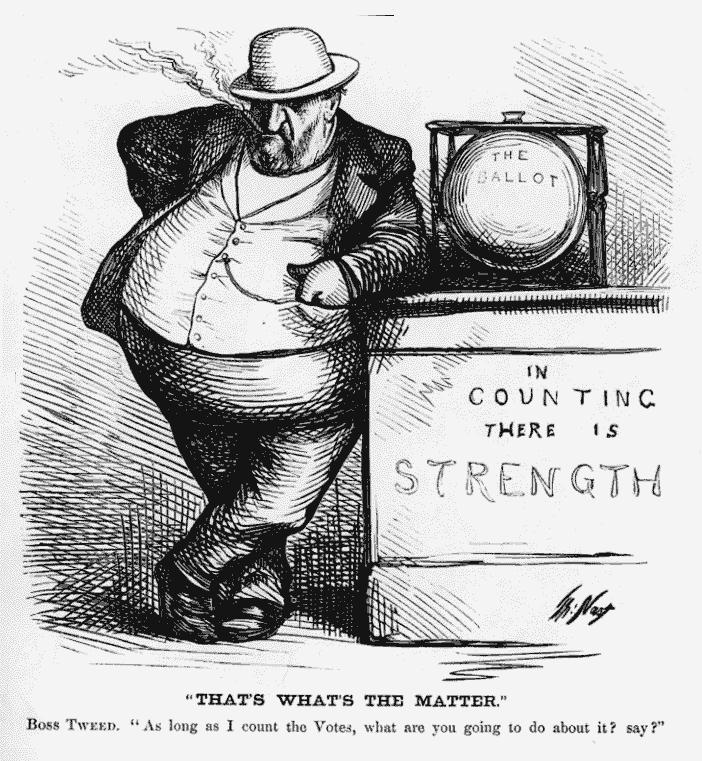
Hail to the thief: an imposing man with money on his mind
___________________________________ You cannot understand New York without understanding its most corrupt politician — William ‘Boss’ Tweed, a larger than life personality with lofty ambitions to steal millions of dollars from the city.
With the help of his ‘Tweed Ring’, the former chair-maker had complete control over the city — what was being built, how much it would cost and who was being paid.
How do you bring down a corrupt government when it seems almost everyone’s in on it? We reveal the downfall of the Tweed Ring and the end to one of the biggest political scandals in New York history. It began with a sleigh ride.
ALSO: Find out how Tammany Hall, the dominant political machine of the 19th century, got its start — as a rather innocent social club that required men to dress up and pretend they’re Indians.
___________________________________
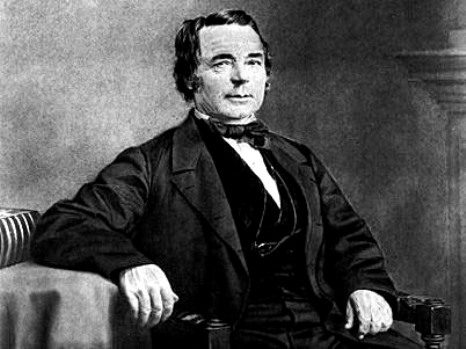
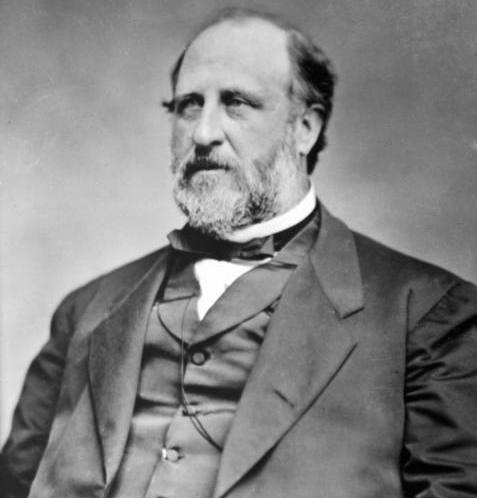
William M. Tweed, son of a chair maker, as photographed by Matthew Brady in 1865. The Lower East Side would not spawn a man as powerful as Tweed until the rise of Al Smith in the 20th Century. Tweed’s influence, however, came at great expense to the city.
The M. in his middle name is something of a controversy. Marcy or Magear? It’s commonly assumed to stand for Marcy; however, there’s no real documentary evidence for this (according to biographer Kenneth Ackerman) while Magear is his mother’s maiden name.
Below: a younger-looking Tweed appears on a tobacco box
___________________________________
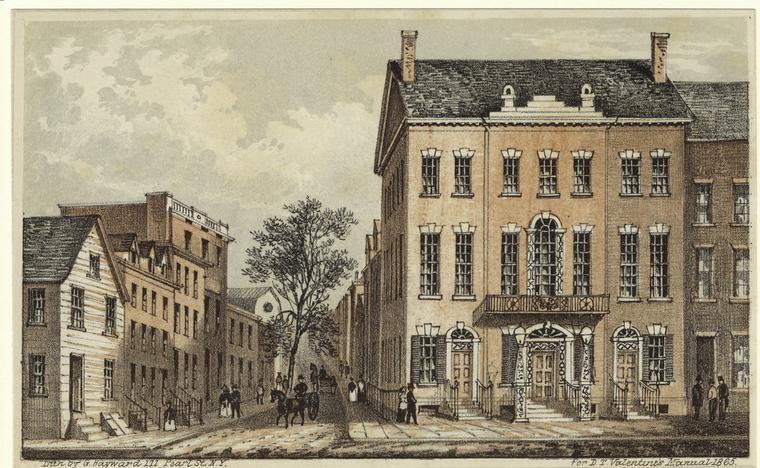
The powerful Democratic machine Tammany Hall (or, officially the Tammany Society) was actually in a hall, located at Frankfurt and Nassau streets, near City Hall. Built in 1811, the new headquarters saw the once benign social organization morph into an influential and often ruthless group with political objectives.
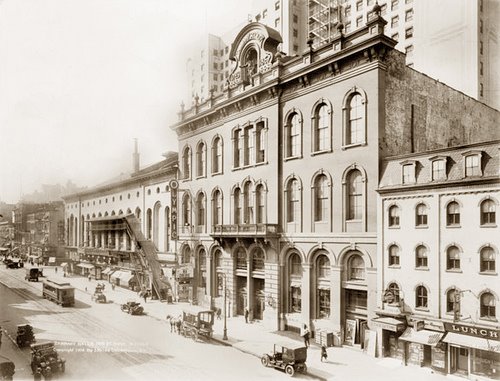
During Tweed’s reign, Tammany Hall was actually located at 14th Street between 3rd Avenue and Irving Place. Tammany moved here in 1867 and would remain until the late 20s, when they would move just around the corner to Union Square. This photo was taken in 1914. Today the Con Edison building, with its beautiful clock tower, stands in its place.
___________________________________
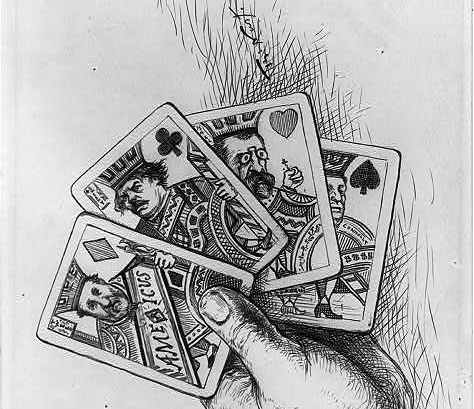
The Tweed Ring — on in this case ‘the Four Knaves’ — as interpreted by their harshest critic, illustrator Thomas Nast. The Ring was composed of Tweed, Mayor A. Oakey Hall, chamberlain Peter Sweeny and ‘Slippery Dick’ Connolly, the comptroller. Emanating from this core group would be other underlings and associates who would assist in the Ring’s graft and embezzlement
Nast’s charges of voting fraud below weren’t hyperbole. The elections of 1868, which installed Hall into the mayor’s seat and Tammany disciple John Hoffman into the governor’s chair, was one of the most manipulated in American history. Fraud was only too common in New York elections in the 19th century.
___________________________________
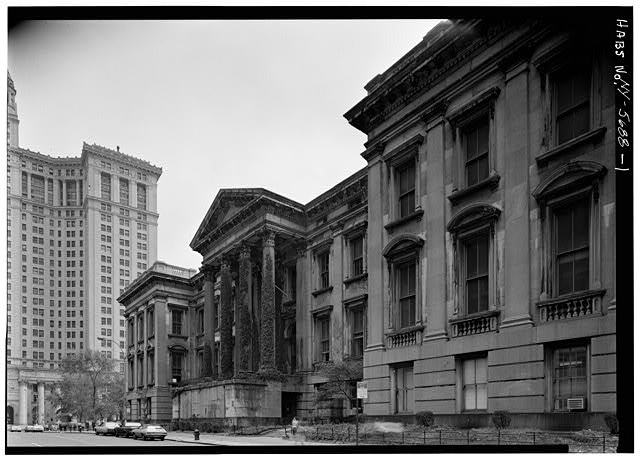
The New York County Courthouse, also known as the Tweed Courthouse for the vast amount money supposedly thrown at it during construction. Contractors would wildly overbill for their often shoddy work, with members of the Tweed Ring skimming from the totals. It would take over 20 years for the building to finally be completed — longer than it took to build the Brooklyn Bridge.
___________________________________
BOOK RECOMMENDATIONS: If you want to learn more about Boss Tweed, go immediately to Kenneth Ackerman’s excellent ‘Boss Tweed: The Rise and Fall of the Corrupt Pol Who Conceived the Soul of Modern New York’. For a broader overview on Tammany Hall, seek out a copy of Oliver E. Allen’s ‘The Tiger: The Rise And Fall of Tammany Hall’ which I believe it out of print but worth looking for.
RELATED PODCASTS: Listen to our prior show on Greenwood Cemetery, where Tweed is buried. Re-visit our Union Square show to get a taste of Tammany’s wily Fernando Wood. Last year I wrote about the Ludlow Street Jail, where Tweed saw his final days.
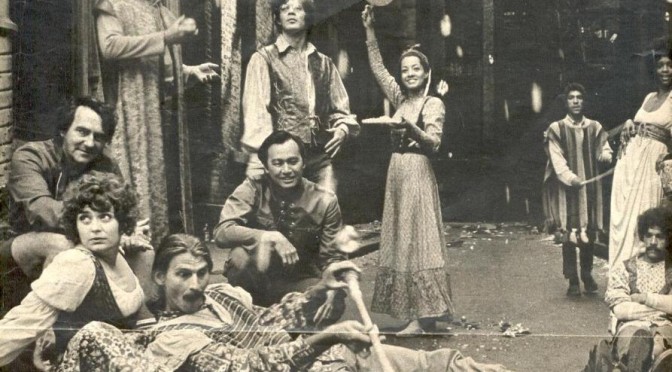
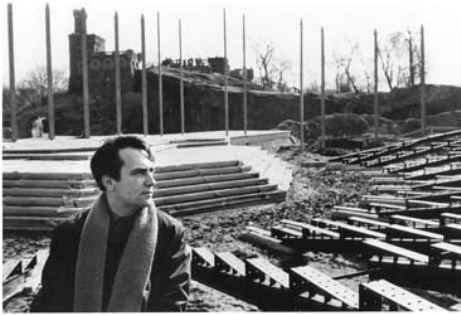
What started in a tiny East Village basement grew to become one of New York’s most enduring summer traditions, Shakespeare in the Park, featuring world class actors performing the greatest dramas of the age. But another drama was brewing just as things were getting started. It’s Robert Moses vs. Shakespeare! Joseph Papp vs. the city! ALSO: Learn how the Public Theater got off the ground and helped save an Astor landmark in the process
PODCAST Listen to it for FREE on iTunes or other podcasting services. Or click this link to listen to the show or download it directly from our satellite site
___________________________________
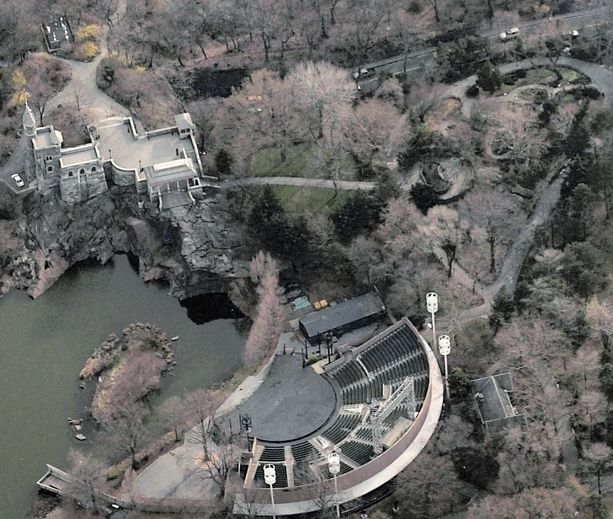
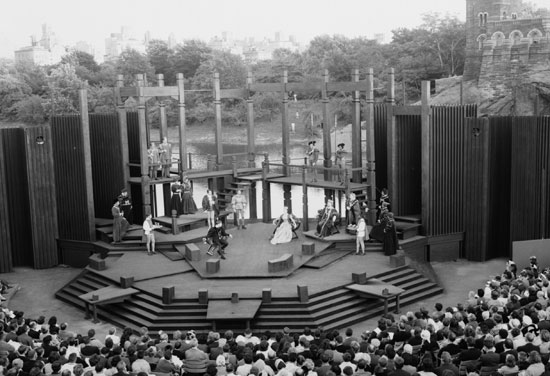
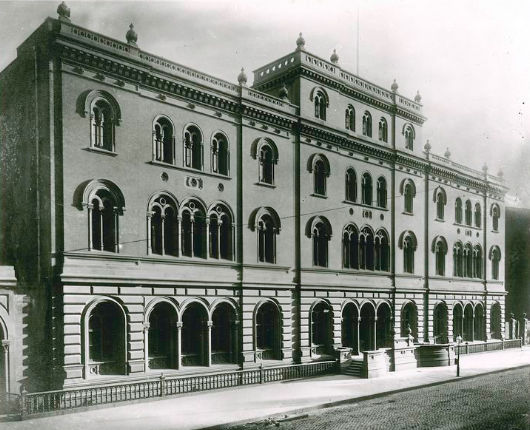
Looking down over both Delacorte Theater and Belvedere Castle. Joseph Papp didn’t have much say in the construction of the theater, but he probably couldn’t have asked for a more picturesque, more perfectly situation location.
Papp at the Delacorte: within a handful of years, he was able to tranport his vision from a basement in an East Village church to the world’s most famous park. Not without a few speedbumps, however…. (pic courtesy New York Public Library)
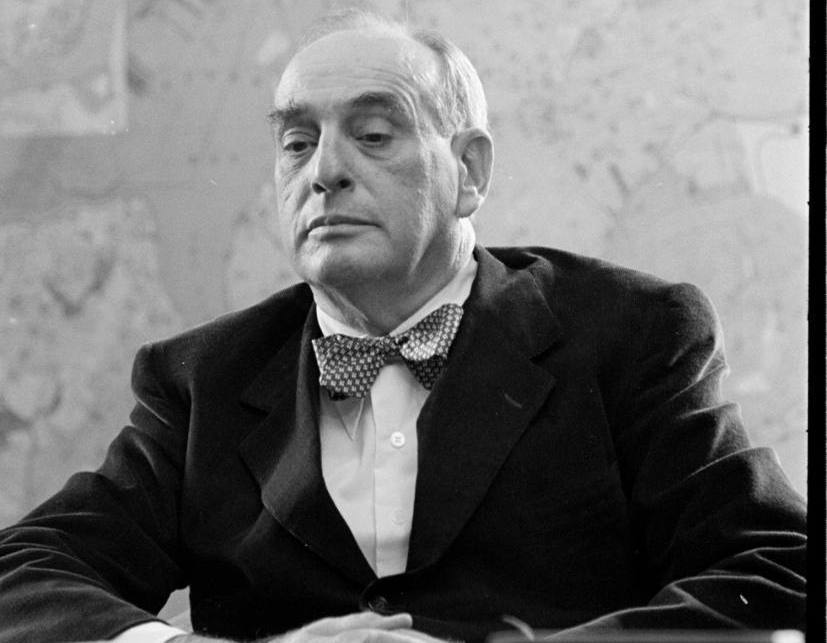
Robert Moses had been one of New York’s most powerful men for almost 30 years by the time he confronted the Shakespeare Festival. At first a supporter of the outdoor program, he soon turned on Papp and refused his permit to perform in Central Park.
One of several performances of Hamlet, this one from 1964, starring Julie Harris and Stacy Keach.
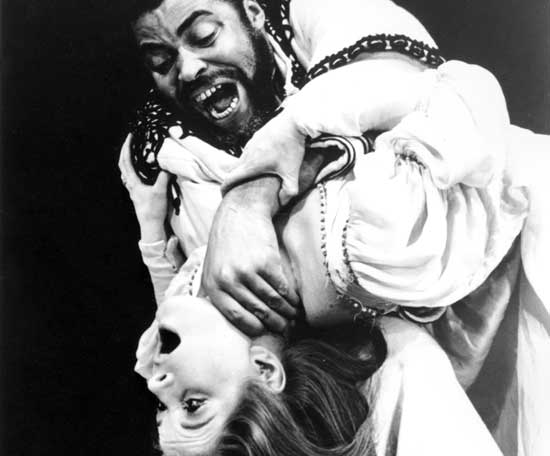
If I could take a time machine back to see one show, it would probably be the 1964 version of Othello with a spry James Earl Jones in the title role.
The old Astor Library, built over a hundred years before the Public Theater made it home. Our New York Public Library podcast details how the volumes once stored at this Astor institution were used to build the collection for the new public system.
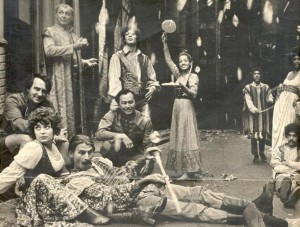
From the 1972 production of the musical version of Two Gentlemen Of Verona, starring Public Theater regular Raul Julia. Like many Delacorte productions, Verona went on to play Broadway and win Tony Awards. Papp is kneeling far left. (Pic courtesy
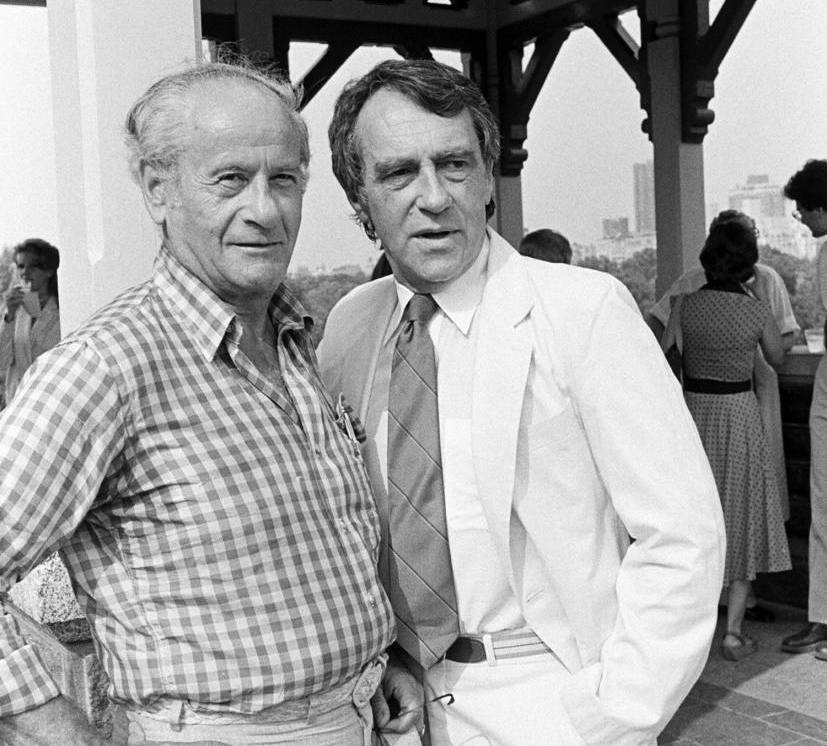
Papp with actor Eli Wallach in 1983. With the Shakespeare festival and later with regular programming at the Public Theater, Papp was able to draw New York’s finest actors and cultivate new stars in the process.
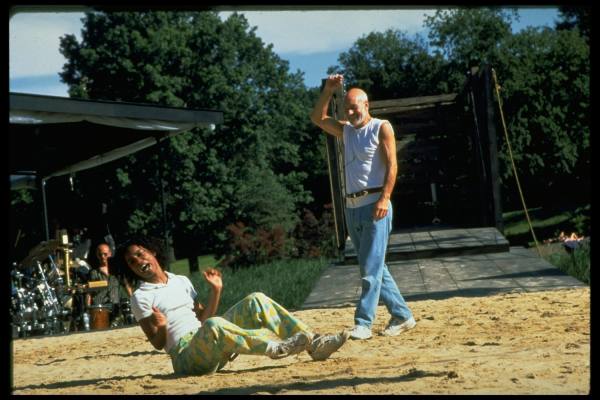
Patrick Stewart rehearses for the 1995 version of The Tempest.
The winding ticket line, quite a treat on a lovely day (and less so when it’s not). These days, for those who can’t or don’t wish to wait, there’s a limited virtual line as well. (Pic courtesy Flickr)
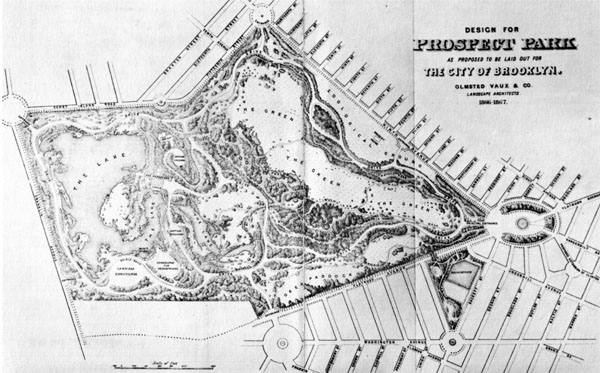
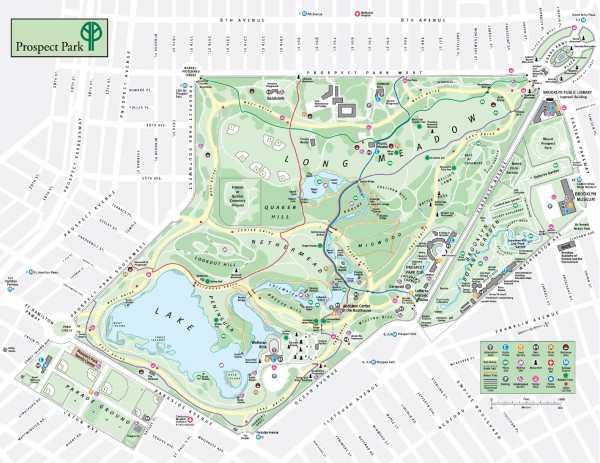
Prospect Park, Brooklyn’s biggest public space and home to the borough’s only natural forest, was a sequel for Olmsted and Vaux after their revolutionary creation Central Park. But can these two landscape architects still work together or will their egos get in the way? And what happens to their dream when McKim, Mead and White and Robert Moses get to it?
PODCAST Listen to it for FREE on iTunes or other podcasting services. Or click this link to listen to the show or download it directly from our satellite site
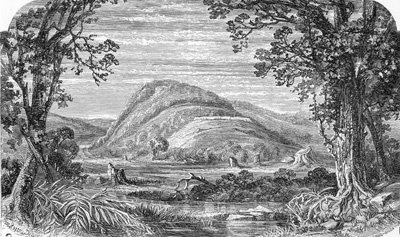
The area of Prospect Park in 1776. This spot, called Flatbush Pass (and later Battle Pass), was the scene of a violent clash between Continental Army soldiers and Hessians employed by the British army. Part of the reason the park was located here was to preserve this hallowed historical war spot.
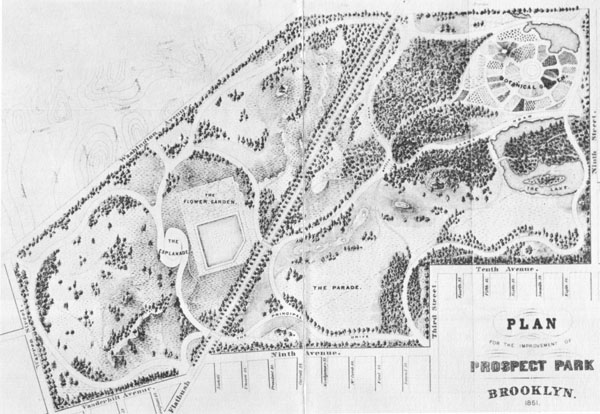
Egbert Viele’s proposed ‘Mount Prospect Park’ blossomed around Flatbush Avenue, which would be arched with pedestrian bridges. This plan would have retained Mount Prospect. But what kind of a park has a major thoroughfare cutting right through it.
Olmstead and Vaux, meanwhile, opted to eliminate one side of Viele’s plan entirely, expanding it south and west with newly acquired land.
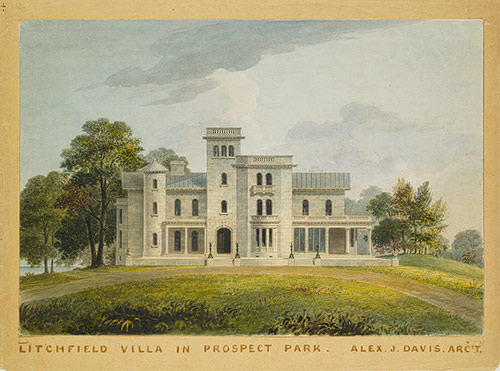
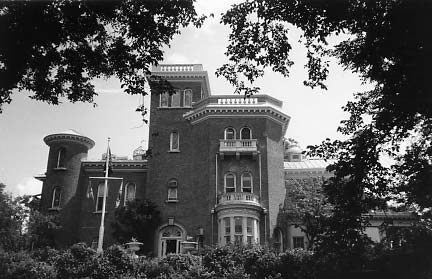
The home of Edwin Litchfield, as it looked back in the day…
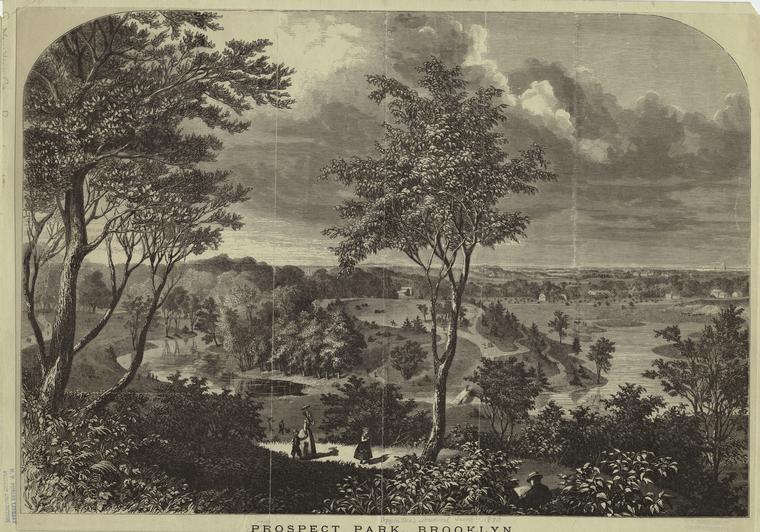
An artist’s depiction of Prospect’s tableaux-style natural foliage. The landscape architects wanted to ‘augment’ the natural beauty of the area. That augmentation included over 70,000 new trees and shrubs.
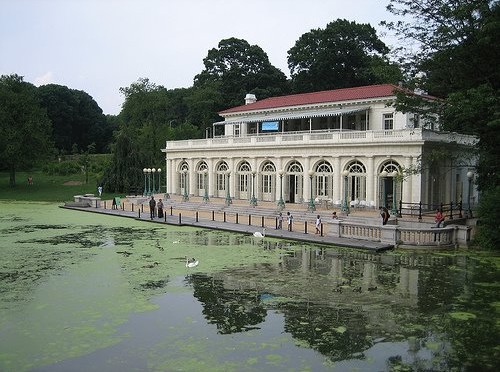
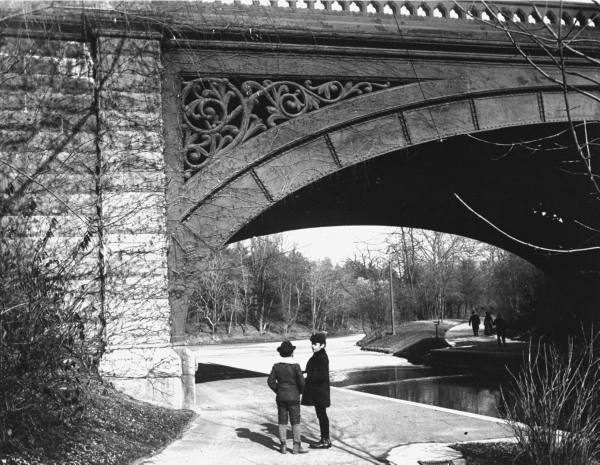
Arches, bridges and overpasses weave throughout the park, often creating fairytale like settings. Photo, taken in 1887 by Wallace G. Levison
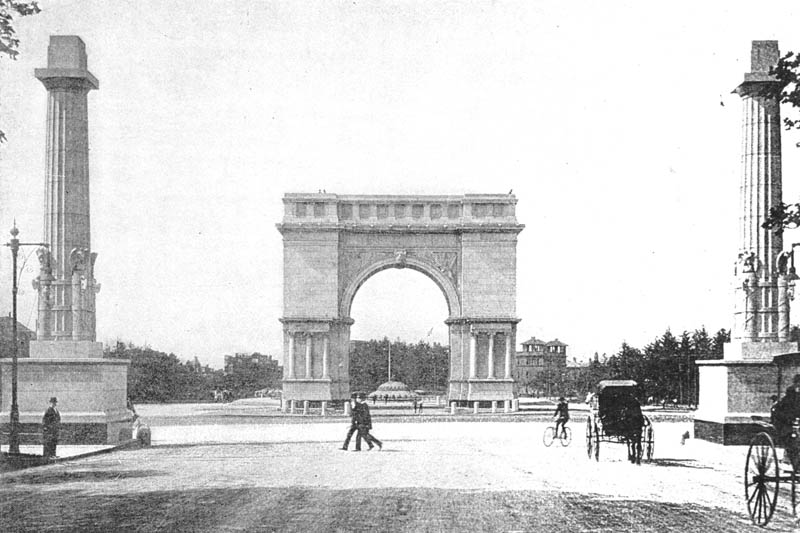
Grand Army Plaza in 1894. More would be added to the plaza, giving it that ornate, triumphal feel — not exactly what Olmsted and Vaux had really intended.
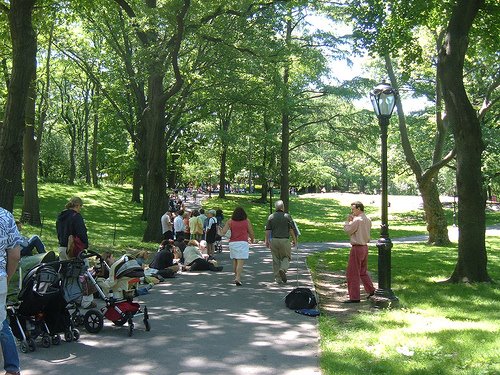
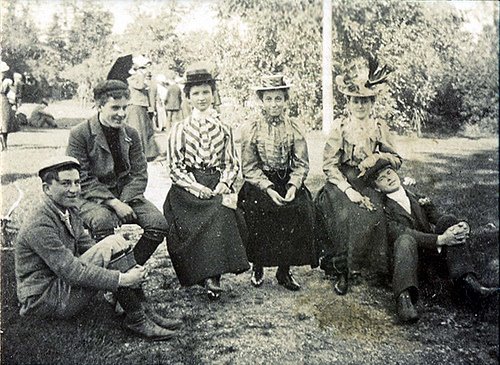
Young adults hangin’ around the park, circa the 1910s
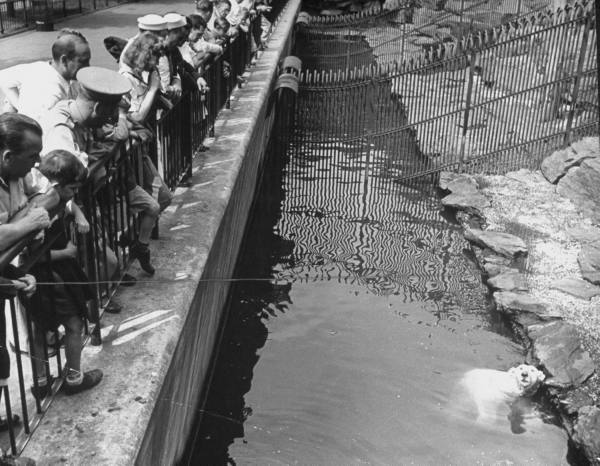
One of Robert Moses’ more beneficial additions: the Prospect Park Zoo (as it looked in 1943)
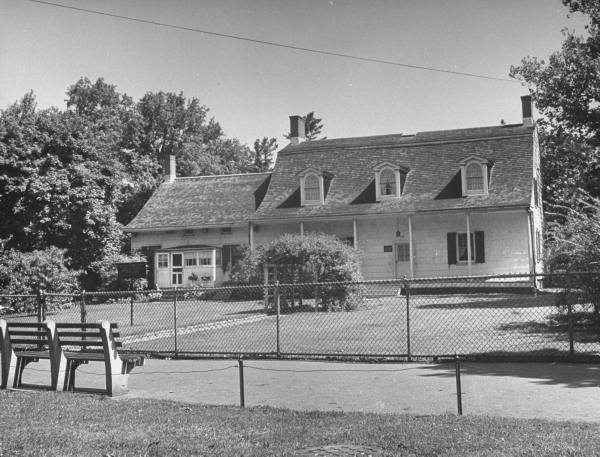
The old Leffert’s homestead did not start out in Prospect Park. It moved there when it was sold to the city in 1918
We turn the clock back to the very beginnings of New York history — to the European discovery of Manahatta and the voyages of Henry Hudson.
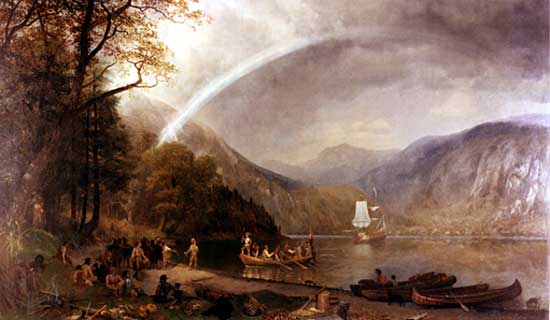
Originally looking for a passage to Asia, Hudson fell upon New York harbor and the Lenape inhabitants of lands that would later make up New York City. The river that was eventually named after Hudson may not have provided access to Asia, but it did offer something else (hint: PETA won’t be happy) that attracted the Dutch and eventually their very first settlement — New Amsterdam.
LISTEN NOW: Henry Hudson
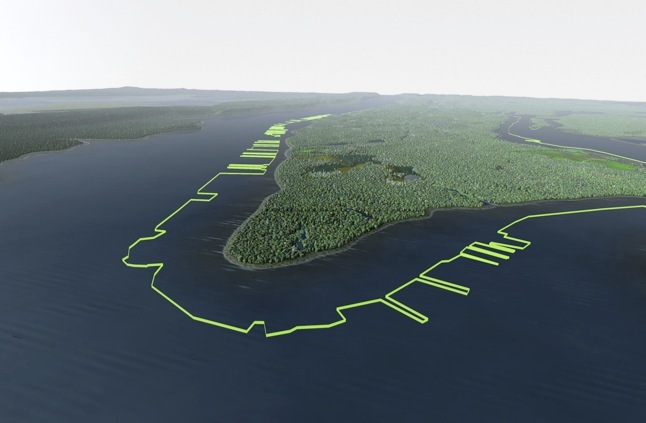
The island of Mannahatta in the days before the Dutch (courtesy the Mannahatta Project). Hudson would have anchored off the tip on the western side, his eyes on the river that stretched north.
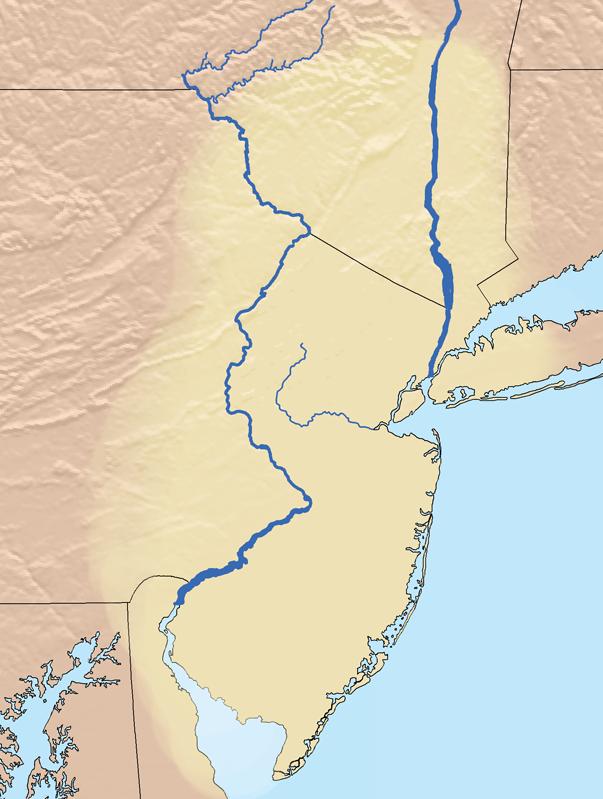
Lenapehoking: that’s what the original inhabitants of the area called the land that comprised the New York City metro area, New Jersey, western Long Island and surrounding areas (map courtesy wikimedia)
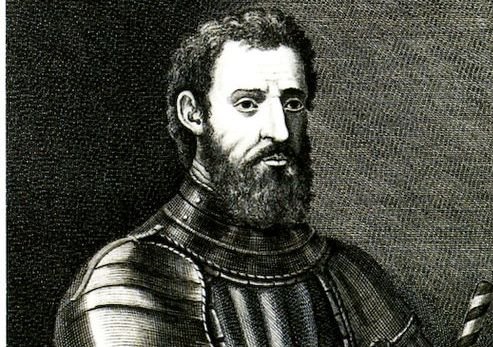
The first guy to arrive, Giovanni da Verrazano (or Verrazzano, depending on where you look), was greeted by the Lenape at the mouth of New York harbor. He touched down on today’s Staten Island but never ventured further into the harbor.
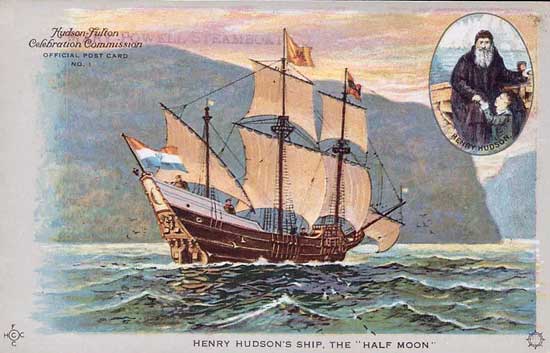
Hudson’s ship the Half Moon — or rather a replica that was launched for the 1909 Hudson-Fulton Celebration
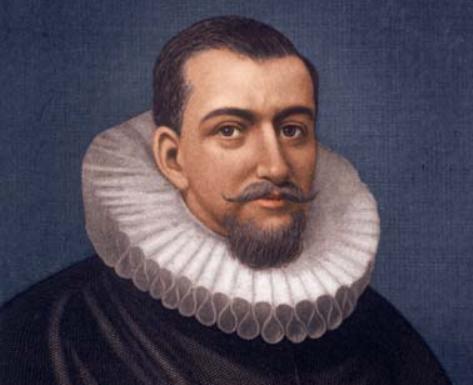
Henry Hudson, an Englishman who tried twice for his country to find a northern route to Asia before being enlisted by the Dutch East India Company. He never found a passage for them either, but he did find the river that today bares his name.
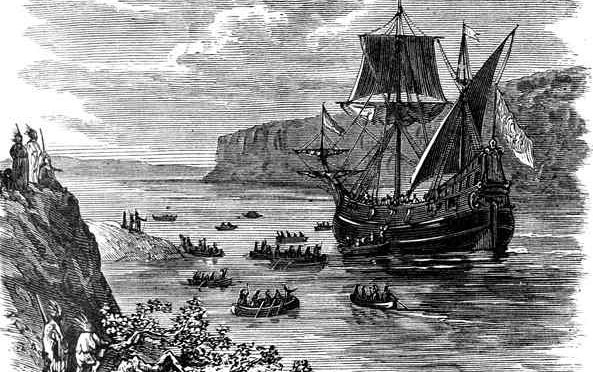
Hudson’s voyage up the Muhheakantuck (the Lenape name for the Hudson River) brought him into contact with several tribes, with encounters growing increasingly unfriendly. By the time he sailed back down the river to Mannahatta, they were flat out attacked by natives in canoes.
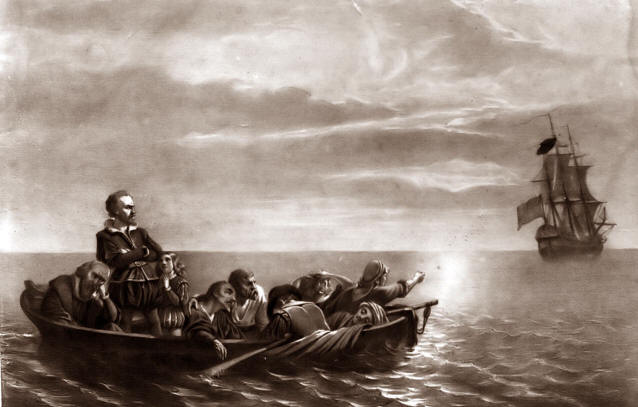
On his last voyage, Hudson’s crew mutinied, throwing the captain, his son and a few remaining loyal crewmen into a boat and setting it adrift in the Arctic.
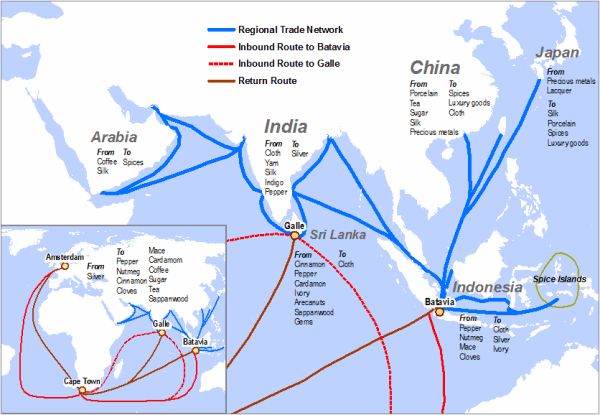
With no alternate route to Asia, the map below illustrates the trade routes the Dutch East India Company had to eventually travel to build their empire. (map courtesy Hofstra)
There are lots of events planned to celebrate the 400th anniversary of Hudson’s discovery. NY400: Holland on the Hudson celebrates New York’s Dutch heritage. Hudson 400 focuses on the explorer himself, with a timeline of events. Meanwhile Explore NY 400 lists statewide celebration.
I wrote about some of the more curious events of the Hudson-Fulton Celebration in a prior blog posting.
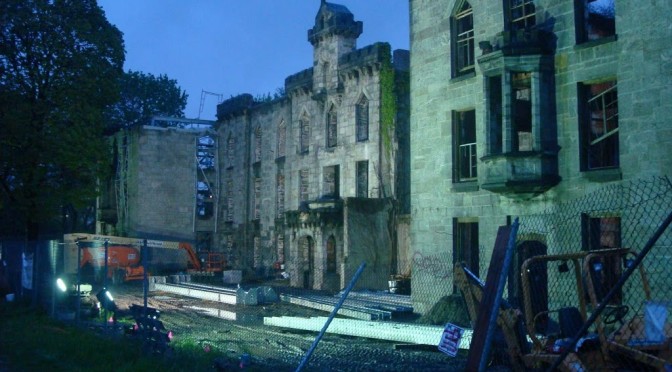
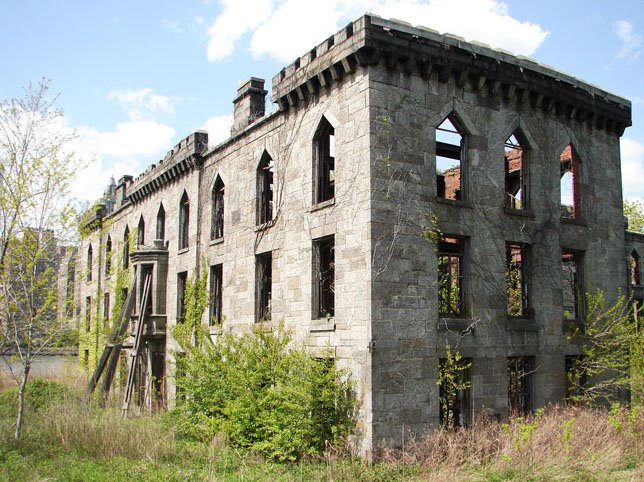
The original Smallpox Hospital, designed by James Renwick, still stands today thanks to diligent restoration. (Click pic for detailed view)
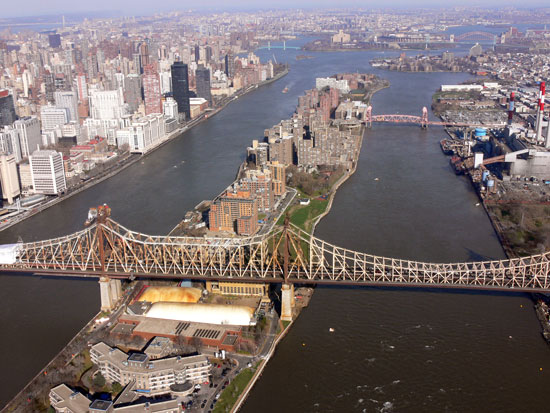
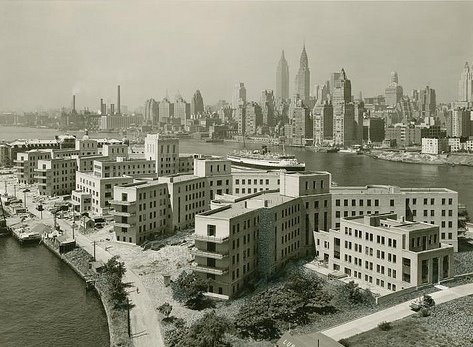
Looking north over Roosevelt Island, which cleanly splits the East River. Picture the buildings gone, the bridges wiped away, replaced with fruit trees and a small farm. The island has adopted several names over the years, including Minnahanonck (‘It’s Nice To Be Here’), Varkens Island (aka Hog’s Island), and Manning’s Island.
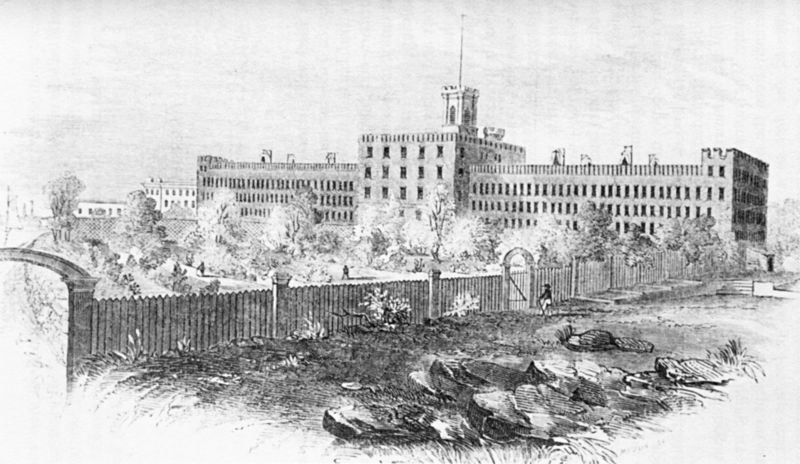
The penitentiary, opening on the now-named Blackwell’s Island in 1832, defined the next 100 years on the island — overcrowded, chaotic, inadequate facilities, grim and corrupted
Another illustration of the prison, this from 1853, showing a rather unusual feature to its side: a garden, which would be kept by inmates to feed themselves
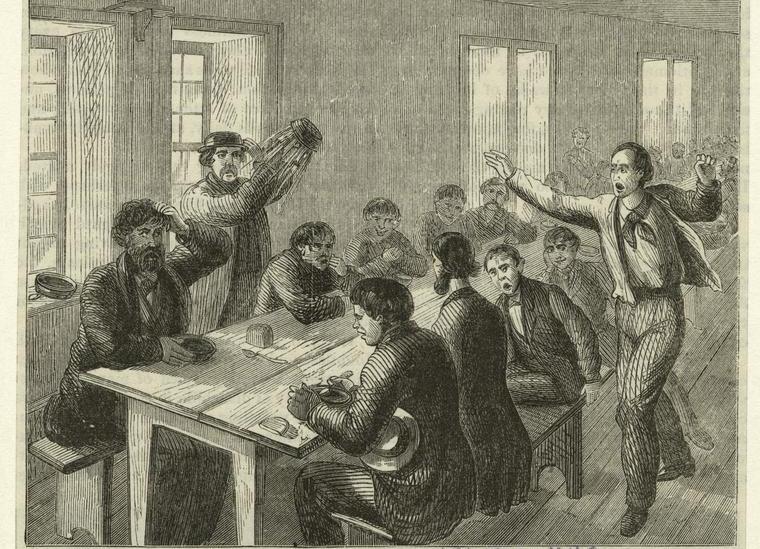
Food fight! Conditions inside the prison — as in most places on the island — were guided by mischief and chaos. Harpers Magazine 1860 (courtesy NY Public Library)
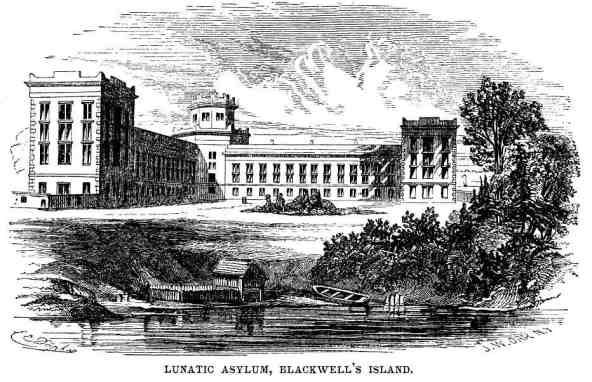
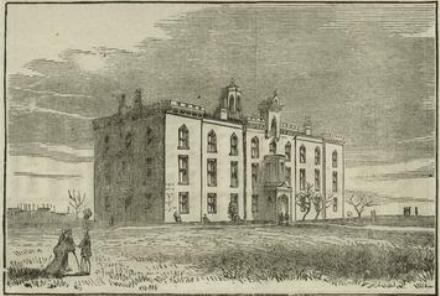
The Lunatic Asylum, aka ‘the Octagon’, became as overcrowded as the island’s prisons, often with people who would not have been considered ‘crazy’ today. Only two wings of the asylum were ever completed. Today, the Octagon is a luxury apartment complex.
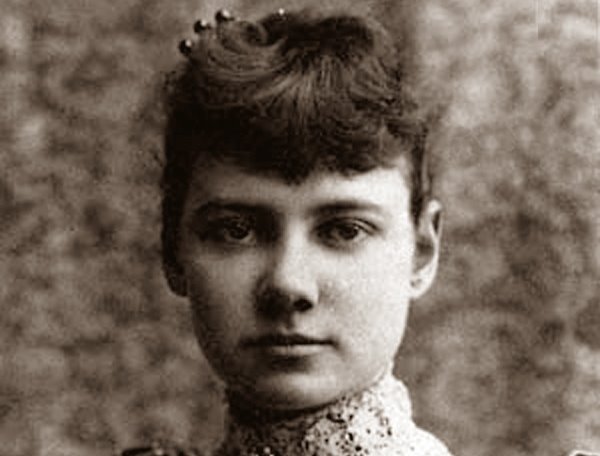
Intrepid reporter Nellie Bly exposed the wretched conditions within the asylum when she went undercover there in 1887.
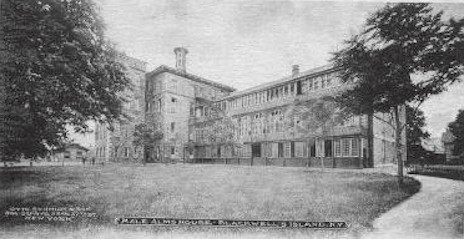
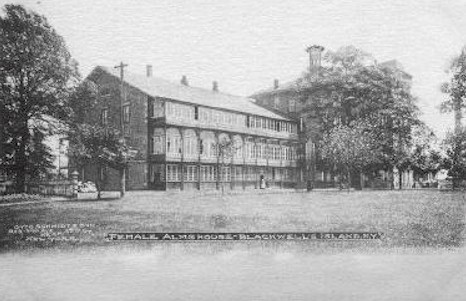
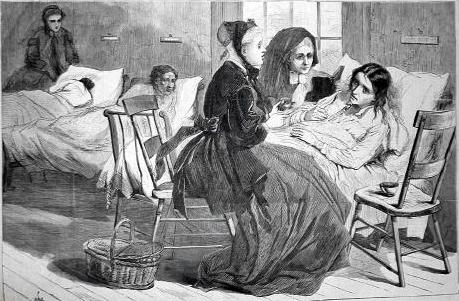
Male and female almshouses, catering to the homeless, the desperately poor and the elderly. Some residents would spend time at the penitentiary or work house, check out, and check back in here. (Images from here)
The Smallpox Hospital came to the island in 1856, a Gothic structure by James Renwick that saw thousands of diseased patients a year.
An illustration from 1868 expresses the dire scene at one of the island’s many hospitals. Confining all manner of sick and injured to one island might have been good for the general population, but was often a dangerous proximity for the sufferers, especially during epidemic time.
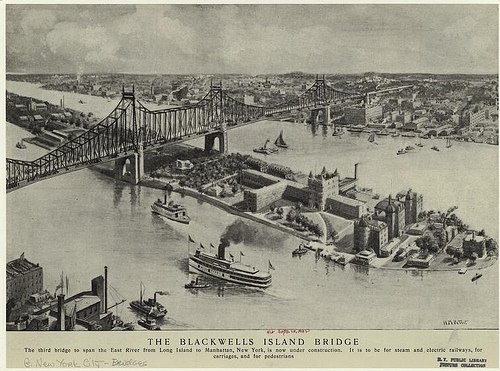
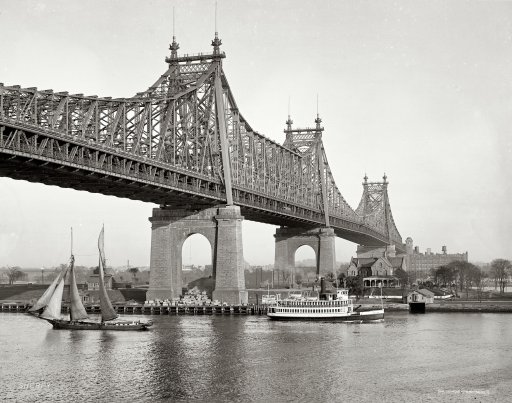
A dramatic change came in 1909 with the construction of the ‘Blackwell’s Island Bridge’, better known today as the Queensboro or 59th Street Bridge. A trolly stopped at the middle of the bridge, letting passengers off who then took an elevator down to the island. The elevator was dismantled by 1970.
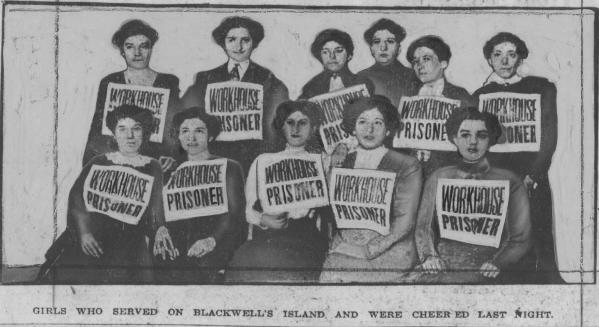
The workhouse, home to prostitutes and drunks, was also a popular place to dump protesters and labor reformers, as evidenced by this group of brave looking women.
As Welfare Island, many of the major institutions would soon leave (to other New York islands) leaving on chronic care hospitals and a whole lot of abandoned property.
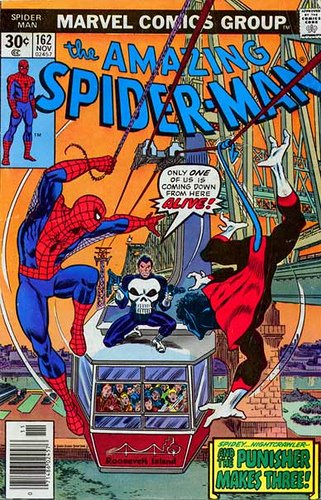
The Roosevelt Islamd Tram was an instant hit when it debuted in 1976, inspiring romantics and comic book writers alike.
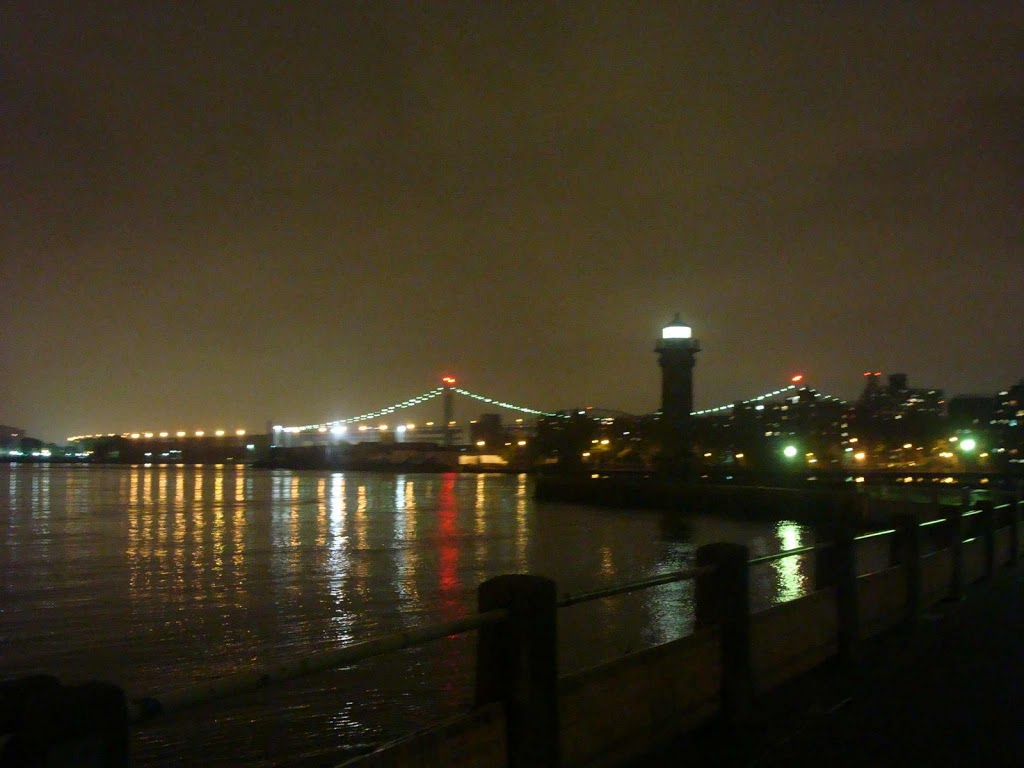
The haunting lighthouse at night, built by island inmates and still illuminating the East River, though the dangers of ships smashing against the rocks of Hell Gate are long gone.
The Renwick Ruins still stand at the south end of the island, the former smallpox hospital still managing to give people a bit of a chill when seen close up (and preferably at night).
An extraordinary look at the island: in 1903, Thomas Edison made a short film using the island as a backdrop. The views include the lighthouse, the Octagon, the penitentiary and the construction work of what would become the 59th Street Bridge
You can find anything you want to know about Roosevelt Island at two excellent blogs, Roosevelt Islander and Roosevelt Island 360. The Main Street Wire, the RI community newspaper, has a great website with an exhaustive history timeline. And naturally, the always reliable Correction History, for all you prison history buffs, has some great info as well.
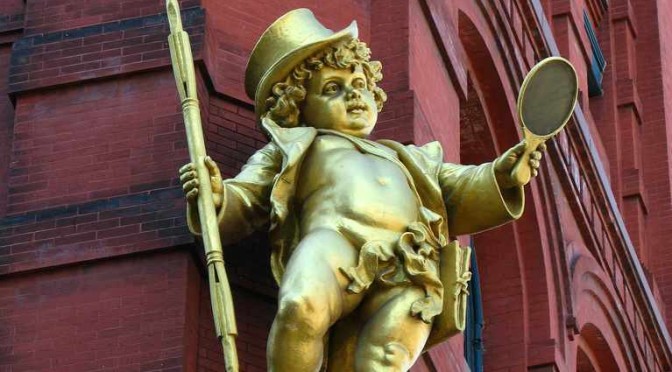
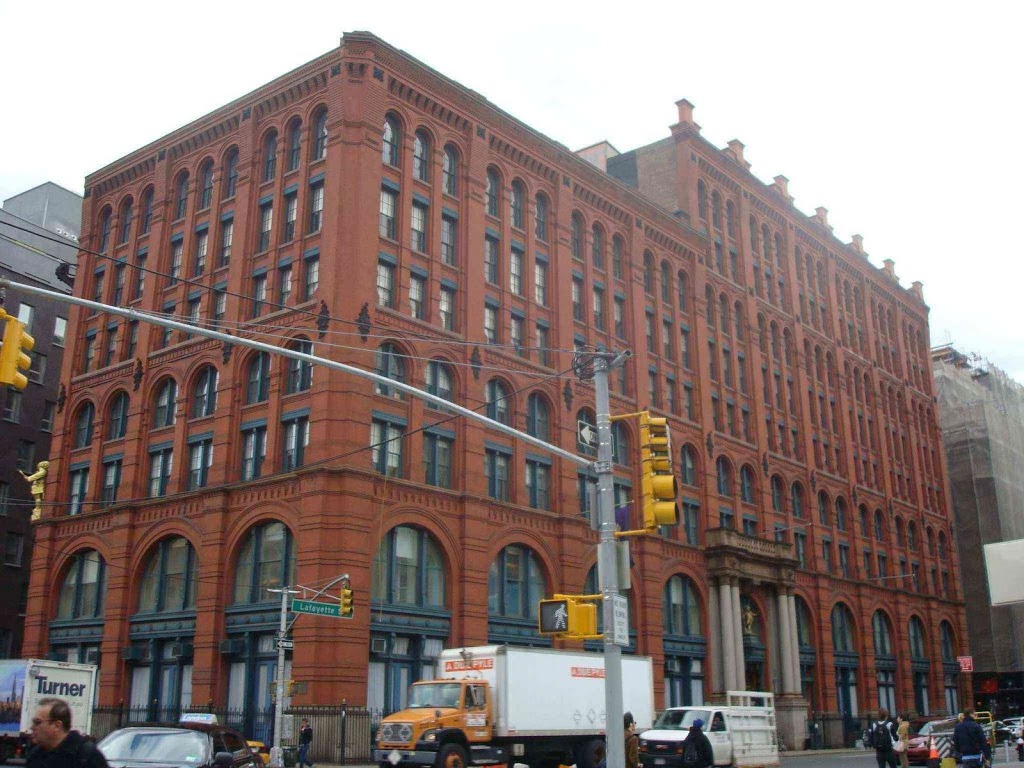
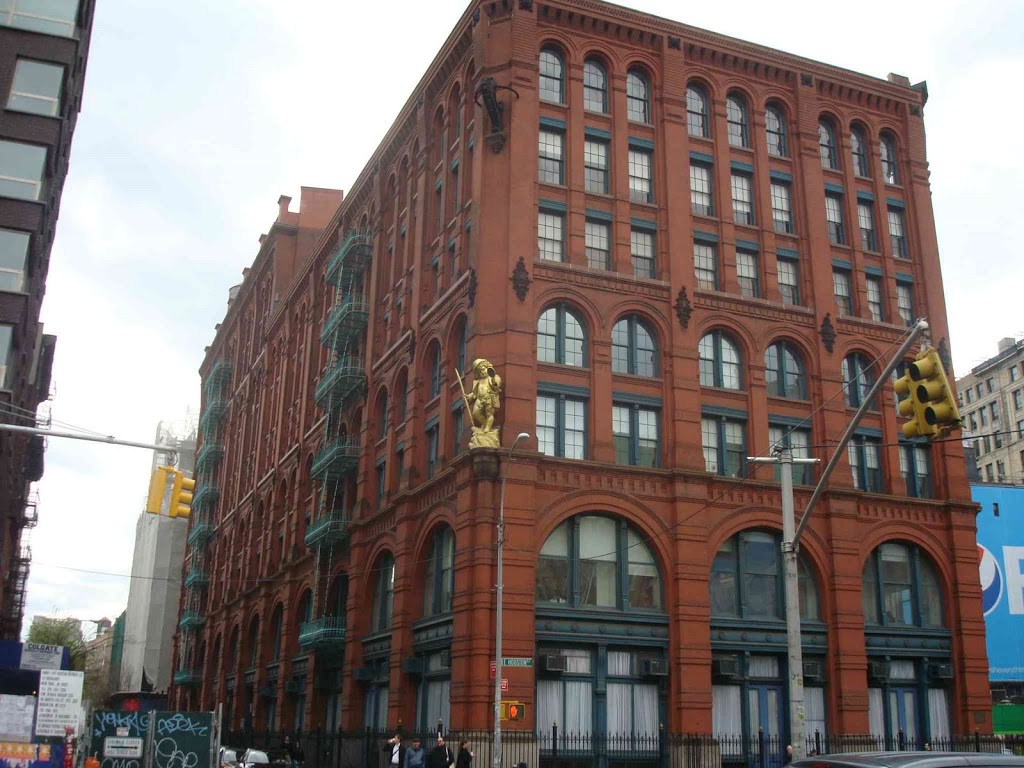
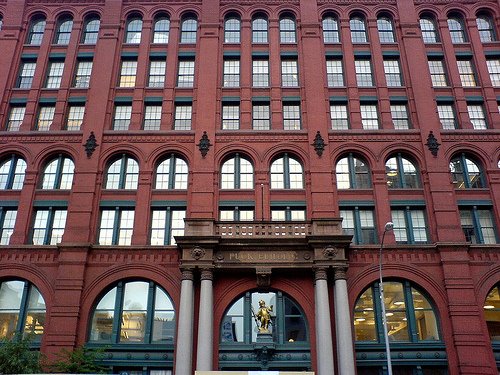
A 6-foot plump gold impish figure stares down as you look up to observe the gorgeous red-brick design of the Puck Building, built for one of the 19th century’s most popular illustrated publications. But this architectural masterpiece was very nearly wiped away by a sudden decision by the city. How did it survive?
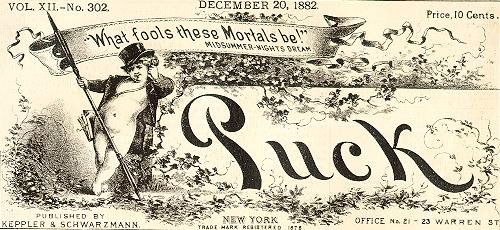
Puck’s utterance “What Fools These Mortals Be!” is the slogan for Puck Magazine and words written by Shakespeare.
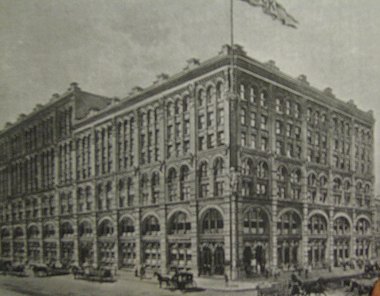
An illustration of what the Puck Building looked like pre-1897….
…and how the truncated Puck looks today.
The impish Puck standing at the corner of the building — and above the western doorway — is echoed in Puck’s magazine banner
There are, of course, two Pucks at the Puck Building. A smaller, newer Puck stands over the main entrance. Neither this entrance nor the Puck above it existed before 1897.
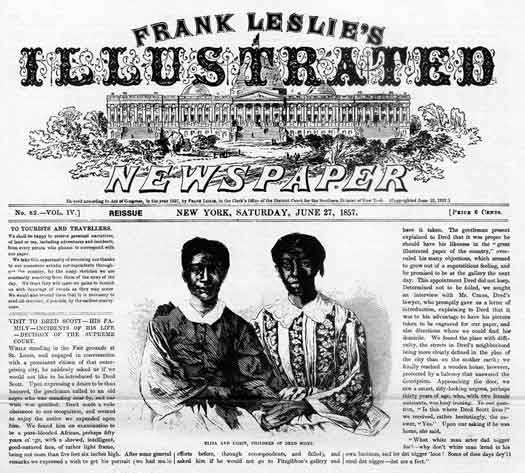
An early issue of Frank Leslie’s Illustrated Newspaper. Keppler went to work for Leslie before striking out on his own with the far more satirical Puck Magazine.
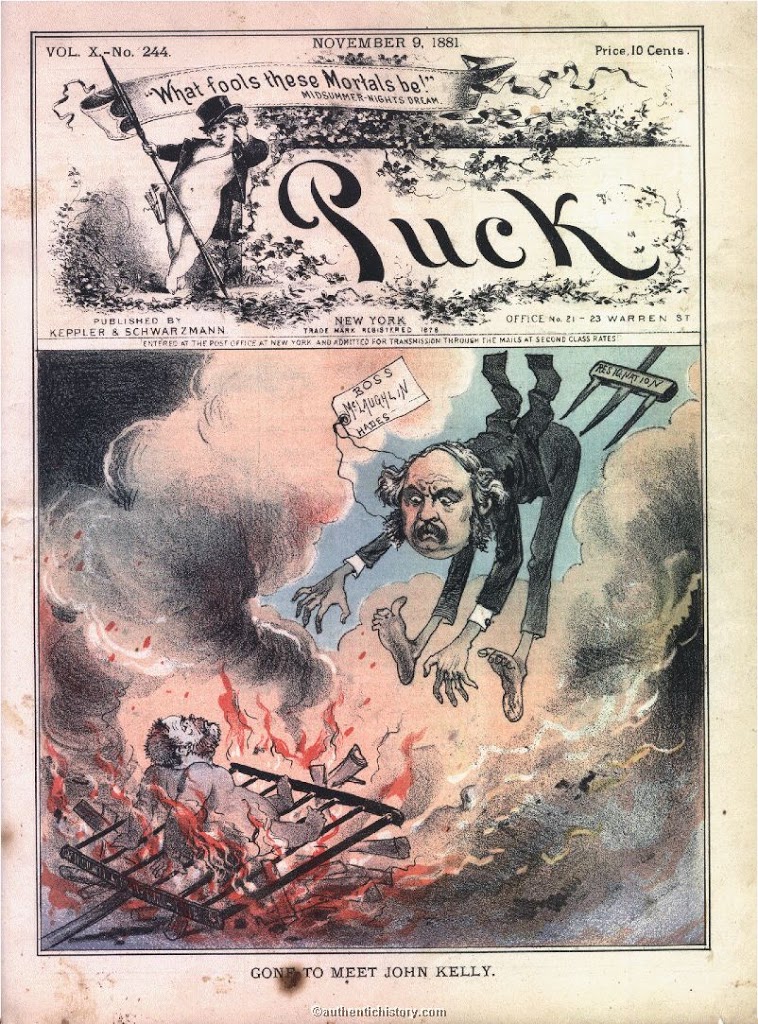
Some images from Puck Magazine. Please click into the images for greater detail.
Below is a cover from 1881, satirizing Brooklyn’s most powerful Democrat, Hugh McLaughlin, who frequently butted heads with Tammany Hall.
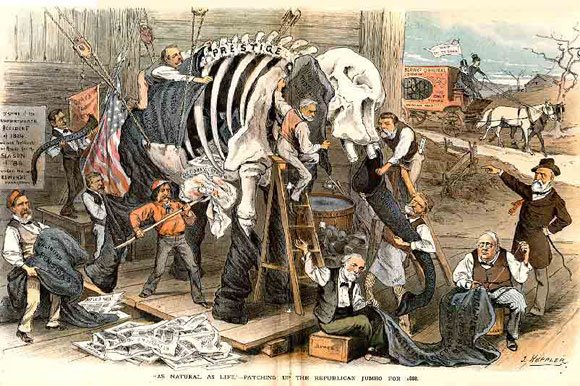
Republicans attempt to stitch together their fractured party, in an illustration by Keppler himself. Keppler was one of the most influential illustrators of his time, second only to the great Thomas Nast of Harper’s Weekly.
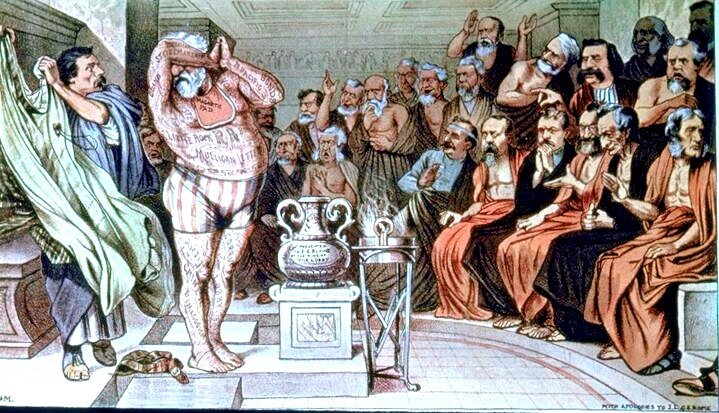
Possibly the most powerful image the magazine ever ran was this one, mocking presidential Republican candidate James Blaine. Keppler was a supporter of Democrat Grover Cleveland, and cartoons like this swayed public opinion. Cleveland beat Blaine in the presidential election of 1884.
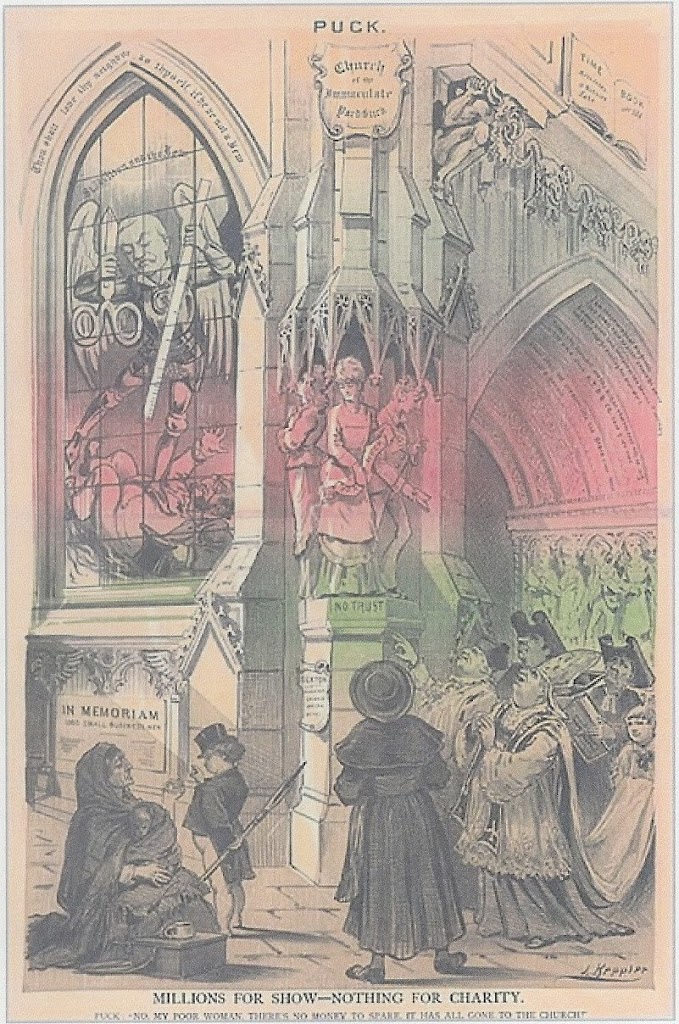
In the interior illustration below, Keppler displays his obvious anti-Catholic (and, by extension, anti-Irish) bias. Puck himself is inserted in this image at bottom left.
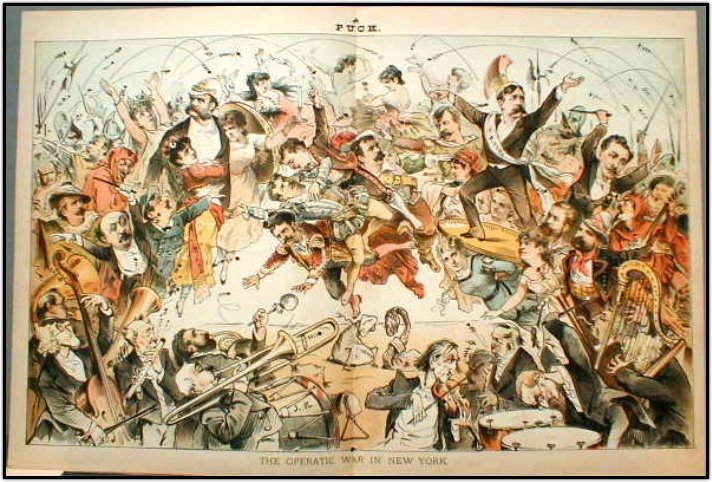
One of my favorite images, and a good example of Puck’s centerfold illustrations, this one expanding on the war in 1883 between the Metropolitan Opera and New York’s Academy of Music.
One hundred years after the Puck Building opened, another catty, satirical magazine Spy Magazine moved in, carrying on the tradition of political lampooning.
PODCAST: The story of Penn Station involves more than just nostalgia for the long-gone temple of transportation as designed by the great McKim, Mead and White.
It’s a tale of incredible tunnels, political haggling and big visions. Find out why the original Penn Station was built to look so classical, why it was then torn down, and what strange behaviors the tunnels that connect it to New Jersey exhibit every night.
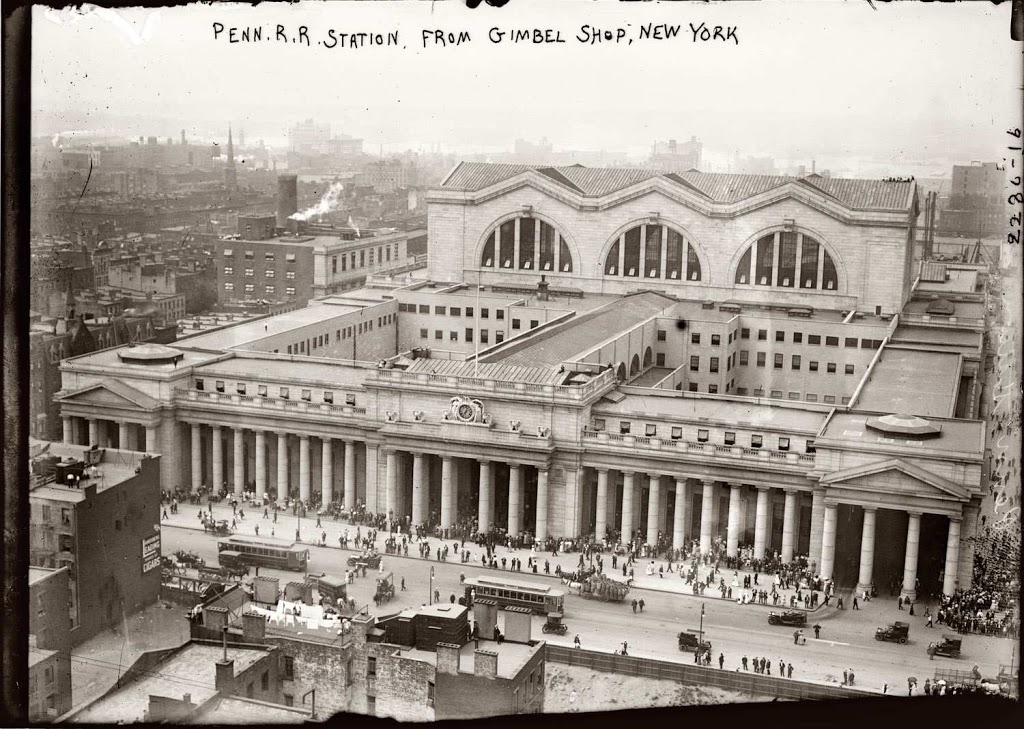
The grandeur and size of Penn Station shocked New Yorkers as it rose from the massive pit excavated by workmen employed by Penn Railroad. McKim, Mead and White’s Roman homage expressed the scope of their client’s ambitions; even more impressive than the station were the miles of tunnels under Manhattan. The image below was taken from Gimbels department store (Click the picture below for greater detail. Pic courtesy Shorpy)
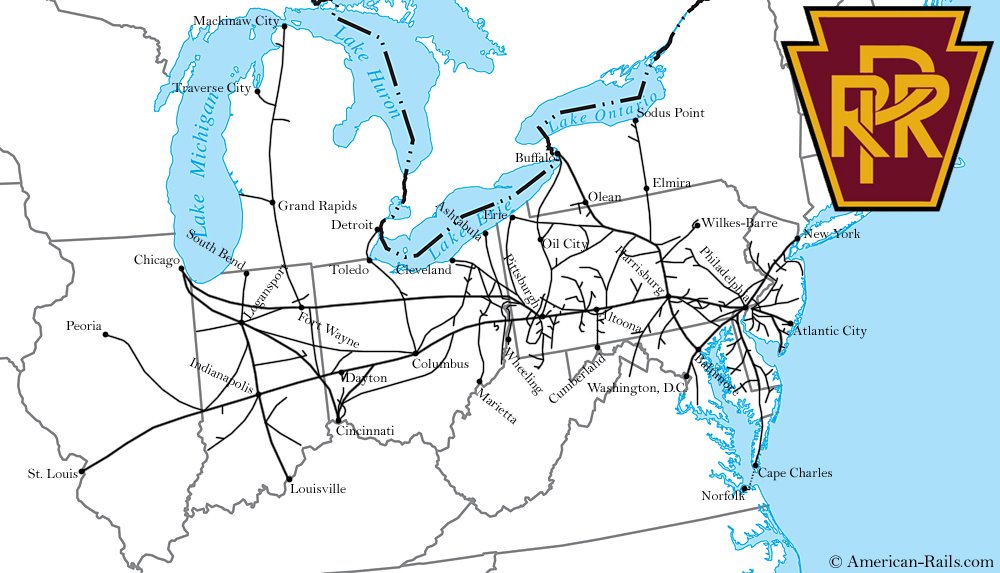
The empire of the Pennsylvania Railroad, extending through most of the northeast, but unable to reach Manhattan until 1910. (Map courtesy American Rails.)
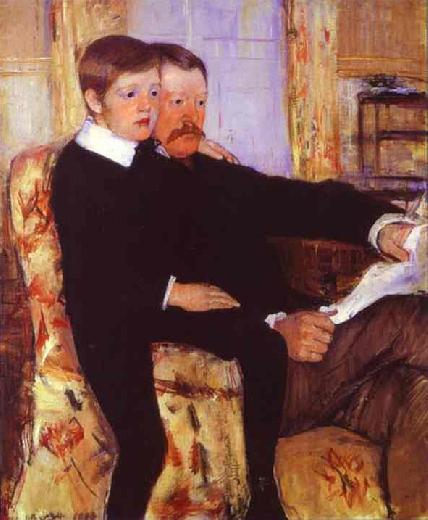
Mary Cassatt’s acclaimed painting of her brother Alexander, the president of Penn Railroad from 1899 to his death in 1906, seated here with his young son Robert
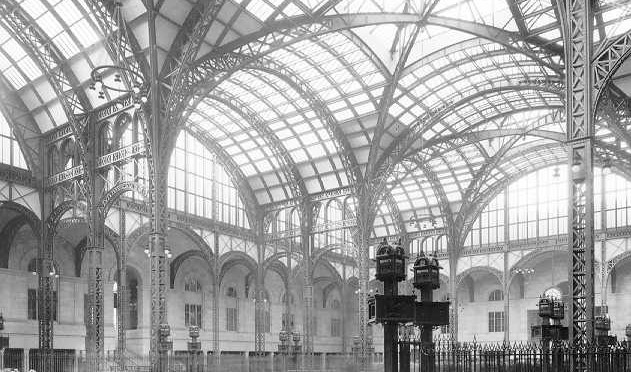
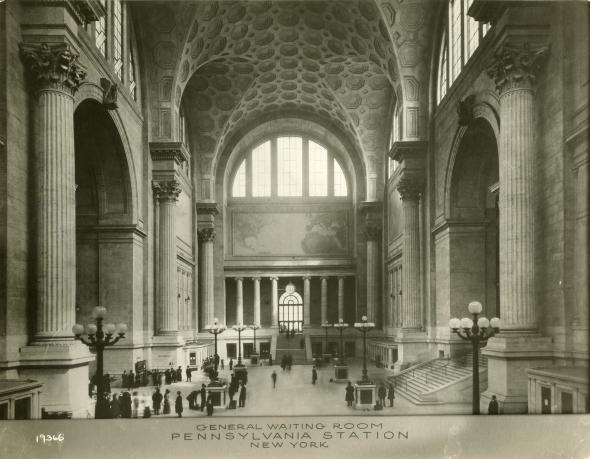
The breathtaking waiting room, with a ceiling that rivaled the greatest buildings of ancient Rome. Even if you were late for your train, how could you not stop for a second to marvel at it?
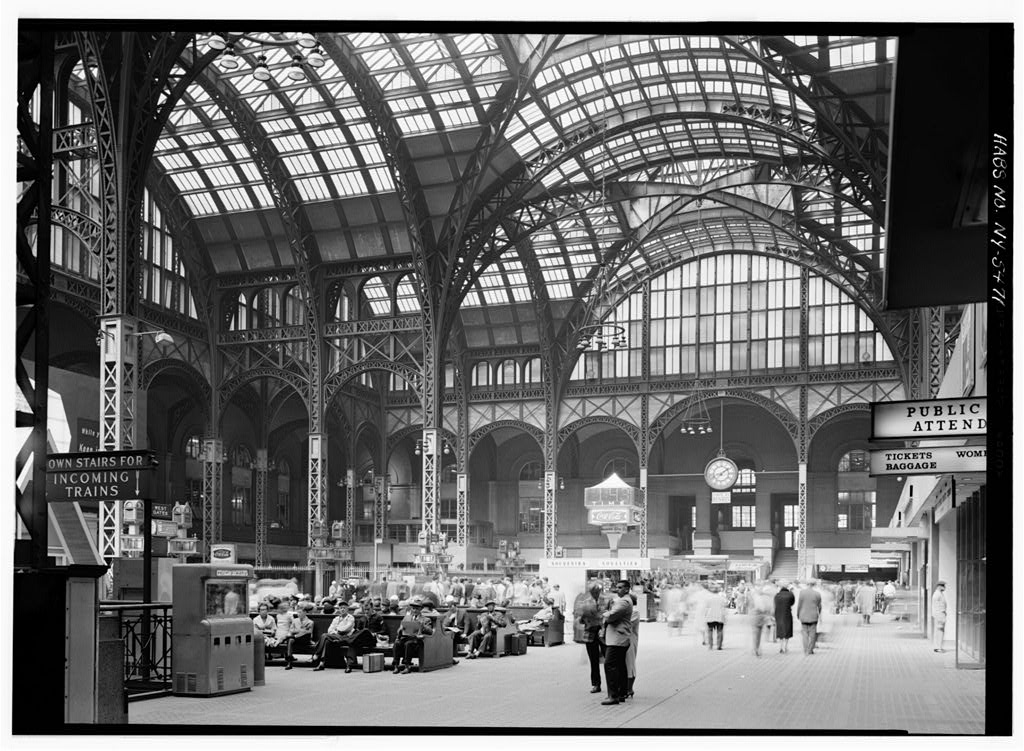
Charles McKim’s glass ceilings gave Penn its unique appeal, rays of light greeting customers who have just spent part of their commute underground.
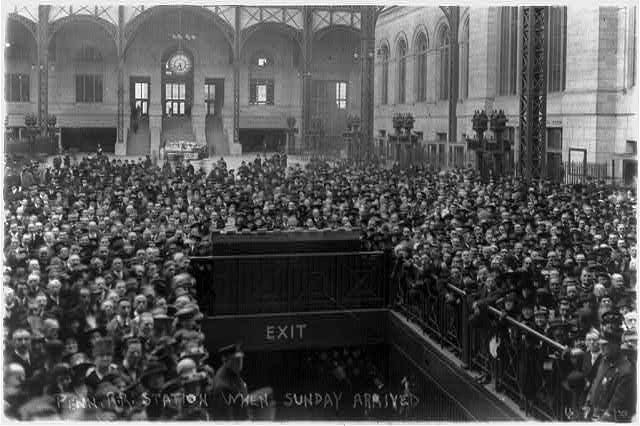
A crush of people along the concourse in 1917. They’re actually not commuters though; they’re fans of appropriately named evangelist Billy Sunday, waiting for his train to arrive.
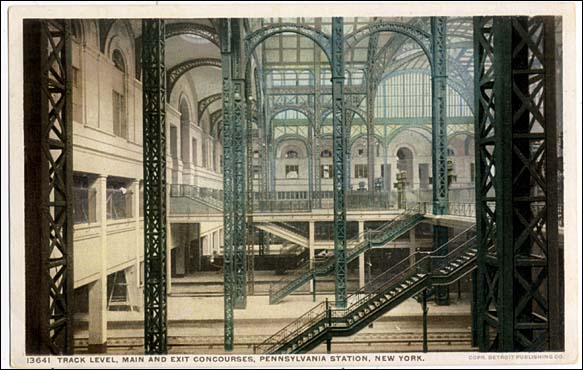
This postcard illustrates how especially sunken the tracks were, coming from deep tunnels from both the west and east sides. The building itself seems ethereal by comparison.
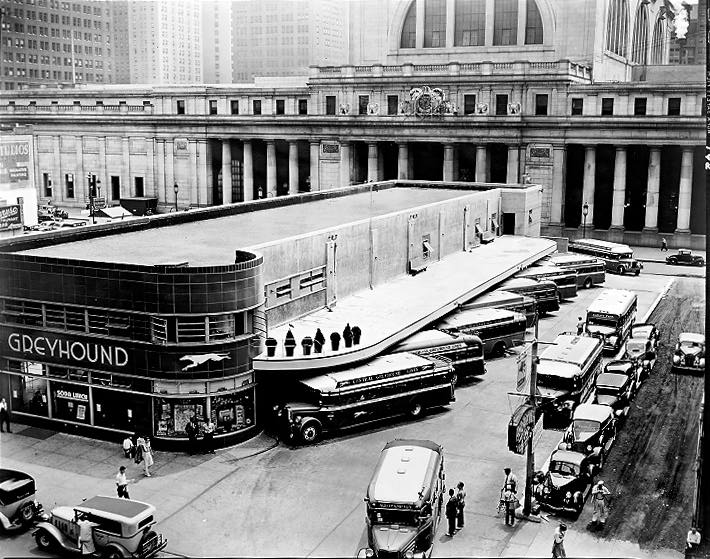
Across the street from Penn was this swanky Greyhound Bus Terminal, which opened in 1935 (Photographed by Berenice Abbott)
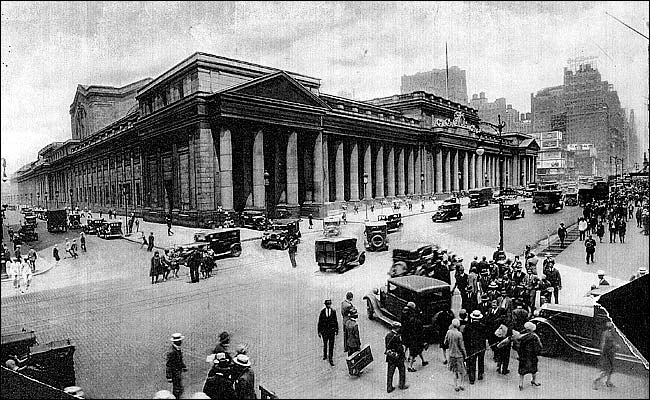
From this view, you get a sense of its massive size and effect on the neighborhood….
While, from street view, the building seemed to continue well into the horizon.
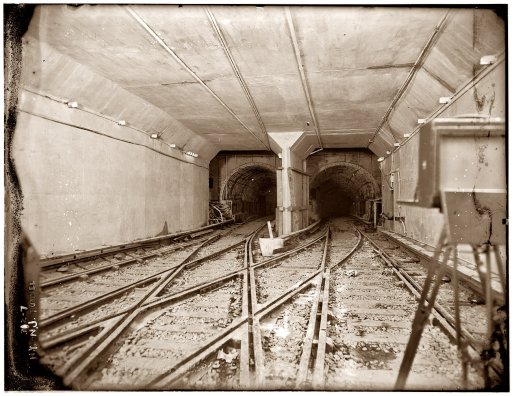
The Hudson River tunnels, a stunning engineering feat that required some truly exact measurements; digging started from both sides of the Hudson River and met in the middle.
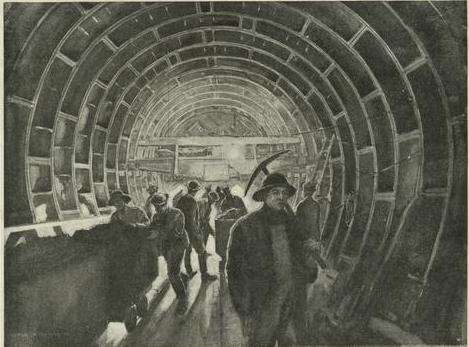
The ambiance inside a tunnel compressed-air chamber. ‘Sandhogs’ spent months boring under the Hudson and East rivers, with the constant fear of flooding, cave-ins and ‘the bends’.
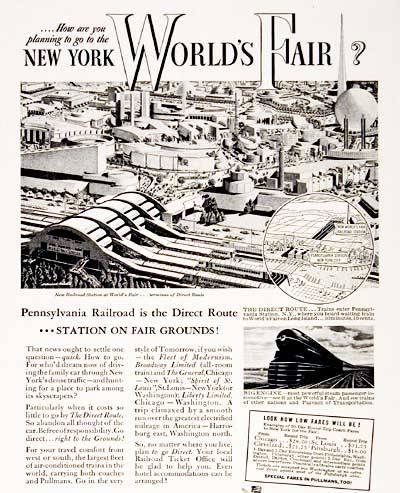
An ad for the World’s Fair of 1939-40 in Flushing Meadows, Queens — a short distance from Penn’s train yards.
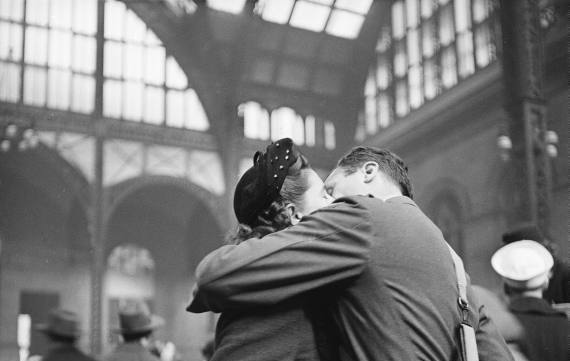
The scene of more than a few emotional departures and arrivals during World War II.
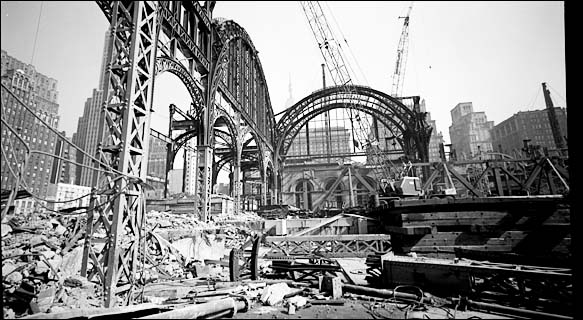
Penn is ungraciously torn down starting in October 1963. The sight stunned New Yorkers, many who thought nobody would ever go through with wrecking the monument. Its demise galvanized architects and preservationists; the sacrifice of Penn most likely helped save dozens of other buildings from a similar fate.
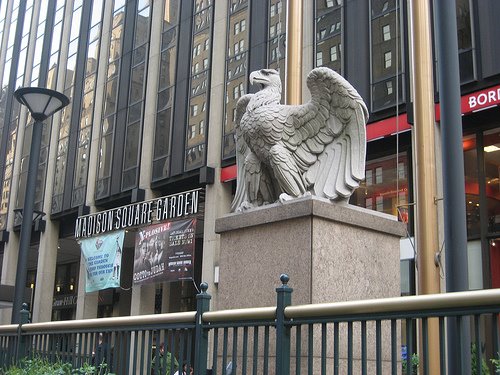
Eagles from the original Penn Station still grace the front of Madison Square Garden.
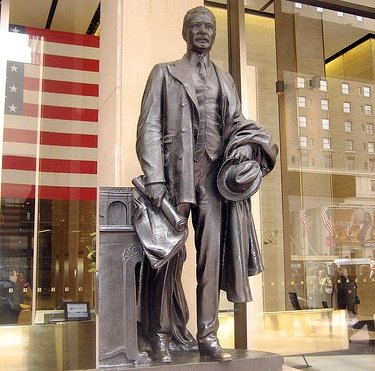
Nearby also stands a statue of Samuel Rea, president of Penn Railroad from 1913-1925
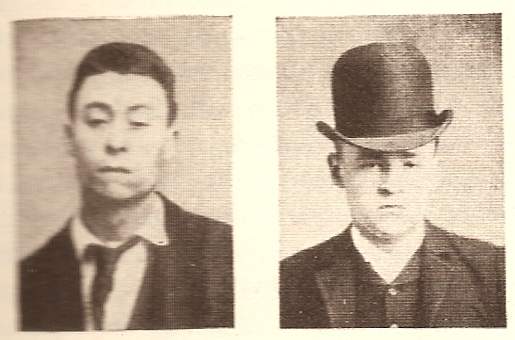
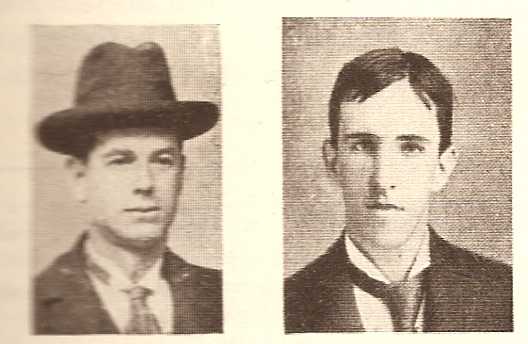
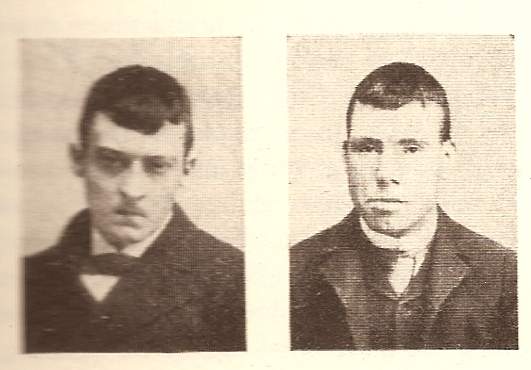
Faces of the Whyo Gang: Googy Corcoran, Clops Connolly, Big Josh Hines and Baboon Connolly
PODCAST: The Whyos (pronounced Why-Ohs)Â were New York’s most notorious gang after the Civil War, organizing their criminal activities and terrorizing law abiding citizens of the Gilded Age. Find out when they lived, how they broke the law and who they were — from Googie Corcoran to Dandy Johnny, as well as two particularly notable guys named Danny.
ALSO: How much does it cost to have somebody’s ear bitten off?